kimkat2709e A Welsh to English Dictionary in
scroll-down format. Geiriadur Cymraeg a Saesneg ar fformat sgrolio-i-lawr.
25-02-2022





|
|
|
Gwefan Cymru-Catalonia |
|

...
|
|
|
|
|
|
|
|
|
|
|
|
|
|
|
|
|
|
|
|
|
|
|
|
|
|
|
|
|
|
|
|
|
|
|
|
|
|
|
|
|
|
|
|
|


..1 ar <AR> [ar] (preposition)
1 on
Note – in place names denoting a bridge over a river:
Pont ar Frân (bridge in Llanymddyfri / Llandovery) (over the river Brân)
Pont ar Daf (bridge at Storey Arms, Sir Frycheiniog) (over the river Taf)
Pontardawe name of a town, from a bridge name Pont ar Dawe (over the river
Tawe)
Pontargothi, village name, from a bridge name Pont ar Gothi (over the river
Cothi)
Pontarfynach, village name, from a bridge name Pont ar Fynach (over the river
Mynach)
2 (emotion) bod hwyl ddrwg ar
be in a nasty mood (“be a bad emotion on”)
3 (view) mynd i gael golwg ar
y dre go and have a look round town
4 (ache, pain, illness) Mae
annwyd arna i <mai A-nuid ar-nai> [maɪ ˡanʊɪd ˡarnaɪ] I’ve got a cold
5 (South Wales) Mae
pen da arno fe He’s clever (“there’s a head on him”)
6 (debts) In expressions
meaning ‘to owe’
Does arnoch chi ddim i mi You
don’t owe me anything, you don’t owe me a thing (“There is nothing on you to
me”)
Mae arnaf fi lawer o arian iddo I owe him a lot of money
Mae arna i ichi am y bwyd I owe you
for the food, I should pay you for the food
Does arna i’r un geiniog iddo I don’t owe him a penny
7 defect
(Ceredigion) celc ar = something
wrong with (but not apparent)
Mae rhyw hen gelc arno He’s a bit odd,
there’s something not quite right about him (“there is some old defect on him”)
Mae rhyw goll arno He’s a bit odd,
He’s not all there, There’s something not quite right about him (“there is some
sort of loss / defect on him”)
8 laziness
Mae tipyn o ddiogi arno pan fo ishe gweithio’n galed
He’s a bit lazy (“there’s a bit of laziness on him) when hard
work is needed
9 (taste) Mae blas rhyfedd ar y te ’ma This tea tastes strange,
This tea has a funny taste
10 (smell)
(South Wales) gwynt smell (= unpleasant
smell)
gwynt drwg olor desagradable
Mae gwynt drwg ar ei anadl He’s got
bad breath, his breath smells (“there’s a bad smell on his breath”)
gwynt cas nasty smell, bad smell
Mae gwynt cas ar ei anadl (“there’s
a nasty smell on his breath”)
11 after verbs or verb phrases:
amneidio ar rywun i wneud rhywbeth
signal to somebody (with a nod of the head) to do something (“to nod on
somebody to do something”)
arbed ar save on = consume a
smaller amount of
arbed ar fwyd save on food
arthio ar (rywun) bark at (someone);
go on at (somebody) (see also below: verbs
of warning, reprimanding, nagging)
bod gormod o floneg ar be too
flabby (“be too-much of fat on”)
brygowthan ar (rywun) go on at (somebody) (see also below: verbs of warning, reprimanding, nagging)
bwrw amheuaeth ar (rywbeth) cast
doubts on something, throw something into doubt
cael hen ddigon ar have just
about enough of
(“get more than enough on”) (cael = get) + (hen = old; ‘more
than’) + soft mutation + (digon = enough) + (ar = on)
cega ar (rywun) go on at (somebody)
(see also below: verbs of warning,
reprimanding, nagging)
codi ar (rywbeth) (auction) bid for
something
codi ar (rywun) am (rywbeth) charge
somebody for
codi arian ar to mortgage
(something) (“raise money on”)
codi (rhywbeth) ar (rywun) charge
somebody for something
colli golwg ar (rywbeth) lose sight
of (something)
colli golwg ar (rywun) lose sight of
(somebody); lose touch with somebody
dal eich golygon ar stare at (“hold
your sights on”)
dwyn cyrch ar make a sortie
against (“carry a raid on”)
dwyn dial (ar rywun) (am rywbeth) take revenge (on somebody) (for something), revenge oneself (on somebody) (for something)
gwaeddu ar (rywun) shout at
(somebody) (see also below: verbs of
warning, reprimanding, nagging)
gwneud arwydd ar rywun i wneud rhywbeth
signal to somebody (with a gesture of the hand) to do something (“make a sign
on somebody to do something”)
gwneud rhuthrad ar storm (a
building), take (a building) by a violent assault (“make an incursion on”)
hewian ar (rywun) go on at
(somebody) (see also below: verbs of
warning, reprimanding, nagging)
rhefru ar (rywun) go on at
(somebody) (see also below: verbs of
warning, reprimanding, nagging)
rhoi gormod o bwyslais ar (rywbeth) attach too much importance to (something)
rhoi prawf ar allu rhywun put
somebody through his paces (“put a test on (the) ability (of) someone”)
taflu amheuon ar cast doubts on
something, throw something into doubt
taro’ch troed ar (rywbeth) stumble
over, trip over (something) (“hit your foot on”)
12
ar ryddhâd on leave (“on
liberation”)
13 (need) Faint sydd ei angen
arnoch? How much do you need? (“(it-is) how-much its necessity onyou”)
14 gyda golwg ar with
reference to, as regards
15 (change)
Sdim newid arno He’s set in his ways
(“there’s no changing on him”)
16 there isn’t..., it isn’t possible to...
Does dim plesio arno He just can’t
be pleased, There’s no pleasing him (he’s dissatisfied whatever you do for him,
he’ll complain mo matter what you fo for him) (“there’s no pleasing on him”)
17 gwir angen real
necessity
Mae arnaf fi ei wir angen I really
need it (“there-is on me its true need”)
Byddwn yn gwario arian ar bethau nad oedd eu gwir angen arnaf
I used to spend money on things I didn’t
really need (“I spent money on things that-not there-was their true need
on-me”)
18 Does yma fawr o lun arni We’re not making a very good job of it, We’ve not managed to make a very good job of it (“there-is-not here much of (a)
picture on-her”)
19 Mae’n dda arno fe He’s
doing well for himself (“it’s good on him”)
20 ar
lawer cyfrif in many respects
ar sawl cyfrif in many respects
21 on the point of
Mae’r llygod yn gadael llong ar suddo Rats desert a sinking ship
22 ar
dennyn on a leash
23 heb ddefnydd arno disused
lorri heb ddefnydd arni disused
lorry
24 pall ar stopping + on
Does dim pall arno He never stops
(“there’s no stopping on him”)
25 ar yr union eiliad at
that precise moment, at that very moment
26 troi’ch trwyn ar turn up
your nose at (“turn your nose on”)
27 AR, GOLWG
barnu (rhywun) ar ei olwg judge
(somebody) by his appearance (“judge (somebody) on his appearance”)
barnu (rhywun) ar yr olwg allanol
judge (somebody) by his appearance (“judge (somebody) on the external
appearance”)
ar ei golwg hi gellwch weld you can tell by the way she looks, from
the look of her, from her look
28 does dim terfyn ar
(rywbeth) (Something) knows no bounds, is limitless
does dim terfyn ar ei haelioni His
generosity knows no bounds
29 ar gais at the request
of
ar gais taer rhywun at the urgent
request of
30 verbs of warning, reprimanding,
nagging, crying to, shouting to
gwaeddu ar (rywun) shout at (somebody)
galw ar (rywun) call to (somebody)
brygowthan ar (rywun) go on at
(somebody)
hewian ar (rywun) go on at
(somebody)
rhefru ar (rywun) go on at
(somebody)
cega ar (rywun) go on at (somebody)
arthio ar (rywun) bark at (someone);
go on at (somebody)
y bugail yn chwibanu ar ei gi the shepherd whistling to his dog
31
debt
Mae arno ddyledion i bawb He owes
everybody money (“there is on him debts to everybody”)
32 siâp (= form, shape)
Pa fath o siâp sy arno? How is he,
What shape is he in (“what kind of shape is on him”)
33 on a subject mynegi barn
ar (rywbeth) voice an opinion about (something)
traethu barn ar (rywbeth) voice an
opinion about (something)
datgan barn ar (rywbeth) voice an
opinion about (something)
34 EXTENT
ni + fawr ar not much
Ni hoffais fawr ar y swydd honno I didn’t much like that job
Colloquially NI
+ fawr ddim ar
Dw i’n deall fawr ddim ar y pwnc hwnnw I don’t understand that subject
much
ni + dim ond ychydig ar only a
little, just a little bit
Colloquially NI
+ dim ond ychydig ar only a little, just
a little bit
Dw’n deall dim ond ychydig ar y pwnc hwnnw I understand that subject
just a bit
35 gwneud diwedd arnoch eich hun put
an end to one's life, commit suicide kill oneself
“make (an) end on yourself”) (gwneud
= do, make) + (diwedd = end) + (arnoch = on you) + (eich hun of yourself)
36 bod arnoch gywilydd o be
ashamed of / about, feel ashamed of / about
(less idiomatic) bod gennych gywilydd o be ashamed of / about, feel
ashamed of / about
37 codi cywilydd ar make
(somebody) feel ashamed (“raise shame on”)
38 dwyn cywilydd ar make
(somebody) feel ashamed (“bring shame on”)
39 gwneud cywilydd ar (rywun)
CLASSICAL WELSH shame (someone)
40 gyrru cywilydd ar (rywun) shame (someone)
41 rhoi’r gyfraith ar (rywun) take
(someone) to court, prosecute (someone)
43
on the occasion of
ar ei priodas on his marriage
Symudodd i Lan-non ar ei priodas he
moved to Llan-non on his marriage
44
on the occasion of = when there is
..a/ ar daranau
“on [the occaion of] claps of thunder”
fel gafr ar daranau (adverb) agitatedly
(“like (a) goat on thunderclaps” = like a goat when there’s thunder about)
(fel = like) + (gafr = goat) + (ar = on;
on the occasion of) + soft mutation + (taranau
= claps of thunder, < taran =
clap of thunder, thunderclap)
..b/ ar dân
“on [the occaion of] fire”
fel cath ar dân (adverb) like
streaked lightning
(“like (a) cat on fire” = like a cat escaping from a fire)
(fel = like) + (cath = cat) + (ar = on;
on the occasion of) + soft mutation + (tân
= fire)
ar dywydd gwael in bad weather
ar dywydd drwg in bad weather
ar dywydd oer in cold weather
ar dywydd mawr in stormy weather
ar dywydd garw in stormy weather
ar dywydd drycinog in stormy weather
ar dywydd gwlyb in wet weather
ar dywydd braf in fine weather
ar dywydd teg in fine weather
ar dywydd sych in dry weather
ar dywydd heulog in sunny weather
ar dywydd poeth in hot weather
ar dywydd mwyn in mild weather
ar dywydd ffafriol in favourable weather
ar dywydd pur galed in very bad weather
ar dywydd glawog in rainy weather
45
ei fryd yn rhedeg ar be inclined
towards
Ond ar y weinidogaeth y rhedodd ei fryd
yn bennaf but he was mostly inclined towards the ministry, he had his heart
set on being a minister of religion
46
marw yn gynnar ar ei fywyd die
young, die early in life
47 indicating a point in time
ar brynháwn y trydydd dydd on the
afternoon of the third day
ar fore y pedwerydd dydd on the
morning of the fourth day
47 with the root form of certain verbs
..1/ ar agor open
(ar = on) + (agor- stem of
verb agor = to open [something], to
open [by itself])
..2/ ar dorr cut, having been cut into
(ar = on) + soft mutation + (tor-
stem of verb torri = to cut, to
break, to get broken)
cosyn ar dor a cheese which one has
started to cut up
..3/ ar gau closed
Strictly speaking it would be spelt ar gae (same pronunciation). Perhaps
it is not used because it also suggests ‘on a field’, whereas the spelling cau
is unambiguously ‘closing; closed’
(ar = on) + soft mutation + (cae-
stem of verb cau = to close, to be
closed)
NOTE: cau cannot be the spelling of the root form, strictly speaking,
because it is “cae-u”, where the –u represents the verbnoun ending. The
root or stem of the verb is obtained by removing any verbnoun suffix.
..4/ ar glo locked
(ar = on) + soft mutation + (clo-
= stem of verb cloi = to lock, to
get locked)
..5/ ar goll lost
(ar = on) + soft mutation + (coll-
= stem of verb colli = to lose, to
get lost)
..6/ ar grwydr wandering
(ar = on) + soft mutation + (crwydr-
= stem of verb crwydro = to wander)
..7/ ar wasgar dispersed, scattered
(ar = on) + soft mutation + (gwasgar-
stem of verb gwasgaru = to scatter,
disperse)
..8/ ar wrych 1
(person) in a bad mood 2 (hair) dishevelled
(ar = on) + soft mutation + (gwrych stem of the verb gwrychu (=
to bristle), used as a past particple)
48 (place names) in river-name tags, similar to English on, upon (Stratford
on Avon, Stratford upon Avon; Newcastle on Tyne, Newcastle upon Tyne)
..a/ ar Ogwr
Pen-y-bont ar Ogwr “(the) Pen-y-bont (which is) on (the river) Ogwr /
Ogmore”
pen y bont = (place) at the bridge head, at the entrance to the bridge
..b/ ar Wy
Clas ar Wy “(the place called) Clas (which is) on (the river) Gwy / Wye”
clas is from Latin [monastica] classis” (= monastic community)
Y Bontnewydd ar Wy “(the place called) Y Bontnewydd (which is) on (the
river) Gwy / Wye”
y bontnewydd (= the new bridge)
..c/ ar Wysg
Casnewydd ar Wysg “(the) Casnewydd (which is) on (the river) Wysg / Usk”
cas newydd is from castell newydd (= new castle)
and various bridge names, where Pont has no preceding definite article, as if
the qualifying phrase with ar is a proper name as in
Pontrobert (“Robert’s bridge”), Pontwilym (“Gwilym’s bridge”).
The short form of the name though is generally ‘Y Bont’ (“the bridge”)
Pontardawe (= pont ar Dawe) the bridge on the river Tawe
Pont ar Daf SN9819 name of a bridge now submerged under the waters of
Llwyn-on
reservoir, above Cefn-coed y Cymer.
More examples at the entry pont
49 with an element meaning hill in house
names
ALLT:
Arallt <AAR-alht> [ˡɑˑraɬt]
1 house name Y Sarn, Pwllheli (Gwynedd); south-east of Meyllteyrn
(Gwynedd); Amlwch (Ynys Môn) “hillside”
(ar = on) + (allt = hill)
BRON:
Arfron <AR-vrON> [ˡarvrɔn] “hillside”
(ar = on) + soft mutation + (bron = (round) hill, woman’s breast)
BRYN:
Arfryn <AR-vrin [ˡarvrɪn] “hillside”
(ar = on) + soft mutation + (bryn = hill)
CRAIG:
Argraig <AR-graig> [ˡargraɪg] house name; in Aber-soch (Gwynedd); house name in
Pwllheli (Gwynedd); “on (the) crag / rocky ridge” (ar = on) + soft
mutation + (craig = crag)
MOEL:
Arfoel <AR-voil> [ˡarvɔɪl] “hillside” house name in Diserth /
Dyserth (county of Dinbych / Denbigh) (ar = on) + soft mutation + (moel
= (bare) hill)
TWYN:
Ardwyn <AR-duIN> [ˡardʊɪn] “hillside” street
name in Porthtywyn / Burry Port (county of Caerfyrddin / Carmarthen) (ar =
on) + soft mutation + (twyn = mound, hill)
40 bod ar drugaredd rhywun be at somebody’s
mercy
SEE:
ar agor (qv) open
ar agor (qv) open
ar air neu ar weithred (qv)in word
or deed, by word or by deed
ar antur (qv) at random, randomly
ar amserau at times
ar ben (qv) on top of; over,
finished, at an end
ar bwys (qv) near
ar dân (qv) 1 on fire 2 on the
breakout of a fire, at the time of a fire (fel
cath ar dân (“like (a) cat on [the occasion of] fire” = like a cat escaping
from a fire, like streaked lightning)
(fel = like) + (cath = cat) + (ar = on;
on the occasion of) + soft mutation + (tân
= fire)
ar drugaredd (rhywun) (qv) at
the mercy of. (someone)
ar ddelw (qv) in the image of
ar ddu a gwyn (qv) in black
and white
ar ddwy (qv) (= ar ddwywaith) at the second attempt (“on two (times)”)
ar dennyn (qv) on a leash
ar dorr (qv) cut, having been cut into
ar draws (qv) across
ar ei ben (qv) directly; see ar eich
pen
ar eich baw (qv) (“on your dirt /
shit”) gadael (rhywun) ar ei faw to
leave (somebody) in the lurch, leave somebody to sort out his own problems,
leave somebody to get out of the predicament he has got himself into (“leave
somebody on his shit”)
ar eich cythlwng (qv) hungry,
starving
ar eich deudroed (qv) on foot
ar eich drwg (qv) up to no good
ar eich eistedd seated, sitting down
ar eich elw to one’s name, in one’s
possession
ar eich ffordd (qv) on one’s way
ar eich golwg chi (qv) from the look
of you, from your look
ar eich gorwedd lying down
ar eich gwaethaf (qv) in spite of
yourself
ar eich hyd (qv) “on your length”,
in every part of your body, from your head to your feet
ar eich llawn dwf (qv) fully grown
(“on your full growth”)
ar eich pen (qv) outright
ar eich pen eich hun (qv) on your own
ar eich tyfiant (qv) growing
ar ffo (qv) fleeing
ar fin (qv) on the point of; on the
edge of; (penis) erect
ar fin y bedd (qv) between life and death, on the
point of death, with one foot in the grave, at death’s door
ar flaen (qv) at the head of, at the
front of, leading
ar frys (qv) in a hurry
Ar fy llw! (qv) I swear (it’s true,
etc) (“on my oath”)
Ar fy ngwir! (qv) I swear (it’s
true, etc) (“on my truth”)
ar gais (qv) at the request of
ar gais (qv) at the request of
ar gam (qv) unjustly
ar gamamser (qv) ‹a at the wrong
time; at an inopportune moment
ar gân (qv) in verse, as a poem;
rough song, singing
ar gau (qv) closed
ar gennad (qv) (USA: on furlough)
(Englandic: on leave)
ar glawr (qv) in existence, existing
ar glo (qv) locked
ar goll (qv) lost
ar goll (qv) lost
ar golled (qv) at a loss
ar gost (qv) at the expense of, at the cost of
ar groesffordd (qv) at a
crossroads (= at a crucial point where a decision must be made)
ar grwydr (qv) wandering
ar gyrn a phibau (qv) (“on horns and
pipes”)
ar gyfartaledd (qv) on average
ar gyfer (qv) for = in preparation for
ar gynydd (qv) on the increase =
gaining size
ar hast wyllt (qv) in a mad hurry
ar her (qv) for a dare
ar herw (qv) outlawed, on the run
ar hyd (qv) ‹along
ar hyd ac ar draws (qv) in all
directions, any old how, at random
ar hyd ac ar led (qv) all
over, everywhere
ar hyd y flwyddyn (qv) during the
year
ar hyn o bryd (qv) at the present
time
ar lafar gwlad (qv) in spoken Welsh
ar lawer cyfrif (qv) in many
respects
ar led (qv) extended
ar letraws (qv) diagonally
ar lun a delw (qv) in the image
of (“in the shape and image of”)
ar lw (qv) oath, sworn
ar ddeudro (qv) the second time, with the second try (“on two turns”)
ar ddrwg (qv) up to no good
ar ddwywaith (qv) at the second
attempt
ar ddydd Gwener (qv) on a Friday, on
Fridays; = every Friday
ar derfyn dydd (qv) at close of day,
at the end of the day
ar draul (qv) at the expense of, at the cost of
ar droed (qv) (rumour, piece
of news) circulating, going round
ar fechnïaeth (qv) on bail
ar ôl (qv) after
ar oleddf (qv) slanting, sloping
ar raddfa fechan (qv) a small scale,
in miniature
ar ran (qv) on behalf of
ar ryddhâd (qv) on leave (“on
liberation”)
ar sail (qv) on the basis of
ar sawl cyfrif (qv) in many respects
ar un ochr i (qv) on one side of
ar un wedd (qv) in one way. in one
sense, from one aspect
ar unwaith (qv) at once, instantly,
immediately (American: also: in short order);
ar waelod (qv) at the bottom of; at
the end of
ar wahân i (qv) ‹apart from
ar wasgar (qv) dispersed, scattered
ar werth (qv) on sale
ar wrych (qv) dishevelled; surly
ar y blaen (qv) ahead, at the front
ar y clwt (qv) destitute
ar y cyntaf (qv) at the beginning
ar y daith (qv) en route, in
transit, on the journey
ar y diawl (qv) ‘very’ (literally:
“on the devil”)
ar y dydd a’r dydd (qv) on such and
such a day, on a certain day, some day in the week
ar y gweill (qv) being prepared, in
preparation
ar y Sadwrn a’r Sul (qv) on
Saturdays and Sundays
ar yr ochr faes i (qv) ‹on the
outside of
ar yr union eiliad (qv) at that
precise moment, at that very moment
NOTE:
(1) The prepostion ar in modern
Welsh comes from two distinct prepositions –
firstly, ar (= in front of)
and secondly, gwar (= on). This
latter is related to English over,
Latin super, Greek hiper.
(2) Most senses of modern Welsh ar
derive from gwar (= on, over) rather
than ar (= in front of)
(3) In Welsh, in common with other prepositions, gwar became
soft-mutated initially
gwar > ghwar
(4) Initial gh in Welsh has disappeared in every case. Hence ghwar
> war
(5) Later war (= on) became ar, through confusion with ar (= in front of).
The form war (= on) is stll the regular form in Cornish and in Breton
:_______________________________.
..(1) ar- <AR> [ɑr] prefix
1 (obsolete) in front of, facing, adjoining. Followed by soft
mutation.
Occurs as a prefix in a number of words:
(1) araul (= sunny, pleasant); (ar) + (haul = sun)
(2) arddwrn (= wrist), (ar) + soft mutation + dwrn (= fist)
“(that which is) adjoining the hand / fist”
(3) Arfon (“(territory) facing (the
island of) Môn”)
(4) arfor (= coast; adjective =
coastal), (ar) + soft mutation + (môr = sea)
(In Brittany, the coast is known as Arvor)
(5) argoed (= wood; edge of a wood),
(ar) + soft mutation + (coed = wood)
(In Brittany, the inland area as Argoad)
(6) Arllechwedd kantrev of the
territory of Gwynedd Uwch Conwy
(ar) + soft mutation + (llechwedd = mountain slope) > *Arlechwedd > Arllechwedd
(7) *Arnemeton place facing the
sacred grove > name of a goddess Arnemetia
“of Arnemeton”, found in the name of the Roman settlement Aquae Arnemetiae (“waters (of) Arnemetia”), Buxton in Derbyshire,
England.
(The place name in modern Welsh would be *Ernyfed,
though there is no place with such a name in modern times)
ETYMOLOGY: British are-, as a prefix
in many compounds.
:______
..(2) ar- <AR> [ɑr] prefix
1 on.
Followed by soft mutation.
Examples from house names
(probably nineteenth-century coinings):
Arfryn (bryn = hill), “on
the hill”
Ardwyn (twyn = hill), “on the hill”
Arfoel (moel = round hill), “on the hill”
_________________________.
âr <AAR> [aːr] masculine noun
1 tilth, ploughed land
tir âr ploughland
2 cyfar joint ploughing,
co-tillage
(cyf- prefix = co-, together) + (âr = tillage)
cyfardir (obsolete) joint ploughland
3 talar headland in a
field, cross ridge at the end of a ploughed field; edge of a field where the
plough turns, and which is ploughed in turn when the whole field has been
ploughed (Scotland: headrig = headland in ploughed field)
(tâl = top, furthest part, highest
part) + (âr = ploughed land)
In the other British languages: Cornish talar
(= headland in a field), Breton talar
(= headland in a field)
ETYMOLOGY: The element ar appears in
the Welsh words aredig (= to
plough), and aradr (= plough, <
Celtic aratron)
Cf. Irish (literary word) ár (=
ploughed land)
Cf. Latin arâtrum (= plough), arâre (= to plough)
A false etymology where this element is wrongly supposed is seen here:
Hanes Tredegar o Ddechreuad y Gwaith Haiarn hyd yr Amser Presennol. David
Morris (Eiddil Gwent, B.B.D.) Tredegar. 1868. Tudalennau 10-11
Rhoddir llawer iawn o ystyrion i’r gair Tredegar. Y mysg eraill geilw rhai ef
Tri-deg-erw, a mynant, er bodd ac anfodd, mai dyna yw’r iawn ystyr o'r enw. Ond
pan ystyriom mai yr hên air Gymraeg am Ddaear neu Daear, yw Ar, ac os digymalwn
y gair Tredegar — fel hyn, Tre Deg Ar, gwelwn yn amlwg mai iawn ystyr yr enw yw
Tre-daear-deg. Mae llawer iawn o balasai yr hên foneddigion Cymreig, y'Nghymru,
yn myned dan yr enw Tre — fel Trenewydd, palas yr anrhydeddus Arglwydd Dinevor
- hefyd Tregoib, palas ardderchog Mr. Hughes, ger Llandeilo Fawr, - a llawer o
balasau ereill yr hên foneddigion a allesid eu henwi.
A great amount of meanings are given to the word Tredegar. Among those some
calls it ‘Tri-deg-erw’ (Note: three-fair-acres, though the soft mutation would
be wrong; a spirant mutation is required: tri-theg-erw. If tre were maintained,
the soft mutation is correct – tre-deg-erw, the ‘trêv / farm of the fair acre;
though both forms would be unusual combinations for a place name ) the other
fair-Tri-acre, and they please, for love and reluctantly, that is the very
meaning of the name. But when we consider that Ar is the old Welsh word for
Earth or Earth, and if we take apart the word Tredegar – like this – Tre Deg Ar
(trêv + fair + ar) we see clearly that the proper meaning of the name is
Tre-daear-deg (= trêv of the fair earth). A great many mansions of the old
Welsh gentry in Wales have the name Tre – such as Trenewydd (new trêv). the
mansion of the honourable Mr. Lord Dinevor (= Dinefwr), also Tregoib, the
excellent mansion of Mr Hughes, near Llandeilo Fawr, - and many other mansions
of the old gentry that could be mentioned (‘named’).
Note: Tredegar is in fact from Tredeger < Tredegyr, ‘the trêv of Tegyr’
:_______________________________.
a’r ‹ar ›
1 preposition + definite article
and the
y ci a’r gath the dog and the cat
2 used in phrases of specifying whilst being unable to state an
exact time / name
y diwrnod a’r diwrnod such and such
a day
3 gadael eich ôl ar (rywbeth)
leave your mark on something
4 bod cryn le i wella ar
(rywbeth) leave a lot to be desired (“to be a considerable place to improve
on something”)
5 Ble roedden ni arni?
(in resuming a discussion, conversation) Now where were we? (“where were we on
it”)
:_______________________________.
â’r
1 with the
2 as the
bod mor
fwynaidd â’r oen be as gentle as a lamb
bod mor
sefydlog â’r graig be as steady as a rock
:_______________________________.
ARABIC
Arabic words in Welsh
aiatola
ayatollah = Shiite leader, member of the religious hierarchy who has
an expert knowledge of Islamic law
ETYMOLOGY: Persian < Arabic (= sign of Allah / God) (âyat = sign) + (Allah = God)
saffari
1 safari = hunting expedition
ETYMOLOGY: < English safari <
Swahili safari (= journey) <
Arabic safariiya < safara (= to travel)
:_______________________________.
Arab.
1 abbreviation (in a
dictionary entry) = Arabeg Arabic
:_______________________________.
Arabeg <a-RAA-beg> [aˡrɑˑbɛg] feminine noun
1 Arabic
Abbreviation: (in a dictionary entry) Arab.
:_______________________________.
aradr (arad’),
PLURAL: erydr (eryd’) <AA-radr, AA-rad; EE-ridr, EE-rid> [ˡɑˑradr,
ˡɑˑrad, ˡeˑrɪdr,
ˡeˑrɪd] masculine noun
1 plough
:_______________________________.
aradr eira <AA-radr / AA-rad EI-ra> [ˡɑˑradr / ˡɑˑrad ˡəɪra] (masculine or feminine noun)
1 snowplough
:_______________________________.
aradwr <a-RAA-dur> [aˡrɑˑdʊr] masculine
noun
PLURAL aradwyr <a-RAD-wir> [aˡradwɪr]
1 ploughman
ETYMOLOGY: (aradr = plough) + (-wr = agent suffix)
:_______________________________.
araf <AA-rav, AA-ra> [ˡɑˑrav, ˡɑˑra] adjective
1 slow = taking a long time
to move, to go
streic araf go-slow (“slow strike”)
2 Ara’ deg piau hi
Don’t get het up! Keep calm! (“very slow has
it”)
:_______________________________.
Arafa Don ‹a-RAA-va DON›
[aˡrɑˑva
ˡdɔn]
1 Name of a hymn composed by R. S. Hughes, who was the choirmaster of
Bethesda Chapel (Congregationalists) in Bethesda (Gwynedd). He died at the
early age of 38 in 1893.
2 Name of a building in Bethesda
The town of Bethesda, at a place
known originally as Glanogwan, took its new name from a Congregational
chapel in Y Stryd Fawr (High Street) built in 1823. It was replaced by a
building with a somewhat over-ornate front in 1840. This chapel has now been
converted into flats, and is now known as Arafa Don, from R. S. Hughes’
well-known hymn.
(Information from the caption to
this photo by Eric Jones http://www.geograph.org.uk/photo/432313
)
ETYMOLOGY: The title is generally translated into English as “abate ye
waves” (with ye, the archaic plural form of you in English, which
placed before a noun was used to express a plural imperative)
Literally the title is “abate!, sea!”
(arafa = abate! second person singular imperative of arafu =
slow down; ease, ease off; abate) + (don
= sea!, < ton = wave; sea)
arafa is (araf- stem of the verb arafu) + (-a
second person singular imperative ending)
The vocative form of a noun is indicated if it begins with a soft-mutable
consonant (c p t / g b d / m ll rh) by the soft mutation. Thus don, which
is from ton (= wave; sea)
:_______________________________.
arafol <ar-AA-vol> [arˡɑˑvɔl] adjective
1 dilatory, delaying, working slowly, deliberately being slow
tacteg arafol delaying tactic
Also: ystryw oedi
ETYMOLOGY: (araf = slow) + (-ol suffix for forming adjectives)
:_______________________________.
arafu <a-RAA-vi> [aˡrɑˑvɪ] verb
Clipped form: ’rafu
(transitive verb)
1 to slow (something) down = to make
(something) go slower
(intransitive verb)
2 to slow down = go slower
Barnwyr 5:28 Mam Sisera a edrychodd trwy ffenestr, ac a waeddodd trwy'r
dellt, Paham yr oeda ei gerbyd ddyfod? paham yr arafodd olwynion ei gerbydau?
Judges 5:28 The mother of Sisera looked out at a window, and cried through the
lattice, Why is his chariot so long in coming? why tarry the wheels of his
chariots?
3
to slow, to delay
tacteg arafu delaying tactic
4 (pain) ease off
Ydi’r boen yn arafu? Is the pain easing off?
5 (rain) ease off, slacken off
6 (heavy sea) abate
Arafa Don (qv) title of a hymn (free translation: “abate ye waves”) (qv)
7 (wind) abate, drop
arafodd y gwynt the wind dropped
:_______________________________.
ar agor <ar AA-gor> [ar ˡɑˑgɔr] (adverb)
1 open
ETYMOLOGY: (ar = on) + (agor-
stem of verb agor = to open
[something], to open [by itself])
:_______________________________.
ar air neu ar weithred <ar
AIR nei ar WEITH-red> [ar ˡaɪr nəɪ ar ˡwəɪθrɛd] adverb
1 in word or deed, by word or by deed
Colosiaid 3:17 A pha beth bynnag a
wneloch, ar air neu ar weithred, gwnewch bob peth yn enw'r Arglwydd Iesu, gan
ddiolch i Dduw a'r Tad trwyddo ef.
Colossians 3:17 And
whatsoever ye do in word or deed, do all in the name of the Lord Jesus, giving
thanks to God and the Father by him.
ETYMOLOGY: (ar = on) + soft mutation + (gair = word) + (neu =
or) + (ar = on) + soft mutation + (gweithred
= deed, action)
:_______________________________.
araith <A-raith, -reth> [ˡaraɪθ, -ɛθ] feminine
noun
PLURAL areithiau
<a-REITH-yai,
-ye> [aˡrəɪθjaɪ, -ɛ]
1 speech,
(USA: also spiel)
araith denau poor speech, threadbare
speech, insubstantial speech
araith gyntaf (parliament) maiden
speech
areithio be giving a speech; make a speech, deliver a speech
2 language
araith ddrwg bad language
ETYMOLOGY: Welsh < British < Celtic *arekt-
Cornish areth, Breton (Gwened) areih (= dispute)
Irish aireacht (= assembly)
NOTE: written colloquial form: areth
/ arath
:_______________________________.
arall <AA-ralh> [ˡɑˑraɬ] adjective
1 other
The plural form is eraill [EE-rilh]
2 y rhyw arall the opposite sex (“the
other sex”)
3 y tu
arall i on the other side of (“the other side to”)
y tu arall i'r afon on the other
side of the river
4 bod mewn cae arall (“be
in another field”) be missing the point, be parking up the wrong tree
:_______________________________.
Arallt <AAR-alht> [ˡɑˑraɬt]
1 house name
..a/ Y Sarn, Pwllheli (Gwynedd)
..b/ south-east of Meyllteyrn (Gwynedd)
..c/ Amlwch (Ynys Môn)
ETYMOLOGY: “hillside” (ar = on) + (allt = hill)
The name probably does
not occur in the south where “allt / gallt” has come to mean “a wood”.
Similar names: Arfryn
(bryn = hill), Ardwyn (twyn = hill), Arfoel (moel = round hill)
:_______________________________.
aran <AA-ran> [ˡɑˑran]
1 soft mutation of garan =
crane (bird)
yr aran = the crane
pig yr aran crane’s bill (flower)
:_______________________________.
ar antur <ar AN-tir> [ar ˡantɪr] adverb
1 at random, randomly
2 cynnig ar antur shot in the dark, wild guess (“attempt at
random”)
dyfaliad ar antur shot in the dark, wild guess (“guess at random”)
3 rhoi’ch bywyd ar antur put your life at risk
:_______________________________.
araul <AA-rail> [ˡɑˑraɪl] adjective
1 sunny
Dewch brydyddion... I ganu clod i Glyn
[sic] Sirhowy, Man tawel — arail yw;
(Can o Glod i Glyn [sic] Sirhowy). Hanes Tredegar, David Morris, (Eiddil
Gwent), 1868
Come poets... to sing the praise of the Syrhywi Valley, it is a quiet place,
sunny.. (arail = poor spelling for araul, formerly in use)
(Song of praise Syrhywi Valley). From Hanes Tredegar (the history of Tredegar),
by David Morris, (Eiddil Gwent), 1868
2 especially in place names in south-east Wales
Maesaraul (qv) sunny field
Gelliaraul (y gelli araul =
the sunny wood) farm in Llan-gan (county of Bro Morgannwg)
3 Y Cyfnod Araul the
Golden Age
ETYMOLOGY: araul < ár-haul (ar = before, in front of) + (haul
= sun)
NOTE: in the south-east the colloquial form is aril <AA-ril> [ˡɑˑrɪl]
In place names. often incorrectly spelt as ‘arael’.
Also, the south-eastern spoken form ‘aral’ (< arel < arael) is to
be found.
Pendeulwyn (Pendoylan) Parish Baptisms mention the birth of Henry Basset (26
Oct 1849) at Maesarael, Pendoylan to father Robert Basset (farmer) and
mother Ann
Merthyr Times, and Dowlais Times, and Aberdare Echo
25 Apr 1895
ABERDARE
TRADESMEN'S BALL: Mr. A. A. Davies, Lloyds Bank; Miss May Davies, Maesaral(,)
Cross Inn; Mr. W. S. Davies, 27, Canon-street...
There is a house named Brynaraul in Mydroilyn, Sir Gaerfyrddin, and also in Bryncoedifor,
Rhydymain, Dolgellau (= Brynaraul, ‘sunny
hill’)
Sometimes spelt as ‘arel’, a more westerly spoken form in Morgannwg / Glamorgan
1841 Census, Tai-bach
(surname, name, address, age, occupation)
JENKINS DAVID MAESAREL 15 COAL MINER
JENKINS ELIZABETH MAESAREL 50 -
JENKINS GWENLLIAN MAESAREL 17 -
JENKINS JOHN MAESAREL 14 COAL MINER
JENKINS RICHARD MAESAREL 22 ASSISTANT AGENT
JENKINS RICHARD MAESAREL 46 MINE & COAL
AGENT
JENKINS WILLIAM MAESAREL 22 STOCKTAKER
However, it is found in the street name Heol Gelliarel /
Gelliarel Road in Y Gilfach-goch.
:_______________________________.
arbed <AR-bed> [ˡarbɛd] verb
1 save = bring away
from danger or death
arbed rhàg angau save from death
2 arbed
ar save on = consume a
smaller amount of
arbed ar fwyd save on food
3 heb arbed unrhyw gost with no expense spared
4 arbed
i rywun wneud rhywbeth save somebody the trouble of doing something (“save
to somebody doing something”)
arbed i rywun y drafferth o wneud
rhywbeth save somebody the trouble of doing something (“save to somebody
the trouble of doing something”)
5 deddf arbed trafferth
the law of least effort (“(the) law (of) saving trouble”)
6 ni +
arbed dim (ar wrthwynebydd) not pull your punches (with an opponent)
(“not + save anything on an opponent”)
7 diarbed ceaseless,
relentless, unrelenting
llafurio yn ddiarbed dros (rywbeth)
work / toil relentlessly for (something)
rhyfel diarbed total war, all-out
war
(di-, negative prefix) + (arbed = to save)
:_______________________________.
ar ben <ar BEN> [ar ˡbɛn] preposition
1 on top of
Carreg ar ben carreg stone upon
stone
2 eistedd ar ben llidiart
sit on the fence, not commit oneself to one side or another in a dispute (“sit
on top of a gate”)
rhegi’r maer ar ben Alltwalis criticise
from a safe distance (“swear at the mayor on top of (the hill called)
Alltwalis”)
Alltwalis SN 4431 is a hamlet 12km
north of the town of Caerfyrddin (county of Caerfyrddin)
3 (with time)
Mae hi ar ben tri o’r gloch It’s
just turned three
(“it is on top of three o’ clock”)
4 at the end of
bod ar ben eich tennyn be at the end
of your tether
:_____________________________.
ar ben <ar BEN> [ar ˡbɛn] adv
1 over,
finished, at an end
Mae ’ngwaith i ar ben My work is finished
2 hi + bod ar ben ar (rywun) have had one's chips, be finished, be
all over (for somebody)
Mae hi ar ben arno fe, His number is
up, He's doomed, He’s done for; His days are numbered,
He's not got long to live
Mae hi ar ben arno i The game’s up
for me
ETYMOLOGY: (ar = on) + soft mutation
+ (pen = head)
:_______________________________.
arbennig <ar-BE-nig> [arˡbɛnɪg] adjective
1 special
:_______________________________.
arbrawf, PLURAL:
arbrofion <AR-brauv,
ar-BROV-yon> [ˡarbraʊv, arˡbrɔvjɔn] feminine
noun
1 test
:_______________________________.
ar bwys <ar BUIS> [ar ˡbʊɪs] (preposition)
1 near
:_______________________________.
arch, PLURAL: eirch <ARKH, EIRKH> [ˡarx,
ˡəɪrx] feminine noun
1 casket (Englandic: coffin)
arch brĕn a
wooden coffin
arch fambŵ
a bamboo coffin
arch bwmpiadwy inflatable arch
● Welsh < British < Latin arca (= chest, coffer)
:_______________________________.
arch <ARKH> [arx] verb
1 order...!; second person singular imperative form of erchi = to command, order
Sant Mathew 4: 3 Os mab Duw wyt, arch
i’r cerrig hyn fod yn fara
Saint Matthew 3: 4 If thou be the Son of God, command that these stones be
bread
:_______________________________.
arch- (prefix)
1 arch-, main, principal
archdderwydd archdruid, principal druid
archfarchnad supermarket
ETYMOLOGY:
Welsh arch < British *ark- < Latin *arc < arch
< Greek arkhi < arkhein (= to rule)
:_______________________________.
Arch.
1 abbreviation Archaeoleg Archaeology (as a field label in
a dictionary)
:_______________________________.
archadeiladydd
<arkh-a-dei-LAA-didh> [arxadəɪˡlɑˑdɪð] masculine noun
PLURAL archadeiladwyr <arkh-a-dei-LAD-wir> [arxadəɪˡladwɪr]
1 master builder = self-employed builder who employs assistants
(In the list of subscribers to a memorial volume with the poetry of the Rhymni
poet Twynog (published in 1912), one of the subscribers in Pontlotyn is Mr. William Davies, Archadeiladydd.)
ETYMOLOGY: (arch-, prefix = arch-,
principal) + (adeiladydd = builder)
NOTE: (The Welsh Dictionary of Yr Acádemi Gymreig uses prifadeiladydd, with the prefix prif (= main, principal) instead of arch)
:_______________________________.
archaeoleg <ar-khei-OO-leg>
[arxəɪˡoˑlɛg] feminine
noun
1 archaeology
Abbreviation: (as a field label in a dictionary) Arch.
Adran Archaẹoleg Amguĕddfa
Gĕnĕdlaẹthŏl Cymru el Archaeology Department
of the national Museum of Wales
● ARCHAEO- < English ARCHAEOLOGY,
+ Welsh suffix -EG (forms names of sciences, disciplines, languages); Late Late
Latin ARCHAEOLOGIA, < Late Greek ARKHAIOLOGIA
(= study of ancient objects)
ARKHAIO- < ARKHAIOS old < ARKHÊ beginning;
Latin -LOGIA < Greek -LOGIA < LOGOS word < LEGEIN to speak
:_______________________________.
archangel, PLURAL:
archangylion <ar-KH-angel, arkh-ang-ƏL-yon>
[arˡxaŋɛl, arxaŋˡəljɔn] masculine
noun
1 archangel
yr Archangel Gabriel the
archangel Gabriel
● Late Latin ARCHANGELUS, < Late
Greek tARKHANGELOS:
Greek (ARKH- = arch-, principal) + (ANGELOS
= angel)
:_______________________________.
archdderwydd, PLURAL:
archdderwyddon ‹arkh DHE ruidh, arkh dhe RUI dhon› masculine noun
1 archdruid
Greek (ARKH- = arch-, principal) + soft mutation + (DERWYDD
= druïd)
:_______________________________.
archeb, PLURAL:
archebion ‹AR
kheb, ar KHEB yon› feminine noun
1 order
:_______________________________.
archebu ‹ar-khee-bi› verb
1 order = instruct (somebody) to supply (something)
Rhaid ei archebu wythnos ymlaen llaw
It has to be ordered a week beforehand
ffurflen archebu order form
2 order = ask to bring food
ROOT: archeb- (1)
THIRD PERSON SINGULAR PRESENT-FUTURE
CLASSICAL WELSH archeba “orders /
will order”
COLLOQUIAL WELSH archebĭff “will
order”
IMPERATIVE - SINGULAR
archeba “order!”
IMPERATIVE - PLURAL
CLASSICAL WELSH archebwch “order!”
COLLOQUIAL WELSH archebwch “order!”
ETYMOLOGY: 1885 (archeb = order) + (-u, suffix to form verbs)
:_______________________________.
archesgob, PLURAL:
archesgobion ‹ar KHE skob, ar khe SKOB yon› masculine
noun
1 archbishop
:_______________________________.
archfarchnad, PLURAL:
archfarchnadoedd ‹arkh VARKH nad, arkh varkh NA dodh› feminine noun
1 hypermarket
ETYMOLOGY: (arch- prefix = chief, main, principal) + soft mutation + (marchnad
= market)
:_______________________________.
archwaeth ‹AR khweth› masculine
noun
1 appetite
2 difetha’ch archwaeth
spoil your appetite
ailfagu archwaeth regain one’s
appetite
3
codi archwaeth ar rywun to whet
somebody’s appetite
:_______________________________.
archwiliad, PLURAL: archwiliadau ‹ar
KHWIL yad, ar khwil YA de› masculine
noun
1 investigation
:_______________________________.
arctig ‹ark -tig› adjective
1 arctic = of the North Pole
2 yr Arctig, the Arctic =
the region north of the Arctic Circle
Cefnfor yr Arctig the Arctic Ocean
helygen yr
Arctig (Salix polaris)
3 arctic = coming from the North Pole or arctic region
(Meteorology) awyr arctig arctic air
4 arctic = characteristic of the weather of the North Pole, very
cold
ETYMOLOGY: English Arctic (= meaning
originally “situated under the constellation of the Great Bear) < Latin arcticus < Greek artikos (= of a bear, of bears)
Cf the Welsh word of Celtic origin arth
(= bear)
:_______________________________.
ardal ‹ar-dal› feminine noun
PLURAL ardaloedd
‹ar- da
-lodh›
1 district, locality, zone
Mae ambell ddisgynnydd i Almaenwr o adeg
y rhyfel yn byw yn yr ardal hon
There are a few descendants of Germans from the war living in this area
2 district, locality, area where a certain language is spoken by a
majority
Rhaid gweithredu ar unwaith am fod yr
ardaloedd Cymraeg eu hiaith mewn perygl
We have to act at once because the Welsh-speaking areas are in danger
3 district = an area of land with set boundaries for the purposes of
administration
ardal warchod conservation area,
area in which certain building regulations are in force to preserve the its
character
4 district distinguished by a distinctive geographical feature
Ardal y Llynnoedd translation of the
English name ‘The Lake District’, a name from the 1880s for an area of
north-west England with many lakes; historically part of the Welsh territory of
Cumbria (until the year 1000 approximately)
5 district = sub-division of a town or city with or without
recognised boundaries
yr ardal Iddewig the Jewish quarter
yr Ardal Ladinaidd the Latin Quarter, southern side of the river Seine in
Paris where traditionally artists and students live
6 district = sub-division of a county with or without recognised
boundaries
yn ardal Tregaron in the Tregaron area (of the county of Ceredigion)
7 mewn llawer ardal in
many districts, in many areas, in many places
Mewn llawer ardal yn awr y mae Cymraeg
yn iaith y rhieni, a Saesneg yn iaith y plant.
In many places now Welsh is the language of the parents and English the
language of the children
8 area, district = the people who live in an area or district
yr holl ardal the whole area, all
the area = everybody in the area
Yn y pentre preswyliai gwr o’r enw Harri
Harri - Harri Ddwywaith y gelwid ef gan yr holl ardal
In the village there lived a man called Harri Harri - he was called Harri
Ddwywaith (= twice over) by everybody in the area
9 ardal gweithiau alcam
stannery (“district (of) tinworks”)
ETYMOLOGY: (ar = on, in front of,
facing) + soft mutation + (tâl =
forehead, place at the end)
:_______________________________.
Ardal y Coed ‹ar-dal ə koid› feminine noun
1 place in Iowa County, Wisconsin (place name now lost?) (Number 8
on the map below, in the south-easter corner of the state)
Merch hoff Mr Richard a Mrs Jane Morgan,
Garrison Grove, diweddar o Ardal-y-Coed, ger Dodgeville, Wis. gynt o Rhywlas (=
Rhiw-las), plwyf Cilcenin (=
Cilcennin), Swydd Aberteifi. (page
234 Cyfaill o’r Hen Wlad, 1873)
(she was) the dear daughter of Mr Richard and Mrs Jane Morgan, Garrison Grove,
late of Ardal-y-Coed, near Dodgeville, Wis(consin), formerly of Rhiw-las,
parish of Cilcennin, county of Aberteifi (= Cardiganshire)
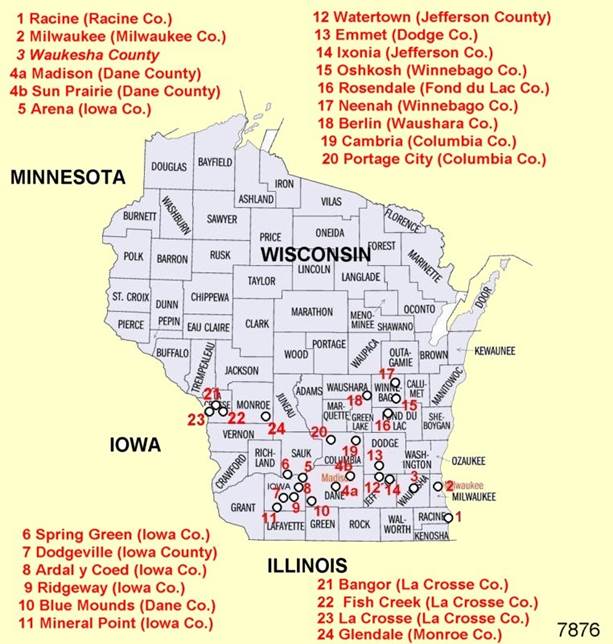
(delwedd 7876)
ETYMOLOGY: “area (of) the woods” (ardal
= area) + (y = the) + (coed = wood, woods)
:_______________________________.
+ardd Soft-mutated form -
the radical form has initial g-.
See gardd =
:_______________________________.
ardd.
1 Abbreviation (in a dictionary entry): = arddodiad, -iaid
:_______________________________.
ar ddangos <ar-DHANG-gos> [arˡðaŋgɔs] adverb
1 on show, on display = placed (goods for sale, works
of art etc) in a place to show them to the public
gya
ETYMOLOGY: (ar preposition = on) + soft
mutation + (dangos, root of the verb dangos = to show)
:_______________________________.
arddangos <ar-DHANG-gos> [arˡðaŋgɔs] (v)
1 show, display
ETYMOLOGY: (ar
intensifying prefix) + soft mutation + (dangos = to show)
:_______________________________.
arddangosfa, PLURAL:
arddangosféydd <ar-dhang-GOS-va,-ar-dhang-gos-VEIDH>
[arðaŋˡgɔsva, arðaŋgɔsˡvəɪð] feminine
noun
1 exhibition
:_______________________________.
arddegol <ar-DHEE-gol> [arˡðeˑgɔl] adjective
1 teenage
ETYMOLOGY: semi-calque on English ‘teenage’, from ar ddeg which appears in the age numbers 13 (tair ar ddeg oed ‘three on ten (of) age’ ) and 14 (pedair ar ddeg oed ‘four on ten (of)
age’ ), but refers, as in English ‘teen’, to ages between 13-19; + (-ol suffix for forming adjectives)
:_______________________________.
arddel <AR-dhel> [ˡarðɛl] verb
1 claim as one’s own
2 diarddel
(rhywun / rhywbeth) disown, repudiate (somebody, something)
gwrthod arddel (rhywun / rhywbeth)
disown, repudiate (somebody, something)
:_______________________________.
ar ddelw <ar DHEE-lu> [ar ˡðeˑlʊ] preposition
1 in the image of
Genesis 9:6 A dywallto waed dyn, trwy ddyn y tywelltir ei waed yntau,
oherwydd ar ddelw DUW y gwnaeth efe ddyn.
Genesis 9:6 Whoso sheddeth man’s blood, by
man shall his blood be shed: for in the image of God made he man.
ETYMOLOGY: (ar = on) +
soft mutation + (delwedd = image)
:_______________________________.
ardderchog ‹ar-DHER-khog›
[arˡðɛrxɔg] adjective
1 excellent, splendid, tiptop
cael hwyl ardderchog have a fantastic time, have a really good time, have a great time
2 (exclamation) ardderchog! great! fantastic! champion!
excellent!
3 ardderchog o (+ adjective) really
Mae'n bryd ardderchog o flasus, It’s a really
tasty meal
4 (adverb) yn ardderchog excellently
Gei di weld y gweithith y plan yn ardderchog You’ll
see that the paln will work excellently
ETYMOLOGY: (ar- intensifying suffix) + soft mutation + (derch) + (-og
suffix for forming adjectives).
The element derch (from Celtic < Indoeuropean *derk) (= to
see) is the same as “drych” in drych (= mirror), edrych (= to
look).
Irish has dearc (= look)
:_______________________________.
ar ddeudro <ar DHEI-dro> [ar ˡðəɪdrɔ] adverb
1 the second time, with the second try (“on two turns”)
Fe wnaeth e hi ar ddeudro Hi managed
it the second time
ETYMOLOGY: (ar = two ) + soft
mutation + (deudro = twice).
:_______________________________.
+arddio Soft-mutated form
- the radical form has initial g-.
See garddio =
:_______________________________.
+arddlunio Soft-mutated
form - the radical form has initial g-.
See garddlunio =
:_______________________________.
+arddluniwr Soft-mutated
form - the radical form has initial g-.
See garddluniwr =
:_______________________________.
ar ddrwg <ar DHRUUG> [ar ˡðruːg]
1 up to no good
bod ar ddrwg be up to no good, be
bent on mischief
mynd ar ddrwg set about doing
mischief
Exodus 32:22 A dywedodd Aaron, Nac enynned digofaint fy arglwydd: ti a adwaenost y bobl,
mai ar ddrwg y maent.
Exodus 32:22
And Aaron said, Let not the anger of my lord wax hot: thou knowest the people,
that they are set on mischief.
ETYMOLOGY: (ar = on) + soft mutation
+ (drwg = evil)
NOTE: also: ar eich drwg
:_______________________________.
ar ddu a gwyn <ar DHII a GWIN>
[ar ˡðiː a ˡgwɪn] prepositional phrase
1 in black and white
:_______________________________.
arddun <AR-dhin> [ˡarðɪn] adjective
1 (obsolete) fair, beautiful; magnificent, grand
ETYMOLOGY: According to Geiriadur Prifysgol Cymru / University of Wales
Dictionary, it is from British *ar-iûn-
(1) -iûn- is related to the obsolete
verb uno (= to wish, to desire),
originally iuno.
This loss of the initial i before u is to be seen in another
obsolete word udd (= lord), originally iudd, which is to be seen
in names from the early period such as udd as a final syllable Gruffudd,
Maredudd; and id- as an initial syllable Idwal, Idnerth, etc
(2) A related word with the element iûn-
is eidduno (= to wish, desire).
Also Eiddun (a woman’s name), from
British *ad-iûn-, or with the
elements as they would appear in Welsh (add- + iun-), maybe with
the sense ‘desirable, desired, wished-for’.
There is a written instance of the British name – it is found in an inscription
as Adiune on a stone built into the
modern parish church at Ystradgynlais. Presumably it represents the form “Adiunae”
= (“(the stone) of Adiuna”). It is said to date from the 400s or early 500s
(3) The meaning of arddun seems to
have been influenced by other words similar in form or sound suggesting ‘beauty’
or ‘grandeur’, such as ardd (=
high), hardd (= beautiful), addurn (= adornment).
:_______________________________.
arddunedd ‹ar-dhii-nedh› masculine
noun
1 grandeur, magnificence, splendour
Tynnwyd llygaid Tomos a Gwen drachefn at
arddunedd y mynyddoed mawr,
lle teyrnasai’r Wyddfa
Tomos and Gwen’s eyes were drawn again to the magnificence of the great
mountains, where Yr Wyddfa (Mount Snowdon) reigned. (Melin-y-ddôl / William a
Myfanwy Eames / 1948 / tudalen 241)
Fry esgyn i’w aur-orsedd
Wna’r haul trwy borth arddunedd -
Teyrnasa mewn rhwysgfawredd
Ar forau Haf (Mynydau Hamddenol: Ail Lyfr Nathan Wyn. 1905. Tudalen 70)
Up yonder the sun rises to its throne of gold through the gate of splendour. It
reigns in ostentation on summer mornings
ETYMOLOGY: (arddun = beautiful;
magnificent) + (-edd suffix for
forming abstract nouns). First example according to Geiriadur Prifysgol Cymru /
University of Wales Dictionary in 1850
:_______________________________.
arddwrn ‹AR dhurn› masculine
noun
1 wrist
band arddwrn pl. bandiau arddyrnau wristband (eg for
identifying hospital patients)
2 nes penelin nag arddwrn ‹nes pe NE lin nag AR dhurn› blood is thicker than
water (“the elbow is nearer (to the heart) than the wrist”)
In some districts arddwrn has been
mistaken for a soft-mutated form, and a radical form garddwrn is used
:_______________________________.
ar ddwy ‹ar dhui › adverb
1 (= ar ddwywaith) at the
second attempt (“on two (times)”)
ETYMOLOGY: (ar = two ) + soft
mutation + (dwy = two (times)).
:_______________________________.
+arddwr Soft-mutated form
- the radical form has initial g-.
See garddwr =
:_______________________________.
+arddwriaeth Soft-mutated
form - the radical form has initial g-.
See garddwriaeth =
:_______________________________.
+arddwriaethol Soft-mutated form - the radical form
has initial g-.
See garddwriaethol =
:_______________________________.
ar ddwywaith ‹ar dhui -weth› adverb
1 at the second attempt
Fe gododd y sach ar ddwywaith He
lifted the sack the second time he tried
ETYMOLOGY: (ar = two ) + soft
mutation + (dwywaith = twice).
:_______________________________.
ar ddydd Gwener
‹ar dhiidh GWEE ner›
1 on a Friday, on Fridays; = every Friday
:_______________________________.
ar dennyn ‹ar de-nin ›
1 on a leash
:_______________________________.
ar derfyn dydd
‹ar der-vin
diidh › adverb
1 at close of day, at the end of the day
ETYMOLOGY: (ar = on) + soft mutation
+ (terfyn = end) + (dydd = day)
:_______________________________.
ar dorr
‹ar DOR›
adverb
1 cut, having been cut into
cosyn ar dor a cheese which one has
been cut into
ETYMOLOGY: (ar = on) + (torr-
stem of verb torri = to cut, to
break, to get broken)
:_______________________________.
ar draul ‹ar DRAIL› preposition
1 at the expense of, at the cost of
2 ar draul ei einioes at the cost of
his life
ar draul ei fywyd at the cost of his life
:_______________________________.
ar draws ‹ar DRAUS› (preposition)
1 across
2 siarad ar draws pen a chlustiau talk
the hind legs off a donkey (“talk across
head and ears”)
:_______________________________.
ardreth ‹ar-dreth› feminine
noun
PLURAL ardrethi
‹ar-dree-thi›
1 (obsolete) rent
2 (obsolete) income, revenue
ETYMOLOGY: (ar- = intensifying
prefix) + soft mutation + (treth =
tax)
:_______________________________.
ar droed ‹ar droid›
adverbi
1
(rumour, piece of news) circulating, going round
mae rhyw si ar droed
bod... there’s a rumour going round that..., it’s rumoured that...
ma' rhyw newydd ar droed bod...
there’s news going round that...
:_______________________________.
Ardudwy ‹ar DII dui› feminine
noun
1 region in the north-west – a kántrev divided into two kúmmuds - Uwch
Arto ‘district above the river Artro’, and Is Artro ‘district below
the river Artro’
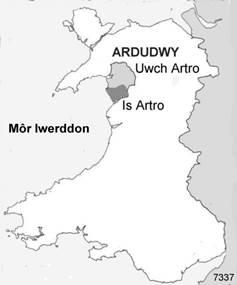 ..
..
(delwedd 7377)
:_______________________________.
Ardwyn ‹AR-duin›
1
street name in Porthtywyn / Burry Port (county of Caerfyrddin / Carmarthen)
ETYMOLOGY: “hillside”
(ar = on) + soft mutation + (twyn = mound, hill)
:_______________________________.
ardyfiant ‹ ar- dəv -yant› m
PLURAL ardyfiannau ‹ ar-dəv- ya -ne›
1
excrescence = protruberance; outgrowth on a part of the body or an organ of the
body
ETYMOLOGY: (ar = on) + soft mutation
+ (tyfiant = growth)
:_______________________________.
ardystio ‹ar-dəsr-yo›
verb
1 certify
2 take the pledge = promise to abstain from alcohol
ardystio i fod yn llwyr-ymatalwr
take the pledge to be a teetotaller
Af adref gyda’m priod, ardystiaf nos
yfory, a chadwaf ef hyd fy medd
(Gwenith Gwyn / ap Tobit / 1913 tudalen 117)
I’ll go home with my wife, I’ll take the pledge tomorrow night, and I’ll keep
it until my grave
Dychwelasom yn ol i Granville, lle
nodedig am gyfleusterau crefyddol. Tranoeth, am 2, mewn Ysgoldŷ Cerrig ar
Fryniau y Cymry, cynhaliwyd cyfarfod Dirwestol. Cawd yno gyfarfod hynod o
hwylus. Yr oedd y rhan fwyaf o’r gynulleidfa wedi ardystio cyn hyny. Ardystiodd
amrai y pryd hwnw hefyd. Mewn Cyfarfod yn Granville, ychydig ddiwrnodiau cyn
hyny, ardystiodd 194 i fod yn Llwyr-ymattalwyr, a 23 yn Gymedrolwyr. (Y
Cyfaill o’r Hen Wlad yn America, Cyfrol 3, 1840, tudalen 140)
We returned to Granville, a notable place for religious facilities. The
following day, a temperance meeting was held at two in a stome schoolhouse on
the Welsh Hills. It was a remarkably
lively meeting. The majority of the
audience had taken the pledge beforehand. Some also took the pledge then too.
In a meeting in Granville, some days before that, 194 took the pledge to be
teetotal, and 23 to be moderate drinkers.
ETYMOLOGY: (ar- = intensifying
prefix) + soft mutation + (tystio =
to witness)
:_______________________________.
aredig ‹a REE dig›
verb
1 to plough
:_______________________________.
ar ei ben ‹ar ii ben › adverb
1 directly; see ar eich pen
:_______________________________.
ar eich baw ‹ar əkh bau ›
1 (“on your dirt / shit”)
gadael (rhywun) ar ei faw to leave
(somebody) in the lurch, leave somebody to sort out his own problems, leave
somebody to get out of the predicament he has got himself into (“leave somebody
on his shit”)
:_______________________________.
ar eich cythlwng
‹ar əkh kəth
-lung ›
1 hungry, starving
yr wyf (i) ar fy nghythlwng I’m
hungry
yr wyt (ti) ar dy gythlwng you’re
hungry
y mae (ef) ar ei gythlwng he’s
hungry
y mae (hi) ar ei chythlwng she’s
hungry
yr ydym (ni) ar ein cythlwng we’re
hungry
yr ydych (chi) ar eich cythlwng
you’re hungry
y maent (hwy) ar eu cythlwng they’re
hungry
Ni byddai un ohonynt yn cael mynd ymáith
ar ei gythlwng
Not one of them would be allowed to leave without having
a bite to eat
ETYMOLOGY: (ar = on) + (eich = your) + (cythlwng = hunger)
:_______________________________.
ar eich deudroed
‹ar əkh dei-droid›
adverb
1 mynd ar eich deudroed
walk it, go by Shanks’s pony, walk because there is no other way of going – no
bike, car, horse, etc
ETYMOLOGY: (ar = your) + (deudroed = two feet).
:_______________________________.
ar eich drwg ‹ar əkh druug›
1 up to no good
Mae’r brain ar ’u drwg heddiw eto
The crows are up to no good again today
ETYMOLOGY: (ar = your) + (eich = your) + (drwg = badness).
:_______________________________.
ar eich eistedd
‹ar əkh ei
-stedh› adv
1 seated, sitting down
aros ar eich eistedd remain seated
2 said of something considered easy to do
gallu gwneud rhywbeth ar eich eistedd
do something with your hands tied behind your back, do it blindfold (“be able
to do something sitting down”)
”Gallaf wneud hyn ar f’eistedd,"
meddai gan wenu
“I can do this as easy as anything,” he said with a smile
ETYMOLOGY: (ar = on) + (eich = your) + (eistedd = sit, sitting)
:_______________________________.
ar eich elw
1 bod gennych (rywbeth) ar
eich elw be to one’s name, have in one’s possession
ni + bod gennych ond (rywbeth) ar eich
elw have only (something) to one’s name
Nid oedd ganddo ond pumpunt ar ei elw
He had no more than five pounds to his name
2
bod ar eich elw be better off
Wedyn clywasom farn werthwr tai a thir
am y Mewnlifiad i’r Broydd Cymraeg. Mynnodd hwnnw ein bod ni’r Cymry ar ein
helw yn sylweddol o’i herwydd
After we heard the viewpoint of an estate agent to the Influx (of rich English
settlers) to the Welsh areas. He maintained that we the Welsh were far better
off because of it
3 bod ar eich elw o be
better off to the tune of, richer by (a specified amount)
Roeddwn i ar ’yn elw o fil o bunnau
I was one thousand pounds better off
ETYMOLOGY: ‘on your gain’ (ar = on)
+ (eich = your) + (elw = profit, gain)
ar eich golwg
chi ‹ar əkh GOO-lug khi›
1 from the look of you, from your look
:_______________________________.
ar eich gorwedd ‹ar əkh GOR-wedh›
1 lying
2 (gravestone) lying flat, not standing
Yno bu maen ar ei orwedd ryw ddeng llath
o ddrws yr eglwys
There was a flat gravestone there about ten yards from the church door
3 syrthio ar eich gorwedd
fall flat on your back
ETYMOLOGY: (ar = on) + (eich = your) + (gorwedd = lie, lying)
:_______________________________.
ar eich gwaethaf
‹ar əkh gwei
-tha›
1 in spite of yourself
bod wedi eich denu at rywbeth ar eich
gwaethaf be irresistibly attracted to something (“be after your attracting
towards something on your worst”)
ETYMOLOGY: (ar = on) + (eich = your) + (gwaethaf = the worst)
:_______________________________.
ar eich hyd ‹ar əkh hiid›
1 “on your length”
bod ofn arnoch ar eich hyd be very
afraid (“be fear on you on your length” - from top to bottom, all your length)
:_______________________________.
ar eich pen ‹ar əkh pen›
adverb
1 heb ddweud rhywbeth ar ei
ben in not so many words, without saying it outright, without spelling it
out “without saying something directly / on its head”
2 gwrthodiad ar ei ben
flat refusal
3 gwadu rhywbeth ar ei ben
completely deny something
:_______________________________.
ar eich pen eich
hun ‹ar əkh PEN əkh HIIN› adverb
1 on your own
2 by yourself, all by
yourself
Mae’n diffodd ar ei ben ei hun (piece of electrical equipment) It
switches itself off, It goes off by itself
:_______________________________.
ar eich ffordd
‹ar əkh fordh›
adverb
1 on one’s way
Lawer bore roeddwn ar fy ffordd am wyth
o’r gloch
Many mornings I was on my way at eight o’ clock
:_______________________________.
ar eich llawn
dwf ‹ar əkh lhaun duuv ›
1 fully grown (“on your full growth”)
:_______________________________.
ar eich tyfiant ‹ar i DƏV yant› prepositional phrase
1 growing
:_______________________________.
areithfa ‹ a- REITH -va› (nf) areithfaoedd, areithféydd ‹ a- reith
-VAA-oidh, a- reith -VEIDH›
1 pulpit,
rosteum
2 chapel
ETYMOLOGY: (areith- stem of araith = speech) (-fa noun-forming suffix, indicating a place)
:_______________________________.
areithio ‹ a- reith -yo› v
1 speak
= make a speech, make speeches; speechify
ETYMOLOGY: (areith- stem of araith = speech) (-fa noun-forming suffix, indicating a place)
:_______________________________.
areithiau ‹ a- reith -ye› plural, feminine
noun
1 speeches;
plural form of araith
ETYMOLOGY: (areith- stem of araith = speech) + (-i-au plural suffix)
:_______________________________.
areithiwr ‹ a- reith -yur› nm
PLURAL areithwyr
‹ a- reith
-wir›
1 orator
)
ETYMOLOGY: (areith- stem of araith = speech) + (-i-wr suffix = man)
:_______________________________.
areithydd ‹ a- rei -thidh› nm
PLURAL areithyddion
‹ a-rei- thədh
-yon›
1 (=
areithiwr) orator
ETYMOLOGY: (areith- stem of araith = speech) + (-ydd noun suffix for indicating a
device or an agent)
:_______________________________.
areithyddiaeth
‹ a-rei- thədh
-yeth› nf
1 oratory
ETYMOLOGY: (areith- stem of araith = speech) + (-i-aeth suffix for forming nouns)
:_______________________________.
aren, PLURAL: arennau ‹A ren, a RE
ne› feminine noun
1 kidney
:_______________________________.
arestio ‹a REST yo›
verb
1 to arrest
:_______________________________.
arf, PLURAL: arfau ‹ARV, AR ve› feminine
noun
1 weapon
2 gorau arf gwirionedd
honesty is the best policy (“best weapon truth”)
3 trwy rym arfau by force
of arms, using weapons
:_______________________________.
arfaeth ‹ar-veth› feminine noun
PLURAL arfaethau
‹ar-vei-the›
1 purpose, plan, intention
2 yr Arfaeth God’s plan,
God’s will
Rhufeiniaid 8:28 Ac ni a wyddom fod pob
peth yn cydweithio er daioni i’r rhai sydd yn caru Duw; sef i’r rhai sydd wedi
eu galw yn ôl ei arfaeth ef;
Romans 8:28 And we know that all things work together for good to them that
love God, to them who are the called according to the purpose
Effesiaid 3:11 Yn ôl yr arfaeth
dragwyddol yr hon a wnaeth efe yng Nghrist Iesu ein Harglwydd ni
Ephesians 3:11 According to the eternal purpose which he purposed in Christ
Jesus our Lord
ETYMOLOGY (arf) + (-aeth, suffix for forming abstract
nouns) . The element arf- is
possibly the stem of the verb arfu (= to arm)
From the same British root: Cornish arveth
(= salary)
:_______________________________.
arfaethedig ‹ar-vei-the-dig› adjective
1 proposed
Cyfarfu yr is-bwyllgor i lunio darpar
gyfansoddiad ar gyfer y Gymdeithas Hanes Sirol arfaethedig
A subcommitee met to draw up a draft constitution for the proposed County
History Society
2 (theology) predestined
ETYMOLOGY: (arfaeth = plan,
intention) + (-edig)
:_______________________________.
arfaethu ‹ar-vei-thi› verb
1 intend
2 propose = put forward as a plan
Anelwig iawn yw eu diffiniad o’r math o
hunanlywodraeth a arfaethir
Their definition of the type of selfgovernment which is proposed is very vague
ETYMOLOGY: (arfaeth = proposal) + (-u =
verb al suffix)
:_______________________________.
arfarniad <ar-VARN-yad> [arˡvarnjad] masculine
noun
PLURAL arfarniadau
<ar-varn-YAA-dai, -de> [arvarnˡjɑˑdaɪ, -ɛ]
1 evaluation, appraisal
ETYMOLOGY: (arfarn-, stem of arfarnu = evaluate) + (-iad suffix)
:_______________________________.
arfbais <ARV-bais> [ˡarvbaɪs] feminine
noun
PLURAL arfbeisiau
<arv-BEIS-yai,
-ye> [arvˡbəɪsjaɪ, -ɛ]
1
coat of arms = a heraldic device representing a family,
corporation or state
2
llyfr arbeisiau armorial = book of
heraldry
3
coat of arms = surcoat with armorial bearings to identify the wearer; a garment
of silk or linen placed over a suit of armour to keep it clean, or prevent it
getting hot in the sun
surcoat (originally of silk or linen to cover a suit of armour to protect it
from dirt,
or prevent it from heating in the sun) embroidered
with a heraldic device to identify the wearer
ETYMOLOGY: (arf = arm ) + soft
mutation + (pais = overgarment)
:_______________________________.
arfbeislyfr <arv-beis-LII-vir> [arvbəɪsˡliˑvɪr] masculine noun
PLURAL arfbeislyfrau
<arv-beis-LI-vrai,
-vre> [arvbəɪsˡlɪvraɪ, -ɛ]
1
armorial = book of heraldry
ETYMOLOGY: (arfbeis- < arfbais = coat of arms ) + (llyfr = book)
:_______________________________.
arfbeisol <arv-BEIS-yol> [arvˡbəɪsjɔl] adj
1
armorial, relating to coats of arms / to heraldry
ETYMOLOGY: (arfbeis- < arfbais = coat of arms ) + (-i-ol suffix for forming adjectives)
:_______________________________.
arfdy <ARV-di> [ˡarvdɪ] masculine
noun
PLURAL arfdai
<ARV-dai> [ˡarvdaɪ]
1
armoury, arsenal; the place where armour or arms are kept
ETYMOLOGY: (arf = arm ) + soft
mutation + (tŷ = house)
:_______________________________.
ar fechnïaeth
<ar vekh-NII-aith,
-eth> [ar vɛxˡniˑaɪθ, -ɛθ] prepositional
phrase
1 on bail
ETYMOLOGY: (ar = on) + soft mutation
+ (mechnïaeth = bail)
:_______________________________.
arfer <AR-ver> [ˡarvɛr] verb
1 use
2 get used to
3 be in the habit of
4 oedd yn arfer, byddai yn
arfer, arferai (she, he, it) used to; (in forming a habitual past tense)
Pan oedden ni yn blant mi fyddem yn
arfer mynd i hel llus ar lethrau’r mynydd
When we were children we used to go and gather bilberries on the slopes of
the mountain
Arferai fod yn ddefod bwysig yr adeg hon
o’r flwyddyn i godi’r tatw cyn i’r rhew ddod a’u difetha
It used to be an important practice at this time of the year to pick the
potatoes before the frost came and ruined them
5 arferid it used to be
the practice to
Arferid ceisio trin teiffoid trwy gael
cleifion i yfed eu dŵr eu hunain
it used to be the practice to try to treat typhoid by getting patients to drink
their own urine
6 do, practise
er arfer pob gofal
in spite of taking every precaution
7 ymarfer (qv) = to
practise
ETYMOLOGY: (ar = intensifying
prefix) + soft mutation + (*ber = to
carry).
In fact the word was formed before the Welsh period, in British: (*are-ber-) < Celtic <
Indo-European *bher (= to carry)
This Indo-European root is found in various words in Welsh and other languages
(1) Welsh
..1/ aber = confluence, estuary
..2/ adfer = restore
..3/ arfer = practise
..4/ cymer = confluence
..5/ diabred = withheld, held back,
refused
..6/ diferu = to drip
..7/ gofer = ditch, stream
..8/ llifeiriant = a flow
(2) Irish
beir = bring, win
(3) English
bear (= to carry, < Germanic) cf
German gebären (= give birth to a
child);
(4) in words in English from Latin fero
(= I carry)
..1/
circumference
..2/
confer
..3/
defer
..4/
differ
..5/
fertile
..6/
fortune
..7/
infer
..8/
offer
..9/
prefer
..10/
refer
..11/
suffer
..12/
transfer
(5) in words in English from Greek pherein (= to carry)
..1/
euphoria
..2/
metaphor
..3/
paraphernalia
..4/
periphery
..5/
phosphorus
..6/
semaphore
:_______________________________.
arfer <AR-ver> [ˡarvɛr] feminine
noun
PLURAL arferion <ar-VER-yon> [arˡvɛrjɔn]
1 habit, custom, practice, usual behaviour
arferion bwyta gwael bad eating habits
yn ôl arfer y cyfnod as was the
practice in those days, in those times
Rhoes anerchiad barddonol yn Eisteddfod
Biwmaris, a hynny yn Saesneg,
yn ôl arfer y cyfnod
He gave a speech about poetry in the Eisteddfod of Biwmaris; this he did in
English, as was the practice in those days.
Dyna’r arfer That’s the usual
practice, That’s the way it’s usually done
Gwell nag athro yw arfer Practice
makes perfect
(“(it-is) better than a-teacher that-is practice”)
(gwell = better) + (nag = than) + (athro = teacher) + (yw =
that-is) + (arfer = practice)
2 habit = something which has been done so many times by somebody
that it has become a characteristic action of that person
mynd i’r arfer o wneud rhywbeth get
into the habit (of doing something)
magu’r arfer o wneud rhywbeth get
into the habit (of doing something)
colli’r arfer o wneud rhywbeth get
out of the habit (of doing something)
o ran arfer from force of habit, out
of habit, out of sheer habit
yn ôl ei arfer as is his wont, as he
usually does
yn unol â’i arfer as is his wont, as
he usually does
3 arferion habits =
settled practices, behaviour
Rhaid cyfadde fod rhai o’i harferion yn
wirioneddol òd
You have to admit that some of her habits are really odd
arferion anonest dishonest practices
4 hen arfer
old-established practice = usual procedure, a usual course of action
Mae yn hen arfer gosod tanciaid o bysgod
mewn ystafell aros deintyddion i dawelu’r sawl sy’n disgwyl am driniaeth
It’s a old practice to put a tank of fish in dentists’ waiting rooms to soothe
people waiting for treatment
5 drwgarfer or drwgarferiad bad habit
6 arfer gan (be) a habit
of, (be) a practice of
Mae’n arfer gennyf... I make it a
rule to (do something)
Nid yw hi’n arfer gennym ddefnyddio’r
gair yn y modd yma yn Gymráeg
We don’t usually use the word in this way in Welsh
7 na’r arfer than usual
mewn gwesty fymryn bach yn grandiach
na’r arfer
In a hotel somewhat more grand than usual
8 ag arfer as usual
ar yr un awr ag arfer at the same
time as usual
9 nag arfer than usual
mwy nag arfer more than usual
10 yn ôl fy arfer as is
my wont, as is my custom, as I am wont to do
11 habit = addiction, behaviour habit resulting from addiction to a
substance
Y mae tuedd i smygwyr ac yfwyr fod â mwy
o gariadon na’r rhai sy’n ymwrthod â’r arferion
Smokers and drinkers tend to have more girlfriends or boyfriends than those who
do not indulge in these habits
12 o ran arfer out of
sheer habit (o ran = from + part) +
(arfer= habit)
ETYMOLOGY: see the preceding entry
:_______________________________.
arferol <ar-VEE-rol> [arˡveˑrɔl] adjective
1 normal, usual
:_______________________________.
ar ffo <ar FOO> [ar ˡfoː] adverb
1 fleeing
carcharor ar ffo an escaped prisoner
hogyn ar ffo o’r fyddin a lad who
has deserted from the army
diflannu fel cath ar ffo scarper
(“disappear like a fleeing cat”)
ETYMOLOGY: (ar = on) + (ffo = fleeing, flight)
:_______________________________.
..1 ar fin <ar VIIN> [ar ˡviːn] (preposition)
1 on the point of; on the edge of
2 bod ar fin mynd yn rhyfel be close to
war
Yr oedd ar fin mynd yn rhyfel War was close to breaking out
3 bod
ar fin trengi have on foot in the grave (“be on the point of dying”)
:_______________________________.
..2 ar fin <ar VIIN> [ar ˡviːn] adverb
1 (penis) erect
bod ar fin = (penis) be erect
ETYMOLOGY: (ar = sobre) +
soft mutation + (min = sharpness / erection)
:_______________________________.
ar fin y bedd <ar viin ə BEEDH> [ar viːn ə ˡbeːð] prepositional phrase
1 between life and death, on the point of death, with one foot in
the grave, at death’s door
ETYMOLOGY: (ar fin = on the edge of)
+ (y bedd = the tomb)
:_______________________________.
ar flaen <ar VLAIN> [ar ˡvlaɪn] preposition
1 at the head of, at the front of, leading
ar flaen yr orymdaith at the head of
the procession
ar flaen y golofn leading the column
ETYMOLOGY: (ar = sobre) + soft
mutation + (blaen = front part)
:_______________________________.
Arfoel ‹AR-voil›
1
house name in Ochr-y-foel, Diserth / Dyserth (county of Dinbych / Denbigh)
ETYMOLOGY: “hillside” (ar = on) + soft mutation + (moel = (bare)
hill)
:_______________________________.
arfog ‹AR vog› adjective
1 armed
dynion arfog armed men
gwy^r arfog armed men
lladron arfog armed thieves
lluoedd arfog armed forces
carfannau arfog asgell dde right-wing armed groups
2 plural adjective as a noun
arfogion armed people, armed men
:_______________________________.
Arfon ‹ar -von› feminine noun
1 (History) division (cantref,
“kantrev”) of Gwynedd Uwch Conwy
Caernarfon town name, from “Caer yn
Arfon” = ‘the place called Caer in the kantrev of Arfon’. Caer is ‘Roman camp,
Roman fort’, which in this case was Segontium. Caer is also the usual name in
Welsh for Chester, just over the Welsh border in England
Bangor Fawr yn Arfon the original name of the monastery established here
in the 500s and destroyed in 1071 by the Norman occupiers
2
Until 1996, an administrative unit (‘district’) in Gwynedd.
Administrative centre: Bangor.
Proportion of Welsh-speakers: 77% (1981).
3 colloquial name for Sir Gaernarfon “Caernarfonshire /
Carnarvonshire” (county until 1974)
Ganwyd ef yn Arfon
He was born in the county of Caernarfon
4 (masculine noun) man’s name
5 Arvonia Latinised form of Arfon. Name of two villages in the USA
founded by immigrants from Sir Gaernarfon
ETYMOLOGY: ‘(the district) facing (the island of) Môn’ Welsh (ar = opposite) + soft mutation + (Môn = island name)
:_______________________________.
Arfoneg ‹ar- vo -neg› feminine
noun
1 the Welsh of Arfon, the type of Welsh spoken by the inhabitants of
the district of Arfon
ETYMOLOGY: (Arfon = district name) +
(-eg = suffix to indicate a language
or dialect)
:_______________________________.
arfor ‹ar -vor› masculine
noun
1 (obsolete) coast
2 Arfor house name =
coast, seaside
3 (adjective) (obsolete) coastal
Found in certain plant names
Taglys Arfor Calystegia soldanella = sea bindweed
Pinwydden Arfor Pinus pinaster = maritime pine
ETYMOLOGY: ‘(the land) facing (the) sea’
Welsh (ar = opposite) + soft
mutation + (môr = sea)
From the same British root: Breton Arvor
(= coastal Brittany; the interior is Argoad
= forest)
:_______________________________.
arfordir ‹ar-VOR-dir› [arˡvɔrdir] masculine
noun
PLURAL arfordiroedd
<ar-VER-yon> [arˡvɔrdiˑrɔɪð,
-ɔð]
1 coast
ETYMOLOGY: ‘coast land’ (arfor =
coast) + soft mutation + (tir =
land)
:_______________________________.
arfordirol ‹ar-vor-DII-rol› [arvɔrˡdiˑrɔl] (adj)
1 coastal
Llwybr Arfordirol Ynys Môn SH6718 Anglesey Coastal Path
http://www.geograph.org.uk/photo/416914
map
ETYMOLOGY: (arfordir = coast) + (-ol adjectival suffix)
:_______________________________.
Arfron ‹AR-vron›
1 house name
..a/ Llanymddyfri / Llandovery
..b/ Llanybydder (Ceredigion)
..c/ Rhosaman, Rhydaman (Caerfyrddin)
..d/ Y Dre-fach, Llanelli (Caerfyrddin)
..e/ Nefyn (Gwynedd)
..f/ Llan-rwst
..g/ Y Dinas (Penfro / Pembroke)
..h/ cottages by Capelgarmon
..i/ house north-east of Trefilan (Ceredigion) SN5558
http://www.geograph.org.uk/search.php?i=4178897
ETYMOLOGY: “hillside” (ar = on) + soft mutation + (bron = (round)
hill; woman’s breast)
:_______________________________.
arfryn ‹ar -vrin› masculine
noun
1 house name (“on (the) hill”) or (“facing (the) hill”)
2 “Bod Arfryn” (“(the) house on (the) hill”)
house name in Tywyn (county of Gwynedd)
(as “Bod Arfryn” in the list of members in “The Transactions of the Honourable
Society of Cymmrodorion” 1961 / Part 1)
ETYMOLOGY: (ar = on, that is, the
old preposition war < gwar) + soft mutation + (bryn = hill);
or else (ar = opposite, facing) +
soft mutation + ( bryn = hill). The
preposition ar subsumed war at an early date.
:_______________________________.
ar frys ‹ar VRIIS› prepositional
phrase
1 in a hurry
:_______________________________.
ar fy llw! ‹ar ən LHUU› prepositional
phrase
1 I swear (it’s true, etc) (“on my oath”)
NOTE: Also ar yn llw! (yn < fyn;
variant form of fy)
:_______________________________.
ar fy ngwir! ‹ar ə NGWIIR› prepositional phrase
1 I swear (it’s true, etc) (“on my truth”)
NOTE: Also ar yn ngwir! (yn <
fyn; variant form of fy)
:_______________________________.
Arfynydd ‹ar-Və-nidh
›
1
area in Welsh Strathclyde (Ystrad Clud) mentioned by the poet Taliesin in
Argoed Llwyfain
Dygrysowys Fflamddwyn yn bedwarllu
Goddeu a Reged i ymddullu
Dyfwy o Argoed hyd Arfynydd
Flamddwyn hastened quickly with four bodies
To encompass Goddeu and Reged :
He spread from Argoed to Arfynydd.
The
History of the Anglo-Saxons, Comprising the History of England from the
Earliest Period to the Norman Conquest. In Three Volumes. Volume III. Fourth
edition. 1823. By Sharon Turner (1768-1847),
ETYMOLOGY:
“facing the upland” (ar = facing) + soft mutation + (mynydd =
upland, mountain)
Cf the name Arllechwedd
below
:_______________________________.
arg.
1 abbreviation (in a dictionary
entry) = argraffiad edition
:_______________________________.
Arg.
1 abbreviation (as a field label in a
dictionary) = Argraffyddiaeth
Typography
:_______________________________.
argae ‹ar -gai› masculine noun
PLURAL argaeau
‹ar- gei
-e›
1 dam
Diarhebion 17:14 Pen y gynnen sydd megis
ped agorid argae:
am hynny gad ymaith ymryson cyn ymyrryd arni.
Proverbs 17:14 The beginning of strife is as when one letteth out water:
therefore leave off contention, before it be meddled with.
2 mill dam = dam built across a stream to raise the water level in
order to turn a mill wheel
NOTE: In the English dialect of
Llanidloes:
ARGA, a term applied to the artificial wooden dams erected to pound up water
for the use of the various mills and factories. The word is Welsh, and is thus
explained in the latest edition of Dr. Owen Pughe’s Dictionary. “ARGAE, au s.f.
(AR-CAE), an enclosure; a fence, a dam; a lock in a river, a restriction. In
some parts of teh country the term is applied to an embankment of earth.
(Parochial Account of Llanidloes / Edward Hamer / Chapter X / Folk-lore. Page
278 Collections Historical and Archeological Relating to Montgomeryshire and
its Borders / 1877).
Also Page 310: WARE, more properly WEIR, a wooden embankment across a stream.
The weir at the town mill is generally known as the Arga, while the one known
as the Ware is that upon the Clywedog, opposite the Dyfnant. The fact of the
former retaining its Welsh name is perhaps a proof of its existence previous to
the importation of the English term.
3
riverside embankment, earthwork to raise the height of a riverbank to prevent
flooding
Yr Argae “This little river-side
township (Rhydesgyn) forms a fork of land between the Severn and its tributary,
the Belé, and is almost surrounded by the Argae, or embankment, which protects
its inhabitants from the constant menace of the flood-waters.” A History of the
Parish of Guilsfield (Cegidfa), T. Simpson Jones and Robert Owen, ?1900.
4 argae môr breakwater
(usually morglawdd)
5 In the district of Glanafon / Riverside in Caer-dydd there is a
street called “Taff Embankment”. The Welsh translation would be Argae-taf
6 codi argae ar draws cwm to
dam a valley
codi argae ar draws dyffryn
to dam a valley
ETYMOLOGY: (ar- intensifying
prefix) + soft mutation + (cae =
enclosure)
:_______________________________.
ar gais ‹ar gais› adverb
1 at the request of
Dechreuodd Thomas bregethu ar gais
eglwys Siloa, y Maerdy
Thomas began preaching at the request of Siloa chapel, in Maerdy
2 by request, on request
arhosfan ar gais request stop
3 ar gais taer rhywun at
the urgent request of
ETYMOLOGY: (ar = on) + soft mutation
+ (cais = request)
:_______________________________.
ar gam ‹ar gam› adverb
1 unjustly
beio ar gam falsely blame
bod yn y carchar ar gam be wrongly
imprisoned
cael bai ar gam be falsely accused
cyhuddo ar gam wrongly accuse,
falsely accuse
2 incorrectly, by mistake
ETYMOLOGY: (ar = on) + soft mutation
+ (cam = injustice, wrong)
:_______________________________.
ar gamamser ‹ar gam-am-ser›
adverb
1 at the wrong time; at an inopportune moment
ETYMOLOGY: “on a wrong time” (ar =
on) + soft mutation + (camamser =
wrong time)
:_______________________________.
ar gân ‹ar gaan› adverb
1 in verse, by means of poetry
Yr oedd yn caru gwragedd dynion eraill -
ond ar gân
He showed his love for the wives of other men - but through his poems
2 through song, singing
gosod penillion ar gân set verses to
music
ETYMOLOGY: “on song” (ar = on) +
soft mutation + (cân = song)
:_______________________________.
ar gau ‹ar GAI› prepositional
phrase
1 closed
2
(sign) desg ar gau position closed
(“desk closed”)
(sign) ffordd ar gau road closed
ETYMOLOGY: (ar = on) + soft mutation + (cae- stem of verb cau =
to close, to be closed)
NOTE: Strictly speaking it would be spelt ar gae (same pronunciation).
Perhaps it is not used because it also suggests ‘on a field’, whereas the
spelling cau is unambiguously ‘closing; closed’
Cau cannot be the spelling of the root form, strictly speaking, because
it is “cae-u”, where the –u represents the verbnoun ending. The root or
stem of the verb is obtained by removing any verbnoun suffix.
:_______________________________.
argáu ‹ar gai › verb
1 to dam
argáu dyffryn to dam a valley
argáu cwm to dam a valley
ETYMOLOGY: (argae = dam) + (-u suffix for forming verbs) > *argáe-u > argáu
:_______________________________.
argel ‹AR-gel › adjective
1 hidden
gwely argel
2 secluded
gwely argel (“secluded bed / resting-place”) grave
Gofidus gennyf feddwl ei fod wedi ei symud o’i gadair fawr yn y Gilfach Glyd
i’w wely argel ym mynydd-dir Gwynno
Llanwynno (1888) Glanffrwd (William Thomas 1843-1890)
It is painful for me to think he has moved from his armchair in (the farmhouse
of) Gilfach-glyd to his grave on the upland of Gwynno (i.e. Llanwynno)
ETYMOLOGY: (ar = intensifying prefix) + soft mutation + (cêl =
hidden).
Cornish argel = retreat, secluded place; Argel place name
:_______________________________.
ar gennad ‹ar GE -nad› adverb
1 (USA: on furlough) (Englandic: on leave)
mynd ar gennad go on leave
bod ar gennad be on leave
ETYMOLOGY: (ar = on) +
soft mutation + (cennad = permission)
:_______________________________.
arglawdd ‹ar -glaudh›
masculine noun
PLURAL argloddiau
‹ar- glodh
-ye›
1 arglawdd railway
embankment or canal embankment
arglawdd y rheilffordd the railway
embankment
arglawdd y gamlas the canal
embankment
ETYMOLOGY: (ar- intensifying prefix)
+ soft mutation + (clawdd = bank)
:_______________________________.
ar glawr ‹ar GLAuR ›
1 in existence, existing
dod ar glawr be revealed, become public knowledge
Daeth y cyfrinach ar glawr The secret slipped out, the secret was
revealed
Daw’r gwir ar glawr The truth will reveal itself (sooner or later the
truth about some mystery will be known)
bod ar glawr be in existence, still survive
cadw ar glawr preserve
ETYMOLOGY: (ar = on) +
soft mutation + (clawr = surface)
:_______________________________.
ar glo ‹ar GLOO› prepositional
phrase
1 locked
ETYMOLOGY: (ar = on) + soft mutation + (clo- = stem of verb cloi = to
lock, to get locked)
:_______________________________.
arglwydd ‹AR gluidh› masculine
noun
1 lord
2 (in addressing a lord)
f’Arglwydd My Lord, Your Lordship
3 fy arglwydd frenin my
lord the king
Daniel 4:24 Dyma y dehongliad, O frenin,
a dyma ordinhad y Goruchaf, yr hwn sydd yn dyfod ar fy arglwydd frenin.
Daniel 4:24 This is the interpretation, O king, and this is the decree of
the most High, which is come upon my lord the king:
4 dydd yr Arglwydd the
Sabbath, the Lord’s Day,
cadw dydd yr Arglwydd keep the
Lord’s Day, keep the Sabbath, observe the Lord’s Day
:_______________________________.
arglwyddes ‹ar- glui -dhes›
feminine noun
PLURAL arglwyddesau ‹ar-glui- dhe -se›
1 lady = woman who is a member of the peerage, whether with a title
in her own right, or as the wife of a lord
2 (in translations of English titles)
(a) Arglwyddes + place name - less
formal title in place of ardalyddes
(marchioness), iarlles (countess), isiarlles (viscountess), barwnes (baroness)
Arglwyddes Llanofer Lady Llanofer
(Augusta Waddington Hall, 1802-96, who lived in Llys Llanofer, county of Mynwy;
collector of Welsh manuscripts)
(b) yr Arglwyddes + Christian name +
family name - formula used for daughter of a man with the title of dug (duke), ardalydd (marquis), iarll
(earl)
(c) yr Arglwyddes + husband’s
Christian name (lady = wife of a lord)
(d) yr Arglwyddes + husband’s
surname - wife of a barwnig
(baronet) or marchog (knight)
3 Ein Harglwyddes Our
Lady, a title of the Virgin Mary
Ysgol Ein Harglwyddes
“(the) school (of) our lady” name of a
school in Bangor
harglwyddes = form of arglwyddes with the prefix h. This prefix is found after
(1) ei = (her);
(2) ein (= our), (‘n - a’n = an our, etc)
(3) eu (= their), (‘u - a’u = and their, etc)
(4) (‘m (= my) (a’m = and my, etc)
ETYMOLOGY: (arglwydd = lord) + (-es suffix, female person)
:_______________________________.
argoed, PLURAL:
argoedydd
‹AR goid, ar GOID idh › masculine noun (properly a collective
noun) (obsolete, but familiar from place names)
1 wood, woodland, forest
2 edge of a wood
ETYMOLOGY: “woodland” (ar = in front of) + soft mutation + (coed =
wood; trees)
Cf arfor (obsolete) = ([place] in front of the sea, edge of the sea,
coast, coastland)
Two corresponding words are used in Breton: Arvor is the coast of
Brittany, and the interior of the peninsula is Argoad
:_______________________________.
Argoed ‹AR goid›
1 place name = woodland
BRO MORGANNWG:
1 place
south-west of Llanharri (Bro Morgannwg)
CAERFFILI:
2 SO1700 locality east of Aberbargod,
Caerffili
http://www.geograph.org.uk/gridref/SO1700
CAERFYRDDIN
3 Cilgant Argoed (“Argoed Crescent”), Trimsaran (Caerfyrddin)
CEREDIGION:
4 farm east of Llangwyryfon (Ceredigion)
5 Farm south of Tregaron, Ceredigion
6 farm south of Cenarth (Caerfyrddin)
CONWY
7 street name in Baecinmael (Conwy)
DINBYCH
8 farm south of Pontcysylltau (Dinbych)
LLOEGR:
9 Locality between Trefesgob / Bishop’s Castle and Colunwy / Clun, Shropshire
(England)
10 SJ3220 Locality south-west of Kinnerley, Shropshire (England)
http://www.geograph.org.uk/gridref/SJ3220
map
MYNWY
11 locality south of Pen-twyn (Mynwy) (“The Argoed”)
12 farm north-west of Bryn-gwyn, Mynwy
13 ST4694 Drenewydd Gelli-farch / Shirenewton
Argoed Uchaf (“Upper Argoed”)
Argoed Isaf (“Lower Argoed”)
http://www.geograph.org.uk/photo/412014
PENFRO:
14 farm south-west of Felindre Farchog (Sir Benfro)
POWYS
Argoed was apparently a district in the kingdom of Powys, and probably wooded
terrain including Clun Forest in modern Shropshire extending westwards into the
modern county of Powys (the district of the old cwmwd of Ceri). Around the Clun
Forest and in this area of Powys there are many places called Argoed. In one of
the poems of Cynddelw Brydydd Mawr (fl. ca. 1155-1200) Argoedwys (“men of
Argoed”) is used as as a synonym of “men of Powys”
15 Farm south-east of Bacheldre, Powys
16 farm east of Llanwrthwl (Powys)
17 farm east of Trefeglwys (Powys)
18 farm south-east of Adfa (Powys)
19 farm SO0945 north-west of Llandeilo Graban SO0944
(1814) William Williams of Argoed, p. Llandilo Graban
(= parish of Llandeilo Graban), gent. (= gentleman)...
tmt (= tenament) and lands called Tuy Mawr (= Tŷ-mawr) in place called Yr
Argoed, p. Llandilo Graban (= parish of Llandeilo Graban)
http://www.powys.gov.uk/uploads/media/R_D_JGW_bi.pdf
http://www.geograph.org.uk/gridref/SO0944
map
20 farm north of Beulah, Powys
WRECSAM:
21 street name in Brymbo (Wrecsam)
22 farm north of Owrtyn (Wrecsam)
Y FFLINT
23
SJ2565 Place name in Bryn-y-bâl, Sir y Fflint. Argoed was the name of a
medieval township in this area. The name is extant in the name of a local farm
SJ2564, a mansion Plas Argoed (“Argoed Hall”) SJ2564, in the name of the
secondary school SJ2564 in Bryn-y-bâl, and in the name of a community council
here.
Argoed is the Welsh name of New Brighton SJ2564, according to Geiriadur yr
Acádemi Gymreig
http://www.geograph.org.uk/gridref/SJ2565
map
http://www.geograph.org.uk/photo/2431553
path to Argoed Farm
http://www.geograph.org.uk/gridref/SJ2564
map
ETYMOLOGY: (see previous entry)
:_______________________________.
argoel, PLURAL:
argoelion ‹AR
goil, ar GOIL yon› feminine noun
1 sign, indication
2 Mae pob argoel y daw
There’s every indication that he’ll come
:_______________________________.
argoeli ‹ar GOI li› verb
1 argoeli’n dda
(prospects) look good
Dyw pethau ddim yn argoeli’n dda
Things don’t look too good, The prospects don’t seem very bright, The prospects
don’t seem very favorable
argoeli’n ddrwg (prospects) look bad
Mae pethe’n argoeli’n ddigon drwg, mae
arna’i ofn Thinks are looking pretty bad, I’m afraid; It looks as though
things will get pretty rough, I’m afraid
:_______________________________.
ar goll ‹ar golh› prepositional
phrase
1 lost
ar goll yn lân completely lost
Mae golwg ar goll arni she looks
lost (“there’s (a) look (of being) lost on–her”)
2
lost = unable to understand
Er gwaethaf ei esboniad hirfaith yr
oeddwn i’n hollol ar goll
In spite of his long explanation I was completely lost
ETYMOLOGY: (ar = on) + soft mutation
+ (coll, stem of colli = lose, get lost)
:_______________________________.
ar golled ‹ar GO-lhed› adverb
1 at a loss
gwerthu rhywbeth ar golled sell something at a loss
:_______________________________.
ar gost ‹ar GOST› preposition
North Wales: ar gôst (with a
long ‘o’)
1 at the expense of, at the cost of
2 ar gost ei einioes
at the cost of his life
ar gost ei fywyd at the cost of his life
:_______________________________.
argraffiaeth ‹ar- graf -yeth› feminine
noun
1 typography, printing
Abbreviation: (as a field label in a dictionary) Arg.
ETYMOLOGY: (argraff- stem of argraffu = to print) + (-i-aeth suffix for forming nouns)
:_______________________________.
argraffnod ‹ar- graf -nod›
masculine noun
PLURAL argraffnodau
‹ar-graf-noo
-de›
1 imprint = name of a publisher with date and place of publication,
usually on the title-page
ETYMOLOGY: (argraff stem of argraffu = to print) + (nod = mark)
:_______________________________.
Argraig ‹AR-graig›
1
house name in Aber-soch (Gwynedd)
2 house name in Pwllheli (Gwynedd)
ETYMOLOGY: “on (the) crag / rocky ridge” (ar = on) + soft mutation + (craig
= crag)
:_______________________________.
argroen ‹ ar -groin› adj
1
epicarp
ETYMOLOGY: (ar = on) + soft mutation
+ (croen = skin)
:_______________________________.
ar groesffordd
(bod ar groesffordd) ‹ar GROIS fordh› prepositional phrase
1 at a crossroads (= at a crucial point where a decision must be
made)
:_______________________________.
ar grwydr ‹ar GRUI dir› adv
1 wandering
ETYMOLOGY: (ar = on) + soft mutation + (crwydr- = stem of verb crwydro
= to wander)
:_______________________________.
ar gyfartaledd
‹ar gə var TA ledh› prepositional phrase
1 on average
:_______________________________.
ar gyfer ‹ar GƏ ver› (preposition)
1 for = in preparation for
gosod ychydig
o’r neilltu ar gyfer tymor glawog
save a little for a rainy day (“put a bit aside for a rainy season”)
Bydd y cranc yn llenwi ei hun efo bwyd
ar gyfer yr amser y bydd o’n diosg ei gragen, a byw ar ei floneg am bythefnos
The crab fills itself up with food for the time when it sheds its shell, and
lives on its fat for a fortnight
cynilo ar gyfer eich henaint save
for your old age
stwffio’ch pen ar gyfer arholiad cram
(“cram your head”) for an examination
2 in front of , opposite
Symudasant i'r
Diosg, tyddyn bychan y tu arall i'r afon ar gyfer yr Hen Gapel
They moved to the Diosg, a small cottage over the river opposite the Old Chapel
:_______________________________.
argyfwng ‹ar GƏ vung› masculine
noun
1 emergency, crisis
2 bod ar gyfyng gyngor ‹ar GƏ ving GƏ
ngor› prepositional phrase be
in a tight spot
3 radio argyfwng emergency radio
larwm argyfwng emergency alarm
:_______________________________.
argyhoeddi ‹ar gə HOI dhi› verb
1 to convince
:_______________________________.
argyhoeddiad, PLURAL:
argyhoeddiadau ‹ar gə HOIDH yad, ar gə hoidh YAA de› masculine noun
1 conviction
:_______________________________.
argyhoeddiadol
‹ar gə hoidh YAA dol› adjective
1 convincing
:_______________________________.
argyhoeddiedig
‹ar gə hoidh YEE dig› adjective
1 convinced
:_______________________________.
argymell ‹ar GƏ melh›
verb
1 to recommend
:_______________________________.
argymhelliad, PLURAL:
argymelliadau ‹ar gə MHELH yad, ar gə melh YA de› masculine noun
1 recommendation
:_______________________________.
ar gynydd ‹ar gəə-nidh› adv
1
on the increase = gaining size
2
on the increase = gaining in popularity
3
ar gynydd ‹which
is› growing
tref ar gynydd yw Abergele Abergele
is an expanding town
bod ar gynnydd be on the increase
mae ymosodiadau ar bobl oedrannus ar
gynnydd yn y cefn gwlad attacks on elderly people in the countryside are on
the increase
dal ar gynnydd to be still on the
increase
ar gynydd mawr growing fast, rapidly expanding
Y
mae Newark yn dref ar gynydd mawr, ar lan y gamlas sy 'n arwain o Lyn Erie i
Afon Ohio.
Newark is a town which is growing fast, on the side of the canal from Lake Erie
to the river Ohio.
Quote from: Chidlaw, Benjamin Williams, 1811-1892. Yr
American: yr hwn sydd yn cynnwys nodau ar daith o Ddyffryn Ohio i Gymru, golwg
ar dalaeth Ohio, hanes sefydliadau Cymreig yn America, cyfarwyddiadau i
ymofynwyr cyn y daith, ar y daith, ac yn y wlad. (Llanrwst: Argraffwyd
gan John Jones, 1840)
:_______________________________.
ar gyrn a phibau
‹ar girn a fii-be›
1 (“on horns and pipes”)
datgan newyddion da ar gyrn a phibau
to trumpet forth good news
(“declare good news on horns and pipes”)
:_______________________________.
ar hast wyllt ‹ar hast WILHT› (adverb)
1 in a mad hurry
:_______________________________.
ar her ‹ar her› adverb
1 gwneud rhywbeth ar her
do something for a dare
ETYMOLOGY: (ar = on) + (her = challenge)
:_______________________________.
ar herw ‹ar he-ru› adverb
1 outlawed, on the run
ETYMOLOGY: (ar = on) + (herw = state of being an outlaw,
outlawry)
:_______________________________.
arholi ‹ar- hoo -li› verb
1 examine
ETYMOLOGY: (ar- = intensifying
prefix) + (holi = to ask)
:_______________________________.
arholiad ‹ar- hol -yad› masculine
noun
PLURAL arholiadau
‹ar-hol-yaa-de›
1 examination
2 arholiad pen tymor
end-of-term examination
3 arholiad pen blwyddyn
final examination, year-end examination
4 sefyll arholiad sit /
do / take an exam (“stand an exam”)
5 llwyddo mewn arholiad pass
an examination, be successful in an examination
y rhai a lwyddodd yn yr arholiadau those
who passed the exams
6 stwffio’ch pen ar gyfer
arholiad cram (“cram your head”) for an examination
ETYMOLOGY: (arhol-i-, stem of the
verb arholi = to examine) + (suffix -i-ad)
:_______________________________.
arholwr ‹ar- ho -lur› masculine
noun
PLURAL arholwyr
‹ar- hol
-wir›
1 examiner
ETYMOLOGY: (arhol-, stem of the verb arholi
= to examine) + (-wr)
:_______________________________.
arhosed ‹ar- ho -sed› verb
1 may he wait;
Arhosed e’ imi gael fy nwylo arno fe...
Just wait until I get my hands on him...! (i.e. to punish him)
ETYMOLOGY: (arhos-, stem of aros = to wait) + (-ed)
:_______________________________.
arhosfa ‹a-hros-va› feminine noun
PLURAL arosféydd
‹a-hros- veidh›
1 stopping place
2 stay
3 pause
4 South Wales sheepwalk =
a tract of grazing land for sheep; the colloquial form is rosfa; and also rhosfa, rhysfa, hysfa, ysfa. In the town
of Maes-teg (county of Pen-y-bont ar Ogwr, South-east Wales) there is a street
called Yr Ysfa (= the sheepwalk)
5 very common house name; usually seen without an ‘h’; Arhosfa, Arosfa; the extended meaning
is ‘home’, since the sheep know instinctively the boundaries of their pasture
ground, and when they go up to the mountain for grazing in summer they always
return to the same spot
ETYMOLOGY: (arhos-, stem of aros = to stay) + (-fa, suffix = place)
NOTE: arosfa is a common erroneous
‘standard’ form in the South, where ‘h’ at colloquial level (especially in the
south-east) isn’t pronounced, and so this was assumed to be the literary form,
people perhaps being unfamiliar with the literary form with ‘h’
:_______________________________.
ar hyd ‹ar HIID› (preposition)
1 along
:_______________________________.
ar hyd ac ar draws ‹ar HIID aag ar DRAuS › adverb
1 in all directions, any old how,
at random
siarad ar hyd ac ar draws talk in a muddled fashion, in a confused way, incoherently
ETYMOLOGY: (ar hyd =
along) + (ac = and) + (ar draws = across)
:_______________________________.
ar hyd ac ar led
‹ar hiid ag
ar leed› adverb
1 all over, everywhere
Chwiliais ar hyd ac ar led ond welais i
ddim byd
I looked all over but I saw nothing
2 siarad ar hyd ac ar led
indulge in small talk
ETYMOLOGY: (ar hyd = along the
length, ‘on length’) + (ac = and,
form of a = and, before a vowel) + (ar led = along the width, ‘on width’)
:_______________________________.
ar hyd y
flwyddyn ‹ar HIID ə VLUI dhin›
1 during the year
:_______________________________.
ar hyn o bryd ‹ar HIN o BRIID› (adverb)
1 at the present time
:_______________________________.
arial ‹ar -yal› masculine noun
1 passion, vigour, spirit
2 courage, mettle
ETYMOLOGY: (ar = in front of) + soft
mutation + (gâl = strength)
The corresponding word in Irish (by now only a literary word) is iorghal (= fighting, battle line)
:_______________________________.
arian ‹AR yan› masculine
noun
1 money; silver
arian ffug forged money
pasio arian ffug pass forged money
2 arian papur (American:
folding money) (Englandic: paper money) (“money (of) paper”)
3 taflu arian da i ganlyn arian drwg throw good money after bad
(“throw good money to follow bad money”)
4 arian taw hush money, a
bribe to buy somebody’s silence (“money (of) silence”)
5 gwneud arian mawr make a fortune
(“make big money”)
6 gwneud pentwr o arian (o...) make a fortune (out of...)
(“make a pile of money”)
7 codi arian ar to
mortgage (something) (“raise money on”)
8 arian hawdd easy money,
money for old rope, money for jam
9 arian tramor foreign
currency
10 gwerth arian o a
fortune (in...)
prynu gwerth arian o bethach spend a
fortune on things (“buy a fortune of things”)
(gwerth = value) + (arian = money)
11 arian parod (“ready
money”)
talu ag arian parod pay cash
12 arian lladrad stolen
money
13 gwneud arian sydyn get
rich quick
:_______________________________.
arianblatiog <ar-yan-BLAT-yog> [arjanˡblatjɔg] adjective
1 silver-plated
ETYMOLOGY: (arian = silver ) + soft
mutation + ( platiog = plated)
:_______________________________.
arianfryn <ar-YAN-vrin> [arˡjanvrɪn] masculine
noun
1
silver hill, silvery hill
Arianfryn House name, Y Bermo
(county of Gwynedd)
ETYMOLOGY: (arian = silver ) + soft
mutation + ( bryn = hill)
:_______________________________.
ariannach <ar-YA-nakh> [arˡjanax] plural
1 (USA: float) (Englandic: petty cash) small fund set aside for
buying minor items which need not be itemised individually in an account - for
example, office supplies, newspapers, etc
ETYMOLOGY: (ariann- < arian = money) + (-ach plural diminutive suffix)
:_______________________________.
ariannaidd <ar-YA-naidh, -nedh> [arˡjanaɪð, -ɛð] adjective
1 silvered, silvery, silver in colour
helygen
ariannaidd (Salix argentea)
silky sand willow
ETYMOLOGY: (arian = silver) + (-aidd suffix for forming nouns indicating the content or capacity
of a container )
:_______________________________.
Ariannell <ar-YA-nelh> [arˡjanɛɬ]
1 stream name
2 (SN6537) Afon Annell /
/ Afon Ariannell = river in the
county of Caerfyrddin, at Caeo
3 Trerannell Locality in
Pen-y-bont at Ogwr by the river Llynfi between Pen-y-fai and Pen-y-cae.
English name: Angelton
Trerannell < Trerannell < Trearannell < Treariannell “(the) trêv (by the)
Ariannell (stream)” (tre + Ariannell).
ETYMOLOGY: (ariann- < arian = silver) + (-ell suffix found in certain stream or river names)
:_______________________________.
ariannin <ar-YA-nin> [arˡjanɪn] adj
1 made of silver; silvery
2 The Welsh name for Argentina is this same word – Yr Ariannin – a
nineteenth-century coining
ETYMOLOGY: (ariann- a
penultimate-syllable form of arian =
silver) + (-in)
:_______________________________.
ariannog <ar-YA-nog> [arˡjanɔg] adjective
1 well-off
:_______________________________.
ariannol <ar-YA-nol> [arˡjanɔl] adjective
1 financial
:_______________________________.
arianwaith <ar-YAN-waith> [arˡjanwaɪθ] masculine
noun
PLURAL arianweithiau
<ar-yan-WEITH-yai,
-ye> [arjanˡwəɪθjaɪ, -ɛ]
1 silverwork = jewellery, etc made from silver
ETYMOLOGY: (arian = silver ) + soft
mutation + ( gwaith = work )
:_______________________________.
Arianwen <ar-YAN-wen> [arˡjanwɛn] feminine
noun
1 woman’s name; (arian =
silver) + (suffix –wen = beautiful)
:_______________________________.
ar lafar gwlad <ar laa-var GWLAAD> [ar lɑˑvar ˡgWlɑd] adv
1 in spoken Welsh
…y ffurf a glywais i ar lafar gwlad yn nwyrain Morgannwg oedd iownda
(Y Treigladau a’u Cystrawen, T. J. Morgan, 1952, t. 27)
…the form I heard in spoken Welsh in esat Glamorgan was iownda
ar lafar gwlad y De
in the spoken Welsh of the South, in southern spoken Welsh
ETYMOLOGY: (ar = on) + soft mutation + (llafar gwlad =
colloquial speech)
llafar gwlad “(the) speech (of) (the) people” (llafar = speech,
speaking) + (gwlad = country, land; the people of a country)
:_______________________________.
arlais ñ <AR-lais> [ˡarlaɪs]
feminine noun
PLURAL arleisiau
<ar-LEIS-yai,
-ye> [arˡləɪsjaɪ, -ɛ]
1 temple = the flat area on either side of the forehead
ETYMOLOGY:
..1/ possibly (ar = on) + soft
mutation + (glais = stream),
..2/ if not (*ar = temple) (which
would be the equivalent of Irish ara
= temple) + soft mutation + (glais =
stream)
:_______________________________.
ar lawer cyfrif <ar LAU-er KƏ-vriv, KƏ-vri> [ar ˡlaʊwɛr
ˡkəvrɪv, ˡkəvrɪ]
adverb
1 in
many respects
:_______________________________.
ar led <ar LEED> [ar ˡleːd] adverb
1 extended
2 hwylio ar led sail
to foreign parts, sail abroad
3
(rumour, gossip, impression) abroad, going the rounds
mae’r si ar led bod... there’s a
rumour going round that..., it’s rumoured that...
rhoi si ar led bod... spread a rumor
that
:_______________________________.
ar letraws <ar LE-traus> [ar ˡlɛtraʊs] adverb
1 diagonally
torri brethyn ar letraws cut cloth
on the cross
ETYMOLOGY: (ar = on) + soft mutation
+ (lletraws = diagonal)
:_______________________________.
Arllechwedd <ar-LHEKH-wedh> [arˡɬɛxwɛð] feminine
noun
1 Kántrev in the north-west. It formed part of the kingdom of
Gwynedd. Under the terms of the Statue of Rhuddlan in 1284, when the English
defeated the Welsh and began the occupation of the territory of this kingdom,
English-type counties were intoduced in the occupied zone, and the county of
Caernarfon was created by joining together the kántrevs of Llŷn, Arfon and
Arllechwedd.
2 a present-day ecclesiastical unit of the Church in Wales
ETYMOLOGY:
“facing the mountainside” (ar = facing) + soft mutation + (llechwedd =
hillside, mountainside, slope)
Cf the name Arfynydd
above
:_______________________________.
+arlleg Soft-mutated form
- the radical form has initial g-.
See garlleg =
:_______________________________.
arlliw <AR-lhiu> [ˡarɬɪʊ] masculine
noun
1 tint, shade
2 In North Wales affliw
(= the least bit) is possibly an alteration of arlliw, maybe due to the influence of the word affaith (= effect). The ‘r’ then has taken the place of ‘ff’
affliw o ddim nothing at all
:_______________________________.
arllwys <AR-lhuis> [ˡarɬʊɪs] verb
1 to pour
2 ymarllwys pour out (eg
people leaving a crowded room)
ymarllwys yn y môr (river) flow into
the sea
3 (South) arllwys eich cwd o flaen
unbosom / unburden yourself to (“pour out your bag in front of...”)
:_______________________________.
arloesi <ar-LOI-si> [arˡlɔɪsɪ] verb
1 to pioneer
2 innovation
y
Gweinidog dros Fenter, Arloesi a Rhwydweithiau the Minister for Enterprise,
Innovation and Networks
:_______________________________.
arloesol <ar-LOI-sol> [arˡlɔɪsɔl] adjective
1 pioneering
2 innovative
:_______________________________.
arloeswr, PLURAL:
arloeswyr <ar-LOI-sur,
ar-LOIS-wir> [arˡlɔɪsʊr,arˡlɔɪswɪr] masculine
noun
1 pioneer
2 innovator
:_______________________________.
ar lun a delw <ar LIIN a
DHE-lu> [ar ˡliːn ɑ ˡðɛlʊ] prepositional phrase
1 in the image of (“in the
shape and image of”)
Genesis 5:3 Ac Adda a fu fyw ddeng mlynedd ar hugain a chant, ac a
genhedlodd fab ar ei lun a’i ddelw ei hun, ac a alwodd ei enw ef Seth.
Genesis 5:3 And Adam lived an hundred and thirty
years, and begat a son in his own likeness,
after his image; and called his name Seth:
2 (be) the spitting image of
Bachgen tawel, cadarn o gorff, ydoedd ef, ar lun a delw ei dad (Y Pentre Gwyn, gan Anthropos (Robert David Rowland
1853?-1944), Tyn-y-cefn, Corwen; 1923)
He was a quiet boy, strong in body, the very
image of his father
ETYMOLOGY: (ar = on) +
soft mutation + (llun) + soft mutation + (delwedd = image)
:_______________________________.
arlunio <ar-LIN-yo> [arˡlɪnjɔ] verb
1 to paint
:_______________________________.
arlunydd, PLURAL:
arlunwyr <ar-LII-nidh,
ar-LIN-wir> [arˡliˑnɪð, arˡlɪnwɪr] masculine
noun
1 artist, painter
:_______________________________.
ar lw <ar LUU> [ar ˡluː]
1 on oath, sworn
datganiad ar lw sworn statement
ETYMOLOGY: (ar = on) + soft mutation
+ (llw = oath)
:_______________________________.
Armeneg ‹ar ME neg› feminine
noun
1 Armenian (language)
:_______________________________.
armerth 1 ‹ar -merth› masculine
noun
1 obsolete preparation
2 South-east Wales bord armerth = table on which dough is
kneaded
3 South-east Wales crochan armerth = a pot for preparing
porridge (“uwd”)
ETYMOLOGY: British < Celtic ari-ambi-ber-t;
this would be equivalent to modern standard Welsh aramferth (though this word
does not occur in the modern language)
(ar = on) + (am = around) + soft mutation + (*berth = to prepare, to organize)
Presumably *aramférth > *ar’mférth > ar’mérth (loss of the ‹v›) > ármerth (change of accent to the penult
in Old Welsh)
From the same British root: Breton armerzh
(= saving);
From the same Hibernian root: Irish beart
(= action)
:_______________________________.
armerth 2 ‹ar -merth› verb
South-east Wales
1 knead
ETYMOLOGY: from the noun armerth
NOTE: also: armerthu
:_______________________________.
armerthu ‹ar-mer-thi› verb
South-east Wales
1 knead: see armerth 2
:_______________________________.
armes ‹ar -mes› feminine noun
1 obsolete prophecy
ETYMOLOGY: ?
:_______________________________.
Armes Prydain ‹ar-mes prə -den› feminine
noun
1 the Prophecy of Britain
A poem from around the year 930 and included in the book of Taliesin (Llyfr
Taliesin). The poem prophesies that the British people will regain control of
the island of Britain south of the Highlands from the Germanic invaders (who
had taken and settled British lands some five hundred years previously),
through the concerted action of the British peoples of what is now Wales,
Cornwall, Brittany, and the south of Scotland, with the aid of the
Scandinavians of Dublin
ETYMOLOGY: (armes = prophecy) + (Prydain = island of Great Britain)
:_______________________________.
armi ‹ar-mi› feminine noun
PLURAL: armis
‹ar-mis›
1 Englishism army (the
standard word is byddin)
yn yr armi in the army (colloquially
often as yn y rarmi)
ETYMOLOGY: English army < French armée, feminine form of armé (= armed), past participle of armer (= to arm) < Latin armâre, armât(um) (= to arm)
:_______________________________.
arnat ‹ ar -nat›
1
on you
arnat ti on you
2
bsantísho = pa beth sydd arnat ti ei eisiau what do you need / require / want?
“Let them see how in their COLLOQUIAL WELSH the accent turns a sentence of many
words into a single word of one or two syllables... e.g. pa beth sydd arnat ti
ei eisieu? has become bsantísho”
T Hudson Williams (1873-1961), University College, Bangor / Vox Populi - A Plea
for the Vulgar Tongue
:_______________________________.
arni ‹ar-ni› preposition
1 on her, on it
2 (weather) Mae golwg glaw
arni It looks like rain (“there is appearance (of) rain on it”)
:_______________________________.
arnodd ‹ar -nodh›
masculine or feminine noun
1 (plough) beam
ETYMOLOGY: ??
NOTE: in the counties of Ceredigion and Penfro arnod, harnod, arnol
:_______________________________.
arobryn ‹a- ro -brin› masculine
noun
1 prize, premium
2 adjective (of a creative
work, usually literary or musical) prizewinning, worthy of a prize;
awdl arobryn prize-winning poem,
winning poem (alliterative, in different metres)
cân arobryn prize-winning song,
winning song
cerdd arobryn prize-winning poem,
winning poem,
englyn arobryn ‹eng-lin›
prize-winning verse, winning verse (four-lined alliterative verse)
model arobryn prize-winning model,
winning model (= for example, an architectural project)
traethawd arobryn prize-winning
essay, winning essay
ETYMOLOGY: A word invented by William Owen-Pughe (It is found in his
1793 dictionary). The word occurs as a verb in Llyfr Taliesin (The Book of
Taliesin) written in the first half of the 1300s - “Gwyn y vyt yr eneit ae
harobryn” (Gwyn ei fyd yr enaid a’i
harobryn = blessed is the soul who wins it). William Owen-Pughe took this verb
and give it an additional use as a noun meaning ‘prize’, and later it came
to be used as an adjective meaning ‘worthy of a prize’, ‘prizewinning’).
The origin of the verb arobryn or arobrynu is (ar- intensifying prefix) + (gobryn,
gobrynu = to deserve, to merit, to
be worthy);
in turn gobryn / gobrynu < (gwo- = sub, under) + soft mutation + (prynu = to buy).
The original form of gobryn / gobrynu was in fact gobrid, and the form with n- came from the inflected forms such
as gobrynaf (= I deserve, I gain);
the modern verb erlyn (= to prosecute in a court of law) is also restyled on the
inflected forms - the original verb
noun was erlid, which survives in
its original sense of ‘to pursue’.
:_______________________________.
arnoch ‹ ar -nokh›
1
on you (= ar + chi)
2
(North) Besnachi isho? = pa beth sydd arnoch chi ei eisiau?
This becomes Bedachi isho?
pa beth sydd arnoch chi ei eisiau?
(“(it-is) what thing which-is on you its need?”)
Analogy in syntax. bedachi isho for besnachi isho (what do you want?)
T Hudson Williams (1873-1961), University College, Bangor / Vox Populi - A Plea
for the Vulgar Tongue
:_______________________________.
arogl ‹A-rogəl› masculine
noun
1 smell; see aroglau
:_______________________________.
aroglau, PLURAL:
arogleuon ‹a
RO gle, a ro GLEI on› masculine
noun
1 smell
:_______________________________.
arogldarth ‹ a- rogl -darth› nm
PLURAL :arogldarthau
‹ a-rogəl-dar-thi›
1 incense
Croniclau-2 30:14 A hwy a gyfodasant, ac
a fwriasant ymaith yr allorau oedd yn Jerwsalem; bwriasant ymaith allorau yr
arogl-darth, a thaflasant hwynt i afon Cidron
Chronicles-2 30:14...
And they arose and took away the altars that were in Jerusalem, and all the
altar for incense took they away, and cast them into the brook Kidron
ETYMOLOGY: (arogl- stem of aroglu = to give off a smell or scent)
+ soft mutation + (tarth = mist,
vapour)
:_______________________________.
ar ôl ‹a ROOL› (preposition)
1 after
codi pais ar ôl piso ("lift a
skirt after pissing") do something too late; try to undo what has been
done
2 in the absence of, after the loss of, after the death of, out of
longing for, because of the absence of
bod tristwch ar ôl be sadness after
the departure of
Symudodd o Langurig i Gilfynydd i fyw, a
bu tristwch ar ei ôl yn ei hen ardal
He moved from Llangurig to Cilfynydd to live, and there was sadness in his home
district after he left
:_______________________________.
ar oleddf ‹ar O ledhv› (adverb)
1 slanting, sloping
2 cornel ar oleddf
banked corner
:_______________________________.
aroleuo ‹ar-o- lei -o›
adjective
1
highlight = make part of the hair lighter than the rest
2 highlight = make part of a text more visible than the rest by
marking it with a coloured pen or by underlining it
ETYMOLOGY: (ar- intensifying prefix)
+ soft mutation + (goleuo =
illuminate)
:_______________________________.
aros ‹A ros› verb
without an object:
1 to wait, to stay
aros ar eich eistedd remain seated
with an object:
2 await, wait for
Mae e’n ei haros hi! He’s in for it now! (“he’s awaiting it”)
3 bear, stand, tolerate,
endure
Fedra i mo’i aros o (North) I can’t stand him
:_______________________________.
ar raddfa fechan
‹ar radh-va
vee-khan› adv
1 on a small scale, in miniature
ETYMOLOGY: (ar = sobre) + soft
mutation + (graddfa = escala) + soft
mutation + (bechan, forma femenina
de bychan = petit)
:_______________________________.
ar ran ‹ar RAN› (preposition)
1 on behalf of
:_______________________________.
ar ryddhâd ‹ar rədh HAAD›
(prep phrase)
on leave (“on liberation”)
:_______________________________.
ar sail ‹ar SAIL› (preposition)
1 on the basis of
gwahaniaethu ar sail rhyw sexual
discrimination
:_______________________________.
ar sawl cyfrif ‹ar SAUL KO vri›
1 in many respects
:_______________________________.
arsefydlu ‹ ar-se- vəd -li› verb
1
install = put a computer program onto a computer
ETYMOLOGY: (ar- intensifying prefix
) + (sefydlu = establish)
:_______________________________.
arswyd ‹AR suid› masculine
noun
1 terror
:_______________________________.
arswyd y byd ‹AR suid ə BIID› phrase
1 Good God! (“the horror of the world”)
:_______________________________.
artaith PLURAL:
arteithiau
‹AR taith, -teth, ar TEITH yai, -ye› feminine noun; but less generally also
masculine
1 torture = act of inflicting severe pain
mewn artaith in torment
dan yr artaith under the torture, suffering torture
Bu’n hollol dawel dan yr artaith He was completely silent under the
torture
artaeth feddyliol mental torture
rhyddid rhag artaith freedom from torture
siambr artaith torture chamber
dioddef artaith suffer torture
Dywedir i’r artaith hwn gael ei gyflawni yn aml ar ferthyron (Y
Gwyliedydd 1826)
It is said that this torture was perpetrated often on martyrs
2 torture = torment, anguish
Bu ei phrofiad hithau yn debyg i alar ac artaith pob mam arall yn yr un
sefyllfa
Her experience was the same as the pain and anguish of every mother in such
circumstances
Artaith araf fu gweld perfformiad yr hen ddigrifiwr It was slow torture
to see the perfoemance of the old comedian
:_______________________________.
arth, PLURAL: eirth ‹ARTH, EIRTH› feminine
noun
1 bear
arth sbectolog spectacled bear (Tremarctos ornatus)
arth fraith grizzly bear (Ursus arctos horribilis)
arth frown brown bear (Ursus arctos)
arth ddu black bear (Ursus americanus)
arth ddu Asia Asian black bear (Ursus thibetanus)
arth wen polar bear (Ursus maritimus)
arth Kodiak Kodiak bear (Ursus arctos middendorffi)
arth yr haul sun bear (Helarctos malayanus)
arth weflog sloth bear (Melursus ursinus)
2 Elen
Benfelen a'r Tair Arth Goldilocks and the
Three Bears
3 arth fach, PLURAL: eirth bach ‹arth
VAAKH, eirth BAAKH› feminine noun
bear cub
4 Arth Fawr ‹arth VAUR› feminine
noun Great Bear
Arth Fechan ‹arth
VE khan› feminine noun Little
Bear
5 arth tedi ‹arth TE di› feminine
noun teddy bear
6 arth wryw, PLURAL: eirth gwryw ‹arth
U riu, eirth GU riu› feminine noun
male bear
:_______________________________.
Arth ‹ARTH› feminine
noun
1 river in South-west Wales
Aber-arth ‘estuary of the Arth river’
:_______________________________.
arthaidd ‹AR thedh› adjective
1 ursine, bear-like
:_______________________________.
arthes, PLURAL:
arthesau ‹AR thes, ar THE sau› feminine noun
1 she-bear
:_______________________________.
arthio ‹ARTH yo› verb
1 arthio ar (rywun) bark
at (someone); go on at (somebody)
:_______________________________.
arthrosis
‹ arth- ro
-sis› m
1
arthrosis = degenerative disease of a joint.
arthrosis y glun hip arthrosis
ETYMOLOGY: Greek arthrôsis
(= joining together) < arthron
(= joint)
:_______________________________.
Arthur ‹AR thir› masculine
noun
1 Arthur; leader of British resistance to Germanic conquerors, sixth
century
2 Telyn Arthur (“(the)
harp (of) Arthur”, Arthur’s harp) Lyra = small constellation in the northern
hemisphere with the star Vega; near Cygnus (Yr Alarch) and Draco (Y Ddraig)
3
Cist Arthur Ysgyrryd Fawr, Llandeilo
Bertholau (SO 3218)(county of Mynwy)
“(the) coffer (of) Arthur, Arthur's Coffer”” (cist = coffer) + (Arthur
= Arthur)
Edward Lhuyd (1670-1709) noted 'There is
upon Skerid Vawr a great stone shaped like a house called Cist Arthur'
:_______________________________.
artist, PLURAL:
artistiaid
‹AR tist, ar TIST yed› masculine noun
1 artist
:_______________________________.
arucheledd ‹ar-i- khee -ledh› masculine noun
1 excellence
2 (title) excellence
Eich Arucheledd Your Excellence,
Your Excellences
Ei Harucheledd Her Excellence
Ei Arucheledd His Excellence
ETYMOLOGY: (aruchel = elevated,
high, sublime) + (-edd suffix for
forming abstract nouns)
:_______________________________.
Arum maculatum
pidyn y gog lords and ladies, cuckoo
pint (“(the) penis (of) the cuckoo”)
coc y neidr (South Wales) lords and
ladies, cuckoo pint. Literally “snake’s penis”, “(the) penis (of) the snake”)
:_______________________________.
arunig ‹ ar- ii -nig› adjective
1 isolated
ETYMOLOGY: (ar- intensifying prefix)
+ (unig = alone)
:_______________________________.
arunigedd ‹ ar-i- nii -gedh› masculine
noun
1 isolation = feeling of being alone
2 isolationism
ETYMOLOGY: (arunig = isolated) + (-edd suffix for forming abstract nouns)
:_______________________________.
arunigwr ‹ ar-i- nii -gur› masculine
noun
PLURAL :arunigwyr
‹ar-i- ni
-gwir›
1 isolationist
ETYMOLOGY: (arunig = isolated) + (-wr suffix = man)
:_______________________________.
ar un ochr i ‹ ar iin oo-khor ii › preposition
1 on one side of
ETYMOLOGY: (ar = on) + (un = one) + (ochr = side) + (i = to)
:_______________________________.
ar unwaith ‹ar in weth› adverb
1 at once, instantly, immediately (American: also: in short order);
Cafodd wasanaeth ar unwaith He was
served at once
2 all of a sudden, suddenly, quickly;
Mae’r gweinidog wedi mynd yn hen ar
unwaith The minister has aged suddenly
3 at the same time;
Yr oedd ef yn bwyta ac yn darllen ar unwaith He was eating and reading at the same time
ETYMOLOGY: (ar = on) + (unwaith = one time, once)
:_______________________________.
ar un wedd ‹ ar iin weedh › adverb
1
..a/ in one way. in one sense, from one aspect
..b/ (South) on any account, on no account, whatever may happen, under no
circumstances, under any circumstances
Na i mo ’ny ar un wedd (nid wnaf fi
hynny ar un wedd) I won’t do that under any circumstances
ETYMOLOGY: (ar = on) + (un = any) + soft mutation + (gwedd = aspect)
:_______________________________.
aruthrol ‹a-rith-rol›
adjective
1 huge, great, tremendous
derbyn cam aruthrol (gan...) be
terribly wronged (by...)
Mae parch aruthrol iddo He enjoys
enormous respect
Rw i’n gweld newidiadau aruthrol yn y
dre ar ôl ugain mlynedd yn América
I see tremendous changes in the town after twenty years in America
2 yn aruthrol
tremendously, greatly
Mae’r iaith Gymraeg wedi cryfháu yn
aruthrol dros y 30 mlynedd diwethaf o ran ei statws
The Welsh language has become a lot stronger (“strengthened enormously”) over
the last 30 years as regards its status
3 (intensifier) aruthrol o
= hugely, extremely, tremendously
Mae’n broblem aruthrol o gymhleth
It’s an extremely complicated problem
ETYMOLOGY: (aruthr = terror;
terrible) + (-ol = suffix for
forming adjectives)
:_______________________________.
+arw ‹a-ru› adjective
1 Soft mutated form (g > ZERO) of garw (= rough)
Glanfa Arw nom de carrer,
Tal-y-cafn, Baecolwyn (county of Conwy)
(“rough landing place”)
Graig Arw, (the) rough crag;
porfa arw rough grazing, pasture in
wild land
(in these names there is soft mutation of the first consonant of an adjective
which follows a feminine noun)
:_______________________________.
ar waelod ‹ar wei -lod›
preposition
1 at the bottom of; at the end of
ar waelod y rhestr at the bottom of
the list
ar waelod yr ardd at the bottom of
the garden
:_______________________________.
ar wahân i ‹ar wa HAAN› (preposition)
1 apart from
:_______________________________.
arwahaniad ‹ar-wa-han-yad › masculine
noun
1 isolation (of an infectious patient)
ETYMOLOGY: (arwahan- stem of arwahanu = to separate) + (-iad suffix for forming nouns)
:_______________________________.
arwain ‹AR wen› verb
1 lead
2 third person singular present tense form in literary Welsh
(The equivalent form in colloquial Welsh arweiniff,
arweinith is used as a future tense)
I Rufain yr arwain pob ffordd All
roads lead to Rome (“(it-is) to Rome that leads every road”)
:_______________________________.
Yr Arwallt ‹ər AR-walht›
[ ər ˡarwaɬt] f
1 SO3318, south of Llanfihangel Crucornau (Mynwy)
(on the Ordnance Survey map as “The Arwallt”)
http://www.geograph.org.uk/browse.php?p=196561
ETYMOLOGY: (yr = definite article) + soft mutation + (garwallt =
rough hill)
Thre is soft mutation of the initial consonant of a feminine noun
garwallt (garw = rough) + (allt = hill)
:_______________________________.
ar wasgar
‹ar WA-skar› adv
1 dispersed, scattered
ETYMOLOGY: (ar = on) + soft mutation + (gwasgar- stem of verb gwasgaru
= to scatter, disperse)
:_______________________________.
arweinydd, PLURAL:
arweinwyr ‹ar
WEI nidh, ar WEIN wir› masculine
noun
1 leader
:_______________________________.
arweddiad ‹ ar- wedh -yad› m
1
(obsolete) bearing, behaviour, attitude
2
CLASSICAL WELSH ymarweddiad bearing,
behaviour, attitude, inclination, disposition
ETYMOLOGY: (arwedd- stem of arweddu = bear, carry, convey) + (-i-ad abstract noun-forming suffix)
:
:_______________________________.
arweddu ‹ ar- wee -dhi› verb
1
(obsolete) bear. carry
ETYMOLOGY: British are-wed- <
wedh- carry, accompany
NOTE: Another form of the verbnoun was arwain.
This has retained the sense of “to guide, to lead”, but a new conjugation based
on the arwain form of verbnoun is
used in modern Welsh - arweiniaf,
etc, instead of arweddaf.
:_______________________________.
ar werth ‹ar WERTH› prepositional
phrase
1 on sale, for sale, to be sold
ETYMOLOGY: Although it seems to be an adverb with the same pattern as ar gau,
ar agor, ar glo, etc, referring to a past action, this is not “sold” (ar =
on) + soft mutation + (gwerth- stem
of verb gwerthu = to sell), which is
expressed as “wedi ei werthu, wedi ei gwerthu, etc; a werthwyd”.
It is (ar = on) + soft mutation + (gwerth
= payment, a fee, a price) “(available) (for (a) fee)” (first example of
its use is from the 1200s), and is equivalent to the phrase “er gwerth” (= for
a price) (also first noted in the 1200s).
But its modern meaning may be the result of the influence of the English phrase
“on sale”.
cynnig ar werth (= offer up for sale) occurs in the Welsh Bible (Apocrypha)
(1620)
Apocrypha / Maccabeaid-2 8:11 Am hynny efe a anfonodd yn y man i'r
dinasoedd ar lan y mor, gan gynnig ar werth yr Iddewon a ddelid yn garcharorion, i fod yn weision
iddynt, gan addo y gwerthai iddynt ddeg a phedwar ugain er un dalent: ond nid
ydoedd efe yn ystyrio dial Duw, yr hwn a ddisgynnai arno ef.
Apocrypha Maccabees-2 8:11 Wherefore immediately he sent to the cities
upon the sea coast, proclaiming a sale of the captive Jews, and promising that
they should have fourscore and ten bodies for one talent, not expecting the
vengeance that was to follow upon him from the Almighty God.
:_______________________________.
arwerthiant ‹ar- werth -yant› masculine
noun
PLURAL: arwerthiannau
‹ar-werth- ya
-ne›
1 auction, sale by auction (colloquially ocsiwn)
2 sale = offering goods at reduced prices
arwerthiant cau closing-down sale
arwerthiant clirio clearance sale
arwerthiant wedi tân fire sale, sale
of goods salvaged after a fire (“sale after (a) fire”)
pris arwerthiant sale price
ETYMOLOGY: (arwerth- stem of arwerthu = sell by auction, sell) + (i-ant suffix for forming nouns)
:_______________________________.
arwerthu ‹ar WER thi› v
1 to auction
ETYMOLOGY: (ar- intensifying prefix)
+ soft mutation + (gwerthu = to sell)
:_______________________________.
arwerthwr, PLURAL:
arwerthwyr ‹ar
WER thur, ar WERTH wir› masculine
noun
1 auctioneer
ETYMOLOGY: (arwerth- stem of arwerthu = sell by auction, sell) + (-wr agent suffix, < gŵr = man)
:_______________________________.
arwr ‹aa -rur› masculine
noun
PLURAL arwyr ‹ar -wir›
1
hero = person of courage
2
hero = person admired and idealised for courage, brave deeds, or noble
character, and considered worthy of imitation
Mae o'n dipyn o arwr i mi He's
something of a hero to me
3
hero = person who has committed a brave act
4
hero, someone who is admired, person who has been skilful in some activity
5
hero = main character in a story, drama, film
6
gwrtharwr anti-hero
(gwrth- prefix = contra, anti) + (arwr = hero)
ETYMOLOGY: (ar- intensive suffix) +
soft mutation + (gŵr = man)
:_______________________________.
arwraidd ‹a- ru -redh› adjective
1
heroic
ETYMOLOGY: (arwr = hero) + (-aidd suffix for forming adjectives)
:_______________________________.
arwrol ‹a -ruu -rol› adjective
1
heroic
safiad arwrol a heroic stand, heroic
resistance
2
anarwrol unheroic
(an- = negative prefix) + (arwrol = heroic)
3
gwrtharwrol antiheroic
(gwrth- prefix = contra, anti) + (arwrol = heroic)
ETYMOLOGY: (arwr = hero) + (-ol suffix for forming adjectives)
:_______________________________.
ar wrych ‹ar WRIIKH› adv
1
(person) in a bad mood
2 (hair) dishevelled
ETYMOLOGY: (ar = on) + soft mutation + (gwrych stem of the verb gwrychu
(= to bristle), used as a past particple)
:_______________________________.
Arwy ‹a -rui› feminine noun
1 (SO2350) Afon Arwy =
river in the district of Maesyfed (county of Powys)
English name: “Arrow”
http://www.geograph.org.uk/photo/378722
Afon Arwy SO2551
(“The Geograph British Isles project aims to collect geographically
representative photographs and information for every square kilometre of Great
Britain and Ireland…”)
2 Llanfihangel Dyffryn Arwy (SO2450)
locality in the district of Maesyfed (county of Powys) “the ‘Llanfihangel’ in
the valley of the river Arwy”
(Llanfihangel = church of Michael) +
(dyffryn = valley) + (Arwy = river name)
English name: Michaelchurch on Arrow
http://www.geograph.org.uk/photo/910538
yr eglwys / the church
(“The Geograph British Isles project aims to collect geographically
representative photographs and information for every square kilometre of Great
Britain and Ireland…”)
ETYMOLOGY: ??
NOTE: The colloquial form would be Arw
‹a-ru›
(in colloquial Welsh the final diphthong wy
> w) which explains the English
form “Arrow”.
Compare the south-eastern river names
..1/ Mynwy > Mynw > English “Monnow”, and
..2/ Ebwy > Ebw
:_______________________________.
arwydd, PLURAL:
arwyddion ‹A
ruidh, a RUIDH yon› feminine noun
1 sign, signal
arwydd cychwyn starting signal
rhoi’r arwydd cychwyn to give the starting signal
2 arwydd cyfeirio direction sign
3 gwneud
arwydd ar rywun i wneud rhywbeth signal to somebody to do something (“make
a sign on somebody to do something”)
gwneud arwydd stopio ar (rywun) signal to someone to stop (“make (a)
sign (of) stopping on (somebody)”
gwneud arwydd i rywun stopio signal
somebody to stop (“make (a) sign for somebody (to) stopping”)
:_______________________________.
arwyddair, PLURAL:
arwyddeiriau ‹a RUI dhair, a rui DHEIR ye› masculine
noun
1 motto
ETYMOLOGY: (arwydd = sign) + soft
mutation + (gair = word)
:_______________________________.
arwyddbost ‹ar-uidh-bost› masculine
noun
PLURAL: arwyddbyst ‹ar-uidh-bist›
1 signpost, direction sign, direction indicator
ETYMOLOGY: (arwydd = sign) + soft
mutation + (post = post)
:_______________________________.
arwyddnod, PLURAL:
arwyddnodau ‹a
RUIDH nod, a ruidh NO de› masculine
noun
1 time signal (on the radio, marking the hour)
ETYMOLOGY: “indicating mark” (arwydd-, stem of the verb arwyddo = indicate ) + soft mutation + (nod = mark)
:_______________________________.
arwyl ‹ar -uil› feminine noun
PLURAL: arwylion ‹ar-uil-yon›
1 funeral
Yr wythnos diwethaf, yn Abergele, bu arwyl
un o feibion disgleiriaf ei genhedlaeth
Last week in Abergele the funeral was held of one of the most prominent
individuals of his generation
2
mourning
Genesis 50: 4 Pan aeth dyddiau ei arwyl
heibio, yna y llefarodd Joseff wrth deulu Pharo, gan ddywedyd, Os cefais yr awr
hon ffafr yn eich golwg, lleferwch wrth Pharo, atolwg...
Genesis 50: 4 And when the days of his mourning were past, Joseph spake unto
the house of Pharaoh, saying, If now I have found grace in your eyes, speak, I
pray you, in the ears of Pharaoh...
ETYMOLOGY: (ar- intensifying prefix)
+ soft mutation + (gwyl = feastday)
:_______________________________.
arwylo ‹ar-ui-lo› verb
1 obsolete hold a funeral
2 obsolete mourn
Genesis 50: 3 Pan gyflawnwyd iddo
ddeugain niwrnod (canys felly y cyflawnir dyddiau y rhai a beraroglir) yna yr
Eifftiaid a’i harwylasant ef ddeng niwrnod a thrigain
Genesis 50: 3 And forty days were fulfilled for him; for so are fulfilled the
days of those which are embalmed: and the Egyptians mourned for him threescore
and ten days.
ETYMOLOGY: (arwyl = funeral) + (-o suffix for forming verbs)
:_______________________________.
arwyn ‹ar -win› adjective
1 obsolete fine, fair,
splendid
ETYMOLOGY: “splendid”, literally “very white” (ar- intensifying prefix) + soft mutation + (gwyn = white, fine, splendid)
:_______________________________.
Arwyn ‹ar -win› masculine noun
1 man’s name, twentieth century
ETYMOLOGY: “fair, good-looking” (see arwyn
adjective)
NOTE: The name Erwyn is the same, though with vowel affection
(ar intensifying prefix) + soft
mutation + (gwyn = white, holy,
fine, fair, splendid)
There is vowel affection, with a > e caused by the y in the
final syllable
:_______________________________.
Arwystl ‹A ruis təl› masculine
noun
1 man’s name (obsolete) = pledge
:_______________________________.
Arwystli ‹a RUIST li› feminine
noun
1 medieval territory in north-west Wales (territory of Arwystl)
:_______________________________.
ar y blaen ‹ar ə BLAIN› (adverb)
1 ahead, at the front
2 bod yn bell ar y blaen i
be way ahead of
Mae’r Gwyddelod yn bell ar y blaen i ni
yn hyn o beth The Irish are way ahead of us in this respect, The Irish have
a head start on us in this matter
:_______________________________.
Ar-y-bryn ‹ar-ə- brin›
1
street name in Porthtywyn / Burry Port (county of Caerfyrddin / Carmarthen)
(spelt as “Ar y Bryn”).
ETYMOLOGY: ar y bryn “(the place) on the hill”
(ar = on) + (y definite article) + (bryn = hill)
:_______________________________.
ar y clwt ‹ar ə klut › adverb
1 destitute
gadael (rhywun) ar y clwt to leave
(somebody) in the lurch
2 jobless, out of work
rhoi (rhywun) ar y clwt to give
someone the sack
bod ar y clwt to be out of work
ETYMOLOGY: “on the patch” (ar = on)
+ (y = the) + (clwt = patch)
:_______________________________.
ar y cyntaf ‹ar ə KƏN ta› (adverb)
1 at the beginning
2 Afrwydd
pob gorchwyl ar y cyntaf every task is difficult at the outset (“difficult
every task on the first”)
:_______________________________.
ar y daith ‹ar ə daith › adverb
1 en route, in transit, on the journey
2 difrod ar y daith
damage in transit
ETYMOLOGY: (ar = on) + soft mutation
+ (taith = journey, trip)
:_______________________________.
ar y diawl ‹ar ə dyaul›
adverbial phrase
1 ‘very’ (literally: “on the devil”)
bod yn falch ar y diawl be as
pleased as punch, be as glad as hell
:_______________________________.
ar y dydd a’r dydd ‹ar ə diidh aar diidh› adv
1 on such and such a day, on a certain day, some day in the week
Fe âi e i’r dre ar y dydd a’r dydd i
godi ei bensiwn
He used to go into town some day in the week to collect his pension
ETYMOLOGY: “on the day and day” (ar
= on) + (y dydd = the day) + (a’r = and the) + (dydd = day)
:_______________________________.
ar y gweill ‹ar ə GWEILH› prepositional phrase
1 being prepared, in preparation
:_______________________________.
ar yr ochr faes
i ‹ar ər OO khor VAIS i›
(preposition)
1 (South Wales) on the outside of
(generally as “ar yr ochor fa’s i”) ‹ar ər
OO khor VAAS i›
:_______________________________.
ar yr union
eiliad ‹ar ər
IN-yon EIL-yad › (prepositional phrase)
1 at that precise moment, at that very moment
:_______________________________.
ar y Sadwrn a’r Sul ‹ar ə SA
durn ar SIIL› (adverb)
1 on Saturdays and Sundays
:_______________________________.
*as ‹as›
1 (obsolete) rib
This is the root of the words
..1/ asen = rib,
..2/ aseth = pole, rod,
..3/ asgwrn = bone
:_______________________________.
AS ‹aa- es› abbreviation
PLURAL ASau
1 abbreviation of aelod
seneddol = MP, Member of Parliament
:_______________________________.
As ‹aa- es›
1 ársenig = arsenic (33):
:_______________________________.
as ‹aas› feminine noun
1 ace
2 the least amount, smallest particle;
South-east Wales Welas-i as ohono-fa I haven’t seen him at all (“I haven’t seen an
ace of him”)
ETYMOLOGY: English ace (= as) <
French as (= as) < Latin as (= unitat) < Greek as variant of heis (= un)
:_______________________________.
-as ‹as›
1 in older Welsh, verb-ending (third-person simple past)
equivalent to modern -odd (northern
and standard) or -ws (southern);
survives in southern Welsh cas (<
cafas) = cafodd he/she got
:_______________________________.
-as ‹as›
1 noun-forming suffix; no longer
productive; examples are:
..1/ bardd = poet
barddas = art of poetry ‹BARDH, BAR-dhas›
..2/ cymydaith (obsolete) =
companion
(cymydeithas >) cymdeithas =
association, society; ‹kə-MƏ-deth, kəm-DEI-thas›
..3/ cymwyn (obsolete) = gentle,
amiable
cymwynas = favor / favour; ‹KƏ-muin, kə-MUI-nas›
..4/ perthyn = to be related
perthynas = relationship, ‹PER-thin, per-THƏ-nas›
..5/ teyrn = king
teyrnas = kingdom ‹TEIRN, TEIR-nas›
..6/ urdd = order
urddas = dignity ‹IRDH, IR-dhas›
ETYMOLOGY: Welsh -as < British *assâ; cf Irish -as
:_______________________________.
-as ‹as›
1 verb -forming suffix
e.g. lluddias (= prevent), from (lludd = obstacle) + (-i-as)
:_______________________________.
asado ‹a-sa-do› masculine noun
PLURAL asados
‹a-sa-dos›
1 (Patagonia) asado = meal in which beef is roasted over a fire
ETYMOLOGY: Argentinian Castilian asado
(= barbecue; steak), past participle of asar
(= to roast)
:_______________________________.
asb ‹asp› feminine noun
PLURAL asbiaid
‹asp-yed›
1 asp, a poisonous snake that was the symbol of the power of
Egyptian pharoahs, probably the horned viper Cerastes cornutus
2 Biblical asp, a poisonous serpent, probably Naja haje
Eseia 11: 7 Y fuwch hefyd a’r arth a
borant ynghyd; eu llydnod a gydorweddant; y llew, fel yr ych, a bawr wellt (11:8)
A’r plentyn sugno a chwery wrth dwll yr
asb; ac ar ffau y wiber yr estyn yr hwn a ddiddyfnwyd ei law
Isaiah 11: 7 And the cow and the bear shall feed; their young ones shall lie
down together: and the lion shall eat straw like the ox. (11:8) And the sucking
child shall play on the hole of the asp, and the weaned child shall put his
hand on the cockatrice’ den.
ETYMOLOGY: English asp < Latin
< Greek aspis
:_______________________________.
asbestos ‹a- sbe-stos› masculine
noun
1 asbestos
ETYMOLOGY: English asbestos <
Latin asbestos < Greek asbestos ‘that cannot be extinguished’
(referring to a supposed stone that gave off constant heat)
(a- negative suffix) + (sbestos = extinguished) < (sbennunai = extinguish)
:_______________________________.
asbestosis ‹a-spe-sto-sis› masculine
noun
1 asbestosis, lung disease caused by the inhalation of asbestos dust
ETYMOLOGY: English asbestosis <
Greek (asbest(os)) + (-osis suffix indicating a disease)
:_______________________________.
asbri ‹a -spri› masculine
noun
1 animation, vivacity, energy, verve, joie de vivre
Erbyn hyn nid oedd yr un asbri yn y canu
By now the singing was not as animated (“there was not the same animation in
the singing”)
2 spirit
Daeth y 60au ag asbri gwrthryfel i blith
ieuenctid Cymru
The 60s brought the spirit of revolt to the youth of Wales
ETYMOLOGY: Welsh asbri <
(possibly) French esprit {esprí} (=
spirit) < esperit < Latin spîritus (= breath), as in spîrâre (= to breathe)
:_______________________________.
asbrin ‹a -sprin› masculine
noun
PLURAL asbrins
‹a -sprins›
1 aspirin = acetyl-salicylic acid
2 an aspirin tablet
ETYMOLOGY: English aspirin <
German a + spir + in
(a = first letter of acetyl) + (spir from Spirsäure =
spiraeic acid, nowadays known as salicylic acid) + (-in suffix to indicate a pharmaceutical substance)
:_______________________________.
ASE ‹aa-es-ee›
1 Aelod Seneddol Ewropeaidd
MPE = European Member of Parliament
:_______________________________.
ased ‹a -sed› masculine noun
PLURAL asedau
‹a- se -de›
1 asset = capital of a company
2 asset = useful quality, quality which can be developed or made
profitable
Mae’r agwedd gymunedol yn ein pentrefi
yn ased y dylid ei ddatblygu
The community-minded ethos in our villages is an asset which should be
developed
ETYMOLOGY: English asset, singular
form from supposing that assets was
a plural noun, though in fact it was from Old French asez (modern French assez)
(= enough).
Assets was ‘enough (money to be able
to pay one’s debts)’, ultimately from Latin ad (= to, up to) + (satis
= sufficient)
:_______________________________.
asen, PLURAL: asennau ‹A sen, a SE
ne› feminine noun
1 rib
:_______________________________.
asen ‹a -sen› feminine noun
PLURAL asennod
‹a- se
-nod›
1 she-ass
ETYMOLOGY: Welsh asen < British
< Latin asina
from the same British root: Cornish asen
(= ass), Breton asen (= ass)
:_______________________________.
asffaltio ‹ as-falt-yo› verb
1 to asphalt
ETYMOLOGY: (asffalt = asphalt) + (-io suffix for forming verbs)
:_______________________________.
asgell, PLURAL:
esgyll ‹A
skelh, E skilh› feminine noun
1 wing
:_______________________________.
asgell-gomander
‹ a- skell
-go-man-der› (m)
PLURAL asgell-gomanderiaid
‹a- skelh
go-man-der-yed›
1 asgell-gomander
wing commander
ETYMOLOGY: (asgell = wing) + soft
mutation + (comander = commander)
:_______________________________.
asgellaid ‹as- ge -lhed› feminine
noun
PLURAL asgelleidiau
‹as-ge-lheid-ye›
1 (obsolete) (Welsh Laws) swarm of bees on the wing
ETYMOLOGY: asgellaid < asgéll-haid (asgell = wing) + (haid =
swarm)
NOTE: for examples of h lost in
compounds, see h
:_______________________________.
asgellog ‹a- ske –lhog › adjective
1 winged
y côr asgellog the woodland choir,
choir of birds (“the winged choir”)
y teulu asgellog “the winged family”, the feathered creatures, the birds
Mae yr eryr, brenin y teulu asgellog, yno yn dra lluosog
The eagle, king of the feathered creatures, is there in great abundance
Hanes Mordaith o Amgylch Y Ddaear, 1852
creaduriaid asgellog
“winged
creatures”, feathered creatures, birds
2 cadair
asgellog wing chair
3 nyten
asgellog wingnut
ETYMOLOGY: (asgell = wing) + (-og suffix for forming adjectives)
:_______________________________.
asgwrn, PLURAL:
esgyrn ‹A
skurn, E skirn› masculine noun
1 bone
Glynodd asgwrn yn ei wddf A bone lodged in his
throat
2 gweithio’ch
bysedd at yr asgwrn work your fingers to
the bone
3 sych fel asgwrn dry as a bone
4 Ni thorrir asgwrn gan air
caled harsh (“hard”) words break no bones (“a bone is not broken by a hard
word”)
5 ysgyrnu (dog) snarl; bare its teeth in anger
< esgyrnu < (esgyrn = bones, plural of asgwrn = bone) + (-u suffix for forming verbs)
6
asgwrn clun, plural esgyrn cluniau hipbone
7 fel ci wrth yr asgwrn ‹vel kii urth ər a-skurn› (“like a dog attached to the bone”) not giving
something up easily, not allowing something to be taken away; hanging onto
something for dear life
:_______________________________.
asgwrn boch, PLURAL:
esgyrn bochau ‹a skurn BOOKH, e skirn BO khe› masculine noun
1 jaw bone
:_______________________________.
asgwrn cefn ‹A skurn KE ven› masculine
noun
1 backbone, spine
:_______________________________.
asgwrn clun, PLURAL:
esgyrn cluniau ‹a skurn KLIIN, e skirn KLIN ye› masculine noun
1 hip bone
:_______________________________.
asgwrn morddwyd,
PLURAL: esgyrn morddwydydd ‹a skurn MOR dhuid, e skirn mor DHUI didh› masculine noun
1 thigh bone
:_______________________________.
asgwrn y gynnen
‹a-kurn ə
gə-nen› masculine noun
1 bone of contention, root of a problem, cause of a problem; matter
in dispute (the image is from two dogs fighting over a bone)
Mae’r cymdogion yn ffraeo â’i gilydd ers
blwyddyn. Arian yw asgwrn y gynnen
The neighbours have been arguing with each other for a year. Money is the root
of the problem
2 claddu asgwrn y gynnen bury the hatchet, make one’s peace (“bury the
bone of contention / “(the) bone (of) the dispute”)
ETYMOLOGY: (“(the) bone (of) the dispute”)
(asgwrn = bone) + (y = the) + soft mutation + (cynnen = dispute)
:_______________________________.
asgwrn yn eich
cefn ‹a- skurn ən əch ke-ven›
1 (said of a lazy person) - Mae
asgwrn yn ei gefn = He’s bone idle (“there’s a bone in his back”). Compare
the equivalent phrase in Catalan “té un os molt gros a l’esquena” he has a
very big bone in his back
:_______________________________.
Asia ‹AS ya› feminine
noun
1 Asia
:_______________________________.
asiantwr teithio
‹a SHAN tur TEITH yo› masculine noun
1 travel agent
:_______________________________.
asidedd ‹ a- sii-dedh› masculine noun
1
acidity
ETYMOLOGY: (asid = acid) + (-edd suffix for forming abstract nouns)
:_______________________________.
asidrwydd ‹ a- sid-ruidh› masculine noun
1
acidity
ETYMOLOGY: (asid = acid) + (-edd suffix for forming abstract nouns)
:_______________________________.
+ast Soft-mutated form -
the radical form has initial g-.
See gast =
:_______________________________.
astell, PLURAL: estyll / astellod ‹A stelh, E stilh/a STE
lhod› feminine noun
1 plank
:_______________________________.
astrus ‹A stris› adjective
1 abstruse
:_______________________________.
astud ‹A stid› adjective
1 diligent
2 yn astud attentively =
listening carefully;
gwrando yn astud listen carefully
Erbyn hyn ro'dd holl gwsmeried y dafarn
yn gwrando'n astud ar Twm Sami'n canu (Hiwmor y Glöwr / Edgar ap Lewys /
1977 / t34)
By now all the drinkers in the pub were listening carefully to Twm Sami singing
gwrando’n astud am achlust keep your
ear close to the ground, listen out for any rumours
:_______________________________.
astudio ‹a STID yo›
verb
1 to study
:_______________________________.
aswy ‹a -sui› adjective
1 left
2 (feminine noun) left
ar yr aswy on the left, on the
left-hand side
ar yr aswy (i rywbeth) on the left
of something
Gadawn Gynon i lawr ar ein haswy, fel
sarff wedi ei halogi ei hun yn llwch y glo y Dyffryn
Llanwynno / (1888 / 1949) / Glanffrwd (William Thomas 1843-1890) tudalen 19
We leave the river Cynon down on our left, like a serpent which has dirtied
itself in the coal dust of the valley
ETYMOLOGY: British < Celtic ad-sowio-,
related to Sanskrit savyá (= left)
NOTE: This was in general use in south-east Wales until the 1900s. The
colloquial form was eisia
:_______________________________.
asyn, PLURAL: asynnod ‹A sin, a SƏ nod› masculine noun
1 ass
:_______________________________.
at ‹AT› (preposition)
1 towards
2 compared to, in comparison with
Does yr un ato There’s nobody who
can measure up to him, there’s no one equal to him (“there is nobody to(wards)
him”)
3 cael eich cefn atoch recover after an
illness (“get your back to you”)
4
bod â’ch cefn at (house) back
onto
Mae’r ty â’i gefn at y parc The
house backs onto the park
5 to (referring to people; not i (also
= ‘to’), but implies ‘into’)
mynd at y meddyg to go to the doctor’s, to visit the doctor
anfon llythyr at rywun send somebody
a letter
6 dod atoch eich hun come round, regain conscousness
7 cofio
(rhywun) at (rywun)
greet somebody on behalf of somebody, say ‘hello’ to somebody for somebody
Cofiwch fi yn garedig ato Give him
my kind regards
8 taflu at throw at
taflu pob cyhuddiad at throw the
book at (“throw every accusation at”)
9 denu at attract to,
draw to
bod wedi eich denu at rywbeth ar eich
gwaetha be irresistibly attracted to something / drawn to soemthing (“be
after your attracting towards something on your worst”)
10 cael digon at eich treuliau cover your expenses
11 as far as, up to
bod at eich clustiau mewn gwaith be
up to one’s eyes in work (“be to your ears in work”)
12 at eich galwad at your
service
at eich gwasanaeth at your service
13 taflu at throw at
taflu pob cyhuddiad at throw the
book at (“throw every accusation at”)
14 parch at... respect
for
Does ganddo ddim parch at neb He has
no respect for anybody
15 rhuthro at (rywun) charge
at (someone)
mynd at go go to = go as far as (an object); go to visit (a
person); go and live with
mynd at y drws go to the door
mynd at y cownter go up to the counter
mynd at y ffenest’ go up to the window
mynd at y bedd go to the grave
at lan y bedd to the graveside
mynd at gwmni join a company, go to work for a company
aeth at
y Methodistiaid i Ben-llys she joined the Methodists, became a member
of the Methodist church, in Pen-llys
wedyn aeth at gwmni Puw a’i Fab after he went to work for the company of
Puw and Son
mynd at y meddyg go to the doctor’s
mynd at y deintydd go to the dentist
mynd at yr heddlu go to the police
mynd at ei daid go over to his grandfather; go to live with his
grandfather
mynd at ei waredwr (Christianity) die (“go to his saviour”)
mynd yn ôl at ei wraig a’i blant go back to his wife and his children
anfon llythyr at send a letter to
arwain rhywun yn ôl at lead sombeody back to
anfon (rhywun) at send someone to
dod at come to
cyfeirio at refer to
ychwanegu at add to
anelu at aim at
ymestyn at extend to
cyrchu at make for, head for
ysgrifennu at write to
dychwelyd at return to
dod yn ôl at return to
rhyfeddu at marvel at, wonder at
agosáu at approach, draw near to
dynesu at approach, draw near to
cofio rhywun at gives someone’s regards / send someone’s regards, best
wishes, to
synnu at be surprised at
edrych ymláen at look gorward to
taflu (rhywbeth) at throw (something) at
rhuthro at rush towards
mynd at grefydd begin to take part in religious activities
Ganwyd ef yn y flwyddyn 1800 ac aeth at grefydd yn 1825
He was born in the year 1800 and he began to be involved in religious
activities in 1825
:_______________________________.
At.
1 abbreviation (as a field label in a dictionary) = Atodiad appendix
:_______________________________.
atal ‹A tal› verb
1 to prevent
y Gymdeithas er Atal... the Society
/ Association for the Prevention of...
Y Gymdeithas er Atal Arteithio
The Association for the Prevention of Torture
Y Gymdeithas er Atal Creulondeb i
Blant The Society for the Prevention of Cruelty to Children
Y Gymdeithas er Atal Damweiniau
The Society for the Prevention of Accidents
Y Gymdeithas er Atal Camddefnyddio
Toddyddion The Society for the Prevention of Misuse of Solvents
Y Gymdeithas er Atal Creulondeb i
Anifeiliaid The Society for the Prevention of Cruelty to Animals
Cymdeithas er Atal Troseddu Cwm
Cynon Cynon Valley Crime Prevention Association.
2 atal y cyflenwad dŵr
cut off the water supply
3 strimyn atal tân firebreak
(“strip (of) stopping fire”)
:_______________________________.
atbl.
1 abbreviation (in a dictionary
entry) = atblygol reflexive
(berf atblygol = reflexive verb)
:_______________________________.
atblygol ‹at- blə -gol› adjective
1 reflexive, reflex = automatic
berf atblygol reflexive verb
2 Abbreviation (in a dictionary entry): atbl.
ETYMOLOGY: (atblyg- stem of atblygu = fold back) + (-i-ad abstract noun-forming suffix)
:_______________________________.
ateb ‹A teb› verb
1 to answer
ateb cwestiwn to answer a question
ateb â “na” plaen answer with a clear “no”
ateb yn fyrfyfyr answer off
hand, off the top of your head
2 ateb
y ffôn to answer the phone
3 ateb yn ôl to answer back
ateb (rhywun) yn ôl to answer (somebody) back
4 answer = write a response, reply, answer
ateb llythyr to answer a letter
:_______________________________.
ateb, PLURAL: atebion ‹A teb, a TEB
yon› masculine noun
1 answer
Chymer hi ddim na yn ateb She
won’t take no for an answer
2 reply, answer (to a question)
Beth sydd gennych yn ateb? What’s
your answer? (“what is with you / what have you got as an answer”)
ateb parod reply made in a flash,
instant reply, instant rejoinder
parod ei ateb quick to answer back;
too ready to answer back
:_______________________________.
atebol ‹a- tee -bol›
adjective
(North Wales – ’tebol. with the loss
of the pretonic syllable)
1 responsible, answerable
2 able, capable
3 tebol (m), debol (f) capable of hard work,
able-bodied, up to the task
Mae hi'n hogan debol iawn She's a girl
capable of hard work
5 (health) in good shape, well
-Sut mae o? -Mae’n ’tebol How is he?
He’s all right
Dydi o ddim yn ’tebol iawn He’s in a
bad way
ETYMOLOGY: (ateb = to answer ) + (-ol suffix for forming adjectives)
:_______________________________.
ategu ‹a TEE gi› verb
1 to prop up
:_______________________________.
atgas ‹AT gas› adjective
1 nasty
2 llygadrythu ar rywun yn
atgas give somebody a nasty stare (“stare on somebody nastily”)
:_______________________________.
atgeisio ‹ at- gei -sho› verb
1
to seek again
Corinthiaid-1 7:18 A alwyd neb
wedi ei enwaedu? nac adgeisied ddienwaediad. A alwyd neb mewn dienweidiad? nac
enwaeder arno. (“let not him seek again uncircumcision”)
Corinthians-1 7:18 Is any man called being circumcised? let him not become
uncircumcised. Is any called in uncircumcision? let him not be circumcised
2
(information) retrieve = to bring (something) out of storage
Nid chodir tâl am wybodaeth, onibai fod
y costau atgeisio ac ymchwil yn
sylweddol
There is no charge for information, unless the retrieval and research
costs are significant
ETYMOLOGY: atgenhedlu < ad-genhedlu (ad- = re-, again) + soft mutation + (ceisio = search, try)
:_______________________________.
atgenhedlu ‹at-ge- nhed -li› verb
1
regenerate
ETYMOLOGY: atgenhedlu < ad-genhedlu (ad- = re-, again) + soft mutation + (cenhedlu = procreate, generate)
:_______________________________.
atgoffa ‹at GOO fa›
verb
1 to remind
atgoffa (rhywun) am (rywbeth) remind somebody about something
:_______________________________.
atgofion ‹at GOV yon› plural
noun
1 memories, reminiscences
:_______________________________.
atgyfnerthol ‹at gəv NER thol› adjective
1 reinforcing
ETYMOLOGY: (atgyfnerth-, stem of the
verb atgyfnerthu = strengthen) + (-ol
adjectival suffix)
:_______________________________.
atgyfodiad ‹at-gə- vod -yad› masculine noun
PLURAL atgyfodiadau ‹at-gə-vod-YAA--de›
1 Christianity
resurrection;
Atgyfodiad Iesu Grist = the
Resurrection of Jesus Christ
2 Christianity Yr Atgyfodiad The Resurrection, the
return to life of all dead people on the day of the Final Judgement
3 resurrection = reappearance of something which had come to an end
(magazine, TV programmes, etc)
ETYMOLOGY: (atgyfod-, stem of the
verb atgyfodi = resuscitate) + (-i-ad
suffix)
:_______________________________.
atgynhyrchiad,
PLURAL: atgynhyrchiadau ‹at gən HƏRKH yad, at gən hərkh YAA de›
masculine noun
1 reproduction
atgynhyrchiad rhywiol sexual
reproduction
ETYMOLOGY: (atgynhyrch-i, stem of
the verb atgynhyrchu = reproduce) +
(-ad suffix for forming nouns)
:_______________________________.
atgynhyrchu ‹at gə NHƏR khi› verb
1 to reproduce
:_______________________________.
atgyweiriad ‹at –gə-weir-yad› masculine noun
PLURAL atgyweiriadau ‹at-gə-weir-yaa-de›
1 repair, restoration
ETYMOLOGY: (atgyweir-i, stem of the
verb atgyweirio = repair, restore) +
(-ad suffix for forming nouns)
:_______________________________.
atgyweirio ‹at –gə-weir-yo› verb
1 restore, repair, recondition, do up
trwsio offer gwaith ac atgyweirio
troliau
to repair work tools and to repair carts
atgyweirio tŷ do up a house (USA: fix up a house); restore a house
2 ‘Atgyweirio Pont’ (road
sign) Bridge Repairs (“repairing (of a) bridge”)
ETYMOLOGY: (ad- = re-) + soft
mutation + (cyweirio = to repair); ad-gyweirio > atgyweirio
:_______________________________.
a’th ‹ aath ›
1
southern form of aeth (= he / she /
it went)
Usually spelt (less correctly) âth
See aa / aath
:_______________________________.
Athr.
1 abbreviation (as a field label in a
dictionary) Athroniaeth philosophy
:_______________________________.
athrawes, PLURAL:
athrawesau
‹a THRAU es, a thrau E se› feminine noun
1 teacher (female)
:_______________________________.
athreuliol ‹a- THREIL -yol› adjective
1 which wears away by friction
2 which weakens or exhausts
rhyfel athreuliol war of attrition
ETYMOLOGY: (athreuli-
stem of athreulio = reduce by
attrition ) + (-ol, suffix for forming adjectives)
:_______________________________.
athro, PLURAL: athrawon ‹A thro, a THRAU
on› masculine noun
1 teacher (male)
2 Gwell nag athro yw arfer
Practice makes perfect (“(it-is) better than a-teacher that-is practice”)
(gwell = better) + (nag = than) + (athro = teacher) + (yw =
that-is) + (arfer = practice)
3 cymdeithas rieni ac
athrawon PLURAL cymdeithasau rhieni
ac athrawon parent-teacher association
:_______________________________.
athrod ‹a -throd›
masculine noun
1 slander, libel, defamation
achos athrod rhwng dau feddyg a case
of slander between two doctors
2
athrotgar slanderous
athrotgar < athród-gar (athrod =
slander, libel, defamation) + (-gar
suffix for forming adjectives, meaning ‘fond of’, cf caru = to love)
ETYMOLOGY: Welsh athrod < *athrawd < *athrawdd (athr- =
prefix) + soft mutation + (rhawdd-
speaking)
:_______________________________.
athrodi ‹a-throo-di›
verb
1 defame, slander, libel, backbite
athrodi dyn yn ei gefn talk badly of
someone behind his back
ETYMOLOGY: (athrod = slander) + (-i suffix for forming verbs)
:_______________________________.
athrodwr ‹a-throo-dur›
masculine noun
PLURAL athrodwyr ‹a-throd-wir›
1 slanderer, libeller
2 talebearer
Diarhebion 11:13 Yr hwn a rodia yn
athrodwr, a ddatguddia gyfrinach: ond y ffyddlon ei galon a gela y peth.
Proverbs 11:13 A talebearer revealeth secrets: but he that is of a faithful
spirit concealeth the matter.
ETYMOLOGY: (athrod = slander) + (-wr suffix = ‘man’)
:_______________________________.
athrofa ‹a- throo -va›
feminine noun
PLURAL athroféydd ‹a-thro-veidh›
1 college, academy
Athrofa Trefeca the Methodist
college at Trefeca (county of Powys)
ETYMOLOGY: (athro = teacher, tutor)
+ (-fa, suffix = ‘place’)
:_______________________________.
athrofaol ‹a-thro- va -ol›
adjective
1 belonging to a college
ysbyty athrofaol teaching hospital
Ysbyty Athrofaol Cymru University
Teaching Hospital of Wales
ETYMOLOGY: (athrofa = college,
institute) + (-ol suffix for forming
adjectives)
:_______________________________.
athroniaeth ‹a THRON yeth› (feminine noun)
1 philosophy
Abbreviation (as a field label in a dictionary): Athr.
2 (Christianity) Athrawiaeth yr Iawn The Doctrine of
Atonement, reconciliation of man with God through sacrificial death of Christ,
who has taken on the sins of man and has died our death for us
:_______________________________.
athrotgar ‹ a- throt -gar› adj
1
slanderous
ETYMOLOGY: athrotgar < “athród-gar” (athrod = slander, libel, defamation) + (-gar suffix for forming adjectives, meaning ‘fond of’, cf caru = to love)
:_______________________________.
athrylith, PLURAL:
athrylithoedd
‹a THRƏ lith, a thrə LII thodh›
(masculine or feminine noun)
1 genius
:_______________________________.
athrywyn ‹a- thrə
-win› masculine noun
1 (obsolete) intervention
ETYMOLOGY: from the verb athrywyn (=
to intervene)
:_______________________________.
athrywyn ‹a-THRƏ-win›
verb
1 (obsolete) intervene
Diarhebion
18:18 Y coelbren a wna i gynhennau
beidio, ac a athrywyn rhwng cedyrn.
Proverbs 18:18 The lot causeth contentions to cease, and parteth between the
mighty.
ETYMOLOGY:
..a/ Possibly Welsh < British < Latin *intrevenire < intervenire
(= to intervene);
..b/ otherwise, if not from Latin, but rather Celtic > British origin, it
corresponds to modern Welsh ythr (obsolete
word = between; a cognate of Latin inter)
+ (unknown element)
:_______________________________.
athyn ‹A-thin›
1 “tenacious; cohesive; pulling”.
See the place name Bryn Athyn in section BR (via Google: kimkat1735e)
ETYMOLOGY: (a- intensifying suffix) + aspirate mutation + (tyn-
/ tynn- [tin] root of the verbnoun tynnu = pulling)
A spurious word which appeared in
William Owen Pughe’s Dictionary of the Welsh Language - one of the most
comprehensive dictionaries in any language for its date (c 1800, and reprinted
in 1832). But many words in this dictionary, supposedly gleaned from the works
of medieval poets and the spoken language, were invented forms.
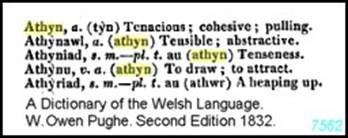
(delwedd 7562)
:_______________________________.
ati ‹a -ti›
1 ‘towards her’ third person feminine singular of the preposition at
2 mynd ati set to it
hwylio ati set to it, start a task
mynd ati fel lladd nadroedd set to it
with a vengeance (“go to it like killing snakes”)
3 dal ati stick at
it, continue to do (something)
4 ac ati et cetera, and so on
:_______________________________.
atig, PLURAL: atigau ‹A tig, a TII ge› masculine
noun attic
Paid â chadw eich casgliad stampiau mewn
seler, neu mewn atig heb eu
inswleiddio
Don’t keep your stamp collection in a cellar, or in an uninsulated attic
:_______________________________.
at i lawr ‹at i LAUR› prep phrase
1 facing downwards
Mewn rhai rhannau o'r byd gosodid y bedol â'i breichiau at i lawr. Credid
fod hynny'n lwcus oherwydd fod y ffurf wedyn yn cynrhychioli'r nefoedd, y to
sy'n gwarchod y Ddaear t14 Llafar Gwlad, Gwanwyn 1990, Rhif 27
In sojme parts of the world the horseshoe was placed with its arms facing
downwards. It was believed that this was lucky because the shape then
represented the heavens, the roof which protects the Earth
:_______________________________.
atodedig ‹a-to-dee-dig › adjective
1 (document) attached
ETYMOLOGY: (atod- stem of atodi = to attach) + (-edig suffix for forming a past
participle adjective)
:_______________________________.
atodiad, PLURAL:
atodiadau ‹a
TOD yad, a tod YAA de› masculine
noun
1 (book ) appendix
Abbreviation (in a dictionary entry): At.
:_______________________________.
atom, PLURAL: atomau ‹A tom, a TO me› masculine
noun
1 to us
:_______________________________.
atomfa ‹a-TOM-va ›
masculine noun
PLURAL atomféydd
‹a-tom-VEIDH›
1 nuclear power station
Atomfa’r Wylfa the nuclear power station at Yr Wylfa (Ynys Môn)
ETYMOLOGY: “atom place” (atom =
atom) + (-fa suffix = place)
:_______________________________.
atsain, PLURAL:
atseiniau ‹AT
sain, at SEIN ye› feminine noun
1 echo
:_______________________________.
atseinio ‹at SEIN yo›
verb
1 to echo, to reverberate
:_______________________________.
atsofl ‹AT-sovl› masculine
noun
1 fallow; land with stubble
ETYMOLOGY: (ad- prefix) + (sofl = stubble)
NOTE: Common in field names in Ceredigion in the form asol
atsofl > atso’l > a’so’l
Ffostrasol (= Ffos Tir Atsofl)
Llannarth: Pantrasol (pant yr asol = hollow of the stubble field)
Through false division: yr asol > y rasol
Y Rasol (= Yr Asol) (the stubble)
Car Rasol (= Cae’r Asol) (the stubble field)
:_______________________________.
atyniad, PLURAL:
atyniadau
‹a TƏN yad, a tən YAA de› masculine noun
1 attraction
2 atyniadau tref the
sights in a town, a town’s tourist attractions
:_______________________________.
-au-
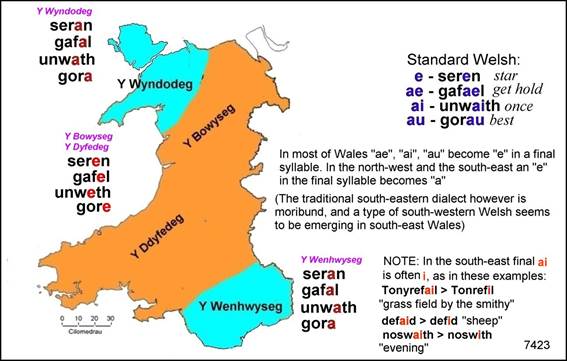
(delwedd 7423)
:_______________________________.
-au ‹AI› plural suffix
1 An example of its
use is: peth (= a thing), pethau (= things)
Colloquially over most of Wales (See map above) it is –e (pethe)
In the north-west and the south-east it is –a (petha)
The local pronunciation of Tafarnau-bach in Blaenau Gwent is Tafarna-bäch.
Bach means little; but an unrelated word bach means hook.
Hence this entry in the 1912 edition The Place-names of Wales by Thomas Morgan
(Skewen) (First edition 1887, revised and second edition 1912) (our comments in orange):
Tafarnau Bach. The ancient name of this place was Twyn-aber-dwynant, a hillock
where two brooks embrace each other. Some derive the present name from tafarn
a bach (= tarfan â bach), a
public house with a hook attached to the outer wall, whereto the rider, having
dismounted his steed, could fasten it. Others derive it from the great number
of small taverns in the place. (The second
suggestion is the more likely)
2 In certain place names on English maps, misspelt as –ey. In some cases the correct Welsh spelling is
used in English now e.e. Dolgellau
Clydau (Sir Benfro / Pembrokeshire) “Clydey”
Dolgellau “Dolgelley”
Llanarthnau (Sir Gaerfyddrin / Carmarthenshire) “Llanarthney” (Nowadays
the offical Welsh form indicates the dialectal pronunciation with “-e”: Llanarthne)
Nannau (Sir Feirionydd / Merionethshire) “Nanney” surname of a gentry family whose seat was here
Trefnannau ‹trev-NA-nai,
-e› village SJ2015 in Powys (as “Trefnanney” on the Ordnance
Survey map). This is tref y nannau “(the) trêv (of) (the) streams”
(tref = trêv, farmstead) + (y definite
article) + (nannau a plural form of nant
= stream)
The usual plural of nant nowadays in nentydd
:_______________________________.
-âu ‹AI›
1 plural suffix – in nouns with a final –a, to which –au
has been added as a pluraliser
copa (= head, top, peak), copâu (= heads, tops, peaks)
:_______________________________.
aur ‹AIR› masculine
noun
1 gold
2 Nid aur popeth melyn All that
glitters is not gold (“(it is) not gold everything
yellow”)
3 helygen aur (Salix alba var. vitellina) golden
willow
4 aur dilin fine gold
Aur dilin yw distawrwydd Silence is
golden (“(it-is”) fine gold that-is silence”)
Job 28:17 Nid aur a grisial a’i cystadla hi; na
llestr o aur dilin fydd gydwerth iddi
Job 28:17 The gold and the crystal cannot equal it: and the exchange of it
shall not be for jewels of fine gold.
5 (Carrasius auratus) pysgodyn aur (m), pysgod aur goldfish
( pysgodyn = fish) + (aur = gold)
NOTE: South Wales retains our ‹OIR›, an
older form of aur
:_______________________________.
Aurfron ‹EIR vron› feminine
noun
1 woman’s name (more correctly Eurfron; from aur = gold, bron =
breast)
:_______________________________.
aw > o /au̯/ > /ɔ, o:/
This is a common
reduction in Welsh
1
rarely in monosyllables
..1/ mawr /mau̯r/ (= big) > mor /mɔr/ (= very, so); mor drwm (= so heavy)
..2/ pawb /pau̯b/ (pronoun: everybody) > pob /po:b/ (determiner: each,
every)
2
sometimes in a penult syllable (especially whem the tonic syllable of
derivative forms)
..1/ cymrodedd (= compromise,
agreement) < *cymrawdedd < *cymfrawdedd
(cymfrawd, nowadays cymrawd = comrade, confrère, associate,
colleague) + soft mutation + (-edd
suffix for forming abstract nouns)
cymfrawd < (cym- = together) + (brawd
= judgement, verdict)
..2/ llofrudd (= murderer)
llawf rudd (llawf = hand) + soft
mutation + (rhudd = red)
Originally llaw was llawf, but in modern Welsh this final f has disappeared
llofrudd > *llawfrudd > llofrudd
sawdl (= heel) (m) > plural sodlau (= heels)
llawn (= full), llonaid > llond (=
fullness)
mawl (= praise) (m), moliant (= praise)
awr (= hour), oriau (= hours)
llawr (= floor, ground) > llorio to floor somebody, to knock
somebody to the floor or to the ground
*llawrio > llorio (llawr = floor, ground) + (-i-o suffix per forming verbs)
pawr (= it browses), pori (= to browse)
tlawd (= poor), tlodi (= poverty), tlodion
(= poor people)
3
in a final syllable - modern “o” in the final syllable is often a reduction of
the Middle Welsh diphthong “-aw”
..1/ Abérffraw > Y Berffro (name of a village in Môn)
..2/ Abérmaw > Y Bermo (name of a village in Gwynedd)
..3/ allawr > allor (= altar)
..4/ *athraw > athro (= male teacher) (cf. athrawes = woman teacher )
..5/ croesawu (= to welcome), *croesaw > croeso (= a welcome)
..6/ difrod (= danys) < difrawd; brawd (= judici)
ETYMOLOGY: difrod (modern Welsh)
damage, destruction; (obsolete meaning) neglect of law, contempt of law; < difrawd (di- prefix = without) + soft mutation + (brawd = judgement, verdict)
..7/ deffraw! > deffro! (wake up!)
..8/ gwrandaw! > gwrando! (listen!)
..9/ llawn (= full); suffix *-lawn > -lon (fyddlon =
faithful)
..10/ pechawd > pechod (= sin)
..11/ Pen-y-cláwdd > (shift
of accent) Penýclawdd > (loss of
final dd) Penýclaw’ > (reduction
of aw) Penýclo
Name of a village in Powys (“(place) by the boundary ditch / frontier dyke”)
..12/ A reduced form of the word awdl
is odl = rhyme.
Derived forms: (1) odli = to rhyme,
(2) unodl (poem) with all lines
having the same rhyme
But there are many words which retain “aw” in the final syllable:
..1/ canllaw (= handrail,
guide)
..2/ catrawd (= regiment)
..3/ yn ddirfawr (= severely)
..4/ distaw (= silent)
..5/ enfawr (= enormous)
..6/ pennawd (= heading)
:_______________________________.
-awd ‹aud› suffix
In modern Welsh -awd > -od
1 Used in words referring to a stroke or blow.
.....(a) the suffix indicates the thing which delivers the blow (instrument,
weapon, etc)
dyrnod < dyrnawd = blow with the fist, punch (dwrn = fist)
ffonnod < ffonnawd = blow with a stick (ffon
= stick)
palfod < palfawd = slap with an open hand (palf = palm of the hand)
.....(b) the suffix indicates the site of the impact, the part of the body which receives the stroke or blow of a weapon
anafod < anafawd = sore,
ulcer (anaf = wound)
cernod < cernawd = blow to the side of the head, box on the ears (cern = cheekbone)
gwarrod < gwarrawd = blow or beating on the neck (gwar = back of the neck, back between the shoulders)
ETYMOLOGY: Celtic –âtyô
:_______________________________.
awdl <AUDL> [aʊdl] feminine
noun
PLURAL odlau <OD-lai,
-le> [ˡɔdlaɪ, -ɛ]
1 Welsh poetic form - alliterative, combining different metres
awdl arobryn prize-winning poem,
winning poem (alliterative, in different metres)
2 A reduced form of the word awdl
is odl = rhyme.
Derived forms: (1) odli = to rhyme,
(2) unodl (poem) with all lines
having the same rhyme
ETYMOLOGY: (awd) + (extraneous -l) – possibly influenced by the word sawdl (= sole of the foot).
Awd < British *ôd < Latin ôda < Greek ôidê <
aoidê (= song).
NOTE: Another word with a non-etymological “l” is corwgl (= coracle) < corwg
:_______________________________.
awdur, PLURAL: awduron <AU-dir, au-DII-ron>
[ˡaʊdɪr, aʊˡdiˑrɔn] masculine
noun
1 author
:_______________________________.
awdurdod PLURAL:
awdurdodau <au-DIR-dod,
au-dir-DOO-dai, -de> [aʊˡdɪrdɔd,
aʊdɪrˡdoˑdaɪ,
-ɛ] masculine noun
1 authority
:_______________________________.
awdurdod addysg
lleol <au-DIR-dod AA-dhisk LHEE-ol> [aʊˡdɪrdɔd ˡɑˑðɪsk
ˡɬeˑɔl] masculine noun
1 local education authority, school board
:_______________________________.
awel <AU-el> [ˡaʊɛl] feminine
noun
PLURAL awelon <au-EE-lon> [aʊˡeˑlɔn]
1 wind
awel o wynt gust of wind
awel groes an ill wind
Mae’r awel yn fain y mis ’ma. “Mawrth a
ladd, Ebrill a fling.”
The wind is keen this month. ‘March kills, April flays’.
awel gyntaf y Gwanwyn the first breath of Spring
2 breeze = light wind
awelyn (county of Ceredigion) slight
breeze
awelig slight breeze
awel win pleasant breeze (‘breeze
(of) wine’)
yn awel yr hwyr in the cool of
the evening (“in the breeze of the evening”)
3 common in house names:
Awel-deg <AU-el
DEEG> [ˡaʊɛl ˡdeːg] (fair
wind),
Awelfa (windy place) <au-EL-va> [aʊˡelva]
Awelfor (sea breeze) <au-EL-vor> [aʊˡelvɔr]
Awelfryn (windy hill) <au-EL-vrin> [aʊˡelvrɪn]
Awelmenai / Awel Menai (Menai breeze, breeze off
the Menai Strait) <AU-el ME-nai> [ˡaʊɛl
ˡmeˑnaɪ]
Awelon (breezes) <au-EE-lon> [aʊˡeˑlɔn]
Aweltywi (Tywi breeze, breeze off
the river Tywi) <AU-el TƏ-wi> [ˡaʊɛl ˡtəwɪ]
Awel-y-fan (breeze from the
hill / peak) <AU-el ə VAN> [ˡaʊɛl
ə ˡvan]
Awelymynydd (mountain breeze) <AU-el ə MƏ-nidh> [ˡaʊɛl
ə ˡmənɪð]
Awel-y-don (sea breeze) <AU-el ə DON>
[ˡaʊɛl ə ˡdɔn]
Brynawelon (windy hill) <brin au-EE-lon> [brɪn aʊˡeˑlɔn] (= bryn yr awelon)
Brynyrawel (hill of the breeze /
wind) <BRIN ər AU-el> [ˡbrɪn ər ˡaʊɛl]
Also with the linking definite article dropped: Brynawel <BRIN AU-el> [ˡbrɪn ˡaʊɛl]
Crud yr Awel / Crudyrawel <KRIID ər AU-el> [ˡkriːd ər ˡaʊɛl]
(“(the) sound / voice (of) the wind”) house name and street name
(“(the) cradle (of) the breeze”)
(crud = cradle) + (yr = the) + (awel = breeze)
Llais yr Awel / Llaisyrawel (“(the) sound / voice (of) the wind”) house name <HLAIS ər AU-el>
/ˡɬaɪs ər ˡaʊɛl/
Maesawelon (windy open field) <mais au-EE-lon> /mai̯s aʊˡeˑlɔn/ (< bryn
yr awelon)
4
(county of Ceredigion) erysipelas, Saint Anthony’s Fire – infection of the
skin, with purplish lesions on the face
ETYMOLOGY: Welsh < British *awel-â
From the same British root: Cornish awel
(= wind, gale, weather), Breton avel
(= wind)
From a PIE root *h2euh1
(“to blow”).
From Proto-Indo-Eureopean *h2ueh1-nto- :
Cf English wind, German der Wind [vint] (= wind)
No connection with Ancient Greek Αἴολος (Aíolos)
/ǎi̯.o.los/ → /ˈɛ.o.los/ → /ˈe.o.los/ (= god of the winds; <
adjective = “moving, swift”), Greek aella (= storm) (wiktionary 16-10-2023: of uncertain
origin: possibly from Proto-Hellenic *walwólos, from Proto-Indo-European
*welwel-, reduplicative form of the root *welH- (“to turn”).)
:_______________________________.
Awel <AU-el> [ˡaʊɛl] femenine
noun
1 woman’s name
ETYMOLOGY: ‘breeze’ - see preceding entry
:_______________________________.
awen PLURAL: awenau <AU-en, au-EE-nai, -ne>
[ˡaʊɛn, aʊˡeˑnaɪ, -ɛ] feminine
noun
1 muse; melody
ETYMOLOGY: Wiktionary 16-10-2023: Perhaps related
to AWEL (“breeze”).
:_______________________________.
Awen <AU-en> [ˡaʊɛn] feminine
noun
1 woman’s name
ETYMOLOGY: poetic muse - see preceding entry
:_______________________________.
awff <AUF> [aʊf] (m)
(Maldwyn, Gogledd Ceredigion)
1 clumsy person, oaf; (USA: klutz)
2 scoundrel
3 bod yn awff am be very fond of (“be an oaf about”)
ETYMOLOGY: English awf, a dialect form of oaf
NOTE: In the English dialect of
Llanidloes:
AWF, a stupid, awkward or clumsy fellow... (Parochial Account of Llanidloes /
Edward Hamer / Chapter X / Folk-lore. Page 289 Collections Historical and
Archeological Relating to Montgomeryshire and its Borders / 1877)
:_______________________________.
awgrymu <au-GRƏ-mi> [aʊˡgrəmɪ] verb
1 to suggest
:_______________________________.
awn ni <aun
ni> [ˡaʊn nɪ] verb
1 let’s go
:_______________________________.
awr, PLURAL: oriau <AUR, OR-yai, -ye> [aʊr, ˡɔrjaɪ, -ɛ] feminine
noun
1 hour
chwarter awr <khwar-ter AUR> [ˡxwartɛr ˡaʊr] quarter of
an hour
hanner awr <ha-ner AUR> [ˡhanɛr ˡaʊr] half an hour
2 bys awr hour hand (“finger (of)
hour”)
3 rai oriau yn ddiweddarach some
hours later
4
yr oriau mân the small hours; =
early hours after midnight
yn yr oriau mân in the small hours
yn
oriau mân y bore in the early hours of the morning, in the small hours
:_______________________________.
Awr fawr Calan,
dwy Ŵyl Eilian, tair Ŵyl Fair
‹aur vaur KAA-lan,
dui aur uil EIL-yan, tair
aur uil VAIR›
[aʊr vaʊr
ˡkɑˑlan, dʊɪ aʊr ʊɪl
ˡəɪljan, taɪr aʊr ʊɪl ˡvaɪr]
1
‘big hour (on) the calend (“awr fawr y Calan”) , two on Eilian’s feastday, and
three on Mary’s feastday’
That is, the day will have lengthened
..a/ a full hour by New Year’s Day (Y
Calan) on January the first, (half an hour in the morning a half an hour in
the evening), (i.e eleven days after the solstice)
..b/ two hours on Eilian’s feastday (Gŵyl
Eilian) on January the thirteenth,
(i.e twelve days after the first of January)
..c/ and three hours by Lady Day (Gŵyl
Fair) on February the second (i.e twenty
days after Eilian’s Day)
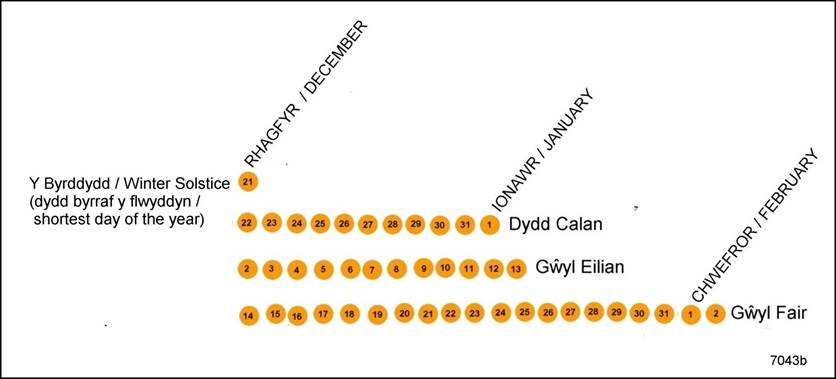
(delwedd 704b3)
NOTE: (Gŵyl Eilian is “the
feastday of Eilian”; soft mutation of the initial consonant in the phrase
converts it into an adverbial, Ŵyl
Eilian “on the feastday of Eilian”)
:_______________________________.
awrfys <AUR-vis> [ˡaʊrvɪs] masculine noun
PLURAL awrfysedd
<aur-VƏ-sedh> [aʊrˡvəsɛð]
1 hour hand (of clock, watch)
ETYMOLOGY: (awr = hour) + soft
mutation + (bys = finger)
:_______________________________.
Awst <AUST> [aʊst] masculine noun
1 August
2 mis Awst August (“(the) month (of) August”)
ym mis Awst in August
ar ddechrau mis Awst at the beginning of August
ar ganol mis Awst in the middle of
August, in mid-August
ar ddiwedd mis Awst at the end of
August
bob mis Awst every August
fis Awst (adverb) in the month of August
3 Daw Awst, daw nos When
August comes, the nights are noticeably longer (“August comes, night comes”)
4 Calan Awst August the
first, a feastday commemorating the miraculous deliverance of Peter from
prison; formerly also a harvest festival; in the town of Caerfyrddin there is a
street in the central called
Heol Awst
(“street (of) (the feastday of the first day of) August”).
The English name is Lammas Street (“lammas” is ‘loaf + (religious) mass’, mass
of the loaves).
ETYMOLOGY: Welsh Awst < *Awghwst < British < Latin Augustus (from the emperor of this
name)
From the same British root: Cornish Est (=
August), Breton eost (= August)
..01 Awst (y cyntaf o Awst)
the first of August
Calan Awst Lammas Day (“the) calend
(of) August”)
Gŵyl Awst Lammas Day (“the)
feastday (of) August”)
..02 Awst (yr ail o Awst)
the second of August
..03 Awst (y trydydd o Awst)
the third of August
..04 Awst (y pedwerydd o Awst)
the fourth of August
..05 Awst (y pumed o Awst)
the fifth of August
..06 Awst (y chweched o Awst)
the sixth of August
..07 Awst (y seithfed o Awst)
the seventh of August
..08 Awst (yr wythfed o Awst)
the eighth of August
..09 Awst (y nawfed o Awst)
the ninth of August
..10
Awst (y degfed o Awst)
the tenth of August
Gŵyl Lawrens (“the) feastday
(of) Laurence”)
..11 Awst (yr unfed ar ddeg o Awst)
the eleventh of August
..12 Awst (y deuddegfed o Awst)
the twelfth of August
..13 Awst (y trydydd ar ddeg o Awst)
the thirteenth of August
..14 Awst (y pedwerydd ar ddeg o Awst)
the fourteenth of August
..15 Awst (y pymthegfed o Awst)
the fifteenth of August
Gŵyl Fair yn Awst (15 Awst) =
Assumption of Mary;
(“the) ‘gwyl Fair’ in August”, the feastday (of) Mary in August) or
Gŵyl Fair Gyntaf y Cynhaeaf
(“the) first ‘gwyl Fair’ (of) the harvest” or
Gŵyl Fair Gyntaf (“first ‘gŵyl
Fair’”)
..16 Awst (yr unfed ar bymtheg o Awst)
the sixteenth of August
..17 Awst (yr ail ar bymtheg o Awst)
the seventeenth of August
..18 Awst (y deunawfed o Awst)
the eighteenth of August
..19 Awst (y pedwerydd ar bymtheg o Awst)
the nineteenth of August
..20 Awst (yr ugeinfed o Awst)
the twentieth of August
..21 Awst (yr unfed ar hugain o Awst)
the twenty-first of August
..22 Awst (yr ail ar hugain o Awst)
the twenty-second of August
..23 Awst (y trydydd ar hugain o Awst)
the twenty-third of August
..24 Awst (y pedwerydd ar hugain o Awst)
the twenty-fourth of August
..25 Awst (y pumed ar hugain o Awst)
the twenty-fifth of August
..26 Awst (y chweched ar hugain o Awst)
the twenty-sixth of August
..27 Awst (y seithfed ar hugain o Awst)
the twenty-seventh of August
..28 Awst (yr wythfed ar hugain o Awst)
the twenty-eighth of August
..29 Awst (y nawfed ar hugain o Awst)
the twenty-ninth of August
..30 Awst (y degfed ar hugain o Awst)
the thirtieth of August
..31 Awst (yr unfed ar ddeg ar hugain o Awst)
the thirty-first of August
:_______________________________.
Awstin <AU-stin> [ˡaʊstɪn] masculine
noun
1 Austin, Augustine
:_______________________________.
Awstralia <au-STRAL-ya> [aʊˡstralja] feminine
noun
1 Australia
:_______________________________.
Awstria <AU-strya> [ˡaʊstrja]
1 Austria
helygen
Awstria (Salix mielichhoferi) Austrian willow
“willow (of)
Austria” (helygen = willow) + (Awstria)
:_______________________________.
awydd <AU-idh> [ˡaʊɪð] masculine
noun
1 desire, wish
2
codi awydd bwyd arnoch whet your
appetite (“raise (the) desire (of) food on you”)
3
colli awydd bwyd lose your appetite
:_______________________________.
awyddfryd <au-ƏDH-vrid> [aʊˡəðvrɪd] masculine noun
1 keenness, zeal
Rhufeiniaid 8:19 Canys awyddfryd y
creadur sydd yn disgwyl am ddatguddiad meibion Duw
Romans 8:19 For the earnest expectation of the creature waiteth for the
manifestation of the sons of God.
Philipiaid 1:20 Yn ôl fy awyddfryd a'm
gobaith, na'm gwaradwyddir mewn dim, eithr mewn pob hyder, fel bob amser, felly
yr awron hefyd, y mawrygir Crist yn fy nghorff i, pa un bynnag ai trwy fywyd,
ai trwy farwolaeth.
Philippians 1:20 According to my earnest expectation and my hope, that in
nothing I shall be ashamed, but that with all boldness, as always, so now also
Christ shall be magnified in my body, whether it be by life, or by death.
ETYMOLOGY: (awydd-, y = <ə> [ə] , <
awydd y = <i>
[ɪ] , = desire) + soft mutation
+ (bryd = mind, intention)
:_______________________________.
awyddus <au-Ə-dhis> [aʊˡəðɪs] adjective
1 keen, desirous
ETYMOLOGY: (awydd-, y = <ə> [ə] , <
awydd y = <i>
[ɪ] , = desire) + (-us adjectival suffix)
:_______________________________.
awyr <AU-ir> [ˡaʊɪr] masculine
noun
1 air
awyr iach <au-ir YAAKH> [aʊɪr ˡjɑːx] masculine
noun fresh air
awyr agored <au-ir a-GOO-red> [aʊɪr aˡgoˑrɛd] masculine
noun open air
2 sky = the space above the ground
Mae’r awyr yn goleuo The sky is
clearing
awyr penddu overcast sky, grey sky
(“black-headed sky”)
darn o awyr las a patch of blue sky
yr awyr serog the starry sky
3 as attributive noun:
post awyr air mail
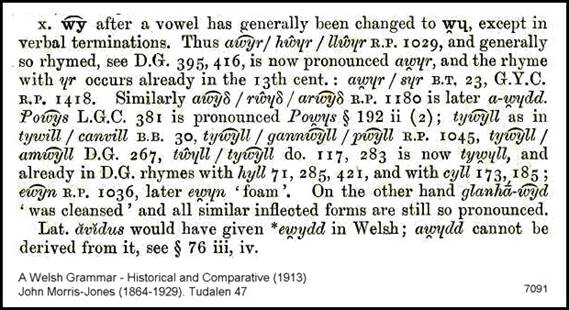
(delwedd 7091)
:_______________________________.
awyren, PLURAL:
awyrennau <au-Ə-ren,-au-ə-RE-ne> [aʊˡərɛn, aʊəˡrɛnaɪ,
-ɛ] feminine noun
1 airplane (Englandic: aeroplane)
2 awyren fomio, awyrennau
bomio bomber (plane which drops bombs)
awyren ryfel, awyrennau rhyfel
warplane
awyren jet, awyrennau jet jet plane
awyren filwrol, awyrennau milwrol
military plane
awyren gludo, awyrennau cludo
transport plane
awyren deithwyr, awyrennau teithwyr
passenger plane
:_______________________________.
awyren ryfel <au-Ə-ren-RƏ-vel> [aʊˡərɛn
ˡrəvɛl] masculine
noun
PLURAL awyrennau rhyfel <au-ə-RE-nai
-e HRƏ-vel> [aʊəˡrɛnaɪ
-ɛ ˡhrəvɛl]
1 (American: warplane, battle plane) (Englandic: warplane)
ETYMOLOGY: (awyren = airplane /
aeroplane) + soft mutation + (rhyfel
= war)
:_______________________________.
awyrfilwr <au-ər-VII-lur> [aʊərˡviˑlʊr] masculine noun
PLURAL awyrfilwyr <au-ər-VIL-wir> [aʊərˡvɪlwɪr]
1 paratrooper
ETYMOLOGY: (awyr- <ə> [ə] < awyr
<i> [ɪ] = sky) + soft mutation + (milwr = soldier)
:_______________________________.
awyrgludiad <au-ər-GLID-yad> [aʊərˡglɪdjad] masculine noun
PLURAL awyrgludiadau <au-ər-glid-YAA-dai, -de> [aʊərglɪdˡjɑˑdaɪ,
-ɛ]
1 airlift
ETYMOLOGY: (awyr- <Ə> [ə] < awyr <I> [ɪ] = sky) + soft mutation + (cludiad = carrying)
:_______________________________.
awyrgludiant <au-ər-GLID-yant> [aʊərˡglɪdjant] masculine noun
1 airfreight
ETYMOLOGY: (awyr- <ə> [ə] < awyr
<i> [ɪ] = sky) + soft mutation + (cludiant = transport)
:_______________________________.
awyrgylch <au-ƏR-gilkh> [aʊˡərgɪlx] masculine
noun
1 atmosphere
2 atmosphere = a particular environment
awyrgylch cartrefol a homelike
atmosphere
ETYMOLOGY: (awyr- <ə> [ə] < awyr
<i> [ɪ] = sky) + soft mutation + (cylch = circle)
:_______________________________.
awyr iach <AU-ir YAAKH> [aʊ-ɪr ˡjɑːx]
1 fresh air; open air
Mae e wedi dod fel awyr iach o rywle
He's like a breath of fresh air in the place (“he’s come like healthy air from
somewhere”)
yn yr awyr iach in the open air
mynd i gael awyr iach go out for a breath of fresh air
ETYMOLOGY: “healthy air” (awyr
= air) + (iach = healthy)
:_______________________________.
awyrlong <au-ƏR-long> [aʊˡərlɔŋ]
feminine noun
PLURAL awyrlongau <a-wər-LO-ngai -e> [awərˡlɔŋaɪ,
-ɛ]
1 airship
ETYMOLOGY: (awyr = air, sky) + soft
mutation + (llong = ship)
:_______________________________.
awyrlu <au-ƏR-li> [aʊˡərlɪ] masculine
noun
PLURAL awyrluoedd <a-wər-LI-oidh -odh> [awərˡliˑɔɪð, - ɔð]
1 airforce, military division of a state’s armed forces for aerial
warfare, with fighters, bombers, and reconnaissance aircraft; usually organised
in combination with land forces and sea forces
2 Marsial yr Awyrlu
(“marshal (of) the airforce”) Air Marshal = senior airforce officer, equivalent
to a vice-admiral in the Navy
ETYMOLOGY: (awyr = air, sky) + soft
mutation + (llu = army)
:_______________________________.
awyrlun <au-ƏR-lin> [aʊˡərlɪn] masculine
noun
PLURAL awyrluniau <a-wər-LIN-yai -e> [awərˡlɪnjaɪ,
-ɛ]
1 aerial photo
ETYMOLOGY: (awyr = air, sky) + soft
mutation + (llun = picture)
:_______________________________.
Aztec, PLURAL: Azteciaid <AZ-tek, az-TEK-yaid -yed> [ˡaztɛk, azˡtɛkjaɪd, -ɛd] masculine
noun
1 Aztec
 A
A
...
 AR
AR
...
 BA
BA
...
 BR
BR
...
 CA.
CA.
...
 CE
CE
...
 CI
CI
...
 CR
CR
...
 CY
CY
...
 DA
DA
...
 DI
DI
...
 E
E
...
 F
F
...
 GA
GA
...
 GWA
GWA
...
 GWI
GWI
...
 H
H
...
 I, J, K
...
 L
L
...
 MA
MA
...
 MI
MI
...
 N
N
...
 O
O
...