kimkat1039e A Welsh to English Dictionary in
scroll-down format. Geiriadur Cymraeg a Saesneg ar fformat sgrolio-i-lawr.
25-02-2022





|
|
|
Gwefan
Cymru-Catalonia |
|

|
|
|
|
|
|
|
|
|
|
|
|
|
|
|
|
|
|
|
|
|
|
|
|
|
|
|
|
|
|
|
|
|
|
|
|
|
|
|
|
|
|
|
|
|


:_______________________________.
B, b ‹bee› [beː] feminine noun
1) second letter of the twenty-six letter
Roman alphabet
...1 a, 2 b, 3 c, 4 d 5 e, 6 f, 7 g, 8 h, 9 i, 10 j, 11 k, 12 l, 13 m, 14 n, 15 o, 16 p, 17 q, 18 r, 19 s, 20 t, 21 u, 22 v, 23 w, 24 x, 25 y, 26 z
2) second letter of the twenty-nine letter
Welsh alphabet
...1 a, 2 b, 3 c, 4 ch, 5 d, 6 dd 7 e, 8 f, 9 ff, 10 g, 11 ng, 12 h, 13 i, 14 j, 15 l, 16 ll, 17 m, 18 n, 19 o, 20 p, 21 ph, 22 r, 23 rh, 24 s, 25 t, 26 th, 27 u, 28 w, 29 y
:_______________________________.
b
b and m have interchanged in certain
words. This in part may be explained by the fact that both initial b and m soft-mutate to f [v], and there has been confusion about the initial
consonant of the unmutated word – it seems to occur generally with feminine
words, where such a mutation would be frequent as it occurs after the definite
article y
1/ b < m
brawddeg (=
sentence) < ’mrawddeg < amrawddeg
The origin of amrawddeg is amrawdd + (suffix –eg)
Amrawdd is (am prefix = around) + soft mutation + (rhawdd = speech, talking)
Y frawddeg (= the sentence) was later
supposed to be from an original brawddeg as an initial mr- is very unusual or exceptional.
2/ m < b
modfedd (= inch)
< máwd-fedd < báwd-fedd (bawd = thumb) + soft mutation + (medd = measure)
(y fodfedd = the inch)
menyw (= woman) < benyw (cf Irish bean = woman)
(y fenyw = the woman)
In other cases, for example with certain names / titles, it is possibly the
result of confusion by infants
modryb (= aunt) > bodo, bopa (= auntie)
Maredudd (“Meredith”) > Bedo
3/ b > m
Originally b can become m through confusion
about what the radical initial consonant really is.
1/ bainc > mainc (= bench)
2/ bath > math (= type)
3/ benyw > menyw (= woman)
4/ Banon > Manon (woman’s name))
6/ Bedo (diminutive
form) < Maredudd (forename)
5/ ffwlbart (= marten) <
English [fúulmart] FOULMART (= “a foul(-smelling) marten), FOUL (i.e. smelly)
MART (= marten)
4/ b < p Final b in Welsh from a final p in English. See b 4 below
:_______________________________.
b 1
In the Celtic languages, b may correspond to m in some Latin words (and be from an earlier Celtic m)
..1) Welsh brag < British < Celtic
From the same British root: Cornish brag (= malt)
From the same Celtic root: Irish braich (= malt)
Cf Latin marcor (= putrefaction)
..2) Welsh bro (= country)
Latin margo, margin- (= border)
..3) Welsh blith (= (adj) milk-giving) < British *blikt- < Celtic *mlikt-
Latin mungere < mulgere (= to milk), Catalan munyir (= to milk)
:_______________________________.
b 2
1) British b <b> [b] has become
f <v> [v] in modern
Welsh
abon- > afon (= river)
gob- > gof (= smith)
Sabrîna > Hafren (river name)
:_______________________________.
b 3
1) A final b, corresponding to an original p in British, is equivalent to a final –c or –ch in Irish (and Scottish Gaelic and Manx)
mab (< map-os) (= son), Irish mac (= son)
crib (= comb; crest, ridge), Irish críoch (= boundary)
:_______________________________.
b 4
b < p
Earlier borrowings of English words with final -p show final -b in Welsh
Casgob, Powys
(spelt in English Cascob) also includes Old English ‘hôp’ as a final element (= a side valley joining a main valley; a secluded
valley).
Ednob is a Cymricisation of the English name Edenhope
(locality in England near the Welsh border; a village 9km north-west of Colunwy
(Clun), in the parish of Mainstone (SO2787) (county of Shropshire)). The first
element (Eden-) is from some Old English personal name, and the second element
is (in modern English) ‘hope’ as a detached element in place names, from Old
English ‘hôp’ (= a side valley joining a main valley; a secluded valley).
The English name has maybe acquired a new pronunciation as a result of spelling
pronunciation (cf weskit > waist|coat, forrid > fore|head).
We might suppose that in earlier English the initial
‘h’ of the final element was lost (typically in English place names – Durham,
Newnham, etc where the ‘h’ is not sounded in modern English).
The Welsh form preserves the (shortened) vowel of ‘hop’, though we might
suppose that as a final element the long vowel became schwa in English at some
stage.)
Also, the post-tonic syllable with schwa was dropped (Édenop > Édnop).
Maybe too the first vowel was originally short in English, and so the Welsh
name preserves to a great extent the older English pronunciation of the name.
sgib (South-west Wales) wicker basket, from English (nonstandard or dialect English) skep (=
wicker basket)
Yr Hob [ər ˡho:b] (place name) Hope (= a side valley joining a main valley; a secluded
valley).
:_______________________________.
b 5
In soft mutation, b < p
Examples of feminine-gender nouns after the
definite article:
pont, y bont bridge, the
bridge
peunes, y beunes peahen, the peahen
problem, y broblem problem,
the problem
pompren, y bompren footbridge, the footbridge
porfa, y borfa pasture, the pasture
:_______________________________.
b 6
b < f
In borrowings from English, an initial (v), spelt f, has become b, as if the
(v) is a soft-mutated consonant and the radical initial is (b)
becso (= to worry) <
*fecso < English TO VEX (= annoy)
(formerly) bicer (= vicar),
nowadays as in English with initial [v]: ficer
:_______________________________.
B-
In certain surnames derived from
patronymics, the initial ‘b’ is ultimately from mab = son
(mab > fab > ab > b-)
Bedward < ’b Edward, ab Edward
Beavan < ’b Ifan, ab Ifan
Bellis < ’b Elis, ab Elis
Bennion < ’b Einion,ab Einion
Bevan < ’b Efan, ab Efan (= ab Ifan)
Bowen < ’b Owen,ab Owen (literary form: ab Owain)
:_______________________________.
ba-
A
word beginning with ba- is possibly a
soft-mutated form with original pa-
i ba dre? to what town? (pa = which, what)
dau báragraff two paragraphs
:_______________________________.
baadd <BAADH> [bɑːð]
1 southern form of
baedd (= boar)
(diphthong ae > long vowel aa)
Usually spelt bâdd / ba’dd
See aa
:_______________________________.
Baal <baal> [bɑːl] masculine noun
1 Baal = Semitic fertility God
2 (Bible) Baal = false god
...1 Brenhinoedd 16:32 Ac efe a gododd allor i Baal yn nhy Baal, yr hwn a adeiladasai efe yn Samaria (16:33) Ac Ahab a wnaeth lwyn, a wnaeth fwy i ddigo Arglwydd Dduw Israel na holl frenhinoedd Israel a fuasai o'i flaen ef
...1 Kings 16:32 And he reared up an altar for Baal in the house of Baal, which
he had built in Samaria (16:33) And Ahab made a grove, and Ahab did more to
provoke the Lord God of Israel to anger than all the kings of Israel before him
3 Bryn-y-Baal SJ2664 (a village east of Bwcle / Buckley) is a poor
spelling for Bryn-y-bâl.
According to Geiriadur Prifysgol Cymru (Rhan 4, Blwyddyn 1952, tudalen 250)
(University of Wales Dictionary of the Welsh Language) (Part 4, Year 1952, page
250) bâl is noted as occurring c. 1788 as “Bâl the peak, or pointed summit
of a hill or mountain”, in which case it would be “(the) hill (of) the
sharp peak”, (though whether this describes a hill there I do not know!)
http://www.geograph.org.uk/gridref/SJ2664
ETYMOLOGY: Welsh < Greek < Hebrew ba'al (= master)
:_______________________________.
baban <BAA-ban> [ˡbɑˑban] masculine noun
PLURAL babanod <ba-BAA-nod> [baˡbɑˑnɔd]
1 baby
dillad baban baby clothes
2 iaith babanod baby talk
3 baby = new venture, new company
Roedd y baban newydd yn dod rhagddo'n gampus yn ei ddwylo diogel
The new baby / the new business was thriving wonderfully in his safe hands
ETYMOLOGY: Welsh baban < maban (mab = son, child) +
(-an, diminutive
suffix) from the influence of the English word babe
:_______________________________.
babanaidd <ba-BAA-naidh, -nedh> [baˡbɑˑnaɪð, -nɛð] adjective
1 infantile
2 childish
ETYMOLOGY: (baban = infant) + (-aidd suffix for forming adjectives)
:_______________________________.
babaneiddiwch <ba-ba-NEIDH-yukh> [babaˡnəɪðjʊx] masculine noun
1 childishness
ETYMOLOGY: (babanaidd = infantile) + (-i-wch suffix for forming nouns)
:_______________________________.
babanladdiad <ba-ban-LADH-yad> [babanˡlaðjad] masculine noun
PLURAL babanladdiadau <ba-ban-ladd-YAA-dai,
-de> [babanladdˡjɑˑdaɪ, -dɛ]
1 infanticide
ETYMOLOGY: (baban = infant) + soft mutation + (lladdiad = killing)
:_______________________________.
babanleiddiad <ba-ban-LEIDH-yad> [babanˡləɪðjad] masculine noun
PLURAL babanladdiadau <ba-ban-leidd-YAA-dai,
e> [babanləɪddˡjɑˑdaɪ,
-dɛ]
1 infanticide (person)
ETYMOLOGY: (baban = infant) + soft mutation + (lleiddiad = killer, murderer)
:_______________________________.
Y Babell <ə BAA-belh> [ə ˡbɑˑbɛɬ] f
1 name of certain nonconformist chapels (=
"the tabernacle")
Street names
..a/ “Babell Road”, Gorsedd (SJ1576), Treffynnon (county of Y Fflint)
(this would be Ffordd y Babell in Welsh)
..b/ “Babell Road”, Pen-sarn (county of Caerfyrddin)
(this would be Heol y Babell in Welsh)
2 (SJ1573) Y Babell (= "the
tabernacle") a village in the county of Fflint 4km south-west of
Treffynnon; from the name of a Nonconformist chapel
ETYMOLOGY: (y = definite article) + soft mutation + (pabell = tent; tabernacle )
Probably from pabell y cyfarfod (Exodus 29:42), the tabernacle of the congregation
prepared by Moses for the people to meet God
..a/ Exodus 29:42 Yn boethoffrwm gwastadol trwy eich oesoedd, wrth ddrws pabell y cyfarfod, gerbron yr ARGLWYDD; lle y cyfarfyddaf â chwi, i lefaru wrthyt yno.
Exodus 29:42 This shall be a continual burnt offering throughout your
generations at the door of the tabernacle of the congregation before the LORD:
where I will meet you, to speak there unto thee.
..b/ Salmau 27:3 Pe gwersyllai llu i’m herbyn, nid ofna fy nghalon: pe cyfodai cad i’m herbyn, yn hyn mi a fyddaf hyderus. 27:44 Un peth a ddeisyfais i gan yr ARGLWYDD, hynny a geisiaf; sef caffael trigo yn nhŷ yr ARGLWYDD holl ddyddiau fy mywyd, i edrych ar brydferthwch yr ARGLWYDD, ac i ymofyn yn ei deml. (27:5) Canys yn y dydd blin y’m cuddia o fewn ei babell: yn nirgelfa ei babell y’m cuddia; ar graig y’m cyfyd i.
Psalms 27:3 Though an host should encamp against me, my heart shall not fear:
though war should rise against me, in this will I be confident. (27:4) One
thing have I desired of the LORD, that will I seek after; that I may dwell in
the house of the LORD all the days of my life, to behold the beauty of the
LORD, and to inquire in his temple. (27:5) For in the time of trouble he shall
hide me in his pavilion: in the secret of his tabernacle shall he
hide me; he shall set me up upon a rock
:_______________________________.
Y Babell Lên <ə BAA-belkh LEEN> [ə ˡbɑˑbɛɬ
ˡleːn] feminine noun
1 (Eisteddfod) the Literature Tent,
venue for readings of literature, lectures and talks on literature and authors
ETYMOLOGY: (y = definite article) + soft mutation + (pabell = tent) + soft mutation + (llên = literature)
:_______________________________.
babi, PLURAL: babis <BAA-bi, BAA-bis> [ˡbɑˑbɪ, ˡbɑˑbɪs] (masculine
noun)
1 baby
:_______________________________.
Bábilon <BA-bi-lon> [ˡbabɪlɔn] feminine noun
1 Babylon = ancient capital of the Chaldean
empire
2 helygen Bábilon (Salix babylonica) weeping willow See: helygen wylofus
3 (SJ3260) locality 3km NE of Yr Hob (county of Y
Fflint)
http://www.geograph.org.uk/photo/134184
:_______________________________.
bac <BAK> [bak] (m) (Englishism) back
especially in the phrase drws y bac the back door
:_______________________________.
bacbib, PLURAL: bacbibau <BAK-bib, bak-BII-bai,
-be> [ˡbakbɪb, bakˡbiˑbaɪ, -bɛ] (feminine
noun) (f)
1 bagpipe
Welsh BACBIB < BÀG-BIB (BÀG = bag) + soft mutation + (PIB = pipe); the
change of G-B (that is, G before a B which is the soft mutation of C) to C-B is
normal.
ETYMOLOGY: BACBIB is a translation of English BAGPIPE
:_______________________________.
bacbibiwr, PLURAL: bacbibwyr <bak-BIB-yur,
bak-BIB-wir> [bakˡbɪbjʊr, bakˡbɪbwɪr] (masculine
noun)
1 bagpiper
:_______________________________.
bacbibydd, PLURAL: bacbibyddion <bak BII bidh, bak bi BƏDH
yon> (m)
1 bagpiper
ETYMOLOGY: ETYMOLOGY (BACBIB = gaita) + (-YDD suffix
= home)
:_______________________________.
bach <BAAKH> [bɑːx] adjective
1 small, little
cwrw bach (‘little beer’) small beer = weak beer
gwas bach youngest or lowest-ranking farmhand; dogsbody, person
obliged to do the less pleasant chores
mae hwn yn rhy fach this is too small
mater bach a small matter
yn y bore bach (adverb) early in the moning (‘in the little morning’)
2 Fach tag - after farm name, to distinguish two farms of
the same name = Little (usually paired with Fawr = big)
Glan-y-nant Fawr, Glan-y-nant Fach (Big (i.e. Greater) Glan-y-nant, Little Glan-y-nant) <glan-ə-NANT> [glan ə ˡnant]
The word fach is a
soft-mutated form of bach; farm names generally are considered to be feminine
(since the native word tref (= settlement, farm) is feminine, as is the word fferm (= farm) borrowed from English (the gender probably
conforming to tref)
But in the North, rather than the pair Fawr / Fach in farm names, we have Fawr / Bach, as curiously Bach dies not undergo soft mutation after
a feminine noun
3 Fach = little, small, minor; tag - after a name in llan- = church, indicates a daughter church (sometimes
paired with Fawr = big)
Llanilltud Fawr, Llanilltud Fach (Great Llanilltud, Little Llanilltud) <lhan-ILH-tid> [ɬanˡɪɬtɪd]
Llandyfaelog, Llandyfaelog Fach (Llandyfaelog, Little Llandyfaelog) <lhan-də-VEI-log> [ɬandəˡvəɪlɔg]
The word fach is a soft-mutated form of bach; church names are feminine (since the word llan (= church) is feminine
4 Fach = little, small, minor; tag - after a river name to
indicate a minor branch of the main river (sometimes paired with Fawr = big)
Rhondda Fawr, Rhondda Fach (Great Rhondda, Little Rhondda) <HRON-dha> [ˡhrɔnða]
The word fach is a soft-mutated form of bach; river names are feminine. The word afon (= river) is feminine (as are ffrwd = hillside stream, nant = stream)
5 (place names) in mocking names
(1) América-fach (“little America”) district of Y Porth (county of Rhondda Cynon Taf)
(apparently Anglicised as ‘America Place’ at some point – this is the name on
modern English-language maps)
(2) Llundain-fach (“little London”)
.....(a) Place by Tal-sarn (county of Ceredigion)
.....(b) Place by Caer-sws (county of Powys)
(3) Lloegr-fach (“little England”) (by Abermarlais SN6929, county of Caerfyrddin)
(4) Llwydlo-fach (“little Ludlow”)
(5) Brysta-fach ruin in Y Creigiau (Rhondda Cynon Taf) (“little
Bristol”)
6 bys bach (hand) little finger (“little finger”)
7 bys bach little hand (“little finger”) (clock, watch)
8 small, little = another, an imitation of
Mae e fel Iesu Grist bach (scornful) He’s a little goodie-goodie, he’s a little
angel (“he’s like a little Jesus Christ”)
8 little, small = minor, not having full
stautus post bach (colloquial) sub-post office, branch post office
(“little post (office)”)
9 pechod bach venial sin
10 gefel fach nippers = small
pincers
(gefel = tongs)
+ soft mutation + (bach = small)
11 In North Wales, after a feminine noun bach remains
unmutated.
Place name examples:
..a/ Eglwys-bach (= yr eglwys fach) (“little church”) SH8070 place 9km
north-west of Llan-rŵst
..b/ Ffordd-las Fawr, Ffordd-las Bach SH9575 near Abergele
..c/ Garn-bach (= y garn
fach) (“little cairn”)
..d/ Rhodfa Bach (= y rhodfa fach) (“little walk”) a street name in
Niwbwrch (county of Môn)
..e/ Sarn-bach (= y sarn
fach) (“little causeway / pavement”) SH3026 place 2km south of Aber-soch
..f/ Ynys Gwylan Bach OS1824, Ynys Gwylan Fawr OS1824, two islands by Aberdaron (Gwynedd). See Ynys Gwylan (qv)
12 'bach o (South Wales) a (little) bit of < ticyn bach o [a] little bit of
13 used as a
diminutive
ca’l rhyw lased bach = have a little drink
tamaid bach a little bit
tipyn bach a little bit
ticyn bach (South-east) a little bit
Comparative forms cynlleied / mor fach (= tan petit), llai (= menys), lleiaf (= el menys)
ETYMOLOGY: Welsh < British *bakk-os < Celtic
From the same Celtic root: Irish beag (= little, small), Scottish beag (= little, small)
:_______________________________.
bach <BAAKH> [bɑːx] noun
1 (especially in addressing a child) my little one
South Wales: bach
North Wales: ’mach i (= fy mach i) (‘my | little one | of me’)
Dere ’ma, bach come here, my little one
:_______________________________.
bach, PLURAL: bachau <BAAKH, BAA-khai, -khe> [ˡbɑːx, ˡbaˑxaɪ,
-xɛ] (feminine
noun)
1 hook
bach a dolen <baakh a DOO-len> [bɑːx a ˡdoˑlɛn] hook and
eye
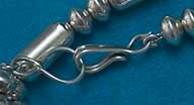
2 colfach = hinge (col = spike, hinge ) + soft mutation + (bach = hook)
ETYMOLOGY:
Indo-European *bak (= staff, stick)
Welsh bach < British *bakk- (= stick) < Celtic
From the same British root: Cornish bagh, Breton bac’h
From the same Celtic root:
Irish bacán (= hinge-hook, peg in the wall),
Scottish (Gaelic) bac (= hook)
From the same Indoeuropean root:
Latin baculum (= staff, crutch, walking stick)
Greek baktron (= staff, baton, club)
English peg < Middle English pegge, probably from Low German or Dutch (modern Dutch peg)
Also:
Welsh bagét / baguette < English baguette < French < Italian bacchetta (= little stick), (bacchio = stick) + (-etta diminutive ending), bacchio < Latin baculus
English bacillus (= rod-shaped bacterium) < New Latin bacillus (= small staff, stick, rod), diminutive form of Latin baculus, altered from baculum < *bak
:_______________________________.
bach, PLURAL: bachau <BAAKH, BAA-khai, -khe> [ˡbɑːx, ˡbaˑxaɪ,
-xɛ] (masculine
or feminine noun)
1 (obsolete) nook
2 (obsolete) corner, bend, sharp turn
3 cilfach (f) cilfachau nook, secluded spot (cil = back) + soft mutation + (bach = nook, corner)
Bach occurs in place names
..a/ Y Fach-wen SH5761 near
Llanberis “white nook”
(y = definite article) + soft mutation + (bach = nook, corner, secluded spot) + soft mutation + (gwen, feminine form of gwyn = white)
..b/ Y Fachddeiliog <ə VAAKH
DHEIL-yog> [ə ˡvɑːx ˡðəɪljɔg]; a place in Y Bala “leafy nook”
(y = definite article) + soft mutation + (bach = nook, corner, secluded spot) + soft mutation + (deiliog = leafy)
Safai yr hen Wenallt mewn pantle, rhwng y fan y saif y Wenallt presenol a'r llwyn o goed a elwir Nyrs Fachddeiliog, yn ymyl hen orsaf ffordd haiarn y Bala.
Adgofion Andronicus (= John William Jones, Y Bala, 1842-1895) Cyhoeddwyd:
Caernarfon 1894 t24
The old Wennallt (farmhouse) stood in a hollow, between the place where the
present Wennallt stands and a wood which was called Fachddeiliog Nursery, next
to the old railway station in Y Bala
ETYMOLOGY: This is the same word as bach (= hook)
:_______________________________.
bachan <BAA-khan> [ˡbaˑxan] (masculine
noun)
1 fellow, bloke, chap, guy
wilia ’da rw fachan o Drood-y-riw talk to some fellow from Troed-y-rhiw
2 lad, fellow, man
(South-east) Mae’n fachan trwy’r tanad (Ma’n fachan trw’r tanad) He’s one of the best (“he is a man
through the explosion”, i.e. who will rescue you in a mine disaster)
(South-east) Bachan nêt yw e He’s one of the best (“he is
a neat man”)
:_______________________________.
bachdro masculine noun PLURAL bachdroeon <BAKH-dro, bakh-DROI-on> [ˡbaxdrɔ, baxˡdrɔɪɔn]
1 hairpin bend
bachdro wed’i ei wneud â tharw dur a bulldozed hairpin bend, a hairpin bend in a track
made by a bulldozer
ETYMOLOGY: (bach = hook) + soft mutation + (tro = bend)
:_______________________________.
bachgen, PLURAL: bechgyn <BAKH-gen, BEKH-gin> [ˡbaxgɛn, ˡbɛxgɪn] (masculine
noun)
1 boy
Fachgen! Fachgen! Beth wyt ti’n ’wneud? What are you doing, lad?
:_______________________________.
bachigol <ba-KHII-gol> [baˡxiˑgɔl] adjective
1 diminutive
ETYMOLOGY: (bachig = tiny) + (-ol, suffix).
The word bachig is made up of (bach = small) + (-ig, diminutive suffix)
:_______________________________.
bachigyn <ba-KHII-gin> [baˡxiˑgɪn] masculine noun
PLURAL bachigion <ba-KHIG-yon> [baˡxɪgjɔn]
1 diminutive = word based on another to
indicate smallness of a thing
2 small piece
3 adjective small
ETYMOLOGY: (bachig = tiny) + (-yn, diminutive suffix); the word bachig is made up of (bach = small) + (-ig, diminutive suffix)
:_______________________________.
bachu <BAA-khi> [ˡbaˑxɪ] (verb)
1 catch with a hook, to hook
2 ei bachu hi go off, go away, “hook it” (ei = her) + aspirate
mutation + (bachu = to hook, catch with a hook) + (hi (of) it / her)
:_______________________________.
bachwy <BAAKH-ui> [ˡbaˑxʊɪ]masculine noun
PLURAL bachwyon <ba-KHUI-on> [baˡxʊɪɔn]
1 bay
ETYMOLOGY: Not in general use.
First instance in 1852. Created from (bach = bend) + soft mutation + (gwy, a word supposedly meaning “water” )
See gwy
:_______________________________.
baco <BA-ko> [ˡbakɔ] (masculine
noun)
1 tabac
2 siop faco tobacconist’s
Also: siop dybaco
Short form of
TYBACO [təˡbakɔ] < English TOBACCO [təˡbakoʊ] < Castilian TOBACO, or from an Arawak language, or
Arabic
:_______________________________.
bacterleiddiad <bak-ter-LEIDH-yad> [baktɛrˡləɪðjad] (m)
PLURAL bacterleiddiadau <bak-ter-leidh-YAA-dai,
-de> [baktɛrləɪðˡjɑˑdaɪ, -dɛ]
1 bactericide
ETYMOLOGY: (bacter- < bacteria = bacteria) + soft mutation + (lleiddiad = substance which kills) (
:_______________________________.
bacterleiddiol <bak-ter-LEIDH-yol> [baktɛrˡləɪðjɔl] (adj)
1 bactericidal
ETYMOLOGY: (bacter- < bacteria = bacteria) + soft mutation + (lleiddiol adjective = which kills) (
:_______________________________.
bacwn <BA-kun> [ˡbakʊn] (masculine
noun)
1 bacon
English BACON
1100+ < Old French BACON < Germanic; related to English BACK
:_______________________________.
bad ‹baad› [baːd] masculine
noun
PLURAL badau <BAA-dai, -e> [ˡbaˑdai, ˡbaˑdɛ]
South Wales: al nord, la paraula corresponent és cwch [ku:x]
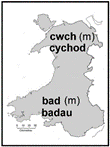
1 boat
bad achub <baad AA khib > lifeboat
bad camlas canal boat, barge
bad diogelwch safety boat = boat accompanying practitioners of water
sports such as kayaking, or in competitions such as boat races, in case of
emergency
bad pwmpiadwy inflatable boat
bad ’styllod plank boat (“boat
(of) planks”)
bad hwylio sailing boat
ryn ni i gyd yn yr un bad we’re all in the
same boat, each of us is in the same predicament, is facing the
same danger
dianc yn y badau take to the boats
(“escape in the boats”)
saer badau boat builder
(‘craftsman (of) boats’)
paid â siglo’r bad don’t rock the boat
2 ferry-boat, boat for crossing a river
llogi bad yn ymyl y bont
spend money on something that is not necessary, incur expenses that could
easily be avoided (“hire a ferry-boat next to the bridge”)
Glan-bad locality
in the county of Rhondda Cynon Taf
(glan y bad “(the) bank (of the river) (of) the boat (that
is, where the ferry boat is moored)”)
(English name: Upper Boat)
ETYMOLOGY: Welsh bad [baːd] < Old
English {baat} (modern English
boat <bout> [bɔʊt])
Final [t] in borrowed English words becomes [d]
:_______________________________.
bad achub <BAAD AA-khib> [ˡbɑːd ˡɑˑxɪb] (masculine
noun)
PLURAL badau achub <BAA-dai,
-e AA-khib > [ˡbaˑdai, ˡbaˑdɛ ɑˑxɪb]
1 lifeboat
ETYMOLOGY: (‘boat {of} saving / rescuing’) bad (= boat) + achub (= saving)
:_______________________________.
ba’dd <BAADH> [ˡbɑːð]
1 spelling to represent the southern form of baedd (= boar)
Usually spelt (less correctly) bâdd
See aa / ba’dd
:_______________________________.
baddon, PLURAL: baddonau <BAA-dhon, ba-DHOO-nai,
-ne> [ˡbɑˑðɔn, baˡðoˑnaɪ, -nɛ] (masculine
noun)
1 bath
2 baddonau baths; swimming baths
baddonau cyhoeddus public baths (swimming pool
and baths)
baddon Twrcaidd Turkish bath
ETYMOLOGY: from the place name Caerfaddon = Bath, England. (The name ‘Bath’ is
from Roman baths here). The second element ‘faddon’ was interpreted by the
lexicographer Wiliam Owen-Puw c. 1800 as a noun ‘baddon’ meaning ‘bath’.
:_______________________________.
baddondy <ba-DHON-di> [baˡðɔndɪ] masculine noun
PLURAL baddondai <ba-DHON-dai> [baˡðɔndaɪ]
1 bath-house = a building with baths for use
by the public
2 bathroom = room in a house with a bathtub or shower
ETYMOLOGY: (baddon = bath) + soft mutation + (ty = house)
:_______________________________.
Badminton (a ward in Y
Cendl / Beaufort of the county of Blaenau Gwent)
9% Welsh-speaking (Census 2001)
The name (dating from ????) shows a connection between the Beaufort family,
owners of land in the area, and the village of Badminton in Gloucestershire
The name Beaufort is that of the House of Beaufort, an English noble family
descended from John Beaufort (1373–1410), the First Duke of Lancaster, who was
made Earl of Somerset in 1397.
John Beaufort was the son of John of Gaunt, the third son of King Edward III,
by his mistress Katherine Swynford. The name Beaufort is from the Château de
Beaufort in Champagne, France, which had belonged to John of Gaunt.
Charles Somerset (1460? – 1526), the first Earl of Worcester, was the
illegitimate son of Henry Beaufort, the Third Duke of Somerset. On 2 June 1492
he married Elizabeth, the daughter and heiress of William Herbert (d. 1491),
and through his marriage he took the title in 1504 of Baron Herbert of Raglan,
Chepstow, and Gower.
His great grandson, Edward Somerset (1553 - 1628), who became the fourth Earl
of Worcester in 1589, was appointed a member of the Council of Wales in 1590.
In 1612, he bought the Estates of Great and Little Badminton in Gloucestershire
from the Boteler family, which had owned them since 1275.
His contemporary, Thomas Wiliems of Trefriw (1545/6 – 1622?) (Syr Tomas ap
Wiliam), the lexicographer, says of him (altered spelling): ‘ni rusia ddywedyd
Cymraeg, a'i hymgeleddu, a'i mawrhâu’n anwylgu Frytanaidd (= He doesn’t
hesitate to speak Welsh, and to nurture it, and to laud it in an affectionate
Welsh (manner)) (1604-7, TW Pen 228))
In 1682 Edward’s son Henry, the Third Marquess of Worcester, built Badminton
House, a palladian mansion, on his Gloucestershire Estate. In this same year he
was created First Duke of Beaufort by the English king Charles.
In 1779 an English iron master, Edward Kendall, leased with his brother a large
tract of land on the border of Monmouthshire and Breconshire from its owner,
the Duke of Beaufort (Henry
Somerset, 5th Duke of Beaufort (16 October 1744 – 11 October 1803)). They named the
new Ironworks after the Duke – The Beaufort Iron Works. On his death the Duke
was buried at St Michael and All Angels Church, Badminton.
:_______________________________.
bae, PLURAL: baeau ‹BAI, BEI-ai, -e› [baɪi, ˡbəɪai, ˡbəɪɛ] (masculine
noun)
1 bay
Bae Abertawe / Swansea Bay
Bae Caergybi / Holyhead Bay
Bae Caer-dydd / Cardiff Bay
Bae Caerfyrddin / Carmarthen Bay
Bae Caernarfon / Caernarfon Bay
Bae Ceredigion / Cardigan Bay
Bae Conwy Conwy Bay, Conway Bay
Bae Lerpwl / Liverpool Bay
Bae Sain Ffred / Saint Brides Bay
Bae Tremadog / Tremadog Bay
:_______________________________.
baedd (baeddod) [BAIDH, BEI dhod] (m) porc
(mascle)
baedd coed [baidh KOID] (m) porc
senglar (“porc del bosc”)
baedd ‹bâidh› [baɪið] , masculine noun
PLURAL baeddod ‹bei
-dhod› [ˡbəɪðɔd]
1 boar
baedd cenfaint (qv) boar kept for breeding, herd boar, stud-boar
(‘boar (of) herd’)
gofyn baedd (sow) desire the boar (‘ask + boar’)
2 obsolete brave fighter, valiant
warrior
3 baedd coed (qv) or baedd gwyllt (qv) wild boar; also as a symbol in heraldry.
Sometimes simply baedd
Ar y sêl gyfrin gwelir baedd o dan goeden
On the privy seal can be seen a (wild) boar under a tree
4 (Bible) baedd o’r coed = wild boar (‘boar from the wood’)
Salmau 80.8 Mudaist winwydden o’r Aifft..., 80.13 Y baedd o’r coed a’i turia, a bwystfil y maes a’i pawr
Psalms 80.8 Thou hast brought a vine out of Egypt... 80.13 The boar of the wood
doth waste it, and the wild beast of the field doth devour it (See the Psalms
on line in this website)
ETYMOLOGY: ?
NOTE:
1/ An obsolete plural form is beidd
2/ In South Wales in monosyllables ae > aa. Hence baadd (but usually spelt bâdd or ba’dd). (The aa spelling is not
in use, but would be helpful to show that a long ‘a’ is intended, and that it
is not a standard pronunciation.)
:_______________________________.
baedd cenfaint <BAAIDH KEN-vaint, -vent> [ˡbaɪð ˡkɛnvaɪnt,
-vɛnt] masculine noun
PLURAL baeddod cenfaint <BEI-dhod KEN-vaint, -vent> [ˡbəɪðɔd ˡkɛnvaɪnt,
-vɛnt]
1 boar kept for breeding, herd boar,
stud-boar
ETYMOLOGY: ‘boar (of) herd’ (baedd = boar) + (cenfaint = herd of swine)
:_______________________________.
baedd coed <BAIDH KOID> [baɪð ˡkɔɪd] masculine noun
PLURAL baeddod coed <BEI-dhod KOID> [ˡbəɪðɔd ˡkɔɪd]
1 wild boar
ETYMOLOGY: ‘boar (of) wood’ (baedd = boar) + (coed = wood)
:_______________________________.
baedd gwyllt <BAIDH KOID> [baɪð ˡgwɪɬt] masculine noun
PLURAL baeddod gwyllt / gwylltion <BEI-dhod GWILHT, GWəLHT-yon> [ˡbəɪðɔd ˡgwɪɬt,
ˡgwəɬtjɔn]
1 wild boar
ETYMOLOGY: ‘wild boar’ (baedd = boar) + (gwyllt = wild)
NOTE: the literary form has a plural adjective gwylltion but there is a tendency in modern Welsh to use a
singular adjective after a plural noun (gwyllt)
:_______________________________.
bàg (masculine noun)
PLURAL: bagiau <BAG, BAG-yai, -ye> [bag, ˡbagjaɪ, -jɛ]
bàg llaw <bag LHAU> [bag ˡɬaʊ] handbag
bàg ysgol <bag Ə-skol> [bag ˡəskɔl] (masculine
noun) school bag, satchel
bàg dyrnu punchbag
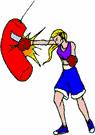
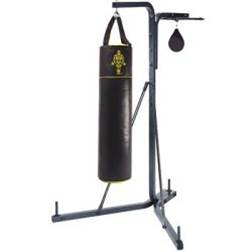
ETYMOLOGY: English bag
SPELLING: The vowel should be marked with a grave accent to show that it is
short, though this is rarely seen in Welsh texts. A monosyllable with vowel +
final g suggests a long vowel in Welsh spelling (as in brag <BRAAG> [brɑːg] malt, gwag <GWAAG> [gwɑːg] empty)
:_______________________________.
bagad ‹BAA-gad› [ˡbaˑgad] masculine noun
PLURAL bagadau ‹ba-GAA-dai,
-de› [baˡgaˑdai, baˡgaˑdɛ]
1 group, crowd
bagad o bobol a group of people
2 literary cluster, bunch (grapes, flowers, etc)
3 collection
Bagad o Ddiarhebion 'Steddfod
A collection of Eisteddfod proverbs (i.e. proverbs submitted for a competition)
4 obsolete swarm (of bees), flock (of birds),
flock (of sheep), herd (of cattle) etc
ETYMOLOGY: Welsh < British *bakâta < *bâka (= grapes, cluster of grapes)
From the same British root: Cornish bagaz, Breton bagad
The Scottish (Gaelic) word bagaid (= bunch (of grapes), cluster (of nuts)) is taken
from Welsh
Latin has bacca (= small round fruit, berry, olive).
The name of the Greek god of wine Bakkhos (in Latin Bacchus) is
perhaps a related word.
NOTE: the colloquial form in South-east Wales is bacid <BAA-kid> [ˡbɑˑkɪd]
:_______________________________.
bagaid (bageidiau) <BAA gaid -ged, ba GEID yai -ye> (m)
1 bagful
bagaid o ’sbwriel a bag of rubbish
bagaid o offer a bag of tools
ETYMOLOGY: (BÀG = bag) + (-AID suffix indicating fullness)
:_______________________________.
bagét (bagéts) [ba GET, ba GETS] (m)
1 baguette, French loaf
ETYMOLOGY: From English BAGUETTE < French BAGUETTE (= stick) < Italian
BACCHETTA (= little stick) < BACCHIO (= stick) < Latin BACULUM (= stick)
:_______________________________.
Bagillt
1 village in the county of Y Fflint
2 ward in the county of Y Fflint
(Census 2001) (Dwyrain Bagillt) 13% Welsh-speaking,
(Gorllewin Bagillt) 14% Welsh-speaking
:_______________________________.
báginet, PLURAL: báginets ‹BAA-gin-et, BAA-gin-ets› [ˡbagɪnɛt, ˡbagɪnɛts] (masculine
noun)
1 (South Wales) bayonet
..a/ A Dialogue in the Devonshire Dialect,
(in three parts) by a Lady: to which is added a Glossary. James Frederick
PALMER, Mary Palmer. 1837: The authors lists “BAGINET” and defines it as
“Bayonet.”.
..b/ Observations on some of the dialects in the West of England
particularly with a glossary of words now in use there; and poems and other
pieces, exemplifying the dialect. By James Jennings, Honorary Secretary of the
Metropolitan Library Institution, London. 1825. Bag'inet.
s[ubstantive]. A bayonet.
NOTE: Standard Welsh has bidog <BII-dog> [ˡbiˑdɔg] (mf)
:_______________________________.
bagl (“bagal”), PLURAL: baglau <BAA-gal,
BA-glai, -gle> [ˡbɑˑgal, ˡbaglaɪ, -glɛ] (feminine
noun)
1 crutch
Also ffon fagl (f), ffyn bagl (“stick (of) crutch”)
mynd wrth eich baglau go around on
crutches, walk on crutches (“go | supported by | your | crutches”)
y fagl = the crutch
2 crozier = bishop’s staff or crook
3 leg
ETYMOLOGY: Welsh < British < Latin BACULUM (= stick)
:_______________________________.
Baglan
1 a village in the
county of Castell-nedd ac Aberafan
2 a ward in this county
10% Welsh-speaking (Census 2001)
:_______________________________.
baglu <BA-gli> [ˡbaglɪ] (verb)
1 trip up
baglu dros rywbeth trip up over something
baglu rhywun trip somebody up
(BAGL = crutch) + (-U verbal suffix)
:_______________________________.
bai <BAI> [baɪ] masculine noun
PLURAL beiau <BEI-ai,
-e> [ˡbəɪaɪ, -ɛ]
1 blame, fault - responsibilty for something
wrong
Arni hi mae'r bai
It's her fault (“(it is) on her that-is the blame”)
Nid arno i mae’r bai It’s not MY fault
Arnat ti roedd y bai i gyd
It was all your fault
Rhaid mai'ch bai chi'ch dau yw e
It must be the fault of you two
Ar bwy mae'r bai?
Whose fault is it? (“on who is the blame?”)
Ar y llywodraeth mae'r bai
It's the fault of the government, it's the government's fault, the government's
to blame
Y mwya'i fai, parota'i feio the most
blameworthy is the quickest to blame others
(“the (person) greatest his blame, readiest his blaming”)
peidio â gweld bai ar not blame someone (“not see blame on someone”)
Paid â gweld bai arno fe Don’t blame him
2 bod bai mawr ar (rywun) i (wneud rhybeth) be very wrong of
somebody to (do something)
3 cael y bai am get the blame for
4 rhoi'r bai ar to blame, to put the blame on (am = for) (“put / give the blame on”)
5 bwrw'r bai ar to blame, to put the blame on (am = for) (“throw the blame on”)
6 bod ar fai be to blame (“be on blame”);
Nid fi sydd ar fai I'm not to blame, it's not my fault
7 Heb ei fai, heb ei eni Everyone has their faults, No-one is without their
faults (“without his fault, without his being born”)
8 blame = accusation of being responsible for something
that is wrong
gweld bai ar to blame (“to see blame on”)
9 chwilio am feiau find fault (“look for faults”)
10 cuddio'ch beiau rhag (rhywun) hide your faults
from (someone)
11 taflu bai = shift the blame (“throw blame”)
12 South Wales cwympo ar eich bai, North Wales: syrthio ar eich bai admit that you are wrong, acknowledge your mistake
(“fall on your fault / blame”)
13 defect, imperfection in a material
14 Geology fault in a rock
15 fault = error, mistake
Bai am y gair 'llawrwydd' yw 'llarwydd'
The word 'llarwydd' is a mistake for 'llawrwydd'
16 fault, shortcoming, failing, deficiency, defect
Nid haelioni yw ei fai mawr You certainly
can’t accuse him of over-generosity
“((it is) not
generosity that-is his big fault / his big shortcoming)”
17 gweld bai ar consider someone to be at fault, think it the fault
of, believe the culprit to be, find fault with
y diafol yn gweld bai ar bechod Satan rebuking sin, the devil denouncing evil (“the
devil seeing defect on sin”)
18 hyd at fai to a fault, excessively
hael hyd at fai generous to a fault
19 pigwr beiau fault finder,
person who always picks faults
20 di-fai (di- = privative prefix) + (bai = fault )
..a/ blameless
Judges 15:3 And Samson said concerning them, Now I shall be more blameless than
the Philistines, though I do them a displeasure
..b/ impeccable
..c/ good, fine
ETYMOLOGY: Welsh bai < bei < British
:_______________________________.
baich, PLURAL: beichiau <baikh,-BEIKH-yai, -ye> [baɪx, ˡbəɪxjaɪ,
-jɛ] (masculine
noun)
1 burden, load
2 diffygio dan faich stagger / collapse under a burden
3 bod dan faich trwm o waith be snowed under with work (“be under a heavy burden
of work”)
4 Fe yw’r baich rw i’n gorfod ’i ddwyn
He’s the cross I have to bear (“the burden I am obliged its carrying”)
(said of a person or matter for which a somebody has taken responsibility even
though it causes him or her many problems. A person condemned to crucifixion
had to carry his or her own cross to the place of execution.)
:_______________________________.
baidd
he / ahe / it dares
See beiddio (= to dare)
:_______________________________.
bâl <BAAL> [bɑːl] m
1 peak
According to Geiriadur Prifysgol Cymru (Rhan 4, Blwyddyn 1952, tudalen 250)
(University of Wales Dictionary of the Welsh Language) (Part 4, Year 1952, page
250) bâl is noted as occurring c. 1788 as “Bâl the peak, or
pointed summit of a hill or mountain”.
2 Bryn-y-Bâl
..a) SJ2664 A village east of Bwcle / Buckley (county of Y Fflint). The poor
spelling Bryn-y-baal occurs on the Ordnance Survey maps, as if it is Baal,
the false god of the Old Testament
...1 Brenhinoedd 16:32 Ac efe a gododd allor i Baal yn nhy Baal, yr hwn a adeiladasai efe yn Samaria (16:33) Ac Ahab a wnaeth lwyn, a wnaeth fwy i ddigo Arglwydd Dduw Israel na holl frenhinoedd Israel a fuasai o'i flaen ef
...1 Kings 16:32 And he reared up an altar for Baal in the house of Baal, which
he had built in Samaria (16:33) And Ahab made a grove, and Ahab did more to
provoke the Lord God of Israel to anger than all the kings of Israel before
him.
http://www.geograph.org.uk/gridref/SJ2664
map
The village name Bryn-y-bâl is from the hill name Bryn y Bâl “(the) hill (of) the sharp peak”
..b) By Brynffordd (Brynford), Treffynnon (Holywell) in the county of Y Fflint
there is a hill called Pen y Bâl (in English, Pen y Ball Top)
http://www.geograph.org.uk/photo/30286
Pen y Bâl
“(the) summit (of) the sharp peak”
:_______________________________.
bal <BAL> [bal] adjective
1 a white spot or patch on the forehead of a
horse, a “blaze”
2 (adjective) (horse) having a white spot on
the forehead
ceffyl bal horse with a white spot on its forehead
There is a well called Ffynnon y Ceffyl Bal (“well of the horse with a white patch on its
forehead”) above Blaengwynfi (county of Castell-nedd ac Aberafan)
ETYMOLOGY: Welsh bal < British *bal- < Indo-european *bhel (= to shine)
From the same British root: Breton bailh (= white blaze on forehead of horse)
From the same Celtic root: Irish ball (= spot, mark)
:_______________________________.
Bala Cynwyd <BAA-la KƏƏ-nʊɪd > [ˡbɑˑla kˡəˑnʊɪd]
1 a village in southeastern Pennsylvania, in Lower Merion Township.
It was originally two separate towns, but it came to be regarded as a single
community after the US Post Office used a single office called “Bala Cynwyd” to
serve both towns. However the railway still has two separate stations, one
being Bala and the other being Cynwyd.
The area was settled by Quakers from Meirionydd three hundred and twenty years
ago, in the 1680s. It forms part of the old Welsh Tract by the city of
Philadelphia. This American Cynwyd is generally pronounced as KIN-wid, and by
some as KIN-wud, as if the name were Kinwood. (Information: wikipedia)
Location of Y Bala and Cynwyd in north-east Wales:
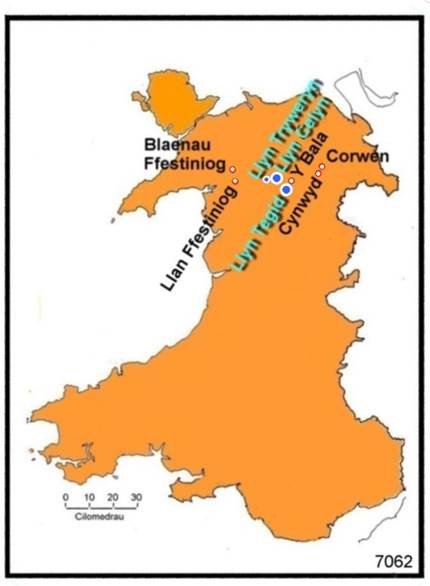
(dewl 7062)
:_______________________________.
Y Bala (county
of Gwynedd)
80% Welsh-speaking (Census 2001)
Y Bala <ə BAA-la> [ə ˡbɑˑla] (as a
place name, a feminine noun)
1 town in the north-east
http://www.gwead.cymru.org/uwchradd/berwyn/cymru.htm
(No longer functional 2008-10-23)
ETYMOLOGY: “the lake outlet”
:_______________________________.
balast ‹BAA-last› [ˡbɑˑlast] (masculine
noun)
1 ballast
llenwi (llong) â balast to fill a ship with ballast, to ballast a ship
Y Cei Balast SH5638 name of small island in the Glaslyn estuary
where ships would dump ballast stones before picking up cargoes of slates. ETYMOLOGY:
y cei balast “the quay (of) ballast” (y definite article) + (cei = quay) + (balast = ballast). On the Ordnance Survey map spelt
incorrectly as Cei Ballast (the English spelling of balast), suggesting that the ll is the Welsh voiceless alveolar lateral
fricative <lh> [ɬ]
http://www.geograph.org.uk/photo/364696
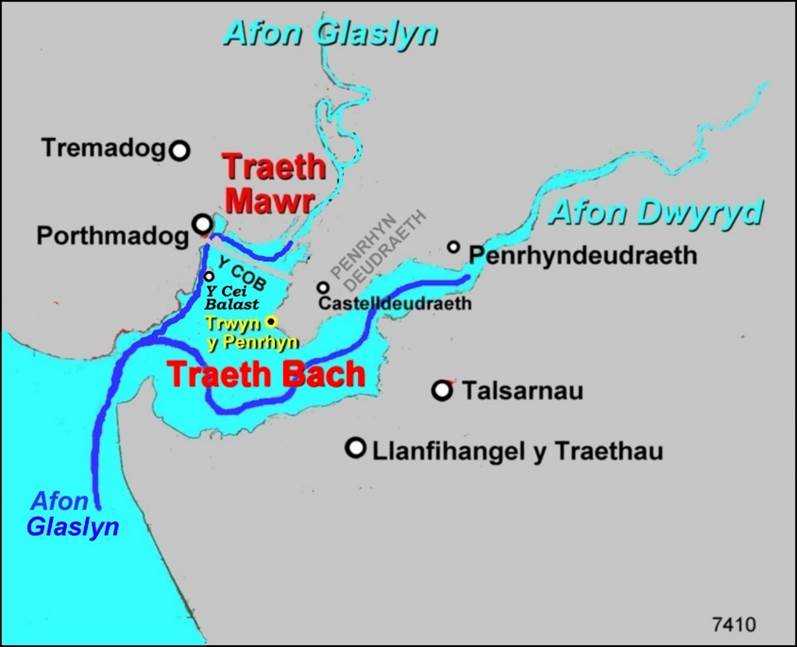
(delwedd 7410)
http://www.geograph.org.uk/gridref/SH5737
map
ETYMOLOGY: English ballast < Low German.
The word occurs too in Old Danish and Old Swedish as barlast, or “bare
load” (bar = bare) + (last = load), in the sense of a load without any value
:_______________________________.
balastio ‹ba-LAST-yo› [baˡlastjɔ] (v)
1 to ballast, fill with ballast
balastio llong to fill a ship with ballast
ETYMOLOGY: (balast = ballast) + (-io verb suffix)
:_______________________________.
balch <BALKH> [ˡbalx] (adjective)
PLURAL: beilchion <BEILH-yon> [ˡbəɪlxjɔn]
1 proud
2 (south-eastern) clawd a balch a byw miwn gopith = (standard) tlawd a balch a byw mewn gobaith
“poor and proud and living in hope’. This
is a reply to / Shwd i chi? = (standard)
Sut yr ydych chi? = how are you?
:_______________________________.
balchder <BALKH-der> [ˡbalxdɛr] (masculine
noun)
1 pride
Mae i falchder ei gwymp Pride comes before a fall (“there-is to pride its
fall”, pride has its fall)
Balchder a gaiff gwymp Pride comes before a fall (“(it-is) pride which gets (a) fall”)
ETYMOLOGY: (balch = proud) + (-der suffix for forming abstract nouns, a soft-mutated
form of -ter)
:_______________________________.
balŵn, PLURAL: balŵns <ba-LUUN,-ba-LUUNS, LUUNZ
> [baˡluːn, baˡluːns,
baˡluːnz] (masculine noun)
1 balloon
ETYMOLOGY: English balloon
:_______________________________.
bambocs, bámbocsys <BAM-boks, BAM-boks-is> [ˡbambɔks, ˡbambɔksɪs] (masculine
noun)
1 bandbox
The Treatment of English Borrowed Words in
Colloquial Welsh / Thomas Powel / Y Cymmrodor Vol. VI 1883. / p133
The following paper is an attempt to give a general account
of the use and treatment of English words in the colloquial
Welsh of the present day. Most of the statements here made
are applicable to the whole of Welsh-speaking Wales; but
the paper treats more particularly of the dialect spoken, with
slight variations, in the Counties of Brecon, Caermarthen,
and the greater part of Cardigan.
In borrowed English words, if more than two consonants
come together, an effort is made to get rid of one of them.
Thus:
1. D after n, and followed by another consonant, goes out
or is assimilated. Bambocs (bandbox), gwlfinsh (goldfinch),
hangcyff (handcuff), hanswm (handsome).
Note: This is more likely to be the English
form of the word as it was taken into Welsh, rather than a Welsh adaptation of
a standard English pronunciation
bandbox > ban’box > bam’box
goldfinch > gol’finch
handcuff > han’cuff
handsome > han’some
:_______________________________.
ban, PLURAL: bannau <BAN, BA-nai, -e> [ˡban, ˡbanaɪ, -nɛ] (feminine
noun)
1 peak
y fan = the peak
2 tryfan (place names) peak, great peak
Tryfan SH6659
(also: Mynydd Tryfan) mountain in the county of Gwynedd, between
Capelcurig and Bangor
(try- = intensifying
prefix, ‘great’ ) + soft mutation + (ban = peak)
http://www.geograph.org.uk/photo/82098
:_______________________________.
banadl <BAA-nadl > [ˡbɑˑnadl]
(South Wales: bana’l) < BAA-nal> [ˡbɑˑnal] (plural
noun)
1 (plant) broom
See banhadlen
:_______________________________.
bana’l / banal <BAA-nal> [ˡbɑˑnal] (plural
noun)
1 (South Wales) (plant) broom
See banhadlen
:_______________________________.
banana, PLURAL: bananas ‹ba-NAA-na, ba-NAA-nas, -naz › [baˡnɑˑna, baˡnɑˑnas,
-naz] (masculine noun)
1 banana
:_______________________________.
banc, PLURAL: banciau <BANGK, BANGK-yai, -e> [ˡbaŋk, ˡbaŋkjaɪ,
-ɛ] (masculine
noun)
1 bank (= money house)
Stryd y Banc street name in Porthmadog “(the) street (of) the
bank”.
Name used by the English: Bank Place.
2 bank (= slope)
See also: ponc (= bank, slope)
:_______________________________.
band, PLURAL: bandiau <BAND, BAND-yai, -e> [ˡband, ˡbandjaɪ, -ɛ] (masculine
noun)
1 band
:_______________________________.
bando ‹BAN-do› [ˡbandɔ] (masculine
noun)
1 bando = a kind of hurling / shinty / hockey / bandy
formerly played in Wales. It was particularly popular in coastal Morgannwg, at
Margam and adjoining Cynffig, which share an extensive sandy shore
2 ffon fando, ffyn bando bando stick
ETYMOLOGY: A variant of bandi < English bandy (= a type of hockey)
A Dialogue in the Devonshire Dialect, (in three parts) by a Lady: to which is
added a Glossary. James Frederick PALMER, Mary Palmer. 1837: The authors lists
“BANDY” and define it thus:
“A game, like that of Golf, in which the adverse parties endeavour to beat a
ball (generally a knob or gnarl from the trunk of a tree,) opposite ways. From
Bendan, Sax[on], to bend; because the stick with which the game is played is
crook'd at the end; hence the verb to Bandy (a term at tennis), to beat to and
fro, and the compound bandy-legged for crooked-legged.”
:_______________________________.
baner, PLURAL: baneri <BAA-ner, ba-NEE-ri> [ˡbɑˑnɛr, baˡneˑrɪ] (feminine
noun)
1 flag
y faner the flag
2 dangos y faner show the flag = put in an appearance, make your
presence noted at some event
:_______________________________.
baneru <ba-NEE-ri> [baˡneˑrɪ] verb
1 deck with flags
ETYMOLOGY: (baner = flag) + (-u suffix for forming verbs)
:_______________________________.
Bangor <BANG-gor> [ˡbaŋgɔr]
1 (SH5872) city in the county of Gwynedd
Population 13,378 (1961)
Proportion of Welsh-speakers: 64% (1961)
i Fangor = to Bangor
ym Mangor = in Bangor
2 a parish at this place
3 esgobion Bangor (Dwyfor, district in western Gwynedd) “bishops (of)
Bangor”;
also esgobion Bangor yn eu gwenwisg “bishops (of) Bangor in their
surplice”
large white clouds on a clear day indicating a coming storm
ETYMOLOGY: Old Welsh bangor (= monastery)
:_______________________________.
banhadl- forma de banadl (= broom) before
a final syllable
:_______________________________.
banhadlen <ban-HAD-len> [banˡhadlɛn] feminine noun
PLURAL banadl <BAA-nadl> [ˡbɑˑnadl]
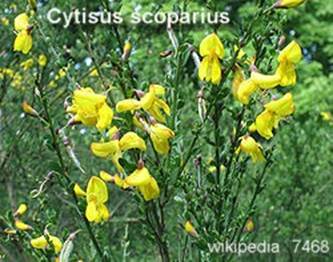
1 broom bush Cytisus scoparius
y fanhadlen the brrom bush
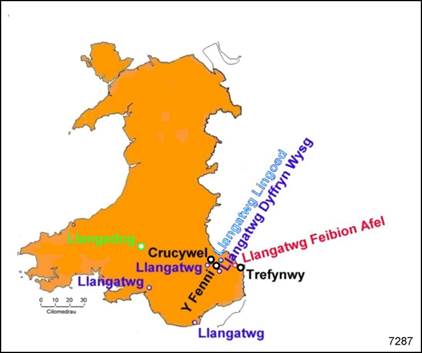
Cae’r Banadl (Caa’r Banal) “(the) field (of) the gorse bushes” Field name c. 1507
in Llangatwg Lingoed or Llandeilo Gresynni, county of Mynwy
16 April 1507 Howel ap David ap Howel and Catherine vergh Ieuan ap Griffith
his wife to Richard ap Howel their son and Maud/Matilda vergh William his wife.
GRANT All lands, messuages and tenements which they hold in the parish of
Llancattok Llincoid in the lordship of Bergavenny and in the parish of
Llanterlow Gressenny in the fee of White Castle.... One close called Kar banall to value of
20d. p.a.;
http://freepages.genealogy.rootsweb.ancestry.com/~llangattocklingoed/deedswills/hanbury.html#1518B
Hanbury Family Papers
(delwedd 7287)
ETYMOLOGY: Welsh banadl < British *banatl-
Cornish has banall (= broom bushes), and Breton banal, balan (= broom bushes);
The French word balai (= broom for sweeping, long-handled brush) is from a
related Gaulish word
NOTE: (1) In South Wales banadl > banaddl > bana’l / banal ‹BAA-nal›
[ˡbɑˑnal], as in Cornish
(banal) and Breton (banal)
(2) and also in South Wales banal > balan ‹BAA-lan› [ˡbɑˑlan], (metathesis);
this metathesis also occurs in Cornish (balan) and Breton (balan)
:_______________________________.
banhadlog <ban-HAD-log> [banˡhadlɔg] adjective
1 abounding in broom
2 (feminine noun) place with broom, broomy land
Found in place names and field names.
3 Gellifanadlog place name in Senghenydd (county of Caerffili)
From “y gelli fanhadlog” ‘broomy grove’ (with the loss of the ‘h’)
(y = definite
article) + soft mutation + (celli = wood, grove) + soft mutation + (banhadlog = broomy)
ETYMOLOGY: Welsh (banhadl-, penult syllable form banadl (= broom) + (-og suffix) < British *banatlâk-
From the same British root: Cornish banalleg, Breton banallek < British
NOTE: (1) North Wales - colloquially banadlog <ba-NAD-log> [baˡnadlɔg]
(2) South Wales banalog - colloquially ‹ba-NAA-log› [baˡnɑˑlɔg]
(3) banadlog sometimes
used as a standard form in place names, omitting the ‘h’
:_______________________________.
Bannau Brycheiniog <BA-nai, –ne, brə-KHEIN-yog> [ˡbanaɪ, -ɛ, brəˡxəɪnjɔg] (plural
noun)
1 Upland area in south-east Wales, called
'the Brecon Beacons' by the English
ETYMOLOGY: (the) peaks (of) (the territory called) Brycheiniog
(bannau = peaks, plural of ban =peak) + (Brycheiniog = district name,
“territory of Brychan”). (Brychan = forename) + (-i-og suffix indicating
a territory)
:_______________________________.
bannod, PLURAL: banodau <BA-nod,-ba-NOO-dai,
-de> [ˡbanɔd, baˡnoˑdaɪ, -dɛ] (feminine
noun)
1 definite article
y fannod = the definite
article
:_______________________________.
banod- form
of bannod (= definite
article) before a final syllable
:_______________________________.
bant <BANT> [bant] (adverb)
1 away
The full form of this adverb is i bant
ETYMOLOGY: (i = to) + soft mutation + (pant = hollow, depression, valley; valley bottom)
:_______________________________.
banw (PLURAL beinw) [BAA nu, BEI nu] (m) porc
Aquesta paraula és més aviat obsoleta. Només existeix la forma femenina a la
llengua moderna - banwes (= truja jove).
banw També ocurreix en alguns
noms de riu
1 Afon Aman, antigament Ámanw
2 Afon Banw
3 Afon Beinw
4 Afon Ogwen < Ogfan < Ógfanw (awg- = ràpid, + banw)
banwes (banwesau) [BAN wes, ban WE
sai -se] (f) truja jove
banwy (districte electoral de la county of
Powys)
60% Welsh-speaking (Census 2001)
bar (barrau) [BAR, BA -rai re] (m) (topònims)
cim; vegeu Berwyn
bar (barrau) [BAR, BA rai -re] (m) 1 bar (establiment
de begudes) 2 barra = peça metàl·lica
3 (FUTUR CURT) cos d’advocats
bar gwin [bar GWIIN]
(m) bar de vi
bar coffi <bar KOO-fi> [bar ˡkoˑfɪ] masculine noun
PLURAL: barrau coffi <BA-rai, -re KOO-fi> [bar, ˡbaraɪ, -rɛ ˡkoˑfɪ] (masculine
noun)
1 coffee bar = small café for coffee and
cakes
ETYMOLOGY: translation of English coffee bar
:_______________________________.
bar gwin <bar GWIIN> [bar ˡgwiːn] (masculine
noun)
1 wine bar
:_______________________________.
bar, PLURAL: barrau <BAR, BA-rai, -re> [bar, ˡbaraɪ, -rɛ] (masculine
noun)
1 bar (= tavern);
2 bar = rod;
3 bar = people collectively who are qualified to
practice law; barristers
4 bar = block of chocolate, soap, etc
bar sebon bar of soap
("bar (of) soap")
bar siocled a bar of
chocolate
5 tu ôl i’r barrau behind bars, in prison (“behind the bars”)
:_______________________________.
bar, PLURAL: barrau <BAR, BA-rai, -re> [bar, ˡbaraɪ, -rɛ] (masculine
noun)
1 (place names) top, peak
(delwedd 7329)
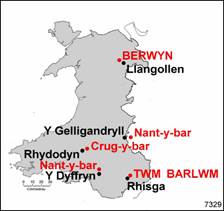
Barlwm (“bare top”) (bar = peak, top) + soft mutation + (llwm = bare, barren, treeless) hill name in Torfaen, now Twm Barlwm / Twyn Barlwm “(the) mound (on) Barlwm”
Berwyn < adjective berwyn “white-peaked,
snowy peaked” (bar = peak, top) + soft mutation + (gwyn = white), with a change a > e in the tonic syllable
through the influnce of the y in the final syllable (vowel affection)
Crug-y-bar SN6537 (“mound (of) the peak”, mound on the peak) village in
Caerfyrddin
http://www.geograph.org.uk/photo/399315
Nant-y-bar ?(“(the) valley /
stream (of) the peak”) Lost industrial village in the Afan valley, south-east
Wales
Mynydd Nant-y-bar SS8397 “The highland / the upland pasture of
Nant-y-bar farm”
http://www.geograph.org.uk/photo/844478
Nant-y-bar SO2840 (“Gwent-in-England”,
in present-day Herefordshire)
http://www.geograph.org.uk/photo/178852
(“farm buildings in Nant-y-bar”)
http://www.geograph.org.uk/photo/178849
(“castle motte at Nant-y-bar)”
(“The Geograph British Isles project aims to collect geographically
representative photographs and information for every square kilometre of Great
Britain and Ireland…”)
:_______________________________.
bara ‹BAA-ra› [ˡbaˑra] (masculine noun)
1 bread
bara brith ‹BAA-ra BRIITH› [ˡbaˑra ˡbriːiˑθ] (masculine noun) currant bread ('speckled
bread')
bara haidd ‹ BAA-ra HAIDH› [ˡbaˑra ˡhaɪð] (masculine noun)
barley bread
bara menyn [BAA ra MEE nin] (m) bread and butter
ffwrn fara bread oven
2 fan fara plural faniau bara bread van, van for delivering bread to homes or shops
3 mor sicr â bod bara mewn torth as sure as fate (“as sure as there is bread in a
loaf”)
4 bara llwyd mouldy bread (“grey bread”)
Saying: Rhaid enllyn da gyda bara llwyd You need a good comapage with mouldy bread
5 enllyn bara Alternative expression for enllyn = companage, something eaten with bread (eg butter, cheese,
meat), something to make plain food more palatable, (Scotland: kitchen,
kitchie; tea) Enllyn bara da yw eisiau bwyd Hunger is the best sauce (= food no matter how plain becomes very
appetising when you are really hungry) (“(it is) (a) good companage (of) bread
that-is want (of) food”)
6 pobi bara (north Wales) bake bread
ffyrna bara (mid-Wales) bake bread
ffyrno bara (south Wales) bake bread
ffwrno bara (south Wales) bake bread
ffwrna bara (south-west Wales) bake bread
bara corn corn bread (USA)
7 bara mantais (county of Trefaldwyn
/ Montgomery) part of the loaf which has risen above the top of the baking tin
(Minwel Tibbot)
NOTE: In the English dialect of Llanidloes bara mantes::
BARA-MANTESS. hot bread, fresh from the oven. (Parochial Account of Llanidloes
/ Edward Hamer / Chapter X / Folk-lore. Page 290 Collections Historical and
Archeological Relating to Montgomeryshire and its Borders / 1877)
:_______________________________.
bara caws <BAA-ra KAUS> [ˡbɑˑra ˡkaʊs] masculine noun
1 bread and cheese
2 Bedyddiwr Bara Caws (nickname) Scotch Baptist (“baptist (of) bread (and)
cheese”)
ETYMOLOGY: (bara = bread) + (caws = cheese)
NOTE: Alternative form: bara a chaws / bara chaws bread + and + cheese
:_______________________________.
bara croyw <BAA-ra KROIU> [ˡbɑˑra ˡkrɔɪʊ] masculine noun
1 unleavened bread
Gwyl y Bara Croyw the Passover, a week-long (now eight days) Jewish
feast commemorating the release of the Israelites from slavery in Egypt
ETYMOLOGY: (bara = bread) + (croyw = unleavened, made without yeast)
:_______________________________.
bara lafwr <BAA-ra LAA-vur> [ˡbɑˑra ˡlɑˑvʊr] masculine noun
1 See: bara lawr
:_______________________________.
bara lawr <BAA-ra LAUR> [ˡbɑˑra ˡlaʊr] masculine noun
1 laver bread = a kind of seaweed fried in
mutton fat, characteristic of central coastal South Wales, and sold
traditionally in Abertawe and Llanelli markets
ETYMOLOGY: (bara = bread) + (lawr = type of seaweed).
The word lawr was originally lafwr < English laver = Porphyra
umbilicalis - type of seaweed of the genus Porphyra with edible
fronds < Latin laver, species of water plant.
The dropping of a medial f is seen in other words in Welsh, such as
a) cas (South Wales -
he, she, it got / received) < cafas
b) codi (= to lift up, to
get up), originally cyfodi
c) dŵr (= water),
originally dwfr
NOTE: (Really a comment on a mistake in English) As the English spoken in Wales
is on the whole a variety of standard English, it is of a non-rhotic variety,
and so a final ‘r’ in a word is not pronounced unless it is followed by a
vowel.
(This non-rhotic English is to be found too of course in the USA, in New
England and in some of the southern States).
There is a tendency in Wales among some English speakers to insist that the
English name of the food is ‘lava bread’, as if it were a kind of magma from a
volcano. Reference to the Welsh form (even though it is originally from
English!) would show that there is a final ‘r’, and so ‘lava bread’ cannot be
right.
:_______________________________.
bara menyn <BAA-ra MEE-nin> [ˡbɑˑra ˡmeˑnɪn] (masculine
noun)
1 bread and butter
(In Y Wladfa, the Welsh settlement in the Chubut valley in Patagonia, this is a
phrase known to many people of non-Welsh origin. If asked if they know any
Welsh, they reply “bara menyn”. It seems that the local Tehuelche Indians would
come to the houses of the Welsh pioneers whrn they had no food, and having had
friendly contact with the pioneers, knew some words of Welsh)
:_______________________________.
barber <BAR-ber> [ˡbarbɛr] masculine noun
PLURAL barbariaid <bar-BAR-yaid,
-yed> [barˡbarjaɪd, -ɛd]
1 barber
2 cot barber barber's coat, dust coat
ETYMOLOGY: English barber < French 1400- barbeor, based on barbe (= beard) < Latin barba (= beard)
There is also a 'more Welsh' form - barbwr (qv)
:_______________________________.
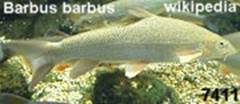
Barbus barbus
1 barfogyn (m), barfogiaid barbel
(delwedd 7411)
:_______________________________.
barbwr, PLURAL: barbwyr <BAR-bur, BARB-wir> [ˡbarbʊr, ˡbarbwɪr] (masculine
noun)
1 barber
:_______________________________.
barclod <BAR-klod> [ˡbarklɔd] masculine noun
PLURAL barclodiau <bar-KLOD-yai,
-ye> [barˡklɔdjaɪ, -ɛ]
1 apron
2 wedi ei gadw ormod wrth farclod ei fam (“after his
keeping + too much + attached to the apron of his mother”)
(said of a spoilt child) too attached to
his mother's apron strings
ETYMOLOGY: Middle English barm barmcloth < Old English “bosom cloth” (barm = bosom) + (clâth = cloth)
Chaucer, in the Miller’s Tale (1386) refers to ‘a barmcloth eek (= also) as
white as milk’. It would seem that ‘barm’ is from Old English ‘ber-‘ (= to
bear, carry, wear).
It would seem that the form of the English word taken into Welsh had a final t (“clot”) rather than th (Was this from a form *barmclot? = barm + clout) Another
second element, apart from ‘cloth’, is seen in
A Dictionary of English Etymology (1857). (barm-clothor barm-skin. an
apron)
Wikipedia (06-06-2016): Hensleigh Wedgwood (21 January 1803 – 2 June 1891) was
a British etymologist, philologist and barrister, author of A Dictionary of
English Etymology. He was a cousin of Charles Darwin - whom his sister Emma
married in 1839... He was born at
Tarrant Gunville in Dorset, the fourth son of Josiah Wedgwood II and Elizabeth
Allen of Cresselly, Pembrokeshire
Cf English clout (= piece of cloth),
though this has a different origin to cloth, from Old English clût ‘lump, stone, rock’ and also ‘a patch
of cloth’. Modern Dutch has ‘kluit’ (= clod, lump, knob); modern
Norwegian ‘klut’ (= cloth). Northern
English: dishclout (= dishcloth)
The verb clout (= patch, put on a patch or patches): Joshua 9:5 (King
James Bible) And old shoes and clouted upon their feet, and old garments upon
them; (= old patched sandals)
A final –t in words of English origin became –d in many words in earlier Welsh:
poced (= pocket), siaced (= jacket), bwled (= bullet).
:_______________________________.
barclodaid <bar-KLOO-daid, -ded> [barˡkloˑdaɪd, -ɛd] masculine noun
PLURAL barclodeidiau <bar-klo-DEID-yai,
-e> [barklɔˡdəɪdjaɪ,
-ɛ]
1 apronful
2 in the names of certain places where there are burial
cairns, to explain the profusion of stones through reference to a mythical
being; See Barclodiad y Gawres
ETYMOLOGY: (barclod = apron) + (-aid = suffix to denote capacity).
In the north-west, the suffix -i-aid is used instead
of –aid, hence barclodiaid
In the north-west, in a final diphthong a final e becomes a, and this applies too to the diphthongs ei, ai, au which in most of Wales become e in the final syllable.
Hence barclodiaid > (barclodied) > barclodiad
:_______________________________.
barclodiad <bar-KLOD-yad> [barˡklɔdjad] masculine noun
PLURAL barclodiaid <bar-KLOD-yaid,
-yed> [barˡklɔdjaɪd, -ɛd]
1 North-west Wales apronful; see barclodaid
:_______________________________.
Barclodiad y Gawres <bar-KLOD-yad ə
GAU-res> [barˡklɔdjad ə ˡgaʊrɛs]
1 SH3270 name of a burial chamber 3km north-west of
Aberffraw, county of Môn, north-west Wales.
http://www.geograph.org.uk/gridref/SH3270
map
2 SH3645 Locality on the Eifl mountain, near Trefor,
north-west Wales.
http://www.geograph.org.uk/gridref/SH3645
map
From: Y Brython (= the Briton, the Welshman), 1859, pages 428-9
Cilmin Droettu - Yr oedd Cilmin yn cyfaneddu ym mysg ellyllon a gwŷr cyfarwydd... Daeth ryw dro ar ddamwain yn gyfeillgar ag un o'r rhai olaf hyn. Gwyddai y cyfarwydd holl ddirgel gyfrinion anian yn drwyadl oddi gerth un... hysbyswyd ef gan ei frodyr cyfarwydd, fod y cyfryw gyfrin wedi ei ysgrifo ar blagawd teg, gan ryw law heb fod yn eiddo dyn, yng nghudd ger llaw coryn un o binaclau pigfain yr Eifl, a bod yno ellyll cuchiog yn ei wylio... Cilmin, yr hwn ni wybuasai erioed pa beth oedd ofn, a ebrwydd gynnygiodd ei wasanaeth, i wneud cais am y trysor... Ymaith â Chilmin tua Mynydd y Gefeilliaid Mawr (dyma enw arall ar yr Eifl), ac ar ôl brwd deithio am hir amser, daeth o'r diwedd at Nant Gwrtheyrn, yr hwn gwm sydd wedi ei furiaw o gwmpas â wal ddiadlam o greigiau ysgrynyglyd... Ymgripiodd o'r Nant, a dyfod a wnaeth nes y cyrhaeddodd Dre'r Ceiri, neu Dref y Caerau, cadarnle milwraidd ar goryn y big bellaf oddi wrth y môr o'r tri mynydd. Yr oedd pob “ysgafell a chafell a chell” yn y fan, y pryd yr aeth Cilmin yno, yn cael eu cyfaneddu gan ellyllon, a phob un o'r ellyllon yn barod ar yr awgrym lleiaf i ddyfod allan i amddiffyn iawnderau eu prif lywydd, yr hwn a drefai ar gopa'r graig uwch eu penau; a mawr y dinystr a'r direidi a fynych gyflawnid ganddynt ar hyd a lled y wlad... Ger llaw hefyd, yn Moel Carn y Wrach, yr arosai Cawres... ar yr adeg yr oedd Cilmin yn cyflawni ei gampwaith rhyfygus yr oedd y Gawres yn dyfod â llonaid ei ffedog o geryg... gan fwriadu ei gwynias boethi yn nhân ufeliar yr ellyll, a'u taflu wedyn yn do difaol i'r meusydd cyfagos. Pan ganfu hi Cilmin yn dyfod mor ffwdanllyd, dychrynu a wnaeth, a gollwng y geryg i lawr ar lethr y Foel a enwyd, ac y maent yno fyth, a gelwir hwy Barclodaid y Gawres. Ar ôl hyn bu byd chwith rhwng y Gawres, Yr Ellyll a Chilmin.
TRANSLATION: Cilmin Droetu (Cilmin of the black foot). Cilmin lived among elves
and men of knowledge - by chance he once became friendly with one of the
latter. The man of knowledge knew all the hidden secrets of nature thoroughly
except for one... he was informed by his fellow men of knowledge, that this
secret was written on a fair parchment, by a hand which was not human, hidden
near the peak of one of the tapering pinnacles of the Eifl, and there angry
elves watched over it... Cilmin, who had never known the meaning of fear,
quickly offered his service, to attempt to obtain the treasure... Off went
Cilmin towards Mynydd y Gefeilliaid Mawr (the mountain of the big twins) - that
is another name for the Eifl - and after travelling zealously for a long time,
he at last came to Nant Gwrthéyrn, which valley is walled around with a wall of
sharp rocks which once crossed over there is no return. He crept up from the
Nant, and came until he reached Tre'r Ceiri ('hamlet of the giants') or Tref y Caerau
('hamlet of the forts'), a military stronghold on the top of the peak of the
three mountains furthest from the sea. Each ledge and nook and cranny in the
place, when Cilmin went there, was occupied by elves, and each elf was ready at
the least indication to come out to defend the rights of their main leader, who
lived on the top of the rock above their heads; and great was the destruction
and mischief often done by them the length and breadth of the contry... Nearby
too, in Moel Carn y Wrach ('bare top of the crag of the witch') there lived a
Giantess... at the time Cilmin was carrying out his daring deed the Giantess
was coming with her apron full of stones... intendung to make them white hot in
the fiery fire of the elves, and throw them afterwards as a destructive
covering into the neighbouring fields. When she saw Cilmin coming towards her
in such a bustle, she took fright, and dropped the stones down on the slope of
the Moel mountain earlier mentioned, and there they are to this day, and they are
called Barclodaid y Gawres (the apronful of the giantess). After this things
were bad between the Giantess, the Elves and Cilmin.
ETYMOLOGY: (“(the) apronful (of stones) (of) the giantess”)
(barclodiad = apronful) + (y = the) + soft mutation + (cawres = giantess).
The profusion of stones at these places was explained by the actions of
mythical figures.
:_______________________________.
barcty <BARK-ti> [ˡbarktɪ] masculine noun
PLURAL barctai <BARK-tai> [ˡbarktaɪ]
1 tannery
ETYMOLOGY: (barc- stem of barcio = to tan hides) + soft mutation + (-ty = house, building) > bárc-dy > barcty
:_______________________________.
barcud <BAR-kid> [ˡbarkɪd] (masculine
noun
PLURAL barcudiaid <bar-KID-yaid,
-yed> [barˡkɪdjaɪd, -ɛd]
1 Milvus milvus red kite
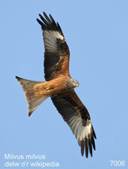 ..
..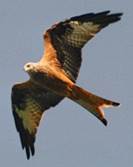
(delwedd 7006)
disgyn fel barcud ar swoop down on (“fall like a red kite on”)
Byddai'n disgyn fel barcud ar bob bargen yn y ffair he'd swoop down on every bargain in the fair
2 In North Wales barcud traditionally refers to Buteo buteo, the
buzzard, as do the the Cornish (bargos) and Breton (barged), cognates of this name. The
standard name for the buzzard in Welsh is bwncath.
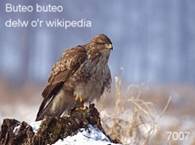
(delwedd 7007)
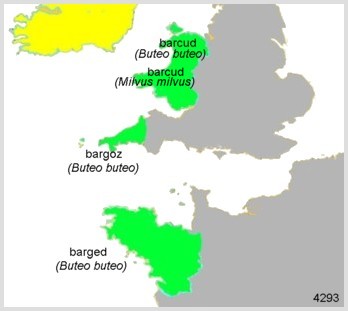
(delwedd 4293)
ETYMOLOGY: (1) From the same British root: as in North Wales,
Cornish bargoz (=
buzzard) (as in the place name Ros Bargoz “hill of the buzzard”), and Karn Bargoz (Carn Bargas) at An Woen-wenn (Whitemoor), in
Nanpyghan (Nanpean)
Breton barged (=
buzzard)
(2) Welsh barcud is a word based on a British element *barg, which also gave rise to the now obsolete Welsh word bery (= bird of prey, kite).
(The consonant g > gh > (vowel) y; the ‘y’ causes vowel affection of the
preceding vowel, thus a > e).
(3) On the basis of the Cornish and Breton forms one might expect Welsh
*bargod.
(4) The final syllable in Welsh barcud has a different origin to the Cornish and Breton
forms, namely cud (= kite), from Old English cŷta (= kite), related to the Middle High German word küze (= owl). (Borrowings of English words with a final
‘t’ usuaully show final ‘d’ in Welsh – more modern examples are poced =
pocket, bwled = bullet, roced = rocket)
(5) The structure seems to be in Old Welsh (bargh = bird of prey, kite) + soft mutation + (cud = kite). This would have given *bargh-gud, and the combination gh-g would have produced c, hence barcud.
(6) Another example of gh-g becoming c is helcyd (= to chase) < helgh-gyd, apparently Old
Welsh helgh- (= to
hunt) + cyd (= common,
united)
NOTE: Also barcut,
(apparently barcut < barcud, the 't' possibly being in imitation of the final 't'
in English 'kite') From this the diminutive forms barcutyn, barcutan.
:_______________________________.
barcut <BAR-kit> [ˡbarkɪt] masculine noun
1 Milvus milvus = red kite; see barcud
:_______________________________.
barcutan <bar-KI-tan> [barˡkɪtan] masculine
noun
barcutan <’cutan> (barcutanod <’cutanod>) [bar KI tan, bar
ki TAA nod]
1 Milvus milvus = red kite; see barcud l
2
barcutan papur <’cutan papur> kite
hedfan ’cutan papur fly a kite

ETYMOLOGY: BARCUTAN (= kite (bird); kite (of paper)) < (BARCUT = kite) +
(-AN diminutive suffix)
:_______________________________.
barcutyn <bar-KI-tin> [barˡkɪtɪn] masculine noun
1 Milvus milvus = red kite; see barcud
:_______________________________.
Barcutyn llwyd o'r coed
A ffwlbart wedi drewi
A winci naw mlynedd oed
<bar-KI-tin
LHUID or KOID, a FUL-bart WEE-di DREU-i, a WING-ki NAU-mluidh OID>
[barˡkɪtɪn ˡɬʊɪd
ɔr ˡkɔɪd, a ˡfʊlbart ˡweˑdɪ ˡdrɛʊɪ,
a ˡwɪŋkɪ ˡnaʊ mlʊɪð ˡɔɪd]
county of Ceredigion
1 humorous answer to the question Beth sydd i ginio? What's for dinner?
(“a little grey (or mouldy) red kite from the woods, and a polecat which has
let off a stink, and a weasel nine years old”)
:_______________________________.
bardd <BARDH> [barð] masculine noun
PLURAL beirdd <BEIRDH> [bəɪrð]
1 bard = poet; the poets formed part of the leading
classes among the Celts
2 poet = person who writes poetry
bardd a llenor oedd Rhisiart Puw Rhisiart Puw was a poet and a writer
talwrn y beirdd competition amongst poets, poetry contest
3 cynfardd, early poet, Welsh
poet from the early period (500s to 1100)
(cyn- = previous) +
soft mutation + (bardd = poet)
gogynfardd Welsh poet from the 100s to the 1300s
(go- prefix, quite) + soft mutation + (cynfardd = early poet)
“quite early poet” (i.e. not the earliest poet)
4 Gorsedd y Beirdd (qv) congress of bards;
a development of the sense gorsedd = court of law, tribunal
(the modern sense of gorsedd is ‘throne’)
5 gwynfardd (literally
“blessed bard”) druid = highest order in Congress of Bards (Gorsedd Beirdd Ynys Prydein)
(gwyn- <ə> [ə], penult form of gwyn <i> [ɪ] ) + soft
mutation + (bardd = bard, poet)
ETYMOLOGY: Welsh < British *bard- < Celtic
From the same British root: Cornish bardh (= poet), Breton barzh (= poet)
From the same Celtic root: Irish bard (= poet), Scottish bard (= poet)
:_______________________________.
bardd talcen slip <bardh TAL-ken SLIP> [barð ˡtalkɛn ˡslɪp] (masculine
noun)
1 doggerel poet (‘poet of receding forehead’)
:_______________________________.
barddas <BAR-dhas> [ˡbarðas] masculine noun
1 poetry (= the art of poetry), bardism
ETYMOLOGY: (bardd = poet) + (-as = suffix)
:_______________________________.
barddol <BAR-dhol> [ˡbarðɔl] feminine noun
1 of a poet
enw barddol bardic name, pseudonym used by a bard
cadair farddol bardic chair, chair awarded in an eisteddfod for a
winning 'awdl' (strict metre poem)
ETYMOLOGY: (bardd = poet) + (-ol = suffix for forming adjectives)
:_______________________________.
barddoniadur <bar-dhon-YAA-dir> [barðɔnˡjɑˑdɪr] masculine noun
PLURAL barddoniaduron <bar-dhon-ya-DII-ron> [barðɔnjaˡdiˑrɔn]
1 guide for poets
William Williams (1814-1869), ‘Creuddynfab’, from Creuddyn, Llandudno (county
of Conwy), published “Y Barddoniadur Cymmreig” (= Y Barddoniadur Cymreig “the Welsh poetry guide”)
in 1855
ETYMOLOGY: (barddon-, stem of barddoniaeth = poetry) + (-i-adur noun-forming suffix, indicating a book)
:_______________________________.
barddoniaeth <bar-DHON-yaith, -yeth> [barˡðɔnjaɪθ, -ɛθ] (feminine
noun)
1 poetry
llyfr barddoniaeth poetry book
cystadleuaeth farddoniaeth poetry competition
barddoniaeth lys (history) courtly poetry,
poetry addressed to courtiers
2 Barddoniaeth Poetry (subject label in a dictionary)
Abbreviation: Brdd.
:_______________________________.
barf <BARV> [barv] feminine noun
PLURAL barfau <BAR-vai,
-e> [ˡbarvaɪ, -ɛ]
1 beard = hair on lower part of a man's face
barf osod PLURAL barfau gosod false beard (“beard (of)
placing”)
glasu barf start growing a beard
tyfu bardd grow a beard
barf laes flowing beard
2 beard = a similar growth in some animals
barf yr afr felen (name of a plant) (Tragopogon pratensis) goat’s beard
(“(the) beard (of )the yellow goat”)
barf yr hen ŵr (Clematis vitalbi) traveller’s joy / old man’s beard
(Clematis vitalbi) (“(the) beard (of )the old man”)
gwisgo barf have a beard (“wear (a) beard”)
3 mould (resembling a beard)
ETYMOLOGY: British < Latin barba (= beard)
From the same British root: Cornish barv (= beard), Breton barv (= beard)
Cf Old English / modern English beard, German der Bart (= beard), which is probably a related form from the
same Indo-European root
NOTE: colloquially also baraf <BAAR-av> [ˡbɑˑrav] (Ceredigion),
where an epithentic vowel, echoping the original vowel, has been inserted
:_______________________________.
barfog <BAR-vog> [ˡbarvɔg] adjective
1 bearded
dyn barfog a bearded man
2 corswennol farfog (f) corswenoliaid barfog (Chlidonias hybrida) whiskered tern
3 barfog (m) barfogiaid <bar-VOG-yaid, -yed> [barˡvɔgjaɪd, -ɛd] bearded
man
ETYMOLOGY: (barf = beard) (-og suffix for forming adjectives)
:_______________________________.
barfogyn <bar-VOO-gin> [barˡvoˑgɪn] masculine noun
PLURAL barfogiaid <bar-VOG-yaid,
-yed> [barˡvɔgjaɪd, -ɛd]
1 (Barbus barbus) barbel
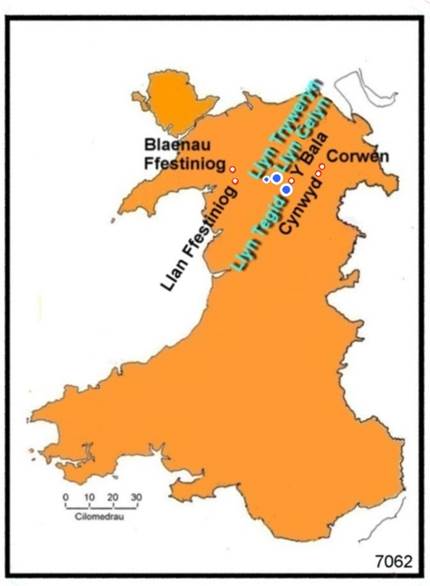
(delwedd 7411)
ETYMOLOGY: “little bearded [fish]”
(barfog =
bearded) + (-yn diminutive suffix added to nouns or adjectives to form nouns)
:_______________________________.
barforwyn, PLURAL: barforwynion <bar-VOO-ruin,-bar-vo-RUIN-yon> [barˡvoˑrʊɪn, barvɔˡrʊɪnjɔn] (feminine
noun)
1 barmaid
ETYMOLOGY: (bar = bar) + soft
mutation + (morwyn = maid). An imitation of the
English word bar + maid
:_______________________________.
bargen, PLURAL: bargeinion <BAR-gen, bar-GEIN-yon> [ˡbargɛn, barˡgəɪnjɔn] (feminine
noun)
1 bargain = something with an advantageous price
2 bargain, deal (= transaction or agreement)
taro bargen strike a deal, strike a bargain
Ni thrawyd mo’r fargen The deal didn’t come off, The deal fell through (“not
+ has been struck + nothing-of-the + deal”)
:_______________________________.
Bargen yw bargen, serch colli <BAR-gen iu BAR-gen, serkh
KO-lhi> [ˡbargɛn ɪʊ ˡbargɛn, sɛrx ˡkɔɬɪ] saying
1 A deal's a deal (even if you lose out)
("a bargain's a bargain, in spite of losing); if you agree to buy
something at a price which you think is very favourable, and you pay and find
that you could have paid less somewhere else, you can't undo a deal already
agreed; you can’t back out once you’ve given your word
:_______________________________.
bargod <BAR-god> [ˡbargɔd] masculine or feminine noun
PLURAL bargodion <bar-GOD-yon> [barˡgɔdjɔn]
1 eaves; overhang of a roof
2 county of Dinbych edge of a wood
3 (obsolete) borderland, territorial boundary,
border zone, frontier.
Nant y Bargod boundary stream
.....(3.1) The cwmwd
(commote, division) of Senghennydd was located in the area between the rivers
Taf and Rhymni in South-east Wales. Here there are two streams called Nant y Bargod which both rise on the highland between the towns of
Rhymni and Merthytudful. One flows towards the east and eventually joins the
river Rhymni, and the other to the west, joining the river Taf.
They are distinguished by the addition of the names of these rivers - Nant Bargod Rhymni (“(the) stream (of) (the) border area (which flows
into the river) Rhymni”), and Nant Bargod Taf (“(the) stream (of) (the) border area (which flows
into the river) Taf”).
Nant Bargod Rhymni:
http://www.geograph.org.uk/photo/625490
(“The Geograph British Isles project aims to collect geographically
representative photographs and information for every square kilometre of Great
Britain and Ireland…”)
The eastern stream flows from near the village of Fochriw, down past the
village of Y Deri, and into the river Rhymni in Aberbargod (“(the) confluence (of the) Bargod (stream) (and the
Rhymni)”).
The town of Y Bargod (qv) overlooks the confluence from the hill above on the western side.
The western stream flows from near Pownd Ras Las. It rises at Blaen Bargod
(“(the) source (of) (the) Bargod (stream)”). It goes towards Bedlinog, past a
farm called Cwmbargod (“the) valley (of) (the) Bargod (stream”).
The map indicates that below the farm this is the name of the valley - Cwm Bargod. Between Bedlinog and Trelewis there is Craig Fargod (“the cliff overlooking the Bargod stream”) from
which two farms take their names - Craigfargod, and Pencraigfargod (“(the) end (of) Craig Fargod, the place by Craig
Fargod”).
It continues through Trelewis into the Taf at Mynwentycrynwyr. In Trelewis
there is a Heol Glyn Bargod (“street (of) (the) valley (of the) Bargod (stream)”)
(in English as “Glyn Bargoed Road”)
Some of these names are misspelt with “Bargoed” instead of “Bargod”. In the
south it is usual in spoken Welsh for a final 'oe' diphthong to become
simplifed as 'o'.
For example, 'cyfoeth' (riches) would become 'cyfoth'.
Names with 'coed' as the last element would undergo the same change: Glasgoed
(green wood) > Glasgod, Trawsgoed (across + wood) > Trawsgod, Hirgoed
(long wood) > Hirgod. An example by Aber-dâr is Llwytgoed (grey wood) >
Llwytgod (though in fact there were further transformations in the local
dialect and it became Llycod).
Although the word bargod is still in use with the sense of 'eaves' it seems
that it was assumed that the final syllable was a reduction of 'coed', and as
place names are normally spelt in literary Welsh rather than according to the
local pronunciation it was respelt as Bargoed and explained as “the wood on the
summit, summit wood” (bar = summit) + soft mutation of a noun preceded by a
qualifying element + (coed = wood). A plausible explanation, but wrong!
.....(3.2) Blaenbargod name of a farm 5km south of Llangeler SN3739 (county
of Caerfyrddin)
SN7840 Nant Bargod, a tributary of Afon Brân, by Cynghordy (Caerfyrddin)
http://www.geograph.org.uk/photo/367724
SN7840 Cwmbargod (“Cwmbargoed”) a farm here, near Cynghordy,
Caerfyrddin
http://www.geograph.org.uk/photo/367713
4 overhang of a cliff, river bank
5 edrych dan fargod eich llaw shade one's eyes with one's hand (to keep out a
strong light; by placing the thumb edge of the hand between the eyebrows, and
the thumb on the temple) (“look under the eave of your hand”)
6 gwennol y fargod (“(the) swallow (of) the eaves”) Delichon urbicas
= house martin .
Alternative name of gwennol y bondo (also meaning “(the) swallow (of) the eaves”)
7 dŵr bargod drippings from roof (“water (of) eaves”)
diferion y bargod eavesdrip, drops of water from the eaves
ETYMOLOGY: bargod < bargawd (bar = top) + soft mutation + (cawd, unknown element, possibly = side)
:_______________________________.
Y Bargod <ə BAR-god> [ə ˡbargɔd] feminine noun
ST 1499
1 town in the county of Caerffili,
South-east Wales; the local form is Y Byrgod <ə BƏR-god> [ə ˡbərgɔd]
Population (1961): 8.835; proportion of Welsh-speakers
(1961): 10%
Population (1971): 8.700; proportion of Welsh-speakers (1971): 6%
NOTE: The local form Bargod [ˡbargɔd]
> Byrgod [ˡbərgɔd]
shows the usual reduction in South Wales of the final
'oe' to 'o', and the unusual reduction of 'a' in the tonic syllable to the
obscure vowel 'y' (though in south-east Wales a number of words do show this
feature).
Nowadays the erroneous form Bargoed (though apparently dating from the 1600’s
at least) seems to have become the usual form in Welsh. See bargod above.
:_______________________________.
bargodiad <bar-GOD-yad> [barˡgɔdjad] masculine noun
PLURAL bargodiadau <bar-god-YAA-dai,
-e> [bargɔdˡjɑˑdaɪ,
-ɛ]
1 overhang of a cliff, river bank
ETYMOLOGY: (bargod-, stem of the verb bargodi = project) + (-iad suffix)
:_______________________________.
bargyfreithiwr, PLURAL: bargyfreithwyr <bar-gə-VREITH-yur,
bar-gə-VREITH-wir> [bargəˡvrəɪθjʊr,
bargəˡvrəɪθwɪr] (masculine
noun)
1 barrister
:_______________________________.
barlys <BAR-lis> [ˡbarlɪs] (plural
noun)
1 barley
:_______________________________.
barlysyn <bar-LƏ-sin> [barˡləsɪn] (masculine
noun)
1 barleycorn
:_______________________________.
barman, PLURAL: barmyn <BAR-man, BAR-min> [ˡbarman, ˡbarmɪn] (masculine
noun)
1 barman
:_______________________________.
barn, PLURAL: barnau <BARN, BAR-nai, -e> [barn, ˡbarnaɪ, -ɛ] (feminine
noun)
1 opinion
y farn = the opinion
2 y farn day of judgement,
the final judgement
cyn sicred â'r farn as sure as fate (“as certain as the final judgement”)
mor siwred â'r farn as sure as fate (“as certain as the final judgement”)
3 mynegi barn ar (rywbeth) voice an opinion about (something)
traethu barn ar (rywbeth) voice an opinion about (something)
datgan barn ar (rywbeth) voice an opinion about (something)
4 cytundeb barn consensus, general agreement
cael cytundeb barn ar y mater reach a consensus on the issue
:_______________________________.
barnu <BAR-ni> [ˡbarnɪ] (verb)
1 to judge
2 barnu (rhywun) ar ei olwg judge (somebody)
by his appearance (“judge (somebody) on his appearance”)
barnu (rhywun) ar yr olwg allanol judge (somebody) by his appearance (“judge (somebody)
on the external appearance”)
barnu (rhywun) yn ôl ei olwg judge (somebody) by his appearance (“judge (somebody)
according to his appearance”)
:_______________________________.
barnwr, PLURAL: barnwyr <BAR-nur, BARN-wir> [ˡbarnʊr, ˡbarnwɪr] (masculine
noun)
1 judge
:_______________________________.
Barselona <bar-se-LOO-na> [barsɛˡloˑna] (feminine noun)
1 Barcelona
:_______________________________.
Barwg [BAA rug]
1 ward in the county of Bro Morgannwg. In English as Baruc.
13% Welsh-speaking (Census 2001)
Dywedir mai sylfaenydd yr Eglwys [= Eglwys Bedwas] oedd
Sant Baruck neu Barwg, yr hwn oedd yn cyfanneddu ar Ynys Barri, yng Nghulfor
Hafren. Nodiadau Plwyfol. Bedwas, Sir Fynwy. Yr Haul. Cyf. 27 Rhif. 321. Medi
1883
It is said that the founder of the church (i.e. Bedwas church) was Saint
Baruck or Barwg, who dwelt on Ynys y Barri / Barry Island in Culfor Hafren /
the Severn Estuary.
Brynbarrwg (spelt as ‘Bryn Barrwg’):
street name in Y Barri (the) hill (of) Barwg, Barwg’s hill
:_______________________________.
barugog <ba-RII-gog> [baˡriˑgɔg] adj
1 (North Wales) frosted over
2 gwydr barugog frosted glass = glass with raised nodules which
allows in light but prevents visibility, as in toilet windows
ETYMOLOGY: (barug- < barrug = frost) + (-og suffix for forming adjectives)
:_______________________________.
bas [BAAS] [bɑːs] (m) (Music) bass
:_______________________________.
bas <BAAS> [bɑːs] (adjective)
1 shallow
afon fas â gwaelod gwastad a shallow river with a flat bed
:_______________________________.
basa <BA-sa> [ˡbasa] (verb)
1 (North-west) he / she / it would be
:_______________________________.
basa chi = basach chi <BA-sa-khi> [ˡbasaxɪ] (verb)
1 (North-west) you would be
:_______________________________.
basa fo <BA-sa vo> [ˡbasavɔ] (verb)
1 (North-west) he would be
:_______________________________.
basach <BA-sakh> [ˡbasax] (verb)
1 (North-west) you would be
:_______________________________.
basach chi <BA-sa khi> [ˡbasaxɪ] (verb)
1 (North-west) you would be
:_______________________________.
basai > base answer form yes, he / she / it
would north-east)
basan (1) [BA-san] [ˡbasan] (v) answer form yes, we would (north-west)
basan (2) [BA -an] [ˡbasan] (v) answer form yes,
they would
(north-west)
basan <BA-san> [ˡbasan] (verb)
1 (North-west) answer form - yes, we would be
:_______________________________.
basan <BA-san> [ˡbasan] (verb)
(North-west)
1 answer form - yes, they would be
:_______________________________.
basan nhw <BA-sa-nu> [ˡbasanʊ] (verb)
1 (North-west) they would be
:_______________________________.
basan ni <BA-sa ni> [ˡbasanɪ] (verb)
1 (North-west) we would be
:_______________________________.
basat <BA-sat> [ˡbasat] (verb)
1 (North-west) you would be
:_______________________________.
basat ti <BA-sa-ti> [ˡbasatɪ] (verb)
1 (North-west) you would be
:_______________________________.
base <BA-se> [ˡbasɛ] (verb)
1 (North-east) yes, he / she / it would be
:_______________________________.
base fo <BA-se-vo> [ˡbasɛvɔ] (verb)
1 (North-east), he would be
:_______________________________.
base hi <BA-se-hi> [ˡbasɛhɪ] (verb)
1 (North-east), she would be
:_______________________________.
basech <BA-sekh> [ˡbasɛx] (verb)
1 (North-east), you would be
:_______________________________.
basech chi <BA-se-khi> [ˡbasɛxɪ] (verb)
1 (North-east), you would be
:_______________________________.
basen <BA-sen> [ˡbasɛn] (verb)
1 (North-east), yes, they would be
:_______________________________.
basen <BA-sen> [ˡbasɛn] (verb)
1 (North-east), yes, we would be
:_______________________________.
basen nhw <BA-se-nu> [ˡbasɛnʊ] (verb)
1 (North-east) they would be
:_______________________________.
basen ni <BA-se-ni> [ˡbasɛnɪ] (verb)
1 (North-east) we would be
:_______________________________.
baset <BA-set> [ˡbasɛt] (verb)
1 (North-east) yes, you would be
:_______________________________.
baset ti <BA-se-ti> [ˡbasɛtɪ] (verb)
1 (North-east)would be
:_______________________________.
Basg <BASK> [basg]
1 soft-mutated form of Pasg = Easter
ysgol Basg Easter school, Easter conference
:_______________________________.
Basg, PLURAL: Basgiaid <BASK, BASK-yaid, -yed> [basg, ˡbasgjaɪd, -ɛd] (masculine
noun)
1 Basque (= man from the Basque Country)
Gwlad y Basg the
Basque Country ‘(the) country (of) the Basque man’
:_______________________________.
basged, PLURAL: basgedi <BA-sked, ba-SKEE-di> [ˡbasgɛd, baˡsgeˑdɪ] (verb)
1 basket
:_______________________________.
Basgeg <BA-skeg> [ˡbasgɛg] feminine noun
1 Basque = language, euskara
yr iaith Fasgeg the Basque language
ETYMOLOGY: (Basg = Basque person) + (-eg suffix for forming a noun or adjective indicating a
language)
:_______________________________.
basgrwth <BAS-kruth> [ˡbasgrʊθ] masculine noun
PLURAL basgrythau <bas-KRƏ-thai,
-e> [basˡgrəθaɪ, -ɛ]
1 double bass
Also: dwbl bas
ETYMOLOGY: (bas = bass) + soft mutation + (crwth = violin)
:_______________________________.
basle <BAS-le> [ˡbaslɛ] masculine noun
PLURAL basleoedd <bas-LEE-oidh,
-odh> [basˡleˑɔɪð, -ɔð]
1 shallow, shallows = a stretch of shallow water
Basle ym mhlwyf Llangynfelyn, Ceredigion, yw Traeth Maelgwn
Traeth Maelgwn (“the shore of Maelgwn”) is a shallow in the parish of
Llangynfelyn (in the county of) Ceredigion
ETYMOLOGY: (bas = shallow) + soft mutation + (lle = place)
:_______________________________.
basn, PLURAL: basnau <BA-san, BA-snai, -e> [ˡbasan, ˡbasnaɪ, -ɛ] (verb)
1 basin
:_______________________________.
bastard (bastariaid) [BA stard, ba STARD yai, -ye] (m)
bastard
Also in South Wales bastardd – here there is probably the influence of the verb tarddu (= originate)
bastard mul, bastardd mul, bastar mul mul
:_______________________________.
baswn <BA-sun> [ˡbasʊn] (verb)
1 (North) yes (I would be)
:_______________________________.
baswn i <BA-su-ni> [ˡbasʊnɪ] (verb)
1 (North) I would be
:_______________________________.
baswn i > ’swn i [BA su ni, SU ni] (jo)
seria / estaria (Nord)
mi faswn i / faswn i / ’swn i [mi VA sun i , VA sun i, SUN i]
(v) seria? / estaria? (jo)
faswn i’n meddwl mai canran fach iawn o grwpiau sy’n ennill bywoliaeth trwy chwarae’n fyw
jo diria que només un percentage molt petit dels conjunts pot guanyar la vida
tocant davant la gent
:_______________________________.
bataliwn, PLURAL: bataliynau <ba-TAL-yun, ba-tal-YƏ-nai, -e> [baˡtaljʊn, batalˡjənaɪ,
-ɛ] (masculine noun)
1 battalion
:_______________________________.
batelu <ba-TEE-li> [baˡteˑlɪ] verb
1 to battle
ETYMOLOGY: (batel = battle) + (-u = suffix for forming verbs)
NOTE: also batlo <BAT-lo> [ˡbatlɔ]
:_______________________________.
bàth (bàths) [BATH, BATHS] (masculine noun)
1 bath
2 bàth adar <bath AA-dar> [baθ ˡɑˑdar] bird bath
:_______________________________.
bàth, PLURAL: bàths <BATH, BATHS> [baθ, baθs] (masculine
noun)
1 bath
ETYMOLOGY: bath = (formerly) a coin; modern Welsh
= type
Welsh < British < Latin BATT- (= to beat)
:_______________________________.
bathdy <BATH-di> [ˡbaθdɪ] masculine noun
PLURAL bathdai <BATH-dai> [ˡbaθdaɪ]
1 mint, place for minting coins
Un lle sy byth yn brin o arian yw bathdy Llantrisant ger Caer-dydd
One place which is never short of money is
Llantrisant Mint near Caer-dydd
ETYMOLOGY: (bath-, stem of bathu = to coin) + soft mutation + (ty = house)
:_______________________________.
bathiad <BATH-yad> [ˡbaθjad] masculine noun
PLURAL bathiadau <bath-YAA-dai,
-e> [baθˡjɑˑdaɪ, -ɛ]
1 coining, production of coins
2 coining = invention of a word
Roedd llawer yn amau doethineb bathiadau newydd Tomos Edwards, Caerfallwch, megis “buddsoddi”, “nwy”, “daeareg”, “degol”, “cyngerdd” ayyb ayyb
Many people were doubtful of (“doubted the wisdom of”) the new coinings of
Tomos Edwards, Caerfallwch, such as “buddsoddi” (to invest), “nwy” (gas),
“daeareg” (geology), “degol” (decimal), “cyngerdd” (concert) etc etc
3 drwgfathiad counterfeit (drwg = bad)
ETYMOLOGY: (bath-, stem of bathu = to coin) + (-i-ad suffix for forming nouns)
:_______________________________.
bathrwm (bathrwms) [BA thrum, BA thrumz] (m) cuarto
de bany
bathrwm <BATH-rum> [ˡbaθrʊm] feminine noun
PLURAL bathrwms <BATH-rums,
rumz> [ˡbaθrʊms, ˡbaθrʊmz]
1 (colloquial) bathroom
ETYMOLOGY: English bathroom
NOTE: The standard word is ystafell ymolchi (“room (of) washing oneself”); sometimes ystafell faddon (“room (of) bath”) is used
:_______________________________.
batlo <BAT-lo> [ˡbatlɔ] verb
1 battle, be at battle
Dal i fatlo... ein gohebydd yn holi cyn-filwyr y mae eu bywyd yn dal yn faes y gad iddynt
Still battling - our correspondent talks to ex-soldiers whose lives continue to
be a battlefield for them
ETYMOLOGY: (batl = battle) + (-o = suffix for forming verbs)
NOTE: also batelu <ba-TEE-li> [baˡteˑlɪ] (= to
battle)
:_______________________________.
Batus <BA-tis> [ˡbatɪs] masculine noun
PLURAL Batus <BA-tis> [ˡbatɪs]
(North Wales)
1 (colloquial) baptist
Batus Bach Scotch Baptist
Y Batus Bach nickname for David Lloyd George (1863-1945, prime
minister of the English state 1916-1922)
Does dim amheuaeth... yn ôl... erthygl bryfoclyd Lloyd George yn y Daily Express fod y Batus Bach wedi swyno gan garisma Hitler (Golwg 10 03 94)
There is no doubt... according to... an incisive article by Lloyd George in the
Daily Express that the “Batus Bach” had been captivated by Hitler’s charisma
2 (colloquial) y Batus (plural) = the Baptists
ETYMOLOGY: from English baptist
:_______________________________.
baw <BAU> [baʊ] masculine noun
1 dirt, filth
bod yn faw i gyd be covered in muck (“be all mud”)
Baw o ddyn yw e He’s vermin (“(it is) dirt of a man that-he-is”)
2 excrement, faeces, shit
baw ci dogdirt, dogshit (from one dog) (Amercian: also “dog
hockey”) (“dirt (of a) dog”)
baw cŵn dogdirt, dogshit (from many dogs) (“dirt (of) dogs”)
3 rhad fel baw dirt cheap
bod yn rhad fel baw be dirt cheap
“cheap like dirt / shit” (rhad = cheap) + (fel = like) + (baw dirt / shit)
4 baw isa'r domen < baw isaf y domen the lowest of the low,
the scum of the earth
(“(the) lowest excrement (of) the dungheap”)
5 ar eich baw (“on your dirt / shit”)
gadael (rhywun) ar ei faw to leave (somebody) in the lurch
gadael (rhywun) yn y baw leave (someone) in the lurch, let (somebody) down,
leave (someone) to fend for himself (“leave someone in the dirt”)
bod wedi’ch gadael yn y baw be left in the lurch
:_______________________________.
bawcoed <BAU-koid> [ˡbaʊkɔɪd] masculine noun
(South Wales)
1 bawcod <BAU-kod> [ˡbaʊkɔd] fallen twigs and
branches, especially after a storm (used for a fire)
ETYMOLOGY: “rubbish (from) trees” (baw = rubbish, dung, dirt) + (coed = wood, trees) > baw-cóed > báw-coed
:_______________________________.
bawd <BAUD> [baʊd] masculine noun
PLURAL bodiau <BOD-yai, -e> [ˡbɔdjaɪ,
-ɛ]
1 thumb = short thick inner
finger. Also bys bawd. Diminutive
form bodyn
troi eich bodiau twiddle your thumbs
bod o dan fawd rhywun be under
somebody’s thumb, be under somebody’s domination
bod o dan fawd be under the thumb,
be subservient, be dominated be henpecked
2 thumb = corresponding digit
in other animals
3 thumb = part of a glove
covering the thumb
4 bawd y troed big toe; plural bodiau'r traed. When the context is obvious,
simply bawd.
bodiau fy nhraed my big
toes, the two big toes
cefais pwys ei droed ar fy mawd corn
a gwaeddais mor groch ag y gwnaeth yr un syffrajet erioed I got the weight of
his foot on my toe with a corn (The Pembroke County Guardian / 12-06-1908)
5 ôl bawd thumbprint
6 in expressing clumsiness
with the hands:
byw o’r bawd i’r genau live from
hand to mouth (‘from the thumb to the mouth’)
bod yn fodiau i gyd be all fingers and thumbs,
be very clumsy in handling things or performing handiwork (“be thumbs all”)
Mae hwnnw yn fodiau i gyd His fingers are all thumbs
(“that person (that we are talking about but not present) is thumbs all”)
Mae pob bys yn fawd ganddo He’s clumsy with
his fingers (“every finger is a thumb with him”)
7 The earlier form with
initial m- is seen I the compounds:
modfedd inch. Literally
“thumb measure” - (mawd = thumb) + soft
mutation + (medd = measure)
modrwy ring. Literally
“thumb-binding” - (mawd = thumb) + soft
mutation + (rhwy, apparently
linked to rhwymo = to bind)
8 ni + uwch bawd na sawdl (‘no + / higher
over / a toe / than / (is) / a heel’)
Nid ei di byth uwch bawd na sawdl You’ll never get
anywhere, You’ll never make it, You’re doomed to failure (“you won’t go higher
than (is) a toe over a heel”)
9 bodio ‹BOD yo› (verb) to thumb it, to hitchhike (bawd = thumb) + (-io verb suffix) > bawdio > bodio (reduction of the diphthong aw in the penult to the simple
vowel o, a usual feature
in Welsh)
ETYMOLOGY:
Welsh bawd < mawd < British < Celtic
From the same British root: Breton: meud (= thumb)
NOTE: the confusion m > b is seen in other Welsh words
(a) maban = little child
> baban,
(b) Maredudd = man's name
> Bedo
(c) modryb = aunt, bodo = auntie (in South-east
Wales, bopa)
There is also the reverse process b > m
(a) abwydyn = worm > bwydyn > mwydyn (diminutive form),
(b) benyw = woman > menyw
The
plural form bodiau < bawdiau shows the reduction of the
diphthong aw in the penult to
the simple vowel o, a usual feature
in Welsh; as does the diminutive form bodyn,
and the verb bodio.
:_______________________________.
bawddyn <BAW-dhin> [ˡbawðɪn] masculine noun
1 vile person
“Pawb a’i cenfydd, o bydd bai,
A bawddyn, er na byddai.”
Everyone will perceive it, if there is a fault,
And a vile person (will find one) even though there
isn’t (one)
(Goronwy Owen 1722 - 1769)
ETYMOLOGY: (baw = dirt) + soft
mutation + (dyn = man)
:_______________________________.
be 'di <BEE di> [ˡbeˑdɪ]
1 North Wales (pa beth ydyw > beth ydi > be 'di, sometimes also written as bedi) what is...?
:_______________________________.
Beca <BE-ka> [ˡbɛka] (feminine noun)
1 woman’s name, shortened form
of Welsh Rebeca (= English Rebecca)
2 Y Beca The Rebecca
Riots (1840s; protests against tolls on roads)
Also helyntion Rebeca = The Rebecca Riots, terfysg Beca = The Rebecca Riots
:_______________________________.
bechan <BEE-khan> [ˡbeˑxan] adjective
1
feminine form of bychan (= small, little,
lesser)
Usually in the form fechan (with soft
mutation <b> [b] > <v> [v]; soft mutation
occurs to the first consonant if it is mutable of an adjective which follows a
feminine noun)
(a) Graigfechan (the) little
rock (village SJ1454 in the county of Dinbych);
(b) Llanfair Fechan (the) little ‘Llanfair’ (=
church of saint Mary). Village SH6874 in the county of Conwy
(c) Nedd Fechan (the) lesser Nedd, a
tributary of the Nedd river in south-east Wales
:_______________________________.
Bechan <BEE-khan> [ˡbeˑxan] feminine noun
1 Afon Bechan = river in the district of
Maldwyn (county of Powys) SO0798
ETYMOLOGY: Apparently bechan, feminine form
of bychan (= small,
little, lesser).
If it were “the little river” we would expect “(yr) Afon Fechan”.
It may be a personal name - “(the) river (of) Bechan”;
:_______________________________.
bechan <BEE-khan> [ˡbeˑxan] feminine noun
1
little girl
Roedd y taid yn chwarae pip-po efo’i wyres ieuangaf. Cuddiai ei wyneb y tu ôl i bapur newydd a gofyn 'Lle mae Taid?' Pan fyddai’n symud y papur ac yn dweud, 'Dyma fo', byddai’r fechan yn chwerthin nes bydd hi'n wan
The grandfather was playing peep-bo with his youngest granddaughter. He hid his
face behind a newspaper and asked “Where’s Granpop?” When he moved the paper
and said “Here he is!” the little girl laughed until she was weak (from
laughing)
2 mechan i my little one, my little
darling, sweetheart
(a) to a little girl; (b) to a lover / spouse
= fy mechan i, fy (= my) + nasal
mutation + (bechan) + (i = (of) me)
ETYMOLOGY: use of the adjective bechan as a noun. Feminine form of bychan (= small, little).
:_______________________________.
bechdan <BEKH-dan> [ˡbɛxdan] feminine noun
PLURAL bechdanau <bekh-DAA-nai, -ne> [bɛxˡdɑˑnaɪ,
-ɛ]
1 form of the word brechdan; slice of bread and butter,
(Northern England: butty) (Scotland: piece)
bechdan jam bread and jam (bread and
butter with jam)
Loss of ‘r’ after initial ‘p / b’ in other languages:
Cf Castilian ‘pograma’ for ‘programa’ (= programme, program)
English Dialect Dictionary / Joseph Wright. The author notes that brisket,
meaning breast or stomach, is ‘bisket’ in Scotland.
The Dictionar o the Scots Leid explains this as brisket > metathesised form birsket > loss of ‘r’ bisket
:_______________________________.
bechgyn <BEKH-gin> [ˡbɛxgɪn]
1 boys
Plural form of bachgen
:_______________________________.
be-chi'n-galw, bechingalw ‹BEE-khin-GAA-lu › [ˡbeˑxɪn ˡgɑˑlʊ] pronoun
1 a
what-d'y'-call-it, whatchamacallit, doodah (USA: hickey) (refrerring to
something the name of which is unknown or momentarily forgotten)
2 what's-it (to
avoid a word considered rude)
3 (South Wales)
vagina, fanny
ETYMOLOGY: “(pa) beth (yr) (ych) chi yn (ei) galw” what do you call it / her
(pa = which ) + soft mutation + (peth = thing) + (yr linking
particle) + (ych chi you are) + (yn linking
particle) + (ei = its, her) + (galw = call)
:_______________________________.
becso <BEK-so> [ˡbɛksɔ] (verb)
1 to
worry (from English 'to vex')
2
(South-west) becso’ch enaid be worried out of your mind
(“worry your soul”)
:_______________________________.
bedd, PLURAL: beddau <BEEDH, BE-dhai, -dhe> [beːð,
ˡbeˑðaɪ, -ɛ] (masculine noun)
1 grave
2 ysbeiliwr beddau grave robber
3 mynd fel y bedd go dead silent
Fe aeth hi fel y bedd You could have
heard a pin drop, it went dead quiet (“it went like the grave”) (“go like the
grave”) (mynd = to go) + (fel = like) + (y = the) + (bedd = grave)
4 cyn ddistawed â’r bedd as silent as the
grave
mor ddistaw â'r bedd as silent as the
grave
5 carreg fedd gravestone,
tombstone (carreg = stone) + soft
mutation + (bedd = tomb, grave)
6 codi corff o fedd exhume a body (“raise a body
from a grave”)
7 yr ochr yma i’r bedd during one’s lifetime, here
on earth, before going to heaven (“on this side of the grave”)
:_______________________________.
Bedd Arthur <beedh AR-thir> [beːð
ˡarθɪr] masculine noun
1 SN1332 gravesite 5km west of
Crymych (county of Penfro)
http://www.geograph.org.uk/photo/301098
Bedd Arthur
(“The Geograph British Isles project aims to collect geographically
representative photographs and information for every square kilometre of Great
Britain and Ireland…”)
ETYMOLOGY: “(the) grave (of) Arthur; Arthur's Tomb / Grave” (bedd = grave) + (Arthur = Arthur)
:_______________________________.
Bedd Taliesin <BEEDH ta-li-E-sin> [ˡbeːð
talɪˡɛsɪn] masculine noun
1
SN6791 locality in the county of Ceredigion (“(the) grave (of) Taliesin”)
:_______________________________.
bedd wedi ei wyngalchu <BEEDH WE-di ɛi / i wən-GAL-khi> [ˡbeːð ˡwɛdɪ əɪ
/ ɪ wənˡgalxɪ] masculine noun
1 a
hypocritical person (literally “whitewashed tomb, whited sepulchre”) = a person
whose outward behaviour conceals the person's innate badness; expression from
the Bible (Matthew 23:27) (beddau wedi eu gwyngalchu = whited sepulchres)
2 something pleasing to see
from the outside but inside corrupt
ETYMOLOGY: “a grave after its whitewashing” (bedd = grave) + (wedi = after) + (ei = its) + soft mutation + (gwyngalchu = whitewashing, to
whitewash)
:_______________________________.
Bedd y Cawr <BEEDH ə KAUR> [ˡbeːð
ə ˡkaʊr]
1 (SJ0172) locality in the
county of Dinbych (North-east Wales) (“(the) grave (of) the giant”)
:_______________________________.
Bedd y Ci Du <BEEDH ə KII DII> [ˡbeːð
ə ˡkiː ˡdiː]
1 (“(the) grave
(of) the black dog”)
Lost field name in Y Rhath, Caer-dydd
ETYMOLOGY: “(the) grave (of) the black dog”
(bedd = grave) + (y = definite
article) + (ci = dog) + (du = black)
:_______________________________.
beddargraff <bedh-AR-graf> [bɛðˡargraf] masculine noun
PLURAL beddargraffiadau <be-dhar-graf-YAA-dai, -de> [bɛðargrafˡjɑˑdaɪ,
-ɛ]
1 epitaph, inscription (on
gravestone)
ETYMOLOGY: (bedd = grave) + (argraff = inscription)
:_______________________________.
Y Beddau <ə BEE-dhai, -dhe> [ə
ˡbeˑðaɪ, -ðɛ]
1 ST0585 locality in the
county of Rhondda-Cynon-Taf
12% Welsh-speaking (Census 2001)
http://www.geograph.org.uk/photo/357651
Sgwâr y Beddau / Beddau Square
(“The Geograph British Isles project aims to collect geographically
representative photographs and information for every square kilometre of Great
Britain and Ireland…”)
2 ST1487 name of a farm in
Heol Trecennydd in the county of Caerffili
Heol y Beddau ST1586 name of a street in Caerffili near Gorsaf yr
Aber / Aber Station
“(the) street / road (of) Y Beddau”
ETYMOLOGY: y beddau = ‘the graves’ (plural of bedd = grave)
NOTE: in the south-east Beddau > Bedda <BEE-dha> [ˡbeˑða]
:_______________________________.
beddrod <BEDH-rod> [ˡbɛðrɔd] masculine noun
PLURAL beddrodau <bedh-ROO-dai, -de> [bɛðˡroˑdaɪ,
-ɛ]
1 tomb
Y Beddrod Sanctaidd The Holy Sepulchre, the
grave where the body of Jesus Christ was placed after the Crucifixion
2 North-west Wales, obsolete
bedrog = charnel house,
building where bones or corpses are deposited (?could this be the influence of
the place name Llanbedrog SH3231 6km south-west of
Pwllheli, in the county of Gwynedd in north-west Wales. The change of final d > g is otherwise very unusual)
ETYMOLOGY: Welsh beddrod < beddrawd; (bedd = grave) + soft mutation + (rhawd = course, route) <
British *bedo-rât-
From the same British root: Breton bered (= grave), < bezred
:_______________________________.
bedi <BEE di> [ˡbeˑdɪ]
See be 'di
:_______________________________.
bedlam <BED-lam> [ˡbɛdlam]
1 feminine noun; obsolete
bedlam = a madhouse
Mae hi fel bedlam yma
It's bedlam here, it's like a madhouse in here (said of activity accompanied by
great confusion or noise)
2 feminine noun; bedlam
= uproar;
bod yn fedlam wyllt be bedlam, be complete
uproar (“be wild bedlam”)
3 masculine noun; obsolete
beggar, tramp; see bedlem
ETYMOLOGY:
Middle English bedlam (= madhouse), a
corruption of 'Bethlehem', from the name of a hospital (Bethlehem Royal
Hospital) by Bishopsgate, in London. This was originally a priory called “Saint
Mary of Bethlehem”, founded in 1247 by the Sheriff of London, Simon FitzMary.
In the late 1300s it began to admit mental patients, becoming an official
lunatic asylum in the 1500s.
:_______________________________.
bedlan <BED-lan> [ˡbɛdlan] masculine noun
1 North-west
Wales ar hyd y bedlan continually, all along, all
the time
ETYMOLOGY: probably from English peddling (= travelling as a pedlar)
:_______________________________.
bedlem <BED-lem> [ˡbɛdlɛm] masculine noun
PLURAL bedlemod, bedlemiaid <bed-LE-mod, bed-LEM-yaid, -ed> [bɛdˡlɛmɔd, bɛdˡlɛmjaɪd,
-ɛd]
1 obsolete beggar,
tramp (male); originally someone from a madhouse with a permit for begging
2 Anodd rhyngu bodd bedlemod Beggars are hard to please
(because they think that a donation given them could be more or better) (“(it
is) hard pleasing beggars”)
ETYMOLOGY: form of bedlam (= beggar)
:_______________________________.
bedlema <bed-LE-ma> [bɛdˡlɛma] verb
1 wander about
Lle buost ti'n bedlema c'yd? Where've you been all this
time? (someone who takes longer than expected to do an errand) (“Where have you
been wandering about all this time?”)
ETYMOLOGY: wander about < wander about begging (bedlem = beggar) + (-a)
:_______________________________.
bedlemes <bed-LE-mes> [bɛdˡlɛmɛs] feminine noun
PLURAL bedlemesau <bed-le-ME-se> [bɛdlɛˡmɛsaɪ,
-ɛ]
1 obsolete beggar,
tramp (female); see bedlem
y fedlemes the female tramp
ETYMOLOGY: (bedlem = beggar) + (-es)
:_______________________________.
Bedlinog <bed-LII-nog> [bɛdˡliˑnɔg] feminine noun
1 SO0901 locality in the
county of Merthyrtudful
Population: (1961) 3,992 (26% Welsh speakers)
Population: (1971) 4,050 (13% Welsh speakers)
9% Welsh-speaking
(Census 2001)
NOTE: A fanciful name for the village is Beddllwynog / Bedd Llwynog, from a belief that the name Bedlinog represents bedd
y llwynog, “(the) grave (of) the fox”
:_______________________________.
bedlwyn <BED-luin> [ˡbɛdlʊɪn] masculine noun
1
birch grove. See bedwlwyn
:_______________________________.
Bedo <BEE-do> [ˡbeˑdɔ] masculine noun
1
man's name (pet form of Maredudd)
2 patronymic = son of Bedo,
originally (before circa 1600) ap Bedo
Hywel ap Bedo Hywel, son of Bedo
Hywel Bedo Hywel, son of Bedo
3 fixed surname (“descendant
of the son of Bedo”) English form: Beddoe, Beddoes
Hywel Bedo Hywel, descendant of a son of Bedo
Such a name in an English form would be: “Howell Beddoe, Howell Beddoes”
ETYMOLOGY: diminutive of Maredudd, probably from
child language (spoken by or to small children); -o = diminitive suffix, the change of the initial
consonant m > b occurs in other words in
Welsh.
See baban (= infant) < maban,
benyw (= woman) < benyw
:_______________________________.
bedol <BEE-dol> [ˡbeˑdɔl] f
1 soft mutated form of pedol (= horseshoe)
y bedol (= the horseshoe)
:_______________________________.
Bedr <BEE-der> [ˡbeˑdɛr] masculine noun
1
soft-mutated form of Pedr = Peter
Llanbedr / Llambed <LHAN-bedr,-LHAM-bed> [ˡɬanbɛdr,
ˡɬambɛd] (the) church (dedicated to) Peter, Peter Church
Gŵyl Bedr Saint Peter’s Day, June the
twenty-ninth (“(the) feastday (of) Peter”)
Ffynnon Bedr Peter Well, (“(the) well
(of) Peter”)
:_______________________________.
bedw <BEE-du> [ˡbeˑdʊ]
collective
noun
1
(plural of bedwen) birches
feminine noun
2 birch grove, birch wood;
(a) Tynyfedw the smallholding
by the birch grove
(b) Cefn y Fedw
‘hill of the birch trees / of the birch wood’ Place by Rhiwabon. Called by the
English ‘Ruabon Mountain’
adjective
3 made
of birch
gwialen fedw birch rod (for corporal
punishment)
:_______________________________.
Bedw <BEE-du> [ˡbeˑdʊ] feminine noun
1 birch
grove, birch trees
Y Fedw the birch grove
2 Cefn y Fedw a place by Rhiwabon. Called
by the English ‘Ruabon Mountain’
:_______________________________.
Bedw <BEE-du> [ˡbeˑdʊ] feminine noun
1 SN3550
Afon Bedw a river in Ceredigion
:_______________________________.
bedwan <BED-wan> [ˡbɛdwan] feminine noun
1 South-east
Wales form of bedwan = birch tree
:_______________________________.
Bedward <BED-ward> [ˡbɛdward] masculine noun
1 telescoped
form of ab Edward = (the) son (of) Edward;
used as a surname
:_______________________________.
Bedwas <BED-was> [ˡbɛdwas] feminine noun
1
locality in Caerffili county ST 1789, south-east Wales; population
(1961) c. 3000;
proportion of Welsh-speakers (1961) 8%
11% Welsh-speaking (Census 2001)
2
parish
ETYMOLOGY: Bedwas < Bedwes (1566: Bedwes) < bedwos (= small birch trees)
(bedw = birches) + (-os = diminitive suffix added to
plural nouns)
A fanciful explanation is found here:
Nodiadau Plwyfol. Bedwas, Sir Fynwy. Yr Haul. Cyf. 27
rhif. 321. Medi 1883. Tudalen 415.
Plwyf gwladaidd yw hwn yn sir Fynwy, ar gyfer sir Forganwg. Y mae tarddiad yr
enw heb gael ei egluro yn foddhaol hyd yn hyn. Yr oedd Mr Bruce Price yn arfer
dweyd i'r gair darddu oddi wrth waith y penteulu yn dywedyd wrth ei weision neu
y plant, "Dos i'r bed, was." Yr oedd y diweddar Quellyn yn barnu mai
Bedw Faes ydyw ystyr y gair. Yr oedd llawer iawn o goed bedw yn arfer tyfu o
amgylch y lle.
Parish Notes. Bedwas, Sir Fynwy / Monmouthshire. Yr Haul (= The Sun –
magazine title). Volume 27, number 321. September 1883. Page 415.
This is a rural parish in Sir Fynwy / Monmouthshire, facing Sir Forgannwg /
Glamorganshire. The derivation of the name has not yet been satisfactorily
explained. Mr Bruce Price used to say that the word derived from the work of
the head of the household saying to his servants or children, ‘Go to bed, was’
[Note: a form of adress. the soft-mutation form of gwas – the mutation
indicates it is being used as a vocative. Gwas is ‘servant’, ‘farmhand’, but
‘was’ is / was also used with a more general sense of ‘my friend, my man,
mate’). The late Quellyn opined that ‘Bedw Faes’ [Note: beech field, though
‘Maesybedw’ would be a more usual structure for such a name) was the meaning of
the word. There were a lot of beech trees that used to grow around the place.
:_______________________________.
bedwen <BED-wen> [ˡbɛdwɛn] feminine noun
PLURAL bedw, bedwenni <BEE-du> [ˡbeˑdʊ] <bed-WE-ni> [bɛdˡwɛnɪ]
1 Betula pendula birch
tree
Betula pendula is also called bedwen arian, as in English
‘silver birch’
2 bedwen lwyd plural bedw llwydion Betula pubescens downy
birch (literally “grey birch”)
Betula pubescens is also called bedwen gyffredin plural bedw cyffredin (“common birch”)
3 corfedwen; plural corfedw Betula nana dwarf
birch
4 bedwen / bedw is a common
element in place names
..1/ Bedw-arian (‘Bedw Arian’)
street in Bryntirion, Pen-y-bont ar Ogwr
..2/ Glynbedw street name,
Llanbradach (county of Caerffili)
glyn y bedw = ‘valley (of) birches’
..3/ Heol y Bedw “(the) street (of) the
birches”, or “(the) street (of) (the house called) Y Bedw”
....a/ Heol Bedw street name, Y Porth (county
of Rhondda Cynon Taf)
..4/ Heol y Bedw-hirion street name, Bedwellte (county
of Caerffili) (‘tall birches’)
..5/ Penrhiwfedwen “pen rhiw y
fedwen” = the top of the slope with the birch tree
(Census, Llangynfelyn 1851: Troedrhiwfedwen / Thomas Jones / Born in Llanfihangel
Genau’r Glyn /
Head of Household / Married / Age 78 / Pauper, farrier)
twyn y bedw = ‘hill of the birch trees’
..6/ Twynbedw street name in Y
Porth (county of Rhondda Cynon Taf)
..7/ Y Fedwenarian (“Y Fedwen Arian”) (= the
silver birch) street name in Penymynydd (SJ3062) (county of Y Fflint)
5 bédwlwyn, or bedlwyn birch grove, birch wood
Heol y Bedlwyn street in Tredegar Newydd (county
of Caerffili) (“Bedlwyn Road”)
6 llwyn bedw birch grove, birch wood
Llwynbedw
.....(a) street name, Pen-coed, Pen-y-bont ar Ogwr county
.....(b) street name, Fforest-fach, Abertawe county
7 bedwos small birch trees
Bedwas village in
Caerffili county < ‘bedwos’. The change of a final ‘o’ to ‘a’ in the south
is to be seen in the word ‘ofn’ = fear; this becomes a bisyllable colloquially
‘ofon’, and in many places has in turn become ‘ofan’ <OO-van> [ˡoˑvan]
8 Penbedw ‘headland of birch trees’
Welsh name for Birkenhead, Wirral Peninsula, England
9
(feminine noun) birch grove, birch wood;
Y Fedw the birch grove, the birch
wood;
Tynyfedw the smallholding
by the birch grove
10 bedwen haf maypole (“birch tree (of)
summer”)
dawns y fedwen haf maypole dance
11 bedw (qualifier) birch = made from
birch
gwialen fedw, plural gwialenni bedw birch rod (for corporal punishment)
rhisgl bedw birch bark
tar rhisgl bedw birch bark tar
12 bedwenni (qv) birch trees
ETYMOLOGY: (bedw = birch trees) +
(-en suffix for
forming singulative nouns); bedw < British *betw- < Celtic <
Indoeuropean *gwet-
From
the same British root:
Cornish bedhow (= birch trees),
Breton bezv (= birch trees),
From the same Hibernian root:
Irish: beith, plural beitheanna (= birch tree, birch trees),
Scottish beith, plural beithean (= birch tree, birch trees)
Cf Catalan bedoll < Latin betul- < Celtic betull-, diminitive form of *betwa (= birch)
Latin
(1) betula (= birch tree) (in
English as betula <BE-chə-lə> [ˡbɛʧələ] for the name of
an example of a birch species). Another related word in Latin is
(2) bitûmen (= tar) from
which come English bitumen and French béton (= concrete)
NOTE: South-east Wales: bedwan, bedwin
:_______________________________.
bedwenni <bed-WE-ni> [bɛdˡwɛnɪ]
1 birch trees
2 Bodwenni mansion by
Llandderfel. The original name was Bedwenni (Merionethshire Court of Quarter
Sessions, 21 November 1781... Robert Evans of Bedwenni...). Apparently
influenced by place names with bod (= dwelling, house, abode) as a first
element which are frequent in North Wales
3 Y Bedwenni (“the birch
trees”) title of a poem in Llyfr Du Caerfyrddin / The Black Book of Carmarthen
c.1250
ETYMOLOGY: (bedwenn- < bedwen = birch tree, singulative
form of bedw = birch trees) + (-i plural suffix)
:_______________________________.
Bedwyr <BED-wir> [ˡbɛdwɪr] (masculine noun)
1
man's name
ETYMOLOGY: Unknown.
The name of the second in status in Athur’s court, Bedwyr ap Pedrawg, (son of
Pedrog), a warrior who lacked a hand (tale of Culhwch ac Olwen, c. 1100). The
modern forename, 1900+, is this name from the legend.
:_______________________________.
bedydd <BEE-didh> [ˡbeˑdɪð] (masculine noun) PLURAL: bedyddiadau [BEE didh, be dədh YAA dai -de]
(m) baptisme
1 baptism
cael bedydd tân receive a baptism of fire (=
said of a difficult task done for the first time)
2 mam fedydd, mamau bedydd godmother
tad a mam bedydd godfather and godmother,
godparents (no soft mutation, as it does not refer solely to the mother
3 tad bedydd, tadau bedydd godfather
tad a mam bedydd godfather and godmother,
godparents (no soft mutation *fedydd < bedydd, as it does not refer solely to
the mother)
ETYMOLOGY: Welsh < British < Latin *batid-
< *baptid- < baptizÂre (= baptise) < Greek baptizein (= baptise) < baptein (= submerge, dye through
submersion).
Latin baptid-io
(= baptise) > batid-io > British *batid > Welsh *badidd > bedydd
:_______________________________.
bedyddfaen <be-DƏDH-vain> [bɛˡdəðvaɪn] masculine noun
PLURAL bedyddfeini <be-dədh-VEI-ni> [bɛdəðˡvəɪnɪ]
1 baptismal font = stone
vessel for holding baptismal water in a church
ETYMOLOGY: (bedydd- root of bedyddio = to baptise) + soft
mutation + (maen = stone)
:_______________________________.
bedyddiad <be-DƏDH-yad> [bɛˡdəðjad] masculine noun
PLURAL bedyddiadau <be-dodh-YAA-dai, -de> [bɛdɔðˡjɑˑdaɪ,
-ɛ]
1 baptism
ETYMOLOGY: (bedydd- root of bedyddio = to baptise) + (-i-ad noun-forming suffix)
:_______________________________.
bedyddio <be-DƏDH-yo> [bɛˡdəðjɔ] (verb)
1 to baptise
ETYMOLOGY: (bedydd = baptism) + (-i-o verb-forming suffix)
:_______________________________.
bedyddiol <be-DƏDH-yol> [bɛˡdəðjɔl] adjective
1
baptismal
2 baptised
neb byw bedyddiol not a soul, not a living
soul (“nobody living (and) baptised”)
ni + yr un creadur byw bedyddiol not a living soul (“not...
the one baptised living creature”)
Doedd yno'r un creadur byw bedyddiol
There wasn’t a soul in the place, there was absolutely nobody there
ETYMOLOGY: (bedydd-, stem of the
verb bedyddio = to baptise) +
(-iol, suffix for
forming adjectives)
:_______________________________.
bedyddiwr <BE-DƏDH-YUR> [bɛˡdəðjʊr] masculine noun
PLURAL bedyddwyr <BE-DƏDH-WIR> [bɛˡdəðwɪr]
1 baptist = a
person who baptises
Ioan Fedyddiwr John the
Baptist, the name given to the Jesus’s disciple John
2 Bedyddiwr Baptist = member
of a non-conformist Protestant church
Addoldy’r Bedyddwyr (the) Baptist
Chapel
Bedyddiwr yr Alban Scotch Baptist
Bedyddiwr Bara Caws (nickname)
Scotch Baptist (“baptist (of) bread (and) cheese”)
3 Bedyddiwr Caeth Strict Baptist
ETYMOLOGY: (bedydd-i-, stem of bedyddiwr = to baptise) +
(-i-wr suffix = man)
:_______________________________.
Bedyddwyr <be-DƏDH-wir> [bɛˡdəðwɪr]
1 Baptists; plural of Bedyddiwr (qv)
:_______________________________.
Beechwood
(a ward in the county of Casnewydd / Newport)
9% Welsh-speaking
(Census 2001)
The place is so-named from Beechwood House, the residence of George Fothergill, a tobacco
manufacturer and former mayor of Casnewydd / Newport.
1842 Cyfaill o’r Hen Wlad
:_______________________________.
Befan <BEE-van> [ˡbeˑvan]
1 Surname. English spelling:
“Bevan”
ETYMOLOGY: ‘son of John’ or ‘son of Evan’ Befan < ab Efan (ab = son) + (Efan, variant of Ifan = John)
:_______________________________.
Begw ‹BEE-gu› [ˡbeˑgʊ] (feminine noun)
1 woman's
name; diminutive of Marged (Margaret)
:_______________________________.
begwn <BEE-gun> [ˡbeˑgʊn] masculine noun
PLURAL begynau, begwns <be-GƏ-nai, -ne, BEE-gunz> [bɛˡgənai, -ɛ, ˡbeˑgʊnz]
1 beacon = hilltop
2 beacon = hilltop bonfire as
a warning sign
3 ST2289 Y Begwns (“the beacons”) local name
for Bannau Brycheiniog (“(the) peaks (of) (the
territory of) Brycheiniog”), also known as Y Bannau (the peaks)
English name: Brecon Beacons, The Beacons. Alsoas “Y Becwns” <BEE-kunz> [ˡbeˑkʊnz]
4 Pen y Begwn SO2436 (677m)
mountain 6km south of Y Gelligandryll
(“(the) summit (of) the beacon”)
(pen = peak, top) + (y = definite article) + (begwn = hill, beacon hill)
English name: Hay Bluff
http://www.geograph.org.uk/photo/14642
ETYMOLOGY: English beacon < Old English
“beacen” (= sign)
NOTE: there is also a variant pegwn, with p instead of b
:_______________________________.
beibl (“beibil”) <BEIBL, BEI-bil> [bəɪbl,
ˡbəɪbɪl] masculine noun
PLURAL beiblau <BEI-blai, -ble> [ˡbəɪblaɪ,
-blɛ]
1 bible = a book with the
sacred writings of a religion
2 y Beibl the Bible = the
sacred texts of the Christian religion;
the Protestant Bible consists of the Old Testament and the New Testament;
the Roman Catholic Church has in addition to these the Apocrypha.
Note on the Bible in Welsh:
a) The New Testament was first translated, mainly from the Greek,
by William Salesbury (c1529-95); it appeared in 1567 (when he was aged c36/37).
b) It served as the basis for a complete edition of the Bible which
appeared 21 years later, in 1588, the work of Richard Morgan (c1547-1604) (when
aged c40/41), the Bishop of Llanelwy.
Based on the Greek and Hebrew Bible, with reference also to the Latin Vulgate,
the Latin version of Sanctes Pagninus
and the English Geneva Bible (a version produced by English exiles in this city
in the year 1560)
c) Richard Parry (1560-1623), his successor as Bishop of Llanelwy,
published a revised version thirty-two years later, in 1620 (when aged 60).
He was probably assisted by his chaplain, John Davies (1570-1644).
This was the Bible in general use until the publication of the Beibl Cymraeg
Newydd (“the New Welsh-language Bible”) in 1988,
and has had a profound influence on the Welsh language (idioms, personal and
place names, the literary language).
The Hebraisms of Richard Morgan were rejected by Parry, who seems to have
attempted to make his revised version conform to the King James's
English Bible, the so-called Authorised Version, which had appeared
nine years earlier, in 1611.
3 y Beibl Cysegr-lân the Holy Bible, Holy Writ
(“sacred-pure”, pure and holy)
4 tyngu (rhywbeth) ar y Beibl swear (something) on the
Bible
5 bod yn olau yn eich Beibl be well-versed in one's
Bible (“be light / enlightened in your Bible”)
6 iaith y Beibl Bible Welsh, the Welsh used
in the Bible regarded as a literary standard (“(the) language (of) the Bible”)
7
bible = an authoritative book
beibl y pysgotwr the fisherman's bible .
8 Beibl teuluol ‹BEI bil tei LII ol› family Bible
ETYMOLOGY: beibl < English bible
< 1200+ Old French bible
< medieval Latin biblia (= books, the
sacred books)
< Greek biblia, plural of biblion (= book), diminutive form of
biblos (= papyrus)
< Byblos (Βύβλος) the Greek name
of the port in Phonecia from which the Greeks brought papyrus that came from
Egypt.
In Phonecian the city was called Gebal (earlier Gubla).
Today it is within Lebanon, and in Arabic is Jbeil (جبيل Ǧubayl): it was
known as Gibelet during the time
of the Crusades.
In the Welsh Bible there is a reference to builders from this port city who
worked on Solomon’s Temple
Brenhinoedd-1, 5:17-18. (17) A'r brenin a orchmynnodd ddwyn ohonynt hwy feini mawr, a meini costus, a meini nadd, i sylfaenu y tŷ. (18) Felly seiri Solomon, a seiri Hiram, a'r Gibliaid, a naddasant, ac a ddar-parasant goed a cherrig i adeiladu'r tŷ.
Kings-1 5:17-18. (17) And the king commanded, and they brought great stones,
costly stones, and hewed stones, to lay the foundation of the house.
(18) And Solomon's builders and Hiram's builders did hew them, and the
stonesquarers: so they prepared timber and stones to build the house.
NOTE: Beibil, infromal
spelling reflecting the colloquial pronunciation
:_______________________________.
Beiblaidd <BEI-blaidh, -bledh> [ˡbəɪblaɪð,
-ɛð] adjective
1
biblical = of the Bible
Y Beibl the Bible
Beibl teuluol [BEI bil tei LII ol] family
bible
Bu cyfnod yn ddiweddar pan nad oedd bri ar alw plant wrth enwau Beiblaidd
There was a period of late when it wasn't fashionable to give children Biblical
names
Enillwyr rowndiau terfynol Cwis Beiblaidd Cymru a gynhaliwyd yn Aberystwyth yn ddiweddar
The winners of the final rounds of the Bible Quiz of Wales held recently in
Aberystwyth
Roedd ganddo ddosbarth Beiblaidd yn y capel
He
had a Bible class in the chapel
Yr oedd iaith Feiblaidd lân ar ei wefus bob gair
He spoke elegant Biblical Welsh (“there was pure Biblical language on his lip
every word”)
ETYMOLOGY: (Beibl = Bible) + (-aidd suffix for forming
adjectives)
:_______________________________.
beic modur <beik MOO-dir> [bəɪk
ˡmoˑdɪr] (masculine noun)
PLURAL: beiciau < BEIK-yai, -ye MOO-dir> [ˡbəɪk,
ˡbəɪkjaɪ, -jɛ ˡmoˑdɪr] 1 motor
bike
ETYMOLOGY: (beic = bike) + (modur = motor), literal translation
of English ‘motorbike’.
:_______________________________.
beic mynydd <beik MƏƏ-nidh> [bəɪk
ˡməˑnɪð] (masculine noun)
1 mountain bike
:_______________________________.
beic, PLURAL: beiciau <BEIK, BEIK-yai, -ye> [ˡbəɪk,
ˡbəɪkjaɪ, -jɛ] (masculine noun)
1 bike
ETYMOLOGY: English bike, an altered
clipped form of bicycle
:_______________________________.
beichiogrwydd <bei-khi-O-gruidh> [bəɪxɪˡɔgrʊɪð] masculine noun
1
pregnancy = period in which a female is pregnant
2 gwisg beichiogrwydd maternity dress (‘dress (of)
pregnancy’)
ETYMOLOGY: (beichiog = pregnant) + (-rwydd = suffix)
:_______________________________.
beiddio [BEIDH yo] (v) dare
TYPE 1
ROOT: berw-
THIRD-PERSON
SINGULAR: (SHORT PRESENT) (LITERARY) baidd (= dares, will dare); less traditional: beiddia (= dares, will dare)
THIRD-PERSON SINGULAR: (SHORT FUTURE) (SPOKEN) berwiff / berwith
SECOND-PERSON SINGULAR
IMPERATIVE (LITERARY) baidd! (= dare!)
SECOND-PERSON SINGULAR
IMPERATIVE (SPOKEN) beiddia! (= dare!)
SECOND-PERSON PLURAL IMPERATIVE (LITERARY AND SPOKEN) beiddiwch! (= dare!)
:_______________________________.
beidr <BEI-dir> [ˡbəɪdɪr] feminine noun
1 (in
Sir Benfro and Godre Ceredigion, i.e. the southern portion of the county of
Ceredigion) lane, farm drive
y feidr = the lane
Pen-feidr SN1750 pen y
feidr “(the) top (of) the lane, or farm drive” (farm name, Y Ferwig -
Ceredigion)
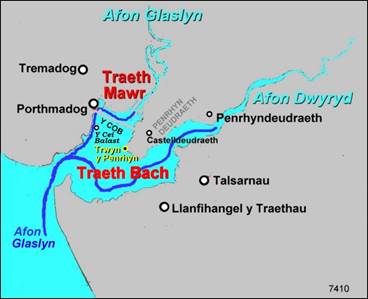
(delwedd 7499)
In Y Barri (Bro Morgannwg, south-east Wales) there is a modern street name Beidr Iorwg (apparently for
Beidr yr Iorwg - ‘(the) lane (of) the ivy’).
The decision to use beidr, a word confined
to south-west Wales, for a street name in this part of the country seems
strange.
ETYMOLOGY: Generally said to be from Irish (from an older form of modern Irish bóthar = road, lane, originally
with the sense of ‘cow track’; Irish bó = cow)
NOTE: there is a variant meidr with m replacing b. This occurs in other words –
the confusion results because both b and m have a
soft-muated form with <v> [v] – feidr, and the wrong radical
consonant becomes general.
(1) bainc > mainc (= bench)
(2) bath > math (= type)
(3) benyw > menyw (= woman)
(4) Banon > Manon (woman’s name)
:_______________________________.
beili masculine noun PLURAL: beilïau <BEI-li, bei-LI-ai, -e> [ˡbəɪlɪ,
bəɪˡliaɪ, -ɛ]
1
(South-east Wales) courtyard, forecourt of a house surrounded by a low
wall
Y Beili SO0460 name of a farm south-west of Llandrindod, Powys
(“Beili”)
http://www.geograph.org.uk/photo/1049851
Y Beili-mawr SO1263 (“the
great forecourt”) name of farm south-east of Pen-y-bont and north-east of
Llandrindod, Powys (“Bailey Mawr”)
http://www.geograph.org.uk/gridref/SO1263
Beili-einon SO0761 (“Bailey Einon”)
(“(the) forecourt (of) Einion / Einon”)
http://www.geograph.org.uk/gridref/SO0761
name of farm east of Llandrindod, Powys (“Beili”)
2 bailey = outermost wall of a
castle
Y Beilïa <ə bei-LI-a> [ə
bəɪˡlɪa] - the name of the castle walls of Llantrisant
(South-east Wales). In the south-east ‘au’ in a final syllable is pronounced as
‘a’.
3 ward, bailey; = open space
within the walls of a castle
mwnt a beili (“mound and bailey / walled
courtyard”) - motte and bailey (type of castle construction typical of the
norman invaders - on top of a mound was constructed a keep (the innermost and
strongest building in a castle) surrounded by a “bailey” (= courtyard) within a
surrounding wall)
4 Yr Hen Feili The Old Bailey, the Central
Criminal Court in London, so called because it was built in the ancient bailey
between the city gates of Ludgate and Newgate
ETYMOLOGY: English bailey < French 1300-
baille (= enclosed
yard), from the verb bailler (= to enclose)
< baile (= stake,
fortification) < Latin baculum (= stick)
NOTE: Used in Cambrian English (a form of English used in Wales with influences
from the Welsh language) – “Go and wash the back beili down” (= Go and clean
the back yard).
Example from ‘The Valley Phrasebook’ from a website dedicated to Cwm Sirhywi. (http://www.geocities.com/jenks436)
:_______________________________.
beili masculine noun
PLURAL:
beilïaid <BEI-li, bei-LII-aid, -ed› [ˡbəɪlɪ, bəɪˡliaɪd,
-ɛd]
1 bailiff = landowner's steward
2 bailiff = a sheriff's officer who serves summons and writs, and has the power
of arrest (Scotland: sheriff officer)
fel beili mewn sesiwn like a bailiff in a court session
mor fusnesus â beili mewn sesiwn as meddlesome / prying as a bailiff in a court session
bod yn brynnach na gras mewn beili be scarcer than [good] grace in
a bailiff
Cwynfan
Tafarn-wraig.
Richard Parry. Blodeugerdd y Cymry, gan Amryw Awdurwyr. Trydydd argraffiad.
(Treffynnon, 1823)
Yna dae 'r Baili boliog,
Мог wirion yr un warrog,
A hen lwynog yn ei lid:
Myn'd a'm Près a'm Efydd,
A'm dysglau pewter newydd,
Hyll ddigwilydd oll i gyd.
Ymddiddan Rhwng Hwn
Wr a Mebyn. Dafydd Thomas. Blodeugerdd y Cymry, gan Amryw Awdurwyr. Trydydd
argraffiad. (Treffynnon, 1823)
Goreu mawredd i ti ymeiriach,
Rhag tynnu melldith ar a feddach;
Fe fydd pob baili hyll drwy'r hollwlad,
Yn mhob cweryl heb ddim cariad.
ETYMOLOGY:
English bailie, a variant of bailiff.
Middle
English baillie < Old French bailli c. 1300, a variant of baillif.
Modern
French has (though no longer in general use) bailli (= bailiff, magistrate, judge)
English bailiff < Middle English
baillif. Anglo-French (baille = custody) + (suffix -if). Old Fench baille from the verb baillier (= take, seize, transfer, take care of something) <
Latin baiulare (= carry on the
back or in the arms) < baiulus (= a porter, a
carrier).
NOTE: also beiliff, beliff; and the
spelling baili = beili.
|
NOTE: London,
1825. Observations on some of the dialects in the West of England
particularly with a glossary of words now in use there; and poems and other
pieces, exemplifying the dialect. by James Jennings, Honorary Secretary of
the Metropolitan Library Institution, London. Glossary of words commonly used
in the County of Somerset; but which are not accepted as legitimate words of
the English language; or words which, although once used generally, are now
become provincial. |
:_______________________________.
beio [BEI o] (v) culpar
beio <BEI-o> [ˡbəɪɔ] (verb)
1
(verb with an object) to blame
Peidiwch â’ch beio’ch hunan Don’t blame ourself
:_______________________________.
beirdd <beirdh> [bəɪrð]
1 poets; plural of bardd = poet
talwrn y beirdd competition amongst poets
talwrn = meadow; clearing; court, yard
:_______________________________.
beirdd <BEIRDH> [ˡbəɪrð] (plural)
1 poets; see bardd
:_______________________________.
beirniad (beirniaid) [BEIRN yad, BEIRN yaid -yed]
(m) 1 crític 2 adjudicador
:_______________________________.
beirniad <BEIRN-yad> [ˡbəɪrnjad] masculine noun
PLURAL beirniaid <BEIRN-yed> [ˡbəɪrnjaɪd,
-jɛd]
1 critic
2 adjudicator, judge = person
who decides the winner in a contest
3 obsolete = person
presiding a court who decides or announces a verdict
4 Y Beirniad monthly magazine
of which 82 issues appeared in the twenty years between 1859 and 1879
5 Y Beirniad quarterly
magazine under the editorship of John Morris-Jones which appeared in the nine
years between 1911 and 1920
ETYMOLOGY: (barn = opinion) + (-iad, suffix for forming nouns)
:_______________________________.
beirniadaeth <beirn-YAA-daith, -deth> [bəɪrnˡjɑˑdaɪθ,
-dɛθ] feminine noun
PLURAL beirniadaethau <beirn-ya-DEI-thai, -the> [bəɪrnjaˡdəɪθaɪ,
-θɛ]
1
criticism = expression of disapproval
y feirniadaeth = the critcism
Un llym ei feirniadaeth ar genedlaetholdeb oedd, a bu ganddo ryw gasineb rhyfedd tuag at yr iaith Gymraeg, yr unig iaith a siaradai yn blentyn
He was very critical of nationalism and bore some strange hatred towards the
Welsh language, the only language he spoke when he was a child
2 criticism = evaluation
beirniadaeth lenyddol literary criticism
3 adjudication = act of
delivering the verdict of a panel of adjudicators; especially the adjudication
after a performance in an eisteddfod
Canodd côr arall, ac yna cafwyd y feirniadaeth
Another choir sang, and then the adjudication was delivered / given
ETYMOLOGY: (beirniad = adjudicator) +
(-iaeth suffix for
forming nouns)
:_______________________________.
beirniadol <beirn-YAA-dol> [bəɪrnˡjɑˑdɔl] adjective
1
critical
bod yn feirniadol o = be critical of
ETYMOLOGY: (beiniad- stem of the verb
beriniadu = to criticise)
+ (-ol suffix for
forming adjectives)
:_______________________________.
beirniadu <beirn-YAA-di> [bəɪrnˡjɑˑdɪ] (verb)
1 to criticise
:_______________________________.
beiro, PLURAL: beiros <BEI-ro, BEI-ros, -roz> [ˡbəɪrɔ,
ˡbəɪrɔs, - rɔz] (masculine noun)
1 biro
ETYMOLOGY: English biro [báirou]
< Lazlo Biro (1899-1965,
inventor of the ballpoint pen, born in Hungary)
:_______________________________.
beisicl, PLURAL: beisicls / beisiclau <BEI-sikl, BEI-si-kəl;
BEI-si-kəls, -kəlz, bei-SI-klai, -kle> [ˡbəɪsɪkl, ˡbəɪsɪkəl;
ˡbəɪsɪkəls, - kəlz, bəɪˡsɪkaɪ,
-klɛ] (masculine noun)
1 bicycle
:_______________________________.
bele <BE-lai, -e> [ˡbeˑlɛ] masculine noun
PLURAL beleod <be-LEE-od> [bɛˡleˑɔd]
1
marten = animal of the genus Martes, agile, with a slender body and a bushy
tail.
2 bele’r coed (Martes martes) pine marten. It has dark brown
fur and a yellowish patch on the throat
3 blew bele sable, the skin of a marten
ETYMOLOGY: British < Celt < bhelewo- < bhel (= white, shining).
Related word: English feline (= pertaining to
cats) < Latin fêlînus < fêlês (= cat, marten)
:_______________________________.
Belg ‹BELG› [bɛlg] masculine noun
PLURAL Belgiaid ‹BELG-yaid, -yed› [ˡbɛlgjad, -jɛd]
1 Belg,
a member of the Belgae people living in northern Gaul in the first century BC
and in southern Britain (Venta Belgarum, the market place of the Belgs, the
Roman name for Winchester). The Belgae seem to have been of Germanic origin,
but had adopted Gaulish as their language after settling east of the Rhine
river.
Gwlad Belg Belgium
gwlad Belg < gwlad y Belg (“Belg-land”, “(the) country (of) the Belg”)
(though probably based on Belg- first syllable of
the English / Latin name Belgium < Belg member of the Gaulish tribe called Belgae in Latin)
Cf Gwlad y Basg (= Basque country, ‘(the) country (of) the Basque man’; Gwlad y
Sais, an expression meaning ‘England’ (lierary; archaic; jocular) , ‘(the) country (of) the Englishman’
ETYMOLOGY: Possibly from Proto-Celtic *belo (= bright)
:_______________________________.
Belgiad <BELG-yad> [ˡbɛlgjad] masculine noun
PLURAL Belgiaid ‹BELG-yaid, -yed› [ˡbɛlgjad, -jɛd]
1
Belgian
Rhodfa’r Belgiaid “(the) walk /
promenade (of) the Belgians”. A promenade in Porthaethwy (Ynys Môn) built by
Belgian refugees in World War 1.
http://www.geograph.org.uk/photo/381413
Rhodfa’r Belgiaid
ETYMOLOGY: (Belg, from the name of
the Celtic inhabitants of the area, Belgae in Latin; though the name is more likely an adaptation
of the English name Belgium:
(Belg- first syllable of the English
/ Latin name Belgium) + (-i-ad noun suffix indicating nationality)
Cf Dutch België, French Belgique
:_______________________________.
Beljan <BEL-jan> [ˡbɛlʤan] masculine noun
PLURAL Beljans <BEL-jans, -janz> [ˡbɛlʤans, -ʤanz]
1 Belgian.
A colloquial form; in the standard language it is Belgiad ‹belg-yad›
ETYMOLOGY:
English Belgian
:_______________________________.
bellach <BE-lhakh> [ˡbɛɬax] (adverb)
1 now
ETYMOLOGY: soft-mutated form (to give it an adverbial function) of pellach (= further) (pell = far) + (-ach suffix for forming comparative degree of an
adjective)
:_______________________________.
bellaf <BE-lhav> [ˡbɛɬav] adverb
1
furthest
Pwy sy’n gallu cyrraedd bellaf? Who can reach the furthest?
Who has the longest reach?
:_______________________________.
belman <BEL-man> [ˡbɛlman] masculine noun
1 (obsolete)
town crier, official who makes public announcements, attracting the attention
of the public by ringing a bell
Standard form: crïwr tref
ETYMOLOGY: English bellman (bell) + (man)
:_______________________________.ñ
belongio <be-LONG-yo> [bɛˡlɔŋjɔ] verb
(South Wales)
1 blongid i belong = be a possession of
2 blongid i (member of a family) be
related to
ETYMOLOGY: English belong < (be- intensifying prefix) + (long- = great in length) “to
reach”. Cf German belangan (= to sue, to
prosecute)
NOTE: (1) Colloquially blongo, blongid, blonged
(2) Also: in Transactions of the Carmarthenshire Antiquarian Society Part 5;
t125 M H Jones April 1906 (Dimetian Dialect) has blyngad maening “belong”
:_______________________________.
bêm <BEEM> [ˡbeːm] masculine noun
PLURAL bemau, bemydd <BE-mai, -me, BE-midh> [ˡbɛmaɪ,
-ɛ, ˡbɛmɪð]
South-west Wales (Ceredigion, Caerfyrddin)
1 beam
= long piece of wood, originally a tree trunk, used in construction; long piece
of metal used in construction
ETYMOLOGY: English beam, now <BIIM> [biːm], but the Welsh
word preserves the older English pronunciation with a long “e”, < Old
English “beam” (= tree) (the spelling ‘ea’ indicates that it was a long open
‘e’ in English). The corresponding word in German is der Baum (= tree)
:_______________________________.
ben <BEN> [bɛn] feminine noun
PLURAL benni <BE-ni> [ˡbɛnɪ]
1
(obsolete) cart
y fen = the cart
2
place names:
(1) Pont-rhyd-y-fen (Glyn-nedd ac
Aberafan) (“(the) bridge (by the ford called) Rhyd y Fen”)
Rhyd y Fen is “(the) ford (of) the cart”.
(2) Pantybenni (by Llangurig,
Powys) (“hollow of the carts”)
ETYMOLOGY: Welsh ben < British benn- (= cart).
In Gaulish the corresponding word is benna (= vehicle; woven basket), the origin of modern
French banne (= cart) and benne (= cart).
The Indo-European root is *bhend (= to bind)
NOTE: There is a variant men (now obsolete)
(= cart) (qv) with the initial consonant “b” confused with “m”
:_______________________________.
ben bore <ben-BOO-re> [bɛnˡboˑrɛ] adverb
1
first thing in the morning, very early in the morning (“(at) (the) beginnng
(of) (the) morning”)
ETYMOLOGY: pen bore = ‘head / start (of the) morning’; there is soft mutation
of the initial letter of the phrase (p > b) to make it adverbial.
:_______________________________.
benbaladr <ben-BAA-ladr> [bɛnˡbɑˑladr] adjective
1 soft mutation of penbaladr all, the whole, from end to
end
Usually in the expression Cymru benbaladr all Wales
(Cymru = Wales (a feminine noun)) + (soft mutation) + (penpaladr)
Glasenwau Gogleisiol o Gymru Benbaladr Amusing Nicknames from all
over Wales
Article in Llafar Gwlad (=‘speech (of) country’, oral tradition), Gwanwyn (=
Spring) 1985
drwy’r wlad benbaladr all over the country,
throughout the country
NOTE: colloquially benbalad, with loss of
the r after a final d in a post-tonic syllable
:_______________________________.
benbwygilydd <ben-bui-GII-lidh> [bɛnbʊɪˡgiˑlɪð] adjective
1 soft
mutation of penbwygilydd (qv) from one end to the
other
Cymru benbwygilydd all Wales, the
whole of Wales
:_______________________________.
bendigedig <ben-di-GEE-dig> [bɛndɪˡgeˑdɪg] (adjective)
1
fantastic, wonderful
O gopa’r bryn yr oedd golygfa fendigedig From the top of
the hill there was a splendid view
ETYMOLOGY: original
sense: blessèd. From (bendig- (<
Latin benedîc-o = speak well of)) + (-edig)
:_______________________________.
bendith, PLURAL: bendithion <BEN-dith, ben-DITH-yon> [ˡbɛndɪθ,
bɛnˡdɪθjɔn] (masculine noun)
1 blessing
drwy fendith Duw with the blessing of God,
with God’s blessing
dan fendith Duw with the blessing of God,
with God’s blessing
dymuno pob bendith i rywun wish somebody every blessing
dymuno pob bendith i rywun i’r dyfodol wish somebody every blessing
for the future, for the times ahead
dymunwn bob bendith iddo ar ei ymddeoliad we wish him every blessing on
the occasion of his retirement
Mae Mr Evans yn gwella'n weddol ar ôl cyfnod hir o waeledd. Pob bendith iddo. Mr. Evans is making a fair
recovery after a long period of illness. We wish him every blessing (“every
blessing to him”)
Duw a’th fendithio may God bless you
bendith Duw arnat may God bless you (“(the)
blessing (of) God on you”)
llawn bendithion full of blessing
byw bywyd llawn bendithion live a life full of blessing
2
blessing, grace = short prayer before a meal asking that the food be blessed
and expressing thanks
gofyn bendith to ask a blessing
rhoi’r fendith to give the blessing
dweud bendith say a blessing
dweud y fendith say the blessing, to give
the blessing
3 bendith gudd, bendithion cudd a blessing in disguise
cyfri’ch bendithion count your blessings
4 dyna fendith... what a blessing..., how
fortunate... (“there’s a blessing ‹that...› )
dyna fendith na fu rhaid i chi fynd yno how fortunate that you didn’t
have to go there
5 blessing = consent, approval
rhoi eich bendith ar give your blessing to
rhoddi sêl bendith i rywbeth give something the seal of approval
ETYMOLOGY: Welsh < British < Latin BENEDICT-IO (= benediction)
:_______________________________.
bendithio <ben-DITH-yo> [bɛnˡdɪθjɔ] (verb)
1 to bless
:_______________________________.
benfelen <ben-VEE-len> [bɛnˡveˑlɛn] adjective
1 soft
mutation of penfelen, feminine form
of penfelyn (=
“yellow-head”, yellow-haired)
Elen Benfelen a'r Tair Arth Goldilocks and the Three Bears
:_______________________________.
Bengaleg <ben-GAA-leg> [bɛnˡgɑˑlɛg] (f)
1 Bengali (the language)
yr iaith Fengaleg the Bengali language
y Fengaleg the Bengali language
:_______________________________.
Bengrych <BEN-grikh> [ˡbɛngrɪx] adjective
1 epithet = curly-haired
2 surname of the Welsh
borderland, especially in the counties on the English side; anglicised as
“Bengry”
ETYMOLOGY: bengrych < pengrych (= curly-haired). The soft
mutation of the initial consonant is typical of adjectives used as epithets
after a name – for example, *Ieuan Pengrych > Ieuan Bengrych (“curly-haired
John”)
:_______________________________.
Y Benllech <ə BEN-lhekh> [əˡbɛnɬɛx] feminine noun
1 SH5182
locality in the county of Môn (North Wales).
The local form, as might be expected, is Benllach (in the north-west, and also in the traditional
dialect of the south-east, an “e” in a final syllable becomes “a”)
yn y Benllech in Y Benllech
ETYMOLOGY: (y = definite
article) + soft mutation + (penllech = flat stone,
flat slab).
penllech = ‘top stone’ (pen = top) + soft mutation + (llech = slab, stone) > *penlech > penllech (the expected soft mutation n-l is absent, having been
blocked, or else the mutation has reverted to n-ll)
The stone referred to is the cromlech in the centre of the village
NOTE: See also the place name Penllech
:_______________________________.
benthyca <ben-THƏ-ka> [bɛnˡθəka] (verb)
1 to
borrow, to lend
ROOT: benthyca-
THIRD-PERSON
SINGULAR: (SHORT PRESENT) benthyca
THIRD-PERSON
SINGULAR: (SHORT FUTURE) benthyciff
SECOND-PERSON SINGULAR
IMPERATIVE (LITERARY) benthyca
SECOND-PERSON SINGULAR
IMPERATIVE (SPOKEN) benthyca
SECOND-PERSON PLURAL IMPERATIVE (LITERARY AND SPOKEN) benthycwch
:_______________________________.
benthyciad (benthyciadau) [ben THƏK yad, ben thək
YAA dai -de] (m) loan
:_______________________________.
benthyg <BEN-thig> [ˡbɛnθɪg] (masculine noun)
1 loan
rhoi (rhywbeth) yn fenthyg (i rywun)len (sth) to (sb)
(rhoi give / yn as a / benthyg loan)
ETYMOLOGY: benthyg originally benffyg < British < Latin
benefic-ium (= service, benefit) (bene = well, facere = do, make)
:_______________________________.
benwan <BEN-wan> [ˡbɛnwan] adjective
1
soft-mutated form of penwan (= idiotic,
foolish)
Siarl Benwan Charles the Simple
:_______________________________.
benyw, PLURAL: benywod <BE-niu, be-NIU-od> [ˡbɛnɪʊ,
bɛˡnɪʊɔd] (feminine noun)
1 woman
y fenyw = the woman
:_______________________________.
*ber <ber> [ber]
1 Celtic
and British element (= to carry) found in various words in modern Welsh.
In Irish and Scottish it occurs as a verb beir (= carry).
Also in non-Celtic languages, from the same Indo-European root as the word in
Celtic:
English to bear, Greek pherein = (to bring, as in the
English word of Greek origin “paraphernalia”)
Welsh words with the element *ber (in some still a
recognisable element, though with soft mutation > fer):
..1/ aber = confluence,
estuary
..2/ adfer = restore
..3/ arfer = practise
..4/ cymer = confluence
..5/ diabred = withheld, held
back, refused
..6/ diferu = to drip
..7/ gofer = ditch, stream
..8/ possibly also llifeiriant (= flow,
flowing) (llif = flow, flowing,
+ *ber, + suffix -iant)
:_______________________________.
ber <BER> [bɛr] feminine or
masculine noun
PLURAL berrau <BE-rai, -re> [ˡbɛraɪ,
-rɛ]
1
(obsolete) leg; survives in certain fixed expressions e.g.
Mae wedi estyn y fer He’s dead and buried, he’s
six foot under, he’s pushing up the daisies
(“He has extended the leg”)
Wedi i’r elor gerbyd gyrraedd ar gyfer hen annedd Janet Williams, safodd y ceffylau yn sydyn. ... Safai y ddau geffyl fel pe wedi eu hoelio wrth y ddaear heb symud ber Plant y Gorthrwm / 1908 / Gwyneth Vaughan (= Anne
Harriet Hughes 1852-1910) t161
After the hearse arrived opposite Janet Williams’s old house, the horses
stopped suddenly.. the two horses stood as if nailed to the ground without
moving a leg
2 bergam (obsolete) bow-legged, bandy-legged
(ber = leg) + soft
mutation + (cam = crooked)
ETYMOLOGY: ??
bera <BE.ra> [ˡbe·ra] feminine
noun haystack
PLURAL: beraon, berâu <be-RAA-on, be-RAI> [bɛˡra·ɔˡn,
bɛˡraɪ] (feminine noun)
bera wair haystack
Ystalyfera (ynys tâl y fera) “the meadow in front of Y Fera (haystack;
probably a hill name).
The word “bera” (haystack) is Celtic *berg-, cognate with Proto-Germanic
*bergaz (from which German Berg = mountain, Old English beorg (“mountain, hill, mound, barrow, burial place), Modern English (dialect) bergh =
hill, and (wiktionary 05-09-2020) Scots BURROW /ˈbʌɹoʊ/ (“mound, tumulus, barrow”), ….. West
Frisian BERCH /bɛrx/ (“mountain”), Dutch BERG /bɛrx/ (“mountain”), Low German BARG /bɛrɣ/ [ba̝ɾ(ə)x] (“mountain”)… Danish BJERG : /bjɛrɣ/ (“mountain”), Swedish BERG /bɛrj/ (“mountain”), Norwegian Bokmål BERG /bɛrɡ/ (“rock, mountain, hillock, rock
bottom”), Icelandic BERG /pɛrk/ (“mountain”), BJARG (“rock”), Polish BRZEG /bʐɛk/ (“bank, shore”), Russian БЕ́РЕГ (BÉREG, “bank, shore, land”).
:_______________________________.
Y Berch <ə BERKH> [ə
ˡbɛrx] feminine noun
1
(SH3936) local name of Aber-erch (county of
Gwynedd)
Probably Aber-érch > Ab’rérch > Ab’érch > Yb’érch > Y B’érch / Y Berch
:_______________________________.
berf, PLURAL: berfau <BERV,-BER-vai, -ve> [ˡbɛrv,
ˡbɛrvaɪ, -vɛ] (feminine noun)
1 verb
Welsh < British
< Latin verb-um (= word)
:_______________________________.
berfa, PLURAL: berfâu <BER-va,-ber-VAI> [ˡbɛrva,
bɛrˡvaɪ] (feminine noun)
1 wheelbarrow
2 cario mwg mewn berfa (“carry smoke in
a wheelbarrow”) try to do the impossible
Also: cario mwg mewn hwilber (“carry smoke in
a wheelbarrow”)
:_______________________________.
berfedd gaeaf <BER-vedh GEI-av / GEI-av > [ˡbɛrvɛð ˡgəɪav,
ˡgəɪa] adverb
1 in the depths of winter
ETYMOLOGY: ‘middle (of) winter’ (perfedd = middle, centre) + (gaeaf = winter).
Adverbial phrases in Welsh are indicated by the soft mutation of the first
consonant of the first word, thus perfedd > berfedd
:_______________________________.
Y Berfeddwlad <ə ber-VEDH-wlad> [ə
ˡbɛrvɛðwlad] feminine noun
1
medieval territory situated between the countries of Powys and Gwynedd; later
it became known as Gwynedd Is Conwy.
It was made up of the four kántrevs (cantrefi) of Dyffryn Clwyd, Rhos,
Rhufoniog, Tegeingl. Y Berfeddwlad (“middle territory”) was so called because
it lay between the territories of Gwynedd and Powys.
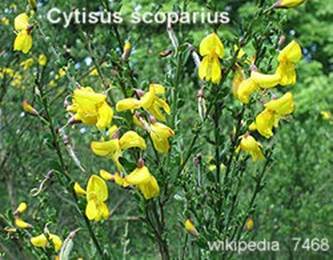
(delwedd 7539)
ETYMOLOGY: (y = definite
article) + soft mutation + (perfeddwlad = middle
territory, buffer country);
perfeddwlad is (perfedd = middle) + soft mutation +
(gwlad = country)
:_______________________________.
berfeddion y nos <ber-VEDH-yon ə NOOS> [bɛrˡvɛðjɔn
ə ˡnoːs] adverb
1 in
the middle of the night
ETYMOLOGY: ‘middles (of) night’ (perfeddion, plural de perfedd = middle, centre) + (nos = night). Adverbial phrases
in Welsh are indicated by the soft mutation of the first consonant of the first
word, thus perfeddion > berfeddion
:_______________________________.
bergam <BER-gam> [ˡbɛrgam] adjective
1
(obsolete) bow-legged, bandy-legged
2 (Query – can anybody provide
information?) Does the street name ‘Vergam Terrace’ in Aber-gwaun / Fishguard,
county of Penfro, have any connection with this word?
ETYMOLOGY: (ber = leg) + soft
mutation + (cam = crooked)
:_______________________________.
beriau <BER-yai> [ˡbɛrjaɪ,
-ɛ] feminine noun
PLURAL berieuau <ber-YEI-ai, -e> [bɛrˡjəɪaɪ,
-ɛ]
1
(obsolete) short yoke
ETYMOLOGY: (ber, feminine form
of byr = short) + (iau (feminine noun) = yoke)
:_______________________________.
beriews <ber-YEI-is> [bɛrˡjəɪɪs] adjective
1
(obsolete) short-yoked, having a short yoke
2 There is a possible instance
of the use of the adjective beriews as a plural noun
with plural suffix -au > beriewsau (= the short-yoked ones, the
short-yoked oxen) in a (lost) Caer-dydd field name.
John Hobson Matthews (Mab Cernyw) in 'Cardiff Records' (1889-1911) notes as a
field name in the year 1709 in Llan-daf
“Dwy Erw yr Byriousa”.
He interprets this as Dwy Erw’r Beriewsau (which he writes ‘dwy-erw-y
byrieuwysau’) – and translates as “the two acres of the short-yoked oxen”.
ETYMOLOGY: (beriau = short yoke) + (-us suffix for forming
adjectives)
NOTE: The local south-eastern form could conceivably be Byriousa as in the 1709 form
...(a) Loss of a syllable through contraction of ‘eu-u’ <be-ri-ei-I-sai, -se> [bɛrɪəɪˡɪsaɪ,
-sɛ] > <be-ri-EI-sai, -e> [bɛrɪˡəɪsaɪ,
-ɛ]
...(b) final -au >
south-eastern -a,
...(c) penult -eu > southern -ou- <oi> [ɔɪ],
...(d) the obscuring of a vowel in a pretonic first syllable is also a southern
feature (resulting in y <ə> [ˡə])
:_______________________________.
Y Bermo <ə-BER-mo> [ə
ˡbɛrmɔ] feminine noun
1 town in the county of
Gwynedd; The standard form is Abermaw ‹a-BER-mau›
Population: 2,104
(1961); proportion of Welsh-speakers: 58% (1961)
2 a parish at this place
ETYMOLOGY: Y Bermo < Abérmo < Abérmaw < Aber-máw <a-BER-mau> [aˡbɛrmaʊ] < Aber-máwdd <a-ber-MAUDH> [abɛrˡmaʊð] “estuary (of the
river) Mawdd”
(1) The present name of the river is Mawddach, with a suffix –ach
(2) Maw < Mawdd;
The loss of a final <dh> [ð] is seen in other
words in Welsh –
....(a) Dewi = David,
anciently Dewydd,
....(b) ohono = from him, in
Middle Welsh ohonodd;
(3) shift of accent - Aber-maw <a-ber-MAU> [abɛrˡmaʊ] > Abérmaw <a-BER-mau> [aˡbɛrmaʊ] A similar case is
Aber-ffráw > Abér-ffraw
(4) Abérmaw > Abérmo. Colloquially a final
diphthong <au> [aʊ] is simplified to
become the vowel <o> [ɔ]. Also seen in
the case of Abérffro < Abérffraw
(5) Abérmo > Y Bermo. The first vowel ‹a› loses its
quality, and becomes neutral, and is confused with the definite article “y”.
Also seen in the case of Y Berffro < Abérffro (name of a place in Ynys
Môn)
NOTE: The English name is “Barmouth”, a reworking of “Y Bermo” to make
something English-sounding.
(1) Coincidentally the final element “mo” suggests 'mouth', which is the
meaning of 'aber'.
(2) “Bar” may be because in English the name had been pronounced “barmo” (-er-
in English words has in general become -ar- in England, if not in the USA.
Hence Derby, clerk, Berk(e)ley, etc, all pronounced -ar- in Englandic).
(3) 'Bar' also suggests 'sandbar', which is easily associated with the idea of
'river mouth'.
(4) In “Modern Place-names in Great Britain and Ireland” (Adrian Room, 1983)
the author quotes Lewis (1849) who explains that the English name had been
adopted 81 years earlier, in 1768 ‘at a meeting of the masters of the vessels
belonging to the port, when, in consideration of the increase in shipping, it
was deemed expedient to have an English name inscribed upon the sterns of the
vessels.’
But this is not the case according to an observation made in 1927, in the
section ‘Merioneth Notes’ of the journal ‘Y Cymmrodor’, Vol. XXXVIII.
“These maps are of some interest also with regard to the name ‘Barmouth’. Some
years ago a note appeared in "Byegones” to the effect that in 1768 the
web-merchants of the neighbourhood met in conclave and decided on changing the
existing name of ‘Abermawe’ to Barmouth, as more pronounceable than the
original. The story is ben trovato, but inaccurate. The map of 1578 contains
the name ‘Barmouth’. The change probably occurred about the time of Henry VII's
activities.”
T. P. ELLIS, I.C.S. (retired), M.A., F.R.Hist.S., Author of "Welsh Tribal
Law and Custom".
:_______________________________.
Berriw
1 village in the county of Powys
14% Welsh-speaking (Census 2001)
:_______________________________.
berth <BERTH> [ˡbɛrθ] adjective
1 (obsolete)
fair, beautiful
Magent hi yn anwyl, anwyl,
Fel rhodd ferth o ddwylaw Duw
(“Tanybryn”, poem by Twynog (1912))
They raised her lovingly
As a beautiful gift from God
ETYMOLOGY: from the IE root *bherəg- (= bright), from
which comes also English bright; also in Welsh
in the compound prydferth (= beautiful)
which is
(pryd = aspect) + soft
mutation + (berth)
NOTE: also occurs as merth (= fair,
beautiful) – showing the change b > m, which also occurs in other words in Welsh. The
confusion occurs with feminine nouns and with adjectives because the mutation
of both <b> [b] and <m> [m] is <v> [v] f;
..a/ benyw (= woman), also menyw;
..b/ ben (= cart), also men, etc
:_______________________________.
Y Berthen-gron ‹ber-then GRON› [ˡbɛrθɛn ˡgrɔn]
masculine
noun
1 Farm SJ2849, by Y
Coed-poeth, Wrecsam
http://www.geograph.org.uk/photo/208635
Y Berthen-gron
ETYMOLOGY: “the round bush”
round bush: (perthen = bush) + soft
mutation + (cron, feminine form of crwn = round) > perthen gron
the round bush: (y = definite article) + soft
mutation + (perthen gron) > y berthen gron
:_______________________________.
berwad [ˡbɛrˡwad] masculine noun
PLURAL berwadau <ber-WAA-dai, -de> [bɛrˡwɑˑdaɪ,
-dɛ]
1 boiling
= act of putting to the boil, leaving on the boil
2 liquid that has been boiled
ETYMOLOGY: (berw- stem of the verb
berw = to boil) + (-ad suffix for forming abstract
nouns)
:_______________________________.
berwedd-dy <ber-WEDH-di> [bɛrˡwɛðdɪ] masculine noun
PLURAL berwedd-dai <ber-WEDH-dai> [bɛrˡwɛðdaɪ]
1
(South-east Wales) brewery
ETYMOLOGY: (berwedd-, stem of berweddu = to brew) + soft mutation +
(ty = house)
NOTE: Also brywedd-dy; see vegeu bryweddu
:_______________________________.
berweddu <ber-WEE-dhi> [bɛrˡweˑðɪ] verb
1
(South-east Wales) brew (beer)
berman berweddu brewer’s yeast
Job sydd yn breweddu’i hunan Job brews his own beer
(Hanes Tonyrefail - Atgofion am y Lle a’r Hen Bobl. Thomas Morgan. 1899.
Caerdydd. Tudalen 105; from a local ballad mentioning the tavernkeeper in
Llanwynno)
ETYMOLOGY: berweddu < *byrweddu < bryweddu < briweddu (briw < English brew) + (-eddu, apparently a
termination in imitation of cordeddu = to twist);
briweddu > *bryweddu (obscuration of the pretonic
vowel, a common feature in south-eastern Welsh) > byrweddu (metathesis) > berweddu (possibly the influence of berwi = to boil)
NOTE: Also in use are / were bryweddu (y instead of i), and breweddu (e instead of y), as in the sequence of variants above.
:_______________________________.
berwi <BER-wi> [ˡbɛrwɪ] (verb)
1 (vt) to boil
2 (vi) boil
ar ben y stof berwai sosban on top of the stove
a saucepan was boiling
ffrwtian berwi splutter; simmer
pwynt berwi boiling point
lledferwi simmer (literally
‘half boil’)
3 (vi) seethe = boil over, bubble
4 (vi) (water running over rocks; water in a whirlpool, etc) seethe, be
agitated
5 (vi) seethe = boil with rage, be full
of contained rage
ro'n i'n berwi, ond wedes i ddim byd I was seething with rage, but I said nothing
6 (vi) bustle, be
y twristiaid yn berwi fel morgrug the tourists milling around like ants
Second-person singular imperative forms: berw! Also
colloquially berwa!
Second-person plural
imperative form: berwch! (from ber wch!
wch!
ROOT: berw-
THIRD-PERSON SINGULAR:
(SHORT PRESENT) berwa
THIRD-PERSON
SINGULAR: (SHORT FUTURE) berwiff
SECOND-PERSON SINGULAR
IMPERATIVE (LITERARY) berw
SECOND-PERSON SINGULAR
IMPERATIVE (SPOKEN) berwa
SECOND-PERSON PLURAL
IMPERATIVE (LITERARY AND SPOKEN) berwch
berwch y dŵr boil the water!
os berwiff y dŵr.. if the water boils...
ETYMOLOGY: Welsh BERW- < British < Celtic. From the same British root:
Breton BERVIÑ, BIRVI (= to boil)
From the saem Celtic root: Irish BEIRIGH = to boil. Related to Latin FERUERE (= to simmer).
:_______________________________.
Berwyn <BER-win> [ˡbɛrwɪn] (masculine noun)
1 mountain ('white peak'),
north-east Wales
2 village north-west of Llangollen SJ1942
Plas Berwyn SJ1843 a mansion here
Twnnel Berwyn Berwyn (Railway) Tunnel
ETYMOLOGY: (noun < adjective = having a 'white peak) (bar = mountain top, hilltop) + (soft mutation) + (gwyn = white) > barwyn > berwyn.
The final vowel ‘y’ has affected the preceding vowel (thus ‘a’ < ‘e’)
Such compounds were existing in British (i.e. pre-Welsh) or else modelled on
them in Welsh. Cf penddu (= black-headed, rather than ‘pendu’), pengrych (=
curly-haired, curly-headed, rather than ‘pencrych’, etc).
:_______________________________.
bet <BET> [bɛt] feminine noun
PLURAL betiau <BET-yai, -ye> [ˡbɛtjaɪ,
-jɛ]
1 bet
= money gambled
rhoi bet ar put a bet on
ETYMOLOGY: English bet (Origin in
English uncertain; possibly from better, comparative form of good)
:_______________________________.
betgwn <BET-gun> [ˡbɛtgʊn]
1
dress
Olde Cheshire Dialecte. http://www.cheshirelittlefolk.co.uk/Old_dialect.htm
(19-05-2016 - webpage no longer found)
bedgown - Cheshire ladies’ traditional old dress, worn everywhere except in bed
:_______________________________.
beth <BEETH> [beːθ] (interr)
1 what?
beth bynnag <beeth BƏ nag> (adv) anyway
beth sy’n bod? <beeth sin BOOD> what’s up?
beth yw’ch oed chi? <beeth iukh OID khi> how
old are you? (‘what’s your age’)
beth am . ? what about-...?
(suggesting)
beth am fynd am dro? what about going for a walk?
beth amdanoch chi ? what about you?
beth arall? what else?
beth ddylwn i ’i wneud? what should I do?
beth sy’n bod arnoch chi? what’s wrong with you?
beth wna i? what shall I do ?
beth wnaethoch chi? <NEI tho khi> what did
you do?
beth wnawn ni ? what shall we do?
beth ydi o ? what is he / it? (North
Wales)?
beth yw e? what is he / it? (South
Wales)?
2 Also
shortened to be’
be’ sy’n bod? <bee sin BOOD> what’s
up?
3 (Caernarfon, north-west
Wales) Bsantísho? = Pa beth sydd arnat ti ei eisiau? What do you need / require /
want?
“Let them see how in their spoken Welsh the accent turns a sentence of many
words into a single word of one or two syllables... e.g. pa beth sydd arnat ti
ei eisieu? has become bsantísho”
T Hudson Williams (1873-1961), University College, Bangor / Vox Populi - A Plea
for the Vulgar Tongue. 1902.
:_______________________________.
beth bynnag <BEETH BƏ-nag> [ˡbeːθ
ˡbənag] (adverb)
1 whatever
beth bynnag fo’i werth for what it’s worth ,
although it is probably not of any importance, whatever it may be worth
beth bynnag fo gwerth hynny for what it’s worth
Dyna fy marn innau, beth bynnag fo’i werth That’s my view, for what
it’s worth
2 in any case
:_______________________________.
beth sydd... <BEETH- siidh> [ˡbeːθ
siːð]
Also as beth sy’ (loss of final dd)
1 what
is (+ prepositional phrase)
Beth sydd gennych yn ateb? What’s your answer?
(“(it-is) / what-thing / which-is / with-you / as / answer”)
2 what is (+ simple adverb)
Beth sydd acw? What’s over there?
:_______________________________.
beth sy'n bod ‹BEETH siin BOOD› [ˡbeːθ siːnˡ boːd]
1 What's
up? What's the matter?
:_______________________________.
beth yw'ch oed chi? <BEETH iukh OID khi> [ˡbeːθ
ɪʊx ˡɔɪd xɪ]
1 How
old are you?
(“(it-is) / what-thing / which-is / your / age / of-you”)
:_______________________________.
Bethan <BEE-than> [ˡbeˑθan] (feminine noun)
1 girl's name (Beth + -an;
'little Elizabeth')
:_______________________________.
Bethcar <BETH-kar> [ˡbɛθkar]
1 (Old
Testament) place west of Mizpeh to where the Israelites pursued the Philistines
...1-Samuel 7:11 A gwyr Mizpah a aethant o Mispa, ac erlidiasant y Philistiaid, ac a’u trawsant hyd oni ddaethant dan Bethcar
...Samuel-1 7:11 And the men of Israel went out of Mizpeh, and pursued the
Philistines, and smote them, until they came under Bethcar.
There is a Heol Bethcar (official name: Bethcar
Street) in Glynebwy, county of Blaenau Gwent, named after a Wesleyan Methodist
chapel, Capel Bethcar
ETYMOLOGY: Hebrew (= house of the lamb)
:_______________________________.
Bethel ‹be-THES-da › [ˡbe·θɛl] (f)
1 ward in the village of
Llanddeiniolen (county of Gwynedd)
Welsh-speakers (Census 2001) 86%
:_______________________________.
Bethesda ‹be-THES-da › [bɛˡθɛsda]
1
chapel name
2 village SH6266 in Gwynedd
http://www.geograph.org.uk/gridref/SH6266
3 SH4646 village in Gwynedd south-east of Llanwnda (also called Bethesda Bach ‹be-THES-da BAAKH› [bɛˡθɛsda
ˡbɑx], to
distinguish it from the other Bethesda nearby)
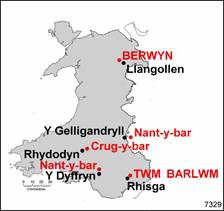
(delwedd 7536)
:_______________________________.
Beti <BE-ti> [ˡbɛtɪ] (feminine noun)
1 Betty (diminutive form of
Elizabeth)
:_______________________________.
betio <BET-yo> [ˡbɛtjɔ] verb
1 bet
:_______________________________.
betin
<BE-tin> [ˡbɛtɪn] (masculine noun)
1 the action of removing and burning grass cover; flaying, paring off of turf
2 land which has been cleared of its grass cover, and the grass burnt; swidden
= area of land where the vegetation has been burnt away in order to prepare it
for cultivation
3 bonfire to produce ash as fertiliser
'Betin' oedd y goelcerth fawr y byddem ni'n gwneud yn ein gerddi bob
gwanwyn... Ar ôl i'r tân ddiffodd na gyd bydde ar ôl oedd lluwch mân llwyd ei
liw, a bydden ni'n gwasgaru hwn ar hyd yr ardd Llafar Gwlad 24 Haf 1989
A ‘betin’ was the big bonfire we’d make in our garden every spring... After the
fire went out all that was left was a fine grey ash, and we’d scatter this over
the garden
4 bating (Dinbych) a wheatsheaf that has been threshed
Variants: batin, bating
South Wales: also bieting (3 syllables)
ETYMOLOGY: English beatin’ [‘be:tin] < beating
A Glossary of
Dialect & Archaic Words Used in the County of Gloucester. Collected and
Compiled by J. Drummond Robertson, M.A. Published for the English Dialect
Society by Kegan Paul, Trench, Trubner, & Co. 1890.
BEAT (bait). We speak of " burning beat," not of "
burn-beating"; and I have always considered beat to be a corruption of
peat. However, Risdon (about 1630) speaks of " beating and burning,"
and thus describes the process: "Paring the grain of their ground with
mattocks into turfs, then drying and loughing those turfs into burrows, and so
burning them, and spreading their ashes on the ground so pared ; which kind of
beating and burning is rare in other shires, and seems to be originally
peculiar to this county, being known by the name of Denshering in other
counties." I have myself heard the phrase " The field was baited, you
knaw."
:_______________________________.
betio <BET-yo> [ˡbɛtjɔ] verb
1 bet
ETYMOLOGY: (bet = bet) + (verb
suffix -io);
The Welsh word bet is from English bet, which is possibly from better, the comparative form of good
:_______________________________.
Betsan <BET-san> [ˡbɛtsan] (feminine noun)
1 Betty (diminutive form of
Elizabeth)
:_______________________________.
betws <BE-tus> [ˡbɛtʊs] (masculine noun)
1 church (in place names and
certain fixed expressions).
Occurs in many place names, either with a distinguishing tag, or simply as Y
Betws (probably replacing a longer name, but the distinguishing tag has been
lost)
Betwsgarmon (Gwynedd)
Betws yn Rhos (county of Conwy)
46% Welsh-speaking (Census 2001)
Betws-y-coed (county of Conwy)
56%
Welsh-speaking (Census 2001)
Y Betws (county of Caerfyrddin)
63% Welsh-speaking (Census 2001)
Y Betws (county of Casnewydd)
10% Welsh-speaking (Census 2001)
Y Betws (county of Pen-y-bont ar Ogwr)
9%
Welsh-speaking (Census 2001)
ETYMOLOGY: From English {beed + huus}, 'bead-house' (= house of prayer)
:_______________________________.
Betws Rhyd y Crwyn <BE-tus hriid ə KRUIN> [ˡbɛtʊs hriːd ə
ˡkrʊɪn]
1 See Betws y Crwyn
:_______________________________.
Betws y Crwyn <BE-tus ə KRUIN> [ˡbɛtʊs
ə ˡkrʊɪn]
1
SO2081 Village in Sir Amwythig / Shropshire, England
http://www.geograph.org.uk/photo/215190
Eglwys Fair / St.Mary’s Church
(“The Geograph British Isles project aims to collect geographically
representative photographs and information for every square kilometre of Great
Britain and Ireland…”)
ETYMOLOGY: The name as it stands means (“(the) church (of) the animal skins /
animal hides”)
(betws = church) + (y = definite article) + (crwyn = animal skins, animal
hides)
But it is a reduction of Betws Rhyd y Crwyn (“(the) (place called) Betws
(which is by) Rhyd y Crwyn”).
Rhyd y Crwyn is (“(the) ford (of) the animal skins / animal hides”)
(rhyd = ford) + (y = definite article) + (crwyn = animal skins, animal
hides). Maybe animal hides were tanned near here.
:_______________________________.
Betws yn Rhos <BE-tus ən HROOS> [ˡbɛtʊs
ən ˡhroːs]
1
Village in the county of Conwy
http://www.geograph.org.uk/photo/55781
(“The Geograph British Isles project aims to collect geographically
representative photographs and information for every square kilometre of Great
Britain and Ireland…”)
ETYMOLOGY: (“(the) Betws (which is in the kántrev of) Rhos (in the country of Y
Berfeddwlad”)
(betws = church) + (yn preposition = in) + (Rhos name of a kántrev; = upland)
:_______________________________.
Betws-y-grog <BE-tus ə GROOG> [ˡbɛtʊs
ə ˡgroːg]
1 Old
name of Ceirchiog SH3676 (by Llechylched SH3476) in Môn
http://www.geograph.org.uk/photo/999251
Betws Y Grog / Holy Rood Church
http://www.geograph.org.uk/photo/999225
Betws Y Grog / Holy Rood Church
http://www.geograph.org.uk/photo/976941
Betws Y Grog / Holy Rood Church
http://www.geograph.org.uk/photo/109273
Betws Y Grog / Holy Rood Church
(“The Geograph British Isles project aims to collect geographically
representative photographs and information for every square kilometre of Great
Britain and Ireland…”)
According to Melville Richards (Enwau Tir a Gwlad, 1998), ”mae crog yn cyfeirio at sgrin yn yr eglwys. Yr enw Saesneg oedd Holy Rood Church.” (= crog refers
to a screen in the church. The English name was Holy Rood Church)
ETYMOLOGY: (“(the) church (of) the cross”)
(betws = church) + (y = definite article) + soft
mutation + (crog = cross,
gallows)
:_______________________________.
beudy, PLURAL: beudai / beudái <BEI-di, BEI-dai / bei-DAI> [ˡbəɪdɪ,
ˡbəɪdaɪ, bəɪˡdaɪ] (masculine noun)
1 cowhouse
:_______________________________.
Beulah (county of Ceredigion)
54% Welsh-speaking (Census 2001)
:_______________________________.
Beuno <BEI-no> [ˡbəɪnɔ] masculine noun
1 Male
saint associated with Clynnog Fawr, north-west Wales; Feast day 21 April. Said
to have been born on the banks of the river Hafren in the territory of Powys,
educated in the territory of Gwent at Caer-went.
Llanfeuno SO3031 (village
in Herefordshire, England, in an area west of Hereford which could be described
as “Gwent-within-England”). Situated in the valley of the river Olchon above
the town of Y Fenni. Englished name: Llanveynoe.
http://www.geograph.org.uk/photo/713232
(“The Geograph British Isles project aims to collect geographically
representative photographs and information for every square kilometre of Great
Britain and Ireland…”)
Gwyl Feuno (“(the) feastday (of)
Beuno”). April 21
ETYMOLOGY: ??
:_______________________________.
beunydd <BEI-nidh> [ˡbəɪnɪð] (adverb)
1 every day
:_______________________________.
biau <BII-ai, -e> [ˡbiˑaɪ,
-ɛ] (verb)
1 = is the person who owns
Fi biau ef - It's mine = ((it is) I
who-owns it)
:_______________________________.
bìb <BIB> [ˡbɪb] masculine or
feminine noun
PLURAL bibiau <BIB-yai, -e> [ˡbɪbjaɪ,
-ɛ]
1 bib
= napkin to cover a child’s front placed under the chin when the child is being
fed
2 bib = upper part of
dungarees covering the chest
ETYMOLOGY: English bib < Middle
English bibben (= to drink),
probably from Latin bibere (= to drink)
NOTE: the proper Welsh spelling would have a grave accent over the letter i to
show that it is short, since in words of Welsh origin a monosyllable a final b
follows a simple vowel which is long (mab, pib, etc). Such words which
contravene the rule are invariably borrowings from English
:_______________________________.
bicer <BII-ker> [ˡbiˑkɛr] masculine noun
PLURAL biceri <bi-KEE-ri> [bɪˡkeˑrɪ]
1
(Englandic: beaker = a large cup, usually plastic, in the shape of a long wide
cylinder with no handles)
2 Chemistry beaker =
glas flat-bottomed container with a lip for pouring out a liquid
3 llond bicer beakerful =
contents of a beaker
llond bicer o ddŵr a beakerful of water
biceraid beakerful =
contents of a beaker
ETYMOLOGY: Welsh < English beaker <
Scandinavian; cf German der Becher (= beaker), mug; Greek bikos (= earthernware jug)
:_______________________________.
bicini <bi-KII-ni> [bɪˡkiˑnɪ] masculine noun
PLURAL bicinis <bi-KII-nzi> [bɪˡkiˑnɪz]
1 bikini
- woman's scanty two-piece swimming costume
ETYMOLOGY: English bikini, from the name Bikini Atoll in the Marshall Islands in
the North Pacific, where the USA carried out an atomic bomb test. The bathing
costume was so called because its effect on men seeing a woman wearing one was
supposedly devastating.
:_______________________________.
bid <BIID> [biːd] feminine noun
PLURAL bidiau, bidau <BID-yai, -e, BII-dai, -e> [ˡbɪdjaɪ, -ɛ, ˡbiˑdaɪ,
-ɛ]
South-east Wales
1 quickset
hedge (English “quick” = alive, living, “set” = put, plant), quick hedge,
plash; a hedge of hawthorn
..1/ Cae’r Fid Foel <kair viid VOIL> [kaɪr viːd ˡvɔɪl]
Lost field name
in Caer-dydd. (“(the) field (of) the bare hedge”)
According to John Hobson Matthews (Mab Cernyw) in 'Cardiff Records'
(1889-1911), it occurs as the name of a house in the chapelry of Yr
Eglwysnewydd, Caer-dydd:
“CAE'R VID VOL... In the parish of Saint John Baptist, on the road leading
to Cathays (1749)”
1749... We Arthur Williams and George Watkins Esquires two of his Majesty's
Justices of the peace for the Town of Cardiffe in the said County of Glamorgan
Do Humbly Certifye unto your Lordshipps that we Have viewed the Causeway in the
common Highway in the parish of St John the Baptist leading from the
gate of a certain close called Cae'r Vid Vol, to a certain place called Cat
Hays which stands presented in this Court to be ruinous and out of repair and
the Cart road or highway on the Eastern Side of the said causeway which stands
presented to be in a ruinous and dangerous Condition
(cae = field) + (yr definite article) + soft
mutation + (bid = hedge) + soft
mutation + (moel = bare)
The local form
would be “Cǣ’r Fid Fol” (or in “Cää’r Fid Fool” in a spelling indicating non-standard long
vowels by means of a double vowel symbol) <‹käär viid VOOL› [kɛːr viːd ˡvoːl]
....a/ cae > southern caa > south-eastern cää;
....b/ moel > southern mool
..2/ Heol y Fid-las ‹heul ə viid LAAS› [ˌhɛʊl ə viːd ˡlɑːs] (“(the) road (of)
the green hedge”)
Road in
Caer-dydd, between Rhydypennau and Llanishen.
(y definite
article) + soft mutation + (bid = hedge) + soft
mutation + (glas = green - when
referring to vegetation – otherwise blue)
..3/ bid ffawydd beech hedge
Twyn y Fid Ffawydd ‹tuin ə viid FAU-idh› [ˌtʊɪn ə viːd ˡfaʊɪð]
(“(the) hill (of)
the hedge (of) beech”) hill in Deri (county of Caerffili)
(twyn = hill) + (y definite article) + soft
mutation + (bid = hedge) + (ffawydd noun: beech
trees, adj: beech, made up of beech tress)
..4/ Y Fidgelyn ‹ə viid GEE-lin› [ə viːd ˡgeˑlɪn] farm on the road
between Cilfynydd and Llanfabon (county of Caerffili)
y fid gelyn = the hedge (of) holly, holly hedge;
(y = definite
article) + soft mutation + (bid = hedge) + soft
mutation + (celyn = (adjective)
holly)
..5/ the place marked Gelli-fud by Glyn-llan /
Melin-ifan-ddu in the county of Pen-y-bont ar Ogwr is probably Gelli-fid < Gelli’r-fid ‹ge-lhir-VIID› [gɛɬɪr ˡviːd] (the grove of the
hedge) (though I have not seen any earlier forms of the name to be able to
substantiate this)
(gelli = grove – a
soft-mutated form of celli used as a
radical form) + (yr definite
article) + soft mutation + (bid = hedge)
..6/ In Aberbargoed (county of Caerffili) there is a road called “Pant-y-fid
Road”) (In Welsh, this would be Heol Pant-y-fid) ‹heul pant ə VIID› [ˌhɛʊl pant ə ˡviːd]
pant
y fid =
(the) hollow (of) the quickset hedge
(pant = hollow) + (y definite article) + soft
mutation + (bid = hedge)
ETYMOLOGY: Welsh < British (*bit- = cut) < Celtic
See: bidog (= bayonet), Gelli'r-fid (place name), gwyddfid (= honeysuckle)
:_______________________________.
bid <BIID> [biːd] verb
1 let
there be, let him be, let her be, let it be (third-person present imperative
form of bod = be)
:_______________________________.
bid <BIID> [ˡbiːd] masculine noun
PLURAL bidiau <BID-yai, -e> [ˡbɪdjaɪ,
-ɛ]
1 Y Bidiau stanzas in Llyfr Coch Hergest (collection of
manuscripts from between 1382 and 1410) beginning with the word bid = let there be, etc
:_______________________________.
bid a fo am hynny <BIID a VOO am HƏ-ni> [ˡbiːd a ˡvoː am ˡhənɪ]
1 (in
concluding in a discourse) however it may be, whatever the facts may be
(“bid = let it be, a fo = the thing that it may be, am hynny = about that”)
:_______________________________.
bidio 1 <BID-YO> [ˡbɪdjɔ] verb
South Wales
1 bidio clawdd or bidio perth work on (trim, or make) a
quickset hedge; plash a hedge
ETYMOLOGY: (bid = hedge) + (-io suffix for forming verbs)
NOTE: The colloquial form is bido ‹bî-do› – in general, the
suffix -io lacks the
semi-consonant i- in the south (-io > -o)
:_______________________________.
bidio 2 <BID-YO> [ˡbɪdjɔ] verb
1 bid,
offer to buy something at an auction
Wn i ddim beth wnaeth imi ddechrau bidio am y gadair
I don't know why I started bidding for the chair
Yn sydyn dyma hi'n fidio gwyllt am y llun
Suddenly there was wild bidding for the picture
ETYMOLOGY: (bìd = bid) + (-io suffix for forming verbs)
< English bid < Old English
bidd-
:_______________________________.
Bidno <BID-no> [ˡbɪdnɔ] feminine noun
1 Afon Bidno river in the district of
Maldwyn, county of Powys SN8683
2 Pont Bidno bridge over the
river Bidno on the Llangurig - Aberystwyth road
ETYMOLOGY: ??
:_______________________________.
bidog <BII-dog> [ˡbiˑdɔg] masculine or
feminine noun
PLURAL bidogau <bi-DOO-gai, -e> [bɪˡdoˑgaɪ,
-ɛ]
1 obsolete
dagger = kind of knfe with a pointed blade for stabbing
2 (Typography) dagger
or obelisk = a cross-like character usually indicating a footnote
(delwedd 7442)
3 bayonet
rhoi blas y bidog i’r gelyn give the enemy a taste of
cold steel (“give the taste of the bayonet to the enemy”)
gosod bidog to fix a bayonet
Gosodwch eich bidogau! Fix bayonets! (‘fix your bayonets’)
gyda'u bidogau wedi'u gosod with their bayonets fixed
ETYMOLOGY: (bid, element = cut)
+ (-og)
NOTE: Can also be a masculine noun
See also báginet
:_______________________________.
Bigyn
1 village (county of Caerfyrddin)
29% Welsh-speaking (Census 2001)
:_______________________________.
bìl, PLURAL: biliau <BIL,-BIL-yai, -e> [bɪl,
ˡbɪljaɪ, -ɛ] (masculine noun)
1 bill
NOTE: the proper Welsh spelling would have a grave accent over the letter i to
show that it is short, since in words of Welsh origin a monosyllable a final l
follows a simple vowel i or u which is long (hil, mil, Sul, mul. etc). Such
words which contravene the rule are invariably borrowings from English
:_______________________________.
bilibala <BII-li-BAA-la> [ˡbiˑlɪ
ˡbɑˑla] masculine noun
South Wales
1 form of pilipala = butterfly
:_______________________________.
bili-ffŵl <BII WL> [ˡbiˑlɪ
ˡfuːl] masculine noun
1 chwarae bili-ffŵl play the fool, act the fool
ETYMOLOGY: ‘Billy (the) fool’ (bili < Bili < English Billy. pet form of William) + (ffŵl = fool)
:_______________________________.
bìn sbwriel <bin BUR-yel> [bɪn
sbʊrjɛl] masculine noun
PLURAL biniau sbwriel <BIN-yai, -e, SBUR-yel> [ˡbɪnjaɪ,
-ɛ ˡsbʊrjɛl]
1 (USA: ashcan,
garbage can) (Englandic: rubbish bin, dustbin)
ETYMOLOGY: (bìn = bin) + (sbwriel / ysbwriel = rubbish)
NOTE: full form: bin ysbwriel
:_______________________________.
bìn, PLURAL: biniau <BIN,-BIN-yai, -e> [bɪn,
ˡbɪnjaɪ, -ɛ] (masculine noun)
1 bin
NOTE: the proper Welsh spelling would have a grave accent over the letter i to
show that it is short, since in words of Welsh origin a monosyllable a final l
follows a simple vowel i or u which is long (hin, min, llun, un. etc). Such
words which contravene the rule are invariably borrowings from English
:_______________________________.
Bioleg ñ <bi-OO-leg> [bɪˡoˑlɛg] feminine noun)
1 biology
:_______________________________.
bisgeden, PLURAL: bisgedi <bi-SKEE-den, bi-SKEE-di> [bɪˡskeˑdɛn,
bɪˡskeˑdɪ] (feminine noun)
1 biscuit
y fisgeden the biscuit
gymerwch chi fisgeden siocled? would you like a choclate
biscuit?
Also bisged (f)
y fisged the biscuit
ETYMOLOGY: From English bisket, from Old French bescuit (= twice
baked) (Modern French: biscuit). The English word was later spelt as in modern
French.
(‘The other
tendency, which seems to be growing stronger in recent years, is to keep as
much as possible the foreign sounds and accent, as in promenade, croquet,
trait, mirage, prestige, rouge, ballet, débris, nuance. This tendency, due,
perhaps, to the wider study of French, has had a curious effect in changing the
pronunciation and spelling of a number of old-established and long-naturalized
words. Thus biscuit, which, in the form of bisket, is found as an old English
word, has recently put on a French costume, although its pronunciation has not
yet been changed...’ The English Language / Logan Pearsall Smith, M.A. / 1912
The word bisket also
occurs in As You Like It / William Shakespeare / 1599:
As drie as the remainder bisket after a voyage (= the ship’s biscuit which
is left over after a voyage is finished)
:_______________________________.
bisgïen, PLURAL: bisgis <bi-SKII-en, BI-skiz> [bɪˡskiˑɛn,
ˡbɪskɪs] (feminine noun)
1 biscuit (South Wales)
ETYMOLOGY: (bisgi = south-western English bisky “biscuit”) + (-en diminutive suffix)
Bisky. s[ubstantive]. A biscuit. It would be scarcely worth while to notice
this difference in the word biscuit (twice baked), were it not that its
pronunciation approaches nearly to the sound given by the French to cuit, the
latter portion of the word — the t being entirely omitted in the Somersetshire
delivery.
Observations on some of the dialects in the West of England particularly
with a glossary of words now in use there; and poems and other pieces,
exemplifying the dialect. By James Jennings, Honorary Secretary of the
Metropolitan Library Institution, London. London, 1825.
:_______________________________.
bisgïen wenith trwyddo <bi-SKII-en WEE-nith TRUI-dho> [bɪˡskiˑɛn
ˡweˑnɪθ ˡtrʊɪðɔ]
PLURAL: bisgis gwenith trwyddo <BI-skiz GWEE-nith TRUI-dho> [ˡbɪskɪs
ˡgweˑnɪθ ˡtrʊɪðɔ] (feminine noun)
1 wholemeal biscuit
:_______________________________.
bisgisen, PLURAL: bisgis <bi-SKI-sen> [bɪˡskɪsɛn] (feminine noun)
1 biscuit
(South-west)
ETYMOLOGY: (bisgis = south-western English biskies “biscuits”) + (-en diminutive suffix; added to plural nouns as a
singularising suffix)
:_______________________________.
biswail <BIS-wail, -wel> [ˡbɪswaɪl,
ˡbɪswɛl] masculine noun
1
cattle dung, cow dung
Exodus 29:14 Ond cig y bustach, a'i groen, a'i fiswail, a losgi mewn tân, o'r tu allan i'r gwersyll; aberth dros bechod yw
Exodus 29:14 But the flesh of the bullock, and his skin, and his dung, shalt
thou burn with fire without the camp: it is a sin offering.
2 maer y biswail in the medieval period, the
agent of the local ruler in charge of the land; a land bailiff; a steward;
“steward of the (cattle) dung”
Cf the use of ‘maer’ in maerdref (= land worked by
unfree tenants to provide court with food)
“steward-settlement”
3 In Llaneirwg (county of
Caer-dydd)
..a/ Pwllybiswail farm name (“pool of the
dung”) (Pwll-y-Biswael, Kelly’s Directory of Monmouthshire, 1901)
Possibly biswail here is an elliptical form of maer y biswail, hence ‘pool of
the steward’
The
local spoken form would be / would have been ‘pw^llbishwal’
..b/ Plasybiswail street name
(spelt as “Plas y Biswail”)
Literally: (the) mansion (of) the cowdung”, cowdung mansion. But it seems to be
a recent coining, and is ‘Biswail mansion’, in allusion to the former farm
‘Pwllybiswail’.
4 urine (of cattle)
5 (south-west) pool of liquid manure (as pishwel; probably the influence of
‘pisho’ (= to piss) explains the change of the intial b > p)
ETYMOLOGY: The first syllable is probably bu- (= cow). Cf Cornish busel (= cattle dung)
Local forms: north-east biswel (final ai > e)
North-west biswal (final ai > e > a)
South-west pishwel < bishwel (is > ish; final ai > e)
South-east bishwal (is > ish; final ai > e > a)
But Crug y Biswal, Llanllwni SN517388 (South-west Wales)
:_______________________________.
bita <BI-ta> [ˡbɪta] verb
1 a
variant spelling of buta = to eat; the standard verb is bwyta
ROOT: bit-
THIRD-PERSON
SINGULAR: (SHORT PRESENT) *bita
THIRD-PERSON
SINGULAR: (SHORT FUTURE) bitiff,
SECOND-PERSON SINGULAR
IMPERATIVE (LITERARY) *bit
SECOND-PERSON SINGULAR
IMPERATIVE (SPOKEN) bita
SECOND-PERSON PLURAL
IMPERATIVE (LITERARY AND SPOKEN) bitwch
:_______________________________.
biti <BI-ta> [ˡbɪta] (m)
1 a pity, a shame
és un llástima que / / quina llàstima que
Biti’ch bod chi wedi colli’r cyfeiriad it’s a pity you’ve lost the address
ETYMOLOGY: In
fact, the phrase mae’n biti (= it is a pity) with the
loss of the pretonic ‘mae’n’.
(mae = is) + (yn = particle)
+ (piti = pity)
:_______________________________.
Biwmares <byu-MAA-res> [bjʊˡmɑˑrɛs] feminine noun
1 SH6076
locality in the county of Ynys Môn
Local form: Biwmaras, Bliwmaras, or the short form: y Bliw
40% Welsh-speaking
(Census 2001)
2 a
parish in this place
ETYMOLOGY: Welsh < French beau marais (= fair marsh) (the castle and the town were built by the
Norman conquerors, near the native Welsh rulers’ residence at Aberffraw;
possibly so sited to show the contempt of the conquerers for the vanquished)
Wiktionary (02-06-2016): Middle French marais, from Old French mareis
("marsh"; compare Medieval Latin maresc, maresch), from
Frankish *marisk (“marsh, swamp”), from Proto-Germanic *mariskaz
(“marsh, swamp”), from Proto-Germanic *mari (“lake, sea,
moor”), from Proto-Indo-European *mari-, *mori- (“sea”).
:_______________________________.
bíwrocrat <BYU-ro-krat> [ˡbjʊrɔkrat] masculine noun
PLURAL biwrocratiaid <byu-ro-KRAT-yed> [bjʊrɔˡkratjaɪd,
-ɛd]
1 bureaucrat
ETYMOLOGY: English bureaucrat < French
:_______________________________.
biwrocrataidd <biu-ro-KRAT-aidh, -edh> [bɪʊrɔˡkrataɪð,
-ɛð] adj
1
bureaucratic
corff biwrocrataidd a bureacratic
body
creu corff biwrocrataidd enfawr gyda swyddog ar gyflog mawr
create
an enormous bureaucratic body with an official on a high salary
trafferthion biwrocrataidd bureacratic
problems, problems with bureaucracy
Mae’r drefn newydd yn llawer mwy hyblyg a llai biwrocrataidd na’r hen drefn
The
new system is much more flexible and less bureaucratic than the old system
ETYMOLOGY: (bíwrocrat = bureaucrat) +
(-aidd, suffix for
forming adjectives)
:_______________________________.
biwrocratiaeth <biu-ro-KRAT-yaith, -yeth> [bɪʊrɔˡkratjaɪθ,
-ɛθ] feminine noun
1
bureaucracy
Biwrocratiaeth yn rhedeg yn rhemp yw hi
It's bureacracy gone mad
ETYMOLOGY: (bíwrocrat = bureaucrat) +
(-i-aeth, suffix for
forming nouns)
:_______________________________.
biwso <BIU-so> [ˡbɪʊsɔ] verb
1 abuse
= vilify, insult
Wna i ddim aros i gael fy miwso fel hyn
I'm not going to stay to be abused like this
ETYMOLOGY:
Welsh biwso < abiwso < English abuse < French < Latin (ab = away from) + (utor,
uti, usus = to use, make use of)
:_______________________________.
Biwt <BIUt> [ˡbɪʊt] verb
1
Welsh spelling of Bute [byuut], a Scottish place name (Scottish Gaelic Bòd =
Bute; Eilean Bhòid = Isle of Bute)
Tre-biwt district of
Caer-dydd (= Butetown; a translation of this English name)
Parc Biwt name of a park in Caer-dydd
(= Bute Park)
Ardalydd Biwt the Marquess of Bute
:_______________________________.
blaan <BLAAN> [blɑːn]
1 southern form of blaen (= tip, end)
Usually spelt blân / bla’n
See aa
:_______________________________.
blään <BLÄÄN> [blæːn]
1 south-eastern form of blaen (= tip, end)
Usually spelt blên / blæ’n
See aa and blaan
:_______________________________.
blacin ‹BLA-kin›
1 blacking (=
polish)
rhoi blacin ar (esgidiau) to black (boots)
ETYMOLOGY: English blackin’< blacking
Cf Jersey Norman (Jèrriais) bliatchinner (= to polish [shoes]) < English blackin’< blacking
:_______________________________.
blacmel <BLAK-mel> [ˡblakmɛl] masculine noun
1
blackmail
ETYMOLOGY: English blackmail “black tribute”
Cf Lowlandic (language of the lowlands of Scotland) mail (= tribute; payment, rent); < Old English mâl < Old Norse mâl (= speech, agreement)
Cf Norwegian mål (= speech,
talking), bokmål = standard
Norwegian (“book language”)
:_______________________________.
blacmelio <blak-MEL-yo> [blakˡmɛljɔ] verb
1
blackmail
ETYMOLOGY: (blacmel = blackmail) + (-io, suffix for forming verbs)
NOTE: South Wales blacmelo (with -o, a typical southern feature,
instead of –io)
:_______________________________.
blacmeliwr <blak-MEL-yur> [blakˡmɛljʊr] masculine noun
PLURAL blacmelwyr <blak-MEL-wir> [blakˡmɛlwɪr]
1 blackmailer
ETYMOLOGY: (blacmêl = blackmail) + (-i-wr suffix, = agent)
NOTE: South Wales blacmelwr (with loss of the
<y> [j] at the beginning
of the final syllable, typical of the language of the south)
:_______________________________.
blacowt <BLAK-out> [ˡblakɔʊt] masculine noun
PLURAL blacowts <BLAK-outs> [ˡblakɔʊts]
1 blackout = complete darkness
as a defensive measure in wartime by extinguishing all lights or preventing
lights in a building from being visible from the outside
Doedd yna ddim blacowt yn y dre y pryd hynny
At
the time there was no blackout in the town
2 blackout = a period of time
in which such measures are taken
3 (colloquial) blackout
= loss of consciousness; the formal word is llewyg
ETYMOLOGY:
English blackout (black + out)
:_______________________________.
blaen <BLAIN> [ˡblaɪn] masculine noun
PLURAL blaenau <BLEI-nai, -ne> [ˡbləɪnaɪ,
-ɛ]
1 end
..1/ blaen bys finger tip, tapering
extremity of a finger;
......ar flaenau’ch bysedd at the tips of your fingers,
at your fingertips
..2/ blaen cadwyn end of a chain
..3/ blaen hidlo filter tip of a cigarette
..4/ blaen rhaff end of a rope
..5/ blaen sigarét end of a cigarette
(containing tobacco and which is lit)
Gwasgodd flaen ei sigarét rhwng bawd a bys
He squashed the end of his cigarette between his thumb and finger
..6/ tip = end of a toe
ar flaenau ei draed on tiptoes
2 tip,
point (needle, pin; knife-blade, sword-blade; spear, spike; twig, etc)
..1/ blaen cala glans (“top (of) penis”)
..2/ blaen cleddyf <KLEE-dhiv> [ˡkleˑðɪv] = tip of a sword
..3/ blaen cyllell <KƏ-lhelh> [ˡkəɬɛɬ] = tip of a knife
......blaen y gyllell the thin end of the wedge, a
small beginning of a process which will lead to worse things (“the tip of the
knife”)
..4/ blaen draenen <DREI-nen> [ˡdrəɪnɛn] = point of a
thorn
..5/ blaen nodwydd = tip of a needle
..6/ blaen tafod tip of the tongue
.......Fe gaiff e glywed blaen dy nhafod i I’ll give him a telling off
(“he will get to hear the tip of my tongue”)
3 top,
head; end-part attached to form an implement, etc;
blaen saeth <SAITH> [saɪθ] arrow head
4 top
blaen ysgub <ə-skib> [ˡəskɪb] = top of a sheaf
of corn
5
front (of a page), upper side (of a page)
blaen tudalen front (of a page),
6
(afon = river) source, head. (This sense in many place names)
Blaenbargod name of a farm
5km south of Llangeler SN3739 (county of Caerfyrddin)
Blaendulais (source of the
Dulais stream) <blain-DII-lais, -les> [blaɪnˡdiˑlaɪs,
-lɛs]
Blaen-y-nant (place name)
stream source
7 blaenau = top end of a valley, place
of the sources of streams
ym mlaenau Dyffryn Tywi <ə-MLEI-nai, -ne, Də-frin Tə-wi> [ə
ˡmləɪnaɪ -ɛ ˡdəfrɪn ˡtəwɪ]
at the top of the
valley of the river Tywi
8 blaenau highland part of a district.
Common in toponyms. Sometimes a district has a corresponding name for the
lowland part (bro = lowland)
..1/ Blaenau Ffestiniog (qv)
<BLEI-ne fe-STIN-yog> [ˡbləɪnaɪ,
-ɛ, fɛˡstɪnjɔg]
..2/ Blaenau Gwent (qv) upper reaches of the
land of Gwent
<BLEI-nai, -ne, GWENT> [ˡbləɪnaɪ,
-ɛ, ˡgwɛnt]
..3/ Blaenau Morgannwg (qv) The highland (of the
region of) Morgannwg, the Morgannwg uplands.
<BLEI-nai, -ne, mor-GA-nug> [ˡbləɪnaɪ,
-ɛ, mɔrˡganʊg] .
Morgannwg is “Morgan’s Land”, (Morgan, prevocalic combining form Morgann-) + (suffix –wg denoting territory).
It is called Glamorgan in English, from an alternative Welsh name Gwlad Forgan, “Morgan’s land”.
The coastal area is Bro Morgannwg <BROO-mor GA-nug> [ˡbroː
mɔrˡganʊg] (qv) “the lowland of Morgannwg”;
..4/ The parish of Llanwenog, in the county of Ceredigion, South Wales is
divided into Blaenau Llanwenog “the highland part of the
parish of Llanwenog” and
Bro Llanwenog “the lowland part of the
parish of Llanwenog”;
<BLEI-nai, -ne, lhan-WEE-nog> [ˡbləɪnaɪ,
-ɛ, ɬanˡweˑnɔg]
<BROO lhan-WEE-nog> [ˡbroː
ɬanˡweˑnɔg]
9 front
part
ar flaen at the head of, at the front
of, leading, in the forefront of
ar flaen y gad (“at the head of the battle”)
in the vanguard of the army; metaphorically in the lead
milwyr ar flaen y gad front-line soldiers
Dros y blynyddoedd mae’r brifysgol wedi fod ar flaen y gad ym maes geneteg planhigion
Over
the years the university has been in the forefront in the field of plant
genetics
ar flaen yr orymdaith at the head of the
procession
ar flaen y golofn leading the column
ar y blaen in the lead, ahead
bod ar y blaen be in the lead, be ahead
bod ymhéll ar y blaen be well in the lead, be well
ahead
10
(hair) blaen hollt <blain HOLHT> [blaɪn
ˡhɔɬt]
split end
11
(North Wales) blaen troed kick
12 blaen troed esgid tip of shoe, front of shoe
13
(North Wales) initiative
Does dim blaen ynddo fo <dois dim BLAIN əN-dho vo> [dɔɪs dɪm ˡblaɪn
ˡənðɔvɔ]
He has no
initiative, he has no go in him
14
leading figure, prominent figure, active person in some sphere
Mae hi'n dipyn o flaen gyda phethau yn y pentre She is prominent in many
things in the village <mai hin DI-pin o VLAIN gə-da
FEE-thai, -e, ən ə PEN-tre> [maɪ hɪn ˡdɪpɪn
ɔ ˡvlaɪn ˡgəda ˡfeˑθaɪ, -ɛ, ən
ə ˡpɛntrɛ]
15 (modifier) front = at the
front;
dannedd blaen front teeth
sedd flaen front seat
16
front, fore-
bys blaen forefinger, index finger
(“finger (of) front”)
17 o flaen <o-VLAIN> [ɔ
ˡvlaɪn] (qv) (preposició) in front of
18 ymláen (qv) <ə-MLAIN> [ə
ˡmlaɪn] (adverb) forward
19 the
noun blaen, can also be
used as a postnominal adjective, is one of the few of this type qhich can take
the superlative termination –af
blaenaf, blaena' (qv) <BLEI-na> [ˡbləɪna] foremost
cerbydau blaenaf a cherbydau olaf y trên the front carriages and the
end carriages of the train
20 go =
energy, iniatitive
(North Wales) Does dim cyrraedd ynddo He’s got no go in him
21
(Bíblia 1620) y rhai blaenaf (qv) the ones in front
Mathew 19:30 Ond llawer o'r rhai blaenaf a fyddant yn olaf, a'r rhai olaf yn flaenaf
<ond LHAU-er or hrai BLEI-nav a VƏ-dhant
ən OO-lav, ar HRAI OO-lav ən VLEI-nav> [ɔnd ˡɬaʊɛr ɔr
hraɪ ˡbləɪnav a ˡvəðant ən ˡoˑlav,
ar hraɪ ˡoˑlav ən ˡvləɪnav]
Matthew 19:30 But
many that are first shall be last; and the last shall be the first
22 leading position
cael y blaen ar beat someone to
it, arrive before another person
Os cewch chi’r blaen arna i, arhoswch nes dof innau hefyd If you get there before me, wait till I come too
achub y blaen ar beat someone to it, arrive
before another person
mynd yn ôl a blaen go back and forth
ETYMOLOGY: Welsh blaen < British
< Celtic *blakn-
In
the other British languages: Cornish bleyn (= tip, top part), Breton blein (= peak); these words are from a variant *blekn- < *blakn-
From
the same Celtic source in the Hibernian languages: Irish bléin (= groin; cavity; cove)
NOTE:
(South Wales) written blân, bla’n, in this dictionary as blaan).
In the south-east (written blên, in this
dictionary as blään)
:_______________________________.
blaen bys <blain BIIS> [blaɪn
ˡbiːs] (masculine noun)
1 finger tip
:_______________________________.
Blaen Hafren (county of Powys) (district
containing the villages of Y Pant-mawr, Llangurig, Cwmbelan, Trefeglwys,
Pen-y-ffordd-las, Y Fan)
28% Welsh-speaking (Census 2001)
(BLAEN = source, top) + (HAFREN = river bame) “source of the river Hafren”
:_______________________________.
blaen saeth <blain SAITH> [blaɪn
ˡsaɪθ] (masculine noun)
1 arrow head
:_______________________________.
blaenaeddfedrwydd <blein-eidh-VED-ruidh> [bləɪnəɪðˡvɛdrʊɪð] (m)
1 puberty
ETYMOLOGY:
“pre-maturity” (blaen = front, top; pre-) + (aeddfedrwydd = maturity)
:_______________________________.
blaenaf <BLEI-nav, BLEI-na> [ˡbləɪnav,
ˡbləɪna] (adjective)
1 foremost
2 o’r radd flaenaf top-notch, top-quality
:_______________________________.
Blaenafon <blain AA-von> [blaɪn
ˡɑˑvɔn] (m) town, South-east Wales
(county of Torfaen)
10% Welsh-speaking (Census 2001)
Apparently blaen
yr afon (“source (of) the river”), with the loss of the medial definite
article
:_______________________________.
Blaenaman <blain-A-man> [blaɪnˡaman]
1 village (south-west)
(“source of the Aman stream”)
:_______________________________.
Blaenannerch <blain-A-nerkh> [blaɪnˡanɛrx]
1
village (South-west)
:_______________________________.
Y Blaenau, PLURAL: <ə-BLEI-nai, -e> [ə
ˡbləɪnaɪ, -ɛ]
1
village (South-east) (county of Blaenau Gwent) (pobles: Blaenau,
Coetgae, Cwmcelyn)
10% Welsh-speaking (Census 2001)
(Y = definite article) + (blaenau = highland, upland, stream
sources; plural
of blaen = stream head,
valley head)
:_______________________________.
Blaenau Ffestiniog <BLEIN-ai, -e, fe-STIN-yog> [ˡbləɪnaɪ, -ɛ,
fɛˡstɪnjɔg] feminine noun
1 SH7045
locality in Gwynedd
ETYMOLOGY: “the upland of the parish of Ffestiniog” (blaenau = upland) + (Ffestiniog, parish name)
Strictly speaking, the village would be spelt as one word: Blaenauffestiniog
:_______________________________.
Blaenau Gwent <BLEI-nai, -e, GWENT> [ˡbləɪnaɪ,
-ɛ, gwɛnt]
1
county in the south-east
:_______________________________.
Blaenau Morgannwg <BLEI-ne mor-GA-nug> [ˡbləɪnaɪ,
-ɛ, mɔrˡganʊg]
1 the
Morgannwg highland - more or less the highland area south of Ffordd Blaenau'r
Cymoedd (Heads of the Valleys Road) from Castell-nedd to Merthyrtudful
ETYMOLOGY: (the) highlands / uplands / stream sources (of) Morgannwg (blaenau = highland, upland, stream
sources) + (Morgannwg, region in the
south-east, old kingdom)
NOTE: Bro Morgannwg is the lowland area by the
coast; (the) lowland (of) Morgannwg
:_______________________________.
Blaenau-gwent <BLEI-nai, -e, GWENT> [ˡbləɪnaɪ,
-ɛ, gwɛnt]
1
village in the south-east (uplands of the territory of Gwent)
Cyngor Bwrdeistref Sirol Blaenau Gwent County Borough of Blaenau Gwent
:_______________________________.
blaenbost <BLEIN-bost> [ˡbləɪnbɔst]
masculine
noun
PLURAL blaenbyst <BLEIN-bist> [ˡbləɪnbɪst]
North Wales
1 gatepost
ETYMOLOGY: “fore-post” (blaen = fore, front) +
soft mutation + (post = post)
:_______________________________.
Blaen-cwm <blain-KUM> [blaɪnˡkʊm]
1 SN8913
Name of a ruined farmhouse 4km from Ystradfellte, Powys
http://www.geograph.org.uk/photo/1329869
ETYMOLOGY: blaen y cwm “(the) top (of) the valley” (blaen = top) + (y definite article) + (cwm = valley)
In place names, the linking definite article is often lost.
See also Blaen-y-cwm
:_______________________________.
blaendoriad <blein-DOR-yad> [bləɪnˡdɔrjad] masculine noun
PLURAL blaendoriadau <blein-dor-YAA-dai, -e> [bləɪndɔrˡjɑˑdaɪ,
-ɛ]
1 apheresis = the loss of a
syllable at the beginning of a word (which could be a vowel, or a single
consonant + vowel, or consonant cluster + vowel).
The phenomenon is common in Welsh. Examples are:
redig < aredig (= to plough),
feidiog < defeidiog (= sheepwalk)
2 blaendoriad llafariad (“front-cutting (of) vowel”)
aphesis = the disappearance of a vowel at the beginning of a word
See
“Apheresis” in the “a”
section of this dictionary for examples of this process in Welsh
ETYMOLOGY:
(blaendorr-, stem of blaendorri = truncate, cut off the
front part) + (-i-ad abstract
noun-forming suffix)
:_______________________________.
Blaendulais <blain-DII-lais, -les> [blaɪnˡdiˑlaɪs,
-lɛs]
1
(SN8108) locality in the county of Castell-nedd ac Aberafan
English name: Seven Sisters
Population and proportion of Welsh-speakers:
(1961) 2,042 25%
(1971) 1,720 12%
ETYMOLOGY: “(the) source (of the river) Dulais” (blaen = source) + (Dulais = river name, ‘black stream’)
NOTE: A general southern pronunciation would be Bla’ndulas / Blaandulas - both representing <blaan-DII-les> [blaːnˡdiˑlɛs]
The expected local pronunciation (south-eastern) would be “Bläändulas” <blään DII-las> [blæːn
ˡdiˑlas]
:_______________________________.
Blaen-ffos <blain-FOOS> [blaɪnˡfoːs]
1 See Blaen-y-ffos
:_______________________________.
blaenffrwyth <BLEIN-fruith> [ˡbləɪnfrʊɪθ]
1
first fruits
(Apocrypha)
Ecclesiasticus 35:8 Gogonedda Dduw â llygad da, ac na phrinha flaenffrwyth dy ddwylo.
(Apocrypha)
Ecclesiasticus 35:8
Give the Lord his honour with a good eye, and diminish not the firstfruits of
thine hands.
(Good News Bible Catholic Edition GNBCE: Praise the Lord by making generous
offerings to him; don't be stingy with the first of your crops.)
:_______________________________.
Blaengarw (county
of Pen-y-bont ar Ogwr)
10% Welsh-speaking (Census 2001)
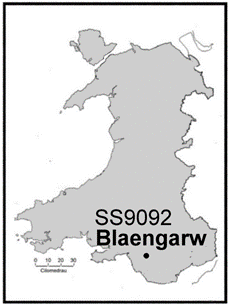
(BLAEN = source) + (GARW = stream name) “source of the Garw”. (GARW = rough;
(of a strream) turbulent)
:_______________________________.
blaengroen <BLAIN-groin> [ˡblaɪngrɔɪn] masculine noun
PLURAL blaengrwyn <BLAIN-gruin> [ˡblaɪngrʊɪn]
1 foreskin
Samuel-1 18:25 A dywedodd Saul, Fel hyn y dywedwch wrth Dafydd; Nid yw y brenin yn ewyllysio cynnysgaeth, ond cael cant o flaengrwyn y Philistiaid, i ddial ar elynion y brenin. Ond Saul oedd yn meddwl peri lladd Dafydd trwy law y Philistiaid.
Samuel-1
18:25 And Saul said, Thus shall ye say to David, The king desireth not any
dowry, but an hundred foreskins of the Philistines, to be avenged of the king's
enemies. But Saul thought to make David fall by the hand of the Philistines.
ETYMOLOGY: (blaen = front; fore) +
soft mutation + (croen = skin)
:_______________________________.
Blaen-gwrach (county
of Castell-nedd ac
Aberafan)
15% Welsh-speaking (Census 2001)
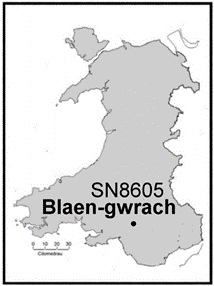
(BLAEN = source) + (GWRACH = stream name) “source of the Gwrach” (GWRACH =
witch)
:_______________________________.
Blaenieithon <blain-YEI-thon> [blaɪnˡjəɪθɔn]
1
(SO1084) locality in the district of Maldwyn (county of Powys)
ETYMOLOGY: (“(the) source (of) (the river) Ieithon”) (blaen = front; source of river) +
(Ieithon)
:_______________________________.
BLAENOR <
BLAENAwR (BLAEN = davant) + (-AwR, -OR suffix d’agent)
blaenor <BLEI-nor> [ˡbləɪnɔr] masculine noun
PLURAL
blaenoriaid <blei-NOR-yaid, -yed> [bləɪˡnɔrjaɪd,
-ɛd]
1 deacon in a Nonconformist
chapel, elder
Mae'r blaenoriaid yn y sêt fawr yn mynd ar eu glinie weithie
The deacons in the Big Seat sometimes kneel down
2 person at the front
Wrth i ni redeg i lawr y bryn i'r ysgol, os byddai i un o'r blaenoriaid faglu, fe fyddai pawb yn syrthio yn bentwr yn bendramwnwgwl ar y ffordd
As we ran down the hill to the school, if one of the people in front tripped, everybody
would tumble head over heels into a pile on the road
ETYMOLOGY: BLAENOR < BLAENAWR (BLAEN =
front) + (-AWR, -OR agent suffix)
:_______________________________.
blaenoriaeth <blei-NOR-yaith, –yeth>
(f)
1 precedence, priority
rhoi blaenoriaeth i donar prioritat a
(BLAENOR = what is in front) + (-I-AETH abstract noun suffix)
:_______________________________.
blaenorol [blei NOO rol] (adj)
1 previous
yn ei swydd flaenorol in his previous job
(BLAENOR = (BLAENOR = what is in front or before) + (-OL suffix adjectival
suffix)
:_______________________________.
Blaen-plwyf <blain-PLUIV> [blaɪnˡplʊɪv]
1 farm
SN2151 in Ceredigion county, west of Aber-porth
http://www.geograph.org.uk/gridref/sn2151
2 village SN5775 in Ceredigion county south of
Aberystwyth
http://www.geograph.org.uk/gridref/SN5775
3 farm SH8409 east of Aberangell, Powys
http://www.geograph.org.uk/gridref/SH8409
ETYMOLOGY: blaen plwyf < blaen y plwyf “(the) top / (the) end (of)
the parish”
(blaen = top, tip,
point) + (y = the) + (plwyf = parish).
In place names, this linking definite article is often lost.
:_______________________________.
Blaen-waun <blain WAIN> [blaɪn
ˡwaɪn]
1
(SN3953) locality in Ceredigion county
2 (SN3427) locality in Caerfyrddin county, 17km
north-west-west of the town of Caerfyrddin
ETYMOLOGY: blaen y waun “(the) top (of) the moorfield”
(blaen = top, tip,
point) + (y = the) + soft
mutation + (gwaun = moor,
moorfield, heath).
In place names, this linking definite article is often lost.
:_______________________________.
blaenwr, PLURAL: blaenwyr <BLEI-nur,-BLEIN-wir> [ˡbləɪnʊr,
ˡbləɪnwɪr] (masculine noun)
1 (rugby) forward
(BLAEN = front) + (-WR suffix = man)
:_______________________________.
Blaen-y-cae <blain ə KAI> [blaɪn
ə ˡkaɪ]
1
place name
2 Occurs in the USA in “Blaen
Y Cae Cemetery”, Randolph, Columbia County, Wisconsin (north-east of Madison
and west of Beaver Dam) 433642N 0890043W
Welsh settlements in Wisconsin. Columbia County is numbered 19, 20
ETYMOLOGY: “(the) top (of) the field” (blaen = top) + (y = the) + (cae = field)
:_______________________________.
Blaen-y-coed <blain ə KOID> [blaɪn
ə ˡkɔɪd]
1
(SN3427) locality in Caerfyrddin county, 10km north-west of the town of
Caerfyrddin
2
street name in Y Radur, Caer-dydd
ETYMOLOGY: “(the) top (of) the wood” (blaen = top) + (y = the) + (coed = wood)
:_______________________________.
Blaen-y-cwm <blain ə KUM> [blaɪn
ə ˡkʊm]
1 street
name in Porthtywyn / Burry Port (county of Caerfyrddin / Carmarthen)
(spelt as “Blaen y Cwm”)
ETYMOLOGY: blaen y cwm “(the) head (of) the valley” (blaen = front; head of a valley) + (y definite article) + (cwm = valley).
See also Blaen-cwm
:_______________________________.
Blaen-y-ffos <blain ə FOOS> [blaɪn
ə ˡfoːs]
1
(SN1937) locality in the county of Penfro, south-west Wales
ETYMOLOGY: “(the) top (of) the ditch, the boundary ditch”
(blaen = top) + (y = the) + (ffos = ditch, boundary ditch)
NOTE: The name is also found as Blaen-ffos. In place names, the linking
definite article is often lost.
:_______________________________.
Blaen-y-fro <blain ə VROO> [blaɪn
ə ˡvroː]
1
street name in Pen-coed, county of Pen-y-bont ar Ogwr
ETYMOLOGY: “(the) top (of) Y Fro”, that is, “above the lowland of Morgannwg”
(blaen = top) + (y = the) + soft mutation + (bro = lowland).
Y Fro (the lowland) is the popular
name for Bro Morgannwg (the lowland of Morgannwg).
The village of Pen-coed is situated on the highland side of the Morgannwg
highland-lowland boundary
:_______________________________.
Blaen-y-llyn <blain ə LHIN> [blaɪn
ə ˡɬɪn]
1
street name in the village of Y Ddraenen-wen, county of Rhondda Cynon Taf
ETYMOLOGY: “(the) top (of) the pool”
(blaen = top) + (y = the) + (llyn = pool, lake)
:_______________________________.
blaguryn, PLURAL: blagur <bla-GII-rin, BLAA-gir> [blaˡgiˑrɪn,
ˡblɑˑgɪr] (masculine noun)
1 bud (flower)
:_______________________________.
blaidd <BLAIDH> [blaɪð] m)
PLURAL bleiddiau, bleiddiaid <BLEIDH-yai, -ye,jBLEIDH-yed> [ˡbləɪðjɛ, ˡbləɪðjaɪd,
-jɛd]
1 (Canis lupis) wolf (western
USA: also lobo)
2 in certain names from the British period;
Arthflaidd <ARTH-vlaidh> [ˡarθvlaɪð],
Bleiddfan <BLEIDH-van> [ˡbləɪðvan]
Bleiddgi <BLEIDH-gi> [ˡbləɪðgɪ]
Bleiddig <BLEI-dhig> [ˡbləɪðɪg]
Bleiddri <BLEIDH-ri> [ˡbləɪðrɪ]
Bleiddudd <BLEI-dhidh> [ˡbləɪðɪð]
Cynflaidd <KƏN-vlaidh> [ˡkənvlaɪð]
3 mor ddibarch â'r blaidd “as disrespectful as the
wolf”
4 gweiddi ‘blaidd!’ to cry wolf = demand help
unnecessarily
5 y Blaidd constellation
Lupus
6 cipio cneuen o wâl y blaidd beard (= oppose) the lion in
his den; confront someone (“take (a) hazelnut (from) (the) den (of ) the wolf”)
7 wolf = cruel rapacious
person
8 blaidd mewn croen dafad a sheep in wolf's clothing
(a menace in disguise, a malicious person who acts as if he or she means well)
(“a wolf in a sheepskin”)
bod yn flaidd mewn croen dafad be a sheep in wolf's
clothing
Mathew 7:15 Ymogelwch rhag gau broffwydi, y rhai a ddeuant atoch yng ngwisgoedd defaid, ond oddi mewn bleiddiaid rheibus ydynt hwy
Matthew 7:15 Beware of false prophets, which come to you in sheep's clothing,
but inwardly they are ravening wolves
ETYMOLOGY: Welsh blaidd < bleidd < British < Celtic *bled-i
From the same British root: Cornish bleydh (= wolf), Breton bleiz (= wolf)
:_______________________________.
blaidd mewn croen defaid <BLAIDH meun kroin DEE-vaid, -ved> [ˡblaɪð mɛʊn ˡkrɔɪnˡ
deˑvaɪd, -ɛd] (masculine noun)
1 a wolf in sheep's clothing
:_______________________________.
bla’n ‹blaan ›
1 southern form of blaen (= tip, end)
Usually spelt (less correctly) blân
See aa and also blaan
:_______________________________.
blanced (blancedi) <BLAN ked, blan KEE di>
(m)
1 blanket
ETYMOLOGY: From English blanket. Note that fianl t final in English has
become final d in Welsh.
:_______________________________.
blas <BLAAS> [blɑːs] (masculine noun)
1 taste
Mae blas sebon ar y bara the bread tastes of soap
(“there is (the) taste (of) soap on the bread”)
Mae blas rhyfedd ar y te ’ma This tea tastes
strange, This tea has a funny taste (“there’s a strange taste on this tea”)
Mae blas melys arni It tastes sweet (‘there is a sweet taste on it’)
2 blesyn taste
(blas = taste) + (-yn diminutive suffix added to
nouns)
(a > e due to the influence of the
final y – vowel
affection)
Cymerwch flesyn i weld Taste it and see (“take a
taste to see”)
3 cael blas ar <kail BLAAS ar> [kaɪl
ˡblɑːs ar] (a) have a taste of; (b) enjoy
Chafodd e fawr o flas erioed ar chwarae rygbi
He never really enjoyed palying rugby
4 rhinflas (food) essence = oily substance to give flavour
(rhin = essence) + soft
mutation + (blas = taste)
5 cael blas o’ch ffisig eich hun have / get a taste of your
own medicine
trio blas o’ch ffisig eich hun have / get a taste of your
own medicine
rhoi ichi flas o’ch ffisig eich hun give you a taste your own
medicine
:_______________________________.
blasbwynt <BLAS-buint> [ˡblasbʊɪnt] (masculine noun)
1 taste bud
ETYMOLOGY: ‘taste
point’ (blas = taste) + soft
mutation + (pwynt = point)
:_______________________________.
blasu <BLA-si> [ˡblasɪ] (verb)
1 to taste
(BLAS = taste) + (-U
verbal suffix)
:_______________________________.
blasus <BLA-sis> [ˡblasɪs] (masculine noun)
1 tasty, delicious
(BLAS = taste) +
(-US adjectival suffix)
:_______________________________.
blawd (1) <BLAUD> [blaʊd] (masculine noun)
1 flour
blawd barlys <blaud BAR-lis> [blaʊd
ˡbarlɪs] barley flour
blawd can <blaud KAN> [blaʊd
ˡkan] white flour
blawd ceirch <blaud KEIRKH> [blaʊd
ˡkəɪrx] oat flour
blawd codi <blaud KOO-di> [blaʊd
ˡkoˑdɪ] self-raising flour
blawd gwenith <blaud GWEE-nith> [blaʊd
ˡgweˑnɪθ] wheat flour
blawd gwyn <blaud GWIN> [blaʊd
ˡgwɪn] white flour
blawd india-corn cornmeal, cornflour
blawd llif <blaud LHIIV> [blaʊd
ˡɬiːv] sawdust (“flour of saw”)
blawd plaen <blaud PLAIN> [blaʊd
ˡplaɪn] plain flour
blawd reis ground rice, rice flour
blawd rhyg <blaud HRIIG> [blaʊd
ˡhriːg] rye flour
2 dal blawd wyneb put on a bold
face (“hold flour (of) face”)
3 cist flawd flour chest
(Scotland: meal-ark)
(“chest (of) flour”) (cist = coffer) + soft
mutation + (blawd = farina)
4 Anodd pobi heb flawd “(it is)
difficult baking without flour”. An English equivalent would be: No bricks
without straw, Even the Israelites could not make bricks without straw, you
can’t make bricks without straw
E. Cobham Brewer 1810–1897. Dictionary of Phrase and Fable. 1898. ‘To attempt
to do something without having the necessary material supplied. The allusion is
to the Israelites in Egypt, who were commanded by their taskmasters so to do.
(Exodus v. 7.)’ (i.e. to make bricks without using straw)..
ETYMOLOGY: Welsh < British blât- < Common Celtic mlât-i-, Indo-European mel(h) (= to crush, to grind) (also
the origin of English meal (= flour; food),
and via Latin, to maul, molar (tooth) and mallet).
Indo-European bhlô-t- < bhlô- (= a leaf, a flower)
From this same I.E: root are English bloom, and Latin flôs, floris (= a flower)
Breton bleud (= flour),
Cornish bleuz (= flour)
Irish bláith (= literary word;
smooth, delicate)< “mláith”
:_______________________________.
blawd (2) <BLAUD> [blaʊd] (masculine noun)
1 (obsolete) flower
With the addition of the plural suffix –au:
blawdau > blodau (= flowers; also [obsolete] used as a singular noun, =
flower)
From the plural form blodau, a singulative
suffix –yn was added > blodeuyn (= a flower)
The more usual form in modern Welsh however is blodyn (= flower)
(blawd = flower) + (–yn a singulative suffix) > “blawd-yn” > blodyn
ETYMOLOGY:
Welsh < British blât < Common
Celtic blât-
Indo-European bhlô-t- < bhlô- (= a leaf, a flower)
From this same I.E: root are English bloom, and Latin flôs, floris (= a flower)
Breton bleuñvenn (= flour),
Cornish bleujenn (= flower)
Irish bláth (= blossom,
flower; blossoms, flowers)
It occurs in Gaulish place names as blât- (= flower), though there is the possibility that blât < mlât- (= to grind, to crush), and so is equivalent to Welsh blawd (= flour)
The name of the town of Blond in France is from Gaulish Blât-o-mâg-os
This
is “flower field” or corresponding to
modern Welsh blawd (= flower), or blod- < blawd (= flower) in blodyn (= flower), and (ma = plain, < Old Welsh magh = plain); or else “grain field” if from mlât- (= to grind, to crush)
Mâg-os occurs as the
first element of maes (= field; plain),
and as ma (= plain) in
place names (Machynlleth, plain of someone
called Cynllaith, Mechain < Mechein < Ma Chein plain of the river Cein, nowadays Cain, Mathafarn plain of the tavern), and as the suffix –fa (= place).
The equivalent form of Blat-o-mag-os in modern Welsh would be “Blodfa”.
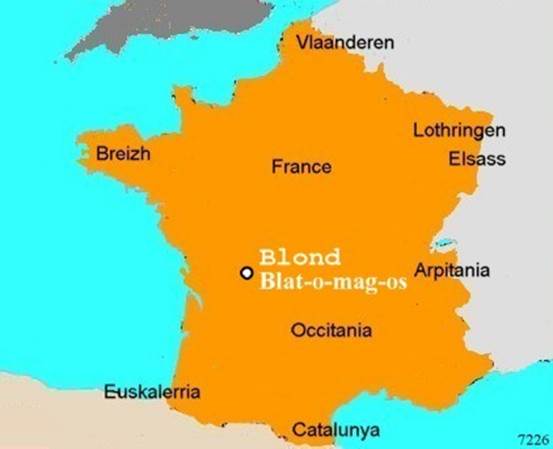
(delwedd 7226)
:_______________________________.
ble ‹BLEE› [bleː] (interr)
1 where
Ewch ble mynnoch Go wherever you want, Go
where you please
tocyn ewch-ble-mynnoch runabout ticket,
explorer ticket (ticket on a bus or train allowing the user to travel at will
on a network in a stipulated area during a stipulated period)
2 ble? where?
Ble mae’r hen lyfr ’na? Where’s that old (= damned)
book?
Before a verb, with the linking particle y / yr (Ble y... / ble yr-...) but his is generally
omitted colloquially
Ble y cefaist ti... > Ble cêst ti dy eni? Where were you born?
:_______________________________.
Bleddyn <BLEE-dhin> [ˡbleˑðɪn] (masculine noun)
1 man's name
ETYMOLOGY: = little wolf, wolf cub bleddyn < bleiddyn
(bleidd- < blaidd = wolf) + (-yn diminutive suffix)
:_______________________________.
blerio <BLER-YO> [ˡblɛrjɔ] verb
(North Wales)
1 untidy, make a
mess, throw into disorder, mess up, leave (something) in a mess, disarrange
2 do (something)
inefficiently
ETYMOLOGY: (blêr- = untidy, disordered) + (-io suffix for
forming verbs)
NOTE: also bleru
:_______________________________.
bleru <BLEE-ri> [ˡbleˑrɪ] verb
(North Wales)
1 untidy, make a
mess, throw into disorder, mess up, leave (something) in a mess, disarrange
2 do (something)
inefficiently
ETYMOLOGY: (blêr- = untidy, disordered) + (-u suffix for forming
verbs)
NOTE: also blerio
The
pronunciation given is based on southern features.
In fact, the pronunciation is <BLE-ri> [ˡblɛrɪ]
as North Wales
has no half-long vowels in the penult
:_______________________________.
blesyn <BLE-sin> [ˡblɛsɪn] masculine noun
1
taste
Cymerwch flesyn i weld Taste it and see (“take a
taste to see”)
ETYMOLOGY: (blas = taste) + (-yn diminutive suffix added to
nouns)
(vowel affection a > e due to the influence of the
final y)
:_______________________________.
b letin, bwletinau <BU le tin, bu le TII nai,
-ne] (m)
letin, bwletinau <BU le tin, bu le TII nai,
-ne] (m)
1 bulletin
:_______________________________.
blew (= hair) > blewyn
:_______________________________.
blewog ‹BLEU-og› [ˡblɛʊɔg] (adjective)
1 hairy
2 llaw flewog thief (“hairy
hand”)
Mae e’n llaw flewog He’s a thief
3 dwylo blewog (“hairy hands”)
Mae ganddo ddwylo blewog He’s a thief (“he has hairy
hands”)
y bobl â dwylo blewog the thieving fraternity, the
guild of thieves, people prone to steal things
4 mân-flewog fluffy
(mân = small, fine )
+ soft mutation + (blewog = hairy)
ETYMOLOGY:
(blew = hair) + (-og adjectival suffix)
:_______________________________.
blewyn, PLURAL: blew <BLEU-in, BLEU> [ˡblɛʊɪn,
ˡblɛʊ] (masculine noun)
1 hair
blewyn amrant (PLURAL: blew amrant) <bleu-in AM-rant, bleu AM-rant] (m) eyelash
siarad heb flewyn ar eich tafod talk straight, speak frankly (“speak without a hair on
your tongue’)
2 straw, blade of
grass
(South Wales) tynnu blewyn cwta am (rywbeth) draw the short
straw for (to choose someone out of two or more people blades of straw are held
in the hand, apparently all the same length – but one is shorter than the other
or others, and whoever draws this is chosen)
Tynnwyd blewyn cwta am y baich ysgafnach The lightest
load was allotted by drawing straws
(“ a short straw was drawn for the
lightest load”)
3 (fish) blewyn fishbone, small bone of a
fish
4 trwch blewyn a hair’s breadth
“thickness (of) hair” (trwch = thickness) + (blewyn = hair)
crac trwch blewyn hairline crack
o drwch blewyn by a hair’s breadth
dod o fewn trwch blewyn o come to within a hair’s breadth of
Fe ddaeth e o fewn trwch blewyn o gael ei ethol yn gynghorwr sir dros bentref ei enedigaeth
He
came to within a hair’s breadth of being elected as a county councillor
representing the village of his birth
5 indicates the least possible
amount (not a single drop of..., not an ounce of..., etc:
dim blewyn not even the
smallest amount (“not (a) hair)”
chawson ni ddim blewyn o law ym mis Mai we didn’t get a single drop of rain in May
does dim blewyn o wahaniaeth rhwng y ddau there’s not an ounce of
difference between the two
ETYMOLOGY:
blewyn is (blew = hair) + (-yn singulative noun suffix)
:_______________________________.
blewyn amrant, PLURAL: blew amrant <BLEU-in AM-rant, BLEU AM-rant> [ˡblɛʊɪn ˡamrant,
ˡblɛʊ ˡamrant] (masculine noun)
1 eyelash
ETYMOLOGY:
“hair (of) eyelid” (blewyn = hair) + (amrant = eyelid)
:_______________________________.
Blicca bjoerkna
1 merfog gwyn (m), merfogiaid gwyn / gwynion silver bream
:_______________________________.
blin <BLIIN> [bliːn] (adjective)
1 sorry
2 tired
3 annoyed
mae’n flin gennyf <main VLIIN GE-ni> [maɪn
ˡvliːn ˡgɛnɪ] (phrase) I'm sorry
mae’n flin ’da fi I’m sorry
:_______________________________.
blinder <BLIN-der> [ˡblɪndɛr] (masculine
noun)
1
tiredness, fatigue
2 bwrw blinder rest, relax
bwrw’ch blinder rest, relax (“throw (off)
your tiredness”)
:_______________________________.
blinedig ‹bli-NEE-dig› [blɪˡneˑdɪg] (adjective)
1 tired
:_______________________________.
blinfyd <BLIN-vid> [ˡblɪnvɪd] masculine noun
1
adversity, tribulation
Diarhebion 31:7 Yfed efe, fel yr anghofio ei dlodi; ac ac un na feddylio am ei flinfyd mwy.
Proverbs 31:7 Let him drink, and forget his poverty, and remember his misery no
more.
ETYMOLOGY: (blin = tedious) +
soft mutation + (byd = world,
situation)
:_______________________________.
blingo <BLI-ngo> [ˡblɪŋɔ] (verb)
1 to
skin
2 blingo’r gath i’r gynffon spend wildly (“skin the cat
to the tail”)
:_______________________________.
blino <BLI-no> [ˡbliˑnɔ] (verb)
1 to tire, to (make someone)
tired
2 to become tired, to get
tired out
Mae golwg wedi blino arni She looks tired
3 to bother (somebody)
ROOT: blin-
THIRD-PERSON
SINGULAR: (SHORT PRESENT) blina
THIRD-PERSON
SINGULAR: (SHORT FUTURE) bliniff
SECOND-PERSON SINGULAR
IMPERATIVE (LITERARY) blina
SECOND-PERSON SINGULAR
IMPERATIVE (SPOKEN) blina
SECOND-PERSON PLURAL IMPERATIVE (LITERARY AND SPOKEN) blinwch
:_______________________________.
blinwaith <BLIN-waith> [ˡblɪnwaɪθ] masculine noun
1 tedious
work
Y mae y gwaith o olchi aur yn flinwaith i’r eithaf; yn llafur anhyfryd, afiach, ac anghysurus. (Y Traethodydd 1851 t353)
The task of washing gold is an extremely tedious task; an unpleasant, unhealthy
and uncomfortable job
ETYMOLOGY: (blin = tedious) +
soft mutation + (gwaith = work)
:_______________________________.
blith <BLIITH> [bliːθ] adjective
PLURAL blithion <BLITH-yon> [ˡblɪθjɔn]
1 milch = giving
milk
buwch flith milch cow, dairy cow, cow
kept for giving milk
(buwch = cow) + soft
mutation + (blith = milch = giving
milk)
da blithion milch cows, cows giving milk
gwartheg blithion milch cows
2 (m) milk; dairy
produce; profit, advantage
3 (North Wales) llefrith milk
llefrith < lleflith < llé’-flith < lléf-flith (*llef = weak, soft,
tepid) + soft mutation + (blith = milk)
Note the change l > r
ETYMOLOGY: Welsh blith < British *blikt- < Celtic *mlikt-
From the same Celtic root: Irish bleacht (= milk)
From the same Indoeuropean root:
..a/ Catalan munyir (= to milk) < Latin mungere < mulgere (M-L-G. Compare
the series of consonants in Celtic M-L-K)
..b/ English milk (cf the series of consonants
in Celtic M-L-K)
:_______________________________.
blith draphlith [bliith DRA flith] (adv) en desordre
ETYMOLOGY: soft mutation (per indicar la funció adverbial de la phrase) + PLITH
DRAPHLITH “mig sobre mig” (PLITH = mig) + soft mutation + TRAPHLITH (adv) = en
desordre, “sobre mig”). (TRA- = sobre) + mutació aspirada + (PLITH = mig)
blodau (1) <BLOO-dai, -de> [ˡbloˑdaɪ,
-dɛ]
1
flowers; plural form of blodyn = flower
:_______________________________.
blodau (2) <BLOO-dai, -de> [ˡbloˑdaɪ,
-dɛ]
1
(obsolete) flower
2 the flower = the prime, the best [of all], the choicest, the sublimest
..a/ the best people or things
blodau’r ffair the pride of the fair, the best of the fair; the pick
of the bunch
Ar lan y môr mae cerrig gleision,
Ar lan y môr mae blodau'r meibion.
(Folk
Song, Ar Lan y Môr)
[Down] by the sea there are grey stones / blue stones,
[Down] by the sea there are the best young men [of all]
blodeugerdd anthology
(blodeu-, blodau = the flower [of
something], the best [of something]) + soft mutation + (cerdd = song, poem) > best song,
best poem > anthology, collection of the best poems
blodau choicest poems
Blodau Dyfed ‘the best poems / the
choicest pieces etc of (the region of) Dyfed’
Blodau Dyfed / John Howell / (Ioan ab Hywel) / 1824
..b/ the best place
Cofiant Matthews, Ewenni, John James Morgan, 1922, p397
Meddwyn yn y trên nos Sadwrn yn methu agor ond cil un llygad, yn bloeddio’n barhaus, “Blodau’r byd yw’r Pil a Chefancribwr.”
A
drunk on the train one Saturday night, with one eye half open (“unable
to open but the corner of one eye”), shouting out constantly, “Y Pîl and
Cefncribwr are the best places on earth.”
..c/ the prime = the best period
blodau ieuenctid the bloom of youth
blodau ei hoedran her prime of life, the flower of her age
7:36 Corinthiaid-1 Ond os yw neb yn tybied ei fod y anweddaidd tuag at ei wyry, od â hi dros flodau ei hoedran, a bod yn rhaid gwneuthur felly; gwnaed a fynno, nid yw yn pechu: priodant.
Corinthians-1
7:36 But if any man think that he behaveth himself uncomely toward his virgin,
if she pass the flower of her age, and need so require, let him do what he
will, he sinneth not: let them marry.
yn ei flodau floruit; in his prime
blodau ei oes prime of life
ym mlodau ei oes in the prime of his life, in the prime of life
Bu farw ym mlodau ei oes heb briodi He died, unmarried, in the prime of his life
4 bod yn ei blodau be having her period (‘be in her flowers’)
mae hi yn ei blodau she’s having her period
John Cotton. An Abstract of the Laws of New England, as They Are Now
Established. Printed in London in 1641.
Chapter VII. Of Crimes. And first, of such as deserve capital punishment, or
cutting off from a man's people, whether by death or banishment.
Pollution of a woman known to be in her flowers, to be put to death.
:_______________________________.
blodeufa, blodeuféydd ‹blo-DEI-va, blo-dei-VEIDH› [blɔˡdəɪva,
blɔdəɪˡvəɪð] (f)
1 parterre = an ornamental
garden with flower beds of different shapes and sizes and gravel paths or turf
paths between the beds
ETYMOLOGY: (blodeu-, blodau = flowers) + (-fa suffix = place)
:_______________________________.
blodeugerdd, blodeugerddi ‹blo-DEI-gerdh, blo-dei-GER-dhi› [blɔˡdəɪgɛrð,
blɔdəɪˡgɛrðɪ] (f)
1 anthology
ETYMOLOGY: (blodeu-, blodau = the flower [of
something], the best [of something]) + soft mutation + (cerdd = song, poem) > best song,
best poem > anthology, collection of the best poems
:_______________________________.
blodeuo <blo-DEI-o> [blɔˡdəɪɔ] (verb)
1 to flower
2 have a period
mae hi’n blodeuo she’s having her period
ETYMOLOGY: (blodeu-, blodau = flowers) + (-o = verbal suffix)
:_______________________________.
blodeuog <blo-DEI-og> [blɔˡdəɪɔg] (feminine noun)
1
flowery
2 blossoming
helygen flodeuog (helyg blodeuog) (Chilopsis
linearis) desert willow
See: helygen yr anialwch
3
flourishing, thriving, growing apace
ETYMOLOGY: (blodeu-, blodau = flowers) + (-og = adjectival suffix)
:_______________________________.
Blodeuwedd [blɔˡdəɪwɛð] (feminine noun)
1
mythical personage
ETYMOLOGY:
“(one who has) (the) appearance (of) flowers”, “flowers-appearance”
(blodeu-, blodau = flowers) +
soft mutation + (gwedd = aspect,
appearance, look)
:_______________________________.
blodeuyn PLURAL blodau ‹blo-DEI-in, BLOO-dai, -e› [blɔˡdəɪɪn, ˡbloˑdaɪ,
-dɛ] (m)
1 flower
The more usual word nowadays is blodyn ‹ BLOO-din› [ˡbloˑdɪn]
ETYMOLOGY:
(blodeu-, blodau = flowers) + (-yn = singulative suffix) > blodeuyn
:_______________________________.
Blodwen [BLOD wen] (f) nom de dona = "flor" (més aviat passat de moda;
típic de les nascudes a finals del segle 1800)
Blodwen <BLOD-wen> [ˡblɔdwɛn] (feminine noun)
1 woman's name
ETYMOLOGY:
“flower”, “Flora” (blod-, stem of blodyn = flower) + (-wen suffix for creating female names; = white, fair,
beautiful)
:_______________________________.
blodyn PLURAL blodau ‹BLOO-din, BLOO-dai, -e› [ˡbloˑdɪn, ˡbloˑdaɪ,
-dɛ] (masculine noun)
1 flower; blossom on a tree
blodau’r drain the hawthorn
blossoms
gwely blodau flower bed
blodyn gwyllt wild flower
2 Sul y Blodau Palm Sunday
(“Sunday (of) the flowers”) = the Sunday before Easter commemorating Jesus’s
entry into Jerusalem
3 Caeblodau street name,
Baecinmel (county of Dinbych)
(appears as “Cae Blodau”) (in theory, street names which mimic habitative names
would be spelt as a single word)
The original form would be ‘cae’r blodau’ ‘(the) field (of) the flowers’
(cae = field) + (’r definite article) + (blodau = flowers)
The linking definite article y / yr / ’r is frequently omitted in place names
4 bod fel blodau’r graban (South) said of a numerous
family, ‘they’re all over the place’, ‘you find them everywhere’, ‘you just
can’t avoid them’
graban Chrysanthemum
segetum; corn marigold
5 endearment: 'mlodyn i “my flower”
6 blodyn y gog (Cardamine pratensis) cuckoo flower
(blodyn = flower) + (y = the) + soft
mutation + (cog = cuckoo)
Blodyn-y-gog street name in Y Barri (Bro
Morgannwg) (spelt ‘Blodyn y Gog’)
(delwedd 7914)
ETYMOLOGY: (blawd = flowers) + (-yn = singulative suffix) > “blawd-yn” > blodyn
See also: blodeuyn (= flower)
:_______________________________.
bloedd <BLOIDH> [ˡblɔɪð] feminine noun
PLURAL bloeddiau, bloeddiadau <BLOIDH-yai, -ye, bloidh-YAA-dai, -de> [ˡblɔɪðjaɪ, -jɛ,
blɔɪðˡjɑˑdaɪ, -dɛ]
1
shout
bloeddiadau gwerthwyr y papurau newyddion
the shouts of the newspaper sellers
2
shout of command
Nid oedd eisiau chwip na bloedd i yrru y ceffylau am y gwyddent y ffordd yn dda
There was no need of a whip or a shout to drive along the horses as they knew
the road well
3 literary
cadfloedd war cry
ETYMOLOGY: British < Celtic; cf Irish bladhair (= to shout)
NOTE: In the south bloedd > blo’dd, “bloodd”. The change oe [oi] > oo [o:] in monosyllables is a
regular feature of Southern Welsh.
:_______________________________.
bloeddio <BLOIDH-yo> [ˡblɔɪðjɔ] verb
1
shout
2 m shouting
ETYMOLOGY: (bloedd = shout) + (-io verbal suffix)
:_______________________________.
bloeddiwr <BLOOIDH-yur> [ˡblɔɪðjʊr] masculine noun
PLURAL bloeddwyr <BLOIDH-wir> [ˡblɔɪðwɪr]
1
shouter
ETYMOLOGY: (bloedd- stem of bloeddio = to shout) + (-i-wr agent suffix)
:_______________________________.
bloesg <BLOISK> [ˡblɔɪsk] (adjective)
1 indistinct
2 siarad yn floesg <SHAA-rad ən VLOISG> [ˡʃɑˑrad
ən ˡvlɔɪsk] speak indistinctly
ETYMOLOGY: Welsh < British < Latin BLAES-US (= indistinct; lisping,
stammering)
:_______________________________.
bloneg ‹BLOO-neg› [ˡbloˑnɛg] masculine noun
1 fat,
lard
bod gormod o floneg ar be too flabby
(“be too-much of fat on”)
:_______________________________.
blonged <BLO-nged> [ˡblɔŋɛd] verb
(South Wales)
1 blonged i belong = be a possession of
2 blonged i (member of a family) be
related to
ETYMOLOGY: English belong. See belongio
NOTE: Also: blongo, blongid. The standard form is perthyn
:_______________________________.
blongid <BLO-ngid> [ˡblɔŋɪd] verb
(South Wales)
1 blongid i belong = be a possession of
2 blongid i (member of a family) be
related to
ETYMOLOGY: English belong. See belongio
NOTE: Also: blongo, blonged. The standard form is perthyn
:_______________________________.
blongo <BLO-ngo> [ˡblɔŋɔ] verb
(South Wales)
1 blongo i belong = be a possession of
2 blongo i (member of a family) be
related to
ETYMOLOGY: English belong. See belongio
NOTE: Also: blonged, blongid. The standard word is perthyn
:_______________________________.
blows, PLURAL: blowsiau <BLOUS, BLOUS-yai, -ye> [ˡblɔʊs,
ˡblɔʊsjaɪ, -jɛ] (feminine noun)
1 blouse
:_______________________________.
blw:ch (blychau) [BLWKH, BLƏ khai, -khe] (m)
1 box
blwch nythu nesting box
2 small square on a printed form for writing a tick or a cross
:_______________________________.
blwch llwch <blwkh LHWKH> [bluːx
ˡɬuːx] masculine noun
PLURAL blychau llwch <BLƏ-khai, -e, LHWKH> [ˡbləxaɪ, -ɛ, ˡɬuːx]
1 ashtray (“box (of) ash”)
Taflwch y Blwch Llwch
Throw
away the ashtray (name of a campaign for smokers to give up their habit, Wales,
January 2001)
:_______________________________.
blwch penseli <blwkh pen-SEE-li> [bluːx
pɛnˡseˑlɪ] masculine noun
PLURAL blychau penseli <BLƏ-khai, -e, pen-SEE-li> [ˡbləxaɪ, -ɛ, pɛnˡseˑlɪ]
1
pencil box
:_______________________________.
blwydd <BLUIDH> [blʊɪð] (feminine noun)
1 year of age
blwydd oed one year old
tair blwydd oed three years old
mae hi’n dair blwydd oed she’s three years old
:_______________________________.
blwyddyn (blynyddoedd, blynedd) [BLUI dhin, blə NƏ
oidh -odh, BLƏ nedh] (f) 1 any 2 curs escolar
blynyddau > blynydde (Sud)
blwyddyn dreth [blui dhin DREETH] (f) any
fiscal (d’Hisenda)
y Mil Blynyddoedd el regne
de mil anys, creença cristiana d’un regne de pau d'una durada de mil anys que
Crist haurà de portar sobre la terra abans del judici final (Apocalipsi
20:1-20:4)
blwyddyn <BLUI-dhin> [ˡblʊɪðɪn] (feminine noun)
PLURAL: blynyddoedd <blə-NƏƏ-dhoidh, -dhodh> [bləˡnəˑðɔɪð,
-ðɔð]
Another plural form
used colloquially is blynyddau blynyddoedd <blə-NƏƏ-dhai, -dhe> [bləˡnəˑðaɪ, -ðɛ]
1 year
NOTE: a year of age is blwydd (qv)
flynyddoedd yn ôl years ago, many years ago
y flwyddyn' nesa’ next year
ddeng mlynedd yn diweddarach ten years later, ten years
after
ryw flwyddyn neu ddwy ar ôl hyn a year or two after this
o’r naill ben i’r flwyddyn i’r llall from one end of the year to
the other, from year’s end to year’s end
blwyddyn naid leap year, year
having an intercalary day, an extra day inserted in the calendar
2 academic year,
school year, university year
3 blwyddyn y
tair caib = 1777 (= the year of the three pickaxes)
4 -Blwyddyn newydd dda ichi! -Run fath i chithe! (= in the literary language Yr un fath i chwithau!)
-A happy New Year to you! -The same to you!
5 mil o flynyddoedd a thousand years
y mil o flynyddoedd (Christianity) the
milennium, the period of one thousand years when Christ will reign the Earth
Datguddiad 20:3 Ac a'i bwriodd ef i'r pydew diwaelod, ac a gaeodd arno, ac a seliodd arno ef, fel na thwyllai efe'r cenhedloedd mwyach, nes cyflawni'r mil o flynyddoedd: ac ar ôl hynny rhaid yw ei ollwng ef yn rhydd dros ychydig amser. (20:4) Ac mi a welais orseddfeinciau, a hwy a eisteddasant amynt, a barn a roed iddynt hwy: ac mi a welais eneidiau'r rhai a dorrwyd eu pennau am dystiolaeth Iesu, ac am air Duw, a'r rhai nid addolasent y bwystfil na'i ddelw ef, ac ni dderbyniasent ei nod ef ar eu talcennau, neu ar eu dwylo; a hwy a fuant fyw ac a deyrnasasant gyda Christ fil o flynyddoedd.
Revelation 20:3 And cast him into the bottomless pit, and shut him up, and set
a seal upon him, that he should deceive the nations no more, till the thousand
years should be fulfilled: and after that he must be loosed a little season.
(20:4) And I saw thrones, and they sat upon them, and judgment was given unto
them: and I saw the souls of them that were beheaded for the witness of Jesus,
and for the word of God, and which had not worshipped the beast, neither his
image, neither had received his mark upon their foreheads, or in their hands;
and they lived and reigned with Christ a thousand years.
6 wyneb blwyddyn spring (“(the) face (of)
year”)
Colloquially also gwyneb blwyddyn
Bernir y bydd yma ugeiniau o anifeiliaid wedi marw eisiau bwyd cyn gwyneb blwyddyn.
It is thought that scores of animals here will have starved to death before
spring
(Letter from G.R. Roberts, Scott County, Tennessee in November 1863; Cofiant y
Tri Brawd / E Pan Jones / 1892 / tudalen 105)
:_______________________________.
blwyddyn dreth <blui-dhin DREETH> [blʊɪðɪn
ˡdreːθ] (feminine noun)
1 tax year
:_______________________________.
blymonj, PLURAL: blymonjus <blə-MONJ, blə-MON-jəs, -jəz> [bləˡmɔnʤ, bləˡmɔnʤəs, -ʤez] (masculine noun)
1 blancmange
ETYMOLOGY: < English
BLANCMANGE [bləmónzh]; into English 1300+ < francès BLANC MANGER (=
white food)
:_______________________________.
blynedd <BLƏƏ-nedh> [ˡbləˑnɛð] (plural noun)
1 years
An old plural form; used in modern Welsh after numbers. In modern Welsh the
singular noun is used after a numeral, but in old Welsh it seems a plural form
was used. This has continued in the case of blwyddyn / blynedd, with a separate plural form blwydd in use when ‘year of one’s age’ is meant – ddwy flynedd yn ôl (= two years ago), pum mlwydd oed (= five years old)
dwy flynedd two years
tair blynedd three years
pedair blynedd four years
pum mlynedd five years
chwe blynedd six years
saith mlynedd seven years
wyth mlynedd eight years
naw mlynedd nine years
deng mlynedd ten years
un mlynedd ar ddeg eleven years
deuddeng mlynedd twelve years
:_______________________________.
blyngad <BLə-ngad> [ˡbləŋad] verb
(South-west Wales)
1 blyngad i belong = be a possession of
2 blyngad i (member of a family) be
related to
ETYMOLOGY: English belong. See belongio
:_______________________________.
blynyddoedd <blə-NƏƏ-dhoidh, -dhodh> [bləˡnəˑðɔɪð,
-ðɔð] (plural noun)
1 years. See blwyddyn
flynyddoedd lawer yn ôl many years ago
:_______________________________.
bnafyd <BNAA-vid> [ˡbnɑˑvɪd] verb
1
(North Wales) to hurt
ETYMOLOGY: ??
:_______________________________.
bo <BOO> (v) be (subjunctive)
:_______________________________.
bo <BOO> [boː] (verb)
1 it be (subjunctive)
2 da bo chi (= goodbye) < da bo i chi ‘may it be good
to you’
(da = good) + (bo = may it be) + (i = to) + (chi = you)
da bo ti (= goodbye) < da bo i ti ‘may it be good
to you’
(da = good) + (bo = may it be) + (i = to) + (ti = you)
tra bo dau while there are two of us, while we’re together (name of
a traditional song)
cyn bo hir soon (‘before | it be | long’)
fel y bo’r galw according to demand (‘as | there be | call, demand’)
pawb at y peth y bo each to his own taste
(‘everybody | to | the | thing | that | be’)
:_______________________________.
bob <BOOB> [boːb] (adjective)
1 every, each (in adverbial
phrases)
(The
initial consonant of the first word in an adverbial phrase undergoes soft
mutation: )
pob dydd > bob dydd every day
pob haf > bob haf every summer
compared to:
mae pob dydd yn wahanol every day / each day is
different
ar gyfer pob dydd o’r flwyddyn for each day of the year
bob amser [boob AM ser] (adv) each
time, every time
bob bore [boob BOO re] (adv) every
morning
bob dydd every day
bob haf every summer
bob hyn a hyn [boob HIN a HIN] (adv) every now and then
bob nos [boob NOOS] (adv) every
night
bob pnawn [boob PNAUN] (adv) every
afternoon
bob Sadwrn [boob SAA durn] (adv) every
Saturday
bob tro [boob TROO] (adv) each
time, every time
bob wythnos [boob UITH nos] (adv) every
week
mynd i’r gwaith bob dydd ar y bws go to work every day on the bus (adverbial phrase)
:_______________________________.
bob amser <boob AM-ser> [boːb
ˡamsɛr] (adverb)
1 each time
:_______________________________.
bob blwyddyn <boob BLUI-dhin> [boːb
ˡblʊɪðɪn] (adverb)
1 every year
ETYMOLOGY:
pob = each, every; + blwyddyn = year; the phrase has soft mutation (p > b) to
denote adverbial function
:_______________________________.
bob dydd <boob DIIDH> [boːb
ˡdiː ð] (adverb)
1 every day
:_______________________________.
bob hyn a hyn <boob HIN a HIN> [boːb
ˡhɪn a ˡhɪn] (adverb)
1
every now and then
:_______________________________.
bob ochr <boob OO-khor> [boːbˡ
oˑxɔr] adverb
1 on both sides (‘(on) every
side’)
ysbïwr bob ochr double agent
ETYMOLOGY: (pob = each) + (ochr = side). There is soft
mutation of an initial consonant in adverbial phrases. hence p > b
:_______________________________.
bob ochr i <boob OO-khor i> [boːbˡ
oˑxɔ ɪr] preposition
1 on both sides of, on either
side of
ETYMOLOGY: (bob ochr = both sides) + (i, preposition = to, used to
form prepositionals from adverbials)
:_______________________________.
bob tro <boob TROO> [boːb
ˡtroː] (adverb)
1 every time
:_______________________________.
bob wythnos <boob UITH-nos> [boːb
ˡʊɪθnɔs] (adverb)
1 every week
:_______________________________.
bob yn… <BOOB ən...> [boːb
ən...]
1 indicating
frequency
bob yn drydydd dydd Llun every third Monday
bob yn eilnos every other night, one night
out of two
2 indicating equal steps in a progression
bob yn droedfedd foot by foot
bob yn fodfedd inch by inch
bob yn llam by leaps and bounds
bob yn llathen yard by yard
3 grouping
bob yn ddau (m), bob yn ddwy (f) in twos
bob yn gant by the
hundredweight (cwt)
bob yn hanner cant by the half
hundredweight
ETYMOLOGY: (pob = each) + (yn = in). Soft mutation of the
initial consonant in an adverbial phrase p > b
:_______________________________.
bob yn ail <boob ən AIL> [boːb
ən ˡaɪl] (adverb)
1 alternately
2 bob yn ail a pheidio every once or
twice (“alternately and ceasing / stopping”)
gweithio bob yn ail a pheidio work by fits and
starts
syrthio
ar ei hyd bob yn ail a pheidio fall flat every once or
twice, fall flat and pick yourself up and fall flat again
ETYMOLOGY: (pob = each) + (yn = in) + (ail = (adj) second). Soft
mutation of the initial consonant in an adverbial phrase p > b
:_______________________________.
bob yn bedwar <boob ən BED-war> [boːb
ən ˡbɛdwar] (adverb)
1 in fours, four by four
Feminine form: bob yn bedair <boob ən DHUI> [boːb
ən ˡbɛdaɪr] = in fours, four
by four (referring to females)
y cantorion a'r cantoresau bob yn
chwech; ac wedi hyny (= hynny) y Dirwest-wragedd bob yn bedair. Y Seren
ddirwestol. Rhif 3. Mawrth 1837. The singers (mewn and women) in sixes; and
after that the Temperance women in fours.
Dywedir fod yr olygfa yn un ardderchog,
saith a deugain o longau yn symud bob yn bedair. It is said that it was a
fine sight (the the sight was an excellent one), forty-seven ships moving in
fours.
Welsh Gazette and West Wales Advertiser. 13 Ebrill 1905.
(pob = each) + (yn = in) + (soft mutation p
> b) + (pedwar = four). Soft mutation of the initial consonant in an
adverbial phrase p > b
:_______________________________.
bob yn ddau <boob ən DHAI> [boːb
ən ˡðaɪ] adv
1 in twos, two by two
Feminine form: bob yn ddwy <boob ən DHUI> [boːb
ən ˡðuɪ] = in twos, two by
two (referring to females)
ETYMOLOGY: (pob = each) + (yn = in) + (soft mutation d
> dd) + (dau = two). Soft
mutation of the initial consonant in an adverbial phrase p > b
:_______________________________.
bob yn droedfedd <boob ən DROID-vedh> [boːb
ən ˡdrɔɪdvɛð] adv
1 foot by foot
Y Saeson… [yn] ymladd eu ffordd bob yn
droedfedd The English fighting their way forward foot by foot
Hanes Cymru a Chenedl y Cymry. Thomas Price (Carnhuanawc).· 1842.
ETYMOLOGY: (pob = each) + (yn = in) + (soft mutation t
> d) + (troedfedd = foot (measurement)). Soft
mutation of the initial consonant in an adverbial phrase p > b
:_______________________________.
bob yn dri <boob ən DRII> [boːb
ən ˡdri:] adv
1 in threes, three by three
Feminine form: bob yn dair <boob ən DAIR> [boːb
ən ˡðaɪr] = in threes,
three by three (referring to females)
ETYMOLOGY: (pob = each) + (yn = in) + (soft mutation t
> d) + (tri = three). Soft
mutation of the initial consonant in an adverbial phrase p > b
:_______________________________.
bob yn fodfedd <boob ən VOD-vedh> [boːb
ən ˡvɔdvɛð] adverb
1 inch
by inch
palu'r ardd bob yn fodfedd dig the garden inch by inch
ETYMOLOGY: (pob = each) + (yn = in / linkword) + (soft
mutation m > f [v]) + + (modfedd = inch). Soft mutation of
the initial consonant in an adverbial phrase p > b
:_______________________________.
bob yn hanner cant <boob ən HA-ner KANT> [boːb ən ˡhanɛr ˡkant] adv
1 by the half hundredweight
pytatws bob yn hanner cant potatoes
by the half hundredweight
ETYMOLOGY: (pob = each) + (yn = in) + (hanner cant = fifty (‘half hundred’)).
Soft mutation of the initial consonant in an adverbial phrase p > b
:_______________________________.
bob yn llam <boob ən LHAM> [boːb
ən ˡɬam] adv
1 by leaps and bounds
cynyddu bob yn llam increase by leaps and bounds
ETYMOLOGY: (pob = each) + (yn = in) + (llam = leap).
:_______________________________.
bob yn llathen <boob ən LHAA-then> [boːb
ən ˡɬa·θɛn] adv
1 yard by yard
Ofnir y bydd yn rhaid enill y wlad bob yn llathen. Y Drych. 28 Hydref
1897. It is feared that it will be
necessary to win / conquer the country yard by yard.
ETYMOLOGY: (pob = each) + (yn = in) + (llathen = yard (measurement)). Soft
mutation of the initial consonant in an adverbial phrase p > b
:_______________________________.
boch, PLURAL: bochau <BOOKH, BOO-khai, -khe> [boːx,
ˡboˑxaɪ, -xɛ] (feminine noun)
1 cheek
y foch the cheek
ETYMOLOGY:
Welsh < British < Latin bucca (= mouth, cheek)
:_______________________________.
bocs teganau <boks te-GAA-nai, -ne> [bɔks
tɛˡgɑˑnaɪ, -nɛ] (masculine noun)
1 toy box
:_______________________________.
bocs, PLURAL: bocsus <BOKS, BOK-sis> [bɔks,
ˡbɔksɪs] (masculine noun)
1 box
bocs bwyd (South) lunch box, snap tin,
bait tin (for carrying a snack lunch to work or to school)
ETYMOLOGY: English box
:_______________________________.
bod <BOOD> [ˡboːd] (feminine noun)
1
being
Y Bod Mawr The Supreme Being
2 dwelling,
house
In house names:
Bodarfryn “Bod Arfryn”
(“(the) house on (the) hill”) (habitation names are written as a single word
preferably)
House name in Tywyn (county of Gwynedd)
(as “Bod Arfryn”, a house name which occurs in the list of members in “The
Transactions of the Honourable Society of Cymmrodorion” 1961 / Part 1)
hafod summer place <
haf-fod (haf = summer) + soft
mutation + (bod = dwelling, dwelling place)
3 In some place names in North Wales, it means “church”
Boduan, Bodewryd, Bodedern, Bodferin, Bodwrog, Botwnnog, Bodelwyddan
Sometimes as “bot”: Botwnnog,
:_______________________________.
bod <BOOD> [ˡboːd] (verb)
1 to be
2 Beth sy'n bod? <BEETH sin BOOD> [ˡbeːθ sɪn
ˡboːd] (phrase) What’s the matter?
3 bod ar fin <BOOD ar VIIN> [boːd
ar ˡviːn] (verb) to be on the point of (doing something)
4 be = remain unchanged
gadael i bethau fod let things take their course
5 bod + soft mutation (adverbial phrase)
bod drwyn wrth gynffon (cars in a
traffic jam) be nose to tail
6 bod as a relative pronoun
rw i’n credu bod mab Siôn wedi mynd i fyw i’r Almaen Ibelieve that Siôn’s son has
gone to Germany to live
wrth gwrs | fy mod i|’n siarad Cymraeg! of course I speak Welsh
7 bod
wedi in forming a periphrastic past tense (be + after)
bod wedi ei ddifrodi (m), bod wedi ei difrodi (f) be damaged (“be after its
damaging”)
bod wedi ei dorri’n ddwy (m), bod wedi ei thorri’n ddwy (f) be broken in two (“be
after its breakiing in two”)
bod wedi ei enwebu (m), bod wedi ei henwebu (f) be nominated (“be after
his / her nominating”)
8 bod is a final element in various compounds
..a/ adnabod to know
..b/ canfod to perceive
(can- = with) + soft mutation + (bod = being, to be)
< British
From the same British root: Breton kavout (= find)
..c/ cymod reconciliation
(cym- prefix =
together) + soft mutation + (bod = being) > *cymfod > cymod
..d/ darganfod (= discover) (dar- intensifying
prefix) + soft mutation + (canfod = perceive)
..e/ gwybod to know
< *gwy’fod < *gwyddfod (gwydd- element now obsolete = to see, to discover) + soft
mutation + (bod = be, being)
..f/ hanfod essence; (verb) derive from, stem from
(hân- noun now obsolete, = separation) + soft mutation + (bod = being; to be)
(The equivalent word for hân in Irish is the
prefix sain- = special, specific, particular, characterisitic)
bod wedi ei... “be after his / her /
its...”
:_______________________________.
bod â
1 to
have (“be with”)
CALON:
bod â'ch calon yn eich gwaith have your heart
in your work
CANOLFAN:
bod â’ch canolfan yn... (company, organisation) be
based in, have its main office in... (“have its centre in”)
CEFN:
bod â’ch cefn at (house) back onto (“have its
back towards”)
.....Mae’r ty â’i gefn at y parc The house backs onto the
park
CYLLELL:
bod â’ch cyllell yn rhywun o hyd be constantly
getting at someone, be always getting at someone
.....Mae e â’i gyllell ynof o hyd He’s always
getting at me (“He has his knife in me constantly”)
EISIAU:
bod ag eisiau (rhywbeth) ar (rywun) to want
GAIR:
bod â gair da i (rywun) have a good word
for = mention favourably (lit: be + with a good word + to)
bod â gair go dda i (rywun) have a quite a
good word for = mention quite favourably (lit: be + with quite a good word +
to)
GALLU:
bod â'r allu (i...) be capable of
(‘be with the ability to...’)
GOFAL:
bod â'ch gofal yn fawr am (rywun) look after
(somebody) very carefully
GOLWG:
bod â'ch golwg ar have one's eye
on (intend to buy, etc; be attracted to (someone) etc)
GORMOD:
bod â gormod o heyrn yn y tân have too many
irons in the fire
LLYGAD:
bod â'ch llygad ar have one's eye
on (intend to buy, etc; be attracted to (someone) etc)
bod â’ch llygad ar eich cyfle be on the
lookout for your chance (to do something), be biding your time
bod â'ch llygad ar eich ysgwydd be on the
lookout, be wary
bod â'ch llygad dros eich ysgwydd be on the
lookout, be wary
OFN:
bod ag ofn (peth neu rywun) be afraid of
something / someone
PENCADLYS:
bod â’ch pencadlys yn... be based in (“have its
headquarters in”)
.....Mae’r cwmni â’i bencadlys ym Mhen-y-bont The company is based in
Pen-y-bont
PEN:
bod â'ch pen i lawr (literally: be
with your head down)
1/ have your head bowed; 2/ be upside down
PIG:
bod â’ch pig i mewn i rywbeth be a real busybody, be
really nosy
... Ma fa â'i big miwn i bobman He’s really nosey (“he’s
with his beak/ nose in everywhere”)
PRIF SWYDDFA:
bod â’ch prif swyddfa yn... (company) be based in (“have
its main office in”)
PRYD:
bod â'ch pryd ar (rywbeth) have your heart
set on
RHYDDID:
bod â'r rhyddid i (wneud rhywbeth) have the freedom
to do something
WYNEB:
bod â'ch wyneb yn ôl i'ch cartref be headed for
home (“have your face back to your home”)
:_______________________________.
bod ar eich drwg <bood ar əkh DRWG> [boːd
ar əx ˡdruː g]
1 be
up to no good
Mae’r brain ar ’u drwg heddiw eto
The crows are up to no good again today
ETYMOLOGY: (bod = be) + (ar = on) + (eich = your) + (drwg = badness).
:_______________________________.
bod byw ac iach <bood BIU aag YAAKH> [boːd
ˡbɪʊ ɑːg ˡjɑːx]
1 “be
alive and healthy”
os bydda i fyw ac iach God willing / if
all goes well
Mi ddo i nôl ’ma eto y flwyddyn nesa, os bydda i fyw ac iach
I’ll
be back here next year, God willing / if all goes well
ETYMOLOGY: (os = if) + (byw = alive) + (ac = and) + (iach = healthy)
:_______________________________.
bod gyd-led gyd-hyd <bood giid-LEED giid-HIID> [boːd giːd ˡleːd giːd
ˡhiːd]
1 be
as long as it is broad
ETYMOLOGY: (bod = to be) + soft
mutation + (cyd-led = co-length) +
soft mutation + (cyd-hyd = co-width).
There is soft mutation of an initial consonant in adverbial phrases. hence cyd > gyd
:_______________________________.
bod ti a tithau rhwng <bod TII aa TII-thai, -the hrung> [boːd ˡtiː ɑː ˡtiˑθaɪ,
-ɛ hrʊŋ] (verb)
1 call each other 'ti' (rather
than the formal 'chi') (“be thou and thou-too between...”), be on very close
terms with
:_______________________________.
bod yn bleser <bood ən BLE-ser> [boːd
ən ˡblɛsɛr]
1 to
be a pleasure
Roedd yn bleser darllen ei erthygl It was a
pleasure to read his article
ETYMOLOGY: (bod = be) + (yn linking
particle) + soft mutation + (pleser = pleasure)
:_______________________________.
bod yn drist <bood ən DRIST> [boːd
ən ˡdrɪst]
1 to
be sad
Mae’n drist meddwl beth fydd dyfodol ein gwlad
It’s sad to think what the future of our country will be
ETYMOLOGY: (bod = be) + (yn linking
particle) + soft mutation + (trist = sad)
:_______________________________.
bod yn ynfyd wallgo’ <bood ƏN-vid WALH-go > [boːd ən ˡənvɪd
ˡwaɬgɔ]
1 be
furious, be hopping mad
ETYMOLOGY: (bod = be) + (yn predicative particle) + (ynfyd = insane, mad) + soft
mutation + (gwallgof = insane, mad)
:_______________________________.
boda, PLURAL: bodaod <BOO-da, bo-DAA-od> [ˡboˑda,
bɔˡdɑˑɔd] (feminine noun)
1 (South Wales) kite (type of
bird)
y foda the kite
:_______________________________.
bodd <BOODH> [boːð] (masculine noun)
1 satisfaction, contentment,
pleasure
2 wrth eich bodd <urth əkh BOODH> [ʊrθ
əx ˡboːð] contented
bod wrth eich bodd dros... be very pleased for
Rw i wrth ’y modd drosoch chi I’m very pleased for you,
I’m thrilled for you (“I’m at my satisfaction over you”)
3 o'ch bodd neu o’ch anfodd whether you like it or not
(“of your satisfaction or of your dissatisfaction”) + (o = from) + (eich = your) + (bodd = satisfaction) + (neu = or) + (o) + (eich + (anfodd = dissatisfaction)
4 gwirfodd free will
(gwir = true ) + soft
mutation + (bodd = will)
o’ch gwirfodd voluntarily, of your own
free will
gwneud rhywbeth o’ch gwirfodd do something of your own
free will
5 rhyngu bodd please, be pleasing to,
gratify
(= “reach (the)
satsifaction (of)”)
(rhyngu <HRƏNG-i› [ˡhrəŋɪ] = (probably) reach; but it
occurs only in this expression)
See rhyngu
Trwy ffydd y bu i Abel, Enoc a Noa ryngu bodd Iawe
Through [their] faith, Abel, Enoch and Noah pleased God
Anodd rhyngu bodd bedlemod (saying) Beggars are hard to please (because they think
that a donation given them is never enough and ought to be more)
Also rhyngu bodd i (with the preposition i = to, for)
Colosiaid 3:20 Y plant, ufuddhewch i'ch rhieni ym mhob peth: canys hyn sydd yn rhyngu bodd i'r Arglwydd yn dda. Colossians 3:20
Children, obey your parents in all things: for this is well pleasing unto the
Lord.
Rhynged bodd eich anrhydedd May it please
your honour (formula used in addressing a judge in a court of law)
:_______________________________.
boddháu <bodh-HAI> [bɔðˡhaɪ] (verb)
1 satisfy
2 eich boddháu ym mhob dim to satisfy your every wish
(“satisfy you in every thing”)
ROOT: boddhá-
THIRD-PERSON
SINGULAR: (SHORT PRESENT) boddhâ
THIRD-PERSON
SINGULAR: (SHORT FUTURE) boddhéiff,
SECOND-PERSON SINGULAR
IMPERATIVE (LITERARY) boddhâ
SECOND-PERSON SINGULAR
IMPERATIVE (SPOKEN) boddhâ
SECOND-PERSON PLURAL IMPERATIVE (LITERARY AND SPOKEN) boddhéwch
-heais: boddheais i I satisfied
:_______________________________.
boddi <BOO-dhi> [ˡboˑðɪ] (verb)
1
drown
2 dianc o Glwyd a boddi ar Gonwy go from the
frying pan into the fire (“escape from (the river) Clwyd and drown on (=
crossing) (the river) Conwy”)
3 (moon) to seem to go behind thick cloud
Y lleuad yn boddi, glaw cyn y bore (weather lore) the moon
“drowning”, rain before the morning
ROOT: bodd-
THIRD-PERSON
SINGULAR: (SHORT PRESENT) bawdd
THIRD-PERSON
SINGULAR: (SHORT FUTURE) boddiff,
SECOND-PERSON SINGULAR
IMPERATIVE (LITERARY) bawdd
SECOND-PERSON SINGULAR
IMPERATIVE (SPOKEN) bodda
SECOND-PERSON PLURAL IMPERATIVE (LITERARY AND SPOKEN) boddwch
:_______________________________.
Bodedern <bod-EE-dern> [bɔdˡeˑdɛrn] (masculine noun)
1 village name, north-west
Wales
(bod = dwelling; monastery; Edern = saint's name)
:_______________________________.
Bodelwyddan (county
of Dinbych)
18% Welsh-speaking (Census 2001)
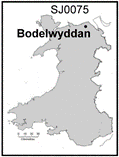
:_______________________________.
Bodffordd (county
of Ynys Môn) (SH4276)
77% Welsh-speaking (Census 2001)
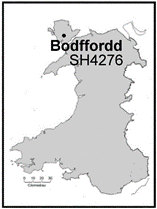
bodiau <BOD-yai, -e> [ˡbɔdjaɪ,
-ɛ]
1
thumbs; plural form of bawd = thumb
:_______________________________.
Bodidda <bod-II-dha> [bɔdˡiˑa]
1 medieval
township in Henryd, Conwy.
"BODIDDA, a township in the parish of Gyffin, and hundred of Isaf, in the
county of Carnarvon, North Wales, 1 mile from Conway." National Gazetteer,
1868
2 Name of a house in Llechwedd, Conwy
ETYMOLOGY: Bodidda < Bodiddan (bod = house) + (Iddan male forename)
The name is possibly Iddan < Iuddan (iudd = lord) + (-an diminutive suffix).
For the loss of the final –n, compare
northern colloquial cyfa < cyfan (= complete)
:_______________________________.
bodio <BOD-yo> [ˡbɔdjɔ] (verb)
1 finger, feel between thumb and fingers
bodiodd y defnydd she fingered the cloth, she felt
the cloth between her thumb and fingers
bodio llyfr thumb through a book
Rwyf wedi bodio’r geiriadur hwn bron yn ddyddiol ers blynyddoedd I’ve thumbed through this
dictionary almost every day for years
2 to thumb it, to hitchhike
Peidiwch byth â chodi unrhyw un sy’n bodio wrth ymyl y ffordd No recullis mai un algú que fa
l’autoestop al costat de la carretera
3 grope (= feel or touch with sexual intent)
Aeth o flaen ei well am iddo fodio un o’i gyd-weithwyr ar ôl meddwi
He was sent to court for groping one of his colleagues after getting drunk
ETYMOLOGY: (bawd = thumb) + (-io verb suffix) > bawdio > bodio
(reduction of the
diphthong aw in the penult to the simple
vowel o, a usual feature in Welsh)
:_______________________________.
bodlon <BOD-lon> [ˡbɔdlɔn] (adjective)
1 content
bodlon ar content with
BODLON < BODDLON < BODDLAWN (BODD = satisfaction) + (-LAWN suffix, <
LLAWN = ple)
:_______________________________.
bodloni <bod-LOO-ni> [bɔdˡloˑnɪ] (verb)
1
satisfy
bodloni chwantau rhywiol satisfy sexual urges
2 become satisfied
bodloni ar yr ail orau settle for second best, be
content with second best
bodloni i’r drefn resign oneself to the situation
(‘
bodloni ar wneud rhywbeth resign oneself to doing
something
ROOT: bodlon-
THIRD-PERSON
SINGULAR: (SHORT PRESENT) bodlona
THIRD-PERSON
SINGULAR: (SHORT FUTURE) bodloniff
SECOND-PERSON SINGULAR
IMPERATIVE (LITERARY) bodlona
SECOND-PERSON SINGULAR
IMPERATIVE (SPOKEN) bodlona
SECOND-PERSON PLURAL IMPERATIVE (LITERARY AND SPOKEN) bodlonwch
(BODLON = satisfied) + (-I verbal suffix)
In South Wales the older form BODDLONI (with ‘dd’) is current <bodh-LOO-ni> [bɔðˡloˑnɪ]
:_______________________________.
Bodorgan (county of Ynys Môn) SH3870
72% Welsh-speaking (Census 2001)
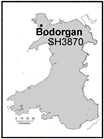
Bodorgan < bod Forgan (dwelling of Morgan)
(bod = dwelling) + soft mutation + (Morgan = male name)
:_______________________________.
bodr <BODR,; BOO-dor> [bɔdr,
ˡboˑdɔr] adjective
1 Soft mutated form (p > b)
of podr, feminine form
of pwdr (= rotten;
barren, poor)
Y Waun Bodr (place name) the barren
moorland meadow
:_______________________________.
boed <BOID> [boɪd]
1 whether it be, should it be,
may it be
boed hindda neu ddrycin fair weather or foul, rain or
shine, whatever the weather
Mi ddof boed hindda neu ddrycin I shall come whatever the
weather
boed hynny fel y bo be that as it may (‘may-be / that / as / (particle) /
may-be’)
:_______________________________.
boed hindda neu ddrycin <boid HIN-dha nei DHRƏ-kin> [bɔɪd ˡhɪnða nəɪ
ˡðrəkɪn] adverb
1 fair weather or foul, rain
or shine, whatever the weather
Mi ddof boed hindda neu ddrycin I shall come whatever the
weather
ETYMOLOGY: “whether it be good weather or bad weather / storm”
(boed = whether it be) + (hindda = good weather) + (neu = or) + soft mutation + (drycin = bad weather / storm)
:_______________________________.
boeler <BOI-ler> [ˡbɔɪlɛr] masculine noun
PLURAL boelerau, boeleri, boelrydd <boi-LEE-rai, -re,-ri,-ridh> [bɔɪˡleraɪ, -rɛ,
-rɪ, -rɪð]
1 boiler
= closed vessel for turning water into steam to drive a turbine or provide heat
2
boiler = closed vessel for providing hot water in a house
3 gwneuthurwr boelerau boiler maker
ETYMOLOGY: English boiler (boil = to boil) + (-er suffix indicating a device),
< Latin bullîre (= to bubble, to
produce bubbles) < bulla (= bubble)
:_______________________________.
boelerdy <boi-LER-di> [bɔɪˡlɛrdɪ] masculine noun
PLURAL boelerdai <boi-LER-dai> [bɔɪˡlɛrdaɪ]
1 boilerhouse
= part of a factory where boilers are housed
ETYMOLOGY: (boeler = boiler) + soft
mutation + (tŷ = house)
:_______________________________.
bogail <BOO-gail, -gel> [ˡboˑgaɪl,
-gɛl] masculine or
feminine noun
PLURAL bogeiliau <bo-GEIL-yai, -ye> [bɔˡgəɪljaɪ,
-jɛ]
1
navel
y bogail / y fogail the navel
Diarhebion 3:7 Na fydd ddoeth yn dy olwg dy hun: ofna yr Arglwydd, a thyn ymaith oddi wrth ddrygioni (3:8) Hynny a fydd iechyd i'th fogail, a mêr i'ch esgyrn
Proverbs 3:7 Be not wise in thy own eyes: fear the Lord, and depart from evil.
(3:8) It shall be health to thy navel and marrow to thy bones
Eseciel 16:4 Ac am dy enedigaeth, ar y dydd y'th anwyd ni thorrwyd dy fogail, ac mewn dwfr ni'th olchwyd i'th feddalhau: ni'th gyweiriwyd chwaith â halen, ac ni'th rwymwyd â rhwymyn
Ezekiel 16:4 As for thy nativity, in the day thou was born thy navel was not
cut, neither wast thou washed in water to supple thee; thou wast not salted at
all, nor swaddled at all
2 boss
of a shield; ornamental stud or knob stud in the centre of a shield
3 hub
(of a wheel), central part of a wheel from which the spokes radiate; usually
the word used for this is both
4 llinyn bogail umbilical cord
llinyn y bogail the umbilical cord
5 toriad y bogail cutting of the umbilical
cord
Roedd o yno yn nhoriad ei fogail (said of some innate badness
in a person, a propensity to commit criminal acts which is typical of the
person's parents and antecedents) (“it was there in the cutting of the
umbilical cord”)
6 syllu ar eich bogail contemplate one's navel,
gaze at one's navel
ETYMOLOGY: bogail < bogeil, which was a singular form
based on the plural form bogeiliau. Historically
the singular form was bogel. < British
< Celtic
The other two British languages: Cornish begel (= navel), Breton begel (= navel)
Cf the related Latin word buccula (= cheek strap;
boss in the middle of a shield), which is a diminutive form of bucca (= mouth).
(It is also the origin of the English word ‘buckle’: Latin buccula > French boucle > English buckle)
NOTE: masculine in the north (y bogail), feminine in the south (y fogail)
Colloquial spellings of bogail, representing
more closely the pronunciation: “bogel, bogal”.
In South-west Wales the plural form bogeiliau > bogeile, bogile
SYNONYM: Colloquially ‘navel’ is botwm bol (= belly button,
‘button (of) belly’) in the north, and botwm bola in the south (=
belly button, ‘button (of) belly’) are also used
:_______________________________.
boi <BOI> [bɔɪ]
pl. bois [bɔɪs, bɔɪz]
1 boy,
lad
yr Hen Foi the Devil
Dewch, bois! Come on, lads!
:_______________________________.
Boi <BOI> [bɔɪ]
1 (ghost
word) Element extracted from the place name Abercwmbói (ST0399), a village in the
county of Rhondda Cynon Taf. It occurs in the street name
‘Boi Close’ in Aberpennar / Mountain Ash. (The Welsh name would be ‘Clos Boi’).
Abercwmbói was mistakenly
understood as aber cwm Boi, and so taken to mean “(the) confluence (in)
(the) valley of Boi”, where Boi is understood as the name of a person.
Historically however the name was Abercynfoi (i.e. Abercýnfoi) (or possibly Abercynfói, with the accent on the
final syllable).
That is, the confluence of Cýnfoi / Cynfói.
The name Cýnfoi / Cynfói is probably a personal name.
The name Boi therefore has no
real justification.
NOTE: Cf a similar change of [nv] > [nb] > [mb] in Welsh:
A local pronunciation, in the county of Penfro / Pembrokeshire, for the name of
the town of Penfro is Pembro
:_______________________________.
bol <BOL> [bɔl] masculine noun
PLURAL boliau <BOL-yai, -e> [ˡbɔljaɪ,
-ɛ]
North Wales, and standard Welsh (in the south, bola, boliau)
1 (a)
belly, paunch; (b) pot = fat belly
2
belly (of an animal)
Matthew 12:40 Canys fel y bu Jonas dridiau a thair nos ym mol y morfil
Matthew 12:40 For as Jonah was three days and three nights in the whale's belly
3
stomach = sac in the alimentary canal where food is stored for digesting
Ma' 'i lyged yn fwy na'i fola His eyes are bigger than his
stomach, he has taken more food than he can manage
4 South
Wales bod gyda chi lond bola o ofn, be scared stiff (“have a
bellyful of fear with you”)
5 un am ei fol / ei bol <iin am ii VOL> [iːn
am iː ˡvɔl] glutton (“(a) person for his / her belly”)
6 bod gennych dân yn y bol be full of fire / energy /
determination (“fire in the belly”)
7 obsolete
bag
Survives in the expression dyrnfol 'bag for the
hand', hedging mitten = leather glove used in trimming hedges, with one space
for the fingers together and another for the thumb
(dyrn- < dwrn = anciently 'hand', now
'fist') + soft mutation + (bol = belly, bag)
8 South
Wales bola coes (qv) calf of the leg (“belly
(of) leg”)
9 llond eich bol a full stomach (“(the)
fullness (of) your stomach”)
bwyta llond eich bol eat one's fill of food
10 llond eich bol the limit of your patience
(“(the) fullness (of) your stomach”)
cael llond bol o be fed up with
11 tywyll fel bol buwch ddu very dark; 'dark like the
belly of a black cow'
also: tywyll fel bol buwch, or simply fel bol buwch
12 place
names marsh (the sense development seems to be ‘belly, paunch’ >
'cavity' > 'marsh')
..1/ bolgoed “the marsh wood”,
marshy wood, wood in marshland.
(bol = marsh) + soft
mutation + (coed = wood)
..a/ Y Bolgoed SN6002 Farm
south-east of Pontarddulais in the county of Abertawe
http://www.geograph.org.uk/browse.php?p=182234
..b/ Y Bolgoed SO0027 Farm near Líbanus, Brycheiniog, Powys
http://www.geograph.org.uk/photo/443208
..2/ bolros “the marsh moor”,
marshy moorland.
(bol = marsh) + soft
mutation + (rhos = moorland).
Bolros SO3940 farm
south-east of Preston-on-Wye in South Herefordshire, England.
The English name for this place, “Bellymoor”, is a direct translation of the
Welsh name, though it appears as Bellamore on present-day Ordnance Survey maps.
It was Bellimoor on the 1831 Ordnance Survey map.
The name appears as “Bolgros” in Liber Landavensis (1130) (“The Book of
Llandaff”) (this spelling represents “bolgh ros”; the ‘gh’ was later lost),
http://www.geograph.org.uk/browse.php?p=216355
map
(bol was from an older form bolgh < British bolg. The spelling in Liber Landavensis represents the older
pronunciation “bólgh-ros”, though the written form “bolgros” would already have
been pronounced “bolros” as in modern Welsh by that time)
..3/ Cors y Bol SH3784 bog in Ynys
Môn; (“(the) bog (of) the marsh”)
http://www.geograph.org.uk/browse.php?p=346057
..4/ Rhos-y-bol SH4288
locality and parish by Amlwch, Ynys Môn; (“(the) moor (of) the marsh”)
http://www.geograph.org.uk/gridref/SH4288
..5/ ceufol = crater
ETYMOLOGY:
(ceu- < cau = empty) + soft mutation + (bol = belly)
Cf the word cest in place
names, with a similar sense development ‘belly, paunch’ > 'cavity, hollow')
13 North Wales mutual
liking
Does dim llawer o fol rhyngddo i â fo
There's no love lost between us, we don't really like each other (“there isn't
a lot of belly between me and him”)
14 county
of Ceredigion bola at a liking for (“a belly / a
stomach towards”)
Does da fi ddim bola ato fe I don't like him (“there
isn’t with me any stomach / liking towards him”)
15
depth, middle
Jona 2:2 Ac a ddywedodd, O'm hing y gelwais ar yr Arglwydd, ac efe a'm hatebodd; o fol uffern y gwaeddais, a chlywaist fy llef
Jonah
2:2 And said, I cried by reason of mine affliction unto the LORD, and he heard
me; out of the belly of hell cried I, and thou heardest my voice.
16 county
of Ceredigion bola berfedd (qv)
17 fish
roe
bol caled hard roe
bol meddal soft roe
bol llaith soft roe Gwynedd, Ceredigion
bol llibin soft roe, Ceredigion
('weak, flaccid')
bol gronell hard roe Ceredigion (grawn = grain, + -ell suffix)
18 bol clawdd bottom of a hedge
cyn gynhysed â neidr ym mol clawdd (“as warm as a snake at the
bottom of a hedge”)
19 (North) bwrw’ch bol wrth rywun unbosom yourself
to, reveal your feelings (“throw your belly to somebody”)
20 magu bol get a pot belly,
get potbellied (‘nurture (a) belly’)
Mae e’n magu bol, ond yw e? He’s getting
potbellied, isn’t he?
bola crochan (South) pot belly (“belly [of] cooking pot”)
bola uwd pot belly (“belly [of] porridge”)
bola cwrw beer belly (“belly [of] beer”)
21 cael caws o fola ci try to do the impossible (“get cheese from (the)
stomach (of) (a) dog”)
22 Dos i chwarae efo dy fol! Get stuffed! (“go to play
with your belly”)
23 bod bron â thorri’ch bol o eisiau (gwneud rhywbeth) be dead keen to do something
(“be almost bursting your belly from (the) want (of) doing”)
Roedd bron â thorri ei fol o eisiau mynd He was dead keen to go
ETYMOLOGY: Welsh bol < *bolgh < British bolg-
From the same British root: Cornish bolghenn (= seedpod), Breton bolc'henn (= seedpod)
From the same Celtic root: Irish bolg (= belly, bag; plural boilg = bellows)
The Celtic word occur in modern French.
Gaulish bolg- > Latin bulga (= bag) > Old French boulge = (bag, leather bag) (modern
French bouge = protuberence).
This Old French word boulge is the source of
two words in modern English
(1) boulge > English bulge (= protuberence).
(2) boulge > diminutive form boulgette > bougette (= pouch, leather pouch) > English budget (= estimate of expenditure).
Related words in Germanic from the same Indo-European source:
Old English belig, belg (= bag) > modern English belly
Old English belig, belg (= bag) > bellow, in modern English usually
in the plural form (a pair of) bellows.
The
related word in German is der Balg (= skin, pelt, snakeskin);
and in the plural form die Bälge (= bellows).
Related to the meaning of 'bellows' is Sanskrit barhi (= chaff)
:_______________________________.
bol cwrw <bol KW-ru> [bɔl
ˡkuˑrʊ] masculine noun
1 beer
belly, pot; large belly from drinking too much beer over the years
Ar y traeth yr oedd y dynion i gyd am y gorau i ddangos eu boliau cwrw a'r merched eu cluniau llawn séliwleit
On the beach all the men were trying to outdo everybody else showing off their
beer bellies and the women their thighs full of cellulite
:_______________________________.
bola <BO-la> [ˡbɔla] masculine noun
PLURAL boliau <BOL-yai, -e> [ˡbɔljaɪ,
-ɛ]
South Wales
1
belly, stomach
2 cafflo bola i daclo pen to rob Peter to bay Paul
(“deceive a belly to decorate a head”, deceive the belly to adorn the head )
The northern form and the standard form is bol
Hence llond bol (North) / llond bola (South) stomachful
ETYMOLOGY: See bol.
In the South, Old Welsh *bolgh > bola (with vocalisation of the
final consonant), whereas in the North *bolgh > bol (with loss of
the final consonant)
:_______________________________.
bola berfedd <BO-la BER-vedh> [ˡbɔla
ˡbɛrvɛð] masculine noun
South Wales
1
bowels
2
innermost secrets
gweud ei fola berfedd reveal / tell his innermost
secrets
ETYMOLOGY: “belly-interior” (bola = belly) + soft
mutation + (perfedd = bowels,
insides)
NOTE: also without soft mutation - bola perfedd
:_______________________________.
bola buwch <BO-la BIUKH> [ˡbɔla
ˡbɪʊx] masculine noun
South Wales (in the North, bol buwch)
1 mor dywyll â bola buwch said of a dark place (“as
dark as (a) belly (of a) cow”)
:_______________________________.
bola haul <BO-la HAIL> [ˡbɔla
ˡhaɪl] masculine noun
South Wales
1 south-facing
part of a mountain or hill which is sunnier than other parts; 'suntrap', 'sunny
side'. The opposite is cil haul ('shady side')
2 Bola-haul locality in the county of
Caerfyrddin. Birthplace of the Independent minister William Lewis (1791-1821).
Nearby is:
Heol Bola-haul (spelt as ‘Heol Bolahaul
/Bolahaul Road’ on the street signs)
street in Cwm-ffrwd SN4217 in the county of Caerfyrddin
ETYMOLOGY:
bola haul < bola’r haul '(the) belly (of) the sun'
(bola = belly) + (yr definite article = the) + (haul = sun). The medial definite
article is frequently lost in place names.
In North Wales it is bol haul (qv)
:_______________________________.
bola perfedd <BO-la PER-vedh> [ˡbɔla
ˡpɛrvɛð] masculine noun
1 See:
bola berfedd
:_______________________________.
bola tost <bo-la TOST> [ˡbɔla
ˡtɔst] masculine noun
South Wales
1
stomach pains, stomachache, belly ache (USA: cramps)
:_______________________________.
bola-heulo <bo-la HEI-lo> [bɔlaˡhəɪlɔ] verb
South Wales
verb without an object
1
sunbathe
ETYMOLOGY: “to belly-sun” (bola = belly) + (heulo = to sun, to expose to the
sun)
:_______________________________.
bolard <BOO-lard> [ˡboˑlard] masculine noun
PLURAL bolardiau <bo-LARD-yai, -e> [bɔˡlardjaɪ,
-ɛ]
1
bollard = post on the edge or the end of a pavement to prevent motor vehicles
from parking, entering
2
bollard = post on a wharf for mooring a boat
ETYMOLOGY: English bollard, probably < bole = tree trunk <
Scandinavian
:_______________________________.
bolas <BOO-las> [ˡboˑlas] feminine noun
1
aphetic colloquial form of eboles ‹e-BOO-les› = filly, female foal.
yr eboles (the filly) > y ’boles > (North-west) y ’bolas
:_______________________________.
bolastwr <bo-LA-stur> [bɔˡlastʊr] masculine noun
PLURAL bolastwyr <bo-LAST-wir> [bɔˡlastwɪr]
South-west Wales
1
glutton, greedy-guts
ETYMOLOGY: bola = belly + ?
:_______________________________.
boles <BOO-les> [ˡboˑlɛs] feminine noun
1
aphetic colloquial form of eboles ‹e- bo -les› = filly, female foal.
yr eboles (the filly) > y 'boles
:_______________________________.
bol haul <bol HAIL> [bɔl
ˡhaɪl] masculine noun
North Wales
1
south-facing part of a mountain or hill which is sunnier than other parts;
'suntrap', 'sunny side'. The opposite is cil haul ('shady side')
The History of the Parish of Llangurig. By Edward Hamer,
Esq., and H. W. Lloyd, Esq. 1875
BOL-HAUL, rotundity facing the sun, the converse of Cil-haul (where the sun
does not shine), a name given to the southern slope
of Cefn-hir-brisg.
ETYMOLOGY:
bol haul < bol yr haul '(the) belly (of) the sun'
(bol = belly) + (yr definite article = the) + (haul = sun). The medial definite
article is frequently lost in place names.
In South Wales it is bola haul (qv)
:_______________________________.
bol-laniad <bol-LAN-yad> [bɔlˡlanjad] (m)
PLURAL bol-laniadau <bol-lan-YAA-dai, -de> [bɔl
lanˡjɑˑdaɪ, -dɛ]
1 pancake landing, belly flop
ETYMOLOGY: (bol- = belly) + soft mutation + (glaniad = landing )
:_______________________________.
bolól <bo-LOL> [bɔˡlɔl] m
PLURAL bololion <bo-LOL-yon> [bɔˡlɔljɔn]
1 (North Wales) bogeyman,
bogey, goblin
ETYMOLOGY: (bo = bogeyman,
goblin) + possibly (lol = nonsense)
:_______________________________.
bom <BOM> [bɔm] › feminine noun
PLURAL bomiau <BOM-yai, -ye> [ˡbɔmjaɪ,
-jɛ]
1 bomb
= explosive device
gollwng bom ar drop a bomb on
bom niwcliar nuclear bomb
ETYMOLOGY: English bomb (= explosive
device) < <French bombe < Italian bomba, probably Latin bombus < Greek bombos (sound of a drum, etc, of
imitative origin)
NOTE: also a masculine noun
:_______________________________.
bomio <BOM-yo> [ˡbɔmjɔ] verb
1 bomb
y penderfyniad i fomio Irác the decision to bomb Iraq
2
(verb without an object) to bomb = to drop bombs
Yn Rhagfyr 1841 dechreuodd y Siapaneaid fomio
In December 1941 the Japanese began bombing
3 awyren fomio bomber (plane
which drops bombs)
4 ei bomio hi bomb along = go at a very
fast pace
5 plymfomio divebomb
ETYMOLOGY: (bom = bomb) (-io suffix for forming verbs)
:_______________________________.
bomiwr <BOM-yur> [ˡbɔmjʊr] masculine noun
PLURAL bomwyr <BOM-wir> [ˡbɔmwɪr]
1
bomber = person who places bombs
2 bomber = aeroplane that drops bombs
ETYMOLOGY: (bom-i- = stem of bomio to place a bomb or bombs) +
(-i-wr suffix = man)
:_______________________________.
bôn, PLURAL: bonion <BOON, BON-yon> [ˡboːn,
ˡbɔnjɔn] (masculine noun)
1 base
yn y bôn basically
2 bongam bandy-leggèd, bow-leggèd
(bôn = cul) + soft
mutation + (cam = crooked)
:_______________________________.
bôn braich <boon BRAIKH> [boːn
ˡbraɪx] masculine noun
1
biceps, upper arm
2 physical
force, brute force, physical effort
Mandral a bôn braich oedd hi y dyddiau hynny dan ddaear
It was a case of a pick and physical strength in those days underground (= in
the mine)
dulliau bôn braich strong-arm tactics, physical
coercion
ETYMOLOGY: “base (of) arm” (bôn = base) + (braich = arm)
:_______________________________.
bonc <bongk > [bɔŋk]
See ponc in this dictionary.
On the webpage ‘Olde Cheshire Dialecte’ there is mentioned: bong, bonk : bank of a river, lake,
etc.
http://www.cheshirelittlefolk.co.uk/Old_dialect.htm
(17-05-2016 - page no longer found)
:_______________________________.
Y Bonc-ddu <bongk-DHII> [bɔŋk
ˡðiː]
1 street name in
Rhosllannerchrugog (county of Wrecsam)
ETYMOLOGY: ‘the black bank’ (y = definite
article) + soft mutation + (ponc = bank) + soft
mutation + (du = black)
:_______________________________.
boncyff, PLURAL: boncyffion <BONG-kiff, bong-KƏF-yon> [ˡbɔŋkɪff,
bɔŋˡkəfjɔn] (masculine noun)
1 tree stump
ty boncyffion – log house
BÔN CYFF ‘base of a trunk > quasi-compound BONCÝFF > accent
shift BÓNCYFF
(BÔN = base) + (CYFF = trunk)
:_______________________________.
boncyn, PLURAL: bonciau <bongk-DHII> [ˡbɔŋkɪn,
ˡbɔŋkjaɪ, -jɛ] (masculine noun)
1 bank, rising ground, hillock
Boncyn y Beddau “(the) bank (of) the graves”, SO1098 east of
Llangynog, Powys
(boncyn = bank) + (y = definite article) + (beddau = graves, plural of bedd = grave)
http://www.geograph.org.uk/gridref/SO1098
map, llun / map, photo
ETYMOLOGY: (bonc = bank, slope) +
(-yn diminutive
suffix)
Bonc is from midlands
English bonk (= bank, slope)
NOTE: English bank > Welsh banc, English bonk > Welsh bonc, boncyn, ponc, poncen
:_______________________________.
bondigrybwyll <bond-i-GRƏ-builh> [bɔndɪˡgrƏbʊɪɬ] (adv)
1 dare I say it, that everyone
talks abou about, which is receiving so much attention these days, the subject
of so much talk,
the much-mentioned, scarcely mentionable, best not mentioned; (as if an
adjective) much talked-about, notorious, well.known
ETYMOLOGY: bondigrybwyll = na bo ond ’i grybwyll = which might not be
except for its mentioning
(na = which-not) + (bo = (it) might be) + (ond = but, except) + (’i / ei = its) + soft mutation + (crybwyll = mention, mentioning)
y consensws bondigrybwyll the consensus which everyone talks about
dim ond ugain mylynedd y bu’r tai newydd yn sefyll - bu rhaid eu dymchwel
am mai fersiynau newydd o'r slymiau yr oeddynt mewn gwirionedd -
y 'two-up-and-two-down' bondigrybwyll
The
houses stood for only twenty years - they had to be demolished since they were
new versions of the slums in reality - the notorious ‘two up and two down’
(houses with two rooms upstairs and two downstairs)
NOTE: Although the form in used with a masculine singular noun tends to be used
with a feminine singular noun or a plural noun too,
stricty speaking the
forms are different:
a) if referring to a masculine noun: bondigrybwyll (= ei grybwyll)
b) if referring to a feminine noun: bondichrybwyll (= ei chrybwyll)
c) b) if
referring to a plural noun: bondicrybwyll (= eu crybwyll)
:_______________________________.
bonedd <BOO-nedh> [ˡboˑnɛð] (masculine noun)
1
nobility, gentry
Bonedd a ddwg gyfrifoldeb Noblesse oblige = to be born
into the nobility implies the need for high moral principles and just behaviour
(“(it-is) nobility which brings responsibility”)
2 bonheddwr nobleman, bonheddes noblewoman, boneddiges noblewoman
:_______________________________.
boneddiges, PLURAL: boneddigesau <bo-ne-DHII-ges, bo-ne-dhi-GE-sai, -se> [bɔnɛˡðiˑgɛs, bɔnɛðɪˡgɛsaɪ,
-sɛ] (feminine noun)
1 noblewoman
y foneddiges the noblewoman, the gentlewoman
:_______________________________.
boneddigion <bo-ne-DHIG-yon> [bɔnɛˡðɪgjɔn] (npl)
1 nobility, gentry
(bonheddig, boneddig- = (adj) noble) + (-ion = substantive plural suffix)
:_______________________________.
bones <BO-nes> [ˡboˑnɛs] feminine noun
PLURAL: bonesau <bo-NE-sai, -se> [bɔˡnɛsaɪ,
-sɛ]
1 gentlewoman
ETYMOLOGY: bon- (stem of bonheddes = lady) + (-es suffix)
Michael D. Jones (the founder of the Welsh settlement in Patagonia) coined the
word bones (= lady) (First
example c.1876).
The corresponding
masculine form is bonwr.
:_______________________________.
bonesig <bo-NE-sig> [bɔˡnɛsɪg] feminine noun
PLURAL: bonesigau <bo-ne-SII-gai, -ge> [bɔnɛˡsi·gaɪ,
-gɛ]
1
(title) Lady (peer; wife of a peer)
Y Fonesig Rees Lady Rees
2 (title) Miss
ETYMOLOGY: bonesig (first example
c. 1898) is (bones = lady) + (-ig diminutive suffix added to
nouns)
:_______________________________.
bongam <BON-gam> [ˡbɔngam] › adjective
1
bandy-leggèd, bow-leggèd
Fongam Epithet in
Middle Welsh - Deicws Fongam c1450 “bandy-leggèd David” (Deicws < Dafydd = David)
2 Mae’n fingul, mae’n fongam, mae’n wargul, mae’n wyrgam description of a bridge by
Edward Richard, Ystradmeuirg 1803 (Geiriadur Prifysgol Cymru / University of
Wales Dictionary t300)
It is narrow-edged, it is bandy-leggèd (= one of the bases is out of position),
it is narrow-humped, it is leaning to one side
ETYMOLOGY: (bôn = cul) + soft
mutation + (cam = crooked)
:_______________________________.
bongorff <BON-gorf> [ˡbɔngɔrf] masculine noun
PLURAL bongyrff <BON-girf> [ˡbɔngɪrf]
1
trunk (of the body)
ETYMOLOGY: “base-body” (bôn = base) + soft
mutation + (corff = body)
:_______________________________.
bonhedd- form of bonedd (= nobility) before a final
syllable beginning with a vowel
:_______________________________.
bonheddig <bon-HEE-dhig> [bɔnˡheˑðɪg] (adjective)
1 noble, of gentle birth
gŵr bonheddig gentleman
byw fel gŵr bonheddig live the life of
Riley (“live like a gentleman”)
2 ffug-fonheddig pseudo-aristocratic
3 boneddigion (qv) noblemen, gentlemen
:_______________________________.
bonheddwr, PLURAL: bonheddwyr <bon-HEE-dhur, bon-HEDH-wir> [bɔnˡheˑðʊr,
bɔnˡhɛðwɪr] (masculine noun)
1 nobleman
:_______________________________.
bônt <BOONT> [boːnt] verb
1 they
may be
Y mae’r boblogaeth oll, o ba genedl bynnag y bônt, yn cael hwyl ar eisteddfod yr Wladfa
All the population, regardless of nationality (of whatever nation they may be),
enjoy the Gwladfa eisteddfod
:_______________________________.
Y Bont-faen <ə bont VAIN> [ə
bɔnt ˡvaɪn] settlement name
1 SS
9974 locality in the county of Bro Morgannwg (South-east Wales).
One local pronunciation was Bom-ffään <bom FÄÄN> [bɔm
ˡfæːn] (‘ää’
like the ‘e’ in English ‘bed’ made long)
English name: “Cowbridge”
2
parish in this place
(1961) population: 1,025; proportion of Welsh-speakers: 6%
(1971) population: 1,150; proportion of Welsh-speakers: 6%
3 As a
reference point - in place-name tags in Bro Morgannwg
Llanfihangel y Bont-faen (to distinguish it from many
other places called Llanfihangel)
Llandochau’r Bont-faen (to distinguish it from Llandochau Fach, near Penárth)
ETYMOLOGY: “the stone bridge” (y = the) + soft mutation + (pont = bridge) + soft mutation + (maen = bridge)
:_______________________________.
Y Bont Gam <ə bont GAM> [ə
bɔnt ˡgam] feminine noun
1 name
of the bridge over the river Taf in central Pont-ty-pridd, South-east Wales
ETYMOLOGY: (“the humpbacked bridge”)
(y = the) + soft
mutation + (pont = bridge) + soft
mutation + (cam = humpbacked)
:_______________________________.
Y Bont-goch <ə bont GOOKH> [ə
bɔnt ˡgoːx] feminine noun
1 SN6886 locality by
Tal-y-bont (county of Ceredigion). Alternative name: Elerch
ETYMOLOGY: “the red bridge” (y = the) + soft
mutation + (pont = bridge) + soft
mutation + (coch = red)
:_______________________________.
Y Bont Grog <ə bont GROOG> [ə
bɔnt ˡgroːg] feminine noun
1
locality in Dyffryn Camwy (Patagonia)
ETYMOLOGY: “the hanging bridge, the suspension bridge” (y = the) + soft mutation + (pont = bridge) + soft mutation +
(crog = hung,
suspended)
:_______________________________.
Y Bont Haearn <ə bont HEI-arn> [ə
bɔnt ˡhəɪarn] feminine noun
1 a historic iron bridge over
the Taf in Merthyrtudful, demolished in the 1960s
Local form: y Bont Harn <ə bont HARN> [ə
bɔnt ˡharn],or rather y Bont 'Arn
(in south Wales haearn > harn; in south-east Wales h is generally
absent in the traditional spoken Welsh of the region)
ETYMOLOGY: “the iron bridge” (y = the) + soft
mutation + (pont = bridge) + (haearn = iron)
:_______________________________.
Y Bont Harn <ə bont HARN> [ə
bɔnt ˡharn] feminine noun
1 see:
y Bont Haearn
:_______________________________.
Y Bontnewydd <ə bont NEU-idh > [ə
bɔnt ˡnɛʊɪð] feminine noun
1 SH4859
locality by Caernarfon (county of Gwynedd)
Welsh-speakers
(Census 2001) 84%
2 SH7720
locality in the district of Meirionnydd (county of Gwynedd)
3 ST2197
locality in the county of Caerffili.
The local pronunciation in Welsh was Bonnewydd.
English name: “Newbridge”
4 SN6165
locality 6km south of Llangwyryfon, county of Ceredigion
5 SJ0170
locality on the river Elwy, south-west of Llanelwy
6 Some towns of this name are distinguished by the addition of an identifying
tag:
Y Bontnewydd ar Wy SO0158 (qv)
ETYMOLOGY: “the new bridge” (y = the) + soft
mutation + (pont = bridge) + (newydd = new)
:_______________________________.
Y Bontnewydd ar Wy <ə bont NEU-idh ar UI> [ə bɔnt ˡnɛʊɪð
ar ˡʊɪ] feminine noun
1 SO0158
locality in the district of Maesyfed (county of Powys).
English name: “Newbridge on Wye”
ETYMOLOGY: “the place called 'Bontnewydd' which is on the river Gwy”
(ar = on) + soft
mutation + (Gwy = river name).
Y Bontnewydd is “the new bridge” (y = the) + soft mutation + (pont = bridge) + (newydd = new)
:_______________________________.
Bôn-y-maen (county d’Abertawe) (SS6895)
10% Welsh-speaking (Census 2001)

(BÔN = base) + (Y = definite article) + (MAEN = standing stone)
:_______________________________.
bopa <BO-pa› [ˡbɔpa] (f)
1 auntie
Diminutive form of modryb (= aunt)
ETYMOLOGY:
..a/ bo- (infant imitation of the first syllable of modryb = aunt)
..b/ redupiclated syllable *bobo
..c/ *bobo > boba The diminutive suffix –a, used with fond
names of relatives) replaces the final o
Cf tada (= daddy) for tad (= father)
..d/ boba in the south-east becomes bopa (the consonants b-d-g at the head of the final syllable are devoiced to p-t-c)
:_______________________________.
bord, PLURAL: bordydd <BORD, BOR-didh> [ˡbɔrd,
ˡbɔrdɪð] (feminine noun)
1
(South Wales) table
:_______________________________.
borden <BOR-den> [ˡbɔrdɛn] masculine noun
PLURAL bordiau <BORD-yai, -ye > [ˡbɔrdjaɪ,
-jɛ]
1 borden wal plural bordiau wal (American: baseboard)
(Englandic: skirting board)
ETYMOLOGY: (bord = board) + (-en diminutive suffix)
:_______________________________.
border <BOR-der> [ˡbɔrdɛr] m
PLURAL borderi, borderydd <bor-DEE-ri, -ridh> [bɔrˡdeˑrɪ,
-rɪð]
1 border = strip of ground
planted with flowers or vegetables at the side of a path in a garden
Y Border Bach the little border
poem by William Crwys Williams (Crwys) (1875-1968)
ETYMOLOGY: English border < Middle
French bordure < border (= to be a border). Of
Germanic origin bord (= the side of a
ship), related to modern English board
Modern French border (= to border, to
edge); (trees) to line (the road); to plank (a ship);
bordure (= border,
fringe, kerb)
:_______________________________.
bord gron, PLURAL: bordydd crynion <bord GRON, BOR-didh KRƏN-yon> [bɔrd ˡgrɔn, ˡbɔrdɪð
ˡkrənjɔn] (feminine noun)
1 round table
2
round table = discussion (around a table); (both in South Wales and North
Wales, though ‘bord’ is generally a southern form and ‘bwrdd’ is used in the
North for ‘table’)
:_______________________________.
bore <BOO-re> [ˡboˑrɛ] masculine noun
PLURAL boreau <bo-REE-ai, -e> [bɔˡreˑaɪ,
-ɛ]
1
morning = the period from dawn to midday
Yn yr oriau mân fore’r ail o Fawrth in the early hours of the
morning of the second of March
y bore yma, y bore ’ma this morning
bore heddiw this morning
heddiw'r bore adverb this morning
bore ddoe <bo re DHOI> (adv) yesterday morning
bore ’fory tomorrow morning
bore trannoeth the following morning
yn y bore <ən ə BOO re>
(adv) in the morning
2 bore da <bo re DAA> sentence substitute good morning
3 morning =
beginning of the day, dawn
y bore bach (“the little morning”) dawn
yn y bore bach (“in the little morning”) (adv) very early in the morning
4 morning = the
period of twelve hours from midnight to midday
5
morning = the hours of darkness after midnight
Wyddoch chi faint o'r gloch y daeth hi adre neithiwr, neu'r bore ’ma y dylswn i ddweud? Tri o'r gloch
Do you know what time she came home last night, or this morning should I say?
Three o' clock
Yn oriau mân y bore in the early hours of the
morning
dau o'r gloch yn y bore two o' clock in the morning
6
morning = the first part of the working day or school day, until lunch time (at
12.00, 1.00, or 2.00)
cael bore rhydd have the morning off
7
morning = the first part of anything
bore eich oes one's childhood (“(the)
morning (of) one's life”)
ym more eich oes early on in one's life
ym more amser at the dawn of time
8 Seren y Bore <SEE-ren ə BOO-re> [ˡseˑrɛn
ə ˡboˑrɛ]
or Y Seren Fore <ə SEE-ren VOO-re> [ə
ˡseˑrɛn ˡvoˑrɛ] the morning star
= the planet Venus
9 ben bore adverb = very early
in the morning, first thing in the morning
10 bore Gwener, bore dydd Gwener Friday morning
fore Gwener adverb on Friday
morning, Friday morning
pob bore Gwener every Friday morning (is a
problem for me, etc)
bob bore Gwener adverb every Friday
morning (I go to work an hour later, etc)
11 bore yfory, bore fory adverb tomorrow
morning
12 bore ddoe adverb yesterday
morning
ddoe'r bore adverb yesterday
morning
13 y bore cynt adverb the morning
before
14 yn fore <ən VOO re> adverb early
yn fore fore adverb very early in
the morning
15 yn y bore adverb in the morning
yn y bore bach adverb very early in
the morning (“in the little morning”)
yn gynnar yn y bore adverb very early in
the morning
y peth cynta yn y bore adverb first thing in
the morning
16 o fore gwyn tan nos adverb from early
morning till night (“from white morning until night”)
18 qualifier bore, y bore = morning,
belonging to the morning, appearing in the morning
haul y bore the morning sun (“(the) sun
(of) the morning”)
cyfog bore = morning sickness
papur bore = morning newspaper, morning
paper - in contrast to those which come out in the late afternoon and evening (papur gyda'r nos)
19 Nid yn y bore mae canmol diwrnod teg (“it-is-not in
the morning that-there-is (the) praising (of) a fair day”), that is, the
weather in the morning may be fine and sunny, but the afternoon may bring rain.
A favourable situation may suddenly change, wait and see what happens in the
long run.
ETYMOLOGY: Welsh bore < more < *more < British *mârig-
From
the same British root: Cornish bore (= morning), Breton beure (= morning) Cf yfory (ie the (next) morning) = tomorrow, on the morn, on
the morrow
From
the same Celtic root: Irish amáireach (= tomorrow), Scottish a-màireach (= tomorrow)
From the same Indo-European root:
..a/ Germanic - German: morgen (= morning,
tomorrow); English: tomorrow, morning,
..b/ Sanskrit marîcih (= ray of light)
:_______________________________.
bore ffŵl Ebrill <BOO-re FWL E-brilh> [ˡboˑrɛˡ
fuːl ˡɛbrɪɬ] masculine noun
1
April Fool's Day morning, April First. A day when practical jokes are played on
other people. However they are only permissible in the morning; any such joke
after twelve noon brings bad luck to whoever is the perpetrator
ETYMOLOGY: “(the) morning (of) (the) April Fool” (bore = morning) + (ffŵl Ebrill = (the) fool (of) April)
:_______________________________.
boreddydd <bo-REE-dhidh> [bɔˡreˑðɪð] masculine noun
1 archaic
dawn; morning.
Boreddydd, yr ugeinfed o Ebrill, 1840
On the morning of the twentieth of April, 1840
ETYMOLOGY: (bore = morning) +
soft mutation + (dydd = day)
NOTE: Also boreuddydd (= borau + dydd)
:_______________________________.
boreuddydd <bo-REI-dhidh> [bɔˡrəɪðɪð] masculine noun
1 archaic
dawn; morning. See boreddydd
ETYMOLOGY: (boreu < borau = morning) + soft mutation +
(dydd = day)
:_______________________________.
Y Borfa-wen <ə
BOR-va WEN> [ə ˡbɔrva ˡwɛn] (f)
1 farm SO1689 near Ceri, Powys
http://www.geograph.org.uk/browse.php?p=260478
ETYMOLOGY: “the white / the
fair pasture” (y definite article) + soft mutation + (porfa = pasture) + soft mutation +
(gwen, feminine form of
gwyn = white, fair,
splendid)
:_______________________________.
borfa <BOR-va> [ˡbɔrva] (f)
1 soft-mutated form of porfa (= grass, pasture)
:_______________________________.
bòs <BOS> [bɔs] masculine noun
PLURAL bosus <BO-sis> [ˡbɔsɪs]
1
boss, gaffer, chief
Fi yw’r bòs I’m the boss!
Mae’r bòs am i mi weithio’n hwyr The boss wants me to work
late
ETYMOLOGY: Englandic (English of England) boss < American English boss < Dutch baas (= master)
The grave accent is not usually written, though it serves to indicate a short
vowel in what is a long-vowel environment (here, a monosyllable ending in –s)
:_______________________________.
botanydd, PLURAL: botanyddion <bo-TAA-nidh, bo-ta-NƏDH-yon> [bɔˡtɑˑnɪð, bɔtaˡnəðjɔn] (masculine noun)
1 botanist
:_______________________________.
Botegwel <bo-TEG-wel> [bɔˡtɛgwɛl]
1
house name, ‘Fair Prospect’
2 In
Llan-sain-siôr (county of Conwy) by Abergele there is a street called in
English Bodtegwel Terrace (translated into Welsh as Rhes Bodtegwel, but Rhes Botegwel would be more accurate.)
Er na fedr hanner y Cymry ddim iawn seinio’r j a’r ch Seisnig, a’r cyfuniadau Seisnig chst, gst, ths, a ct; etto hwy a dybian fod yr enwau a ’alwan hwy yn Tsurts Street, Sou’ Street, a Fair Prospec’, yn barchusach eu golwg a'u sŵn na'r enwau Cymreig Hewl yr Eglwys, Hewl y De, a Bottegwel.
Although half the Welsh can’t pronounce properly the English j and ch, and the
combinations chst, gst, ths, and ct, they believe that the names that they
pronounce Tsurts Street, Sou’ Street, and Fair Prospec’, are more respectable
to see and hear than the Welsh names Hewl yr Eglwys, Hewl y De, and Bottegwel
(“Seisnigo Enwau Cymréig” (Englishing Welsh Names) / Emrys ap Iwan / Y Geninen
/ Rhif 1 / Ionawr, 1897 / Cyf. XV.)
ETYMOLOGY: Apparently a recent name; Botegwel < Bod Degwel < (bod = house) + soft mutation + (tegwel fair appearance, fair view).
The combination d-d, where the
second d is a soft
mutation of t, generally
becomes t
:_______________________________.
botwm <BO-tum> [ˡbɔtʊm] masculine noun
PLURAL botymau <bo-TƏ-mai, -e> [bɔˡtəmaɪ,
-ɛ]
1
button = small disk for fastening or decorating clothes
2 button = switch in the shape
of a button operated by pressing down
ar wasgiad botwm
at the touch of a button
pwyso botymau'r teledu
press the buttons of the television
botwm larwm alarm button
3 counter in a
boardgame
4 thing of minimal
value
Tydi o fotwm o bwys gen i pwy enillith
I couldn't care less who wins this year (“it isn't a button of weight /
importance with me who will win”)
5 fel botwm (room) neat and
tidy (“like a button”)
ETYMOLOGY: English button < Old French buton < boter (= to thrust); of Germanic
origin, related to the English words butt (= strike with the head or horns); to beat (= to hit)
:_______________________________.
botwm bol <bo-tum BOL> [bɔtʊm
ˡbɔl]
(masculine noun)
1 belly button
:_______________________________.
Botwnnog <bo-TU-nog> [bɔˡtʊnɔg]
1 (SH2631) village
in Gwynedd
ETYMOLOGY: “church (of) Tywynnog”
(bod = church) + soft mutation + (Tywynnog saint’s name) > Bod-dywynnog
> Botywynnog (d-d becomes t)
> Bot’wynnog (vowel lost between two
syllables in the pretonic syllable, resulting in a consonant cluster)
> Bot’w’nnog (diphtong wy in the tonic accent reduced
to simple vowel w – a feature which occurs in
many words in spoken Welsh, of which the most well-known example is probably gwybod (= to know) > gw’bod
The saint’s name Tywynnog <tə-WƏ-nog> [ˡtəˡwənɔg] is a diminutive
form of Gwynnog
(ty = thy, your; serves as a
diminutive prefix) + soft mutation +
(Gwynnog)
Gwynnog is (gwynn- < gwyn = white, pure, holy) + (-og adjectival suffix)
:_______________________________.
bowl <BOUL> [bɔʊl] feminine noun
PLURAL bowliau, bowls <BOUL-yai, -ye,-BOULS> [ˡbɔʊljaɪ,
-jɛ, ˡbɔʊls]
1 bowl
= wooden ball
y fowl = the bowl
2 ala fowliau bowling alley, skittle alley
The modern expression for a bowling alley is alai fowlio (also as ala / ale / ali fowlio)
In Dinbych there is a street called Parc Alafowlia (Post Code LL16
3HZ)
(ala = alley) + soft
mutation + (bowlia, a form of bowliau = bowls)
ETYMOLOGY: English bowl (= bowl) <
French boule (= bowl) <
Latin bulla (= bubble)
:_______________________________.
bowlin <BOU-lin> [ˡbɔʊlɪn] masculine noun
1
bowling, the game of bowls
Occurs at Tal-sarn, Ceredigion in a field name Cae Bowlin (= bowling
green, “field (of) bowling”)
(Cardiganshire Antiquarian Society 1936 / 11 / p61)
ETYMOLOGY: English bowling < to bowl;
English bowl < French boule (= bowl) < Latin bulla (= bubble)
:_______________________________.
bowlio ‹BOUL-yo› v
1 to
bowl
llain fowlio (f) lleiniau bowlio bowling green
ETYMOLOGY: (bowl = bowl) + (-io verbal suffix)
:_______________________________.
bow wow [bou WOU] (-) 1 imitation of the bark of a dog
“Bow wow,” meddai Carlo “Bow wow” said Carlo (= name of
a dog)
·····
Sumbolau:
a A / æ Æ / e E / ɛ Ɛ / i I / o O / u
U / w W / y Y /
MACRON: ā Ā / ǣ Ǣ / ē Ē / ɛ̄ Ɛ̄
/ ī Ī / ō Ō /
ū Ū / w̄ W̄ / ȳ Ȳ /
MACRON
+ ACEN DDYRCHAFEDIG: Ā̀ ā̀ , Ḗ ḗ, Ī́ ī́ , Ṓ ṓ , Ū́
ū́, (w), Ȳ́ ȳ́
MACRON + ACEN DDISGYNEDIG: Ǟ ǟ , Ḕ ḕ, Ī̀ ī̀, Ṑ ṑ, Ū̀ ū̀, (w), Ȳ̀ ȳ̀
MACRON ISOD: A̱ a̱ , E̱ e̱ , I̱ i̱ , O̱ o̱, U̱ u̱, (w), Y̱ y̱
BREF: ă Ă / ĕ Ĕ / ĭ Ĭ / ŏ Ŏ / ŭ Ŭ
/ Ў B5236: 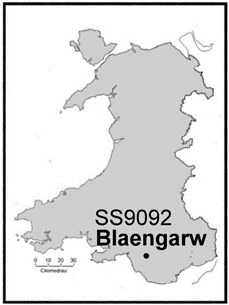 B5237:
BREF GWRTHDRO ISOD: i̯, u̯
CROMFACHAU: ⟨ ⟩ deiamwnt
ˡ ɑ ɑˑ aˑ a: / æ æ: / e eˑe: / ɛ ɛ: / ɪ iˑ i: / ɔ oˑ o: / ʊ uˑ u: / ə / ʌ /
ẅ Ẅ / ẃ Ẃ / ẁ Ẁ / ŵ Ŵ /
ŷ Ŷ / ỳ Ỳ / ý Ý / ɥ
ˡ ð ɬ ŋ ʃ ʧ θ ʒ ʤ / aɪ ɔɪ əɪ uɪ ɪʊ aʊ ɛʊ əʊ / £
ә ʌ ẃ
ă ĕ ĭ ŏ ŭ ẅ ẃ ẁ Ẁ ŵ
ŷ ỳ Ỳ
Hungarumlaut: A̋ a̋
U+1EA0 Ạ U+1EA1 ạ
U+1EB8 Ẹ U+1EB9 ẹ
U+1ECA Ị U+1ECB ị
U+1ECC Ọ U+1EED ọ
U+1EE4 Ụ U+1EE5 ụ
U+1E88 Ẉ U+1E89 ẉ
U+1EF4 Ỵ U+1EF5 ỵ
g yn
yn  aith δ δ £
wikipedia, scriptsource. org
https://en.wiktionary.org/wiki/ǣ
---------------------------------------
Y
TUDALEN HWN: www.[] kimkat.org/amryw/1_vortaroy/geiriadur_cymraeg_saesneg_BAEDD_b_1039e.htm
---------------------------------------
Creuwyd: ?-
Ffynhonnell:
Adolygiad diweddaraf - latest update: 01-04-2017,
09-08-2012, 2010-07-24, 2008-10-01, 11 07 2002 :: 22 09 2002 :: 02 11 2002 ::24
12 2002 :: 25 01 2003 :: 25 02 2003 :: 23 03 2003 :: 29 06 2003 :: 222 07 2003
:: 01 08 2003 :: 2003-10-13 :: 2003-10-27 :: 2003-11-04 :: 2003-11-13 ::
2003-11-24 :: 2003-12-13 :: 2003-12-20 :: 2004-02-13 :: 2004-06-24 ::
2004-08-01 :: 2004-10-23
Delweddau:
|
Freefind. |
|
|