kimkat1071e A Welsh to English Dictionary in
scroll-down format. Geiriadur Cymraeg a Saesneg ar fformat sgrolio-i-lawr.
25-02-2022




|
|
|
Gwefan Cymru-Catalonia |
|

...
|
|
|
|
|
|
|
|
|
|
|
|
|
|
|
|
|
|
|
|
|
|
|
|
|
|
|
|
|
|
|
|
|
|
|
|
|
|
|
|
|
|
|
|
|


cebáb ‹ke BAB, ke BÀ be / ke BABS› (masculine noun) [kɛˡbab, kɛˡbabz]
1 kebab = meat and vegetables
cooked on a skewer
cebáb sbeisiog spicy kebab
(colloquially, cebáb sbeisi)
shish-cebáb shish-kebab
:_______________________________.
cebystr, cebystrau ‹KE bist, ke BƏS tre› [ˡkeˑbɪstr, kɛˡbɪstrɛ, -aɪ] (masculine noun)
(North Wales)
The colloquial form is cebyst’ [ˡkeˑbɪst]
1 halter (rope for holding
animals);
2 hangman’s noose
3 beth gebyst’... (North Wales) = what the hell...?
:_______________________________.
Cedewain ‹ke
DEU ain› [kɛˡdɛuaɪn] (feminine noun)
(kantrev name)
1 medieval territory in the North-east
Llanfair yng Nghedewain former
hamlet in Powys, replaced in 1279 by the Norman borough of Y Drenewydd (“(the
place called) Llanfair (which is) in Cedewain”).
There are many settlements called Llanfair (“Marychurch”) and in most cases
they are differentiated by the addition of a tag, as in this case.
:_______________________________.
cedor <KEE-dor> [ˡkeˑdɔr] feminine and masculine noun
PLURAL cedorau <ke-DOO-rai, -rai, -e> [kɛˡdoˑraɪ, -ɛ]
1 pubic hair(s)
y gedor = the pubic hair
llau cedor pubic lice, lice in the
pubic hair; crab lice, crabs (Phthirus pubis)
Cywydd y Cedor “(the) poem (of )the
pubic hair”, a strict-metre work in praise of the vulva by Gwerful Mechain,
a female poet in the 1400s from the kúmmud of Mechain in Powys.
ETYMOLOGY: Welsh < British < Celtic
Breton: kezhour (= pubic hair),
Irish: caithir (= down, pubic hair)
NOTE: see cedowrach (= deadly
nightshade, belladona), from cedor y
wrach (= (the) pubic hair (of) the witch)
:_______________________________.
cedor gelc <KEE-dor
GELK> [keˑdɔr ˡgɛlk] feminine noun
North Wales
1 hair of the armpit
ETYMOLOGY: “hidden pubic-like hair” (cedor
= pubic hair, hair resembling pubic hair) + soft mutation + (celc = hidden)
:_______________________________.
cedor y wrach <KEE-dor ə wRAAKH> [keˑdɔr ə ˡwrɑːɑˑx] feminine noun
1 see cedowrach
:_______________________________.
cedorol <ke-DOO-rol> [kɛˡdoˑrɔl] adjective
1 pubic
ETYMOLOGY: (cedor = pubic hair) + (-ol = suffix for forming adjectives)
:_______________________________.
cedowrach <ke-DOU-rakh> [kɛˡdourax] feminine noun
1 Atropa belladonna = deadly nightshade,
belladona
y gedowrach = the belladona
ETYMOLOGY: cedowrach < cedor y wrach = ((the) pubic hair (of)
the witch)
NOTE: codwarth (a variant of this
word)
:_______________________________.
cedr ‹KEDR› [ˡkɛdr] masculine non
1 cedar; see cedrwydden
ETYMOLOGY: (in the 1500s) Cymricisation of Latin cedrus (= cedar)
:_______________________________.
Cedron <KE-dron> [ˡkɛdrɔn]
1 Kedron, Kidron;
a ravine below the eastern wall of Jerusalem, a small stream which rises near
Jerusalem, and flows through the Iehosophat valley, disgorging into the Dead
Sea
(1) Ioan 18:1 Gwedi i’r Iesu ddywedyd y geiriau hyn, efe a aeth allan,
efe a’i ddisgyblion, dros afon Cedron, lle yr oedd gardd, i’r hon yr aeth efe
a’i ddisgyblion
John 18:1 When Jesus has spoken these words, he went forth with his disciples
over the brook Cedron, where was a garden, into the which he entered, and his
disciples
2 chapel name (eg for example, at Nanmor, near
Beddgelert) (name said to be given because the chapel was next to a stream)
NOTE: The same stream is mentioned another nine times in the Welsh Bible, but
as Cidron (qv)
:_______________________________.
cedrwydden <kedr-WƏ-dhen> [kɛdrˡwəðɛn] feminine noun
PLURAL cedrwydd <KEDR-widh> [ˡkɛdrwɪð]
1 cedar tree
y gedrwydden = the cedar tree
ETYMOLOGY: (cedr = cedar) + soft
mutation + (gwydden = tree)
:_______________________________.
cedrwydden Líbanus <kedr-WƏ-dhen LI-ba-nis> [kɛdrˡwəðɛn ˡlɪbanɪs] feminine noun
PLURAL cedrwydd
Líbanus <KEDR-widh LI-ba-nis> [ˡkɛdrwɪð ˡlɪbanɪs]
1 cedar of Lebanon
= Cedrus libani, tall tree, level spreading
branches
ETYMOLOGY: (cedrwydden = cedar) + (Líbanus = Lebanon)
:_______________________________.
Cedweli <ked-WEE-li> [kɛdˡweˑlɪ] (feminine noun) (kantrev name)
1 medieval territory in the South-west; town in the
South-west
:_______________________________.
cedyrn <KEE-dirn> [ˡkeˑdɪrn] adjective
1 plural form of the adjective cadarn = strong.
cedyrn rhyfel mighty (literary)
warriors (“strong ones (of) war”)
PLURal adjectives in Welsh are also used as plural nouns - y cedyrn (= the strong)
Ynys y Cedyrn the island of Britain (“(the) island) of the mighty
(warriors)”)
:_______________________________.
Y Cefan <ə KEE-van> [ə ˡkeˑvan]
1 south-eastern form of the place name Y Cefn.
This is a short form of name beginning with cefn (= hill):
..1/ Cefncoedycymer
Ma fa’n byw ar y Cefan He lives in
Cefncoedycymer
..2/ Cefncribwr
NOTE: cefn > cefen <KEE-ven> [ˡkeˑvɛn] in the south. In
south-east Wales, a final e become a, hence cefan. Dialectally there can also be palatalisation of the c to give Y Ciefan [ə ˡkjeˑvan]
:_______________________________.
ceffyl, ceffylau ‹KE
fil, ke FƏ lai, -e› [ˡkeˑfɪl] [kɛˡfəlaɪ, kɛˡfəlɛ] (masculine noun)
Diminutive form: ceffylyn [kɛˡfəlɪn]
A clipped form of
ceffylau is ’ffyle [ˡfəlɛ]
1 horse
2 ceffyl wedi rhedeg a runaway horse
(“hore after running”)
3 ceffyl pren wooden horse
mor
brìn â chachu ceffyl pren (said of something scarce) “as scarce as
the shit of a wooden horse”
4 Ceffylyn Rhygyngog (“(the) ambling nag”) A folk tune in a “The
Cambrian Quarterly Magazine and Celtic Repertory” (1830). The English name is
given as “Galloping Nag”.
:_______________________________.
ceffyl haearn <KEE-fil HEI-arn> [ˡkeˑfɪl ˡhəɪarn] masculine noun
PLURAL ceffylau haearn <ke-FƏ-lai, -le, HEI-arn> [kɛˡfəlaɪ, -ɛ, ˡhəɪarn]
1 (obsolete) (poetic) car
2 (obsolete) bicycle
In the days of long ago, when bicycles were an object of awe and wonder to the
youth of Carnarvon, we never called them by any other name other than ceffyl haearn or car gwyllt
T Hudson Williams (1873-1961), University College, Bangor / Vox Populi - A Plea
for the Vulgar Tongue
NOTE: ceffyl haearn = iron horse, car gwyllt = wild sled
3 (obsolete) train
4 andiron, fire dog
ceffyl haearn = offeryn haearn, ar lun ceffyl, yn cadw'r tân yn drefnus
(t195 Rhai o Eiriau Llafar Sir Drefaldwyn BBCS 1, Rhan 3 Tachwedd 1922)
an iron implement, horse-shaped, which keeps the fire tidy
(Some Spoken Words from Montgomeryshire, BBCS 1, Part 3, November 1922)
ETYMOLOGY: “iron horse” (ceffyl = horse) + (haearn
= iron)
:_______________________________.
cefn, cefnau <KEVN, KEE-ven, KEV-nai, -ai, -e> [kɛvn, ˡkeˑvɛn,ˡkɛvnaɪ, -ɛ] (masculine noun)
1 back
2 cael
eich cefn atoch recover after an illness (“get your back to you”)
3 bod â’ch cefn
at (person) have one’s back turned to (someone); (house) back onto (“be
with your back towards”)
Roedd Elen â’i chefn ato wrth iddi agor y llythyr Elen had her back towards
him as she opened the letter
Mae’r ty â’i gefn at y
parc The house backs
onto the par
4
middle (of a period of time)
gefn trymedd nos in the dead of night (“back (of) heaviness (of) night”)
5 clap ar y cefn
a clap on the back (a sign of congratulation)
6 cadw cefn rhywun plead someone’s cause (“keep (the) back (of)
somebody”)
7 torri cefn y
gwaith break the back of the work
8 adnabod rhywbeth fel cefn eich llaw know something like the back
of your hand
9 wrth gefn set by, in reserve
bod gennych ddigon wrth gefn to have
enough to live on
cadw (rhywbeth) wrth gefn keep something in reserve
cynllun wrth gefn contingency plan
bod â chwestiwn wrth gefn have a question
ready to spring on somebody, have a surprise question, have a question up your
sleeve
10 (Topography) (Place-names) ridge, hill; = low long hill
(According to the journal of the
Cardiganshire Antiquarian Society 1936 / 11 / p65: “ridge or ‘backbone’ of a
mountain or hill. ‘Cefn’ is the word generally applied to a ridge or high land
at the top of a valley”
(See Cefn Coch, Cefn Brith,
etc)
11 Hwnnw oedd y gwelltyn olaf ar gefn y
camel this was the straw that broke the camel’s back, this was the last straw
(“this was the last straw on the back of the camel”)
12 trachefn <tra-KHEE-ven> [traˡxeˑvɛn] obsolete, preposition
behind (tra = beyond) + spirant
mutation + (cefn = back)
In South Wales, trachefn > trachefen, trachefan
“Kae tracheuen y skibbor”, Year
1676; Llangrallo / Laleston (county of Pen-y-bont ar Ogwr / Bridgend)
In modern spelling this is
Cae Trachefen y Sgubor <KAI tra-KHEE-ven
ə SKII-bor> [ˡkai traˡxeˑvɛn ə ˡskiˑbɔr],
a colloquial form of literary Welsh Y Cae Trachefn yr
Ysgubor <ə KAI tra-KHEVN
ər ə-SKII-bor> [ə ˡkai traˡxɛvn ər əˡskiˑbɔr],
though the local pronunciation is likely to have been “Cä’ Trachevan y Sgupor” <ə KÄÄ tra-KHEE-van
ə SKII-por> [ə ˡkæː traˡxeˑvan ə ˡskiˑpɔr],
“the field behind
the barn” (y = the) + (cae = field) + (trachefn = behind)
+ (y = the) + (ysgubor = barn)
13 drachefn <dra-KHEE-ven> [draˡxeˑvɛn] adverb again
NOTE: diminutive form cefnen (qv)
:_______________________________.
Cefncribwr
‹KEE-ven-KRII-bur›
1 village in
Pen-y-bont ar Ogwr
The local form would be Cefancripwr
Cofiant Matthews, Ewenni, John James Morgan, 1922, p397
Meddwyn yn y trên nos Sadwrn yn methu agor ond cil un llygad, yn bloeddio’n
barhaus, “Blodau’r byd yw’r Pil a Chefancribwr.”
A drunk on the
train one Saturday night, with one eye half open (“unable to open but the
corner of one eye”), shouting out constantly, “Y Pîl and Cefncribwr are the
best places on earth.”
ETYMOLOGY: ??cefn y cribwr
:_______________________________.
Cefnbychan ‹ke-ven- bə -khan›
1 locality in
Wrecsam. English name: Newbridge
ETYMOLOGY: y cefn bychan = ‘liitle
hill’ (y definite article) + (cefn = back, hill) + (bychan = little)
:_______________________________.
cefnder ("ce’nder"), cefnderwyr ‹KEVN der, KEN der; kevn DER wir› (masculine noun)
1 cousin
:_______________________________.
cefndir, cefndiroedd ‹KEVN dir, kevn-DII-roidh, -rodh› (masculine noun)
1 background
2 cilio i’r
cefndir take a back seat, fade into the background, move out of the public
eye (“retreat to the background”)
ETYMOLOGY: (cefn = back) + soft
mutation + (tir = land, ground)
:_______________________________.
cefndrum ‹KEVN
drim› (feminine noun)
1 ridge
y Gendrum ‹GEN drim›
:_______________________________.
cefnen, cefnenni <KEV-nen, kev-NE-ni> [ˡkɛvnɛn, kɛvˡnɛnɪ] (feminine noun)
1 hillside, ridge
Mae terfyn y ddwy dafodiaith 'a' ac 'e' ar y gefnen rhwng Pandytudur
a Gwytherin
The boundary between the two dialects ‘a’ and ‘e’ is on the ridge between
Pandytudur and Gwytherin
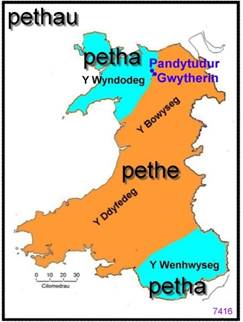
(delwedd 7416)
cefnen dywod, cefnenni tywod sandbank
ETYMOLOGY: (cefn = ridge, hillside) + (en diminutive suffix)
:_______________________________.
cefnffordd, cefnffyrdd ‹KEVN-fordh, KEVN-firdh› [ˡkɛvnfɔrð, ˡkɛvnfɪrð] (masculine noun)
1 ridgeway, road along a ridge
ETYMOLOGY: (cefn = back) + (ffordd = road)
NOTE: In South Wales as cenffordd ‹KEVN-fordh, KEVN-firdh› [ˡkɛvnfɔrð, ˡkɛvnfɪrð]
cefnffordd > ce’nffordd / cenffordd
The loss of [v] in compounds where cefn is the first element is common
Hence Y Genffordd SO1730, a farm south of Talgarth, Powys, and Pengenffordd
SO1730, a hamlet here.
pen y gefnffordd “(the) end (of) the ridgeway” (pen = end) + (y definite
article) + (cefnffordd = ridgeway)
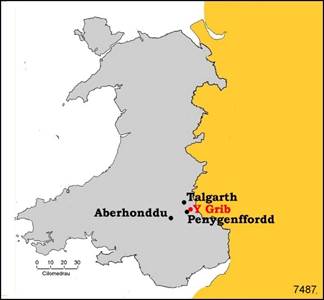
(delwedd 7487)
:_______________________________.
cefnfor, cefnforoedd ‹KEVN vor, kevn-VORR-oidh, -odh› (masculine noun)
1 ocean
ETYMOLOGY: (cefn = back) + soft mutation + (môr = sea)
NOTE: In South Wales as cenfor ‹KEN
vor›.
In many words in
Welsh with the element cefn in the penultimate syllable , the [v]
is elided
cefnraff > cenraff, cefnfordd > cenffordd, cefnder > cender,
cefnllif > cenlli, Y Gefnros > Y Genros / Y Gendros, etc
:_______________________________.
cefngrwm ‹KEVN
grum› (adjective)
1 having a curved
back
2 (Oncorhynchus
gorbuscha) eog cefngrwm (m) eogiaid cefngrwm pink salmon
:_______________________________.
cefn gwlad ‹ke-ven gwlaad› masculine noun
1 countryside =
the rural part of a land;
yng nghefn gwlad in the countryside,
upcountry
byw yng nghefn
gwlad live in the
country
yng nghefn gwlad Cymru in the Welsh
countryside
Un o synau cyfarwydd yr haf yng nghefn gwlad Cymru yn y dyddiau a fu
oedd crawcian y rhegen yr yd
One of the familiar summer sounds in the Welsh countryside in days gone by was
the croaking of the corncrake
Deddf Bywyd Gwyllt a Chefn Gwlad the Wildlife and Coutnryside
Act (= environmental protection law)
Rheolau Cefn Gwlad The Countryside
Code (recommendations and prohibitions for visitors to rural areas – e.g. keep
dogs on a lead, not to light fires, not to leave farm gates open, etc)
Nid yw cefn gwlad yn
Baradwys Ddaearol o bell ffordd
The countryside is not an earthly Paradise by any manner of means
parc cefn gwald country park – a countryside area close to a built-up area to give town-dwellers and
city-dwellers an easily accessible rural environment
ETYMOLOGY: “(the) middle / the back(bone) (of the) country” (cefn = middle; back) + (gwlad = country)
:_______________________________.
Cefnhafodau ‹KEE-ven-ha-VOO-dai,
-de›
1 farm in Powys, in Llangurig parish
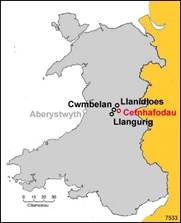
ETYMOLOGY: “cefn yr hafodau” “(the) hill (of) the
summer places / the summer pastures / the summer dwellings” (cefn = back, hill) + + (yr definite article) + (hafodau, plural
of hafod = summer place)
:_______________________________.
cefn haul ‹KEE-ven hail
›
1 place shaded from the sun
yng nghefn haul out of the sun’s reach
Yr oedd yn dyddyn bychan, gwlyb, oer, creigiog, anial,
yn nghefn haul, ar ochr ogleddol y llechwedd serth hwnw a elwir ‘Newydd
Fynyddog.’
It was a tiny smallholding,
wet, cold, craggy, barren, out of the sun’s reach, on
the northern side of the steep slope called “Newydd Fynyddog”
ETYMOLOGY: (cefn = back) + (haul = sun)
:_______________________________.
Cefn Hirfynydd ‹KEE-ven
hir-və-nidh›
1 (SO4194 ) ridge
English name: The Long Mynd (“mynd” is an adaptation of Welsh “mynydd”)
ETYMOLOGY: (“(the) ridge (of) Hirfynydd”)
(cefn = ridge); Hirfynydd is “long mountain” (hir = long) + soft mutation + ( mynydd = mountain,
hill)
:_______________________________.
Cefn Llangatwg ‹KEE-ven
lhan-GAA-tug›
1 place
(formerly?) in Llangatwg Lingoed, Mynwy
http://freepages.genealogy.rootsweb.ancestry.com/~llangattocklingoed/deedswills/hanbury.html#1518B Hanbury Family
Papers
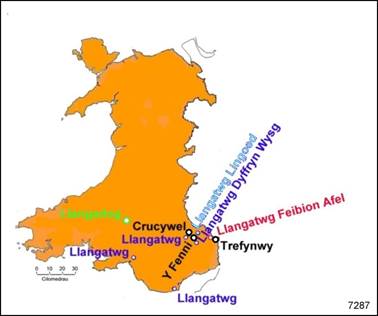
(delwedd 7287)
ETYMOLOGY: (“(the) hill / ridge (of / overlooking) Llangatwg ”)
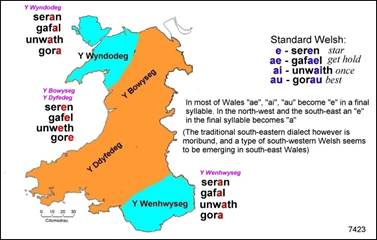
NOTE: The spelling represents the local form Cefen Llangatwg. It would
seem that Llangatwg was not in fact within the south-eastern “final –a” zone
:_______________________________.
cefnllif ‹kevn
-lhi› masculine noun
1 deluge, torrent;
see cenllif
:_______________________________.
cefnogi ‹kev
NO gi› (verb)
1 to back, to support
:_______________________________.
cefn wrth gefn ‹ke –ven
urth ge-ven› adjective
1 back to back
tai cefn wrth gefn back to back
houses
ETYMOLOGY: (cefn = back) + soft
mutation + (cefn)
:_______________________________.
Cefn y Castell ‹ke-ven-ə- ka
-stelh›
1 third highest
(364m) of three peaks of Mynydd Breiddin
English name: Middletown Hill
ETYMOLOGY: (“(the) hill (of) the castle”)
(cefn = back, hill) + (y definite article) + + (castell = castle)
:_______________________________.
Cefn-y-coed ‹kevn-ə-koid ›
1 name of a house
in Bangor (Gwynedd)
2 farm north of Llanfaglan, and to the west of Y Bontnewydd, near Caernarfon,
Gwynedd SH4860
http://www.geograph.org.uk/photo/237254 map
3 farm in Deuddwr SJ2417, Powys
http://www.geograph.org.uk/photo/548122
4 Cefn-y-coed Isaf SH7969 Farm near Eglwys-bach, county of Conwy (though
spelt incorrectly on the Ordnance Survey map as “Cefn-y-Coed Isaf”). isaf =
lower
ETYMOLOGY: “(the) hill (of) the wood”, “wood hill” , “wooded hill”
(cefn = back, hill) + (y definite article) + (coed = wood)
:_______________________________.
Cefn y Fedw ‹kevn-ə- ve
-du›
1 Place by
Rhiwabon. Called by the English ‘Ruabon Mountain’
ETYMOLOGY: “(the) hill (of) the birch trees / (of) the birch wood”
(cefn = back, hill) + (y definite article) + soft mutation + (bedw = birch wood, birch grove)
:_______________________________.
Cefyn <KEE-vin> [ˡkeˑvɪn] (masculine noun)
1 Cymricised form of the English name Kevin, ultimately
from Irish Caoimhín, from caomh (= dear, loved) + diminutive
suffix –ín. The word caomh corresponds to Welsh cu (=
loved)
:_______________________________.
ceg, cegau ‹KEEG, KEE ge› (feminine noun)
1 mouth
y geg = the mouth
2 brechlyn trwy’r geg oral vaccine
(“through the mouth”)
3 tarian geg
(Sport) gumshield
4 cau ceg fel
llyffant = shut up on purpose (in the district d’Arfon, now part of the
county of Gwynedd)
5 bod yng ngheg y byd be common knowledge (“be in the mouth of the world”)
:_______________________________.
cega ‹KÊ
ga› (verb)
1 prattle
cega ar (rywun) go on at (somebody)
:_______________________________.
cegaid ‹ke
-ged› feminine noun
PLURAL cegeidiau ‹ke- geid -ye›
1 mouthful
y gegaid = the mouthful
cymryd gormod o gegaid
bite off more than
you can chew (“take (an) excess of mouthful”)
ETYMOLOGY: (ceg = mouth) + (-aidd suffix for forming nouns
indicating the content or capacity of a container )
NOTE: also cegiad in the north
:_______________________________.
cegddu ‹keg
-dhii› adjective
1 black-mouthed
ETYMOLOGY: (ceg = mouth) + soft
mutation + (du = mouth)
:_______________________________.
cegddu ‹keg
-dhi› masculine noun
PLURAL cegdduon ‹ke- dhî -on›
1 (Merluccius
merluccius) = hake
ETYMOLOGY: “(the) blackmouthed (fish)”, “the fish with a black mouth”
(See the previous entry)
:_______________________________.
cegid ‹kê-gid› plural
1 See cegiden = hemlock
:_______________________________.
cegiden ‹ke-gî-den› feminine noun
PLURAL cegid ‹kê-gid›
1 Conium maculatum hemlock
y gegiden = the hemlock
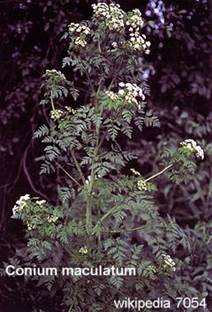
(delwedd 7054)
ETYMOLOGY: Welsh < British
From the same British root: Cornish kegez
(= hemlock), Breton kegid (=
hemlock)
:_______________________________.
cegiden leiaf ‹ke-gî-den lei-av› feminine noun
PLURAL cegid lleiaf ‹cê-gid lhei-av›
1 y gegiden leiaf fool’s parsley Aethusa cynapium; alternative name of gwyn y cloddiau "white
(flower) of the hedges"
ETYMOLOGY: "lesser hemlock" (cegiden
= hemlock) + soft mutation + (lleiaf
= least, smallest)
:_______________________________.
Cegidfa <ke-GID-va> [kɛˡgɪdva] feminine noun
Ordnance Survey Map Reference: SJ2211
1 SJ2211 locality
in northern Powys, north of Y Trallwng /
Welshpool.
English name: Guilsfield
Population: 852 (1961)
Proportion of Welsh-speakers: 14% (1961)
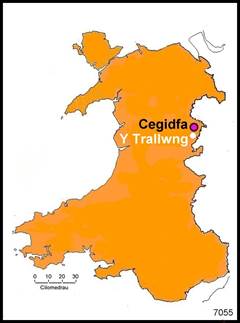
(delwedd 7055)
http://www.geograph.org.uk/photo/268537
2 seat on Cyngor Sir Powys (the county
council of Powys) representing this locality
ETYMOLOGY: "hemlock place", place where hemlock grows (cegid = hemlock) + (-fa suffix, = place).
Unusually this place name, unlike others of the same type, is not preceded by
the definite article (*Y Gegidfa would
be the form otherwise)
:_______________________________.
cegidog ‹ke-gî-dog› adjective
1 abounding in
hemlock
2 feminine noun
place abounding in hemlock
3 Ordnance Survey Map Reference: SH9775 Cegidog former
name of Llan-sain-siôr, between Abergele and Cinmel (county of Conwy)
4 Ordnance Survey Map Reference: SJ2556 Afon Cegidog This
is a river in the county of Wrecsam, 6km north of the town of Wrecsam, running
into the Afon Alun south of the village of Cefn-y-bedd
ETYMOLOGY: (cegid = hemlock) + (-og adjectival suffix, common with
plant names)
:_______________________________.
cegin, ceginau ‹KE gin, ke GI ne› (feminine noun)
1 kitchen
y gegin = the kitchen
2 cegin
gawl PLURAL ceginau cawl soup kitchen
3 cegin fach,
ceginau bach ‹KE gin VAAKH, ke gi
ne BAAKH› back kitchen
4 cegin gefn,
ceginau cefn ‹CE gin GE ven, ke
gi ne KE ven› back kitchen
:_______________________________.
..1 ceglyn ‹ke-glin› masculine noun
PLURAL caglau ‹ka-gle›
1 sheep dropping,
goat dropping
2 Meirionnydd, a district of the county of Gwynedd rascal
ETYMOLOGY: (cagl = excrement) + (-yn, diminutive suffix);
the suffix has caused affection of the preceding
vowel a > e
:_______________________________.
..2
ceglyn ‹keg -lin› masculine noun
PLURAL ceglynnoedd, ceglynnau ‹keg lə –nodh, -ne›
1 mouthwash, gargle; = liquid for gargling;
(colloquially = peth golchi ceg
“thing (for) washing mouth”)
ETYMOLOGY: (first recorded example: 1773) (ceg
= mouth) + soft mutation + ( llyn = liquid )
:_______________________________.
cei ‹kei
› verb
1 you will get,
you will have < cael
cei di you’ll get
Annwyd gei di You’ll catch a cold
Fe’i cei di hi! You’ll cop it!
You’ll get it! (= you will be punished)
:_______________________________.
cei, ceiau 2 ‹KEI, KEI e› (masculine noun)
1 quay
:_______________________________.
ceibr (Southern
‘ceibir’) <KEI-bir> [ˡkəɪbɪr] masculine noun
PLURAL ceibrau <KEI-brai, -bre> [ˡkəɪbraɪ, -brɛ]
1 beam
Pen-rhiw-ceibr place name – from “pen
rhiw’r ceibr” (‘top of the slope of the beam, top of the hill of the beam’ –
probably indicates a place where there were trees which were felled to use as
roof beams) (a linking definite article, in this case ’r, is often omitted in place names)
ETYMOLOGY: Welsh ceibr < British
< Latin * caprio, caprion- (=
beam) < caper (= goat)
From the same British root: Cornish keber
(= beam, rafter, joist), Breton kebr
(= beam, rafter, joist);
Cf other languages also with words derived from Latin *caprio, caprion- (= beam)
(1) French chevron, (2) Irish cabar (= pole, rafter)
Cf Latin capreoli (= little goats,
two pieces of wood forming rafters), Catalan cabrió (= rafter)
NOTE: There is a diminutive form: ceibren,
plural ceibrenni
:_______________________________.
ceibren, ceibrenni <KEI-bren, kei-BRE-ni> [ˡkəɪbrɛn, kəɪˡbrɛnɪ] (feminine noun)
1 beam
y geibren = the beam
2 ceibren cafn
valley rafter, rafter of the angle where two slopes of a roof meet
ETYMOLOGY: diminutive form of ceibr
(= beam), through the addition of the suffix -en
:_______________________________.
Ceidiog <KEID-yog> [ˡkəɪdjɔg] masculine noun
1 stream name
The church of Llandrillo is situated on a mound by the Ceidiof stream not far
from the point that it flows into the river Dyfrdwy / Dee
Nant Ceidiog “(the) Ceidiog stream” name of a house in
Llandrillo
:_______________________________.
ceidwad, ceidwaid <KEID-wad, KEID-waid, -wed> [ˡkəɪdwad, ˡkəɪdwaɪd, -wɛd]
(masculine noun)
1 keeper
2 ceidwad parc park keeper
:_______________________________.
ceiliagwydd <keil-YAA-guidh> [kəɪlˡjɑˑgʊɪð] masculine noun
PLURAL ceiliagwyddau <keil-ya-GUI-dhai,
-dhe> [kəɪljaˡgʊɪðaɪ, -ðɛ]
1 gander = male
goose
2 term of disrespect: noisy fool
3 mis y clacwydd "(the) month (of) the gander" the gandermonth;
the month when the gnader sits on the goose’s eggs; the month when a husband
stays at home to tend to his wife who is about to give birth and do the
domestic chores
NOTE: Colloquial forms are North Wales clagwydd, South Wales clacwydd and clacwdd
ETYMOLOGY: (ceiliag, form of ceiliog = cock, male bird) + soft
mutation + (gwydd = goose); from the same British root: Cornish keliogoedh = gander
:_______________________________.
ceiliog <KEIL-yog> [ˡkəɪljɔg]masculine noun
PLURAL ceiliogod <keil-YOO-god> [kəɪlˡjoˑgɔd]
1 (American: rooster) (Englandic: cock) = male hen
2 cock = the male bird of a named species
ceiliog cwcw = male cuckoo
("male-bird (of) cuckoo")
ceiliog colomen male pigeon, cock
pigeon ("male-bird (of) pigeon")
3 dominant partner in a relationship
Pa un ai’r gŵr ynteu’r wraig yw’r ceiliog?
Which one wears the trousers - the husband or the wife?
("which one whether the husband or the wife is the rooster?")
4 South-east
Wales "cilog" woman
chaser, womaniser, ladies’ man, philanderer
Sometimes as an epithet: Dai Cilog (= Dafydd y Ceiliog) David the womaniser
5 mor sionc â cheiliog ar bolyn ‘as nimble as a rooster on a pole’
6 mor iach â’r
ceiliog ‘as healthy as
the rooster’
7 cock = emblem of the French state; and especially as
a symbol of the rugby team
8 Mae ’na ragor ofnadwy rhwng ebol a cheiliog
They’re as different as chalk from cheese, they’re completely different
(‘there’s a terrible difference / an enormous
difference between a foal and a rooster”)
9 pit ceiliogod (North)
cockpit
Standard form: talwrn
10 talwrn
ceiliogod cockpit
11 ceiliog pen y domen the top dog, king of the castle, the big cheese,
the one who gives the ordres (“the cock on top of the dunghill”)
12 cam ceiliog cockstride
bydd y dydd yn ymestyn gam ceiliog bob dydd the day gets longer by a
cockstride each day
Also in Scots (Germanic language of the Lowlands of Scotland):
Cockstride, n. a short distance; used figuratively of the lengthening of days
A Scots Dialect Dictionary / Alexander Warrack / 1911
(A cock when walking lifts its foot very high, but in fact each step is very
short)
ETYMOLOGY: Welsh ceiliog < ceiliawg < British *kaljâk-os
< Celtic.
From the same British root: Cornish keliog
(= rooster), Breton kilhog (=
rooster).
In Irish: coileach (= rooster).
The bird was so named in Celtic because of its loud crowing. This is borne out
by the meanings of related words in non-Celtic languages:
..a/ Greek kalein (= to call),
..b/ Latin calare (= to call, to
summon)
..c/ English to low (= make the the
sound of a cow)
NOTE: the southern form is generally ciilog
<KII-log> [ˡkiˑlɔg]
(1) In the south, the consonant i at
the beginning of a final syllable is typically absent, hence ceiliog (= rooster, cock) > ceilog
(2) The reduction of the diphthong “ei” to a simple vowel <i> [ɪ] (half long in the penult) is also typical of the
south. Hence ceiliog (= rooster,
cock) > ceilog > ciilog
(3) A similar word showing both these changes is ceiniog (= penny) > ciinog
:_______________________________.
ceilioges <keil-YOO-ges> [ˡkəɪlˡjoˑgɛs]feminine noun
PLURAL ceiliogesau <keil-yo-GE-sai, -se> [kəɪljɔˡgɛsaɪ, -sɛ]
1
bossy woman, dominant woman
ETYMOLOGY: (ceiliog = cock) + (-es noun suffix
indicating a female)
:_______________________________.
ceiliog hwyad,
ceiliogod hwyad <KEIL-yog HUI-ad, keil-YOO-god HUI-ad> [ˡkəɪljɔg ˡhʊɪad, kəɪlˡjoˑgɔd ˡhʊɪad] (masculine noun)
1 male duck
:_______________________________.
ceiliog y rhedyn <KEIL-yog
ə
HREE-din> [ˡkəɪljɔg ə ˡhreˑdɪn] (masculine noun)
1 grasshopper (“the rooster of the bracken”)
:_______________________________.
ceilysyn <kei-LƏ-sin> [kəɪˡləsɪn]masculine noun
PLURAL ceilys <KEI-lis> [ˡkəɪlɪs]
1 skittle
ETYMOLOGY: ceilys is from an earlier form in English of the English
word kails (= skittles, ninepins; =
the plural form of kail).
The English word is from a Germanic root - note the similar words in Dutch kegel (= skittle), German Kegel (= skittle); and French (from a
Germanic word) quille = (skittle)
In Cornubian English (the English of Cornwall): Kailles, ninepins;
Kaille-alley, a ninepin-alley.
(Glossary of Words In Use in Cornwall. (1) West Cornwall,
Miss Margaret Ann Couurtney. English Dialect Society. 1880.)
:_______________________________.
ceillgwd <KEILH-gud> [ˡkəɪɬgʊd] masculine noun
PLURAL ceillgydau <keilh-GƏƏ-dai, -de> [kəɪɬˡgəˑdaɪ, -dɛ]
1 scrotum
ETYMOLOGY: “testicle-bag” (ceill-
penult form of caill = testicle) +
soft mutation + ( cwd = bag)
:_______________________________.
ceimiad <KEIM-yad> [ˡkəɪmjad]masculine noun
PLURAL ceimiaid <KEIM-yaid, -yed> [ˡkəɪmjaɪd, -jɛd]
1 obsolete
champion, hero
2 obsolete eminent
person, distinguished person; found in the epithets of two saints,
Elian Geimiad "eminent Elian”, Beuno Geimiad “eminent Beuno"
ETYMOLOGY: ceimiad < ceimhiad < *ceimp-iad (camp = feat) + (-iad suffix to denote a person)
:_______________________________.
ceimion <KEIM-yon> [ˡkəɪmjɔn]
adjective
1 plural form of cam
= bent, crookèd
2 (a) pennau
ceimion (in the Arfon area of Gwynedd county, north-west Wales) a nickname
for Calvinistic Methodists ("bent heads", "lowered heads")
(b) garrau ceimion bandy legs
ETYMOLOGY: cam + plural suffix -ion ; the ‘i’ of the suffix causes
vowel affection a > ei
:_______________________________.
cein- (1) <KEIN> [ˡkəɪn] adjective
1 penult form of cain
= fair, beautiful
:_______________________________.
cein- (2) <KEIN> [ˡkəɪn] masculine noun
1 place names penult form of *cain = ridge. See Ceinmerch
:_______________________________.
ceinach <KEI-nakh> [ˡkəɪnax] feminine noun
PLURAL ceinachod, ceinych <kei-NAA-khod,
KEI-nikh> [kəɪˡnɑˑxɔd,ˡkəɪnɪx]
1 obsolete hare
y geinach = the hare
ETYMOLOGY: (cein = ?hare) <
British *kasnî; with the addition of
a suffix + -ach.
Cf German Hase (= hare) (Wiktionary:
04-12-2022: From Middle High German has(e),
from Old High German haso, from
Proto-West Germanic *hasō, from
Proto-Germanic *hasô, from *haswaz (“grey”), from
Proto-Indo-European *ḱh₂s-én-. (= grey.)
:_______________________________.
ceinachgi <kei-NAKH-gi> [kəɪˡnaxgɪ] masculine noun
PLURAL ceinachgwn <kei-NAKH-gun> [kəɪˡnaxgʊn]
1 obsolete harrier, dog which hunts hares
ETYMOLOGY: (ceinach) + soft mutation
+ (ci = dog); first example noted in
1850
:_______________________________.
ceiniog <KEIN-yog> [ˡkəɪnjɔg] (feminine noun)
PLURAL: ceiniogau [ˡkəɪnjɔg] [kəɪnˡjoˑgaɪ, -gɛ]
1 penny
y geiniog the penny
un geiniog one penny
dwy geiniog two pence
tair ceiniog three pence
pedair ceiniog four pence
pum ceiniog five pence
chwe cheiniog six pence
saith geiniog / saith ceiniog seven pence
wyth geiniog / wyth ceiniog eight pence
naw ceiniog nine pence
deg ceiniog ten pence
un geiniog ar ddeg eleven pence
deuddeg ceiniog twelve pence
tair ceiniog ar ddeg thirteen pence
pedair ceiniog ar ddeg fourteen pence
pymtheg ceiniog fifteen pence
un geiniog ar bymtheg sixteen pence
dwy geiniog ar bymtheg seventeen pence
deunaw ceiniog eighteen pence
pedair ceiniog ar bymtheg nineteen pence
ugain ceiniog twenty pence
deg ceiniog ar hugain thirty pence
deugain ceiniog forty pence
hanner can ceiniog fifty pence
trigain ceiniog sixty pence
deg ceiniog a thrigain seventy pence
pedwar ugain ceiniog eighty pence
deg ceiniog a phedwar ugain ninety pence
2 peiriant
ceiniogau slot machine, fruit machine, gambling machine (“machine (of)
pennies”)
3 gwario swllt
er ennill ceiniog penny wise and pound foolish (“spending a shilling to
gain a penny”)
4 llygad
y geiniog “(the) eye (of) the penny” miser; (adjective) miserly, stingy, frugal
Siôn lygad y geiniog (also
Siôn llygad y geiniog)
miser
Ieuan lygad y geiniog (also
Ieuan llygad y geiniog)
miser
5 edrych yn llygad y
geiniog count the pennies, be frugal, practise thrift, look twice at every penny
(“look in (the) eye (of) the penny”
6 bod yn gynnil
ar geiniog look twice at every penny, be very careful with money
NOTE: NOTE: the southern form is generally ciinog
<KII-nog> [ˡkiˑnɔg]
:_______________________________.
Ceinmeirch <KEIN-meirkh> [ˡkəɪnməɪrx]
1 division (cwmwd
/ ‘commote’) of the kantrev of Rhufoniog (in the country of Gwynedd Is Conwy, North-east
Wales).
The name survives today as Cinmeirch
<KIN-meirkh> [ˡkɪnməɪrx]
(with simplification of the diphthong ei
> i) in the village name Llanrhaeadr yng Nghinmeirch SJ0863 4km
south-east of Dinbych on the road to Rhuthun.
(‘the Llanrhaeadr which is in the ‘cwmwd’ (commote / district) of Cinmeirch’).
Llanrhaeadr = (the) church (of the) river called Rhaeadr (= waterfall)
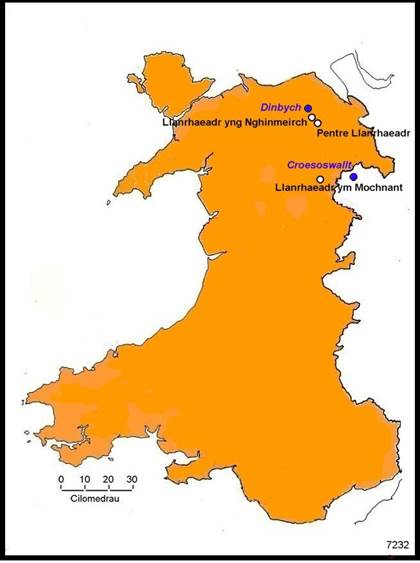
(delwedd 7232)
ETYMOLOGY: Ceinmeirch = (‘(the)
ridge (of the) horses’)
(cein = back, ridge) + (meirch = horses, plural of march = horse)
:_______________________________.
Ceintaidd <KEIN-taidh,
-edh> [ˡkəɪnˡtaɪð, -tɛð]adjective
1
Kentish; pertaining to the county of Kent in the south-east of England
ETYMOLOGY: (Ceint-, penult-syllable form of Caint, a county
of Kent in the south-east of England) + (-aidd suffix
for forming adjectives)
:_______________________________.
Ceintun <KEIN-tin> [ˡkəɪntɪn]
1 English name: Kington (SO2956) English village on
river Arwy 20km west of the English town of Leominster (Welsh
name: Llanllieni) and some 10km south east of the Welsh town of Maesyfed
http://www.geograph.org.uk/photo/19363 Heol yr Eglwys, Church Street
2 Llanfihangel
yng Ngheintun (SJ3614) Welsh name of the English village of Alberbury
(Shropshire)
It is about
“The village of Llanfihangel situated in Ceintun”.
(Llanfihangel = church of Michael
the Archangel) + (yn = in) + nasal mutaiton + (Ceintun)
http://www.geograph.org.uk/gridref/SJ3614 map
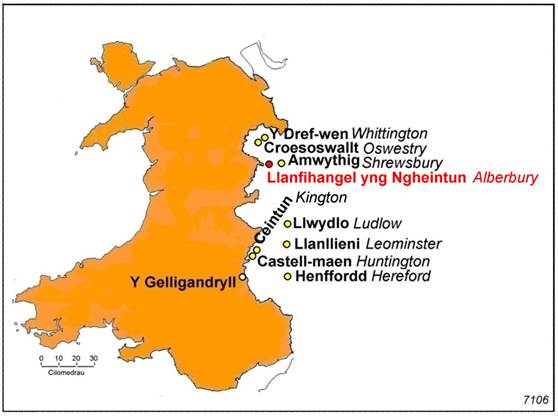
(delwedd 7106)
ETYMOLOGY: Ceintun
(SO2956) from the English name Kington
:_______________________________.
Ceinwedd <KEIN-wedh> [ˡkəɪnwɛð] (feminine noun)
1 woman’s name (cain = fine, splendid; gwedd = aspect,
face)
:_______________________________.
Ceinwen <KEIN-wen> [ˡkəɪnwɛn] (feminine noun)
1 woman’s name (cain = fine, splendid; -wen = suffix)
:_______________________________.
ceir <KEIR> [kəɪr] verb
1 (impersonal
form, present-future tense of cael =
to get, to receive); is got, will be got, is had, will be had, there is, there
are, there will be
Blew geifr, glaw geir (= glaw a
geir)
Weather saying – cirrus clouds bring rain (‘hairs of goats, ‹it is› rain that will be had’)
Ni cheir y melys heb y chwerw
There is no happiness without sadness, life is both happiness and sadness (‘it
is not received the sweet without the bitter’)
:_______________________________.
ceir <KEIR> [kəɪr]
1 cars, plural of car (= car)
:_______________________________.
ceirch <KEIRKH> [kəɪrx] (plural noun)
1 oats. See ceirchen
:_______________________________.
ceirchen <KEIR-khen> [ˡkəɪrxɛn] (feminine noun)
PLURAL: ceirch <KEIRKH> [kəɪrx]
1 oat
y geirchen = the oat, the grain of
oats
2 (North-west) Ceirch
iddi! Get moving! (“oats to it?”) (?an alteration of cyrch, from cyrchu =
to take, fetch)
:_______________________________.
Ceirchiog <KEIRCH-yog> [ˡkəɪrxjɔg]
1 Locality
in the parish of Llechylched (SH3476) in the county of Môn.
The old name was Betws y Grog (“(the) church (of) the cross”)
http://www.geograph.org.uk/gridref/SH3476 map
According to Melville Richards (Enwau Tir a
Gwlad, 1998), “mae crog yn
cyfeirio at sgrin yn yr eglwys. Yr enw Saesneg oedd Holy Rood Church.” (= crog refers to a screen in the church. The English name was Holy Rood
Church)
ETYMOLOGY: ??oat field (ceirch = oats) + (-iog, suffix
for forming adjectives; in place names, as a noun. Often indicates a crop or
type of vegetation)
Cf Haydock, Lancashire, apparently an Old Welsh name corresponding to modern heiddiog
(= barley field; haidd = barley)
:_______________________________.
ceiriosen, ceirios <keir-YO-sen> [kəɪrˡjɔsɛn] (feminine noun)
PLURAL: ceirios ‹KEIR-yos›
[ˡkəɪrjɔs]
1 cherry
y geiriosen = the cherry
2 ceirios y gŵr drwg (Atropa
belladona) deadly nightshade (“(the) cherries (of) the bad man / the devil”)
3 ceiriosen
siwgwr PLURAL ceirios siwgwr
glacé cherry
:_______________________________.
Cei’r Llechi <keir LHEE-khi> [kəɪr ˡɬeˑxɪ] masculine noun
1 place name,
Caernarfon (= "slate quay")
:_______________________________.
ceirnos <KEIR-nos> [ˡkəɪrnɔs] plural
1 small heaps,
small mounds, little mounds
With plural suffix -os (diminutives
with -os behave as feminine singular
nouns after the definite article – there is soft mutation)
(found in place names in south Wales)
ceirnos > Y Geirnos
ETYMOLOGY: (curn = pile, heap) + (-os suffix for forming diminutives of
collective nouns, especially those of certain plants) curnos > ceirnos
(with a change to the tonic vowel – possibly the influence of ceirniog = abundant in cairns )
:_______________________________.
ceirw <KEI-ru> [ˡkəɪrʊ] (plural noun)
1 stags; see carw
:_______________________________.
Ceirwyn <KEIR-win> [ˡkəɪrwɪn] (m)
1 male forename
ETYMOLOGY: Apparently (câr- root of caru = to love) ) + (-wyn
suffix for male names, soft-muated form of gwyn = white; fair) >
car-wyn > ceirwyn (the final y causes the preceding a to become the
diphthong ei – cf gwan = weak, plural gweinion; glas = blue, plural
gleision)
:_______________________________.
ceisbwl <KEIS-bul> [ˡk əɪsbʊl] (m)
PLURAL ceisbyliaid <keis-BƏL-yaid, -yed> [k əɪsˡbəljaɪd, -jɛð]
1 (hanes =
history) bailiff, minor justice officer, officer who detains debtors or demands
payment of dents
ETYMOLOGY: Welsh ceisbwl (showing influence of ceis-,
cais = attempt) < English catchpole (= constable) < Norman French cachepol (= chase-hen, chaser of hens), equivalent to Old French chacepol (chacier, modern French chasser, = chase) + (poul = cock)
Poul < Latin pullus (= cock, young animal); cf.
modern French poule (= hen) < Latin pulla (= hen), feminne form of pullus
A catchpole did not catch polls, i.e. heads, nor did
he catch people
with a pole, although a very ingenious implement,
exhibited in the Tower of London Armoury,
is catalogued as a catchpole. It corresponds to a French compound chasse-poule,
catch-hen, in Picard cache-pole, the official's chief duty being to
collect dues, or, in default, poultry.
The Romance of Words / Ernest Weekley, M.A / 1912 / p.153
:_______________________________.
ceisio <KEI-sho> [ˡkəɪʃɔ] (verb)
1 to try, to attempt
2 ceisio gwneud
yr amhosib’ try to do the impossible
3 atgeisio
..a/ to seek again
Corinthiaid-1
atgenhedlu < ad-genhedlu (ad- = re-,
de nou) + mutació suau + (ceisio =
intentar, cercar)
Corinthians-1
..b/ (information) retrieve = to bring (something) out of storage
atgeisio < ad-geisio (ad- = re-,
again) + soft mutation + (ceisio =
search, try)
:_______________________________.
cêl <KEEL> [keːl] (adjective)
1 hidden
2 argel hidden;
secluded
(ar = intensifying prefix) + soft mutation + (cêl = hidden).
3 gogel (obsolete) (= take care, be wary)
(go) + soft mutation + (cel- = to hide) < British <
Celtic *wo-kel
From this the current word diogel (=
safe)
(di) + soft mutation + (gogel).
This corresponds to Cornish diogel,
Breton diogel (= safe)
:_______________________________.
celain <KEE-lain,
len> [ˡkeˑlaɪn, -lɛn] feminine noun
PLURAL celanedd, celaneddau <ke-LAA-nedh,
ke-la-NEE-dhai, -dhe> [kɛˡlɑˑnɛð, kɛlaˡneˑðaɪ, -ðɛ]
1 dead body,
carcase, cadaver, corpse
y gelain = the corpse
Jeremeia 31:40 a holl ddyffryn y celaneddau, a'r lludw, a'r holl feysydd, hyd afon Cidron, hyd gongl porth y
meirch tua'r dwyrain, a fydd sanctaidd i'r Arglwydd;
Jeremiah 31:40
And the whole valley of the dead bodies, and of the ashes, and all the fields
until the brook of Cedron, unto the corner of the horse gate towards the east,
shall be holy unto the Lord
Genesis 15:11 A phan ddisgynnai yr adar
ar y celaneddau, yna Abram a’u tarfai hwynt.
Genesis
syrthio’n gelain drop down dead
saethu (rhywun) yn gelain shoot (someone) dead
2 anything dead
3 marw gelain
stone dead, dead as a doornail
"corpse dead" - (marw =
dead) + soft mutation + (celain =
corpse)
4 celanedd
(qv) = pile of bodies; killing, slaughter
ETYMOLOGY: Welsh < British < Celtic
In Irish collainn (= body, person)
NOTE: celaneddau is a double plural
(-edd) + (-au)
:_______________________________.
celanedd <ke-LAA-nedh
> [kɛˡlɑˑnɛð]
1 dead bodies; plural of celain
2 sometimes as a feminine noun; pile of bodies,
massacre, slaughter, bloodshed; cruelty
Eiseia 33:15 Yr hwn a rodia mewn
cyfiawnder, ac a draetha uniondeb, a wrthyd elw trawster, a
ysgwydo ei law rhag derbyn gwobr, a gaeo ei glust rhag clywed celanedd, ac a
gaeo ei lygaid rhag edrych ar ddrygioni
Isaiah 33:15 He that walketh righteously, and speaketh uprightly; he that
despiseth the gain of oppressions, that shaketh his hands from holding of
bribes, that stoppeth his ears from hearing of blood, and shutteth his eyes
from seeing evil;
chwythu bygythiadau a chelanedd
breathe out threatenings and slaughter
Actau
Acts 9:1 And Saul, yet breathing out threatenings and slaughter against the
disciples of the Lord, went unto the high priest,
3 North Wales
bod yn glana chwerthin be doubled up
with laughter (= "be corpses (from) laughing (so much)") glana < clana / c’lana’ < c’lanadd
< celanadd < celanedd (corpses)
:_______________________________.
celc <KELK> [kɛlk] masculine noun
PLURAL celcau <KEL-kai, -ke> [ˡkɛlkaɪ, -kɛ]
(North Wales)
1 hoard
2 fortune
3 money put by
byw ar eich celc (north-west) live
off your savings
4 deceit
5 (Ceredigion) defect
celc ar = something wrong with (but
not immediately obvious)
Mae rhyw hen gelc arno He’s a bit odd,
there’s something not quite right about him (“there is some old defect on him”)
ETYMOLOGY: Welsh < Irish cealg (=
deceit)
:_______________________________.
celf, celfau <KELV, KEL-vai, -ve> [kɛlv, ˡkɛlvaɪ, -vɛ] (feminine noun)
1 art
y gelf = the art
2 celf a chrefft <KELV a KHREFT> [ˡkɛlv a ˡxrɛft] art and craft
:_______________________________.
celfi <KEL-vi> [ˡkɛlvɪ] (plural noun)
1 furniture; plural of celficyn
:_______________________________.
celficyn, celfi <kel-VI-kin, KEL-vi> [kɛlˡvɪkɪn, ˡkɛlvɪ] (masculine noun)
(South Wales)
1 piece of furniture
2 fan gelfi removal van, furniture van (South)
:_______________________________.
celfyddyd,
celfyddydau <kel-VƏƏ-dhid, kel-və-DHƏƏ-dai, -de> [kɛlˡvəˑðɪd ,kɛlvəˡðəˑdaɪ, -dɛ] (masculine noun)
1 art
2 oriel gelfyddyd PLURAL orielau celfyddyd art gallery
3 celfyddyd yr ogofâu cave art (“art (of) the caves”)
:_______________________________.
Celfyn <KEL-vin> [ˡkɛlvɪn] (masculine noun)
1 man’s name (respelling of English Kelvin)
:_______________________________.
cell, cellau <KELH, KE-lhai, -lhe> [ˡkɛɬ, ˡkɛɬaɪ, -ɬɛ] (feminine noun)
1 cell
y gell = the cell
:_______________________________.
celli <KE-lhi> [ˡkɛɬɪ] feminine noun
PLURAL cellïoedd <ke-LHII-oidh,
-odh> [kɛˡɬiˑɔɪð, - ɔð]
1 wood, spinney
y gelli = the wood
celli geirios cherry orchard
2 Y
Gelligandryll (“the shattered wood”), short form Y Gelli, town in the
county of Powys, on the border with England
3 often in place names with gelli used as if it were the base form, instead of
celli was would be expected
Gelli-gaer < gelli’r gaer, instead of celli’r gaer
ETYMOLOGY: Welsh < British *kall- <
Celtic *kald-
From the same British root:
Cornish kelli (= wood) (as in the Cornish place name Roskelli “promontory of the wood”, in
English “Rosekilly”);
From the same Celtic root: Irish coille (= wood)
Related words in other languages are:
Latin: callis (= glade),
Greek klados (= branch);
German das Holz (= wood), Dutch hout (= wood), English holt
‹hoult› [ˡhɔʊlt] (in place names = wood); cf the Dutch
name Holland (region in the western Netherlands consisting of the tho provinces
of North Holland and South Holland; and as a pars pro toto used to refer to the whole of the
Netherlands. From Middle Dutch holtland (= woodland, wooded land), referring
originally to the region around Haarlem.)
NOTE: “The word "
gelli " is a common name in Merioneth for a farm or field situated in
a sheltered nook.”
Y Cymmrodor. Vol. XXXVIII. 1927. Merioneth Notes.
By T. P. ELLIS,
I.C.S. (retired), M.A., F.R.Hist.S., Author of "Welsh Tribal Law and
Custom"
:_______________________________.
celli geirios <KE-lhi GEIR-yos> [ˡkɛɬɪ ˡgəɪrjɔs] (feminine noun)
PLURAL: cellïoedd ceirios <ke-LHII-oidh, -odh KEIR-yos > [kɛˡɬiˑɔɪð, - ɔð kəɪrjɔs]
1 cherry orchard
:_______________________________.
cellwair <KELH-wair,
-wer> [ˡkɛɬwaɪr, -wɛr] (masculine noun)
1 joke
2 Mae llawer o gellwair yn wir Many
a true word is spoken in jest, Many a truth is said in jest (“a lot of joking is true”)
:_______________________________.
cellwair <KELH-wair,
-wer> [ˡkɛɬwaɪr, -wɛr] (verb)
1 to joke
:_______________________________.
cellweirio <kelh-WEIR-yo> [kɛɬˡwəɪrˡjɔ]
1
joke = make jokes, jest
Tybiai ei frawd a’r gweinidog mai cellwair oedd, ond
yr oedd Ifan mor ddifrifol â mynach His brother and the minister thought that he was
joking, but Ifan was deadly serious (“as serious as a monk”)
ETYMOLOGY: (cellweir- < cellwair = a joke, a wisecrack) + (-io suffix for forming verbs)
NOTE: also cellwair as a verbnoun
:_______________________________.
Celt, Celtiaid <KELT, KELT-yaid, -yed> [ˡkɛlt, ˡkɛltjaɪd, -jɛd]
(masculine noun)
1 Celt
2 The bardic name or pen name of Edward Morgan Humphreys (Dyffrynardudwy
1882-1955), journalist and author
http://cy.wikipedia.org/wiki/Edward_Morgan_Humphreys
:_______________________________.
Celtaidd <KEL-tedh> [ˡkɛltaɪð, -ɛð] adjective
1 Celtic = of the modern
Celts (Welsh, Breton, Cornish, Irish, Scots, Manx)
Yr Undeb Celtaidd The Celtic League
- an organisation which campaigns for the political independence of the Celtic
countries and the restoration of their native languages as the first language
of the country
2 Celtic = related to the Celtic territories
Y Môr Celtaidd the Celtic Sea, the
sea between Wales and Ireland
3 Celtic = of the ancient Celts
4 Celtic = connected with the study of Celtic cultures
and languages
Astudiaethau Celtaidd Celtic Studies
5 Celtic = of a style characteristic of the Celts
telyn Geltaidd Celtic harp
croes Geltaidd Celtic cross
6 ffug-Geltaidd
pseudo-Celtic
ETYMOLOGY: (Celt = Celt) + (-aidd suffix for forming adjectives)
:_______________________________.
Celteg <KEL-teg> [ˡkɛltɛg] feminine noun, adjective
1 Celtic = the
Celtic language which was widely spoken in Europe some two thousand years ago; it
survived only in the islands off the north-western mainland of Europe, where it
it is divided into two groups -
British (eastern - Welsh, Cornish, Breton) and Hibernian (western - Irish,
Scottish, Manx). Also known as P-Celtic (the eastern division) and Q-Celtic
(the western division) because many words with an original initial ‘q’ ‹kw› in Celtic preserved this
sound in Hibernian, although nowadays it is pronounced ‹k›, and in the British group it became ‹p›.
For example, ‘head’ is ceann in
Irish and pen in Welsh.
Latin words in general retained the ‘q’ <kw> [kw] and it survives in the pronunciation in some modern
languages derived from Latin, and in the spelling if not the current
pronunciation of others.
Irish <k> [k] ceithre (= four), Welsh <p> [p] pedwar (= four), Latin <p> [p] quattor (= four), Catalan
<kw> [kw]quatre (= four), French
<k> [k]quatre (= four)
Celteg Q <kel-teg KIU> [ˡkɛltɛg ˡkɪʊ] = Q Celtic
Celteg P <kel-teg PII> [ˡkɛltɛg ˡpiː] = P Celtic
ETYMOLOGY: (Celt = Celt) + (-eg suffix for forming nouns and
adjectives indicating a specific language)
:_______________________________.
Celtegwr <kel-TEE-gur> [kɛlˡteˑgʊr] masculine noun
PLURAL Celtegwyr <kel-TEG-wir> [kɛlˡtɛgwɪr]
1 Celticist
ETYMOLOGY: (Celteg = Celtic language) + (-wr,
'man', agent suffix)
NOTE: Also Celtegydd
:_______________________________.
celu <KEE-li> [ˡkeˑlɪ] verb
1 to hide
2 Llawer gwir gorau ei gelu
Many things are best left unsaid (“many a truth best its hiding”)
3 Ni ellir celu’r ffaith fod... there’s
no disguising the fact that
:_______________________________.
celwydd <KEE-luidh> [ˡkeˑlʊɪð]
PLURAL: celwyddau <ke-LUI-dhai,
-e> [kɛˡlʊɪðaɪ, -ɛ] masculine noun
1 lie, untruth,
fabrication, ‘fairy tale’, ‘pork pie’
llwyth o gelwyddau a pack of lies (“a load of lies”)
2 heb air o gelwydd no kidding, honestly,
“without a word of a lie”
3 clap a chelwydd gossip and lies
4 Mae i bob celwydd ei gymar One lie leads to another
(“there is to every lie its partner”)
celwydd golau a barefaced lie (“a clear / plain / evident lie”) (golau
also means light, illuminated)
celwydd glân golau a barefaced lie (“an evident + pure lie”)
ETYMOLOGY: British "*kalwi-jos"; cf Latin "calumnia" from
an earlier form "calwomnia"
LOCAL VARIANTS: In the north-west celwyddau (= lies)
> clwydda <klu-II-dha> [ˡklʊiˑða]
In the south celwydd (= a lie) >
celwdd <KEE-ludh> [ˡkeˑlʊð]
:_______________________________.
celwyddgi <ke-LUIDH-gi> [kɛˡlʊɪðgɪ] masculine noun
PLURAL celwyddgwn <ke-LUIDH-gun> [kɛˡlʊɪðgʊn]
(South Wales)
1 liar, storyteller (one who tells untrue stories)
Mae e’n gythraul o gelwyddgi He’s a hell of a liar
ETYMOLOGY: (celwydd = lie) + soft mutation + (ci = dog; also in compound words as a term of contempt for a
person)
:_______________________________.
celwyddog <ke-LUI-dhog> [kɛˡlʊɪðɔg] adjective
1 lying
Mae e’n ddiawl celwyddog He’s a lying bastard
Un celwyddog tost yw a He’s a terrible liar,
Helies through his teeth
NOTE: Also colloquially c’lwyddog, c’lw’ddog
:_______________________________.
celwyddwr <kel-UI-dhur> [kɛˡlʊɪðʊr] masculine noun
PLURAL celwýddwyr <kel-WƏDH-wir> [kɛˡlʊɪðwɪr]
1 liar
Celwyddwr yw e He’s a liar
ETYMOLOGY: (celwydd = lie) + (-wr
suffix = man)
:_______________________________.
celynnen ‹ke-lƏ-nen› [kɛˡlənɛn]
PLURAL celyn <KEE-lin> [ˡkeˑlɪn] feminine noun
1 (Ilex aquifolium) holly, evergreen tree with prickly
leaves and bright red berries; holly bush
y gelynnen = the holly bush
2 {attribute} holly = relating to the plant
pren celyn holly wood, the
wood of a holly tree
dail celyn holly leaves
3 {substantive adjective} holly = made of the wood of a
holly
4 celynennau
‹ke-lə- nə -ne› individual hollies
(in the district of Eifionydd, Gwynedd, in
the form clenna)
Y Clenennau A farm SH5342 by Golan, Gwynedd
http://www.geograph.org.uk/photo/651244 Y Clenennau
The development might have been as follows:
Y Celynennau > Y C’lynennau > Y C’lenennau > (Y C’lenenna’)
5 (plant name) Celynnen
Fair (Ruscus aculeatus) butcher's broom
(“(the) holly (of the Virgin) Mary”)
6 Maescelyn
“maes y celyn” (“(the) field (of) the holly-bushes”)
(maes = field) + (definite article y) + (celyn holly-bushes)
Occurs in the following places as a street name:
..a/ Llanbedr Dyffryn Clwyd, Rhuthun (county of Dinbych) (“Maes Celyn”)
..b/ Llaneurgain (county of Y Fflint) (“Maes Celyn”)
..c/ Coed-y-glyn (county of Wrecsam) (“Maes Celyn”)
7 celynnen > c’lynnen / clynnen
In the 1881 Census (Tywyn,
District 3) David Davies (55) mariner is recorded as living at Pantyglynnen (spelt as “Pant y Glynen”) (= hollow of the holly bush)
ETYMOLOGY: Welsh celyn < British *kolin-
< Celtic
From the same British root:
Breton kelenn (= holly trees /
bushes),
Cornish kelenn (= holly trees /
bushes). It occurs in Cornwall in the place name Roskelenn, in English “Treskilling” (ros = upland, hill) + (kelenn holly trees) “upland of the
holly trees”
From the same Common Celtic root: Irish cuileann
(= holly)
Cf Old English holegn > modern
English holly
Cf English holm oak ‹houm-óuk›.
(The word holm ‹houm›, is a dialect word for holly: holm 1300+ < holin < Old English holegn)
:_______________________________.
celynllwyn ‹ke-LƏN-lhuin› [kɛˡlənɬʊɪn]masculine noun
1 holly bush; (holly = Ilex aquifolium, evergreen tree with prickly leaves and bright red
berries)
Talycynllwyn farm name in Pontarddulais (county of Abertawe),
= tal y c’ynllwyn < tal y
c’lynllwyn < tal y celynllwyn (“place facing /
opposite the holly grove / holly wood / holly-bush”)
(“Place-names in and around the Bont”, Deric John, 1999)
ETYMOLOGY: (celyn = holly bushes) + soft mutation + (llwyn = bush, grove)
> *celyn-lwyn > celynllwyn (loss of the soft
mutation)
NOTE: More usually, rather than celynllwyn, “holly bush” is llwyn celyn.
Other examples with “llwyn” as a second
element are:
bédwlwyn / bed’lwyn (birch grove), also llwyn bedw
dérwlwyn / der’lwyn (= oak grove), also llwyn derw
gruglwyn (heather clump), also llwyn grug
gwernllwyn (alder grove), also llwyn gwern
onllwyn (ash grove), also
llwyn on(n),
:_______________________________.
celynnog <ke-LƏ-nog> [kɛˡlənɔg]
1 (adj) abounding in holly bushes
2 (noun) place abounding in holly bushes, place of holly bushes
It occurs in place names as Clynnog
(= C’lynnog) <KLƏ-nog> [ˡklənɔg] , a
reduced form of celynnog)
..a/ In Llanrhaeadr ym Mochnant there is a farm “Clynog” SJ1225 which is
probably Clynnog
http://www.geograph.org.uk/gridref/SJ1225 map
..b/ Clynnog-fawr SH4149 also known simply as Clynnog
A village in Gwynedd
http://www.geograph.org.uk/photo/191720 y pentref / the
village
ETYMOLOGY: (celynn- penult form of celyn = holly bushes) + (-og adjectival suffix ) > celynnog (adj) (= abounding in
holly bushes) > celynnog (noun) (= place abounding in holly bushes)
:_______________________________.
cemais <KE-mais,
-mes> [ˡkɛmaɪs, -mɛs] (masculine noun)
(obsolete; present in place names)
1 bend in a river
2 bend in the coastline
In place names, often misspelt Cemaes / Cemmaes, through assuming some
connection with maes (= field)
:_______________________________.
Cemais <KE-mais,
-mes> [ˡkɛmaɪs, -mɛs]
1 SH8306 A village in Powys
http://www.geograph.org.uk/browse.php?p=275811 map
The local form is Cemes, and a former spelling “Cemmes” reflects this
local pronunciation:
The Engineer day Coach to Oswestry runs from the Talbot Hotel every Tuesday,
Thursday, and Saturday, at 7 a.m., through Machynlleth, Cemmes, Mallwyd,
Llanfair, and Meifod, returning on the alternate days from Oswestry by 8
o'clock p.m.
New Guide to Aberystwith and its Environs; Third edition, 1858. Thomas Owen
Morgan, Esq.
ETYMOLOGY: The basis of the word is cam (= bent, crooked)
:_______________________________.
Cemais Comawndwr ‹KE-mais, -mes, ko-MAUN-dur› [ˡkɛmaɪs, -mɛs, kɔˡmaʊndʊr]
1 village in the county of Mynwy (Gwent)
In earlier Welsh Cemais Cymawndwr
English name: Kemeys Commander
ETYMOLOGY: “(the place called) Cemais (which is in the possession of a)
commander”.
The church here and its lands were at one time a possession or “commandery” of the Knights Templars, and were administered by a
“commander”.
(The addition of “Comawndwr” serves to distinguish it from other parishes in
Wales with the name Cemais)
:_______________________________.
cemeg <KE-meg> [ˡkɛmɛg] (feminine noun)
1 chemistry
:_______________________________.
cen <KEN> [kɛn] masculine noun
PLURAL cennau <KE-nai, -me> [ˡkɛnaɪ, -mɛ]
Also: cennyn ‹KE-nin› [ˡkɛnɪn], PLURAL cennau
1 (obsolete) skin
(obsolete) hyddgen deerskin
(hydd- < hydd = deer) + soft mutation + (cen = skin)
Cen is also used as a collective /
plural form:
2 scales of a fish or a reptile
3 dandruff
(South Wales: can)
4 lichen
5 fur in pipes
6 film of dirt on the skin
ETYMOLOGY: Welsh cen < British *kend
From the same British root: Cornish kenn
(= skin, hide, peel)
Cognates: Cf Modern English skin < Middle English skin < Old Norse skinn.
The Scandinavian word is a
cognate of Welsh cen
:_______________________________.
cen / ce’n <ken> [kɛn]
1 form of cefn
<KEE-ven> [ˡkeˑvɛn] in the
pronunciation of some compound words where it is the first element.
....1/ First element in a compound word (as a stressed penultimate syllable)
....a/ cefnffordd < ce’nffordd / cenffordd (= ridgeway, road along a ridge) (ffordd = road)
....b/ cefnfor > ce’nfor / cenfor (= ocean) (môr =
sea)
....c/ cefnfro > ce’nfro
> ce’nffro / cenffro (= part of beach above high water for leaving boats) (bro = low-lying land, coastal land)
(change of v > f after n; for other examples see the entry ff)
....d/ cefnlli > ce’nlli / cenlli (= flood, torrent) (llif
= flow)
....e/ cefnrhaff > cefnraff > ce’nraff > cendraff
(= back band of a horse’s harness) (rhaff
= rope)
....2/ qualified first element in a place name (as a prepenultimnate syllable,
or an unstressed penultimate syllable before a final strsesed syllable)
....a/ Cefnsidan > Ce’nshidan / Censhidan (place name, county of Caerfyrddin)
....b/ Cefn-tre-baen > Ce’n-tre-baen > Pentre-baen (place name – “(the) ridge (of) (the farm called)
Tre-baen”)
(Paen = Cymricised form of the
English surname Payne)
....c/ cefn y coed > Cefn-coed
> Ce’n-coed / Cen-coed (place name – “(the) ridge
(of) the wood”
....d/ cefn y don > Cefn-don >
Ce’n-don, Cen-don (place name,
“(the) ridge (of) the pasture” (example quoted in
GPC Geiriadur Prifysgol Cymru / University of Wales Dictionary t1578)
....e/ cefn y lle oer > Cefn-lle-óer
> Ce’n-lle-óer > Ce’nll’óer > Cé’nll’oer > Cé’nll’o’r
> Y Genllor < (place name –
“(the) ridge (of) the cold place”)
2 as a second element
..a/ in the word gwarcen, made up of (gwar) + (cefn)
gwar cefn or gwarcéfn > gwárcefn
> gwarce’n > gwarcen (= upper part of back,
shoulders)
:_______________________________.
-cen <KEN> [kɛn]
1 feminine
diminutive suffix, corresponding to the masculine suffix -cyn
..1/ botgen (obsolete) little thumb
(bawd = thumb;
bawd + cen > ‘bawd-gen’ > ‘bod-gen’ > ‘botgen’)
..2/ ffolcen fool, foolish woman
..3/ hanercen (county of Penfro)
dwarf (woman)
:_______________________________.
Cenarth <KEE-narth> [ˡkeˑnarθ] (feminine noun)
1 village, south-west
:_______________________________.
cenau ‹KEE-nai, -e› [ˡkeˑnaɪ, -ɛ] (feminine noun) masculine noun
PLURAL cenawon <ke-NAU-on> [kɛˡnaʊɔn]
1 cub, whelp
Eseia 11:6 a'r blaidd a drig gyda'r oen, a'r llewpart a orwedd gyda'r myn; y llo hefyd, a chenau y llew, a'r anifail bras, fyddant ynghyd, a bachgen bychan a'u harwain
Isaiah 11:6 The wolf also shall dwell with the lamb, and the leopard shall lie
down with the kid; and the calf and the young lion and the fatling together;
and a little child shall lead them.
2 (North Wales) (term of reproach) rascal, cur, low dog, scoundrel, lout
Jon Robaitsh - y cena drwg iddo Jon Robaitsh - that old scoundrel
cenau glas out and out scoundrel, complete rogue, incorrigible rogue,
despicable person
3
rascal (mildly reproving term for a child)
4 an
element in old personal names
Gorgenau (intensifying prefix gwor,
‘great whelp’
Morgenau (mawr =
great) ‘great whelp’
Rhigenau (rhi =
king) ‘king whelp’
5
See cenawes (North Wales) (colloquially cnawes)
she-cub; (term of reproach for a
woman) vixen
ETYMOLOGY: Welsh < British *kanou-
From the same Celtic root: Irish cana (= literary Irish – cub, whelp; poet of the fourth order)
Related to Latin canis (=
dog), hence English canine
(= doglike; relating to dogs)
NOTE: cenawon colloquial forms: cenafon, cynafon, cnafon
The old form of cenawon had “a” – canawon, but changed in order to
match the singular form, cenau, with an “e”
:_______________________________.
cenawes <ke-NAU-es> [kɛˡnaʊɛs]feminine noun
PLURAL cenawesau <ke-nau-ES-ai, -e> [kɛnaʊˡɛsai, -ɛ]
1 she-cub
2 (North Wales) (term of reproach for a
woman) vixen
yr hen gnawes 'na that old bitch
ETYMOLOGY: (cenaw = cub, whelp) + (-es noun suffix
indicating a female)
NOTE: (colloquially cnawes)
:_______________________________.
cender ‹KEN-der› [ˡkɛndɛr] (m)
1 see cefnder (= male first cousin)
In many words in Welsh with the element cefn in the penultimate syllable
, the [v] is elided / deleted
cefnraff > cenraff, cefnfordd > cenffordd, cefnder > cender,
cefnllif > cenlli, Y Gefnros > Y Genros / Y Gendros, etc
:_______________________________.
cenedl, cenhedloedd <KE-nedl, ken-HED-loidh, -odh> [ˡkeˑnɛdl, kɛnˡhɛdlɔɪð, -ɔð] (feminine noun)
1 nation
y genedl = the nation
cenedl y Cymry “(the) nation (of) the Welsh”, the Welsh nation, Wales
2 (Old Testament) Y
Cenhedloedd the Gentiles = non-Jewish people, non-Jews
Actau 4:27 Herod a Phontius Peilat,
gyda'r Cenhedloedd, a phobl Israel
Acts 4:27 both Herod and Pontius Pilate, with the Gentiles, and the people of
Israel
apostol y cenhedloedd the apostle to
the Gentiles (name given to Saint Paul)
3
Y Cenhedloedd (as used by Christians) the
Gentiles = non-Christian people
:_______________________________.
cenedlaethau <ke-ned-LEI-thai, -e> [kɛnɛdˡləɪθaɪ, -ɛ] (plural noun)
1 generations: see cenhedlaeth
:_______________________________.
cenedlaethol <ke-ned-LEI-thol> [kɛnɛdˡləɪθɔl] (adjective)
1 national
2 national = symbolic of a nation
Yr elc yw anifail cenedlaethol Norwy
Norway’s national animal is the elk
:_______________________________.
cenedlaetholwr <ke-ned-lei-THOO-lur> [kɛnɛdləɪˡθoˑlʊr] masculine noun
PLURAL cenedlaetholwyr <ke-ned-lei-THOL-wir> [kɛnɛdləɪˡθɔlwɪr]
1 nationalist,
‘nationist’ = one who seeks to protect national rights threatened with abolition
by an invading state, or regain the full national rights abolished or
disallowed by an occupying state
2 nationalist, ‘expansionist’ = one who believes in the
superiority of a state and its dominant culture and its right to incorporate
other nations into its territory, eradicate their languages and cultures, and
impose its own linguistic and cultural values
ETYMOLOGY: (cenedlaethol = national)
+ (-wr = person, man); imitation of
the English word nationalist, from (national) + (-ist)
:_______________________________.
cenfaint, cenfeiniau <KEN-vaint, -vent, ken-VEIN-yai, -ye> [ˡkɛnvaɪnt, -vɛnt, kɛnˡvəɪnjaɪ, -jɛ] (feminine noun)
1 flock
:_______________________________.
cenffordd ‹KEN-fordh› [ˡkɛnfɔrð] (f)
1 see cefnfordd (= ridge road)
In many words in Welsh with the element cefn in the penultimate syllable
, the [v] is elided
cefnraff > cenraff, cefnfordd > cenffordd, cefnder > cender,
cefnllif > cenlli, Y Gefnros > Y Genros / Y Gendros, etc
:_______________________________.
cenffro ‹KEN-fro› [ˡkɛnfrɔ] (f)
1 part of beach above high water for leaving boats) (bro = low-lying land, coastal land)
See cefnfro
cefnfro > ce’nfro > ce’nffro / cenffro
In many words in Welsh with the element cefn in the penultimate syllable
, the [v] is elided
cefnraff > cenraff, cefnfordd > cenffordd, cefnder > cender,
cefnllif > cenlli, Y Gefnros > Y Genros / Y Gendros, etc
:_______________________________.
cenfigen <ken-VII-gen> [kɛnˡviˑgɛn] (feminine noun)
1 jealousy, envy
2 bod yn las gan
genfigen be green with envy
:_______________________________.
cengl <KENGL, KE-ngel> [ˡkɛŋl, kɛŋɛl] feminine noun
PLURAL cenglau <KENG-lai, -e> [ˡkɛŋlaɪ, -ɛ]
1 saddle girth,
belly band;
y gengl = the saddle girth
tynháu’r gengl tighten the saddle
girth
2 cengl fain
(said of somebody very thin) (" a thin saddle girth")
3 county of Môn
llacio’r gengal <GE-ngal> [ˡgɛŋal] feminine noun take a break during work;
take some days off from work, take a holiday ("loosen the saddle
girth")
4 skein = loosely tied coil of yarn
ETYMOLOGY: Welsh < British < Latin *cing’la
< cíngula = belt, < cingere to gird.
In English
1.. a Latin masculine form cingulum <SING-yu-ləm> [ˡsɪŋgjʊləm] is used in anatomy - ‘girdle-like ridge around the
base of a tooth’, ‘band of fibres connecting parts of the cerebrum’)
2.. and in surcingle <SƏƏ-sing-gəl> [ˡsəəsɪŋgəl] ( = a girth for a
horse which goes around the body and is used especially with racing horses), a
word taken from French (sur + cengle)
NOTE:
North Wales = cengal (west), cengel (east) <KE-ngal,-KE-ngel> [ˡkɛŋal, ˡkɛŋɛl]
South Wales = cingel (east), cingal (west) ‹ki-ngel,
ki-ngal› <KI-ngel, KI-ngal> [ˡkɪŋɛl, ˡkɪŋal]
:_______________________________.
cenglog <KENG-log> [ˡkɛŋlɔg] adjective
1 (cow) having
streaks
buwch genglog cow with streaks
ETYMOLOGY: (cengl = saddle girth) +
(-og)
:_______________________________.
cenglu <KENG-li> [ˡkɛŋlɪ] verb
1 fasten a girth
around (a horse’s belly)
(Hen Déstament)
Jeremeia 46:4 Cenglwch y meirch, ac ewch
arnynt, farchogion; sefwch yn
eich helmau, gloywch y gwaywffyn, gwisgwch y llurigau
(Old Testament)
Jeremiah 46:4 Harness the horses; and get up, ye horsemen, and stand forth with
your helmets; furbish the spears, and put on the brigadines
2 form into skeins
ETYMOLOGY: (cengl = saddle girth,
skein) + (-u = suffix for forming
verbs)
:_______________________________.
cenglwr <KENG-lur> [ˡkɛŋlʊr] masculine noun
PLURAL cenglwyr <KENGL-wir> [ˡkɛŋlwɪr]
1 reel, hose-reel =
circular box with an axis inside around which a hose or cable is wound for
storage
:_______________________________.
cenhad- <KEN-had...> [ˡkɛnhad...]
1 in derivative
words, the penult form of cennad (=
mission). The original penult form was also cennad, but it has acquired influenced by the organic h- in canhiad-, penult form of caniad
= (obsolete word) permission
:_______________________________.
cenhadaeth ‹ken-hAA-daith, -eth› [kɛnˡhadaɪθ, -ɛθ] feminine noun
PLURAL cenadaethau ‹ke-na-DEI-thai.
-e› [kɛnadˡəɪθaɪ, -ɛ]
1 Religion mission = group of people sent
by a church to a foreign country to promote the religion and do social work
y genhadaeth = the mission
2 Diplomacy diplomatic
mission = group of people in a foreign country representing a country
3 Commerce
trade mission = group of people in a foreign country representing a company or
companies
4 mission = work of such a group
5 mission = buildings of such; mission station
6 llysgenhadaeth
embassy ("court + mission")
ETYMOLOGY: cenhad- (penult form)
< cennad (original penult form)
influenced by the organic h- in canhiad-, penult form of caniad = (obsolete word) permission
:_______________________________.
cenhades <ken-HA-des> [kɛnˡhɑˑdɛs] feminine noun
PLURAL cenadesau <ke-na-DE-sai, -se> [kɛnaˡdɛsaɪ, -sɛ]
1 missionary
(female)
y genhades = the missionary
ETYMOLOGY: (cenhad-, penult-syllable
form < cennad = mission) + (-es, female agent suffix)
:_______________________________.
cenhadfa <ken-HAD-va> [kɛnˡhadva] feminine noun
PLURAL cenhadféydd <ken-had-VEIDH> [kɛnhadˡvəɪð]
1 mission (=
place), mission station, mission house
y genhadfa = the mission house
ETYMOLOGY: (cenhad-, penult-syllable
form < cennad = mission) + (-fa, suffix = place)
:_______________________________.
cenhadol <ken-HAA-dol> [kɛnˡhɑˑdɔl] adjective
1 missionary = undertaking
a religious mission
ETYMOLOGY: (cenhad-, penult-syllable
form < cennad = mission) + (-ol, suffix for forming adjectives)
:_______________________________.
cenhadon <ke-NHAA-don> [kɛˡnhɑˑdɔn] noun plural
PLURal form of cennad, or cenhadwr
:_______________________________.
cenhadu <ken-HAA-di> [kɛnˡhɑˑdɪ] verb
1 work as a
missionary
ETYMOLOGY: (cenhad-, penult-syllable
form < cennad = mission) + (-u, suffix for forming verbs)
:_______________________________.
cenhadwr <ken-HAA-dur> [kɛnˡhɑˑdʊr] masculine noun
PLURAL cenhadon, cenhadwyr <ken-HA-don,
ken-HAD-wir> [kɛnˡhɑˑdɔn, kɛnˡhadwɪr]
1 missionary
ETYMOLOGY: (cenhad-, penult-syllable
form < cennad = mission) + (-wr, ‘man’, agent suffix)
:_______________________________.
cenhedlaeth <ke-NHED-laith, -leth> [kɛˡnhɛdlaɪθ, -lɛθ] feminine noun
PLURAL cenedlaethau <ke-ned-LEI-thai,
-the> [kɛnɛdˡləɪθaɪ, -θɛ]
1 generation = all
the individuals of roughly the same age;
y genhedlaeth = the generation
pobl o’m cenhedlaeth = people of my
generation
2 generation = (as a measure of time) average lifetime
of a generation; the period of years considered to separate one generation from
another (often regarded as being thirty years)
genhedlaeth yn ôl a generation ago
ers cenedlaethau for generations
Buont yn ceisio cael ateb i hyn ers cenedlaethau
They’ve been trying to find an answer for this for generations
cenedlaethau lawer o brofiad many
generations of experience
hyd genhedlaeth a chenhedlaeth from generation to generation
Arhosed ein haith yn ei bri hyd genhedlaeth a
chenhedlaeth
May our language remain predominant over the generations
Croniclau-1 16:15
Cofiwch yn dragwydd y cyfamod; y gair a orchmynnodd efe i fil o
genedlaethau
Chronicles-1 16:16 Be ye mindful always of his covenant; the word which he
commanded to a thousand generations
3 generation = a single step in the evolution of an
animal or a plant etc
4 generation = period of technological development,
differing from a previous period through having general characteristics unknown
in an earlier period
ETYMOLOGY: (cenhedl-,
penult-syllable form < cenhedlu =
propagate) + (-aeth, suffix for
forming nouns)
:_______________________________.
cenhedliad <ke-NHEDL-yad> [kɛˡnhɛdljad] masculine noun
1 procreation
2 propagation
ETYMOLOGY: (cenhedl-,
penult-syllable form < cenedlu =
propagate) + (-iad, suffix for
forming nouns)
:_______________________________.
cenhedlig <ke-NHED-lig> [kɛˡnhɛdlɪg] adjective
1 obsolete pagan
2 masculine noun;
obsolete pagan
ETYMOLOGY: (cenhedl-,
penult-syllable form < cenedl = nation
/ gender / (obsolete) family) + (-ig,
suffix for forming adjectives)
:_______________________________.
cenhedloedd <ke-NHED-lodh, -loidh> [kɛˡnhɛdlɔɪð, -lɔð] noun plural
1 nations
See: cenedl
:_______________________________.
Y Cenhedloedd Unedig <ə ke-NHED-loidh,
-lodh, i-NEE-dig> [ə kɛˡnhɛdlɔɪð, -lɔð, ɪˡneˑdɪg]
1 the United
Nations
:_______________________________.
cenhedlu <ke-NHED-li> [kɛˡnhɛdlɪ] verb
verb without an object
1 procreate = to
create offspring
cenhedlu a magu teulu to procreate and to raise a family
verb with an object
2 (man) beget = to
father, beget a child
Job 38:28 A oes dad i’r glaw? neu pwy a genhedlodd ddefnynnau y gwlith?
Job 38:28 Hath the rain a father? or who hath begotten the drops of dew?
3 (woman) conceive = become pregnant with
cenhedlu plentyn conceive a child, become pregnant
4 engender, give rise to, create, bring about, spawn
William Owen-Pughe a’i dylwyth a genhedlodd erthylod o eiriau megis
"merchaid" a "ciwaid" yn lle "merched" a
"ciwed"
It was William Owen-Pughe and his followers who created such bastardisations of
words as "merchaid" and "ciwaid" instead of
"merched" and "ciwed"
5 atalydd cenhedlu contraceptive
("preventer of conceiving")
6 rheoli
cenhedlu birth control ("regulating conceiving")
7 atgenhedlu regenerate
atgenhedlu < ad-genhedlu (ad- = re-,
again) + soft mutation + (cenhedlu =
procreate, generate)
ETYMOLOGY: (cenhedl-,
penult-syllable form < cenedl =
nation / gender / (obsolete) family) + (-u,
suffix for forming verbs)
:_______________________________.
cenhedlwr <ke-NHED-lur> [kɛˡnhɛdlʊr] masculine noun
PLURAL cenhedlwyr <ke-NHEDL-wir> [kɛˡnhɛdlwɪr]
1 begetter,
progenitor
ETYMOLOGY: (cenhedl-,
penult-syllable form < cenhedlu =
propagate) + (-wr, ‘man’, agent
suffix)
:_______________________________.
cenhinen <ke-NHII-nen> [kɛˡnhiˑnɛn] feminine noun
PLURAL cennin <KE-nin> [ˡkɛnɪn]
1 leek (Allium
ampeloprasum var. porrum (L.), also called allium porrum )
y genhinen = the leek
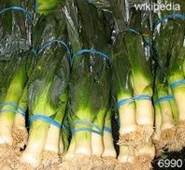
(delwedd 6990)
2 the leek as the national emblem of Wales; probably
because white and green were the colours of the Welsh chiefs in the medieval
period (though apocryphal stories abound of a Welsh army fighting the English
in a leek field, and the Welsh fighters used the leek to identify themselves to
each other)
3 In the phrase of comparison mor lased â’r cennin ("as green as the leeks")
4 Llanbedr y
Cennin (SH7569) village in the county of Conwy ("the
‘Llanbedr’ of the leeks"; Llanbedr = the church of Saint Peter)
ETYMOLOGY: British *kannin-.
..1/ Cornish kinenn (= leek), kinenn ewinek (= garlic);
..2/ Breton kignen (= garlic),
..3/ Irish cainnean (= leek)
The relationship between leek and garlic is seen too in the English word
garlic, a “gar-leek”, “gar” being from an Old English word for “spear”.
:_______________________________.
cenhinen Bedr <ke-NHII-nen
BEDR / BEE-der> [kɛˡnhiˑnɛn ˡbɛdr, ˡbeˑdɛr] feminine noun
PLURAL cennin Pedr <KE-nin PEDR / PEE-der> [ˡkɛnɪn ˡpɛdr, ˡpeˑdɛr]
1 daffodil
(narcissus pseudonarcissus)
2 this flower as a
national symbol of Wales
Cennin-pedr Name of a street in Y Barri (Bro Morgannwg) (spelt as
‘Cennin Pedr’)
ETYMOLOGY: "(the) leek (of) (Saint) Peter")
(cenhinen = leek) + soft mutation +
(Pedr = [Saint] Peter)
:_______________________________.
cenlli <KEN-lhi> [ˡkɛnɬɪ]
1 deluge, flood,
torrent; see cenllif
2 kestrel; see cenlli
goch
In many words in Welsh with the element cefn in the penultimate syllable
, the [v] is elided
cefnraff > cenraff, cefnfordd > cenffordd, cefnder > cender,
cefnllif > cenlli, Y Gefnros > Y Genros / Y Gendros, etc
:_______________________________.
cenllif <KEN-lhi> [ˡkɛnɬɪ] masculine noun
Also in the older form cefnllif
1 deluge, flood,
torrent
Roedd y nant yn rhuthro yn gefnllif gwyllt ar ôl y storm
The stream was a raging torrent (“rushed as a wild torrent”) after the storm
Maesygenlli (“(the) field (of) the
torrent”) street name in Cletwr, Caer-sws (Powys) (apparently cenlli = torrent, but see also cenlli goch)
Llwybr Cenllif place east of
Dolgellau in the county of Gwynedd (name on English maps: Torrent Walk)
llwybr y cenllif = (the) path
(of) the torrent
(llwybr = path) + (y = definite article) + (cenllif = torrent)
2 downpour, heavy rain
bod yn genlli = be pouring down
ar ôl hanner awr a chenlli’r storm yn
arafu...
after half an hour when the rainstorm subsided...
Dywedodd wrthym iddi fod yn genlli drwy’r wythnos
He told us it had poured down all week
ETYMOLOGY: (cefn = back) + soft
mutation + (llif = current, flow)
> *cefnlif > cefnllif (loss of the mutation) > cenllif (loss of the final <v> [v], normal in
polysyllabic words in colloquial Welsh) > cenlli (loss of the <v> [v] in cefn, occurs
in other words of two syllables where it is the first element in a compound.)
See cen-
NOTE: also occurs as a feminine noun > y
genllif
:_______________________________.
cenlli goch <KEN-lhi GOOKH> [ˡkɛnɬɪ ˡgoːx] feminine noun
North Wales
1 kestrel
y genlli goch = the kestrel
ETYMOLOGY: : (cenlli = kestrel) +
soft mutation + (coch = red);
cenlli < cefnlli < cefnllif;
Possibly < cefnlliw (“(bird)
(with a) coloured back”);
(cefn= back) + soft mutation + (lliw = colour)
> *cefnliw > cefnlliw (loss of the mutation)
> cefnlli > cenlli (this loss of the <v> [v] in cefn, occurs in other words of two
syllables where it is the first element in a compound.
See cen-)
A final f is lost in polysyllables generally in Welsh (cyntaf =
first, cynta; siaradaf = I shall speak, siarada, etc)
If the missing final consonant is w (cefnlliw > cefnlli) , this is to be compared with these other words in Welsh:
(1) heddiw / heddi (today),
(2) tanlliw / tanlli
(flame-coloured), etc
:_______________________________.
cenllysg <KEN-lhisk> [ˡkɛnɬɪsk] (masculine noun) (North Wales)
1 hail
2 bwrw cenllysg <BUU-ru
KEN-lhisk> [ˡbuˑrʊ ˡkɛnɬɪsk] (verb) to hail
:_______________________________.
cenllysgen <ken-LHƏ-sken> [kɛnˡɬəskɛn] (feminine noun)
(North) hailstone
:_______________________________.
..1 cennad <KE-nad> [ˡkɛnad] feminine noun
PLURAL cenhadau <ken-HAA-dai, -de> [kɛnˡhɑˑdaɪ, -dɛ]
1 permission,
leave
y gennad = the permission
gyda'ch cennad by your leave, with
your permission
gyda chennad with permission
2 ar gennad
(USA: on furlough) (Englandic: on leave)
mynd ar gennad go on leave
bod ar gennad be on leave
cennad absenoldeb leave of absence
3 rhoi cennad i
give leave to (USA: to furlough) (Englandic: to leave)
ETYMOLOGY: cennad < cannad
(can- = with) + (gad- = stem of gadael = to leave; influence of cennad = messenger )
:_______________________________.
cenmyl ‹KEN-mil› [ˡkɛnmɪl]
1 (indicative mood, third.-person singular
present-future tense) he / she / it praises < canmol
Apocrypha: Ecclesiasticus
Apocrypha: Ecclesiasticus
:_______________________________.
..2 cennad <KE-nad> [ˡkɛnad] (masculine noun)
1 emissary, messenger
:_______________________________.
cennau <KE-nai,
-ne> [ˡkɛnaɪ, -nɛ]
1 plural form of cen
/ cennyn
:_______________________________.
cennin <KE-nin> [ˡkɛnɪn] (plural noun)
1 leeks; see cenhinen
:_______________________________.
Cennydd ‹KE-nidh› [ˡkɛnɪð]
1 saint’s name, a variant form of Cynydd
2 Llangennydd, a variant of Llangynydd SS4291 (English name:
Llangennith). Village in the county of Abertawe.
http://www.geograph.org.uk/photo/873433 y pentref / the
village
http://www.geograph.org.uk/photo/873443 yr eglwys / the
church
http://www.geograph.org.uk/photo/873428 Pen y Brenin /
The King’s Head
(“The Geograph British Isles project aims to collect geographically
representative photographs and information for every square kilometre of Great
Britain and Ireland…”)
3 Also Trecennydd (Trecenydd) in Caerffili.
The medieval kántrev of Senghennydd lay between the rivers Taf and
Rhymni. In the 1800s it was popularly explained as meaning “Saint Cennydd”,
though the saint was not connected with this area.
However, the popularity of this explanation is to be seen in the numerous
references to Cennydd in the area – Ysgol Gyfun Cenydd Sant (St.
Cenydd’s Comprehensive School) in Caerffili, Eglwys Cenydd Sant a Sant Pedr
(the Church of St Cenydd and St Peter), Heol Cenydd Sant (St.
Cenydd Road) in Caerffili, Rhestr Cenydd (Cenydd Terrace) in Senghennydd
village, etc.
NOTE: The name Cenydd
is sometimes given to males in an English form as Kenneth, though in fact
the names are not related, though the pronunciation is somewhat similar
NOTE: Melville Richards / Enwau Tir a Gwlad /
gives Cynydd as an alternative form of Cenydd.
He also suggests that Senghennydd is very possibly ‘Sangan’s territory’;
–ydd is a territorial suffix, and the first part of the name is a man’s
forename, Sangan, stem Sanghann-
:_______________________________.
cennyn ‹
ke -nin› [ˡkɛnɪn]
1 See cen (=
scale, skin)
:_______________________________.
cenol <KEE-nol> [ˡkeˑnɔl] adjective
1 (South-east Wales) equivalent to canol (= middle)
2 Y
Bont Genol (“the middle bridge”) A bridge name noted by John Hobson Mathews (Mab Cernyw) 'Cardiff Records' (1889-1911)
“The middle bridge" (y bont
genol), across the mill-stream
by the Roath mill. (Roath is the
name used by the English for Y Rhath, Caer-dydd)
3 Dwy Erw a Hanner Genol (“the middle two and a half acres”) A field name noted by John Hobson Mathews (Mab Cernyw) 'Cardiff Records' (1889-1911)
“DWY-ERW-A-HANER-GENOL (the
middle two and a half acres.) A
piece of land on the shore of the East Moor (1764.)”
3 Nedd Genol
A Topographical Dictionary
of Wales / Samuel Lewis / 1849:
NEATH- GENOL, or MIDDLE (NEDD- GENOL, or GANOL), a township, in the parish
of CADOXTON, union and hundred of NEATH, county of GLAMORGAN, SOUTH WALES,
4 Hafod Genol
On the 1847 Tithe Apportionment Map in the area where today stands the
village of Trehafod south of Y Porth and north of Pont-y-pridd there were three
farms called Hafod - Hafod Uchaf (= upper), Hafod Genol (=
middle) and Hafod Fawr (= great)
5 Llwyncenol Ycha (Llwyncanol Uchaf)
Probate of the Last Will and Testament, dated 29 March 1797, of David
Davies, Llwyncenol ycha in the Parish of Llanafan, co. Brecon, gent.
Calendar of Deeds and Documents Volume 1, The Coleman Deeds, Francis
Green, 1921
6 Cae Cenol
Calendar of Deeds and Documents Volume 1, The Coleman Deeds, Francis Green,
1921, p. 217:
(22-07-1643) Llansamlett, co. Glamorgan… a bakehouse, little garden and barn
and eight parcels of land called Kaer ffwrndy, Kae cenoll, Kae newydh, Gwayn
ynis y pandy, Ynys y pandy vach, Ynys y pandy vawr, Y koedgae and Y kae dy
:_______________________________.
cenraff ‹KEN-raf› [ˡkɛnraf] (f)
1 see cefnraff (= back band of a horse’s
harness)
In many words in Welsh with the element cefn in the penultimate syllable
, the [v] is elided
cefnraff > cenraff,
cefnfordd > cenffordd,
cefnder > cender,
cefnllif > cenlli,
Y Gefnros > Y Genros / Y Gendros, etc
:_______________________________.
cenros ‹KEN-ros› [ˡkɛnrɔs] (f)
1 see cefnros (=moorland on a ridge)
In many words in Welsh with the element cefn in the penultimate syllable
, the [v] is elided
cefnraff > cenraff,
cefnfordd > cenffordd,
cefnder > cender,
cefnllif > cenlli,
Y Gefnros > Y Genros / Y Gendros, etc
:_______________________________.
cer! <KER> [kɛr] (verb) (South Wales)
1 go!
ETYMOLOGY: Used as the second-person singular imperative of mynd (= to
go), though in fact it is cer, the
stem of cer’ed < cerdded (= to walk)
NOTE: The second-person plural form is cerwch! (= go!). A colloquial
form is cera! with the –a of the second-person singular imperative
ending, not needed in this case, being added. See -a
:_______________________________.
cerbyd <KER-bid> [ˡkɛrbɪd] masculine noun
PLURAL cerbydau <ker-BƏ-dai, -de> [kɛrˡbədaɪ, -dɛ]
1 vehicle
cerbyd cyhoeddus public service
vehicle (PSV)
2 carriage, coach
cerbyd â phâr coach and pair
(coach drawn by two horses)
Y Cerbyd a’r Meirch (public house
name) the Coach and Horses
yn Nhafarn y Cerbyd a’r Meirch in the
"Coach and Horses", at the sign of the "Coach and Horses"
3 chariot
cerbyd rhyfel chariot, war
chariot
cerbyd rhyfel
Rhufeinig Roman chariot
4 (railway) (American: car) (Englandic: carriage,
coach)
cerbyd trên (American:
railroad car) (Englandic: railway carriage)
cerbyd metro (American: subway car),
underground railway carriage, metro carriage
5 coach, motor coach
Cerbydau Caelloi "Caelloi
Motors", coach company in Pwllheli (the company uses the form Caelloi, the correct spelling would be Cae-lloi, with a hyphen; from
Cae’r-lloi = the field of the calves, calf field)
6 saer cerbydau
carriage builder,
coach builder; person who builds bodies of cars, lorries, railway cars
(Englandic: carriages), etc
7 (history) ffordd
gerbyd
coach road, road for horse-drawn coaches
8 ôl-gerbyd (lorry) trailer = wheeled flat frame towed by a
tractor unit; the flat frame may be a base for carrying a container, or may
support an open or closed box-like structure - (ôl = back) + soft mutation + (cerbyd = vehicle)
9 cerbytffordd carriageway
ETYMOLOGY: Welsh < British < Irish (modern Irish carbad = chariot);
cf (1) Celtic *karbant-,
(2) in Gaulish karpent (= war
vehicle).
(3) Taken into Latin as carpentum (=
wagon),
(4) From carpentum came French charpente = (building) framework,
skeleton; (body) constitution, build; (speech, novel) structure
(5) Derivatives in French: (a) charpenter (= (wood) shape; construct;
(speech, novel) shape, plan); (b) from the Latin derivative carpentarius (= wagon builder) is
French charpentier (= carpenter);
and charpenterie (= carpentry,
carpenter’s workshop, timberyard)
(6) The English word carpenter with ‹k› is from Norman; in many
Norman words an initial <k> [k] coresponds to ‹sh› [ʃ] in modern French,
in earlier French ‹ch› [ʧ]
:_______________________________.
cerbytffordd <ker-BƏT-fordh> [kɛrˡbətfɔrð] feminine noun
PLURAL cerbytffyrdd <ker-BƏT-firdh> [kɛrˡbətfɪrð]
1 carriageway
ETYMOLOGY: (cerbyd = vehicle) + (ffordd=
road) > *cerbyd·ffordd > cerbytffordd (d-ff > t-ff)
:_______________________________.
cerbyty <ker-BƏ-ti> [kɛrˡbətɪ] masculine noun
PLURAL cerbytai <ker-BƏ-tai> [kɛrˡbətaɪ] 1 coach house
ETYMOLOGY: (cerbyd = vehicle) + soft mutation + (ty = house) > cerbyd·dy > cerbyty (d-d > t)
NOTE: Also coetsiws < English
"coachhouse"
:_______________________________.
cerdd, cerddi <KERDH, KER-dhi> [ˡkɛrð, ˡkɛrðɪ] (f)
1 poem
y gerdd = the poem
cerddi caeth a rhydd poems in strict metre and in free metre
rhiangerdd ‹hri-AN-gerdh› [hrɪˡangɛrð] (qv) love poem, poem in
praise of a young woman
(rhian = maiden) + soft mutation + (cerdd = poem)
This form of the word was popular in the 1800s, though historically it is rhieingerdd
rhieingerdd ‹hri-EIN-gerdh› [hrɪˡəɪngɛrð] (qv) love poem, poem in praise of a young woman (rhiein- = penult form of rhiain =
maiden) + soft mutation + (cerdd =
poem)
cerdd arobryn prize-winning
poem, winning poem
2 music
cerdd dant <kerdh DANT> [kɛrð ˡdant] harp music
This is literally ‘string music’ < tant
(= harpstring)
Mae pob aderyn yn hoff o'i gerdd ei hun, ebe'r frân (saying) every bird
likes his own music, says the crow (what is badly done may seem quite
satisfactory to the person who does it)
siop gerdd, siopau cerdd music shop,
shop selling musical instruments and music books
sioe gerdd, sioeau cerdd theatrical
show with a simple plot with dialogue interspersed with songs and dancing
Coleg Cerdd a Drama College of Music and Drama
blodeugerdd, blodeugerddi ‹blo-DEI-gerdh, blo-dei-GER-dhi› (f) anthology
(blodeu-, blodau = the flower [of
something], the best [of something]) + soft mutation + (cerdd = song, poem) > best song, best poem > anthology,
collection of the best poems
pencerdd, penceirddiaid chief musician in the medieval Welsh court
(pen = head; principal
person) + (cerdd = music)
3 (obsolete) craft, art, occupation
4 angerdd passion
ángerdd (= áng-erdd) < ángerdd (= ang-gerdd)
(an- = prefix) + soft mutation
+ (cerdd = craft);
The change (ang-g...)
> (ang...) is due to the influence of the words angau (= death) ‹ANG-ai› [ˡaŋaɪ], angen (= neeed,
necessity) ‹ANG-en› [ˡaŋɛn],
ETYMOLOGY: Welsh < British < Common Celtic
Irish: ceird (= trade, craft), ceard (= craftsman)
Cf Greek kerdos (= profit, cunning, craftiness)
:_______________________________.
cerdd <KERDH> [kɛrð] (f)
1 (obsolete) walk, journey
2 movement
3 (place names) slope (“land moving downwards”)
Y Gerlan (qv) <GER-lan> SH6366 district of Bethesda
“the slope” Y Gerlan < Y Gerddlan (y definite article) + soft
mtuation + (cerddlan = slope, bank) cerddlan < (cerdd
= slope) + soft mtuation + (glan = river bank, slope)
gogerdd (qv) slope, ledge < gwogerdd (gwo- prefix,
= under) + soft mtuation + (cerdd = slope)
Occurs in the
names Gogerddan and Y Gogarth
ETYMOLOGY: Cornish kerdh (=
journey), Breton kerzh (=
jouney), e-gerzh (= during)
:_______________________________.
cerdd <KERDH> [kɛrð] (verb)
1 walk!
(dal aderyn du) Tyn dy gap yn barod, a cherdd yn ddystaw ato, mi dali
o mewn mynyd.
Adgofion Bywgraffyddol - Dewi Wnion (1800-1884)
(Catching a blackbird) Take off your cap ready, walk slowly towards it, and
you’ll catch it in no time
:_______________________________.
cerdda <KER-dha> [ˡkɛrða] (verb)
1 walk!
Diarhebion 6:6 Cerdda at y morgrugyn, tydi ddiogyn; edrych ar ei ffyrdd ef,
a bydd ddoeth:
Proverbs 6:6 Go to the ant, thou sluggard; consider her ways, and be
wise:
:_______________________________.
cerdded <KER-dhed> [ˡkɛrðɛd] (verb)
1 to walk
taith cerdded, teithiau cerdded walk, march (as in a protest walk over a
long distance)
2 walk = go across, step on the surface of
Na cherddwch ar y glaswellt Keep off
the grass (“Do not walk on the grass”)
3 Cerddodd ias
trwof A shiver went down my spine (“a shudder went / walked through me”)
4 news, rumour - spread, (old-fashioned: go abroad)
mae’r si yn cerdded bod... there’s a
rumour going round that..., it’s rumoured that...
fe gerdodd y gair bod... the rumour
went around that...
fe gerdodd y sôn bod... the rumour
went around that...
Bu’r sôn am Siôn Llywelyn Gwêl-y-don yn
cerdded fel tân wyllt
The rumour about Siôn Llywelyn from Gwêl-y-don quickly went around (“went like
wildfire”)
:_______________________________.
cerddor, cerddorion <KER-dhor, ker-DHOR-yon> [ˡkɛrðɔr, kɛrˡðɔrjɔn] (masculine noun)
1 musician
:_______________________________.
cerddorfa, cerddorféydd <ker-DHOR-va,
ker-dhor-VEIDH> [kɛrˡðɔrva, kɛrðɔrˡvəɪð] (feminine noun)
1 orchestra
y gerddorfa the orchestra
Cerddorfa Faróc Cymru the Welsh Baroque Orchestra
(Cerddorfa Baroc Gymreig is not correct)
:_______________________________.
cerddoriaeth <ker-DHOR-yaith, -yeth> [kɛrˡðɔrjaɪθ, -ɛθ] (feminine noun)
1 music
y gerddoriaeth = the music
:_______________________________.
cerddorol <ker-DHOO-rol> [kɛrˡðoˑrɔl] (adjective)
1 musical
:_______________________________.
cerddwr, cerddwyr <KER-dhur,-KERDH-wir> [ˡkɛrðʊr,ˡkɛrðwɪr] (masculine noun)
1 pedestrian
:_______________________________.
cerdyn,
cardiau <KER-din, KARD-yai, -e> [ˡkɛrdɪn, ˡkardjaɪ, -ɛ] (masculine noun)
1 card
2 cerdyn prawf test card - an image broadcast by a television channel
when the transmitter is active but there is no programme being shown. It
indicates what company is using the channel, and a pattern on it serves for
adjusting the TV set to obtain a correct setting.
:_______________________________.
cerdyn atgoffa <KER-din
at-GOO-fa> [ˡkɛrdɪn atˡgoˑfa] masculine noun
PLURAL cardiau atgoffa <KARD-yai,
-ye, at-GOO-fa> [ˡkardjaɪ, -ɛ, atˡgoˑfa]
1 reminder, a postcard
sent to remind someone (e.g. from a library to say that the loan period for a
book has been exceeded, from a doctor or dentist to say that it is time to
arrange a time for a periocical check-up, etc)
ETYMOLOGY: "card (of) reminding", (cerdyn = card) + (atgoffa = to remind)
:_______________________________.
cerdyn banc <KER-din BANGK> [ˡkɛrdɪn ˡbaŋk] masculine noun
PLURAL cardiau
banc <KARD-yai,
-ye, BANGK> [ˡkardjaɪ, -ɛ, ˡbaŋk]
1 bank card, banker’s
card; card issued by a bank which guarantees the recipient of a cheque that it
will be paid in full up to a stated amount
ETYMOLOGY: “card (of) bank", (cerdyn = card) + (banc
= bank)
:_______________________________.
cerdyn bws <KER-din BUS> [ˡkɛrdɪn ˡbʊs] masculine noun
PLURAL cardiau
bws <KARD-yai,
-ye, BUS> [ˡkardjaɪ, -ɛ, ˡbʊs]
1 bus pass
ETYMOLOGY: “card (of) bus", (cerdyn = card) + (bws =
bus)
:_______________________________.
cerdyn byrddio <KER-din BƏRDH-yo> [ˡkɛrdɪn ˡbərðjɔ] masculine noun
PLURAL cardiau
byrddio <KARD-yai,
-ye, BƏRDH-yo
> [ˡkardjaɪ, -ɛ, ˡbərðjɔ]
1 boarding card =
identification card for a passenger going on to a boat or plane
ETYMOLOGY: translation of English boarding
card; (cerdyn = card) + (byrddio
= to embark, go on board)
NOTE: cerdyn byrddio is the standard form. In the south, carden fyrddio
:_______________________________.
cerdyn catalog <ker-din
KA-ta-log> [kɛrdɪn ˡkatalɔg] (masculine noun)
1 catalogue card
:_______________________________.
cerdyn coch <KER-din KOOKH> [ˡkɛrdɪn ˡkoːx] masculine noun
PLURAL cardiau
coch, cardiau cochion <KARD-yai, -ye, KOOKH, KOKH-yon> [ˡkardjaɪ, -ɛ, ˡkoːx, ˡkɔxjɔn] ‹kard-ye kookh, kard-ye kokh-yon›
1 (football) red
card = card shown by a referee to a player who has broken a rule or rules of
the game, used as a visual command to leave the football field;
dangos y cerdyn coch = show the red card (to a player)
ETYMOLOGY: translation of English red
card
NOTE: cerdyn coch is the standard form. In the south, carden goch
:_______________________________.
cerdyn cofnodi <KER-din
kov-NOO-di> [ˡkɛrdɪn kɔvˡnoˑdɪ] (masculine noun)
1 file card
:_______________________________.
cerdyn cyfarch <KER-din KƏ-varkh> [ˡkɛrdɪn ˡkəvarx] masculine noun
PLURAL cardiau
cyfarch <KARD-yai,
-ye, KƏ-varkh> [ˡkardjaɪ, -ɛ, ˡkəvarx]
1 greetings card
(Christmas, birthday, wedding, etc)
ETYMOLOGY: adaptation of English greeting
card; (cerdyn = card) + (cyfarch
= to greet)
NOTE: cerdyn cyfarch is the standard form. In the south, carden gyfarch
:_______________________________.
cerdyn debyd <KER-din DEE-bid> [ˡkɛrdɪn ˡdeˑbɪd] masculine noun
PLURAL cardiau
debyd <KARD-yai,
-ye, DEE-bid> [ˡkardjaɪ, -ɛ, ˡdeˑbɪd]
1 debit card,
electronic card which can be used for payment and automatically takes the
amount to be paid from the holder’s bank account and transfers it to the
account of the payee
ETYMOLOGY: translation of English debit
card; (cerdyn = card) + (debyd = debit)
NOTE: Cerdyn debyd is the standard
form. In the south, carden ddebyd is possible
:_______________________________.
cerdyn glanio <KER-din GLAN-yo> [ˡkɛrdɪn ˡglanjɔ] masculine noun
PLURAL cardiau
glanio <KARD-yai,
-ye, GLAN-yo> [ˡkardjaɪ, -ɛ, ˡglanjɔ]
1 landing card =
identification card for a passenger leaving a boat or plane
ETYMOLOGY: translation of English landing
card; (cerdyn = card) + (glanio
= to land, to disembark)
NOTE: cerdyn glanio is the standard form. In the south, carden lanio
:_______________________________.
cerdyn mynegai
<KER-din mə-NEE-gai, -e> [kɛrdɪn məˡneˑgaɪ, -ɛ] (masculine noun)
1 index card
:_______________________________.
cerdyn pen-blwydd <KER-din
pen-BLUIDH> [ˡkɛrdɪn pɛnˡblʊɪð] masculine noun
PLURAL cardiau pen-blwydd <KARD-yai,
-ye, pen-BLUIDH>> [ˡkardjaɪ, -ɛ, pɛnˡblʊɪð]
1 birthday card
ETYMOLOGY: translation of English birthday
card
NOTE: cerdyn pen-blwydd is the standard form.
In the south, carden ben-blwydd
:_______________________________.
cerdyn post <KER-din POST> [ˡkɛrdɪn ˡpɔst] masculine noun
PLURAL cardiau
post <KARD-yai,
-ye, POST>> [ˡkardjaɪ, -ɛ, ˡpɔst]
1 postcard
2 cerdyn post darluniadol picture postcard
ETYMOLOGY: translation of English postcard
NOTE: cerdyn post is the standard form. In the north post > pôst (Compare Southern rhost (= rhoasted), Northern rhôst;
Southern cost (= cost, Northern côst; etc) . In the south, carden bost
:_______________________________.
cerdyn
priodas <KER-din pri-OO-das> [ˡkɛrdɪn prɪˡoˑdas] masculine noun
PLURAL cardiau
priodas <KARD-yai,
-ye, pri-OO-das>> [ˡkardjaɪ, -ɛ, prɪˡoˑdas]
1 postcard
1 cerdyn priodas wedding card, card sent to congratulate a couple on
their marriage
ETYMOLOGY: translation of English wedding
card
NOTE: cerdyn priodas is the standard form. In the south, carden
briodas
:_______________________________.
cerdyn siec <KER-din SHEK> [ˡkɛrdɪn ˡʃɛk] (masculine noun)
PLURAL cardiau siec <KARD-yai,
-ye, SHEK> [ˡkardjaɪ, -ɛ, ˡʃɛk]
1 check card
(Englandic: cheque card)
:_______________________________.
cerdyn teithio <KER-din TEITH-yo> [ˡkɛrdɪn ˡtəɪθjɔ] masculine noun
PLURAL cardiau
teithio <KARD-yai,
-ye, TEITH-yo > [ˡkardjaɪ, -ɛ, ˡtəɪθjɔ]
1 travel card = a
multi-journey ticket for public transport
ETYMOLOGY: translation of English travel
card; (cerdyn = card) + (teithio
= travelling; to travel)
NOTE: cerdyn teithio is the standard form. In the south, carden deithio might be expected
:_______________________________.
cerdyn ymwéld <KER-din əm-WELD> [ˡkɛrdɪn əmˡwɛld] masculine noun
PLURAL cardiau
ymwéld ‹kard-ye
əm-weld› <KARD-ye əm-WELD> [ˡkardjaɪ, -ɛ, əmˡwɛld]
1 (American:
calling card) (Englandic: visiting card)
ETYMOLOGY: translation of English visiting
card
NOTE: cerdyn ymwéld is the standard form. In the south, carden ymwéld
:_______________________________.
cered <KEE-red> [ˡkeˑrɛd] verb
South Wales
1 form of cerdded
= to walk, to go
2 bod ar gered
be away from home
rhoi ar gered put into action, set
in motion
3 Ceredigion;
masculine noun hurry, rush
Beth yw’r cered sy arnat ti? What’s the rush? What’s all the
hurry? (“What is the hurry which is on you?”)
ETYMOLOGY: cerdded with the loss of
the consonant <dh> [ð]
:_______________________________.
Cered <KEE-red> [ˡkeˑrɛd] masculine noun
http://www.mentrau-iaith.com/mentrau/ceredigion/cymraeg/ceredigion.shtml
1 ‘menter iaith’
(centre for the promotion of the Welsh language) serving the county of
Ceredigion. Set up in October 2000, based in the village of Felin-fach.
ETYMOLOGY: a play on words – it is the abbreviaiton for Ceredigion (see Cered.),
as well as being the southern form of cerdded
(= to walk). In the county of Ceredigion cered
also has the sense of ‘hurry’, ‘intense activity’ (see cered)
:_______________________________.
Cered. <KEE-red> [ˡkeˑrɛd]
1 abbreviation of Ceredigion (county name / region / old
kingdom)
:_______________________________.
Ceredigion <ke-re-DIG-yon> [kɛrɛˡdɪgjɔn] (feminine noun)
(1) medieval territory, south-west Wales;
(2) name of a district in the former county of Dyfed (1972-1996);
(3) modern county (created 1996)
:_______________________________.
cerf <KERF> [kɛrf] adjective
1 carved
Daethpwyd o hyd i dwy garreg gerf
anferth o dan lawr yr eglwys
Two enormous carved stones were found under the floor of the church
ETYMOLOGY: stem of the verb cerfio
(= to carve)
:_______________________________.
cerfdy <KERV-di> [ˡkɛrvdɪ] masculine noun
PLURAL cerfdai <KERV-dai> [ˡkɛrvdaɪ]
1 carvery = restaurant
where a customer pays a set price and may have as many portions as he / she
wants of meat and vegetables
ETYMOLOGY: (cerf- stem of cerfio = to carve (meat) + soft
mutation + (ty^ = house)
:_______________________________.
cerfiad <KERV-yad> [ˡkɛrvjad] masculine noun
PLURAL cerfiadau <kerv-YAA-dai, -e> [kɛrvˡjɑˑdaɪ, -ɛ]
1 carving
ETYMOLOGY: (cerf- stem of cerfio = to carve) + (-i-ad abstract noun-forming suffix)
:_______________________________.
cerfiedig <kerv-YEE-dig> [kɛrvˡjeˑdɪg] adjective
1 carved
ETYMOLOGY: (cerf- stem of cerfio = to carve) + (-i-edig suffix for forming a past
participle adjective)
:_______________________________.
cerfio <KERV-yo> [ˡkɛrvjɔ] verb
(verb with an object)
1 carve = chip away at, or slice, a material (in order
to form something)
cerfio pren carve wood
cerfio carreg carve a stone
2 carve = produce (an object) by chipping away at or
slicing some material
cerfio delw carve a statue
3 carve (meat), cut slices off meat
4 carve = engrave
cerfio ei enw yn y garreg to carve
his name in the stone
5 of facial expression adopted, as if carved
Yr oedd anobaith wedi ei gerfio ar eu hwynebau
Hopelessness was carved on his face
ETYMOLOGY: (cerf < English kerve (= to carve) + (-io suffix for forming verbs)
(cerf- is from Middle English kerve = to carve. As such, it preserves
the original –er sound which in later English became –ar; other examples are
Welsh fferm / clerc / persli / person, English farm / clark / parsley / parson )
Related to German die Kerbe (=
notch, nick)
:_______________________________.
cerfiwr <KERV-yur> [ˡkɛrvjʊr] masculine noun
PLURAL cerfwyr <KERV-wir> [ˡkɛrvwɪr]
2 woodcarver
Bob Gruff, y Cerfiwr o Langwm... Bob
Gruff, the woodcarver from Llangwm
ETYMOLOGY: (cerf-, stem of cerfio = to carve, to sculpt) + soft
mutation + (-i-wr suffix for
indicating a device or an agent; literally = man)
:_______________________________.
cerflun <KERV-lin> [ˡkɛrvlɪn] masculine noun
PLURAL cerfluniau <kerv-LIN-yai, -yai, -e> [kɛrvˡlɪnjaɪ, -ɛ]
1 carving
2 statue, sculpture
cerflun o’r Forwyn a Madonna (a statue of the Virgin Mary)
ETYMOLOGY: (cerf-, stem of cerfio = to carve, to sculpt) + soft
mutation + (llun = picture)
:_______________________________.
cerfluniaeth <kerv-LIN-yaith,
-yeth> [kɛrvˡlɪnjaɪθ, -ɛθ] feminine noun
1 (art) sculpture
= making three-dimensional figures; branch of art, a discipline, a profession
ETYMOLOGY: (cerf-, stem of cerfio = to carve, to sculpt) +(-i-aeth suffix for forming nouns)
:_______________________________.
cerflunig <kerv-LII-nig> [kɛrvˡliˑnɪg] masculine noun
PLURAL cerflunigau <kerv-li-NII-gai,
-gai, -e> [kɛrvlɪnˡiˑgaɪ, -ɛ]
2 statuette
ETYMOLOGY: (cerflun = sculpture) + (-ig diminutive suffix added to nouns)
:_______________________________.
cerflunio <kerv-LIN-yo> [kɛrvˡlɪnjɔ] verb
1 sculpt, create sculptures
ETYMOLOGY: (cerflun = sculpture) + (-ig diminutive suffix added to nouns) +
(-io suffix for forming verbs)
:_______________________________.
cerfluniwr <kerv-LIN-yur> [kɛrvˡlɪnjʊr] masculine noun
PLURAL cerflunwyr <kerv-LIN-wir> [kɛrvˡlɪnwɪr]
1 sculptor
ETYMOLOGY: (cerflun-, arrel de cerflunio = to sculpt) + (-ig diminutive suffix added to nouns) +
(-i-wr suffix for indicating a
device or an agent; literally = man)
:_______________________________.
cerflunwaith <kerv-LIN-waith> [kɛrvˡlɪnwaɪθ] masculine noun
PLURAL cerflunweithiau <kerv-lin-WEITH-yai,
-yai, -e> [kɛrvlɪnˡwəɪθjaɪ, -ɛ]
2 carving
ETYMOLOGY: (cerflun = sculpture) + +
soft mutation + (gwaith = work)
:_______________________________.
cerflunydd <kerv-LII-nidh> [kɛrvˡliˑnɪð] masculine noun
1 sculptor; see cerfluniwr
:_______________________________.
cerfwedd <KERV-wedh> [ˡkɛrvwɛð] feminine noun
1 relief = raised
work (art)
cerfwedd isel bas relief, low relief
wedi ei gerfio mewn cerfwedd isel
carved in low relief
cerfwedd uchel high relief = a type of relief
or sculpture of shapes carved to stand out from a background; in high relief,
the carved figure is well above this surface formed to serve as the background
ffug-gerfwedd false relief
mewn cerfwedd in relief
mewn cerfwedd canolig in medium relief
ETYMOLOGY: (cerf-, stem of cerfio = to carve, to sculpt) + soft
mutation + (gwedd = aspect)
:_______________________________.
Ceri <KEE-ri> [ˡkeˑrɪ] (masculine or
feminine noun)
1 place name
Village in Powys SO1489. Spelt “Kerry”
by the English.
http://www.geograph.org.uk/gridref/SO1489
2 man’s name
3 woman’s name
:_______________________________.
Ceridwen <ke-RID-wen> [kɛˡrɪdwɛn] (feminine noun)
1 woman’s name
ETYMOLOGY: The elements of this name (which may have been formed in British
rather than in Welsh) are (cerid) + (-wen = white; fair)
Cerid < British *karita, comparable with Latin caritas, accusative caritatem (= dearness,
high price; affection)
NOTE: Not connected with “cerdd” (= poem), which is the derivation given on
some name websites
:_______________________________.
cern <KERN> [kɛrn] feminine noun
PLURAL cernau <KER-nai, -nai, -e> [ˡkɛrnaɪ, -ɛ]
1 cheekbone, side of head
y gern = the cheekbone
Roedd ganddo gernau uchel
He had high cheekbones
Brenhinoedd-1 22.24 Ond Sedseceia mab Cenaana
a nesaodd, ac a drawodd Michea dan ei gern, ac a ddywedodd, Pa ffordd yr aeth
ysbryd yr Arglwydd oddi wrthyf fi i ymddidan â
thydi?
Kings-1 22.24 But
Zedekiah, the son of Chenaanah went near, and smote Micaiah on the cheek, and
said, Which way went the spirit of the Lord from me to speak unto you?
2 county of Môn
gwneud cern (cow, bull) make a
threatening gesture with the head
3 cernflew
(qv) side whiskers
4 cerngoch
(qv) having red side whiskers.
Cerngoch was the penname of John
Jenkins, a nineteenth-century poet from Llanfihangel Ystrad in the county of
Ceredigion
5 cernwyn (qv) having white side whiskers
6 cernod
(qv); cernen (qv); cerniad / cernad (qv); blow to the side
of the head, box on the ears
7 slope, hillside
Cerniau “slopes” SH7524 Name of a hill by Llanfachreth
http://www.geograph.org.uk/photo/727749
Nearby is Bwlch Goriwaered bwlch y
goriwaered “(the) gap (of) the slope”
8 corner
“Plas Pengwern mewn cern, mîn coed”
(1790 Twm o’r Nant)
the mansion of Pengwern in a corner, (at the) edge of a wood
ETYMOLOGY: Welsh cern < British *kern-a < Celtic *kern-â
From the same British root: Breton kern
(= summit; top of the head)
From the same Celtic root: Irish cearn
(= corner)
NOTE: According to a correspondent in the Western Mail (06 06 1983) “gern” is used in Cambrian English for
‘cheekbone and side of face’
:_______________________________.
Cernyw <KER-niu> [ˡkɛrnɪʊ] (feminine noun)
1 Cornwall
2 pastai Gernyw PLURAL pasteiod
Cernyw Cornish pasty, (“pasty (of)
Cornwall”)
:_______________________________.
Cernyweg <ker-NIU-eg> [kɛrˡnɪʊɛg] (feminine noun) (adjective)
1 Cornish (language)
y Gernyweg = the Cornish language
:_______________________________.
cerpyn PLURAL carpau
<KER-pin> [ˡkɛrpɪn] <KAR-pai, -e> [ˡkarpaɪ, -ɛ] (masculine noun)
1 rag
2 (South Wales) (colloquial) yn eich carpau gorau all dressed up, in one's best clothes
("in your best rags")
:_______________________________.
cerpyn <KER-pin> [ˡkɛrpɪn] masculine noun
PLURAL carpiaid <KARP-yaid, -yed> [ˡkarpjaɪd, -ɛd]
1 (Cyprinus
carpio) carp
ETYMOLOGY: (carp = carp) + (-yn diminutive suffix added to
nouns) (vowel change a > e under the influence of the y in the final syllable)
Welsh carp < English carp an adaptation of English carp
< Old French < Germanic
:_______________________________.
cerrig <KE-rig> [ˡkɛrɪg] (plural noun)
1 stones (plural of carreg)
:_______________________________.
Cerrig Ceinwen <ke-rig KEIN-wen> [ˡkɛrɪg ˡkəɪnwɛn] (feminine noun)
1 place name (Ceinwen’s stones)
:_______________________________.
Cerrigllwydion <KE-rig LHUID-yon> [ˡkɛrɪg ˡɬʊɪdjɔn]
1 hamlet above Pont-rhyd-y-fen in the
Afan valley (county of Castell-nedd ac Aberafan)
ETYMOLOGY: y cerrig llwydion = “the grey
stones” (cerrig = stones. plural of carreg = stone) + (llwydion plural form of llwyd = grey)
:_______________________________.
Y Cerrig-mân <ə KE-rig MAAN> [ə ˡkɛrɪg ˡmɑːn]
..a/ Y Cerrig-mân SS5494 farm by Afon Morlais south of Pen-clawdd
(Abertawe) (“Cerrig Mân”)
http://www.geograph.org.uk/gridref/SS5494 map
..b/ Y Cerrig-mân SH4590 hamlet north-west of Pen-y-sarn, Ynys Môn
(“Cerrig-mân”)
http://www.geograph.org.uk/photo/392318 map
ETYMOLOGY: y cerrig mân the little stones; the pebbles
(y definite article) + (cerrig
= stones) + (mân = small)
:_______________________________.
cerrynt <KE-rint> [ˡkɛrɪnt] nm
PLURAL cerhyntau <ker-HƏN-tai,
-tai, -e> [kɛrˡhəntaɪ, -ɛ]
1 (obsolete) path, road
2 (obsolete) riverbed
3 (obsolete) ford
ETYMOLOGY: (carr- < car = cart) + (hynt = way)
carr-hynt > cerr-hynt (vowel affection, a
> e caused by the y in the following syllable) > cerrynt (loss of the h)
Cornish karrhyns (= cart track),
Breton karrhent (= sunken lane,
lane)
NOTE: Also: cerhynt
:_______________________________.
certh <KERTH> [kɛrθ] (adjective) (Latin: certus)
1 (obsolete)
certain. See coelcerth = bonfire
:_______________________________.
cerwyn <KE-ruin> [ˡkɛrʊɪn] feminine noun
PLURAL cerwyni <ke-RUI-ni> [kɛˡrʊɪnɪ]
1 tub, vat
y gerwyn = the tub
2 (place names) hollow
Moel Cwm Cerwyn “There is a
mountain in Pembrokeshire called Moel Cwm Cerwyn which derives its name from
Cwm Cerwyn, a crater-like hollow on the summit of it.” (Byegones 3 7 1878 p57)
3 cerwn facsu (South Wales) brewing vat
ETYMOLOGY: Welsh cerwyn < British *kerên(a),
possibly from Latin carîna (= keel,
nutshell) (as in Catalan carena =
keel of a boat, hill ridge)
NOTE: Colloquially in the south it is cerwn
(wy > w) <KER-win> [ˡkɛrwɪn]
NOTE: Page 46 / A Welsh Grammar - Historical and
Comparative / John Morris-Jones (1864-1929) /
1913: The following
words may be mentioned as those most commonly mispronounced: wy is the
falling diphthong in cer n ‘vat’, disgl, ‘look,
expect’, Gnedd ‘Venedotia’,
Gndid, id., mor
n ‘vat’, disgl, ‘look,
expect’, Gnedd ‘Venedotia’,
Gndid, id., mor n ‘maiden’, ter
 n ‘ fervent’; it
is the rising diphthong in oher
n ‘ fervent’; it
is the rising diphthong in oher dd ‘because of’,
cych
dd ‘because of’,
cych n, ‘rise, start’,
erch
n, ‘rise, start’,
erch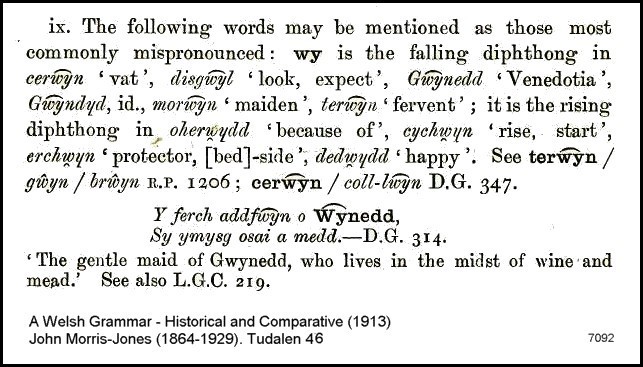 n ‘protector,
[bed]-side’, deddd ‘happy’
n ‘protector,
[bed]-side’, deddd ‘happy’
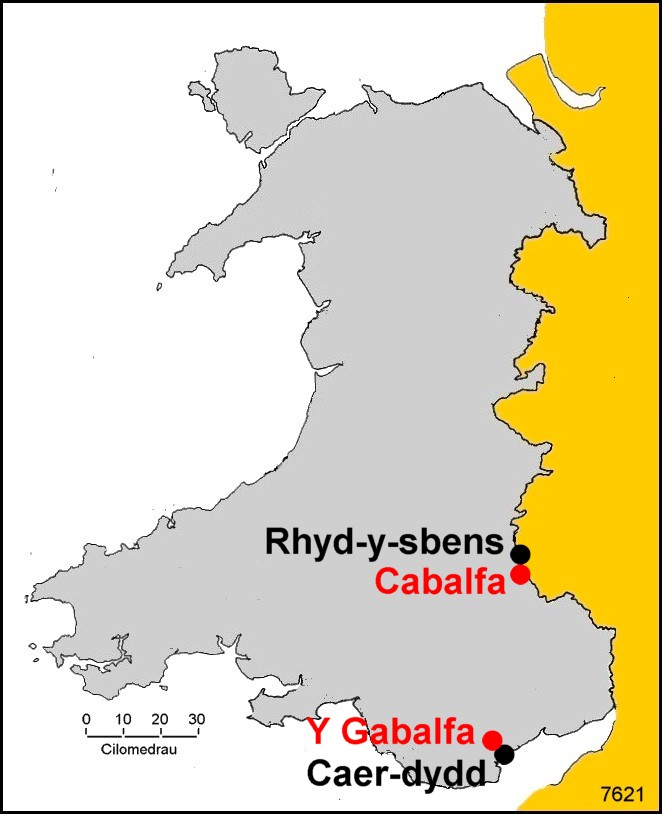
(delwedd 7092)
:_______________________________.
cesail <KE-sail,
-sel> [ˡkɛsaɪl , ˡkɛsɛl] feminine noun
PLURAL ceseiliau <ke-SEIL-yai, -yai, -e> [kɛˡsəɪljaɪ, -jɛ]
1 armpit
y gesail the armpit
cesail y forddwyd
groin
2 dan eich
cesail (bird) under its wing ("under your armpit");
iâr â’i phen dan ei chesail a hen
with its head under its wing
3 armpit = part of garment, where the sleeve joins the
main part (shirt, blouse, jacket, dress, etc)
4 poced gesail
inside pocket (of a jacket, etc) ("armpit pocket")
5 hollow, nook, recess, sheltered place; sometimes in
place names
Y Gesail “the nook” street name in
Johnstown (county of Wrecsam)
6 North Wales
creek, inlet
7 South Wales cesail morddwyd crotch, groin ("(arm)pit (of) thigh")
8 South Wales
Cymer gip dan dy gesail See your own
faults first; recognise that you too have faults before you accuse others
("take a look under your armpit")
:_______________________________.
Cesail-y-bryn <KE-sail, -sel, ə BRIN> [ˡkɛsaɪl, –sɛl ə ˡbrɪn]
1 street name in Pwllheli
(county of Gwynedd) (“Cesail y Bryn”)
ETYMOLOGY: cesail y bryn “(the) hollow / nook (of) the hill”, “hill
hollow”
(cesail = armpit; hollow, nook) + (y definite article) + (bryn
= hill)
:_______________________________.
cesair <KE-sair,
-ser> [ˡkɛsaɪr, -ɛr]
South Wales
1 hailstones, hail
See ceseiren
:_______________________________.
cesar <KE-sar> [ˡkɛsar]
1 South-east
Wales - local form of cesair (=
hail, hailstones). See ceseiren
:_______________________________.
Cesar <KE-sar> [ˡkɛsar] masculine noun
1 Iwl Cesar Julius
Caesar
2 Telwch
chwithau yr eiddo Cesar i Gesar
Render unto Caesar the things which are Caesar’s ("pay you yourself what
belongs to Caesar to Caesar")
Mathew 22:17 Dywed i ni gan hynny, Beth yr wyt ti yn ei
dybied? AI cyfreithlon rhoddi teyrnged i Gesar, ai
nid yw? (
Matthew
Other verions of the expression in other gospels:
Marc 12:14 Hwythau, pan ddaethant, a ddywedasant wrtho, Athro, ni a
wyddom dy fod di yn eirwir, ac
nad oes arnat ofal rhag neb: canys nid wyt ti yn edrych ar wyneb dynion, ond yr wyt yn dysgu ffordd
Duw mewn gwirionedd: Ai cyfreithlon rhoi teyrnged i Gesar, ai
nid yw? a roddwn, ai ni roddwn hi? (
Mark
Luc 20.22 Ai cyfreithlon i ni roi teyrnged i Gesar, ai nid yw? (
Luke
ETYMOLOGY: Cesar < Latin Caesar
:_______________________________.
Cesaraidd <ke-SAA-raidh,
-edh> [kɛˡsaraɪð, -ɛð] adjective
1 Caesarian; genedigaeth Gesaraidd Caesarian birth
:_______________________________.
ces dillad <KEES DII-lhad> [ˡkeːs ˡdɪɬad] masculine noun
PLURAL cesys dillad <KE-sis DII-lhad> [ˡkɛsɪs ˡdɪɬad]
1 suitcase
also: siwtces
ETYMOLOGY: (ces = case) + (dillad = clothes)
:_______________________________.
ceseiren <ke-SEI-ren> [kɛˡsəɪrɛn]
feminine noun
PLURAL cesair <KE-sair, -ser> [ˡkɛsaɪr, -ɛr]
South Wales
1 hailstone
y geseiren = the hailstone
2 bwrw cesair to hail ("throw
hailstones")
3 cawod o gesair hailstorm, hail shower
("shower of hail")
4 cesair hailstones, hail
5 ceseirio
to hail
ETYMOLOGY: ceseiren (cesair = hail) + (-en = singulative suffix)
Welsh cesair < ceseir < British
From the same British root: Cornish keser
= hail, Breton kazarc’h = hail
(showing the influence of erc’h =
snow).
From the same Celtic root: Irish casairneach
= hail
NOTE: informal spelling: ceser; In South-east Wales it is cesar <KE-sar> [ˡkɛsar]
:_______________________________.
ceseirio <ke-SEIR-yo> [kɛˡsəɪrjɔ] verb
South Wales
1 to hail
ETYMOLOGY: (cesair = hail) + (-io)
NOTE: The spoken form is ceseiro – in
the South, the semiconsonant <y> [j] at the beginning of a final syllable is generally lost
:_______________________________.
ceser <KE-ser> [ˡkɛsɛr]
1 Informal spelling of cesair = hail, hailstones. See ceseiren
:_______________________________.
cest <KEST> [kɛst]
PLURAL: cestiau <KEST-yai, -ye> [ˡkɛstjaɪ, -jɛ]
1 basket
2 belly, paunch
cestiog having a big belly
cestiwr (North Wales) someone who gulps down drink, guzzler;
beer-swiller
3 (South-west) (anatomy) chest
4 (obsolete) hold of a ship
5 Bron-gest SN3245 bron y gest
1912 edition of The
Place-names of Wales by Thomas Morgan (Skewen) (First edition 1887, revised and
second edition 1912): Brongest. Bron, a slope, or side of a hill: literally,
breast. Cest, a deep glen between two mountains. The name is quite descriptive
of the situation of the place.
http://www.geograph.org.uk/browse.php?p=220962
NOTE: In the north, the vowel is long (cêst), as in the majority of monosyllables ending in –st (Nêst, Llan-rŵst, côst, etc)
ETYMOLOGY: Welsh < British < Latin cista (= basket)
Cf Catalan cistell
(= basket)
:_______________________________.
cestyll <KE-stilh> [ˡkɛstɪɬ] (plural noun)
1 castles (plural of castell)
:_______________________________.
cethr <KEE-ther> [ˡkeˑθɛr] (masculine noun)
PLURAL: cethrau, cethri <KE-thri, -rai, -re> [ˡkɛθrɪ, -raɪ, -rɛ]
1 (obsolete) lance, spear
2 (obsolete) nail, spike
3 (obsolete) (sensation) prick
(obsolete) cethri cydwybod pricks of conscience , the
pricks of a bad conscience, ganawings of conscience, a gnawing conscience
4 cathrain to goad oxen (South Wales, as cathren, cathran)
5 cethru (North Wales) scold, tell off, reprimand, reprove, give a
dressing down to
ETYMOLOGY: Welsh < British < Latin centrum (= centre; point which
is the centre of a circle; a sharp point) < Greek kentron (= sharp
point; prick, sting) < kenteó (= to prick)
From British: Cornish kenter (= nail), Breton kentr (= spur)
:_______________________________.
cetyn, cetynnau
/ catiau <KE-tin, ke-TƏ-nai, -ne, KAT-yai, -yai, -e> [ˡkɛtɪn, kɛˡtənaɪ, -ɛ, ˡkatjaɪ, -ɛ] (masculine noun)
1 fragment
byw ar eich cetyn (South-west) live off your savings (“live on your
little piece”)
2 short-stemmed pipe
2 SN5434 Farm in the parish of Llanfihangel
Rhos-y-corn, Caerfyrddin county, south-east of Gwernogle. South-east of this
farm, beyond the farm of Pantycoubal, is a well called Ffynon y Gog.
http://www.geograph.org.uk/photo/153283
Eglwys Llanfihangel Rhos-y-corn
http://www.geograph.org.uk/browse.php?p=210141
Ffynnon-y-gog
:_______________________________.
ceu-
1 penult form of cau (= hollow)
ceubont tubular bridge
ceubren hollow tree
ceudod cavity
ceunant ravine
ceulan eroded river bank
:_______________________________.
ceubal <KEI-bal> [ˡkəɪbal] (mf)
PLURAL: ceubalau <kei-BAL-ai,
-e> [kəɪˡbɑˑlaɪ, - ɛ]
1 (obsolete) ferry boat
2 belly, big belly
llenwi ei geubal to fill his belly
3 rhyw geubal o ddyn a greedy-guts, a glutton, a fat greedy person
4 apparently a hollow or deep hollow inat least one place name:
Pantycoubal SN5333 farm south-east of Gwernogle, Ceredigion
pant y ceubal (?deep hollow “hollow of the deep hollow”)
(ou is a southern variant of eu in a penultimate syllable)
http://www.geograph.org.uk/browse.php?p=210141 map
ETYMOLOGY: Welsh < British < Latin caupulus (= little boat)
Cf English coble (= flat-bottomed sailing boat), Scots coble (=
flat-bottomed rowing boat) < Middle English cobel, most likely
ultimately from Latin caupulus < *calpulus
:_______________________________.
ceubalfa <kei-BAL-va >
[kəɪˡbalva] (f)
PLURAL: ceubalfeydd <kei-bal-VEIDH> [kəɪbalˡvəɪð]
1 (obsolete) ferrying-place, place where a ferry-boat is moored, boat place
2 Y Gabalfa (= y geubalfa)
District of Caer-dydd, by the river Taf
3 Cabalfa SO2346 in the parish of Cleirwy (English: Clyro), a farm by
Rhyd-y-sbens (English: Rhydspence) in Powys (Cabalva Farm on the Ordnance
Survey map), by Afon Gwy / the river Wye
http://www.geograph.org.uk/photo/1355951 road by Cabalfa
http://www.geograph.org.uk/photo/1355951
Cabalva House SO2446
The names Lower Cabalfa / Cabalva, Upper Cabalfa / Cabalva, Cabalfa / Cabalva
Bridge also occur on English-language maps (= in Welsh, Cabalfa Isaf, Cabalfa
Uchaf, Pont Cabalfa)
|
By the reign of Richard II the manor of La Royl and
the neighbouring grange of Cybalfa in Elvael had between them a flock of over
1000 sheep belonging to the lord of Painscastle. |
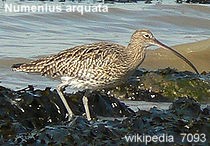
(delwedd 7621)
ETYMOLOGY: “boat place” (ceubal = boat) + (-fa = place)
Possible sequence of reduction of the diphthong to the vowel [a]:
ceubalfa > cybalfa > cabalfa
[kəɪˡbalva,
kəˡbalva, kaˡbalva]
:_______________________________.
ceubont <KEI-bont>
[ˡkəɪbɔnt] (f)
PLURAL: ceubontydd <kei-BONT-idh> [kəɪˡbɔntɪð]
1 tubular bridge
ETYMOLOGY: (ceu- < cau =
hollow) + soft mutation + (pont = bridge)
:_______________________________.
ceubren <KEI-bren> [ˡkəɪbrɛn] nm
PLURAL ceubrennau, ceubrenni <kei-BRE-nai, -ne,-ni> [kəɪˡbrɛnaɪ, -nɛ, -nɪ]
1 hollow tree
ETYMOLOGY: (ceu- < cau = empty, hollow) + soft mutation +
(pren = tree)
:_______________________________.
Ceubren yr Ellyll <KEI-bren ər E-lhilh> [ˡkəɪbrɛn ər ˡɛɬɪɬ]
1 'the hollow
tree of the sprite’ = hollow oak at Nannau SH7420 where Owain Glyndwr is said to have hidden the body of his would-be
assassin, his cousin Hywel Sele
http://www.geograph.org.uk/photo/596810 Plas Nannau
Ceubren yr Ellyll... Yng nghwr
isaf gardd Nannau, ger Meirion, safai gynt dderwen fawr a elwid ar yr enw (Brython 1858-9)
At the bottom of the garden at Nannau... there was formerly a large oak called
by this name
ETYMOLOGY: (ceubren = hollow tree) +
(yr definite article) + ( ellyll = sprite, pixie)
:_______________________________.
ceudod <KEI-dod> [ˡkəɪdɔd] (masculine noun)
1 cavity
2 wal geudod
cavity wall
:_______________________________.
ceudwll <KEI-dulh> [ˡkəɪdʊɬ] (masculine noun)
PLURAL ceudylliau
<kei-DƏLH-ai, -e > [kəɪˡdəɬaɪ, -ɛ]
1 crater
ETYMOLOGY: (ceu- < cau = empty) + soft mutation + (twll = hole)
:_______________________________.
ceufol <KEI-vol> [ˡkəɪvɔl] (masculine noun)
PLURAL ceufoliau <kei-VOL-yai,
-e > [kəɪˡvɔljaɪ, -jɛ]
1 crater
ETYMOLOGY: (ceu- < cau = empty) + soft mutation + (bol = belly)
:_______________________________.
ceufron <KEI-vron> [ˡkəɪvrɔn] feminine noun
PLURAL ceufronnau, ceufronnydd <kei-VRO-nai,
-ne,-nidh> [kəɪˡvrɔnaɪ, -ɛ, -ɪð]
1 hollowed hillside
y geufron = the hollowed hillside
Place names:
(1) Y Geufron (SJ2142) locality in
Sir Ddinbych, north of Llangollen
http://www.geograph.org.uk/gridref/SJ2142
(2) Y Goufron farm north of the
village of Llanfihangel Brynpabuan, county of Powys (on English maps as
“Goyfron”)
ETYMOLOGY: (ceu- penult syllable
form of cau- = empty) + soft
mutation + (bron = hill )
NOTE: In the south “eu-“ in an accented syllable is (or was) generally
pronounced as “ou-“, hence coufron, Y Goufron
:_______________________________.
ceugrwm <KEI-grum> [ˡkəɪgrʊm] adjective
1 concave =
curving inward
2 ceugrwm
concave (Cf amgrwm convex)
cromlin geugrwm concave line (Cf cromlin amgrwm convex line)
ETYMOLOGY: (ceu- penult syllable
form of cau- = empty) + soft
mutation + (crwm = curved)
NOTE: feminine form: ceugrom, plural
ceugrymion
:_______________________________.
ceugwm <KEI-gum> [ˡkəɪgʊm] masculine noun
PLURAL ceugymoedd <kei-GƏ-moidh, -modh> [kəɪˡgəmɔɪð, -ɔð]
1 deep narrow ravine
ETYMOLOGY: (ceu- penult syllable
form of cau- = empty, hollow) + soft
mutation + (cwm = valley)
NOTE: South Wales: cougwm <KOI-gum> [ˡkɔɪgʊm] . See ou
:_______________________________.
ceulan, ceulannau <KEI-lan, kei-LA-nai, -nai, -e> [ˡkəɪlan, kəɪˡlanaɪ, -ɛ] (feminine noun)
1 bank (of stream, river, pool)
Gorweddwn ar fy hyd dros y geulan un tro yn chwilio am bincod I was once
lying [on my front] over the river bank looking for minnows
glas y geulan kingfisher “blue (bird) (of) the (hollow) riverbank”
NOTE: In the English dialect of
Llanidloes:
GILAN, a shelving bank of earth, generally applied to the banks of a river or
brook. A corruption of the Welsh Ceulan, the hollow bank of a river. (Parochial
Account of Llanidloes / Edward Hamer / Chapter X / Folk-lore. Page 289
Collections Historical and Archeological Relating to Montgomeryshire and its
Borders / 1877)
2 coulan (also spelt as coilan)
= southern form of ceulan
y geulan goch > Goulan-goch locality in the county of Caerfyrddin
Marwolaethau: "Awst 20fed, wedi byr gystudd, yn 73 mlwydd oed, Esther
Thomas, Goilangoch, Llandilo
(Tyst a'r Dydd 15 6 1882)
Deaths: August 20, after a short illness, at the age of 73, Esther Thomas, of
Geulan-goch / Goilan-goch, Llandeilo
3 edge, brink
ceulan ei fedd the edge of his grave
ar y geulan ymyl (Arfon) on the brink, on the edge,
ETYMOLOGY: (ceu-, penultimate-syllable form of cau = hollow) + soft mutation + (glan = riverbank)
:_______________________________.
Ceulan <KEI-lan> [ˡkəɪlan]
1 Afon Ceulan
SN6990 river in Ceredigion
Cwm Ceulan the Ceulan valley
:_______________________________.
Ceulan a Maesmor
1 SN6789 parish in Ceredigion
:_______________________________.
ceulfraen <KEIL-vrain,
-vren> [ˡkəɪlvraɪn, -ɛn] masculine noun
(South-west Wales)
NOTE: Colloquially in the south colfran
<KOL-vran> [ˡkɔlvran]
1 curds
2 colfran
cottage cheese
caws colfran cottage cheese
ETYMOLOGY: colfran < coulfraen (an earlier form of ceulfraen) (coul / ceul- = penult
form of caul = curds) + soft
mutation + ( braen = rotten, putrid)
:_______________________________.
ceunant <KEI-nant> [ˡkəɪnant] masculine noun
PLURAL ceunentydd <kei-NAN-tidh> [kəɪˡnantɪð]
1 ravine, gorge = rocky ravine with stream
Crofft y Ceunant “(the) field (of) the ravine” Field name.
1707-1725 ABSTRACT of title of James Tudor
Morgan to a messuage and lands called Croft y Kynant in the parish of
Langattock Lingoed.
http://freepages.genealogy.rootsweb.ancestry.com/~llangattocklingoed/deedswills/hanbury.html#1518B Hanbury Family
Papers
ETYMOLOGY: Welsh ‘hollow valley’, (ceu-,
penult form of cau = hollow) + (nant = valley) < British
From the same British root: Cornish kownans
(= ravine), as in the place name Pennkownans
(“top end of the ravine”), in English “Kynance”
NOTE: (South Wales) Here eu is / was
pronounced ou. Thus counant <KOI-nant> [ˡkɔɪnant]
:_______________________________.
Ceunant <KEI-nant> [ˡkəɪnant]
1 SH 5361 locality in the county of Gwynedd
2 Counant <KOI-nant> [ˡkɔɪnant] farm 6km south-south-west of Llanboidy SN2123 (county of Caerfyrddin).
........(1) This is a southern pronunciation of ceunant. More examples of this feature at ou
........(2) Sometimes on maps with a spelling showing interference from English
spelling conventions - oy instead of
ou. Thus “Coynant”
ETYMOLOGY: See preceding entry
:_______________________________.
cewch <KEUKH> [kɛʊx] (verb)
1 you shall have < cael
2 Mwya gewch
chi, mwya fynnwch chi
The more you get / have, the more you want, The more people have, the more they
want
:_______________________________.
cewri <KEU-ri> [ˡkɛʊrɪ]
1 giants; plural form of cawr = giant
:_______________________________.
cewyll <KEU-ilh> [ˡkɛʊɪɬ]
1 baskets; plural form of cawell = basket
:_______________________________.
Cf
1 Abbreviation on maps for Culfor strait, straits = narrow stretch
of water joining two areas of sea
Cf Gibraltar = Culfor Gibraltar
:_______________________________.
cfdds.
1 abbreviation (in a dictionary entry) = cyfaddasiad
:_______________________________.
CH, ch ‹EKH› [ɛx] feminine noun
1) fourth letter
of the twenty-nine letter Welsh alphabet
1 a, 2 b, 3 c, 4 ch, 5 d, 6 dd 7 e,
:_______________________________.
ch
1 Certain words in Welsh with ch are borrowings from English borrowed at a time when gh was pronounced ‹GH› [ɣ] in English
..1/ Brychdwn = Broughton, place in
the county of Bro Morgannwg
..2/ Cnicht = mountain name in the
district of Meirionnydd (county of Gwynedd) (from English ‘knight’)
..3/ dracht = draught, swig, drink;
and the verb formed from this drachtio
= drink down
..4/ fflachdar (South Wales) cwympo’n fflachdar = fall head over
heels < English dialectal “flaughter” (= fall head over heels)
..5/ Halchdyn = village in the county of Wrecsam (from the English
name "Halghton")
..6/ Niwbwrch = village in county of
Ynys Môn (from new + burgh, = "new borough")
..7/ slachdar (= mess) < English slaughter
..8/ Sychdyn Soughton, place in the county of Y Fflint
2 In some words in Welsh which are borrowings from
English, the sound <kh> [x] has replaced English <sh> [ʃ]
..1/ fflàch = flash < < English
“flash”
..2/ llàch = whipstroke < English
"lash"
..3/ fflwch = abundant < English
“flush”
:_______________________________.
chaiff <KHAIF> [xaɪf] verb
1 from ni chaiff, won’t get, won’t receive,
won’t be able
(ni negative particle + spirant
mutation + caiff, present-future
tense third person singular of the verb cael)
Chaiff neb mo’i dwyllo fe He’s nobody’s fool, Nobody can get the better of him,
He can’t be taken in ("nobody will achieve his cheating")
Chaiff mo’i big i mewn He won’t get
a look in, He’ll be prevented from joining in (“he won’t get his beak in”)
Chaiff e fawr o gyfle He won’t get
much of a chance
:_______________________________.
chei di ddim <khei di DHIM> [xəɪ dɪ ˡðɪm] verb
1 (literary Welsh)
ni chei = you won’t get, you won’t
be allowed to; I won’t let you...
Segond person singular of the future tense of cael (= receive, get, obtain, be allowed to)
2 Chei di ddim
cyffwrdd pen dy fys ynddo I won’t let you
lay a finger on him (“you won’t get (the) touching (of the) tip (of) your
finger in him”)
:_______________________________.
chi <KHII> [xiː] (pronoun)
1 you
2 galw “chi” ar rywun (“to call ‘chi’ on somebody”, to call somebody ‘chi’)
to address somebody with the formal ‘chi’ (= you”), rhather than the
familiar ‘ti’ (= thou)
Mae
hi’n digon oer i weiddi “chi” arni hi freezing cold (“cold enough to shout “chi” at it”)
(to address somebody as “chi” is to use the formal form of “you” - as used by
children to adults, or subordinates to superiors. To call something “chi” is an
expression used to mean that something is very large and imposing; to shout
“chi” at the weather suggests that the temperature is extremely cold)
:_______________________________.
chi mòd <khi
MOD> [xɪ ˡmɔd] (phrase)
1 you know
A reduced form of yr ych chi yn gwybod (=you know)
yr ych chi yn gwybod
> yr ych chi’n gwybod
> rych chi’n gwybod
> chi’n gwybod
> chi’n ’bòd
> chi’m ’bòd
> chi’m ’mòd
> chi mòd
:_______________________________.
chithau <KHII-thai,
-thai, -e> [ˡxiˑθaɪ, -ɛ] (pronoun)
1 you too (literary Welsh: chwithau)
:_______________________________.
chithe <KHII-thai, -e> [ˡxiˑθɛ] pronoun
1 Colloquial form of chwithau (= you too)
-Blwyddyn newydd dda ichi! -Run
fath i chithe! (= Yr un fath i chwithau!)
-A Happy New Year to you. -The same to you.
:_______________________________.
Chlidonias hybrida
1 corswennol farfog (f) corswenoliaid barfog whiskered tern
:_______________________________.
Chlywais i mo’r fath beth <KHLƏ-wais, -es, i MOR vaath
BEETH> [ˡxləwaɪs, -ɛs, ɪ mɔr vɑ ˑθ ˡbeːθ]
1 (expression of
surprise) I’ve never heard such a thing! Well I never!
ETYMOLOGY: < ni chlywais i ddim o’r
fath baeth (ni negative
particle) + aspirate mutation + (clwais
= I heard < clywed = to hear) + (y definite article) + soft mutation + (math = type, sort) + soft mutation + (peth = thing)
:_______________________________.
chw
1 This initial consonant cluster
corresponds to <sk> [sk] or ‹sh› in Irish words
of the same Celtic origin
..1/ chwedl (= tale), Irish scéal (= tale)
..2/ chwerw (= bitter), Irish searbh (= bitter)
..3/ chwyd (= vomit), chwydu (= to vomit),
Irish sceith (= to vomit)
..4/ chwydd (= swelling), Irish siad (= swelling)
..5/ chwyl (= peal of
bells), Irish seal (= turn, go;
period, spell)
..6/ chwythu (= to blow), Irish séid (= to blow)
..7/ cychwyn (= to begin), the final element “-chwyn” = Irish scinn (= to start)
:_______________________________.
chwaer, chwiorydd <KHWAIR,
khwi-OO-ridh> [ˡxwaɪr, xwɪˡoˑrɪð] (feminine noun)
1 sister
:_______________________________.
chwaethach ‹KHWEI-thakh› (feminine noun)
1 never mind…, not to mention… (expression used to
indicate that a possiblility does not exist, or even one that could be
considered close to it)
Mynd yn gyfreithiwr? Does dim digon yn hen glopa di i neud ysgybwr heolydd
chwaethach cyfreithiwr
Become a lawyer? Ther’s not enough in your noggin to make a road sweeper (out
of you), never mind a lawyer
-Ma’ ’i enw ar fla’n ‘y nhafod… beth o’dd e nawr?
-Rw inne’n ffaelu gofio hefyd. Dyw e ddim ar fôn 'y nhafod i, chwaetach ar ei
fla'n e.
-His name’s on the tip of my tongue. What was it nawr?
-I can’t remember it either. It’s not [even] on the base of my tongue, never
mind the tip of my tongue
2 chwaethach fyth let alone, least
of all
Fydde fe ddim yn dweud hynny am neb, chwaethach am hen gyfaill iddo
He wouldn’t say that about anybody, least of all about an old friend of his
:_______________________________.
chwain ‹KHWAIN›
1 fleas; plural of chwannen (= flea)
:_______________________________.
chwaith ‹KHWAITH› (adverb)
1 either
NOTE: In South Wales, in addition hefyd (= also) is used in the sense of
“either”
ETYMOLOGY: chwaeth / chwaith (= taste) > “a bit” > (with negative
particle ni) “not a bit” > (with negative particle ni) “not...
either”, “neither”
Breton: c’hoaz (= again; even more)
Cornish hwath (= still, yet; again, once more)
:_______________________________.
chwâl ‹KHWAAL› (adj)
1 scattered, dispersed, spread
ar chwâl scattered, dispersed
2 (soil) broken up
pridd chwâl broken soil
3 (as a noun) scattering
ETYMOLOGY: chwâl < chwal-, stem of the verb chwalu (= (vt) to
scatter; destroy; (vi) fall to pieces) used as a past participle
:_______________________________.
chwalfa, chwalféydd ‹KHWAL
va, khwal VEIDH› (feminine noun)
1 collapse
2 chwalfa anadferadwy
(marriage) irretrievable breakdown , irremediable breakdown
:_______________________________.
chwalu ‹KHWA
li› (verb)
1 (vt) disperse, scatter, spread
chwalu cartref break up a home
chwalu’r niwl to disperse the fog
chwalu’r gwair to spread the hay (for drying)
Salmau 68:2 Chweli hwynt fel chwalu mwg: fel y tawdd cwyr wrth y tân,
difether y rhai annuwiol o flaen DUW.
Psalms 68:2 As smoke is driven away, so drive them away: as wax
melteth before the fire, so let the wicked perish at the presence of God.
chwalu ymaith blow away
Salmau 1:4 Nid felly y bydd yr annuwiol; ond fel mân us yr hwn a
chwâl y gwynt ymaith.
Psalms 1:4 The ungodly are not so: but are like the
chaff which the wind driveth away.
2 (vt) knock down, demolish
chwalu ty^ demolish a house, knock downa house
chwalu wal knock down a wall,
flatten a wall, smash open a wall
chwalu yn wastad â’r llawr raze to
the ground
3
(vt) destroy
chwalu dadl destroy an argument, tear an argument to pieces
4 (vt) dissolve
5 (vt) shatter
gwaith chwalu carthion sewage works,
sewage farm (“work / works (of) destroying excrements”)
Chwalwyd ein gobeithion pan ddaeth y newydd fod y cyngor wedi gwrthod rhoi
caniatàd i ni fynd rhagddi Our hopes were dashed when we heard that the
local council had refused to give us permission to go ahead
6 (South Wales) (vt), (vi) babble, prattle
chwalu chwaldod, “walu waldod” (“to prattle nonsense”) talk nonsense
chwalu chwedlau, “walu weddla” (“to prattle stories”) to gossip
Paid â chwalu, “Paid walu” Don’t prattle on
Pa beth a wyt ti yn ei chwalu? “Beth ti’n walu?” What are you
prattling on about?
7 chwalu gwlân tease or card wool
8 (South Wales) chwalu meddyliau be depressed, have gloomy thoughts (“to
scatter thoughts”)
9 chwilio a chwalu (North Wales) to rummage (“search and scatter”)
chwalu a chwilio (North Wales) to rummage (“scatter and search”)
10 (vi) break up (= be broken up), disperse (= be dispersed), scatter (= be
scattered)
mae’r niwl yn chwalu the fog is dispersing
mae’r cymylau’n chwalu the clouds are dispersing
11 (vi) fall down, collapse
ysgubor wedi chwalu a dilapidated barn, a barn which has fallen down
:_______________________________.
chwaldod ‹khwal-dod› masculine noun
1 (South Wales) “waldod” nonsense
chwalu chwaldod,
“walu waldod” (“to prattle nonsense”) talk nonsense
ETYMOLOGY: (chwal-, stem of chwalu = destroy, scatter) + (-dod noun suffix)
:_______________________________.
chwalwr ‹khwâ -lur› masculine noun
PLURAL chwalwyr ‹khwal
-wir›
1 (North Wales) chwalwr
gwair, or simply chwalwr:
haymaker, device which spreads hay for drying
2 chwalwr
chwedlau gossip, blabbermouth, someone who tells tales
3 chwalwr
llongau ship breaker
4 demolitionist
chwalwr tai housebreaker, person who
demolishes old buildings
ETYMOLOGY: (chwal-, stem of chwalu = destroy, scatter) + (-wr noun suffix (agent suffix))
:_______________________________.
chwannen ‹khwa -nen› feminine noun
PLURAL chwain ‹khwain›
1 flea
2 cyn pen chwinciad chwannen in the blink of an eye
(“before the end of a wink of a flea”)
3 chweina =
look for fleas
4 achub chwannen
a cholli croen buwch (“catch a flea and lose a cow hide”) dedicate too much
time and effort to an unimportant matter and lose what is important
5 chwannen ddŵr plural: chwain dŵr water flea, daphnia
6 chwannen y
traeth sand hopper (“flea (of) the beach”)
7 chwain y gof
sparks from red-hot iron being hammered (“fleas of the smith”)
8 lladd chwannen
â gordd crack a nut with a sledgehammer (“kill a flea with a sledgehammer”)
use absurdly disproportionate measures to deal with a small problem
9 chwain y gof (“fleas of the blacksmith”) sparks produced when red-hot
iron is struck with a hammer
ETYMOLOGY: Welsh chwain < chwein < British *skond-
Cornish hwannenn, plural hwannennow (= flea),
Breton: c'hwennenn plural c'hwenn (= flea)
NOTE: (1) South-west Wales chw- >
hw- (chwannen, chwain)
(2) South-east Wales chw- > hw- > w- (wannan, wain)
:_______________________________.
chwant, chwantau ‹KHWANT, KHWAN te› (masculine noun)
1 desire
:_______________________________.
chwap ‹ khwap
› masculine noun
PLURAL chwapiau ‹ khwap -ye›
1 wallop, sudden blow
2 (adverb) yn
chwap o chwap instantly;
swiftly, soon (South-east Wales: wap)
Pan mae'r Fenni yn gwisgo'i chap
Bydd glaw yn dilyn chwap...
When Y Fenni wears her cap (= when there are clouds over Abergafenni town) rain
will soon follow
Y mae gennym ninnau yn yr Wyddgrud ein
tafodiaith - ond fe ddowch i'n deall chwap!
We in Yr Wyddgrug (town in north-east Wales) have our own dialect – but you’ll
soon get to understand us
3 (South Wales) chwepyn
/ hwepyn / wepyn clout, smack; instant
(chwap = bang, slap, blow) + (-yn diminutive suffix added to nouns)
(vowel change a > e under the influence of the y in the final syllable)
ETYMOLOGY: anglès whap (= blow,
impact)
NOTE: South Wales: chwap > hwap,
wap
:_______________________________.
chwarae ‹KHWA
re› (verb)
1 to play
2 chwarae plant child’s play, kids’ stuff, something very easy (“(the) playing (of) children”)
3 chwarae mwgwd
yr ieir play blind man’s buff (“play (the) blindfold (of) the hens”)
chwarae mwgwd y dall play blind
man’s buff (“play (the) blindfold (of) the blnd man”)
4 chwarae dwbl
neu ddim play double or quits, game in which by tossing a coin, etc, it is
decided whether a stake is to be doubled or withdrawn
5 chwarae triphlyg (Baseball) triple play
6 Dos i chwarae
efo dy fol! Get stuffed! (“go to play with your belly”)
7 lle chwarae playground,
children’s playground
8 maes chwarae playing
field, sports ground, sports field
Maeschwarae
Street name in Yr Ystôg, district of Maldwyn, county of Powys (“Maes Chwarae”)
9 cael eich afal
i chwarae ac i’w fwyta have your cake
and eat it (“get your apple to play and to eat it”) Chewch chi mo’ch afal i chwarae ac i’w fwyta You can’t have your cake and eat it
10 hapchwarae gamble
(hap = chance) + (chwarae = to play)
y Ddeddf Hapchwarae The Gambling
Act, The Gaming Act
11 cae chwarae playing field
:_______________________________.
chwaraeon ‹khwa REI on› (plural noun)
1 sports; plural of chwarae
:_______________________________.
chwarae teg ‹KHWA re TEEG› (masculine noun)
1 fair play
gwneud chwarae teg â do justice to =
treat fairly
rhoi chwarae teg i be fair to somebody, be considerate of somebody’s
needs or interests
Rhowch chwarae teg i’r merched, bois, a pheidiwch â chodi cymaint o dwrw.
Maen nhw’n treio gwneud eu gwaith cartre.
Be fair to the girls, lads, and don’t make so much noise. They’re trying to
do their homeowrk,
:_______________________________.
chwaraewr , chwaraewyr ‹khwa-REI-ur, khwa-REI-wir› (masculine noun)
1 player
chwaraewr gwyddbwyll ‹GUIDH-builh›
chess player
:_______________________________.
chwardd- ‹khwardh› verb
1 stem of the verb chwerthin
= to laugh
chwarddais = I laughed
:_______________________________.
chwarel <KHWAA-rel> [ˡxwɑˑrɛl] feminine noun
PLURAL chwareli, chwarelau <khwa-REE-li,-lai,
-e> [xwaˡreˑlɪ, -laɪ, -ɛ]
North Wales
1 quarry = place (usually
an open pit) from which building stone is obtained
2 quarry = place (usually an open pit) from which slate
(for roofing, etc) is obtained,
chwarel lechi plural chwareli llechi slate quarry
3 ardal chwareli
quarrying area, district with many quarries
ETYMOLOGY: chwarel < cwarel < English quarrel < Old French quarriere from *quarre < Latin quadrâre
(= to make (something) square).
(1) Dissimulation in English: the sequence r-r
became r-l (quarriere > quarrel)
(2) The sequence cw- became (in
North Wales) chw-
(3) modern French has carrière (=
quarry)
NOTE: In South Wales there are various forms with cw- (1) cwarel, (2) cwar, (3) cware
:_______________________________.
chwarel <KHWAA-rel> [ˡxwɑˑrɛl] feminine noun
PLURAL chwareli, chwarelau <khwa-REE-li,-lai,
-e> [xwaˡreˑlɪ, -laɪ, -ɛ]
1 window pane
ETYMOLOGY: chwarel < cwarel < English quarrel (= glass pane
in the shape of a square, or a rhombus / diamond) < Old French < Vulgar
Latin *quadrellus, a diminutive form
(addition of the infix –ell-) of Late Latin quadrus (= a square).
Derived from Latin quattor (=
four) < Indo-European kwetwer- (= four) (also the origin
of Welsh pedwar = four).
Modern French has carreau (= tile, window pane, little square, paving
stone)
A Dialogue in the Devonshire Dialect, (in three parts) by a Lady: to which is
added a Glossary. James Frederick PALMER, Mary Palmer. 1837: The authors list
“QUARREL” and define it as “A pane of glass”.
:_______________________________.
chwart <KHWART> [xwart] masculine noun
PLURAL chwartiau <KHWART-yai, -yai, -e> [ˡxwartjaɪ, -ɛ]
1 quarter of a gallon =
gwin diflas gwerth hanner can ceiniog y
chwart
insipid wine worth (the equivalent of) fifty pence a quart
2 chwysu
cwartiau to sweat gallons (“to sweat quarts”)
ETYMOLOGY: English quart < Old
French quarte < Latin quartus (= a quarter)
NOTE In South Wales the change cw-
> chw- has not occurred, and so
here it is cwart <KWART> [kwart]
:_______________________________.
chwarter <KHWAR-ter> [ˡxwartɛr] masculine noun
PLURAL: chwarteri <khwar-TEE-ri> [xwarˡteˑrɪ]
1 quarter
NOTE: In the south (chw > cw) cwarter, cwarteri <KWAR-ter, kwar-TEE-ri> [ˡkwartɛr,kwarˡteˑrɪ]
ETYMOLOGY: 1500-
English "quarter" < French "quartier" < Latin
"quartârius" = fourth part < "quartus" = fourth
:_______________________________.
chwarthor <KHWAR-thor> [ˡxwarθɔr] masculine or
feminine noun
PLURAL chwarthorion, chwarthorau <khwar-THOR-yon,
khwar-THO-rai, -rai, -e> [xwarˡθɔrjɔn, xwarˡθɔraɪ, -ɛ]
1 joint of meat (leg, saddle, etc)
2 Ceinewydd, county of Ceredigion hwarthol o oen = leg of lamb
3 county of Penfro
hwarthol o gig maharen = leg of
mutton
4 chwarthor tir obsolete fourth part of a stag to be
given to the owner of the land on which it had been hunted (tir = land)
ETYMOLOGY: chwarthor < chwarthawr < Latin quartârius, pars quartâria = a fourth
part
NOTE: Colloquially there is also a form with dissimulation – the sequence r-r becomes r-l
Chwarthor > chwarthol; and this
is the basis of the colloquial variants
.....(1) hwarthol <HWAR-thol> [ˡhwarθɔl] in the south-west initial chw- is simplified to hw-),
and
.....(2) gwarthol <GWAR-thol> [ˡgwarθɔl] (with gw- instead
of chw-)
:_______________________________.
chwe <KHWEAi,
-e> [xweː] (nm) (+ noun)
1 six (before a consonant)
chwe munud <KHWEE-MII-nid> [ˡxweː ˡmiˑnɪd] six minutes
:_______________________________.
chwech <KHWEEKH> [xweːx] (n)
1 six (as an independent numeral, and as a determiner
before a vowel)
(in the South, chwech / hwech / wech is
also used before consonants)
:_______________________________.
chweched <KHWEE-khed> [ˡxweˑxɛd] (adjective)
1 sixth
:_______________________________.
chwedl, chwedlau ‹KHWEDL, KHWED le› (feminine noun)
South Wales: hweddel ‹HWEE dhel›
1 legend, tale
2 story, gossip
2 Prìn chwedl,
llawn chwedl No news is good news (“scarce report, full report”)
:_______________________________.
chwedlon ‹khwed- lon › feminine noun
PLURAL chwedlonau ‹khwed-lô-ne›
1 (word not in
general use) myth
ETYMOLOGY: stem of the word chwedloniaeth
(= mythology).
Used to form derivatives - chwedlonol
(= mythical), chwedlonwr (=
mythologist), chwedloneg (= the
study of myths), chwedloni (=
mythologise)
:_______________________________.
chwedloniaeth ‹khwed- lon
-yeth› feminine noun
PLURAL chweloniaethau ‹khwed-lon- yei -the›
1 mythology =
traditional stories of one particular culture
2 mythology = set of beliefs and
traditions and stories related to some object (plant, etc)
ETYMOLOGY: First
example 1850. Modelled on the word barddoniaeth
(= poetry). (chwedl = legend, myth,
tale) + (-oni- element as in barddoniaeth) + (-aeth suffix for forming nouns)
Barddoniaeth was originally barddoni - the modern noun has incorporated
the abstract-noun suffix -aeth.
The suffix -oni is from the British
suffix *onîsâ, as in
..a/ daioni (= good, goodness),
..b/ drygioni (= bad, evil)
..c/ haelioni (= generosity).
The noun barddoni became a verb (=
to compose poems; barddonaf = I
compose poems, etc).
The derivative adjective is barddonol
(= poetic)
:_______________________________.
chwedlonol ‹khwed- loo -nol › adjective
1 mythical
ETYMOLOGY: (chwedlon = myth) + (-ol suffix for forming adjectives)
:_______________________________.
Chwefrol ‹KHWEV
rol› (masculine noun)
1 regional form of Chwefror
:_______________________________.
Chwefror ‹khwev-ror› masculine noun
1 February
mis Chwefror February (“(the) month (of) February”)
ym mis Chwefror in February
ar ddechrau mis Chwefror at the beginning of February
ar ganol mis Chwefror in the middle
of February, in mid-February
ar ddiwedd mis Chwefror at the end
of February
bob mis Chwefror every February
ETYMOLOGY:
Corresponding form in the other British languages: Cornish Hwevrer (= February), Breton C’hwevrer
(= February).
Welsh Chwefror < Chwefrawr < British *swebr’âr < Latin februârius.
The initial ‘s’ is difficult to explain unless it is a vestige of the word mensis in Latin mensis februârius (= February, the month of expiation). Ultimately
from februa (= feast of expiation).
Similar examples with preclitic “s” from the final syllable of a preceding
word, in modern Welsh and in English:
(1) Many exist in modern Welsh (for example, the place name Ynysmeudwy > Smitw, etc). More information at the
entry “s”
(2) The phenomenon also occurs in English, as with the asseveration Struth! (God’s truth), and others of
this type now obsolete (Sdeath! =
God’s death, Sblood! = God’s blood);
’s afternoon in rapid or careless speech for this afternoon
(1) as in Ionor < Ionawr, and many other words in modern
Welsh, a final diphthong aw has been
reduced to a simple vowel o
(2) Interestingly, English February
has been remodelled on the Latin form, replacing Middle English Feverer < Old French < Latin februârius
NOTE: (1) Colloquially there is also a form with dissimulation – the sequence
r-r becomes r-l (Chwefror > Chwefrol). In this case it is not
standard.
(a) It also occurs dialectically in chwarthol < chwarthor (= joint of meat),
(b) but it is standard in cornel
(from English corner),
(c) and it also is to be seen in the place name
Hirael (from Hirerw)
Hírerw > Hírer > Hirel > Hirael
Hírerw (erw is a single syllable in
older Welsh; the stress falls on the penultimate syllable i.e. in this name hir) > Hírer (loss of final w, well attested in place names where erw is a
final lement in a compound) > Hirel
(dissimulation r-r- > r-l) > Hirael
(hypercorrection through supposing that final ‘e’ is the colloquial
reduction of a final diphthong ‘ae’, a common phenomenon in colloquial Welsh,
and that the name is hir + ael, “long hillcrest”).
(2) February is also called y mis bach
(the little month, the short month)
..01 Chwefror (y cyntaf o Chwefror) : the first of February
Gŵyl Sanffráid / Gŵyl Sánffred (feast of Saint Brigit)
..02 Chwefror (yr ail o Chwefror) : the second of February
Gŵyl Fair y Canhwyllau = Candlemas
(presentation of Jesus in the Temple, purification of the Virgin Mary) (‘Gŵyl Fair of the
candles’ - candles were
blessed on this day) (Gŵyl Fair = feast of Mary)
Awr fawr Calan, dwy Ŵyl
Eilian, tair Ŵyl Fair (traditional saying)
‘big hour (on) the calend (“awr fawr y Calan”), two on Eilian’s feastday,
and three on Mary’s feastday’
that is, the day will have lengthened
(1) a full hour by New Year’s Day (Y
Calan) on January the first, (half an hour in the morning and half an hour
in the evening),
(2) two hours on Eilian’s feastday (Gŵyl
Eilian) on January the thirteenth, and
(3) three hours by Lady Day (Gŵyl Fair) on February the second
..03 Chwefror (y trydydd o Chwefror) :
the third of February
..04 Chwefror (y pedwerydd o Chwefror) :
the fourth of February
..05 Chwefror (y pumed o Chwefror) : the fifth of February
..06 Chwefror (y chweched o Chwefror) : the sixth of February
..07 Chwefror (y seithfed o Chwefror) : the seventh of February
..08 Chwefror (yr wythfed o Chwefror) : the
eighth of February
..09 Chwefror (y nawfed o Chwefror) : the ninth of February
Gŵyl Deilo (feast
of Teilo) (Welsh saint)
..10 Chwefror (y degfed o Chwefror) : the tenth of February
..11 Chwefror (yr unfed ar ddeg o Chwefror) : the eleventh of February
..12 Chwefror (y deuddeg o Chwefror) : the twelfth of February
..13 Chwefror (y trydydd ar ddeg o
Chwefror) : the thirteenth of February
..14 Chwefror (y pedwerydd ar ddeg o
Chwefror) : the fourteenth of February
Gŵyl Fálentin (Valentine’s
Day)
..15 Chwefror (y pymthegfed o Chwefror) : the fifteenth of February
..16 Chwefror (yr unfed ar bymtheg o Chwefror) : the sixteenth of February
..17 Chwefror (yr ail ar bymtheg o Chwefror) : the seventeenth of February
..18 Chwefror (y deunawfed o Chwefror) : the eighteenth of February
..19 Chwefror (y pedwerydd ar bymtheg o
Chwefror) : the nineteenth of February
..20 Chwefror (yr ugeinfed o Chwefror) : the twentieth of February
..21 Chwefror (yr unfed ar hugain o Chwefror) : the twenty-first of February
..22 Chwefror (yr ail ar hugain o Chwefror) : the twenty-second of February
..23 Chwefror (y trydydd ar hugain o
Chwefror) : the twenty-third of February
..24 Chwefror (y pedwerydd ar hugain o
Chwefror) : the twenty-fourth of February
Gŵyl Fathias (feast of Mathias)
..25 Chwefror (y pumed ar hugain o Chwefror) : the twenty-fifth of February
..26 Chwefror (y chweched ar hugain o Chwefror) : the twenty-sixth of February
..27 Chwefror (y seithfed ar hugain o Chwefror) : the twenty-seventh of
February
..28 Chwefror (yr wythfed ar hugain o Chwefror) :
the twenty-eighth of February
..29 Chwefror (y nawfed ar hugain o Chwefror) : the twenty-ninth of February
:_______________________________.
chwennych <KHWE-nikh> [ˡxwɛnɪx] verb
1 covet, envy
2 yearn for, desire greatly
y sawl sydd yn chwennych statws yn y gymdeithas
the person who
yearns for status in society
Nid dyma’r fodolaeth yr oedd ef yn
chwennych i'r Gymraeg
This was not the kind of existence that he wanted for the Welsh language
Dyma’r geiriadur y chwenychodd llawer
weled ei ddydd
This is the dictionary that many people wanted to see published (“(that it)
sees its day”)
3 crave for (as a pregnant woman)
ETYMOLOGY: (chwant = desire) +
(suffix -ych)
NOTE: Also: chwenychu <khwe-NƏƏ-khi> [xwɛˡnəˑxɪ] with an additional verbal suffix -u
:_______________________________.
chwenychion <khwe-NƏKH-yon> [xwɛˡnəxjɔn]
1 things desired
ETYMOLOGY: (chwennych = to desire, desiring) + (-ion suffix for forming plurals)
:_______________________________.
chwerthin <KHWER-thin> [ˡxwɛrθɪn] verb
1 to laugh
Bu bron iddo dorri allan i chwerthin He almost burst out laughing
2 mynd i sterics o chwerthin am rywbeth become hysterical from laughing about something
3 cilchwerthin
snigger (cil = corner, recess) + (chwerthin = to laugh)
cilchwerthin ar rywun to snigger at someone
4 bod
bron marw o chwerthin die of laughter (“be nearly dead from laughing”)
Bûm bron marw o chwerthin I nearly died laughing
:_______________________________.
chwepyn <KHWE-pin> [ˡxwɛpɪn] masculine noun
(South Wales)
1 clout, smack
2 instant
yn chwepyn at once,
instantly
ETYMOLOGY: (chwap = bang, slap,
blow) + (-yn diminutive suffix added to nouns) (vowel change a > e under the influence of the y in the final syllable
:_______________________________.
chwerw ei flas <KHWEE-ru ii VLAAS> [ˡxwe·rʊ ɪː ˡvlɑːs] (adjective)
1 having a bitter taste, bitter in taste,
bitter-tasting
:_______________________________.
chwi ‹ KHWII› pronoun
1 you (formal, singular); you (plural)
In modern spoken Welsh chwi > chi
:_______________________________.
chwiban 1
<KHWII-ban> [ˡxwiˑban] m
1 whistle = whistling sound
2 trill of a bird, trilling of a bird
3 hiss, hissing sound
ETYMOLOGY: from the verb chwiban / chwibanu
:_______________________________.
chwiban 2
<KHWII-ban> [ˡxwiˑban] v
1 to whistle
See chwibanu
:_______________________________.
chwibanog 1
‹khwi-BAA-nog› [xwɪˡbɑˑnɔg] adjective
1 whistling
ETYMOLOGY: (chwiban = whistle) + (-og adjectival suffix)
:_______________________________.
chwibanog 2 ‹khwi-BAA-nog› [xwɪˡbɑˑnɔg] adjective
1 colloquial form of chwibanogl (= whistle;
curlew)
NOTE: omission of the final l; the form withount an ‘l’ is in fact is the
historical form of the word
:_______________________________.
chwibanogl ‹khwi-BAA-nogl› [xwɪˡbɑˑnɔg]l
PLURAL: chwibanoglau, chwybenigl ‹khwi-ba-NO-glai, -gle, khwi-BEE-nigl› [ xwɪbaˡnɔglaɪ, -glɛ, xwɪˡbeˑnɪgl]
1 whistle
2 flageolot, Irish whistle
3 curlew (Numenius arquata)
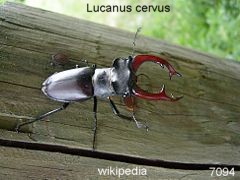
(delwedd 7093)
Cerrig Chwibanog stones on upland west of Llanuwchllyn
cerrig y chwibanog “(the) stones (of) the curlew”
ETYMOLOGY: (chwibanog adjective = whistling) + (-l)
This extraneous l is seen in other words in Welsh:
tymestl (= tempest, storm) < tymest
cwrwgl (= coracle) < cwrwg
NOTE: northern Ceredigion hwibanog
NOTE: In South Wales it is chwibanwr (“whistler”) / hwibanwr / wibanwr
:_______________________________.
chwibanu ‹ khwi-BAA-ni› [xwɪˡbɑˑnɪ] v
In South Wales it is chwiban / hwiban /
wiban
1 to whistle
Cer i wipan! (south-east) (= Cer i wiban, Cer i chwiban) Go to the
devil! Get lost! Take a running jump into a river! (“”go to whistle”)
Cer i hwiban ysgadan! (south-west, formerly) Go to the devil! etc (“go
to whistle / cry herrings”)
2 (wind) to whistle
3 (bullet passing through the air) to whistle
4 (curlew) scream, screech
chwibanogl
5 to whistle = produce a mechanical whistling sound (train with steam whistle,
etc)
6 (snake) hiss
7 (shepherd) To whistle = call by whistling, direct by whistling
y bugail yn chwibanu ar ei gi the shepherd whistling to his dog
8 said of doing something effortlessly
fel chwiban (“like whistling”)
dan chwiban (“whistling”)
trwy chwiban (“through whistling”)
9 hiss = show contempt through hissing
Jeremeia 19:8 A mi a wnaf y ddinas hon yn anghyfannedd, ac yn ffiaidd, pob
un a elo heibio iddi a synna ac a chwibana, oherwydd ei holl ddialeddau hi.
Jeremiah 19:8 And I will make this city desolate, and an hissing; every one
that passeth thereby shall be astonished and hiss because of all the plagues
thereof.
10 penchwiban (qv) frivolous; hare-brained
ETYMOLOGY: (chwiban = whistle) + (-u verb suffix)
chwiban is an imitation of a whistling / trilling / hissing sound
NOTE: In South Wales it is chwiban /
hwiban / wiban
chwiban represents the standard
written form of this south Wales variant
hwiban is the south-western form (chw > hw)
wiban is the south-eastern form (chw
> hw > w) In the south-east,
the ‘h’ is missing from the repertoire of sounds of the dialect here
:_______________________________.
chwibanwr ‹khwi-BAA-nur›
[xwɪˡbɑˑnʊr]
PLURAL:
chwibanwyr ‹khwi-BAN-wir›
[xwɪˡbɑˑnwɪr]
1 whistler, person who whistles
2 whistler, thing which whistles
3 (South Wales) curlew
ETYMOLOGY: (chwiban- root of the verb chwibanu or chwibanu =
to whistle)
NOTE: In South Wales it is chwibanwr (“whistler”) / hwibanwr / wibanwr
chwibanwr represents the standard written form of this south Wales variant
hwibanwr is the south-western form (chw > hw)
wibanwr is the south-eastern form (chw > hw > w) In the south-east, the ‘h’ is missing from
the repertoire of sounds of the dialect here
:_______________________________.
chwilboeth <KHWIL-boith> [ˡxwɪlbɔɪθ] adjective
1 (drink, food) boiling hot, piping hot, burning hot
Roedd y te’n chwilboeth
The tea was boiling hot
ETYMOLOGY: (chwil = reeling,
turning, wild; used as an intensifier before an adjective – extremely, very) +
soft mutation + ( poeth = hot)
:_______________________________.
chwildaith ‹khwil -daith› feminine noun
PLURAL chwildeithiau ‹khwil-deith-ye›
1 reconnaissance
trip, a trip to gather information about an enemy
Nodau o Chwildaith Filwraidd, o Gaer
Lavenworth, yn Missouri, i San Diego, yn Califfornia
(Traethodydd 1851; translation of the book title “Note of a Military
Reconnoisance, from Fort Lavenworth, in Missouri, to San Diego, in California”)
ETYMOLOGY: (chwil-, stem of chwilio = to search for) + soft
mutation + (taith = trip, journey)
:_______________________________.
chwilen ‹khwî
-len› feminine noun
PLURAL chwilennod, chwilod, chwilsod ‹khwi-le-nod,
khwî-lod, khwil-sod›
1 beetle; chafer
2 whim, obsession, crazy idea
Mae chwilen yn ei ben
He has a bee in his bonnet ("he has a beetle / crazy idea in his
head")
Mae chwilen yn ei gorun
He has a bee in his bonnet ("he has a beetle / crazy idea in his crown
(i.e. crown of the head)")
ETYMOLOGY: (chwil = beetles) + (-en singulative suffix);
Welsh chwil < British < Celtic
*swei (= to turn)
In the other two British languages: Cornish hwilenn (= beetle), Breton c’hwil
(= beetle)
:_______________________________.
chwilen
gorniog ‹ khwii-len gorn -yog› feminine noun
PLURAL chwilod corniog ‹ khwii-lod korn -yog›
1 stagbeetle (USA: hornbug) (Lucanus cervus)
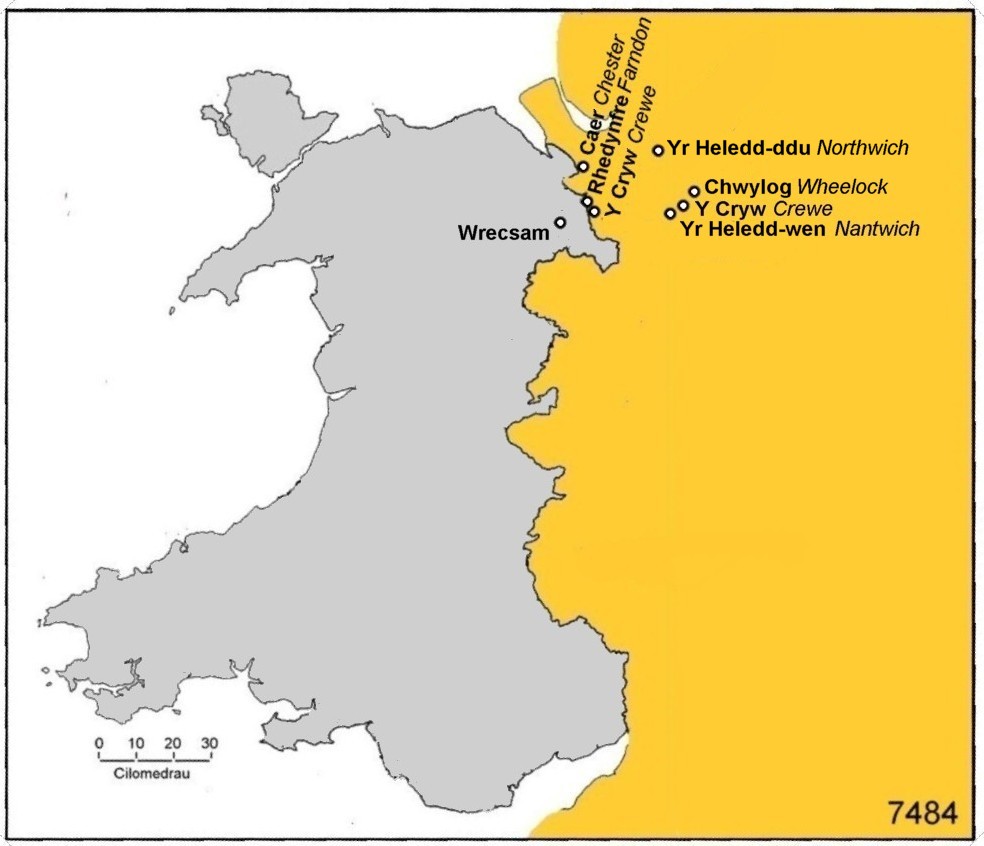
(delwedd 7094)
ETYMOLOGY: (“horned beetle”) (chwilen
= beetle) + soft mutation + (corniog
= horned)
:_______________________________.
chwilfriw ‹khwil
-vriu› adjective
1 smashed to
pieces, broken to bits, shattered
malu’n chwilfriw shatter, smash to
pieces
malu’n chwilfriw mân shatter, smash into little pieces
Un gnoc fach ddamweiniol a dyna’r plât
gwerth dros £7, 000 yn chwilfriw
One slight accidental knock and the the plate worth over £7, 000 was smashed to
smithereens
2 bwrw (rhywbeth) yn chwilfriw mân
smash (something) to pieces
Fe fwriodd y watsh yn chwilfriw mân ar
lawr cadarn y palmant
He (threw and) smashed the watch to bits on the hard surface of the pavement
3 (idea, theory) darnio’n
chwilfriw shatter
ETYMOLOGY: (chwil = twirling,
whirling) + soft mutation + (briw =
shattered)
:_______________________________.
chwilfriwio ‹hwil-vriu-yo›
verb with an object
1 shatter, smash
2 dispel (an idea)
Rhaid chwilfriwio’r syniad mai hen iaith
gapelig yw’r Gymraeg
We have to dispel the idea that Welsh is some language fit only for chapels
3 verb without an
object shatter, smash = be shattered, be smashed
ETYMOLOGY: (chwilfriw = shattered) +
(-io, suffix for forming verbs)
:_______________________________.
Chwilgrug ‹khwil
-grig›
1 (ST4088) locality 2km north-west of Magwyr, in the county of Casnewydd
English name: Wilcrick
http://www.geograph.org.uk/gridref/ST4088 map
ETYMOLOGY: ??
:_______________________________.
chwilod ‹khwî-lod› -
1 beetles; plural
form of chwilen
:_______________________________.
chwilolau ‹khwiil-ô-le› masculine noun
PLURAL chwiloleuadau ‹khwil-o-lei-â-de›
1 searchlight
Also golau chwilio
ETYMOLOGY: (chwil = stem of chwilio = to search) + soft mutation +
( golau = light)
:_______________________________.
chwilota ‹khwi-lo-ta› verb
1 obsolete search for beetles (said of a
hen or another bird). For another instance of a word referring to hens or other
birds see the entry cachiad = ‘shitting;
the time it takes for a bird to shit; an instant’
2 search, rummage, ferret around
Yr oedd ef yn chwilota’n swnllyd am y siswrn yn y ddrôr
He was rummaging noisily in the drawer for the scissors
ETYMOLOGY: chwilota < chwilod-ha (chwilod = beetles) + (-ha
suffix for forming verbs with the sense of ‘to collect’, ‘to search for’)
Breton: c’hwileta = look for insects
:_______________________________.
chwilotydd ‹khwi-lo-tidh› masculine noun
1 (Computers)
search engine
ETYMOLOGY: (chwilota = to search) +
(-ydd suffix to form
nouns)
:_______________________________.
chwilio (am) ‹KHWIL yo› (verb)
1 look for
chwilio a chwalu (North Wales) to rummage (“search and scatter”)
chwalu a chwilio (North Wales) to rummage (“scatter and search”)
:_______________________________.
chwiorydd ‹khwi OO ridh› (plural noun)
1 sisters (plural of chwaer)
:_______________________________.
chwip ‹KHWIP› f
PLURAL chwipiau ‹KHWIP-yai,
-ye›
1 whip
rhoi clec ar y chwip to crack the
whip (“give a crack on the whip”)
2 whipping, whiplash; the use of a whip
Roedd y ceffylau yn gwybod y ffordd yn dda ac nid oedd eisiau chwip na
bloedd i'w gyrru
Llafar Gwlad 7 Chwefror-Mai 1983
The horses knew the road well and there was no need of a whip or shouting to
drive them
3 (north-west) fel chwip in an
instant
(Maldwyn, Mid-Wales) mewn chwip o dro in
no time at all
4 chwip din arsewhip, a whipping on the buttocks
rhoi chwip din i rywun give
somebody a good whipping, a good caning; chastise severely
bod chwip rhywun ar gefn rhywun to be lambasted (“somebody’s whiplash
being on somebody’s back”)
Bu ei chwip ar gefn y rhai ffolaf ohonynt lawer tro
He lambasted the more foolish of them many a time
5 whip = parliamentary whip
6 (Llyn) chwip o smashing, great,
wonderful
Y mae Michael Jones yn chwip o chwaraewr y diwrnodau
Michael Jones is a great footballer
Chwip o raglen deledu y noson o'r blaen
An excellent programme on TV the night before
7 (of the wind) whip = sharp force
chwip y gwynt gaeafol the whip of the winter wind, the whipping winter
wind (“the whip of the wintry wind”)
8 (South Wales) gyda chwip y dydd at the peep of dawn, at the crack of dawn
ETYMOLOGY: Welsh < Middle English whip., possibly from Dutch wippen
(Modern Dutch wippen = to whip; to wooble; to stand moving from heel to toe to
heel). If so, it is related to German der Wipfel (= tree top)
:_______________________________.
chwip ‹khwip ›
1 Stem of the verb chwipio = to whip. Verb stems are used as past
participles in Welsh.
hufen chwip whipped cream
:_______________________________.
chwitchwatrwydd ‹khwit-khwat-ruidh› masculine noun
1 inconstancy,
changeability, indecision, chopping and changing, fickleness
ETYMOLOGY: (chwitchwat = fickle, changeable,
unreliable) + (-rwydd suffix for forming abstract nouns)
:_______________________________.
Chwitffordd ‹kwwit-fordh›
1 (SJ1478) locality in the county of Y Fflint
English name: Whitford
2 a
parish at this place
http://www.geograph.org.uk/gridref/SJ1478 map, Chwitffordd
ETYMOLOGY: English Whitford (year 1291 written Chwytford in Welsh)
Llafar Gwlad, Haf 1985, Rhif 9
:_______________________________.
chwith ‹KHWIITH› (adjective)
1 left, left-hand (= situated on the left)
pedal chwith soft pedal piano (“left
pedal”)
2 left-handed
3 wrong
y tu
chwith i on the wrong
side of
Mae hen
ddihareb i’r perwyl fod pob ceiliog yn gawr ar ei esgynlawr ei hun, a buaswn
innau yn medru eich annerch chwi yn hyfach yr ochr arall i afon Teifi, ar dir a
daear Ceredigion, yng ngwlad fy ngenedigaeth. Ond rhaid gwneyd y goreu o sir
Gaerfyrddin, gan fod yr Eisteddfod wedi ymbabellu yma ryw ychydig lathenni y tu
chwith i’r terfyn. (Enwau Lleoedd / John Rhys / Cymru Cyfrol XI. RHIF 63.
Hydref 15fed, 1896.)
There’s an old saying to the effect that every rooster is a giant on its own
perch, and I would be able to address you in a bolder manner on the other side
of the river Teifi, in Ceredigion (“on the ground and land of Ceredigion”), in
the land of my birth.But I’ll have to make the best I can of the county of
Caerfyrddin, since the Esiteddfos has pitched camp a few yards on the wrong
side of the boundary
dyna'r unig beth
all fynd yn chwith that’s the only thing that could / might go (“can go”)
wrong
4 awkward, clumsy
Usually as lletchwith ‹LHET-khwith› [ˡɬɛtxwɪθ], South Wales lletwith ‹LHET-with› [ˡɬɛtwɪθ] .
Lletchwith < lléd-chwith (lled = half, quite, somewhat) + (chwith = left-handed; awkward, clumsy)
5 sad, feeling a sense of loss for, at
a loss
bod yn chwith gan (rywun) ar ôl (rhywun) to miss somebody, to feel sad after the
death of somebody
Ni fydd yn chwith gennyf gefnu ar y brifysgol I won’t be
sad to leave the university, to take my leave of the university, to leave the
university behind me
bod yn chwith gan (rywun) am to feel sorry about
Roedd yn chwith gennym glywed fod Mari yn ein gadael ac yr ydym yn hynod
ddiolchgar iddi am
ei holl waith.
We were sad to hear that Mari is leaving us and we are very grateful to her for
all her work
mae ama i ofn y teimlwn i yn chwith hebddyn nhw I’m afraid I’ll feel at
a loss without them, I’ll feel their absence
6 unfortunate
bod yn chwith iawn ar to be in unfortunate circumstances
:_______________________________.
chwith ‹KHWIITH› (f)
1 (feminine noun) left, left side, left-hand side
ar yr chwith on the left, on the left-hand
side
ar yr chwith (i rywbeth) on the left of something
2 the Left in politics
ar y Chwith on the Left
y Chwith galed the hard Left (those Left-wing politicians or militants
who are very dogmatic about and inflexible in their beliefs)
3 feeling of being troubled
cael chwith (South-west) take something to heart
4 resentmernt, offence
cymeryd yn chwith be offended, take (something) amiss
:_______________________________.
chwiw, chwiwiau ‹KHWIU, KHWIU ye› (feminine noun)
1 (North Wales) whim, desire, fancy
fel y daw’r chwiw as the fancy takes me / her / him, etc (“as the whim comes”)
:_______________________________.
chwydfa ‹khwəd -va› feminine noun
1 vomit = matter from the stomach expelled through the mouth and nose
Megys y dychwel y ci at ei chwydfa like the dog that returns
to its own vomit, in the same way that a dog returns to its vomit (said of
someone who is attracted back to what is unpleasant or harmful, such as an
addiction or bad company)
Pedr-2 2:22 Eithr digwyddodd iddynt yn ôl y wir ddihareb, Y ci a
ymchwelodd at ei chwydfa ei hun; a’r hwch wedi ei golchi, i’w hymdreiglfa yn y
dom
Peter-2 2:22 But it is happened unto them according to the true proverb, The
dog is turned to his own vomit again; and the sow that was washed to her
wallowing in the mire
2 large amount Ma hwda (= chwydfa) o arian ganddo He’s got loads of money
3
mess, jumble
Yr oedd chwydfa o gabanau wrth ffens y gwersyll milwrol There was a jumble of huts
by the fence of the military camp
NOTE:
(1) In the south hwdfa
< hwydfa < chwydfa; in southern Welsh , initial “chw-“
becomes hw-; and tonic wy- ‹wə› in some words > vowel w ‹u›
(2) In the language of the south-east initial ‹h› is generally absent, hence hwdfa > wdfa
(3) In the south, there is also hwda ‹hu-da› with the loss of the ‹v›
ETYMOLOGY: (chwyd- stem of chwydu = to vomit) + (-fa noun-forming suffix, indicating a place)
:_______________________________.
chwydu ‹KHUƏ di› (verb)
1 to vomit, to spew, to puke up
:_______________________________.
Chwylog ‹ KHUI-log› f
1 The probable Welsh name for the river Wheelock in
Cheshire. A town on the river is called Wheelock.
(delwedd 7484)
ETYMOLOGY: chwylog (= winding), (chwyl = twist, turn) + (-og adjectival
suffix)
Although this is the most likely explanation of the name Wheelock, the
adjective does not exist in modern Welsh, and there seem to be no other streams
or rivers with such a name.
:_______________________________.
chwyn ‹
khwin ›
1 weeds
See chwynnyn (= weed)
:_______________________________.
chwynnyn ‹
khwə -nin› masculine noun
PLURAL chwyn ‹ khwin
›
1 weed
Dyw'r rhododendron
yn ddim gwell na chwynnyn
A rhododendron is nothing more than a weed (“the rhododendron is not anything
better than a weed”)
ETYMOLOGY: Welsh chwyn < British *skwinn-
The original sense was “furze”
From the same Indoeuropean root: English whin
(= furze)
chwynnyn is (chwynn- ‹ə›, penult form of chwyn ‹i› = weeds) + (-yn suffix added to
nouns to make a singular form out of a collective noun or plural noun)
:_______________________________.
chwyrn gau ‹KHWƏRN GAI› (verb)
1 to creak shut
clywais y drws yn chwyr gau I heard the door creaking
shut
:_______________________________.
chwyrnu ‹KHWƏR ni› (verb)
1 snort
2 snore
chwyrnu fel mochyn snore like a
pig
:_______________________________.
chwys ‹KHWIIS› (masculine noun)
1 sweat
2 sychu’r chwys wipe away the sweat
3 chwys domen “a sweat (like a) dungheap”
yn chwys domen dripping in
sweat
mynd yn chwys domen break out into a
sweat
bod yn chwys domen be sweating pints
bod yn wlychfa o chwys be soaked in sweat, be drowning in sweat (“be a
saturation of sweat”)
4 llain chwys sweatband
:_______________________________.
chwysigen, chwysigennod ‹khwə SI gen, khwə si GE nod› (feminine noun)
1 bubble
codi’n chwysigennod come out in
blisters (“to rise in blisters”)
:_______________________________.
chwyslyd ‹KHWƏ slid› (adjective)
1 sweaty
:_______________________________.
chwythbib ‹ khwəth -bib› feminine noun
PLURAL chwythbibau ‹khwəth- bî
-be›
1 blowpipe = tube through which a dart is shot by
blowing
2 blowpipe = pipe which directs air into a flame
ETYMOLOGY: (chwyth- ‹ə›, stem of chwythu = to blow) + soft mutation + (pib = pipe)
:_______________________________.
chwythbren ‹
hwəth -bren› masculine noun
PLURAL chwythbrenni ‹ hwəth-bre-ne
›
1 woodwind instrument
ETYMOLOGY: chwyth- stem of chwythu = to blow) + soft mutation + ( pren = wood)
:_______________________________.
chwythu ‹KHWƏ thi› (v)
1 to blow
2 gweld pa
ffordd y mae’r gwynt yn chwythu see how things are / see how things stand,
see how the land lies
:_______________________________.
chwythydd eira,
chwythyddion eira ‹KHWƏ thidh EI ra, khwə THƏDH yon EI ra› (masculine noun)
1 snow-blower
:_______________________________.
chymer ‹khə-mer› verb
1 chymer < ni chymer (he / she / it) doesn’t take, won’t take
Chymer hi ddim “na” yn ateb She won’t take “no” for an answer
Chymer hi ei thwyllo gan neb No-one can pull the wool over HER eyes, She won’t be tricked by anyone (“she won’t take her cheating with anybody”)
:_______________________________.
chymerwn i ddim ‹khə -mê-run
i dhim› verb
1 I wouldn’t take
Chymerwn i mohono am bris yn y byd
I wouldn’t take it even if you paid me to, I wouldn’t take it even if you gave
it to me
(“I would take anything of it for a price in the world”)
ETYMOLOGY: ni chymerwn i (ni negative particle, dropped in
col·loquial Welsh) + aspirate mutation + (cymerwn
I would take, < cymryd = to take) + (i
= I, me)
Sumbolau: ā ǣ ē ī ō ū / ˡ ɑ æ ɛ ɪ ɔ ʊ ə ɑˑ eˑ iˑ oˑ uˑ ɑː æː eː iː oː uː / ɥ / ð ɬ ŋ ʃ ʧ θ ʒ ʤ / aɪ ɔɪ əɪ ɪʊ aʊ ɛʊ əʊ / ә ʌ ŵ ŷ ẃ
---------------------------------------
Y TUDALEN HWN /THIS PAGE / AQUESTA PÀGINA: www.kimkat.org/amryw/1_vortaroy/geiriadur_cymraeg_saesneg_BAEDD_ce_1071e.htm
---------------------------------------
Creuwyd / Created / Creada: ??
Adolygiadau diweddaraf / Latest updates / Darreres actualitzacions: 06-04-2017,
2006-01-12, 2008-09-26, 2009-02-05
Delweddau / Images / Imatges:
---------------------------------------
Ble'r wyf i? Yr ych chi'n ymwéld ag un o dudalennau'r Wefan CYMRU-CATALONIA
On sóc? Esteu visitant una pàgina de la Web CYMRU-CATALONIA (=
Gal·les-Catalunya)
Where am I? You are visiting a page from the CYMRU-CATALONIA (=
Wales-Catalonia) Website
Weə-r äm ai? Yüu äa-r víziting ə peij fröm dhə CYMRU-CATALONIA
(= Weilz-Katəlóuniə) Wébsait

Edrychwch ar fy ystadegau / View My
Stats