kimkat3601k Testunau yn Saesneg De-ddwyrain Cymru. Texts in the English dialect of
south-east Wales, sometimes referred to popularly as “Wenglish”
22-11-2021 18-00
● kimkat0001 Yr Hafan www.kimkat.org
●
● kimkat2001k Y Fynedfa Gymraeg www.kimkat.org/amryw/1_gwefan/gwefan_arweinlen_2001k.htm
● ● ● kimkat0960k Mynegai i’r testunau Cymraeg yn y wefan
hon www.kimkat.org/amryw/1_testunau/sion_prys_mynegai_0960k.htm
● ● ● ● kimkat3527k Y tudalen hwn....
|
|
Gwefan Cymru-Catalonia Twll Cloi Conferences. Dai Shirgar.
|
|


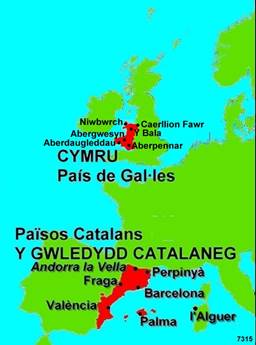
…..
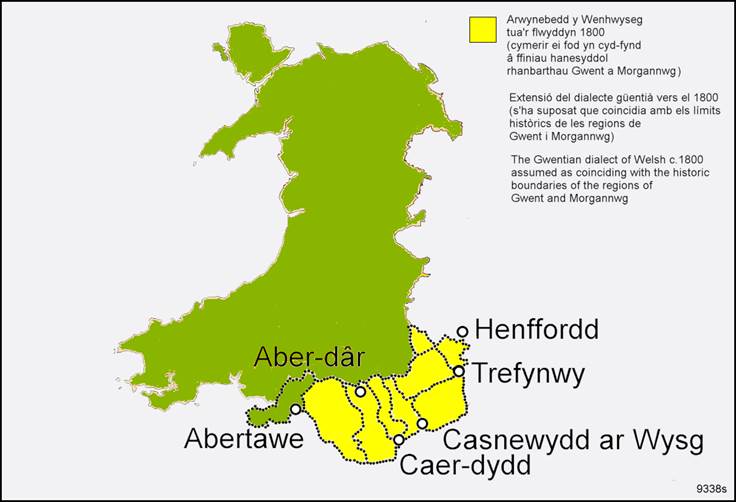
(delwedd
9338e)
http://www.kimkat.org/amryw/1_gwenhwyseg/gwenhwyseg_cyfeirddalen_0934k.htm Y Wenhwyseg - y prif dudalen
http://www.kimkat.org/amryw/1_gwenhwyseg/gwenhwyseg_cyfeirddalen_2184c.htm El dialecte güentià del gal·lès
- la pàgina prinicipal
http://www.kimkat.org/amryw/1_gwenhwyseg/gwenhwyseg_cyfeirddalen_1004e.htm Gwentian dialect of Welsh – the
main page
08
Ebrill 1911
15
Ebrill 1911
06
Mai 1911
13
Mai 1911
27
Mai 1911
|
|
|
|
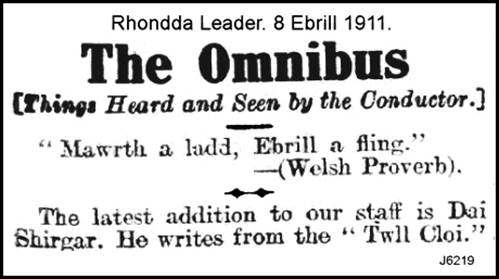
(delwedd J6219) (15 Ebrill 1911) |
Rhondda Leader. 8 Ebrill 1911. The Omnibus [Things Heard and Seen by the Conductor.] “Mawrth a ladd, Ebrill a fling.” – (Welsh
Proverb). The latest addition to our staff is Dai Shirgar. He
writes from the “Twll Cloi." |
|
|
|
|
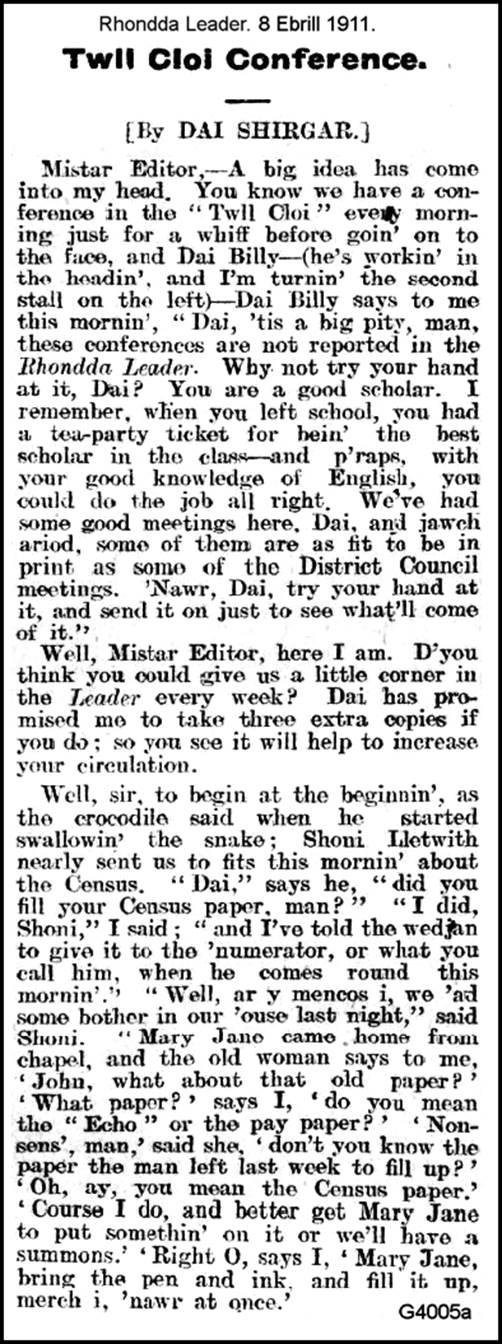
(delwedd G4004a) (15 Ebrill 1911) |
Rhondda Leader. 8 Ebrill 1911. Twll Cloi Conferences. [By DAI SHIRGAR] Mistar Editor, - A big idea has come into my
head. You know we have a conference in the “Twll Cloi” every morning just for
a whiff before goin' on to the face, and Dai Billy - (he's workin' in the
headin' and I'm turnin' the second stall on the left) - Dai Billy says to me
this mornin', “Dai, 'tis a big pity, man, these conferences are not reported
in the Rhondda Leader. Why not try your hand at it, Dai? You are a good
scholar. I remember, when you left school, you had a tea-party ticket for bein'
the best scholar in the class - and p'raps, with your good knowledge of
English, you could do the job alright. We’ve had some good meetings here,
Dai, and jawch ariod, some of them are as fit to be in print as some of the
District Council meetings. ’Nawr, Dai, try your hand at it, and send it on
just to see what'll come of it.” Well, Mistar Editor, here I am. D'you think you
could give us a little corner in the Leader every week ? Dai has promised me
to take three extra copies if you do; so you see it will help to increase
your circulation. Well, sir, to begin at the beginning as the
crocodile said when he started swallowin' the snake; Shoni Lletwith nearly
sent us to fits this mornin' about the Census. “Dai,” says he, “did you fill
your Census paper, man?” “I did, Shoni,” I said “and I've told the wedjan to
give it to the 'numerator, or what you call him, when he comes round this
mornin'.” “Well, ar y mencos i, we ’ad some bother in our 'ouse last night,”
said Shoni. “Mary Jane came home from chapel, and the old woman says to me, ‘John,
what about that old paper?' ‘What paper?' says I, ‘do you mean the “Echo” or
the pay paper?’ ‘Nonsens', man,’ said
she, 'don't you know the paper the man left last week to fill up? Oh, ay, you
mean the Census paper.’ ‘Course I do, and better get Mary Jane to put
somethin' on it or we'll have a summons.' ‘Right O, says I, ‘Mary Jane, bring
the pen and ink, and fill it up, merch i, ’nawr at once.' |
|
|
|
|
(delwedd G4004a) (15 Ebrill 1911) |
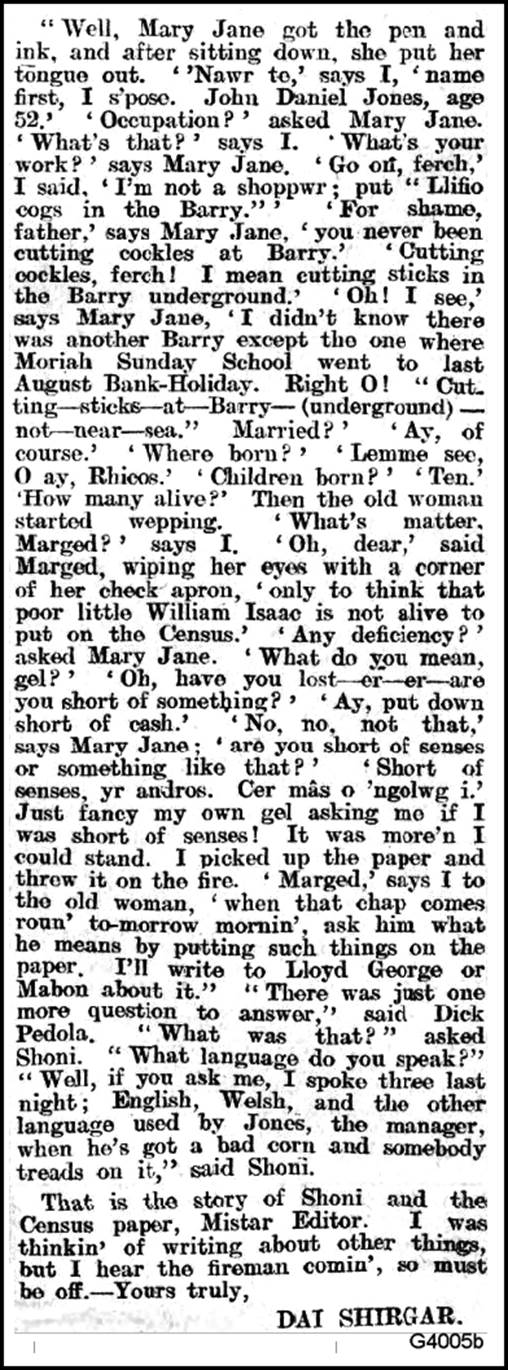
“Well, Mary Jane got the pen and ink, and after
sitting down, she put her tongue out. ‘ ’Nawr te,' says I, ‘name first, I
s'pose. John Daniel Jones, age 52.' ‘Occupation?' asked Mary Jane. ‘What's
that?’ says I. ‘What's your work?’ says Mary Jane. ‘Go on, ferch,' I said, ‘I'm
not a shoppwr; put “Llifio cogs in the Barry.” ’ ‘For shame, father,' says
Mary Jane, ‘you never been cutting cockles at Barry.' ‘Cutting cockles,
ferch! I mean cutting sticks in the Barry underground.' 'Oh! I see,' says
Mary Jane, ‘I didn't know there was another Barry except the one where Moriah
Sunday School went to last August Bank-Holiday. Right O! “Cutting - sticks -
at - Barry - (underground) - not - near - sea.” Married?’ ‘Ay, of course.' Where
born?' ‘Lemme see, O ay, Rhicos.' ‘Children born?’ 'Ten.' 'How many alive?'
Then the old woman started wepping. ‘What's matter, Marged?' says I. 'Oh,
dear,' said Marged, wiping her eyes with a corner of her check apron, ‘only
to think that poor little William Isaac is not alive to put on the Census.'
'Any deficiency?' asked Mary Jane. ‘What do you mean, gel?' 'Oh, have you
lost – er – er - are you short of something?’ ‘Ay, put down short of cash.' ‘No,
no, not that,' says Mary Jane; are you short of senses or something like
that?’ ‘Short of senses, yr andros. Cer mâs o ngolwg i.' Just fancy my own
gel asking me if I was short of senses! It was more'n I could stand. I picked
up the paper and threw it on the fire. ‘Marged,' says I to the old woman, ‘when
that chap comes roun' to-morrow mornin', ask him what he means by putting
such things on the paper. I'll write to Lloyd George or Mabon about it.” “There
was just one more question to answer,” said Dick Pedola. “What was that?”
asked Pedola. “What language do you speak?” “Well, if you ask me, I spoke three
last night; English, Welsh, and the other language used by Jones, the
manager, when he's got a bad corn and somebody treads on it,” said Shoni. That is the story of Shoni and tie Census paper,
Mistar Editor. I was thinkin' of writing about other things, but I hear the
fireman comin', so must be off. - Yours truly, DAI SHIRGAR. |
|
|
|
|
(delwedd G4004a) (15 Ebrill 1911) |
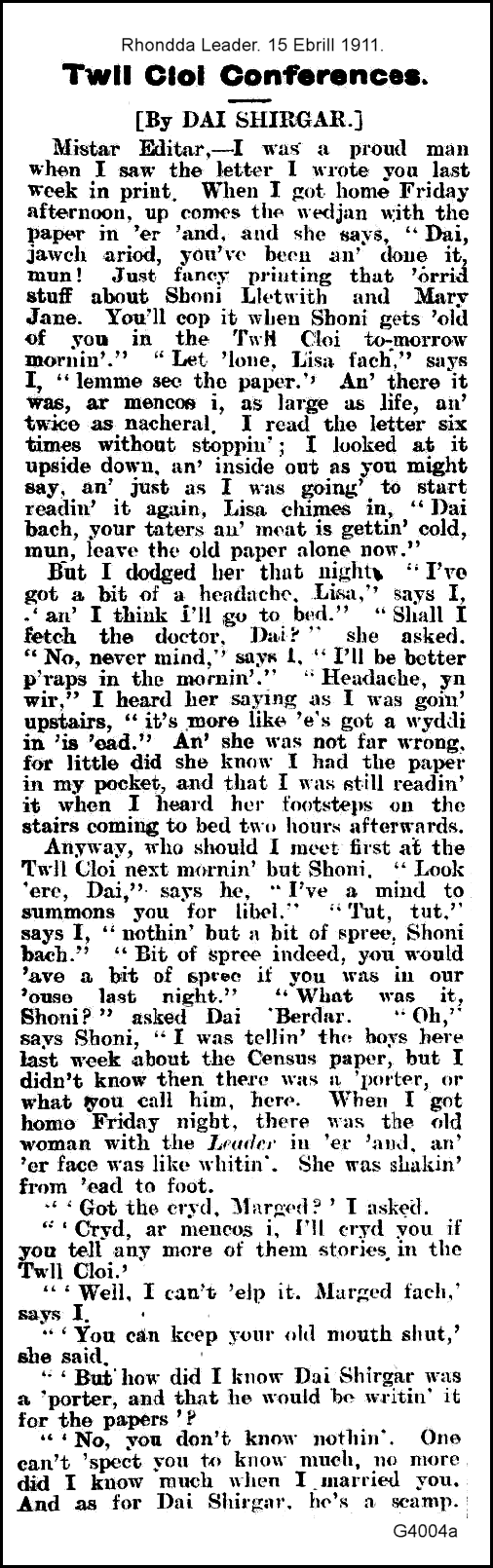
Rhondda Leader. 15 Ebrill 1911. Twll Cloi Conferences. [By DAI SHIRGAR] Mistar Editar, - I was a proud man when I saw the letter I wrote you last
week in print. When I got home Friday afternoon, up comes the wedjan [girlfriend]
with the paper in 'er 'and, and she says, “Dai, jawch ariod [jawch
ariôd = good heavens, etc; jawch < diawl = devil; ariôd < erioed =
ever], you've been an' done it, mun! Just fancy printing that 'orrid
stuff about Shoni Lletwith [lletchwith = left-handed; awkward] and
Mary Jane. You'll cop it when Shoni gets 'old of you in the Twll Cloi [= lamp
room; “hole (of) closing”] to-morrow mornin'.” “Let ’lone, Lisa fach,”
says I, “lemme see the paper.” An there it was, ar mencos i [= ar f’einios
i, ar f’engos i; upon my life], as large as life, an' twice as nacheral.
I read the letter six times without stoppin'; I looked at it upside down, an'
inside out as you might say, an' just as I was going' to start readin' it
again, Lisa chimes in, "Dai bach, your taters an' meat is gettin' cold,
mun, leave the old paper alone now." But I dodged her that night. “I've got a bit of a headache. Lisa,"
says I, “an’ I think I’ll go to bed.” “Shall I fetch the doctor, Dai?” she
asked. “No, never mind,” says I. “I'll be better p'raps in the mornin'.”
Headache, yn wir, [truly; indeed]" I heard her saying as I was goin'
upstairs, “it's more like ’e’s got a wyddi [< gwyddyf < gwddyf =
billhook, sickle] in 'is 'ead." An' she was not far wrong, for
little did she know I had the paper in my pocket, and that I was still
readin' it when I heard her footsteps on the stairs coming to bed two hours
afterwards. Anyway, who should I meet first at the Twll Cloi next mornin' but Shoni.
"Luuk ’ere, Dai," says he, “I’ve a mind to summons you for
libel." “Tut, tut," says I, “nothin' but a bit of spree, Shoni bach
[little John, = my friend John]." “Bit of spree indeed, you would
’ave a bit of a spree if you was in our ’ouse last night.” “What was it,
Shoni?" asked Dai 'Berdar [Aber-dâr / Aberdare]. “Oh,” says
Shoni, “I was tellin' the boys here last week about the Census paper, but I
didn't know then there was a 'porter, or what you call him. here. When I got
home Friday night, there was the old woman with the Leader in ’er ’and, ci,
an 'er face was like whitin’. She was shakin' from 'ead to foot. “Got the cryd, [= ague, fever, shivers] Marged?” I asked. “Cryd, ar mencos i, I'll cryd you if you tell any more of them stories in
the Twll Cloi.' “Well, I can't 'elp it, Marged fach,” says I “You can keep your old mouth shut,' she said. “But how did I know Dai Shirgar was a ’porter, and that he would be
writin it for the papers?” “No, you don't know nothin'. One can't 'spect you to know much, no more
did I know much when I married you. And as for Dai Shirgar, he's a scamp. |
|
|
|
|
(delwedd G4004b) (15 Ebrill 1911) |
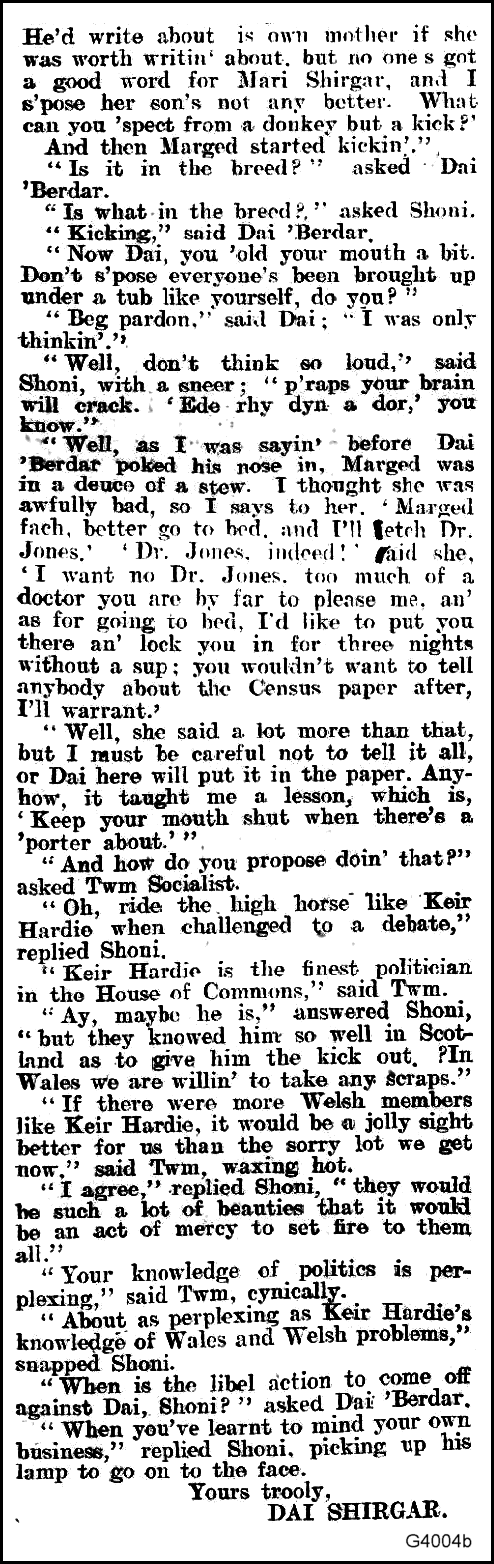
He'd write about ’is own mother if she was worth writin' about, but no
one’s got a good word for Mari Shirgar, and I s'pose her son's not any
better. What can you 'spect from a donkey but a kick? And then Marged started
kickin'.” "Is it in the breed?” asked Dai ’Berdar. "Is what in the breed" asked Shoni. “Kicking," said Dai ’Berdar. “Now Dai, you ’old your month a bit. Don't s'pose everyone's been brought
up under a tub like yourself, do you?” “Beg pardon," said Dai “I was only thinkin'.” “Well, don't think so loud," said Shoni, with a sneer; “p'raps your
brain will crack. ‘Ede rhy dyn a dor,' [a thread too tight breaks / will
break] you know. "Well, as I was sayin' before Dai ’Berdar poked his nose in, Marged
was in a deuce of a stew. I thought she was awfully bad, so I says to her,
‘Marged fach, better go to bed, and I'll fetch Dr. Jones.’ ‘Dr. Jones,
indeed!’ said she, 'I want no Dr. Jones, too much of a doctor you are by far
to please me, an’ as for going to bed, I’d like to put you there an’ lock you
in for three nights without a sup: you wouldn't want to tell anybody about
the Census paper after, I'll warrant.' “Well, she said a lot more than that, but I must be careful not to tell
it all, or Dai here will put it in the paper. Anyhow, it taught me a lesson,
which is, ‘Keep your mouth shut when there's a ’porter about.' “And how do you propose doin’ that?” asked Twm Socialist. "Oh ride the high horse like Keir Hardie when challenged to a
debate," replied Shoni. “Keir Hardie is the finest politician in the House of Commons, said Twm. “Ay, maybe he is." answered Shoni, “but they knowed him so well in
Scotland as to give him the kick out. In Wales we are willin’ to take any
scraps." “If there were more Welsh members like Keir Hardie, it would be a jolly
sight better for us than the sorry lot we get now,” said Twm, waxing hot. “I agree," replied Shoni, “they would be such a lot of beauties that
it would be an act of mercy to set fire to them all.” “Your knowledge of politics is perplexing," said Twm, cynically. “About as perplexing as Keir Hardi’s knowledge of Wales and Welsh
problems," snapped Shoni. "When is the libel action to come off against Dai, Shoni?” asked Dai
’Berdar. “When you’ve learnt to mind your own business," replied Shoni,
picking up his lamp to go on to the face. Yours trooly, DAI SHIRGAR. |
|
|
|
|
(delwedd G4020a) (6 Mai 1911) |
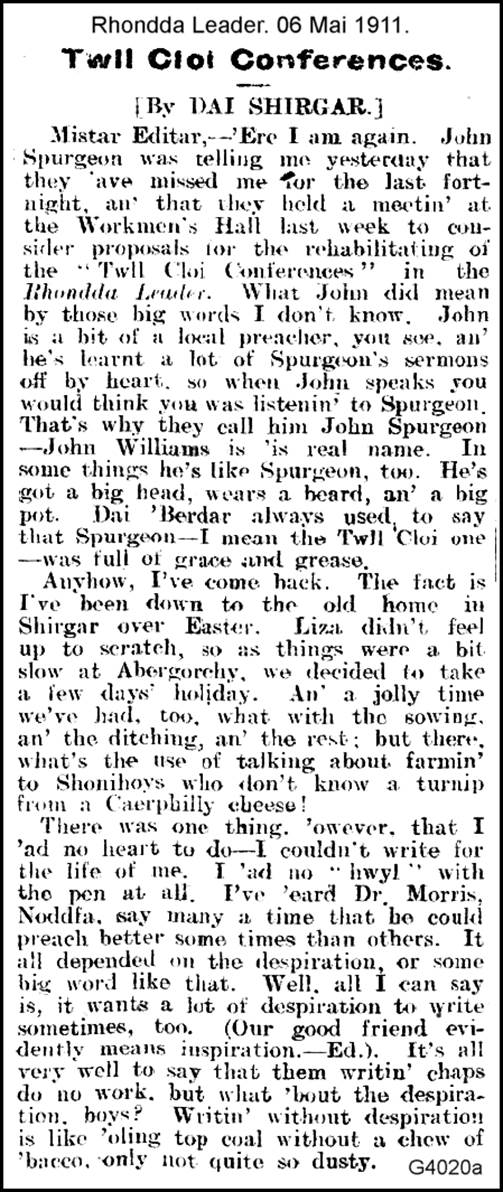
Rhondda Leader. 6 Mai 1911. Twll Cloi Conferences. [By DAI SHIRGAR] Mistar Editar, - 'Ere
I am again. John
Spurgeon was telling me yesterday that they ’ave
missed me for
the last fortnight,
an'
that they held a
meetin' at the Workmen's Hall last week to consider proposals for
the rehabilitating of the
“Twll
Cloi Conferences” in the Rhondda Leader. What
John did mean by those big words I don't know. John is a bit of a local
preacher, you see, an' he's learnt a lot of Spurgeon’s sermons off
by heart, so when John
speaks you would think you was listenin' to Spurgeon.
That's why they call him John Spurgeon - John
Williams is 'is real name. In some things he's like
Spurgeon, too. He's got a big head, wears a beard,
an' a big pot. Dai 'Berdar always used, to say that Spurgeon - I
mean the Twll Cloi one - was full of grace and
grease. Anyhow, I've come back.
The fact
is I've been down to the old home in Shirgar over Easter. Liza didn’t
feel
up to scratch, so as things were a bit slow
at Abergorchy,
we decided to take a few days holiday. An'
a jolly time we’ve had, too, what with
the sowing, an' the ditching, an' the rest; but there,
what's the use of talking about farmin’ to who Shonihoys who don't
know a turnip from a Caerphilly cheese! There was one thing, ’owever,
that I 'ad no heart to do - I couldn't write for
the life of me. I ’ad no “hwyl”
with the pen at all. I've ’eard Dr. Morris, Noddfa, say many
a time
that he could preach better some times
than others. It all depended on the despiration,
or some big word like that. Well, all I can say is, it
wants a lot of despiration to write
sometimes, too. (Our good friend evidently means inspiration. - Ed.). It's
all very well to say that them writin' chaps do no work,
but what ’bout
the despiration, boys? Writin' without despiration
is like
top coal without a chew of 'bacco, only not quite so
dusty. |
|
|
|
|
(delwedd G4020b) (6 Mai 1911) |
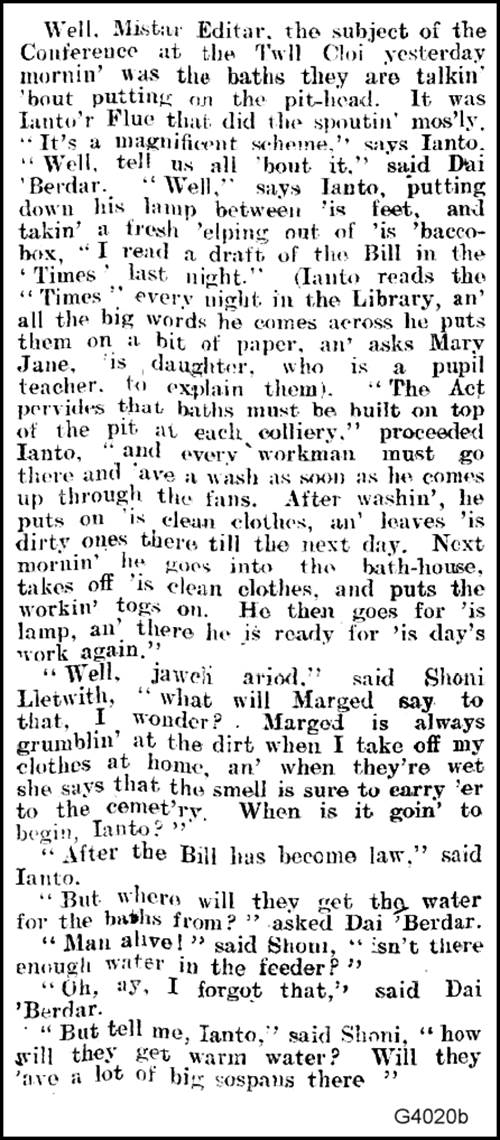
Well, Mistar
Editar,
the subject of the Conference at the Twll Cloi yesterday mornin' was the
baths they are talkin' 'bout putting on the pit-head. It was lanto'r Flue
that did the spoutin' mos'ly. “It's a magnificent scheme,” says lanto. “Well,
tell us all ’bout-
it,”
said Dai
’Berdar.
“Well,”
says Ianto, putting down his lamp between 'is feet, and takin' a
fresh ‘elping out of ’is ’bacco-box,
“I
read a draft, of the Bill
in the ‘Times'
last night,” (Ianto reads the “Times every night in the
Library, an' all the big words he comes across he puts them on a bit
of paper, an' asks Mary Jane's daughter, who is a pupil
teacher, to explain them). ''The Act pervides that baths must be built
on
top of the pit at each colliery,” proceeded Ianto,
“and every workman must go there and ’ave a wash as soon as he
comes up through the fans. After washin', he puts on ’is
clean clothes, leaves ’is dirty
ones there till
the next day. Next mornin' he goes into the bath-house,
takes off clean clothes, and puts the workin’ togs on. He then goes
for ’is
lamp, an there he is ready for ’is day's work again.”
“Well, jawch ariod,”
said Shoni Lletwith,
“what will Marged say to that, I wonder? Marged is
always grumblin’ at the dirt when I take off my clothes at
home, an' when they're wet she says that the smell
is sure to carry ’er to the cemet'ry. When is it goin'
to begin, Ianto?” "After
the Bill has become law,”
said Ianto. "But
where will they get the water for the baths from?” asked
Dai ’Berdar. “Man
alive!”
said Shoni, “isn't there enough
water in the feeder?” “Oh, ay, I forgot that”,
said Dai ’Berdar.
“But
tell me, Ianto,” said Shoni, how will they get warm water?
Will they ’ave
a lot of big sospans there?” |
|
|
|
|
(delwedd G4020c) (6 Mai 1911) |
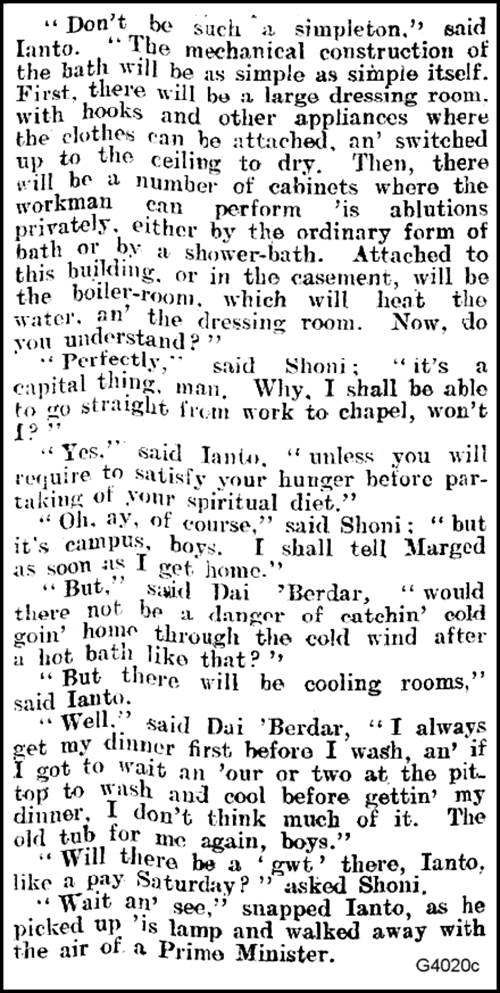
“Don't
be a, simpleton,” said Ianto. “The mechanical
construction of the bath will be as simple as simple itself. First,
there will be a large dressing room,
with hooks and other appliances where the clothes can be attached, an'
switched up to the ceiling to dry. Then, there will
be number of cabinets where the workman
can perform 'is ablutions privately, either by the ordinary
form of bath or by a shower-bath. Attached
to this building, or in the casement, will be the
boiler-room, which
will heat the water, an’ the dressing room. Now, do you
understand?" "Perfectly,” said
Shoni; “it's a capital thing, man. Why, I
shall be able to
go straight from work to chapel, won't I?”
“Yes,” said
Ianto, “unless
you will require to satisfy your hunger before
partaking of your spiritual diet.” "Oh, ay, of course," said Shoni; “but
it's campus, boys. I shall tell Marged as soon as I get home.” “But,” said Dai
’Berdar, “would there not be a danger of catchin'
cold goin' home through the cold wind after a hor bath like that?” “But there will be
cooling rooms,” said Ianto. “Well,”
said Dai 'Berdar, “I always get my dinner first before I wash,
an' if I got to wait an hour or
two at the pit-top to wash and cool before gettin' my dinner, I don't think
much of it. The old tub for me again, boys.” “Will there be a ‘gwt’ there, Ianto, like a pay Saturday?” asked
Shoni.” “Wait
an' see,” snapped Ianto, as he picked up ’is lamp
and walked away with the air of a Prime Minister. |
|
|
|
|
(delwedd G4021a) (13 Mai 1911) |
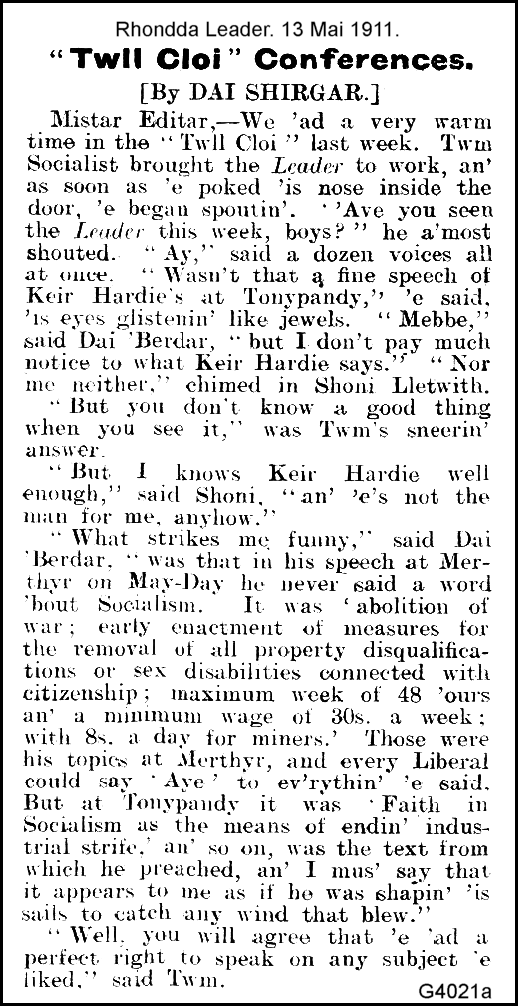
Rhondda Leader. 13 Mai 1911. “Twll Cloi” Conferences. [By DAI SHIRGAR] Mistar
Editar, - We 'ad a very warm time in the “Twll Cloi” last week. Twm Socialist
brought the Leader to work, an' as soon as ’e poked ’is nose inside the door,
’e began spoutin'. “ ’Ave you seen the Leader this week, boys?” he almost
shouted. “Ay," said a dozen voices all at once. “Wasn't that a fine
speech of Keir Hardie's at Tonypandy,” ’e said, ’is eyes glistenin’ like
jewels. "Mebbe," said Dai ’Berdar, “but I don't pay much notice to
what Keir Hardie says.” “Nor me neither," chimed in Shoni Lletwith. “But you
don't know a good thing when you see it," was Twm's sneerin' answer. “But I
knows Keir Hardie well enough," said Shoni. "an' ’e’s not the man
for me, anyhow." “What
strikes me funny," said Dai ’Berdar, “was that in his speech at Merthyr
on May-Day he never said a word ’bout Socialism. It was 'abolition of war;
early enactment of measures for the removal of all property disqualifications
or sex disabilities connected with citizenship; maximum week of 48 'ours an'
a minimum wage of 30s. a week; with 8s. a day for miners.' Those were his
topics at Merthyr, and every Liberal could say ‘Aye’ to ev'rythin' 'e said.
But at Tonypandy it was Faith in Socialism as the means of endin' industrial
strife, an' so on, was the text from which he preached, an' I mus’ say that
it appears to me as if he was shapin' ’is sails to catch any wind that
blew." “Well, you
will agree that ’e ’ad a perfect right to speak on any subject ’e
liked," said Twm. |
|
|
|
|
(delwedd G4021b) (13 Mai 1911) |
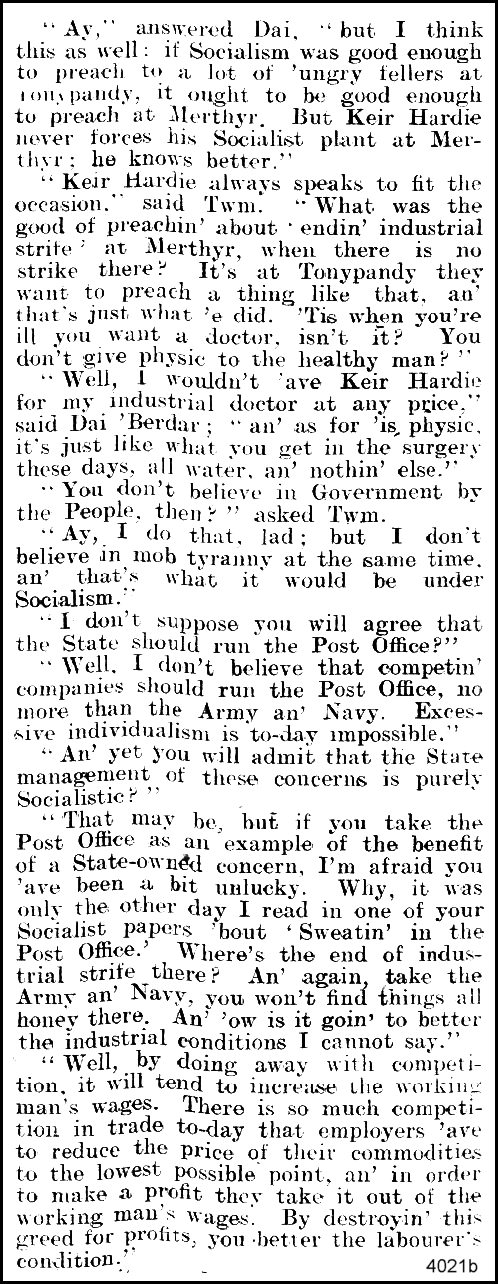
“Ay,"
answered Dai, "but I think this as well: it Socialism was good enough to
preach to a lot of ’ungry fellers at Tonypandy, it ought to be good enough to
preach at Merthyr. But Keir Hardie never forces his Socialist plant at
Merthyr: he knows better." “Keir
Hardie always speaks to fit the occasion,” said Twm. “What was
the good of preachin' about endin' industrial strife at Merthyr, when there
is no strike there? It's at Tonypandy they want to preach a thing like that,
an' that's just what ’e did. ’Tis when you're ill you want a doctor, isn't
it? You don't give physic to the healthy man?” “Well, I
wouldn't ’ave Keir Hardie for my industrial doctor at any price," said
Dai ’Berdar; an' as for ’is physic, it's just like what you get in the
surgery these days, all water, an' nothin' else." “You don't
believe in Government by the People, then?” asked Twm. "Ay,
I do that, lad; but I don't believe in mob tyranny at the same time, an'
that’s what it would be under Socialism.” “I don't
suppose you will agree that the State should run the Post Office?" “Well, I
don't believe that competin' companies should run the Post Office, no more
than the Army an' Navy. Excessive individualism is to-day impossible." “An' yet
you will admit that the State management of these concerns is purely
Socialistic?” “That may
be, but if you take the Post Office as an example of the benefit of a
State-owned concern, I'm afraid you ’ave been a bit unlucky. Why, it was only
the other day I read in one of your Socialist papers ’bout ‘Sweatin' in the
Post Office.' Where's the end of industrial strife there? An' again, take the
Army an' Navy, you won't find things all honey there. An' ’ow is it goin' to
better the industrial conditions I cannot say." “Well, by
doing away with competition, it will tend to increase the working man's
wages. There is so much competition in trade to-day that employers ’ave to
reduce the price of their commodities to the lowest possible point, an' in
order to make a profit they take it out of the working man’s wages. By
destroyin' this greed for profits, you better the labourer's condition.” |
|
|
|
|
(delwedd G4021b) (13 Mai 1911) |
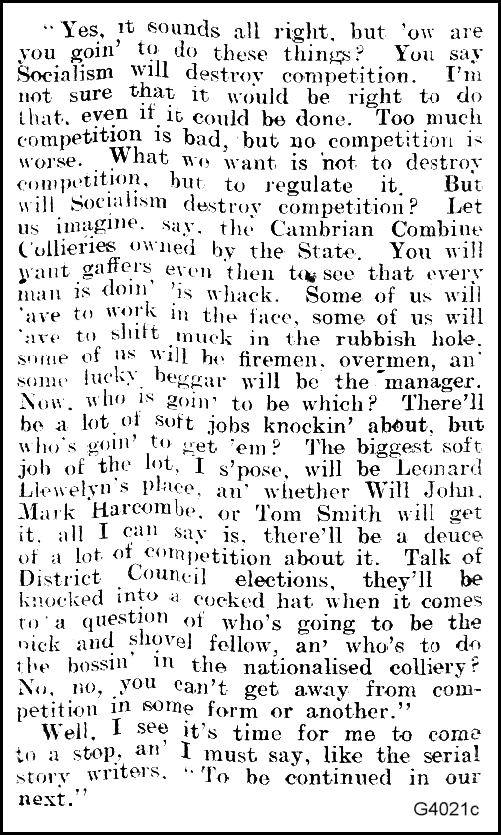
“Yes, it
sounds all right, but 'ow are you goin to do these things? You say Socialism
will destroy competition. I'm not sure that it would be right to do that even
if it could be done. Too much competition is bad, but no competition is
worse. What we want is not to destroy competition, but to regulate it. But
will Socialism destroy competition? Let us imagine, say, the Cambrian Combine
Collieries owned by the State. You will want gaffers even then to see that
every man is doin’ ’is whack. Some of us will ’ave to work in the face, some
of us will ’ave to shift muck in the rubbish hole, some of us will be firemen,
overmen, an' some lucky beggar will be the manager. Now. who is goin' to be
which? There'll be a lot of soft jobs knockin' about, but who's goin’ to get
’em ? The biggest soft job of the lot, I s'pose, will be Leonard Llewelyn's
place, an' whether Will John, Mark Harcombe, or Tom Smith will get it, all I
can say is, there'll be a deuce of a lot of competition about it. Talk of
District Council elections, they'll be knocked into a cocked hat when it
comes to' a question of who's going to be the pick and shovel fellow, an'
who's to do the bossin’ in the nationalised colliery? No, no, you can't get
away from competition in some form or or another.” “Well, I
see it’s time for me to come to a stop, an’ I must say, like the serial story
writers, “To be continued in our next." |
|
|
|
|
|
|
|
(delwedd
G4022a) (27 Mai 1911) |
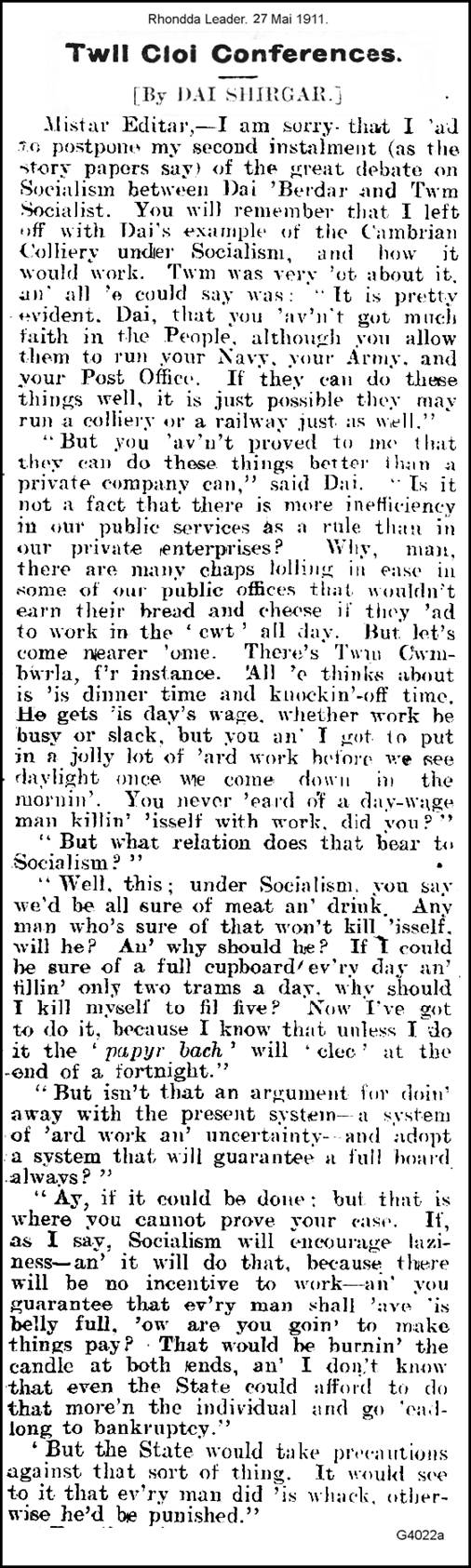
Rhondda Leader. 27 Mai 1911. Twll Cloi Conferences. [By DAI SHIRGAR] Mistar Editar, - I am sorry that I ’ad to postpone my second instalment
(as the story papers say) of the great debate on Socialism between Dai
’Berdar and Twm Socialist. You will remember that I left off with Dai's
example of the Cambrian Colliery under Socialism, and how it would work. Twm
was very ’ot about it, an’ all ’e could say was: “It is pretty evident. Dai,
that you ’av'n't got much faith in the People, although you allow them to run
your Navy, your Army, and your Post Office. If they can do these things well,
it is just possible they may run a colliery or a railway just as well.” "But you ’av'n't proved to me that they can do these things better
than a private company can," said Dai. “Is it not a fact that there is
more inefficiency in our public services as a rule than in our private
enterprises? Why, man, there are many chaps lolling in ease in some of our
public offices that wouldn't earn their bread and cheese if they 'ad to work
in the ‘cwt’ all day. But let's come nearer ’ome. There's Twm Cwmbwrla, f'r
instance. All 'e thinks about is ’is dinner time and knockin'-off time. He
gets ’is day's wage, whether work be busy or slack, but you an' I got to put
in a jolly lot of ’ard work before we see daylight once we come down in the
mornin'. You never ’eard of a day-wage man killin' ’isself with work, did
you?” "But what relation does that bear to Socialism?” "Well, this; under Socialism, you say we’d be all sure of meat an'
drink. Any man who's sure of that won't kill ’isself, will he? An' why should
he? If I could be sure of a full cupboard ev'ry day an' fillin’ only two
trams a day, why should I kill myself to fil five? Now I've got to do it,
because I know that unless I do it the ‘papyr bach’ will 'clec' at the end of
a fortnight." "But isn't that an argument for doin’ away with the present system a
system of ’ard work an' uncertainty and adopt a system that will guarantee a
full board always?” "Ay, if it could be done: but that is where you cannot prove your
case. If, as I say, Socialism will encourage laziness - an' it will do that,
because there will be no incentive to work - an' you guarantee that ev'ry man
shall ’ave ’is belly full, ’ow are you goin' to make things pay? That would
be burnin’ the candle at both ends, an' I don't know that even the State
could afford to do that more'n the individual and go ’e adlong to
bankruptcy.” “But the State would take precautions against that sort of thing. It
would see to it that ev’ry man did ’is whack, otherwise he'd be punished.” |
|
|
|
|
(delwedd
G4022b) (27 Mai 1911) |
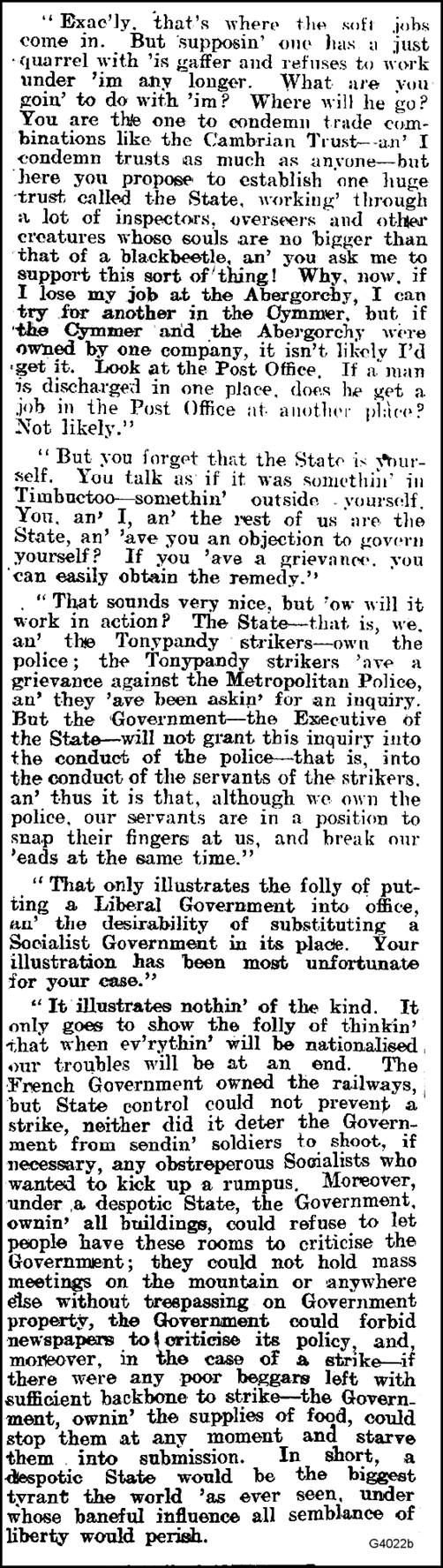
“Exac’ly, that's where the soft jobs come in. But supposin' one has a
just quarrel with ’is gaffer and refuses to work under ’im any longer. What
are you goin' to do with 'im? Where will he go? You are the one to condemn
trade combinations like the Cambrian Trust - an' I condemn trusts as much as
anyone - but here, you propose to establish one huge trust called the State,
workin' through a lot of inspectors, overseers and other creatures whose
souls are no bigger than that of a blackbeetle, an' you ask me to support
this sort of thing'! Why, now, if I lose my job at the Abergorchy, I can try
for another in the Cymmer, but if the Cymnier and the Abergorchy were owned
by one company, it isn't likely I'd get it. Look at the Post Office, if a man
is discharged in one place, does he get a job in the Post Office at another
place? Not likely." “But you forget that the State is yourself. You talk as if it was
somethin’ in Timbuctoo - somethin' outside yourself. You, an' I, an' the rest
of us are the State, an’ ’ave you an objection to govern yourself? If you
’ave a grievance, you can easily obtain the remedy." “That sounds very nice, but ’ow will it work in action? The State — that
is, we an' the Tonypandy strikers - own the police; the Tonypandy strikers
’ave a grievance against the Metropolitan Police, an' they ’ave been askin'
for an inquiry. But the Government — the Executive of the State — will not
grant this inquiry into the conduct of the police — that is, into the conduct
of the servants of the strikers, an' thus it is that, although we own the
police, our servants are in a position to snap their fingers at us, and break
our ’eads at the same time." “That only illustrates the folly of putting a Liberal Government into
office, an’ the desirability of substituting a Socialist Government in its
place. Your illustration has been most unfortunate for your case." “It illustrates nothin' of the kind. It only goes to show the folly of
thinkin' that when ev'rythin' will be nationalised our troubles will be at an
end. The French Government owned the railways, but State control could not
prevent a strike, neither did it deter the Government from sendin' soldiers
to shoot, if necessary, any obstreperous Socialists who wanted to kick up a
rumpus. Moreover, under a despotic State, the Government, ownin' all
buildings, could refuse to let people have these rooms to criticise the
Government; they could not hold mass meetings on the mountain or anywhere
else without trespassing on Government property, the Government could forbid
newspapers to criticise its policy, and, moreover, in the case of a strike —
if there were any poor beggars left with sufficient backbone to strike — the
Govern- ment, ownin' the supplies of food, could stop them at any moment and
starve them into submission. In short, a despotic State would be the biggest
tyrant the world ’as ever seen under whose baneful influence all semblance of
liberty would perish. |
|
|
|
Sumbolau:
a A / æ Æ / e E / ɛ
Ɛ / i I / o O / u U / w W / y Y /
MACRONː ā Ā / ǣ Ǣ / ē Ē / ɛ̄ Ɛ̄
/ ī Ī / ō
Ō / ū Ū / w̄ W̄ / ȳ Ȳ /
MACRON + ACEN DDYRCHAFEDIGː Ā̀ ā̀ , Ḗ ḗ,
Ī́ ī́ , Ṓ ṓ , Ū́ ū́, (w),
Ȳ́ ȳ́
MACRON + ACEN DDISGYNEDIGː Ǟ ǟ , Ḕ ḕ, Ī̀
ī̀, Ṑ ṑ, Ū̀ ū̀, (w), Ȳ̀
ȳ̀
MACRON ISODː A̱ a̱ , E̱ e̱ , I̱ i̱ , O̱
o̱, U̱ u̱, (w), Y̱ y̱
BREFː ă Ă /
ĕ Ĕ / ĭ Ĭ / ŏ Ŏ / ŭ Ŭ / B5236ː  B5237ː
BREF GWRTHDRO ISODː i̯, u̯
CROMFACHAUː ⟨ ⟩ deiamwnt
A’I PHEN I LAWRː ∀, ә, ɐ (u+0250) httpsː
//text-symbols.com/upside-down/
Y WENHWYSWEG: ɛ̄ ǣ æ
ˈ ɑ ɑˑ
aˑ aː / æ æː / e eˑeː / ɛ ɛː / ɪ
iˑ iː ɪ / ɔ oˑ oː / ʊ uˑ uː
ʊ / ə / ʌ /
ẅ Ẅ / ẃ Ẃ / ẁ Ẁ / ŵ Ŵ /
ŷ Ŷ / ỳ Ỳ / ý Ý / ɥ
ˈ ð ɬ ŋ ʃ ʧ
θ ʒ ʤ / aɪ ɔɪ əɪ uɪ ɪʊ aʊ
ɛʊ əʊ / £
ә ʌ ẃ ă ĕ ĭ ŏ ŭ ẅ ẃ ẁ
Ẁ ŵ ŷ ỳ Ỳ Hungarumlautː A̋ a̋
U+1EA0 Ạ U+1EA1 ạ
U+1EB8 Ẹ U+1EB9 ẹ
U+1ECA Ị U+1ECB ị
U+1ECC Ọ U+1ECD ọ
U+1EE4 Ụ U+1EE5 ụ
U+1E88 Ẉ U+1E89 ẉ
U+1EF4 Ỵ U+1EF5 ỵ
g yn
yn  aith
δ δ £gyn
aith
δ δ £gyn  aith
δ δ £U+2020 †
aith
δ δ £U+2020 †
« »
DAGGER
wikipedia, scriptsource. org
httpsː
[]//en.wiktionary.org/wiki/ǣ
Hwngarwmlawtː A̋ a̋
g yn
yn  aith δ δ
…..
…..
ʌ ag acen ddyrchafedig / ʌ with acute
accentː ʌ́
|
Shwa ag acen ddyrchafedig
/ Schwa with acute |
…..
…..
wikipedia,
scriptsource.[]org
httpsː//[
]en.wiktionary.org/wiki/ǣ
Y
TUDALEN HWN /THIS PAGE / AQUESTA PÀGINA:
Sumbolau:
Y TUDALEN HWN: www. []kimkat.org[]/amryw/1_testunau/testunau-saesneg_337_twll-cloi-conferences_dai-shirgar_1911_3601k.htm
---------------------------------------
Creuwyd / Created / Creada: 08-11-2020
Adolygiadau diweddaraf / Latest updates / Darreres
actualitzacions: 22-11-21,-08-11-2020
Delweddau / Imatges / Images:
Ffynhonell / Font / Source: Newyddiadron
Arlein, Llyfrgell Genedlaethol Cymru
---------------------------------------
|
Freefind. Archwiliwch y wefan hon
Beth sydd yn newydd?
|
Ble
yr wyf i? Yr ych chi'n ymwéld ag un o dudalennau'r Wefan CYMRU-CATALONIA
On sóc? Esteu
visitant una pàgina de la Web CYMRU-CATALONIA (= Gal·les-Catalunya)
Where am I? You are visiting a page from the CYMRU-CATALONIA (= Wales-Catalonia)
Website
Weə-r äm ai? Yüu äa-r víziting ə peij fröm dhə CYMRU-CATALONIA
(= Weilz-Katəlóuniə) Wébsait
Adran y
Wenhwyseg / Secció del dialecte de Gwent / Gwentian Welsh
Edrychiadau ar y tudalennau / Vistes de les pàgines / Page Views

Edrychwch
ar ein Hystadegau / Mireu les nostres Estadístiques / View Our Stats