|
|
|
|
(delwedd F6951) (tudalen 200)
|
200 English Element
in Welsh [chapter iv, § 60
vowel (o) that usuall}- developed from M and Early NE ait. The reason for
this irregularity is given by Jespersen (p. no): “We should have had
[o"] • . .in all instances of an before a nasal . . . , had it not been
for the fact that this an was a special development of the Anglo-French
dialect, and that the English were in constant contact with continental
French as well, and naturally that French pronunciation, which was more and
more recognized as standard, would grow in importance as Anglo-French
dwindled away. In consequence of this, many words were in course of time
re-fashioned when the manner of Stratford-atte-Bowe was too far removed from
the French of Paris, or — which r mounts to the same thing — ^they were
re-adopted in a more French form." Thus, although we have nowadays dance
in E, the form dawns is still the present-day W form.
With regard to the monophthongization cf the diphthong in E, Wyld says (p.
252): “The process of change followed was probably [au, on, o", o",
5], that is to say, the first element of the diphthong underwent rounding
through the influence of the second element; the former became longer and
more important, and the latter proportionally weaker until it disappeared
altogether. It is naturally impossible to fix the precise period at which
complete monophthongization took place, but it is reasonable to suppose that
the [o'^, o'^] stage had been passed before the old li had become [ou] [that
is, early in the sixteenth century). . . . The [ou] from au may . . . have
been monophthongized in the preceding century." See further Jespersen,
pp. 311, 312. It may be mentioned here that ŴS (1547)
states that the w in awe is silent: “Hefyt distewi a wna w| with ddiweddy
llawer gair saesnec val yn diwedd y rai hynn | awe, howe, wowe | y rhain a
ddarlleant modd hynn: a i ofyn, bo bwa: w | kary."
Apart from any other proof, the above remarks lead us to suppose that the
borrowings with aw in W found their way into the language during the Early NE
period. It is noticeable that where aw in W would regularly become in the
Mod. period, in nearly aU cases except in monosyllables, the aw from E remains
unchanged as a rule. Cf. herod, however, in § 61. Cf. also the Lat. au in Ŵ JMJ 118. “Before a consonant, penultimate aw is sounded
9W, and sometimes written ow” (JMJ, p. 118). See § 61 below.
|
|
|
|
|
(delwedd F6952) (tudalen 201)
|
CHAPTER IV, § 61]
Middle and New English Diphthongs 201
§ 61. ^I AND NE NORMAL au > W aw
" awditor: Auditor “WS. awmal. See awmael, § 55.
awmler “ambler (?) “in PenMS, 67, p. 44, 1. 22; but cf. amler in CLl 202b.
awgrym, § 27 (a).
hesawnt “bezant, besant," SG 42, 45.? <C F. Cf. bysanneu, plur., in
Car. Mag, 103.
brawn “brawn; produce “Bod. Not in Dav.? <C E brawn.
cawdel, § 20. Cf. siawdel LlanMS, 6, p. 115, 1. 39;? from a form in ch-.
Kawntlberi? Canterbury, in RepWMSS II, i, p. 136 (Archesgob Kawntlberi) .
cawl “broth, soup; cabbage."? •< E or Lat. ME caul.
cawsai, §§ 54, 56.
[clawst{w)r “cloister."? < E or Lat. RBB 127-34 {cla6st6r); PenMS 57,
p. 17, 1. 64 (y glawstr ef ay eglw3^s draw). Cf. clauster vel cloister in
Cor. Voc]
coliawndmr{n) “coriander “SE. ME coliaundre. AfcL, I, i, 39 [coliawndr).
daimawnt "diamont." ME diamamit, dimaunt. CCharl 56. Cf. diemwnt,
etc., § 32.
dawcan “a plant of the parsnip or carrot kind “SE.? E dauke.
dawns “a dance," dawnsio “to dance." dawns in LlC I, p. 56; Jer.
xxxi, 13; Ex. xv, 20; dawnsio in Mc. vi, 22; ML II, 88; LIR 321. See SE for
other refs. ME daunce. Cf. Cor. donssye, downssya.
elisawndyr “alexanders” (plant), ME alisaundre. AfcL, I,
i,?,7; HD.
exawmpyl, exawmpleu “example, -es." SG 43.
ffawt "fault." Used in Cams. WS has “fawt bai: Faute." WST I
Cor. vi, p. 315 (/^ze'O. ME faut{e).
fflaw “splinter”; singulat. fflewyn. ME flawe. Dav. has “fflaw. Idem quod
dellten, Rediuia, secamentum." The word is still used in W, See an interesting
article entitled Fflaw in Y Genedl Gymreig, Chwefror 21, 1922, by Prof. Ifor
Williams. WS has "flaw brec “with no E meaning,
" flawn: A flaune “WS. See NED s.v. flawn.
|
|
|
|
|
(delwedd F6953) (tudalen 202)
|
202 English Element
in Welsh [chapter iv, § 61
galamnt, §§ 7 (a), 9 (b). ME galaunt[e). Cf galont, § 7 (a).
gerlawnt, §§ 7 (a), 22. Cf. gerlont, § 7 (a).
gosawg, § 46.
Aflze'g "hawk" DGG I49'6.
? i7flZ£'i C/y;', § 25A.
hawnt "haunt." ME haunt{e). WS has “hawnt: Haunt." LGC 337
(Wyr Owain hael o'r un hawnt); CanC clxvii, 5 [hawnt); Iviii, 13 [hawntio
"to haunt").
herawds "heralds," § 17 (h). Cf. herod, §§ 22, 45.
lawnd, lamnt “laund, lawn (fine linen)." M and NE laun{e), laund{e). ID
7 (Iwyn tristan ar lamnd trosto); DE 28 (o lawnt main wj-^lwn nad mav); PenMS
57, p. 77, 1. 15 fmewn lawnt hardd mayn alawnt h[i]); FN 144 {lawnt); DPO 54
[lawnt a sidan).
lawnt “lawn." E lawn is for earlier laund. See Weekley s.v.
/az^^rg/ "laurel." WLB (Gloss.).
Lawnslod “Lancelot." LGC 346. E (sixteenth century) had Launcelott; see
Bardsley s.v. Lancelot. Malfawnt “Maliphant." LGC 337. Mawd, Mawt
“Md^nd." LGC 116; PenMS 67, p. 39, 1. 12;
p. 72>, 1- 40-
Mawndfil” (Sir John) Mandeville." FN 162.
nigromawns “necromance," necromawnswr “necromancer." See § 9 (a)
s.v. necromans.
} pawen "paw."? < E. LlanMS 6, p. 68, 1. 45. ME has pawe, powe
from OF poe. The aw is due to the influence of claw (Jespersen, p. 108).
rampamnt “rampant." ME rampaunt. LGC 67. Cf. rampont,
§ 7 (a).
rawnswn “ransom. SG 209; cf. ranswn SG 417.
Rwmawns “Romance." CCharl 19,
" sawdwst: Sawedust “WS.
saw)s “sauce." RP 128b 27, 129b 17; MM(W) 258; PenMS 57, p. 6, 1. 34;
DGG 124-12; RepWMSS I, ii, p. 624; LIR 261; DE 106 [sawsau, plur.); “saws:
Sauce “WS.
sawser “saucer." WLB (Gloss.).
" sawt: Assaulte “WS. The I is intrusive in E. LlC I, p. 21 [sawd,
sawt); RepWMSS I, i, p. 217 [sawt); PenMS 67, p. 31, 1.
|
|
|
|
|
(delwedd F6954) (tudalen 203)
|
CHAPTER IV, §§62,
63] Middle and New English Diphthongs 203
12 {sawt); sawdyo “to assault," in PenMS 67, p. 14, 1. 45; sawtwyr
"assaulters “or "soldiers (?) “in PenMS 67, p. 116, 1. 11 (a roes
Edwart yr sawtwyr; the cynghanedd suggests sawdwyr "soldiers" (?)).
siawns “chance." ME chaunce. PGG 39.
siavDusler “chancellor." DT 99 [Siawnsler Henffordd); RBB 403-27
(jaGnsler); RepWMSS I, i, pp. 154, 210 (Siawnsler); siawnsri “chancery “in
RepWMSS I, i, p. 216.
truawnt (truant)? "truant," in BoHam., p. 122.
Cf. ysmeraud “emerald “in SG 127. The / is intrusive in E. W is from F.
§ 62. E au AS ow IN W
We have already seen (end of § 60) what the pronunciation of W aw was in
penultimate S3dlables before a consonant. In some parts of Wales ow (9w) is
heard even in monosyllables in such words as mawr. Some words given b}^ WS in
hie dictionary have the oix'-spelling. Whether this reflects the W
pronunciation or is a representation of the E development (see § 60), is not
certain — probably the former. These forms occur in WS: —
' ' fowset: A f aucete , ' '
" fowtus: Faulty." Ci. ffawt, § 61.
" Dygwyl lowres: S. Lawrence day."
Cf. also owmal by the side of awmal, awmael, §§ 55, 61; and? vowart (LGC 35)
“vanward, voward." E has vaw- and vow-ard. ME vauntwarde.
§ 63. M AND NE on [ow)
For the various origins of this diphthong in ME, see Jespersen, p. 99. The
first element in the diphthong appears to have been long in all cases (except
one, that from OE + ht, according to Jespersen, p. 99). This [first element
was also a back-round vowel. By the seventeenth century this diphthong had
fallen together with M and NE open (§ 47), both having become by that time a
diphthong with a close 6 as the first element and remaining as such till the
present day. Another view, however, is that monophthongization had set in by
the seventeenth century (and also that the ME long open had not been
diphthongized at this time but merely become
|
|
|
|
|
(delwedd F6955) (tudalen 204)
|
204 English Element
in Welsh [chapter iv, §§64,65
a long close 6), and that diphthongization arose towards the end of the
eighteenth century. We may, however, recall the statement made by WS (1547)
that w at the end of some words in E was silent, e.g., howe was pronounced ho
(see under au, § 60). It may be remarked that Welshmen still frequently
pronounce the sound as if it were a monophthong (0) . This may be due to the
fact that the w-element in the diphthong is not so rounded as the w in the W
diphthong ow, or the w-element in the diphthong in NE that developed from ME
il (§ 40). Or, the W not being so close as the E (close) in such diphthongs,
the Welsh ear may be (or have been) unable to recognize distinctly the
diphthongal quality. Besides, the diphthong ow does not usually occur in W;
see, however, § 62.
§ 64. TRACES OF E on [ow) APPEARING AS ow IN W “addfowsomx (?) rent: Aduouson
“WS; also adfowson, see
§ 9 (a).
" howling Hong: Bowleyne “WS.
? fowart, § 62.
ffowler “fowler." CAMSS, p. 67.
Fowls “Paul's," i.e. “St. Paul's." M and NE Powlys, Ponies,'' Fowls
occurs in LGC 126; CCMSS 215, 410; CAMSS, p. 268 (Eglwys Bowls); CLl 195b.
Cf. RBB 97-29, -30 (" kaer loy6 ... A gloGsestyr yn saesnec”; that is,
Gloucester). On Gloucester, see Jespersen, p. 126.
For powd{w)r, see § 68 (b).
§ 65. TRACES OF M AND NE ou [ow] > aw IN W: cf. § 68.
For rhawt, sawden, sawdwr, see § 68. Cf. pawen, § 6i.
Bristaw, Brystaw “Bristol." ME Bristowe. See § 27 (b). See also
Jespersen, p. 297, and Wyld, p. 297.
ysgawt “scout." Bod. Not in Dav. In Cams, the expression ar sgawt is
common. In this word, as in powder, in E “the OF 'hollow /' before a
consonant had become |u| previous to [its]
1 “Eine besondere Stellung nimmt in alteren Neuenglischen Paul's ein. Butler
1633 sagt . . . ' au in Paul's and his compounds the Londoners pronounce
after the French manner of ow ' " — Horn, Untersuchungen zur neuen
Lautgeschichte, p. 25. He also quotes Miege (1688), who states that Paul's
(the Cathedral) was pronounced Pols.
|
|
|
|
|
(delwedd F6956) (tudalen 205)
|
CHAPTER IV, § 661
Middle and New English Diphthongs 205
adoption into E” (Jespersen, p. 56). Are we then to regard the diphthong in
ME as a normal diphthong, and not one that developed from it?
§ 66. {a) M AND NE eu (ew).
On this sound and its development, see Wyld, pp. 242, 243, and cf. § 42
above. See also Jespersen, pp. loi, 102, 105, 106. This diphthong (in all its
forms) has developed into itl or ii in Mod. E. We seem to have traces of the
older pronunciation with e in some loan-words in W. Cf. the diphthongization
of u {= ii) in late Cornish.
ih) M AND NE iu (iw).
This diphthong also fell together with eit and ii {— ii) of ME, giving later
in or ft. See § 42.
(c) M AND NE a.
This sound in F words (if it did exist as a pure monophthong at all in ME and
Early NE) developed on the same lines as [a] and {b) above. See again § 42.
As the above, with a few exceptions, have developed into similar diphthongal
forms in W, they are grouped together here. In the W forms we get yw, uw, iw,
in addition to some cases of ew.
Examples:
(i) With ew.
blewmon (?), § 7.
Ehrew “Hebrew." ML I, 206. Cf. Ebryw below, and § 22.
Newgad “Newgate “in LGC 26;? infl. of E spelling. Cf. Nywgat CCMSS, p. 164.
Newtwnn “Newton “in WLl, iii, 58.
"pewter: Pewter" WS. E <^ OF peutre, pemitre. Cf. peitur, § 14
(b). DT, p. no, pewtar, but piwtar on p. 164.
sew “broth, pottage; juice; relish, sauce." ME sew, sean. DE 49, 144; FN
40; WLB (Gloss.); “sew: Sewe “WS.
sewer “sewer, attendant at table." ME sewer (<^ OF sewer, ace. to
Stratmann). DE48; "sewer: A sewer "WS. See Weekley s.v. sewer (2),
where AF asseour is given as the origin.
The W form llewpard “leopard {Hewpart, RP i6ia 18; Ueicpard,
|
|
|
|
|
(delwedd F6957) (tudalen 206)
|
206 English Element
in Welsh [chapter iv, § 66
Dat. xiii, 2) probably owes its diphthong to the influence of Hew
"hon." ME has lihhard, kppard.
(ii) With yw, uw, iw.
anterliwt “interlude." Cf. interhid, § 43, antarliwt, § 21 (a). WLl
(Geir.) has “chwerig: anterliwt." Also antarliwt in W. See Bulletin of
Bd. of Celtic Studies, I, ii, p. 92.
huwl “mule (?)," in WLl (Geir.) “huwl: mul ieuanc."
ciwrio "to cure." EC I, 147; HG 138-27 {kywr "cure").
Cuwpyd “Cupid." CAMSS, p. 52; Ciwpit, p. 316.
duwk in RepWMSS I, i, p. 221. See § 43.
Ehryw “Hebrew."? FN I44'33.
" fluwet [sic]: A flute “WS. Now usu. pronounced ffliwt.
Gryw “Greek (language)." ME Greu, Grewe.
iwsio “to use." CLIC II, p. 22.
Luwk “Luke." CAMSS, p. 40.
luwt “lute." Gre. 313; LGC 240 luwi. WS has “luwt: A lute."
miwsig, muwsig “music." Cf. musig, § 43. DG 370 {miwsig); CCMSS 81
[muwsig); loloMSS, p. 327 [miwsig).
Miwsys, etc. “Muses,' § 17 (b).
Nywgat “Newgate." See New gad above.
Nywpwrt “Newport." LlanMS 6, p. 160, 1. 20 (tref nyw pwrt).
pictiwr “picture." PT 81.
piwr “pure," colloq. HG 149-15 [pywr).
resgyw, rescuw "rescue." LGC 156 [resgyw); “rescuw: Rescue “WS.
riwbi, rowbi "rubi." DG 293 [riwhi]; IG, p. 668 [rowbi).
rhuw, ruw “rue." MM(W), pp. loi, 104, 147 [rhuw); PenMS
57. P- 47, 1- 9 (^^^)-
rhuwl, ruwl "rule"; rhuwlio, rhiwlio "to rule." ME riwle.
DE 86 [rvwl), 95 [rvwliad); LGC 202 [rhuwl); ID 64 [ruwl);
" ruwl: Rule “WS; CCMSS, p. 51 (" ac a ruwliai yn greulon”;
the verb); p. 152 (" Wyt ruwliwr i'n tir Wiliam “i.e.
"ruler").
Cf. rhywlys, § 17 (b), ruwls in WS (Introd.).
rhywart “reward." LGC 249.
rhywharh "rhubarb." MM(W), p. 132.
suwgr, sywgr, siwgr, “sugar." ME sugre, sucre. DG 86 [siwgr); DG 354
[siwgraidd, adj.); WLl liv, 54 [siwgr); lolo MSS, p. 310
|
|
|
|
|
(delwedd F6958) (tudalen 207)
|
CHAPTER IV, § 67]
Middle and New English Diphthongs 207
{sywgy); MM(W), p. 209 {siiwgr); DT 164 {snwgr); ID 17, 18 {siwgwr, siwgr);
ML I, 238 {siwgwr); cf. DE 49 (sew kaer ynnol svwkwr a wnaeth). See § 35.
siW “sure," In NW usu. pron. shwr, in SW s?W, sMwr (with consonantal w).
ML I, 166 {siwrach, compar.).
siwt, sywt, snwt “manner, condition; suit." See and cf. siid, § 43. CLIC
IV, p. 21 {syxi>t), p. 35 {siwtiau, plur. “suits of clothes ");
"sut| suwt: Sute “WS; WST Lc. xvi, p. 145 [siwt), i Cor. vi, p. 315
[suwt), Rhuf. xiv, p. 302 (suwt), 1 Cor. v, p. 314 (suwt), — all in margin,
with cyffelip, cyfryw, etc. in text; OS [5] [suwt); TN 280 [siwt).
suwio "to sue." CCMSS, p. 107 [suwiwch, 2 pers. plur. imperat.),
statuwt “statute." Cf ystatud, § 43, and statuwtes, § 17 (a).
" truws: Trewes “WS. ME trewes, triwes. In Cams, triwst in children's
games, "truce,"
trywlwv "true-love," in LGC 442. Cf. iriw "true" PT 96;
FC has triw.
tuwnio "to tune." CCMSS, p. 100. Usu. tiwnio, as in PT 2.
" yspruws: Spruce," WS.
" ystuws twymduy: Stewes “WS. CanC xiv, 21 [stywdeiau), Ixxxix
[stywdai), ex, 55 [stywdy).
With the above we may compare the W forms of the name of the town of
Beaumaris. RP 120a 15 [byGmares, with y deleted and e superscribed); RepWMSS
I, i, p. 220 has “morua teg . . . ar lau menaii . , . yn ffrangayg Bewmares .
, , ac o lysenw Duw mares”; cf. p. 89 [Dvmares). Nowadays usu. pron. is
Biwmaras or Bliwmaras. On Beau- in names, see Jespersen, pp. 106, 107. See
also OPem. II, p. 363,
II. DIPHTHONGS THAT AROSE FROM LONG VOWELS IN
M AND NE § 67. The diphthongization that developed from M and NE a, I, U, has
already been considered, and examples of the W representation given. See § 12
for «, § 33 for i, § 66 for u; an isolated instance of a diphthong in W
representing the diphthong that arose comparatively late in E in the
development of ME long open 0, is mentioned at the end of § 47, There remains
to be illustrated the diphthongization of ME n.
|
|
|
|
|
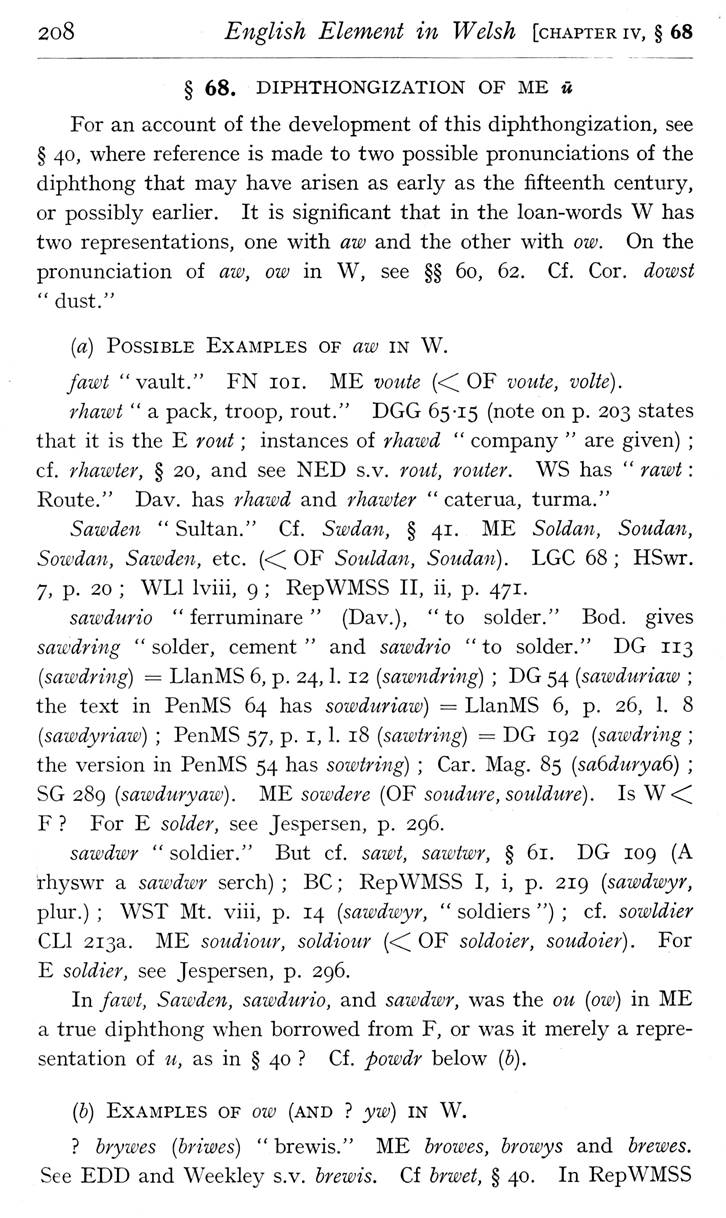
(delwedd F6959) (tudalen 208)
|
208 English Element
in Welsh [chapter iv, § 68 § 68. DIPHTHONGIZATION OF ME u
For an account of the development of this diphthongization, see § 40, where
reference is made to two possible pronunciations of the diphthong that may
have arisen as early as the fifteenth century, or possibly earlier. It is
significant that in the loan-words W has two representations, one with aw and
the other with ow. On the pronunciation of aw, ow in W, see §§ 60, 62. Cf.
Cor. dowst “dust."
[a) Possible Examples of aw in W.
fawt "vault." FN loi. ME voute {<! OF vonte, volte).
rhawt “a pack, troop, rout." DGG 65-15 (note on p. 203 states that it is
the E rout; instances of rhawd “company “are given); cf. rhawter, § 20, and
see NED s.v. rout, router. WS has “rawt: Route." Dav. has rhawd and
rhawter “caterua, turma."
Sawden
“Sultan." Cf. Swdan, § 41. ME Soldan, Soudan, Sowdan, Sawden, etc. (<^ OF Souldan, Soudan). LGC 68; HSwr. 7, p. 20; WLl
Iviii, 9; RepWMSS II, ii, p. 471.
sawdurio “ferruminare” (Dav.), “to solder." Bod. gives sawdring
"solder, cement" and sawdrio "to solder." DG 113
[sawdring) = LlanMS 6, p. 24, 1. 12 [sawndring); DG 54 [sawduriaw; the text
in PenMS 64 has sowduriaw) = LlanMS 6, p. 26, 1. 8 {sawdyriaw); PenMS 57, p.
i, 1. 18 {sawtring) = DG 192 [sawdring; the version in PenMS 54 has
sowtring); Car. Mag. 85 (saGduryaG); SG 289 (sawduryaw). ME sowdere (OF
soudure, souldure). Is W<^ F? For E solder, see Jespersen, p. 296.
sawdwr “soldier." But cf. sawt, sawtwr, § 61. DG 109 (A rhyswr a sawdwr
serch); BC; RepWMSS I, i, p. 219 [sawdwyr, plur.); WST Mt. viii, p. 14
(sawdwyr, “soldiers "); cf. sowldier CLl 213a. ME soudiour, soldiour
(<^ OF soldoier, soudoier). For E soldier, see Jespersen, p. 296.
In fawt, Sawden, sawdurio, and sawdwr, was the ou [ow] in ME a true diphthong
when borrowed from F, or was it merely a representation of u, as in § 40? Cf.
powdr below [h).
(b) Examples of ow (and? yw) in W.
? hrywes (briwes) “brewis." ME browes, browys and brewes. See EDD and
Weekley s.v. brewis. Cf brwet, § 40. In RepWMSS
|
|
|
|
|
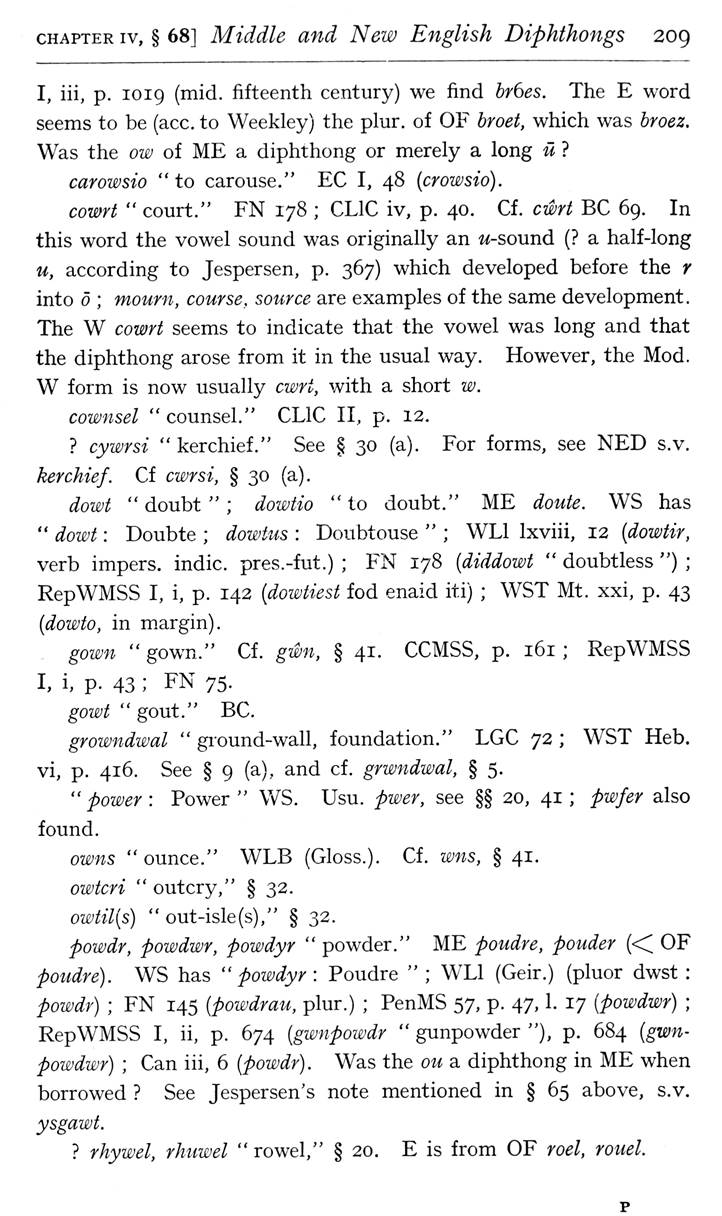
(delwedd F6960) (tudalen 209)
|
CHAPTER IV, § 68]
Middle and New English Diphthongs 209
I, iii, p. 1019 (mid. fifteenth century) we find hy6es. The E word seems to
be (ace. to Weekley) the plur. of OF broet, which was hroez. Was the ow of ME
a diphthong or merely a long u?
carowsio "to carouse," EC I, 48 {crowsio).
cowrt “court." FN 178; CLIC iv, p. 40. Cf. cwrt BC 69. In this word the
vowel sound was originally an w-sound (? a half-long u, according to
Jespersen, p. 367) which developed before the r into; mourn, course, source
are examples of the same development. The W cowrt seems to indicate that the
vowel was long and that the diphthong arose from it in the usual way.
However, the Mod. W form is now usually cwrt, with a short w.
cownsel “counsel." CLIC II, p. 12.
? cywrsi “kerchief." See § 30 (a). For forms, see NED s.v. kerchief. Cf
cwrsi, § 30 (a).
dowt "doubt"; dowtio "to doubt." ME dotite. WS has “dowt:
Doubte; dowtus: Doubtouse”; WLl Ixviii, 12 [dowtir, verb impers. indie,
pres.-fut.); FN 178 [diddowt “doubtless "); RepWMSS I, i, p. 142
[dowtiest fod enaid iti); WST Mt. xxi, p. 43 {dowto, in m.argin).
gow7i “gown." Cf. gwn, § 41. CCMSS, p. 161; RepWMSS I, i, p. 43; FN 75.
gowt “gout." BC.
growndwal “ground-wall, foundation." LGC 72; WST Heb. vi, p. 416. See §
9 (a), and cf. grwndwal, § 5.
" power: Power “WS. Usu. pwer, see §§ 20, 41; pwfer also found.
ow7ts "ounce." WLB (Gloss.). Cf. W7is, § 41.
owtcri “outcry," § 32.
owtil{s) “out-isle (s)," § 32.
powdr, powdwr, powdyr “powder." ME poudre, pouder “OF poiidre). WS has
"powdyr: Poudre”; WLl (Geir.) (pluor dwst: powdr); FN 145 [powdrau,
plur.); PenMS 57, p. 47, 1. 17 {powdwr); RepWMSS I, ii, p. 674 {gwnpowdr
“gunpowder "), p. 684 {gwnpowdwr); Can iii, 6 {powdr). Was the ou a
diphthong in ME when borrowed? See Jespersen's note mentioned in § 65 above,
s.v. ysgawt.
? rhywel, rhuwel “rowel," § 20. E is from OF roel, rouel.
|
|
|
|
|
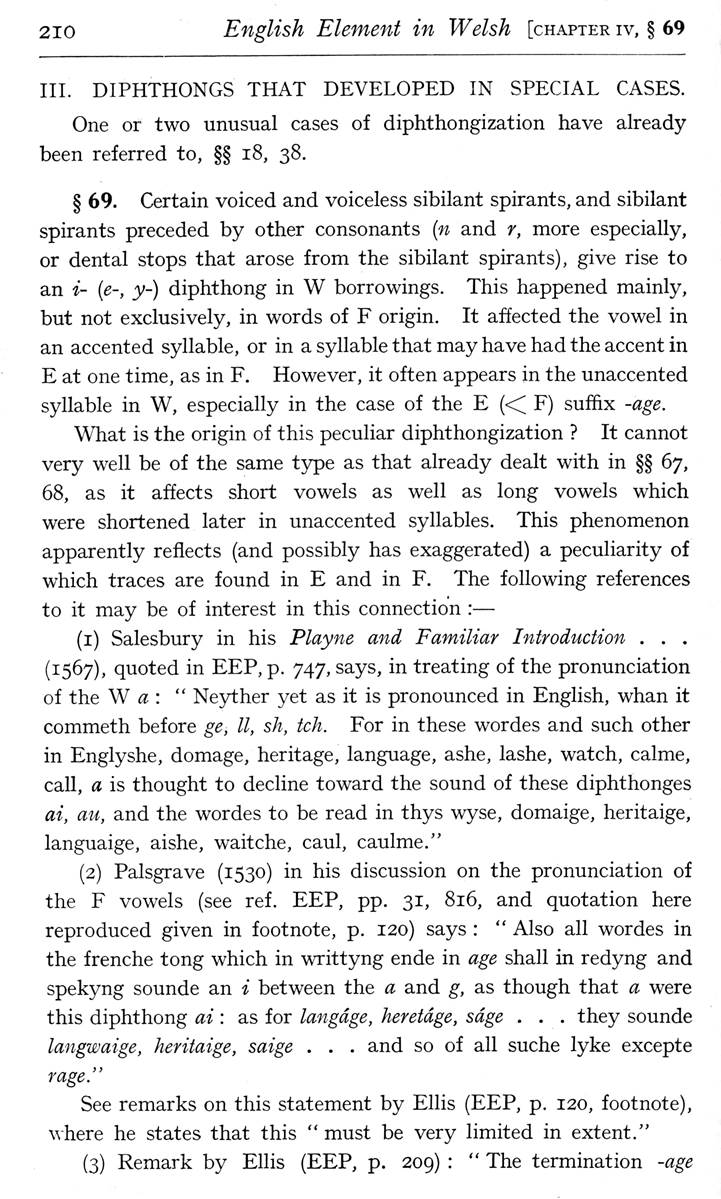
(delwedd F6961) (tudalen 210)
|
210 English Element
in Welsh [chapter iv, § 69
III. DIPHTHONGS THAT DEVELOPED IN SPECIAL CASES. One or two unusual cases of
diphthongization have already been referred to, §§ i8, 38.
§ 69. Certain voiced and voiceless sibilant spirants, and sibilant spirants
preceded by other consonants [n and r, more especially, or dental stops that
arose from the sibilant spirants), give rise to an i- [e-, y-) diphthong in W
borrowings. This happened mainly, but not exclusively, in words of F origin.
It affected the vowel in an accented syllable, or in a syllable that may have
had the accent in E at one time, as in F. However, it often appears in the
unaccented syllable in W, especially in the case of the E « F) suffix -age.
What is the origin of this peculiar diphthongization? It cannot very well be
of the same type as that already dealt with in §§ 67, 68, as it affects short
vowels as well as long vowels which were shortened later in unaccented
syllables. This phenomenon apparently reflects (and possibly has exaggerated)
a peculiarity of which traces are found in E and in F. The following
references to it may be of interest in this connection: —
(i) Salesbury in his Plaŷie and Familiar Introduction . . . (1567), quoted in EEP,
p. 747, says, in treating of the pronunciation of the W a: “Neyther yet as it
is pronounced in English, whan it commeth before ge, II, sh, tch. For in
these wordes and such other in Englyshe, domage, heritage, language, ashe,
lashe, watch, calme, call, a is thought to decline toward the sound of these
diphthonges ai, au, and the wordes to be read in thys wyse, domaige,
heritaige, languaige, aishe, waitche, caul, caulme."
(2) Palsgrave (1530) in his discussion on the pronunciation of the F vowels
(see ref. EEP, pp. 31, 816, and quotation here reproduced given in footnote,
p. 120) says: “Also all wordes in the frenche tong which in wTittyng ende in
age shall in redyng and spekyng sounde an i between the a and g, as though
that a were this diphthong ai: as for langdge, Jieretdge, sage . . . they
sounde langwaige, heritaige, saige . . . and so of all suche lyke excepte
rage."
See remarks on this statement by Ellis (EEP, p. 120, footnote), where he states
that this “must be very limited in extent."
(3) Remark by Ellis (EEP, p. 209): “The termination -age
|
|
|
|
|
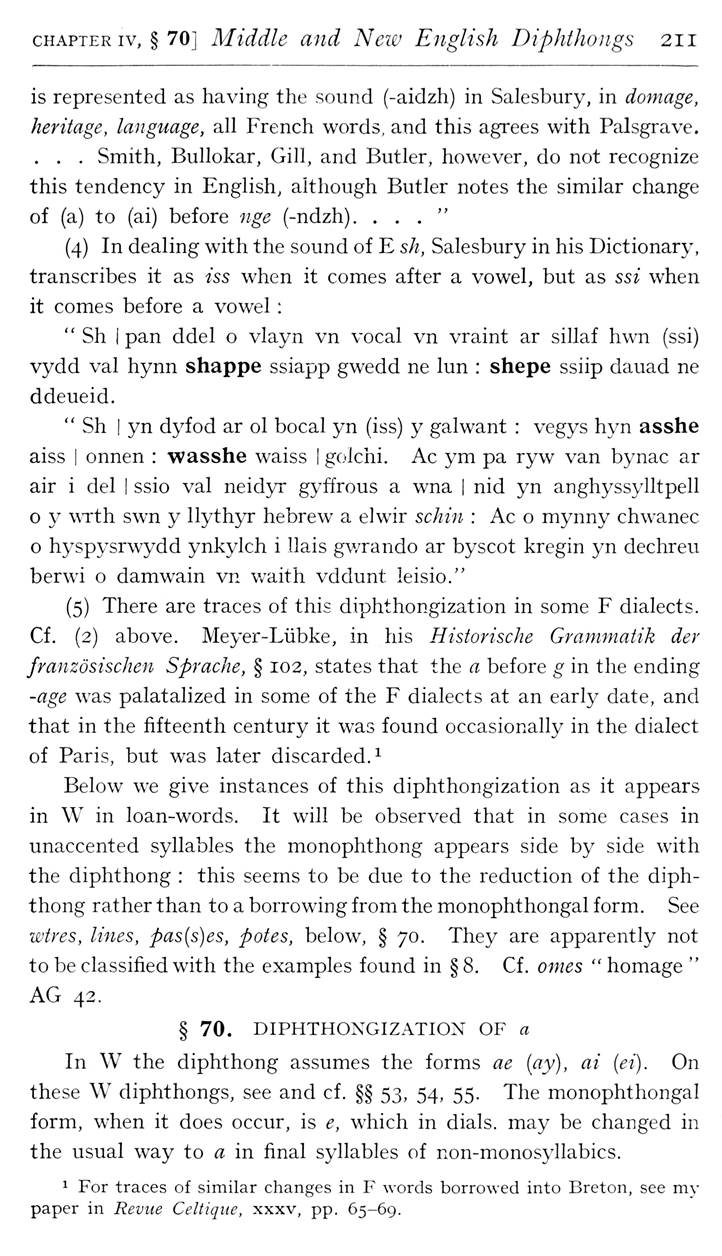
(delwedd F6962) (tudalen 211)
|
CHAPTER IV, § 70]
Middle and New English Diphthongs 211
is represented as having the sound (-aidzh) in Salesbury, in damage,
heritage, language, all French words, and this agrees with Palsgrave. . . .
Smith, Bullokar, Gill, and Butler, however, do not recognize this tendency in
English, although Butler notes the similar change of (a) to (ai) before nge
(-ndzh). ..."
(4) In dealing with the sound of E sh, Salesbury in his Dictionary,
transcribes it as iss when it comes after a vowel, but as ssi when it comes
before a vowel:
" Sh I pan ddel o vlayn vn vocal vn vraint ar sillaf hwn (ssi) vydd val
hynn shappe ssiapp gwedd ne lun: shepe ssiip dauad ne ddeueid.
" Sh I yn dyfod ar ol bocal yn (iss) y gal want: vegys hyn asshe aiss I
onnen: wasshe waiss I golchi. Ac ym pa ryw van bynac ar air i del I ssio val
neidyr gyffrous a wna | nid yn anghyssylltpell o y WTth swn y llythyr hebrew
a elwir sclmi: Ac o mynny chwanec o hyspysrwydd ynkylch i llais gv/rando ar
byscot kregin yn dechreu berwi o damwain vn v/aith vddunt leisio."
(5) There are traces of this diphthongization in some F dialects. Cf. (2)
above. Meyer-Liibke, in his Historische Grammatik der franzosischen Sprache,
§ 102, states that the a before g in the ending -age was palatalized in some
of the F dialects at an early date, and that in the fifteenth century it was
found occasionally in the dialect of Paris, but was later discarded.^
Below we give instances of this diphthongization as it appears in W in
loan-words. It will be observed that in some cases in unaccented syllables
the monophthong appears side by side with the diphthong: this seems to be due
to the reduction of the diphthong rather than to a borrowing from the
monophthongal form. See wires, lines, pas{s)es, potes, below, § 70. They are
apparently not to be classified with the examples found in § 8. Cf. omes
“homage “AG 42.
§ 70. DIPHTHONGIZATION OF a
In W the diphthong assumes the forms ae [ay], ai (ei). On these W diphthongs,
see and cf. §§ 53, 54, 55. The monophthongal form, when it does occur, is e,
which in dials, may be changed in the usual way to a in final syllables of
non-monosyllabics.
1 For traces of similar changes in F words borrowed into Breton, see my paper
in Revue Celtiqiie, xxxv, pp. 65-69.
|
|
|
|
|
(delwedd F6963) (tudalen 212)
|
212 English Element
in Welsh [chapter iv, § 70
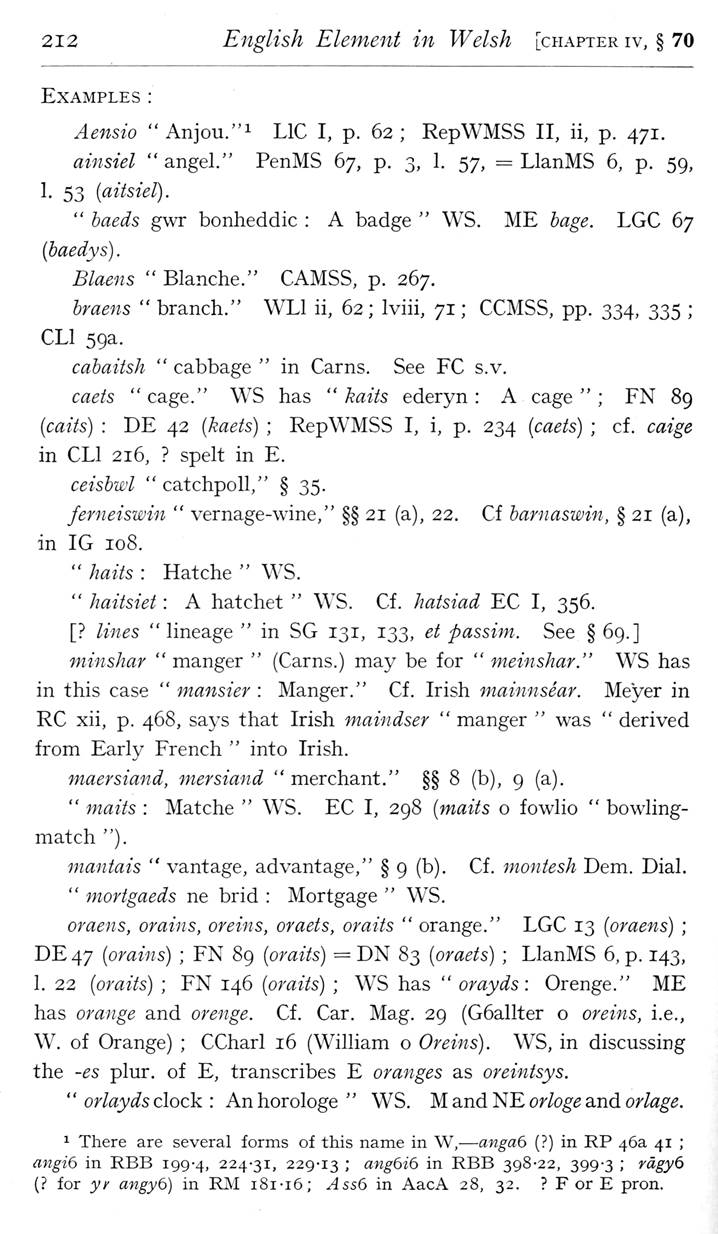
Examples:
Aensio "Anjou."i LlC I, p. 62; RepWMSS II, ii, p. 471.
ainsiel “angel." PenMS 67, p. 3, 1. 57, = LlanMS 6, p. 59, 1. 53
[aitsiel).
" baeds gwr bonheddic: A badge “WS. ME bage. LGC 67 (baedys) .
Blaens “Blanche." CAMSS, p. 267.
braens “branch." WLl ii, 62; Iviii, 71; CCMSS, pp. 334, 335; CLl 59a.
cabaiish “cabbage “in Cams. See FC s.v.
caets “cage." WS has “kaits ederyn: A cage”; FN 89 (caits): DE 42
(kaets); RepWMSS I, i, p. 234 [caets); cf. caige in CLl 216,? spelt in E.
ceisbwl “catchpoll," § 35.
ferneiswin “vernage-wine," §§ 21 (a), 22. Cf barnaswin, § 21 (a), in IG
108.
" haits: Hatche “WS.
" haitsiet: A hatchet “WS. Cf. hatsiad EC I, 356.
[? lines “lineage “in SG 131, 133, et passim. See § 69.]
minshar “manger” (Cams.) may be for “meinshar." ŴS has in
this case “mansier: Manger." Cf. Irish mainnsear. Meyer in RC xii, p.
468, says that Irish maiiidser “manger “was “derived from Early French “into
Irish.
maersiand, mersiand “merchant," §§ 8 (b), 9 (a).
" maits: Matche “WS. EC I, 298 [maits o fowlio “bowling-match ").
mantais “vantage, advantage," § 9 (b), Cf. montesh Dem. Dial.
" mortgaeds ne brid: Mortgage “WS.
oraens, orains, oreins, oraets, oraits “orange." LGC 13 [oraens); DE47
{orains); FN 89 {oraits) = DN 83 {oraets); LlanMS 6, p. 143, 1. 22 {oraits);
FN 146 {oraits); WS has “orayds: Orenge." ME has orange and orenge. Cf.
Car. Mag. 29 (G6allter o oreins, i.e., W. of Orange); CCharl 16 (William o
Oreins). WS, in discussing the -es plur. of E, transcribes E oranges as
oreintsys.
" orlayds clock: An horologe “WS. M and NE or/o^g and o;'/a^(2.
1 There are several forms of this name in W, — anga6 (?) in RP 46a 41; angib
in RBB 199-4, 224-31, 229-13; ang6i6 in RBB 398-22, 399-3; rdgy6 (? for yy
angyd) in RJM i8i-i6; AssG in AacA 28, 32.? F or E pron.
|
|
|
|
|
(delwedd F6964) (tudalen 213)
|
CHAPTER IV, § 71]
Middle and New English Diphthongs 213
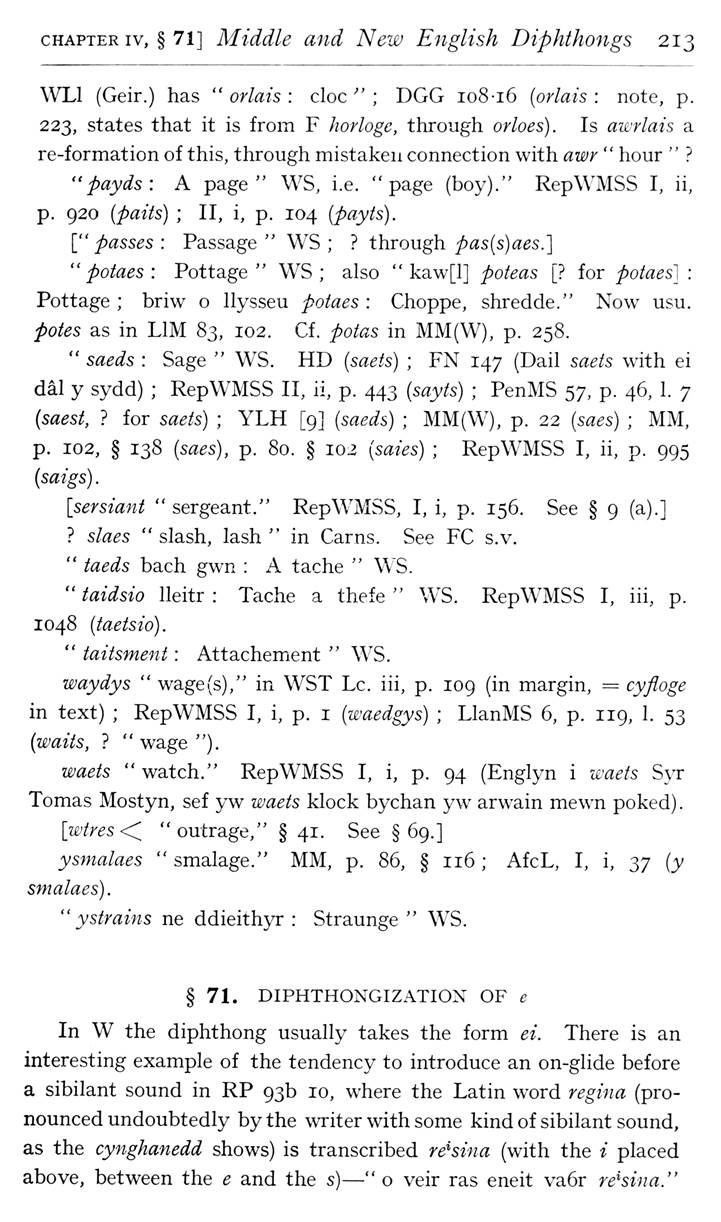
WLl (Geir.) has “orlais: cloc”; DGG io8-i6 (orlais: note, p. 223, states that
it is from F Iiorlogc, through orloes). Is awrlais a re-formation of this,
through mistaken connection with awr “hour "?
"payds: A page" WS, i.e. "page (boy)." RepWMSS I, ii, p.
920 (paits); II, i, p. 104 (payts).
["passes: Passage" WS;? through pas{s)aes.]
" potaes: Pottage" WS; also “kaw[l] poteas [? for potaes]: Pottage;
briw o llysseu potaes: Choppe, shredde." Now usu. potes as in LIM S^),
102. Cf. potas in MM(W), p. 258.
" saeds: Sage “WS. HD (saets); FN 147 (Dail saets with ei dal y sydd);
RepWMSS II, ii, p. 443 (sayts); PenMS 57, p. 46, 1. 7 {saest,? for saets);
YLH [9] (saeds); MM(W), p. 22 (saes); MM, p. 102, § 138 [saes), p. 80. § 102
[saies); RepWMSS I, ii, p. 995 (saigs).
[sersiant “sergeant." RepWMSS, I, i, p. 156. See § 9 (a).]
? slaes “slash, lash “in Cams. See FC s.v,
" taeds bach gwn: A tache “WS.
" taidsio lleitr: Tache a thefe “WS. RepWMSS I, iii, p. 1048 (taetsio).
" taitsment: Attachement “WS.
waydys “wage(s)," in WST Lc. iii, p. 109 (in margin, = cyfloge in text);
RepWMSS I, i, p. i [waedgys); LlanMS 6, p. 119, 1. 53 [waits,? “wage ").
waets “watch." RepWMSS I, i, p. 94 (Englyn i waets S}T Tomas Mostyn, sef
y w waets klock bychan y w arwain mewn poked) .
[wtres<^ "outrage," § 41. See §69.]
ysmalaes “smalage." MM, p. 86, § 116; AfcL, I, i, ^y [y smalaes).
" ystrains ne ddieith>T: Straunge “WS. § 71. DIPHTHONGIZATIOX OF e
In W the diphthong usually takes the form ei. There is an interesting example
of the tendency to introduce an on-glide before a sibilant sound in RP 93b
10, where the Latin word regma (pronounced undoubtedly by the writer with
some kind of sibilant sound, as the cynghanedd shows) is transcribed retina
(with the i placed above, between the e and the s) — “o veir ras eneit va6r
rehina."
|
|
|
|
|
(delwedd F6965) (tudalen 214)
|
214 English Element
in Welsh [chapter iv, §§72,73
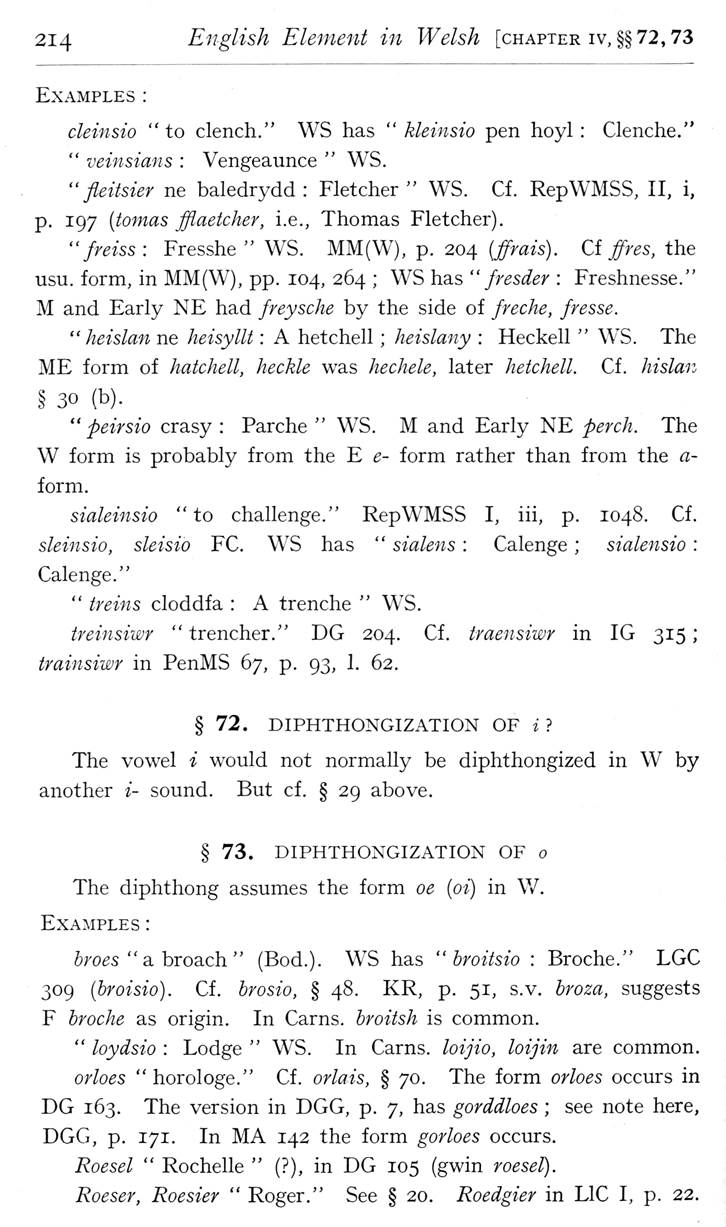
Examples:
cleinsio "to clench." WS has “kleinsio pen hoyl: Clenche."
" veinsians: Vengeaunce “WS.
" fleitsier ne baledrydd: Fletcher “WS. Cf. RepWMSS, II, i, p. 197
[tomas fflaetcher, i.e., Thomas Fletcher).
"freiss: Fresshe “WS. MM(W), p. 204 (ffrais). Ci ffres, the usu. form,
in MM(W), pp. 104, 264; WS has “fresder: Freshnesse." M and Early NE had
freyscJie by the side of freche, fresse.
" heislan ne heisyllt: A hetchell; heislany: Heckell “WS. The ME form of
hatchell, heckle was hechele, later hetchell. Cf. hislan
§ 30 (b).
" peirsio crasy: Parche “WS. M and Early NE perch. The W form is probably
from the E e- form rather than from the a-form.
sialeinsio "to challenge." RepWMSS I, iii, p. 1048. Cf. sleinsio,
sleisio EC. WS has “sialens: Calenge; sialensio: Calenge."
" treins cloddfa: A trenche “WS.
treinsiwr “trencher." DG 204. Cf. traensiwr in IG 315; trainsiwr in
PenMS 67, p. 93, 1. 62.
§ 72. DIPHTHONGIZATION OF i?
The vowel i would not normally be diphthongized in W by another i- sound. But
cf. § 29 above.
§ 73. DIPHTHONGIZATION OF o The diphthong assumes the form oe (oi) in W. Examples:
broes “a. broach” (Bod.). WS has “broitsio: Broche." LGC 309 (broisio).
Cf. brosio, § 48. KR, p. 51, s.v, broza, suggests F broche as origin. In
Cams, broitsh is common.
" loydsio: Lodge “WS. In Cams, loijio, loijin are common.
orloes “horologe." Cf. orlais, § 70. The form orloes occurs in DG 163.
The version in DGG, p. 7, has gorddloes; see note here, DGG, p. 171. In MA
142 the form gorloes occurs.
Roesel “Rochelle” (?), in DG 105 (gwin roesel).
Roeser, Roesier “Roger." See § 20. Roedgier in LlC I, p. 22.
|
|
|
|
|
(delwedd F6966) (tudalen 215)
|
CHAPTERiv, §§ .4,75]
Middle and New English Diphthongs 215
The form Antioys for “Aniioch “occurs in Buchedd Margret, p. 222 of The Lives
of the Cambro-British Saints (W. MSS. Soc, 1853).
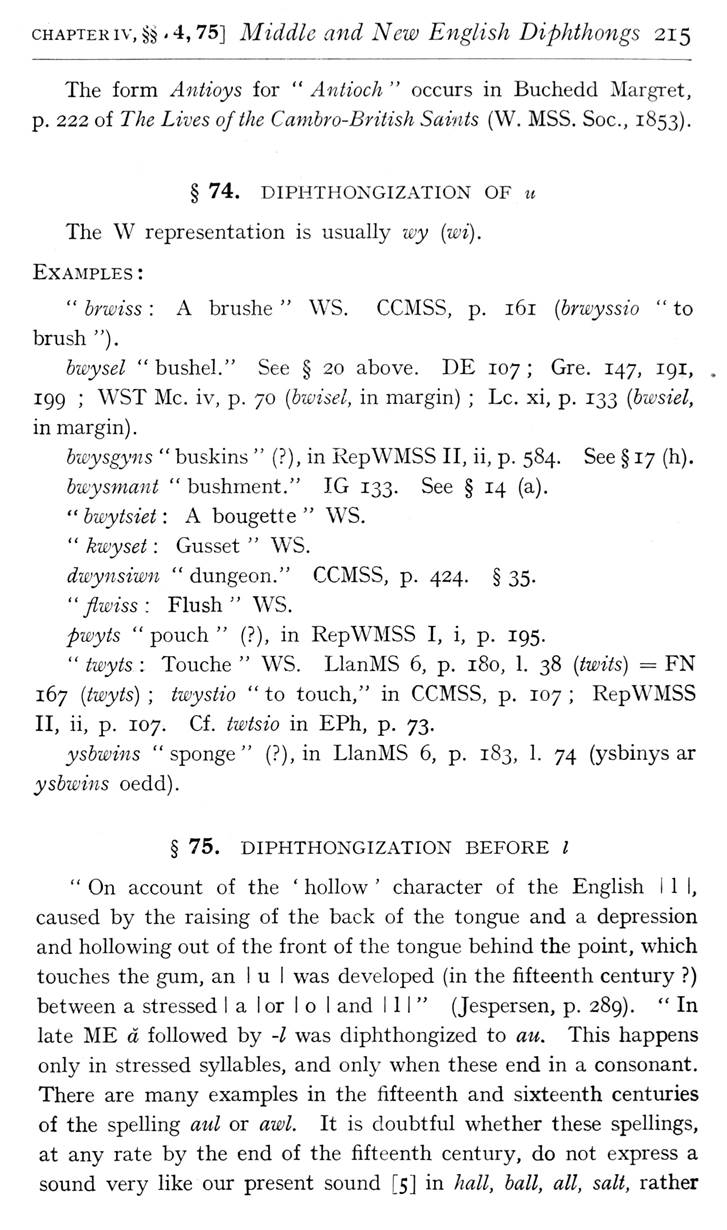
§ 74. DIPHTHONGIZATION OF u The W representation is usually wy {wi).
Examples:
" brwiss: A brushe “WS. CCMSS, p. 161 {brwyssio "to brush ").
bwysel “bushel." See § 20 above. DE 107; Gre. 147, 191, 199; WST Mc. iv,
p. 70 {bwisel, in margin); Lc. xi, p. 133 {bwsiel, in margin) .
bwysgyns “buskins” (?), in RepWMSS II, ii, p. 584. See § 17 (h).
bwysmant “bushment." IG 133. See § 14 (a).
" bwytsiet: A bougette “WS.
" kwyset: Gusset “WS.
dwynsiwn “dungeon." CCMSS, p. 424, § 35.
"flwiss: Flush" WS.
pwyts “pouch” (?), in RepWMSS I, i, p. 195.
" twyts: Touche “WS. LlanMS 6, p. 180, 1. 38 {twits) = FN 167 {twyts);
twystio “to touch," in CCMSS, p. 107; RepWMSS II, ii, p. 107. Cf. twtsio
in EPh, p. 73.
ysbwins “sponge” (?), in LlanMS 6, p. 183, 1. 74 (ysbinys ar ysbwins oedd).
§ 75. DIPHTHONGIZATION BEFORE /
" On account of the ' hollow ' character of the English I 1 I, caused by
the raising of the back of the tongue and a depression and hollowing out of
the front of the tongue behind the point, which touches the gum, an 1 u I was
developed (in the fifteenth century?) between a stressed I a lor I o I and
III" (Jespersen, p. 289). “In late ME a followed by -I was diphthongized
to au. This happens only in stressed syllables, and only when these end in a
consonant. There are many examples in the fifteenth and sixteenth centuries
of the spelling aid or awl. It is doubtful whether these spellings, at any
rate by the end of the fifteenth century, do not express a sound very like
our present sound [5] in hall, ball, all, salt, rather
|
|
|
|
|
(delwedd F6967) (tudalen 216)
|
2i6 English Element
in Welsh [chapter iv, § 75
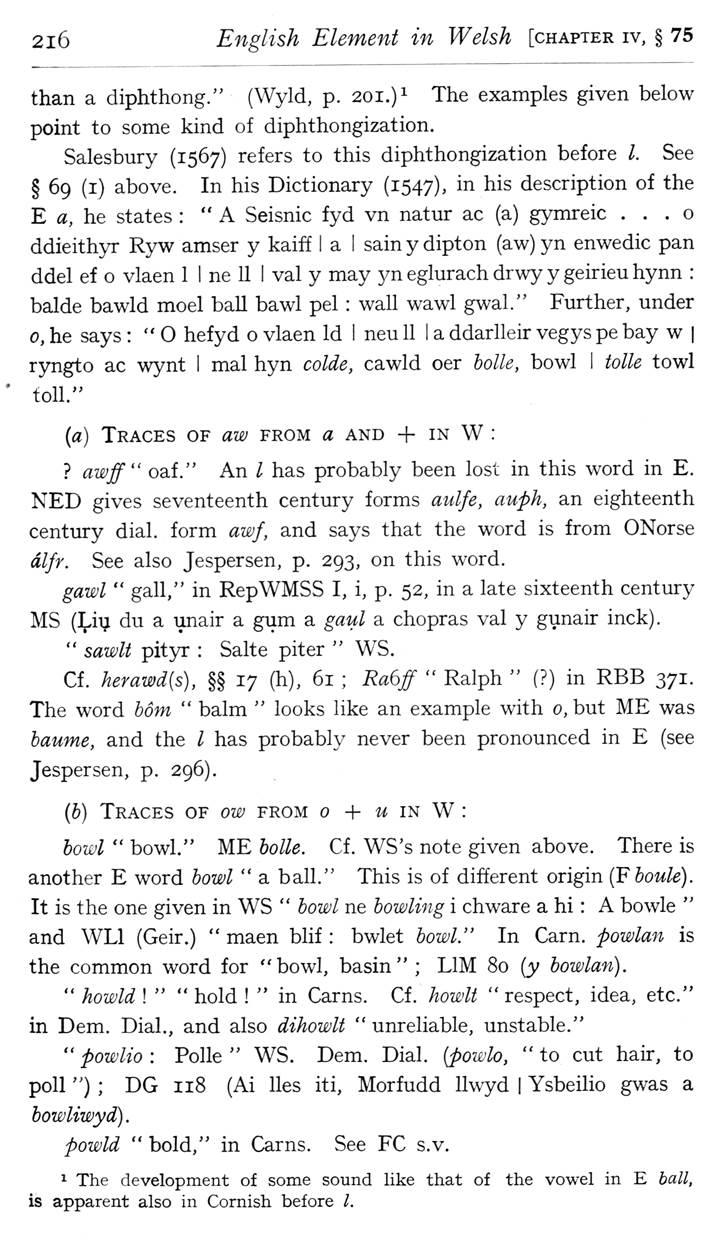
than a diphthong." (Wyld, p. 201.)^ The examples given below point to
some kind of diphthongization.
Salesbury (1567) refers to this diphthongization before I. See § 69 (i)
above. In his Dictionary (1547), in his description of the E a, he states:
"A Seisnic fyd vn natur ac (a) gymreic . . . o ddieith}T Ryw amser y
kaiff I a I sainydipton (aw)yn enwedic pan ddel ef o vlaen 1 I ne 11 I val y
may yn eglurach drwy y geirieu hynn: balde bawld moel ball bawl pel: wall
wawl gwal." Further, under 0, he says: “hefyd o vlaen Id i neu II I a
ddarlleir vegys pe bay w | ryngto ac wynt I mal hyn colde, cawld oer hoik,
bowl I toU& towl toll."
{a) Traces of aw from a and + in W:
? awff" oaf." An I has probably been lost in this word in E. NED
gives seventeenth century forms aulfe, auph, an eighteenth century dial, form
awf, and says that the word is from ONorse dlfr. See also Jespersen, p. 293,
on this word.
gawl “gall," in RepWMSS I, i, p. 52, in a late sixteenth centiu-y MS
(;^iu du a unair a gum a gaul a chopras val y gunair inck).
" sawlt pityr: Salte piter “WS.
Cf. herawd{s), §§ 17 (h), 61; Ra6ff “Ralph” (?) in RBB 371. The word bom
“balm “looks like an example with 0, but ME was baume, and the / has probably
never been pronounced in E (see Jespersen, p. 296).
(6) Traces of ow from + m in W:
bowl “bowl." ME bolle. Cf. WS's note given above. There is another E
word bowl “a ball." This is of different origin {Fboule). It is the one
given in WS “bowl ne bowling i chware a hi: A bowle “and WLl (Geir.) “maen
blif: bwlet bowl." In Carn. powlan is the common word for "bowl,
basin"; LIM 80 [y bowlan).
" howld!” “hold! “in Cams. Cf. howlt “respect, idea, etc." in Dem.
Dial., and also dihowlt “unreliable, unstable."
" powlio: Polle “WS. Dem. Dial, {powlo, “to cut hair, to poll ");
DG 118 (Ai lies iti, Morfudd llwyd 1 Ysbeilio gwas a bowliwyd).
powld “bold," in Cams. See FC s.v.
^ The development of some sound like that of the vowel in E ball, is apparent
also in Cornish before /.
|
|
|
|
|
(delwedd F6968) (tudalen 217)
|
CHAPTER IV, § 75]
Middle and New English Diphthongs 217
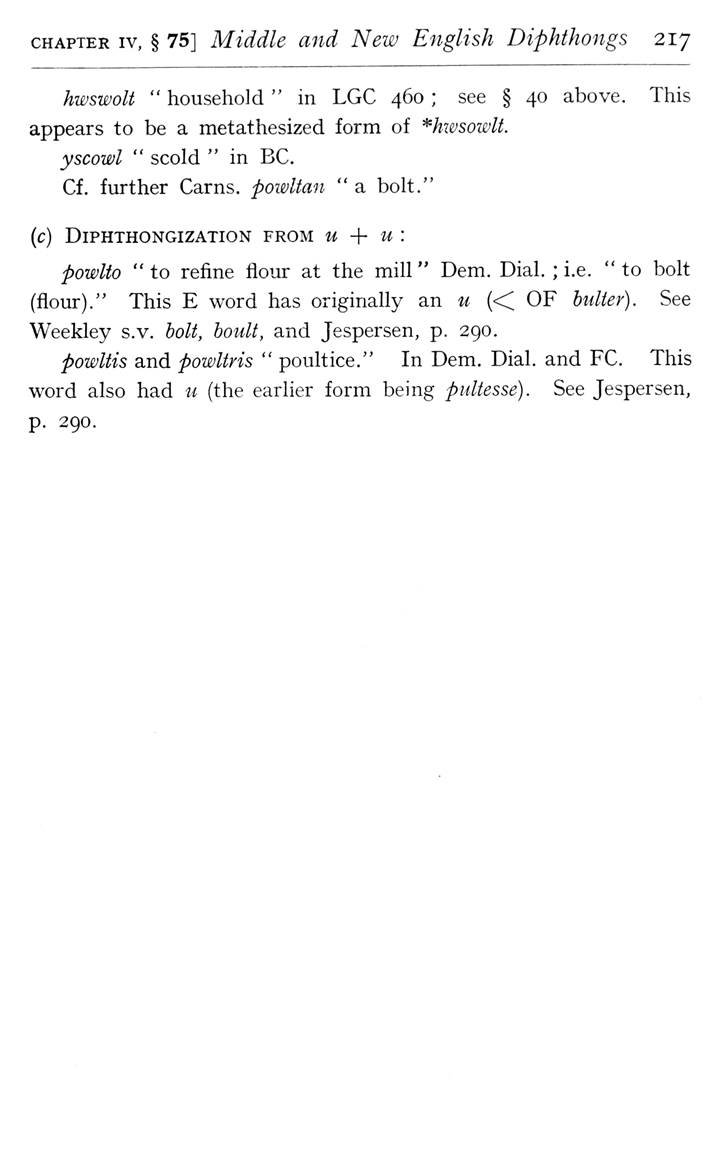
hwswolt “household “in LGC 460; see § 40 above. This appears to be a
metathesized form of *hwsowlt. y scowl “scold “in BC. Cf. further Cams,
powUan “a bolt."
(c) DiPHTHONGIZATION FROM U -\- U:
powlto “to refine flour at the mill “Dem. Dial.; i.e. “to bolt (flour)."
This E word has originally an u “OF hidier). See Weekley s.v. holt, boult,
and Jespersen, p. 290.
powltis and powltris “poultice." In Dem. Dial, and FC. This word also
had u (the earlier form being pultesse). See Jespersen, p. 290.
|
|
|
|
|
(delwedd F6969) (tudalen 218)
|
>
\
CHAPTER V
Middle and New English Consonants
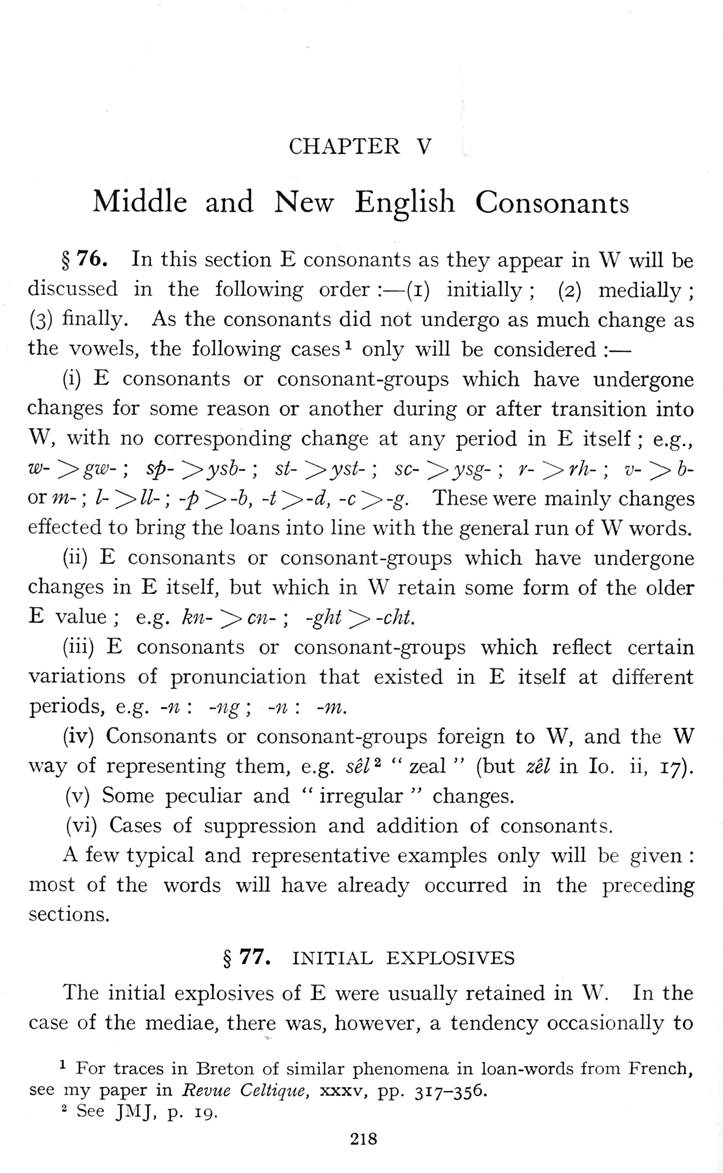
§ 76. In this section E consonants as they appear in W will be discussed in
the following order: — (i) initially; (2) medially; (3) finally. As the
consonants did not undergo as much change as the vowels, the following cases
^ only will be considered: —
(i) E consonants or consonant-groups which have undergone changes for some
reason or another during or after transition into W, with no corresponding
change at any period in E itself; e.g., w- '^gw-; sp- ^ysh-; st- ~^yst-; sc-
'^ysg-; r- > rh-; v- >> b-or m-; /- ^ //-; -p ^ -b, -t > -d, -c ^
-g. These were mainly changes effected to bring the loans into line with the
general run of W words.
(ii) E consonants or consonant-groups which have undergone changes in E
itself, but which in W retain some form of the older E value; e.g. kn-
>> en-; -ght >> -cht.
(iii) E consonants or consonant-groups which reflect certain variations of
pronunciation that existed in E itself at different periods, e.g. -n: -ng;
-n: -m.
(iv) Consonants or consonant-groups foreign to W, and the W way of
representing them, e.g. sel^ “zeal” (but zel in lo. ii, 17).
(v) Some peculiar and “irregular “changes.
(vi) Cases of suppression and addition of consonants.
A few typical and representative examples only will be given: most of the
words will have already occurred in the preceding sections.
§ 77. INITIAL EXPLOSIVES
The initial explosives of E were usually retained in W. In the case of the
mediae, there was, however, a tendency occasionally to
■"■ For traces in Breton of similar phenomena
in loan-words from French, see my paper
in Revue Celtique, xxxv, pp. 317-356. ^ See JMJ, p. 19.
218
|
|
|
|
|
(delwedd F6970) (tudalen 219)
|
CHAPTER V, §§77, 78]
Middle and New English Consonants 219
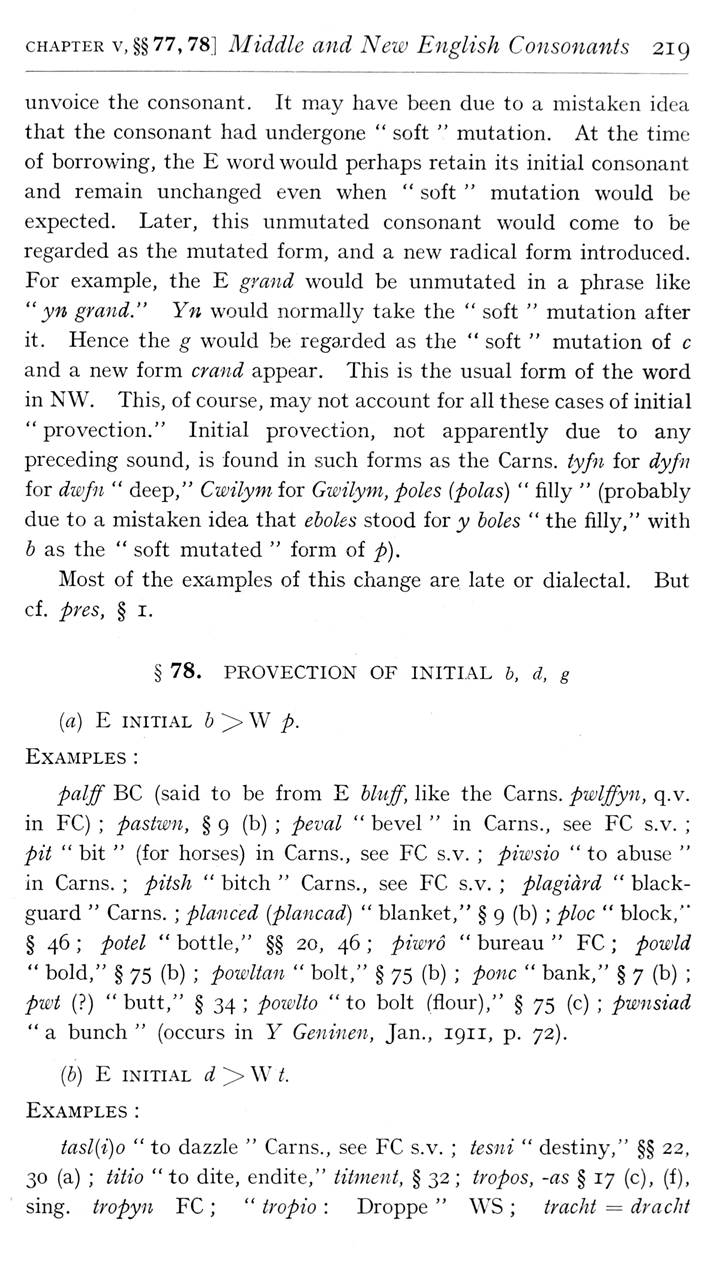
unvoice the consonant. It may have been due to a mistaken idea that the
consonant had undergone “soft “mutation. At the time of borrowing, the E word
would perhaps retain its initial consonant and remain unchanged even when
“soft “mutation would be expected. Later, this unmutated consonant would come
to be regarded as the mutated form, and a new radical form introduced. For
example, the E grand would be unmutated in a phrase like “yn grand." Yn
would normally take the “soft “mutation after it. Hence the g would be
regarded as the “soft “mutation of c and a new form crand appear. This is the
usual form of the word in NW. This, of course, may not account for all these
cases of initial “provection." Initial provection, not apparently due to
any preceding sound, is found in such forms as the Cams, tyfn for dyfii for
dwfn “deep," Cwilym for Gwilym, poles (polas) “filly” (probably due to a
mistaken idea that eholes stood for y boles “the filly," with b as the
“soft mutated “form of p).
Most of the examples of this change are late or dialectal. But cf. pres, § I.
§ 78. PROVECTION OF INITIAL b, d, g
(a) E INITIAL b'^W p.
Examples:
palff BC (said to be from E bluff, like the Cams, pwlffyn, q.v. in EC);
pastwn, § 9 (b); peval “bevel “in Cams., see EC s.v.; pit “bit” (for horses)
in Cams., see EC s.v.; piwsio “to abuse “in Cams.; pitsh “bitch “Cams., see
EC s.v.; plagidrd “blackguard “Cams.; planced (plancad) “blanket," § 9
(b); ploc “block," § 46; potel “bottle," §§ 20, 46; piwro “bureau
“EC; powld “bold," § 75 (b); powltan “bolt," § 75 (b); pone
“bank," § 7 (b); pwt (?) "butt," § 34; poiolio "to bolt
(flour)," § 75 (c); pwnsiad “a bunch” (occurs in Y Geninen, Jan., 1911,
p. 72).
{b) E INITIAL d >> W t.
Examples:
tasl{i)o “to dazzle “Cams., see EC s.v.; tesni “destiny," §§ 22, 30 (a);
titio "to dite, endite," titment, § 32; iropos, -as § 17 (c), (f),
sing, tropyn EC; “tropio: Droppe “WS; iracht = dracht
|
|
|
|
|
(delwedd F6971) (tudalen 220)
|
220 English Element
in Welsh [chapter v,§§ 79, 80 “draught” § 9 (b) (? in Wms. Pantycelyn); in
Cams. dial, tamp is heard for “damp," tip for “dip (for sheep)”; in S.
Cards tragwns “dragoons” (see Tr.GG 1907-8, p. no).
(c) E INITIAL g > W C.
Examples:
cer “gear," § 24; ciang “gang “in Cams.; coblyn < E
"gobhn," § 27 (a); crab "grab" BC; crand
"grand" Cams. cropian? < E grope, § 48; cwsberi{n)s
“gooseberries “Cams. cwysed “gusset” (in WS), § 74; calpian and clapian “to
gallop ' in Cams.; cwter “gutter," § 20;? cwm “gun," § 35; closhwns
“goloshes," § 17 (d); ciamocs “gammocks “in Nedw (E. Tegla Da vies), p.
75, usu. giamocs in Cams., cf. EDD s.v. gammock; carsiwn -< E garrison EC,
see s.v. garsiwn, § 9 (b).
§ 79. There appear to be a few cases of the opposite change. The following
may be examples:
? bwysi by the side of pwysi “posy," § 58; brolog “nonsense," <E
prologue, YC; bwytatwys "potatoes," § 17 (e),? influence of bwyta
"to eat”; barli by the side of parli “parley (in games) “Carns., § 30
(a); garetsh “carrots “Dem. Dial.; grofft? < E croft, § 46; growd “crowd
“EC.
§ 80. INITIAL kn OF E
Ellis (EEP, p. 208) says: “The initial k according to all authorities was
still heard in the sixteenth century before n." Jespersen, pp. 351, 352,
states: “The loss of initial I k, g I before I n I began late in the
seventeenth century. . . . Several foreign grammarians give the pronunciation
of kn as I tn I, which is of course a very natural assimilation. . . .
Another intermediate sound between I kn I and [ n ], which the old
grammarians do not mention for want of sufficient phonetic knowledge, is
voiceless I 51 1, which is still the sound used in knock, know, etc., in
Cumberland. . . . The development may thus have been either (I kn I ^ I tn I
^ i n I ^ I n I or, more directly I kn | >> I n 1 >■! n I." There is no trace in W borrowings of a / sound. ^
1 The c remained before n in the northern parts of Scotland. See EDGr. § 335-
|
|
|
|
|
(delwedd F6972) (tudalen 221)
|
CHAPTER V, §§81,82]
Middle and New English Consonants 221
Examples of E kn- retained as en- in W.
cnaf “knave," § 17; cnap “knap," § 9 (b);? cnec “knack," § 8
(b); cnoc, cnocio “knock," § 46; cnot “knot," § 46; cnwpa
“knob," §§ 15, 35. Cf. wtcneiff" wood-knife," § 33, and the
Cams. peficnath “penknife."
§ 81. In some loans g has been prefixed to an initial vowel, probably for the
same reason as that mentioned in § yy. Cf. gallt for allt, godidog for
odidog, etc., in W.
gonest? <C E honest. CAMSS 47 (gonest); cf. onest Tit. ii, 2; gildio “to
yield “is not quite a case in point, but ildio occurs, § 25; gordro “to order
“FC, § 46.
§ 81a. For a period (end of eighteenth century and beginning of nineteenth
centurŷ) E had a front-glide between g-, k- and the following
front vowel. Traces of this are seen in some dial, words in W., e.g. Carn.
dial, giard "guard"; gicit "gate"; giaffar “gaffer”;
giamocs “gammocks”; giami “gammy”; gidm “game”; gieid “guide."
On this phenomenon in E, see also EEP, p. 203, Jespersen, pp. 349-350, Wyld,
p. 310. In the Carns. dial, and possibly in other dials, this glide is heard
in W words as spoken by the older people, e.g. in ciartra for cartref, ciath
for cath, etc., even before non-front vowels.
§ 82. INITIAL qu OF E IN W
The qu has been retained as cw in W in some cases, in others it has become
chw. The latter change may have been due to the fact that initial cw- is
foreign to W (although found in contracted forms like cwilydd for cywilydd)
,w\ieie2iS initial chw is common. In some words both forms are found. Cf. W
chwarthawr, -or? <^ Lat. quartarius.
{a) qu retained as cio in W.
Examples:
cwarel (ME cuarel), §§ 9 (b) 20; civeryl “quarrel” (ME qiierel), §§ 21 (b),
22; cwart “quart," cwarter “quarter," § 9 (b); cwestiwn
^ Wyld, p. 310, quotes instances from the middle of the seventeenth century.
|
|
|
|
|
(delwedd F6973) (tudalen 222)
|
222 English Element
in Welsh [chapter v, § 83
" question," § 22; in FC we find cwafar “quaver," cwecian “to
quake," cwic “quick, curling tongs," cwicio “to goffer," cwils
“quills," etc.
(b) qu becoming chw in W.
Examples:
chwails “quails," §§ 17 (h), 54; cJiwarel “quarrel, quarry," §§ 9
(b), 20; chwart “quart," § 9 (b); chwarter “quarter," § 9 (b);
chwintan “quintain”; chwitaiis “acquittance," § 9 (a); chwitio "to
quit," § 30 (b); chwits “quits."
§ 83. INITIAL z; OF E
This has been retained in some words as /, but in others it was changed to h
or m, as if jt were the mutated (" soft ") form of those
consonants. Some loan-words have two or three forms, one with /', and one or
two with either 5- or w-, or both. The interchange cf h- and m- is not
unknown in W in native words; see JMJ, p. 163. All the words in the preceding
sections showing initial / in W are instances of the preservation of E v,
e.g. felfed, § 20; ficar, § 9 (a); fenswn “venison," § 22; fioled, §§
32, 45; fernagl, §§ 9 (a), 22; etc.
(a) E V becoming b in W.
Examples:
barbal “marble," HG 28-9; berfaen “vervain," § 22; bernais, barnais
“varnish," §§ 21 (a), 22; barnaswin “vernage (wine)," § 21 (a) (cf.
ferneiswin, §§ 21 (a), 22); bicar, bicer “vicar," §§ 9 (a), 20; bitel
“victuals," § 56;? bilain “villein," §§ 30 (b), 54; bernagl
“vernicle," § 9 (a); becsio “to vex “FC.
(b) E V becoming m in W.
Examples:
mantais” (ad)vantage," §§ 9 (a), 70; melfed “velvet," §§ 20, 22;
miswrn “vizor," §§ 32, 35; micar “vicar," § 9 (a);? murseii
“virgin," § 27 (b). Cf. Bortvn,? << Vortiin<^ Ovortun =
“Overton “in RepWMSS I, ii, p. 779. See Awrtim, § 3 (b).? Malmidine =
“Valentine “in CAMSS, p. 244 (penill Malandine).
|
|
|
|
|
(delwedd F6974) (tudalen 223)
|
CHAPTER V, §§84-86]
Middle and New English Consonants 223
§ 84. E INITIAL s + p, t, c [k)
As in native words and Latin loan-words, W developed an on-glide before s +
stop initially. On the history of this W development, see JMJ, p. 26. The E
loan-words fell in with the general practice. In colloquial speech, however,
this prosthetic y is hardly ever pronounced unless the accent falls on it.
Examples are very numerous. We quote a few from written records:
ysgarlat, etc. “scarlet," § 9 (a), (b); ystiwart “steward," §§ 8, 9
(a); ysturmant? <C E instrument §§ 14 (a), 39; ystondardd “standard,"
§ 7 (b). Cf. ysten, § i, and the later spectal, § 7.
In those words that may be of F origin, it is possible that the y- is a
reflection of the vowel that developed in F in similar cases.
§ 85. E s- SOUND EXPRESSED BY c
" OF c originally was pronounced Its I; and the letter c was sometimes
used with this value in early ME. . . . But when F words with c were adopted
into E, Its I must either have been simplified in French or else the English
substituted |s| for Its I. At any rate there is in St[andard] English no
trace of a distinction between c and the ordinary s. Initially c is generally
written in accordance with F (or Latin) spelling, centre, circle ..."
(Jespersen, p. 49). In W there is no trace of anything but s as the
representing sound. WS has a reference to it: “C. wrth i darllen yn sasonaec
a chamberaec sydd yn un lief onid o vlayn e I i I y I canj^s o vlayn y tair
Ilythyren hyn val si vydd i son vegys hynn: face ffas wyneb gracyouse graciws
rraddlawn I codicyon condisywn." See also EEP, p. 214.
Examples:
seifys “chives, cives," §§ 17 (b), 33; seiprys “cj^press," § 14
(b); seler “cellar," § 22; si7iglys “cingles," §§ 17 (b), 30 (b);
sifil, etc. "civil," § 30 (a); sindir "cinder(s)," § 30
(b); seiffro "to cipher," § 33; sertein, serten
"certain," §§ 22, 54. Cf. the form certeyn (with c = s) mentioned
in § 22.
§ 86. INITIAL sc [sh) OF E
Ellis (EEP, p. 512), states: “In the Ancren Riwle (ab. 1230), while k had
yielded to (tsh) by itself, sc had not become (sh), as in
|
|
|
|
|
(delwedd F6975) (tudalen 224)
|
224 English Element
in Welsh [chapter v, § 86
Italy and Germany, and as generally in England at that time, and the modern
shot scot ags. sceat, shows both the palatalized and unpalatalized form of
the same word still current." Jespersen, p. 25: “As OE sc^ has become
I/I, the group I ski is found in loan-words only." In EDGr, p. 247,
Wright says: “Initial sc has become / in native Eng. words just as in the
lit, language, as shade, shake . . . etc. 7 whereas in words of foreign
origin it has remained in the dialects just as in the lit. language, as scab,
scaffold . . . etc. Excluding all sc- words which are of various origins and
which are common both to the lit. language and the dialects — such as the
words in the above list . . . it is a remarkable fact that the Eng. Dialect
Dictionary contains no less than 1,154 simple sc words. This points to one of
two things: either the dialects contain a far larger number of Norse words
than is generally supposed, or else it is not certain that initial sc had
under all circumstances become / in native words in the dialects. In some
words sc and / exist side by side even in the same dialect. . . ." WS
has this description of E sA: “Sh I pan ddel o vlayn vn vocal vn vraint ar
sillaf hwn (ssi) vydd val hynn shappe ssiapp gwedd ne lun: shepe ssiip dauad
ne ddeueid." See also HES, pp. 192, 267. In view of the above
quotations, it is interesting to note that both forms are found in the
loan-words in W, sometimes in the same word. The si (for sh) found in W has
the value of E sh or that ois -\- i (consonantal) . Before another i (or y)
the consonantal i is lost, but those who do pronounce sh initially, pronounce
it also in these cases, e.g. sir, prond. sMr or sir-; Syrk “Chirk."
[a) Examples of sc preserved as sc {sg, ysg):
{y)sgdr “share," ME schare (OE scearu), §§ 11, 12; sciabas “scabs “BC, §
17 (c) [siabas also occurs; see note in BC); cf. ysgadan (?), § 5- -
Compare further the following, which have a guttural in W, but no trace of it
in Mod. E:
ysglandr [sclandr) “slander”: ME sclaundre (<C OF esclandre),
1 On the palatalization of OE sk, medially and finally, see Englische
Studien, vol. 39, pp. 161-188 (H. Weyhe).
2 Some Welshmen find it difficult to pronounce sh (/) especially as a final
consonant. Cf. the use of Shibboleth as a test-word, Judges xii, 4-7. See
JMJ, p. 19.
|
|
|
|
|
(delwedd F6976) (tudalen 225)
|
CHAPTER V, § 87]
Middle and New English Consonants 225
§ 9 (b); ysglatys, etc. “slate(s)”: ME slat, sclai (<< OF esclai), §§
II, 17 (b); ysglent (?), § 22; sglont “slant," § 7 (b); sglefr “a
slide," sglefrio “to slide," see FC s.w., where the E dial, forms
slither, slether, Scot, sclither, are compared; sglwtsh “slush “FC, q.v., the
Scot, sklush being compared with it; ysglisen “slice”: ME sclice, slice
(<^ OF esclise), § 32.
[h) Examples illustrating the development into si in W. '
siahas, see (a) above; siarp “sharp”: ME scharp, sharp (<^ OE scearp), § 9
(b); sir “shire," siryf, etc.: ME shire, schire (<^ OE sclr), § 31;
slop “shop”: ME schoppe, shoppe (<^ OE sceoppa), §46. Cf. si7#§5.
§ 87. E INITIAL cJi ( = tsh)
This sound of E is generally represented in W by si. Cf. § 86. There is
apparently no trace of the dental stop which exists in the E pronunciation.
For the pronunciation of si in W, see § 86,
Ellis (EEP, p. 512) says that the palatal c of OE had developed the sound tsh
by the beginning of the thirteenth century. Sweet, however, states in HES, p.
193, that “ME ch = OE c is, when doubled, written cch, chch . . . This seems
to show that OE c had not^ — in eME at least — developed into full (t J).
Probably it had the sound of . . . Sw[edish] k before front vowels, as in
kind ' cheek.' “Jespersen, p. 24, states simply: "A palatal OE Ik I very
early became It J" I." WS (1547) transcribes it tsi: “Ch nid yw dim
tebyg yn saesonaec ac ymghamberaec: Ac nid oes ynghamraec lythyren na
llythyrenneu ai kyfilyba yn iawn I eithjn: may sain I tsi I kyn gyfflypet
iddi ar efydd ir aur I val yn y gair hwn churche tsurts ecleis." In his
opinion, then, tsi was not an exact representation.
The sound tsh of E also represents the OF sound tsh which has now become sh;
see Jespersen, p. 52. Ellis (EEP, p. 207) says that “it is not easy to
determine whether in very old French ch, j, were read (tsh, dzh) or (sh,
zh)."
Examples in W of E ch- (from OE palatal c) and F ch-:
Sieb"- “Cheap(side)”: ME chepe “OE ceap), §§ 24, 33; sialc
^ Is this word used at all as a common noun in W? See note LGC iii. Bod.
gives sieb, “market, mart (' cheap ')."
|
|
|
|
|
(delwedd F6977) (tudalen 226)
|
226 English Element
in Welsh [chapter v, § 88
" chalk”: ME chalk “OE cealc), § 9 (b); siwrl “churl”: ME clmrle “OE
ceorl), § 35. Cf. Sisedr “Chichester “in LGC 52; Syrk “Chirk “GabI i.
seims “chimes”: ME and OF chimhes, §§ 17 (h), 33; siamhr “chamber/' siamhrlen
“chamberlain”: ME from OF chamherlen, -lain, §§ II, 55, 56; Siarlot
“Charlotte” (F Charlotte) DT 201; Siarls “Charles," § 9 (b); siars
“charge," § 9 (b); siecr “chequer," § 22; sias “chase”: ME from OF
chace, § 11; siatal “chattel”: ME chattel” OF chatel), § 9 (b); siawns
“chance," § 61; sied” (es)cheat," § 24; simnai “chimney," §§
30 (b), 56; siawnsler (spelt ja6nsler in RBB 403-27) "chancellor,"
§ 61; siff "chief" § 25; sir “cheer," § 25; sibols “chibols,"
§ 30 (b).
§ 88. E INITIAL;■ ( = dzh) AND INITIAL g ( = dzh)
[zh is used for the voiced form of “sh," i.e. ^].
The sound dzh, thus (above) expressed in E, corresponds to OE palatal g and
to the OF sound dzh, which has in Mod. F developed into the sound zh. Cf. §
87 above. On the spelling in E, see Jespersen, p. 51.
In the loan-words in W there is no trace of the dental (cf., however, dsiet
“jet “found once, § 22).
WS's description of E j and g may not be without interest:
" G, seisnic a ch I o saesnec ynt daran debyc eu sain ie mor debyc i son
yw gilydd ac yd yscriuena sags [sic] ny bo dra dyscedic yn aill yn Her Hall
vegys y damwain yn y gair hwn churge yn He churche tsiurts eglwys. . . . Pan
ddel g I o vlaen 1 e 1 i I neu y I val ch, seisnic neu tsadde o Hebrew vydd i
lief or rhan vynychaf vegys hyn gynger tsintsir I sinsir I."
" { . . . pan gydseinio i, a bocal arall vn sain vydd hi yna a, g,
seisnic ac achos eu bot hwy mor gyffelypson mi weleis rei ympetruster a dowt
pa vn ai ac, i, ai ynte a, g, yd scrivenynt ryw eirieu ar rain maiestie,
gentyle, gelousye: a rhai yn scrifenny habreioune ac ereill hebergyn, lluric:
Ac velly mi welaf ynghylch >T vn gyffelybrwydd rwng y tair llythyren
seisnic hyn ch, g, i, a rhwng y plwm pewter ar ariant, sef yw hynny, bod yn
gynhebyc yw gylydd ar y golwc kyntaf ac yn amrafaelio er hyny with graffu
arnunt. Esampl o, i, yn gydsain lesu, tsiesuw, Jesu: John tsion a sion o
lediaith: ac Jeuan ynghamroec loyw: ioynt, tsioynt kymal."
|
|
|
|
|
(delwedd F6978) (tudalen 227)
|
CHAPTER V, § 89]
Middle and New English Consonants 227
Note that WS transcribes ginger and John “tsintsir “and "tsion,"
but writes sinsir and sion as the W words. As in the cases mentioned in § 86,
the si seems to develop into s (or is it sh >s?) before i, and perhaps
before ii ^; e.g., sinsir “gingir," § 30 (a); sin “gin," § 30 (a);
sipsiwn “gipsies," §§ 17 (h), 30 (b), 35; sibed “gibbet," §§ 20, 27
(a), 30 (b) (but cf. shihedu in Dem. Dial.); Sud “Jude," § 43; Stidas
“Judas," § 43; Subiier “Jupiter," LGC 222.
Examples:
Sine “Jack," § 9 (b); siaced, §§ 9 (b), 20; siaflvng “javelin “WS;
“siaggio: Jagge “WS; Siaspar “Jasper," LGC 165 (cf. the names of the
three “Wise Men “in LlanMS 6, p. 159, 11. 33> 34. Siasber, Melsior,
Baldasar; in RP 51b, laspart, Melchior and Melsyor, Baltassar); Sieron
“Jerome," IG 235, LGC 93, DG 345, WS {Sieron sant: Saynt hierome),
Siarom, Siaron in WL. Ixii, 74, vii, 38; Sion “John” (written in the E form
in DE loi, 102: Eissiav neb i John abad. Lr byd swllt ywr abad John), § 48;
Sioas{s)ym “Joachim," HSwr. 3, p. 6, WLl xxiv, 67, CAMSS, p. 40
[Siossym]; Sionas “Jonas," lolo MSS, p. 293; Sioseph “Joseph,"
HSwr. 9, p. 23, Sioseb in DG 81, “Siosep: Josephe “WS; sirken [syrkyn)
“jerkin," § 21 (b); siwcls “jewels," §§ 17 (h), 30 (b): sing,
siwelyn in EC I, 91; Siencyn “Jenkin," LGC 85, “Siankin: Jenkin “WS;
siwrnai “journey," §§ 35, 54; Siors “George," DT 195, WS {Siors
Sant: Salt George).
Cf. further shocos “jocose; contented," sJiwc “jug," in S. Cards;
Sioli Boy (i.e. Jolly Boy) is the name of a dog mentioned in a cywydd in
LlanMS 123 (RepWMSS II, p. 630) “Mar: betheiad a elwid Sioli boy gwaith
discibl Clidro."
How is the i of iustus {iestiis) “justice” (§ 43) to be explained?
§ 89. INITIAL w OF E
In many of the older borrowings we find gw initially in W where E has w. This
change has already been mentioned (§ 76). Initial w (consonantal) is foreign
to W as a radical (unmutated) form.
^ Cf . the non-appearance of the consonantal i in E after 5 in such words as
suit, supreme, assume, with the result that the 5/^ sound is not developed in
them, although it is found in sure, sugar, etc. On this, see Jespersen, PP-
343-344. 383-
|
|
|
|
|
(delwedd F6979) (tudalen 228)
|
228 English Element
in Welsh [chapter v, § 90
The E words with w-, then, were either felt to be mutated forms of gw-, or
were changed into gw- analogically to avoid an apparent
"irregularity." In the later borrowings, however, w (consonantal)
still remains initially. It was lost in some of the older forms when the
vowel that came after it was rounded. This is seen in E words in wood-, a
form which Welshmen still find difficult to pronounce, the tendency being to
leave out the w before a vocalic w-sound, as also in woman and other words.
For traces of the “loss of z£; “before rounded vowels in E in such words as
wolf, woman, would, etc., see Wyld, p. 296; and for its disappearance in
similar cases in E dialects, see EDGr., p. 207. The same tendency exists in
the case of consonantal i followed by vocalic i (cf. iyrch, the plur. of
iwrch, '^yrch; see JMJ 40, and cf. ildio, § 91). Hence we have: —
wdcneiff “wood-knife," § 20; wdrot “woodruff," § 51; wtwart
“woodward," § 9 (a);? wrsip “worship," §§31 (a), 35; iDstyd
“worsted."
Examples with gw-:
gwalt “welt," gwaltas, §§ 9 (b), 17 (b); gwdr “ware," § 11;
gwarant^ “warrant," § 9 (a); gwarden “warden," § 9 (b); gimrdrob
“wardrobe," § 9 (b); gwasel "wassail," §§ 9 (b), 20, 55;
gwedrod “wethers," § 22; Gwinsor “Windsor “RepWMSS I, i, p. 272; IG 113
(cf. Winsawr LGC ^'^);? gwrydd, § 25A; gwaetio “wait," § 55. Cf.
gwalstod, § 5, Gwales, § 6.
Examples with w-:
wasael “wassail” (cf. gwasel above); weir “wire," § ^^; wiscreft
"witchcraft," § i; waets, waits "watch," § 70; wasbws
“washboards," §§ 17 (i), 35; wits “witch," § 30 (b); weils
“wiles,"
§ 33.
§ 90. INITIAL wh [hw) OF E
The Mod. E wh corresponds to the OE hw, written wh from the thirteenth
century (Jespersen, p. 38). On the later development into w in E, see
Jespersen, p. 374, where it is stated “that a great many ' good speakers '
always pronounce [w] and look upon [hw]
^ Is gwarant a direct F borrowing, with the u of OF gu still kept? — and
gwarden?
|
|
|
|
|
(delwedd F6980) (tudalen 229)
|
CHAPTER V, § 90]
Middle and New English Consonants 229
as harsh or dialectal. In some schools, however, especially girls' schools,
[hw] is latterly insisted on." Wyld, p. 311, gives an account of this
change in E, and says that at the present day no distinction is usually made
between such words as whine and wine. “The only exceptions," according
to him, “are those speakers who have been subjected to Scotch or Irish
influence, or who have deliberately chosen to depart from the normal practice
for their own private satisfaction. In the South and West we find w-
spellings instead of wli- or hw-, from an early period in ME."
W has developed chw- from the wh (hw) of E. It seems clear then that at the
time of borrowing the wh was heard by Welshmen as quite distinct from initial
w- of E which gave gw- in W. It is not easy to say whether the clear
distinction between gw- and chw- in Welsh borrowed words is due to their
having been borrowed early before the change of hw (wh) ^ w set in in E, or
to their having been borrowed from some dialect in which the hw (wh) was
still preserved unchanged.
As in the case of gw- <^ w-, it is difficult to say whether the change wh-
^ chw- is a true, genuine phonetic change (as it very well might be, because
it is known in the history of the language) or a mere semi-analogical change,
due to the fact that hw is known in W only as a dialect (SW) form; cf. the
change of v to m or b, § 83, and of qu- to chw-, § 82 (b). “In many Sc[otch]
dialects the hw is yw or nearly so "(Wright, EDGr., p. 209).
Examples in chw- in W:
? chwalcys “whelks," §§ 17 (b), 21 (a); chwap “whap," § 9 (b);?
chwarfan “wharf," § 9 (b); chwiff “whiff “EC; chweitwasio “to whitewash
“EC; chwim “whim," also chwimp (as, e.g. in DE [44] and in Y Beirniad,
Gaeaf 1915-16, p. 288); chwip “whip," chwipio “to whip," chwipyn
“suddenly," § 30 (b); chwrligwgon “whirligig," § 30 (a); chwislo
“to whistle “EC; chweil in wyrth chweil “worth while “EC; Chwitnai “Whitney
“WLI xxvii, 85; chwrlio, chwrlio “to whirl “EC.
The forms Whitharnais in LGC 31 and wheit leion in CCMSS, p. 164 (§ 33 above)
are probably more or less conscious transcriptions of the E words.
|
|
|
|
|
(delwedd F6981) (tudalen 230)
|
230 English Element
in Welsh [chapter v,§§ 91-94
§ 91. E INITIAL y (CONSONANTAL)
In one or two words this sound of E remains in W. The W iet in dial. (e.g.
Dem. Dial.) is probably from some E dial, form; see EDGr. s.v. gate, and cf.
-iat in llidia[r)t, § 5 above. The W forms of the E yoman, yomen, preserve
the sound; see iymyn, iemyn, yowmon in §§, 7, 14 (b). In ildio “to yield” (§
25) the consonantal i has been lost (see and cf. § 89), and a prosthetic g
appears before the vowel, giving gildio, q. v. § 25 above. For a similar
disappearance of the consonantal i {y) in E dialects, see EDGr., p. 212.
§ 92. LOSS OF E INITIAL h
On the loss of the aspirate in E, see Jespersen, pp. 375-381, and Wyld, p.
295, where it is stated that it is doubtful whether words of French or
Norman-French origin were pronounced with an initial aspirate originally. A
good deal of vacillation is found in the spelling in E, and also in the
pronunciation (see Jespersen, pp. 60, 61). “It would appear that the
present-day vulgarism [of ' dropping the h '] was not widespread before the
end of the eighteenth century” (Wyld, p. 296). In view of this, the following
E words in W may be of interest:
orihl “horrible “in LGC 165; ostes “hostess “CLIC II, pp. 20, 22; cf. also
ostler “hostler, ostler” (on the h in this E word and its pronunciation, see
Jespersen, p. 61), § 20; Bar “Hilary," § 9 (a); ermit-wr, hermit,
eremite," §§ 22, 30 (a).
§ 93. INITIAL m OF E
This is generally kept unchanged. There are, however, instances of interchange
of b and m initially; see and cf. § 83 above. The possible examples with b
for m are —
balaen, belan, bilan “Milan (steel) “by the side of melan, etc., § 9 (a);
barlat by the side of marlat “mallard," § 9 (a); buwl “mule," § 66
(b);? burgyn “morkin," § 27 (a); barblis heard for marblis “marbles “in
Cams. dial.;? basarn [masarn) “mazer," § 9 (a).
§ 94. INITIAL & OF E
This remained as a rule in W borrowings. Traces of jji for b are, however,
found; e.g. maner (baner) “banner," § 9 (b); mwngler
|
|
|
|
|
(delwedd F6982) (tudalen 231)
|
CHAPTER V, § 95]
Middle and New English Co7isonants 231
{hwngler) "bungler," §20; macynau [bacynau], plur. of hacwn or
hacyn “bacon," § 11; mar gen {bar gen) “bargain," §§ 9 (b), 56;
mwclis “bugles, beads “in Cams., miwglis in S. Cards (see Tr. GG 1907-8, p.
107).
§ 95. E INITIAL / AND y
Initial / and r, being now foreign to W as radical (unmutated) forms, were
changed initially in W very often into // (the W voiceless unilateral I) and
rh. There was a suggestion of unmutated forms about them, and this may have
helped the change; see and cf. §§ 83, 89. Some words, however, still retain
the / and r of E; others have both forms. The later borrowings naturally tend
to preserve the I and r unchanged. On W;' and rh, see JMJ, p. 25.
{a) Examples of initial I retained:
lawnt “lawn," § 58;? lili “lily," § 30; litani “litany," § 9
(a); lafant "lavender," lamp "lamp," larder
"larder" in § 9 (b); etc.
{h) Examples with l^-ll:
lloft “loft," also lofft, § 46; lladm-er-ydd “latimer," also
ladmer, § 9 (b);? llewpard "leopard," §§ 9 (a), 66; llwŷi "loin," also Iwyn, § 58. Cf. llidiart, § 6,
Hoc, § 5.
(c) Examples of E initial r kept:
recorder “recorder “BC; redi “ready “BC; rwhel “rubble “FC; etc.
{d) Examples of E initial f ^ W rh:
rhymedi “remedy," §§ 17 (a), 20; rhohs “ropes," § 17 (h);
rhes{s)ing “raisin," § 30 (a); etc.
§ 95a. Cases of haplologŷ occur initially in some W words borrowed from E,
especially in the colloquial language.
pura{u) for papurau “papers”; pasu for pwrpasu “to purpose”; tysan for
tatysen (from tatws” 'tatoes, potatoes ")
^ “If the mind does not realize how far the vocal organs have got, the result
may be the skipping of some sound or sounds; this is particularly likely to
happen when the same sound has to be repeated at some httle distance, and
then we have the phenomenon termed ' haplology.'“ — Jespersen {Language . . .
London, 1922, p. 281).
|
|
|
|
|
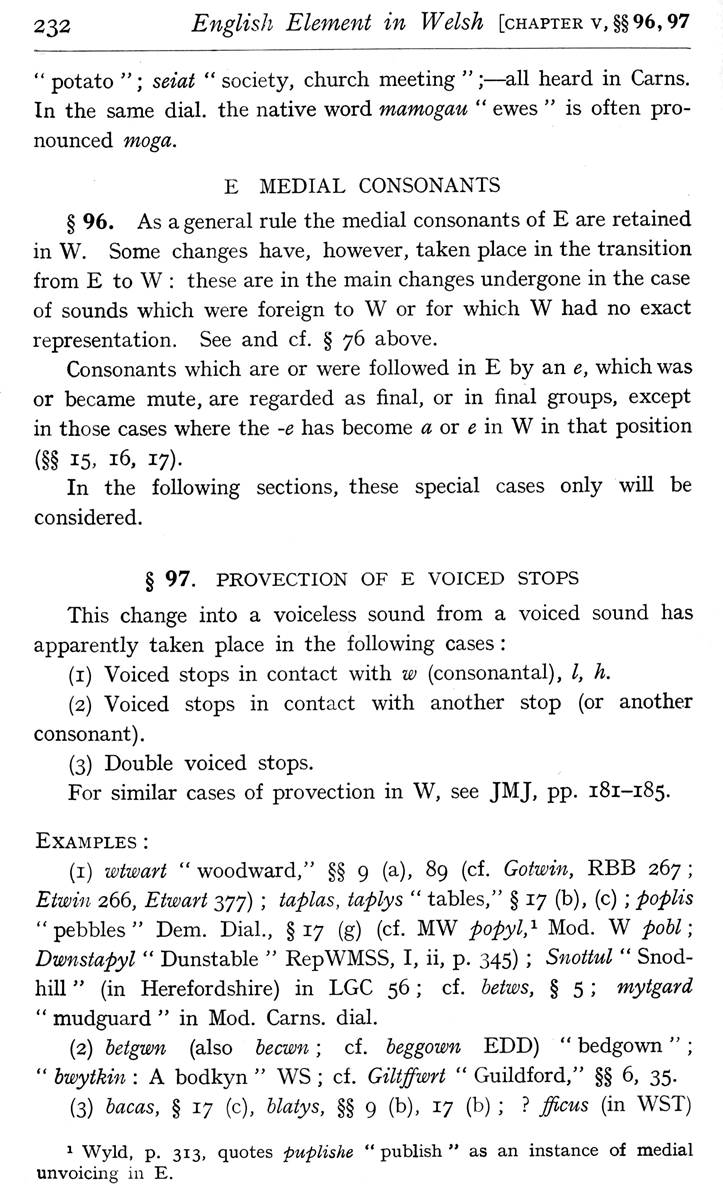
(delwedd F6983) (tudalen 232)
|
232 Englisli Element
in Welsh [chapter v, §§96,97
" potato”; seiat “society, church meeting”; — all heard in Cams, In the
same dial, the native word mamogau “ewes “is often pronounced moga.
E MEDIAL CONSONANTS
§ 96. As a general rule the medial consonants of E are retained in W. Some
changes have, however, taken place in the transition from E to W: these are
in the main changes undergone in the case of sounds which were foreign to W
or for which W had no exact representation. See and cf. § 76 above.
Consonants which are or were followed in E by an e, which was or became mute,
are regarded as final, or in final groups, except in those cases where the -e
has become a gt e in W in that position
(§§ 15, 16, 17).
In the following sections, these special cases only will be
considered.
§ 97. PROVECTION OF E VOICED STOPS
This change into a voiceless sound from a voiced sound has apparently taken
place in the following cases:
(i) Voiced stops in contact with w (consonantal), /, h.
(2) Voiced stops in contact with another stop (or another consonant).
(3) Double voiced stops.
For similar cases of provection in W, see JMJ, pp. 181-185.
Examples:
(i) wtwart “woodward," §§ 9 (a), 89 (cf. Gotwin, RBB 267; Etwiii 266,
Etwart 377); taplas, taplys “tables," § 17 (b), (c); poplis
"pebbles" Dem. Dial., §17 (g) (cf. MW popyl,"- Mod. W pohl \
Dwnstapyl “Dunstable “RepWMSS, I, ii, p. 345); Snottul “Snodhill” (in
Herefordshire) in LGC 56; cf. betws, § 5; mytgard “mudguard “in Mod. Cams.
dial.
(2) hetgwn (also hecwn; cf. heggown EDD) “bedgown”; “hwytkin: A bodkyn “WS;
cf. Giltffwrt “Guildford," §§ 6, 35.
(3) hacas, § 17 (c), hlatys, §§ 9 (b), 17 (1^);? fficus (in WST)
^ Wyld, p. 313, quotes pupUshe “publish “as an instance of medial unvoicing
in E.
|
|
|
|
|
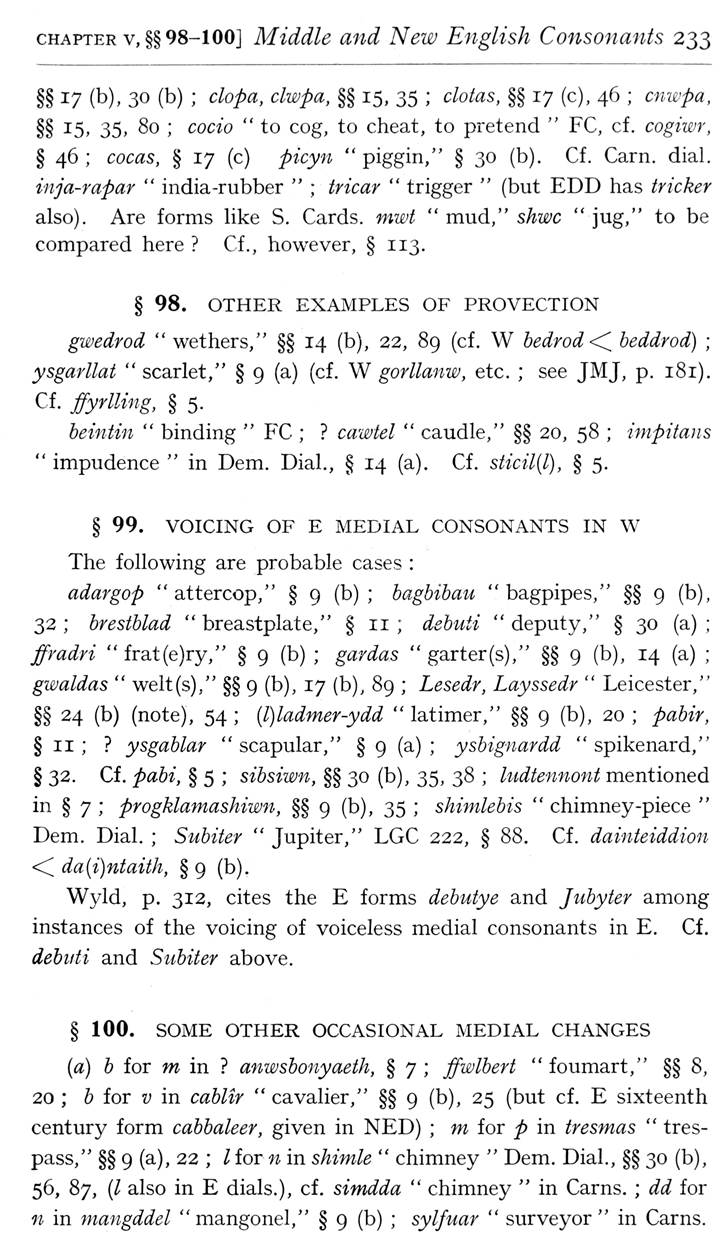
(delwedd F6984) (tudalen 233)
|
CHAPTER v,§§ 98-100]
Middle and New English Consonants 233
§§ 17 (b), 30 (b); clopa, clwpa, §§ 15, 35; clotas, §§ 17 (c), 46; cnwpa, §§
15. 35» 80; cocio “to cog, to cheat, to pretend “FC, cf. cogiwr, § 46; cocas,
§ 17 (c) picyn “piggin," § 30 (b). Cf. Carn. dial. inja-rapar
“india-rubber”; tricar “trigger” (but EDD has tricker also). Are forms like
S. Cards, mwt “mud," shwc “jug," to be compared here? Cf., however,
§ 113.
§ 98. OTHER EXAMPLES OF PROVECTION
gwedrod “wethers," §§ 14 (b), 22, 89 (cf. W bedrod<C beddrod);
ysgarllat “scarlet," § 9 (a) (cf. W gorllanw, etc.; see JMJ, p. 181).
Cf. ffyrlling, § 5.
heintin “binding “FC;? cawtel “caudle," §§ 20, 58; impitans “impudence
“in Dem. Dial., § 14 (a). Cf. sticil(l), § 5.
§ 99. VOICING OF E MEDIAL CONSONANTS IN W
The following are probable cases:
adargop “attercop," § 9 (b); hagbihau "bagpipes," §§ 9 (b),
32; brestblad "breastplate," § 11; debuii "deputy," § 30
(a); ffmdri "frat(e)ry," § 9 (b); gar das “garter (s)," §§ 9
(b), 14 (a); gwaldas “welt(s)," §§ 9 (b), 17 (b), 89; Lesedr, Layssedr
“Leicester," §§ 24 (b) (note), 54; [l)ladmer-ydd “latimer," §§ 9
(b), 20; pabir, § II;? ysgablar “scapular," § 9 (a); ysbignardd
“spikenard," § 32. Cf. pabi, § 5; sibsiwn, §§ 30 (b), 35, 38; ludtennont
mentioned in § 7; progkla7nashiwn, §§ 9 (b), 35; shinilebis “chimney-piece
“Dem. Dial.; Subiter “Jupiter," LGC 222, § 88. Cf. dainteiddion <C
da{i)ntaith, § 9 (b).
Wyld, p. 312, cites the E forms debutye and Jubyter among instances of the
voicing of voiceless medial consonants in E. Cf. debiiti and Subiter above.
§ 100. SOME OTHER OCCASIONAL MEDIAL CHANGES
(a) b for w in? anwsbonyaeth, § 7; ffwlbert "foumart," §§ 8, 20; 6
for y in cablir “cavalier," §§ 9 (b), 25 (but cf. E sixteenth century
form cabbaleer, given in NED); m for p in tresmas “trespass," §§ 9 (a),
22; /for n in shimle “chimney “Dem. Dial., §§ 30 (b), 56, 87, (/ also in E
dials.), cf, simdda “chimney “in Cams.; dd for 11 in mangddel
"mangonel," § 9 (b); sylfuar “surveyor" in Cams.
|
|
|
|
|
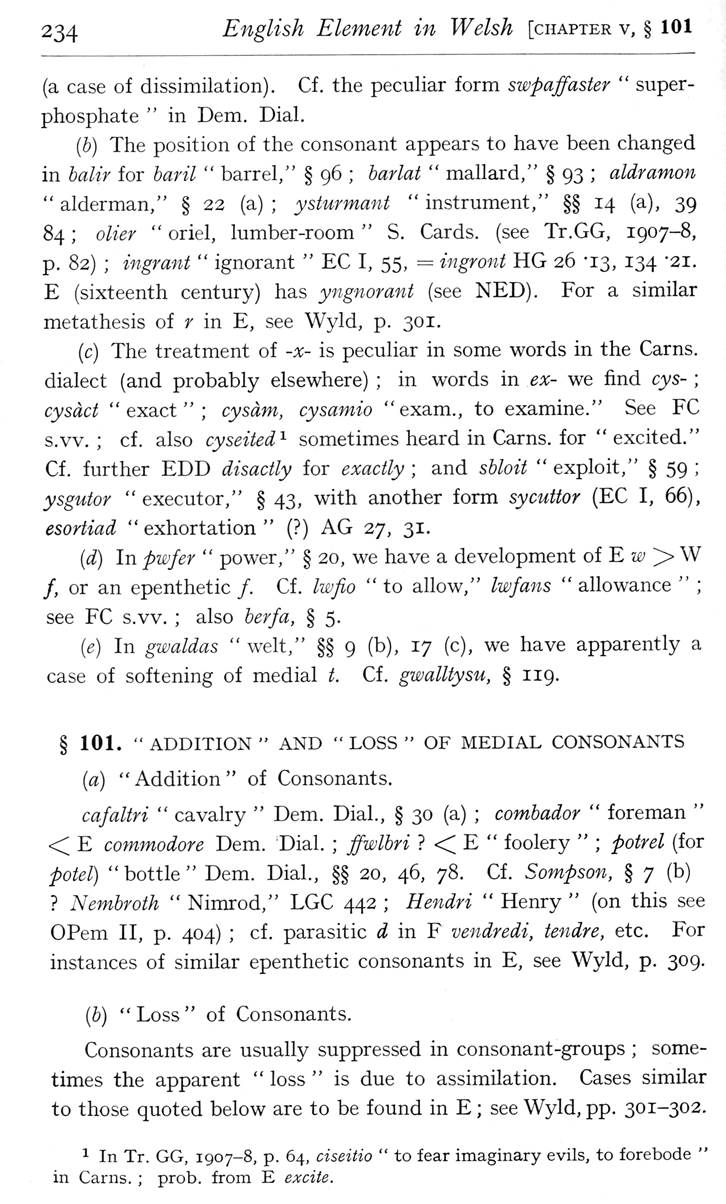
(delwedd F6985) (tudalen 234)
|
234 English Element
in Welsh [chapter v, § 101
(a case of dissimilation). Cf. the peculiar form swpaffaster “super-phosphate
“in Dem. Dial.
(6) The position of the consonant appears to have been changed in halir for
haril “barrel," § 96; harlat “mallard/' § 93; aldramon “alderman,"
§ 22 (a); ysturmant “instrument," §§ 14 (a), 39 84; olier “oriel,
lumber-room “S. Cards, (see Tr.GG, 1907-8, p. 82); ingrant “ignorant “EC I,
55, = ingront HG 26 '13, 134 -21. E (sixteenth century) has yngnorant (see
NED). For a similar metathesis of r in E, see Wyld, p. 301.
(c) The treatment of -x- is peculiar in some words in the Cams, dialect (and
probably elsewhere); in words in ex- we find cys-; cysdct "exact";
cysdm, cysamio "exam., to examine." See EC s.w.; cf. also cyseited^
sometimes heard in Cams, for “excited." Cf. further EDD disactly for
exactly; and shloit “exploit," § 59; ysgutor "executor," § 43,
with another form sycuttor (EC I, 66), esortiad “exhortation” (?) AG 27, 31.
(d) In pwfer “power," § 20, we have a development of E tiy > W /, or
an epenthetic /. Cf. Iwfio “to ahow," Iwfans “allowance”; see EC s.w.;
also berfa, § 5.
(e) In gwaldas “welt," §§ 9 (b), 17 (c), we have apparently a case of
softening of medial t. Cf. gwalUysu, § 119.
§ 101. “ADDITION “AND “LOSS “OF MEDIAL CONSONANTS
[a) “Addition “of Consonants.
cafaltri
“cavalry “Dem. Dial., § 30 (a); combador “foreman” < E commodore Dem. ^Dial.; ffwlhri? < E “foolery”; petrel (for potel)
"bottle" Dem. Dial, §§ 20, 46, 78. Cf. Sompson, § 7 (b)? Nembroth
“Nimrod," LGC 442; Hendri “Henry” (on this see OPem II, p. 404); cf.
parasitic ^ in F vendredi, tendre, etc. Eor instances of similar epenthetic
consonants in E, see Wyld, p. 309.
(6) “Loss “of Consonants.
Consonants are usually suppressed in consonant -groups; sometimes the
apparent “loss “is due to assimilation. Cases similar to those quoted below
are to be found in E; see Wyld, pp. 301-302.
1 In Tr. GG, 1907-8, p. 64, ciseitio “to fear imaginary evils, to forebode
“in Cams.; prob. from E excite.
|
|
|
|
|
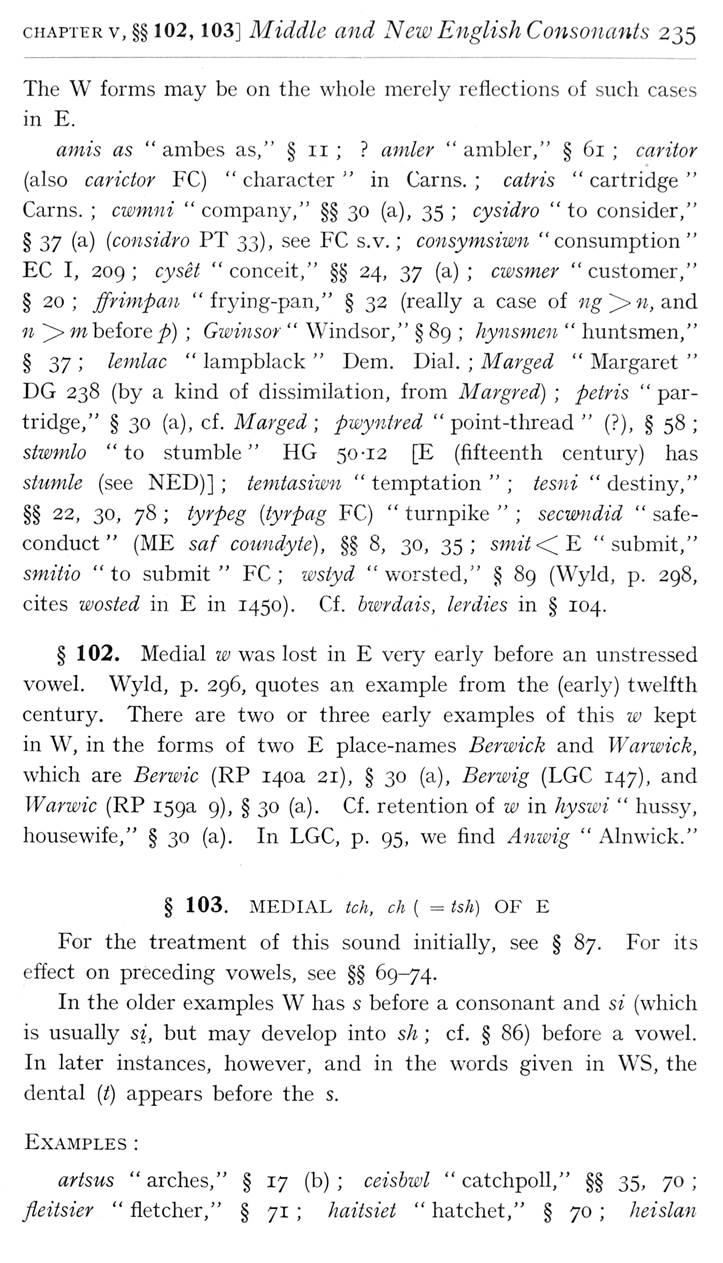
(delwedd F6986) (tudalen 235)
|
CHAPTER v,§§ 102,
103] Middle and New English Consonants 235
The W forms may be on the whole merely reflections of such cases in E.
amis as “ambes as," § 11;? aniler “ambler," § 61; cantor (also
carictor FC) “character “in Cams.; catris “cartridge ' Cams.; cwmni
“company," §§ 30 (a), 35; cysidro "to consider,' § 37 {^) (considro
PT 33), see FC s.v.; consymsiwn "consumption ' EC I, 209; cyset
“conceit," §§ 24, 37 (a); cwsmer “customer,' § 20; ffrimpan
"frying-pan," § 32 (really a case of ŵ^«, and 11
> w before^); Gwinsor “Windsor," § 89; hynsmen “huntsmen,' § ^y;
lemlac “lampblack “Dem. Dial.; Marged “Margaret ' DG 238 (by a kind of
dissimilation, from Margred); petris “partridge," § 30 (a), cf. Marged;
pwyntred “point -thread” (?), § 58 siwmlo "to stumble" HG 50-12 [E
(fifteenth century) has stumle (see NED)]; temtasiwn “temptation”; tesni
“destiny,' §§ 22, 30, 78; iyrpeg {tyrpag FC) “turnpike”; secwndid
“safe-conduct” (ME saf coundyte), §§ 8, 30, 35; smit<C^ "submit,'
smitio “to submit “FC; 7£)styd “worsted," § 89 (Wyld, p. 298 cites
wasted in E in 1450), Cf. bwrdais, lerdies in § 104.
§ 102. Medial w was lost in E very early before an unstressed vowel. Wyld, p.
296, quotes an example from the (early) twelfth century. There are two or
three early examples of this w kept in W, in the forms of two E place-names
Berwick and Warwick, which are Berwic (RP 140a 21), § 30 (a), Berwig (LGC
147), and Warwic (RP 159a 9), § 30 (a). Cf. retention of w in hyswi “hussy,
housewife," § 30 (a). In LGC, p. 95, we find Anwig “Alnwick." §
103. MEDIAL tch, ch { = tsh) OF E
For the treatment of this sound initially, see § 87. For its effect on
preceding vowels, see §§ 69-74.
In the older examples W has s before a consonant and si (which is usually si,
but may develop into sh; cf. § 86) before a vowel. In later instances,
however, and in the words given in WS, the dental [t) appears before the s.
Examples:
artsus “arches," § 17 (b); ceisbwl “catchpoll," §§ 35, 70;
fleitsier “fletcher," § 71; haitsiet “hatchet," § 70; heislan
|
|
|
|
|
(delwedd F6987) (tudalen 236)
|
236 English Element
in Welsh [chapter v,§ 104
" hetchell," § 71; marsiand, etc., “merchant," §§ 9 (b), 21,
22 (also mershiand, § 8); matsio “to match “EC II, 242; martses “marches
“CAMSS, p. 45; Melsior “Melchior” (one of the three “Wise Men ") LlanMS
6, p. 159, 1. 33, EC II, 342, and RP 51b 24 {melsyor and melchior), see
Siasber, § 88; hengsmon “henchman," § 7 (a); parsment “parchment,"
§§ 9 (b), 22 (a); piser “pitcher," §§ 20, 30 (b); Rhismwnd “Richmond
“CCMSS, p. 189, Rhismwnt lolo MSS 315; scwtsiwn “scutcheon," § 35;
“setsiel: A sechell “WS, i.e. “satchel”; taitsment “attachment," § 70;
treinsiwr “trencher," § 71; Rhisiart “Richard “DGG 339, IG 128;
wiscrefft “witchcraft," §§ i, 89; Litsfild “Lichfield “EC I, 64.
In transyrie plur., mentioned in § 14 (b),we seem to have a case of loss of i
(or a case of sh >> s) before y; cf. §§ 86, 88, 91.
§ 104. E MEDIAL j [=dzh) AND g {= dzh) IN W
[zh is used here for voiced sh, i.e. i.] For this sound in E, and its
representation initially in W, see § ^^.
In W we generally find si medially for this sound of E. Before i or u it may
become s (see end of § 103 above), as in sinsir and consurio. WS once or
twice writes tsi (? for dsi <^ dzh, as W has no z- sound); he transcribes
E ginger as “tsintsir” (see § 88).
Examples:
ainsiel [aitsiel) “angel," § 70; Aeiisio “Anjou," § 70; Bridsied
“Bridget “EC I, 5; Brndsys in “satten o brudsys: Saten of bruges “WS, i.e.
“Bruges”; “bwytsiet: A bougette “WS, § 74; consurio “to conjure," §§ 35,
43 (cf. cwnsheri Dem. Dial.); dwynsiwn “dungeon," §§ 35, 74; veinsians
“vengeance," § 71; hahrsiwn "habergeon," §§ 9 (b), 35; mansier
"manger," §70;? mursen “virgin," § ^^ (b); Roesier, Roedgier,
etc. “Roger," §§ 20, 73; sarsiant “sergeant," §§ 9 (a), 21 (WS has
serdsiant); sinsir “ginger," §§ 30 (b), 88.
In a few words there is a peculiar development . The combination dsi seems to
have arisen as in the other cases, but as there was another s in the next
syllable, the s of the group was dropped. This is a type of dissimilation
similar to that found possibly in Marged for Margred, § loi (b).
|
|
|
|
|
(delwedd F6988) (tudalen 237)
|
CHAPTER V, §§ 1 05-1
07J Middle and New English Consonants 237
Examples:
hwrdais (ME burgeys) “burgess," §§ 35, 54: it stands perhaps for
*bwrdsais; cf. forms with g of this word in W, g being hardly the voiced
stop.
lerdies ( lardies) “largess," §§ 8, 20: this again probably stands for
*lerdsies.
waedys “wages," § 70,? for *waedsys; cf. the other form waedgys
mentioned in § 70 (with g as in E).
baedys “badges “Bod.,? for ^baedsys.
In bwrdais, MW bwrdeis, waedys and baedys, the consonantal i may have
disappeared as it did in the cases mentioned in §§ 86, 88, 91, 104, above.
§ 105. E -si- AND -//-.
These sounds in E had become “sh “very early by a kind of combinative change.
Traces of the new development date from the fifteenth century (Wyld, p. 293).
Jespersen, pp. 340-348, includes this among the “seventeenth-century
consonant-changes." Ellis (EEP, pp. 208, 225) says that in the
fourteenth century the sh-sound had not developed in these cases, but that in
the eighteenth century and perhaps earlier “ci- before a vowel became
(sh)." WS (1547) says that c before e and i had the sound of s, and
gives “condicyon," transcribed “condisywn," as an example.
Examples:
co(jn)mi{s)sion, § 45; defosiwn, §§ 19, 35; nasiwn, § 35; pasiwn, §§ 9 (b),
35; pensiwn, §§ 22, 35; sesiwn, §§ 22, 35; sipsiimi, §§ 17 (h), 30 (b);
wngsiwn, § 35; temtasiwn, § 100; cf. progklamashiwn, §§ 9 (b), 35, 99-
§ 106. The zh (or i) sound that developed in E from zi before u (for which
see Wyld, p. 294) is not reflected in W. W has s. Cf . the note on Sud in §
88 above. Thus we have —
asur, §§ 9 (b), 43; 77tesur, §§ 24, 43; tonsur, § 43;? pleser, § 22; usur, §
43.
§ 107. The ish sound that developed in E in the seventeenth century from H
before unstressed {i)u (for which see Jespersen,
|
|
|
|
|
(delwedd F6989) (tudalen 238)
|
238 English Element
in Welsh [chapter v, §§ 108-111
p. 346) is not reflected in W in the examples here given, presumably because
they were borrowed prior to the E change. Thus we have — antur, §§ 9, 43;
jforUm, § 43; natur, §§ 11, 43.
§ 108. The E seventeenth century change of ti to a tsh sound before a weak
syllable (for which see Jespersen, p. 346) is not reflected in the W
cwestiwn, §§ 22, 35; pictiwr, § 30 (b).
§ 109. Medial -sh- of E is represented in W by si before a vowel, and by s
before a consonant. See and cf. §§ 86, 103. Examples are —
hwysel, §74; dismed "dish-meat" (Bod.); pwysment, § 22 (a), usier,
§§ 20, 43; washws, §§ 17 (i), 35, 89. In wrsip {wrsih), §§ 30 (a), 35, 89, we
have an example of the development before i mentioned above in §§ 86, 88.
§ 110. As there is no -s'-sound in W, any such sound that occurs in E
loan-words in W is represented by s,^ cf. § 76 (iv). Traces of z are,
however, met with, e.g. tryzor Car. Mag. 81, see §§ 14 (b), 36 above; cf.
nazared in RP 57a 41, but nasred RP 90a 17. § 111. LOSS OF I IN E.
(a) In E / has been dropped before labial consonants in such words as calm,
palm, halm, etc. The evidence for this loss dates from the fifteenth century.
See Wyld, p. 297, and Jespersen, pp. 292-293. Instances in W with the Z still
retained are? palm, § 9 (b); palmer, § 9 (b);? salm, § 9 (b); Malmsai, § 9
(b); the forms halm, § 9 (b), and calm, § 9 (b), are probably “book “forms.
(6) In E in the same way / was lost before k and /. In W bale, § 9 (b) and
sialc, § 9 (b), we seem to have the / still unsuppressed. Cf. “ystalkio ne
stelkian: Stalk" WS.
^ “However good the pronunciation of the first introducer of a [loan-] word
may have been, it is clear that when a word is extensively used by people
with no intimate and first-hand knowledge of the language from which it was
taken, most of them will tend to pronounce it with the only sounds with which
they are familiar, those of their own language." — Jespersen {Language .
. . London, 1922, p. 207).
|
|
|
|
|
(delwedd F6990) (tudalen 239)
|
cHAPTERv, §§ 112,
113] Middle and New English Consonants 239
E FINAL CONSONANTS
§ 112. In general, the remarks made on the treatment of initial and medial
consonants (§§ 76, 96) also apply here in the case of final consonants. In
the final position, however, certain variations appear, to which consonants
in the initial and medial positions are not specially subject. Here again, as
with initial and medial consonants, the changes reflect to a large extent in
a good many cases the changes that are evidenced by E itself.
Only special cases will be considered in the following sections. It has
already been pointed out in § 96 that E consonants or consonant-groups
followed now by a mute e in writing are regarded as final, with the obvious
exception of those cases in which the -e has become -a or -e in W, as the
consonants in these cases were, of course, not in the final positions at the
time of borrowing.
§ 113. FINAL VOICELESS STOPS OF E
In the E borrowings which are found in MW texts we are confronted with a
diificulty which the orthography of the period presents. As a general rule
voiced stops are not met with at the end of words at this period (for the
facts and the exceptions, see JMJ, p. 20). It appears that the true quality
of a W final stop depended to a large extent on whether it was followed in
the next word by a vowel or by a consonant. This v/as first suggested by Sir
John Rhys in an article entitled “All around the Wrekin “in Y Cymmrodor xxi,
pp. 32-35. The question is discussed at greater length in JMJ, pp. 183-184,
where it is stated that the reason why the mediae are so commonly written as
tenues in MW was that the pre-consonantal form was generalized in writing.
Rhys, in the article referred to, says, in discussing the mutation of final
tenues, p. 35: "It will be found on enquiry that the tendency to make
the change had probably exhausted itself before the period when the mass of
English loan-words in colloquial Welsh found their way into Wales, for in
them the Mutation is seldom found carried through." This statement is
correct so far as the process of mutation in W is concerned; but changes of a
similar nature, although they may not strictly be part of the W native
mutational process, did take place in the E loan-words in Welsh in the final
position. In view of what has been said, we may expect to find in
|
|
|
|
|
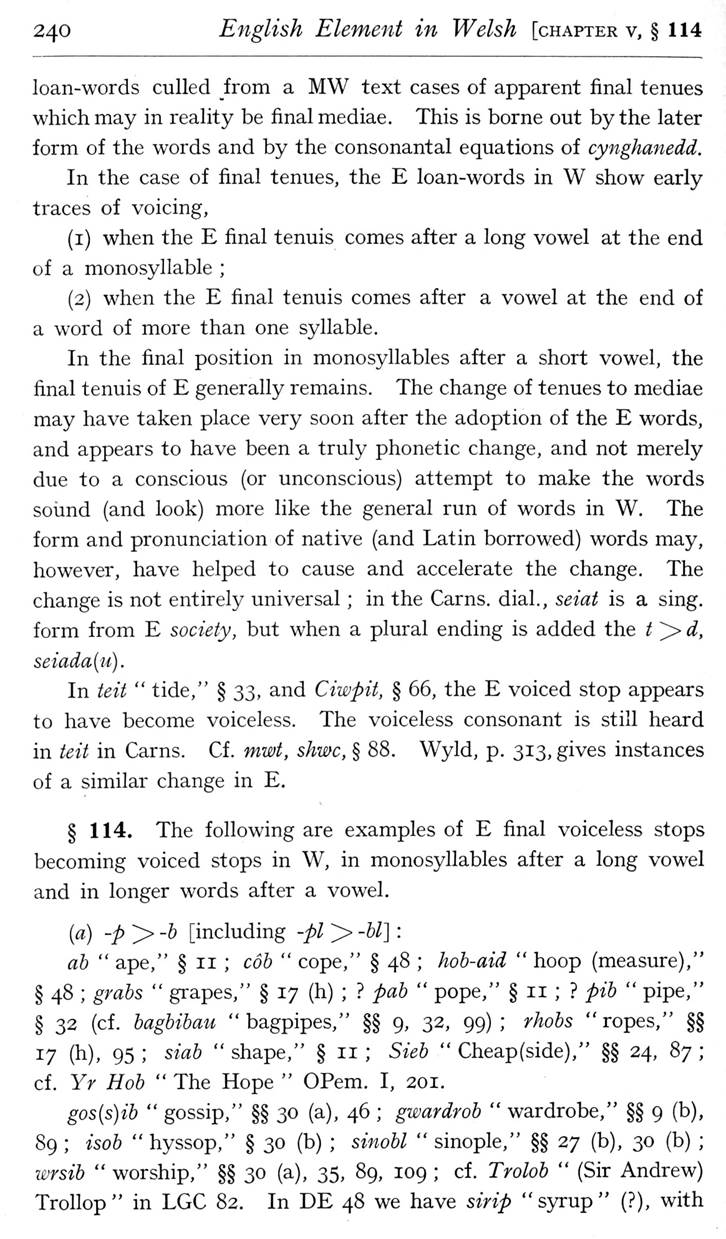
(delwedd F6991) (tudalen 240)
|
240 English Element
in Welsh [chapter v, § 114
loan-words culled from a MW text cases of apparent final tenues which may in
reality be final mediae. This is borne out by the later form of the words and
by the consonantal equations of cynghanedd.
In the case of final tenues, the E loan-words in W show early traces of
voicing,
(i) when the E final tenuis comes after a long vowel at the end of a
monosyllable;
(2) when the E final tenuis comes after a vowel at the end of a word of more
than one syllable.
In the final position in monosyllables after a short vowel, the final tenuis
of E generally remains. The change of tenues to mediae may have taken place
very soon after the adoption of the E words, and appears to have been a truly
phonetic change, and not merely due to a conscious (or unconscious) attempt
to make the words soimd (and look) more like the general run of words in W.
The form and pronunciation of native (and Latin borrowed) words may, however,
have helped to cause and accelerate the change. The change is not entirely
universal; in the Cams, dial., seiat is a sing, form from E society, but when
a plural ending is added the f^d, seiada{u).
In teit “tide," § 2^, and Ciwpit, § 66, the E voiced stop appears to
have become voiceless. The voiceless consonant is still heard in teit in
Cams. Cf. mwt, shmc, § 88. Wyld, p. 313, gives instances of a similar change
in E.
§ 114. The following are examples of E final voiceless stops becoming voiced
stops in W, in monosyllables after a long vowel and in longer words after a
vowel.
[a) -p > -b [including -pi > -U]:
ah “ape," § 11; cob “cope," § 48; hob-aid “hoop (measure)," §
48; grabs “grapes," § 17 (h);? pab “pope," § 11;? pib “pipe,"
§ 32 (cf. bagbibau “bagpipes," §§ 9, 32, 99); rhobs “ropes," §§ 17
(h), 95; siab “shape," § 11; Sieb “Cheap (side)," §§ 24, 87; cf. Yr
Hob “The Hope “OPem. I, 201.
gos{s)ib “gossip," §§ 30 (a), 46; gwardrob “wardrobe," §§ 9 (b),
89; isob “hyssop," § 30 (b); sinobl “sinople," §§ 27 (b), 30 (b);
i£jrsib “worship," §§ 30 (a), 35, 89, 109; cf. Trolob” (Sir Andrew)
Trollop" in LGC 82. In DE 48 we have sirip "syrup" (?), with
|
|
|
|
|
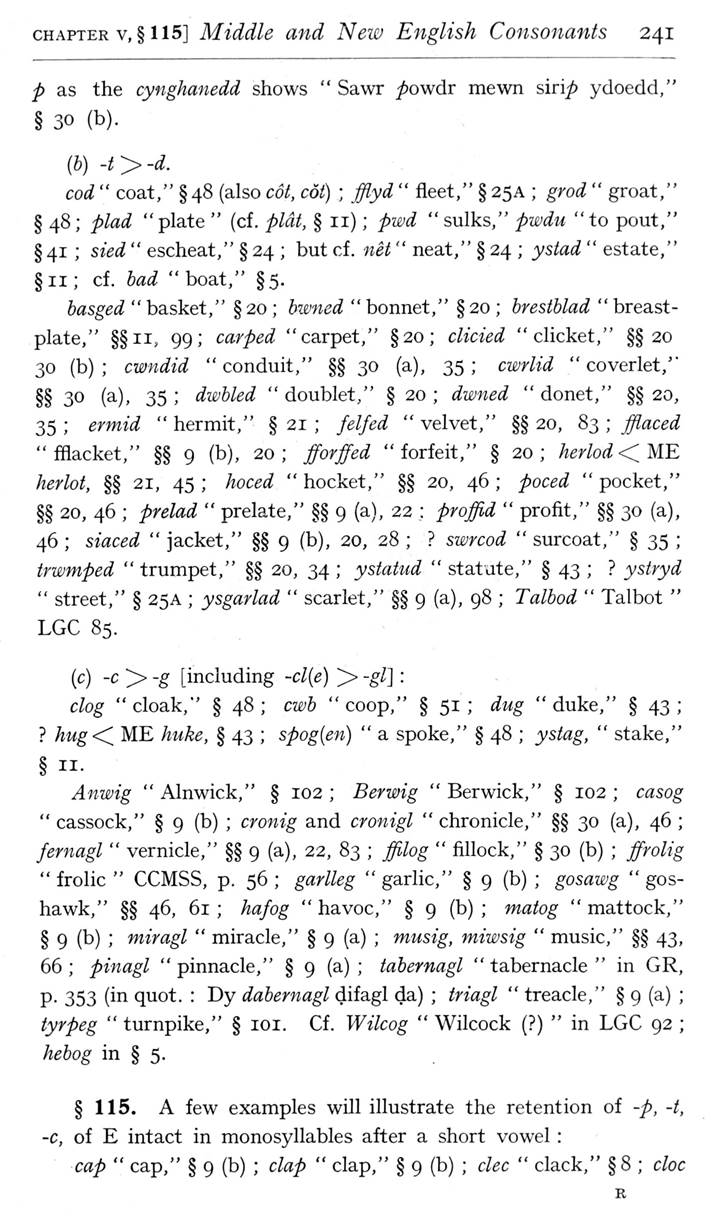
(delwedd F6992) (tudalen 241)
|
CHAPTER v,§ 115]
Middle and New English Consonants 241
p as the cyngJianedd shows “Sawr ^owdr mewn sinp ydoedd," § 30 (b).
{h) -ty-d.
cod “coat," §48 (also coi, cot); fflyd “fleet," § 25A; grod
“groat," § 48; plad "plate” (cf. plcit, § 11); pwd
"sulks," pwdu "to pout," § 41; sied “escheat," § 24;
but cf. net “neat," § 24; ystad “estate," §11; cf. bad “boat,"
§5.
basged “basket," § 20; bwned “bonnet," § 20; brestblad
“breast-plate," §§ii. 99; carped "carpet," §20; elided
"clicket," §§20 30 (b); cwndid “conduit," §§ 30 (a), 35;
cwrlid “coverlet," §§ 30 (a), 35; dwbled “doublet," § 20; dwned
“donet," §§ 20, 35; ermid “hermit," § 21; felfed “velvet," §§
20, 83; flaced "fflacket," §§ 9 (b), 20; fforffed "forfeit,"
§ 20; herlod<^WE herlot, §§ 21, 45; hoced “hocket," §§ 20, 46; poced
“pocket," §§ 20, 46; prelad “prelate," §§ 9 (a), 22: proffid
“profit," §§ 30 (a), 46; siaced “jacket," §§ 9 (b), 20, 28;? swrcod
“surcoat," § 35; trwmped “trumpet," §§ 20, 34; ystatud
“statute," § 43;? ystryd “street," § 25A; ysgarlad “scarlet,"
§§ 9 (a), 98; Talbod “Talbot “LGC 85.
(c) -c > -g [including -cl{e) > -gl]:
clog "cloak," § 48; cwb "coop," § 51; dug
"duke," § 43;? hug<^ ME Jiuke, § 43; spog{en) “a spoke," §
48; ystag, “stake,"
§ II-
Anwig “Alnwick," § 102; Berwig “Berwick," § 102; casog
" cassock," § 9 (b); cronig and cronigl “chronicle," §§ 30
(a), 46; fernagl “vernicle," §§ 9 (a), 22, 83; ffilog “fillock," §
30 (b); ffrolig “frolic “CCMSS, p. 56; garlleg “garlic," § 9 (b); gosawg
“goshawk," §§ 46, 61; hafog “havoc," § 9 (b); matog “mattock,"
§ 9 (b); miragl “miracle," § 9 (a); musig, miwsig “music," §§ 43,
66; pinagl “pinnacle," § 9 (a); tabernagl “tabernacle “in GR, P- 353
(ill quot.: Dy dabernagl difagl da); triagl “treacle," § 9 (a); tyrpeg
“turnpike," § loi. Cf. Wilcog “Wilcock (?) “in LGC 92; hebog in § 5.
§ 115. A few examples will illustrate the retention of -p, -t, -c, of E
intact in monosyllables after a short vowel:
cap “cap," § 9 (b); clap “clap," § 9 (b); dec “clack," §8; doc
R
|
|
|
|
|
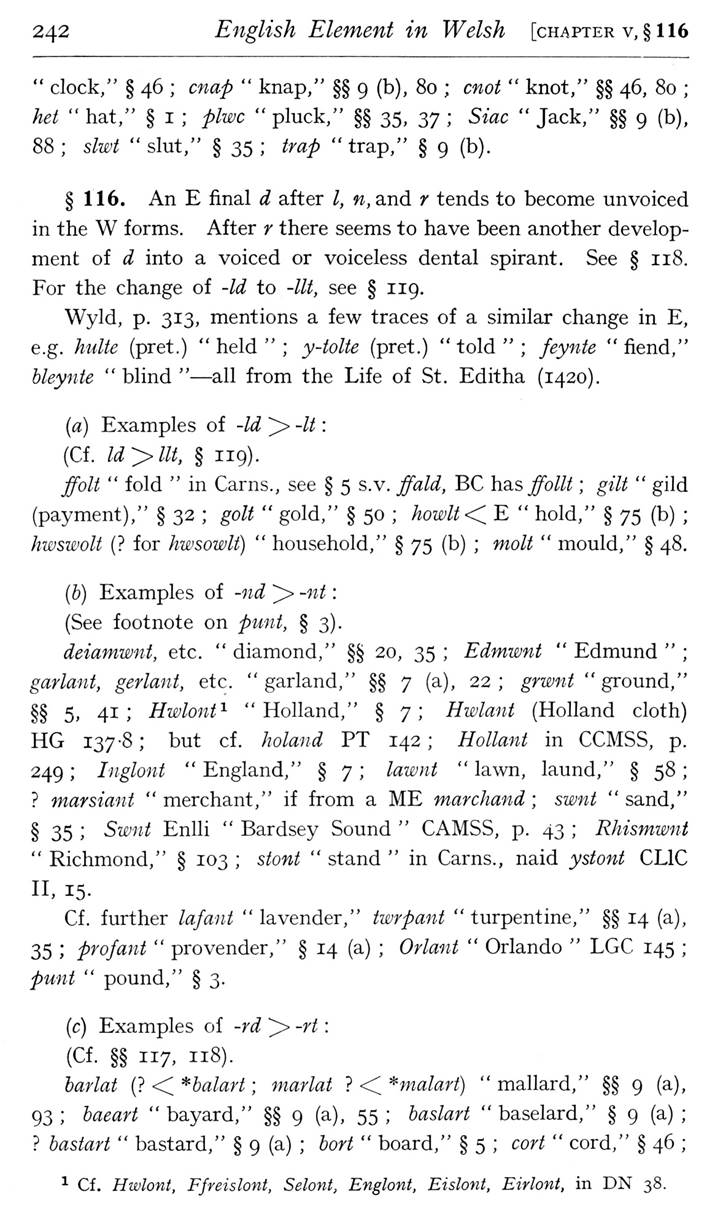
(delwedd F6993) (tudalen 242)
|
242 English Element
in Welsh [chapter v,§ 116
" clock," § 46; cnap “knap," §§ 9 (b), 80; cnot “knot,"
§§ 46, 80; het “hat," § I; plwc “pluck," §§ 35, 37; 5mc
“Jack," §§ 9 (b), 88; slwt “slut," § 35; ^m^ “trap," § 9 (b).
§ 116. An E final d after /, w, and ^' tends to become unvoiced in the W
forms. After r there seems to have been another development of d into a
voiced or voiceless dental spirant. See § 118. For the change of -Id to -lit,
see § 119.
Wyld, p. 313, mentions a few traces of a similar change in E, e.g. hulte
(pret.) “held”; y-tolte (pret.) “told”; feynte “fiend," bleynte “blind”
— all from the Life of St. Editha (1420).
(a) Examples of -Id ^ -//:
(Cf. ld-:>llt, § 119).
ffolt “fold “in Cams., see § 5 s.v. ffald, BC hd.s ffollt; gilt “gild
(payment)," § 32; golf “gold," § 50; Aoz£;/2!< E “hold," §
75 (b); hwswoU (? for hwsowlt) “household," § 75 (b); molt “mould,"
§ 48.
(6) Examples of -«(^ ^ -«^:
(See footnote on punt, § 3).
deiamwnt, etc. “diamond," §§ 20, 35; Edmwnt “Edmund”; garlant, gerlant,
etc. “garland," §§ 7 (a), 22; grwnt “ground," §§ 5, 41; Hwlont^
"Holland," § 7; i:^z£;/a«2! (Holland cloth) HG 137-8; but cf.
holand PT 142; Hollant in CCMSS, p. 249; Inglont “England," § 7; lawnt
“lawn, laund," § 58;? marsiant “merchant," if from a ME marchmtd;
swnt “sand," § 35; Swnt Enlli “Bardsey Sound “CAMSS, p. 43; Rhismwnt
“Richmond," § 103; stont “stand “in Cams., naid ystont CLIC
II, 15-
Cf. further lafant "lavender," twrpant "turpentine," §§
14 (a),
35; profajit “provender," § 14 (a); Orlant “Orlando “LGC 145; punt
“pound," § 3.
(c) Examples of -rd ^-rt:
(Cf. §§ 117, 118).
barlat (? <C *balart; marlat? ■< ^malart) “mallard," §§ 9
(a), 93; baeart
“bayard," §§ 9 (a), 55; baslart “baselard," § 9 (a);? bastart
“bastard," § 9 (a); bort “board," § 5; cort “cord," § 46;
^ Cf. Hwlont, Ffreislont, Selont, Englont, Eislont, Eirlont, in DN 38.
|
|
|
|
|
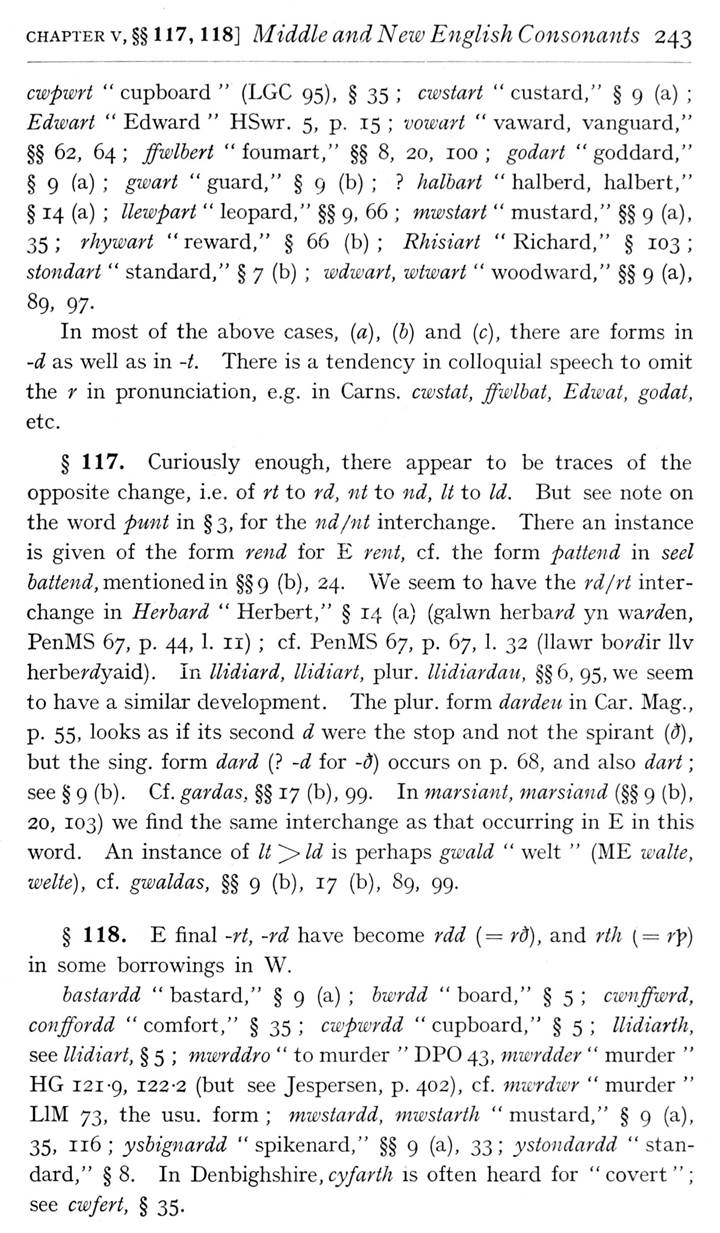
(delwedd F6994) (tudalen 243)
|
CHAPTER V, §§ 1 17,
1 18] Middle and New English Consonants 243
cwpwrt “cupboard” (LGC 95), § 35; cwstart "custard," § 9 (a);
Edwart “Edward “HSwt. 5, p. 15; vowart “vaward, vanguard," §§ 62, 64;
ffwlhert "foumart," §§ 8, 20, 100; godart "goddard," § 9
(a); gwart “guard," § 9 (b);? halhart “halberd, halbert," § 14 (a);
Uewpart “leopard," §§ 9, 66; mwstart “mustard," §§ 9 (a), 35;
rhywart "reward," § 66 (b); Rhisiart "Richard," § 103;
stondart “standard," § 7 (b); wdwart, wtwart “woodward," §§ 9 (a),
89, 97.
In most of the above cases, [a], {b) and (c), there are forms in -d as well
as in -t. There is a tendency in colloquial speech to omit the r in
pronunciation, e.g. in Cams, cwstat, ffwlbat, Edivat, godat, etc.
§ 117. Curiously enough, there appear to be traces of the opposite change,
i.e. of rt to rd, nt to nd, It to Id. But see note on the word punt in §3,
for the nd/nt interchange. There an instance is given of the form rend for E
rent, cf. the form pattend in seel hattend, meiitionedim. §§9 (b), 24. We
seem to have the rd/rt interchange in Herbard “Herbert," § 14 (a) (galwn
h.eTha.rd yn warden, PenMS 67, p. 44, 1. 11); cf. PenMS 67, p. 67, 1. 32
(Ilawr bor^ir llv herbef (i^yaid) . In llidiard, llidiart, plur. llidiardau,
§§6, 95, we seem to have a similar development. The plur. form dardeu in Car.
Mag., p. 55, looks as if its second d were the stop and not the spirant {d),
but the sing, form dard (? -d for -d) occurs on p. 68, and also dart; see § 9
(b). Cf. gar das, §§ 17 (b), 99. In marsiant, marsiand (§§ 9 (b), 20, 103) we
find the same interchange as that occurring in E in this word. An instance of
It ^ Id is perhaps gwald “welt” (ME walte, welte), cf. gwaldas, §§ 9 (b), 17
(b), 89, 99.
§ 118. E final ~rt, -rd have become rdd {= rd), and rtJi [= rp) in some
borrowings in W.
bastardd “bastard," § 9 (a); bwrdd “board," § 5; cwnffwrd,
conffordd "comfort," § 35; cwpwrdd "cupboard," § 5;
llidiarth, see llidiart, § 5; mwrddro “to murder “DPO 43, mwrdder “murder “HG
121-9, 122-2 (but see Jespersen, p. 402), cf. mwrdwr “murder “LIM 73, the
usu. form; mwstardd, mwstarth “mustard," § 9 (a), 35, 116; ysbignardd
"spikenard," §§ 9 (a), 33; ystondardd "standard," § 8. In
Denbighshire, cy/<a:;'/A is often heard for "covert"; see
cwfert, § 35.
|
|
|
|
|
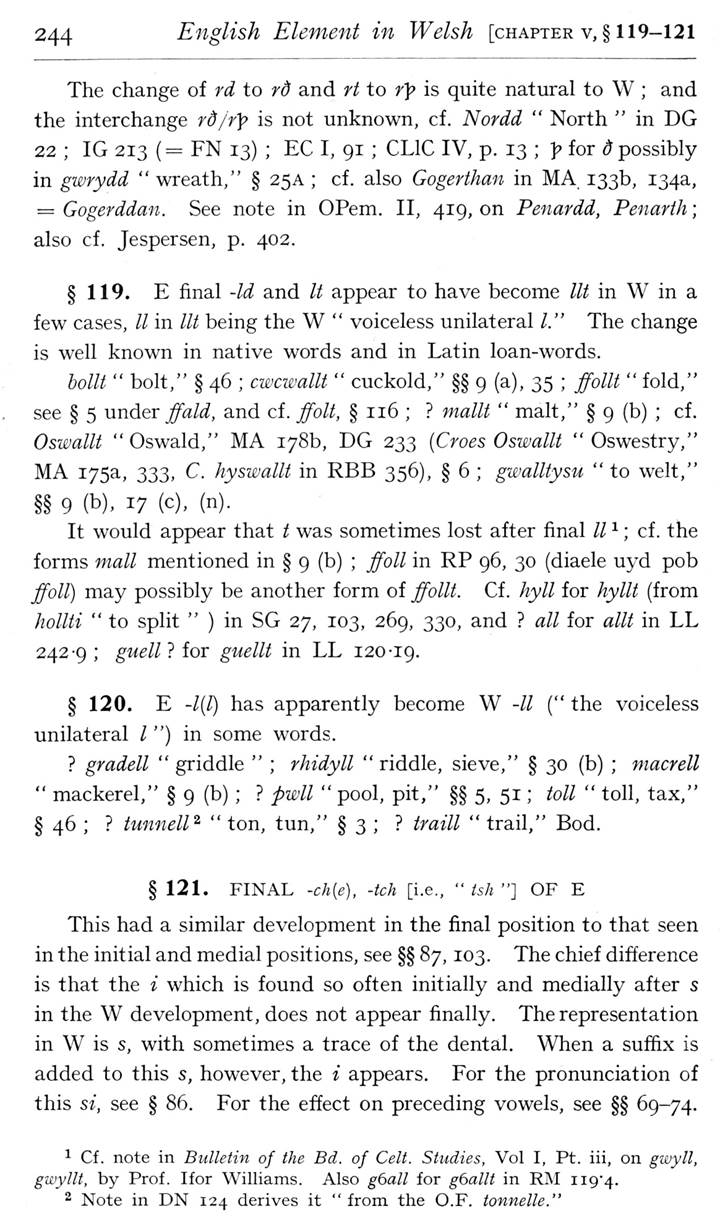
(delwedd F6995) (tudalen 244)
|
244 English Element
in Welsh [chapter v,§ 119-121
The change of rd to rd and ft to r]? is quite natural to W; and the
interchange rd/r'^ is not unknown, cf. Nordd “North “in DG 22; IG 213 (= FN
13); EC I, 91; CLIC IV, p. 13; 1? for d possibly in gwrydd “wreath," §
25 a; cf. also Gogerthan in MA. 133b, 134a, = Gogerddan. See note in OPem.
II, 419, on Penardd, Penarth; also cf. Jespersen, p. 402.
§ 119. E final -Id and It appear to have become lit in W in a few cases, //
in lit being the W “voiceless unilateral I." The change is well known in
native words and in Latin loan-words.
hollt “bolt," § 46; cwamllt “cuckold," §§ 9 (a), 35; ffollt
“fold," see § 5 under ffald, and cf. ffolt, § 116;? inallt “malt,"
§ 9 (b); cf. Oswallt "Oswald," MA 178b, DG 233 [Croes Oswallt
"Oswestry," MA 175a, 333, C. hyswallt in RBB 356), § 6; gwalltysu
“to welt," §§ 9 (b), 17 (c), (n).
It would appear that t was sometimes lost after final II ^; cf . the
forms mall mentioned in § 9 (b); jfoll in RP 96, 30 (diaele uyd pob
ffoll) may possibly be another form of ffollt. Cf . Jiyll for hyllt (from
hollti “to split “) in SG 27, 103, 269, 330, and? all for allt in LL
242-9; guell? for guellt in LL 120-19.
§ 120. E -1(1) has apparently become W -// (" the voiceless unilateral /
") in some words.
? gradell “griddle”; rhidyll “riddle, sieve," § 30 (b); macrell
“mackerel," § 9 (b);? pwll “pool, pit," §§ 5, 51; toll “toll,
tax," § 46;? tunnell^ “ton, tun," § 3;? traill “trail," Bod.
§ 121. FINAL -ch{e), -tch [i.e., “ish "] OF E
This had a similar development in the final position to that seen in the
initial and medial positions, see §§ 87, 103. The chief difference is that
the i which is found so often initially and medially after s in the W
development, does not appear finally. The representation in W is s, with
sometimes a trace of the dental. When a suffix is added to this s, however,
the i appears. For the pronunciation of this si, see § 86. For the effect on
preceding vowels, see §§ 69-74.
1 Cf. note in Bulletin of the Bd. of Celt. Studies, Vol I, Pt. iii, on
givyll, gwyllt, by Prof. Ifor Williams. Also gball for gballt in R]\I ii9'4.
2 Note in DN 124 derives it “from the O.F. tonnelle."
|
|
|
|
|
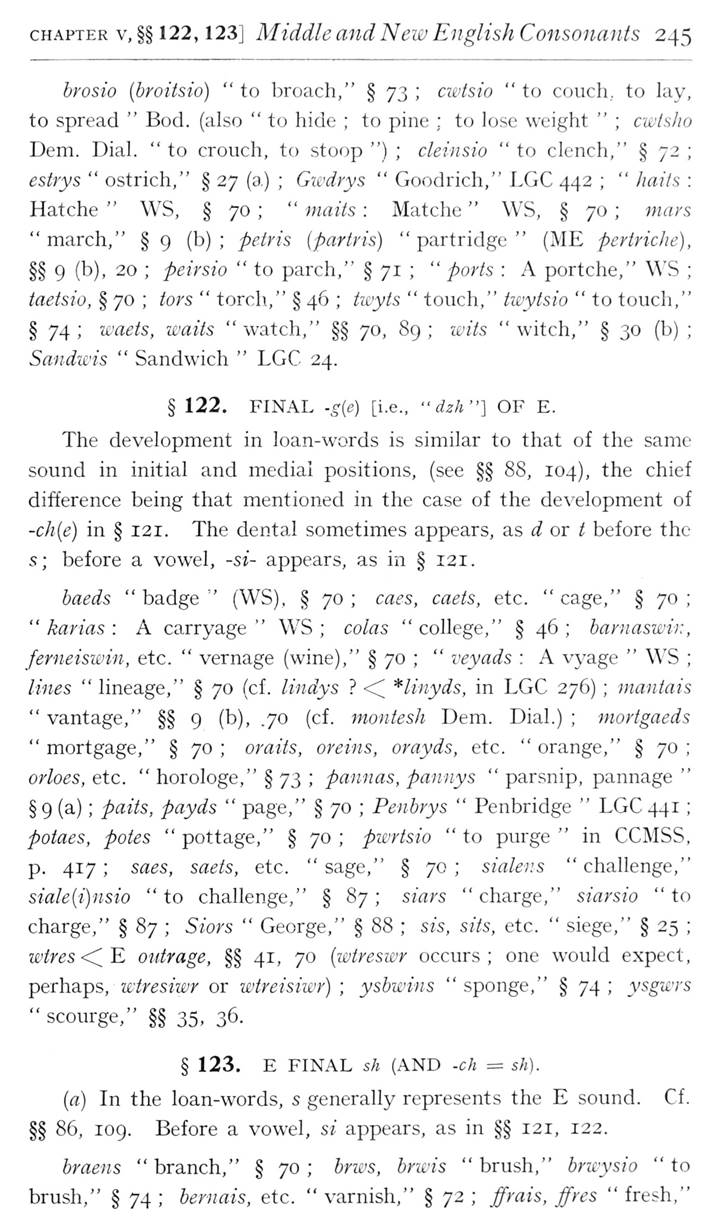
(delwedd F6996) (tudalen 245)
|
CHAPTER V, §§122,
123] Middle and New English Consonants 245
brosio [hroitsio] "to broach," § 73; cwtsio "to couch, to lay,
to spread “Bod. (also “to hide; to pine; to lose weight”; cwtsho Dem. Dial.
“to crouch, to stoop "); cleinsio “to clench," § 72; estrys
“ostrich," § 27 (a); Gwdrys “Goodrich," LGC 442; “haits: Hatche
“WS, § 70; “maiis: Matche “WS, § 70; mars “march," § 9 (b); petris
[partris) “partridge” (ME pertriche), §§ 9 (b), 20; peirsio “to parch,"
§ 71; “ports: A portche," WS; taetsio, § 70; tors “torch," § 46;
twyts “touch," twytsio “to touch," § 74; waets, waits
"watch," §§ 70, 89; wits "witch," § 30 (b); Sandwis
“Sandwich “LGC 24.
§ 122. FINAL -g{e) [i.e., “dzh"} OF E.
The development in loan-words is similar to that of the same sound in initial
and medial positions, (see §§ 88, 104), the chief difference being that
mentioned in the case of the development of -ch[e) in § 121. The dental
sometimes appears, as (^ or ^ before the s; before a vowel, -si- appears, as
in § 121.
baeds “badge” (WS), § 70; caes, caets, etc. “cage," § 70; “karias: A
carryage “ŴS; colas “college," § 46; barnaswi):, ferneiswin,
etc. “vernage (wine)," § 70; “veyads: A vyage “WS; lines “lineage,"
§ 70 (cf. lindys? <:^ *linyds, in LGC 276); mantais “vantage," §§ 9
(b), .70 (cf. montesh Dem. Dial.); mortgaeds “mortgage," § 70; oralis,
orevns, orayds, etc. “orange," § 70; orloes, etc. “horologe," § 73;
pannas, pannys “parsnip, pannage” § 9 (a); paits, payds “page," § 70;
Penbrys “Penbridge “LGC 441; potaes, potes “pottage," § 70; pwrtsio “to
purge “in CCMSS, p. 417; saes, saets, etc. "sage," § 70; sialens
"challenge," siale{i)nsio "to challenge," § 87; siars
"charge," siarsio "to charge," § 87; Siors “George,"
§ 88; sis, sits, etc. “siege," § 25; wtres <^ E outrage, §§ 41, 70 {ivtreswr
occurs; one would expect, perhaps, wtresiwr or wtreisiwr); ysbwins
“sponge," § 74; ysgwrs "scourge," §§ 35, 36.
§ 123. E FINAL sh (AND -ch = sh). [a] In the loan-words, s generally
represents the E sound. Cf. §§ 86, 109. Before a vowel, si appears, as in §§
121, 122.
braeiis "branch," § 70; bncs, brwis "brush," brwysio
"to brush," § 74; bernais, etc. “varnish," § 72; ffrais, ffres
“fresh,"
|
|
|
|
|
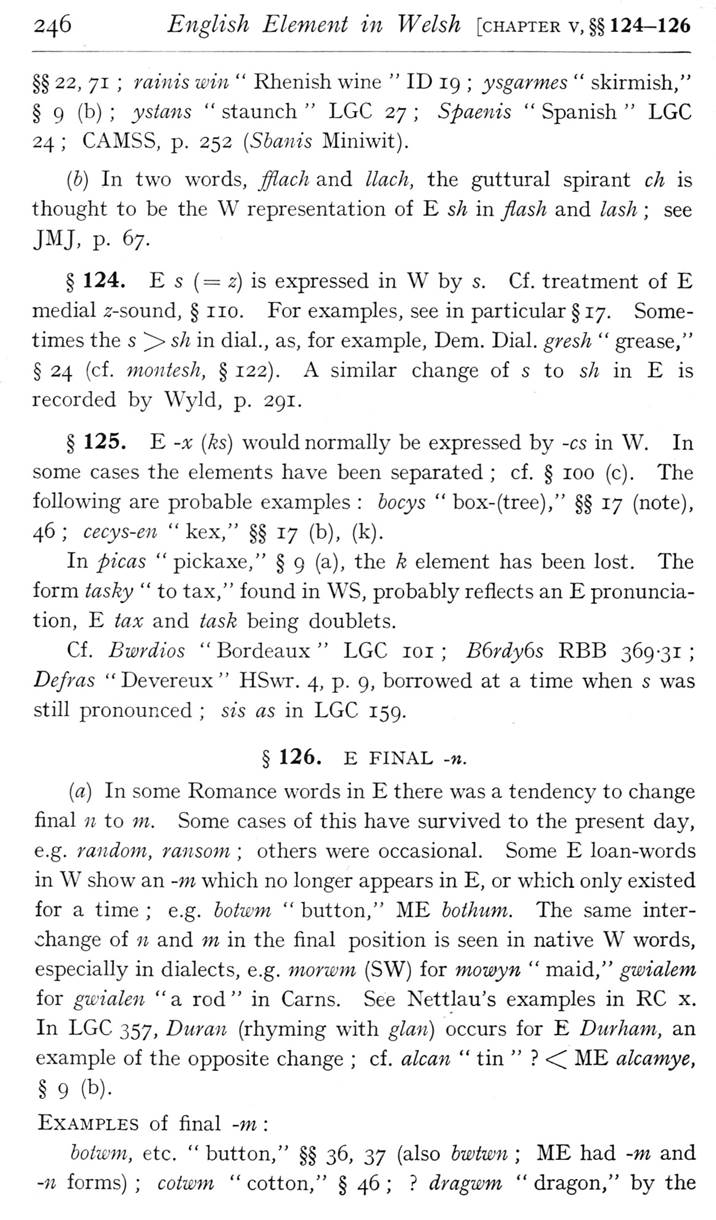
(delwedd F6997) (tudalen 246)
|
246 English Element
in Welsh [chapter v,§§ 124-126
§§ 22, 71; rainis win “Rhenish wine “ID 19; ysgarmes “skirmish," § 9 (^)
'> ysiMis “staunch “LGC 27; Spaenis “Spanish “LGC 24; CAMSS, p. 252
{Sbanis Miniwit).
(6) In two words, fflach and llach, the guttural spirant ch is thought to be
the W representation of E sh in flash and lash; see JMJ, p. 67.
§ 124. E s (= 2) is expressed in W by s. Cf. treatment of E medial 2-sound, §
no. For examples, see in particular § 17. Sometimes the s ^ sh in dial., as, for
example, Dem. Dial, gresh “grease," § 24 (cf. montesh, § 122). A similar
change of s to sh in E is recorded by Wyld, p. 291.
§ 125. E -X [ks) would normally be expressed by -cs in W. In some cases the
elements have been separated; cf. § 100 (c). The following are probable
examples: bocys “box-(tree)," §§ 17 (note), 46; cecys-en “kex," §§
17 (b), (k).
In picas “pickaxe," § 9 (a), the k element has been lost. The form tasky
“to tax," found in WS, probably reflects an E pronunciation, E tax and
task being doublets.
Cf. Bwrdios “Bordeaux “LGC 10 1; B6rdy6s RBB 369-31; Defras
"Devereux" HSwr. 4, p. 9, borrowed at a time when s was still
pronounced; sis as in LGC 159.
§ 126. E FINAL -n.
(a) In some Romance words in E there was a tendency to change final n to m.
Some cases of this have survived to the present day, e.g. random, ransom;
others were occasional. Some E loan-words in W show an -m which no longer
appears in E, or which only existed for a time; e.g. hotwm “button," ME
bothum. The same interchange of n and m in the final position is seen in
native W words, especially in dialects, e.g. morwm (SW) for momyn
“maid," gwialem for gwialen "a rod" in Cams. See Nettlau's
examples in RC x. In LGC 357, Duran (rhyming with glan) occurs for E Durham,
an example of the opposite change; cf. alcan “tin "? <^ ME alcamye, §
9 (b). Examples of final -m:
boiwm, etc. “button," §§ 36, 37 (also bwtwn; ME had -m and -n forms);
cotwm “cotton," § 46;? dragwm “dragon," by the
|
|
|
|
|
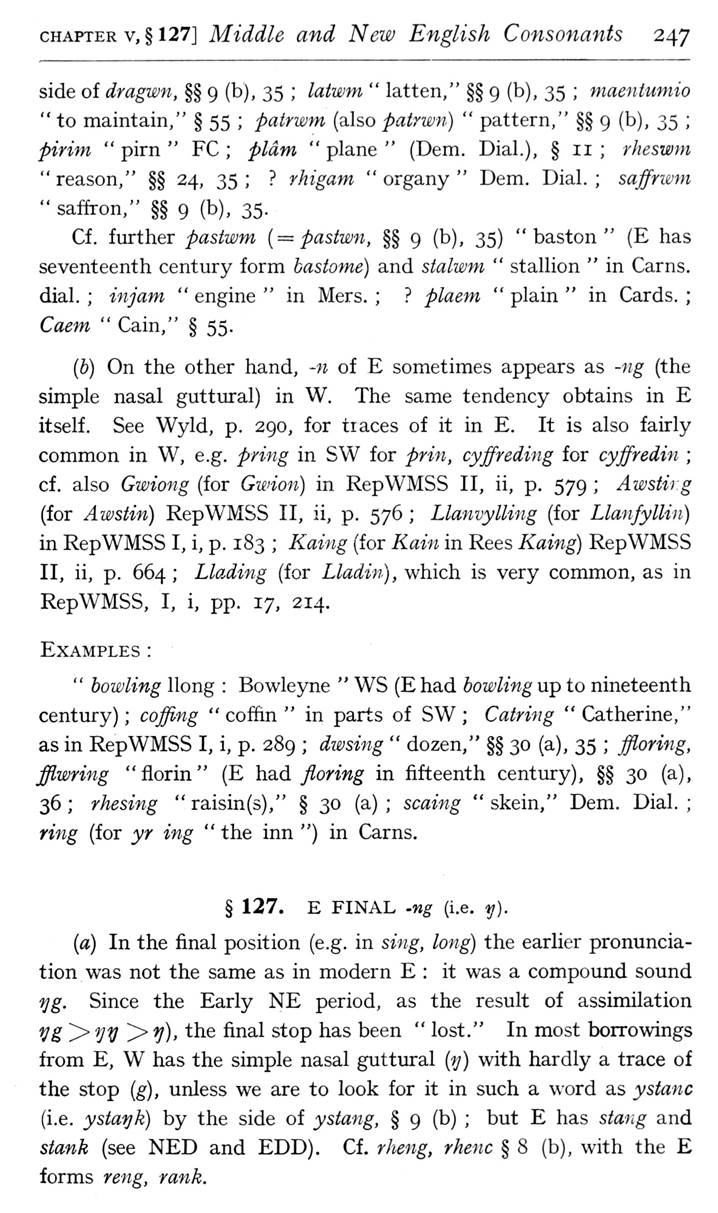
(delwedd F6998) (tudalen 247)
|
CHAPTER v,§ 127]
Middle and New English Consonants 247
side of dragwn, §§ 9 (b), 35; latwm “latten," §§ 9 (b), 35; maentumio
“to maintain," § 55; patrwm (also patrwn) “pattern," §§ 9 (b), 35;
pirim “pirn “FC; pldm “plane” (Dem. Dial.), § 11; rheswm “reason," §§
24, 35;? rhigam “organy “Dem. Dial.; saffnmn “saffron," §§ 9 (b), 35-
Cf. further pastwm {= pastwn, §§ 9 (b), 35) “baston” (E has seventeenth
century form bastome) and stalwm “stallion “in Cams, dial.; injam “engine “in
Mers.;? plaem “plain “in Cards.; Caem “Cain," § 55.
(b) On the other hand, -n of E sometimes appears as -ng (the simple nasal
guttural) in W. The same tendency obtains in E itself. See Wyld, p. 290, for
traces of it in E. It is also fairly common in W, e.g. pring in SW for prin,
cyffreding for cyffredin; cf. also Gwiong (for Gwion) in RepWMSS II, ii, p.
579; Awstirg (for Awstin) RepWMSS II, ii, p. 576; LlanvyUing (for LlanfylUn)
in RepWMSS I, i, p. 183; Kaing (for Kain in Rees Kaing) RepWMSS II, ii, p.
664; Llading (for Lladin), which is very common, as in RepWMSS, I, i, pp. 17,
214.
Examples:
" bowling Hong: Bowleyne “WS (E had bowling up to nineteenth century);
coffing “coffin “in parts of SW; Catring “Catherine," as in RepWMSS I,
i, p. 289; divsing “dozen," §§ 30 (a), 35; ffloring, fflwring
"florin" (E h3.d Jloring in fifteenth century), §§ 30 (a), 36;
rhesing “raisin(s)," § 30 (a); scaing “skein," Dem. Dial.; ring
(for yr ing “the inn ") in Cams.
§ 127. E FINAL -ng (i.e. y).
{a) In the final position (e.g. in sing, long) the earlier pronunciation was
not the same as in modern E: it was a compound sound?;g. Since the Early NE
period, as the result of assimilation V& ^ VV ^ V)' ^^^ fi^^^ s'^^P h^^
been “lost." In most borrowings from E, W has the simple nasal guttural
{y) with hardly a trace of the stop (g), unless we are to look for it in such
a word as ystanc (i.e. ystayk) by the side of ystang, § 9 (b); but E has
staiig and stank (see NED and EDD), Cf. rheng, rhenc § 8 (b), with the E
forms reiig, rank.
|
|
|
|
|
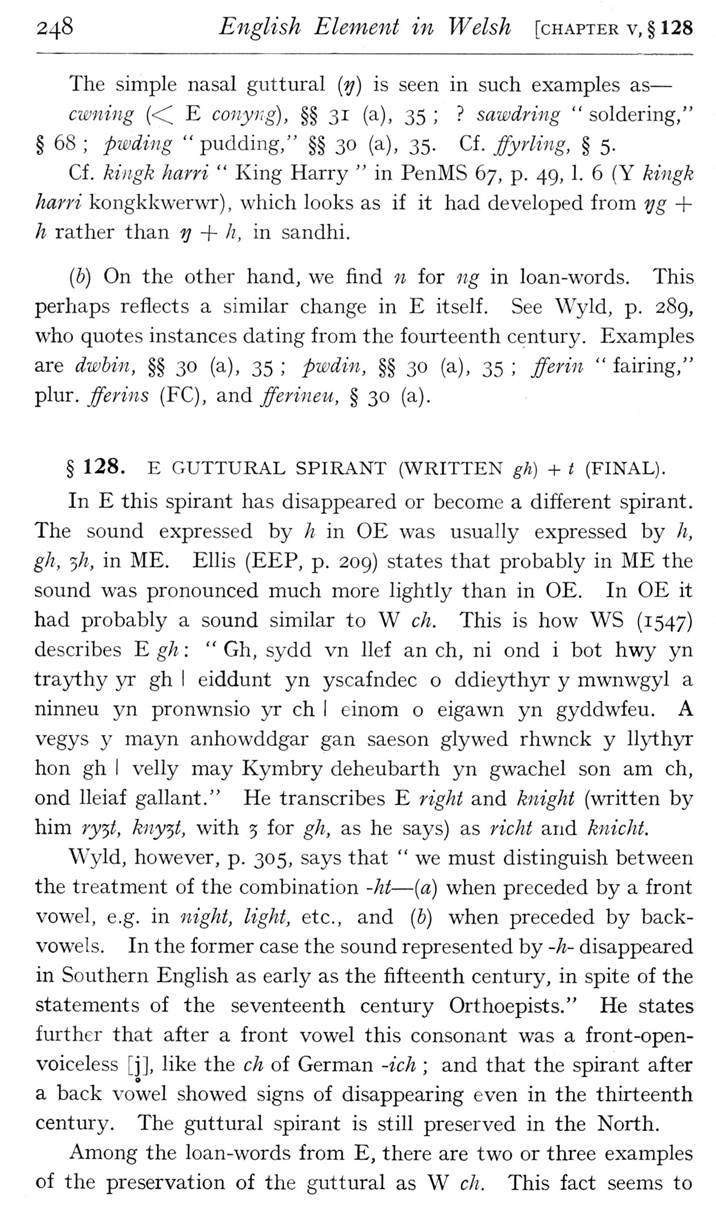
(delwedd F6999) (tudalen 248)
|
248 English Element
in Welsh [chapter v, § 128
The simple nasal guttural [ij] is seen in such examples as — owning (<^ E
conyiig), §§ 31 (a), 35;? sawdring “soldering,"
§ 68; pwding "pudding," §§ 30 (a), 35. Cf. ffyrling, § 5.
Cf. kingk harri “King Harry “in PenMS 67, p. 49, 1. 6 (Y kingk
harri kongkkwerwr) , which looks as if it had developed from 'ijg +
h rather than ij + Ii, in sandhi.
(b) On the other hand, we find w for ng in loan-words. This perhaps reflects
a similar change in E itself. See Wyld, p. 289, who quotes instances dating
from the fourteenth century. Examples are dwbin, §§ 30 (a), 35; pwdin, §§ 30
(a), 35; fferin “fairing," plur. fferins (FC), and fferineu, § 30 (a).
§ 128. E GUTTURAL SPIRANT (WRITTEN gh) + t (FINAL).
In E this spirant has disappeared or become a different spirant. The sound
expressed by h in OE was usually expressed by h, gh, 5/?, in ME. Ellis (EEP,
p. 209) states that probably in ME the sound was pronounced much more lightly
than in OE. In OE it had probably a sound similar to W ch. This is how WS
(1547) describes E gh: “Gh, sydd vn lief an ch, ni ond i bot hwy yn traythy
yr gh I eiddunt yn yscafndec o ddieythyr y mwnwgyl a ninneu yn pronwnsio yr
ch I einom o eigawn yn gyddwfeu. A vegys y mayn anhowddgar gan saeson glywed
rhwnck y llythyr hon gh I velly may Kymbry deheubarth yn gwachel son am ch,
ond lleiaf gallant." He transcribes E right and knight (written by him rŷt, knŷt, with 5 for gh, as he says) as richt and knicht.
Wyld, however, p. 305, says that “we must distinguish between the treatment of
the combination -ht — {a) when preceded by a front vowel, e.g. in night,
light, etc., and {h) when preceded by back-vowels. In the former case the
sound represented by -h- disappeared in Southern English as early as the
fifteenth century, in spite of the statements of the seventeenth century
Orthoepists." He states further that after a front vowel this consonant
was a front-open-voiceless [j], like the ch of German -ich; and that the
spirant after
9
a back vowel showed signs of disappearing even in the thirteenth century. The
guttural spirant is still preserved in the North.
Among the loan-words from E, there are two or three examples of the
preservation of the guttural as W ch. This fact seems to
|
|
|
|
|
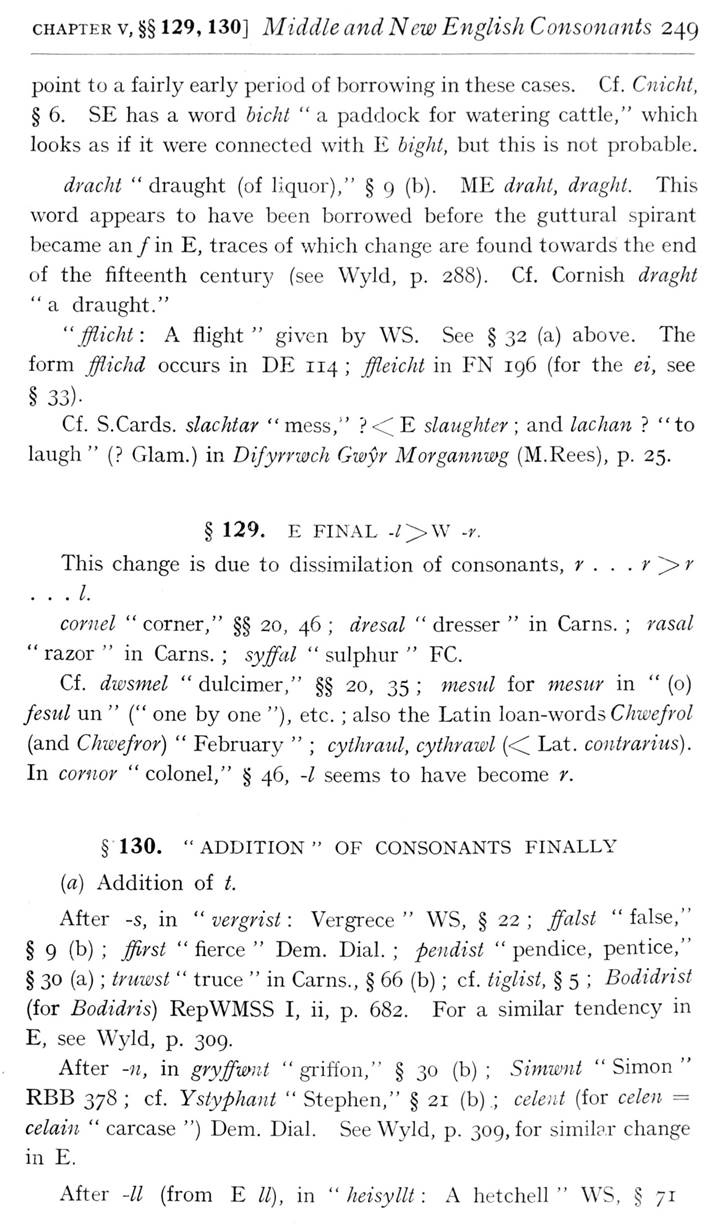
(delwedd F7000) (tudalen 249)
|
CHAPTER V, §§129,
130] Middle and New English Consonants 249
point to a fairly early period of borrowing in these cases. Cf . C7iicht, §
6. SE has a word bicht “a paddock for watering cattle," which looks as
if it were connected with E bight, but this is not probable.
dracht “draught (of liquor)," § 9 (b). ME draht, draghi. This word
appears to have been borrowed before the guttural spirant became an / in E,
traces of which change are found towards the end of the fifteenth centur}/
(see Wyld, p. 288). Cf. Cornish draght "a draught."
"fflicht: A flight" given by WS. See §32 (a) above. The form
fflichd occurs in DE 114; ffleicht in FN 196 (for the ei, see
Cf. S. Cards, slachtar "mess,"?<CE slaughter; and lachan?
"to laugh” (? Glam.) in Difyrrwch Gwyr Morgannmg (M.Rees), p. 25.
§ 129. E FINAL -/>W ~r.
This change is due to dissimilation of consonants, r . . . r ^ r . . .1.
cornel “corner," §§ 20, 46; dresal “dresser “in Cams.; rasal “razor “in
Cams.; syffal “sulphur “FC.
Cf. dwsmel “dulcimer," §§ 20, 35; mesul for mesur in” (o) fesul un”
(" one by one "), etc.; also the Latin loa.n-woids Chwefrol (and
Chwefror) “February”; cythratU, cythrawl « Lat. contrarius). In cornor
“colonel," § 46, -/ seems to have become r.
§ 130. "ADDITION" OF CONSONANTS FINALLY (a) Addition of t.
After -s, in “vergrisi: Vergrece “WS, § 22; ffalst “false," § 9 (b);
ffirst “fierce “Dem. Dial.; pendist “pendice, pentice," § 30 (a); tniwst
“truce “in Cams., § 66 (b); cf. tiglist, § 5; Bodidrist (for Bodidris)
RepWMSS I, ii, p. 682. For a similar tendency in E, see Wyld, p. 309.
After -11, in gryffwnt "griffon," § 30 (b); Simwnt
"Simon" RBB 378; cf. Ystyphant “Stephen," § 21 (b); celent
(for celen = celain “carcase ") Dem. Dial. See Wyld, p. 309, for similar
change in E.
After -// (from E //), in “heisyllt: A hetchell “WS, § 71
|
|
|
|
|
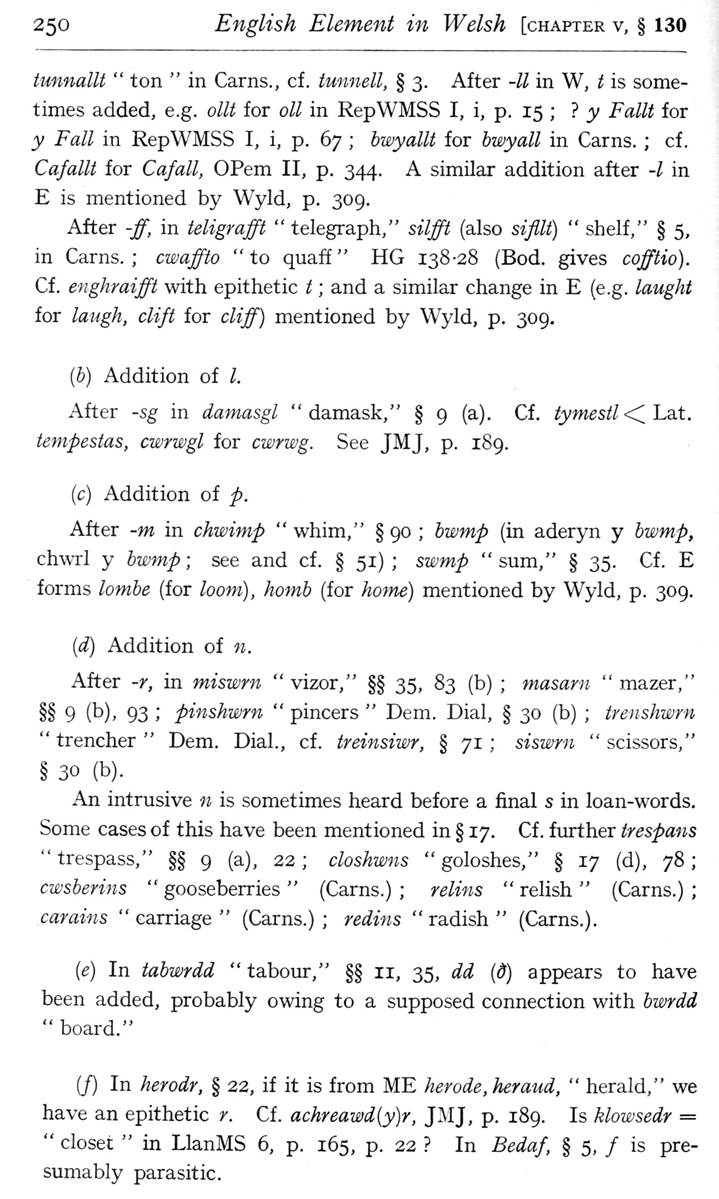
(delwedd F7001) (tudalen 250)
|
250 English Element
in Welsh [chapter v, § 130
tunnallt “ton “in Cams., cf. tunnell, § 3. After -II in W, t is sometimes
added, e.g. olU for oil in RepWMSS I, i, p. 15; } y Fallt for y Fall in
RepWMSS I, i, p. 67; hwyallt for hwyall in Cams.; cf , Cafallt for Cafall,
OPem II, p. 344. A similar addition after -/ in E is mentioned by Wyld, p.
309,
After -ff, in teligmfft “telegraph," silfft (also sifllt) “shelf,"
§ 5, in Cams.; cwaffto "to quaff" HG 138-28 (Bod. gives cofftio).
Cf. enghraifft with epithetic t; and a similar change in E (e.g. laught for
laugh, clift for cliff) mentioned by Wyld, p. 309.
[h] Addition of I.
After -sg in damasgl "damask," § 9 (a), Cf. tymestl<iLait.
tempestas, cwrwgl for cwrwg. See JMJ, p. 189.
(c) Addition of p.
After -w in chwimp “whim," § 90; hwmp (in aderyn y hwmp, chwrl y hwmp;
see and cf. § 51); swmp "sum," § 35. Cf. E forms lomhe (for loom),
homh (for /fowe) mentioned by Wyld, p. 309.
{d) Addition of n.
After -r, in miswrn “vizor," §§ 35, 83 (b); masarn “mazer," §§ 9
(b), 93; pinshwrn “pincers “Dem. Dial, § 30 (b); trenshwrn “trencher “Dem.
Dial., cf. treinsiwr, § 71; siswrn “scissors," § 30 (b).
An intrusive n is sometimes heard before a final s in loan-words. Some cases
of this have been mentioned in § 17. Cf . further trespans
"trespass," §§ 9 (a), 22; closhwns "goloshes," § 17 (d),
78; cwsberins “gooseberries” (Cams.); relins “relish” (Cams.); carains
“carriage” (Cams.); redins “radish” (Cams.).
{e) In tabwrdd “tabour," §§ 11, 35, dd (d) appears to have been added,
probably owing to a supposed connection with bwrdd “board."
(J) In herodr, § 22, if it is from ME her ode, her and, “herald," we
have an epithetic r. Cf. achreawd{y)r, JMJ, p. 189. Is klowsedr = “closet “in
LlanMS 6, p. 165, p. 22? In Bedaf, § 5, / is presumably parasitic.
|
|
|
|
|
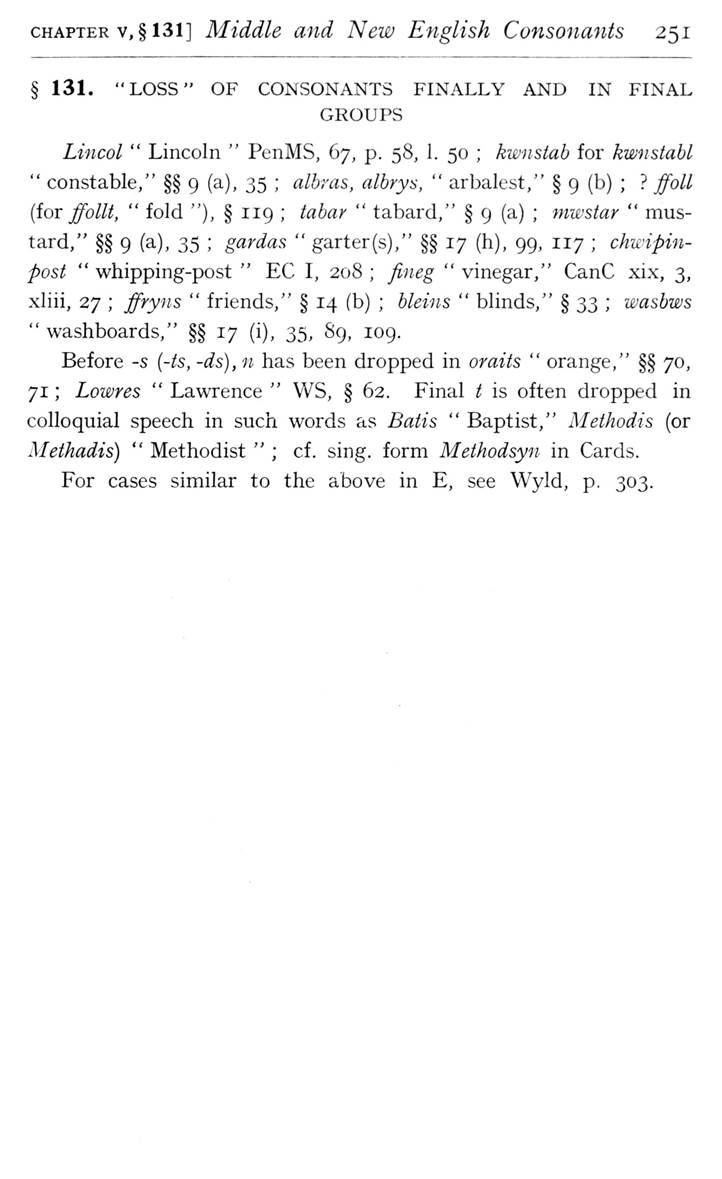
(delwedd F7002) (tudalen 251)
|
CHAPTER v,§ 131]
Middle and New English Consonants 251
§ 131. "LOSS" OF CONSONANTS FINALLY AND IN FINAL
GROUPS
Lincol “Lincoln “PenMS, 67, p. 58, 1. 50; kwnstab for kwnstahl
“constable," §§ 9 (a), 35; albras, albrys, “arbalest," § 9 (b);?
ffoll {ioT ffollt, “fold "), § 119; tabar “tabard," § 9 (a); mwstar
“mustard," §§ 9 (a), 35; gardas “garter(s)," §§ 17 (h), 99, 117;
chwipin-post “whipping-post “EC I, 208; fineg “vinegar," CanC xix, 3,
xliii, 27; ffryns “friends," § 14 (b); bleins “blinds," § 33;
wasbws “washboards," §§ 17 (i), 35, 89, 109.
Before -s {-is, -ds), n has been dropped in or aits “orange," §§ 70, 71;
Lowres “Lawrence “WS, § 62. Final t is often dropped in colloquial speech in
such words as Batis “Baptist," Methodis (or Methadis) “Methodist”; cf.
sing, form Methodsyn in Cards.
For cases similar to the above in E, see Wyld, p. 303.
|
|
|
|
|
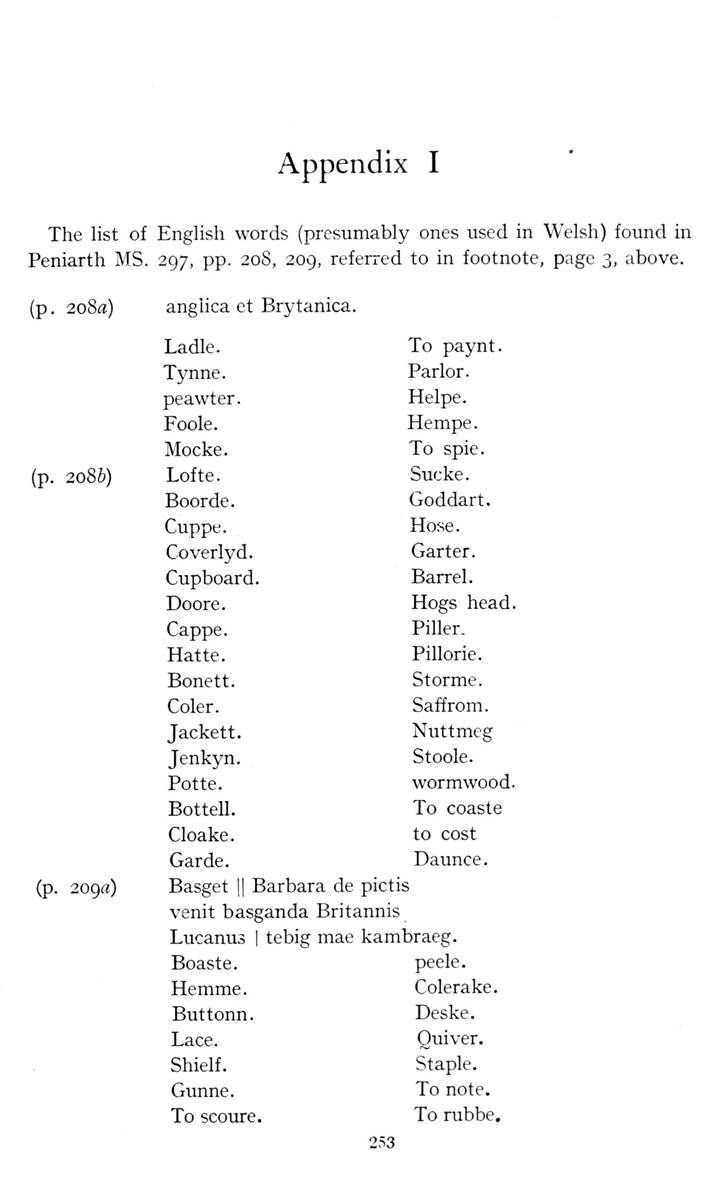
(delwedd F7004) (tudalen 253)
|
Appendix I The
list of English words (presumably ones used in Welsh) found in Peniarth MS.
297, pp. 208, 209, referred to in footnote, page 3, above.
(p . 208fl) angiica et Brytanica. (p. 208b) (p. 209rt) Ladle.
To paynt.
Tynne.
Parlor.
peawter.
Helpe.
Foole.
Hempe.
Mocke.
To spie.
Lofte.
Sucke.
Boorde.
Goddart.
Cuppe.
Hose.
Coverlyd.
Garter.
Cupboard.
Barrel.
Doore.
Hogs head
Cappe.
Piller.
Hatte.
Pillorie.
Bonett.
Storme.
Coler.
Saffrom.
Jackett.
Nuttmeg
Jenkyn.
Stoole.
Potte.
wormwood
Bottell.
To coaste
Cloake.
to cost
Garde.
Daunce.
Basget 1 Barbara de
pictis
venit basganda Britannis
Lucanus | tebig mae
kambraeg.
Boaste.
peele.
Hemme.
Colerake.
Buttonn.
Deske.
Lace.
Quiver.
Shielf.
Staple.
Gunne.
To note.
To scoure.
To rubbe.
|
|
|
|
|
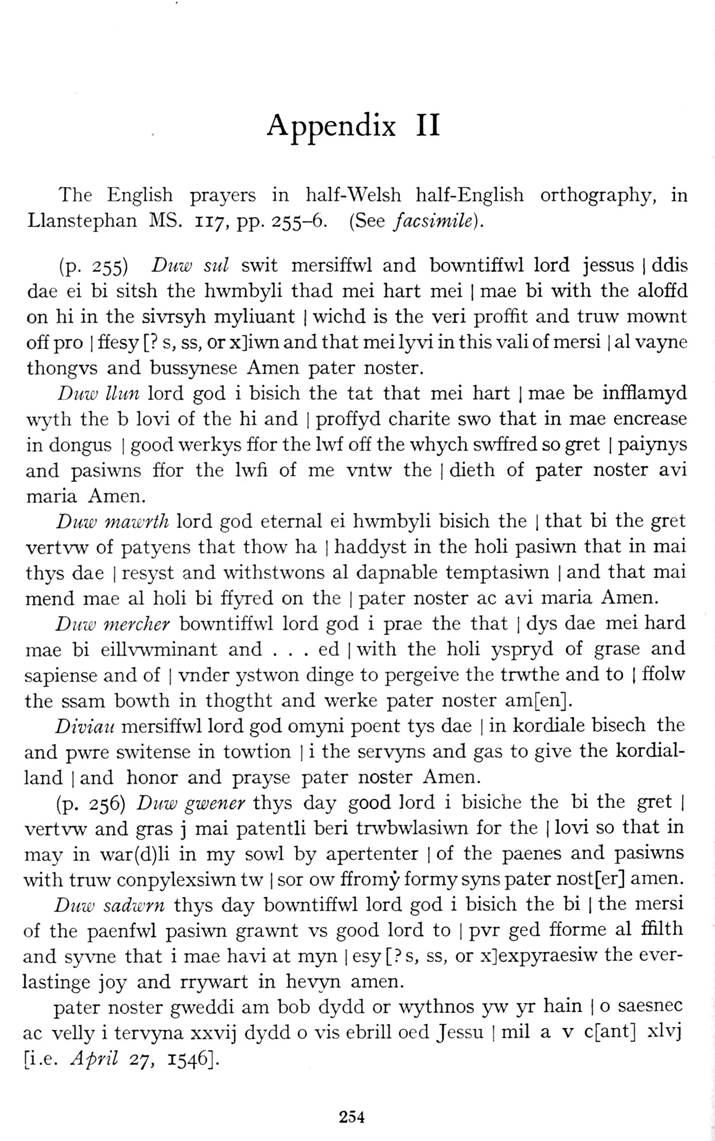
(delwedd F7005) (tudalen 254)
|
253
Appendix II The English prayers in half-Welsh half-English orthography, in
Llanstephan MS, 117, pp, 255-6, (See facsimile),
(p, 255) Duw sul swit mersiffwl and bowntiffwl lord jessus 1 ddis dae ei bi
sitsh the hwmbyli thad mei hart mei | mae bi with the aloffd on hi in the
sivrsyh myliuant | wichd is the veri proffit and truw mownt off pro I ffesy
[? s, ss, or x]iwn and that mei ly vi in this vali of mersi | al vayne
thongvs and bussynese Amen pater noster,
Duw llun lord god i bisich the tat that mei hart 1 mae be infflamyd wyth the
b lovi of the hi and | proffyd charite swo that in mae encrease in dongus |
good werkys ffor the Iwf off the whych swffred so gret | paiynys and pasiwTis
ffor the Iwfi of me vntw the | dieth of pater noster avi maria Amen,
Duw mawrth lord god eternal ei hwmbyli bisich the | that bi the gret vertvw
of patyens that thow ha | haddyst in the holi pasiwn that in mai thys dae |
resyst and withstwons al dapnable temptasiwn | and that mai mend mae al holi
bi ffyred on the | pater noster ac avi maria Amen,
Duw mercher bowntiffwl lord god i prae the that | dys dae mei hard mae bi
eiU\'\\Tninant and , , , ed | with the holi yspryd of grase and sapiense and
of | vnder ystwon dinge to pergeive the trwthe and to [ ffolw the ssam bowth
in thogtht and werke pater noster am[en],
Diviau mersiffwl lord god omyni poent tys dae | in kordiale bisech the and
pwre switense in towtion | i the servyns and gas to give the kordial- land I
and honor and prayse pater noster Amen,
(p, 256) Duw gwener thys day good lord i bisiche the bi the gret | vertvw and
gras j mai patentli beri trwbwlasiwn for the | lovi so that in may in
war(d)li in my sowl by apertenter | of the paenes and pasiwns with truw
conpylexsiwn tw | sor ow ffromy formy syns pater nost[er] amen,
Duw sadwrn thys day bowntiffwl lord god i bisich the bi | the mersi of the
paenfwl pasiwn grawnt vs good lord to | pvr ged fforme al ffilth and syvne
that i mae havi at m}^ | esy [?s, ss, or xjexpyraesiw the ever-lastinge joy
and rrywart in hevyn amen,
pater noster gweddi am bob dydd or wythnos yw yr hain | o saesnec ac velly i
tervyna xxvij dydd o vis ebrill oed Jessu | mil a v c[ant] xlvj [i,e, April
27, 1546],
|
|
|
|
|
|
|
|
|
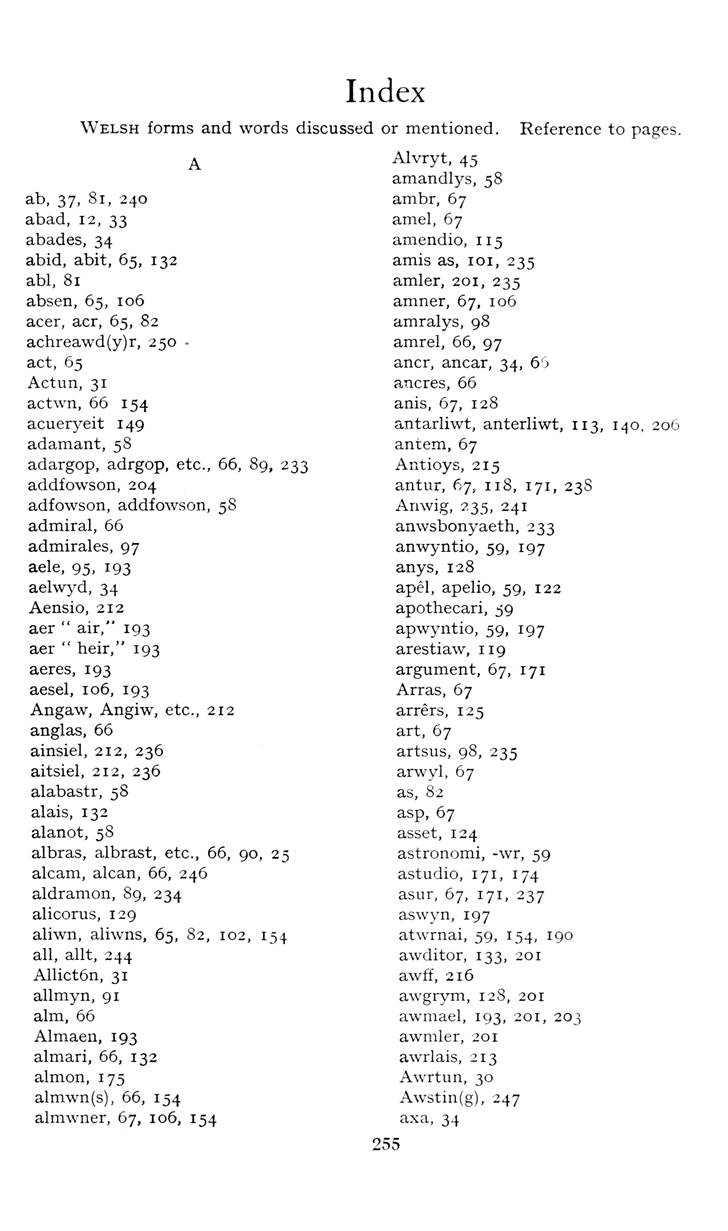
(delwedd F7006) (tudalen 255)
|
254
Index
Welsh
forms and words discussed or mentioned, Reference to pages,
A
ab,
37, 8i, 240
abad, 12, 33
abades, 34
abid, abit, 65, 132
abl, 81
absen, 65, 106
acer, acr, 65, 82
achreawd(y)r, 250
act, 65
Actun, 31
actwn, 66 154
acueryeit 149
adamant, 58
adargop, adrgop, etc., 66, 89, 233
addfowson, 204
adfowson, addfowson, 58
admiral, 66
admirales, 97
aele, 95, 193
aelwyd, 34
Aensio, 212
aer “air," 193
aer “heir," 193
aeres, 193
aesel, 106, 193
Angaw, Angiw, etc., 212
anglas, 66
ainsiel, 212, 236
aitsiel, 212, 236
alabastr, 58
alais, 132
alanot, 58
albras, albrast, etc., 66, 90, 25
alcam, alcan, 66, 246
aldramon, 89, 234
alicorus, 129
aliwn, aliwns, 65, 82, 102, 154
all, allt, 244
Allict6n, 31
allmyn, 91
aim, 66
Almaen, 193
almari, 66, 132
almon, 175
almwn(s), 66, 154
almwner, 67, 106, 154
|
Alvryt, 45
amandlys, 58
ambr, 67
amel, 67
amendio, 115
amis as, 101, 235
amler, 201, 235
amner, 67, 106
amralys, 98
amrel, 66, 97
ancr, ancar, 34, 65
ancres, 66
anis, 67, 128
antarliwt, anterliwt, 113, 140, 206
antem, 67
Antioys, 215
antur, 67, 118, 171, 238
Anwig, 235, 241
anwsbonyaeth, 233
anwyntio, 59, 197
anys, 128
apêl, apelio, 59, 122
apothecari, 59
apwyntio, 59, 197
arestiaw, 119
argument, 67, 171
Arras, 67
arrêrs, 125
art, 67
artsus, 98, 235
arwyl, 67
as, 82
asp, 67
asset, 124
astronomi, -wr, 59
astudio, 171, 174
asur, 67, 171, 237
aswyn, 197
atwrnai, 59, 154, 190
awditor, 133, 201
awff, 216
awgrym, 128, 201
awmael, 193, 201, 203
awmler, 201
awrlais, 213
Awrtun, 30
Awstin(g), 247
axa, 34
|
|
|
|
|
|
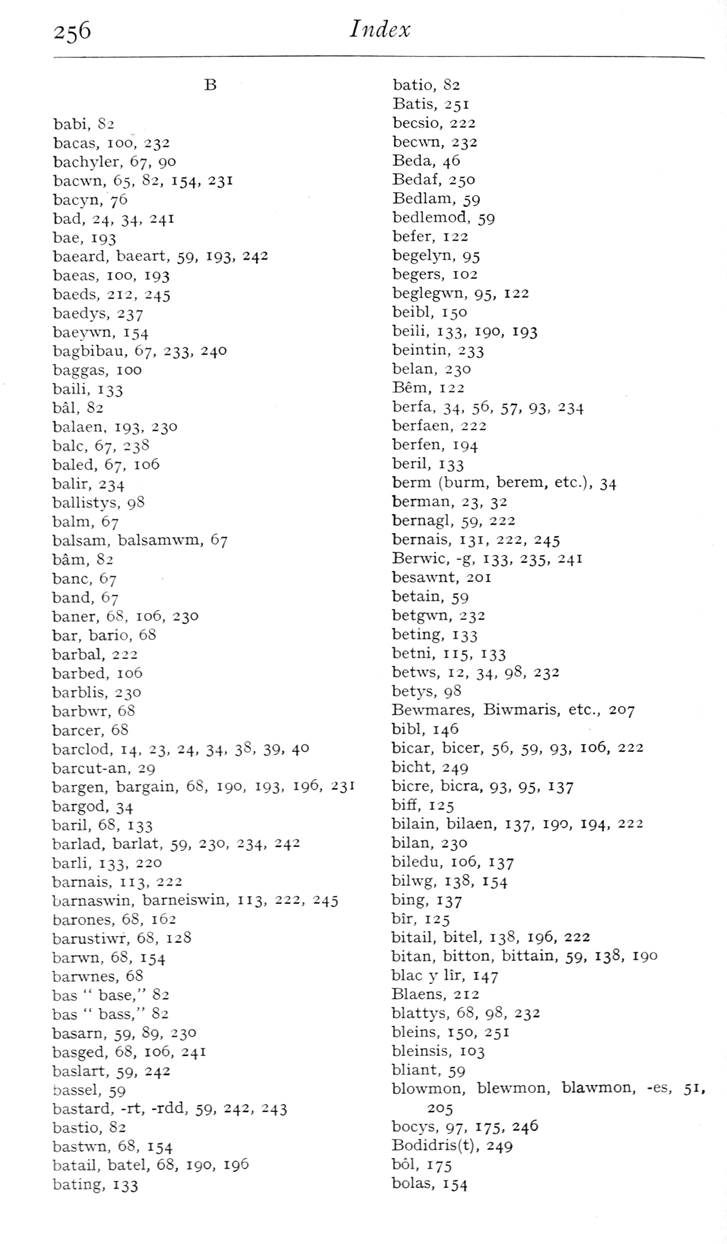
(delwedd F7007) (tudalen 256)
|
256
Index
B
babi,
82
bacas, loo, 232
bachyler, 67, 90
bacwn, 65, 82, 154, 231
bacyn, 76
bad, 24, 34, 241
bae, 193
baeard, baeart, 59, 193, 242
bae as, 100, 193
baeds, 212, 245
baedys, 237
baeywn, 154
bagbibau, 67, 233, 240
baggas, 100
baili, 133
bâl, 82
balaen, 193, 230
balc, 67, 238
baled, 67, 106
balir, 234
ballistys, 98
balm, 67
balsam, balsamwm, 67
bâm, 82
banc, 67
band, 67
baner, 68, 106, 230
bar, bario, 68
barbal, 222
barbed, 106
barblis, 230
barbwT, 68
barcer, 68
barclod, 14, 23, 24, 34, 38, 39, 40
barcut-an, 29
bargen, bargain, 68, 190, 193, 196, 231
bargod, 34
baril, 68, 133
barlad, barlat, 59, 230, 234, 242
barli, 133, 220
bamais, 113, 222
bamaswin, barneiswin, 113, 222, 245
barones, 68, 162
barustiwr, 68, 128
barvwn, 68, 154
barwnes, 68
bas “base," 82
bas “bass," 82
basarn, 59, 89, 230
basged, 68, 106, 241
baslart, 59, 242
bassel, 59
bastard, -rt, -rdd, 59, 242, 243
bastio, 82
bastwn, 68, 154
batail, batel, 68, 190, 196
bating, 133
|
batio, 82
Batis, 251
becsio, 222
becwn, 232
Beda, 46
Bedaf, 250
Bedlam, 59
bedlemod, 59
befer, 122
begelyn, 95
begers, 102
beglegwn, 95, 122
beibl, 150
beili, 133, 190, 193
beintin, 233
belan, 230
Bêm, 122
berfa, 34, 56, 57, 93, 234
berfaen, 222
berfen, 194
beril, 133
berm (burm, berem, etc,), 34
berman, 23, 32
bernagl, 59, 222
bernais, 131, 222, 245
Berwic, -g, 133, 235, 241
besawnt, 201
betain, 59
betgwn, 232
beting, 133
betni, 115, 133
betws, 12, 34, 98, 232
betys, 98
Bewmares, Biwmaris, etc., 207
bibl, 146
bicar, bicer, 56, 59, 93, 106, 222
bicht, 249
bicre, bicra, 93, 95, 137
biff, 125
bilain, bilaen, 137, 190, 194, 222
bilan, 230
biledu, 106, 137
bilwg, 138, 154
bing, 137
bir, 125
bitail, bitel, 138, 196, 222
bitan, bitton, bittain, 59, 138, 190
blac y lîr, 147
Blaens, 212
blattys, 68, 98, 232
bleins, 150, 251
bleinsis, 103
bliant, 59
blowmon, blewmon, blawmon, -es, 51, 205
bocys, 97, 175, 246
Bodidris{t), 249
bôl, 175
bolas, 154
|
|
|
|
|
|
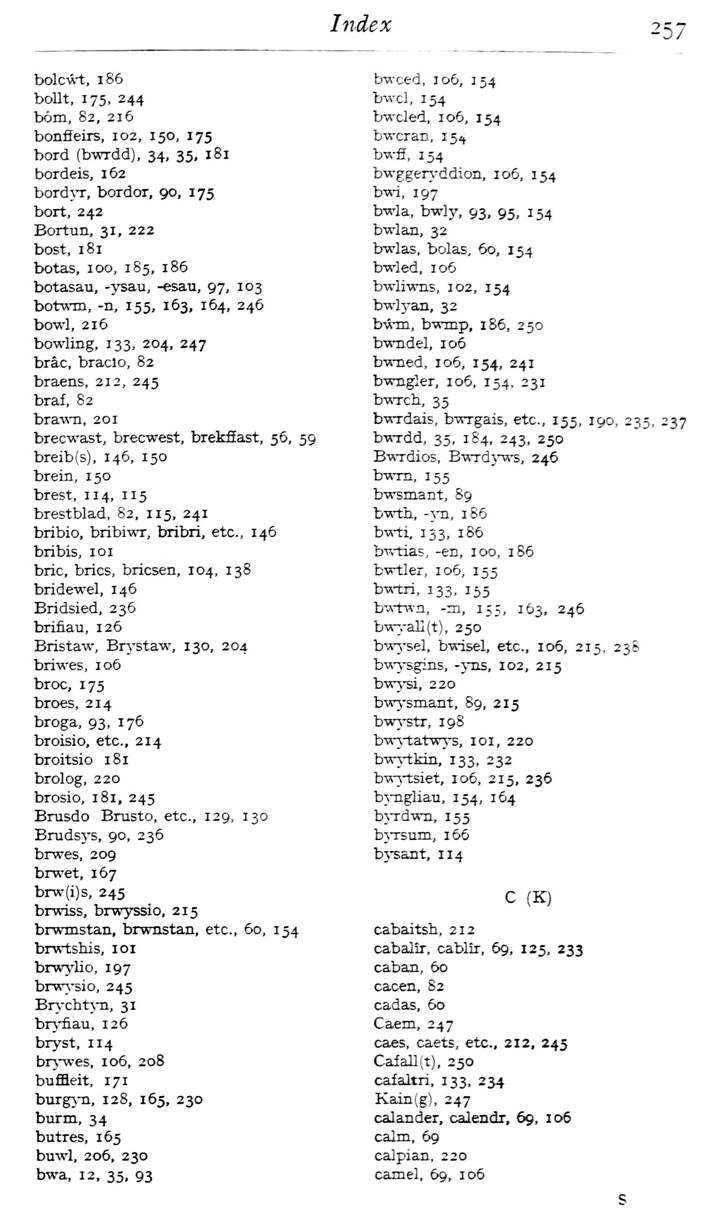
(delwedd F7008) (tudalen 257)
|
257
bolcŵt,
186
bollt, 175, 244
bôm, 82, 216
bonffeirs, 102, 150, 175
bord (bwrdd), 34, 35, 181
bordeis, 162
bordyr, bordor, 90, 175
bort, 242
Bortun, 31, 222
bost, 181
betas, 100, 185, 186
botasau, -ysau, -esau, 97, 103
botwm, -n, 155, 163, 164, 246
bowl, 216
bowling, 133, 204, 247
brâc, bracio, 82
braens, 212, 245
braf, 82
brawn, 201
brecwast, brecwest, brekffast, 56, 59
breib(s), 146, 150
brein, 150
brest, 114, 115
brestblad, 82, 115, 241
bribio, bribiwr, bribri, etc., 146
bribis, 101
bric, brics, bricsen, 104, 138
bridewel, 146
Bridsied, 236
brifiau, 126
Bristaw, Brystaw, 130, 204
briwes, 106
broc, 175
broes, 214
broga, 93, 176
broisio, etc., 214
broitsio 181
brolog, 220
brosio, 181, 245
Brusdo Brusto, etc., 129, 130
Brudsys, 90, 236
brwes, 209
brwet, 167
brw(i)s, 245
brwiss, brwyssio, 215
brwmstan, brwnstan, etc., 60, 154
brwtshis, 101
brwjdio, 197
brwisio, 245
Brychtyn, 31
bryfiau, 126
bryst, 114
brywes, 106, 208
buffleit, 171
burgyn, 128, 165, 230
burm, 34
butres, 165
buwl, 206, 230
bwa, 12, 35, 93
|
bwced,
106, 154
bwcl, 154
bwcled, 106, 154
bwcran, 154
bwff, 154
bwggeryddion, 106, 154
bwi, 197
bwla, bwly, 93, 95, 154
bwlan, 32
bwlas, bolas, 60, 154
bwled, 106
bwliwns, 102, 154
bwlyan, 32
bŵm, bwmp, 186, 250
bwndel, 106
bwned, 106, 154, 241
bwngler, 106, 154, 231
bwrch, 35
bwrdais, bwrgais, etc., 155, 190, 235, 237
bwrdd, 35, 184, 243, 250
Bwrdios, Bwrdwys, 246
bwrn, 155
bwsmant, 89
bwth, -yn, 186
bwti, 133, 186
bwtias, -en, 100, 186
bwtler, 106, 155
bwtri, 133, 155
bwtwn, -m, 155, 163, 246
bwyrall(t), 250
bwysel, bwisel, etc., 106, 215, 238
bwysgins, -yns, 102, 215
bwysi, 220
bwysmant, 89, 215
bwystr, 198
bwyttatwys, 101, 220
bwytkin, 133, 232
bwytsiet, 106, 215, 236
byngliau, 154, 164
byrdwn, 155
byrsum, i65
bysant, 114
C (K)
cabaitsh, 212
cabalir, cablir, 69, 125, 233
caban, 60
cacen, 82
cadas, 50
Caem, 247
caes, caets, etc., 212, 245
Cafall(t), 250
cafaltri, 133, 234
Kain(g), 247
calander, calendr, 69, 106
calm, 69
calpian, 220
camel, 69, 106
|
|
|
|
|
|
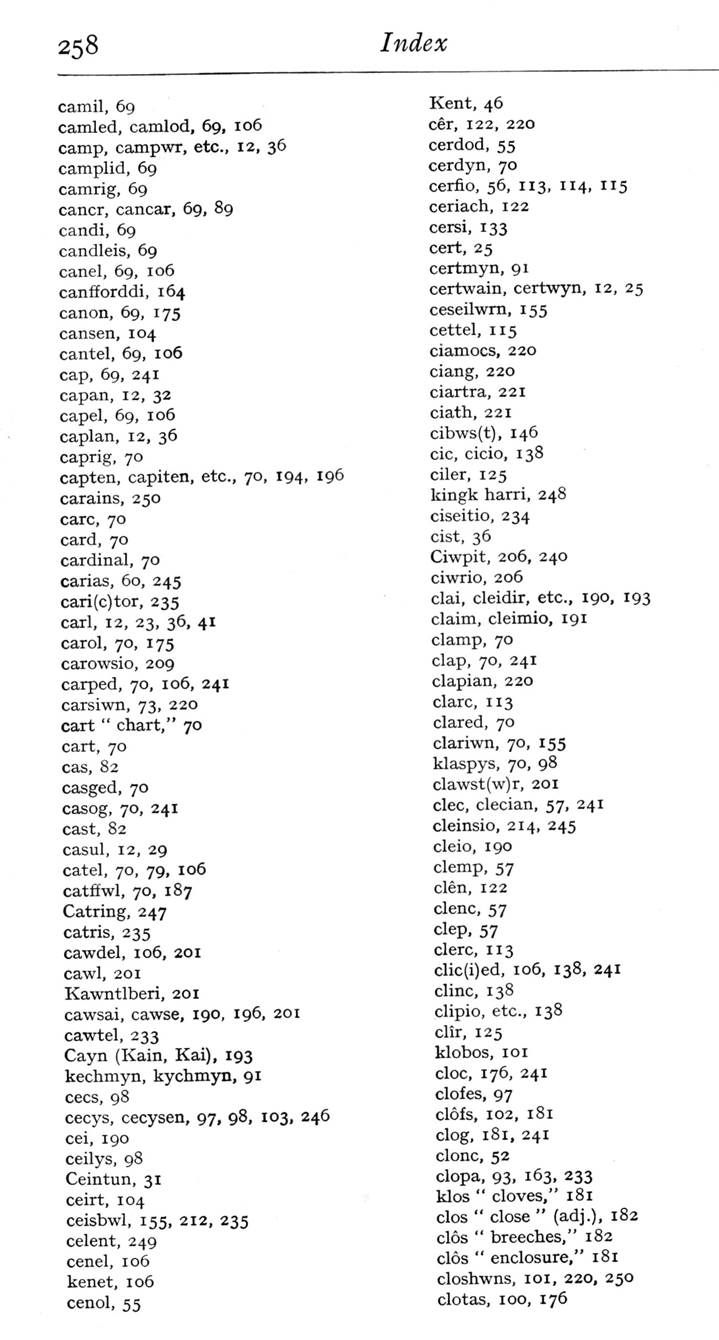
(delwedd F7009) (tudalen 258)
|
258
Index
camil,
69
camled, camlod, 69, 106
camp, campwr, etc., 12, 36
camplid, 69
camrig, 69
cancr, cancar, 69, 89
candi, 69
candleis, 69
canel, 69, 106
canfforddi, 164
canon, 69, 175
cansen, 104
cantel, 69, 106
cap, 69, 241
capan, 12, 32
capel, 69, 106
caplan, 12, 36
caprig, 70
capten, capiten, etc., 70, 194, 196
carains, 250
carc, 70
card, 70
cardinal, 70
carias, 60, 245
cari(c)tor, 235
carl, 12, 23, 36, 41
carol, 70, 175
carowsio, 209
carped, 70, 106, 241
carsiwn, 73, 220
cart “chart," 70
cart, 70
cas, 82
casged, 70
casog, 70, 241
cast, 82
casul, 12, 29
catel, 70, 79, 106
catffwl, 70, 187
Catring, 247
catris, 235
cawdel, 106, 201
cawl, 201
Kawntlberi, 201
cawsai, cawse, 190, 196, 201
cawtel, 233
Cayn (Kain, Kai), 193
kechmyn, kychmyn, 91
cecs, 98
cecys, cecysen, 97, 98, 103, 246
cei, 190
ceilys, 98
Ceintun, 31
ceirt, 104
ceisbwl, 155, 212, 235
celent, 249
cenel, 106
kenet, 106
cenol, 55
|
Kent, 46
cêr, 122, 220
cerdod, 55
cerdyn, 70
cerfio, 56, 113, 114, 115
ceriach, 122
cersi, 133
cert, 25
certmyn, 91
certwain, certwyn, 12, 25
ceseilwm, 155
cettel, 115
ciamocs, 220
ciang, 220
ciartra, 221
ciath, 221
cibws(t), 146
cic, cicio, 138
ciler, 125
kingk harri, 248
ciseitio, 234
cist, 36
Ciwpit, 206, 240
ciwrio, 206
clai, cleidir, etc., 190, I93
claim, cleimio, 191
clamp, 70
clap, 70, 241
clapian, 220
clarc, 113
clared, 70
clariwn, 70, 155
klaspys, 70, 98
clawst(w)r, 201
clec, clecian, 57, 241
cleinsio, 214, 245
cleio, 190
clemp, 57
clên, 122
clenc, 57
clep, 57
clerc, 113
clic(i)ed, 106, 138, 241
clinc, 138
clipio, etc., 138
clir, 125
klobos, 101
cloc, 176, 241
clofes, 97
clôfs, 102, 181
clog, 181, 241
clonc, 52
clopa, 93, 163, 233
klos “cloves," 181
clos “close” (adj,), 182
clôs “breeches," 182
clôs “enclosure," 181
closhwns, 101, 220, 250
clotas, 100, 176
Index
|
|
|
|
|
|
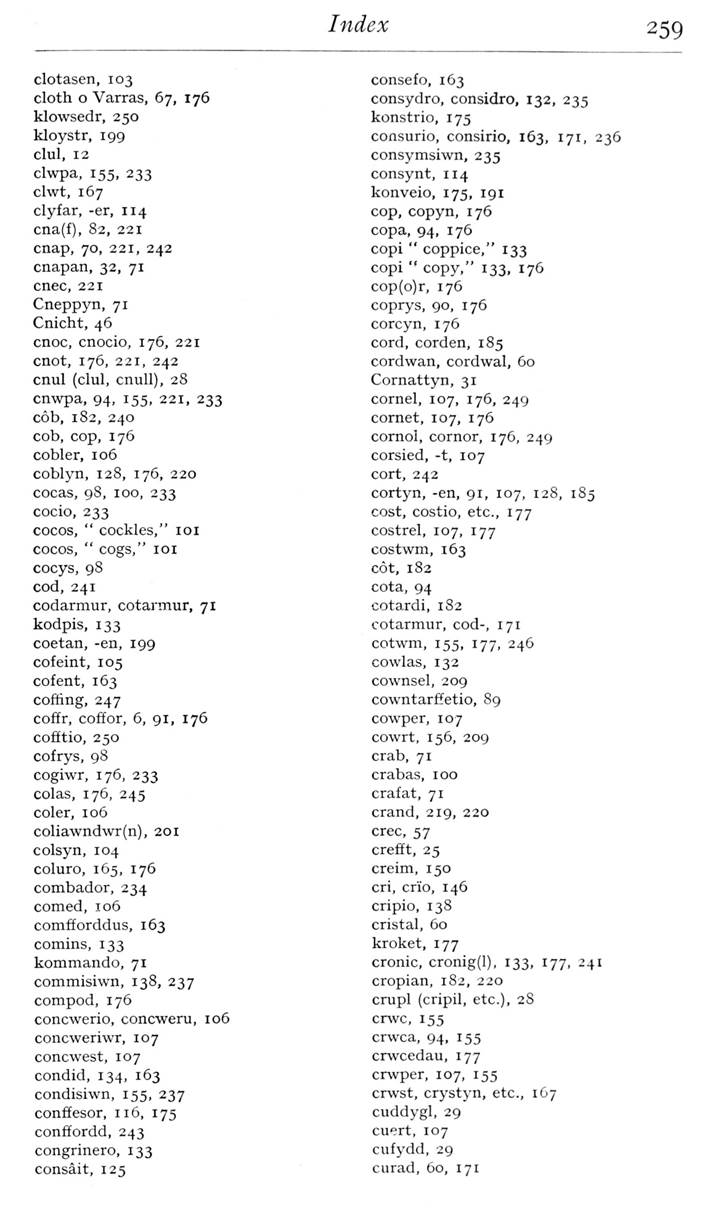
(delwedd F7010) (tudalen 259)
|
259
clotasen,
103
cloth o Varras, 67, 176
klowsedr, 250
kloystr, 199
clul, 12
clwpa, 155, 233
clwt, 167
clyfar, -er, 114
cna(f), 82, 221
cnap, 70, 221, 242
cnapan, 32, 71
cnec, 221
Cneppyn, 71
Cnicht, 46
cnoc, cnocio, 176, 221
cnot, 176, 221, 242
cnul (clul, cnull), 28
cnwpa, 94, 155, 221, 233
côb, 182, 240
cob, cop, 176
cobler, 106
coblyn, 128, 176, 220
cocas, 98, 100, 233
cocio, 233
cocos, “cockles," 101
cocos, “cogs," 101
cocys, 98
cod, 241
codarmur, cotarmur, 71
kodpis, 133
coetan, -en, 199
cofeint, 105
cofent, 163
coffing, 247
coffr, coffor, 6, 91, 176
cofftio, 250
cofrys, 98
cogiwr, 176, 233
colas, 176, 245
coler, 106
coliawndwr(n), 201
colsyn, 104
coluro, 165, 176
combador, 234
corned, 106
comfforddus, 163
comins, 133
kommando, 71
commisiwn, 138, 237
compod, 176
concwerio, concweru, 106
concweriwr, 107
concwest, 107
condid, 134, 163
condisiwn, 155, 237
conffesor, 116, 175
conffordd, 243
congrinero, 133
consâit, 125
|
consefo, 163
consydro, considro, 132, 235
konstrio, 175
consurio, consirio, 163, 171, 236
consymsiwn, 235
consynt, 114
konveio, 175, 191
cop, copyn, 176
copa, 94, 176
copi “coppice," 133
copi “copy," 133, 176
cop(o)r, 176
coprys, 90, 176
corcyn, 176
cord, corden, 185
cordwan, cordwal, 60
Cornattyn, 31
cornel, 107, 176, 249
cornet, 107, 176
cornol, cornor, 176, 249
corsied, -t, 107
cort, 242
cortyn, -en, 91, 107, 128, 185
cost, costio, etc., 177
costrel, 107, 177
costwm, 163
côt, 182
cota, 94
cotardi, 182
cotarmur, cod-, 171
cotwm, 155, 177, 246
cowlas, 132
cownsel, 209
cowntarffetio, 89
cowper, 107
cowrt, 156, 209
crab, 71
crabas, 100
crafat, 71
crand, 219, 220
crec, 57
crefft, 25
creim, 150
cri, crio, 146
cripio, 138
cristal, 60
kroket, 177
cronic, cronig(l), 133, 177, 241
cropian, 182, 220
crupl (cripil, etc,), 28
crwc, 155
crwca, 94, 155
crwcedau, 177
crwper, 107, 155
crwst, crystyn, etc., 167
cuddygl, 29
cuert, 107
cufydd, 29
curad, 60, 171
|
|
|
|
|
|
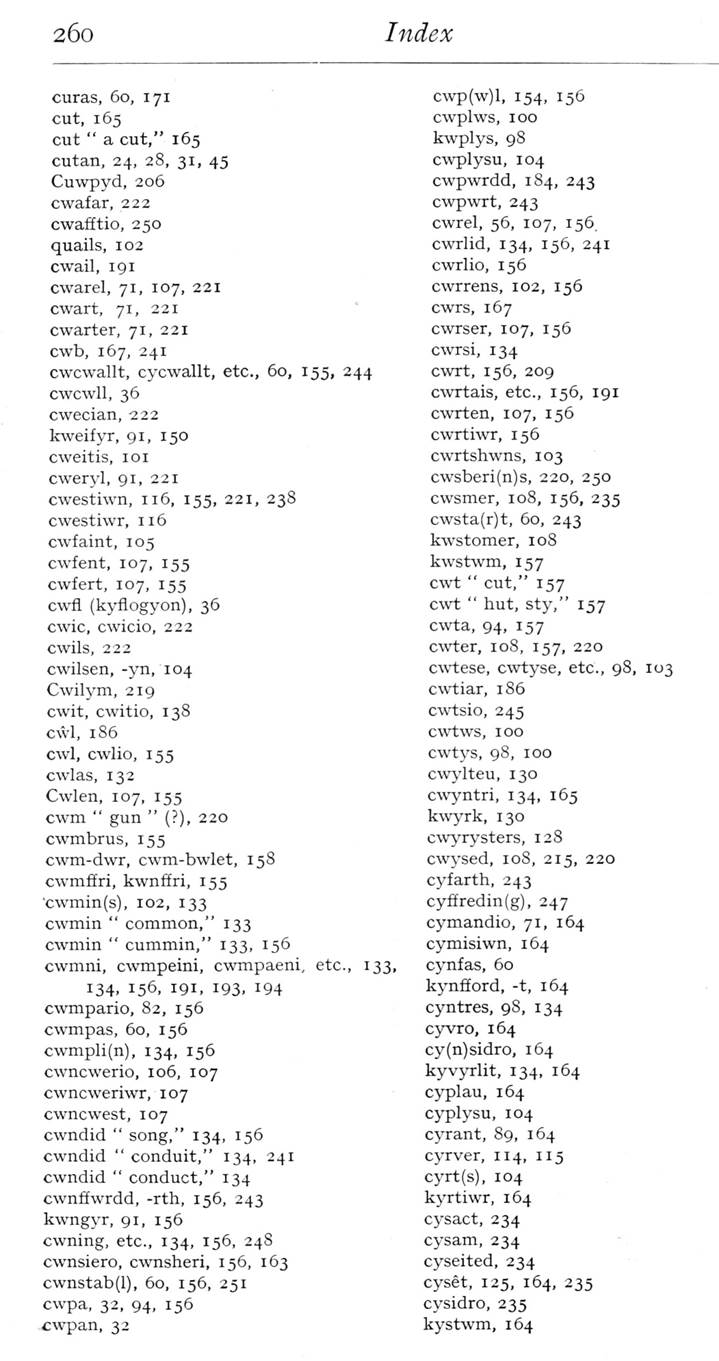
(delwedd F7011) (tudalen 260)
|
260
Index
curas,
60, 171
cut, 165
cut “a cut," 165
cutan, 24, 28, 31, 45
Cuwpyd, 206
cwafar, 222
cwafftio, 250
quails, 102
cwail, 191
cwarel, 71, 107, 221
cwart, 71, 221
cwarter, 71, 221
cwb, 167, 241
cwcwallt, cycwallt, etc., 60, 155, 244
cwcwll, 36
cwecian, 222
Icweifyr, 91, 150
cweitis, 101
cweryl, 91, 221
cwestiwn, 116, 155, 221, 238
cwestiwr, 116
cwfaint, 105
cwfent, 107, 155
cwfert, 107, 155
cwfl (kyflogyon), 36
cwic, cwicio, 222
cwils, 222
cwilsen, -yn, 104
Cwilym, 219
cwit, cwitio, 138
cŵl, 186
cwl, cwlio, 155
cwlas, 132
Cwlen, 107, 155
cwna “gun” (?), 220
cwmbrus, 155
cwm-dwr, cwm-bwlet, 158
cwmffri, kwnffri, 155
cwmin(s), 102, 133
cwmin “common," 133
cwmin “cummin," 133, 156
cwmni, cwmpeini, cwmpaeni, etc., 133,
134, 156, 191, 193, 194
cwmpario, 82, 156
cwmpas, 60, 156
cwmpli(n), 134, 156
cwncwerio, 106, 107
cwncweriwr, 107
cwncwest, 107
cwndid “song," 134, 156
cwndid “conduit," 134, 241
cwndid “conduct," 134
cwnffwrdd, -rth, 156, 243
kwngyr, 91, 156
cwning, etc., 134, 156, 248
cwnsiero, cwnsheri, 156, 163
cwnstab(l), 60, 156, 251
cwpa, 32, 94, 156
|
cwpan, 32
cwp(w)l,
154, 156
cwplws, 100
kwplys, 98
cwplysu, 104
cwpwrdd, 184, 243
cwpwrt, 243
cwrel, 56, 107, 156,
cwrlid, 134, 156, 241
cwrlio, 156
cwrrens, 102, 156
cwrs, 167
cwrser, 107, 156
cwrsi, 134
cwrt, 156, 209
cwrtais, etc., 156, 191
cwrten, 107, 156
cwrtiwr, 156
cwrtshwns, 103
cwsberi(n)s, 220, 250
cwsmer, 108, 156, 235
cwsta(r)t, 60, 243
kwstomer, 108
kwstwm, 157
cwt “cut," 157
cwt “hut, sty," 157
cwta, 94, 157
cwter, 108, 157, 220
cwtese, cwtyse, etc., 98, 103
cwtiar, 186
cwtsio, 245
cwtws, 100
cwtys, 98, 100
cwylteu, 130
cwyntri, 134, 165
kwyrk, 130
cwyrysters, 128
cwysed, 108, 215, 220
cyfarth, 243
cyffredin(g), 247
cymandio, 71, 164
cymisiwn, 164
cynfas, 60
kynfford, -t, 164
cyntres, 98, 134
cyvro, 164
cy(n)sidro, 164
kyvyrlit, 134, 164
cyplau, 164
cyplysu, 104
cyrant, 89, 164
cyrver, 114, 115
cyrt(s), 104
kyrtiwr, 164
cysact, 234
cysam, 234
cyseited, 234
cysêt, 125, 164, 235
cysidro, 235
kystwm, 164
|
|
|
|
|
|
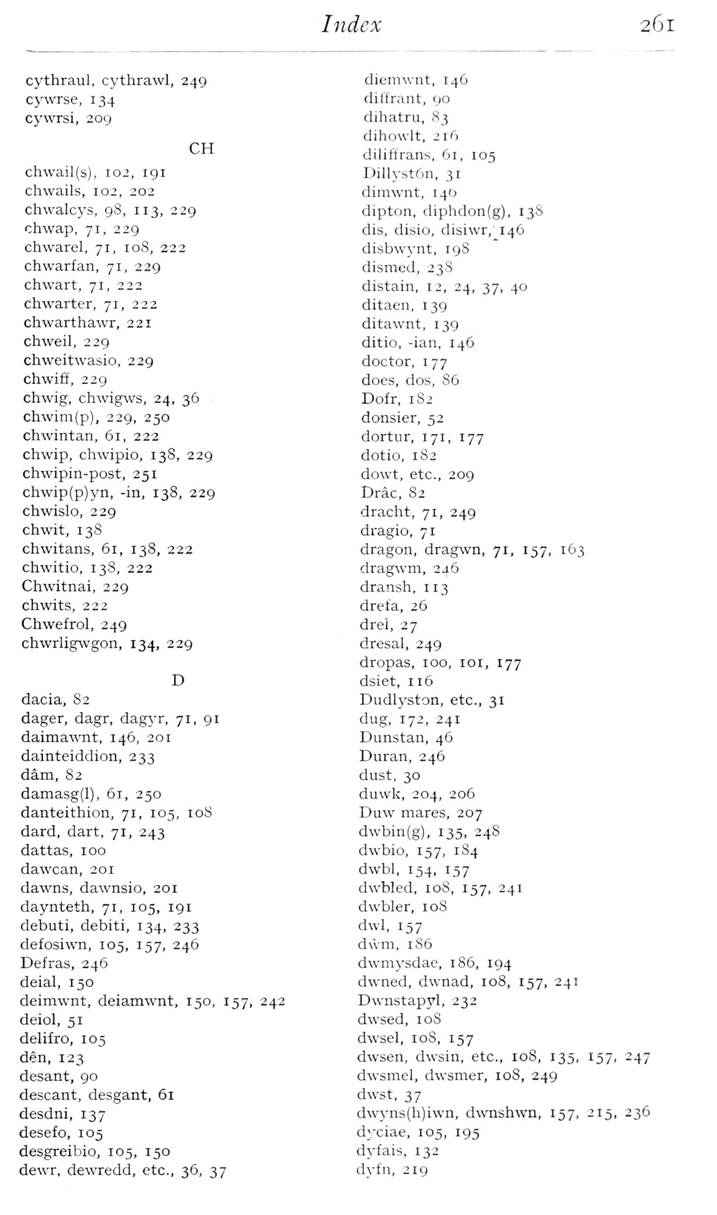
(delwedd F7012) (tudalen 261)
|
Index 261
cythraul,
cythrawl, 249
cywrse, 134
cywrsi, 209
CH
chwail(s), 102, 191
chwails, 102, 202
chwalcys, 98, 113, 229
chwap, 71, 229
chwarel, 71, 108, 222
chwarfan, 71, 229
chwart, 71, 222
chwarter, 71, 222
chwarthawr, 221
chweil, 229
chweitwasio, 229
chwiff, 229
chwig, chwigws, 24, 36
chwim(p), 229, 250
chwintan, 61, 222
chwip, chwipio, 13S, 229
chwipin-post, 251
chwip(p)yn, -in, 138, 229
chwislo, 229
chwit, 138
chwitans, 61, 138, 222
chwitio, 138, 222
Chwitnai, 229
chwits, 222
Chwefrol, 249
chwrligwgon, 134, 229
D
dacia, 82
dager, dagr, dagyr, 71, 91
daimawnt, 146, 201
dainteiddion, 233
dam, 82
damasg(l), 61, 250
danteithion, 71, 105, 108
dard, dart, 71, 243
dattas, 100
dawcan, 201
dawns, dawnsio, 201
daynteth, 71, 105, 191
debuti, debiti, 134, 233
defosiwn, 105, 157, 246
Defras, 246
deial, 150
deimwnt, deiamwnt, 150, 157, 242
deiol, 51
delifro, 105
den, 123
desant, 90
descant, desgant, 61
desdni, 137
desefo, 105
desgreibio, 105, 150
dewr, dewredd, etc., 36, 37
|
diemwnt, 146
diffrant, 90
dihatru, 83
dihowlt, 216
diliffrans, 61, 105
Dillyst6n, 31
dimwnt, 146
dipton, diphdon(g), 138
dis, disio, disiwr, 146
disbwynt, 198
dismed, 238
distain, 12, 24, 37, 40
ditaen, 139
ditawnt, 139
ditio, -ian, 146
doctor, 177
does, dos, 86
Dofr, 182
donsier, 52
dortur, 171, 177
dotio, 182
dowt, etc., 209
Drac, 82
dracht, 71, 249
dragio, 71
dragon, dragwn, 71, 157, 163
dragwm, 246
dransh, 113
drefa, 26
drei, 27
dresal, 249
dropas, 100, 101, 177
dsiet, 116
Dudlyston, etc., 31
dug, 172, 241
Dunstan, 46
Duran, 246
dust, 30
duwk, 204, 206
Duw mares, 207
dwbin(g), 135, 248
dwbio, 157, 184
dwbl, 154, 157
dwbled, 108, 157, 241
dwbler, 108
dwi, 157
dwm, 186
dwmysdae, 186, 194
dwned, dwnad, 108, 157, 241
Dwnstapyl, 232
dwsed, 108
dwsel, 108, 157
dwsen, dwsin, etc., 108, 135, 157, 247
dwsmel, dwsmer, 108, 249
dwst, 37
dwyns(h)iwn, dwnshwn, 157, 215, 236
dyciae, 105, 195
dyfais, 132
dyfn, 219
|
|
|
|
|
|
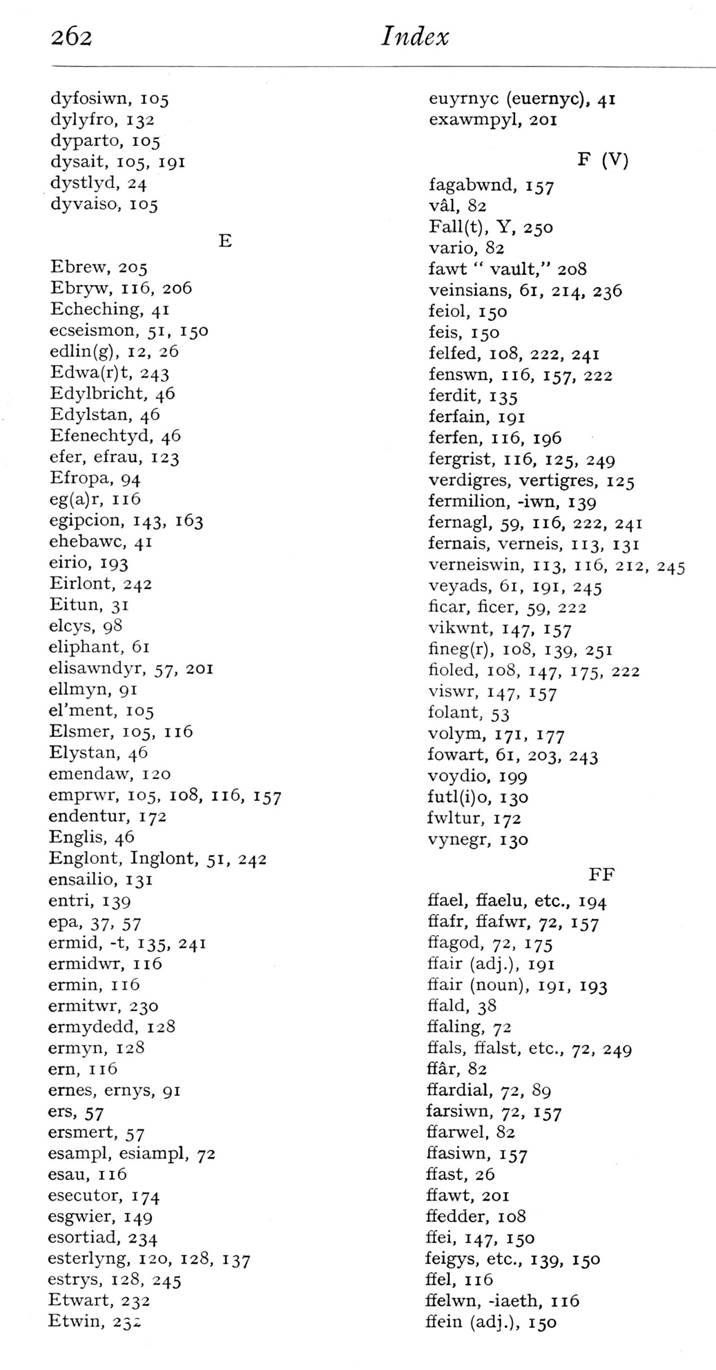
(delwedd F7013) (tudalen 262)
|
262 Index
dyfosiwn,
105
dylyfro, 132
dyparto, 105
dysait, 105, 191
dystlyd, 24
dyvaiso, 105
E
Ebrew,
205
Ebryw, 116, 206
Echeching, 41
ecseismon, 51, 150
edlin(g), 12, 26
Edwa(r)t, 243
Edylbricht, 46
Edylstan, 46
Efenechtyd, 46
efer, efrau, 123
Efropa, 94
eg(a)r, 116
egipcion, 143, 163
ehebawc, 41
eirio, 193
Eirlont, 242
Eitun, 31
elcys, 98
eliphant, 61
elisawndyr, 57, 201
ellmyn, 91
el'ment, 105
Elsmer, 105, 116
Elystan, 46
emendaw, 120
emprwr, 105, 108, 116, 157
endentur, 172
Englis, 46
Englont, Inglont, 51, 242
ensailio, 131
entri, 139
epa, 37, 57
ermid, -t, 135, 241
ermidwr, 116
ermin, 116
ermitwr, 230
ermydedd, 128
ermyn, 128
ern, 116
ernes, ernys, 91
ers, 57
ersmert, 57
esampl, esiampl, 72
esau, 116
esecutor, 174
esgwier, 149
esortiad, 234
esterlyng, 120, 128, 137
estrys, 128, 245
Etwart, 232
Etwin, 25i
|
euyrnyc
(euernyc), 41
exawmpyl, 201
F (V)
fagabwnd, 157
vâl, 82
Fall(t), Y, 250
vario, 82
fawt “vault," 208
veinsians, 61, 214, 236
feiol, 150
feis, 150
felfed, 108, 222, 241
fenswn, 116, 157, 222
ferdit, 135
ferfain, 191
ferfen, 116, 196
fergrist, 116, 125, 249
verdigres, vertigres, 125
fermilion, -iwn, 139
fernagl, 59, 116, 222, 241
fernais, vemeis, 113, 131
verneiswin, 113, 116, 212, 245
veyads, 61, 191, 245
ficar, ficer, 59, 222
vikwnt, 147, 157
fineg(r), 108, 139, 251
fioled, 108, 147, 175, 222
viswr, 147, 157
folant, 53
volym, 171, 177
fowart, 61, 203, 243
voydio, 199
futl(i)o, 130
fwltur, 172
vynegr, 130
FF
ffael, ffaelu, etc., 194
ffafr, ffafwr, 72, 157
ffagod, 72, 175
ffair (adj,), 191
ffair (noun), 191, 193
ffald, 38
ffaling, 72
ffals, ffalst, etc., 72, 249
ffâr, 82
ffardial, 72, 89
farsiwn, 72, 157
ffarwel, 82
ffasiwn, 157
ffast, 26
ffawt, 201
ffedder, 108
ffei, 147, 150
feigys, etc., 139, 150
ffel, 116
ffelwn, -iaeth, 116
ffein (adj,), 150
|
|
|
|
|
|
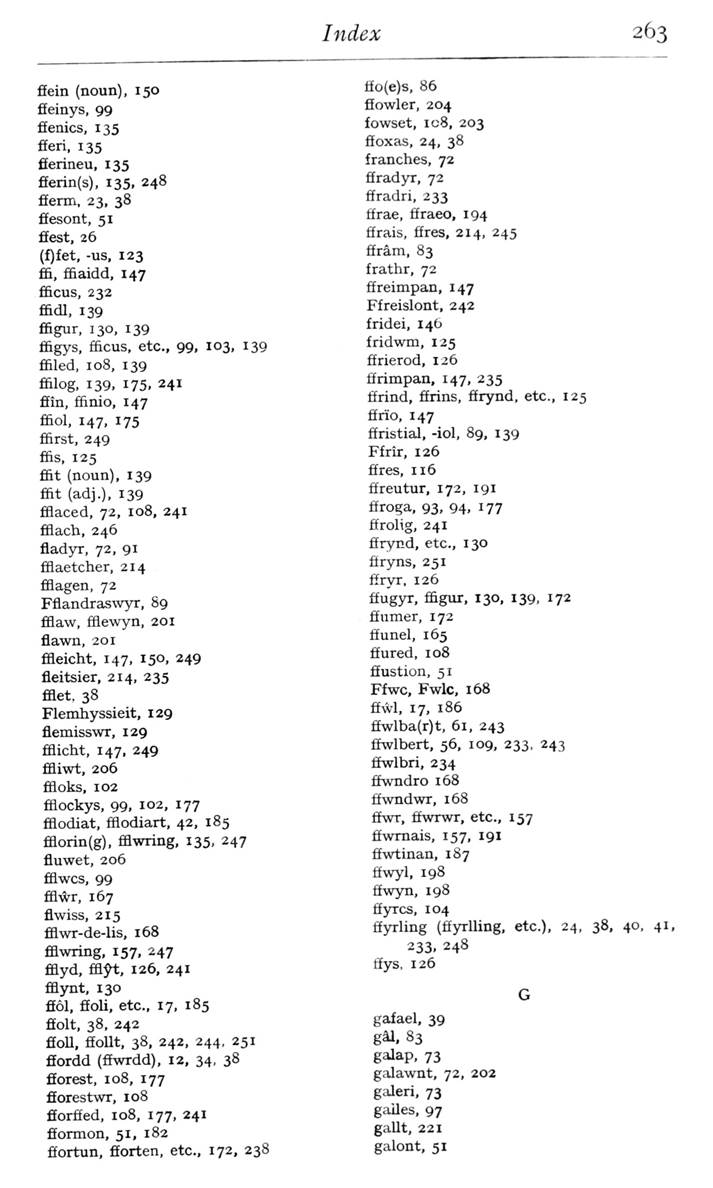
(delwedd F7014) (tudalen 263)
|
Index 263
ffein
(noun), 150
ffeinys, 99
ffenics, 135
fferi, 135
fferineu, 135
fferin(s), 135, 248
fferm, 23, 38
ffesont, 51
ffest, 26
(f)fet, -us, 123
ffi, ffiaidd, 147
fficus, 232
ffidl, 139
ffigur, 130, 139
ffigys, fficus, etc., 99, 103, 139
filled, 108, 139
ffilog, 139, 175, 241
ffin, ffinio, 147
ffiol, 147, 175
ffirst, 249
ffis, 125
ffit (noun), 139
ffit (adj,), 139
fflaced, 72, 108, 241
fflach, 246
fladyr, 72, 91
fflaetcher, 214
fflagen, 72
Fflandraswyr, 89
fflaw, fflewyn, 201
flawn, 201
ffleicht, 147, 150, 249
fleitsier, 214, 235
fflet, 38
Flemhyssieit, 129
flemisswr, 129
fflicht, 147, 249
ffliwt, 206
ffloks, 102
fflockys, 99, 102, 177
ffiodiat, fflodiart, 42, 185
fflorin(g), fflwring, 135, 247
fluwet, 206
ffwcs, 99
fflŵr, 167
flwiss, 215
fflwr-de-lis, 168
fflwring, 157, 247
fflyd, fflŷt, 126, 241
fflynt, 130
ffôl, ffoli, etc., 17, 185
ffolt, 38, 242
ffoll, ffollt, 38, 242, 244, 251
ffordd (ffwrdd), 12, 34, 38
fforest, 108, 177
fforestwr, 108
fforffed, 108, 177, 241
fformon, 51, 182
ffortun, fforten, etc., 172, 238
|
ffo(e)s, 86
ffowler, 204
fowset, 108, 203
ffoxas, 24, 38
franches, 72
ffradyx, 72
ffradri, 233
ffrae, ffraeo, 194
ffrais, ffres, 214, 245
ffrâm, 83
frathr, 72
ffreimpan, 147
Ffreislont, 242
fridei, 146
fridwm, 125
ffrierod, 126
ffrimpan, 147, 235
ffrind, ffrins, ffrynd, etc., 125
ffrïo, 147
ffristial, -iol, 89, 139
Ffrir, 126
ffres, 116
ffreutur, 172, 191
ffroga, 93, 94, 177
ffrolig, 241
ffrynd, etc., 130
ffryns, 251
ffryr, 126
ffugyr, ffigur, 130, 139, 172
ffumer, 172
ffunel, 165
ffured, 108
ffustion, 51
Ffwc, Fwlc, 168
ffŵl, 17, 186
ffwlba(r)t, 61, 243
ffwlbert, 56, 109, 233, 243
ffwlbri, 234
ffwndro 168
ffwndwr, 168
ffwr, ffwrwr, etc., 157
ffwrnais, 157, 191
ffwtinan, 1S7
ffwyl, 198
ffwyn, 198
ffyrcs, 104
ffyrling (ffyrlling, etc,), 24, 38, 40, 41, 233, 248
ffys, 126
G
gafael,
39
gâl, 83
galap, 73
galawnt, 72, 202
galeri, 73
galles, 97
gallt, 221
galont, 51
|
|
|
|
|
|
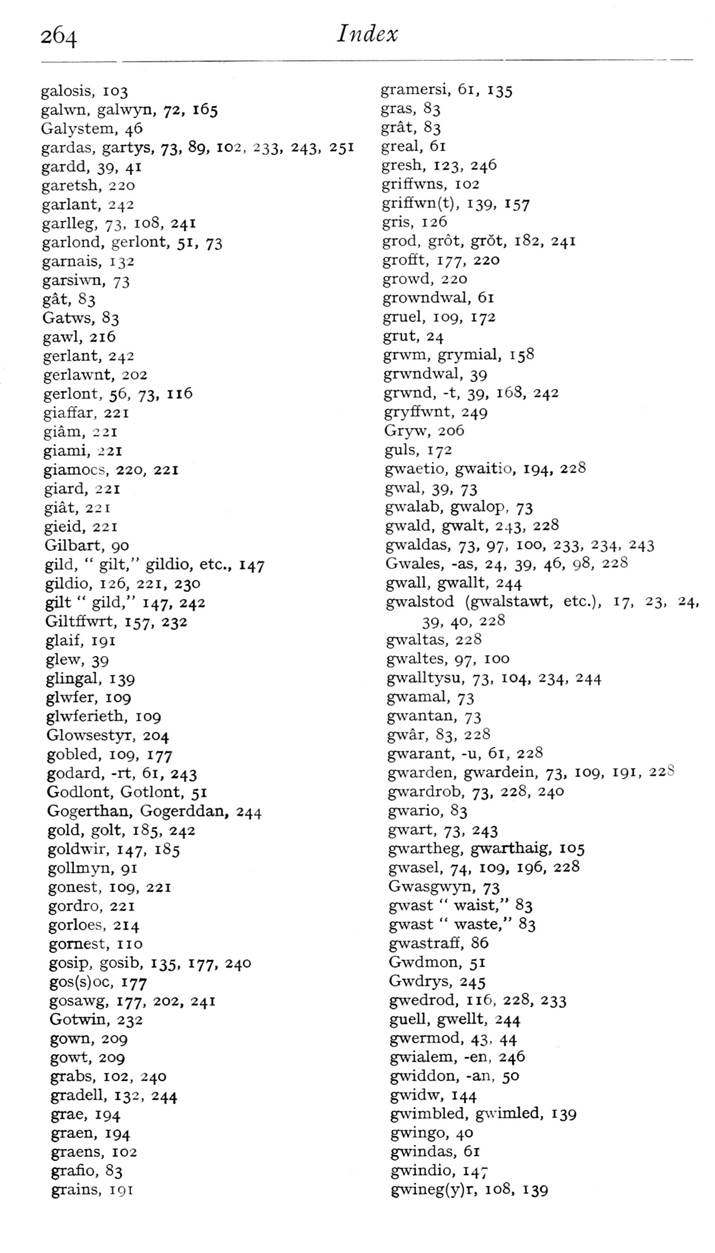
(delwedd F7015) (tudalen 264)
|
264 Index
galosis,
103
galwn, galwyn, 72, 165
Galystem, 46
gardas, gartys, 73, 89, 102, 233, 243, 251
gardd, 39, 41
garetsh, 220
garlant, 242
garlleg, 73, 108, 241
garlond, gerlont, 51, 73
garnais, 132
garsiwn, 73
gat, 83
Gatws, 83
gawl, 216
gerlant, 242
gerlawnt, 202
gerlont, 56, 73, 116
giaffar, 221
giam, 221
giami, 221
giamocs, 220, 221
giard, 221
giat, 221
gieid, 221
Gilbart, 90
gild, “gilt," gildio, etc., 147
gildio, 126, 221, 230
gilt “gild," 147, 242
Giltffwrt, 157, 232
glaif, 191
glew, 39
glingal, 139
glwfer, 109
glwferieth, 109
Glowsestyr, 204
gobled, 109, 177
godard, -rt, 61, 243
Godlont, Gotlont, 51
Gogerthan, Gogerddan, 244
gold, golt, 185, 242
goldwir, 147, 1 85
gollmyn, 91
gonest, 109, 221
gordro, 221
gorloes, 214
gornest, 110
gosip, gosib, 135, 177, 240
gos(s)oc, 177
gosawg, 177, 202, 241
Gotwin, 232
gown, 209
gowt, 209
grabs, 102, 240
gradell, 132, 244
grae, 194
graen, 194
graens, 102
grafio, 83
grains, 191
|
gramersi, 61,
135
gras, 83
grât, 83
greal, 61
gresh, 123, 246
griffwns, 102
griffwn(t), 139, 157
gris, 126
grod, grôt, grot, 182, 241
grofft, 177, 220
growd, 220
growndwal, 61
gruel, 109, 172
grut, 24
grwm, grymial, 158
grwndwal, 39
grwnd, -t, 39, 1 63, 242
gryflwnt, 249
Gryw, 206
guls, 172
gwaetio, gwaitio, 194, 228
gwal, 39, 73
gwalab, gwalop, 73
gwald, gwalt, 243, 228
gwaldas, 73, 97, 100, 233, 234, 243
Gwales, -as, 24, 39, 46, 98, 228
gwall, gwallt, 244
gwalstod (gwalstawt, etc,), 17, 23, 24, 39, 40, 228
gwaltas, 228
gwaltes, 97, 100
gwalltysu, 73, 104, 234, 244
gwamal, 73
gwantan, 73
gwâr, 83, 228
gwarant, -u, 61, 228
gwarden, gwardein, 73, 109, 191, 22S
gwardrob, 73, 228, 240
gwario, 83
gwart, 73, 243
gwartheg, gwarthaig, 105
gwasel, 74, 109, 196, 228
Gwasgwyn, 73
gwast “waist," 83
gwast “waste," 83
gwastraff, 86
Gwdmon, 51
Gwdrys, 245
gwedrod, 116, 228, 233
guell, gwellt, 244
gwermod, 43, 44
gwialem, -en, 246
gwiddon, -an, 50
gwidw, 144
gwimbled, gwimled, 139
gwingo, 40
gwindas, 61
gwindio, 147
gwineg(y)r, 108, 139
|
|
|
|
|
|
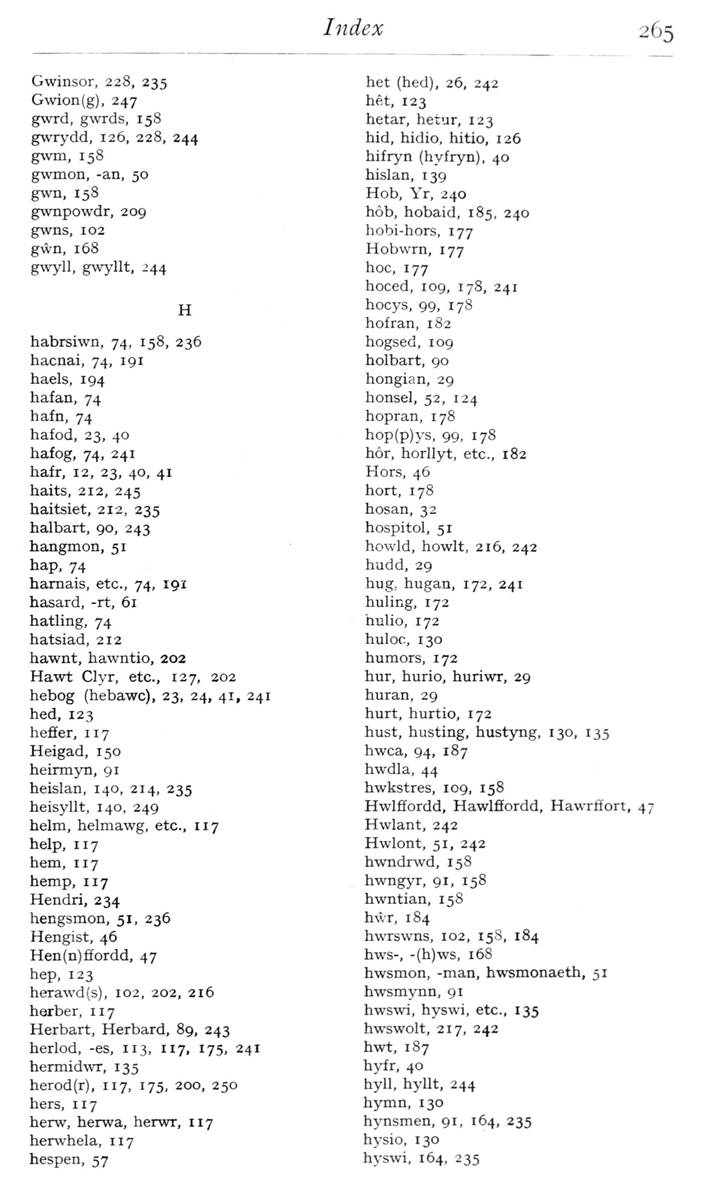
(delwedd F7016) (tudalen 265)
|
Index 265
Gwinsor,
228, 235
Gwion(g), 247
gwrd, gwrds, 158
gwrydd, 126, 228, 244
gwm, 158
gwmon, -an, 50
gwn, 158
gwnpowdr, 209
gwns, 102
gwn, 168
gwyll, gwyllt, 244
H
habrsiwn, 74, 158, 236
hacnai, 74, 191
haels, 194
hafan, 74
hafn, 74
hafod, 23, 40
hafog, 74, 241
hafr, 12, 23, 40, 41
halts, 212, 245
haitsiet, 212, 235
halbart, 90, 243
hangmon, 51
hap, 74
hamais, etc., 74, 191
hasard, -rt, 61
hathng, 74
hatsiad, 212
hawnt, hawntio, 202
Hawt C]yr, etc., 127, 202
hebog (hebawc), 23, 24, 41, 241
hed, 123
heffer, 117
Heigad, 150
heinnyn, 91
heislan, 140, 214, 235
heisyllt, 140, 249
helm, helmawg, etc., 117
help, 117
hem, 117
hemp, 117
Hendri, 234
hengsmon, 51, 236
Hengist, 46
Hen(n)ffordd, 47
hep, 123
herawd(s), 102, 202, 216
herber, 117
Herbart, Herbard, 89, 243
herlod, -es, 113, 117, 175, 241
hermidwr, 135
herod(r), 117, 175, 200, 250
hers, 117
herw, herwa, herwr, 117
hersvhela, 117
hespen, 57
|
het
(hed), 26, 242
het, 123
hetar, hetur, 123
hid, hidio, hitio, 126
hifryn (hyfryn), 40
hislan, 139
Hob, Yr, 240
hôb, hobaid, 185, 240
hobi-hors, 177
Hobwrn, 177
hoc, 177
hoced, 109, 178, 241
hocys, 99, 178
hofran, 182
hogsed, 109
holbart, 90
hongian, 29
honsel, 52, 124
hopran, 178
hop(p)ys, 99, 178
hôr, horllyt, etc., 182
Hors, 46
hort, 178
hosan, 32
hospitol, 51
howld, howlt, 216, 242
hudd, 29
hug, hugan, 172, 241
huling, 172
hulio, 172
huloc, 130
humors, 172
hur, hurio, huriwr, 29
huran, 29
hurt, hurtio, 172
hust, busting, hustyng, 130, 135
hwca, 94, 187
hwdla, 44
hwkstres, 109, 158
Hwlffordd, Hawlffordd, Hawrffort, 47
Hwlant, 242
Hwlont, 51, 242
hwndrwd, 158
hwngyr, 91, 158
hwntian, 158
hŵr, 184
hwrswns, 102, 158, 184
hws-, -(h)ws, 168
hwsmon, -man, hwsmonaeth, 51
hwsmynn, 91
hwswi, hyswi, etc., 135
hwswolt, 217, 242
hwt, 187
hyfr, 40
hyll, hyllt, 244
hymn, 130
hynsmen, 91, 164, 235
hysio, 130
hyswi, 164, 235
|
|
|
|
|
|
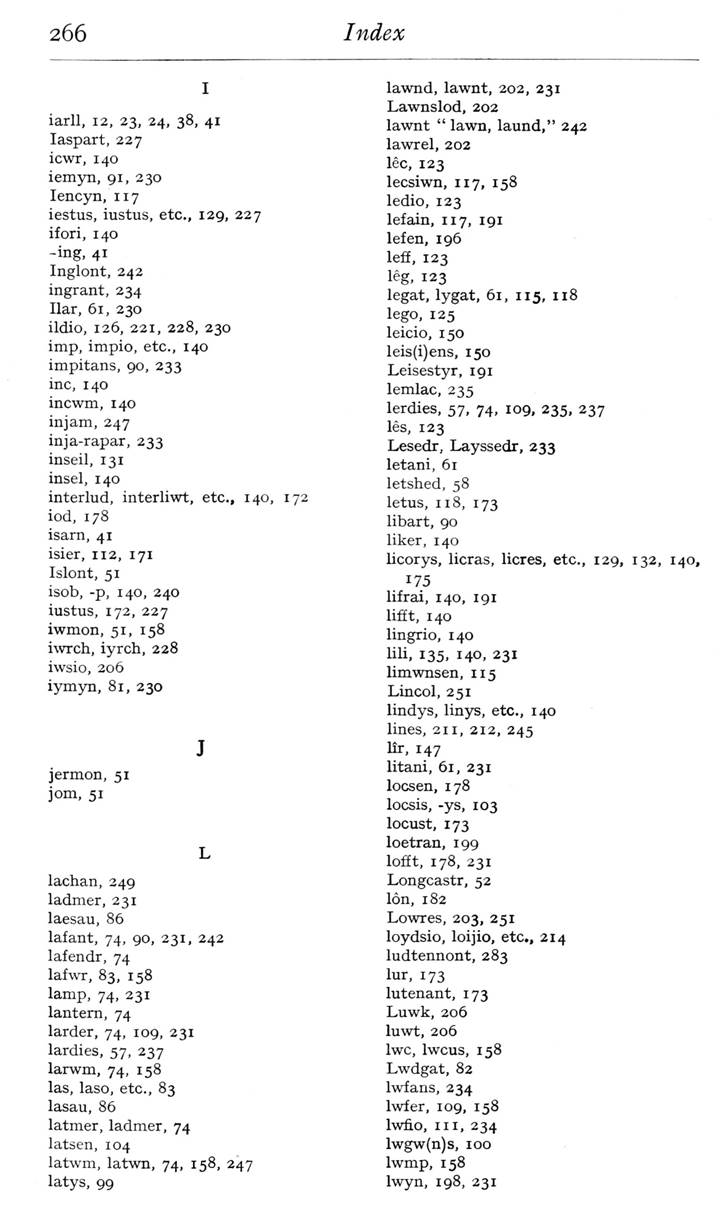
(delwedd F7017) (tudalen 266)
|
266 Index
iarll,
12, 23, 24, 38, 41
laspart, 227
icwr, 140
iemyn, 91, 230
lencyn, 117
iestus, iustus, etc., 129, 227
ifori, 140
-ing, 41
Inglont, 242
ingrant, 234
liar, 61, 230
ildio, 126, 221, 228, 230
imp, impio, etc., 140
impitans, 90, 233
inc, 140
incwm, 140
injam, 247
inja-rapar, 233
inseil, 131
insel, 140
interlud, interliwt, etc., 140, 172
iod, 178
isam, 41
isier, 112, 171
Islont, 51
isob, -p, 140, 240
iustus, 172, 227
iwmon, 51, 158
iwrch, iyrch, 228
iwsio, 206
iymyn, 81, 230
J
jermon,
51
jom, 51
L
lachan,
249
ladmer, 231
laesau, 86
lafant, 74, 90, 231, 242
lafendr, 74
lafwr, 83, 158
lamp, 74, 231
lantern, 74
larder, 74, 109, 231
lardies, 57, 237
larwm, 74, 158
las, laso, etc., 83
lasau, 86
latmer, ladmer, 74
latsen, 104
latwm, latwn, 74, 158, 247
latys, 99
|
lawnd,
lawnt, 202, 231
Lawnslod, 202
lawnt “lawn, laund," 242
lawrel, 202
lêc, 123
lecsiwn, 117, 158
ledio, 123
lefain, 117, 191
lefen, 196
leff, 123
leg, 123
legat, lygat, 61, 115, 118
lego, 125
leicio, 150
leis(i)ens, 150
Leisestyr, 191
lemlac, 235
lerdies, 57, 74, 109, 235, 237
les, 123
Lesedr, Layssedr, 233
letani, 61
letshed, 58
letus, 118, 173
libart, 90
liker, 140
licorys, licras, licres, etc., 129, 132, 140,
175
lifrai, 140, 191
lifit, 140
lingrio, 140
lili, 135, 140, 231
limwnsen, 115
Lincol, 251
lindys, linys, etc., 140
lines, 211, 212, 245
lir, 147
litani, 61, 231
locsen, 178
locsis, -ys, 103
locust, 173
loetran, 199
lofft, 178, 231
Longcastr, 52
Iôn, 182
Lowres, 203, 251
loydsio, loijio, etc., 214
ludtennont, 283
lur, 173
lutenant, 173
Luwk, 206
luwt, 206
Iwc, Iwcus, 158
Lwdgat, 82
Iwfans, 234
Iwfer, 109, 158
Iwfio, 111, 234
lwgw(n)s, 100
Iwmp, 158
Iwyn, 198, 231
|
|
|
|
|
|
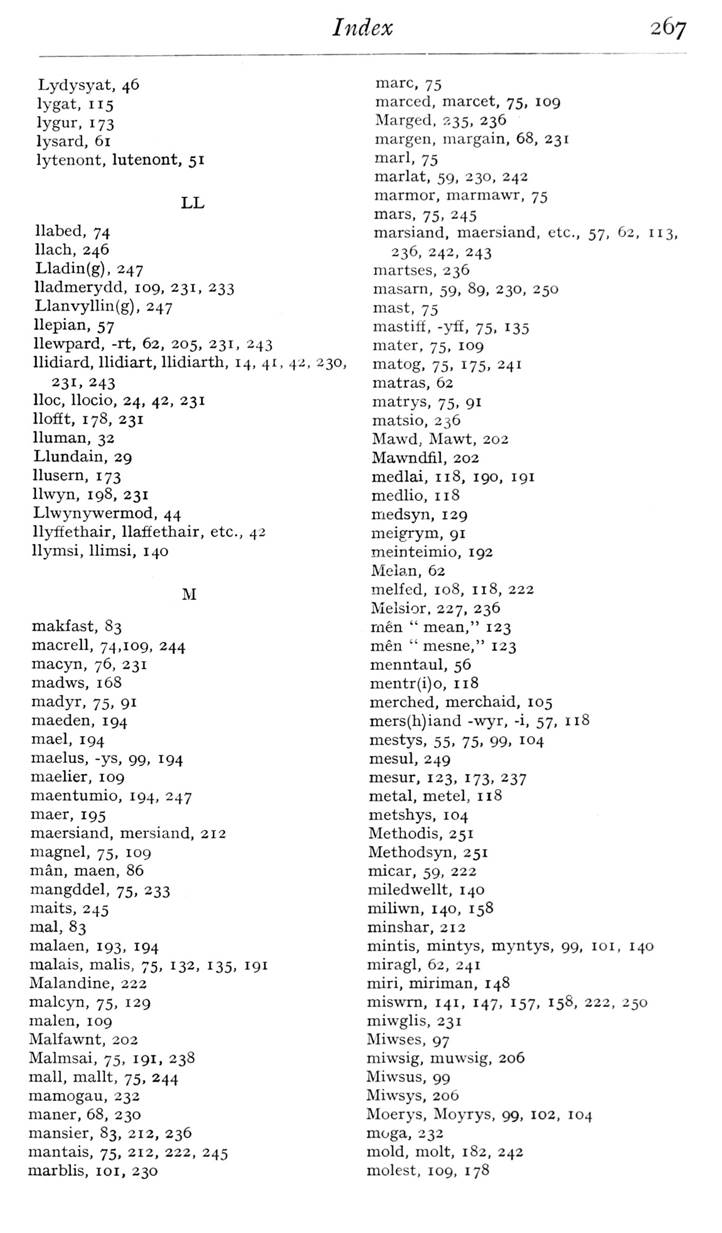
(delwedd F7018) (tudalen 267)
|
Index 267
Lydysyat,
46
lygat, 115
lygur, 173
lysard, 61
lytenont, lutenont, 51
LL
llabed, 74
llach, 246
Lladin(g), 247
lladmerydd, 109, 231, 233
Llanvyllin(g), 247
llepian, 57
llewpard, -rt, 62, 205, 231, 243
llidiard, llidiart, llidiarth, 14, 41, 42, 230,
231, 243
lloc, llocio, 24, 42, 231
llofft, 178, 231
lluman, 32
Llundain, 29
llusern, 173
llwyn, 198, 231
Llwynywermod, 44
llyffethair, llaffethair, etc., 42
llymsi, llimsi, 140
M
makfast, 83
macrell, 74,109, 244
macyn, 76, 231
madws, 168
madyr, 75, 91
maeden, 194
mael, 194
maelus, -ys, 99, 194
maelier, 109
maentumio, 194, 247
maer, 195
maersiand, mersiand, 212
magnel, 75, 109
mân, maen, 86
mangddel, 75, 233
maits, 245
mal, 83
malaen, 193, 194
malais, malis, 75, 132, 135, 191
Malandine, 222
malcyn, 75, 129
malen, 109
Malfawnt, 202
Malmsai, 75, 191, 238
mall, mallt, 75, 244
mamogau, 232
maner, 68, 230
mansier, 83, 212, 236
mantais, 75, 212, 222, 245
marblis, 101, 230
|
marc, 75
marced, marcet, 75, 109
Marged, 235, 236
margen, margain, 68, 231
marl, 75
marlat, 59, 230, 242
marmor, marmawr, 75
mars, 75, 245
marsiand, maersiand, etc., 57, 62, 113, 236, 242, 243
martses, 236
masarn, 59, 89, 230, 250
mast, 75
mastiff, -yff, 75, 135
mater, 75, 109
matog, 75, 175, 241
matras, 62
matrys, 75, 91
matsio, 236
Mawd, Mawt, 202
Mawndfil, 202
medial, 118, 190, 191
medlio, 118
medsyn, 129
meigrym, 91
meinteimio, 192
Melan, 62
melfed, 108, 118, 222
Melsior, 227, 236
mên “mean," 123
mên “mesne," 123
menntaul, 56
mentr(i)o, 118
merched, merchaid, 105
mers(h)iand -wyr, -i, 57, 118
mestys, 55, 75, 99, 104
mesul, 249
mesur, 123, 173, 237
metal, metel, 118
metshys, 104
Methodis, 251
Methodsyn, 251
micar, 59, 222
miledwellt, 140
miliwn, 140, 158
minshar, 212
mintis, mintys, myntys, 99, 101, 140
miragl, 62, 241
miri, miriman, 148
miswrn, 141, 147, 157, 158, 222, 250
miwglis, 231
Miwses, 97
miwsig, muwsig, 206
Miwsus, 99
Miwsys, 206
Moerys, Moyrys, 99, 102, 104
moga, 232
mold, molt, 1S2, 242
molest, 109, 178
|
|
|
|
|
|
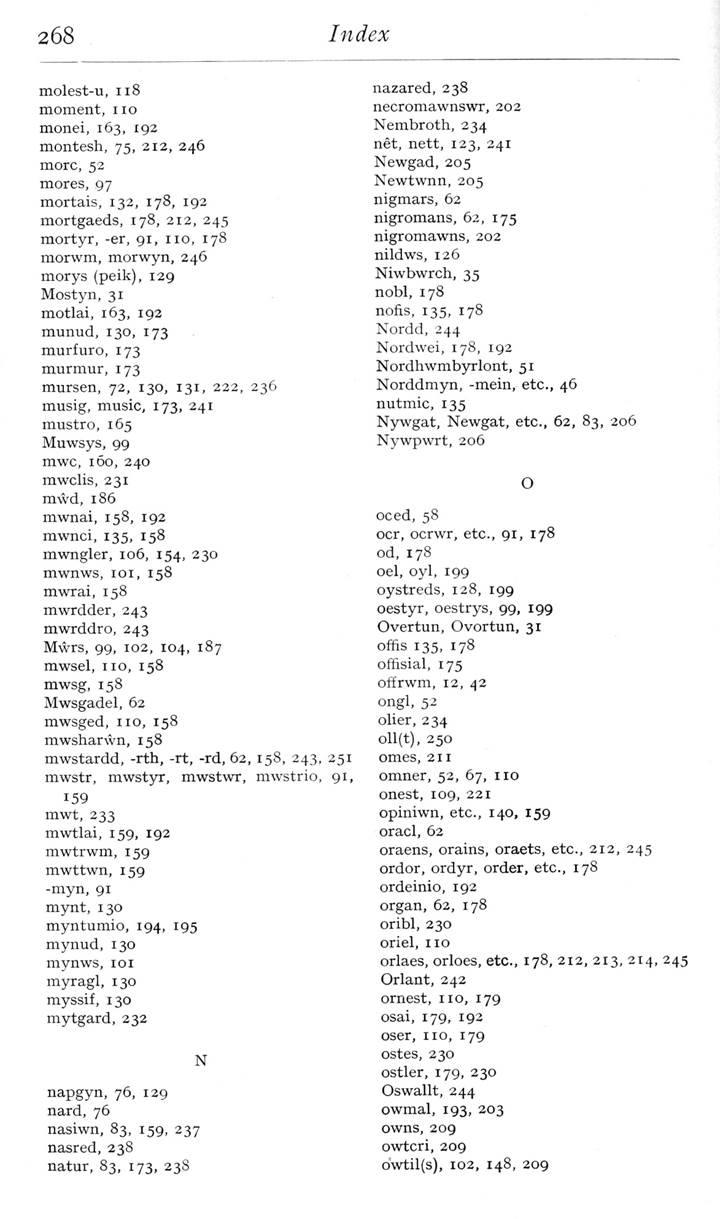
(delwedd F7019) (tudalen 268)
|
268 Index
molest-u,
118
moment, 110
monei, 163, 192
montesh, 75, 212, 246
morc, 52
mores, 97
mortals, 132, 178, 192
mortgaeds, 178, 212, 245
mortyr, -er, 91, 110, 178
morwm, morwyn, 246
morys (peik), 129
Mostyn, 31
motlai, 163, 192
munud, 130, 173
murfuro, 173
murmur, 173
mursen, 72, 130, 131, 222, 236
musig, music, 173, 241
mustro, 165
Muwsys, 99
mwc, 160, 240
mwclis, 231
mwd, 186
mwnai, 158, 192
mwnci, 135, 158
mwngler, 106, 154, 230
mwnws, 101, 158
mwrai, 158
mwrdder, 243
mwrddro, 243
Mŵrs, 99, 102, 104, 187
mwsel, 110, 158
mwsg, 158
Mwsgadel, 62
mwsged, 110, 158
mwsharwn, 158
mwstardd, -rth, -rt, -rd, 62, 158, 243, 251
mwstr, mwstyr, mwstwr, mwstrio, 91,
159
mwt, 233
mwtlai, 159, 192
mwtrwm, 159
mwttwn, 159
-myn, 91
mynt, 130
myntumio, 194, 195
mynud, 130
mynws, 101
myragl, 130
myssif, 130
mytgard, 232
N
napgyn,
76, 129
nard, 76
nasiwn, 83, 159, 237
nasred, 238
|
natur, 83,
173, 23S
nazared,
238
necromawnswr, 202
Nembroth, 234
nêt, nett, 123, 241
Newgad, 205
Newtwnn, 205
nigmars, 62
nigromans, 62, 175
nigromawns, 202
nildws, 126
Niwbwrch, 35
nobl, 178
nofis, 135, 178
Nordd, 244
Nordwei, 178, 192
Nordhwmbyrlont, 51
Norddmyn, -mein, etc., 46
nutmic, 135
Nywgat, Newgat, etc., 62, 83, 206
Nywpwrt, 206
O
oced,
58
ocr, ocrwr, etc., 91, 178
od, 178
oel, oyl, 199
oystreds, 128, 199
oestyr, oestrys, 99, 199
Overtun, Ovortun, 31
offis 135, 178
offisial, 175
ofErwm, 12, 42
ongl, 52
olier, 234
oll(t), 250
omes, 211
omner, 52, 67, 110
onest, 109, 221
opiniwn, etc., 140, 159
oracl, 62
oraens, orains, oraets, etc., 212, 245
ordor, ordyr, order, etc., 178
ordeinio, 192
organ, 62, 178
oribl, 230
oriel, 110
orlaes, orloes, etc., 178, 212, 213, 214, 245
Orlant, 242
ornest, 110, 179
osal, 179, 192
oser, 110, 179
ostes, 230
ostler, 179, 230
Oswallt, 244
owmal, 193, 203
owns, 209
owtcri, 209
owtil(s), 102, 148, 209
|
|
|
|
|
|
(delwedd F7020) (tudalen 269)
|
Index 269
pab,
83, 240
pabi, 42, 223
pabir, 83, 233
pac, 76
pae, 195
paement, 110, 195
paen, 86
Paen, 195
paent, paentio, etc., 193, 195
pafiliwn, 62, 159
pagan(s), 62, 102
paits, payds, 213, 245
palas, 76
paleis, 76, 192
palff, 219
palffrai, -re, 76, 190, 192, 196
palis, 76, 135
palm, 76, 238
palmant, -ment, 76
palmer, 76, 110, 238
palmeres, 76
palmyr, 76
pannas, -ys, 63, 245
panel, 76, 110
panter, 76
pantler, 76
pantri, 76
papur, papir, 83, 129, 173, 231
parabl, 63
parateu, 58
parc, 76
parcer, 76
pardwn, 76
pardynu, 164
parli, 133
parlwr, 77
parlmant, -ment, 76, 90
parsel, 77
parsmant, 77, 90, 236
part, 77
parti, 77, 136
partris, partrys, 77, 113
pascal, 63
pas, 84
pases, 56, 77, 211, 213
pasio, 77
pasiwn, 77, 237
pasport, 77
pastai, 84, 192
pasteim, 150
pastwm, 247
pastwn, 68, 77, 154, 219
pasu, 231
patent, -d, 84, 243
patrwm, patrwn, 77, 84, 247
patrys, 77
pawen, 202, 204
pecaid, 118
|
pedler,
118
peval 219
peics, X02, 104
peik, 150
peilat, 63, 151
peint, 151
peintio, 192, 193
peirsio, 214, 245
peitur, 91
Peithing, 41
pen (for pan), 56
Penardd, Penarth, 244
Penbrys, 245
pencnath, 221
pendil, 136
pendist, 136, 249
pennon, 118, 163
pensel, 110
pensiwn, 118, 159, 237
pentis, -us, 129
penwn, 118, 159
pêr, 123
peran, 32
perches, 98
perchvyd, 118
perls, 102
perot, 58
persen, 104
persli, 118, 136
perswad, 84
perswadio, 84
pert, 118
perwg, 136
perwig, 136
pesont, 52
pestel, pestl, 118
petigryw, 136
petrel, 110
petris, partris, etc., 113, 118, 136,
235,
245
peutur, 110
pewter, 91, 110, 205
pi, pioden, 148
pia, 94
pib, 148, 240
pibirment, 115
pibl, 148
picas, 63, 246
picil, 140
picter, 140
pictiwr, 140, 206, 238
picyn, 140, 233
picys, 99, 102
pig, pigo, 148
Pilad, 148
Pilatwys, 101
piler, 110, 141
pilin, 141
pilio, 126, 141
|
|
|
|
|
|
(delwedd F7021) (tudalen 270)
|
270 Index
pilori,
pilwri, 141, 162, 159
pilwri, 159
pin “pen," 141
pin “pin," 141
pinacl, pinagl, etc., 63
pinagl, 241
pincio, 141
pinegl, 56
pinnas, 100
pinshwrn, 103, 141, 256
pirat, 148
pircs, 104
pirim, 247
piser, 110, 141, 236
piso, 141
pit, 219
pitffel, 56
pitsh, 219
piwr, 206
piwro, 219
piwsio, 219
piwtar, 110, 205
plad, plât, 84, 241
plaem, 247
plaen, 84, 87
plag, -io, 84
plagiard, 219
plâm, 84, 247
plân, 84, 87
planc, 77
planced, 77, 219
planed, 77, 110
plas, 84
plaster, plastr, etc., 77, 92
plater, 110
plats, 99, 102, 104
platys, 84, 99, 104
ple, 123
pleder, 123
pledio, 123
ples, 123
pleser, -yr, n8, 123, 237
plesio, 123
plet, pleten, 124
pletio, 124
plismon, 52
ploc, 179, 219
plod, 53
plundrio, 165
plwc, plycio, 159, 164, 242
plwg, 159
plwmmas, 100
plwmwns, -wys, 101, 159
plwmwnsen, 103
poced, 110, 179
poetri, 136, 199
poles, 219
pomgranad, 63, 163
ponc, 53, 219
|
poncag,
pancogen, 53
popin, 42
poplis, 101, 232
poplys, 99, 179
poplysen, 103
popyl, 232
Porffordd, 47
porffil, 136
porthcwlis, portcwlis, 132, 136, 159
porthmon, 52
porthmyn, 91
portre-ad, 196
portreio, 163, 192
ports, 179, 245
pos(s)el, 110
posibl, 136
posio, 183
posnet, 110
pot, 179
potaes, potes, 56, 110, 179, 211, 213, 245
potas, 213
potecari, potegari, 63
potel, 179, 219
potrel, 234
powdr, powdyr, etc., 92, 204, 208, 209
power, 111, 209
powlan, 216
powld, 216, 219
powltan, 217
powl(i)o, 216
Powls, 204
powlto, 217, 219
powlt(r)is, 217
pownd, 17
powrs, 181
poynt, 199
prae, 195
praitio, 87
pranc, 77
preins, 132, 141, 192
preint, 132, 141, 192
prelad, 63, 119, 241
prentis, -ys, 119, 129, 136
pres, 26, 219
presant, 90
press, 119
Prestatyn, 31
presumio, 111, 173
preswmsiwn, 111, 159
Pretur Siôn, Pretter Siôn, etc., 92
pric, 141
pricsiwn, 159
prife, pryvai, 141, 196
prim, 148
prin(g), 247
prins, 132, 141
prinsis, 101
print, 141
|
|
|
|
|
|
(delwedd F7022) (tudalen 271)
|
Index 271
prior,
148
pris, prisio, 148
proc, procio, etc., 183
procer, 183
proclamasiwn, 77, 159
proctor, 179
procurwyr, 173
profandyr, 90, 92
profant, 90, 242
proftes, 111
proffid, proffidio, etc., 136, 179, 241
progklamasiwn, 233, 237
prolog, 175
promais, 132
propr, propor, propyr, 179
proses, 111, 179
prosessiwn, 159
prŵff, 187
pryfai sel, 192
pryfed, pryfaid, 105
Prystatun, 31
publican, 165
pulpud, pwlpud, pillpyd, 129, 165, 173
punt, punnoedd, 12, 17, 24, 30, 242, 243
punt “pint," 130
pupur, pupyr, 92
pura(u), 231
pustol, pystol, 131
putain, 173
pwca, 43, 94
pwd, pwdu, 168, 241
pwdin(g), pwdyngen, 129, 159, 248
pwer 111, 168
pwfer, 111, 209, 234
pwlffyn, 219
pwU, 43, 187
pwltis, 136
pwmel, 111, 159
pwmgarnat, 63
pwmgranad, 159
pwmp, 159
pwmpa, 94, 102, 157
pwmparis, 159
pwmps, 102
pwnsiad, 219
pwrcas, -wr, -u, 63, 159
pwrffil, 136, 159
pwrpas, 63, 159
pwrpasu, 231
pwrpwl, 160
pwrs, 6, 160
pwrsifant, 63
pwrtsio, 245
pwt “a thrust," 160
pwt "butt," 219
pwtio, -ian, 160
pwynt, pwyntio, etc., 198
pwyntio, 197
pwyntil, pwyntl, pwyntel, 136, 197, 198
|
pwyntmant, 90
pwyntred, -ryd, 198, 235
pwysi, 19S
pwysment, 238
pwyts, 215
pyblic, 164
pyrs, 104
pyrsau, 164
pys, 127
pystelens, 1x4
PH
physig, physygwr, 131
phlêm, 124
R
raemant, 90, 195
rainis win, 246
rampawnt, -ont, 52, 78, 202
ranswm, 78
ranswn, 202
rasal, 249
Rawff, 216
rawnswn, 202
rebeliwn, 119, 160
recorder, 179, 231
redi, 136, 231
redins, 250
reiat, 151
reiol, rheiol, 52
reiolti, rheiolti, 52, 151
rêl, 124
relins, 250
rend, 243
rental, 63
repet, 125
resefer, 124, 125
reseinio, 151
resgyw, rescuw, 119, 206
resing, 136
rial, 63
riat, 151
ring, 247
riwbi, rowbi, 206
robio, robri, 179
robri, 137
rockyan, 179
rockys, 99
Roesel, 214
Roeser, Roesier, etc., 214, 236
role, 95
Rolond, 52
Rôn, 183
rosmari, 183
rubalt, rubald, 63
ruban, rhuban, 63, 173
rwbel, 111, 231
rwden, 72
|
|
|
|
|
|
(delwedd F7023) (tudalen 272)
|
272 Index
Rwmawns, 202
Rwmnai, 160
rwmsys, 103
rwnca, 160
rysâit, 125
rysêt, 125
rypreseniad, 105
RH
rhacanu, 32, 45
rhaca(n), 32, 84, 95
rhagraith, 132
rhamant, 63
rhawt, 204, 208
r(h)awter, 11 1, 208
rheinws, 168
rheng, rhenc, 58, 119, 247
rhent, 119
rhesing, 137, 231, 247
rhest-io, 119
rheswm, 124, 160, 247
rhethrig, 105, 119
rhiban, 63
rhibib, 131
rhidens, 141
rhidyll, 141, 244
rhigam, 247
rhigol, 141, 175
Rhin, 148
rhis, 148
Rhisiart, 236, 243
Rhismwnt, 236, 242
rhiwbob, 53
rhobs, 231, 240
rhôl, 183
rhonc, 53
rhopos, 101
rhos, 183
Rhoser, Roesier, etc., 111
rhost, rhostio, etc., 183
r(h)ubi, 173
r(h)uw, 206
rhuwel, rhywel, 209
r(h)uwl, 206
r(h)uwls, 102
rhwbio, 160
rhwd, 187
r(h)wmnai, 192
rhwnca, 94
r(h)wter, 111
rhwymedi, rhymedi, 111, 137, 231
rhybib, 131
rhywart, 64, 206, 243
rhywbarb, 206
rhywel, 111
rhywlys, ruwlys, 99
|
sabl, 84
sad, 78
Sadler, 78
sae, 195
saes, saets, etc., 213, 245
saff, 84
safcwndit, 84
saffir, 78
saffrwm, -n, 78, 160, 247
safr, safwyr, 84
safgard, 64, 84
safio, 84
safri, 84
safwr, 160
saim (saem), 43, 192
ssain manwel, 145
sal, 84
salad, 78
salm, 78, 238
Salter, 78
sambr, 85
samit, 84
sampler, 78
sampler, 78
samwin, 78
sandal, 78
Sandwis, 245
sapel, 69, 78, 111
sapter, 78, 111
sariws, 113
Sarsiant, 64, 113, 236
Sarsin, 78
sarsnet, 78
sasiwn, 113
sataen, 78, 195
sattan, 78, 90
sawd, sawt, 202
Sawden, 56, 204, 208
sawdring, sowdring, etc., 208, 248
sawdurio, 208
sawdwr, 204, 208
sawdwst, 37, 202
sawdyo, sawdwyr, etc., 203
sawlt, 216
sawr, 84
saws, 202
sawser, 202
sbaer, 87
Sbanis, 246
sbâr, 86, 87
sbarblis, 101
sbario, 85
sbarras, 100
sbloit, 199, 234
sbrisin, 100
sbwylio, 198
sbyrs, 103
sbyrsyn, 100, 104
|
|
|
|
|
|
(delwedd F7024) (tudalen 273)
|
Index 273
scabas,
100
scaing, 247
sciabas, 79, 100, 224
sclandr, 224
sclent, 120
scum, sgum, 166
scwtsiwn, 160, 236
sec, 119
sek(e)r, 120
secret, 119
sekutor, 174
secwndid, 56, 84, 137, 160, 225
secwensiau, seg-, 119
sedr, 119
seiat, seiadau, 232, 240
seiens, 151
seiffro, 151, 223
seiffyrs, 151
seifys, 99, 151, 223
seimlyd, 43
seims, 102, 151, 226
Seimwnt Mwmfford, 160
seintwar, 64, 192
seintwer, 56, 64
seiprys, 92, 151, 223
sel, 124, 218
Selatyn, 31
seld, 26
seler, 119, 223
selio, 124
Selont, 242
sem, 124
sengl, 119
sens “incense," 119
senser, 119
sentens, 119
sentori, 137
sentri, 137
seramoni, 90
sercl, 119
serdsiant, 64, 119
serio, 124
sersiant, 213
Sersin, 78
sertain, serten, 119, 192, 223
sesiwn, 119, 160, 237
sesn, sesyn, 124
seston, 131
sêt, 124
setsiel, 120, 236
sew, 205
sewer, 205
sgaer, 87
sgapio, 85
sgâr, 78
sgar, 86, 87, 224
sgarff, 79
sgarmaitsh, 132
sgawt, 204
|
sgem, 124
sgert, 131
sgimio, 124
sglaits, 87
sglefr, 225
sglent, 120
sglisan, 149
sglwtsh, 225
sgwir, 149
shibedu, 227
shimle, shimlebis, 142, 233
shishwrn, 103
shocos, 227
shwc, 160, 227, 233, 240
shwtrws, 10 1
slab, 240
siabas, 79, 225
Siac, 79, 227, 242
Siacc a nap, 81
siaced, 79, 111, 227, 241
siaen, 195
siafiing, 79, 227
siaffyr, 79, 92
siaggio, 79, 227
sialc, 79, 225, 238
sialens, 79, 245
sialeinsio, 214
siambr, 85, 226
siambrlen, etc., 85, 195, 196, 226
siamled, 79
siampl, sampl, 79
Siams, Siamys, 85, 92
Siân, 85
Siancyn, Siencyn, etc., 129, 227
siâp, 85
siarad, 79
siared, 79, 1 1 1
Siarls, 79
Siarlymaen, Siarlmaen, Siarlamaen, 193
Siarom, -n, 113, 227
siarp, 79, 225
siarpwyr, 79
siars, siarsio, 79, 226, 245
siarter, siartr, siartyr, 79, 92
siartrasseu, 100
sias, 85, 226
Siasber, 236
Siaspar, 227
siatal, 70, 79, 90, 226
siawdel, 201
siawns, 203, 226
siawnsler, 203, 226
sibed, 131, 227
sibol(s), 142, 175, 226
Sibs(i)wn(s), 102, 160, 233
sic(i)r 142
sikl, 149
sidan, 33
Sieb, 124, 225, 240
|
|
|
|
|
|
(delwedd F7025) (tudalen 274)
|
274
Index
Siebseid,
124, 151
sieced, siaced, 58, 79
siecr, 120, 226
sied “shed," 120
sied, siet “escheat," 124, 226, 241
Siencyn, 227
sïens, 151
siepdor, jepdor, 58
Sieron, 227
siersiant, 64, 113, 119
sieryf, 120
Siesir, 149
sietwr, 124
sifa, 94
siff, 126, 226
sifil, 142, 223
sifrisol, 115
sifys, 99, 148
Silbart, 90
silff(t), sifilt, 43, 225, 250
simant, 90, 115, 142
simdda, -dde, 142, 233
simnai, simne, 142, 192, 196, 226
simnel, 142
simpyl, 142
Simwnt, 249
simwr, 142
sin “gin," 142, 227
sin “sign” (?), 149
sinam, sinamwn, etc., 64
sinc, 142
sinder, sindir, 142, 223
sinobl, sinobr, 131, 142, 175, 240
singl, singlys, 99, 142, 223
singnet, 142
singyl siamgyl, 142
sinsir, 143, 227, 236
Sioassym, 227
siôl, 183
Sioli Boy, 227
siompol, 53
Siôn, 183, 227
Sionas, 227
Sioned, 183
siop, 179, 225
Siors, 227, 245
Sioseph, Sioseb, etc., 227
siot, 179
siprys, 143
sipsiwn, etc., 143, 227, 237
sîr “cheer," 126, 226
sîr “shire," 149, 224, 225
siri, siryf, etc., 143
sirian, 143
sirins, 101, 143
sirip, 143, 240
sirken, 115, 227
sis, sits, sidgis, etc., 126, 245
Sisedr, 226
|
sisli, 143
siswrn, 103, 141, 250
siswrs, 143
siwed, 111
siwels, 102, 143, 227
siwgr, sywgr, etc., 160, 206
siwlard, 160
Siwon, Siwan, 52
siwr, 207
siwrl, 160, 226
siwrnai, siwrne, 160, 196, 227
siwt, sywt, etc., 207
slachtar, 249
slaes, 213
slaf, 85
slec, 58
sleinsio, 79, 214
slont, 53
slwt, 160, 242
smacht, 80
smalaes, 213
smit, smitio, 235
smotyn, 180
smwcan, 31
Snawtun, 31
snisin, 126
Snottul, 129, 232
sobr, 183
soced, 112, 179
sockyssen, 103
soffgart, 53
soffstri, 179
solans, solan, 64
solas, 64
solffeuo, 179
Sompson, 53, 234
som, siom, 53
sond, 163
sopos, 101
sort, 179
sospan, 52
sos, 179
sowldier, 208
Spaenis, 246
sparog, 177
Spas, 85
spectal, 64, 223
spectol, 52
speisys, 99, 149, 151
spiknar, 149
spinus, 100
splentes, 98
spogen, 184, 241
spon, 53
stabal, 86
staen, 196
stalwm, 81, 247
stansh, 81
stasiwn, 86
|
|
|
|
|
|
(delwedd F7026) (tudalen 275)
|
Index
275
statut,
etc., 174
statuniau, 174
statuwt, 207
statuwtes, 98
stem, 120
stem, stemar, 124
stent, 120
sticil (sticill), 43, 233
stiliwns, 103
stôl, 186
stond, 53
stondart, 243
stondin(g), 53
stont, 242
stopio, 180
stori, 137, 184
studio, 174
stumog, 165
sturmant, stwrmant, 90
stwff, 160, 162
stwmlo, 235
stwnt, 162
stymog, 53
stywdy, 207
subet, 112, 131
Subiter, 227, 233
sucan, 29, 30, 31, 32, 45
Sud, 173, 227, 237
sud, sut, 171, 173
Sudas, 173
suful, syful, 129, 142
sum, 165
sumant, 115, 131, 142
sunamwn, 131
sunsur, 143
suntur, 165
supio, 131
superu, 166
sur, 30
suran, 30, 33
surfai, 173
surion, 30
suvlard, 64
suwio, 207
swae, swai, 192
swagriwr, 79
swcro, 160
swcwr, 160
swdan, 168, 208
swga, 95
swip, 126
swm, swmp, 160, 250
swmer, 112, 161
swnd, -t, 161, 242
swpaffaster, 234
swper, 112, 161
swrcod, -t, 161, 182, 241
swrffed, 112, 161
swrplis, 161
|
swrplys,
129
sws, 168
swspecsus, 161
swspectio, 161
swspendio, 120, 161
swtan, 168
Swthsex, 46
syartrasseu, 103
sycamor, 64
Sychtyn, 31
sycuttor, 234
sydyn, 92
syffryngan, 64
sygn, 24, 43
sylfuar, 233
sylffal, 249
sym, 166
sympl, 131
syndal, 64, 114
synobl, 131, 142
synysgal, 92, 114
syr, 131
syra, 95, 131
Syrck, 131, 224, 226
syrcyn, 114, 115, 129, 227
syr, 131
syrffed, 112, 164, 196
syric, 114
syrs, 102
sytai, 192
Syvarn, 90, 115
T
tabar,
64, 251
tabernagl, 241
tabl, 85
tabwrdd, 85, 161, 250
taclau, 79
taclus, 80
taeds, 213
taeliwr, 195
taetsio, 213, 245
taidsio, 213
taitsment, 213, 236
Talbod, 241
talent, 80
tamp, 220
tancer, tancr, 80
tangced, 58
tanner, 80, 112
taplas, -ys, 85, 99, 100, 232
tapr, tapyr, 85, 92
tapstr, 80
targed, 80, 112
tarian, 12, 24, 33, 41
tarier, 113
tario, 80
|
|
|
|
|
|
(delwedd F7027) (tudalen 276)
|
276
Index
tasel,
80, 112
tasg, 80, 85
tasky, 80, 246
tasl(i)o, 219
tast, -io, 85
tatws, 231
tatysen, 231
teclyn, 55, 79
teid, teit, 151, 240
teigr, 151
teiliwr, 195
teilys, teils, 99, 103, 151
teim, 151
teirant, 151
teligrafft, 250
Terms, Temys, 92
temtasiwn, 235, 237
tenant, 64
tenis, -ys, 120, 137
tenont, 52
term, 120
terment, 120
termys, 99
tesni, 120, 137, 219, 235
tet, 124
tic(k), ticin, 143
tiglist, 24, 43, 101, 249
tinc, tincial, etc., 143
tincer, tincyr, etc., 92, 143
tip, 220
tipod, tip(p)et, 143
titio, titment, 147, 219
tocins, 92
tocio, 179
tocyn, 92, 180
toll, 175, 180, 244
tôn, 184
tonsur, 173, 237
top, 180
tors, 180, 245
tosel, 53
tracht, 219
trad, 85
traen “drain," 193, 195
traen “train," 195
traenbands, 195
traensiwr, 214
traetur, etc., 166, 195
trafael, -fel, 80, 195, 196
tragwns, 220
traill, 244
traitwyrs, 103, 192
tranket, 112, 113
transh, 113
transyrie, 92, 236
trap, 80, 242
trapiad, 80
tras, 85
tresmas, 233
|
trespans,
250
treswn, 161
treswr, 161
tre (for “tra”) , 56
trebl, 120
trefa, 26
treinio, 193
treins, 214
treinsiwr, 214, 236, 250
treio, 151
trenshwrn, 250
tres, 120
tresbas, tresbans, trespas, tresmas, 64, 120
treson, tresyn, tresn, 124
tresor, tresawr, etc., 115
trest(e)l, 120
tret, tretio, 124
triog, triagl, truag, 52, 64, 149, 241
trip, tripio, 144
tripa, 94
triw, 207
triwst, 207
trolio, 163
Trolob, 240
trôn, 184
tropio, 219
tropos, tropas, 101, 219
troter, 112
trotian, 180
truawnt, 203
truws, 207
truwst, 249
trwb(w)l, trwblio, 161
trwel, 168
trwlio, 163
trwmbel, 112
trwmp, 161
trwmped, 112, 161, 241
trwn, 184
trwnc, 161
trwp, 168
trwps, 103
trybut, 174
trymper, 164
trympeu, 164
tryp, 131
trwsa, trwsio, etc., 95, 161
trysor, trysawr, etc., 40, 115, 163, 175
tryspas, 115
trywlwv, 158, 207
tryzor, 238
tshêp, 125
tshêt, 125
tsiaen, 195
tun, tuno, 174
-tun, 30
tunnallt, 250
tunnell 29, 244
|
|
|
|
|
|
(delwedd F7028) (tudalen 277)
|
Index 277
turn,
turnen, 29
turnpeiciwr, 151
turs, 104
tuwnio, 207
twba, 94, 95, 161
twca, 95, 161
twel, 112, 168
tŵm, 168
twmbrel, 112
twndis, 161
twnel, 161
twnffed (twnffet), 26
tŵr, 168
twred, 161
twrn, 162
twrnai, 154
twrneimant, etc., 90, 105, 162
twrneio, 162
twrpant, 162, 242
twtsio, 215
twybil, 137
twyts, 215, 245
tyciae, 105, 195
tyfn, 219
tymestl, 250
tympan, timpan, 65
tyrpeg, 235, 241
tyrs, 104
tysan, 231
tywel, 112, 196
TH
thengci,
58
thronau, 184
U
udrot,
187
ufyll, 29
uncyn, 168
unicorn, 137, 174
urin, 174
usier, 112, 174, 238
ustus, 129, 172
usur, etc., 174, 237
W
waets, 213
walwrt, 162
wandrio, 80
wantan, 73
Warwic, 137, 235
warws, 168
wasbws, 103, 162, 228, 238, 251
wasael, 228
wasel, 74
wast, wastio, 86
|
waydys,
waedgys, 100, 213, 237
wdcneiff, 151, 228
wdrot, 228
wdrw(y)th, wdroyth, 187
wdwart, wtwart, 65, 243
weils, 151, 228
weindio, 147
weir, 151, 228
wermod (wermwd), 43
Westmustr, Westmynysdyr, 131
westras, 99, 100
whâl, 86
wheit leion, 150, 229
whilber, 56
whirligogen, 134
Whitharnais, 229
widw, 144
Wilcog, 241
Winsawr, 40, 228
Winstwn, 162
winwyn, 165
wiscrefft, 26, 236
wits, 144, 228
Witwn, 162
wncyn, 16S
wngsiwn, 162, 237
wniwns, 103, 162
wns, 168
wrsib, -p, 137, 162, 228, 238, 240
wrls, 103, 162
wrlys, 100, 162
Wrtun, 30
wstyd, 228
wtcneiff, 221
wtla, 12, 44
wtres, 169, 211, 213, 245
wttro, 162
wtwart, 228, 232
wynwyn, 198
wyrcws, 168
wystrys, wstrys, 99, 100, 198
wystyd, 235
ymgropyan,
182
ymargio, 80
ymendau, 115, 120
ympneu, 130
yndeintvr, 172
ynsel, ynseyl, 131, 140
ynya(e)les, 98
yowmon, 230
Ysbaen, 19,5
ysbario, 86
ysbarog, 80
ysbasseu, 85
ysbeinus, 100
ysbeinys, 149
|
|
|
|
|
|
(delwedd F7029) (tudalen 278)
|
278
Index
ysbêr,
44
ysbignardd, 149, 233, 243
ysbinys, -us, 100, 149
ysbïo, ysbiwr, 149
ysbonc, 53
ysbrigyn, 144
ysbwins, 215, 245
ysbyrs, 103
yscowl, 217
yscum, 166
ysdys, 129
ysgablar, 65, 233
ysgadan, ysgadenyn, 33, 44, 224
ysgâr, 86, 224
ysgarlad, ysgarllat, etc., 38, 65, 80, 223,
233, 241
ysgarmes, 80, 131, 246
ysgawt, 204
ysgipio, 144
ysglander, 80
ysglandr, 224
ysglater, 86
ysglatus, -ys, etc., 86, 87, 98, 100, 225
ysglent, 120, 225
ysglisen, ysglisio, 149, 225
ysgorn, 180
ysgors, 163
Ysgotlont, Yscotlond, 52
ysgrap, 33
ysgrepan, 12, 23, 33
ysgutor, 174, 234
ysgwâr, 86
ysgwier, etc., 149
ysgwir, 149
ysgwl,i62
ysgwrio, 162
ysgwrs, ysgwrsio, ysgyrsio, 162, 245
yslafri, 85
yslafs, 85
yslipanu, 24, 29, 31, 44
yslisen, 149
ysmacht, 80
ysmalaes, 213
ysmeraud, 203
ysmoc(i)o, 184
ysmotyn, 180
ysmwcan, 24, 29, 32, 45, 184
ysmwclaw, 45
|
ysnoden, 45
yspisswyr, 149
yspruws, 207
ystabl, 86
ystad, 86, 241
ystaen, 195, 196
ystaer, 196
ystag, 86, 241
ystanc, ystang 81, 247
ystalkio, 238
ystalwyn, 81, 165
ystans, 81, 246
ystasiwn, 86, 162
ystatud, ystatus, etc., 174, 241
ystem, 120
ystên, 24, 27, 223
ystent, 120
ysterling-ot, 120, 128, 137
ystem, 115
ystil, 126
ystiwert, ystiwart, 56, 65, 223
ystompio, 53
ystôl, 186
ystola, 95
ystondardd, ystondard, ystondart, 53,
65, 223, 243
ystor, -io, 184
ystop(i)o, 180
ystori, 137, 184
ystorm, 180
ystrains, 213
ystred (ystret), 27, 127
ystryd, 27, 127, 241
ystudio, 174
ysturmant, 90, 166, 223, 234
ystuws, 207
ystwff, 162
ystwnd, -t, 162
ystŵr, 169
Ystyphan(t), 115, 249
ystyrn, 115
Ystyvyn, 92
yswain, 45
ywmen, 91
zêl,
218
Printed in Great Britain by Butler
& Tanner Ltd,, Frame and London
|
|
|
|
|







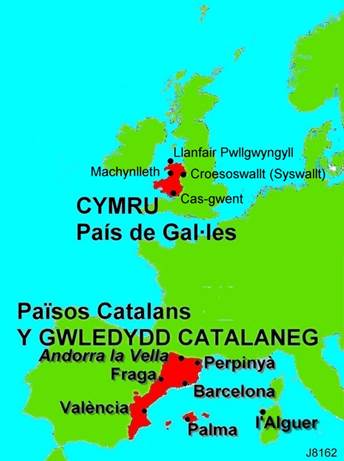
 B5237:
  ă ĕ ĭ ŏ ŭ
 yn
yn  aith δ δ £ U+2020 DAGGER †