|
|
|
|
(delwedd F6851) (tudalen 100)
|
100 English
Element in Welsh [chapter hi. § 17
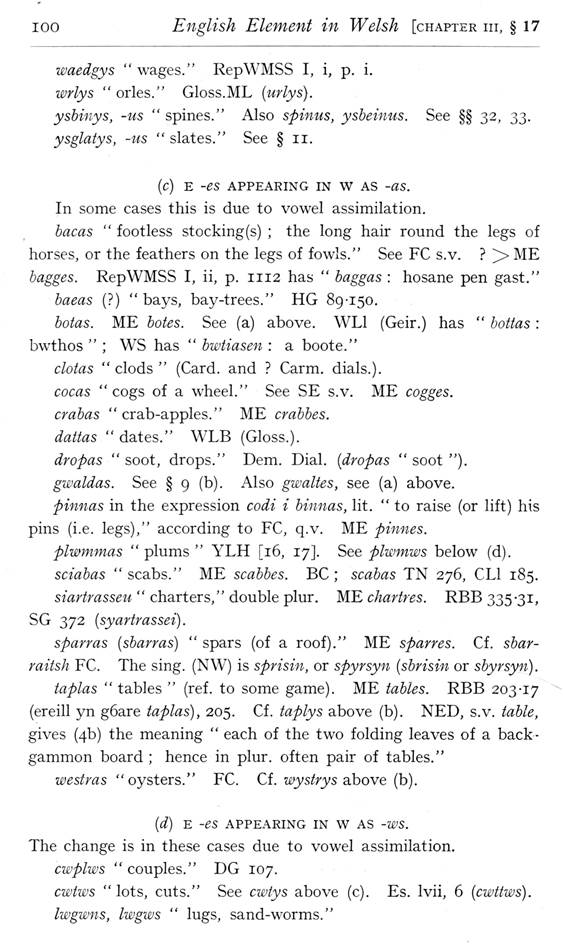
waedgys “wages." RepWMSS I, i, p. i.
wrlys “orles." Gloss. ML (urlys).
yshinys, -us “spines." Also spinus, ysbeinus. See §§ 32, ^^.
ysglatys, -us “slates." See § 11.
(c) E -es APPEARING IN W AS -US.
In some cases this is due to vowel assimilation.
bacas “footless stocking(s); the long hair round the legs of horses, or the
feathers on the legs of fowls." See FC s.v.? ^ ME hagges. RepWMSS I, ii,
p. 1112 has “baggas: hosane pen gast."
baeas (?) “bays, bay-trees." HG 89-150.
botas. ME botes. See (a) above. WLl (Geir.) has “bottas: bwthos”; WS has
“bwtiasen: a boote."
clotas “clods” (Card, and? Carm. dials.).
cocas "cogs of a wheel." See SE s.v. ME cogges.
crabas “crab-apples." ME crabbes.
dattas “dates." WLB (Gloss.).
dropas “soot, drops." Dem. Dial, {dropas “soot ").
gwaldas. See § 9 (b). Also gwaltes, see (a) above.
pinnas in the expression codi i binnas, lit. “to raise (or lift) his pins
(i.e. legs)," according to FC, q.v. ME pinnes.
plwmmas “plums “YLH [16, 17]. See plwmws below (d).
sciabas “scabs." ME scabbes. BC; scabas TN 276, CLl 185,
siartrasseu “charters," double plur. ME chartres. RBB 335-31, SG 372
[syartrassei).
span as {sbarras) “spars (of a roof)." ME sparres. Cf. sbarraitsh FC.
The sing. (NW) is sprisin, or spyrsyn [sbvisin or sbyrsyn).
taplas “tables” (ref. to some game). ME tables. RBB 203-17 (ereill yn g6are
taplas), 205. Cf. taplys above (b). NED, s.v. table, gives (4b) the meaning
“each of the two folding leaves of a backgammon board; hence in plur. often
pair of tables,"
westras "oysters." FC. Cf. ^e'jys^rys above (b).
[d) E -es APPEARING IN W AS -WS.
The change is in these cases due to vowel assimilation. cwplws
“couples." DG 107.
cwtws “lots, cuts." See cwtys above (c). Es. Ivii, 6 (cwttws). Iwgwns,
Iwgws “lugs, sand- worms."
|
|
|
|
|
(delwedd F6852) (tudalen 101)
|
CHAPTER
III, § 17] Middle and New English Vowels loi
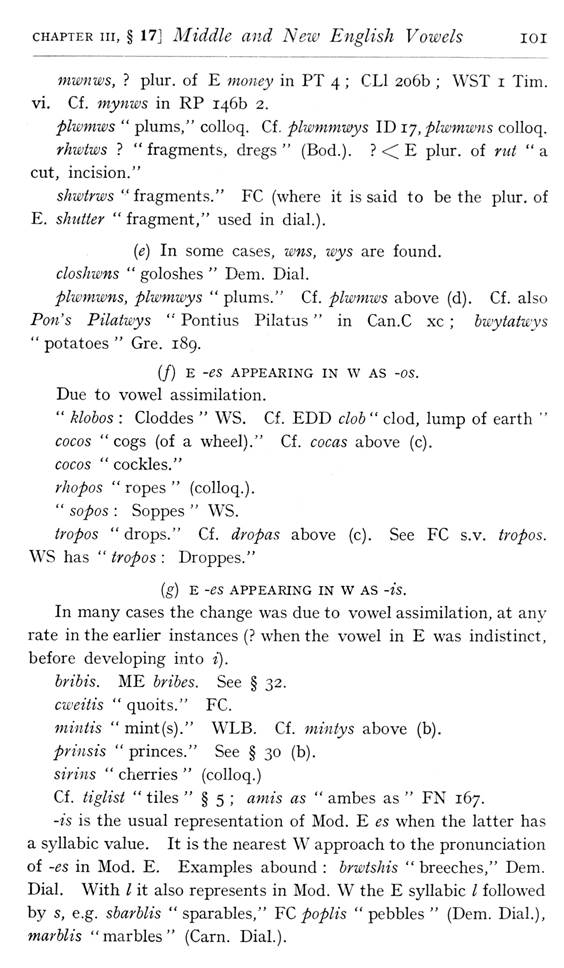
mwnws,? plur. of E money in PT 4; CLl 206b; WST i Tim. vi. Cf. mynws in RP
146b 2.
piwmws “plums," colloq. Cf, phmnmwys ID iy,plwmwns colloq.
rhwtws? "fragments, dregs" (Bod.).? <! E plur, of rut "a
cut, incision."
shwtrws "fragments." FC (where it is said to be the plur, of E.
shutter “fragment," used in dial,).
{e) In some cases, wns, wys are found.
closhwns “goloshes “Dem. Dial.
plwmwns, plwmwys “plums." Cf. piwmws above (d). Cf. also Pon's Pilatwys
“Pontius Pilatus “in Can.C xc; hwytatwys “potatoes “Gre. 189.
(/) E -es APPEARING IN W AS -OS.
Due to vowel assimilation.
" klobos: Cloddes “WS. Cf. EDD dob “clod, lump of earth “cocos “cogs (of
a wheel)." Cf. cocas above (c). cocos “cockles." rhopos “ropes”
(colloq.), “sopos: Soppes “WS.
tropos “drops." Cf. dropas above (c). See FC s,v, tropos. WS has
“tropos: Droppes."
(g) E -es APPEARING IN W AS -is.
In many cases the change was due to vowel assimilation, at any rate in the
earlier instances (? when the vowel in E was indistinct, before developing
into i).
bribis. ME bribes. See § 32.
cweitis “quoits." FC.
mintis “mint(s)." WLB. Cf. mintys above (b).
prinsis “princes." See § 30 (b).
sirins “cherries” (colloq.)
Cf. tiglist “tiles” § 5; amis as “ambes as “FN 167.
-is is the usual representation of Mod. E es when the latter has a syllabic
value. It is the nearest W approach to the pronunciation of -es in Mod. E.
Examples abound: brwtshis "breeches," Dem. Dial. With / it also
represents in Mod. W the E syllabic I followed by s, e.g. sbarblis
"sparables," ¥C poplis "pebbles" (Dem. Dial.), marblis
"marbles" (Carn. Dial.).
|
|
|
|
|
(delwedd F6853) (tudalen 102)
|
102 English
Element in Welsh [chapter hi, § 17
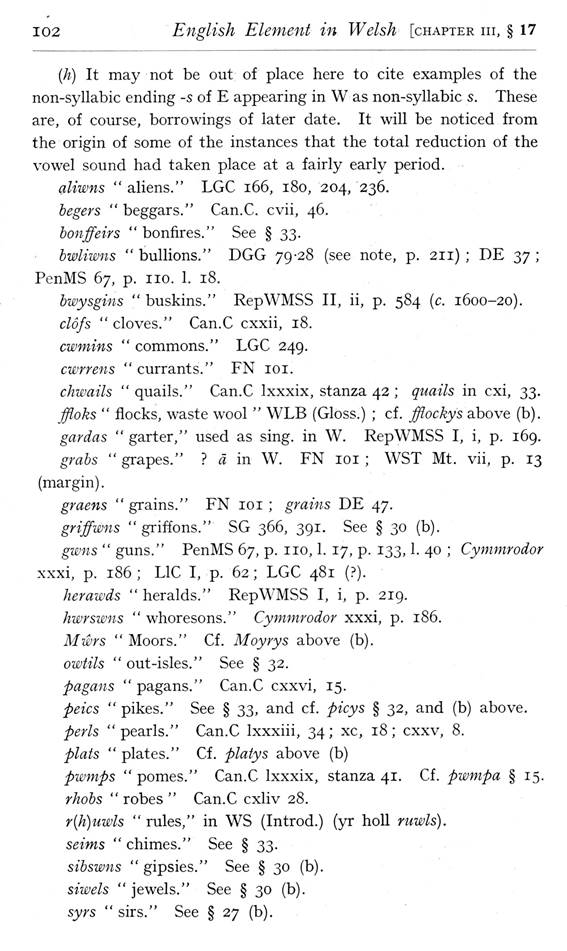
{h) It may not be out of place here to cite examples of the non-syllabic
ending -s of E appearing in W as non-syllabic s. These are, of course,
borrowings of later date. It will be noticed from the origin of some of the
instances that the total reduction of the vowel sound had taken place at a
fairly early period.
aliwns “aliens." LGC i66, i8o, 204, 236.
begers “beggars." Can.C. cvii, 46.
bonffeirs “bonfires." See § 33.
bwliwns “bullions." DGG 79-28 (see note, p. 211); DE 37; PenMS 67, p.
no. 1. 18.
bwysgins “buskins." RepWMSS II, ii, p. 584 (c. 1600-20).
clofs “cloves." Can.C cxxii, 18.
cwmins “commons." LGC 249.
cwrrens “currants." FN loi.
chwails “quails." Can.C Ixxxix, stanza 42; quails in cxi, 33.
ffloks “flocks, waste wool “WLB (Gloss.); cf. fflockys above (b).
gar das “garter," used as sing, in W. RepWMSS I, i, p. 169.
grabs “grapes."? a in W. FN loi; WST Mt. vii, p. 13 (margin) .
graens "grains." FN loi; grains DE 47.
griffwns “griffons." SG 366, 391. See § 30 (b).
gwns “guns." PenMS 67, p. no, 1. 17, p. 133, 1. 40; Cymmrodor xxxi, p.
186; Lie I, p. 62; LGC 481 (?).
herawds “heralds." RepWMSS I, i, p. 219.
hwrswns “whoresons." Cymmrodor xxxi, p. 186.
Mwrs “Moors." Cf. Moyrys above (b).
owtils “out-isles." See § 32.
pagans “pagans." Can.C cxxvi, 15.
peics “pikes." See § 33, and cf. picys § 32, and (b) above.
perls "pearls." Can.C Ixxxiii, 34; xc, 18; cxxv, 8.
plats “plates." Cf. platys above (b)
pwmps “pomes." Can.C Ixxxix, stanza 41. Cf. pwmpa § 15.
rhobs “robes “Can.C cxliv 28.
r{h)uwls “rules," in WS (Introd.) (yr hoU ruwls).
seims “chimes." See § 33.
sibswns “gipsies." See § 30 (b).
siwels “jewels." See § 30 (b).
syrs “sirs." See § 27 (b).
|
|
|
|
|
(delwedd F6854) (tudalen 103)
|
CHAPTER
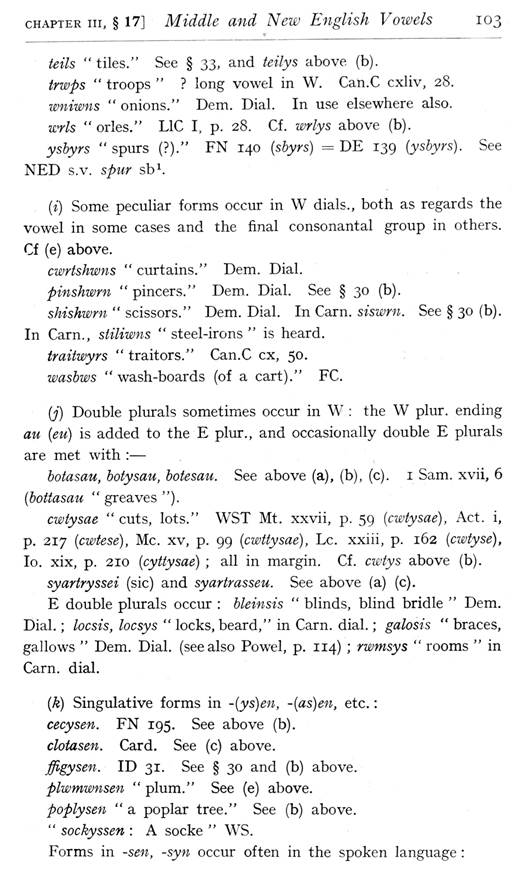
III, § 17] Middle and New English Vowels 103 teils “tiles." See § 33,
and teilys above (b). trwps “troops "? long vowel in W. Can.C cxliv, 28.
wniwns “onions." Dem. Dial. In use elsewhere also. wrls “orles."
LlC I. p. 28. Cf. wrlys above (b). yshyrs “spurs (?)." FN 140 {sbyrs) =
DE 139 {ysbyrs). See NED s.v. spur sb^.
{i) Some peculiar forms occur in W dials., both as regards the vowel in some
cases and the final consonantal group in others. Cf (e) above.
cwrtshwns “curtains." Dem. Dial.
pinshwrn “pincers." Dem. Dial. See § 30 (b).
shishwm “scissors." Dem. Dial. In Carn. siswrn. See § 30 (b). In Carn.,
stiliwns “steel-irons “is heard.
traitwyrs “traitors." Can.C ex, 50.
washws “wash-boards (of a cart)." EC.
ij) Double plurals sometimes occur in W: the W plur. ending au [eu) is added
to the E plur., and occasionally double E plurals are met with: —
hotasau, botysau, botesau. See above (a), (b), (c). i Sam. xvii, 6 {bottasau
“greaves ").
cwtysae “cuts, lots." WST Mt. xxvii, p. 59 [cwtysae), Act. i, p. 217
{cwtese), Mc. xv, p. 99 [cwttysae), Lc. xxiii, p. 162 [cwtyse), lo. xix, p.
210 {cyttysae); all in margin. Cf. cwtys above (b).
syartryssei (sic) and syartrasseu. See above (a) (c).
E double plurals occur: bleinsis “blinds, blind bridle “Dem. Dial.; locsis,
locsys “locks, beard," in Carn. dial.; galosis “braces, gallows “Dem.
Dial, (see also Powel, p. 114); rwmsys “rooms “in Carn. dial.
(k) Singulative forms in -{ys)en, -{as)en, etc.:
cecysen. FN 195. See above (b).
clotasen. Card. See (c) above.
ffigysen. ID 31. See § 30 and (b) above.
plwmwnsen “plum." See (e) above.
poplysen “a poplar tree." See (b) above.
" sockyssen: A socke “WS.
Forms in -sen, -syn occur often in the spoken language:
|
|
|
|
|
(delwedd F6855) (tudalen 104)
|
104 English
Element in Welsh [chapter hi, § 17
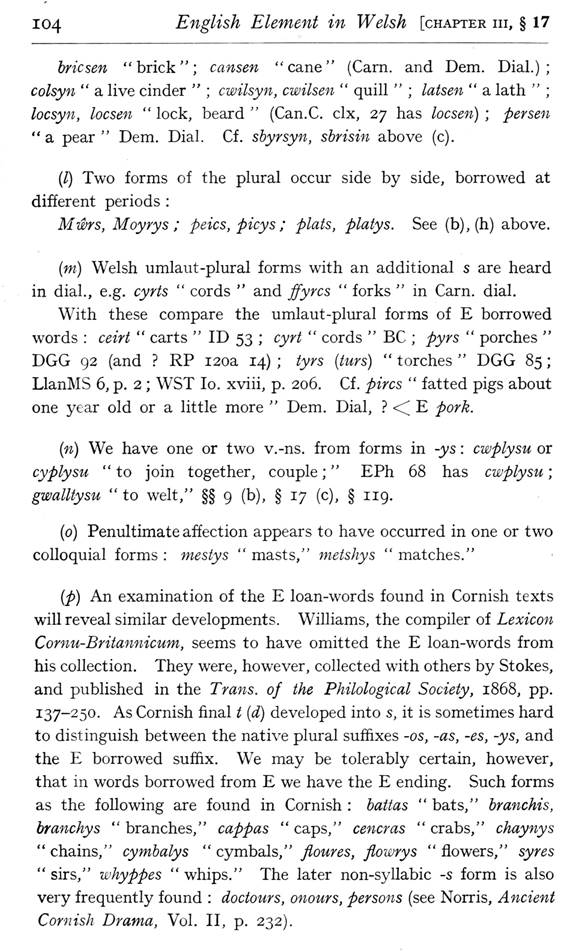
bricsen "brick"; cansen "cane" (Carn. and Dem. Dial.);
colsyn “a live cinder”; cwilsyn, cwilsen “quill”; latsen “a lath”; locsyn,
locsen “lock, beard” (Can.C. clx, 27 has locsen); persen "a pear “Dem.
Dial. Cf. sbyrsyn, shrisin above (c).
(/) Two forms of the plural occur side by side, borrowed at different
periods:
Mwrs, Moyrys; peics, picys; plats, platys. See (b), (h) above.
(m) Welsh umlaut-plural forms with an additional s are heard in dial., e.g. cyrts
“cords “and ffyrcs “forks “in Carn. dial.
With these compare the umlaut-plural forms of E borrowed words: ceirt “carts
“ID 53; cyrt “cords “BC; pyrs “porches “DGG 92 (and? RP 120a 14); iyrs {turs)
“torches “DGG 85; LlanMS 6, p. 2; WST lo. xviii, p. 206. Cf. pircs “fatted
pigs about one year old or a little more “Dem. Dial,? <C E pork.
(n) We have one or two v.-ns. from forms in -ys: cwplysu or cyplysu “to join
together, couple; “EPh 68 has cwplysu; gwalltysu “to welt," §§ 9 (b), §
17 (c), § 119.
(0) Penultimate affection appears to have occurred in one or two colloquial
forms: mestys “masts," metshys “matches."
{p) An examination of the E loan-words found in Cornish texts will reveal
similar developments. Williams, the compiler of Lexicon Cornu-Britannicum,
seems to have omitted the E loan-words from his collection. They were,
however, collected with others by Stokes, and published in the Trans, of the
Philological Society, 1868, pp. 137-250. As Cornish final t {d) developed
into s, it is sometimes hard to distinguish between the native plural
suffixes -os, -as, -es, -ys, and the E borrowed suffix. We may be tolerably
certain, however, that in words borrowed from E we have the E ending. Such
forms as the following are found in Cornish: battas “bats," branchis,
branchy s “branches," cappas “caps," cencras “crabs," chaynys
“chains," cymbalys “cymbals," flour es, flowrys “flowers,"
syres “sirs," whyppes “whips." The later non-syllabic -s form is
also very frequently found: doctours, otiours, persons (see Norris, Ancient
Cornish Drama, Vol. II, p. 232).
|
|
|
|
|
(delwedd F6856) (tudalen 105)
|
CHAPTER
III, §§18-20] Middle mid New English Vowels 105
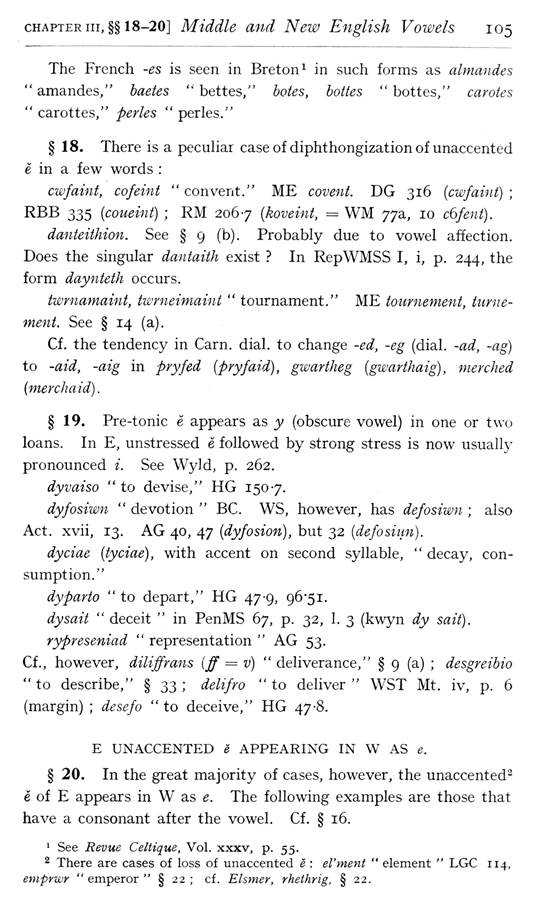
The French -es is seen in Breton^ in such forms as almandes “amandes,"
haetes “bettes," botes, hottes “bottes," carotes “carottes,"
perles “perles."
§ 18. There is a peculiar case of diphthongization of unaccented e in a few
words:
cwfaint, cofeint “convent." ME covent. DG 316 [cwfaint); RBB 335
(coueint); RM 2067 {koveint, = WM 77a, 10 c6fent).
danteithion. See § 9 (b). Probably due to vowel affection. Does the singular
dantaith exist? In RepWMSS I, i, p. 244, the form daynteth occurs.
twrnamaint, twrneimaint “tournament." ME tournement, turnement. See § 14
(a).
Cf. the tendency in Carn. dial, to change -ed, -eg (dial, -ad, -ag) to -aid,
-aig in pry fed [pry f aid), gwartheg {gwarthaig), merched {merchaid).
§ 19. Pre-tonic e appears as y (obscure vowel) in one or two loans. In E,
unstressed e followed by strong stress is now usually pronounced i. See Wyld,
p. 262.
dyvaiso “to devise," HG 1507.
dyfosiwn “devotion “BC. WS, however, has defosiwn; also Act. xvii, 13. AG 40,
47 {dyfosion), but 32 {defosiun).
dyciae [tyciae), with accent on second syllable, “decay, consumption."
dyparto “to depart," HG 47-9, 96-51,
dysait “deceit “in PenMS 67, p. 32, 1. 3 (kwyn dy sail).
rypreseniad “representation “AG 53. Cf., however, diliffrans iff = v)
“deliverance," § 9 (a); desgreibio “to describe," § 33; delifro “to
deliver “WST Mt. iv, p. 6 (margin); desefo "to deceive," HG 47-8.
E UNACCENTED e APPEARING IN W AS e.
§ 20. In the great majority of cases, however, the unaccented^ e of E appears
in W as e. The following examples are those that have a consonant after the
vowel. Cf. § 16.
1 See Revue Celtique, Vol. xxxv, p. 55.
2 There are cases of loss of unaccented e: el'ment “element “LGC 114, eniprwr
“emperor” § 22; cf. Elsmer, rhethrig, § 22.
|
|
|
|
|
(delwedd F6857) (tudalen 106)
|
io6 English
Element in Welsh [chapter hi, § 20
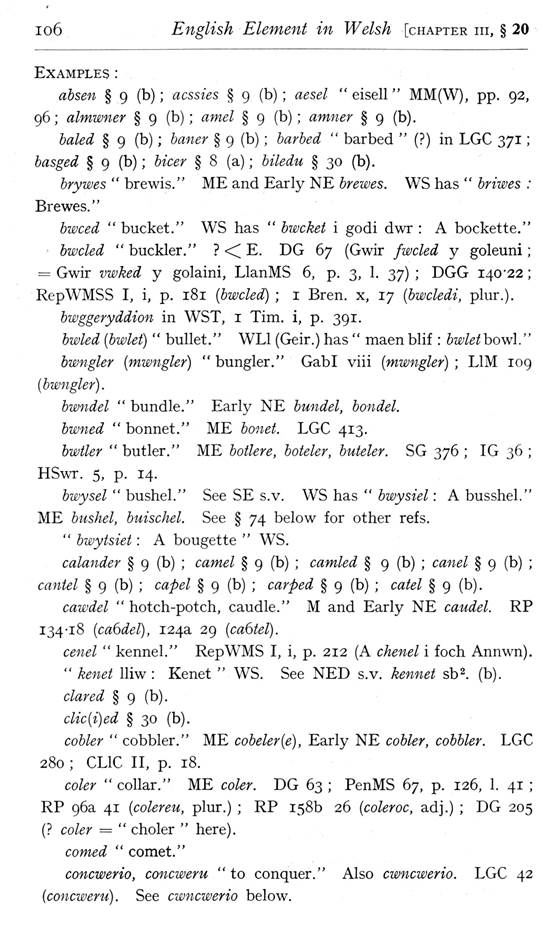
Examples:
ahsen § 9 (b); acssies § 9 (b); aesel “eisell “MM(W), pp. 92, 96; almwner § 9
(b); amel § 9 (b); amner § 9 (b).
haled § 9 (b); haner § 9 (b); barbed “barbed” (?) in LGC 371; basged § 9 (b);
bicer § 8 (a); biledu § 30 (b).
brywes “brewis." ME and Early NE brewes. WS has “briwes: Brewes."
bwced “bucket." WS has “bwcket i godi dwr: A bockette."
bwcled “buckler."? <] E. DG 67 (Gwir fwcled y goleuni; = Gwir vwked y
golaini, LlanMS 6, p. 3, 1. 37); DGG I40"22; RepWMSS I, i, p. 181
[bwcled); i Bren. x, 17 [hwcledi, plur.).
bwggeryddion in WST, i Tim. i, p. 391.
bwled [bwlet) “bullet." WLl (Geir.) has “maen blif: bwletho^l."
bwngler [mwngler) “bungler." GabI viii {mwngler); LIM 109 {bwngler).
bwndel “bundle." Early NE bundel, bondel.
bwned “bonnet." ME honet. LGC 413.
bwtler “butler." ME botlere, boteler, buteler. SG 376; IG 36; HSwr. 5,
p. 14.
bwy sel “hushel." See SE s.v. WS )i2iS “bwysiel: A busshel." ME
bushel, buischel. See § 74 below for other refs.
" bwytsiet: A bougette “WS.
calander § 9 (b); camel § 9 (b); camled § 9 (b); canel § 9 (b); caniel § 9
(b); capel § 9 (b); carped § 9 (b); catel § 9 (b).
cawdel “hotch-potch, caudle." M and Early NE caudel. RP 134-18 [ca6del),
124a 29 {cartel).
cenel “kennel." RepWMS I, i, p. 212 (A chenel i foch Annwn).
" kenet lliw: Kenet “WS. See NED s.v. kennet sb^. (b).
dared § 9 (b).
clic{i)ed § 30 (b).
cobler “cobbler." ME cobeler{e), Early NE cobler, cobbler. LGC 280; CLIC
n, p. 18.
coler “collar." ME coler. DG 63; PenMS 67, p. 126, 1. 41; RP 96a 41
[colereu, plur.); RP 158b 26 (coleroc, adj.); DG 205 (? coler = “choler
“here).
corned “comet."
concwerio, concweru “to conquer." Also cwncwerio. LGC 42 (concweru). See
cwncwerio below.
|
|
|
|
|
(delwedd F6858) (tudalen 107)
|
CHAPTER
III, § 20] Middle and New English Vowels 107
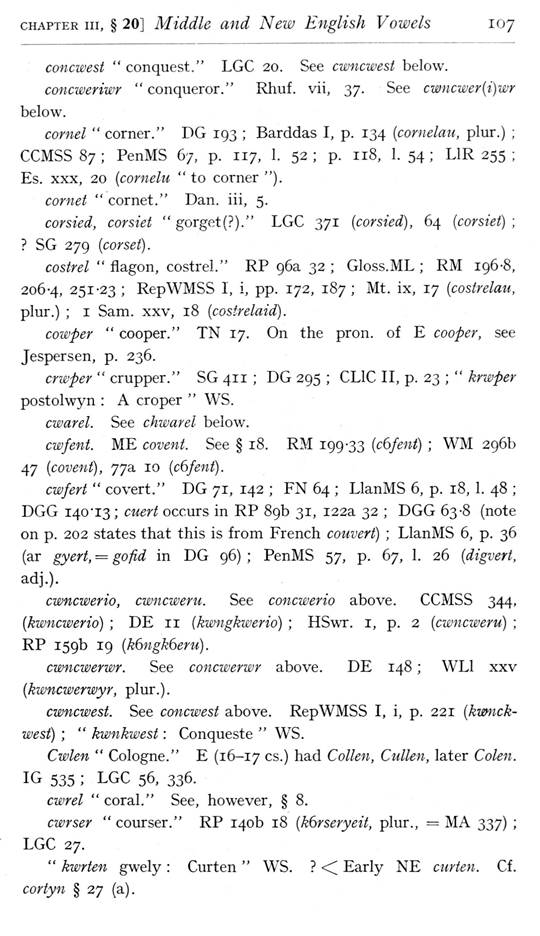
concwest “conquest." LGC 20. See cwncwest below.
concweriwr “conqueror." Rhuf. vii, 37. See cwncwer{i)wr below.
cornel “corner." DG 193; Barddas I, p. 134 {cornelau, plur.); CCMSS 87;
PenMS 67, p. 117, 1. 52; p. 118, 1. 54; LIR 255; Es. XXX, 20 [cornelu “to
corner ").
cornet “cornet." Dan. iii, 5.
corsied, corsiet “gorget(?)." LGC 371 [corsied), 64 {corsiet);? SG 279
{corset).
costrel “flagon, costrel." RP 96a 32; Gloss.ML; RM 196-8, 206-4, 251-23;
RepWMSS 1, i, pp. 172, 187; Mt. ix, 17 {costrelau, plur.); I Sam. xxv, 18
{costrelaid).
cowper “cooper." TN 17. On the pron. of E cooper, see Jespersen, p. 236.
crwper “crupper." SG 411; DG 295; CLIC II, p. 23; “krwper postolwyn: A
croper “WS.
cwarel. See chwarel beiov/.
cwfent. ME covent. See § 18. RM 199-33 {c6fent); WM 296b 47 {covent), 77a 10
{c6fent).
cwfert “covert." DG 71, 142; FN 64; LlanMS 6, p. 18, 1. 48; DGG
I40"i3; cuert occurs in RP 89b 31, 122a 32; DGG 63-8 (note on p. 202
states that this is from French convert); LlanMS 6, p. 36 (ar gyert, = gofid
in DG 96); PenMS 57, p. 67, 1. 26 {digvert,
adj.).
cwncwerio, cwncweru. See concwerio above. CCMSS 344, {kwncwerio); DE 11
{kwngkwerio); HSwr. i, p. 2 {cwncweru); RP 159b 19 {k6ngk6eru).
cwncwerwr. See concwerwr above. DE 148; WLl xxv {kwncwerwyr, plur.).
cwncwest. See concwest above. RepWMSS I, i, p. 221 {kwnckwest); “kwnkwest:
Conqueste “WS.
Cwlen “Cologne." E (16-17 cs.) had Collen, Cullen, later Colen. IG 535;
LGC 56. 336.
cwrel “coral." See, however, § 8.
cwrser “courser." RP 140b 18 {k6rseryeit, plur., = MA 337); LGC 27.
" kwrten gwely: Curten “WS.? <^ Early NE curten. Cf. cortyn § 27 (a).
|
|
|
|
|
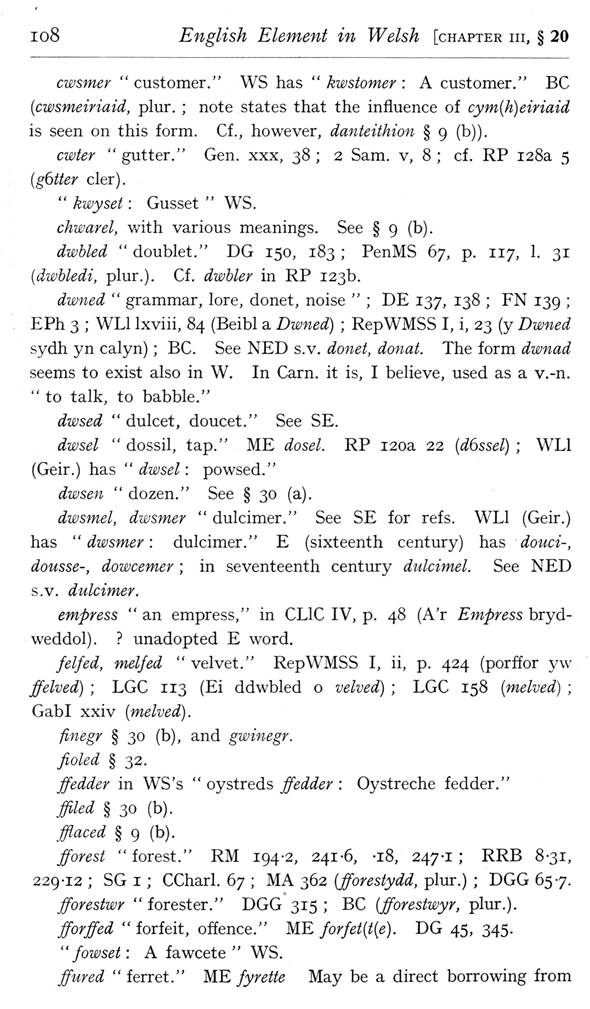
(delwedd F6859) (tudalen 108)
|
io8 English
Element in Welsh [chapter hi, § 20
cwsmer “customer." WS has “kwstomer: A customer." BC [cwsmeiriaid,
plur.; note states that the influence of cym{h)eiriaid is seen on this form.
Cf., however, danteithion § 9 (b)).
cwter “gutter." Gen. xxx, 38; 2 Sam. v, 8; cf. RP 128a 5 {g6Uer cler).
" kwyset: Gusset “WS.
chwarel, v/ith various meanings. See § 9 (b).
dwbled “doublet." DG 150, 183; PenMS 67, p. 117, 1. 31 {dwhledi, plur.).
Cf. dwhler in RP 123b.
dwned “grammar, lore, donet, noise”; DE 137, 138; FN 139; EPh 3; WLl Ixviii,
84 (Beibl a Dwned); RepWMSS I, i, 23 (y Dwned sydh yn calyn); BC. See NED
s.v. donet, donat. The form dwnad seems to exist also in W. In Carn. it is, I
believe, used as a v.-n. “to talk, to babble."
dwsed “dulcet, doucet." See SE.
dwsel “dossil, tap." ME dosel. RP 120a 22 [d6ssel); WLl (Geir.) has
“dwsel: powsed."
dwseji “dozen." See § 30 (a).
dwsmel, dwsmer “dulcimer." See SE for refs. WLl (Geir.) has
"dwsmer: dulcimer." E (sixteenth century) has douci-, dousse-,
dowcemer; in seventeenth century dulcimel. See NED s.v. dulcimer.
empress “an empress," in CLIC IV, p. 48 (A'r Empress brydweddol).?
unadopted E word,
felfed, melfed “velvet." RepWMSS I, ii, p. 424 (porffor yw ffelved); LGC
113 (Ei ddwbled o velved); LGC 158 (melved); GabI xxiv [melved).
finegr § 30 (b), and gwinegr.
fioled § 32.
ffedder in WS's “oystreds ffedder: Oystreche fedder."
filed § 30 (b).
fflaced § 9 (b).
forest "forest." RM 194-2, 241-6, -18, 247-1; RRB 8-31, 229-12; SG
I; CCharl. 67; MA 362 (fforestydd, plur.); DGG 65-7.
fforestwr “forester." DGG 315; BC (fforestwyr, plur.).
fforffed “forfeit, offence." ME forfet{t{e). DG 45, 345.
" fowset: A fawcete “WS.
ffured "ferret." ME fyrette May be a direct borrowing from
|
|
|
|
|
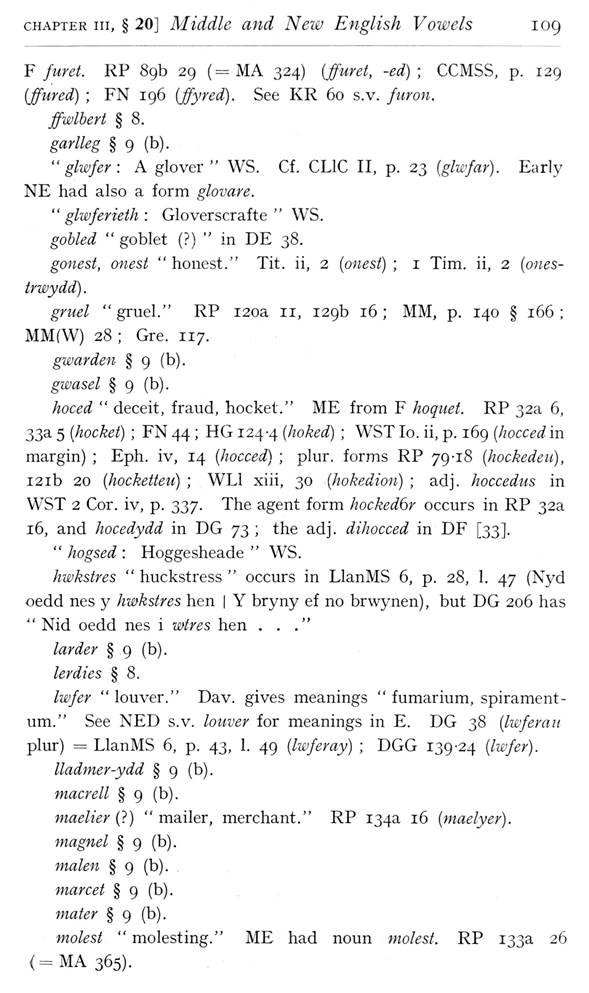
(delwedd F6860) (tudalen 109)
|
CHAPTER
III, § 20] Middle and New English Vowels 109
¥ furet. RP 89b 29 (= MA 324) [ffuret, -ed); CCMSS, p. 129 {ffured); FN 196
(Jfyred). See KR 60 s.v. furon.
ffwlhert § 8.
garlleg § 9 (b).
" glwfer: A glover" WS. Cf. CLIC II, p. 23 (glu'far). Early NE had
also a form glovare.
" glwfer ieth: Gloverscrafte “WS.
gobled “goblet (?) “in DE 38.
gonest, onest “honest." Tit. ii, 2 (onesi); i Tim. ii, 2 {onestrwydd).
gruel "gruel." RP 120a 11, 129b 16; MM, p. 140 § 166: MMfW) 28;
Gre. 117.
gwarden § 9 (b),
gwasel § 9 (b).
hoced “deceit, fraud, hocket." ME from F hoquet. RP 32a 6, 33a 5
(hocket); FN 44; HG 124-4 (hoked); WST lo. ii, p. 169 {hocced in margin);
Eph. iv, 14 (hocced); plur. forms RP 79-18 (hockeden), I2ib 20 (hocketteu);
WLl xiii, 30 (hokedion); adj. hoccedus in WST 2 Cor. iv, p. 337. The agent
form hocked6r occurs in RP 32a 16, and hocedydd in DG 73; the adj. dihocced
in DF [33].
" hogsed: Hoggesheade “WS.
hwkstres “huckstress “occurs in LlanMS 6, p. 28, 1. 47 (Nyd oedd nes y hwkstres
hen | Y bryny ef no brwynen), but DG 206 has “Nid oedd nes i wtres hen
..."
larder § 9 (b).
lerdies § 8.
Iwfer “louver." Dav. gives meanings “fumarium, spiramentum." See
NED s.v. louver for meanings in E. DG 38 (Iwferau plur) = LlanMS 6, p. 43, 1.
49 (Iwferay); DGG 139-24 (Iwfer).
lladmer-ydd § 9 (b).
macrell § 9 (b).
maelier (?) “mailer, merchant." RP 134a 16 (maelyer).
magnel § 9 (b).
nialen § 9 (b).
marcet § 9 (b).
7nater § 9 (b).
molest “molesting." ME had noun molest. RP 133a 26 (=MA365).
|
|
|
|
|
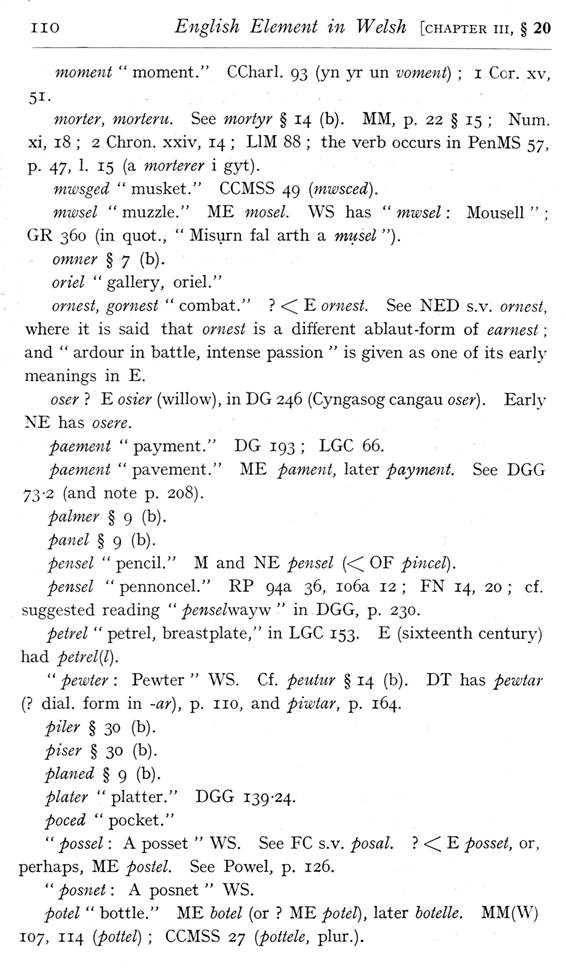
(delwedd F6861) (tudalen 110)
|
no English
Element in Welsh [chapter m, § 20
moment “moment." CCharl. 93 (yn yr un voment); i Ccr. xv,
51-
morter, mortem. See martyr § 14 (b). MM, p. 22 § 15; Num.
xi, 18; 2 Chron. xxiv, 14; LIM ^?>; the verb occurs in PenMS 57,
p. 47, 1. 15 (a morter er i gyl).
mwsged “musket." CCMSS 49 (mwsced).
mwsel "muzzle." ME mo set. WS has “mwsel: Mousell”; GR 360 (in
quot., “Misurn fal arth a musel "). omner § 7 (b). oriel "gallery,
oriel."
ornest, gornest “combat."? <C E ornest. See NED s.v. ornest, where it
is said that ornest is a different ablaut -form of earnest; and “ardour in
battle, intense passion “is given as one of its early meanings in E.
oser? E osier (willow), in DG 246 (Cyngasog cangau oser). Early NE has osere.
Paement “payment." DG 193; LGC 66. paement “pavement." ME pament,
later payment. See DGG 73-2 (and note p. 208). palmer § 9 (b). panel § 9 (b).
pensel “pencil." M and NE pensel (<^ OF pinceT). pensel
“pennoncel." RP 94a 36, io6a 12; FN 14, 20; cf. suggested reading “penselwa.y\v
“in DGG, p. 230.
petrel “petrel, breastplate," in LGC 153. E (sixteenth century) had
petrel{l).
"pewter: Pewter “WS. Cf. peutur § 14 (b). DT has pewtar (? dial, form in
-ar), p. no, and piwtar, p. 164. piler § 30 (b). piser § 30 (b). planed § 9
(b).
plater “platter." DGG 139-24. poced “pocket."
" possel: A posset “WS. See FC s.v. posal.? <I E posset, or, perhaps,
ME postel. See Powel, p. 126. “posnet: A posnet “WS.
potel “bottle." ME hotel (or? ME potel), later hotelle. MM(W) 107, 114
{pottel); CCMSS 27 [pottele, plur.).
|
|
|
|
|
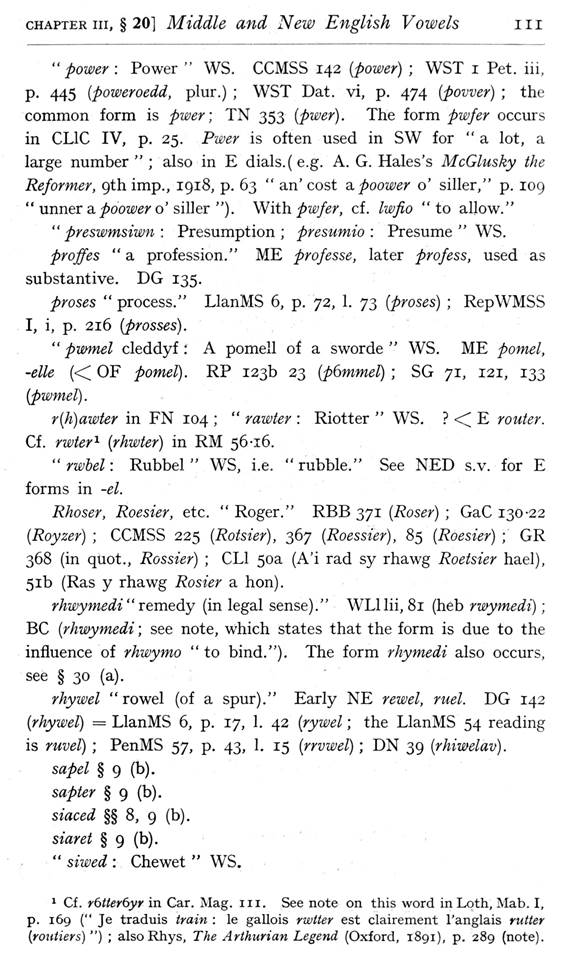
(delwedd F6862) (tudalen 111)
|
CHAPTER
III, § 20] Middle and New English Vowels iii
"power: Power “WS. CCMSS 142 [power); WST i Pet. iii, p. 445 [poweroedd,
plur.); WST Dat. vi, p. 474 [power); the common form is pwer; TN 353 [pwer).
The form pwfer occurs in CLIC IV, p. 25. Pwer is often used in SW for “a lot,
a large number”; also in E dials. (e.g. A. G. Hales's McGlusky the Reformer,
9th imp., 1918, p. 63 “an' cost a.poower o' siller," p. 109 “unner a
_^ooz£^ero' siller "), With pwfer, cf. Iwfio "to allow."
" preswmsiwn: Presumption; presumio: Presume" WS.
proffes “a profession." ME prof esse, later profess, used as
substantive. DG 135.
proses “process." LlanMS 6, p. 72, 1. 73 [proses); RepWMSS I, i, p. 216
[prosses).
" pwmel cleddyf: A pomell of a sworde “WS. ME pomel, -elk (<< OF
pomel). RP 123b 23 [pGmmel); SG 71, 121, 133 [pwmel) .
r[h)awter in FN 104; “rawter: Riotter “WS.? <C E router. Cf. rwter^
[rhwter) in RM 56-16.
"rwbel: Rubbel “WS, i.e. "rubble." See NED s.v. for E forms in
-el.
Rhoser, Roesier, etc. “Roger." RBB 371 [Roser); GaC 130-22 [Royzer);
CCMSS 225 [Rotsier), 367 [Roessier), 85 [Roesier); GR 368 (in quot.,
Rossier); CLl 50a (A'i rad sy rhawg Roetsier hael), 51b (Ras y rhawg Rosier a
hon).
rhwymedi “remedy (in legal sense)." WLllii, 81 (heb rwymedi); BC
{rhwymedi; see note, which states that the form is due to the influence of
rhwymo “to bind."). The form rhymedi also occurs, see § 30 (a).
rhywel "rowel (of a spur)." Early NE rewel, niel. DG 142 [rhywel) =
LlanMS 6, p. 17, 1. 42 [rywel; the LlanMS 54 reading is ruvel); PenMS 57, p.
43, 1. 15 [rrvwel); DN 39 [rhiwelav).
sapel § 9 (b).
sapter § 9 (b).
siaced §§ 8, 9 (b).
siaret § 9 (b).
" siwed: Chewet “WS.
1 Cf. r6tier6yr in Car. Mag. iii. See note on this word in Loth, Mab. I, p.
169 (" Je traduis train: le gallois rwtter est clairement I'anglais
rtdter {rouiiers) "); also Rhys, The Arthurian Legend (Oxford, 1891), p.
289 (note).
|
|
|
|
|
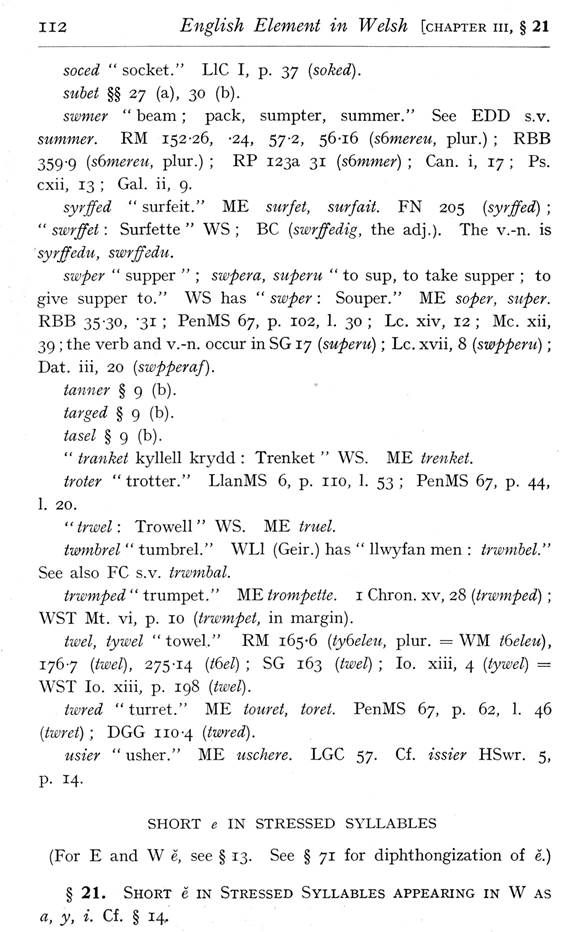
(delwedd F6863) (tudalen 112)
|
112 English
Element in Welsh [chapter hi, § 21
soced “socket." LlC I, p. 37 (soked).
subet §§ 27 (a), 30 (b).
swmer “beam; pack, sumpter, summer." See EDD s.v. summer. RM 152-26,
-24, 57-2, 56-16 {s6mereu, plur.); RBB 359-9 {sGmereu, plur.); RP 123a 31
[sGmmer); Can. i, 17; Ps. cxii, 13; Gal. ii, 9.
syrffed “surfeit." ME surfet, surf ait. FN 205 [syrffed); “swrffet:
Surfette “WS; BC {swrffedig, the adj.). The v.-n. is syrffedu, swrffedu.
swper “supper”; swpera, superu “to sup, to take supper; to give supper
to." WS has "swper: Souper." ME soper, super. RBB 35-30, -31;
PenMS 67, p. 102, 1. 30; Lc. xiv, 12; Mc. xii, 39; the verb and v.-n. occur
in SG 17 (superu); Lc. xvii, 8 [swpperu); Dat. iii, 20 [swpperaf).
tanner § 9 (b). *
targed § 9 (b).
tasel § 9 (b).
" tranket kyllell krydd: Trenket “WS. ME trenket.
troter “trotter." LlanMS 6, p. no, 1. 53; PenMS 67, p. 44, 1. 20.
"trwel: Trowell “WS. ME truel.
twmbrel “tumbrel." WLl (Geir.) has “llwyfan men: trwmbel." See also
EC s.v. trwmbal.
trwmped “trumpet." ME trompette. i Chron. xv, 28 (trwmped); WST Mt. vi,
p. 10 [trwmpet, in margin).
twel, tywel "towel." RM 165-6 (tyGeleu, plur. = WM t6eleu), 176-7
{twel), 275-14 (tGel); SG 163 (twel); lo. xiii, 4 (tywel) = WST lo. xiii, p.
198 (twel).
twred "turret." ME touret, toret. PenMS 67, p. 62, 1. 46 (twret);
DGG no -4 (twred).
usier “usher." ME uschere. LGC 57. Cf. issier HSwr. 5, p. 14.
SHORT e IN STRESSED SYLLABLES (For E and W e, see § 13. See § 71 for
diphthongization of e.)
§ 21. Short e in Stressed Syllables appearing in W as a, y, i. Cf. § 14.
|
|
|
|
|
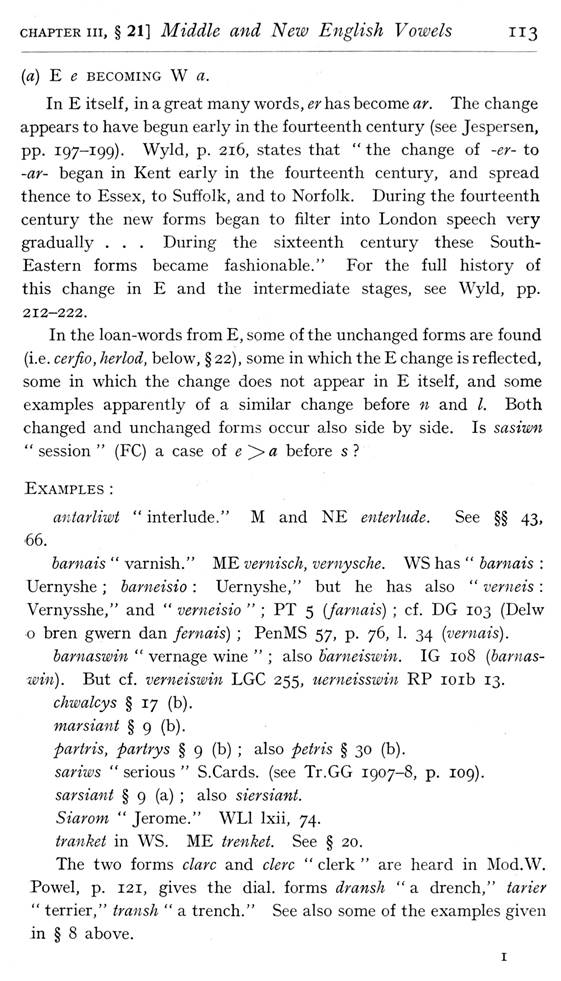
(delwedd F6864) (tudalen 113)
|
CHAPTER
III, § 21] Middle and New English Vowels 113
{a) E e BECOMING W a.
In E itself, in a great many words, er has become ar. The change appears to
have begun early in the fourteenth century (see Jespersen, pp. 197-199).
Wyld, p. 216, states that "the change of -er- to -ar- began in Kent
early in the fourteenth century, and spread thence to Essex, to Suffolk, and
to Norfolk. During the fourteenth century the new forms began to filter into
London speech very gradually . . . During the sixteenth century these
South-Eastern forms became fashionable." For the full history of this
change in E and the intermediate stages, see Wyld, pp. 212-222.
In the loan-words from E, some of the unchanged forms are found (i.e. cerfio,
herlod, below, § 22), some in which the E change is reflected, some in which
the change does not appear in E itself, and some examples apparently of a
similar change before n and /. Both changed and unchanged forms occur also
side by side. Is sasiwn “session” (FC) a case oi e'^a before s?
Examples:
antarliwt “interlude." M and NE enterlude. See §§ 43, 66.
harnais “varnish." ME vernisch, vernysche. WS has “harnais: Uernyshe;
harneisio: Uernyshe," but he has also “verneis: Vernysshe," and
“verneisio”; PT 5 (farnais); cf. DG 103 (Delw o bren gwern dan fernais);
PenMS 57, p. 76, 1. 34 [vernais).
barnaswin “vernage wine”; also harneiswin. IG 108 {harnaswin). But cf.
verneiswin LGC 255, uerneisswin RP loib 13.
chwalcys § 17 (b).
marsiant § 9 (b).
partris, partrys § 9 (b); also petris § 30 (b).
sariws “serious “S. Cards, (see Tr.GG 1907-8, p. 109).
sarsiant § 9 (a); also siersiant.
Siarom “Jerome." WLl Ixii, 74.
tranket in WS. ME trenket. See § 20.
The two forms dare and clerc “clerk “are heard in Mod.W. Powel, p. 121, gives
the dial, forms dransh “a drench," tarier “terrier," transh “a
trench." See also some of the examples given in § 8 above.
I
|
|
|
|
|
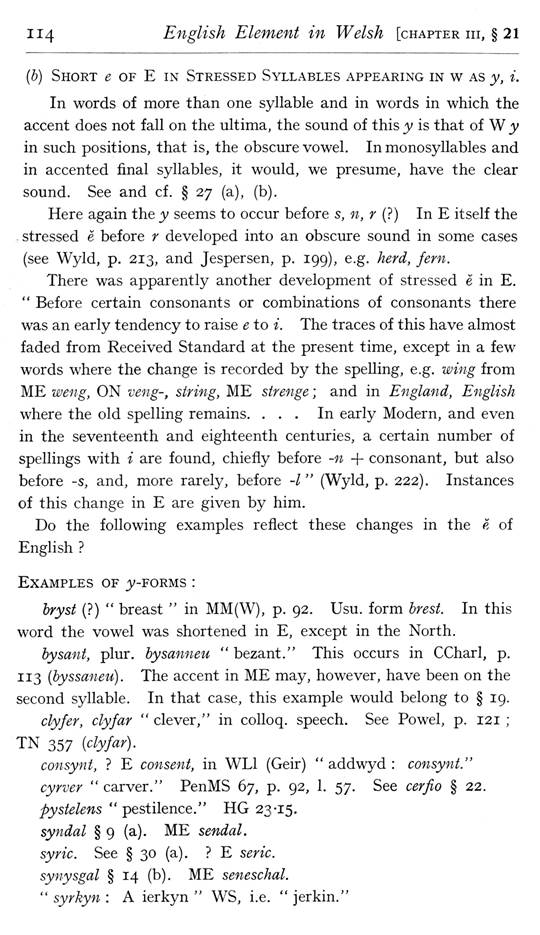
(delwedd F6865) (tudalen 114)
|
114 English
Element in Welsh [chapter hi, § 21
{h) Short g of E in Stressed Syllables appearing in w as y, i.
In words of more than one syllable and in words in which the accent does not
fall on the ultima, the sound of this y is that of W jy in such positions,
that is, the obscure vowel. In monosyllables and in accented final syllables,
it would, we presume, have the clear sound. See and cf. § 27 (a), (b).
Here again the y seems to occur before s, n, r (?) In E itself the stressed e
before r developed into an obscure sound in some cases (see Wyld, p. 213, and
Jespersen, p. 199), e.g. herd, fern.
There was apparently another development of stressed e in E. “Before certain
consonants or combinations of consonants there was an early tendency to raise
e to i. The traces of this have almost faded from Received Standard at the
present time, except in a few words where the change is recorded by the
spelling, e.g. wing from ME weng, ON veng-, siring, ME strenge; and in
England, English where the old spelling remains. ... In early Modern, and
even in the seventeenth and eighteenth centuries, a certain number of
spellings with i are found, chiefly before -n + consonant, but also before
-s, and, more rarely, before -/” (Wyld, p. 222). Instances of this change in
E are given by him.
Do the following examples reflect these changes in the e of English?
Examples of ^/-forms:
bryst (?) “breast “in MM(W), p. 92. Usu. form brest. In this word the vowel
was shortened in E, except in the North.
bysant, plur. bysanneu “bezant." This occurs in CCharl, p. 113
(byssaneu). The accent in ME may, however, have been on the second syllable.
In that case, this example would belong to § 19.
clyfer, clyfar “clever," in colloq. speech. See Powel, p. 121; TN 357
[clyfar).
consynt,? E consent, in WLl (Geir) “addwyd: consynt."
cyrver “carver." PenMS 67, p. 92, 1. 57. See cerfio § 22.
pystelens "pestilence." HG 23-15.
syndal § 9 (a). ME sendal.
syric. See § 30 (a).? E seric.
synysgal § 14 (b). ME seneschal.
" syrkyn: A ierkyn “WS, i.e. “jerkin."
|
|
|
|
|
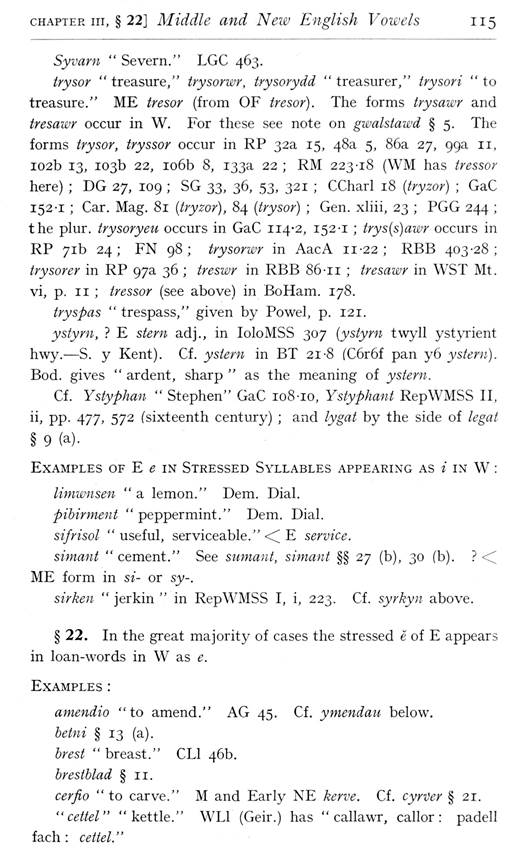
(delwedd F6866) (tudalen 115)
|
CHAPTER
III, § 22] Middle and New English Vowels 115
Syvarn “Severn." LGC 463.
trysor “treasure," trysorwr, trysorydd “treasurer," try sort “to
treasure." ME iresor (from OF tresor). The forms trysawr and tresawr
occur in W. For these see note on gwalsiawd § 5. The forms trysor, tryssor
occur in RP 32a 15, 48a 5, 86a 27, 99a 11, 102b 13, 103b 22, io6b 8, 133a 22;
RM 223-18 (WM has tressor here); DG 27, 109; SG 33, 36, 53, 321; CCharl 18
(tryzor); GaC 152-1; Car. Mag. 81 {tryzor), 84 (trysor); Gen. xHii, 23; PGG
244; the plur. trysoryeu occurs in GaC 114-2, 152-1; trys{s)awr occurs in RP
71b 24; FN 98; trysorwr in AacA 11-22; RBB 403-28; try sorer in RP 97a 36;
treswr in RBB 86-11; tresawr in WST Mt. vi, p. II; tressor (see above) in
BoHam. 178.
tryspas “trespass," given by Powel, p. 121.
ystyrn,? E stern adj., in loloMSS 307 [ystyrn twyll yst^^rient hwy. — S. y
Kent). Cf. y stern in BT 21 -8 (C6r6f pan y6 y stern). Bod. gives “ardent,
sharp “as the meaning of ystern.
Cf. Ystyphan “Stephen" GaC 108 -lo, Ystyphant RepWMSS II, ii, pp. 477,
572 fsixteenth century); and lygat by the side of legat § 9 (a).
Examples of E e in Stressed Syllables appearing as i in W:
limwnsen “a lemon." Dem. Dial. pihirment “peppermint." Dem. Dial.
sifrisol “useful, serviceable." <^ E service, simant “cement."
See sumant, simant §§ 27 (b), 30 (b).? <^ ME form in si- or sy-.
sirkeji “jerkin “in RepWMSS I, i, 223. Cf. syrkyn above.
§ 22. In the great majority of cases the stressed e of E appears in
loan-words in W as e.
Examples:
amendio "to amend." AG 45. Cf. ymeridau below. hetni § 13 (a).
hrest "breast." CLl 46b. brestblad § 11.
cerfio “to carve." M and Early NE kerve. Cf. cyrver § 21.
"cettel" "kettle." WLl (Geir.) has “callawr, callor:
padell fach: cettel."
|
|
|
|
|
(delwedd F6867) (tudalen 116)
|
ii6 English
Element in Welsh [chapter in, § 22
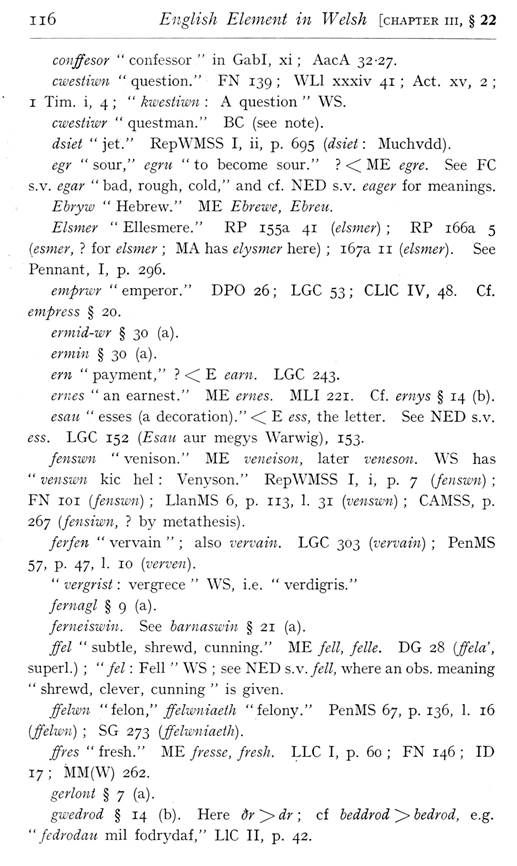
conffesoY “confessor “in GabI, xi; AacA 32-27.
cwestiwn “question." FN 139; WLl xxxiv 41; Act. xv, 2; I Tim. i, 4;
“kwestiwn: A question “WS.
cwestiwr “questman." BC (see note).
dsiet “jet." RepWMSS I, ii, p. 695 {dsiet: Muchvdd).
egr “sour," egru “to become sour."? <; ME egre. See FC s.v. egar
"bad, rough, cold," and cf. NED s.v. eager for meanings.
Ehryw “Hebrew." ME Ebrewe, Ebreu.
Elsmer “Ellesmere." RP 155a 41 (elsmer); RP i66a 5 (esmer,? for elsmer;
MA has elysmer here); 167a 11 (elsmer). See Pennant, I, p. 296.
emprii'r "emperor." DPO 26; LGC 53; CLIC IV, 48. Cf. empress § 20.
ermid-wr § 30 (a).
ermin § 30 (a).
em “payment,"? <C E earn. LGC 243.
ernes “an earnest." ME ernes. MLI 221. Cf. ernys § 14 (b).
esau “esses (a decoration)." <^ E ess, the letter. See NED s.v. ess.
LGC 152 {Esau aur megys Warwig), 153.
fenswn “venison." ME veneison, later veneson. WS has “venswn kic hel:
Venyson." RepWMSS I, i, p. 7 {fenswn); FN loi {fenswn); LlanMS 6, p.
113, 1. 31 {venswn); CAMSS, p. 267 {fensiwn,? by metathesis).
f erf en “vervain”; also vervain. LGC 303 {vervain); PenMS 57, p. 47, 1. 10
{verven).
" vergrist: vergrece “WS, i.e. “verdigris."
fernagl § 9 (a).
ferneiswin. See harnaswin § 21 (a).
/^/ “subtle, shrewd, cunning." ME fell, felle. DG 28 {ffela' , superl.);
“fel: Fell “WS; see NED s.v. fell, where an obs. meaning “shrewd, clever,
cunning “is given.
ffelwn "felon," ffelwniaeth "felony." PenMS 67, p. 136,
1. 16 {ffelwn); SG 273 {ffelwniaeth).
ffres “fresh." ME fresse, fresh. LLC I, p. 60; FN 146; ID 17; MM(W) 262.
gerlo7it § 7 (a).
gwedrod § 14 (b). Here dr^dr; cf beddrod ^ bedrod, e.g. “fedrodau mil
fodrydaf," LlC II, p. 42.
|
|
|
|
|
(delwedd F6868) (tudalen 117)
|
CHAPTER
III, § 22] Middle and New English Vowels ii.j
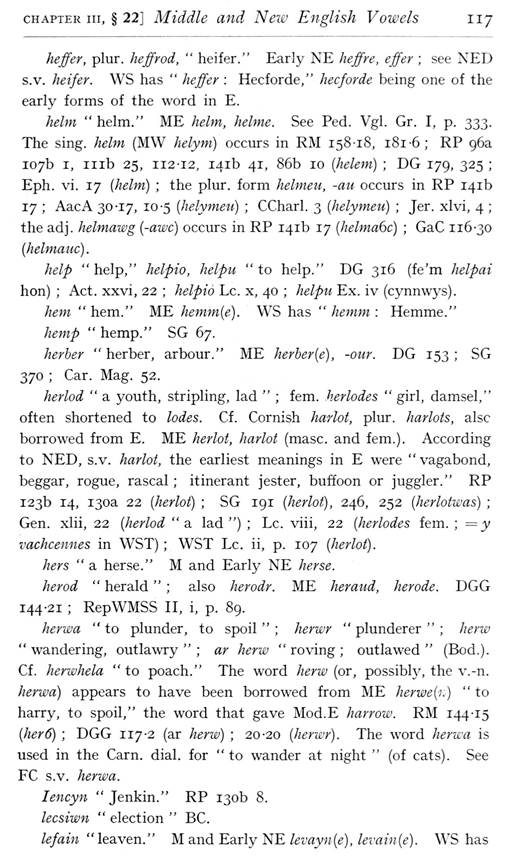
heffer, plur. heffrod, “heifer." Early NE heffre, effer; see NED s.v.
heifer. WS has “heffer: Hecforde," hecforde being one of the early forms
of the word in E.
helm “helm." ME helm, helme. See Ped. Vgl. Gr. I, p. 333. The sing, helm
(MW helym) occurs in RM 158-18, 181 -6; RP 96a 107b I, iiib 25, II2-I2, 141b
41, 86b 10 [helem]; DG 179, 325; Eph. vi. 17 {lielm); the plur. form helmeii,
-au occurs in RP 141b 17; AacA 30-17, 10-5 [helymeu); CCharl. 3 (helymeu);
Jer. xlvi, 4; the adj. helmawg {-awe) occurs in RP 141b 17 {helmaGc); GaC
116-30 [helmanc) .
help "help," helpio, helpu "to help." DG 316 (fe'm helpai
hon); Act. xxvi, 22; helpio Lc. x, 40; helpu Ex. iv (cynnwys). hem.
“hem." ME hemm{e). WS has “hemm: Hemme." hemp “hemp." SG 67.
herher “herber, arbour." ME herber{e), -our. DG 153; SG 370; Car. Mag.
52.
herlod “a youth, stripling, lad”; fem. herlodes “girl, damsel," often
shortened to lodes. Cf. Cornish harlot, plur. harlots, also borrowed from E.
ME herlot, harlot (masc. and fem.). According to NED, s.v. harlot, the
earliest meanings in E were "vagabond, beggar, rogue, rascal; itinerant
jester, buffoon or juggler." RP 123b 14, 130a 22 {herlot); SG 191
{herlot), 246, 252 {herlotwas); Gen. xlii, 22 {herlod "a lad"); Lc.
viii, 22 {herlodes fem.; =y vachcennes in WST); WST Lc. ii, p. 107 {herlot).
hers “a herse." M and Early NE herse.
herod “herald”; also herodr. ME heraiid, herode. DGG 144-21; RepWMSS II, i,
p. 89.
herwa “to plunder, to spoil”; herwr “plunderer”; lierw “wandering, outlawry”;
ar herw “roving; outlawed” (Bod.). Cf. herwhela “to poach." The word
herw (or, possibh^ the v.-n. herwa) appears to have been borrowed from ME
herwe{r.) “to harry, to spoil," the word that gave Mod.E harrow. RM
144-15 {herd); DGG 117 -2 (ar herw); 20-20 {herwr). The word herwa is used in
the Carn. dial, for "to wander at night” (of cats). See FC s.v. herwa.
lencyn “Jenkin." RP 130b 8.
lecsiwn “election “BC.
lefain "leaven." M and Early NE levayn{e), levain{e). WS has
|
|
|
|
|
(delwedd F6869) (tudalen 118)
|
Ii8 English
Element in Welsh [chapter hi, § 22
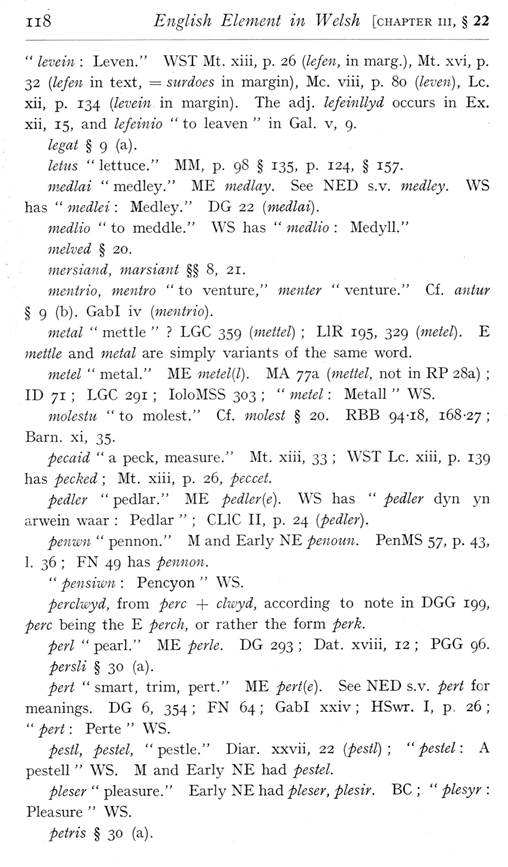
" levein: Leven." WST Mt. xiii, p. 26 {lefen, in marg.), Mt. xvi,
p. 32 {lefcn in text, = surdoes in margin), Mc. viii, p. 80 (leven), Lc. xii,
p. 134 {levein in margin). The adj. lefeinllyd occurs in Ex. xii, 15, and
lefeinio “to leaven “in Gal. v, 9.
legat § 9 (a).
letus "lettuce." MM, p. 98 § 135, p. 124, § 157.
medial “medley." ME medlay. See NED s.v. medley. WS has “medlei:
Medley." DG 22 {medial) .
medllo “to meddle." WS has “medllo: Medyll."
melved § 20.
mersland, mar slant §§ 8, 21.
mentrlo, mentro “to venture," menter “venture." Cf. antur § 9 (b).
GabI iv {mentrlo).
metal “mettle "? LGC 359 {mettel); LIR 195, 329 {metel). E mettle and
metal are simply variants of the same word.
metel “metal." ME metel{l). MA 77a {mettel, not in RP 28a); ID 71; LGC
291; loloMSS 303; "metel: Metall “WS.
molestu "to molest." Cf. 7nolesi § 20. RBB 94-18, 168-27; Barn, xi,
35.
pecald “a peck, measure." Mt. xiii, 33; WST Lc. xiii, p. 139 has pecked;
Mt. xiii, p. 26, peccet.
pedler “pedlar." ME pedler{e). WS has “pedler dyn yn arwein waar:
Pedlar”; CLIC II, p. 24 {pedler).
penwn “pennon." M and Early NE penoun. PenMS 57, p. 43, 1. 36; FN 49 has
pennon.
" penslwn: Pencyon “WS.
perclwyd, from perc + clwyd, according to note in DGG 199, perc being the E
perch, or rather the form perk.
perl “pearl." ME perle. DG 293; Dat. xviii, 12; PGG 96.
persll § 30 (a).
pert “smart, trim, pert." ME pert{e). See NED s.v. pert for meanings. DG
6, 354; FN 64; GabI xxiv; HSwr. I, p= 26; “pert: Perte “WS.
pestl,
pestel, "pestle." Diar. xxvii, 22 {pestl); “pestel: A pestell “WS. M and Early NE had pestel.
pleser “pleasure." Early NE had pleser, pieslr. BC; “plesyr: Pleasure
“WS.
petrls § 30 (a).
|
|
|
|
|
(delwedd F6870) (tudalen 119)
|
CHAPTER
III, § 22] Middle and New English Vowels 119
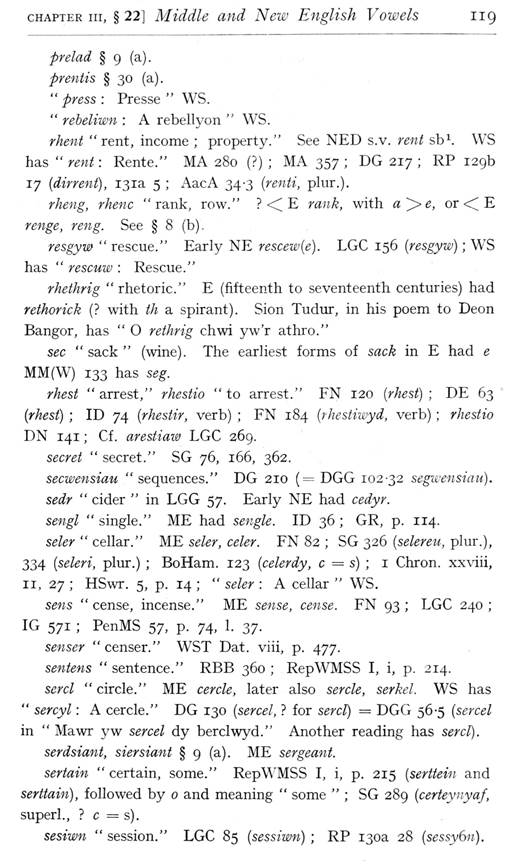
prelad § 9 (a),
prentis § 30 (a).
" press: Presse “WS.
" reheliwn: A rebellyon “WS.
rhent "rent, income; property." See NED s.v. rent sb^ WS has “rent:
Rente." MA 280 (?); MA 357; DG 217; RP 129b 17 {dirrent), 131a 5; AacA
34-3 {renti, pkir.).
rheng, rhenc "rank, row."? <^ E rank, with a'^e, or ■< E renge, reng. See § 8 (b).
resgyw “rescue." Early NE resceu>{e). LGC 156 [resgyw); WS has
“rescuw: Rescue."
rhethrig “rhetoric." E (fifteenth to seventeenth centuries) had
rethorick (? with th a spirant). Sion Tudur, in his poem to Deon Bangor, has
“O rethrig chwi yw'r athro."
sec “sack” (wine). The earhest forms of sack in E had e MM(W) 133 has seg.
rhest “arrest," rhestio “to arrest." FN 120 {rhest); DE 63 (rhest);
ID 74 {r he stir, verb); FN 184 {rhestiwyd, verb); rhestio DN 141; Cf.
arestiaw LGC 269.
secret “secret." SG 76, 166, 362.
secwensiau "sequences." DG 210 (= DGG 102-32 segwensiau).
sedr “cider “in LGG 57. Early NE had cedyr.
sengl “single." ME had sengle. ID 36; GR, p. 114.
seler “cellar." ME seler, celer. FN 82; SG 326 {selereti, plur.), 334
[seleri, plur.); BoHam. 123 {celerdy, c = s); 1 Chron. xxviii, II, 27; HSwr.
5, p. 14; “seler: A cellar “WS.
sens “cense, incense." ME sense, cense. FN 93; LGC 240; IG 571; PenMS
57, p. 74, 1. 37.
senser “censer." WST Dat. viii, p. 477.
sentens “sentence." RBB 360; RepWMSS I, i, p. 214.
sercl “circle." ME cercle, later also sercle, serkel. WS has “sercyl: A
cercle." DG 130 {sercel,? for sercl) = DGG 56-5 {sercel in “Mawr yw
sercel dy berclwyd." Another reading has sercl).
serdsiant, siersiant § 9 (a). ME sergeant.
sertain “certain, some." Rep\\^MSS I, i, p. 215 [serttein and serttain),
followed by and meaning “some”; SG 289 {certeynyaf, superl.,? c = s).
sesiwn “session." LGC 85 [sessiwn); RP 130a 28 {sessy6n).
|
|
|
|
|
(delwedd F6871) (tudalen 120)
|
120 English
Element in Welsh [chapter hi, § 23 “setsiel: A sechell “WS, i.e. satchel. E
(sixteenth century) had sechell and setchell.
siecr (seker)? E chequer, checker. ME cheker{e). DG 242 {seker in “A'i seker
oil a'i swkwr wyd," where seker probably stands for sekr, as the length
of the line shows); LGC 81 [siecr au, plur.); p. 482 [Siecr Rol “Checker
Roll").
sied (with short e) “shed." CLIC II, p. 23.
sieryf “sheriff." LGC 183.
stent. See ystent below.
" swspendio: Suspend." WS.
tenis § 30 (a).
term "term." ME terme. DG 181; GabI vii (= FN 173); lolo MSS 295.
terment “interment." See Dav. s.v.
tesni § 30 (a).
treU “treble." DG 113; RepWMSS I, ii, p. 922. * tres, plur. tresi. ME
tresse.? MA 324 [tresi), 143a [tres); DG 44; “tres: A tresse “WS.
tresbas § 9 (a).
trestl [trestel)
“trestle." DG 199 [deudrestl); SG 27, 227 [tresteleu, plur.); Mc. xi, 15
[trestlau). ME had plur. tresteles.
ysglent “slide, drift; rebound” (Bod.).? ME sclenten. See NED s.v. slant.
Dem, Dial, has “sclent: slant, diagonal." Cf. sglent EC.
ymendau “to amend, make amends," in SG 183; but emendaw occurs on p.
227, and emendey [2 pers. sing. pres. ind.) on p. 183.
[y)stem "shift (of work)" in NW (Carn.). Ci. ystem in WST Lc. i, p.
102, with cwrs as alternative.? E stem. See EDD s.v. stem.
ystent, stent “extent, stent." WLl xiii, 24 [stent; see note); FN 60
[ystent); LGC 24 ['stent); BC [stent; see note). See NED s.v. extent, stent,
for meanings. The v.-n. ystenta occurs in Gre. 196 [ystenta dy dir a'th ddaiar
drwy wyr fyddlawn), 146.
y sterling, esterlyng §§ 27 (a), 30 (a).
M AND NE e.
§ 23, ME had two long e's, an open e and a close e. Their nature depended on
their origin. See Jespersen, pp. 74, 5, for their
|
|
|
|
|
(delwedd F6872) (tudalen 121)
|
121CHAPTER III, § 23] Middle and New
English Vowels 121
origin. Later in the history of E, the difference between the two sounds was
more pronounced, when the close long e developed into an I- sound. Later
still the two fell together in most cases in pronunciation, but the
orthographical distinction that arose in the sixteenth century still remains.
" In ME spelling no distinction was made between the two e's, which were
written e or ee indifferently, though we may be perfectly certain of their
being separate sounds, because they were kept apart in rimes, and because the
evidence of the rimes agrees, on the one hand, with the distinction between
two classes of OE vowels and diphthongs, and on the other hand with the
distinction expressly made by the phoneticians of the modern period. ... In
the sixteenth century an orthogi'aphic distinction began to be made, by which
|e-| [i.e. long close e'] was written ee, ie, or ei, while |e-| [i.e. long
open e] was written ea ov e . . e; but both might occasionally be written e”
(Jespersen, pp. 76-7). The change of close e to i appears to have begun in
weak syllables; and “the change |e*| > [i"] in strong syllables as in
hee, he, meet, people, etc., certainly took place before 1550, though S[mith]
1568 describes the sound as ' qui nee e nee I reddit auribus, sed quoddam
medium, et tamen simplex est.' . . .” (Jespersen, p. 239).
On these two e's of ME we may quote further some remarks of a similar trend
made by Wyld: “By common consent the long tense e of ME, no matter what its
origin, was raised to [i] in the Early Modern period. Apart from present-day
vulgar English of big towns, the new vowel sound has been preserved. In the
degraded forms referred to, there appears to be a tendency to diphthongize
[i] to something like [ai]. This tendency generally goes with a drawling
habit of speech which seems incompatible with the preservation of any long
vowel as a pure sound. . . . The first indications we get of the change of
[e] to [i] are given by the occasional spellings of persons who wrote i, y
instead of e. These spellings, so far as my knowledge goes, begin before the
end of the first quarter of the fifteenth century. . . . Since we have
evidence of it [i.e. the change] in spelling as early as 1420 or thereabouts,
it is probable that the present sound was fully developed in pronunciation
considerably, perhaps fifty years, earlier." (Wyld, pp-205, 206).
|
|
|
|
|
(delwedd F6873) (tudalen 122)
|
122 English
Element in Welsh [chapter hi, § 24
The long open e remained during the whole of the ME period, but is in
present-day “Received Standard “English an I sound, like that developed from
ME long close e. The history of this change is given by Wyld, p. 209. He
states that when ME e (close) was raised to I, the ME e (open) at first
remained unaltered; that the intermediate stage in the development of e
(open) to i must have been e (close); that this new tense e developed as
early as the first quarter of the fifteenth century; that during the
fifteenth century, among certain sections of the community, this new e had
already been raised to I; that during the sixteenth and seventeenth centuries
another pronunciation with e (close) was prevalent; that, therefore, there
seem to have been two pronunciations side by side; “that our modern usage
with [^] in heat, meat, etc., is not in the nature of a sound change as some
writers seem to suggest, but is merely the result of the abandonment of one
type of pronunciation and the development of another” (p. 211).
On E e (open and close), see also Zachrisson, pp. 68-71.
§ 24. E e (OPEN) IN LOAN-WORDS IN W
In the instances which we cite below, this sound appears in W as e. The W
short e, as we have already seen (§ 13), is an open sound, but long e is
slightly more closed. These examples must have been borrowed before the open
e of E developed into I, or, if that is not always the case, some of them may
be a reflection of the other pronunciation which existed for a time side by
side with this; see § 23.
Examples:
apel “appeal," apelio “to appeal." ME apele.
hefer “beaver," as in “het befer," and in the pennill “A thipyn
bach bach o 61 y frech wen | Yn gwisgo het befar ar ochor i phen." Cf.
Cor. Voc. befer; DPO 160-14 [befer).
beglegwn “beagles." See § 16.
Bern “Bohemia." ME Berne, Beeme. LGC 363.
cer "gear, tools"; ceriach "rubbish; rabble." Also ger,
as in BC. DG 86 (afraid ger). ME gere.
den in colloq. speech. ME dene “clean." The meaning appears to be
“kindly, agreeable, nice, pleasant." See EC s.v.
|
|
|
|
|
(delwedd F6874) (tudalen 123)
|
CHAPTER
III, § 24] Middle and New English Vowels 123
clen, and NED s.v. clean adj. meaning (9) “fair, fine, proper," an
"epithet of admiration or commendation."
den “dean." See FC. Cf. Gor. Owen's “Sion Den."
efer, efrau "tares, darnel, eaver, ever." Cf. EDD s.v. eaver. The E
form was borrowed from OF evraie. HG 5-16 [ever); Mt. xiii, 25 [efrau, =
efrae in WST); EC I, 99 [evrau).
"fet: Feate “WS; also "fetus: Fayctous." ME fete "a
feat," and fetys[e), later fet[e)ous “featous." See FC s.v. ffetus.
gresh (with e) “gi'ease “in Dem. Dial. Cf. hep “heap “given by Powel, p. 121.
hit “heat, race, course." ME hete. LGC 499. Cf. het in GabI vi. The word
hed is used in NCarn. for the passage in a boat across a lake in fishing; but
for this latter cf . DN 134-5 .
hetar (in Cams.) “a piece of iron used for heating an ironing box." EDD
gives E heater with the same meaning. The form hetur [hetyr) is also heard in
Cams.
lee "a leak." FC.
ledio "to lead"; ledio hymn "to give out a hymn." ME
leden. CCMSS 29 (ledio); TN 295 [ledio).
leff “leaf (of a table)." Cam. and Angl.
leg “league." BC.
les "lease."
men “mean," subs, in DG 113 [men a threbl).
men “mesne." LGC 122.
men “mean “adj. ME mene.
mesur (?) “measure." ME mesiire. May be << F or Lat. BBC 3-3
[7nessur); RM 136-17 [messur); RBB 62-16 (messur); BT 34-16 (messur).
Probably from Lat.; see Loth Voc. s.vv. mesur, doguomisuriam] , dowomisura
[m] mi.
net in SW dial. “neat." Cf. nett in CAMSS, p. 24.
per "a pear." WS has “per an gellygen: A pere." ME pere.
^/e" a plea."
pleder “pleader," in PenMS 67, p. 15
pledio "to plead." ME pleden.
pleser “pleasure." Early NE has pleser, plesir. WS has “plesyr:
Pleasure." The vowel has become short in E.
plesio "to please." WS has “plesio: Please." In Carn. pies
(with e) is used for any act or action that pleases.
|
|
|
|
|
(delwedd F6875) (tudalen 124)
|
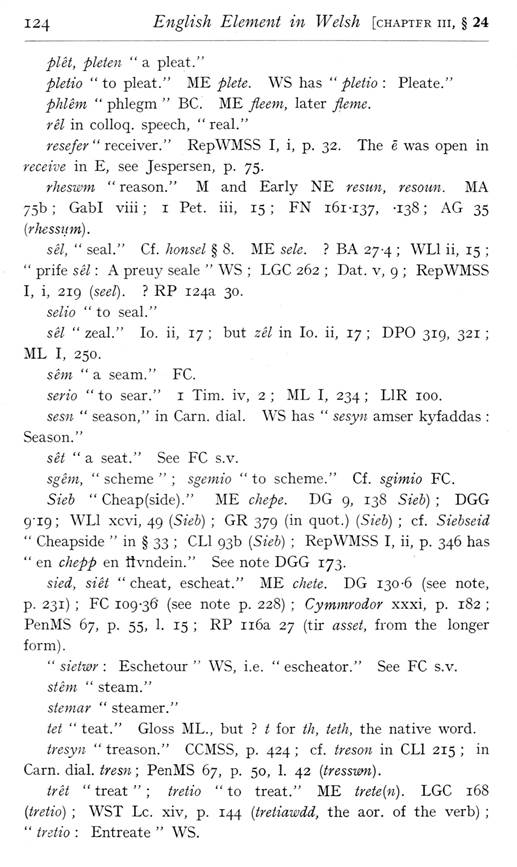
124 English
Element in Welsh [chapter hi, § 24
put, pleten “a pleat."
pletio “to p\ea.t." ME plete. WS hs^s “pletio: Pleate."
phlem “phlegm “BC. ME fleeni, later fieme.
rU in colloq. speech, “real."
yes^/er “receiver." RepWMSS I, i, p. 32. The e was open in receive in E,
see Jespersen, p. 75.
rheswm “reason." M and Early NE resun, resoim. MA 75b; GabI viii; i Pet.
iii, 15; FN 161-137, -138; AG 35 {rJiessym).
set, “seal." Cf. honsel § 8. ME sele.? BA 27-4; WLl ii, 15; “prife set:
A preuy seale “WS; LGC 262; Dat. v, 9; RepWMSS I, i, 219 (seel).? RP 124a 30.
selio “to seal."
set “zeal." lo. ii, 17; but zet in lo. ii, 17; DPO 319, 321; ML I, 250.
sem “a seam." FC.
serio "to sear." i Tim. iv, 2; ML I, 234; LIR 100.
sesn “season," in Carn. dial. WS has “sesyji amser kyfaddas:
Season."
set “a seat." See FC s.v.
sgem, “scheme”; sgemio “to scheme." Cf. sgimio FC.
Sieb “Cheap (side)." ME chepe. DG 9, 138 Sieh); DGG 9"i9; WLl xcvi,
49 {Sieb); GR 379 (in quot.) (Sieb); cf. Siebseid “Cheapside “in § 33; CLl
93b [Sieb]; RepWMSS I, ii, p. 346 has “en chepp en ttvndein." See note
DGG 173.
sied, siet “cheat, escheat." ME chete. DG 130-6 (see note, p. 231); FC
109-36 (see note p. 228); Cymmrodor xxxi, p. 182; PenMS 67, p. 55, 1, 15; RP
ii6a 27 (tir asset, from the longer form).
" sietwr: Eschetour “WS, i.e. “escheator." See FC s.v.
stem “steam."
steniar “steamer,"
tet “teat." Gloss ML., but? t for th, teth, the native word.
tresyn “treason." CCMSS, p. 424; cf. ireson in CLl 215; in Carn. dial,
tresn; PenMS 67, p. 50, 1. 42 [tressmn).
tret "treat"; tretio "to treat." ME trete{n). LGC 168
{tretio); WST Lc. xiv, p. 144 [tretiawdd, the aor. of the verb); “tretio:
Entreate “WS.
|
|
|
|
|
(delwedd F6876) (tudalen 125)
|
CHAPTER
III, § 25] Middle and New English Vowels 125
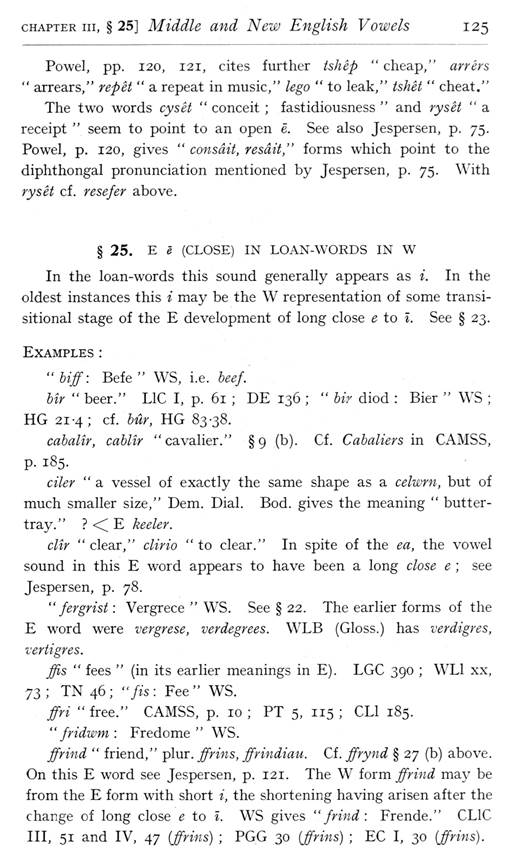
Powel, pp. 120, 121, cites further tshep “cheap," arrers “arrears,"
repet “a repeat in music," lego “to leak," tshet “cheat."
The two words cysH “conceit; fastidiousness “and ryset “a receipt “seem to
point to an open e. See also Jespersen, p. 75. Powel, p. 120, gives “consdit,
resdit," forms which point to the diphthongal pronunciation mentioned by
Jespersen, p. 75. With )yset cf. resefer above. § 25. E e (CLOSE) IN
LOAN-WORDS IN W
In the loan-words this sound generally appears as i. In the oldest instances
this i may be the W representation of some transisitional stage of the E
development of long close e to i. See § 23.
Examples:
"biff: Befe" WS, i.e. beef.
bir “beer." LlC I, p. 61; DE 136; “bir diod: Bier “WS; HG 21-4; cf. bur,
HG 83-38.
cabalir, cablir "cavalier." §9 (b). Cf. Cabaliers in CAMSS,
p. 185.
ciler “a vessel of exactly the same shape as a celwrn, but of much smaller
size," Dem. Dial. Bod. gives the meaning “butter-tray."? <C E
heeler.
clir “clear," clirio “to clear." In spite of the ea, the vowel
sound in this E word appears to have been a long close e; see Jespersen, p.
78.
" fer grist: Vergrece “WS. See § 22. The earlier forms of the E word
were vergrese, verdegrees. WLB (Gloss.) has verdigres, vertigres.
ffis “fees” (in its earlier meanings in E). LGC 390; WLl xx, 73; TN 46;
"fis: Fee" WS.
ffri “free." CAMSS, p. 10; PT 5, 115; CLl 185.
"fridwm: Fredome “WS.
ffrind “friend," plur. ffrins, ffrindiau. Ci. ffrynd § 27 (b) above. On
this E word see Jespersen, p. 121. The W ioim ffrind may be from the E form
with short i, the shortening having arisen after the change of long close e
to i. WS gives “frind: Frende." CLIC III, 51 and IV, 47 ffrins); PGG 30
ffrins); EC I, 30 (ffrins).
|
|
|
|
|
(delwedd F6877) (tudalen 126)
|
126 English
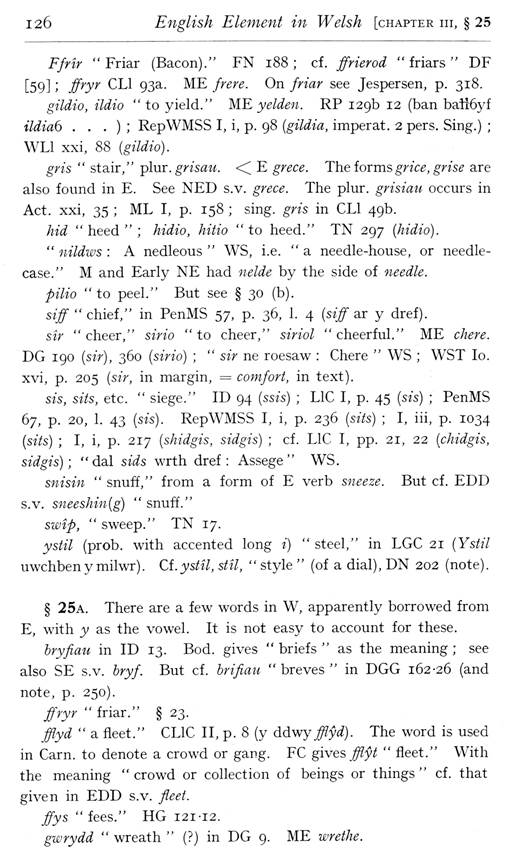
Element in Welsh [chapter hi, § 25
Ffrir "Friar (Bacon)." FN i88; cf. ffrierod "friars" DF
[59] '> ff^y^ CLl 93a. ME frere. On friar see Jespersen, p. 318.
gildio, ildio “to yield." ME yelden. RP 129b 12 (ban baii6yf ildia() . .
. ); RepWMSS I, i, p. 98 {gildia, imperat. 2 pers. Sing.); WLl xxi, 88
{gildio).
gris “stair," ■phir.grisau. <^ E grece. The iorms grice, grise
are also found
in E. See NED s.v. grece. The plur. grisiaii occurs in Act. xxi, 35; ML I, p.
158; sing, gris in CLl 49b.
hid “heed”; hidio, hitio “to heed." TN 297 {hidio).
" nildws: A nedleous “WS, i.e. “a needle-house, or needle-case." M
and Early NE had nelde by the side oi needle.
pilio “to peel." But see § 30 (b).
siff “chief," in PenMS 57, p. 36, 1. 4 {siff dj: y dref).
sir “cheer," sirio “to cheer," siriol “cheerful." ME chere. DG
190 {sir), 360 {sirio); “sir ne roesaw: Chere “WS; WST lo. xvi, p. 205 {sir,
in margin, = comfort, in text).
sis, sits, etc. “siege." ID 94 {ssis); LlC I, p. 45 {sis); PenMS 67, p.
20, 1. 43 {sis). RepWMSS I, i, p. 236 {sits); I, iii, p. 1034 {sits); I, i,
p. 217 {shidgis, sidgis); cf. LlC I, pp. 21, 22 {chidgis, sidgis); "dal
sids wrth dref: Assege “WS.
snisin “snuff," from a form of E verb sneeze. But cf. EDD s.v.
sneeshin{g) “snuff."
swip, “sweep." TN 17.
ystil (prob. with accented long i) “steel," in LGC 21 {Ystil uwchbeny
milwr). Ci. ystil, stil, “style” (of a dial), DN 202 (note).
§ 25a. There are a few words in W, apparently borrowed from E, with y as the
vowel. It is not easy to account for these.
hryfiaii in ID 13. Bod. gives “briefs “as the meaning; see also SE s.v. hryf.
But cf. hrifiau "breves" in DGG 162-26 (and note, p. 250).
ffryr “friar." § 23.
fflyd “a fleet." CLIC II, p. 8 (y ddwy^y^). The word is used in Carn. to
denote a crowd or gang. EC gives fflyt “fleet." With the meaning
"crowd or collection of beings or things" cf. that given in EDD
s.v. fleet.
ffys "fees." HG 121-12.
gwrydd “wreath” (?) in DG 9. ME wrethe.
|
|
|
|
|
(delwedd F6878) (tudalen 127)
|
CHAPTER
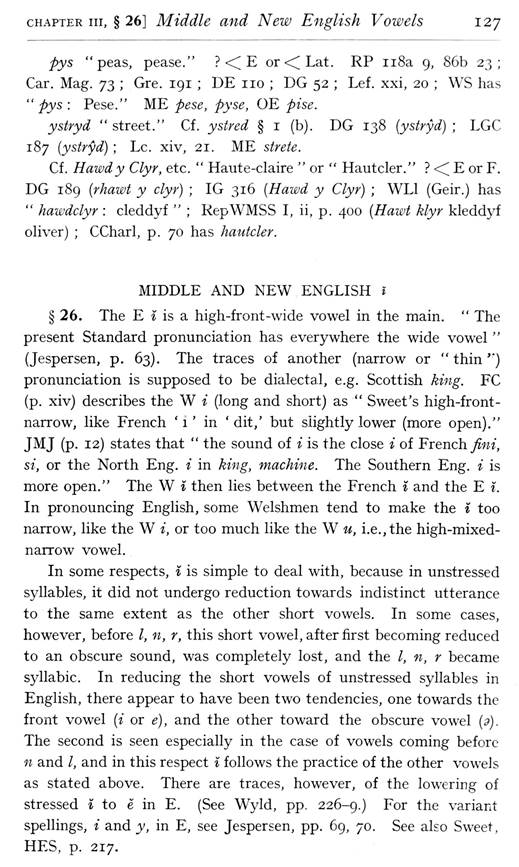
III, § 26] Middle and New English Vowels 127 ^ > pys "peas,
pease."? <C E oK^Lat. RP ii8a 9, 86b 2 Car. Mag. 73; Gre. 191; DE no;
DG 52; Lef. xxi, 20; WS has "pys: Pese." ME pese, pyse, OE pise.
ystryd "street." Cf. ysired § i (b). DG 138 [ystryd); LGC 187
{ystryd); Lc. xiv, 21. ME strete.
Cf. Hawdy Clyr, etc. “Haiite-claire “or “Hautcler."? <; E or F, DG
189 (rhawt y clyr); IG 316 {Hawd y Clyr); WLl (Geir.) has “hawdclyr:
cleddyf”; KepWMSS I, ii, p. 400 [Hawt klyr kleddyf oHver); CCharl, p. 70 has
hautcler. MIDDLE AND NEW ENGLISH l
§ 26. The E * is a high-front -wide vowel in the main. “The present Standard
pronunciation has everywhere the wide vowel” (Jespersen, p. 63). The traces
of another (narrow or "thin''} pronunciation is supposed to be
dialectal, e.g. Scottish king. EC (p. xiv) describes the W i (long and short)
as “Sweet's high-front-narrow, like French ' 1 ' in ' dit,' but slightly
lower (more open)." JMJ (p. 12) states that “the sound of i is the close
i of French j^wi, si, or the North Eng. i in king, machine. The Southern Eng.
i is more open." The W i then lies between the French i and the E i. In
pronouncing English, some Welshmen tend to make the % too narrow, like the W
i, or too much like the W u, i.e., the high-mixed-narrow vowel. .
In some respects, i is simple to deal with, because in unstressed syllables,
it did not undergo reduction towards indistinct utterance to the same extent
as the other short vowels. In some cases, however, before /, 11, r, this
short vowel, after first becoming reduced to an obscure sound, was completely
lost, and the I, n, r became sjdlabic. In reducing the short vowels of
unstressed syllables in English, there appear to have been two tendencies,
one towards the front vowel {i or e), and the other toward the obscure vowel
(p). The second is seen especially in the case of vowels coming before n and
/, and in this respect i follows the practice of the other vowels as stated
above. There are traces, however, of the lowering of stressed t to e in E. (See
Wyld, pp. 226-9.) For the variant spellings, i and y, in E, see Jespersen,
pp. 69, 70. See also Sweet, HES, p. 217.
|
|
|
|
|
(delwedd F6879) (tudalen 128)
|
128 English
Element in Welsh [chapter hi, § 27
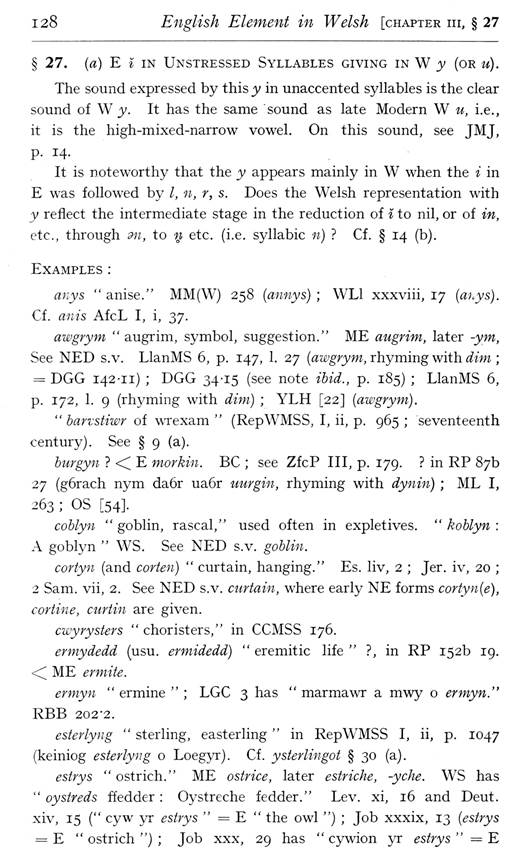
§ 27. {a) E ^ IN Unstressed Syllables giving in W _y (or u).
The sound expressed by this y in unaccented syllables is the clear sound of W
jy. It has the same sound as late Modern W u, i.e., it is the
high-mixed-narrow vowel. On this sound, see JMJ,
P- 14-
It is noteworthy that the y appears mainly in W when the i in
E was followed by /, n, r, s. Does the Welsh representation with
y reflect the intermediate stage in the reduction of % to nil, or of in,
etc., through dn, to n etc. (i.e. syllabic n)? Cf. § 14 (b).
Examples:
anys “anise." MM(W) 258 [annys); WLl xxxviii, 17 {a%ys). Cf. anis AfcL
I, i, 37.
awgrym “augrim, symbol, suggestion." ME augrim, later -ym, See NED s.v.
LlanMS 6, p. 147, 1. 27 {awgrym, rhyming with dim; = DGG 142-11); DGG 34-15
(see note ibid., p. 185); LlanMS 6, p. 172, 1. 9 (rhyming with dim); YLH [22]
{awgrym).
" barvstiwr of wrexam” (RepWMSS, I, ii, p. 965; seventeenth century).
See § 9 (a).
burgyji? <C E morkin. BC; see ZfcP III, p. 179.? in RP 87b 27 (g6rach nym
da6r ua6r uurgin, rhyming with dynin); ML I, 263; OS [54].
coblyn “goblin, rascal," used often in expletives. “koblyn: A goblyn
“WS. See NED s.v. goblin.
cortyn (and corten) “curtain, hanging." Es. liv, 2; Jer. iv, 20; 2 Sam.
vii, 2. See NED s.v. curtain, where early NE forms cortyn{e), cortine, curtin
are given.
cwyrysters “choristers," in CCMSS 176.
ermydedd (usu. ermidedd) “eremitic life "?, in RP 152b 19. <^ ME
ermite.
ermyn “ermine”; LGC 3 has “marmawr a mwy o ermyn."
RBB 202-2.
esterlyng “sterling, easterling “in RepWMSS I, ii, p. 1047 (keiniog esterlyng
o Loegyr). Cf. ysterlingot § 30 (a).
estrys “ostrich." ME ostrice, later estriche, -ycJie. WS has “oystreds
ffedder: Oystreche fedder." Lev. xi, 16 and Deut. xiv, 15 (" cyw 3^
estrys” = E “the owl "); Job xxxix, 13 {estrys = E “ostrich "); Job
xxx, 29 has “cywion 3^ estrys” — K
|
|
|
|
|
(delwedd F6880) (tudalen 129)
|
129CHAPTER III, § 27] Middle and New
English Vowels 129
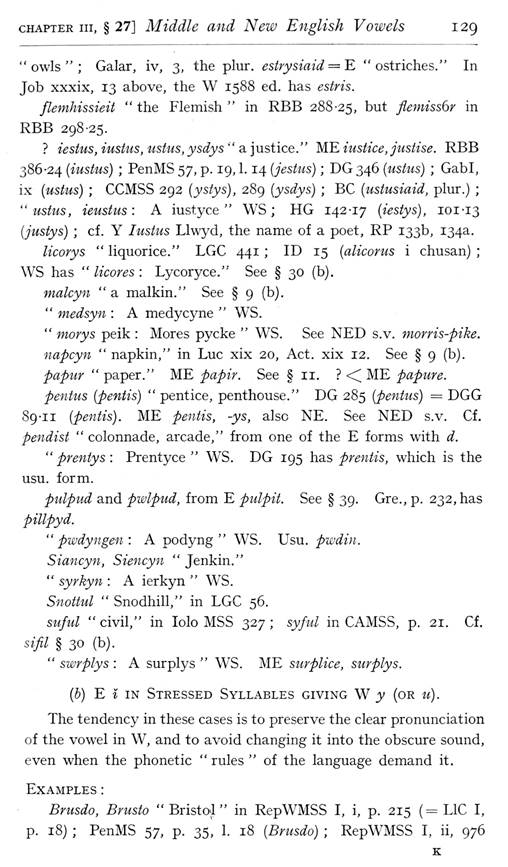
"owls"; Galar, iv, 3, the plur. estrysiaid=E "ostriches."
In Job xxxix, 13 above, the W 1588 ed. has estris.
flemhissieit “the Flemish “in RBB 288-25, but flemissdr in RBB 298-25.
? iestus,iustus,ustus,ysdys'' a. ]Visi\CQ,." ME iustice,justise. RBB
386-24 [iustus); PenMS 57, p. 19, 1. 14 (jestus); DG 346 {ustus); GabI, ix
(ustus); CCMSS 292 (ystys), 289 (ysdys); BC (ustusiaid, plur.); “usttts,
ieustiis: A iustyce “WS; HG 142-17 [iestys), 101-13 (justys); cf. Y Iustus
Llwyd, the name of a poet, RP 133b, 134a.
licorys “liquorice." LGC 441; ID 15 [alicorus i chusan); WS has
“licores: Lycoryce." See § 30 (b),
malcyn “a malkin." See § 9 (b).
" medsyn: A medycyne “WS.
" morys peik: Mores pycke “WS. See NED s.v. jnorris-pike.
napcyn “napkin," in Luc xix 20, Act. xix 12. See § 9 (b).
papur “paper." ME papir. See § 11.? <C ^^E papure.
pentus [pentis) “pentice, penthouse." DG 285 (pentus) = DGG 89-11
{pentis). ME pentis, -ys, also NE. See NED s.v. Cf. pendist “colonnade,
arcade," from one of the E forms with d.
" preniys: Prentyce “WS. DG 195 has prentis, which is the usu. form.
pulpud and pwiptid, from E pulpit. See § 39. Gre., p. 232, has pillpyd.
"pwdyngen: A podyng “WS, Usu. pwdin.
Siancyn, Siencyn “Jenkin."
" syrkyn: A ierkyn “WS.
Snottul “Snodhill," in LGC 56.
suful “civil," in lolo MSS 327; syful in CAMSS, p. 21. Cf. sifil § 30
(b).
" swrplys: A surplys “WS. ME surplice, surplys.
(b) E t IN Stressed Syllables giving W y (or «).
The tendency in these cases is to preserve the clear pronunciation of the
vowel in W, and to avoid changing it into the obscure sound, even when the
phonetic “rules “of the language demand it.
Examples:
Brusdo, Brusto "Bristol" in RepWMSS I, i, p. 215 (= LlC I, p. 18);
PenMS 57, p. 35, 1. 18 {Brusdo); RepWMSS I, ii, 976
|
|
|
|
|
(delwedd F6881) (tudalen 130)
|
130 English
Element in Welsh [chapter hi, § 27
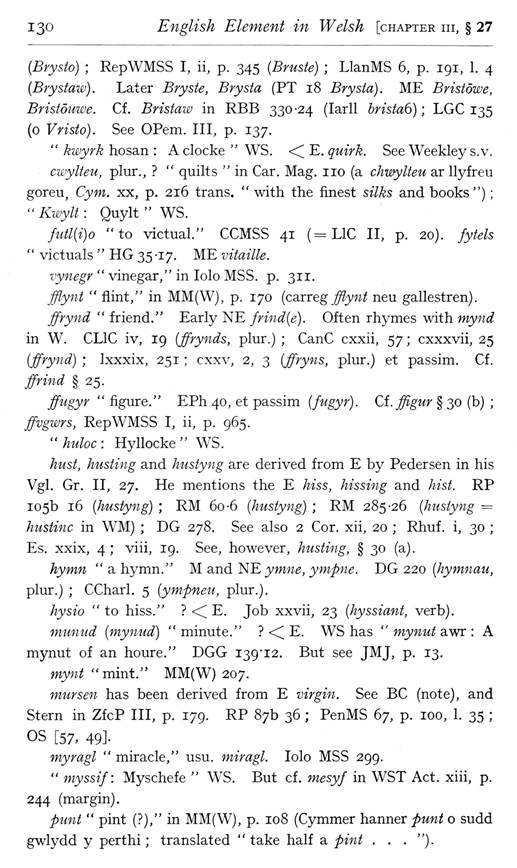
(Brysto); RepWMSS I, ii, p. 345 (Bruste); LlanMS 6, p. 191, 1. 4 {Brystaw).
Later Bryste, Brysta (PT 18 Brysta). ME Bristowe, Bristouwe. Cf. Bristaw in
RBB 330-24 (larll brista6); LGC 135 (0 Vristo). See OPem. Ill, p. 137.
" kwyrk hosan: A clocke “WS. <^ E. quirk. See Weekley s.v.
cwylteu, plur.,? “quilts “in Car. Mag. no (a chwylteu ar llyfreu goreu, Cym.
xx, p. 216 trans. “with the finest silks and books"); “Kwylt: Quylt “WS.
futl{i)o "to victual." CCMSS 41 (=L1C II, p. 20). fyfels “victuals
“HG 35 -17. ME vitaille.
t^yw^^;' “vinegar," in lolo MSS. p. 311.
fflynt “flint," in MM(W), p. 170 {csLireg fflynt neu gallestren).
ffrynd “friend." Early NE frind{e). Often rhymes with mynd in W. CLIC
iv, 19 {ffrynds, plur.); CanC cxxii, 57; cxxxvii, 25 {ffrynd); Ixxxix, 251;
cxxv, 2, 3 (ffryns, plur.) et passim. Cf. ffrind § 25.
ffugyr “figure." EPh 40, et passim {fugyr). Qi.fflgur § 30 (b); ffvgwrs,
RepWMSS I, ii, p. 965.
" huloc: Hyllocke “WS.
hust, husting and hustyng are derived from E by Pedersen in his Vgl. Or. II,
27. He mentions the E hiss, hissing and hist. RP 105b 16 {hustyng); RM 60 -6
{hustyng); RM 285-26 {hustyng = hustinc in WM); DG 278. See also 2 Cor. xii,
20; Rhuf. i, 30; Es. xxix, 4; viii, 19. See, however, husting, § 30 (a).
hymn “a hymn." M and 'NF, ymne, ympne. DG 220 {hymnau, plur.); CCharl. 5
{ympneu, plur.).
hysio “to hiss."? -c:;^ E. Job xxvii, 23 {hyssiant, verb).
munud {mynud) "minute."? <^ E. WS has “mynut dcwc: A mynut of an
houre." DGG I39"i2. But see JMJ, p. 13.
mynt "mint." MM(W) 207.
mursen has been derived from E virgin. See BC (note), and Stern in ZfcP III,
p. 179. RP 87b 36; PenMS 67, p. 100, 1. 35;
OS [57, 49]-
myragl “miracle," usu. miragl. lolo MSS 299.
" niyssif:
Myschefe “WS. But cf. mesyf in WST Act. xiii, p. 244 (margin).
punt “pint (?)," in MM(W), p. 108 (Cymmer banner punt o sudd gwlydd y
perthi; translated "take half a pint . . . ").
|
|
|
|
|
(delwedd F6882) (tudalen 131)
|
CHAPTER
III, §§28,29] Middle and New English Vowels 131
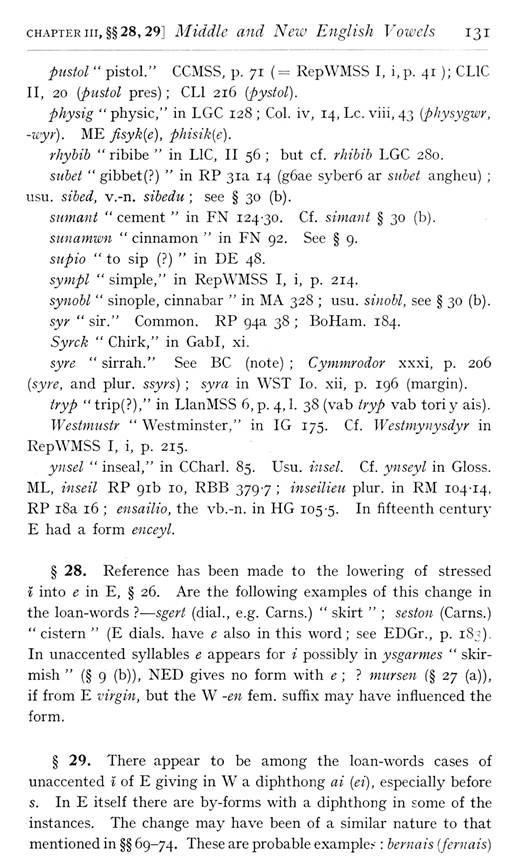
pustol “pistol." CCMSS, p. 71 (- RepWMSS I, i, p. 41 ); CLIC II, 20
{pustol pres); CLl 216 {pystol).
physig “physic," in LGC 128; Col. iv, 14, Lc. viii, 43 {physygwr, -uyr).
ME fisyk{e), phisik{e).
rhyhib “ribibe “in LlC, II 56; but cf. rhibih LGC 280.
suhet “gibbet(?) “in RP 31a 14 (g6ae syber6 ar suhet angheu); usu. sibed,
v.-n. sibedu; see § 30 (b).
sumant "cement “in FN 124-30. Cf. simant § 30 (b).
simamwn “cinnamon “in FN 92. See § 9.
supio "to sip (?) “in DE 48.
sympl “simple," in RepWMSS I, i, p. 214.
synobl “sinople, cinnabar “in MA 328; usu. sinobl, see § 30 (b).
syr “sir." Common. RP 94a 38; BoHam. 184.
Syrck “Chirk," in GabI, xi.
syre “sirrah." See BC (note); Cymmrodor xxxi, p. 206 {syre, and plur.
ssyrs); syra in WST lo. xii, p. 196 (margin).
tryp “trip(?)," in LlanMSS 6, p. 4, 1. 38 (vab tryp vab toriy ais).
Westmustr “Westminster," in IG 175. Cf. Westmynysdyr in RepWMSS I, i, p.
215.
yiisel “inseal," in CCharl. 85. Usu. insel. Cf. ynseyl in Gloss. ML,
inseil RP 91b 10, RBB 3797; inseilieu plur. in RM 104-14, RP iSa 16;
ensailio, the vb.-n. in HG 105-5. Iri fifteenth century E had a form enceyl.
§ 28. Reference has been made to the lowering of stressed i into e in E, §
26. Are the following examples of this change in the loan-words? — sgert
(dial., e.g. Cams.) “skirt”; seston (Cams.) “cistern” (E dials, have e also
in this word; see EDGr., p. 183). In unaccented syllables e appears for i
possibly in ysgarmes “skirmish” (§ 9 (b)), NED gives no form with e;? nmrsen
(§ 27 (a)), if from E virgin, but the W -en fem. suffix may have influenced
the form.
§ 29. There appear to be among the loan-words cases of unaccented i of E
giving in W a diphthong ai (ei), especially before s. In E itself there are
by-forms with a diphthong in some of the instances. The change may have been
of a similar nature to that mentioned in §§ 69-74. These are probable
example.--: bernais [fernais)
|
|
|
|
|
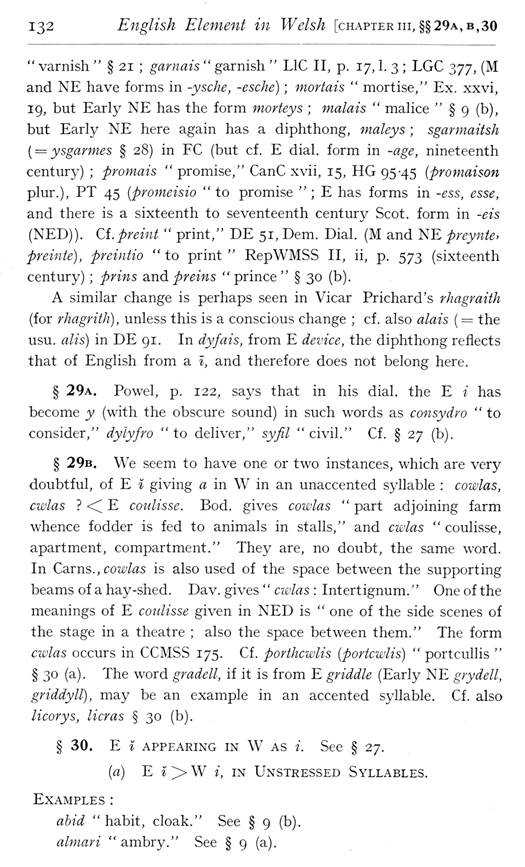
(delwedd F6883) (tudalen 132)
|
132 English
Element in Welsh [chapter iii,§§ 29a, b, 30
" varnish” § 2i; garnais “garnish “LlC II, p. 17, 1. 3; LGC 377, (M and
NE have forms in -ysche, -esclie); mortais “mortise," Ex. xxvi, 19, but
Early NE has the form morteys; malais “mahce” § 9 (b), but Early NE here
again has a diphthong, maleys; sgarmaitsh [ = ysgarmes § 28) in EC (but cf. E
dial, form in -age, nineteenth century); promais “promise," CanC xvii,
15, HG 95-45 (promaison plur.), PT 45 [promeisio “to promise”; E has forms in
-ess, esse, and there is a sixteenth to seventeenth century Scot, form in
-eis (NED)). Ci.preint “print," DE 51, Dem. Dial. (M and NE preynte>
preinte), preintio “to print “RepWMSS II, ii, p. 573 (sixteenth century);
prins and preins “prince” § 30 (b).
A similar change is perhaps seen in Vicar Prichard's rhagraith (for
rhagrith), unless this is a conscious change; cf. also alais (= the usu.
alis) in DE 91. In dyfais, from E device, the diphthong reflects that of
English from a I, and therefore does not belong here.
§ 29a. Powel, p. 122, says that in his dial, the E i has become y (with the
obscure sound) in such words as consydro “to consider," dylyfro “to
deliver," syfil “civil." Cf. § 27 (b).
§ 29b. We seem to have one or two instances, which are very doubtful, of E *
giving <a; in W in an unaccented syllable: cowlas, cwlas? <C E
coulisse. Bod. gives cowlas “part adjoining farm whence fodder is fed to
animals in stalls," and cwlas “coulisse, apartment, compartment."
They are, no doubt, the same word. In Cams., cow/as is also used of the space
between the supporting beams of a hay-shed. Dav. gives “cwlas:
Intertignum." One of the meanings of E coulisse given in NED is “one of
the side scenes of the stage in a theatre; also the space between them."
The form cwlas occurs in CCMSS 175. Cf. porthcwlis (portcwlis) “portcullis” §
30 (a) . The word gradell, if it is from E griddle (Early NE grydell,
griddyll), may be an example in an accented syllable. Cf. also licorys,
licras § 30 (b).
§ 30. E i APPEARING IN W AS i. See § 27.
{a) E i > W i, IN Unstressed Syllables.
Examples:
abid "habit, cloak." See § 9 (b). almari "ambry." See § 9
(a).
|
|
|
|
|
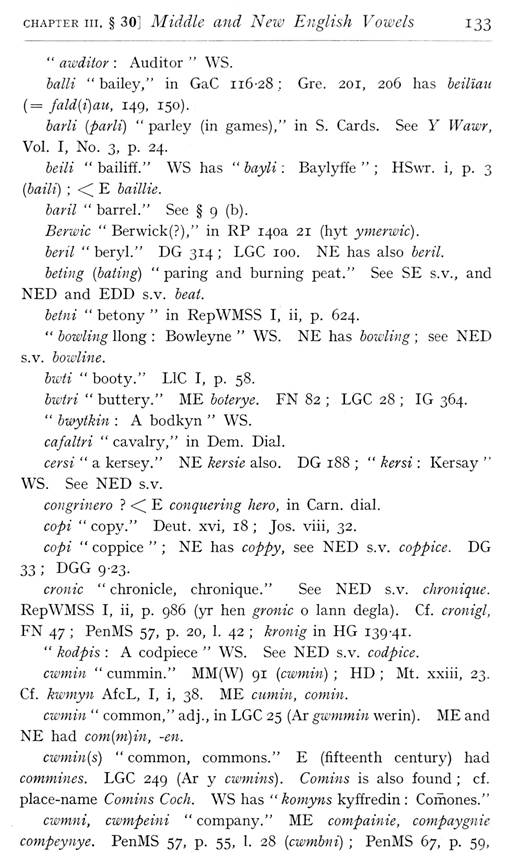
(delwedd F6884) (tudalen 133)
|
CHAPTER in.
§ 30] Middle and New English Vowels 133
" awditor: Auditor “WS.
halli “bailey," in GaC 116-28: Gre. 201, 206 has heiliau (= fald{i)au,
149, 150).
harli (parli) “parley (in games)," in S. Cards. See Y Wawr, Vol. I, No.
3, p. 24.
heili “bailiff." WS has “bayli: Baylyffe”; HSwr. i, p. 3 (baili); <^
E haillie.
bar it "barrel." See § 9 (b).
Berwic “Berwick (?)," in RP 140a 21 (hyt ymerwic).
beril “beryl." DG 314; LGC 100. NE has also beril.
beting (bating) “paring and burning peat." See SE s.v., and NED and EDD
s.v. beat.
betni “betony “in RepWMSS I, ii, p. 624.
" bowling Hong: Bowleyne “WS. NE has bowling; see NED s.v. bowline.
bwti “booty." Lie I, p. 58.
bwtri “buttery." ME boterye. FN 82; LGC 28; IG 364.
" bwytkin: A bodkyn “WS.
cafaltri “cavalry," in Dem. Dial.
cersi “a kersey." NE kersie also. DG 188; “kersi: Kersay “WS. See NED
s.v.
congrinero? <C E conquering hero, in Carn. dial.
copi “copy." Deut. xvi, 18; Jos. viii, 32.
copi “coppice”; NE has coppy, see NED s.v. coppice. DG 33; DGG 9 23.
cronic “chronicle, chronique," See NED s.v. chronique. RepWMSS I, ii, p.
986 [yr hen gronic o lann degla). Cf. cronigl, FN 47; PenMS 57, p. 20, 1. 42;
kronig in HG 139-41.
" kodpis: A codpiece “WS. See NED s.v. codpice.
cwmin “cummin." MM(W) 91 (cwmin); HD; Mt. xxiii, 23. Cf. kwmyn AfcL, I,
i, 38. ME cumin, comin.
cwmin “common," adj., in LGC 25 (Ar gwmmin werin). ME and NE had
com{m)in, -en.
cwmin{s) "common, commons." E (fifteenth century) had commines. LGC
249 (Ar y cwmins). Comins is also found; cf. place-name Comins Coch. WS has
“komyns kyffredin: Comones."
cwmni, cwmpeini “company." ME compainie, compaygnie compeynye. PenMS 57,
p. 55, 1. 28 (cwmbni); PenMS 67, p. 59,
|
|
|
|
|
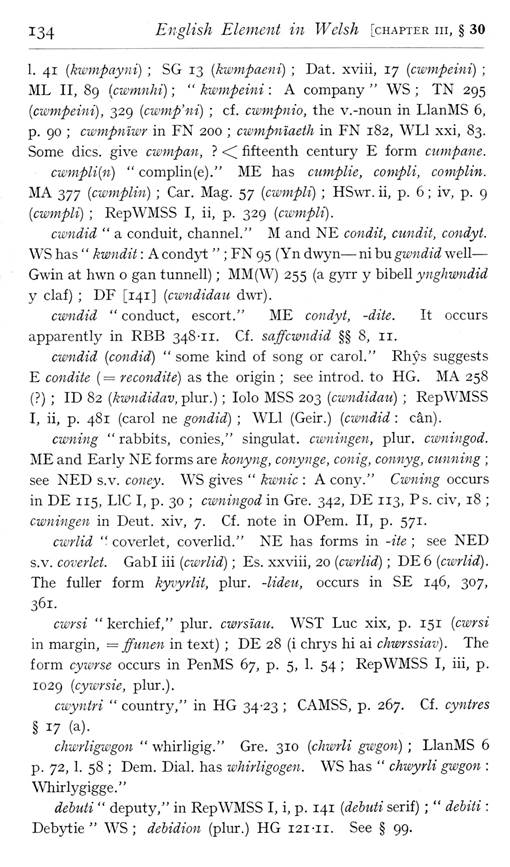
(delwedd F6885) (tudalen 134)
|
134 English
Element in Welsh [chapter hi, § 30
1. 41 {kwmpayni); SG 13 {kwmpaeni); Dat. xviii, 17 [cwmpeini); ML II, 89
[cwmnhi]; “kwmpeini: A company “WS; TN 295 (cwmpeini), 329 [cwmp'ni); cf.
cwmpnio, the v.-noun in LlanMS 6, p. 90; cwmpniwr in FN 200; cwmpniaeth in FN
182, WLl xxi, 83. Some dies, give cwmpan,? <^ fifteenth century E form
ciimpane.
cwmpU[n) “compHn(e).'" ME has cumplie, compli, complin. MA 377
(cwmplin); Car. Mag. 57 [cwmpli); HSwt. ii, p. 6; iv, p. 9 [cwmpli]; RepWMSS
I, ii, p. 329 [cwmpli).
cwndid “a conduit, channel." M and NE condit, cundit, condyt. WS has
“kwndit: A condyt”; FN 95 (Yn dwyn — ni bu gwndid well — Gwin at hwn o gan
tunnell); MM(W) 255 (a g\Tr y bibell yngJmmdid y claf); DF [141] [cwndidau
dwT).
cwndid “conduct, escort." ME condyt, -dite. It occurs apparently in RBB
348-11. Cf. saff cwndid §§ 8, 11.
cwndid [condid) “some kind of song or carol." Rhys suggests E condite {=
recondite) as the origin; see introd. to HG. MA 258 (?); ID 82 [kwndidav,
plur.); lolo MSS 203 [cwndidau); RepWMSS I, ii, p. 481 (carol ne gondid); WLl
(Geir.) [cwndid: can).
cwning “rabbits, conies," singulat. cwningen, plur. cwningod. ME and
Early NE forms are konyng, conynge, conig, connyg, cunning; see NED s.v.
coney. WS gives “kwnic: A cony." Cwning occurs in DE 115, Lie I, p. 30;
cwningod in Gre. 342, DE 113, Ps. civ, 18; cwningen in Deut. xiv, 7. Cf. note
in OPem. II, p. 571.
cwrlid "■ coverlet,
coverlid." NE has forms in -ite; see NED s.v. coverlet. GabI iii [cwrlid); Es.
xxviii, 20 [cwrlid); DE 6 [cwrlid). The fuller form kyvyrlit, plur. -lideii,
occurs in SE 146, 307, 361.
cwrsi “kerchief," plur. cwrslau. WST Luc xix, p. 151 [cwrsi in margin, =
ffunen in text); DE 28 (i chrys hi ai chwrssiav). The form cywrse occurs in
PenMS 67, p. 5, 1. 54; RepWMSS I, iii, p. 1029 [cywrsie, plur.).
cwyntri “country," in HG 34-23; CAMSS, p. 267. Cf. cyntres
§ 17 (a).
chwrligwgon “whirligig." Gre. 310 [cliwrli gwgon); LlanMS 6
p. 72, 1. 58; Dem. Dial, has whirligogen. WS has “chwyrli gwgon:
Whirlygigge."
debuti “deputy," in RepWMSS I, i, p. 141 [dehuti serif); “dehiti:
Debytie “WS; debidion (plur.) HG 121 -ii. See § 99.
|
|
|
|
|
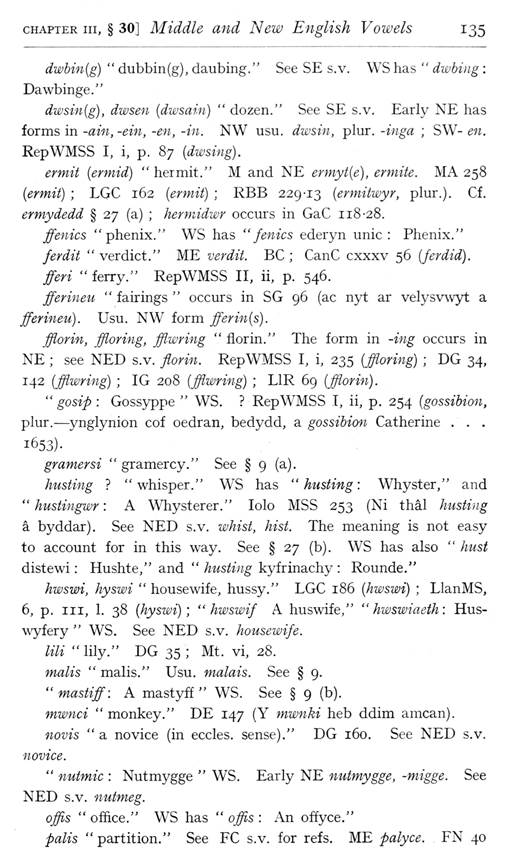
(delwedd F6886) (tudalen 135)
|
CHAPTER
III, § 30] Middle and New English Vowels 135
dwbin{g) “dubbin(g), daubing." See SE s.v. WS has “dwhiiig:
Dawbinge."
dwsin{g), dwsen {dwsain) “dozen." See SE s.v. Early NE has forms in
-ain, -ein, -en, -in. NW usu. dwsin, plur. -inga; SW- en. RepWMSS I, i, p. 87
{dwsing).
ermit (erniid) “hermit." M and NE ermyt{e), ermite. MA 258 (ermit); LGC
162 [ermit]; RBB 229-13 [ermitwyr, plur.). Cf. ermydedd § 27 (a); hermidwr
occurs in GaC 118-28.
ffenics "phenix." WS has “fenics ederyn unic: Phenix."
ferdit “verdict." ME verdit. BC; CanC cxxxv 56 (Jerdid).
fferi “ferry." RepWMSS II, ii, p. 546.
fferineu “fairings “occurs in SG 96 (ac nyt ar velyswvyt a fferineu). Usu. NW
form fferin{s).
florin, ffloring, fflwring “florin." The form in -ing occurs in NE; see
NED s.v. florin. RepWMSS I, i, 235 [ffloring); DG 34, 142 [fflwring); IG 208
[fflwring); LIR 69 [fflorin).
" gosip: Goss5^pe “WS.? RepWMSS I, ii, p. 254 [gossibion, plur. —
ynglynion cof oedran, bedydd, a gossibion Catherine . . .
1653).
gramersi “gramercy." See § 9 (a).
husting? "whisper." WS has "husting: Whyster," and
“hustingwr: A WTiysterer." lolo MSS 253 (Ni thil husting a byddar). See
NED s.v. whist, hist. The meaning is not easy to account for in this way. See
§ 27 (b). WS has also “hiist distewi: Hushte," and “husting kyfrinachy:
Rounde."
hwswi, hyswi “housewife, hussy." LGC 186 [hwswi); LlanMS, 6, p. Ill, 1.
38 [hyswi)', “hwswif A huswife," “hwswiaeth: Huswyfery “WS. See NED s.v.
housewife.
lili “lily." DG 35; Mt. vi, 28.
malis “malis." Usu. malais. See § 9.
" mastiff: A mastyff “WS. See § 9 (b).
mwnci “monkey." DE 147 (Y mwnki heb ddim amcan).
novis “a novice (in eccles. sense)." DG 160. See NED s.v. novice.
" nutmic: Nutmygge “WS. Early NE nutmygge, -migge. See NED s.v. nutmeg.
offis “office." WS has “offls: An offyce."
palis "partition." See EC s.v. for refs. ME palyce. FN 40
|
|
|
|
|
(delwedd F6887) (tudalen 136)
|
136 English
Element in Welsh [chapter hi, § 30
{palisau, plur.);? “palis: A paleys “WS; LlC II, 39 (o balis neuadd Bilad).
parti “party." TN 262,
pendil “pendulum, pendle." E has forms in -il, -ill. See NED and EDD
s.v. pendle.
pendist “colonnade, piazza, arcade, pentice." WS has “pendist: A
pentys." See NED s.v. penthouse for meanings. Cf pentus,
§ 27 (a).
persli "parsley." M and Early NE have forms in per-. HD; MM, p. 138
§ 164; “persli: Percely “WS.
perwig “a periwig." Earlier perwig in E. BC [perwigau, plur. See note).
Cf. perwg “perruke “in LlC II, 56; LGC 280.
petigryw [peticrvw) “pedigree." NE has pedigrue, pedigrewe, petiegrew;
see NED. LGC 9 (petigryw); RepWMSS I, ii, p. 872 (peticrvw) .
petris “partridge (s)”; singulat. petrisen. See partris § 9 (b). WS has
“petris: A partryche”; Bo Ham. 125 (pertris); i Sam. xxvi, 20 (petris);
BoHam. 125 (pertris); CLl 218 (pettris).
poetri “poetry." DE 143; RepWMSS I, i, p. 201.
porffil, pwrffil “purfle." Early NE has forms in -yl, -il. LGC 102
(porfil); RepWMSS I, ii, p. 424 (pwrffil; in an old vocab. late fifteenth
century “ginayrw yw pwrffil ").
" Portcwlis: A portcullis" W^S.
posibl “possible." Mt. xix 26.
prentis “a prentice, apprentice." Cf. prentys § 27 (a). Rep. WMSS I, i,
p. 189 (prentisied, plur.); TN 405 (prentis); CanC cxi, 28 (prentisiaid) .
proffid "profit." ME profit(e). DG 247 (proffid); GabI xvii
(di-broffid); LlC II, p. 35 (proffid gras y proffwyd grym). The v.-n. is
proffitio in WS, “proffitio: Profyle”; usu. proffidio.
pwltis "poultice," in WLl (Geir.) “uwd: sugaethan: pwltis."
From the seventeenth century, NED gives forms in -ice, -ise, -iss.
pwyniil “pointel, pencil." NED, s.v. pointel, gives fourteenth century
form poyntil, and seventeenth-eighteenth centuries form pointil. W has also
pwyntl, pwyntel.
redi “ready." BC.
" reswj^: Reysyn “WS. ^2j:\y ^^}i2isreysyn(g),resyng(g). FN
|
|
|
|
|
(delwedd F6888) (tudalen 137)
|
CHAPTER
III, § 30] Middle and New English Vowels i^y
10 1 {rhessing, cwrrens a fenswn); i Sam. xxv, i8 (rhesin); i Chron. xii, 40
{rhesingau, plur).
" whri: Robbery “WS.
rJmymedi} <^K remedy. BC; EC I, 114; LIR 304; RepWMSS I, ii, p. 467
[rhymedi); HG 62-11, 56-12, 34-20 {rhymedi). See § 20.
secwndid "safe-conduct." See cwndid "conduct" above, and
saffcwndid §§ 8, 11. Secwndid occurs in LlC I, p. 52 (= FN 133).
sentri “centaury (?) “in RepWMSS I, ii, p. 624 (Betni, ryw sentri); cf.
sentori in AfcL I, i, 39.
swrplis “surplice." SG 64.
tenis, tenys "tennis." ME tenyse, tennys. WS has "tenys:
Tenyse”; PenMS 57, p. 22, II. 45, 46 (Gware mae y g\vr ay meddl Tenis a chlot
trwy wynedd).
tesni “destiny." Darllen (or dywedyd) tesni, “to tell fortunes."
RepWMSS II, iii, p. 886 (Llyfr Tesni); II, i, p. 192 (llyfr desdni).
" twybil: A twyble “WS; i.e. twyhill, twibil.
" unicorn: Unicorne “WS.
Warwic “Warwick," in RP 159a 9 (Gi 6ar6ic, Guy of Warwick).
wrsib “worship." RepWMSS II, i, p. 59 {wrsib); I, i, p. 270 {wrsip); DN
51; WLl 119; CLl 49b, 69b [wrsib).
ysterlingot, plur. See esterlyng § 27 (a). RBB 379-1; RP 78a 8.
ystori, siori “story." DG 314 {'stori); GabI x (ystori).
{b) E I >> W i IN Stressed Syllables.
Examples:
bicre "to fight, skirmish";? also noun "a skirmish." NED
s.v. bicker sb^ gives M and NE forms biker, bykere, and s.v. bicker vb. the
fifteenth century forms bikre, bykre. Dav., s.v., quotes from LGC “Torr dy
filan ym micre." The v.-n. occurs in RBB 300-2 (y vickre ac 6ynt). EC I,
99 {bicre). The form bier a also occurs, LlC II, 15.
bing “an alley in a cowhouse, the forestall," ace to SE.? <C E bin.
bilain “villain, villein." ME vilain, vileyn. MA 965a {bileintii); RP
133a 29 {bileinseis); RM 280-4 (Paham vilein heb ynteu); RBB 299-23, 119-32
(bileinllu); RBB 123-31, 122-17, -32 (bilaen); HSwr. i, p. I (bilain).
biledu "to billet." FN 120 (ni biledwyd).
|
|
|
|
|
(delwedd F6889) (tudalen 138)
|
138 English
Element in Welsh [chapter hi, § 30
hilwg {hilwc) “billhook." RP 121a 22 [Umc); PenMS 67, p. 92, 1. 59 (y
ddev vilwc oedd velys); “hilwc kau: A hedging bill “WS.
hitan, biton “betony." See §§ 9 (a), 30 (a). E (sixteenth century) had
hittonie.
bitail, hitel “victual{s)." Cf. futl[i)o § 27 (b). ME vitaille. Forms in
-el occur in LlanMSS 6, p. 10 1; WST Mt. xiv (p. 28, in margin); RepWMSS I,
i, p. 216.
hric “a brick," plur. hrics, singulat. hricsen (in dial.). DG 41
(brics); “brik: Bricke “WS; CLl 62a (brigs). No form earlier than fifteenth
century, however, is given in NED.
cic “a kick," cicio “to kick." See NED s.v. kick. Cf cicwr in KM
136-21 (ac a oed o gic6r dethol).
diced, elided “a clicket, latch." See NED s.v. clicket. DG 204
{cliciedyn); IG 650 [cUcedau, plur.); DE 47 [klikied); FN 188 [elided, ref.
to trigger of a gun) = WLl lix, 55 [kliked); LlC I, 31 {elided); LlanMS 6, p.
13, 1. 100 [diked); SG 154 [diket); CCMSS, p. 31 [dicciadau, plur.);
“klickiet drws: A latch of a dore “WS; PenMS 57, p. 18, 1. 15 [diket
dwyuoch). See EC s.v. elided, and EDD s.v. clicket.
dine? << E clink, in CCMSS 164. Cf. dingciad CCMSS 176.
dipio "to clip," clipiwf "clipper." WS has “klipio arian:
Clyppe money"; RP 119b 30 (aryan dippiedic, verb. -adj.) (= MA 343); RP
85b 2 [clippyGr); BC [dipwyr, plur.),
commisiwn “commission “in LGC 63.
cripio “to scratch "? <^ E grip. GabI ix. See EDD s.v. grip v^.
chwip “whip." See SE and EC s.v.
chwipyn “instantaneously, suddenly." BC [chwippin. Note states “o'r
Saes. whipping"); DPO 78 [chwippyn).
" chwitans: Acquytaunce “WS.
" chwitio: Quyte “WS. The form cwitio is found, CCMSS 164 [cwitiwn).
" chwit: Quytte “WS. The form cwit of the adj. is also found, CLIC II,
p. 38 (yn gwitt). See NED s.v. quit, quite adj.
dipton, diphdong, diphdon “diphthong,"? <C E. Early NE had diptong[e)
dypton; see NED. Dosp. Ed. xix [dipton); GR, p. 216 [diphdon), p. 217
diphdong, and adj. [diphdongaul] .
|
|
|
|
|
(delwedd F6890) (tudalen 139)
|
CHAPTER
III, § 30] Middle and New English Vowels 139
ditaen "dittany." Early NE dyteyne, dytayne, dittayne, ace. to NED.
MM(W) 20; MM 90 § 126. Also ditawnt, as in AfcL, I, i, 39.
entri “entry." ML I, 254.
fiiiegr “vinegar." Mt. xxvii, 48. Cf. gwineg{y)r in RP 75b 27, 98b 40,
fermilion “vermilion." Jer. xxii, 14. WLl (Geir.) fermiUwn (under
silophr).
ffidl “fiddle." BC; “fidyl: A fyddle “WS.
ffigys” ^gs," sm^. ffigysen. ME fige,\^.ter ^Iso fyg{g){e). GaC 146-25;
SG 45, 46; MM 98, § 137; DPO 320 [ffigyssen); Es. xxviii, 4; Mc. xi, 13
(-bren); Deut. viii, 8 (-wydd); ID 31 (-en); WST Mc. xi (p. 88) hz-s fficuspr
en, and Luc xiii (p. 138) ffycuspren; WS has feigyssen, feigys, figys. 'Qie
forms in -ys, -us are from ME plur. ending -es. See § 17.
ffigur “figure “RBB 179-6. Cf. ffiigyr § 27 (b).
ffded “fillet." FN 196 [ffded); “filet: A fyllet “WS.
ffilog “filly, fillock." See NED s.v. fillock. WS has “filoc:
Fylocke."
ffit “a fit, spasm."
ffit “fit, suitable," CLIC II, p. 38. Also noun ffit, and v.-n. ffitio
“to fit."
ffristial. Bod. gives ffristial, ffristiol “dice-box; dice (the game)."
DGG 70-23 [G^erm ffristial a thawlbwrdd); LlC II, 11 (Ceiliog fforestog a wna
ffristial). A note in LlC II, p. 12 states, “Dengys y Uinell yma, ond odid,
mai nid blwch disiau, fel y dywed y geiriaduron, yw ffristial, ond y darnau
chwarae. Gallai felly mai o frusttde, o'r Lladin frustulum, darn bychan, y
daw." There is, however, an E word /m^e//g, known since 1400, from OF
frestell{e), meaning “a flute." Is the W word connected with this E
word? See NED s.v. fristelle, and BC s.v. ffristial.
gliiigal "galingale," in MM(W) 138.
griffwn “a griffon “Dav. The form gryffwnt occurs in LGC 140.? < E. Cf.
grifft in BT 52-24, and egrifft KM 158-18; griff SG 398. See DN 159, note on
Adar Llwch Gwin.
gwimled, gwimUed “a gimlet." E (seventeenth to nineteenth centuries) has
also gimblet. WS has “gwimbill ne gwimlet: Wymble."
hislan "hatchel." Early NE hechele, hychele. BC. Another
|
|
|
|
|
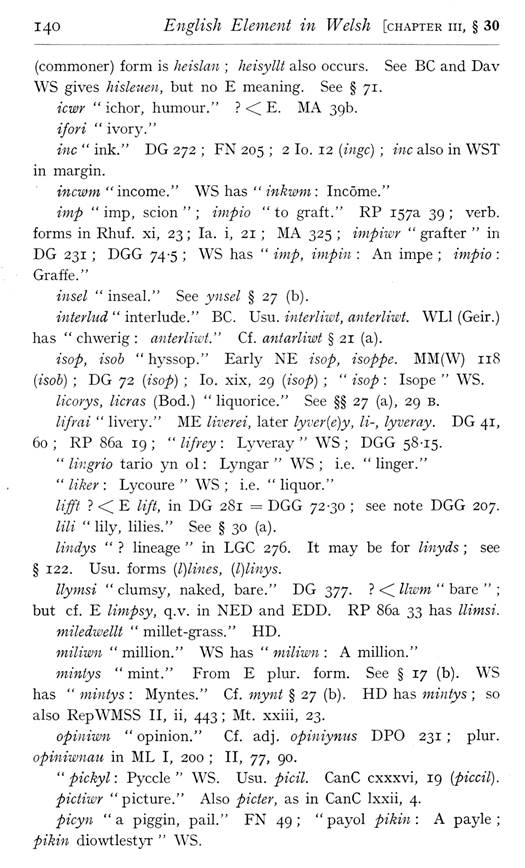
(delwedd F6891) (tudalen 140)
|
140 English
Element in Welsh [chapter hi, § 30
(commoner) form is heislan; heisylU also occurs. See BC and Dav WS gives
hisleuen, but no E meaning. See § 71,
icwr “ichor, humour."? ■< E. MA 39b.
ifori “ivory."
inc “ink." DG 272; FN 205; 2 lo. 12 {ingc); inc also in WST in margin.
incwm “income." W S ha.s “inkmm: Income."
imp “imp, scion”; impio “to graft." RP 157a 39; verb, forms in Rhuf. xi,
23; la. i, 21; MA 325; impiwr “grafter “in DG 231; DGG 74-5; WS has “imp,
impin: An impe; impio: Graffe."
insel “inseal." See ynsel § 27 (b).
interlud “interlude." BC. Usu. interliwt, anterliwt. WLl (Geir.) has
“chwerig: anterliwt." Cf. antarliwt § 21 (a).
isop, isob “hyssop." Early NE isop, isoppe. MM(W) 118 {isob); DG 72
(isop); lo. xix, 29 (isop); “isop: Isope “WS.
licorys, licras (Bod.) “liquorice." See §§ 27 (a), 29 b.
lifrai “livery." ME liverei, later lyver[e)y, li-, lyveray. DG 41, 60;
RP 86a 19; “lifrey: Lyveray “WS; DGG 58-15.
" lingrio tario yn ol: Lyngar “WS; i.e. “linger."
"liker: Lycoure “WS; i.e. “liquor."
liffi? < E lift, in DG 281 = DGG 72-30; see note DGG 207.
lili “lily, lilies." See § 30 (a).
lindys "? lineage “in LGC 276. It may be for linyds; see § 122. Usu.
forms {l)lines, {l)linys.
llymsi “clumsy, naked, bare." DG 377.? «< llwm “bare”; but cf. E
limpsy, q.v. in NED and EDD. RP 86a 33 has llimsi.
miledwellt “millet-grass." HD.
miliwn “million." WS has “miliwn: A million."
mintys “mint." From E plur. form. See § 17 (b). WS has “mintys:
Myntes." Cf. mynt § 27 (b). HD has mintys; so also RepWMSS II, ii, 443;
Mt. xxiii, 23.
opiniwn “opinion." Cf. adj. opiniynus DPO 231; plur. opiniwnau in ML I,
200; II, yy, 90.
" pickyl: Pyccle “WS. Usu. picil. CanC cxxxvi, 19 (piccil).
pictiwr "picture." Also picter, as in CanC Ixxii, 4.
picyn "a piggin, pail." FN 49; “payol pikin: A payle; pikin
diowtlestyr “WS.
|
|
|
|
|
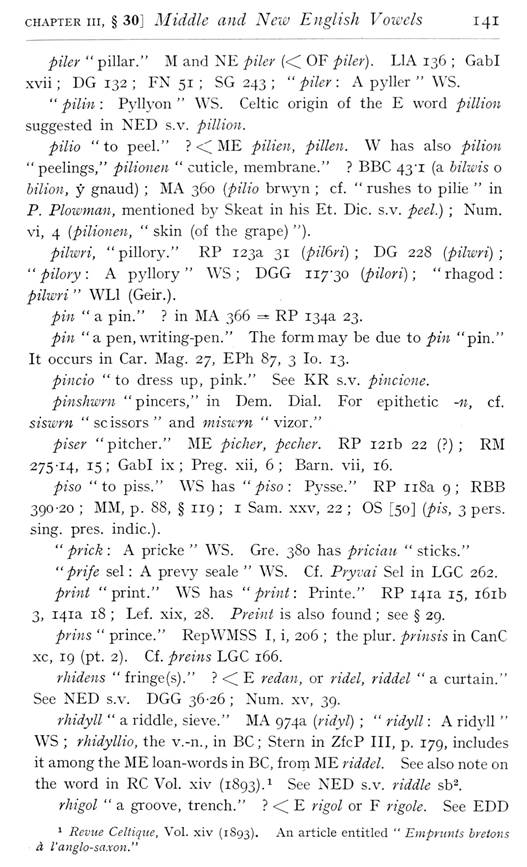
(delwedd F6892) (tudalen 141)
|
CHAPTER
III, § 30] Middle and New English Vowels 141
piler “pillar." M and NE piler “OF piler). LIA 136; GabI xvii; DG 132;
FN 51; SG 243; “piler: A pyller “WS.
" pilin: Pyllyon “WS. Celtic origin of the E word pillion suggested in
NED s.v. pillion.
pilio “to peel."? <C ME pilien, pillen. W has also pilion
"peelings," pilionen “cuticle, membrane."? BBC 43"i (a
hilwis o hilion, y gnaud); MA 360 {pilio brwyn; cf. “rushes to pilie “in P.
Ploivman, mentioned by Skeat in his Et. Die. s.v. peel.); Num. vi, 4
[pilionen, “skin (of the grape) ").
pilwri, "pillory." RP 123a 31 {pil6ri); DG 228 (pilwri); “pilory: A
pyllory “WS; DGG ii7'30 {pilori); “rhagod: pilwri" WLl (Geir.).
pin “a pin."? in MA 366 = RP 134a 23. pin "a pen,
writing-pen." The form may be due to pin "pin." It occurs in
Car. Mag. 27, EPh ^y, 3 lo. 13.
pincio “to dress up, pink." See KR s.v. pincione. pinshwrn
"pincers," in Dem. Dial. For epithetic -n, cf. siswrn
"scissors" and miswrn "vizor."
piser "pitcher." ME picher, pecker. RP 121b 22 (?); RM 275-14, 15;
GabI ix; Preg. xii, 6; Barn, vii, 16.
piso "to piss." WS has “piso: Pysse." RP ii8a 9; RBB 390-20;
MM, p. 88, § 119; i Sam. xxv, 22; OS [50] {pis, 3 pers. sing. pres. indie).
"prick: A pricke “WS. Gre. 380 has priciau “sticks." “prife sel: A
prevy scale “WS. Cf. Pryvai Sel in LGC 262. print "print." WS has
"print: Printe." RP 141a 15, i6ib 3, 141a 18; Lef. xix, 28. Preint
is also found; see § 29.
prins “Y>^mce." RepWMSS I, i, 206; the plur. _/)r/«sis in CanC xc, 19
(pt. 2). Cf. preins LGC 166.
rhidens “fringe(s)."? <C E redan, or ridel, riddel “a curtain."
See NED s.v. DGG 36-26; Num. xv, 39.
rhidyll “a riddle, sieve." MA 974a {ridyl); “ridyll: A ridyll “WS;
rhidyllio, the v.-n., in BC; Stern in ZfcP III, p. 179, includes it among the
ME loan-words in BC, from ME riddel. See also note on the word in RC Vol. xiv
(1893). ^ See NED s.v. riddle sb^.
rhigol “a groove, trench."? < E rigol or F rigole. See FDD
^ Revue Celtique, Vol. xiv (1S93). An article entitled “Emprunts bretons d
I'anglo-saxon."
|
|
|
|
|
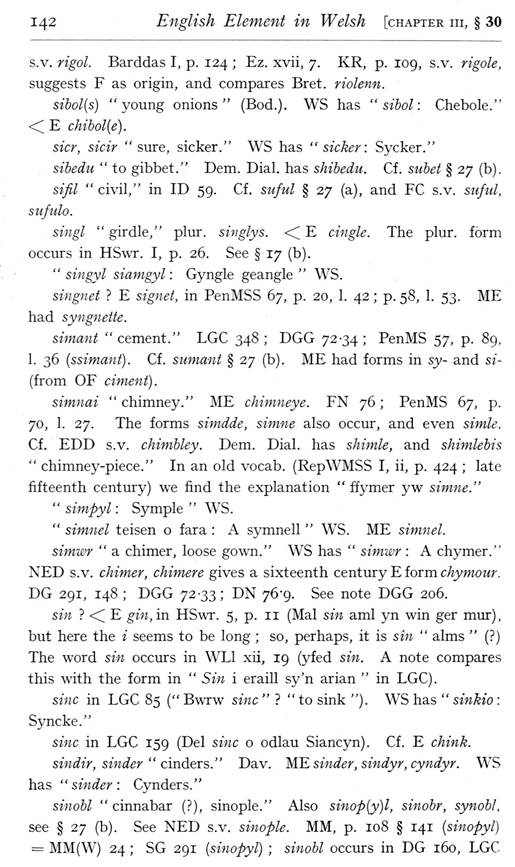
(delwedd F6893) (tudalen 142)
|
142 English
Element in Welsh [chapter m, § 30
s.v. rigol. Barddas I, p. 124; Ez. xvii, 7. KR, p. 109, s.v. rigole, suggests
F as origin, and compares Bret, riolenn.
sibol{s) "young onions" (Bod.). WS has "sibol: Chebole."
<^ E chihol{e).
sicr, sicir "sure, sicker." WS has "sicker: Sycker."
sibedii “to gibbet." Dem. Dial, has shibedu. Cf. subet § 27 (b).
sifil “civil," in ID 59. Cf. suful § 27 (a), and EC s.v. siiful, sufulo.
singl “girdle," plur. siiiglys. <^ E cingle. The plur. form occurs in
HSwr. I, p. 26. See § 17 (b).
" singyl siamgyl: Gyngle geangle “WS.
singnet? E signet, in PenMSS 67, p. 20, 1. 42; p. 58, 1. 53. ME had
syngnette.
simant “cement." LGC 348; DGG 72-34; PenMS 57, p. 89, 1. 36 {ssimant).
Cf. sumant § 27 (b). ME had forms in sy- and si- (from OF ciment).
simnai “chimney." ME chimney e. FN 76; PenMS 67, p. 70, 1. 27. The forms
simdde, simne also occur, and even simle. Cf. EDD s.v. chimbley. Dem. Dial,
has shimle, and shimlebis “chimney-piece." In an old vocab. (RepWMSS I,
ii, p. 424; late fifteenth century) we find the explanation “ffymer yw
simne."
" simpyl: Symple “WS.
" simnel teisen o fara: A symnell “WS. ME simnel.
simwr “a chimer, loose gown." WS has “simwr: A chymer." NED s.v.
chimer, chimere gives a sixteenth century E form chymour. DG 291, 148; DGG
72-33; DN 76-9. See note DGG 206.
sin? <C E ^m, in HSwt. 5, p. ii (Mai sin ami yn win ger mur), but here the
i seems to be long; so, perhaps, it is sin “alms” (?) The word sin occurs in
WLl xii, 19 (yfed sin. A note compares this with the form in “Sin i eraill
sy'n arian “in LGC).
sine in LGC 85 (" Bwrw sine "? "to sink "). WS has
“sinkio: Syncke."
sine in LGC 159 (Del sine o odlau Siancyn). Cf. E chink.
sindir, sinder “cinders." Dav. MEsinder,sindyr,cyndyr. WS has
"sinder: Cynders."
sinobl “cinnabar (?), sinople." Also sinop{y)l, sinobr, synobK see § 27
(b). See NED s.v. sinople. MM, p. 108 § 141 {sinopyl) = MM(W) 24; SG 291
(sinoPyl); sinobl occurs in DG 160, LGC
|
|
|
|
|
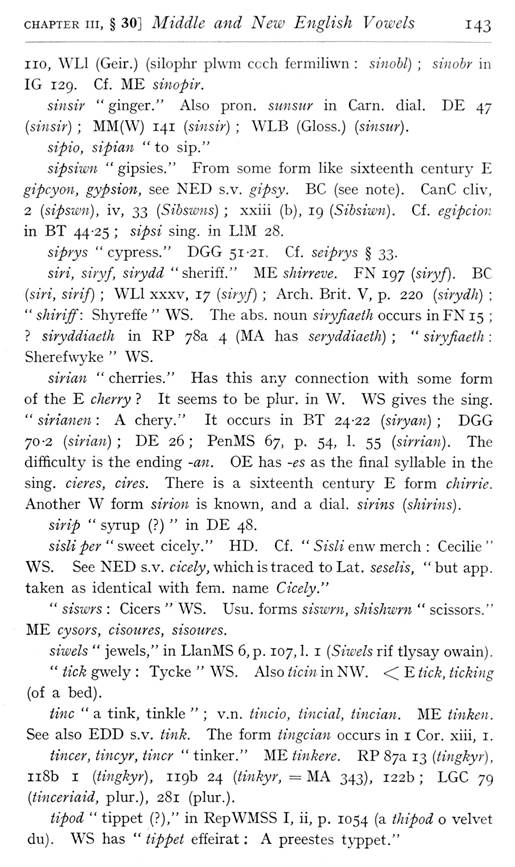
(delwedd F6894) (tudalen 143)
|
CHAPTER
III, § 30] Middle and New English Vowels 143
no, WLl (Geir.) (silophr phvm ccch fermiliwn: sinoU); sinohr in IG 129. Cf.
ME sinopir.
sinsir “ginger." Also pron. sunsur in Carn. dial. DE 47 [sinsir]; MM(W)
141 (sinsir); WLB (Gloss.) [sinsur).
sipio, sipian "to sip."
sipsiwn "gipsies." From some form like sixteenth century E gipcyon,
gypsion, see NED s.v. gipsy. BC (see note). CanC cliv, 2 [sipsivn), iv, 33
[Sihswus); xxiii (b), 19 [Sibsiwn). Cf. egipcion in BT 44-25; sipsi sing, in
LIM 28.
siprys "cypress." DGG 51-21. Cf. seiprys § 33.
siri, siryf, sirydd "sheriff." ME shirr eve. FN 197 {siryf). BC
{siri, sirif); WLl xxxv, 17 {siryf); Arch. Brit. V, p. 220 [sirydh);
“shiriff: Shyreffe “WS. The abs. noun siryfiaeth occurs in FN 15;?
siryddiaeth in RP 78a 4 (MA has seryddiaeth); “siryfiaeth: Sherefwyke “WS.
sirian “cherries." Has this any connection with some form of the E
cherry? It seems to be plur. in W. WS gives the sing. “sirianen: A
chery." It occurs in BT 24-22 [siryan); DGG 70-2 [sirian); DE 26; PenMS
67, p. 54, 1. 55 (sirrian). The difficulty is the ending -an. OE has -es as
the final syllable in the sing, cieres, cires. There is a sixteenth century E
form chirrie. Another W form sirion is known, and a dial, sirins [shirins).
sirip “syrup (?) “in DE 48.
s/s/*'_/)gr “sweet cicely." HD. Cf. “Sisli enw merch: Cecilie “WS. See
NED s.v. czcg/jy, which is traced toLat. seselis, "but app. taken as
identical with fern, name Cicely."
" siswrs: Cicers “WvS. Usu, forms siswrn, shishwrn “scissors." ME
cysors, cisoures, sisoures.
siwels “jewels," in LlanMS 6, p. 107, 1. i (Siwels rif tlysay owain).
" tick gwely: Tycke “WS. Also ticin in NW. << E tick, ticking (of
a bed).
tine “a tink, tinkle”; v.n. tincio, tincial, tincian. ME tinken. See also FDD
s.v. tink. The form tingcian occurs in i Cor. xiii, i.
tincer, tincyr, tincr “tinker." ME tinkere. RP 87a 13 (tingkyr), ii8b I
(tingkyr), 119b 24 (tinkyr, = MA 343), 122b; LGC 79 (tinceriaid, plur.), 281
(plur.).
tipod “tippet (?)," in RepWMSS I, ii, p. 1054 (a tliipod o velvet du).
WS has “tippet effeirat; A preestes t^-ppet."
|
|
|
|
|
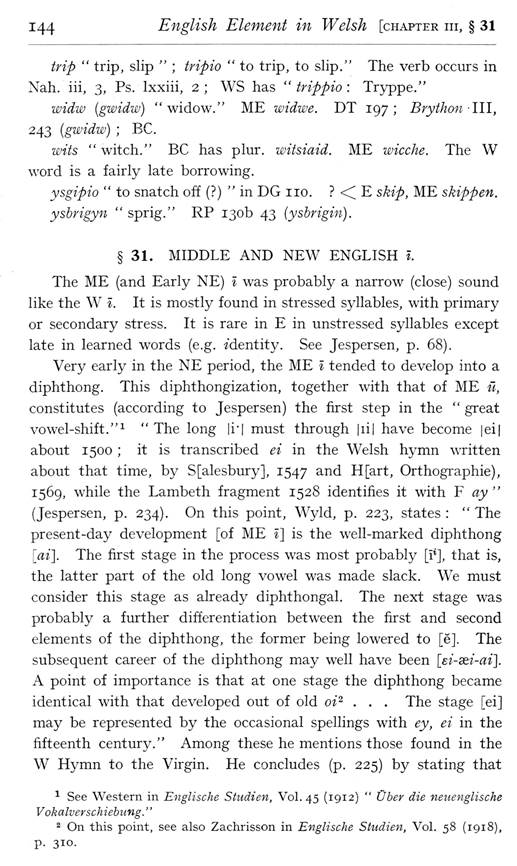
(delwedd F6895) (tudalen 144)
|
144 English
Element in Welsh [chapter hi, § 31
trip “trip, slip”; tripio “to trip, to slip." The verb occurs in Nah. iii,
3, Ps. Ixxiii, 2; WS has “trippio: Tryppe."
widw {gwidw) "widow." ME widwe. DT 197; Brython -111, 243 {gwidw);
BC.
wits “witch." BC has plur. witsiaid. ME wicche. The W word is a fairly
late borrowing.
ysgipio “to snatch off (?) “in DG no.? <C E skip, ME skippen.
ysbrigyn “sprig." RP 130b 43 (ysbrigin).
§ 31. MIDDLE AND NEW ENGLISH I
The ME (and Early NE) i was probably a narrow (close) sound like the W t. It
is mostly found in stressed syllables, with primary or secondary stress. It
is rare in E in unstressed syllables except late in learned words (e.g.
^'dentity. See Jespersen, p. 68).
Very early in the NE period, the ME i tended to develop into a diphthong.
This diphthongization, together with that of ME ii, constitutes (according to
Jespersen) the first step in the “great vowel-shift."^ "The long
|i"| must through |ii| have become |ei| about 1500; it is transcribed ei
in the Welsh hymn written about that time, by S[alesbury], 1547 and H[art,
Orthographic), 1569, while the Lambeth fragment 1528 identifies it with F ay”
(Jespersen, p. 234). On this point, Wyld, p. 223, states: “The present-day
development [of ME i] is the well-marked diphthong [ai]. The first stage in
the process was most probably [i*], that is, the latter part of the old long
vowel was made slack. We must consider this stage as already diphthongal. The
next stage was probably a further differentiation between the first and
second elements of the diphthong, the former being lowered to [e]. The
subsequent career of the diphthong may well have been [si-sdi-ai]. A point of
importance is that at one stage the diphthong became identical with that
developed out of old oi^ . . . The stage [ei] may be represented by the
occasional spellings with ey, ei in the fifteenth century." Among these
he mentions those found in the W Hymn to the Virgin. He concludes (p. 225) by
stating that
^ See Western in Englische Studien, Vol. 45 (1912) “tJber die neiienglische
Vokalverschiebung. ' '
2 On this point, see also Zachrisson in Englische Studien, Vol. 58 (1918), p.
310.
|
|
|
|
|
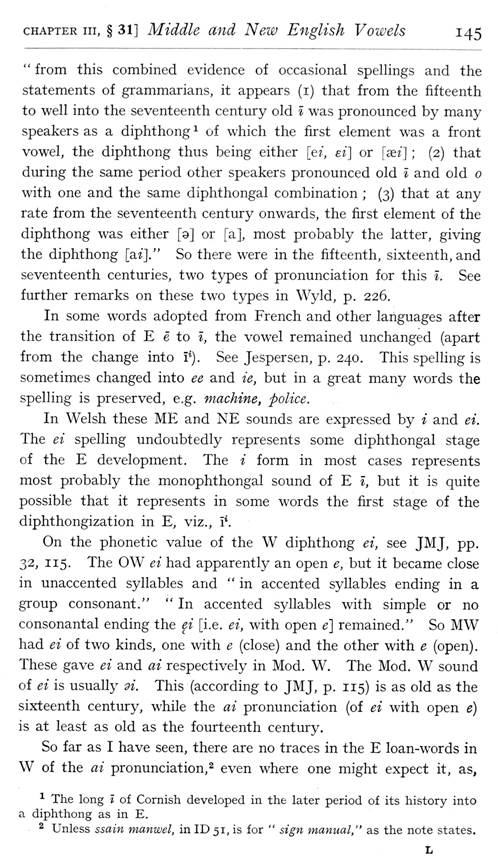
(delwedd F6896) (tudalen 145)
|
CHAPTER
III, § 31] Middle and New English Vowels 145
" from this combined evidence of occasional spellings and the statements
of grammarians, it appears (i) that from the fifteenth to well into the
seventeenth century old i was pronounced by many speakers as a diphthong ^ of
which the first element was a front vowel, the diphthong thus being either
[e^', ei] or [sti]; (2) that during the same period other speakers pronounced
old I and old with one and the same diphthongal combination; (3) that at any
rate from the seventeenth century onwards, the first element of the diphthong
was either [9] or [a], most probably the latter, giving the diphthong
[a«]." So there were in the fifteenth, sixteenth, and seventeenth
centuries, two types of pronunciation for this i. See further remarks on
these two types in Wyld, p. 226,
In some words adopted from French and other languages after the transition of
E e to I, the vowel remained unchanged (apart from the change into i*). See
Jespersen, p. 240. This spelling is sometimes changed into ee and ie, but in
a great many words the spelling is preserved, e.g. machine, police.
In Welsh these WE and NE sounds are expressed by i and ei. The ei spelling
undoubtedly represents some diphthongal stage of the E development. The i
form in most cases represents most probably the monophthongal sound of E i,
but it is quite possible that it represents in some words the first stage of
the diphthongization in E, viz.,?.
On the phonetic value of the W diphthong ei, see JMJ, pp. 32, 115. The OW ei
had apparently an open e, but it became close in unaccented syllables and “in
accented syllables ending in a group consonant." “In accented syllables
with simple or no consonantal ending the ei [i.e. ei, with open e]
remained." So MW had ei of two kinds, one with e (close) and the other
with e (open). These gave ei and ai respectively in Mod, W. The Mod. W sound
of ei is usually di. This (according to JMJ, p. 115) is as old as the
sixteenth century, while the ai pronunciation (of ei with open e) is at least
as old as the fourteenth century.
So far as I have seen, there are no traces in the E loan-words in W of the ai
pronunciation,^ even where one might expect it, as,
^ The long t of Cornish developed in the later period of its history into a
diphthong as in E.
2 Unless ssain manwel, in ID 51, is for “sign manual," as the note
states.
|
|
|
|
|
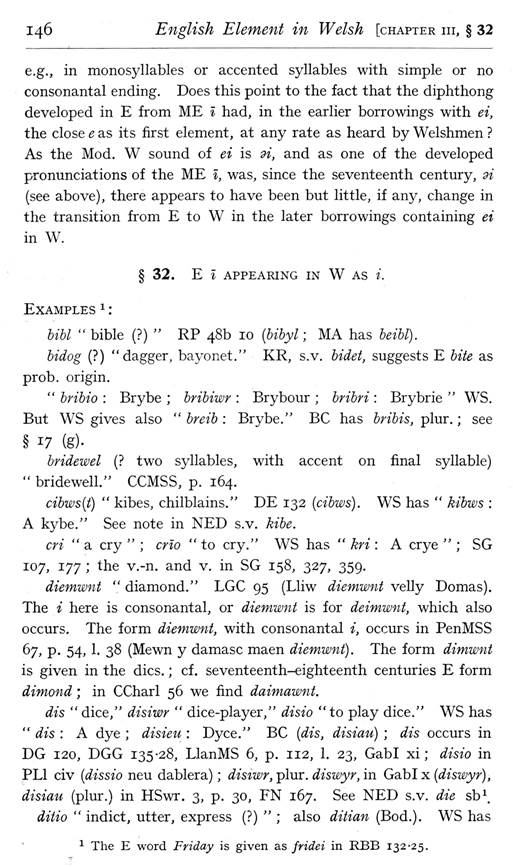
(delwedd F6897) (tudalen 146)
|
146 English
Element in Welsh [chapter hi, § 32
e.g., in monosyllables or accented syllables with simple or no consonantal
ending. Does this point to the fact that the diphthong developed in E from ME
I had, in the earlier borrowings with ei, the close e as its first element,
at any rate as heard by Welshmen? As the Mod. W sound of ei is n, and as one
of the developed pronunciations of the ME l, was, since the seventeenth
century, oi (see above), there appears to have been but little, if any,
change in the transition from E to W in the later borrowings containing ei in
W.
§ 32. E t APPEARING IN W AS i.
Examples ^:
Uhl “bible (?) “RP 48b 10 {hihyl; MA has beibl).
bidog (?) "dagger, bayonet." KR, s.v. bidet, suggests E bite as
prob. origin.
" bribio: Brybe; bribiwr: Brybour; bribri: Brybrie “WS. But WS gives
also “breib: Brybe," BC has bribis, plur.; see
§ 17 (g).
bfidewel (? two syllables, with accent on final syllable)
" bridewell." CCMSS, p. 164.
cibws[t) “kibes, chilblains." DE 132 [cibws). WS has “kibws: A
kybe." See note in NED s.v. kibe.
cri “a cry”; crio “to cry." WS has “kri: A crye”; SG 107, 177; the v.-n.
and v. in SG 158, 327, 359.
diemwnt “diamond." LGC 95 (Lliw diemwnt velly Domas). The i here is
consonantal, or diemwnt is for deimwnt, which also occurs. The form diemwnt,
with consonantal i, occurs in PenMSS 67, p. 54, 1. 38 (Mewn y damasc maen
diemwnt). The form dimwnt is given in the dies.; cf. seventeenth-eighteenth
centuries E form dimond; in CCharl 56 we find daimawnt.
dis “dice," disiwr “dice-player," disio "to play dice."
WS has “dis: A dye; disieu: Dyce." BC {dis, disiau); dis occurs in DG
120, DGG 135-28, LlanMS 6, p. 112, 1, 23, GabI xi; disio in PLl civ [dissio
neu dablera); disiwr, "plwv. diswyr, in Gablx (diswyr), disiau (plur.)
in HSwr. 3, p. 30, FN 167. See NED s.v. die sb^, ditio “indict, utter,
express (?)”; also ditian (Bod.). WS has
^ The E word Friday is given as fridei in RBB 132-25.
|
|
|
|
|
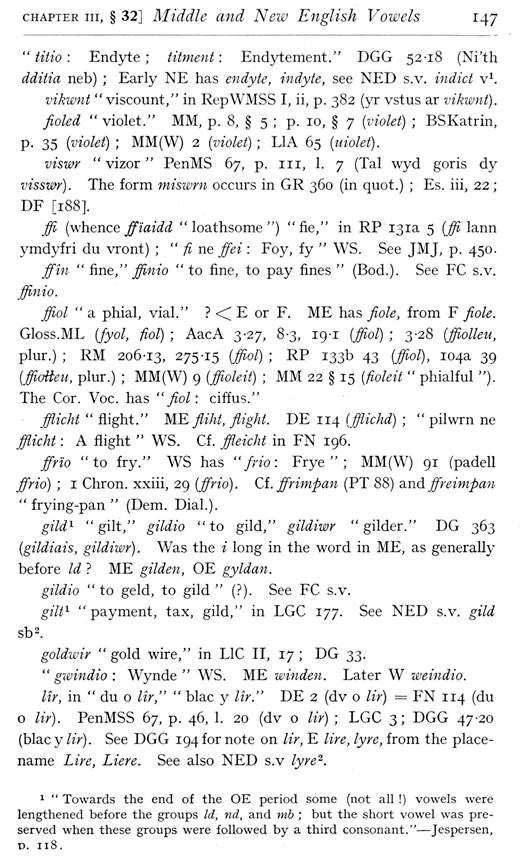
(delwedd F6898) (tudalen 147)
|
CHAPTER
III, § 32] Middle and New English Vowels 147
" titio: Endyte; titment: Endytement." DGG 52-18 (Ni'th dditia
neb); Early NE has endyte, indyte, see NED s.v. indict v^.
vikwnt "viscount," in RepWMSS I, ii, p. 382 (yr vstus ar vikwnt).
fioled “violet." MM, p. 8, § 5; p. 10, § 7 {violet); BSKatrin, p. 35
{violet); MM(W) 2 {violet); LI A 65 {iiiolet).
viswr “vizor “PenMS 67, p. iii, 1. 7 (Tal wyd goris dy vissmr). The form
miswrn occurs in GR 360 (in quot.); Es. iii, 22; DF [188].
ffi {v^'hence ffiaidd "loathsome") "fie," in RP 131a 5
{ffi lann ymdyfri du vront); “fi ne ffei: Foy, fy “WS. See JMJ, p. 450.
ffin “fine," ffinio “to fine, to pay fines” (Bod.). See FC s.v. ffinio.
ffwl “a phial, vial."? <; E or F. ME has fiole, from F fiole. Gloss.
ML {fyol, fiol); AacA 3-27, 8-3, 19 -i {ffiol); 3-28 {ffiolleu, plur.); RM
206-13, 275-15 {ffwl); RP 133b 43 {ffwl), 104a 39 {ffioUeu, plur.); MM(W) 9
{ffioleit); MM 22 § 15 {fiokit “phialful "). The Cor. Voc. has
"fiol: ciffus."
fflicht “flight." ME fliht, flight. DE 114 {ffichd); “pilwrn ne fflicht:
A flight “WS. Cf. ffleicht in FN 196.
ffrio "to fry." WS has "frio: Frye”; MM(W) 91 (padell ffno); I
Chron. xxiii, 29 {ffrio). Q.i. ffrimpan (PT 88) a.ndffreimpan
"frying-pan" (Dem. Dial.).
gild^ "gilt," gildio "to gild," gildiwr
"gilder." DG 363 {gildiais, gildiwr). Was the i long in the word in
ME, as generally before Id? ME gilden, OE gyldan.
gildio “to geld, to gild” (?). See FC s.v.
gilt'^ “payment, tax, gild," in LGC 177. See NED s.v. gild sb2.
goldwir “gold wire," in LlC II, 17; DG ^^.
" gwindio: Wynde “WS. ME winden. Later W weindio.
lir, in “du o lir," “blac y lir." DE 2 (dv o lir) = FN 114 (du o
lir). PenMSS 67, p. 46, 1. 20 (dv o lir); LGC 3; DGG 47-20 (blac y lir). See DGG 194 for note on lir, E lire,
lyre, from the place-name Lire, Liere. See also NED s.v lyre-.
1 “Towards the end of the OE period some (not all!) vowels were lengthened
before the groups Id, nd, and >nb; but the short vowel was preserved when
these groups were followed by a third consonant." — Jespersen, D. 118.
|
|
|
|
|
(delwedd F6899) (tudalen 148)
|
148 English
Element in Welsh [chapter hi, § 32
miri “merriment, bustle,"? from some form of E merry. M and Early NE
miri{e), myrie. The compound miriman (? <^ E merry man) is heard in the NW
dial.
owtil{s) "out isle(s)." ME owte ile{s). LGC 102 [owtil); DN 37'i6;
FN 13 (= LlC I, p. 43). See Bulletin of Board of Celtic Studies, Vol. I, No.
i, p. 42, and NED s.v. out a. 2b.
pi "pie, magpie." ME pie, pye. WS has "pi ne piocen: A
pye." DG 202; DOG 584. The plur. is piod, whence sing. pioden (piogen);
cf. WS's piocen. See EC s.v. pioden.
pih'^ "pipe." } <^M1£. pipe, pype. These forms occur: pihen,
sing., BT 32-8, RP 134b 11; pibau, -eu, plur., Luc vii, 32; CCharl 114;
pibydd "piper" BT 72-2; ID 82 {bagbibav "bagpipes"; see §
9); LlanMS 6, p. 119, 1. 47 (pibay).
pibl “book, Bible (?)."? < ME bible. RP 73a 33 (pibyl); MA 276.
pig “point, prickle, pike," pigo “to prick, to stug." ME pike, plk.
For meaning, see NED s.v. pike sb^ and v^. The verb occurs in Ps. Ixxiii, 21,
Diar. xxiii, 32; the sing, pigyn occurs, cf. “pi gin val i ddraenen: Poynte,
pricke “WS. The plur. picys occurs also by the side of peics, as in LlanMS 6,
p. 74 (raw a ffikys); see § 17 (b), (h). See KR, p. 72, s.v. picco.
Pilad “Pilate." LlC II, 39.
pirat "pirate," DF [46].
prim "prime ";? long i in W. DGG 13-15 (goleu&n'wz); RP. 136a
24 (o brim hyt dy6 gbener); SG 2, 34 (awT brim). See note DGG, p. 175.
prior "prior." RBB 237-23 {prioreit, plur.).
pris "price," prisio "to price," prisiwr
"valuer." The form pris occurs in PenMS 67, p. 76, 1. 28 (Ni wyr
ffrangk banner y ffris); DG 43; Lef. xxvii, 15; prisio and verbal forms in FN
192; Lef. xxvii, 12, 14; Job xxxvi, 19; prisiwr in DE 27. ME prise, pryce.
Rhin “Rhine." LGC 117; HSwt. 5, p. 12 {Rrin).
rhis "rice (?)," in IG 364 (Grawn de Paris, rhis, rhesin).
sivys “chives, cives," in LGC 225 (gwely sivys glas hefyd). Cf. seifys
WS. See § 17 (b).
1 This word is more probably from Lat. See Loth ML s.v., and Loth Voc. s.v.
pipenn reulaiin ("icicle," a Juvencus gloss), for which see also
Bulletin of Bd. of Celt. Studies, 1, ii, p. 122.
|
|
|
|
|
(delwedd F6900) (tudalen 149)
|
CHAPTER
III, § 33] Middle and New English Vowels 149
sikl “cycle (?) “in RepWMSS I, ii, p. 406 [sikl yr haul).
sin “sign (?)," in PenMS 67, p. 97, 1. 72 (ar enw yw sin }t ynys hon).
ME signe, seine.
sir “shire, county." Common. ME schire, shire. MA 320b; WLl Ixxiv 57
[Siesir “Cheshire ").
triagl "treacle." ME iriacle. See § 9 (a).
yshignardd “spikenard," in MM(W) 202; spiknar in AfcL I,
i, 45-
yshinys “spines (?)," from £ plur. LlanMS 6, p. 183, 1. 74 {y shiny s);
DE 120 {spinvs; var. red.dm^ ysheinys). See NED s.v. spine sb^. Cf. yshinws
LlC II, -^y, and yspin (?) in BT 24-17.
yshio “to spy, espy, gaze”; yshiwr “a spy, spectator." WS has “spio:
Spye; espi: A spye; espio: Espye." The form ysbio occurs in ML II, 15
(spio); SG 387 (yspio); Gal. ii, 4; ysbiwr, plur. yshiwyr, in RBB 292-1, 290
[yspiwyr); BoHam. 176 (yspiwr); DG 127 (ysbiivr); Heb. xi, 31. ME spien,
espien.
yspisswyr “spicers, sorciers “occurs in MM, p. 138 § 160. Cf. speisys §§ 17
(b), 33.
ysglisen "a slice," ysglisio "to slice." See EC s.v.
sglisan. ME slice, sclice. WS has “ysclis: A sclyce." Mn.W also yslisen.
ysgwier “square, esquire." Very common in MW. RM 269-19 (ysqGier) (=
PenMS 6 ysgwier, WM yscuer); SG i {ysgwier), 11 {ysgwieryeit, plur.); DG 219
{ysgwier); DT 114 {esgwier). Cf. GaC 140-29 {aciieryeit) .
ysgwir "carpenter's square." Also appar. used as an adj. inW. GabI
vii (cerdd ysgwir); FN 165 (Naddu sgwir yn wir a wnai); BC {ysgwir; see
note). ME squire "square, carpenter's rule." § 33. TRACES OF THE
DIPHTHONGIZATION OF THE l OF E
IN BORROWINGS.
See § 31 for the history of the change in E. The examples here given are
undoubtedly of later origin than those found in § 32. It will be noticed that
some words occur with the two forms, i and ei, pointing to two different
periods. That the diphthong was pronounced even in actual Latin words used in
E is shown by such forms as akwaf veitti (var. reading aqua viti) “aqua vitae
“in DE 49; acwafeiti in CanC xxxiv, i.
|
|
|
|
|
(delwedd F6901) (tudalen 150)
|
150 English
Element in Welsh [chapter hi, § 33
Examples:
beibl "book, Bible." MA 308a; GabI vii. The form Beihl was used in
the first edition of the W Bible. ME hiUe. Cf . pibl. § 32.
hreib “bribe." See bribio, bribis, § 32. WS has “breib: Brybe “TN 320
{breibs, plur.); GR 369 (in quot.) = RepWMSS I, i, p. 185 CCMSS 339; BC
[breibwyr “bribers "); FN 60 [breibiwr, sing.) TN 307 {breibio “to bribe
").
bleins, plur. bleinsis “blind bridle," in Dem. Dial.
bonffeirs “bonfires." CanC cxliv 38.
" brein heli: Bryne “WS. ME brine.
creim “crime," in the expression adar greim “birds of crime," in
Lie I, 53 (= Cyni. xxxi, p. 177).
"
kweifyr sayethe: A queuar “WS. ME quiver, quyuere.
deial “dial." See § 7. 2 Bren. xx, 11.
deimwnt, deiamwnt “diamond." See under dimwnt § 32. WLl Ixxii, 60
{deimwnt); RepWMSS I, ii, p. 693 {deiamwnt).
desgreibio “to describe," in RepWMSS I, i, p. 135.
ecseismon “exciseman," in DT 198. See § 7 (a).
feis “vice (the instrument)." CLIC II, 26 (yn lie bwj^all, feis a
phlwm).
ffei “fie." See # § 32. WS has “Ji ne ffei: Foy, fy." See quot.
from Sion Tudur (sixteenth century) in JMJ, p. 450 {Ffei o ieuenctid am ffo).
See FC s.v. ffei.
"feigys: Fygges; feigyssen: A fygge “WS. Seeffigys § 17 (b). Do these
forms in WS point to an i or a diphthongal pronunciation of some of the forms
of the word fig in E? NED gives a NE form fige.
feiol “viol." CLIC II, p. 21.
ffein “fine “adj. ML II, 311; PT 60, 61.
ffeinys “fines," in RepWMSS I, iii, p. 1047. See § 17 (b).
ffleicht "flight." FN 196. See fflicht § 32.
Heigad “Highgate," in CCMSS 75.
leicio “to like." PT 134.
leion in wheit leion “WTiite Lion” (in London), in CCMSS 164, a transcription
of the E,
" leysens kened: Licence “WS. WLl xii, 23 {leisiens).
peik in “morys peik: Mores pycke “WS. See NED s.v. morrispike. CanC ex, 39
has peics (plur.). Cf. pig § 32.
" pasteim . . .: Past y me “W^S.
|
|
|
|
|
(delwedd F6902) (tudalen 151)
|
CHAPTER
III, § 34] Middle and New English Vowels 151
" peilat Hong: Pylote “WS. NED, s.v. pilot, gives sixteenth-eighteenth
centuries forms pylate, pilate in E,
peint "pint." LIM 106.
" reiolti: Royalti “WS.? < E rialty. See § 7 (a).
ye?«^ in cadw reiat “to make a noise," in NW dial. The form fiat is also
heard. See FC s.v. Dem. Dial, has cadw reiets. E riot.
" reseinio: Resygne “WS.
scweir “squire “in BC.
seiens "science," in RepWMSS I, i, p. 214. Cf, siens LGC 315.
" seifys llyseu: Cyves “WS. E chives, cives. See sivys § 32.
seiffyrs “ciphers," in RepWMSS II, i, p. iii. Cf. Dem. Dial. seiffro
“arithmetic; to perform arithmetical operations."
seims “chimes." CCMSS 170, 176.
Siehseid “Cheapside." RepWMSS I, ii, p. 637; p. 895 [Sieh seid ynghaer
Ivdd).
" seiprys: Cypres “WS. ME cipres, cypres; later cipris. Cf. siprys § 30
(b).
speisys "spices" in WS, "llyseu siopeu ne speisys:
Spyce." Cf. yspisswyr § 32.
teigr "tiger." ME tigre.
teilys "tiles"; also teils. Cf. tiglist § 5. ME tiles. DGG 19-16
{teilys) = DG 253; LGC 158 [teils), 176 {teilys); ID 14 {teils); Lie I, 30
{teilys).
teim “thyme." Gre. 113 ('N wlych i deim hav a lavant; c. 1730); MM(W)
loi (a theim gwyllt); “teim llyseu: Tyme “WS.
teid "tide." See FC s.v.; teit is also heard. RepWMSS I i, p. 246
{teit); CAMSS, p. 44 {teit).
teirant “tyrant." CLIC iv, p. 47 {teirant and teyrant).
treio “to try." See FC. CLIC II, p. 9 (yna treinDyd llawer mil).
turnpeiciwr “turnpike-keeper." TN 18.
wdcneiff “woodknife." RepWMSS I, i, pp. 8, 174, 181.
weils "wiles," in CCMSS 40 (Canfod weils disiau ffeilsion).
weir “wire." BC. See FC s.v. weiran.
§ 34. M AND NE u (NATIVE AND FRENCH), d (FRENCH) u AND
j ou (FRENCH)
E UNSTRESSED u AND 6. Like the other unstressed vowels already dealt with,
these in E were “weakened “and have become
|
|
|
|
|
(delwedd F6903) (tudalen 152)
|
152 English
Element in Welsh [chapter hi, § 34
an obscure vowel sound. “Unstressed |o| and |u| generally have become [9].
The two vowels cannot be separated, and it is possible that any |o| before
becoming [9] passed through |u| . . . In middle syllables we have [9] in all
familiar words: innocent [in9S9nt] ... In the beginnings of words we have [e]
for or u in the numerous words formed with con-, com-, cor- . . . |o| and |u|
^ [9] in weak-stressed words" (Jespersen, pp. 257,
258).
In W the pure 0- sound even in unstressed syllables appears in
most cases as 0, whether the be of native E or of F origin. See
§ 46. The M-sound, however, and the b (with ou and u variants)
of F origin generally appear as w in W. This seems to imply that
borrowing had taken place in these cases before the actual weakening,
and in the case of the words with pure appearing in W with 0,
before the first stage in the “weakening," namely the change of
unstressed to the u- sound, mentioned above. There are, however,
a few traces among the loan-words of the “weakening “process in
E, e.g. tresyn, tresn and sesn, § 24.
E STRESSED u. In Early NE the w-sound is of many origins.
There seem to have been two kinds, narrow u and wide u. The
sound represents OE u, shortened OE u, and sometimes OE y. But
it is also found instead of other vowels “in the neighbourhood of
lip consonants” (Jespersen, p. 84), e.g. word, worm, worry. It also
occurs between m and ng. It corresponds also to OF u, whether
stressed in E and F, or unstressed in F, but stressed in E. “Early
|u| also represents F before a nasal, which in Anglo-French had
become |u|” (Jespersen, p. 85), whether stressed in F and E,
stressed in F and not in E, or stressed in neither language, "u
also corresponds to F in a few other words, e.g. putty, gulf,
drug” (Jespersen, p. 86). Sometimes E u represents F u [w];
cf. § 43-
Orthographical variants in 0, u, ou are found in M and Early NE. This led to
some confusion, in spite of the fact that an attempt was made to distinguish
between u and u, the former being represented by (of F) and the latter by ou
(of F). Besides, was sometimes used for both long and short u. In late ME was
used for u in the neighbourhood of the letters m, n, u, as an orthographical
device to prevent ambiguity and confusion. Hence the spelling
|
|
|
|
|
(delwedd F6904) (tudalen 153)
|
CHAPTER
III, § 34] Middle and New English Vowels 153
won, wonder, monkey, love. This is fully explained by Jespersen, pp. ^^, 89.1
Ellis thought that because of the variant spellings mentioned above E had two
sounds, for he say^ (EEP, p. 398), in dealing with the pronunciation of the
fourteenth century: “short had two sounds (o, u), generally (o), the short
sound of the last letter, not heard in usual English, the French 'homme,'
Ger. ' Holtz,' It. aperto . . . Occasionally short was sounded as short?/,
apparently in those cases in which it was thus sounded in the xvi century,
provided it corresponded with Anglo-Saxon n." Can the E sound have been
in some cases or at some time in the Romance words somewhere intermediate
between the high-back-wide and the mid-back-wide vowels?
In almost all the cases mentioned above, W has w. This W sound is the
high-back-narrow-round vowel, like F ou in tout, sou, Scottish 00 in hook,
but perhaps slightly less rounded. The E u- sound (as in Modern E pull, put)
is the high-back-wide-round sound. There has been, therefore, a slight change
(from wide to narrow) in the transition.
In the following list, then, we have included words belonging to all the
classes mentioned above, that is, all cases of sounds that gave the Early NE
u- sound (native and foreign). As the majority of these have in W the w in
unaccented positions (of E), the borrowing seems to have taken place before
the unstressed sound developed in E into 9 (the obscure vowel); and as in
stressed syllables also we generally have w in W, such cases point to a
period of borrowing prior to the unrounding of accented u in E. (For the
unrounding of ME u, see Wyld, p. 232 ^; also Jespersen, p. 330, where it is
stated that "the change |u| >> [a], by which lu| was perhaps first
unrounded into the high-back-wide vowel sound and then lowered, must have
taken place in the seventeenth century.")
As the representation of the E sound both in stressed and in unstressed
syllables was the same in W, no separate classification has been attempted.
In Romance words, the accent fluctuated a
1 On this influence of French orthography, see also Horn, Historische
neuenglische Grammatik (Strassbourg, 1908), Vol. I, p. 9.
2 See also Horn, op. cit., chap iv.
|
|
|
|
|
(delwedd F6905) (tudalen 154)
|
154 English
Element in Welsh [chapter hi, § 35
good deal in E (see above), especially at the time when they were newly
borrowed from F into E.
For doublets in w and o, see § 35.
For cases of diphthongization of u, see § 74.
For cases with u in W, see § 39.
In the examples mentioned below (§ 35), the w tends to remain even when the
change w^^y would be expected in W.
Forms like cwpl, dwbl, represent cases of E shortening before a labial, see
Jespersen, p. 237. § 35. EXAMPLES WITH w IN W
actwn. ME acketonn, aketton, § 9 (b).
almwn “almond" § 9 (b).
almwner, §§ 9 (b), 20.
aliwn, § II.
atwrnai, twrnai “attorney." ME aturne, atorne, attourney, -at,
§ 9 (a).
hacwn, § 9 (b).
baeywn “bayonet." PenMS 67, p. 11, 1. 14. < Bayonne.
harwn “baron," § 9 (b).
bastwn, pastwn, § 9 (b).
Ulwg, § 30 (b).
brwmstan, § 9 (a).
bwced “bucket," § 20.
bwd “buckle." See SE.
bwcled, § 20.
bwcran “buckram." RM 154-22.? << ME biickeram, bougeren, or -<
F. See Weekley s.v. buckram.
bwff “buff." RepWMSS II, ii, p. 651 (clos o bwff); LIM 86 (clos bwph).
bwggeryddion, § 20.
bwngler [mwngler), § 20. Cf. byiigliau,? plur. of E bungle, in ID 72 (na wna
dithau byngliav balch).
bwla, bwly, “bull," §§ 15, 16.
bwlas “bullace," § 9 (a). WS has bolas.
bwliwns, § 17 (h).
bwned, “bonnet," § 20.
|
|
|
|
|
(delwedd F6906) (tudalen 155)
|
CHAPTER
III, § 35] Middle and New English Vowels 155
hwrdais, hwrgais "burgess," ME burgeis, borgeis,<C. OF burgeis.
The form bwrdais {bwrdeis) occurs in RP 129b 45; LlanMS 6, p. 40, 1. 24 (= DG
190); LGC 388; FN 133 (= LIC I, p. 53); RepWMSS I, i, p. 233; the plur.
b6rdeisseit in RBB 331-24, -26. The form bwrgais {bwrgeis) occurs in SG 226,
236; RepWMSS I, ii, p. 330 (bvrgeis); the plur. bGrgeisseit in RBB 363-26,
366-6, 379-25, -29; GaC 134-3 {burgeissyeit; 1 u=w).
bwrn, “bundle, burden," from E burn, a contraction of burden. See NED
s.v. burn sb-, and EDD s.v. burn sb^. MA, p. 987; Gloss. ML burn {u = w); RM
275-14 {b6rnn); RepWMSS I, ii, p. 680. It is used in W very often meaning
“incubus; a burden on the stomach." See EC s.v. bwrn. Is ceseilmrn (as,
e.g., RMi45"28 cesseildrn) for ceseil -\- fwrn?
bwiler “butler," § 20.
bwtri “buttery," § 35.
bwtwn “button." ME botoun, botone. Car. Mag. 29 {b6U6n). Also bwtwm,
botwm in W.
byrdwn “burden, refrain." ME byrdoun, later bordone.
ceisbwl “catchpoll, catchpole." ME cachepol. DGG 96-30. TA 494; BC
{ceisbwl).
clariwn “clarion," § 9 (b).
clwpa. ME clubbe, § 15.
cnwpa “knob," § 15.
condisiwn “condition." TN 327.
commissiwn, § 30 (b):
cotwm “cotton." ME cotoun, colon. WS has “kotwm: Coton."
crwc "crock, pail."? -< E. ME crocke. WS has “krwck ne ystwck
llestyr: A payle." See KR s.v. cruche.
? crwca, § 15.
crwper, § 20.
cwcwallt, § 9 (a),
cwestiwn, § 22.
cwfent, § 20.
cwfert, § 20.
"cwl: Cull; cwlio: Cull" WS. See EC s.v. cwlin.
Cwlen “Cologne." Early NE Collen, Cidlen, § 20.
cwmbrus “cumbrous." BC.
cwmffri “comfrey." HD; AfcL, I, i, 39 [kwnffri).
|
|
|
|
|
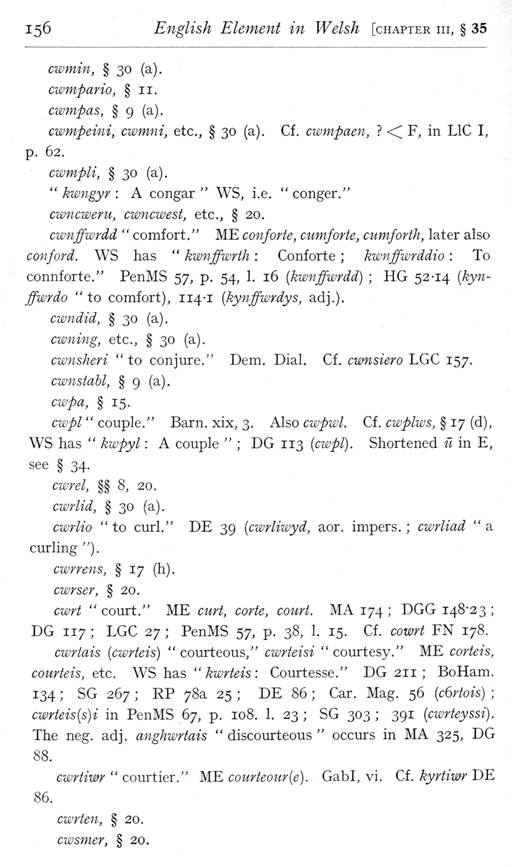
(delwedd F6907) (tudalen 156)
|
156 English
Element in Welsh [chapter hi, § 35
cwmin, § 30 (a).
cwmpario, § 11.
cwmpas, § 9 (a).
cwmpeini, cwmni, etc., § 30 (a). Cf. cwmpaen,? <^ F, in LlC I, p. 62.
cwmpli, § 30 (a).
" kwngyr: A congar “WS, i.e. "conger,"
cwncweru, cwncwest, etc., § 20.
cwnffwrdd “comfort." ME conforte, cumforte, cumforth, later also
conford. WS has “kmnffwrth: Conforte; kwnffwrddio: To connforte." PenMS
57, p. 54, 1. 16 {kwnffwrdd); HG 52-14 (^jy;?- ffwrdo "to comfort),
114-1 {kynffwrdys, adj.).
cwndid, § 30 (a).
cwtiing, etc., § 30 (a).
cwnsheri “to conjure," Dem. Dial. Cf, cwnsiero LGC 157.
cwnstabl, § 9 (a).
cz£;j5)«, § 15,
cz£^j!)/ “couple." Barn, xix, 3. Also cwpwl. Cf. cwplws, § 17 (d), WS
has “kwpyl: A couple”; DG 113 {cwpl). Shortened u in E, see § 34.
cwrel, §§ 8, 20.
cwrlid, § 30 (a).
cwrlio “to curl." DE 39 [cwrliwyd, aor. impers.; cwrliad “a curling
").
cwrrens, § 17 (h).
cwrser, § 20,
cwrt “court." ME cz^r^, corte, court. MA 174; DGG 148-23; DG 117; LGC
27; PenMS 57, p. 38, 1. 15. Cf. cowrt FN 178.
cwrtais {cwrteis) "courteous," cwrteisi "courtesy." ME
corteis, courteis, etc, WS has "kwrteis: Courtesse." DG 211; BoHam.
134; SG 267; RP 78a 25; DE 86; Car, Mag. 56 {cGrtois); cwrteis{s)i in PenMS
67, p. 108. 1, 23; SG 303; 391 [cwrteyssi). The neg. adj. anghwrtais
"discourteous" occurs in MA 325, DG 88.
cwrtiwr “courtier." ME courteour{e). GabI, vi. Cf. kyrtimr DE 86.
cwrten, § 20. cwsmer, § 20.
|
|
|
|
|
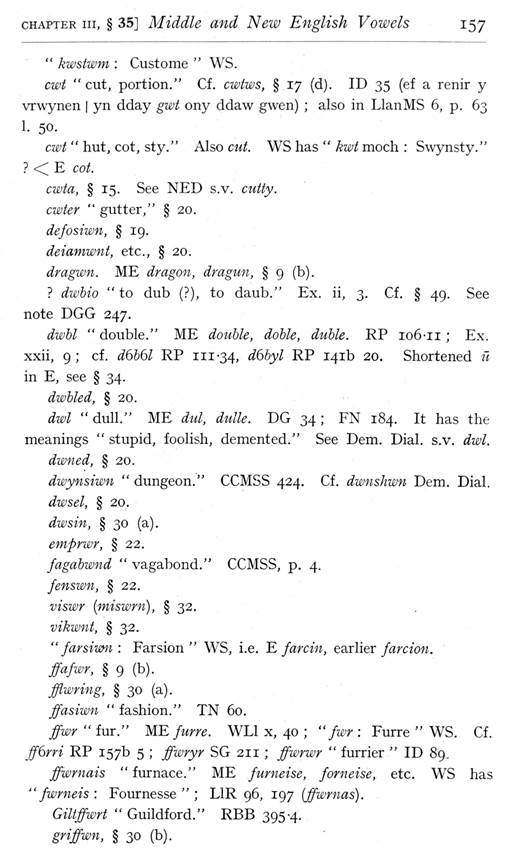
(delwedd F6908) (tudalen 157)
|
CHAPTER
III, § 35] Middle and New English Vowels 157
" kwstwm: Custome “WS.
cwt “cut, portion." Cf. cwtws, § 17 (d). ID 35 (ef a renir y vrwynen |
yn dday gwt ony ddaw gwen); also in LlanMS 6, p. 63
1. 50.
cwt “hut, cot, sty." Also cut. WS has “kwt moch: Swynsty."? < E
cot.
cwta, § 15. See NED s.v. cutty.
cwter “gutter," § 20.
defosiwn, § 19.
deiamwnt, etc., § 20.
dragwn. ME dragon, dragun, § 9 (b).
? ^w5io “to dub (?), to daub." Ex. ii, 3. Cf. § 49. See note DGG 247.
dwhl “double." ME double, dohle, duhle. RP io6-ii; Ex. xxii, 9; cf.
d6h6l RP 111-34, d^hyl RP 141b 20. Shortened ii in E, see § 34.
dwbled, § 20.
dwl "dull." ME dul, dulle. DG 34; FN 184. It has the meanings
“stupid, foolish, demented." See Dem. Dial. s.v. dwl.
dwned, § 20.
dwynsiwn “dungeon." CCMSS 424. Cf. dwnshwn Dem. Dial.
dwsel, § 20.
dwsin, § 30 (a).
emprwr, § 22.
fagahwnd “vagabond." CCMSS, p. 4.
fenswn, § 22.
viswr {miswrn), § 32.
vikwnt, § 32.
" farsium: Farsion “WS, i.e. 'E farcin, esxliev farcion.
ffafwr, § 9 (b).
fflwring, § 30 (a).
ffasiwn “fashion." TN 60.
ffwr “fur." ME furre. WLl x, 40; “fwr: Furre “WS. Cf. ffOrri RP 157b 5;
ffwryr SG 211; ffwrwr “furrier “ID 89.
ffwrnais “furnace." ME furneise, forneise, etc. WS has “fwrneis:
Fournesse”; LIR 96, 197 {ffwrnas).
GiUffwrt “Guildford." RBB 395-4.
griffwn, § 30 (b).
|
|
|
|
|
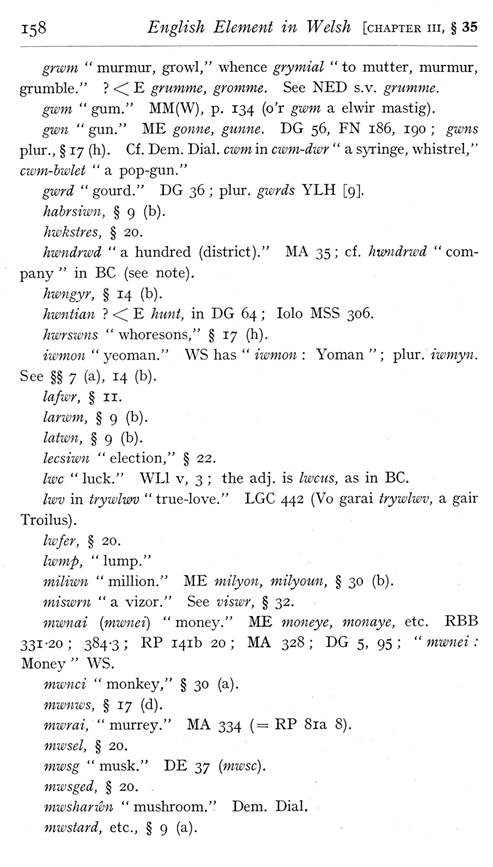
(delwedd F6909) (tudalen 158)
|
158 English
Element in Welsh [chapter hi, § 35
grwm “murmur, growl," whence grymial “to mutter, murmur, grumble."?
<C E grumme, gromme. See NED s.v. grumme.
gwm "gum." MM(W), p. 134 (o'r gwm a elwir mastig).
gwn “gun." ME gonne, gunne. DG 56, FN 186, 190; gwns plur., § 17 (h).
Cf. Dem. Dial, cwm in cwm-dwr “a sjnringe, whistrel," cwm-hwlet “a
pop-gun."
gwrd “gourd." DG 36; plur. gwrds YLH [9].
hahrsiwn, § 9 (b).
hwkstres, § 20.
hwndrwd “a hundred (district)." MA 35; cf. hmndrwd “company “in BC (see
note).
hwngyr, § 14 (b).
hwntian? <C E /m«i, in DG 64; lolo MSS 306.
hwrswns “whoresons," § 17 (h).
iwmon “yeoman." WS has “iwmon: Yoman”; plui.' iwmyn.
See §§ 7 (a), 14 (b).
lafwr, § II.
larwni, § 9 (b).
latwn, § 9 (b).
lecsiwn “election," § 22.
/zee “luck." WLl V, 3; the adj. is Iwcus, as in BC.
Iwv in irywlwv "true-love." LGC 442 (Vo garai trywlwv, a gair
Troilus) .
Iwfer, § 20.
Iwmp, “lump."
miliwn “million." ME milyon, milyoun, § 30 (b).
miswrn “a vizor." See viswr, § 32.
mwnai [mwnei) “money." ME money e, monaye, etc. RBB 331-20; 384-3; RP
141b 20; MA 328; DG 5, 95; “mwnei: Money “WS.
mwnei “monkey," § 30 (a).
mwnws, § 17 (d).
mwrai, "murrey." MA 334 (= RP 8ia 8).
mwsel, § 20.
mwsg “musk." DE 37 (mwsc).
mwsged, § 20.
mwsharwn “mushroom." Dem, Dial.
mwstard, etc., § 9 (a).
|
|
|
|
|
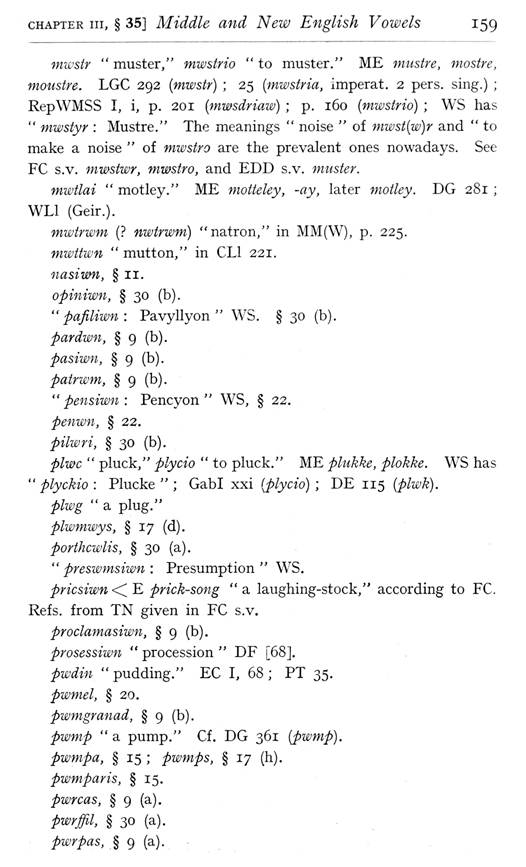
(delwedd F6910) (tudalen 159)
|
159CHAPTER III, § 35] Middle and New
English Vowels 159
mwstr “muster," mwstrio “to muster." ME miistre, mostre, monstre.
LGC 292 {mwstr); 25 {mwstria, imperat. 2 pers. sing.); RepWMSS I, i, p. 201
[mmsdriaw); p. 160 [mwstrio); WS has “mwstyr: Mustre." The meanings
“noise “of mwst{w)y and “to make a noise “of mwstro are the prevalent ones
nowadays. See FC s.v. mwstwr, mmstro, and EDD s.v. muster.
mwtlai “motley." ME motteley, -ay, later motley. DG 281; WLl (Geir.).
mwtrwm (? nwtrwm) "natron," in MM(W), p. 225.
mwttwn “mutton," in CLl 221.
iiasiwn, § 11.
opiniwn, § 30 (b).
"pafiliwn: Pavyllyon “WS. § 30 (b).
pardwn, § 9 (b).
pasiwn, § 9 (b).
patrwm, § 9 (b).
" pensiwn: Pencyon “WS, § 22.
penwn, § 22.
pilwfi, § 30 (b).
^/z£/c “pluck," ^^/yao “to pluck." ME plukke, plokke. WS has
“plyckio: Plucke”; GabI xxi (plycio); DE 115 (plwk).
plwg “a plug."
plwmwys, § 17 (d).
porthcwlis, § 30 (a).
" preswmsiwn: Presumption “WS.
pricsiwn<^E, prick-song "a laughing-stock," according to FC.
Refs. from TN given in FC s.v.
proclamasiwn, § 9 (b).
prosessiwn “procession “DF [68].
pwdin “pudding." EC I, 68; PT 35.
pwmel, § 20.
pwmgranad, § 9 (b).
pwmp “a pump." Cf. DG 361 (pwmp).
pwmpa, § 15; pwmps, § 17 (h).
pwmparis, § 15.
pwrcas, § 9 (a).
pwrffil, § 30 (a).
pwrpas, § 9 (a).
|
|
|
|
|
(delwedd F6911) (tudalen 160)
|
i6o English
Element in Welsh [chapter m, § 35
pwfpwl “purple/' in LlanMS 6, p. 119, 1. 59.
pwrs "purse." ME purs, pors, pours. MA 343 (= RP 119b 26); SG 135;
LGC 236; GR 372; MM, p. 140, § 166; lo. xii, 6.
pwt "anything short, stump."? <C E butt, "the butt-end of
anything."? in RP 123b 21 {p6t).
pwt “a thrust, a shove." <^ E put or butt. The W v.-n. is pmtian,
pwtio. For meaning of E put, see Weekley s.v.
" rebeliwn: A rebellyon “WS.
rheswm, § 24.
rhwbio "to rub." GabI, p. 24 {rhwbiasont, aor. 3 pers. plur.);
“rwbio: Rubbe “WS; Lc. vi, i.
? rwnca, § 15.
Rwmnai “Rumney (wine)." ME romon{e)ye, romanye, later romney. DE 49; LGC
255; HS\vr 5, p. 15.
safwr, § II.
saffrwm, § 9 (b).
scwtsiwn “scutcheon." BC.
secwndid, § 30 (a).
Seimwnt Mwmfordd in RepWMSS, I, i, p. 215.
sesiwn,
§ 22.
sibswn{s), §§ 17 (h), 30 (b).
? siwgr, siwgwr “sugar." ME sucre, sugre. DG 86, 354 [siwgraidd, adj.); WLl liv,
54; ID 17, 18. Cf. suwgr § 66.
shwc “jug," in S, Cards; cf. mwc “a mug."
siwlard, § 9 (a).
siwrl "churl." ME chorle, churle. DG 137; GabI iii, p. 6; Rep. WMSS
I, i, pp. 64, 130; “siwrl: A churle “WS; CLl 206b.
siwrnai “journey." ME iornee, iournee. DG 167; BoHam. 130 (iwrnei); Cym.
xxxi, p. 205 (siwrnai); RepWMSS I, i, p. 218 [shiwrnai]; SG 159, 160
[sywrneioed, plur.); v.-n. siwrneio “to journey”; DG 56 [siwrneiai).
slwt “slut." RepWMSS I, i, p. 88.
stwff “stuff." TN 310.
swcwr “succour." DT p. 103 (swccwr); “swckwr: Socoure “WS; swcro “to
succour “TN 445.
swm “sum." ME summe, somme. RP ii8a 37; ID 88; RepWMSS I, ii, p. 353; ML
II, 15. Cf. swmp in RBB 3607, 365-11, 408, 409; ID 55; PenMS 57, p. 34, 1.
56; WST Mc. xii, p. 89;
|
|
|
|
|
(delwedd F6912) (tudalen 161)
|
CHAPTER
III, § 35] Middle and New English Vowels i6i
p. 465 [swm, swmp, in margin); “swm: Summe “WS; Dem. Dial. [swmp).
swmer. ME somer. See § 20.
swnd “sand." ME sond[e). Also swnt in W. WLl, Iv, 122 [swnt); PenMS 67,
p. 70, 1. 23 (smnd); WST Dat. xx, p. 496 (swnd in margin, = i^ywo^ y mor in
text). See FC s.v. sz£'';?<i'.
swper, § 20.
swrcod, swrcot “surcoat."? <^ F or ME surcote. The form s6;'co^
occurs in RM 84-24; 153-14; 164-29; 247-16; RP 134b, 34. WS has “swrkot: A
surcote." The plur. swrcodeu [swrcodau) occurs in MA 369, SG 250, RP
128b 38.
swrffed, § 20.
" swspectio ne ddrycdybio: Suspecte; swspecsus ne tybus: Suspiciouse
“WS.
" swspendio: Suspende “WS.
swrplis, § 30 (a) . A case of E z^ <^ F tt [u), like swrcod, swrffed,
above.
tabwrdd, § 11.
treswr, § 21 (b).
treswn, § 24.
trwmp “trump," ME trumpe, tronipe. MA 371; DG 56; “trwmp: Trumpe “WS;
CCharl 94 [irympeu, plur.); cf. trympiau FN 44.
trwU, trwbwl “trouble”; trwhlio “to trouble." WS has "trwbwl:
Trouble"; GR, p. 363 (in quot., truUio).
trwmped, § 20.
trwnc “trunk." ME tronke. The trwnc of BC is another word, and means
“urine."
trwsa, § 15. The form tr6ssyat [trwsiad) occurs in RP 94b 38, 97b 2; MA 217b;
DG 27; tr6ssya6 in RP 97a 2; trwsio Dat. xxi, 2;? trussad in BBC 78-5; trws
in DG 108. See NED s.v. truss, and FC s.v. trwsio, which usually means “to
mend, to trim, to dress." Note in DGG 247 derives trws from F trousse.
twha, § 15.
twca, § 15.
twndis "tun-dish, funnel" in SW (Bod.).
twnel “tunnel," § 20.
twred, § 20.
M
|
|
|
|
|
(delwedd F6913) (tudalen 162)
|
1 62
English Element in Welsh [chapter hi, § 36
twrn “a turn." DG 75, 201; RP loib 37, 103b 24; HSwr. 6, p. 16; GabI
xxiv, p. 59; “twrn: A turn “WS.
twrneimeint "tournament." ME turnement, tournement, etc.?
W<<F. RM 260-16; 193-3; WM 286-3 {twrmeineint). Cf. § 18 and
twrneimant, § 14 (a). Cf. also twrneio in LlC I, p. 56 (od elai deg, gydol
dydd, |i dwrneio i'r Dre Newydd).
twrpant, § 14 (a).
walwrt “wall-wort." HD.
washws “wash-boards," in FC. See § 17 (i).
wniwns “onions." Dem. Dial. Cf. winwyn, § 38. See also
§ 17 (h).
wngsiwn “unction," in RepWMSS I, ii, p. 966 (wngsiwn: oentment llwydwyn
. , .).
wrlys, wrls, § 17 (b), (h).
wrsih, § 30 (a).
wttro "to utter." CanC cvii, 22.
ysgwl in DGG 57-1. E skull suggested as origin in note, p. 200.
ysgwrio “to scour." Lef. vi, 28 [ysgwriaf).
ysgwrs “scourge," ysgyrsio, ysgwrsio “to scourge." SG 191, 308,
334, 425; FN 167; RP 98b 25; RepWMSS I, ii, p. 424 (ffrowyll yw ysgwrs);
plur. in SG 423 {ysgyrseu); LIA 59; the shorter form scwrs occurs in BC, with
v.-n. scwrsio; WST Mt. x, p. 19 has yscyrsian, Mt. xx, p. 40 yscyrsiaw, Mt.
xxvii, p. 59 yscyrsiodd; lo. ii, p. 170 yscwrs.
ystasiwn, § 11.
ystwff, stwff, “stuff."
ystwffio, stwflo “to stuff."
ystwnd, stwnt. <C. E stund. DE 146 {ystwnd, with var. read. ystwnt); cf.
FC s.v. stwnt. Bod. gives also stond "tub, cask, vessel." See NED
s.v. stund, and EDD s.v. stound.
Many E names in -on appear in W with -wn, e.g. Winstwn LGC 89, Witwn GabI xi.
§ 36. Certain forms in occur in W side by side with those in w. Are some of
these due to the influence of E spelling? barones § 9 (b); cf. barwn § 35.
bordeisseit, plur. of bordeis, bwrdeis (§ 35), in RepWMSS I, ii,
PP- 345, 346.
|
|
|
|
|
(delwedd F6914) (tudalen 163)
|
CHAPTER
III, § 37] Middle and Neiv English Vowels 163
hotwm; cf. hwtwn, § 35. LlanMS 6, p. 8, 1. 36 (plur. hotymay, — hotymau in DG
53); Gre. 395 {hotwm); LlC I, p. 62 {hotwn, rhyming with hwn); RP 129b 29
(bottymaGc, adj.).
clopa; cf. chvpa, § 35. See § 15.
cofent; cf. cwfeni, §§ 20, 35.
comfforddns Zech. i, 13; cf. cwnffwrdd, § 35.
condid; cf. cwndid, § 35.
consefo "to conceive." HG iio-2 [consefodd).
consurio “to conjure." GabI xi, 30. See § 43. Cf. cwnsheri,
§ 35-
corieissi SG 248; cf. cwrteis{s)i, § 35.
costwm “custom “or “costume," in RepWMSS, I, i, p. 20; CAMSS, p. 18
{cosdimn). Cf. kystwm, § 37.
dragon, § 9 (b); cf. dragwn, § 35.
egipdon, § 30 (b); cf. sihsiwn, § 35.
ffloring, § 30 (a); cf. ffiwriug, § 35.
motlai in WLl (Geir.) “motlai, mwtlai: amhwiog”; PenMS 67, p. 7, 1. 31
{modleiwyt mettel lawer; the aor. impers. of modleio,? for motleio). Cf.
mwtlai, § 35.
monei in WST Mc. xii, p. 91; cf. mwnei, § 35.
pennon, § 22; cf. penwn, § 35.
pilori, pilwri, § 30 (b).
pomgranad, § 9 (a); cf. pwmgranad, § 35.
portreio “to portray." ME purtreie, portreie {<^ OF poiirtrai). In
this case, there does not seem to be a W form with w. WS has “Portreiad:
Portraiture”; LGC 487 (portreiwr); see also forms with por- in Act. vii, 44;
Heb. ix, 23, 24; Gal. iii, i; Ez, viii, 10.
sond “sand “FC. Cf. swnd, § 35.
irolio and trwlio “to troll, to trundle." See KR s.v. troler and Weekley
s.v. troll.
trysor, § 21 (b); cf. treswr, § 35.
ysgors in SG 237; cf. ysgwrs, § 35.
§ 37. Where W w would regularly become y, that is in non-final syllables, we
find y instead of w in loan-words from E; but this is by no means the rule,
as may be gathered by examining the instances of z£' in § 35. In the later
examples, and especially in words borrowed during recent years, the y may be
a representation of the sound
|
|
|
|
|
(delwedd F6915) (tudalen 164)
|
164 English
Element in Welsh [chapter hi, § 37a
that developed in E as a result of the unrounding of u. A few examples of y
are appended: —
hotymau, plur. of botwm, § 36; hot[t)ymawc adj., § 36.
hyngliau “bungles." See bwngler, §§ 20, 35.
kyvyrlit, plur. -ideu, SG 307, 361, 146. See § 30 (a) and cf. cwrlid, § 35.
kynfford, kynffort, "comfort," PenMS 67, p. 58, 1. 12; p. 59. 1. I;
kynfforddi “to comfort," Cymmrodoy xxxi, pp. 208, 209. Cf. canfforddi
EPh 85. See cwnffwrdd, § 35,
cyplau, plur. of cwp{w)l, § 35.
cyrant “current," in LlC II, p. 27. See § 14 (a).
kyrtiwr “courtier," in DE 86. Cf. cwrtiwr, § 35.
kysiwm? “custom," in BT 8-6 {kystGm kywlat). Cf. costwni,
§ 36.
hynsmen, “huntsmen “LGC 28.
hyswi, § 30 (a).
pardynu “to pardon." AG 50 (i hardynn); FN 99 {pardynodd, aor. 3 pers.
sing.) See pardwn, §§ 9 (b), 35.
piycio “to pluck." GabI xxi, p. 53; LlanMS 6, p. 121, 1. 9 (a blykai
wlan . . .). Cf. piwc, § 35.
pyrsan "purses." DGG 19-28; Mt. x, 9. Cf. pwrs, § 35.
Pyblic "public." LIM 93.
syrffed, § 20. Cf. surfed, § 35.
trympeu, plur. of trwmp (§ 35), in CCharl 94; trympiau FN 44; cf. trymper in
LGC 485.
§ 37a. In initial syllables we have y (with the obscure sound) for 0, u of E
in some late borrowings. This probably reflects the E pronunciation. “In the
beginning of words we have [9] for or u in the numerous words formed with
con-, com-, cor- . . . , in sub-, sup-, ..." (Jespersen, p. 258). Cf. §§
19, 44.
Examples:
cymandio “to command." CLIC II, p. 25.
cymisiwn “commission." HG 138.
cyset “conceit."
cysidro “consider." EC has cynsidro; cf. considro PT 33.
? cyvro "to cover." LGC 342.
|
|
|
|
|
(delwedd F6916) (tudalen 165)
|
CHAPTER
III, §§38,39] Middle and New English Vowels 165
§ 38. In two or three words, instead of w or 0, we find wy: —
galwyn "gallon." See § 9 (b).
winwyn “onion (s)." See wniwns, §§ 17 (h), 35. The form winwyn occurs in
RepWMSS I, i, p. 93; Num. xi, 5; wynwn in YLH [11]. The ME forms were onyon,
oynyon, unyon, oynon, etc.; see NED s.v. onion.
ystalwyn "stallion." See § 9 (b).
Can the diphthongization have been due in the case of winwyn and ystalwyn to
the i of the -ion of E, -iwn ^ wy7i by some kind of inversion or
transposition of the elements? But cf. cwyntri "country," § 30 (a).
§ 39. There appear to be a few instances of w in W where w (or 0) would be
expected. Some of them are, however, very doubtful. A form like publican (in
the Bible sense) would not belong here, as the word is generally pronounced
as in E, the word being of “learned “origin. The following examples, if
genuine, are not to be confused with those mentioned in § 43.
burgyn, § 27 (a).
butres "buttress," in DGG 32-3.
? cohiro “to paint, tinge, varnish."? <C E colour. 2 Sam. 11
(cynnwys); 2 Bren, ix, 30.
cut in Gre. 117, plur. cutiau, p. 378; DG 149 {cut); LIM y^. Cf. cwt “cot.
sty," § 35.
cut “a cut (?)," in GabI xxi, p. 53 (A tharo fal plycio plaid | Cutt
mawr ar y Coetmoriaid). Cf. cwt “cut," § 35. ME kutte, kut, kot.
ffunel “funnel." ME fonel. It occurs apparently in PenMS 57, p. 40, 1.
64 (ffynn a Ivsc ffvnel losgwrn).
mustro, CanC cvii, 26. Cf. mwstro, § 35.
plundrio (? for plwndrio) "to plunder." ML I, 172.
pulpud "pulpit." Cf. pwlpyd, § 27 (a). WS has “pulpy t: A
pulpyt." ME pidpit, pidput;? a case of il. DF [128] has pulpyt; TN 444
pulpud.
siumog? <C E stomach. Cf. stumaich in DE 28.
suntur “gravelly earth."? < swnd + tir. For swnd, see § 35.
sum? = swm in meaning. See swm, § 35. The form sum occurs in DGG 144-10; WST
Mc. xii, p. 89 (cynnwys), Dat., p. 465 (in margin, = cry7iodep in text);? in
LlanMS 6, p. 140, 1. 43 (hyd pan aythym
|
|
|
|
|
(delwedd F6917) (tudalen 166)
|
i66 English
Element in Welsh [chapter m, § 40
val sym sach; = DG 218, Hyd pan aethum fal sym sach). Cf . biysum (<<
byr “short” + sum) in WST 2 Tim. (}t Argvment), p. 397 (gan ddangos yddaw yn
lyrsum }^t Euangel). The word sum is often heard in colloq. speech for
“flesh, body, etc.," as in the phrase colli [ei] sum “to lose (his)
flesh."
supeni, § 20.
traetur “traitor." ME traitour, traitur. SG 287 {traettiir), 398
{traetur); DG 227 [traetures, fem.)(=DGG 1174); lolo MSS 309 {traetur); GR
375 {traetur iaeth, abs. noun); CLIC II, p. 12 {traetyrried, plur.).
yscum “scum “in Ez. xxiv, 6; WLB (Gloss.) {sgum); CLIC II, p. 18 {scum). ME
scome, scum. A case of shortened ii before a labial, ace. to Jespersen, p.
237.
? ysturmant, § 14 (a).
§ 40. M AND NE u
The M and Early NE il- sound is of several origins, including OF u and
Central French (Anglo-French u), for which see Jespersen, pp. 86, 87. Owing
to French influence, some confusion arose in the spelling, and we find ou
used to represent it. Cf. § 34. As in the case of the other long vowels of ME
already discussed, the ME u underwent diphthongization in the process known
as the “Great Vowel Shift." It is difficult to decide at what period
this diphthongization set in and what the intermediate stages were. The
subject has been dealt with by Jespersen, pp. 234-238, Wyld, pp. 230-232, and
Zachrisson, p. 79. At the present day the first element in the diphthong is
an unrounded sound, but the intermediate stage of the development appears to
have been a diphthong whose first element was rounded. “The traditional
spelling ou, if taken literally to mean + u, was by no means a bad
representation of the pronunciation of the diphthong as it probably was
during the greater part of the sixteenth century” (Wyld, p. 231). If this was
so, then “either the fifteenth- and sixteenth-century writers who wrote au
were using a very unsuggestive mode of expression, or they were representing
a different pronunciation altogether — one more like that suggested by the
French writer who transliterates aou forty or fifty years later. It is quite
possible that some speakers pronounced [au] while others still said [ou], the
first element in the
|
|
|
|
|
(delwedd F6918) (tudalen 167)
|
CHAPTER
III, § 41] Middle and New English Vowels 167
latter case being perhaps only slightly rounded. It must be remembered that
the diphthonging of old w must have begun very early ... It is extremely
probable that a full-blown [aii] had arisen — perhaps in the Eastern parts of
the country — during the fifteenth century" (Wyld, p. 231).
The diphthong does not always arise in E. Before lip consonants there is no
trace of it, e.g. coop, ME coupe. The diphthongization is not always of the
same kind in all districts (Wyld, p. 230), and in the northern dialects no
diphthongization has taken place.
For cases of diphthongization as seen in loan-words in W, see § 66.
§ 41. The following are instances of « of E remaining in W. If they were not
borrowed from dialects in which the u was not diphthongized in E, they must
have been taken over at an early date (see § 40). Some of them may, of
course, have been borrowed at the time of the first change in the sound in E,
that is, when the first element of the diphthong had not yet developed into
an 0-sound, being still the u- sound.
Examples:
? hrwet <^ E or F. E browet «^ OF broet) . It occurs in MM, p. 66, § 82 (y
my6n br6et, translated “dans du brouet "). See Weekley s.v. brewis, and
cf. browes, brywes below, § 68.
clwt “a rag, a clout." WS has “klwt: A clout”; GR, p. 360 (in quot.,
“Truyth gly,t a gud tratheg liu” — Gr. Hiraethog i'r Cadach Uyneb); SG 91
[clyttyeu, plur., here = “patches "); OS
[29]-
cwb “a coop, a pen." SE and Bod. ME cupe, coupe. This is
a case in which diphthongization did not take place in E; see § 40.
? cwrian "to cower." SE and Bod. ME coure.
? crwst “crust," crwstyn, crystyn; plur. crystiau. ME cronste, crust “OF
crouste). CLl 179a [cnejst); LIM 108 {crysiyn); ML II, 86 (crustyn), I, 119
(crystyn); CLIC iv, p. 25 {crwstyn). In Carn., at any rate, the w is long in
the monosyllable.
cwrs “course." ML I, 202; YLH [19].
fiwr “flour." ME flour[e), flur{e)” OF flour, flur). RP 124a 34; MM, p.
56, § 61; MM(W), pp. 12, 109 {fflmr gwenith); WST
|
|
|
|
|
(delwedd F6919) (tudalen 168)
|
1 68
English Element in Welsh [chapter hi, § 41
Lc. xiii, p. 139 {fflwr in margin, = hlawd in text), also Dat. xviii, p. 492.
Cf ffimr-de-lis in DG 34, 201;? direct << F.
ffwc? “F(f)oulk “in RP 107b 25. WS has “Fwlc henw map: Fulke."
ffwndro “to founder." TN 283.
ffwndwr “founder." RBB 165-21 (a vuassei/6w^6y y vanachla6c).
grwnd “ground." ID 51. See § 5. WST Lc. xiv, p. 142 [grwnd in margin, =
sail in text); LGC 249 {grwnt); PenMS 57, P- 83, 1. 52 {grwnt).
gwn “a gown." ME goun{e), gown{e) (<^ OF goune, gone). See note in
NED s.v. gown. RP 158a 27; DG 6, 268; PenMS 67, p. 100, 1. 54; Dat. vii, 9
{gynau, plur.).
hws- in compounds, from E house-, hus-. In E the vowel was often shortened in
these compound forms (see Jespersen, p. 125). Cf. hwswi, § 30 (a), hwsmon,
hwsmyn, §§ 7 (a), 14 (b); also as -ws from E -house in gatws, § 11; nildws, §
25; hetws, § 5. Cf. hwswold, hwswolt “household “in LGC 195, 460; also madws
“madhouse," rheinws? “arraign-house “from a short form rey^ie of Early
NE, wyrcws “workhouse," warws “warehouse."
pwdu “to pout." Cf. KR, p. 74 s.v. pote.
pwer “power," § 20.
swdan “sultsin." ME sowden {<C OF soudan).? W < F. RP 67b 9, 68b
27, 90a 23, 98b 19; RBB 379-11. Cf. swtan WS; sawden § 68.
" sws: Souse “WS.
" irwel: Trowell “WS.
? trwp (? w) “troop," in RP 120b 14; BC; plur. trwps in CanC see § 17
(h) above. This is another case like cwb above. E is from F troupe.
twm “tomb." ME toumbe. LGC 21.
twr “a tower," < E or F. BBC 2-2 {tur?); RP 7a 23, 8a 35, 105b 15,
114a 4, ii8a 3, 144a 25; MA 29, 306; LLA iiO'S; DG 315; CCharl 13; "twr:
A toure “WS; Mc. xii, i; Ps. xlviii, 12 {tyrau, plur.). Cf. twred, § 20.
twel “towel." See § 20.
wns “ounce." ME unce, later ounce. HSwr. 4, p. 9; RepWMSS I, ii, p. 353;
I, iii, p. 1047. Cf. uncyn MM(W) p. 131, but wncyn,
p. 134- CHAPTER III, § 42] Middle and New English Vowels 169
wires “prodigalitas, luxuria," wtreswr “prodigus, luxuriosus," ace.
to Dav. Other dies, also give “luxury, prodigality, earousal “as the meaning
of wires. WS, however, gives “wires: Outrage," which suggests the origin
of the word. ME has ouirage. The v.-n. in W is wtresu. DG 206 {wires), 125
(wiresu); RP 133a 29 (amgri bileinseis treis 6iiress6r): ID 36 (os over
wiires afon); DE 21 (trwsiad merch ai hwireswr), p. 27 (trwsiaf gerdd val
wiresydd) GBC 201 {wiires), 185 {wiireswyr, plur. of wireswr).
ystwr “stir, commotion, noise."? ■< E. ME
siuren. Cf. EDD s.v. siour,
the meanings given being “a quarrel, strife, bustle, commotion." See
also EC s.v. siwr, where the OF esiour is cited.
|
|
|
|
|
(delwedd F6920) (tudalen 169)
|
§ 42. M AND
NE ii
This sound apparently did exist in ME, although arguments have been brought
forward to try to prove its non-existence.
The OE y survived in the ME period, especially in the South-western dialects,
but this became u in the Early NE period, as e.g. in thrush. Then it is
thought that there existed in ME a sound u of French origin; this, again,
gave u later, as, e.g., in just, judge. In these cases the u was unrounded
still later; see §§ 34, 35 above; and HES, p. 225. Cf. Zachrisson, pp. 84-87.
There was also a long form of this vowel {u) in ME from OE y, according to
Wyld, p. 246, and another case of it from F u. This sound (if it did exist in
ME) fell together with ME ew and iu, giving the modern iu (or ju). Wyld, p.
242, puts the following questions with regard to this levelling, and supplies
answers:” (i) When did the levelling take place; (2) what was the path of
development towards the present sound; and (3) how long did the old sound of
F w [y] survive, and when, on the other hand, did the present sound appear?
The answer to the first is, during if not before the fifteenth century; to
the third, that the old [y] still existed, apparently, among some speakers in
the sixteenth century, possibly later, but it is no less (and no more)
certain that in the sixteenth century many speakers clearly pronounced the
present sound ... As to the process, the three diphthongs probably became
[iy] (eu and eu, having first been levelled under the former sound), while
old long ii also became [iy] or [jy]. This stage was apparently reached in
the
|
|
|
|
|
(delwedd F6921) (tudalen 170)
|
170 English
Element in Welsh [chapter hi, § 42
fifteenth century. Then the second element was retracted, giving [ju], which
is the present sound." Further (p. 243), “did the sound [y] exist at all
in English after, say, the middle of the sixteenth century? . . . I . . .
believe the strong body of testimony which asserts that what we may call the
French sound did still exist well into the seventeenth century. But I think
it is equally well established that there were other speakers who did not
habitually pronounce this sound ..."
On the other hand, we have this statement by Jespersen, pp. 103-104: “The
theory that ME and early Mod E had the F sound lyl in words like duke, etc.,
cannot be right. The only important argument in favour of the theory is the
identification of the sound in F and E by some of the early phoneticians
..."
In view of all this, the forms of the E borrowings into W may be of some
interest. The majority of cases have u in W. On the W sound and its
development, see § 2, where we have already dealt with a similar development
in the case of OE y as it appears in loan-words in W. In other cases
(probably of later date than those with W u) we find a diphthong. It has more
than one form, uw, iw, yw. It is not easy to say whether the diphthong
represents the E ii still undiphthongized or the diphthong that had arisen in
E itself. In some cases it may be a representation of the first stage of the
diphthongization in E, i.e. iii, or even an attempt to express in W
orthography the w of E at a time when the nearest approach to it that ever
existed in W had become unrounded, giving the Modern W u.
On the diphthong forms in W, see § 66.
WS has made an attempt to explain the sound of E, but he is apparently
describing some diphthongized form, unless he understood the sound to be the
equivalent of what could only be expressed by means of a diphthong when
transcribed into W. He says in the introduction to his dictionary: “Eithyr u
/yn vocal a ettyl [sic] bwer y ddwy lythyren gamberaec hyn, u, w, ai henw
kyffredin vydd yu, vw, vegys y tystolaytha y geirieu hyn true truw kywir:
vertue vertuw rhinwedd A rhyw amser y kaiff i hiawn enw gantunt ac y darlleir
yn ol y llatinwyr sef y galwant yn vn llais an w / ni ..." In the last
sentence he is, of course, referring to the u-sound of E.
|
|
|
|
|
(delwedd F6922) (tudalen 171)
|
171CHAPTER III, § 43] Middle and New
English Vowels 171
It may be urged, of course, that some of the examples given below (§ 43) are
direct borrowings from F. If they are not, but E borrowings, then it appears
that they afford a proof of the existence in M and NE of a sound like the F
u.
One of the sources of NE iu is the F monosyllabic ui (Jespersen, p. 102). It
is significant that this sound is represented in W by it, as e.g., in curas
“cuirass," sud “shape, form “from suit. See §§ 43, 66.
§ 43. M AND NE a APPEARING IN W AS u
No attempt has been made here to distinguish between long and short ii. In F
words in E, the accent and length varied considerably. Like other sounds the
iu was weakened in E in unstressed syllables. See Jespersen, p. 260. See also
Wyld, p. 265, on the unrounding of "French u = [^] in unstressed
syllables." In one or two cases there are traces of i in W, e.g.
consirio, isier, below; cf. volym “volume” (?) in Car. Mag. 53.
Examples:
antur “adventure." ME aventure. See § 9 (b).
astudio. See ystudio below.
" argument: An argument “WS, also WST. Bod. gives the plur. argumennau.
asur "azure." ME asure (from OF asur, azur). See § 9 (b).
? huffleit in RBB 149-31 (yn gyrn buelyn neu buffleit). Cf. Weekley s.v.
buffle.
consurio "to conjure." WS has “consurio: Coniure”; Act. xix
(cynnwys); GabI xi {consurio and consirio); consuriwr “conjurer, exorcist “in
Deut. xviii, 11; Act. xix, 13. See §§ 35, 36.
cotarmur “coat-armour”; -armur? <^ E. ME armure, later armour, from OF armure.
The form cotarmur occurs in LGC 84; but kodarmur is the form in LlariMS 6, p.
22, 1. 28, in a cywydd attributed to Dafydd ap Gwilym, but is not found in
the same cywydd in DG 71. See § 9 (b). A later form is seen in WLl (Geir.)
“cwnsall: cot armor."
cur ad “curate." See § 9 (a).
[curas “cuiras." § 9 (a). See § 42].
dortur “dortour, dormitory." ME doortur, later dorture. GBC 199 (A Derw
tir mewn dortur Mawr).
|
|
|
|
|
(delwedd F6923) (tudalen 172)
|
172172 English Element in Welsh [chapter
hi, § 43
dug “duke." See SE s.v. for refs. ME duk, duke. RBB 201. The later form
in W is duwk, in RepWMSS I, i, p. 221 {duwk o Swmerset).
? endentur “indenture," in RepWMSS II, iii, p. 851; I, ii, p. 955
{yndeintvr); I, i, p. 216 (endentturs, plur.)
fwltur “vulture." Lef. xi, 14; Es. xxxiv, 15 [fwUuriaid, plur.). ffortun
“fortune," Asoffortyn; ffortunus “fortunate, fortunous." WS has
“fortun: Fortune; fortunus ne ffortuniol: Fortunate”; GabI I (ffortunus); LGC
497,500 {fort^m); LIM 29 (ffortun), 30 (ffortyn); EC II, 180 (ffortun);
CCMSS, p. 65 (ffortyn). Cf. ffortennys in CLIC II, p. 9; fforten in CanC x,
17; xiii, 9; ex, 59; cxiii, 14. The later form is ffortshwn, see FC s.v.
Wyld, p. 259, gives fortin and forten as examples in E of varieties due to
different conditions of stress; see also Wyld, p. 265.
? ffreutur “refectory," in LIA 112 -i; Ore., p. 370. For a long note on
this word and further references, see Y Beirniad, Vol. vi, No. 4, p. 273. ME
freitur, freitour (<^ OF fraitur).
ffumer “chimney." Is it connected with 'E fume (<^ OF fum)? GabI
xxiii (ffumeroedd, plur.); Hos. xiii, 3 (ffumer). ffugyr, ffigur
“figure." See §§ 17 (b), 27 (b). ffured "ferret." ME fyrette
(<COF fuiret, fur et). See § 20. ffustion “fustian." See § 7 (a).
gruel "gruel." See § 20.
[guls “gules “in LGC 272. E is <1 OF gueules, goules]. hug “cloak."
Job xxiv, 15; also hugan. KR s.v. hoche (p 103) suggests ME huke (F huque) as
the origin. Cf. Corn, huk, hugk.
hulio “to cover”; huling “covering." WS has “hulio: Hyll; huling: A
hylling”; BC [hulio; see note here); LGC 439 (huling). ME hule(n). See FDD
s.v. hill, hull.? humors “humours." ML I, 263.
hurt “dull, stupid, stunned”; hurtio “to stupefy, to stun; to be stunned
"? < E hurt, ME hurte “OF hurte). DG 76 {Hurtiwyd serch, hort iti
sydd; the aor. impers. of hurtio); GabI xvi (A mi'n hurt er ei mwyn hi); ML
I, 260 (hurtyn).
interlud “interlude (dramatic representation)." BC. The commoner forms
are anterliwt, interliwt, of later period of borrowing. M and NE have forms
in ent-. See §§ 21, 66.
iustus, ustus, etc. “justice." ME iustice. See §§ 27 (a), 88.
|
|
|
|
|
(delwedd F6924) (tudalen 173)
|
CHAPTER
III, § 43] Middle and New English Vowels 173
letus "lettuce." ME letuse. MM(W), p. 21; AfcL I, i, 42.
? locust “locust."? <^ E (which is from OF locuste). MA 40a {locust)
— BT 45-4 [lloscus); Mc. i, 6 [locustiaid, plur.).
"lur: Lure “WS.
lutenant "lieutenant." ME lutenand, -ant, etc. Cf. lutenont, §7
(a). LGC 78 {Lutenant).
lygur "ligure," Ex. xxviii, 19.
llusern “lamp, lantern."? <C E lucerne “lamp." See NED s.v.
? mesur “measure," § 24. ME mesure.
munud “minute."? <^ E. WS has “mynut awr: A mynut of an houre."
See § 27 (b) above, and JMJ, p. 13.
murmur “murmur." ME murmur e {<C F murmur e). WS has “murmur:
Murmuring." Cf. AG 63 {murfuro "murmurare "), 44 (na
furfurom).
music, musig “music."? <^ ME musik{e) (<^ F musique). MA 125 = BBC
13 "4 {music); CCharl 114 {mussyc); RP 140b 12 {music); Car. Mag. 104
{music); RepWMSS I, ii, p. 922 {mvsic); lolo MSS 299 {musig); CCMSS 28
{mussig).
natur “nature," § 11.
? papur "paper, papyrus," § 11.
" presumio: Presume “WS.
procurwyr “procurers," in lolo MSS 288 = FN 66.
pulpud "pulpit," § 27 (a).
? putain “putain, whore," plur. puteiniaid. ME putain{e); putayn, -ane.?
W<F. RP 87b 37, 88a 40, 88b 11, 129a 20; Dat. xvii, i, 5; Heb. xii, 16,
xiii, 4; puteinio, the v.-n. WS has “bytain: A hore."
rubait "ribbon, ruban," § 9 (a).
rimbi, rubi "ruby." ME ruby{e) (<^ OF rubi). RP 158a 26; IG 378
{rhubi).
Sud “Jude." DG 320; HSwr. 9, p. 23; CCMSS 152 {Syd); “dyddgwyl Simon a
Sud: Symon and Judas day “WS. Cf. Sudas “Judas “FN 167 {Sudas am ddissiau
ydoedd).
sud, sut “form, shape."? < E. ME has suite, sute. See JMJ, p. 67. WS
has ." Slit, suwt: Sute”; DE 20 {sut); RP 85b 44 (my6n eur sut); DGG
118-14 {sud). See § 42.
surfai “survey," in GabI iii., p. 7.
tonsur “tonsure."
|
|
|
|
|
(delwedd F6925) (tudalen 174)
|
174 English
Element in Welsh [chapter hi, § 44
" tryhut: A tribute “WS.
" tun ton: Tune “WS; also “tuno: Tune."
" unicorn: Unicorn “WS,
urin “urine “in MM(W) 23, 26.
usier “usher." LGC 57. See § 20. Also? issier in HSwr.
5. P- 14-
usur, usuriaeth "usury," usuriwr "usurer." ME usure
(<^
F usure). RP 79-14 {usur), 46b 39 {usurer); LI A 40 {usur); GR, p. 370
{usuriaeth, in quot.); YLH [28] {usur); Ps. xv, 5 {usuriaeth): WST Lc. xix,
p. 151 {vsur).
ysgutor “executor." ME executur{e), esecutor, etc. «^ AF executour).
WShas “esectUor: Anexecutour," and “sekuior: Sectour”; FN 40 {ysgutor);
IG 673 {sucuttorion, plur.); EC I, 66 {sycuttor).
ystatud "statute." E<CF statut. lolo MSS ^18 {statud) . Cf.
statuniau LGC 147, and statunion LGC 295; ystatus RepWMSS, I, i, p. 16; but
statvt RepWMSS I, ii, p. 478, ystadud, p. 490; statut, p. 512, ystatvs, pp.
921, 938.
y studio “to study”; also astudio, which may be due to the influence of astud
{<C Lat. astutus), if not derived from it. WS has “ystudyaw: Studye”;
Buch. Meir Wyry, p. 218 {studyaw); GR p. 389 {studio); FN 193 {astudiwr). §
44. M AND NE 6
See § 34 above for unaccented 6.
Although in Early NE “when unstressed was unrounded, and . . . in a large
number of words, chiefly, though not exclusively, before -n, and -t in the
same syllable, this unrounded vowel was fronted” (Wyld, p. 264), there seems
to be but little or no trace of this in loan-words in W, unless we may regard
such a form as prissiessiwn (ID, p. 50, pwyr ssais yn y prissiessiwn) <^ E
'procession ' as an example. CI, however, § 37A. As a rule the unstressed 6
of E, like the stressed 6, appears as in W, a sound which, “when long or
medium, is the middle 0, midway between the close in Eng. note and the open
in 7iot . . .; when short, it is more open, tending towards the of not
..." (JMJ, p. 12).
The accented short d of E also remains in W as a rule. In Early
|
|
|
|
|
(delwedd F6926) (tudalen 175)
|
175CHAPTER III, §§45,46] Middle and New
English Vowels 175
NE the “pronunciation was probably not so ' open ' as the present
low-round-back-wide sound in got” (Jespersen, p. 90). There is, apparently,
no trace in W of the unrounding of ME 6 which set in during the Early NE
period, although this was prevalent at one time; see Wyld, pp. 240-241.
For the diphthongization of 0, see §§ 73, 75.
§ 45. M AND NE UNSTRESSED d > W o
Examples:
almon, § 9 (b); canon, § 9 (b); carol, § 9 (b); “konveio: Convay “WS (Cf.
con-, cwn~ forms in § 36); conffesor, § 22; “konstrio: Constrewe “WS (Early
NE has constre); fioled, §§ 20, 32;? ffiol, § 32; ffagod, § 9 (b); ffilog, §
30 (b); herlod, § 22; herod, § 22 (is the here, as in ME kerode, from aw? See
Jespersen, p. 296; and § 61 below); licoris, § 30 (b); matog, § 9 (b); nigromans,
§ 9 (b); “offisial: An officyall “WS; “pasport: Pasport “WS;? pilori, §§ 30
(b), 36; prolog “prologue “BC; rhigol, § 30 (b); sihol, “chibol," § 30
(b); sinohl, § 30 (b); trysor, § 21 (b).
§ 46. M AND NE STRESSED o > W o
N.B. In some of the following examples the vowel became long or half-long in
E. See footnote below, p. 177.
Examples:
hocys, § 17.
hoi (?) “bowl” (in its two meanings), in LGC 159 {Bols o dan ar balls du; the
plur. form), p. 318 [Bol mawr a bual a medd). The ME form is holle (<<
OE holla). But this word was probably borrowed when the vowel was lengthened
(and diphthongized) in E. For this word, see Jespersen, p. 290; cf. toll
below.
hollt "bolt." DGG 63-19.
honffeirs, §§ 17 (h), z^.
" hordyr: Border “WS; RepWMSS, I, i, p. 215 {hordoran, plur.) = Lie I,
p. 18.
hroc (mor) “wreckage, sea-wrack." WS has “hrock mor: Wrake of the sea
";? from E, which had in ME period hroc, late hrok, broke. See NED s.v.
broke sb, and FDD s.v. hrock.
|
|
|
|
|
(delwedd F6927) (tudalen 176)
|
176176 English Element in Welsh [chapter
hi, § 46
hroga, § 15.
cloc “clock." ME clok, clokke. See note in NED s.v. clock, DG 277, 307;
LlanMS 6, p. ^% (klok) = DG 307; PenMS 57, p. 18, 1. 15 (clok).
clotas, § 17 (c).
cloth in “cloth o var(r)as” (i.e. cloth of Arras), § 9 (b). On length of
vowel, see cost below.
cnoc "a. knock," cnocio "to knock." DG 190 [cnocio]; Gre.
339 [cnociaw); RepWMSS I, i, p. 230 [knokiwn), = p. 130 (knockiwn).
cnot? <C E knot. ID 26 {cnottiav, plur.); DE 143 {knott); FN 177 (cnot);
LlanMS 6, p. 175 [cnotiey, plur. ); CCMSS, p. 170 {cnottiau, plur).
col, cop in “pryf copyn," “a.dr gop," etc. See § 9 (b). ME coppe.
cohlyn “goblin, etc." See § 30 (a).
coffr "coffer." ME cofre, coffre. RP 130b 35 (= MA 330); DG 169;
HSwr. 7, p. 18; “koffyr kist: A cofer “WS. Cf. plur. cofrys, § 17 (b).
cogiwr “cogger, cheat." BC (see note).
colas “college, chapter-house." ME colage, colege. LGC 354. coluro, §
39.
? compod in MA 303b (= RP 66a and 117b 40 kompot).? << E compot, which
is from OF compot. See NED s.v. compot. A note in DN 198 derives the W compod
from F.
cop, coPyn “spider." LIR 258 (pryf coPyn); ML II, p. 112. See adyrcop,
etc., § 9 (b). copa, § 15. copi, § 30 (a).
copy, copor "copper." MK coper, later copre, coppar. DG 336
{copy?); “kopyy: Coppar “WS; WLl (Geir.) has “lattwm: coppoy”; 2 Tim. iv, 14
(copy), copyys, § 14 (b).
coycyn “cork." WS has “koyk: Corke." cornel, § 20. coynet, § 20.
coynol, coynoy "colonel." RepWMSS I, i, p. 84 (cornol), p. 259
(coynoy).
|
|
|
|
|
(delwedd F6928) (tudalen 177)
|
CHAPTER
III, § 46] Middle and New English Vowels 177
cost “cost, expense”; costio, costi, “to cost, to bear expense." ME
cost, cosie. If borrowed from E, it is difficult to say whether it was before
or after the lengthening of the vowel in E.^ However, it occurs early in W,
and was probably borrowed in the ME period. RP 59a 12, 65b 35, 91a 28, io8b
42 (= MA 29a); MA 335; RM 277-20; Gloss.ML; DG 4, iii; RBB 381-25 (costi);
“kost: Cost; kostus: Costyouse “WS.
costrel, § 20.
cronic, cronigl, § 30 (a).
? kroket in LIA, p. 92. But cf. crGcedau in RP 130b 17,? >• E crocket. See
NED and Weekley s.v. crocket.
cotwm “cotton." ME cotoun, coton. See § 35.
doctor “doctor." RP i6ia 35; Act. v, 34; Lc. ii, 46 [doctoriaid plur.).
dortur, § 43.
dropas, § 17 (c).
volym, § 43.
fflockys, § 17 (b).
fforest, § 20.
fforffed, § 20.
ffroga, § 15.
gohled, § 20.
gosih, § 30 (a).
? gosawg "goshawk." ME goshanke, later (sixteenth to seventeenth
centuries) also gosse-hawk. A case of shortened OE 6 in E. LGC 13 (gosawg);
cf. RP 158a 28 (Aur Rissiart yssyd ar ossoc. ryiiel. — L.Glynn Kothi);
sparog, § 9 (b).
grofft "croft."?<E. RM 53-10, -17, -21; 54-15 (groffteu, plur.);
54-16; $j-2i (groffd). WM has /(i in all these.
Hohwrn “Holborn." CCMSS 164. Cf. also farm Hobwrn in Llyn, Cams.
hohi-hors “hobby-horse." DG 169. The earliest example in E given by NED
is hobhie-horse in 1598.
hoc,? E hog, in RP ii8b 16.
^ On the long or half-long vowel found before /, p, s, see Jespersen, pp.
312, 313, 314. See also Wyld, p. 257. Cf. cloth above, which in ME had a long
open 0, which was shortened, with the result that the vowel was not
diphthongized,
N
|
|
|
|
|
(delwedd F6929) (tudalen 178)
|
178 English
Element in Welsh [chapter hi, § 46
hoced, § 20.
hocys, § 17 (b).
hopran “mill-hopper." <^ E. BC.
hopys, § 17 (b).
? //or/! in DG 76, LGC 497. Is it from E hort, an early form of hurt?
io^ "jot." Mt. V, 18.
locsen, § 17 (k).
;/o/^ "loft." ME loft, lofte. Also /o/( in W. RM 174-2, -3; DG 291;
Act. ix, 37. loft appears to be the radical form in RM 250-23, 251-16 (WM has
llofft here); 251-26 (WM llofft).
molest, §§ 20, 22.
mortals “mortice." Early NE mortaise, -eyse, morteis. WS has “mortais:
Mortesse; mortaisio: Mortayse”; WLl (Geir.) has “rhwyll: mortais."
" mortgaeds ne brid: Mortgage “WS.
morter, § 20.
nobl “a noble (coin)." E -< F noble. RP 141b 9 [nohleu, plur.) = MA
328; RP 141b 9 {nohyl) = MA 328; DG 43-6. Was the long in ME? It developed
into a long open vowel in E from OF 0. See Jespersen, p. 93.
iiordwei “Norway." GaC, p. 106.
nofis “novice," § 30 (a).
ocr “usury." ME ocre, oker. RP 130a 42 [okyr); Car. Mag. 86 {okyr); LIA
40-9 [ockyr); PenMS 57, p. 4, 1. 8 [okr), p. 30, 1. 4 {okr); LlanMS 6, p.
146, 1. 20 {okor) = DGG 142-4 {ocr); HG, p. 97 {okr), p. 28 {okre,? plur.);
Neh. v (cynnwys) {occr); Deut. xxiii, 19 {occraeth); Ex. xxii, 25 {ocrwr
"usurer "); HG 97-7 {okr); LIR 264 {ocrwr).
" ockyr lliw coch: Occurre “WS. See § 14 (b).
od “odd." ME od, odde. DG 40.
offis, § 30 (a).
organ, § 9 (a).
ordor, ordyr “order”; ordro “to order." ME ordre, order. DG 140 {ordri,
2 pers. sing. pres. indie.); CCMSS 4 {ordor); DT 167 {order); “ordyr: An
order “WS; HG 141 {order); 16, 36, 10 1 {ordro).
orlaes, orloes. See § 70, y;^.
|
|
|
|
|
(delwedd F6930) (tudalen 179)
|
CHAPTER
III, § 46] Middle and New English Vowels 179
ornest, § 20.
osai “Osey (wine)." ME osey{e) “OF Aussay “Alsace "). LGC 255; DGG
134-14; HSwr. 5, p. 12; MM(W), p. 96; FN 96 = GBC 149; RepWMSS I, i, p. 229.
oser, § 20.
ostler “ostler." DG 199.
ploc, plocyn “a block." See FC s.v.
poced, § 20.
poplys, § 17 (b).
"ports: A portche” \VS.
pot "pot." WS has "j!)o/: A pot." HSwr. 5, p. 14 (potiau,
plur.); CLIC, II, p. 24 (pott).
potes. See § 70.
poiel, § 20.
" proctor: Proctour “WS.
proffid, § 27 (a).
propr, propor, propyr "proper, handsome." ME propre, proper. WS has
"propyr: Proper." See FC s.v. propor.
proses, § 20. See note on cost above.
recordor, § 20. BC.
rohio “to rob”; rohri, § 30 (a). Cf. rohhior “raptor “in Cor. Voc.
rockyan in RP 129a 12.? << E.
slop “shop." DG 138 {slop landeg) = LlanMS 6, p. 121, 1. 34 [slope
lawnd); DG 310 [slop], 9 [siopau, plur.); LlanMS 6, p. 143, I, 25 [siopay).
slot "shot, payment." TN 347. WS has “siot ne dal mewn tafarn: A
shotte." See FC s.v.
soced, § 20.
? solffeuo "to sol-fa." ME solfe, solfye. DG 192 {solffeuais, aor.
indie, i pers. sing.).
" sort: A sort “WS. Now usu. sort or siorl with short 0. Was this a case
of the lengthening of vowel before r + consonant in E, before or after it was
borrowed into W?? soffstri "sophistry." loloMSS 327. “SOS: Sosse
“WS. ME sosse. See NED s.v. soss. tocio “to dock."? <^ E. See KR, p.
80, s.v. tocca.
|
|
|
|
|
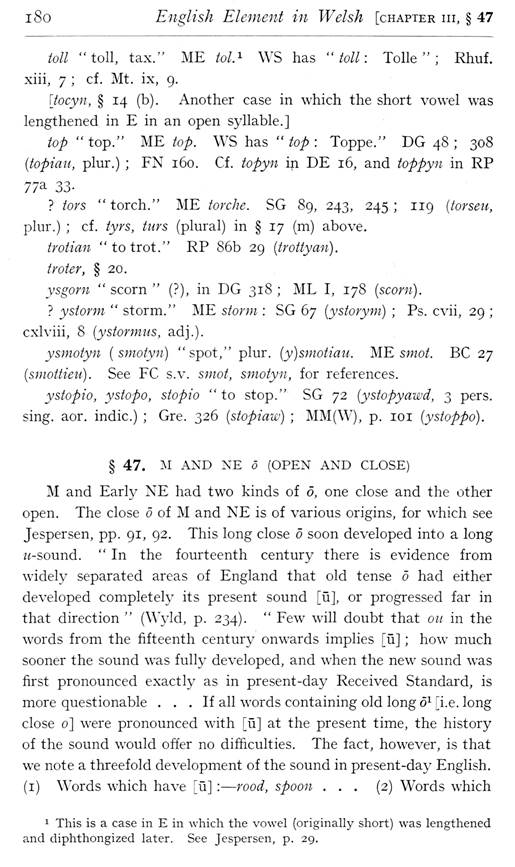
(delwedd F6931) (tudalen 180)
|
i8o English
Element in Welsh [chapter hi, § 47
toll "toll, tax." ME tol."- WS has "toll: Tolle”; Rhuf.
xiii, 7; cf. Mt. ix, 9.
[tocyn, § 14 (b). Another case in which the short vowel was lengthened in E
in an open syllable.]
top “top." ME top. WS has “top: Toppe." DG 48; 308 [topiaii,
plur.); FN 160. Cf. topyn in DE 16, and toppyn in RP
77a 3?>-
? tors "torch." ME torche. SG 89, 243, 245; 119 {torseu,
plur.); cf. tyrs, turs (plural) in § 17 (m) above.
trotian "to trot." RP 86b 29 [trottyan).
troter, § 20,
ysgorn “scorn” (?), in DG 318; ML I, 178 [scorn).
? ystorm “storm." ME storm: SG 67 (ystorym); Ps. cvii, 29; cxlviii, 8
[ystormus, adj.).
ysmotyn { smotyn) "spot," plur. [y)smotian. ME smot. BC 27
{smottieu). See FC s.v. smot, smotyn, for references.
ystopio, ystopo, stopio "to stop." SG 72 {ystopyawd, 3 pers. sing.
aor. indie.); Gre. 326 [stopiaw); MM(W), p. loi (ystoppo).
§ 47. M AND NE 5 (OPEN AND CLOSE)
M and Early NE had two kinds of 6, one close and the other open. The close of
M and NE is of various origins, for which see Jespersen, pp. 91, 92. This
long close soon developed into a long M-sound. “In the fourteenth century
there is evidence from widely separated areas of England that old tense 5 had
either developed completely its present sound [u], or progressed far in that
direction” (Wyld, p. 234). “Few will doubt that on in the words from the
fifteenth century onwards implies [u]; how much sooner the sound was fully
developed, and when the new sound was first pronounced exactly as in
present-day Received Standard, is more questionable ... If all words
containing old long 6^ [i.e. long close 0] were pronounced with [u] at the
present time, the history of the sound would offer no difficulties. The fact,
however, is that we note a threefold development of the sound in present-day
English, (i) Words which have [u]: — rood, spoon ... (2) Words which
1 This is a case in E in which the vowel (originally short) was lengthened
and diphthongized later. See Jespersen, p. 29.
|
|
|
|
|
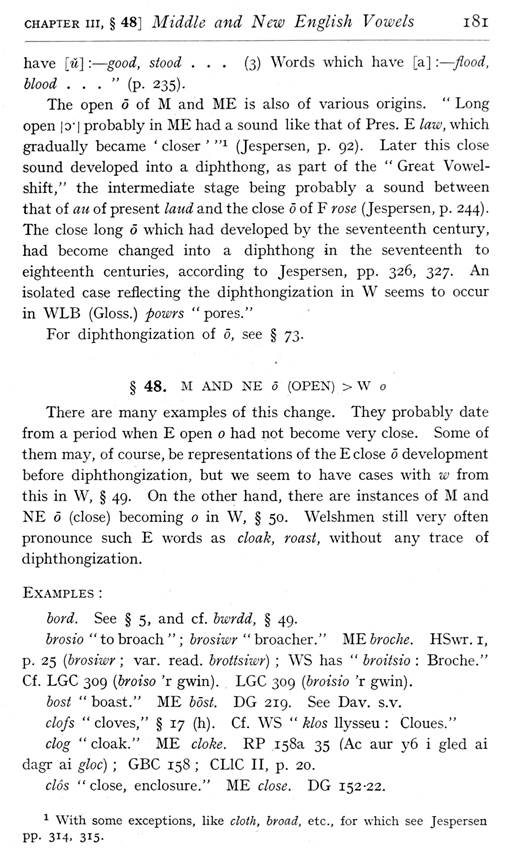
(delwedd F6932) (tudalen 181)
|
CHAPTER
III, § 48] Middle and New English Vowels i8i
have [u\: — good, stood ... (3) Words which have [a]: — flood, blood
..." (p. 235).
The open o of M and ME is also of various origins. “Long open |D-| probably
in ME had a sound like that of Pres. E law, which gradually became ' closer '
"^ (Jespersen, p. 92). Later this close sound developed into a
diphthong, as part of the “Great Vowel-shift," the intermediate stage
being probably a sound between that of an of present laud and the close of F
rose (Jespersen, p. 244). The close long 6 which had developed by the
seventeenth century, had become changed into a diphthong in the seventeenth
to eighteenth centuries, according to Jespersen, pp. 326, 327. An isolated
case reflecting the diphthongization in W seems to occur in WLB (Gloss.)
powrs "pores."
For diphthongization of 5, see § y;^.
§ 48. M AND NE (OPEN) > W
There are many examples of this change. They probably date from a period when
E open had not become very close. Some of them may, of course, be
representations of the E close development before diphthongization, but we
seem to have cases with w from this in W, § 49. On the other hand, there are
instances of M and NE (close) becoming in W, § 50. Welshmen still very often
pronounce such E words as cloak, roast, without any trace of
diphthongization.
Examples:
bord. See § 5, and cf. bwrdd, § 49.
brosio “to broach”; brosiwr “broacher." ME broche. HSwr. i, p. 25
[brosiwr; var. read, brottsiwr); WS has “broitsio: Broche." Cf. LGC 309
{broiso 'r gwin). LGC 309 (broisio 'r gwin).
bost “boast." ME bost. DG 219. See Dav. s.v.
clofs “cloves," § 17 (h). Cf. WS “klos llysseu: Clones."
clog “cloak." ME cloke. RP 158a 35 (Ac aur y6 i gled ai dagr ai gloc);
GBC 158; CLIC II, p. 20.
clos "close, enclosure." ME close. DG 152-22.
^ With some exceptions, like cloth, broad, etc., for which see Jespersen pp.
314, 315.
|
|
|
|
|
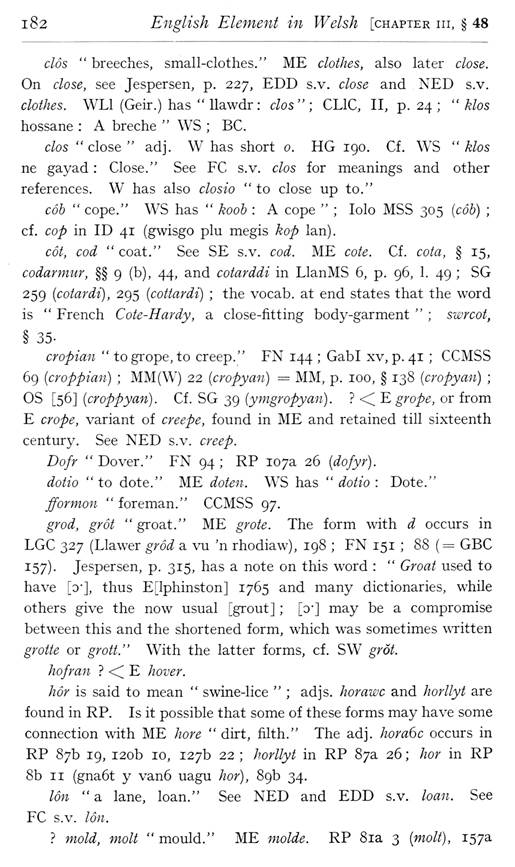
(delwedd F6933) (tudalen 182)
|
1 82
English Element in Welsh [chapter hi, § 48
clos “breeches, small-clothes." ME clothes, also later close. On close,
see Jespersen, p. 227, EDD s.v. close and NED s.v. clothes. WLl (Geir.) has
“llawdr: clos"; CLIC, II, p. 24; “klos hossane: A breche “WS; BC.
clos "close" adj. W has short 0. HG 190. Cf. WS “klos ne gayad:
Close." See EC s.v. clos for meanings and other references. W has also
closio “to close up to."
cob “cope." WS has “koob: A cope”; lolo MSS 305 (cob); cf. cop in ID 41
(gwisgo plu megis kop Ian).
cot, cod “coat," See SE s.v. cod. ME cote. Cf. cota, § 15, codarmur, §§
9 (b), 44, and cotarddi in LlanMS 6, p. 96, 1. 49; SG 259 [cotardi), 295
[cottardi); the vocab. at end states that the word is “French Cote-Hardy, a
close-fitting body-garment”; swrcot,
§ 35-
cropian “to grope, to creep." FN 144; GabI xv, p. 41; CCMSS
69 [croppian); MM(W^) 22 [cropyan) = MM, p. 100, § 138 {cropyan);
OS [56] [cYoppyan) . Cf . SG 39 (ymgroPyan) .? <C E grope, or from
E crope, variant of creepe, found in ME and retained tiU sixteenth
century. See NED s.v. creep.
Dofr “Dover." EN 94; RP 107a 26 (dofyr).
dotio "to dote." ME doten. WS has “dotio: Dote."
fformon “foreman." CCMSS 97.
grod, grot “groat." ME grote. The form with d occurs in LGC 327 (Llawer
grod a vu 'n rhodiaw), 198; FN 151; 88 (= GBC 157). Jespersen, p. 315, has a
note on this word: “Groat used to have [o'], thus E[lphinston] 1765 and many
dictionaries, while others give the now usual [grout]; [o'] may be a
compromise between this and the shortened form, which was sometimes wTitten
grotte or grott." With the latter forms, cf. SW grot.
hofran? <C E hover.
hor is said to mean “swine-lice”; adjs. horawc and horllyt are found in RP.
Is it possible that some of these forms may have some connection with ME hore
“dirt, filth." The adj. horaGc occurs in RP 87b 19, I20b 10, 127b 22;
horllyt in RP 87a 26; hor in RP 8b II (gna6t y van6 uagu hor), 89b 34.
Ion “a lane, loan." See NED and EDD s.v. loan. See FC s.v. Ion.
? mold, molt “mould." ME molde. RP 8ia 3 {molt), 157a
|
|
|
|
|
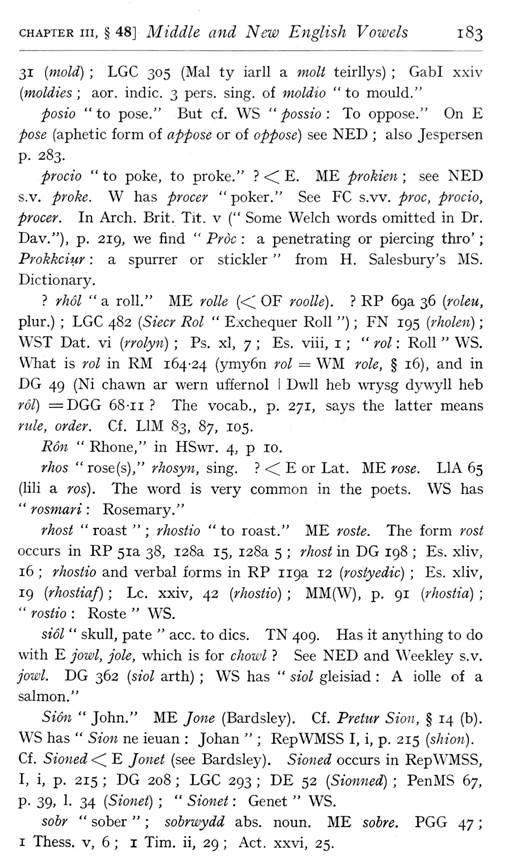
(delwedd F6934) (tudalen 183)
|
CHAPTER
III, § 48] Middle and New English Vowels 183
31 [mold); LGC 305 (Mai ty iarll a molt teirllys); GabI xxiv {moldies; aor.
indie. 3 pers. sing, of moldio “to mould."
posio "to pose." But of, WS “possio: To oppose." On E pose
(aphetic form of appose or of oppose) see NED; also Jespersen p. 283.
procio “to poke, to proke,"? ■< E. ME prokien; see NED s.v. proke. W has procer “poker."
See FC s.vv. proc, procio, procer. In Arch. Brit. Tit. v (" Some Welch
words omitted in Dr. Dav."), p. 219, we find “Prdc: a penetrating or
piercing thro'; Prokkciur: a spurrer or stickler “from H. Salesbury's MS.
Dictionary,
? rhol “a roll." ME rolle « OF rootle).? RP 69a 36 {roleu, plur.); LGC
482 [Siecr Rot “Exchequer Roll "); FN 195 (rhoten); WST Dat. vi
(rrolyn); Ps. xl, 7; Es. viii, i; “rol: Roll “WS. V\liat is rot in RM 164-24
(ymy6n rol = WM role, § 16), and in DG 49 (Ni chawn ar wern uffernol I Dwll
heb wrysg dywyll heb rol) =DGG 68-11? The vocab., p. 271, says the latter
means rule, order. Cf. LIM 83, 87, 105.
R671 “Rhone," in HSwr, 4, p 10,
rJios “rose(s)," rhosyn, sing.? <^ E or Lat. ME rose. LI A 65 (lili a
ros). The word is very common in the poets. WS has “rosmari: Rosemary."
rhost “roast”; rhostio “to roast." ME roste. The form rost occurs in RP
51a 38, 128a 15, 128a 5; rhost in DG 198; Es. xliv, 16; rhostio and verbal
forms in RP 119a 12 (rostyedic); Es. xliv, 19 [rhostiaf); Lc. xxiv, 42
[rhostio); MM(W), p. 91 {rhostia); “rostio: Roste “WS.
siol “skull, pate “ace. to dies. TN 409. Has it ami:hing to do with E jowl,
jole, which is for chowl? See NED and W^ekley s.v. jowl. DG 362 {siol arth);
WS has “siol gleisiad: A ioUe of a salmon."
Sion “John." ME Jone (Bardsley). Cf. Pretur Sion, § 14 (b). WS has “Sion
ne ieuan: Johan”; RepWMSS I, i, p. 215 [shion). Cf. Sioned << E Jojiet
(see Bardsley). Sioned occurs in RepW^MSS, I, i, p. 215; DG 208; LGC 293; DE
52 {Sionned); PenMS 67, p. 39, 1. 34 [Sionet); “Sionet: Genet “WS.
sohr “sober”; sobrwydd abs. noun. ME sobre. PGG 47; I Thess. V, 6; I Tim. ii,
29; Act. xxvi, 25.
|
|
|
|
|
(delwedd F6935) (tudalen 184)
|
184 English
Element in Welsh [chapter iii, §§49,50
spogen “spoke (of a wheel) “Dem. Dial,
ton "tone, tune." E tone is from Lat. rather than from F
(Jespersen, p. 242). Is W also direct from Latin? CCharl 114; MA 335; DG 114.
tron “throne." ME trone. WST Dat. iv [tron). Cf. thronau, CanC xc 25;
Col, i, 16; thronau in ML II, 138,
ysmoc[i)o “to smoke,"
ystor “store," ME store. DG 76; Nah, ii, 9; Diar. x, 14 {ystoriaf,
verb).
ystori, stori “story”; ME storie. DG 314 (stori); GabI x, p. 27 {ystori,? for
stori here),
§ 49. M AND NE (OPEN) > W w
It appears that in some cases the open in M and NE has become w in W. The
examples, however, are more or less doubtful. We infer that in E in these
cases (close) or u had already arisen at the time of borrowing to give W w.
? bwrdd. See § 5 s.v, bord, and footnote.
cwpujrdd “cupboard." M and NE cup-, cop-, -horde, -bourde. This, like
bwrdd, appears to have come from an E form \\dth a close (from earlier open
0). LGC 95 (cwpwrt); HSwr, 5, p. 14 {kwpwrdd); “kwpbwrdd: A cuphorde “WS;
“almari: cwpwrdd “WLl (Geir.).
? “dwbio: Daube “WS. Is this from M or NE form dobe of daub. Cf § 35.
hwr “whore," Cf, hwrswns, § 17 (h). WS has “hwr: A hore; Ivwrswn:
Horesone," The initial z£; in E is a later addition. On these forms in
or, see Jespersen, pp. 367-368. WS states that the in whore had the u- sound.
The word apparently occurs in RP 130a 19 (yn wreic hwr hir ymwrteis).
? trwn “throne." ME trone. Cf, tron, § 48, The word occurs in Ed. Prys's
metrical version of the Psalms, but appears to have had a short w, — “Yr
Arglwydd gweryd (felly y gwn) O'i gysegr drwn ei 'neiniog." WST Dat.
xiv, p. 486 (gair hiony trwn).
Cf, ysmwcan, § 5,
§ 50. M AND NE (CLOSE) >W o
In the following examples we seem to have traces of the unchanged (close) of
M and NE, We have already seen that the
|
|
|
|
|
(delwedd F6936) (tudalen 185)
|
CHAPTER
III, § 50] Middle and New English Vowels 185
usual development is into a long «-sound (§ 49) in Early NE. The words coyd
and gold are “irregular “in E,
Examples:
botas?<ME botes "boots." See § 17 (c).
? cord" cord." See SE s.v. WS has “y^or^: A chorde." Was the
long in this word open or close at the time of borrowing? See footnote on
bard, § 5. The sing, forms cortyn, cordeii occur, also cort with plur. cyrt.
See EC s.v. cortyn for refs. Cf. Cor. Voc. cor den “fidis," Bret,
korden.
fflodia{r)t "floodgate." See EC s.v. The earliest example in NED is
c. 1440. For -iat see and cf. llidia{r)t, § 5.
ffol “foohsh, a fool." ME /a/, fole, noun and adj. RP 9b 32, 67a 8, 88b
42, 122b 41, 130a 41; RM 1997 (ffol) = WM 289-10 ifol); BSKatrin 32; Mt. xxv,
2; WST Mt. v, p. 8; ML I, 185. The abs. nouns are ffolineh, ffolder; jfolog
“a foolish woman”; ffoli "to dote, to fool." Cf. fol '■' stultus
“in Cor. Voc.
gold, golt "gold; marigold." WS has "gold mair: Mary golde”;
PenMS 57, p. 46, 1. 6 {golt Mayrr); gold y gors “marsh marigold “HD; DG 33
(Gweled ei gwallt fal gold gwiw; Uwch feinir goldwir a gaid, i.e. “gold wire
"); DG 9-17; DE 16 (tidau o liw golt ydoedd), 25 {golt yd fal gwiail
tidiau), 46 (gwiail tidav golt ydyn); LlC I, p. 56 (unlliw k 'r gold yn lie
'r gwyn). The in this word was a long close that developed from OE 6.
"In gold OE lengthened should give ME I o" I and Mod [u^]: this is,
indeed, a form frequently given by the authorities of the preceding
centuries; but in compounds, like goldsmith, etc., I o I would remain short,
and I ol I regularly becomes [oul], thus accounting for the present
pronunciation” (Jespersen, p. 119). Wyld, p. 239, says: “The present-day
pronunciation of gold goes back to a ME short form gold, which may be derived
from an adjectival goldne, or from such a compound as goldsmith, etc. The
normal OE and ME forms of the noun had a long vowel, and would yield a Modern
[guld]. This type was in use among some persons who lived far into the
nineteenth century, though by that time it was doubtless old-fashioned."
hoh “measure of capacity, varying with localit}'“; hobaid "contents of
hob; peck" (Bod.). See BC {hobaid) note, and EC s.v. hobaid; TN 276
{hobed). The word is apparently from E
|
|
|
|
|
(delwedd F6937) (tudalen 186)
|
1 86
English Element in Welsh [chapter hi, § 51
hoop, M and Early NE hope. NED, s.v. hoop, gives as one of its meanings “a
measure of corn, etc., of varying capacity," now local. ystol “stool,
chair." See EC s.v. stol for refs. ME stol, stool “a seat,
scabellum." DG 199; EPh 38; 2 Bren. iv, 10; Ezra iii, 3; la. ii, 3;
OS [56] {stol). § 51.
M AND NE (CLOSE) > \N w
See § 47.
The w that appears in the words in W is certainly a reflection either of the
early tendency in E to change (close) in the direction of the w-sound, or of
the actually complete change. In some late E words frequently used in modern
colloquial W, it is, of course very common, e.g. mwd “mood," c-di
“cool," etc.
Examples:
bwm, hwnip “hollow sound, boom."? •< E. See SE and Bod. s.v. Cf.
aderyn y hwmp “bittern”; the usu. word for “bittern “is hwn (? short w) as in
RBB 152-10. Cf. chwil y hwm, “black beetle," in PT 21.
hwtias “boots (?), top-boots." WS has “bwtiasen: A boote”; CLIC II, p.
20 [hwtias); cf. WLl (Geir.) “bottas: bwthos," and botas, § 17 (c)
above. The word appears to be the same as botas, but the i in it is
difficult. The form bwtshas (bwtsias) also exists, as, e.g., in bwtsias y gog
“wild hyacinth." Cf. EC s.v. bwtshas. It is hardly probable that the W
word is from E boot-hose. The form with sh may be due to the influence of
some W form of E bluchers, in Carn. dial, blwtshars or bwtshars.
bwti “booty." LlC I, p. 58. See § 30 (a). WS has “bwtti: Boty."
bwth “cabin, booth, cottage."? < E. RP 134a 20; ID 9; Job xxvii, 18;
Gen. xxxiii, 17 [bythod, plur.); another sing, form is bwthyn.
cwtiar “cwt + iar “hen ") “coot." In Carn. bolcwt is heard,
probably E bald-coot.
dwm “doom," in MA 75b (Rhag ovyn dydd dwm); cf. dwmysdae
“doomsday," § 14 (b).
ffwl “a fool." Cf. ffol, § 50. DG 362; OS [14] ijwl); CCMSS
|
|
|
|
|
(delwedd F6938) (tudalen 187)
|
CHAPTER
III, § 51] Middle and New English Vowels 187
106; WST Mt. V, p. 8; "fid ne ynfyd: A fole “WS; cf. catffwl BC; CLIC
II, 27. The plur. is ffyliaid, as in Rhuf, i, 22.
} ffwtinan “a footstool (?)," in CLIC II, p. 24 (A chanddo ffwtin an
with ei draed) .? <C E footing.
? hwca, § 15.
hwt “away! begone! "? <C E ^^00^; hwtio “to hoot," as in Seph.
ii, 15; Mic. vi, 16. See NED s.v. hoot.
Mwrs "Moors." See § 17 (b), (h). On the vowel sound in this w^ord,
see Jespersen, p. 368.
prwff “proof “in CCMSS 49 (Praff ymwasgu pvwff mwsced),
pwll “pool, pit."? < E. Cf. pwll, § 5, and see NED s.v. pool. RM
216-3; 215-29.
rhwd “rood, rod, eight yards." <C E rood. BC. See also EC s.v. rhwd
(the measure). WS has “rwd mesur: A rodde."
udrot {? = wdrot) in MM, p. 14, § 11, vtrot, p. 18, § 12, “woodruff." ME
has woderofe, wodniffe. See Weekley and NED s.v. woodruff. The W form is
perhaps from a ME woderote, given by Stratmann. Cf. W wdrwyth, wdrwth,
7£}droyth HD. See § 89.
|
|
|
|
|
(delwedd F6939) (tudalen 188)
|
CHAPTER IV
Middle and New English Diphthongs
§ 52. We have to distinguish between three classes: —
I. Diphthongs that arose in ME from certain OE sound-combinations, and those
that appear in words taken from OF.
II. Diphthongs that arose from long vowels.
III. Diphthongization that arose in special cases.
We have already dealt with two cases of II in §§ 12, 33.
I. NORMAL DIPHTHONGS
§ 53. THE M AND NE NORMAL DIPHTHONG ai {ay), ei [ey), NATIVE
AND ROMANCE
For the sources of this diphthong, see Jespersen, pp. 96, 97, 98.
" Towards the end of the ME period two hitherto distinct diphthongs ai
[ay] and ei [ey) were confused into one |ae"i| or |aei|, perhaps with a
half -long first element. The old difference is still to some extent visible
in the spelling, though a good many ey's have now been changed into ay's [wey
. pley . cley . hey and others). . . . ME ae and ei [may be regarded] as one
Modern English diphthong. The phonetic value of the diphthong was probably
|ae'| . . . gliding slowly upwards in the direction of |i|” (Jespersen, p.
96). On the coalescence of this diphthong with the one that developed from ME
a, see Jespersen, pp. 323, 324. Cf. Elhs (EEP), pp. 119, 398.
"Me. ei (wey) und ai (day) sind schon in Chancers Zeit unter ai
zusammengefallen [ei >- ai) . . . Auf ei ^ ai deuten Chaucers Reime und
spatere Schreibungen wie rain fiir rein, way fiir wey ..." (Horn, Vol.
I, p. 96).
" These diphthongs [ai, ei of ME], originally different, were pretty
generally levelled under one in ME at latest by the fourteenth century. In
different dialects this single sound may have tended
188
|
|
|
|
|
(delwedd F6940) (tudalen 189)
|
CHAPTER IV,
§ 53] Middle and New English Diphthongs 189
towards either \ai] or [e^'J. By the first quarter of the fifteenth century
the sound, whatever it was, had evidently been very widely monophthongized,
and the single vowel thence resulting was a front vowel, either [£§] or [e].
This levelling is proved by the occasional spellings a, ea for former ai, ei,
and further by the fact that ai, ey are sometimes written for old a. That the
sound into which both ai and a developed was a front vowel is shown by rhymes
in which old a is coupled with old e . . ., and by the fact that ey is
sometimes used for old e = [e or e], and that ea which is written for old ai
never does nor could stand for anj.'thing but a front vowel ' (Wyld, p. 247).
"If we are to assume that ME ai, ei were still pronounced as diphthongs
in the seventeenth century we shall, I think, land ourselves in inextricable
confusion” (p. 249).
" ME ai, ei, both pronounced [ai'l in the later period, have become
first [S], then [e], then [ej, and finally in Standard English [et] rain,
day, vein, etc." (Wyld, p. 72).
It appears that in OF the ei and ai were kept distinct, but that in
Norman-French (and Anglo-Norman) they fell together giving finally ai. The
Central French -ee is in Anglo-French -eie.
The E cases mentioned above were those in which the diphthong occurred in
stressed syllables. In unstressed syllables, the development was naturally
slightly different. “The diphthongs ai and ei, already in ME probably,
levelled under [ae/] or [sil in stressed syllables, are simplified in
unstressed syllables to a simple front vowel, probably [i], written sometimes
e, sometimes i, at least as early as the first half of the fifteenth century.
Before I and 11 the spelling is also generally e or i, the latter becoming
increasingly more frequent in course of time. Certain speakers seem to tend
to [9] expressed hy a" (Wyld, p. 280).
This E diphthong (or coalescence of two diphthongs) appears in W as ei, ai,
according to the date of the texts, and also, in the mod. period, according
to its position. The diphthong doubtless fell together with the W diphthong
ei [ai). There are, however, as we shall see, other developments, into ae and
e, in the loan-words. The W diphthong is discussed in JMJ, p. 32: “Ml. W. ei
had an open and a close e according to position; these developed into Mn. W.
ai and ei . , . The present sound of the form ei is si, where 9 is an obscure
vowel which is hardly, if at all, distinct from
|
|
|
|
|
(delwedd F6941) (tudalen 190)
|
igo English
Element in Welsh [chapter iv, § 54
y." Further, p. 115, “Old and Ml, W. ei appears as ai and ei in Mn. W,
With some exceptions . . . ai appears in the ultima and in monosyllables, and
ei (pronounced 9i) in other syllables. Thus Mn. W. ai stands in the syllable
generally accented in O.W., and ei in the syllable then unaccented. The
natural inference is that the Mn. mutation ei \ ai is an exaggeration of a
difference in the pronunciation of ei going back to O.W, O.W. ei was
originally ei with open e . . . But in unaccented syllables it came to be
sounded ei [that is, with close e'] to avoid lowering the tongue to e and
raising it again to i in the short time available. . . . The present sound 9i
seems to be as old as the sixteenth century. . . . The present sound ai is at
least as old as the fourteenth century."
We may here mention the fact that WS generally has ai, but sometimes ei (as,
e.g., medlei, palffrei).
See my paper in Revue Celtique, Vol. xxxv, pp. 69-74 for the F diphthong in
loan-words in Breton.
No attempt has been made here to distinguish between the stressed and
unstressed cases where W has ai [ae). As the diphthong appears in unstressed
syllables, it would appear that borrowing had already taken place perhaps
before the first half of the fifteenth century; see above.
§ 54. M AND NE ai {ay), ei [ey) > W ei {ai)
Examples:
atwrnai, § 9 (a).
bargain, § 9 (b).
hateil, § 9 (b).
heili, § 30 (a),
hilain, § 30 (b). Cf. hilaen, § 55.
hitain, § 30 (b).
hwrdais, bwrgais, § 35.
bitail, § 30 (b).
cawsai “causeway, causey." ME cause, causei. Cf. Llangawsat near
Aberystwyth. See SE s.v., and OPem. II, p. 405. Cf. cawse § 56.
cei “quay”; e.g. Cei Nemydd “New Quay." ME key{e).
clai “clay," cleio the v. -noun. ME clai, clei. DG 203 {deio); WLl xliv,
21 [klai); To. ix, 6 [clai]; i Bren. vii, 46 (cleidir); Dan.
|
|
|
|
|
(delwedd F6942) (tudalen 191)
|
CHAPTER IV,
§ 54] Middle and New English Diphthongs 191
ii, 41 {cleilyd); WST lo. ix, p. 188 {clai in margin); ML I, 170 (clai) .
claim "claim"; cleimio "to claim." ME cleym{e), claym{e).
LGC 46 {claim); WLI (Geir.) (ymarddel: claimio); BC [cleimio); Rep. WMSS I,
i, p. 159 [claim).
" konveio: Convey “WS,
cwmpeini, §§ 30 (a), 35.
cwrtais, § 35. Cf. cGrlois in Car. Mag. 56.
cwail and chwail “quail." See SE s.v. chwail. See § 17 (h).
daynteth, etc., §§ 9 (b), 18.
dysait, § 19.
" veyads taith: A vyage “WS. ME veiage, viage.
ferfain, § 22.
^cr/r “a fair." ME fare, fayre, faire, etc. WS has "/«2>: A
fayre."? RP 85b 14 [ffeir), 87a 20, 90a i [ffeireu plur.), 90a 6,
79"i3 [ff^iyy^u, plur.); Rep WMSS I, ii, p. 343 (jeir); FN 148 (cloch y
jfaiV); Barddas, II, p. 126 {ffair); DOG 124-13.
jfair “fair “adj. WE feir, fair, etc.? in RP 31a 16; 47b 9; 58b II; DGG
79-16.
Cf. Fridei “Friday “in RBB 132-25. § 32 (note).
ffreittiir, § 43. The en is due probably to the u in last syllable; cf. JMJ,
p. 112,
ffwrnais, § 35.
glaif "glaive, sword." ME glaive, etc. DGG 15-7. W is •< F
according to note in DN pp. 136-7, q.v.
gwardein, § 9 (b).
grains, § 17 (h).
hacnai “hackney." ME hak[e)nei, etc. DG 322; LGC 299; “hacknei: Hackney
“WS.
harnais, § 9 (b). ME harnais, etc.
lefain,
§ 22. ME levayn[e), etc.
Leisestyr “Leicester," § 22 (b) note.
lifiai, § 30 (b).
malais, § 9 (b). ME
maleys, malice. The adj. inaleisus in ML II, 54. Cf. § 29.
Malmsai “Malmsey (wine)." LGC 255. Early NE Malmesey, etc.
medlai, § 22.
|
|
|
|
|
(delwedd F6943) (tudalen 192)
|
192192 English Element in Welsh [chapter
iv, § 55
meinteimio “to maintain," ME mainten{e), etc. RP 159b 33 [meinteimer) .
Usu. maentumio; see § 55.
mortals, § 46. Cf. § 29.
motlai, mwtlai, §§ 35, 36,
mwnai, § 35; monei, § 36.
mwrai, § 35.
Nordwei, § 46.
ordeinio, "to ordain," ME ordain, ordein{e).
osai, § 46.
paleis, § 9 (b).
palffrai, § 9 (b).
pastai, § II.
peintio “to paint." ME peint[e), etc. RP 157b 14 {peintya6); GR 369
{peintio). Cf. paent, § 55.
portreio, etc., § 36.
? preins “prince," from a form preins that occurs in ME; see NED s.v.
prince. LGC 166. See § 29.
? preint “print." But see § 29.
pryvai sel, § 24.
r{h)wmnai, § 35- ' .
? saim [saem), § 5-
seintwar, §§ 8 (a), 9 (a). LGC 29, 469.
sertain, § 22.
simnai, § 30 (b).
siwrnai, § 35.
sy/ai "city." HG 8-13. E (sixteenth century) has syttey (see NED).
swai “row, fuss “Dem. Dial. In NW swae, <^ E sway.
teiliwr. See taeliwr, § 55.
traitwyrs, § 17 (i). Cf. traetur, § 55.
§ 55. M AND NE fli (a_y), ei [ey) > W ae
The second element in W ae (written sometimes ay in Early MW and sometimes in
MSS. of the Modern period) was probably the clear sound of 3; (like Mod W u).
“Though now always written ae . . . , the sound in N.W. is still distinctly
ay . . . [that is, the clear sound of y, = u of W] ... In Mid and S. Wales
the sound approaches the spelling ae . . . In parts of S.W. the
|
|
|
|
|
(delwedd F6944) (tudalen 193)
|
CHAPTER IV,
§ 55] Middle and New English Diphthongs 1 93
diphthong is simphfied to a . . .in the dialects ..." (JMJ,
PP- 32,?>d,)-
The ae-diphthong seems to have developed from the E diphthong
(i) before I, m, n, r, (s); (2) before a vowel; (3) finally in monosyllables.
Some words have ae and ai {ei) forms. In the above cases there are exceptions
which are included in § 54, e.g. bargain, ffair and clai (with short a in W):
in monosyllables with ae the a is long. There are other examples with ei where
the next syllable contains a palatal sound, e.g. peintio, § 54 (cf. paent
below), cwmpeini, § 54, heili, traen "drain" in NW, but treinio
"to drain." Cf. W saer; plur. seiri. See also JMJ, p. 93. In this
connection one might mention the W forms of the name Cain. Kayn (Cayn) occurs
in RP 25b 36, 26a 17, 36b 25; Kaem in LlanMS 6, p. 117, 1. 18, p. 123, 1. 33;
cf. Kain BBC 44-16, Kai 45-8 (both dissyllabic) .
Examples:
? aele, § 16.
aer “air," in spoken lang. ME eir, etc. But eirio “to air." See FC
s.v. aer “air," where an instance from CanC is cited.
aer “heir." ME eir{e), etc. BC; WLl ii, p. 4 (Dewr o burwaed aer barwnn.
Aer erioed arr wyr ydwyd).
aeres “heiress “Diar., xxx, 23; ML II, 15.
aesel, § 20. ME aisel, etc.
? Alniaen “Germany” <^ E or direct from F. CCharl. 4; BoHam. 119; RBB
-^yy; lolo MSS 194, 283. Cf. Siarlymaen ^ “Charlemagne”; Bryttaen
“Britain"' RBB 40-1.
awmael “enamel." ME aumayl etc. Also owmal, amel, § 9 (b). See Dav. s.v.
RP 115a 22 [awmael) = MA 306b. NED, s.v. amel, gives an E fifteenth century
form amall, and refers to Anglo-French amal. The W form owmal occurs in DG
33, PenMS 67, p. 104, 1. 13, and in Cywyddau Cymrii, p. 51, in a poem by
Dafydd Nanmor. Cf. DN 185.
hae "a bay." See FC s.v.
haeas “bays, baytrees," § 17 (c).
haeart, § 9 (a). ME bayard, etc.
balaen =malaen “Milan-steel." Cf. melan, § 9 (a).? RP
^ Siarlamaen LGC. p. 29, Siarlmaen, p. 484.
o
|
|
|
|
|
(delwedd F6945) (tudalen 194)
|
194 English
Element in Welsh [chapter iv, § 55
25a 20 {malaen). The form valaen in BBC 97 (margin) has probably nothing to
do with it,
herfen “vervain." ME verveyne, etc. See and cf. ferfain, §§ 22, 54.
hilaen, § 30 (b).
captaen, § 9 (b).
kwmpayni, kwmpaeni, §§ 30 (a), 35.
dwmysdae, §§ 14 (b), 51.
ffael “failure," ffaelu [ffaelio) “to fail." ME fail, failen, etc.
WS has "fayl: Fayle."? RP 128b 27 {ffael); MM, p. 94, § 134 {ny
phaela); p. 144, § 173 (ffaelu); CLIC, II, p. 38 ffaelio); BoHam. p. 159
iffeyleist, 2 pers. sing. aor. indie.); SG 59 {ffaelyedic, ffaelassei) , 77
{ff^yly^i^i) 'y TN 278 ffaelio).
ffrae “quarrel, brawl," <I E fray. For meaning see NED s.v. fvay. The
v.-noun is ffraeo. WS has “frae: Affraye”; CCMSS, p. 4 ffrae); WLl xlv, 49
ffrae); BC ffrae).
grae “grey” (?), in LlanMS 6, p. 93, 1. 10 (gwr ay wallt mal y grae wyf). Cf.
Grae “Grey “in WLl liii and in RepWMSS I, i, p. 93 (argl: Grae o Rvthvn).
graen “grain." Cf. graens, § 17 (h). WS has “graen: Grayne." In W
it seems to have two of the meanings given in NED s.v. grain, (i) seed; (12a)
roughness of surface. Bod. gives “grain, gloss, lustre “as the meaning; but
in graens it seems to mean seed.? lolo MSS 305; DG 117 {graen coed). See FC
s.v graen.
gwaetio “to wait." TN 309, but gwaitio 320; AG 19 (yn tiaetio).
haels “hail-shot, shot “in Carn. See FC s.v. haels and NED and FDD s.v. hail.
? maeden<^^ maiden. See BC (and note on the word).
mael “gain, profit." Dav. gives “mael: lucrum." WS gives
"7nael: Auayle; maelio: Auayle." He also gives mail with no
meaning. The word mael is found in RP 142a 19, 142b 37; MA 340. For the
meaning, see NED and FDD s.v. mail. Cf. maelier, § 20.
maelus, maelys, plur. of ME maille “mail, coat of mail." See § 17 (b).
Cf. LGC 216 (ar vaels caith).
maentnmio “to maintain." ME mainten{e),etc. Cf. meinteinio, § 54. The
form myntnmio also occurs, and myntumiwr “maintainer." WS has
“mayniumiad: Maintenance; mayntumio:
|
|
|
|
|
(delwedd F6946) (tudalen 195)
|
CHAPTER IV,
§ 55] Middle and New English Diphthongs 195
Maynteyne”; BC [maentumio; note here states that it is from F rather than
from E); CCMSS 113 {maentimiaf) , p. 145 {maentumiwr); LGC 22 {myntumiwr);
cf. ML I, 167 {mantumio) .
? maer “mayor, steward." WS has “mayre: A ma^Te." Is this from
Lat., from F maire, or from an early E form mair. But it occurs very early in
W, e.g. as mair in Loth Voc, with plur. meir (Old Breton), and merion; BBC
12-3 (maer), 54-13 {meiri_ plur.). LL, p. 120 {mair); Gloss. ML [maer, mayr);
BT 35-8 {maer); RM 135-27 {maer); RP 5a i, T4a 4, 129b 44, 133b '^y {maerdy).
pae "pay." RBB 331-22 (g6r pae).
paement, § 20.
paent "paint," paentio, peintio "to paint." MK peiKt{e) ,
eic . Cf. peintio, § 54. WS has “payntio: Paynte”; DG 18 {paentiad); 187
{paentiwr).
Paen in “Castell Paen “LGC 81, “Pain's Castle."
plaen "plain." Also often plaem in SW dials.
prae "prey." ME preie, etc. LlC I, p. 14 {praeau, plur.).
raemant, § 22 (a).
sae "say, a kind of cloth." ME saie. WS has “brethyn say: Say
clothe." See KR, p. 77, s.v. saja.
" sataen: A chesteyn “WS, i.e. “chestnut -tree."? ME chasteine. Cf.
casteyn in AfcL, I, i, 39.
siambrlaen, § 9 (b). ME chamberlein, etc.
swae “sway, fuss” (Bod.). Cf. swai, § 54.
taeliwr, teiliwr "tailor." ME taylor, etc., later also tailer. DG
10 {taeliwr); 307 {teiler); lolo MSS, p. 288 {taelwyr, plur.); “ysginawr:
taeliwr" WLl (Geir.); “tayliwr: A taylh'our “WS.
traen "train." RepWMSS I, ii, p. 346 {traen yr heul).
traenhands "train-bands." CAMSS, p. 250.
traen “a drain”; treinio (? traenio) “to drain." See FC s.v. traen.
trafael, irafaelu, § 9 (b).
traetur, § 39.
tsiaen {siaen) in colloq. speech, “chain."
tyciae, dyciae, § 19.
Ysbaen “Spain." CCharl 19 {yspaen). DPO 17 has Hispaen.
ystaen “stain," ystaenio {ysteinio?) “to stain." WLl Ixxvii,
|
|
|
|
|
(delwedd F6947) (tudalen 196)
|
196 English
Element in Welsh [chapter iv.§§ 56, 57
48 (Pie staenodd had tad na'r taid I Pie staenodd had Pilstwniaid). In DG 71
ystaen is a different word, “tin."
ystaer “stair." WLl Ixviii, 81 (Os ystaer is yw dewTion); LlanMS 6, p.
189, 1. 3 {^.i ystaer vawr ystad).
§ 56. M AND NE ai {ay), ei {ey) APPEARING AS e in W
By the side of some of the forms already mentioned in §§ 54, 55, there are
found in W forms in e. We have already referred (§ 53) to the simplification
that took place in E in unstressed syllables. The vowel that developed, as we
have seen, was WTitten sometimes e and sometimes i. This developed at least
as early as the first half of the fifteenth century. Jespersen, p. 259,
refers to the same change: “Original ai lae'il in weak syllables generally
becomes [i]; “p. 268 “lae'il before 111 has become [9] or is often
lost."
In W the vowel that developed, or the one that is reflected, in the
loan-words is e. Examples of this have already been included in § 20, e.g.
tyK'el, syrffed. In the following list we include those cases which have in W
ae or ai side by side with e.
hay gen, § 9 (b). Cf. bargain, inargain, § 54.
batel, § 9 (b). Cf. bateil, § 54.
bitel, § 30 (b). Cf. bitail, § 54.
capten, § 9 (b). Cf captaen, § 55.
cawse in cerrig cawse “obstacles," Dem. Dial. Cf. cawsai § 54.
ferfen, § 22. Cf. berfaen, § 55.
{g)wasel, §§ 9 (b), 20. Cf. {g)wasael, § 55.
lefen, § 22. Cf. lefain, § 54.
palffre, § 9 (b). Cf. palffrai, § 54.
portre-ad, § 36. Cf. portreio, § 54.
prive set, § 24. Cf. pryvai, § 54.
siambrlen, § 9 (b). Cf. siambrlaen, § 55.
siwrne PGG 22, 121. Cf. siwrnai, §§ 35, 54.
simne, § 30 (b). Cf. simnai, § 54.
trafel, § 9 (b). Cf. trafael, § 55.
§ 57. THE M AND NE DIPHTHONG oi{oy)
This diphthong is only found in loan-words in E. The history of its
development is not by any means clear. The descriptions
|
|
|
|
|
(delwedd F6948) (tudalen 197)
|
CHAPTER IV,
§ 58] Middle and New English Diphthongs 197
and accounts given by the old grammarians suggest several pronunciations,
which are really stages in the development of the diphthong. “The old sound
seems to have been more like [ni] than [oil just before its transformation. .
. . The [oi] pronunciation . . . represents probably an artificially '
restored ' pronunciation due to the spelling, and this is the Received
pronunciation at the present time. . . . The type [u^'] seems to have
vanished after the seventeenth century” (Wyld, pp. 250, 251). See also
Jespersen, pp. 100, loi. Horn, I, p. 100, in treating of oi, ui, states: “Die
me. Worter mit oi-ui sind fast alle franzosischen Ursprungs. Die Doppelheit
oi-ui linden v/ir bei den friih-neuenglischen Orthoepisten wieder: sie
unterscheiden, allerdings mit betrachtlichen Schwanken, zwei Gruppen von
Wortern, eine mit oi, eine andere mit ui. Es scheint moglich, dass afrz. gi
die Quelle von me. oi ist, wahrend afrz. gi me. ui gab." Further, p. 209,
he has tabulated the various stages in the development of the supposed two
types. According to this, the wz-pronunciation does not continue beyond the
sixteenth century.^
In the earlier loan-words W has, with a few exceptions given in WS, the
representation of the ui- pronunciation. This is expressed in W by wy, the
“falling “diphthong, in which the second element has the same quality as the
e in ae, mentioned in § 55. WTien followed in the next syllable by a palatal
(front) sound, it is almost (if not quite) an «-sound, e.g. in pwyntio
"to point," pwyntil "pointel."
§ 58. ^.I AND NE oi [oy) > W wy
Examples:
anwyntio "to anoint," § 9 (a).
apwyntio, “to appoint," § 9 (a).
aswyn “absence; essoin." See Dav. s.v.? < E. ME as{s)oyne. The other
aswyn “invocation, blessing “is probably a direct borrowing from Latin. See
Loth Voc.
hrwylio “to broil." WS has “hrwylio: Broyle."
hwi or hwi “buoy “is peculiar. See EC s.v. bwi. WS has “bwi a vydd with
ancor: Boy."
1 The interchange of oe and wy in W has not yet been carefully worked out.
Professor Ifor Williams, in LlLl, p. 20, refers to some cases of it.
|
|
|
|
|
(delwedd F6949) (tudalen 198)
|
igS English
Element in Welsh [chapter iv, § 59
? hwystr “boister-ous “in PenMS 67, p. 84, 1. 23 (gwyr hwystr).
? dishwynt “disappointment,"? in Merionethshire.
ffwyl “foil, stroke, repulse." SE and Bod.? <C E foil.
" fwyn brath ac aryf: Foyne “WS, i.e. “foin."
Iwyn “loin." ME loyne. Also llwyn. Heb. vii, 10 {Iwynau plur.); I Bren.
xii, 10 {llwynau); WS has “llwyn ar gic: A loyne.'
pwynt “point; plight; health “Bod. Dav. has “valetudo ' and “punctum “as
meanings of pwynt, and “saginari, saginare ' and “designare “of pwyntio. The
meaning “to become sleek ' is that in Deut. xxxii, 15. The meaning “plight,
condition “is that in DGG 153-24, and? in RP 157b 15, 16; the adj. pwyntus
“in good point “occurs in DGG 89-11 (see note, p. 213) and in RP 142a 22;
pwynt “point “occurs in RM 97-30, and in RM 96-29 {p6nt?; see LlLl, p. 27);
plur. pwyntiau in DG 141; in Proff. Sibli Ddoeth, p. 276 {pwynt blaenllym
vegis poynt scorpion); BC 41; see also FC s.v. pwyntio, pwyntus.
pwyntio “to appoint," Bod. E has an aphetic form point.
pwyntil, pwyntl “pointel, pencil." ME poyntil, -tell. GaC 120-23
[puyntleu, plur.).
pwyntmant, § 14 (a). E has an aphetic form pointment.
Pwyntred “shoemaker's thread “Dem. Dial. Bod. EC I, 312 has pwyntryd.? <^
point + thread.
pwysi "posy." Early NE poysie. GabI ix p. 22 {pwyssi); WS has
"pwysi o lysseu: A posy; pwysi val o gnau: A clustre”; Can. i, 13; EC I,
59.
sbwylio "to spoil." CLIC II, p. 22 (A shwyliodd lawer sten a
stwnt), p. 26 (A spwyliodd lawer ffenestr wen). See FC s.v. sbwylio.
wynwyn (gwynwyn) “onion(s)." ME oynon. MM(W) 173 (gwynwyn). Cf. winwyn,
wniwns, §§ 17 (h), 35, 38.
wystrys “oysters." ME oistres. See § 17 (b).
§ 59. M AND NE oi {oy) > oe {oy, oi) IN W
Reference has already been made to the rarity of these forms with in W. With
one or two exceptions, they appear to be mere orthographical variations of
the other forms. Some of the genuine cases may be instances of the E
diphthong borrowed at a time when the ui- pronunciation was dying, or had
died, out. In any case, they have as a rule oe, not oi, outside WS. The same
remarks
|
|
|
|
|
(delwedd F6950) (tudalen 199)
|
CHAPTER IV,
§ 60] Middle and New English Diphthongs 199
as those found on ae in § 55 apply to the e in this diphthong: the dialects
vary. As in the case of wy, the second element in the diphthong even in NW
becomes an i- sound. E words borrowed quite recently into spoken W have oi.
The following few examples are either late or from WS:
kloystr “cloister “in IG 175.
coetan, coeten “a quoit." ME coyte. BC 62 [coeten Arthur “cromlech '').
Cf. can eg goitan “a cromlech “Dem. Dial.
" voydio: Voyde “WS.
loetran “to loiter." CanC Ixxviii, 73, cxiii, 4.
oesstrys in RepWMSS I, ii, p. 424 (late fifteenth century?). See § 17 (b). WS
has “oestyr: Oyster."
oyl in WST Lc. xvi, p. 144 (in margin = oleo in text). Cf. oel “oil (?) “in
DE 105.
" oystreds ffedder: Oystreche ffedder “WS, i.e. “ostrich-feather."
poynt by the side of pwynt; see pwynt, § 58.
shloit in Cams. dial, for “exploit." See FC s.v. Probably late
borrowing.
The oe of W poetri (dissyllabic) has arisen from the fusion of -\- e oi E. DE
143 {poettri 'n iach yn pattrwTi oedd); RepWMSS I, i, p. 201 (Bit ry wan
boetri enyd). See § 30 (a). § 60. M AND NE NORMAL DIPHTHONG au (aw)
For the sources of this diphthong in M and NE, see Jespersen, pp. 107-109.
Among these is the case of au arising before a nasal in many French words.
This was an Anglo-Norman development and is reflected faithfully in W words.
It has been suggested that there were two types of au in English, but the
view generally held now is that there was only one kind, whatever its source.
The diphthongal value of au before a nasal in French words has also been
doubted, and the suggestion made that it was only a way of representing a
nasalized a, but the present-day spelling {au or aw) seems to prove that it
was a full-fledged diphthong. The E loan-words in W also bear this out.
Several clear instances of aw occur. The difficulty, so far as E words r.re
concerned, is to explain the non-appearance of in such cases in Mod. E of the
long low-back-wide
|
|
|
|







 B5237:
  ă ĕ ĭ ŏ ŭ
 yn
yn  aith δ δ £ U+2020 DAGGER †