|
|
|
|
(delwedd F6737) (tudalen 001)
|
THE
ENGLISH ELEMENT
IN WELSH
By T. H. Parry -Williams
|
|
|
|
|
(delwedd F6738) (tudalen 002)
|
02
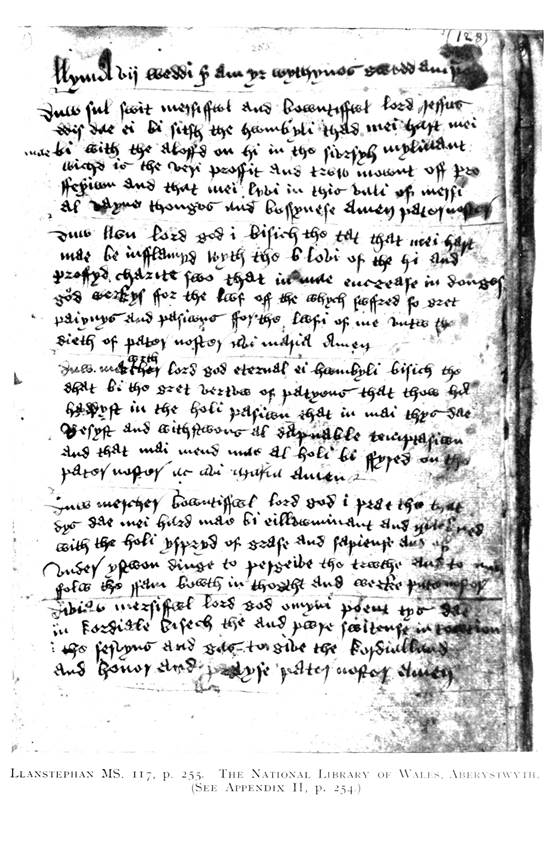
Llanstephan MS. 117, p. 255. The National Library of Wales, Aberystwyth.
(See Appendix II, p. 254.)
|
|
|
|
|
(delwedd F6739) (tudalen 003)
|
Cymmrodorion
Record Series, No. X THE ENGLISH ELEMENT IN WELSH
THE ENGLISH ELEMENT IN WELSH
A STUDY OF ENGLISH LOAN-WORDS IN WELSH BY
T. H. PARRY-WI1.LIAMS
M.A., B.LiTT., Ph.D.
Professor of Welsh at the University College of Wales, Aberystwyth
LONDON
ISSUED BY THE
HONOURABLE SOCIETY OF CYMMRODORION
NEW STONE BUILDINGS, 64 CHANCERY LANE, W.C.2
1923
|
|
|
|
|
(delwedd F6740) (tudalen 004)
|
02
Llanstephan MS. 117, p. 255. The National Library of Wales, Aberystwyth.
(See Appendix II, p. 254.)
|
|
|
|
|
(delwedd F6741) (tudalen 005)
|
02
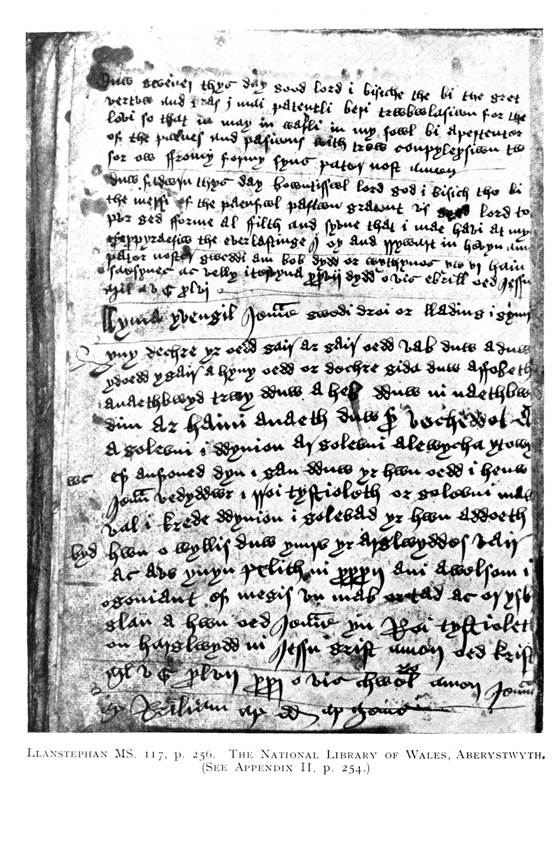
Llanstephan MS. 117, p. 256. The National Library of Wales, Aberystwyth.
(See Appendix II, p. 254.)
|
|
|
|
|
(delwedd F6742) (tudalen 006)
|
04Prefatory Note
The contents of this volume was brought to the notice of the members of the
Honourable Society of Cymmrodorion in a paper read by Professor T. H.
Parry-Williams at a meeting held under the chairmanship of Sir Israel
Gollancz, Secretary to the British Academy, on the nineteenth of May, 1922,
at King's College in the Strand. In the ordinary course a paper so read would
appear in the Transactions of the Society for the current year. It transpired
, however, that Professor Parry-Williams had devoted years of study to the
subject of which only a bare outline was suggested at the meeting at King's
College, and that he had accumulated an immense quantity of material for its
elucidation. The volume of material and its technical quality made it more or
less unsuitable for inclusion amongst the general articles appearing in the
Transactions, and, with the consent of the Trustees of the Fund, it was
decided to publish the entire work as one of the publications of the
Cymmrodorion Record Series. Strictly speaking, it does not come within the
specified limits of the Series, which was primarily intended for the
production of unpublished historical records, but the close relationship of
history and language justifies what appears to be a departure from the
original lines. As a painstaking and laborious study of the evolution of
Welsh as it is spoken, the Council most cordially commend Professor
Parry-Williams' work to the careful attention of members and subscribers.
On behalf of the Council,
E. VINCENT EVANS,
Honorary Secretary. Cymmrodorion Library, 64, Chancery Lane,
London. V
|
|
|
|
|
(delwedd F6743) (tudalen 007)
|
05Author's
Preface
This work was begun at the instance of the late Sir Edward Anwyl, M.A., and my
great regret is that he is not alive to relieve it of its manifold
imperfections. It owes its appearance to the good offices of Sir Vincent
Evans, to whom I, like so many others, owe a very great debt of gratitude.
As I have been unable, during the last few years, owing to the pressure of
other duties, to devote as much time as I would have wished to making the
study more presentable, and as there is little prospect of greater leisure in
the near future, I have persuaded myself to let it appear as it is, with all
its shortcomings, consoling myself with the hope that this beginning will
induce some scholar, after seeing my mistakes, to pursue the study with more
care and greater fullness. The material collected and used by me was finally
moulded into its present shape at one of the busiest periods of the College
Session. It, therefore, naturally presents clear traces of intermittent
attention I offer no further excuses in the attempt to extenuate the defects
of the work.
My original intention was to work the English element in Cornish side by side
with that in Welsh, but that project had to be abandoned.
A few words of explanation are required: —
(i) As will be observed, I have endeavoured to deal with the borrowed words
only. No attempt has been made to discuss the influence of English syntax, or
any other aspect of speech, on that of Welsh. I have confined m}^ attention
to words and the sounds that constitute them. The semantic aspect of the
study, which is interesting in many ways, has, I am afraid, received
inadequate attention.
(2) The older borrowings have been given a more prominent place than the
newer ones. Perhaps wrongly. Changes are perceptible even at the present day,
as every man speaks to-day differently from the way he spoke yesterday.
(3) I have not tried to discuss the process of borrowing from a
psychological, historical, nationalistic, or any other such point of view. I
might here, however, quote Jespersen's remarks in his Language: “Loan-words
always show a superiority of the nation from whose language they are
borrowed, though the superiority
|
|
|
|
|
(delwedd F6744) (tudalen 008)
|
viii English Element in Welsh
may be of many different kinds" (p.
209). "When a nation has once got into the habit of borrowing words,
people will often use foreign words where it would have been perfectly
possible to express their ideas by means of native speech-material” (p. 210).
On the general question, reference may be made to the chapter entitled
“Contact et méelanges des langues," of Vendryes's Le Langage (Paris,
1921, pp. 330-348)-
(4) The "settlers" and the "corpses" have been included
among the examples; but English words and phrases used in a semi- jocular
manner by some writers have been omitted. Examples of such are to be found in
Llanover MS. B5 (i6th c), p. 64:
I have nothyng mor y ddywedyd
But consyder wrth fy mhenyd
in my hart mae saeth yn pido
Come in hast yddy thynny oddyno.
By my troth hyn wy n y geiso
What you promise oy gywyro
I will stand heb ddowt f anwylyd
in my words er gwaetha r hollfyd.
(5) The reference to the dialects of “N. Wales” and “S. Wales” is only very
roughly accurate, as every Welshman knows. But I have used this rough
designation because little reliable information is available on the exact
delimitation of the Welsh dialects.
(6) The lists of words cited as examples are, I trust, representative. A full
collection of all references and examples from MSS., printed books, and the
spoken language would entail years of hard work.
(7) I have referred elsewhere to the difficulty connected with possible
Anglo-French borrowings.
(8) In conclusion, I may be allowed here to refer to works dealing with the
Welsh element (not necessarily loan-words) in English:
(a) Keltisches Wortgut im Englischen . .
. von Max Forster. Halle (Saale),
Max Niemeyer, 1921.
(b) De oudste
Keltische en Angelsaksische. A. G. van Hamel.
Middelburg, 1911.
(c) There is an interesting explanation
of English and Welsh place-names in The Place-Names of England and Wales, by
the Rev. James B. Johnson, M.A., B.D. London, 1915.
T. H. PARRY- WILLIAMS. Aberystwyth,
July, 1923.
|
|
|
|
|
(delwedd F6745) (tudalen 009)
|
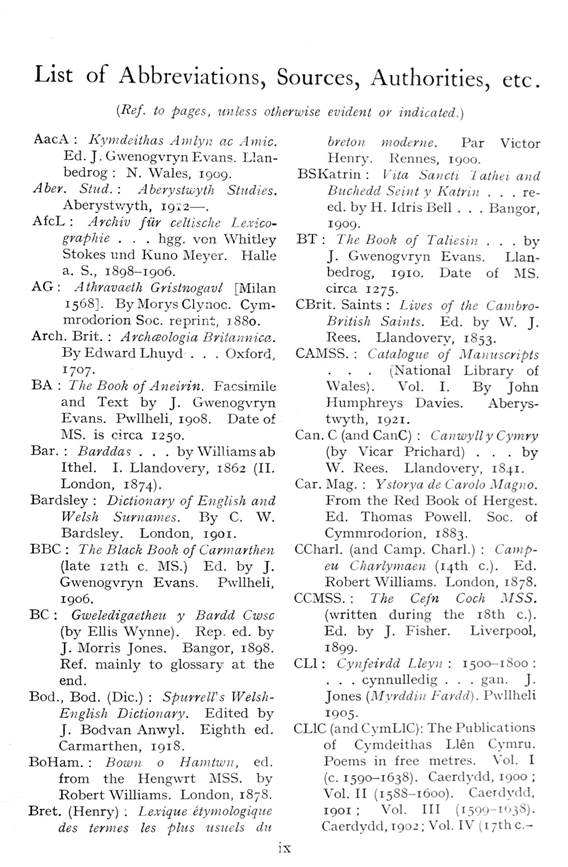
08 List of Abbreviations^ Sources,
Authorities, etc
{Ref. to pages, unless otherwise evident or indicated.) AacA: Kymdeithas
A)ulyn ac Amic.
Ed. J. Gwenogvryn Evans. Llan-
bedrog: N. Wales, 1909. Aber. Stud.: Aberystwyth Studies.
Aberystwyth, 1912 — . AfcL: Archiv filr celtische Lexico-
graphie . . . hgg. von Whitley
Stokes und Kuno Meyer. Halle
a. S., 1898-1906. AG: A thravaeth Gristnogavl [Milan
1568]. By Morys Clynoc. Cym-
mrodorion Soc. reprint, 1880. Arch. Brit.: Archcsologia Britannica.
By Edward Lhuyd . . . Oxford,
1707. BA: Tlie Book of Aneirin. Facsimile
and Text by J. Gwenogvryn
Evans. Pwllheli, 1908. Date of
MS. is circa 1250. Bar.: Barddas . . . by Williams ab
Ithel. I. Llandovery, 1862 (II.
London, 1874). Bardsley: Dictionary of English and
Welsh Surnames. By C. W.
Bardsley. London, 1901. BBC: The Black Book of Carmarthen
(late i2th c. MS.) Ed. by J.
Gwenogvryn Evans. Pwllheli,
1906. BC: Gweledigaetheu y Bardd Cwsc
(by Ellis Wynne). Rep. ed. by
J. Morris Jones. Bangor, 1898.
Ref. mainly to glossary at the
end. Bod., Bod. (Die.): SpurrelVs Welsh-English Dictionary. Edited by
J. Bod van Anwyl. Eighth ed.
Carmarthen, 191 8. BoHam.: Bown o Hamtwu, ed.
from the Hengwrt MSS. by
Robert Williams. London, 1878. Bret. (Henry); Lexique etymologique
des termes les plus usuels du breton moderne. Par Victor Henry. Rennes, 1900.
BSKatrin: Vita Sancti Tathei and Buchedd Seint y Katrin ... re-ed, by H.
Idris Bell . . . Bangor, 1909.
BT: The Book of Taliesin ... by J. Gwenogvryn Evans. Llanbedrog, 1910. Date
of ]\IS. circa 1275.
CBrit. Saints: Lives of the Catnbro-British Saijits. Ed. by W. J. Rees.
Llandovery, 1853.
CAMSS.: Catalogue of Manuscripts (National Library of Wales). Vol. I. By John
Humphreys Davies. Aberystwyth, 192 1.
Can. C (and CanC): Catiwylly Cymry (by Vicar Prichard) ... by W. Rees.
Llandovery, 1841.
Car. Mag.: Ystorya de Carolo Maguo. From the Red Book of Hergest. Ed. Thomas
Powell. Soc. of Cymmrodorion, 1883.
CCharl. (and Camp. Charl.): Canipeu Charlyinaen (14th c). Ed. Robert WUliams.
London, 1878.
CCMSS.: The Cefn Cock MSS. (written during the i8th c). Ed. by J. Fisher.
Liverpool, 1899.
CLl: Cynfeirdd Lleyn: 1500-1800: . . . cynnuUedig . . . gan. J. Jones
{Myrddin Fardd). Pwllheli
1905- CLIC (and CymLlC): The Publications of Cymdeithas Lien Cymru. Poems in
free metres. Vol. I (c. 1590-1638). Caerdydd, 1900; Vol. II (1588-1600).
Caerdydd, 1901; Vol. Ill (i599-i'>38). Caerdydd, 1902; Vol. I V ( 1 7th c-
|
|
|
|
|
(delwedd F6746) (tudalen 010)
|
09 IX 10
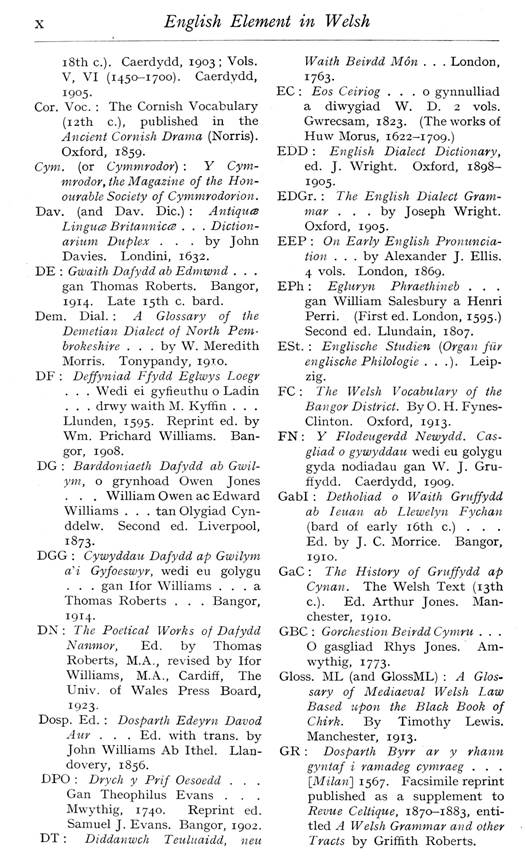
X English Element in Welsh i8th c). Caerdydd, 1903; Vols. V, VI ( 1 450-1
700). Caerdydd, 1905.
Cor. Voc.: The Cornish Vocabulary (12th c), published in the Ancient Cornish
Drama (Norris). Oxford, 1859.
Cym. (or Cymmrodor): Y Cymmrodor, the Magazine of the Honourable Society of
Cymmrodorion .
Dav. (and Dav. Die.): Antiques Lingucs BritanniccB . . . Dictionarium Duplex
. . . by John Davies. Londini, 1632.
DE: Gwaith Dafydd ah Edmwnd . . . gan Thomas Roberts. Bangor, 1914. Late 15th
c. bard.
Dam. Dial.: A Glossary of the Dcmetian Dialect of North Pembrokeshire . . .
by W. Meredith Morris. Tonypandy, 1910.
DF: Deffyniad Ffydd Eglwys Loegr . . . Wedi ei gyfieuthu o Ladin . . . drwy
waith M. Kyffin . . . Llunden, 1595. Reprint ed. by Wm. Prichard Williams.
Bangor, 1908.
DG: Barddoniaeth Dafydd ah Gwilym, o grynhoad Owen Jones . . . William Owen
ac Edward Williams . . . tan Olygiad Cynddelw. Second ed. Liverpool,
1873. DGG: Cywyddau Dafydd ap Gwilym
ai Gyfoeswyr, wedi eu golygu . . . gan I for Williams ... a Thomas Roberts .
. . Bangor, 1914.
DN: The Poetical Works of Dafydd Nanmoy, Ed. by Thomas Roberts, M.A., revised
by If or Williams, M.A., Cardiff, The Univ. of Wales Press Board, 1923.
Dosp. Ed.: Dosparth Edeyrn Davod Aur . . . Ed. with trans, by John Williams
Ab Ithel. Llandovery, 1856.
DPO: Drych y Prif Oesoedd . . . Gan Theophilus Evans . . . Mwythig, 1740.
Reprint ed. Samuel J. Evans. Bangor, 1902.
DT: Diddanwch Teuluaidd, neu Waith Beirdd Mon . . . London,
1763-
EC: Eos Ceiriog . . . o gynnulliad a diwygiad W. D. 2 vols. Gwrecsam, 1823.
(The works of Huw Morus, 1 622-1 709.)
EDD: English Dialect Dictionary, ed. J. Wright. Oxford, 1898-1905.
EDGr.: The English Dialect Grammar ... by Joseph Wright. Oxford, 1905.
EEP: On Early English Pronunciation ... by Alexander J. Ellis. 4 vols.
London, 1869.
EPh: Egluryn Phraethineh . . . gan William Salesbury a Henri Perri. (First
ed. London, 1595.) Second ed. Llundain, 1807.
ESt.: Englische Studien {Organ fiiv englische Philologie . . .). Leipzig.
EC: The Welsh Vocabulary of the Bangor District. By O. H. Fynes-Clinton.
Oxford, 1913.
FN: y Flodeugerdd Newydd. Casgliad o gywyddau wedi eu golygu gyda nodiadau
gan W. J. Gruffydd. Caerdydd, 1909.
GabI: Detholiad Waith Gruffydd ab leuan ah Llewelyn Fychan (bard of early
i6th c.) . . . Ed. by J. C. Morrice. Bangor, 1910.
GaC: The History of Gruffydd ap Cynan. The Welsh Text (13th c). Ed. Arthur
Jones. Manchester, 1910.
GBC: Gorchestion Beirdd Cymru . . . O gasgliad Rhys Jones. Amwythig, 1773.
Gloss. ML (and GlossML): A Glossary of Mediaeval Welsh Law Based upon the
Black Book of Chirk. By Timothy Lewis. Manchester, 1913.
GR: Dosparth Byrr ar y rhann gyntaf i ramadeg cymraeg . . . [Milan'] 1567.
Facsimile reprint published as a supplement to Revue Celtique, 1 870-1 883,
entitled A Welsh Grammar and other Tracts by Griffith Roberts. 11c List of Abbreviations, Sources,
Authorities, do. xi
|
|
|
|
|
(delwedd F6747) (tudalen 011)
|
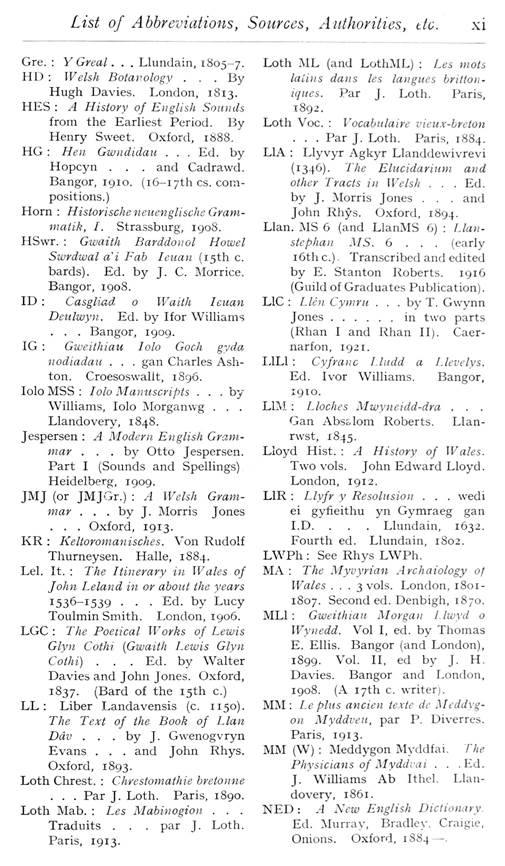
Gre.: Y Greal . . . Llundain, 1805-7.
HD: Welsh Botav.ology . . . By Hugh Davies. London, 181 3.
HES: A History of English Sounds from the Earliest Period. By- Henry Sweet.
Oxford, 1888.
HG: Hen Gwndidau . . . Ed. by Hopcyn . . . and Cadrawd. Bangor, 1910.
(iG-iyth cs. compositions.)
Horn: HistorischeneuenglischeGrammatik, I. Strassburg, igoS.
HSwr.: Gwaith Barddonol Howel Swrdwal ai Fab leuan (15th c. bards). Ed. by J.
C. Morrice. Bangor, 1908.
ID: Casgliad V/aith leuan Deulwyn. Ed. by Ifor WiUiams . . . Bangor, 1909.
IG: Gweithiau lolo Goch gyda nodiadau . . . gan Charles Ashton. Croesoswallt,
1896.
lolo MSS: lolo Manuscripts ... by Williams, lolo Morganwg . . . Llandovery,
1848.
Jespersen: A Modern English Grammar ... by Otto Jespersen. Part I (Sounds and
Spellings) Heidelberg, 1909.
JMJ (or JMJGr.): A Welsh Grammar . . . by J. Morris Jones . . . Oxford, 1913.
KR: Keltoromanisches . Von Rudolf Thurneysen. Halle, 1884.
Lei. It.: The Itinerary in Wales of John Leland in or about the years
1536-1539 ... Ed. by Lucy Toulmin Smith. London, 1906.
LGC: The Poetical Works of Lewis Glyn Cothi [Gwaith Lewis Glyn Cothi) . . .
Ed. by Walter Davies and John Jones. Oxford, 1837. (Bard of the 15th c.)
LL: Liber Landavensis (c. 1150). The Text of the Book of Llan Ddv . . . by J.
Gwenogvryn Evans . . . and John Rhys. Oxford, 1893.
Loth Chrest.: Chresioniathie bretonne . . . Par J. Loth. Paris, 1890.
Loth Mab.: Les Mabinogion . . . Traduits . . . par J. Loth. Paris, 1913. Loth
ML (and LothML): Les mots latins dans les langues brittoniques. Par J. Loth.
Paris, 1892.
Loth Voc.: Vocabulaire vieux-breton . . . Par J. Loth. Paris, 1884.
LIA: Llyvyr Agkyr Llanddewivrevi (1346). The Elucidarium and other Tracts in
Welsh . . . Ed. by J. Morris Jones . . . and John Rhys. Oxford, 1894.
Llan. MS 6 (and LlanMS 6): Llanstephan MS. 6 . . . (early 1 6th c . ) .
Transcribed and edited by E. Stanton Roberts. 1916 (Guild of Graduates
Publication).
Lie: Lien Cymru . . . by T. Gwynn
Jones in two parts
(Rhan I and Rhan II). Caernarfon, 192 1.
LlLl: Cy franc Lludd a Llevelys. Ed. Ivor Williams. Bangor, 19T0.
LIM: Lloches Mwyneidd-dra . . . Gan Absolom Roberts. Llanrwst, 1845.
Lloyd Hist.: A History of Wales. Two vols. John Edward Lloyd. London, 1912.
LIR: Llyfr y Resolusion . . . wedi ei gyfieithu yn Gymraeg gan I.D. . . .
Llundain, 1632. Fourth ed. Llundain, 1802.
LWPh: See Rhys LWPh.
MA: The Myvyrian Archaiology of Wales . . . 3 vols. London, 1801-1807. Second
ed. Denbigh, 1870.
MLl: Gweithiau Morgan Llwyd Wynedd. Vol I, ed. by Thomas E. Ellis. Bangor
(and London), 1899. Vol. II, ed by J. H. Davies. Bangor and London, 1908. (A
17th c. writer).
MM: Le plus ancien texte de Meddyg- 011 Myddveu, par P. Diverres. Paris, 191
3.
MM (W): Meddygon Myddfai. The Physicians of Myddvai . . .Ed. J. Williams Ab
Ithel. Llandovery, 1861.
NED: A New English Dictionary. Ed. Murray, Bradley. Craigie, Onions. Oxford,
18S4— .
|
|
|
|
|
(delwedd F6748) (tudalen 012)
|
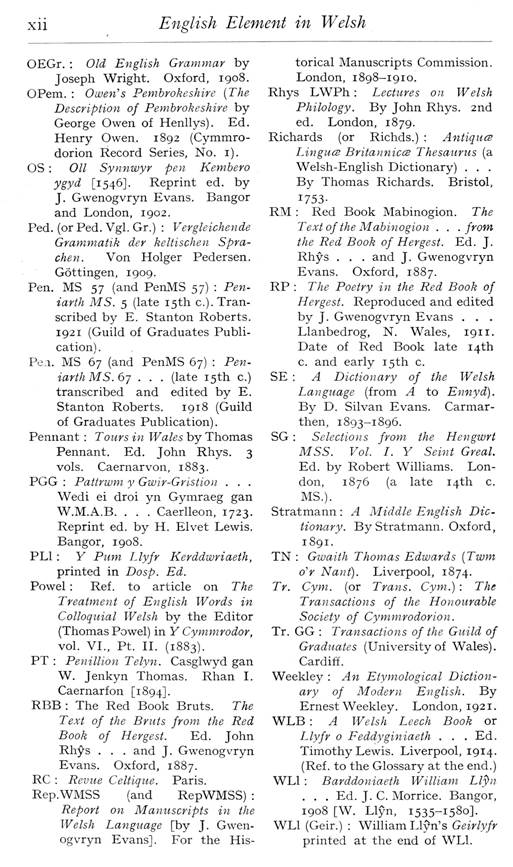
12 Xll English Element in Welsh
OEGr.: Old English Grammar by Joseph Wright. Oxford, 1908. OPem.: Owen's
Pembrokeshire [The Description of Pembrokeshire by George Owen of Henllys).
Ed. Henry Owen. 1892 (Cymmrodorion Record Series, No. i). OS: Oil Synnwyr pen
Kembero ygyd [1546]. Reprint ed. by J. Gwenogvryn Evans. Bangor and London,
1902. Ped. (or Ped. Vgl. Gr.): Vergleichende Gramrnatik der keltischeyi
Sprachen. Von Holger Pedersen. Gottingen, 1909. Pen. MS 57 (and PenMS 57):
Peniarth MS. 5 (late 15th c). Transcribed by E. Stanton Roberts. 192 1 (Guild
of Graduates Publication). Pe.i. MS 67 (and PenMS 67): PeniarthMS.^j . . .
(late 15th c.) transcribed and edited by E. Stanton Roberts. 191 8 (Guild of
Graduates Publication). Pennant: Tours in Wales by Thomas Pennant. Ed. John
Rhys. 3 vols. Caernarvon, 1883. PGG: Pattrwm y Gwir-Gristion . . . Wedi ei
droi yn Gymraeg gan W.M.A.B. . . . Caerlleon, 1723. Reprint ed. by H. El vet
Lewis. Bangor, 1908. PLl: Y Pum Llyfr Kerddwriaeth,
printed in Dosp. Ed. Powel: Ref. to article on The Treatment of English Words
in Colloquial Welsh by the Editor (Thomas Powel) in Y Cymmrodor, vol. VL, Pt.
II. (1883). PT: Penillion Telyn. Casglwyd gan W. Jenkyn Thomas. Rhan I.
Caernarfon [1894]. RBB: The Red Book Bruts. The Text of the Bruts from the
Red Book of Hergest. Ed. John Rhys , . . and J. Gwenogvryn Evans. Oxford,
1887. RC: Revue Celtique. Paris. Rep.WMSS (and RepWMSS): Report on
Manuscripts in the Welsh Language [by J. Gwenogvryn Evans]. For the
Historical Manuscripts Commission.
London, 1898-1910. Rhys LWPh: Lectures on Welsh
Philology. By John Rhys. 2nd
ed. London, 1879. Richards (or Richds.): Antiques
LingucB Brita>iniccB Thesaurus (a
Welsh-English Dictionary) . . .
By Thomas Richards. Bristol,
1753-
RM: Red Book Mabinogion. The TextoftheMabinogio)i . . .from the Red Book of
Hergest. Ed. J. Rhys . . . and J. Gwenogvryn Evans. Oxford, 1887.
RP: The Poetry in the Red Book of Hergest. Reproduced and edited by J.
Gwenogvryn Evans . . . Llanbedrog, N. Wales, 191 1. Date of Red Book late
14th c. and early 15th c.
SE: A Dictionary of the Welsh Language (from A to Ennyd). By D. Silvan Evans.
Carmarthen, 1893-1896.
SG: Selections from the Hengwrt MSS. Vol. I. Y Seint Greal. Ed. by Robert
Williams. London, 1876 (a late 14th c. MS.).
Stratmann: A Middle English Dictionary. By Stratmann. Oxford, 1891.
TN: Gwaith Thomas Edwards [Twm o'r Nant). Liverpool, 1874.
Tr. Cym. (or Trans. Cym.): The Transactions of the Honourable Society of
Cymmrodor ion.
Tr. GG: Transactions of the Guild of Graduates (University of Wales).
Cardiff.
Weekley: An Etymological Dictionary of Modern English. By Ernest Weekley.
London, 192 1.
WLB: A Welsh Leech Book or Llyfr Feddyginiaeth . . . Ed. Timothy Lewis.
Liverpool, 1914. (Ref. to the Glossary at the end.)
WLl: Barddoniaeth William Ll^n . . . Ed. J. C. Morrice. Bangor, 1908 [W.
Llyn, 1535-1580].
WLl (Geir.): William Llyn's Geirlyfr printed at the end of WLl.
|
|
|
|
|
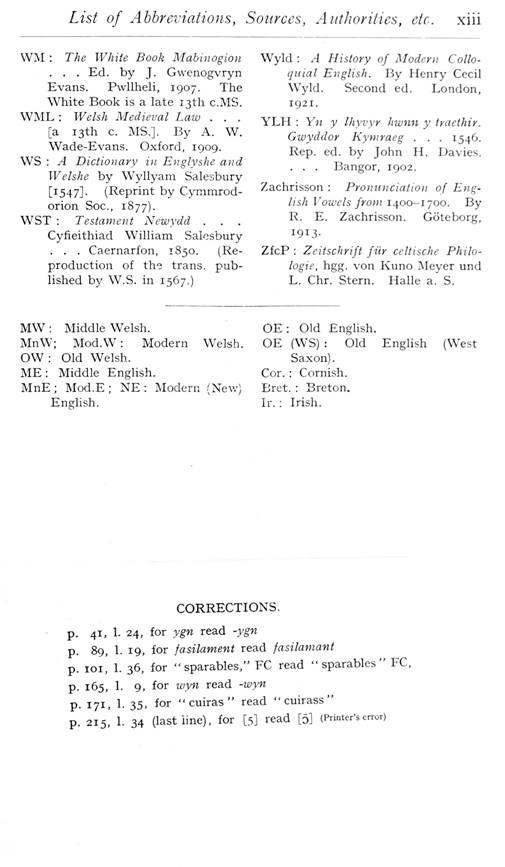
(delwedd F6749) (tudalen 013)
|
13List of Abbreviations, Sources,
Authorities, etc. xm
\V]M: The White Book Mahinogion . . . Ed. by J. Gwenogvryn Evans. Pwllheli,
1907. The White Book is a late 13th c.MS.
WML: Welsh Medieval Law . . . [a 13th c. MS.]. By A. W. Wade-Evans. Oxford,
1909.
WS: A Dictionary in Euglyshe and Welshe by Wyllyam Salesbury [1547]- (Reprint
by Cymmrodorion Soc, 1877).
WST: Testament Newydd .
Cyfieithiad William Salesbury . . . Caernarfon, 1850. (Reproduction of the
trans, published by W.S. in 1567.) Wyld: A History of Modern Colloquial
English. By Henry Cecil Wyld. Second ed. London, 1921.
YLH: Yn y Ihyvyr liwnn y traethir. Gwyddor Kymraeg . . . 1546. Rep. ed. by
John H. Davies. . . . Bangor, 1902.
Zachrisson: Pronunciation of English Vowels from 1400-1700. By R. E.
Zachrisson. Goteborg, 1913-
ZfcP: Zeitschrift fiir celtische Philologie, hgg. von Kuno Meyer und L. Chr.
Stern. Halle a. S. MW:
Middle Welsh. MnW
; Mod.W: Modern
Welsh.
OW:
Old Welsh. ME:
Middle English. MnE
; Mod.E; NE: Modern
(New)
English. OE: Old Enghsh.
OE (WS): Old English
Saxon) . Cor.: Cornish. Bret.: Breton, Ir.; Irish. (West
14CORRECTIONS.
p. 41, 1. 24, for ygn read -ygn
p. 89, 1. 19, for fasilament read fasilamant
p. loi, 1. 36, for "sparables," FC read "sparables" EC,
p. 165, 1. 9, for wyn read -wyn
p. 171, 1. 35, for "cuiras" read "cuirass"
p. 215, 1. 34 (lasthne), for [5] read [5] (Printer's error)
|
|
|
|
|
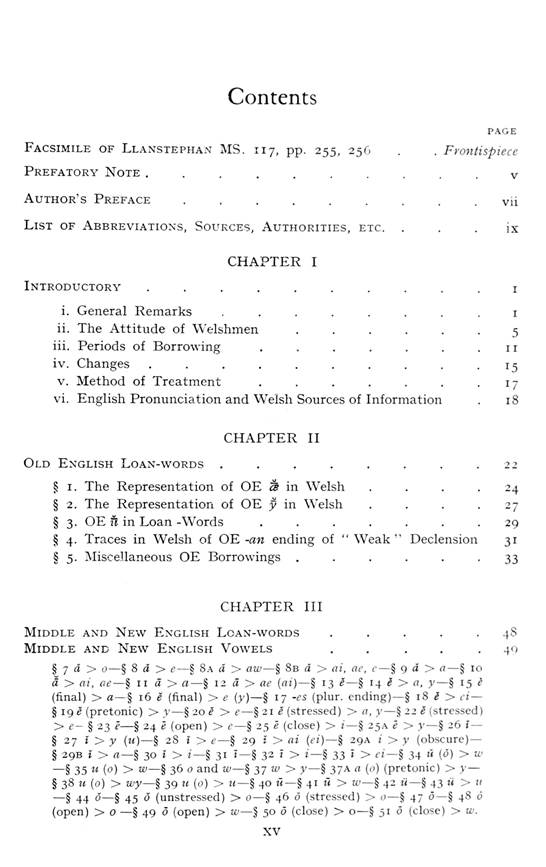
(delwedd F6750) (tudalen 015)
|
15Contents Facsimile of Llanstephan MS.
117, pp. 255, 256 Prefatory Note .......
Author's Preface ......
List of Abbreviations, Sources, Authorities, etc. PAGE
Frontispiece
V
vii ix CHAPTER I Introductory i. General Remarks .....
ii. The Attitude of Welshmen
iii. Periods of Borrowing ....
iv. Changes .......
V. Method of Treatment ....
vi. English Pronunciation and Welsh Sources of Information I
5 II
15
17 18 CHAPTER II Old English Loan-words § I. The Representation of OE a in
Welsh .... 24
§ 2. The Representation of OE y in Welsh . . . .27
§ 3. OE U in Loan -Words ....... 29
§ 4. Traces in Welsh of OE -an ending of “Weak” Declension 31
§ 5. Miscellaneous OE Borrowings . . . . . -33 CHAPTER III
Middle and New English Loan-words ..... Middle and New English Vowels .....
§ 7 rt > — § 8 a > e — § 8a a > aw — § 8b a > ai, ae, c — § 9 a
> a — § 10 a > ai, ae—^ 11 a > a — § 12 a > ae {ai) — § 13 S — §
14 ^ > rt, y — § 15 t (final) > a— § 16 e (final) > e (y) — § 17 -es
(plur. ending) — § 18 ^ > ci — § 19 e (pretonic) > y — § 20 e > e —
§21 e (stressed) > a, y — § 22 S (stressed) > e- % 23 e — § 24 e (open)
> e— § 25 e (close) > i— § 25A e > y— § 26 1 — § 27 I > y (m) — §
28 i > e — § 29: > ni (ei) — § 29A i > y (obscure) — § 29B i >
rt— § 30 I > f— § 31 i— § 32 J > i— § 33 t > ei—^ 34” (0) > tif —
§ 35 ^« {0) > w — § 36 and w — § ^y w > y — § 37A a (0) (pretonic) >
> — § 38 u (0) > wy—% 39 u (0) > 2(— § 40 tT— § 41 t7 > w—l 42 M—
§ 43 M > II — § 44 6 — § 45 (unstressed) > — § 46 6 (stressed) > — §
47 0— § 48 6 (open) > — § 49 o (open) > w— § 50 o (close) > o— § 51
(close) > w.
XV 48 40
|
|
|
|
|
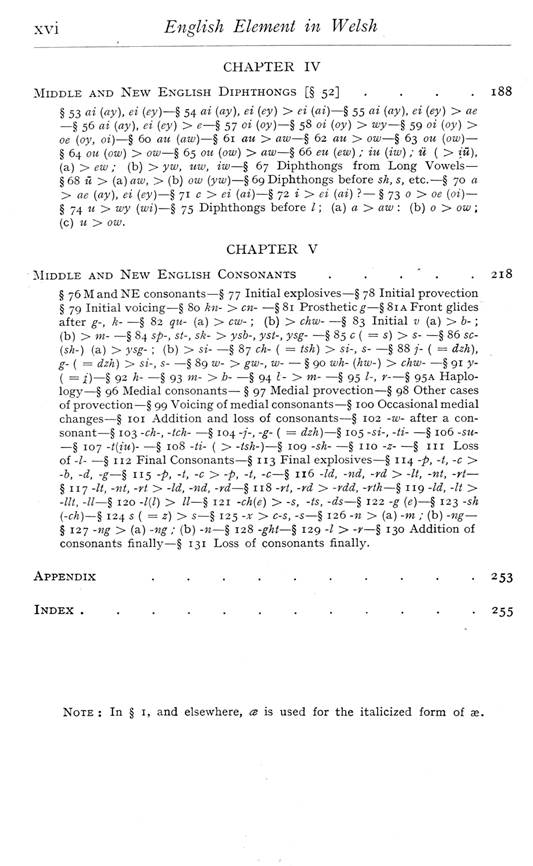
(delwedd F6751) (tudalen 016)
|
16xvi English Element in Welsh CHAPTER IV
Middle and New English Diphthongs [§ 52] . . . .188
§ 53 ci {cy), ei {ey)—l 54 ai {ay), ei (ey) > ei {c>.i)—% 55 ai [ay),
ei (ey) > ae — § 56 ai (ay), ei {ey) > e— § 57 oi (oy)— § 58 oi {oy)
> wy—^ 59 oi {oy) > oe {oy, oi)- — § 60 au {aw) — § 61 au > aw — §
62 au > ow — § 63 ou {ow) — § 64 ou {ow) > ow — § 65 ou {ow) > aw —
§ 66 eu {ew); iu {iw); ii { > iu),
(a) > ew; (b) > yw, uw, iw — § 67 Diphthongs from Long Vowels — §68 ii
> {3i)aw, > (b) ow {yw) — § 69 Diphthongs before sh.s, etc. — § 70 a
> ae {ay), ei (ey)— § 71 c > ei (««)—§ 72 i > ei {ai)? — § 73 >
oe {oi)— % j^ u > wy {wi) — § 75 Diphthongs before I; (a) a > aw: (b)
> oziy; (c) u > ow.
CHAPTER V
Middle and New English Consonants . . , ' . .218
§ 76MandNE consonants — § 77 Initial explosives — § 78 Initial provection
§ 79 Initial voicing — § 80 kn- > en § 81 Prosthetic^ — § 81 a Front
glides
after g-, k § 82 qu- (a) > cw-; (b) > chw § 83 Initial v (a) > b-;
(b) > ni- — § 84 sp-, St-, sk- > ysh-, yst-, ysg § 85 c ( = s) > s §
86 sc-
{sh-) (a) > ysg-; (b) > si § 87 ch- { = tsh) > si-, s § 88 /- ( =
dzh),
g- { = dzh) > si-, s § 89 w- > gw-, w § 90 wh- {hw-) > chw § 91 y-
( = /)— § 92 h § 93 m- > b § 94 I- > m § 95 1-, r — § 95A Haplo-
logy — § 96 Medial consonants — § 97 Medial provection — § 98 Other cases of
provection — § 99 Voicing of medial consonants — § 100 Occasional medial
changes — § loi Addition and loss of consonants — § 102 -w- after a consonant
— § 103 -ch-, -tch § 104 -/-, -g- { = dzh) — § 105 -si-, -ti § 106 -su-
— § 107 -t{iu) § 108 -ti- { > -tsh-) — § 109 -sh § no -z § in Loss
of -/ § 112 Final Consonants — § 113 Final explosives — § 114 -p, -t, -c >
-b, -d, -g — § 115 -p, -t, -c > -p, -t, -c — § 116 -Id, -nd, -rd > -It,
-nt, -rt — § 117 -It, -nt, -rt > -Id, -nd, -rd — § 118 -rt, -rd > -rdd,
-rth — § 119 -Id, -It > -lit, -//— § 120 -/(/) > W— § 121 -ch{e) >
-s, -ts, -rfs— § 122 -g (e)— § 123 -sh (-c/z)— § 124 s { = z) > s — § 125
-X > c-s, -s — § 126 -n > (a) -m; (b) -ng — § 127 -ng > (a) -ng; (b)
-n — § 128 -ght — § 129 -I > -r — § 130 Addition of consonants finally — §
131 Loss of consonants finally.
Appendix .......... 253
Index ............ 255 Note: In § i, and elsewhere, cs is used for the
italicized form of ae.
|
|
|
|
|
(delwedd F6752) (tudalen 001)
|
01CHAPTER 1
Introductory
I. GENERAL REMARKS
In these days, when etymology and phonology are being so ardently pursued on
well-established scientific lines, and when every source of information is
being investigated, it is a matter for surprise that hitherto a most
important and fruitful field of enquiry, the English loanwords in Welsh, has
been sadly neglected or contemptuously ignored. There may be a belief that
the subject is not invested with enough mystery and romance to attract the
serious attention of the analjiiical etymologist and the scientific
phonologist. Or agam, there may appear to be too much of the element of
inevitableness and obviousness about it to deserve careful scrutiny. However
that may be, it is not too much to suggest that, if from the standpoint of
etymology the subject contains for the Celtic student no great attraction
because of its comparative recentness and of a lack of that dignity which is
often associated with antiquity, it nevertheless abounds in features of
interest which might well engage the attention of the student of the history
of English pronunciation. And for one clear, outstanding reason: that Welsh
is phonetically a conservative language, whereas English, since the Old
English period, to go no further back, has in this respect shown a
progressive tendency, which, as compared with Welsh, is astounding in its
changes and in the swiftness of those changes.
It is only fair to add, however, that the need for the collection and
systematic study of these loans has been keenly felt from time to time by
some Welsh scholars. The late Sir John Rhys, who, judging by some ohiter
dicta in his works, was deeply interested in
1 B
|
|
|
|
|
(delwedd F6753) (tudalen 002)
|
2
English Element in Welsh [chapter i
the subject, stated in an article written to Y Cymmrodor^ in the year 1908
that “an exhaustive and classified list of them is wanted." This is what
the present writer has set out to do, with a leaning more, perhaps, towards
the “classification” aspect of the wish than towards exhaustiveness. From a
modern standpoint, the purely historical aspect of this study deserves a
prominent place, as it may conceivably furnish additional information
regarding intercourse and contact between two linguistically distinct units.
For, as Professor Weekley has justly remarked^: “In assigning to a word a
foreign origin, it is necessary to show how contact between the two languages
has taken place, or the particular reasons which have brought about the
borrowing." The contact in the case of Welsh and English is
self-evident: the reasons for borrowing are not so easy to find. The most
difficult questions in connection with our subject, from the viewpoint of
history, are when and how far did the English and the Welsh come into
sufficiently close contact to allow of the free importation of words from the
language of one into that of the other. Professor Powel, who wrote on this
subject in 1883,^ stated: “Historically it is part of a larger subject, the
question of the relation of the Celt and the Teuton in Britain. It has
generally been thought that down to a comparatively recent period the two
peoples maintained an attitude of almost complete isolation; and proof of
this is supposed to be found, amongst others, in the slight influence which
the two languages had upon each other. But I am inclined to think that fuller
inquiry will show this influence on both sides to have been greater than is
generally allowed." Sir Edward Anwyl, in 1904, wrote words to the same
effect •*: “The English words found in the Welsh dialects have a special
interest of their own, and should be treated separately in connection with
the history of the relations between England and Wales at various
periods." In this connection it would be interesting to collect
references to Saesneg “English” in medieval Welsh literature. The epithets
disaesneg, diseysnic and disaesnegeid “un-English” were used by some of the
Gogynfeirdd,^ and appear to have been complimentary. In the case of
^ Cymmrodor, vol. xxi, p. 36.
2 The Romance of Words. London. Murray, 1912. Chap. II, p. 15.
3 Cytnmrodor, vol. vi, p. iii.
* Trans, of the Guild 0/ Graduates (Wales) for 1904, p. 40.
^ disaesnegeid and diseynic by Dafydd y Coed (c. 1330) in RP 142a 11,
|
|
|
|
|
(delwedd F6754) (tudalen 003)
|
CHAPTER
i] Introductory Anglo-French (Anglo-Norman) and Welsh, this particular
aspect, the historical, has been carefully investigated by Professor Watkin.^
We do not, however, feel confident enough as yet to formulate, on the
strength of our study of the English loan-words in Welsh or the antiquity of
their enfranchisement, any theory or hypothesis as a contribution likely to
be of value to the study of Welsh history or of the social, economic, or
political intercourse between the English and the Welsh.
An excellent beginning was made by Professor Powel in a paper (already
mentioned) published in the Transactions of the Philological Society, and
reprinted in Y Cymmrodor,^ under the title “The Treatment of English Words in
Colloquial Welsh." ^ This paper “treats more particularly of the dialect
spoken, with slight variations, in the counties of Brecon, Cacrmarthen, and
the greater part of Cardigan." Then, in a review written by Stern'* on
Professor Morris- Jones's edition of Y Bardd Cwsc,^ there is a list of
so-called “Middle English” words found in that text. In a paper read by
Professor Kuno Meyer before the Honourable Society of Cymmrodorion^ on the
“Early Relations between Gael and Br}i:hon," we find (p. 82) two or
three "Anglo-Saxon” loan-words discussed, with a promise that a “full
list” would be published in the first number of the Archiv filr celtische
Lexicographie, but, unfortunately, this never appeared. There are isolated
references to English borrowings in notes to edited texts and in glossaries.
No one, however, has as yet attempted a systematic study of this abundant
material, in the light of the new evidence and conclusions which of late
years have accumulated with regard to the development of sounds and the
pronunciation of English.
142b 16; and disaesneg by Casnodyn (c. 1320) in RP 70a 26. Cf. diuydeleid
“un-Irish” by Casnodyn, RP 142a, 7.
1 Trans. Cym.. 1918-19, pp. 149 5^g. The English aspect of the “historical”
evidence is also touched upon, and the writer expresses certain views on this
point with considerable vehemence.
2 Cymmrodor, vol. vi, pp. 111-135.
3 In Pen. MS. 297 [Llyvreu Geirydion John Jones, written in 1606; p. 208,
among lists of words and vocabularies, there is a list of English words
(about 60) used in Welsh, but curiously enough only the English forms are
given.
* Zeitschrijt Jiir celtische Philologie, III Bd., pp. 179-188. 5 Y Bardd
Cwsc. Bangor. Jarvis and Foster, 1898. fi Trans. Cym. 1895-96, p. 82.
|
|
|
|
|
(delwedd F6755) (tudalen 004)
|
4 .
English Element in Welsh [chapter i
In an interesting account of the Welsh language in the sixteenth and
seventeenth centuries {The Welsh Language in the i6th and lyth centuries. By
Ivor James. Cardiff, 1887), there are two lists of English words found in
Welsh; pp. 43-47, Appendix A, “A list of words from foreign sources (mostly
English) taken into Welsh, and included in Salesbury's Dictionary, 1547”; pp.
47-49, Appendix B, “List of English words in the poems of Vicar
Prichard." This book deals also in a general way with the English words
found in the works of Welsh bards and prose- writers.
The late Alexander J. Ellis, the first great authority on English
pronunciation, was conscious of the importance of this aspect of the case,
for in an article on “The Delimitation of the English and Welsh Languages”
contributed to Y Cymmrodor ^ (1882), he observes (in a footnote, p. 207):
"Of course I leave out of account the numerous English words, which, as
their sounds show, have existed in colloquial (as distinguished from
literary) Welsh for hundreds of years." It might be added that the
“literary” words are quite as important, if not more so.
The Latin loan-words in Welsh were treated at length years ago by Professor
Loth-; the Irish loanwords in Welsh were dealt with by Sir John Rhys in
ArchcBologia Camhrensis ^; the “Old Norse, Anglo-Saxon and Early English,
Latin, and Early French” words in Irish were the subject of an article by
Professor Kuno Meyer in the Revue Celtique^; Norris touched upon the subject
of the English (and French) loan-words in Cornish, of which there are a great
many, in the Appendix to his book on Cornish Drama (1859).^ Some Anglo-French
words found in Middle Welsh have been dealt with individually in a paper read
recently before the Hon. Society of Cymmrodorion by Professor M. Watkin.^ An
article on “Emprunts bretons a I'anglo-saxon” appeared in the Revue Celtique,
vol. xiv (1893).
1 Cymmrodor, vol. v, pp. 173-208.
2 Vocabulaire vieux-bveton. Paris, 1884.
^ Archceologia Camhrensis, 1895, p. 264 et sqq. Cf. also Revue Celtique, vol.
xvii, p. 102 et sqq.
^ Revue Celtique, vol. xi, pp. 493-495; vol. xii, pp. 459-463.
^ Ancient Cornish Drama (2 vols.) Oxford, 1859, vol. ii, pp. 463-464. Cf. the
large number of English words in A Cornish Vocabulary, by Stokes, in the
Transactions of the Philological Society, 1868, pp. 137-250. ^ Trans. Cym.,
1919-20, pp. 57-72.
|
|
|
|
|
(delwedd F6756) (tudalen 005)
|
CHAPTER
i] Introductory II. THE ATTITUDE OF WELSHMEN i
Speaking generally, the early Welsh bards, judging by references to English
and Englishmen in their works, did not view them with great favour. But,
curiously enough, some of the later Gogynfeirdd, especially in their
lampoons, appear to have drawn largely on English for their vocabulary of
satire and caricature; for example, Madog Dwygraig (c. 1370), Hj/wel Ystoryn,
Yr Justus Lhvyd and Y Mab Cryg. This suggests that English words and
expressions were mainly used by the lower order of bards, whose works were
restricted, according to the Codes, to lampoon and caricature. ^ It also
implies that English words were finding their way to the colloquial language
and were being assimilated in considerable numbers.
Writers on the language and its literature at a later period were evidentl}'
opposed to the practice of indiscriminately absorbing foreign words into
their native speech. They found fault with the bards for introducing the
foreign elemient into their vocabulary, though some were more tolerant than
others. It will not be without interest, perhaps, to include here some
specimens of observations made by Welshmen on this point from time to time,
as illustrating their attitude.
(i) In Simwnt VjThan's Pum Llyfr Cerddwriaeth^ (sixteenth century), in a
section which is introduced (p. cxii) with the words: “Yma y sonniwn bellach
am Ffugrau ai rrhannau y rrai a ymchwelawdd William Salbri or Lladin
Ynghamberaec” (trans, p. 321 “We wiU now treat of the figures and their
parts, which William Salisbury turned from Latin into Cymraeg "), one
figure is called BolysothacJi, a description of which is given in Welsh thus
(p. cxix): “Bolysothach ai cymysgiaith a vydd pann gymysger a cherdd
Gamberaec, gair neu eiriau o osbiaith arall, neu ryw eiriau hen a ncwydd
kymhessur ac anghymessur, val y mae; 1 Further references to opinions
expressed by Welshmen on this point are given by Ivor James in his book [The
Welsh Language in the i6th and i-jth Centuries. Cardiff, 1887) pp. 6, 7.
2 Cf. Bardism and Romance (from Trans. Cym., 1913-14) by T. Gwynn Jones, p.
97.
^ Pubhshed with Dosparth Edeyrn Dajawd Atir. Ed. Ab Ithel. London, 1S56. S.
Vychan, born c. 1530, -died 1606.
|
|
|
|
|
(delwedd F6757) (tudalen 006)
|
English
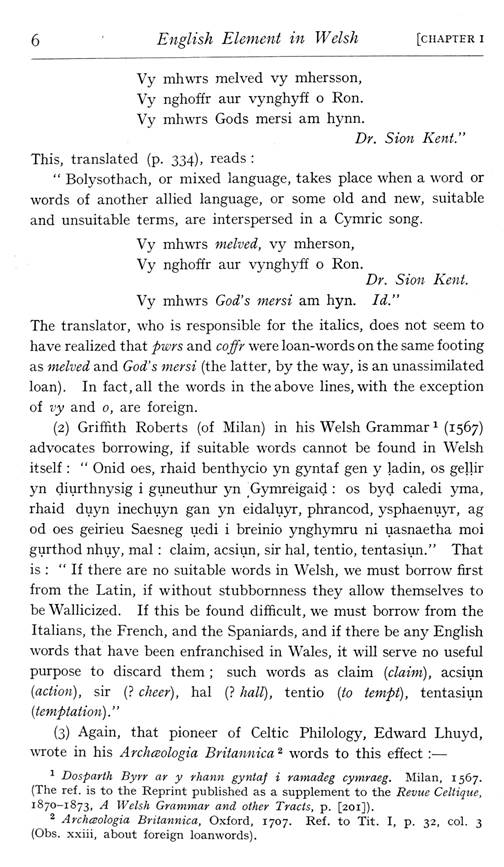
Element in Welsh [chapter i Vy mhwrs melved vy mhersson, Vy nghoffr aur
vynghyff o Ron. Vy mhwrs Gods mersi am hynn.
Dr. Sion Kent." This, translated (p. 334), reads:
" Bolysothach, or mixed language, takes place when a word or words of
another allied language, or some old and new, suitable and unsuitable terms,
are interspersed in a Cymric song.
Vy mhwrs melved, vy mherson,
Vy nghoffr aur vynghyff o Ron.
Dr. Sion Kent.
Vy mhwrs God's mersi am hyn. Id."
The translator, who is responsible for the italics, does not seem to have
realized that pwrs and coffr were loan-words on the same footing as melved
and God's mersi (the latter, by the way, is an unassimilated loan). In fact,
all the words in the above lines, with the exception of vy and 0, are
foreign.
(2) Griffith Roberts (of Milan) in his Welsh Grammar ^ (1567) advocates
borrowing, if suitable words cannot be found in Welsh itself: “Onid oes,
rhaid benthycio yn gyntaf gen y ladin, os gellir yn diurthnysig i guneuthur
yn ^Gymreigaid: os byd caledi yma, rhaid duyn inechuyn gan yn eidaluyr,
phrancod, ysphaenujT, ag od oes geirieu Saesneg uedi i breinio ynghymru ni
uasnaetha moi gurthod nhuy, mal: claim, acsiun, sir hal, tentio,
tentasiun." That is: “If there are no suitable words in Welsh, we must
borrow first from the Latin, if without stubbornness they allow themselves to
be Wallicized. If this be found difficult, we must borrow from the Italians,
the French, and the Spaniards, and if there be any English words that have
been enfranchised in Wales, it will serve no useful purpose to discard them;
such words as claim {claim), acsiun {action), sir (? cheer), hal (? hall),
tentio {to tempt), tentasiun {temptation)."
(3) Again, that pioneer of Celtic Philology, Edward Lhuyd, wrote in his
ArchcBologia Britannica ^ words to this effect: —
^ Dosparth Byrr ar y rhann gyntaf i ramadeg cymraeg. Milan, 1567. (The ref.
is to the Reprint published as a supplement to the Revue Celtique, 1870-1873,
A Welsh Grammar and other Tracts, p. [201]).
2 Archcsologia Britannica, Oxford, 1707. Ref. to Tit. I, p. 32, col. 3 (Obs.
xxiii, about foreign loanwords).
|
|
|
|
|
(delwedd F6758) (tudalen 007)
|
CHAPTER
i] Introductory “There are also a great many Teutonic or Gothic words in the
British, but as we see that the Latin words therein are but partly^ owing to
the Roman Conquest, so we shall find that of these, very few have been
borrowed from the Saxons, whose language cannot be suppos'd to have been then
so copious, as that of the Romaniz'd Britans: and much fewer, if any, from
the Danes, who had never any settlement amongst them. The vulgar errour in
supposing most or all such Welsh words as agree with the English, to have
been receiv'd from that Language, will plainly appear to any that shall
peruse Maunoir's Armoric Vocabulary, where they'l find as many such, as in
Dr. Davies's Welsh Dictionary, which yet could not have been borrow'd from
the English, seeing (as is agreed upon by the Inhabitants of both Countreys)
thej^ left this Island before the Saxons were call'd in . . .
" . . . That small part of Cornwall that retains the British and those
of Wales, that border upon England, use a great many English words disguis'd
with their own Terminations; but as such are only used by the Borderers. So
they have been almost wholly omitted by Salesbury and Davies in their
Dictionaries, and are not apply'd to use by any Writers excepting some
ignorant Rimers."
Unfortunately, however, Lhuyd quotes no examples of English loan-words in
Welsh, although he cites a few English words found in Cornish and Breton.
(4) It will not be out of place to quote further what Theophilus Evans, the
author of Drych y Prif Oesoedd (1716) has to say on the matter, although it
is rather lengthy; but it is interesting in many respects. He wrote ^: “Y mae
yn wir yn y Jaith Gymraeg amryw eiriau o'r un ystyr a'r Saesonaeg; ac yn
ddiweddar y mae chwaneg beunydd yn llifeirio iddi oddiwrth y Saesonaeg. Ond
camsynnied er hynny yw tybied mai oddiwrth y Saeson y cawsom ni }t holl
Eiriau sy o'r un Sain ac yst}^: yn ein Hiaith ni a hwythau: Canys e fu'r
Saeson amryw Flynyddoedd yngwasanaeth yr hen Frutaniaid cyn iddynt yn
felldigedig droi yn Fradwjn: yn eu herbyn: Ac yn yi ysbaid hwnnw y mae 'n
naturiol i gredu eu bod yn benthyccio
^ Lhuyd says “partly," because he considered some Welsh words that are
reaUy cognate with Latin words, as having been borrowed from Latin at some
pre-historic period.
2 Drych y Prij Oesoedd. Reprint of 1740 (second) edition. Ed. S. J. Evans.
Bangor, 1902. Pp. 162-164.
|
|
|
|
|
(delwedd F6759) (tudalen 008)
|
8 '
English Element in Welsh [chapter i gan eu Meistriaid: A'r geiriau hyn a
ganlyn yw ychydig allan o lawer, megis, Anghwrteis, Byclau, Bar gen, Cap,
Cadpen, Clap, Cost, Crefft, Crwpper, Cwcwallt, Ceispwl, Cwpl, Cwppan, Cweryl,
Dart, Egr, Ffael, Ffals, Ffair, Ffol, Gran, Gronyn, Happus, Hap, Het, Hittia,
Inge, Lifrai, Llewpard, Malais, Maer, Pert, Plds, Plwm, Sad, Sadler, Siwrnai,
Siop, Tasc, Tafarn, Twr, Trwm, Tiler, Ystryd.
" Y mae'r Geiriau hyn oil i'w gweled (gydag amryw eraill) Yng Hywyddau
Dafydd ap Gwilym, yr hwn ym Marn Madoc Benfras oedd Benial Cerdd ddyfal
dafawd: Ac ebe Jolo goch am dano yn ei Farwnad, Aed lie mae'r ehang Dangnef,
Ac aed y Gerdd gydag ef. Nid oedd dim hoffder yn ei amser ef (sef ogylch y
Flwyddyn 1380) mewn Bonheddig na Gwreng i Siarad Saesonaeg, er eu bod yn
deall eu gwala o Ladijt, Groeg, ac Hehraeg; Ac y mae e'n Gwestiwn, pa un a'i
bod Dafydd ap Gwilym, neu un Offeiriad arall, neu Bendefig, neu un Gwt
dyscedig pa un bynnag yn yr Oes honno yn deall Saesonaeg, megis y gellir barnu
yn dra naturiol WTth y Stori nodedig hon a ganlyn . . . Y mae'n hawdd casglu
oddiyma na fedrai na Phendefigion na Dyscedigion Cymru ddim Saesonaeg yn yr
oes honno, o gylch tri chant a deg o flynyddoedd a aethent heibio. Ac am
hynny y mae'n ddilys mai Cymraeg yw'r ychydig Eiriau uchod a chwiliais i
allan o Gy wyddau Dafydd ap Gwilym; ac yn wir y mae'r Pen-cymro y dyscedig
Dr. Dafies yn eu cydnabod oil, gydag amryw chwaneg.
" Nid yw hyn ddim wTth y Lliaws a fenthycciodd y Saeson o amser
bwy-gilydd oddiwrth Genhedloedd eraill i gyfoethogi eu Hiaith, megis y mae hi
yn wir ynawr yn Jaith lawn a helaeth. Ffrangaeg yw llawer jawn o honi, ynghyd
ag ambell air bychan o'i hen jaith ei hun. ' Canys, eb'r Cronicl, yn amser
Gwilym Gwncwerwr nid oedd Swyddog o Sais yn Lloegr; a gwradwydd mawr oedd alw
un yn Sais, neu ymgyfathrachu ag un o'r Genedl honno, canys hwy a gasheid yn
ddirfawr. Ac wrth hynny y mae'n amlwg nad oes un Pendefig yn Lloegr eithr o
Hiliogaeth naill a'i o'r Normaniaid, a'i o'r Ffrangcod, a'i ynteu o'r
Brutaniaid ': Ac yno yr ydoedd yn Ddiharcb, Jack would be a Gentleman, but he
can Speak no French."
That is: “There are, indeed, in Welsh several words with the same meaning as
in English; and recently many more have been flowing into the language from
the English. But it is a mistake
|
|
|
|
|
(delwedd F6760) (tudalen 009)
|
CHAPTER
i] Introductory g
to imagine that we have taken over from the Enghsh all those words that have
the same sound and sense in our language as in theirs. For the English were
for many years in the service of the old Britons, before they accursedly
turned traitors against them. And it is natural to believe that during that
period they were borrowing from their masters. The following are a few
examples out of many such words: Anghwrtais, etc., etc.
" All these words are to be found (with several others) in the Cywyddaii
of Dafydd ap Gwilym, who in the opinion of Madog Benfras was ' Penial cerdd
ddyfal dafawd.' And lolo Goch sang of him in his Elegy, ' Aed lie maeW ehang
Dangnef, Ac aed y Gerdd gydag ef.' In his time (about the year 1380) neither
nobleman nor plebeian was fond of speaking English, though they w^ell
understood Latin, Greek, and Hebrew; and it is a question whether Dafydd ap
Gwilym, or any other priest or nobleman, or any learned person whatsoever in
that age understood English, as may be easily gathered from this remarkable
story . . .
" It is easy to conclude from the above that neither the noblemen nor
the scholars of Wales were conversant with English, about three hundred and
ten years ago. And for this reason: it is certain that the above-mentioned
words, culled by me from the Cywyddau of Dafydd ap Gwilym, are Welsh; and, in
fact, the learned chief among Welshmen, Dr. Dafies, recognizes them as such,
along with many others.
" This is as nothing compared with the great number borrowed by the
English, from time to time, from other nations to enrich their own language,
with the result that it is now a full and comprehensive language. A large
portion of it is French, with an occasional small word of the old original
tongue itself. ' For,' says a chronicle in the time of William the Conqueror,
' no Englishman held office in England; and it was a great disgrace to be
called an Englishman, or to have intercourse with anyone of that nation, for
they were greatly despised. And consequently it is quite clear that there is
no nobleman in England who is not descended from the Normans, or from the
French, or from the Britons.' And at that time (or there, i.e. in England)
there was a proverbial expression, ' Jack would be a Gentleman, but he can speak
no French.'“
(5) We may quote the view of Lewis Morys which is found in
|
|
|
|
|
(delwedd F6761) (tudalen 010)
|
10 .
English Element in Welsh [chapter i
the Introduction to Diddanwch Teuluaidd,^ in a letter written in English to
“William Parry, Esq., Deputy Coroner of his Majesty's Mint in the Tower of
London, and Secretary to the Cymmrodorion Society." The writer of the
letter says: — “The English tongue is far more indebted to the ancient
language of Britain, now spoken in Wales, than is generally imagined. Shallow
dabblers in Etymology run with the stream, and attribute every word that
sounds like English, to be a corruption, or borrowed from that language;
which, if some care be not taken to distinguish them, will be a means to
create, in time, a confusion of Languages, like that of Babel. I am far from
claiming all the words from Latin, Greek, and German which Mons. Pezron is
willing to give us; but shall be contented with such as prove themselves to
be ours from very ancient times, and which from their very nature and
composition show themselves to be such. For example,
" Can anyone doubt but that the English word Denizen (a Foreigner, made
free) is taken from the British Dinaswr or Dinesydd? a citizen. Is it not
plain that the word dainty is derived from dant, a tooth? pi. daint. Who
cannot see that, to darn, with a needle and thread, be not borrowed from the
British darn, a piece, darnio, to piece, etc.?
" Who can be so hardy as to deny that the word Garter (that Great Mark
of Honour) is not derived from the British Gardys, signifying the same thing;
and that from garr, the Ham, as if one would say Ham-ties? I might enumerate
abundance of such English words, which prove themselves to be Old British,
but that it is beyond the Scope of a letter."
(6) Further, we quote W. D.'s (Gwallter Mechain's) remarks, couched in turgid
Welsh, on Huw Morris's vocabulary, in the Introduction to Eos Ceiriog,^ the
works of H. Morris edited by him: “Mae y geiriau anghyfiaith a gynnwysir yn y
gwaith megis ffarwel, perl, aliwns, ysgweier, camrig, galwyn, dart, part,
ffrins, etc., etc. — gwedi eu argraffu mewn lljrthyrenau amrywiol, er mwyn
dynodiant, ac fel yr ymwrthodont y beirdd ieuainc a'r fath gymysgedd yn eu
cyfansoddiadau." That is: “The foreign words contained in the work, such
as ffarwel . . , have been printed in different type,
^ Diddanwch Teuluaidd, London, 1763.
2 Eos Ceiriog. Gwrecsam. I. Painter, 1823. P. xx.
|
|
|
|
|
(delwedd F6762) (tudalen 011)
|
CHAPTER
i] Introductory ii
to indicate them, so that the young bards may avoid such mixture in their
compositions."
(7) We have the modern view on the subject of borrowing in the Introduction
to Y Bardd Cwsc (ed. J. Morris- Jones, Bangor, 1898), where the editor, in
deahng with the numerous EngHsh words found in ElHs Wynne's masterpiece,
shows (pp. xlv-xlvii) how weak the arguments of the Welsh purists were, and
how necessary it is for a living language to borrow continually.
Some articles published in the new Welsh periodicals, Y Lienor and Y
Tyddynnwr, contain a large number of foreign words in Welsh garb. This proves
that even the modern literary language has not by any means ceased to borrow,
especially from English.
It will be readily observed from the above extracts that Welsh writers from
time to time have been forced to take the English element into account. There
appears to have been a very strong feeling of prejudice against borrowing
indiscriminately, arising probably from a jealous spirit which in some cases
had its origin in a firm belief in the necessity or desirability of
preserving the homogeneity of the Welsh vocabulary. We now know that their
etymology was not sound, though their intentions were good, and that their
concern for the vernacular had run away with their judgment. To-day it has to
be admitted that there are hosts of foreign words in Welsh, which by their
very form, betray their alien origin — generally English. The real difficulty
which confronts us most often is not whether a word is Celtic or English, but
whether it is Anglo-Norman or Anglo-Romance — that is, a direct French
borrowing, or an indirect one, through the channel of English.
III. PERIODS OF BORROWING
The most convenient classification for our purpose is that based on the
accepted periods — (i) Old English and (2) Middle-and-New English. We must
leave any historical evidence regarding the intercourse, peaceful or
otherwise, between the Welsh and their English neighbours to the historians.
There is, however, no reason to doubt one fact, that by the tenth century at
the latest, relations between the Welsh princes and the English rulers were
fairly peaceable.
Although we have no texts of continued Welsh of an earlier
|
|
|
|
|
(delwedd F6763) (tudalen 012)
|
12 .
English Element in Welsh [chapter i
date than the twelfth century (there are, of course, fragments of greater
antiquity, like the “Juvencus” verses), yet there is not much room for doubt
that most of the words included in the Old English section of this work are
genuine loans of that period. If punt (Oxoniensis I, ninth century) is, as we
think it is, from Old English, then the MS. evidence, in this case at least,
carries us farther back, to the ninth century. Other words which occur in our
oldest texts (transcripts, many of them, of much older texts, as the
orthographical features show) are bond fide borrowings from the Old English
period. There are some words in the living spoken language to-day that are
not found in written texts until quite recently, and which, as their form
proves, date from the Old English period. It may be noted here that absence
of loan-words (Irish, English and French) has recently^ been regarded as
evidence of the antiquity (sixth century) of a poem in the Book of Taliesin
(thirteenth century MS.). Only a few possible Old English loan-words are to
be found in the Black Book of Carmarthen (twelfth century MS.).
[One is tempted to classify some of the Old English borrowings:
Ecclesiastical: ahad, beiws, capan, caplan, casul, clul, offrwm. Social,
legal: edling, distain, wtla. Military: hwa (?), certwain, camp, tarian.']
It is easy to confuse Old English and Norse borrowings, because the few Norse
words that are to be found in Welsh appear to occur also in English. The date
of borrowing of these Norse words can, perhaps, be safely fixed between the
limits of the ninth century and the beginning of the eleventh century — ^the
period of Scandinavian plunderings and settlements on the Irish, Welsh and
English coasts. larll, ysgrepan, carl, hafr are probable examples.
To revert to the texts in which some of our examples have been collected, —
in the Book of Llandaf (Liber Landavensis, c. 1150) there are one or two
examples, ford ( = ffordd “road "); in the Book of Taliesin (thirteenth
century MS.) a few; in the Black Book of Chirk (c. 1200) some instances; in
the White Book of Rhydderch Mabinogion (late thirteenth century MS.) and the
Red Book
^ Cymmvodor, xxviii, p. 168. “The vocabulary is purely British and Latin: it
does not contain one word borrowed from Irish or English, not to mention
French."
|
|
|
|
|
(delwedd F6764) (tudalen 013)
|
CHAPTER
I] Introductory 13
Mabinogion (fourteenth and early fifteenth centuries) a fairly good number;
in the Red Book Poetry (same date) a very large number of English (and
French) words, especially in the works of some of the later Gogynfeirdd who
WTote satire. But it is when we come to the cywydd-poets from Daf3^dd ap
Gwilym (fourteenth century) on, that we fully realize to what extent
borrowing from English (and French) must have taken place. Dafydd ap Gwilym
apparently borrowed the vocabulary of the Clerwr, that is, the unofficial
bard, whose compositions were restricted to lampoon and caricature. “Dafydd
ap Gwilym borrowed his [the Clerwr' s] vocabulary and his love of nature and
women, and most probably his metre, out of which he and his predecessors,
whose names are not recorded and whose poems were not preserved, fashioned
the Kywydd — a distinct compromise between the style of the Bard and that of
the ClerwT." This leads us to suppose that, in the realm of verse, it
was the Clerwr who made bold to introduce into his work the foreign words
which must have been common in the vocabulary of colloquial speech in his
day. These words were adopted and used (in imitation of the earlier writers)
by the later cywydd-poets for centuries, and new ones were no doubt
continually added, so that when we come to Thomas Prys of Plas lolyn (late
sixteenth and early seventeenth centuries) their number is becoming
prodigious. [Thomas Prys wrote some English poems.] The same may be said of
the works of some later prose writers, e.g. Ellis Griffith's History
(sixteenth century) (Mostyn MS. 158), which swarms with English words,
touched into Welsh — a mere pretence.
With regard to the first examples of free metre (accentual verse) poetry in
Welsh, the same tale is to be told, and the borrowing habit continued in full
vigour until very recently. This tendency in what was originally a
folk-tradition of poetry (the work of the direct descendants of Y Gler?) -
seems to prove that the spoken language must have been very heavily-laden
with these English borrowings— even more so than now. Vicar Prichard (born
1579),
^ Bardism and Romance (T Gwynn Jones). From the Trans. Cym., 1913-14, p. 103.
Cf. the remark on y gler in LIA, p. 40: “Pa obeith yssyd yr gler. nyt oes yr
vn. kannys oe hoU ynni ymaent y[n]gwassanaethu ydia6l."
2 Cf. Trans. Cym., 1913-14, p. 191. (Y Gler a'r Penillion Telyn. Ifor
WiUiams.)
|
|
|
|
|
(delwedd F6765) (tudalen 014)
|
14
English Element in Welsh [chapter i
who wrote for the populace, crammed his moral verses with English words,
touched up to give them a Welsh semblance.^ We can hardly believe that this
was necessary to such an extent at that time, even to be understood of the
common people. The hymnologists, who wrote with a similar purpose and for the
same class of people, made extensive use of the foreign element in their
vocabulary. The poems of Huw Morris (born 1622) are brimful of English words;
likewise the ballads of the eighteenth and nineteenth centuries. Even the
“classical” prose-writers were not immune; Ellis Wynne, whose Bardd Cwsc
appeared in 1703, makes free use of English words and expressions which were
undoubtedly taken from the living colloquial speech of his time and district.
We may regard the majority of these loans as “popular” borrowings. Until
comparatively recent times, very few “learned” loanwords found their way into
Welsh from English — unless we are to regard some of the examples from the Middle
Welsh prose and Early Modern Welsh poetry as being "learned,"
because of the nature of the literary tradition. With the translation of the
Scriptures into Welsh, there came an influx of English "learned"
borrowings.
Large numbers of borrowed words have not survived. They occur in some texts
only — and they have passed away from the language. In spite of their
ephemeral character, they may, of course, have formed part of the living
language for a period. For our purpose, they are none the less interesting,
from the standpoint of form and sound. There is no doubt that some words
failed to find a resting-place for any length of time on foreign soil,
amongst which a large number of those given in Salesbury's Dictionary^
(sixteenth century) are to be reckoned. The reason is obvious: he compiled
his dictionary for the use of Welshmen desirous of learning English.
Strangely enough, words that have long become obsolete in English, or which
survive only in dialects, are still living in Welsh, e.g. barclod, Uidiart.
Some of our examples are interesting from the standpoint of semantics. The
older meaning is often preserved
^ Cf. The Welsh Language in the 16th and lyth Centuries. By Ivor James.
Cardiff, 1887. Pp. 12-16.
2 Ibid., pp. 10-12 (" Salesbury's Dictionaiy^ exhibits the English words
in a sort of dead phalanx ").
|
|
|
|
|
(delwedd F6766) (tudalen 015)
|
CHAPTER
i' Introductory 15
in Welsh, while that of the English has changed (except, occasionally, in
dialects), e.g. sad "firm, steady."
Welsh has no doubt been subject to the vagaries of linguistic fashion. There
are times when borrowing is popular and is being encouraged, and times when
such a practice meets with the condemnation of the literary leaders and
scholars of the day. (Cf. II above.)
IV. CHANGES
It seems fairly obvious that a foreign word borrowed orally into a living
spoken language preserves, as far as possible, its characteristic
sound-value. There are, however, various influences at work, and when the
foreigner finds himself in Rome, he is generally obliged to "do as the
Romans do”: — (i) Certain sounds may be foreign to the adopting language
(e.g. English ck, sh, j, z); in such cases the nearest equivalent is chosen.
(2) Certain positions may appear unnatural in the adopting speech; the
adopted word is then made to conform to the common usage (e.g. intervocalic
voiceless stops; final voiceless stops; initial r-, /-, w-, v-, wh-, sp-,
sc-, st-, short vowels in monosyllables before a final voiced stop), (3)
There may be certain changes operative at the time of borrowing or afterwards
in the adopting language. The foreign words fall in. [This is especially true
of Latin loan-words in Welsh.] (4) Unusual positions of accent may bring
about changes like the suppression of unaccented (post -tonic or pre-tonic)
vowels. (5) Foreign words may have initial or final syllables that have an
appearance similar to common prefixes or suffixes in the adopting language.
Slight changes may then take place. (6) Popular etymology is liable at times
to play havoc with the forms of words. (7) Any system of changes in the
adopting speech may indirectly lead to a change in the borrowed word. The
Welsh “voiced” mutation, for example, may be responsible for the interchange
of initial b and m. (8) Sounds may have been wrongly heard and transferred
incorrectly. (9) Sounds that are practically identical, may, however, be
pronounced somewhat differently in the two languages. For example: initial b
in Welsh is more forcibly pronounced than initial b in English. Hence this
voiced sound in Welsh appears to be voiceless to Englishmen. A great deal has
been WTitten on the subject of English
|
|
|
|
|
(delwedd F6767) (tudalen 016)
|
1 6
English Element in Welsh [chapter i
words as pronounced by Welshmen, and the representation of this pronunciation
in EngHsh literature.^ (lo) Physiological factors and climate even may have
something to do with these sound-changes in transition from one language to
another. We are tempted to quote from an article published in an English
daily, ^ and written by a well-known English novelist: “The influence of
climate on temperament, of course, even on character, is admitted, and may be
estimated, if not measured. I should like to suggest that it has much to
answer for in the growth and development of Latin — filius, figlio, fils,
hijo; facere, faire, hacer; travallum, travaglia, travail, trabajo. What was
it that made the Spaniards incapable of the F and V sounds, so that facere
became hacer, and travallum trabajo? The Law of Laziness, it will be said.
Yes, but what, if not climate, induced such slack enunciation? Whether it was
climate or some peculiar palatal formation in the indigenes which turned the
liquid of Italy into the gutteral {sic) aspirate of the Iberian Peninsula I
am not scholar enough to say. Filius, at any rate, became hijo, and mulier is
in Spanish mujer. Shall we lay that to the sun?”
With the exception of changes of the above-mentioned type — changes which
make the loanwords of more than ordinary interest — the loan-words which will
be found classified in this collection, in the main reflect, as far as that
is possible in a foreign tongue, the exact pronunciation of their native
English, or the nearest approach to it. A sound in process of change in
English may have it accentuated in the Welsh form, and the change may appear
complete. Some forms have become obsolete in English, but have been preserved
in the Welsh derivatives. It is because of such features as these that the
English loan-words in Welsh are of special interest.
Nowadays, when a “learned” borrowing from English finds its way into Welsh,
it is the usual practice to make the word conform to the standard “rules” of
change that are manifest in the older borrowings, in order to invest them
with more naturalness.
^ Cf. Cymmrodor xxxix, pp. 56-69 [Tudor Welshmen's English, T. Gwynn Jones),
and Cymmrodor v., pp. 224-260 [The Welshmen of English Literature, D. Lewis).
2 The Daily News, November 29, 192 1 [The Weather and the Soul, Maurice
Hewlett).
|
|
|
|
|
(delwedd F6768) (tudalen 017)
|
CHAPTER
i] Introductory 17
"Learned” words whose forms have not yet been subjected to any process
of “touching-up '■" or
naturahzing of this kind, still bear in Welsh literature the stigma of italics.
One or two interesting phenomena deserve mention here. A loanword (from Old
English) like Middle Welsh gwalstawth.d.s, undergone a peculiar kind of
change. The original vowel of the final syllable, from Old English 0, was
changed by the Middle Welsh scribes to aw. It was a purely mechanical change.
This is, among others, a proof that the aw of so many final syllables in
Middle Welsh did not alv/ays represent the actual pronunciation of the
period, and that in most cases it was merely a literary practice to write it
so. It is also interesting to find words that have been borrowed twice — at
different periods, of course. The changes that had taken place in English
pronunciation are evident in these: e.g. ffol, ffwl; hord, bwrdd. The word
punt is one of our earliest borrowings from English (Old English pund). It
has now a twin-brother in the spoken language of some parts of Wales (the
South more especially), pownd, which might have been borrowed yesterday.
V. METHOD OF TREATMENT: SCOPE OF THE WORK
It will be understood that this treatise deals with vocabulary only.
Attention is drawn to certain grammatical points here and there, when some
English inflexion has been taken over into Welsh (e.g. -as, the plural ending
of Old English; -es, plural ending of Middle English; -an, the case ending of
Old English “weak” nouns; the -an infinitive ending of Old English). Traces
of borrowing of this nature are, however, rare; they become more frequent,
perhaps, in the late Modern period. It is true that some English syntactical
features make themselves manifest in the Welsh of to-day, but, naturally,
they are religiously eschewed by the best writers and speakers. We have,
therefore, confined our attention to the vocabulary of the two languages,
with a view to discovering the rules that govern the sound-changes when they
occur. The examples have been collected from all the available documents from
the earliest period, and the earlier ones have received special attention. So
far as Middle and Early Modern Welsh literature is concerned, we have
endeavoured to make the lists as complete as possible. But as, in later
centuries, borrowing had become such a common practice, the
|
|
|
|
|
(delwedd F6769) (tudalen 018)
|
1 8 English Element in Welsh [chapter i
examples are so numerous and so varied as to preclude the possibility of
including them in our collection. We hope, however, that all the most
important features are amply illustrated. The works of such men as Huw
Morris, Y Ficer Prichard, Twm o'r Nant,^ Tomos Prys, the Balladists, and some
of the cywyddwyr call for special collections of their own.
The classification of our examples has been made according to the sounds or
sound-changes which they illustrate. This appears to be the only practical
systematic method of procedure. An attempt has, therefore, been made to
classify as completely as possible all the sound-changes (vocalic and
consonantal), and to show how they reflect changes which were taking, or had
taken, place in English at the time of borrowing, and any other special
features characteristic of English or Welsh. For the English side of the
question, I have consulted the works of Ellis, Sweet, Zachrisson, Jespersen,
Horn, and Wyld. I have found Wyld's recent book, A History of Modern
Colloquial English, most useful and illuminating.
Whenever the allied Celtic languages show traces of changes similar to those
found in Welsh, attention has been drawn thereto.
VI. ENGLISH PRONUNCIATION AND WELSH SOURCES OF
INFORMATION
Since the publication of Ellis's monumental work On Early English
Pronunciation (London, 1869-1875), considerable attention has been paid to
the development of English pronunciation from the fourteenth century to the
present day. All kinds of sources of information on the subject have been
examined. Among these, Ellis mentions some Welsh ones, viz. A Dictionary in
Englyshe and Welshe ... by Wm. Salesbury, London, 1547, which contains a
short treatise on English pronunciation, and A piayne and a familiar
Introduction [teaching how to pronounce the letters in the Brytish Tongue) by
Wm. Salesbury, London, 1567. He is guarded, however, in his use of
information furnished by Salesbury,^ for this reason (EEP I, p. 32): “As a
Welshman, Salesbury was, of course,
^ It is interesting to note how some English words which Twm o'r Nant used as
Enghsh words and not strictly as English words borrowed into Welsh, were
actually made to conform to the Welsh rules of initial mutation; e.g.
ddispute, dext, gonsent. These look like half-baked borrowings.
^ Cf. Professor Powel's article on Salesbury's Dictionary in Cymmrodor ,
viii, p. 211.
|
|
|
|
|
(delwedd F6770) (tudalen 019)
|
CHAPTER
i] Introductory 19
liable to mispronounce English, but he was so early removed to England, and
had so long an opportunity of studying the Southern English pronunciation to
which his treatises show that he was fully alive, that any assertion of his
must carry great weight with it, however much opposed it might be to theory.
His pronunciation is evidently more modern than Palsgrave's."
Sweet, in his History of English Sounds (Oxford, 1888), makes use of a
further Welsh source of information — a phonetic transliteration in Welsh
orthography of a Hymn to the Virgin, published in the Transactions of the
Philological Society (1880-81).^ On page 203 of HES he says: ''It is
fortunate that we have detailed comparisons of the sound of fMn [First Modern
English, 1500-1600] with those of a phonetically written language whose
sounds have undergone hardly any change since the sixteenth century — North
W^elsh. The results thus obtained are further confirmed and supplemented by a
phonetic transliteration . . . of a Hymn to the Virgin. "2 This “Hymn to
the Virgin” is an English poem, in Welsh orthography, by leuan ap Howel
Swrdwal ^ (fior. c. 1470) I Dduw ac i Fair Wyry (To God and the Virgin Mary).
A version of this poem- found in British Museum MS. 14966 ^ has an
interesting foreword: “Llyma owdyl arall i dduw ag i fair a wnaeth Kymbro yn
Rhydychen wrth ddysgu achos dwedyd o un or Saeson na oedd na mesur na
chynghanedd ynghymbraeg. Yntau ai attebodd i gwnai ef gerdd o Saesneg ar
fesur a chynghanedd Kymraeg fal na fedreur Sais nag yr un oi gyfeillion
wneythur moi math yn i hiaith i hunein ac i canodd ef val i canlyn ond am fy
mod in scrivennu r llyfr hwn oil ag orthographie Kymbraeg e gaiff hyn o
Saesneg ganlyn yn llwybr ni: darllenwch ef val Kymbraec." Which means:
"Here follows another awdl (ode) to God and (the Virgin) Mary composed
by a Welshman in Oxford, when he was learning (i.e. a student?) because an
Englishman had stated that there was neither metre nor cynghanedd in Welsh.
Then he replied by saying
1 Annotated by Ellis. Appendix II, 34*-44*. The English version (from the
Hengwrt MSS.) and the Welsh transliteration are given.
2 “Too much importance should not be paid to these Welsh sources." —
Jespersen, p. 63.
^ See Gwaith Barddonol Howel Swrdwal a'i Fab leuan. J. C. IMorrice, M.A.,
Bangor, 1908. P. 32. The poem is sometimes attributed to the father, Howel.
* See ibid.
|
|
|
|
|
(delwedd F6771) (tudalen 020)
|
20
English Element in Welsh [chapter i
that he would compose an English song in Welsh metre and cynghanedd, the like
of which neither the Englishman nor any of his friends could compose in their
own language; and he sang as follows. But as I am writing this book
throughout in Welsh orthography, this much English miist follow our path:
read it as if it were Welsh."
In Llanstephan MS. 117, p. 255 (written April 27, 1546) there are English
prayers for every day of the week, written mainly in Welsh orthography.
In Peniarth MS. 60, p. 119 (sixteenth century) there is a short tract
entitled “Llyma y gwahaniaeth yssydd rrwng y llythyreu yssydd Saesnec ar rrai
yssydd yn Gymraeg," i.e. “Here is the difference between the English
letters and the Welsh ones."
Fragments of English (sentences and phrases) in Welsh orthography occur
occasionally in the works of some Welsh poets; e.g. Cywydd y Saesnes by Tudur
Penllyn (fifteenth century) in Llanstephan MS. 6, pp. 125-126. It is a
dialogue between the bard and an Englishwoman. The Englishwoman speaks in
English (e.g. ffor truthe harde wailsmann I trow). It will be seen that the
English words are not written consistently in Welsh orthography in this poem.
Then we have Thomas Prys's (Plas lolyn) well-known poem describing “yr
heldring a fu i wr pan oedd ar y mor," i.e. "the troubles
experienced by a man at sea." This is found in the Cefn Coch MSS. (p.
41) and in Lien Cymru II, p. 20.
In Peniarth MS. 115 (late seventeenth century) there is a satire (/ Abad
Enlli, i.e. To the Abbot of Enlli) containing one or two English expressions
in Welsh orthography.
In Hen Gwndidan, p. 152, there is an English poem belonging to the
seventeenth century, written in Welsh orthography.
In Llanover MS. B 5 (sixteenth century), p. 63, there is a poem in
free-metre, containing English expressions mixed with the Welsh, but these
are in the main in English orthography.
An examination of these might be of some interest to students of English
pronunciation.
So far as I have seen, however, no one, in investigating the development of
the pronunciation of English, has examined for this purpose the large mass of
helpful material available in the form of English loan-words in Welsh,
ranging in date from the Old
|
|
|
|
|
(delwedd F6772) (tudalen 021)
|
CHAPTER
i] Introductory 21
English period to the present day. They very often confirm results otherwise
obtained. Jespersen, in A Modern English Grammar . . . Part I (Heidelberg,
1909), pp. 3-9, mentions the various ways in which information about the
pronunciation of former periods may be obtained, viz. spelling,
versification, puns and plays upon words, the works of English phoneticians,
grammarians, and spelling reformers. But he does not even suggest here that
loan-words may be a help, in spite of the fact that in his Growth and
Structure of the English Language (Leipzig, 1905), p. 29, § 31, he writes,
“Loan-words have been called the milestones of philology, because in a great
many instances they permit us to fix approximately the dates of linguistic
changes."
|
|
|
|
|
(delwedd F6773) (tudalen 022)
|
CHAPTER
II
Old English Loan-words
The middle of the twelfth century is generally accepted as the later limit of
the OE period. The oldest examples of written Welsh date from the eighth or
ninth to the eleventh century. These consist of glosses and fragments of
prose and verse. This was the OW period; but it is likely that there are
transcripts of OW in MW, If, therefore, we find any borrowings in these, and
if we can without much hesitation treat them as English loans, then they may
surely be regarded as having been borrowed during the OE period. Of these
there are a few doubtful cases, as may be seen if the lists here given be
examined. It will be found, then, that manuscript antiquity will not aid us
very much in coming to a decision regarding the age of borrowing. Perhaps one
might venture to regard such examples as are to be found in BBC (twelfth
century) as occurring early enough in MS. to be reckoned among the OE
examples, apart from any question of sound or form. There are in the Cor.
Voc. (twelfth century) several borrowings from E, and these, too, can be
included among the OE loans in that language. Even Breton supplies instances
of apparently OE loan-words.^
In spite of the lack of material of the OW period and the
1 Cf. the following statements.
" Es ist langst erkannt, dass die lateinischen Lehnworter im Irischen,
soweit sie auf volkstiimlichen Wege aufgenommen sind, samtlich durch
britannisches Zwischenglied gegangen sind, und auch die altesten englischen
Lehnworter sind den Iren durch die Britannier vermittelt” (Pedersen, Vergl.
Gram. I, pp. 22, 23).
" Die altesten englischen Lehnworter im Irischen sind wohl durch
britannische Vermittelung aufgenommen (z. B. ir. ron “Seehund” bei Cormac,
aus aengl. hrdit; ir. rot “Weg," c. rhawd (mit rhedeg “laufen”
assoziiert) aus aengl. rdd; mir. onmit "Tor, Narr," Corm., nir.
oinmhid, mc. ynfyt, nc. ynfyd, vgl. aengl. unwitti. . . )."
" Die altera Schicht [i.e. of Latin loan-words in Irish] zeigt vielfach
halb britannischen Sprachcharakter ..." Thurneysen, Handbuch des
Altirischen (Heidelberg, 1909) I, p. 517 (§ 905).
22
|
|
|
|
|
(delwedd F6774) (tudalen 023)
|
CHAPTER
II] Old English Loan-Words 23
consequent absence of purely historical proof of antiquity, we may, with some
degree of confidence, regard a goodly number of loan-words in Welsh as having
been borrowed during the OE period. Their forms alone supply the criteria.
Consequently, with a few exceptions, the loan-words in the following sections
(§§ 1-6) claim a right to inclusion mainly on phonological grounds. Some
examples are naturally doubtful, but, in the other cases, if phonological
proof counts for anything at all, their claim to antiquity is more or less
unchallengeable.
It is not impossible that a small number of the words herein recorded may be
Norse ^ in origin, e.g. carl, hafr, iarll, ysgrepan. In view of some peculiar
features exhibited in the loan-words, another question arises: are we to look
for any traces of the dialectal differences of OE in them, i.e. any
peculiarities of non-West Saxon as against West Saxon or vice versa, and
thereby endeavour to fix on any special dialect or dialects as the ones from
which the Welsh most likely borrowed? If one were venturesome, one might,
perhaps, suggest that traces of such differences might be seen in herman,
fferm, hebog, and barclod, gwalstod, hafod, and even venture further and say
that such forms point to the actual contact territory between the two
linguistic units — Welsh and English. With our present knowledge, however,
and as the examples are so few and uncertain, it would, in our opinion, be
rash to suggest an5rthing; and besides, some of these supposed OE borrowings
may after all be reflections not so much of any dialectal features of OE
itself as of certain early ME developments. The OE lists are, therefore,
presented with very great diffidence and misgiving. Words are included which
have been cited more than once by etymologists as OE loan-words. In such
cases reference is made to the authority. Some, again, are mere suggestions
thrown out for what they are worth, and some of the most doubtful of all have
an additional warning in the form of a query.
The comparative fewness of certain examples precludes the possibility of any
clear and definite classification on a strictly phonological basis, but an
attempt has been made to arrange examples illustrative of certain phenomena
in groups. A short
■•■ Cf. Revue
Celtique, vol. ii, pp. 493-495, vol xii, pp. 459-463. K. Meyer on Old Norse, Anglo-Saxon . . ,
borrowings in Irish.
|
|
|
|
|
(delwedd F6775) (tudalen 024)
|
24 '
English Element in Welsh [chapter ii, § l
list of some OE names and words found in Welsh texts, but not
"enfranchised" has been added (§ 6). As they appear in Welsh
orthography, they may be of interest as reflections of the pronunciaciation
of English at a fairly early period, if they are not all actual OE
pronunciations.
Some of the unclassified features of sound-change in transition may be
mentioned here, and may be compared with similar characteristics in words
borrowed during the ME and NE periods: [a) Preservation of the voiceless stop
after a short vowel in a monosyllabic word, Hoc (§ 5), grut (§ 3); [h)
provection, rl^rll, in ffyrlling (§ 5), iarll (§ 5); (c) the voiced guttural
spirant (OE g)'^ becoming a stop in tiglis{t) (§ 5), chwig (§ 5), sygn (§ 5),
or the palatal spirant (consonantal i) in distain (§ 5), tartan (§ 4), as it
did in ME; {d) the preservation of the OE plural ending -as in ffoxas (§ 5 )
and Gwalas (§ 6); {e) the apparent traces of the OE infinitive ending -an in
cusan (§ 2), ysmwcan (§ 5), yslipan-u (§ 5); (j) final -nd '^ni in punt (§
3); {g) the voicing of a voiceless stop at the end of a word of more than one
syllable, hebog (§ 5), and at the end of a monosyllable with a long vowel,
bad (§ 5); {h) the development of on-glides into full consonants as in native
words and Latin loan-words, ysten (§ i), ysmwcan (§ 5), gwalstod (§ 5); {i)
the suppression of consonants in consonantal groups, barclod (§ 5), gwalstod
(§ 5), distain (§ 5), ffyrlling (§ 5); (j) the “home” treatment of English
words, e.g. subjection to the influence of vowel-affection, vowel-mutation,
etc., dystlyd <^ dwst <^ OE dust (§ 5), punt, plur. punnoedd
(§ 3);
§ 1. THE REPRESENTATION OF OE ^ IN WELSH
OE CB had the sound of NE a in hat, the low-front -wide vowel (or
"open" short e). The sound that most nearly approaches this in
Welsh is e as in W pen[n), the mid-front -wide vowel, and this is the Welsh
development of OE cb; but it must be remembered that the W e was liable to be
lengthened according to the special laws governing vowel-length in Welsh.
When e > e in Welsh, the
^ The OE g (spirant) seems to have become g (stop) also in ME in certain
cases. This was pointed out in Englische Studien, 40 Bd., pp. 1 61-174. “Zur
Geschichte der altenglischen guUuralen Spirans 3 i^i Mittelenglischen” (E.
Elkwall).
|
|
|
|
|
(delwedd F6776) (tudalen 025)
|
CHAPTER
II, § 1] Old English Loan-Words 25
vowel has apparently a tendency to become "closer." In this
connection, it may be interesting to recall the fact that the ordinary W a is
pronounced in some dialects something like OE ce and NE a. This peculiar
pronunciation (for Welsh) has been explained in at least two ways: (i) as
being the pronunciation of a peculiar to a special Celtic tribe, a similar
development being also apparent in French and Latin words with a^; (2) as
being due to the influence of a corresponding change in English - (see § 8).
The OE dialects, however, show certain deviations from (2. This West-Saxon
(OE) sound — Kentish e (with the same change from “low” to “mid” as that seen
in the loan-words into Welsh), and remained longer as an e- sound in ME in
the Kentish and South-western dialects, but was later superseded by the a-
development of OE (WS) (S, which was the characteristic development of the
Anglian dialect, and which as the East Midland value became the ruling
pronunciation in ME and early NE. In the examples which are given in this
section, we have regarded OE (WS) fg >■ W e as an
actual change
(from “low” to “mid ") that took place in the transition rather than as
a reflection of the sound e of an OE dialect.
The same change appears to have taken place in the case of OE (WS) ^. This OE
(^ was close or open according to its origin. The close S of WS = e of non-WS
dialects, and the WS ^ (open) = Kentish e. In ME, both appear as e- sounds,
but there was naturally a distinction into "open” and “close” (NE ea and
ee). There are only one or two possible examples of this OE ^ in borrowings
into Welsh, and if they are to be regarded as OE (WS), and not dialectal or
ME, the same change as in the case of cf > e seems to have taken place
here also.
[a) Examples of ^.
certwain, certwyn {certwen?): OE crcet-wkn, SG 242 [certwein);
DGG 83-28; MLl I, 190, 248 {certwyn); WLl ix, 35 [kertwain)
[= RepWMSS. I, i, 183]. Cf. cert" a cart," and see NED s.v. cart.
Ped. Vgl. Gr. I, pp. 59, 104, gives a W gwain = It. fen "Wagen."
crefft: OE crceft. RP 8ib i (= MA 334), 119b 40, 123a 34;
^ The Welsh People, 4th ed., 1906, pp. 20, 21.
2 Trans, of the Guild oj Graduates (Wales) for 1905, p. 9. Anwyl, quoting
from Darlington's paper to the Cynimrodorion.
|
|
|
|
|
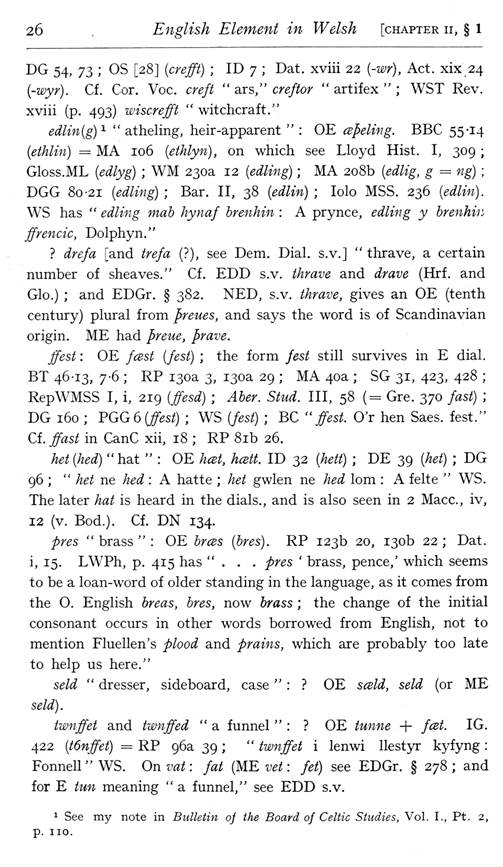
(delwedd F6777) (tudalen 026)
|
26 ,
English Element in Welsh [chapter ii, § 1
DG 54, y^; OS [28] {crefft); ID 7; Dat. xviii 22 {-wr), Act. xix 24 {-wyr).
Cf. Cor. Voc. creft “ars," creftor” artifex”; WST Rev. xviii (p. 493)
wiscrefft “witchcraft."
edlin{g)^ “atheling, heir-apparent”: OE cBpeling. BBC 55-14 {ethlin) = MA 106
[ethlyn], on which see Lloyd Hist. I, 309; Gloss.ML {edlyg); WM 230a 12
[edling); MA 208b {edlig, g = ng); DOG 80 -21 [edling); Bar. II, 38 {edlin);
lolo MSS. 236 [edlin). WS has “edling mab hynaf brenhin: A prynce, edling y
brenhir. ffrencic, Dolphyn."
? drefa [and trefa (?), see Dem. Dial, s.v.] “thrave, a certain number of
sheaves." Cf. EDD s.v. thrave and drave (Hrf. and Glo.); and EDGr. §
382. NED, s.v. thrave, gives an OE (tenth century) plural from Preues, and
says the word is of Scandinavian origin. ME had Preue, Prave.
ffest: OE fcest (fest); the form fest still survives in E dial. BT 46-13,
7-6; RP 130a 3, 130a 29; MA 40a; SG 31, 423, 428; RepWMSS I, i, 219 (ffesd);
Aber. Stud. Ill, 58 (= Gre. 370 fast); DG 160; VGG 6 iffest); WS (/est); BC
"ffest. O'r hen Saes. fest." Cf. ffast in CanC xii, 18; RP 8ib 26.
het [hed] "hat”: OE hcet, hcett. ID 32 [hett); DE 39 [het); DG 96; “het
ne hed: A hatte; het gwlen ne hed lorn: A felte” WS, The later hat is heard
in the dials., and is also seen in 2 Mace, iv, 12 (v. Bod.). Cf. DN 134.
pres “brass”: OE brcBS (bres). RP 123b 20, 130b 22; Dat. i, 15. LWPh, p. 415
has "... pres ' brass, pence,' which seems to be a loan-word of older
standing in the language, as it comes from the O. English breas, bres, now
brass; the change of the initial consonant occurs in other words borrowed
from English, not to mention Fluellen's plood and prains, which are probably
too late to help us here."
seld “dresser, sideboard, case ":? OE said, seld (or ME seld).
twnffet and twnffed “a funnel ":? OE tumie + feet. IG. 422 [tdnffet) =
RP 96a 39; “twnffet i lenwi llestyr kyfyng: Fonnell"WS. On vat: fat [WE
vet: fet) see EDGr. § 278; and for E tun meaning “a funnel," see EDD
s.v.
1 See my note in Bulletin oj the Board of Celtic Studies, Vol. I., Pt. 2, p.
no.
|
|
|
|
|
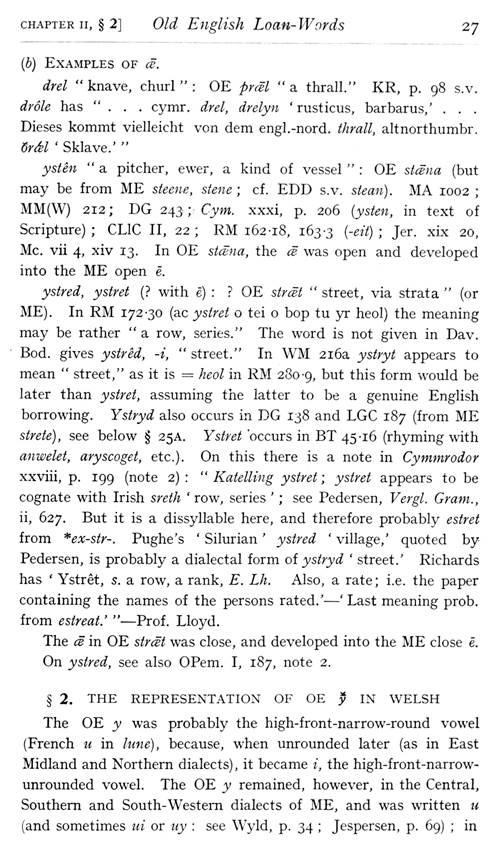
(delwedd F6778) (tudalen 027)
|
CHAPTER
II, § 2] Old English Loan-Words 27
[b) Examples of cc.
drel “knave, churl”: OE prrel “a thrall." KR, p. 98 s.v. drole has
"... cymr. drel, drelyn ' rusticus, barbarus,' . . . Dieses kommt
vielleicht von dem engl.-nord. thrall, altnorthumbr. 6rM ' Sklave.' “
ysten” a pitcher, ewer, a kind of vessel”: OE st^na (but may be from ME
steene, stene; cf. EDD s.v. stean). MA 1002; MM(W) 212; DG 243; Cyw. xxxi, p.
206 {ysten, in text of Scripture); CLIC II, 22; RM 162-18, 163-3 (-^^'0; Jer.
xix 20, Mc. vii 4, xiv 13. In OE stmia, the ^ was open and developed into the
ME open e.
ystred, ystret (? with e):? OE strM “street, via strata” (or ME). In RM
172-30 (ac ystret o tei o bop tu yr heol) the meaning may be rather “a row,
series." The word is not given in Dav. Bod. gives ystred, -i,
“street." In WM 216a ystryt appears to mean “street," as it is =
heol in RM 280-9, but this form would be later than ystret, assuming the
latter to be a genuine English borrowing. Ystryd also occurs in DG 138 and
LGC 187 (from ME strete), see below § 25A. Ystret 'occurs in BT 45-16
(rhyming with anwelet, aryscoget, etc.). On this there is a note in Cymmrodor
xxviii, p. 199 (note 2): “Katelling ystret; ystret appears to be cognate with
Irish sreth ' row, series '; see Pedersen, Vergl. Gram., ii, 627. But it is a
dissyllable here, and therefore probably estret from *ex-str-. Pughe's '
Silurian ' ystred ' village,' quoted by Pedersen, is probably a dialectal
form oi ystryd ' street.' Richards has ' Ystret, s. a row, a rank, E. Lh.
Also, a rate; i.e. the paper containing the names of the persons rated.' —
'Last meaning prob. from estreat.'“ — Prof. Lloyd.
The (^ in OE street was close, and developed into the ME close e.
On ystred, see also OPem. I, 187, note 2.
§ 2. THE REPRESENTATION OF OE y IN WELSH
The OE y was probably the high-front-narrow-round vowel (French u in June),
because, when unrounded later (as in East Midland and Northern dialects), it
became i, the high-front-narrow-unrounded vowel. The OE y remained, however,
in the Central, Southern and South- Western dialects of ME, and was written n
(and sometimes ui or uy: see Wyld, p. 34; Jespersen, p. 69); in
|
|
|
|
|
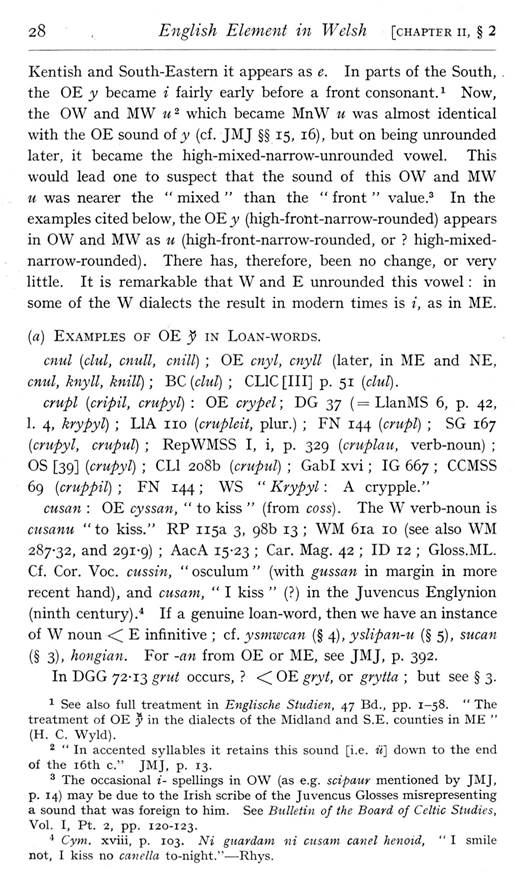
(delwedd F6779) (tudalen 028)
|
28 ,
English Element in Welsh [chapter ii, § 2
Kentish and South-Eastern it appears as e. In parts of the South, the OE y
became i fairly early before a front consonant.^ Now, the OW and MW u^ which
became MnW u was almost identical with the OE sound oi y (cf. JMJ §§ 15, 16),
but on being unrounded later, it became the high-mixed-narrow-unrounded
vowel. This would lead one to suspect that the sound of this OW and MW u was
nearer the “mixed” than the “front” value. ^ In the examples cited below, the
OE y (high-front-narrow-rounded) appears in OW and MW as u
(high-front-narrow-rounded, or? high-mixed-narrow-rounded). There has,
therefore, been no change, or very little. It is remarkable that W and E
unrounded this vowel: in some of the W dialects the result in modern times is
i, as in ME.
[a) Examples of OE ^ in Loan-words.
cnul {clul, cnull, cnill); OE cnyl, cnyll (later, in ME and NE, cnul, knyll,
knilt) ] 'B(Z[clnl); CL1C[III] p. 51 (clul).
crupl [cripil, crupyl): OE crypel; DG 37 ( = LlanMS 6, p. 42, 1. 4, krypyl);
LIA no [crupleit, plur.); FN 144 [crupl); SG 167 [crupyl, crupul); RepWMSS I,
i, p. 329 [cruplau, verb-noun); OS [39] [crupyl); CLl 208b [crupul); GabI
xvi; IG 667; CCMSS 69 [cruppil); FN 144; WS "Krypyl: A crypple."
cusan: OE cyssan, “to kiss” (from coss). The W verb-noun is cusanu "to
kiss." RP 115a 3, 98b 13; WM 6ia 10 (see also WM 287-32, and 291-9);
AacA 15-23; Car. Mag. 42; ID 12; Gloss. ML. Cf. Cor. Voc. cussin, “osculum”
(with gussan in margin in more recent hand), and cusani, “I kiss” (?) in the
Juvencus Englynion (ninth century).^ If a genuine loan-word, then we have an
instance of W noun <^ E infinitive; cf. ysmwcan (§ 4), yslipan-u (§ 5),
sucan (§ 3), hongian. For -an from OE or ME, see JMJ, p. 392.
In DGG 72-13 grut occurs,? <^ OE gryt, or grytta; but see § 3.
1 See also full treatment in Englische Studien, 47 Bd., pp. 1-58. “The
treatment of OE y in the dialects of the Midland and S.E. counties in ME” (H.
C. Wyld).
2 “In accented syllables it retains this sound [i.e. ii] down to the end of
the i6th c." JMJ, p. 13.
^ The occasional i- spellings in OW (as e.g. scipaur mentioned by JMJ, p. 14)
may be due to the Irish scribe of the Juvencus Glosses misrepresenting a
sound that was foreign to him. See Bulletin of the Board of Celtic Studies,
Vol. I, Pt. 2, pp. 120-123.
^ Cym. xviii, p. 103. Ni guardani ni ciisam canel henoid, “I smile not, I
kiss no canella to-night." — Rhys.
|
|
|
|
|
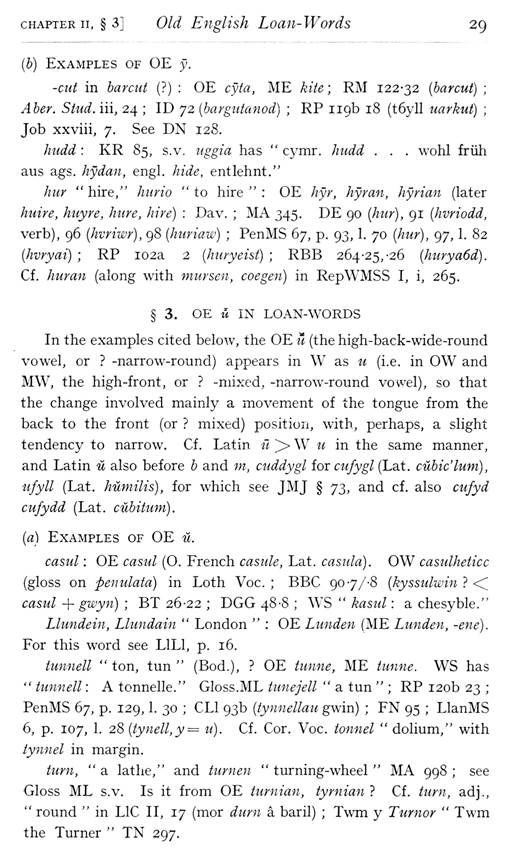
(delwedd F6780) (tudalen 029)
|
CHAPTER
II, § 3] Old English Loan-Words 29
(6) Examples of OE y.
-cut in barcut (?): OE cyia, ME kite; RM 122-32 {barcui); Aber. Stud, iii,
24; ID 72 [bargutanod); RP 119b 18 (t6yll uarkut); Job xxviii, 7. See DN 128.
/rz/^^: KR 85, s.v. uggia has “cymr. hudd . . . wohl friih aus ags. hydaii,
engl. /zz'^fe, entlehnt."
/zwr “hire," hurio” to hire”: OE hyr, hyran, hyrian (later huire, huyre,
hure, hire): Dav.; MA 345. DE 90 {hur), 91 {hvriodd, verb), 96 {hvriwr), 98
[huriaw); PenMS 67, p. 93, 1. 70 [hur), 97, 1. 82 [hvryai); RP 102a 2
(huryeist); RBB 264-25, -26 [huryaCd). Cf. huran (along with mursen, coegen)
in RepWMSS I, i, 265.
§ 3. OE tf IN LOAN-WORDS
In the examples cited below, the OE it (the high-back- wide -round vowel, or?
-narrow-round) appears in W as w (i.e. in OW and MW, the high-front, or?
-mixed, -narrow-round vowel), so that the change involved mainly a movement
of the tongue from the back to the front (or? mixed) position, with, perhaps,
a slight tendency to narrow. Cf. Latin u ^ W u in the same manner, and Latin
u also before b and in, cuddy gl for cufygl (Lat. cubic'lum), ufyll (Lat.
humilis), for which see JMJ § 73, and cf. also cufyd cufydd (Lat. cubitum).
[a) Examples of OE u.
casul: OE casul (O. French caside, Lat. casida). OW casidheticc (gloss on
pemdata) in Loth Voc.; BBC 90 7/-8 [kysstdwin? <^ casul -f gwyn); BT
26-22; DGG 48-8; WS “kasid: a chesyble."
Llundein, Llundain “London”: OE Lunden (ME Lunden, -ene). For this word see
LlLl, p. 16.
tunnell “ton, tun” (Bod.),? OE tunne, ME tunne. WS has “tunnell: A
tonnelle." Gloss. ML tune jell “a tun”; RP 120b 23; PenMS 67, p. 129, 1.
30; CLl 93b [tynnellau gwin); FN 95; LlanMS 6, p. 107, 1. 28 {tynell,y= it).
Cf. Cor. Voc. tonnel “dolium," with lynnel in margin.
tttrn, “a lathe," and turnen “turning- wheel” MA 998; see Gloss ML s.v.
Is it from OE iurnian, tyrnian? Cf. turn, adj., “round “in LlC II, 17 (mor
diirn a baril); Twm y Tumor “Twm the Turner” TN 297.
|
|
|
|
|
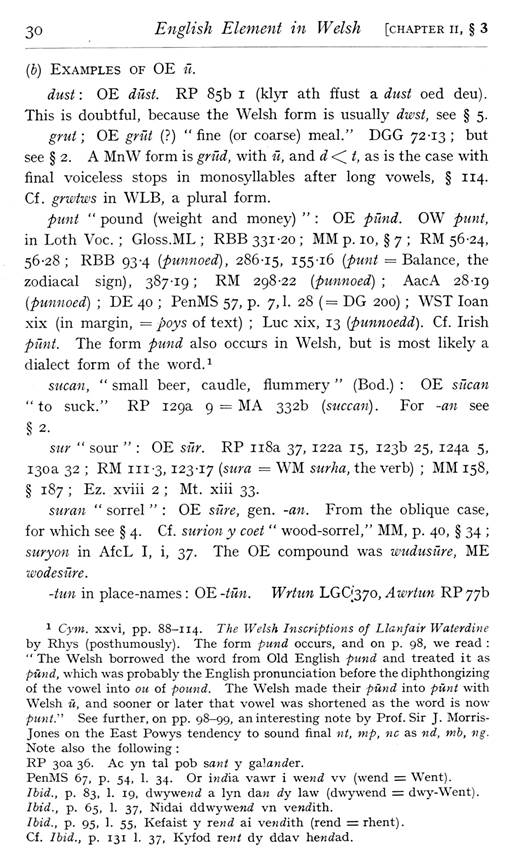
(delwedd F6781) (tudalen 030)
|
30
English Element in Welsh [chapter ii, § 3
{h) Examples of OE u.
dust: OE dust. RP 85b i (klyr ath ffust a dust oed deu). This is doubtful,
because the Welsh form is usually dwst, see § 5.
grut; OE grut (?) “fine (or coarse) meal." DGG 72-13; but see § 2. A MnW
form is grud, with ii, and ^ <^ /, as is the case with final voiceless
stops in monosyllables after long vowels, § 114. Cf. grwtws in WLB, a plural
form.
punt “pound (weight and money)”: OE pfmd. OW ptmt, in Loth Voc.; Gloss.ML;
RBB 331-20; MM p. 10, § 7; RM 56-24, 56-28; RBB 93-4 (punnoed), 286-15,
155-16 {punt = Balance, the zodiacal sign), 387-19; RM 298-22 (punnoed); AacA
28-19 {punnoed); DE 40; PenMS 57, p. 7,1. 28 (= DG 200); WST loan xix (in
margin, = poys of text); Luc xix, 13 {punnoedd). Cf. Irish punt. The form
pund also occurs in Welsh, but is most likely a dialect form of the word.^
sucan, “small beer, caudle, flummery” (Bod.): OE siican "to suck,"
RP 129a 9 = MA 332b {succan). For -an see
§2.
sur “sour”: OE sur. RP ii8a 37, 122a 15, 123b 25, 124a 5, 130a 32; RM 111-3,
123-17 {sura = WM surha, the verb); MM 158, § 187; Ez. xviii 2; Mt. xiii 33.
suran “sorrel”: OE siire, gen. -an. From the oblique case, for which see § 4.
Cf . surion y coet “wood-sorrel," MM, p. 40, § 34; suryon in AfcL I, i,
37. The OE compound was wudusiire, ME wodesure.
-tun in place-names: OE-tun. Wrtun hGO^yo, Awrtun RP77b
^ Cym. xxvi, pp. 88-114. ^^^ Welsh Inscriptions of Llanfair Waterdine by
Eliys (posthumously). The form pund occurs, and on p. 98, we read: “The Welsh
borrowed the word from Old English pund and treated it as pund, which was
probably the English pronunciation before the diphthongizing of the vowel
into ou of pound. The Welsh made their pund into piint with Welsh u, and
sooner or later that vowel was shortened as the word is now punt.'" See
further, on pp. 98-99, an interesting note by Prof. Sir J. Morris-Jones on
the East Powys tendency to sound final nt, mp, nc as nd, mb, ng. Note also
the following:
RP 30a 36. Ac yn tal pob sant y galander.
PenMS 67, p. 54, 1. 34. Or india, vawr i -wend vv (wend = Went). Ibid., p.
83, 1. 19, dwywend a lyn daw dy law (dwywend = dwy-Went). Ibid., p. 65, 1.
37, Nidai ddwywewii vn vew^ith. Ibid., p. 95, 1. 55, Kefaist y rend ai
vendith. (rend = rhent). Cf. Ibid., p. 131 1. 37, Kyfod rent dy ddav henda.d.
|
|
|
|
|
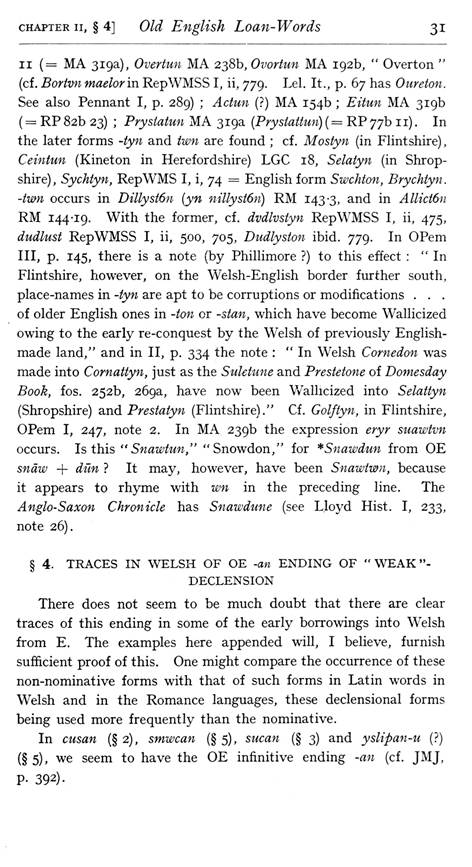
(delwedd F6782) (tudalen 031)
|
CHAPTER
II, § 4] Old English Loan-Words 31 II (= MA 319a), Overtun MA 2Z^h, Ovortun
MA 192b, “Overton” (cf. Bortvn maelor in RepWMSS I, ii, 779. Lei. It., p. 67
has Oureton. See also Pennant I, p. 289); Actun (?) MA 154b; Eitun MA 319b (
= RP 82b 23); Prysiatun MA 319a [Prystattim) ( = RP 77b 11) . In the later
forms -tyn and twn are found; cf . Mostyn (in Flintshire) , Ceintun (Kineton
in Herefordshire) LGC 18, Selatyn (in Shropshire), Sychtyn, RepWMS I, i, 74 =
English form Swchton, Brychtyn. -twn occurs in DiUyst6n (yn mllyst6n) RM
143-3, ^-^id ii^ AUict6n RM 144-19. With the former, cf. dvdlvstyn RepWMSS I,
ii, 475, dudlust RepWMSS I, ii, 500, 705, Dudlyston ibid. 779. In OPem III,
p. 145, there is a note (by Phillimore?) to this effect: “In Flintshire,
however, on the Welsh-English border further south, place-names in -tyn are
apt to be corruptions or modifications . . . of older English ones in -ton or
-stan, which have become Wallicized owing to the early re-conquest by the
Welsh of previously English-made land," and in II, p. 334 the note:
"In Welsh Cornedon was made into Cornattyn, just as the Suletune and
Prestetone of Domesday Book, fos. 252b, 269a, have now been "Wallicized
into Selattyn (Shropshire) and Prestatyn (Flintshire)." Cf. Golftyn, in
Flintshire, OPem I, 247, note 2. In MA 239b the expression eryy suawtvn
occurs. Is this “Snawtun," "Snowdon," for *Snawdun from OE
sndw -f dun? It may, however, have been Snawtwn, because it appears to rhyme
with wn in the preceding line. The Anglo-Saxon Chronicle has Snawdune (see
Lloyd Hist. I, 233, note 26).
§ 4. TRACES IN WELSH OF OE -an ENDING OF “WEAK "-
DECLENSION
There does not seem to be much doubt that there are clear traces of this
ending in some of the early borrowings into Welsh from E. The examples here
appended will, I believe, furnish sufficient proof of this. One might compare
the occurrence of these non-nominative forms with that of such forms in Latin
words in Welsh and in the Romance languages, these declensional forms being
used more frequently than the nominative.
In cusan (§ 2), smwcan (§ 5), sucan (§ 3) and yslipan-u (?) (§ 5)» we seem to
have the OE infinitive ending -an (cf. JMJ, P- 392).
|
|
|
|
|
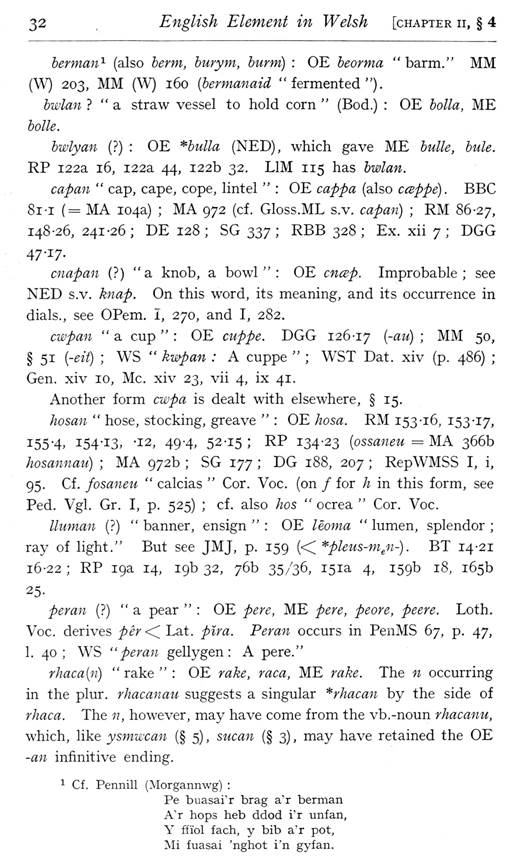
(delwedd F6783) (tudalen 032)
|
32 ,
English Element in Welsh [chapter ii, § 4
herman'^ (also herm, hurym, hurm): OE heorma “barm." MM (W^ 203, MM (W)
160 [hermanaid "fermented").
hwlan? “a straw vessel to hold corn” (Bod.): OE holla, ME bolle.
hwlyan (?): OE *bulla (NED), which gave ME bulk, bule. RP 122a 16, 122a 44,
122b 32. LIM 115 has hwlan.
capan “cap, cape, cope, lintel”: OE cappa (also ccBppe). BBC 81 -I (= MA
104a); MA 972 (cf. Gloss.ML s.v. capan); RM 86-27, 148-26, 241-26; DE 128; SG
337; RBB 328; Ex. xii 7; DGG 47-17.
cnapan (?) "a knob, a bowl": OE cncBp. Improbable; see NED s.v.
knap. On this word, its meaning, and its occurrence in dials., see OPem. I,
270, and I, 282.
cwpan “a cup”: OE cuppe. DGG 126-17 (-^^^) > ^M 50, § 51 i-eit); WS
“ku}pan: A cuppe”; WST Dat. xiv (p. 486); Gen. xiv 10, Mc. xiv 23, vii 4, ix
41.
Another form cwpa is dealt with elsewhere, § 15.
hosan “hose, stocking, greave”: OE Jiosa. RM 153-16, 153-17, 155-4, 154-13,
-12, 49-4, 52-15; RP 134-23 {ossaneu = MA 366b hosannau); MA 972b; SG 177; DG
188, 207; RepWMSS I, i, 95. Cf. fosaneu “calcias” Cor. Voc. (on / for h in
this form, see Ped. Vgl. Gr. I, p. 525); cf. also hos “ocrea” Cor. Voc.
Human (?) “banner, ensign”: OE leoma “lumen, splendor; ray of light."
But see JMJ, p. 159 (<< ^pletis-m^n-) . BT 14-21 16-22; RP 19a 14, 19b
32, 76b 35/36, 151a 4, 159b 18, 165b
25-
peran (?) "a pear”: OE pere, ME pere, peore, peeve. Loth.
Voc. derives per <^ Lat. pira. Peran occurs in PenMS 67, p. 47,
1. 40; WS “peran gellygen: A pere."
rhaca{n) “rake”: OE rake, raca, ME rake. The n occurring
in the plur. rhacanau suggests a singular *rhacan by the side of
rhaca. The n, however, may have come from the vb.-noun rhacanu,
which, like ysmwcan (§ 5) , sucan (§ 3) , may have retained the OE
-an infinitive ending.
1 Cf. Pennill (Morgannwg):
Pe buasai'r brag a'r berman A'r hops heb ddod i'r unfan, Y ffiol fach, y bib
a'r pot. Mi fuasai 'nghot i'n gyfan.
|
|
|
|
|
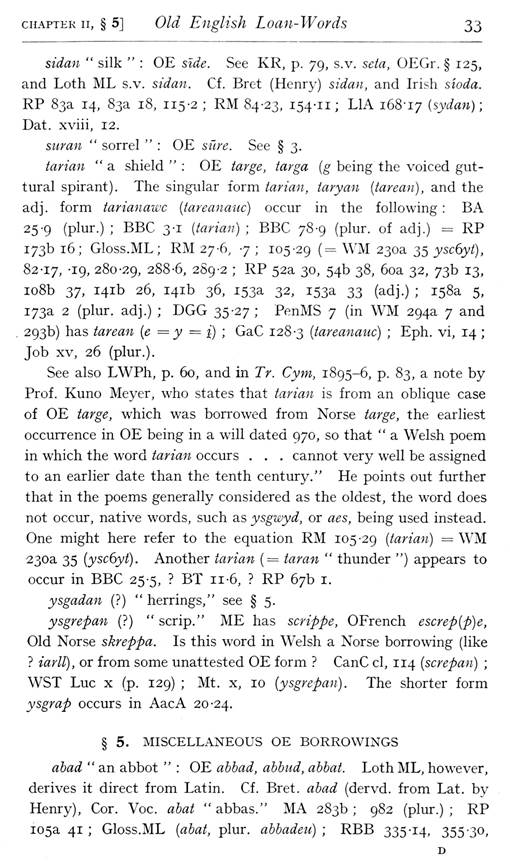
(delwedd F6784) (tudalen 033)
|
CHAPTER
II, § 5] Old English Loan-Words 33
sidan “silk”: OE side. See KR, p. 79, s.v. seta, OEGr. § 125, and Loth ML
s.v. sidan. Cf. Bret (Henry) sidan, and Irish sioda. RP 83a 14, 83a 18,
115-2; RM 84-23, 154-11; LIA 168-17 (sydan); Dat. xviii, 12.
suran “sorrel”: OE silre. See § 3.
tarian "a shield": OE targe, targa (§' being the voiced guttural
spirant). The singular form tarian, taryan [tarean), and the adj. form tarian
awe (iareanauc) occur in the following: BA 25-9 (plur.); BBC 3-1 (tarian);
BBC 78-9 (plur. of adj.) = RP 173b 16; Gloss. ML; RM 27-6, -7; 105-29 (= WM
230a 35 ysc6yt), 82-17, -19, 280-29, 288-6, 289-2; RP 52a 30, 54b 38, 60a 32,
73b 13, io8b 37, 141b 26, 141b 36, 153a 32, 153a 33 (adj.); 158a 5, 173a 2
(plur. adj.); DGG 35-27; PenMS 7 (in WM 294a 7 and 293b) has tarean {e = y =^
i); GaC 128-3 [tareanauc); Eph. vi, 14; Job XV, 26 (plur.).
See also LWPh, p. 60, and in Tr. Cym, 1895-6, p. 83, a note by Prof. Kuno
Meyer, who states that tarian is from an oblique case of OE targe, which was
borrowed from Norse targe, the earliest occurrence in OE being in a will
dated 970, so that “a Welsh poem in which the word tarian occurs . . . cannot
very well be assigned to an earlier date than the tenth century." He
points out further that in the poems generally considered as the oldest, the
word does not occur, native words, such as ysgwyd, or aes, being used
instead. One might here refer to the equation RM 105-29 {tarian) = WM 230a 35
[ysc^yt). Another tarian (= taran “thunder ") appears to occur in BBC 25
5,? BT 11 -6,? RP 67b i.
ysgadan (?) “herrings," see § 5.
ysgrepan (?) “scrip." ME has scrippe, OFrench escrep{p)e, Old Norse
skreppa. Is this word in Welsh a Norse borrowing (like? iarll), or from some
unattested OE form? CanC cl, 114 [screpan); WST Luc X (p. 129); Mt, x, 10
{ysgrepan). The shorter form ysgrap occurs in AacA 20-24.
§ 5. MISCELLANEOUS OE BORROWINGS
ahad “an abbot”: OE ahbad, ahhiid, abhat. Loth ML, however, derives it direct
from Latin. Cf. Bret, ahad (dervd. from Lat. by Henry), Cor. Voc. ahat
“abbas." MA 283b; 982 (plur.); RP 105a 41; Gloss. ML {ahat, plur.
ahhadeii); RBB 335-14, 355-30,
D
|
|
|
|
|
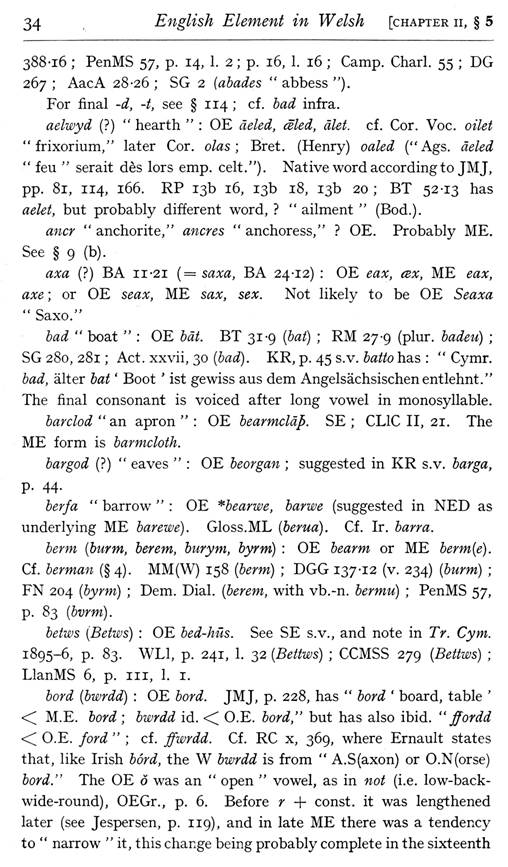
(delwedd F6785) (tudalen 034)
|
34 .
English Element in Welsh [chapter ii, § 5
388-16; PenMS 57, p. 14, 1. 2; p. 16, 1. 16; Camp. Charl. 55; DG 267; AacA
28-26; SG 2 (abades “abbess "),
For final -d, -t, see § 114; cf. had infra.
aelwyd (?) “hearth”: OE deled, Med, diet. cf. Cor. Voc. oilet
“frixorium," later Cor. olas; Bret. (Henry) oaled ("Ags. deled
“feu” serait des lors emp. celt."). Native word according to JM J, pp.
81, 114, 166. RP 13b 16, 13b 18, 13b 20; BT 52-13 has aelet, but probably
different word,? “ailment” (Bod.).
ancr “anchorite," ancres “anchoress,"? OE. Probably ME, See § 9
(b).
axa (?) BA 11 -21 (= saxa, BA 24-12): OE eax, cbx, ME eax, axe; or OE seax,
ME sax, sex. Not likely to be OE Seaxa “Saxo."
had “boat”: OE hat. BT 31-9 {hat); RM 27-9 (plur. hadeu); SG 280, 281; Act.
xxvii, 30 [bad). KR, p. 45 s.v. hatto has: “Cymr. had, alter hat ' Boot ' ist
gewiss aus dem Angelsachsischenentlehnt." The final consonant is voiced
after long vowel in monosyllable.
harclod “an apron”: OE hearmcldp. SE; CLIC II, 21. The ME form is barmcloth.
hargod (?) “eaves”: OE heorgan; suggested in KR s.v. harga,
P- 44-
herfa “barrow”: OE *bearwe, harwe (suggested in NED as
underlying ME harewe). Gloss. ML (berua). Cf. Ir. harra.
herm {burm, berem, hurym, hyrm): OE bearm or ME herm{e). Cf. herman (§ 4).
MM(W) 158 {herm); DGG 137-12 (v. 234) {burm); FN 204 {hyrm); Dem. Dial,
{berem, with vb.-n. bermu); PenMS 57, p. 83 {hvrm).
betws {Betws): OE hed-hus. See SE s.v., and note in Tr. Cym. 1895-6, p.
d>z. WLl, p. 241, 1. 32 {Bettws); CCMSS 279 {Bettws); LlanMS 6, p. iii, 1,
i.
hord {bwrdd): OE bord. JMJ, p. 228, has “bord ' board, table ' < M.E.
hord; bwrdd id. < O.E. bord," but has also ibid. “ffordd <i O.E.
ford”; cf. ffwrdd. Cf. RC x, 369, where Ernault states that, like Irish bord,
the W bwrdd is from “A.S(axon) or O.N(orse) hord." The OE 6 was an “open
“vowel, as in not (i.e. low-back-wide-round), OEGr., p. 6. Before r -j-
const, it was lengthened later (see Jespersen, p. 119), and in late ME there
was a tendency to “narrow “it, this change being probably complete in the
sixteenth
|
|
|
|
|
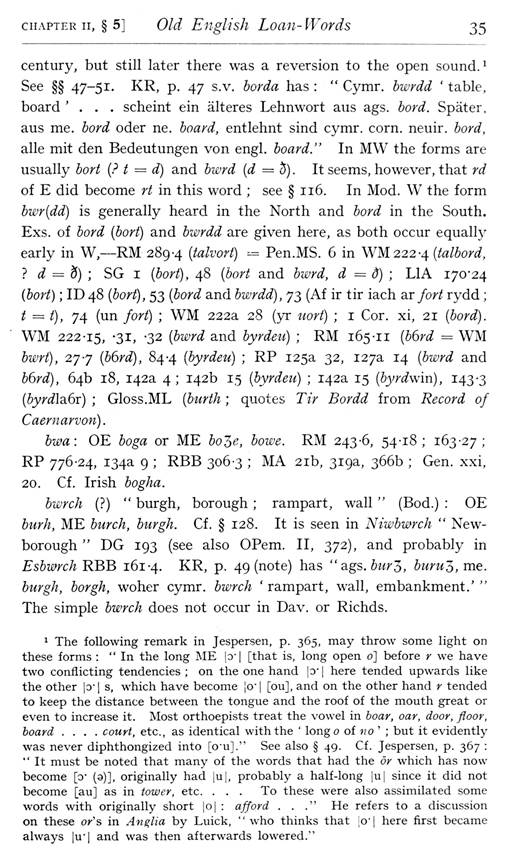
(delwedd F6786) (tudalen 035)
|
CHAPTER
II, §5] Old English Loan-Words 35
century, but still later there was a reversion to the open sound. ^ See §§
47-51. KR, p. 47 s.v. horda has: “Cymr. bwrdd ' table, board ' . . . scheint
ein alteres Lehnwort aus ags. bord. Spater, aus me. bord oder ne. board,
entlehnt sind cymr. corn, neuir. bord, alle mit den Bedeutungen von engl.
board." In MW the forms are usually bort {? t ~ d) and bwrd {d = 5) . It
seems, however, that rd of E did become rt in this word; see § 116. In Mod. W
the form bwr[dd) is generally heard in the North and bord in the South. Exs.
of bord [bort) and bwrdd are given here, as both occur equall}^ early in W, —
RM 289-4 {talvort) -= Pen. MS. 6 in WM222-4 [talbord,? ^ = cJ); SG I {bort),
48 (port and bwrd, d = d); LIA 170-24 (bort); ID 48 [bort), 53 [bord and
bwrdd), 73 (Af ir tir iach ds fort rydd; t = t), 74 (un fort); WM 222a 28 (yr
nort); i Cor. xi, 21 {bord). WM 222-15, '3^> '32 {bwrd and byrdeit); RM
165-11 {b6rd = WM bwrt), 27-7 {b6rd), 84-4 {byrdeu); RP 125a 32, 127a 14 (Jz^'r^
and &6r(^), 64b 18, 142a 4; 142b 15 {byrdeu); 142a 15 {byrdw'm), 143-3
(&yr(ila6r); Gloss. ML {burth; quotes Tir Bordd from Record of
Caernarvon) .
bwa: OE boga or ME 6o5<?, ^ozc^. RM 243-6, 54-18; 163-27; RP 776-24, 134a
9; RBB 306-3; MA 21b, 319a, 366b; Gen. xxi, 20. Cf. Irish bogha.
bwrch (?) “burgh, borough; rampart, wall” (Bod.): OE burh, ME burch, burgh.
Cf. § 128. It is seen in Niwbwrch “Newborough” DG 193 (see also OPem. II,
372), and probably in Esbwrch RBB 161-4. KR, p. 49 (note) has "ags.
6w;'3, buruZ,me. burgh, borgh, woher cymr. bwrch ' rampart, wall,
embankment.' “The simple bwrch does not occur in Dav. or Richds.
^ The following remark in Jespersen, p. 365, may throw some light on these
forms: “In the long ME |o-| [that is, long open 0] before r we have two
conflicting tendencies; on the one hand |o' | here tended upwards like the
other |o-| s, which have become |o'| [ou], and on the other hand r tended to
keep the distance between the tongue and the roof of the mouth great or even to
increase it. Most orthoepists treat the vowel in boar, oar, door, floor,
board .... court, etc., as identical with the ' longo of vo '; but it
evidently was never diphthongized into [o-u]." See also § 49. Cf.
Jespersen, p. 367: “It must be noted that many of the words that had the dr
which has now-become [o- (a)], originally had |u|, probably a half-long |u|
since it did not become [au] as in tower, etc. . . . To these were also
assimilated some words with originally short |o|: afford ..." He refers
to a discussion on these or's in Anglia by Luick, “who thinks that [o'l here
first became always |u-| and was then afterwards lowered."
|
|
|
|
|
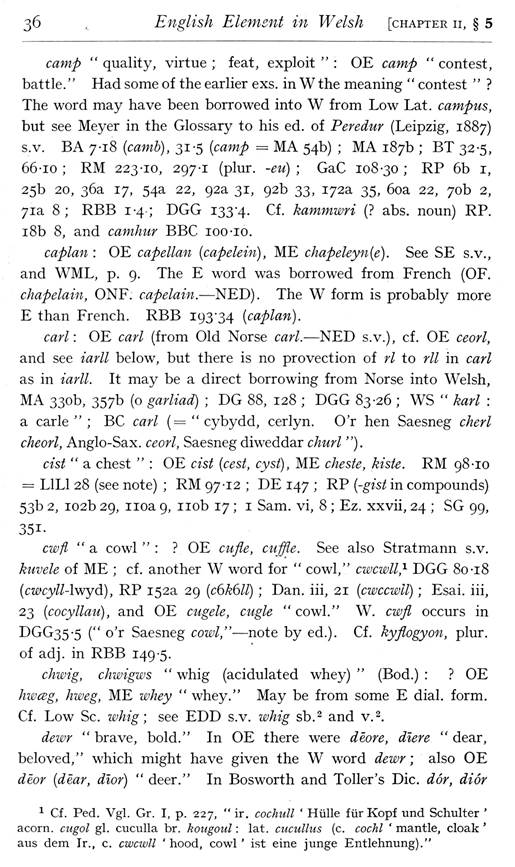
(delwedd F6787) (tudalen 036)
|
36 ,
English Element in Welsh [chapter ii, § 5
camp “quality, virtue; feat, exploit”: OE camp “contest, battle." Had
some of the earlier exs. in W the meaning "contest "? The word may
have been borrowed into W from Low Lat. campus, but see Meyer in the Glossary
to his ed. of Peredur (Leipzig, 1887) s.v. BA 7-18 (camb), 31-5 {camp = MA
54b); MA 187b; BT 32-5, 66-10; RM 223-10, 297-1 (plur. -eu); GaC 108-30; RP
6b i, 25b 20, 36a 17, 54a 22, 92a 31, 92b 33, 172a 35, 60a 22, 70b 2, 71a 8;
RBB 1-4-; DGG I33"4. Cf. kammwri (? abs. noun) RP, i8b 8, and camhur BBC
100-10.
caplan: OE capellan {capelein), ME chapeleyn{e). See SE s.v., and WML, p. 9.
The E word was borrowed from French (OF. chapelain, ONF. capelain. — NED).
The W form is probably more E than French. RBB I93'34 [caplan).
carl: OE carl (from Old Norse carl. — NED s.v.) , cf . OE ceorl, and see
iarll below, but there is no provection of rl to rll in carl as in iarll. It
may be a direct borrowing from Norse into Welsh, MA 330b, 357b (o garliad);
DG 88, 128; DGG 83-26; WS “karl: a carle”; BC carl {= “cybydd, cerlyn. O'r
hen Saesneg cherl cheorl, Anglo-Sax. ceorl, Saesneg diweddar churl ").
cist “a chest”: OE cist [cest, cyst), ME cheste, kiste. RM 98-10 = LlLl 28
(see note); RM 9712; DE 147; RP {-gist in compounds) 53b 2, 102b 29, iioa 9,
nob 17; i Sam. vi, 8; Ez. xxvii, 24; SG 99,
351-
cwfi “a cowl ":? OE cufle, cuffle. See also Stratmann s.v.
kuvele of ME; cf. another W word for “cowl," cwcwll,^ DGG 80-18
{cwcyll-\Mfyd) , RP 152a 29 {c6k6ll); Dan. iii, 21 {cwccwU); Esai. iii,
23 {cocyllau), and OE cugele, ciigle “cowl." W. cwfl occurs in
DGG35-5 (" o'r Saesneg cowl,"- — note by ed.). Cf. kyflogyon, plur,
of adj. in RBB 149-5.
chwig, chwigws “whig (acidulated whey)” (Bod.):? OE hwcEg, hweg, ME whey
“whey." May be from some E dial, form, Cf. Low Sc. whig; see FDD s.v.
whig sb.- and v.^.
dewr “brave, bold." In OE there were deore, dtere “dear, beloved,"
which might have given the W word dewr; also OE deor {dear, dlor)
“deer." In Bosworth and Toller's Die. dor, dior
1 Cf. Ped. Vgl. Gr. I, p. 227, “ir. cochull ' HiiUe f iir Kopf und Schulter '
acorn, cugol gl. cuculla br. kongoul: lat. cuciillus (c. cochl ' mantle,
cloak ' aus dem Jr., c. cwcwll ' hood, cowl ' ist eine junge
Entlehnung)."
|
|
|
|
|
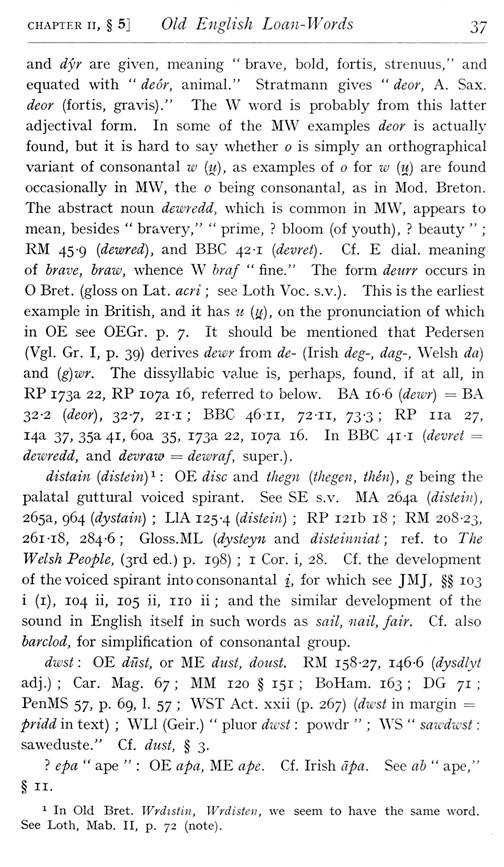
(delwedd F6788) (tudalen 037)
|
CHAPTER
II, § 5] Old English Loan-Words 37
and dyr are given, meaning “brave, bold, fortis, strenuus," and equated
with “deor, animal." Stratmann gives “deor, A. Sax. deor (fortis,
gravis)." The W word is probably from this latter adjectival form. In
some of the MW examples deor is actually found, but it is hard to say whether
is simply an orthographical variant of consonantal w [u), as examples of for
w [u) are found occasionally in MW, the being consonantal, as in Mod. Breton.
The abstract noun dewredd, which is common in MW, appears to mean, besides
“bravery," “prime,? bloom (of youth),? beauty”; RM 45-9 {dewred), and
BBC 42-1 {devret). Cf. E dial, meaning of hrave, hraw, whence W hraf
“fine." The form deurr occurs in O Bret, (gloss on Lat. acri; see Loth
Voc. s.v.). This is the earliest example in British, and it has « {ij), on
the pronunciation of which in OE see OEGr. p. 7. It should be mentioned that
Pedersen (Vgl. Gr. I, p. 39) derives dewr from de- (Irish deg-, dag-, Welsh
da) and {g)wr. The dissyllabic value is, perhaps, found, if at all, in RP
173a 22, RP 107a 16, referred to below. BA 16 -6 (deze^r) = BA 32-2 (deor),
327, 2I-I; BBC 46-11, 72-11, 73-3; RP iia 27, 143- 37> 35^41, 6oa 35, 173a
22, 107a 16. In BBC 41-1 {devret = dewredd, and devraw = dewraf, super.).
distain (distein)^: OE disc and thegn [thegen, then), g being the palatal
guttural voiced spirant. See SE s.v. MA 264a {distein), 265a, 964 {dystain);
LIA 125-4 {distein); RP 121b 18; RM 208-23, 261-18, 284-6; Gloss. ML [dysteyn
and disteinniat; ref. to The Welsh People, (3rd ed.) p. 198); i Cor. i, 28.
Cf. the development of the voiced spirant into consonantal i, for which see
JMJ, §§ 103 i (i), 104 ii, 105 ii, iio ii; and the similar development of the
sound in English itself in such words as sail, nail, fair. Cf. also harclod,
for simplification of consonantal group.
dwst: OE dilst, or ME dust, doust. RM 158-27, 146-6 [dysdlyt adj.); Car. Mag.
67; MM 120 § 151; BoHam. 163; DG 71; PenMS 57, p. 69, 1. 57; WST Act. xxii
(p. 267) [dwst in margin = pridd in text); WLl (Geir.) “pluor dwst: powdr”;
WS “sawdwst: saweduste." Cf. dust, § 3.
? epa “ape”: OE apa, ME ape. Cf. Irish dpa. See ab “ape," § II-
^ In Old Bret. Wrdistin, Wrdisteu, we seem to have the same word. See Loth,
Mab. II, p. 72 (note).
|
|
|
|
|
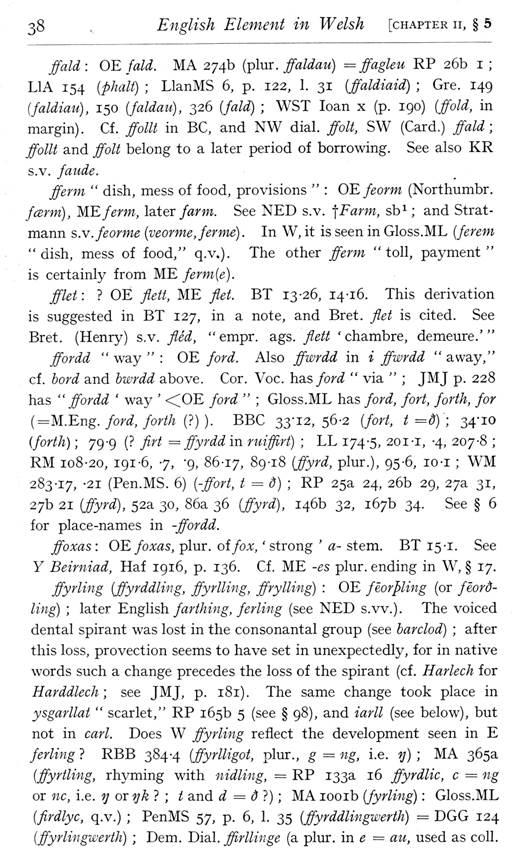
(delwedd F6789) (tudalen 038)
|
38 .
English Element in Welsh [chapter ii, § 5 ffald: OE f aid. MA 274b {p\m.
ffaldaii) = ffagleu RP 26b i; LIA 154 {phalt); LlanMS 6, p. 122, 1. 31
[ffaldiaid); Gre. 149 {faldiau), 150 [faldau], 326 [fald); WST loan x (p.
190) [fold, in margin). Cf. ffollt in BC, and NW dial, ffolt, SW (Card.)
ffald; ffollt and ffolt belong to a later period of borrowing. See also KR
s.v. faiide.
fferm “dish, mess of food, provisions”: OEfeorm (Northumbr. fcBrm), MEferm,
laler farm. See NED s.v. fi^arm, sb^; and Stratmann s.v.feorme [veorme ,
ferme) . In W, it is seen in Gloss. ML [ferem "dish, mess of food,"
q.v.). The other fferm "toll, payment" is certainly from ME
ferm{e).
fflet:? OE flett, ME flet. BT 13-26, 14-16. This derivation is suggested in
BT 127, in a note, and Bret, flet is cited. See Bret. (Henry) s.v. fled,
"empr. ags. flett ' chambre, demeure.'“
ffordd “way”: OE ford. Also ffwrdd in i ffwrdd “away," cf. bord and
bwrdd above. Cor. Voc. has/o7'^ “via”; JMJ p. 228 has "ffordd ' way '
<0E ford”; Gloss.ML has ford, fort, forth, for {^M.Eng. ford, forth {?)).
BBC 33-12,56-2 (fort, t =d); 34-10 {forth); 79-9 (? flrt = ffyrdd in
ruiffirt); LL 174-5, 201 -i, -4, 207-8; RM 108-20, 191-6, -7, -9, 86-17,
89-18 iffyrd, plur.), 95-6, lo-i; WM 283-17, -21 (Pen.MS. 6) [-ffort, t = d);
RP 25a 24, 26b 29, 27a 31, 27b 21 (ffyrd), 52a 30, 86a 36 (ffyrd), 146b 32,
167b 34. See § 6 for place-names in -ffordd.
ffoxas: OE /cia;«s, plur. of /o,r, ' strong '«- stem. BT 15-1. See y
Beirniad, Haf 1916, p. 136. Cf. ME -es plur. ending in W, § 17.
ffyrUng [ffyrddling, ffyrlling, ffrylling): OE feorpling (or feord-
ling); later English farthing, fer ling (see NED s.vv.). The voiced
dental spirant was lost in the consonantal group (see barclod); after
this loss, provection seems to have set in unexpectedlj', for in native
words such a change precedes the loss of the spirant (cf. Harlech for
Harddlech; see JMJ, p. 181). The same change took place in
ysgarllat “scarlet," RP 165b 5 (see § 98), and iarll (see below), but
not in carl. Does W ffyrling reflect the development seen in E
ferling? RBB 384-4 (ffyrlligot, plur., g = ng, i.e. y); MA 365a
{ffyrtling, rhyming with nidling, = RP 133a 16 ffyrdlic, c = ng
or nc, i.e. ij or yk?; t and d = d?); MA looib {fyrling): Gloss.ML
[firdlyc, q.v.); PenMS 57, p. 6, 1. 35 (ffyrddlingwerth) = DGG 124
{ffyrlingwerth); Dem. Dial, ffir Hinge (a plur. in ^ = au, used as coll.
|
|
|
|
|
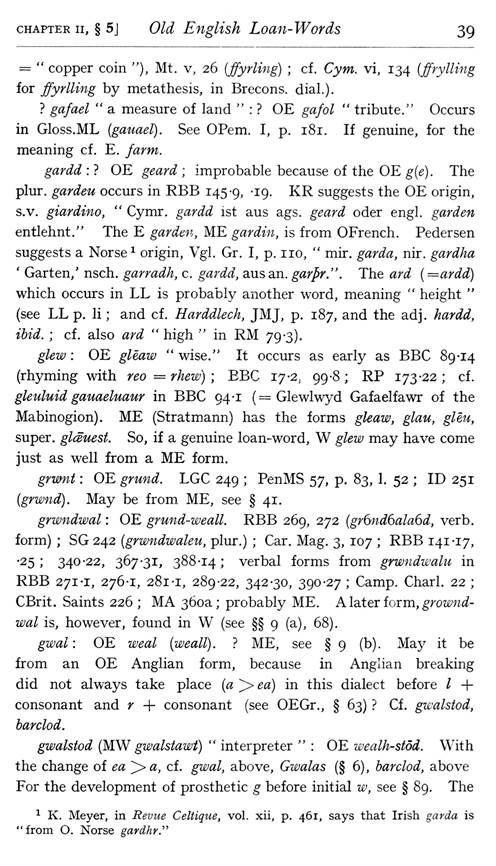
(delwedd F6790) (tudalen 039)
|
CHAPTER
II, § 5J Old English Loan-Words 39
= “copper coin "), Mt. v, 26 {ffyrling); cf. Cym. vi, 134 {ffrylling for
jfyrlling by metathesis, in Brecons. dial.).
? gafael “a measure of land ":? OE gafol “tribute." Occurs in
Gloss. ML (gauael). See OPem. I, p. 181. If genuine, for the meaning cf. E.
farm.
gardd:? OE geard; improbable because of the OE g{e). The plur. garden occurs
in RBB 145-9, -19. KR suggests the OE origin, s.v. giardino, “Cymr. gardd 1st
aus ags. geard oder engl. garden entlehnt." The E garden, ME gardin, is
from OFrench. Pedersen suggests a Norse ^ origin, Vgl. Gr. I, p. no, “mir,
garda, nir. gardha ' Garten,' nsch. garradh, c. gardd, aus an. garpr.".
The ard {=ardd) which occurs in LL is probably another word, meaning “height”
(see LL p. li: and cf. Harddlech, JMJ, p. 187, and the adj. hardd, ibid.; cf.
also ard “high “in KM 79-3).
glew: OE gleaw “wise." It occurs as early as BBC 89-14 (rhyming with reo
= rhew); BBC 17-2. 99-8; RP 173-22; cf. gleuluid gauaeluaur in BBC 94-1 (=
Glewlwyd Gafaelfawr of the Mabinogion). ME (Stratmann) has the forms gleaw,
glau, glen, super, glcsuest. So, if a genuine loan-word, W glew may have come
just as well from a ME form.
grwnt: OE grund. LGC 249; PenMS 57, p. 83, 1. 52; ID 251 (grwnd). May be from
ME, see § 41.
grwndwal: OE grund-weall. RBB 269, 272 {gr6nd6ala6d, verb, form); SG 242
[grwndwaleu, plur.); Car. Mag. 3, 107; RBB 141-17, •25; 340-22, 367-31,
388-14; verbal forms from grwndwalu in RBB 271-1, 276-1, 281-1, 289-22,
342-30, 390-27; Camp. Charl. 22; CBrit. Saints 226; MA 360a; probably ME.
K\3.i&[ iorm., growndwal is, however, found in W (see §§ 9 (a), 68).
gwal: OE weal {weall).? ME, see § 9 (b). Ma}' it be from an OE Anglian form,
because in Anglian breaking did not always take place {a ^ ea) in this
dialect before I + consonant and r + consonant (see OEGr., § 63)? Cf.
gwalstod, barclod.
gwalstod (MW gwalstawt) “interpreter”: OE wealh-stod. With the change of ea ^
a, cf . gwal, above, Gwalas (§ 6) , barclod, above For the development of
prosthetic g before initial w, see § 89. The
^ K. Meyer, in Revue Celtique, vol. xii, p, 461, says that Irish garda is
"from O. Norse gardhr."
|
|
|
|
|
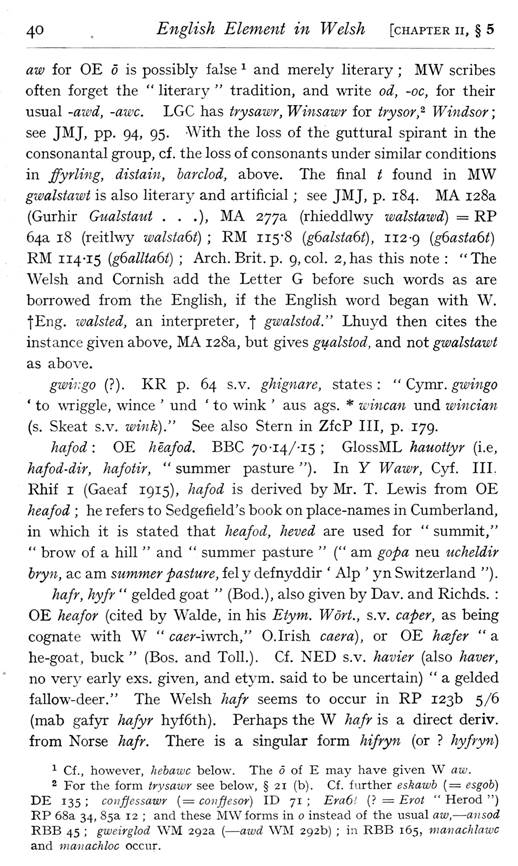
(delwedd F6791) (tudalen 040)
|
40 .
English Element in Welsh [chapter ii, § 5
aw for OE o is possibly false ^ and merely literary; MW scribes often forget
the “literary “tradition, and write od, -oc, for their usual -awd, -awe. LGC
has trysawr, Winsawr for trysor,^ Windsor; see JMJ, pp. 94, 95. With the loss
of the guttural spirant in the consonantal group, cf . the loss of consonants
under similar conditions in ffyrling, distain, harclod, above. The final t
found in MW gwalstawt is also literary and artificial; see JMJ, p. 184. MA
128a (Gurhir Gualstaut . . .), MA 277a (rhieddlwy walstawd) = RP 64a 18
(reitlwy walsta6t); RM 115 "8 {g6alsta6t), 112-9 (g^astaGt) RM 114-15
{g6allta6t); Arch. Brit. p. 9, col. 2, has this note: "The Welsh and
Cornish add the Letter G before such words as are borrowed from the English,
if the English word began with W. fEng. walsted, an interpreter, f
gwalstod." Lhuyd then cites the instance given above, MA 128a, but gives
gualstod, and not gwalstawt as above.
gwiiigo (?). KR p. 64 s.v. ghignare, states: “Cymr. gwingo ' to wriggle,
wince ' und ' to wink ' aus ags. * wincan und wincian (s. Skeat s.v.
wink)." See also Stern in ZfcP III, p. 179.
hafod: OE heafod. BBC 70-i4/-i5; GlossML hauottyr (i.e, hafod-dir, hafotir,
“summer pasture "). In Y Wawr, Cyf. III. Rhif I (Gaeaf 1915), hafod is
derived by Mr. T. Lewis from OE heafod; he refers to Sedgefield's book on
place-names in Cumberland, in which it is stated that heafod, heved are used
for “summit," “brow of a hill “and “summer pasture” (" am gopa neu
ucheldir bryn, ac am summer pasture, fel y defnyddir ' Alp ' yn Switzerland
").
hafr, hyfr “gelded goat” (Bod.), also given by Dav. and Richds.: OE heafor
(cited by Walde, in his Etym. Wort., s.v. caper, as being cognate with W
“caer-vwich.," O.Irish caera), or OE hcefer “a he-goat, buck” (Bos. and
Toll.). Cf. NED s.v. havier (also haver, no very early exs. given, and etym.
said to be uncertain) “a gelded faUow-deer." The Welsh hafr seems to
occur in RP 123b 5/6 (mab gafyr hafyr hyf6th). Perhaps the W hafr is a direct
deriv. from Norse hafr. There is a singular form hifryn (or? hyfryn)
^ Cf., however, hebawc below. The o of E may have given W aw.
2 For the form trysawr see below, § 21 (b). Cf. further eskawb {= esgob) DE
135; couffessawr (= conffesor) ID 71; Era6' (? = Erot “Herod ") RP 68a
34, 85a 12; and these MW forms in instead of the usual aw, — ansod RBB 45;
gweirglod WM 292a ( — awd ^VM 292b); in RBB 165, matiachlawc and maiiachloc
occur.
|
|
|
|
|
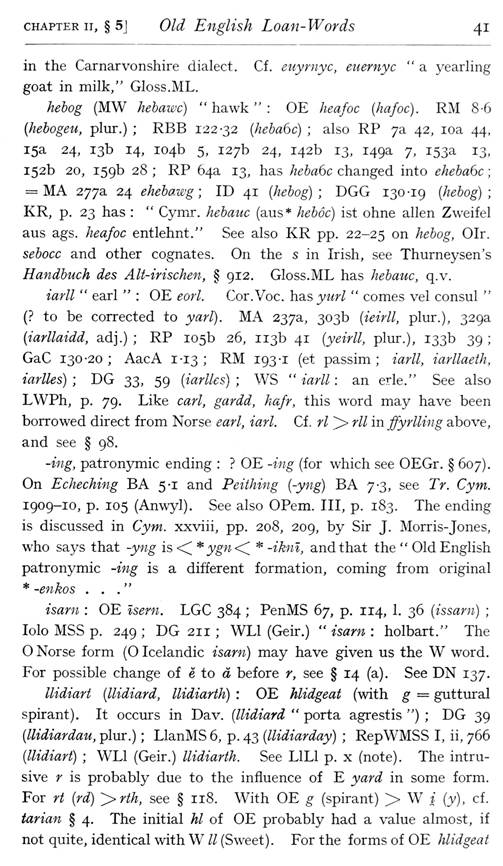
(delwedd F6792) (tudalen 041)
|
CHAPTER
II, § 5J Old English Loan-Words 41
in the Carnarvonshire dialect. Cf. euyrnyc, enemy c “a yearling goat in
milk," Gloss. ML.
hebog (MW hebawc) “hawk”: OE heafoc {hafoc). RM 8-6 {hehogeu, plur.); RBB
122-32 (hebaGc); also RP 7a 42, loa 44, 15a 24, 13b 14, 104b 5, 127b 24, 142b
13, 149a 7, 153a 13, 152b 20, 159b 28; RP 64a 13, has heba6c changed into
eheba6c; = MA 277a 24 ehebawg; ID 41 {hebog); DGG 130-19 [hebog); KR, p. 23
has: “Cymr. hebauc (aus* heboc) ist ohne alien Zweifel aus ags. heafoc entlehnt."
See also KR pp. 22-25 on hebog, Olr. sebocc and other cognates. On the s in
Irish, see Thurneysen's Handbuch des Alt-trischen, § 912. Gloss. ML has
hebauc, q.v.
iarll “earl": OE eorl. Cor. Voc. has jywrZ “comes vel consul” (? to be
corrected to yarl). MA 237a, 303b {ieirll, plur.), 329a [iarllaidd, adj.); RP
105b 26, 113b 41 [yeirll, plur.), 133b 39; GaC 130-20; AacA 1-13; RM 193-1
(et passim; iarll, iarllaeth, iarlles); DG 33, 59 {iarllcs); WS “iarll: an
erle." See also LWPh, p. 79. Like carl, gardd, hafr, this word may have
been borrowed direct from Norse earl, iarl. Cf . rl ^ rll in ffyrlling above,
and see § 98,
-vug, patronymic ending:? OE -ing (for which see OEGr. § 607). On Echeching
BA 5-1 and Peithing (-yng) BA 7-3, see Tr. Cym. 1909-10, p. 105 (Anwyl). See
also OPem. Ill, p. 183. The ending is discussed in Cym. xxviii, pp. 208, 209,
by Sir J. Morris- Jones, who says that -yng is << * ygn<i * -ikni,
and that the “Old English patronymic -ing is a different formation, coming
from original * -enkos . . ."
isarn: OE Isern. LGC 384; PenMS 67, p. 114, 1. 36 (issarn); lolo MSS p. 249;
DG 211; WLl (Geir.) “isarn: holbart." The O Norse form (O Icelandic
isarn) may have given us the W word. For possible change of e to a before r,
see § 14 (a). See DN 137.
llidiart [llidiard, llidiarth): OE hlidgeat (with g = guttural spirant). It
occurs in Da v. [llidiard “porta agrestis "); DG 39 [llidiardau, plur.);
LlanMS 6, p. 43 [llidiarday); RepWMSS I, ii, 766 [llidiart); WLl (Geir.)
llidiarth. See LlLl p. x (note). The intrusive r is probably due to the
influence of E yard in some form. For rt [rd) ^rth, see § 118. With OE g
(spirant) > W i [y), cf. tarian § 4. The initial hi of OE probably had a
value almost, if not quite, identical with W // (Sweet). For the forms of OE
hlidgeat
|
|
|
|
|
(delwedd F6793) (tudalen 042)
|
42 .
English Element in Welsh [chapter ii, § 5
in later E, see NED s.v. lidgate and EDD s.v. lidgate. The OE geat (Anglian
gcet) with spirant guttural survives as yate in the dialects, and has given W
dial, iet (e.g. Dem. Dial.). With the compound llidia{r)t we may compare the
W fflodiat “flood-gate, sluice." The earliest example in E given by NED
is from the fifteenth century [flodegate). In W there is a by-form flodiart
(cf. llidiart), for which in Carn. dial, see EC s.v. flodjat.
lloc'^ “sheep-fold," llocio (the verb-noun): OE loc, BBC 22 '5 {Hoc?);
PenMS 67, p. 2 (Ivkas mal ych a loked, the aor. impers. of the verb) = LlanMS
6, p. 59, 1. 30 (lykas val ych a leked). See Cym. xxxi, p. 133, “The Welsh
llocc (from Old English loc) . . . generally means ' sheep-fold '“ (J.
Morris- Jones). In the Snowdon district. Hoc is often found in the names of
small fields. In this word the final voiceless consonant is kept after a
short vowel in a monosyllable. Contrast had above, where -t ^ -d after a long
vowel. See §§ 112, 113, 114.
Uyffethair {llaffethair, llawethair) “a shackle, long fetter”: OE lang -\-
feter [fetor, feotor). On the loss of the nasal guttural see Pedersen,
Vgl.Gr. I, 152; see also I, p. 540 and p. 409 (M.Irish langfiter, which,
according to Cormac, = “a long fetter which is between the fore-legs and the
hind-legs "). RP 150a 6 [llaffethair); Galar. iii, 7 [Uyffethair), Mc.
v, 4 [-eiriau, plur.); in Dem. Dial. lloithir “a shackle," probably from
llawethair or llowethair. WS has “lief ether: Schaccle."
offrwm “offering ":? OE offrung or ME of rung. MA 966a [ofr6m); CCharl
55 [offrmm); H.Swr, 7-11 [ophrwm); WS “offrwm: an offryng”; Heb. x, 5; vii,
27. The change of final ng into m is unusual. Perhaps the first stage was ng
^ n (see § 127) and afterwards n ^m (see § 126),
pahi “poppy”: OE papig [popceg, papoeg), g being the guttural spirant. In the
fifteenth century E had papy, and in the sixteenth century pappy (see NED
s.v. poppy). AfcL I, i, 43 [papy); MM(W) 231 [pahi), MM 50, § 49 [pahi); cf. MM(W)
21 [popin). For the voicing of intervocalic _^, see § 99. The OE g, being a
spirant, would naturally fall out in W in this final position, as it did in
ME.
1 Cf. ir loc guac “the vacant space," in the Old Welsh Computus, ZfcP 8
Bd., 1910-12, p. 408. Here, however, loc may be the Latin locus borrowed.
|
|
|
|
|
(delwedd F6794) (tudalen 043)
|
CHAPTER
II, § 5] Old English Loan-Words 43
pwca ^:? OE pilca; but see § 15.
pwll:? OE pull; but see § 51.
saim {saem) "grease": OE seim{e); or more probably <^ OFrench
saim, sain. See EDD s.v. saim. MM(W) 25 [saym,? = saem); MM 116, § 141, and
also ibid seymlyt [=Mn\Y seimlyd adj.). On ai: ae: ei, see §§ 53-56. S.W.
dial, sdm (from saem) “polish (Glam.), grease, fat." RepWMS I, ii, p.
751 has saim; RP 120b 6 (seim). ME had seim, saim. See OPem. I, p. 275 (note
4), and cf. note on sdn in I, p. 117.
silff “a shelf ":? OE scylfe, ME schelfe. It may have come from E dial.
s/w7/ (see EDD s.v.) . It occurs in W in the seventeenth century in a cywydd
by Huvv Machno (MLl II, 311-3, I lyfrau ar silffiau sydd), and is in common
use in MnW. In NW, it is frequently pronounced silfft with epithetic t (cf.
teligrafft, see § 130). Cf., however, § 86.
sticil {sticill) “a stile” (mostly SW):? OE stigol, [stiogol stigel), with
spirant g, ME stigele. See Y Wawr, Cyf. I, Rhif 3 (Haf, 1914). Dem. Dial,
sticil.
sygn “sign (of the zodiac):? OE segn (spirant g), cf. OFr. seigne, signe. May
it be a “learned “borrowing from Lat. signum? RP 32a 16 [sygneu, plur), 36a
23 [sygnoed, plur.), 57b 40 [sycneu), 58a 27, 57b 7, 85a 21, 102a 17, 136a
14; Car. Mag. 34 [sy gyn); DGG 83-28 (sygnau); DGG 76-27 {-sygn in
planetsygn), 69-30; SG 131 [sygneu).
tiglist “tiles” (Bod. has tiglis{t), diglist “tiles, bricks "):? OE
tigle [tigele, tiegle, tigol, tile) . If tiglist is really a plural form from
E, it may have come from some ME form rather than from OE, because the OE
word was a fern. “weak “noun. The t in W would be epithetic. For -is, see §
17 (g), and for -t, see § 130. Tiglist occurs in LLA 44, 11. 15, 16: babilon
va6r ... a adeila6d semiramis vrenhines o diglist. Aphridgist mal y
g6rth6ynebei y tiglist y tan. ar pridgist yr d6fuyr = Lat., p. 205: magna
Babylonia, quam de latere et bitumene construxit Semiramis regina, ut later
es igni, bitumen aquae resisterent.
wermod [wermwd,
wermwnt, gwermod) “wormwood”: OE wermod (weremod). AfcL I, i, 27 (y wermot);
MM(W) 4 (y wermot); MM, p.
'^ In Revue Celtique, vol. xii, p. 461, Meyer traces Irish puca “a goblin “to
Old Norse puki "■ imp."
|
|
|
|
|
(delwedd F6795) (tudalen 044)
|
44 .
English Element in Welsh [cpiapter ii, § 5
i8, § 12 (ar wennot); PenMS 57, p. 46, 1. 7 (ar wermod); DG 322 (Cerdd wermod
a ddatodai); WS “gwermod: wermode”; Dat. viii, II (wermod); Dem. Dial, has
wermwnt, wermwd, gwermwd, all later forms. In a Patent Roll,^ A.D. 1331, the
place-name Llunwermon occurs (p. 6ib, 1. 12), and is identified with Llwyny
wermod, “the Wormwood Bush,"“ 3 m. N.W. of Caio." According to EED,
wermont is found in the English dial, of Pern. For final consonant, see
gwalstod above.
wtla “outlaw”: OE utla {utlaga, iltlah), ME iitlawe, outlawe. DG 299 [Wtla
o'r tir at eiliw'r tes) = PenMS 57, p. 80, 1. 14 [wttla); DE 145 (yr hwdla
bach; var. lect. wtla).
ysher, plur. ysberi: OE spere or ME spere. RP 150b 17 (sper); BA7-9 [ysberi),
21-17 [ysberi) = MA 55a [ysperi);? BBC 6o-io [ispler^i); LGC 49 [sper). Cf.
RBB 392 (William Iwngesper,” Longspear "). See, however, § 24. Cf. spero
“to spear “in Cards.
ysgadan “herrings” (sing, ysgadenyn; Dem. Dial, stenyn). This word was
discussed recently in the columns of Y Brython (the Liverpool Welsh weekly),
Nov. 10, 1921 (p. 5), Nov. 24, 1921 (p. 4). OE sceadd, Mod.E shad, has been
suggested as a probable origin, and even OE sceddan, scddan “to divide,
sever." As ysgadan is used as a plur. in W, one would at first think of
looking for a trace of the OE “weak “plural ending in it. Again, one is
reminded of E skate (from ONorse skata). Pedersen, however, in his Vgl. Gr.
I, p. 24, regards the Middle Irish scatdn. Mod. Irish sgaddn, as having been
borrowed from W ysgadan. The plur. in Irish is sgaddin. The word occurs
fairly early in W: RP 130a 22 {ysgadan); RepWMSS I, iii, p. 1112 [skadan).
See Pennant II, p. 375 on Forth Ysgadan in Carnarvonshire. For the expression
mwys sgadan [= Manx meays de skeddanyn) see OPem. I, p. 122, note 3.
yslipanu (ysleipanu) “to burnish, polish, sharpen (?) ":? OE. Stratmann
s.v. slipen of ME has "A. Sax. [to)slipan, M.L.Ger. slipen (serpere,
acuere) ..." RM 126-26; 127-4 [yslipanu cledyveu), 250-1 [ysleipanu) ,
126-19 [yslipanwr). This yslipanu is done with an agalen “whetstone” (RM
127), but it is associated
^ Royal Charters and Historical Documents relating to the Town and County oj
Carmarthen . . . Daniel-Tyssen and Evans. Carmarthen (Spurrell), 1878.
|
|
|
|
|
(delwedd F6796) (tudalen 045)
|
CHAPTER
II, § 6] Old English Loan-Words 45
with golchi “to wash” (RM 126-28). For the E -an inf. ending in W, see
ysmwcan below, and sucan § 3, rhacanu § 4, cusan § 2.
ysmwcan "fog, mist, drizzle; vapour, smoke" (Bod.). See FC s.v,
sniwcan “drizzle, Scotch mist”; Dav. has ysmwccan, "nebula,
fumellus." Cf. ysmwclaw {<^ysmwc + glaw) with same meaning. Is
ysmwcan from OE smeocan [smocian) “to smoke "?
Cf. § 49-
ysnoden “snood”; OE snod, ME snod. Pedersen, Vgl. Gr. I, p. 85, suggests an E
origin. Cf., however, Irish snathe, Cor.Voc. snod “vitta," Breton
neudenn, Gaulish nate (gloss on fili), cited by Pedersen, ibid. Cf. § 50. RM
1647 {ysnoden); DE 37 [snoden), 42 [ysnoden); ID y [ysnoden); vSG 136
{ysnodennau, ^Im:.); Es. iii, 30 [ysnoden, -nati). It may have been borrowed
from ME before the long close became the w-sound. See also FC s.v. snodan.
[y swain “esquire," armour-bearer”: OE swdti, ME swein, swain, ONorse
sveinn. This is probably from ONorse or from ME. It occurs, e.g., in AacA
2-12, 20-21, 8-2 [yssweineit and sweineit, plur.)]
§ 6. It will not be out of place, perhaps, to cite here a few examples of OE
words and names, found mainly in MW texts. They seem to have preserved
largely the OE form, but as a rule were transcribed into W orthography. These
cannot be regarded as strictly enfranchised forms, except in a few cases. In
the Welsh Bruts, examples are plentiful. In the Welsh translation of
Geoffrey's Brut [Historia Regum Britanniae), the English phrase found in the
Latin text (San Marte's ed. 1854, Liber Sextus, Caput xii, p. 84) as Lauerd
King, wacht Jieil, appears as Lofyrt kig wassael (RBB 135 '15) i 3-ricl Drinc
heil (San Marte, ibid.) as drinc heil (RBB 135-23). The phrase Nemet oure
saxas, found in the Latin text (San Marte, Lib. vi. Cap. xv, p. 88), appears
in the Welsh text as Nymyth a6r saxys (RBB 139-24, -29); cf. the eniminit
saxas of Nennius. W. trans. KymerOch a6ch kylleill (RBB 139-30).
A study of the forms of English names as found in the Welsh Brutiau and in
historical poems would be very interesting from the point of view of the
development of English sounds. The few examples here given seem to have in
the main the OE sound values.
Alvryt, RBB 386: OE Alfrip, [Aldfrip, Alfred).
|
|
|
|
|
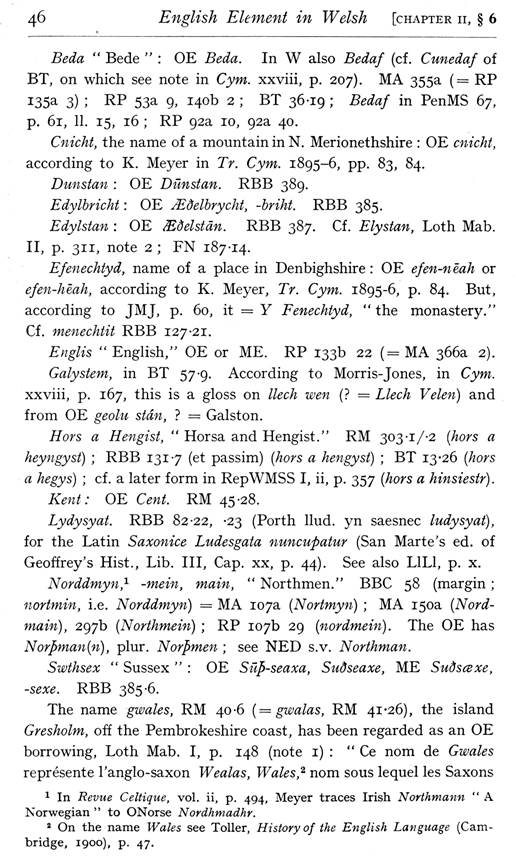
(delwedd F6797) (tudalen 046)
|
46
English Element in Welsh [chapter ii, § 6
Beda “Bede”: OE Beda. In W also Bedaf (cf. Cunedaf of BT, on which see note
in Cym. xxviii, p. 207). MA 355a (= RP 135a 3); RP 53a 9, 140b 2; BT 36-19;
Bedaf in PenMS 67, p. 61, 11. 15, 16; RP 92a 10, 92a 40.
Cnicht, the name of a mountain in N. Merionethshire: OE cnicht, according to
K. Meyer in Tr. Cym. 1895-6, pp. 83, 84.
Dunstan: OE Dunstan. RBB 389.
Edylbricht: OE Mdelhrycht, -briht. RBB 385.
Edylstan: OE Mdelstdn. RBB 387. Cf. Elystan, Loth Mab. II, p. 311, note 2; FN
187-14.
Efenechtyd, name of a place in Denbighshire: OE efen-neah or efen-heah,
according to K, Meyer, Tr. Cym. 1895-6, p. 84. But, according to JMJ, p. 60,
it = Y Fenechtyd, “the monastery." Cf. menechtit RBB 127-21.
EngUs “English," OE or ME. RP 133b 22 (- MA 366a 2).
Galystem, in BT 57-9. According to Morris- Jones, in Cym. xxviii, p. 167,
this is a gloss on llech wen (? = Llech Velen) and from OE geolu stdn,? =
Galston.
Hors a Hengist, “Horsa and Hengist." RM 303-i/-2 {hors a heyngyst); RBB
131-7 (et passim) {hors a hengyst); BT 13*26 [hors a hegys); cf. a later form
in RepWMSS I, ii, p. 357 {hors a hinsiestr).
Kent: OE Ce7tt. RM 45-28.
Lydysyat. RBB 82-22, -23 (Porth llud. yn saesnec ludysyat), for the Latin
Saxonice Ludesgata nuncupatur (San Marte's ed. of Geoffrey's Hist., Lib. Ill,
Cap. xx, p. 44). See also LlLl, p. x.
Norddmyn,^ -mein, main, “Northmen." BBC 58 (margin; nortmin, i.e.
Norddmyn) = MA 107a {Nortmyn); MA 150a {Nordmain), 297b {Northmein); RP 107b
29 {nordmein). The OE has Norpman{n) , plur. Norpmen; see NED s.v. Northman.
Swthsex “Sussex”: OE Siip-seaxa, Siidseaxe, ME SudscBxe, -sexe. RBB 385-6.
The name gwales, RM 40-6 {= gwalas, RM 41-26), the island Gresholm, off the
Pembrokeshire coast, has been regarded as an OE borrowing, Loth Mab. I, p.
148 (note i): “Ce nom de Gwales represente I'anglo-saxon Wealas, Wales,^ nom
sous lequel les Saxons
1 In Revue Celtique, vol. ii, p. 494, Meyer traces Irish Northmann “A
Norwegian “to ONorse Nordhmadhr.
* On the name Wales see Toller, History of the English Language (Cambridge,
1900), p. 47.
|
|
|
|
|
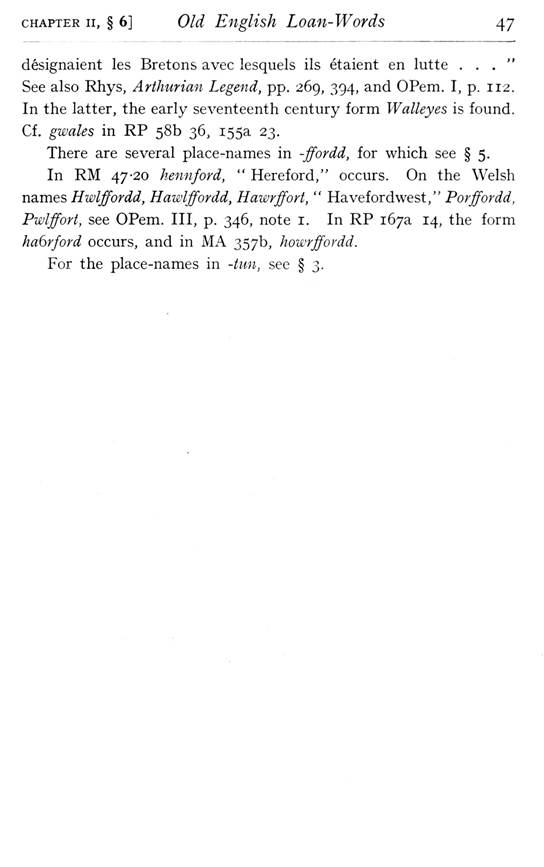
(delwedd F6798) (tudalen 047)
|
CHAPTER
II, § 6] Old English Loan-Words 47 d^signaient les Bretons avec lesquels ils
etaient en lutte ..." See also Rhys, Arthurian Legend, pp. 269, 394, and
OPem. I, p. 112. In the latter, the early seventeenth century form Walleyes
is found. Cf. gwales in RP 58b 36, 155a 23.
There are several place-names in -ffordd, for which see § 5.
In RM 47-20 hennford, “Hereford," occurs. On the Welsh names Hwlffordd,
Hawlffordd, Hawrffort, “Havefordwest," Por ffordd, Pwlffort, see OPem.
Ill, p. 346, note i. In RP 167a 14, the form ha6rford occurs, and in MA 357b,
howrffordd.
For the place-names in -tun, see § 3.
|
|
|
|
|
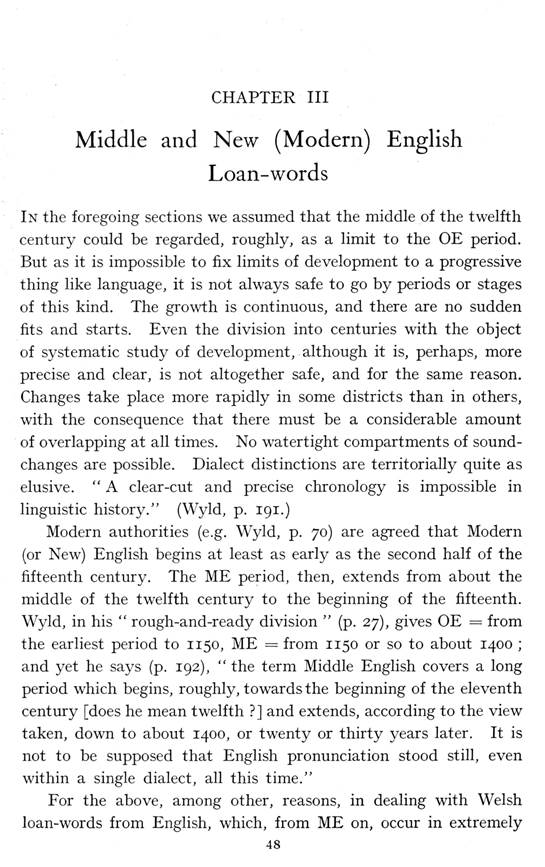
(delwedd F6799) (tudalen 048)
|
CHAPTER
III
Middle and New (Modern) English
Loan-words
In the foregoing sections we assumed that the middle of the twelfth century
could be regarded, roughly, as a limit to the OE period. But as it is
impossible to fix limits of development to a progressive thing like language,
it is not always safe to go by periods or stages of this kind. The growth is
continuous, and there are no sudden fits and starts. Even the division into
centuries with the object of systematic study of development, although it is,
perhaps, more precise and clear, is not altogether safe, and for the same
reason. Changes take place more rapidly in some districts than in others,
with the consequence that there must be a considerable amount of overlapping
at all times. No watertight compartments of sound-changes are possible.
Dialect distinctions are territorially quite as elusive. “A clear-cut and
precise chronology is impossible in linguistic history." (Wyld, p. 191.)
Modern authorities (e.g. Wyld, p. 70) are agreed that Modern (or New) English
begins at least as early as the second half of the fifteenth century. The ME
period, then, extends from about the middle of the twelfth century to the
beginning of the fifteenth. Wyld, in his “rough-and-ready division” (p. 27),
gives OE = from the earliest period to 1150, ME = from 1150 or so to about
1400; and yet he says (p. 192), “the term Middle English covers a long period
which begins, roughly, towards the beginning of the eleventh century [does he
mean twelfth?] and extends, according to the view taken, down to about 1400,
or twenty or thirty years later. It is not to be supposed that English
pronunciation stood still, even within a single dialect, all this time."
For the above, among other, reasons, in dealing with Welsh loan-words from
English, which, from ME on, occur in extremely
48
|
|
|
|
|
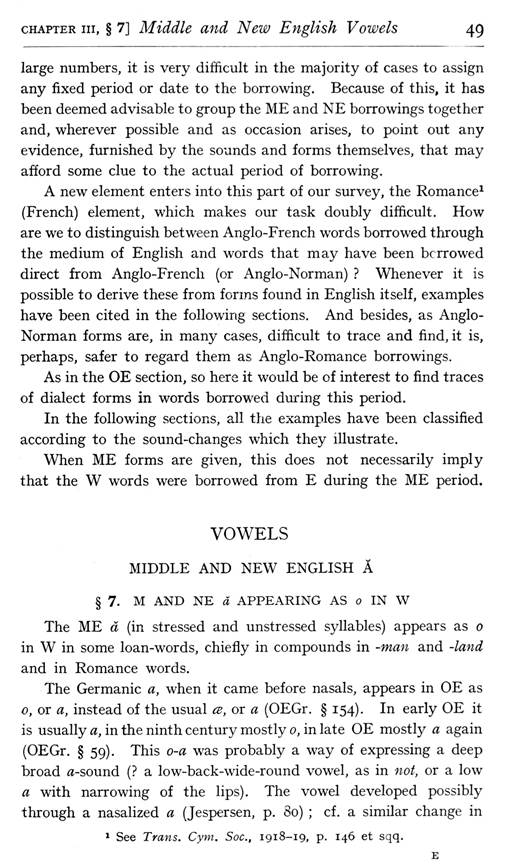
(delwedd F6800) (tudalen 049)
|
49?CHAPTER III, § 7] Middle and New
English Vowels 49 large numbers, it is very difficult in the majority of
cases to assign any fixed period or date to the borrowing. Because of this,
it has been deemed advisable to group the ME and NE borrowings together and,
wherever possible and as occasion arises, to point out any evidence,
furnished by the sounds and forms themselves, that may afford some clue to
the actual period of borrowing.
A new element enters into this part of our survey, the Romance* (French)
element, which makes our task doubly difficult. How are we to distinguish
between Anglo-French words borrowed through the medium of English and words
that may have been bcrrowed direct from Anglo-French (or Anglo-Norman)?
Whenever it is possible to derive these from forms found in English itself,
examples have been cited in the following sections. And besides, as
Anglo-Norman forms are, in many cases, difficult to trace and find, it is,
perhaps, safer to regard them as Anglo-Romance borrowings.
As in the OE section, so here it would be of interest to find traces of
dialect forms in words borrowed during this period.
In the following sections, all the examples have been classified according to
the sound-changes which they illustrate.
When ME forms are given, this does not necessarily imply that the W words
were borrowed from E during the ME period.
VOWELS MIDDLE AND NEW ENGLISH A
§ 7. M AND NE a APPEARING AS o IN W
The ME a (in stressed and unstressed syllables) appears as in W in some
loan-words, chiefly in compounds in -man and -land and in Romance words.
The Germanic a, when it came before nasals, appears in OE as o, or a, instead
of the usual cb, or a (OEGr. § 154). In early OE it is usually a, in the
ninth century mostly 0, in late OE mostly a again (OEGr, § 59). This o-a was
probably a way of expressing a deep broad <2-sound (? a
low-back-wide-round vowel, as in not, or a low a with narrowing of the lips).
The vowel developed possibly through a nasalized a (Jespersen, p. 80); cf. a
similar change in
1 See Trans. Cym. Soc, 1918-19, p. 146 et sqq.
E
|
|
|
|
|
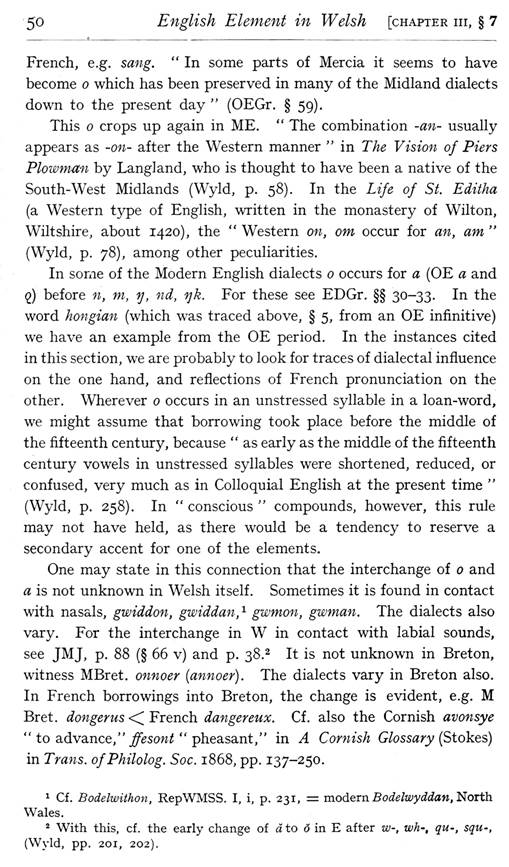
(delwedd F6801) (tudalen 050)
|
50
English Element in Welsh [chapter hi, § 7
French, e.g. sang. “In some parts of Mercia it seems to have become o which
has been preserved in many of the Midland dialects down to the present day”
(OEGr. § 59).
This crops up again in ME. “The combination -an- usually appears as -on-
after the Western manner “in The Vision of Piers Plowmmi by Lang] and, who is
thought to have been a native of the South-West Midlands (Wyld, p. 58). In
the Life of St. Editha (a Western type of English, written in the monastery
of Wilton, Wiltshire, about 1420), the “Western on, om occur for an, am”
(Wyld, p. 78), among other peculiarities.
In some of the Modern English dialects occurs for a (OE a and q) before n, m,
y, nd, tjk. For these see EDGr. §§ 30-33. In the word hongiaji (which was
traced above, § 5, from an OE infinitive) we have an example from the OE
period. In the instances cited in this section, we are probably to look for
traces of dialectal influence on the one hand, and reflections of French
pronunciation on the other. Wherever occurs in an unstressed syllable in a
loan-word, we might assume that borrowing took place before the middle of the
fifteenth century, because “as early as the middle of the fifteenth century
vowels in unstressed syllables were shortened, reduced, or confused, very
much as in Colloquial English at the present time” (Wyld, p. 258). In
“conscious “compounds, however, this rule may not have held, as there would
be a tendency to reserve a secondary accent for one of the elements.
One may state in this connection that the interchange of and a is not unknown
in Welsh itself. Sometimes it is found in contact with nasals, gwiddon,
gwiddan,'^ gwmon, gwman. The dialects also vary. For the interchange in W in
contact with labial sounds, see JMJ, p. 88 (§ 66 v) and p. 38.2 It is not
unknown in Breton, witness MBret. onnoer (annoer). The dialects vary in
Breton also. In French borrowings into Breton, the change is evident, e.g. M
Bret, dongerus <^ French danger eux. Cf. also the Cornish avonsye “to advance,"
^gsow^ “pheasant," in A Cornish Glossary [Stokes) in Trails. ofPhilolog.
Soc. 1868, pp. 137-250.
1 Cf. Bodelwithon, Rep'^AHMSS. I, i, p. 231, = raodexn Bodelwyddan, Ji^orth
Wales.
* With this, cf. the early change of ato d in E after w-, wh-, qu-, squ-,
(Wyld, pp. 201, 202).
|
|
|
|
|
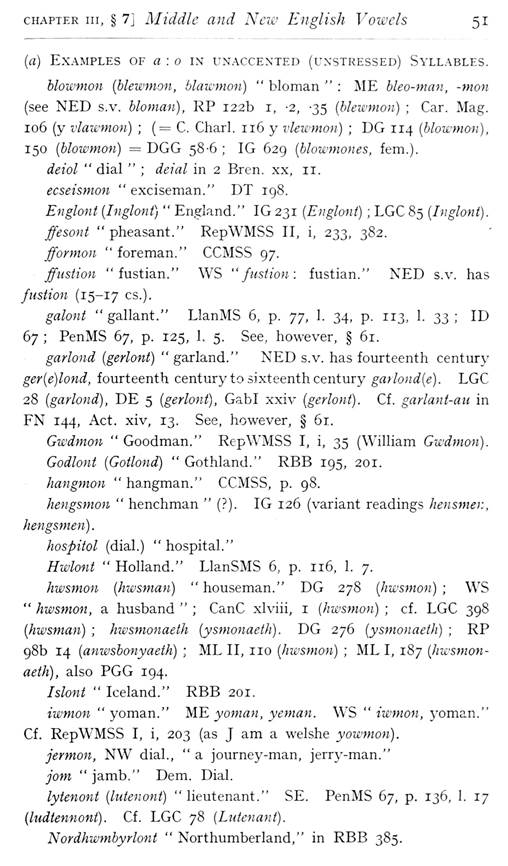
(delwedd F6802) (tudalen 051)
|
CHAPTER
III, § 7] Middle and New English Vowels 51
{a) Examples of a; in unaccented (unstressed) Syllables.
hlowmon [hlewmon, blammon) “bloman”: ME hleo-man, -mon (see NED s.v. bloman),
RP 122b i, -2, -35 (hlewmon); Car. Mag. 106 (y vlawmon); (= C. Charl. 116 y
vlewmon); DG 114 [hlowmon), 150 [hlowmon) = DGG 58-6; IG 629 [hlowmones,
fern.).
deiol “dial”; deial in 2 Bren. xx, 11.
ecseismon "exciseman." DT 198.
Englont [Inglont) “England." IG 231 [Englont); LGC 85 [Inglont).
ffesont “pheasant." RepWMSS II, i, 233, 382.
fformon “foreman." CCMSS 97.
ffustion "fustian." WS "fustion: fustian." NED s.v. has
fustion (15-17 cs.).
galont “gallant." LlanMS 6, p. 77, 1. 34, p. 113, 1. 33; ID 67; PenMS
67, p. 125, 1, 5. See, however, § 61.
garlo7id [gerlont) “garland." NED s.v. has fourteenth centur}'
ger[e)lond, fourteenth century to sixteenth century garlond[e). LGC 28
[garlond), DE 5 [gerlont), GabI xxiv [gerlont). Cf. garlant-an in FN 144,
Act. xiv, 13. See, however, § 61.
Gwdmon “Goodman." RepWMSS I, i, 35 (William Gwdmon).
Godlont [Gotlond) “Gothland." RBB 195, 201.
hangmon “hangman." CCMSS, p. 98.
hengsmon “henchman” (?). IG 126 (variant readings hensmen, hengsmen).
hospitol (dial.) “hospital."
Hwlont “Holland." LlanSMS 6, p. 116, 1. 7.
hwsmon [hwsman) “houseman." DG 278 [hwsmon); WS “hwsmon, a husband”;
CanC xlviii, i [hwsmon); cf. LGC 398 [hwsman); hwsmonaeth [ysnwnaeth). DG 276
[ysmonaeth); RP 98b 14 [anwsho7iyaeth); ML II, no [hwsmon); ML I, 187
[hwsmonaeth), also PGG 194.
Islont “Iceland." RBB 201.
iwmon “yoman." ME yotnan, yeman. W'S “iwmon, j-oman." Cf. RepWMSS
I, i, 203 (as J am a welshe yowmon).
jermon, NW dial., “a journey-man, jerry-man."
jom “jamb." Dem. Dial.
lytenont [lutenont) “lieutenant." SE. PenMS 67, p. 136, 1. 17
(Itidtennont) . Cf. LGC 78 (Lutenant).
Nordhwmbyrlont “Northumberland," in RBB 385.
|
|
|
|
|
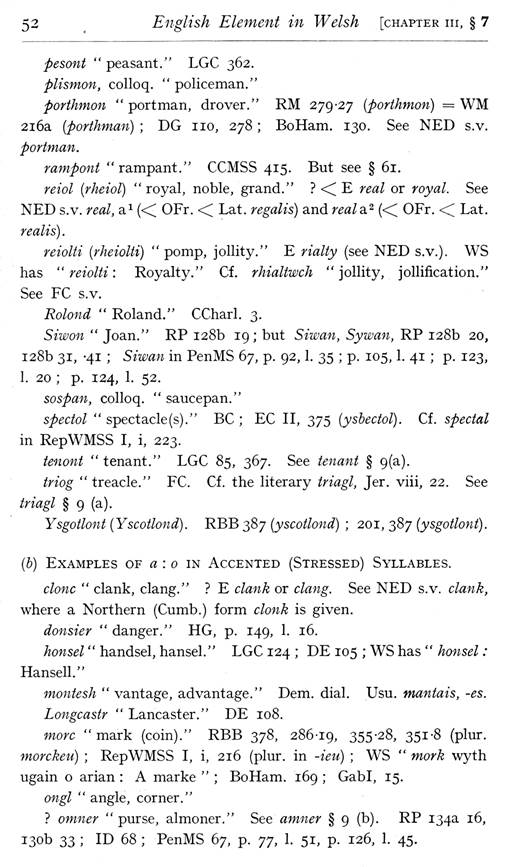
(delwedd F6803) (tudalen 052)
|
52 ^
English Element in Welsh [chapter hi, § 7
pesont “peasant." LGC 362.
piismon, colloq. “policeman."
porthmon “portman, drover." RM 279-27 (porthmon) = WM 2i6a (porfhman);
DG no, 278; BoHam. 130. See NED s.v. portman.
rampont "rampant." CCMSS 415. But see § 61.
reiol [rheiol) "royal, noble, grand."? <C E real or royal. See
NED s.v. real, a^ (<^ OFr. <^ Lat. regalis) and reala.^ {<^ OFr.
<; Lat. realis).
reiolti {rheiolti) “pomp, jollity." E rialty (see NED s.v.). WS has
“reiolti: Royalty." Cf. rhialtwch “jollity, jollification." See FC
s.v.
Rolond “Roland." CCharl. 3.
Siwon “Joan." RP 128b 19; but Siwan, Sywan, RP 128b 20, 128b 31, -41;
Siwan in PenMS 67, p. 92, 1. 35; p. 105, 1. 41; p. 123, 1. 20; p. 124, 1. 52.
sospan, colloq. “saucepan."
spectol “spectacle (s)." BC; EC II, 375 (ysbectol). Cf. special in
RepWMSS I, i, 223.
tenant “tenant." LGC 85, 367. See tenant § 9(a).
triog “treacle." FC. Cf. the literary triagl, Jer. viii, 22. See triagl
§ 9 (a).
Ysgotlont (Yscotlond). RBB 387 {yscotlond); 201, 387 (ysgotlont).
(b) Examples of a: in Accented (Stressed) Syllables.
clone “clank, clang."? E clank or cla^ig. See NED s.v. clank, where a
Northern (Cumb.) form clonk is given.
donsier “danger." HG, p. 149, 1. 16.
honsel “handsel, hansel." LGC 124; DE 105; WS has “hojisel:
Hansen."
montesh “vantage, advantage." Dem. dial. Usu, mantais, -es.
Longcastr “Lancaster." DE 108.
more "mark (coin)." RBB 378, 286-19, 355-28, 351-8 (plur.
rnorckeu); RepWMSS I, i, 216 (plur. in -ieu); WS “mark wyth ugain o arian: A
marke”; BoHam. 169; GabI, 15.
ongl “angle, corner."
? omner “purse, almoner." See amner § 9 (b). RP 134a 16, 130b 33; ID 68;
PenMS 67, p. 77, 1. 51, p. 126, 1. 45.
|
|
|
|
|
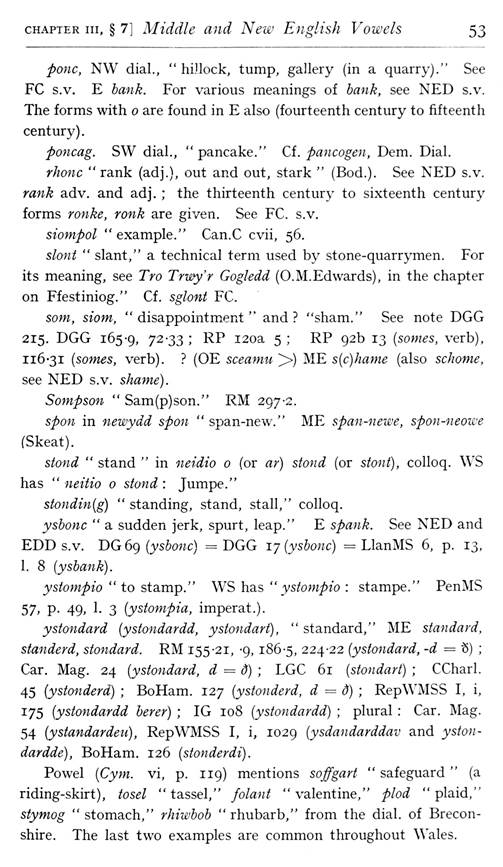
(delwedd F6804) (tudalen 053)
|
CHAPTER
III, § 7] Middle and New English Vowels 53
pone, NW dial., “hillock, tump, gallery (in a quarry)." See FC s.v. E
hank. For various meanings of bank, see NED s.v. The forms with are found in
E also (fourteenth century to fifteenth century).
poncag. SW dial., “pancake." Cf. pancogen, Dem. Dial.
rhonc “rank (adj.), out and out, stark” (Bod.). See NED s.v. rank adv. and
adj.; the thirteenth century to sixteenth century forms ronke, ronk are
given. See FC. s.v.
siompol “example." Can.C cvii, 56,
slont “slant," a technical term used by stone-quarrymen. For its
meaning, see Tro Trwy'r Gogledd (O.M.Edwards), in the chapter on
Ffestiniog." Cf. sglont FC.
som, siom, "disappointment" and? "sham." See note DGG
215. DGG 165-9, 72-33; RP i2oa 5; RP 92b 13 {somes, verb), 116-31 (somes,
verb).? (OE sceamu » ME s[c)hame (also schome, see NED s.v. shame).
Sompson “Sam (p) son." RM 297-2.
spon in newydd spon “span-new." ME span-newe, spon-neowe (Skeat).
stond “stand” in neidio (or ar) stond (or stont), colloq. \VS has “neitio
stond: Jumpe."
stondin{g) “standing, stand, stall," colloq.
yshonc “a sudden jerk, spurt, leap." E spank. See NED and EDD s.v. DG69
[yshonc] = DGG tj {yshonc) = LlanMS 6, p. 13, 1. 8 {y shank).
ystompio “to stamp." WS has “ystompio: stampe." PenMS 57, p. 49, 1.
3 {ystompia, imperat.).
ystondard {ystondardd, ystondart), “standard," ME standard, standerd,
stondard. RM 155-21, -9, 186-5, 224-22 {ystondard, -d =^; Car. Mag. 24
{ystondard, d = d); LGC 61 {stondart); CCharl. 45 (ystonderd); BoHam. 127
{ystonderd, d = d); RepWMSS I, i, 175 {ystondardd herer); IG 108
{ystondardd); plural: Car. Mag. 54 {ystandarden), RepWMSS I, i, 1029
{ysdandarddav and ystondardde), BoHam. 126 {stonderdi).
Powel {Cym. vi, p. 119) mentions soffgart “safeguard” (a riding-skirt), tosel
“tassel," folani “valentine," plod “plaid," stymog
“stomach," rhiwhoh “rhubarb," from the dial, of Breconshire. The
last two examples are common throughout Wales.
|
|
|
|
|
(delwedd F6805) (tudalen 054)
|
54 .
English Element in Welsh [chapter m, § 8
§ 8. E a APPEARING IN W AS e
The ME a (a mid-back vowel) became, either in late ME or during some
subsequent period, cb (a low-front-wide vowel). The change, therefore,
involved a process of fronting and lowering: the a was, perhaps, fronted to e
(mid-front-wide) and then lowered to ce (mid-back-wide) (Wyld, 196).^ During
the fifteenth century there are some occasional spellings with e side by side
with a (Wyld, p. 198).
The sound cb was (and is) a difficult one. We have already seen what OE cb
gave in loan-words into Welsh (see § i). A note on this sound by Wyld, p.
197, is worthy of inclusion here: ". . . The modern English sound is,
even to-day, very rare among the languages of the world, . . . it is by no
means universal in the English dialects, whether Regional or Social, at the
present time, and . . . , for those speakers who have not used it from
childhood, it is apparently one of the most difficult sounds to acquire,
difficult to recognize and discriminate, and difficult to analyze and
describe. It is a matter of very common experience that English speakers who
have studied and perhaps spoken a foreign language for years, in which no
sound at all resembling the genuine English [ae] occurs, continue, when
pronouncing this foreign tongue, to substitute their native sound for the
foreign [a] without the slightest misgiving and without entertaining any
doubt as to the complete identity of the two sounds. I have also known
persons who, without having had any systematic training in phonetics, had yet
given much intelligent attention to phonetic questions, who maintained
stoutly that English [ae] was not a front vowel at all, but a back vowel
closely associated with [a], and this although they themselves undoubtedly
pronounced the normal front sound."
Now, in the vast majority of words which had in ME an a, Welsh has kept the
a- sound (the mid-back vowel). As the mass of loan-words found their way to
Welsh after the ME period, how are we to account for the comparative lack of
traces of this change in English itself? Is the answer suggested in the above
quotation? That is, did the Welsh, being innocent of cb in their native
tongue, carelessly believe with their ears that the sound represented by the
a of English was identical or almost identical with their own a,
^ See Englische Studien, vol. 52, p. 317 (Zachrisson).
|
|
|
|
|
(delwedd F6806) (tudalen 055)
|
CHAPTER
III, § 8] Middle and New English Vowels 55
or was it that they found the sound, as they undoubtedly would, extremely
difficult to produce? One is tempted now to think that this was so,
especially because at the present day, Welsh-speaking Welshmen must exercise
some effort in pronouncing the English ce — when they realize that it is
somehow different from anything in their own tongue. We have already referred
to a sound similar to the English cb in dealing with the development of OE cb
in loan-words.
If, as we were led to believe on the strength of some examples, the OE CB
gave Welsh e, how is it that the new New English sound cb did not give Welsh
e? The few examples of the NE cB-sound giving e in Welsh are not by any means
certain. There may have been a special reason why Welsh has e in these cases.
We wonder if the neighbouring consonant (generally a voiceless stop) or the
monosyllabic abruptness or shortness had anything to do with the change; or
was there a tendency in a border English dialect to accentuate the front
quality of the «s-sound, and make a mid-front of the low-front sound? This is
true of some modern English dialects. Jespersen, p. 246, says “that | a | ^ |
« | >> [ej vulgarly in the neighbourhood of I k I , cah, catch, etc."
A wilder suggestion would be that some ME dialects still kept the e which
they had evolved from the OE CB (as in Central Southern and South Western).
This is exceedingly unlikely because ME a represents not only cb of OE, but
also OE a, ea, a, ea, as well as some foreign sounds [a of Norse and French).
It is now believed that fronting of ME a began as early as the beginning of
the 15th century in the South-Eastern districts and afterwards spread. A few
of the Welsh examples seem to occur fairly early, but they are not
sufficiently numerous to allow us to draw any conclusion. Some cases of the
change [a'^ e or 1 cb'^ e) appear in unstressed syllables, and as the vowels
in such positions were weakened very early in English, no great interest
attaches to such forms. See remarks in § 7, above.
Such Welsh words as mestys "masts," plur. of mast “a mast,"
and teclyn a sing, form from tacl-aii “tackle," of course owe their e to
the “vowel-affection “of Welsh But traces of e for a occur in Welsh where it
is difficult to explain the interchange, e.g. cenol {= canol), kenawl, RP
130b 36, RM 232-8; cerdod {= cardod),
|
|
|
|
|
(delwedd F6807) (tudalen 056)
|
56 .
English Element in Welsh [chapter hi, § 8
SG 167 (cerdodeu), FN. 46; menntaul (OW gloss on Lat. hilance, = mantawl,
mantol; see LothVoc. s.v.). Cerdod and cenol are also colloq. forms. In parts
of N. Wales pen is heard for pan; see FC S.V., where the instance found in BC
33-23 is referred to. Cf. also pen in RepWMSS I, i, p. 69 (a ffen godais) and
pent ( = pan or? pan yd) in RepWMSS I, ii, p. 456 (pent oyddwn ar fore yn
kerdded), whereas on p. 454 pant is found {pant oedd . . . ). These date from
the sixteenth century. In the Carn. dial, there is a tendency to change the
conjunction ira “while “into ire.
Forms like cerfio “carve," gerlont “garland," do not come in this
class: they are really examples oi 'Ee'^W e, before the change of e{r) to
a{r) took place in English. See §§ 21 (a), 22. Words in -es like potes
“potage," pases “passage “are not cases in point, because e in these
words is apparently for ae from a{ge). See § 70.
{a) Examples of a: e in Unaccented Syllables.
bicer (also bicar, ficar, ficer) “vicar." ME had vikar and viker. Gre.
368. See bicar § 9 (a).
brecwest (also brecwast) “breakfast ";? influenced by gwest
“feast."
cwrel “coral." ME coral (and since the sixteenth century, -el{l) ). RP
ma 14, 157a 20; DG 183; DGG 43-12; GabI 58; Job xxviii, 18.
ffwlbert “foumart." MKfulmard (but in fifteenth century forms in
-merd{e) and -mert occur). RP 89b 31 (= MA 324a); 130-44 iffeiberdyn); DE
145; WS has "fwlbert: a fulmarde." Cf. ffwlbart § 9 (a).
pinegl “pinnacle “in WLl (Geir.) “curnen: pinegl clochdy”; TN 382 {pinegl).
Cf. pinagl § 9.
pitffel “pitfall." IG 462; WS {pitfel: A pytfall).
Sawden “Sultan." LGC 68; HSwr 20; WLl Ivii, 9. The ME forms were Soudan,
Sowdon.
? secwndid “safe-conduct." FN 133. Cf. WS “safcwndit: Savecoduyt”
seintwer “sanctuary." See NED s.v. sanctuary (fourteenth
century form seyntery). RepWMSS I, i, 35. Cf. seintwar § 9 (a).
whilber “a wheelbarrow." Dem. dial.; also other SW dialects. Cf. berfa §
5.
ystiwert “steward." See NED s.v. steward (OE stigweard; ME forms in
-erde). RBB 279-16 {ystiwert), 299-26; 296-12 {ystiwerdaeth). Cf. RBB 276-8
{ystiwart) and RP 130a 8, -9, {ystiwart); see § 9 (a).
|
|
|
|
|
(delwedd F6808) (tudalen 057)
|
CHAPTER
III, § 8] Middle and New English Vowels 57
Some of the above examples may be due to the effect of the “dulling “process
which began very early in E in unaccented syllables. See § 9.
{h) Examples o¥ a: e in Accented Syllables.
berfa. ME barewe, barwe. But see s.v. in § 5.
dec, clecian, “clack, to clack." ME clacke. LlanMS 6, p. 88 {klek) (=DG
307 dec); DG 224 {clecian); HG 114-9 [kl^k)- In dials, it has other meanings,
e.g. “gossip," with which cf. NED and EDD s.v. clack.
clemp “clamp”; FC s.v. has “a piece of iron placed under the toe of a shoe
“as the meaning.
dene “anything fiat, a shock”; FC (where E clank, dial. clenk, is suggested
as the origin). Cf. dene wair “a bundle of hay “mentioned in Tr.GG (1904), p.
43.
dep “clap, clack, gossip," depian “to clack, babble, gossip, slam (a
door)," mostly colloq. E clap. ME has clappe a.nd ckppe; see NED s.v.
clap. The E obsolete meaning “a sudden or violent shutting of a door” (NED
fS) is the common NW meaning.
crec “a knack, sharp blov/." ME knak. NED gives an obs. meaning of the
verbal form, "to deal a sharp sounding blow." RP 124a 24; RP 128b
29 {-eu, plur.), 133b 8 (= MA 365b); DG 307; RP I20a 40 {creckya6c, adj.).
crec “crepitation, crack." ME crak (see NED s.v.). DG 259.
elisawndyr “alexanders." See § 61.
epa “ape." (?) OE apa or ME ape; but see § 3. Cf. ab; epa in I Bren. x,
22,
ers “podex, arse." MK ars, arce, erse (<^ OEcsrs, ears). In Llyn
(Carn.) there is an expression “chwip din hers am beidio a dysgu'r
wars." Cf. Cvs mein ers in RepWMSS I, ii, pp. 513, 931; II, ii, p. 620;
ersmert “earsmarte, arse smart," WLB (Gloss.).
llepian "to lap, lick." WS “llepian ual ki: Lappe."
hesp-en “a hasp." ME haspe (also North hespe; see NED s.v.); WS “hespen:
A haspe." Or is it from OE hcepse? Cf. Cor.Voc hesp “sera."
lerdies” \^vgess{e)." ME largesse. Ft^ 10^; ci.lardiesEGCs90.
mershiand-wyr “merchants “in RepWMSS I, i, pp. 215, 221; also mershiandi, p.
221. Usually marsiand-, see § 9.
|
|
|
|
|
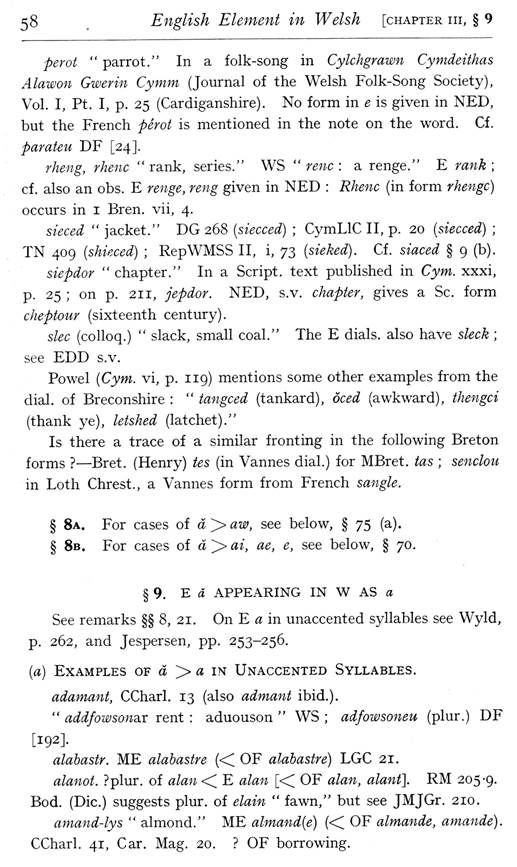
(delwedd F6809) (tudalen 058)
|
58 ,
English Element in Welsh [chapter hi, § 9
perot “parrot." In a folk-song in Cylchgrawn Cymdeithas Alawon Gwerin
Cymm (Journal of the Welsh Folk-Song Society), Vol. I, Pt. I, p. 25
(Cardiganshire). No form in e is given in NED, but the French perot is
mentioned in the note on the word. Cf. parateu DF [24].
rheng, rhenc “rank, series." WS “renc: a renge." E rank; cf . also
an obs. E renge, reng given in NED: Rhenc (in form rhengc) occurs in i Bren.
vii, 4.
sieced “jacket." DG 268 {siecced); CymLlC II, p. 20 {siecced); TN 409
[shieced); RepWMSS II, i, 73 [sieked). Cf. siaced § 9 (b).
siepdor “chapter." In a Script, text published in Cym. xxxi, p. 25; on
p. 211, jepdor. NED, s.v, chapter, gives a Sc. form cheptour (sixteenth
century).
slec (colloq.) “slack, small coal." The E dials, also have sleek; see
EDD s.v.
Powel {Cym. vi, p. 119) mentions some other examples from the dial, of
Breconshire: “tangced (tankard), deed (awkward), thengci (thank ye), letshed
(latchet)."
Is there a trace of a similar fronting in the following Breton forms? — Bret.
(Henry) tes (in Vannes dial.) for MBret. tas; senclou in Loth Chrest., a
Vannes form from French sangle.
§ 8a. For cases of a >> aw, see below, § 75 (a). § 8b. For cases of a
> ai, ae, e, see below, § 70.
§ 9. E a APPEARING IN W AS a
See remarks §§ 8, 21. On E a in unaccented syllables see Wyld, p. 262, and
Jespersen, pp. 253-256.
{a) Examples of a > a in Unaccented Syllables.
adamant, CCharl. 13 (also admant ibid.).
" addfowson3.T rent: aduouson “WS; adfowsoneu (plur.) DF
[192]-
alabastr. ME alabastre (<< OF alabastre) LGC 21.
alanot.?plur. of alan <^ E alan [•< OF alan, alant], RM 205-9. Bod.
(Die.) suggests plur. of elain “fawn," but see JMJGr. 210.
amand-lys “almond." ME almand{e) « OF almande, amande). CCharl. 41, Car.
Mag. 20.? OF borrowing.
|
|
|
|
|
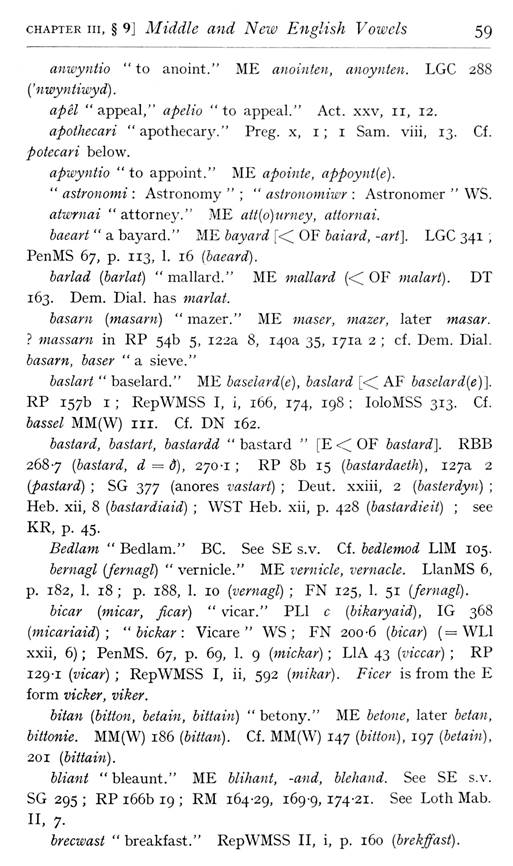
(delwedd F6810) (tudalen 059)
|
CHAPTER
III, § 9] Middle and New English Vowels 59
anwyntio “to anoint." ME anointen, anoynten. LGC 288 (^nwyntiwyd).
apel "appeal," apelio "to appeal." Act. xxv, 11, 12.
apothecari "apothecary." Preg. x, i; i Sam. viii, 13. Cf. potecari
below.
apwyntio "to appoint." ME apointe, appoynt{e).
" astronomi: Astronomy”; “astronomiwr: Astronomer “WS.
atwrnai “attorney." ME att{o)urney, attornai.
haeart “a bayard." ME bayard [<^ OF baiard, -art]. LGC 341; PenMS 67,
p. 113, 1. 16 (baeard).
barlad (barlat) “mallard." ME mallard {<C OF malart). DT 163. Dem.
Dial, has marlat.
basarn (masarn) “mazer." ME maser, mazer, later masar.? massarn in RP
54b 5, 122a 8, 140a 35, 171a 2; cf. Dem. Dial. basarn, baser “a sieve."
baslart “baselard." ME baselard{e), baslard [<; AF baselard{e)]. RP
157b I; RepWMSS I, i, 166, 174, 198; loloMSS 313. Cf. bassel MM(W) iii. Cf.
DN 162.
bastard, bastart, bastardd "bastard” [E << OF bastard]. RBB 2687
[bastard, d = d), 270-1; RP 8b 15 [bastardaeth) , 127a 2 (pastard); SG 377
(anores vastart); Deut. xxiii, 2 [basterdyn); Heb. xii, 8 [bastardiaid); WST
Heb. xii, p. 428 [bastardieit); see KR, p. 45-
Bedlam “Bedlam." BC. See SE s.v. Cf. bedlemod LIM 105.
bernagl (fernagl) “vernicle." ME vernicle, vernacle. LlanMS 6,
p. 182, 1. 18; p. 188, 1. 10 (vernagl); FN 125, 1. 51 (fernagl).
bicar (micar, ficar) “vicar." PLl c [bikaryaid) , IG 368 [micariaid);
“bickar: Vicare “WS; FN 200-6 {bicar) (=WL1 xxii, 6); PenMS. 67, p. 69, 1. 9 (mickar); LI A 43
[viccar); RP 129 -I [vicar); RepWMSS I, ii, 592 [mikar). Ficer is from the E
form vicker, viker.
bitan [bitton, betain, bittain) "betony." ME betone, later betan,
bittonie. MM(W) 186 [bittan). Cf. MM(W) 147 [bitton), i()7 [betain), 201
[bittain).
bliant “bleaunt." ME blihant, -and, blehand. See SE s.v. SG 295; RP i66b
19; RM 164-29, 169-9, 174-21. See Loth Mab. II, 7.
brecwasi “breakfast." RepWMSS II, i, p. 160 [brekffast).
|
|
|
|
|
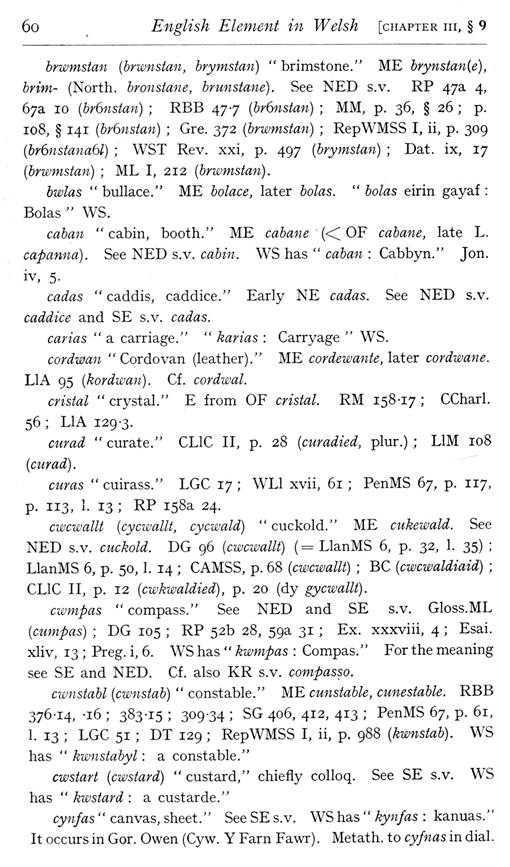
(delwedd F6811) (tudalen 060)
|
6o
English Element in Welsh [chapter hi, § 9
hrwmstan {hrwnstan, hrymstan) “brimstone." ME brynstan{e), brim- (North,
bronstane, brunstane). See NED s.v. RP 47a 4, 67a 10 {br6nstan); RBB 477
(brGnstan); MM, p. 36, § 26; p. 108, § 141 (brGnstan); Gre. 372 {brwmstan);
RepWMSS I, ii, p. 309 {br6nstana6l); WST Rev, xxi, p. 497 (brymstan); Dat.
ix, 17 {brwmstan); ML I, 212 (brwmstan).
bwlas “bullace." ME bolace, later bolas. “bolas eirin gayaf: Bolas “WS.
caban “cabin, booth." ME cabane (<< OF cabane, late L. capanna).
See NED s.v. cabin. WS has “caban: Cabbyn." Jon.
iv, 5-
cadas “caddis, caddice." Early NE cadas. See NED s.v. caddice and SE
s.v. cadas.
cartas “a carriage." “karias: Carryage “WS.
cordwan “Cordovan (leather)." ME cordewante, later cordwane. LI A 95
(kordwan). Cf. cordwal.
cristal “crystal." E fronri OF cristal. RM 158-17; CCharl. 56; LIA
129-3.
curad “curate." CLIC II, p. 28 (curadied, plur.); LIM 108 (cur ad) .
curas “cuirass." LGC 17; WLl xvii, 61; PenMS 67, p. 117, p. 113, 1. 13;
RP 158a 24.
cwcwalU (cycwallt, cycwald) “cuckold." ME cukewald. See NED s.v.
cuckold. DG 96 (cwcwallt) (= LlanMS 6, p. 32, 1. 35); LlanMS 6, p. 50, 1. 14;
CAMSS, p. 68 (cwcwallt); BC (cwcwaldiaid); CLIC II, p. 12 (cwkwaldied) , p.
20 (dy gycwallt).
cwmpas “compass." See NED and SE s.v. Gloss.ML (cumpas); DG 105; RP 52b
28, 59a 31; Ex. xxxviii, 4; Esai. xliv, 13; Preg. i, 6. WS has “kwmpas:
Compas." For the meaning see SE and NED. Cf. also KR s.v. compasso.
cwnstabl (cwnstab) “constable." ME cunstable, cunestable. RBB 376-14,
-16; 383-15; 309-34; SG 406, 412, 413; PenMS 67, p. 61, 1. 13; LGC 51; DT
129; RepWMSS I, ii, p. 988 (kwnstab). WS has “kwnstabyl: a constable."
cwstart (cwstard) “custard," chiefly colloq. See SE s.v. WS has
“kwstard: a custarde."
cynfas “canvas, sheet." See SE s.v. WS has “kynfas: kanuas." It
occurs in Gor. Owen (Cyw. Y Earn Fawr) . Metath. to cyfnas in dial.
|
|
|
|
|
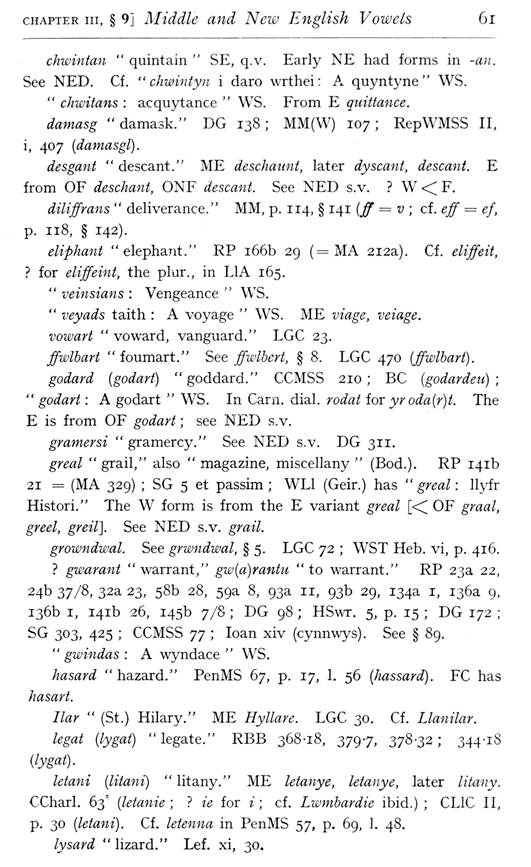
(delwedd F6812) (tudalen 061)
|
CHAPTER
III, § 9] Middle and New English Vowels 6i
chwintan “quintain “SE, q.v. Early NE had forms in -an. See NED, Cf,
“chwiutyn i daro wrthei: A quyntyne “WS.
" chwitans: acquytance “WS. From E quittance.
damasg "damask." DG 138; MM(W) 107; RepWMSS II, i, 407 (damasgl).
desgant “descant." ME deschaunt, later dy scant, descant. E from OF
deschant, ONF descant. See NED s.v.? W <^ F.
diliffrans “deliverance." MM, p. 114, § 141 [ff = v\ cf. ejf = ef, p.
118, § 142).
eliphant "elephant." RP i66b 29 (= MA 212a). Cf. eliffeit,? for
eliffevnt, the plar., in LIA 165.
" veinsians: Vengeance “WS.
" veyads taith: A voyage “WS. ME viage, veiage.
vowart “voward, vanguard." LGC 23.
ffwlhart “foumart." See ffwlbert, § 8. LGC 470 {ffwlhart).
godard (godart) "goddard." CCMSS 210; BC (godardeu); “godart: A
godart “WS. In Carn. dial, rodat for yr oda{r)t. The E is from OF godart; see
NED s.v,
gramersi “gramercy." See NED s.v. DG 311.
great “grail," also “magazine, miscellany” (Bod.), RP 141b 21 = (MA 329);
SG 5 et passim; WLl (Geir.) has "great: llyfr Histori." The W form
is from the E variant greal [<^ OF graal, greet, greil]. See NED s.v.
grail.
growndwal. See grwndwal, § 5. LGC 72; W^ST Heb. vi, p. 416.
? gwarant "warrant," gw{a)rantu "to warrant." RP 23a 22,
24b 37/8, 32a 23, 58b 28, 59a 8, 93a II, 93b 29, 134a I, 136a 9, 136b I, 141b
26, 145b y/^; DG 98; HSwr. 5, p, 15; DG 172; SG 303, 425; CCMSS yy; loan xiv
(cynnwys). See § 89,
" gwindas: A wyndace “WS.
hasard “hazard," PenMS 67, p, 17, 1, 56 {hassard). EC has hasart.
liar ”(St.) Hilary." ME Hytlare. LGC 30. Cf. Llanilar.
legat {lygat) "legate." RBB 368-18, 3797, 37^-Z'2) 344-i8 {lygat).
letani {litani) “litany," ME tetany e, tetany e, later litany. CCharl.
63' [letanie;? ie for i; cf. Lwmhardie ibid.); CLIC II, p. 30 {letani). Cf.
letenna in PenMS 57, p. 69, 1. 48. lysard “lizard," Lef, xi, 30.
|
|
|
|
|
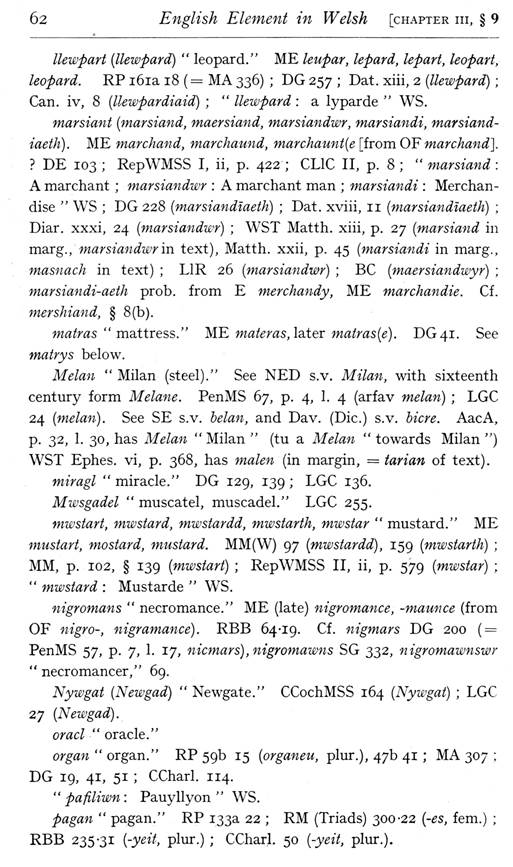
(delwedd F6813) (tudalen 062)
|
62
English Element in Welsh [chapter hi, § 9
llewpart [llewpard) “leopard." ME leupar, kpard, lepart, leopart,
leopard. RP i6ia i8 (= MA 336); DG 257; Dat. xiii, 2 {llewpard); Can. iv, 8
[Uewpardiaid); “llewpard: a lyparde “WS.
marsiant {marsiand, maersiand, marsiandwr, marsiandi, marsiandiaeth). ME
marchand, marchaund, marchaunt{e [from OF marchand].? DE 103; RepWMSS I, ii,
p. 422; CLIC II, p. 8; "marsiand: A marchant; marsiandwr: A marchant
man; marsiandi: Merchandise “WS; DG 228 (marsiandiaeth); Dat. xviii, 11
(marsiandiaeth); Diar. xxxi, 24 (marsiandwr); WST Matth. xiii, p. 27
(marsiand in marg., marsiandwr m text), Matth. xxii, p. 45 (marsiandi in
marg., masnach in text); LIR 26 (marsiandwr); BC (maersiandwyr);
marsiandi-aeth prob. from E merchandy, ME marchandie. Cf. mershiand, § 8(b).
wa/ms “mattress." ME mater as, later matr as (e). DG41. See matrys
below.
Melan “Milan (steel)." See NED s.v. Milan, with sixteenth century form
Melane. PenMS 67, p. 4, 1. 4 (arfav melan); LGC 24 (melan). See SE s.v.
&g/a«, and Dav. (Die.) s.v. Z)/cy^. AacA, p. 32, 1. 30, has Melan “Milan”
(tu a Melan “towards Milan ") WST Ephes. vi, p. 368, has malen (in
margin, = tarian of text).
miragl “miracle." DG 129, 139; LGC 136.
Mwsgadel “muscatel, muscadel." LGC 255.
mwstart, mwstard, mwstardd, mwstarth, mwstar “mustard." ME mustart,
mostard, mustard. MM(W) 97 (mwstardd), 159 (mwstarth); MM, p. 102, § 139
(mwstart); RepWMSS II, ii, p. 579 (mwstar); “mwstard: Mustarde “WS.
nigromans “necromance." ME (late) nigromance, -maunce (from OF nigro-,
nigramance). RBB 64-19. Cf. nigmars DG 200 ( = PenMS 57, p. 7, 1. 17,
nicmars),nigromawns SG 332, nigromawnswr “necromancer," 69.
Nywgat (Newgad) “Newgate." CCochMSS 164 (Nywgat); LGC 27 (Newgad).
oracl “oracle."
organ “organ." RP 59b 15 (organeu, plur.), 47b 41; MA 307; DG 19, 41,
51; CCharl. 114.
" pafiliwn: Pauyllyon “WS.
pagan “pagan." RP 133a 22; RM (Triads) 300-22 {-es, fem.); RBB 235-31
(-yeit, plur.); CCharl. 50 (-yeit, plur.).
|
|
|
|
|
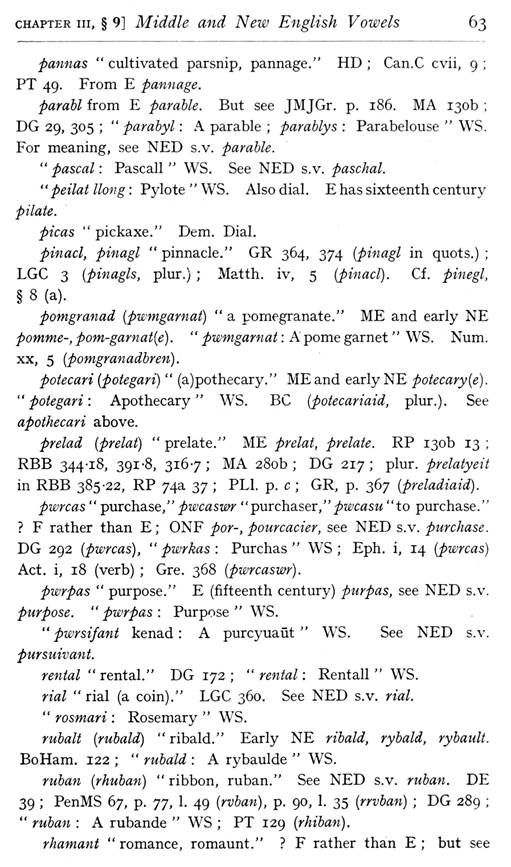
(delwedd F6814) (tudalen 063)
|
CHAPTER
III, § 9] Middle and New English Vowels 63
pannas “cultivated parsnip, pannage." HD; Can.C cvii, 9; PT 49. From E
pannage.
parahl from E parable. But see JMJGr. p. 186. MA 130b; DG 29, 305; “parabyl:
A parable; par ably s: Parabelouse “WS. For meaning, see NED s.v. parable.
" pascal: Pascall “WS. See NED s.v. paschal.
" Peilat Hong: Pylote “WS. Also dial. E has sixteenth century pilate.
picas “pickaxe." Dem. Dial.
pinacl, pinagl “pinnacle." GR 364, 374 [pinagl in quots.); LGC 3
(pinagls, plur.); Matth. iv, 5 {pinacl). Cf. pinegl, § 8 (a).
pomgranad {pwmgarnat) “a pomegranate." ME and early NE pomme-, pom-gam
at[e). “pwmgarnat: A pome garnet “WS. Num. XX, 5 [potngranadbren).
potecari {potegari)” (a)pothecary." ME and early NE potecary{e).
“potegari: Apothecary" WS. BC {potecariaid, plur.). See apothecari
above.
prelad [prelat] “prelate." ME prelat, prelate. RP 130b 13; RBB 344-18,
391-8, 316-7; MA 280b; DG 217; plur. prelatyeit in RBB 385-22, RP 74a 37;
PLl. p. c; GR, p. 367 {preladiaid).
pwrcas “purchase," pwcasmr “purchaser," _/)Z£^c«sw "to
purchase."? F rather than E; ONF por- , pourcacier , see NED s.v.
purchase. DG 292 [pwrcas], “pwrkas: Purchas “WS; Eph. i, 14 [pwrcas) Act. i,
18 (verb); Gre. 368 [pwrcas wr).
pwrpas “purpose." E (fifteenth century) purpas, see NED s.v. purpose,
"pwrpas: Purpose" WS.
" pwrsifant kenad: A purcyuaut “WS. See NED s.v. pursuivant.
rental “rental." DG 172; “rental: Rentall “WS.
rial “rial (a coin)." LGC 360. See NED s.v. rial.
" rosmari: Rosemary “WS.
rubalt [rubald) “ribald." Early NE ribald, rybald, rybaidi. Bo Ham. 122;
“rubald: A rybaulde “WS.
rttban [rhuban) “ribbon, ruban." See NED s.v. ruban. DE 39; PenMS 67, p.
77, 1. 49 [rvban), p. 90, 1. 35 [rrvban); DG 289; “ruban: A rubande “WS; PT
129 [rhiban).
rhamant "romance, romaunt."? F rather than E; but see
|
|
|
|
|
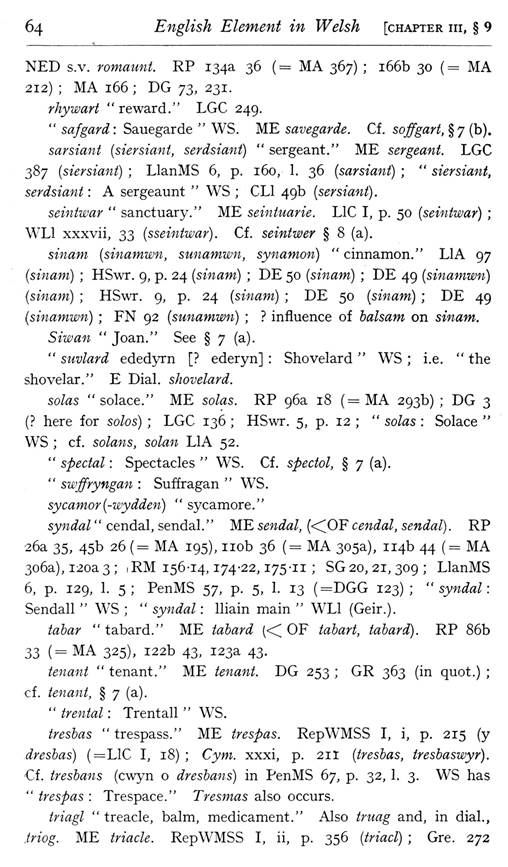
(delwedd F6815) (tudalen 064)
|
64
English Element in Welsh [chapter hi, § 9
NED s.v. romaunt. RP 134a 36 (= MA 367); i66b 30 (= MA 212); MA 166; DG y^,
231.
rhywart “reward." LGC 249.
" safgard: Sauegarde “WS. ME savegarde. Cf. soffgart, §7 (b).
sarsiant [siersiant, serdsiant) “sergeant." ME sergeant. LGC 387
(siersiant); LlanMS 6, p. 160, 1. 36 (sarsiant); “siersiant, serdsiant: A
sergeaunt “WS; CLl 49b (sersiant).
seintwar “sanctuary." ME seintuarie. LlC I, p, 50 (seintwar); WLl
xxxvii, 33 (sseintwar) . Cf. seintwer § 8 (a).
sinam (sinamwn, sunamwn, synamon) “cinnamon." LIA 97 (sinam);
HSwr. 9, p. 24 (sinam); DE 50 (sinam); DE 49 (sinamwn) (sinam); HS\\t. 9, p.
24 (sinam); DE 50 (sinajn); DE 49 (sinamwn); FN 92 (sunamwn);? influence of
balsam on sinam.
Siwan
“Joan." See § 7 (a).
" suvlard ededyrn [? ederyn]: Shovelard “WS; i.e. “the sho velar." E Dial. sJwvelard.
solas "solace." ME solas. RP 96a 18 (= MA 293b); DG 3 (? here for
solos); LGC 136; HSwr. 5, p. 12; “solas: Solace “WS; cf. solans, solan LIA
52.
" special:
Spectacles “WS. Cf. spectol, § 7 (a).
" swffryngan: Suffragan “WS.
sycamor (-wydden) “sycamore."
syndal “cendal, sendal." ME sendal, (<COF cendal, sendal). RP 26a 35,
45b 26 (= MA 195), nob 36 (= MA 305a), 114b 44 (= MA 306a), i2oa3; iRM
156-14, 174-22, 175-11; SG20, 21, 309; LlanMS 6, p. 129, 1. 5; PenMS 57, p.
5, 1. 13 (=DGG 123); "syndal: Sendall “WS; “syndal: lliain main “WLl
(Geir.).
tabar “tabard." ME tabard (< OF tabart, tabard). RP 86b 33 (= MA
325), 122b 43, 123a 43.
tenant “tenant." ME tenant. DG 253; GR 363 (in quot.); cf. tenant, § 7
(a).
" trental: Trentall “WS.
tresbas “trespass." ME trespas. RepWMSS I, i, p. 215 (y dresbas) (=L1C
I, 18); Cym. xxxi, p. 21I (tresbas, tresbaswyr). Cf. tresbans (cwyn o
dresbans) in PenMS 67, p. 32, 1. 3. WS has “trespas: Trespace." Tresmas
also occurs.
triagl “treacle, balm, medicament." Also triiag and, in dial., iriog. ME
triacle. RepWMSS I, ii, p. 356 (triad); Gre. 272
|
|
|
|
|
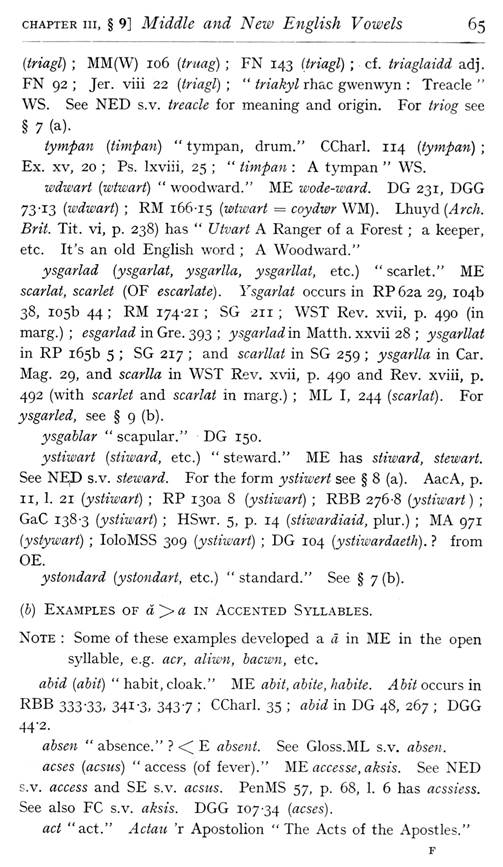
(delwedd F6816) (tudalen 065)
|
CHAPTER
III, § 9] Middle and New English Vowels 65
(iriagl); MM(W) 106 {truag); FN 143 itriagl); cf. triaglaidd adj. FN 92; Jer.
viii 22 (iriagl)] “triakyl rhciC gwenwyn: Treacle" WS. See NED s.v.
treacle for meaning and origin. For triog see
§ 7 (a).
tympmi [timpan) “tympan, drum." CCharl. 114 [tympan]; Ex. XV, 20; Ps.
Ixviii, 25; “timpan: A tympan “WS.
wdwart (wtwart) “woodward." ME wode-ward. DG 231, DGG 73-13 {wdwart); RM
166-15 [wtwart = coydwr WM). Lhuyd [Arch. Brit. Tit. vi, p. 238) has “Utvart
A Ranger of a Forest; a keeper, etc. It's an old English word; A
Woodward."
ysgarlad [ysgarlat, ysgarlla, ysgarllat, etc.) “scarlet." ME scarlat,
scarlet (OF escarlate) . Ysgarlat occurs in RP 62a 29, 104b 38, 105b 44; RM
174-21; SG 211; WST Rev. xvii, p. 490 (in marg.); esgarlad in Gre. 393;
ysgarladm Matth. xxvii 28; ysgarllat in RP 165b 5; SG 217; and scarllat in SG
259; ysgarlla in Car. Mag. 29, and scarlla in WST Rev. xvii, p. 490 and Rev.
xviii, p. 492 (with scarlet and scarlat in marg.); ML I, 244 [scarlat). For
ysgarled, see § 9 (b).
ysgablar “scapular." DG 150.
ystiwart [stiward, etc.) “steward." ME has stiward, Stewart. See NED
s.v. steward. For the form ystiwert see § 8 (a). AacA, p. II, 1. 21
[ystiwart); RP 130a 8 [ystiwart); RBB 276-8 [ystiwart); GaC 138-3 [ystiwart);
HSwr. 5, p. 14 [stiwardiaid, plur.); MA 971 iy sty wart); loloMSS 309
[ystiwart); DG 104 [ystiwardaeth).? from OE.
ystondard [ystondart, etc.) “standard." See § 7 (b).
[b) Examples of a >> “in Accented Syllables.
Note: Some of these examples developed a a in ME in the open syllable, e.g.
acr, aliwn, hacwn, etc.
ahid [ahit) “habit, cloak." ME ahit, abite, habite. Abit occurs in RBB
333-33, 341-3, 343-7; CCharl. 35; abid in DG 48, 267; DGG 44-2.
absen “absence."? <C E absent. See Gloss. ML s.v. absen.
acses [acsus) "access (of fever)." ME accesse,aksis. See NED s.v.
access and SE s.v. acsus. PenMS 57, p. 68, 1. 6 has acssiess. See also FC
s.v. aksis. DGG 107-34 [acses).
act "act." Actau 'r Apostolion “The Acts of the Apostles."
F
|
|
|
|
|
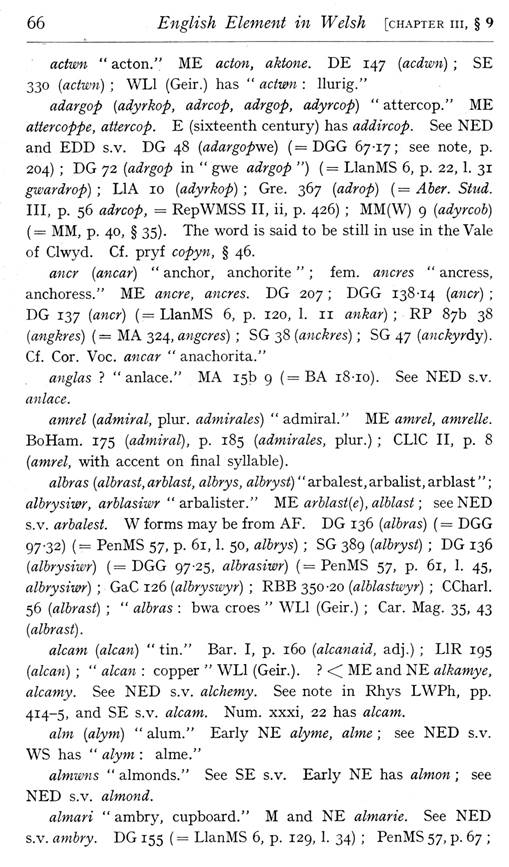
(delwedd F6817) (tudalen 066)
|
66
English Element in Welsh [chapter in, § 9
adwn “acton." ME acton, aktone. DE 147 [acdwn); SE 330 (actwn); WLl
(Geir.) has “actwn: llurig."
adargop [adyrkop, adrcop, adrgop, adyrcop) “attercop." ME attercoppe,
attercop. E (sixteenth century) has addircop. See NED and EDD s.v. DG 48
{adargopwe) (= DGG 67-17; see note, p. 204); DG 72 [adrgop in “gwe adrgop
") (= LlanMS 6, p. 22, 1. 31 gwardrop); LI A 10 [adyrkop); Gre. 367
[adrop) (= Aher. Stud. Ill, p. 56 adrcop, = RepWMSS II, ii, p. 426); MM(W) 9
[adyrcoh) [= MM, p. 40, § 35). The word is said to be still in use in the
Vale of Clwyd. Cf. pryf copyn, § 46.
ancr [ancar) “anchor, anchorite”; fern, aiicres “ancress, anchoress." ME
ancre, ancres. DG 207; DGG 138-14 [ancr); DG 137 [ancr) (= LlanMS 6, p. 120,
1. 11 ankar); RP 87b 38 [angkres) [= MA 324, angcres); SG 38 [anckres); SG 47
[anckyrdy). Cf. Cor. Voc. ancar “anachorita."
anglas? “anlace." MA 15b 9 (=BA 18-10). See NED s.v. anlace.
amrel [admiral, plur. admirales) “admiral." ME amrel, amrelle. BoHam.
175 [admiral), p. 185 [admirales, plur.); CLIC II, p. 8 [amrel, with accent
on final syllable).
albras [albrast,arblast, albrys, albryst) “arbalest, arbalist,arblast";
albrysimr, arS/as^W “arbalister." ME arblast[e) , alblast; see NED s.v.
arbalest. W forms may be from AF. DG 136 [albras) [ = DGG 97.32) (= PenMS 57,
p. 61, 1. 50, albrys); SG 389 [albryst); DG 136 [albrysiwr) (= DGG 97-25,
albrasiwr) (= PenMS 57, p. 61, 1. 45, albrysimr); GaC 126 [albryswyr); RBB
350-20 [alblastwyr); CCharl. 56 [albrast); “albras: bwa croes “WLl (Geir.);
Car. Mag. 35, 43 [albrast).
alcam [alcan) "tin." Bar. I, p. 160 [alcanaid, adj.); LIR 195
[alcan); "alcan: copper “WLl (Geir.).? <^ ME a.nd'N'E alkamye,
alcamy. See NED s.v. alchemy. See note in Rhys LWPh, pp. 414-5, and SE s.v.
alcam. Num. xxxi, 22 has alcam.
aim [alym) “alum." Early NE alyme, alme; see NED s.v. WS has “alym:
alme."
almwns “almonds." See SE s.v. Early NE has almon; see NED s.v. almond.
almari “ambry, cupboard." M and NE almarie. See NED s.v. ambry. DG 155
(= LlanMS 6, p. 129, 1. 34); PenMS 57, p. 67;
|
|
|
|
|
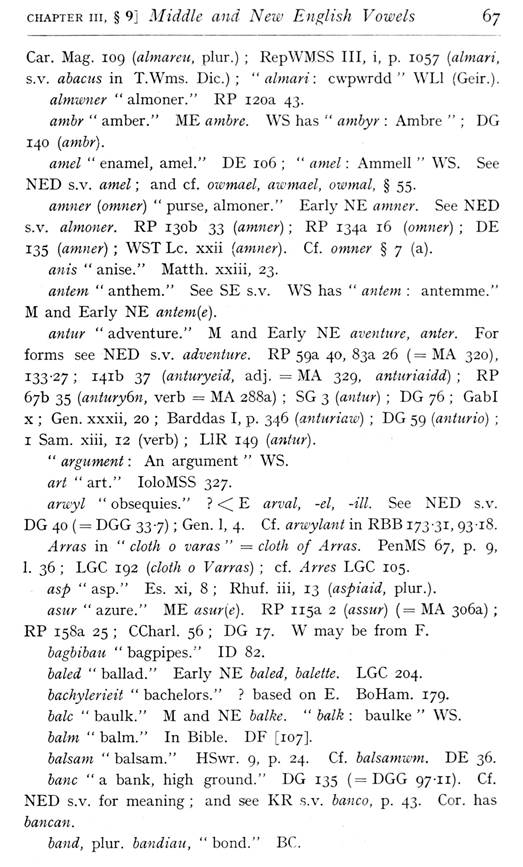
(delwedd F6818) (tudalen 067)
|
CHAPTER
III, § 9] Middle and New English Vowels 67
Car. Mag. 109 {ahnareti, plur.); RepWMSS III, i, p. 1057 {<^lmayi, s.v.
abacus in T.Wms. Die); “almari: cwpwrdd “WLl (Geir.).
almwner “almoner." RP 120a 43.
ambr “amber." ME ambre. WS has “ambyr: Ambre”; DG 140 (ambr).
amel “enamel, amel." DE 106; “amel: Ammell “WS. See NED s.v. amel; and
cf. owmael, awmael, owmal, § 55.
amner [omner] “purse, almoner." Early NE amner. See NED s.v. almoner. RP 130b 33
{amner); RP 134a 16 {omner); DE 135 {amner); WST Lc. xxii {amner). Cf. omner § 7 (a).
anis “anise." Matth. xxiii, 23.
antem “anthem." See SE s.v. WS has “antem: antemme." M and Early NE
antem{e).
aniur “adventure." M and Early NE aventure, anter. For forms see NED
s.v. adventure. RP 59a 40, 83a 26 (= MA 320), 133 "27; 141b 37
{anturyeid, adj. = MA 329, anturiaidd); RP 67b 35 {antury6n, verb = MA 288a);
SG 3 {antur); DG 76; GabI X; Gen. xxxii, 20; Barddas I, p. 346 {anturiaw); DG
59 {anturio); I Sam. xiii, 12 (verb); LIR 149 {antur).
" argument: An argument “WS.
art "art." loloMSS 327.
arwyl “obsequies."? <C E arval, -el, -ill. See NED s.v. DG 40 (= DGG
337); Gen. 1, 4. Cf. arwylant in RBB 173-31, 93-18.
Arras in “cloth varas” — cloth of Arras. PenMS 67, p. 9, 1. 36; LGC 192
{cloth Varras); cf. Arres LGC 105.
asp “asp." Es. xi, 8; Rhuf. iii, 13 {aspiaid, plur.).
asur “azure." ME asur{e). RP 115a 2 {assur) (= MA 306a); RP 158a 25;
CCharl. 56; DG 17. W may be from F.
bagbibau “bagpipes." ID 82.
baled “ballad." Early NE baled, balette. LGC 204.
bachylerieit “bachelors."? based on E. BoHam. 179.
bale “baulk." M and NE balke. “balk: baulke “WS.
balm “balm." In Bible. DF [107].
balsam “balsam." HSwr. 9, p. 24. Cf. balsamwm. DE 36.
banc "a bank, high ground." DG 135 (=DGG 97-11). Cf. NED s.v. for
meaning; and see KR s.v. banco, p. 43. Cor. has bancan.
band, plur. bandiau, “bond." BC.
|
|
|
|
|
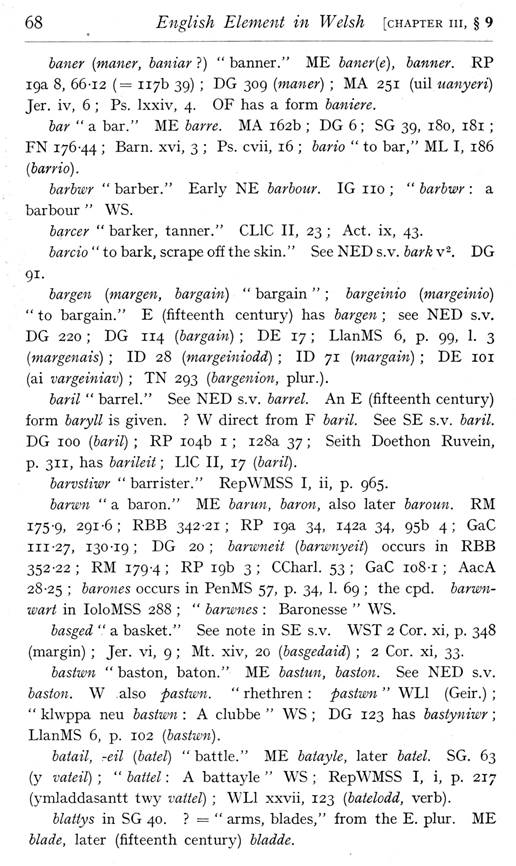
(delwedd F6819) (tudalen 068)
|
68
English Element in Welsh [chapter hi, § 9
haner {maner, haniar?) “banner." ME haner{e), banner. RP 19a 8, 66-12 (=
117b 39); DG 309 [maner); MA 251 (uil uanyeri) Jer. iv, 6; Ps. Ixxiv, 4. OF
has a form haniere.
bar “a bar." ME barre. MA 162b; DG 6; SG 39, 180, 181; FN 176-44; Barn,
xvi, 3; Ps. cvii, 16; bario “to bar," ML I, 186 (barrio).
barbwr “barber." Early NE barbour. IG no; “barbwr: a barbour" WS.
barcer “barker, tanner." CLIC II, 23; Act. ix, 43.
barcio “to bark, scrape off the skin." See NED s.v. bark v^. DG 91.
bar gen [mar gen, bargain) “bargain”; bargeinio [margeinio) “to
bargain." E (fifteenth century) has bar gen; see NED s.v, DG 220; DG 114
[bargain); DE 17; LlanMS 6, p. 99, 1. 3 [margenais); ID 28 [margeiniodd); ID
71 [margain); DE loi (ai vargeiniav); TN 293 [bargenion, plur.).
baril “barrel." See NED s.v. barrel. An E (fifteenth century) form
baryll is given.? W direct from F baril. See SE s.v. baril. DG 100 [baril);
RP 104b i; 128a 37; Seith Doethon Ruvein, p. 311, has barileit; LlC II, 17
[baril).
barvstiwr “barrister." RepWMSS I, ii, p. 965.
barwn “a baron." ME barun, baron, also later baroun. RM 175-9, 291-6;
RBB 342-21; RP 19a 34, 142a 34, 95b 4; GaC III -27, 130-19; DG 20; barwneit
[barwiiyeit) occurs in RBB 352-22; RM 1794; RP 19b 3; CCharl. 53; GaC 108 -i;
AacA 28-25 '' bar ones occurs in PenMS 57, p. 34, 1. 69; the cpd. barwn-wart
in loloMSS 288; “barwnes: Baronesse “WS.
basged “a basket." See note in SE s.v. WST 2 Cor. xi, p. 348 (margin);
Jer. vi, 9; Mt. xiv, 20 [basgedaid); 2 Cor. xi, 33.
bastwn “baston, baton." ME bastun, baston. See NED s.v. basto7i. W also
pastwn. “rhethren: pastwn “WLl (Geir.); “klwppa neu bastwn: A clubbe “WS; DG
123 has bastyniwr; LlanMS 6, p. 102 [bastwn).
batail, -eil (batel) “battle." ME batayle, later batel. SG. 63 (y
vateil); “battel: A battayle “WS; RepWMSS I, i, p. 217 (ymladdasantt twy
vattel); WLl xxvii, 123 [baielodd, verb).
blattys in SG 40.? = “arms, blades," from the E, plur. ME blade, later
(fifteenth century) bladde.
|
|
|
|
|
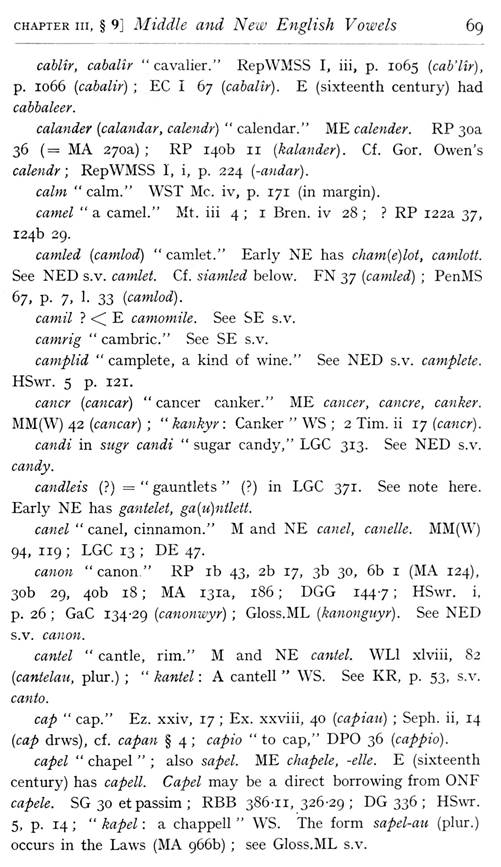
(delwedd F6820) (tudalen 069)
|
CHAPTER
III, § 9] Middle and New English Vowels 69
cahlir, cabalir "cavalier." RepWMSS I, iii, p. 1065
[cab'lir), p. 1066 [cabalir); EC I 67 [cabalir). E (sixteenth century) had
cabbaleer.
calander [calandar, calendr) “calendar." ME calender. RP 30a 36 (= MA
270a); RP 140b II [kalander). Cf. Gor. Owen's calendr; RepWMSS 1, i, p. 224
[-andar).
calm “calm." WST Mc. iv, p. 171 (in margin).
camel “a camel." Mt. iii 4; i Bren. iv 28;? RP 122a ^y, 124b 29.
camled [camlod) “cam.let." Early NE has cham[e)lot, camlott. See NED
s.v. camlet. Cf. siamled below. FN 37 [camled); PenMS ^7> P- 7' 1- 33
[camlod).
camil? <C E camomile. See SE s.v.
camrig “cambric." See SE s.v.
camplid “camplete, a kind of wine." See NED s.v. camplete. HSwr. 5 p.
121.
cancr [cancar) “cancer canker." ME cancer, cancre, canker. MM(W) 42
[cancar); “kankyr: Canker “WS; 2 Tim. ii 17 [cancr).
candi in sugr candi “sugar candy," LGC 313. See NED s.v. candy.
candleis (?) = “gauntlets” (?) in LGC 371. See note here. Early NE has
gantelef, ga[u)ntlett.
canel “canel, cinnamon." M and NE canel, canelle. MM(\V) 94, 119; LGC
13; DE 47.
canon "canon" RP ib 43, 2b 17, 3b 30, 6b i (MA 124), 30b 29, 40b
18; MA 131a, 186; DGG 1447; HSwr. i. p. 26; GaC 134-29 [canonwyr); Gloss. ML
[kanonguyr). See NED s.v. canon.
cantel “cantle, rim." M and NE cantel. WLl xlviii, 82 [cantelau, plur.);
“kantel: A cantell “WS. See KR, p. 53, s.v. canto.
cap “cap." Ez. xxiv, 17; Ex. xxviii, 40 [capian); Seph. ii, 14 [cap
drws), cf. capan § 4; capio “to cap," DPO 36 [cappio).
capel “chapel”; also sapel. ME chapele, -elle. E (sixteenth century) has
capell. Capel may be a direct borrowing from ONE capele. SG 30 et passim; RBB
386-11, 326-29; DG 336; HSwr. 5, p. 14; “kapel: a chappell “WS. The form
sapel-au (plur.) occurs in the Laws (MA 966b); see Gloss. ML s.v.
|
|
|
|
|
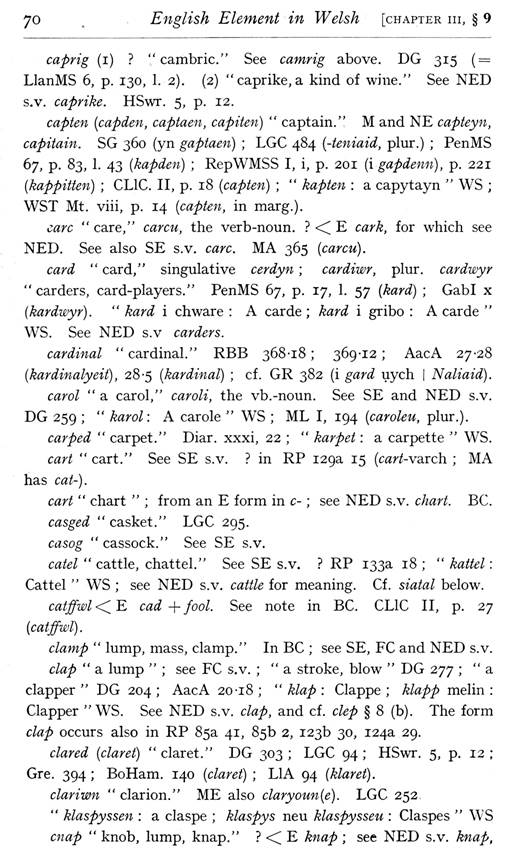
(delwedd F6821) (tudalen 070)
|
70 ,
English Element in Welsh [chapter m, § 9
caprig (i)? "cambric." See camrig above. DG 315 ( = LlanMS 6, p.
130, 1. 2). (2) "caprike, a kind of wine." See NED s.v. caprike.
HSwr. 5, p. 12.
capten [capden, captaen, capiten) “captain." M and NE capteyn, capitain.
SG 360 (yn gaptaen); LGC 484 [-teniaid, plur.); PenMS 67, p. 83, 1. 43
{kapden); RepWMSS I, i, p. 201 (i gapdenn), p. 221 {kappitten); CLIC. II, p.
18 {capten); “hapten: a capytayn “WS; WST Mt. viii, p. 14 [capten, in marg.).
jarc “care," carcw, the verb-noun.? <C E cark, for which see NED. See
also SE s.v. care. MA 365 (carcu).
card “card," singulative cerdyn; cardiwr, plur. cardwyr “carders,
card-players." PenMS 67, p. 17, 1. 57 (^artf); GabI x (kardwyr). “kard i
chware: A carde; kard i gribo: A carde “WS. See NED s.v carders.
cardinal “cardinal." RBB 368-18; 369-12; AacA 27-28 (kardinalyeit) ,
28-5 [kardinal); cf. GR 382 (i gard uych | Naliaid).
carol “a carol," caroli, the vb.-noun. See SE and NED s.v. DG 259;
“karol: A carole “WS; ML I, 194 [caroleu, plur.).
carped “carpet." Diar. xxxi, 22; “karpet: a carpette “WS.
cart “cart." See SE s.v.? in RP 129a 15 {cart-vaich; MA has cat-).
cart “chart”; from an E form in c-; see NED s.v. chart. BC.
casged “casket." LGC 295.
casog “cassock." See SE s.v.
catel “cattle, chattel." See SE s.v.? RP 133a 18; “kattel: Cattel “WS;
see NED s.v. cattle for meaning. Cf. siatal below.
catffwl<^E cad + fool. See note in BC. CLIC II, p. 27 (catffwl).
clamp “lump, mass, clamp." In BC; see SE, FC and NED s.v.
clap “a lump”; see FC s.v.; “a stroke, blow “DG 277; “a clapper" DG 204;
AacA 20-18; “klap: Clappe; klapp melin: Clapper “WS. See NED s.v. clap, and
cf. clep § 8 (b). The form clap occurs also in RP 85a 41, 85b 2, 123b 30,
124a 29.
dared [claret) “claret." DG 303; LGC 94; HSwr. 5, p. 12; Gre. 394;
BoHam. 140 [claret); LIA 94 [klaret).
clariwn “clarion." ME also clary oun[e). LGC 252
" klaspyssen: a claspe; klaspys neu klaspysseu: Claspes “WS
cnap “knob, lump, knap."? <C E knap; see NED s.v. knap,
|
|
|
|
|
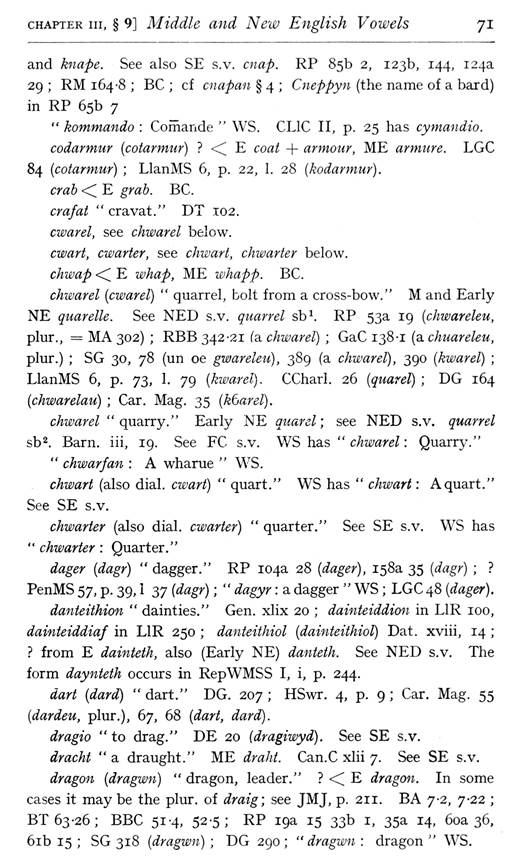
(delwedd F6822) (tudalen 071)
|
CHAPTER
III, § 9] Middle and New English Vowels 71
and knape. See also SE s.v. cnap. RP 85b 2, 123b, 144, 124a 29; RM 164-8; BC;
cf cnapan § 4; Cneppyn (the name of a bard) in RP 65b 7
" kommando: Comande “WS, CLIC II, p. 25 has cymandio.
codarmur {cotarmur)? <; E coat + armour, ME armure. LGC 84 {cotarmur);
LlanMS 6, p. 22, 1. 28 [kodarmur).
crab <C. E ^g'/aJ. BC.
crafat “cravat." DT 102.
cwarel, see chwarel below.
cwart, cwarter, see chwart, chwarter below.
chwap <^ E whap, ME whapp. BC.
chwarel (cwarel) “quarrel, bolt from a cross-bow." M and Early NE
quarelle. See NED s.v. quarrel sb^. RP 53a 19 [chwareleu, plur., = MA 302);
RBB 342-21 fa chwarel); GaC 138 -i (a chuareleu, plur.); SG 30, 78 (un oe
gwareleu), 389 (a chwarel), 390 (kwarel); LlanMS 6, p. 73, 1. 79 (kwarel).
CCharl. 26 (quarel); DG 164 (chwarelau); Car. Mag. 35 (k6arel).
chwarel "quarry." Early NE quarel] see NED s.v. quarrel sb^. Barn,
iii, 19. See FC s.v. WS has "chwarel: Quarry."
" chwarfan: A wharue “WS.
chwart (also dial, cwart) “quart." WS has “chwart: A quart." See SE
s.v.
chwarter (also dial, cwarter) “quarter." See SE s.v. WS has “chwarter:
Quarter."
dager (dagr) “dagger." RP 104a 28 (dager), 158a 35 (dagr);? PenMS 57, p.
39, i 37 (dagr); “dagyr: a dagger “WS; LGC 48 (dager).
danteithion “dainties." Gen. xlix 20; dainteiddion in LIR 100,
dainteiddiaf in LIR 250; danteithiol (dainteithiol) Dat. xviii, 14;? from E
dainteth, also (Early NE) danteth. See NED s.v. The form daynteth occurs in
RepWMSS I, i, p. 244.
dart (dard) “dart." DG. 207; HSwr. 4, p. 9; Car. Mag. 55 (dardeu,
plur.), 67, 68 (dart, dard).
dragio "to drag." DE 20 (dragiwyd). See SE s.v.
dracht “a draught." ME draht. Can.C xlii 7. See SE s.v.
dragon (dragwn) “dragon, leader."? <C E dragon. In some cases it may
be the plur. of draig; see JMJ, p. 211. BA 7-2, 7-22; BT 63-26; BBC 51-4,
52-5; RP 19a 15 33b I, 35a 14, 60a 36, 6ib 15; SG 318 (dragwn); DG 290;
"dragwn: dragon “WS.
|
|
|
|
|
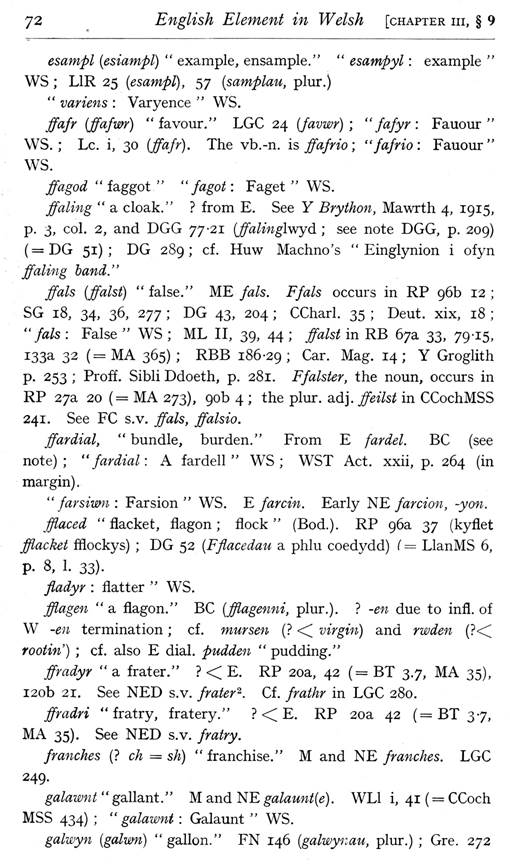
(delwedd F6823) (tudalen 072)
|
72
English Element in Welsh [chapter hi, § 9
esampl {esiampl) “example, ensample." “esampyl: example “WS; LIR 25
{esampl), 57 [samplau, plur.)
" variens: Varyence “WS.
ffafy {ffafwr) "favour." LGC 24 (favwr); “fafyr: Fauour “WS.; Lc.
i, 30 {ffafr). The vb.-n. is ffafrio; “fafrio: Fauour “WS.
ffagod “faggot” "fagot: Faget “WS.
ffaling “a cloak."? from E. See Y Brython, Mawrth 4, 1915, p. 3, col. 2,
and DGG 77-21 (ffaliitgVwyd; see note DOG, p. 209) (=DG 51); DG 289; cf. Huw
Machno's “Einglynion i ofyn ffaling band."
ffals iffalst) “false." ME fals. Ffals occurs in RP 96b 12; SG 18, 34,
36, 277; DG 43, 204; CCharl. 35; Deut. xix, 18; "fals: False “WS; ML II,
39, 44; ffalst in KB 67a 33, 79-15, 133a 32 (= MA 365); RBB 186-29 > Car.
Mag. 14; Y Groglith p. 253; Proff. Sibli Ddoeth, p. 281. Ffalster, the noun,
occurs in RP 27a 20 (= MA 273), 90b 4; the plur. adj. ffeilst in CCochMSS
241. See FC s.v. ffals, ffalsio.
ffardial, “bundle, burden." From E fardel. BC (see note); “fardial: A
fardell “WS; WST Act. xxii, p. 264 (in margin).
" farsiwn'. Farsion “WS. E farcin. Early NE farcion, -yon.
fflaced “fiacket, flagon; flock” (Bod.). RP 96a 37 (kyflet fflacket
fflockys); DG 52 {Fflacedau a phlu coedydd) (= LlanMS 6, p. 8, 1. 33).
fladyr: flatter “WS.
fflagen "a flagon." BC {fflagenni, plur.).? -en due to infl. of W
-en termination; cf. mursen (? <^ virgin) and rwden (?<^ footin'); cf.
also E dial, pudden “pudding."
ffradyr “a frater."? < E. RP 20a, 42 (= BT 3.7, MA 35), i2ob 21. See
NED s.v. frater"^. Cf. frathr in LGC 280.
ffradri “fratry, fratery."? < E. RP 20a 42 (= BT 3-7, MA 35). See NED
s.v. fratry.
franches (? ch = sh) “franchise." M and NE franches. LGC 249.
galawnt “gallant." M and NE galaunt{e). WLl i, 41 (= CCoch MSS 434);
“galaimit: Galaunt “WS.
galwyn {galwn) "gallon." FN 146 {galwynau, plur.); Gre. 272
|
|
|
|
|
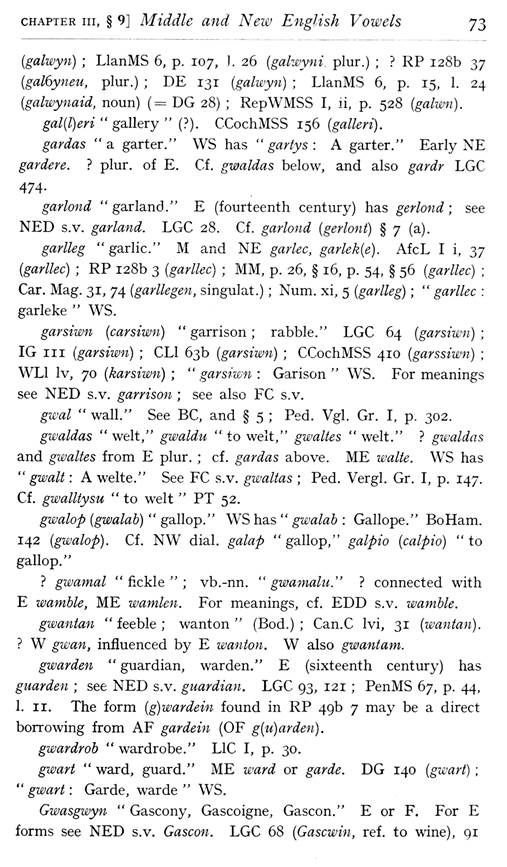
(delwedd F6824) (tudalen 073)
|
CHAPTER
III, § 9] Middle and New English Vowels 73
(galwyn); LlanMS 6, p. 107, ). 26 {galwyni. plur.);? RP 128b 37 {gal6yneu,
plur.); DE 131 (galwyn); LlanMS 6, p. 15, 1. 24 {galwynaid, noun) (= DG 28); RepWMSS
I, li, p. 528 [galwn),
gal{l)eri “gallery” (?). CCochMSS 156 (galleri).
gardas "a garter." WS has “gartys: A garter." Early NE
gardere.? plur. of E. Cf. gwaldas below, and also gardr LGC
474-
garlond “garland." E (fourteenth century) has gerlond; see NED s.v.
garland. LGC 28. Cf. garlond (gerlont) § 7 (a).
garlleg “garlic." M and NE garlec, garlek{e). AfcL I i, 37 (garllec); RP
128b 3 (garllec); MM, p. 26, § 16, p. 54, § 56 [garllec); Car. Mag. 31, 74
(garllegen, singulat.); Num. xi, 5 (garlleg); “garllec: garleke “WS.
garsiwn (carsiwn) "garrison; rabble." LGC 64 (garsiwn); IG III
(garsiwn); CLl 63b (garsiwn); CCochMSS 410 (garssiwn); WLl Iv, 70 (karsiwn);
“garsiwn: Garison “WS. For meanings see NED s.v. garrison; see also FC s.v.
gwal “wall." See BC, and § 5; Ped. Vgl. Gr. I, p. 302.
gwaldas "welt," gwaldu “to welt," gwaltes "welt."?
gwaldas and gwaltes from E plur.; cf. gardas above. ME walte. WS has “gwalt:
A welte." See FC s.v. gwaltas; Ped. Vergl. Gr. I, p. 147. Cf. gwalltysu
“to welt “PT 52,
gwalop (gwalah) “gallop." WS has “gwalab: Gallope." BoHam. 142
(gwalop). Cf. NW dial, galap “gallop," galpio (calpio) “to gallop."
? gwamal "fickle"; vb.-nn. “gwamalu."? connected with E
wamble, ME wamlen. For meanings, cf. FDD s.v. wamble.
gwantan "feeble; wanton" (Bod.); Can.C Ivi, 31 (wantan).? W gwan,
influenced by E wanton. W also gwantam.
gwarden “guardian, warden." E (sixteenth century) has guarden; see NED
s.v. guardian. LGC 93, 121; PenMS 67, p. 44, 1. II. The form (g)wardein found
in RP 49b 7 may be a direct borrowing from AF gardein (OF g(u)arden).
gwardrob “wardrobe." LlC I, p. 30.
gwart “ward, guard." ME ward or garde. DG 140 (gwart); “gwart: Garde,
warde “WS,
Gwasgwyn “Gascony, Gascoigne, Gascon." E or F. For E forms see NED s.v.
Gascon. LGC 68 (Gascwin, ref. to wine), 91
|
|
|
|
|
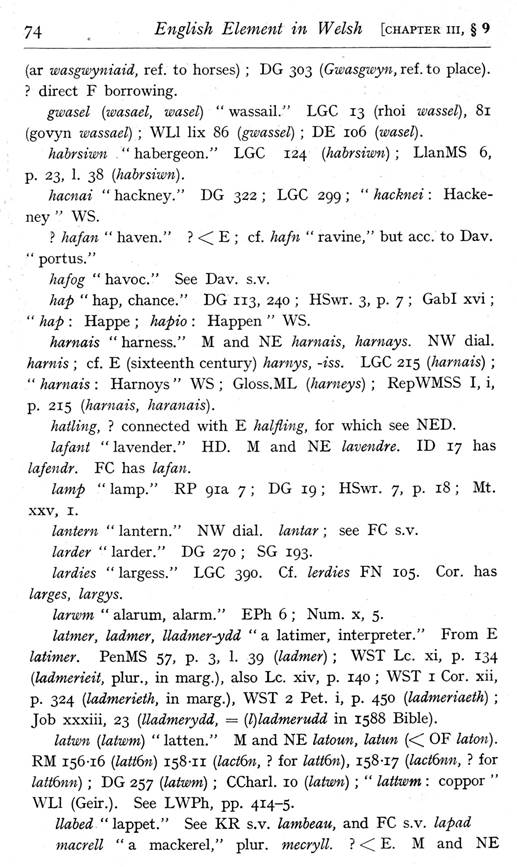
(delwedd F6825) (tudalen 074)
|
74
English Element in Welsh [chapter hi, § 9
(ar wasgwyniaid, ref. to horses); DG 303 {Gwasgwyn,rei. io place).? direct F
borrowing.
gwasel {wasael, wasel) “wassail." LGC 13 (rhoi wassel), 81 (govyn
wassael); WLl lix 86 (gwassel); DE 106 {wasel).
habrsiwn . “habergeon." LGC 124 [hahrsiwn); LlanMS 6, p. 23, 1. 38
[hahrsiwn).
hacnai “hackney." DG 322; LGC 299; “hacknei: Hackeney “WS.
? hafan “haven."? < E; cf. hafn “ravine," but ace. to Dav.
“portus."
hafog “havoc." See Dav. s.v.
hap “hap, chance." DG 113, 240; HSwr. 3, p. 7; GabI xvi; “hap: Happe;
hapio: Happen “WS.
harnais “harness." M and NE harnais, harnays. NW dial. harnis; cf. E
(sixteenth century) harnys, -iss. LGC 215 [harnais); "harnais: Harnoys
“WS; Gloss.ML [harneys); RepWMSS I, i, p. 215 [harnais, haranais).
hailing,? connected with E halfling, for which see NED.
lafant “lavender." HD. M and NE lavendre. ID 17 has lafendr. FC has
lafan.
lamp “lamp." RP 91a 7; DG 19; HSwr. 7, p. 18; Mt.
XXV, I.
lantern “lantern." NW dial, lantar; see FC s.v.
larder "larder." DG 270; SG 193.
lardies “largess." LGC 390. Cf. lerdies FN 105. Cor. has larges, largys.
larwm “alarum, alarm." EPh 6; Num. x, 5.
laimer, ladmer, lladmer-ydd “a latimer, interpreter." From E latimer.
PenMS 57, p. 3, 1. 39 [ladmer); WST Lc. xi, p. 134 [ladmerieit, plur,, in
marg.), also Lc. xiv, p. 140; WST i Cor. xii, p. 324 [ladmerieth, in marg.),
WST 2 Pet. i, p. 450 [ladmeriaeth); Job xxxiii, 23 [lladmerydd, =
[l)ladmerudd in 1588 Bible).
latwn [latwm) “latten." M and NE latoun, latun “OF laton). KM 156-16
[lattGn) 158-11 [lact6n,? for lattOii), 158-17 [lactGnn,? for lattGnn); DG
257 [latwm); CCharl. 10 [latwn); “lattwm: coppor “WLl (Geir.). See LWPh, pp.
414-5.
llabed “lappet." See KR s.v. lambeau, and FC s.v. lapad
macrell “a mackerel," plur. mecryll.? <C E. M and NE
|
|
|
|
|
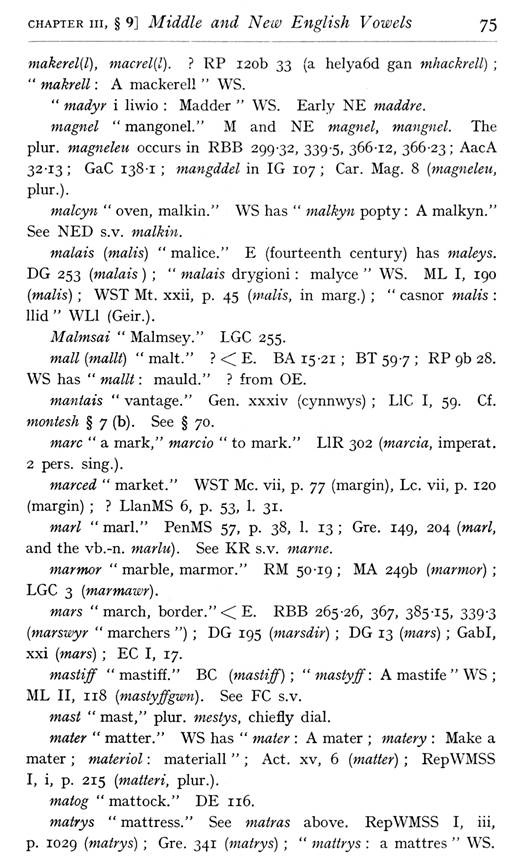
(delwedd F6826) (tudalen 075)
|
CHAPTER
III, § 9] Middle and New English Vowels 75
makerelil), macrel{l).? RP 120b 33 (a helya6d gan mhackrell); “makrell: A
mackerell “WS.
" madyr i liwio: Madder “WS. Early NE maddre.
magnet “mangonel." M and NE magnet, mangnet. The plur. magneteu occurs
in RBB 299-32, 339-5, 366-12, 366-23; AacA 32-13; GaC 138 -I; mangddet in IG
107; Car. Mag. 8 {magneteu, plur.).
matcyn “oven, malkin." WS has “matkyn popty: A malkyn." See NED
s.v. matkin.
malais [matis] “malice." E (fourteenth century) has matey s. DG 253
{matais ); “malais drygioni: malyce “WS. ML I, 190 {matis); WST Mt. xxii, p.
45 {matis, in marg.); “casnor matis: Hid" WLl (Geir.).
Matmsai “Malmsey." LGC 255.
matt{mallt) "malt."? < E. BA 15-21; BT 59-7; RP 9b 28. WS has
“math: mauld."? from OE.
mantais “vantage." Gen. xxxiv (cynnwys); LlC I, 59. Cf. montesh § 7 (b).
See § 70.
marc “a mark," marcio “to mark." LIR 302 {marcia, imperat. 2 pers.
sing.).
marced “market." WST Mc. vii, p. yy (margin), Lc. vii, p. 120 (margin);?
LlanMS 6, p. 53, 1. 31.
mart “marl." PenMS 57, p. 38, 1. 13; Gre. 149, 204 {mart, and the vb.-n.
martu). See KR s.v. marne.
marmor “marble, marmor." RM 50-19; MA 249b {marmor); LGC 3 {marmawr).
mars "march, border." <<E. RBB 265-26, 367, 385-15, 339-3
{marswyr “marchers "); DG 195 {marsdir); DG 13 {mars); GabI, xxi {mars);
EC I, 17.
mastiff "mastiff." BC {mastiff); "mastyff: A mastife “WS; ML
II, 118 {mastyffgwn). See FC s.v.
mast “mast," plur. mestys, chiefly dial.
mater “matter." WS has “mater: A mater; matery: Make a mater; material:
materiall”; Act. xv, 6 {matter); RepWMSS I, i, p. 215 {matteri, plur.).
matog “mattock." DE 116.
matrys “mattress." See matras above. RepWMSS I, iii, p. 1029 {matrys);
Gre. 341 {matrys); “mattrys: a mattres “WS.
|
|
|
|
|
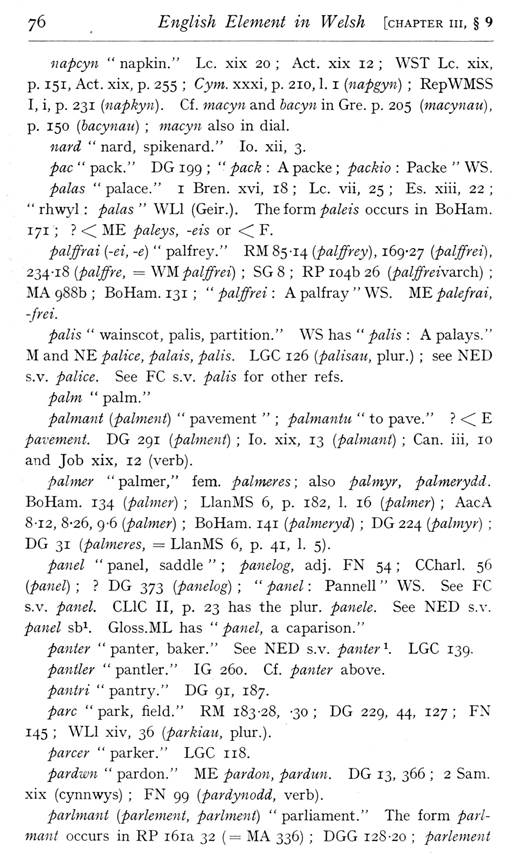
(delwedd F6827) (tudalen 076)
|
76
English Element in Welsh [chapter hi, § 9
napcyn “napkin." Lc. xix 20; Act. xix 12; WST Lc. xix, p. 151, Act. xix,
p. 255; Cym. xxxi, p. 210, 1. i [napgyn]; RepWMSS I, i, p. 231 {napkyn). Cf.
macyn and bacyn in Gre. p. 205 (macynau), p. 150 (bacynau); macyn also in
dial.
nard “nard, spikenard." lo. xii, 3.
pac “pack." DG 199; “pack: Apacke; packio: Packe “WS.
palas “palace." i Bren. xvi, 18; Lc. vii, 25; Es. xiii, 22; “rhwyl:
palas “WLl (Geir.). The iovm paleis occurs in BoHam. 171;? ■< ME
paleys, -eis or << F.
palffrai {-ei, -e) “palfrey." RM 85-14 {palffrey), 169-27 (palffrei),
234-18 {palffre, = WM palffrei); SG 8; RP 104b 26 [palffreivsuch); MA 988b;
BoHam. 131; “palffrei: A palfray “WS. ME palefrai, -frei.
palis “wainscot, palis, partition." WS has “palis: A palays." M and
NE palice, palais, palis. LGC 126 [palisaii, plur.); see NED s.v. palice. See
EC s.v. palis for other refs.
palm “palm."
palmant (palmeJit) “pavement”; palmantu “to pave."? <C E pavement. DG
291 {palment); lo. xix, 13 (palmant); Can. iii, 10 and Job xix, 12 (verb).
palmer "palmer," fem. palmeres; also palmyr, palmerydd. BoHam.
134 [palmer); LlanMS 6, p. 182, 1. 16 [palmer); AacA 8-12, 8*26, 9-6
[palmer); BoHam. 141 [palmeryd); DG 224 [palmyr); DG 31 [palmeres, = LlanMS
6, p. 41, 1. 5).
panel "panel, saddle"; panelog, adj. FN 54; CCharl. 56 (Panel);? DG
373 [panelog); “panel: Pannell “WS. See EC s.v. panel. CLIC H, p. 23 has the
plur. panele. See NED s.v. panel sb^. Gloss. ML has "panel, a
caparison."
panter “panter, baker." See NED s.v. panter'^. LGC 139.
pantler “pantler." IG 260. Cf. panter above.
pantri “pantry." DG 91, 187.
pare "park, field." RM 183-28, -30; DG 229, 44, 127; FN 145; WLl
xiv, 36 [parkiau, plur.).
parcer “parker." LGC 118.
pardwn “pardon." ME pardon, pardun. DG 13, 366; 2 Sam. xix (cynnwys); FN
99 [pardynodd, verb).
parlmant (parlement, parlment) “parliament." The form parlmant occurs in
RP i6ia 32 (= MA 336); DGG 128-20; parlement
|
|
|
|
|
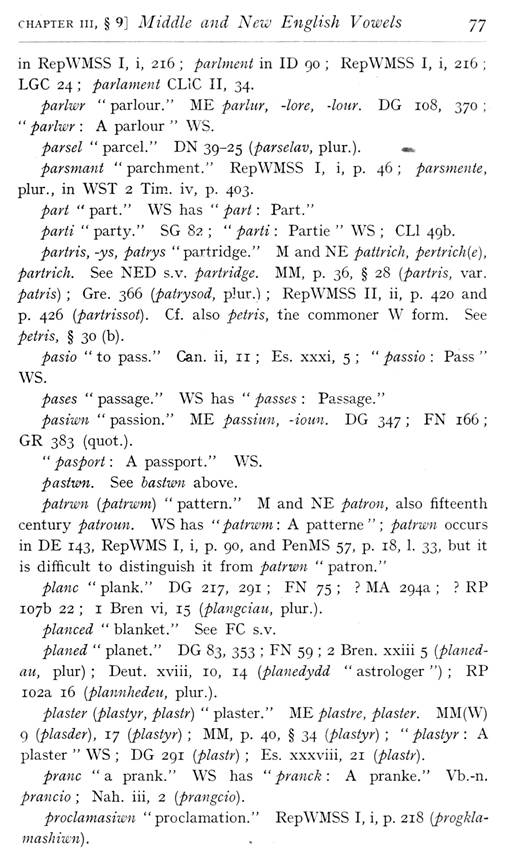
(delwedd F6828) (tudalen 077)
|
77CHAPTER III, § 9] Middle and New
English Vowels 77
in RepWMSS I, i, 216; parlment in ID 90; RepWMSS I, i, 216; LGC 24; parlament
CLIC II, 34.
parlwr "parlour." WE parlur, -lore, -lour. DG 108, 370 ^ “parlwr: A
parlour “WS.
parsel “parcel." DN 39-25 {parselav, plur.). «»,
parsmant “parchment." RepWMSS I, i, p. 46; parsmente, plur., in WST 2
Tim. iv, p. 403.
part "part." WS has "part: Part."
parti “party." SG 82; “parti: Partie “WS; CLl 49b.
partris, -ys, patrys "partridge." M and NE pattrich, pertrich{e),
partrich. See NED s.v. partridge. MM, p. 36, § 28 [partris, var. patris);
Gre. 366 [patrysod, plur.); RepWMSS II, ii, p. 420 and p. 426 (partrissot).
Cf. also petris, the commoner W form. See petris, § 30 (b).
pasio "to pass." Can. ii, 11; Es. xxxi, 5; “passio: Pass" WS.
pases "passage." WS has "passes: Passage."
pasiwn “passion." ME passiun, -ioun. DG 347; FN 166; GR 383 (quot.).
" pasport: A passport." WS.
pastwn. See hastwn above.
patrwn (patrwrn) “pattern." M and NE patron, also fifteenth century
patroun. WS has "patrwm: A patterne”; patrwn occurs in DE 143, RepWMS I,
i, p. 90, and PenMS 57, p. 18, 1. ^2, but it is difficult to distinguish it
from patrwn "patron."
plane “plank." DG 217, 291; FN 75;? MA 294a;? RP 107b 22; I Bren vi, 15
[plangciau, plur.).
planced “blanket." See FC s.v.
planed “planet." DG 83, 353; FN 59; 2 Bren. xxiii 5 [planedan, plur);
Deut. xviii, 10, 14 [planedydd “astrologer "); RP 102a 16 [plannhedeii,
plur.).
plaster [plastyr, plastr) “plaster," WE piastre, plaster. MM(W) 9
(plasder), 17 (plastyr); MM, p. 40, § 34 (plastyr); "plastyr: A plaster
“WS; DG 291 (plastr); Es. xxxviii, 21 (plastr).
pranc "a prank." WS has “pranck: A pranke." Vb.-n. prancio;
Nah. iii, 2 (prangcio).
proclamasiwn "proclamation." RepWMSS I, i, p. 218
(progklamashiwn).
|
|
|
|
|
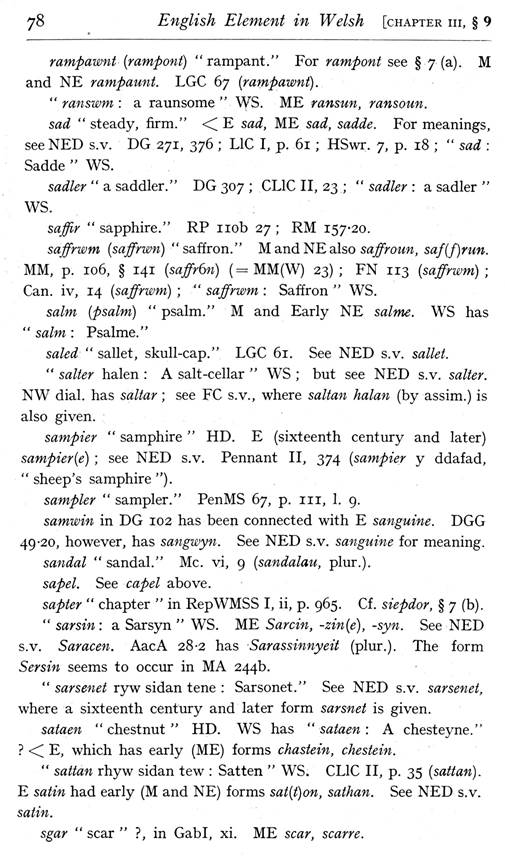
(delwedd F6829) (tudalen 078)
|
78yS English Element in Welsh [chapter
hi, § 9
rampawnt {rampont) "rampant." For rampont see § 7 (a). M and NE
rampaunt. LGC 67 (rampawnt).
" ranswm: a raunsome “WS. ME ransun, ransoun. sad “steady, firm."
<^ E sad, ME sad, sadde. For meanings, see NED s.v. DG 271, 376; LlC I, p.
61; HSwr. 7, p. 18; “sad: Sadde “WS.
sa^/^y “a saddler." DG 307; CLIC II, 23; “sadler: a sadler “WS.
saffir “sapphire." RP nob 27; RM 157-20. saffrwm [saffrwn)
"saffron." M and NE also so^roww, saf(f)run. MM, p. 106, § 141 (saffrGn)
(= MM(W) 23); FN 113 {saffrwm); Can. iv, 14 {saffrwm); “saffrwm: Saffron “WS.
salm {psalm) “psalm." M and Early NE salme. WS has “salm: Psalme."
saled “sallet, skull-cap." LGC 61. See NED s.v. sallet. “Salter halen: A
salt-cellar “WS; but see NED s.v. Salter. NW dial, has saltar; see FC s.v.,
where saltan halan (by assim.) is also given.
sampler “samphire “HD, E (sixteenth century and later) sampier{e); see NED
s.v. Pennant II, 374 {sampier y ddafad, “sheep's samphire ").
sampler “sampler." PenMS 67, p. in, 1. 9. samwin in DG 102 has been
connected with E sanguine. DGG 49-20, however, has sangwyn. See NED s.v.
sanguine for meaning. sandal “sandal." Mc. vi, 9 {sandalau, plur.).
sapel. See capel above.
sapter “chapter “in RepWMSS I, ii, p. 965. Cf. siepdor, § 7 (b). “sarsin: a
Sarsyn “WS. ME Sarcin, -zin{e), -syn. See NED s.v. Saracen. AacA 28-2 has
Sarassinnyeit (plur.). The form Sersin seems to occur in MA 244b.
" sarsenet ryw sidan tene: Sarsonet." See NED s.v. sarsenet, where
a sixteenth century and later form sarsnet is given.
sataen "chestnut" HD. WS has “sataen: A chesteyne."? <^ E,
which has early (ME) forms chastein, chestein.
" sattan rhyw sidan tew: Satten “WS. CLIC II, p. 35 {sattan). E satin
had early (M and NE) forms sat{t)on, sathan. See NED s.v. satin.
sgar “scar "?, in GabI, xi. ME scar, scarre.
|
|
|
|
|
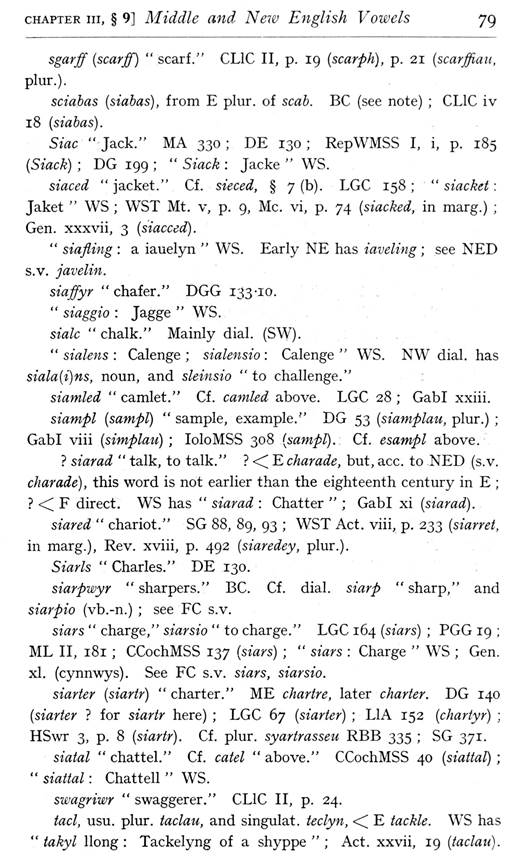
(delwedd F6830) (tudalen 079)
|
79CHAPTER III, § 9] Middle and New
English Vowels 79
sgarff [scarff) “scarf." CLIC II, p. 19 [scarph], p. 21 [scarffiau,
plur.).
sciahas (siabas), from E plur. of scab. BC (see note); CLIC iv 18 (siabas).
Siac "Jack." MA 330; DE 130; RepWMSS I, i, p. 185 {Siack); DG 199;
“Siack: Jacke “WS.
siaced “jacket." Cf. sieced, § 7 (b). LGC 158; “siacket: Jaket “WS; WST
Mt. v, p. 9, Mc. vi, p. 74 [slacked, in marg.); Gen. xxxvii, 3 (siacced).
" siafling: a iauelyn “WS. Early NE has iaveling; see NED s.v. javelin.
siaffyr “chafer." DGG 133-10.
" siaggio: Jagge “WS.
sialc “chalk." Mainly dial. (SW).
" sialens: Calenge; sialensio: Calenge “WS. NW dial, has siala{i)ns,
noun, and sleinsio “to challenge."
siamled “camlet." Cf. camled above. LGC 28; GabI xxiii.
siampi [sampl) “sample, example." DG 53 [siampiau, plur.); GabI viii
(simpiau); loloMSS 308 (sampi). Cf. esampl above.
? siarad “talk, to talk."? <C E charade, but, ace. to NED (s.v.
charade), this word is not earlier than the eighteenth century in E;? <^ F
direct. WS has “siarad: Chatter”; GabI xi (siarad).
siared “chariot." SG 88, 89, 93; WST Act. viii, p. 233 (siarret, in
marg.). Rev. xviii, p. 492 [siaredey, plur.).
Siarls “Charles." DE 130.
siarpwyr “sharpers." BC. Cf. dial, siarp “sharp," and siarpio
(vb.-n.); see EC s.v.
siars “charge," siarsio “to charge." LGC 164 (siars); PGG 19; ML
II, 181; CCochMSS 137 (siars); “siars: Charge “WS; Gen. xl. (cynnwys). See EC
s.v. siars, siarsio.
siarter (siartr) “charter." ME chartre, later charter. DG 140 (siarter?
for siartr here); LGC 67 (siarter); LIA 152 (chartyr); HSwr 3, p. 8 (siartr).
Cf. plur. syartrasseu RBB 335; SG 371.
siatal “chattel." Cf. catel “above." CCochMSS 40 (siattal);
“siattal: Chattell “WS.
swagriwr “swaggerer." CLIC II, p. 24.
tad, usu. plur. taclan, and singulat. teclyn, <^ E tackle. WS has “takyl
Hong: Tackelyng of a shyppe”; Act. xxvii, 19 (taclan).
|
|
|
|
|
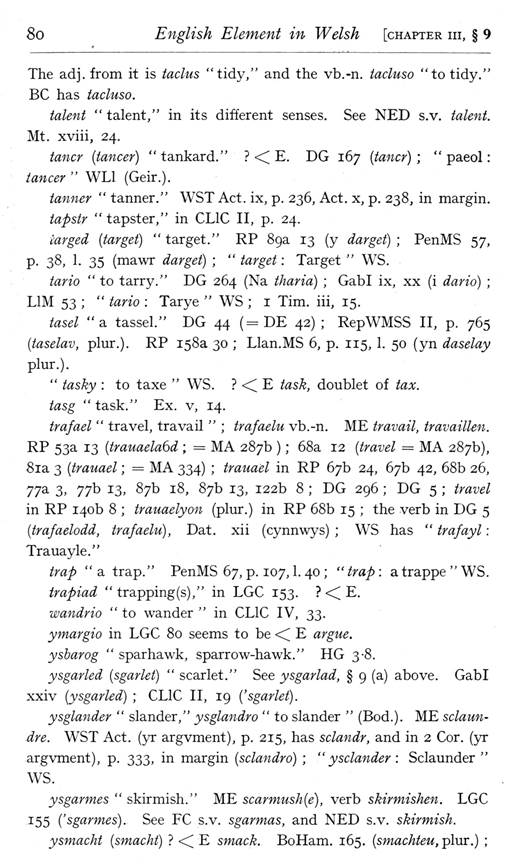
(delwedd F6831) (tudalen 080)
|
808o English Element in Welsh [chapter
hi, § 9
«
The adj. from it is taclus "tidy," and the vb.-n. tacluso "to
tidy." BC has tacluso.
talent “talent," in its different senses. See NED s.v. talent. Mt.
xviii, 24.
tancr (tancer) “tankard."? << E. DG 167 [tancr); “paeol: tancer
“WLl (Geir.).
tanner “tanner." WST Act. ix, p. 236, Act. x, p. 238, in margin.
tapstr “tapster," in CLIC II, p. 24.
carged [target) “target." RP 89a 13 (y darget); PenMS 57, P- 3S, 1. 35
(mawr darget); “target: Target “WS.
tario “to tarry." DG 264 (Na tharia); GabI ix, xx (i dario); LIM 53;
“tario: Tarye “WS; i Tim. iii, 15.
tasel "a tassel." DG 44 (=DE 42); RepWMSS II, p. 765 {taselav,
plur.). RP
158a 30; Llan.MS 6, p. 115, 1. 50 (yn daselay plur.).
" tasky: to taxe “WS.? <C E task, doublet of tax.
tasg "task." Ex. v, 14.
trafael “travel, travail”; trafaelu vb.-n. ME travail, travaillen. RP 53a 13
{trauaela6d; = MA 287b ); 68a 12 {travel = MA 287b), 8ia 3 [trauael; = MA
334); trauael in RP 67b 24, 67b 42, 68b 26, 77a 3, 77b 13, 87b 18, 87b 13,
122b 8; DG 296; DG 5; travel in RP 140b 8; trauaelyon (plur.) in RP 68b 15;
the verb in DG 5 {trafaelodd, trafaelu), Dat. xii (cynnwys); WS has “trafayl;
Trauayle."
trap “a trap." PenMS 67, p. 107, 1. 40; "trap: atrappe"WS.
trapiad “trapping (s)," in LGC 153.? <^ E.
wandrio “to wander “in CLIC IV, ^^.
ymargio in LGC 80 seems to be <^ E argue.
ysbarog “sparhawk, sparrow-hawk." HG 3-8.
ysgarled [sgarlet) “scarlet." See ysgarlad, § 9 (a) above. GabI xxiv
(ysgarled); CLIC II, 19 {'sgarlet).
ysglander “slander," ysglandro “to slander” (Bod.). ME sclaundre. WST
Act. (3^- argvment), p. 215, has sclandr, and in 2 Cor. (yr argvment), p.
333, in margin [sclandro); “ysclander: Sclaunder “WS.
ysgarmes “skirmish." ME scarmush{e), verb skirmishen. LGC 155
{'sgarmes). See FC s.v. sgarmas, and NED s.v. skirmish.
ysmacht {smacht)? <C E smack. BoHam. 165. {smachteu, plur.);
|
|
|
|
|
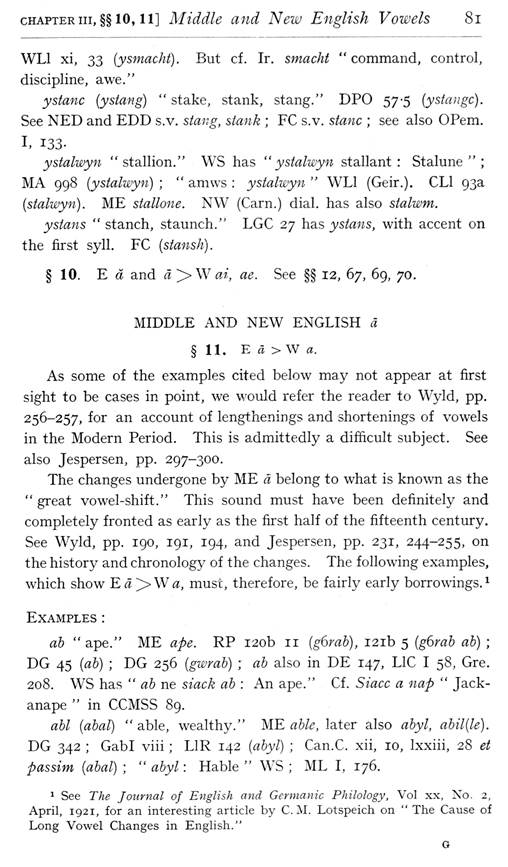
(delwedd F6832) (tudalen 081)
|
81cHAPTERiii, §§10, 11] Middle and New
English Vowels 8i WLl xi, 33 (ysmacht). But cf. Ir. smacht “command, control,
discipline, awe."
ystanc [ystang) “stake, stank, stang." DPO 57-5 [ystangc). See NED and
EDD s.v. stang, stank; EC s.v. stanc; see also OPem.
I, 133-
ystalwyn "stallion." WS has “ystalwyn stallant: Stalune”;
MA 998 {ystalwyn); “amws: ystalwyn “WLl (Geir.), CLl 93a (stalwyn). ME
Stallone. NW (Carn.) dial, has also sialwm.
ystans “stanch, staunch." LGC 27 hsis y stasis, with accent on the first
syll. EC {stansh).
§ 10. E a and a '^\N ai, ae. See §§ 12, 67, 69, 70.
MIDDLE AND NEW ENGLISH a § 11. E a > W a.
As some of the examples cited below may not appear at first sight to be cases
in point, we would refer the reader to Wyld, pp. 256-257, for an account of
lengthenings and shortenings of vowels in the Modern Period. This is
admittedly a difficult subject. See also Jespersen, pp. 297-300.
The changes undergone by ME a belong to what is known as the “great
vowel-shift." This sound must have been definitely and completely fronted
as early as the first half of the fifteenth century. See Wyld, pp. 190, 191,
194, and Jespersen, pp. 231, 244-255, on the history and chronology of the
changes. The following examples, which show Ea >-Wa, must, therefore, be
fairly early borrowings.^
Examples:
ah “ape." ME ape. RP 120b 11 {g6mb), 121b 5 {g6rab ah); DG 45 (ah); DG
256 [gwrah); ah also in DE 147, LlC I 58, Gre. 208. WS has “ah ne slack ah:
An ape." Cf. Siacc a nap “Jackanape “in CCMSS 89.
ahl {ahal) “able, wealthy." ME ahle, later also ahyl, ahil{le). DG 342;
GabI viii; LIR 142 {ahyl); Can.C. xii, 10, Ixxiii, 28 et passim {ahal);
“ahyl: Hable “WS; ML I, 176.
1 See The Journal of English and Germanic Philology, Vol xx, Xo. 2, April,
1921, for an interesting article by CSl. Lotspeich on “The Cause of Long
Vowel Changes in English."
O
|
|
|
|
|
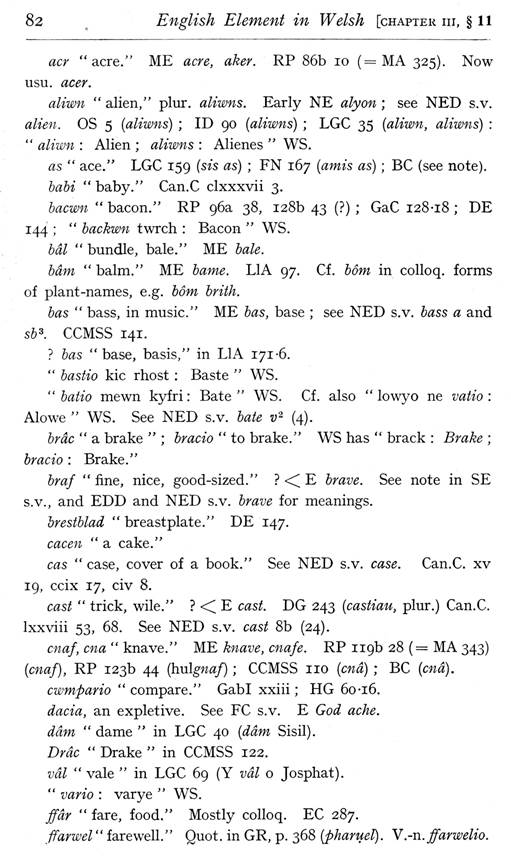
(delwedd F6833) (tudalen 082)
|
82 ^
English Element in Welsh [chapter hi, §11
acr "acre." ME acre, aker. RP 86b lo (= MA 325). Now usu.
acer.
aliwn
“alien," plur. aliwns. Early NE alyon; see NED s.v. alien. OS 5
{aliwns); ID 90 {aliwns); LGC 35 {aliwn, aliwns): “aliwn: Alien; aliwns:
Alienes “WS.
as “ace." LGC 159 {sis as); FN 167 {amis as); BC (see note).
babi “baby." Can.C clxxxvii 3.
bacwn "bacon." RP 96a 38, 128b 43 (?); GaC 128-18; DE 144; “backwn
twrch: Bacon “WS.
bdl “bundle, bale." ME bale.
bam “balm." ME bame. LI A 97. Cf. bom in colloq. forms of plant-names,
e.g. bom briih.
bas “bass, in music." ME bas, base; see NED s.v. bass a and sb^. CCMSS
141.
? bas "base, basis," in LI A 171-6.
" bastio kic rhost: Baste “WS.
" batio mewn kyfri: Bate" WS. Cf. also “lowyo ne vatio: Alowe “WS.
See NED s.v. bate v^ (4).
brae “a brake”; bracio “to brake." WS has “brack: Brake; bracio:
Brake."
braf “fine, nice, good-sized."? <C E brave. See note in SE s.v., and
EDD and NED s.v. brave for meanings.
brestblad “breastplate." DE 147.
cacen “a cake."
cas “case, cover of a book." See NED s.v. case. Can.C. xv 19, ccix 17,
civ 8.
cast “trick, wile."? <C E cast. DG 243 {castiau, plur.) Can.C.
Ixxviii 53, 68. See NED s.v. cast 8b (24).
cnaf,cna"kn3.Ye." ME knave, cnafe. RP 119b 28 (= MA 343) {cnaf), RP
123b 44 {hulgnaf); CCMSS no {end); BC {end).
cwmpario "compare." GabI xxiii; HG 6o-i6.
dacia, an expletive. See FC s.v. E God ache.
dam “dame “in LGC 40 {ddm Sisil).
Drdc “Drake “in CCMSS 122.
vdl “vale “in LGC 69 (Y vdl o Josphat).
" vario: varye “WS.
ffdr “fare,
food." Mostly colloq. EC 287.
ffarwel “farewell." Quot. in GR, p. 368 {pharuel). Y .-n. ffarwelio.
|
|
|
|
|
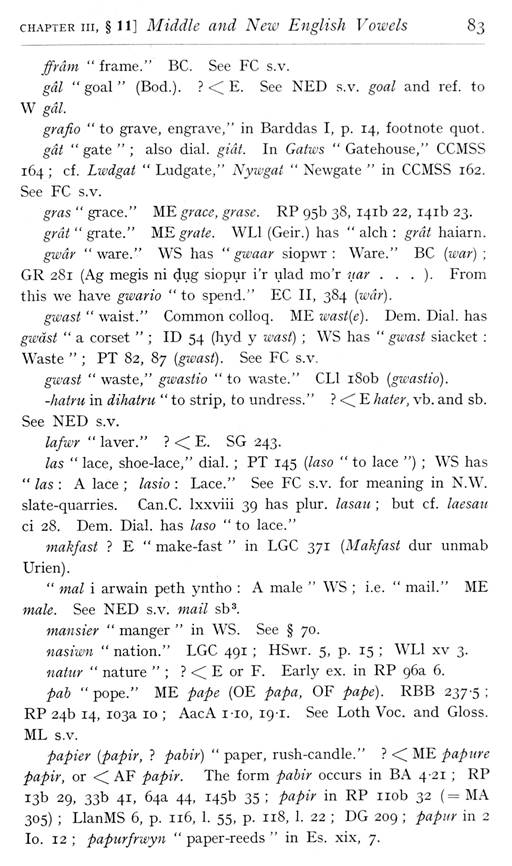
(delwedd F6834) (tudalen 083)
|
83CHAPTER III, § 11] Middle and New
English Vowels ^^
jfrcim “frame." BC. See FC s.v.
gal “goal” (Bod.).? < E. See NED s.v. goal and ref. to W gdl.
grafio "to grave, engrave," in Barddas I, p. 14, footnote quot.
gat “gate”; also dial. gidt. In Gatws “Gatehouse," CCMSS 164; cf. Lwdgat
“Ludgate," Nywgat “Newgate “in CCMSS 162. See FC s.v.
gras “grace." ME grace, grase. RP 95b 38, 141b 22, 141b 23.
gr at “gr Site." M.E grate. WLl (Geir.) has “alch: grdt haiarn.
gwdr "ware." WS has “gwaar siopwr: Ware." BC [war); GR 281 (Ag
megis ni dug siopur i'r ulad mo'r nar . . . ). From this we have givario
"to spend." EC II, 384 [wdr).
gwast “waist." Common colloq. ME wast{e). Dem. Dial, has gwdst “a
corset”; ID 54 (hyd y wast); WS has “gwast siacket: Waste”; PT 82, 87
(gimst). See FC s.v.
gwast “waste," gwastio “to waste." CLl i8ob [gwastio).
-hatru in dihatru “to strip, to undress."? <C E hater, vb. and sb.
See NED s.v.
lafwr “laver."? < E. SG 243.
las “lace, shoe-lace," dial.; PT 145 {laso “to lace "); WS has
“las: A lace; lasio: Lace." See FC s.v. for meaning in N.W.
slate-quarries. Can.C. Ixxviii 39 has plur. lasau; but cf. laesaii ci 28.
Dem. Dial, has laso “to lace."
makfast? E “make-fast “in LGC 371 {Makfast dur unmab Urien) .
" mal i arwain peth yntho: A male “WS; i.e. “mail." ME male. See
NED s.v. mail sb^.
mansier “manger “in WS. See § 70.
nasiwn “nation." LGC 491; HSwr. 5, p. 15; WLl xv 3.
natur “nature ";? < E or F. Early ex. in RP 96a 6.
pab “pope." ME pape (OE papa, OF pape). RBB 237-5; RP 24b 14, 103a 10;
AacA i-io, 19-1. See Loth Voc. and Gloss. ML s.v.
papier {papir,? pahir) “paper, rush-candle."? < ME papure papir, or ■< AF
papir. The form pabir occurs in BA 421; RP 13b 29, 33b 41, 64a 44, 145b 35; papir
in RP nob 32 (= MA 305); LlanMS 6, p. 116, 1. 55, p. 118, 1. 22; DG 209;
papur in 2 lo. 12; papurfntyn “paper-reeds “in Es. xix, 7.
|
|
|
|
|
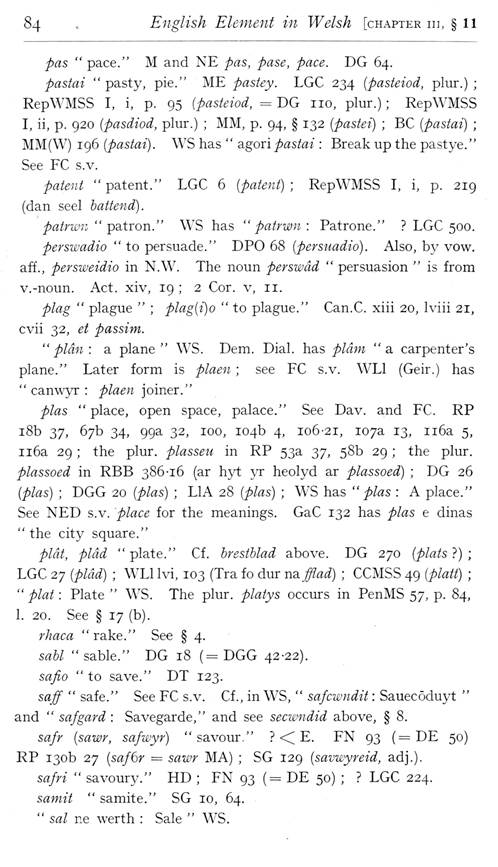
(delwedd F6835) (tudalen 084)
|
84 .
English Element in Welsh [chapter hi, § 11
pas “pace." M and NE pas, pase, pace. DG 64. pastai “pasty, pie."
ME pastey. LGC 234 {pasteiod, plur.); RepWMSS I, i, p. 95 (pasteiod, = DG no,
plur.); RepWMSS I, ii, p. 920 (pasdiod, plur.); MM, p. 94, § 132 [pastel); BC
[pastai]; MM(W) 196 [pastai). WS has “Sigori pastai: Break up the
pastye," See FC s.v.
patent “patent." LGC 6 [patent); RepWMSS I, i, p. 219 (dan seel
hattend).
patrwn “palron." WS has “patrwn: Patrone."? LGC 500. perswadio “to
persuade." DPO 68 [persuadio). Also, by vow. aff., persweidio in N.W.
The noun perswdd “persuasion “is from v.-noun. Act. xiv, 19; 2 Cor. v, 11.
plug “plague”; plag[i)o “to plague." Can.C. xiii 20, Iviii 21, cvii 32,
et passim.
"plan: a plane" WS. Dem. Dial, has pldm "a carpenter's
plane." Later form is plaen; see FC s.v. WLl (Geir.) has “canwyr: plaen
joiner."
plas “place, open space, palace." See Dav. and FC. RP i8b 37, 67b 34,
99a 32, 100, 104b 4, io6-2i, 107a 13, ii6a 5, ii6a 29; the plur. plasseu in
RP 53a 37, 58b 29; the plur. plassoed in RBB 386-16 (ar hyt t^t heolyd ar
plassoed); DG 26 (plas); DGG 20 [plas); LIA 28 [plas); WS has "plas: A
place." See NED s.v. place for the meanings. GaC 132 has plas e dinas
“the city square."
plat, pldd “plate." Cf. brestblad above. DG 270 [plats?); LGC 27 [pldd);
WLl Ivi, 103 (Tra fo dur nafflad); CCMSS 49 [platt); “plat: Plate “WS. The
plur. platys occurs in PenMS 57, p. 84, 1. 20. See § 17 (b).
rhaca “rake." See § 4. sabl "sable." DG 18 (= DGG 42-22).
safio “to save." DT 123.
saff “safe." See FC s.v. Cf., in WS, “safcwndit: Sauecoduyt “and
“safgard: Savegarde," and see secwndid above, § 8.
safr [sawr, safwyr) "savour."? <; E. FN 93 (=DE 50) RP 130b 27
[saf6r = sawr MA); SG 129 [savwyreid, adj.). safri “savoury." HD; FN 93
(=- DE 50);? LGC 224. samit “samite." SG 10, 64. “sal ne werth: Sale
“WS.
|
|
|
|
|
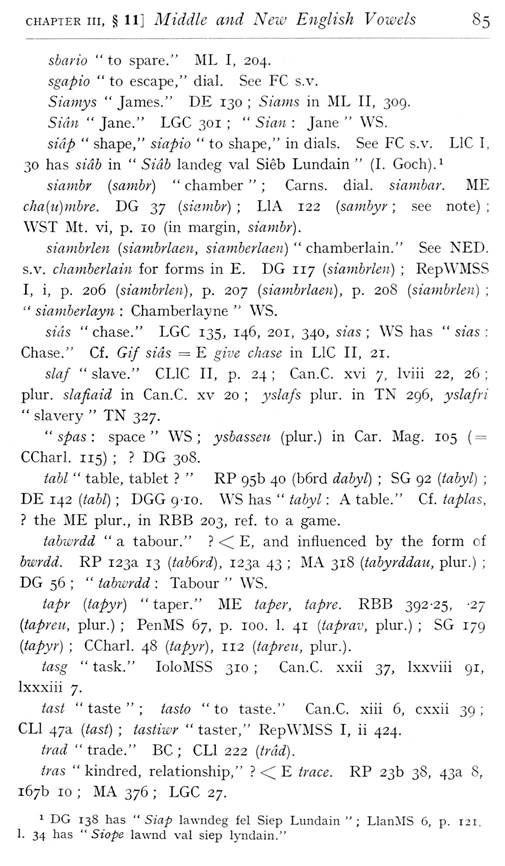
(delwedd F6836) (tudalen 085)
|
85CHAPTER III, § 11] Middle and New
English Vowels 85
sbario “to spare." ML I, 204.
sgapio “to escape," dial. See FC s.v.
Siainys “James." DE 130; Siams in ML II, 309.
Sidn “Jane." LGC 301; “Si an: Jane “WS.
sidp “shape," siapio “to shape," in dials. See FC s.v. LlC I, 30
has sidb in “Sidb landeg val Sieb Lundain” (I. Goch).^
siamhr {sambr) “chamber”; Cams. dial, siambar. ME cha{u)mbre. DG '^j
(siambr); LIA 122 {sambyr; see note); WST Mt. vi, p, 10 (in margin, siambr).
siambrlen {siambrlaen, siamberlaen) “chamberlain." See NED. s.v.
chamberlain for forms in E. DG 117 {siambrlen); RepWMSS I, i, p. 206
[siambrlen), p. 207 [siambrlaen), p. 208 [siambrlen); '•' siamberlayn:
Chamberlayne “WS.
sids “chase." LGC 135, 146, 201, 340, sias; WS has “sias: Chase."
Cf. Gif sids = E give chase in LlC II, 21.
slaf “slave." CLIC II, p. 24; Can.C. xvi 7, Iviii 22, 26; plur. slafiaid
in Can.C. xv 20; yslafs plur. in TN 296, yslafri “slavery “TN 327.
"spas: space" WS; ysbasseu (plur.) in Car. Mag. 105 ( = CCharl.
115);? DG 308.
tabl “table, tablet? “RP 95b 40 (b6rd dabyl); SG 92 [tabyl); DE 142 [tabl);
DGG 9-10. WS has “tabyl: A table." Cf. taplas,? the ME plur., in RBB
203, ref. to a game.
tabwrdd “a tabour."? <^ E, and influenced by the form of bwrdd. RP
123a 13 [tabbrd), 123a 43; MA 318 [tabyrddau, plur.); DG 56; “tabwrdd: Tabour
“WS.
iapr [tapyr) "taper." ME taper, tapre. RBB 392-25, -27 [tapreu,
plur.); PenMS 67, p. 100. 1. 41 [taprav, plur.); SG 179 [tapyr); CCharl. 48
[tapyr), 112 [tapreu, plur.).
tasg “task." loloMSS 310; Can.C. xxii 37, Ixxviii 91, Ixxxiii 7.
tast "taste"; tasto "to taste." Can.C. xiii 6, cxxii 39;
CLl 47a [tast); tastiwr "taster," RepWMSS I, ii 424, trad
"trade." BC; CLl 222 [trdd).
tras “kindred, relationship,"? < E trace. RP 23b z^, 43a 8, 167b 10;
MA 376; LGC 27.
1 DG 138 has “Siap lawndeg fel Siep Lundain”; LlanMS 6, p. 121, 1. 34 has
“Siope la\\Tid val siep lyndain."
|
|
|
|
|
(delwedd F6837) (tudalen 086)
|
86
English Element in Welsh [chapter hi, § 12
wast “waste." LGC 20 (heb un awr wast); wastio “to waste “in CCMSS 292;
"wast: waste" \VS. See FC s.v. wast. Cf. gwastraff.
whdl “whale “in Can.C cii 2.
yshario "to spare," shdr, noun and adj. GR 370 (quot.) has yspario.
See FC s.v. shdr and shario.
ysgdr “share," ysgario “to share." See FC s.v. sgdr, sgario. ME
schare.
ysglatus, -ys “slates." RepWMSS I, i, p. 182 (ysdatys); WS has
“ysdatyssen: A slate." See FC s.v. sglaitch. In dial. (S.W.) slatsen is
a common singulat. form; ysglater “slater," TN 415 {'sclateriaid,
plur.). ME slat, sclat. Cf. E sclait, sclayt, sklait, fifteenth century to
nineteenth century,
ysgwdr “square”; vb.-noun sgwario. See FC s.v. Ez. xliii, 16. has ysgwdr.
ystabl “stable." KM 247-5 (ystabyl); RBB 389-29 (ystabyl); Car. Mag. 72
(ystabal); LlanMS 6, p. no, 1. 52 (ystabl); SG 53 (ystablii, vb.-n.), 295
(ystablawd, aor. ind. 3 pers. sing.). BoHam, 185 (ystabyl); Can.C x 7, xiv 9
(stabal); LIR 260 (ystabyl).
ystdd “state, estate, furlong." DG 55; GabI vi; lo. vi 19, xi 18; also
heard as stdt. See FC s.v. stdt. Can.C x 11, xxv 10, xc 3 (stad).
ystdg “stake," in LGC 495 (Mae'n wag ei ystag megis dugiaeth). A note
states that it = “a. stake in a game of dice."
ystasiwn (stasiwn) “station." LGC 117 (ystasiwn); GR 383 (stasiim, in
quot.).
§ 12. Traces of the diphthongization of the a of E are seen in some
borrowings. This may be in some of the instances a reflection of the E
development. It must be borne in mind, however, that there is a tendency in W
dialects to diphthongize a long vowel sometimes. In Carn. ffos is often
pronounced ffoes (see FC s.v. ffos), dos (the impv. of myned) does, man (the
adj.), 7naen. Williams Pantycelyn wTote ffoes and does. Cf. the
diphthongization of a and a mentioned in § 10.
Examples.
laesau "laces" in Can.C, cxi, 28 (cf. lasau above, § 11). paen
“pane (of glass) “in N.W. dial. See FC s.v.
|
|
|
|
|
(delwedd F6838) (tudalen 087)
|
CHAPTER
III, § 13] Middle and New English Vowels 87
plaen “plane of a carpenter." Cf. plan above, § 11. WLl (Geir.) has
“canw}^:: plaen joiner." See FC s.v.
praitio occurs in CLIC iii, p. 47 (Taw a'th braitio llelo llwud). sgaer
“share “in N.W. dial, of Carn. Cf. sgdr, § 11. shaer “spare," noun and
adj. in Carn. dial. Cf. sbdr, § 11. sglaits “slates," See under
ysglatus, § 11. MIDDLE AND NEW ENGLISH c
§ 13. In stressed syllables the articulation of e in M and Early NE was
probably as now in bet. “It corresponds regularly to OE short e and to OF e
and is nearly always written e” (Jespersen, p. 72). In some words before n,
however, this e alternates with a in Early NE (Jespersen, p. 73).
The sound of W e is similar to that of English. “The sound of e, when long or
medium, is the middle e, as in the Eng. men, let; . . . when short it is
generally more open” (JMJ, p. 12). FC, p. xiv, states: “e. Sweet's mid-front
-wide, very slightly lower (more open) than Eng. ' e ' in 'pen.' . . . Before
a single voiced consonant in stressed penultimates the sound is slightly
higher (more closed) than English ' e ' in ' pen.' e: [i.e. e] the lengthened
form of it, but perhaps slightly more closed."
Thus, when the e (stressed) of E appears in loan-words in W as e, there has
been very little change.
In unstressed syllables, the case is more difficult. Cf. §§ 9, 26. In ME a
short e of indefinite quality was frequent in unstressed syllables, where OE
had the clearer sounds a, e, 0, u (Jespersen, P- 73)- Wyld (pp. 258-282)
deals at length with the E vowels of unstressed syllables as from the
fifteenth century (although many of the phenomena, as he himself states, are
no doubt much older than the fifteenth century). The weakening process
appears to have set in very early. Ellis (EEP I, p. 318) says guardedly, in
discussing the e final of the fourteenth century: “that the e final was at
least occasionally pronounced, and that the sound did not differ, except in
accent, from that of me, the {= mee dhee) is conclusively proved by . . .
rhymes." The tendency nowadays is to regard these “weakening “changes as
having taken place earlier than it was once thought. “The sound-changes to
which the present day pronuncia-
|
|
|
|
|
(delwedd F6839) (tudalen 088)
|
88
English Element in Welsh [chapter hi, § 14 tion of Standard English owes its
characteristic features had begun as early as the fifteenth century." ^
“At least as early as the middle of the fifteenth century vowels in
unstressed syllables were shortened, reduced, or confused, very much as in
Colloquial English at the present time" (Wyld, p. 258). The loss of weak
e \9\, the ME representative of OE full vowels a, e, i, 0, u, in weak
syllables is one of the most important changes in the history of the language
. . . The loss did not take place in all positions at the same time . . .
When it disappeared from the pronunciation, it was very often retained in the
spelling” (Jespersen, pp. 186, 192).
" There appear to be two quite different tendencies at work from early
in Modern period among different sections of speakers. One group tends to
level all weak vowels under some front vowel, written i or e; the other to
level all weak vowels under some ' obscure ' vowel [9], or some such sound,
written variously a, 0, u. It is probably safe to infer that the symbols for
old back or back-rounded vowels, a, 0, u, generally imply some sound
corresponding to [a] at the present time, and that the symbols for front
vowels — i, e — imply the kind of vowel now heard in the second syllable of
ladies ..." (Wyld, p. 260). § 14. SHORT e IN UNSTRESSED SYLLABLES
APPEARING IN W
AS a OR y[u) BEFORE /, n, v, s.
{a) In unstressed syllables before r, n, I, and s (?) (except in plur. suffix
-es), the sound is represented in W sometimes by a. In this connection we may
quote again from Wyld,^ p. 260: “The two tendencies [i.e. those mentioned
above at the end of § 13] are specially observable in the treatment of vowels
before -n and -l. One tendency results in developing and preserving the '
clear ' vowel, so that we get [in, il] for earlier -en, -el, and even for -on
. . . The other tendency results in [an, 9I], which are further weakened to
syllabic n and I respectively as present-day button, beaten, . . . etc. ...
As regards the treatment of vowels in unstressed syllables before -r,
although -yr, -ir are common spellings for older -er, it seems very doubtful
whether the genius of the English language
1 Zachrisson, Englische Studien (191 S) vol. 52, p. 258.
2 See also Zachrisson, pp. 60, 61
|
|
|
|
|
(delwedd F6840) (tudalen 089)
|
89CHAPTER III, § 14] Middle and New
English Vowels 89
ever tolerated such a combination as [-?V] in actual speech, at least
finally. On the other hand such spellings as fadr, rememhr, both fifteenth
century, suggest that a syllabic [r] was pronounced. The various spellings
or, er, yr, ur, ar for the same syllable er seem to imply a vowel which it
was difficult to identify, probably [a, 9]. The ' murmur ' vowel [a] probably
developed quite early before -r, and [ar] was later reduced to syllabic [r].
This in its turn was weakened and gave pla,ce to the present [a]." See
also Jespersen p. 196.
In the following examples the Wa appears to be the representation of the
weak, obscure sound of the vowel at some stage of its development in E.
These, together with those illustrating the change into y[u), are probably in
the main of a later date than those with e. In some cases we may have traces
of the representation of syllabic /, n, r, for which sounds in E see
Jespersen, pp. 190, 191. Cf. the change of -er- to -ar- in Breton; see RC i,
p. 87; RC v, pp. 53-54. The half-mute ^ of F appears in Breton as a rule as
a, e.g. the IMiddle Breton forms autramant ("' autrement "),
paeamant (" paiement "), fasilament (" facilement "). See
RC v, p. 55.
Examples:
adargop. § 5.
aldramon. § 7.
hasarn, masarn “mazer." § 9 (a).
" hwsmant: Bushement “WS. IG 133 {bwysmant); cf. RepWjVISS I, i, p. 211
(/ hwysment). ME hussche-, busce-, huysche-, -ment. See NED s.v. hushment.
cancar “canker." § 9 (b).
Charlas “Charles," in RBB 379.
cowntarffetio “to counterfeit." CLIC IV, p. 34.
cyrant “current." LlC II, 27,
far dial “fardel." § 9 (b).
Fflandraswyr “men of Flanders." RBB 336.
ffristial “fristelle." § 30 (b).
gar das "garter(s)." § 9(b).
Herbart “Herbert." LGC 17 [Herbart]; PenlVIS 67, p. 44, 1. 11 (Galwn
herbard yn wardenn). Cf. plur. in PenlMS 67, p. 67, 1. 32 (11a wr bordir llv
herberdyaid).
|
|
|
|
|
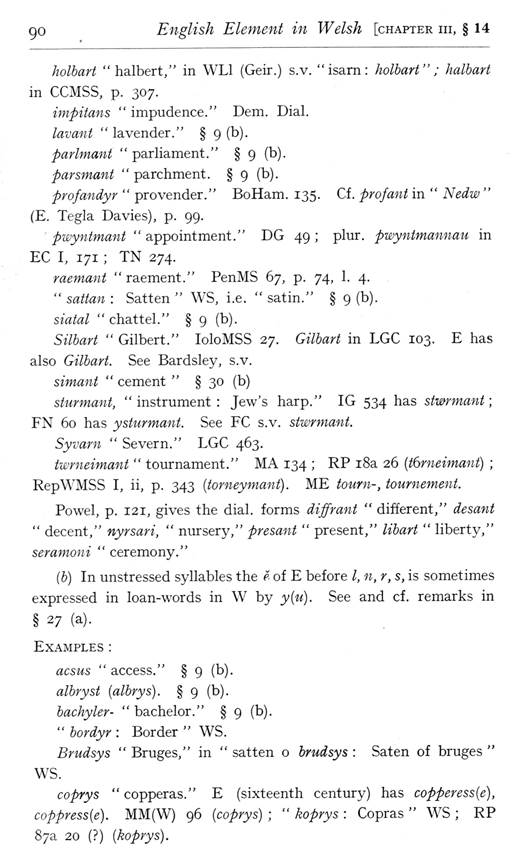
(delwedd F6841) (tudalen 090)
|
90go Eiiglish Element in Welsh [chapter
hi, § 14
holhart “halbert," in WLl (Geir.) s.v. “isarn: holbart"; halhart in
CCMSS, p. 307.
impitans “impudence." Dem. Dial.
lavant “lavender." § 9 (b).
parUnant “parliament." § 9 (b).
parsmant “parchment. § 9 (b).
profandyr “provender." BoHam. 135. Cf. pro/ant in “Nedw” (E. Tegla Da
vies), p. 99.
pwyntmant “appointment." DG 49;
plur. pwyntmannau in EC I, 171; TN 274.
raemani "raement." PenMS 67, p. 74, 1. 4. .
" saltan: Satten “WS, i.e. "satin." § 9(b).
siatal "chattel." § 9 (b).
Silbart “Gilbert." loloMSS 27. Gilbart in LGC 103. E has also Gilbart.
See Bardsley, s.v.
simant “cement” § 30 (b)
sturmant, "instrument: Jew's harp." IG 534 has stwrmant; FN 60 has
ysturmant. See FC s.v. stwrmant.
Syvarn “Severn." LGC 463,
twrneimant “tournament." MA 134; RP i8a 26 {t6rneimant); RepWMSS I, ii,
p. 343 [torneymant) . ME tourn-, tournement.
Powel, p. 121, gives the dial, forms diffrant “different," desant
“decent," nyrsari, “nursery," presant “present," libart
“liberty," seramoni “ceremony."
(b) In unstressed syllables the ^ of E before /, n, r, s, is sometimes
expressed in loan-words in W by y{u). See and cf. remarks in § 27 (a).
Examples:
acsus "access." § 9 (b).
albryst (albrys). § 9 (b).
bachyler- “bachelor." § 9 (b).
" bordyr: Border" WS.
Brudsys “Bruges," in “satten o brudsys: Saten of bruges “WS.
coprys “copperas." E (sixteenth century) has copperess{e), coppress{e).
MM(W) 96 (coprys); “koprys: Copras “WS; RP 87a 20 (?) [koprys).
|
|
|
|
|
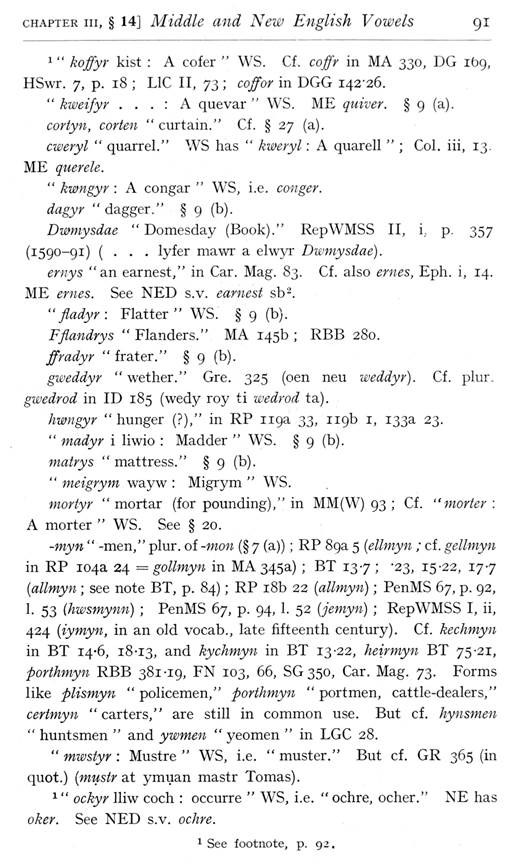
(delwedd F6842) (tudalen 091)
|
91CHAPTER III, § 14] Middle and New
English Vowels 91
1 “koffyr kist: A cofer “WS. Cf. coffr in MA 330, DG ibg, HSwr. 7, p. 18; LlC
II, J^; coffor in DGG 142-26.
" kweifyy . . .: A quevar “WS. ME quiver. § 9 (a).
cortyn, corten “curtain." Cf. § 27 (a).
cweryl “quarrel." WS has “kweryl: A quarell”; Col. iii, 13. ME guerele.
" kwngyr: A congar “WS, i.e. conger.
dagyr “dagger." § 9 (b).
Dwmysdae “Domesday (Book)." RepWMSS II, i. p. 357 (1590-91) ( . . .
lyfer mawr a elwyr Dwmysdae).
ernys "an earnest," in Car. Mag. 83. Cf. also ernes, Eph. i, 14. ME
ernes. See NED s.v. earnest sb^.
"fladyr: Flatter" WS. § 9 (b).
Fflandrys “Flanders." MA 145b; RBB 280.
ffradyr “frater." § 9 (b).
gweddyr “wether." Gre. 325 (oen neu weddyr). Cf. plur. gwedrod in ID 185
(wed}'' roy ti wedrod ta).
hwngyr “hunger (?)," in RP 119a 33, 119b i, 133a 23.
" madyr i liwio: Madder “WS. § 9 (b).
niatrys “mattress." § 9 (b).
" meigrym wayw: Migrym “WS.
mortyr “mortar (for pounding)," in MM(W) 93; Cf. "morter: A morter
“WS. See § 20.
-myn ”-men," plur. of -nion (§ 7 (a)); RP 89a 5 {ellmyn; cf. gellmyn in
RP 104a 24 = gollmyn in MA 345a); BT 137; -23, 15-22, 177 {allmyn; see note
BT, p. 84); RP i8b 22 [allmyn]; PenMS 67, p. 92, 1. 53 (hwsmynn); PenMS 67,
p. 94, 1. 52 (jemyn); RepWMSS I, ii, 424 {iyniyn, in an old vocab., late
fifteenth century). Cf. kechmyn in BT 14-6, 18-13, 3-nd kychmyn in BT 13-22,
heirmyn BT 75-21, porthmyn RBB 381-19, FN 103, 66, SG350, Car. Mag. 73. Forms
like piismyn “policemen," porthmyn “portmen, cattle-dealers,"
certmyn "carters," are still in common use. But cf. hynsmen
“huntsmen “and ywmen “yeomen “in LGC 28.
" mwstyr: Mustre “WS, i.e. “muster." But cf. GR 365 (in quot.)
[mustr at ymuan mastr To mas) .
1 “ockyr lliw coch: occurre “WS, i.e. “ochre, ocher." NE has oker. See
NED s.v. ochre.
1 See footnote, p. 92 .
|
|
|
|
|
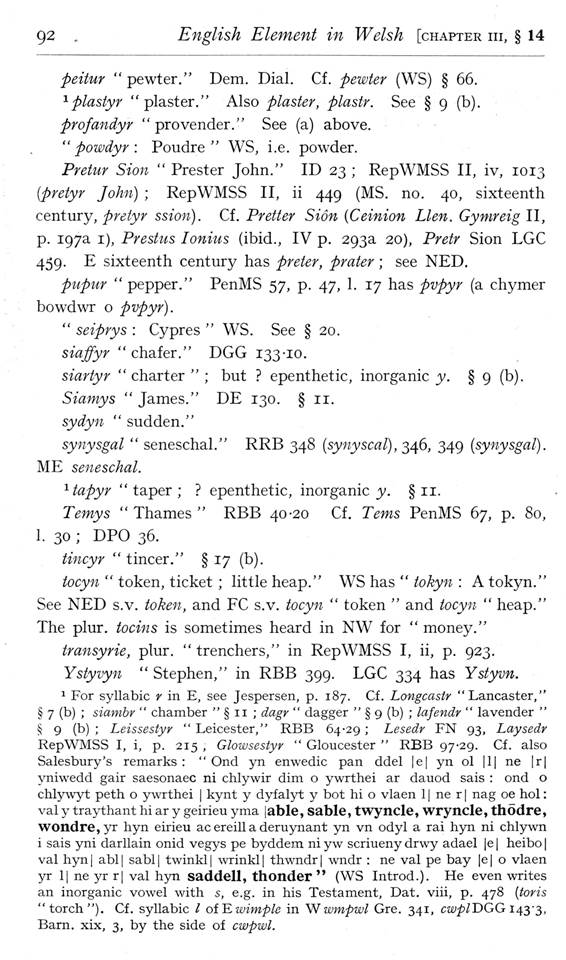
(delwedd F6843) (tudalen 092)
|
92 .
English Element in Welsh [chapter hi, § 14
peitur "pewter." Dem. Dial. Cf. pewter (WS) § 66.
^piastyr "plaster." Also plaster, plastr. See § 9 (b).
profandyr "provender." See (a) above.
" powdyr: Poudre “WS, i.e. powder.
Pretur Sion “Prester John." ID 23; RepWMSS II, iv, 1013 {pretyr John);
RepWMSS II, ii 449 (MS. no. 40, sixteenth centuiy , pretyr ssion). Cf.
Pretter Sion {Ceinion Lien. Gymreig II, p. 197a I), Prestus lonius (ibid., IV
p. 293a 20), Pretr Sion LGC 459. E sixteenth century has preter, prater; see
NED,
pMpur “pepper." PenMS 57, p. 47, 1. 17 has pvpyr (a chymer bowdwr o
pvpyr).
" seiprys: Cypres “WS. See § 20.
siaffyr "chafer." DGG 133-10.
siartyr "charter”; but? epenthetic, inorganic y. § 9 (b).
Siamys “James." DE 130. § 11.
sydyn “sudden."
synysgal “seneschal." RRB 348 (sywjysca/), 346, 349 (synysgal). ME
seneschal.
^tapyr "taper;? epenthetic, inorganic jy. §11.
Temys “Thames “RBB 40-20 Cf. Terns PenMS 67, p. 80, 1. 30; DPO 36.
tincyr “tincer." § 17 (b).
tocyn “token, ticket; little heap." WS has “tokyn: A tokyn." See
NED s.v. token, and EC s.v. tocyn “token “and tocyn “heap." The plur.
tocins is sometimes heard in NW for “money."
transyrie, plur. "trenchers," in RepWMSS I, ii, p. 923.
Ystyvyn “Stephen," in RBB 399. LGC 334 has Ystyvn.
1 For syllabic r in E, see Jespersen, p. 187. Cf. Longcastr
"Lancaster," § 7 (b); sianibr “chamber” § 11; dagr “dagger” § 9
(b); lafendv “lavender” § 9 (b); Leissestyr “Leicester," RBB 64-29;
Lesedr FN 93, Laysedr RepWMSS I, i, p. 215 , Glowsestyv “Gloucester “RBB
97-29. Cf. also Salesbury's remarks: “Ond yn enwedic pan ddel |e| yn ol |1|
ne |r| yniwedd gair saesonaec ni chlywir dim o ywrthei ar dauod sais: ond o
chlywyt peth o y\vrthei | kynt y dyfalyt y bot hi o vlaen 1 1 ne r | nag oe
hoi: val y traythant hi ar y geirieu yma |able, sable, twyncle, wryncle,
thodre, wondre,yr hyn eirieu ac ereill a deruynant yn vn odyl a rai hyn ni
chlywn i sais yni darllain onid vegys pe byddera niyw scriueny dr-wy adael
|e| heibo| val hyn | abl | sabl | twinkl | wrinkl | thwndr | wndr: ne val pe
bay |e | o vlaen yr 1| ne yr r| val hyn saddell, thonder” (WS Introd.). He
even writes an inorganic vowel with s, e.g. in his Testament, Dat. viii, p.
478 {toris "torch"). Cf. syllabic I oi'Ewimple in W wmpwl Gre. 341,
cz^^/ DGG 143-3, Barn, xix, 3, by the side of cwpwl.
|
|
|
|
|
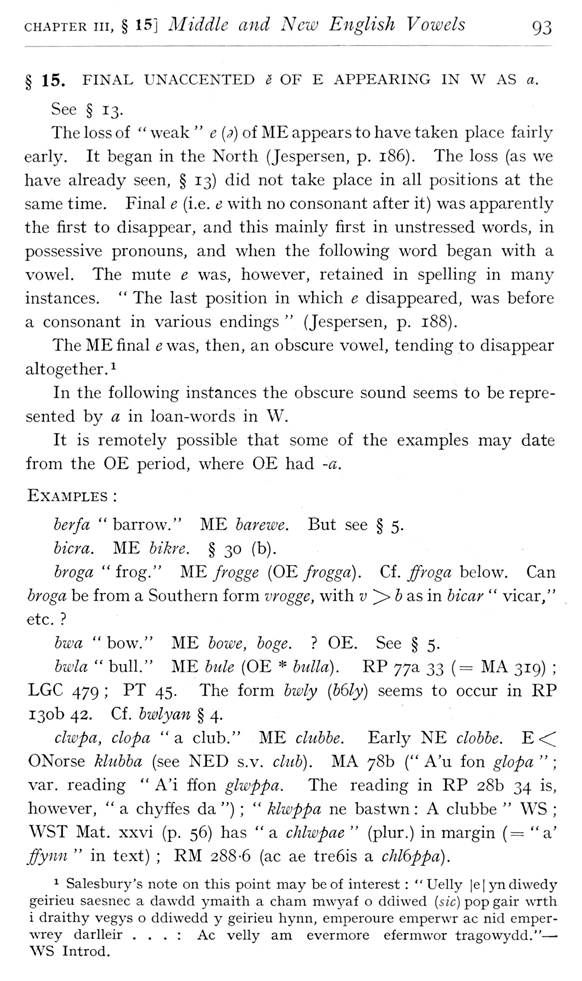
(delwedd F6844) (tudalen 093)
|
CHAPTER
III, § 15] Middle and New English Vowels 93
§ 15. FINAL UNACCENTED e OF E APPEARING IN W AS a.
See § 13.
The loss of “weak “e{d) of ME appears to have taken place fairly early. It
began in the North (Jespersen, p. 186). The loss (as we have already seen, §
13) did not take place in all positions at the same time. Final e (i.e. e
with no consonant after it) was apparently the first to disappear, and this
mainly first in unstressed words, in possessive pronouns, and when the
following word began with a vowel. The mute e was, however, retained in
spelling in many instances. “The last position in which e disappeared, was
before a consonant in various endings” (Jespersen, p. 188).
The ME final e was, then, an obscure vowel, tending to disappear altogether.^
In the following instances the obscure sound seems to be represented by a in
loan-words in W.
It is remotely possible that some of the examples may date from the OE
period, where OE had -a.
Examples:
herfa “barrow." ME harewe. But see § 5.
hicra. ME bikre. § 30 (b).
hroga “iiog." ME frogge {OE frogga). Cf. ffwga below. Can broga be from
a Southern form vrogge, with v^bdiSm bicar “vicar," etc.?
bwa “bow." ME bowe, boge.? OE. See § 5.
bwla “bull." ME bule (OE * bulla). RP 77a 33 (= MA 319); LGC 479; PT 45.
The form bwly (bGly) seems to occur in RP 130b 42. Cf. bwlyan § 4.
clwpa, clopa "a club." ME cliibbe. Early NE clobbe. E <^ ONorse
kliibba (see NED s.v. club). MA 78b (" A'u fon glopa”; var. reading “A'i
ffon glwppa. The reading in RP 28b 34 is, however, “a chyffes da ");
“klwppa ne bastwn: A clubbe “WS; WST Mat. xxvi (p. 56) has “a chlwpae”
(plur.) in margin (= "a' ffynn “in text); RM 288-6 (ac ae tre6is a
chlGppa).
1 Salesbury's note on this point may be of interest: "Uelly |e|yndiwedy
geirieu saesnec a dawdd ymaith a cham mwyaf o ddiwed {sic) pop gair wrth i
draithy vegys o ddiwedd y geirieu hynn, emperoure emperwr ac nid emper■\vrey
darlleir . . .: Ac velly am evermore efermwor tragowydd." — WS Introd.
|
|
|
|
|
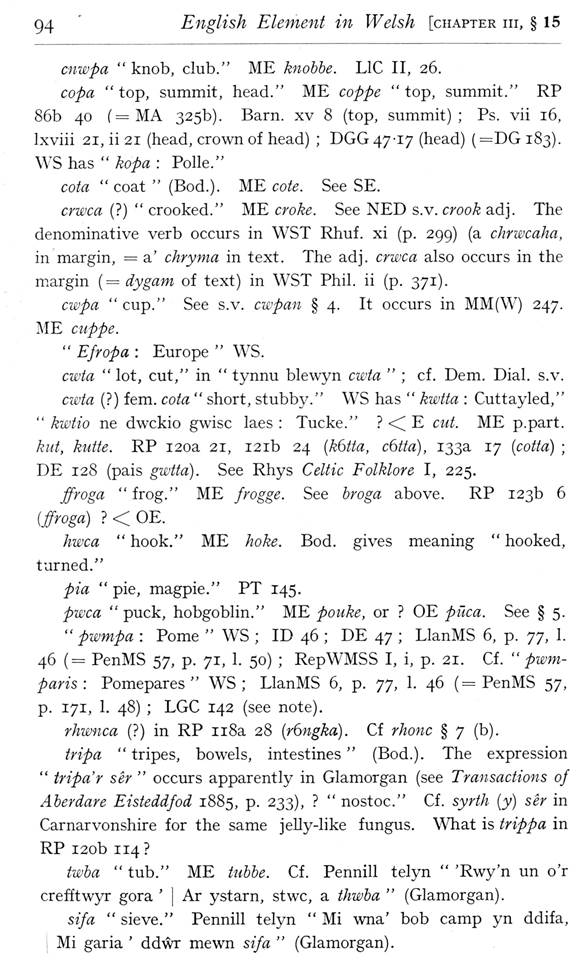
(delwedd F6845) (tudalen 094)
|
94 '
English Element in Welsh [chapter hi, § 15
cnwpa “knob, club." ME knobbe. LlC II, 26.
copa "top, summit, head." ME coppe "top, summit." RP 86b 40
(=MA 325b). Barn, xv 8 (top, summit); Ps. vii 16, Ixviii 21, ii 21 (head,
crown of head); DGG 47-17 (head) (=DG 183). WS has “kopa: Polle."
cota “coat” (Bod.). ME cote. See SE.
crwca (?) “crooked." ME croke. See NED s.v. crook adj. The denominative
verb occurs in WST Rhuf. xi (p. 299) (a chrwcaJia, in margin, = a' chryma in
text. The adj. crwca also occurs in the m.argin (= dygam of text) in WST
Phil, ii (p. 371).
cwpa “cup." See s.v. cwpan § 4. It occurs in MM(W) 247. ME cuppe.
" Ejropa: Europe “WS.
cwta “lot, cut," in “tynnu blewyn cwta”; cf. Dem. Dial. s.v.
cwta (?) fem. cota “short, stubby." WS has “kwtta: Cuttayled,"
“kwtio ne dwckio gwisc laes: Tucke."? <C E cut. ME p. part. kut,
kutte. RP i2oa 21, 121b 24 {kGita, c6tta), 133a 17 {cotta); DE 128 (pais
gwtta). See Rhys Celtic Folklore I, 225.
ffroga “frog." ME frogge. See broga above. RP 123b 6 iffroga)? < OE.
hwca “hook." ME hoke. Bod. gives meaning “hooked, turned."
pia “pie, magpie." PT 145.
pwca “puck, hobgoblin." ME pouke, or? OE pftca. See § 5.
" pwmpa: Pome “WS; ID 46; DE 47; LlanMS 6, p. yy, 1. 46 (= PenMS 57, p. 71, 1. 50); RepWMSS
I, i, p. 21. Cf. “pwmparis: Pomepares “WS; LlanMS 6, p. yy, 1. 46 (= PenMS
57, p. 171, 1. 48); LGC 142 (see note).
rhwnca (?) in RP ii8a 28 {rGngka). Cf rhonc § 7 (b).
iripa “tripes, bowels, intestines” (Bod.). The expression “tripa'r sir
“occurs apparently in Glamorgan (see Transactions of Aberdare Eisteddfod
1885, p. 233),? “nostoc." Cf. syrth {y) ser in Carnarvonshire for the
same jelly-like fungus. What is trippa in RP I20b 114?
twba “tub." ME tubbe. Cf. Pennill telyn "'Rwy'n un o'r crefftwyr
gora ' | Ar ystarn, stwc, a thwba” (Glamorgan).
sifa “sieve." Pennill telyn “Mi wna' bob camp yn ddifa, I Mi garia '
ddwr mewn sifa” (Glamorgan).
|
|
|
|
|
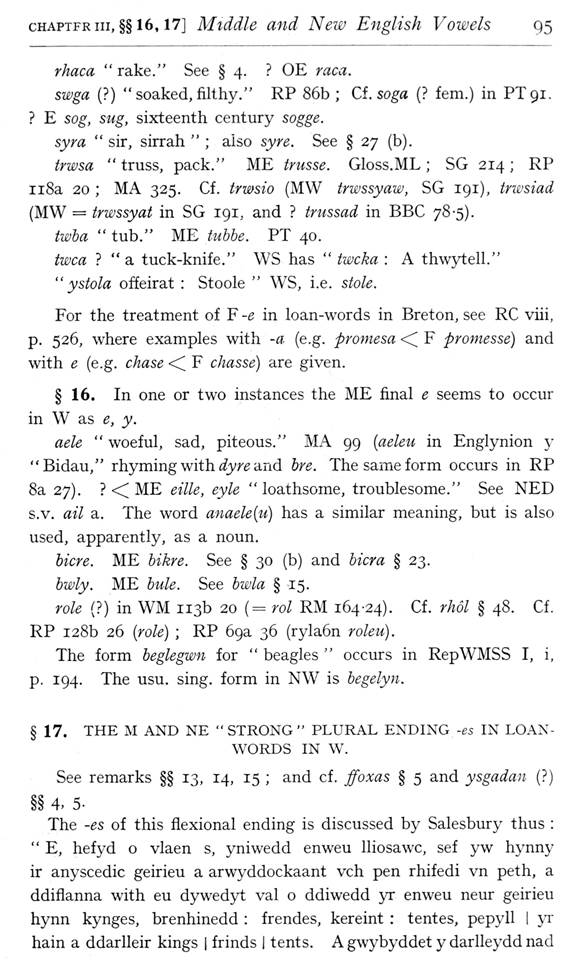
(delwedd F6846) (tudalen 095)
|
cHAPTFRiii,
§§ 16, 17] Middle and New English Vowels 95
rhaca “rake." See § 4.? OE raca.
swga (?) "soaked, filthy." RP 86b; Ct soga (? fern.) in PT91.? E
sog, sug, sixteenth century sogge.
syra “sir, sirrah”; also syre. See § 27 (b).
trwsa "truss, pack." ME trusse. Gloss. ML; SG 214; RP ii8a 20; MA
325. Cf. trwsio (MW trwssyaw, SG 191), tnvsiad (MW = trwssyat in SG 191, and?
trussad in BBC 78-5).
twba “tub." ME tubbe. PT 40.
twca? “a tuck-knife." WS has “twcka: A thwytell."
" ystola offeirat: Stoole “WS, i.e. stole.
For the treatment of F -e in loan-words in Breton, see RC viii, p. 526, where
examples with -a (e.g. promesa <^ F promesse) and with e (e.g. chase <^
F chasse) are given.
§ 16. In one or two instances the ME final e seems to occur in W as e, y.
aele “woeful, sad, piteous." MA 99 [aeleu in Englynion y
"Bidau," rhyming with ^3;^^ and hre. The same form occurs in RP 8a
27).? <^ ME eille, eyle "loathsome, troublesome." See NED s.v.
ail a. The word anaele{u) has a similar meaning, but is also used,
apparently, as a noun,
hicre. ME bikre. See § 30 (b) and bier a § 23.
bwly. ME bide. See bwla § 15.
role (?) in WM 113b 20 (= rol RM 164-24). Cf. rhol § 48. Cf. RP 128b 26
{role); RP 69a 36 (ryla6n roleu).
The form beglegwn for “beagles “occurs in RepWMSS I, i, p. 194. The usu.
sing, form in NW is begelyn.
§ 17. THE M AND NE "STRONG" PLURAL ENDING -es IN LOAN-WORDS IN W.
See remarks §§ 13, 14, 15; and cf. ffoxas § 5 and ysgadan (?)
§§ 4> 5-
The -es of this flexional ending is discussed by Salesbury thus:
" E, hefyd o vlaen s, yniwedd enweu lliosawc, sef yw hynny
ir anyscedic geirieu a arwyddockaant vch pen rhifedi vn peth, a
ddiflanna with eu dywedyt val o ddiwedd }t enweu neur geirieu
hynn kynges, brenhinedd: frendes, kereint: tentes, pepyll I }t
hain a ddarlleir kings | frinds I tents. A gwybyddet y darlleydd nad
|
|
|
|
|
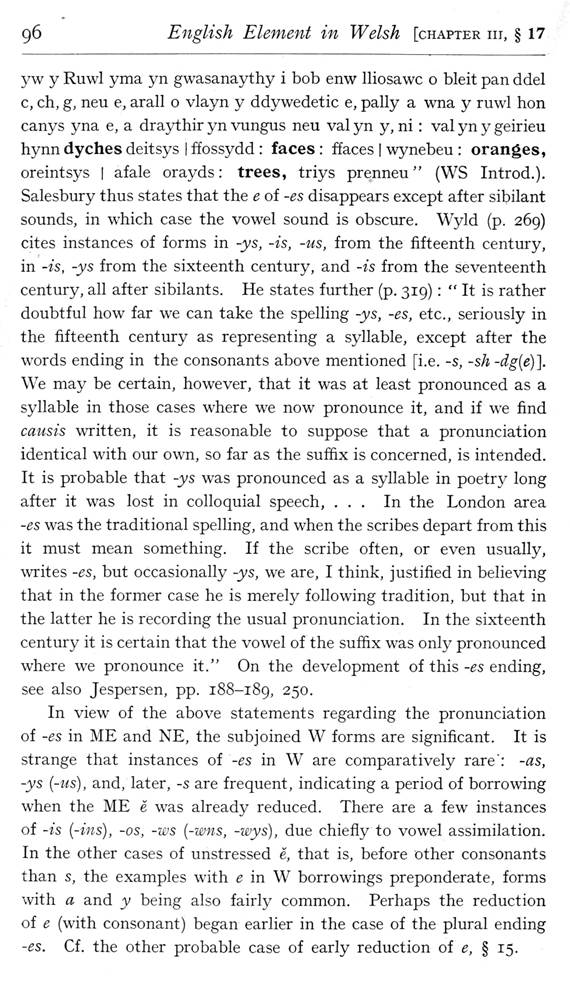
(delwedd F6847) (tudalen 096)
|
96
English Element in Welsh [chapter hi, § 17
yw y Ruwl yma yn gwasanaythy i bob enw lliosawc o bleit pan ddel c, ch, g,
neu e, arall o vlayn y ddywedetic e, pally a wna y ruwl hon canys yna e, a
draythir yn vungus neu val yn y, ni: val yn y geirieu hynn dyches deitsys I
ffossydd: faces: ffaces | wynebeu: oranges, oreintsys | afale orayds: trees,
triys prenneu” (WS Introd.). Salesbury thus states that the e of -es
disappears except after sibilant sounds, in which case the vowel sound is
obscure. Wyld (p. 269) cites instances of forms in -ys, -is, -us, from the
fifteenth century, in -is, -ys from the sixteenth century, and -is from the
seventeenth century, all after sibilants. He states further (p. 319): “It is
rather doubtful how far we can take the spelling -ys, -es, etc., seriously in
the fifteenth century as representing a syllable, except after the words
ending in the consonants above mentioned [i.e. -s, -sh -dg[e)']. We may be
certain, however, that it was at least pronounced as a syllable in those cases
where we now pronounce it, and if we find causis written, it is reasonable to
suppose that a pronunciation identical with our own, so far as the suffix is
concerned, is intended. It is probable that -ys was pronounced as a syllable
in poetrj^ long after it was lost in colloquial speech, ... In the London
area -es was the traditional spelling, and when the scribes depart from this
it must mean something. If the scribe often, or even usually, writes -es, but
occasionally -ys, we are, I think, justified in believing that in the former
case he is merely following tradition, but that in the latter he is recording
the usual pronunciation. In the sixteenth century it is certain that the
vowel of the suffix was only pronounced where we pronounce it." On the
development of this -es ending, see also Jespersen, pp. 188-189, 250.
In view of the above statements regarding the pronunciation of -es in ME and
NE, the subjoined W forms are significant. It is strange that instances of
-es in W are comparatively rare": -as, -ys {-us), and, later, -s are
frequent, indicating a period of borrowing when the ME e was already reduced.
There are a few instances of -is {-ins), -OS, -ws {-wns, -ivys), due chiefly
to vowel assimilation. In the other cases of unstressed e, that is, before
other consonants than s, the examples with e in W borrowings preponderate,
forms with a and y being also fairly common. Perhaps the reduction of e (with
consonant) began earlier in the case of the plural ending -es. Cf. the other
probable case of early reduction of e, § 15.
|
|
|
|
|
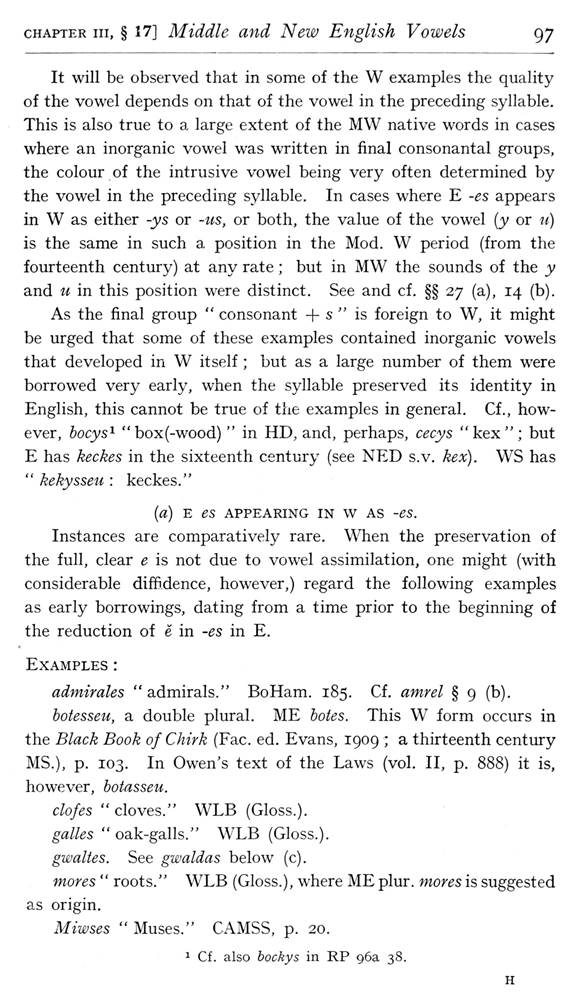
(delwedd F6848) (tudalen 097)
|
CHAPTER
III, § 17] Middle and New English Vowels 97
It will be observed that in some of the W examples the quality of the vowel
depends on that of the vowel in the preceding syllable. This is also true to
a large extent of the MW native words in cases where an inorganic vowel was
written in final consonantal groups, the colour of the intrusive vowel being
very often determined by the vowel in the preceding syllable. In cases where
E -es appears in W as either -ys or -us, or both, the value of the vowel [y
or n) is the same in such a position in the Mod. W period (from the
fourteenth century) at any rate; but in MW the sounds of the y and u in this
position were distinct. See and cf. §§ 27 (a), 14 (b).
As the final group “consonant -\- s" is foreign to W, it might be urged
that some of these examples contained inorganic vowels that developed in W
itself; but as a large number of them were borrowed very early, when the
syllable preserved its identity in English, this cannot be true of the
examples in general. Cf., however, hocys'^ "box(-wood) “in HD, and,
perhaps, cecys "kex"; but E has keckes in the sixteenth century
(see NED s.v. kex). WS has “kekysseu: keckes."
[a] E es APPEARING IN W AS -CS.
Instances are comparatively rare. When the preservation of the full, clear e
is not due to vowel assimilation, one might (with considerable diffidence,
however,) regard the following examples as early borrowings, dating from a
time prior to the beginning of the reduction of e in -es in E.
Examples:
admirales "admirals." BoHam. 185. Cf, amrel § 9 (b).
hotesseu, a double plural. ME botes. This W form occurs in the Black Book of
Chirk (Fac. ed. Evans, 1909; a thirteenth century MS.), p. 103. In Owen's
text of the Laws (vol. II, p. 888) it is, however, hotasseu.
clofes “cloves." WLB (Gloss.).
galles “o3.k-ga\ls." WLB (Gloss.).
gwaltes. See gwaldas below (c).
mores “roots." WLB (Gloss.), where ME plur. mores is suggested as
origin.
Miwses “Muses." CAMSS, p. 20.
1 Cf. also bockys in RP 96a 38.
H
|
|
|
|
|
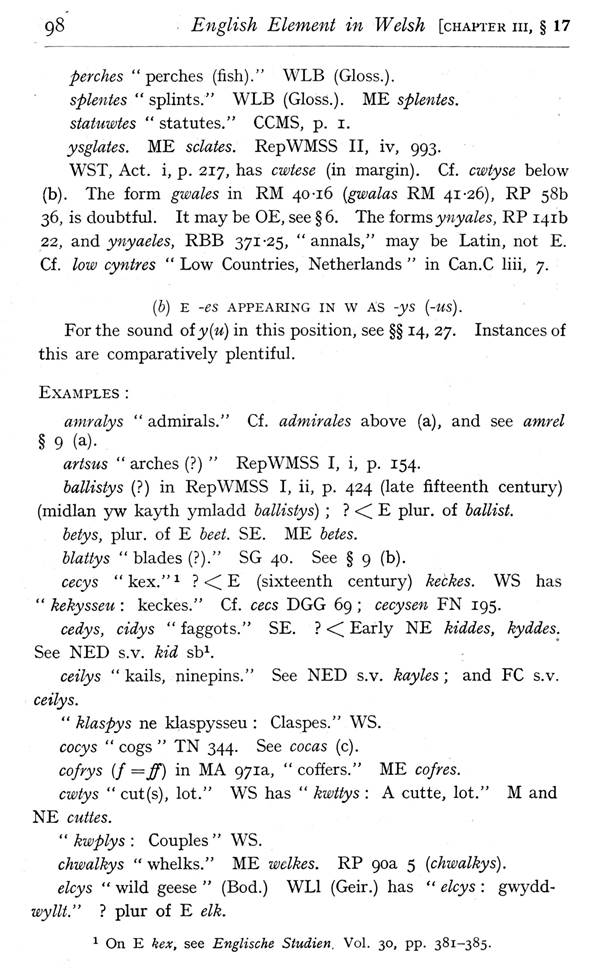
(delwedd F6849) (tudalen 098)
|
98
English Element in Welsh [chafier hi, § 17
perches “perches (fish)." WLB (Gloss.).
splentes “splints." WLB (Gloss.). ME splentes.
statuwtes “statutes." CCMS, p. i.
ysglates. ME sclates. RepWMSS II, iv, 993.
WST, Act. i, p. 217, has cwtese (in margin), Cf. cwtyse below (b). The form
gwales in RM 40-16 {gwalas KM 41-26), RP 58b 36, is doubtful. It may be OE,
see § 6. The iorms ynyales, RP 141b 22, a.nd ynyaeles, RBB 371-25,
"annals," may be Latin, not E. Cf. low cyntres “Low Countries,
Netherlands “in Can.C liii, 7.
(b) E -es APPEARING IN W AS -ys {-US).
For the sound oiy{u) in this position, see §§ 14, 27. Instances of this are
comparatively plentiful.
Examples:
amralys “admirals." Cf. admirales above (a), and see amrel § 9 (a).
artsus “arches (?) “RepWMSS I, i, p. 154.
ballistys (?) in RepWMSS I, ii, p. 424 (late fifteenth century) (midlan yw
ka5rth ymladd ballistys);? •< E plur. of ballist.
betys, plur. of E beet. SE. ME betes.
Matty s “blades (?)." SG 40. See § 9 (b).
cecys "kex."^? <I E (sixteenth century) keckes. WS has
“kekysseu: keckes." Cf. cecs DGG 69; cecysen FN 195.
cedys, cidys “faggots." SE.? <^ Early NE kiddes, kyddes. See NED s.v.
kid sb^.
ceilys “kails, ninepins." See NED s.v. kayles; and FC s.v. ceilys.
" klaspys ne klaspysseu: Claspes." WS.
cocys “cogs “TN 344. See cocas (c).
cofrys (f =ff) in MA 971a, “coffers." ME cofres.
cwtys “cut(s), lot." WS has “kwttys: A cutte, lot." M and NE
cuttes.
" kwplys: Couples" WS.
chwalkys “whelks." ME wdkes. RP 90a 5 {chwalkys).
elcys “wild geese” (Bod.) WLl (Geir.) has “elcys: gwyddwyllt."? plur of
E elk.
^ On E kex, see Englische Studien. Vol. 30, pp. 381-385.
|
|
|
|
|
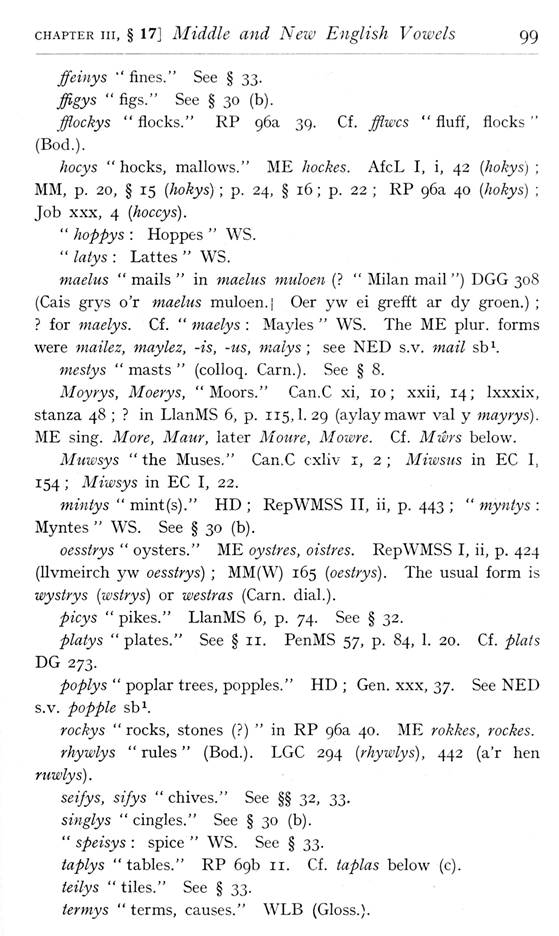
(delwedd F6850) (tudalen 099)
|
CHAPTER
III, § 17]
Middle and New English Vowels 99
ffeinys “fines." See § 33.
ffigys “figs." See § 30 (b).
fflockys "flocks." RP 96a 39. Cf. fflwcs "fluff, flocks"
(Bod.).
hocys "hocks, mallows." ME hockes. AfcL I, i, 42 (hokys); MM, p.
20, § 15 (hokys); p. 24, § 16; p. 22; RP 96a 40 (hokys); Job XXX, 4 (hoccys).
" hoppys: Hoppes “WS.
" latys: Lattes “WS.
maelus “mails “in niaelus muloen (? “Milan mail ") DGG 308 (Cais grys
o'r maelus muloen. | Oer yw ei grefft ar dy groen.);? for maelys. Cf.
“maelys: Mayles “WS. The ME plur. forms were mailez, maylez, -is, -us, malys;
see NED s.v. mail sb^.
mestys “masts” (colloq. Carn.). See § 8.
Moyrys, Moerys, "Moors." Can.C xi, 10; xxii, 14; Ixxxix, stanza
48;? in LlanMS 6, p. 115,1. 29 (aylaymawr val y mayrys). ME sing. More, Maur,
later Moure, Moi&re. Cf. Mwrs below.
Muwsys "the Muses," Can.C cxliv i, 2; Miwsus in EC I, 154; Miwsys
in EC I, 22.
mintys “mint(s)." HD; RepWMSS II, ii, p. 443; “myntys: Myntes “WS. See §
30 (b).
oesstrys “oysters." ME oystres, oistres. RepWMSS I, ii, p. 424
(llvmeirch yw oesstrys); MM(W) 165 (oestrys). The usual form is wystrys
(wstrys) or westras (Carn. dial.).
picys “pikes." LlanMS 6, p. 74. See § 32.
plaiys “plates." See § 11. PenMS 57, p. 84, 1. 20. Cf. plats DG 273.
poplys “poplar trees, popples." HD; Gen. xxx, 37. See NED s.v. popple
sb^
rockys “rocks, stones (?) “in RP 96a 40. ME rokkes, rockes.
rhywlys “rules” (Bod.). LGC 294 (rhywlys), 442 (a'r hen niwlys).
seifys, sifys “chives." See §§ 32, 33.
singly s “cingles." See § 30 (b).
" speisys: spice “WS. See § 33.
taplys “tables." RP 69b 11. Cf. taplas below (c).
teilys “tiles." See § 33.
terniys “terms, causes." WLB (Gloss.).
|






 B5237:
  ă ĕ ĭ ŏ ŭ
 yn
yn  aith δ δ £ U+2020 DAGGER †