kimkat3807k Brô Gôth ’gan Tâzow. Kérnow ha’y Thávaz. Cernyw a’i hiaith. Cornualla i la
seva llengua. Cornwall and its Language.
20-03-2024






|
|
Gwefan Cymru-Catalonia |
|

...
I
FYND AT Y TUDALEN HWN YN CYMRAEG: www.kimkat.org/amryw/1_kernewek/kernewek_bro-goth-agan-tazow_CYMRAEG_3808k.htm
PER ANAR A AQUESTA PÀGINA EN CATALÀ: www.kimkat.org/amryw/1_kernewek/kernewek_bro-goth-agan-tazow_CATALA_3810k.htm
Brô Gôth ’gan Tâzow
Cornish National Anthem
GWERS ÔNAN
Brô gôth agan tâzow, dhà flêghez a'th-kâr,
Gwlâz kêr än howlsêdhez, pan vrô yw dhà bâr?
War oll än norvyz 'th-ôn-ni skoellyz a-lêz,
Mêz àgan kerenza yw dhîz.
KÊSKAN
Kernow! Kernow! Y-kêryn Kernow.
Än môr hedrê vô º’vêl fôz dhîz a-drô
'Th-ôn ônan hàg oll ràg Kernow!
GWERS DEW
Gwlaskor Myghtern Arthur, än Sens kyns, hà'n Grâl,
Moy kêryz gênen nynz ºêûs tîredh
ârall,
Ynnoz-ji pùb karn, nans, mênydh hà chî
A-gowz yn Kernewek dhŷn-nî.
GWERS TRÎ
Yn tewlder än bâl hà war donnow än môr,
Pan êzen ow-kwandra drè diryow tramôr,
Yn pùb lê pynâg, hàg yn kenîver brô
Ÿ-treylyn kolonnow dhîzo.
ºCorrections to the the text – see below
…..
1/ Two spellings – standard and spelling for learners
2/ Notes on the spelling used here
3/ Words of the Anthem and an English translation
4/ CORRECTIONS TO THE ORIGINAL TEXT
5/ Words of the Anthem and the
Pronunciation using the International Phonetic Alphabet
6/ Vocabulary Notes
7/ Versions of the Anthem on Youtube
…..
1/ Two spellings – standard and spelling for learners
|
GWERS ONAN |
GWERS ÔNAN |
|
Bro goth agan tasow, dha fleghes a'th kar, |
Brô gôth agan tâzow, dhà flêghez a'th-kâr, |
|
Gwlas ker an howlsedhes, pan vro yw dha bar? |
Gwlâz kêr än howlsêdhez, pan vrô yw dhà bâr? |
|
War oll an norvys 'th on ni skollys a-les, |
War oll än norvyz 'th-ôn-ni skoellyz a-lêz, |
|
Mes agan kerensa yw dhis. |
Mêz àgan kerenza yw dhîz. |
|
|
|
|
KESKAN |
KÊSKAN |
|
Kernow! Kernow, y keryn Kernow; |
Kernow!
Kernow! Ÿ-kêryn Kernow. |
|
|
Än môr hedrê vô º’vêl fôz dhîz a-drô |
|
|
'Th-ôn ônan hàg oll ràg Kernow! |
|
|
|
|
GWERS DEW |
GWERS DEW |
|
Gwlaskor
Myghtern Arthur, an Sens kyns, ha'n Gral, |
Gwlaskor
Myghtérn Arthur, än Sens kyns, hà'n Grâl, |
|
Moy kerys
genen nyns yw tiredh aral, |
Moy kêryz
gênen nynz ºêûs tîredh ârall, |
|
Ynnos
sy pub karn, nans, menydh ha chi |
Ynnoz-ji pùb
karn, nans, mênydh hà chî |
|
A
gows yn Kernewek dhyn ni. |
A-gowz yn
Kernewek dhŷn-nî. |
|
|
|
|
GWERS TRI |
GWERS TRÎ |
|
Yn
tewlder an bal ha war donnow an mor, |
Yn tewlder än
bâl hà war donnow än môr, |
|
Pan
esen ow kwandra dre diryow tramor, |
Pan êzen
ow-kwandra drè diryow tramôr, |
|
Yn
pub le pynag, hag yn keniver bro |
Yn pùb lê
pynâg, hàg yn kenîver brô |
|
Y treylyn
kolonnow dhiso. |
Ÿ-treylyn
kolonnow dhîzo. |
…..
2/ Notes on the spelling used here
The spelling is Kernewek Kemmyn, with some amendations.
Although diacritics (here marks over a letter to help indicate the
pronunciation) are not used in Cornish, they are used here as an aid for
learners of the language.
a/ CIRCUMFLEX. Long vowels (in monosyllables, and final syllables in some
polysyllables) and half-long vowels (in many polysyllables) are marked with a
circumflex. For example,
brô (= country), môr (= sea) (long vowel);
tramôr (= foreign), hedrê (while) (long vowel),
mênydh (= hill), tâzow (= fathers) (half-long vowel)
b/ GRAVE ACCENT. Some words have a short vowel where one might expect a long
vowel or a half-long vowel, according to spelling rules.
pùb (= every), dhà (= your), àgan (=
our).
c/ An acute accent indicates an unusual stress in a word
myghtérn (= king)
d/ A diaeresis (two dots) over a vowel indicates that it is pronounced as a
schwa or neutral vowel /ə/
The definite article än is /ən/.
The particles ÿ- and ÿth- are /ə, əθ/
e/ HYPHEN. Particles are joined by means of a hyphen to the words they precede
or follow
ow kwandra > ow-kwandra (=
wandering)
ÿ treylyn > ÿ-treylyn (= we turn)
a gowz > a-gowz (= that speaks)
ynnoz ji > ynnoz-ji (= in you).
(In other cases the hyphen is used in standard spelling – a-lêz (= far and wide), a-drô
(= around)).
In standard spelling “z” is only found in a handful of words as an initial
consonant (zebra, etc).
However, the “s” at the end of monosyllables with a long vowel and in other monosyllables and in many polysyllables
is pronounced as /z/. Here “z” is used to indicate this.
fos > fôz (= wall)
kows > kowz (= speaks)
tasow > tâzow (= fathers)
(There is doubt whether a final “s” should be pronounced as /s/ or /z/, but
here we use “z”.)
fleghes > flêghez (= children)
howlsedhes > howlsêdhez (=
sunset, west).
…..
3/ Words of the Anthem and English translation
|
|
|
|
Brô gôth agan tâzow, dhà flêghez a'th-kâr, |
Old land of our fathers, your
children love you, |
|
Gwlâz kêr än howlsêdhez, pan vrô yw dhà bâr? |
Dear country of the west, what
land is your equal? |
|
War oll än norvyz 'th-ôn-ni skoellyz a-lêz, |
All over all the world we are
scattered far and wide, |
|
Mêz àgan kerenza yw dhîz. |
But our love is to you. |
|
|
|
|
KÊSKAN |
CHORUS |
|
Kernow!
Kernow! Y-kêryn Kernow. |
Cornwall! Cornwall! We love
Cornwall. |
|
Än môr hedrê vô º’vêl fôz dhîz a-drô |
For as long as the sea may be
like a wall around you |
|
'Th-ôn ônan hàg oll ràg Kernow! |
We are one and all for Cornwall! |
|
|
|
|
GWERS DEW |
VERSE TWO |
|
Gwlaskor
Myghtern Arthur, än Sens kyns, hà'n Grâl, |
The Kingdom of King Arthur, the
saints earlier, and the Grail |
|
Moy kêryz
gênen nynz ºêûs tîredh ârall, |
More belovèd with us there is no
other territory |
|
Ynnoz-ji pùb
karn, nans, mênydh hà chî |
In you every cairn, valley,
mountain and house |
|
A-gowz yn
Kernewek dhŷn-nî. |
Speaks in Cornish to us. |
|
|
|
|
GWERS TRÎ |
VERSE THREE |
|
Yn tewlder än
bâl hà war donnow än môr, |
In the darkness of the mine and
on the waves of the sea |
|
Pan êzen
ow-kwandra drè diryow tramôr, |
When we are wandering through
foreign lands |
|
Yn pùb lê
pynâg, hàg yn kenîver brô |
In whatever place, and in many a
country |
|
Y-treylyn
kolonnow dhîzo. |
We turn [our] hearts to you |
…..
4/ Words of the Anthem and the Pronunciation using the International
Phonetic Alphabet
NOTE: The stressed syllables are
indicated in bold type.
However, the words are not a good fit to the tune. There is unnatural
stress on some of them. These unnaturally stressed words are marked with an
asterisk.
norvyz > *norvyz
Kernow > *Kernow
ârall > *ârall
gwlaskor > *gwlaskor
myghtérn > *myghtern
gênen > *gênen
ynnos-ji > ynnos-ji
kenîver > *kenîver
dhîzo > *dhîzo
5/ CORRECTIONS TO THE ORIGINAL TEXT
yn fôz dhîz a-drô > º’vêl fôz dhîz a-drô (yn = in, ‘vêl
= like; yn seems to be the result of the influence of Welsh syntax)
nynz yw
tîredh ârall > nynz ºêûs tîredh ârall (yw is used with definite
nouns; êûs with indefinite nouns. “tîredh ârall” is indefinite.)
|
GWERS ÔNAN |
gwɛrs ˈɔ·nan |
|
Brô gôth agan tâzow, dhà flêghez a'th-kâr, |
brɔ: gɔ:θ ˈagan ˈta·zɔw, ða ˈflɛ·xɛz aθ ka:r, |
|
Gwlâz kêr än howlsêdhez, pan vrô yw dhà bâr? |
gwla:z kɛːr әn hɔwlˈsɛ·ðɛz, pan vrɔ: ɪw ða ba:r |
|
War oll än *norvyz
'th-ôn-ni skoellyz a-lêz, (instead of norvyz) |
war ɔl: әn ˈnɔrvɪz *(nɔrˈvɪz) ˈθɔ·n:ɪ ˈskɤl:ɪz aˈlɛːz, |
|
Mêz àgan kerenza yw dhîz. |
mɛːz ˈagan kɛˈrɛnza ɪw ði:z. |
|
|
|
|
KÊSKAN |
ˈkɛ·skan |
|
*Kernow! Kernow! Y-kêryn *Kernow. (instead of Kernow) |
ˈkɛrnɔw ˈkɛrnɔw *(kɛrˈnɔw)
ɪˈkɛ·rɪn ˈkɛrnɔw *(kɛrˈnɔw) |
|
Än môr hedrê vô ’vêl fôz dhîz a-drô |
әn mɔ:r hɛˈdrɛː vɔ: vɛːl fɔ:z ði:z aˈdrɔ: |
|
'Th-ôn ônan hàg oll ràg *Kernow!
(instead of Kernow) |
θɔ:n ˈɔ·nan hag ɔl: rag ˈkɛrnɔw *(kɛrˈnɔw) |
|
|
|
|
GWERS DEW |
gwɛrs dɛw |
|
*Gwlaskor *Myghtern Arthur, än Sens kyns,
hà'n Grâl, |
ˈgwlaskɔr *(gwlasˈkɔr) mɪxˈtɛrn
*(ˈmɪxtɛrn) ˈarθyr әn sɛns kɪns, han
gra:l |
|
Moy kêryz *gênen nynz êûs tîredh *ârall, (instead of gênen, ârall) |
mɔɪ ˈkɛ·rɪz ˈgɛ·nɛn
*(gɛ·ˈnɛn) nɪnz œs ˈti·rɛð ˈa·ral: *(a·ˈral:) |
|
Ynnoz-ji pùb karn, nans, mênydh hà chî |
ˈɪn:ɔz ʤɪ pʊb karn, nans, ˈmɛ·nɪð
ha ʧi: |
|
A-gowz yn Kernewek dhŷn-nî. |
aˈgɔwz ɪn kɛrˈnɛʊɛk ði:n ni: |
|
|
|
|
GWERS TRÎ |
gwɛrs tri: |
|
Yn tewlder än bâl hà war donnow än môr, |
ɪn ˈtɛʊldɛr әn ba:l ha war ˈdɔn:ɔw әn
mɔ:r, |
|
Pan êzen ow-kwandra drè diryow tramôr, |
pan ˈɛ·zɛn ɔwˈkwandra drɛ ˈdɪrjɔw
traˈmɔ:r, |
|
Yn pùb lê pynâg, hàg yn *kenîver brô (instead of kenîver) |
ɪn pʊb lɛː pɪˈna:g,
hag ɪn kɛˈni·vɛr *(ˈkɛni·vɛr) brɔ: |
|
Ÿ-treylyn kolonnow *dhîzo.
(instead of dhizo) |
әˈtrɛɪlɪn kɔˈlɔn:ɔw ˈði·zɔ
*(ði·ˈzɔ) |
|
|
|
…..
6/ Vocabulary Notes
▪ = causes soft mutation
▪* = causes soft mutation in certain circumstances
|
GWERS ÔNAN |
VERSE ONE |
|
Brô gôth agan tâzow, dhà flêghez a'th-kâr, |
Old land
of our fathers, your children love you, |
|
Gwlâz kêr än howlsêdhez, pan vrô yw dhà bâr? |
Dear
country of the west, what land is your equal? |
|
War oll än norvyz 'th-ôn-ni skoellyz a-lêz, |
All over
all the world we are scattered far and wide, |
|
Mêz àgan kerenza yw dhîz. |
But our
love is to you. |
|
verse |
/gwɛrs/ |
|
|
kêskan |
chorus, refrain, burden |
/ˈkɛ·skan/ |
|
ônan |
one |
/ˈɔ·nan/ |
|
dew |
two |
/dɛw/ |
|
trî |
three |
/tri:/ |
|
brô |
(nf) country, land |
/brɔ:/ |
|
kôth |
old |
/kɔ:θ/ |
|
brô gôth |
old land (soft mutation k < g of following adjective
after a feminine noun) |
/brɔ:
gɔ:θ/ |
|
àgan |
our |
/ˈagan/ |
|
’gan |
our (clipped form) |
/gan/ |
|
tâz |
(nm) father |
/ta:z / |
|
tâzow |
fathers |
/ˈta·zɔw/ |
|
dhà |
your |
/ða,/ |
|
flôgh |
(nm) child |
/flo:x/ |
|
flêghez |
children |
/ˈflɛ·xɛz/ |
|
kâr |
he / she / it loves |
/ka:r/ |
|
a-gâr |
(it is)… that loves (the preceding “it is” (in Old Cornish
“is”, in Welsh “ys”) has disappeared from Cornish) |
/aˈga:r/ |
|
’th |
infixed form of tî
= you |
/θ/ |
|
a’th-kâr |
that loves you |
/aθ ka:r/ |
|
gwlâz |
(nf) country |
/gwla:z/ |
|
kêr |
dear, belovèd |
/kɛːr, gwla:z kɛːr/ |
|
howl |
(nm) sun |
/hɔwl/ |
|
sêdhi |
to sink |
/ˈsɛ·ðɪ/ |
|
sêdhez |
sinking |
/ˈsɛ·ðɛz/ |
|
howlsêdhez |
(nm) 1 sunset (‘sun-sinking’) 2 west |
/hɔwlˈsɛ·ðɛz/ |
|
gwlâz kêr än howlsêdhez |
dear country (of) the west |
/gwla:z kɛːr әn
hɔwlˈsɛ·ðɛz/ |
|
pan▪* |
(determiner) what Probably pŷ (pronoun) (= which one) + (än = the); thus “which one + the”. It mutates a following
feminine noun, in the same way as the definite article “än” does |
/pan/ |
|
pan vrô |
which country, land (bro
> vro after pan) |
/pan vrɔ:/ |
|
yw |
is |
/ɪw/ |
|
dhà▪ |
your (causes soft mutation) |
/ða / |
|
pâr |
equal = something or someone equal to you |
/pa:r/ |
|
dhà bâr |
your equal (par >
bar after dhà) |
/ða ba:r/ |
|
war |
on |
/war/ |
|
oll |
all |
/ɔl: / |
|
norvyz |
world |
/ˈnɔrvɪz/ |
|
oll än norvyz |
all the world |
/ɔl: әn ˈnɔrvɪz / |
|
war oll än norvyz |
in all the world (“on all the world”) |
/war ɔl: әn ˈnɔrvɪz/ |
|
ôn |
we are |
/ɔ·n/ |
|
ôn-ni |
we are (+ tag pronoun -ni = we) |
/ˈɔ·n nɪ/ |
|
ÿth- |
particle before verb “to be” in the affirmative form |
/әθ/ |
|
ÿth-ôn-ni |
we are (reduced to ’th-ôn-ni)
(loss of pretonic syllable) |
/әθ ˈɔ·n nɪ, ˈθɔ·n nɪ/ |
|
skoellya |
spill, pour |
/ˈskɤl:ja/ |
|
lêz |
(nm) width, breadth |
/lɛːz/ |
|
a-lêz |
widely, abroad (in the old sense of widely) |
/aˈlɛːz/ |
|
skoellya a-lêz |
scatter |
/ˈskɤl:ja aˈlɛːz/ |
|
skoellys a-lêz |
scattered |
/ˈskɤl:ɪz aˈlɛːz/ |
|
mêz |
but |
/mɛːz/ |
|
kerenza |
(nf) love |
/kɛˈrɛnza/ |
|
àgan kerenza |
our love |
/ˈagan kɛˈrɛnza./ |
|
dhîz |
to you |
/ði:z/ |
|
yw dhîz |
is to you. |
/ɪw ði:z/ |
….
|
KÊSKAN |
CHORUS |
|
Kernow!
Kernow! Y-kêryn Kernow. |
Cornwall!
Cornwall! We love Cornwall. |
|
Än môr hedrê vô º’vêl fôz dhîz a-drô |
For as
long as the sea may be like a wall around you |
|
'Th-ôn ônan hàg oll ràg Kernow! |
We are
one and all for Cornwall! |
….
|
Kernow |
(nf) Cornwall |
/ˈkɛrnɔw/ |
|
kêryn |
we love |
/ˈkɛ·rɪn/ |
|
ÿ- |
particle introducing a verb in an
affirmative sentence |
/ә/ |
|
ÿ-kêryn |
we love |
/әˈkɛ·rɪn/ |
|
môr |
(nm) sea |
/mɔ:r/ |
|
hedrê▪ |
whilst - apparently (he- intensifying prefix) + (soft
mutation T > D) + (tre –
original form of ter = through) |
/hɛˈdrɛː/ |
|
bô |
may it be (third person singular
present subjunctive of bôz = to
be; being) |
/bɔ:/ |
|
hedrê vô |
while it may be, as long as it is |
/hɛˈdrɛː vɔ:/ |
|
like |
/aˈvɛːl
/ |
|
|
’vêl |
like – clipped form - loss of pretonic syllable |
/vɛːl / |
|
fôz |
wall |
/fɔ:z/ |
|
’vêl fôz |
like a wall |
/vɛːl fɔ:z/ |
|
dhîz |
to you |
/ði:z/ |
|
trô |
a turn |
/trɔ:/ |
|
a-drô |
around (adv) |
/aˈdrɔ:/ |
|
a-drô dhè |
(preposition) around (“around to”) |
/aˈdrɔ:
ðә/ |
|
a-drô dhîz |
around you; (poetically with the words reversed) dhîz a-drô around you |
/aˈdrɔ:
ði:z/ |
|
ÿth-ôn |
we are (same as ÿth-ôn-ni above) Reduced to 'th-ôn (loss of
pretonic syllable) |
/әθˈɔ:n, θɔ:n/ |
|
ônan hàg oll |
one and all (also the motto of Cornwall) |
/ˈɔ·nan hag ɔl:/ |
|
ràg |
for |
/rag ˈkɛrnɔw / |
|
ràg Kernow |
for Cornwall |
/rag ˈkɛrnɔw/ |
…..
|
GWERS DEW |
VERSE TWO |
|
Gwlaskor
Myghtérn Arthur, än Sens kyns, hà'n Grâl, |
The
Kingdom of King Arthur, the saints earlier, and the Grail |
|
Moy
kêryz gênen nynz êûs tîredh ârall, |
More
belovèd with us there is no other territory |
|
Ynnos-si
pùb karn, nans, mênydh hà chî |
In
you every cairn, valley, mountain and house |
|
A-gowz
yn Kernewek dhŷn nî. |
Speaks
in Cornish to us. |
….
|
dɛw |
two |
dɛw |
|
gwlâz |
country |
gwla:z |
|
kordh |
(nm) tribe |
kɔrð |
|
gwlaskor |
(nf) kingdom, realm: gwlâz +
kordh > gwlazgordh > gwlaskordh > gwlaskor (“country-tribe”) |
ˈgwlaskɔr *(gwlasˈkɔr) |
|
myghtérn |
(nm) king |
mɪxˈtɛrn |
|
Arthur |
Arthur |
ˈarθyr |
|
sans |
(nm) saint |
sans |
|
sens |
saints |
sɛns |
|
kyns |
before, formerly |
kɪns |
|
hà |
and (hà + än) > hà’n and the |
ha,
han |
|
Grâl |
(nm) the Grail, the Holy Grail |
gra:l |
|
moy |
more |
mɔɪ |
|
kêryz |
loved, dear, belovèd |
ˈkɛ·rɪz |
|
gans |
with |
gans |
|
gênen |
with us |
ˈgɛ·nɛn |
|
nynz |
not |
nɪnz |
|
nynz êûs |
is not, there is not |
nɪnz œs |
|
tîredh |
territory |
ˈti·rɛð |
|
ârall |
other |
ˈa·ral: |
|
tîredh ârall |
another territory |
ˈti·rɛð ˈa·ral: |
|
yn |
in |
ɪn |
|
ynnoz |
in you |
ˈɪn:ɔz |
|
-ji |
tag pronoun = you |
ʤɪ |
|
ynnoz-ji |
in you |
ˈɪn:ɔz ʤɪ |
|
pùb |
every |
pʊb |
|
karn |
cairn |
karn |
|
nans |
valley |
nans |
|
mênydh |
hill |
ˈmɛ·nɪð |
|
hà |
and |
ha |
|
chî |
(nm) house |
ʧi: |
|
kewzel |
to speak |
ˈkɛʊzɛl |
|
kowz |
it speaks |
kɔwz |
|
a-gowz |
which speaks |
aˈgɔwz |
|
pùb karn… a-gows |
(it is) every cairn which speaks |
pʊb karn… aˈgɔwz |
|
yn Kernewek |
in Cornish |
ɪn kɛrˈnɛʊɛk |
|
dhŷn |
to us |
ði:n |
|
dhŷn-ni |
to us |
ni: |
……
|
GWERS TRÎ |
VERSE
THREE |
|
Yn
tewlder än bâl hà war donnow än môr, |
In
the darkness of the mine and on the waves of the sea |
|
Pan
êzen ow-kwandra drè diryow tramôr, |
When
we are wandering through foreign lands |
|
Yn
pùb lê pynâg, hàg yn kenîver brô |
In
whatever place, and in many a country |
|
Ÿ-treylyn
kolonnow dhîzo. |
We
turn [our] hearts to you |
…
|
yn |
in |
ɪn |
|
tewlder |
darkness |
ˈtɛʊldɛr |
|
bâl |
(nm) mine |
ba:l |
|
yn tewlder än bâl |
in (the) darkness (of) the mine |
ɪn ˈtɛʊldɛr әn ba:l |
|
hà |
and |
ha |
|
war |
on (causes soft mutation) |
war |
|
tonn |
(nf) wave |
tɔn: |
|
tonnow |
waves |
ˈtɔn:ɔw |
|
war donnow än môr |
on (the) waves (of) the sea |
war ˈdɔn:ɔw әn
mɔ:r |
|
pan |
when |
pan |
|
êzen |
we are |
ˈɛ·zɛn |
|
ow- |
particle introducing the gerund.
Causes mixed mutation (here “g” > “k”). |
ɔw |
|
gwandra |
to wander; wandering |
ˈgwandra |
|
ow-kwandra |
wandering |
ɔw ˈkwandra |
|
drè |
through (This preposition causes
soft mutation) |
drɛ |
|
tîr |
land |
ti:r |
|
tiryow |
lands |
ˈtɪrjɔw |
|
drè diryow |
through lands |
drɛ ˈdɪrjɔw |
|
*trâ |
< Brythonic *trans (= across); same as Latin trans (= across) |
tra: |
|
tramôr |
foreign (“across-sea”) |
traˈmɔ:r |
|
pùb lê |
every place |
pʊb lɛː |
|
pynâg |
Whatever. Apparently “which thing”
+ “not” (pŷ+ nâg) |
pɪˈna:g |
|
yn pùb lê pynâg |
wherever, in whatever place (“in
every place whatever”) |
ɪn pʊb lɛː pɪˈna:g |
|
hàg |
and. A form of hà before a vowel |
hag |
|
kenîver |
many (kê- < kêv < Brythonic prefix
*kom- = with; same as Latin prefix com- = with) + (nîver = number).
Originally meant “so many”, now “many”. |
kɛˈni·vɛr |
|
brô |
country |
brɔ: |
|
treylya |
to turn; turning |
ˈtrɛɪlja |
|
y-treylyn |
we turn |
әˈtrɛɪlɪn |
|
kolonn |
(nf) heart |
ˈkɔlɔn: |
|
kolonnow |
hearts |
kɔˈlɔn:ɔw
|
|
dhè |
to |
ðә |
|
dhîzo |
to you |
ˈði·zɔ |
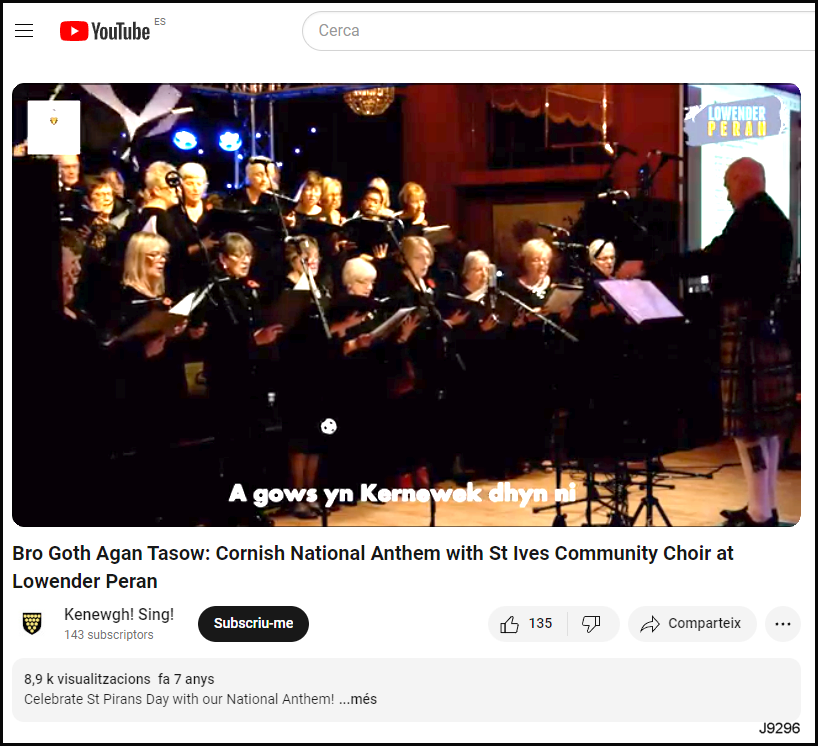
7/ Versions of the Anthem
on Youtube
….
|
|
|
|
|
|
|
|
|
|
|
|
|
See also wikipedia |
|
|
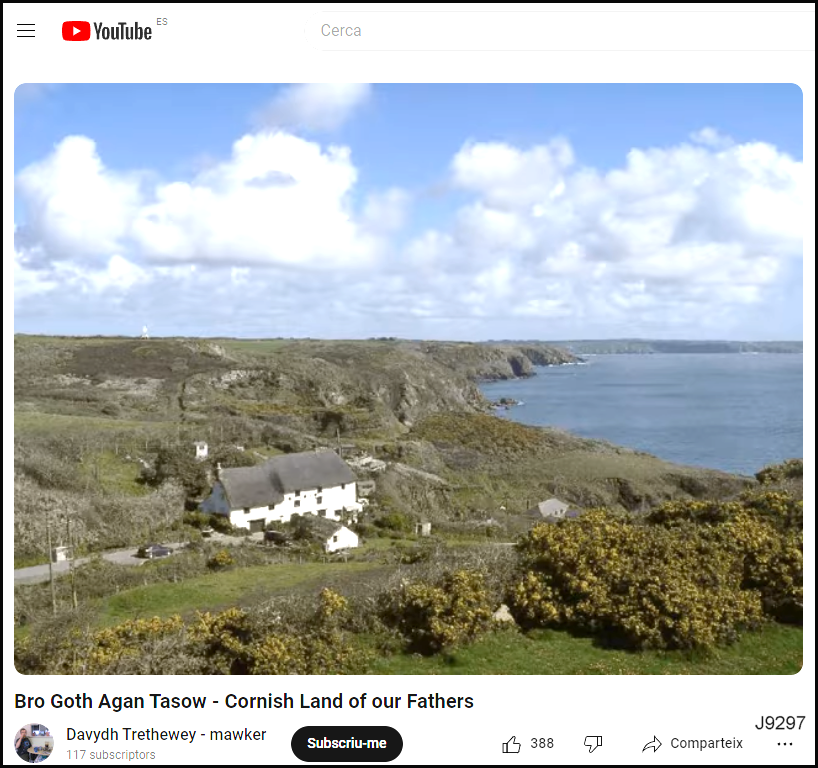
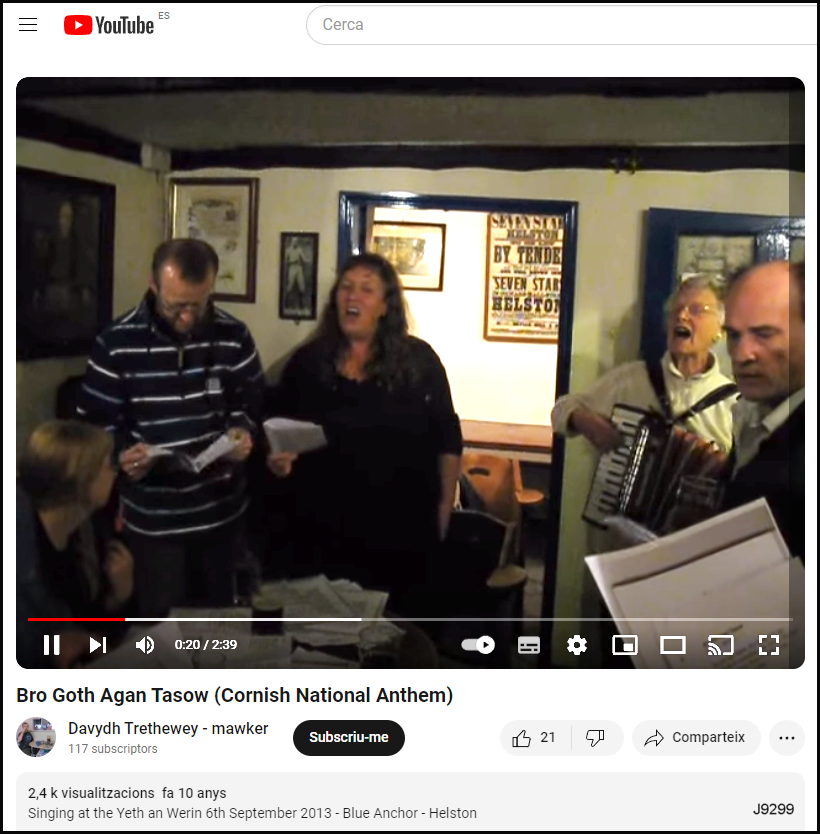
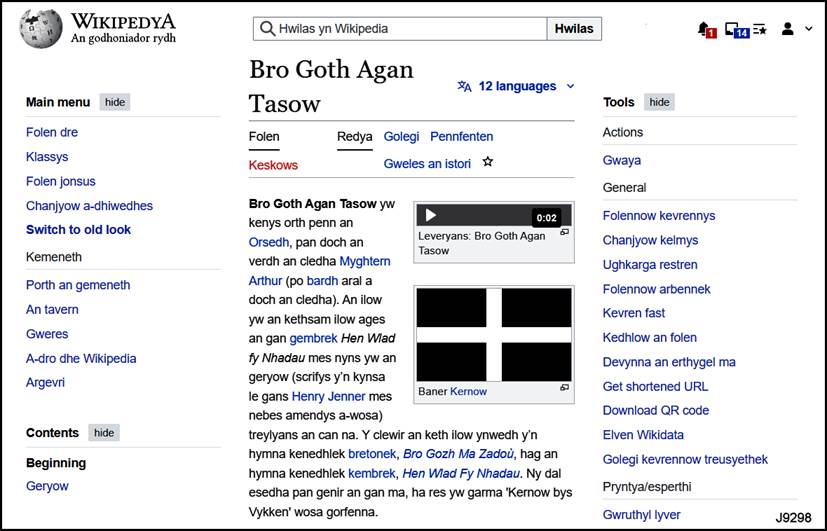
…..
Comparison between our IPA transcription and the
wikipedia transcription
|
KERNEWK KERMYN AMENDYZ |
WIKIPEDIA |
|
|
|
|
gwɛrs ˈɔ·nan |
1 |
|
brɔ: gɔ:θ ˈagan ˈta·zɔw, ða ˈflɛ·xɛz aθ ka:r, |
[bɹoː ɡoːθ ˈæː.ɡæn
ˈtæː.zɔʊ ðæː ˈfleː.hɛz æːθ
kɑːɹ] |
|
gwla:z kɛːr әn hɔwlˈsɛ·ðɛz, pan vrɔ:
ɪw ða ba:r |
[ɡwlæːz keːɹ æn hɔʊlˈzeː.ðəz
pæːn vɹoː ɪw ðæː bɑːɹ] |
|
war ɔl: әn ˈnɔrvɪz *(nɔrˈvɪz) ˈθɔ·n:ɪ ˈskɤl:ɪz aˈlɛːz, |
[wɑːɹ oːlʰ æn ˈnɔɹ.vɪz
θ‿oːn niː
ˈskoː.lʰɪz æˈleːz] |
|
mɛːz ˈagan kɛˈrɛnza ɪw ði:z. |
[meːz ˈæː.ɡæn kəˈɹɛn.zæ
ɪw ðiːs] |
|
|
|
|
ˈkɛ·skan |
|
|
ˈkɛrnɔw ˈkɛrnɔw
*(kɛrˈnɔw) ɪˈkɛ·rɪn ˈkɛrnɔw
*(kɛrˈnɔw) |
[ˈkɛɹ.nɔʊ ˈkɛɹ.nɔʊ
ə ˈkeː.ɹɪn ˈkɛɹ.nɔʊ] |
|
әn mɔ:r hɛˈdrɛː vɔ:
vɛːl fɔ:z ði:z aˈdrɔ: |
[æn moːɹ ˈhɛd.ɹə
voː ɪn foːz ðiːz əˈdɹoː] |
|
θɔ:n ˈɔ·nan hag ɔl: rag ˈkɛrnɔw *(kɛrˈnɔw) |
[θ‿oːn
ˈoː.nən hæːɡ oːlʰ ɹæːɡ ˈkɛɹ.nɔʊ] |
|
|
|
|
gwɛrs dɛw |
2 |
|
ˈgwlaskɔr *(gwlasˈkɔr)
mɪxˈtɛrn *(ˈmɪxtɛrn) ˈarθyr әn
sɛns kɪns, han gra:l |
[ˈɡwlæːs.kɔɹ ˈmɪh.təɹn
ˈɑɹ.θʊɹ æn sɛnz kɛnz hæːn ɡɹæːl] |
|
mɔɪ ˈkɛ·rɪz
ˈgɛ·nɛn *(gɛ·ˈnɛn) nɪnz œs ˈti·rɛð ˈa·ral:
*(a·ˈral:) |
[mɔɪ ˈkeː.ɹɪz ˈɡeː.nɛn
nɪnz ɪw ˈtiː.ɹɛð æˈɹæːl] |
|
ˈɪn:ɔz ʤɪ pʊb karn, nans, ˈmɛ·nɪð ha ʧi: |
[ˈɪ.ᵈnɔz (d͡ʒ)iː
pʊb kɑɹn nænz ˈmeː.nɪð hæː t͡ʃiː] |
|
aˈgɔwz ɪn kɛrˈnɛʊɛk ði:n ni: |
[ə ɡɔʊz ɪn kəɹˈneː.wɛk
ðiːn niː] |
|
gwɛrs tri: |
|
|
ɪn ˈtɛʊldɛr әn ba:l ha war ˈdɔn:ɔw әn
mɔ:r, |
[ɪn ˈtɛʊl.dəɹ ən
bæːl hæː wɑɹ ˈdɔ.ᵈnɔʊ ən
moːɹ] |
|
pan ˈɛ·zɛn ɔwˈkwandra
drɛ ˈdɪrjɔw traˈmɔ:r, |
[pæːn ˈeː.zən ɔʊ
ˈkwæn.dɹæ dɹeː ˈdɪɹ.jɔʊ ˈtɹæː.mɔɹ] |
|
ɪn pʊb lɛː pɪˈna:g, hag ɪn kɛˈni·vɛr
*(ˈkɛni·vɛr) brɔ: |
[ɪn pʊb leː ˈpɪ.nəɡ
hæːɡ ɪn kəˈniː.vɛɹ bɹoː] |
|
әˈtrɛɪlɪn kɔˈlɔn:ɔw
ˈði·zɔ *(ði·ˈzɔ) |
[iː ˈtɹəɪ.lɪn kɔˈlɔ.ᵈnɔʊ
ˈðiː.sɔ] |
…..
Sumbolau:
a A / æ Æ / e E / ɛ Ɛ /
i I / o O / u U / w W / y Y /
MACRONː ā Ā / ǣ Ǣ /
t Ē / ɛ̄ Ɛ̄ / ī Ī / ō Ō / ū Ū /
w̄ W̄ / ȳ Ȳ /
MACRON + ACEN DDYRCHAFEDIGː Ā̀
ā̀
, Ḗ ḗ, Ī́
ī́
, Ṓ ṓ , Ū́
ū́,
(w), Ȳ́
ȳ́
MACRON + ACEN DDISGYNEDIGː Ǟ ǟ , Ḕ ḕ, Ī̀
ī̀,
Ṑ ṑ, Ū̀
ū̀,
(w), Ȳ̀
ȳ̀
MACRON ISODː A̱ a̱ ,
E̱ e̱ ,
I̱ i̱ ,
O̱ o̱, U̱ u̱,
(w), Y̱ y̱
BREFː ă Ă / ĕ Ĕ / ĭ Ĭ / ŏ Ŏ / ŭ Ŭ /
B5236ː  B5237ː
BREF GWRTHDRO ISODː i̯, u̯
CROMFACHAUː ⟨ ⟩ deiamwnt
A’I PHEN I LAWRː ∀, ә, ɐ (u+0250) httpsː //text-symbols.com/upside-down/
Y WENHWYSWEG: ɛ̄ ǣ æ ɛ:
æ:
ˈ ɑ ɑˑ aˑ aː / æ æː /
e eˑeː / ɛ ɛː / ɪ iˑ iː ɪ / ɔ oˑ oː / ʊ uˑ uː ʊ / ə / ʌ /
ẅ Ẅ / ẃ Ẃ / ẁ Ẁ / ŵ Ŵ /
ŷ Ŷ / ỳ Ỳ /
ý Ý / ɥ
ˈ ð ɬ ŋ ʃ ʧ θ ʒ ʤ /
aɪ ɔɪ əɪ uɪ ɪʊ aʊ ɛʊ ɔʊ əʊ / £
ә ʌ ẃ ă ĕ ĭ ŏ ŭ ẅ ẃ ẁ Ẁ ŵ ŷ ỳ Ỳ ɣ ɤ Hungarumlautː A̋ a̋
U+1EA0 Ạ U+1EA1 ạ
U+1EB8 Ẹ U+1EB9 ẹ
U+1ECA Ị U+1ECB ị
U+1ECC Ọ U+1ECD ọ
U+1EE4 Ụ U+1EE5 ụ
U+1E88 Ẉ U+1E89 ẉ
U+1EF4 Ỵ U+1EF5 ỵ
g yn
yn  aith
δ δ £ g
aith
δ δ £ g yn
yn  aith
δ δ £ U+2020 †
aith
δ δ £ U+2020 †
« »
DAGGER
wikipedia, scriptsource. org
httpsː []//en.wiktionary.org/wiki/ǣ
Hwngarwmlawtː A̋ a̋
g yn aith
δ δ
yn aith
δ δ
…..
…..
ʌ ag acen ddyrchafedig / ʌ with acute accentː ʌ́
|
Shwa ag acen ddyrchafedig / Schwa
with acute |
…..
…..
turnwikipedia,
scriptsource.[]org
httpsː//[
]en.wiktionary.org/wiki/ǣ
Y TUDALEN HWN: www.[] kimkat.org/amryw/1_kernewek/kernewek_bro-goth-agan-tazow_SAESNEG_3807k.htm
---------------------------------------
Creuwyd: 18-03-2024
Ffynhonnell:
Adolygiad diweddaraf: 18-03-2024
Delweddau:
|
Freefind: |
Ble'r wyf i? Yr ych chi'n ymwéld ag un o dudalennau'r Wefan
CYMRU-CATALONIA
On sóc? Esteu visitant una pàgina de
la Web CYMRU-CATALONIA (= Gal·les-Catalunya)
Where am I? You are visiting a page from the CYMRU-CATALONIA (= Wales-Catalonia)
Website
Weə-r äm ai? Yüu äa-r víziting ə peij fröm dhə CYMRU-CATALONIA
(= Weilz-Katəlóuniə) Wébsait
An Ázran Gernéweg / Yr Adran Gernyweg / La
secciò còrnica / Cornish Section
908
Mirowgh
orth agan stadegow. Edrychwch ar ein Hystadegau. Mireu les nostres
estadístiques.