0926e Gwefan Cymru-
06-01-2022





····
|
|
Gwefan
Cymru-Catalonia |
|
.....
|
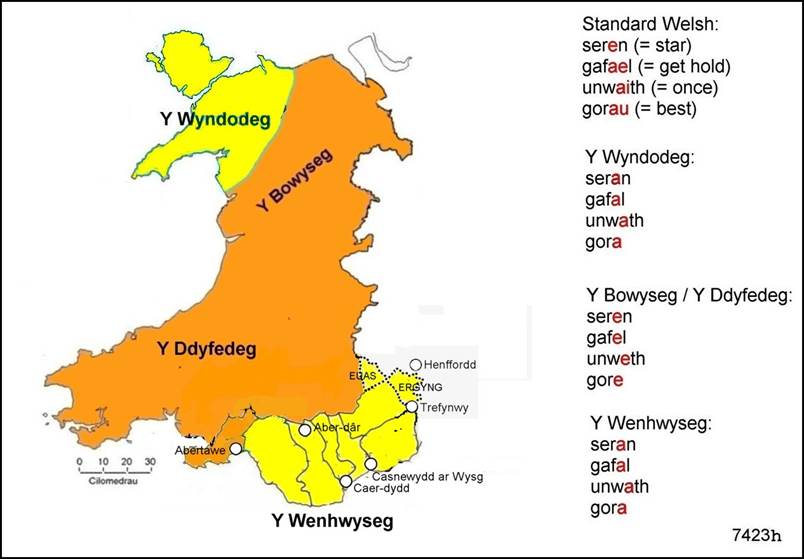
NODWEDDION Y WENHWYSEG (YN SAESNEG) 1/ Slender ‘a’ And where the long “a” in
general southern Welsh is a reduction of the diphthong ‘ae’, this too becomes
‘ɛ’ [æ:] 2/ Provection
seren [se·rɛn]
(= star) > seran [se·ran] . This is also the case where
the ‘e’ in general southern Welsh is a reduction of the diphthongs ‘ai’,
‘ae’, ‘au’. 4/ Loss of ‘h’ Hapus (= happy) > ’apus Hanes (= story) > hanas > ’anas |
Now
we shall look at the features of Gwentian in more detail.
A/ Some features are common throughout Wales in the spoken language.
B/ Many are general in South Wales, and are common to the south-west and the
south-east, but are not found in the north.
C/ Some are found only in south-eastern Wales, and are the distinctive
characteristics of Gwentian.
..............................................................
A1/
The loss of a final [v] (spelt ‘f’) in polysyllables.
Cyntaf
(= first) > cynta
Pentref
> pentre (> Gwentian pentra)
Uchaf
(= uppermost) > ucha
It
seems that in some words it is retained in speech:
Araf (= slow)
(Words
from literary Welsh, if used in speech, also retain the final [v] e.g. gorsaf
(= station)
(The
monosyllable tref (= home; town) also
loses the final ‘f’ > tre).
..............................................................
A2/ Final ‘oe’ in a polysyllabic word is reduced to
‘o’. This is especially noticeable in the plural suffix ‘-oedd’
cant
(= hundred), plural cannoedd > cano’dd
nef
(= heaven), nefoedd > nefo’dd (= heaven, heavens)
..............................................................
A3/ Loss of linking
‘y’ (definite article) in place names.
Nant-y-moel > Nant-môl
Nant-y-glo > Nant-glo
Glan-y-llyn
> Glan-llyn
Pen-y-bont > Pen-bont
..............................................................
A4/ Monosyllabic words from English which have [ai] in that language have [ei] in Welsh
steil = English style
preiz = English prize
ceind = English
kind
preid = English pride
reit = English right
preim = English prime (of life)
..............................................................
A5/
Monosyllabic words from English
which have [aʊ] in that language have [oʊ] in Welsh
sowth
= English south
stowt
= English stout
..............................................................
A6/
A pretonic syllable in words of three syllables or more might be dropped
esgidiau
(= shoes) >
sgidiau > sgidie > sgidje >
(Gwentian) sgidja, sgitsha
..............................................................
A7/ A tonic syllable in a disyllable might be dropped
i.e. many disyllabic forms lose the first syllable, although it bears the accent
(a feature common to all dialects of Welsh)
yma [Ə-ma⟩ = here > ’ma [ma⟩
yma
(= here) > ma
dyma
(= here is; from ‘wel dyma’, from the question ‘a weli di yma?’ do you see
here?) > ma
aco
(= over there) > co (North Wales has aco > acw > cw).
..............................................................
A8/
‘m’ as the preferred nasal consonant before ‘b’ and ‘p’, replacing ‘n’.
Llwynypia
> Llwmpia
Pen-bont
> Pem-bont
This
is a common feature in many languages – e.g. English Banbury > Bambry, German
Brandenburg > Brandemburg (and Hamburg, originally Hanburg); Scots Dunbarton
(as in Dunbartonshire), but Dumbarton (name of the county town), etc.
..............................................................
A9/
Many English loan-words.
To
lodge > lojo
Trousers
> trowsus
Building
> bildin
..............................................................
A10/
In polysyllables, some consonant clusters with final ‘-l’, ‘-r’ lose these
ffenestr = (window) > ffenest (> Gwentian ffenast)
perygl
(= danger) > peryg
..............................................................
A11/
schwa in monosyllables in
words from English:
Standard Welsh prefers ‘w’ [ʊ]
bws
[bʊs] (= bus)
is usually colloquially bys [bəs]
rẁff [rʊff] (= rough) is also ryff [rəf]
If
the word is used only colloquially, it is spelt with ‘y’ although the spelling would suggest, in a
monosyllable, that rather it is [ɪ] or [i:]
ryn (= a
run, i.e. on foot; journey in a car, etc)
[rən]
Dytsh (= Dutch) [dəʧ]
..............................................................
A12/
the definite article ‘yr’ before a tonic syllable beginning with a vowel
becomes ‘r’ (see A6 above).
This
occurs throughout Wales in a few instances and is noticeable in certain place
names.
Yr
Ynys > ’Rynys (= the island)
Yr
Allt > ’Rallt (= North: the cliff, the hill; South: the wooded hill)
Yr
Ardd > ’Rardd (= the garden; the field near the farmhouse. Field name,
Llangoedmor, Ceredigion)
Cae’r
Efail > Cae Refel (= smithy field, forge field) (field name in
Llan-bryn-mair, Sir Drefaldwyn)
..............................................................
A13/
The combination of ‘g’ and the diphthong ‘wy’ [guɪ] in a tonic syllable has generally been
simplified to [gwɪ].
Hence in North
Wales Yr Wyddfa (“Mount Snowdon”) > “Y Wuddfa” (also “Yr Wuddfa”)
..............................................................
A14/ Both
English “ch” and “j”, as well as “z” are now usual in spoken Welsh, though only
recently adopted in spoken northern Welsh (in the twentieth century).
English
“chips” is Welsh “tships”, “startch” is “startsh” (although “starts” for
northern speakers until recent times). English “jug” is Welsh “jwg”, though the
earlier pronunciation “shwg” survives too. “Jack” is Welsh “Jac”, earlier
“Shac”. The sound “z” [z] is now usual in spoken Welsh, though in recent times
in the North replced by “s” [s], its unvoiced counterpart. Thus “zoo” is
generally “zw”, though standard Welsh maintains the older spelling and
pronunciation “sw”.
..............................................................
A15/ A
final-syllable “a” may become “o” and vice-versa in various dialects.
In the
south, ofn (= fear) > ofon > ofan.
In the south
afal (= apple) > afol.
..............................................................
A16/ Gender
of nouns may vary in different regions.
..............................................................
A17/ Plural
forms may vary in different regions.
Cath (=
cat), cathod (= cats) North Wales and standard.
South
Wales: plural: cathau > (general southern) cathe > (Gwentian) catha
..............................................................
Mynydd (=
mountain; upland pasture), mynyddoedd (= mountains, etc) North Wales and
standard.
South
Wales: plural: mynyddau > (general southern) mynydd e> (Gwentian) mynydda
..............................................................
llythyr (=
letter), llythyron (= letters) North Wales and standard.
South
Wales: plural: > llythyrau (general southern) llythyre > (Gwentian)
llythyra
..............................................................
A18/ A
final “n” in polysyllables may become “m”
Thus botwn
(= button) > botwm
Y Trallwng
(= the swamp; place name) > Y Trallwn > Y Trallwm
Morgan >
Margan > Margam (place name, south-east Wales)
..............................................................
A19/ Clustering of initial consonants when an initial vowel is lost.
Caradog
> Cradog
Llangarannog
> Llangrannog
..............................................................
A20/
reduction of the vowel in a pretonic syllable > schwa
ceffylau (=
horses) > cyffyle
..............................................................
FEATURES OF
SOUTHERN WELSH
This indicates that the vowel is not an
original long “o”, as in words such as “bod” (= to be), “cof” (= memory), “gof”
(= “smith”, etc.)
(The usual way of representing this long ‘o’ from an original ‘oe’ – for
example, in dialect writing - is either with an apostrophe (co’d) (nowadays the recommended form,
as it is clear that it is a reduction of a diphthong), or with a circumflex (côd).) (In standard Welsh this is coed (= wood) (and pronounced in
southern standard Welsh as [kɔi̯d]).
(The
standard South Wales pronunciation ‘oe’ [ɔi̯] is similar
to the diphthong in English ‘oi’, ‘oy’ (coin, boy); the Northern pronunciation
however is a more distinctive: [o·ɨ̯]
(first element a half-long closed ‘o’ with a semi-consontal ‘i’ similar to a
French ‘u’ (sud, mur, vaincu) or German ü (Güter, hübsch)).
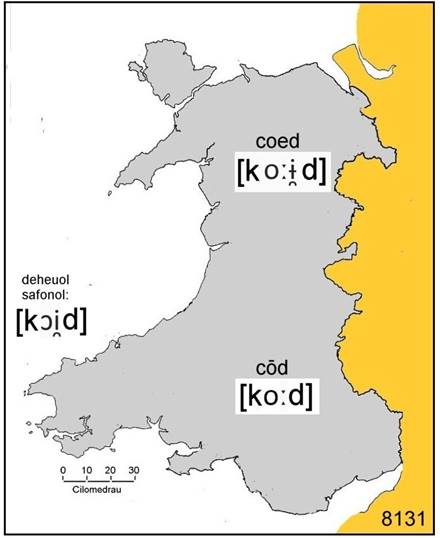
(delwedd 8131b)
(ynganiad) deheuol safonol = standard southern (pronunciation)
Here are some examples:
coed [kɔi̯d] woodland >
cōd [ko:d]
moel [mɔi̯l] bald >
mōl [mo:l]
toes [tɔi̯s] dough >
tōs [to:s]
oed [ɔi̯d] age > ōd
[o:d]
soeg [sɔi̯g] dregs from
brewing, draff; pigswill > sōg [so:g]
poen [pɔi̯n] pain >
pōn [po:n]
poeth [pɔi̯θ]
hot; burnt > pōth [po:θ]
oes [ɔi̯s] is > ōs
[o:s]
loes [lɔi̯s] anguish, mental
pain; agony, great physical pain > lōs [lo:s]
..............................................................
B2/
In general southern Welsh (south-west Wales and Brycheiniog, and the western
fringe of Gwentian) the diphthong “ae” in monosyllables becomes [a:].
(Here
we spell this long vowel which is a simplifcation of the diphthong “ae” as “ā”, that is, with a macron.
This
indicates that the vowel is not an original long “a”, as in words such as
“plas” (= mansion), “tad” (= father), “mab” (= son”, etc.)
(In
Gwentian this ā > ɛ̄, see below)
(plɛ̄s, tɛ̄d, mɛ̄b)
..............................................................
B3/ The final-syllable diphthongs ae, ai, au, in general southern Welsh (and also in north-eastern Welsh) are reduced to e [ɛ].
gafael (= get hold of) > gafel
unwaith (= once) > unweth
gorau (= best) > gore
(In Gwentian this e > a, see below) (gafal, unwath, gora, etc).
..............................................................
B4/ In southern Welsh the vowel in a penultimate
syllable may be half-long before a single consonant. In North Wales such vowels
are always short.
Tafod
(= tongue), gorau > gore > gora (= best).
..............................................................
B5/
In south Wales there is palatalisation of s before or after i [i, i·,
i:].
This feature is a general in southern Welsh.
Thus
mis [mi:s] month mish [mi:ʃ]
llais [ɬaɪs] voice
llaish [laɪʃ]
siglo [sɪglɔ] to shake shiglo [ʃsɪglɔ]
..............................................................
B6/
In South Wales there is an absence of the semi-consonant [j] or [i̯] at
the commencement of a final syllable
Gobeithio
(= to hope) > gobeitho > gobitho
gweithio
(= to work) > gweitho > gwitho
..............................................................
B7/ Although ‘ae’ in monosyllables in standard
spelling represents southern [ai̯], northern [aːɨ̯], in a tonic syllable in polysyllables it is [əɪ] (southern), [əːɨ̯]
(northern).
In dialect writing in the south it is
often spelt as “ei” (But see B8 below).
Blaenaf (= foremost) > bleina
In dialect
writings in the North it is sometimes written as ‘eu’, although this does not
represent a different pronunciation: maeddu
[ˡməːɨ̯ ðɨ] (= to beat) > meuddu
Haeddu
(= to derserve) > heuddu
Blaenau (= upland) > bleuna (north-western),
bleune (north-eastern)
Saethu
(= to shoot) > seuthu
..............................................................
B8/
In South Wales a tonic “ei” is usually reduced to “i”
Gobeithio (= to hope) > gobeitho > gobitho
gweithio
(= to work) > gweitho > gwitho
cneifio
(= to shear) > cneifo > cnifo
..............................................................
B9/
In general southern Welsh the initial consonant cluster chw- is reduced to hw-
Chwarae
(= to play) > hware > (Gwentian) wara (see below)
Chwech
(= six) > hwech > (Gwentian) wech
..............................................................
B10/
In South Wales generally, “wy” in a final syllable becomes “w”
annwyl (= dear) > annwl
ofnadwy (awful) > ofnatw (= awful)
..............................................................
B11/
In South Wales “wy” in a tonic syllable may become “w”
Gwybod
(= to know) > gwbod > (Gwentian) gwpod
Cwympo
(= to fall) > cwmpo
..............................................................
B12/
A feature of the Welsh of South Wales ‘declustering’, that is, is the inertion
of an epenthetic vowel in consonant clusters at the end of a monosyllable. This
following vowel is an “echo vowel” – a repetition of the main vowel (a + a, e +
e, etc) or else the final element of a diphthong (ei + i), etc
aml (= often) > amal
geifr (= goats) > geifir > gifir
(= goats)
cefn (= back) > cefen
llyfr (book) > llifir
budr
(= great, splendid; North Wales dirty) > budur
..............................................................
B13/ The spellings <u>
and <y>.
In
medieval Welsh, “i”, “u”, and “y” (though the grapheme “y” also was / is also
used to represent schwa) were all distinct vowels, and each had a short and
long version.
In
Wales generally, the “u”, which had lip-rounding, lost this feature and came to
be pronounced exactly as “y”. The vowel “i” remained distinct.
This
is still the situation in North Wales.
Thus
misspellings in all Wales since “y” and “u” are interchangeable in informal
spelling:
“Gruffydd”
for “Gruffudd” (English: Griffith)
“Llanwrtyd”
for “Llanwrtud”.
The
coincidence of the two vowels in pronunciation but their difference in spelling
gave rise tho the spelling for the name of the country, “Cymru”, which is in
effect “Cymry” (= Welshmen, Welsh people) (where a plural form of the bame of a
people becomes the name of the country they inhabit, such as “Sweden” (= “[the]
Swedes”), German “Sachsen” (= Saxony, literally “Saxons”).
In
South Wales “y” and “u” later came to be pronounced as “i”. Thus “y” = “u” =
“i”
Hence
a tendency in dialect writing to replace in some cases “u” with “i”, and “y”
with “i”.
Thus
spellings such as “shingrig” for “shingrug” in minor place names (= eisingrug,
pile of chaff), and “bidir” for “budur”.
Also
“helig” for “helyg” (= willow trees) as a misspelling in place names.
(Note:
There has been identified a small area near Mynyddcynffig in the Gwentian speech
area where the “u” has retained its original sound as in the North).
..............................................................
B14/
In the south, in monosyllables with final “ll”, the vowel is long. In the North
(and in standard Welsh) it is short.
Pwll (= pool), twll (= hole), pell (= far, distant).
..............................................................
B15/
In South Wales there is no half-long component in the diphthongs “ae” and “oe”as in North Wales.
..............................................................
B16/ In monosyllables in the South-west and South-east, there is retention of
the diphthong ou [oi] from Middle Welsh, which in other parts of Wales
has become eu [ei] > au [ai]
clou [kloi] = quick > (Standard Welsh) clau [klai]
clou [kloi] = quick > (Standard Welsh) clau [klai]
houl [hoil] = sun > (Standard Welsh) haul [hail]. In
Gwentian ’oul
..............................................................
B17/
In certain districts of the south final n may become -ng in some words
Prin
(= scarce) > pring
..............................................................
B18/
A “w” which becomes the tonic accent should be reduced to “y” in a derived
form, but often the “w” is retained
Crwt
(= boy, lad) > crwtyn (= young boy, young lad) (though crytyn also exits)
Cwd
(= bag) > cwdyn (= small bag) though cydyn also occurs. Also in North Wales
as cwdyn.
(Also
in the North gwthio (= to push) from gwth (= a push); though “gythio” also
exists).
..............................................................
B19/
An “a” which becomes the tonic accent before a second syllable with “y” or “i”
should become “e” through vowel affection. Often the “a” is retained.
Pac
(= pack) > pacyn (= small pack) (though pecyn also exits)
..............................................................
B20/
In standard Welsh pump (= five) is pum before a following noun; chwech is chwe
before a following noun.
In
South Wales in Sir Gaerfyrddin / Carmarthenshire the village of Pump-hewl is in
standard Welsh Pumheol.
..............................................................
B21/
Loss of final “w” in many words
Chwech
Erw (= six acres, a field name) = (southern) Hwech Erw / Hwechérw > Hwécherw
> Hwecher > (Gwentian) Wechar
Elliw
(saint’s name); Llanelliw > Llanelli
Heddiw
(= today) > heddi > (Gwentian) ’eddi
Also
historically in Wales in general
Arddelw
> arddel (= claim, be loyal to)
..............................................................
B22/
In the South there is reduction of the cluster dl > ddl > l in final position
anadl (AA-nadl)
[ˡa·nadl] (= breath), anaddl (AA-nadl)
[ˡa·naðl]
> anal (AA-nal) [ˡa·nal]
banadl (BAA-nadl) [ˡba·nadl] (= broom bushes), banaddl (BAA-nadl) [ˡba·naðl] > bana’l (BAA-nal) [ˡba·nal]
Also
boddlon [ˡbɔðlɔn] (= satisfied) > northern and standard
bodlon [ˡbɔdlɔn] , southern bo’lon [ˡbɔlɔn].
..............................................................
B/23
loss of medial [v] in ymofyn (= want) > mofyn > mo’yn
..............................................................
FEATURES OF
GWENTIAN WELSH
C1/
“Slender ‘a’”. This is a characteristic shared with midland Welsh,
and seems to be an
areal feature that has spread from such a phenomenon in English.
Long
‘a’ [a:] in monosyllables becomes ɛ̄ [ɛ:] in Gwentian (this sound in called in Welsh yr ‘a’
fain – English: the slender ‘a’)
cath (= cat) > cɛ̄th
The
diphthong ‘ae’ in monosyllables becomes a long ‘a’ (a feature of south-west
Wales and the western fringe of the south-east Wales dialect or Gwentian)
In Gwentian, this [a:] from a reduced diphthong also becomes a narrow ‘e’: cael
(= to get) > cāl > cɛ̄l). (= to get).
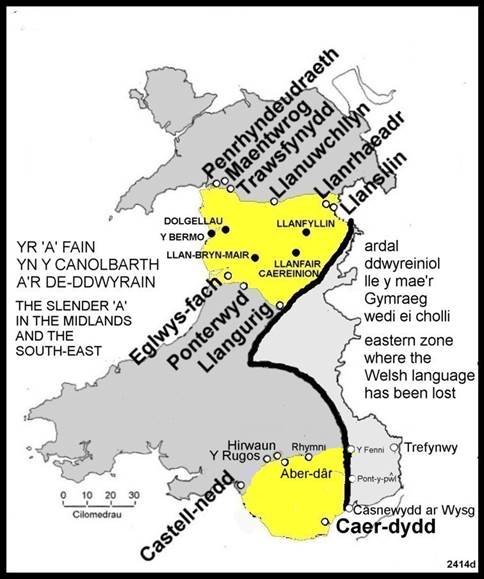
(delwedd 2414d
..............................................................
C2/
There is provection of the consonants b,d,g as the initial of a final syllable.
This is unique to Gwentian.
cegin (= kitchen) > cecin
tebyg (= similar) > tepyg
dodi (= to put) > doti
..............................................................
C3/ A final-syllable “e” [ɛ] becomes “a” [a].
|
|
.....
..............................................................
C4/ Loss of h The consonant [h] is absent in general.
It seems to be a areal
feature that has spread from English.
This is unique to Gwentian.
a/ h > zero
Harri (= Harry, Henry) > ’Arri
hanner (=
half) > ’annar
b/
rh > r
rhan (= part)
> ran
c/
hw > w
(Standard Welsh)
chwech (= six) > (general southern) hwech > (Gwentian) wech
(Standard
Welsh) chwarae (= to play) > (general southern) hware > (Gwentian) wara
..............................................................
C5/
Metathesis.
Although this occurs too in other dialects, some are characteristic of
Gwentian.
L-DD
> DD-L cywilydd (= shame) > cwyilydd > cwiddyl
Also
casglu (to gather) > clasgu, prynu (= to buy) > pyrnu, ysgrifennu (= to
write) > sgrifennu > sgryfennu > sgyrfennu
..............................................................
C6/
Clustering of initial consonants when an initial vowel is lost. This occurs too
in other dialects (See A19 above).
Aberafan
> Berafan > Brafan
Aberogwr
> Berocwr > Brocwr
..............................................................
C7/ Reduction
of the vowel in a pretonic syllable > schwa (See also A20)
ceffylau (=
horses) > cyffyle
ysgrifennu
(= to write) > sgrifennu > sgryfennu > sgyrfennu
..............................................................
C8/
Simplification of the initial consonant clusters gwl-, gwr- > gl-, gr-
Gwlad
(= country) > glad
Gwneuthur
(= to make, to do) > gneuthur > gnuthur / gnithir
..............................................................
C9/
At one time there was palatalisation after iuntial “c” [k] and “g” [g], as in
noerthern Welsh.
This
is possibly an areal eature from English.
Northern:
giât (= gate)
Gwentian:
cefn (= back; hill) > cefen > cefan > ciefan
..............................................................
C10/
In Gwentian, “ai” in a final syllable may become “i”
Llygaid
(eyes) > Gwentian llycid
..............................................................
C11/
“y” in a tonic syllable may become “i”
Llygaid
(eyes) > Gwentian llycid (eyes) > llicid
Rhedeg
(= to run) > (Gwentian) redeg > retag > ritag > rytag
..............................................................
C12/
Simplification of aea [ei + a]
aea [ei + a] > ae [aai] > a [a]
haearn [HEI-arn] = iron > hae’rn > harn [harn], or more usually ’arn [arn] (with the loss of the ‘h’)
..............................................................
_______________________________________
Sumbolau:
a A / æ Æ / e E / ɛ Ɛ / i I / o O / u U
/ w W / y Y /
MACRON: ā Ā / ǣ Ǣ / ē Ē / ɛ̄ Ɛ̄
/ ī Ī / ō Ō / ū Ū / w̄ W̄ / ȳ Ȳ /
BREF: ă Ă / ĕ Ĕ / ĭ Ĭ / ŏ Ŏ / ŭ Ŭ
/ B5236:  B5237:
BREF GWRTHDRO ISOD: i̯, u̯
CROMFACHAU: [ ⟩ deiamwnt
MACRON + ACEN DDYRCHAFEDIG: Ā̀ ā̀ , Ḗ
ḗ, Ī́ ī́ , Ṓ ṓ , Ū́
ū́, (w), Ȳ́ ȳ́
MACRON + ACEN DDISGYNEDIG: Ǟ ǟ , Ḕ ḕ, Ī̀
ī̀, Ṑ ṑ, Ū̀ ū̀, (w), Ȳ̀ ȳ̀
MACRON ISOD: A̱ a̱ , E̱ e̱ , I̱ i̱ , O̱ o̱,
U̱ u̱, (w), Y̱ y̱
ˡ ɑ ɑˑ aˑ a: / æ æ: / e eˑe:
/ ɛ ɛ: / ɪ iˑ i: / ɔ oˑ o: / ʊ uˑ u: / ə
/ ʌ /
ẅ Ẅ / ẃ Ẃ / ẁ Ẁ / ŵ Ŵ /
ŷ Ŷ / ỳ Ỳ / ý Ý / ɥ
ˡ ð ɬ ŋ ʃ ʧ θ ʒ ʤ / aɪ ɔɪ
əɪ uɪ ɪʊ aʊ ɛʊ əʊ / £
ә ʌ ẃ
ă ĕ ĭ ŏ ŭ ẅ ẃ ẁ Ẁ
ŵ ŷ ỳ Ỳ
Hungarumlaut: A̋ a̋
wikipedia, scriptsource. org
https://en.wiktionary.org/wiki/ǣ
---------------------------------------
Y TUDALEN HWN /THIS PAGE / AQUESTA PÀGINA:
www.kimkat.org/amryw/1_gwenhwyseg/gwenhwyseg_nodweddion_y_wenhwyseg_0926e.htm
---------------------------------------
Creuwyd / Created / Creada: 31-05-2017
Adolygiadau diweddaraf / Latest updates / Darreres actualitzacions: 31-05-2017
Delweddau / Imatges / Images:
Ffynhonnell / Font / Source:
|
Freefind. |
Ble'r wyf i? Yr ych chi'n ymwéld ag un o dudalennau'r Wefan CYMRU-CATALONIA
On sóc? Esteu visitant una pàgina de la Web CYMRU-CATALONIA (= Gal·les-Catalunya)
Where am I? You are visiting a page from the CYMRU-CATALONIA (= Wales-Catalonia)
Website
Weə-r äm ai? Yüu äa-r víziting ə peij fröm dhə CYMRU-CATALONIA
(= Weilz-Katəlóuniə) Wébsait