|
|
|
|
|
(delwedd 3961A) (clawr blaen / front cover)
The Welsh Elementary School Series
Welsh as a Specific Subject for Elementary
Schools
Stage 1
Compiled by a Committee of Elementary School
Teachers
Fifth Edition
Published for The Society for Utilizing the Welsh
Language
By D. Duncan and Sons, Cardiff
London: Simpkin, Marshall and Co.
1890
(Copyright) Price 6d.; Cloth, 9d.
____________________________
|
|
|
|
|
|
(delwedd 3967B)
(x0) The Welsh Elementary School Series
Welsh as a Specific Subject for Elementary
Schools
Stage 1
Compiled by a Committee of Elementary School
Teachers
Fifth Edition
Published for The Society for Utilizing the Welsh
Language
By D. Duncan and Sons, Cardiff
London: Simpkin, Marshall and Co.
1890
(Copyright)
Price 6d.; Cloth, 9d.
____________________________
|
|
|
|
|
|
(delwedd 3895B) (x1)
IMPORTANT MODIFICATIONS SANCTIONED BY THE EDUCATION DEPARTMENT.
The New Code for 1889, when first issued, created
some disappointment in Welsh circles owing to the small amount of concessions
which it appeared at first sight to make to the special needs if Welsh
schools, and to the unanimous recommendations of the late Royal Commission on
this subject, backed as they had been by the active private support of the
leading Welsh members on both sides of the House of Commons and by several of
the Welsh peers We are glad to say, however, that the fears on this score of
those interested in Welsh education have been set at rest by a letter from
Sir William Hart-Dyke, the Vice-President of the Committee of Council on
Education, to Sir John Puleston, M.P., who has taken a warm interest in the
matter from the outset, and has been in close communication with the
Education Department on behalf of the Welsh Utilization Society.
This important letter may be taken as an official interpretation of the New Code,
the provisions of which, read in the light of the Vice-President’s
explanation, will be found to concede, to all intents and purposes, the whole
programme which was put forward in April, 1886, by the Welsh Utilization
Society in their Memorial to the Royal Commission, and since then generally
accepted by Welsh educationists.
{Letter from Sir WILLIAM HART-DYKE, Vice-president of the Committee of
Council on Education).
(COPY),
“My DEAR PULESTON, —First as to Welsh recognised as a specific subject. It
has been so recognised for the last two years, and has been mentioned in the
annual report submitted to Parliament. The forthcoming report of H.M.
Inspector, Mr. Williams, in the Welsh district, will be published, as it was
two years ago, in a separate form, so as to be generally accessible to the
Welsh people, and, besides the statistical matter relating
|
|
|
|
|
|
(delwedd 3896A) (x2)
(x2a) to Wales, will contain the figures for the last two years showing the
number of departments and scholars who have taken Welsh as a specific
subject. It is not included in Schedule III., because it is thought better to
leave the scheme of instruction, as far as possible, to the initiative of the
locality. . . The words “at the discretion of the inspector” (note to
Schedule I.) refer to the substitution of dictation for composition in the
upper standards generally; and the Inspectors will certainly be instructed to
give every encouragement to the translation of Welsh into English, or the
rendering in English of a story read in Welsh.
“We must not encourage the Welsh language at the expense of English, but
rather as a vehicle for the sounder and more rapid acquisition of English,
and with that object the use of bilingual leading books, sanctioned in
footnote to page 23, will enable Welsh and English to be acquired pari-passu
in all the standaids. It is clearly for the managers to decide upon the
expediency of using these books; the concession being granted in the most
unqualified terms, and being, indeed, the obvious antecedent of the new
regulation as to composition in the upper standards.
“The first footnote to Schedule II. empowers managers to submit, and the
Inspectors to approve, any progressive scheme of lessons in the subjects
named. This will clearly enable the map of Wales to be used in illustration
of the terms taught in Standard II., and the Physical and Political Geography
of Wales to be substituted for that of England in Standard III., under
suitable conditions. It will also enable English as a class subject to be so
handled as to adjust it to the special difficulties and needs of Welsh
schools.
“I venture on the whole to plead that all legitimate demands of those who are
interested in Welsh education have been very fairly and completely met.— I
remain, very truly yours,
(Signed) “W. HART-DYKE.”
The portions of the Code to which the foregoing letter refers are these:—
SCHEDULE I.— Elementary Subjects.
N.B.— “In Welsh districts translation into English of an easy piece of Welsh
written on the blackboard, or of a story read twice, may be substituted (for
English composition).”
.
|
|
|
|
|
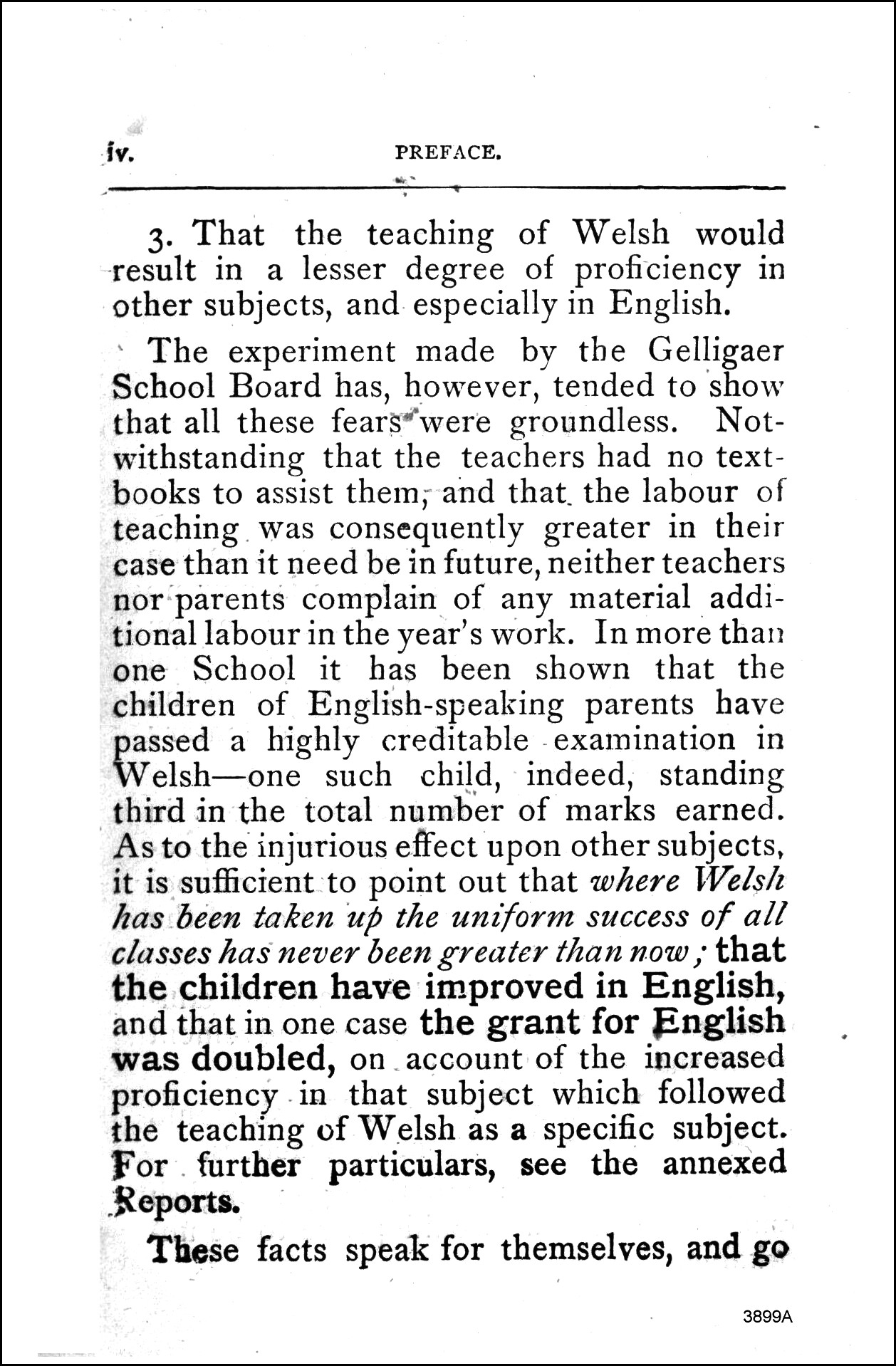
|
(delwedd 3904B) (x3)
SCHEDULE II.—Class Subjects.
Footnote I.— If the managers desire, they may submit to the Inspector at his
annual visit, and the Inspector may approve for the ensuing year, some
progressive scheme of lessons in these subjects, providing for not less than
three groups.
Footnote 2.— In districts where Welsh is spoken, the in¬telligence of the
children examined in any elementary or class subject may be tested by
requiring them to explain in Welsh the meaning of passages read, and
bilingual books may be used for the puipose of instructing the scholars.
SUMMARY OF THE POWERS GRANTED BY THE NEW CODE.
A careful reading of the Code in the light of the official inter¬pretation
afforded in Sir William Hart-Dyke’s letter shows that the effects of
apparently minor modifications are far-reaching, and of the highest
importance as regards Welsh schools. In effect they will open the door to a
thorough change in the whole system of Welsh elementary education. Summarized
briefly they amount to this:—
1. Welsh grammar may be taught as a specific subject in Standards V., VI.,
VII,, and a grant of 4s. will be paid on account of each child who passes
this examination.
2. A rational system of teaching English as a class subject by means of a
graduated system of tianslations, and an appeal at each step to the
intelligence of the children, may be sub¬stituted for the present
requirements in English grammar in all the standards, and a grant of two
shillings per child on the average of the whole school will be paid if the
results of the examination be satisfactory.
3. In all standards and in all subjects taught in the school bilingual
reading-books may be used, and bilingual copy-books may be used in teaching
writing.
4. The geography of Wales may be taught up to Standard III., and the history
of Wales may be taught throughout the whole school, by means of books partly
Welsh partly English, and a grant of two shillings per head on the average of
the whole school may be earned for each of these subjects if the results of
the examination are satisfactory. ____________________________
|
|
|
|
|
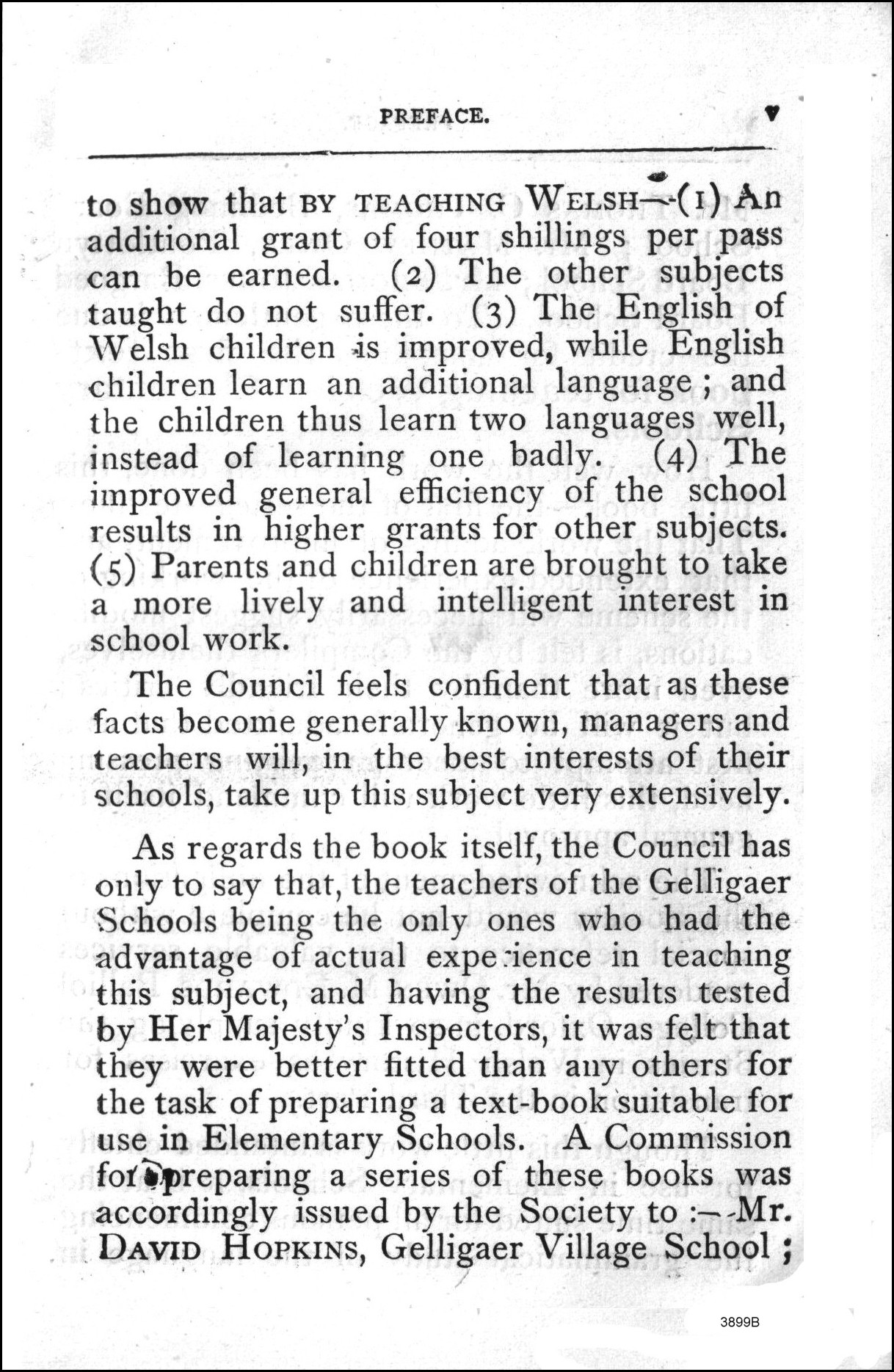
|
(delwedd 3897A) (x4)
(x4) 5. Schools taking up the new method of teaching English as a class
subject may also claim the right to substitute translation from Welsh to
English for English composition in the elementary subjects, and thus reap a
double benefit.
6. Finally, the small village and country schools, so numerous in the
Principality, may, for the purposes of class teaching, re-arrange the
standards into three groups, e.g., Group l, Standards I., II.; Group 2,
Standards III., IV.; Group 3, Standards V., VI., VII. This will be a material
reliet to under-staffed schools.
Taken as a whole, the concessions made to Welsh demands are highly
satisfactory, and Wales is to be congratulated on having at last secured a
sensible system of elementary education adapted to her special circumstances
and needs.
All that now remains is for teachers and managers of schools to avail
themselves largely of these new powers
|
|
|
|
|
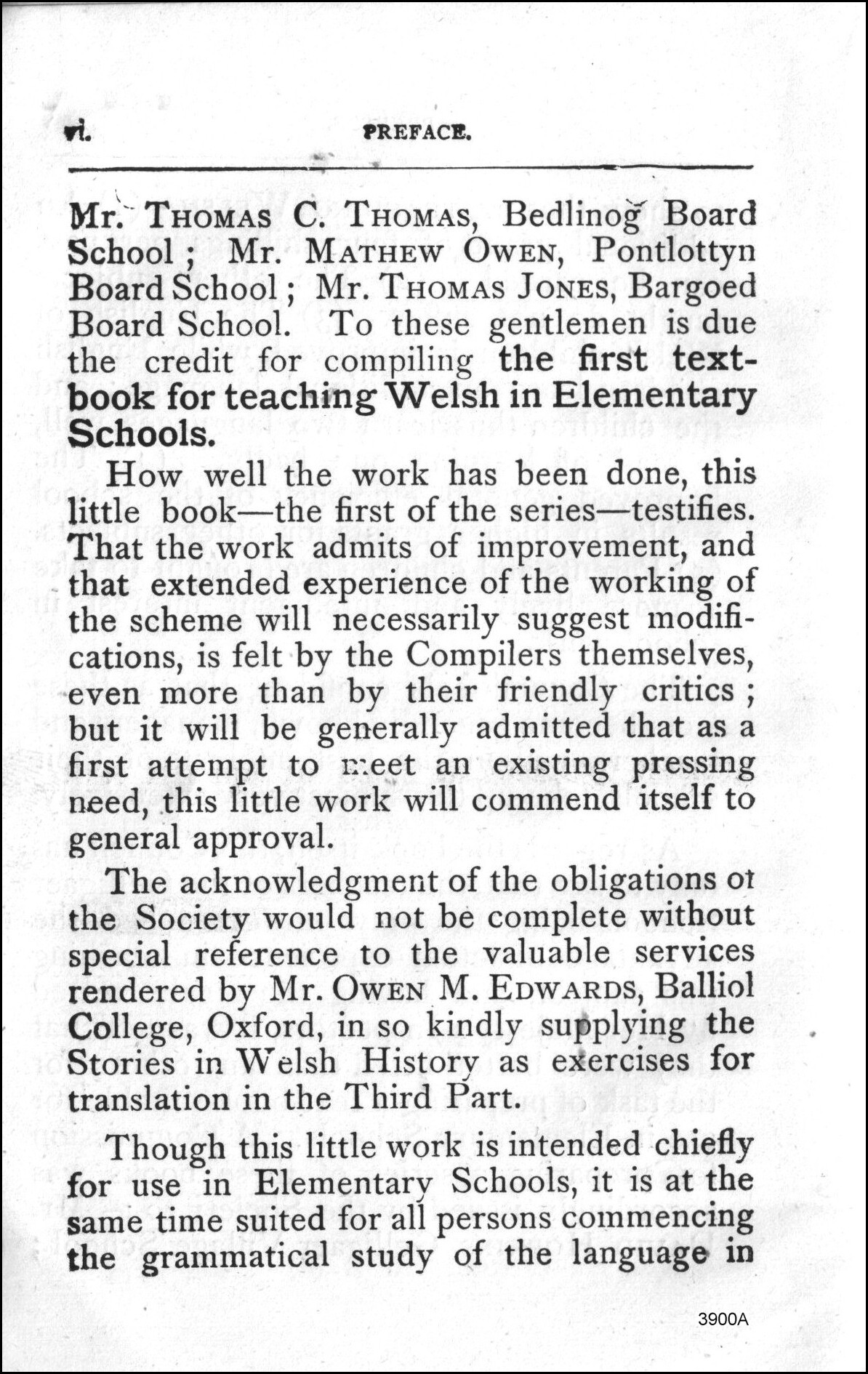
|
(delwedd 3898B) (x3) PREFACE.
THE Council of the Society for Utilizing the Welsh Language feels that there
is now no apology needed for the movement set on foot by the Society to
secure the official recognition and the rational utilization of the Welsh
Language, in the course of Elementary Education in Wales.
The results of the first examinations in this subject held by Her Majesty’s
Inspectors in the Schools of the Gelligaer School Board, afford a complete
justification of the action taken by the Society.
The fears entertained by practical educationists at the outset of the
movement may be summarized thus:—
1. That the introduction of Welsh would add materially to the labour of
teachers.
2. That in Schools containing an English element, the scheme would prove to
be unworkable. ____________________________
|
|
|
|
|
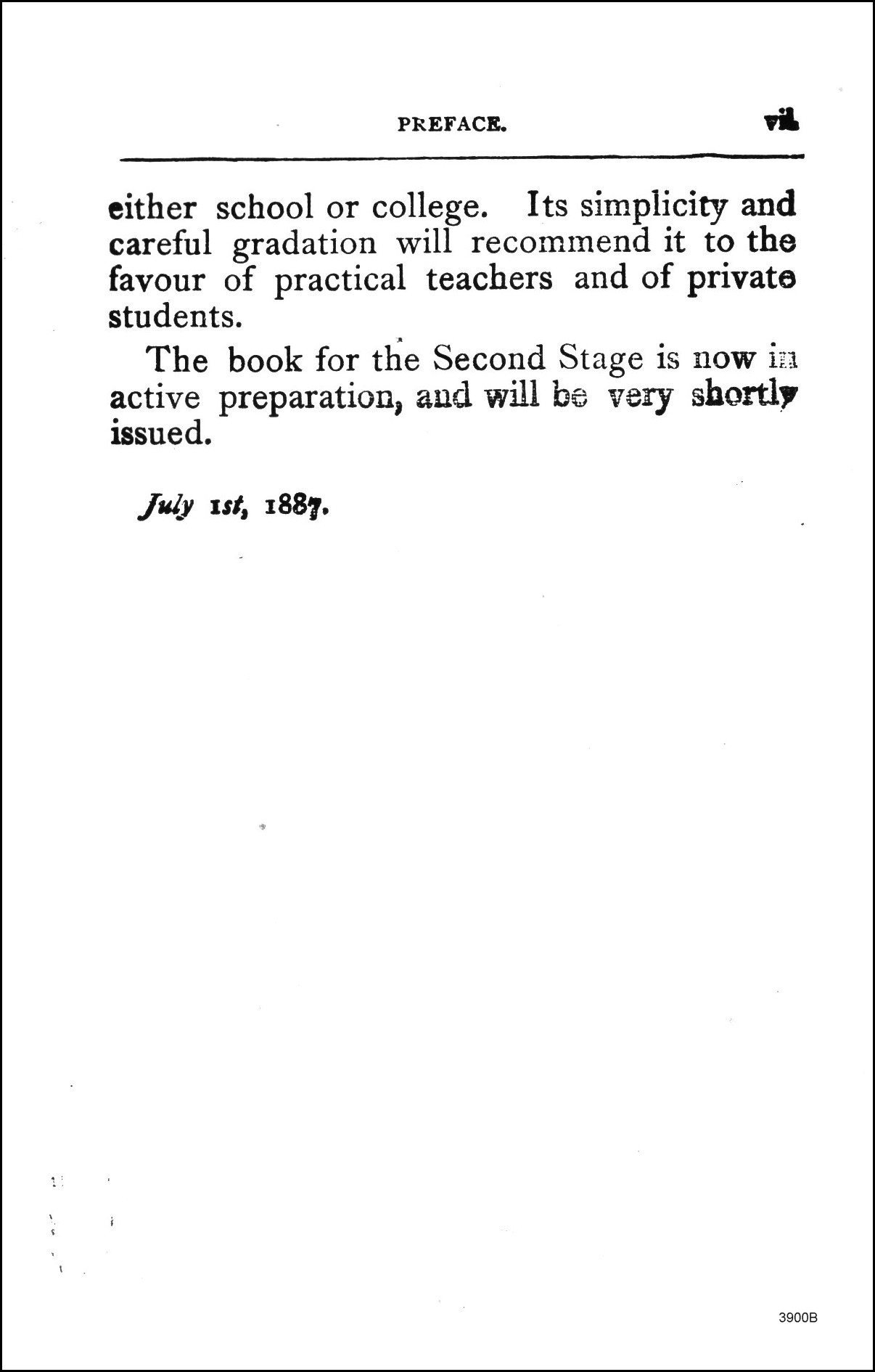
|
(delwedd 3899A) (x4)
(x4) 3. That the teaching of Welsh would result in a lesser degree of
proficiency in other subjects, and especially in English.
The experiment made by the Gelligaer School Board has, however, tended to
show that all these fears were groundless. Not¬withstanding that the teachers
had no text¬books to assist them, and that the labour of teaching was
consequently greater in their case than it need be in future, neither
teachers nor parents complain of any material addi¬tional labour in the
year’s work. In more than one School it has been shown that the children of
English-speaking parents have passed a highly creditable examination in Welsh
— one such child, indeed, standing third in the total number of marks earned.
As to the injurious effect upon other subjects, it is sufficient to point out
that where. Welsh has been taken up the uniform success of all classes has
never been greater than now; that the children have improved in English, and
that in one case the grant for English was doubled, on account of the
increased proficiency in that subject which followed the teaching of Welsh as
a specific subject. For further particulars, see the annexed reports.
These facts speak for themselves, and go
|
|
|
|
|
|
(delwedd 3899B)
(x5) to show that BY TEACHING WELSH—
(1) An additional grant of four shillings per pass can be earned. (2) The
other subjects taught do not suffer. (3) The English of Welsh children is
improved, while English children learn an additional language; and the
children thus learn two languages well, instead of learning one badly. (4)
The improved general efficiency of the school results in higher grants for
other subjects. (5) Parents and children are brought to take a more lively
and intelligent interest in school work.
The Council feels confident that as these facts become generally known,
managers and teachers will, in the best interests of their schools, take up
this subject very extensively.
As regards the book itself, the Council has only to say that, the teachers of
the Gelligaer Schools being the only ones who had the advantage of actual
experience in teaching this subject, and having the results tested by Her
Majesty’s Inspectors, it was felt that they were better fitted than any
others for the task of preparing a text-book suitable for use in Elementary
Schools. A Commission for preparing a series of these books was accordingly
issued by the Society to:—- Mr. DAVID HOPKINS, Gelligaer Village School;
____________________________
|
|
|
|
|
|
(delwedd 3900A) (x6)
(x6) Mr. THOMAS C. THOMAS, Bedlinog Board School; Mr. MATHEW OWEN, Pontlottyn
Board School; Mr. THOMAS JONES, Bargoed Board School. To these gentlemen is
due the credit for compiling the first text¬book for teaching Welsh in
Elementary Schools.
How well the work has been done, this little book — the first of the series —
testifies. That the work admits of improvement, and that extended experience
of the working of the scheme will necessarily suggest modifi-cations, is felt
by the Compilers themselves, even more than by their friendly critics; but it
will be generally admitted that as a first attempt to meet an existing
pressing need, this little work will commend itself to general approval.
The acknowledgment of the obligations ot the Society would not be complete
without special reference to the valuable services rendered by Mr. OWEN M.
EDWARDS, Balliol College, Oxford, in so kindly supplying the Stories in Welsh
History as exercises for translation in the Third Part.
Though this little work is intended chiefly for use in Elementary Schools, it
is at the same time suited for all persons commencing the grammatical study
of the language in
|
|
|
|
|
|
(delwedd 3900B) (x7)
(x7) either school or college. Its simplicity and careful gradation will
recommend it to the favour of practical teachers and of private students.
The book for the Second Stage is now in active preparation, and will be very
shortly issued.
July 1st, 1887. ____________________________
|
|
|
|
|
|
(delwedd 3901A) (x8)
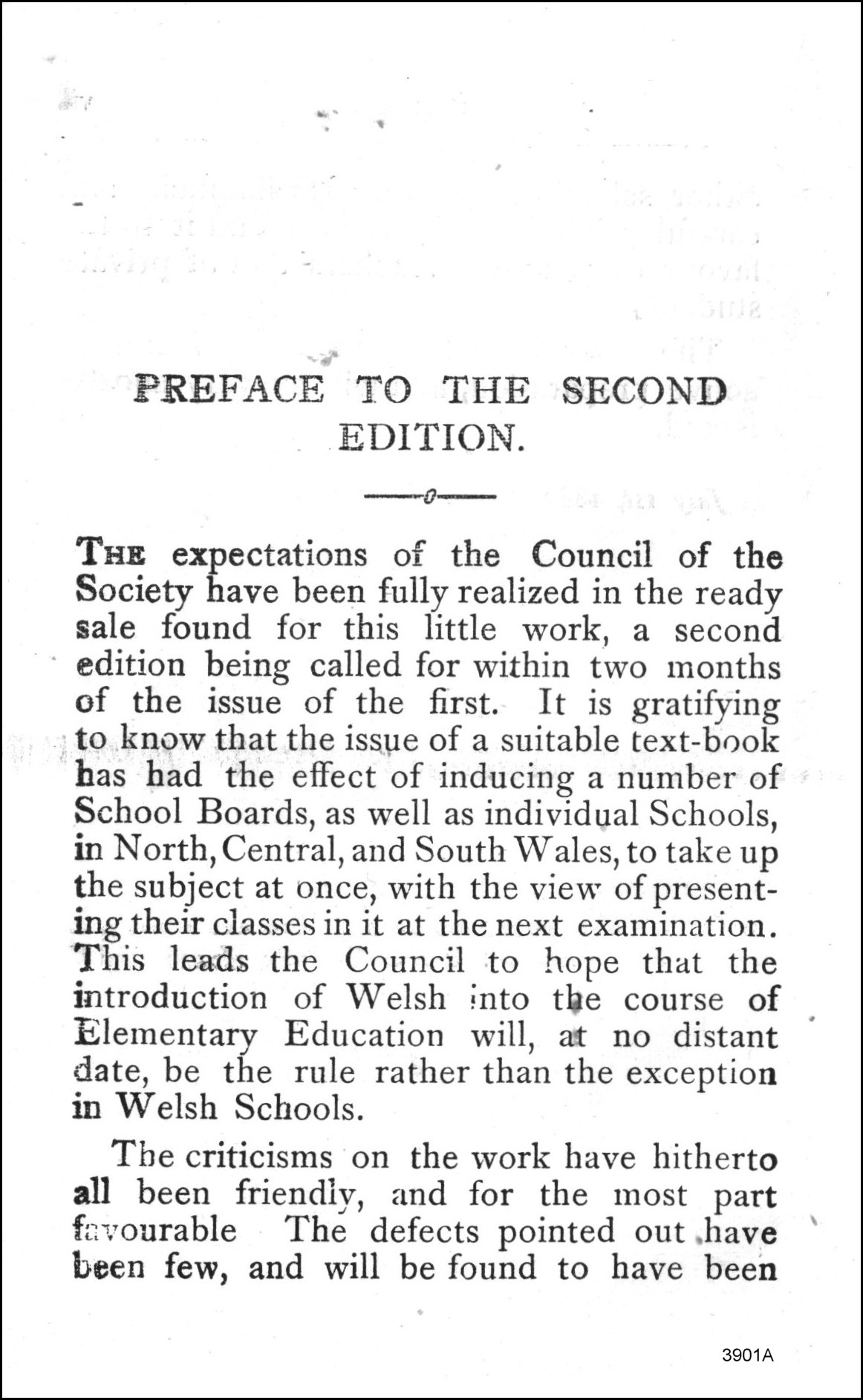
(x8) PREFACE TO THE SECOND EDITION.
The expectations of the Council of the Society have been fully realized in
the ready sale found for this little work, a second edition being called for
within two months of the issue of the first. It is gratifying to know that
the issue of a suitable text-book has had the effect of inducing a number of
School Boards, as well as individual Schools, in North, Central, and South
Wales, to take up the subject at once, with the view of present¬ing their classes
in it at the next examination. This leads the Council to hope that the
introduction of Welsh into the course of Elementary Education will, at no
distant date, be the rule rather than the exception in Welsh Schools.
The criticisms on the work have hitherto all been friendly, and for the most
part favourable. The defects pointed out ,have been few, and will be found to
have been
|
|
|
|
|
|
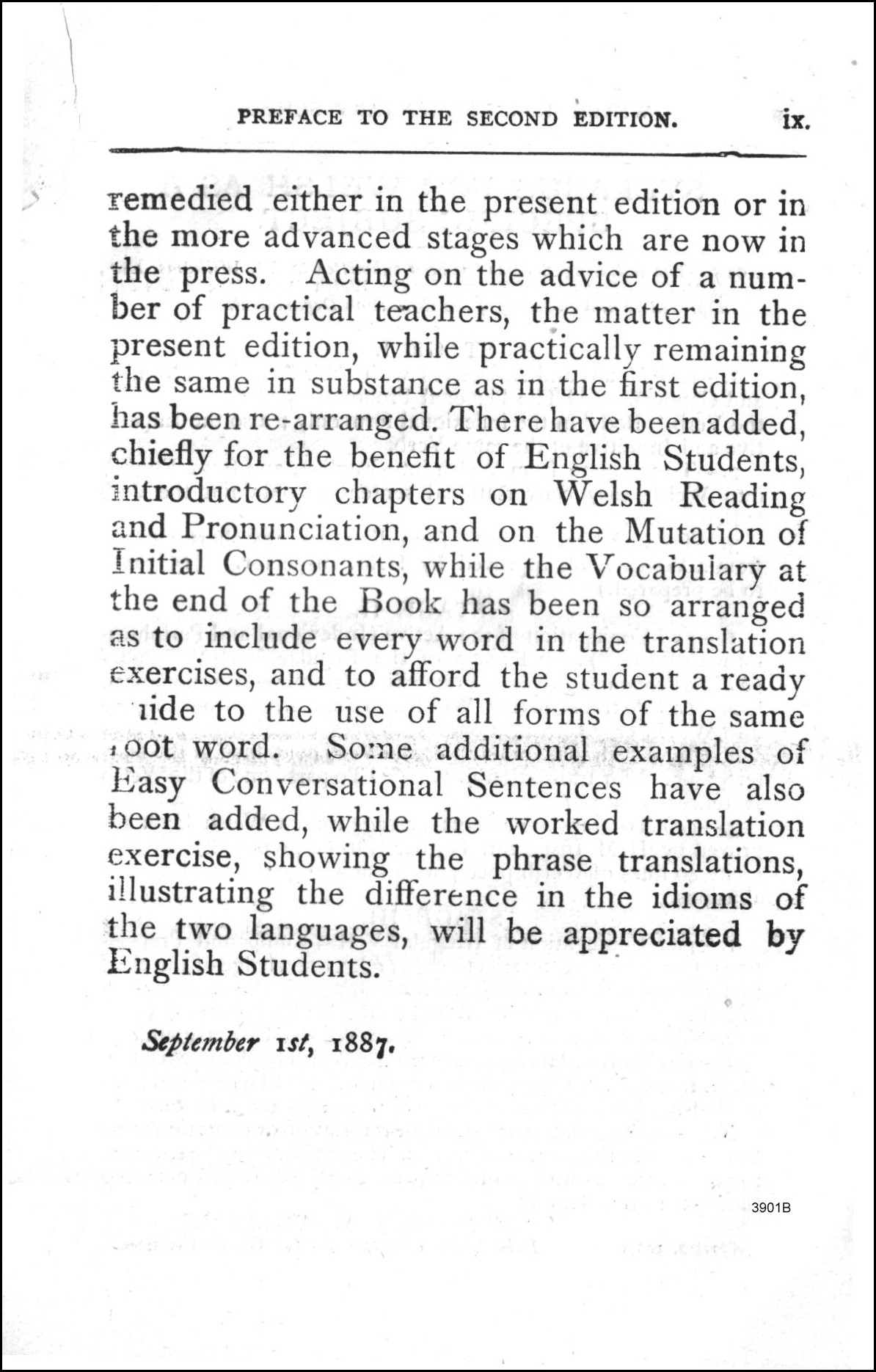
(delwedd 3901B)
(x9) remedied either in the present edition or in the more advanced stages
which are now in the press. Acting on the advice of a num¬ber of practical
teachers, the matter in the present edition, while practically remaining the
same in substance as in the first edition, has been re-arranged. There have
been added, chiefly for the benefit of English Students, introductory
chapters on Welsh Reading and Pronunciation, and on the Mutation of Initial
Consonants, while the Vocabulary at the end of the Book has been so arranged
as to include every word in the translation exercises, and to afford the
student a ready gude to the use of all forms of the same root word. Some
additional examples of Easy Conversational Sentences have also been added,
while the worked translation exercise, showing the phrase translations,
illustrating the difference in the idioms of the two languages, will be
appreciated by English Students.
September 1st, 1887. ____________________________
|
|
|
|
|
|
(delwedd 3902A)
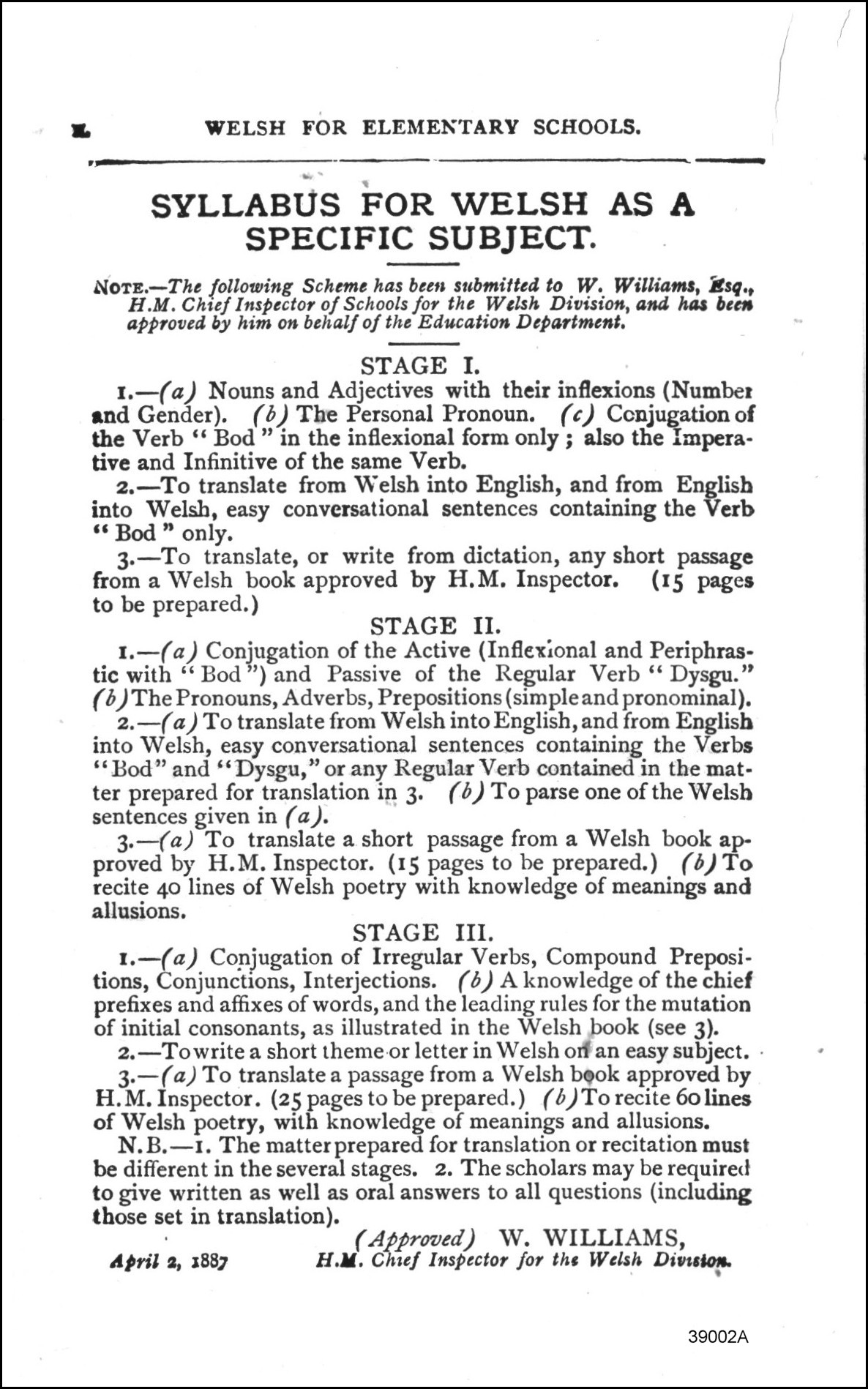
(x10) SYLLABUS FOR WELSH AS A SPECIFIC SUBJECT.
NOTE.—The following Scheme has been submitted to W. Williams, Esq., H.M.
Chief Inspector of Schools for the Welsh Division, and has been approved by
him on behalf of the Education Department.
STAGE I.
1.— (a) Nouns and Adjectives with their inflexions (Number and Gender), (b)
The Personal Pronoun, (c) Conjugation of the Verb “Bod” in the inflexional
form only; also the Impera¬tive and Infinitive of the same Verb.
2.—To translate from Welsh into English, and from English into Welsh, easy
conversational sentences containing the Verb “Bod” only.
3.—To translate, or write from dictation, any short passage from a Welsh book
approved by H.M. Inspector. (15 pages to be prepared.)
STAGE II.
1.— (a) Conjugation of the Active (Inflexional and Periphras¬tic with “ Bod
“) and Passive of the Regular Verb “Dysgu.” (b) The Pronouns, Adverbs,
Prepositions (simple and pronominal).
2. — (a) To translate from Welsh into English, and from English into Welsh,
easy conversational sentences containing the Verbs “Bod” and “Dysgu,” or any
Regular Verb contained in the mat¬ter prepared for translation in 3. (b) To
parse one of the Welsh sentences given in (a).
3-— (a) To translate a short passage from a Welsh book ap-proved by H.M.
Inspector. (15 pages, to be prepared.) (b) To recite 40 lines of Welsh poetry
with knowledge of meanings and allusions.
STAGE III. 1.— (a) Conjugation of Irregular Verbs, Compound Preposi¬tions,
Conjunctions, Interjections, (b) A knowledge of the chief prefixes and
affixes of words, and the leading rules for the mutation of initial
consonants, as illustrated in the Welsh book (see 3).
2.—To write a short theme or letter in Welsh on an easy subject.
3-— (a) To translate a passage from a Welsh book approved by H.M. Inspector.
(25 pages to be prepared.) (b) To recite 60 lines of Welsh poetry, with
knowledge of meanings and allusions.
N.B.—1. The matter prepared for translation or recitation must be different
in the several stages. 2. The scholars may be required to give written as
well as oral answers to all questions (including those set in translation).
(Approved) W. WILLIAMS, H.M. Chief Inspector for the Welsh Division. April 2,
1887
|
|
|
|
|
|
(delwedd 3902B)
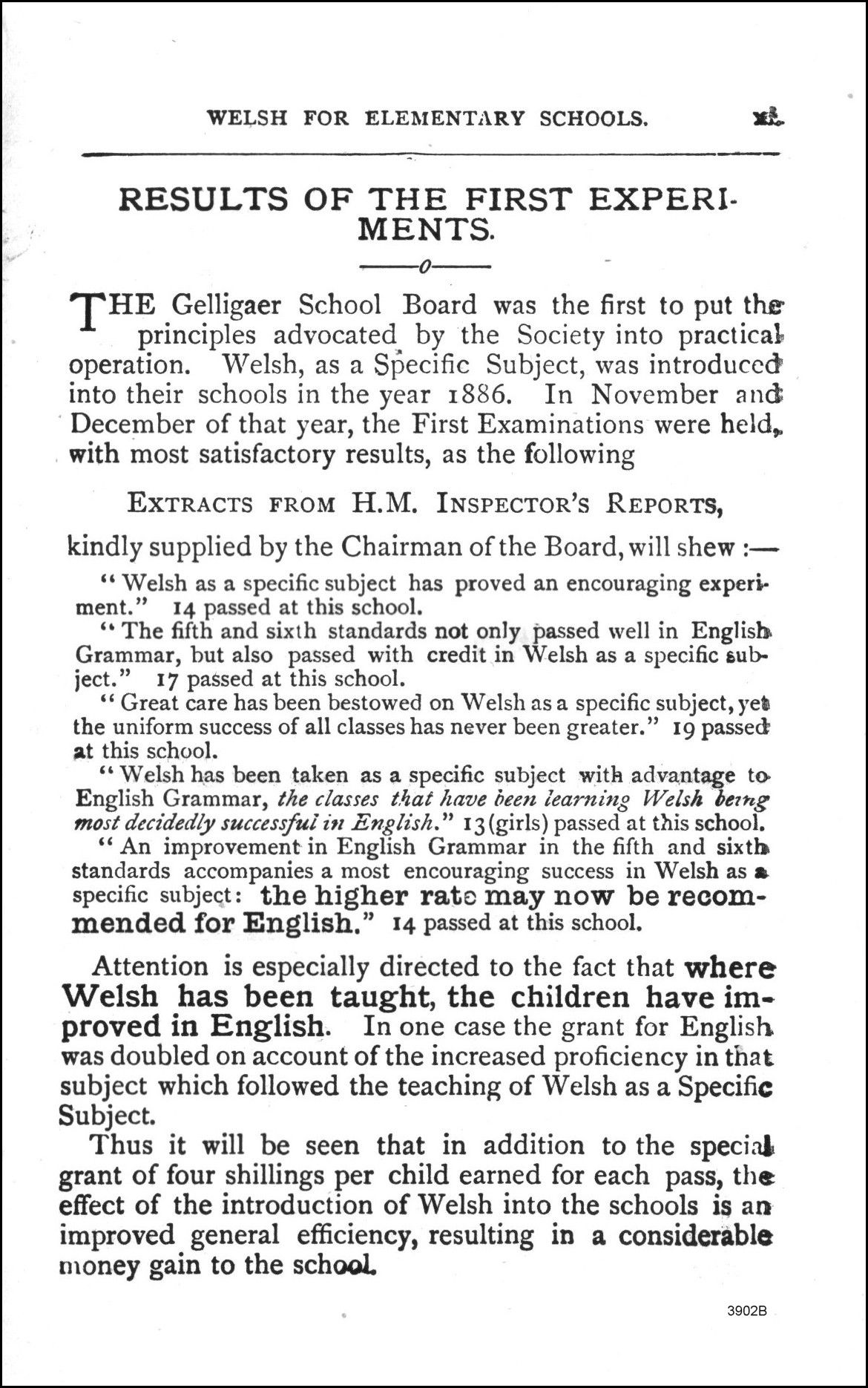
(x11) RESULTS OF THE FIRST EXPERIMENTS.
THE Gelligaer School Board was the first to put the principles advocated by
the Society into practical operation. Welsh, as a Specific Subject, was
introduced into their schools in the year 1886. In November and December of
that year, the First Examinations were held, with most satisfactory results,
as the following
EXTRACTS FROM H.M. INSPECTOR’S REPORTS,
kindly supplied by the Chairman of the Board, will shew:—
“Welsh as a specific subject has proved an encouraging experi¬ment.” 14
passed at this school.
“The fifth and sixth standards not only passed well in English Grammar, but
also passed with credit in Welsh as a specific sub¬ject.” 17 passed at this
school.
“Great care has been bestowed on Welsh as a specific subject, yet the uniform
success of all classes has never been greater.” 19 passed at this school.
“Welsh has been taken as a specific subject with advantage to English
Grammar, the classes that have been learning Welsh being most decidedly successful
in English.” 13 (girls) passed at this school.
“An improvement in English Grammar in the fifth and sixth standards
accompanies a most encouraging success in Welsh as a specific subject: the
higher rate may now be recom¬mended for English.” 14 passed at this school.
Attention is especially directed to the fact that where Welsh has been
taught, the children have improved in English. In one case the grant for
English, was doubled on account of the increased proficiency in that subject
which followed the teaching of Welsh as a Specific Subject.
Thus it will be seen that in addition to the special grant of four shillings
per child earned for each pass, the effect of the introduction of Welsh into
the schools is an improved general efficiency, resulting in a considerable
money gain to the school. ____________________________
|
|
|
|
|
|
(delwedd 3903A)
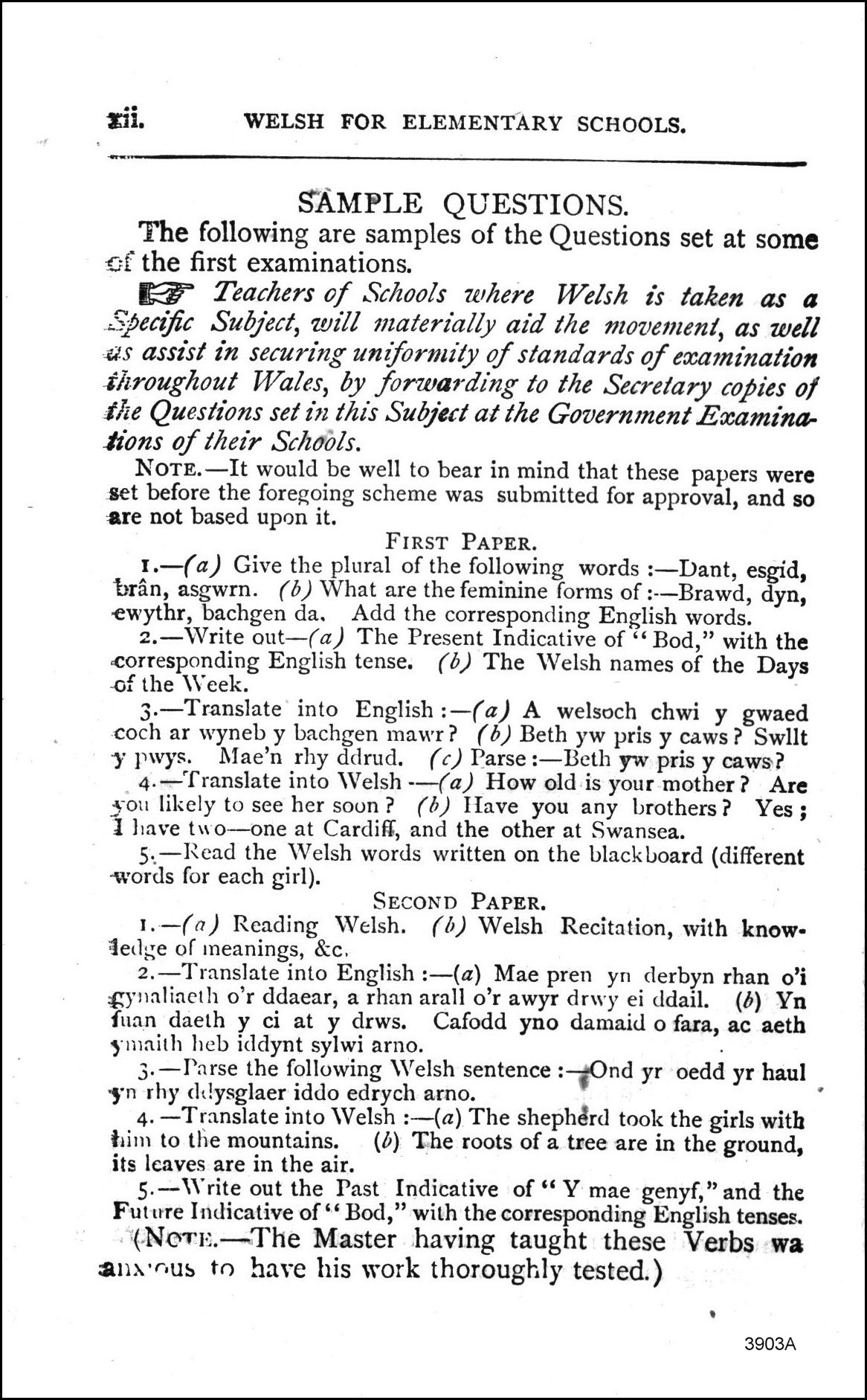
(x12) SAMPLE QUESTIONS.
The following are samples of the Questions set at some of the first
examinations.
Teachers of Schools where Welsh is taken as a Specific Subject, will
materially aid the movement, as well us assist in securing uniformity of
standards of examination throughout Wales, by forwarding to the Secretary
copies of the Questions set in this Subject at the Government Examinations of
their Schools.
NOTE.—It would be well to bear in mind that these papers were set before the
foregoing scheme was submitted for approval, and so are not based upon it.
FIRST PAPER.
1.— (a) Give the plural of the following words:—Dant, esgid, brân, asgwrn.
(b) What are the feminine forms of;-—Brawd, dyn, ewythr, bachgen da. Add the
corresponding English words.
2.—Write out— (a) The Present Indicative of “Bod,” with the corresponding
English tense. (b) The Welsh names of the Days of the Week.
3.—Translate into English:— (a) A welsoch chwi y gwaed coch ar wyneb y
bachgen mawr? (b) Beth yw pris y caws? Swllt y pwys. Mae’n rhy ddrud. (c)
Parse:—Beth yw pris y caws?
4.—Translate into Welsh— (a) How old is your mother? Are you likely to see
her soon? (b) Have you any brothers? Yes; I have two — one at Cardiff, and
the other at Swansea.
5.—Read the Welsh words written on the blackboard (different words for each
girl).
SECOND PAPER. 1.— (a) Reading Welsh. (b) Welsh Recitation, with knowledge of
meanings, &c
2.—Translate into English:— (a) Mae pren yn derbyn rhan o’i gynaliaeth o’r
ddaear, a rhan arall o’r awyr drwy ei ddail. (b) Yn fuan daeth y ci at y
drws. Cafodd yno damaid o fara, ac aeth ymaith heb iddynt sylwi arno.
3.—Parse the following Welsh sentence:- 0nd yr oedd yr haul yn rhy ddysglaer
iddo edrych arno.
4. —Translate into Welsh:— (a) The shepherd took the girls with him to the
mountains, (b) The roots of a tree are in the ground, its leaves are in the
air.
5.—Write out the Past Indicative of “Y mae genyf,” and the Future Indicative
of “Bod,” with the corresponding English tenses.
(NOTE.—The Master .having taught these Verbs was anxious to have his work
thoroughly tested.)
|
|
|
|
|
|
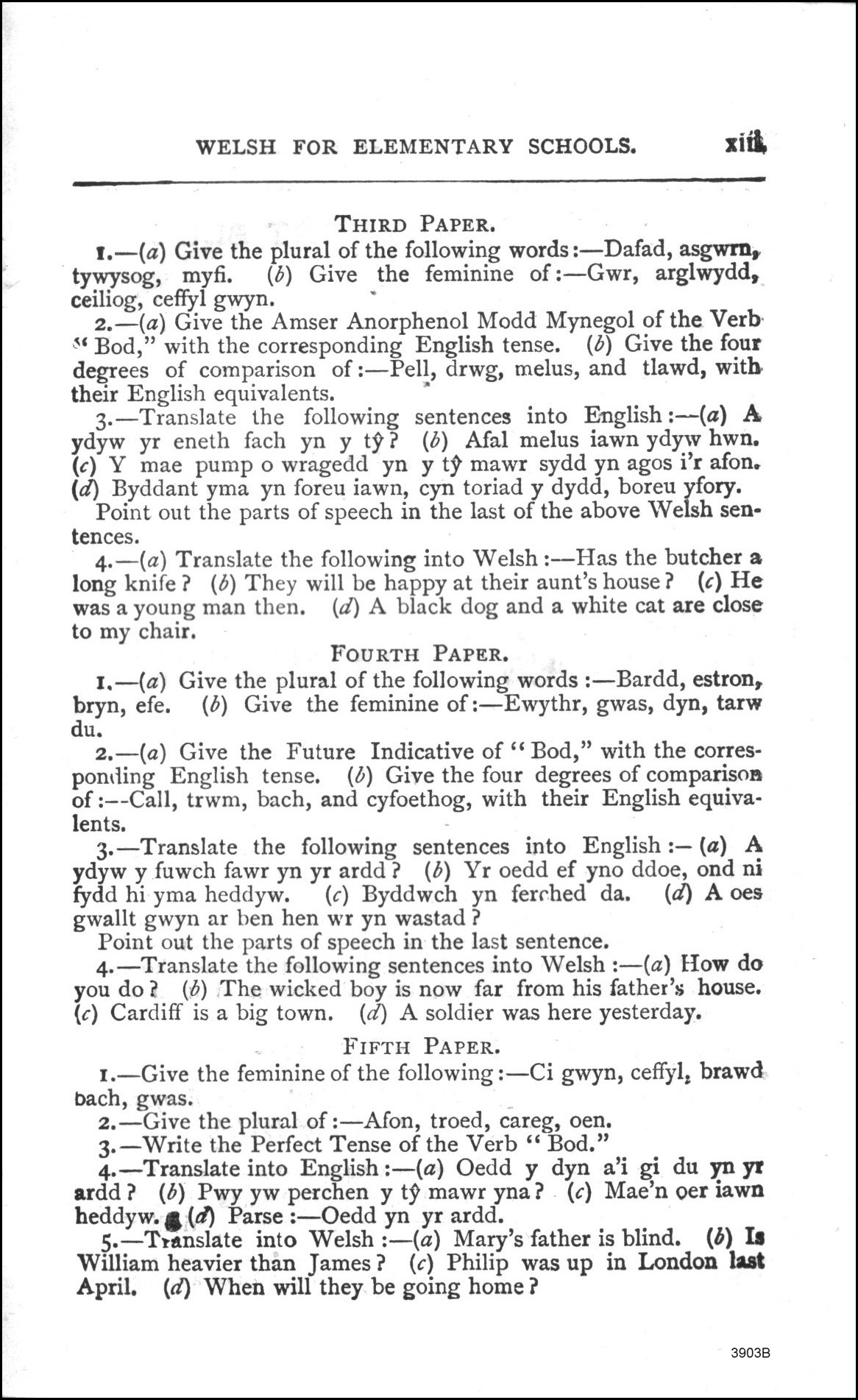
(delwedd 3903B) (x13) THIRD PAPER. 1— (a) Give the plural
of the following words:—Dafad, asgwrn, tywysog, myfi. (b) Give the feminine
of;—Gwr, arglwydd, ceiliog, ceffyl gwyn.
2.— (a) Give the Amser Anorphenol Modd Mynegol of the Verb “Bod,” with the
corresponding English tense, (b) Give the four degrees of comparison
of:—Pell, drwg, melus, and tlawd, with their English equivalents.
3.—Translate the following sentences into English:— (a) A ydyw yr eneth fach
yn y tŷ?
(b} Afal melus iawn ydyw hwn. (c) Y mae pump o wragedd yn y tŷ mawr sydd yn agos i’r
afon, (d) Byddant yma yn foreu iawn, cyn toriad y dydd, boreu yfory.
Point out the parts of speech in the last of the above Welsh sen¬tences.
4.—Translate
the following into Welsh:— (a) Has the butcher a long knife?
(b) They will be happy at their aunt’s house? (c) He was a young man
then. (d) A black dog and a white cat are close to my chair.
FOURTH PAPER. 1.— (a)
Give the plural of the following words:—Bardd, estron, bryn, efe. (b} Give
the feminine of:—Ewythr,
gwas, dyn, tarw du.
2.— (a) Give the Future Indicative of “Bod,” with the corres¬ponding English
tense. (b) Give the four degrees of comparison of:— Call, trwm, bach, and
cyfoethog, with their English equiva-lents.
3.—Translate the following sentences into English:— (a) A ydyw y fuwch fawr
yn yr ardd? (b) Yr oedd ef yno ddoe, ond ni fydd hi yma heddyw. (c) Byddwch
yn ferched da. (d) A oes gwallt gwyn ar ben hen wr yn wastad?
Point out the parts of speech in the last sentence.
4.—Translate the following sentences into Welsh:— (a) How do you do? (b) The
wicked boy is now far from his father’s house. (c) Cardiff is a big town. (d)
A soldier was here yesterday.
FIFTH PAPER. 1.—Give the feminine of the following:—Ci gwyn, ceffyl, brawd
bach, gwas.
2.—Give the plural of:—Afon, troed, careg, oen.
3.—Write the Perfect Tense of the Verb “Bod.”
4.—Translate into English:— (a) Oedd y dyn a’i gi du yn yr ardd? (b) Pwy yw
perchen y tŷ
mawr yna? (c) Mae’n
oer iawn heddyw. (d) Parse:—Oedd yn yr ardd.
5.—Translate
into Welsh:— (a) Mary’s father is blind, (b) Is William heavier than James?
(c) Philip was up in London last April. (d) When will they be going home?
____________________________
|
|
|
|
|
|
(delwedd 3904A)
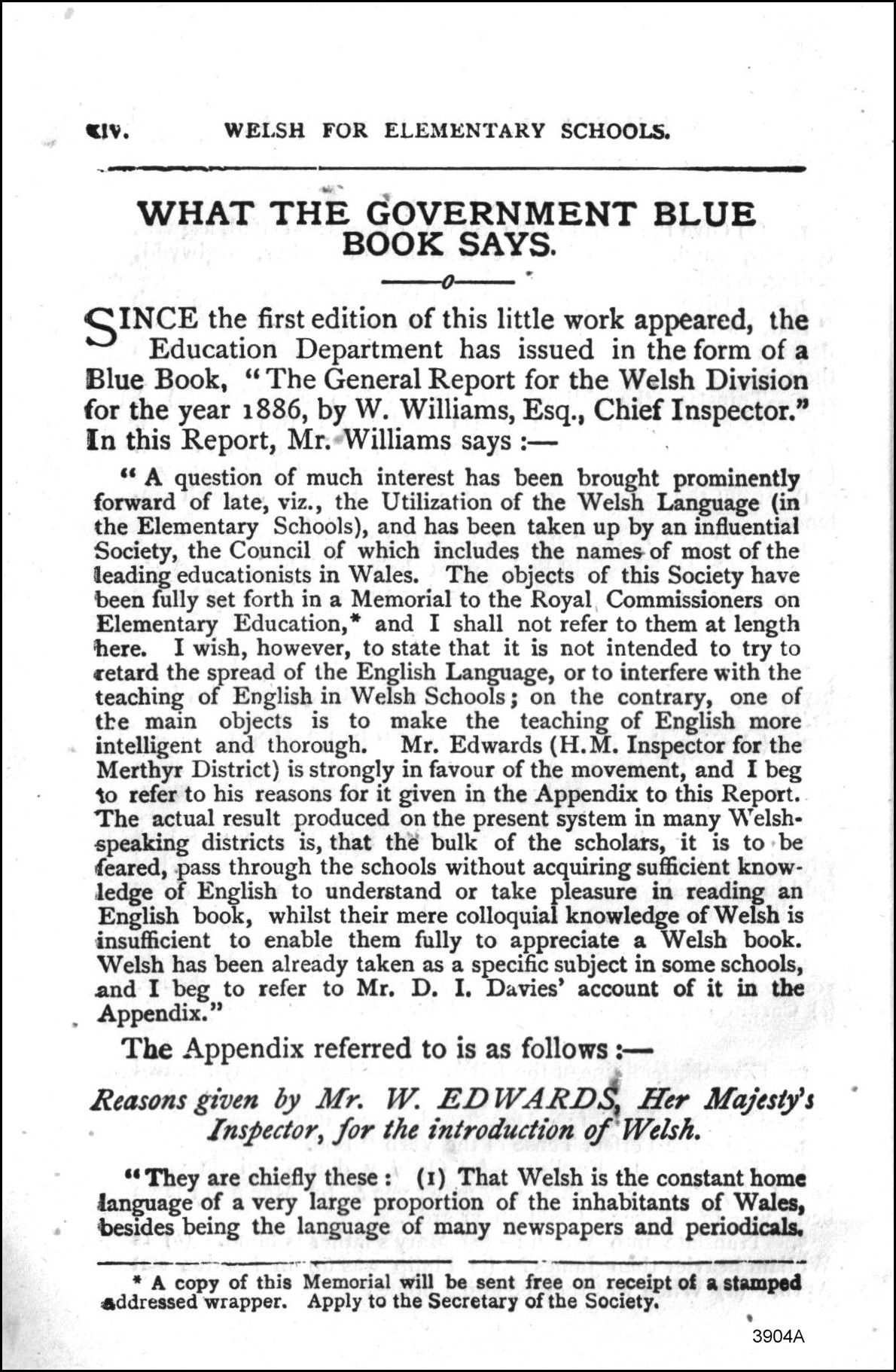
(x14) WHAT THE GOVERNMENT BLUE BOOK SAYS.
SINCE the first edition of this little work appeared, the Education
Department has issued in the form of a Blue Book, “The General Report for the
Welsh Division for the year 1886, by W. Williams, Esq., Chief Inspector.” In
this Report, Mr. Williams says:—
“A question of much interest has been brought prominently forward of late,
viz., the Utilization of the Welsh Language (in the Elementary Schools), and
has been taken up by an influential Society, the Council of which includes
the names of most of the leading educationists in Wales. The objects of this
Society have been fully set forth in a Memorial to the Royal Commissioners on
Elementary Education,*
*A copy of this Memorial will be sent free on receipt of a stamped Addressed
wrapper. Apply to the Secretary of the Society.
and I shall not refer to them at length here. I wish, however, to state that
it is not intended to try to retard the spread of the English Language, or to
interfere with the teaching of English in Welsh Schools; on the contrary, one
of the main objects is to make the teaching of English more intelligent and
thorough. Mr. Edwards (H.M. Inspector for the Merthyr District) is strongly
in favour of the movement, and I beg to refer to his reasons for it given in
the Appendix to this Report. The actual result produced on the present system
in many Welsh-speaking districts is, that the bulk of the scholars, it is to
be feared, pass through the schools without acquiring sufficient know¬ledge
of English to understand or take pleasure in reading an English book, whilst
their mere colloquial knowledge of Welsh is insufficient to enable them fully
to appreciate a Welsh book. Welsh has been already taken as a specific
subject in some schools, and I beg to refer to Mr. D. I. Davies’ account of
it in the Appendix.”
The Appendix referred to is as follows:—
Reasons given by Mr. W. EDWARDS, Her Majesty’s Inspector, for the
introduction of Welsh.
“They are chiefly these: (i) That Welsh is the constant home language of a
very large proportion of the inhabitants of Wales, besides being the language
of many newspapers and periodicals.
|
|
|
|
|
|
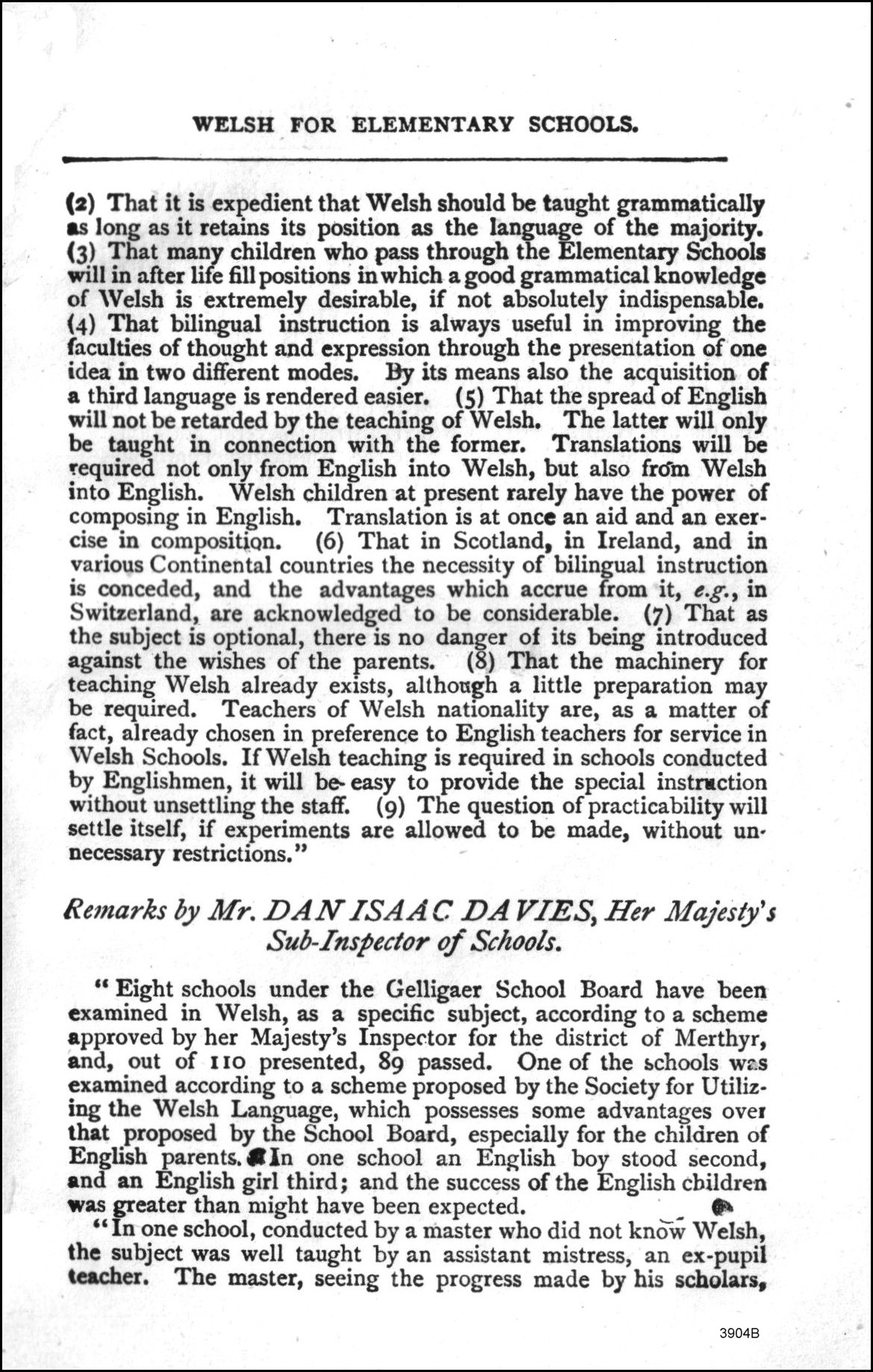
(delwedd 3904B) (x15) (2) That it is expedient that Welsh
should be taught grammatically as long as it retains its position as the
language of the majority.
(3) That many children who pass through the Elementary Schools will in after
life fill positions in which a good grammatical knowledge of Welsh is
extremely desirable, if not absolutely indispensable.
(4) That bilingual instruction is always useful in improving the faculties of
thought and expression through the presentation of one idea in two different
modes. By its means also the acquisition of a third language is rendered
easier.
(5) That the spread of English will not be retarded by the teaching of Welsh.
The latter will only be taught in connection with the former. Translations
will be required not only from English into Welsh, but also from Welsh into
English. Welsh children at present rarely have the power of composing in
English. Translation is at once an aid and an exer¬cise in composition.
(6) That in Scotland, in Ireland, and in various Continental countries the
necessity of bilingual instruction is conceded, and the advantages which
accrue from it, e.g., in Switzerland, are acknowledged to be considerable.
(7) That as the subject is optional, there is no danger of its being
introduced against the wishes of the parents.
(8) That the machinery for teaching Welsh already exists, although a little
preparation may be required. Teachers of Welsh nationality are, as a matter
of fact, already chosen in preference to English teachers for service in Welsh
Schools. If Welsh teaching is required in schools conducted by Englishmen, it
will be easy to provide the special instruction without unsettling the staff.
(9) The question of practicability will settle itself, if experiments are
allowed to be made, without unnecessary restrictions.
Remarks by Mr. DAN ISAAC DAVIES, Her Majesty’s Sub-Inspector of Schools.
“Eight schools under the Gelligaer School Board have been examined in Welsh,
as a specific subject, according to a scheme approved by her Majesty’s Inspector
for the district of Merthyr, and, out of 110 presented, 89 passed. One of the
schools was examined according to a scheme proposed by the Society for
Utiliz¬ing the Welsh Language, which possesses some advantages over that
proposed by the School Board, especially for the children of English parents.
In one school an English boy stood second, and an English girl third; and the
success of the English children was greater than might have been expected.
“In one school, conducted by a master who did not know Welsh, the subject was
well taught by an assistant mistress, an ex-pupil teacher. The master, seeing
the progress made by his scholars, ____________________________
|
|
|
|
|
|
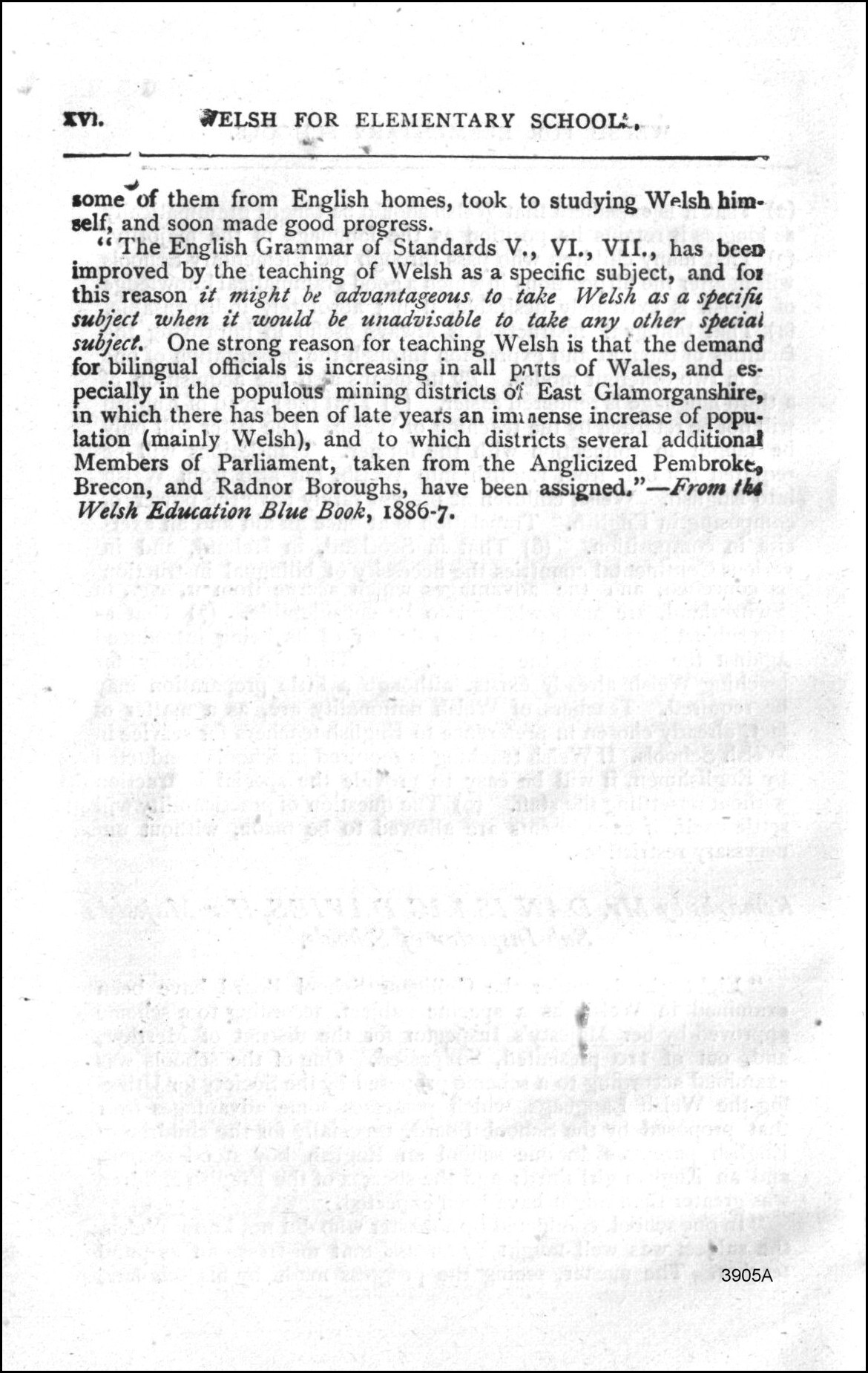
(delwedd 3905A)
(x16) some of them from English homes, took to studying Welsh him¬self, and
soon made good progress.
“The English Grammar of Standards V., VI., VII, has beeo improved by the
teaching of Welsh as a specific subject, and for this reason it might be
advantageous to take Welsh as a specific subject when it would he unadvisable
to take any other special subject. One strong reason for teaching Welsh is
that the demand for bilingual officials is increasing in all parts of Wales,
and es¬pecially in the populous mining districts of East Glamorganshire, in
which there has been of late years an immense increase of population (mainly
Welsh), and to which districts several additional Members of Parliament,
taken from the Anglicized Pembroke, Brecon, and Radnor Boroughs, have been
assigned.”— From the Welsh Education Blue Book, 1886-7.
|
|
|
|
|
|
(delwedd 3905B)
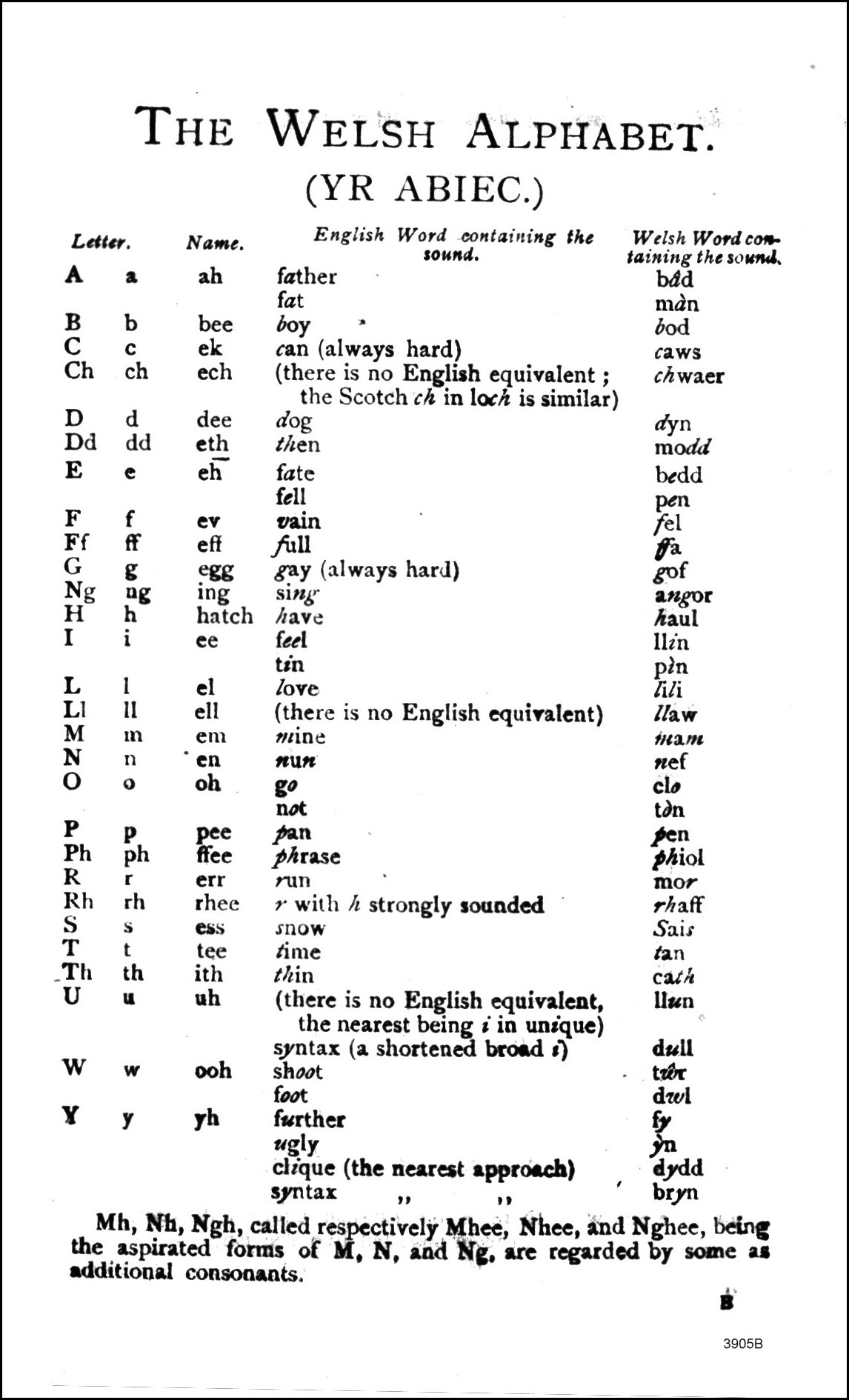
(x17) THE WELSH ALPHABET (YR ABIEC.)
Letter / Name / English Word containing the sound. / Welsh Word containing
the sound.
A / a / ah / father / bâd / fat / màn B / b / bee / boy / bod C / c / ek /
can (always hard) / caws Ch / ch / ech / (there is no English equivalent; the
Scotch ch in loch is similar) / chwaer D / d / dee / dog / dyn Dd / dd / eth
/ then / modd E / e / eh / fate / bedd / fell / pen F / f / ev / vain / fel
ff / ff / eff / full / ffa G / g / egg / gay (always hard) / gof Ng / ng /
ing / sing / angor H / h / hatch / have / haul I / i / ee / feel / llin / tin
/ pin L / l / el / love / lili LL / ll / ell / (there is no English
equivalent) / llaw M / m / em / mine / mam N / n / en / nun / nef O / o / oh
/ go / clo / not / tòn P / p / pee / pan / pen Ph / ph / ffee / phrase /
phiol R / r / err / run / mor Rh / rh / rhee / r with h strongly sounded /
rhaff S / s / ess / snow / Sais T / t / tee / time / tan Th / th / ith / thin
/ cath U / u / uh / (there is no English equivalent, the nearest being i in
unique) / llun / syntax (a shortened broad i) / dull W / w / ooh / shoot / tŵr / foot / dwl y / y / yh / further
/ fy / ugly / ỳn /
clique (the nearest approach) / dydd / syntax / bryn /
Mh, Nh, Ngh, called respectively Mhee, Nhee, and Nghee, being the aspirated
forms of M, N and Ng, are regarded by some as additional consonants.
____________________________
|
|
|
|
|
|
(delwedd 3906A)
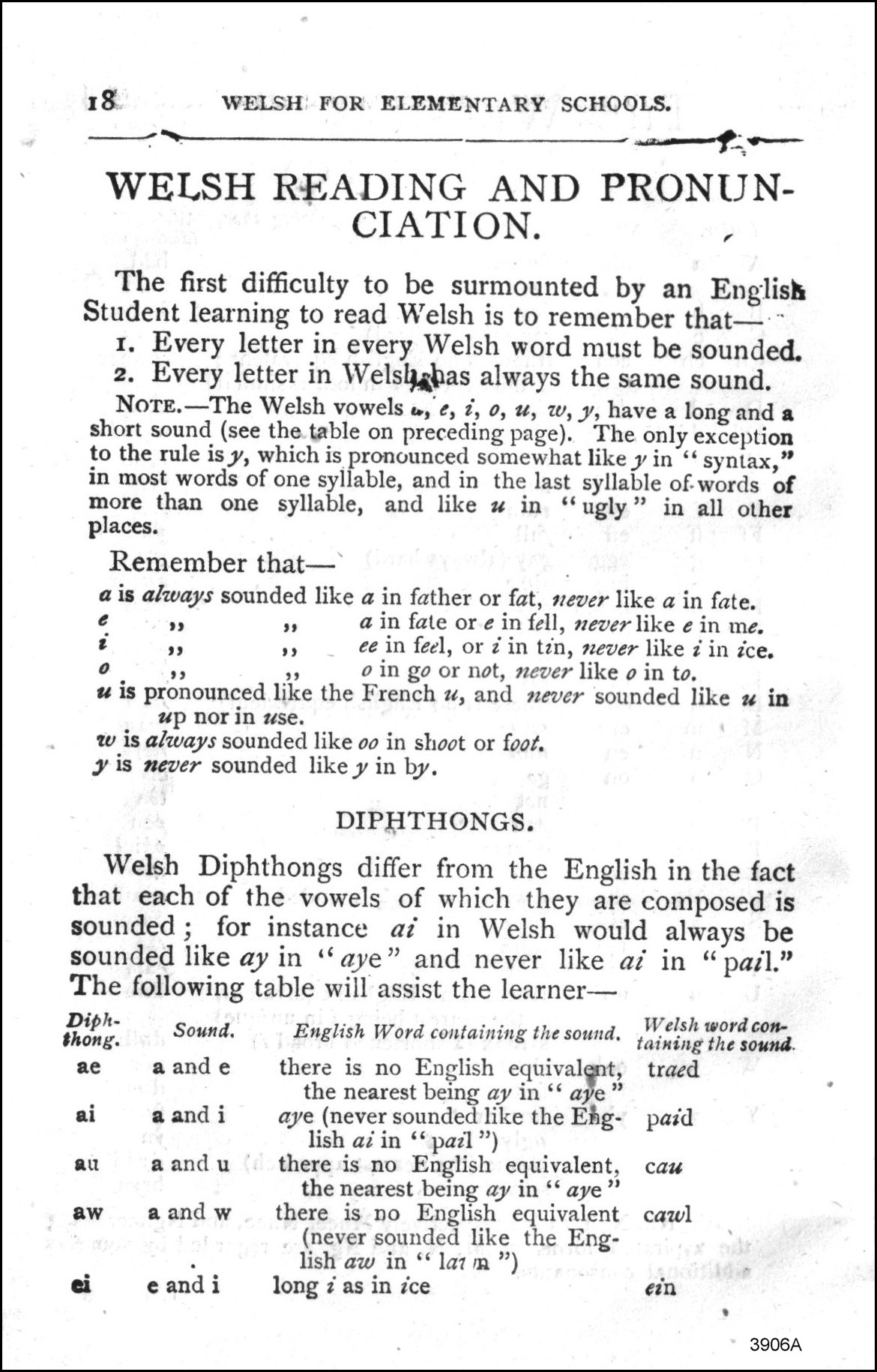
(x18) WELSH READING AND PRONUN¬CIATION.
The first difficulty to be surmounted by an English Student learning to read
Welsh is to remember that— 1. Every letter in every Welsh word must be
sounded. 2. Every letter in Welsh has always the same sound.
NOTE.—The Welsh vowels a, e, i, a, u, w, y, have a long and a short sound
(see the table on preceding page). The only exception to the rule is y, which
is pronounced somewhat like y in “syntax,” in most words of one syllable, and
in the last syllable of words of more than one syllable, and like u in “ugly
“ in all other places.
Remember that— a is always sounded like a in father or fat, never like a in
late. e is always sounded like a in fate or e in fell, never like e in me. i
is always sounded like ee in feel, or i in tin, never like i in ice. o is
always sounded like o in go or not, never like o in to. u is pronounced like
the French u, and never sounded like u in up nor in use. w is always sounded
like oo in shoot or foot. y is never sounded like y in by.
DIPHTHONGS. Welsh Diphthongs differ from the English in the fact that each of
the vowels of which they are composed is sounded; for instance ai in Welsh
would always be sounded like ay in “aye” and never like ai in “pail.” The
following table will assist the learner-
Diphthong. / Sound. / English Word containing the sound. / Welsh word
containing the sound. ae / a and e / there is no English equivalent, the
nearest being ay in “aye” / traed ai / a and i / aye (never sounded like the
English ai in “pail”) / paid au / a and u / there is no English equivalent,
the nearest being ay in “aye” / cau aw / a and w / aye (never sounded like
the English aw in “lawn”) / cawl ei / e and i / long i as in ice / ein
|
|
|
|
|
|
(delwedd 3906B)
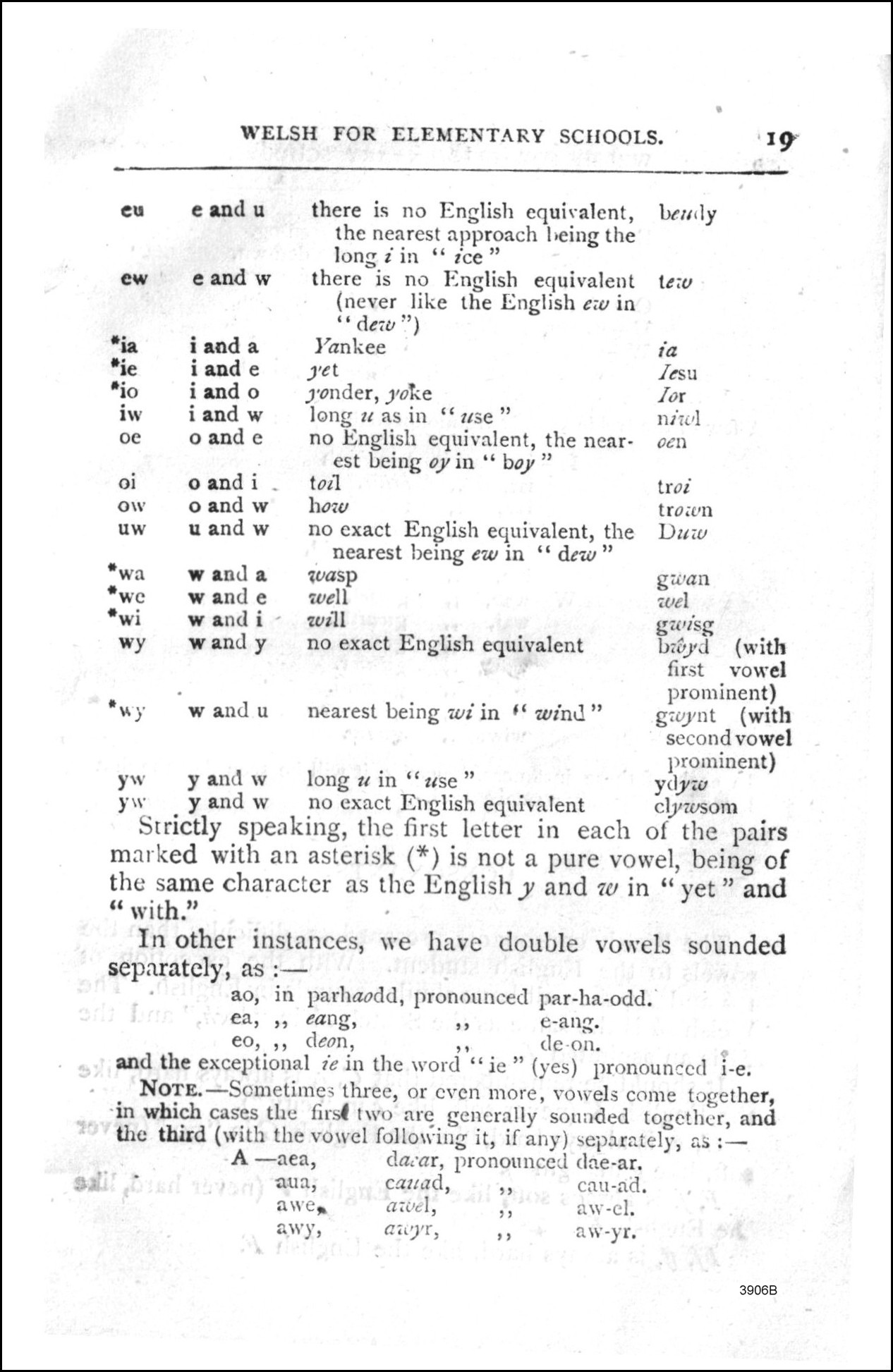
(x19) eu / e and u / there is no English equivalent, the nearest approach
being the long i in “ice” / beudy ew / e and w / there is no English
equivalent (never like the English ew in “dew”) / tew *ia / ia and a / Yankee
/ ia *ie / i and e / yet / Iesu *io / i and o / yonder, yoke / Iot iw / i and
w / long u as in “use” / niwl oe / o and e / no English equivalent, the
near¬est being oy in “boy” / oen ow / o and w / how / trown uw / u and w / no
exact English equivalent, the nearest being ew in “dew” / Duw *wa / w and a /
wasp (!) / gwan *we / w and e / well / wel *wi / w and i / will / gwisg wy /
w and y / no exact English equivalent / bwyd (with first vowel prominent) yw
/ y and w / nearest being wi in “wind” / gwynt (with second vowel prominent)
yw / y and w / long u in “use” / ydyw yw / y and w / no exact English
equivalent / clywsom
Strictly speaking, the first letter in each of the pairs marked with an
asterisk (*) is not a pure vowel, being of the same character as the English
y and w in “yet” and “with.”
In other instances, we have double vowels sounded separately, as:— .
ao, in parhaodd, pronounced par-ha-odd. ea, in eang, pronounced e-ang. eo, in
deon, pronounced de-on. and the exceptional ie in the word “ie” (yes)
pronounced i-e.
NOTE.—Sometimes three, or even more, vowels come together, in which cases the
first two are generally sounded together, and the third (with the vowel
following it, if any) separately, as:—
A — aea, daear, pronounced dae-ar. aua, caead, pronounced cau-ad. awe, awel,
pronounced aw-el. awy, awyr, pronounced aw-yr. ____________________________
|
|
|
|
|
|
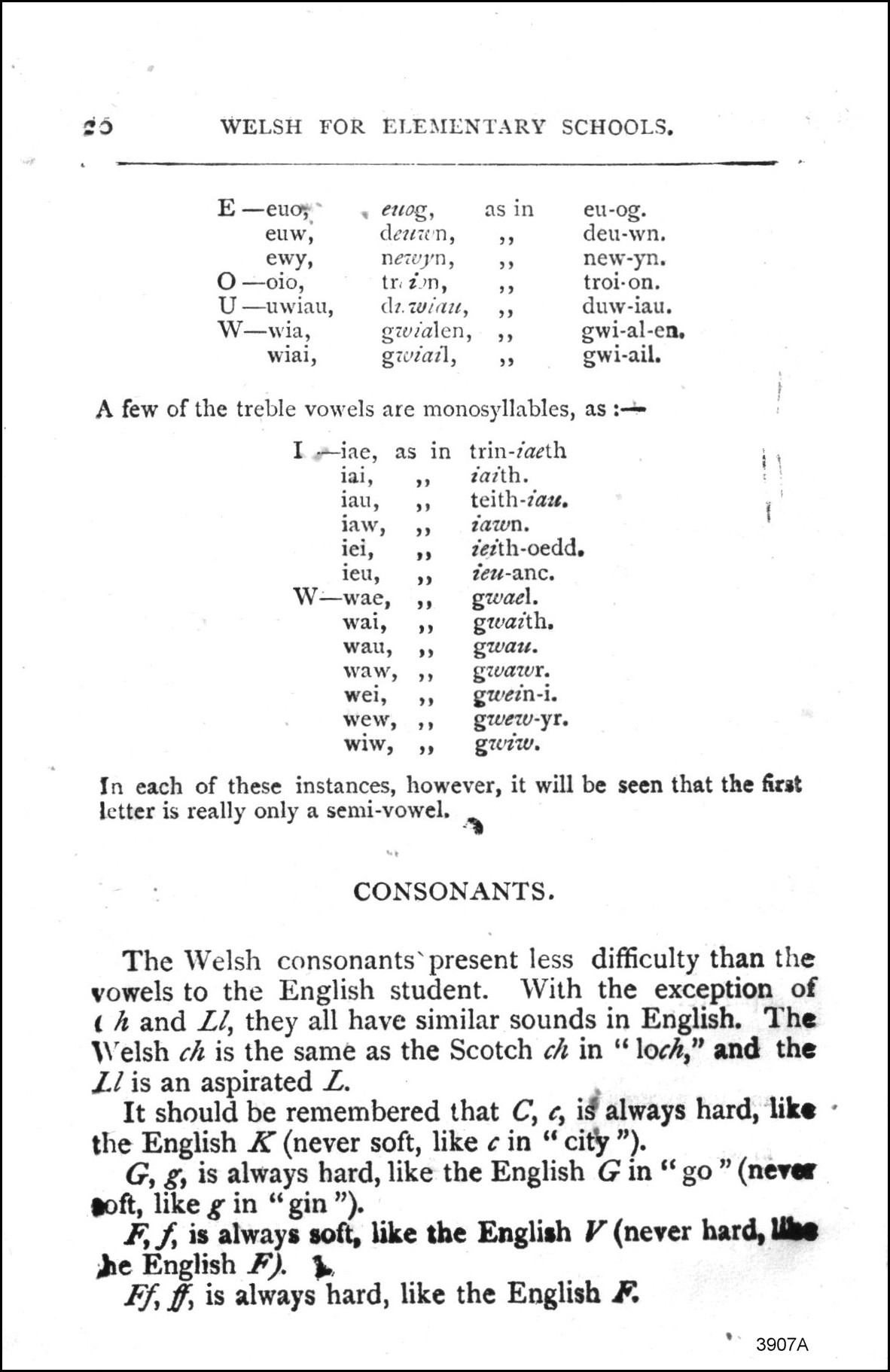
(delwedd 3907A) (x20)
(x20) E - euo, euog, as in eu-og. euw, deuwn, as in deu-wn. ewy, newyn, as in
new-yn.
O - oio, troion, as in troi-on.
U - uwiau, duwiau, as in duw-iau.
W - wia, gwialen, as in gwi-al-en. wiai, gwiail, as in gwi-ail.
A few of the treble vowels are monosyllables, as:—
I - iaie, as in trin-iaieth. iai, as in iaith. iau, as in teith-iau. iaw, as
in iawn iei, as in ieith-oedd. ieu, as in ieu-anc.
W - wae, as in gwaed. wai, as in gwaith. wau, as in gwau. waw, as in gwawr.
wei, as in gwein-i. wew, as in gwew-yr. wiw, as in gwiw.
In each of these instances, however, it will be seen that the first letter is
really only a semi-vowel.
CONSONANTS.
The Welsh consonants present less difficulty than the vowels to the English
student. With the exception of Ch and LI, they all have similar sounds in
English. The Welsh ch is the same as the Scotch ch in “loch,” and the LI is
an aspirated L.
It should be remembered that C, c, is always hard, like the English K (never
soft, like c in “city”).
G, g, is always hard, like the English G in “go” (never soft, like g in
“gin”).
F, f, is always soft, like the English F (never hard, like the English F).
Ff, ff, is always hard, like the English F. (x21)
____________________________
|
|
|
|
|
|
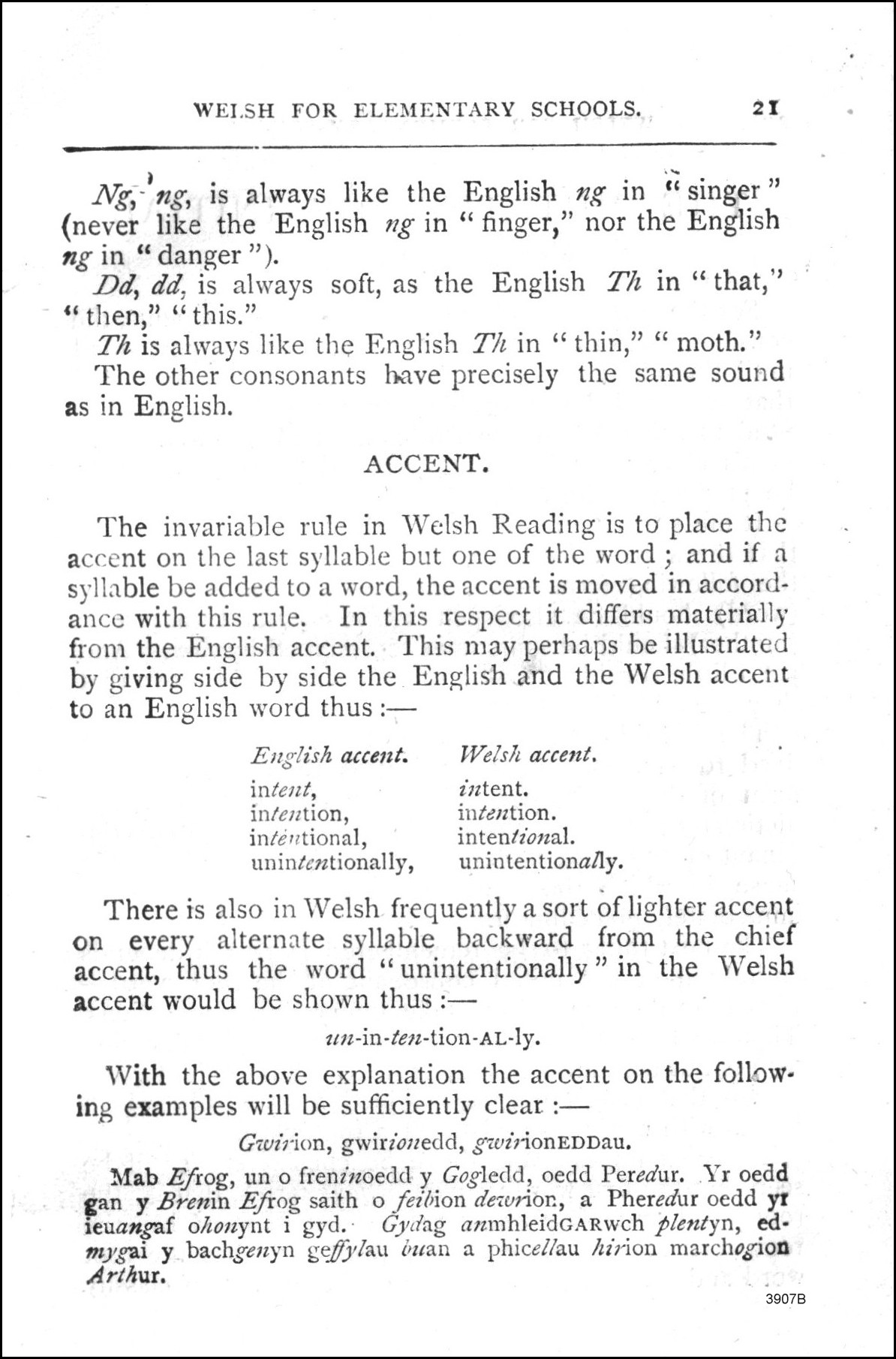
(delwedd 3907B) (x21)
WELSH FOR
ELEMENTARY SCHOOLS.
Ng,- ng, is always like the English ng in singer
(never like the English ng in " finger," nor the English
ng in danger ").
Dd, dd, is always soft, as the English Th in that,"
this."
then,
moth. "
Th is always like the English Th in thin,
The other consonants Iklve precisely the same sound
as in English.
ACCENT.
The invariable rule in Welsh Reading is to place the
accent on the last syllable but one of the word ; and if a
syllable be added to a word, the accent is moved in accord-
ance with this rule. In this respect it differs materially
from the English accent. This may perhaps be illustrated
by giving side by side the English and the Welsh accent
to an English word thus :—
English accent. Welsh accent.
intent,
intention,
inténtional,
intent.
intention.
intentional.
unintentionally.
unintcntionally,
There is also in Welsh frequently a sort of lighter accent
on every alternate syllable backward from the chief
accent, thus the word " unintentionally in the NVelsh
accent would be shown thus :—
tin-in-ten-tion-AL-ly.
With the above explanation the accent on the follow-
ing examples will be sufficiently clear :—
Gtvirion, gwirionedd, gavirionEDDau.
Mab Efrog, un o freninoedd y Gogledd, oedd Peredur. Vr oedd
gan y Brenin Efrog saith o feibion dewrion, a Pheredur oedd yr
ieuang•af ohonynt i gyd. Gydag anmhleidGARwch flentyn, ed •
mygai y bachgenyn gefy/au &uan a phice//au hirion marchogion
A rthur.
3907B
|
|
|
|
|
|
(delwedd 3908A)
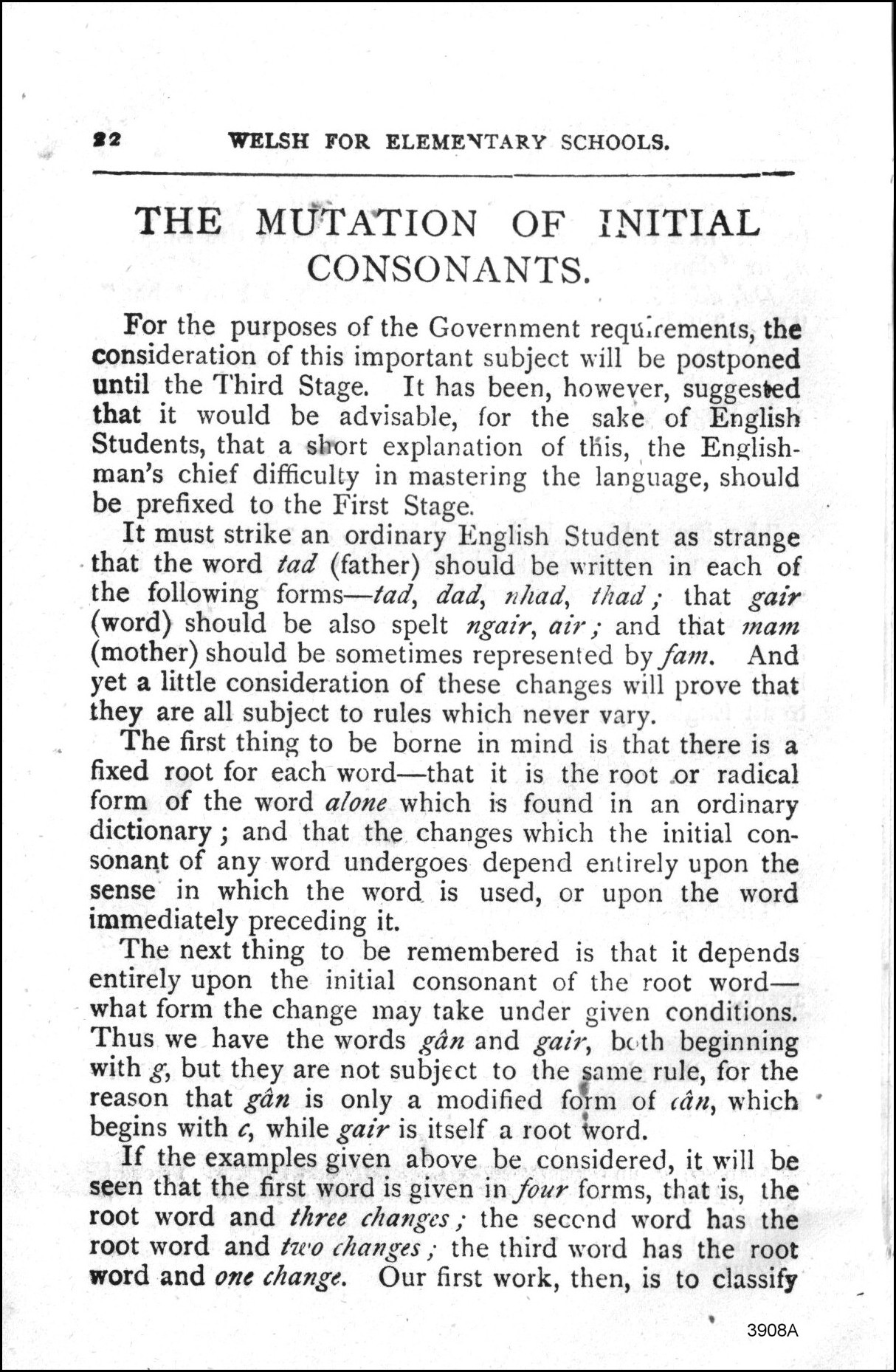
(x22) THE MUTATION OF INITIAL CONSONANTS.
For the purposes of the Government requirements, the consideration of this
important subject will be postponed until the Third Stage. It has been,
however, suggested that it would be advisable, for the sake of English
Students, that a short explanation of this, the English¬man’s chief
difficulty in mastering the language, should be prefixed to the First Stage.
It must strike an ordinary English Student as strange that the word tad
(father) should be written in each of the following forms — tad, dad, nhad,
thad; that gair (word) should be also spelt ngair, air; and that mam (mother)
should be sometimes represented fam. And yet a little consideration of these
changes will prove that they are all subject to rules which never vary.
The first thing to be borne in mind is that there is a fixed root for each
word — that it is the root or radical form of the word alone which is found
in an ordinary dictionary; and that the changes which the initial con-sonant of
any word undergoes depend entirely upon the sense in which the word is used,
or upon the word immediately preceding it.
The next thing to be remembered is that it depends entirely upon the initial
consonant of the root word — what form the change may take under given
conditions. Thus we have the words cân and gair, both beginning with g, but
they are not subject to the same rule, for the reason that gân is only a
modified form of cân, which begins with c, while gair is itself a root word.
If the examples given above be considered, it will be seen that the first
word is given four forms, that is, the root word and three changes; the
second word has the root word and two changes; the third word has the root
word and one change. Our first work, then, is to classify
|
|
|
|
|
|
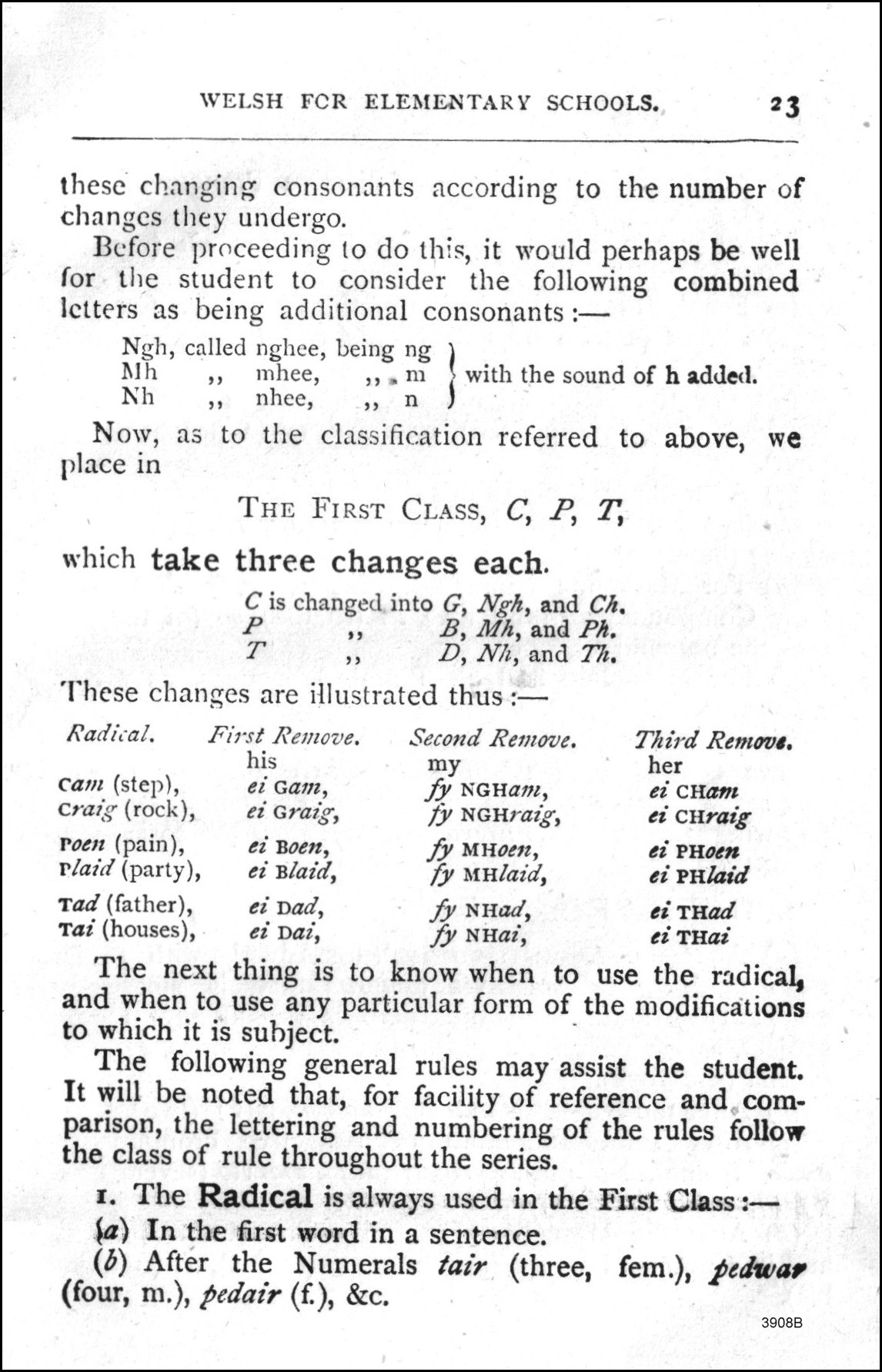
(delwedd 3908B) (x23) WELSH FOR
ELEMENTARY SCHOOLS.
23
these changing consonants according to the number of
changes they undergo.
Before l)roceeding to do this, it would perhaps be well
for the student to consider the following combined
letters as being additional consonants
Ngh, called nghee, being ng
Mh
mhee,
„ m with the sound of h added.
nhee,
n
Now, as to the classification referred to above, we
place in
THE FIRST CLASS, C, P, T,
which take three changes each.
C is changecl into G, Ngh, and Ch.
B, Mh, and n.
D, N/'l, and Th.
These changes are illustrated thus
Radical. First Remove.
cam (step),
Craig (rock),
roen (pain),
plaid (party),
Tad (father),
Tai (houses),
his
ei Gam,
ei Graig•,
ei Boen,
ei Blaid,
ei Dad,
ei Dai,
Second Remove.
my
fy NGHam,
D' NGHraig,
fy MHO"t,
D' MHlaid,
fy NHad,
fy NHai,
Third Remnw.
her
ei cyrane
ei cHraig
ei PI-IOC"
ei PHIaid
ei THad
ei THai
The next thing is to know when to use the radical,
and when to use any particular form of the modifications
to which it is subject.
The following general rules may assist the student.
It will be noted that, for facility of reference andecom-
parison, the lettering and numbering of the rules follow
the class of rule throughout the series.
1. The Radical is always used in the First Class
V) In the first word in a sentence.
(b) After the Numerals tair (three, fem.), *dwar
(four, m.), tedair (f.), &c.
3908B
|
|
|
|
|
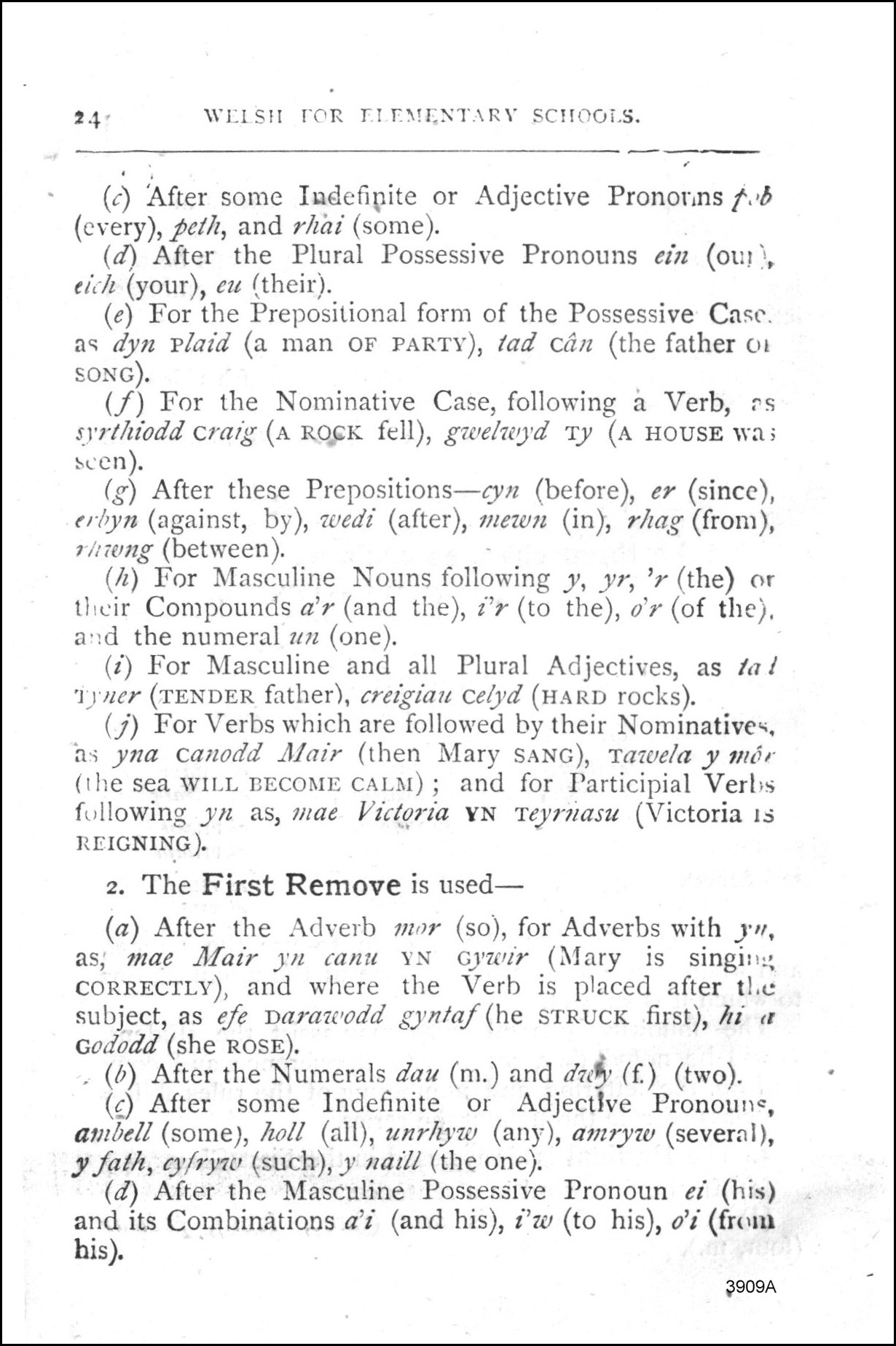
|
(delwedd 3909A)
(x24) 24
WEI Sil I*OR El SCHOOi.S.
(c) 'After some Indefipite or Adjective Pronorans tob
(every), Icth, and rhhi (some).
(d) After the Plural Possessive Pronouns ein (ou;
eit-h (your), cu (their).
(e) For the Prepositional form of the Possessive Case.
as dyn plaid (a man OF PARTY), tad can (the father 01
SONG).
(f) For the Nominative Case, following a Verb, rs
s.vrthiodd craig (A ROSK fell), grvekvyd TY (A HOUSE was
seen).
(g) After these Prepositions—cyn (before), er (since),
erbyn (against, by), wedi (after), Illewn (in), rhag (from),
(between).
(h) For Masculine Nouns following y, yr, 'r (the) or
their Compounds a'r (and the), i'r (to the), O'r (of the).
the numeral un (one).
(i) For Masculine and all Plural Adjectives, as tal
'1 yucr (TENDER father), creigiau ce/yd (HARD rocks).
(j) For Verbs which are followed by their Nominatives,
'as yna canodd Mair (then Mary SANG), prawe/a y
(the sea WILL BECOME CALM) ; and for Participial Verbs
following yn as, mae Victgria YN rreyrnasu (Victoria IS
REIGNING).
2. The First Remove is used—
(a) After the Adverb mor (so), for Adverbs with
as; mae Mair yn canu c,ywir (Mary is singing
CORRECTLY), and where the Verb is placed after the
subject, as eye Darawodd gyn/af (he STRUCK first), hi
Godbdd (she ROSE).
(b) After the Numerals dau (m.) and dtc6' (f.) (two).
(q) After some Indefinite or Adjective Pronoune,
ambell (some), holl (all), unrhytv (any), amryw (several),
'fath, ty/rytcp (such), y nail/ (the one).
(d) After the Masculine Possessive Pronoun ei (his)
and its Combinations a'i (and his), i'w (to his), o'i (from
his).
3909A
|
|
|
|
|
|
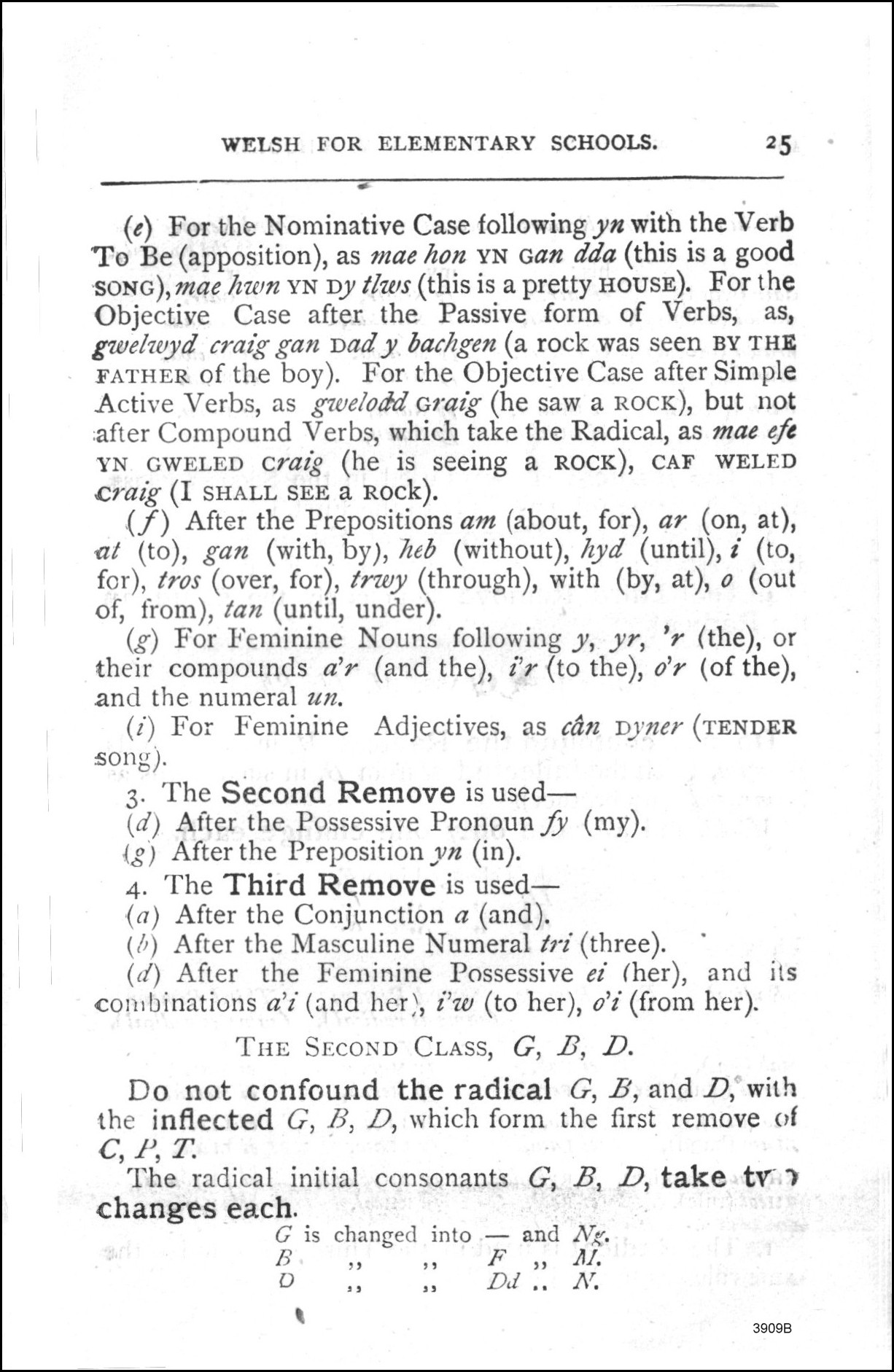
(delwedd 3909B)
(x25)
WELSH FOR
ELEMENTARY SCHOOLS.
25
(e) For the Nominative Case following yn with the Verb
To Be (apposition), as mae hon YN Gan dda (this is a good
SONG), mae hwn YN D)' tlws (this is a pretty HOUSE). For the
Objective Case after the Passive form of Verbs, as,
gwelwyd craig gan Dad y bachgen (a rock was seen BY THE
FATHER of the boy). For the Objective Case after Simple
Active Verbs, as gwelodd craig (he saw a ROCK), but not
.after Compound Verbs, which take the Radical, as mae eye
TN GWELED craig (he is seeing a ROCK), CAF WELED
craig (I SHALL SEE a Rock).
(f) After the Prepositions am (about, for), ar (on, at),
al (to), gan (with, by), lub (without), hyd (until), i (to,
for), tros (over, for), trwy (through), with (by, at), o (out
of, from), tan (until, under).
(g) For Feminine Nouns following y, yr, 'r (the), or
their compounds a'? (and the), (to the), O'r (of the),
and the numeral un.
(i) For Feminine Adjectives, as can ryner (TENDER
song).
3. The Second Remove is used—
(d) After the Possessive Pronoun f (my).
(g ) After the Preposition yn (in).
4. The Third Remove is used—
(a) After the Conjunction a (and).
(b) After the Masculine Numeral tri (three).
(d) After the Feminine Possessive ei (her), and its
contbinations a'i (and her), i'w (to her), o'i (from her).
THE SECOND CLASS, G, D, D.
Do not confound the radical G, B, and D,' with
the inflected G, B, D, which form the first remove of
The radical initial consonants G, 3, D, take
changes each.
G is changed into .— and
M.
3909B
|
|
|
|
|
|
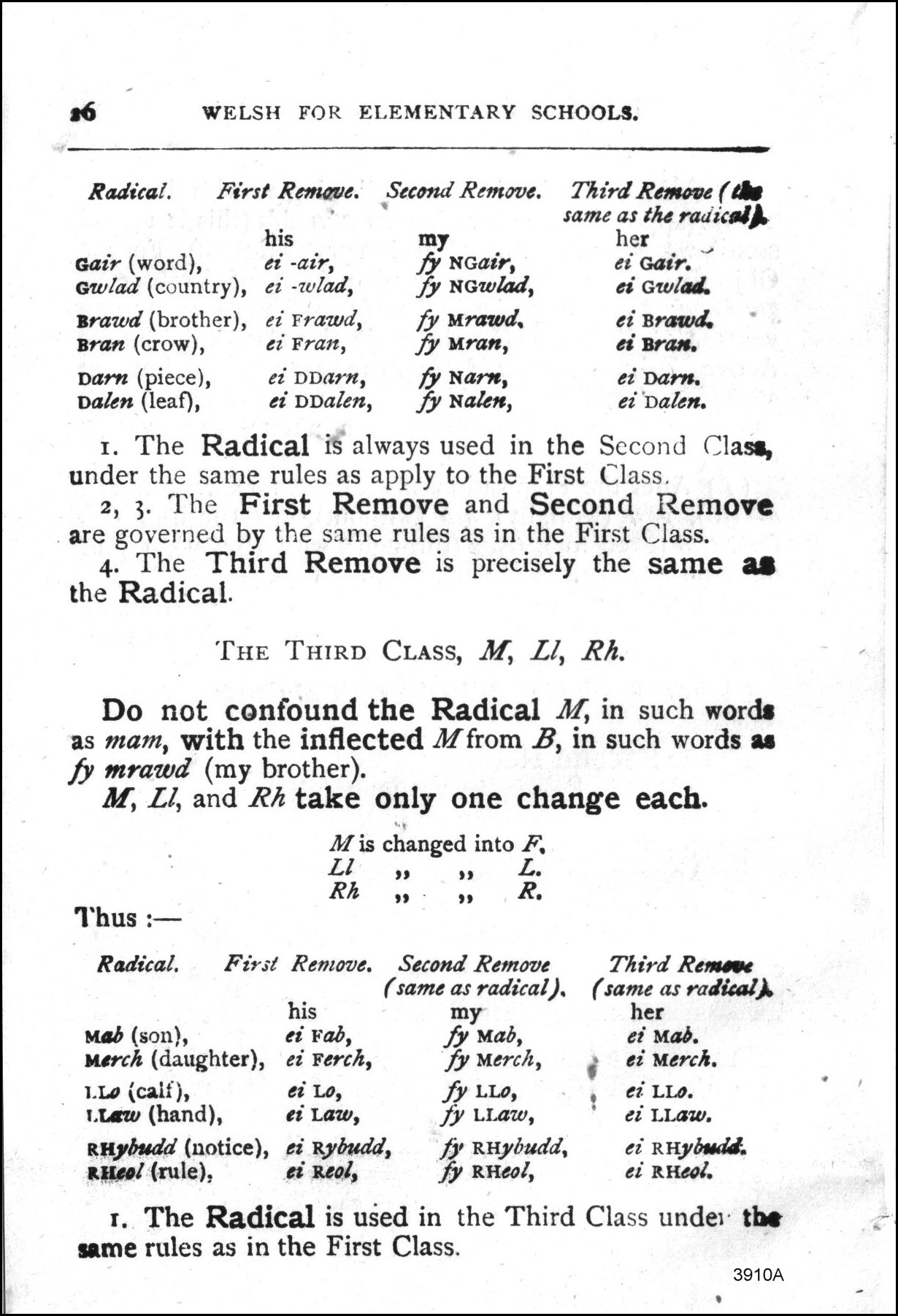
(delwedd 3910A)
(x26)
WELSH FOR ELEMENTARY SCHOOLS.
Radical. First Renae. Second Remove. Third Remove ( &
Gair (word),
Gwlad (country),
Brazed (brother),
Bran (crow),
Darn (piece),
Dalen (leaf),
his
ei -air,
ei -zvlad,
ei Frazvd,
ei Fran,
ei DDarn,
ei DDalen,
my
b NGair,
NGzvId,
fy Mrazvd.
Mt-an,
D' Nam,
-fy Nah,
same as the
her
ei Gair.
ei Gtvld.
ei Braw'
ei Bran.
ei Darn.
ei 'Dalen.
1. The Radical • always used in the Second Clasg
under the same rules as apply to the First Class.
2, 3. The First Remove and Second Remove
are governed by the same rules as in the First Class.
4. The Third Remove is precisely the same
the Radical.
THE THIRD CLASS, M, Ll, Rh.
Do not confound the Radical M, in such words
as mam, with the inflected M from B, in such words u
fy mrawd (my brother).
M, Ll, and Rh take only one change each.
M is changed into F.
L.
R.
Thus :—
Radical.
Mab (son),
First
Merch (daughter),
LLO (calf),
1.tÆZV (hand),
RHIbgdd (notice),
(rule),
Remove.
his
ei Fab,
ei Ferch,
ei 1.0,
ei Law,
Second Remove
(same as radical).
my
fy Mab,
Merch,
fy Ll..o,
fy LLaw,
ei R"bgdd, RHYbudd,
RHeol,
ei geol,
Third Rem•æ
(same as radicalÅ
her
ei Mab.
ei Merch.
ei LLO.
ei Ll.aw.
ei RHYb%U.
ei RHeol.
r. The Radical is uged in the Third Class under tbe
same rules as in the First Class.
3910A
|
|
|
|
|
|
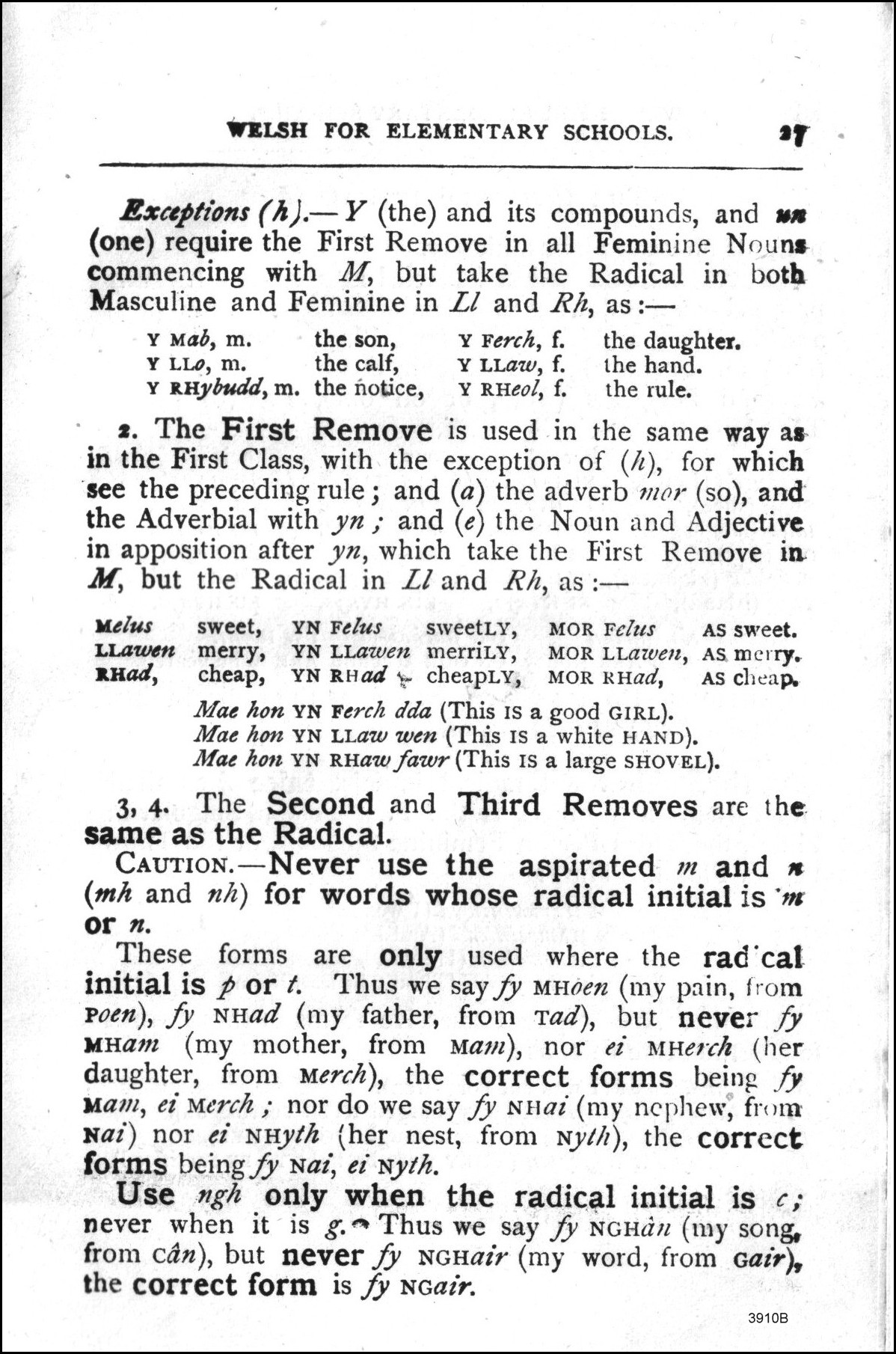
(delwedd 3910B)
(x27)
*EISH FOR ELEMENTARY SCHOOLS.
Exceptions Y (the) and its compounds, and
(one) require the First Remove in all Feminine Nouns
commencing with M, but take the Radical in both
Masculine and Feminine in Ll and Rh, as
Y Mab, m.
the son,
Y perch, f.
the daughter.
the calf,
Y Ll,azv, f.
the hand.
Y LIM, m.
Y RHYbgdd, m. the notice, Y RHeol, f.
the rule.
The First Remove is used in the same way as
in the First Class, with the exception of (h), for which
see the preceding rule; and (a) the adverb mor (so), and
the Adverbial with yn ; and (e) the Noun and Adjective
in apposition after yn, which take the First Remove in
M, but the Radical in Ll and Rh, as
Melus sweet, YN Fetus
sweetLY, MOR FClus AS sweet.
Ll.auwt merry, YN LLawen merriLY, MOR LLazven, AS merry.
*Had, cheap, YN RHad cheapl,y, MOR RHad, AS cheap.
Mae hon YN perch dda (This IS a good GIRL).
Mae hon YN LLazv wen (This IS a white HAND).
Mae hon YN RHawfazvr (This IS a large SHOVEL).
3, 4. The Second and Third Removes are the
same as the Radical.
CAVT10N.—Never use the aspirated m and n
(mh and nh) for words whose radical initial is •w
or n.
These forms are only used where the rad •cal
initial is ort. Thus we say j' MHoen (my pain, from
poen), j,' NHad (my father, from Tad), but never fy
MHam (my mother, from Mam), nor ei MHerch (her
daughter, from Merch), the correct forms being fy
Nam, ei Merch ; nor do we say fy NEIai (my nephew, from
Nai) nor ei NHYth (her nest, from NYI/I), the correct
forms being f Nai, ei NYth.
Use ngh only when the radical initial is c;
never when it is g." Thus we say fy NGHån (my song
from can), but never fy NGHair (my word, from Gair),
the correct form is fy NGair.
3910B
|
|
|
|
|
|
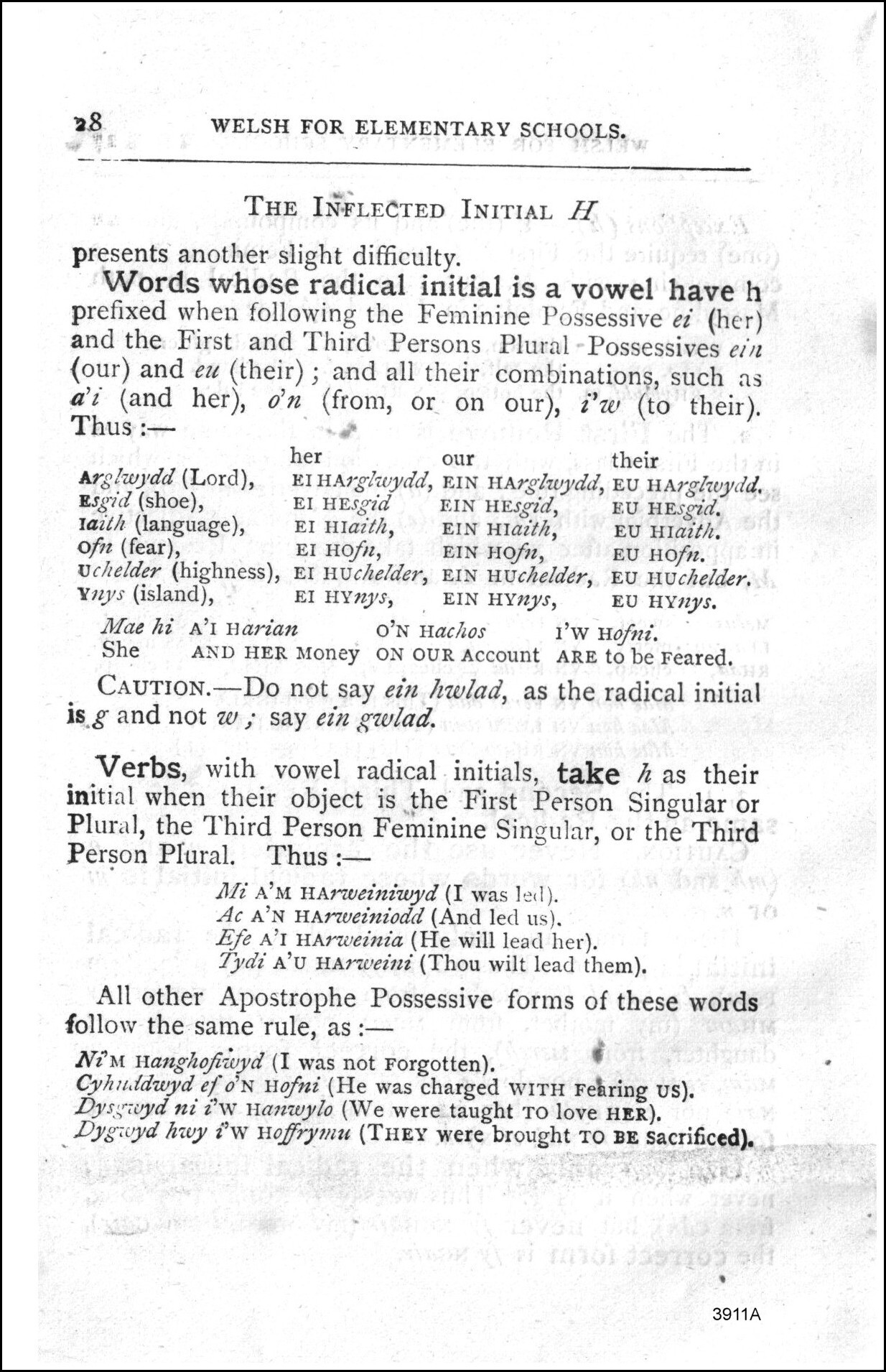
(delwedd 3911A)
(x28)
28
WELSH FOR ELEMENTARY SCHOOF.
THE INFLECTED INITIAL H
presents another slight difficulty.
Words whose radical initial is a vowel have h
prefixed when following the Feminine Possessive ei (her)
and the First and Third Persons Plural -Possessives ein
(our) and eu (their) ; and all their combination}, such as
a'i (and her), O'n (from, or on our), i' w (to their).
Thus
her
their
our
Arglzvydd (Lord),
El HArWtvydd, EIN HArglzvydd, EU HArgkvydd.
Esgid (shoe),
El HEsg•id
EIN HEsgid,
EU HEsgid.
railh (language)'
El Hlaith,
EIN Hlaith,
EU Hlait/e.
Oft (fear),
El HOfn,
EIN HOfiz,
EU HOfn.
uchelder (highness), El HUche/der, EIN Huchelder, EU HUchelder.
Vnys (island),
El HYnys,
EIN Hynys,
EU HY1zys.
Mae hi A'I H arian
O'N Hachos
l'w Hofni.
She
AND HER Money ON OUR Account ARE to be Feared.
CAUTION.—DO not say ein hwlad, as the radical initial
is g and not w ; say ein gwlad.
Verbs, with vowel radical initials, take h as their
initial when their object is First Person Singular or
Plural, the Third Person Feminine Singular, or the Third
Perion Plural. Thus
Mi A'M YIArzveinizvyd (I was led
Ac A'N HArzveiniodd (And led us).
Efe A'I HArzveinia (He will lead her).
Tydi A'U HArzveini (Thou wilt lead them).
All other Apostrophe Possessive forms of these words
follow the same rule, as
Nz"M IlanghoFvyd (I was not Forgotten).
Cyhuddzvyd e/ O'N Hofni (He was charged WITH US).
Dys,cayd ni z" w Hanzvylo (We were- taught TO love HER).
L)ygwyd hwy i" w H0frymu (THEY were brought TO BE Sacrificed).
3911A
|
|
|
|
|
|
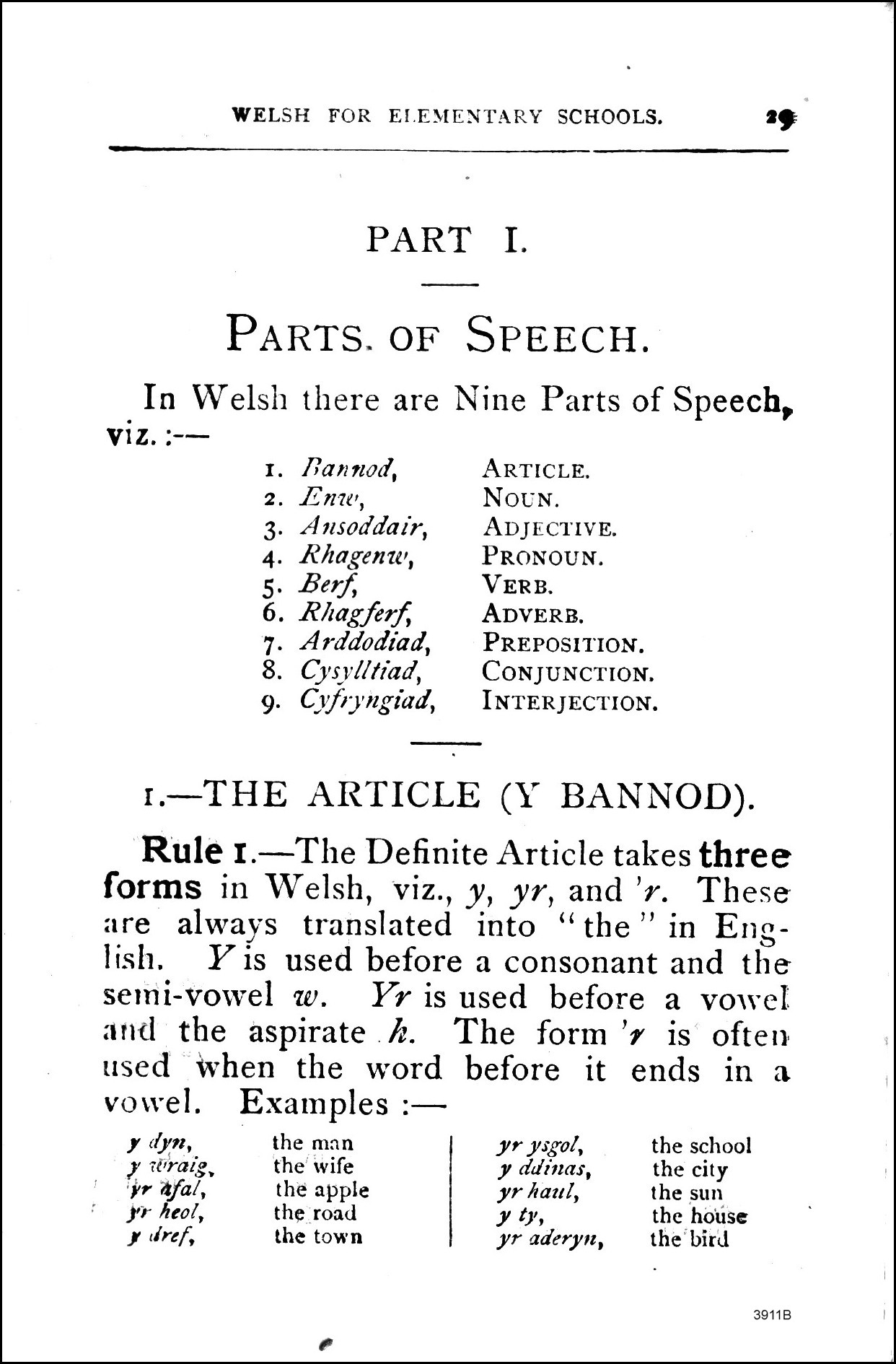
(delwedd 3911B)
(x29)
WELSH FOR ELEMENTARY SCHOOLS.
PART 1.
PARTS. OF SPEECH.
In Welsh there are Nine Parts of Speech,
viz..
Bannod,
I.
2. Ente,
A nsoddair,
3.
Rhagenw,
4.
Berf,
5.
Rhagferf,
6.
A rddodiad,
7.
8.
Cysylltiad,
Cyfryngiad,
9.
ARTICLE.
NOUN.
ADJECTIVE.
PRONOUN.
VERB.
ADVERB.
PREPOSITION.
CONJUNCTION.
INTERJECTION.
I—THE ARTICLE (Y BANNOD).
Rule I.—The Definite Article takes three
forms in Welsh, viz., y, yr, and 'r. These
are always translated into " the " in Eng-
lish. Yis used before a consonant and the
semi-vowel w. Yr is used before a vowel
and the aspirate h. The form '1 is often,
used When the word before it ends in a
vowel. Examples .
y dyn,
r&raig.
yr åfa/,
Yr heo(,
tiref,
the man
the wife
the apple
the road
the town
yr yvol,
ddinas,
yr haul,
yr aderpe,
the school
the city
the sun
the house
the bird
3911B
|
|
|
|
|
|
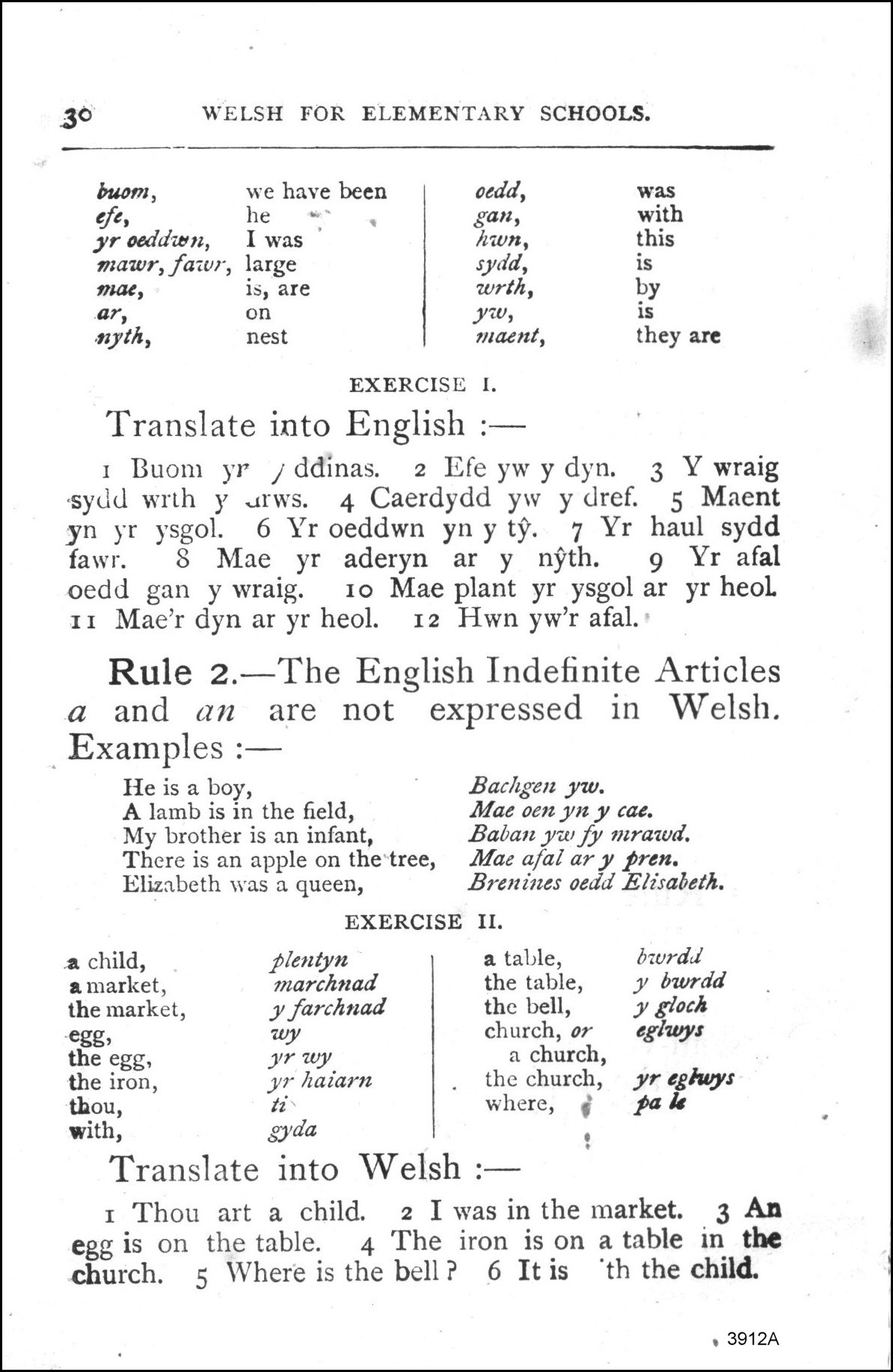
(delwedd 3912A)
(x30)
30
efe,
WELSH FOR ELEMENTARY SCHOOLS.
yr oeddzen,
mazvr, fazvr,
mae,
nyth,
we have been
he
I was
large
IS, are
on
nest
oedd,
gan,
hwn,
sydd,
wrth,
maent,
was
with
this
is
by
is
they are
EXERCISE 1.
Translate into English .
1 Buom yr 1 ddinas.
2 Efe yw y dyn. 3 Y wraig
esydd wrth y urws. 4 Caerdydd yw y dref. 5 Maent
yn yr ysgol. 6 Yr oeddwn yn y t'. 7 Yr haul sydd
9 Yr afal
S Mae yr aderyn ar y 119th.
fawr.
10 Mae plant yr ysgol ar yr heoL
oedd gan y wraig.
12 Hwn yw'r afal.'
11 Mae'r dyn ar yr heol.
Rule 2.—The English Indefinite Articles
a and an are not expressed in Welsh.
Examples :
He is a boy,
A lamb is in the field,
My brother is an infant,
yzv.
Mae oen yn y cae.
Baban yzvfy mrazvd.
There is an apple on the tree, Mae anal ar y Iren.
Bren ines udd Elisabeth.
Elizabeth was a queen,
EXERCISE 11.
a child,
a market,
the market,
egg,
the egg,
the iron,
thou,
with,
Ilentyn
marchnad
Y farchnad
yr wy
yr haiarn
ti
Uda
a table,
the table,
the bell,
church, or
a church,
the church,
where,
bwrdd
Y bwrdd
y gloch
eglwys
yr eghws
Translate into Welsh :
1 Thou art a child. 2 1 was in the market. 3 An
egg is on the table. 4 The iron is on a table in the
church. 5 Where is the bell? 6 It is •th the child.
3912A
|
|
|
|
|
|
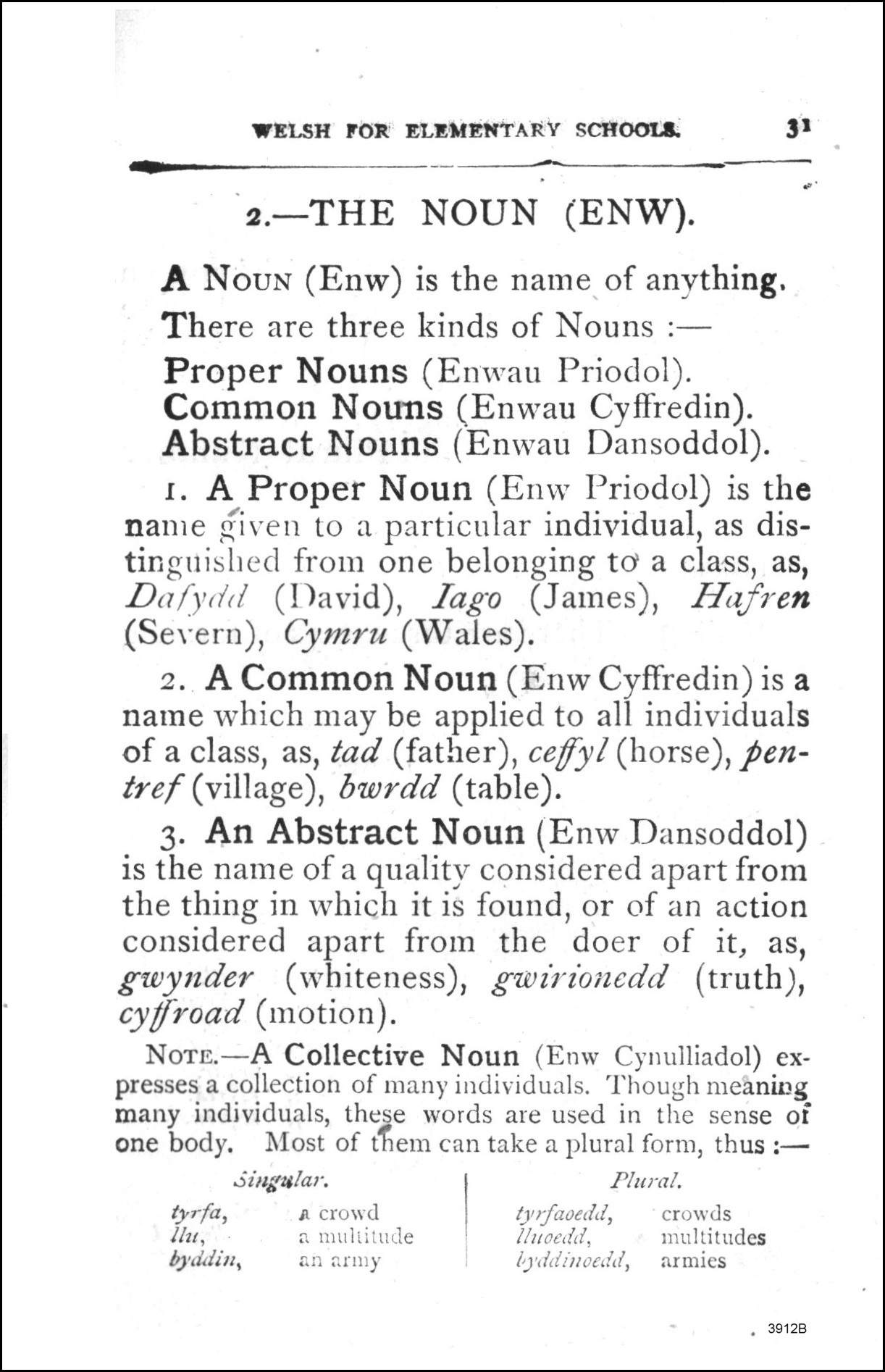
(delwedd 3912B)
(x31)
WELSH FOR ELEMENTARY scqoots.
2.—THE NOUN (ENW).
A NouN (Enw) is the name of anything,
There are three kinds of Nouns .
Proper Nouns (Enwau Priodol).
Common Nouns (Enwau Cyffredin).
Abstract Nouns (Enwau Dansoddol).
I. A Proper Noun (Enw Priodol) is the
narne given to a particular individual, as dis-
tinguishecl from one belonging to a class, as,
Daf.ydd (l)avid), lago (James), Hafren
(Severn), Cymru (Wales).
2. A Common Noun (Enw Cyffredin) is a
name which may be applied to all individuals
of a class, as, tad (father), ceLyl (horse), pen-
tref (village), bwrdd (table).
3. An Abstract Noun (Enw Dansoddol)
is the name of a quality considered apart from
the thing in which it is found, or of an action
considered apart from the doer of it, as,
gwynder (whiteness), gwirioncdd (truth),
cyLroad (motion).
NOTE.—A Collective Noun (Enw Cynulliadol) ex-
presses a collection of many individuals. 'I'hough meaning
many individuals, these words are used in the sense of
one body. Most of tfem can take a plural form, thus
Singular.
tyrfa,
b)'ddin,
crowd
multitude
an aril))'
Plural.
tyrfaocdd,
crowds
lluoedd,
multitudes
lyddinoe,id, armies
3912B
|
|
|
|
|
|
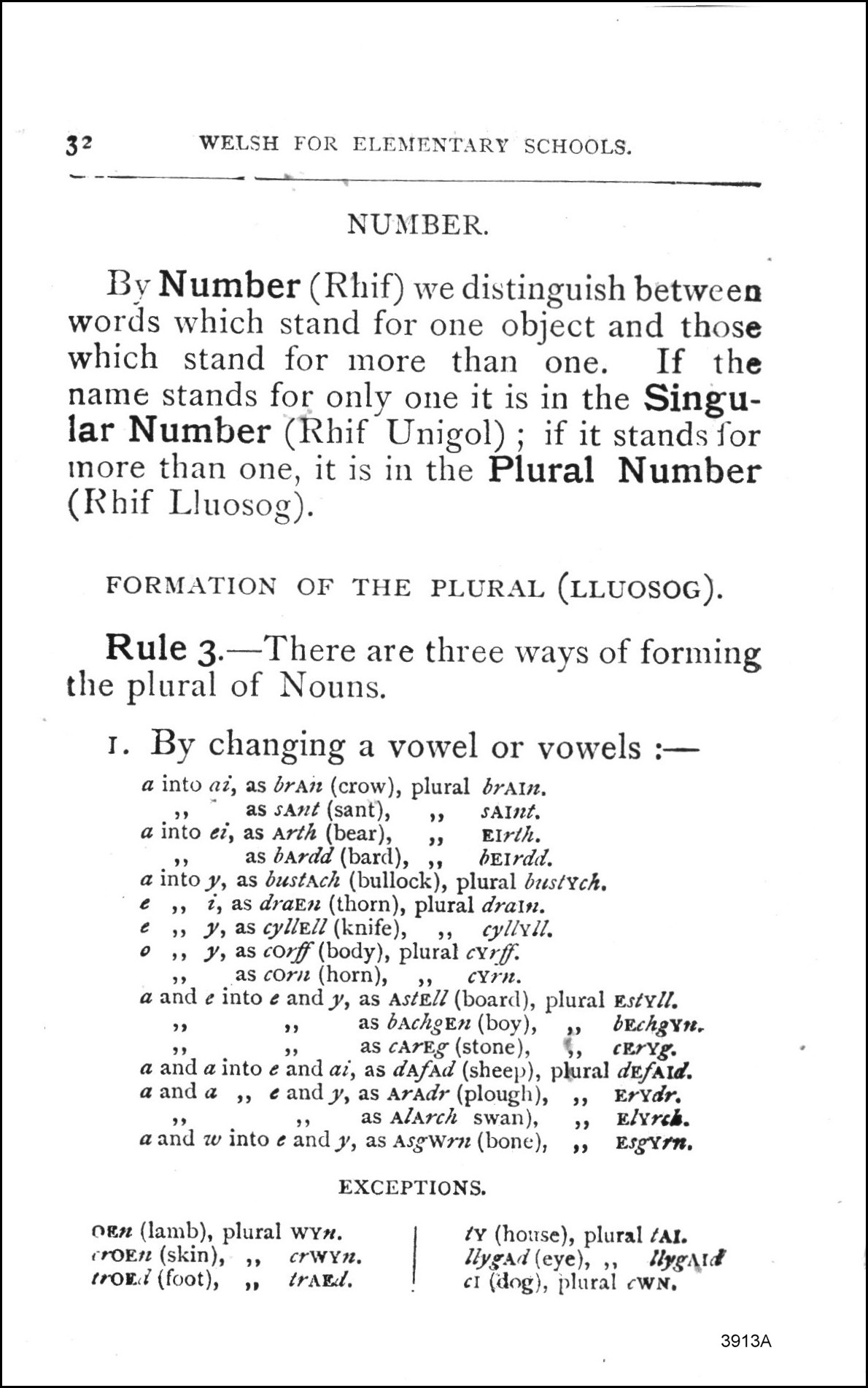
(delwedd 3913A)
(x32)
WELSH FOR ELEMENTARY SCHOOLS.
NUMBER.
By Number (Rhif) we distinguish between
words which stand for one object and those
which stand for more than one.
If the
name stands for only one it is in the Singu-
lar Number (Rhif Unigol) ;
if it stands for
more than one, it is in the Plural Number
(Rhif Lluosog).
FORMATION OF THE PLURAL (LLUOSOG).
Rule 3.—There are three ways of forming
the plural of Nouns.
r. By changing a vowel or vowels :
a into ai, as brAi2 (crow), plural brAI't.
as $Ant (sant),
.fAInt.
a into ei, as Arth (bear),
Elrth.
as bArdd (bard),
bE1rdd.
a into y, as bustAch (bullock), plural buslYch.
i, as draEn (thorn), plural drarn.
e „ y, as cyllEll (knife),
„ cyliY11.
o „ y, as corf(body), plural cyrff.
as corn (horn),
cyrn.
a and e into e and y, as AstEll (board), plural ESIYI/.
as bAchgEn (boy),
bp.chgvte-
as CArF„g (stone),
a and a into e and ai, as dAfAd (sheep), lüural dEfAId.
a and a
e and y, as ArAdr (plough),
Erydr.
as AlArch swan),
Elyrcå.
a and w into e and y, as Asgwrn (bone),
ETYM.
EXCEPTIONS.
OPM (lamb), plural WY".
crOEtz (skin),
crwyu.
(foot),
tr,xrd.
ty (house), plural tAI.
IlYSAd (eye), „
Cl (dog), plural cwN.
3913A
|
|
|
|
|
|
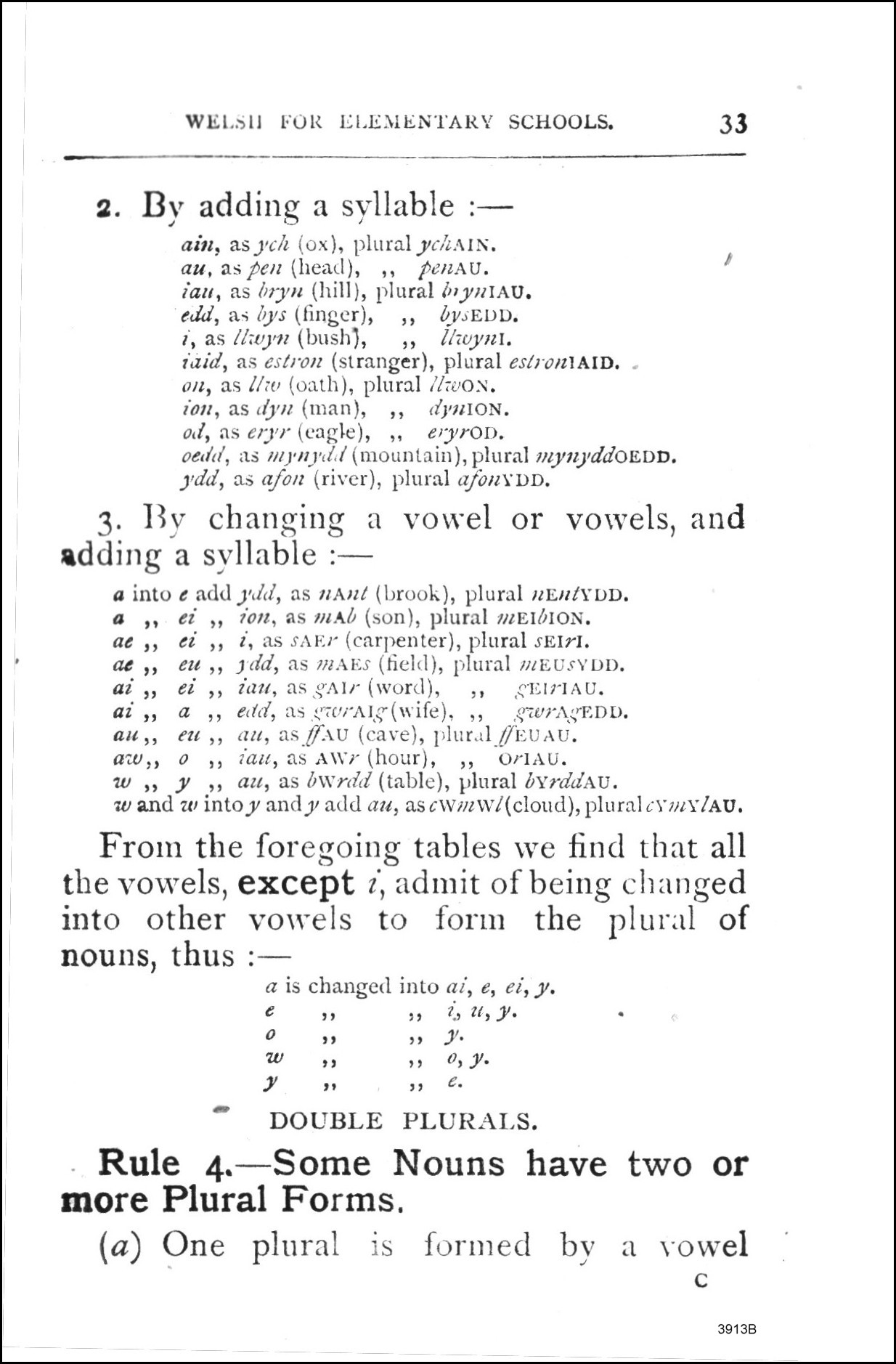
(delwedd 3913B)
(x33) 33
2.
3.
WEI.SIJ FOR ELEMENTARV SCHOOLS.
Dv adding a syllable :
ain, asych (ox), plural ychAIN.
au, as pen (head),
tenAU.
iau, as bryn (hill), plural dnynIAU.
edd, as bys (finger),
bvsEDD.
i, as llwyn (bush),
llwynl.
iaid, as cstron (stranger), plural estronlAID.
on, as 1,4v (oath), plural /lzvON.
ion, as dyn (man),
dyn10N.
od, as cryr (eagle),
eryrOD.
oedd, as (mountain), plural mynyddOEDD.
ydd, as afon (river), plural afonYI)D.
IBv changing a vowel or vowels, and
adding a svllable :
a into e add ycld, as nAnt (brook), plural /ZE'IIVDD.
ei
a
ei
ae
eu „
ai
ei
az
a
au„ eu
acv, , o
tv „ y „
ion, as mAb (son), plural 1,'1EIbION.
i, as SAEr (carpenter), plural sEIrI.
ydd, as lilAES (field), plural mEUSVDD.
iau, as g•AIv (word),
edd, as {'XMAI'(wife),
au, as.CAU (cave), plural LEU AU.
iau, as A Wr (hour),
OPIAU.
au, as bwrdd (table), plural bYrddAu.
w and w into y and y add au, as evvmw/(cloud), plural cv;nv/AU.
From the foregoing tables we find that all
the vowels, except i, admit of being changed
into other vowels to forni the plural of
nouns, thus :
a is changed into ai, e, ei, y.
DOUBLE PLURALS.
Rule 4.—Some Nouns have two or
more Plural Forms.
(a) One plural is forrnecl bv a vowel
c
3913B
|
|
|
|
|
|
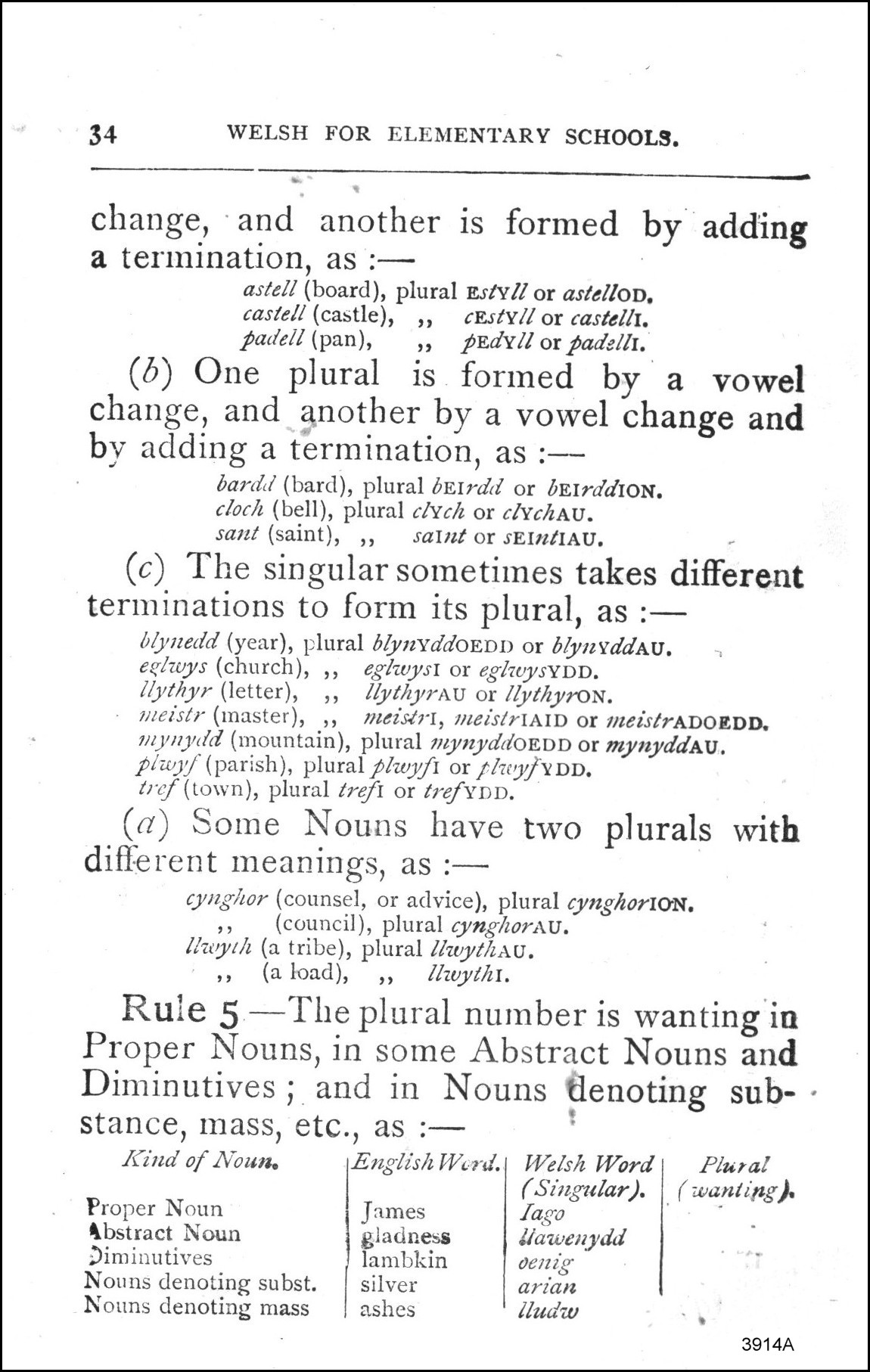
(delwedd 3914A)
(x34) 34
WELSH FOR ELEMENTARY SCHOOLS.
change, and another is formed by adding
a termination, as :
astell (board), plural EstYll or aste110D.
castell (castle),
cEstYll or castelll.
padell (pan),
PEdYll or padelll.
(b) One plural is formed by a vowel
change, and +nother by a vowel change and
bv adding a termination, as :
bardd' (bard), plural l)EIrdd or bEIrddION.
cloch (bell), plural clych or clychAU.
sant (saint),
saint or sE1nt1AU.
(c) The singular sometimes takes different
terminations to form its plural, as :
b/ynedd (year), plural blynYdd0EDI) or blynyddAU.
eelwys (church), „ eglzvysr or eglwysYDD.
//ythyr (letter),
, , llythyrAtJ or llythyrON.
meistr (master),
meisO•I, meislFIAID or meistrADOEDD.
mynydd (mountain), plural mynyddOEDD or mynyddAU.
(parish), pluralllzvyfl or /hvyjYDD.
trey (town), plural trefl or trefY1)D.
(a) Some Nouns have two plurals with
different meanings, as :
cynghor (counsel, or advice), plural cynghorION.
(council), plural cynghorAU.
llwyuh (a tribe), plural llzvythA(J.
(a load),
llzvythl.
Rule 5 —The plural number is wanting in
Proper Nouns, in some Abstract Nouns and
Diminutives ; and in Nouns denoting sub-
stance, mass, etc., as .
Kind of Noun.
Proper Noun
Abstract Noun
Diminutives
Nouns denoting subst.
Nouns denoting mass
English W,xd. welsh Word Pima,'
James
gladness
lambkin
silver
ashes
(Singular). ( wantiæg).
fago
diazvenydd
oenig•
arian
lludzv
3914A
|
|
|
|
|
|
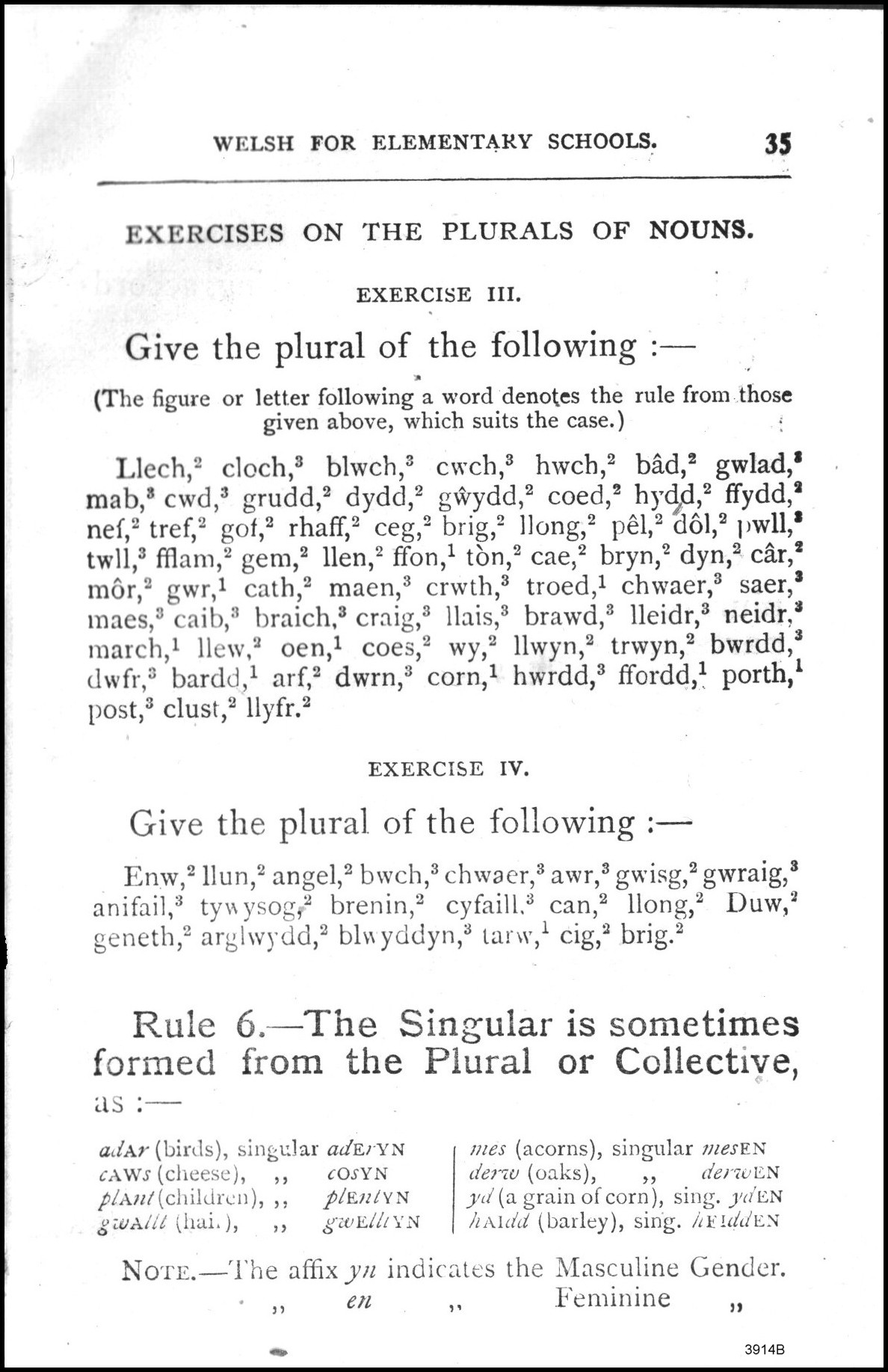
(delwedd 3914B)
(x35) WELSH FOR ELEMENTARY SCHOOLS.
35
EXERCISES ON THE PLURALS OF NOUNS.
EXERCISE 111.
Give the plural of the following :
(The figure or letter following a word denotes the rule from those
given above, which suits the case.)
Llech,2 cloch,3 blwch,3 cwch,3 hwch,2 båd,2 gwlad,8
mab,8 cwd,3 grudd,2 dydd,2 gWydd,2 coed,2 ffydd,a
nef,2 tref,2 gof,2 rhaff,2 ceg,2 brio,2 Ilong,2 pél,2 (161,2 pwll,8
twll,3 flam, 2 gem,2 Ilen,2 ffon,l tbn,2 cae,2 bryn,2 dyn,2 cår,2
mör, gwr,l cath,2 maen,3 crwth,3 troed,l chwaer,3 saer,8
maes,3 caib,3 braich,3 craig,3 llais,3 brawd,3 Ileidr,3 neidr,*
march,l Ilew,2 oen,l coes,2 wy,2 llwyn,2 trwyn,2 bwrdd,3
dwfr,$ bardd,l arf,2 dwrn,3 corn,l hwrdd,3 ffordd,l porth,l
post,3 clust,2 llyfr.2
EXERCISE IV.
Give the plural of the following :
Enw,2 llun,2 angel,2 bwch,3 chwaer,3 awr,3 gwisg,2 gwraig,S
ysog„2 brenin,2 cyfaill.3 can,2 Ilong,2
anifail,3
geneth,2 arglwydd,2 yddyn,3 tarw,l cig,2 brig.2
Rule 6.—The Singular is sometimes
formed from the Plural or Collective,
as .
adAr (birds), singular adE/YN
CAWS (cheese),
COSYN
P/A'" (children), ,
PIE','IVN
„ SWEIIIYN
(hai. ),
mes (acorns), singular mesEN
dent' (oaks),
denteLN
yd (a grain of corn), sing. ydEN
hA1dd (barley), sing. hE!ddEN
NOTE.—'I'he affix yn indicates the Masculine Gender.
en
Feminine
3914B
|
|
|
|
|
|
(delwedd 3915A)
(x36)
36
WELSH FOR ELEMENTARV SCHOOLS.
EXERCISE V.
Give the singular of the following, accord-
ing to the above rule :
(NOTE.-—m. masculine ; f. feminine.)
Rhos m. (roses), gwenith f. (wheat), bedw f. (birch),
blodeu m. (flowers), tywys f. (ears of corn), ceirch f.
(oats), glaswellv". (grass), gwelltf. (straw), coed/ (trees).
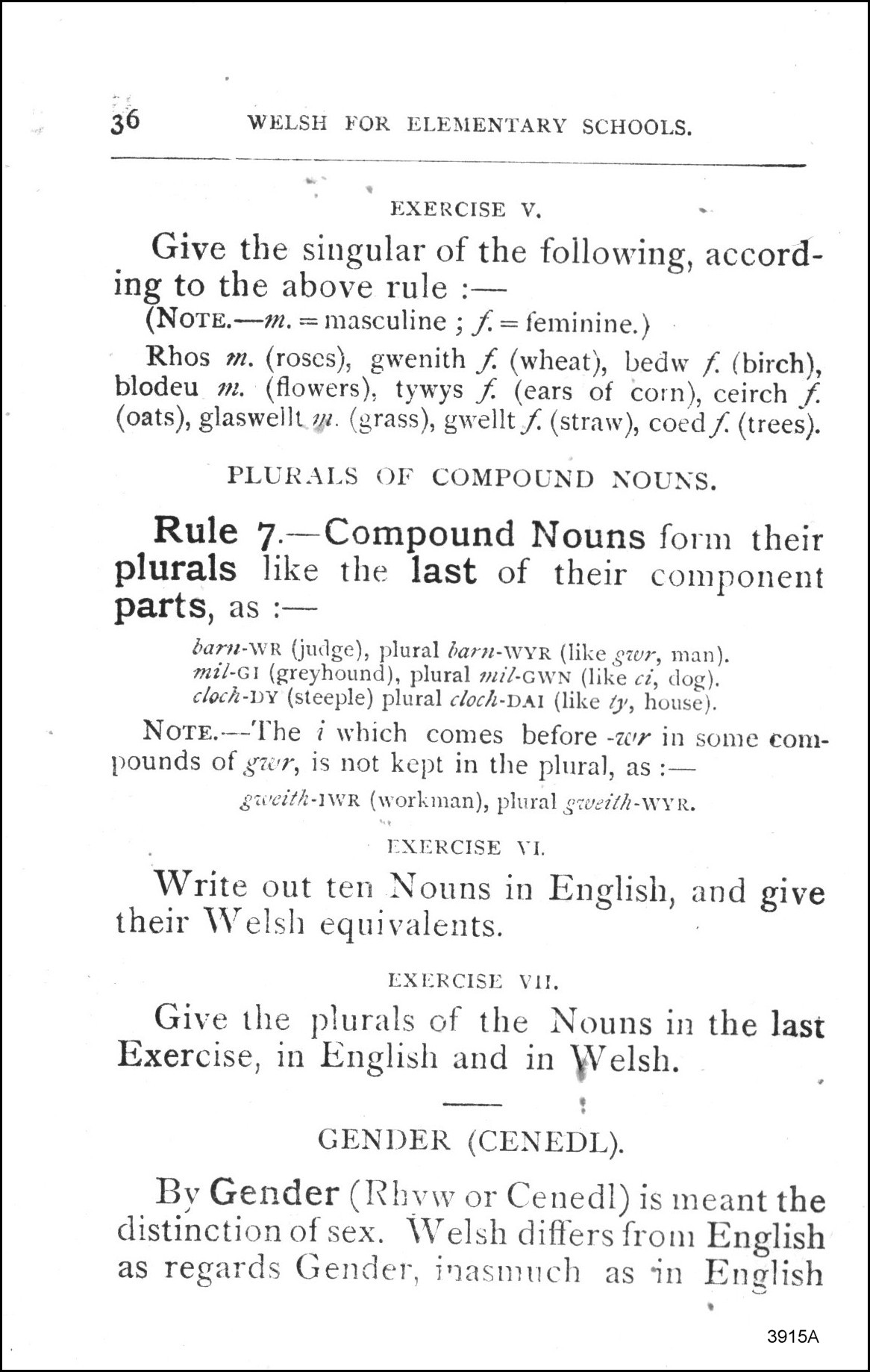
PLURALS OF COMPOUND NOUNS.
Rule 7.—Compound Nouns forin their
plurals like the last of their coinponent
parts, as
barn-wR (judge), plural barn-WVR (like gwr, man).
mil-Gl (greyhound), plural mil-GWN (like ci, dog).
cloch-IDY (steeple) plural cloth-DAI (like O', house).
i which comes before -zer in some com-
pounds of gzvr, is not kept in the plural, as :
gat'ith-H'CR (workman), plural gcveit/1-WYR.
EXERCISE VI.
Write out ten Nouns in English, and give
their MY els11 equivalents.
EXERCISE v 11.
Give the plurals of the Nouns in the last
Exercise, in English and in Welsh.
GENDER (CENEDL).
BV Gender (IRhvw or Cenedl) is meant the
distinction of sex. NVelsh differs fronl English
as regards Gender, inastnucl) as •in English
3915A
|
|
|
|
|
|
(delwedd 3915B)
(x37)
WELSH FOR
ELEMENTARY SCHOOLS.
37
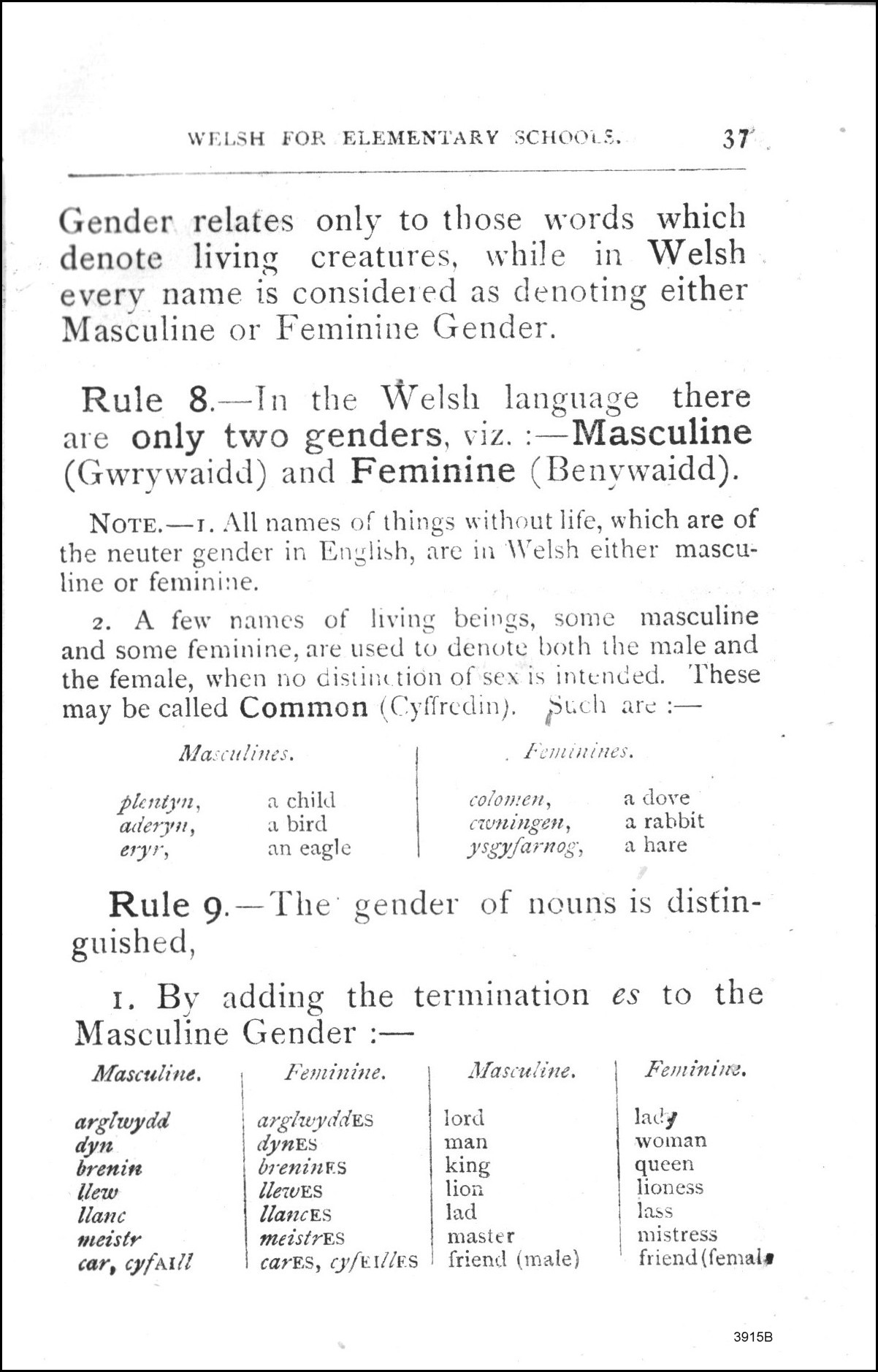
Gender relates only to those words which
denote living creatures, while in Welsh
every name is considered as denoting either
Masculine or Feminine Gender.
Rule 8.—1n the Welsh language there
are only two genders, viz. :—Mascu1ine
(Gwrywaidd) and Feminine (Benywaidd).
NOTE.—T. All names of things without life, which are of
the neuter gender in English, are in NVelsh either mascu-
line or feminine.
2. A few nannes of living beings, some masculine
and some feminine, are used to denote both the male and
the female, when no distinc tion of sex is intended. 'l'hese
may be called Common (Cyffredin). tSuc11 are .
Plc ntyn,
acieryn ,
eryr,
a child
a bird
an eagle
co/omen,
cwmngcn,
ysgyfarnog•,
a dove
a rabbit
a hare
Rule 9.—The gender of nouns is distin-
guished,
1. By adding the terinination es to the
Masculine Gender :
Masculine.
argttvydd
dyn
brenin
Ilew
llanc
meistr
car, cy/A111
Feminine.
arg/zvyddES
dynES
breninF.s
IlewEs
llancEs
meistrF,s
carES, CJfE1//ES
Mascutine.
lord
man
king
lion
lad
master
friend (male)
Feminine.
lad'
woman
queen
lioness
lass
mistress
friend (femal•
3915B
|
|
|
|
|
|
(delwedd 3916A)
(x38)
38
WELSH FOR ELEMENTARY SCHOOLS.
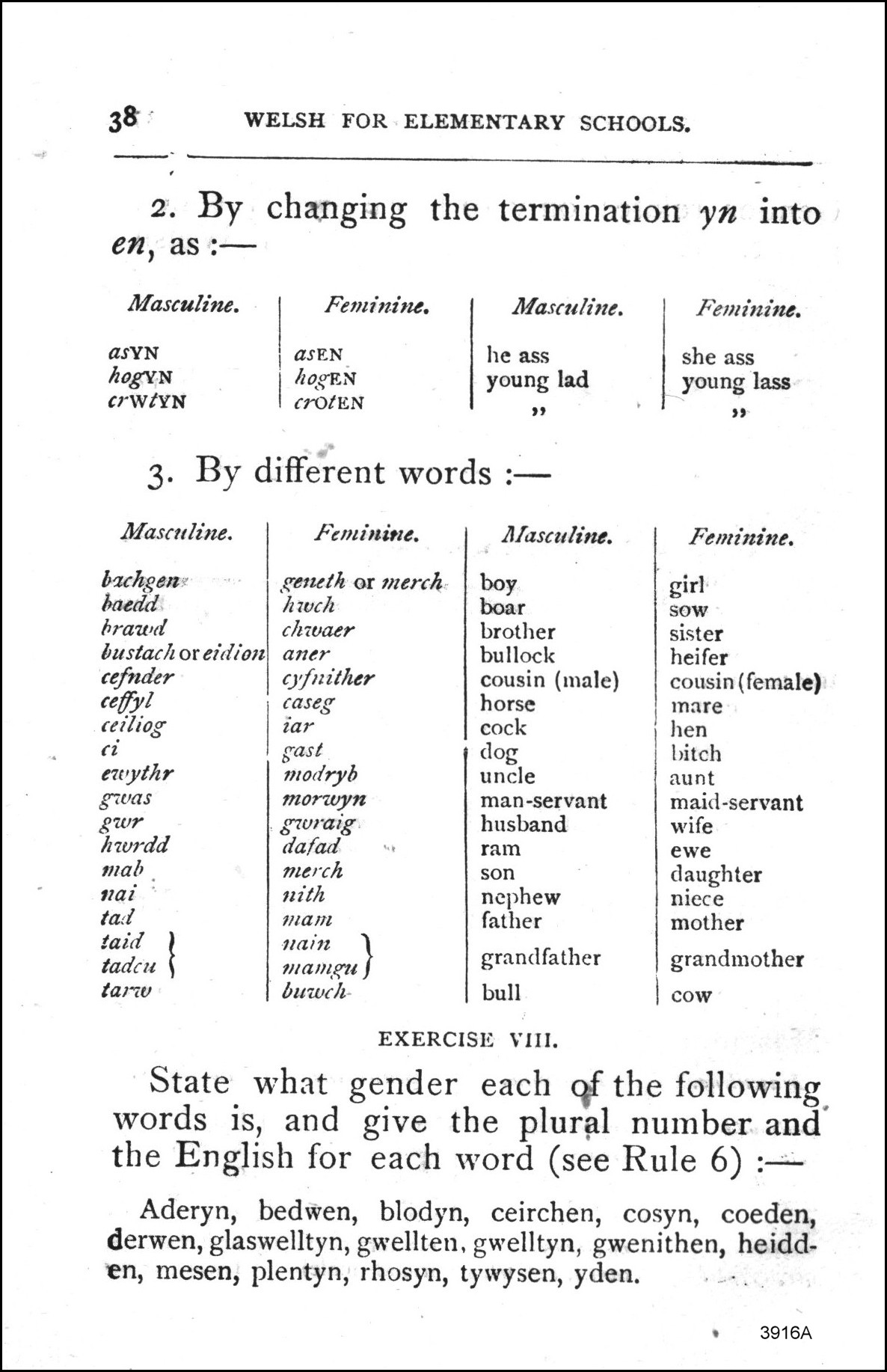
2. By changing the termination yn into
en, as t—-
Masculine.
asyN
hogYN
crwtYN
Feminine.
asEN
hog-EN
crotEN
Masculine.
he ass
young lad
3. By different words :——
Masculine.
bachgew
hrazvd
bustach or eidion
cefnder
ceryl
ceiliog
ewythr
ovas
gwr
h wrdd
mab
nai
tad
'aid
tadcu
tarw
Feminine.
Masculine.
geneth or merci boy
h zvch
chtvaer
aner
cyfnither
caseg
iar
gast
modryb
morzvyn
dafad
merch
n ith
mam
nain
ma mgt'
buzvch-
boar
brother
bullock
cousin (male)
horse
cock
dog
uncle
man-servant
husband
ram
son
nephew
father
grandfather
bull
EXERCISE Vlll.
Feminine.
she ass
young lass
Feminine.
girl
sow
sister
heifer
cousin (female)
mare
hen
bitch
aunt
maid-servant
wife
ewe
daughter
niece
mother
grandmother
cow
State what gender each qf the following
words is, and give the plural number and
the English for each word (see Rule 6) :
Aderyn, bedwen, blodyn, ceirchen, cosyn, coeden,
derwen, glaswelltyn, gwellten, gwelltyn, gwenithen, heidd-
en, mesen, plentyn, rhosyn, tywysen, yden.
3916A
|
|
|
|
|
|
(delwedd 3916B)
(x39)
WELSH FOR ELEMENTARY SCHOOLS.
39
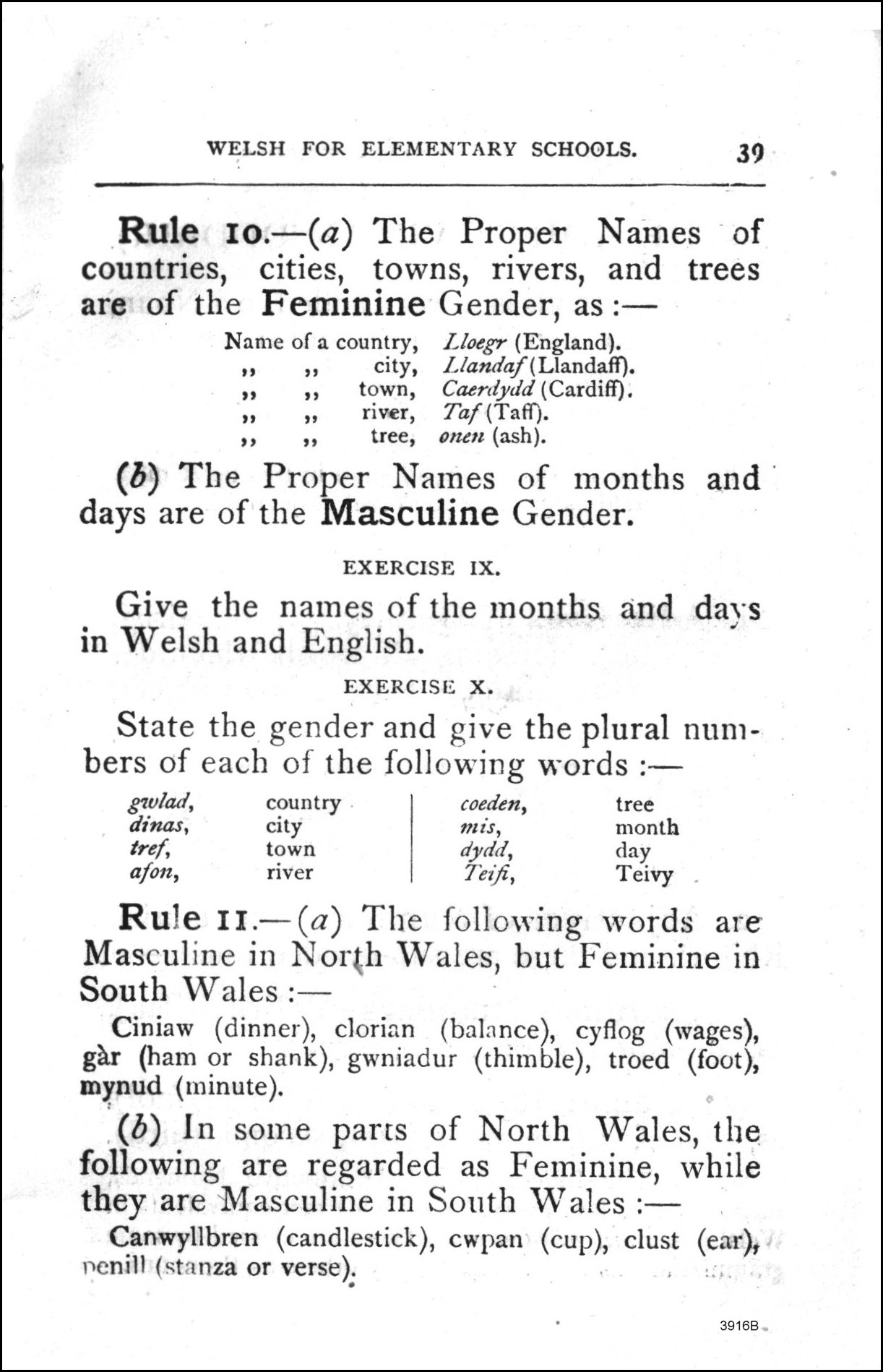
Rule The Proper Names of
countries, cities, towns, rivers, and trees
are of the Feminine Gender, as :-—
Name of a country, Lloegr (England).
city, Llandaf( Llandaff).
town, Caerdydd (Cardiff).
river, Taf(Tafl).
tree, onen (ash).
(b) The Proper Names of months and
days are of the Masculine Gender.
EXERCISE IX.
Give the names of the months and days
in Welsh and English.
EXERCISE X.
State the gender and give the plural num-
bers of each of the following words :—
gwlad,
dinas,
tref,
afon,
country
city
town
river
coeden,
mis,
dydd,
Teifi,
tree
month
day
Teivy
Rule Il
(a) The following words are
Masculine in North Wales, but Feminine in
South Wales
Ciniaw (dinner), clorian (balance), cyflog (wages),
går (ham or shank), gwniadur (thimble), troed (foot),
mynud (minute).
(b) In some parts of North Wales, the
following are regarded as Feminine, while
they are Masculine in South Wales :—
Canwyllbren (candlestick), cwpan (cup), clust (ear),
penill (stanza or verse).
3916B
|
|
|
|
|
|
(delwedd 3917A)
(x40)
40
WELSH FOR ELEMEN't•.ARV SCHOOLS.
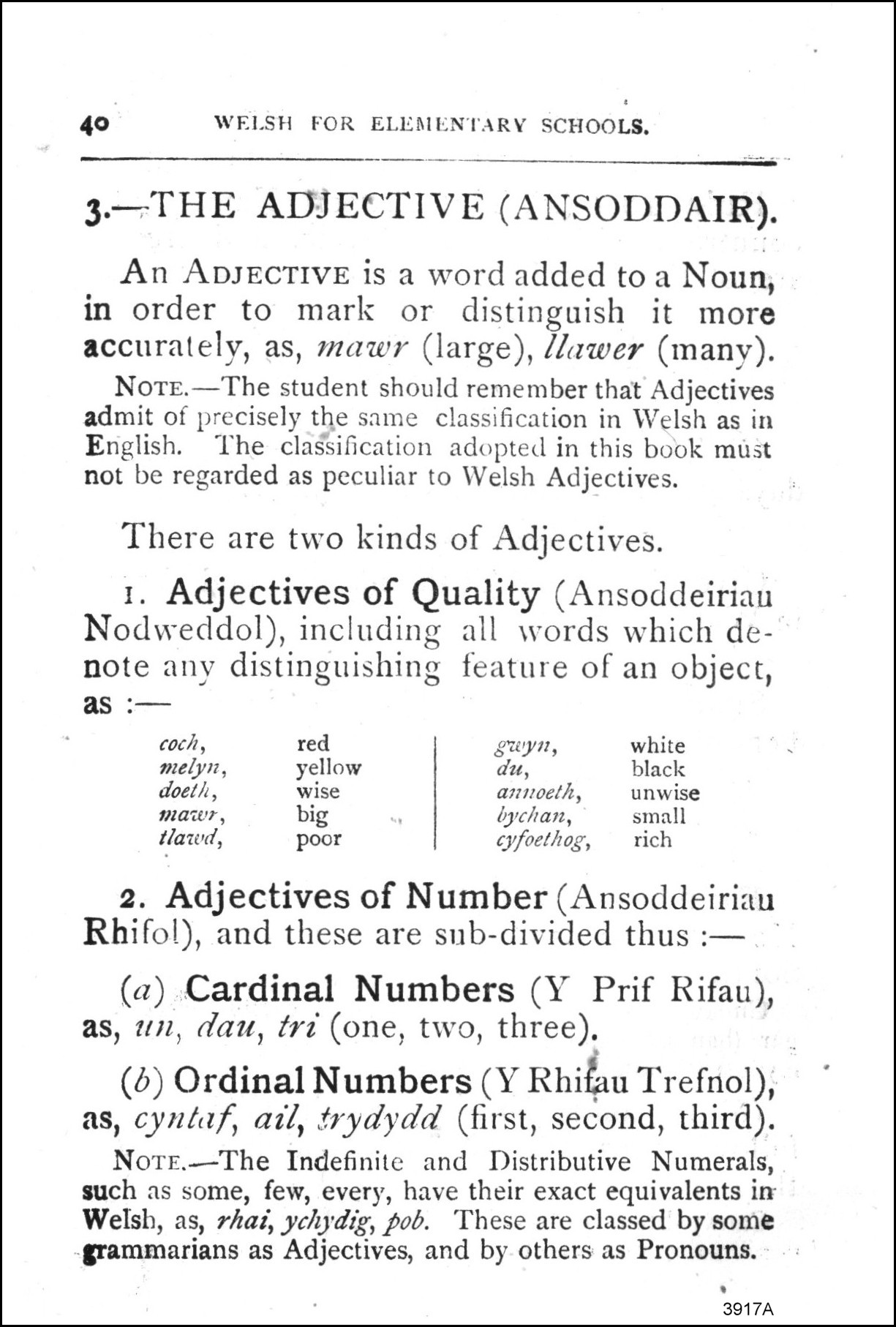
3.—THE ADJECTIVE (ANSODDAIR).
An ADJECTIVE is a word added to a Noun,
in order to mark or distinguish it more
accurately, as, mawr (large), llawer (many).
NOTE.—The student should remember that Adjectives
admit of precisely the same classification in Welsh as in
English. The clas•sification adopted in this book must
not be regarded as peculiar to Welsh Adjectives.
There are two kinds of Adjectives.
1. Adjectives of Quality (Ansoddeiriau
Nodwecldol), including all words which de-
note any distinguishing feature of an object,
coch ,
melyn,
doeth ,
Plater ,
tlazvd,
red
yellow
wise
big
poor
gü'Y'1,
du,
annoeth,
iychan,
cyfoeth 0',
white
black
unwise
small
rich
2. Adjectives of Number (Ansoddeiriau
Rhifol), and these are sub-divided thus :—
(a) Cardinal Numbers (Y Prif Rifau),
as, tin, dau, tri (one, two, three).
(b) Ordinal Numbers (Y Rhifau Trefnol),
as, cyntaf, ail, frydydd (first, second, third).
Indefinite and Distributive Numerals,
such as some, few, every, have their exact equivalents in
Welsh, as, Thai, ychydig, pob. These are classed by some
grammarians as Adjectives, and by others as Pronouns.
3917A
|
|
|
|
|
|
(delwedd 3917B)
(x41)
WELSH FOR ELEMENTARY SCHOOLS.
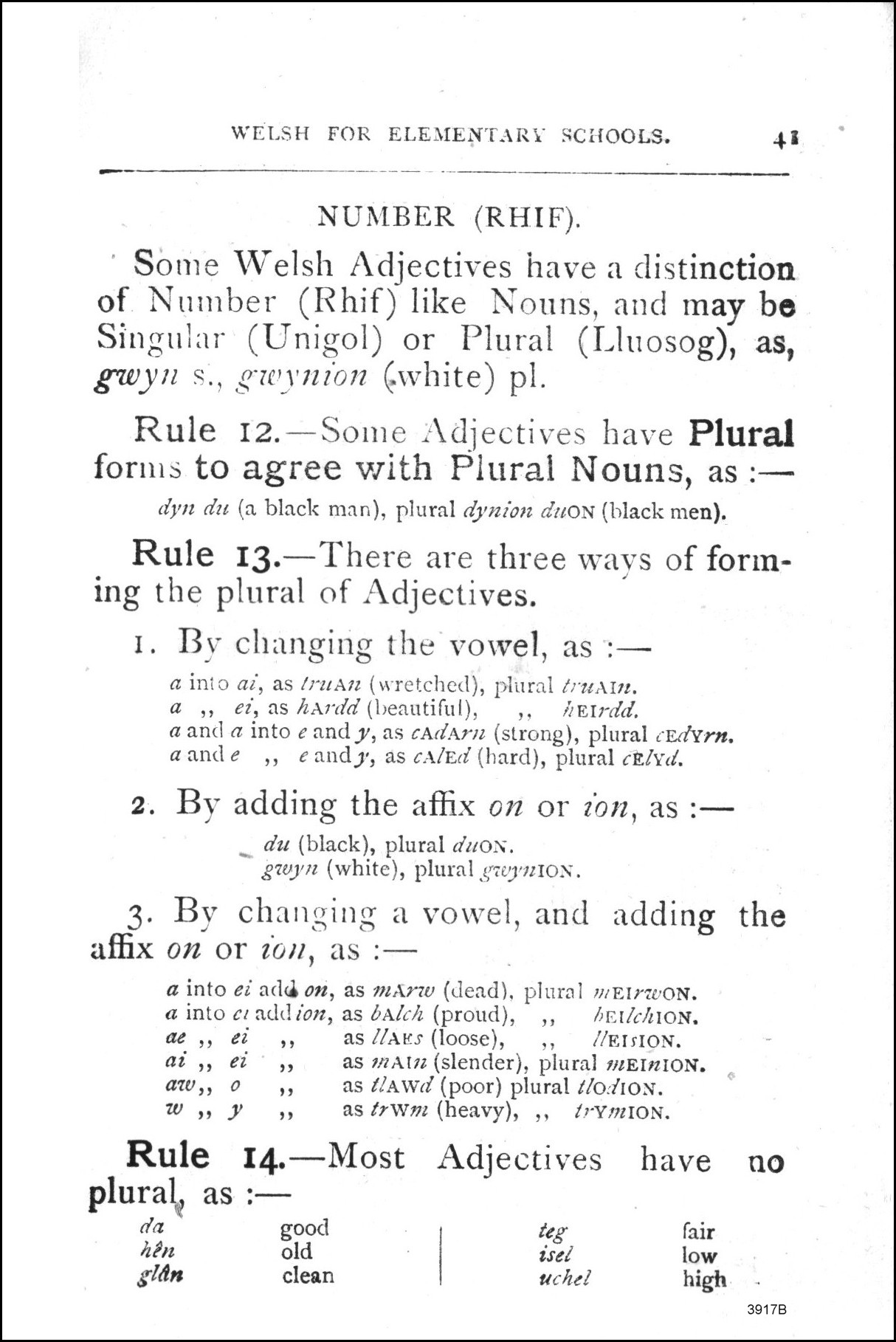
NUMBER (RHIF).
Sotne Welsh Adjectives have a distinction
of Nutnber (Rhif) like Nouns, and may be
Singular (Unigol) or Plural (Lluosog), as,
gwyn s. , etc')'llion (white) pl.
Rule 12.—S01ne Adjectives have Plural
forrns to agree with Plural Nouns, as :—-
dyn du (a black man), plural dynion duON (black men).
Rule 13.—There are three ways of form-
ing the plural of Adjectives.
1. By changing the vowel, as :
a into a; , as trztA7Z (wretched), plural /rttA11t.
ei, as hArdd (beautiful),
//EI,-dd.
a
a and a into e and y, as cAdArn (strong), plural cEdyrn.
a and e
c and 3', as cAlEd (hard), plural cÉ.lYd.
2. By adding the affix on or ion, as :
du (black), plural duos.
gtvyn (white), plural FC'YI,'ION.
3. By changing a vowel, and adding the
affx on or ion, as .
a into ei add on, as mArzv (dead). plural
a into Cl add ion, as bAlch (proud),
hE[/ch10N.
ei
ai
ei
acv, , o
Rule 14.
plural? as .
as //AES (loose),
SION.
as mAtn (slender), plural 1"EIn10N.
as tlAWd (poor) plural tlod10N.
as WII' (heavy), ,
trvm10N.
—-Most Adjectives have no
da
gldn
good
old
clean
teg
ise/
rchel
fair
low
high
3917B
|
|
|
|
|
|
(delwedd 3918A)
(x42)
WEI SH FOR ELEMENTARY SCHOOLS.
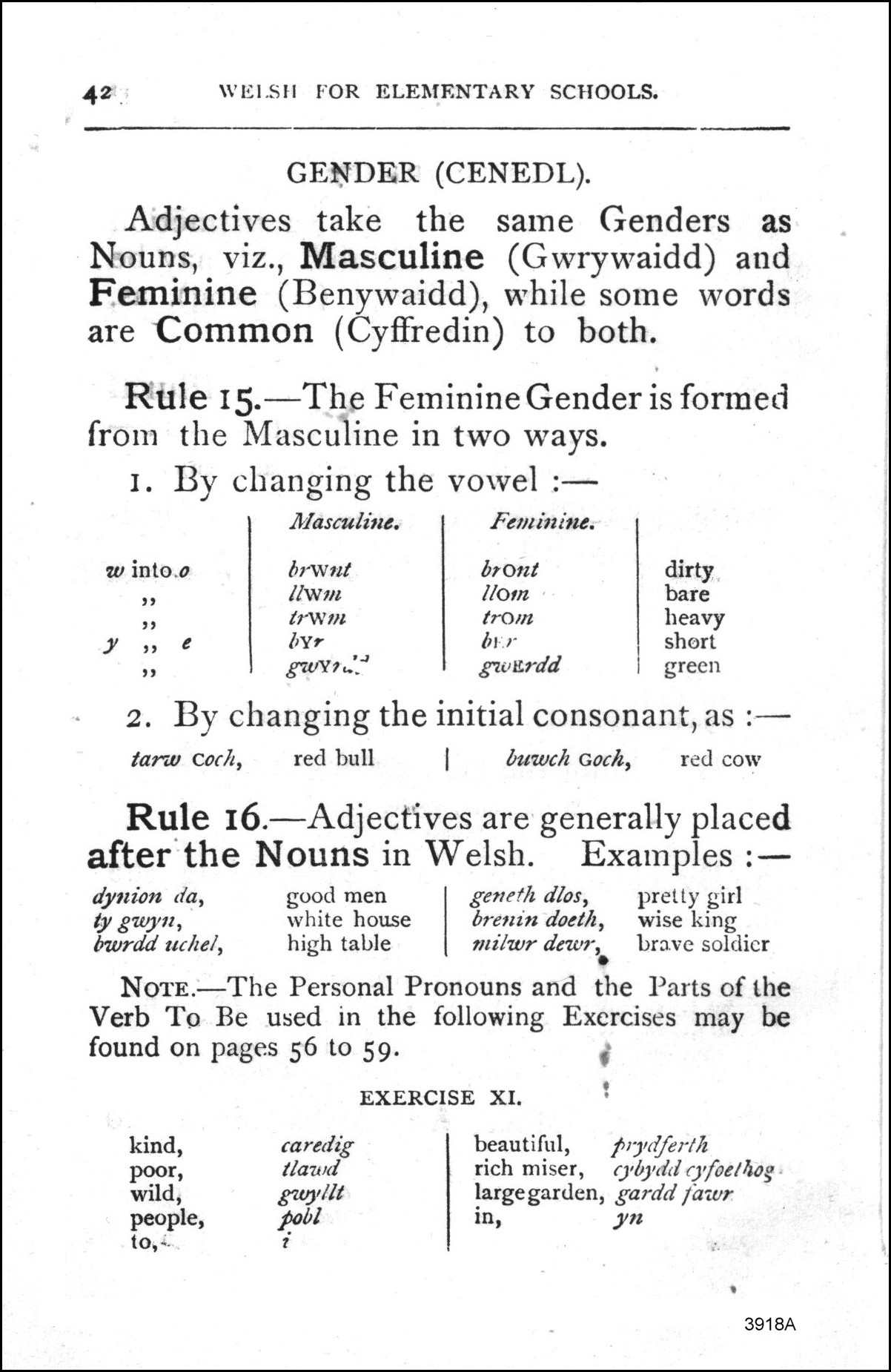
GENDER (CENEDL).
Adjectives take the same Genders as
Nouns, viz., Masculine (Gwrywaidd) and
Feminine (Benywaidd), while some words
are Common (Cyffredin) to both.
Råle 15.—The Feminine Gender is formed
from the Masculine in two ways.
1. By changing the vowel :
w into.o
Masculine,
årwnt
llwm
trW m
byr
gzvY1c.'_
Feminine.
btont
110m
trom
overdd
dirty
bare
heavy
short
green
2. By changing the initial consonant, as :
I buzvch Goch,
red bull
tarw coch,
red cow
Rule 16.—Adjectives are generally placed
after the Nouns in Welsh. Examples : —-
dynion da,
ty gwyn,
bzvrdd uche/,
geneth dlos,
good men
pretty girl
white house
brenin doeth, wise king
high table
milzvr dezvr, brave soldier
N0TE.—The Personal Pronouns and the Parts of the
Verb To Be used in the following Exercises may be
found on pages 56 to 59.
EXERCISE Xl.
kind,
poor,
wild,
people,
to,
cared*
tlawd
gavy/lt
beautiful, Irydfer/h
rich miser,
cybydd cyfoelåog
large garden, gardd /kztvr
in,
3918A
|
|
|
|
|
|
(delwedd 3918B)
(x43)
WELSH FOR ELEMENTARY SCHOOLS.
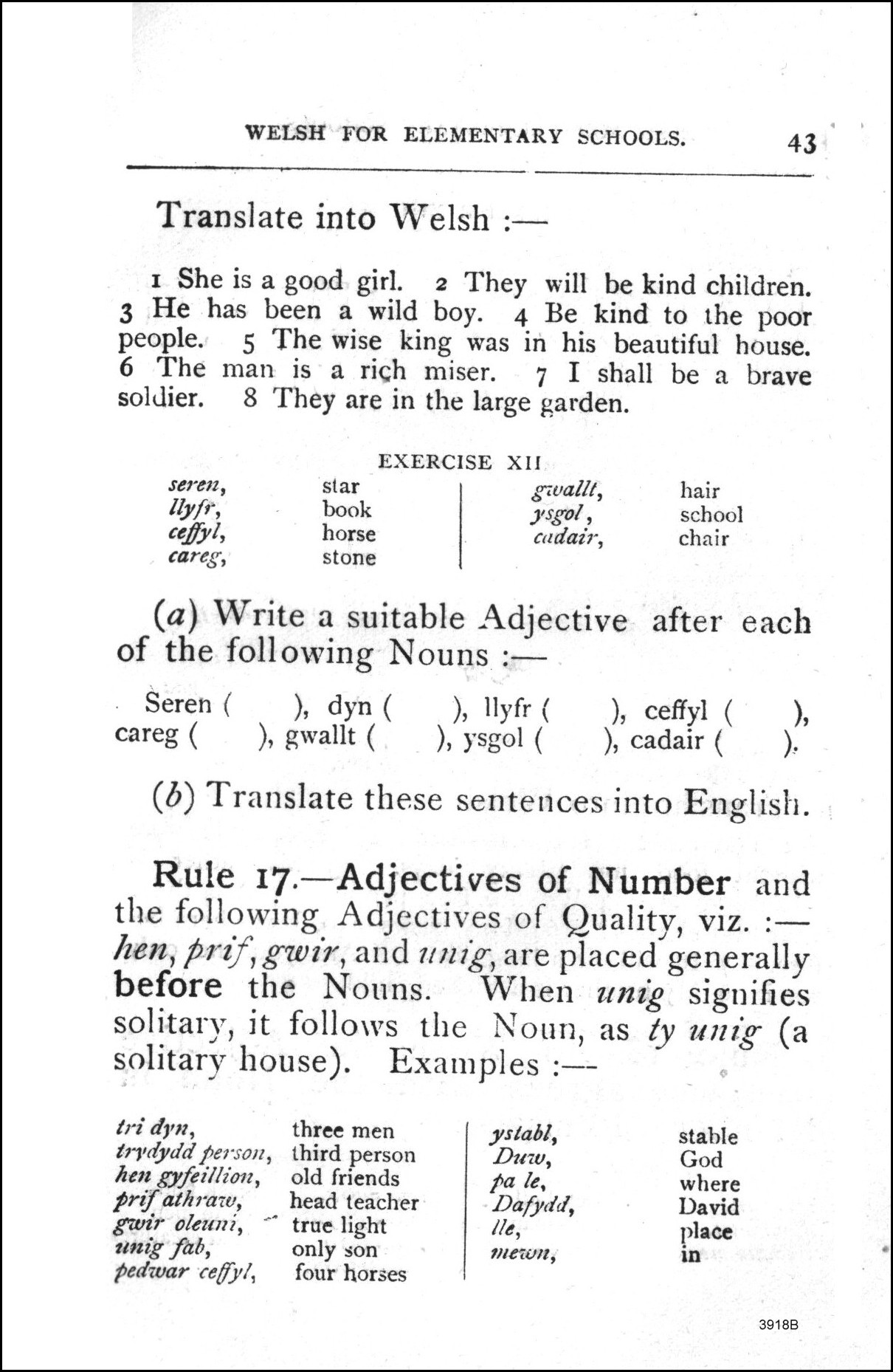
Translate into Welsh :
43
1 She is a good girl. 2 They will be kind children.
3 He has been a wild boy. 4 Be kind to the poor
people.
5 The wise king was in his beautiful house.
6 The man is a rich miser.
7 1 shall be a brave
soldier. 8 They are in the large garden.
EXERCISE Xll
seren,
llyfr,
cares,
star
book
horse
stone
ovalll,
cadair,
hair
school
chair
(a) Write a suitable Adjective after each
of the following Nouns
Seren (
dyn (
llyfr (
ceffyl (
careg (
gwallt (
ysgol (
), cadair (
(b) Translate these sentences into English.
Rule 17.—Adjectives of Number and
the following Adjectives of Quality, viz.
hen, prif, gwir, and uni., are placed generally
before the Nouns. When unig signifies
solitary, it follows the Noun, as ly unig (a
solitary house). Exarnples .
tri drn,
trrdydd Person,
hen ufei/lion,
prif ath raw,
gzvir oleuni,
unig fob,
tedtvar cety/,
three men
third person
old friends
head teacher
true light
only son
four horses
ystabl,
Duw,
Dafydd,
lie,
metun,
stable
God
where
David
place
an
3918B
|
|
|
|
|
|
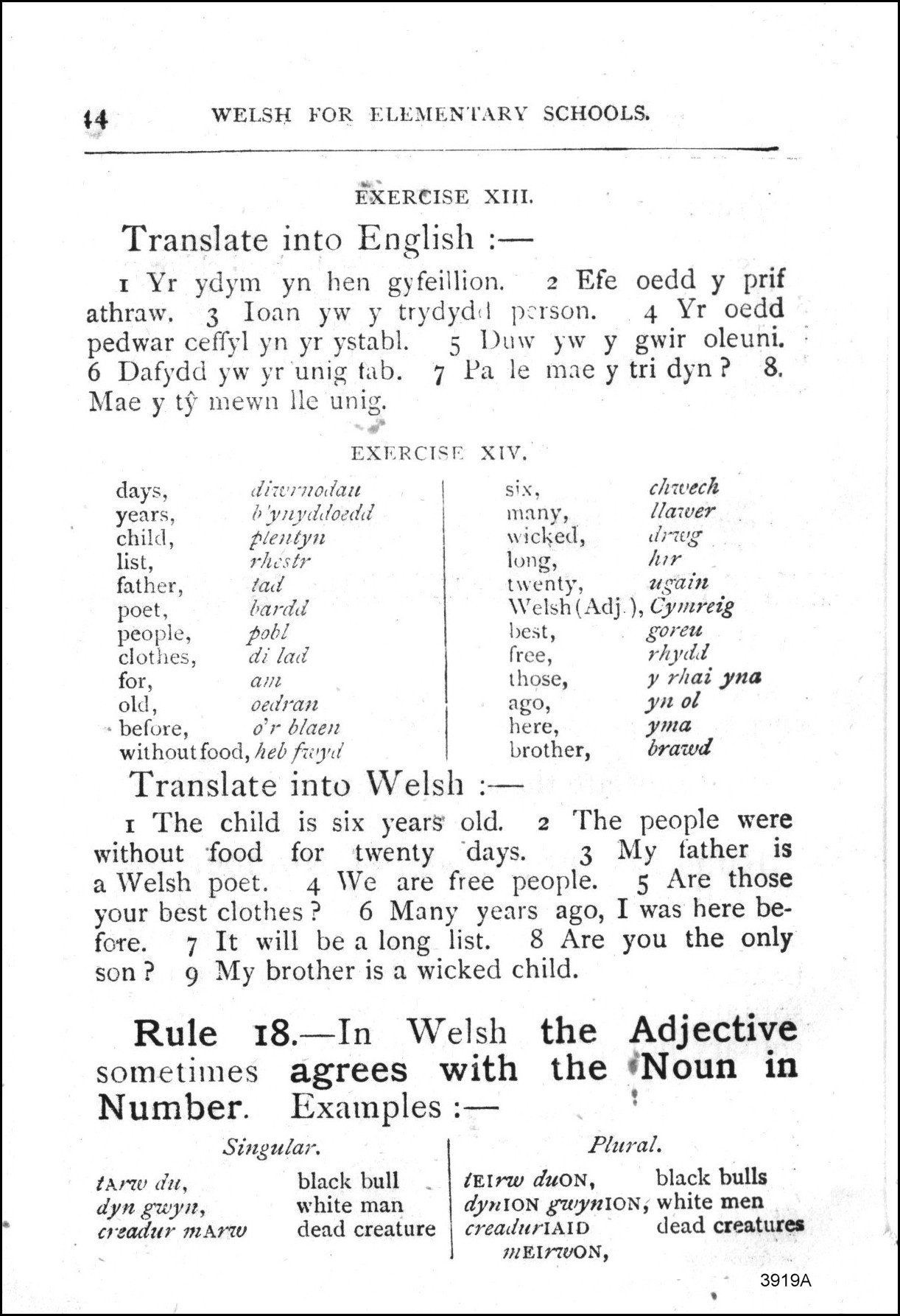
(delwedd 3919A)
(x44) WELSH FOR ELEMENTARY SCHOOLS.
EXERCISE Xlll.
Translate into English :
2 Efe oedd y prif
1 Yr ydym yn hen gyfeillion.
4 Yr oedd
athraw, 3 loan yw y trydyd(l pa-son.
5 1)uw yw y gwir oleuni.
pedwar ceffyl yn yr ystabl.
6 Dafydd yw yr unig tab. 7 Pa le mae y tri dyn? 8.
Mae y ty mewn Ile unig.
EXERCISE xtv.
days,
years,
child,
list,
father,
poet,
people,
clothes,
for,
old,
before,
diwrnotiau
b _'vnyddoedd
Plentyn
rhestr
tad
bardd
di lad'
oedran
O'r ålaen
chwech
si.x,
llawer
many,
wicked,
Jnr
long,
u gain
twenty,
Welsh (Adj. Cymreig
best,
gareu
rhydd
free,
y rhai pta
those,
yn 01
ago,
here,
yma
brawd
brother,
without food, heb fü')'d'
Translate into VVelsh .
1 The child is six years old. 2 The people were
3 My father is
without food for twenty days.
5 Are those
a Welsh poet. 4 i,Ve are free people.
your best clothes? 6 Many years ago, I was here be-
8 Are you the only
fore. 7 It will be a long list.
son? 9 My brother is a wicked child.
Rule 18.—In Welsh the Adjective
sometilnes agrees with the iNoun in
Number. Examples :-—
Singular.
tArzv du,
dyn gwyn,
creadur mArtv
black bull
white man
dead creature
Plural.
black bulls
IE1rzv du0N,
dyn10N gzvyn10N, white men
dead creatures
creadurIAID
111E1rzvoN,
3919A
|
|
|
|
|
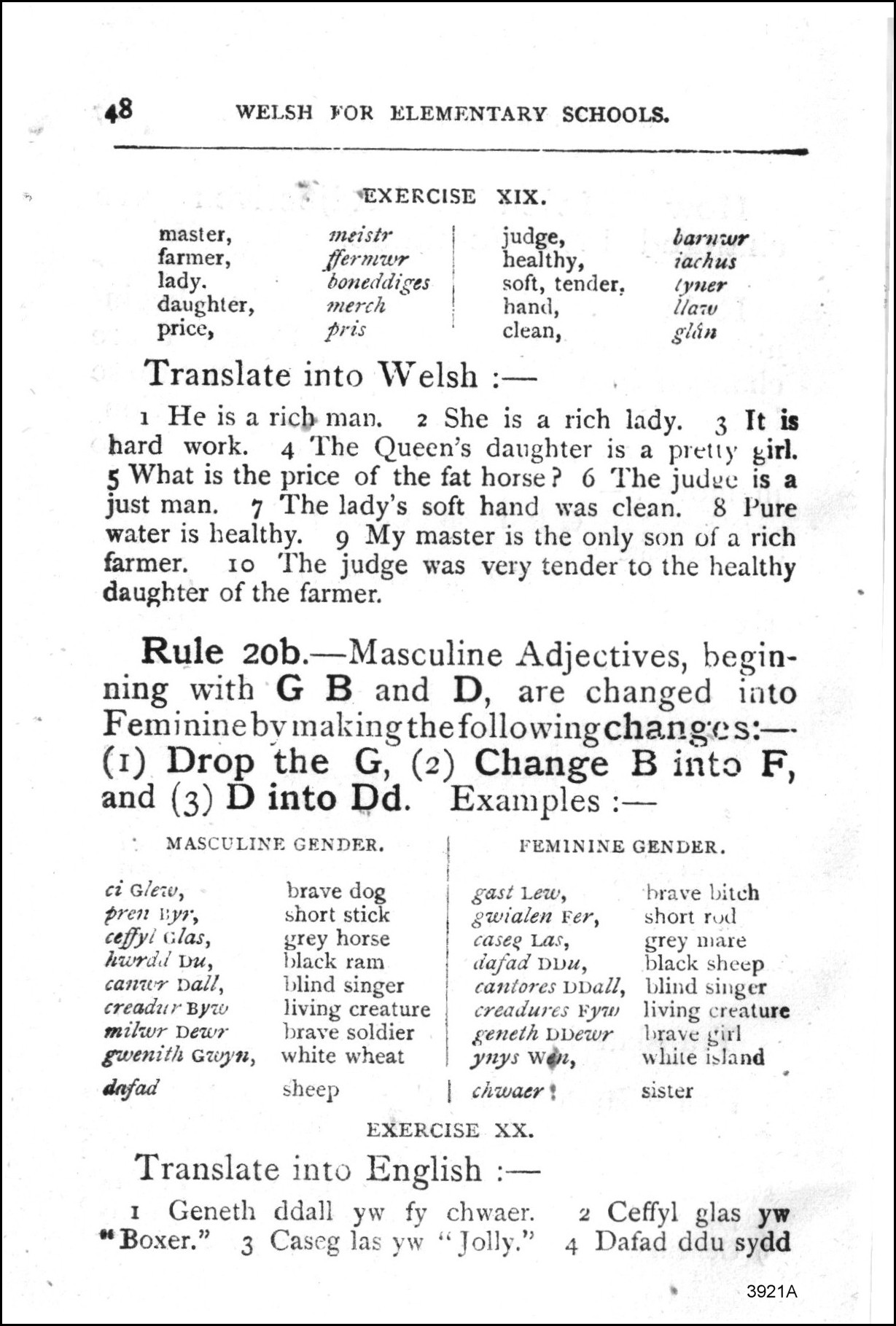
|
(delwedd 3919B)
(x45) WELSH FOR ELEMENTARY SCHOOLS.
45
mater,
PIENTYN ('Ach,
bAchgEn cry/,
BUWCH Goch,
l/estr ,
brawd, brodyr,
and,
large clog
little child
strong boy
red cow
emptv vessel
CWN matvr10N,
WANT ivchAIN,
bpchgvn cry/!0N,
BUCIIOI) cochion,
l.'cslrl SQEI(YION
EXERCISE XV.
brother-s
but
larg. -er-est,
inore, most
-nan
nenych ,
d;zvo
zazcv,'
large dogs
little childrene
strong boys
red cows
empty vessels
with
with you
wicked, bad
very
kardd s. , hcirdd pl. pretty
Translate into English :
1 Dynion duon sydd yn Affrica. 2 Bechgyn cryfion
YW fy mrodyr.
3 Heirdd yw plant ond hardd yw'r
plentyn. 4 Ceffyl du sydd gan fy nhad. 5 Buchod
cochion sydd genych chwi. 6 Llestri gweigion sydd
fwyaf eu sWn.
7 IMae y plant bychain yn ddrwg iawn.
8 Creaduriaid meirwon oeddynt.
EXERCISE x VI.
son,
lion,
road,
leaves,
birds,
moun tain,
way,
hair,
book,
blackbird,
mab
llcw
hcol, dd
dail
adar
my nydd
-nordd
gwallt
llyfr
mwya.lchen,
aderrn du
ild,
dry,
ide,
rough,
guy l/t
svch
/lydan
sarzv
great, big, mawr
high,
like,
tree,
uchcl
fed, yu elebyg i
cocden
ho•vi many, fa saw/ or pa faint
on,
Snowdon, Yr Wyddfa
Translate into Welsh
1 It is a big lion. 2 The dry leaves are on the wide
road, 3 The rough ways are before us. 4 Snowdon
is a high mountain.
5 The wild creature was
like a red cow. 6 'I'he poet's hair is white.
7 Our
son is a strong boy. 8 The blackbird's nest is on a
high tree. 9 How many leaves are there in your large
book ?
3919B
|
|
|
|
|
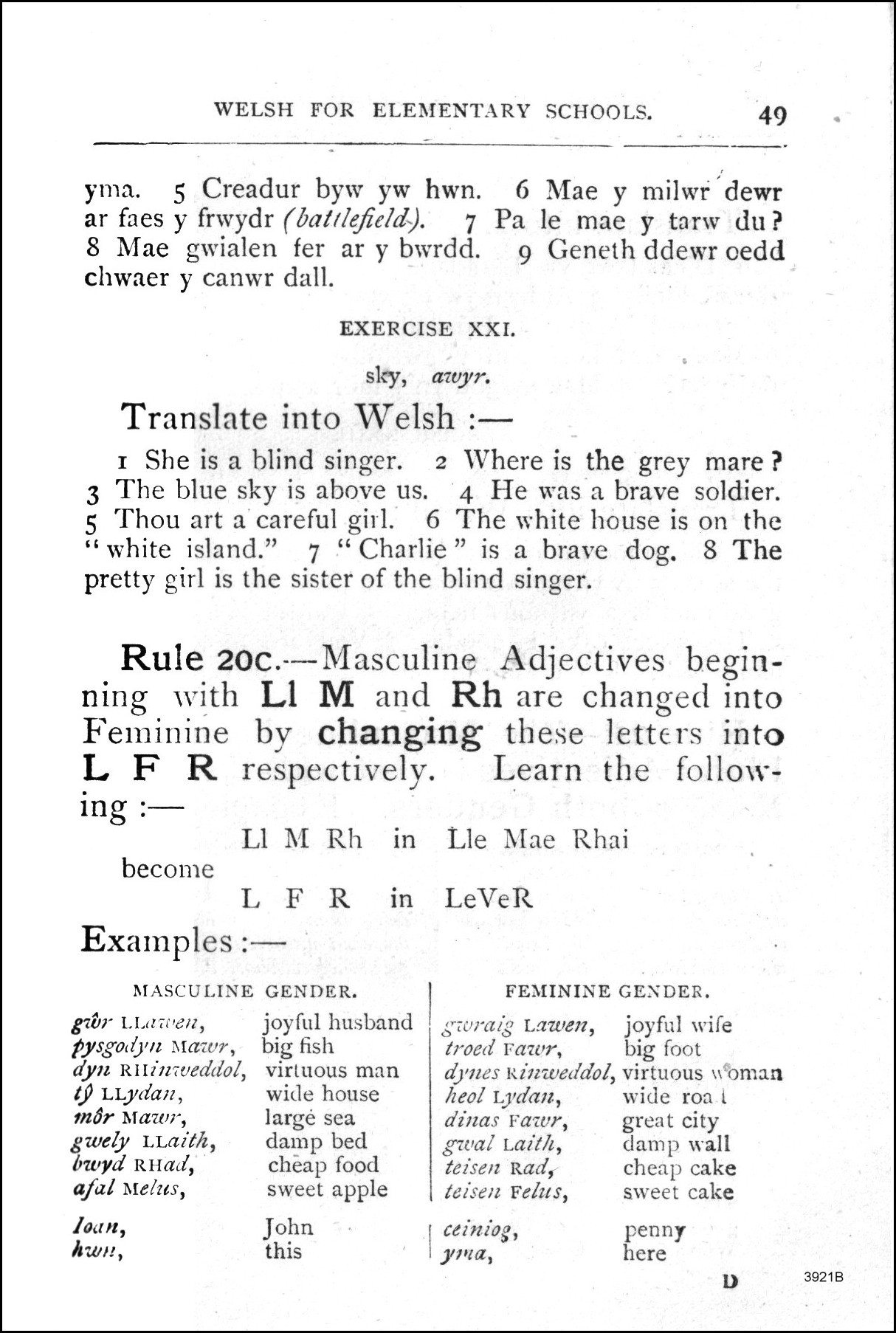
|
(delwedd 3920A)
(x46)
46
WELSH FOR ELEMENTARY SCHOOLS.
Rule 19.—The following Adjectives are
not inflected for Number, and are used
both with the Singular and the Plural
ouns, viz..
l'J'tv,
call,
clodfazvr,
da,
dedzvydd,
aelod-au,
afon -ydd,
Cymru,
salad,
living
wise
praiseworthy
good
happy
guilty
EXERCISE
member-s f
river-s
Wales
country
hyJryd,
uchel,
hen,
glån,
go/alus,
XVII.
menyg,
fynon,
leasant
old
clean
careful
pure
gloves
well
dzvfr, dyfrocdd, water-s
llais,
voice
(a) Translate into English .
1 Maent yn greaduriaid byw. 2 Hen wlad y menyg
gwynion " yw Cymru.
3 Dyn da ydych chwi, ond
dynion drwg ydynt hwy. 4 Mae llais hyfryd ganddo ef.
5 1)wfr glån sydd yn y ffynon. 6 Mae dyfroedd pur
yn yr afonydd. 6 Mae aelodau y ty yn ddynion call a
gofalus. 7 Yr ydym yn hen bobl. 8 Maent yn ddynion
b• 9 Yr wyf yn ddyn euog.
(b) Translate into Welsh :
1 The rivers of YVales are pleasant.
2 The water in
the well is pure.
3 The members are very careful.
4 r Phese gloves are old, but they are clean. 5 The
voice of the guilty man was rough.
Rule 20. —In Welsh the Adjective
agrees with the Noun in Gender, but
in the Singular Number only.
3920A
|
|
|
|
|
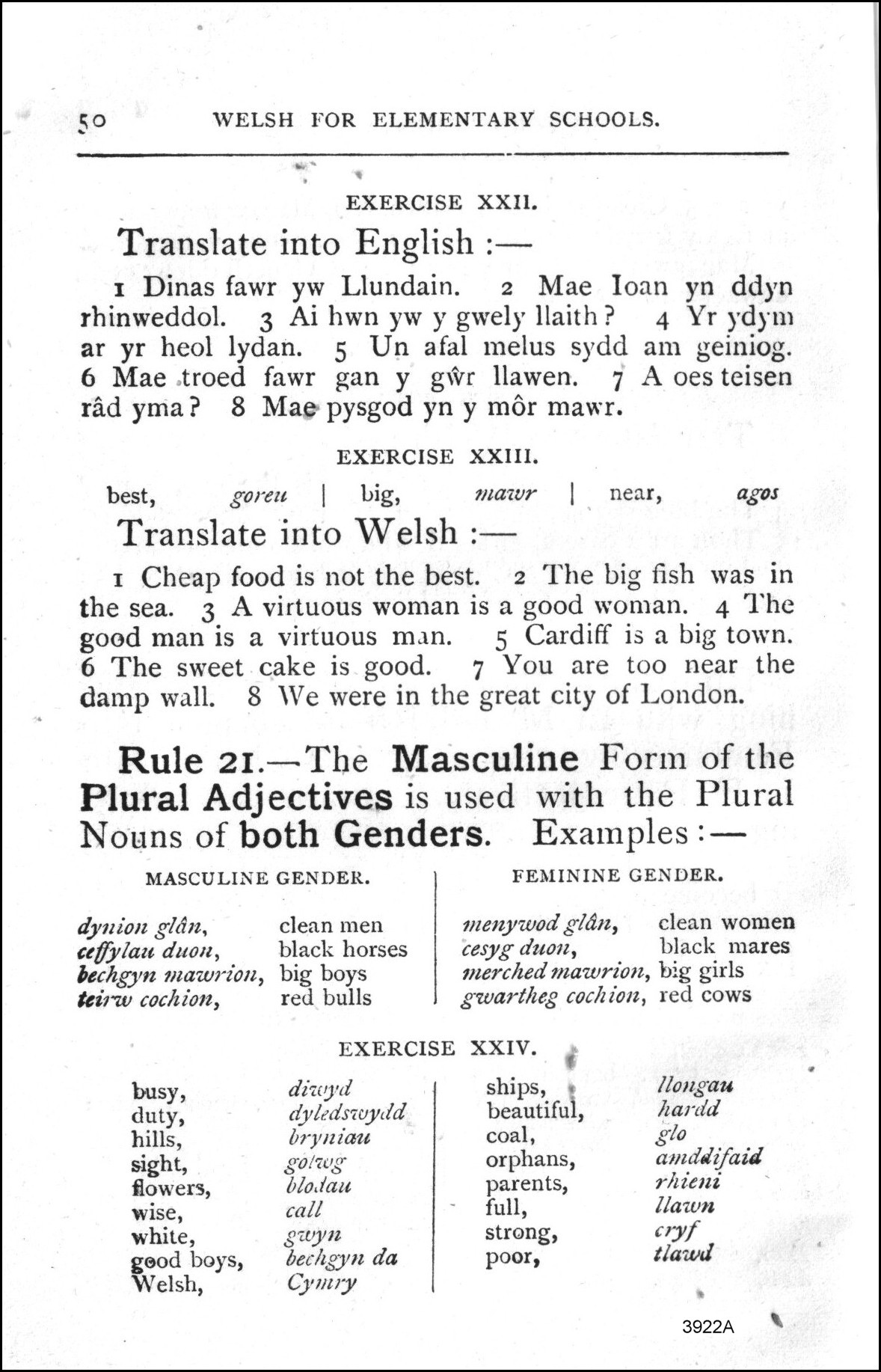
|
(delwedd 3920B)
(x47)
WELSH FOR ELEMENTARY SCHOOLS.
47
How Masculine Adjectives are
changed into Feminine.
Rule 20a.—Masculine Adjectives begin-
ning with the Consonants C P and T are
changed into Feminine by changing these
sletters into
sonants, G
memory .
become
Examples :
MASCUI.INE
tarzv coch,
bachgen Tlzvs,
dyn Tlawd,
gzvr cyfoethog,
dze,fr pur,
ceffyt Tezv
brcnin cy/iatvn,
gwaith caled,
gardd,
man.' ,
their* corresponding soft Con-
B and D. Commit this to
CPT
GENDER.
red bull
in
co Pa T'
GwyBeD.
FEMININE
butvch GOC.?I,
merch D/os,
dynes Dlazvd,
pretty boy
poor man
rich man
pure water
fat horse
just king
hard work
garden
mother
GENDER.
red cow
pretty girl
poor woman
gzv,' aigc;yfoethog•, rich woman
alon Bur,
pure river
fat mare
caseg new,
brenines G"/fazvn, just queen
calon Galed,
cae,
baban,
hard heart
field
baby
EXERCISE xvlll.
Translate into English .
2 Mae y tarw
1 Bu y fuwch goch yn yr ardd.
3 Yr oedd Mr. Jones yn Wr cyfoethog.
coch yn y cae.
4 Gwraig gyfoethog oedd ei fam. 5 Calon galed
sydd gan y drwg., 6 Brenin cyfiawn oedd Alfred Fawr.
7 Dynes dlawd yw fy mam. 8 A oes dwfr pur yn y ty ?
10 Baban tlws yw hwn.
9 Geneth dlos yw Jane.
3920B
|
|
|
|
|
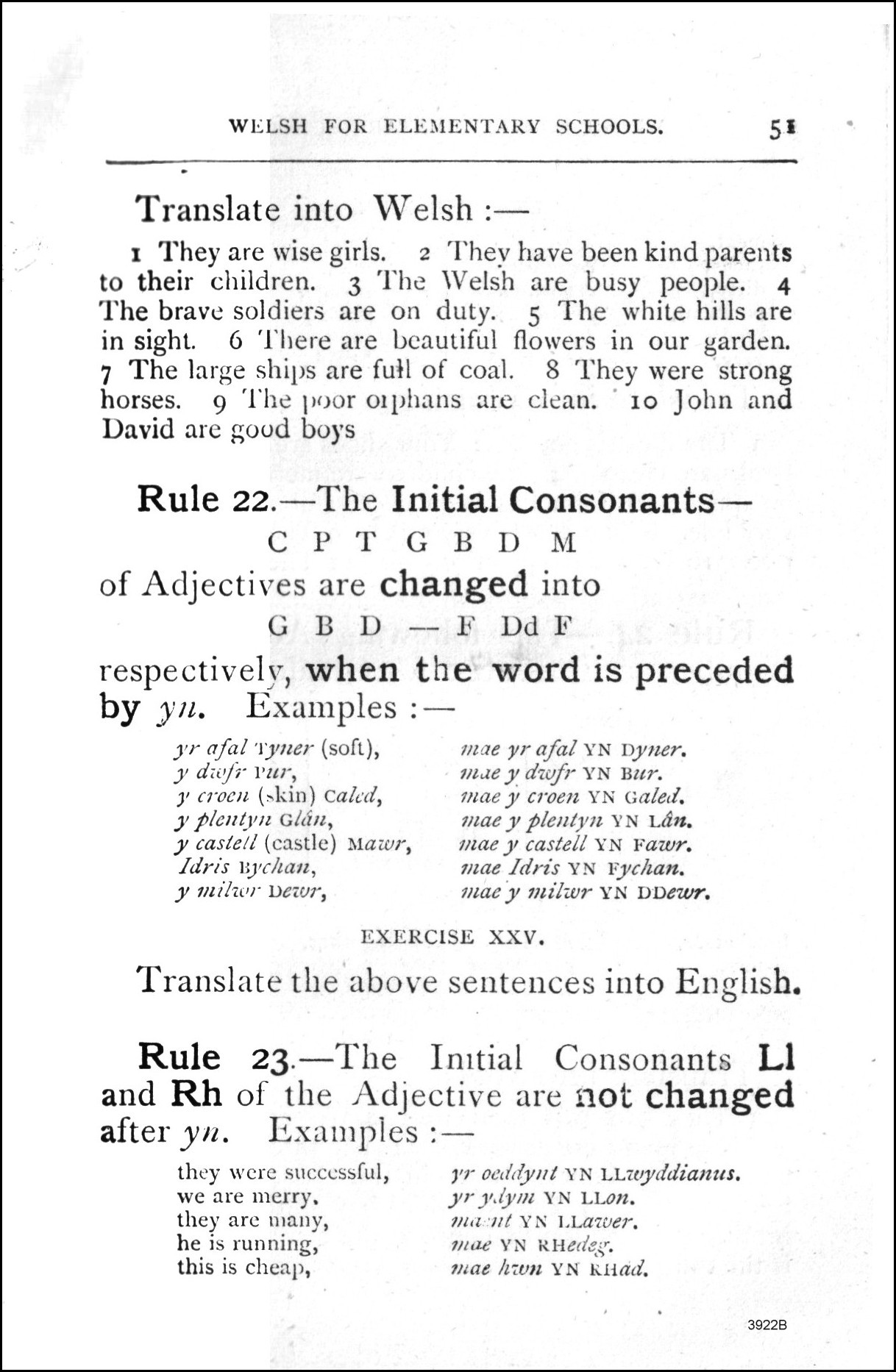
|
(delwedd 3921A)
(x48)
48
WELSH FOR ELEMENTARY SCHOOLS.
•EXERCISE XIX.
master,
farmer,
lady.
daughter,
price,
meistr
fermzer
boneddiges
merch
pris
judge'
healthy,
soft, tender,
hand,
clean,
barn tur
iach us
tyner
l/a7V
Translate into M'Yelsh :
1 He is a ricb man.
2 She is a rich lady. 3 It is
hard work. 4 The Queen's daughter is a pretty girl.
5 What is the price of the fat horse? 6 The judee is a
just man. 7 The lady's soft hand was clean. 8 Pure
water is healthy. 9 My master is the only son of a rich
farmer.
10 The judge was very tender to the healthy
daughter of the farmer.
Rule 20b.—Masculine Adjectives, begin-
ning with G B and D, are changed into
Femininebv making the following change
(1) Drop -the G, (2) Change B into F,
and (3) D into Pd.
MASCULINE GENDER.
Exanil)les :
FEMININE GENDER.
ci G/ew,
pren I',yr,
cejy/ c, las,
izvrda' Du,
canter nail,
creadu r Byzv
mikvr Dewr
brave dog
short stick
grey horse
black ram
blind singer
living creature
brave soldier
gzvenifh Gtvyn, white wheat
dafad
sheep
gas: Lew,
gzvialen Fer,
caseg Las,
'iajad
cantores I)Dall,
creadurcs FY7D
geneth I)Dewr
ynys wet,
I chwaer
brave bitch
short rod
grey mare
black sheep
blind singer
living creature
brave girl
white island
sister
EXERCISE XX.
Translate into English .
1 Geneth ddall yw fy chwaer.
Boxer."
3 Caseg las yw Jolly."
2 Ceffyl glas yw
4 Dafad ddu sydd
3921A
|
|
|
|
|
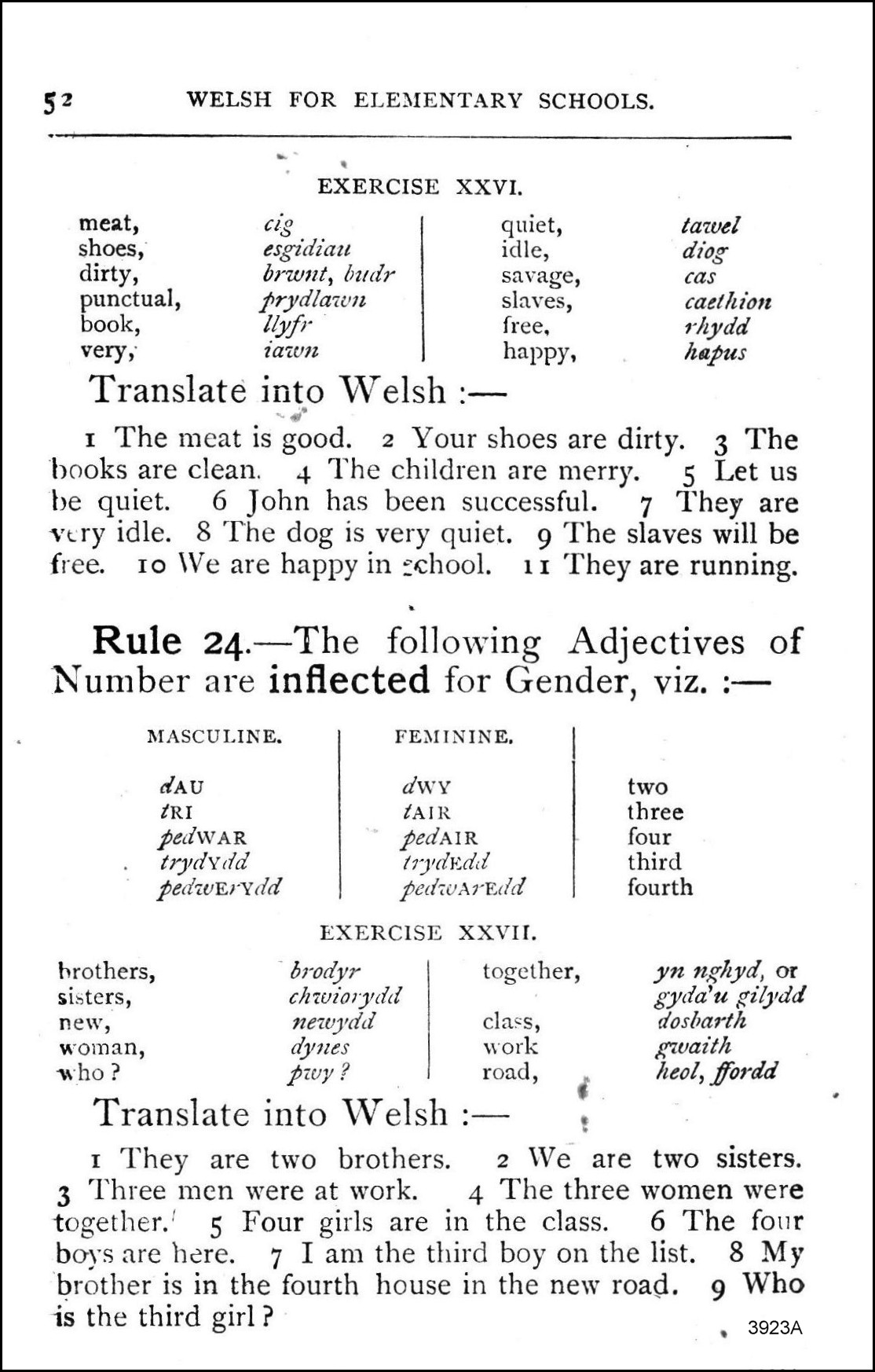
|
(delwedd 3921B)
(x49)
WELSH FOR ELEMENTARY SCHOOLS.
49
ytna. 5 Creadur byw yw hwn. 6 Mae y milwt; dewr
ar faes y frwydr (battlefield). 7 Pa le mae y tarw du?
8 Mae gwialen fer ar y bwrdd. 9 Geneth ddewr oedd
chwaer y canwr dall.
EXERCISE xxr.
sky, atvyr.
Translate into Welsh :
1 She is a blind singer.
2 Where is the grey mare ?
3 The blue sky is above us. 4 He was a brave soldier.
5 Thou art a careful girl. 6 The white house is on the
white island."
7 Charlie is a brave dog. 8 The
pretty girl is the sister of the blind singer.
Rule 20c.-—Masculine Adjectives begin-
ning with Ll M and Rh are changed into
Feminine by changing these letters into
L F R respectively. Learn the follow-
ing .
become
Examples :—-
MASCULINE GENDER.
in
in
gt&r I.Latvezz,
joyful husband
tysgodyn Mawr, big fish
dyn Rilintveddol, virtuous man
Lie Mae Rhai
LeVeR
FEMININE GENDER.
gran-aig Lawen, joyful wife
troed Fawr,
big foot
dynes Rinweddol, virtuous
ty LLYdan,
mbr Mazvr,
gzvely LLaith,
bzvyd R Had,
afal Melus,
loan,
hum,
wide house
largé sea
damp bed
cheap food
sweet apple
John
this
heal Lydan,
dinas Fawr,
oval Laith,
teisen Radf
teisen Felus,
ceiniog,
Y"ta,
wide roa
great city
damp wall
cheap cake
sweet cake
penny
here
D
3921B
|
|
|
|
|
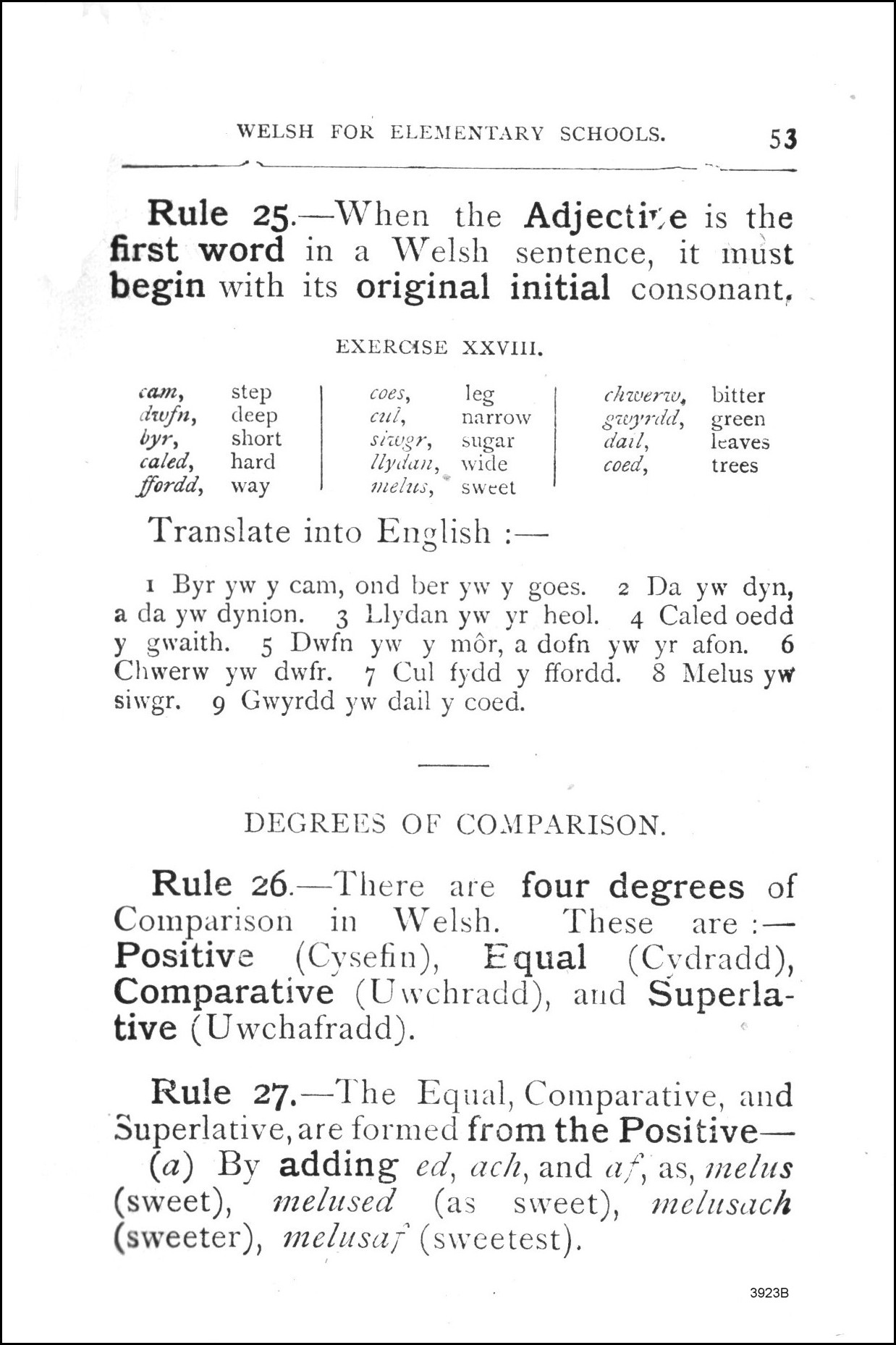
|
(delwedd 3922A)
(x50)
50
WELSH FOR ELEMENTARY SCHOOLS.
EXERCISE XXII.
Translate into English :
1 Dinas fawr yw Llundain.
2 Mae loan yn ddyn
rhinweddol. 3 Ai hwn yw y gwely llaith ? 4 Yr ydym
ar yr heol lydan. 5 Un afal melus sydd am geiniog.
6 Mae ,troed fawr gan y gWr llawen. 7 A oes teisen
råd yma? 8 Mae pysgod yn y mör mawr.
best,
EXERCISE XXIII.
mazvr I near,
I big,
goreu
agvs
Translate into Welsh :
1 Cheap food is not the best. 2 The big fish was in
the sea. 3 A virtuous woman is a good woman. 4 The
5 Cardiff is a big town.
good man is a virtuous man.
6 The sweet cake is good. 7 You are too near the
damp wall. 8 We were in the great city of London.
Rule 21.—The Masculine Form of the
Plural Adjectives is used with the Plural
Nouns of both Genders. Examples :-—
MASCULINE GENDER.
dynion glån,
clean men
black horses
ceCylau duon,
bechgyn mazvrion, big boys
FEMININE GENDER.
menyzvod glån,
clean women
black mares
cesyg dun,
merched mazvrion, big girls
guartheg cochin, red cows
teirw cochion,
busy,
duty,
hills,
sight,
flowers,
wise,
white,
good boys,
Welsh,
red bulls
EXERCISE XXIV.
ditoyd
dylddstvydd
bryniau
go/tcg
blodau
call
bechgyn da
Cymry
ships,
beautiful,
coal,
orphans,
parents,
full,
strong'
poor,
Ilong•au
hardd
amddifaid
rhieni
llazvn
cry/
tlatvd
3922A
|
|
|
|
|
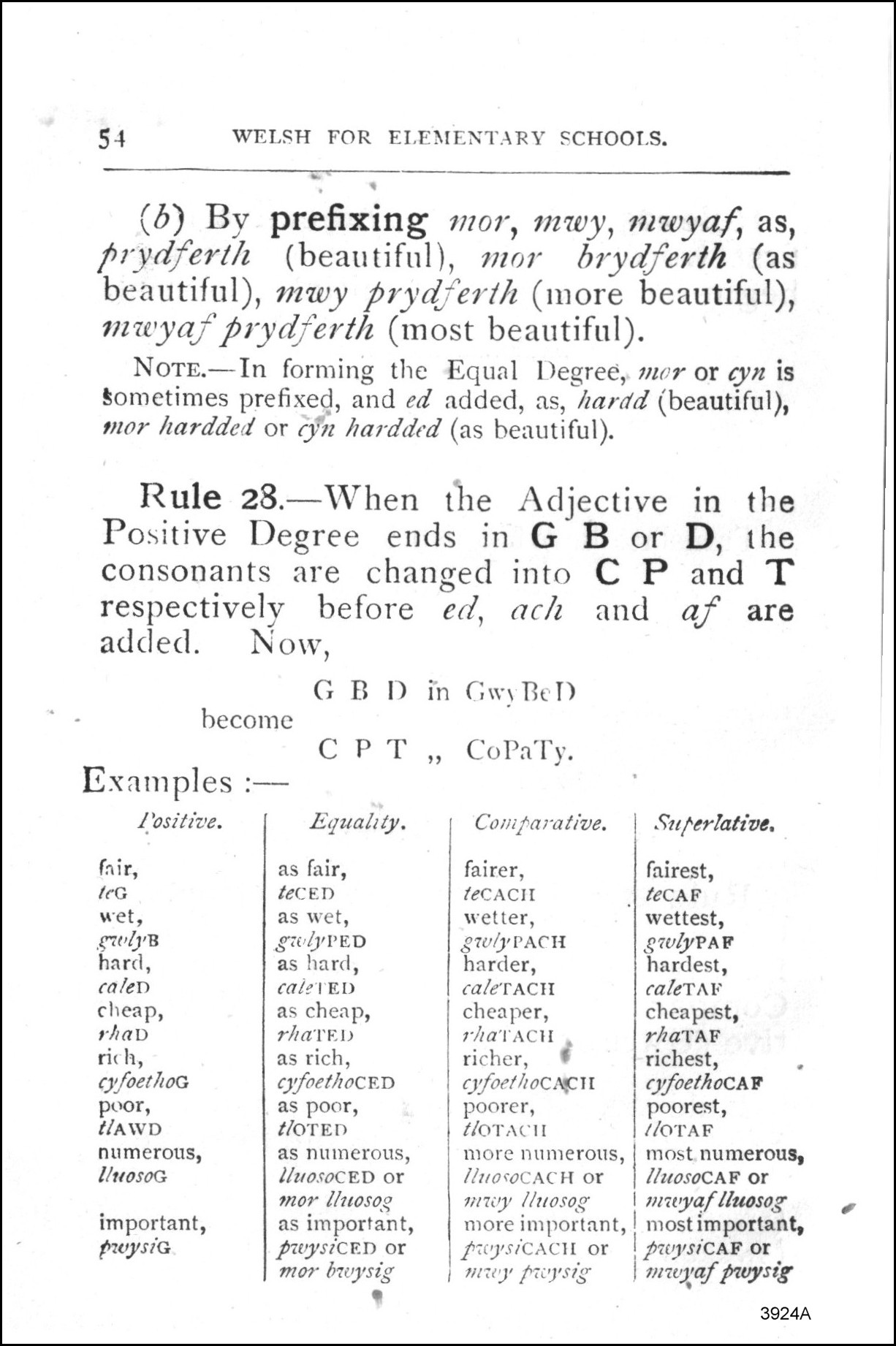
|
(delwedd 3922B)
(x51)
WELSH FOR ELEMENTARY SCHOOLS.
Translate into Welsh :
1 They are wise girls. 2 Thev have been kind parents
to their children. 3 'l'he Wels•h are busy people. 4
The brave soldiers are on duty. 5 The white hills are
in sight. 6 'l'here are beautiful flowers in our garden.
7 The large ships are full of coal. 8 They were strong
horses. 9 'l'he poor orphans are clean. 10 John and
David are good boys
Rule 22.—The Initial Consonants—
of Adjectives are changed into
respectively, when the word is preceded
by y n. Examples .
yr afal 'ryner (soft),
y dwf;• l','tr,
y crocn (skin) calcd,
y plcntyn Glån,
y castell (castle) Mawr,
Idris p,ychan,
y milter I)czvr,
mae yr afal MN Dyner.
maey dwfr V N Bur.
maey croen Y N Galea.
mae y plenty;z Y N Liu.
mae y castell YN Fazvr.
mae Idris v N Fychan.
macy milwr YN DDezvr.
EXERCISE XXV.
Translate the above sentences into English.
Rule 23.—The Imtial Consonants Ll
and Rh of the Adjective are not changed
after yn. Exatnples :
they were successful,
we are merry.
they are many,
he is running,
this is cheap,
oeddynt Y N LLzvyddianus.
yr y,lym Ll.on.
m,vnt V N
mae VN RHede:r.
mae hzvn Y N Ridtzd.
3922B
|
|
|
|
|
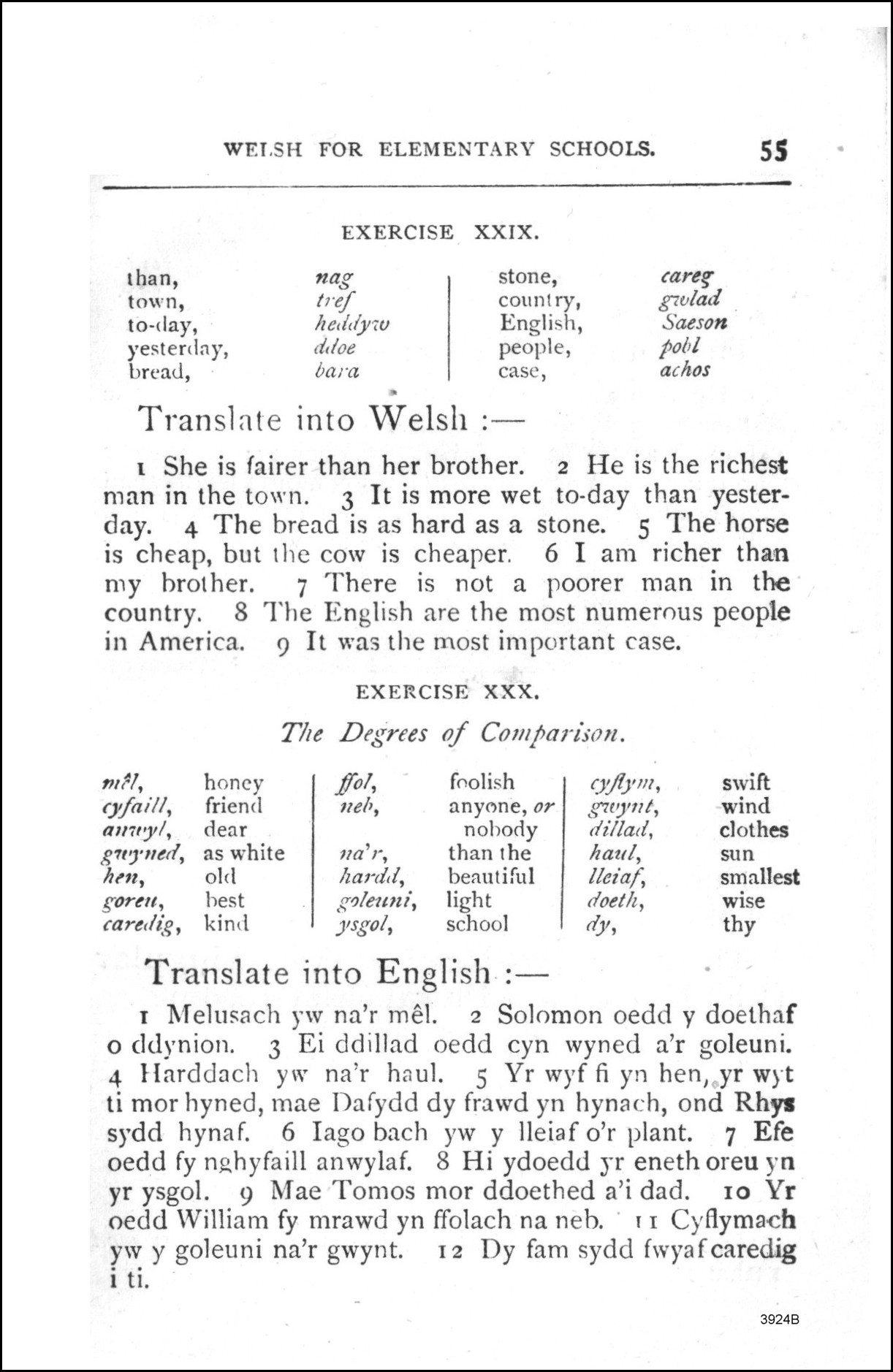
|
(delwedd 3923A)
(x52)
52
meat,
shoes,
dirty,
punctual,
book,
very,•
WELSH FOR ELEMENTARY SCHOOLS.
EXERCISE xxvr.
esgidiau
brzvnt, budr
llyf,.
tatvn
quiet,
idle,
savage,
slaves,
free,
happy,
tawd
diog
cas
caethion
rhydd
hapus
Translate into Welsh .
1 The meat is good. 2 Your shoes are dirty. 3 The
books are clean. 4 The children are merry. 5 Let us
be quiet.
6 John has been successful.
7 They are
very idle. 8 The dog is very quiet. 9 The slaves will be
free. 10 We are happy in :chool.
11 They are running.
Rule 24.—The following Adjectives of
Number are inflected for Gender, viz. .
MASCULINE.
tR1
pedwAR
trydvdd
ledzvErydd
brothers,
sisters,
new
woman,
FEMININE.
dwv
tAIR
PedAIR
trydEdd
13cdtd'A 1*Edd
EXERCISE xxvll.
brodyr
chtviorydd
nezvydd
dynes
together,
class,
ork
road,
two
three
four
third
fourth
yn nghyd, or
gyda'u gilydd
dosbarth
pzvaith
heal, fordd
Translate into Welsh :
1 They are two brothers.
2 We are two sisters.
3 Three men were at work.
4 The three women were
together.
5 Four girls are in the class.
6 The four
boys are here. 7 1 am the third boy on the list. 8 My
brother is in the fourth house in the new road. 9 Who
is the third girl ?
3923A
|
|
|
|
|
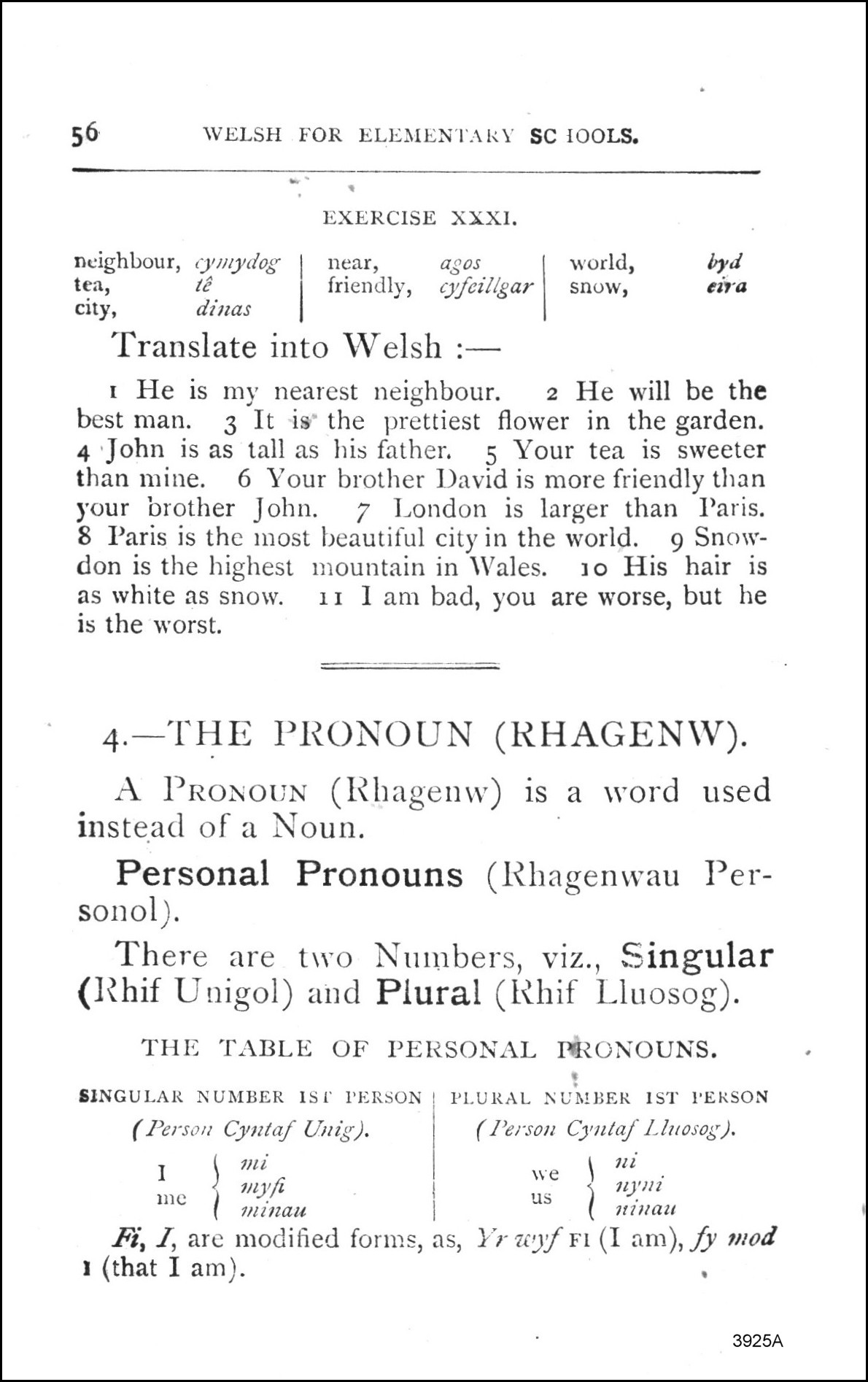
|
(delwedd 3923B)
(x53)
WELSH FOR ELEMENTARY SCHOOLS.
53
Rule 25.—When the Adjectiv;e is the
first word in a Welsh sentence, it must
begin with its original initial consonant,
EXERCISE xxvlll.
cam,
dtvfn,
byr,
caled,
firdd,
step
deep
short
hard
way
coes,
cut,
succor,
leg
narrow
sugar
llydan,
wide
melus,
sweet
chzverzv, bitter
gtvyrdd, green
dad,
leaves
coed,
trees
Translate into English :
1 Byr yw y cam, ond ber yw y goes. 2 Da yw dyn,
a da yw dynion. 3 Llydan yw yr heol. 4 Caled oedd
y gwaith. 5 Dwfn yw y mör, a dofn yw yr afon. 6
Chwerw yw dwfr. 7 Cul fydd y ffordd. 8 Melus YW
siwgr. 9 Gwyrdd yw dail y coed.
DEGREES OF COMPARISON.
Rule 26.—There are four degrees of
Comparison in Welsh.
These are
Positive (Cysefin), Equal (Cydradd),
Comparative (Uwchradd), and Superla-
tive (Uwchafradd).
Rule 27.4 he Equal, Conlparative, and
Superlative, are formed from the Positive—
(a) By adding ed, ach, and af, as, melus
(sweet),
nzelused (as
sweet),
mclusach
(sweeter), nzelusaj-n (sweetest).
3923B
|
|
|
|
|
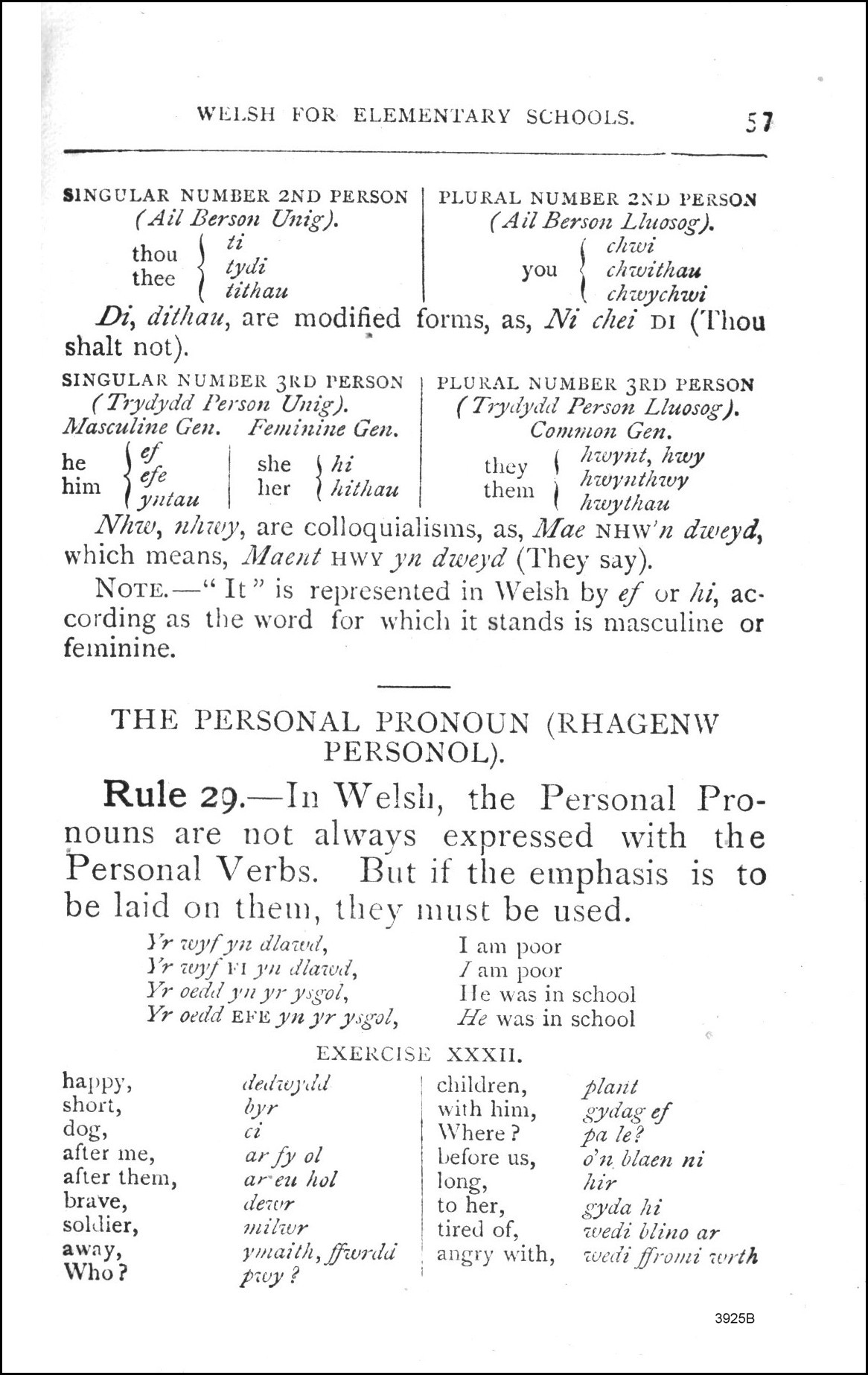
|
(delwedd 3924A)
(x54)
54
WELSH FOR ELEMENTARY SCHOOLS.
r b) By prefixing mor, mwy, mwyaf, as,
Prydferth (beau tiful ),
mor brydferth (as
beautiful), mwy Pryd/ert/l (Inore beautiful),
mwyafprydferth (most beautiful).
NOTE.—In forming the Equal Degree,s mor or cyn is
Sometimes prefixeql, and ed added, as, hardd (beautiful),
mor hardded or cygn hardded (as beautiful).
Rule 28.—When tile Adjective in the
Positive Degree ends in G B or D, the
consonants are changed into C P and T
respectively before ed, ach and af are
adcled. Now,
become
E.xatnples .
I 'ositive.
fair,
teG
wet,
.5t'lyB
ha rd,
caten
cheap,
cyfoeth0G
poor,
t/AWD
numerous,
11tt0SOG
important,
rwysiG
CPT
Equality.
as fair,
tecE„D
as wet,
gadYPED
as hard,
cabo ED
as cheap,
r//(ü1'E1)
as rich,
cyfoeth0CF.D
as poor,
NOTED
as numerous,
lluosocED or
mor 11tt0Soq
as important,
pwysicF.D or
mor bzvysig
CoPaTy.
Comfarative.
Sutertative.
fairer,
fairest,
tecAC11
tecAF
wetter,
wettest,
gw/YPACH
gwlypA F
harder,
hardest,
caleTAC11
cateTAF
cheaper,
cheapest,
rha'l'AC11
rhatAF
richer,
richest,
cyfoet/toCüVT1
cyfoethoCA F
poorest,
poorer,
t/OTAC11
//OTAF
most nu merous,
more n tunerous,
//uo€OCACH or
lluosocAF or
I mteyaflluosog
//uosog
more important, I most important,
I PwysiCAF or
fit')'siCAcII or
mtvyaf2wysig
fi'J'sisr
3924A
|
|
|
|
|
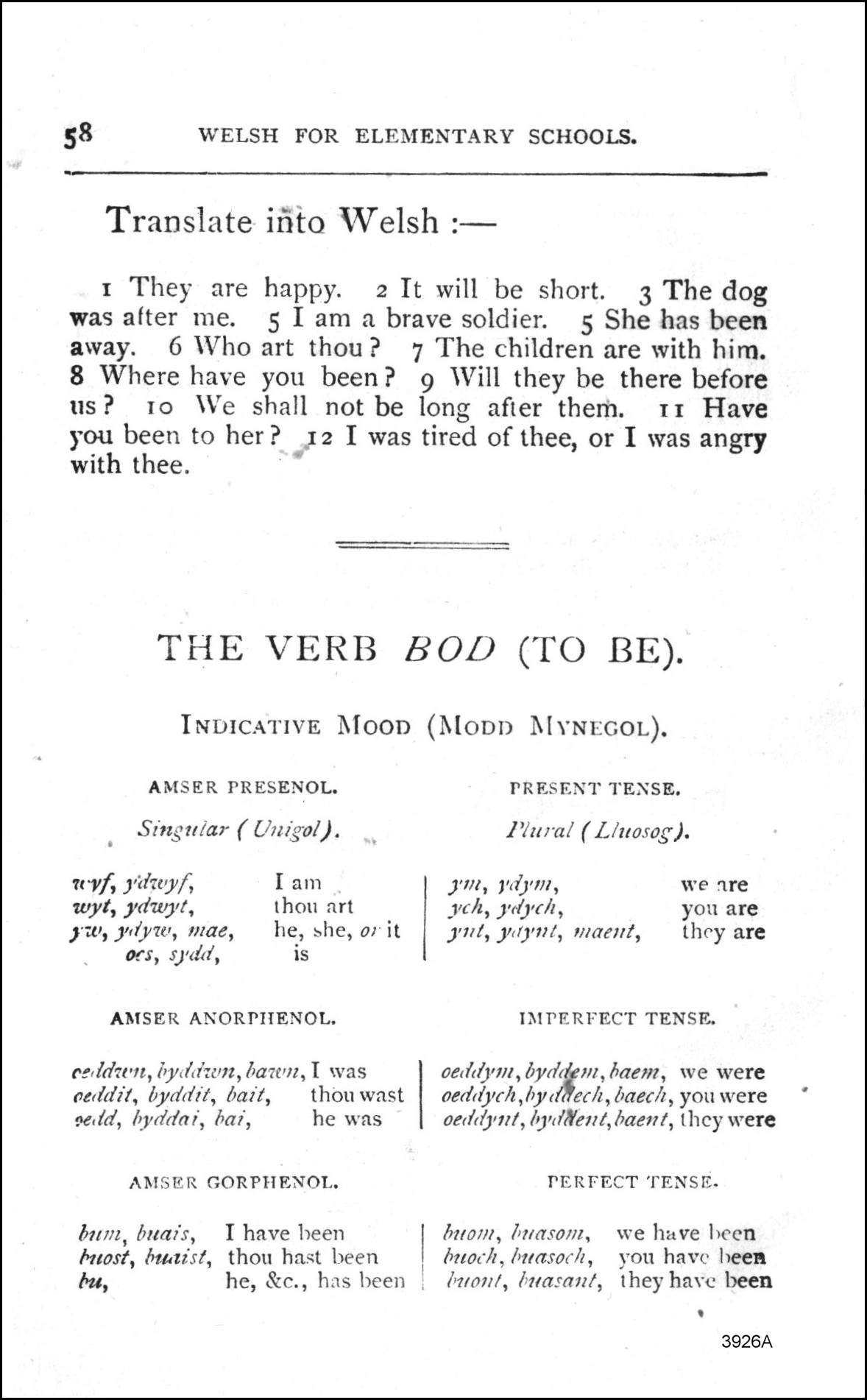
|
(delwedd 3924B)
(x55)
WELSH FOR ELEMENTARY SCHOOLS.
EXERCISE XXIX.
55
than,
town,
to-day,
yesterday,
bread,
nao•
tref
heddyw
ddoe
bara
stone,
count ry,
English,
people,
case,
careg
gulad
Saeson
achos
Translate into Welsh :
1 She is fairer than her brother. 2 He is the richest
man in the town. 3 It is more wet to-day than yester-
day. 4 The bread is as hard as a stone. 5 The horse
is cheap, but the cow is cheaper. 6 1 am richer than
7 There is not a poorer man in the
my brother.
country. 8 The English are the most numerous people
in America. 9 It was the most important case.
EXERCISE XXX.
The Degrees of Comparison.
cyfai//,
antt•y/,
g7t'j•ned,
hen,
goreu ,
caredig
honey
friend
dear
as white
old
best
kind
neb,
hardd,
goteuni,
ysgol,
foolish
anyone, or
nobody
than the
beautiful
light
school
cyJtym,
gtvynt,
di/lad,
hazd,
Ileiaf,
doeth,
Y,
swift
wind
clothes
sun
smallest
wise
thy
Translate into English :
2 Solomon oedd y doethaf
r Melusach yw na'r mél.
o ddynion. 3 Ei ddillad oedd cyn wyned a'r goleuni.
4 Harddach yvv na'r haul. 5 Yr wyf fi yn hen, eyr wyt
ti mor hyned, mae Dafydd dy frawd yn hynach, ond Rhys
sydd hynaf. 6 lago bach yw y Ileiaf O'r plant.
7 Efe
oedd fy nghyfaill anwylaf. 8 Hi ydoedd yr eneth oreu yn
yr ysgol. 9 Mae Tomos mor ddoethed a'i dad. 10 Yr
oedd William fy mrawd yn ffolach na neb. r 1 Cyflymach
yw y goleuni na'r gwynt.
12 Dy fam sydd fwyafcaredig
i ti.
3924B
|
|
|
|
|
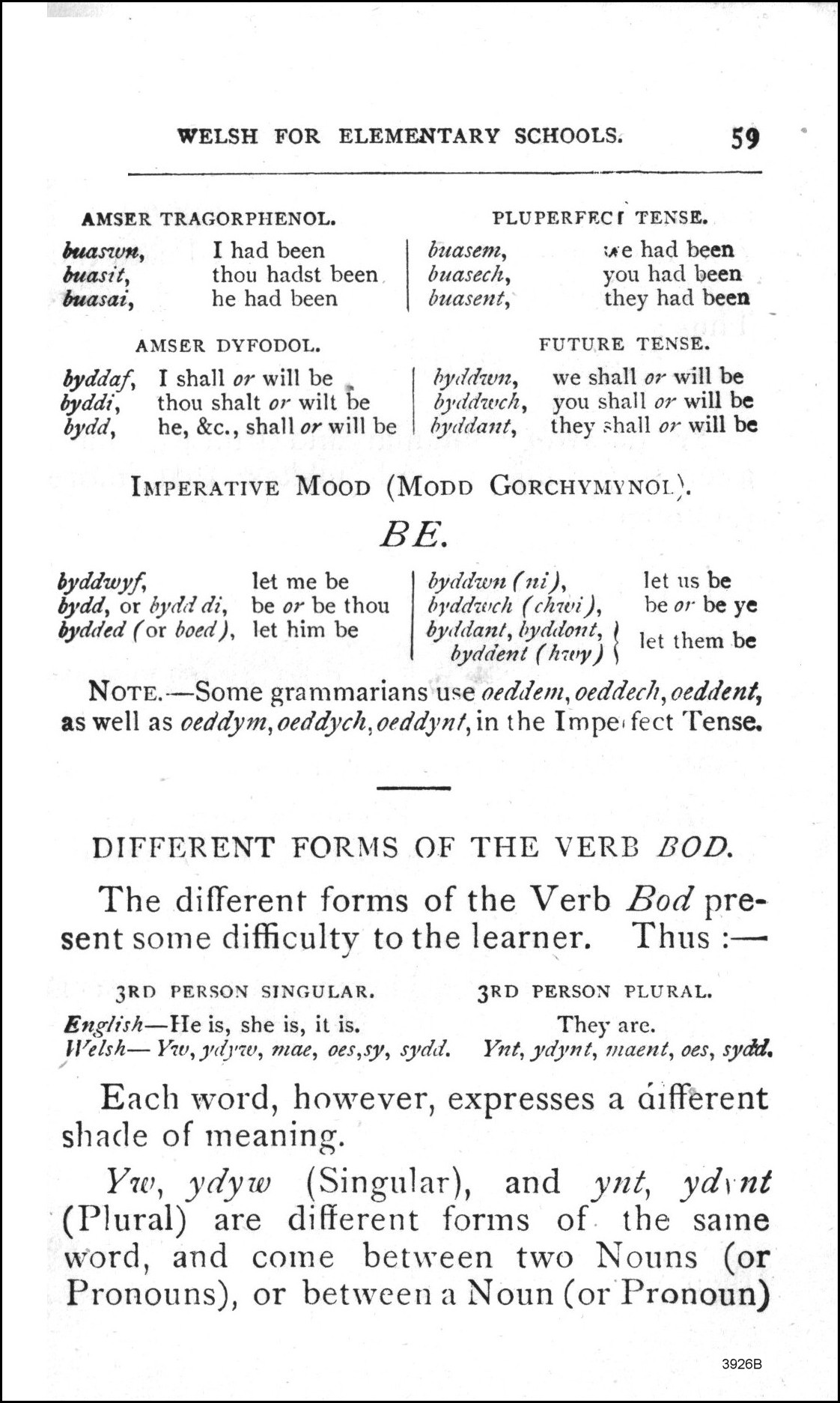
|
(delwedd 3925A)
(x56)
56
WELSH FOR ELEMENTARY SC IDOLS.
EXERCISE xxxl.
neighbour, cymydog•
near,
a oos
world,
byd
eira
tea,
city,
friendly, cyfcil/gar snow,
dinas
Translate into Welsh .
1 He is my nearest neighbour.
2 He will be the
best man. 3 It is' the prettiest flower in the garden.
4 John is as tall as his father, 5 Your tea is sweeter
than mine. 6 Your brother David is more friendly than
your brother John. 7 London is larger than Paris.
8 Paris is the most l)eautiful city in the world. 9 Snow-
don is the highest Inountain in Wales.
10 His hair is
as white as snow.
11 1 am bad, you are worse, but he
is the worst.
4.—THE PRONOUN (RHAGENW).
A PRONOUN (Rhagenvv) is a word used
instead of a Noun.
Personal Pronouns (Rhagenwau Per-
sonol).
There are two Nurnbers, viz., Singular
(Rhif Unigol) and Plural (Rhif Liuosog).
THE TABLE OF PERSONAL påv'0NOUNS.
SINGULAR NUMBER IS i' PERSON
PLURAL NUMBER 1ST PERSON
( Person Cyntaf Unig).
(Person Cyntaj• I-luosog).
ni
mi
1
we
nyni
my/i
us
ine
n inau
m inau
Fi, I, are modified forms, as, zcyfF1 (I am), f mod
(that I am).
3925A
|
|
|
|
|
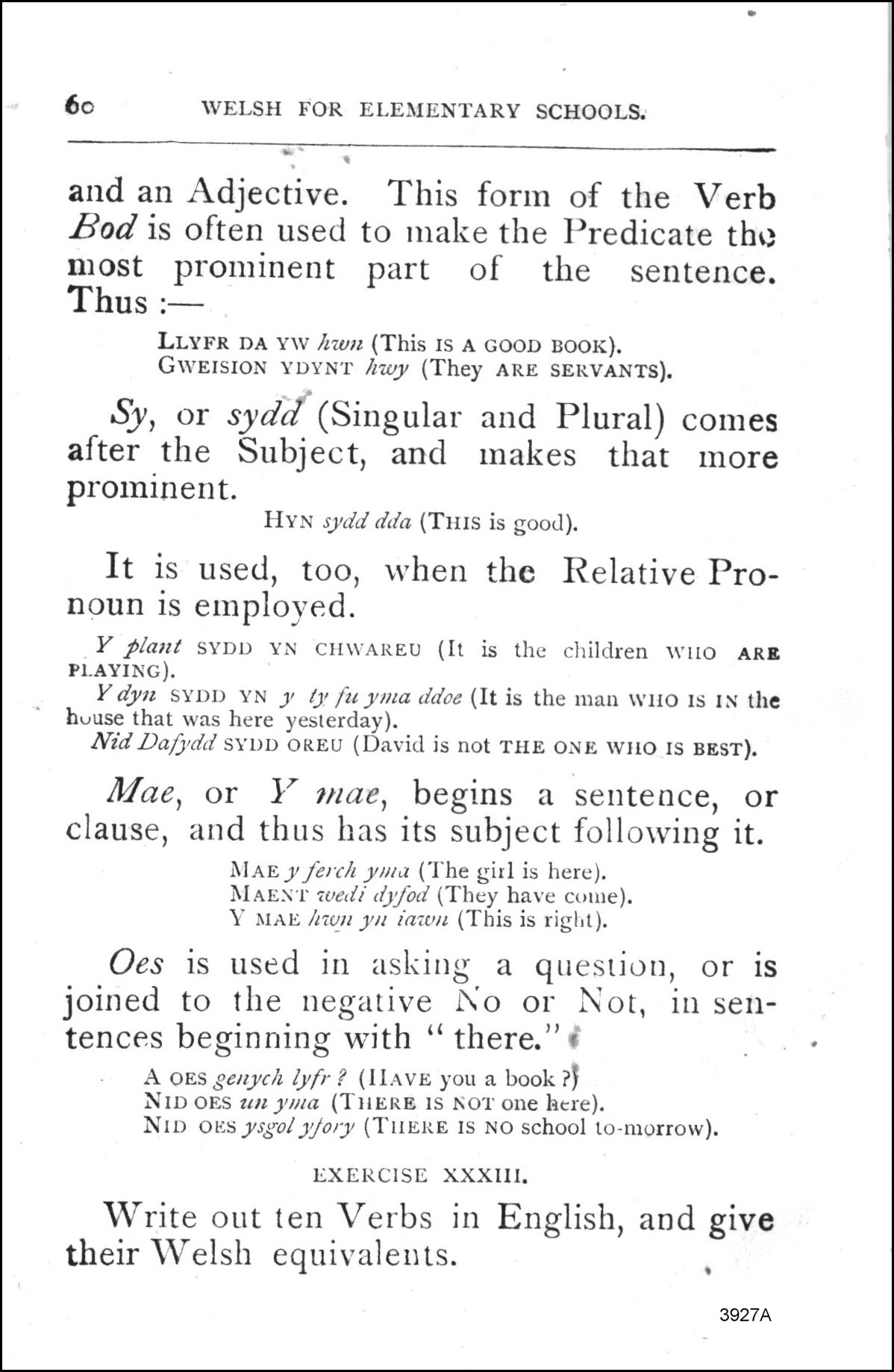
|
(delwedd 3925B)
(x57)
WELSH FOR ELEMENTARY SCHOOLS.
SINGULAR NUMBER 2ND PERSON
(Ail Berson Uzi').
ti
thou
tydi
thee
tithau
Di, dithau, are modified
shalt not).
SINGULAR NUMBER 3RD PERSON
(T,-ydydd Person Unig).
Masculine Gen. Feminine Gen.
he
eye
him
ynlau
she
her
hithau
PLURAL NUMBER 2ND PERSON
(Ail Berson Lluasog).
chzvi
chwithau
you
chzvychzvi
forms, as, Ni chei DI ('I'hou
PLURAL NUMBER 3RD PERSON
( Trydydd Person Lluosog).
Common Gen.
hwynt, hwy
they
hzvrnthzvy
them
hwytha.u
Nhw, nhwy, are colloquialisms, as, Mae NHW'n dweyd,
which means, Macnt HWY yn dzveyd (They say).
NOTE. —
is represented in Welsh by ef or hi, ac-
cording as the word for which it stands is masculine or
feminine.
THE PERSONAL PRONOUN (RHAGENW
PERSONOL).
Rule 29.—1n Welsh, the Personal Pro-
nouns are not always expressed with the
Personal Verbs. But if the emphasis is to
be laid on then), they Illust be used.
Yr wy/y;z dlated,
Yr tvyf FI yu d/awd,
Yr oedd __1','1 yr ysgvi,
Yr oedd EFE yu yr ysgvl,
I poor
I am poor
Ile was in school
He was in school
EXERCISE xxxll.
happy,
short,
dog,
after me,
after them,
brave,
soldier,
away,
Who ?
by r
ci
arfy 01
aneu hol
deter
milwr
ymailh , Jjzvrda•
children,
with him,
\Vhere ?
before us,
long,
to her,
tired of,
angry with,
Plant
g•ydag ef
O'n Idaen ni
Uda hi
tvedi Idino ar
weedi Croni tenth
3925B
|
|
|
|
|
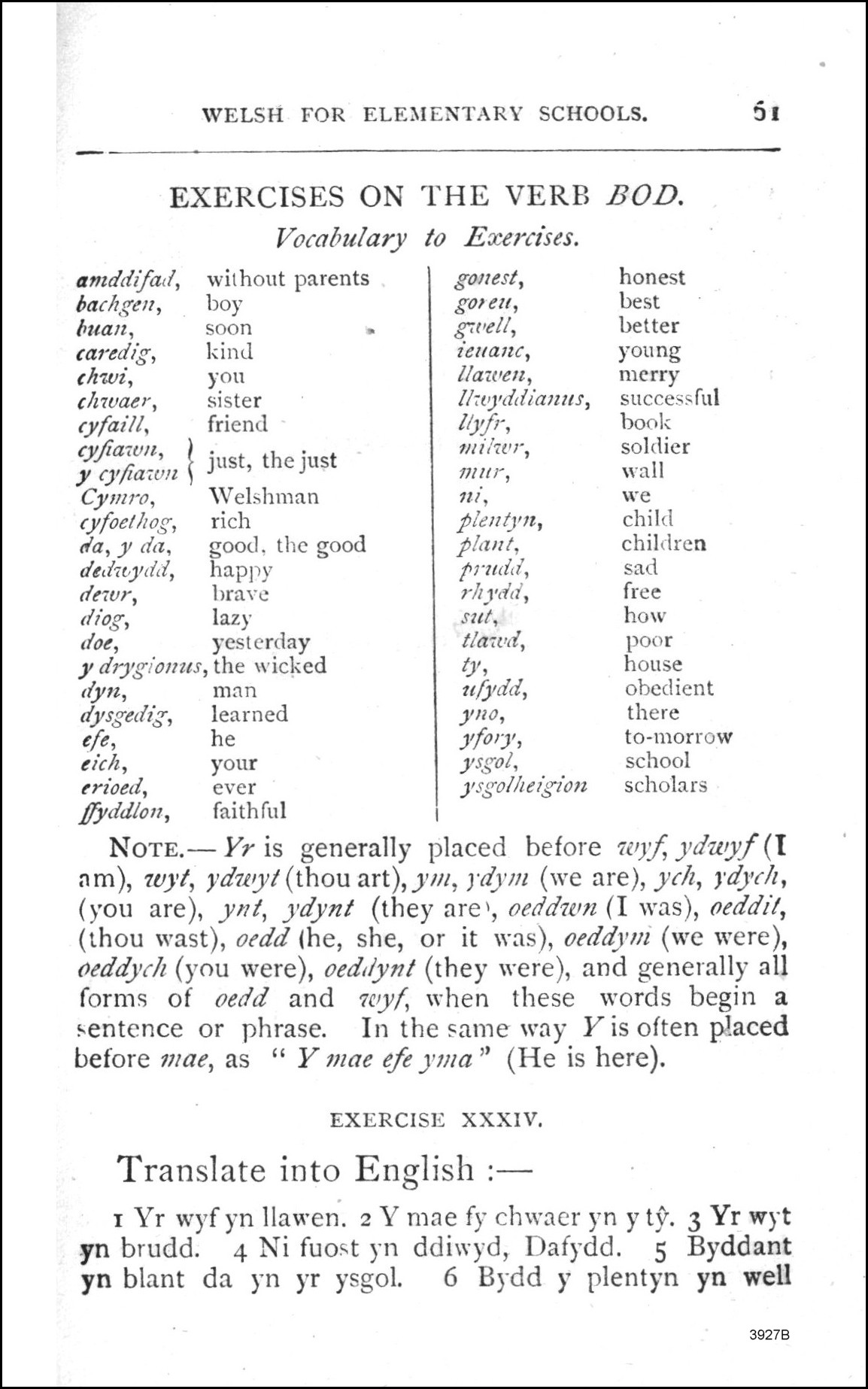
|
(delwedd 3926A)
(x58)
58
WELSH FOR ELEMENTARY SCHOOLS.
Translate ifito Welsh :
1 They are happy. 2 It will be short. 3 The dog
was after me. 5 1 am a brave soldier. 5 She has been
away. 6 Who art thou? 7 The children are with him.
8 Where have you been? 9 they be there before
us? ro We shall not be long after them. 11 Have
you been to her? '2 1 was tired of thee, or I was angry
with thee.
THE VERB BOD (TO BE).
INDICATIVE Moon (MODI) MVNEC,OL).
AMSER PRESENOL.
Singular ( Cuigvl).
PR ESENT TENSE.
I'/ural ( L/uosog).
tcvf, ydwyn,
wyt, ydzvyt,
yw, yriyw, mae,
ors, sydd,
I aln
thou art
he, she, or it
is
3'"/ , J'dym,
_vch, ydyc/l,
ynt, yttynt, maent,
we nre
you are
they are
AMSER ANORPIIENOL.
redd7"t, by/'izvn, batt'jz, I was
thou wast
oeddit, byddit, bait,
he was
oedd, hyddai, bai,
AMSER GORPHENOL.
I have been
buais,
huost, buaist, thou hast been
he, &c., has been
IMPERFECT TENSE.
oeddym,åydt m, haem, we were
oeddych,hyc ech, baech, you were
oeddynt, byddent, baent, they were
PERFECT 'rENSE.
Iwasom, we have been
buom,
buoch, /'ttasoch ,
you have been
l;uasant, they have been
l'?ton/,
3926A
|
|
|
|
|
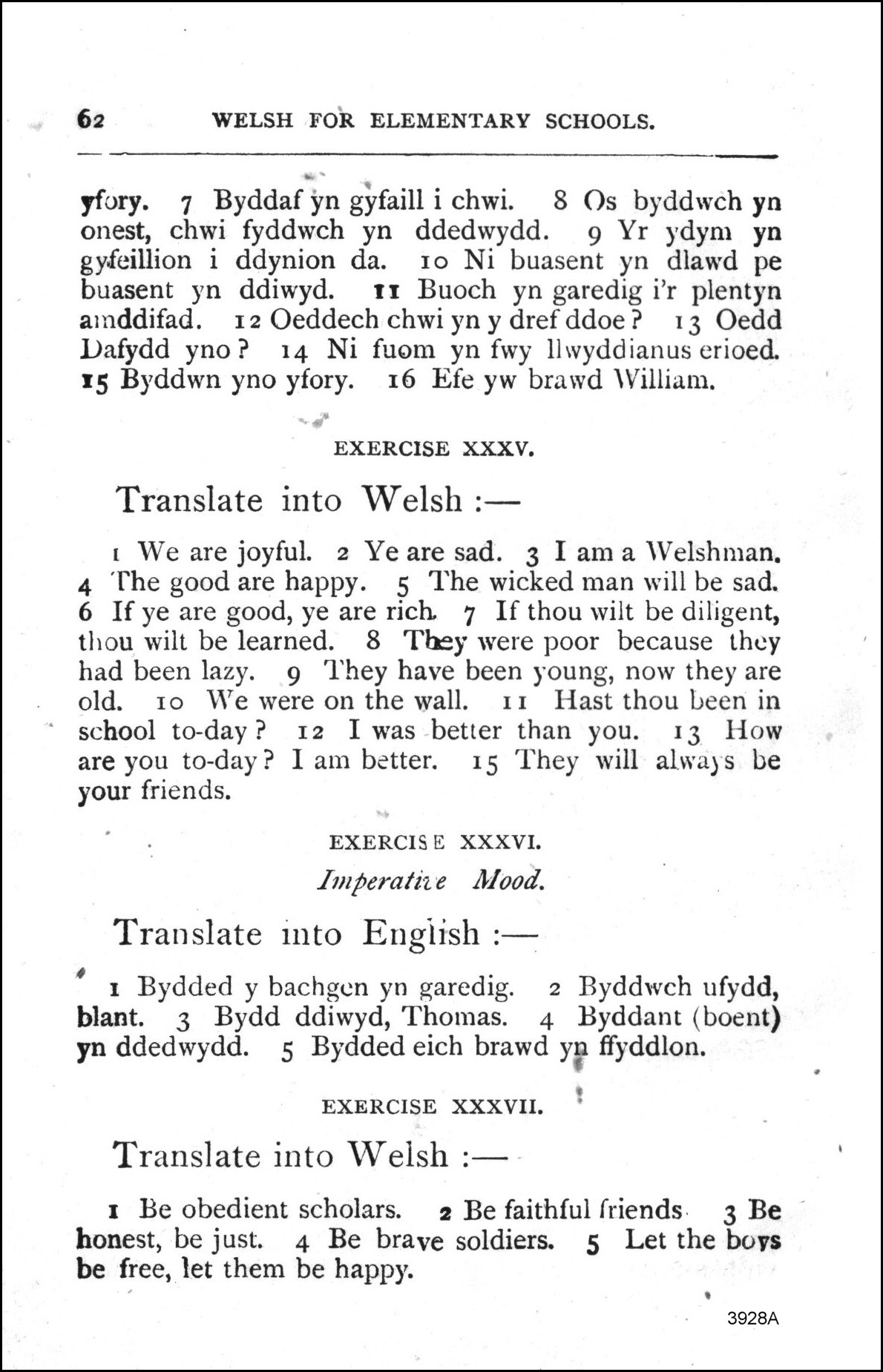
|
(delwedd 3926B)
(x59)
WELSH FOR ELEMENTARY SCHOOLS.
59
AMSER TRAGORPHENOL.
PLUPERFECr TENSE.
buasit,
buasai,
I had been
thou hadst been
he had been
buasem,
buasech,
buasent,
u e had been
you had been
they had been
AMSER DVFODOL.
byddaf, I shall or will be
byddi, thou shalt or wilt Be
bydd, he, &c., shall or will be
FUTURE TENSE.
hyddtvn, we shall or will be
byddwch, you shall or will be
they shall or will be
byddant,
IMPERATIVE MOOD (MOOD GORCHVMVNOL).
BE.
let us be
byddwn (ni),
byddzvyf,
let me be
bydd, or bydd di, be or be thou brddwch (chtei),
be or be ye
bydded (or boed), let him be
byddant, lyddont,
let them be
byddent (haw)
NOTE.—Some grammarians use oeddem, oeddech, oeddent,
as well as oeddym, oeddych, oeddyn/, in the Impel fect Tense.
DIFFERENT FORMS OF THE VERB DOD.
The different forms of the Verb Bod pre-
sent sonne difficulty to the learner. Thus
3RD PERSON SINGULAR.
English—He is, she is, it is.
3RD PERSON PLURAL.
They are.
Il'elsh— Ytv, ydytv, mae, oes,sy, sydd. Ynt, ydynt, maent, oes,
Each word, however, expresses a different
shade of nieaning.
Y tv, ydyw (Singular
and ynt, yd) Tit
(Plural) are different forms of the same
word, and come between two Nouns (or
Pronouns), or between a Noun (or Pronoun)
3926B
|
|
|
|
|
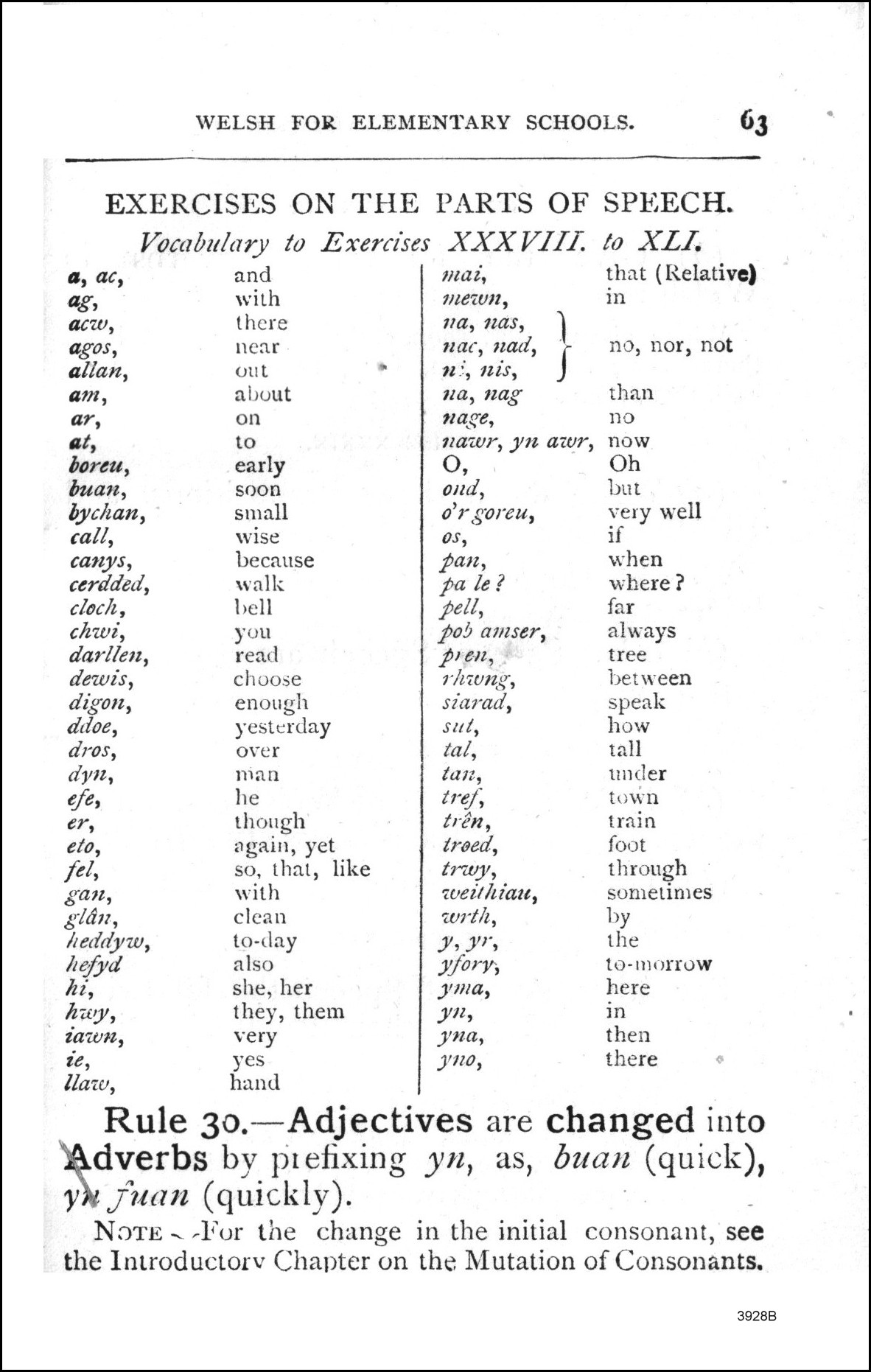
|
(delwedd 3927A)
(x60)
60
WELSH FOR ELEMENTARY SCHOOLS.
and an Adjective. This form of the Verb
Bod is often used to Inake the Predicate the
most prominent part of the sentence.
Thus
LLVFR DA VW hzvn (This IS A GOOD BOOK).
GWEISION VI)YN'r hwy (They ARE SERVANTS).
Sy, or sydc/ (Singular and Plural) comes
after the Subject, and makes that more
prominent.
HYN sydddda (THIS is good).
It is used, too, when the Relative Pro-
noun is employed.
Y Plant SVDD MN CHWAREU (It is the children WIIO ARE
PLAYING).
Y dyn SYDI) Y N y ty nuyma ddoe (It is the man WIIO IS IN the
house that was here yesterday).
NidDaDdd SYI)D OREU (David is not THE ONE WHO IS BEST).
Mae, or Y mae, begins a sentence, or
clause, and thus has its subject following it.
MAE y ferch yma (The girl is here).
MAEN'•r teedi dyfod (They have cotne).
Y MAE htgn Y/l iatvn (This is right).
Oes is used in asking a question, or is
joined to the negative No or Not, in sen-
tences beginning with " there."
A OES genych Iyfr ? (Il AVE you a book
NID OES un yma (THERE IS NOT one here).
NID OES ysgol 3'jovy (TIIERE IS NO school to-morrow).
EXERCISE xxxlll.
Write out ten Verbs in English, and give
their NV elsh equivalents.
3927A
|
|
|
|
|
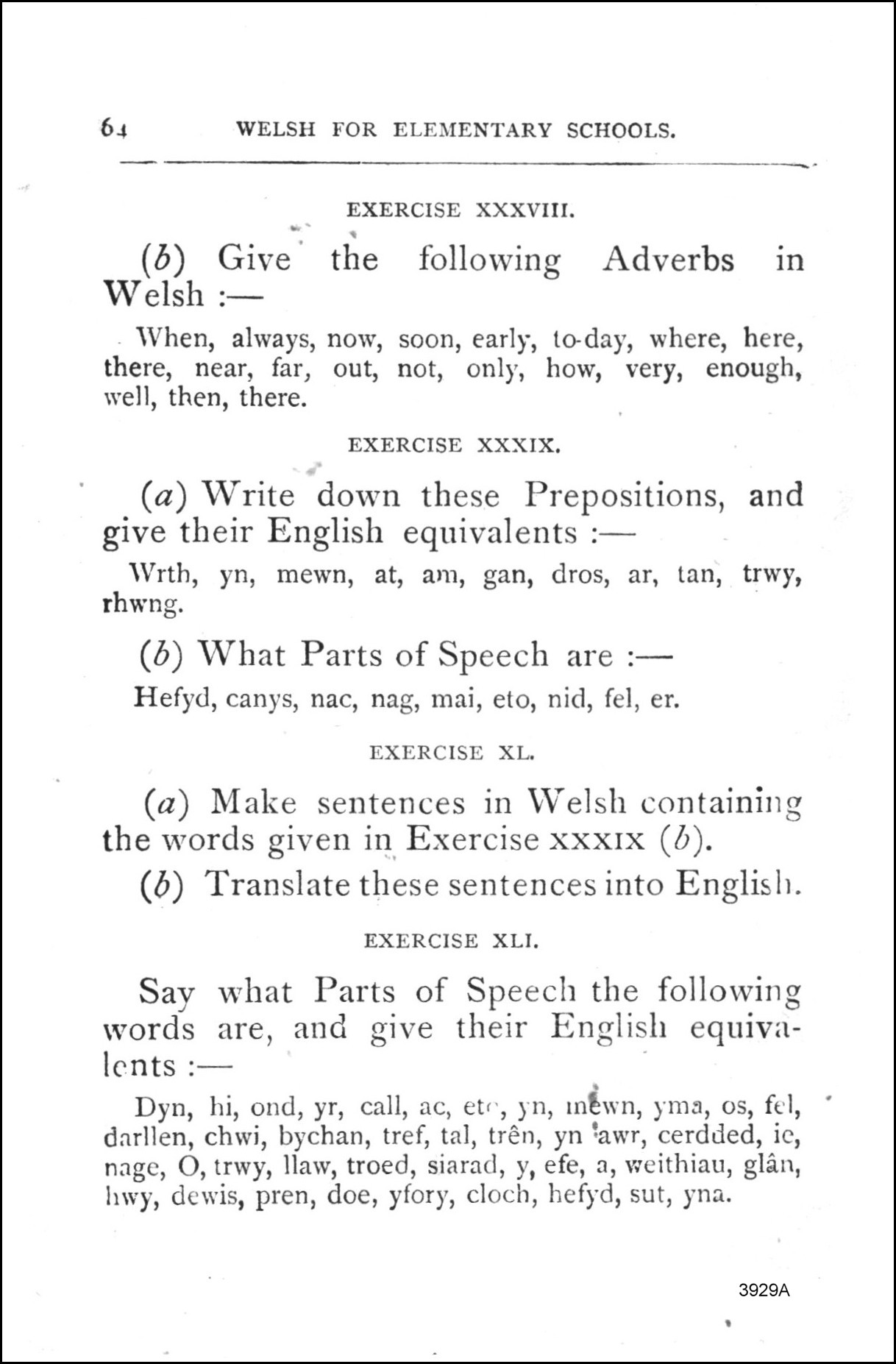
|
(delwedd 3927B)
(x61)
WELSH FOR ELEMENTARY SCHOOLS.
EXERCISES ON THE VERB BOD.
Vocabulary to Eayrcises.
51
anzddifad,
bachgen,
buan,
caredig,
chwi,
chwaer,
cyfaill,
cyJiawn,
without parents
boy
soon
kind
you
sister
friend
just, the just
y cy/iawn
NVelshman
Cymro,
cynoethog, rich
da, y da, good, the good
dedttydd, happy
dewy,
diog,
doe,
brave
lazy
yesterday
y drygionus, the wicked
dyn,
man
dysgedig,
learned
ere,
eich,
erioed,
Dddlon,
he
your
ever
faith ful
gonest,
go,' eu,
gull,
ieuanc,
llawen,
Il:vyddianus,
l/yf;-,
n,'i/ter,
mur,
ni,
Plentyn,
Want,
rhydd,
sut,
tlazt'Æ,
tifydd,
yno,
3'fory,
ysgol,
ysgv/heig•ion
honest
best
better
young
merry
successful
book
soldier
wall
we
child
children
sad
free
how
poor
house
obedient
there
to-morrow
school
scholars
NOTE.— Yr is generally placed before tvyf, ydzvyf (I
am), wyt, ydtvy/ (thou art),ym, ydym (we are), ych, ydych,
(you are), ynt, ydynt (they are b oeddwn (I was), oeddit,
(thou wast), oedd (he, she, or it was), oeddym (we were),
oeddych (you were), oediiynt (they were), and generally all
forms of oedd and tcy/, when these words begin a
sentence or phrase. In the same way Y is often placed
before mae, as Y mae eye yma " (He is here).
EXERCISE xxxlv.
Translate into English .
1 Yr wyfyn llawen. 2 V mae fy chwacr yn y t'. 3 Yr wyt
yn brudd. 4 Ni fuost yn ddiwydy Dafydd. 5 Byddant
yn blant da yn yr ysgol. 6 Bydd y plentyn yn well
3927B
|
|
|
|
|
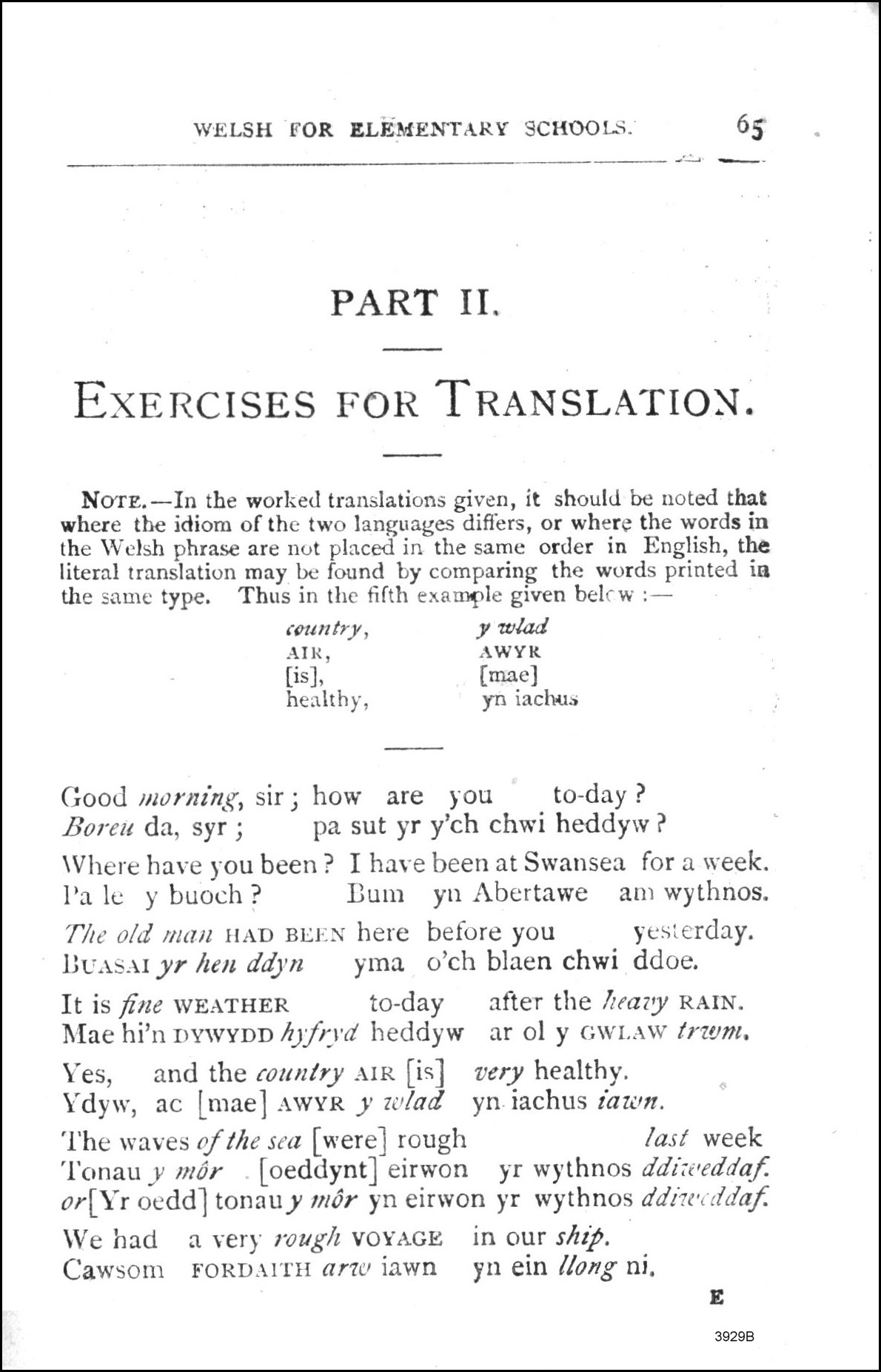
|
(delwedd 3928A)
(x62)
62
WELSH FOR ELEMENTARY SCHOOLS.
yfory. 7 Byddaf yn gyfaill i chwi. 8 Os byddwch yn
onest, chwi fyddwch yn ddedwydd. 9 Yr ydym yn
gyfeillion i ddynion da. 10 Ni buasent yn dlawd pe
buasent yn ddiwyd. 11 Buoch yn garedig i'r plentyn
amddifad. 12 Oeddech chwi yn y dref ddoe? 13 Oedd
Dafydd yno? 14 Ni fuom yn fwy Il wyddianus erioed.
15 Byddwn yno yfory. 16 Efe yw brawd William.
EXERCISE XXXV.
Translate into Welsh :
1 We are joyful. 2 Ye are sad. 3 1 am a Welshman.
4 The good are happy. 5 The wicked man will be sad.
6 If ye are good, ye are rich 7 If thou wilt be diligent,
thou wilt be learned. 8 were poor because they
had been lazy. 9 They have been young, now they are
11 Hast thou been in
old. 10 We were on the wall.
school to-day? 12 1 was better than you.
13 How
are you to-day? I am better.
15 They will alwa)S be
your friends.
EXERCISE xxxvl.
Imperatiz e 1100d.
Translate Into English :
1 Bydded y bachgen yn garedig. 2 Byddwch ufydd,
blant. 3 Bydd ddiwyd, Thomas. 4 Byddant (boent)
yn ddedwydd. 5 Bydded eich brawd ffyddlon.
EXERCISE xxxvll.
Translate into Welsh :
1 be obedient scholars.
2 Be faithful friends 3 Be
honest, be just. 4 Be brave soldiers. 5 Let the boys
be free, let them be happy.
3928A
|
|
|
|
|
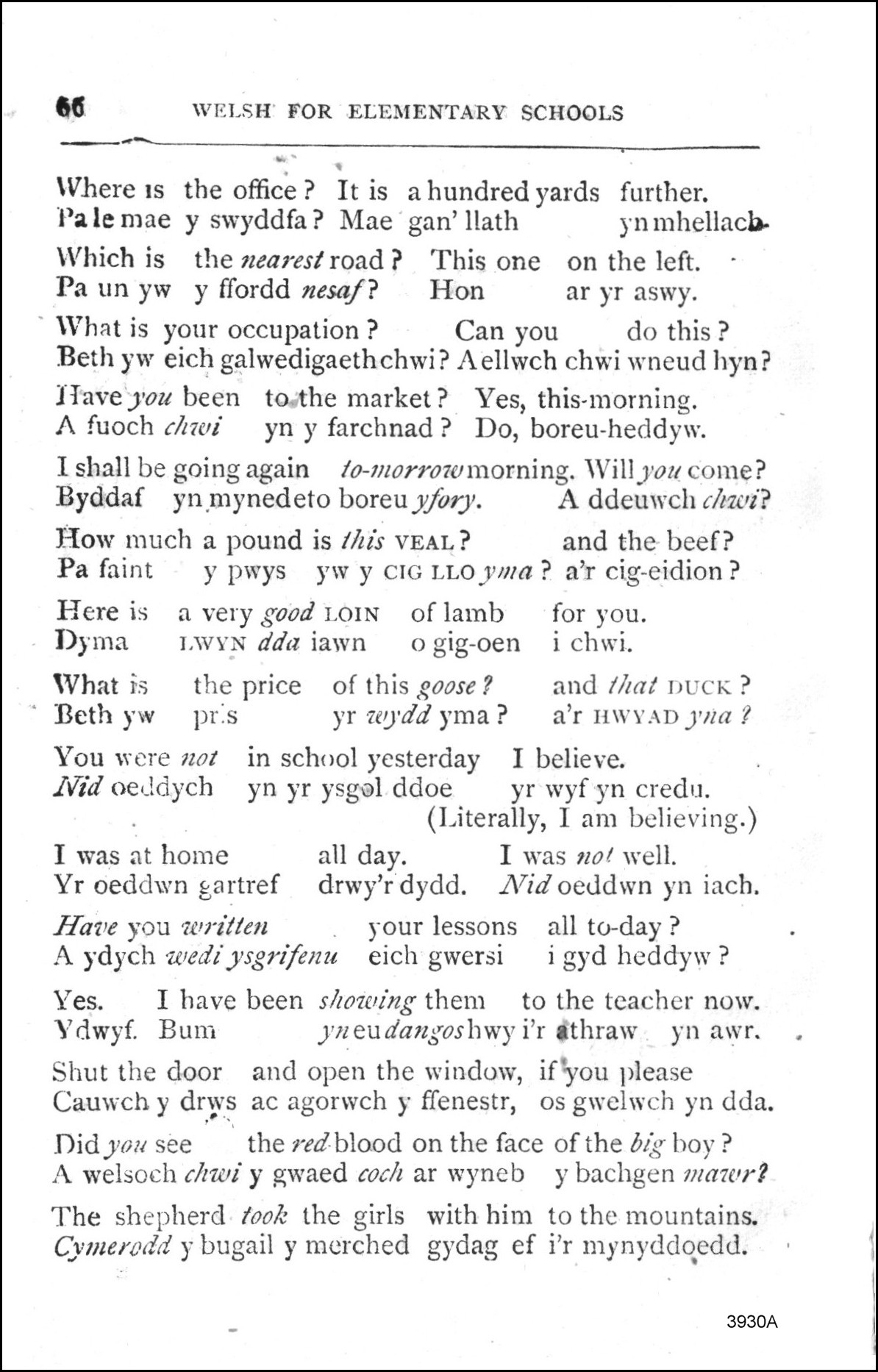
|
(delwedd 3928B)
(x63)
WELSH FOR ELEMENTARY SCHOOLS.
EXERCISES ON THE PARTS OF SPEECH.
Vocabulary to Exercises xxxvlll. to XLI.
63
a, ac,
aczv,
agos,
allan,
am,
boreu,
buan,
bychan,
call,
canys,
cerdded,
cloch ,
chwi,
darllen,
dewis,
digon,
ddoe,
dros,
drn,
eye,
eto,
fez,
gan,
glån,
heddyzv,
h efyd
hi,
hay,
iawn,
ie,
llazv,
and
with
there
near
out
about
on
to
early
soon
small
wise
because
walk
bell
you
read
choose
enough
yesterday
over
man
he
though
again, yet
so, that, like
with
clean
to-day
also
she, her
they, them
very
yes
hand
mai,
metvn,
na, nas,
nac, nad,
IZis,
na, nag
nave,
nazvr, azvr,
O,
ond,
o'rgorcu,
Pan,
pa le ?
'ell,
20b amser,
l'/ltvng-,
siarad,
sut,
tal,
tan,
t ref,
trén,
treed,
trzvy,
tvei/hiau,
tvrt/l,
3'forr,
yma,
yna,
YIM,
that (Relative)
in
no, nor, not
than
no
now
Oh
but
very well
if
when
where ?
far
always
tree
between
speak
how
tall
under
town
train
foot
through
sometimes
by
the
to-inorrow
here
in
then
there
Rule 30.—Adjectives are changed into
dverbs by prefixing yn, as, buan (quick),
y fuan (quickly).
NOTE „For the change in the initial consonant, see
the Introductorv Chapter on the Mutation of Consonants.
3928B
|
|
|
|
|
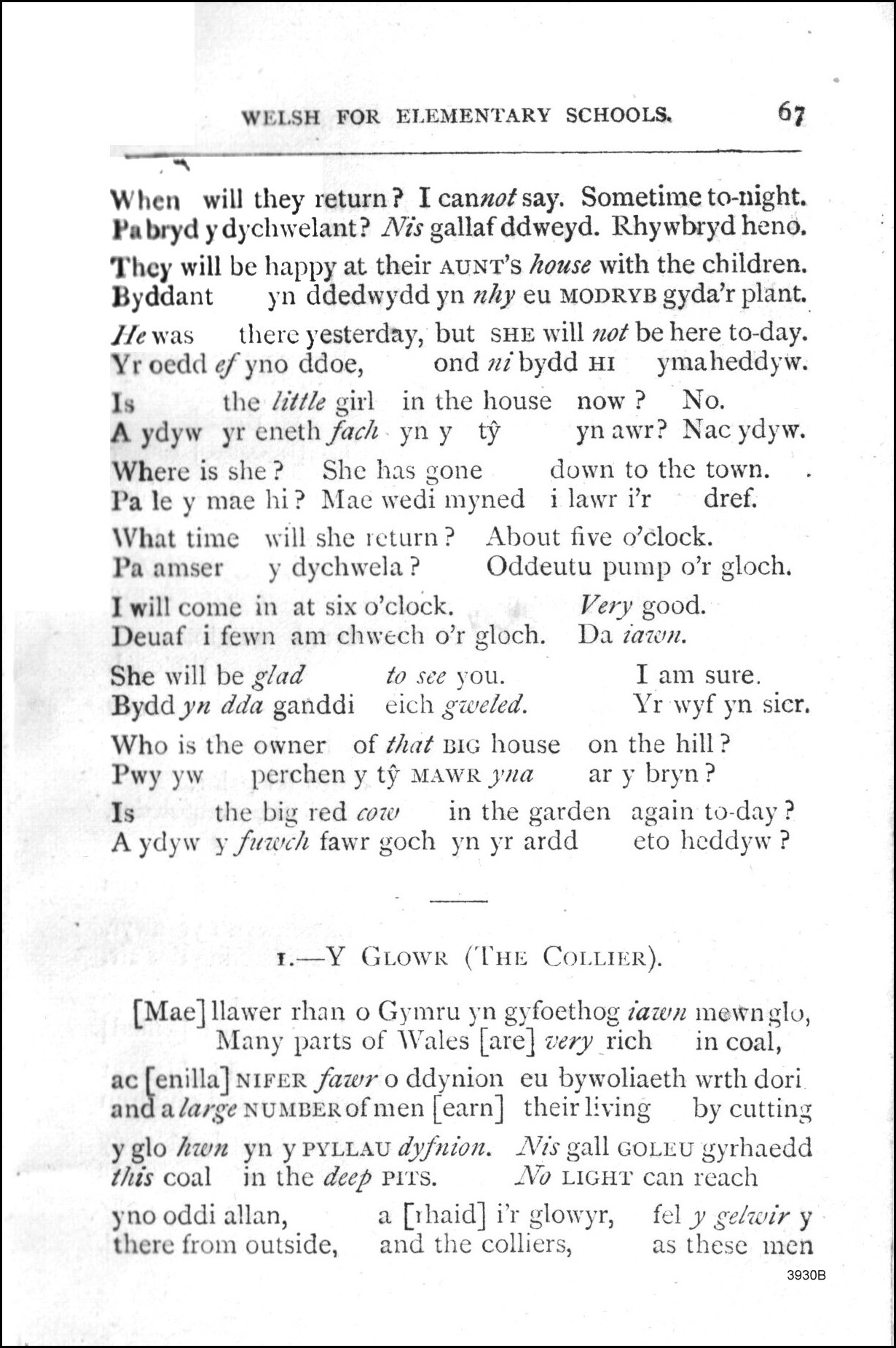
|
(delwedd 3929A)
(x64)
64
WELSH FOR ELEMENTARY SCHOOLS.
EXERCISE xxxvlll.
(b) Give the following Adverbs in
Welsh :
M/ hen, always, now, soon, early, to-day, where, here,
there, near, far, out, not, only, how, very, enough,
well, then, there.
EXERCISE xx.xrx.
(a) Write down these Prepositions, and
give their English equivalents .
1,Vrth, yn, mewn, at, am, gan, dros, ar, tan, trwy,
rhwng.
(b) What Parts of Speech are :
Hefyd, canys, nac, nag, mai, eto, nid, fel, er.
EXERCISE XL.
(a) Make sentences in Welsh containing
the words given in Exercise xxxrx (b).
(b) Translate these sentences into English.
EXERCISE XLI.
Say what Parts of Speech the following
words are, and give their Enolish equiva-
lents :
Dyn, hi, ond, yr, call, ac, etc', yn, m wn, yma, os, fel,
darllen, chwi, bychan, tref, tal, trén, yn ••awr, cerdded, ie,
nage, O, trwy, llaw, troed, siarad, y, efe, a, weithiau, glån,
hwy, dewis, pren, doe, yfory, cloch, hefyd, sut, yna.
3929A
|
|
|
|
|
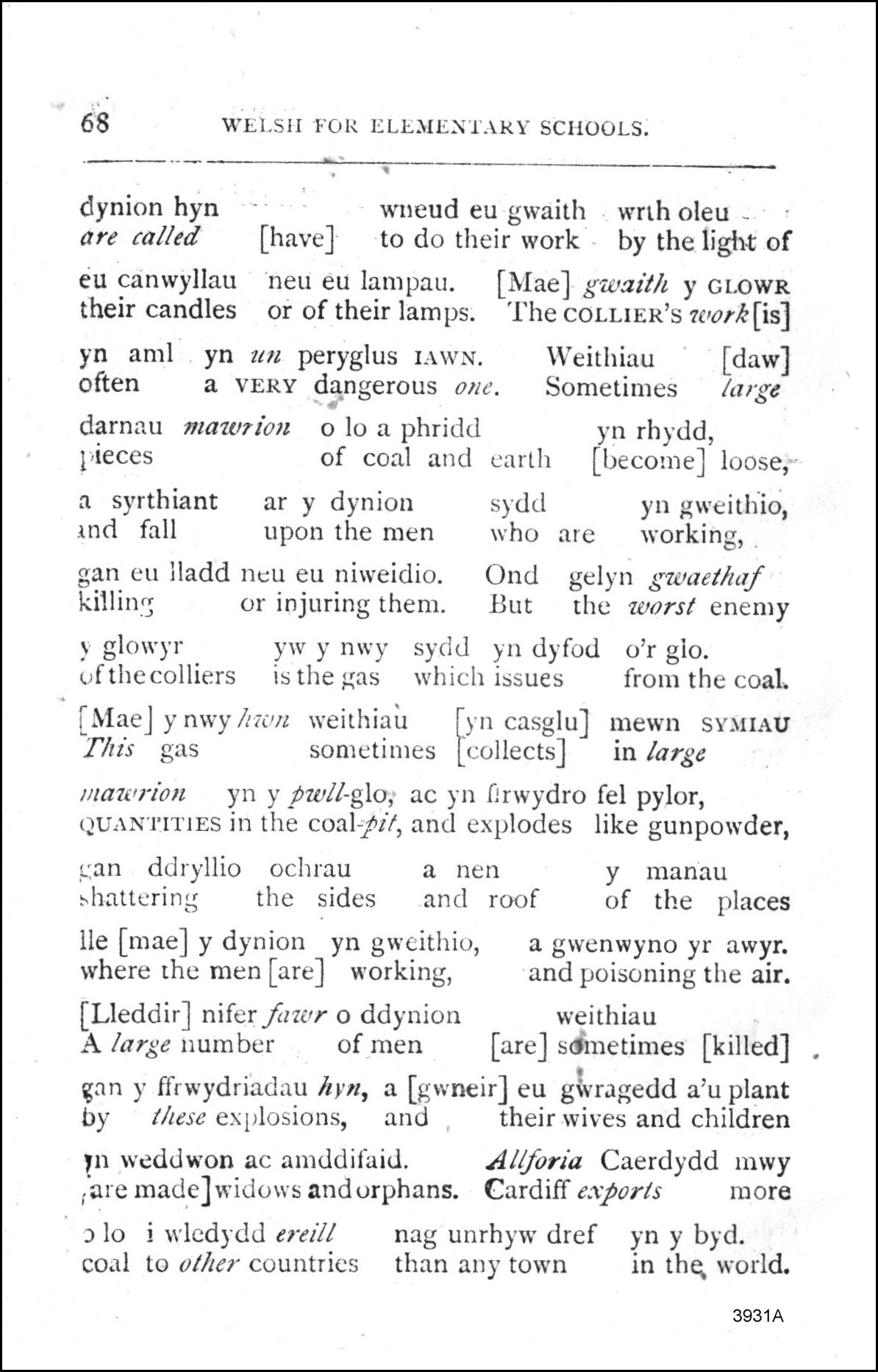
|
(delwedd 3929B)
(x65)
WELSH FOR ELEMENTARY SCHOOLS.
PART 11.
65
EXERCISES FOR TRANSLATION.
NOTE. —In the worked translations given, it should be noted that
where the idiom of the two languages differs, or where the words in
the Welsh phrase are not placed in the same order in English, the
literal translation may be found by comparing the words printed in
the same type. Thus in the fifth examqle given belt-w :
country,
AIR,
healthy,
y tvlad
AWYR
(mae]
yn iachus
to-day ?
Good morning, sir; how are you
pa sut yr y'ch chwi heddyw ?
Boreu da, syr ;
NVhere have you been ? I have been at Swansea for a week.
yn Abertawe am wythnos.
Pa le y buoch ?
yesterday.
The o/d man HAD BEEN here before you
yma o'ch blaen chwi ddoe.
I}VASAI yr hen ddyn
to-day after the heavy RAIN.
It is fine WEATHER
Mae hi'n I)YWYDD hyfr_l'd heddyw ar 01 y GWI„AW trzvm.
and the country AIR [is] very healthy.
Yes,
Vdyw, ac [mael AWYR y zetad yn iachus iazvn.
last week
'Ithe waves of the sea [were] rough
'Itonau y mbr [oeddynt] eirwon yr wythnos ddiweddaf.
ort Yr oedd] tonauy mör yn eirwon yr wythnos ddiü'cddaf.
We had a very rough VOYAGE in our ship.
Cawsom FORDAITH art' iawn yn ein (long ni.
3929B
|
|
|
|
|
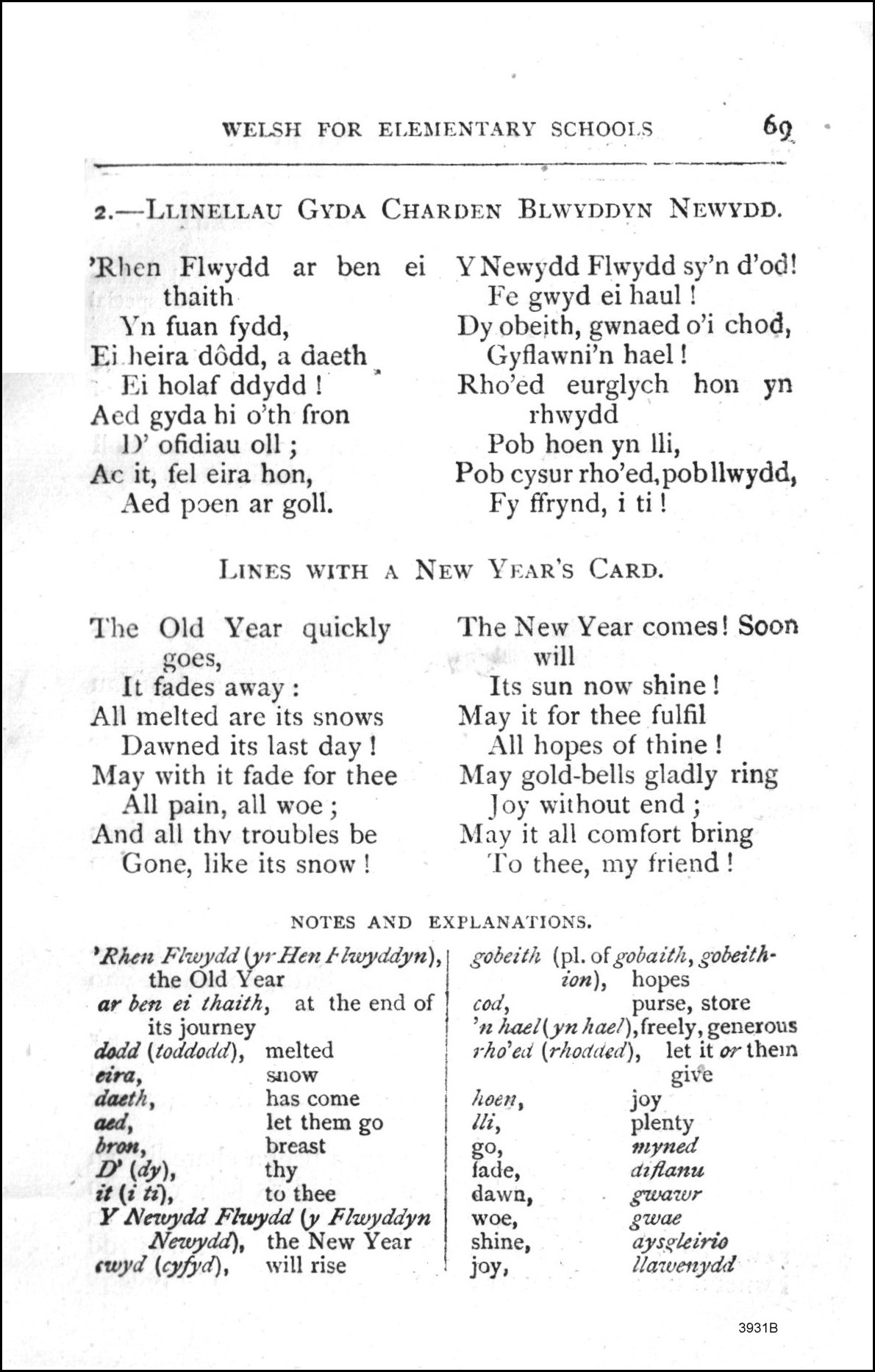
|
(delwedd 3930A)
(x66) Where is the office? It is a hundred yards further. Pa le mae y
swyddfa? Mae gan’llath ynmhellacb.
Which is the nearest road? This one on the left. Pa un yw y ffordd nesaf? Hon
ar yr aswy.
What is your occupation? Can you do this? Beth yw eich galwedigaeth chwi? A
ellwch chwi wneud hyn?
Have you been to the market? Yes, this morning. A fuoch chwi yn y farchnad?
Do, boreu-heddyw.
I shall be going again tomorrow morning. Will you come? Byddaf yn myned eto
yfory. A ddeuwch chwi?
How much a pound is this VEAL? and the beef? Pa faint y pwys yw y CIG LLO
yma? a’r cig-eidion?
Here is a very good LOIN of lamb for you. Dyma LWYN dda iawn o gig-oen i
chwi,
What is the price of this goose? and that DUCK? Beth yw pris yr wydd yma? a’r
HWYAD yna?
You were not in school yesterday I believe. Nid oeddych yn yr ysgol ddoe yr
wyf yn credu. (Literally, I am believing.)
I was at home all day. I was not well. Yr oeddwn gartref drwy’r dydd. Nid
oeddwn yn iach.
Have you written your lessons all to-day? A ydych wedi ysgrifenu eich gwersi
i gyd heddyw?
Yes. I have been showing them to the teacher now. Ydwyf. Bum yn eu dangos nwy
i’r athraw yn awr.
Shut the door and open the window, if you please. Cauwch y drws ac agorwch y
ffenestr, os gwelwch yn dda.
Did you see the red blood on the face of the big boy? A welsoch chwi y gwaed
coch ar wyneb y bachgen mawr?
The shepherd took the girls with him to the mountains. Cymerodd y bugail y
merched gydag ef i’r mynyddoedd.
|
|
|
|
|
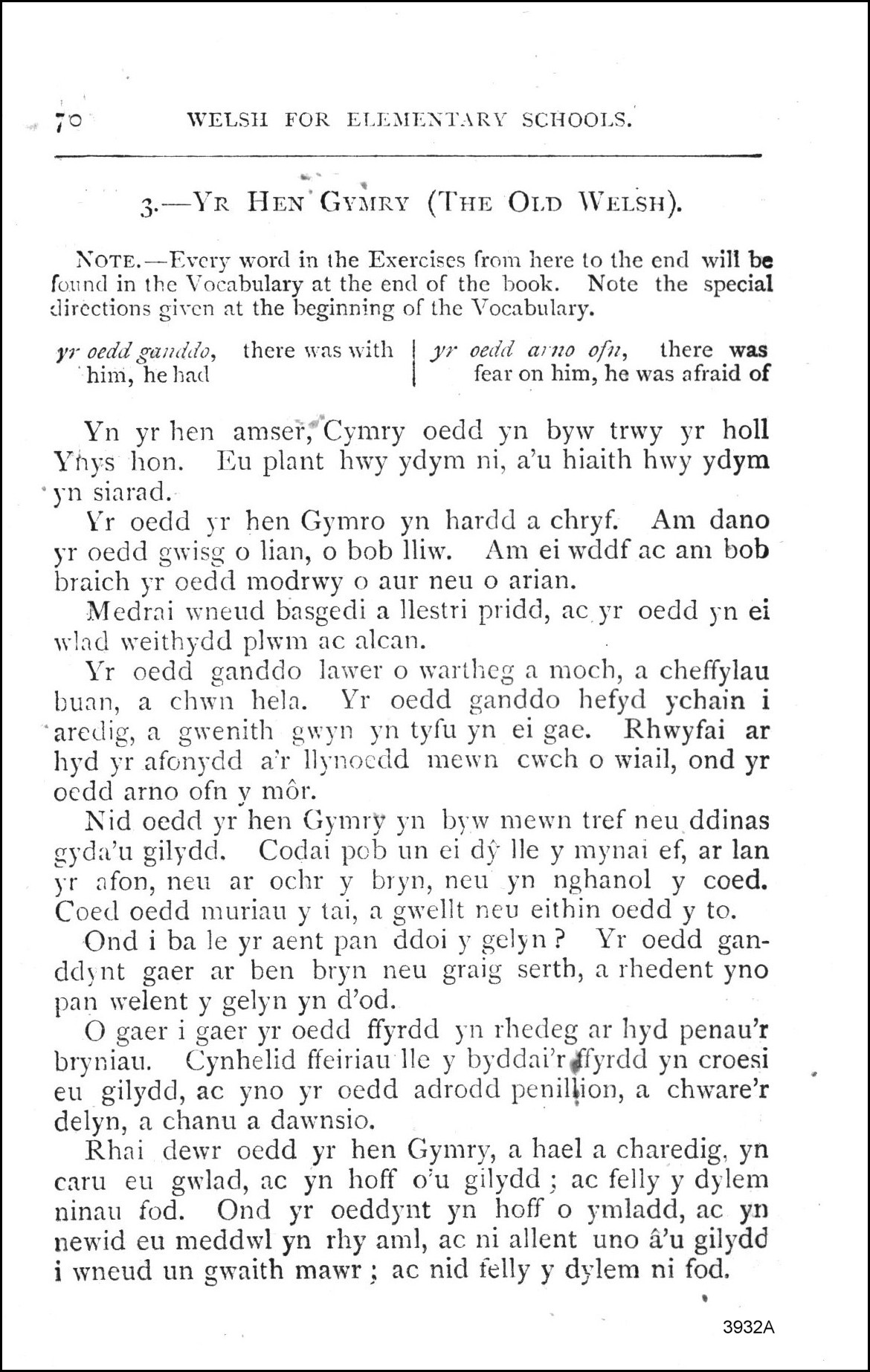
|
(delwedd 3930B)
(x67) When will they return? I cannot say. Sometime to-night. Pa bryd y dychwelant?
Nis gallaf ddweyd. Rhywbryd heno.
They will be happy at their AUNT’S house with the children. Byddant yn
ddedwydd yn nhŷ eu
MODRYB gyda’r
plant.
He was there yesterday, but SHE will not be here to-day. Yr oedd ef yno ddoe,
ond ni bydd HI yma heddyw.
Is the little girl in the house now? No. A ydyw yr eneth fach yn y tŷ yn awr? Nac ydyw.
Where is she? She has gone down to the town. Pa le y mae hi? Mae wedi myned i
lawr i’r
dref.
What time will she return? About five o’ clock. Pa amser y dychwela?
Oddeutu pump o’r gloch.
I will come in at six o’clock. Very good. Deuaf i fewn am chwech o’r gloch.
Da iawn.
She will be glad to see you. I am sure. Bydd yn dda ganddi eich gweled. Yr
wyf yn sicr.
Who is the owner of that BIG house on the hill? Pwy yw perchen y tŷ MAWR yna ar y bryn?
Is the big red cow in the garden again to-day?. A ydyw y fuwch fawr goch yn
yr ardd eto heddyw?
1.—Y
GLOWR (THE COLLIER).
[Mae] llawer rhan o Gymru yn gyfoethog iawn mewn glo, Many parts of Wales
[are] very rich in coal,
ac [enilla] NIFER fawr o ddynion eu bywoliaeth wrth dori and a large NUMBER
of men [earn] their living by cutting
y glo hwn yn y PYLLAU dyfnion. Nis gall GOLEU gyrhaedd this coal in the deep
PITS. No LIGHT can reach
yno oddi allan, a [rhaid] i’r glowyr, fel y gelwir y there from outside, and
the colliers, as these men
|
|
|
|
|
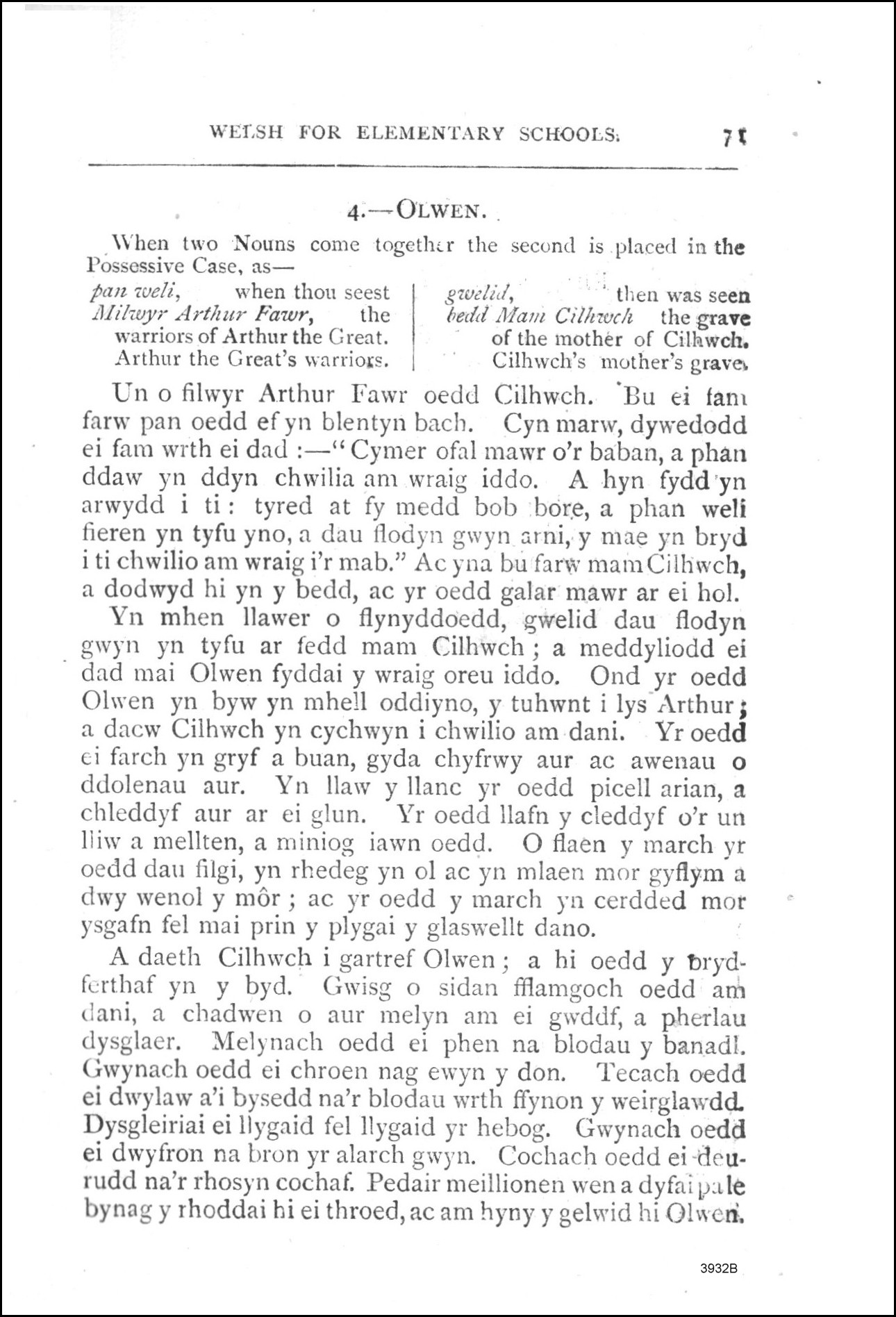
|
(delwedd 3931A)
(x68)
dynion hyn wneud eu gwaith wrth oleu
are called [have] to do their work by the light of
eu canwyllau neu eu lampau. [Mae] gwaith y GLOWR their candles or of their
lamps. The COLLIER’S work [is]
yn aml yn un peryglus IAWN. Weithiau [daw] often a VERY dangerous one.
Sometimes large
darnau mawrion o lo a phridd yn rhydd, pieces of coal and earth [become]
loose,
a syrthiant ar y dynion sydd yn gweithio, and fall upon the men who are
working,
gan eu lladd neu eu niweidio. Ond gelyn gwaethaf killing or injuring them.
But the worst enemy
y glowyr yw y nwy sydd yn dyfod o’r glo. of the colliers is the gas which
issues from the coal.
[Mae] y nwy hwn weithiau [yn casglu] mewn SYMIAU This gas sometimes
[collects] in large QUANTITIES
mawrion yn y pwll-glo, ac yn ffrwydro fel pylor, in the coal-pit, and
explodes like gunpowder,
gan ddryllio ochrau a nen y manau shattering the sides and roof of the places
lle [mae] y dynion yn gweithio, a gwenwyno yr awyr. where the men [are]
working, and poisoning the air.
[Lleddir] nifer fawr o ddynion weithiau A large number of men [are] sometimes
[killed]
gan y ffrwydriadau hyn, a [gwneir] eu gwragedd a’u plant by these explosions,
and their wives and children
yn weddwon ac amddifaid. Allforia Caerdydd mwy are made widows and orphans.
Cardiff exports more
o lo i wledydd ereill nag unrhyw dref yn y byd. coal to other countries than
any town in the world.
|
|
|
|
|
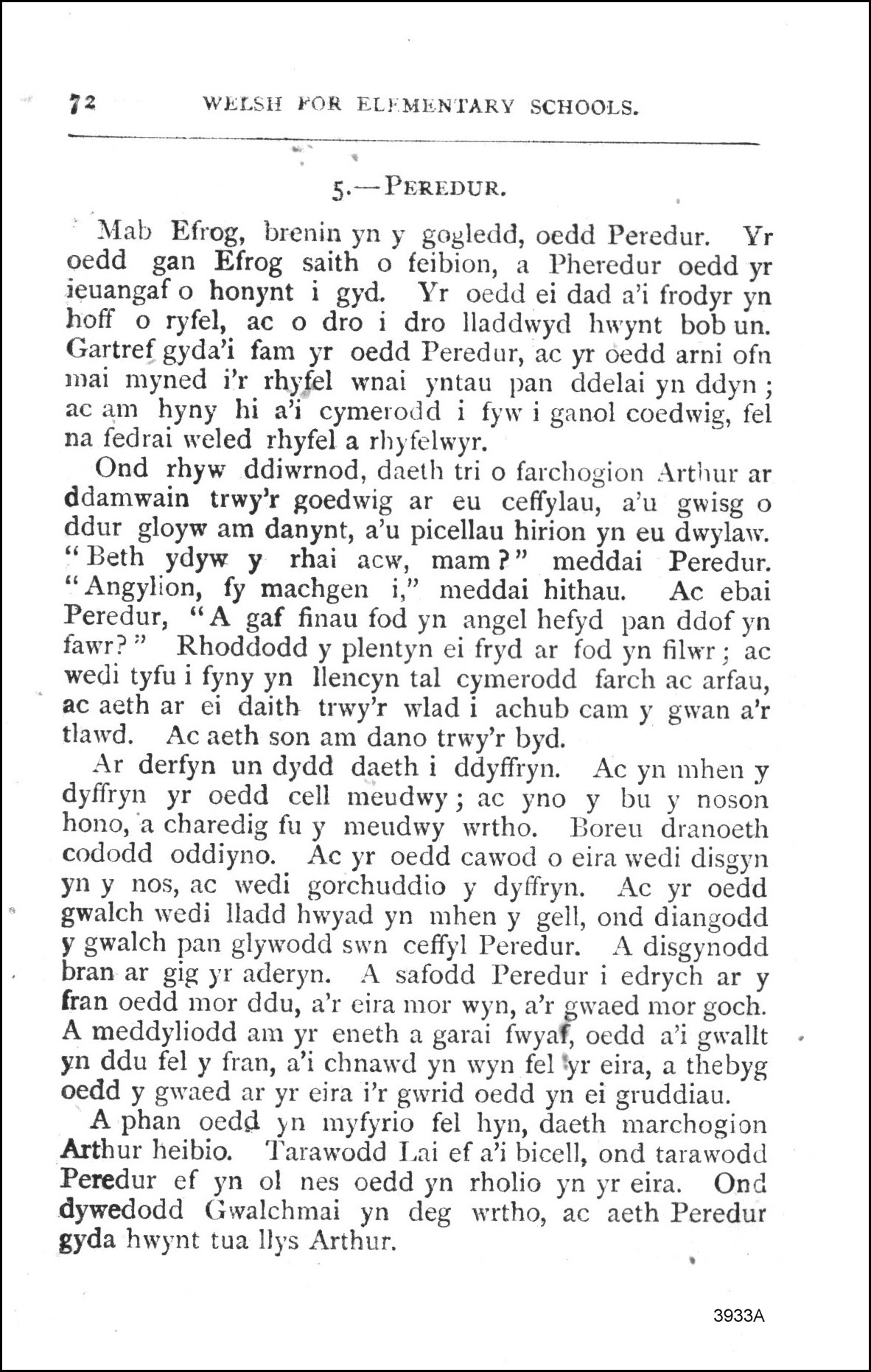
|
(delwedd 3931B)
(x69) 2.——LLINELLAU GYDA CHARDEN
BLWYDDYN NEWYDD.
‘Rhen Flwydd ar ben thaith Yn fuan fydd, Ei heira dôdd, a daeth Ei holaf
ddydd! Aed gyda hi o’th fron D’ofidiau oll; Ac it, fel eira hon, Aed poen ar
goll.
Y Newydd Flwydd sy’n d’od! Fe gwyd ei haul! Dy obeith, gwnaed o’i chod,
Gyflawni’n hael! Rho’ed eurglych hon yn rhwydd Pob hoen yn lli, Pob cysur
rho’ed, pob llwydd, Fy ffrynd, i ti!
LINES WITH A NEW YEAR’S CARD. The Old Year quickly goes, It fades away: All
melted are its snows Dawned its last day! May with it fade for thee All pain,
all woe; And all the troubles be Gone, like its snow!
The New Year comes! Soon will Its sun now shine! May it for thee fulfil All
hopes of thine! May gold-bells gladly ring Joy without end; May it all
comfort bring To thee, my tnend!
NOTES AND EXPLANATIONS. ‘Rhen Flwydd (yr Hen flwyddyn), the Old Year ar ben
ei thaith, at the end of its journey dodd (toddodd}, melted eira, snow daeth,
has come aed, let them go bron, breast D’ (dy), thy it (i ti), to thee y Newydd
Flwydd. (y Flwyddyn Newydd}, the New Year cwyd (cyfyd), will rise gobeith
(pl. of gobaith, gobeithion), hopes cod, purse, store ‘n hael (yn hael),
freely, generous rho’ed (rhodded), let it or them give hoen, joy lli, plenty
myned, go diflanu, fade gwawr, dawn gwae, woe dysgleirio, shine llawenydd,
joy
|
|
|
|
|
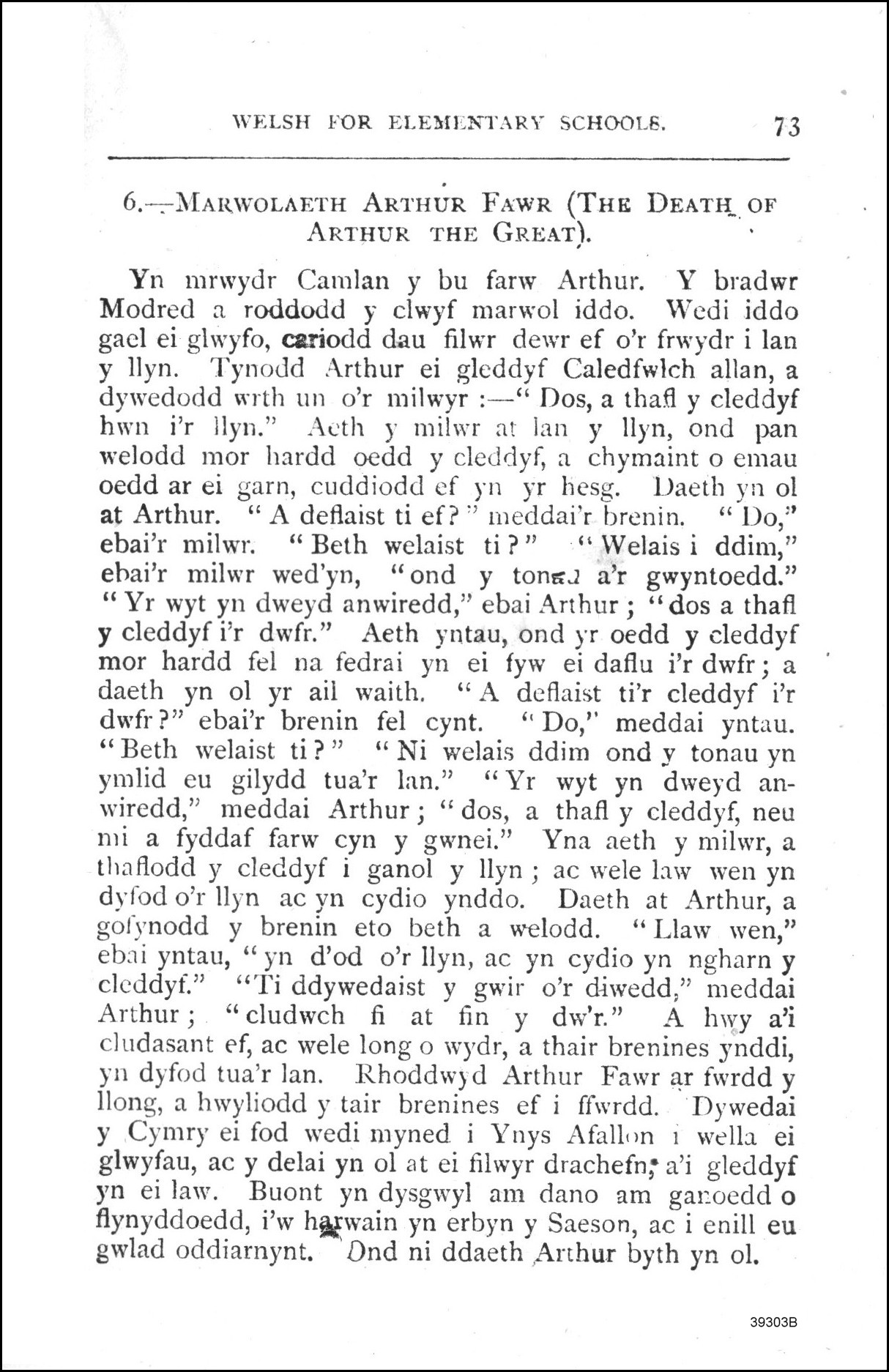
|
(delwedd 3932A)
(x70)
-o
WELSH FOR ELEMENTARY SCHOOLS.
3.—VR HEN GYMRV (THE OLD WELSH).
NOTE.—Evcry word in the Exercises from here to the end will be
found in the Vocabulary at the end of the book. Note the special
directions given at the beginning of the Vocabulary.
there was with yr oedd arno 0/11, there was
yr oedd ganddo,
fear on him, he was afraid of
him, he had
V n yr hen oedd yn byw trwy yr holl
Y hys hon. Eu plant hwy ydym ni, a'u hiaith hwy ydym
yn siarad.
Vr oedd yr hen Gymro yn hardd a chryf. Am dano
yr oedd gwisg o lian, o bob Iliw. Am ei wddf ac am bob
braich yr oedd modrwy o aur neu o arian.
Medrai wneud basgedi a Ilestri pridd, ac yr oedd yn ei
wlad weithydd plwm ac alcan.
Yr oedd ganddo lawer o warthcg a moch, a cheffylau
buan, a chwn hela. Vr oedd ganddo hefyd ychain i
aredig, a gwenith gwyn yn tyfu yn ei gae. Rhwyfai ar
hyd yr afonydd a'r llynoedd mewn cwch o wiail, ond yr
oedd arno ofn y mör.
Nid oedd yr hen Gymry yn byw mewn tref neu ddinas
gyda'u gilydd. Codai pcb un ei dj Ile y mynai ef, ar Ian
yr afon, neu ar ochr y bryn, neu yn nghanol y coed.
Coed oedd muriau y tai, a gwellt neu eithin oedd y to.
Ond i ba le yr aent pan ddoi y gelyn? Yr oedd gan-
ddynt gaer ar ben bryn neu graig serth, a rhedent yno
pan welent y gelyn yn d'od.
O gaer i gaer yr oedd ffyrdd yn rhedeg ar hyd penau'r
biyniau. Cynhelid ffeiriau Ile y byddai'r'fyrdd yn croesi
eu gilydd, ac yno yr oedd adrodd penil!ion, a chware'r
delyn, a chanu a dawnsio.
Rhai dewr oedd yr hen Gymry, a hael a charedig, yn
caru eu gwlad, ac yn hoff o'u gilydd ; ac felly y dylem
ninau fod. Ond yr oeddynt yn hoff o ymladd, ac yn
newid eu meddwl yn rhy aml, ac ni allent uno å'u gilydd
i wneud un gwaith mawr ; ac nid felly y dylem ni fod,
3932A
|
|
|
|
|
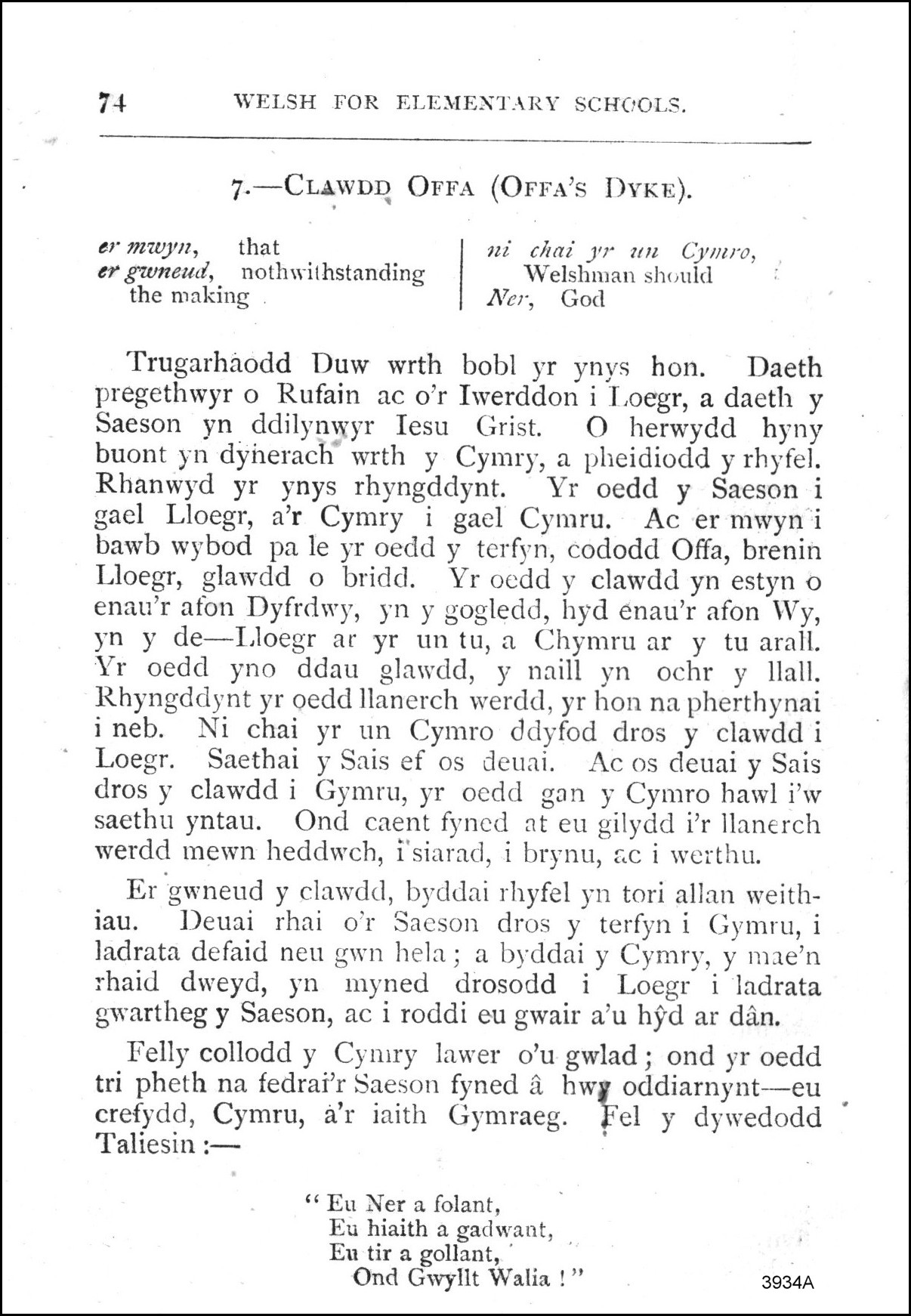
|
(delwedd 3932B)
(x71)
WEr,SH FOR ELEMENTARY SCHOOLS;
4.-—OLWEN.
\Vhen two Nouns come together the second is placed in the
Possessive Case, as—
Pan tvcli,
when thou seest
g zvelit/,
then was seen
IJIikvyr Arthur Fawr,
the
warriors of Arthur the Great.
Arthur the Great's warrioss.
tedd Mat/l Cilhzvch the grave
of the mother of Cilhwch.
Cilhwch's mother's grave,
Un o filwyr Arthur Fawr oedd Cilhwch. • Bu ei fam
farw pan oedd efyn blentyn bach. Cyn marw, dywedodd
ei fam wrth ei dad :
Cymer ofal mawr O'r baban, a phan
ddaw yn ddyn chwilia am wraig iddo. A hyn fydd yn
arwydd i ti :
tyred at fy medd bob bore, a phan weli
fieren yn tyfu yno, a dau flodyn gwyn arni, y mae yn bryd
i ti chwilio am wraig i'r mat)." Ac yna bu far*ö' mamCilhwch,
a dodwyd hi yn y bedd, ac yr oedd galar mawr ar ei hol.
V n mhen llawer o flynyddoedd, gwelid dau flodyn
gwyn yn tyfu ar fedd mam Cilhwch ; a meddyliodd ei
dad mai Olwen fyddai y wraig oreu iddo. Ond yr oedd
Olwen yn byw yn mhell oddiyno, y tuhwnt i lys Arthur;
a dacw Cilhwch yn cychwyn i chwilio am dani. Yr oedd
ei farch yn gryf a buan, gyda chyfrwy aur ac awenau o
ddolenau aur. V n llaw y llanc yr oedd picell arian, a
chleddyf aur ar ei glun. Yr oedd llafn y cleddyf O'r un
liiw a mellten, a miniog iawn oedd. O flaen y march yr
oedd dau filgi, yn rhedeg yn 01 ac yn mlaen mor gyflym a
dwy wenol y mör ; ac yr oedd y march yn cerdded mor
ysgafn fel mai prin y plygai y glaswellt dano.
A daeth Cilhwch i gartref Olwen; a hi oedd y bryd-
ferthaf yn y byd. Gwisg o sidan fflamgoch oedd am
dani, a chadwen o aur melyn am ei gwddf, a pherlau
dysglaer. Melynach oedd ei phen na blodau y banadl.
Gwynach oedd ei chroen nag ewyn y don. Tecach oedd
ei dwylaw a'i bysedd na'r blodau wrth ffynon y weirglawdd.
Dysgleiriai ei llygaid fel llygaid yr hebog. Gwynach oedd
ei dwyfron na bron yr alarch gwyn. Cochach oedd ei -deu-
rudd na'r rhosyn cochaf. Pedair meillionen wen a dyfai pale
bynag y rhoddai hi ei throed, ac am hyny y gelwid hi Olweti.
3932B
|
|
|
|
|
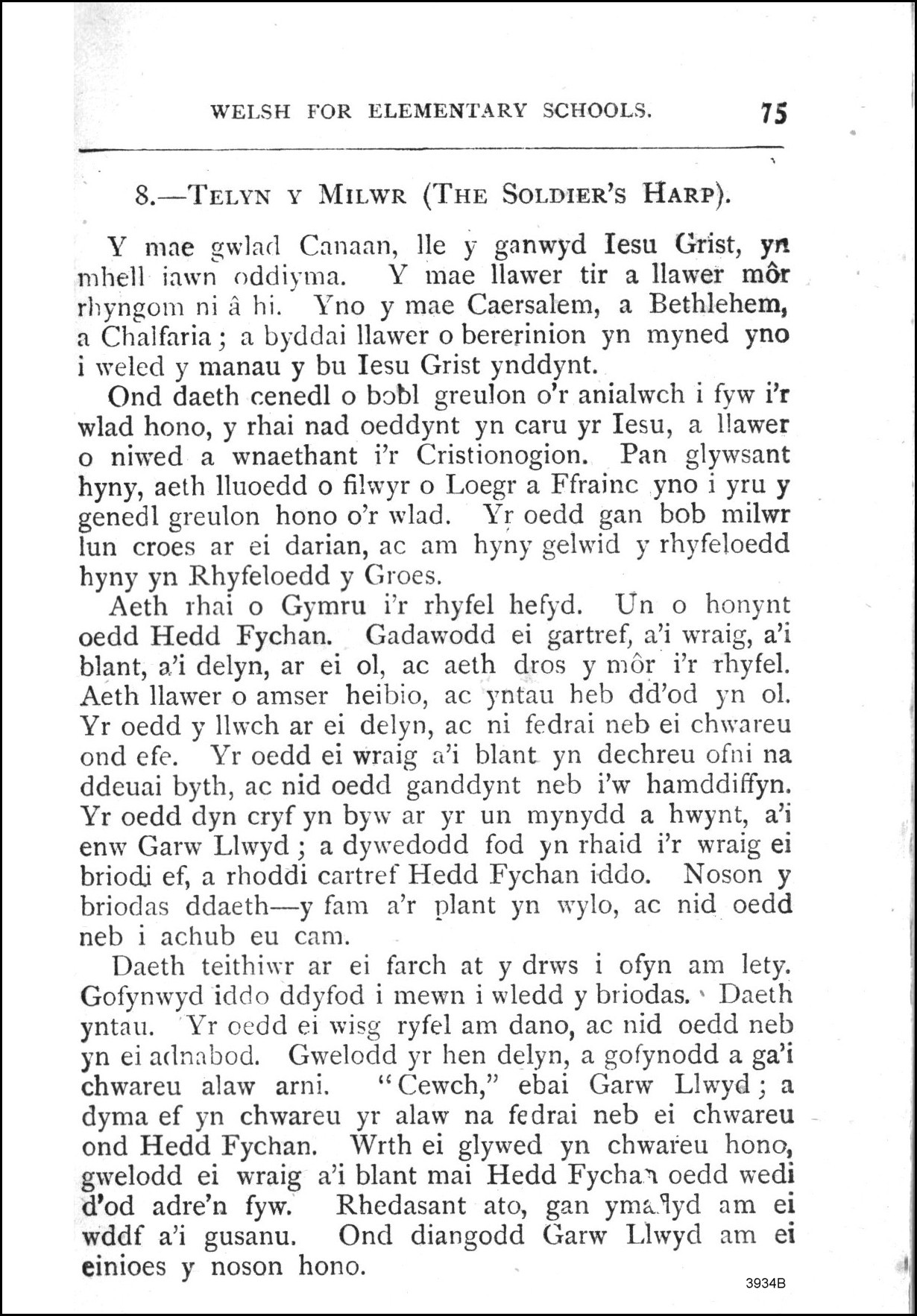
|
(delwedd 3933A) (x72)
72 WELSH FOR ELY MENTARV SCHOOLS. 5.—PEREDUR.
Mab Efrog, brenin yn y gogledd, oedd Peredur. Yr oedd gan Efrog saith o feibion, a Pheredur
oedd yr ieuangafo honynt i gyd. Vr
oedd ei dad a'i frodyr yn hoff o
ryfel, ac o dro i dro lladdwyd hwynt bob un.
Gartref gyda'i fam yr oedd Peredur, ac yr oedd arni ofn Inai myned i'r rhyfel wnai yntau pan ddelai
yn ddyn , ac am hyny hi a'i cymerodd i
fyw i ganol coedwig, fel na fedrai
weled rhyfel a rhyfelwyr. Ond rhyw
ddiwrnod, daeth tri o farchogion Arthur ar
ddamwain trwy'r goedwig ar eu ceffylau, a'u gwisg o ddur gloyw am danynt, a'u picellau hirion
yn eu dwylaw. " Beth ydyw y rhai
acw, mam ? " meddai Peredur.
" Angylion, fy machgen i," meddai hithau. Ac ebai Peredur, "A gaf finau fod yn angel
hefyd pan ddof yn fawr? Rhoddodd y
plentyn ei fryd ar fod yn filwr; ac
wedi tyfu i fyny yn Ilencyn tal cymerodd farch ac arfau, ac aeth ar ei daith trwy'r wlad i achub cam
y gwan a'r tlawd. Ac aeth son am dano
trwy'r byd. Ar derfyn un dydd daeth i
ddyffryn. Ac yn mhen y dyffryn yr oedd
cell meudwy ; ac yno y bu y noson
hono, a charedig fu y meudwy wrtho. Boreu dranoeth cododd oddiyno. Ac yr oedd cawod o eira
wedi disgyn yn y nos, ac wedi
gorchuddio y dyffryn. Ac yr oedd
gwalch wedi lladd hwyad yn mhen y gell, ond diangodd y gwalch pan glywodd swn ceffyl Peredur. A
disgynodd bran ar gig yr aderyn. A
safodd Peredur i edrych ar y fran oedd
mor ddu, a'r eira mor wyn, a'r gwaed mor goch. A meddyliodd am yr eneth a garai fwyaf,
oedd a'i gwallt yn ddu fel y fran, a'i
chnawd yn wyn fel tyr eira, a thebyg
oedd y gwaed ar yr eira i'r gwrid oedd yn ei gruddiau. A phan oedd yn myfyrio fel hyn, daeth
marchogion Arthur heibio. Tarawodd Lai
ef a'i bicell, ond tarawodd Peredur ef
yn 01 nes oedd yn rholio yn yr eira. Ond
dywedodd Gwalchmai yn deg wrtho, ac aeth Peredur gyda hwynt tua llys Arthur. 3933A
|
|
|
|
|
|
(delwedd 3933B) (x73)
WELSH FOR
ELEMENTARY SCHOOL8. 73 6.=-MARWOLAETH ARTHUR FAWR (THE I)F.A1u
OF ARTHUR THE GREAT). Y n mrwydr Camlan y bu farw Arthur. V
bradwr Modred a roddodd y clwyf marwol
iddo. Wedi iddo gael ei glwyfo,
cariodd dau filwr dewr ef O'r frwydr i Ian
y llyn. Tynodd Arthur ei gleddyf Caledfwlch allan, a dywedodd wrth un O'r milwyr . Dos, a thafl y cleddyf hwn i'r llyn." Aeth y milwr at Ian y llyn, ond pan welodd mor hardd oedd y cledclyf, a
chymaint o emau oedd ar ei garn, cuddiodd
ef yn yr hesg. Daeth yn 01 at Arthur.
" A deflaist ti ef? " meddai'r brenin. " Do," ebai'r milwr. Beth welaist ti ? " c' i,Velais i ddim," ebai'r milwr wed'yn, ond y toneta a'r gwyntoedd." Yr wyt yn dweyd anwiredd," ebai Arthur
; " dos a thafl y cleddyf i'r
dwfr." Aeth yntau, ond yr oedd y cleddyf
mor hardd fel na fedrai yn ei fyw ei daflu i'r dwfr; a daeth yn 01 yr ail waith. A deflaist ti'r
cleddyf i'r dwfr ? " ebai'r
brenin fel cynt. Do," meddai yntau.
Beth welaist ti ? " Ni
welais ddim ond y tonau yn ymlid eu
gilydd tua'r Ian." Yr wyt yn
dweyd an- wiredd," meddai Arthur
; dos, a thafl y cleddyf, neu mi a
fyddaf farw cyn y gwnei." Yna aeth y milwr, a thaflodd y cleddyf i ganol y llyn ; ac wele
law wen yn dyfod O'r llyn ac yn cydio
ynddo. Daeth at Arthur, a gofynodd y
brenin eto beth a welodd. " Llaw wen," ebai yntau, yn d'od O'r llyn, ac yn cydio
yn ngharn y cleddyf." "Ti ddywedaist y gwir O'r
diwedd;" meddai Arthur ; 'e' cludwch fi at fin y dw'r." A hwy
a'i cludasant ef, ac wele long o wydr,
a thair brenines ynddi, yn dyfod tua'r
Ian. Rhoddwyd Arthur Fawr qr fwrdd y
Ilong, a hwyliodd y tair brenines ef i ffwrdd. Dywedai y Cymry ei fod wedi myned i Ynys Afallon 1
wella ei glwyfau, ac y delai yn 01 at
ei filwyr drachefn,• a'i gleddyf yn ei
law. Buont yn dysgwyl am dano am gar-oedd o
flynyddoedd, i'w h*wain yn erbyn y Saeson, ac i enill eu gwlad oddiarnynt. Dnd ni ddaeth Arthur byth
yn 01. 39303B
|
|
|
|
|
|
(delwedd 3934A) (x74)
WELSH FOR
ELEMENTARY SCHOOLS. 7.—CLAWDD, OFFA
(OFFA'S DYKE). that er mzvyn,
er gzvneud, nothwithstanding
the making ni chai yr un
Cymro, Welshman should Ncr, God
Trugarhaodd Duw wrth bobl yr ynys hon. Daeth pregethwyr o Rufain ac O'r lwerddon i
Loegr, a daeth y Saeson yn ddilynyyr
lesu Grist. O herwydd hyny buont yn
dyheracK wrth y Cymry, a pheidiodd y rhyfel.
Rhanwyd yr ynys rhyngddynt. Yr oedd y Saeson i gael Lloegr, a'r Cymry i gael Cymru. Ac er
mwyn i bawb wybod pa le yr oedd y
terfyn, cododd Offa, brenin Lloegr,
glawdd o bridd. Yr oedd y clawdd yn estyn o
enau'r afon Dyfrdwy, yn y gogledd, hyd enau'r afon Wy, yn y de—Lloegr ar yr un tu, a Chymru ar y
tu arall. Vr oedd yno ddau glawdd, y
naill yn ochr y llall. Rhyngddynt yr
oedd llanerch werdd, yr hon na pherthynai
i neb. Ni chai yr un Cymro ddyfod dros y clawdd i Loegr. Saethai y Sais ef os deuai. Ac os
deuai y Sais dros y clawdd i Gymru, yr
oedd gan y Cymro hawl i'w saethu
yntau. Ond caent fyned at eu gilydd i'r llanerch werdd mewn heddwch, i'siarad, i brynu, ac i
werthu. Er gwneud y clawdd, byddai
rhyfel yn tori allan weith- iau. Deuai
rhai O'r Saeson dros y terfyn i Gymru, i
ladrata defaid neu gwn hela; a byddai y Cymry, y nne'n rhaid dweyd, yn myned drosodd i Loegr i
ladrata gwartheg y Saeson, ac i roddi
eu gwair a'u hjd ar dån. Felly collodd
y CY'mry lawer o'u gwlad ; ond yr oedd
tri pheth na fedrai'r Saeson fyned å hwy oddiarnynt—eu crefydd, Cymru, a'r iaith Gymraeg. yel y
dywedodd Taliesin :—- Eu Ner a folant, Eu hiaith a gadwant, Eu tir a gollant, Ond Gwyllt Walia ! " 3934A
|
|
|
|
|
|
(delwedd 3934B) (x75)
WELSH FOR
ELEMENTARY SCHOOLS. 75 8.—TELVN V MIL,WR (THE SOLDIER'S
HARP). V mae gwlad Canaan, Ile y
ganwyd lesu Grist, yn mhell iawn
oddiyma. Y mae llawer tir a llawer mor
rhyngotn ni å hi. Y no y mae Caersalem, a Bethlehem, a Chalfaria; a byddai llawer o bererinion
yn myned yno i weled y manau y bu lesu
Grist ynddynt. Ond daeth cenedl o bobl
greulon O'r anialwch i fyw i'r wlad
hono, y rhai nad oeddynt yn caru yr lesu, a llawer o niwed a wnaethant i'r Cristionogion. Pan
glywsant hyny, aeth lluoedd o filwyr o
Loegr a Ffrainc yno i yru y genedl
greulon hono O'r wlad. Yr oedd gan bob milwr
lun croes ar ei darian, ac am hyny gelwid y rhyfeloedd hyny yn Rhyfeloedd y Groes. Aeth Thai o Gymru i'r rhyfel hefyd. Un o
honynt oedd Hedd Fychan. Gadawodd ei
gartref, a'i wraig, a'i blant, a'i
delyn, ar ei 01, ac aeth dros y mör i'r rhyfel. Aeth llawer o amser heibio, ac yntau heb
dd'od yn 01. Yr oedd y llwch ar ei
delyn, ac ni fedrai neb ei chwareu ond
efe. Yr oedd ei wraig a'i blant yn dechreu ofni na ddeuai byth, ac nid oedd ganddynt neb i'w
hamddiffyn. Yr oedd dyn cryf yn byw ar
yr un mynydd a hwynt, a'i enw Garw
Llwyd ; a dywedodd fod yn rhaid i'r wraig ei
briocli ef, a rhoddi cartref Hedd Fychan iddo. Noson y briodas ddaeth—y fam a'r plant yn wylo, ac
nid oedd neb i achub eu cam. Daeth teithiwr ar ei farch at y drws i ofyn
am lety. Gofynwyd iddo ddyfod i mewn i
wledd y briodas. Daeth yntau. Yr oedd
ei wisg ryfel am dano, ac nid oedd neb
yn ei adnabod. Gwelodd yr hen delyn, a gofynodd a ga'i Cewch," ebai Garw Llwyd ; a chwareu alaw arni. dyma ef yn chwareu yr alaw na fedrai neb ei
chwareu ond Hedd Fychan. Wrth ei
glywed yn chwafeu hono, gwelodd ei
wraig a'i blant mai Hedd Fychan oedd wedi
d'od adre'n fyw. Rhedasant ato, gan ymaqyd am ei wddf a'i gusanu. Ond diangodd Garw Llwyd am
ei einioes y noson hono. 3934B
|
|
|
|
|
|
(delwedd 3935A) (x76)
76 WELSH FOR ELEMENTARY SCHOOLS. 9.—MAES (THE FIELD OF CROGEN). Dyma enw maes brWydr. Gorchfygodd Owen
Gwynedd y Saeson ar faes Crogen. Ond
bu llawer Cymro ieuanc farw yno wrth
ymladd dros ei "'lad ; a phan oedd yr adar yn canu boreu dranoeth, daeth mam i chwilio am gorph ei
bachgen.] maes br;eydr, a battlefield maes y
. the field of 'vocdd, yr oedd,
there was battle 1. V
frwydr del h drosodd O'r diwedd,
Gorchfygwyd y gelyn .vn llwyr,
A'r ser edrychasarJt ar ynedd, A'r boreu ddilynodd yr hwyr Roedd yno rai ieuainc yn gorwedd, Am sefyll dros yn bur, V n fore daeth mamau a gwragedd I chwilio am feibion a gwyr. 11.
l' e ganai mwyalchen, er hyny,
Mewn del wen ar lanerch y gad,
"l*ra'r coedydd a'r gwrychoedd yn liedu Eu breichiau. dros filwyr ein gwlad • Gorweddai gwr ieuanc yn welw, Fe drengodd bachgenyn gerllaw, 'l'ra'i dad wrth ei ochr yn farw, A'i gleddyf yn fyw yn ei law ! 111.
Gan frodyr, chwiorydd, a nnamau,
Fe gasgl y Ineirwon yn n hyd ;
Agorwyd y bedd ac fe'i cauwy
Ond canai'r fwyalchen o hyd: Du
brwydr Maes Crogen yn chwerw, Gwyn fyd
yr aderyn nas crwyr Anu alar y byw am
y meinv, Y boreu ddilynodd yr Invyr
! 3935A
|
|
|
|
|
|
(delwedd 3935B)
(x77)
WELSH FOR ELEMENTARY SCHOOLS.
10.—Y TEITHWYR A'R ARTH (THE TRAVELLERS
AND THE BEAR).
77
nac ofna,
y mae genyf,
yr un,
ar ei hyd,
fear not
there is with me, I have
any
at full length
dododd, gosododd placed
Ilestti empty vessels
Yr oedd dau gyfaill unwaith yn myned trwy goedwig.
Cofiodd un o honynt fod y Ile yn enwog am eirth, a
dywedodd wrth'ei gyfaill :
Beth a ddaw o honom os daw arth i'n cyfarfod ?"
Nac ofna," oedd yr ateb ; y mae genyf fraich gref
a chalon ddewr. Nyni a ymladdwn ochr yn ochr, ac ni
wna yr un niwed i ni."
Ar hyny clywsant swn mewn llwyn getllaw, a gwelsant
arth yn dyfod allan o hono tuag atynt. Dringodd y gwr
ymffrostgar i ben coeden, a gadawodd ei gyfaill wrtho ei
hun i wynebu y perygl. Syrthiodd hwn ar ei hyd ar y
ddaear, ac ataliodd ei anadl fel pe byddai wedi
marw.
Daeth yr arth ato. Cerddodd o'i amgylch, a gosododd
ei ffroen With ei enau. Meddyliai y creadur mai dyn
marw oedd, ac yn 01 yr aeth i'r goedwig. Wedi iddo
fyned ddigcn pell, disgynodd y broliwr, a gofynodd i' T
gyfaill :
Pa beth ddywedodd yr arth wrthyt pan y dododd ei
enau mor agos i dy glust ?"
Atebodd yntau, " Cynghorodd fi i beidio ymddiried
mewn dyn ymffrostgar fel tydi."
Nid y rhai mwyaf eu swn sydd bob amser yn gwneud
mwyaf o waith. Fel y dywed yr hen ddiareb, " Mwyaf
swn—llestri gweigion."
3935B
|
|
|
|
|
|
(delwedd 3936A) (x78)
11.—Y BLAIDD A’R OEN (THE WOLF AND THE
LAMB).
o’r diwedd, (literally, from the end)
, at last gan hyny, therefore yr un, the same
Un diwrnod poeth yn yr haf, daeth blaidd ac oen at yr un nant i dori eu
syched. Ar ol yfed, dechreuodd y blaidd deimlo yn newynog. Syrthiodd ei
lygaid ar yr oen oedd yn yfed yr ochr isaf iddo. Meddyliodd ynddo ei hun y
buasai yr oen yn giniaw foethus.
Yna dechreuodd chwilio am achos cwerylu â’r creadur diniwed. O’r diwedd,
meddai ef wrth yr oen:—
“Paham y meiddi gynhyrfu y dwfr wyf fi yn ei yfed?”
“Syr,” ebai yr oen, mewn llais crynedig, “sut y gall hyny fod? Nid yw y dwfr
yn rhedeg oddiwrthyf fi atoch chwi, ond daw oddiwrthoch chwi ataf fi.”
Yr oedd yr ateb mor rhesymol, ac mor amlwg, fel na feiddial hyd yn nod y
blaidd ei amheu.
Ond nid oedd y blaidd yn myned i roddi i fyny ei ginaw am ddim. Felly efe a
geisiodd am ryw achos arall i gyfiawnhau ei fwriad drwg, ac meddai:—
“Tydi yw yr hwn a amcanodd dori fy nghymeriad i oddeutu blwyddyn yn ol.”
‘‘ Nid ydwyf fi ond tri mis oed, Syr; gan hyny, sut y gallaswn amcanu dori
eich cymeriad naw mis cyn fy ngeni?” oedd ateb yr oen.
Pan welodd y blaidd fod yr oen yn well rhesymwr nag ef, efe a ffyrnigodd yn
fawr iawn, ac meddai:—
“Os nad tydi ydoedd, dy dad oedd, ac y mae yn rhaid i ti dalu am bechod dy
dad.”
Ar hyn neidiodd ar yr oen, a llarpiodd ef mewn eiliad.
|
|
|
|
|
|
(delwedd 3936B)
(x79) 12. — LLYTHYRAU CYMERADWYAETH (LETTERS OF RECOMMENDATION)
.
bod eisieu bachgyn arno (literally, that the want of a boy was on him), that
he wanted a boy gan ddanfon, sending gan gyfaill, by a friend i’m, to my
Anfonodd cyfreithwr i newyddiadur i ddweyd fod eisieu bachgen arno i’w
gynorthwyo yn ei swyddfa. Daeth haner cant o fechgyn i gynyg eu hunain. O’u
plith dewisodd un, gan ddanfon y lleill i ffwrdd. Gofynwyd iddo gan gyfaill
oedd yn y swyddfa ar y pryd, paham y dewisodd y bachgen hwnw yn hytrach na’r
lleill, gan nad oedd ganddo un llythyr cymeradwyaeth fel yr oedd gan bob un
o’r bechgyn ereill.
“Nid oedd ef heb gymeradwyaeth,’’ oedd yr ateb.
“Pan ddaeth i mewn, sychodd ei esgidiau, a chauodd y drws ar ei ol. Yr oedd
hyn yn brawf ei fod yn fachgen cryno a threfnus.
“Rhoddodd ei gadair i’r hen wr cloff a ddaeth i mewn ar ei ol. Yr oedd hyn yn
profi ei fod yn fwyn ac yn feddylgar.
“Cododd ei het pan ddaeth i mewn, ac atebodd fy ngofyniadau yn barchus, yr
hyn a brofai ei fod yn foesgar.
“Cododd y llyfr a osodais yn fwriadol ar y llawr, yn lle camu drosto fel y
gwnaeth y lleill. Profodd wrth hyn ei fod yn fachgen gofalus.
“Arosodd ei dro yn amyneddgar, yn lle gwthio fel rhai o’r lleill, a dangosodd
ei fod yn wylaidd.
“Sylwais fod ei wisg yn lân, ei wallt yn gryno, ei ddanedd yn wynion, a’r
ewinedd wedi eu glanhau.
“Onid yw y pethau hyn yn gymeradwyaethau? I’m tyb i y maent, ac yn well na
llwyth o lythyrau.”
|
|
|
|
|
|
(delwedd 3937A)
(x80)
13.—Y PLANT A’R CROCHANAID AUR (THE
CHILDREN AND THE POT OF GOLD).
aeth â hwynt, went with them, took them.
Clywodd dau blentyn eu mam yn dywedyd unwaith wrth gyfeilles iddi, bod
crochan o aur i’w gael yn y fan lle y cyffwrdd yr enfys a’r ddaear. Un
diwrnod gwlyb, fel yr oedd y brawd a’r chwaer yn gwasgu eu trwynau yn erbyn y
ffenestr, gofynodd Ioan (dyna oedd enw y brawd) i Mair, ei chwaer, a garai hi
ddyfod gydag ef i chwilio am y crochan a’r aur.
Atebodd Mair y huasai yn falch iawn i fyned gyda Ioan, a rhedodd i geisio ei
het fel y gallent fyned heb oedi.
“Na,” meddai Ioan, “awn ni ddim heno. Y mae y nos ar ddyfod. Nyni a godwn yn
gynar boreu yfory, cyn i nhad a mam ddeffro, ac fe ddeuwn yn ol erbyn
boreufwyd. O, fel yr agorant eu llygaid pan welant y crochan mawr yn llawn o
aur melyn!”
Curodd y plant eu dwylaw wrth feddwl am y cyfoeth oedd yn eu haros.
Tranoeth, fel yr oedd y wawr yn tori, yr oedd Ioan yn curo yn ddystaw wrth
ddrws ystafell ei chwaer. Neidiodd Mair o’i gwely, ac yr oedd y ddau yn barod
i gychwyn mewn ychydig fynudau. Aethant i lawr y grisiau ar flaenion eu
traed, rhag deffro eu rhieni. Wedi agor a chau y drws yn ddystaw,
dechreuasant redeg am y cyflymaf, pob un yn meddwl ynddo ei hun am fed y
cyntaf i osod ei law ar y crochan.
Nid oedd enfys i’w harwain mor foreu a hyn, ond cofiodd Ioan mai ar ben y
bryn oedd o’u blaen y gwelodd yr enfys y tro diweddaf, ac i ben y bryn y
penderfynasant fyned.
Ond mae yn hawddach dweyd bryn na’i ddringo, ac felly cafodd. y ddau bleutyn
hyn. Wedi dringo am beth amser, ac eto yn mhell o ben y bryn, dechreuodd
|
|
|
|
|
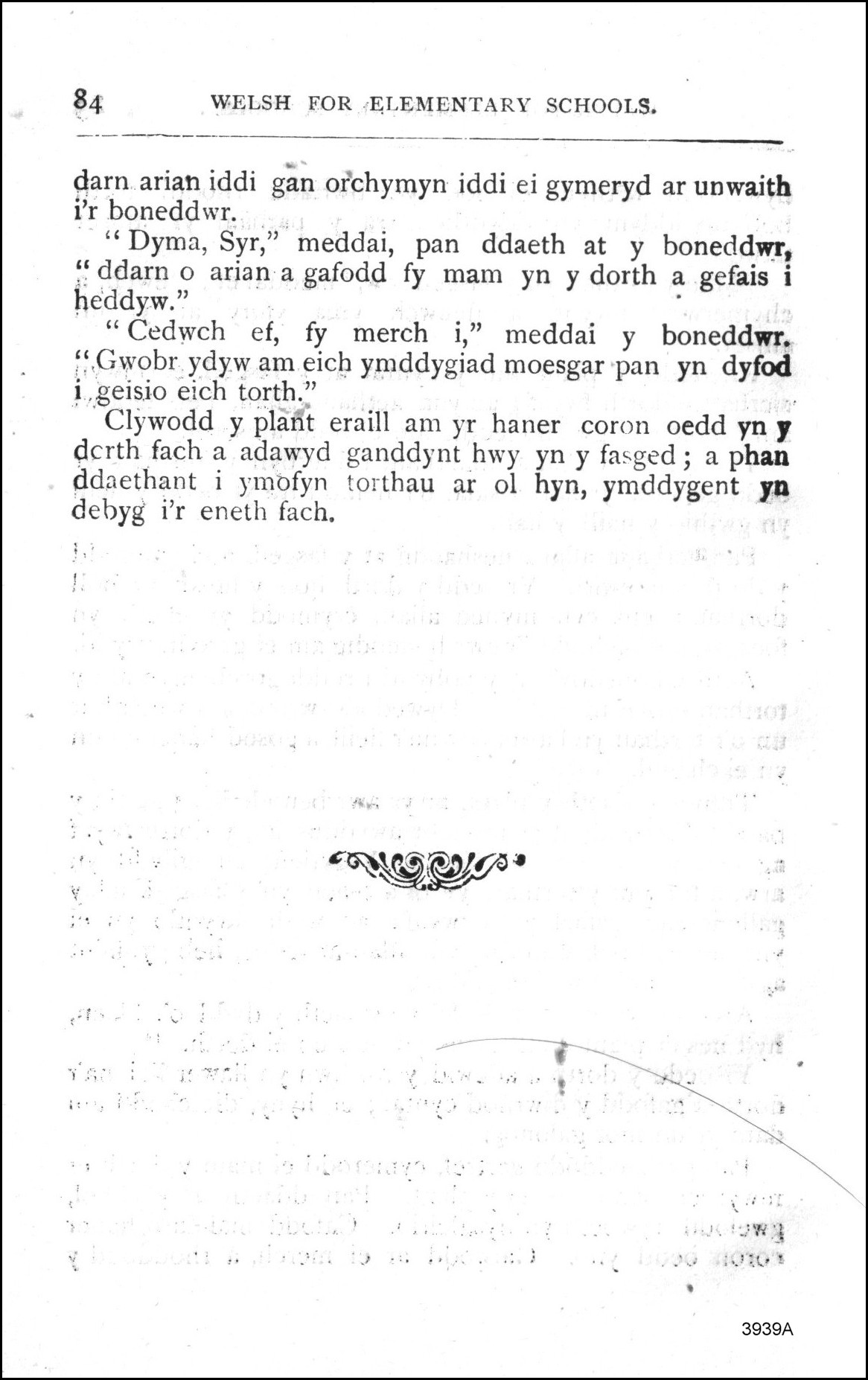
|
(delwedd 3937B)
(x81) Mair deimlo’n flinedig. Nid oedd ei brawd mor fywiog ag oedd pan yn cau
drws tŷ ei
dad.
Yr oeddynt hefyd yn teimlo chwant bwyd, a chafodd y plant nad oedd y gwaith
oeddynt wedi ymgymeryd ag ef mor hawdd ag y meddylient ei fod.
Pan welodd Ioan ei chwaer yn llefain, torodd yntau allan i wylo, ac
eisteddodd y ddau ar ymyl y ffordd, a gofidient eu bod wedi cychwyn ar neges
mor anhawdd ei gwneuthur.
Daeth amaethwr heibio i’r fan lle yr eisteddent, a chymerodd hwynt gydag ef
i’w dŷ.
Rhoddodd ei wraig fara a llaeth i’r plant, a phan gawsant eu digoni,
dechreu¬asant
siarad. Nis gallai yr amaethwr beidio a chwerthin pan glywodd natur y neges
ar yr hon yr oedd y plant wedi cychwyn o’u cartref.
Wedi iddynt orphwys ychydig, aeth y ffermwr â hwynt yn ol i dŷ eu tad. Mawr oedd llawenydd y fam
pan welodd y crwydriaid yn dyfod at y tŷ. Ni
fu Ioan a Mair mor ffol a myned i chwilio am y crochan aur yr ail waith.
14.—Y
TEITHIWR A’R
MWNCIOD (THE TRAVELLER AND THE MONKEYS).
yn mhen tipyn, in a little while er mwyn, for the purpose of
Fel yr oedd dyn yn ymdeithio yn un o’r gwledydd poethion, daeth i le
cysgodol, a gorweddodd ar y ddaear i orphwys. Cyn gwneuthur hyny, agorodd
sypyn o gapiau cochion oedd yn gario, a dododd un o honynt ar ei ben, i’w
amddiffyn rhag gwres yr haul.
Wedi gorwedd, ni fu yn hir cyn syrthio i drwmgwsg. Anghofiodd gau y sypyn cyn
myned i gysgu.
Tra yr oedd ef yn cysgu, daeth heibio haid o fwnciod. Tynodd y capiau eu
sylw. Cymerodd pob un o honynt
|
|
|
|
|
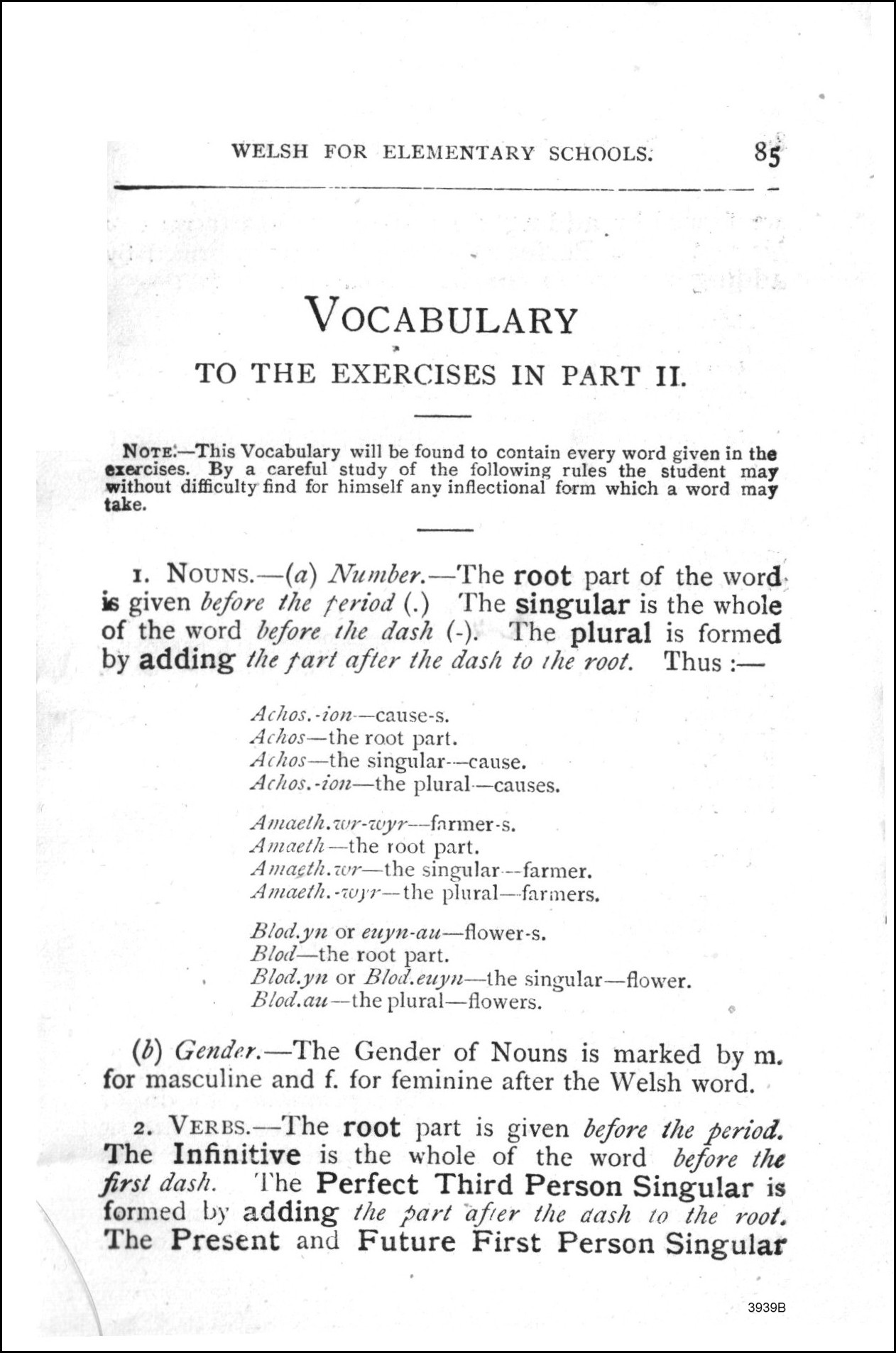
|
(delwedd 3938A) (x82) gap o’r
sypyn, gan ei roi ar ei ben. Yna dringasant i frig y coed, o dan gangenau y
rhai y cysgai perchenog y capiau. Pan gyrhaeddasant frig y coed, dechreuasant
ysgrechain a gwneuthur y seiniau mwyaf erchyll. Fel hyn y dangosent eu
llawenydd.
Deffrodd y teithiwr yn mhen tipyn, a mawr oedd ei syndod pan welodd fod pob
cap wedi myned.
Nis gallai wneuthur allan pwy oedd y lleidr neu’r lladron. Edrychodd i fyny
at frigau y coed, er mwyn cael allan beth oedd achos y cynhwrf oedd yn mhlith
y mwnciod. Yr oedd ei syndod yn fwy fyth. Gwelodd mai y mwnciod oeddynt y
lladron. Y pwnc a lanwodd ei feddwl nesaf oedd, sut i gael ei eiddo yn ol.
Cynygiodd gnau ac afalau iddynt. Gwnaeth bob ymgais ag a allai feddwl am dani
i geisio denu y lladron i ddisgyn, ond yn ofer.
Cofiodd o’r diwedd mai creadur hynod am ddynwared dyn ydyw y mwnci. Ar hyn,
cymerodd y cap oedd am ei ben a bwriodd ef a’i holl nerth ar y llawr, gan
ddysgwyl yn bryderus pa beth a wnaethai y mwnciod. Ar unwaith, wele pob mwnci
yn cymeryd y cap oddiar ei ben ac yn ei daflu â’i holl egni tua’r llawr.
Rhedodd y teithiwr i’w casglu, ac wedi gwneud ei sypyn i fyny aeth ar ei
ffordd yn llawen, gan benderfynu, os byth y cysgai eto mewn lle o’r fath, na
fyddai mor esgeulus a gadael ei sypyn yn agored.
15.—Y BASGEDAID TORTHAU (THE BASKET OF LOAVES).
Pan oedd prinder gwaith, ac mewn canlyniad prinder bwyd, mewn cymydogaeth,
gwahoddodd gwr boneddig caredig oedd yn byw yno, ugain o blant tlodion i’w dŷ, a
|
|
|
|
|
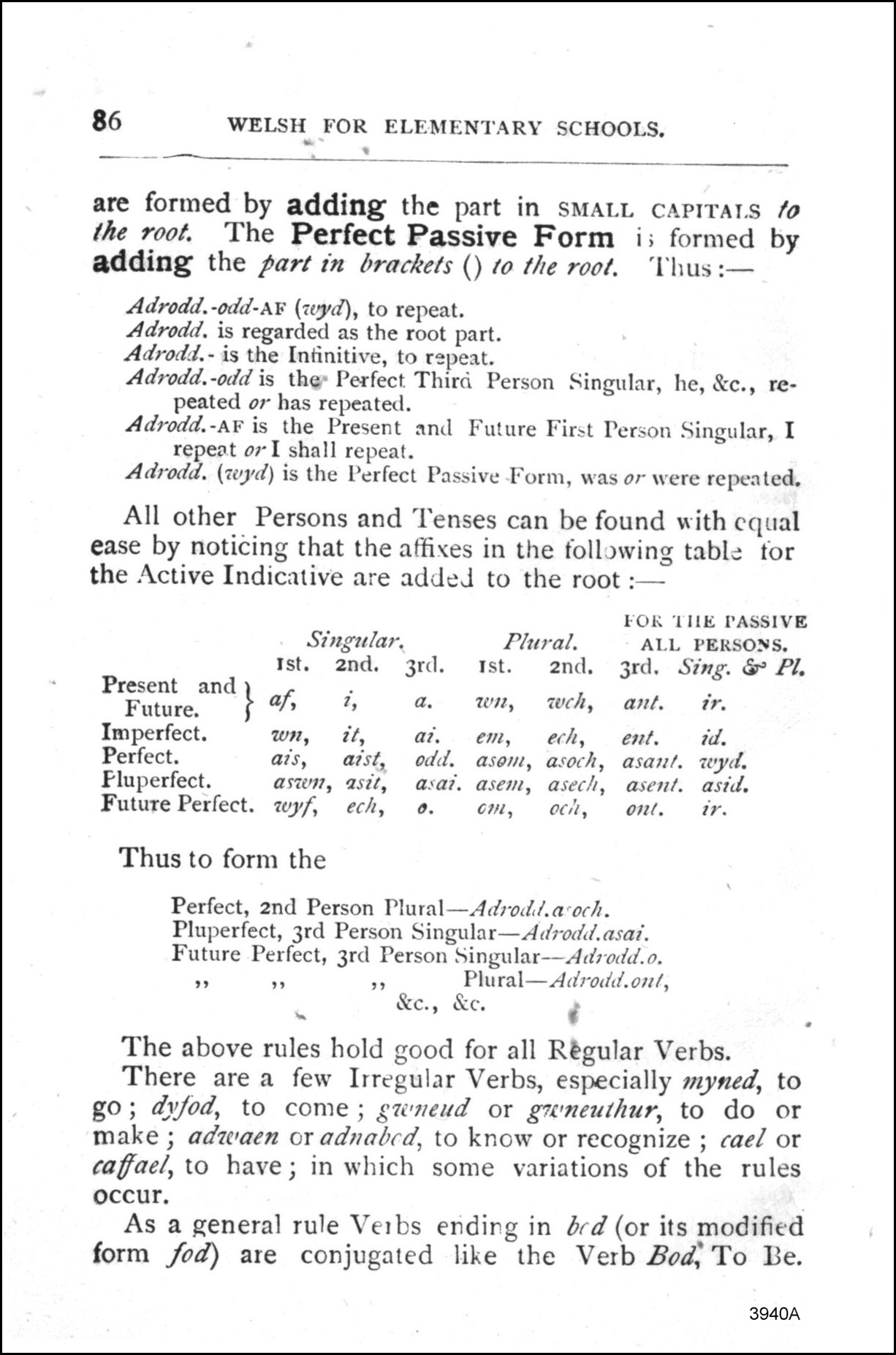
|
(delwedd 3938B) (x83) dywedodd wrthynt ei
fod yn bwriadu rhoddi torth bob un iddynt yn ddyddiol, tra y parhaai yr amser
tlawd.
“Mae y torthau yn y fasged acw,” meddai ef; “ewch, a chymerwch hwynt, a
deuwch yma yfory ar yr un amser.”
Rhedodd y plant am y cyntaf at y fasged, er mwyn sicrhau y dorth fwyaf; ac
yna aethant allan, heb feddwl am ddiolch i’r gwr boneddig am ei rodd amserol.
Yn mhlith y rhai a ddaethant i dderbyn y torthau yr oedd geneth, yr hon a
safai o’r neilldu tra yr oedd y lleill yn gwthio y naill y llall.
Pan aethant allan, neshaodd at y fasged, a chymerodd y dorth a adewid. Yr
oedd y dorth hon y lleiaf o’r holl dorthau; eto, cyn myned allan, crymodd yr
eneth yn foesgar, a diolchodd i’r gwr boneddig am ei garedigrwydd.
Aeth y boneddwr at y pobydd i roddi gorchymyn am y torthau erbyn tranoeth.
Dywedodd wrtho am wneuthur un o’r torthau yn llawer llai na’r lleill, a gosod
haner coron yn ei chanol.
Tranoeth daeth y plant, ar yr awr benodedig, i geisio y bara. Yr oeddynt yr
un mor awyddus am y dorth fwyaf ag oeddynt y dydd o’r blaen. Ysgytient eu
gilydd yn arw, a throent y torthau yn ol a blaen yn y fasged, fel y gallent
gael gafael yn y fwyaf; ac wedi llwyddo yn ei ymgais, elai pob un o honynt
allan ar redeg, heb gymaint ag edrych ar y gwr boneddig.
Arosodd yr eneth fach, fel y gwnaeth y dydd o’r blaen, hyd nes i’r plant
eraill gymeryd pob un ei dorth.
Yr oedd y dorth a adewid y tro hwn yn llawer llai na’r dorth a gafodd y
diwrnod cyntaf; er hyny, diolchodd am dani yr un mor galonog.
Pan gyrhaeddodd gartref, cymerodd ei mam y dorth er mwyn ei rhanu rhwng y
plant. Pan ddaeth at y canol, gwelodd rywbeth yn dysgleirio. Cafodd mai darn
haner coron oedd yno. Galwodd ar ei merch, a rhoddodd y
|
|
|
|
|
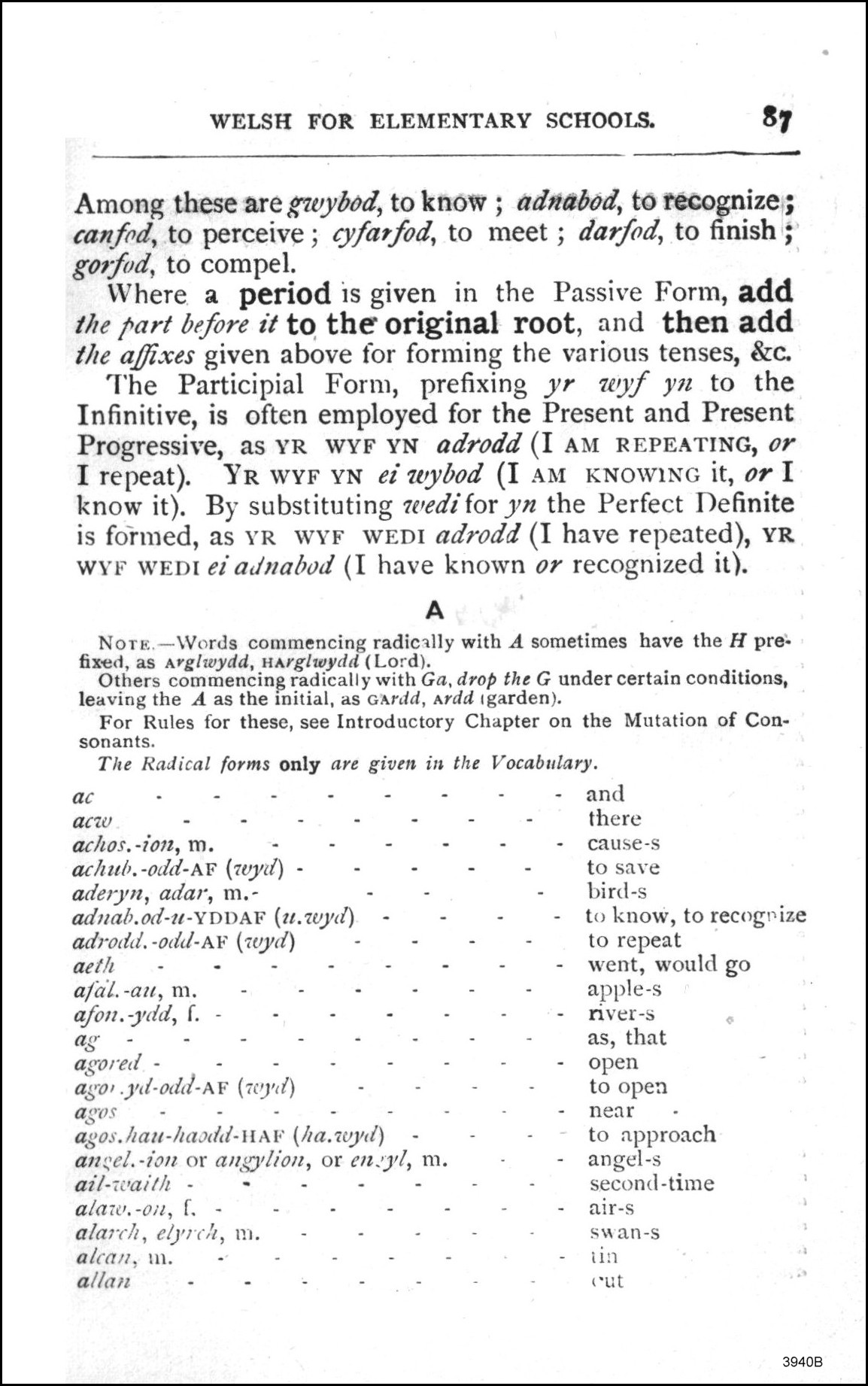
|
(delwedd 3939A) (x84)
darn arian iddi gan orchymyn iddi ei
gymeryd ar unwaith i’r boneddwr.
“Dyma, Syr,” meddai, pan ddaeth at y boneddwr, “ddarn o arian a gafodd fy mam
yn y dorth a gefais i heddyw.”
“Cedwch ef, fy merch i,” meddai y boneddwr. “Gwobr ydyw am eich ymddygiad
moesgar pan yn dyfod i geisio eich torth.”
Clywodd y plant eraill am yr haner coron oedd yn y dorth fach a adawyd
ganddynt hwy yn y fasged; a phan ddaethant i ymofyn torthau ar ol hyn,
ymddygent yn debyg i’r eneth fach.
|
|
|
|
|
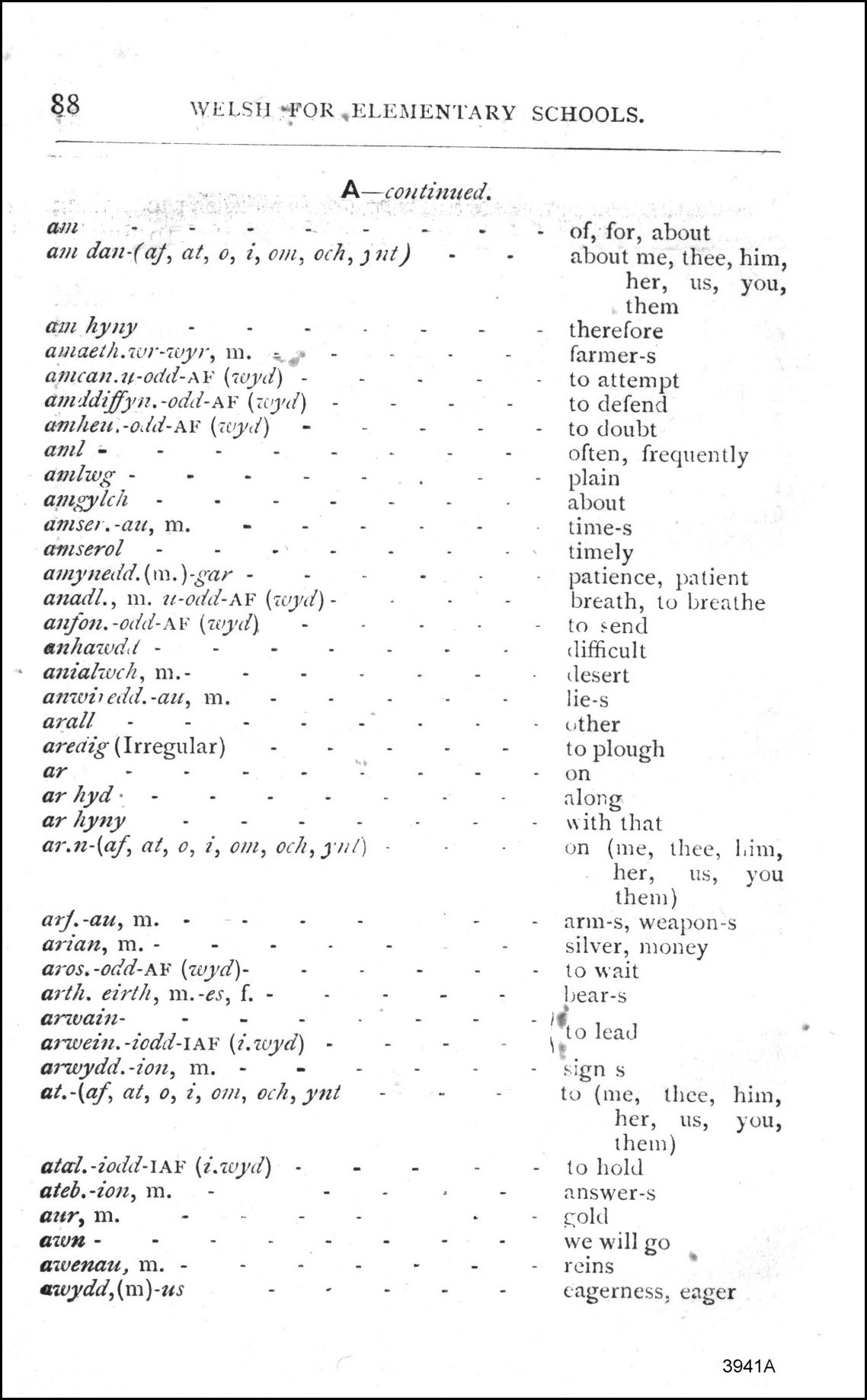
|
(delwedd 3939B) (x85) VOCABULARY TO THE EXERCISES IN PART
II. NOTE:— This Vocabulary will be
found to contain every word given in the exercises. By a careful study of the
following rules the student may without difficulty find for himself any
inflectional form which a word may take.
1. NOUNS.—(a} Number.— The root part of the word given before the period
(.) The singular is the whole of the word before the dash (-). The plural is
formed by adding the part after the dash to the root. Thus:— Achos.-ion / cause-s. Achos / the root
part. Achos / the singular : cause. Achos.-ion / the plural : causes. Amaeth.wr-wyr / farmer-s. Amaeth / the root
part. Amaeth.wr / the singular : farmer. Amaeth.-wyr / the plural : farmers. Blod.yn or euyn-au / flower-s. Blod / the
root part. Blod.yn or Blod.euyn / the singular : flower. Blod.au / the plural
: flowers. (b) Gender.—The Gender of
Nouns is marked by m. for masculine and f. for feminine after the Welsh
word. 2. VERBS.—The root part is given
before the period. The Infinitive is the whole of the word before the first
dash. The Perfect Third Person Singular is formed by adding the part after
the dash to the root. The Present and Future First Person Singular
|
|
|
|
|
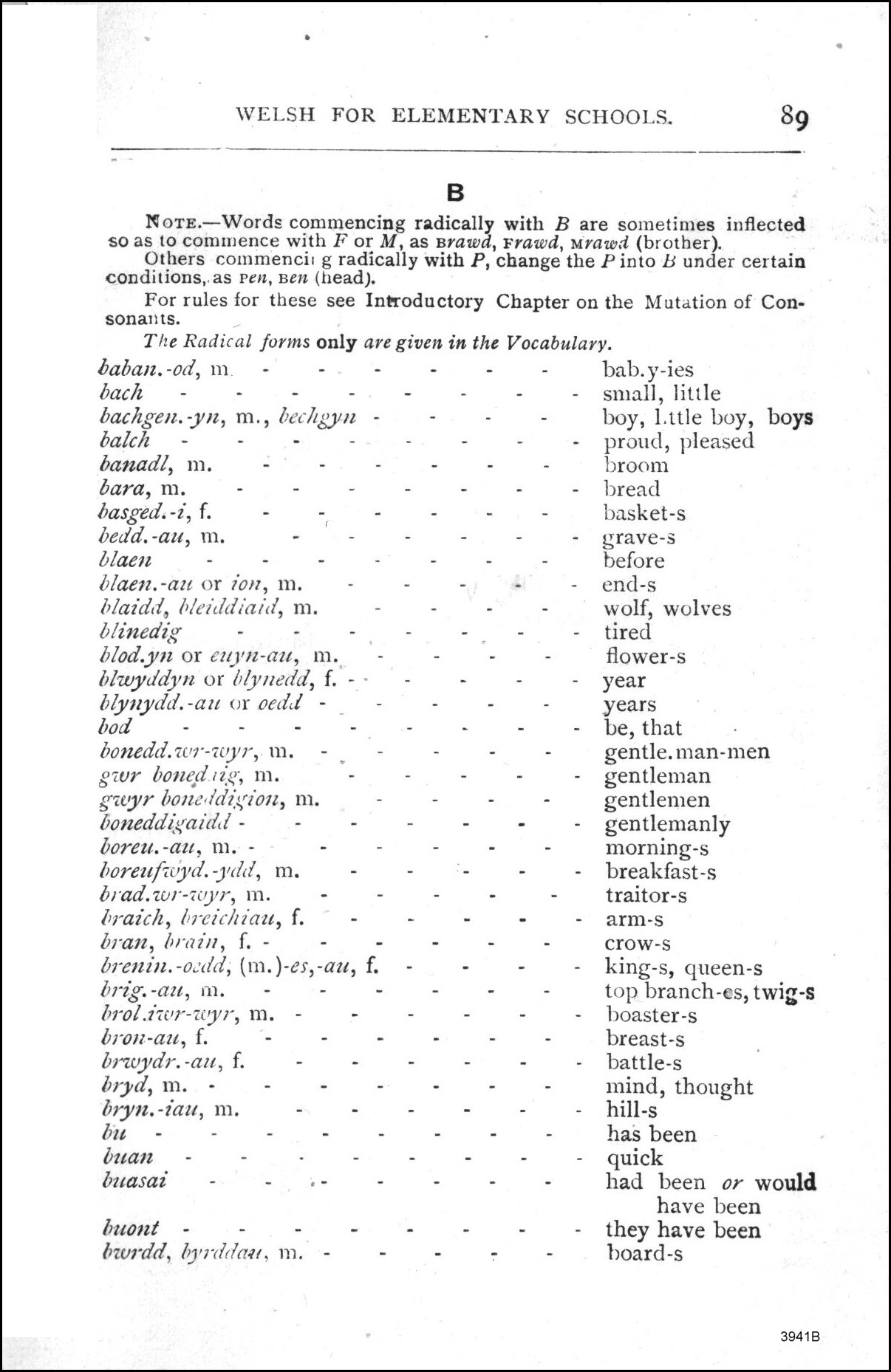
|
(delwedd 3940A) (x86)
86 WELSH FOR ELEMENTARY SCHOOLS. are formed by adding the part in SMALL
CAPITAI,S to the root. The Perfect
Passive Form i formed by adding the
part in brackets () to the root.
"l'hus :— Adrodd. -odd-AF
(tvyd), to repeat. Adrodd. is regarded
as the root part. Adrodd.- is the
Infinitive, to repeat. Adrodd.-oddis
thg• Perfect Third Person Singular, he, &c., re- peated or has repeated. Adrodd.-AF is the Present and Future First
Person Singular, I repeat orl shall
repeat. Adrodd. (tvyd) is the Perfect
Passive -Form, was or were repeated.
All other Persons and Tenses can be found with equal ease by notiéing that the atflxes in the
following table tor the Active
Indicative are added to the root :
Singular, 1st. 2nd. zvn, it,
ais, aist, asten, asit, Plural.
Present and Future. Imperfect.
Perfect. Pluperfect. 3rd.
a. ai. odd.
asai. 1st. ten,
em, asom, asem,
cm, 2nd. tvch,
ech, asoch , asech,
och , FOR PASSIVE ALL PERSONS. 3rd. Sing. PI. ant.
id. ent. asant. zeyd. asent. asid. ont.
Future Perfect. tvyf, ech, Thus
to form the Perfect, 2nd Person Pluperfect, 3rd Person
Singular—Adrodd.asai. Future Perfect,
3rd Person Singular—Adrodd.o.
Plural—Adrodd.ont, The above
rules hold good for all Régular Verbs.
There are a few Irregular Verbs, especially myned, to go ; dyJod, to come ; gwneud or greneuthur,
to do or make ; adwaen or adnaåcd, to
know or recognize ; cael or catae/, to
have ; in which some variations of the rules
occur. As a general rule V abs
ending in bad (or its modified form
fad) are conjugated like the Verb Bod,• To De. 3940A
|
|
|
|
|
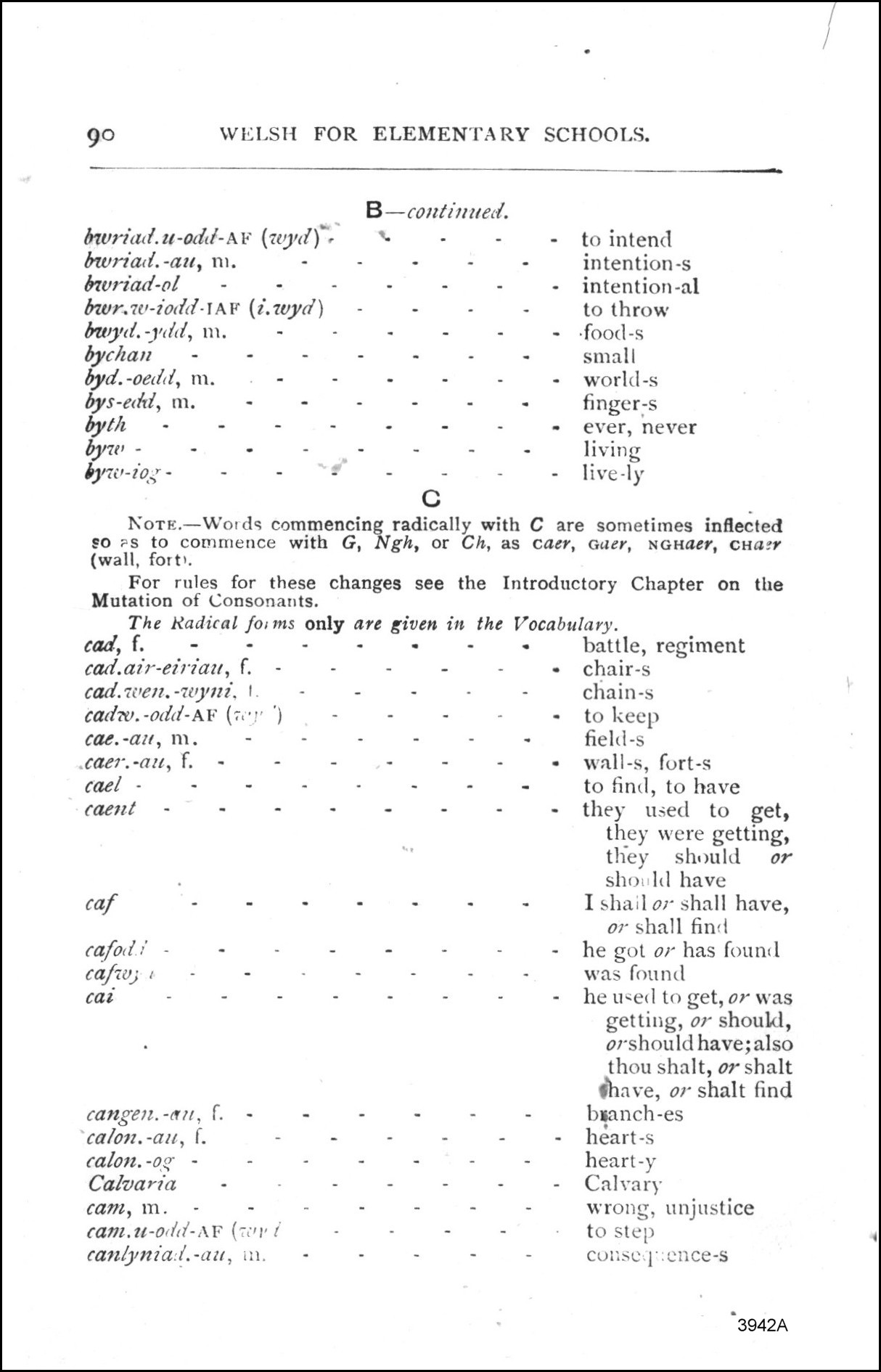
|
(delwedd 3940B) (x87)
WELSH FOR
ELEMENTARY SCHOOLS. 87 Among these aregwyböd, to know ; ädhäböd,
to recognize ; canfod, to perceive ;
cyfatfod, to meet ; darfod, to finish
gorfod, to compel. Where a
period is given in the Passive Form, add
the part before it to the original root, and then add the affixes given above for forming the
various tenses, &c. The
Participial Form, prefixing yr tvyf yn to the
Infinitive, is often employed for the Present and Present Progressive, as YR WVF YN adrodd (I AM
REPEATING, or I repeat). YR WYF YN
eiwybod (I AM KNOWING it, or I know
it). By substituting wedifor yn the Perfect Definite is foimed, as VR WVF WEDI adrodd (I have
repeated), YR WVF WEDI ei adnabod (I
have known or recognized it).
N0TE.—Words commencing radically with A sometimes have the H pre fixed, as Arglwydd, HArglwydd (Lord). Others commencing radically with Ga, drop
the G under certain conditions,
leaving the A as the mitial, as GArdd, Ardd (garden). For Rules for these, see Introductory
Chapter on the Mutation of Con-
sonants. The Radical forms only
are given in the Vocabulary. ac aczv
achos. -ion, m. achub. -odd-AF
(wyd) - aderyn, adar, m.- adnab.od-u-VDDAF (u.zvyd) adrodd. -odd-AF (wyd) aet!l
a/äl. -au, m. afon. -ydd,
f. agored - ago'. yd-odd-AF (7CY'd) ao•os
agos.hau-haodd-IIAF (ha.tvyd)
ancel. -ion or angylion, or en:yl, m.
ail-teaith alazv. -0/1, f. alarch, m.
alcan, m. allan and
there cause-s to save
bird-s to know, to
recognize to repeat went, would go apple-s
river-s as, that open
to open near to approach
angel-s second-time air-s
tin 3940B
|
|
|
|
|
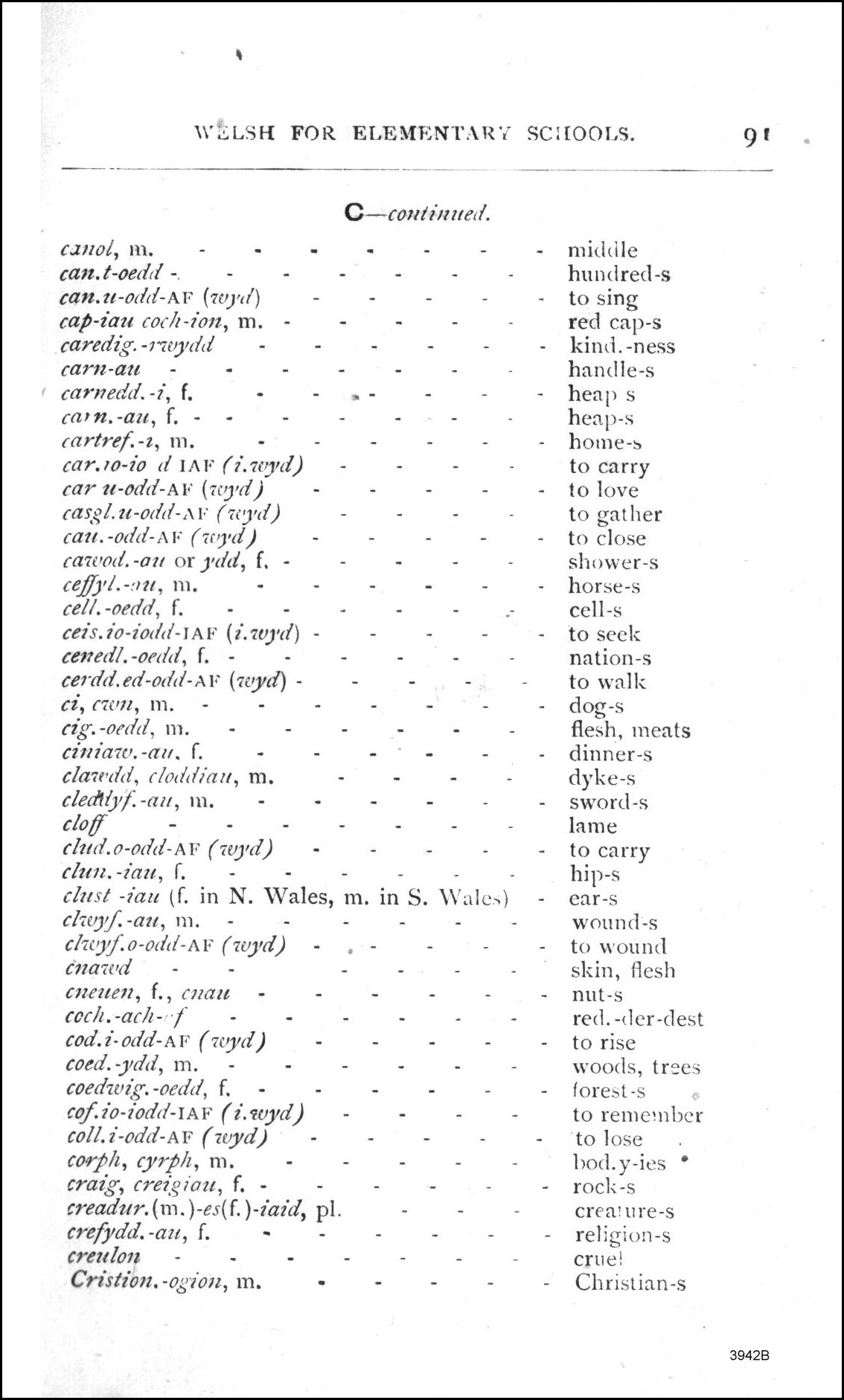
|
(delwedd 3941A) (x88)
$8 am
WELSH •FOR .ELEMEN'I'ARV SCHOOLS.
A—continued. och, nt) am dan-(aj, at, o, i, 0/11, am hyny
amaeth. wr-tvyr, m.
amcan.u-odd-AF (tvyd) amddifyn.
-odd-AF (a-yd) anzheu. -odd-AF
(wyd) am/ - amlzvg -
amgylch amser. -au, m. amserol
aønynedd. (m. )-gar - anadl.,
m. it-odd-AF (tcyd) - anfon. -odd-AF
(zeyd) anhawd,i - aniakvch, m.- antvimedd. -au, m. arall
aredig (Irregular) ar hyd
• ar hyny ar.n-(af, at, o, i, 0/11, ad. -au, m.
arian, m. aros. -odd-AF (zvyd)- arth. eirlh, m.-es, f. - arzvain-
och, 3'/,'/) of, for, about about me, thee, him, her,
us, you, them therefore
farmer-s to attempt to defend
to doubt often, frequently plain
about time-s timely
patience, patient breath, to
breathe to send difficult
desert lie-s other
to plough on along
with that on One, thee,
Lim, her, us,
you them) arm-s, weapon-s anvein. -iodd-1AF (i.wyd) arzvydd. -ion, m. at.-(af, at, o, i, 0m, ach, ynt atcI.-iodd-IAF (i.wyd) ateb.-ion, m. aur, m.
awn - awenau, m. - awydd,(m)-us silver, nioney to wait
bear-s to lead sign s
to (me, thee, her, us,
thetn) to hold answer-s
cold we will go reins
him, you, eagerness, eager 3941A
|
|
|
|
|
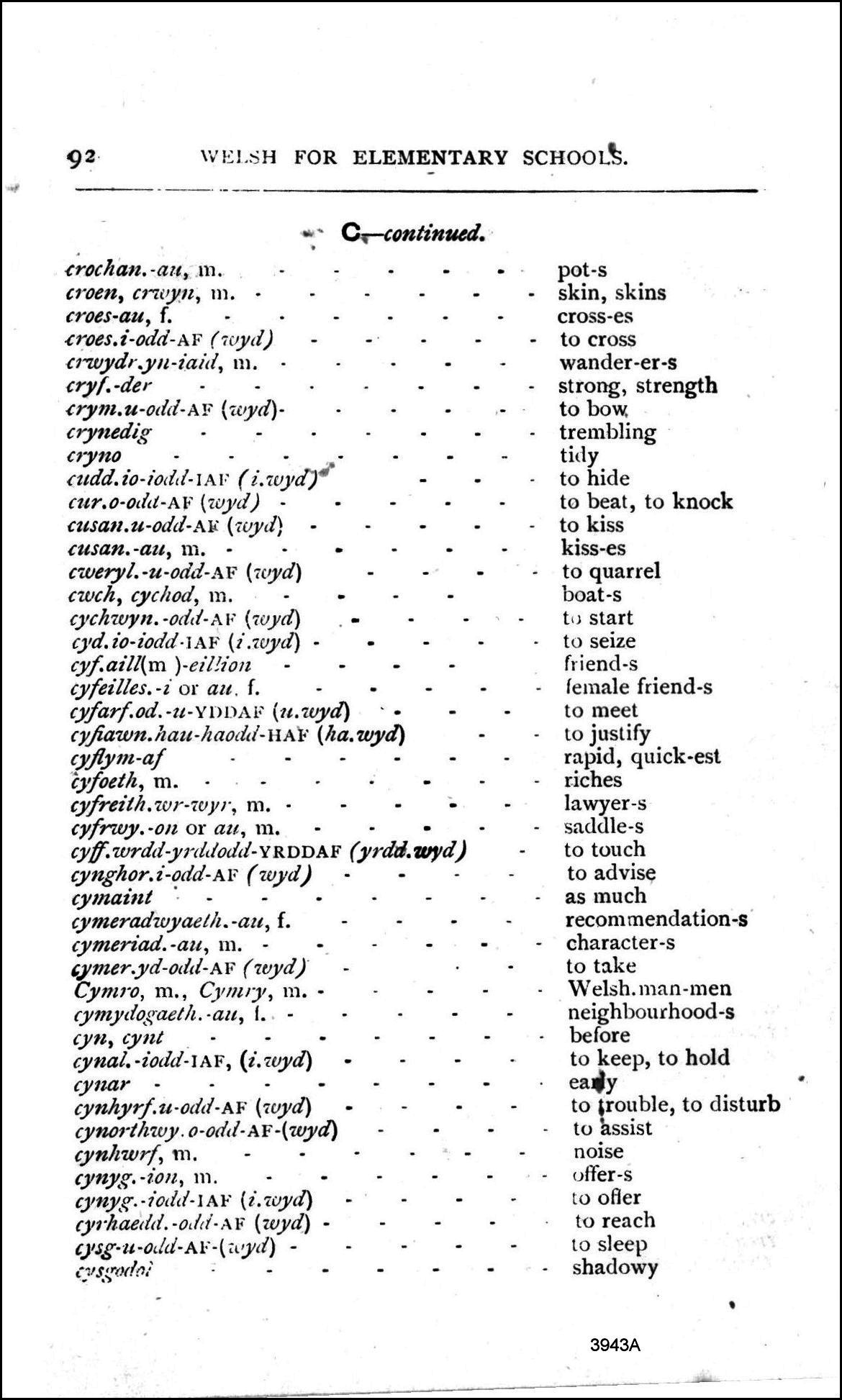
|
(delwedd 3941B) (x89)
WELSH FOR
ELEMENTARY SCHOOLS. 89 N 0TE.—Words commencing radically with B
are sometimes inflected so as to
commence with F or M, as Brawd, Frawd, Mrawd (brother). Others commencil g radically with P, change
the P into B under certain
conditions„as pen, Ben (head).
For rules for these see Inyoductory Chapter on the Mutation of
Con- sonants. The Radical forms only are given in the
Vocabulary. baban. -ad, m bach
bachgen. -yn, m. , åechgyn
balch banadl, m. bara, m.
basged,-i, f. bedd. -au,
m. blaen blaen. -au or ion, m. blaidd, Oleiddiaid, m. blinedig
ålod.yn or cuyn-au, m. blwyddyn
or ilynedd, f. - ålynydd. -au or oedd bod
boncdd. tcw-tvyr,. m. gwr boned
lie, m. gwyr bone,/di.srion, m. boneddisraidd - boreu. -azt, m. boreußvyd. -ydd, m. brad. wr-tvyr, m. iraich, ircichiau, f. bran, brain, f. - brenin. -ocdd, (m. )-es årig. -au, m. lwol.iwr-ayr, m. bron-au, f.
brzvydr. -au, f. bryd, m. bryn. -iau, m. buan
buasai buont bwrdd,
l)3'77idau, m. bab.y-ies small, little boy, l.ttle boy, boys proud, pleased broom
bread basket-s grave-s
before end-s wolf, wolves tired
flower-s year years
be, that gentle. man-men gentleman
gentlemen gentlemanly morning-S
breakfast-s traitor-s arm-s
crow-s king-s, queen-s top branch-es, twig-s boaster-s
breast-s battle-s mind, thought hill-s
has been quick had been or would have been
they have been board-s 3941B
|
|
|
|
|
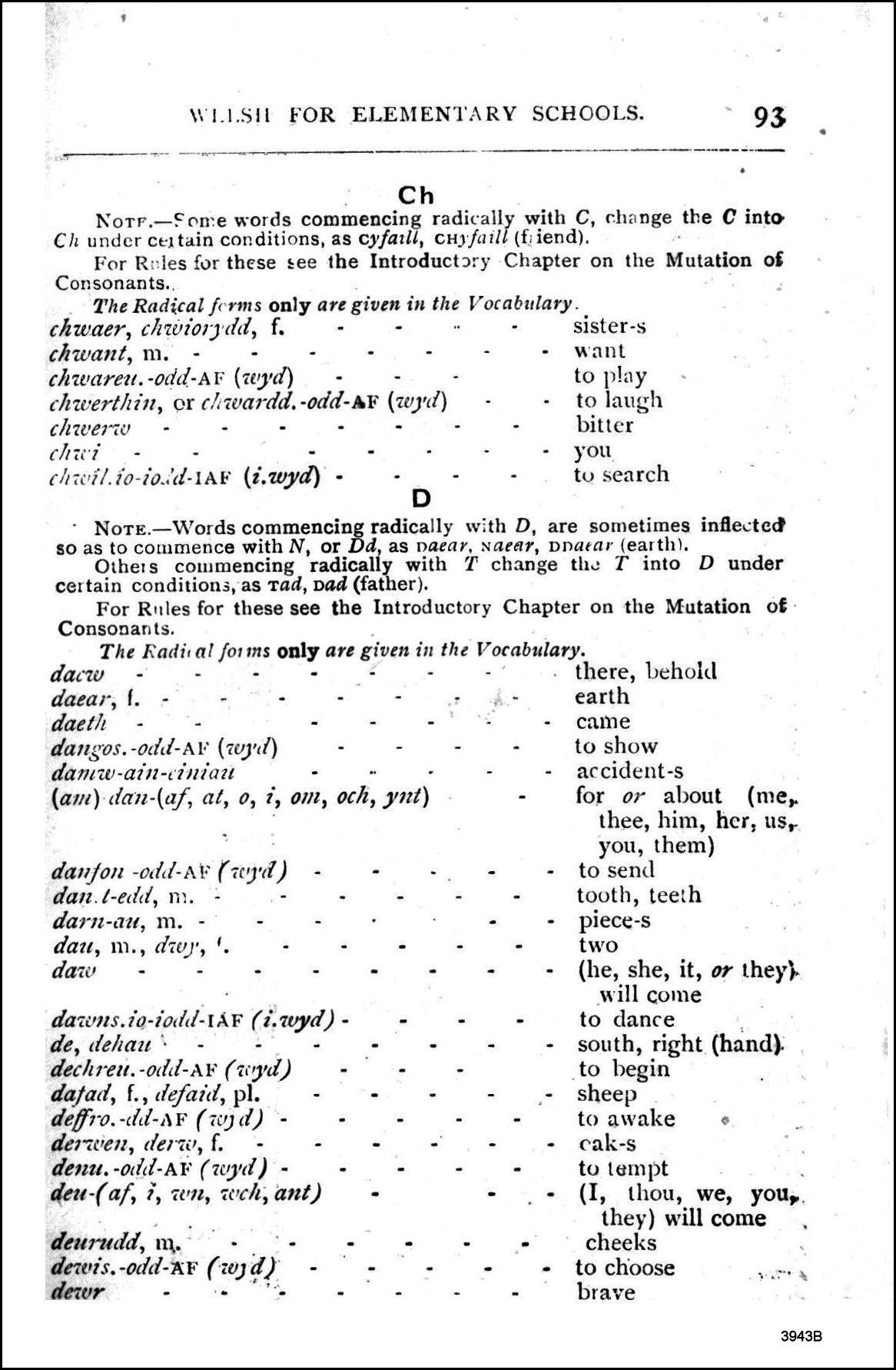
|
(delwedd 3942A) (x90)
90 WELSH FOR ELEMENTARY SCHOOLS. bwriad.u-odd-AF (tvyd) bwriad. -au, m. btvriad-ol
bzvr.w-iodd-IAF (i.zvyd) bzvyd.
-ydd, m. bychan byd.-oedd, m. bys-edd, m.
byth 'tv-io• - B —continued. c to
intend intention-s intention-al to throw
•food -s small world-s
finger-s ever, never living
live-ly N0TE.—Words commencing
radically with C are sometimes inflected
eo æs to commence with G, Ngh, or Ch, as caer, Gaer, NGHaer,
cHa:r (wall, fort). For rules for these changes see the
Introductory Chapter on the Mutation
of Consonants. The Radical yo; ms only
are given in the Vocabulary. cad, f. cad.air-eiriau, f. cad.wen. -zvyni, l. cadw.-odd-AF cae.-au, m.
.caer.-au, f. cael - caent
cafod caftv; cai
cang•en. -du, f. calon. -au,
f. calon. -og- Calvaria
cam, m. cam. it-odd-AF canlynia / - •
• battle, regiment chair-s
chain-s to keep field-s
wall-s, fort-s to find, to
have they used to get, they were getting, tliey sht )uld or should have
I shail or shall have, or shall
find he got or has found was found
he u•ed to get, or was getting,
or should, orshould have; also thou shalt, or shalt 'have, or shalt find blanch-es
heart-s heart-y Calvary
wrong, to step conseq•
unjustice :ence-s 3942A
|
|
|
|
|
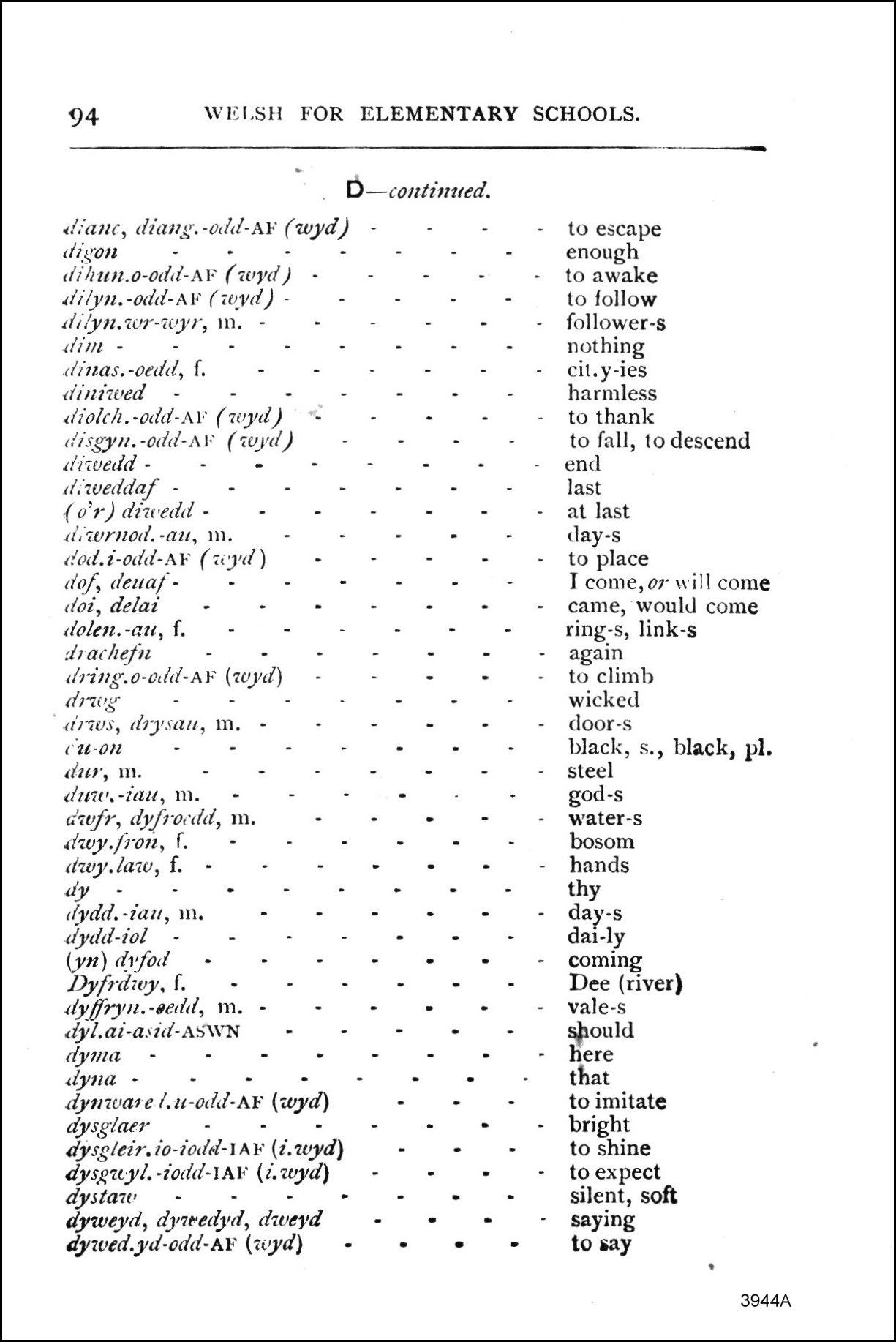
|
(delwedd 3942B) (x91)
FOR
ELEMENTARY sc:roors. C—continued. canol, m.
can.t-oedd - can.u-odd-AF (wyd) cap-iau coch-ion, m. caredig. -rtvydd carn-au
carnedd. -i, f. car n. -au, f.
- cartre/. -z, m. car. 10-io d IA F (i.ayd) car a-odd-AF (zcyd) casgl. it-odd-AF (t('3'd) cau. -odd-AF (7f'3'd) cawod. -au or ydd, f. ceTY'l.-.'/?t, m. cell. -oedd, f. ceis.io-iodd-JAF (i.wyd) cenedl. -oedd, f. cerdd. ed-odd-AF (tvyd) ci, cten, m. cig. -oedd, ln. ciniazv. -au. f. clawdd, cloddiau, m. cledly/l -au, m. cloa
clud.o-odd-AF (tvyd) clun.
-iau, f. dust -iau (f. in N. Wales, cltvyf. -azt, m. ckcyf. a-odd-AF (wyd) dnat('d
cneuen, f. , cnau
coch.-ach- cod.i-odd-AF
(tvyd) coed. -ydd, m. coedzvig•. -oedd, f. cof.io-iodd-IAF (i.wyd) coll. i-odd-AF (wyd) coq/l, cyrph, m. craig•, creigiau, f. - )-iaid, pl.
crefydd. -au, f. creulon Cristian. -ogion, m. m.
in S. middle hundred-s
to sing red cap-s kind. -ness
handle-s heap s heap-s
home-s to carry to love
to gather to close shower-s
horse-s cell-s to seek
nation-s to walk dog-s
flesh, meats dinner-s dyke-s
sword-s lame to carry
hip-s ear-s wound-s
to wound skin, flesh nut-s
red. -der-dest to rise woods, trees forest-s
to remenber to lose bod.y-ies
rock -s creat u re-s religion-s
crue! Christian-s 3942B
|
|
|
|
|
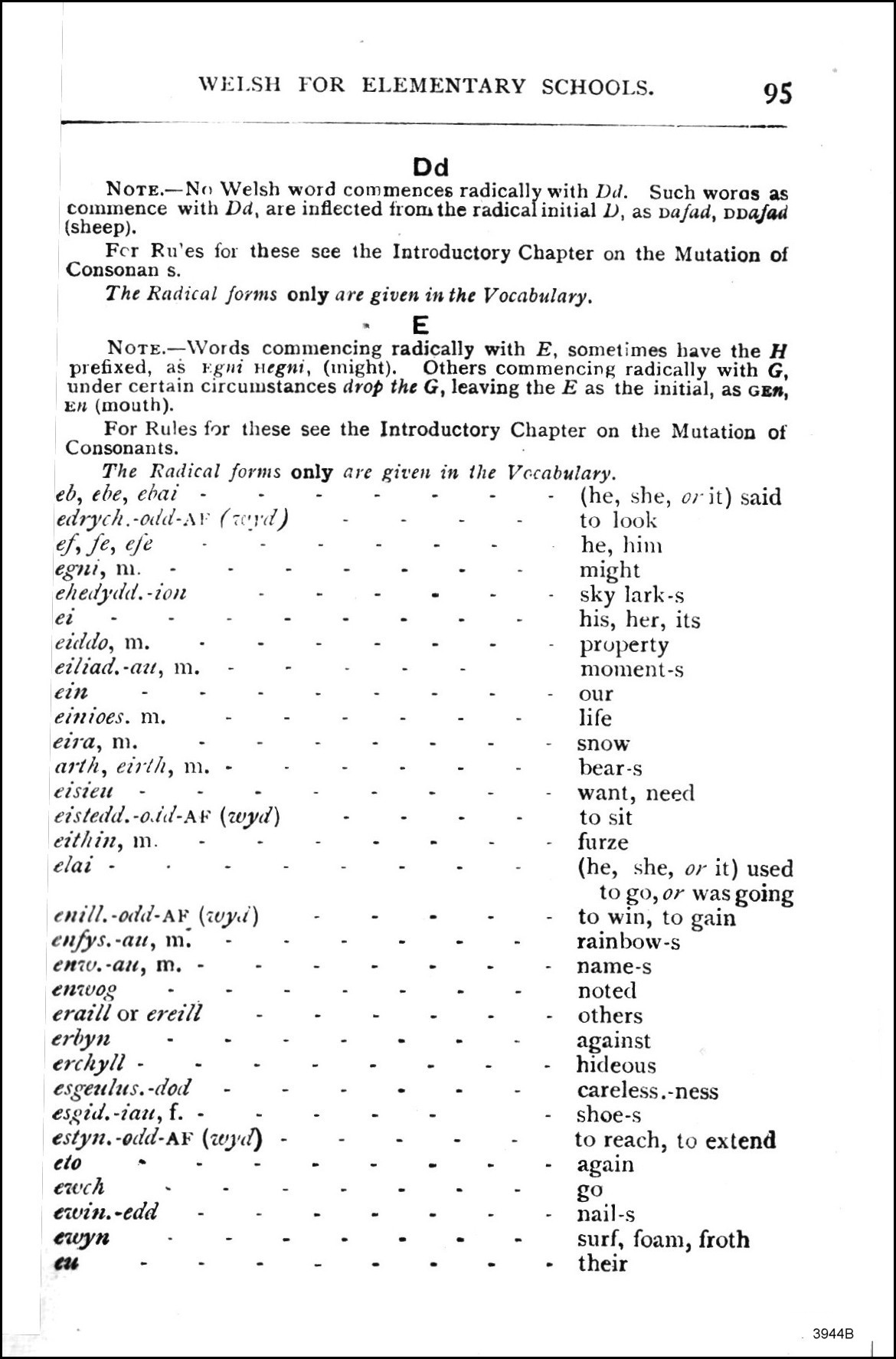
|
(delwedd 3943A) (x92)
92 WELSH FOR ELEMENTARY SCHOOLS. Caontinued.
crochan. -au, m. croen, crayn,
ln. croes-au, f. croes.i-odd-AF (tvyd) crzvydr.yn-iaid, m. cry/. -der
crym.u-odd-AE (tvyd)-
crynedig cryno cudd.io-iodtl-1AF (i.tcyd) cur.o-odd-AF (wyd) cusan.u-odd-AF (tvyd) cusan. -au, m. cweryl. -u-odd-AF (ayd) czvch, cychod, m. cychzvyn. -odd-A F (tvyd) cyd. io-iodd•iAF (i.tvyd) cyf.aill(m
cyfeillcs. -i or au. f.
cyfarf.od.-u-Vl)DAF (u.tvyd)
cyfazvn.hau-haodd-iIAF (ha.zvyd)
cyßynz-af kyfoeth, m. cyfreith. wr-zvyr, m. cyfrzvy. -on or au, m. cyf.zvrdd-yrddodd-y RDDAF (yrdd.zvyd) cynghor. i-odd-AF (wyd) cymaint
cymeradzvyaeth. -au, f.
cymeriad. -au, m.
vnzer.yd-odd-AF (wyd) Cymro, m.
, Cymry, ln. - cynzydogaet/l. -au,
f. cyn, cynt c.ynai. -iodd-1AF, (i.zvyd) cynar
cynhyrf.u-odd-AF (-,cyd)
cynorthwy. 0-odd-AF-(wyd)
cynhzvr/, m. cynyg. -ion,
ln. cynyg•.-iodd-IAF (i.wyd) cyrhaedd. -odd-AF (wyd) cysg-u-odd-AF-( -,eyd) pot-s
skin, skins cross-es to cross
wander-er-s strong,
strength to bow. trembling
tidy to hide to beat, to knock to kiss
kiss-es to quarrel boat-s
to start to seize friend-s
female friend-s to meet to justify
rapid, quick-est riches lawyer-s
saddle-s to touch to advise
as much recommendation-s character-s
to take Welsh. man-men neighbourhood-s before
to keep, to hold eady to brouble, to disturb to åssist
noise offer-s to offer
to reach to sleep shadowy
3943A
|
|
|
|
|
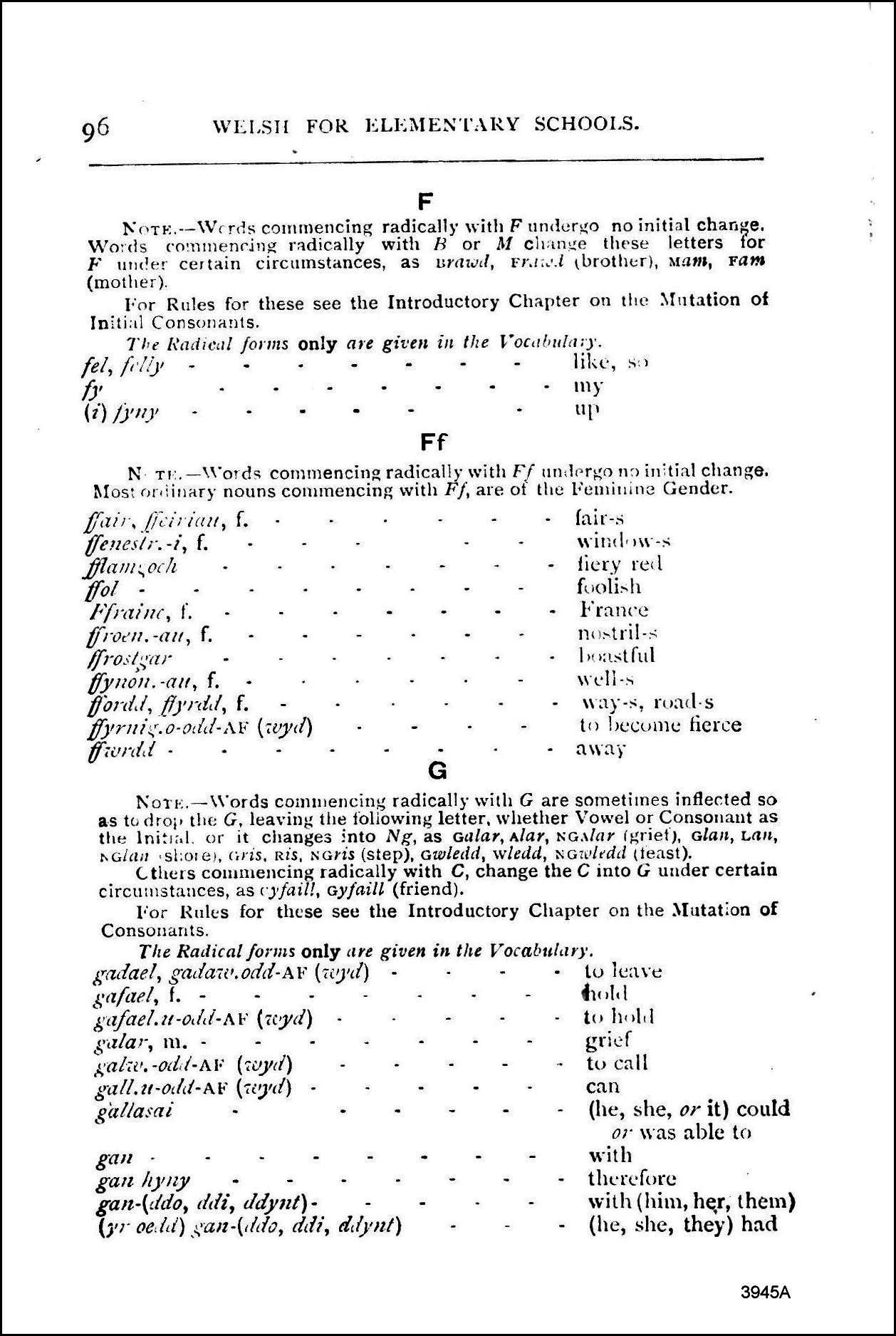
|
(delwedd 3943B) (x93) V, 1.1..S11 FOR ELEMENTARV SCHOOLS. Ch
93 Con:e words commencing
radically with C, change the C into
Norr.— Ch under ce•J tain
conditions, as cyfazll, cH_Üaill (fi iend).
For for these see the Introductory Chapter on the Mutation Of Consonants.
The Radical f€wms only are given in the Vocabulary. chwaer, chzvio;ydd, f. chwant, m.
chzvareu. -odd-AF (teyd)
chwerthin, or clæardd. -odd-AF (7')'d)
cha•i chü'i/.io-io..'d-IAF
(i.zvyd) sister-s M ant
to laugh bitter you
to search N0TE.—Words
commencing radically w:th D, are sometimes inflected so as to cotnmence with N, or Dd as oaear,
Naeetr, l)naear (eal th). Others
cotnmencing radicaliy with T change the T into D under certain conditions, as Tad, Dad
(father). For Rules for these see the
Introductory Chapter on the Mutation of
Consonan ts. The Radit at fot
ms only are given in the Vocabulary.
dactv daea;•, f. daeth
dangos. -odd-AF (70)'d)
damw-ain-ciniazt (am) dan-(af,
at, o, i, 01/1, och, davyfon -odd-Afr
(7C'J'd) dan. I-edd, darn-au, m.
dau, ln., 1. daze dawns.io-iodd-1ÅF (i.tvyd) - de, dehau
dechreu. -odd-AF da/ad, f. ,
defaid, pl. dearo. -cid-AF d) derzc't'l,', f. denu. -odd-AF (7C')'d) deu-(af, i, ten, CC'C/I, ant) deurudd, IA. detvis.-odd-AF (w) d) deter
Jilt) there, behold earth
came to show accident-s
for or about (me„ thee, him,
her, itsy you, them) to send
tooth, teeth piece-s two
(he, she, it, or they). Mill
cone to dance south, right (hand). to begin
sheep to awake cak-s
to tempt (1, thou, we, you, they) will come cheeks
to choose brave 3943B
|
|
|
|
|
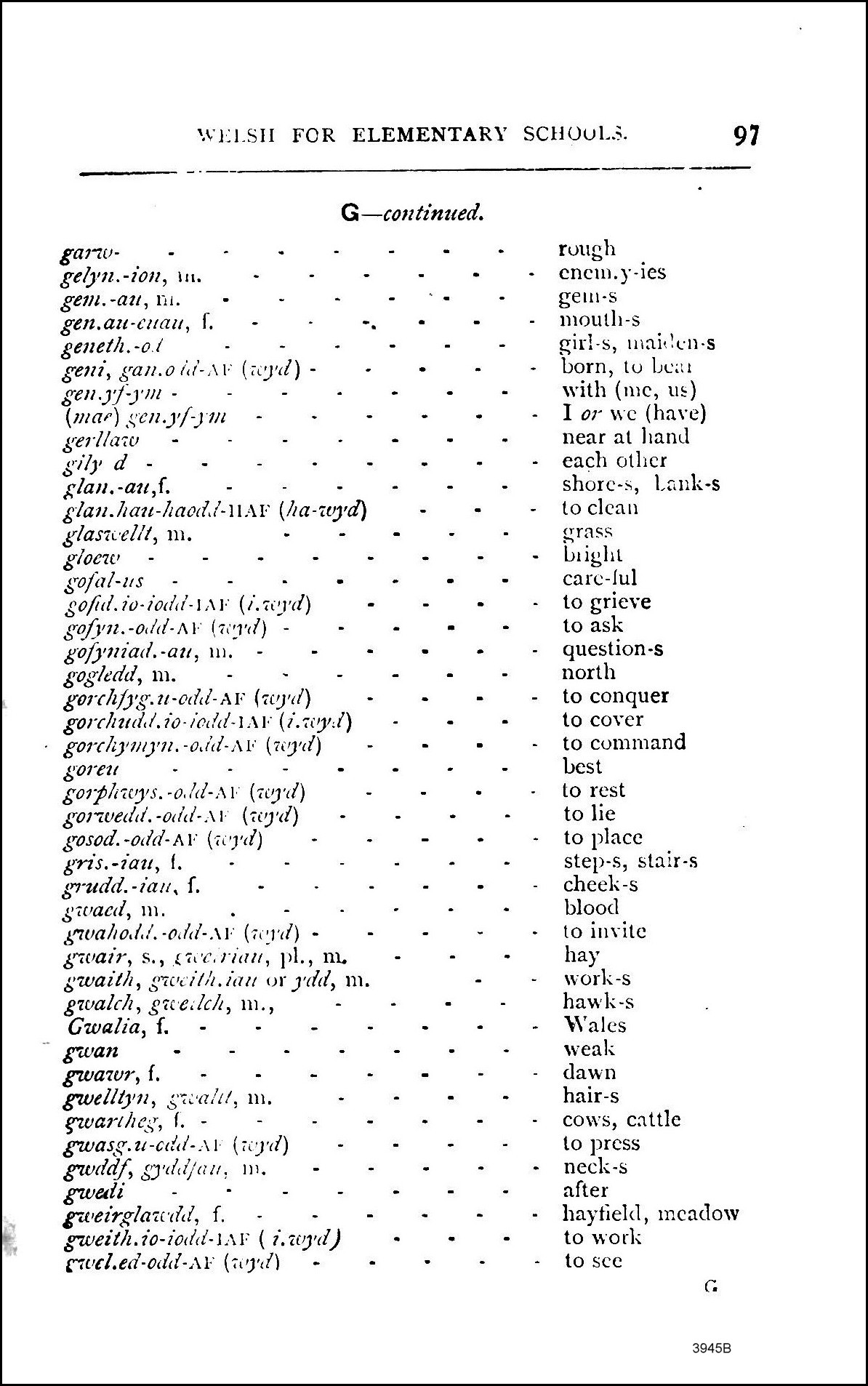
|
(delwedd 3944A) (x94)
94 WELSH FOR ELEMENTARY SCHOOLS. b—continued. diangr. -odd-AF (wyd) dig-on
dihun.o-odd-AF (wrd) dilyn.
-odd-AF (70.vd) di/yn.ter-tvyr,
ln. dim - .dinas. -oedd, f. diniwed
diolch. -odd-Ali' (wyd) isgyn.
-Odd-AF (tvyd) ditvedd - d, •weddaf
diteedd - -au, ln. dod.i-odd-AF (teyd) dof, deua/-
doi, delai dozen. -au, f. dl ach€nn
dring.o-odd-AF (wyd) drag. zirws, drysau, m. c it-on
dur, m. dute. -iau, m. dtvfr, dyfrot•dd, m. dwy./ron, f. dzvy.lazv, f. dydd. -iau, m. dydd-iol
(yn) difod Dyfrawy, f. dyTryn. -eedd, m. - dyl.ai-asid-ASWN dyma
dyna dynzvaøe /.u-odd-AF
(wyd) dysg•laer dysg/eir. io-iodd-IAF (i.tvyd) dysgteyl. -iodd-lAF (i.zvyd) dystaw
dyzveyd, dyteedyd, dwerd
dyzved.yd-odd-AF (wyd) to
escape enough to awake
to follow follower-s nothing
cit.y-ies harmless to thank
to fall, to descend end last
at last day-s to place
I come, or come came, would
come ring-s, link-s again
to climb wicked door-s
black, s. , black, pl. steel god-s
water-s bosom hands
thy day-s dai-ly
coming Dee (river) vale-s
spuld here that
to imitate bright to shine
to expect silent, soft saying
to say 3944A
|
|
|
|
|
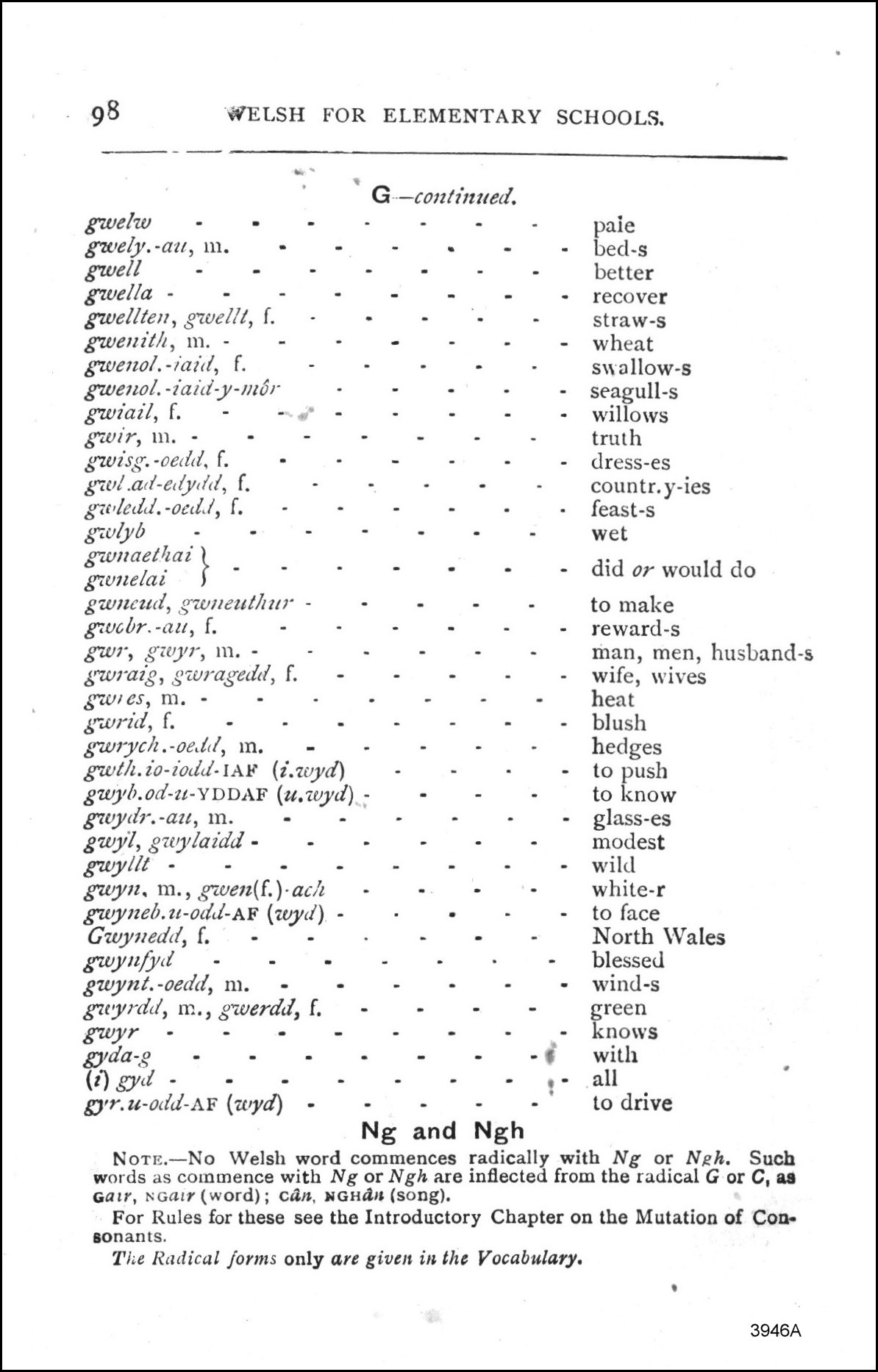
|
(delwedd 3944B) (x95) WELSH FOR ELEMENTARY SCHOOLS. Dd
95 Welsh word commences
radically with Dd. Such woras as
commence with Dd. are inflected from the radical initial D, as Dafad,
DDaJgd (sheep). Fcr Ru'es for these see the Introductory
Chapter on the Mutation of Consonan
s. The Radical forms only are given in
the Vocabulary. N0TE.—Words commencing
radically with E, sometimes have the H
prefixed, as F.gni Hegni, (might). Others commencing radically with
G, under certain circumstances drop
the G, leaving the E as the initial, as GEN,
En (mouth). For Rules for these
see the Introductory Chapter on the Mutation of Consonants.
The Radical forms only are given in the Vc.cabulary. eb, ebe, ebai alrych.-odd-AF (rc•rd) ef, fe, ej-e egui, m.
ehedydd. -ion ei eiddo, m.
eiliad. -au, m. cin euuoes. m.
eira, m. arth, eirlh, m. eisieu
eistedd.-aid-AF (wyd) eithin,
m. elai enill. -odd-AF (wyti) enfys. -au, m. entv.•au, m. enwog
eraill or erei/l erbyn erchyll -
esg•eulus. -dod esgid.-iau,f.
- estyn. -odd-AF (zeyd) elo
ewch etvin. •edd awn
(he, she, or it) said to
look he, hinm might
sky lark-s his, her, its property
moment-s our life
snow bear -s want, need
to sit furze (he, she, or it) used to go, or was going to win, to gain rainbow-s
name-s noted others
against hideous careless .-ness shoe-s
to reach, to extend again nail-s
surf, foam, froth their 3944B
|
|
|
|
|
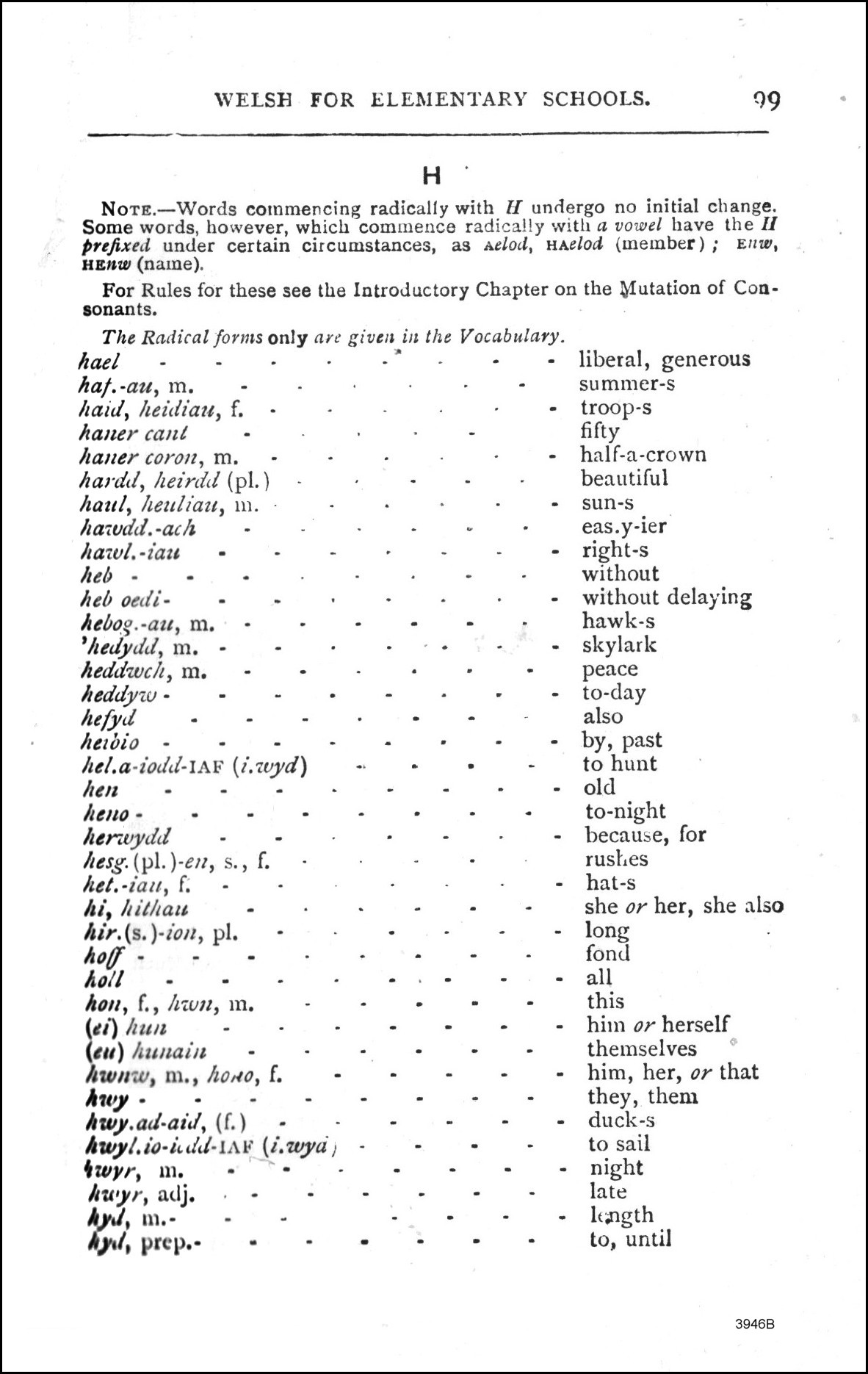
|
(delwedd 3945A) (x96)
96 WI-ISH FOR ELEMEN'I'ARV SCHOOI.S. N0TE.-—Wc res conunencing radically with F
undergo no initial change. V,'o: ds
radically with B or M chanue these letters for ,e.t (brother), Mam, Fam F cer tain circlitnstances, as urawd, (mother).
For Rules for these see the Introductory Chapter on the Mutation
of Initial Consonants. The Raziieal fonns only ave given in the ;
y. fez, (i) /jny
like, Iny up N
TIA — YVcvd* conunencing radically with Ft- undergo no initial change. Most orliinary nouns conunencing with F f,
are ot the Fetnitline Gender. iau,
f. Lenesi;•. -i, f. Inc/
rot'/,'. -alt, f. //ros/i 'a
r Lynon. -au, f. //brd,i, (iyrdd, f. Zyrni r.D-odd-AE (ayd) fiery red
fooli4i ICrance 'St ril-s
K 1st f Ill ay-s, roacl-s to beccnne fierce a svay
conunencing radically with G are sometimes inflected so as to drop the G, leaving the foliowing
letter, whether Vowel or Consonant as
it changes into Ng, as Galar, Alar, NGAIar (Kriet), Glan, Lan, the Initial. or N Glan crris. Ris, NG"iS (step),
Gtvledd, wledd, NGtvledd (least).
ethers conamencing radically with C, change the C into G under
certain circu:nstaaces, as (Yfail!,
GYfailI (friend). For Rules for these
see the Introductory Chapter on the Mutat:on of Consonants.
The Radical forms only are given in the Vocabulary. gadael, gadaü'.odd-AF (-,vyd) gafael, f.
safael.u-odd-AF (rcyd) gala;-,
111. gal-cd'. -odd-AF (tvyti) ga(l.u-odd-AE (7')'d) gkt(/ascti
gan gan hyny gan-(ddo, ddi, ddynt)- oe.ld) oan-(ddD, ddi, ddynt) to leave
grief to call can
(he, she, or it) could or '.vas
able to with therefore
with (hitn, her, them) (he,
she, they) had 3945A
|
|
|
|
|
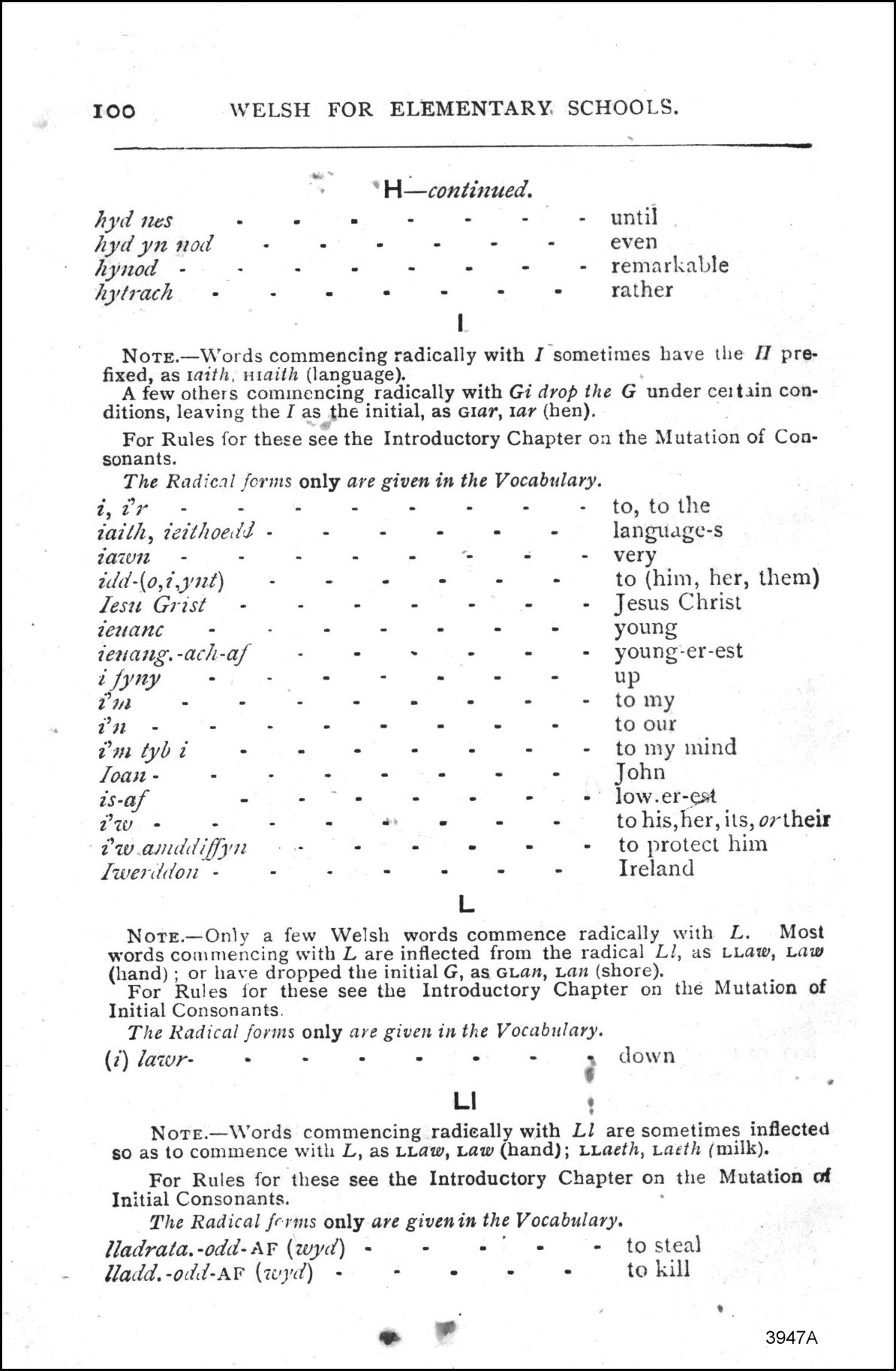
|
(delwedd 3945B) (x97) '.VELSII FOR ELEMENTARY G —continued. garzv-
gelyn.-ion, ill. gem. -au, hi. gen.azt-cuau, f. geneth. -0.1 geni, /,/- \ l,' (map) gcn.y/-ym grerl/atv
077)' d Klan. -au,f. glan.hau-haod,/-llAF (ha-tvyd) glasacl/t, ln. g/oczc'
goral-us (i. ti')'d) goral. io- iodd- I A gofyn.-odd-A (7C'1'd) go/yniad. -au, 11). gwledd, m.
gorch/yg. u-odd-AF (tcyd)
gorchudd. io- ;odd-l A 1•• (i. tvy./)
gorchy•myn. -o,/d-A (7V)'d)
goreu gorphtvys. -a Ill-A
l, gorzvedd. -odd-.\ l, (tv) 'd)
gosod. -odd-AF (71'Yd)
gris.-iau, f. p-udd. -iauq
f. gwacd, ln. -odd-.\1•• (701'd) pl., m.
gtvair, s. , ozvaith,
geeith.iau or ydd, m. gzvalch,
gtcc,lch, n). , Gzvalia, f. gtvan
gu,'azvr, f. ovelltyn, ln. guardicmr, f. g•zvasg. u I g•zvddf, gydd;au. guali
gveirglatcdd, f.
gueith.io-iodd-l.\l•• ( i. tvyd)
SCHOUI„.;. rough cnmn.y-ies
gelli•s Inouth-s gir.-s,
born, to bear with (Inc, us) I or (have)
near at hand each other -ank-s
shore-s, to clean bliglll
care-lul to grieve to ask
question •s north to conquer
to cover to command best
to rest to lie to place
step-.s, stair-s cheek -s blood
to invite hay work-s
ha" k -s Wales weak
dawn hair-s cows, cattle to press
neck-s after hayfield,
to "Ork to see 3945B
97
|
|
|
|
|
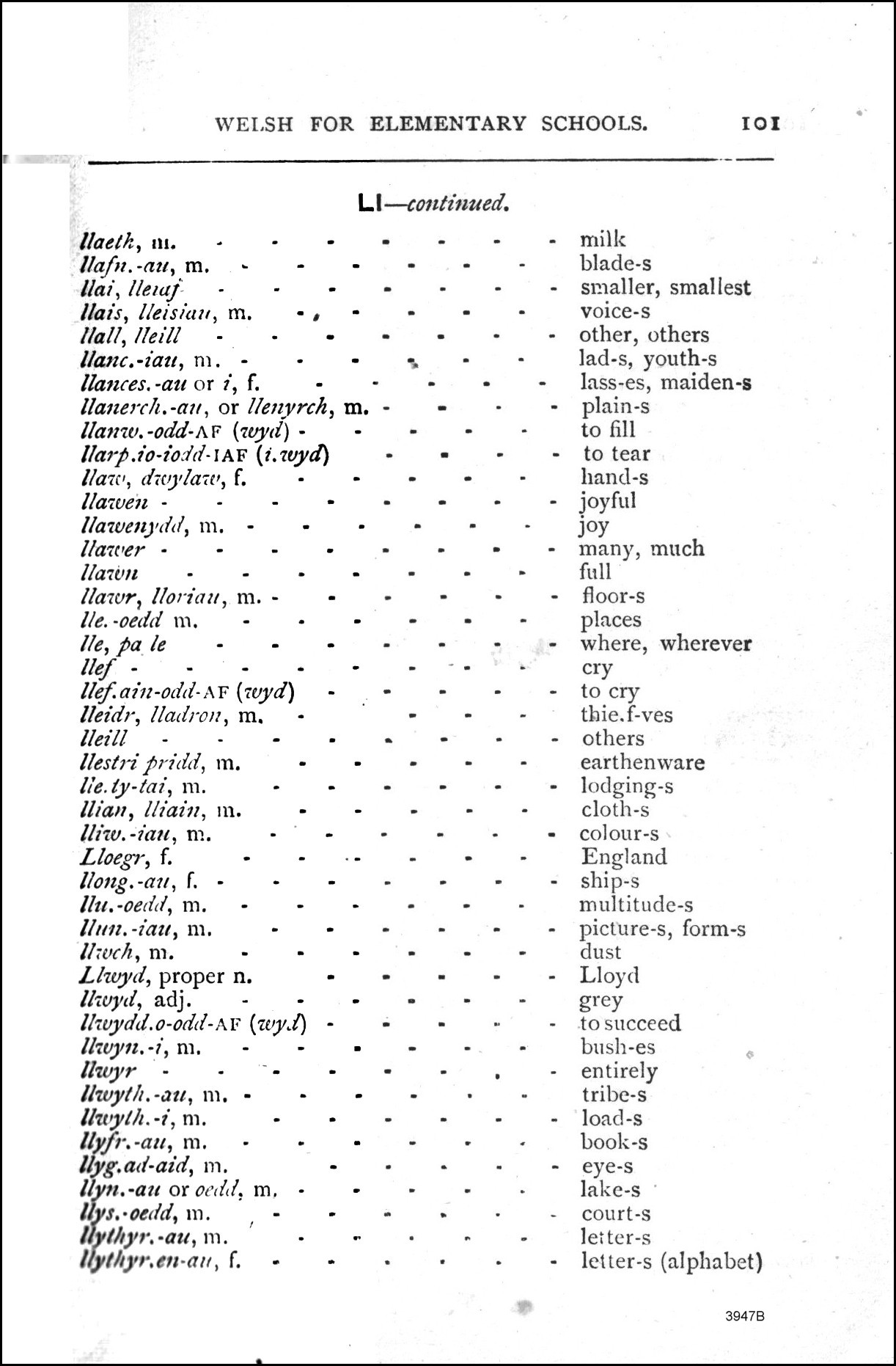
|
(delwedd 3946A) (x98) 98
gzvelzv WELSH FOR ELEMENTARY
SCHOOLS. G —continued.
gwelw...pale gwely. -au, m. g•zvell
ovella - gzvellten, gzvellt,
f. gzvenith, ln. gzvenol. -iaid, f. ovenol. -iaid-y-mb- gzviail, f.
g•wir, m. - gzvisg. -oedd, f. gtvl.ad-cdydd, f. gwledd. -oed,/, f. gwlyb
gwnaet4ai gtvnelai gwncud, guneuthur grvcbr. -au, f. gzvr, gwyr, m. - gzvraig, gwragedd, f. gw;cs, m. -
gwrid, f. gzvrych.-oedd,
m. gwth. io-iodd.IAF (i.zvyd) gwyb.od-u-YDDAF (u.zvyd) ovydr.-azt, m. gzvjl, gwylaidd - gzvyllt
gzvyn. m. , g•zvyneb. u-odd-AF
(tvyd) - Gwynedd, f. gzvyn/yd
gzvynt.-oedd, m. g•zcyrdd, m.,
gwerdd, f. Uda-g u-odd-AF (zvyd) paie
bed-s better recover
straw-s wheat swallow-s
seagull-s willows truth
dress-es countr.y-ies feast-s
wet did or would do to make
reward-s man, men,
husband-s wife, wives heat
blush hedges to push
to know glass-es modest
wild white-r to face
North Wales blessed wind-s
green knows with
all to drive Ng and Ngh
NOTE.—NO Welsh word commences radically with Ng or Ngh. Such words as commence with Ng or Ngh are
inflected from the radical G or C, as
Garr, NGatr (word) ; can, NGH'i'J (song). For Rules for these see the Introductory
Chapter on the Mutation of Con•
sonants. The Radical forms only
are given in the Vocabulary.
3946A
|
|
|
|
|
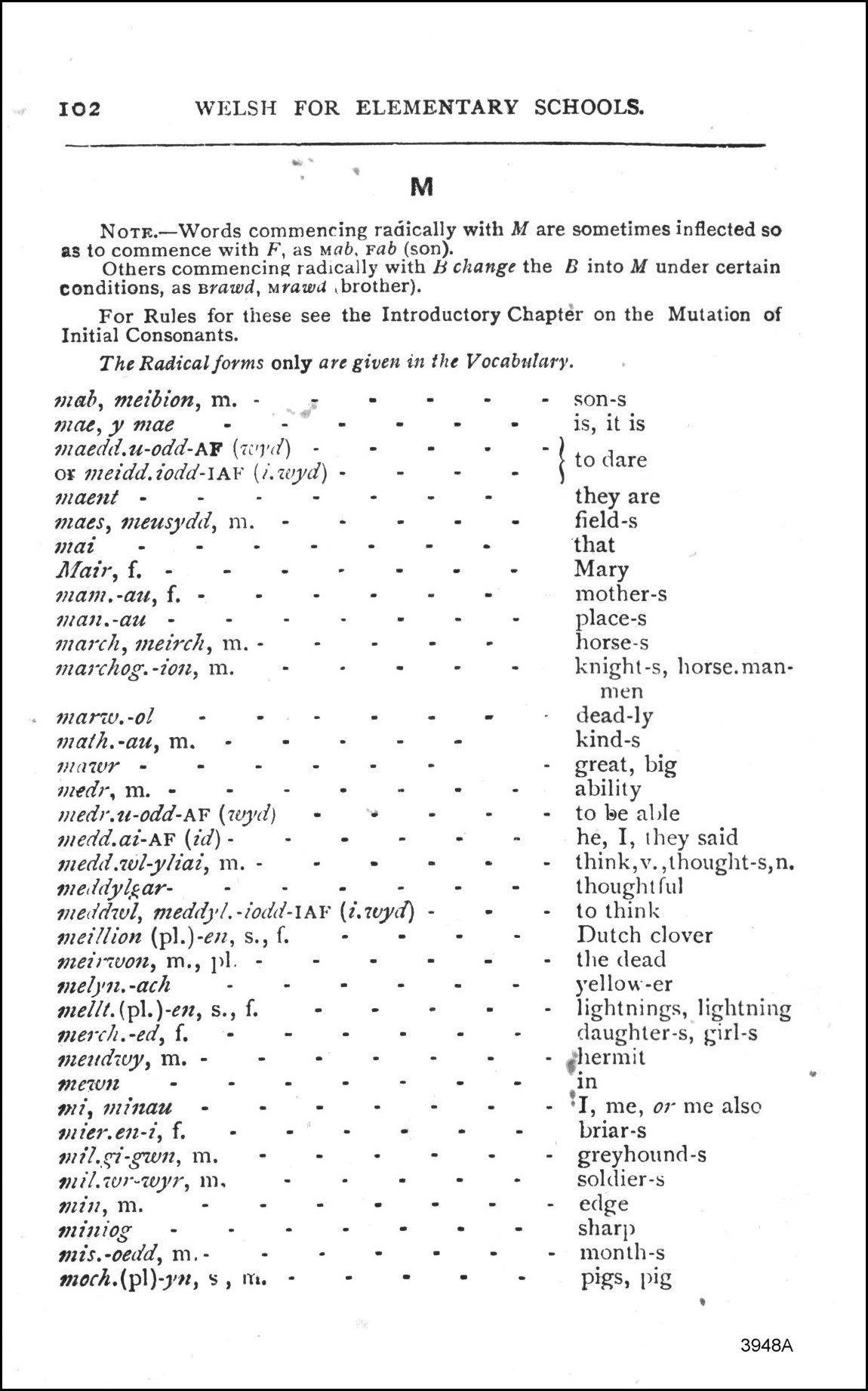
|
(delwedd 3946B) (x99) WELSH FOR ELEMENTARY SCHOOLS. 09
N0TE.—V/ords cotnmencing radically with I-I undergo no initial
change. Some words, however, which commence
radically with a vowel have the 11
Prefixed under certain circumstances, as xelod, HAelod (member) ;
Ettw, HEnw (name). For Rules for these see the Introductory
Chapter on the of Con- sonants. The Radical forms only are given in the
Vocabulary. hael haul, heidiau, f. ha,'ur cant
haner coron, m. hardd, heirdd
(pl. ) haul, heuliau, m. hawdd. -ach
,4atvl. -iau heb heb oedi-
hebog.-au, m. 'hedydd, m.
- heddzvc/l, m. heddyw •
he/yd he,'bio hel.a-iodd-IAF (i.wyd) hen
leno - herwydd leg. (pl. )-0,', s. , f. het.-iau, f: hi, lithau
hip. (s. )-ion, pl. hou hon, f. , hzvn, m. el) hun
eu) hunai/ß tvnw, m. , ho„'0,
f. hwy . hwy.ad.aid, (f. ) htvyl.io•icdd-IAF (i.zvyå {tvyr, m.
hwyr, adj. I'd, prep.• liberal, generous summer-s
troop-s fifty half-a-crown beautiful
sun-s eas.y-ier right-s
without without delaying hawk-s
skylark peace to-day
also by, past to hunt
old to-night because, for rushes
hat-s she or her, she also long
fond all this
him or herself themselves him, her, or that they, them
duck-s to sail night
late length to, until
3946B
|
|
|
|
|
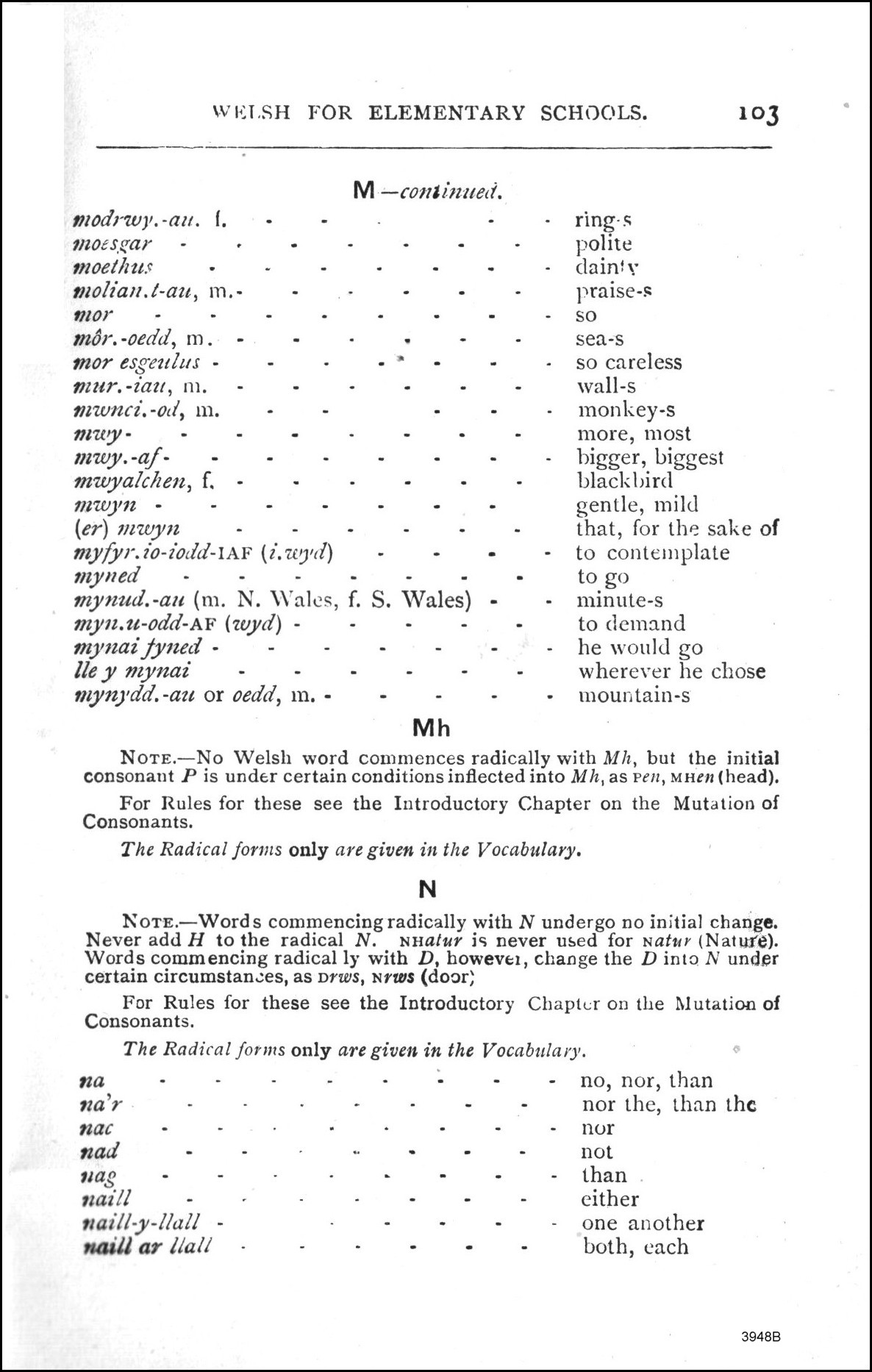
|
(delwedd 3947A) (x100)
100 hyd lies
hydyn nod hynod h)'trach
WELSH FOR ELEMENTARY. SCHOOLS.
H—continued. until even
remarkable rather NOTE.—M'ords commencing radically with I
sometimes have the [I pre. fixed, as
laith, Hlaith (language). A few others
commencing radically with Gi drop the G under cel tain con- ditions, leaving the I as the initial, as
Glar, lar (hen). For Rules for these
see the Introductory Chapter on the Mutation of Con- sonants.
The Radical forms only are given in the Vocabulary. iailh, ieithoedd - iatvn
idd-(o,i,ynt) lest' Grist ieuanc
ieuang. -ach-af i/yny tyb i
loan - is-af i'zv
i' tv amddiTyn Izverddon - to, to the
language-s very to (him, her, them) Jesus Christ young
young-er-est up to my
to our to my mind John
low.er-est to his, her, its,
ortheir to protect him Ireland
NOTE.—Only a few Welsh words commence radically with L. Most words conunencing with L are inflected from
the radical LI, as LLatV, I-aw (hand)
; or have dropped the initial G, as GLan, Lan (shore). For Rules for these see the Introductory
Chapter on the Mutation of Initial
Consonants. The Radical forms only are
given in the Vocabulary. (z)
lawr- down commencing radically with Ll are sometimes
inflected so as to commence with L, as
LLaw, Law (hand); LLaeth, Laeth (milk).
For Rules for these see the Introductory Chapter on the Mutation
cd Initial Consonants. The Radical forms only are given in the
Vocabulary. Iladrata. -odd-AF
(zvyd) lladd. -odd-AF (wyd) to steal
to kill 3947A
|
|
|
|
|
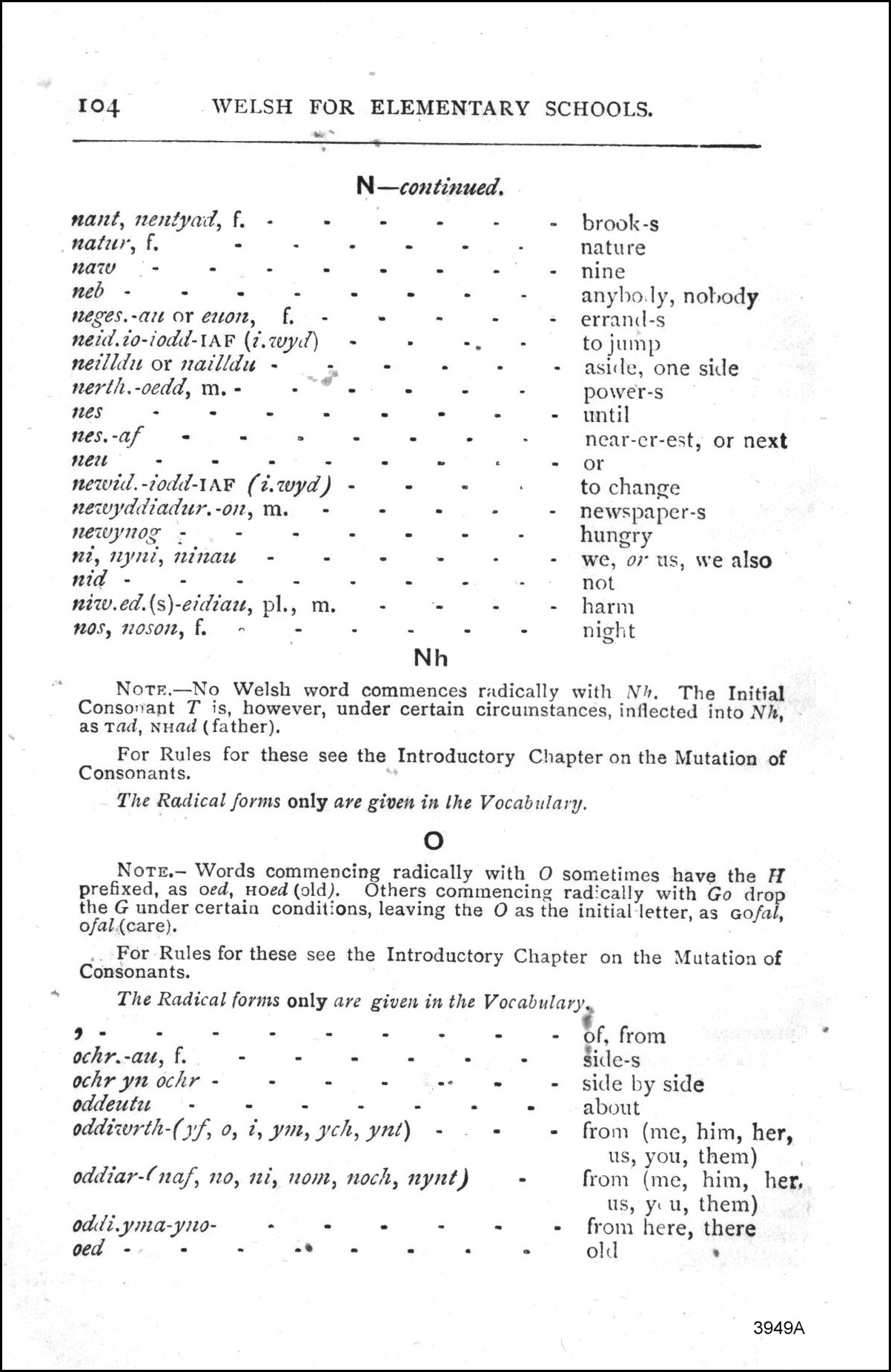
|
(delwedd 3947B) (x101)
WEI,SH FOR
ELEMENTARY SCHOOLS. L
I—continued. 101 llaeth,
Ilafn. -au, m. llai,
Ileutj llais, Ileisiau, m. l/all, /leill I/anc.-iatt, m. llances. -au or i, f. llanerch. -au, or Ilenyrch, m. Ilantv. -odd-AF (wyd) - IlarP.io-iodd-IAF (i.wyd) IlatC', dtcylatt', f. llatven
Ilawenydd, m. Ilawer llawn
llawr, Iloriau, m. - lie. -oedd
m. lie, pa le Ilef.ai1z-odd-AF (tvyd) Ileidr, lladron, m. Ileill
Ilestri Iridd, m. l/e.ty-tai,
m. Ilian, Iliain, m. Iliw.-iau, m. Lloegr, f.
Ilong. -au, f. Ilu.-oedd,
m. llun. -iau, m. Ihvch, m.
Llzvyd, proper n. lltvyd,
adj. 11tvydd.o-odd-AF (tvy,l) llwyn. -i, m. 11tvyr
Ilzvyth.-au, m. - lltvylh. -i,
m. llyfr.-au, m. 1b'" ad-aid, m. llyn.-au or oedd, m, llys.•oedd, m. Il thyr.•au, m. I thyr.en-au, f. milk
blade-s smaller, smallest voice-s
other, others lad-s,
youth-s lass-es, maiden-s plain-s
to fill to tear hand-s
joyful joy many, much
full floor-s places
where, wherever cry to cry
thie.f-ves others earthenware
lodging-s cloth-s colour-s
England ship-s multitude-s
picture-s, form-s dust Lloyd
grey -to succeed bush-es
entirely tribe-s load-s
book-s eye-s lake-s
court-s let ter-s letter-s (alphabet) 3947B
|
|
|
|
|
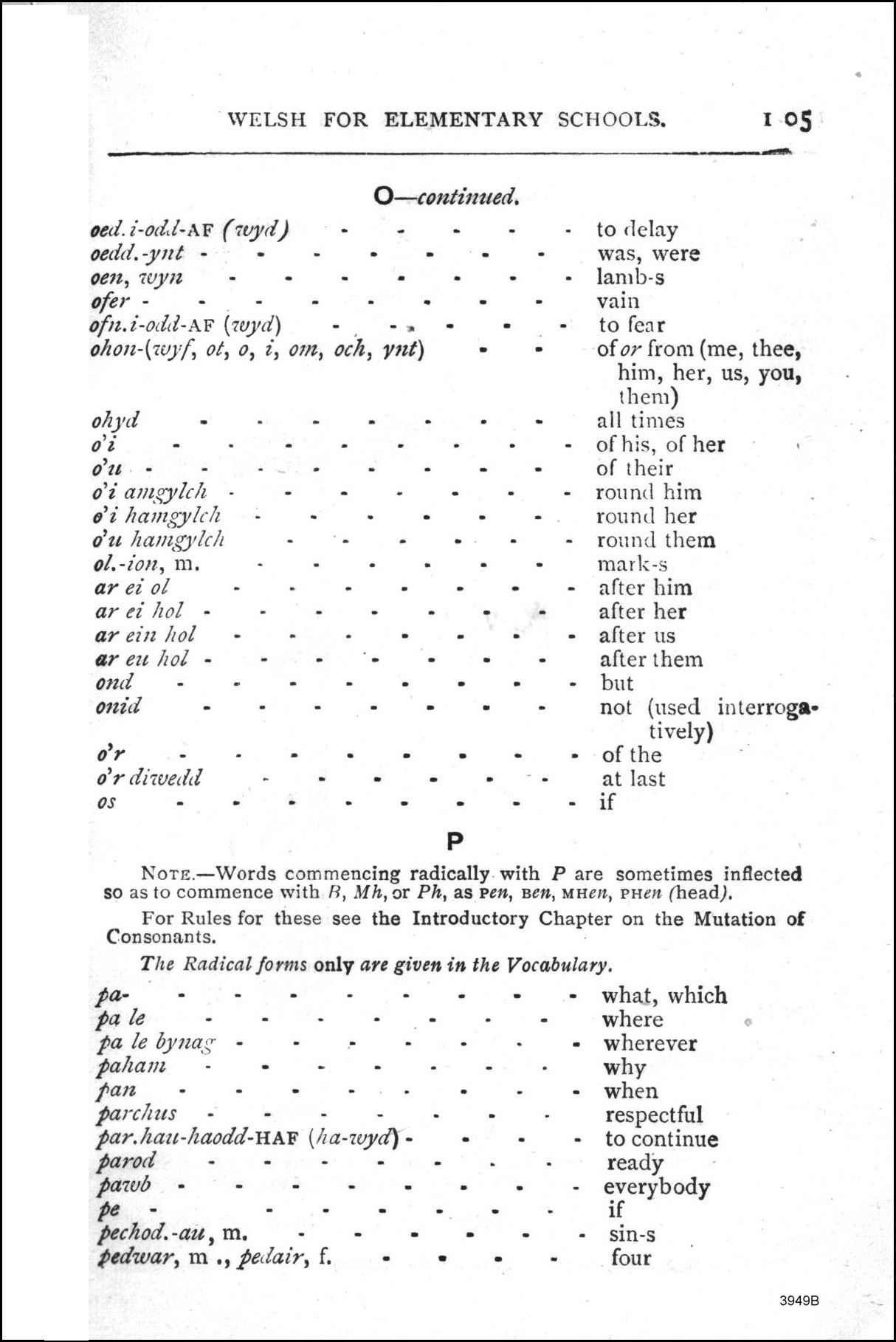
|
(delwedd 3948A) (x102) 102 WELSH
FOR ELEMENTARY SCHOOLS. N0TE.—Words
commencing radically with M are sometimes inflected so as to commence with F, as Mab. Fab (son). Others commencing radically with B change
the B into M under certain conditions,
as Brawd, Mrawa brother). For Rules
for these see the Introductory Chapter on the Mutation of Initial Consonants. The Radical forms only are given in the
Vocabulary. mab, meibion, m. mae, y mae
maedd.u-odd-AF (tvrd) or
meidd.iodd-1AF (i.zvyd) - Illaent maes, meusydd, m. mai
Nair, f. nzam.-au, f. - man. -au
march, m. - marchog. -ion,
m. martv. -01 math. •au, m. mater
medr, m. medr.u-odd-AF
(zvyd) medd.ai-AF (id) - medd.zvl-yliai, m. meddylgar-
meddwl, meddy/. -iodd-IAF (i.wya") - meitlion (pl.)-en, s. , f meirtvon, m. , pl. melyn. -ach
mellt. (pl.)-en, s. , f.
merch.-ed, f. meudtvy, m. m cwn
mi, minau mier.en-i, f. mi?.qi-gzvn, m. mil. tvr„tvyr, m, min, m.
mis.-oedd, m.- son -s is, it is
to dare they are field-s
that Mary mother-s
place-s horse-s knight-s, horse. man- men
dead-ly kind-s great, big
ability to be able he, I, they said think, v. , thought-s,n. thought ful
to think Dutch clover the dead
yellow-er lightnings,
lightning daughter-s, girl-s ihermit
in I, me, or me also briar-s
greyhound-s soldier-s edge
sharp mon th -s pigs, Pig
3948A
|
|
|
|
|
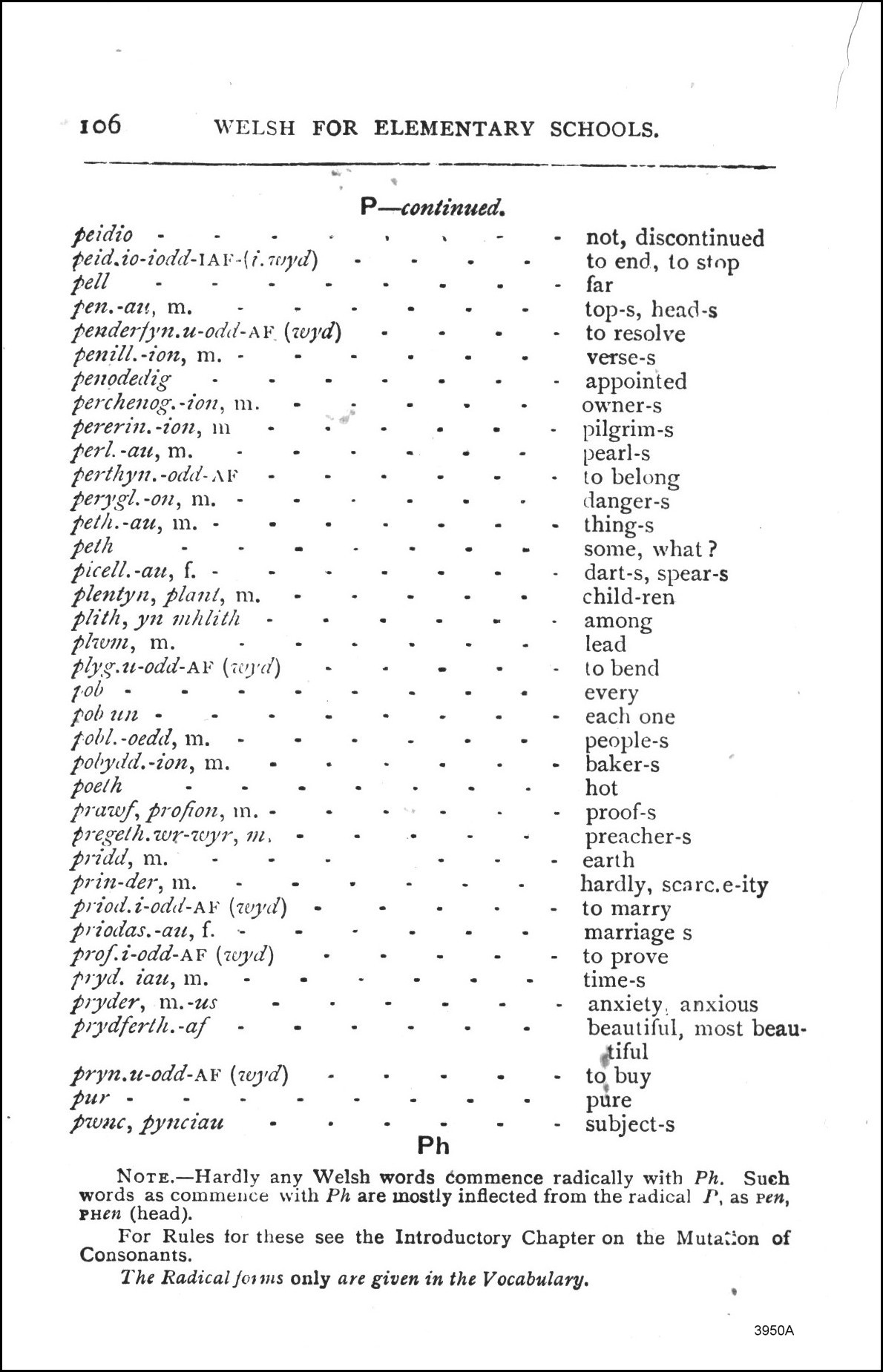
|
(delwedd 3948B) (x103) W' El SH
modrwy. -au. f. moss.ear
moethu.c molian.t-au, m mor
mbr. -oedd, m . mor
esgeulus mur.-iau, In. tnzvnci. -ed, m. mzvy -
mzvy. -af- mzvyalchen, f. mzvyn
(er) mzvyn FOR ELEMENTARY
SCHOOLS. 103 myfyr. io-iodd-IAF (i. wyd) myned
mynud.-au (m. N. Wales,
myn.u-odd-AF (wyd) -
mynaijyned Ile y mynai mynydd. -au or oedd, m. - M —coniinued. f. S. Wales) polite
dainfv praise-s so
sea-s so careless wall-s
monkey-s more, most bigger, biggest blackbird
gentle, mild that, for the sake
of to contelnplate to go
minute-s to demand he would go
wherever he chose
mountain-s NOTE.—No Welsh word
commences radically with M h, but the initial
consonant P is under certain conditions inflected into Mh, as pen,
MHen (head). For Rules for these see
the Introductory Chapter on the Mutation of
Consonants. The Radical forms
only are given in the Vocabulary.
N0TE.—Words commencing radically with N undergo no initial
change. Never add H to the radical N.
NHatur is never used for Natur (Nature).
Words commencing radical ly with D, however, change the D into N
under certain circumstances, as Drws,
NIWS (door) For Rules for these see
the Introductory Chapter on the Mutation of
Consonants. The Radical forms
only are given in the Vocabulary.
na'r nac nad
nag nail/ naili-y-llall - nail/ ar llal/ no, nor, than nor the, than thc nor
not than either
one another both, each 3948B
|
|
|
|
|
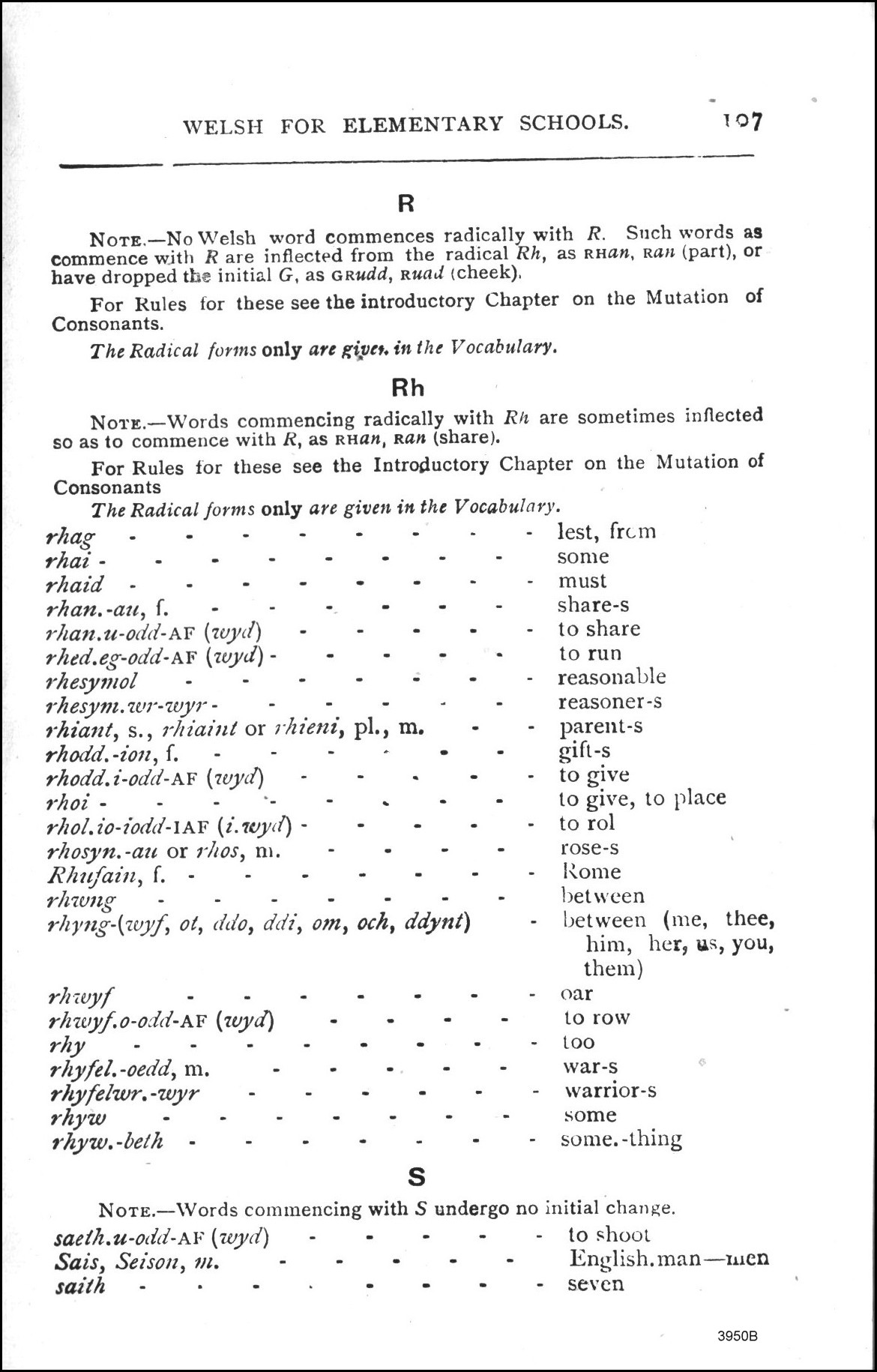
|
(delwedd 3949A) (x104)
WELSH FOR
ELEMENTARY SCHOOLS. N —continued. nant, f.
natur, f. vatu neb
neg•es.-au or euon,
neid.io-iodd-1AF (i.wyd)
neilldu or nailldu nerlh.-oedd,
m. - nes nes. -af
neu nezvid. -iodd-IAF (i.zvyd) nezvyddiadur. -on, m. netvynog
ni, nyni, ninau nid - pl., m.
nos, nosozz, f. brook-s natu re
nine anybody, nobody errand-s
to jit Inp aside, one side power-s
until near-er-est, or next or
to change newspaper-s hungry
we, or us, we also not hanu
night N0TE.—No Welsh word
commences radically with N". The Initial
Consonant T is, however, under certain circumstances, inflected into
NL, as Tad, NHad (father). For Rules for these see the Introductory
Chapter on the Mutation of
Consonants. The Radical forms
only are given in lhe Vocabulary.
o NOTE.— Words commencing
radically with O sometimes have the
prefixed, as oed, Hoed (old). Others commencing radically with Go drop the G under certain conditions, leaving the
O as the initial "letter, as GOfal,
ofaL(care). For Rules for these
see the Introductory Chapter on the Mutation of Consonan ts. The Radical forms only are given in the
Vocabulary ochr.-au, f. ochryn ochr - oddeutu
odditvrth-(yf, o, oddiar-(naf,
no, oddi.yma-yno- oed -
i, YD', ych, ynt) ni, non,
noch, nynt) pf, from éide-s
side by side about from (me, him, her, us, you, them) from (me, him, her, uS, yg u, them) from here, there old
3949A
|
|
|
|
|
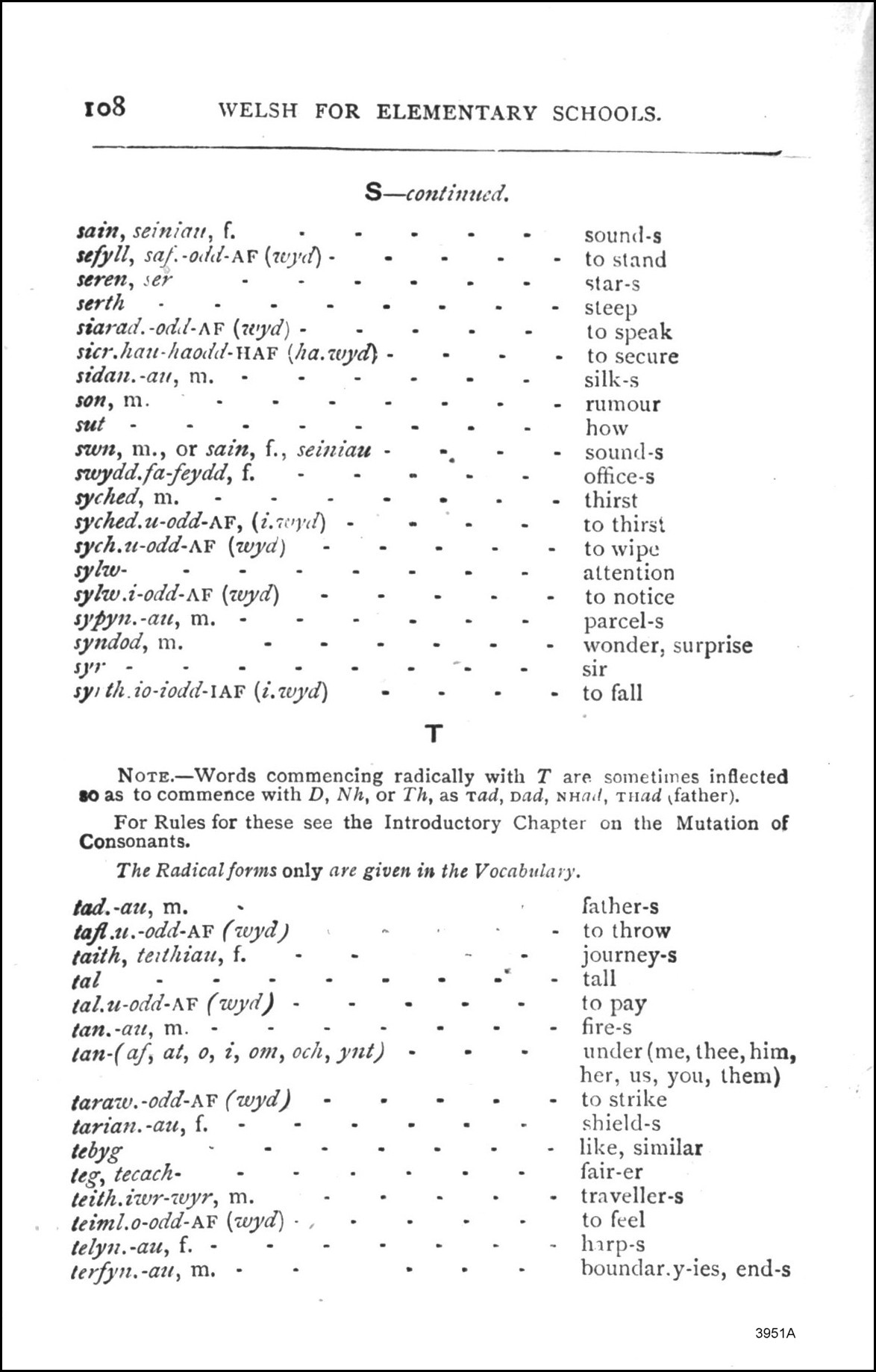
|
(delwedd 3949B) (x105) WELSH FOR ELEMENTARY SCHOOLS. O—continued. 1 05
oed. i-odd-AF (wyd) oedd. -ynt oen, tvy,tz
oner - ofn.i-odd-AF (wyd) ohon-(wyf, ot, o, i, 01", ohyd
o'i o'i amgylch o'i hamgylch du hamgylch
al.-ion, m. ar ei 01 ar ei hol
ar ein hol ar ezt hol and
onid O'r ditvedd os
och, ynt) to delay
was, were lamb-s vain
to fear of or from (me,
thee, him, her, us, you, them)
all times of his, of her of their
round him round her round them
mark-s after him after her
after us after them but
not (used interroga• tively) of the
at last if N0TE.—Words commencing radically with P are
sometimes inflected so as to commence
with B, Mh, or Ph, as pen, Ben, MHen, Pl.-ren (head). For Rules for these see the Introductory
Chapter on the Mutation of
Consonants. The Radical forms
only are given in the Vocabulary. pa
le pa le bynag Pahave
Ian Parch us Par.hau-haodd-HAF (ha-zvyd)- parod
pazvb pechod. -au , m. tedwar, m pedair, f. what, which
where wherever why
when respectful to continue
ready everybody if
sin-s four 3949B
|
|
|
|
|
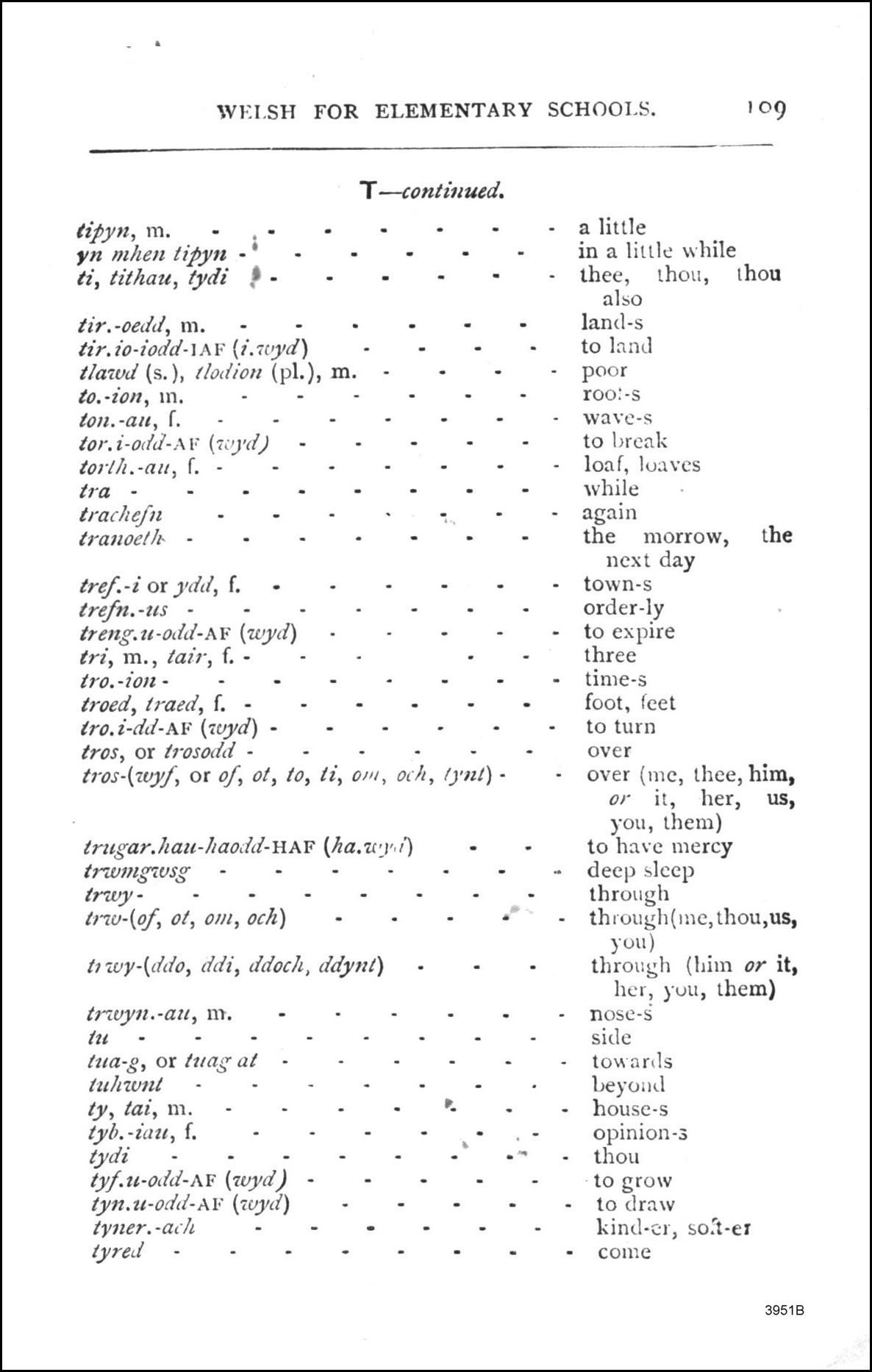
|
(delwedd 3950A) (x106) 106 'e
idio WELSH FOR ELEMENTARY
SCHOOLS. p—continued. teid. io-iodd-IAF-( i. 7M)'d) tell
fen. -ate, m.
fender/yn.u-odd-AF (zvyd)
tenill. -ion, m. -
Penodedig terchenog. -ion,
m. tererin. -ion, m ferl. -au, m. terthyn. -odd- A F Perygl. -on, m. leth.-au, m. 'eth
picell. -au, f. - Plentyn,
plant, m. plith, yn mhlit/l tltvm, m.
tlyg.u-odd-AF (tvyd) 101, rob un
fold. -oedd, m. Polydd.-ion,
m. poelh trawf, Profon, m. - trege(h.zvc-zvyr, pridd, m.
Prin-der, m. priod. i-odd-AF
(tvyd) piodas. -au, f. Prof. i-odd-AF (tvyd) pyd. iau, m. pyder, m. -us pydferlh. -af Pryn.u-odd-AF (wyd) 'zvuc, Pynciau not, discontinued to end, to stop far
top-s, head-s to resolve verse-s
appointed owner-s pilgrim-s
pearl-s to belong danger-s
thing-s some, what ? dart-s, spear-S child-ren
among lead to bend
every each one people-s
baker-s hot proof-s
preacher-s earth hardly, scarc.e-ity to marry
marriage s to prove time-s
anxiety, anxious beautiful,
most beau- ,tiful to. buy
pure subject-s N0TE.—Hardly any Welsh words Commence
radically with Ph. Such words as
commence with Ph are mostly inflected from the radical P, as pen, PHen (head). For Rules for these see the Introductory
Chapter on the of Consonants. The Radical fQi1ns only are given in the
Vocabulary. 3950A
|
|
|
|
|
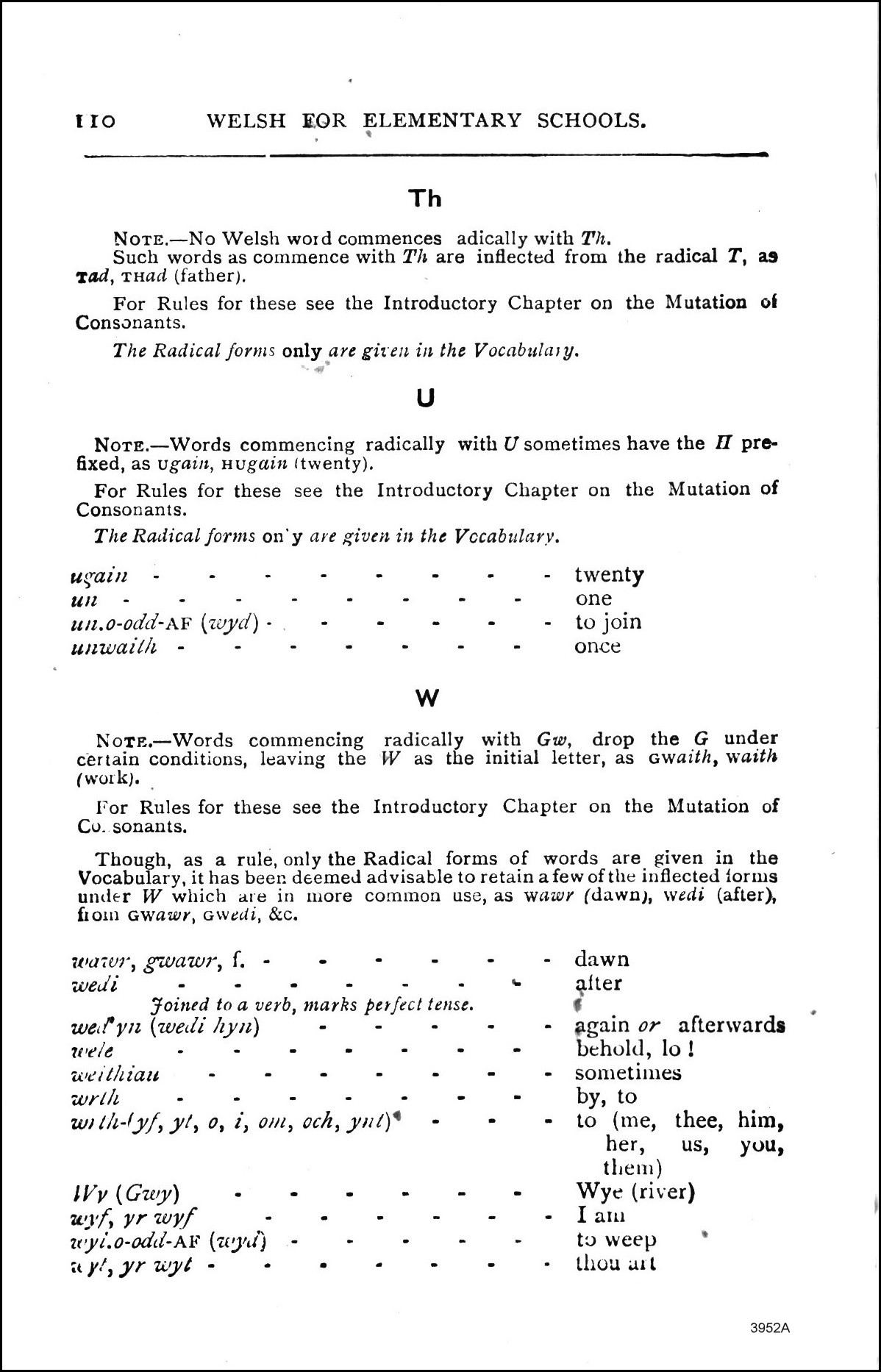
|
(delwedd 3950B) (x107)
WELSH FOR
ELEMENTARY SCHOOLS. NOTE.—No Welsh
word commences radically with R. Such words as commence with R are inflected from the
radical Rh, as RHan, Ran (part), or
have dropped the initial G, as GRudd, Ruad (cheek). For Rules for these see the introductory
Chapter on the Mutation of Consonants. The Radical forms only are given in the
Vocabulary. N0TE.—Words commencing
radically with R/i are sometimes inflected
so as to commence with R, as RHan, Ran (share). For Rules for these see the Introductory
Chapter on the Mutation of
Consonants The Radical forms
only are given in the Vocabulary. rhag rhai -
rhaid rhan. -au, f. rhan.u-odd-AF (zvyd) rhed.eg-odd-AF (zvyd) - rhesynzol
rhesym. wr-zvyr - rhiant, s. ,
rhiaint or rhieni, pl., m. rhodd.-ion,
f. rhodd. i-odd-AF (zvyd) rhoi -
rhoI.io-iodd-IAF (i.wyd) -
rhosyn. -au or rhos, m.
Rhufain, f. rhwng rhyng-(zvyf, 01, ddo, ddi, rhwy/
rhwyf.o-odd-AF (wyd) rhy rhyfel.-oedd, m. rhyfelzvr. -zvyr rhyzv
rhyzv. -beth om, och,
ddynt) s lest, frcm
some must share-s
to share to run reasonable
reasoner-s parent-s gift-s
to give to give, to place to rol
rose-s Rome between
between (me, thee, him, her,
us, you, them) oar
to row too war-s
warrior-s some some. -thing NOTE.—Words commencing with S undergo no
initial change. saeth.u-odd-AF
(wyd) Sais, Seison, m. saith
to shoot English. man —men seven
3950B
|
|
|
|
|
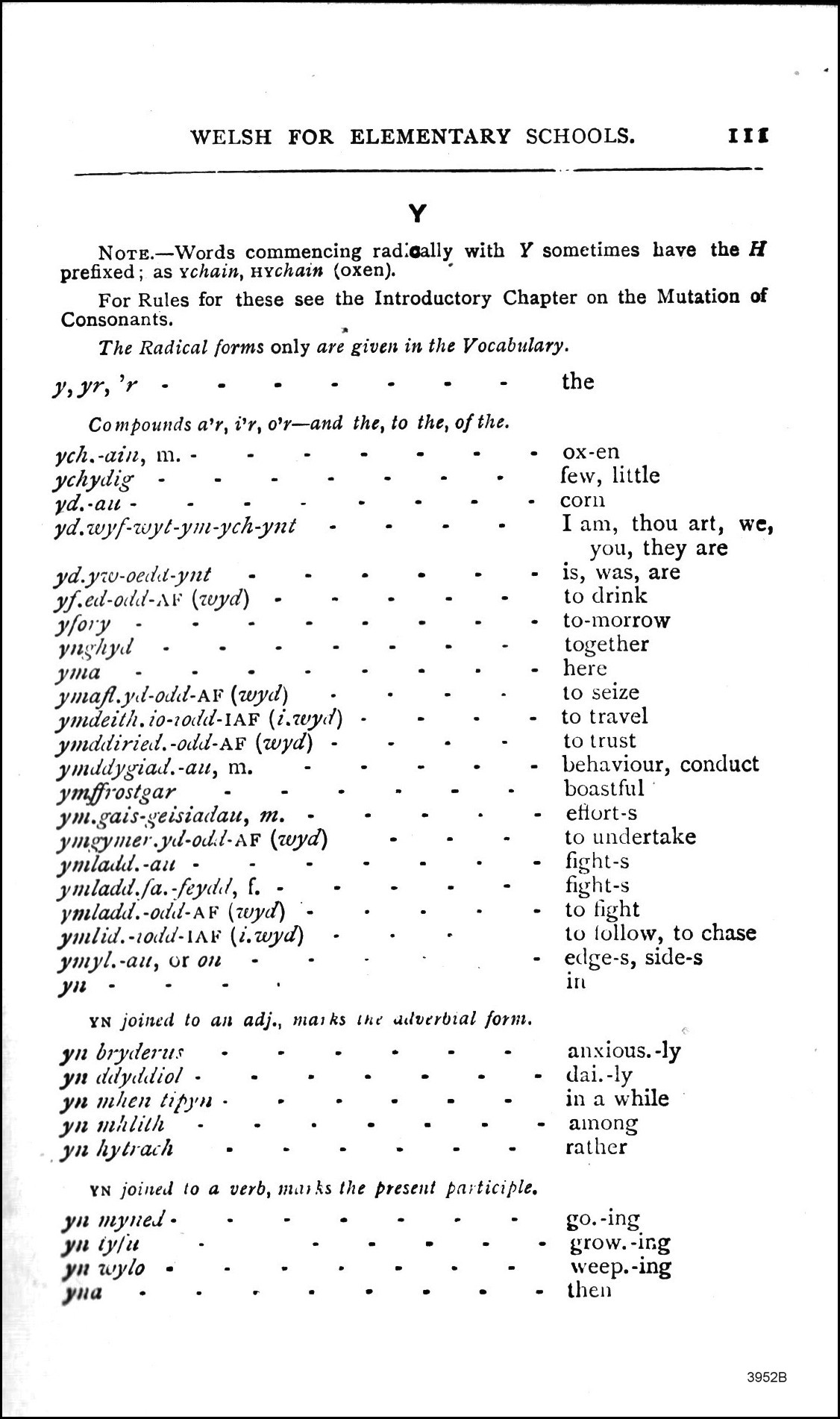
|
(delwedd 3951A) (x108) 108 WELSH
FOR ELEMENTARY SCHOOLS.
S—continucd. gain, seiniau,
f. sefyll, say. -odd-AF (wytt) - seren, vser
serth siarad. -odd-AF
(7t'Yd) sicr.hau-haodd-HAF (ha.tvyd) - sidan. -au, m. son, m.
szvn, m. , or sain, f. , seiniau -
szvydd.fa-feydd, f. syched,
m. syched.u-odd-AF, rych.u-odd-AF (zvyd) sylw-
sylzv.i-odd-AF (tvyd)
sypyn.-au, m. syndod, m. syr
th. io-iodd-IAF (i.zvyd)
sound-s to stand star-s
steep to speak to secure
silk-s rumour how
sound-s office-s thirst
to thirst to wipe attention
to notice parcel-s wonder, surprise sir
to fall N0TE.—Words commencing
radically with T are. sometimes inflected
•oas to commence with D, Nh, or T h, as •rad, Dad, NHaa, Tllad
Oather). For Rules for these see the
Introductory Chapter on the Mutation of
Consonants. The Radical forms
only are given in the Vocabula ry.
tad.-au, m. taß.u.-odd-AF
(wyd) taith, tet'thiau, f. tal
gal. u-odd-AF (zvyd) tan. -au,
m. tan-(af, at, o, i, 0m, och,
ynt) tarazv. -odd-AF (wyd) tarian. -au, f. tebyg
leg, tecach• teith.itvr-wyr, m. teiml.o-odd-AF (tvyd) telyn.-au, f. - terfyn. -au, m. father-s
to throw journey-s tall
to pay fire-s under (me, thee, him, her, us, you, them) to strike
shield-s like, similar fair-er
traveller-s to feel Inrp-s
boundar.y-ies, end-s 3951A
|
|
|
|
|
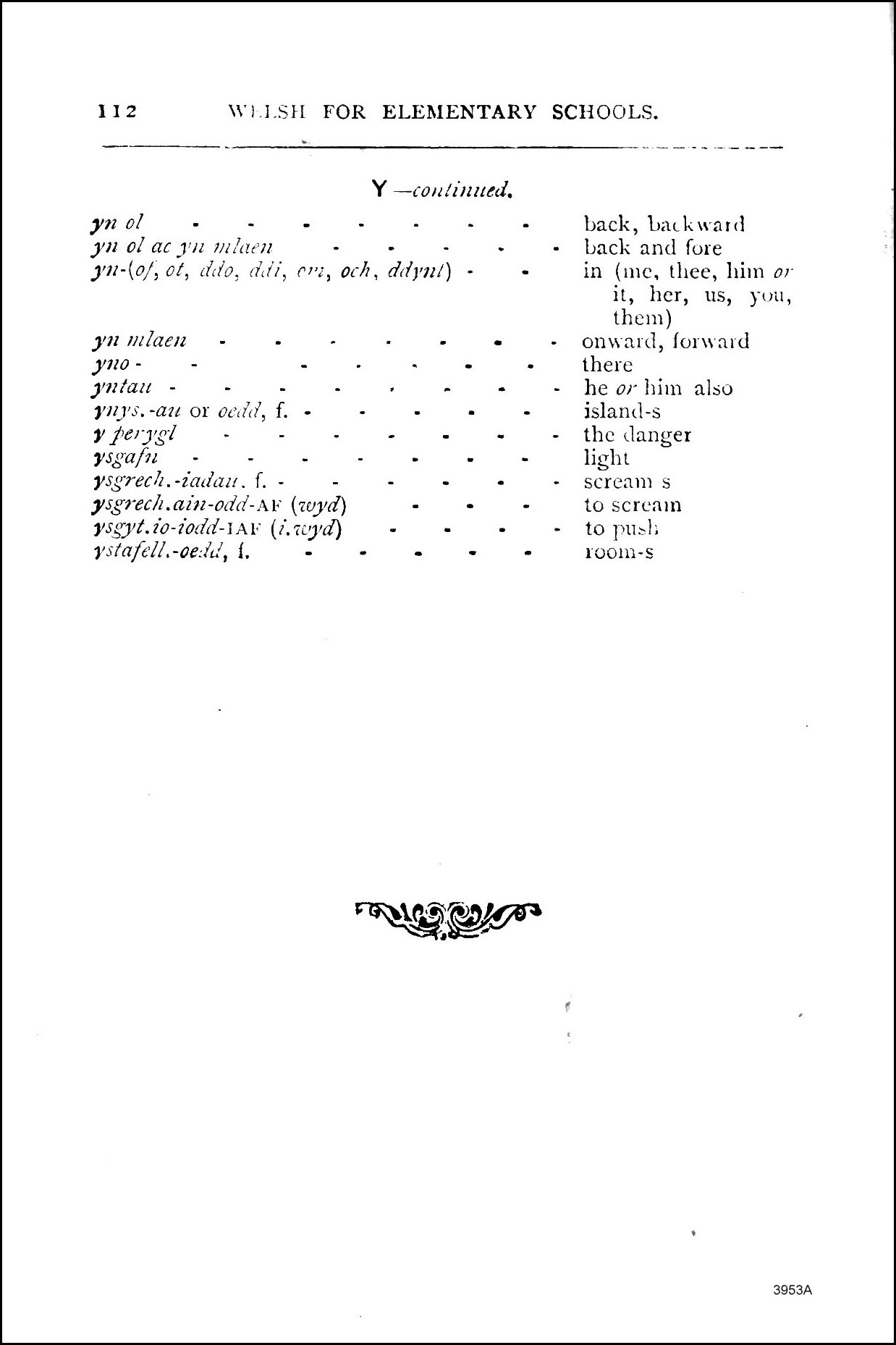
|
(delwedd 3951B) (x109) WELSH FOR ELEMENTARY SCHOOLS. T —continued. 109
tipyn, m. yn mhen tilyn - ti, tithau,tydi - tir.-oedd, m. tir.io-iodd-IAF (i.tcyd) t/atvd (s. ), tlodion (pl.), m to.-ion, m.
ton. -au, f. tor. i-odd-AF
(tvyd) torlh.-au, f. tra
trachcfn tranoe!/b tref.-i or ydd, f. trefn. -us
freng.u-odd-AF (wyd) tri, m. ,
lair, f. - tro. -ion - treed, traed, f. - tro.i-dd-AF (tvyd) - tros, or trosodd - tros-(zvyf, or of, ot, to, ti, 0/11,
och, trugar.hau-haodd-HAF trzvmgtvsg trtvy -
trtv-(of, 01, 01/1, och)
zvy-(ddo, ddi, ddoc/l, ddynl)
trtvyn.-au, m. tu tua-g, or tuag• al tuhzvnt
ty, tai, m. tyb.-iazt, f. tydi
tyf.u-odd-AF (wyd) tyn.u-odd-AF
(tvyd) tyner. -ach tyred
a little in a little while thee, lhou, thou also
land-s to land poor
roo:-s wave-s to break
loaf, loaves while again
the morrow, next day town-s
order-ly to expire three
time-s foot, feet to turn
over the tynt) -
over One, thee, him, it, her,
us, or
you, them) to have mercy deep sleep
through th rough One,
thou,us, you) through (him or it, her, you, them) nose-S
side towards beyond
house-s opinion-3 thou
to grow to draw kind•er, soft-er come
3951B
|
|
|
|
|
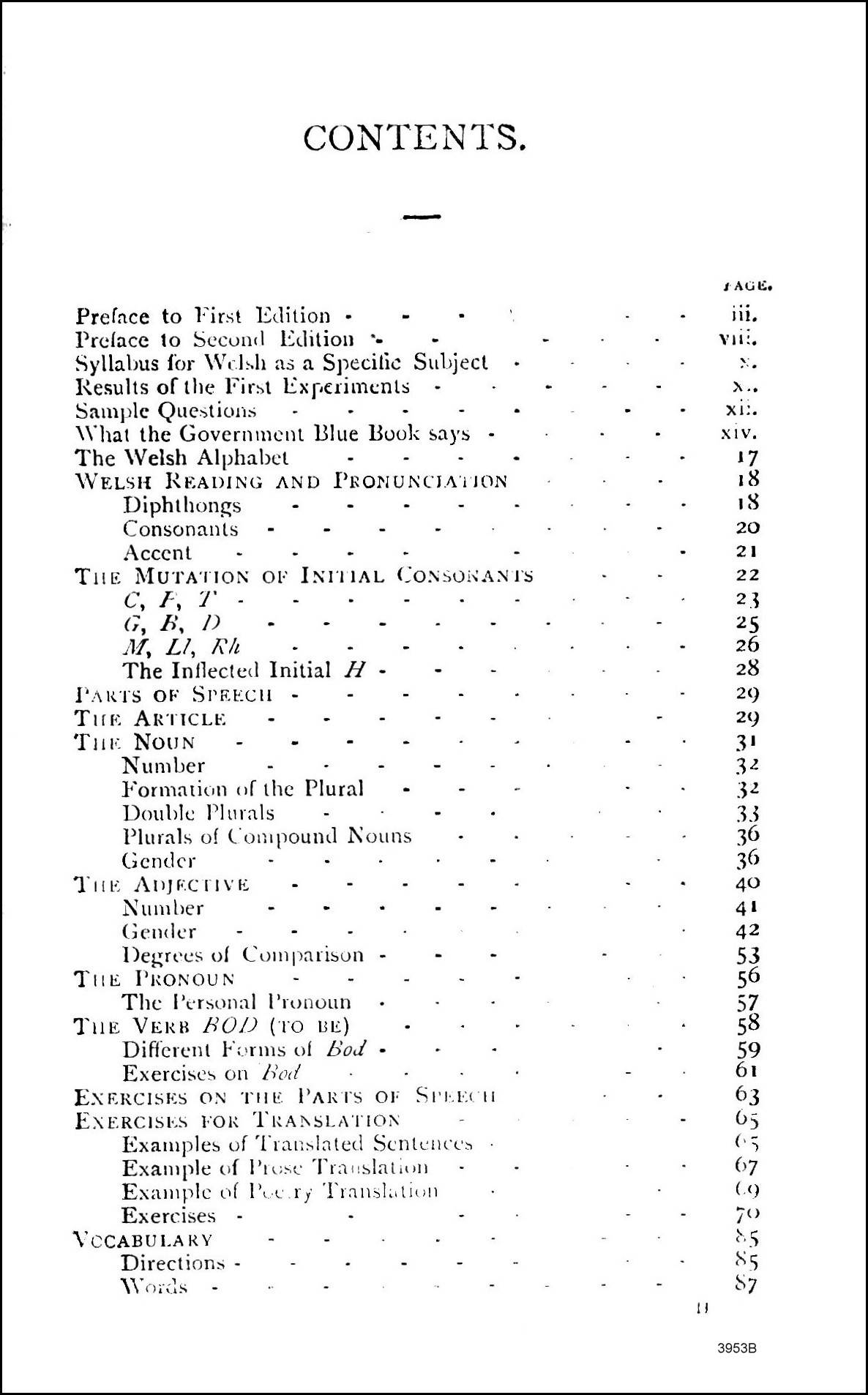
|
(delwedd 3952A) (x110)
WELSH EOR
ELEMENTARY SCHOOLS. NOTE.—NO Welsh
word commences adically with Th. Such
words as commence with Th are inflected from the radical T, as tad, THad (father). For Rules for these see the Introductory
Chapter on the Mutation of
Consonants. The Radical forms
only are given in the Vocabulaw.
N0TE.—Words commencing radically with U sometimes have the pre- fixed, as ugain, Hugain (twenty). For Rules for these see the Introductory
Chapter on the Mutation of Consonants.
The Radical forms on •y are given in
the Vocabulary. wrain un
un.o-odd-AF (zvyd) •
unzvaith twenty one
to join once w N
0TE.—Words commencing radically with Gtv, drop the G under certain conditions, leaving the W as the
initial letter, as Gwaith, waith
(work). For Rules for these see
the Introductory Chapter on the Mutation of
Co. sonants. Though, as a rule,
only the Radical forms of words are given in the Vocabulary, it has beer. deemed advisable
to retain a few of the inflected forms
under W which are in f101n
Gwawr, Gwedi, &c. watvr, gzvazvr,
f. wedi 30ined to a verb, war yu (wedi hyn) we/e
weuhiau wrlh w,' l/'-(yf, yt, o, i, 0m, wy ( Gwy)
wyf, yr zvyf zeyi.o-odd-AF
(tey,t) y/ , yr wyc' more common use, as wawr (dawn), wedi
(after), marks peyfect tense. ach, ynt)€
dawn iter again or afterwards behold, 10 ! sometimes
by, to to (me, thee, her,
us, thenl ) Wye (river)
I aru to weep thou al t
him, you, 3952A
|
|
|
|
|
|
(delwedd 3952B) (x111)
WELSH FOR
ELEMENTARY SCHOOLS. 111 N 0TE.—VVords commencing rad:oally with Y
sometimes have the H prefixed; as
ychain, Hychain (oxen). For Rules for
these see the Introductory Chapter on the Mutation of Consonants.
The Radical forms only are given in the Vocabulary. Co mpounds a'r, o'r—and ych.-ain, m. - ychydig
yd.-au - yd.
zvyf-wyt-ym-ych-ynt
yd.ytv-oedd-ynt 'fed-odd-AF
(zvyd) y/ory yu;rhyd
yma ymaJl.yd-odd-AF (zvyd) ymdeith. io-zodd-IAF (i.wyd) ymddiried. -odd-AF (wyd) ymddygiad. -au, m. ymfrostgar
ym.gais-g•eisiadau, m.
ynæymer.yd-odd•AF (zvyd)
ymladd. -au ymladd./a. -feydd,
f. - ymladd.-odd-AF (wyd) ymlid. -10dd-lAF (i.zvyd) ynzyl. -au, or on YN joined to an adj., maj ks yn bryderus
ddyddio/ • yn mhcn • yn m/llilh
hyb•ach YN joined to a yn myned •
zeylo the the, to the, of the. ox-en
few, little corn I am, thou art, we, you, they are is, was, are to drink
to-morrow together here
to seize to travel to trust
behaviour, conduct boastful effort-s
to undertake fight-s fight-s
to fight to follow, to
chase edge-s, side-s in
the adverbial fotm. anxious.
-ly dai. -ly in a while
among rather verb, ks the Present participle. go. -ing
grow. -ing weep.-ing then
3952B
|
|
|
|
|
|
(delwedd 3953A) (x112)
yn 01 I.SH FOR ELEMENTARY SCHOOLS. yn 01 at yn mlaen, ot, lido, cit/i, yn mlaen
yno - 17,' tau ynys. -au or oedd, f. Y leryg•l
ysgafn ysgrech. -iadau. f. ysgrech.ain -odd-AF (wyd)
ysgyt.io-iodd-1AF (i. tvyd)
•ystafell.-oe:/d, f. Y
—continued. , och, ddynl) back, back wrard back and fore in (Inc, thee, him or it, her, us, you, thenl)
onward, fonvard there he or him also island-s
the danger light screan) s
to scream to push room-s
3953A
|
|
|
|
|
|
(delwedd 3953B) (x113)
CONTENTS. Preface to First Edition Prelace to Second Edition Syllabus for Wc-Ish as a Specitie
Subject Results of the First
Experiments Sample Questions What the Governtnent Blue Book says The Welsh Alphabet WELSH READING AND PRONUNCJA'i JON Diphthongs
Consonants Accent TilE. MUTA'I'ION 01.' INI'I IAL CONSONAN
rs The Inflected Initial H - IiAR•rs OF SPF.E-CII T ITE ARI'ICLF, T lilt-. NOUN Number
Formation or the Plural Double
PI Plurals of Conupound Nouns Gender
'Ill E N u Inber Gender
Degrees 01 Coin parison T Il E
PRONOUN The Personal I 'ronoun THE VERB BOD Cro BE) Different For Ins of Bod Exercises on Boa' EXERCISES ON •rilE. PARTS OF EXERCISES FOR "I'RANSI-A'I'ION Exalnples of r I •rau.slated Sentences Exatnple of Prose Exaniple of r y' 'l'ranslatlon Exercises
VCCABULARV Directions - 18
20 21 22
23 25 26
28 29 29
31 32 .33
36 36 40
41 42 53
56 57 58
59 61 63
67 3953B
|
|
|
|
|
|
(delwedd 3954B) (x1157)
Advertisements
|
|
|
|
|
|
(delwedd 3955B) (x117)
College of
Otit,qlcg Jitütuttütlth%lfire. President: LORD ABERDARE. OFFICERS OF THE COLLEGE. attb
PrincfPa1: J. VIRIAMU JONES, M.A. (Oxon), B.Sc.(Lond Fellow ot University College, Lcndon. Reg,istrar:
IVOR JAMES. PROFESSORS AND LECTURERS. Professor of Greek : T. F. ROBERTS, B.A.,
st. John's College, Oxford. Professor
of Latin: J. R WARDALE, M.A., Fellow of Clare Colle e, Cam. bridge. Professor of Logic a ici
Philosophy: ANDREW SETH, M.A., (Edin.)
Professor of English Language, Literatti,re, and History : W. P. KER,
M.A., formerly Fellow of All Sou:s'
College, Oxford. sscr of Mathematics and
I'vo 'essov of Physics :
Astronomy: H. W. LLOYD TANNER, MA (Oxon.) THE PRINCIPAL. Professor of Chem stry: C.
M. THOMPSON, M.A. (Cantab.), D.Sc.
(Lond.), Trinity College, mbridxe, F.C.S. Professor of Biology : W. N. PARKER, F.z.s. Professor C,
It c: THOMAS POWEL, M.A., Jesus
College, Oxford. Lecturer on French Language Literature : PAUL BAR BIER. Lecturer G ernta:b and
Literature: FRANCK ARNOLD, B
A.,ffrinity College, Cmnbridge, PhD. (Würzburg). Lecturer CLEMENT PLETON. M.A., Trinity
College, Cambridge. Demonstrator in
Physics: W. S. HENS IÄEV. B.A., Christ's
College, Cambridge. De:nonstratorin Chennslry: J. W. JAMES, Ph D.
(Jena), F C.S. Assistant Lecturer tn
Mathematics: F. PELT ON, M A.. Gonviile
and Caius College, Cambridge. Lecturer in Hebrew: J. LLOYD
WILLIAMS, B.A. TUITION FEE FOR LECTURES. PER ANNUM. SrIJüIft1'fiIJipfi, attå prii2%. Six Scholarships of fro rer annum, tenable
for three years. Nine Scholarships of
[40 per annum, tenable for three years. Nine Scholarships of E 30 per annum, tenable for three years. Seventy-six Exhibitions of CIO. One Scholarship of {25 per annum, tenable
for one year, founded by the Ancient
Order of Foresters. Sir W. Thomas
Lewis' Mining St holarship for five years, of {33 per annum. The competition is limited to
persons who have wor ked fcr six years
underground in the Rhymney, Merthyr, Aberdare, or Rhondda
Valleys. A Scholarship of {50 per
annum, tenable at the College, is annually asvar• ded on the result of the examination of the
Science and Alt Department in
connection with the Ebbw Vale Sliool of Science and Art. Two Scholarships of [20 per annum, tenable
{Or three years, open to candidates
from the County of Brecknock. On the work
of the Session and the results of the Annual Examination in June,
(i.) To First Year's Students, eight Prizes of {15, and at least as
many Exhibitions of C 10, tenable for
one year, as were awarded at the
previous Entrance Examination.
(ii.) To Second Year 's Students, eight Prizes of E 15, and at least
as many Exhibitions of {10, tenable
for one year, as were awarded at the
Entrance Exantination next but one previous.
For further particulars aft?!)' to the Reg-istl ar at the College. 3955B
|
|
|
|
|
|
(delwedd 39548A) (x118) unibpr$iru qollpgp of ülpx, ABERYSTWYTH. (Endowed and in receipt of a Government
grant.) President—THE RIGHT HON. LORD
ABERDARE, G.C.B. Principal—THE REV. T.
C. EDWARDS, M.A. Oxon. and Lond., D.D.
Edin. CURRICULUM.—The instruction at
the College is arranged with reference
to the Arts and Science Courses of the London University, and the Scholarship Examinations at Oxford
and Cambridge. Numerous distinctions
have been gained at these Universities by Students from Aberystw th. SUMbARY OF DISTINCTIONS.—The following is a
sum- mary of the distinctions gained
by the Students since the opening of the
College in 1872 : 130 Students
have matriculated at the University of London, of whom 21 obtained honours (some gaining
prizes) and 83 were placed in the
first division. 43 have passed the Intermediate Examination for the degree of B.A. 2 obtaining the first place
in first-class honours and one an
exhibition of {40 a year ; 18 obtained honours, 10 being in the first
division. 15 have taken the degree of
B.A. 3 obtaining honours, 15 have pas •ed
the Intermediate Examination for the degree of B Sc., 2 obtaining the
first place in first-class honours,
one an Exhibition of {40 a year, one obtaining the first place in first-class honours in
Chemistry, and 5 obtaining honours, 2
have taken the degree of B.Sc., onc obtaining 1st class honours. 13 have assed the Preliminary Scientific Ex
*mination for the degree of M.B. One
as taken the degree of M.B. and M.D. One has passed the
Intermediate Examination for the
degree of LL.B. 7 Students have gained
open Scholarships ; 3 an open Ex-
hibition in Cambridge; 6 gained open Scholarships and 6 open
Exhibitions in Oxford, and of the 18
who have taken their degrees in Oxford, 5 are first- class men, 12 obtained honours ; of the r 3
who took their degree in Cam- bridge,
2 are first-class men, one a wrangier, 5 obtained honours. One has gained an open Scholarship of ß70
per annum at the University of l)urham
: one gained an open Scholarship of fifty guineas at St. Mary's Hospital, London ; one gained a
prize, value L 30, at Owen's College,
Manchester. A former Sh!dent is
Professor of Greek at .Univcrsity College,
Cardiff; two are Lecturers at University College,' Aberystwyth ; one
is assistant to the Woodwardian
Professor of Geölogy at Cambridge ; one is
a Demonstrator of Physiology in the Medical School of St. Nlary's
Ilospital, London ; one is a Professor
at St. David's College, Lampeter.
SCHOLARSHIPS.—A large number of Scholarships and Ex- hibitions, ranging in value from to {10,
are offered for Compet;tion at the
beginning of each Session. •THE NEW
HOSTEL FOR WOMEN STUDENTS.— The Hostel
will be opened next session under the superintendence of the Lady Principal, Miss E. A. Carpenter, who
is highly qualified by her educational
experience and attainments to aid the students in Ibeir work. Residence in Hostel for the Sess on
{30. FEES.—For Lectures to all
Students, LIO the Session'; Single Classes,
per term. 3956A
|
|
|
|
|
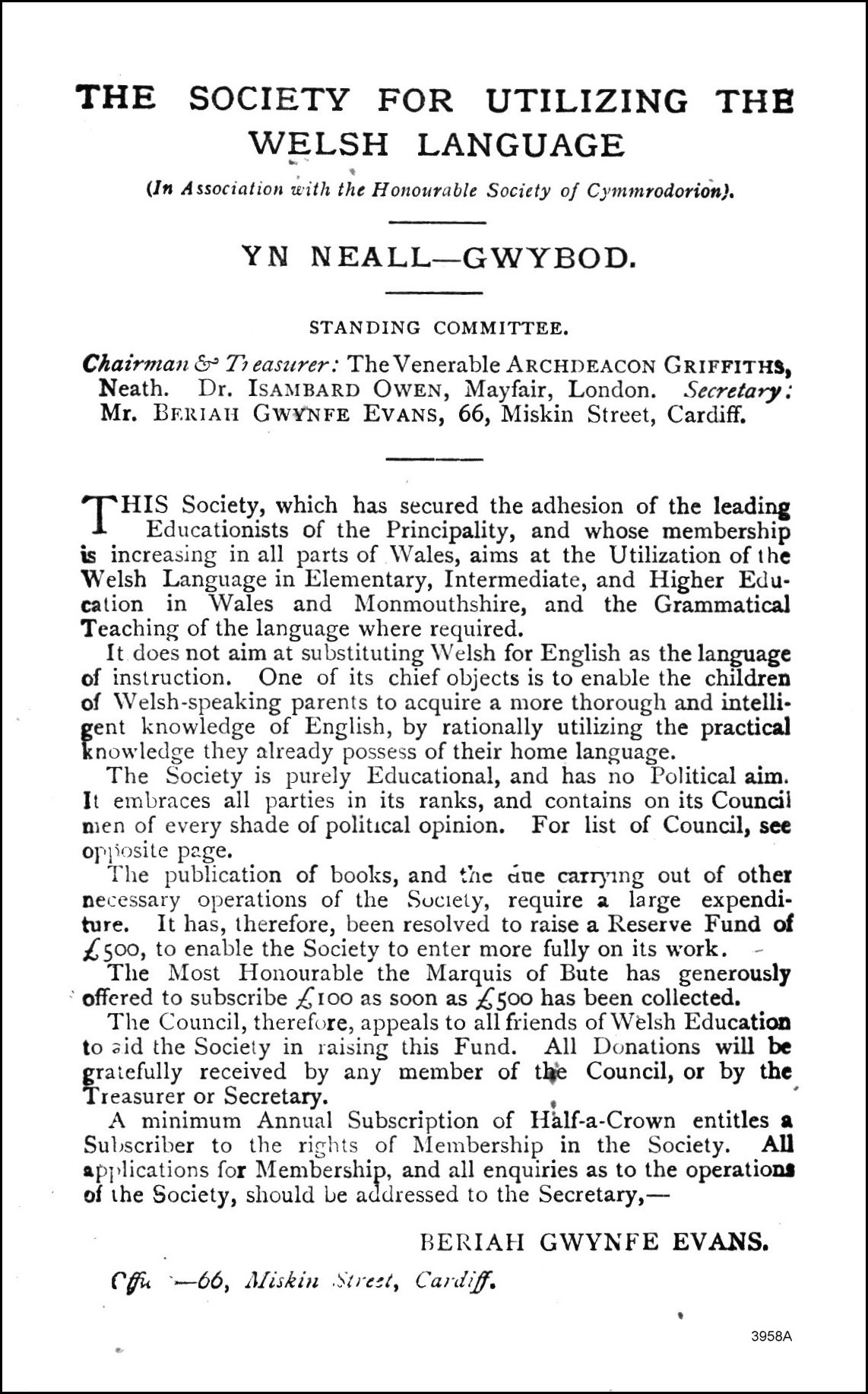
|
(delwedd 3956B) (x119)
(119) THE NEW COLLEGE BUILDINGS.—The New
College Buildings are being rapidly
restored. The Science Department will be
completed and ready for occupation in January, 1888, and the whole
Building by Septe.mber, 1888, in time
for the commencement the session 1888-9.
The Class Rooms and other arrangements are of a very complete
character and accommodation of a
superior kind will be provided for af least 300 students.
LOCAL ADVAN T AGES. —Aberystwyth is beautifully situated on Cardigan Bay. It has excellent sanitary
arrangements, and is one of the
healthiest towns in the kingdom, the average death rate being only 14
per 1,000. An analysis of the water,
by Dr. Frankland shows that its purity is
not excelled by that of any water supply in Great Britain. Aberystwyth
has accommodation for about 5,000
visitors during the summer season, and
since this is not utilized during the period of the College Session,
out-door Students are able to obtain
Lodgings at a VERY MODERATE COST. The sum
usually paid is from 3s. ()d. to 5s. per week. Full particulars as to Lectures, Hostel,
Scholarships, etc., may be had on
application to the Registrar, University College, Aberystwyth. LONSDALE CHAMBERS, 27, CHANCERY LANE, LONDON, August 20th, 1887. MORGAN LLOYD, Hon. Sen.
LEWIS MORRIS, j EDUCATION IN
WALES. The Future Development of the
Welsh Educational System, Being the Proceedings of the Cynvm-odorion
Section of the London National
Eisteddfod, 1887, Including the Papers
read by Principal V IRI AMU JONES,
Cardiff, and Principal REICHEL, Bangor, on The Future of Higher Education in Wales
; Mr. W. EDWARDS, H.M. Inspector of
Schools, and Mr. IBERIAYI GWYNFE
EVANS, on The Place of/he Welsh
Language in Elementary Education in
Wales ; Miss E. P. HUGHES, Cambridge,
and Miss DILYS DAVIES, London, on Higher Education for Girls in Wales. Price TWOPENCE, Post Free. From—The SECRETARY, The Society for
Utilizing the Welsh 66, Miskin Street,
Cardiff. 3956B
|
|
|
|
|
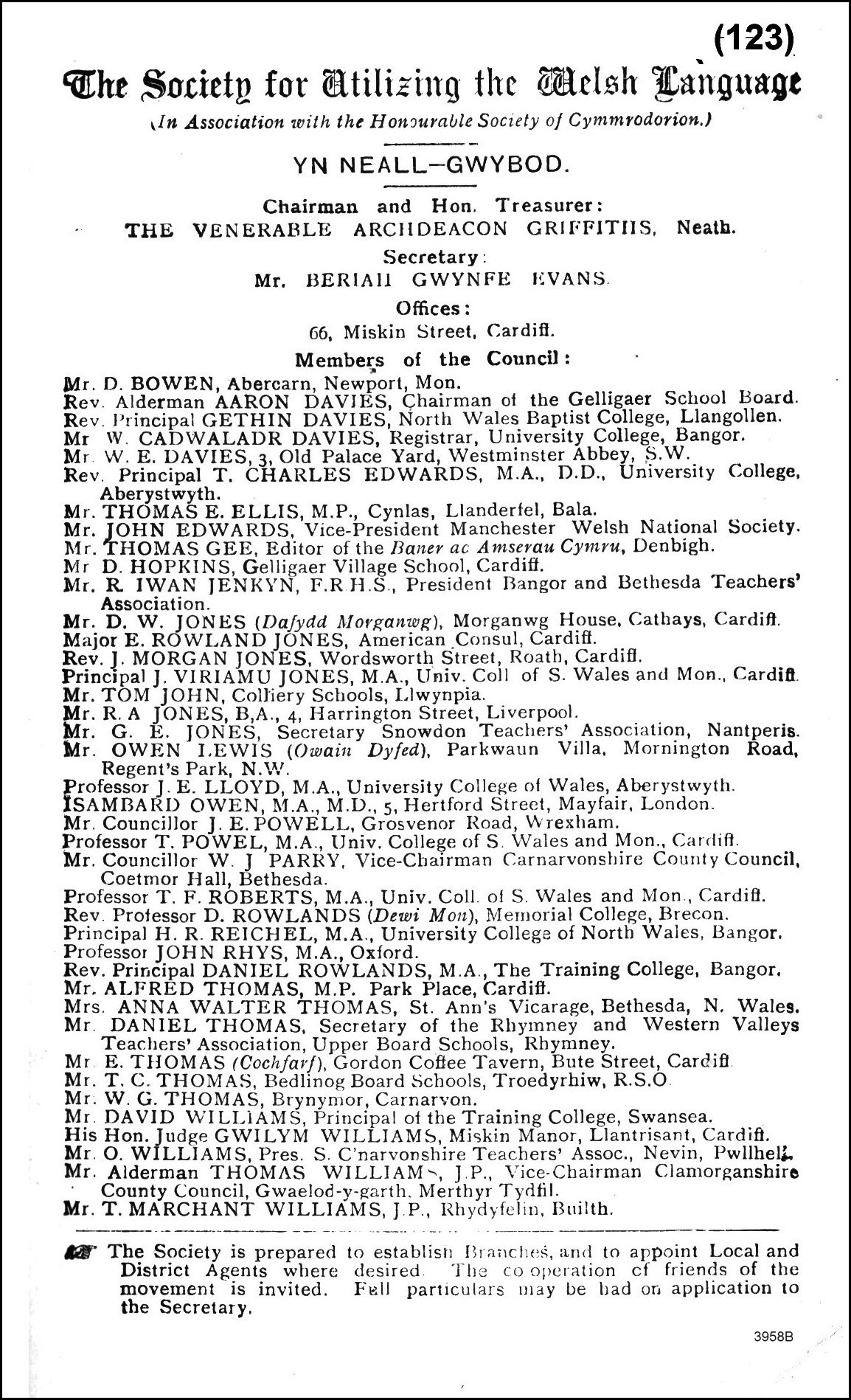
|
(delwedd 3957A) (x120) C)sfüf5tru ILjigIJ SclJüüI. The School Year is divided into three terms
of 13 weeks each, commencing
respectively on the 3rd Tuesday in January, the last Tuesday in April, and the 3rd Tuesday in
September. There is Accommodation for
65 Boarders. It is desirable that
applications for admission should be made as early as possible
before the beginning of each
term. The Boarders at present
represent Sixteen of the Western
Counties. The Upper Sixth Form
prepares for Scholarships at Oxford
and Cambridge ; and the Lower Sixth Form for the Matriculation Examination of London University, for which
the High School is a Centre. The Fifth and Fourth Forms prepare for the
Oxford Local Examinations (for which
the I ligh School is a Centre), and also for
the Public Examinations generally.
The Third and Second Forms prepare for the Fourth Form, as well as for Business and Commercial
Pursuits. The First Form is
preparatory, and Boys can be received into
this Form at an early age. One
Hundred and Ten Public Certificates have been obtained by Pupils direct from School during the
last two years. From 15 to 20
Scholarships and Exhibitions, varyingin value
from K 40 to '12, are annually offered for comp*ition on the first Tuesday in January. For Syllabus of Scholarships, School
Prospectus, and List Of Successes
apply to OWEN OWEN, M.A., HEAD MASTL,
3957A
|
|
|
|
|
|
(delwedd 3957B) (x121) (121)
*abhütbül Cumreiß
CAERDYDD. CVFRES O W ERS 1 DWY-IEITHOG I' tv hader yn yr Ysgol Sabbothol. Parotoedig gan Is-Bwyllgor yr Undeb
uchod. Y I,lyrr Cyntaf yn awr yn
barod. Pris Ceiniog yr un, na 9c. y
dwsin. L LENI ABIEC, Sef Lleni Mawrion yn cynwys yr Abiec yn
Gymraeg, at wasanaeth dosbarthiadau.
Pris Ceiniog a Dimai yr un, neu Swllt y Dwsin. Llyfrau ereill yn cael eu Parotoi. Danfoner pob archebion at—Mr. T. BOWEN,
Ysgrifenydd Cynorthwyol yr Undeb, 34,
Gregg Frederick St., Caerdydd•.
Qsgoliüit SabbütIJüI Cuntteig
LIVERPOOL. LLAWLYFR
CYMREIG, At wasanaeth leuenctyd
Ysgolion Sabbolhol Cymrei& y
Trefydd Seisnig. GAN WILLIAM J.
THOMAS, LIVERPOOL. Pris Tair
Ceiniog. Cyhoeddwyd gan Undeb Ysgolion
Sabbothol Cymreig Liverpool a'r
Cyffniau. Ceir pob manylion wrth anfon
at yr Vsgrifenydd,—Mr. E. W. ROBERTS.
154, Northbrook Street, Prince's Avenue, LiverpooL 3957B
|
|
|
|
|
|
(delwedd 3958A)
(x122) THE SOCIETY
FOR UTILIZING THE
WELSH LANGUAGE
(In Association with the Honourable Society of Cymmrodorion).
Y N NEALL—GWYBOD.
STANDING COMMITTEE.
Chairman 7} easurer: The Venerable ARCHDEACON GRIFFITHS,
Neath. Dr. ISAMBARD OWEN, Mayfair, London. Secretary:
Mr. GWYNFE EVANS, 66, Miskin street, Cardiff.
THIS Society, which has secured the adhesion of the leading
Educationists Of the Principality, and whose membership
increasing in all parts of \Vales, aims at the Utilization of the
Welsh Language in Elementary, Intermediate, and Higher Edu-
cation in Wales and Monmouthshire, and the Grammatical
Teaching of the language where required.
It does not aim at substituting Welsh for English as the language
of instruction. One of its chief objects is to enable the children
of Welsh-speaking parents to acquire a more thorough and intelli-
ent knowledge of English, by rationally utilizing the practical
nowledge they already possess of their home language.
The Society is purely Educational, and has no Political aim.
It embraces all parties in its ranks, and contains on its Council
men of every shade of political opinion. For list of Council, see
omiosite page.
The publication of books, and the éue carrymg out of other
necessary operations of the Society, require a large expendi-
ture. It has, therefore, been resolved to raise a Reserve Fund of
L 500, to enable the Society to enter more fully on its work.
The Most Honourable the Marquis of Bute has generously
offered to subscribe {100 as soon as K 500 has been collected.
The Council, therefore, appeals to all friends of Welsh Education
to aid the Society in raising this Fund. All Donations will be
ratefully received by any member of Council, or by the
reasurer or Secretary.
A minimum Annual Subscription of Hålf-a-Crown entitles a
Subscriber to the rights of LMembership in the Society. All
applications for Membership, and all enquiries as to the operations
of the Society, should be addressed to the Secretary,—
BERIAH GWYNFE EVANS.
—66, Miskin .So•et, Cardif.
3958A
|
|
|
|
|
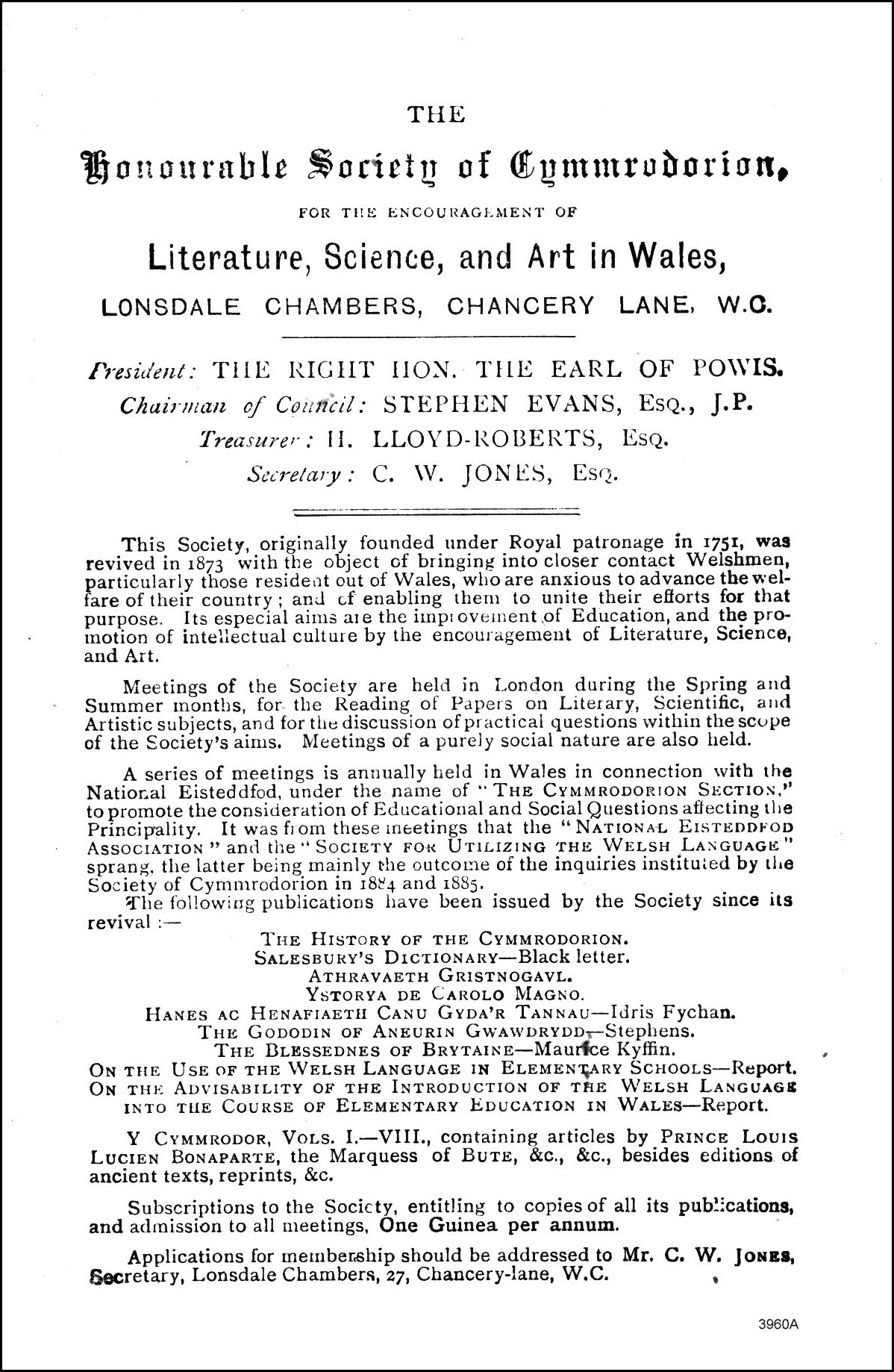
|
(delwedd 3958B)
(x123) (123)
Che Societp for Utilizing the ZUcIgh unitguage
Association with the Honourable Society of Cymmvodorion.)
YN NEALL—GWYBOD.
Chairman and Hon. Treasurer :
THE VENERABLE ARCHDEACON GRIFFITHS,
Secretary
Mr. BERIAII GWYNFE EVANS
Offces :
66, Miskin Street, Cardiff.
Members of the Council :
Mr. D. BOWEN, Abercarn, Newport, Mon.
Neath.
Rev. Alderman AARON DAVIES, Chairman of the Gelligaer School Board.
Rev. Principal GETHIN DAVIES, North Wales Baptist College, Llangollen.
Mr W. DAVIES, Registrar, University College, Bangor.
Mr W. E. DAVIES, 3, Old Palace Yard, Westminster Abbey, S.W.
Rev. Principal T. CHARLES EDWARDS, M.A., D.D., University College,
Aberystwyth.
Mr. THOMAS E. ELLIS, M.P., Cynias, Llanderfel, Bala.
Mr. IOHN EDWARDS, Vice-President Manchester Welsh National Society.
Mr. THOMAS GEE, Editor of the Baner ac Amserau Cymru, Denbigh.
Mr D. HOPKINS, Gelligaer Village School, Cardiff.
Mr. R IWAN JENKYN, F.R H.s., President Bangor and Bethesda Teachers'
Association.
Mr. D. W. JONES (Dafydd Morganwg), Morganwg House. Cathays, Cardiff.
Major E. ROWLAND JONES, American Consul, Cardiff.
Rev. 1. MORGAN JONES, Wordsworth Street, Roath, Cardiff.
Princlpal J. VIRIAMU JONES, M.A., Univ. coli of S. Wales and Mon., Cardin
Mr. TOM JOHN, Colliery Schools, l.lwynpia.
Mr. R. A JONES, B,A., 4, Harrington Street, Liverpool.
Mr. G. E. JONES, Secretary Snowdon Teachers' Association, Nantperis.
Mr. OWEN LEWIS (Owain Dyfed), Parkwaun Villa. Mornington Road,
Regent's Park, N.W.
Professor J. E. LLOYD, M.A., University College of Wales, Aberystwyth.
ISAMBARD OWEN, M.A., M.D., 5, Hertford Street, Mayfair, London.
Mr. Councillor J. E. POWELL, Grosvenor Road, Wrexham.
Professor T. POWEL, M.A., Univ. College of S Wales and Mon., Catxlifl.
Mr. Councillor W I PARRY, Vice-Chmrman Carnarvonsbire County Council.
Coetmor Hall, Bethesda.
Professor T. F. ROBERTS, M.A., Univ. coll. 01 S. Wales and Mon , Cardiff.
Rev. Professor D. ROWLANDS (Dewi Mon), Mernorial College, Brecon.
Principal H. R. REICHEL, M.A., University College of North Wales, Bangor.
Professor JOHN RHYS, M.A., Oxford.
Rev. Principal DANIEL ROWLANDS, M.A„ The Training College, Bangor.
Mr. ALFRED THOMAS, M.P. Park Place, Cardiff.
Mrs. ANNA WALTER THOMAS, st. Ann's Vicarage, Bethesda, N. Wales.
Mr. DANIEL THOMAS. Secretary of the Rhymney and Western Valleys
Teachers' Association, Upper Board Schools, Rhymney.
Mr E. THOMAS (Cochfavf), Gordon Coffee Tavern, Bute Street, Cardiff
Mr. T. C. THOMAS, Bedlinog Board Schools, Troedyrhiw, R.S.O
Mr. W. G. THOMAS, Brynymor, Carnarvon.
Mr. DAVID WILLIAMS, Principal of the Training College, Swansea.
His Hon. Judge GWILYM WILLIAMS, Miskin Manor, Llantrisant, Cardiff.
Mr. O. WILLIAMS, Pres. S. C'narvonshire Teachers' Assoc., Nevin,
Mr. Alderman THOMAS WILLIAM*, JF., Vice-chairman Clamorganshire
County Council, Gwaelod-y-garth. Merthyr Tydfil.
Mr. T. MARCHANT WILLIAMS, J P., Rhydyfelin. Builth.
The Society is prepared to establisn Branchek, and to appoint Local and
District Agents where desired T lie co operation cf friends of the
movement is invited. Fell particulars Ina y be bad on application to
the Secretary.
3958B
|
|
|
|
|
|
(delwedd 3959A)
(x124) 2.
3.
The $ittionat CiGttihfoi
President: THE MOST HONOCRABI.E THE MARQUIS OF BUTE, K.T.
Treasurer: SIR J. H. PULESTON, M.P.
Hon Secretary : MR. T. MARCHANT WILLIAMS, B.A.
Secretary: MR. E. VINCENT EVANS.
OFFICES CHAMBERS, 27, CHANCERY LANE, L0N0CN, C.
OBHÄCTS or
To raise, by means of annual subscriptions and donations, a fund which
shall the Association to offer prizes for competition, and in
other ways to promote. the usefulness of the Eisteddfod.
To secure the holding of only one National Eisteddfod in each year, in
North and South Wales alternately ; to select the place at which it
shall be held, and fix the conditions to be attached to the selection.
To assist in providing a suitable pavilion ; in selecting appropriate sub-
jects for competition ; in securing men of eminence to preside at the
Eisteddfod meetings ; in preparing the Eisteddfod programme; and
in upholding the authority of the Gorsedd.
4. To publish a volume of the Eisteddfod transactions annually, and such
prize compositions as may from time to time be selected by the
Council.
The Council beg to call attention to the following List of Publications
The Association Prize Essay, Cardiff Eisteddfod, 1883,
Elcnpbbiattb Upnu•tig O'r 1300 i'r 1650 D.C.
(The History of VVelsh Literature from A.D. 1300 to A.D. 1650). By R. J.
PRY SE (Gweirydd ap Rhys). Cloth, Demy 8vo., 500 pp. Price to Members
of the Association, 5s. ; to Non-Members, IOS. 6d.
The Association Prize Essay, Liverpool Eisteddfod, 1884,
yttqlJ Y)ig I! ifc •ani y ift-(mrh.
By W. E. DAVIES, with a Preface bv LEWIS MORRIS, Esq., M.A., and a new
Autotype Portrait of Sir Hugh Owen. Cloth, Crown 8vo., 140 pp. Price to
Non-Members, 2s. 6d.
The Association Prize Quartet, Aberdare Eisteddfod, 1885,
Quartet in 4 fot Violin, Viola, l')iolonctlla, ani Pianoforte
By J. T. REES. Score, 8s. nett; Parts, 2s. each. Reduced Price to Members.
Gwobrwyedig gan yr Anrhydeddusaf Ardalydd Bute, K.T.,
31ctgtis '
gan CuripibeB,
Chwareugerdd Roegaidd, wedi ei throi i'r Gymraeg gan Proffeswr D. ROW.
LANDS, B.A.(Dewi Mon), Pa c , . D. E. EDWARDES, M.A., Gyda Rhag.
arweiniad gan Profieswr T. F. ROBERTS, B.A.
Cofnobi01t ?iltiiugol Cist ciå(ob *berbar, 1885.
Transactions of the National Eisteddfod of Walés, Aberdare, 1885.
Cofnobiotl a qpfangobbiabaxt Ciståbfob Catrnarf01t, 1886.
Transactions of the National Eisteddfod of Wales, Carnarvon,.1886.
For the Years 1881, 1882, 1883. 1884, 1885, 1886, together with the
Transactions
•f the Cymmrodorion Section of the National Eisteddfod.
Terms of Membership.—An Annual Subscription of not less than Half-
a-Guinea, payable in advance to the Secretary, Mr. E. VINCENT EVANS, at
the Offce of the Association, Lonsdale Chambers, 27, Chancery Lane,
London. W.C.
3959A
|
|
|
|
|
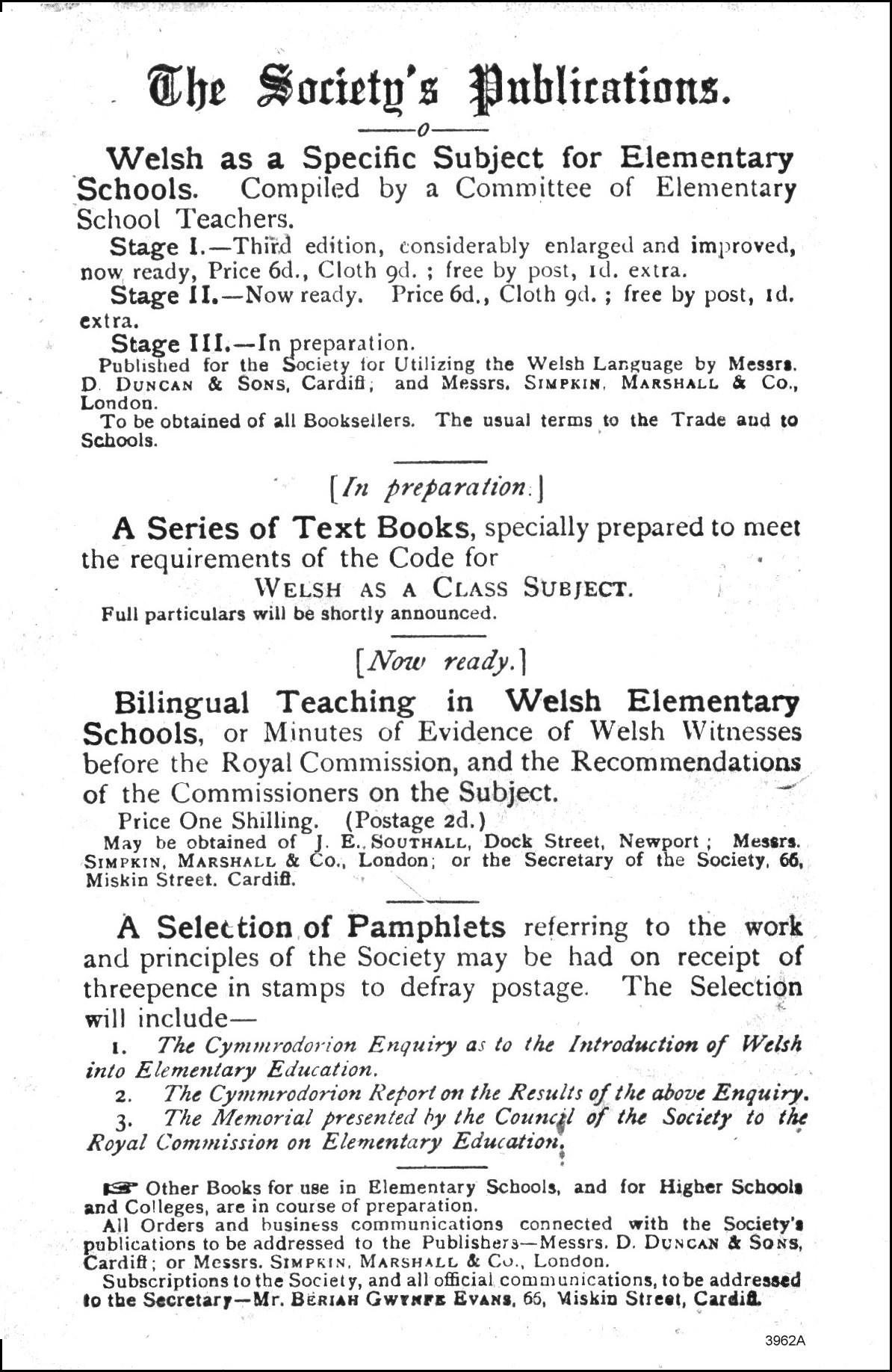
|
(delwedd 3959B)
(x125)
(125)
Agsnriatiott for Orontoiiltg the I(jigber
Ciltration of Oir15 in
HONORARY SECRETARIES :
Mrs. VERNEV, RHIAXVA, BANGOR, WALES,
Miss DILYS DAVIES, 5, GORDON SQUARE, LONDON, W.C.
T Hrs ASSOCIATION has been formed ',vith the double purpose of stimulating
the desire for better education in women which has been awakened in Wales.
and remedying, as far as its may extend, the present lamentabl&
deticiency of means for such education. Thanks to the University Colleges,
the collegiate part of the course is now partly provided for; but Wales is
still almost destitute of the sound intermediate schools which are essential
to lead up to the collegiate career, and without which the efforts of the
colleges are well-nigh paralysed.
The Association therefore proposes—
1. To diffuse knowledge of the requisites of good school and college
education for girls, and to make its advantages more widely known.
2. To collect information as to the present condition cf education
as afiécting girls in the various districts of the Principality, and to
ascertain how improvements may best be secured under the special
conditions of life in Wales.
3. To watch carefully over the interests of girls in the expected
legislation for intermediate education in Wales, and in any re-arrange-
ment of Welsh educational endowments.
The condition of Membership is the Payment of a Minimum Annual Subscrip-
tion oj Half-a-Crown.
Applications for Membership should be Addressed to
Miss DILYS DAVIES, Hon. sec.
, 5, GORDON SQUARE,
LONDON, N.S. C.
The following Pamphlets and Reprints have been issued by the Society for
the furtherance of its work, and may be obtained of Miss DAVIES for
A PENNY EACH.
I.
2.
3.
4.
5.
6.
WELSH UNIVERSITY LOCAL EXAMINATIONS.
By Mrs. BRYANT, D.Sc.
RACE AND NATIONALITY.
By ISAMBARD OWEN, M.D., M.A.
THE FUTURE OF WELSH EDUCATION.
By PRINCIPAL REICHEL, M.A.
THE EDUCATION OF WELSHWOMEN.
By Miss E. P. HUGHES.
ADDVSG MERCIIED CYMRU.
Gan Miss E. P. HUGHES.
THE PROBLEM OF GIRLS' EDUCATION IN WALES.
By Miss DILYS DAVIES.
3959B
|
|
|
|
|
|
(delwedd 3960A)
(x126)
THE
Socictu of
FOR TUE ENCOURAGEMENT OF
Literature, Science, and Art in Wales,
LONSDALE CHAMBERS, CHANCERY LANE, W.C.
['resident: THE RIGHT HON. THE EARL OF POWIS.
Chai„nan of Conncil.• STEPHEN EVANS, ESQ., J.P.
ll. LLOYD-ROBERTS, ESQ.
Treasurer .
Secretary: C. NV. JONES, ESQ.
This Society, originally founded under Royal patronage in 1751, was
revived in 1873 with the object of bringing into closer contact Welshmen,
particularly those resident out of Wales, who are anxious to advance tbe wel-
fare of their country ; and cf enabling them to unite their efforts for that
purpose. Its especial aims al e the imp: oveqnent of Education, and the pro-
motion of intellectual culture by the encouragement of Literature, Science,
and Art.
Meetings of the Society are held in London during the Spring and
Summer months, for- the Reading of Papers on Literary, Scientific, and
Artistic subjects, and for the discussion of practical questions within the
scope
of the Society's aims. Meetings of a purely social nature are also held.
A series of meetings is annually held in Wales in connection with the
National Eisteddfod, under the name of THE CYMMRODORION SECTION,"
to promote the consideration of Educational and Social Questions affecting
the
Principality. It was fiom these meetings that the " NATIONAL EISTEDDFOD
ASSOCIATION and the " SOCIETY FOR UTILIZING THE WELSH LANGUAGE '
sprang, the latter being mainly the outcome of the inquiries institu{ed by
the
Society of Cymmrodorion in 18.84 and 1885.
The föllowiug publications have been issued by the Society since its
revival :
THE HISTORY OF THE CYMMRODORION.
SALESBURY'S DICTIONARY—BIack letter.
ATHRAVAETH GRISTNOGAVL.
Y STORY A DE CAROLO MAGNO.
HANES AC HENAFIAETH CANU GYDA'R TANNAU—IdriS Fychan.
THE GODODIN OF ANEURIN
THE BLESSEDNES OF BRYTAINE—Maurice Kyffin.
ON THE USE OF THE WELSH LANGUAGE IN ELEMEN'GARY ScH00Ls—Report.
ON THE ADVISABILITY OF THE INTRODUCTION OF THE WELSH LANGUAGE
INTO TUE COURSE OF ELEMENTARY EDUCATION IN WALEs—Report.
Y CYMMRODOR, VOLS. I.—VIII., containing articles by PRINCE Lours
LUCIEN BONAPARTE, the Marquess of BUTE, &c., &c., besides editions of
ancient texts, reprints, &c.
Subscriptions to the Socicty, entitling to copies of all its pubEcations,
and admission to all meetings, One Guinea per annum.
Applications for mernberrship should be addressed to Mr. C. W. JONES,
Becretary, Lonsdale Chambers, 27, Chancery-lane, W.C.
3960A
|
|
|
|
|
|
(delwedd 3960B)
(x127)
BELL'S
READING BOOKS
(Specimen Catalogue sent upon
Are especially designed to give the Children a love of
Reading, and so to lighten the task of the Teacher
throughout the entire course.
A Mistress at a Higher Grade School says The Scholars are very fond of
your Books." The Publishers are continually receiving letters from the
Masters and Mistresses of Elémentary Schools testifying to the value of
the Series in exciting an interest on the part of the children, and thereby
attaining quicker and more satisfactory results.
The are adopted by the School Boards of London, Edinburgh. Liverpool,
irmingham, Leeds, Sheffeld, Nottingham, Portsmouth, &c.
Thosc Volumes Prefixed thus have Illustrations or a Fron!zsPiece.
INFANTS.
, .•.INFANTS' PRIMER .
.•.T0T AND THE CAT ...
HE OLD BOATHOUSE .
HE CAT Art) THE HEN
STANDARD l.
.•.THE THREE MONKEYS...
THE NEW-BORN LAMB
THE BLIND Boy
STANDARD ll.
.•.STORY OF A CAT
THE DEY AND THE KNIGHT
UEEN BEE AND BUSY BEE..
u Ll.'S CRAG, Tale of the
Sea ...
STANDARD Ill.
.•.GRIMM's TALEs—Selected...
GT. ENGLISHMEN, Short Lives
.•.ANDERSON 's TRLEs—Selectd.
STANDARD IV.
GT. ENG'HWOMEN, Short Lives
DICKENS' " LITTLE NELL
from the Old Curiosity bhop
(STANDARD
GT. SCOTSMEN—Short Lives...
EDGEWORTH'S TALEs—Sltd...
PARABLES FROM N ATV HE—SItd 1
.•.MASTERMAN READY—Abdg...
1
STANDARD V.
.•.ARABIAN NIGHTs—Selected
1
FRIENDS IN FUR & FEATHERS
1
LAMB'S Tales from SHAKE-
SPEARE ...
TALES OF THE COAST
.•.ROBINSON CRUSOE
1
STANDARD V AND VI., OR
V., VI., V ll., OOMBINED.
GULLIVER's TRAVELS—Abd.
VICAR OF WAKEFIELD .
POETRY FOR Boys
.•.SETTLERS IN CANADA...
.•.LIFE OF WELLINGTON
LIFE OF NELsoN—Southey—
1
1
Abridged
1
SIR ROGER DE COVERLEY
SHAKESPEARE'S PLAYS.
With Explanatory Notes for
School Use. Kemble's Reading Edition.
tULIUS CÆSAR. Price 6d.
HENRY THE FIFTH. Price 6d.
THE MERCHANT of VENICE. 6d. MACBETH. Price 6d.
KING JOHN. Price 6d.
AS YOU LIKE IT. Price 6d.
LONDON : GEORGE BELL & SONS, YORK STREET, COVENT GARDEN,
3960B
|
|
|
|
|
|
(delwedd 3962A)
(x128)
CIJC
*ütietu'g Publitatißtts.
Welsh as a Specific Subject for Elementary
Schools. Compiled by a Committee of Elementary
School Teachers.
Stage I.—Th1frd edition, considerably enlarged and improved,
now ready, Price 6d., Cloth 9d. ; free by post, Id. extra.
Stage ll.—Now ready. Price 6d., Cloth 9d. ; free by post, I d.
extra.
stage 111 —
. In preparation.
Published for the Society for Utilizing the Welsh Language by Messrs.
D. DUNCAN & SONS. Cardiff, and Messrs. SIMPKIN, MARSHALL & Co.,
London.
To be obtained of all Booksellers. The usual terms to the Trade aud to
Schools.
[ In Preparation. J
A Series Of Text Books, specially prepared to meet
the requirements of the Code for
WELSH AS A CLASS SUBJECT.
Full particulars will be shortly announced.
[Now ready. I
Bilingual Teaching in Welsh Elementary
Schools, or Minutes of Evidence of Welsh Witnesses
before the Royal Commission, and the Recommendations
of the Commissioners on the Subject.
Price One Shilling. (Postage 2d.)
May be obtained of J. E.. SOUTHALL, Dock Street, Newport ; Messrs.
SIMPKIN. MARSHALL & Co., London; or the Secretary of the Society. 66,
Miskin Street. Cardiff
|
|
|
|
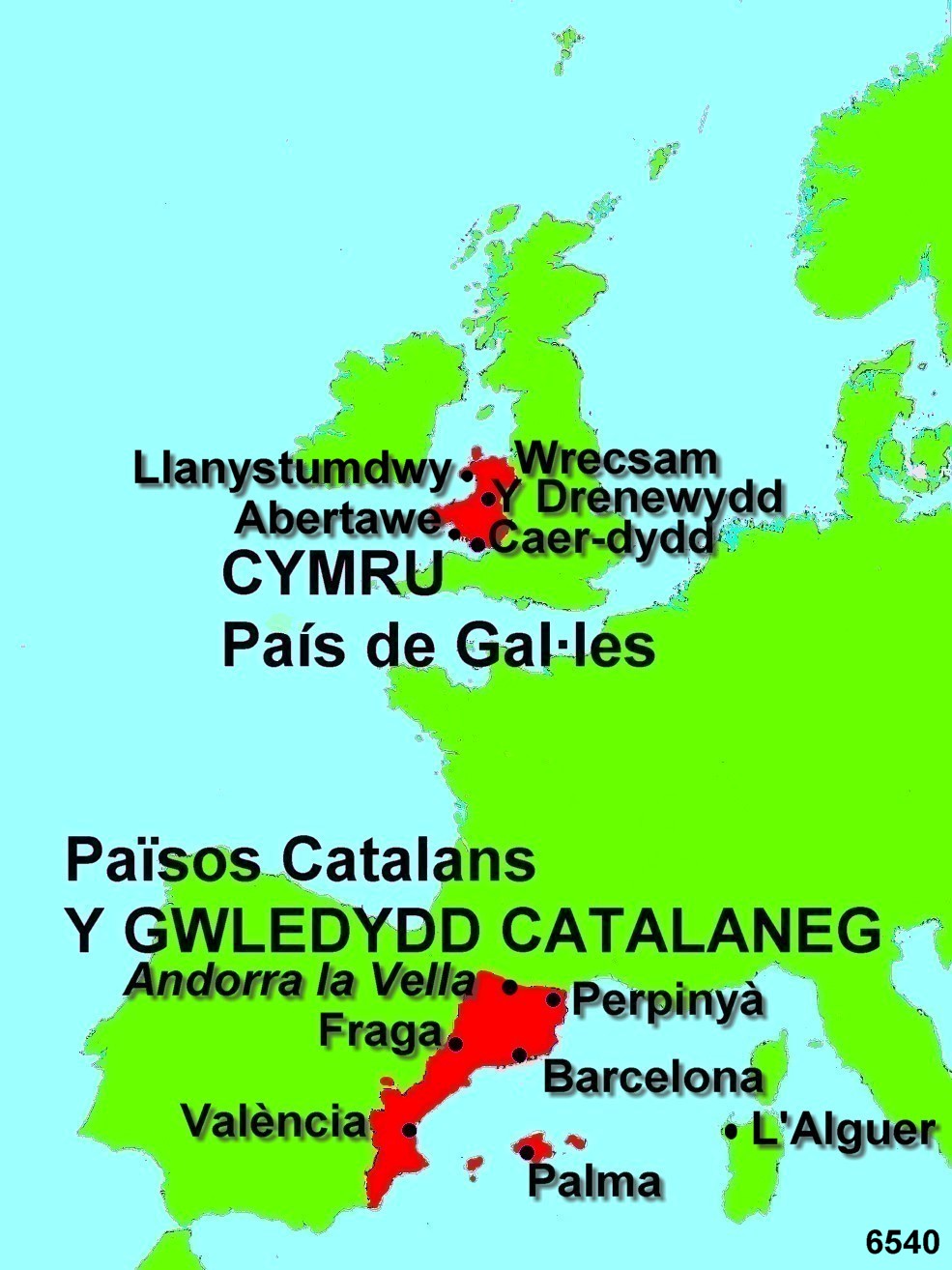


 xxxx Y tudalen hwn yn Gymraeg
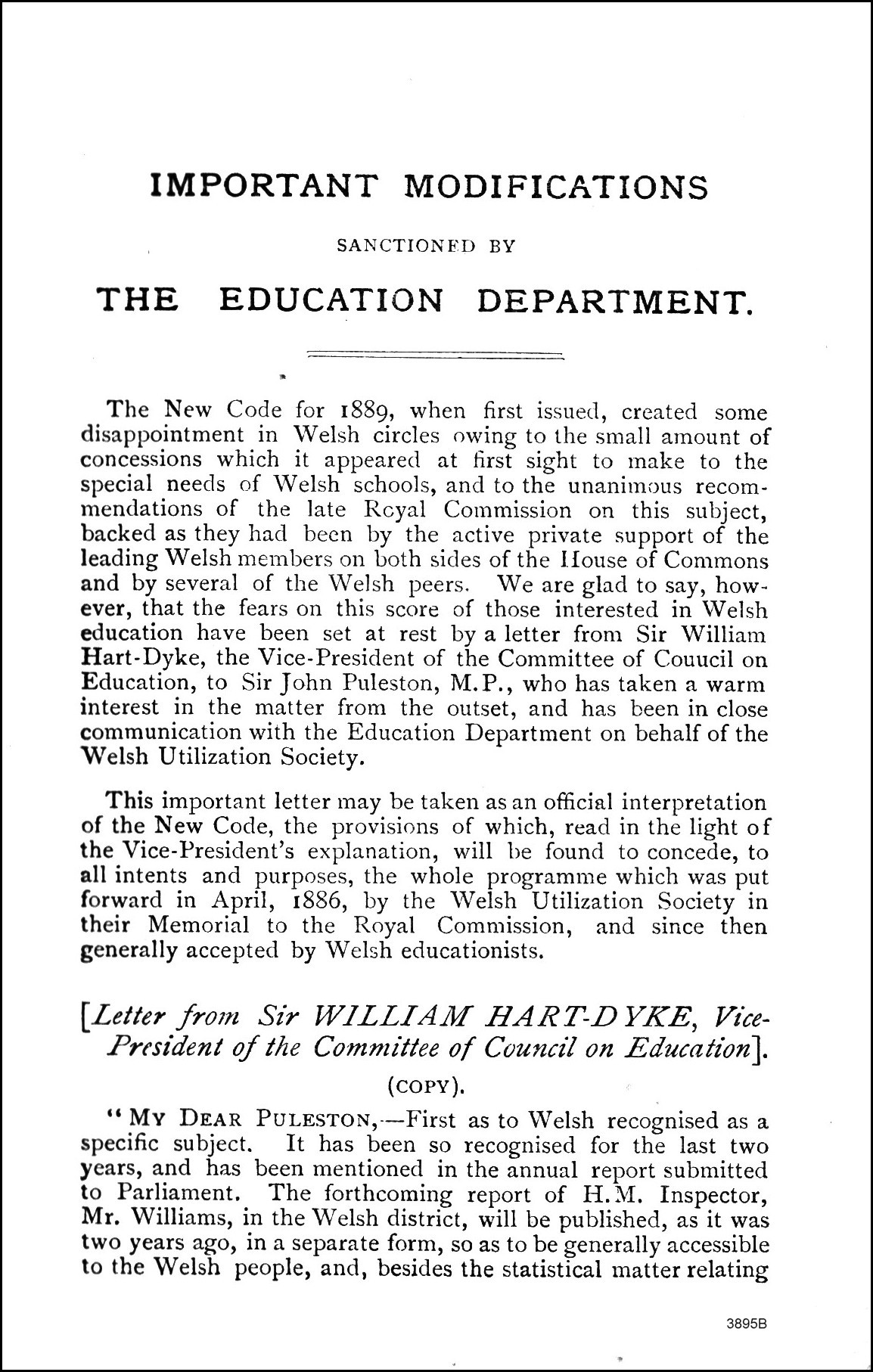 xxxx Aquesta
pàgina en català
xxxx Aquesta
pàgina en català B5237:
  ă ĕ ĭ ŏ ŭ
 yn
yn  aith δ δ £ U+2020 DAGGER †