http://www.kimkat.org/amryw/1_gramadeg/minnesota_02_rhan_2_lleoliad_0882e.htm
0001 Y Tudalen Blaen / Home Page kimkat0001
....................2659e Y Porth
Saesneg / English Gateway kimkat2659e
........................................2003e
Y Barthlen / Plan of the website kimkat2003e
............................................................1804e
Y Cymry Alltud / The Welsh in exile kimkat1804e
..........................................................................................··1927e
Cyfeirddalen i Adran Gwladfa’r Glasbridd / Orientation page for the Welsh Blue
Earth Settlement, Minnesota kimkat1927e
.........................................................................................................................y tudalen hwn / this page
|
|
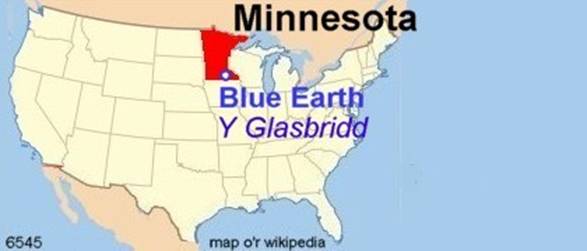
Gwefan Cymru-Catalonia 9 Blue Earth County -
location of the Welsh Settlements |
|

FULL TITLE: History of the Welsh in Minnesota, Foreston and Lime Springs, Iowa,
gathered by the Old Settlers
Edited by the Reverends
Thomas E. Hughes and David Edwards, and Messrs. Hugh G. Roberts and Thomas
Hughes.
1895
Note: We have added
comments and corrections to the original text . These are in orange type.
We have indicated the page numbers in the original book, but precede them with
a letter x and they are placed in brackets (x20), (x45), etc.. This makes them easier to find with
the page search function.
___________________________________________________________________________________________________
History of the Welsh in
Minnesota
By Thos.
Hughes, Esq, Mankato
___________________________________________________________________________________________________

(delw 4006) (tudalen / page 1)
(x1)
9 BLUE EARTH
COUNTY - Location of the Welsh Settlements
(http://city.net/maps/address/ For a modern map
of the area go to the MapQuest website and type in Mankato)
The Minnesota river, rising near the western boundary of the State to which it
gives its name, flows, for the first hundred miles of its journey, in a
southeasterly direction, when it makes an abrupt bend to the northeast, and,
after following that course another hundred miles, empties into the Mississippi
at the eastern boundary of the State. “Minnesota” was the ancient Indian name
of the river, and is derived from two Dakotah words - “Minne,” “water;” and
“Sotah,” literally meaning “bleared,” though variously translated “muddy,”
“cloudy,” and “sky-tinted.” The word has reference to the peculiar appearance
of the river, caused by minute particles of bluish clay mingling with the
water, so that it does not seem muddy nor yet clear, but “hazy” or “bleared.”
·····
The valley, in which the river flows, is from a mile to a mile and a half in
breadth, and, on either side of the great bend, quite straight - like the two
sides of an angle. Standing upon the bluff at the “V” of the big bend one may
look up the valley to the northwest or down the valley to the northeast, a
distance of forty or fifty miles.
····
(See ‘Before Mankato’ in the ‘Streets of Old Makato
Website’ http://www.anthro.mankato.msus.edu/history/oldmankato/commonlinks/streets.html)
·····
What a magnificent view it is, with the cone-shaped bluffs rising in woody
terraces on either side of the valley nearly two hundred feet in height, now
opening into a grand amphitheater, enclosing an oasis of three or four miles of
bottom prairie, and
___________________________________________________________________________________________________

(delw 4007) (tudalen / page 2)
(x2) now closing into a few miles of solid timber.
Occasionally one catches a glimpse of the river’s silvery chain as it meanders
around one of its many curves; for, though the valley, be straight, the river
is exceedingly crooked, turning and twisting, and often almost doubling upon
its path as though it fain would loiter in its lovely valley. For the most part
the river hugs its northern bluff, leaving most of the bottom-lands on its
southern side. The low, flat-lands, in times of great freshets (a sudden rise in the level of a stream, or a flood, due
to heavy rains or the rapid melting of snow and ice. Webster’s Dictionary)
, are overflowed, while, what is known as the “bench,” which rises about twenty
feet from the low lands, is very stony, so that the valley is but little used
for agriculture. It is not, however, on that account less valuable, for in its
prairie bottom-lands are found the finest meadows of wild hay in the country.
Clay, for the manufacture of brick, drain-tile, and pottery-ware, is found,
also, in inexhaustible quantities; while the rocky second bench is full of immense
quarries of the finest building stone, lime and hydraulic cement.
·····
The valley is dotted with many villages and cities; and, in the palmy days of
steamboating, the river banks on either side were lined with town sites, which
might have been great cities, had the fates been more propitious.
·····
At our feet, at the great bend of the river, lies Mankato, the principal city
of Southern Minnesota. Three miles higher up the bend are the ruins of its
ancient rival - the village of South Bend; ten miles higher up, on opposite
sides of the river, are the town sites of Judson and Eureka, but these cities
are now no more; fifteen miles still farther up is the pretty German city of
New Ulm. Below Mankato seven miles is the old village of Kasota with its famous
stone quarries; five miles farther is the city of St. Peter; two miles beyond
is the site of Traverse de Sioux, once the metropolis of the Minnesota valley,
but now entirely deserted; about a mile farther we come to Ottawa, and six
miles more and we reach Le Sueur; while at the junction of the Minnesota with
the Mississippi lie the great twin cities of St. Paul and Minneapolis.
·····
At the great bend of the Minnesota there empties into it, from the south,
between Mankato and South Bend, the Blue Earth river. Its name is a translation
of the Indian appelation, “Mahkahto,” given it by reason of a peculiar bed of
clay of a bluish or greenish color, found on the river about three miles above
its mouth, which clay of old had great fame among the aborigines as a pigment
for decorating their bodies. The river, with its many tributaries, branching
out like a spreading oak,
___________________________________________________________________________________________________
(x2a) blank

(delw 4008) (tudalen /
page 2b)
(x2b) Photo: Welsh Business Men of Lake
Crystal, Minn.
___________________________________________________________________________________________________

(delw 4009) (tudalen / page 3)
(x3) drains the county of Blue Earth. These many rivers,
with their countless brooks and rills, each bordered with its winding chain of
timber, and with the myriad lakes, many of which are daintily set in groves of
oak and poplar, caused the naturalist, Nicollet, who, in 1838, visited the
country, to name it the “Undine Region,” after the water nymph of the famous
German romance. On the eastern bank of the Blue Earth lies the great forest,
stretching fifty miles in length by from twenty to forty miles in breadth,
known as the “Big Woods.” This great body of timber has been protected during
the centuries from the destructive prairie fires, which almost every autumn
used to sweep across the plains, by the Minnesota river on the north, the
Cannon and Straight rivers on the east, the Le Sueur river on the south, and
the Blue Earth river on the west. On the western side of the Blue Earth begins
the great plain, which stretches over grassy knoll and reedy lake in a
boundless ocean of rolling prairie as far as the Rocky Mountain.
·····
The portion of this vast country with which we shall have to do particularly is
that occupied by the Welsh Settlements. The largest and one of the oldest of
which is is that of Blue Earth County, comprising a strip six miles wide,
extending northwesterly along the right bank of the Minnesota river, a distance
of twenty miles. It embraces the townships of South Bend on the east, Judson in
the center, and the northeasterly half of Butternut Valley and the fractional
town of Cambria in the west. Its western end also dips over a little into
Cottonwood township, Brown Co. A few Welsh also reside in the small village of
Courtland, on the opposite side of the Minnesota river from Cambria; quite a
number reside at the much larger village of Lake Crystal, situated on the
southern boundry (sic) of Judson; and a
still greater number dwell in the city of Mankato. There is also a branch of
the settlement twenty miles northwest of Mankato, in Le Sueur county, near the
village of Ottawa, known from the great timber tract in which it is situated as
the “Big Woods” settlement,
·····
Another branch of the Blue Earth county settlement of the Blue Earth county
settlement is located on the head waters of the Big Cottonwood sixty miles to
the west, formerly known as Saratoga, but now called Tracy and Custer, while
about 2,000 Welsh people reside in St. Paul and Minneapolis. Sixty miles to the
northwest of Mankato lie three flourishing Welsh settlements, at the head
waters of the Iowa river, partly in Minnesota and partly in Iowa, and known as
Bristol Grove, Foreston and Lime Springs.
·····
In the Blue Earth County settlement, on the southern
___________________________________________________________________________________________________
(x4)

(delw 4010) (tudalen / page 4)
Minneopa Falls
___________________________________________________________________________________________________

(delw 4011) (tudalen / page 5)
(x5) boundary of South Bend and Judson, there is a chain
of five large lakes, beautifully environed by groves of timber, and on the
banks of one of which is pleasantly situated the village of Lake Crystal. The
outlet of these lakes is a sparkling little brook which flows in a
northeasterly direction through the towns of Judson and South Bend into the
Minnesota river. It is called by its Indian name “Minneopa”, from “Minne,”
“water,” and “inneopa,” “of two falls.” These falls are situated about half way
up the stream, and one is ten, and the other, just below it, nearly fifty feet
in height. Stories are told how the Indian braves used to shoot over both falls
in their light, frail canoes and land right-side up on the foaming waters
below. In a cave under the larger falls dwelt in the early days the brave chief
San-tuhu-mah-na-du-tah, “Hater-of-the-white-race,” whose mighty deeds, in
avenging the wrongs of his sister, tradition tells. At the time of the
Inkpadootah (Inkpaduta) war the old chief
went to Spirit Lake, and from there, probably, to the spirit land, as he was
never heard of afterwards.
·····
Through the middle of Cambria township flows Cambria creek, and through its
northwestern corner runs the Little Cottonwood, both emptying into the
Minnesota. The Little Cottonwood is so called to distinguish it from the Big
Cottonwood, a larger river emptying into the Minnesota six miles above in the
vicinity of New Ulm. “Cottonwood” is the English word for “Waraju,” the old
Indian name of these rivers (See 0877
(The Sioux and their Names of Places - 1895).
·····
Bordered thus, north and east, by the two large rivers, the Minnesota and the Blue
Earth, with their charming valleys and belts of wood; traversed by so many
brooks and rills with their spurs of timber jutting out across the great
rolling prairie; bespangled with so many lovely lakes and pleasant groves, the
Welsh Settlement of the Minnesota valley is the most delightful spot in all
this charming Undine Region.
·····
·····
10 BLUE EARTH
COUNTY - CLIMATE, SOIL AND PRODUCTION
The Dakotah Indians believed that the mouth of the Minnesota river stood
directly over the centre of the earth. Nor was this traditional fancy of the
untutored savage much at variance with the more exact knowldege of modern
geography. The surveyor’s chain designates Minnesota as the equi-distant point
between the two oceans; while the rivers, radiating northward, southward,
eastward, westward, also mark it as the very top of the great dome of the
American continent. This high latitude and altitude render the winters at times
necessarily cold and long,
___________________________________________________________________________________________________

(delw 4012) (tudalen / page 6)
(x6) while the distance from the sea causes the atmosphere
to be exceptionally dry and pure. A severe winter closes in about the last of
November, and continues without any great relaxation of its vigor until about
the last of March. There is an occasional blizzard from the northwest. The
depth of snow is from one to two feet all winter, and the mercury reanges from
zero to twenty to thirty degrees below; but in the dry, crisp air of Minnesota
one does not fell the cold at thirty below; but in the dry, crisp air of
Minnesota one does not feel the cold at thirty below, more than he would at
zero in the more humid atmosphere of the sea coast. The severe winters,
however, do not occur regularly every year. Half the time the winters are mild
and open, with little, if any, snow. These open winters, though are not nearly
as healthy as the others. There is a tonic in a steady, cold Minnesota winter,
which braces up one’s whole constitution, which purifies the atmosphere, and
which seems even to impart fresh vigor to the soil. The summer months of June,
July and August are usually very warm, the temperature often getting as high as
80, 90 and sometimes even 100 degrees in the shade. Its long, magnificent
autumns are, however, Minnesota’s pride. The temperature so pleasant and
uniform, the skies so clear and sunny, and nature so gorgeously rich in all her
attire, that the days are a succession of delights.
·····
The soil is a dark, rich loam, from a foot and a half to three foot in depth, with
a clayey bottom. It produced in its natural state a most luxuriant growth of
grass, taller than one’s head, and even today constitutes the principal
pasturage and hay meadows of the land.
·····
The chief agricultural product has been wheat, which used to yield from twenty
to thirty-five bushels per acre on the average. Of late years the land has
become somewhat exhausted from constant wheat raising, and the farmers are
turning their attention more to dairying, stock raising, and diversified
farming, with a success more sure and substantial than under the old
dispensation of universal wheat fields. Corn, oats, barley, sorghum, and
potatoes are grown abundantly. Wild plums, grapes, gooseberries, currants,
strawberries, and raspberries are very plenty, and their tame cousins are also
easily cultivated. Hardy kinds of apples are likewise grown successfully.
·····
The timber of the country comprises oak, elm, basswood, maple, butternut,
hickory, poplar, and in the valleys, black walnut and cottonwood.
·····
·····
11
BLUE EARTH COUNTY - ABORIGINES
This country was the ancient home of the Sisseton bands of
___________________________________________________________________________________________________

(delw 4013) (tudalen / page 7)
(x7) the powerful Sioux or Dakotah nation. Their villages
were situated at Traverse-De-Sioux, at Swan Lake, (Merrah Tauka) (sic; = Tanka; See 0877e
(The Sioux and their Names of Places - 1895); and see 1053e
(Lakota wordlist) Maghá Táka Óta = “many swan”), at the mouth of the Big
Cottonwood, and in Judson, just below the residence of Henry Roberts, Esq., on
the Minnesota river.
·····
Of these the principal one was at Swan Lake, under Chief “Red Iron,” while that
under Chief “Friend,” in Judson, was the least, being really only a branch of
the Swan Lake village. An Indian village consisted simply of a collection of
huts, built by covering a frame-work of poles with elm bark, leaving a hole in
the roof for the smoke to escape. These villages were seldom occupied except in
the winter, which fact, owing to the Indian’s want of cleanliness in and about
his abode, was well as a sanitary measure. During the summer the Indians
wandered about from stream to stream, from lake to lake, and from prairie to
woodland, hunting and fishing, and dwelling in teepees.
····
An old Indian trail led from “Red Iron’s” village to “Friend’s,” and there to
the upper prairie, near the house of Henry Roberts, Esq., thence by the house
of Rev. John Roberts, following the edge of the timber in a bee line through
the village of South Bend, to the valley of the Blue Earth, called by the
Indians “Pleasant Valley,” where they obtained their paint and where they loved
to camp, thence the path led through where now stands the city of Mankato, into
the Big Woods, where they frequently went on hunting expeditions, and where,
every spring, they made much maple sugar.
·····
Upon this ancient road in the early days one would be quite sure to meet a
troop of aborigines on the march, all walking in single file. First came the
men, dressed in close-fitting pantaloons of clouted cloth or buck skin, with a
wide, fancy fringe along each leg, a pair of moccasins. ornamented with beads,
on the feet, and a dirty white blanket drawn over the shoulders. At the girdle
hung a tomahawk, knife and ammunition pouch, while on the arm would be carried
the gun. They were a tall, stalwart looking people, straight as an arrow, of a
dusky red color, with prominent features, high cheek bones, and long, straight,
very coarse, black hair, often braided in two or three plaits. Behind the men
came the squaws, much more haggard and squatty than their lords, because of the
drudgery they had to perform. On their backs would be huge bundles, and often a
small pappoose (sic; = papoose), strapped to
a board, perched on top of all. With them also, would be all the other
pappooses of various ages, the older ones carrying burdens, like their mothers.
Mingled with the company would be several wolfish-looking
___________________________________________________________________________________________________

(delw 4014) (tudalen / page 8)
(x8) dogs, whose meat was esteemed a great delicacy at
their feasts. Generally, the troops would have half-a-dozen small scraggy
ponies, which, sometimes, the men would ride; and which sometimes the squaws
would harness to two poles, one end of each of which would drag on the ground
and form a primitive sort of wagon, upon which to transport a part of the
luggage and pappooses.
·····
All labor connected with Indian life the squaws performed. Their duty it was
not only to transport the baggage, but, also, to put up the wigwams (sic), fetch the firewood, cook the meals,
cultivate the small patch of Indian corn, tan the furs and the robes, make the
clothing and fancy bead-work, manufacture the household implements and hew out
the canoes.
·····
The Indians were very hospitable, and would spare the last morsel, and expect
others to do the same. They had but a faint idea of private property,
especially in the matter of food, and, therefore, thought nothing of begging
eatables of the early settlers, deeming it a matter of right that if they or
their pappooses were hungry, and the pale face had more food in his lodge than
he wanted at a meal, he should certainly share with them. They seldom made any
provision for the morrow, but would gorge themselves with what they had at the
time and wait until hungry before looking for more; hence, during the severe
winters, when game became scarce, they were often at starvation’s door, and
sometimes perished from want. They were never dainty as to what they ate. All
kinds of animals, and every part of the animal, afforded them nourishment. The
early pioneers remember how a dead horse or dead cow would be relished by the
Indians as a big feast.
·····
The Sioux were the hereditary foes of the Chippewas, who dwelt north, about the
head waters of the Mississippi; and for ages war parties were constantly going
out from one nation against the other. The fair fields of Minnesota have been
literally drenched in gore, and there is scarce a spot but has been the scene
of a bloody conflict. The old settler can recall how he was horrified, when
passing an Indian village, at the site of a number of fresh human scalps,
painted, combed and stretched upon a hoop which was fastened to a pole in front
of the wigwams. Sometimes the heads of their victims might be seen placed in a
hideous row upon stakes. Around these bloody trophies, for many nights, would
be held the savage scalp-dance, with such howling, hooting and yelling as would
wake the echoes of Gehenna. They observed many dances and feasts, and
___________________________________________________________________________________________________

(delw 4015) (tudalen / page 9)
(x9) often spent all night in these wild orgies, much to
the terror of the early settlers before they became used to their customs.
Though the braves disliked all labor, deeming it ignoble for a man, yet they
were inured to the severerst hardships, fatigue and bodily pains. To endure
physical suffereing with them was the chief characteristic of manhood. From childhood
the males were taught to despise pain, and feats of endurance were always the
special feature of their feasts and dances. Major Stephen H. Long, who made a
survey of the valley in 1823, thus describes a “Dance to the Sun,” performed by
a young brave named “Wanotau,” as witnessed by him at Lake Traverse: This
dance consisted in making three cuts through his skin - one on his breast and
one on each of his arms. The skin was cut in the manner of a loop, so as to
permit a rope to pass under the strip of skin and flesh, which was thus divided
from the body. The ropes being pased through, their ends were secured to a
tall, vertical pole planted at about forty yards from his lodge. He then began
to dance around this pole, at the commencement of his fast, frequently swinging
himself in the air, so as to be supported merely by the cords which were
secured to the strips of skin cut from his arms and breast. He continued this
exercise, with few intermissions, during the whole of his fast, until the
fourth day about 10 o’ clock a.m., when the strip of skin from his breast gave
way, notwithstanding which he interrupted not his dance, although supported
merely by his arms. At noon the strip from his left arm snapped off. His uncle
then though he had suffered enough, and drew his knife and cut the remaining
strip from his right arm, upon which Wanotau fell to the ground in a swoon. The
heat at the time was extreme. He was left exposed in that state to the sun
until night, when his friends took him some provisions.
·····
During the summer of 1820 two of these Sisseton Sioux murdered two men on the
Missouri river. The government demanded the murderers for punishment. The aged
father of one volunteered to die instead of his son, and with the other
murderer, started for Fort Snelling to deliver themselves up to the
authorities. Before entering the fort both pinioned their arms and thrust
wooden splinters through the flesh above their elbows, to show their contempt
of pain and death.
·····
Thus the stoic red man cultivated and exalted in his indifference to suffering
and death.
·····
On the opposite side of the river from Friend’s Village, in Judson, on a high
bluff overlooking the river, was situated the
___________________________________________________________________________________________________

(delw 4016) (tudalen /
page 10)
(x10) old Indian cemetery. It was formed by placing a
number of crotched posts in the ground, and laying out a net work of poles
across from one to the other; and on top of those, wrapped in skins or
blankets, the dead were deposited. This ancient burial place was cut down and
destroyed as a nuisance by the early Welsh settlers. The Indian, however, was
gone. For the past thirty years he has not set foot upon the land of his
fathers. A mighty change has taken place; his bark villages have disappeared
without leaving a ruin; his paths are obliterated; there is no trace of the
powerful race which filled the land just thirty years ago; no one can even find
a trinket in the fields; it is as though oblivion had drawn its hand across the
slate of their existence, and blotted out forever their every slight mark. The
land, where his forefathers lived, and moved, and had their being for a
thousand years and more; where they loved and hated, joyed and sorrowed, fought
and bled and died; where ambition stirred and victory crowned full many a
nameless hero - the land where he was born and reared; where he played and won
his first achievements of the chase and war, knows him not. And should he
return today and behold it, dotted with busy marts of trade, sprinked with
farm-houses, school-houses and churches, chequered with waving fields of golden
harvests, striped with roads and railways, and teeming with strange population,
he, likewise, would know it not.
·····
·····
12 BLUE
EARTH COUNTY - EARLY DISCOVERIES
The first account we have of this great country dates back to the year 1700,
when a Frenchman, by the name of Le Sueur, having intimation of a copper mine
in this region, and having received authority from the French Government,
ascended the Mississippi with a small sail boat, two canoes, and nineteen men,
entering, on September 20, 1700, the mouth of the Minnesota, which river he
called St. Pierre, in honor of a French officer then in command at Lake Pepin.
On October 1st he entered the Mahkato or Blue Earth river. About a
league up this river, in the vicinity of the supposed copper mine. Le Sueur and
party landed and built a fort, which was completed on October 14th
and called Le Huillier, after the Farmer General at Paris. That the valleys and
prairies adjoining the Blue Earth and Minnesota rivers then afforded pasturage
to immense herdsd of buffalo, is evidenced by the fact that a few of Le Sueur’s
party in a short time killed four hundred of these animals, whose flesh,
preserved
___________________________________________________________________________________________________

(delw 4017) (tudalen /
page 11)
(x11) by being quartered and being hung up to dry within
the fort, formed the chief sustenance of the party during the winter. In the
spring Le Sueur began working the mine. According to Penicaut, who was one of
the party, and afterward wrote an account of the expedition, the ore was
scratched out with a knife, and, in twenty-two days, more than twenty thousand
pounds was obtained, of which Le Sueur selected four thousand of the best. This
he landed in his shallop (any of various vessels
formerly used for sailing or rowing in shallow waters, especially a two-masted
gaff-rigged vessel of the 17th and 18th centuries. French
“shalopue” < German “Schluppe” = sloop, akin to Old English slûpan = to
glide. Webster’s Dictionary) , and with three canoes full of furs, among
which were four hundred beaver robes of nine skins each, obtained in trade from
the Indians, started about the first of May for Louisiana and France, leaving
one D’Eraque with twelve men to guard the fort. D’Eraque remained at his post
that summer and winter, until the spring of 1702, when, being out of provisions
and ammunition, and three of his men having been killed by the Fox and
Mascouten Indians, he abandoned the fort and sailed down the river for
Louisiana.
·····
The sight (sic = site) of the ancient Fort
Le Huillier is now very much in doubt. Some place it about a mile below the
juncture of the Le Sueur river with the Blue Earth. Penicaut described it as
being a league up the Mahkota, on a point of land a quarter of a mile from the
woods, and the mine was three quarters of a league distant, on the bank of the
river, in a bluff, where the green earth was a foot and a half in thickness;
and a map of the period puts the fort on the right bank of the river. To tally
with the description, many think the Blue Earth at that time, flowed west of
its present channel, through the village of South Bend, where traces of its
ancient bed are plainly visible; and that the fort stood on the elevated
tableland to the east of the village. As to the copper ore discovered, this
seems to have been the Indian pigment of green clay. What became of the
ship-load carried to France history saith not.
·····
There is a tradition of an ancient and magnificent cave, in the vicinity of
this bed of green clay, hewn into the solid rock in the sides of the high bluff
on the farm lately owned by Mr. Jas. P. Thomas. The entrance to the cave is
said to be very small, so that one would have to crawl in on hands and knees;
but the interior is an immense chamber, whose sides and high ceilings glitter
with the sheen of a peculiar metal. In one corner stands a huge chest with a
skeleton on the lid to guard the French valuables hid by d’Eraque, while scattered
about the cave are heaps of treasures, concealed by the Indians. Two or three
of the earliest settlers claim to have seen the mouth if the cave, or a hole
which might have been such, but a land-slide soon after
___________________________________________________________________________________________________

(delw 4018) (tudalen
/ page 12)
(x12) their arrival covered it up. Occasionally some
curious antiquarian, with pick and shovel, makes a feeble search, but no
systematic exploration has been attempted, and the wonderful cave still remains
a mystery.
·····
·····
13 THE FIRST
SETTLEMENT OF MANKATO
For a hundred fifty years after the abandonment of Fort Le Huillier this fair
and fertile country was destined to continue in the wild beauty of nature. The buffalo
grazed upon the prairie, the deer bounded through the forest, the wolf howled
from the hillside, and the smoke of the wigwam rose from the valleys
undisturbed by the approach of the white man; save for the occasional visit of
some wandering French hunter; save that in May, 1820, a company of Scotchmen,
under one Laidlaw, passed up the Minnesota river, from Prairie Du Chien, with
several boats full of grain for the Selkirk Colony, at Pembina, whose crop had
been entirely destroyed by grasshoppers; and save for the occasional passing of
some Government survey or exploring expedition.
·····
On the morning of the 24th July, 1850, the first steamboat passed
the mouth of the Blue Earth up the Minnesota river. It was called the “Yankee,”
and on board was an excursion party from St. Paul. Just above the mouth of the
Minneopa creek the cry of buffaloes was raised, and the old hunters got their
guns ready; but the buffaloes proved to be a number of huge boulders half
hidden in the tall grass. During the day the heat was excessive, the murcury (sic = mercury) getting as high as 104 degrees in
the shade. The night was passed at the mouth of the Big Cottonwood, and a
terrible night it was. In addition to the stifling heat, clouds of mosquitoes
filled the air, against whose attack no smoke or switches of leafy boughs
availed. So completely exhausted were the excursionists by morning that they
were glad to beat a hasty retreat for home. Among this company of
pleasure-seekers were P. K. Johnson, Col. Robertson, Henry Jackson and Daniel
Williams, who were so impressed with the great beauty of the country and with
the location of the great bend of the Minnesota as the natural key to this vast
region, that they determined to build there a town.
(“Jackson Street -This street was named after Henry
Jackson, one of the original founders of Mankato” - see Streets of Old Mankato
Website http://www.anthro.mankato.msus.edu/history/oldmankato/commonlinks/streets.html)
Accordingly, on January 31, 1852, P. K. Johnson, Daniel Williams and John James
left St. Paul with a team to locate the new city. About a mile below the mouth
of the Mahkato, or Blue Earth, there was a good boat landing on the Minnesota,
and here our adventurers determined to found their city, and at once began by
putting up a long shanty. On the 4th of February a town site company
was organized at St. Paul, consisting of fourteen members,
___________________________________________________________________________________________________
 .......................................
(delw 4019) (tudalen / page 12a) ....................................(delw
4032) (tudalen / page 12a)
.................................................................................names
added to each portrait
(x12a)
Eight photos: Welsh Business Men, Mankato, Minn.
Wm. H. Jones,
David S. Evans,
Richard F. Jones,
John B. Richards,
John R. Thomas,
Wm. R. Hughes,
Edward Jones,
Wm. W. Davis, Jr.
___________________________________________________________________________________________________
 .......................................
(delw 4020) (tudalen / page 12b) ....................................(delw
4033) (tudalen / page 12b)
.................................................................................names
added to each portrait
.
(x12b)
Eight photos: Welsh Business Men, Mankato, Minn.
Owen E. Richards,
Evan D. Jones,
Henry I. Parry,
Wm. F. Hughes,
Wm. Davis,
Byron Hughes,
David J. Jones,
Hugh Evans
___________________________________________________________________________________________________

(delw 4021) (tudalen /
page 13)
(x13) who, in the following May, had the town
site surveyed and platted, and called the new town Mankato, from the Mahkato or
Blue Earth river, though some maintain that the name came from the that of the
water-spirit in the German Legend of Undine. But the name Mankato does not
occur in Undine. The fact seems to have been that Mrs. Col. Robertson, who
chose the name, had been reading Nicollet’s account of the region of the Blue
Earth of Mahkato, where it is compared to the Undine region of the German
Romance. The good lady in some way misunderstood the passage and got the
impression that Mankato was the name of a water-spirit in the German Romance
and so named the town.During that year (1852) about a half dozen log shanties
were built. This was the first settlement in Blue Earth county, and the origin
of the present city of Mankato.
(The name is from Dakota name ‘blue earth’, makHá = earth, to = blue, and was written
down as Mahkato. It seems that on some map or document it was miscopied as
Mankato, the ‘h’ having been mistaken for a ‘n’, and that this erroneous form
took the place of the genuine form).
·····
As to two of the founders - Daniel Williams and John James - their names
indicate them of Welsh desent, though the former was born in New York and the
latter somewhere in England.
·····
·····
14 THE FIRST
WELSH SETTLERS IN ST. PAUL AND LE SUEUR
Who was the first Welshman to settle in Minnesota is not known, but prior to
the organization of the territory in 1849 a few Welshmen had located in St.
Paul and vicinity.
·····
In May, 1849, Maj. John P. Owens came to St. Paul from Cincinnati, O., and
started the Minnesota Register, the first newspaper in the territory.
About 1849 one Thomas Thomas, of Pont-y-pool (Pont-y-pwl)
, Wales, came from New Orleans and located in St. Paul. He was a stone mason
and contractor by trade, and helped to lay the first foundations of the future
capital of our state. Four Welshmen, named John L. Jones, Griffith Jones, John
Roberts and Enoch Mason, nephew of the late Rev. John H. Evans, came to St.
Paul in 1850. Mason died there in the summer of 1852, and was buried on
Dayton’s Bluff, and as far as known was the first Welshman who died in
Minnesota. In 1851 these were joined by four other Welshmen, at least, viz:
David Jones (now of Le Sueur county). another David Jones, and one Evans, who
had a drug store there, and Williams, in the employ of the Pioneer.
John Roberts, David Jones, Griffith Jones and John L. Jones went about four
hundred miles northeast of St. Paul and located upon
___________________________________________________________________________________________________

(delw 4022) (tudalen
/ page 14)
(x14) farms. The four were natives of Denbighshire, Wales.
In August, 1852, John C. Evans, now of Le Sueur county, joined this embryonic
Welsh settlement, making his claim in Section 10 of New Canada township. He was
soon joined by his two sisters, Rose and Margaret. The following April (1853)
Mr. Evans’ father, Edward Evans, and mother, and his brother, Edward S. Evans,
and his other four sisters, Elizabeth, Mary, Maria and Liza, all came to the
new settlement. Though there was then plenty of government land in Ramsey
county, still the soil was of such poor quality that our Welshmen very soon
concluded to abandon it and seek a more favorable spot. The region of the Blue
Earth was then famed as being the richest and most desirable farming land in
the world. Accordingly about the first of May, 1853, John C. Evans, David Jones
and John Roberts, finding a boat at St. Paul going up the Minnesota river to
Ft. Ridgely, embarked on it for the Blue Earth country. The boat’s name was
Tiger. The first day it got as far as Ft. Snelling. The next day it reached
Home Landing (now Shakopee.) The third day brought them to Brown’s Landing (now
Henderson), where there was but one cabin and one man in it. The fourth day
they reached Le Sueur, where a few people had settled. The fifth day found them
at Traverse de Sioux, which in that day was the largest city by far in the
Minnesota valley. It was the metropolis of the Sioux Indians. Situated at the
main ford of the Minnesota river, it had been prominent in Indian history from
the first and trading posts were located here by the whites as early as 1829,
and in 1843, the great Sioux missionary, Rev. S. R. Riggs, established a
mission here. At the time of this visit from our Welsh friends, Nathan Myrick
conducted the principal trading post while Rev. M. N. Adams ministered to the
spiritual wants of the community. On the sixth day our travellers past Rock
Bend (now St. Peter) and Babcock’s Landing, at each of which places there was
but one shanty. Frequently the boat would stop while all on board, passengers
and boat hands, went out and cut wood for the engine - the captain having
thoughtfully brought along a few extra axes for the passengers. On Wednesday
morning, the seventh day since they began their journey our Welsh friends
landed at Mankato, then a city of three log cabins, and distant from St. Paul
350 miles according to the boat’s schedule, but which today is only 86 miles
distant and about two hours ride by rail. On enquiry they learned that the
fertile prairie land they were seeking lay six or seven miles to the west and
south. The three struck
___________________________________________________________________________________________________

(delw 4023) (tudalen / page 14a)
(x14a)
4 Photos: Early Welsh Settlers of Le Sueur County,
Minn.
Edward Jones,
David Jones,
W. E. Jones,
Evan T. Jones
___________________________________________________________________________________________________

(delw 4024) (tudalen / page 14b)
(x14b)
4 Photos: Early Welsh Settlers of Le Sueur County, Minn.
John C. Evans,
Mrs. John C. Evans,
David Hughes,
Mrs. David Hughes
___________________________________________________________________________________________________

(delw 4025) (tudalen /
page 15)
(x15) out through the woods to the south
inquest of the promised land, but had not gone far when a heavy cold rain set in,
which continued with some snow all day. Turning to the west our travelers soon
came to the Blue Earth river, but as the water was deep and cold, they could
not cross it, and after walking for miles along its bank looking for a ford,
they gave up the project and turned back to return to St. Paul on foot. Having
walked until dark in the cold rain and finding no house to shelter in they were
obliged to camp out in the woods.
·····
They placed a few strips of bark over their heads to ward off the biggest drops.
Thus our pioneers passed a night of misery long drawn out, between the rain,
the cold, the loneliness and the dread of the wild beasts, whose cries
frequently broke the silence.
·····
The next day they found a well-beaten track which they supposed led in the
direction of St. Paul and they followed it many miles, when it terminated
suddenly in the remains of a large Indian village situate (sic) on a large and most beautiful peninsula
almost surrounded by the waters of a large lake. The Indians had all left, but
indications pointed to a recent occupation. The teepee poles were all up and
their number showed the village to have been very large. On the lake were a
number of canoes and round the teepees were many cooking utensils, made of
birch bark, while near the centre of the village were a number of empty whiskey
barrels, showing that the devil’s missionaries from the land of the pale-face
had already found the red man even in this hidden retreat. The lake was either
Lake Washington or some other large lake in the near vicinity, and the good
path referred to led between it and Traverse de Sioux. Our travelers now found
that their good path had led them directly away from St. Paul. Retracing their
steps they discovered a new road which one Captain Todd was cutting through the
Big Woods, and which is known as the Todd road to this day. The second night
they camped by a creek where the village of Cleveland now stands. The next day
they followed the new road until late in the afternoon when they caught up with
Captain Todd and his force of eleven men at work on the road. These were the
first white men our Welshmen had seen since leaving Mankato, and as the supply
of crackers they had brought from St. Paul was nearly exhausted they were very
glad to get a small loaf of bread from the captain’s scanty stock.
·····
From this point on our travelers had neither road nor path to guide them, but
after wandering many weary miles through
___________________________________________________________________________________________________

(delw 4026) (tudalen / page
16)
(x16) the tangled labyrinth of timber, lakes and sloughs
they finally, about noon of the next day (Saturday), reached Canoe (now Cannon)
river at a point a little north of Faribault. Our travelers had no idea where
they were, but after crossing the river to the prairie beyond they encouraged
each other with the assurance that when they reached a certain high knoll off
in the distance they could certainly see St. Paul, so they hurried toward it
with high hopes. but alas for many a human high expectation. The top of that
knoll only revealed the valley of the river stretching mile upon mile until it
was lost in the distant horizon, with a boundless prairie on one side, and the
endless forest on the other, without a human habitation or path save an occasional
Indian trail. Tired and hungry our travelers would fain rest and refresh
themselves, but the crackers and bread had all been exhausted since morning,
and there was an uncomfortable doubt as to where or when they would get more.
·····
After traveling for some distance they found a fairly good trail, which,
fortunately, proved to be the one leading between Faribault and St. Paul. Night
came, but they dared not rest, for as yet they knew not whence their next meal
would come. So they pressed on all night. The woods on their left seemed alive
with wolves, whose loud and dismal howls often sounded startlingly near and
reminded our travelers that they too might be looking for their supper.
·····
Across the path lay numerous creeks whose cold and unknown waters they had to
ford in the dark, and many of them proved to be quite deep. After traveling all
night and until 1 or 2 o’ clock in the afternoon of the next day, to their
great joy they came to the house of a Frenchman, where they obtained some food
and learned that St. Paul was but seven miles distant.
·····
Our Welshmen now determined to remove from their settlement near St. Paul to
the country they had seen near Traverse de Sioux. Accordingly after a few days
rest and preparation on May 31, 1853, five of them, namely John C. Evans,
Edward S. Evans, Elizabeth Evans (their sister), John Roberts and Griffith
Jones started with three wagons drawn by four yokes of oxen for the new
country. They went from St. Paul to where the present city of Faribault now stands,
and where then a few Indians and half-breeds, dwelt together with one white man
who had just arrived, thence they passed through the Big Woods to where now
stands the village of Kasota.
·····
Their wagons were the first to pass through most of this
___________________________________________________________________________________________________

(delw 4027) (tudalen / page 17)
(x17) country and slow and tedious was the journey -
cutting their way through the dense tangles forest, crossing bottomless
sloughs, going up and down steep ravines and fording creeks and rivers. Many
were the accidents and thrilling adventures of each day.
·····
After a few days spent in the exploration of the country they finally chose Le
Sueur prairie as the site of their new home, and there accordingly located
their claims.
·····
This was the origin of the present Welsh settlement of Le Sueur or “Big Woods”
as it is commonly called. The government had not yet surveyed the land, so our settlers
built their cabins and plowed the prairie to suit themselves with no boundaries
to interfere. In the following August Griffith Jones left for Wisconsin, never
to return, and in October John Roberts died suddenly after a short illness, and
was buried on a corner of his claim, Rev. Adams, of Traverse de Sioux
officiating at the funeral. Roberts was an honest, religious young man and a
member of the Welseyan Methodist church. To compensate for this loss to the
settlement of two-fifths of its population, the next day after Mr. Roberts’
death, Mr. and Mrs. Edward Evans, parents of John C., Edward S., and Elizabeth
Evans, arrived with their other two daughters, Maria and Liza. In the following
May, Thos. Davis and family arrived from Pomeroy, O., and located in the same
neighborhood. During 1855 came David Jones, Evan Jones and Wm. Humphreys, with
their families, and settled on the opposite side of the river, in Sibley
county.
·····
Let us now leave this embryo settlement of Le Sueur county and trace the beginning
of its much larger sister settlement in Blue Earth county.
·····
·····
15 THE FIRST
WELSH SETTLERS IN BLUE EARTH COUNTY
About this time there lived in La Crosse, Wisconsin, two Welshmen: D. C. Evans,
Esq., and Rev. Richard Davies.
·····
Mr. Evans was born in Meivod (Meifod),
Montgomeryshire, April 28, 1820; emigrated to Palmyra, O., in 1836: thence, in
1843, to Dodgeville, Wis.; and thence to La Crosse, in 1850. In his mental
make-up he was more of an American than a Welshman - and a western American at
that - thoroughly imbued with that sanguine enthusiasm which is the virtuous
fault of our typical westerner; which makes him see millions in everything,
build the city of a century in a day, and transform in an hour a savage
wilderness into a smiling civilization.
·····
Rev. Richard Davies was a native of the same shire in
___________________________________________________________________________________________________

(delw 4028) (tudalen /
page 18)
(x18) Wales, born in Llanwaddelan (sic = Llanwyddelan), January, 1805. (In the Biographies section, his birth year is stated to
be 1804) ; emigrated to Jackson County, O., in 1837; began preaching
there with the C. M. church in 1840; moved, in 1852, to Racine, Wis., and ten
years later to La Crosse, where he labored as a missionary with the
Congregationalists.
·····
These two men were of the opinion that they could better their fortunes more
readily by moving farther west, and they were also desirous of bettering the fortunes
of their countrymen, by founding a new Welsh settlement. Heretofore, nearly all
of the Welsh colonies had been made in poor, barren agricultural districts, and
our two Welshmen were very anxious that one settlement, at least, should be
planted in some of the rich farming lands of the West.
·····
When in the real estate office of Col. T. B. Stoddard, at La Crosse, in the
spring of 1853, Mr. Evans had his attention first called to the great bend of
the St. Peter, or Minnesota, river as a natural point of importance. This Col.
Stoddard used to study the maps of the northwest in those days, with a view to
discover (sic = discovering) the natural
points, where, in his opinion, great cities must arise; and foremost among
these points was the big bend at the mouth of the Blue Earth.
····
About this time wonderful accounts began to circulate of the magnificent
country in the valley of the Minnesota, which, by treaties with the Wapeton and
Sisseton bands, of Dakota, at Traverse de Sioux, July 23, 1851, and with the
Medawakon and Wapekuta bands at Mendota, August 5, 1851, had all been ceded to
the Government. These treaties, on the 14th of February, 1853, were
ratified by Congress, and this vast territory was thrown open for settlement.
·····
All these things coming to the ears of our Welsh friends at La Crosse, fanned
the western flame within them all the more, and at last, on the 26th
of July, 1853, Mr. Evans started from La Crosse to spy the promised land. On
the way he fell in with one Gen. Matthews, who was also drifting westward. They
spent one day at St. Paul, then a village of a dozen shanties, and went to see
the great falls of St. Anthony, and visited the only white inhabitant in then
in that region, a Col. Stevens (in those days no American came west unless he
was a General, a Colonel, or a least a Captain). This Col. Stevens had just
built a squatter’s shanty on the land adjoining the falls, but lived in daily
apprehension of being driven off, as a trespasser, by the military at Fort
Snelling; for St. Anthony Falls, with its adjoining territory, then belonged to
the Indians. Standing beside
___________________________________________________________________________________________________

(delw 4029) (tudalen / page 19)
(x19) this magnificent water power in its primitive
greatness and grandeur, Mr. Evans remarked, “Here some day will be the Lowell
of the West.” How well this prediction has been verified let the city of two
hundred thousand inhabitants, which supplies the markets of the world with
flour and timber attest.
At St. Paul, Evans and Matthews met Samuel Humbertson, captain of the
“Clarion,” a small boat plying on the Minnesota river. Two or three weeks
before, this man had gone ashore, about a mile above the mouth of the Blue
Earth, where a narrow valley, the ancient bed of that stream, comes down to the
Minnesota, bewteen two prairie plateaus of the second bench. Finding at this
spot a fine place for a boat landing and levee, Capt. Humbertson decided to
found a city in this valley and on the adjoining plateaus, which should rival Mankato
and become, eventually, the city of the great bend. Accordingly, he left Thomas
Lamareaux, his nephew, with a pile of boards, to hold possession, while he
should get up a townsite company at St. Paul. Meeting Evans and Matthews he
quickly induced them to join him in the enterprise. The water in the river that
year being low, the “Clarion” failed to ascend further than Babcock’s Landing,
a little above the present city of St. Peter. From there, on the 1st
of August, 1853, Humbertson, his clerk, Alden Bryant, his engineer John Mann,
with Evans and Matthews, walked on the present site of South Bend. There they
found Thomas Lamereaux and a bottle of whiskey lying under the pile of boards.
There they also found J. S. Lyon and family, who had arrived from Iowa a day or
two before, in a prairie schooner, (a wagon with a tented cover of
sheetting (sic = sheeting)). Lyon was taken
into the townsite company, making the sixth member, each having an equal share.
·····
At the suggestion of Mr. Evans the village was called “South Bend,” from its
position at the great bend of the Minnesota.
·····
·····
16 THE
ORGANIZATION OF BLUE EARTH COUNTY
On Saturday, August 6, 1853, was built for Mr. Lyon, on the tableland east of
the present village, the first log cabin.
·····
It is to be noted that Mr. Lyon brought the first cow west of the Blue Earth,
and on this day was done the first churning. This item has still more interest
since the recent wonderful development of the dairy industry in this region. On
this same 6th of August (1853)
the first Board of County Commissioners met at Mankato and organized the county
of Blue Earth and established the voting precincts of Mankato and Kasato. On
the 7th of August (1853) Mr.
Evans started back to La Crosse, to arrange his
___________________________________________________________________________________________________

(delw 4030) (tudalen / page 20)
(x20) affairs there in reference to his new home, and to
report the good country he had found. When just ready to return to South Bend
on the 17th (August 1853),
intelligence reached him that his father, at Palmyra, O., was seriously ill. So
Mr. Evans hired a Welshman named Owen Herbert to go to South Bend to look after
his interests, while he went to attend his father in what proved to be his last
sickness. October 11th (1853) was
held the first election precinct of Mankato only. There were eighteen votes
cast, eleven of which were republican and seven democratic. By the 15th
of November (1853) Mr. Evans had returned to
South Bend and on the 22d (November 1853) went
after D. T. Turpin, a surveyor at St. Paul, to survey the new townsite, which
survey was completed on the 2d of December (1853).
The weather had been exceedingly fine during all of this fall, and on the last
day of the survey there was no frost in the ground, while even on Christmas
day, when a party of Mankato people came up to visit South Bend, the ice upon
the Blue Earth was not strong enough for them to cross upon it. By the first of
January, 1854, however, there was a change in the weather program, and a very cold
spell was experienced, lasting six months.
····
About this time the provisons at South Bend gave out and none were to be had
nearer than St. Paul - ninety miles away. Mr. Evans had bought a span of horses
of Capt. Humbertson, which, by the way, were the first, and, for two years, the
only horses west of the Blue Earth. It, therefore, devolved upon Mr. Evans to
take his horses and sleigh after provisions.
·····
With deep snow upon the ground - drifted in places to mountain heaps - with the
mercury down to the twenties, and the danger of being caught in a blizzard
without a road or a human habitation, the journey was anything but desirable.
It took Mr. Evans eleven days to make the trip, and the hardships attending it
were the severest he experienced in all his life. On the evening of the 24th
of January (1854) he was overtaken by a
terrible storm, far away from any house, and gave himself up to perish.
Unhitching his team, he made the best shelter possible for them with the
sleigh, and put before them all the fodder he had. Kindling a fire, he sat down
beside it, not expecting to see the morrow. He fell into a sort of doze from
which he woke to find his fur cap lying upon a few embers before him,
apparently intact, but upon the touch of his hand it fell to ashes. This
aroused him from his stupor, and the storm fortunately having
___________________________________________________________________________________________________
0.jpg"
target="_blank">

(delw 4031) (tudalen / page 21)
(x21) Photo.
South Bend. The building in the foreground is the Congregational Church
___________________________________________________________________________________________________

(delw 4035) (tudalen / page 22)
(x22) abated, he took courage, and with head tied up in
some flannel shirts he had bought at St. Paul, he eventually managed to reach
Shakopee, where he and his team were hospitably cared for at the hostelry of
the old pioneer, Jos. Reynolds. “Uncle Joe,” as he was called, confidentially
told Mr.Evans of all the wonderful advantages possessed by Shakopee, and how
some day, not far distant, it was bound to be the London of America. Mr. Evans
listened with a compassionate smile as he thought that Mr. Reynolds had never
seen the great South Bend, and while ignorance was bliss, it would be folly,
thought Evans, to disturb his dreams by revealing the glorious future of this
mighty city at the wonderful bend, so he left him and heroically pushed forward
through the snowdrifts, until he finally reached his prospective city, and its
hungry inhabitants, who were prayerfully looking for him and his load.
·····
Toward the last of February (1854) the
weather grew very warm, and a thunder storm on the first of March (1854) took away all the snow and broke up all the
ice in the river. After this so mild was the temperature that Mr. Evans had no
more need to shelter his horses, but left them out pasturing day and night. By
the 4th of April (1854) the
snakes and the mosquitoes were out.
During the winter Mr. Evans had the logs hauled for his two-story house, which
was built during the summer (of 1854); but,
while Mr. Evans and his employee, Owen Herbert, were busy raising the walls of
the would-be metropolis (South Bend), our old friend, Rev. Richard Davies at La
Crosse, was equally busy, by the public press and by private letters, making
known its greatness and glory throughout the Welsh world. So well, indeed, did
he advertise the new settlement that in a year (there
was) no Welshman in the land but had heard of the fame of South Bend,
and the golden acres in the valley of the Minnesota.
·····
The first Welshmen induced to visit the new settlement were John Jones and his
son-in-law, Griffith Jones, from near Oshkosh, Wis., who came to view the land
on the 24th of July, 1854; and on the 17th of August (1854) following arrived with other families and
settled on claims near Rush Lake, three miles southwest of South Bend village.
They brought with them all their stock and farm implements. On the 6th of
July, 1854, the election precinct of South Bend was created, comprising all the
country west of the Blue Earth. D.C. Evans, L. Matthews and N.G. Bangs were
appointed election judges. Evans, however,
___________________________________________________________________________________________________

(delw 4036) (tudalen / page 23)
(x23) did not serve, being a candidate for County
Commissioner that fall. The election occurred on the 10th of October
(1854), and South Bend cast five votes and
Mankato forty-five, and Mr. Evans was elected with a good majority
·····
During the summer of 1854 was laid out the first military road by Capt. Reno,
from Medota, through Mankato and South Bend in a southwesterly course, to the
mouth of the Big Sioux river. During this summer, also, J. S. Lyon built, on
Minneopa creek, the first saw mill, which he began operating on the 8th
of August (1854). This Lyon was a queer
character with all the crude notions and ways of a typical backwoodsman. He
dressed in a buckskin suit of semi-barbarous style, and the least restraint of
civilization galled him, and caused him half the time to be at loggerheads with
those whom he came into contact.
·····
The death of his son, John Lyon, which occurred September 9, 1854, was the
first in the settlement. The funeral services were held in the open air near
the present South Bend Cemetery, and were conducted by the Rev. James Thompson,
a Presbyterian minister, who then and there preached the first sermon ever
heard west of the Blue Earth, from the text found in 2d Cor., 5th
chap. and 1st verse. (Most certainly an
English sermon. “For we know that if our earthly house of this tabernacle were
dissolved, we have a building of God, an house not made with the hands, eternal
in the heavens”: In Welsh, the corresponding verse is “Canys ni a wyddom, os
ein daearol dŷ o’r babell hon a ddatodir, fod i ni adeilad gan Dduw, sef tŷ
nid o waith llaw, tragwyddol yn y nefoedd”). John Lyon was 21 years old
when he died, and for his amiable character was much esteemed by all.
·····
September 22, 1854, the South Bend plat was recorded, when it appears the
proprietary was divided, 1/4 share each, to D.C. Evans, Lyman Matthews and
Samuel Humbertson, and 1/8 each to Alden Bryant and A. Thompson. The first
census, taken and preserved in his diary by D.C. Evans, shows South Bend to
contain, on the 8th of August, 1854, 5 houses, 6 families comprising
26 souls, 1 span of horses, 4 yoke of oxen, 6 cows, and 2 dogs. Had the water
been higher in the river this year, so that Capt. Humbertson could ascend it in
his boat, this population might have been many times doubled. In the spring he
started from St. Paul with fifteen American families for South Bend, but they
failed to pass the rapids near Carver, and all turned back disgusted, except
Mr. Thompson.
·····
The pen of our old friend, Rev. Richard Davies, at La Crosse, proved mightier,
however, then Capt. Humbertson’s boat. The glowing descriptions of the valley
of the Minnesota, which appeared in the Disgedydd, Drych and Cyfaill (three Welsh-language periodicals) fired the Welsh
mind throughout the country with a desire to see these golden Hesperian fields.
·····
About the first of February, 1855, three persons left Emmet, a Welsh settlement
near Waukesha, Wis., for South Bend.
___________________________________________________________________________________________________

(delw 4037) (tudalen / page 24)
(x24) Their names were John A. Jones, David J. Lewis, and
Evan J. Lewis. Crossing the Mississippi at La Crosse, and being provided with
blankets, a bag of provisions and a gun, they struck out afoot through the
great wilderness. Now they would come upon a trail which sometimes led them
aright and often astray, and now they would wander through the unbroken forest,
where there was not the ghost of a path anywhere. Sometimes they would stumble
upon a lonely cabin in the woods, and share over night the pioneer’s generous
hospitality. At other time they would travel all day without seeing a single
soul, and would have to pass the night round a camp fire in the open air, - and
this, too, in mid-winter: but it was a mild winter, without much snow. Finally,
after many hardships and adventures, they reached South Bend - liked the
country, located claims, built cabins - and on the 2nd of March (1855) returned home to tell their neighbors what
they had seen and to prepare for emigrating as soon as the weather became
favorable.
·····
About March 22 (1855), also, Mr. Evans,
finding it not well, even in this western paradise, that man should be alone,
departed for his old Palmyra home in quest of a fitting helpmate. About April
10th, of this same year (1855) eight
Welshmen met at Galena, Ill., all going to the valley of the Minnesota. They
were Wm. C. Williams, Wm. Jenkins and Ed. Pierce, from Big Rock, Ill.; Thos. Y.
Davis and Humphrey Jones, from Pomeroy, O.; John Watkins and William Jones,
from Youngstown, O.; and Anthony Howells, from Palmyra, O. Thus thrown together
they journeyed henceforth in company. Arriving at St. Paul they found no boat
ready just then to take them further, on account of low water, so they hired a
man and a team for $3.00 apiece to drive them to Mankato, where they arrived April
14th (1855), and that same
afternoon walked the balance of the way to South Bend. The famous metropolis
they would have passed without knowing it had they not turned to inquire at a
little rough board shanty, nearly covered with the skins of wild animals that
hung about it to cure. What, however, was their astonishment of our friends to
learn that they then stood in the midst of the great city itself, of which they
had read so much from the gushing pen of our friend Davies; yea, and that they
stood at the principal entrance of the only first class hotel in town (the
other entrances being where the boards had weathered and shrunk, and were used
mostly by the wind, rain and mosquitos).
·····
This company of Welshmen, after traveling about several days in quest of farms
in the vicinity of South Bend, finally, on
___________________________________________________________________________________________________

(delw 4038) (tudalen / page 25)
(x25) the 28th of April (1855),
located upon claims ten miles further west - in the present town of Judson. The
eight claims, of 160 acres each, were on the upland prairie, and ranged in a
row along the edge of the timber from the old Wm. C. Williams place to that of
the Rev. John Roberts. After marking the claims the parties drew lots for them.
April 30th (1855) they hired a
son of Mr. Lyon to take them up in a wagon, with a second-hand stove and a few
provisions, to the new settlement. The next two or three weeks were spent
building a house on each claim. It did not require much labor or expense to
build a residence in those days. A site was chosen in the brush where timber
was most convenient; some cut the logs, others carried them together and plied
them upon each other in a rectanglar shape, to the height of six or seven feet,
one side being made higher than the other for a roof slope. The roof of poles
and bark was then put on and the house completed. There was no glass, so
windows were dispensed with; there was no lumber, so terra firma
answered for a floor, and a blanket, hung over the entrance, served the purpose
of a door. At his leisure the pioneer would fill the cracks between the logs
with chunks of wood, and plaster them over with mud. Such was the mansion
primeval. After a year or two this gave place to a larger log cabin, plastered
with clay, with one or two small square windows, with a two-sided roof covered
with ax-split clap-boards, with a floor of wide, rough planks (sawed or hewn),
and with a stout door of the same material, fastened with a strong wooden
latch. Sometimes a fireplace and chimney, huge enough for a pair of oxen to
pass through, would be built first, and the house above described appended to
it as an addition. I the course of a few years this house would be superseded
by a more tasty and commodious one of hewn logs, plastered with lime, roofed
with shingles, floored with matched boards, partitioned off into rooms, and
having an up-stairs and a paneled front door. In another decade, this house in
turn had to give place to the present comfortable edifice o frame or brick.
Such is the evolution of the modern farm house in the Minnesota valley.
·····
·····
17 THE FIRST
SETTLERS IN JUDSON
But to return to our stout-hearted pioneers, whom we left fashioning the
promordial germ of the house species. Having finished their shanties, all except
Humphrey Jones, Thos. Y. Davis and Wm. Jones left for their respective homes
after their goods and families; and in a few days more Wm. Jones departed upon
ther same errand, leaving Thos. Y. Davis and Humphrey Jones alone in the new
settlement. Let us leave them for a time , while we see how
___________________________________________________________________________________________________

(delw 4039) (tudalen / page 26)
(x26) South Bend is progressing. About the
middle of April, 1855, Evan D. Evans and family arrived from Blossburg, Pa.,
and on the 27th of the same month (27
April 1855) came Evan Evans (Pant) and Thos. Jones (Maes Mawr) on a
visit from Waukesha, Wis.
·····
They all boarded with Joshua Barnard, and the bill of fare consisted only of
salt meats and Indian corn, boiled together.
·····
April 22d (sic = 22nd) (1855) was held the first prayer meeting west of
Blue Earth, and the first Welsh prayer meeting, probably, west of the
Mississipi. The place was the cabin of Mr. John Jones (Oshkosh), on Rush Lake
in South Bend township, and those present were Mr. Jones and family, Wm.
Jenkins, Wm. C. Williams, Humphrey Jones, Thos. Y. Davis and the others of
their party before named. April 29th the first prayer meeting in
South Bend village was held at D. C. Evans’ house, then occupied by Evan D.
Evans. The service was partly in Welsh and partly in English, both
nationalities being present. Those taking part were Evan D. Evans, Owen
Herbert, Joshua Barnard and Evan Evans (Pant).
·····
A Bible class had been held for a few Sundays the preceding February, when D.C.
Evans, Joshua Barnard, Owen Herbert, John A. Jones and David and Evan J. Lewis
used to gather together on Sundays at Mr. Evans’ house and read a chapter of
the Scriptures, each one commenting and questioning upon his own verse after
the Welsh method. Mr. Barnard, who was a very religious man, and who since has
become an efficient minister of the M.E. Church, usually began those Bible
studies with prayer. There were none among our pioneers much versed in music,
so Mr. Barnard, who had learned to play the fiddle in his youth, would lead the
singing by first humming the tune over on an old bass-viol, then all would join
in with lusty voices.
·····
On the 5th of May (1855), Edward
Thomas, Esq., arrived with his family from Pomeroy, O.; and on the second
Sabbath of that month was started at D.C. Evans’ house the first regular Sunday
school, with Edward Thomas as superintendent.
·····
May 21st (1855), Thos. M. Pugh
and Thomas Phillips reached South Bend from Dodgeville, Wis. They traveled from
Shakopee on foot in company with two Germans. Failing to reach a house by
night, they had to lodge under the twinkling stars. The four laid them down in
a row on a blanket and, being tired, soon fell asleep. Toward midnight Pugh was
awakened by the loud howlings of the wolves in the surrounding forest. After
listening awhile to their dismal cries, at times sounding
___________________________________________________________________________________________________

(delw 4040) (tudalen / page 26a)
(x26a)
4 Engravings:
Hugh Edwards,
Evan Williams,
David J. Williams (Bradford),
Evan Jones
___________________________________________________________________________________________________

(delw 4041) (tudalen / page 26b)
(x26b)
4 Engravings:
Evan H. Evans,
Hugh W. Williams,
Lewis D. Lewis,
John I. Jones
___________________________________________________________________________________________________

(delw 4042) (tudalen / page 27)
(x27) viciously near, he began to think his
outside position not he most desirable. Next to him lay a sleek, fat Dutchman,
and Mr. Pugh, getting up, crawled in on the other side of him, saying as he
pushed the Teuton outward, “The Dutchman first, Mr. Wolf.” Mr. Wolf, however,
went for other game and left Dutchman and Welshman alone.
·····
The early settlers will remember how numerous the wolves were during the first
few years and how they made night hideous with their howlings. They were a
small, harmless, kind however, and so timid as to be seldom seen, and with the
settling of the country they almost entirely disappeared.
·····
·····
18 THE COLONY
FROM EMMET (WISCONSIN)
In the month of June, John A. Jones, David and Evan J. Lewis returned to their
claims, bringing with them a large colony from Emmet, near Watertown, Wis. Of
this colony were Evan H. Evans, Hugh Edwards, Wm. J. Roberts, John Pugh, Sr.,
Griffith Roberts, Robert R. Williams, Thomas J. Jones (Bryn Llys) (Bryn-llys) and David Evans (Creek). They came
across the country by way of La Crosse and Rochester in eleven covered wagons with
their families, household goods, farming implements and cattle, making a great
multitude, so that David Lyon, of La Crosse, told D.C. Evans, who happened to
be there in a few days after they had passed, that there were thousands of
them. They were six weeks making the journey. A religious people, too, were
they, who in all their weary wanderings did not forget the worship of God a
single Sunday. Crossing the Mississippi at La Crosse on Saturday, they encamped
on the Minnesota shore for the Sabbath (May 27, 1855), and Rev. Richard Davies
came across in a skiff and preached for them there in the wilderness. Thus was
the first Welsh sermon preached in Minnesota and probably the first west of the
Father of Waters.
·····
Near Straight river they met the Winnebago Indians, en route to their new
reservation, located that spring three miles south of Mankato and South Bend,
in the very heart of Blue Earth county. The sight of so many savages, and the
thought that they were to be such near neighbors, rather intimidated our
colonists and they halted for a few days, in much doubt whether to advance or
retreat. John A. Jones, Evan and David J. Lewis, Thomas J. Jones and John Pugh
concluded in a short term to go ahead and they reached South Bend on the 21st
of June (1855). The others left their wagons
and families near Faribault and went ahead on foot to reconnoiter the country,
going as far as the cabin of John E. Davis, in the present town of Cambria.
___________________________________________________________________________________________________

(delw 4043) (tudalen / page 28)
(x28) Returning, all were satisfied to
proceed, except Evan H. Evans and David Evans, who sold some of their stock and
started back, while the others went forward. The fates, however, were against
our faint-hearted emigrants, and Pharaoh-like, their chariot wheels were
broken, and they had to put into Faribault for repairs. Next morning they
changed their minds and turned again to follow after their companions, arriving
in South Bend five days after them, July 4th (1855). Most of this colony settled along Minneopa creek. About
this same time another company from Ixonia, Wis., composed of John Francis,
John Williams and others, reached South Bend.
June 24, 1855, Rev. Wm. Williams, a Baptist minister from Big Rock, Ill.,
visited South Bend and preached the first Welsh sermon in Blue Earth county.
About July 8th (1855), our old
friend, Rev. Richard Davies came to South Bend from La Crosse. About the same
time William R. Price and family arrived from Cambria, Wis., and D.C. Evans returned
with his worthy helpmate from Ohio.
·····
August 23d (sic = 23rd) (1855), Evan Evans
(Pant), John Jones (Maes Mawr) and Hugh R. Wiliiams arrived with their families
from Waukesha, Wis., and settled on claims in the vicinity of South Bend.
·····
·····
19 SOUTH BEND
CHURCH ORGANIZED
On the 1st of August, 1855, Rev. Richard Davies organized, at his
own house in the village of South Bend, the first church in the settlement. It
was an Union church, with five deacons and forty-three members. Rev. R. Davies,
was pastor; Edward Thomas, Sr., clerk; and the deacons were Evan H. Evans, Evan
Evans (Pant), William R. Price, William J. Roberts and Edward Thomas, Sr.
September 2d, we find the first record of baptism, by Rev. R. Davies, the
baptized being Thomas, son of Evan D. Evans, and Sophia Hannah, daughter of
William R. Price. Three Sabbath services were regularly held this summer and
fall, in South Bend: two being devoted to preaching and prayer and the other to
the Sabbath school, and all the people being united in one church, there was
good attendance, and many manifestations also of the divine presence.
·····
·····
20 THE FIRST
SETTLERS OF EUREKA
Let us now visit Judson which, in those early days, was called “Eureka” from a
paper city of that name, situated on the opposite side of the river from it, in
Nicollet county. At this upper settlement we left Thomas Y. Davis and Humphrey
Jones, all alone; yet not entirely alone, for, between the Indains and
mosquitoes, they often thought they had more company than was needed. None but
the oldest pioneers can form any idea of what a plague the mosquitoes were in
the early days.
___________________________________________________________________________________________________

(delw 4044) (tudalen / page 29)
(x29)
The rank grass of the prairie encircling so many lakes and sloughs, and the
thick underbrush of the forest, with the many brooks and rivers, bordered by
dense growth of reeds and rushes, seemed a very paradise for these
blood-thirsty little pests. Should it be cloudy, one could hardly endure them
during the day; but when evening came the atmosphere was alive with them - a
million to every cubic inch - and as hungry were they, and ferocious, as though
they had fasted for a year and a day.
·····
The other obnoxious company were the Indians, then very numerous in the land,
and regarded with much distrust and fear by the settlers before they became
used to them. Sometimes a number of dusky braves, much to the terror of the
women and children, would come to a cabin, peer in at the window or door, walk
into the room unbidden and, drawing their blankets about them, sit in a row
against the wall upon the floor, smoking their long stone pipes in silence.
Then, rising, by signs and Indian speech, they would ask for something to eat,
which usually would be gladly given in order to get ride (sic = rid) of them. After awhile (sic = a while) every settler provided himself
with a good, savage watch dog, which the Indians always respected, and they
never approached a house so protected without first calling at a distance for
someone to take charge of the dog, which from religious veneration, the red man
seldom killed. When on a drunken spree or when holding their wild dancing
feasts, the Indians were very noisy and demonstrative, and often in the weary
watches of the night would the pioneer shudder as he heard the tumult of their
savage revelry.
·····
One beautiful moonlight night in July as our two Eureka friends were sitting in
their cabin with Owen Roberts and Morris Lewis, who had just arrived, they were
startled by the most blood-curdling yells and shrieks in the direction of an
Indian camp, situated about a quarter of a mile distant. Running out they could
see that the whole Indian village was in the wildest commotion. Men and women
running, leaping and yelling, like raving demoniacs, and beating upon kettles,
pans and Indian drums, with a hubbub like a pandemonium, just broke loose. Our
frontiersmen spent a night of terror in their hut, expecting every moment to be
murdred by the savages who, all night long, with unabated fury continued their
hideous riot. When morning came, however, all was smiling and peaceful, without
a sound to be heard. During the day an Indian boy, disposed to cultivate the
acquaintance of the pale-faced strangers, paid them a visit, and of him they
inquired the cause of the night’s
___________________________________________________________________________________________________

(delw 4045) (tudalen / page 30)
(x30) uproar. “Sick, so big”
(measuring about two feet from the ground with his hand), was the laconic
reply. They finally understood that a papoose had been taken very ill the
previous night, and the savages thought that the Evil one was prowling around
trying to steal his soul, and the noise was made to scare him away.
·····
Thus amid Indians, wolves, mosquitoes, and wild nature in general, our sturdy
pioneer began the work of bringing the savage wilderness into a civilized
subjection. A great work, too, it was - much greater than we of today can ever
appreciate. No houses, no lumber, no fields, no fences, no farming implements,
no seed, no schools, no churches, no higways, no bridges, no mills, no food, no
towns wherein to but the necessaries of life, and no railway to bring in a few
hours these things from afar; but with a slow ox-team plodding through the tall
grass of the prairie and the thick, tangled underbrush of the unbroken forest -
now fast in some bottomless slough, and having to carry on his back the load
and wagon out by piece meal - now descending at the peril of his neck into some
ravine, and again with much labor climbing the steep precipice out of it - here
having a narrow escape from drowning in attempting to ford a river - there
almost dashed to pieces by the upsetting of the wagon over the precipitous edge
of some narrow hill-side trail - ever from one adventure and peril to another
on the long, long journey of one hundred miles to St. Paul after a little flour
and some prvisions. Three weeks are spent going to this nearest market and
back, without shelter from summer’s heat and rain, and from winter’s cold and
stormy blizzard. He may perish in the snow and storm; his family in the little
bark-roofed shanty far off in the wilderness may perish from cold and hunger.
·····
All honor to the sturdy pioneer! Worthy are they of long remembrance! Nobly
they suffered - bravely they struggled in the strife with savage nature and
savage men; and one by one, ere scarce the batlle ceased, they fell - covered
with the scars of toil and hardship, leaving to us, who follow, the fruits of
their glorious victory, in happy homes, fields, smiling with cultivation, and a
rich prosperous commonwealth. The modern pioneer, however, preceded by
railroads, telegraphs, and all the modern conveniences, knows nothing of
pioneer life forty years ago, when all these things were not.
·····
Our two friends of the Eureka settlement began farming with an ax, a grub-hoe,
and a bushel of potatoes. With the ax and hoe they cleared a small patch of
ground in the brush,
___________________________________________________________________________________________________

(delw 4046) (tudalen / page 30a)
(x30a)
Photos:
Thos. Y. Davis, Mankato, Minn.;
Humphrey Jones, late of Judson, Minn.;
Morris Lewis, late of Cambria, Minn.;
Owen Roberts, Judson, Minn.
___________________________________________________________________________________________________

(delw 4047) (tudalen / page 30b)
(x30b)
Photos:
Residence of J. Roberts, Judson, Minn.;
Residence of Rev. Thos. E. Hughes, Cambria, Minn.
___________________________________________________________________________________________________

(delw 4048) (tudalen / page 31)
(x31)
where the soil was loose, and there planted their potatoes. Just below them in
the Judson valley a few families of Americans and Swedes had settled the
preceding autumn (in 1854). One of these,
named Hill, our Welshmen hired with his team to meet a boat at Traverse and
bring up some provisions for them. They bought three barrels of flour for
$18.00 per barrel. It was miserably black stuff, but in lieu of something
better it answered the purpose. They purchased a few other things, also; but
salt they could not get for love or money, and hence they had to do without it,
just as the French at Le Huillier had been obliged to live without the same
commodity, and just as the Indians during all the centuries had done without
it. At first it made them very sick, but after becoming used to food without
this common article of seasoning, they got along very well. For meat they
caught prairie chickens and partridges in traps, as they were not provided even
with the proverbial pioneer rifle.
·····
The late Humphrey Jones built his residence upon the identical spot where his
first cabin stood, and he and Thomas Y. Davis loved to talk of the good old
time when they first batched it together in Judson, and many were the
adventures they had to relate. Sunday, May 27 (1855),
the two took a walk into the terra incognito further up the Minnesota
river, as far as the western edge of the present town of Cambria. There they
discovered the bottom land known as the “Little Prairie” (Prairie Bach) 1984,
also Cambria creek and the Little Cottonwood, and the long neck of upland
prairie between the two streams, where Horeb church now stands. This strip of
prairie from half a mile to a mile in width, wedged in between the two belts of
timber, was, they thought, the most beautiful spot they had ever seen. Large
spreading oak trees standing singly and in groupes (sic)
like lordly sentinels of the place, clumps of hazel bushes and red-topped
sumach (sumac, also sumach - any of several
anacardiaceous shrubs or small trees of the genus Rhus. Middle English <
Medieval Latin < Arabic summâq.
Webster’s Dictionary) , and small groves of the dainty poplar, were
scattered over the prairie as if by design, while the dovetailing of prairie
and woodland and the deep indenturers and recesses winding far into the forest
like the avenues of a mighty labyrinth, gave the appearance of a magnificent park.
·····
·····
21 THE FIRST
SETTLERS OF BUTTERNUT VALLEY
About the latter part of May, 1855, David J. Williams and family arrived at St.
Paul from Bradford, Pa. There they met Morris Lewis and David Evans - the
former from Pennsylvania and the latter from Ohio - both bound, like
themselves, for Eureka. They all came by boat as far as the rapids near
Traverse de Sioux, when the boat, because of low water, was obliged to unload
and return.
___________________________________________________________________________________________________

(delw 4049) (tudalen / page 32)
Includes a photo captioned: The
Welsh Settlement of Eureka, Nicollet Co., Minn. The clearing to the left of
river marks cite (sic) of Chief Friend’s Village, the high bluff beyond, cite
(sic) of Indian Cemetery

(delw 4050) (tudalen / page 32)
___________________________________________________________________________________________________
(x32)
·····
Thos. D. Williams, Griffith Williams, John Williams and Hannah Williams,
the grown up children of D. J. Williams, together with Morris Lewis and David
Evans went forward on foot reaching Caywood’s House at Eureka on June 1st (1855).
·····
The following Monday they found at South Bend David Williams (Banker),
who had, also, recently come from near Bradford, Pa.
·····
On Wednesday, June 6th (1855),
Morris Lewis, David Evans and David A. Davis located claims in the present town
of Cambria. Evans in a few months sold his claim to Wm. R. Lewis and left the
country. Williams (Bradford), and his sons after looking over the country on
both sides of the river finally on June 9th (1855),
bought a claim on the Nicollet side, a mile west of Eureka townsite.
·····
About the 12th of June (1855),
John E. Davis and family arrived in Judson, from Big Rock, Ill., and for a few
days staid (sic = stayed) at the shanty of
William C. Williams, Judson, while erecting on their claim, in the present town
of Cambria, one of the fashionable mansions of the day. The architectural plan
of which was as follows: Two forked posts were put up about ten feet apart, a
ridge
of dry tipi poles, and the whole covered with hay, except one end
over which a quilt or blanket was hung for a door. This was the first residence
in the town of Cambria, and John E. Davis
___________________________________________________________________________________________________

(delw 4051) (tudalen / page 32a)
(x32a)
Photos:
(1) Mrs. John E. Davis, Mankato, Minn. First white woman in town of Cambria,
Minn.;
(2) Mr. Wm. Harris, late of Cambria, Minn;
(3) Salem Congregational Church, Cambria, Minn
___________________________________________________________________________________________________

(delw 4052) (tudalen / page 33)
(x33) and family were the first residents.
Soon after this Morris Lewis and David A. Davis built the second mansion in
this town. It consisted of a hole on the hillside, a hay-stack roof and a
basswood log front. Here the two pioneers dwelt like two badgers in a hole.
·····
The very first Sunday after his arrival (June 17, 1855) John E. Davis gathered
the few settlers together at the cabin of Humphrey Jones and started a Sabbath
school - the first in the town of Judson. Mr. Davis acted as superintendent,
and Morris Lewis taught the Bible class. A few weeks later this school was more
fully organized with David J. Rees, who had just arrived from Pomeroy, O., as
superintendent, and Wm. E. Davis as secretary.
·····
About the sixth of July (1855), David J.
Davis and David J. Williams came from Palmyra, O., and located claims in the
bottom lands three or four miles still farther west, at the mouth of the Little
Cottonwood. Davis immediately returned for the families, while Williams
remained to fit up a shanty and cut hay. A pony, which they had brought with
them to ride alternately on the way, Williams retained, and he rendered
valuable services that fall keeping up communication between the upper and
lower settlements.
·····
Later in the same month (July) (1855), Owen
Roberts and David Y. Davis came to Judson from Pomeroy, Ohio. The latter having
taken a claim between Cambria creek and the Cottonwood, on the upland prairie,
where was the garden spot of our two Sunday explorers, returned to Ohio; the
former took a claim in Judson and tarried with Humphrey Jones and Thomas Y.
Davies.
·····
In September (1855), David T. Davis and
family, from Big Rock, Ill., settled in Judson. John Watkins and William Jones
about this time returned to their claims, bringing their families.
·····
Monday, October 1, 1855, Rev. Jenkin Jenkins arrived at St. Paul, on his way to
visit the Welsh settlelements. There he met Thomas Jones (Maes Mawr) and
John Pugh, who had come to St. Paul after flour, meat and other provisions for
South Bend. They were also joined by Hugh J. Roberts and Henry Jones, and that
evening the five Welshmen took the same boat for South Bend. It had been a dry
summer, and the river was very low, so that the boat could make but little
progress. Mr. Jenkins, however, beguiled the tediousness of the journey by
composing a poem to Hugh and Henry on their first visit to Minnesota. On the
afternoon (Thursday) of the 4th
of October (1855), the boat stopped,
___________________________________________________________________________________________________

(delw 4053) (tudalen / page 34)
Includes a photo captioned: Horeb
Neighborhood, Cambria, Minn. View looking East from D.P. Davis’ Hill

(delw 4054) (tudalen / page 34)
(x34)
having failed to pass the rapids near Traverse. It was necessary to bear
tidings of this to South Bend that night, in order to have teams sent for the
flour and provisions. On Mr. Pugh fell the lot, and Jenkins and Roberts
voluntered to accompany him. They reached the Blue Earth late at night, and
failed to find the hut of the German boatman. After tramping through the woods
until midnight, John A. Jones in his cabin on the other side of the river heard
them halloing, and rising from his bed went to their aid. Learning that they
were Welsh men, he plunged into the cold water and swam across - “for ford
there was none” - and led our tired friends to the boatman’s hut, and thence in
the boat to his own cabin.
·····
·····
22 THE FIRST
SETTLERS OF THE HOREB NEIGHBOURHOOD
The following Sunday (7 October 1855), Mr.
Jenkins preached in English at South Bend. He then went up to the Cottonwood
settlement to visit his old friend John E. Davis, and Hugh J. Roberts and Henry
Jones went with him to look for claims. Mr. Davis showed him the country as far
as the mouth of the Little Cottonwood, and directed Roberts and Jones to David
J. William’s hut, where they were conducted by Mr. Williams to the upland
prairie between the Cottonwood and Cambria creek, and located on the claims
afterwards sold by them to David P. Davis and Daniel P. Davis.
····
The previous week Hugh R. Williams had arrived with his family from Wisconsin,
and located on the Richard Morgan
___________________________________________________________________________________________________

(delw 4055) (tudalen / page 34a)
(x34a)
Photo: Early Welsh Ministers of Blue Earth County, Minn.
(1) Rev. Jenkin Jenkins (Shenkin Ddwywaith),
(2) Rev. William Williams,
(3) Rev. Richard Davis,
(4) Rev. Robert D. Price
___________________________________________________________________________________________________

(delw 4056) (tudalen / page 34b)
(x34b)
Photo: Early Welsh Ministers of Blue Earth County, Minn.
(1) Rev. John W. Roberts,
(2) Rev. Wm. Roberts,
(3) Rev. Richard G. Jones,
(4) Rev. Richard W. Jones
___________________________________________________________________________________________________

(delw 4057) (tudalen / page35)
(x35) farm, building his hay hut on its
southwestern corner. This shanty and that of David J. Williams were the first
two houses built and occupied in the western part of the present town of
Cambria.
·····
·····
23 SALEM
CONGREGATIONAL CHURCH ORGANIZED
In the meantime Mr. Jenkins and John E. Davis had been busy planning to locate
a new claim for the Lord in this new country. In the Eureka or Judson
settlement, religious services had been held for the first two or three months at
the shanty of Humphrey Jones, and then move to John Watkin’s cabin, because it
was larger and more convenient than any other place. Rev. R. Davies had
preached to them once or twice and was about to organize them properly as a
church, when Rev. J. Jenkins made his visit. As it was a Congregational
society, and Mr. Jenkins a minister of that denomination, to him was accorded
the honor of organizing this, the first church in the town of Judson, the first
denominational church west of the Blue Earth, and at present the oldest Welsh
church in the state. The organization took place October 14, 1855, at the house
of John Watkins. The hand of fellowship was given to thirteen members, and the
two deacons chosen were John E. Davis and David T. Davis. Immediately after
organizing this church, Rev. J. Jenkins returned to Illinois to prepare for
moving out to the settlement in the spring.
·····
October 9th (1855), Rev. William
Williams, who had visited the country the preceding June, came with his family,
and bought a claim in Judson. In the same month Evan J. Davis and his mother,
his brother-in-law, Henry Hughes and family, and the family of Owen Roberts
arrived together from Pomeroy, Ohio. The Minnesota being unnavigable by reason
of low water, at St. Paul they had to hire a team, which brought them to
Traverse de Sioux; but the driver refused to go further, saying he did not know
the way. Leaving the women and children, therefore, at Traverse, early next
morning (October 27) two men started afoot for the city of Eureka, fifteen
miles distant; in whose vicinity on the opposite side of the river was the
Welsh settlement. From the prominence given it on maps and the glowing accounts
they had heard and read of it, our pioneers had been led to believe that Eureka
was a great city. After following Indian trails all day, late in the afternoon
they came to a valley on the Minnesota river where they expected to find
Eureka. Turning to a very primitive log hut with a still more primitive
blacksmith shop attached, they inquired the way to Eureka. The Swedish smith
could talk no English, but
___________________________________________________________________________________________________

(delw 4058) (tudalen / page36)
(x36) pointed down the valley to a log shanty, larger than
common, standing on the river bank. Going to this house they again inquired the
way and distance to Eureka. A number of persons were at supper in the room at
the time, one of whom perceiving from Mr. Hughes’ brogue that he was a
Welshman, jumped up and shouted in Welsh: “Fachgen, yr wyt ti ynddi pan yn y ty
(sic = tŷ) yma.” (Boy, you are in it when in this house). The person who made this
surprising announcement was Evan Bowen, who, with his family, had newly arrived
from Pennsylvania, and claimed on the Nicollet side of the river, adjoining the
family of Williams (Broadford). The house belonged to H. Caywood, sole
owner and occupant of the great Eureka townsite. Crossing the river in a skiff,
rowed by a strong barefooted Welsh maiden (then probably the belle of Eureka),
our two travelers found Thomas Y. Davis (E.J. Davis’ brother), Owen Roberts,
Humphrey Jones, and others, at a log raising for Rev. William Williams. Early
Monday morning, a wagon with old Buck and Berry, an ox-team which several of
the Judson settlers had combined to purchase for breaking their lands, was
dispatched to Traverse after the families.
····
Early in November (1855), David J. Davis
returned, bringing his family and David J. Williams’ mother and his brother,
Daniel L. Williams - the other brother, William J. Williams, having come a few
weeks prior. At the Winnebago Agency, fifteen miles beyond Mankato, the bread
supply became exhausted,and Mr. Davis bought a corn bread loaf of a Winnebago
squaw. The filthy appearance of this dusky matron prejudiced the women against
her bread and they would not touch it. Arriving at Mankato, Davis searched
every house in that city then, and failed to find a loaf of bread for sale, and
so South Bend had to be reached before any could be obtained. The Davis and
Williams families passed the fall and winter in a shanty, originally built by
some steamboat wood-choppers, about two miles above the mouth of the Cottonwood
on the Frazer claim.
·····
In November (1855), also, Rev. Wm. Roberts
from Waukesha, Wis., first visited this country. With him came John Owens (Ty
Coed) (modern spelling: Tŷ-coed) , who
having passed much of his life among the higher classes in England as steward,
had imbibed many of the notions and eccentric ways of the typical John Bull.
From St. Paul to Mankato the two had to foot it. At the latter place the two
met Mr. Roberts’ old friend and neighbor, Evan H. Evans, who, in his lumber
wagon drawn by two ox-teams, took them through the mud of the sloughs and the
deep waters of the Blue
___________________________________________________________________________________________________

(delw 4059) (tudalen / page 36a)
(x36a)
Photo: Early Welsh Ministers of Cambria, Minn.
(1)David J. Davis,
(2) John Shields,
(3) David J.Williams,
(4) Wm. J. Williams
___________________________________________________________________________________________________

(delw 4060) (tudalen / page 36b)
(x36b)
Photo: Early Welsh Ministers of
Cambria, Minn.
(1) David S. Davies,
(2) John S. Davies,
(3) Richard Roberts,
(4) Owen Morris
___________________________________________________________________________________________________

(delw 4061) (tudalen / page 37)
(x37) Earth to South Bend. The hardships of
the way and the wildness of the country had long put Mr. Owens upon the silent
pinnacle of offended dignity; but when South Bend finally burst on the view - a
miserable collection of half a dozen shanties in the little valley below - so
different from the magnificent city expected, then the volcano of his wrath
could be restrained no longer, but burst forth with such an explosion of oaths
as almost scared poor Evans out of his wits, for he had half suspected the fine
appearing old gentleman of being a minister or a deacon at least. The very next
morning, Mr. Owens commended South Bend to the care of his majesty of the
nether world, and in high dudgeon took his departure forever from the barbarous
land. Rev. William Roberts took a more charitable view of the country, made a
claim in the Judson settlement and tarried with his friend in South Bend until
the following spring, when he departed not again to return for three years.
___________________________________________________________________________________________
···························································································································
0875e
kimkat0875e
On to the next page - “The Jackson Colony” – Welsh people who moved west
from Ohio
···························································································································
LINKS TO OTHER WEBSITES:
LAKOTA-DAKOTA-NAKOTA
(1) http://www.lakotaoyate.com/welcome.html Lakota
Oyate
“To defend and preserve Lakota culture from exploitation.”
·····
(2) http://www.enter.net/~drutzler/intro.htm Welcome
to Spirit’s Place
“So yeah, I am Native American. Lakota actually. I do “Indian stuff”, but I am a
human being first and foremost. I created this set of pages for many reasons.
First, to help keep Native information easily available for all... The Lakota
Language Page will be updated monthly with a new subject. This month’s
lesson: “Animals”. Check it out for basic grammar and phonetics. There is no
charge for these lessons, no club to join or anything else to “buy”. This is
for you, the curious, the seeking and the informed”
·····
(3) http://207.254.63.58/language1.htm Introduction
to Lakota
·····
(4) Hau! Tima hiyu wo! ‘Greetings! Come inside!’ Hokahe, hel iyotaka.
‘Welcome’ to the Lodge of šung’manitu-Išna, ‘ Lone Wolf ‘. The intent of
these pages is to honor a proud and noble people, the Oglala Lakota, of Pine
Ridge, South Dakota. http://207.254.63.58/i-welcome.htm#sitemap
·····
(5) Sisseton Wahpeton Sioux Tribe’s Homepage http://swcc.cc.sd.us/homepage.htm
·····
(6) Sota Iya Ye Yapi - http://www.earthskyweb.com/news.htm -
bringing news of the Sisseton-Wahpeton Sioux Tribe / Dakota Nation and Lake Traverse
Reservation to the World Wide Web. Weekly, with updates when appropriate during
the week.
·····
(7) KILI Radio, the Voice of the Lakota Nation. http://www.lakotamall.com/kili/schedule.htm
KILI Radio (pronounced “KEE-lee”) is the largest
Indian-owned and operated public radio station in America. We
broadcast in English and Lakota 22 hours each day to homes on three
reservations in the Black Hills. Our listeners are spread out over 10,000 square
miles, an area larger than the state of Delaware. KILI means “cool” or
“awesome” in the Lakota language. KILI Radio is cool, but it’s much more than
that. It’s a vital force of preservation for Lakota people and our culture.
·····
(8) Lakota newspaper. EYAPAHA - allies of the Lakota. http://www.lakotamall.com/allies/Eyapaha/99F/
·····
(9) Links to Lakota-Dakota-Nakota (Sioux) Indians Sites http://members.tripod.com/~PHILKON/links12lakota.html
·····
(10) http://www.law.umkc.edu/faculty/projects/ftrials/dakota/Dakota_excerpts.html
In Their Own Words: Excerpts from Speeches & Letters Concerning the
Dakota Conflict
SPEECH OF HDAINYANKA IN FAVOR OF CONTINUING WAR
LETTER FROM GENERAL POPE DECLARING HIS GOAL OF EXTERMINATING SIOUX
LETTER FROM BISHOP WHIPPLE CONCERNING DEGREES OF GUILT
ADDRESS TO CONDEMNED PRISONERS BEFORE THEIR EXECUTIONS
STATEMENT OF TAZOO AT THE TIME OF HIS EXECUTION
LETTER OF HDAINYANKA WRITTEN SHORTLY BEFORE HIS EXECUTION
LETTER FROM REV. THOMAS WILLIAMSON TO REV. STEPHEN RIGGS
LETTER FROM COL. HENRY SIBLEY
LETTER FROM REV. STEPHEN RIGGS
LETTER FROM COL. HENRY SIBLEY TO HIS WIFE
GEORGE CROOK’S (WAKANAJAJA’S) ACCOUNT OF JOURNEY TO PRISON CAMP
CALL OF JACOB NIX, COMMANDANT OF NEW ULM, FOR DAKOTA BLOOD
·····
The above is a section form
(11) The Dakota Indian Conflict http://www.ic.mankato.mn.us/reg9/nul/tour/dakota.html
·····
(12) http://www.nara.gov/exhall/originals/sioux.html “The Black
Hills of Dakota are sacred to the Sioux Indians. In the 1868 treaty, signed
at Fort Laramie and other military posts in Sioux country, the United States
recognized the Black Hills as part of the Great Sioux Reservation, set aside
for exclusive use by the Sioux people. However, after the discovery of gold
there in 1874, the United States confiscated the land in 1877. To this day,
ownership of the Black Hills remains the subject of a legal dispute between the
U.S. government and the Sioux...”
·····
·····
HO-CHUK
(9) The Ho-Chunk (‘Winnebago’) Nation http://www.ho-chunk.com/index.htm
·····
(10) (Ho-Chunk History - http://www.ho-chunk.com/culture_history_page.htm For
example, 1856 Winnebago mission founded at Blue Earth and is attended by
diocesan priest residing at Saints Peter & Paul Church in Mankato).
·····
(11) Ho-Chunk newspaper http://www.ho-chunk.com/dept_newspaper_page.htm
·····
(16) Indian Circle Web Ring, maintained by the Seminole Tribe of
Florida. List of websites of federally acknowledged tribes in the contiguous 48
states and in Alaska. http://www.indiancircle.com/links.shtml
·····
·····
INDIAN COUNTRY
(1) http://indiancountry.com Indian Country
- America’s Leading Indian News Source. Weekly online edtion
·····
(2) http://airos.org/grid.html Programme
Schedule for AIROS (American Indian Radio On Satellite)
“The AIROS network is a national distribution system for Native programming to
Tribal communities and to general audiences through Native American and other
public radio stations as well as the Internet. Alter*Native Voices / California
Indian Radio Project / Different Drums / Earthsongs / National Native News /
Native America Calling / Native Sounds-Native Voices National / New Letters on
Air / Voices from the Circle / Wellness Edition
·····
(3) Minnesota Indian Affairs Council http://www.indians.state.mn.us/stats.htm
XXXXXXXXXXXXXXXXXXXXXXXXXXXXXXXX
·····
EDRYCHWCH - VIEW
Edrychwch ar ein Llÿfr Ymwelwÿr!
View our Visitors' Book!
1853e kimkat1853e
LLOFNODWCH - SIGN
Hoffech chi lofnodi ein Llÿfr Ymwelwÿr?
Would you like to sign our Visitors' Book?
1853e kimkat1853e
LINKS TO OTHER PAGES IN THE
"WALES-CATALONIA" WEBSITE:
kimkat0893e
Geirfa Lakota (Dakota)-Cymraeg-Saesneg
Lakota (Dakota)-Welsh-English vocabulary
kimkat0855e
Rhestr o gynnwÿs y llÿfr 'History of the Welsh in Minnesota...'
List of the contents of 'The History of the Welsh in Minnesota...'
·····
kimkat0894e
Ein mynegai i'r llÿfr (heb ei orffen)
Our index to the book (incomplete)
·····
kimkat0895e
ychwanegiadau diweddaraf o 'Hanes y Cymrÿ ym Minnesota...'
latest additions from the 'History of the Welsh in Minnesota
·····
kimkat0856e
ein rhestr o'r enwau yn 'Hanes y Cymrÿ ym Minnesota...' (heb ei orffen)
our list of the names which appear in the 'History of the Welsh in
Minnesota...' (incomplete)
·····
kimkat0859e
y Cymrÿ yn erbÿn y Sioux a'r Winnebagos - gwrthryfel 1862
the Welsh against the Sioux and the Winnebagoes - the 1862 uprising
·····
kimkat0550e
mynegai i'r hÿn sÿdd gennÿm yn y Gwefan 'Cymru-Catalonia'
index to the pages in the "Wales-Catalonia" website
·····
kimkat0596e
adrannau'r Gwefan 'Cymru-Catalonia'
siteplan - list of sections in the "Wales-Catalonia" website
·····
kimkat0008e
cyntedd croeso y Gwefan 'Cymru-Catalonia'
the reception area of the "Wales-Catalonia" website
·····
kimkat0001
tudalen blaen y Gwefan 'Cymru-Catalonia'
front page of the 'Wales-Catalonia' Website
Adolygiad
diweddaraf / Latest update: 25 09 2001, 2006-11-06
Ble'r wÿf i? Yr ÿch
chi'n ymwéld ag un o dudalennau'r Gwefan "CYMRU-CATALONIA"
On sóc? Esteu visitant una pàgina de la Web "CYMRU-CATALONIA" (=
Gal·les-Catalunya)
Where am I? You are visiting a page from the "CYMRU-CATALONIA" (=
Wales-Catalonia) Website
Weø(r) àm ai? Yùu àa(r) vízïting ø peij fròm dhø "CYMRU-CATALONIA (=
Weilz-Katølóuniø) Wébsait
zx
CYMRU-CATALUNYA