kimkat2649e A Welsh Grammar - Historical and Comparative. 1913. John Morris-Jones (1864-1929).
Gwefan Cymru-Catalonia.
21-11-2025
.....
|
(delwedd 003) |
Gwefan Cymru-Catalonia A Welsh Grammar - Historical and
Comparative RHAN 6 |
|
.....
|
2644e Tudalennau |
Rhan 2: Tudalennau |
Rhan 3: Tudalennau §41- §75 |
Rhan 4: Tudalennau §75- §99 |
Rhan 5: Tudalennau §99- §120 |
Rhan 6: Tudalennau §120- §148 |
Rhan 7: Tudalennau §148- §165 |
Rhan 8: Tudalennau §165- §189 |
Rhan 9: Tudalennau §189- §209 |
Rhan 10: Tudalennau §209- §224 |
Rhan 11: Tudalennau (y mynegai) |
|
Secció 1: Pàgines |
Secció 2: Pàgines |
Secció 3: Pàgines §41- §75 |
Secció 4: Pàgines §75- §99 |
Secció 5: Pàgines §99- §120 |
Secció 6: Pàgines §120- §148 |
Secció 7: Pàgines §148- §165 |
Secció 8: Pàgines §165- §189 |
Secció 9: Pàgines §189- §209 |
Secció 10: Pàgines §209- §224 |
Secció 11: Pàgines (index) |
|
Part 1: Pages |
Part 2: Pages |
Part 3: Pages §41- §75 |
Part 4: Pages §75- §99 |
Part 5: Pages §99- §120 |
Part 6: Pages §120- §148 |
Part 7: Pages §148- §165 |
Part 8: Pages §165- §189 |
Part 9: Pages §189- §209 |
Part 10: Pages §209- §224 |
Part 11: Pages (index) |
Gweler hefyd / Vegeu també / See also: https://en.wikisource.org/wiki/A_Welsh_Grammar,_Historical_and_Comparative
|
|
|
|
||||||||||||||||||||||||||||
|
|
|
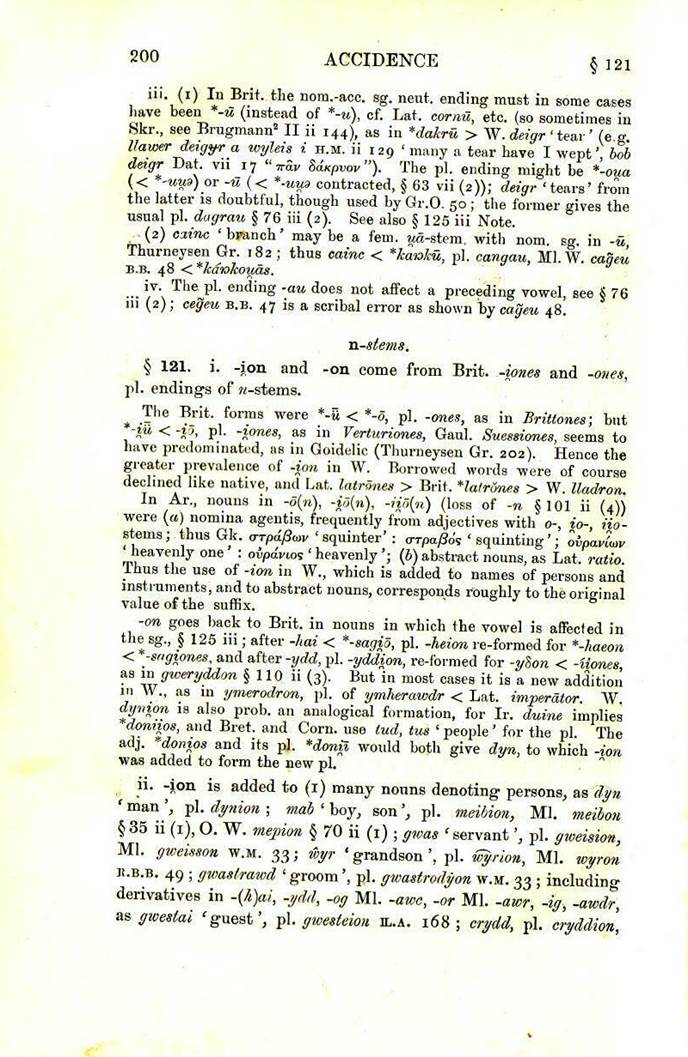
200 ACCIDENCE § 121 iii. (1) In Brit. the nom.-acc. sg. neut. ending must in some cases have been *‑ū (instead of *‑u), cf. Lat. cornū, etc. (so sometimes in Skr., see Brugmann² II ii 144), as in *dakrū > W. deigr ‘tear’ (e.g. llawer deigɏr a wyleis i h.m. ii 129 ‘many a tear have I wept’, bob deigr Dat. vii 17 “πᾶν δάκρυον”). The pl. ending might be *‑ou̯a (< *‑uu̯ə) or ‑ū (< *‑uu̯ə contracted, § 63 vii (2)); deigr ‘tears’ from the latter is doubtful, though used by Gr.O. 50; the former gives the usual pl. dagrau § 76 iii (2). See also § 125 iii Note. (2) cainc ‘branch’ may be a fem. u̯ā-stem, with nom. sg. in ‑ū, Thurneysen Gr. 182; thus cainc < *kaŋkū, pl. cangau, Ml. W. cag̃eu b.b. 48 < *káŋkou̯ās. iv. The pl. ending ‑au does not affect a preceding vowel, see § 76 iii (2); ceg̃eu b.b. 47 is a scribal error as shown by cag̃eu 48. n-stems. § 121. i. ‑i̯on and ‑on come from Brit. ‑i̯ones and ‑ones, pl. endings of n-stems. The Brit. forms were *‑ǖ < *‑ō, pl. ‑ones, as in Brittones; but *‑i̯ǖ < ‑i̯ō, pl. ‑i̯ones, as in Verturiones, Gaul. Suessiones, seems to have predominated, as in Goidelic (Thurneysen Gr. 202). Hence the greater prevalence of ‑i̯on. in W. Borrowed words were of course declined like native, and Lat. latrōnes > Brit. *latrŏnes > W. lladron. In Ar., nouns in ‑ō(n), ‑i̯ō(n), ‑ii̯ō(n) (loss of ‑n § 101 ii (4)) were (a) nomina agentis, frequently from adjectives with o‑, i̯o‑, ii̯o- stems; thus Gk. στράβων ‘squinter’: στραβός ‘squinting’; οὐρανίων ‘heavenly one’: οὐράνιος ‘heavenly’; (b) abstract nouns, as Lat. ratio. Thus the use of ‑ion in W., which is added to names of persons and instruments, and to abstract nouns, corresponds roughly to the original value of the suffix. ‑on goes back to Brit. in nouns in which the vowel is affected in the sg., § 125 iii; after ‑hai < *‑sagi̯ō, pl. ‑heion re-formed for *‑haeon < *‑sagi̯ones, and after ‑ydd, pl. ‑yddi̯on, re-formed for ‑yẟon < ‑íi̯ones, as in gweryddon § 110 ii (3). But in most cases it is a new addition in W., as in ymerodron, pl. of ymherawdr < Lat. imperātor. W. dyni̯on is also prob. an analogical formation, for Ir. duine implies *donii̯os, and Bret. and Corn. use tud, tus ‘people’ for the pl. The adj. *doni̯os and its pl. *doni̯ī would both give dyn, to which ‑i̯on was added to form the new pl. ii. ‑i̯on is added to (1) many nouns denoting persons, as dyn ‘man’, pl. dynion; mab ‘boy, son’, pl. meibion, Ml. meibon § 35 ii (1), O. W. mepion § 70 ii (1); gwas ‘servant’, pl. gweision, Ml. gweisson w.m. 33; ŵyr ‘grandson’, pl. w͡yrion, Ml. wyron r.b.b. 49; gwastrawd ‘groom’, pl. gwastrodẏon w.m. 33; including derivatives in ‑(h)ai, ‑ydd, ‑og Ml. ‑awc, ‑or Ml. ‑awr, ‑ig, ‑awdr, as gwestai ‘guest’, pl. gwesteion Ỻ.A. 168; crydd, pl. cryddion, |
||||||||||||||||||||||||||||
|
|
|
|
||||||||||||||||||||||||||||
|
|
|
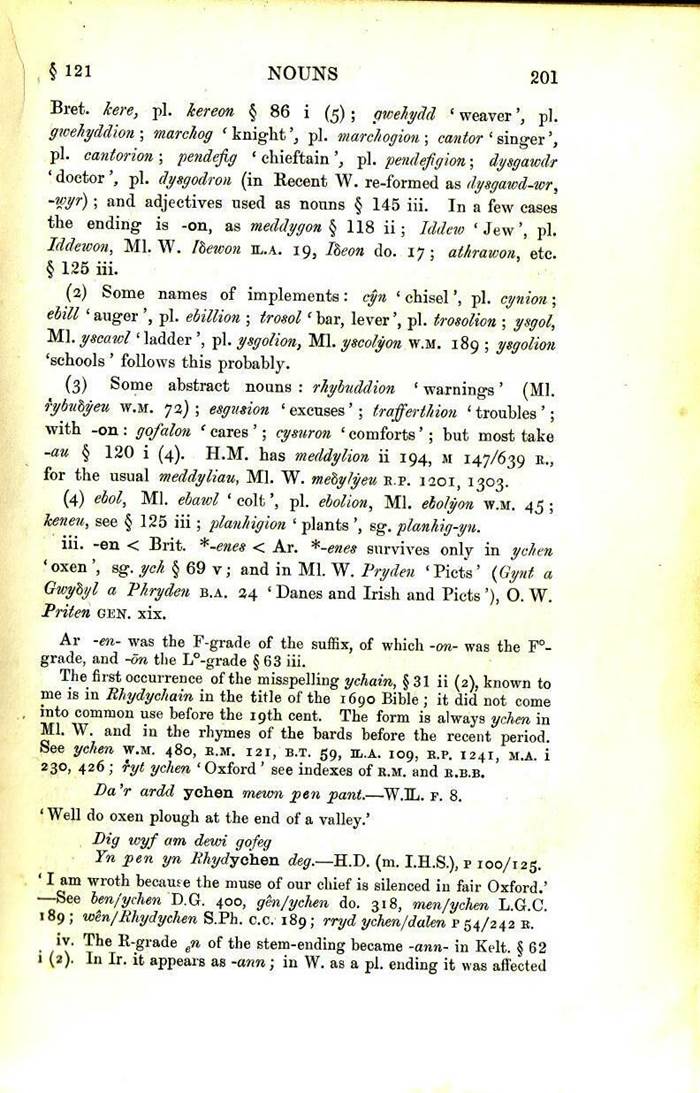
§ 121 NOUNS 201 Bret. kere, pl. kereon § 86 i (5); gwehydd ‘weaver’, pl. gwehyddion; marchog ‘knight’, pl. marchogion; cantor ‘singer’, pl. cantorion; pendefig ‘chieftain’, pl. pendefigion; dysgawdr ‘doctor’, pl. dysgodron (in Recent W. re-formed as dysgawd-wr, ‑w̯yr); and adjectives used as nouns § 145 iii. In a few cases the ending is ‑on, as meddygon § 118 ii; Iddew ‘Jew’, pl. Iddewon, Ml. W. Iẟewon Ỻ.A. 19, Iẟeon do. 17; athrawon, etc. § 125 iii. (2) Some names of implements: cŷn ‘chisel’, pl. cynion; ebill ‘auger’, pl. ebillion; trosol ‘bar, lever’, pl. trosolion; ysgol, Ml. yscawl ‘ladder’, pl. ysgolion, Ml. yscolẏon w.m. 189; ysgolion ‘schools’ follows this probably. (3) Some abstract nouns: rhybuddion ‘warnings’ (Ml. r͑ybuẟẏeu w.m. 72); esgusion ‘excuses’; trafferthion ‘troubles’; with ‑on: gofalon ‘cares’; cysuron ‘comforts’; but most take ‑au § 120 i (4). H.M. has meddylion ii 194, m 147/639 r., for the usual meddyliau, Ml. W. meẟylẏeu r.p. 1201, 1303. (4) ebol, Ml. ebawl ‘colt’, pl. ebolion, Ml. ebolẏon w.m. 45; keneu, see § 125 iii; planhigion ‘plants’, sg. planhig-yn. iii. ‑en < Brit. *‑enes < Ar. *‑enes survives only in ychen ‘oxen’, sg. ych § 69 v; and in Ml. W. Pryden ‘Picts’ (Gynt a Gwyẟyl a Phryden b.a. 24 ‘Danes and Irish and Picts’), O. W. Priten gen. xix. Ar. ‑en- was the F-grade of the suffix, of which ‑on- was the F°-grade, and ‑ōn the L°-grade § 63 iii. The first occurrence of the misspelling ychain, § 31 ii (2), known to me is in Rhydychain in the title of the 1690 Bible; it did not come into common use before the 19th cent. The form is always ychen in Ml. W. and in the rhymes of the bards before the recent period. See ychen w.m. 480, r.m. 121, b.t. 59, Ỻ.A. 109, r.p. 1241, m.a. i 230, 426; r͑yt ychen ‘Oxford’ see indexes of r.m. and r.b.b. Da’r ardd ychen mewn pen pant.—W.Ỻ. f. 8. ‘Well do oxen plough at the end of a valley.’ Dig wyf am dewi gofeg Yn pen yn Rhydychen deg.—H.D. (m. I.H.S.), p 100/125. ‘I am wroth because the muse of our chief is silenced in fair Oxford.’—See ben/ychen D.G. 400, gên/ychen do. 318, men/ychen L.G.C. 189; wên/Rhydychen S.Ph. c.c. 189; rryd ychen/dalen p 54/242 r. iv. The R-grade ₑn of the stem-ending became ‑ann- in Kelt. § 62 i (2). In Ir. it appears as ‑ann; in W. as a pl. ending it was affected |
||||||||||||||||||||||||||||
|
|
|
|
||||||||||||||||||||||||||||
|
|
|
202 ACCIDENCE § 122 in every case to ‑ein(n), tending to become ‑eint or to be replaced by ‑eu. The affection prob. comes from neut. dual forms, of which the ending in Pr. Ar. was *‑ī. Thus Ml. W. ysgyveint m.m. 2, Mn. W. ysgyfaint ‘lungs’ < *squmₑn-ī, old neut. dual; the noun has no sg.;—O.W. anu ‘name’ pl. enuein. Ml. W. pl. enweu, with a new sg. enw, Mn. W. enw, pl. enwau (the a- survived in anwedig G.R. [122, 220], Gwyn. dial. § 112 i (2)): Ir. ainm, pl. anmann, neut.;—cam ‘step’, O.W. pl. cemmein, now camau: Ir. cēim, pl. cēimmenn, neut.;—rhwym ‘band’, O. W. pl. ruimmein, now rhwymau;—gof ‘smith’, also gofan(n) b.t. 7, pl. Ml. W. goveẏn a.l. i 72, Mn. W. gofaint: Ir. goba, gen. gobann;—edn ‘bird’, once ednan m.a. i 195, pl. ednein (printed ednain m.a. i 207), etneint r.p. 1245, Mn. ednaint Gr.O. 10;—llw ‘oath’, Ml. W. pl. cam lyein Ỻ.A. 158, camlyeu r.p. 1201 ‘false oaths’, Mn. W. llŵon, Gwyn. dial. llyfon. i-stems. § 122. i. ‑i, ‑ydd, ‑oedd, ‑edd represent the Brit. endings of i‑, i̯o‑, i̯ā- and i̯e- stems. ii. i-stems, (1) The vowel is not affected in the sg. All the above endings occur in the pl. The Ar. nom. endings were m.f. sg. *‑is, pl. *‑ei̯es; neut. sg. *‑i, pl. *‑ii̯ə, *‑ī. In Brit. the sg. *‑is, *‑i became *‑es, *‑e and did not cause affection; the pl. *‑eies became *‑ii̯es which gave ‑i, ‑ydd or ‑oedd according to the accentuation § 75 v, iv; the neut. pl. *‑ii̯ə > *‑iia > ‑edd or ‑oedd according to accentuation; and *‑ī affected the preceding vowel and dropped. (2) ‑i and ‑ydd both form the pl. of tref ‘town’; thus trewi (≡ trefi) b.b. 54, trewit (≡ trefyẟ) do. 91, Mn. W. trefi § 160 iii (2), and trefydd D.G. 3; cantref ‘cantred’ makes cantrevoeẟ r.b.b. 407 ff., but Mn. W. cantref-i, ‑ydd like tref; see § 75 iv, v. eglwys ‘church’ follows tref in Mn.W. (eglwysyẟ p 147/5 r.), but Ml. W. has eglwysseu r.p. 1046, m.a. i 273a. In. Ml. W. fforest follows tref: foresti r.b.b. 199, fforestyẟ r.m. 195, Mn. W. fforestydd only. plwyf ‘parish’ (a late meaning) also takes ‑i or ‑ydd in Recent W., but earlier plwyvau m.a. ii 613. ‑i was added to some names of persons: saer ‘craftsman’, pl. seiri w.m. 189; maer ‘steward’, pl. meiri b.b. 54; cawr ‘giant’, pl. cewri (rarely ceuri) § 76 iv (3); merthyr ‘martyr’, pl. merthyri Ỻ.A. 126; prophwydi ib.; arglwydd, pl. arglwyẟi M.A. i 198a; so all in Mn. W. (in Late W. merthyron also). |
||||||||||||||||||||||||||||
|
|
|
|
||||||||||||||||||||||||||||
|
|
|
§ 122 NOUNS 203 ‑i was also added to many names of things with e or a in the sg., the ‑i of course affecting the latter; as llestr-i w.m. 6 ‘vessels’; gwernenn-i a hwylbrenn-i do. 51 ‘masts and yards’; canhwyllbrenn-i, also ‑au, both in 1 Chron. xxviii 15 ‘candlesticks’; fenestr-i m.a. i 216a ‘windows’; cethr-i I.G. 584 ‘nails’; perth-i r.p. 1272 ‘bushes’;—banier-i m.a. i 197b ‘banners’, sg. bani̯ar; per-i ib. ‘spears’, sg. pâr; defn-i ‘drops’ § 202 v (3), for dafneu r.p. 1184; der-i r.p. 1318 ‘oaks’, sg. dâr f. The use of ‑i has been extended in Mn. W.; thus Ml. W. kerẟeu w.m. 6 ‘songs’, Mn. W. cerddi T.A. and later; Ml. W. garẟeu r.b.b. 145 ‘gardens’, Mn. W. gerddi D.G. 258; Ml. W. llwyneu r.b.b. 40 ‘bushes’, so llwynau D.G. 60, later llwyni; Ml. W. mein ‘stones’ (sg. maen), Late Mn. W. meini (Ml. meini in ZE. 284 is an error for mein, see r.m. 196, l. 5); beddi b.cw. 59 beside the usual beddau, Ml. beteu (t ≡ ẟ) b.b. 63. (3) ‑ydd and ‑oedd are found in avon-it (≡ ‑yẟ) b.b. 91 ‘rivers’, avon-oeẟ r.b.b. 40, Mn. W. afonydd; gwladoeẟ m.a. i 199a, c.m. 2, r.b.b. 44, w.m. 190, later gwledyẟ in the last-quoted passage in r.m. 91, Mn. W. gwledydd; keyryẟ w.m. 192 ‘castles’, kaeroeẟ r.p. 1230, also caereu b.a. 26, Mn. W. keyrydd W.Ỻ. 64, caerau G.Gl. m 146/163; dinassoeẟ w.m. 190, r.m. 91, 93, Mn.W. dinasoedd, rarely dinessyẟ p 147/5 r., G.Gl. p 152/201. They are added to nouns in ‑fa, as Mn. W. porfeydd, porfaoedd ‘pastures’ (most of them with only one in use), Ml. W. tyrvahoeẟ r.p. 1241 ‘crowds’; as well as ‑au, Ml. W. ‑eu: presswylvaeu Ỻ.A. 57 ‘habitations’, eisteẟvaen do. 62, ‘seats’ (‑aeu later contr. to ‑ā́u). ‑ydd alone occurs in meyssyẟ r.p. 1188 ‘fields’, Mn. W. meysydd (wrongly spelt meusydd), sg. maes; heolyẟ r.m. 175 ‘streets’; bro-yẟ r.p. 1189 ‘regions’; dolyẟ do. 1188 ‘meadows’ (also doleu b.t. 33); gweunyẟ r.p. 1286 ‘meadows’, sg. gweun, gwaun; lluoss-it (≡ ‑yẟ) b.b. 66, r.p. 1188 ‘hosts’, sg. lliaws; nentydd ‘brooks’, poet. naint D.G. 25, sg. nant; coedydd ‘trees’, ystormydd ‘storms’, etc. (4) Old neut. nouns take ‑oedd or ‑edd, sometimes alternating with vowel-affection; as môr m. ‘sea’, pl. moroedd < *mórii̯a beside mŷr < *morī, § 117 i; dant m. ‘tooth’, pl. dannedd < *dantíi̯a beside deint r.p. 1036, daint D.D. s.v.; deint is also sg., see § iii (2). ‑oedd may be orig. m. or f. also, see (1). |
||||||||||||||||||||||||||||
|
|
|
|
||||||||||||||||||||||||||||
|
|
|
204 ACCIDENCE § 122 ‑edd and ‑oedd are added to nouns orig. of other declensions as follows: ‑eẟ in Ml. W., ‑oedd in Mn. W. are added to tir m. ‘land’ (an old neut. s-stem), pl. tiret (‑t ≡ ‑ẟ) b.b. 33, tireẟ r.b.b. 40 (beside tirion § 35 iii), Mn. W. tiroedd D.G. 436, 524; mynydd m. ‘mountain’ (< *moníi̯o‑), pl. mynyẟeẟ w.m. 250, b.t. 11, r.b.b. 40, Mn. mynyddoedd; dwfr m. ‘water’ (neut. o-stem), pl. dyfreẟ Ỻ.A. 54, 65, Mn. dyfroedd. mynyẟeẟ having become mynyẟe in S. W. dialects (cf. eiste § 110 iv (3)), this was wrongly standardized as mynyddau by some recent writers, but the traditional lit. form mynyddoedd prevails. The same remark applies to blynyddoedd, now sometimes written blynyddau for dial. blynyẟe < *blynyẟeẟ. In the above words ‑oeẟ may be old as a N. W. form, the prevailing forms in Ml. W. being S. W. ‑oedd was added to cant m. ‘hundred’ (neut. o-stem), pl. cannoedd; nerth m. ‘strength’ (neut. o-stem); mil f. ‘thousand’; mur m. ‘wall’, pl. muroeẟ w.m. 191, muroedd g. 237, later muriau; llu m. ‘host’ (m. o-stem), pl. lluoeẟ r.m. 175, Mn. lluoedd; byd m. ‘world’ (m. u-stem), pl. bydoeẟ m.a. i 199, Mn. bydoedd; nifer m. ‘host’, pl. niveroeẟ w.m. 54, Mn. niferoedd; mis m. ‘month’, pl. misoedd; teyrnas f. ‘kingdom’, pl. tyrnassoeẟ w.m. 50, Mn. teyrnasoedd; tŵr m. ‘tower’ (< E. < Fr.), pl. tyroeẟ w.m. 191, tyreu do. 133, Mn. tyrau; iaith f. ‘language’, pl. ieithoeẟ w.m. 469, b.t. 4, Mn. ieithoedd; gw̯ledd f. ‘feast’, pl. gwleddoedd D.G. 524, gwleddau do. 8; gwisg f. ‘dress’, pl. gwisgoedd; oes f. ‘age’, pl. O. W. oisou (with ð added at some distance, see fac. b.s.ch. 2, for ‘deest’ according to Lindsay, EWS. 46), Ml. W. oessoeẟ Ỻ.A. 103, oesseu b.t. 15, 19, Mn. W. oesoedd, oesau; achoet (t ≡ ẟ) B.B. 53, Mn. achoedd, achau ‘lineage’ both in L.G.C. 213, sg. ach f.; dyfnderoedd ‘depths’, blinder-oedd, ‑au ‘troubles’. iii. i̯o-stems. (1) The vowel is affected in the sg.; the pl. ends in ‑ydd, ‑oedd, ‑edd. The Ar. nom. endings were m. sg. *‑(i)i̯os, pl. *‑(i)i̯ōs; neut. sg. *‑(i)i̯om, pl. *-(i)i̯ā. In Kelt. *-(i)i̯ōs gave place to *‑(i)i̯oi > *‑(i)i̯ī; this gave ‑yẟ or ‑oeẟ according to the accent; neut. *‑íi̯ā gave ‑eẟ; ‑eẟ in m. nouns is prob. for ‑oeẟ. Where neither sg. nor pl. had i before i̯, we had e.g. dyn ‘man’ and ‘*men’; then a new dynion for the latter § 121 i. |
||||||||||||||||||||||||||||
|
|
|
|
||||||||||||||||||||||||||||
|
|
|
§ 122 NOUNS 205 (2) Ml. W. bugeil ‘shepherd’, pl. bugelyẟ Ỻ.A. 109, r.b.b. 245 < *boukoli̯os pl. *boukolíi̯ī. This was a rare type, and in Mn. W. a new pl. was formed: bugail, pl. bugeiliaid. But the f. adain ‘wing’ (i̯ā-stem), pl. adanedd, had a new pl. made by affecting this, as if the word belonged to the ‑i̯o- declension: adain, pl. adenydd § 125 iii. The word for ‘tooth’ seems partly to have passed over to this declension; thus *danti̯on pl. *dantíi̯ā giving sg. deint Ỻ.A. 67 translating “dens”, Mn. W. daint, as heb un-daint D.G. 323 'without one tooth ', pl. dannedd as for sg. dant § ii (4) above. In Gwyn. dial. the sg. is daint. The ending was ‑oeẟ in brenhinoet b.b. 53 ‘kings’, Mn. W. brenhinoedd; but the more usual Ml. form is breenhineẟ l.l. 120, brenhineẟ w.m. 178–9, prob. with ‑eẟ for ‑oeẟ § 78 ii. So teyrneẟ r.p. 1313, D.G. 181 ‘kings’, ewythreẟ r.m. 140 ‘uncles’; cystlwn ‘family’, pl. cystlyneẟ r.p. 1267. Cystlynedd Gwynedd i gyd, Cynafon Hwlcyn hefyd.—G.Gl. m 1/no. 49. ‘All the families of Gwynedd, and the scions of Hwlcyn too.’ iv. Fem. i̯ē- and i̯ā-stems. (1) The vowel is affected in the sg. Pl. ending ‑edd. i̯ē- and i̯ā-stems have R-grade forms in ‑ī, p. 81. In Lat. and Balt. they remain distinct or have become so (Lat. dūritia: dūritiēs). In Kelt. they seem to be mixed, see Thurneysen, Gr. 180 f.; but as ē > ī in Kelt., the meaning of the facts is often obscure. In other branches ‑i̯ē- and ‑i̯ā- are indistinguishable. The W. sg. may come from *‑i̯ā, *‑i̯ē, or *‑ī; pl. ‑eẟ < *‑íi̯ās. (2) blwyddyn ‘year’ (Ir. blīadain) < *bleidonī, pl. blynedd < *blidníi̯ās § 125 v (1); this pl. form is used only after numerals; for other purposes a new pl. was formed by adding ‑edd to the sg., as blwyẟyneẟ w.m. 37, then by metath. blwynyẟeẟ Ỻ.A. 105, Mn. W. blynyddoedd, S. W. dial. blynyẟe(ẟ) (whence latterly a false blynyddau see ii (4)).—modryb ‘aunt’ < *mātr-aqu̯ī (√ōqu̯- § 69 ii (4)), pl. modrabedd c.c. 282 (so in Gwyn. dial.; ‑o- < sg.) < *mātraqu̯íi̯ās; the form modrybeẟ r.p. 1362 seems to be re-made from the sg., as modreped ox. 2.—edau ‘thread’, pl. edafedd § 76 vii (1); adain ‘wing’ pl. adanedd, etc., see § 125 iii. |
||||||||||||||||||||||||||||
|
|
|
|
||||||||||||||||||||||||||||
|
|
|
206 ACCIDENCE § 123 blwydd means ‘a year of one’s age’ or adj. ‘year old’ pl. blwyddiaid, § 145 iii Note, teirblwydd ‘three years old’, pymtheg̃mlwyẟ r.b.b. 185 ‘fifteen years old’, etc. The use by recent writers of blwydd for ‘year’ is as foreign to the spoken language as it is to the literary tradition, and the forms blwyddau, blwyddi for ‘years’ are pure fabrications. (3) ‑edd, later replaced by ‑ydd, was added to *chwïor < *su̯esores, the pl. of chwaer ‘sister’, as chwioreẟ Ỻ.A. 38, r.b.b. 39, w.m. 158; in the last passage chwioryẟ in r.m. 226; Mn. W. chw̯ïóredd T.A., Wm.S., later only chw̯ïórydd; § 75 vi (2). t-stems. § 123. i. ‑ed < Brit. *‑etes occurs in merched ‘daughters’, Ml. W. merchet w.m. 469, merched (d ≡ d) 468; pryfed ‘worms’, Ml. W. pryved (d ≡ d) b.b. 81. D.G. has hued 30, 93 ‘hounds’ (sg. huad W.Ỻ. 166, O.G. c 82 s.v.). In Ml. W. we also have guystviled b.b. 53 ‘beasts’; and in O. W. ætinet brounbreithet ox. gl. cicadae. The stem-form is seen in Gaul. Cing-es, gen. ‑etos, and Nemetes ‘nobiles?’ beside the ‑eto- stem in nemeto- ‘temple’. As it seems to have been used to form names of persons it may be original in merch, which would so be from *merke(s)s < *merkets (pl. *merketes) < *mer(i)k-et‑: Skr. maryakáḥ § 101 iv (1), √merēi̯- § 125 v (1).—pryf is an old i-stem § 61 i (1), ending therefore in *‑es (< *‑is), which seems to have been mistaken for *‑e(s)s < *‑ets. ii. ‑od, Ml. W. ‑ot < Brit. *‑otes occurs in llygod ‘mice’, sg. llyg (< *lukō(s)s) and llygoden (Ir. luch ‘mouse’, gen. lochad, Bret. logodenn, pl. logod): Gaul. Lucot-ios, Λουκοτ-ικνος. The above is an example of the survival in W. of Brit. ‑ot- as seen by its cognates; but the ending ‑od became fertile in the formation of new plurals. It was added to diminutives, and forms with gemination, which is a peculiarity of child language, and of names of animals § 93 iii (2). (1) It was added to most names of animals: llewot w.m. 229, Ỻ.A. 165 ‘lions’, now llewod; eryrot Ỻ.A. 167 ‘eagles’, now eryrod; llydnot r.m. 52, w.m. 73, now llydnod, sg. llwdn ‘pullus’; hyẟot w.m. 158, now hyddod ‘stags’; gwiberot do. 229, now gwiberod ‘vipers’; ednot Ỻ.A. 130, now ednod ‘birds’ (also ednaint, § 121 iv, and in O. W. ætinet i above). In Mn. W. |
||||||||||||||||||||||||||||
|
|
|
|
||||||||||||||||||||||||||||
|
|
|
§ 123 NOUNS 207 cathod, llwynogod, ewigod (Ml. W. ewigeẟ r.m. 118), ysgyfarnogod, crancod (Bardsey crainc, so G.Gr. p 77/193), colomennod, etc. (2) It was added to some names of persons: gwiẟonot w.m. 178 ‘witches’; meudwyot Ỻ.A. 117 ‘hermits’ (also meudwyaid D.G. 409); gw̯rach ‘hag’, pl. gwrachiot p 12/124 r., Mn. W. gwrachḯod D.G. 332, in which ‑od seems to be added to an old pl. *gw̯rechi (cf. the adj. gw̯rachḯaidd). Er ŵyn a gw̯lân arwain glod A chýwydd i w̯rachḯod.—I.B.H., br. iv 104. ‘For lambs and wool he brings praise and song to old women.’ It is found in genethod ‘girls’ sg. geneth (old geminated form, § 93 iii (2)); and is added to diminutives in ‑an, as in babanod ‘babies’, llebanod ‘clowns’ (whence by analogy the biblical publicanod); in ‑ach, as in bwbachod ‘bugbears’, corachod ‘dwarfs’ (by analogy in Late W. mynachod for myneich ‘monks’); in ‑yn(n) or ‑en(n), as in lliprynnod ‘weaklings’, mursennod ‘prudes’, dyhirod ‘knaves’ sg. dyhiryn; and to other nouns originally in a contemptuous sense, as eurychod ‘tinkers,’ twrneiod a chlarcod b.cw. 62, Gwyddelod in Late W. for Gwyddyl ‘Irishmen’, Ffrancod for Ffrainc. The substitution in Late W. of ‑od for another termination in the names of relatives etc. comes from child-language, as in tadmaethod Esa. xlix 23 for tadmaethau. Ml. W. tatmaetheu w.m. 37; ewythrod for ewythredd § 122 iii (2), cyfnitherod for cyfnitheroedd W.Ỻ. C.Ỻ. 132. (3) It occurs after a few names of things: (α) geminated forms, or what appeared to be such, as cỿchod sg. cwch ‘boat’; nythod ‘nests’, Ml. W. nethod (e ≡ ỿ) a.l. i 24; bythod, sg. bwth ‘hut’; (β) diminutive forms, as tenynnod ‘halters’ sg. tennyn; bythynnod ‘cottages’, sg. bwthyn; and by false analogy Mn. W. tyddynnod ‘small farms’, for Ml. W. tyẟynneu a.l. i 168, 182; bwlanod sg. bwlan ‘a vessel of straw’; (γ) some names of coins: dimeiot r.b.b. 384 now dimeiau ‘halfpennies’; ffyrllig̃ot ib. now ffyrlingod ‘farthings’; ffloringod D.G. 287 ‘florins’, hatlingod ‘half-farthings’; (δ) personifications etc.: angheuod b.cw. 65 ‘death-sprites’; eilunod ‘idols’, erthylod ‘abortions’. iii. Ml. W. ‑awt occurs in pyscawt r.m. 52, w.m. 73, r.b.b. 149, b.t. 8, b.b. 89 ‘fish’ < Lat. piscātus, § 118 ii (2); and in |
||||||||||||||||||||||||||||
|
|
|
|
||||||||||||||||||||||||||||
|
|
|
208 ACCIDENCE § 123 gorwyẟawt b.t. 36 ‘horses’, sg. gorw͡yẟ; eẟystrawt b.t. 70 ‘horses’ sg. eddystr or eddestr. The first survives as pysgod, in which the ending is now indistinguishable from old ‑od. iv. ‑i̯aid, Ml. W. ‑ẏeit, ‑eit, is the pl. formed by affection of the ending ‑i̯ad, Ml. W. ‑ẏat § 143 iv (5); thus offeiriad ‘priest’ pl. offeiriaid, Ml. W. offeireit Ỻ.A. 117. All names of living things in ‑i̯ad (except cariad) form their pl. so; thus ceinẏeid m.a. i 285 ‘singers’, lleitẏeid (t ≡ ẟ) ib. now lleiddiaid ‘murderers’, gleissẏeid ib., now gleisiaid, sg. gleisiad ‘salmon’; but abstract nouns in ‑iad have ‑iadau § 120 i (4); cariad ‘lover’ is the same as cariad ‘love’ and has pl. cariadau Hos. ii 5, 7, 10. But ‑iaid is also added to form the pl. of names of living things whose sg. does not end in ‑iad: (1) Names of classes and descriptions of persons: personnẏeit Ỻ.A. 117, now personiaid, sg. person ‘parson’; conffessorieit do. 70; r͑aclovẏeit w.m. 456, Mn. W. rhaglofiaid, sg. rhaglaw ‘deputy’; barwnẏeit r.m. 179, now barwniaid, sg. barwn ‘baron’; makwyveit w.m. 15, mackwyeit r.m. 9, sg. maccwy(f) ‘youth’; bẏleẏnẏeẏt a.l. i 24, sg. bilaen r.b.b. 123 ‘villain’; cythreulẏeit m.a. i 251b ‘devils’; ysgwierẏeit s.g. 11 ‘squires’; in Mn. W. pennaethiaid Ps. ii 2, sg. pennaeth; estroniaid ‘strangers’, meistraid ‘masters’, gefeilliaid ‘twins’, Protestaniaid, Methodistiaid, etc. Also adjectives used as nouns, § 145 iii. (2) Tribal and national names: Albanẏeit r.b.b. 271, also Albanwyr do. 270, sg. Albanwr ‘Scotchman’; Corannyeit r.m. 96, no sg.; Brytanẏeit do. 91, no sg.; y Groecieit a’r Lhadinieit J.D.R. [xiv] ‘the Greeks and Latins’; Rhufeiniaid, Corinthiaid, etc. Also family and personal names: y Llwydiaid ‘the Lloyds’, y Lleisioniaid L.G.C. 110 ‘the Leyshons’, Koytmoriaid p 61/33 r. (3) All names in ‑ur of living things: pechadurẏeit Ỻ.A. 152 now pechaduriaid, sg. pechadur ‘sinner’; kreadurẏeit do. 4, now creaduriaid, sg. creadur ‘creature’; awdurieid J.D.R. [xiv], awdurẏeit r.p. 1375, sg. awdur ib. ‘author’ (the pl. awduron seems to come from the gorseddic writings, the source of numerous fabrications); Mn.W. ffoäduriaid, cysgaduriaid, henuriaid, etc. Other nouns in ‑ur take either ‑i̯au, as gw̯niaduri̯au ‘thimbles’, pladuri̯au ‘scythes’, or ‑au as papurau ‘papers’, mesurau ‘measures’, or ‑on as murmuron, cysuron. |
||||||||||||||||||||||||||||
|
|
|
|
||||||||||||||||||||||||||||
|
|
|
§ 124 NOUNS 209 (4) Some generic names of animals; as anifelleit Ỻ.A. 165, w.m. 238, now anifeiliaid, sg. anifail ‘animal’; mileit r.m. 129, Mn. W. milod, sg. mil ‘animal’; so bwystvileit r.b.b. 40 now bwystfilod, sg. bwystfil; ysgrubliaid Gen. xlv 17 ‘beasts’. Also a few specific names, as cameleit Ỻ.A. 165, Mn. W. camelod; Mn. W. bleiddiaid Matt. vii 15 ‘wolves’, also bleiddiau T.A. g. 233, Ml. bleẏẟẏeu m.a. ii 230; gwenoliaid D.G. 20, sg. gwennol ‘swallow’. Strictly, of course, ‑i̯aid is not a t-stem but a to-stem; thus ‑i̯ad from *‑i̯atos, pl. ‑iaid < *‑i̯atī. v. ‑ant < Brit. *‑antes, m. f. pl. participial ending occurs in carant b.a. 14, b.b. 46, Ỻ.A. 153, r.m. 130, sg. câr ‘kinsman’ < *karants (Ir. care < *karants) < *k̑ₑr‑: Armen. ser ‘progeny, family’, E. her‑d, Lat. crēsco, √k̑er- ‘grow’. In Early Ml. W. carant was already affected into kereint C. m.a. i 244, Mn. W. ceraint, later also cerynt M.K. [71] ‘kinsmen’ (not ‘lovers’). On the analogy of this was formed the pl. of Ml. W. nei (now nai) ‘nephew’: neẏeẏnt a.l. i 8, nẏeint w.m. 89, Ỻ.A. 121, Mn.W. neiaint; and of ceifn ‘3rd cousin’: keywneynt (≡ keivneint) b. ch. 76 defined ib. as ‘children of the 4th mother’ (those of the 2nd being ‘cousins’, etc.). Ml. W. meddweint Ỻ.A. 55 ‘drunkards’ may be an old participial form. A few other nouns have ‑eint, Mn. W. ‑aint affected for an earlier *‑ann, § 121 iv. r-stems. § 124. i. ‑er < Brit. *‑eres occurs in broder w.m. 38, r.m. 26, later affected to brodyr r.m. 140; broder survived, as in T.A. g. 229, Wm.S. e.g. Act. xv 23, but was at length ousted by brodyr, cf. § 122 iv (3). In Ml. W. brodorion also is used, R.M. 203, 207. Sg. brawd ‘brother’, § 59 ii, § 63 iii. brodorion also meant ‘fellow-countrymen, clansmen’ b.b. 51, 55 (cf. Gk. φρᾱ́τωρ); in Late Mn. W. it came to mean ‘natives’; brodor ‘a native’ is a new sg. deduced from this pl. -yr was added (instead of the old ‑awr) to gwayw ‘spear’ (also in Mn. W. ‘pain’), giving gw̯aew̯yr c.m. 48, but more usually gwewyr r.b. 1074 (for *gw̯eyw̯yr). Ofera’ gwaith fu i’r gwŷr Eliaw ôl i wewyr.—D.N., p 99/598. ‘It was the vainest task for men to anoint the marks of his spears.’ |
||||||||||||||||||||||||||||
|
|
|
|
||||||||||||||||||||||||||||
|
|
|
210 ACCIDENCE § 125 ii. ‑awr is common in Early Ml. W. poetry: gwaewaur b.b. 58, b.a. 9 (see fac.) ‘spears’, ysgwydawr b.a. 9 ‘shields’, cleẟyvawr, byẟinawr, llavnawr ib. ‘swords, armies, blades’; later (in prose) gwaewar w.m. 182, r.m. 85. -awr < Brit. *‑āres < Ar. *‑ōres. Vowel Changes. 125. The vowel changes which occur when an ending is added to form the pl. are the following: i. Mutation § 81: brawd ‘brother’, pl. brodyr; brawd ‘judgement’, pl. brodiau; daw ‘son-in-law’, pl. dofẏon r.b.b. 68; rhaw ‘spade’, pl. rhofiau § 110 iii (1); cwrr ‘edge’, pl. cỿrrau; dɥn ‘man’, pl. dỿni̯on; sail ‘foundation’, pl. seiliau; ffau ‘den’, pl. ffeuau; gwaun ‘meadow’, pl. gweunydd; buwch ‘cow’, pl. buchod, etc. etc. ii. Penultimate Affection § 83 iii: The endings which cause affection are ‑i, ‑ydd, ‑i̯aid, ‑i̯on: pâr, peri; dâr, deri; maer, meiri; cawr, cewri; § 122 ii (2);—caer, ceyrydd; maes, meysydd; do. (3);—cymar ‘mate’, pl. cymheiriaid; gefell r.p. 1302 ‘twin’ (< Lat. gemellus), pl. gefeilliaid; penkeirẟẏeit, anr͑eigẏon § 70 ii (2); mab ‘son’, pl. meibion, etc.; see § 128 ii. iii. Reversion. In some cases the vowel is affected in the sg., but reverts to (or, historically speaking, retains) its original sound in the plural: Fem. iē- or iā-stems, with pl. ending ‑edd, § 122 iv: adein b.b. 82, adain D.G. 132, 421 ‘wing’, pl. adaneẟ r.m. 155, r.b.b. 64, later affected to adenydd; celain ‘corpse’, pl. celanedd or calaneẟ r.b.b. 49; edeu, edau ‘thread’, pl. edafedd or adaveẟ r.m. 154; elain ‘fawn’, pl. elanedd or alaneẟ a.l. i 20; gw̯raig, Ml. W. gwreic, pl. gw̯rageẟ; neidr ‘snake’, pl. nadredd, anadreẟ § 21 iii, later nadroedd; r͑iein r.p. 1239, m.a. i 329b, 421b, Mn. W. rhiain D.G. 39, 95, 117, 130, 308, etc. ‘maiden’, pl. r͑ianeẟ w.m. 166, r.p. 1282, rhianedd D.G. 125, 234, 371.—Neut. io-stem: daint, pl. dannedd § 122 iii (2).—Fem. uā-stem, pl. ending ‑au: cainc ‘branch’, Ml. W. ceing w.m. 108, pl. cag̃eu b.b. 48, now cangau, see § 120 iii (2).—Neut. u-stem, pl. ending ‑au: deigr ‘tear’, pl. dagrau, see § 120 iii (1).—Mas. and fem. n-stems, pl. ending |
||||||||||||||||||||||||||||
|
|
|
|
||||||||||||||||||||||||||||
|
|
|
§ 125 NOUNS 211 ‑on (Brit. nom. sg. ‑ō, pl. ‑ones) § 121 i: athro, pl. athrawon § 76 v (5), athraon § 36 iii; keneu w.m. 483 ‘whelp’, pl. kanawon w.m. 28, canaon § 36 iii, cỿnawon r.m. 18, cỿnavon r.p. 1209, late cenawon; draig ‘dragon’, pl. dragon, later dreigeu Ỻ.A. 153, now dreigiau; lleidr ‘thief’, pl. lladron; Sais ‘Englishman’, pl. Saeson § 69 ii (2), Ml. W. sg. Seis Ỻ.A. 120, pl. Saeson b.b. 60, 66, r.b.b. 41, 71, etc., Saesson b.b. 48, 51, b.a. 4. On ych (affection of *wch), pl. ychen, see § 69 v. Edn a’i draed ydwy’n y drain, A’r glud ar gil i adain.—T.A., a 14866/201. ‘I am a bird with his feet in the thorns, and the lime on the edge of his wing.’ Hwde un o’i hadanedd; E heda byth hyd y bedd.—I.F., m 160/456. ‘Take one of its [the swallow’s] wings; it will fly always till death’ [lit. ‘till the grave’]. Llathen heb yr adenydd Yn y saeth a dynnai sydd.—Gut.O., a 14967/50. ‘There is a yard without the feathers in the arrow which he drew.’ Mai nodwydd ym mlaen edau Y mae lliw hon i’m lleihau.—D.G. 296 (? T.A.). ‘As a needle threaded, does her aspect make me spare.’ Aur a dyf ar edafedd Ar y llwyn er mwyn a’i medd.—D.G. 87. ‘Gold grows on threads on the bush [of broom] for the sake of [her] who owns it.’ Ni’m cymer i fy rhḯain: Ni’m gwrthyd f’anwylyd fain.—D.G. 429. ‘My damsel will not have me: my slender love will not reject me.’ Er bod arian rhïánedd Fwy na’i bwys ar faen y bedd.—H.D. p 99/402. ‘Though there be [of] maidens’ money more than his weight on the gravestone.’ Fy mrawd, mi a rois fy mryd Ar ddau genau oedd gennyd.—G.I.H., p 77/384. ‘My brother, I have set my heart on two whelps that thou hadst.’ Kedyrn ac ievainc ydynt, Kynafon aur Kynfyn ynt.—Gut.O., p 100/343. ‘Strong and young are they; they are the golden scions of Cynfyn.’ |
||||||||||||||||||||||||||||
|
|
|
|
||||||||||||||||||||||||||||
|
|
|
212 ACCIDENCE § 125 Note.—Reversion has puzzled writers of the late modern period, and lexicographers. adain was used regularly by the Early Mn. bards; but the Bible has aden, deduced from the pl. adenydd; from aden a spurious pl. edyn was formed, which seems to occur first in E.P., ps. lvii 1, but did not make its way into the spoken language. In the 1620 Bible ceneu is, by a slip, correctly written in Esa. xi 6, elsewhere it is carefully misspelt cenew; in later editions this became cenaw, an impossible form, since ‑aw could not affect the original a to e; see § 76 v (5). On athro, misspelt athraw, see ibid. Pughe gives eleined as the pl. of elain, and actually asserts that the pl. of gwraig is gwreigedd! He also invented the singulars rhian, edan. Silvan Evans s.v. celan notes this; but himself inserts the equally spurious dagr ‘tear’ and deigron ‘tears’. In his Llythyraeth p. 17 he attempted to change the spelling of Saeson to Seison. iv. Exchange of ultimate for penultimate affection: Ml. W. bugeil, bugelyẟ, Mn. W. adain, adenydd § 122 iii (2); Ml. W. gwelleu r.m. 123, w.m. 483, ‘shears’, Mn. W. gwellau, pl. gwelleifiau, new lit. sg. gwellaif § 76 vii (1). v. Anomalous changes: (1) morw͡yn ‘virgin’, pl. morỿnion b.b. 61, morynẏon w.m. 99, Ỻ.A. 109, r.b.b. 70. This was altered to morwynion in the Bible, but persists in the spoken language as m’rỿni̯on. Note the double rhymes in Lleẟɏf englỿnẏon lliw r͑os gwỿnnẏon, lloer morỿnẏon llawr Meirẏonyẟ.—I.C. r.p. 1287. ‘Sad verses [to her of] the colour of white roses, the moon of the maidens of the land of Merioneth.’ The same change occurs in blw͡yddyn, pl. blỿnedd § 122 iv (2). This change seems to be due to the survival in Brit. under different accentuations of two R-grades of ēi, namely R1e ei, and R2 i, § 63 vii (5). Thus morw͡yn < Brit. *moréini̯ō < *marei- < *mₑrei‑; morỿni̯on < Brit. *morini̯ónes < *mₑri‑, √merēi‑: Lat. marī-tus < *mₑrī- with R3 ī.—blw͡yẟyn ‘year’, Ir. blíadain < *bleidonī, a fem. i̯ā-stem from an adj. *blei-d-ono‑s from a vb. stem *blei‑d- ‘to blow’, √bhlēi‑, extension of *bhelē‑, *bhelō- whence O.H.G. bluo-ian (< *bhlō‑) ‘to blossom’, Ml. W. blawt ‘blossom’, Lat. flōs, etc. § 59 v, thus blwyẟyn ‘*budding season’; pl. blýneẟ < *blidníi̯ās; tair blyneẟ ‘three < *seasons’. (2) chwaer pl. chwïorydd § 75 vi (2), § vii (2). (3) achos pl. achosion, Ml. W. achaws pl. achwysson Ỻ.A. 129, see § 75 i (3). |
||||||||||||||||||||||||||||
|
|
|
|
||||||||||||||||||||||||||||
|
|
|
§ 126 NOUNS 213 (4) celfyẟyd ‘art’, Ml. W. pl. kelvydodeu. celfyẟyd < *kalmíi̯o-tūts; kelvydod- < *kalmii̯o-tā́t-es, owing to the interchange of ‑tūt‑, -tāt‑; § 99 ii (2), § 143 iii (10), (24). Plural of Nouns with Singular Endings. § 126. Nouns with the singular endings ‑yn and ‑en fall into three classes for the purposes of pl. formation. i. Class 1. The sg. ending is dropped, with or without vowel change; thus, without vowel change: pluen ‘feather’, pl. plu; mochyn ‘pig’, pl. moch; cwningen ‘rabbit’, pl. cwning g. 226; blewyn ‘a hair’, pl. blew. The vowel changes that take place when the ending is dropped are the following: (1) Mutation: conyn ‘stalk’, pl. cawn; deilen b.t. 28, Gen. viii 11, ‘leaf’, pl. dail; cneuen ‘nut’, pl. cnau; gwenỿnen ‘bee’, pl. gwenɥn, etc. (2) Ultimate Affection: collen ‘hazel’, pl. cɥll; onnen ‘ash’, pl. ɥnn; dalen w.m. 231, r.m. 167, Ps. i 3 ‘leaf’, pl. dail, chwannen ‘flea’, pl. chwain; draenen ‘hawthorn’, pl. drain; tywarchen ‘sod’, pl. tyweirch, tywyrch: Drylliwr cwys i droi lle’r ceirch, Daint haearn dan y tyweirch.—T.A. c. i 341. ‘The cutter of a furrow to turn up the bed of the corn, an iron tooth under the sods.’ (3) Reversion. As ‑yn causes penultimate affection, when it drops the vowel reverts to its original sound: plentyn ‘child’, pl. plant; aderyn ‘bird’, pl. adar. (4) Exchange of penultimate for ultimate affection: giewyn ‘sinew’, pl. gḯau; Ml. W. llyssewyn Ỻ.A. 97, 166 ‘plant’, pl. llysseu m.m. 3, Mn. llyssau W.Ỻ. 99, llysiau. ii. Class 2. A plural ending is substituted for the sg. ending, as diferyn ‘drop’, pl. diferion; crwydryn ‘vagrant’, pl. crwydraid; meddwyn ‘drunkard’, pl. meddwon; planhigyn ‘plant’, pl. planhigion; cwningen ‘rabbit’, pl. cwningod. The following vowel changes occur: (1) Affection: mïaren ‘bramble ’, pl. mïeri (mwyeri r.b.b. 48). (2) Reversion: gelyn ‘enemy’, old pl. galon b.a. 26, and |
||||||||||||||||||||||||||||
|
|
|
|
||||||||||||||||||||||||||||
|
|
|
214 ACCIDENCE § 127 some nouns with two singulars, as deigryn ‘tear’, pl. dagrau § 130 ii. iii. Class 3. A pl. ending is added to the sg. ending, as gelyn ‘enemy’, pl. gelinion b.b. 71, gelynẏon r.b.b. 71, Mn. W. gelỿni̯on; defnyn Gr.O. 48, defnynnau Luc xxii 44; dalen ‘leaf’, pl. dalennau Ex. xxxix 3; mursennod, bythynnod § 123 ii. iv. In some nouns final ‑yn or ‑en is not the singular ending but part of the stem; in these the n of ‑yn is not necessarily double when an ending is added; and ‑en is affected to ‑yn; thus telɥn f. ‘harp’, pl. telỿnau; tyddɥn m. ‘small farm’, § 98 i (3), pl. tỿddỿnnod, Ml. W. tyẟynneu a.l. i 168, 180, 182; maharen m. c.m. 26, myharen D.G. 202 ‘ram’, pl. meheryn; crogen, cragen, ‘shell’, pl. cregin § 117 iii (3); elltrewyn § 76 v (5), pl. *‑yneẟ not found; blwyẟyn § 122 iv (2). Plural Formed from Derivatives. § 127. The pl. of a few nouns is formed by adding a pl. ending to a derivative: glaw ‘rain’, pl. glawogyẟ r.b.b. 324, g. 98; Ml. W. cristawn ‘christian’ pl. cristonogion b.b. 71, Mn.W. cristi̯on, pl. cristi̯onogi̯on, cristnogi̯on; llif ‘flood’, pl. llifogydd; addurn ‘adornment’, pl. addurniadau; crwydr ‘wandering’, pl. crwydr(i̯)adau; serch ‘affection’, pl. serchi̯adau; dychryn ‘terror’, pl. dychryni̯adau, dychrynfeydd; rheg ‘curse’, pl. rhegfeydd; dyn ‘man’, pl. dyniabon r.p. 1196, dyneẟon Ỻ.A. ii beside dyni̯on; cas Deut. vii 10 ‘hater, foe’, pl. caseion W.Ỻ. 8, also pl. cas do. 5. Beside glawogydd the dialects have glawiau, evidently a new formation, though Bret. has glaoiou. The misspelling gwlaw occurs first about the end of the 17th cent., and was substituted in the Bible for the correct form glaw by R.M., 1746. The word always appears with gl- in Ml. W., as glav b.b. 63, glaw Ỻ.A. 13, 42, r.m. 146, m.a. i 396, r.p. 585, 1032 (4 times), 1055; gwlaw s.g. 147 is of course glaw in the ms., see P 11/95b; and of course there is no trace of gw̯- in the spoken language. The word cannot be from *u̯o-lau̯- as is usually assumed, for there is no example of the reduction of the prefix *u̯o- before a consonant to g- or even to gw‑; and that the same reduction took place also in Bret. glao, Corn. glaw is incredible. The etymology of the word is doubtful, but it probably represents Brit. *glou- (? *glo-u̯o‑: Skr. jala- ‘water, rain’). camrau is used in the Bible for ‘steps’; but the true pl. of cam is camau Ỻ 28/96 r., Ml.W. kammeu r.b.b. 149, O.W. cemmein § 121 iv; and camrau is a mere misspelling of kam-re, see § 31 ii (2). |
||||||||||||||||||||||||||||
|
|
|
|
||||||||||||||||||||||||||||
|
|
|
§ 128 NOUNS 215 Double Plurals. § 128. Double plurals are of common occurrence, and are formed in the following ways: i. A second pl. ending is added to the first: celain ‘corpse’, pl. celanedd, double pl. celaneddau Ps. cx 6; deigr ‘tear’, pl. dagrau, double pl. dagreuoeẟ Ỻ.A. 71, r.b.b. 146, 149; so blodeu ‘flowers’, double pl. blodeuoeẟ r.b.b. 40, sg. blodeuyn; dieu ‘days’, double pl. dieuoeẟ do. 9, 25, sg. dyẟ; llysseu ‘plants’, double pl. llysseuoeẟ Ỻ.A. 70; dynion, double pl. dynẏoneu r.p. 1303; neges ‘errand’, pl. negesau, double pl. negeseuau m.l. ii 97; peth ‘thing’, pl. pethau, double pl. petheuau do. 112, 119 ‘various things’; esgid ‘shoe’, esgidiau ‘shoes’, esgideuau ‘pairs of shoes’; mach ‘surety’, pl. meichi̯au, double pl. meichiafon. ii. A pl. ending is added to a pl. formed by affection: thus cloch ‘bell’, pl. clych s.g. 380, double pl. clychau; sant ‘saint’, pl. seint b.b. 85, Ỻ.A. 69, double pl. seinnẏeu h.m. ii 227, Mn. W. seintiau; angel ‘angel’, pl. engyl m.a. i 282, double pl. engylẏon Ỻ.A. 155, w.m. 118, b.b. 70 etc., Mn. W. angỿli̯on (e- > a- § 83 iii Note 2). In old formations ‑i̯on affected the preceding vowel, thus the ei of meibi̯on is the affection of a by i̯, as shown by the intermediate form mepion § 70 ii (1). But meibion seemed to be the pl. meib with ‑i̯on added; and on this analogy ‑i̯on was added to engyl. The y in angylion is not an old affection of the e by i̯, for that would be ei, cf. anr͑eigẏon, etc., § 70 ii (2). angelion is a new formation probably due to Wm.S., and, though used in the Bible by Dr. M. and Dr. P., has failed to supplant angylion as the spoken form. Silvan Evans’s statement that angelion very frequently occurs in Ml. mss. is a gross error, supported only by a quotation from a 17th cent. copy, h.m. ii 337, of a tract appearing in Ỻ.A., where the reading is eg̃ylẏonn 129. In most cases however ‑i̯on is added to the sg., and does not affect ae, e, o: kaethẏon r.p. 1272, ysgolion ‘schools’. iii. The diminutive pl. endings ‑ach (‑i̯ach) and ‑os are added to pl. nouns, as cryddionach Gr.O. 208, dynionach do. 93, J.D.R. [xx]; dreiniach ‘thorns’; plantos, gwragedhos, dilhados (dh ≡ ẟ, lh ≡ ll) J.D.R. [xv] ‘children, women, clothes’; cỿnos ‘little dogs’; more rarely to sg. nouns: branos r.m. 154, L.G.C. 148, ‘little crows’, caregos ‘pebbles’, dernynnach ‘bits’. Sometimes a final media is now hardened before the ending: pryfetach, merchetos. This is prob. due to late diminutive doubling (d‑d > tt, etc.). |
||||||||||||||||||||||||||||
|
|
|
|
||||||||||||||||||||||||||||
|
|
|
216 ACCIDENCE § 129 iv. A noun with a pl. ending sometimes has its vowels affected as an additional sign of the pl., as ceraint for carant § 123 v, adenyẟ for adaneẟ § 125 iii, brodyr for broder § 124 i, which are therefore, in a sense, double plurals. Plural Doublets. § 129. i. A noun not ending in ‑yn or ‑en may have more than one pl. form in the following ways: (1) One pl. may be formed by affection and one by the addition of an ending: môr ‘sea’, pl. mŷr, moroeẟ § 122 ii (4); arf ‘weapon’, pl. arveu w.m. 97, 99, etc., poet, eirf D.G. 2; esgob ‘bishop’, pl. esgyb, later esgobion (15th cent, Gnt.O. a 14967/87), esgobiaid (T.A. a 14975/61), the first and last now obsolete; Ml.W. kévɏnderw̯ ‘cousin’, pl. kévɏndɥru, a.l. i 222, Mn. W. cefnder, pl. cefndyr, cefnderoedd L.G.C. 167. In Recent Welsh new and inelegant weak forms are sometimes found, as castelli, alarchod for cestyll, elyrch. On the other hand in the late period we meet with spurious strong forms, such as edyn § 125 iii Note; and latterly emrynt for amrannau (amrantau) § 120 i (1); brieill for briallu § 134 ii; creig for creigiau. (2) Two or more plurals may be formed by adding different endings: tref ‘town’, pl. trefi, trefydd § 122 ii (2); kaer ‘castle’, pl. keyrydd, kaeroedd, caereu, do. (3); achau, achoedd L.G.C. 213 ‘ancestry’; dyn § 127, etc. See § 131 i. (3) Two plurals with the same ending may have different vowel changes; thus Ml. W. ceing old pl. cangeu § 125 iii, newer pl. ceingheu Ỻ.A. 144; these survive in Mn. W. as cainc pl. cangau, ceinciau. So cawr ‘giant’, pl. ceuri, cewri § 76 iv (3); achaws, achos ‘cause’ pl. achwysson § 125 v (3), achuysẏon a.l. i 30, and achosion. ii. A noun ending in ‑yn or ‑en may have more than one pl. form as follows: (1) Some nouns of class 1, § 126 i, have two plurals, one without and one with the vowel affected; as gwïalen ‘twig’, pl. gwḯal or gwḯail; seren ‘star’, pl. sêr b.t. 26, or sɥ̂r Ỻ.A. 5, the latter now obsolete; collen ‘hazel’, pl. coll m.m. 32, generally cɥll; onnen ‘ash’, pl. onn, more usually ɥnn; mellten ‘flash of lightning’, pl. mellt Ỻ.A. 107, rarely mɥllt r.b.b. 259. |
||||||||||||||||||||||||||||
|
|
|
|
||||||||||||||||||||||||||||
|
|
|
§ 130 NOUNS 217 Ni thawaf, od af heb dâl, Mwy nog eos mewn gw̯ī́al.—D.G. 418, cf. 151. ‘I will not be silent, though I go without pay, more than a nightinggale in the branches. E gaeodd Mai â gwī́ail Y llwybrau yn dyrrau dail.—D.G. 442, cf. 87, 162, 225. ‘May has blocked up with twigs the paths into masses of leaves.’ Mawr yw seren y morwyr, Mwy yw no swrn o’r mân sŷr.—L.G.C. 459. ‘Great is the star of the mariners, greater than a cluster of small stars.’ Dy ryw cyn amled a’r onn, Derw̯goed yw’r[1] dreigiau dewrion.—T.A. a 14975/11. ‘Thy kindred are as numerous as ash-trees, but the brave dragons are oaks.’ (2) A noun may fall in more than one of the classes mentioned in § 126; thus cwningen, pl. 1 cwning, 2 cwningod; gelyn, pl. 1 galon, 3 gelynion; dalen, pl. 1 dail, 3 dalennau; defnyn, pl. 2 dafnau, 3 defynnau; asen ‘rib’, pl. 1 ais, 2 asau, 3 asennau. Rhyfedd yw’r ais, a’i rhifo, Fal cronglwyd lle tynnwyd to.—I.B.H., f. 17. ‘Strange are my ribs, and to be counted, like rafters where the roof has been taken away.’ Ef a wŷs ar fy asau Am gelu hyn im gulhau.—B.Br.[2] p 82/293, cf. D.G. 295. ‘It is evident from my ribs that I have become lean through concealing this [secret].’ Siôn ffriw ac asennau Ffranc Sy lew brau—Salbri ieuanc.—T. A., a 14965/44. ‘Siôn, of the face and frame of a Frank, is a spirited lion—young Salesbury.’ Singular Doublets. § 130. i. A noun not ending in ‑yn or ‑en may have two forms of the sg. owing to various phonetic accidents: (1) ‑yf: ‑eu § 76 vii: cleẟyf r.p. 1236 ‘sword’, cleẟeu do. 1369, pl. cleẟyfeu; neẟyf do. 1237 ‘adze’, and neẟeu. (2) dant, daint ‘tooth’, pl. dannedd § 122 iii (2). (3) gwyry, gwyrf, gwerydd ‘virgin’, pl. gweryddon § 110 ii (3).
|
||||||||||||||||||||||||||||
|
|
|
|
||||||||||||||||||||||||||||
|
|
|
218 ACCIDENCE § 131 (4) paret w.m. 92, parwyt b.t. 27 (the latter obsolete), pl. parwydydd ‘walls’ (of a house). (5) gwarthafl ‘stirrup’, Mn. W. gwarthol (‑afl > ‑awl > ‑ol), pl. gwarthafleu, Mn. gwarthaflau. (6) dydd ‘day’, dyw in dyw Sul etc., pl. dyddiau, dī́au. ii. A noun may have a sg. form with, and one without, a sg. ending; as deigr, deigryn ‘tear’, pl. dagrau; erfyn, arf ‘weapon’, pl. arfau § 129 i (1); edau, edefyn ‘thread’, pl. edafedd, § 125 iii. The diminutive form has sometimes a pl. of its own; as dafn ‘drop’, pl. dafnau § 122 ii (2), and defnyn ‘drop’, pl. defnynnau § 126 iii; cainc ‘branch’, pl. cangau, ceinciau § 129 i (3); cangen ‘branch’, pl. canghennau T.A. g. 251. iii. Nouns ending in ‑yn or ‑en, Class 1 § 126 i, may have two singulars, (1) one formed with each ending; thus adar ‘birds’, sg. m. aderyn and f. adaren b.b. 107, the latter obsolete; ysgall ‘thistles’, sg. ysgellyn and ysgallen, both in use; cawn, sg. conyn ‘stalk’, cawnen ‘rush’; gwḯal or gwḯail, sg. gwïalen, or gwïelyn c.c. 265. (2) With different vowel changes; as dail ‘leaves’, old sg. dalen § 126 i (2), newer sg. deilen, re-formed from the pl. § 126 i (1). Desynonymized Doublets. § 131. i. Many pl. doublets, especially those with different endings, § 129 i (2), have been desynonymized, some early, as bronneu w.m. 94, D.G. 233 ‘breasts’, bronnyẟ m.a. i 415, D.G. 70, ‘hills’, sg. bron ‘breast, hill’; personiaid § 123 iv (1) ‘parsons’, personau ‘persons’ (personẏeu c.m. 19), sg. person in both senses. The following occur in Mn. W.: canoniaid ‘canons’ (men), canonau ‘regulations’, sg. canon; cynghorion ‘counsels’, cynghorau ‘councils’, sg. cyngor; llwythau ‘tribes’, llwythi ‘loads’ (but llwythau ‘loads’ Ex. v 5, vi 6, llwythi ‘tribes’ J.D.R. 291), sg. llwyth; prydiau ‘times’, prydau ‘meals’, sg. pryd; pwysau ‘weights’, pwysi ‘lbs.’, sg. pwys; ysbrydion ‘spirits’ (beings), ysbrydoedd ‘spirits’ in other senses (but Ml. W. ysprydoeẟ, s.g. 308–9, ysprydẏeu do. 310, both in the former sense); anrheithiau ‘spoils’, anrheithi ‘dear ones’, sg. anrhaith ‘booty; darling’, § 156 ii (1). |
||||||||||||||||||||||||||||
|
|
|
|
||||||||||||||||||||||||||||
|
|
|
§ 132 NOUNS 219 ii. In some cases the desynonymization is only partial: tadau means both ‘fathers’ and ‘ancestors’, but teit Ỻ.A. 121, Mn. W. taid means the latter only, as Penaethiaid yw dy daid oll.—G.I.H., Ỻ 133/211. ‘All thy ancestors are chieftains.’ teidiau ‘ancestors’ is perhaps to be treated as the pl. of taid ‘grandfather’, a derivative (< *tati̯os?) of tad, cf. nain ‘grandmother’ (< *nani̯ā?). The pl. ais, while continuing to mean ‘ribs’, was used for ‘breast’ D.G. 316, and became a sg. noun, fem. (like bron), as Am Robert y mae’r ebwch Yn f’ ais drom anafus drwch.—T.A., g. 230. ‘For Robert is the cry in my heavy wounded broken breast.’ But asau and asennau retained their literal meaning. In the spoken language now, ais is ‘laths’ (sg. eisen), asennau ‘ribs’ (sg. asen). iii. Partial desynonymization extends to the sg. in deilen ‘leaf’ (of a tree only), dalen ‘leaf’ (natural or artificial), dail ‘leaves’ (of trees or books), dalennau ‘leaves’ (artificial only, but Ml. W. dalenneu b.b. 101 ‘leaves’ of trees). Complete desynonymization has taken place in the sg. and pl. in cors f. ‘marsh’, pl. corsydd, and corsen f. ‘reed’, pl. cyrs (in Ml. W. cors, corsydd meant ‘reed, reeds’ also, see Silvan Evans s. v.); tant ‘harp-string’, pl. tannau, and tennyn ‘halter’, pl. tenynnod. iv. Desynonymization occurs in the sg. only in conyn ‘stalk’, cawnen ‘reed’; gwïalen ‘twig, wand’, gwïelyn ‘osier’ (used in wicker-work—the original meaning, § 75 vi (2)). In the dialects also coeden ‘tree’ “vox nuperrimè ficta” D.D. and coedyn ‘piece of wood’. The word for ‘tree’ in lit. W. is pren; cf. ny elwir coet o un prenn r.p. 1044 ‘wood is not said of one tree.’ In some cases, of course, the diminutive was from its earliest formation distinct in meaning from its base; as yden f. ‘a grain of corn’ from yd ‘corn’ mas. sg. (yr yd hwn ‘this corn’), pl. ydau ‘varieties of corn’. Anomalous Plurals. § 132. A few anomalous plurals remain to be noticed: (1) ci ‘dog’, pl. cwn; ci < Kelt. *kū < *ku̯ū < Ar. *k̑(u)u̯ō: Skr. s̑vā́ § 89 iii; cŵn < Brit. *kunes < Ar. *k̑unes. |
||||||||||||||||||||||||||||
|
|
|
|
||||||||||||||||||||||||||||
|
|
|
220 ACCIDENCE § 133 (2) dydd ‘day’ < *díi̯ēus: Lat. diēs, and dyw ‘day’ in dyw Gwener ‘on Friday’ etc. from an oblique case (Ar. gen. *diu̯és, *diu̯ós), pl. dïeu < Brit. *di̯éues § 100 ii (1), beside dïeuoeẟ § 128 i, and dyẟẏeu Ỻ.A. 51, r.b.b. 9, re-formed from the sg., Mn. W. dyddi̯au, now the usual form, though tridi̯au is still in common use. Bluitinet a hir dieu (t ≡ ẟ) b.b. 56 ‘years and long days’; deugein niheu Ỻ.A. 21 ‘forty days’; seith nieu r.b.b. 54; deugain nïeu D.G. 198, etc. (3) duw ‘god’, O. W. duiu- § 78 iv (2) < *dei̯uos (: Lat. deus) is the same word as the above with different vowel grades § 63 vii (4). The Ml. pl. dwyw̯eu Ỻ.A. 73 is formed from the old sg.; geu-dwyeu also occurs do. 44 with loss of w̯; the Mn. pl. duw̯i̯au is a second re-formation. (4) di̯awl ‘devil’, pl. dïefyl § 100 ii (1), also a late pl. di̯awl(i̯)aid (loss of i̯ by dissim. is usual) ; the pl. dieifl used by Gr.O. is artificial, as possibly the sg. diafl. Wm.S. invented a new sg. diafol, which was adopted in the Bible, and so is considered more respectable than the genuine form. (5) blwyddyn ‘year’, pl. blynedd, blwyẟyneẟ, blynyddoedd § 122 iv (2), § 125 v (1). (6) aren pl. eirin § 106 ii (1), new pl. arennau; eirin ‘plums’, new sg. eirinen. (7) pared, pl. parwydydd § 130 i (4); ffêr ‘ankle’, pl. (old dual) uffarnau, ucharnau § 96 iv (2), late pl. fferau, fferi. Other cases of anomalous vowel changes in § 125 v, § 117 iii. (8) One or two examples generally quoted of irregular plurals are due to haplology, § 44 iv, and are irregular in the late period only. Mn. W. cydymaith ‘companion’, pl. cymdeithion; Ml. W. sg. cedymdeith w.m. 10, pl. cydymdeithon do. 1;—Mn. W. credadun ‘believer’, pl. credinwyr, a corrupt re-formation from credini̯ol for creduni̯ol, § 77 ix, for credaduni̯ol; Ml. W. credadun, pl. credadunion m.a. i 566. Nouns with no Plural. § 133. The following nouns are used in the sg. only:— i. Many abstract nouns, simple, as gwanc ‘voracity’, llwnc |
||||||||||||||||||||||||||||
|
|
|
|
||||||||||||||||||||||||||||
|
|
|
§ 134 NOUNS 221 ‘swallowing’, llafur ‘labour’, cred ‘belief’, tywydd ‘weather’; or derivative as syched ‘thirst’, tristwch ‘sadness’, ffyddlondeb ‘fidelity’, glendid ‘cleanliness’. But a large number of abstract nouns have pl. forms: chwant ‘desire’, pl. chwantau; coel ‘belief’, pl. coelion, etc.; see § 120 i (4), § 121 ii (3), § 122 ii (4). ii. Nouns denoting material or substance, as mêl ‘honey’, glo ‘coal’, ymenyn ‘butter’, gwaed ‘blood’, baw ‘dirt’, llaeth ‘milk’, etc. There are many exceptions: dyfroedd ‘waters’, sg. dwfr; cigau ‘meats’, ydau § 131 iv, etc. arian in the sg. means ‘silver’, thus yr arian hwn ‘this silver’, arian byw ‘quicksilver’; but arian is also pl., and as pl. means ‘money’, as yr arian hyn ‘this money’, arian gwynion or arian gleision ‘white’ or ‘grey money’, i. e. silver coins. More rarely aur is pl. in a similar sense: aur melynion or aur rhuddion W.Ỻ. 2. Similarly heyrn the pl. of haearn means ‘irons’ as fire-irons, etc. The names of woods have the same form as the pl. of the names of trees; thus derw ‘oak’ or ‘oak-trees’, sg. derwen ‘oak-tree’. The same form is used (like arian, aur, haearn, etc.) as an adj.: cadair dderw ‘oak chair’; onn ‘ashen’, etc. (but not ɥnn etc.): Llithio ’r wyd y llath hir onn Ar galonnau’r gelynion.—T.A., a 14975/95. ‘Thou feedest the long ashen spear on the hearts of the enemies.’ iii. Diminutive nouns in ‑an, ‑ig, ‑cyn, ‑cen; as dynan ‘a little, person’, oenig ‘a little lamb’, bryncyn ‘hillock’, llecyn ‘place’, ffolcen ‘foolish girl’. If the word does not exist without the suff., or if without the suff. it is an adj., it has a pl. in ‑od, rarely ‑au; mudanod ‘deaf-mutes’, llebanod, etc. § 123 ii (2), ewigod do. (1); crymanau‘sickles’. iv. Archaic and poetical words such as bun ‘maid’, iôr ‘lord’, cun ‘lord’, huan ‘sun’ § 113 i (5). v. Proper names of places, months, days, feasts; as Cymru, Ebrill, Calan, Nadolig. Except Suli̯au ‘Sundays’, Sadyrnau ‘Saturdays’. Other days thus: dyddiau Llun ‘Mondays’, etc. Nouns with no Singular. § 134. A few nouns are used in the pl. only: i. bonedd ‘gentlefolk’; rhïeni ‘parents’; nouns in ‑w͡ys denoting inhabitants, as Monwys ‘men of Môn’ § 38 viii. |
||||||||||||||||||||||||||||
|
|
|
|
||||||||||||||||||||||||||||
|
|
|
222 ACCIDENCE §§ 135, 136 Bonedd Gwynedd a genais, Blodau’r sir heb ledryw Sais.—T.A., a 14966/27 7. ‘I have sung the nobility of Gwynedd, flowers of the shire with no Saxon alloy.’ The sg. rhiant (pl. rhïaint) given by Pughe seems to be his own invention. ii. aeron ‘fruits’; gwartheg ‘cattle’; creifion ‘parings’; gwreichion ‘sparks’; names of certain vegetables: bresych ‘cabbages’, chw̯yn(n) ‘weeds’, brïallu b.t. 25, H.M. ii 162 ‘primroses’; in Mn. W. ymysgaroedd ‘bowels’, but Ml. sg. ymysgar s.g. 214. For pl. names of vegetables a sg. is sometimes formed by adding ‑en, as hesg ‘rushes’, sg. hesgen, or ‑yn as blodeu-yn, rhos-yn. The new and spurious sg. briallen is based on the assumption that ‑u is a pl. ending; so also the spurious pl. brieill. iii. Adjectives used as nouns: (1) persons: fforddolion ‘wayfarers’, tlodion ‘paupers’; (2) qualities: prydferthion ‘beauties’, § 145 iii. ¶ For the pl. of compound nouns, see § 157 iii. Gender. § 135. The gender of a noun denoting an animate object agrees in general with the sex of the object; thus the nouns gŵr ‘man, husband’, ceffyl ‘horse’, brawd ‘brother’, gwas ‘servant, youth’ are m., and gwraig ‘woman, wife’, caseg ‘mare’, chwaer ‘sister’, morwyn ‘maid’ are f. § 136. i. When the same noun is used for both sexes it is generally epicene, that is, it has its own gender whichever sex it denotes. The following are mas. epicenes: plentyn ‘child’, baban ‘babe’, barcut ‘kite’, eryr ‘eagle’. The following are fem. epicenes: cennad ‘messenger’, cath ‘cat’, colomen ‘dove’, brân ‘crow’, ysgyfarnog ‘hare’. Thus we say y gennad (not *y cennad) even when we mean a man. Kymer y gennat honn, a dwc ef ẏ dy Ernallt c.m. 33 ‘Take this messenger and bring him to the house of Ernault’. See also r.b.b. 68, Ỻ.A. 111 and 2 Sam. xi 19–25. These nouns do not change their gender by the addition of gwryw ‘male’ or benyw ‘female’, as old-fashioned grammarians taught. In |
||||||||||||||||||||||||||||
|
|
|
|
||||||||||||||||||||||||||||
|
|
|
§ 136 NOUNS 223 eryr benyw ‘female eagle’ the non-mutation of the b- of benyw shows that eryr remains mas. In fact the gender of a noun must be ascertained before gwryw or benyw can be added to it. ii. There are however several nouns of common gender in Welsh, that is, nouns whose gender varies according to the sex of the individual meant. Such are dyn ‘man’ or ‘woman’, dynan ‘little person’, cyfyrder ‘second cousin’, wyr ‘grandchild’, tyst ‘witness’ (< Lat. testis com.), mudan ‘deaf-mute’, perthynas ‘relation’, gefell ‘twin’, cymar ‘mate’, llatai ‘love-messenger’, etc. § 139 v, cyw ‘pullus’, llo ‘calf’. Thus y mudan or y fudan; y perthynas or y berthynas; llo gwryw or llo fenyw. See cyw f. D.G. 94, usually m.; un gymar f. D.G. 274; teir wyrẏon r.m. 112, w.m. 468 ‘three granddaughters’. Y ddyn fwyn oedd ddoe’n f’annerch: Aeth yn fud weithian y ferch.—D.E., g. 117. ‘The gentle lady yesterday greeted me: now the maid has become silent.’ Ŵyr Cadwgon yw honno: Ŵyr i fab Meilir yw fo.—L.G.C. 367. ‘She is the granddaughter of Cadwgon; he is the grandson of Meilir’s son.’ Danfonaf, o byddaf byw, At feinwen latai fenyw.—Ỻ., Ỻ 133/102. ‘I will send, if I live, to the maiden a female messenger.’ The initial consonant of dyn is sometimes left unmutated after the art. when f., as pwy yw’r dyn deg? D.G. 53 ‘who is the fair lady?’ But usually y ddyn as above, cf. § 38 vi, ex. 3. dynes is a N. Walian vulgarism which has found its way into recent literature; it does not occur in the Bible or any standard work. The examples quoted by Silvan Evans are evident misreadings (dynes for y ddyn and dynes sad for dyn sad); but it is found in the work of a poetaster in p 112/365 (early 17th cent.). No pl. has been invented for it. Other late formations are cymhares and wyres, the former used in the 17th cent. iii. Some mas. nouns used as terms of endearment, etc. become fem. when applied to females; as peth ‘thing’, byd ‘life’, cariad ‘love’, enaid ‘soul’; thus y beth dlawd ‘poor thing’ f. ’Y myd wen, mi yw dy ŵr, A’th was i’th burlas barlwr.—D.G. 156. ‘My fair life, I am thy husband and thy servant in thy leafy parlour.’ |
||||||||||||||||||||||||||||
|
|
|
|
||||||||||||||||||||||||||||
|
|
|
224 ACCIDENCE § 137 F’ enaid dlos, ni ddaw nosi I adail haf y dêl hi.—D.G. 321. ‘My beautiful soul! there comes no nightfall to the summer-house to which she comes.’ iv. Similarly a mas. abstract noun, when personified is occasionally treated as fem., as doethineb in Diar. i 20, ix 1–4. § 137. i. Some mas. names of living objects are made fem. by the addition of ‑es, or by changing ‑yn to ‑en; thus brenin ‘king’, brenhines ‘queen’; bachgen ‘boy’, bachgennes Joel iii 3 ‘girl’; llew ‘lion’, llewes ‘lioness’; asyn ‘ass’, f. asen; coegyn ‘fop’, f. coegen b.cw. 14. arglwyẟ ‘lord’, arglwyẟes w.m. 11 ‘lady’; marchawc w.m. 2, Mn.W. marchog ‘horseman, rider, knight’, marchoges, w.m. 13, b.cw. 58; iarll, iarlles w.m. 254 ‘earl’, ‘countess’; amhérawdɏr w.m. 178 ‘emperor’, amherodres do. 162; cares I.G. 557 ‘relative’ f.; tywysoges ib. ‘princess’; santes do. 559 ‘saint’ f.; arglwyddes a meistres môr Gr.O. 15 ‘lady and mistress of the sea’. In old formations the ‑es is seen added to the original stem, as in lleidr ‘thief’, f. lladrones b.cw. 21, see § 121 i; Sais ‘Englishman’, f. Saesnes < Brit. *Saxō, *Saxonissā, § 113 i (2). On the vowel change in Cymro, f. Cymraes see § 65 ii (1). ii. In the following cases the distinction of gender is irregular: nai ‘nephew’, nith ‘niece’; cefnder(w̯) ‘cousin’, f. cyfnither(w̯); chwegrwn ‘father-in-law’, f. chwegr; hesbwrn, f. hesbin ‘ewe’; ffôl ‘fool’, f. ffolog; gŵr, gw̯raig; ci § 132 (i), gast § 96 ii (3). nai < Ar. *nepōts; nith < Ar. *neptís § 75 vii (2); cefnderw § 76 vii (3) (O. W. pl. ceintiru) and cyfnitherw̯ are improper compounds representing ceifn derw̯ and cyfnith ẟerw̯; for ceifn lit. ‘co-nephew’ see § 75 vii (1); cyfnith < *kom-neptís ‘co-niece’; derw̯ is an obsolete adj. meaning ‘true’, Ir. derb ‘sure’ < *deru̯os, Ar. base *dereu̯‑: E. true, and doubtless W. pl. derw̯yẟ-on[1] ‘soothsayers’ < *dₑru̯íi̯es (: Gaul. druides < Brit., Caesar b.g. vi 13, Ir. drui < Brit. ?): W. dir ‘true, certain’, Ir. dīr ‘due’ < LR *dēru-s.—chwegr § 94 iv; chwegrwn < *su̯ek̑ru-no‑;—hesbin from W. hesb f. of hysb ‘dry’ § 96 iii (5); the formation of hesbwrn is not clear; perhaps for *hesbrwn formed on the analogy of chwegrwn;—gŵr < Ar. *u̯iros: Lat. vir; gw̯raig < *u̯rakī prob. < *u̯(i)r-āk-ī́, a noun in ‑ī (: ‑ii̯ā, cf. pl. gw̯rageẟ) from a derivative in ‑āk- of *u̯ir-os: cf. Lat. virāgo.
|
||||||||||||||||||||||||||||
|
|
|
|
||||||||||||||||||||||||||||
|
|
|
§ 138 NOUNS 225 iii. (1) As in other languages, near relations and familiar animals have names of different origin for males and females: tad ‘father’, mam ‘mother’; brawd, chwaer; ewythr, modryb; ceffyl, caseg; etc. (2) Names of birds are epicenes, mostly f. as y fwyalch or y fwyalcken ‘the blackbird’, y fronfraith ‘the thrush’, yr ŵydd ‘the goose’, y gog ‘the cuckoo’, y frân ‘the crow’, etc.; but almost an equal number are m., as eryr ‘eagle’, dryw ‘wren’, barcut ‘kite’, hedydd ‘lark’, alarch ‘swan’. The male bird is in some cases distinguished by using ceiliog followed by the specific name in the attributive genitive, as y ceiliog bronfraith or y ceiliog mwyalch; but this cannot be done generally. Note ceiliágwydd ‘gander’ § 74 i. The names of one or two male animals are formed in a similar manner; as bwch gafr ‘he-goat’; gwrcath ‘tom-cat’. § 138. The gender of nouns denoting inanimate objects or abstractions can only to a very limited extent be determined by the meaning. i. The following nouns are mas.: (1) tymor ‘season’, and the names of the seasons: gwanwyn, haf, hydref, gaeaf, see hydref dwys a’r gwanwyn § 38 viii; so y Garawys, y Grawys ‘Lent’ with g- as a new radical § 101 iii (2), cf. yr holl Arawys a.l. i 338 ‘all Lent’. (2) mis ‘month’, and the names of the months, as Chwefrol sydd iddo 28 o ddyddiau 1620 Bible Almanac ‘February has 28 days’. (3) dydd ‘day’, and names of days, see Difiau du § 46 ii (4); so y Pasg ‘Easter’, y Nadolig ‘Christmas’, y Sulgwyn ‘Whitsunday’, y Calan ‘New Year’s Day’; but gŵyl ‘feast’ is f., so that Gŵyl Fair ‘Lady Day’, etc., are f. (4) gwynt ‘wind’, and the names of points of the compass: y gogledd ‘the north’, y dwyrain ‘the east’, y deheu ‘the south’, y gorllewin ‘the west’. (5) Nouns denoting material or substance: aur, arian, haearn, pres, pren, derw, ffawydd, glo, maen, pridd, calch, clai, tail, gwair, gwellt, yd, bwyd, bara, cig, gwaed, gwin, cwrw, dwfr, gwydr, lledr, lliain, sidan, glaw, eira, etc. (6) Verbal nouns; see § 205. ii. The following nouns are fem.: (1) gwlad ‘country’, teyrnas ‘kingdom’, ynys ‘island’, and names of countries, etc.: Cymru lân ‘beautiful Wales’, Prydain Fawr ‘Great Britain’, y Fôn fau Gr.O. 16 ‘my Mona’. But tir ‘land’ is m., hence Tir Groeg m. ‘Greece’. (2) tref ‘town’, llan ‘church’, and names of towns and parishes: Bangor Fawr yn Arfon; Ỻanbadarn Fawr. (3) afon ‘river’, and names of rivers: Dyfi wendal D.Ỻ. ‘fair-browed Dovey’. (4) Names of mountains and hills: yr Wyddfa ‘Snowdon’, Carnedd |
||||||||||||||||||||||||||||
|
|
|
|
||||||||||||||||||||||||||||
|
|
|
226 ACCIDENCE § 139 Ddafydd, Moelyci; but mynydd ‘mountain’ and bryn ‘hill’ are m., and so therefore are names formed from them, as Mỿnỿ́ddmawr. (5) iaith ‘language’, and names of languages: y Gymraeg wen E.P. 217; but when the name denotes matter written in a language it is m.: y Cymraeg hwn ‘this (piece of) Welsh’. llythyren ‘letter’ is fem., and names of letters and sounds: a fain ‘thin a’ (i.e. ‘æ’). (6) Names of trees: derwen ‘oak’, dâr ‘oak’, collen ‘hazel’, etc. (7) Collective nouns denoting communities, etc.: y genedl ‘the nation’, y werin ‘the people, the crew (of a ship)’, y bobl ‘the people’, y bendefigaeth ‘the nobility’, y gymanfa ‘the assembly’, y gynulleidfa ‘the congregation’, y glêr ‘the bards’ (y fân glêr L.G.C. 71), y dorf, y dyrfa ‘the crowd’, y gynhadledd ‘the assembly’; with some late exceptions, as y cyngor ‘the council’, y bwrdd ‘the board’. § 139. The gender of a derivative noun is determined by its ending. i. The following endings form m. nouns: ‑ach dim. sg., ‑aint, ‑awd, ‑cyn, ‑dab ‑deb, ‑der, ‑did, ‑dod, ‑dra, ‑dwr, ‑edd, ‑hâd, ‑i ‑ni ‑i̯oni, ‑i̯ad ‑ad, ‑i̯ant, ‑inab ‑ineb, ‑rwydd, ‑wch (‑wg), ‑yd, ‑yn. Examples: bwbach, henaint, traethawd, llecyn, un-dab, ‑deb, blinder, gwendid, cryndod, ffieidd-dra, cryfdwr, amynedd, glanhâd, tlodi, noethni, drygioni, cariad, teimlad, mwyni̯ant, doethin-ab, ‑eb, enbydrwydd, tywyll-wch, (‑wg), iechyd, offeryn. Exceptions: awdurdod, trindod; buchedd, cynghanedd, trugaredd, see § 143 iii (13); cenadwri (f. after cennad); adeilad § 205; caniad ‘song’ (f. after cân) but caniad ‘singing’ m.; galwad (f. after galwedigaeth); blwyddyn, elltrewyn, odyn, telyn, twymyn. In the last group ‑yn is not the sg. ending ‑ynn, see § 126 iv. ii. The following endings form f. nouns: ‑ach (abstract), ‑aeth ‑i̯aeth etc., ‑as, ‑ed, ‑ell, ‑en, ‑es, ‑fa, ‑ur. Examples: cyfeillach, cosbedigaeth, athrawiaeth, teyrnas, colled, asgell, seren, llynges, porfa, natur, pladur. There are many exceptions in ‑aeth and ‑i̯aeth; as claddedigaeth, darfodedigaeth, gwasanaeth, hiraeth, amrywi̯aeth, gwahaniaeth, lluniaeth.—Other exceptions are lludded, caethiwed, syched, pared; castell, cawell, hiriell ‘angel’ D. 43; maharen; hanes m. in N.W.—gw̯nïadur ‘thimble’ is m. in N.W.; names of persons in ‑ur are mas. (f. ‑ures). iii. The following endings form derivatives having the same gender as the noun to which they are affixed: ‑aid ‘‑ful’, ‑an dimin., ‑awd, ‑od ‘stroke, blow’; as crochanaid m. ‘potful’; llwyaid f. ‘spoonful; maban m. ‘babe’, gwreigan f. ‘little woman’, dynan com. ‘little person’; cleddyfod m. ‘stroke of sword’, ffonnod f. ‘blow of a stick’, dyrnod m., arfod f. (cleddyfawd f. D.G. 473 is exceptional). iv. ‑og (‑awc) forms m. titles and designations, as tywysog ‘prince’, marchog ‘knight’, swyddog ‘officer’, cymydog ‘neighbour’, taeog ‘villain’; and f. terms of reproach, as ffolog ‘fool’ f., budrog ‘slattern’, slebog id. Names of inanimate objects in ‑og are generally f., as arffedog ‘apron’, clustog ‘cushion’, mawnog ‘bog’. |
||||||||||||||||||||||||||||
|
|
|
|
||||||||||||||||||||||||||||
|
|
|
§ 140 NOUNS 227 ‑ig forms m. titles, as gwledig ‘prince’, pendefig ‘chief’, and f. diminutives as oenig, etc. ‑in is m. in brenin ‘king’, dewin ‘sage’, buelin ‘drinking horn’, ewin ‘(finger‑)nail’, gorllewin ‘west’; otherwise f., as byddin, cegin, cribin, gwerin, hesbin, megin, melin. v. ‑ai, Ml. W. ‑ei (for ‑hei) forms nouns of com. gender, as llatai § 136 ii; see cicai f. D.G. 166. § 140. i. No useful rule can be laid down for determining by the form the gender of nouns without derivative endings. It is true that nouns having w or y in the ultima are mostly m., and those having o or e are mostly f.; thus asgwrn, arddwrn, dwrn, dwfr, ellyll, byd, bryn are m.; colofn, tonn, ffordd, ffenestr, gwên, deddf are f. But exceptions are so numerous that the rule is of no great practical value. The reason for the rule is that Brit. u and i, which normally give W. w and y, were affected to o and e by the lost f. ending ‑ā, § 68, thus bringing about a preponderance of f. nouns with o and e. The reasons for the numerous exceptions are the following: (1) o and e may be original Brit., and not the result of affection at all, as in môr m. ‘sea’, penn m. ‘head’; (2) y is often due to affection by the lost f. ending ‑ī; as in blwyddyn f., telyn f. etc.; (3) endings other than ‑ā, ‑ī caused no affection; hence ffrwd f., hwch f. etc. u seems to some extent to have followed the analogy of w, thus W. cur m. < Lat. cūra f.; most monosyllables with u are thus m.; but clud ‘vehicle’, tud ‘people, country’, hug ‘covering’, dun ‘thigh’, hun ‘sleep’, punt ‘£1’, ffust ‘flail’ are f. There is no reason why a, i and the diphthongs should be distinctive of gender; and rules which make them the basis of such a distinction are arbitrary, and worse than useless. Thus Mendus Jones, Gr.² 75, states that monosyllables having a are f.; Anwyl, Gr. 28, says they are m., and names 13 exceptions (omitting gardd, sarff, barf, nant, cad, llath, barn, etc., etc.); actually, the proportion of m. to f. (excluding Eng. words, and names of males and females, as tad, mam) is about 55:45. Similarly monos. with i are said to be m.; in reality the numbers of m. and f. are practically equal:—m., llid, gwrid, pridd, llif ‘flood’, rhif, brig, cig, cil, mil ‘animal’, ffin, llin, min, gwin, glin, tir, mis, plisg, llith ‘mash’;—f., pi, crib, gwib, gwich, tid, ffridd, llif ‘saw’, gwig, pig, hil, mil ‘1000’, hin, tin, trin, rhin, gwisg, cist, llith ‘lesson’. ii. A few doublets occur with m. ‑w‑, f. ‑o‑; as cwd m. ‘bag’, cod f. ‘purse’. The others are borrowed words containing ‑or + cons.; as torf ‘crowd’ < Lat. turba: twrf ‘tumult’;—fforch ‘a fork’ < Lat. furca: ffwrch ‘the fork, haunches’;—ffordd ‘way’ < |
||||||||||||||||||||||||||||
|
|
|
|
||||||||||||||||||||||||||||
|
|
|
228 ACCIDENCE §§ 141, 142 O.E. ford: i ffwrdd ‘away’;—bord ‘board, table’ < M.E. bord: bwrdd id. < O.E. bord. Also with ‑yn: ‑en, as ysgellyn: ysgallen § 130 iii, coegyn: coegen etc., § 137 i, ffwlcyn: ffolcen, and S.W. dial. crwtyn ‘boy’: croten ‘girl’. § 141. i. The gender of a compound noun is generally that of its subordinating element; thus eluséndy ‘almshouse’ m. like ty ‘house’, this being the subordinating, and elusen the subordinate element. So gwínllan ‘vineyard’ f. like llan; canhẃyllbren ‘candlestick’ m. like pren. There are a few exceptions, possibly due to a change in the gender of the simple noun: cartref m. ‘home’, pentref m. ‘village’ (though tref is now f.) § 111 v (2); pendro f. ‘vertigo’ (tro m.), as Mae’r bendro ar y llo lleiaf r.p. 1278. Epithetized compounds have the same gender as the sex of the person; thus all-tud ‘exile’ generally m. (tud f.). ii. The above rule also holds for improper compounds, § 46, in which the subordinating element comes first; thus tréf-tad ‘heritage’ f.; dỿ́dd-brawd ‘day of judgement’ m.; pónt-bren ‘wooden bridge’ f.; pén-cerdd ‘chief of song’ m. § 142. i. There are many nouns of vacillating or uncertain gender. Some of them are old neuters, like braich from Lat. bracchium. In other cases the uncertainty is due to the action of analogy. ii. The gender sometimes varies according to meaning or use:—golwg ‘sight’ m., as in golwg byr ‘short sight’ (but f. in Ỻ.A. 107): golwg ‘appearance’ f., as in teg yr olwg ‘fair to see’;—bath or math ‘kind’ m., as dau fath ‘two kinds’: with the art. f., as y fath ‘the kind’, y fath beth ‘the kind of thing’;—man ‘spot’ m., as ẏ’r ẟeu van gochẏon w.m. 140 ‘to the two red spots’, man gwan ‘weak spot’: man ‘place’ f. generally as in Matt, xxviii 6, often m. as in Jer. vii 3; note yn y fan ‘immediately’, yn y man ‘by and by’;—to ‘roof’ m. as in aderyn y to ‘sparrow’: to ‘generation’ sometimes f., as in L.G.C. 204;—coes ‘leg’ f.: coes ‘stalk’ or ‘handle’ of a spade, etc. (where there is only one) m., dim. coesyn m.—Unrelated pairs: gwaith ‘work’ m., gwaith ‘fois’ f., as in dwy waith ‘twice’; llif m., llif f.; mil m., mil f.; llith m., llith f.; § 140 i. iii. Some nouns have different genders in Ml. and Mn. W. This is sometimes due to a break in the tradition owing to the word becoming obsolete in the spoken language; in other cases it is due to, or has been helped by, analogy. Early Mn. W. generally agrees with Ml. W.; the break comes in the Late Mn. period. |
||||||||||||||||||||||||||||
|
|
|
|
||||||||||||||||||||||||||||
|
|
|
§ 143 NOUNS 229 The following are m. in Ml. W., f. in Late W.: damwein w.m. 29, r.m. 19 ‘accident’; breint l.l. 121, r.b.b. 71 ‘privilege’; dinas c.m. 3, 8, Ỻ.A. 44, D.G. 325 ‘stronghold, city’, still m. in place-names; nef Ỻ.A. 4 ‘heaven’, S.Ph. (m. W.Ỻ.) late 16th cent. has ne’ gwyn, but H.S. mid. 15th already has nef f., see § 160 iii (2) (c); chwedɏl r.m. 192 ‘tale’, chwedl drwg Ps. cxii 7; gruẟ Ỻ.A. 93 ‘cheek’, y grudd, deurudd in the bards, but f. in Bible; gweithret a.l. i 526, b.b. 7, Ỻ.A. 132; ergit r.b.b. 42; krevyẟ Ỻ.A. 143. The following are f. in Ml. W., m. in late W.: tangneveẟ w.m. 43, r.m. 30, 38 (but y tangneveẟ w.m. 55) ‘peace’, m. in Bible; gwirioneẟ w.m. 29, r.m. 19 ‘truth’, m. in Bible and later bards, c.c. 357; cyg̃reir c.m. 18, r.m. 160 ‘truce’, m. in Bible, Deut. xxix 14; r͑ydit r.b.b. 83 ‘freedom’; person c.m. 19, Ỻ.A. 3 ‘person’; llynn w.m. 51, r.m. 36 ‘lake’; llys w.m. 5, r.m. 3 ‘court’. In some cases the gender fluctuates in Ml. W.: breich, as in c.m. 18 ar y breich ‘on the arm’, and in the next line ẏ’r vreich ‘to the arm’; it is m. in the Bible, but now f. except in place-names;—heul ‘sun’, m. Ỻ.A. 3, f. do. 161, generally f. in the bards, m. in Bible, f. in Wms. 257, now m.; heulwen is an improper compound of haul wenn § 46 ii (1);—clot ‘praise’ m. as clot bychan w.m. 142, r.m. 212, generally f. in the bards g. 184, f. in the Bible, 1 Bren. x 7, now m., orig. neut. § 66 v. iv. The difference is in some cases dialectal: ciniaw ‘dinner’ f. in w.m. 61, r.m. 43, now f. in S.W. but m. in N.W.; troed m. in Ml.W. e.g. deudroet always (not dwy‑), m. in N.W., f. in S.W. The following are f. in S.W., m. in N.W.: cyflog, hanes, garr, gwnïadur, llyn, pwys, munud, clorian (though ar y funud, yn y glorian in N.W. also); in Mn. Lit. W. these are mostly m. as in N.W.; crib ‘comb' now m. in N.W., but crib ‘ridge’ f. On the other hand in N.W. cusan (m. c.m. 58, 61) and cwpan (m. in Bible) are sometimes treated as f., doubtless a late misuse, as also the use in some parts of canhwyllbren as f. But clust m. r.b.b. 54, m. in S.W., is f. in N.W. and in the Bible. N.W. is not uniform: sach m. in Gwynedd (< Lat. saccus) is f. in Powys. Derivative Nouns. § 143. Derivative nouns are formed from simple nouns, from adjectives, and verb-stems by the addition of the following endings: i. Diminutive endings, largely used to form singular nouns § 126: m. ‑yn, f. ‑en. The O.W. forms are ‑inn, ‑enn, and the n is doubled in Ml. and Mn. W. when a syllable is added, as defnynn-au Can. v 2, canghenn-au Luc. xiii 19. They probably represent the Ar. suffixes ‑ino‑, ‑inā- with dimin. gemination § 93 iii (2), giving Brit. *‑inno‑s, *‑innā. They may also be added to adjectives and vb.-stems, as coeg-yn ‘fop’, (coeg ‘empty, vain’), ysgogyn ‘swaggerer’ (ysgog-i ‘to shake’). ii. Diminutive endings added to nouns: ‑ach, as corrach ‘dwarf’ < a Brit. *‑akkos, with dimin. gemination;—‑an, as dynan ‘little |
||||||||||||||||||||||||||||
|
|
|
|
||||||||||||||||||||||||||||
|
|
|
230 Accidence § 143 person’, gwreigan ‘little woman’; this appears in late Brit. as ‑agn‑; in Ir. it is ‑ān; see § 104 ii (1);—‑ell, as in i̯ỿrchell ‘a roe’, < Brit. *‑ellā or *‑illā;—‑ig, as in oenig ‘lamb’, < Brit. *‑īkā;—‑cyn, f. ‑cen, sometimes added to contracted personal names, as Hwlcyn for Hywel, appears to be comparatively late, and may be from E. ‑kin. iii. Abstract and collective noun endings, etc.: (1) ‑ach as cyfeillach ‘friendship’ cyfrinach ‘secret’ (< *‑aksā, v.n. suffix § 203 i (3) (4)). (2) ‑aeth ‘act’ < *‑aktā, § 203 i (1), as in gwasanaeth ‘service’ < *u̯o-ssān-āktā < *u̯po-stā-no-aktā § 96 ii (2); as *gwasan does not occur, the suffix is here felt to be ‑ánaeth. It takes the form ‑i̯aeth from stems in ‑i̯, thus added to ‑aid in dysg-éid-i̯aeth ‘learning’; hence hynáfi̯aeth ‘antiquity’, gofáni̯aeth ‘smithing’; hence ‑ániaeth in gw̯lỿbáni̯aeth ‘wet weather’. So ‑ḯaeth as marsiandḯaeth ‘commerce’; ‑nḯaeth as saernḯaeth ‘workmanship’, mechnḯaeth ‘surety’. In arglwyddḯaeth, arglẃyddi̯aeth both accentuations occur, see Arglwyddḯaeth (4 syll.) D.G. 8; Gw̯ledd Dduw a’i arglwyddḯaeth Gut.O. m 146/397 r. ‘The feast of God and his Lordship’: Pe talai’r ŵydd arglẃyddi̯aeth D.G. 210 ‘If the goose paid tribute’. The form in Late W. is the last. The ending is also added to verbal adjectives in ‑adwy, ‑edig, as ofnadwyaeth ‘terror’, poenedigaeth ‘torture’, erledigaeth for erlidedigaeth § 44 iv. It is also seen in ‑adaeth, ‑dabaeth, ‑debaeth, ‑wri̯aeth, etc. (3) ‑aid, Ml. W. ‑eit < *‑ati̯o‑s, *‑ati̯ā: llwyaid § 139 iii. (4) ‑aint, Ml. W. ‑eint: henaint ‘old age; dioddefaint ‘suffering’ § 203 ii (3), q.v. (5) ‑an: cusan ‘kiss’, chwiban ‘whistle’, v.n. suff. § 203 vi (1). (6) ‑as < *assā: teyrnas f. ‘kingdom’; also ‑i̯as, as trigi̯as ‘residence’: Ir. ‑as m. < *‑assu- (: Goth. ‑assu‑): ?*‑ət‑tā, *‑ət‑tu‑. (7) ‑awd, ‑od, Ml. W. ‑awt < *‑āt‑: traethawd 'treatise' < Lat. tractātus; molawd ‘praise’: Ir. molad; used to denote the stroke of a weapon cleẟyfawt, etc. § 139 iii < *‑ātiō. (8) ‑deb, ‑dab, ‑dábaeth, ‑débaeth, ‑íneb, ‑ínab all contain *ap- < *əqu̯‑, √ōqu̯‑ like Lat. antīquus, Skr. prátīka‑m ‘face’ and W. wyneb § 100 v. In ‑deb *ap‑ is added to a ‑ti- stem, in ‑ineb to Brit. ‑īni- (as in brenin iv (10)); ´‑i̯a‑ > i̯e > e § 65 vi; in ‑dab ‑inab to allied adj. stems in ‑to‑, ‑īno- (cf. Brugmann² II i 285); ´‑oa‑ > ´‑ā‑ > a. Silvan Evans states s.v. duwdab that ‑dab etc. are “local forms”, meaning that the ‑a- is Gwyn. a for e, § 6 iii, which is absurd, for dial. a does not extend to the penult as in ‑dabaeth (dial, atab, atebodd, not *atabodd). The forms with a occur before any trace of dial. a, and are used by writers of all parts: diweirdap p 14/2 r. (circa 1250), dewindabaeth r.b.b. 16, 38, 41, 42, c.m. 93; doethinab m 117 r. (c. 1285), r.b.b. fac. opp. p. 1 (c. 1310–1330); cowreindab S.T., Ỻ 169/39 r.; hydab L.G.C. 195; geudab Ps. lxii 9. Y Drindod a roa undab Er deigr Mair deg ar i Mab.—T.A. c. ii 78. a: Printed dro. ‘The Trinity bring about union for the sake of fair Mary’s tear for her Son.’ |
||||||||||||||||||||||||||||
|
|
|
|
||||||||||||||||||||||||||||
|
|
|
§ 143 NOUNS 231 (9) ‑der, ‑ter < *‑tero- cpv. suff.: dyfn-der ‘depth’. (10) ‑did, ‑tid, Ml. W. ‑dit, ‑tit < Ar. *‑tūt‑: gwen-did ‘weakness’; ‑dod, ‑tod, Ml. W. ‑dawt, ‑tawt < Ar. *‑tāt‑: cryn-dod ‘trembling’;—: Lat. vir-tut- (< *u̯iro-tūt‑); cīvi-tāt‑. ‑dra, ‑tra, see (22) below. (11) ‑dwr < *‑turo‑, prob. ‑ro- added to ‑tu- stem., cf. Gk. μάρ-τυρος: cryfdwr ‘strength’. (12) ‑ed, Ml. W. ‑et, partly < ‑itās, as in ciwed < Lat. cīvitās; partly < *‑e‑to, Ml. W. dyly‑et < *dligeto‑n: Ir. dliget.—syched ‘thirst’; nodd-ed ‘protection’, colled ‘loss’, etc. (13) ‑edd < *‑íi̯ā; trugaredd ‘mercy’ < *trougākaríi̯ā: Ir. trōcaire;—: Gk. ‑ίᾱ, ἀναρχία, etc. Most nouns with this ending have become mas. in W.; but many retain the orig. gender § 139 i. (14) ‑eg < ‑ikā; as gramadeg < grammatica; so hanereg ‘half-measure’ < Brit. *san-ter-ikā. It forms the names of languages as Saesneg, Gwyddeleg, Ffrangeg, Gwyndodeg ‘the dialect of Gwynedd’, Gro-eg, Cymrá-ëg. In the last two contraction took place. Wm.S. took ‑aeg for the ending in Cymráeg, and so, beside the correct Saesneg, wrote Saesnaeg and Saesonaeg, see the headings in his Dic. Gwyddelaeg, Ffrancaeg etc. were also formed, either by him or by his imitators. D.D. s.v. aeg vehemently protests against these solecisms, and against the use of aeg as a word meaning ‘language’.[1]—Kanys Yspaenec a ẟywedei y kawr c.m. 19 ‘For it was Spanish that the giant spoke’. Kymraëc/chwec r.p. 1189. Ffrangec ẟa lóew̯dec ẟiletẏeith do. 1225 ‘Good clear pure French’. Dysgais yr eang Ffrangeg; Doeth yw i dysg, da iaith deg.—I.R., p 82/309 r. ‘I have learnt the rich French language; wise is its learning, fair good tongue.’ (15) ‑es < *issā: buches ‘herd of cows, place for milking’; llynges ‘fleet’, lloches ‘hiding-place’; cf. iv (4). (16) ‑fa: 1. < *‑mag- ‘place’: por-fa ‘pasture’; cam-fa ‘stile’; trig-fa ‘dwelling place’; cyrch-fa ‘resort’.—2. Abstr. for ‑fan(n) v.n. ending § 203 ii (4), by loss of ‑nn § 110 v (2) < Ar. *‑mₑn- § 62 i (2): llosg-fa ‘a burning’; lladd-fa ‘slaughter’; cryn-fa ‘tremor’; bodd-fa ‘deluge’. The two are confused, and the second class have plurals like the first, as llosgfeydd. (17) ‑i is the same as the v.n. ending ‑i, see § 202 ii; thus tlodi ‘poverty’ (also as v.n. ‘to impoverish’), noethi ‘nakedness’ (v.n. ‘to denude’), diogi ‘idleness’ (v.n. ‘to idle’), caledi ‘hardship’, gwegi ‘vanity’, ymddifedi ‘destitution’. (18) ‑i̯ad, ‑ad added to verb-stems is properly ‑ad, as shown by
|
||||||||||||||||||||||||||||
|
|
|
|
||||||||||||||||||||||||||||
|
|
|
232 Accidence § 143 such forms as carad, e.g. llu du di‑garad b.b. 86, and especially the form ‑hā́d (for ‑ha‑ad), which would be *‑haead if the ending were ‑i̯ad; but with stems in ‑i̯- we have e.g. rhodi̯-ad (: rhodi̯af); from these ‑i̯ad was generalized, but too late to cause penultimate affection; hence cari̯ad ‘love’ (‑iad agent affects, see iv (5)). ‑ad, pl. ‑adau is from *‑ə-tu- (Ar. *‑tu- verbal-abstr. suffix): Lat. supine genitum < *g̑enə-tu‑m; ‑ad f. < *‑ə-tā § 203 iii (8). (19) ‑i̯ant is similarly ‑ant < *‑n̥t‑, participial suffix, as in Ml. W. derewant Ỻ.A. 152 ‘stink’, Mn. W. drewi̯ant; it generally appears as ‑i̯ant in Ml. and Mn. W.: meẟẏant w.m. 8, Mn. W. meddiant ‘possession’. (20) ‑id in addewid f. ‘promise’, perhaps < *‑ī-tā (: Lat. fīnītus); in cadernid m. ‘might’ < *‑ī-tu- (: Lat. sup. vestītum);—rhyddid is a late re-formation of rhy(ẟ)-did. (21) ‑ni < Brit. *gnīmu‑, O.W. gnim ‘work’ § 203 vii (4): mech-ni ‘bail’ (mach ‘a surety’), noeth-ni ‘nakedness’; ‑i̯oni < ‑i̯ono-gnīm- § 155 ii (1): haeli̯oni ‘liberality’; also ‑oni in barddoni (bardhony a.l. i 78) ‘bardism’. As ‑ni is for *‑ᵹni, and nᵹn > n § 110 ii (1), the ending cannot be distinguished from ‑i after n; thus trueni ‘wretchedness’, gwrthuni ‘unseemliness’ may have ‑i or *‑ᵹni. (22) ‑red, lit. ‘course’, < *‑reto‑, √ret‑ § 63 ii: gweithred ‘action’, Ml. W. brithred ‘confusion’ ( = Ir. brechtrad ‘commingling’); in a more literal sense, hydred ‘length’, lledred ‘breadth’. ‑rwydd, lit. ‘course’, < *‑reido‑: Gaul. rēda ‘waggon’ < *reidā, W. rhwydd ‘easy, without let, perfunctory’, lit. ‘*running’; a fertile abstr. suff. in W.: enbyd-rwydd ‘peril’, gwallgof-rwydd ‘insanity’. ‑dra, ‑tra, lit. ‘course’ < *´‑trog‑, √treɡh‑ § 65 ii (1): e‑ofn‑dra ‘fearlessness’. (23) ‑wch < *‑is-qo‑, v.n. ending; see § 201 iii (2): ‘darkness’, heddwch ‘peace’. The ‑wg in the by-form tywyllwg is prob. due to dissim. of continuants; see § 201 iii (3). (24) ‑yd < *‑o-tūts, nom. sg. of *‑o-tūt- (10): bywyd ‘life’, Ir. bethu < Kelt. *biu̯otūts; mebyd ‘youth’; partly perhaps < *‑itī (: Lat. ‑itia, and substituted for it, as tristyd < *trīstitī < trīstitia). (25) ‑ynt in helynt ‘course’; tremynt (dremynt) ‘sight’; prob. *‑en- + ‑tī. iv. Endings denoting agent or person: (1) ‑adur < Lat. ‑ātōrem, as in pechadur < peccātōrem, extended to new formations: henadur ‘elder’, penadur ‘chieftain’; in creadur ‘creature’ it comes of course from ‑ātūra. (2) ‑ai, Ml. W. ‑ei, properly ‑hei for it hardens the preceding consonant, < *‑sagi̯ō ‘seeker’ § 104 ii (2), as blotai ‘beggar of meal’ (blawd ‘meal’), cynutai ‘gatherer of firewood’ (cynnud ‘firewood’) etc. The late artificial formation mynegai ‘index’ is wrong in form (it should be *mynacai) and in meaning (it should denote a ‘seeker’). (3) ‑awdr < Lat. ‑ātor, as in ymhérawdr < imperātor, créawdr < creātor, extended in W., as in dysgawdr ‘teacher’, llywi̯awdr ‘ruler’. |
||||||||||||||||||||||||||||
|
|
|
|
||||||||||||||||||||||||||||
|
|
|
§ 143 Nouns 233 For W. awdr ‘author’ < Lat. au(c)tor (beside awdur < acc. au(c)tōrem) the dial, form awdwr (with parasitic w § 16 v (3)) came to be used in Late W. The above words were then mistaken for compounds of this, and wrongly spelt and accented ymheráwdwr, creáwdwr. Lastly the ‑wr was mistaken for ‑wr ‘man’, (8) below, and a new pl. ymherawdwyr formed instead of the true pl. ym(h)erodron; but ym(h)erodraeth remains. (4) ‑es < Brit. *‑issā: Lat. ‑issa: brenhines etc. § 137 i. (5) ‑i̯ad: hebryngẏat w.m. 4 ‘guide’; it affects a to ei: lleiddi̯ad ‘killer’ (lladd ‘kill’), datgeini̯ad ‘singer’; after w̯ the i̯ is lost § 36 v, as geilwad ‘caller’ (galw ‘call’), ceidwad ‘keeper, saviour’ (cadw ‘keep’). It implies Brit. ‑i̯atis (or i̯atā): Gaul. Ναμαυσατις, Γαλάται: Ir. ‑ith, i-stem; the suffix is ‑ti- (or ‑tā): Gk. μάντις, κρι-τή‑ς; ‑i̯a- or ‑a- < ‑i̯ə- or ‑ə‑; the affection of the vowel shows that the ‑i̯a- form was already generalized in Brit. (6) ‑og, Ml. W. ‑awc < Brit. ‑ākos adj. suffix § 153 (5) forms m. nouns as tywysog ‘prince’, marchog ‘knight’, swyddog ‘officer’, and f. nouns as ffolog, see § 139 iv; the former have feminines in ‑oges: tywysoges ‘princess’, cymydoges ‘neighbour’. (7) ‑or, Ml. W. ‑awr < Lat. ‑ārius as kag̃hellaur a.l. i 62, Mn. W. canghellor < cancellārius, extended in W.: telynor ‘harpist’, cantor ‘singer’; f. ‑ores: cantores. (8) ‑wr ‘man’: pregethwr ‘preacher’, gweithi̯wr ‘worker’ etc.; ‑w̯raig ‘woman’: gólchw̯raig ‘washerwoman’. (9) ‑ydd < Brit. ‑íi̯ō: crydd ‘shoemaker’ § 86 i (5), melinydd ‘miller’, prydydd ‘poet’; ‑edydd < ‑atíi̯o: dringhedydd ‘climber’, nofiedydd D.G. 502 ‘swimmer’; ‑idyẟ: llemidit w.m. 466 llemhidyẟ r.m. 110 ‘leaper’; f. ‑yddes: prydyddes ‘poetess’, ‑adyddes: gwnïadyddes ‘sempstress’. (10) Endings of more restricted use: ‑ig in pendefig ‘chieftain’, gwledig ‘prince’, < *‑ī-ko‑, § 153 (9). ‑in in brenin < *‑īni‑; cf. pl. brenhinoedd; ‑in from Lat. ‑īno- in dewin for *diwin < dīvīnus, per(i̯)erin ‘pilgrim’ < *pergerīnos < peregrīnus. v. Endings denoting instrument or thing: (1) ‑adur, iv (1): Ml. W. paladur, Mn. W. pladur ‘scythe’, gwnïadur ‘thimble’ etc. (2) ‑in < ‑īna: melin ‘mill’ < Lat. molīna; cegin § 89 iii; so cribin, megin, etc. § 139 iv. The m. buelin may have ‑in < *‑ikno‑, cf. Gaul. celicnon ‘tower’, √qel- ‘high’: Lat. celsus, columen. (3) ‑ell < ‑ella or ‑illa: padell ‘pan’ < Lat. patella; pibell ‘pipe’, ffynhonnell ‘fountain, source’. (4) ‑og iv (6), besides names of persons, forms f. names of things, as arffedog ‘apron’, clustog ‘cushion’, of plants, as tewbanog ‘mullein’, of places, as mawnog ‘peat-bog’, brwynog ‘marsh’, etc., and m. names of birds as cyffylog ‘woodcock’, and animals, as draenog ‘hedgehog’, llwynog ‘fox’. (5) ‑wr iv (8): crafwr ‘scraper’. |
||||||||||||||||||||||||||||
|
|
|
|
||||||||||||||||||||||||||||
|
|
|
234 Accidence § 144 Adjectives Number. § 144. The pl. of adjectives is formed from tbe sg. as follows: i. By change of vowel. The change is the ultimate i-affection § 83 ii; cf. § 117 i. Examples: bychan ‘little’, pl. bychein Ỻ.A. 2, Mn. W. bychain, so llydan ‘broad’, truan ‘wretched’, buan ‘quick’; cadarn ‘strong’, pl. kedeirn w.m. 40, kedyrn do. 51, Mn. W. cedyrn; ieuanc ‘young’, pl. ieueinc w.m. 181, Mn. W. ieuainc; harẟ ‘handsome’, pl. heirẟ; byẟar ‘deaf’ pl. byẟeir r.p. 1196, Mn. W. byddair. ii. By adding the ending ‑i̯on. Examples: mud ‘mute’, pl. mudẏon r.p. 1196, Mn. W. mudi̯on; coch ‘red’, pl. cochẏon r.p. 1236, Mn. W. cochi̯on; glew ‘bold’, pl. glewi̯on; cul ‘narrow’, pl. culi̯on. iii. The addition of ‑i̯on causes the following vowel changes: (1) Mutation § 81: tlawd ‘poor’, pl. tlodyon r.p. 1196, Mn. W. tlodi̯on; trwm ‘heavy’, pl. trymẏon r.m. 14, Mn. W. trỿmi̯on; llwm ‘bare’, pl. llỿmi̯on; llɥm ‘keen’, pl. llỿmi̯on; melɥn ‘yellow’, pl. melỿni̯on; Mn. W. main ‘slender’, pl. meinion,etc. The comparatively late pl. mawrion is an exception; an older form is perhaps morẏon b.t. 45; but the original form mawr < *mārī (like the sg. mawr < *māros) generally remained: lloppaneu mawr w.m. 23, r.m. 14 ‘big boots’. A similar exception is trawsion m.a. i 544. (2) Penultimate affection § 83 iii: glas ‘blue’, pl. gleissẏon r.p. 1196, now written gleision; dall ‘blind’, pl. deillẏon ib., Mn. W. deilli̯on; claf ‘sick’, pl. cleivẏon ib., Mn. W. cleifi̯on; gwag, pl. gweigion; cadr, pl. ceidrẏon r.p. 1169 (ceidron iv). e is not affected: uchel ‘high’ pl. uchelion m.a. i 565a; see gwelwon etc. iv. a is unaffected in the late pl. meddalion; the old pl. is meddal like the sg.: petheu clayr meẟal Ỻ.A. 70 “blanda et mollia”. ae remains unaffected, and the ending in some old forms is written ‑on, as haelon b.b. 3, r.p. 1169, m.a. i 283a, later haelion. iv. After the groups mentioned in § 36 v–vii, the i̯ drops, so that the ending appears as ‑on: gwelw̯ ‘pale’, pl. gwelw̯on r.p. 1196, gweddw̯ ‘widowed’, pl. gweẟw̯on do. 1236; chw̯erw̯ ‘bitter’, pl. chw̯erw̯on; hoyw̯ ‘sprightly’, pl. hoyw̯on; du ‘black’, pl. duon; teneu ‘thin’, pl. teneuon; budr ‘dirty’, pl. budron; garw̯ ‘rough’, pl. geirw̯on; marw̯ ‘dead’, pl. meirw̯on; llathr ‘bright’, |
||||||||||||||||||||||||||||
|
|
|
|
||||||||||||||||||||||||||||
|
|
|
§ 145 Adjectives 235 pl. lleithron (lleithɏrẏon in w. 7bi). The affection of the vowel in geirw̯on etc. bears witness to the lost i̯. In most Ml. W. mss. the i̯, following ei, is lost after all consonants, as in S.W. dialects, § 35 ii, as deillon r.p. 1236 (beside deillẏon 1196). v. Some adjectives have two plurals, one formed by affection, and one by adding ‑i̯on: hardd ‘handsome’, pl. heirdd, heirddion; garw̯ ‘rough’, pl. geirw̯, geirw̯on; marw ‘dead’, pl. meirw̯, meirw̯on. caled usually remains unchanged: rhai caled T.A. c. ii 79, pethau caled Ex. xviii 26, cf. 1 Bren. x 1, xiv 6; but caledion Judas 15 (though calet here also in Wm.S.), cledion c.c. 334. The spoken forms are caled and cledion. The form celyd R.G.D. 96 seems to be a recent invention; Wms. 372 has Yr hoelion geirwon caled, changed in recent hymnbooks to celyd. Similarly Cymraeg is sg. and pl.: henweu Kymraec s.g. 172 ‘Welsh names’. § 145. i. The only pl. forms which are originally adjectival are those produced by vowel affection; where these exist they generally accompany pl. nouns, thus gwŷr cedyrn, not gwŷr cadarn. But we have seen that from the Ar. period *‑i̯ō, pl. *‑i̯ones formed nouns corresponding to adjectives in *‑i̯os § 121 i; and there can be no doubt that W. forms in ‑i̯on (from *‑i̯ones) were originally nouns, as they may still be, e.g. y tlodion ‘the poor’. The distinction between these nouns and adjectives proper was obscured by the fact that adjectives might be used as nouns, e.g. y kedyrn w.m. 51 ‘the mighty’; then, in imitation of gwŷr cedyrn ‘mighty men’, expressions like plant tlodion ‘poor children’ were formed for the sake of formal agreement, as the agreement was not apparent in an adj. like tlawd which had the same form for sg. and pl. But the old tradition persisted, and the use of forms in ‑i̯on was, and is, optional: eriron du, …coch, eririon gwinn, …glas, …lluid b.b. 72–3 ‘black…, red…, white…, blue…, grey eagles’; dynyon mwyn r.m. 21 ‘gentle folk’, meirch dof do. 31 ‘tame horses’; and is more frequent in later than in earlier periods, thus bratteu trwm of w.m. 23 appears as bratteu trymẏon in the later r.m. 14. Hence we find (1) as forms in ‑i̯on were not really needed, many adjectives remained without them, and have no distinctive pl. forms; (2) in many cases plurals in ‑i̯on remain substantival. ii. The following adjectives have no distinctive plural forms in use: |
||||||||||||||||||||||||||||
|
|
|
|
||||||||||||||||||||||||||||
|
|
|
236 ACCIDENCE § 145 (1) The simple adjectives (or old derivatives no longer recognized as such): bach, ban, call, cas, certh, craff, cu, cun, chweg, da, dig, drwg, fflwch, gau, gwâr, gwir, gwymp, hafal, hagr, hawdd, hên, hoff, llawen, llesg, lion, llwyr, mad, mân, pur, rhad, serfyll, serth, sobr, swrth, teg. bychain is pl. of bychan, not of bach, which is sg. and pl. like the others in the above list; thus plentyn bach ‘little child’, pl. plant bach. Yr adar bach a rwydud A’th iaith dwyllodrus a’th hud.—D.G. 313. ‘Thou wouldst snare the little birds with thy deceiving words and thy wile.’ drwg is also an abstract noun, pl. drygau ‘evils’, hagr is included in D.’s list; Rowland’s hagron is obviously spurious—it would be *heigron if genuine. hên is included because henẏon Ỻ.A. 95 is only known to occur once, and that in verse. D. y C. has hyff as pl. of hoff, as well as ag̃hlyff, pryff and cryff as pl. of anghloff, praff, craff apparently extemporized r.p. 1361 (praff has pl. preiffion). mân is usually pl. as in cerrig mân ‘small stones’, often sg. as in gro mân ‘fine gravel’. glân ‘clean’ has pl. gleinẏon Ỻ.A. 102, r.p. 1236, which is comparatively rare, and became extinct. D. 56 includes tywyll, but quotes an example of tywyllion; this and one or two others like melysion (for melys pl., Diar. xxiii 8) are not uncommon in Late Mn. W. (2) Adjectives of the equative or comparative degree. But superlative adjectives have substantival plurals. (3) Derivative adjectives in ‑adwy, ‑aid, ‑aidd, ‑ar, ‑gar, ‑in, ‑lyd, 153. But adjectives in ‑ig, ‑og, ‑ol, ‑us have plurals in ‑i̯on, which commonly precede their nouns, but may follow them, as gwyr bonheẟigẏon s.g. 62 ‘gentlemen’. nefolẏon wybodeu ac ysprydolẏon gelvydodeu Ỻ.A. 103 ‘heavenly sciences and spiritual arts’, cf. 102. Deddfolion ddynion a ddyfalant m.a. i 26 ‘law-abiding men they deride’. o’r nefolion a’r daearolion a thanddaearolion bethau Phil. ii 10.—Nerthoeẟ nefolẏon… neu wrthẏeu r͑yveẟolẏon Ỻ.A. 102 ‘heavenly powers or wonderful miracles’. Y mae’r sir wedi marw Siôn Yn wag o wŷr enwogion.—Gut.O., g. 219. ‘The county, after the death of Siôn, is void of famous men.’ Rhoed yn un bedd mawredd Môn— Eu deugorff urddedigion.—H.K. ‘In one grave has been laid the greatness of Môn, their two noble bodies.’ |
||||||||||||||||||||||||||||
|
|
|
|
||||||||||||||||||||||||||||
|
|
|
§ 145 Adjectives 237 (4) Most compound adjectives, as hy-glyw, hy-glod, e-ang, ffrwyth-lon, melỿs-lais, etc. But when the second element is an adj. which may take ‑i̯on, the ending is sometimes affixed to the compound; thus claer-wynnẏon Ỻ.A. 92 ‘bright’, gloyw-ẟuon do. 93 ‘glossy-back’; glas-feinion D.G. 87 ‘green and slender’, tal- gryfi̯on Ezek. iii 7 “of an hard forehead”. D. 56 quotes cyn-dynion, erchyllion (erch-hyllion) as exceptional forms in Dynion cyndynion dinerth Hyllion erchyllion a cherth.—Anon. ‘Stubborn (but) weak men, ugly, hideous and strange.’ iii. Many adjectives have substantival plurals used partly as abstract nouns as uchelion Gr.O. 120 ‘heights’, but chiefly to denote classes of persons; the sg. is also in some cases substantival. The pl. is formed either by affection or by adding ‑i̯on or ‑i̯aid, Ml. W. ‑ẏon, ‑ẏeit; the latter is used for persons only, and causes the same penult, affection as ‑i̯on, except in late formations. Thus caeth ‘slave’ pl. keith, Mn. W. caith L.G.C. 63, or Ml. W. keithẏeit or Mn. W. caethion; byddar ‘deaf’ pl. byddair, later formation byddariaid; balch ‘proud’ pl. beilch r.p. 1334 l. 46, beilchion, beilchiaid; truan ‘wretch’ pl. truain, trueinion, trueiniaid; gwan ‘weak’, pl. gweinẏon m.a. i 220b, gweinẏeit r.p. 1196, Mn. W. gweiniaid; dall ‘blind’ pl. deillion, deilliaid. Ar ol y ferch ar ŵyl Fair O gloi’r bedd e glyw’r byddair.—T.A., c. ii 83. ‘The deaf hear [the lamentations] for the maid on Lady Day at the closing of the grave.’ A’i lun gwrol yn gorwedd Ef a wna i’r beilch ofni’r bedd.—T.A., a 14975/107. ‘Since his manly form lies [in it], he makes the proud fear the grave.’ Be chwilid pob ach aliwn, Bylchau’n ach beilchion a wn.—TA., a 14966/277. ‘If every alien pedigree were examined I know gaps in the pedigree of proud ones.’ A phlaid o feilchiaid a fydd.—D.E., p 100/249. ‘And there will be a company of the proud.’ Note. gweini̯aid is often used adjectivally in Mn. W., as rhai gweiniaid 1 Cor. ix 22; on the other hand gweinion is often a noun |
||||||||||||||||||||||||||||
|
|
|
|
||||||||||||||||||||||||||||
|
|
|
238 Accidence § 146 even as late as c.c. 338 (dated 1588). blwyddiaid is the only form of the pl. of the adj. blwydd ‘year old’, and is used adjectivally, as saith oen blwyddiaid Lev. xxiii 18; see § 122 iv (2), p. 206. iv. Many superlatives have pl. forms which are substantival only; one, hynaif ‘elders’, is formed by affection; the others take ‑i̯on or ‑i̯aid, as goreuon, hynafi̯aid (the a of ‑af is not affected); eithafoeẟ r.m. 186, L.G.C. 140, 152 (beside eithafion) and pellafoedd are peculiar in having ‑oedd. Hopcyn ar lasfryn a’i laif, Hwnnw oedd fal yr hynaif.—L.G.C. 167, cf. 10. ‘Hopkin on a green hill with his sword, he was as the men of old.’ Llan Nefydd, lle i hynafiaid.—T.A., a 31102/158. ‘Llan Nefydd, the place of his ancestors.’ I wyth ynys y’th aned, O’th ofn crynn eithafion Cred.—T.A., a 14971/390. ‘For eight islands hast thou been born, the uttermost parts of Christendom tremble for fear of thee.’ v. Derivatives in ‑ig, ‑og, ‑ol, ‑us have substantival plurals in ‑i̯on only; as y dysgedigion ‘the learned’, y cyfoethogion ‘the wealthy’, meidrolion ‘finite beings’, rheidusion m.a. i 315a ‘needy ones’. Ac yr wyf inneu yn mynet yn erbyn bonheẟigẏon y wlat hon s.g. 293 ‘and I am going against the gentlemen of this country’. Efe a dywallt ddirmyg ar foneddigion Ps. cvii 40. vi. Many compounds have plurals used as nouns only: kyvoedẏon C. m.a. i 233b ‘contemporaries’, anwariaid ‘savages’, y ffyddloniaid ‘the faithful’; pengryniaid and pengrynion ‘round-heads’'; prydferthion ‘beauties’, abstract. Gender. 146. i. Many adjectives containing w or ɥ have f. forms in which these vowels are affected to o or e respectively, §§ 68, 83. The change takes place chiefly in monosyllables. ii. Monosyllables containing w or y may be classified thus:— (1) In the following the affection takes place in the f., in the literary language:—w: blwng I.G. 198 ‘angry’, f. blong see ex.; brwnt ‘dirty’; bwlch (kic bwlch a.l. i 524 ‘meat in cut’), f. bolch |
||||||||||||||||||||||||||||
|
|
|
|
||||||||||||||||||||||||||||
|
|
|
§ 146 Adjectives 239 r.p. 1327; crwm ‘bent’; crwn ‘round’; dwfn ‘deep’; llwfr ‘cowardly’; llwm ‘bare’; mwll ‘sultry’; mws r.p. 1348
‘stale’, f. mos I.G. 406; pŵl ‘blunt’,
f. pôl Ỻ. Ỻ 133/211a; tlws ‘beautiful’; trwch I.G.
491 ‘maimed’, f. troch do. 285; trwm ‘heavy’; trwsgl ‘clumsy’; twll w.m. 133,
G.Gr. d.g. 247 ‘perforated’, f. toll r.p. 1045; twnn I.G.
497 ‘battered’, f. tonn, see ex.—y: brych ‘spotted’; byrr ‘short’; cryf ‘strong’; cryg ‘hoarse’
f. grec r.p. 1274, I.G. 628, D.G. 223; ffyrf ‘thick’; gwlyb ‘wet’; gwyn(n)
‘white’; gwyrdd ‘green’ (but see § 68); hysb ‘dry’; llyfn ‘smooth’; llym ‘keen’; sych ‘dry’; syth ‘upright’; tyn(n)
‘tight’. All the f. forms of the y-group are in colloquial use,
except creg. Rhoes hwrdd
i’m llong, rhoes flong floedd.—G.Gr. p 51/49. ‘[The billow]
gave my ship a push, and gave an angry shout.’ Oer yw rhew
ar warr heol; Oerach yw
’mronn dona yn
d’ôl.—W.Ỻ., g 300. ‘Cold is the frost
on the ridge of the roadway; colder is my stricken breast after thee.’ (2) In the
following both the unaffected and the affected form are used for the f.; in
some cases perhaps the affected is a conscious formation, more or less
artificial:—w: fflwch, f. in D.G. 80, but ‑ffloch in
comp. I.G. 226 ‘flush’; pwdr ‘rotten’, f. Num. v 21,
but podr I.G. 399; rhwth ‘distended’, geg-rwth f.
D.G. 344, but roth I.G. 406; swrth, f. sorth ‘prostrate’
Gr.O. 59.—y: clyd ‘sheltered’, clid f. b.b. 62,
but cled D.G. 221 and later poetry, see ex., now clyd f.; crych ‘curly’,
f. D.G. 75, ‑grech in comp. see iv (1); chwyrn ‘whirling’,
f. D.G. 418, late chwern d.p.o. 344; gwydn ‘tough’, gwedn D.G.
50; gwymp ‘fine’, I.R. has gwemp says D.
54; hyll, f. D.G. 71, nos hyll ‘horrid night’
do. 500, later f. hell, but generally hyll, and so in
spoken W. (the compound diell is not necessarily f. as D.
assumed, but is for di-hyll by dissim. § 16 iv
(2), and may be mas. as dïell dëyrn m.a. i 493b). Od aeth Rhys
o’i glaerllys gled, Yr wyf
finnau ar fyned.—D.N., m 136/109. ‘If Rhys has
gone [to the grave] from his warm bright home, I too am about to go.’ (3) In the
following the vowel is never affected, but the unaffected form is m. and f.:—w: brwd ‘warm’, drwg ‘bad’, glwth ‘gluttonous’, gwrdd ‘strong’, gwrm ‘brown’, llwgr ‘corrupt’.—y: dygn ‘grievous’; grym ‘strong’; gwych,
f. D.G. 89, 143, 156, 315, 359 ‘fine’ (gwech is a late
fabrication); gwychr ‘victorious’; gwyllt see
ex.; hy ‘bold’; hydr ‘valiant’; myg ‘admirable’; rhydd ‘free’; rhyn(n)
f. D.G. 267 ‘shivering, cold’; syn(n) ‘astonishing’. |
||||||||||||||||||||||||||||
|
|
|
|
||||||||||||||||||||||||||||
|
|
|
240 Accidence § 146 Hed drosof hyda dir Esyllt O berfedd gwlad Wynedd wyllt.—D.G. 523. a: Misprinted i. ‘Fly for my sake as far as the land of Essyllt from the heart of the wild region of Gwynedd.’ iii. The change takes place rarely in uncompounded polysyllables: (1) Melyn ‘yellow’ has f. melen always. (2) D.D. gives “manwl et manol” s.v. but cites (from L.G.C. 318) manwl f.; the form manol seems a variant (? late) of manwl rather than a f. For the f. of tywyll L.G.C. and D.E. wrote tywell, which is quite certainly a spurious form, for tywyll originally had in its ult. not y but w͡y § 38 x, § 111 i (2), and could no more take a. f. form than llŵyd ‘grey’. The true f. is tywyll: Stavell Gynẟylan ys tywyll r.p. 1045 ‘The hall of C. is dark’; Tywyll yw’r nos,… tywyll yw’r fro D.G. 267 ‘dark is the night, dark is the land’; rhan dywyll Luc xi 36. D. 54 states correctly that tywyll is com., quoting as violating usage (“sed dixit poeta”) the well-known couplet— Nos da i’r Ynys Dywell; Ni wn oes un ynys well.—L.G.C., m 146/140. ‘Good night to the dark island; I know not if a better island be.’ The name, which denotes Anglesey, is properly yr Ynys Dywyll (Ynis Dowyll Camden⁴ 681, Ynys Dowyll Mona Ant.¹ 24). Rowland 41 gives tywell as regular, and cites the couplet as an example, borrowing it from D. or his translator, but lacking D.’s scholarship. Some recent writers have used the form, having learnt it from these sources; and naturally Wms’s tywll nos is everywhere “corrected” to tywell nos in the new C.-M. hymnbook. The spoken language of course preserves the traditional form nos dywyll. In Ml. and Early Mn. W. derivatives in ‑lyd had f. forms in ‑led: croc creuled b.b. 41 ‘bloody cross’; y ẟreic danllet s.g. 294, 329 ‘the fiery dragon’; arf wyarlled G.G1. d. 59 ‘gory weapon’; Ac uybren drymledb ledoer A’i lluwch yn gorchuddio’r lloer.—D.G. 229. b: Printed dremled. ‘And a gloomy chilly sky, and its drift hiding the moon.’ (3) But the bulk of polysyllabic adjectives with w or ɥ in the ult., which are not conscious compounds, have no distinctive f. form: w: agwrdd ‘strong’ amlwg ‘evident’, chwimwth ‘quick’, teilwng ‘worthy’, etc.;—y: melys ‘sweet’, dyrys ‘intricate’, hysbys ‘known’, echrys ‘terrible’, newydd ‘new’, celfydd ‘skilful’, pybyr f. I.G. 111 ‘keen’, ufyll ‘humble’, serfyll ‘prostrate’, etc. etc. iv. The affection often takes place in compounds: (1) In the second element when it is an adj. as pen-grych r.m. 163 ‘curly-haired’, f. benn-grech do. 232 (but ben-grych in the earlier |
||||||||||||||||||||||||||||
|
|
|
|
||||||||||||||||||||||||||||
|
|
|
§ 147 Adjectives 241 w.m. 165); claerwyn m.a. i 92 ‘bright’, f. claerwen D.G. 48; mynýgl-wen do. 137 ‘white-throated’, drwyn-llem do. 395 ‘sharp- nosed’; gwallt-felyn g. 157 ‘yellow-haired’, f. gwallt-felen D.G. 107; dí-syml ‘artless’, f. dí-seml D.G. 53. Dywed, donn lẃys-gron, lás-greg, Chwedl da am ferch wiwdal deg.—G.Gr. p 77/194. ‘Tell me, finely-curved blue hoarse wave, good news of the fair sweet-faced maiden.’ Sometimes the first element is affected in co-ordinate compounds, as tlos-deg D.G. 518 ‘beautiful and fair’, sech-goeg I.G. 406 ‘dry and void’; and in rare cases both elements, as cron-fferf D.G. 38 ‘round and firm’. (2) But old compounds, consisting of prefix + adj. and others which are not consciously felt to be compounds, retain their vowel unaffected: hy-dyn ‘tractable’, an-hydyn ‘intractable’, cyn-dyn ‘stubborn’, ed-lym ‘keen’, cymysg ‘mixed’, hy-fryd ‘pleasant’, dy-bryd ‘ugly’, cyffelyb ‘like’, amlwg, agwrdd, etc. iii (3), v. The following are irregular: (1) brith ‘speckled’ has f. braith, Ml. W. breith, a special case of a-affection, not originally irregular, see § 68. (2) The change takes place in the penult in bychan ‘little’, f. bechan, see § 101 ii (2), and cwta ‘short’, f. sometimes cota; and sometimes in comparatives and superlatives; see § 147 iii. vi. There is no distinctive form for the f. pl. Comparison. § 147. i. The adjective in W. has four degrees of comparison, the positive, the equative, the comparative, and the superlative. As the cpv. is followed by no, later na ‘than’, the equative is preceded by cyn and followed by â (unacc., a): cyn wynned â’r eira ‘as white as snow’; ‘of’ after the spv. is expressed by o: y byrraf o’r ddau lit. ‘the shortest of the two’. ii. (1) The derived degrees are formed from the positive by the addition of ‑(h)ed, ‑ach, ‑(h)af respectively. The ‑h- of the equative and spv. disappeared after the accent § 48 ii, but hardened final ‑b, ‑d, or ‑g to tenues, even when these were followed by a sonant; in Late Mn. W. the hardening is extended to the cpv. Of course all mutable vowels are mutated, § 81. Thus the present-day comparison is as follows:— |
||||||||||||||||||||||||||||
|
|
|
|
||||||||||||||||||||||||||||
|
|
|
242 Accidence §147
(2) But in
Ml. W. the final consonant of the positive was not hardened in the
comparative; thus we have tebygach w.m. 44, r.m. 30
‘more likely’, tegach ‘fairer’ beside teckaf ‘fairest’ w.m. 226, r.m. 164, hyfrydach r.b.b. 50
‘more pleasant’, r͑eidẏach r.p. 1249 ‘more necessary’. The
tenuis is rare: kaletach b.t. 64, 69 ‘harder’. The media
remained in Early Mn. W., e.g. rywiogach L.G.C. see § 115 ii; caledach G.G1.
c. i 195; tegach T.A. a 14967/89; tlodach see
ex. Aeth cerdd
dafod yn dlodach; Aed ef i
wlad nef yn iach.—H.D., p 99/416. ‘Poetry became
poorer [by his loss]; may he go safe to heaven.’ The equative
and superlative, however, always have the tenuis: kyn-debycket w.m. 34, r.m. 22, teccet w.m. 181, r.m. 84, teccaf
a gwastataf w.m. 179, r.m. 83, etc. The ‑h- which
caused this hardening is sometimes preserved in Ml. W.: dahet r.m. 50
‘as good’; mwyhaf w.m. 179, r.m. 83; ky
vawhet, gurhaw § 149 i
(2); pennhaw (‑w ≡ ‑f) b.b. 102;
see § 48 iv. ¶ On i̯ before the ending, see § 35 ii
(2). iii. In
Ml. W. f. forms of the derived degrees arose, the endings being added to the
f. positive; these are new formations, and are less frequent in earlier than
in later texts; thus dissymlaf of w.m. 6
becomes disemɏlaf in r.m. 4.
Other examples are tromhaf w.m. 82, r.m. 60; gwen(n)ach r.b.b.
60; gwennet r.p. 1239; dofnet do.
1276. A few survive in the Mn. period, eos dlosaf D.G. 402
‘most beautiful nightingale’; berraf f. 17; Wennaf
Wen. iv. (1) The
comparison of adjectives in the Ar. languages is largely formed by means of
the Ar. suffix *‑i̯es‑. The L°-grade *‑i̯ōs gives
Lat. ‑ior nom. sg. m. f. of the cpv.; the
F°-grade ‑i̯os gives
Lat. ‑ius the corresponding neuter; the R-grade ‑is is
seen in the Lat. cpv. adverb mag-is. The R-grade ‑is- with
other suffixes gave many forms of the cpv. and spv. |
||||||||||||||||||||||||||||
|
|
|
|
||||||||||||||||||||||||||||
|
|
|
§ 147 Adjectives 243 (2) The W. spv. ‑haf (= Ir. ‑em, ‑am) is from Kelt. *‑isamos, *‑isamā < Italo-Kelt. *‑isₑm-os, ‑ā, cf. Lat. plūrimus < *plōisₑmos. This is formed by adding the ordinal ending *‑ₑmos (: Lat. sept-imus) to the suffix of comparison ‑is‑, just as the other ordinal ending ‑tos (: Lat. sex-tus) added to ‑is- forms the other spv. ending ‑istos familiar in Gk. and Germanic. [The ‑ss- of Lat. ‑issimus is due to some re-formation, probably ‑is- + ‑simus newly compounded, the latter element containing ‑(i)s- already.] (3) The W. cpv. ‑ach (Bret. ‑oc’h) seems to come from Brit. *‑aks- for unaccented *‑āks- § 74; probably in full *‑āk’son < *‑āk-isōn (final *‑on for *‑ōn § 59 v) the cpv. in *‑is-ōn (: Gk. ‑ιων, Goth, ‑iza) of a derivative in *‑āk-os of the adj. § 153 (5). The general substitution of the cpv. of a derivative for the ordinary cpv. in *‑i̯ōs is doubtless due to the fact that, after the loss of endings, the cpv. in ‑i̯ōs did not differ from the pos. pl. (*katarn-i̯ōs would give *cedeirn),[1] or in some cases from the pos. sg. (*meliss-i̯ōs would give *melys). The suffix ‑āk- itself prob. had a heightening force, as it has in Lith. when added to an adj.; in Lettish ‑āks is the ordinary cpv. ending. The suffix *‑isōn is formed by adding *‑ōn to the suffix of comparison *‑is‑. It occurs with loss of ‑i- in W. nes, haws, etc. § 148 i, q.v.; the final *‑ōn is the L°-grade of a suffix ‑en‑, which is perhaps to be seen in amgen § 148 ii and haeachen g. 234, apparently an obl. case of haeach § 220 iii (6). The final ‑n of the nom. sg. ‑son is prob. the initial of no ‘than’ § 113 i (1). (4) The W. eqtv. ‑het (= Bret. exclamative ‑het) seems to be from Brit. *‑is-eto‑s, formed by adding the Kelt. ordinal suffix *‑eto‑s § 154 ii (2) to the suffix of comparison *‑is‑. It contains the same elements as the spv. suffix *‑istos, but is a new and independent formation, in which each element preserves some measure of its significance: ‑is- ‘superior’, ‑eto- ‘in order’. It is equative in meaning only when cyn is prefixed; thus cyn deced â ‘as beautiful as’, lit. ‘equally excelling-in-beauty with’. Without cyn it is an exclamative, as uchet y kwynaf r.p. 1417 ‘how loudly I lament!’; so Ml. Bret. kazret den ‘what a fine man!’ (in the dial. of Leon the spv. is substituted for it, as brasa den ‘what a big man!’). In W. it is largely used substantially as the obj. of a vb. or prep., meaning not the quality denoted by the adj. but the degree of it: er i theced ‘in spite of her superior beauty’. Zimmer, KZ. xxxiv 161–223, held that the eqtv. was a noun like colled, etc., which became an adj. by being compounded with cyn, which he regarded as *kom‑; cf. lliw ‘colour’, cyfliw ‘of a like colour’. His explanation did not account for the ‑h- in the suffix; hence Stern, ZfCP. iii 164, suggests that the eqtv. is a compound, the second element being allied to Ir. sāith, Lat. satis, but this the vowel does not admit of.—The fact that teced is a noun in er i theced no more proves it to be a noun originally than the use of gwaethaf
|
||||||||||||||||||||||||||||
|
|
|
|
||||||||||||||||||||||||||||
|
|
|
244 Accidence § 147 as a noun
in er dy waethaf ‘in spite of thy worst’ proves the spv. to
be a primitive noun; the ordinal itself is so used, as ar vyn deuẟecvet w.m. 83 ‘on my twelfth’, meaning ‘[I]
with eleven others’. Zimmer ignores the difference of meaning between the
eqtv. and an abstract noun; er fy nhlodi is ‘in spite of my
poverty’, but er fy nhloted is ‘in spite of the degree of my
poverty’; the former means ‘though I am poor’, the latter ‘however poor I may
be’; the idea of ‘degree’ is common to the W. eqtv. and Bret. exclamative,
and it is absurd to assert, as Zimmer does, that it is a meaning read into
the form by us moderns. Some of the
irregular equatives given in the next section begin with cỿm‑, cỿn‑, cỿf‑, cỿ‑, which are the regular forms of Kelt. *kom- in
composition. These do not require cɥn before them; hence Zimmer believed
that cɥn before an
equative in ‑(h)ed was identical with the above
prefixes, and came from *kom‑. But cɥn is followed by a soft initial, and
its ‑n (Ml. ‑nn) is never
assimilated to the following consonant; Strachan, who accepts Zimmer’s view,
explains this briefly as follows: “the form cyn- with
analogical lenation became the general form before all sounds,” Intr. 29.
Analogy usually causes the one to conform to the many; but the above
explanation involves the assumption of the many conforming to the one in the
generalization of the pre-dental form cyn- (which did not
take place in any other compounds of *kom‑); it involves the
same assumption in the generalization of the apparent lenition in cỿ‑w- (as in cỿ-wir); as the two things (‑n and
lenition) could not co-exist in any formation from *kom‑, the
two generalizations would have to be independent, so that the improbability
is raised to the second degree. Further, the ‑n- of cɥn is not only old enough to provect l- and r- (§ 111 i),
as in cɥn llonned, cɥn rhated (as opposed to cỿf-lawn, cỿf-ran from *kom‑), but is actually
older than the separation of W. and Bret., for in Ml. Bret, it is quen.
Some other explanation of cɥn must therefore be sought. cɥn (≡ cɥ̆n, in the dialects
mostly k̑ĭn) is now a proclitic, though it may be accented for
emphasis; it was also a proclitic in Ml. W. for it was generally joined to
the eqtv. in writing, though often separated, see below. But its ‑ɥ- shows that originally it was a separate
word separately accented, and distinguishes it from all the forms of *kom‑,
which have ỿ. In cỿ́n-ddrwg, cɥn forms an improper compound with the adj.,
and its ɥ becomes ỿ § 46 i;
this is the only case of ỿ in cỿn with lenition.—While cỿf- < *kom- can be prefixed to
a noun or adj. as cỿf-liw, cỿf-uwch, the form cɥn cannot be put before a noun; we cannot say
*cɥn harddwch, *cɥn dlodi, *cɥn rhaid, *cɥn gymdeithas, but must say cɥn hardded, cɥn dloted, cyn rheitied, cynn
gytymdeithaset h.m. ii 419. Zimmer notes this, loc. cit. 197, but
does not draw the obvious conclusion. The only word in W. not ending in ‑(h)ed used
after cyn with lenition is drwg, and that is an
adj. In Bret. quen, ken (ker, kel)
comes before positive adjectives: quen drouc, quen bras.
The inference is that forms in ‑(h)ed are |
||||||||||||||||||||||||||||
|
|
|
|
||||||||||||||||||||||||||||
|
|
|
§ 148 Adjectives 245 adjectives. Bret. preserves traces of a wider use of ken which shows that it is an adverb or conjunction: ken ar re binvidik, ken ar re baour ‘les riches aussi bien que les pauvres’ Troude, Die. Fr.-Bret. s.v. aussi 3. The W. lenition is probably more original than the Bret. non-mutation, as ‑n tends to cause provection. The base of cynn is very probably *kom- as has been supposed, but it contains an additional element, doubtless an adverbial suffix, probably the loc. suffix *‑dhi or *‑dhe § 162 vi (2), thus cynn < *kon-dhi; cf. Umbr. ponne ‘cum’ < *qu̯om-de, O.Lat. quamde ‘quam’. In Ml. W. beside kyn- as kyndebycket w.m. 34, and kynn written separately as kynn decket Ỻ.A. 19, 67, kynn gadarnnet do. 67, etc. we sometimes find ky- as kygyfyg̃het r.m. 150, ky ẟruttet ib. This is due to the loss of final unaccented ‑nn, see § 110 v (2). The misspelling can for cɥn arose in the 18th cent., and was adopted by Pughe ; but there is absolutely no justification for it either in the earlier written language or in the spoken dialects. The Ir. eqtv. in ‑ithir, ‑idir is not phonetically related to the W. eqtv. § 148. i. The following adjectives are compared irregularly:— (1) agos ‘near’ § 222 i (3); eqtv. mor agos s.g. 34, Job xli 16, kynnesset c.m. 58; cpv. nes; spv. Ml. nessaf, now spelt nesaf. W. nessaf, Ir. nessam < *ned-’sₑmo‑s: Osc. nessimas ‘proximae’, Umb. nesimei ‘proxime’: Skr. náhyati ‘binds’ (h < *dh), √nedh- ‘bind’. The cpv. nes (≡ nēs) < *ned-’son < *ned-sōn; as final ‑ōn became ‑on § 59 v, it would not affect the vowel; see § 147 iv (3). In the dialects agos is often compared regularly (a)gosach, (a)gosa’, thus ffor’ gosa’ ‘nearest way’ for lit. fort (≡ fforẟ) nessaf m.a. i 367b. These forms sometimes crept into the written language in the late period; see Silvan Evans s.v. agos. (2) bỿchan ‘small, little’; eqtv. bỿchaned, lleied; cpv. Ml. llei, Mn. llai; spv. lleiaf. bychan § 101 ii (2); vychanet, yr bychanet w.m. 44; am beth kynvychanet a hynny s.g. 107 ‘for so small a thing as that’. For llai see § 104 ii (2). Rhys Brydydd used a spv. bychanaf, see Pughe s.v. mymryn. (3) cỿnnar ‘early’, buan ‘quick’; eqtv. cỿnted; cpv. cɥnt; spv. cỿntaf.—buan is also compared regularly: buaned D.G. 132, buanach do. 225, Galarnad iv 19; so cynnar, spv. cynharaf ‘earliest’ etc. Ni wyẟwn i varch gynt…no hwnn r.m. 9 ‘I knew of no fleeter steed than this’. buan § 63 vii (3);—cynt (: Ir. cēt, Gaul. Cintu‑) is perhaps cpv. in meaning only; it is believed to be cognate with Goth. hindumists; |
||||||||||||||||||||||||||||
|
|
|
|
||||||||||||||||||||||||||||
|
|
|
246 ACCIDENCE § 148 Eng. hind-er, be-hind, perhaps from √k̑ent- ‘point’; cf. blaenaf ‘foremost, first’: blaen ‘point’;—cyntaf § 106 iii (3); cynnar § 153 (4); cynffon ‘tail’ < *cynh-ffonn shows cynt meaning ‘hind’. (4) da ‘good’; eqtv. Ml. kynna b.t. 10, r.p. 1403; Ml. kystadɏl m.a. i 290, kystal b.t. 10, w.m. 4, 7, etc., Mn. cystadl, usually cystal; as a noun Ml. dahet w.m. 70, daet r.m. 207, Mn. daëd, daed; cpv. gwell, spv. Ml. goreuhaf b.t. 65, B.B. 42, goreuaf Ỻ.A. 49, but usually goreu, Mn. W. goreu, gorau. da § 65 ii (1); kynna < *kom-dag‑; daëd and dae̯d, disyll. and monosyll., see exx.;—cystadl § 96 ii (3), cf. distadl ibid.; the frequent use of the word caused the reduction ‑adl > ‑al; J.D.R.’s cystadled, and later cystled seem to be wrongly standardized forms of Gwyn. dial. cystlad, which may well be for cystadl by metathesis;—gwell orig. ‘choice’ § 100 iii (2), prob. not cpv. in form;—goreu appears to be formed from gor- ‘super’ § 156 i (17) and some form of the base *eu̯eseu̯- ‘good’ § 75 vii (3); it is not likely that goreu is shortened from goreuhaf, for the dropping of the ending would be against all analogy; rather goreuhaf is a rhetorical form made from goreu, and apparently not largely used at any time; the Mn. form is goreu, gorau, § 81 iii (1); in the Early Mn. bards it rhymes with ‑au, see ex.—Pughe’s goraf is a fiction. Er 'dá-ëd fo’r gair dí-werth, Ni bydd gwir heb addaw gwerth.—I.F., m 148/59. ‘However good a word without a bribe may be, it will not be [accepted as] true without the promise of a bribe.’ Gwae ni dy ddaed gan dy ddwyn.—T.A., g. 230 (7 syll.). ‘Woe to us that thou wert so good since thou art taken away.’ Cf. L.G.C. 190. O gwŷl gŵr gael y gorau, Oed i’r gŵr hwn drugarhau.—T.A., a 24980/85. ‘If a man sees that he has the best [of it], it is time for that man to relent.’ So iau/orau H.C.Ỻ., Ỻ 133/212b; H.D.p 99/498. (5) drwg ‘bad’; eqtv. kynẟrwc r.p. 1357, s.g. 11, 34, 37, etc., cỿnddrwg Gen. xli 19; as a noun drycket w.m. 227, Mn. drỿced D.G. 40; cpv. gwaeth; spv. gwaethaf. drwg, Bret. drouk, droug, Ir. droch‑, drog- < Kelt. *druko- √dhreuɡh/q‑: Skr. drúh‑, dhruk ‘injuring, betraying’, drúhyati ‘hurts’, Germ. Trug: Lat. fraus;—cỿnddrwg § 147 iii (4);—gwaeth, gwaethaf, Bret. gwaz, gwasa, Vann. gwac’h, Corn. gwêth, gwetha; the Bret. forms show that W. wae is for woe, so that Stokes’s *u̯akto‑s Fick⁴ ii 260 is inadmissible; hence probably gw̯aethaf < *gw̯oeẟ-haf < *upo-ped-isₑmos § 75 ii (1): Lat. pessimus < *ped-sₑmos; in that |
||||||||||||||||||||||||||||
|
|
|
|
||||||||||||||||||||||||||||
|
|
|
§ 148 ADJECTIVES 247 case gwaeth is
formed from the superlative; see llydan (11) below.
These are, then, the compared forms of gwael ‘base, vile’,
the positive often having a suffix lost in comparison, cf. mawr, hir, uchel;
and gwael represents *upo-ped-lo-s; its derivative gwaelawt ‘bottom’,
O. W. guoilaut, preserves the literal meaning (‘under foot’). Of
course in Ml. and Mn. W. gwael is compared regularly, its
relation to gwaethaf having been forgotten. (6) hawdd 'easy';
eqtv. hawsset Ỻ.A. 81, Mn. hawsed; cpv. haws; spv. hawssaf Ỻ.A. 81, s.g. 13,
Mn. hawsaf. hawdd, originally ‘pleasant’, as in hawddfyd ‘pleasure’, hawdit (≡ hawẟ-ẟyẟ) b.b. 90 ‘fine day’, hawdd-gar ‘handsome’ § 153 (8) for
*hw̯awdd § 94 iv <
Ar. *su̯ādu-s: Gk. ἡδύς, Skr. svādú-ḥ, O. E. swēte,
Lat. suāvis (< *su̯ādu̯i‑s),
etc.;—cpv. haws < *su̯ād’son < *su̯ādisōn = Gk. ἡδῐ́ων < *su̯ādisōn;—spv. hawsaf < *su̯ād’sₑmos; the ‑aw- instead
of ‑o- in the penult is due to the lost w̯ before it; cf. gw̯awd ‘song’ < *u̯āt‑, Ml.
pl. gwawdeu r.p. 1216. In Gaul. we find Suadu-rix, ‑genus (prob. ‑ā‑).
For the development of the meaning cf. E. ease ‘comfort;
facility’. In Recent W. we
sometimes see hawddach and hawddaf which
come from the most debased dialect; good speakers still use the standard
forms haws, hawsaf. Similarly an-háwdd,
ánawẟ r.p. 1227, etc. § 48 iv,
Mn. ánodd ‘difficult', O.W. hanaud cp.;
eqtv. anháwsed; cpv. ánaws, ános;
spv. anháwsaf. Owing to its
obvious formation the word is generally written anhawdd in
the late period; but the regular Mn. form is ánodd, because h is
lost after the accent § 48 iv,
and unaccented aw > o § 71 ii
(1). The spoken form is ánoẟ, in some parts hánoẟ by early metathesis of h,
as perhaps in the O.W. form above. Maddau ún ym
oedd ánodd Na bai yn
fyw neb un fodd.—I.D., g. 135;
cf. c.c. 193. ‘It was
difficult for me to part with one whose like did not live.’ Eithr 'ános yw d’aros di.—T.A., c.
i 340. ‘But it is more
difficult to confront thee.’ But the prefix
may be separately accented § 45 iv
(2), in which case the word is necessarily án-háwdd; this
form is attested in— O deuaf ŵyl
i’w dai fo, An-háwdd fydd fy nyhúddo.—Gnt.O., a 14967/60. ‘If I come on a
holiday to his houses, it will be difficult to comfort me.’ (7) hên ‘old’;
eqtv. hỿned; cpv. hɥn b.t. 26 ≡ Mn. hɥ̂n; hỿnach c.c. 342; spv. hỿnaf, O.W. hinham. |
||||||||||||||||||||||||||||
|
|
|
|
||||||||||||||||||||||||||||
|
|
|
248 Accidence § 148 hên, Ir. sen < Ar. *seno‑s = Gk. ἕνος, Skr. sánaḥ, Lith. sė́nas ‘old’, Lat. sen‑;—cpv. hŷn, Ir. siniu < *seni̯ōs = Lat. senior; spv. hyn(h)af < *sen-isₑmos, see llydan below.—The cpv. hɥ̂n is still in colloquial use, though the later and weaker hynach is more common; in S.W. also a still later henach, henaf, re-formed from the pos. (8) hir ‘long’; eqtv. kyhyt w.m. 43, cyhyd § 41 v, contr. to cɥ̂d; as a noun hɥ̂d, e.g. in er hyd ‘however long’; cpv. hwy; spv. hwyaf. hir § 72; the root is *sēi̯‑; cyhyd ‘as long’ < *ko-sit‑; hyd ‘length’, Ir. sith < *si‑t‑, R₂ *sĭ- § 63 vii (5);—cpv. hwy, Ir. sīa < *seison for *sei-isōn ib.;—so spv. hwyaf, Ir. sīam < *seisₑmos. The contracted form cɥ̂d is common in Mn.W.: cɥd a rhaff D.G. 48 ‘as long as a rope’, cɥd a gw̯ɥdd D.E. g. 124 ‘as long as trees’, cɥd E.P. ps. xliv 23 ‘so long’; cɥd a phregeth ‘as long as a sermon’.—cŷd < cɥ́hɥd (which gives Card. dial. cíchɥd). (9) i̯euanc, i̯efanc, ifanc § 76 iii (3) ‘young’; eqtv. ieuanghet r.m. 160, ivanghet c.m. 84; cpv. Ml. ieu b.t. 26, 28, Mn. i̯au; also ieuanghach s.g. 66; ieuangach Job xxx 1; spv. ieuhaf a.l. i 542, ieuaf, ifaf, ieuangaf. ieuanc, Bret. iaouank, Ir. ōac, contr. ōc (whence W. hog-lanc ‘lad’);—cpv. ieu < *i̯uu̯i̯ōs (Ir. ōa with ‑a from the spv., see 11 below): Skr. yávīyas‑;—spv. i̯euaf, Ir. ōam < *i̯uu̯isₑmos. (10) issel, now written isel ‘low’; eqtv. isset r.m. 94, Mn. ised; cpv. is (≡ īs); spv. issaf, isaf. W. issel = Ir. is(s)el. The origin of the word is not certain, but it is most probably cognate with Lat. īmus. Brugmann IF. xxix 210 ff. derives īmus, Osc. imad‑en ‘ab imo’ from *ī or *īd an adv. from the pron. stem *i‑, as Lat. dēmus, dēmum is formed from dē; and quotes other examples of ‘here’ becoming ‘here below’. The Kelt. adj. is obviously formed after *upselo‑s (> W. uchel ‘high’ § 86 iv); if the orig. adv. was *īd, the adj. would be *īd-selo‑s > *īsselo‑s, which gives W. issel, Ir. issel regularly. Pedersen suggests *pēd-selo‑, √ped- ‘foot’; but the connexion with Ital. spv. īmo- is more probable. (11) llydan ‘wide’; eqtv. cyfled, as a noun lled; cpv. lled, late lletach; spv. lletaf. W. llydan, Ir. lethan § 63 viii (1); W. lled noun, see ibid.; spv. lletaf < *plet-isₑmo‑s. The cpv. lled, Ir. letha (‑a added in Ir.) is irregular; Osthoff derived W. lled from *plet-is (Thurneysen Gr. 227), but it is not clear why the adverbial form ‑is should be generalized (the regular *pleti̯ōs would give W. *llyd, Ir. *lithiu). As many comparatives were the same as the superlative without its ending, e.g. hwy, hwyaf, Ir. sīa, sīam, the probability is that some, |
||||||||||||||||||||||||||||
|
|
|
|
||||||||||||||||||||||||||||
|
|
|
§ 148 ADJECTIVES 249 which differed, were assimilated, so that lled is a re-formation of *llyd on the analogy of lletaf. This seems also the simplest explanation of Ir. letha and similar forms. In the same way W. hynaf seems to owe its y to the comparative hŷn, § 65 iv (1). The cpv. lled in Job xi 9 is changed in late editions to llettach; the literary form is lled: thus Eidion lled no’r dunnell win Ỻ. a 14967/20 ‘an ox broader than a tun of wine’; cf. L.G.C. 429. O drugareddpen Calfaria, sydd yn llawer lled nar byd.—Wms. 490.‘Oh the mercy of mount Calvary, which is much wider than the world.’ (12) mawr ‘large, great’; eqtv. Ml. kymeint, Mn. cỿmaint, and Ml. kymein, Mn. cỿmain § 106 iii (2); as a noun meint, Mn. maint; cpv. Ml. moe § 75 i (3), Ml. and Mn. mwy, as an adv. mwyach also; spv. mwyhaf § 147 ii (2), mwyaf. W. mawr, Ir. mār, mōr, Gaul. Σεγο-μαρος < Kelt. *mā-ro‑s; cpv. mwy, Ir. māa, mōo, mōu < *mā-i̯ōs § 75 i (3); spv. mwyhaf < *māisₑmos < *mā-is ₑmos;—the eqtv. noun maint < *ma‑ntí‑s < *mā‑ntí‑s § 74 iv, with the suffix of numeral substantives such as *dekantí‑s < *dek̑m̥-tí‑s: Skr. das̑atíḥ ‘a decade’; cf. the formation of eqtv. adjectives with ordinal suffixes; cf. also pa veint c.m. 78 ‘how many’, y meint gwyr a oeẟ iẟaw r.b.b. 46 ‘the number of men that he had’ = ‘as many as he had’, etc.—The dialectal form cymin(t) of the eqtv. is met with, though rarely, in the bards: Nid cymin ar y min mau Blys gwin a bias i genau.—D.G. 317. ‘Not so much on my mouth is the desire of wine as of the taste of her lips.’ (13) tren(n) ‘strong’; cpv. trech (≡ trēch); spv. trechaf. Trechaf treisied, gwannaf gwaedded prov. ‘let the strongest oppress, the weakest cry’. S.T. has a new cpv. trechach f. 6. W. trenn, Ir. trēn < *trek-sno‑s, √stereɡ‑: Germ, stark, streng, Eng. strong;—cpv. trech, Ir. tressa (with added ‑a) < *trek-’son < *treg-isōn;—spv. trechaf, Ir. tressam < *trek-’sₑmo‑s. chweg ‘sweet’ has Ml. cpv. chwechach w.m. 481, r.m. 121, formed like trechach from an old cpv. *chwech < *su̯ek-’son. (14) uchel ‘high’; eqtv. Ml. kyvuch, Mn. cyfuwch, contr. cuwch; exclam. uchet r.p. 1417; as a noun uchet w.m. 189; cpv. Ml. uch, Mn. uwch; spv. uchaf. uchel § 86 iv, § 96 iv (3); uch, uwch < *up-’son; uchaf < *up- ’sₑmos: Lat. s‑ummus < *s‑up-mo‑s, Gr. ὕπατος < *up-m̥-to‑s. On the mutation uch‑: uwch see § 77 x. The form uwchaf sometimes met with in Late W. ignores the mutation; it is a re-formation from uwch, as children say buwchod for buchod ‘cows’, sg. buwch. |
||||||||||||||||||||||||||||
|
|
|
|
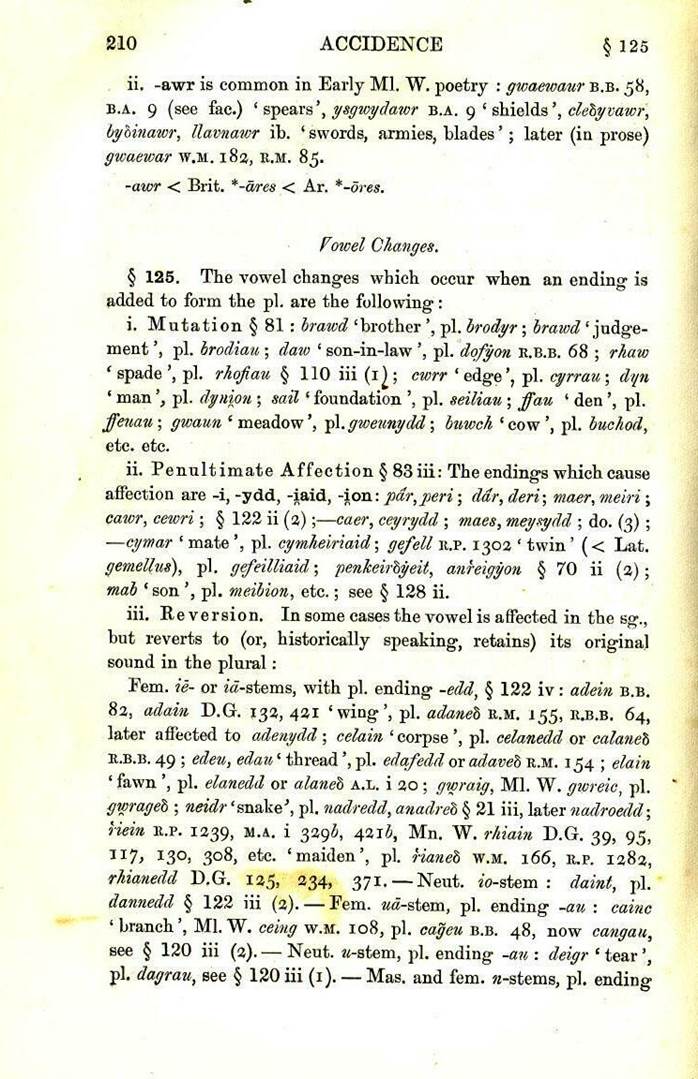
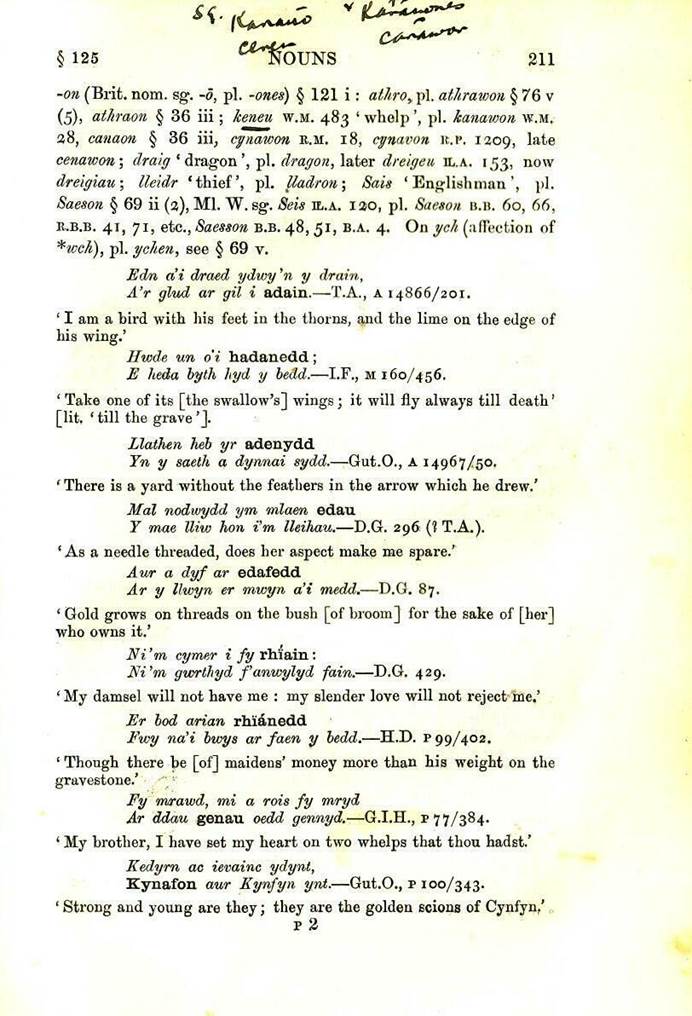
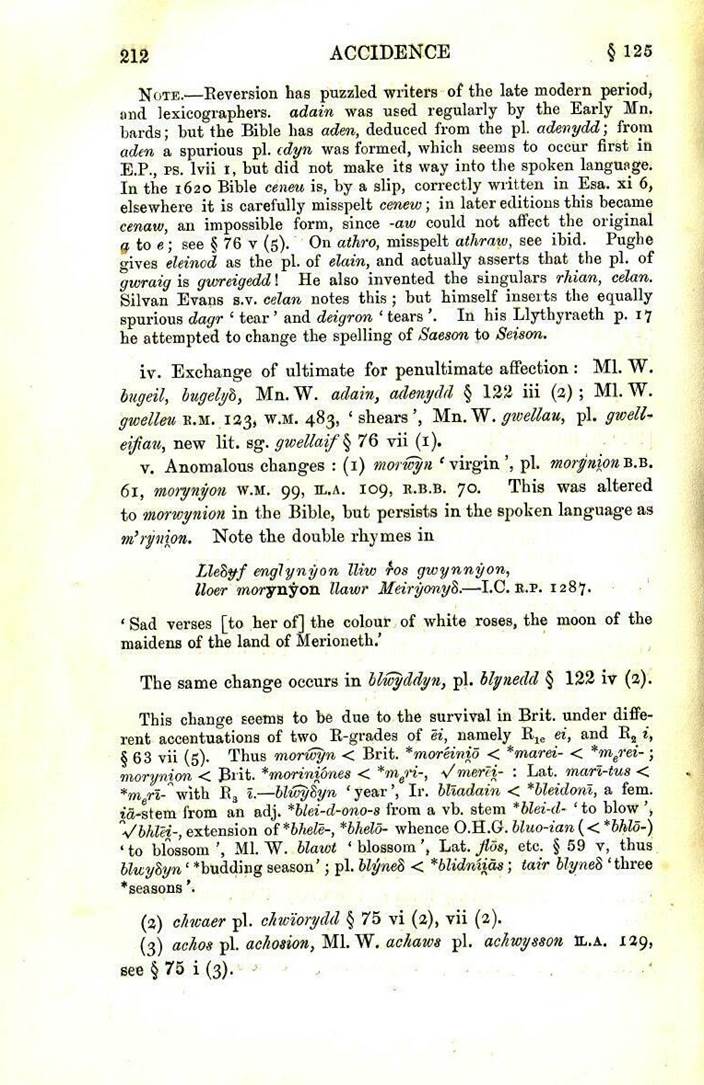
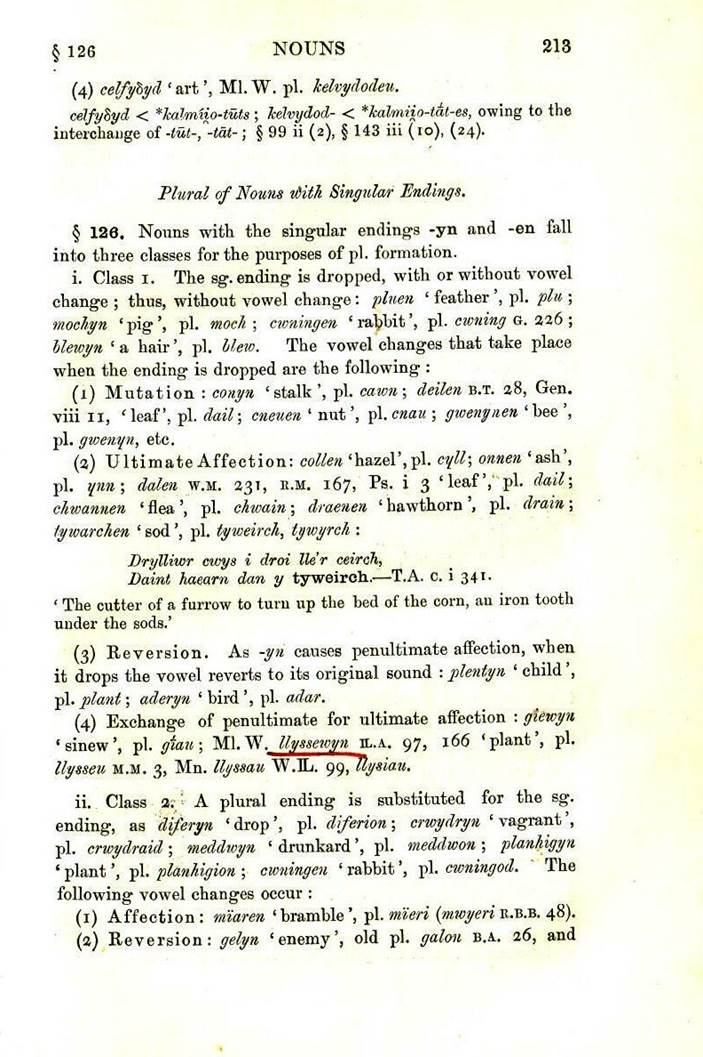
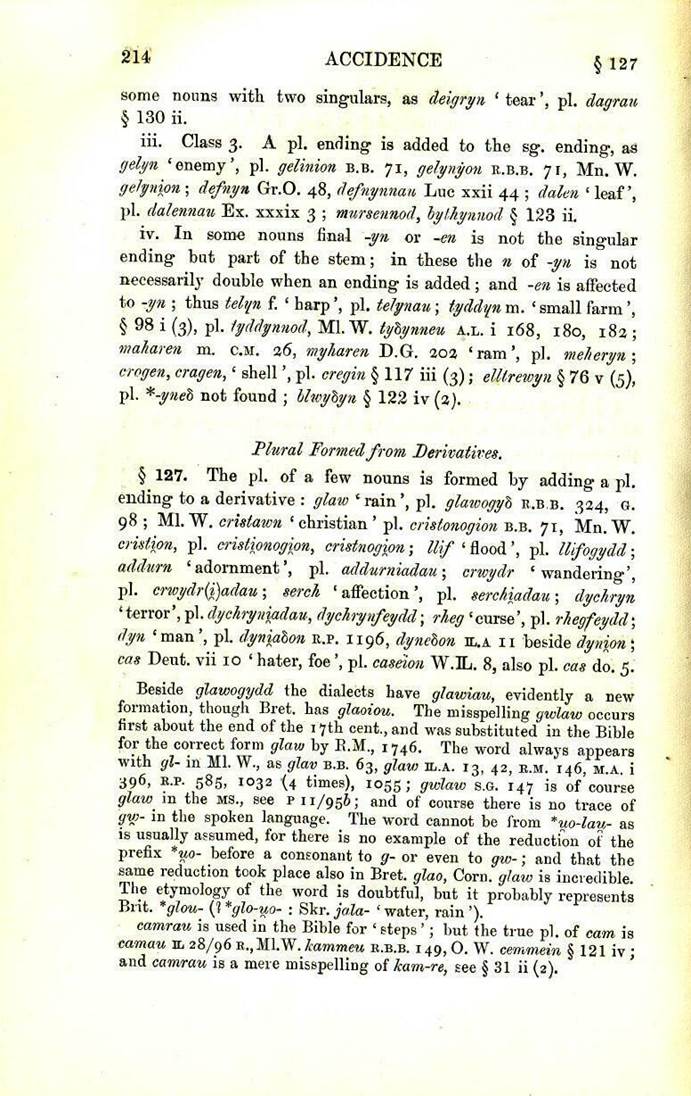
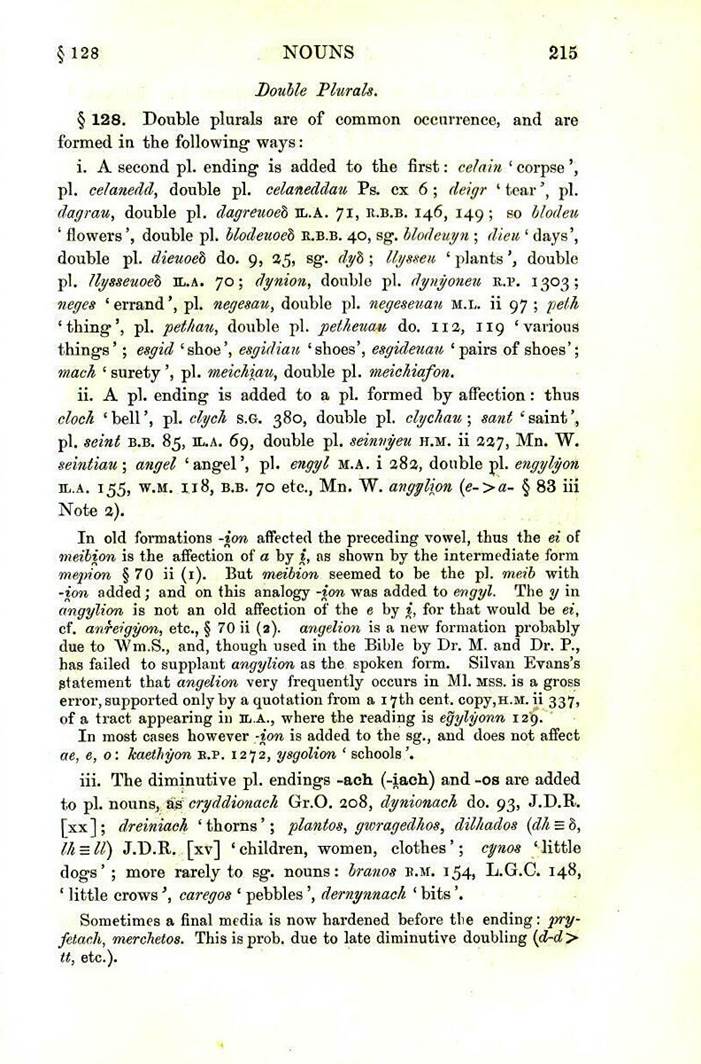
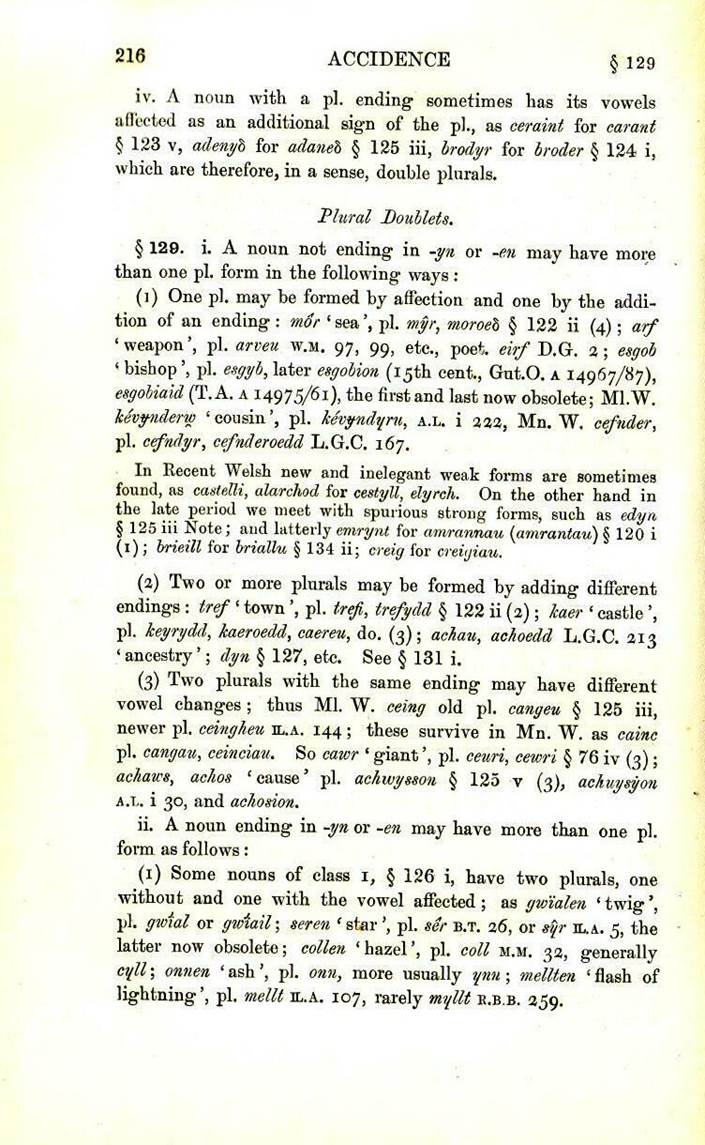
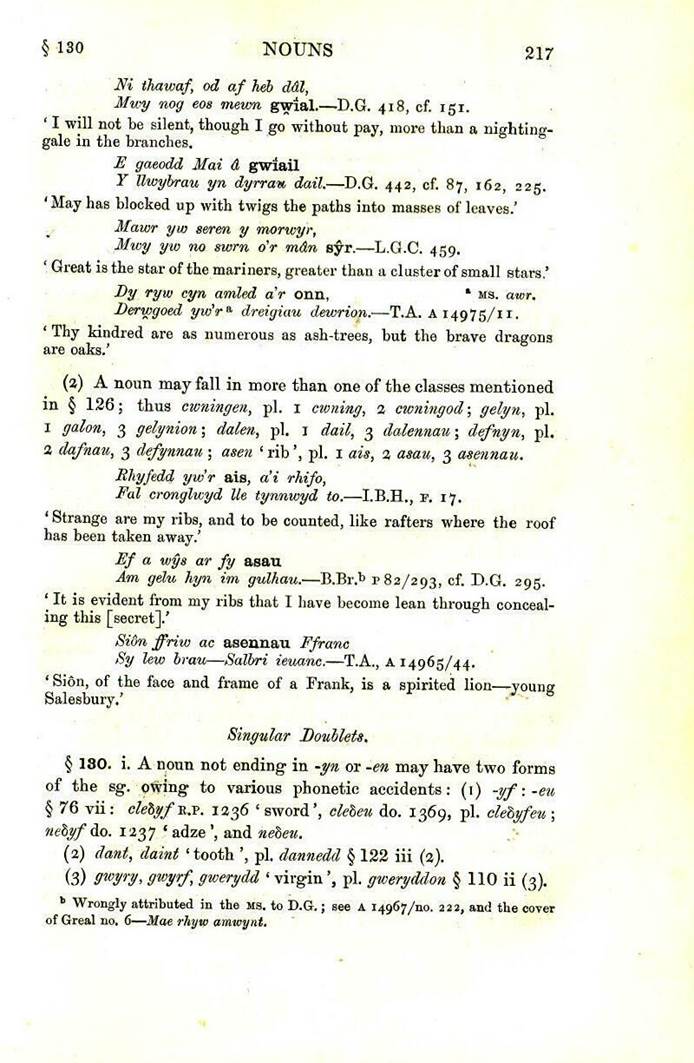
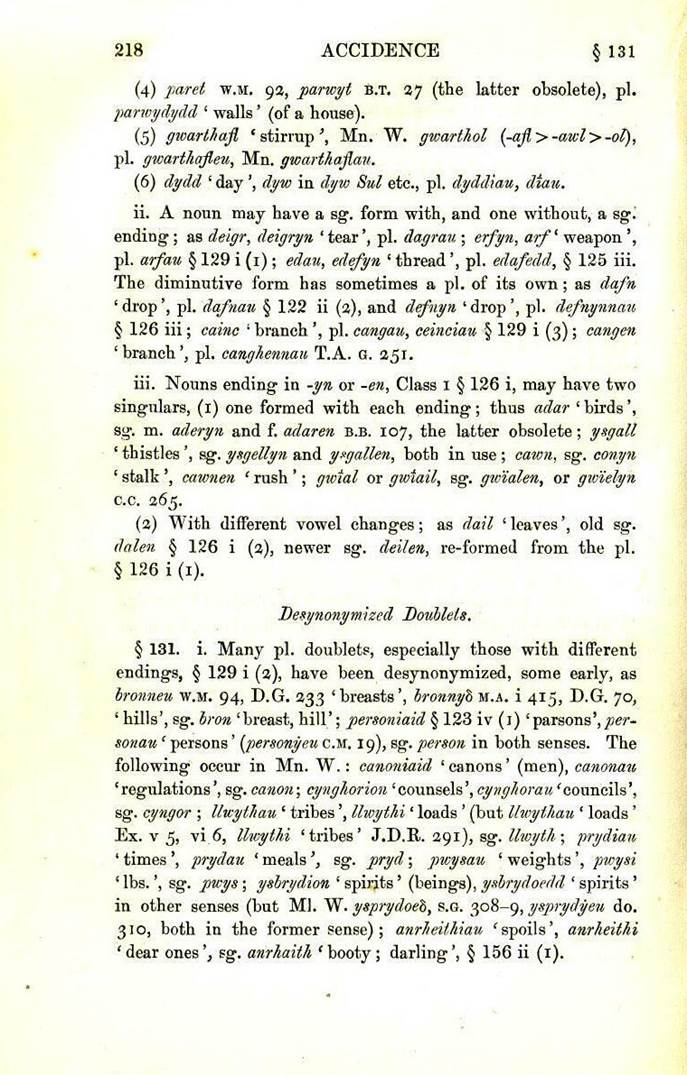
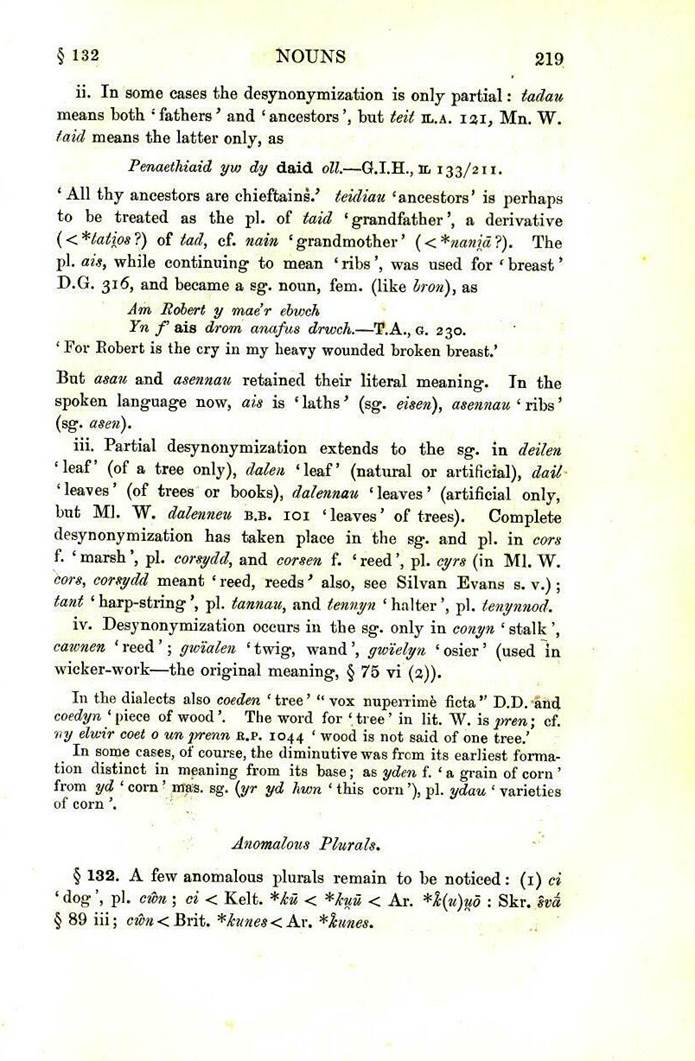
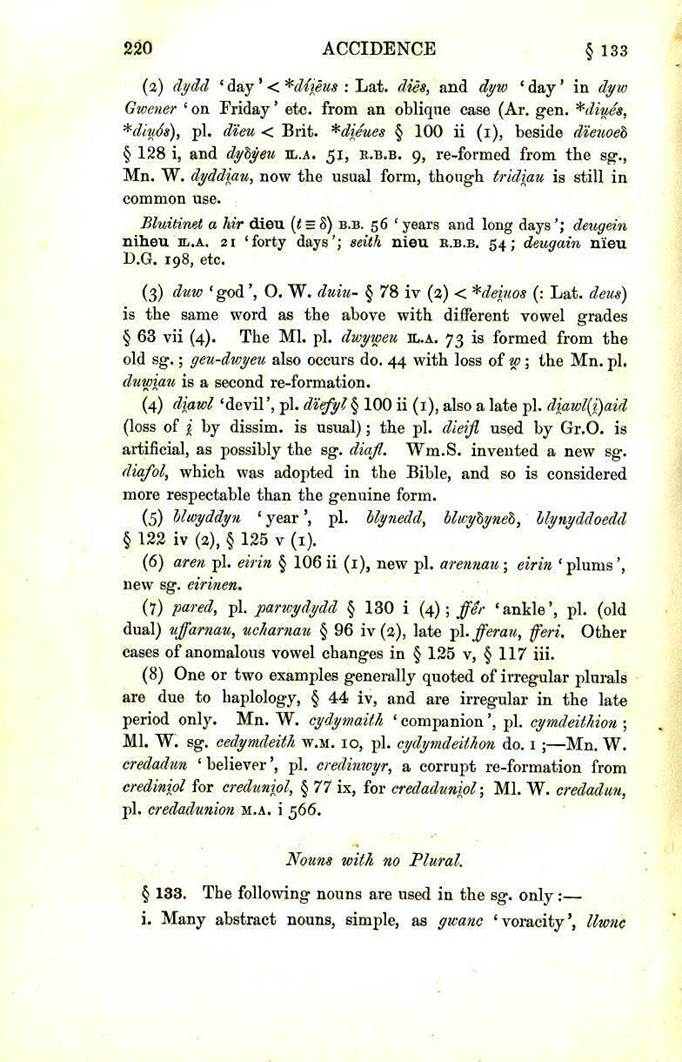
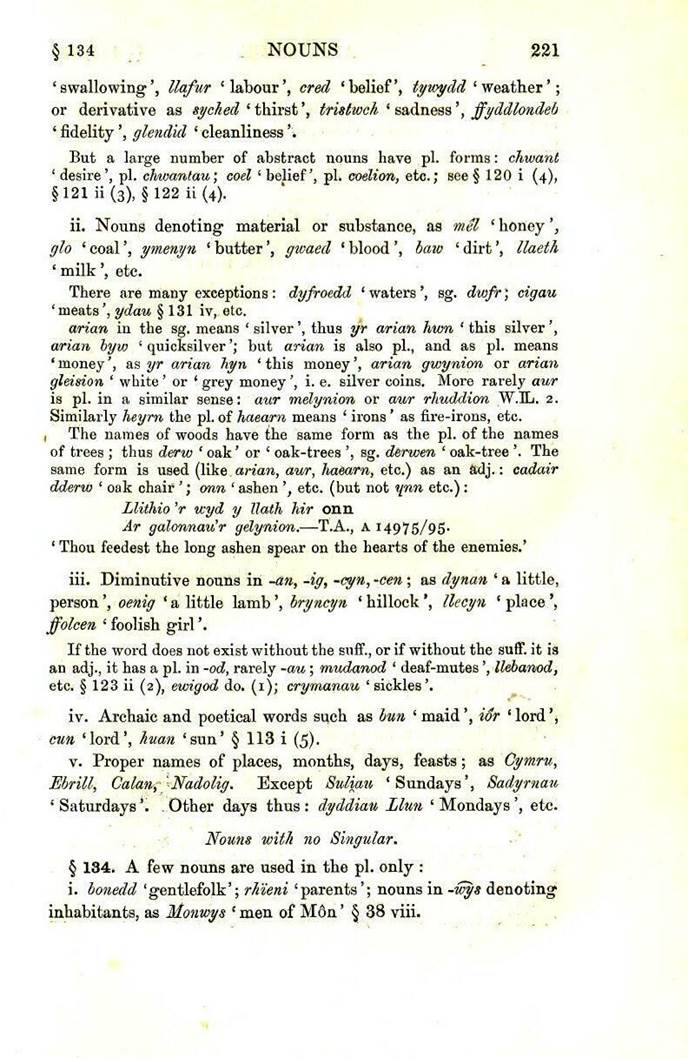
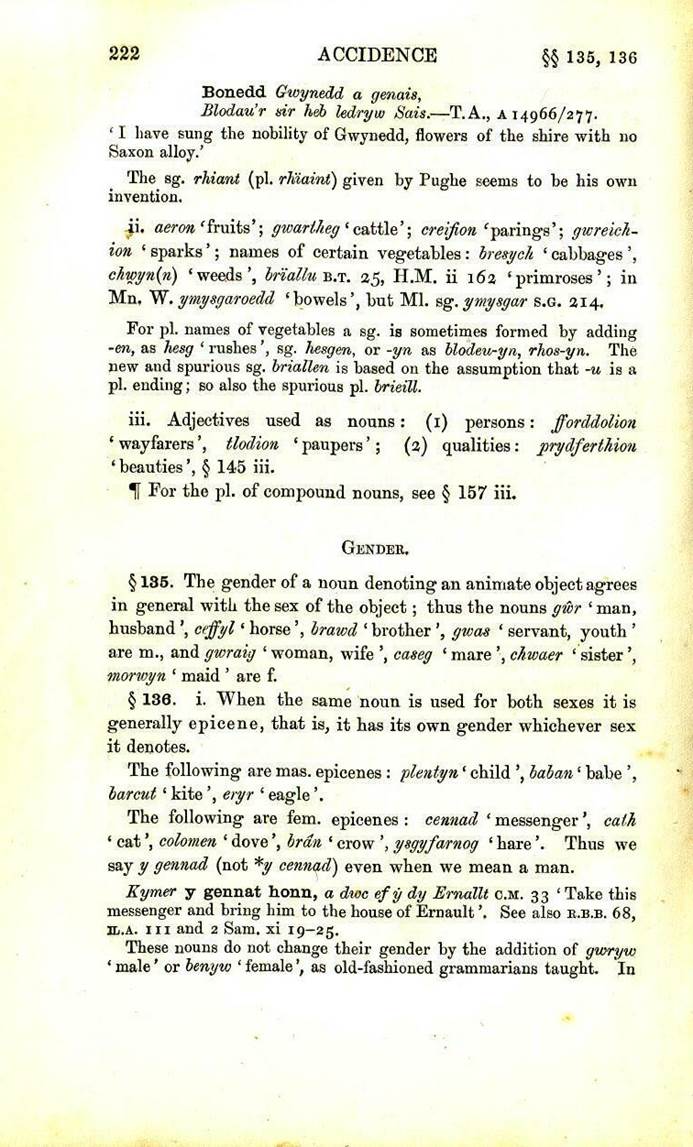
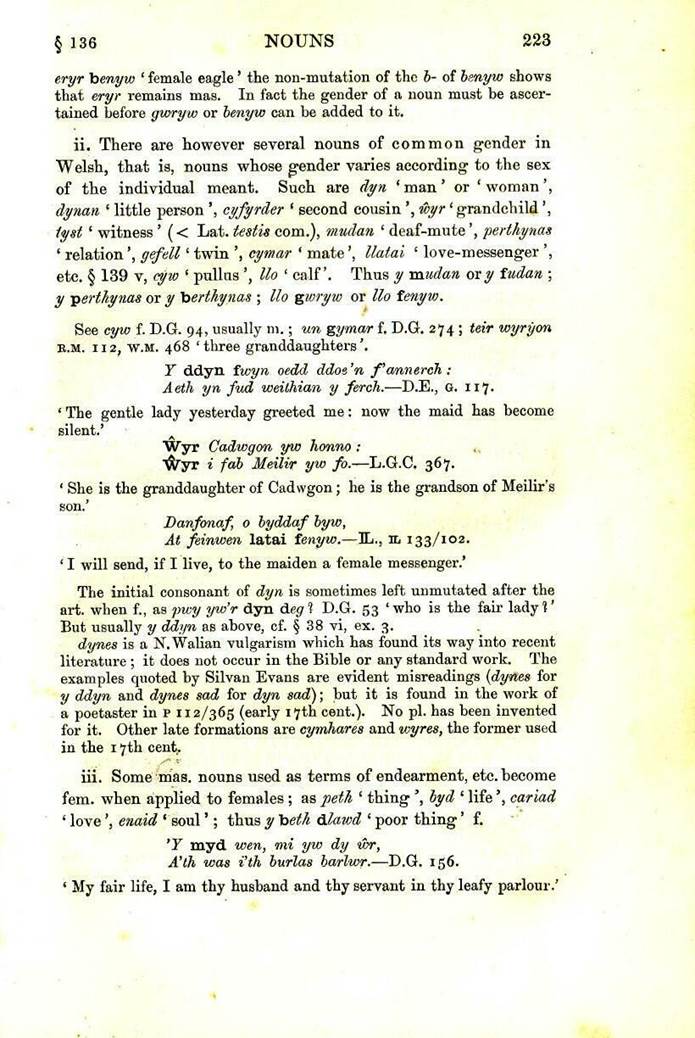
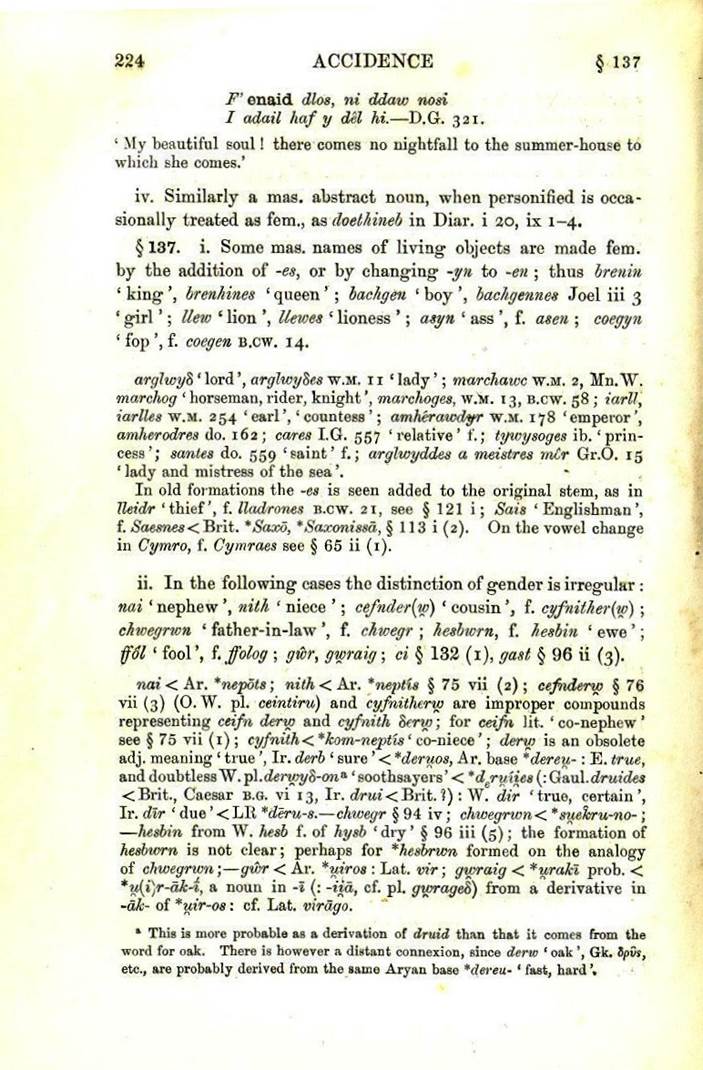
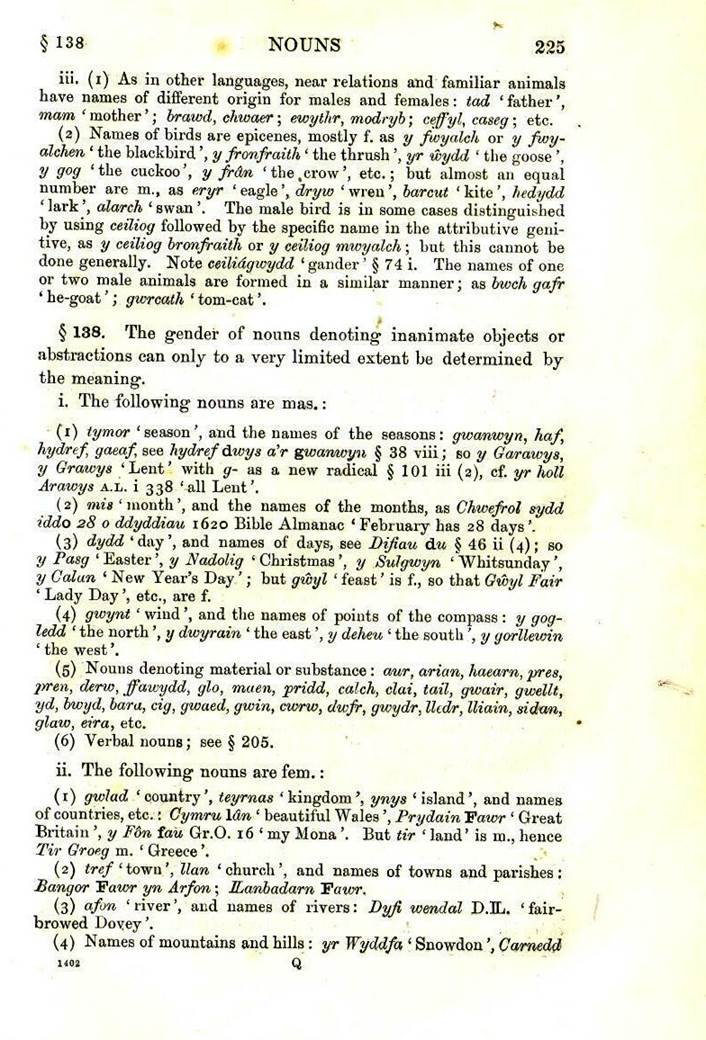

![[1]](https://en.wikisource.org/wiki/Page:Morris-Jones_Welsh_Grammar_0217.png#cite_note-1)
![[2]](https://en.wikisource.org/wiki/Page:Morris-Jones_Welsh_Grammar_0217.png#cite_note-2)
![[1]](https://en.wikisource.org/wiki/Page:Morris-Jones_Welsh_Grammar_0224.png#cite_note-1)


![[1]](https://en.wikisource.org/wiki/Page:Morris-Jones_Welsh_Grammar_0231.png#cite_note-1)


![[1]](https://en.wikisource.org/wiki/Page:Morris-Jones_Welsh_Grammar_0243.png#cite_note-1)
Y RHAN NESAF: 2650e
Sumbolau:
a A / æ Æ / e E / ɛ Ɛ / i
I / o O / u U / w W / y Y /
…..
…..
MACRON: ā Ā / ǣ Ǣ /
ē Ē / ɛ̄ Ɛ̄
/ ī Ī / ō Ō /
ū Ū / w̄ W̄ / ȳ Ȳ /
MACRON + ACEN DDYRCHAFEDIG: Ā̀ ā̀
, Ḗ ḗ, Ī́ ī́
, Ṓ ṓ , Ū́ ū́,
(w), Ȳ́ ȳ́
MACRON + ACEN
DDISGYNEDIG: Ǟ ǟ , Ḕ ḕ,
Ī̀ ī̀, Ṑ ṑ, Ū̀
ū̀, (w), Ȳ̀ ȳ̀
MACRON ISOD: A̱ a̱ , E̱ e̱ ,
I̱ i̱ , O̱ o̱, U̱ u̱, (w),
Y̱ y̱
BREF: ă Ă / ĕ Ĕ / ĭ Ĭ / ŏ Ŏ / ŭ
Ŭ / B5236:  B5237:
BREF GWRTHDRO ISOD: i̯, u̯
CROMFACHAU: ⟨ ⟩ deiamwnt
A’I PHEN I LAWR: ∀, ә, ɐ (u+0250) https:
//text-symbols.com/upside-down/
…..
…..
ˡ ɑ ɑˑ aˑ a: / æ æ: / e eˑe:
/ ɛ ɛ: / ɪ iˑ i:
/ ɔ oˑ o: / ʊ uˑ u:
/ ə / ʌ /
ẅ Ẅ / ẃ Ẃ / ẁ Ẁ / ŵ Ŵ /
ŷ Ŷ / ỳ Ỳ / ý Ý / ɥ
ˡ ð ɬ ŋ ʃ ʧ θ ʒ ʤ /
aɪ ɔɪ əɪ uɪ ɪʊ aʊ ɛʊ əʊ / £
ә ʌ ẃ ă ĕ ĭ ŏ ŭ ẅ
ẃ ẁ Ẁ ŵ ŷ ỳ Ỳ
…..
…..
Hwngarwmlawt: A̋ a̋
g yn
yn  aith δ δ
…..
…..
ә ʌ ẃ ă ĕ ĭ ŏ ŭ ẅ
ẃ ẁ ŵ ŷ ỳ
Ә Ʌ Ẃ Ă Ĕ Ĭ Ŏ Ŭ Ẅ
Ẃ Ẁ Ẁ Ŵ Ŷ Ỳ Ỳ
…..
….
Hwngarwmlawt: A̋ a̋
g yn
yn  aith δ δ
…..
…..
ʌ ag acen ddyrchafedig / ʌ with acute accent: ʌ́
|
Shwa ag acen ddyrchafedig Xwa amb accent agut Schwa with acute |
|
|
DejaVu Serif |
…..
wikipedia,
scriptsource.[]org
https://[ ]en.wiktionary.org/wiki/ǣ
…..
Y TUDALEN HWN /THIS PAGE / AQUESTA PÀGINA:
http://
[]www. []kimkat.org/amryw/1_gramadeg/gramadeg_2_1913_jmj_welsh_grammar_06_200-249_2649e.htm
____________________________________
Adolygiadau diweddaraf: 2005-12-02
Ble’r wyf i? Yr ych chi’n ymwéld ag un o dudalennau’r Gwefan
“CYMRU-CATALONIA”
On sóc? Esteu visitant una pàgina de la Web “CYMRU-CATALONIA” (=
Gal”les-Catalunya)
Weør àm ai? Yùu àar vízïting ø peij fròm dhø “CYMRU-CATALONIA” (=
Weilz-Katølóuniø) Wéb-sait
Where am I? You are visiting a page from the
“CYMRU-CATALONIA” (= Wales-Catalonia) Website
CYMRU-CATALONIA