|
|
|
|
(delwedd L1252) (tudalen 000a)
|
STUDIES
IN
WELSH GRAMMAR
AND PHILOLOGY
S.
J. EVANS, M.A.
|
|
|
|
|
(delwedd L1253) (tudalen 000b)
|
egad
|
|
|
|
|
(delwedd L1254) (tudalen 000c)
|
STUDIES
IN
WELSH GRAMMAR
AND
PHILOLOGY
|
|
|
|
|
(delwedd L1255) (tudalen 000a)
|
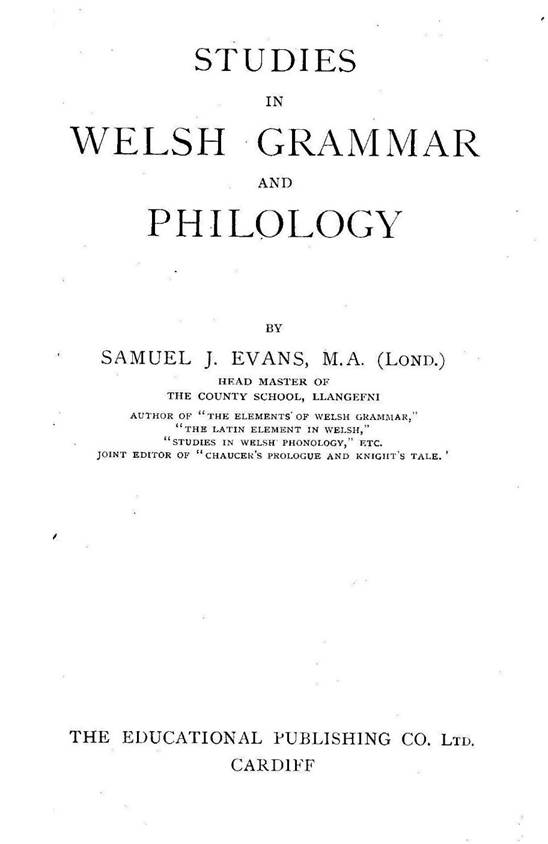
STUDIES
IN
WELSH GRAMMAR
AND
PHILOLOGY
SAMUEL J. EVANS, M.A. (LOND.)
RVAo MASTER OF
TITE COUNTY SCHOO% LLANGEFXI
AUTHOR or OF
LATIN WELSH,"
"STUDIES ETC
EDrr-OR OF " CHAUCER's TALE. •
THE EDUCATIONAL VUBLISHING CO. LTD.
CARDIFF
|
|
|
|
|
(delwedd L1256) (tudalen 000d)
|
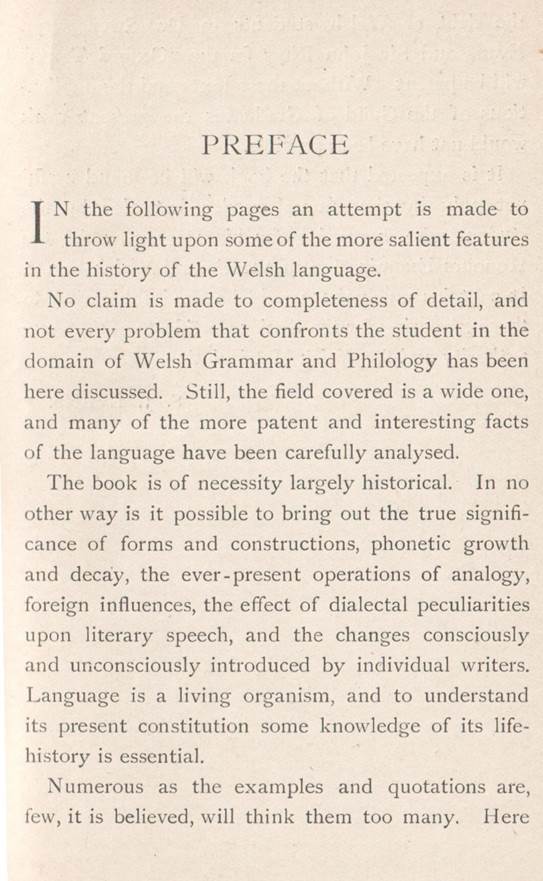
PREFACE
I N the following pages an attempt is made to
throw light upon some of the more salient features
in the history of the Welsh language.
No claim is made to completeness of detail, and
not every problem that confronts the student in the
domain of Welsh Grammar and Philology has been
here discussed. Still, the field covered is a wide one,
and many of the more patent and interesting facts
of the language have been carefully analysed.
The book is of necessity largely historical.
In no
other way is it possible to bring out the true significance of forms and
constructions, phonetic growth
and decay, the ever-present operations of analogy,
foreign influences, the effect of dialectal peculiarities
upon literary speech, and the changes consciously
and unconsciously introduced by individual writers.
Language is a living organism, and to understand
its present constitution some knowledge of its lifehistory is essential.
N umerous as the examples and quotations are,
few, it is believed, will think them too many. Here
|
|
|
|
|
(delwedd L1257) (tudalen 000e)
|
vi
PREFACE
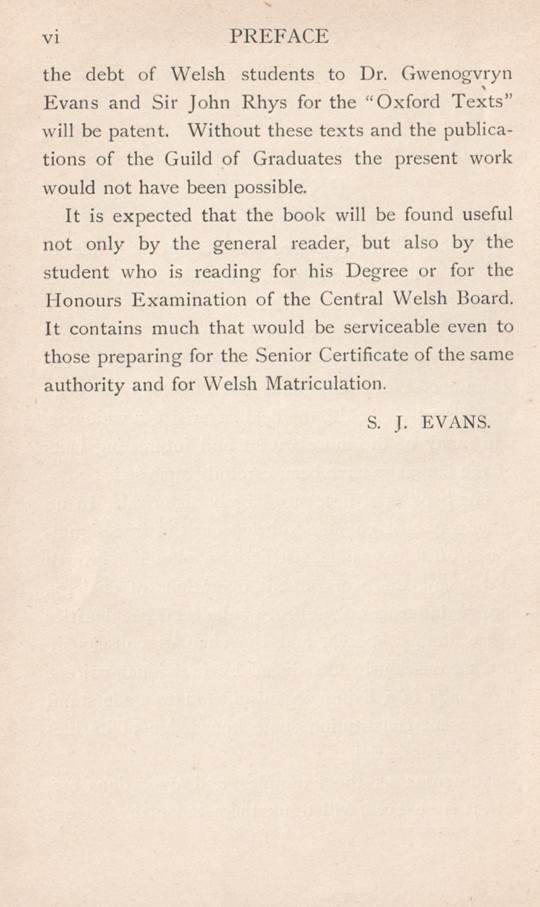
the debt of Welsh students to Dr. Gwenogvryn
Evans and Sir John Rhys for the "0xford Texts"
will be patent. Without these texts and the publications of the Guild of
Graduates the present work
would not have been possible.
It is expected that the book will be found useful
not only by the general reader, but also by the
student who is reading for his Degree or for the
I-Ionours Examination of the Central Welsh Board.
It contains much that would be serviceable even to
those preparing for the Senior Certificate of the same
authority and for Welsh Matriculation.
J. EVANS.
|
|
|
|
|
(delwedd L1258) (tudalen 000f)
|
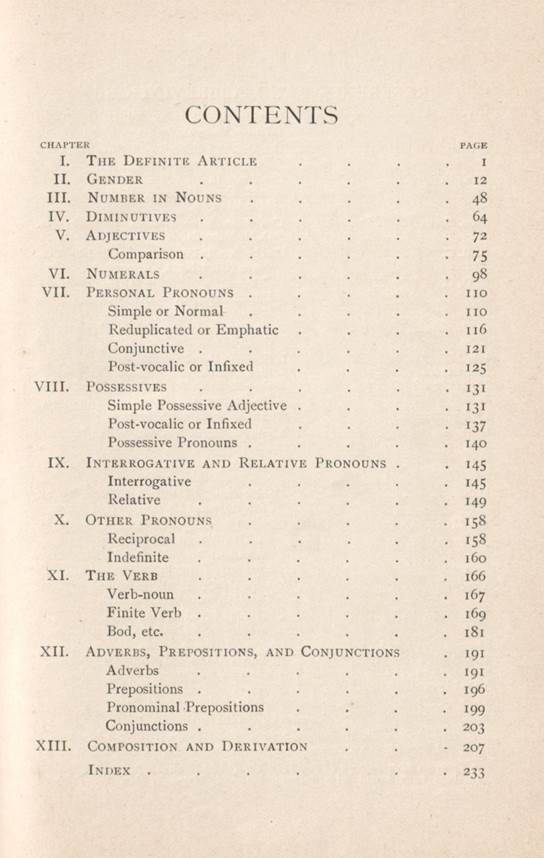
CONTENTS
Il.
111.
IV.
V.
VI.
VII.
VI".
EX.
X.
Xlll.
THE DEFINITE ARTICLE
GEN t'ER
NUMBER IN NOUNS
DI Ml NVTIVEs
Comparison
N t' ME RALS
PERSONAL PKONouNs
Simple or Normal
Reduplicated or Emphatic
Conjunc
Post-vocalic or Infixed
POSSESSIVES
Simple Possessive Adjective .
Post•vocalic or Infixed
Possessive Pronouns .
INTERROGATIVE AND RELATIVE
PRONOUNS .
Interrogative
Relative
OTIIER PRONOUNS
Reciprocal
Indefinite
THE VERB
V erb-noun
Finite Verb
Bod, etc.
ADVERBS, PREPOSITIONS, AND
Adverts
i t ions
pronominal I"repositions
Conjunctions .
CONJ V NCT10Ns
COMPOSITION AND IDERIVATION
INI'EX
FAO E
as
64
72
75
98
110
110
137
140
145
145
J 49
158
60
166
167
169
199
203
233
|
|
|
|
|
(delwedd L1259) (tudalen 000g)
|
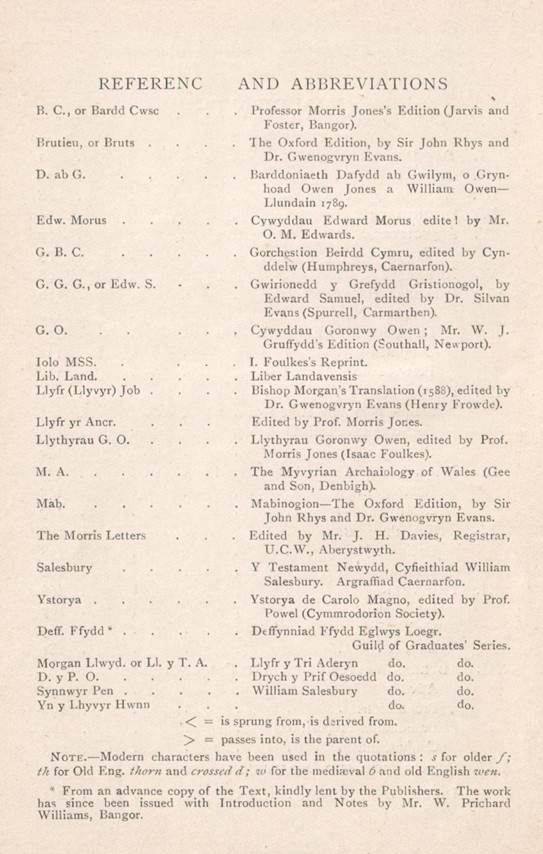
REFERENC
B.,or Bardd
Brutieu, or Brats
Edw. Morus
G. G. G., or Edw. S.
MSS.
Lib. Land.
Llyfr Llyvyr) Job
[.lyfr yr
Mab.
The Morris Letters
Sal esbury
Deff. •
Morgan I.lwyd. or Ll. y T. A.
Synnwyr
Vn y I,hyvyr Hwnn
AND ABBREVIATIONS
Professor Morris Jones's Edition (Jarvis and
Foster, Bangorx
The Oxford Edition, by Sir John Rhys and
Dr. Gwenogvryn Evans.
ah G wily"', o
hoad Owen Jones a William O wen —
l.lundain
Cvwyddau Edward Morus edite by Mr.
O. M. Edwards.
Beirdd edited by Cynddelw (Humphreys, Caernarfon).
Gwirioncdd y Grcfydd by
Edward edited by
Evans (Spurrell,
Goronwy; Mr. W.
Gruffydd's Edition (Southall, Nea port).
l. FOulkeS'S
Liber Landavensis
Kishop Morgan's Translation (t SBS), edited by
I_ir. G wcnoguyn Evans (Ilenry
Edited by prof. Morris Jor.es.
Llythyrau Goronwy Owen, edited by Prof.
Morris Jones (Isaac Foulkes).
Myvy•rian Of (Gee
and Son,
Oxford Edition, by Sir
John Rhys and Dr. Evans.
Edited by Mr. J. H. Davies, Registrar,
Abcrygtwyth.
V Testament Newydd, Cyfieithiad William
Salesbury. A Caernarfon.
VStOrya de edited by prof.
Powel (Cymmrodorion Society).
De ffynniad Ffydd Eg'.wys Loegr.
Guild of Graduates' Series.
1.1yfr v Tri Aderyn
is sprung from, is derived from.
into, is the parent of.
do.
do.
do.
NOTE. — Modern characters have used in the quotations: s for older f;
for Old Eng. and the 6 and Old English
• From an advance copy of the Text, kindly lent by the Publishers. The work
has since been issued with Introduction and Notes by Mr. W. Prichard
Williams, Bangor.
|
|
|
|
|
(delwedd L1260) (tudalen 001)
|
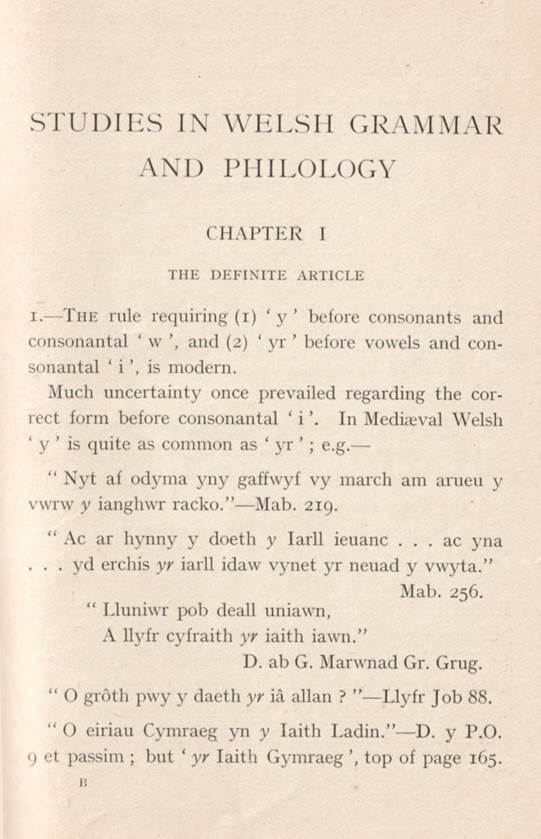
STUDIES
IN WELSH GRAMMAR AND PHILOLOGY
CHAPTER 1
THE DEFINITE ARTICLE
I. — THE rule requiring (1) ' y ' before consonants and
consonantal ' w’, and (2) ' yr ' before vowels and consonantal ' i is modern.
Much uncertainty once prevailed regarding the correct form before consonantal
' i
In Mediæval Welsh
‘y' is quite as common as ' yr '; e.g. —
“Nyt af odyma yny gaffwyf vy march am arueu y
v.vrw y ianghwr racko." — Mab. 219.
“Ac ar hynny y doeth y larll ieuanc . . . ac yna
. . yd erchis yr iarll idaw vynet yr neuad y vwyta."
Mab. 256.
“Lluniwr pob deall uniawn,
A llyfr cyfraith yr iaith iawn."
D. ab G. Marwnad Gr. Grug.
“O gröth pwy y daeth yr iå allan ? " — Llyfr Job 88.
“O eiriau Cymraeg yn y laith Ladin." — D. y P.O.
9 et passim; but ' yr laith Gymraeg’, top of page 165.
|
|
|
|
|
(delwedd L1261) (tudalen 002)
|
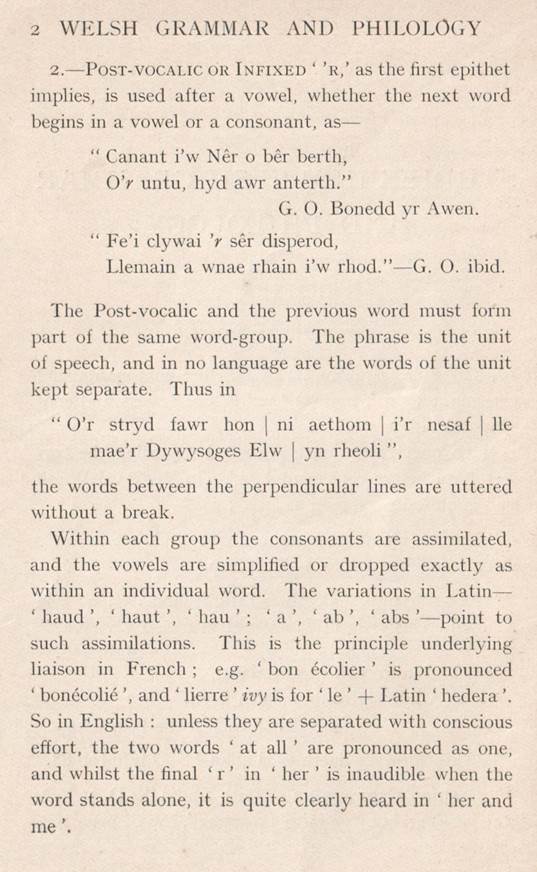
2
WELSH GRAMMAR AND PHILOLOGY
2. — POST-VOCALIC OR INFIXED ' 'R,' as the first epithet
irnplies, is used after a vowel, whether the next word
begins in a vowel or a consonant, as —
“Canant i'w Nér o bér berth,
O'r untu, hyd awr anterth."
G. O. Bonedd yr Awen.
Fe'i cl»vai 'r sér disperod,
I-lemain a wnae rhain i'w O. ibid.
The Post-vocalic and the previous word must form
part oi the sarne word-group. The phrase is the unit
of speech, and in no language are the words of the unit
kept separate. Thus in
“O'r stryd fawr hon I ni aethom I i'r nesaf I Ile
mae'r Dywysoges Elw yn rheoli ",
the words between the perpendicular lines are uttered
without a break.
Within each group the consonants are assimilated,
and the vowels are simplified or dropped exactly as
within an individual word. The variations in Latin —
‘haud’,
‘haut
‘hau '
', ‘ab', ‘abs ' — point to
such assimilations. This is the principle underlying
liaison in French; e.g. ' bon écolier ' is pronounced
‘bonécolié’, and lierre ' ivy is for 'le ' -+- Latin ' hedera '.
So in English: unless they are separated with conscious
effort, the two words ' at all ' are pronounced as one,
and whilst the final ' r' in ' her ' is inaudible when the
word stands alone, it is quite clearly heard in ' her and
me '.
|
|
|
|
|
(delwedd L1262) (tudalen 003)
|
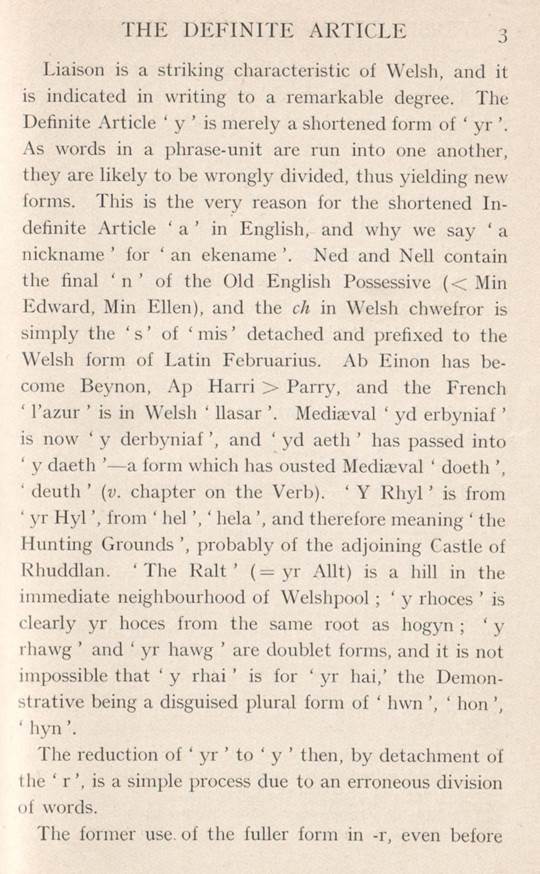
THE DEFINITE ARTICLE
3
Liaison is a striking characteristic of Welsh, and it
is indicated in writing to a remarkable degree. The
Definite Article ' y ' is merely a shortened form of ' yr '.
AS words in a phrase-unit are run into one another,
they are likely to be wrongly divided, thus yielding new
forms. This is the very reason for the shortened Indefinite Article ' a' in
English, and why we say ' a
nickname' for ' an ekename Ned and N ell contain
the final ' n ' of the Old English Possessive Min
Edward, Min Ellen), and the ch in Welsh chwefror is
simply the 's' of ' mis' detached and prefixed to the
Welsh form of Latin Februarius. Ab Einon has be.
come Beynon. Ap Harri > Parry, and the French
l'azur ' is in Welsh ' llasar Medieval ' yd erbyniaf '
is now ' y derbyniaf’, and ' yd aeth ' has passed into
‘y daeth ' — a form which has ousted Media•val ' doeth’,
deuth ' (v. chapter on the Verb). ' Y Rhyl ' is from
‘yr Hyl’, from hel’, hela’, and therefore meaning ' the
Hunting Grounds’, probably of the adjoining Castle of
Rhuddlan. ' The Ralt '
( = yr Allt) is a hill in the
itnmediate neighbourhood of Welshpool; ' y rhoces ' is
clearly yr hoces from the same root as hogyn; '
rhawg ' and ' yr hawg ' are doublet forms. and it is not
irnpossible that 'y rhai ' is for ' yr hai,' the
strative being a disguised plural form of ' hwn’, ‘hon '
hyn '.
The reduction of ' yr ' to ' y ' then, by detachment of
the ' r', is a simple process due to an erroneous division
words.
The former use of the fuller form in -r, even before
|
|
|
|
|
(delwedd L1263) (tudalen 004)
|
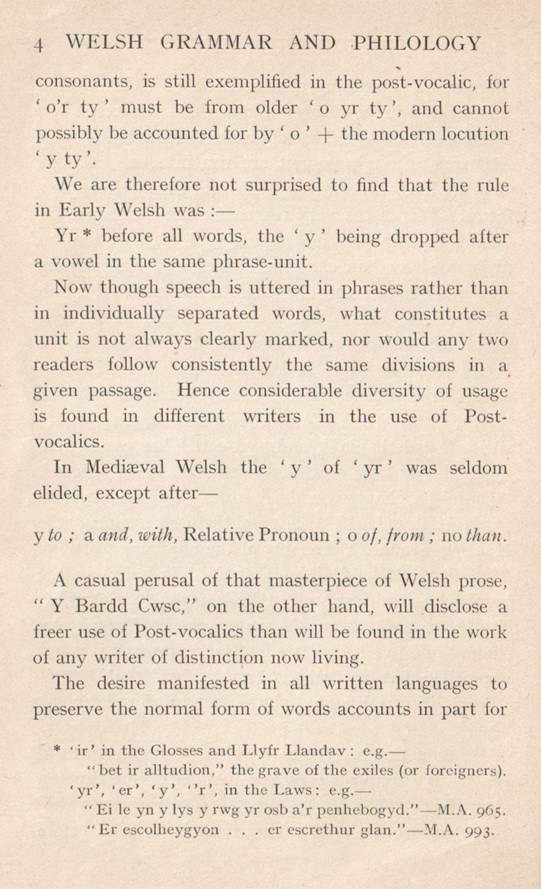
4
WELSH GRAMMAR AND PHILOLOGY
consonants, is still exemplified in the post-vocalic, for
‘o'r ty' must be from older 'o yr ty’, and cannot
possibly be accounted for by o' + the
modern locution ‘y ty’.
We are therefore not surprised to find that the rule
in Early Welsh was: —
Yr * before all words, the ' y ' being dropped after
a vowel in the same phrase-unit.
Now though speech is uttered in phrases rather than
in individually separated words, what constitutes a
unit is not always clearly marked, nor would any two
readers follow consistently the same divisions in a
given passage. Hence considerable diversity of usage
is found in different writers in the use of Postvocalics.
In Mediæval Welsh the ' y ' of ' yr ' was seldom
elided, except after —
y to; a and, with, Relative Pronoun; o o', from; no than.
A casual perusal of that masterpiece of Welsh prose,
“Y Bardd Cwsc," on the other hand, will disclose a
freer use of Post-vocalics than will be found in the work
of any writer of distinction now living.
The desire manifested in all written languages to
preserve the normal form of words accounts in part for
• ' ir' in the Glosses and Llyfr Llandav: e.g. —
bet ir alltudion," the grave of the exiles (or foreigners).
y', • in the Laws: e.g. —
“Ei le yn y lys yrwg yr Osb a'r 965.
“Er escolheygyon .
. cr escrethur 993.
|
|
|
|
|
(delwedd L1264) (tudalen 005)
|
THE DEFINITE ARTICLE 5
the not infrequent use of the full form ' yr where we
should expect the Post-vocalic
“y wrthwynebu yr paganyeit." — ystorya 2.
Kerdda yr y I.hyvyr Hwn.
“tua yr Job 6.
“Drwy yr byd y P. O. 6.
The examples here adduced show the phonological
effect of a vowel-ending word upon the following
Article, and the hesitation of the writer to elide the ' y
Y', then, is a truncated ' yr’, due to the -r
having been erroneously prefixed to the next word.
Hence in its early history ' Y ' would be found only
before words beginning in the consonant r (or n-, or 1-,
see below). Then by analogy it came to be used before
words beginning in other consonants.
A comparison of the Welsh form ' yr' with the
Breton Definite Article ' ar', al', ‘ann’, and the ease
with wllich these three liquids interchange, suggest an
inquiry whether any traces of doublet forms in -n and
-l occur in Welsh. Further reason for suspecting Such
forms exists in the fact that the Old Irish Definite
Article was ' ind ' (m.),
‘inna ' (f.), ‘an ' (neut.), and
that its oldest form in Cornish was an '.
In Welsh we
have at least two instances of the form yn in ' y
naill ' for ' yn aill and ' yn awr literally the hour.
lirobably ' y llall ' is for yl all’, and it isa noteworthy
fact that in Demetian and Gwentian the common
|
|
|
|
|
(delwedd L1265) (tudalen 006)
|
6 WELSH GRAMMAR AND PHILOLOGY
'
locution for y llall ' is 'y nall '. On the other hand,
y neilltu ' is 'y Ileilltu ' in the Laws.*
4. — A comparison of all the above. and especially
the evidence of Old Irish, suggest that the earliest form
XVhen it is added that in
of the consonant was ' n
()ld Irish after certain prepositions to which the Article
is suffixed. an s appears between the two words, as —
forsin < for 'thon + sin (the article),
we mav infer a still older form. ' Sind’, of which the
‘sin ' (for sim by assitnilation of m to the ' d is
‘silnilis English ' same
Cognate with Latin ' semel’,
and Welsh ' halal '
while the d found in Irish
alone, is cognate with the neuter Definite Article in
Greek.
If this is correct. then our Definite Article is in origin
the first part of a compound, of which the second
element — the presumably original Definite Article — is
completely lost from the Brythonic languages.
in modern Welsh the Article
is indeclinable, the evidence of mutation points to inflection in Brythonic:
—
1. The Article governs the soft mutation of ' dau '
and dwy’, e.g. —
‘Y ddau ddyn ' Y dd',vy wraig ,
• See Wade-Evans' Welsh Medieval Inw" (p. 47), pub.
lished while these sheets were passing through the press.
|
|
|
|
|
(delwedd L1266) (tudalen 007)
|
THE DEFINITE ARTICLE
wllile it is followed by the radical in ' tri’,
• pedwar’, pedair’, and other numerals.
7
‘tair
The existence of a dual number in Old Irish leads one
to expect a dual form in Brythonic, which of course
would be used before ' dau • and ' dwy
The form of the dual Article in Irish does not help
us much, but if we turn to Greek, where that number
was still in use in the classical period. we note that in
the Nominative and Accusative it always ended in a
vowel. Similarly the only surviving dual forms in
Latin are ' duo ' and ' ambo both of which end in -o.
A dual Article in Brythonic would thus mutate the
vowel-flanked d of dau and dwy into dd. This same
fact has been used by Sir John Rhys to account for the
soft mutation in ' Yr Eiil ' The Rivals, the name of
certain forked peaks in Soutli-West Carnarvonshire. If
Geifl were plural, the initial would not disappear. for the
Article does not mutate the initial consonant of a
plural noun. Hence he inferred that here we have the
clual, and the once vowel-ending dual Article accounts
for the mutation (cf. Number in Nouns).
2. The Feminine Singular of the Article once ended
in a vowel, hence its governing the soft mutation;
e.g. —
V wraig (from gwraig) y dduwies (from duwies),
for — we may here observe — mutation goes back to a
time anterior to the shortening of ' yr' into ' y
6. — THE ARTICLE WITH PROPER Novss. — How is if
|
|
|
|
|
(delwedd L1267) (tudalen 008)
|
8 WELSH GRAMMAR AND PHILOLOGY
that in Welsh the Definite Article is often used before
such Proper Names as ' Mwythig ' or Amwythig '
Shrewsbury. Bala Bala ?
The history of ' Yr Amwythig ' is interesting and
typical of a class:
1010 Goch does not use the Article in —
“I)wyn blaenffrwyth cwrw Amwythig,
Gwiredydd, bragodydd brig." — G. B. C. 116.
But in the seventeenth and eighteenth centuries the
initial vowel. being unaccented and therefore indistinctly articulated, was
misunderstood and detached.
Hence on the title page of books printed by Thomas
Durston the name is ' V Muythig’, and Goronwy Owen
in his letters writes —
yny Mwythig ' (p. 29), and ' i'r Mwythig ' (p. 11).
Later the A- was restored, but without any suspicion
that the detached ' y ' was anything but the Definite
Article. Hence the modern form ' Yr A mu•ythig '
The same explanation applies to the ' yr ' with
lwerddon, Eidal or Ida]. Yspaen, Amerig, Almaen,
Bermo, etc., and instances of their use with and without
the Article may be adduced:
“Wynt a welynt teir Ilong ar dec yn dyuot o deheu
i werdon
26.
Lloegyr a freinc ar almaen
de Carolo 1.
|
|
|
|
|
(delwedd L1268) (tudalen 009)
|
. ar eidal
. ac yr
THE DEFINITE ARTICLE
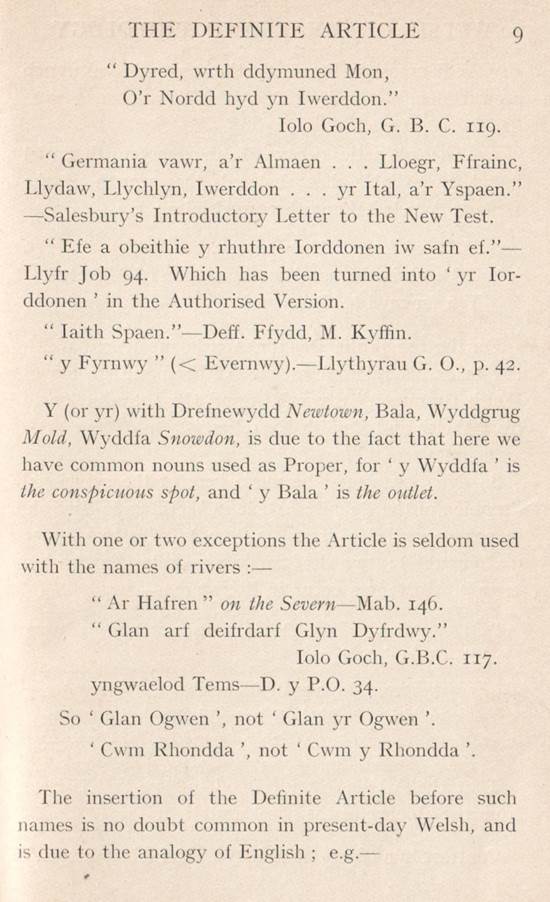
“Dyred, wrth ddymuned Mon,
O'r Nordd hyd yn lwerddon."
9
1010 Goch, G. B. C. 119.
“Germania vawr, a'r Almaen .
Lloegr, Ffrainc,
Llydaw, Llychlyn, lwerddon .
yr Ital, a'r Yspaen."
— Salesbury's Introductory Letter to
the New Test.
Efe a obeithie y rhuthre lorddonen iw safn el."
Llyfr Job 94. Which has been turned into ' yr Iorddonen ' in the Authorised
Version.
“laith Ffydd, M.
“y Fyrnwy " Evernwy). — Llythyrau G. O.,p. 42.
Y (or yr) with Newtown, Bala, Wyddgrug
Mold, Wyddfa Snowdon, is due to the fact that here we
have common nouns used as Proper, for y Wyddfa ' is
the conspicuous spot, and ' y Bala ' is the outlet.
With one or two exceptions the Article is seldom used
with the names of rivers: —
Ar Hafren on the Severn — Mab. 146.
Glan arf deifrdari Glyn Dyfrdwy."
1010 Goch, G.B.C. 117.
yngwaelod Terns — I). y P.O. 34.
So ' Glan Ognven’, not Glan yr Ogwen '.
‘Cwtn Rhondda’, not Cwm y Rhondda '.
The insertion of the Definite Article before such
narnes is no doubt in present-day Welsh, and
is due to tlie oi English; e.g. —
|
|
|
|
|
(delwedd L1269) (tudalen 010)
|
10 WELSH GRAMMAR AND PHILOLOGY
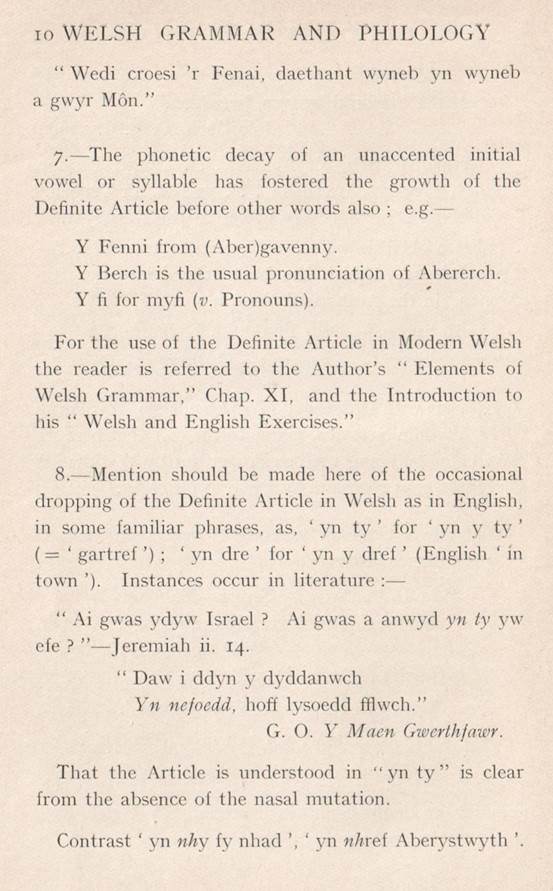
Wedi croesi 'r Fenai, daethant wyneb yn wyneb
a gwyr Mön."
7. — The phonetic decay of an unaccented initial
vowel or syllable has fostered the growth of the
Definite Article before other words also; e.g. —
Y Fenni from (Aber)gavenny.
Y Berch is the usual pronunciation of Abererch.
Y fi for rnyfi (v. Pronouns).
For the use of the Definite Article in Modern Welsh
the reader is referred to the Author's " Elements of
Welsh Grammar," Chap. XI, and the Introduction to
his " Welsh and English Exercises."
8. — Mention should be made here of the occasional
dropping of the Definite Article in Welsh as in English,
in some familiar phrases, as, ‘yn ty ' for ' yn y ty '
gartref '); yn dre ' for yn y dref ' (English ' in
town
Instances occur in literature: —
Ai ydyw Israel? Ai gnvas a anwyd yn ty YW
efe? _
“Jererniali ii. 14.
‘Daw i ddyn y dyddanwch
nc/ocdd. hoff lysoedd filwch."
G. O. V Maen Gwerlh/awr.
That the Article is understood in " yn ty" is clear
from the absence of the nasal mutation.
Contrast ' yn nhy fy nhad ' yn nhref Aberystwyth '
|
|
|
|
|
(delwedd L1270) (tudalen 011)
|
THE DEFINITE ARTICLE 11
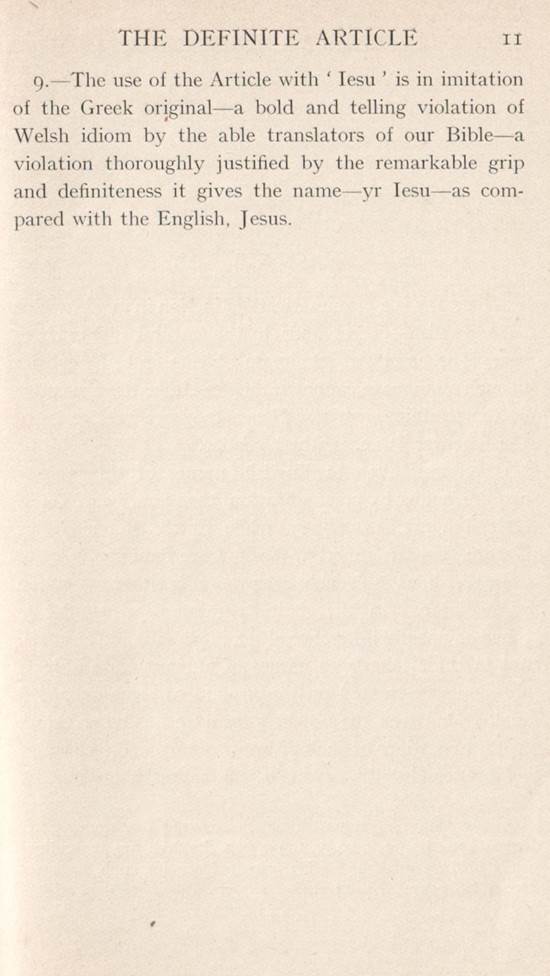
9. — The use oi the Article with 'Iesu' is in imitation
of the Greek original — a bold and telling violation of
Welsh idiom by the able translators of our Bible — a
violation thoroughly justified by the remarkable grip
and definiteness it gives the name — yr lesu — as compared with the English.
Jesus.
|
|
|
|
|
(delwedd L1271) (tudalen 012)
|
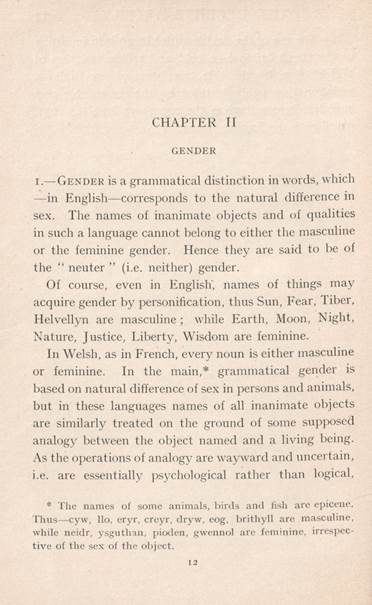
CHAPTER 11
GENDER
r. — GENDER is a grammatical distinction in words, which
— in English — -corresponds to the
natural difference in
sex. The names of inanimate objects and of qualities
in such a language cannot belong to either the masculine
or the feminine gender. Hence they are said to be of
the 's neuter "
(i.e. neither) gender.
Of course, in English'. names of things may
acquire gender by personification, thus Sun, Fear, Tiber,
Helvellyn are masculine; while Earth, Moon, Night,
Nature, Justice, l.iberty, Wisdom are feminine.
In Welsh, as in French, every noun is either masculine
In the main,* grammatical gender is
or feminine.
based on natural difference of sex in persons and animals,
but in these languages names of all inanimate objects
are similarly treated on the ground of some supposed
analogy between the object named and a living being.
As the operations of analogv are wayward and uncertain,
i.e. are essentially psychological rather than logical,
The names of some animals. birds and fish are epicene.
Thus — cyw. 110. eryr. creyr. dryw, eng, brithyll are masculine,
while neidr. ysguth.n. picvlen. gwennol are feminine, irrespective of the sex
Of the object.
|
|
|
|
|
(delwedd L1272) (tudalen 013)
|
GENDER
13
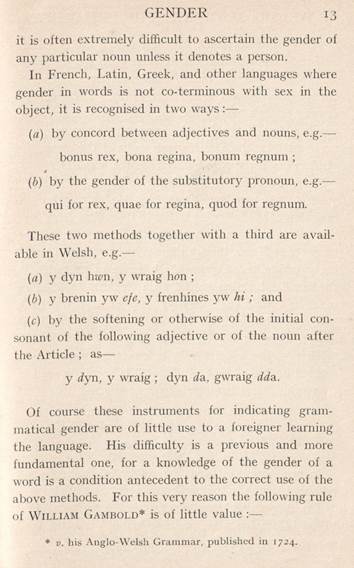
it is often extremely difficult to ascertain the gender of
any particular noun unless it denotes a person.
In French, Latin, Greek, and other languages where
gender in words is not co-terminous with sex in the
object, it is recognised in two ways: —
(a) by concord between adjectives and nouns, e.g. —
bonus rex, bona regina, bonum regnum;
(b) by the gender of the substitutory pronoun, e.g. —
qui for rex, quae for regina, quod for regnum.
These two methods together with a third are available in Welsh, e.g. —
(a) y dyn hwn, y wraig hon;
(b) y brenin yw e/e, y frenhines yw hi; and
(c) by the softening or otherwise of the initial consonant of the following
adjective or of the noun after
the Article; as —
y dyn, y wraig; dyn da, gwraig dda.
Of course these instruments for indicating gramrnatical gender are of little
use to a foreigner learning
the language. His difficulty is a previous and more
fundamental one, for a knowledge of the gender of a
word is a condition antecedent to the correct use of the
above methods. For this very reason the following rule
of WILLIAM GAMBOLD* is of little value: —
* v. his Anglo-Welsh Grammar, published in 1724.
|
|
|
|
|
(delwedd L1273) (tudalen 014)
|
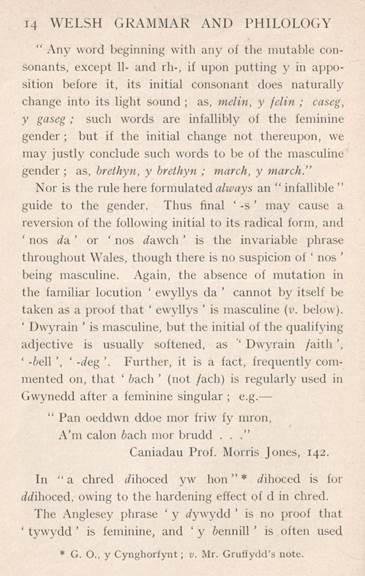
14 WELSH GRAMMAR AND PHILOLOGY
‘Any word beginning with any of the mutable consonants, except ll- and rh-,
if upon putting y in apposition before it, its initial consonant does
naturally
change into its light sound; as, melin. y felin; cascg,
y gaseg; such words are infallibly of the fetninine
gender; but if the initial Change not thereupon, we
may justly conclude such words to be of the masculine
gender; as, brethyn, y brethyn; march, y march."
Nor is the rule here formulated always an infallible "
guide to the gender. Thus final ' -s' may cause a
reversion of the following initial to its radical form, and
‘nos da ' or ' nos dawch' is the invariable phrase
throughout Wales, though there is no suspicion of ' nos '
being masculine. Again, the absence of mutation in
the familiar locution ' ewyllys da ' cannot by itself be
taken as a proof that ewyllys ' is masculine (v. below).
Dwyrain ' is masculine, but the initial of the qualifying
adjective is usually softened, as " Dwyrain faith
‘-bell
-deg Further, it is a fact, frequently commented on, that ' bach ' (not 'ach)
is regularly used in
Gwynedd after a feminine singular; e.g.
Pan oeddwn ddoe mor friw fy mron,
A'rn calon bach mor brudd
Caniadau Prof. Morris Jones, 142.
In " a chred dihoced yw hon "* dihoced is for
ddihoced, owing to the hardening effect of d in chred.
The Anglesey phrase ' y dywydd ' is no proof that
‘tywydd ' is feminine, and ' y bennill ' is often used
• G. O., y Cynghoriynt; v. Mr. Gruffydd's note.
|
|
|
|
|
(delwedd L1274) (tudalen 015)
|
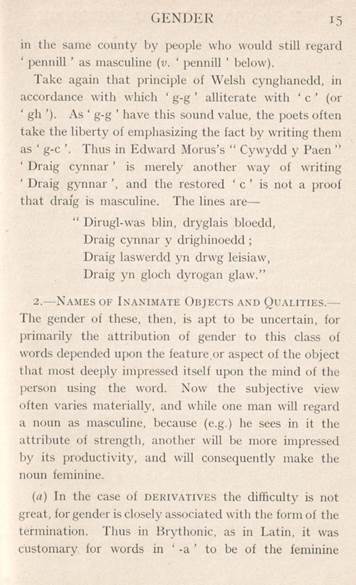
GENDER
15
in the same county by people who would still regard
‘pennill ' as masculine (v. ' pennill ' below).
Take again that principle of Welsh cynghanedd, in
accordance with which ' g-g ' alliterate with ' c ' (or
‘gh '). As ' g-g ' have this sound value, the poets often
take the liberty of emphasizing the fact by writing tliem
as ' g-c '. Thus in Edward Morns's " Cywydd y Paen "
‘Draig cynnar' is merely another way of writing
‘Draig gynnar’, and the restored ' c ' is not a proof
that drafg is masculine. The lines are —
“Dirugl-was blin, dryglais bloedd,
Draig cynnar y drighinoedd;
Draig laswerdd yn drwg leisiaw,
Draig yn gloch dyrogan glaw."
2. — NAMES OF INANIMATE OBJECTS AND QUALITIES.
The gender oi these, then, is apt to be uncertain, for
primarily the attribution of gender to this class of
words depended upon the feature or aspect of the object
that Inost deeply impressed itself upon the mind of the
person using the word. Now the subjective view
often varies materially. and while one man will regard
a noun as masculine, because (e.go he sees in it the
attribute of strength, another will be more impressed
by its productivity, and will consequently make the
noun feminine.
(a) In the case of DERIVATIVES the difficulty is not
great, for gender is closely associated with the form of the
termination. Thus in Brvthonic, as in Latin, it was
customary for words in ' -a ' to be of the feminine
|
|
|
|
|
(delwedd L1275) (tudalen 016)
|
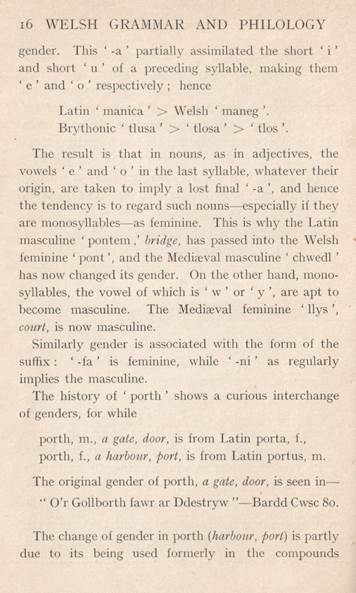
16 WELSH GRAMMAR AND PHILOLOGY
gender. This -a ' partially assimilated the short i '
and short u ' of a preceding syllable, making them
‘e and ' o ' respectively; hence
Latin manica ' > Welsh maneg '
Brythonic ' tlusa ' > ' tlosa ' > ' tlos '.
The result is that in nouns, as in adjectives, the
vowels ' e ' and ' o ' in the last syllable, whatever their
origin, are taken to imply a lost final ' -a’, and hence
the tendency is to regard such nouns — especially if they
are monosyllables — as feminine. This is why the I -atin
masculine pontem . ' bridge, has passed into the Welsh
feminine pont ' , and the Medi;eval masculine ' chwedl '
has now changed its gender. On the other hand, monosyllables, the vowel of
which is ' w ' or y’, are apt to
become masculine. The Mediæval feminine llys’,
court, is now masculine.
Similarly gender is associated with the form of the
‘-fa' is feminine, wliile -ni' as regularly
suffix:
implies the masculine.
The history of ' porth shows a curious interchange
of genders, for while
porth, m., a gate, door, is from Latin porta, f.,
porth, f., a harbour, port, is from Latin portus, m.
The original gender of porth, a gate, door, is seen in —
“O'r Gollborth fawr ar Ddestryw " — Bardd Cwsc 80.
The change of gender in porth (harbour, port) is partly
due to its being used formerly in the colnpounds
|
|
|
|
|
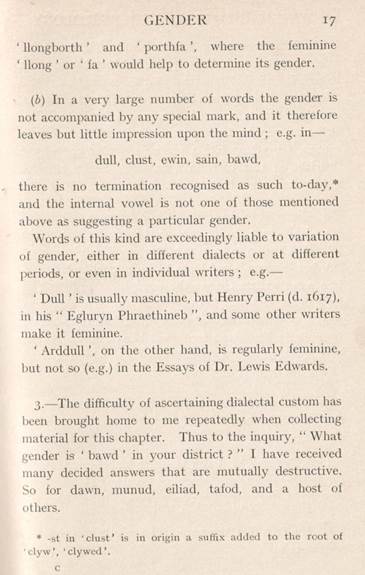
(delwedd L1276) (tudalen 017)
|
GENDER
17
‘Ilongborth ' and ' porthfa’, where the feminine
Ilong ' or ' fa ' would help to determine its gender.
(b) In a very large number of words the gender is
not accolnpanied by any special mark, and it therefore
leaves but little itnpression upon the mind; e.g. in —
dull, clust, ewin, sain, bawd,
there is no termination recognised as such to-day, *
and the internal vowel is not one of those mentioned
above as suggesting a particular gender.
Words of this kind are exceedingly liable to variation
of gender, either in different dialects or at different
periods, or even in individual writers; e.g. —
‘Dull ' is usually masculine, but Henry Perri (d. 1617),
in his " Egluryn Phraethineb ", and some other writers
make it feminine.
Arddull’, on the other hand, is regularly fenlinine,
but not so (e.g.) in the Essays of Dr. Lewis Edwards.
3. — The difficulty of ascertaining dialectal custom has
been brought home to me repeatedly when collecting
material for this chapter. Thus to the inquiry, " What
gender is ' bawd ' in your district ?
I have received
many decided answers that are mutually destructive.
So for dawn, munud, eiliad, tafod, and a host of
others.
• -st in •clust' is in origin a suffix added to the root of
|
|
|
|
|
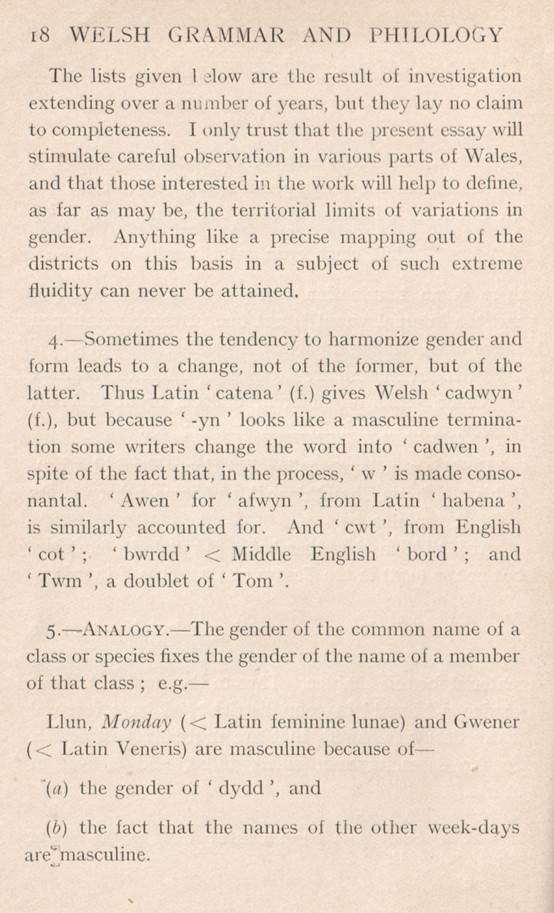
(delwedd L1277) (tudalen 018)
|
18
WELSH GRAMMAR AND PHILOLOGY
The lists given below are the result of investigation
extending over a number of years, but they lay no claim
to completeness. I only trust that the present essay will
stimulate careful observation in various parts of Wales,
and that those interested in the work will help to define,
as far as may be, the territorial limits of variations in
gender. Anything like a precise mapping out of the
districts on this basis in a subject of such extreme
fluidity can never be attained.
4. — Sometimes the tendency to harmonize gender and
form leads to a change, not of the former. but of the
latter. Thus Latin ' catena ' (f.) gives Welsh ' cadwyn '
but because ' -yn ' looks like a masculine termination some writers change
the word into ' cadwen’, in
spite of the fact that, in the process, ‘w ' is made consonantal. ' Awen '
for ' afwyn’, from Latin ' habena’,
is similarly accounted for. And ' cwt ' ,
from English
‘cot ';
‘bwrdd' < Middle English 'bord
and
Twrn a doublet of ' Tom '.
gender of the common name of a
class or species fixes the gender of the name of a Inentber
of that class; e.g. —
I.lun, Monday (cc I.atin feminine lunae) and Gwener
( < Latin Veneris) are masculine because of —
the gender of ' dydd’, and
(b) the fact that the nailiۥs oi the oilier week-days
are* masculine.
|
|
|
|
|
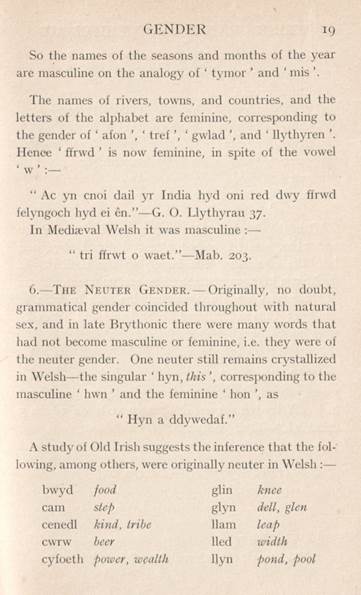
(delwedd L1278) (tudalen 019)
|
GENDER
19
So the names of the seasons and months of the year
are masculine on the analogy of tymor ' and ' mis '.
The names oi rivers, towns, and countries. and the
letters Of the alphabet are feminine, corresponding to
the gender of ' afon’, ‘tref’, ‘gwlad’, and ' llythyren '
Hence ' firwd ' is now feminine, in spite of the vowel
Ac yn cnoi dail yr India hyd oni red dwy firwd
felyngoch hyd ei O. Llythyrau 37.
In Mediæval Welsh it was masculine
“tri ffrwt o waet." — Mab. 203.
CO. — THE NEUTER GENDER. — Originally, no doubt,
grammatical gender coincided throughout with natural
sex, and in late Brythonic there were many words that
had not become masculine or feminine, i.e. they were of
the neuter gender. One neuter still remains crystallized
in Welsh — the singular hyn, this’, corresponding to the
masculine ' hwn ' and the feminine ' hon’, as
“Hyn a ddywedaf."
A study of Old Irish suggests the inference that the following, among others,
were originally neuter in Welsh: —
bwyd
cenedl
cwrw
cyfoeth
food
Ste/'
kind, tribe
beer
power, wealth
glin
glyn
llam
lied
llyn
knee
dell, glen
lea
width
pond, Pool
|
|
|
|
|
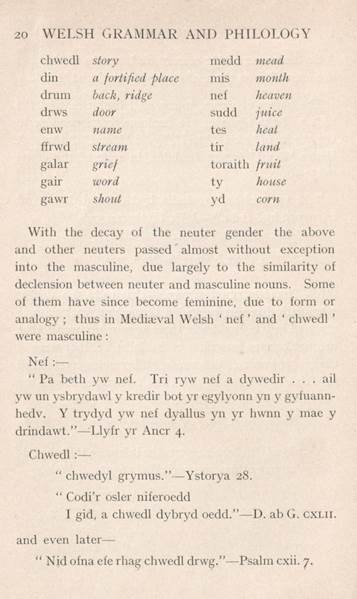
(delwedd L1279) (tudalen 020)
|
20
WELSH GRAMMAR AND PHILOLOGY
chwedl
din
drum
d rws
enw
firwd
gal ar
galr
gawr
story
a fortiftcd place
back, ridge
door
name
stream
grief
word
shout
medd
nus
nef
sudd
tes
tir
mead
month
heaven
heal
land
toraith fruit
house
ty
yd
corn
With the decay of the neuter gender the above
and other neuters passed ' almost without exception
into the masculine, due largely to the similarity of
declension between neuter and masculine nouns. Some
of them have since become feminine, due to form or
analogy; thus in Mediæval Welsh ' nef ' and ' chwedl '
were masculine:
Nef
. ail
“Pa beth yw nef. Tri ryw nef a dywedir .
un ysbrydawl y kredir bot yr egylyonn yn y gyiuannhedv. Y trydyd yw nef
dyallus yn yr hwnn y mae y
drindawt." — Llyfr yr Ancr 4.
Chwedl: —
“chwedyl grymus." — Ystorya 28.
“Codi'r osier niferoedd
I gid, a chwedl dybryd oedd." — D. ab G. CXLII.
and even later —
“Nid ofna efe rha; chwedl drwg." — Psalm cxii. 7.
|
|
|
|
|
(delwedd L1280) (tudalen 021)
|
GENDER
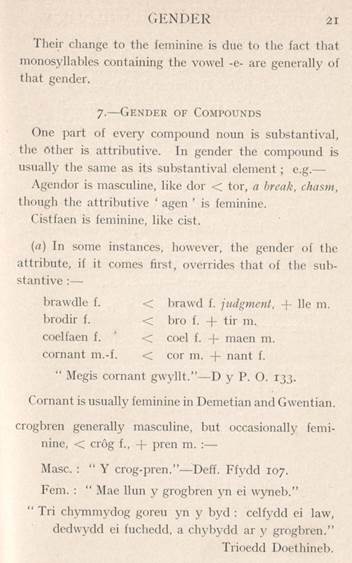
Their change to the feminine is due to the fact that
monosyllables containing the vowel -e- are generally of
that gender.
7. — GENDER OF COMPOUNDS
One part of every compound noun is substantival,
the other is attributive. In gender the compound is
usually the same as its substantival element; e.g. —
Agendor is masculine, like dor < tor, a break, chasm,
though the attributive ' agen ' is feminine.
Cistfaen is feminine, like cist.
(a) In some instances, however, the gender of the
attribute, if it comes first, overrides that of the substantive:
brawdle f.
brodir f.
coelfaen f.
cornant rn.-f.
< brawd f. judgment, + Ile m.
< bro f. + tir m.
< coel f. 4- maen m.
< cor m. 4- nant f.
‘Megis cornant gwyllt." — D y P. O. 133.
Cornant is usually feminine in Demetian and Gwentian.
crogbren generally masculine, but occasionally feminine, < crög f., + pren
m.
Masc.: “Y Ffydd 107.
Fem.: “Mae llun y grogbren yn ei wyneb."
“Tri chymmydog goreu yn y byd: celfydd ei law,
dedwydd ei fuchedd, a chybydd ar y grogbren."
T Hoedd Doethineb.
|
|
|
|
|
(delwedd L1281) (tudalen 022)
|
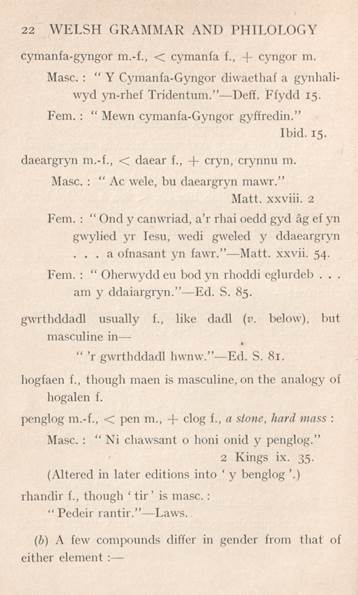
22 WELSH GRAMMAR AND PHILOLOGY
cymanfa-gyngor m.-f., < cymanfa f.. 4- cyngor m.
Masc.: “Y Cymanfa-Gyngor diwaetljaf a gynhaliwyd yn-rhef Tridentum. " — l)eff.
Ffydd 15.
Fem.: “Mewn cymanfa-Gyngor gyffredin."
Ibid. 15.
daeargryn m.-f., < daear f.,+ cryn, crynnu m.
Masc.: “Ac wele, bu daeargryn mawr."
Matt. xxviii. 2
Fem.: “Ond y canwriad, a'r Thai oedd gyd åg ef yn
gwylied yr lesu, wedi gweled y ddaeargryn
. a ofnasant yn fawr." — Matt. xxvii. 54.
Fem.: “C)herwydd eu bod yn rhoddi eglurdeb . . .
am y S. 85.
like dadl (v. below), but
gwrthddadl usually f.,
masculine in —
‘'r gwrthddadl S. 81.
hogfaen f., though maen is masculine, on the analogy of
hogalen f.
penglog m.-f., < pen m., -F clog f.,a stone, hard mass:
Masc.: “Ni chawsant o honi onid y penglog."
2 Kings ix. 3.5•
(Altered in later editions into ' y benglog '.)
rhandir f.,though ' tir' is masc.:
Pedeir rantir. " — Laws.
(b) A few compounds differ in gender from that of
either element: —
|
|
|
|
|
(delwedd L1282) (tudalen 023)
|
GENDER
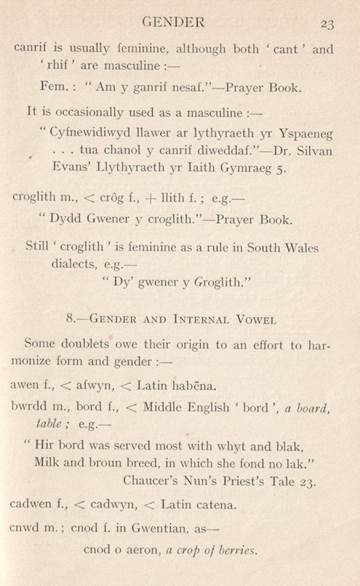
Canrif is usually feminine, although both ' cant
‘rhif ' are masculine: —
Fem.: “Am y ganrif nesaf." — Prayer Book.
It is occasionally used as a masculine
23
and
“Cyfnewidiwyd llawer ar lythyraeth yr Yspaeneg
. . tua chanol y canrif Silvan
Evans' l.lythyraeth yr laith Gymraeg 5.
croglith m.,< crög f.,+ Ilith f.; e.g. —
“Dydd Gwener y croglith." — Prayer Book.
Still ' croglith is feminine as a rule in South Wales
dialects, e.g. —
“Dy' gwener y Groglith."
8. — GENDER AND INTERNAL VOWEL
Some doublets owe their origin to an effort to harmonize form and gender: —
awen f.,< afwyn, < Latin haböna.
bwrdd rn., bord f.,< Middle English ' bord’, a board,
table; e.g. —
‘Hir bord was served most with Whyt and blak,
Milk and broun breed, in which she fond no lak."
Chaucer's Nun's Priest's Tale 23.
cadwen f.,< cadw•yn, < Latin catena.
cnwd m.; cnod i. in Gwentian, as —
cnod o aeron, a croft o/ /mrries.
|
|
|
|
|
(delwedd L1283) (tudalen 024)
|
24 WELSH GRAMMAR AND PHILOLOGY
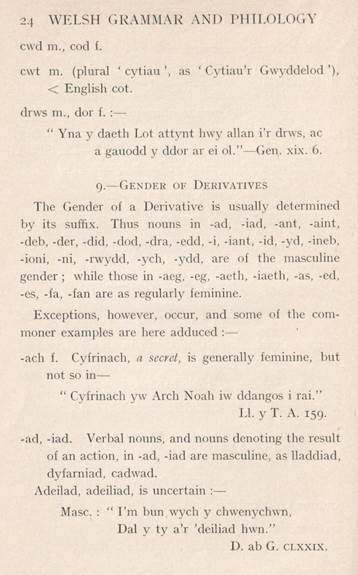
cwd m.,cod f.
cwt m. (plural ' cytiau’, as ' Cytiau'r Gwyddelod '),
< English cot.
drws m.,dor f. .
“Yna y daeth Lot attynt hwy allan i'r drws, ac
a gauodd y ddor ar ei 01." — Gen. xix. 6.
9. — GENDER OF DERIVATIVES
The Gender of a Derivative is usually determined
by its suffl.x. Thus nouns in -ad, -iad, -ant, -aint,
-deb, -der, -did, -dod, -dra, -edd, -i, -iant, -id, -yd, -ineb,
-ioni, -ni, -rwydd, -ych, -ydd, are of the masculine
gender; while those in -aeg, -eg, -aeth, -iaeth, -as, -ed,
-es, -fa, -fan are as regularly feminine.
Exceptions, however, occur, and some of the commoner examples are here
adduced:
-ach f. Cyfrinach, a secret, is generally feminine, but
not so in —
“Cyfrinach Arch Noah iw ddangos i rai."
1.1. y T. A. 159.
-ad, -iad. Verbal nouns, and nouns denoting the result
of an action, in -ad, -iad are masculine, as lladdiad,
dyfarniad, cadwad.
Adeilad, adeiliad, is uncertain
Masc.: “I'm bun wych y chwenychwn,
Dal y ty a'r 'deiliad hwn."
D. ab G. Cl.XXIX.
|
|
|
|
|
(delwedd L1284) (tudalen 025)
|
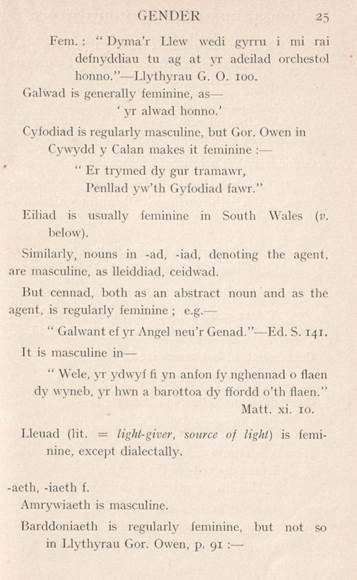
GENDER
25
Fem.: “I)yma'r Llew wedi gyrru i mi rai
defnyddiau tu ag at yr adeilad orchestol
G. O. 100.
Galwad is generally feminine, as —
‘yr alwad honno.'
Cyfodiad is regularly masculine, but Gor. Owen in
Cywydd y Calan makes it feminine: —
“Er trymed dy gur tramaMT,
Penllad yw'th Gyfodiad fawr."
Eiliad is usually feminine in South Wales (v.
below).
Similarly, nouns in -ad, -iad, denoting the agent,
are masculine, as Ileiddiad, ceidwad.
But cennad, both as an abstract noun and as the
agent, is regularly feminine; e.g. —
“Galwant ef yr Angel neu'r S. 141.
It is masculine in —
“Wele, yr ydwyf fl yn anion fy nghennad 0 flaen
dy wyneb, yr hwn a barottoa dy fiordd o'th flaen."
Matt. xi. 10.
Lleuad (lit. = light-giver, source of light)
is feminine, except dialectally.
-aeth, -iaeth f.
Arnrywiaeth is masculine.
Barddoniaeth is regularly ferninine,
in Llythyrau Gor. Owen, p. 91: —
|
|
|
|
|
(delwedd L1285) (tudalen 026)
|
but
not
so
26
WELSH GRAMMAR AND PHILOLOGY
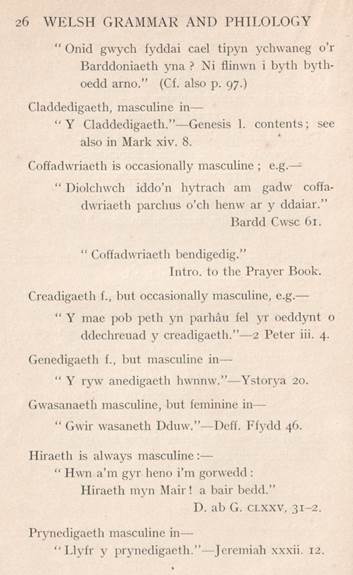
“Onid gwych fyddai cael tipyn ychwaneg O'r
Barddoniaeth yna ? Ni flinwn i byth bythoedd arno." (Cf. also p. 97.)
Claddedigaeth, masculine in —
'J Y Claddedigaeth." — Genesis 1. contents; see
also in Mark xiv. 8.
Coffadwriaeth is occasionally masculine;
“Diolchwch iddo'n hytrach am gadw coffadwriaeth parchus o'ch henw ar y
ddaiar."
Bardd Cwsc 61.
“Coffadwriaeth bendigedig."
Intro. to the Prayer Book.
Creadigaeth f.,but occasionally masculine, e.g. —
“V mae pob peth yn parhåu fel yr oeddynt o
ddechreuad y creadigaeth. " — 2 Peter iii. 4.
Genedigaeth f.,but masculine in —
“Y ryw anedigaeth 20.
Gwasanaeth masculine, but feminine in —
“Gwir wasaneth Ffydd 46.
Hiraeth is always masculine: —
“Hwn a'm gyr heno i'm gorwedd:
Hiraeth myn Mair! a bair bedd."
D. ab G. CLXXV, 31-2.
Prynedigaeth masculine in —
“Llyfr y prynedigaeth." — Jeremiah xxxii. 12.
|
|
|
|
|
(delwedd L1286) (tudalen 027)
|
GENDER
27
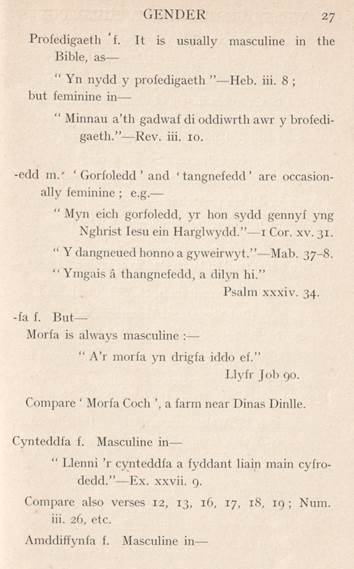
Profedigaeth 'f.
It is usually masculine in the
Bible, as —
“Y n nydd y profedigaeth " — Heb. iii. 8;
but feminine in —
“Minnau a'th gadwaf di oddiwrth awr y brofedigaeth." — Rev. iii. 10.
-edd m. • ' Gorfoledd ' and ' tangnefedd ' are occasionally feminine; e.g. —
“Myn eich gorfoledd, yr hon sydd gennyf yng
Nghrist lesu ein Harglwydd." — -l Cor. xv. 31.
“V dangneued honno a gyweirwyt." — Mab. 37 — 8.
“Ymgais thangnefedd, a dilyn hi."
Psalm xxxiv. 34.
-faf. But —
Morfa is always masculine: —
“A'r morfa yn drigfa iddo ef."
Job 90.
Compare ' Morfa Coch a farm near Dinas Dinlle.
Cynteddfa f. Masculine in —
“I.lenni 'r cynteddfa a fyddant liain main cyfrodedd." — Ex. xxvii. 9.
Compare also verses 12, 13, 17, IS, 19; Num.
iii. 26. etc.
Amddiffynfa f. Masculine in —
|
|
|
|
|
(delwedd L1287) (tudalen 028)
|
28
WELSH GRAMMAR AND PHILOLOGY
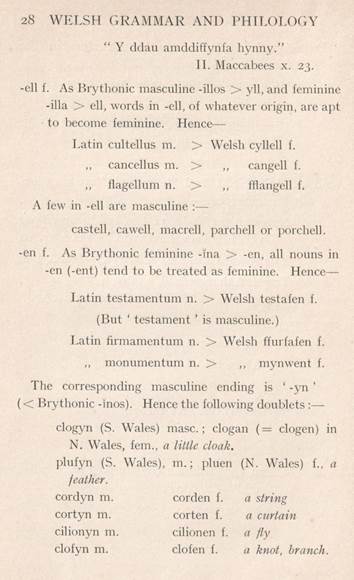
“Y ddau amddiffynfa hynny."
Il. Maccabees x. 23.
-ell f. As Brythonic masculine -illos > yll, and feminine
-illa > ell, words in -ell, of whatever origin, are apt
to become feminine. Hence —
Latin cultellus m. > Welsh cyllell f.
cancellus m. >
flagellum n. >
A few in -ell are masculine: —
cangell f.
mangell f.
castell, cawell, macrell, parchell or porchell.
-en f. As Brythonic feminine -ina > -en, all nouns in
-en Gent) tend to be treated as feminine. Hence —
Latin testamentum n. > Welsh testafen f.
(But testament ' is masculine.)
Latin firmamenturn n. > Welsh ffurfafen f.
monumentum n. >
mynwent f.
The corresponding masculine ending is ' -yn
( < Brythonic -inos). Hence the following doublets: —
clogyn (S. Wales) masc.; clogan clogen) in
N. Wales, fem., a little cloak.
plufyn (S. Wales), m.; pluen (N. Wales) f.,a
feather.
cordyn m.
cortyn m.
cilionyn m.
clofyn m.
|
|
|
|
|
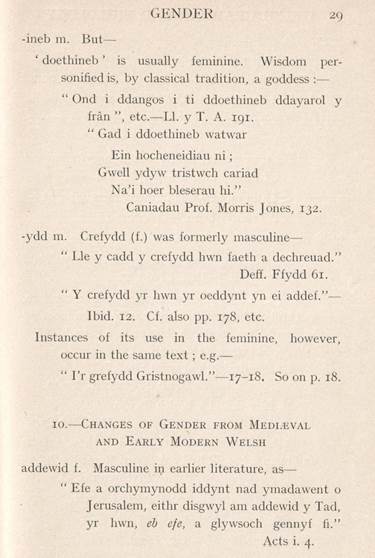
(delwedd L1288) (tudalen 029)
|
corden f.
corten f.
cilionen f.
clofen f.
a string
a curtain
a fly
a knot, branch.
GENDER
-ineb m. But —
29
‘doethineb ' is usually felninine. Wisdom personified is, by classical
tradition, a goddess:
“Ond i ddangos i ti ddoethineb ddayarol y
från ", etc. — Ll. y T. A. 191.
Gad i ddoethineb watwar
Ein hocheneidiau ni;
Gwell ydyw tristwch cariad
Na'i hoer bleserau hi."
Caniadau Prof. Morris Jones, 132.
•ydd m. Crefydd (f.) was formerly masculine —
“Lle y cadd y crefydd hwn faeth a dechreuad."
Deff. Fiydd 61.
“Y crefydd yr hwn yr oeddynt yn ei addef."
Ibid. 12. Cf. also pp. 178, etc.
Instances of its use in the feminine, however,
occur in the same text; e.g. —
‘I'r grefydd Gristnogawl."
17 — 18. So on p. 18.
IO. — CHANGES OF GENDER FROM MEDI.-EVAL
AND EARLY MODERN WELSH
addewid f. Masculine ip earlier literature, as —
“Eie a orchymynodd iddynt nad ymadawent o
Jerusalem, eithr disgwyl am addewid y Tad,
yr hwn, eb e/e, a glywsoch gennyf fl."
Acts i. 4.
|
|
|
|
|
(delwedd L1289) (tudalen 030)
|
30 WELSH GRAMMAR AND PHILOLOGY
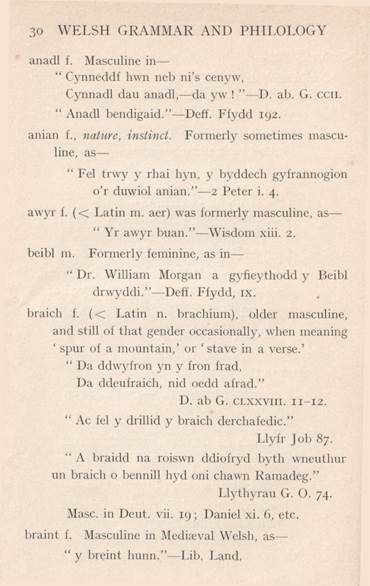
anadl f. Masculine in —
“Cynneddf hwn neb ni's cenyw,
Cynnadl dau anadl, — da yw ! ab. G. ccll.
Anadl bendigaid." — Deff. Ffydd 192.
anian f.,nature, instinct. Formerly sometimes masculine, as_
“Fel trwy y rhai hyn, y byddech gyfrannogion
O'r duwiol anian." — 2 Peter i. 4.
awyr f. Latin m. aer) was formerly masculine, as —
‘Yr awyr buan." — Wisdom xiii. 2.
beibl m. Formerly feminine, as in
“Dr. William Morgan a gyfieythodd y Beibl
Ffydd, IX.
braich f. Latin n. brachium), older masculine,
and still of that gender occasionally, when meaning
‘spur of a mountain,' or ' stave in a verse.'
“Da ddwyfron yn y fron frad,
Da ddeuiraich, nid oedd airad."
D. al) G. Cl.xxvlll. 11-12.
“Ac iel y drillid y braich derchaiedic."
l.lyfr Job 87.
“A braidd na roiswn ddiofryd byth wneuthur
un braich o bennill hyd oni chawn Ramadeg."
Llythyrau G. O. 74.
Masc. in Deut. vii. 19; Daniel .xi. 6, etc.
braint f. Masculine in Medi;eval Welsh, as —
y breint Land,
|
|
|
|
|
(delwedd L1290) (tudalen 031)
|
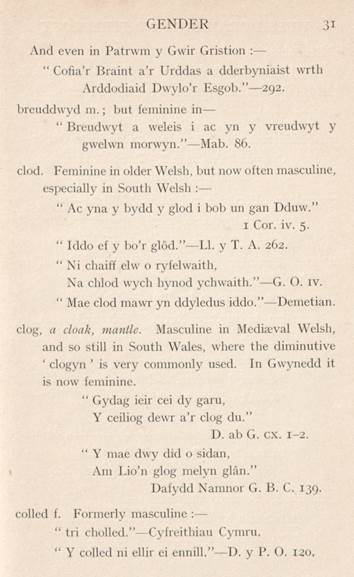
GENDER
And even in Patrwm y Gwir Gristion: —
31
“Cofia'r Braint a'r Urddas a dderbyniaist wrth
Arddodiaid I)wylo'r
breuddwyd m.; but feminine in —
‘Breudwyt a weleis i ac y vreudwyt y
gwelwn morwyn." — Mab. 86.
clod. Feminine in older Welsh, but now often masculine,
especially in South Welsh:
“Ac yna y bydd y glod i bob un gan I)duw."
1 Cor. iv. 5•
“Kido ef y bo'r y T. A. 262.
“Ni chaiff elw o rvfelwaith,
Na chlod wych hynod O. IV.
“Mae clod mawr yn ddyledus
clog, a cloak, mantle. Masculine in Media•val Welsh,
and so still in South Wales, wliere the diminutive
‘clogyn ' is very commonly used. In Gwynedd it
is now feminine.
“Gydag ieir cei dy garu,
Y ceiliog dewr a'r clog du."
I). ab G. cx. 1-2.
“Y nuae dwv did o sidan,
Am Lio'n gl(jg melyn glån."
Dafydd Namnor G. B. C. 139.
colled f. Formerlv masculine: —
tri Cymru.
Y colled ni ellir ei y P. O.
|
|
|
|
|
(delwedd L1291) (tudalen 032)
|
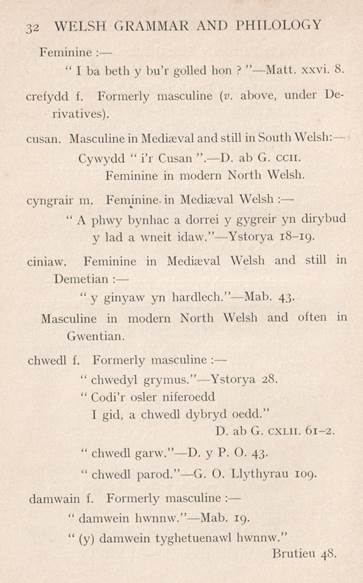
32 WELSH GRAMMAR AND PHILOLOGY
Feminine: —
“I ba beth y bu'r golled hon ? " — Matt. xxvi. 8.
crefydd f. Formerly masculine (v. above, under Derivatives).
cusan. Masculine in Medi:eval and still in South Welsh: —
Cywydd " i'r Cusan ". — I). ab G. CCII.
Feminine in modern North Welsh.
cyngrair m. Fem.inine. in Mediæval Welsh
“A phwy bynhac a dorrei y gygreir yn dirybud
y lad a wneit idaw." — Ystorya 18 — 19.
ciniaw. Feminine in Mediæval Welsh and still in
Demetian: —
“y ginyaw yn 43.
Masculine in modern North Welsh and often in
Gwentian.
chwedl f. Formerly masculine
chwedyl grymus." — -Vstorya 28.
“Codi'r osier niferoedd
I gid, a chwedl dybryd oedd."
D. ab G. CXLII. 61 — 2.
“chwedl garw." — D. y P. O. 43.
“chwedl parod." — G. O. Llythyrau 109.
damwain f. Formerly masculine: —
“damwein 19.
“(y) damwein tyghetuenawl hwnnw."
Brutien 48.
|
|
|
|
|
(delwedd L1292) (tudalen 033)
|
GENDER
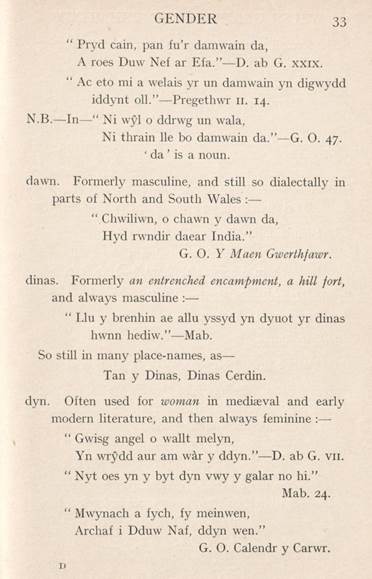
“Pryd Cain, pan fu'r damwain da,
33
A roes Duw Nef ar Efa." — D. ab G. x.xrx.
“Ac eto mi a welais yr un damwain yn digwydd
iddynt 11. 14.
N.B. — In — " Ni o ddrwg un wala,
Ni thrain Ile bo damwain da." — G. O. 47.
‘da' is a noun.
dawn. Formerly masculine, and still so dialectally in
parts of North and South Wales: —
“Chwiliwn, 0 chawn y dawn da,
Hyd rwndir daear India."
G. O. Y Maen Gwerth/awr.
dinas. Formerly an entrenched encampment, a hill fort,
and always masculine: —
“Llu y brenhin ae allu yssyd yn dyuot yr dinas
hwnn hediw. " — Mab.
So still in many place-names, as —
Tan y Dinas, Dinas Cerdin.
dyn. Often used for woman in mediæval and early
modern literature, and then always feminine: —
Gwisg angel 0 wallt melyn,
Yn wr$dd aur am wår y ddyn." — D. ab G. Vll.
“Nyt oes yn y byt dyn vwy y galar no hi."
Mab. 24.
Mwynach a fych, fy meinwen,
Archaf i I)duw Naf, ddyn wen."
G. O. Calendr y Carwr.
|
|
|
|
|
(delwedd L1293) (tudalen 034)
|
34 WELSH GRAMMAR AND PHII.OLOC,Y
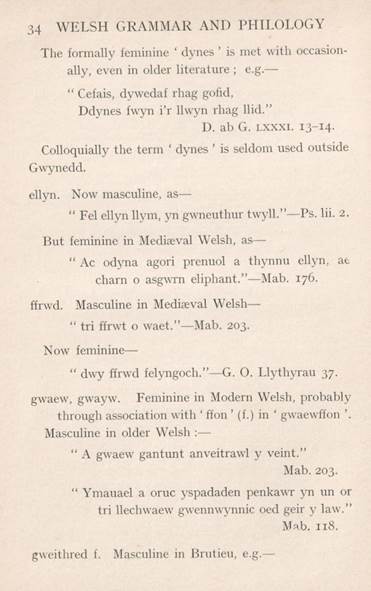
The formally feminine ' dynes ' is met with occasionally, even in older
literature; e.g. —
“Cefais, dywedaf rhag gofld,
Ddynes fwyn i'r llwyn rhag Ilid."
D. ab G. LXXXI. 13-14.
Colloquially the term ' dynes ' is seldom used outside
Gwynedd.
ellyn. Now masculine, as —
Fel ellyn llyrn, yn g',vneuthur lii. 2.
But feminine in Medic•eval Welsh, as —
“Ac odyna agori prenuol a thynnu ellyn, ae
charn o asgwrn eliphant." — Mab. 176.
ffrwd. Masculine in Mediæval Welsh —
“tri ffrwt o waet." — Mab. 203.
Now feminine —
“dwy ffrwd felyngoch. O. I-lythyrau 37.
gwaew, g wayw. Feminine in Modern Welsh, probably
through association with ' ffon ' (f.) in ' gwaewffon '
Masculine in older Welsh:
“A gwaew gantunt anveitrawl y veint."
Mab. 203.
“Ymauael a oruc yspadaden penkawr yn un or
tri Ilechwaew gwennwynnic oed geir y law. "
Mab. 118.
gweithred f. Masculine in Brutieu, e.g.
|
|
|
|
|
(delwedd L1294) (tudalen 035)
|
GENDER
35
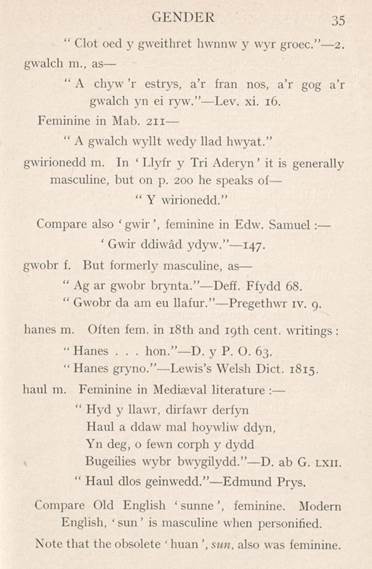
“Clot oed y gweithret hwnnw y wyr groec." — 2.
gnvalch m.,as —
“A ch»v 'r estrys, a'r fran nos, a'r gog a'r
gwalch yn ei ryw." — Lev. xi. 16.
Feminine in Mab. 211 —
“A gwalch wyllt wedy llad hwyat."
gwirionedd m. In Llyfr y Tri Aderyn it is generally
masculine, but on p. 200 he speaks of
‘Y wirionedd."
Compare also ' gwir’, feminine in Edw. Samuel
‘Gwir ddiwåd
gwobr f. But formerly masculine, as —
‘Ag ar gwobr brynta." — Deff. Ffydd 68.
“Gwobr da am eu IV. 9.
hanes m. Often fem. in 18th and 19th cent. writings:
‘Hanes .
. y P. O. 63.
‘Hanes Welsh Dict. 1815.
haul m. Feminine in Medi:eval literature
“Hyd y llawr, dirfawr derfyn
Haul a ddaw mal hoywliw ddyn,
Yn deg, o fewn corph y dydd
Bugeilies wybr bwygilydd." — D. ab G. I.XII.
“Haul dlos geinwedd." — Edmund Prys.
Cornpare Old English ' sunne’, feminine. Modern
English, sun ' is masculine when personified.
Note that the obsolete ' huan’, sun, also was feminine.
|
|
|
|
|
(delwedd L1295) (tudalen 036)
|
36 WEI.SH GRAMMAR AND PHILOIOGY
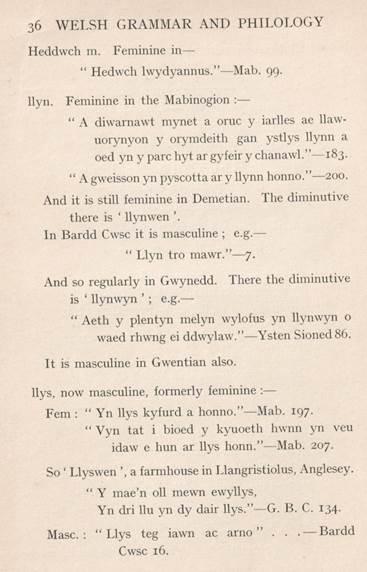
Heddwch m. Feminine in —
“Hedwch lwydyannus." — Mab. 99.
llyn. Feminine in the Mabinogion: —
“A diwarnawt mynet a oruc y iarlles ae llawuorynyon y orymdeith gan ystlys
llynn a
oed yn y parc hyt ar gyfeir y chanawl." —
183.
“A gweisson yn pyscotta ar y llynn honno. " — 200
And it is still feminine in Demetian. The diminutive
there is ' llynwen .
In Bardd Cwsc it is masculine; e.g. —
“I-lyn tro
And so regularly in Gwynedd. There the diminutive
is ' llynwyn '; e.g. —
“Aeth y plentyn melyn wylofus yn llynwyn o
waed rhwng ei Sioned 86.
It is masculine in Gwentian also.
llys, now masculine, formerly feminine: —
Fem: “Yn llys kyfurd a honno." — Mab. 197.
"Vyn tat i bioed y kyuoeth hwnn yn veu
idaw e hun ar llys honn." — Mab. 207.
So ' Llyswen ' , a farmhouse in Llangristiolus, Anglesey.
“Y mae'n 011 mewn ewyllys,
Yn dri llu yn dy dair llys." — G. B. C. 134.
Masc.: “Llys teg iawn ac arno"
Cwsc 16.
|
|
|
|
|
(delwedd L1296) (tudalen 037)
|
. — Bardd
GENDER
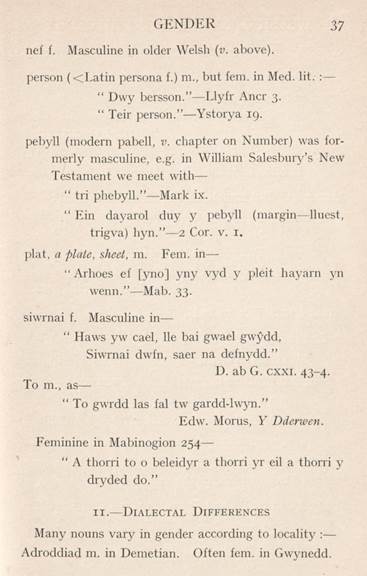
nef f. Masculine in older Welsh (r. above).
37
person (<l.atin persona f.) m.,but fem. in Med. lit.:
“Dwy Ancr 3.
“Teir person." — Ystorya 19.
pebyll (modern pabell, v. chapter on Number) was formerly masculine, e.g. in
William Salesbury's New
Testament we meet with —
‘tri phebyll." — Mark ix.
‘Ein dayarol duy y pebyll (margin — lluest,
trigva) Cor. v. 1.
plat, a Plate, sheet, m. Fem. in —
“Arhoes ef [yno] yny vyd y pleit hayarn yn
33•
siwrnai f. Masculine in —
“Haws YW cael, Ile bai gwael gwjdd,
Siwrnai dwfn, saer na defnydd."
D. ab G. cxxl. 43 — 4.
“To gv,Tdd las fal tw gardd-lwyn."
Edw. Morus, Y Dderwen.
Feminine in Mabinogion 254 —
“A thorri to o beleidyr a thorri yr eil a thorri y
dryded do."
IT. — DIALECTAL DIFFERENCES
Many nouns vary in gender according to locality
Adroddiad m. in Demetian. Often fem. in Gwynedd.
|
|
|
|
|
(delwedd L1297) (tudalen 038)
|
WELSH GRAMMAR AND PHILOLOGY
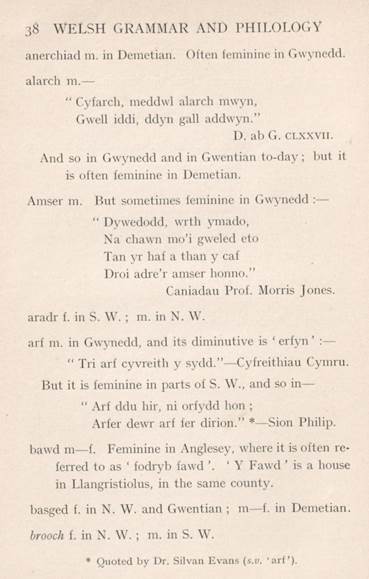
anercliiad m. in Demetian. ()ften feminine in Gwynedd.
alarch m.
“Cyfarch, meddwl alarch mwyn,
Gwell iddi, ddyn gall addwyn."
D. ab G. CLXXVII.
And so in Gwvnedd and in Gwentian to-day; but it
is often feminine in Dernetian.
Amser m. But sometitnes feminine in Gwynedd: —
“Dvwedodd, wrth ymado,
Na chawn mo'i gweled eto
Tan haf a than y caf
Droi adre'r amser honno."
Caniadau Prof. Morris Jones.
aradr f. in S. W.; m. in N. W.
arf m. in Gwynedd, and its diminutive is ' erfyn ' •
“Tri arf cyvreith y sydd." — Cyfreithiau Cymru.
But it is feminine in parts of S. W.,and so in —
“Arf ddu hir, ni orfvdd hon;
Philip.
Arfer dewr ari fer dirion.'
bawd m — f. Feminine in Anglesey, where it is often re.
Y Fawd ' is a house
ferred to as fodryb fawd
in Llangristiolus, in the same county.
basged f. in N. W. and Gwentian; m — f. in Dernetian.
brooch f. in N. W.; m. in S. W.
• Quoted by Dr. Silvan Evans (s.v. •ari
|
|
|
|
|
(delwedd L1298) (tudalen 039)
|
39
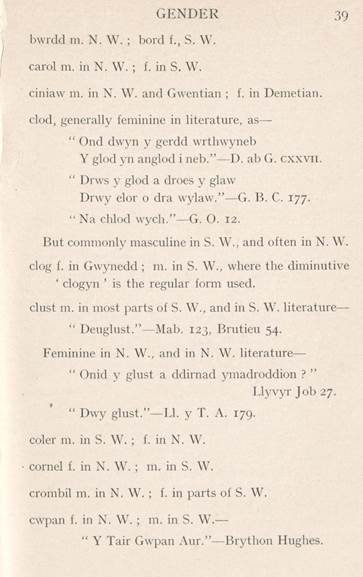
bwrdd m. N. W.,
carol m. in N. W. •
GENDER
bord f., S. W.
f. in S. W.
ciniaw m. in N. W. and Gwentian; f. in Demetian.
clod, generally feminine in literature, as —
‘Ond dwyn y gerdd wrthwyneb
Y glod yn anglod i neb. ab G. CXXVII.
Drws y glod a droes y glaw
Drwy elor o dra wylaw." — G. B. C. 177.
“Na chlod O. 12.
But conunonly masculine in S. W., and often in N. W.
clog f. in Gwynedd; m. in S. W.,where the diminutive
‘clogyn ' is the regular form used.
clust m. in most parts of S. W.,and in S. W. literature —
123, Brutieu 54.
Feminine in N. W., and in N. W. literature —
“Onid y glust a ddirnad ymadroddion ? "
l.lyvyr Job 27.
‘Dwy glust." — Ll. y T. A. 179.
coler m. in S. W.; f. in N. W.
• cornel f. in N. W.; m. in S. W.
crombil m. in N. W.; f. in parts of S. W.
cwpan f. in N. W.; m. in S. W. —
“Y T air Gwpan Hughes.
|
|
|
|
|
(delwedd L1299) (tudalen 040)
|
40 WELSH GRAMMAR AND PHILOLOGY
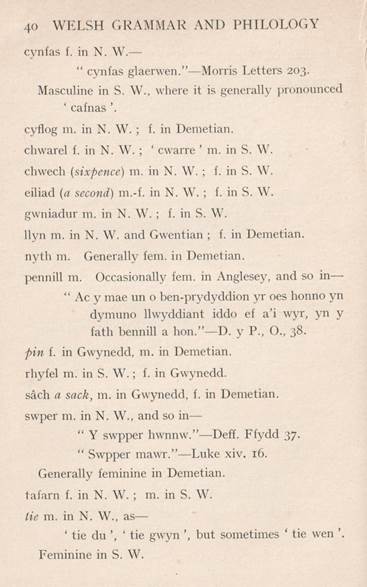
cynfas f. in N. W. —
‘cynfas glaerwen." — Morris Letters 203.
Masculine in S. W., where it is generally pronounced
‘cafnas '.
cyflog m. in N. W.; f. in Demetian.
chwarel f. in N. W.; ' cwarre ' m. in S. W.
chwech (six-hence) m. in N. W.; f. in S. W.
eiliad (a second) m.-f. in N. W.; f. in S. W.
gwniadur m. in N. W.;
f. in S. W.
llyn m. in N. W. and Gwentian; f. in Demetian.
nyth m. Generally fem. in Demetian.
pennill m. Occasionally fem. in Anglesey, and so in —
“Ac y mae un o ben-prydyddion yr oes honno yn
dymuno llwyddiant iddo ef a'i wyr, yn y
fath bennill a hon." — l). y P.,O.,38.
pin f. in Gwynedd, m. in Demetian.
rhyfel m. in S. W.; f. in Guynedd.
såch a sack, m. in Gwynedd, f. in Demetian.
swper m. in N. W.,and so in —
Y swpper Ffydd 37.
“Swpper mawr." — Luke xiv. 16.
Generally feminine in Demetian.
tafarn f. in N. W.; m. in S. W.
tie m. in N. W.,as_
‘tie du’, ‘tie gwyn’, but sometimes
Feminine in S. W.
|
|
|
|
|
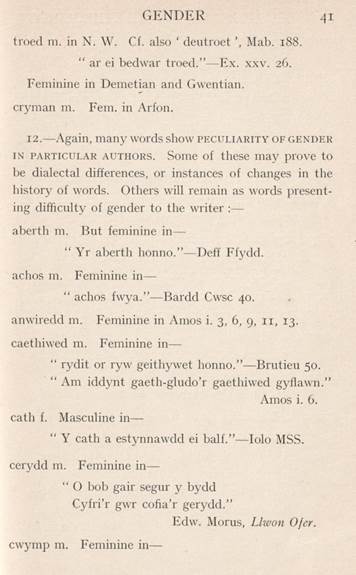
(delwedd L1300) (tudalen 041)
|
tie wen
GENDER
41
troed m. in N. W. Cf. also ' deutroet ' , Mab. 188.
ar ei bedwar troed." — Ex. xxv. 26.
Feminine in Demetian and Gwentian.
cryman m. Fem. in Arfon.
12 . — Again, many words show PECULIARITY OF GEN DER
IN PARTICUI.AR AUTHORS. Some of these may prove to
be dialectal differences, or instances of changes in the
history of words. Others will remain as words presenting difficulty of gender
to the writer: —
aberth m. But feminine in —
“Yr aberth honno." — Deff Ffydd.
achos m. Feminine in
‘achos fwya." — Bardd Cwsc 40.
anwiredd m. Feminine in Amos i. 3, 6, 9, 11, 13.
caethiwed m. Feminine in —
“rydit or ryw geithywet 50.
“Am iddynt gaeth-gludo'r gaethiwed gyflawn."
cath f. Masculine in —
“Y cath a estynnawdd ei balf
cerydd m. Feminine in —
“O bob gair segur y bydd
Cyfri'r gwr cofia'r gerydd."
Amos i. 6.
MSS.
Edw. Morus, Llwon O/er.
cwymp m. Feminine in —
|
|
|
|
|
(delwedd L1301) (tudalen 042)
|
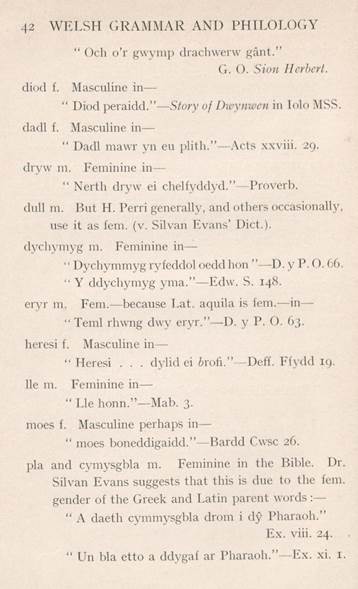
42 WELSH GRAMMAR AND PHILOLOGY
diod f.
“Och O'r gwymp drachwerw gånt."
G. O. Sion Iler/u•rl.
Masculine in —
“Diod peraidd. " — Story o/ I hcynwcn in 1010 MSS.
Masculine in —
“Dadl mawr yn eu xxviii. 29.
dryt,v m. Feminine in —
“Nerth dryw ei
dull m. But H. Perri generally, and otljers occasionally,
use it as fem. (v. Silvan Evans' Dict.).
(lycllynmyg m. Feminine in —
“Dychymmyg ryfeddol oedd hon " — D. V P. O. (:6.
Y ddychymyg S. 148.
eryr m. Fem. — because I — at. aquila is fem. — in —
“Teml rhwng dwy eryr." — D. y P. O.
heresi f. Masculine in —
dylid ei Ffydd 19.
‘Heresi .
Ile m. Feminine in —
“Lle honn."
— Mab. 3.
moes f. Masculine perhaps in —
“moes boneddigaidd. " — Bardd Cwsc 26.
pla and cymysgbla m. Feminine in the Bible. Dr.
Silvan Evans suggests that this is due to the fem.
gender of the Greek and Latin parent words
“A daeth cymmysgbla drom i Pharaoh."
Ex. viii. 24.
“Un bla etto a ddygaf ar xi. 1.
|
|
|
|
|
(delwedd L1302) (tudalen 043)
|
GENDER
43
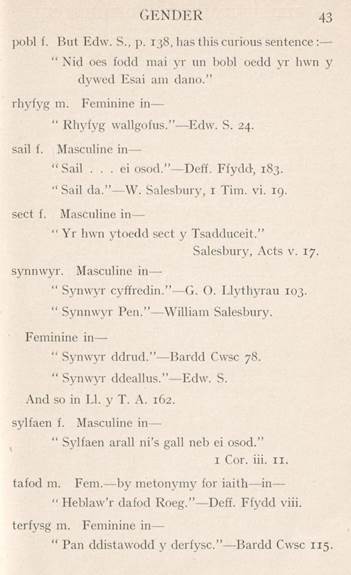
pobl f. But Edw. S.,p. has this curious sentence
“Nid oes fodd tnai yr un bobl oedd yr Irvvn y
dywed Esai arn dano."
rhyfyg m. Feminine in —
sail f.
sect f.
‘Rhyfyg wallgofus." — Edw. S. 24.
Masculine in —
“Sail .
. ei Ffydc}, 183.
“Sail da."
W. Salesbury, r Tim. vi. 19.
Masculine in —
“Yr hwn ytoedd sect y Tsadduceit."
Salesbury, Acts v. 17.
synnwyr. Masculine in —
“Synwyr cyffredin." — G. O. Llythyrau 103.
“Synnwyr Pen."
William Salesbury.
Feminine in —
“Synwyr Cwsc 78.
“Synwyr ddeallus." — Edw. S.
And so in Ll. y T. A. 162.
sylfaen f. Masculine in —
“Sylfaen arall ni's gall neb ei osod."
1 Cor. iii. 11.
tafod m. Fem. — by metonylny for
“Heblaw'r dafod Roeg." — Deff. Ffydd viii.
terfysg m. Fetninine in —
“Pan ddistawodd y derfysc."
Bardd Cwsc 115.
|
|
|
|
|
(delwedd L1303) (tudalen 044)
|
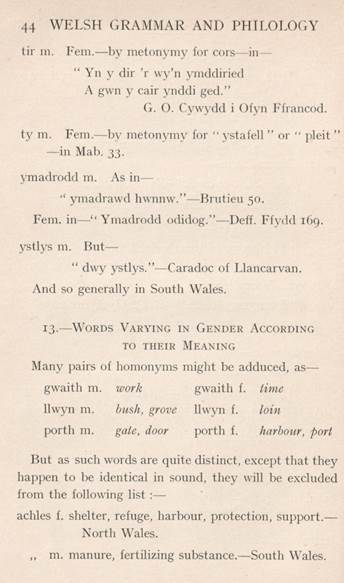
44 WELSH GRAMMAR AND PHILOI.OGV
tir m. Fem. — by metonymy for cors — in —
Yn y dir 'r wy'n ymddiried
A gwn y cair ynddi ged."
G. O. Cywydd i Ofyn Ffrancod.
ty m. Fem. — by metonymy for " ystafell " or " pleit "
— in Mab. 33.
ymadrodd m. As in —
“ymadrawd hwnnw." — Brutieu 50.
Fem. in — " Ymadrodd odidog. " — Deff. Ffydd 169.
ystlys m. But —
“dwy ystlys." — Caradoc of I-lancarvan.
And so generally in South Wales.
IN — WORDS VARYING IN GENDER ACCORDING
TO THEIR MEANING
Many pairs of homonyms might be adduced, as
gwaith m. work
gwaith f.
time
llwyn m. bush, grove llwyn f. loin
porth m. gate, door porth f. harbour, port
But as such words are quite distinct, except that they
happen to be identical in sound, they will be excluded
from the following list:
achles f. shelter, refuge, harbour, protection, support. —
North Wales.
m. manure, fertilizing substance — South Wales.
|
|
|
|
|
(delwedd L1304) (tudalen 045)
|
GENDER
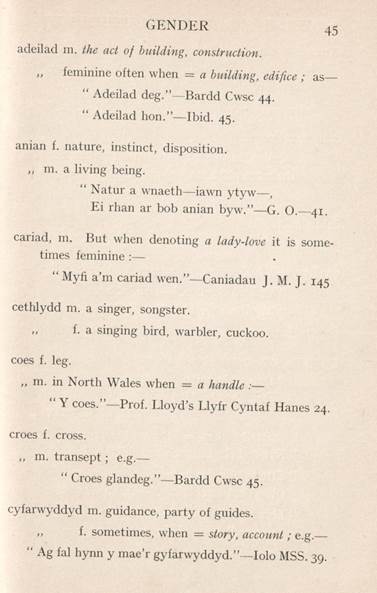
adeilad m. the act o/ building. construction.
feminine often when = a building, edifice;
“Adeilad deg." — Bardd Cwsc 44.
“Adeilad hon." — lbid. 45.
anian f. nature, instinct, disposition.
m. a living being.
“Natur a wnaeth — iawn ytyw — .
Ei rhan ar bob anian byw." — G.
45
cariad, m. But when denoting a lady-love it is sometimes feminine
“Myfi a'rn cariad J. M. J. 145
cethlydd m. a singer. songster.
f. a singing bird, warbler, cuckoo.
coes f. leg.
, m. in North Wales when = a handle
“Y coes." — Prof. Lloyd's Llyfr Cyntaf Hanes 24.
Croes f. cross.
m. transept; e.g. —
“Croes glandeg. " — Bardd Cwsc 45.
cyfarwyddyd m. guidance, party of guides.
f. sometimes. when = story, account; e.g. —
“Ag fal hynn y mae'r gyfarwyddyd." — lolo MSS. 39.
|
|
|
|
|
(delwedd L1305) (tudalen 046)
|
46 WELSH GRAMMAR AND PHILOLOGY
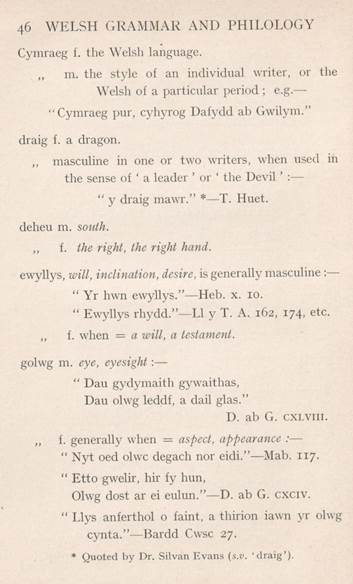
Cymraeg f. the Welsli language.
m. the stvle of an individual writer, or the
Welsh of a particular period; e.g. —
“Cymraeg pur, cyhyrog Daiydd ab Gwilym."
draig f. a dragon.
masculine in one or two writers, when used in
the sense of ' a leader ' or ' the Devil ':
“y draig mawr." * — T. Huet.
deheu m. south.
f. the right, the right hand.
ewyllys, will, inclination, desire, is generally masculine: —
“Yr hwn ewyllys." — Heb. x. 10.
“Ewyllys rhydd." — Ll y T. A. 162, 174, etc.
f. when = a will, a testament.
golwg m. eye, eyesight: —
“Dau gydymaith gyvvaithas,
Dau olwg leddf, a dail glas."
D. ab G. CXLVIII.
f. generally when = aspect, amearance: —
“Nyt oed olwc degach nor eidi." — Mab. 117.
“Etto gwelir, hir fy hun,
Olwg dost ar ei eulun." — D. ab G. CXCIV.
“I-lys anferthol o faint. a thirion iawn yr olwg
cynta." — Bardd Cwsc 27.
• Quoted by Dr. Silvan Evans (s.c. draig
|
|
|
|
|
(delwedd L1306) (tudalen 047)
|
GENDER
47
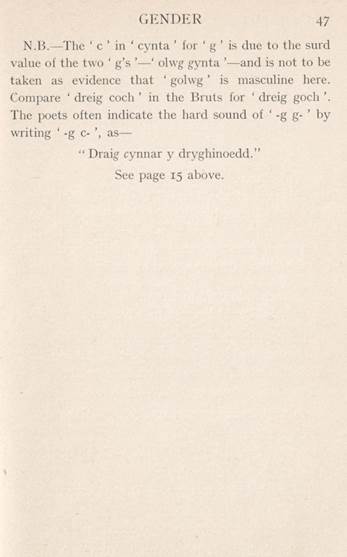
N.B. — The 'c ' in ' cynta ' for ' g ' is due to the surd
value of the two ' g's olwg gynta ' — and is not to be
taken as evidence that ' golwg ' is masculine here.
Compare ' dreig coch ' in the Bruts for ' dreig goch '.
The poets often indicate the hard sound of ' -g g- ' by
writing ' -g c-’, as —
“Draig cynnar y dryghinoedd."
See page 15 above.
|
|
|
|
|
(delwedd L1307) (tudalen 048)
|
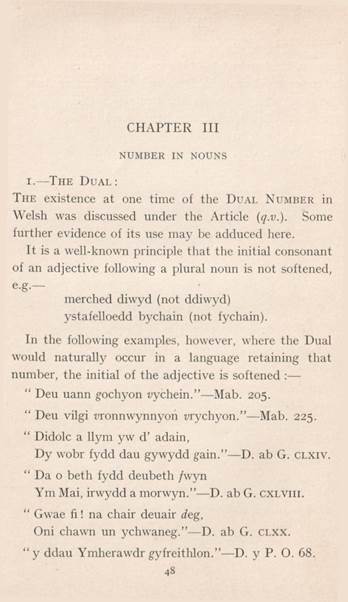
CHAPTER 111
NUMBER IN NOUNS
r. — THE DUAL:
THE existence at one time of the DUAL NUMBER in
Welsh was discussed under the Article (q.v.). Some
further evidence of its use may be adduced here.
It is a well-known principle that the initial consonant
of an adjective following a plural noun is not softened,
e.g. —
merched diwyd (not ddiwyd)
ystafelloedd bychain (not fychain).
In the following examples. however, where the Dual
would naturally occur in a language retaining that
number, the initial of the adjective is softened: —
“Deu uann gochyon 205.
“Deu vilgi vronnwynnyori vrychyon." — Mab. 225.
‘Didolc a llym yw d' adain,
Dy wobr fydd dau gywydd ab G. CLXIV.
“Da o beth fydd deubeth fwyn
V m Mai, irwydd a morwyn. ab G. CXLVIII.
“Gwae fl! na chair deuair deg,
Oni chawn un ychwaneg." — D. ab G. Cl.XX.
“y ddau Ymherawdr gyfreithlon." — D. y P. O. 68.
|
|
|
|
|
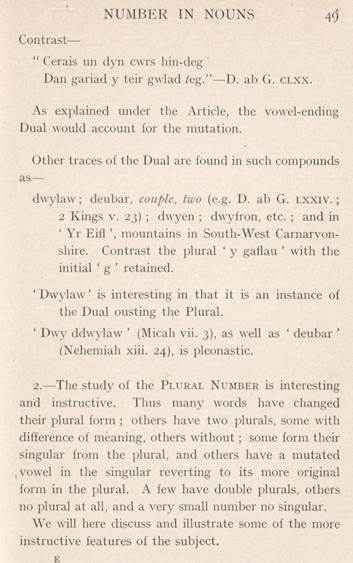
(delwedd L1308) (tudalen 049)
|
NUMBER IN NOUNS
Contrast —
“Cerais un dyn cwrs hin-deg
Dan gariad y teir gwlad ab G. CLXX.
As explained under the Article, the vowel-ending
Dual would account for the mutation.
Other traces oi the Dual are found in such compounds
dwylaw; deubar. couple, two (e.g. D. ab G. LXXIV.;
2 Kings v.; du-yen; dwyfron, etc.; and in
‘Yr Eifl’, mountains in South-West Carnarvonshire. Contrast the plural ' y
gaflau ' with the
initial ' g ' retained.
‘Dwylaw ' is interesting in that it is an instance of
the Dual ousting the Plural.
‘Dwy ddwylaw ' (Micah vii. 3), as well as ' deubar '
(Nehemiah Niii. 24), is pleonastic.
2. — The study of the PI-VRAL NUMBER is interesting
and instructive. Thus many words have changed
their plural form; others have two plurals, some with
difference of meaning, others without; some form their
singular from the plural, and others have a mutated
, vowel in the singular reverting to its more original
form in the plural. A few have double plurals, others
no plural at all, and a very small number no singular.
We will here discuss and illustrate some of the more
instructive features oi the subject.
|
|
|
|
|
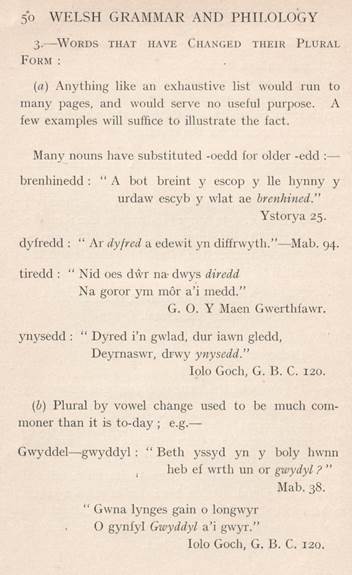
(delwedd L1309) (tudalen 050)
|
WELSH GRAMMAR AND PHILOLOGY
3. — W0Rns THAT HAVE CHANGED THEIR PLURAL
FORM:
(a) Anything like an exhaustive list would run to
many pages, and would serve no useful purpose. A
few examples will suffice to illustrate the fact.
Many nouns have substituted -oedd for older -edd: —
brenhinedd: “A bot breint y escop y Ile hynny y
urdaw escyb y wlat ae brenhined."
Ystorya 25.
dyfredd:
“Ar dy/red a edewit yn diffrwyth." — Mab. 94.
tiredd: “Nid oes di•r na• dwys diredd
Na goror yul mör a'i medd."
G. O. Y Maen Gwerthfawr.
ynysedd:
“Dyred i'n gwlad, dur iawn gledd,
Deyrnaswr, dr.vy ynysedd."
1010 Goch, G. B. C. 120.
(b) Plural by vowel change used to be much commoner than it is to-day; e.g. —
Gwyddel — gwyddyl: “Beth yssyd yn y boly hwnn
heb ef wrth un or gwydyl ? "
Mab. 38.
“Gwna lynges gain o longwyr
O gyniyl Gwyddyl a'i p,vyr."
1010 Goch, G. B. C. 120.
|
|
|
|
|
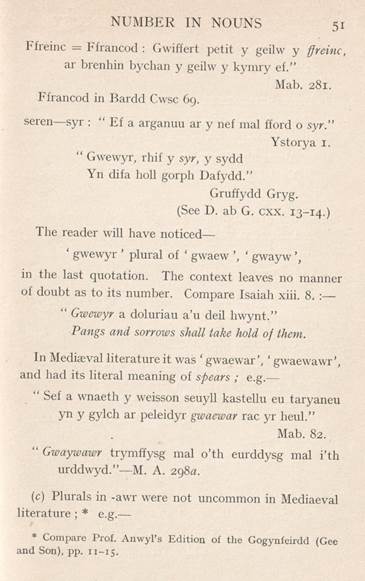
(delwedd L1310) (tudalen 051)
|
NUMBER IN NOUNS
51
Ffreinc = Ffrancod: Gwiffert petit y geilw y Oreinc,
ar brenhin bychan y geilw y kymry el."
Mab. 281.
Ffrancod in Bardd Cwsc 69.
seren — syr: “Ef a arganuu ar y nef mal fiord o syr."
Ystorya 1.
“Gwevvyr, rhif y syr, y sydd
Yn difa holl gorph Dafvdd."
Gruffydd Gryg.
(See D. ab G. cxx. 13 — 14.)
The reader will have noticed —
‘gwewyr ' plural of ' gwaew’, ‘gwayw
in the last quotation. The context leaves no manner
of doubt as to its number. Compare Isaiah xiii. 8..
“Gwewyr a doluriau a'u deil hwynt."
Pangs and sorrows shall take hold o/ them.
In Mediæval literature it was ' gwaewar', ‘gwaewawr',
and had its literal meaning of spears; e.g.
“Sef a wnaeth y weisson seuyll kastellu eu taryaneu
yn y gylch ar peleidyr gwaewar rac yr heul."
Mab. 82.
“Gwaywawr trymffysg mal o'th eurddysg mal i'th
urddwyd." — M. A. 298a.
(c) Plurals in -awr were not uncommon in Mediaeval
literature; *
* Compare Prol- Anwyl's Edition oi the Gogynfeirdd (Gee
and Son), pp. 11 — 15.
|
|
|
|
|
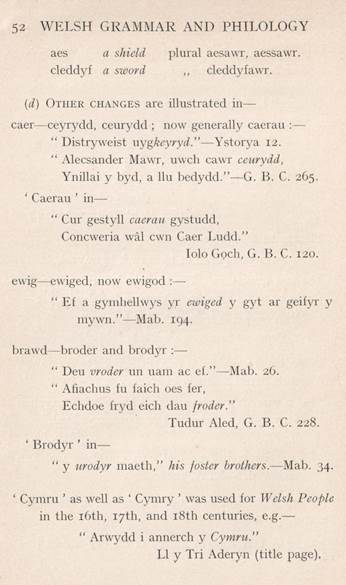
(delwedd L1311) (tudalen 052)
|
52
WELSH GRAMMAR AND PHILOLOGY
a shield plural aesawr, aessawr.
aes
cleddyf a sword
cleddyfawr.
(d) OTHER CHANGES are illustrated in —
caer — ceyrydd, ceurydd; now generally caerau: —
“Distryweist uygkeyryd." — ystorya 12.
“Alecsander Mawr, uwch cawr ceurydd,
Ynillai y byd, a llu bedydd." — G. B. C. 265.
‘Caerau in —
“Cur gestyll caerau gystudd,
Concweria wål cwn Caer Ludd."
1010 (loch, G. B. C. 120.
ewig — ewiged, now ewigod •
“Ef a gymliellv•.'ys yr ewiged y gyt ar geifyr y
mywn. " — Mab. 194.
brawd — broder and brodyr: —
Deu vroder un ualll ac 20.
“Afiaclms fu faicli oes fer,
Eclidoe fryd eich dau /roder."
•rudur Aled, G. B. C. 228.
‘Brodyr ' in —
“y urodyr maeth," his foster brothers. — Mab. 34.
‘Cymru ' as well as ' Cymry ' was used for Welsh People
in the 10th, 17th, and 18th centuries, e.g. —
“Arwydd i annerch y Cymru."
Ll y Tri Aderyn (title page).
|
|
|
|
|
(delwedd L1312) (tudalen 053)
|
NUMBER IN NOUNS
53
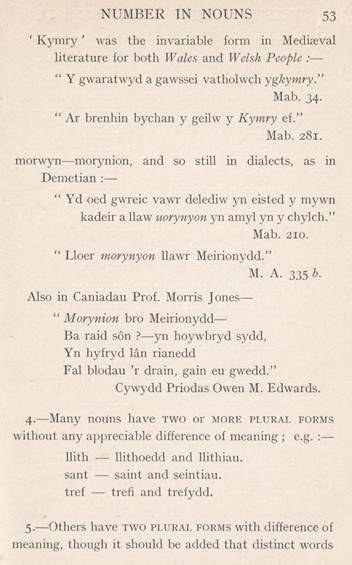
‘Kymry ' was the invariable form in Mediæval
literature for both Wales and IVc/sh People: —
“Y gwaratwyd a gawssei vatholwch ygkymry."
Mab. 34.
“Ar brenhin bychan y geilw y Kymry ef."
Mab. 281.
morwyn — morynion, and so still in dialects, as in
Demetian: —
“Yd oed S".vreic vawr delediw yn eisted y mywn
kadeir a llaw uorynyon yn amyl yn y chylch."
Mab. 210.
‘Lloer morynyon llawr Meirionydd."
M. A. 335 b.
Also in Caniadau Prof. Morris Jones —
‘' Morynion bro Meirionydd —
Ba raid son ? — yn hoywbryd sydd,
Y n hyfryd Ian rianedd
Fal blodau 'r drain, gain eu gwedd."
Cywydd Priodas Owen M. Edwards.
4. — Many nouns have TWO or MORE PI-URAL FORMS
without any appreciable difference of meaning; e.g. .
Ilith —
Sant —
tref —
Ilithoedd and Ilithiau.
saint and seintiau.
trefi and trefydd.
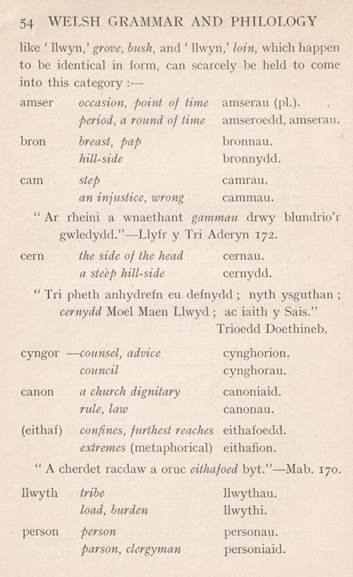
5. — Others have Two PLURAL FORMS with difference of
meaning, though it should be added that distinct words
|
|
|
|
|
(delwedd L1313) (tudalen 054)
|
54 WELSH GRAMMAR AND PHILOLOGY
like ' llwyn,' grove, bush, and ' llwyn,' loin, which happen
to be identical in form, Can scarcely be held to come
into this category:
amser
bron
cam
occasion, point of time amserau (pl.).
period, a round o/ time amseroedd, amserau.
breast, pap
hill-side
step
an injustice, wrong
bronnau.
bronnydd.
camrau.
cammau.
“Ar rheini a wnaethant gammau drwy blundrio'r
y Tri Aderyn 172.
cern
the side o/ the head
a steep hill-side
cernau.
cernydd.
Tri pheth anhydrefn eu defnydd; nyth ysguthan;
cernydd Moel Maen Llwyd; ac iaith y Sais."
cyngor — counsel, advice
canon
(eithaf)
council
a church dignitary
rule, law
Trioedd Doethineb.
cynghorion.
cynghorau.
canoniaid.
canonau.
confines, furthest reaches eithafoedd.
extremes (metaphorical) eithafion.
“A cherdet racdaw a oruc citha/oed byt." — Mab. 170.
llwyth
person
tribe
load, burden
person
Parson, clergyman
llwythau.
llwythi.
personau.
personiaid.
|
|
|
|
|
(delwedd L1314) (tudalen 055)
|
NUMBER IN NOUNS
55
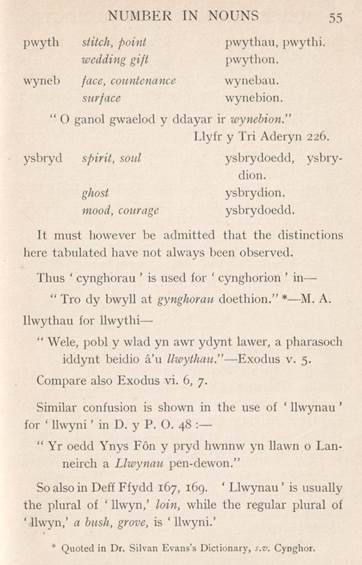
pwyth
WY neb
stitch, point
wedding gift
face, countenance
surface
pwythatl, pwytlli.
pwython.
wynebau.
wyne bion.
“O ganol gwaelod y ddayar ir wynebion."
ysbryd spirit, soul
ghost
mood, courage
Llyfr y Tri Aderyn 226.
ysbrydoedd, ysbrydion.
ysbrydion.
ysbrydoedd.
It must however be admitted that the distinctions
here tabulated have not always been observed.
Thus ' cynghorau ' is used for ' cynghorion ' in —
“Tro dy bwyll at gynghorau doethion." * — M. A.
llwythau for llwythi —
“Wele, pobl y wlad yn awr ydynt lawer, a pharasoch
iddynt beidio å'u v. 5.
Compare also Exodus vi. 6, 7.
Similar confusion is shown in the use of ' llwynau '
for ' llwyni ' in D. y P. O. 48: —
“Yr oedd Vnys Fön y pryd hwnnw yn llawn o Lanneirch a Llwynau
pen-dewon."
So also in Deff Ffydd 167, 169. ' Llwynau ' is usually
the plural of ' llwyn,' loin, while the regular plural of
‘Alwyn,' a bush, grove, is ' llwyni.'
• Quoted in Dr. Silvan Evans's Dictionary, s.7. Cynghor.
|
|
|
|
|
(delwedd L1315) (tudalen 056)
|
56 WELSH GRAMMAR AND PHILOLOGY
In view of the fact that ' brodor,' a native, is a doublet
of ' brawd ' (for ' brawdr '), brother, it does not seem
strange that in earlier literature brodorion,' now the
plural of ' brodor,' should be often used for brothers;
“Ac ymgeissaw a oruc ae gedymdeithon ae vrodoryon
maeth." — Mab. 144 (cf. 203, 207).
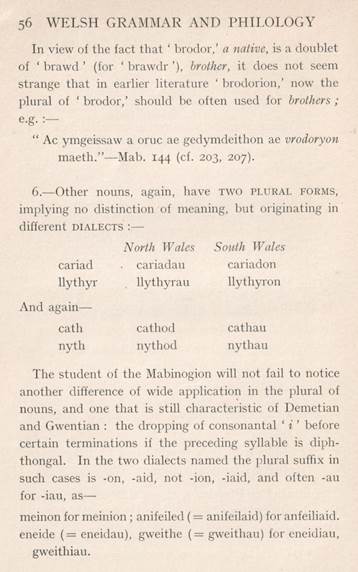
6. — Other nouns, again, have TWO PLURAL FORMS,
irnl)lying no distinction of meaning, but originating in
different DIALECTS: —
North South Wales
cariad
llythyr
And again —
cath
nyth
cariadau
llythyrau
cathod
nythod
cariadon
llythyron
cathau
nythau
The student of the Mabinogion will not fail to notice
another difference of wide application in the plural of
nouns, and one that is still characteristic of Demetian
and Gwentian: the dropping of consonantal ' i ' before
certain terminations if the preceding syllable is diphthongal. In the two
dialects named the plural suffix in
such cases is -on, -aid, not -ion, -iaid, and often -au
for -iau, as —
meinon formeinion; anifeiled ( = anifeilaid) for anfeiliaid.
eneide eneidau), gweithe gweithau) for eneidiau,
gweithiau.
|
|
|
|
|
(delwedd L1316) (tudalen 057)
|
NUMBER IN NOUNS
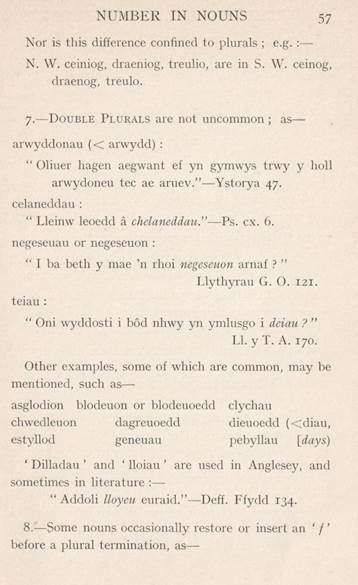
Nor is this difference confined to plurals; e.g.:
57
N. W. ceiniog, draeniog, treulio, are in S. W. ceinog.
draenog, treulo.
7. — DOVBLE PLURALS are not uncommon; as —
arwyddonau arwydd):
“Oliuer hagen aegwant ef yn gymwys trwy y holl
arwydoneu tec ae aruev." — Ystorya 47.
celaneddau:
“Lleinw leoedd å cx. 6.
negeseuau or negeseuon:
“I ba beth y mae 'n rhoi negcseuon arnaf ? "
Llythyrau G. O. 121.
teiau:
“Oni wyddosti i böd nhwy yn yrnlusgo i dciau ? "
Ll. y T. A. 170.
Other examples, some of which are common, may be
mentionecl, such as —
asglodion blodeuon or blodeuoedd clychau
chwedleuon
estyllod
dagreuoedd
geneuau
dieuoedd (<diau,
peliyllau [days)
Dillaclau ' and Iloiau ' are used in Anglesey, and
sometimes in literature
“Addoli Iloyeu Ffydcl 134.
8.2Some nouns occasionally restore or insert an / '
before a plural termination, as —
|
|
|
|
|
(delwedd L1317) (tudalen 058)
|
58 WELSH GRAMMAR AND PHILOLOGY
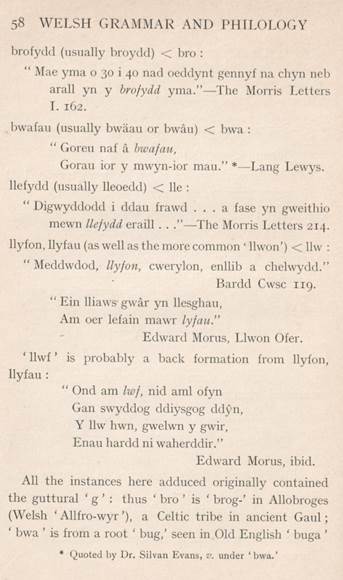
brofydd (usually broydd) < bro:
“Mae yrna 0 30 i 40 nad oeddynt gennyf na Chyn neb
arall yn y bro/ydd yma." — The Morris Letters
I. 162.
. bwafau (usually bwäau or bwåu) < bwa:
“Goreu naf å bwafau,
Gorau ior y rnwyn-ior mau." * — Lang Lewys.
liefydd (usually Ileoedd) < lie:
“Digwyddodd i ddau frawd
. . . a fase yn gweithio
mewn Ile/ydd eraill . . ." — The Morris Letters 214.
llyfon, llyfau (as well as the more common llwon') < llw:
“Meddwdod, lly/on, cwerylon, enllib a chelwydd."
Bardd Cwsc 119.
“Ein Iliaws gwår yn Ilesghau,
Am oer lefain mawr lyfau."
Edward Morns, Llwon Ofer.
‘llwf' is probably a back formation from llyfon,
llyfau:
“Ond am lw/, nid aml ofyn
Gan swyddog ddiysgog dcl$n,
Y llw hwn, gwelwn y gwir,
Enau hardd ni waherddir."
Edward Morns, ibid.
All the instances here adduced originally contained
the guttural ' g': thus ' bro' is ' brog-' in Allobroges
(Welsh ' Allfro-wyr '), a Celtic tribe in ancient Gaul;
‘bwa ' is from a root ' bug,' seen in Old English ' buga '
• Quoted by Dr. Silvan Evans, v. under bwa.'
|
|
|
|
|
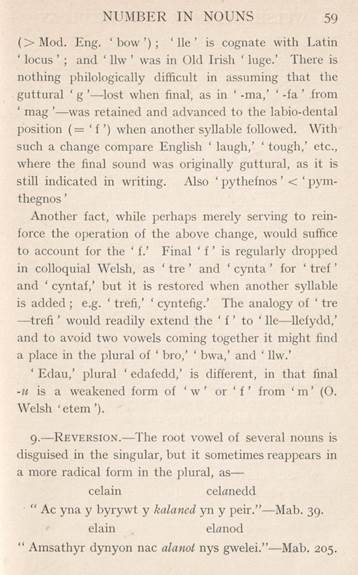
(delwedd L1318) (tudalen 059)
|
NUMBER IN NOUNS
59
Mod. Eng. ' bow ' Ile' is cognate with Latin
‘locus ,
and ' llw ' was in Old Irish ' luge.' There is
nothing philologically difficult in assuming that the
guttural ' g ' — lost when final, as in ' -ma,’ ‘-fa ' from
‘mag ' — was retained and advanced to the labio-dental
position ( —
‘f ' ) when another syllable followed. With
such a change compare English ' laugh,' tough,' etc.,
where the final sound was originally guttural, as it is
still indicated in writing. Also ' pythefnos' < pymthegnos '
Another fact, while perhaps merely sewing to reinforce the operation of the
above change, would suffice
to account for the ' f.' Final ' f' is regularly dropped
in colloquial Welsh, as ' tre' and ' cynta' for ' tref '
and ' cyntaf,' but it is restored when another syllable
is added; e.g. ' trefi,’ ‘cyntefig.' The analogy of ' tre
trefi ' would readily extend the ' f ' to ' Ile — llefydd,'
and to avoid two vowels coming together it might find
a place in the plural of bro,' bwa,' and ' llw.'
‘Edau,' plural ' edafedd,' is different, in that final
-u is a weakened form of ' w' or 'f' from 'm' (O.
Welsh ' etem
root vowel of several nouns is
disguised in the singular, but it sometimes reappears in
a more radical form in the plural, as —
celain
“Ac yna y byrywt y kalaned yn y perr
celanedd
• 39.
elain
elanod
Amsathyr dynyon nac alanoi nys 205.
|
|
|
|
|
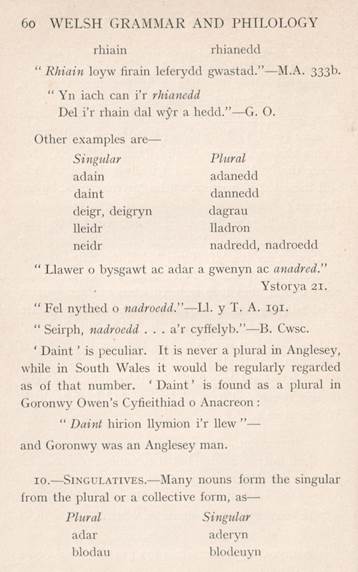
(delwedd L1319) (tudalen 060)
|
60 WELSH GRAMMAR AND PHILOLOGY
rhiain
rhianedd
“Rhiain loyw firain leferydd 333b.
“Y n iach can i'r rhiancdd
Del i'r rhain dal wS'r a hedd." — G. O.
Other examples are —
Singular
adain
daint
deigr, deigryn
Ileidr
neidr
Plural
adanedd
dannedd
dagrau
lladron
nadredd, naclroedd
I-lawer o bysgawt ac adar a gwenyn ac anadred."
Ystorya 21.
“Fel nythed o y T. A. 191.
“Seirph, nadroedd . . . a'r cyfielyb." — B. Cwsc.
‘Daint ' is peculiar. It is never a plural in Anglesey,
while in South Wales it would be regularly regarded
as of that number. ' Daint' is found as a plural in
Goronwy Owen's Cyfieithiad 0 Anacreon:
“Daint hirion llymion i'r Ilew
and Goronwy was an Anglesey man.
nouns form the singular
from the plural or a collective form, as —
Plural
adar
blodau
|
|
|
|
|
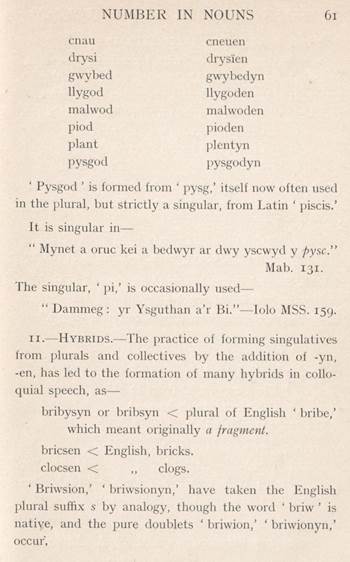
(delwedd L1320) (tudalen 061)
|
Si ngular
aderyn
leuyn
NUMBER IN NOUNS
61
cnau
drysi
gwybed
llygod
malwod
piod
plant
pysgod
cneuen
drysien
gwy bed y n
llygoden
malwoden
pioden
plentyn
pysgodyn
‘Pysgod ' is formed from pysg,' itself now often used
in the plural, but strictly a singular, from Latin ' piscis.'
It is singular in —
“Mynet a oruc kei a bedwyr ar dwy yscwyd y hysc."
Mab. 131.
The singular, ‘pi,' is occasionally used —
“Dammeg: yr Ysguthan a'r Bi."
1010 MSS. 159.
practice of forming singulatives
from plurals and collectives by the addition of -yn,
-en, has led to the formation of many hybrids in colloquial speech, as —
bribysyn or bribsyn < plural of English ' bribe,'
which meant originally a fragment.
bricsen < English, bricks.
clocsen <
clogs.
‘Briwsion
, ‘' briwsionyn,' have taken the English
plural suffix s by analogy, though the word
‘briw ' is
native, and the pure doublets ' briwion,'
briwionyn , ‘
occur'.
|
|
|
|
|
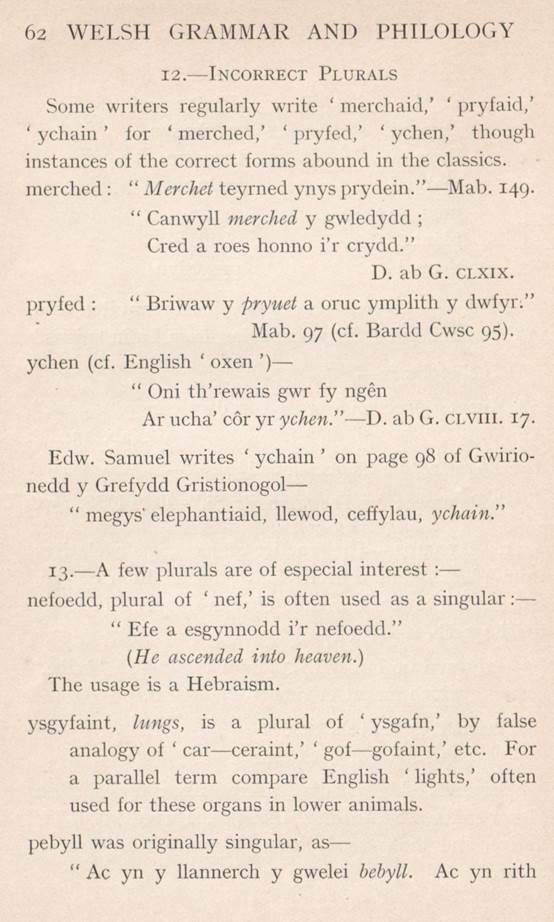
(delwedd L1321) (tudalen 062)
|
62 WELSH GRAMMAR AND PHILOLOGY
12. — INCORRECT PLURALS
Some writers regularly write ' merchaid,’ ‘pryfaid,'
‘ychain' for ' merched,’ ‘pryfed,’ ‘ychen,' though
instances of the correct forms abound in the classics.
merched: “Merchet teyrned ynys prydein. " — Mab. 149.
“Canwyll merched y SAS'ledydd;
Cred a roes honno i'r crydd."
D. ab G. CLXIX.
“Briwaw y pryuet a oruc ymplith y dwfyr."
pryfed:
Mab. 97 (cf. Bardd Cwsc 95).
ychen (cf. English ' oxen ') —
“Oni th'rewais gwr fy ngén
Ar ucha' cöryr ychen." — D. ab G. Cl.V111. 17.
Edw. Samuel writes ' ychain ' on page 98 of Gwirionedd y Grefydd Gristionogol
—
“megys• elephantiaid, Ilewod, ceffylau, ychain."
13. — A few plurals are of especial interest: —
nefoedd, plural of ' nef,' is often used as a singular: —
“Efe a esgynnodd i'r nefoedd."
(He ascended into heaven.)
The usage is a Hebraism.
ysgyfaint, lungs, is a plural of ' ysgafn,' by false
analogy oi car — ceraint,’ ‘gof — gofaint,' etc. For
a parallel term compare English ' lights,' often
used for these organs in lower animals.
pebyll
was originally singular, as —
“Ac yn y llannerch y gwelei bebyll. Ac yn rith
|
|
|
|
|
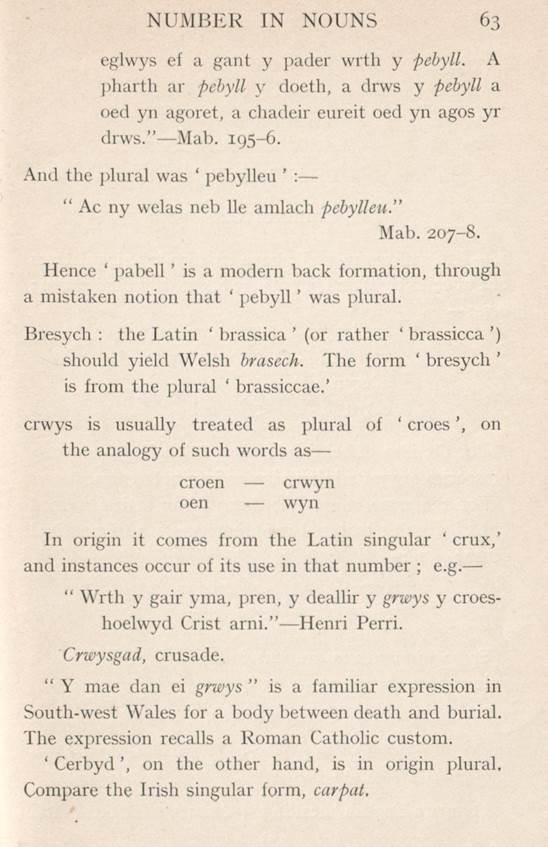
(delwedd L1322) (tudalen 063)
|
NUMBER IN NOUNS
63
eglwys ef a gant y pader wrth y pebyll. A
pharth ar 'cbyll y doeth, a drws y pebyll a
oed yn agu•ret, a chadeir eureit oed yn agos yr
195 — 6.
And the plural was ' pebylleu ':
“Ac ny welas neb Ile amlach pcbylleu."
Mab. 207 — 8.
Hence ' pabell ' is a modern back formation, through
a mistaken notion that ' pebyll ' was plural.
Bresych: the Latin ' brassica ' (or rather ' brassicca ' )
should yield Welsh brasech. The form ' bresych
is from the plural ' brassiccae.'
crwys is usually treated as plural of ' crocs on
the analogy of such words as —
croen
oen
crwyn
In origin it comes from the Latin singular • crux,'
and instances occur of its use in that number; e.g. —
“Wrth y gair yma, pren, y deallir y grwys y Croeshoelwyd Crist arni." — Henri
Perri.
Crwysgad, crusade.
“Y mae dan ei gncys " is a familiar expression in
South-west Wales for a body between death and burial.
The expression recalls a Roman Catholic custom.
‘Cerbyd’, on the other hand, is in origin plural.
Compare the Irish singular form, carpal.
|
|
|
|
|
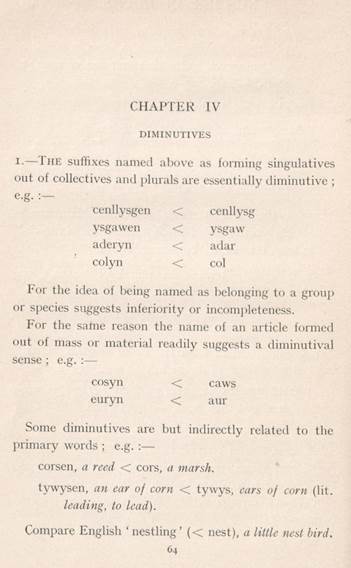
(delwedd L1323) (tudalen 064)
|
CHAPTER IV
DIMINUTIVES
I. — THE suffixes named above as forming singulatives
out of collectives and plurals are essentially diminutive; e.g. : -
cenllysgen < cenllysg
ysgawen < ysgaw
aderyn < adar
colyn < col
For the idea of being named as belonging to a group
or species suggests inferiority or incompleteness.
For the same reason the name of an article formed
out of mass or material readily suggests a diminutival
sense; e.g.: —
cosyn < caws
euryn < aur
Some diminutives are but indirectly related to the
primary words; e.g.: -
corsen, a reed < cors, a marsh.
tywysen, an ear of corn < tywys, ears of corn (lit.
leading, to lead).
Compare English ‘nestling' (< nest), a little nest bird.
|
|
|
|
|
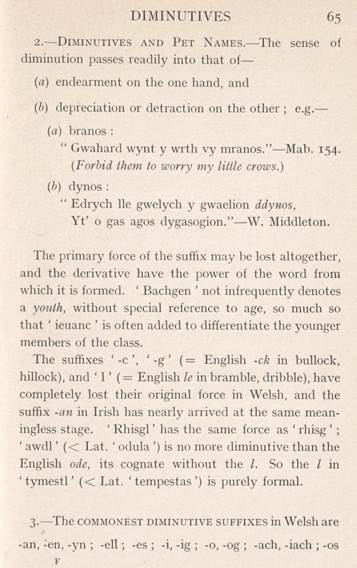
(delwedd L1324) (tudalen 065)
|
DIMINUTIVES 64
65
2. — DIMINUTIVES AND PET NAMEs. — The sense of
diminution passes readily into that of —
(a) endearment on the one hand, and
(b) depreciation or detraction on the other; e.g. —
(a) branos:
“Gwahard wynt y wrth vy mranos." — Mab. 154.
(Forbid them to worry my little crows.)
(b) dynos:
“E(lrych Ile gwelych y gwaelion ddynos,
Yt' o gas agos dygasogion." — W. Middleton.
The primary force of the suffix may be lost altogether,
and the derivative have the power of the word from
which it is formed. ' Bachgen ' not infrequently denotes
a youth, without special reference to age, so much so
that ' ieuanc ' is often added to differentiate the younger
members of the class.
The suffixes ' -c’, -g' English -Ck in bullock,
hillock), and ' I ' ( = English le in bramble, dribble), have
completely lost their original force in Welsh, and the
suffix -an in Irish has nearly arrived at the same meaningless stage. '
Rhisgl ' has the same force as ' rhisg';
‘awdl ' (e: Lat. ' odula ') is no more diminutive than the
English ode, its cognate without the l. So the I in
‘tymestl ' Lat. ' tempestas ') is purely formal.
3. — The COMMONEST DIMINUTIVE SUFFIXES in Welsh are
-an, Zen, -yn; -ell; -es; -i, -ig; -o, -og; -ach, -iach; -os
|
|
|
|
|
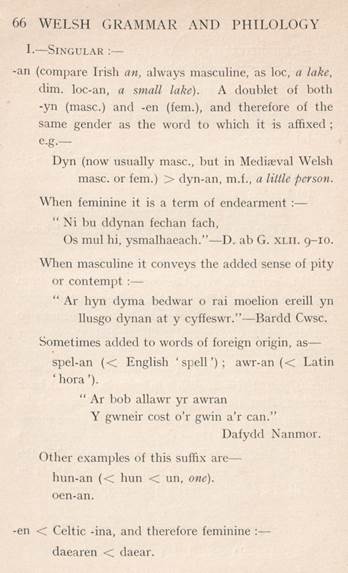
(delwedd L1325) (tudalen 066)
|
66 WELSH GRAMMAR AND PHILOLOGY
I. — SINGULAR
-an (compare Irish an, always masculine, as loc, a lake,
dim. loc-an, a small lake). A doublet of both
-yn (masc.) and -en (fem.), and therefore of the
same gender as the word to which it is afflxecl;
e.g. —
Dyn (now usually masc., but in Mediæval Welsh
masc. or fem.) > dyn-an, m.f., a little Person.
feminine it is a term of endearment: —
“Ni bu ddynan fechan fach,
Os mul hi, ysmalhaeach." — D. ab G. XLII. 9 — 10.
When masculine it conveys the added sense of pity
or contempt
“Ar hyn dyma bedwar o rai moelion ereill yn
llusgo dynan at y Cwsc.
Sometimes added to words of foreign origin, as
spel-an English ' spell '); awr-an Latin
‘hora ').
“Ar bob allawr yr awran
Y gwneir cost O'r gwin a'r can."
Dafydd Nanmor.
Other examples of this suffl.x are —
hun-an (e-< hun < un, one).
oen-an.
-en < Celtic -ina, and therefore feminine
daearen < daear.
|
|
|
|
|
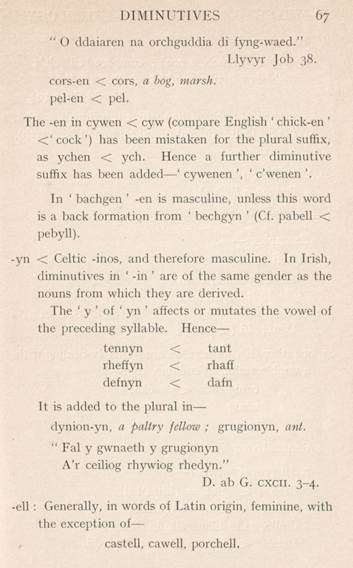
(delwedd L1326) (tudalen 067)
|
DIMINUTIVES
67
“O ddaiaren na orchguddia di fyng-waed."
I.lyvyr Job 38.
cors-en < cors, a bog, marsh.
pel-en < PCI.
The -en in cywen < cyw (compare English ' chick-en '
< ' cock ') has been mistaken for the plural suffix,
as ychen < ych. Hence a further diminutive
suffix has been added — ' cywenen’, ‘c'wenen '.
In ' bachgen ' -en is masculine, unless this word
is a back formation from ' bechgyn ' (Cf. pabell <
pebyll).
-yn < Celtic -inos, and therefore masculine. In Irish,
diminutives in ' -in ' are of the same gender as the
nouns from which they are derived.
The ' y ' of ' yn ' affects or mutates the vowel of
the preceding syllable. Hence —
tennyn < tant
rhefiyn < rhaff
defnyn < dafn
It is added to the plural in —
dynion-yn, a paltry fellow; grugionyn, ant.
Fal y gwnaeth y grugionyn
A'r ceiliog rhywiog rhedyn."
D. ab G. c,XC11. 3 — 4.
-ell: Generally, in words of Latin origin, feminine, with
the exception of —
castell, cawell, porchell.
|
|
|
|
|
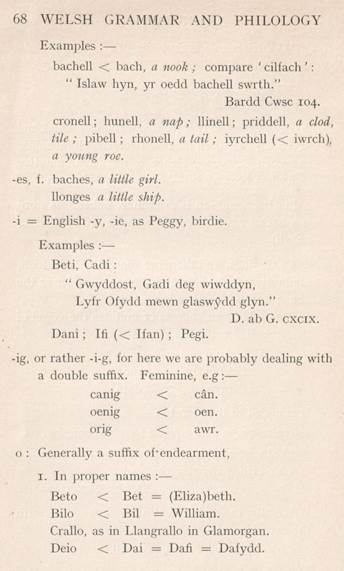
(delwedd L1327) (tudalen 068)
|
68
WELSH GRAMMAR AND PHILOLOGY
Examples
bachell < bach, a nook; compare ' cilfach ':
“Islaw hyn, yr oedd bachell swrth."
Bardd Cwsc 104.
cronell; hunell. a nap; Ilinell; priddell, a clod,
tile; pibell; rhonell, a tail; iyrchell (e: iwrch),
a young roc.
f. baches, a little girl.
Ilonges a little shift.
i = English -y, -ie, as Peggy, birdie.
Examples
Beti, Cadi:
“Gwyddost, Gadi deg wiwddyn,
Lyfr Ofydd mewn glasw$dd glyn."
D. ab G. cxcrx.
Dani; Ifi Ifan); Pegi.
-ig, or rather -i-g, for here we are probably dealing with
a double suffix. Feminine, e.g: —
can lg
oenig
orig
cån.
oen.
awr.
o:
Generally a suffix of•endearment,
1. In proper names: —
Beto < Bet = (Eliza)beth.
Bilo < Bil = William.
Crallo, as in Llangrallo in Glamorgan.
Deio < Dai = Dafl Dafydd.
|
|
|
|
|
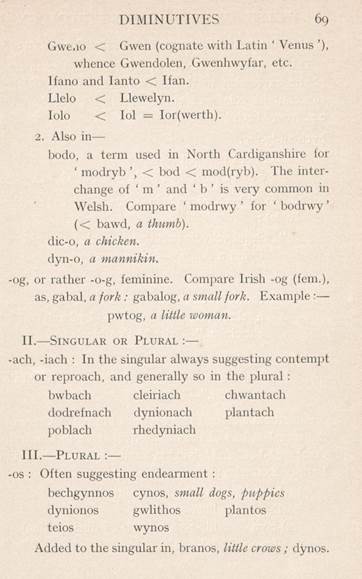
(delwedd L1328) (tudalen 069)
|
DIMINUTIVES
69
Gweao < Gwen (cognate with Latin ' Venus ' ),
whence Gwendolen, Gwenliwyfar, etc.
Ifano and lanto < Ifan.
Llelo < Llewelyn.
1010 < 101 —
— lor(werth).
2. Also in —
bodo, a term used in North Cardiganshire for
‘modryb ' , < bod < mod(ryb). The interchange of ' m ' and ' b ' is
very common in
Welsh. Compare ' modrwy ' for ' bodrwy
bawd, a thumb).
dic-o, a chicken.
dyn-o, a mannikin.
-og, or rather -o-g, feminine. Compare Irish -og (fem.),
as, gabal, a fork: gabalog, a small fork. Example
pwtog, a little woman.
ll. — SINGULAR OR PLURAL
-ach, -iach: In the singular always suggesting contempt
or reproach, and generally so in the plural:
bwbach
dodrefnach
poblach
Ill. — PLURAL
cleiriach
dynionach
rhedyniach
chwantach
plantach
-os: Often suggesting endearment:
bechgynnos
dynionos
teios
cynos, small dogs, puppies
gwlithos
plantos
wynos
Added to the singular in, branos, little crows; dynos.
|
|
|
|
|
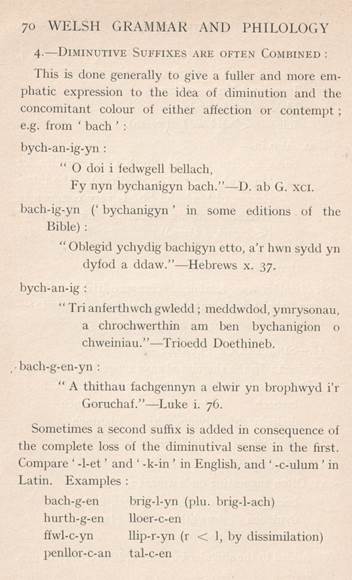
(delwedd L1329) (tudalen 070)
|
70 WELSH GRAMMAR AND PHILOLOGY
4. — DIMINUTIVE SUFFIXES ARE OFTEN COMBINED:
This is done generally to give a fuller and more emphatic expression to the
idea of diminution and the
concomitant colour of either affection or contempt;
e.g. from ' bach ':
bych-an-ig-yn
“O doi i fedwgell bellach,
Fy nyn bychanigyn bach." — D. ab G. .xcl.
bach-ig-yn (' bychanigyn ' in some editions of the
Bible):
“Oblegid ychydig bachigyn etto, a'r hwn sydd yn
dyfod a ddaw." — Hebrews x. 37.
bych-an-ig:
“Tri anferthwch gwledd; meddwdod, ymrysonau,
a chrochwerthin arn ben bychanigion o
chweiniau." — Trioedd Doethineb.
bach-g-en-yn:
“A thithau fachgennyn a elwir yn brophwyd i'r
Goruchaf." — Luke i. 76.
Sometimes a second suffix is added in consequence of
the complete loss of the diminutival sense in the first.
Compare ' -I-et ' and ' -k-in ' in English, and ' -c-ulum ' in
Latin. Examples:
bach-g-en
brig-I-yn (plu. brig-I-ach)
hurth-g-en
Iloer-c-en
ffwl-c-yn
Ilip-r-yn (r < l, by dissimilation)
penllor-c-an tal-c-en
|
|
|
|
|
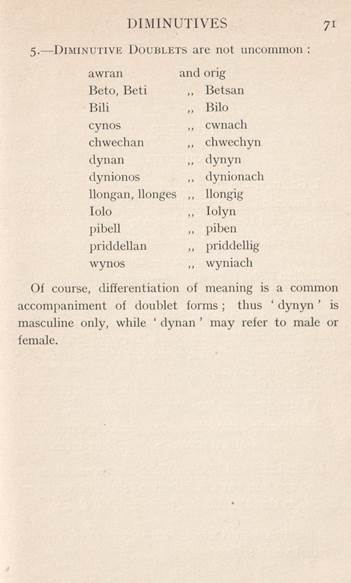
(delwedd L1330) (tudalen 071)
|
DIMINUTIVES
DOUBLETS are not uncommon:
71
a wran
Beto, Beti
Bili
cynos
chwechan
dynan
dynionos
Ilongan, Ilonges
1010
pibell
priddellan
wynos
and orig
Betsan
Bilo
cwnach
chwechyn
dynyn
dynionach
Ilongig
Iolyn
pi ben
priddellig
wyniach
Of course, differentiation of meaning is a common
accompaniment of doublet forms; thus ' dynyn ' is
masculine only, while ' dynan ' may refer to male or
female.
|
|
|
|
|
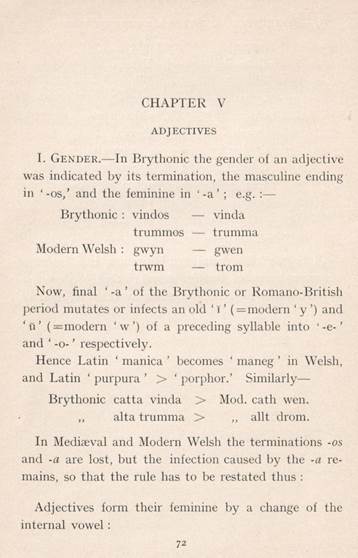
(delwedd L1331) (tudalen 072)
|
CHAPTER V
ADJECTIVES
l. GENDER. — ln Brythonic the gender of an adjective
was indicated by its termination, the masculine ending
in '-os,' and the feminine in ' -a'; eg
Brythonic: vindos
trummos
Modern Welsh: gwyn
trwm
vinda
trumma
gwen
trom
Now, final ' -a ' of the Brythonic or Romano-British
period mutates or infects an old 'i' ( — modern ' y ') and
‘n' (=modern ' w of a preceding syllable into ' -e- '
and -o- ' respectively.
Hence Latin ' manica ' becomes ' maneg ' in Welsh,
and Latin ' purpura' > ' porphor.' Similarly —
Brythonic catta vinda > Mod. cath wen.
alta trumma >
allt drom.
In Mediæval and Modern Welsh the terminations -os
and -a are lost, but the infection caused by the -a remains, so that the rule
has to be restated thus:
Adjectives form their feminine by a change of the
internal vowel:
72
|
|
|
|
|
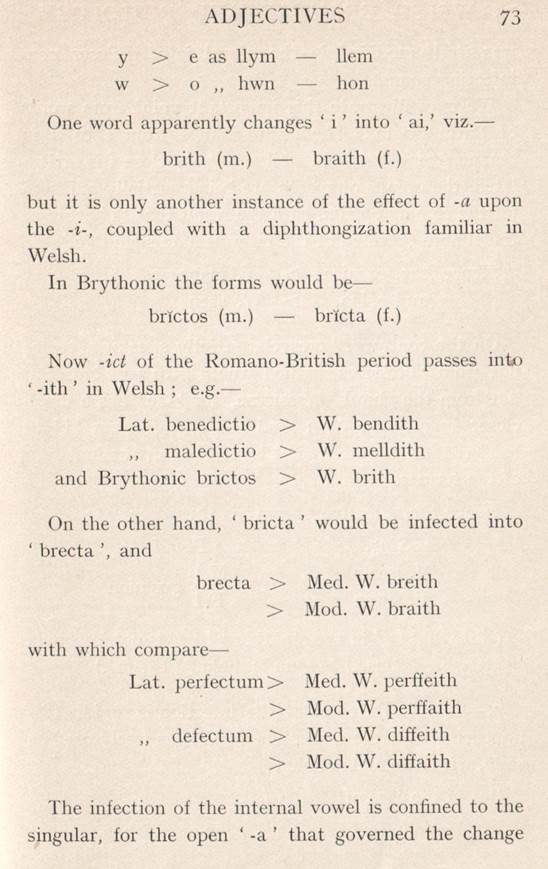
(delwedd L1332) (tudalen 073)
|
ADJECTIVES
73
y > e as llym - llem
w > o as hwn - hon
One word apparently changes ' i ' into ' ai,' viz. —
braith (f.)
brith (m.)
but it is only another instance of the effect of -a upon
the -i-, coupled with a diphthongization familiar in
Welsh.
In Brythonic the forms would be —
bricta (f.) - brictos (m.)
Now -ict of the Romano-British period passes into
‘-ith ' in Welsh; e.g. —
Lat. benedictio >
maledictio >
and Brythonic brictos >
On the other hand, ‘bricta '
‘brecta’, and
brecta >
>
with which compare —
I — at. perfecturn>
>
defectum >
>
W. bendith
W. melldith
W. brith
would be infected into
Med.
Mod.
Med.
Mod.
Med.
Mod.
W. breith
W. braith
W. perfteith
W. periTaith
W. diffeith
W. diffaith
The infection of the internal vowel is confined to the
'ingular, for the open ' -a ' that governed the change
|
|
|
|
|
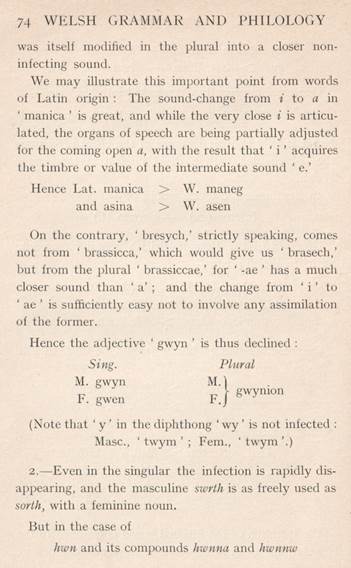
(delwedd L1333) (tudalen 074)
|
74 WELSH GRAMMAR AND PHILOLOGY
was itself modified in the plural into a closer noninfecting sound.
We may illustrate this important point from words
of Latin origin: The sound-change from i to a in
‘manica ' is great, and while the very close i is articulated, the organs of
speech are being partially adjusted
for the coming open a, with the result that ' i ' acquires
the timbre or value of the intermediate sound ' e.'
Hence Lat. manica > W. maneg
and asina > W. asen
On the contrary, ‘bresych,' strictly speaking, comes
not from ' brassicca,' which would give us ' brasech,'
but from the plural ' brassiccae,' for ' -ae ' has a much
closer sound than ' a'; and the change from ' i ' to
‘ae ' is sufficiently easy not to involve any assimilation
of the former.
Hence the adjective ' gwyn ' is thus declined:
Sing.
M. gwyn
F. gwen
Plural
M.
gwymon
(Note that ' y in the diphthong 'wy ' is not infected:
Masc., ‘twym '; Fem., ‘twym
2. — Even in the singular the infection is rapidly disappearing, and the
masculine swrth is as freely used as
sorth, with a feminine noun.
But in the case of
hwn and its compounds hwnna and hwnnw
|
|
|
|
|
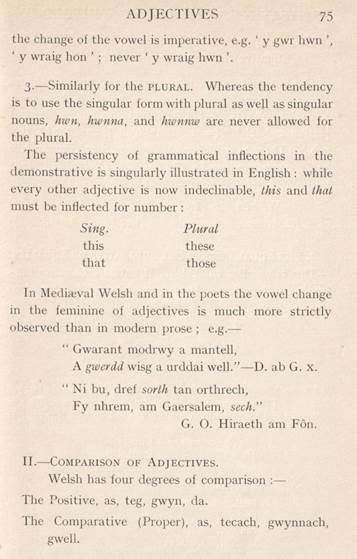
(delwedd L1334) (tudalen 075)
|
ADJECTIVES
75
the change of the vowel is imperative, e.g. ' y gwr hwn '
y wraig hon
never ' y wraig hwn '
3. — Similarly for the PLURAL. Whereas the tendency
is to use the singular form with plural as well as singular
nouns, hwn, hwnna, and hwnnw are never allowed for
the plural.
The persistency of grammatical inflections in the
demonstrative is singularly illustrated in English: while
every other adjective is now indeclinable, this and that
must be inflected for number:
Sing.
this
that
Plural
these
those
In Mediæval Welsh and in the poets the vowel change
in the feminine of adjectives is much more strictly
observed than in modern prose; e.g. —
“Gwarant modrwy a mantell,
A gwerdd wisg a urddai well." — D. ab G. x.
“Ni bu, dref sorth tan orthrech,
Fy nhrem, am Gaersalem, sech."
G. O. Hiraeth am Fön.
ll. — COMPARISON OF ADJECTIVES.
Welsh has four degrees of comparison: —
The Positive, as, teg, gwyn, (la.
The Comparative (Proper), as, tecach, gwynnach,
|
|
|
|
|
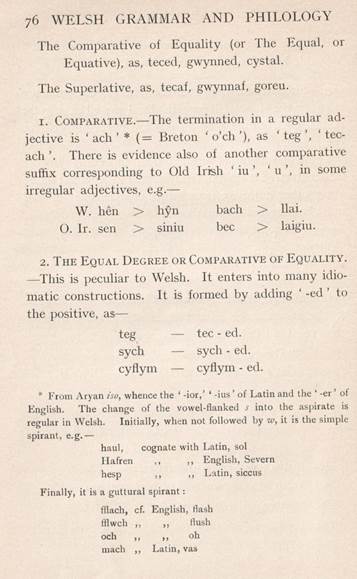
(delwedd L1335) (tudalen 076)
|
76 WELSH GRAMMAR AND PHILOLOGY
The Comparative of Equality (or The Equal, or
Equative), as, teced, gnvynned, cystal.
The Superlative, as, tecaf, gwynnaf, goreu.
1. COMPARATIVE. — The termination in a regular adjective is 'ach' * Breton '
o'ch '), as ' teg’, ‘tecach '. There is evidence also of another comparative
u’, m some
suffix corresponding to Old Irish ' iu’,
irregular adjectives, e.g. —
W. hén > h$n bach > llai.
bec > laigiu.
O. Ir. sen > siniu
2. THE EQUAL DEGREE OR COMPARATIVE OF EQUALITY.
— This is peculiar to Welsh. It enters
into many idiomatic constructions. It is formed by adding ' -ed ' to
the positive, as —
teg
sych
tec - ed.
sych - ed.
— cyflym - ed.
cyflym
-ius ' of Latin and the -er' of
From Aryan iso, whencethe -ior,'
English. The change of the vowel-flanked s into the aspirate is
regular in Welsh. Initially, when not followed by cc, it is the simple
spirant, e.g. —
haul , cognate with Latin, sol
llafren
hesp
English, Severn
Latin, siccus
Finally, it is a guttural spirant:
fllach, cf. English, flash
fflwch
mach
|
|
|
|
|
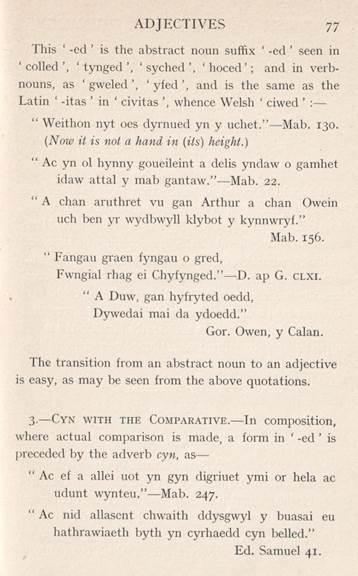
(delwedd L1336) (tudalen 077)
|
flush
oh
Latin, vas
ADJECTIVES
77
This ' -ed ' is the abstract noun suff1X ' -ed ' seen in
‘colled’, ‘tynged ' syched’, ‘hoced'; and in verbnouns, as ' gweled • , ‘yfed’,
and is the same as the
Latin ' -itas ' in ' civitas’, whence Welsh ' ciwed ': —
“Weithon nyt oes dyrnued yn y 130.
(Now it is not a hand in (its) height.)
“Ac yn 01 hynny goueileint a delis yndaw o garnhet
idaw attal y mab gantaw." — Mab. 22.
“A chan aruthret vu gan Arthur a chan Owein
uch ben yr wydbwyll klybot y kynnwryf."
Mab. 156.
Fangau graen fyngau o gred,
Fwngial rhag ei ap G. CLXI.
‘A Duw, gan hyfryted oedd,
Dywedai mai da ydoedd."
Gor. Owen, y Calan.
The transition from an abstract noun to an adjective
is easy, as may be seen from the above quotations.
3. — CYN WITH THE COMPARATIVE. — In composition,
where actual comparison is made, a form in ' -ed ' is
preceded by the adverb cyn, as —
“Ac ef a allei uot yn gyn digriuet ymi or hela ac
udunt wynteu." — Mab. 247.
“Ac nid allascnt chwaith ddysgwyl y buasai eu
hathrawiaeth byth yn cyrhaedd cyn belled."
Ed. Samuel 41.
|
|
|
|
|
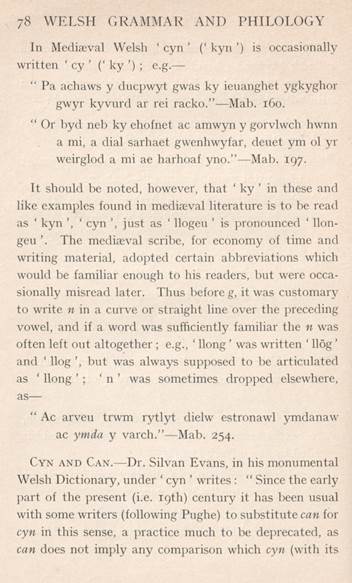
(delwedd L1337) (tudalen 078)
|
78 WELSH GRAMMAR AND PHILOLOGY
In Mediæval Welsh ' cyn ' kyn ') is occasionally
written ' cy ' ky '); e.g. —
‘Pa achaws y ducpwyt ky ieuanghet ygkyghor
gwyr kyvurd ar rei racko." — Mab. 160.
“Or byd neb ky ehofnet ac amwyn y gorvlwch hwnn
a mi, a dial sarhaet gwenhwyfar, cleuet ym 01 yr
weirglod a mi ae harhoaf yno." — Mab. 197.
It should be noted, however, that ' ky ' in these and
like examples found in mediæval literature is to be read
as ' ky•n’, cyn’, just as ' Ilogeu ' is pronounced ' Ilongeu '. The mediæval
scribe, for economy of time and
writing material, adopted certain abbreviations which
would be familiar enough to his readers, but were occasionally misread later.
Thus before g, it was customary
to write n in a curve or straight line over the preceding
vowel, and if a word was sufficiently familiar the was
often left out altogether; e.g., ‘Ilong ' was written ' llög
and ' Ilog’, but was always supposed to be articulated
as ' Ilong '
‘n ' was sometimes dropped elsewhere,
Ac arveu tnvrn rytlyt dielw estronawl ymdanaw
ac ymda y 254.
CYN AND CAN. — Dr. Silvan Evans, in his monumental
Welsh Dictionary, under ' Cyn ' writes: 'c Since the early
part of the present (i.e. 19th) century it has been usual
with some writers (following Pughe) to substitute can for
cyn in this sense, a practice much to be deprecated, as
can does not imply any comparison which cyn (with its
|
|
|
|
|
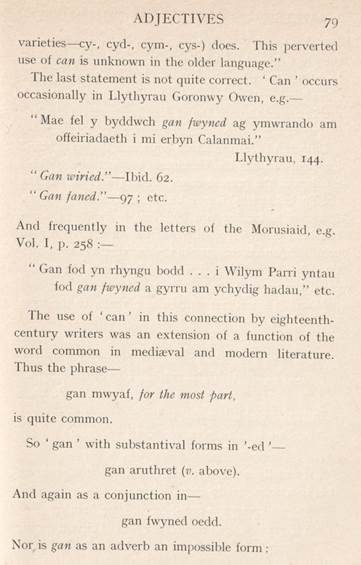
(delwedd L1338) (tudalen 079)
|
ADJECTIVES
79
variet ies — cy-. cyd-, cym-, cys-) does. This l»erverted
use 'if can is unknown in the older language."
The last statement is not quite correct. Can ' occurs
occasionally in l.lythyrau Goronuy Owen, e.g. —
“Mae fel y byddwch gan iwyncd ag ymwrando am
offeiriadaeth i mi erbvn Calanmai."
I-lythyrau, 144.
“Gan 62.
“Gan; etc.
And frequently in the letters of the Morusiaid, e.g.
vol. 1. p. 258
. i Wilym Parri yntau
“Gan fod yn rhyngu INVId .
fod gan fwyncd a gyrru am ychydig hadau," etc.
The use of ' can ' in this connection by eighteenthcentury writers was an
extension of a function of the
word common in media•val and modern literature.
Thus the phrase —
gan mwyaf, the most part.
is quite common.
So gan ' with substantival forms in '-ed
gan aruthret (v. above).
And again as a conjunction in —
gan fwyned oedd.
Nor is gan as an adverb an impossible form:
|
|
|
|
|
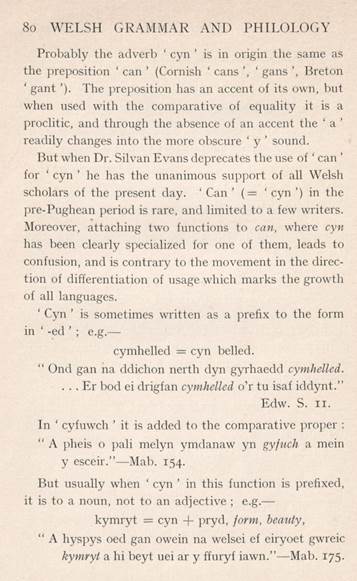
(delwedd L1339) (tudalen 080)
|
(tudaten 079)
80 WELSH GRAMMAR AND PHILOLOGY
Probably the adverb ' cyn ' is in origin the same as
the preposition ' can ' (Cornish ' cans’, ‘gans Breton
gant '). The preposition has an accent of its own, but
when used with the comparative of equality it is a
proclitic, and through the absence of an accent the ' a '
readily changes into the more obscure ' y ' sound.
But when Dr. Silvan Evans deprecates the use of ' can '
for ' cyn ' he has the unanimous support of all Welsh
scholars of the present day. ' Can ' ( = ' cyn ') in the
pre-Pughean period is rare, and limited to a few writers.
Moreover, attaching two functions to can, where cyn
has been clearly specialized for one of them, leads to
confusion, and is contrary to the movement in the direction of
differentiation of usage which marks the growth
of all languages.
‘Cyn ' is sometimes written as a prefix to the form
in ' -ed '; e.g. —
cymhelled = cyn belled.
“Ond gan na (Idichon nerth dyn gyrhaedd cymhelled.
... Er bod ei drigfan cymhelled O'r tu isaf iddynt."
Edw. S. Il.
In ' cyfuwch ' it is added to the comparative proper:
“A pheis o pali melyn ymdanaw yn gy/uch a mein
y esceir." — Mab. 154.
But usually when ' cyn ' in this function is prefixed,
it is to a noun, not to an adjective; e.g. —
kymryt = cyn -+- pryd, form, beauty,
“A hyspys oed gan owein na welsei ef eiryoet gwreic
kymryt a hi beyt uei ar y ffuryf 175.
|
|
|
|
|
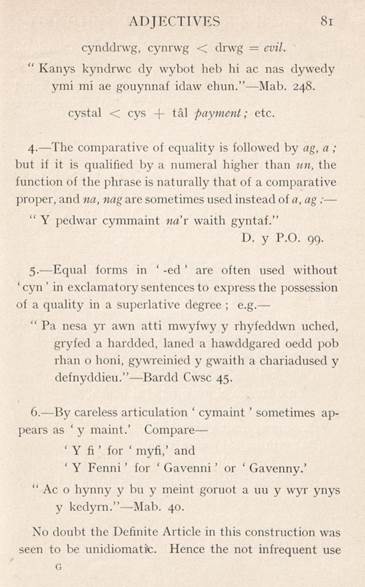
(delwedd L1340) (tudalen 081)
|
ADJECTIVES
81
cynddrwg, cynrwg < drwg evil.
“Kanys kyndrwc dy wybot heb hi ac nas dywedy
ymi mi ae gouynnaf idaw ehun." — Mab. 248.
cystal < cys + tål payment; etc.
4. — The comparative Of equality is followed by ag, a;
but if it is qualified by a numeral higher than un, the
function of the phrase is naturally that of a comparative
proper, and na, nag are sometimes used instead of a, ag: —
Y pedwar cymmaint na'r waith gyntaf."
l). y P.O. 99.
5. — Equal forms in ' -ed ' are often used without
‘cyn ' in exclamatory sentences to express the possession
of a quality in a superlative degree; e.g. —
“Pa nesa yr awn atti mwyfwy y rhyfeddwn uched,
gryfed a hardded, laned a hawddgared oedd pob
rhan o honi. gywreinied y gwaith a chariadused y
defnyddieu." — Bardd Cwsc 45.
6. — By careless articulation ' cymaint ' sometimes appears as ' y maint.'
Compare —
'Y fi ' for ' myfi,' and
‘Y Fenni ' for ' Gavenni ' or ' Gavenny.'
“Ac o hynny y bu y meint goruot a uu y wyr ynys
y 40.
No doubt the Definite Article in this construction was
seen to be unidiomatk. Hence the not infrequent use
|
|
|
|
|
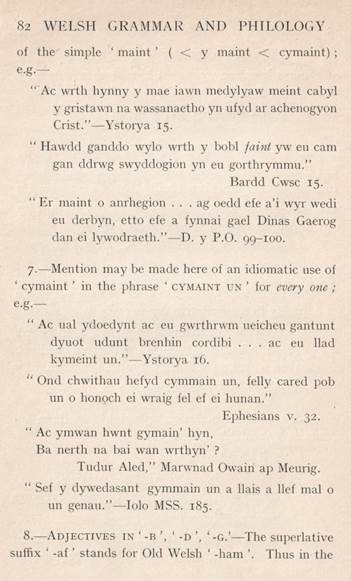
(delwedd L1341) (tudalen 082)
|
82 WELSH GRAMMAR AND PHILOLOGY
of the simple ' maint' ( < y maint < cymaint);
e.g. —
Ac wrth hynny y mae iawn medylyaw meint cabyl
y gristawn na wassanaetho yn ufyd ar achenogyon
Crist." — Ystorya 15.
“Hawdd ganddo wylo wrth y bobl faint yw eu cam
gan ddrwg swyddogion yn eu gorthrymmu."
Bardd Cwsc 15.
“Er maint o anrhegion . .
. ag oedd efe a'i wyr wedi
eu derbyn, etto efe a fynnai gael Dinas Gaerog
dan ei lywodraeth." — D. y P.O. 99 — 100.
7. — Mention may be made here of an idiomatic use of
cymaint ' in the phrase ' CYMAINT UN' ' for every one;
e.g.
“Ac ual ydoedynt ac eu gwrthr•.'lll ueicheu gantunt
dyuot udunt brenhin cordibi . . . ac eu llad
kymeint un." — Ystorya 16.
Ond chwithau hefyd cymmain un, felly cared pob
un o honoch ei wraig fel ef ei hunan."
Ephesians v. 32.
“Ac ymwan hwnt gymain' hyn,
Ba nerth na bai wan wrthyn' ?
Tudur Aled," Marwnad Owain ap Meurig.
“Sef y dywedasant gymmain un a llais a Ilef mal o
." — lolo MSS. 185.
un genau
8. — ADJECTIVES IN ' -B , ‘' D’, ‘-G.' — The superlative
suffix ' -af ' stands for Old Welsh
‘-ham Thus in the
|
|
|
|
|
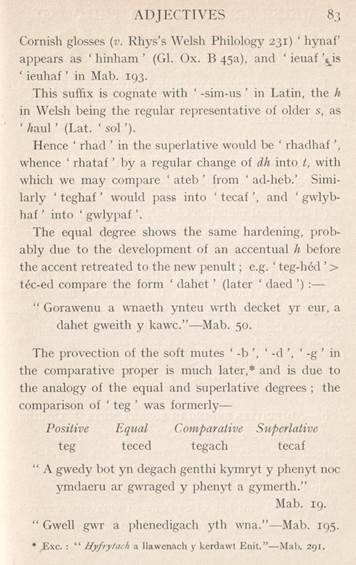
(delwedd L1342) (tudalen 083)
|
ADJECTIVES
83
Cornish glosses (v. Rhys's Welsh Philology 231) ' hynaf'
appears as ' hinham ' (Gl. Ox. B 45a), and ' ieuaf
‘ieuhaf ' in Mab. 193.
This suffix is cognate with ' -sim-us ' in Latin, the h
in Welsh being the regular representative of older s, as
‘haul ' (Lat. ' sol ').
Hence ' I-had ' in the superlative would be ' rhaclhaf’,
whence ' rhataf ' by a regular change of dh into t, with
which we may compare ' ateb ' from ' ad-heb.' Similarly ' teghaf ' would pass
into ' tecaf’, and ' gwlybhaf' into ' gnvlypaf '.
The equal degree shows the same hardening, probably due to the development Of
an accentual h before
the accent retreated to the new penult; e.g. teg-héd ' >
téc-ed compare the form ' dahet ' (later ' daed '): —
“Gorawenu a wnaeth ynteu wrth decket yr eur, a
dahet gweith y kawc." — Mab. 50.
The provection of the soft mutes ' -b
-g ' in
the comparative proper is much later,* and is due to
the analogy of the equal and superlative degrees; the
comparison of ' teg ' was formerly —
Positive
teg
Equal
teced
C omparalive Superlative
tegach
tecaf
“A gwedy bot yn degach genthi kymryt y phenyt noc
ymdaeru ar gwraged y phenyt a gymerth."
Mab. 19.
“Gwell gwr a phenedigach yth wna."
Mab. 195.
• Uxc.: Hyfrytach a llawenach y kerdawt 291.
|
|
|
|
|
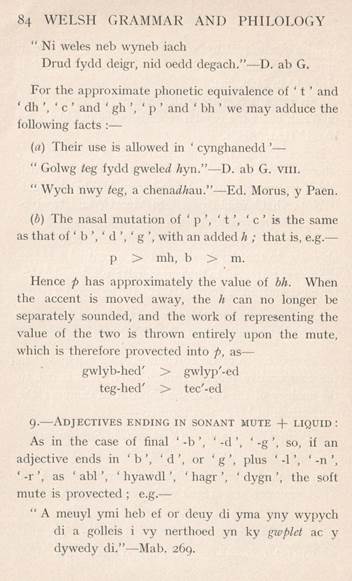
(delwedd L1343) (tudalen 084)
|
84 WEISH GRAMMAR AND PHILOLOGY
“Ni weles neb wyneb iach
Drud fydd deigr, nid oedd degach." — D. ab G.
For the approximate phonetic equivalence of ' t ' and
‘dh 'c' and ' gh ' p ' and ' bh ' we may adduce the
following facts: —
(a) Their use is allowed in ' cynghanedd ' —
“Golwg teg fydd gweled hyn." — D. ab G. Vlll.
‘Wych nwy teg, a chenadhau." — Ed. Morus, y Paen.
(b) The nasal mutation of ' p ' t’, ‘c' is the same
as that of ' b’, ‘d ' g’, with an added h; that is, e.g. —
Hence has approximately the value of bh. When
the accent is moved away, the h can no longer be
separately sounded, and the work of representing the
value of the two is thrown entirely upon the mute,
which is therefore provected into p, as —
gwlyb-hed' > gwlyp'-ed
teg-hed' > tec'-ed
9. — ADJECTIVES ENDING IN SONANT MUTE + LIQUID:
As in the case of final ' -b
-g', so, if an
adjective ends in 'b', 'd', or 'g', plus '-l', ‘
as 'abl
‘hyawdl’,
‘hagr’, ‘dygn’, the soft
mute is provected; e.g. —
“A meuyl ymi heb ef or deny di yma yny wy'l)ych
di a golleis i vy nerthoed yn ky gwt61et ac y
dywedy 269.
|
|
|
|
|
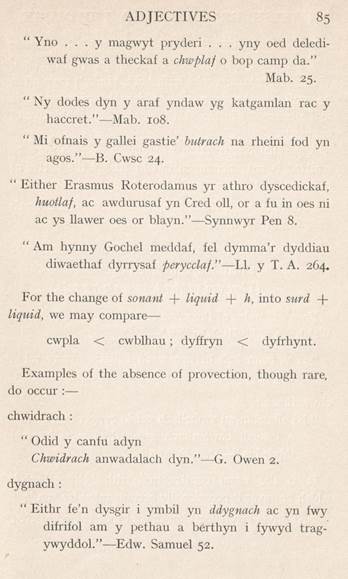
(delwedd L1344) (tudalen 085)
|
ADJECTIVES
85
“Yno . . . y magwyt pryderi . . . yny oed delediwaf gwas a theckaf a chw,$la/
o bop camp da."
Mab. 25.
“Ny dodes dyn y araf yndaw yg katgamlan rac y
108.
“Mi ofnais y gallei gastie' bulrach na rheini fod yn
agos." — B. Cwsc 24.
“Either Erasmus Roterodamus yr athro dyscedickaf,
huotlaf, ac awdurusaf yn Cred 011, or a fu in oes ni
ac ys llawer oes or Pen 8.
“Am hynny Gochel meddaf, fel dymma'r dyddiau
diwaethaf dyrrysaf y T. A. 264.
For the change of sonant + liquid -F h, into surd +
liquid, we may compare —
cwpla < cwblhau; dyffryn < dyfrhynt.
Examples of the absence of provection, though rare,
do occur
chwidrach:
“Odid y canfu adyn
Chwidrach anwadalach dyn." — G. Owen 2.
dygnach •
“Eithr fe'n dysgir i ymbil yn ddygnach ac yn fwy
difrifol am y pethau a berthyn i fywyd tragywyddol." — Edw. Samuel 52.
|
|
|
|
|
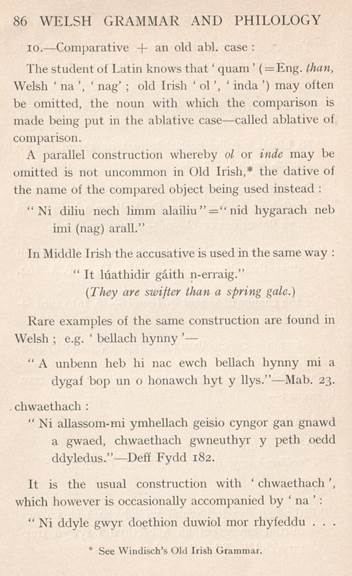
(delwedd L1345) (tudalen 086)
|
86 WELSH GRAMMAR AND PHILOLOGY
mo. — Comparative 4- an old abl. case:
The student of Latin knows that ' quam ' (=Eng. than,
Welsh ' na’, ‘nag'; old Irish ' 01’, ‘inda ') may often
be omitted, the noun with which the comparison is
made being put in the ablative case — called ablative of
comparrson.
A parallel construction whereby 01 or inde may be
omitted is not uncommon in ()ld the dative of
the name of the compared object being used instead:
“Ni diliu nech limm alailiu hygarach neb
imi (nag) arall."
In Middle Irish the accusative is used in the same way:
“It låathidir gåith p-erraig."
(They are swifter than a spring gale.)
Rare examples of the same construction are found in
Welsh; e.g. ' bellach hynny ' —
“A unbenn heb hi nac ewch bellach hynny mi a
dygaf bop un o honawch hyt y 23.
. chwaethacli:
“Ni allassom-mi ymhellach geisio cyngor gan gnawd
a gwaed, chwaethach gwneuthyr y peth oedd
Fycld 182.
It is the usual construction with ' chwaethach ' ,
which however is occasionally accompanied by ' na '
“Ni ddyle gwyr doethion duwiol mor rhyfeddu .
• See Windisch's Old Irish Grammar.
|
|
|
|
|
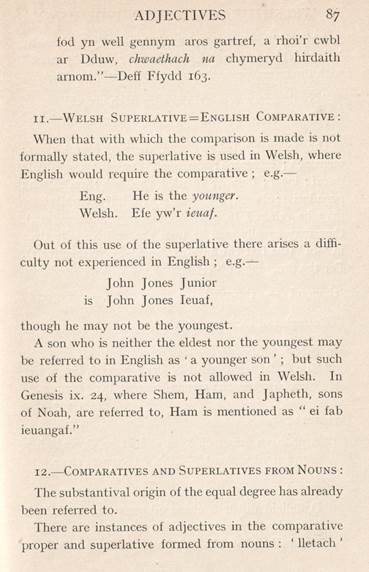
(delwedd L1346) (tudalen 087)
|
ADJECTIVES
87
fod yn well gennym aros gartref, a rhoi'r cwbl
ar Dduw, chwaethach na chymeryd hirdaith
arnom." — Deff Ffydd 163.
ll. — WELSH SUPERLATIVE — ENGLISH COMPARATIVE:
When that with which the comparison is made is not
formally stated, the superlative is used in Welsh, where
English would require the comparative; e.g. —
Eng. He is the younger.
Welsh. Efe yw'r ieua/.
Out of this use of the superlative there arises a difflculty not experienced
in English; e.g.=
John Jones Junior
is John Jones leuaf,
though he may not be the youngest.
A son who is neither the eldest nor the youngest may
be referred to in English as ' a younger son '; but such
use of the comparative is not allowed in Welsh. In
Genesis ix. 24, where Shem, Ham, and Japheth, sons
of Noah, are referred to, Ham is mentioned as ei fab
ieuangaf."
12. — COMPARATIVES AND SUPERLATIVES FROM NOUNS:
The substantival origin of the equal degree has already
been referred to.
There are instances of adjectives in the comparative
proper and superlative formed from nouns: ' Iletach '
|
|
|
|
|
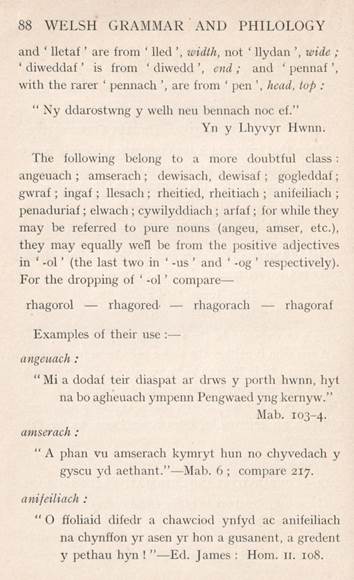
(delwedd L1347) (tudalen 088)
|
88 WELSH GRAMMAR AND PHILOLOGY
and ' Iletaf ' are from ' Iled’, width, not ' llydan’, wide;
diweddaf' is from ' diwedd’, end; and ' pennaf’,
with the rarer ' pennach’, are from ' pen head, top:
“Ny ddarostwng y welh neu bennach noc Cf."
V n y Lhyvyr Hwnn.
The following belong to a more doubtful class:
angeuach; amserach; dewisach, dewisaf; gogleddaf;
gwraf; ingaf; Ilesach; rheitied, rheitiach; aniieiliach;
penaduriaf; elwach; cywilyddiach; arfaf; for while they
may be referred to pure nouns (angeu, amser, etc.),
they may equally wen be from the positive adjectives
in ' -01 ' (the last two in ' -us ' and ' -og ' respectively).
For the dropping of ' -01 ' compare —
rhagorol
rhagored.
rhagorach
Examples of their use: —
angeuach:
rhagoraf
“Mi a dodaf teir diaspat ar drws y porth hwnn, hyt
na bo agheuach ympenn Pengwaed yng kernyw."
Mab. 103 — 4.
amserach:
“A phan vu amserach kymryt hun no chyvedach y
gyscu yd 6; compare 217.
ani/eiliach:
O ffoliaid difedr a chawciod ynfyd ac anifeiliach
na chynffon yr asen yr hon a gusanent, a gredent
y pethau hyn ! " — Ed. James: Hom. 11. 108.
|
|
|
|
|
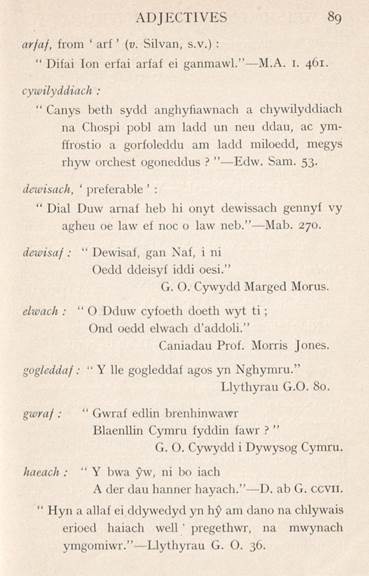
(delwedd L1348) (tudalen 089)
|
ADJECTIVES
ar/a/, from ' arf' (v. Silvan, s.v.):
89
“Difai Ion erfai arfaf ei ganmawl." — M.A. 1. 461.
cywilyddiach:
Canys beth sydd anghyiiawnach a chywilyddiach
na Chospi pobl am ladd un neu ddau, ac ymffrostio a gorfoleddu am ladd
miloedd, megyS
rhyw orchest ogoneddus ? " — Edw. Sam. 53.
dewisach, ‘preferable ':
“Dial I)uw arnaf heb hi onyt dewissach gennyf vy
agheu oe law ef noc o law neb." — Mab. 270.
dewisa/: “Dewisaf, gan Nat, i ni
Oedd ddeisyf iddi oesi."
G. O. Cywydd Marged Morus.
elwach
: “O Dduw cyfoeth doeth wyt ti;
Ond oedd elwach d'addoli."
Caniadau Prof. Morris Jones.
“Y Ile gogleddaf agos yn Nghymru."
Llythyrau G.O. 80.
gwra/:
“Gwraf edlin brenhinwawr
Blaenllin Cymru iyddin fawr ? "
G. O. Cywydd i Dywysog Cymru.
haeach:
“Y bwa ni bo iach
A der dau hanner ab G. ccvll.
‘Hyn a allaf ei ddywedyd yn IIS' am dano na chlywais
erioed haiach well • pregethwr, na rnwynach
G. O. 36.
|
|
|
|
|
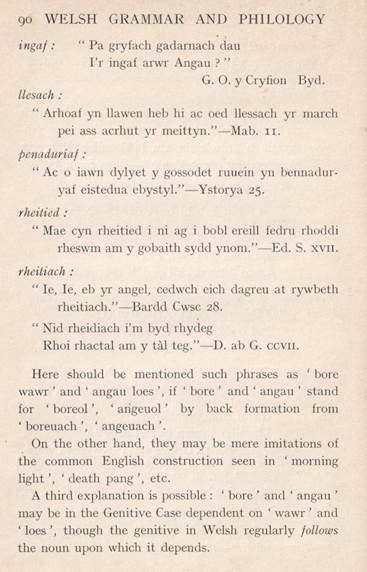
(delwedd L1349) (tudalen 090)
|
90 WELSH GRAMMAR AND PHILOLOGY
inga/:
“Pa gryfach gadarnach dau
I'r ingaf arwr Angau ? "
G. O. y Cryfion Byd.
Ilesach:
“Arhoaf yn llawen heb hi ac oed Ilessach yr march
pei ass acrhut yr meittyn." — Mab. 11.
Penaduria/:
“Ac 0 iawn dylyet y gossodet ruuein yn bennaduryaf eistedua ebystyl." — Ystorya
25.
rheitied:
“Mae cyn rheitied i ni ag i bobl ereill fedru rhoddi
rheswm am y gobaith sydd ynom." — Ed. S. XVII.
rheiliach:
“le, le, eb yr angel, cedwch eich dagreu at rywbeth
rheitiach." — Bardd Cwsc 28.
“Nid rheidiach i'rn byd rhydeg
Rhoi rhactal am y tål teg." — D. ab G. cc„V11.
Here should be mentioned such phrases as ' bore
wawr ' and angau loes’, if ' bore' and ' angau ' stand
for ' boreol ' arigeuol ' by back formation from
‘boreuach’, ‘angeuach '
On the other hand, they may be mere imitations of
the common English construction seen in ' morning
light’, ‘death pang etc.
A third explanation is possible: ' bore ' and ' angau
may be in the Genitive Case deliendent on ' wawr ' and
‘loes’, though the genitive in Welsh regularly follows
the noun upon which it depends.
|
|
|
|
|
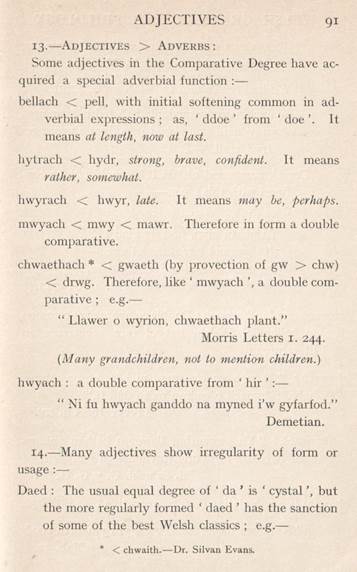
(delwedd L1350) (tudalen 091)
|
ADJECTIVES
13. — ADJECTIVES > ADVERBS:
91
Some adjectives in the Comparative Degree have acquired a special adverbial
function:
bellach < pell, with initial softening common in adverbial expressions; as,
‘ddoe ' from ' doe It
means al length, now at last.
hytrach < hydr, strong, brave, confident. It means
rather, somewhat.
hwyrach < hwyr, late. It means may be, Perhaps.
rnwyach < mwy < mawr. Therefore in form a double
comparative.
chwaethach * < gwaeth (by provection of gw > chw)
< drwg. Therefore, like ' mwyach’, a double comparative; e.g. —
‘Llawer o wyrion, chwaethach plant."
Morris Letters 1. 244.
(Many grandchildren, not to mention children.)
hwyach: a double comparative from ' hir ':
“Ni fu hwyach ganddo na myned i'w gyfarfod."
Demetian.
14. — Many adjectives show irregularity of form or
usage
Daed: The usual equal degree of ' da is ' cystal’, but
the more regularly formed ' daed ' has the sanction
of some of the best Welsh classics; e.g. —
< chwaith. — Dr. Silvan Evans.
|
|
|
|
|
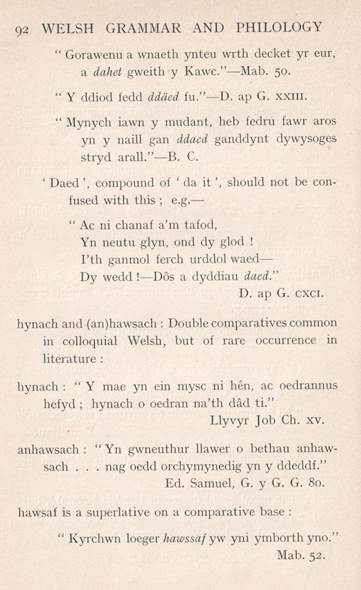
(delwedd L1351) (tudalen 092)
|
92
WELSH GRAMMAR AND PHILOLOGY
“Gorawenu a wnaeth ynteu wrth decket yr eur,
a dahet gweith •y 50.
Y ddiod fedd ddüed ap G. XXIII.
“Mynych iawn y mudant, heb fedru fawr aros
yn y naill gan ddaed ganddynt dywysoges
stryd arall." — B. C.
‘Daed’, compound of ' da it’, should not be confused with this; e.g. —
“Ac ni chanaf a'm tafod,
Yn neutu glyn, Ond dy glod !
I'th ganmol ferch urddol waed —
Dy wedd ! — Dös a dyddiau daed."
D. ap G. c,XC1.
hynach and (an)hawsach: Double comparatives common
in colloquial Welsh, but of rare occurrence in
literature:
hynach: “Y mae yn ein mysc ni hén, ac oedrannus
hefyd;
anhawsach
sach .
hynach o oedran na'th dåd ti."
Llyvyr Job Ch. xv.
: “Y n gwneuthur llawer o bethau anhaw. . nag oedd orchymynedig yn y
ddeddf."
Ed. Samuel, G. y G. G. 80.
hawsaf is a superlative on a comparative base:
“Kyrchwn loeger hawssa/yw yni ymborth yno."
Mab. 52.
|
|
|
|
|
(delwedd L1352) (tudalen 093)
|
ADJECTIVES
93
“Na wn i heb yr owein namyn y gyueir y mynnych ac y bo hawssa/ gennyt
dos." — Mab. 293.
hawsed, like ' gnvaethed’, has its ' -ed ' added to the
comparative form: — anhawsset. Mab. 282.
Cymaint and Cynifer: Strictly speaking ' cymaint '
should refer to quantity, while ' cynifer' denotes
number. Still, ‘cymaint ' by looseness of construction is sometimes used as
the comparative of
‘llawer ' (many); e.g. —
“Y rhai a hynododd Duw drwy gymmaint o
wyrthiau." — Deff Ffydd.
And frequently in D. y P.O.
llawer: The superlative is the substantival phrase,
y rhan fwyaf ' , or the prepositional phrase, ‘gan
rnwyaf;
e.g. —
“A gadu y pyscawt yn noeth a meirw vyd eu
kan 241.
uwch: ' w ' is excrescent, and is due to the glide of the
tongue in passing from the ' u ' to the ' ch ' position. Compare media•val '
awch’, a doublet of
‘ych’, your, and the ' u ' before ' gh ' in English
‘bought’,
‘thought’,
etc u The ' w' generally
disappears when another syllable is added; e.g. —
buwch
lluwch
buchod
lluchio
Hence ' uched ' is better than ' uwched’, and
‘uchaf ' than ' uwchaf '.
W ' was very rare even
|
|
|
|
|
(delwedd L1353) (tudalen 094)
|
94 WELSH GRAMMAR AND PHILOLOGY
in the comparative of this word in mediæval
literature, the regular form being ' uch '; e.g. —
‘Uch penn y 216.
“Ac uch oed y diaspat noc a oed o dyn a chorn
yn y llu." — Mab. 175•
“gwyd gogyfuch " = trees of equal height.
Mab. 163.
Note that the form ' ogyfuuch ' occurs in —
“Acyn dyvot yn ogyfuuch ar 8.
iawn in Mediæval Welsh is fully compared: —
iawnach: “A iawnach yw kerdet velly."
Mab. 236.
iawnetc " Pei gwyput ti iawnct itt chware ac
eisted y gyt ar gwr hwnnw nyt eistedut ac
ny 235.
“lawnaf y gwnaf i heb yr Arthur,
iawnaf:
mynet y hela ef auory yn ieuenctit y dyd."
Mab. 245.
15. — The following are no longer in common use: —
hydyr: “A phann welei y iarll ae niver marchawc y
llamhystaen yn hydyr." — Mab. 254.
And its superlative —
‘A phan vei hyttraf gereint y llahyttraf (hytraf):
wenhaei y gwr gwynllwyt ae wreic ae
255.
|
|
|
|
|
(delwedd L1354) (tudalen 095)
|
ADJECTIVES
95
newyddach: “Ac ny bu newydach gantunt y dyvodyat
no chynt." — Mab. 6.
ambellach, comparative of ' ambell ':
“Ac na fychanom neb am fod ei ddoniau ef yn
ambellach na'n doniau ni."
Edw. James, Hom. 111, 139.
lléd, as comparative of ' llydan '
“[mae] ei fesur ef yn hwy na'r ddaiar: ac yn
lléd na'r mör." — Llyfr. Job. ch. XI.
Lledled rydau, waethwaeth ddeddfau."
Ll. y T. A. 184.
16. — THE SYNTHETIC AND THE ANALYTIC METHODS
OF COMPARISON . — The growing use of the analytic
method of denoting comparison is very noticeable in
modern writings.
In Mediæval Welsh cyn + Equal degree was the all
but invariable method of expressing that degree in construction; e.g.
“Ac wynt yn un vam un dat, ac yn un dylyet, ac yn
gyn dewret, ac yn gyndecket, ac yn gynhaelet."
Bruts. 72.
“A dpvedut pa wed y gellit dwyn mein kymeint ar
rei hynny 0 le kynbellet a 167.
Mor + positive was extremely rare, except in an
exclamatory sense, = how very. The following is an
example from the Mabinogion: —
|
|
|
|
|
(delwedd L1355) (tudalen 096)
|
96 WELSH GRAMMAR AND PHILOLOGY
“A gwledychu o honaw yno mor lwydyannus a dwyn
y dwy deyrnas yn un drwy y dewred ef ae vilwryaeth y diffyg»vys y enw ef ar
pwyll penndeuic
In sixteenth, seventeenth, and eighteenth century
writings this construction gained ground, though most
writers felt it to be the exception,* and even to-day
the more idiomatic cyn + Equal degree has the better
literary sanction.
Again, ‘mwy' and ' mwyaf' with the positive to
express the comparative and superlative respectively
is a characteristic of Modern Welsh. It was practically unknown up to the
middle of the fourteenth
century.
The gradual adoption of ' mor ' ,
‘mwy’, and ' mwyaf’, with adjectives is due to two influences: —
(1) The tendency ('f all modern languages to become
analytic.
(2) The influence of
(a) French aussi .
and English as . . .
. . que
which helped on the use of ' mor ' in Welsh;
(b) French Plus le Plus
and English more
most
and
which secured the introduction of mwy ' and mwyaf '
into the corresponding constructions in Welsh.
• Mor + positive is not uncommon in Def. Ffydd."
|
|
|
|
|
(delwedd L1356) (tudalen 097)
|
ADJECTIVES
97
That English played an important part in this development is evident. The use
of more and most with the
positive was due to French influence, and they therefore
appear later in this röle than as . . .
as. So in Welsh,
while mor*- positive had gained early currency, ‘mwy '
and ' mwyaf ' do not appear until after ' more ' and
‘most ' came to be similarly used in English.
|
|
|
|
|
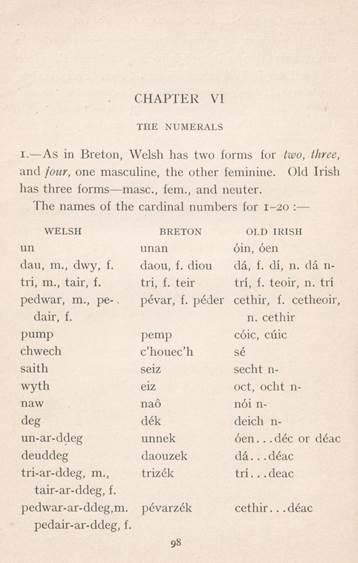
(delwedd L1357) (tudalen 098)
|
CHAPTER VI
THE NUMERALS
1. — As in Breton, Welsh has two forms for two, three,
and four, one masculine, the other feminine. ()ld Irish
has three forms — masc., fem., and neuter.
The names of the cardinal numbers for 1 — 20:
WELSH
dau, m., dwy, f.
tri, m.,tair, f.
war, m.,pedair, f.
pump
ch wech
saith
wyth
naw
deg
un-ar-d0eg
deuddeg
tri-ar-ddeg, m.,
tair-ar-ddeg, f.
pedwar-ar-ddeg,m.
pedair-ar-ddeg, f.
|
|
|
|
|
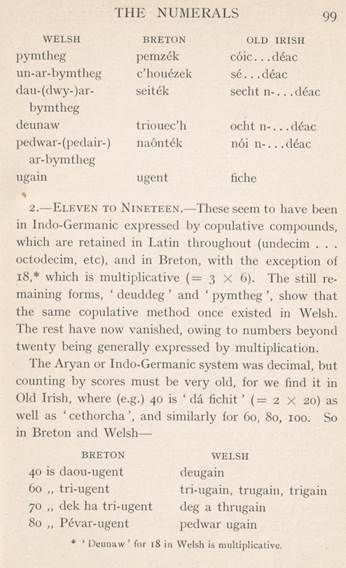
(delwedd L1358) (tudalen 099)
|
BRETON
unan
daou, f. diou
tri, f. teir
pévar, f. péder
pemp
c'houec'h
sew,
nab
dék
unnek
daouzek
trizék
pévarzék
OLD IRISH
bin, oen
då, f. di, n. clå ntri, f. teoir, n. tri
cethir, f. cetheoir,
n. cethir
c6ic, cfiic
sé
secht noct, ocht nn6i ndeich ndéc or déac
då... déac
tri... deac
cethir.. .déac
THE NUMERALS
WELSH
pymtheg
un-ar-bymtheg
dau- (dwy-)arsecht déac
bymtheg
deunaw
ocht n-... déac
pedwar-(pedair-)
n6i n- .. .deac
ar- bymtheg
ugam
99
BRETON
pemzék
c 'houézek
seiték
triouec'h
naönték
ugent
OLD IRISH
cÖic.. .déac
sé.. .déac
fiche
2. — ELEVEN TO NINETEEN. — These seem to have been
in Indo-Germanic expressed by copulative compounds,
which are retained in Latin throughout (undecim . . .
octodecim, etc), and in Breton, with the exception of
which is multiplicative 3 X 6). The still remaining forms, ‘deuddeg ' and '
pymtheg’, show that
the same copulative method once existed in Welsh.
The rest have now vanished, owing to numbers beyond
twenty being generally expressed by multiplication.
The Aryan or Indo-Germanic system was decimal, but
counting by scores must be very old, for we find it in
Old Irish, where (e.g.) 40 is ' då fichit ' ( = 2 X 20) as
well as ' cethorcha’, and similarly for 60, 80, 100. So
in Breton and Welsh —
BRETON
40 is daou-ugent
60 tri-ugent
70 „ dek ha tri-ugent
80 „ Pévar-ugent
WELSH
deugain
tri-ugain, trugain, trigain
deg a thrugain
pedwar ugain
• Deunaw for IS in Welsh is multiplicative.
|
|
|
|
|
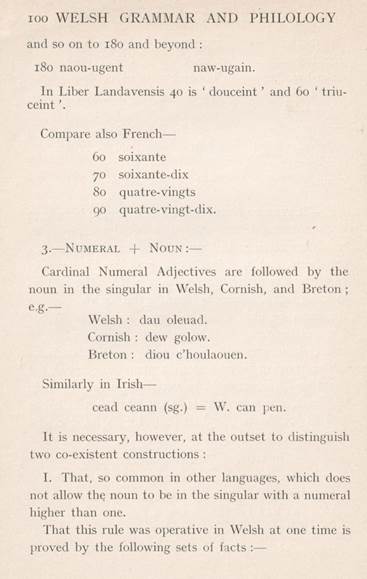
(delwedd L1359) (tudalen 100)
|
100 WELSH GRAMMAR AND PHILOLOGY
and so on to ISO and beyond:
180 naou-ugent
naw-ugam.
In Liber Landavensis 40 is ' douceint
ceint
Compare also French —
60 soixante
70 soixante-dix
80 quatre-vingts
90 quatre-vingt-dix.
3. — NUMERAL + Noux:
‘and 60 ' trlu
Cardinal Numeral Adjectives are followed by the
noun in the singular in Welsh, Cornish, and Breton;
Welsh: dau oleuad.
Cornish: dew golow.
Breton: diou c'houlaouen.
Similarly in Irish —
cead ceann (sg.) =
W. can pen.
It is necessary, however, at the outset to distinguish
two co-existent constructions:
I. That, so common in other languages, which does
not allow the noun to be in the singular with a numeral
higher than one.
That this rule was operative in Welsh at one time is
proved by the following sets of facts: —
|
|
|
|
|
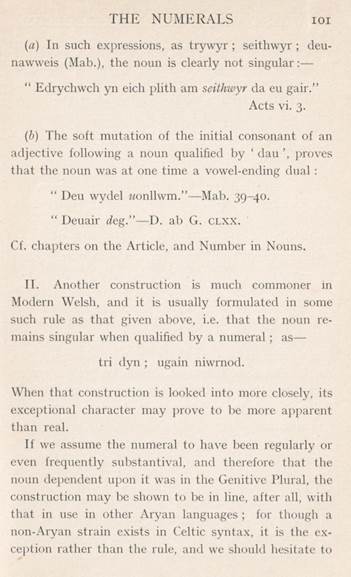
(delwedd L1360) (tudalen 101)
|
THE NUMERALS
101
(a) In such expressions, as trywyr; seithwyr; deunawweis (Mab.), the noun is
clearly not singular: —
Edrychwch yn eich plith am seithwyr da eu gair."
Acts vi. 3•
(b) The soft mutation of the initial consonant of an
adjective following a noun qualified by ' dau proves
that the noun was at one time a vowel-ending dual:
“Deu wydel 39 — 40.
“Deuair deg." — D. ab G. CLXX.
Cf. chapters on the Article, and Number in Nouns.
Il. Another construction is much commoner in
Modern Welsh, and it is usually formulated in some
such rule as that given above, i.e. that the noun remains singular when
qualified by a numeral; as —
tri dyn; ugain niwrnod.
When that construction is looked into more closely, its
exceptional character may prove to be more apparent
than real.
If we assume the numeral to have been regularly or
even frequently substantival, and therefore that the
noun dependent upon it was in the Genitive Plural, the
construction may be shown to be in line, after all, with
that in use in other Aryan languages; for though a
non-Aryan strain e.xists in Celtic syntax, it is the exception rather than
the rule, and we should hesitate to
|
|
|
|
|
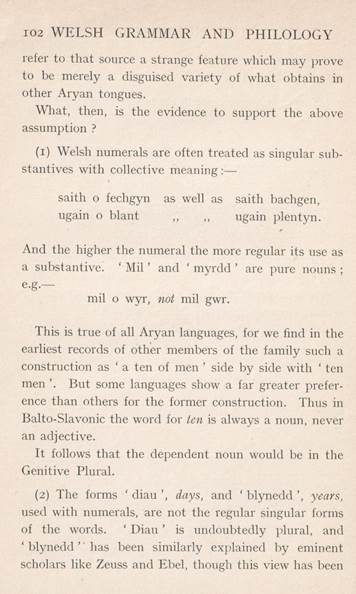
(delwedd L1361) (tudalen 102)
|
102 WELSH GRAMMAR AND PHILOLOGY
refer to that source a strange feature which may prove
to be merely a disguised variety of what obtains in
other Aryan tongues.
VSTat, then, is the evidence to support the above
assumption ?
(1) Welsh numerals are often treated as singular substantives with collective
meaning
saith o fechgyn as well as saith bachgen,
ugain o blant
ugain plentyn.
And the higher the numeral the more regular its use as
a substantive. ' Mil ' and ' myrdd' are pure nouns;
e.g. —
mil o wyr, not mil gwr.
This is true of all Aryan languages, for we find in the
earliest records of other members of the family such a
construction as ' a ten of men ' side by side with ' ten
men But some languages show a far greater preference than others for the
former construction. Thus in
Balto-Slavonic the word for ten is always a noun. never
an adjective.
It follows that the dependent noun would be in the
Genitive Plural.
(2) The forms diau’, days, and ' blynedcl years,
used with numerals, are not the regular singular forms
of the words. ' Dian '
is undoubtedly plural, and
‘blynedd 'L has been similarly explained by eminent
scholars like Zeuss and Ebel, though this view has been
|
|
|
|
|
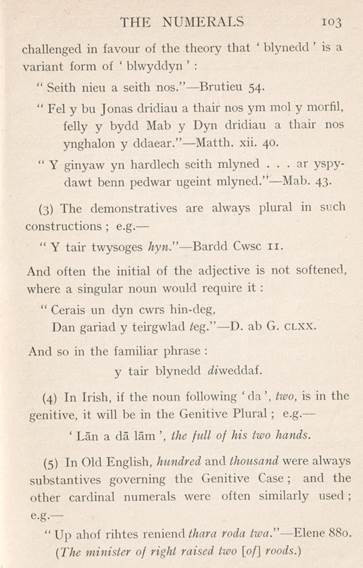
(delwedd L1362) (tudalen 103)
|
THE NUMERALS
103
challenged in favour of the theory that ' blynedd ' is a
variant form of ' blwyddyn '
Seith nieu a seith nos." — Brutieu 54.
Fel y bu Jonas dridiau a thair nos ym mol y morfil,
felly y bydd Mab y Dyn dridiau a thair nos
ynghalon y xii. 40.
‘Y ginyaw yn hardlech seith mlyned .
. ar yspydawt benn pedwar ugeint mlyned." — Mab. 43.
(3) The demonstratives are always plural in such
constructions; e.g. —
“Y tair twysoges hyn." — Bardd Cwsc 11.
And often the initial of the adjective is not softened,
where a singular noun would require it:
“Cerais un dyn cwrs hill-deg.
Dan gariad y teirgwlad teg." — D. ab G. CLXX.
And so in the familiar phrase:
y tair blynedd diweddaf.
(4) In Irish, if the noun following ' du’, two, is in the
genitive, it will be in the Genitive Plural; e.g. —
‘IÄn a dä läm ' , the full o/ his two hands.
(5) In Old English, hundred and thousand were always
substantives governing the Genitive Case; and the
other cardinal numerals were often similarly used;
e.g. —
“Up ahof rihtes reniend Ihara roda twa." — Elene 880.
(The minister of right raised two [0/1 roods.)
|
|
|
|
|
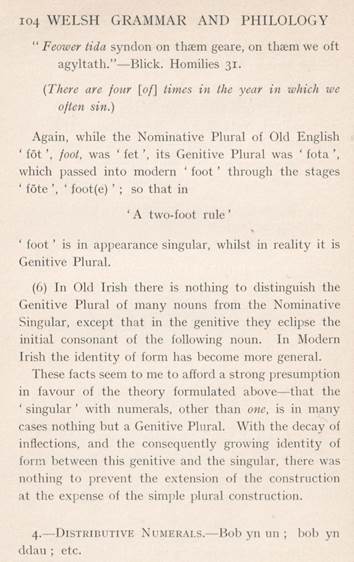
(delwedd L1363) (tudalen 104)
|
104 WELSH GRAMMAR AND PHILOLOGY
“Feower tida syndon on thærn geare, on thæm we oft
agyltath." — Blick. Homilies 31.
(There are four [of] times in the year in which we
often sin.)
Again, while the Nominative Plural of Old English
‘föt’, foot, was ' fet’, its Genitive Plural was ' fota’,
which passed into modern ' foot ' through the stages
‘föte’, ‘foot(e) '; so that in
‘A two-foot rule '
foot is in appearance singular, whilst in reality it is
Genitive Plural.
(6) In Old Irish there is nothing to distinguish the
Genitive Plural of many nouns from the Nominative
Singular, except that in the genitive they eclipse the
initial consonant Of the following noun. In Modern
Irish the identity of form has become more general.
These facts seem to me to afford a strong presumption
in favour Of the theory formulated above — that the
singular ' with numerals, other than one, is in many
cases nothing but a Genitive Plural. \Vith the decay of
inflections, and the consequently growing identity of
form between this genitive and the singular, there was
nothing to prevent the extension of the constructi•yn
at the expense of the siml)le plural construction.
NUMERA1.s. — Bob yn un; bob yn
cl(lau; etc.
|
|
|
|
|
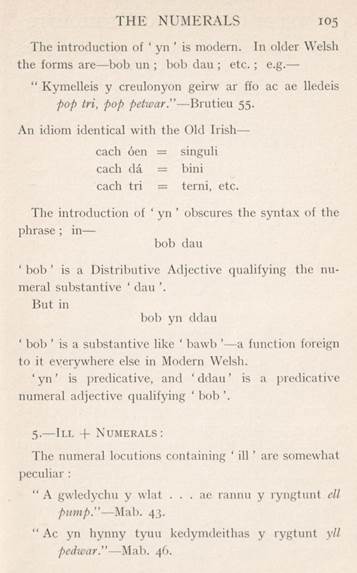
(delwedd L1364) (tudalen 105)
|
THE NUMERALS
105
The introduction of ' yn ' is modern. In older Welsh
the forms are — bob un; bob dau; etc.; e g
“Kyrnelleis y creulonyon geirw ar ffo ac ae Iledeis
pop tri, pop 55.
An idiom identical with the Old Irish —
cach ben
cach då
cach tri
singuli
bini
terni, etc.
The introduction of ' yn ' obscures the syntax of the
phrase; in —
bob dau
‘bob' is a Distributive Adjective qualifying the numeral substantive ' dau '.
But in
bob yn (Idau
‘bob ' is a substantive like ' bawb ' — a function foreign
to it everywhere else in Modern Welsh.
yn' is predicative, and ' ddau' is a predicative
numeral adjective qualifying ' bob '.
+ NUMERALS:
The numeral locutions containing ' ill ' are somewhat
peculiar:
“A gwledychu y "'lat .
Pump."
Mab. 43.
. ae rannu y ryngtunt ell
“Ac yn hynny tyuu kedymdeithas y rygtunt yll
pedwar
46.
|
|
|
|
|
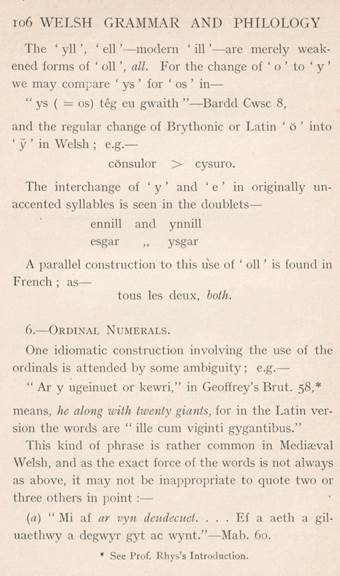
(delwedd L1365) (tudalen 106)
|
106 WELSH GRAMMAR AND PHILOLOGY
The 'yll
‘ell ' — modern ' ill ' — are merely weakened forms of ' 011’, all. For the
change of ' o ' to ' y '
we may compare ' ys ' for ' os ' in —
‘ys ( = os) tég eu gwaith " — Bardd Cwsc 8,
and the regular change of Brythonic or Latin ' ' into
‘' in Welsh; e.g. —
cönsulor > cysuro.
The interchange of ' y ' and ' e ' in originally unaccented syllables is seen
in the doublets —
ennill and ynnill
esgar
ysgar
A parallel construction to this rise of ' 011 ' is found in
French; as —
tous les deux, both.
6. — ORDINA1. NUMERALS.
One idiomatic construction involving the use of the
ordinals is attended by some ambiguity; e.g. —
“Ar y ugeinuet or kewri," in Geoffrey's Brut. 58,*
means, he along with twenly giants, for in the Latin version the words are
" ille cum viginti gygantibus."
This kind of phrase is rather common in Mediæval
Welsh, and as the exact force of the worcls is not always
as above, it may not be to quote two or
three others in pt)int:
(a) " Mi af ar vyn deudecuct. .
uaethwy a degwyr gyt ac wynt —
. Ef a aeth a gilMab. 60.
• See Prof. Rhys's Introduction.
|
|
|
|
|
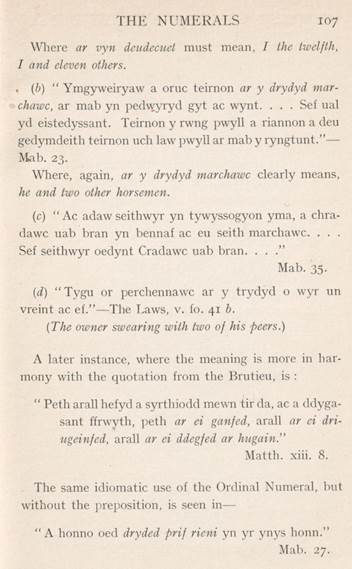
(delwedd L1366) (tudalen 107)
|
THE NUMERALS
107
Where ar vyn deudccuet must mean, I the twelfth,
I and eleven others.
(b) " Ymgyweiryaw a oruc teirnon ar y drydyd mar. Sef ual
- chawc, ar mab yn pedsyyryd gyt ac wynt. .
yd eistedyssant. Teirnon y rwng pwyll a riannon a deu
gedymdeith teirnon uch law pwyll ar mab y ryngtunt." —
Mab. 23.
Where, again, ar y drydyd marchawc clearly means,
he and two other horsemen.
(c) " Ac adaw seithwyr yn tywyssogyon yma, a chradawc uab bran yn bennaf
ac eu seith marchawc. . .
Sef seithwyr oedynt Cradawc uab bran. . . ."
Mab. 35.
(d) " Tygu or perchennawc ar y trydyd o wyr un
vreint ac ef." — The I — aws, v. fo. 41 b.
(The owner swearing with two o/ his peers.)
A later instance, where the meaning is more in barmony with the quotation
from the Brutieu, is:
“Peth arall hefyd a syrthiodd mewn tir da, ac a ddygasant ffrwyth, peth ar ei
ganged, arall ar ei driugein/ed, arall ar ei ddegfrd ar hugain."
Matth. xiii. 8.
The same idiomatic use of the Ordinal Numeral, but
without the preposition, is seen in —
“A honno oed dryded prif rieni yn yr ynys honn."
Mab. 27.
|
|
|
|
|
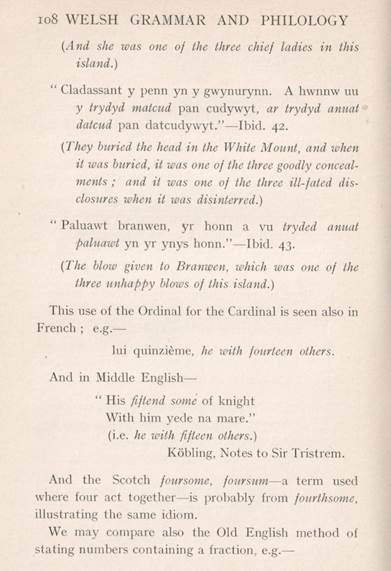
(delwedd L1367) (tudalen 108)
|
108 WELSH GRAMMAR AND PHILOLOGY
(And she was one o/ the three Chie/ ladies in this
island.)
“Cladassant y penn yn y gwynurynn. A hwnnw uu
y trydyd matcud pan cudywyt, ar trydyd anuat datcud pan datcudywyt." — lbid.
42.
(They buried the head in the JVhitc Mount, and when
it was buried, it was one o/ the' three goodly concealments; and it was one
o/ the three ill-fated disclosures when it was disinterred.)
Paluawt branwen, yr honn a vu tryded annat
Paluawt yn yr ynys honn."
Ibid. 43.
(The blow given to Branwcn, which was onc o/ the
three unhappy blows o/ this island.)
This use of the Ordinal for the Cardinal is seen also in
French; e.g. —
lui quinziöme, he with fourteen others.
And in Middle English —
“His ,f/tcnd some: of knight
With him yede na mare."
(i.e. he with fifteen others.)
Köbling, Notes to Sir Tristrem.
And the Scotch foursome. /oursum — a term used
where four act together — is probably from fourthsomc,
illustrating the same idiom.
We may cornpare also the Old English method of
stating nutnbers containing a fraction, e.g. —
|
|
|
|
|
(delwedd L1368) (tudalen 109)
|
THE NUMERALS
109
'Other healf,' (so German, ‘andert-halb one and a
half; lit. the second a hall.
‘Fifte healf hund, four hundred and /i/ty; lit. the fifth
a hql/-hundred.
Compare also Latin ' sestertius’, a contraction of
‘semis tertius ' lit. the third a half; hence two and a
half.
We noticed above that, though the ar-phrase usually
comprises the previously named individual or object,
in one or two examples it is additive. A similar uncertainty existed in the
use of ' sum’, some, with
numerals in Old English; e.g. in Orosius CCII. 16 —
feowera Sum = with four others;
while in Beowulf 3124
eahta sum = with seven others, i.e. himself the eighth.
|
|
|
|
|
(delwedd L1369) (tudalen 110)
|
CHAPTER Vll
PERSONAL PRONOUNS
A. SIMPLE OR NORMAL PERSONAL PRONOUNS.
(1) Mediæval: —
r.
2.
Sing.
mi. vi.
ti, di
ef, efo
hi,' hy
Plural
m, ny
chwi
fwy. hwy
(v,ynt, hwynt
rst Singular. — ln English, Latin, and some other
Aryan languages two entirely different stems have to
be distinguished: English I (Old Eng. ic) and Latin
ego are different from English me, Latin me. The
strictly Nominative form has disappeared from Welsh,
the other stem now doing duty for the Nominative as
well as for oblique cases. So in Old Irish ' mé ' ktands
for ' I ' and ' me '. French, too, has gone a long way
in the direction of obliterating the distinction between
the functions of the two stems, in that ' moi ' often
stands for the Nominative:
Welsh, myrt yw ( English, It is I) = French, C'est moi.
The same tendency is observable in the English
vulgarism It is me’, but this is not sanctioned by
literary usage.
1 10
|
|
|
|
|
(delwedd L1370) (tudalen 111)
|
(tudalen 1 10)
PERSONAL PRONOUNS
Examples of mi, vi, i: —
111
Ac wrtll hynny tra vu vygkyvoeth i yn gallu rodi
rodyon pawl) am karei. Ac nyt mi a gerynt
namyn vy rodyon am devodeu am donyeu."
Bruts. 67.
“Och vi a dwyweu nef a dayar pa bryt y daw yr
amser y gallwyf y talu clchwyl yny gwrthwyneb
yr gwyr hynn." — Bruts. 67.
Where the pronoun is affixed as an auxiliary for explanation or emphasis of
an already expressed Possessive
or Personal Pronoun, the form is always ' i ' or ' vi '
(Mod. ' fi '), never ' mi Of these, ‘i ' is the usual form
except when following a verb or pronominal preposition
in ' -f
e.g. —
“Cymerais i; adwaen i; fy mhlant i;
Ti a'm gwiscaist i." — Llyfr Job. x.
But some writers freely use the fuller form " fi," even
in this connection; e.g. in Bishop Morgan's Bible —
“Efe a'm barn /i yn Job. IN.
“Ti a'm cyssylltaist fi ag x.
Similarly the fuller auxiliary form fi ' is often used
colloquially in Gwynedd; e.g. —
dyma fy Ile fi.
After the first person of a verb in
‘- i' or of a pronominal preposition, " fi " (older ' vi ') and
" i " are used
indifferently:
|
|
|
|
|
(delwedd L1371) (tudalen 112)
|
(tudalen 1 11)
112 WELSH GRAMMAR .AND PHILOLOGY
“Mwy boen yw genyf i yr awr hon goffav uygky67.
“Gweddw hebot ydwyf ft."
J. M. J.'s Caniadau, 18.
Mi is used —
(i) at the beginning of a sentence —
mi a åf
(ii) when governed by ' å ' with its compounds ' gyda’,
2.
‘tua’, ‘parth å’, and after the preposition ' i ' —
“Prydydd wyt medd prophwydi
Cywyddol manol i mi. ab G. cxxx.
Ti, di: At the beginning of a sentence the form is
usually ' ti '
Ti a weli.
Ti I)duw a folwn.
But some writers, like Morgan Llwyd, prefer ' di ' —
“Di dy hunan a ddylit fynnu gwybod."
Llyfr y Tri Ad. 183.
“Di ddywedaist ddigon." — lbid. 181.
After forms in ' -d’, ‘-t’, much freedom is allowed, no
doubt due in part to the fact that in ' cynghanedd '
't ' alliterates with ' d-d’, ‘dt’, ‘td’, and ' tt
Hence ' di ' and ' ti ' are used indifferently, though in
present-day Welsh
ti ' is much commoner than ' di '
in that construction —
|
|
|
|
|
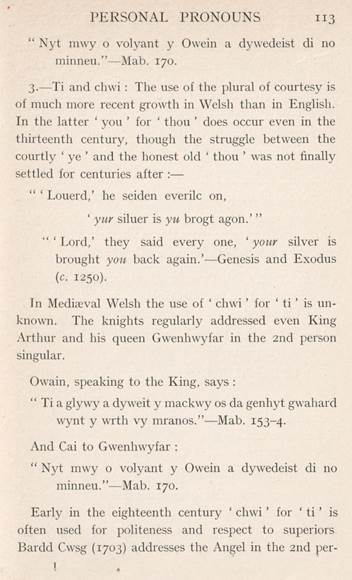
(delwedd L1372) (tudalen 113)
|
(tudalen 1 12)
PERSONAL PRONOUNS
113
“Nyt mwy o volyant y Owein a dywedcist di no
minneu."
Mab. 170.
3. — Ti and chwi: The use of the plural of courtesy is
of much more recent growth in Welsh than in English.
In the latter ' you ' for ' thou ' does occur even in the
thirteenth century, though the struggle between the
courtly ' ye ' and the honest old ' thou ' was not finally
settled for centuries after
‘Louerd,' he seiden everilc on,
‘yur siluer is yu brogt agon.' "
“' Lord,' they said every one, ‘your silver is
brought you back again. ' — Genesis and Exodus
(c. 1250).
In Mediæval Welsh the use of ' chwi ' for ' ti ' is unknown. The knights
regularly addressed even King
Arthur and his queen Gwenhwyfar in the 2nd person
singular.
Owain, speaking to the King, says:
“Ti a glywy a dyweit y mackwy os da genhyt gwahard
wynt y wrth vy mranos." — Mab. 153 — 4.
And Cai to Gwenhwyfar:
“Nyt mwy o volyant y Owein a dywedeist di no
minneu." — Mab. 170.
Early in the eighteenth century ' chwi ' for ' ti ' is
often used for politeness and respect to superiors
Bardd Cwsg (1703) addresses the Angel in the 2nd per
|
|
|
|
|
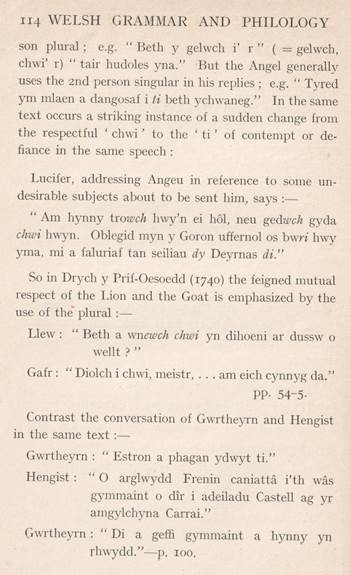
(delwedd L1373) (tudalen 114)
|
(tudalen 1 13)
114 WELSH GRAMMAR AND PHILOLOGY
son plural; e.g. " Beth y gelwch i' r "
( = gelwch,
chwi' r)
“tair hudoles yna." •But the Angel generally
uses the 2nd person singular in his replies; e.g. " Tyred
ym mlaen a dangosaf i li beth ychwaneg."
In the same
text occurs a striking instance of a sudden change from
the respectful ' chwi ' to the ' ti ' of contempt or de.
fiance in the same speech:
Lucifer, addressing Angeu in reference to some undesirable subjects about to
be sent him, says
“Am hynny trowch hwy'n ei höl, neu gedwch gyda
chwi hwyn. Oblegid myn y Goron uffernol os bwri hwy
yma, mi a faluriaf tan seiliau dy Deyrnas di."
So in Drych y (1740) the feigned mutual
respect of the Lion and the Goat is emphasized by the
use of the- plural: —
Llew: “Beth a wnewch chwi yn dihoeni ar dussw o
wellt ? "
Gafr: “Diolch i chwi, meistr
, ... am eich cynnyg (la."
pp. 54 — 5•
Contrast the conversation of Gwrtheyrn and Hengist
in the same text:
Gwrtheyrn: “Estron a phagan ydwyt ti."
Hengist: “O arglwydd Frenin caniattå i'th was
gymrnaint o dir i adeiladu Castell ag yr
amgylchyna Carrai."
Gwrtheyrn: “Di a geffl gymrnaint a hynny yn
rh»'dd. 100.
|
|
|
|
|
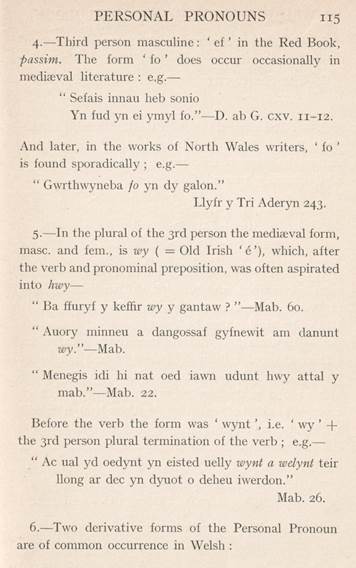
(delwedd L1374) (tudalen 115)
|
(tudalen 1 14)
PERSONAL PRONOUNS
115
4. — Third person masculine: ' ef ' in the Red Book,
Passim. The form ' fo ' does occur occasionally in
mediæval literature: e.g. —
“Sefais innau heb sonio
Yn fud yn ei ymyl fo." — D. ab G. cxv. 11 — 12.
And later, in the works of North Wales writers, ‘fo '
is found sporadically; e.g. —
“Gwrthwyneba fo yn dy galon."
Llyfr y Tri Aderyn 243.
5. — In the plural of the 3rd person the mediæval form,
masc. and fem., is wy ( Old Irish ' é which, after
the verb and pronominal preposition, was often aspirated
into hwy —
“Ba ffuryf y kefhr wy y gantaw ? " — Mab. 60.
“Auory minneu a dangossaf gyfnewit am danunt
“Menegis idi hi nat oed iawn udunt hwy attal y
mab." — Mab. 22.
Before the verb the form was ' wynt’, i.e. ' ' -F
the 3rd person plural termination of the verb; e.g.
“Ac ual yd oedynt yn eisted uelly wynl a welynl teir
Ilong ar dec yn dyuot o deheu iwerdon."
Mab. 26.
6. — Two derivative forms of the Personal Pronoun
are of common occurrence in Welsh:
|
|
|
|
|
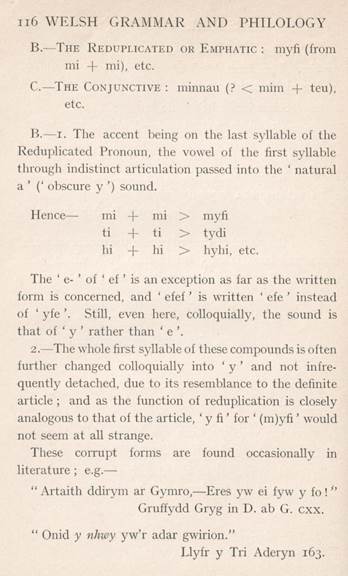
(delwedd L1375) (tudalen 116)
|
(tudalen 1 15)
116 WELSH GRAMMAR AND PHILOLOGY
B.ETIIE REDUPLICATED OR EMPHATIC: myfi (from
mi 4- mi), etc.
C. — THE CONJUNCTIVE: minnau (? < mim + teu),
etc.
IS. — I. The accent being on the last syllable of the
Reduplicated Pronoun, the vowel of the first syllable
through indistinct articulation passed into the ' natural
a ' (' obscure y ') sound.
Hence — mi + mi > myfi
hi -i- hi > hyhi, etc.
The ' e- ' of ' ef ' is an exception as far as the written
form is concerned, and ' efef ' is written ' efe ' instead
of ' yfe '. Still, even here, colloquially, the sound is
that of ' y ' rather than ' e '.
2. — The whole first syllable of these compounds is often
further changed colloquially into ' y ' and not infrequently detached, due to
its resemblance to the definite
article; and as the function of reduplication is closely
analogous to that of the article, ‘y fi ' for ' (m)yfi ' would
not seem at all strange.
These corrupt forms are found occasionally in
literature; e.g. —
“Artaith ddirym ar Gymro, — Eres yw ei fyw y fo! f'
Gruffydd Gryg in I). ab G. cxx.
“Onid y nhwy yw'r adar gwirion."
Llyfr y Tri Aderyn 163.
|
|
|
|
|
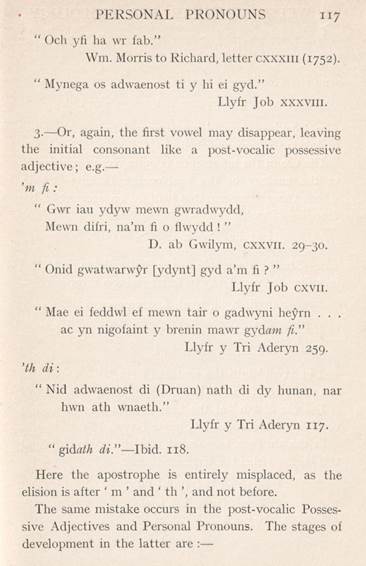
(delwedd L1376) (tudalen 117)
|
(tudalen 1 16)
PERSONAL PRONOUNS
“Och yii ha wr fab."
117
Wm. Morris to Richard, letter CXXXIII (1752).
‘Mynega os adwaenost ti y hi ei gyd."
Llyfr Job xxxvlll.
3. — Or, again, the first vowel may disappear. leaving
the initial consonant like a post-vocalic possessive
adjective; e.g. —
‘Gwr iau ydyw mewn gwradwydd,
Mewn difri, na'm fi o flwydd ! "
D. ab Gwilym, cxxvrr. 29 — 30.
“Onid gwatwarw$r [ydynt] gyd a'm fi ? "
Llyfr Job c,XV11.
“Mae ei feddwl ef mewn tair o gadwyni hegrn
ac yn nigofaint y brenin mawr gydam ft."
Llyfr y Tri Aderyn 259.
“Nid adwaenost di (Druan) nath di dy hunan, nar
hwn ath wnaeth."
Llyfr y Tri Aderyn 117.
“gidath d'
118.
Here the apostrophe is entirely misplaced, as the
elision is after ' m ' and ' th’, and not before.
The same mistake occurs in the post-vocalic Possessive Adjectives and
Personal Pronouns. The stages of
development in the latter are
|
|
|
|
|
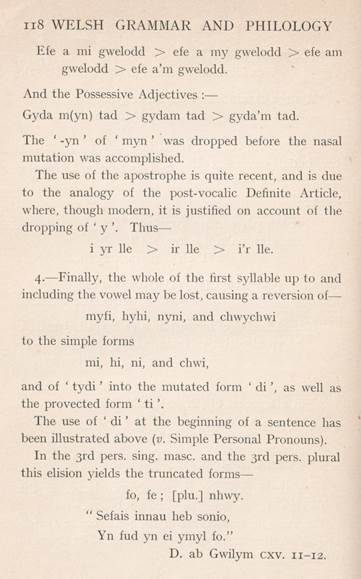
(delwedd L1377) (tudalen 118)
|
(tudalen 1 17)
118 WELSH GRAMMAR AND PHILOLOGY
Efe a mi gwelodd > efe a my gwelodd > efe am
gwelodd > efe a'm gwelodd.
And the Possessive Adjectives: —
Gyda m(yn) tad > gydam tad > gyda'm tad.
The ' -yn ' of myn ' was dropped before the nasal
mutation was accomplished.
The use of the apostrophe is quite recent, and is due
to the analogy of the post-vocalic Definite Article,
where, though modern, it is justified on account of the
dropping of ' y Thus —
i yr Ile > irlle > i'r Ile.
4. — Finally, the whole of the first syllable up to and
including the vowel may be lost, causing a reversion of —
rnyfi, hyhi, nyni, and chwychwi
to the simple forms
mi, hi, ni, and chwi,
and of ' tydi ' into the mutated form ' di’, as well as
the provected form ' ti
The use of ' di ' at the beginning of a sentence has
been illustrated above (v. Simple Personal Pronouns).
In the 3rd pers. sing. masc. and the 3rd pers. plural
this elision yields the truncated forms —
fo, fe; [plu.] nhwy.
“Sefais innau heb sonio,
Yn fud yn ei ymyl fo."
D. ab Gwilym cxv. 11 — 12.
|
|
|
|
|
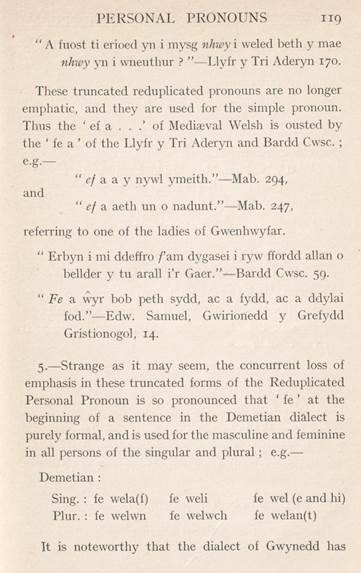
(delwedd L1378) (tudalen 119)
|
(tudalen 1 18)
PERSONAL PRONOUNS
r 19
“A fuost ti erioed yn i mysg nhwy i weled beth y mae
nhwy yn i wneuthur ? " — Llyfr y Tri Aderyn 170.
These truncated reduplicated pronouns are no longer
emphatic, and they are used for the simple pronoun.
, . ' of Mediæval Welsh is ousted by
Thus the ' ef a
the ' fe a ' of the Llyfr y Tri Aderyn and Bardd Cwsc.;
“e/ a a y nywl ymeith." — Mab. 294,
and
“e/ a aeth un o nadunt." — Mab. 247,
referring to one of the ladies of Gwenhwyfar.
“Erbyn i mi ddeffro f'am dygasei i ryw ffordd allan o
bellder y tu arall i'r Gaer." — Bardd Cwsc. 59.
“Fe a wyr bob peth sydd, ac a fydd, ac a ddylai
fod." — Edw. Samuel, Gwirionedd y Grefydd
Gristionogol, 14.
5. — Strange as it may seem, the concurrent loss of
emphasis in these truncated forms of the Reduplicated
Personal Pronoun is so pronounced that ' fe ' at the
beginning of a sentence in the Demetian dialect is
purely formal, and is used for the masculine and feminine
in all persons of the singular and plural; e.g.
Demetian:
Sing.: fe wela(f) fe weli
Plur.: fe welwn fe welwch
fe wel (e and hi)
fe welan(t)
It is noteworthy that the dialect of Gwynedd has
|
|
|
|
|
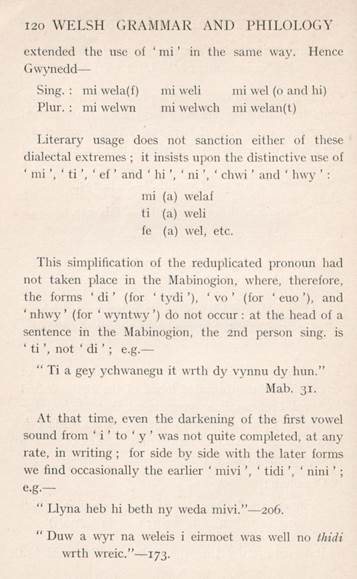
(delwedd L1379) (tudalen 120)
|
(tudalen 1 19)
120 WELSH GRAMMAR AND PHILOLOGY
extended the use of ' mi ' in the same way. Hence
Gwynedd —
Sing.: mi wela(f) mi weli
mi wel (o and hi)
Plur.: mi welwn
mi welwch mi welan(t)
I.iterary usage does not sanction either of these
dialectal extremes; it insists upon the distinctive use of
‘mi’, 'ti’, ‘ef ' and ' hi’, ‘ni’, ‘chwi ' and ' hwy '
mi (a) welaf
ti (a) weli
fe (a) wel, etc.
This simplification of the reduplicated pronoun had
not taken place in the Mabinogion, where, therefore,
the forms 'di' (for ' tydi '), 'vo' (for 'euo '), and
‘nhwy' (for ' wyntwy ') do not occur: at the head of a
sentence in the Mabinogion, the 2nd person sing. is
'ti not 'di'; e.g. —
“Ti a gey ychwanegu it wrth dy vynnu dy hun."
Mab. 31.
At that time, even the darkening of the first vowel
sound from ' i ' to ' y ' was not quite completed, at any
rate, in writing; for side by side with the later forms
we find occasionally the earlier ' mivi’, ‘tidi’, ‘nini '
“Llyna heb hi beth ny weda mivi." — 206.
“Duw a wyr na weleis i eirmoet was well no thidi
wrth wreic.'
‘— 173•
|
|
|
|
|
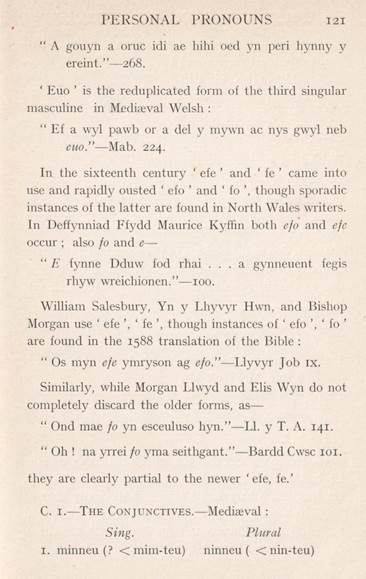
(delwedd L1380) (tudalen 121)
|
PERSONAL PRONOUNS
121
“A gouyn a oruc idi ae hihi oed yn peri hynny y
eremt
Euo is the reduplicated form of the third singular
masculine in Mediæval Welsh:
“Ef a wyl pawb or a del y mywn ac nys gwyl neb
euo." — Mab. 224.
In the sixteenth century ' efe ' and ' fe ' came into
use and rapidly ousted ' efo ' and ' fo’, though sporadic
instances of the latter are found in North Wales writers.
In Deffynniad Ffydd Maurice Kyilin both and e/e
occur; also fo and c —
“E fynne I)duw fod rhai .
rhyw
. a gynneuent legis
William Salesbury, Yn y Lhyvyr I-Iwn, and Bishop
Morgan use ' efe’, ‘fe’, though instances of efo’, ‘fo
are found in the 1588 translation of the Bible:
“Os myn efe ymryson ag Job rx.
Similarly, while Morgan I-Ivsyd and Elis Wyn do not
completely discard the older forms, as —
“Ond mae fo yn esceuluso y T. A. 141.
“Oh ! na yrrei fo yma seithgant." — Bardd Cwsc 101.
they are clearly partial to the newer ' efe, fe.'
C. r. — THE CONJUNCTIVES.
Sing.
1. minneu < mirn-teu)
|
|
|
|
|
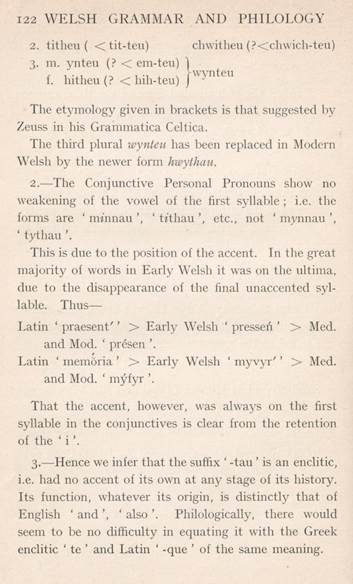
(delwedd L1381) (tudalen 122)
|
Mediæval:
Plural
ninneu ( < nin-teu)
122 WELSH GRAMMAR AND PHILOLOGY
2. titheu ( < tit-teu)
chwitheu <cljwich-teu)
3. m. ynteu (? < em-teu)
wvnteu
f. hitheu (? < hih-teu)
The etymology given in brackets is that suggested by
Zeuss in his Grarntnatica Celtica.
The third plural wyntcu has been replaced in Modern
Welsh by the newer form hwylhau.
2. — The Conjunctive Personal Pronouns show no
weakening of the vowel of the first syllable; i.e. the
forms are ' minnau’, ‘tithau’, etc., not ' mvnnau
‘tythau
This is due to the position of the accent. In the great
majority of words in Early Welsh it was on the ultima,
due to the disappearance of the final unaccented syllable. Thus —
Latin ' praesent" > Early \Velsh ' pressefi' > Med.
and Mod. ' présen '.
Latin ' memöria ' > Early Welsh ' myvyr" > Med.
and Mod. ' m$fyr '.
That the accent, however, was always on the first
syllable in the conjunctives is clear from the retention
of the 'i
3. — Hence we infer that the suffix ' -tau ' is an enclitic,
i.e. had no accent of its own at any stage of its history.
Its function, whatever its origin, is distinctly that of
English ' and’, ‘also Philologically, there would
seem to be no difficulty in equating it with the Greek
enclitic ' te ' and Latin ' -que ' of the same meaning.
|
|
|
|
|
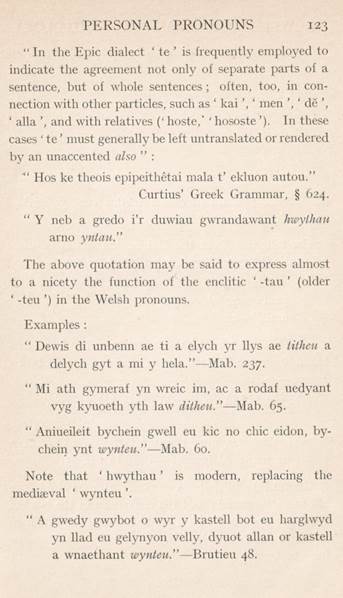
(delwedd L1382) (tudalen 123)
|
PERSONAL PRONOUNS
123
“In the Epic dialect ' te ' is frequently employed to
indicate the agreement not only of separate parts of a
sentence, but of whole sentences; often, too, in connection with other
particles, such as ' kai’, ‘men’, ‘dé’,
alla and with relatives hoste,• ' hososte ').
In these
cases ' te ' must generallv be left untranslated or rendered
by an unaccented also " .
Hos ke theois epipeithétai mala t' ekluon autou."
Curtius' Greek Grammar, 624.
“Y neb a gredo i'r duwiau gwrandawant hwylhau
arno yntau."
The above quotation may be said to express almost
to a nicety the function of the enclitic -tau ' (older
‘-teu ') in the Welsh pronouns.
Examples:
“Dewis di unbenn ae ti a elych yr llys ae tithcu a
delych gyt a mi y hela." — Mab. 237.
“Mi ath gymeraf yn wreic im, ac a rodaf uedyant
vyg kyuoeth yth law ditheu." — Mab. 65.
“Aniueileit bychein gwell eu kic no chic eidon, bychem ynt 60.
Note that ' hwythau ' is modern, replacing the
mediæval ' wynteu '.
‘A gwedy gwybot o wyr y kastell bot eu harglwyd
yn llad eu gelynyon velly, dyuot allan or kastell
a wnaethant 48.
|
|
|
|
|
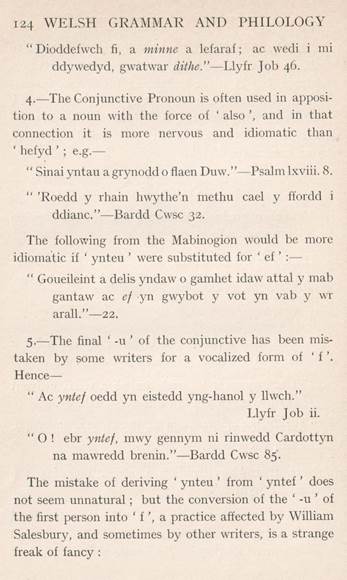
(delwedd L1383) (tudalen 124)
|
124 WELSH GRAMMAR AND PHILOLOGY
“Dioddefwch fi, a minne a lefaraf; ac wedi i mi
ddywedyd, gwatwar dithe." — Llyfr Job 46.
4. — The Conjunctive Pronoun is often used in apposition to a noun with the
force of ' also’, and in that
connection it is more nervous and idiomatic than
‘hefyd '; e.g. —
“Sinai yntau a grynodd o flaen Duw. " — Psalm Ixviii. 8.
“'Roedd y rhain hwythe'n methu cael y ffordd i
Cwsc 32.
The following from the Mabinogion would be more
idiomatic if ' ynteu ' were substituted for ' ef '
“Goueileint a delis yndaw o gamhet idaw attal y mab
gantaw ac e/ .yn gwybot y vot yn vab y wr
5. — The final ' -u ' of the conjunctive has been mistaken by some writers
for a vocalized form of ' f
Hence —
“Ac yntef oedd yn eistedd yng-hanol y llwch. "
Llyfr Job ii.
“O ! ebr yntef, mwy gennym ni rinwedd Cardottyn
na mawredd brenin." — Bardd Cwsc 85'.
The mistake of deriving ' ynteu ' from ' yntef ' does
not seem unnatural; but the conversion of the ' -u ' of
the first person into ' f’, a practice affected by William
Salesbury, and sometimes by other writers, is a strange
freak oi fancy:
|
|
|
|
|
(delwedd L1384) (tudalen 125)
|
PERSONAL PRONOUNS
125
“Cans pe's credyssech Moysen, chwi am credyssech
loan, ch. v.
“Minef' sy y yn gweithiaw." — lbid. ch. v.
“Ar du Cephas medde'r llall rydwyf innef, a minnef
medd'r trydydd, yn dal gyda'g Apollo."
Deff. Fydd 56.
6. — An unfortunate tendency is noticeable in Modern
Welsh to limit the use of the conjunctives. This is due in
part to the fact that no corresponding words are found
in English, and to the excessive tendency in Modern
Welsh to an analytic form of speech. The same
tendency which leads to the use of —
yr wyf yn gweled for gwelai
favours also the use of —
ti hefyd for tithau,
and similar loose constructions, so unlike the strong,
nervous, and idiomatic style oi Bardd Cwsc and Drych
y Prif Oesoedd.
D. — POST-VOCALIC OR INFIXED PERSONAL PRONOUNS
(1) Mediæval
Singular
2. th
Plural
ch
e, y, s (ys, as)
3. e, y, s (ys, as)
2. — When used: When any of the following words
|
|
|
|
|
(delwedd L1385) (tudalen 126)
|
126 WELSH GRAMMAR AND PHILOLOGY
precedes a transitive verb which itself governs a personal
pronoun in the accusative case, the object is placed
immediately before the verb, as —
Ni'm halogwyd i, not Ni Iralogwyd fi.
The preceding .word may be —
(a) the Personal Pronoun — mi, ti, fe, etc.;
(b) the Relative — a or y;
(c) the Adverbs — ni, oni, na;
(d) a conjunction ending in a vowel, as — na, pe, y.
Note that the function of the Post-fixed Pronoun —
as i in the above example — is merely to explain or
emphasize the object already expressed.
Examples:
“Duw a wyr na thwyllafi am 117.
“Yr honn a vynnei drigyaw yn llys Arthur hi ae
kaffei." — Mab. 192.
“Nyn Iledir namyn y gyt." — Mab. 117.
“Yr duw canych ( = can nych) gwelas neb or gaer
ettwa, ymchoelwch dracheuyn." — Mab. 117.
“Y gred a rois ar y llyn,
Na lafur byth ei gofyn:
A'r gred a rois ar feddwdawd
Ni's cywiraf hyd ddydd brawd."
D. ab G. CLXXXI.
The s in the third person was found to be phonetically
the only possible form after ' ni' (' ny '), for 'nyy'
|
|
|
|
|
(delwedd L1386) (tudalen 127)
|
PERSONAL
would be indistinguishable
negative ' ny '.
Compounded with ' ny
therefore —
nym, nyth, nys;
PRONOUNS
127
in speech from the simple
the regular forms were
nyn, nych, nys.
These in modern orthography become —
ni'm, ni'th, ni's or nis; ni'n, ni'ch, ni's or nis.
“Nyt oes neb yma a wypo (dim) y wrth hynny o nys
gwyr Branwen."
— Mab. 35-36.
Contrast —
“le heb ynteu Vendigeit Uran ony allafi vy hun
Cael y 37.
Where the object of allaf is the verb-noun cael.
Curiously, the sigmatic form was not used after y,
where the same difficulty in a less degree was experienced. Hence in Mediæval
Welsh and much later y
has to do duty for modern ' y'i’, ‘y'u ' (or ' ys’, ‘y's 'j.
“Lli ac Archan y ys, y's or y'u] gelwit." — Mab. 35.
‘Kanys mawr y [ = y'i, ys or y's] karei." — Mab. 212.
(For he loved him dearly.)
‘A dywedut wrthunt a wnaethpwyt, nat yr amarch
arnunt y y'u, y's or ys] dodit islaw y teulu."
Mab. 227.
“Myfi a wn fod fy mhrynwr yn fyw ac y y'i, y's,
ys] Job .xrx.
i' O lafur ei enaid y gwel ac y [=y'i, y's, ys] diwellir."
Edw. S.
|
|
|
|
|
(delwedd L1387) (tudalen 128)
|
128 WELSH GRAMMAR AND PHILOLOGY
Much uncertainty in the use of s has always prevailed: —
(i) It is incorrectly left out of the following: —
“Ny [for nysl welei neb ef."
Mab. 41.
“A'r eiddo ei hun ni (Iderbyniasant El."
St. John i. 11.
(ii) The following examples illustrate its correct use
“le heb ef ac atuyd y mae arnat o enryded ual nas
dylyy." — Mab. 2.
‘Keissyaw Rolant ae dv.xn a oruc ac nys cauas."
Ystorya 18.
(iii) It is incorrectly used in the follouing: —
“Ac atuyd ys kymeraf gyghor." — Mab. 37.
“Os y Pabau y pryd ymma, nid ydynt yn guneuthyr
y petheu hyn; neu ynte, onis gwnaeth Pedr
Abostol y pethau rhagddoededig O'r blaen."
Deff. Ffydd 194-5.
“Nis gwn i, ebr finneu, beth a allei'ch meddwl fod."
Bardd Cwsc 61.
“Nis gun i ddim o'u storiåu." — lbid. 64.
“Pe ni's gadawsent i fusgrellni a llaithder eu gory P. O. 94.
“Mae cyhyd arnser er pan ysgrifennais attoch, na's
gwn yr avvrhon pa sutt i ddechreu."
Llythyrau G. O. 50.
It will be seen from these examples, and a host of
others that might be adduced, that the pronominal
|
|
|
|
|
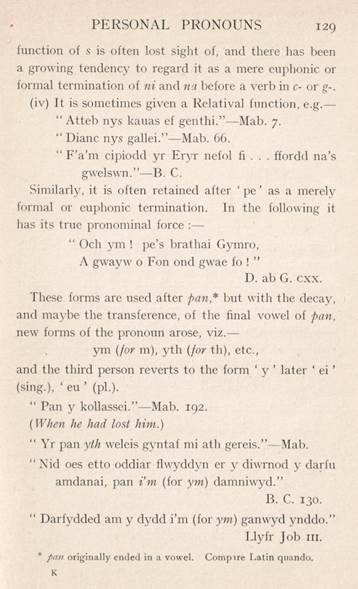
(delwedd L1388) (tudalen 129)
|
PERSONAL PRONOUNS
129
function of s is often lost sight of, and there has been
a growing tendency to regard it as a mere euphonic or
formal termination of ni and before a verb in c- or g-.
(iv) It is sometimes given a Relatival function, e.g. —
“Atteb nys kauas ef genthi." — Mab. 7.
“Dianc nys gallei." — Mab. 66.
“F'a'm cipiodd yr Eryr nefol fi . . ffordd na's
Similarly, it is Often retained after ' pe' as a merely
formal or euphonic termination. In the following it
has its true pronominal force:
“Och ym ! pe's brathai Gymro,
A gwayw o Fon ond gwae fo ! "
D. ab G. cxx.
These forms are used after but with the decay,
and maybe the transference. of the final vowel of Pan,
new forms of the pronoun arose, viz. —
ym (for m), yth (for th), etc.,
and the third person reverts to the form ' y ' later ' ei '
(sing.), 'eu' (pl.).
“Pan y kollassei." — Mab. 192.
( IV'hen he had lost him.)
“Yr pan yth weleis gyntaf mi ath gereis." — Mab.
“Nid oes etto oddiar flwyddyn er y diwrnod y (lapfu
amdanai, pan i'm (for ym) damniwyd."
B. C. 130.
“Darfydded am y dydd i'm (for ym) ganwyd ynddo."
Llyfr Job 111.
• originally ended in a vowel. Cornpire l.atin quando.
|
|
|
|
|
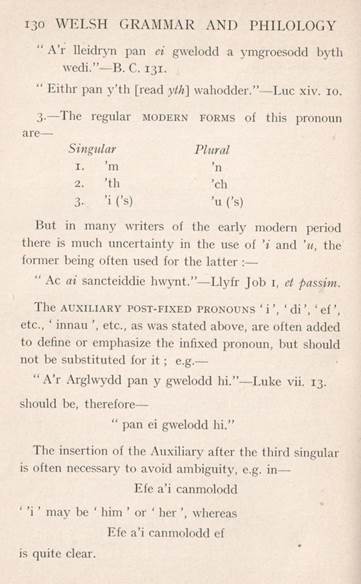
(delwedd L1389) (tudalen 130)
|
130 WELSH GRAMMAR AND PHILOLOGY
“A'r Ileidryn pan ei gwelodd a ymgroesodd byth
wedi." — B. C. 131.
‘Eithr pan y'th [read yth] xiv. 10.
3. — The regular MODERN FORMS of this pronoun
Singular
1.
2.
3.
'th
Plural
'n
'ch
But in many writers of the early modern period
there is much uncertainty in the use of 'i and 'u, the
former being often used for the latter
“Ac ai sancteiddie hwynt." — Llyfr Job 1, et Passim.
The AUXILIARY POST-FIXED PRONOUNS 'i’, ‘di’, ‘ef’,
etc., ‘innau’, etc., as was stated above, are often added
to define or emphasize the infixed pronoun, but should
not be substituted for it; e.g. —
“A'r Arglwydd pan y gwelodd hi." — Luke vii. 13.
should be, therefore —
‘pan ei gwelodd hi."
The insertion of the Auxiliary after the third singular
is often necessary to avoid ambiguity, e.g. in —
Efe a'i canmolodd
'i ' may be ' him ' or ' her whereas
Efe a'i canmolodd ef
is quite clear.
|
|
|
|
|
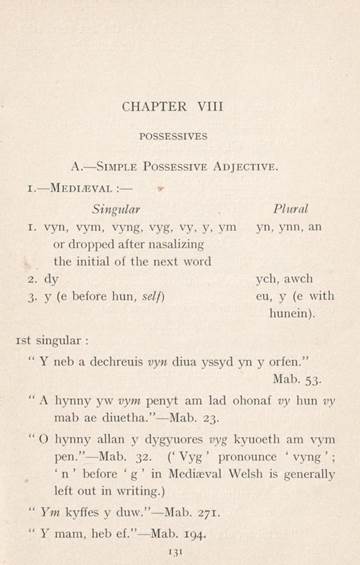
(delwedd L1390) (tudalen 131)
|
CHAPTER
POSSESSIVES
A. — SIMPI.E POSSESSIVE ADJECTIVE.
Singular
r. vyn, vym, vyng, vyg, vy, y, ym
or dropped after nasalizing
the initial of the next word
2. dy
3• y (e before hun, self)
1st singular:
Plural
yn, ynn, an
ych, awch
eu, y (e with
hunein).
“Y neb a dechreuis vyn diua yssyd yn y orfen."
Mab. 53.
A hynny YW vym penyt am lad ohonaf vy hun vy
mab ae 23.
“O hynny allan y dygyuores vyg kyuoeth am vym
pen." — Mab. 32. Vyg' pronounce ' vyng '
‘n before g in Mediteval Welsh is generally
left out in writing.)
‘Ym kyffes y duw." — Mab. 271.
“Y mam, heb 194.
131
|
|
|
|
|
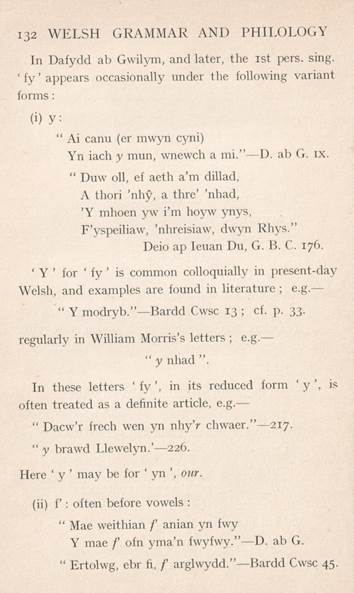
(delwedd L1391) (tudalen 132)
|
132 WELSH GRAMMAR AND PHILOLOGY
In Dafydd ab Gwilym, and later, the 1st pers. sing.
‘fy ' appears occasionally under the following variant
forms:
“Ai canu (er mwyn cyni)
Yn iach y mun, wnewch a nu
“I)uw 011, ef aeth a'm dillad,
A thori 'nll$, a thre' 'nhad,
'Y mhoen yw i'm hoyw ynys,
F'yspeiliaw, 'nhreisiaw, dwyn Rhys."
Deio ap leuan Du, G. B. C. 176.
‘Y ' for ' fy ' is common colloquially in present-day
Welsh, and examples are found in literature; e.g. —
‘Y modryb." — Bardd Cwsc 13; cf. p. 33.
regularly in William Morris's letters; e.g. —
‘y nhad "
In these letters ' fy in its reduced form
often treated as a definite article, e.g. —
“Dacw'r frech wen yn nhy'r chwaer."
— 217.
“y brawd Llewelyn.' — 226.
Here ' y' may be for ' yn’, our.
(ii) f': often before vowels:
‘Mae weithian f' anian yn fwy
Y mae f' ofn yma'n fwyfwy." — D. ab G.
‘Ertolwg, ebr fl, i' arglwydd." — Bardd Cwsc 45.
|
|
|
|
|
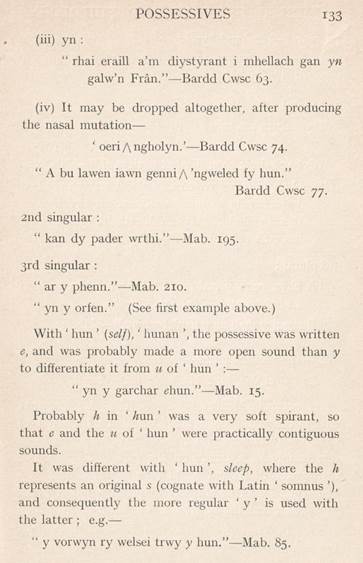
(delwedd L1392) (tudalen 133)
|
POSSESSIVES
(iii) yn:
133
“rhai eraill a'm diystyrant i mhellach gan yn
galw'n Från." — Bardd Cwsc 63.
(iv) It may be dropped altogether, after producing
the nasal mutation —
‘oeriA ngholyn.' — Bardd Cwsc 74.
“A bu lawen iawn genni/\ 'ngweled fy hun."
Bardd Cwsc 77.
2nd singular:
“kan dy pader wrthi." — Mab. 195.
3rd singular •
‘ar y 210.
‘yn y orfen." (See first example above.)
With ' hun ' (self), hunan’, the possessive was written
e, and was probably made a more open sound than y
to differentiate it from u of ' hun ':
yn y garchar ehun." — Mab. 15.
Probably h in ' hun ' was a very soft spirant, so
that e and the u of ' hun ' were practically contiguous
sounds.
It was different with ' hun’, sleep, where the h
represents an original s (cognate with Latin ' somnus '),
and consequently the Inore regular
'y' is used with
the latter; e.g. —
‘y vorwyn ry welsei trwy y hun '
.' — Mab. 85.
|
|
|
|
|
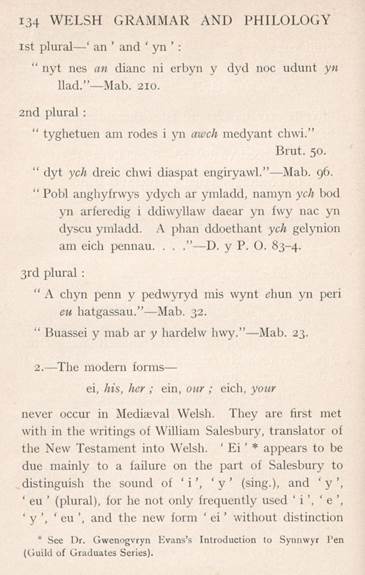
(delwedd L1393) (tudalen 134)
|
134 WELSH GRAMMAR AND PHILOLOGY
1st plural — ' an ' and ' yn '
‘nyt nes an dianc ni erbyn y dyd noc udunt yn
llad —
." Mab. 210.
2nd plural:
“tyghetuen am rodes i yn awch medyant chwi."
Brut. 50.
“dyt ych dreic chwi diaspat engiryawl. " — Mab. 96.
“Pobl anghyfrwys ydych ar ymladd, namyn ych bod
yn arferedig i ddiwyllaw daear yn fwy nac yn
dyscu yrnladd. A phan ddoethant ych gelynion
am eich pennau.
3rd plural:
y P. O. 83-4.
“A Chyn penn y pedwyryd mis wynt chun yn peri
eu hatgassau." — Mab. 32.
“Buassei y mab ar y hardelw 23.
2. — The modern forms —
ei, his, her; ein, our; eich, your
never occur in Mediæval Welsh. They are first met
with in the writings of William Salesbury, translator of
the New Testament into Welsh. ' Ei ' * appears to be
due mainly to a failure on the part of Salesbury to
'y' (sing.), and 'y',
distinguish the sound of 1
‘eu ' (plural), for he not only frequently used ' i’, ‘e '
eu’, and the new form ' ei ' without distinction
See Dr. Gwenogvryn Evans's Introduction to Synnwyr Pen
(Guild of Graduates Series).
|
|
|
|
|
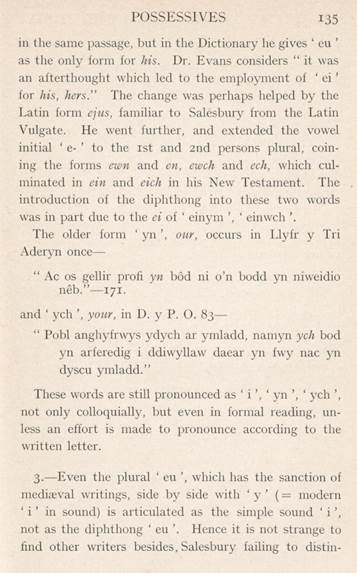
(delwedd L1394) (tudalen 135)
|
POSSESSIVES
135
in the same passage, but in the Dictionary he gives ' eu '
as the only form for his. Dr. Evans considers ' ' it was
an afterthought which led to the employment of ' ei '
for his, hers." The change was perhaps helped by the
Latin form cius, familiar to Salesbury from the Latin
Vulgate. He went further, and extended the vowel
initial ' e- ' to the rst and 2nd persons plural, coining the forms cwn and
en, ewch and ech, which culminated in ein and eich in his New Testament. The
introduction of the diphthong into these two words
was in part due to the ci of ' einym’, ‘einwch
The older form ' yn’, our, occurs in Llyfr y Tri
Aderyn once —
“Ac os gellir profi yn bOd ni O'n bodd yn niweidio
néb."
171.
and ' ych’, your, in D. y P. O. 83 —
“Pobl anghyfrwys ydych ar yrnladd, namyn ych bod
yn arferedig i ddiwyllaw daear yn fwy nac yn
dyscu ymladd."
These words are still pronounced as ' i’, ‘yn’, ‘ych’,
not only colloquially, but even in formal reading, unless an effort is made
to pronounce according to the
written letter.
3. — -Even the plural ' eu’, which has the sanction of
mediæval writings, side by side with ' y' modern
‘i ' in sound) is articulated as the simple sound i’,
not as the diphthong ' eu '. Hence it is not strange to
find other writers besides. Salesbury failing to distin
|
|
|
|
|
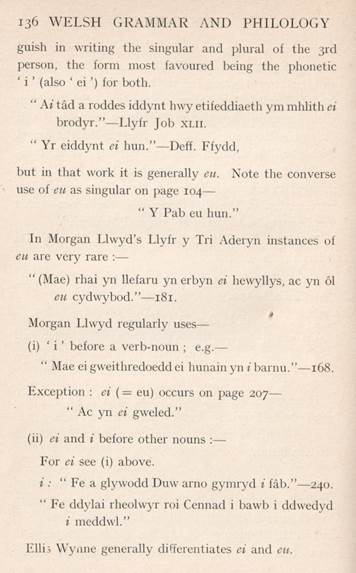
(delwedd L1395) (tudalen 136)
|
136 WELSH GRAMMAR AND PHILOLOGY
guish in writing the singular and plural of the 3rd
person, the form most favoured being the phonetic
'i ' (also ' ei ') for both.
“Ai tåd a roddes iddynt hwy etiieddiaeth yrn mhlith ei
brodyr." — Llyfr Job .XLII.
“Yr eiddynt ei hun." — Deff. Ffydd,
but in that work it is generally cu. Note the converse
use of eu as singular on page 104 —
“Y Pab eu hun."
In Morgan Llwyd's Llyfr y Tri Aderyn instances of
eu are very rare: —
“(Mae) rhai yn Ilefaru yn erbyn ei hewyllys, ac yn 01
eu
Morgan I-lwyd regularly uses —
(i) ' i ' before a verb-noun; e.g. —
“Mae ei gweithredoedd ei hunain yn i barnu. " — 168.
Exception: ei eu) occurs on page 207 —
“Ac yn ei gweled."
(ii) ei and i before other nouns
For ei see (i) above.
i • " Fe a glywodd I)uw arno gymryd i
“Fe ddylai rheolwyr roi Cennad i bawb i ddwedyd
i meddwl."
Elli; Wynne generally differentiates ci and cu.
|
|
|
|
|
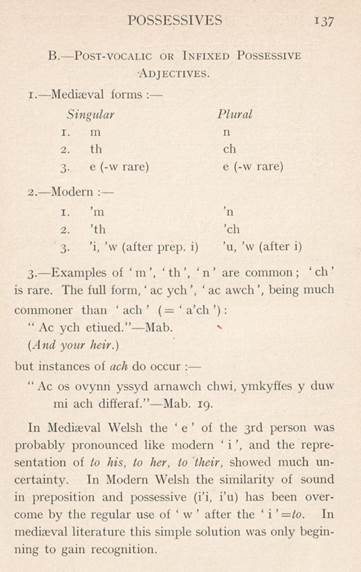
(delwedd L1396) (tudalen 137)
|
POSSESSIVES
B. — -POST-VOCALIC OR INFIXED POSSESSIVE
•ADJECTIVES.
137
1 . — Mediæval forms
Singular
1.
2.
3.
th
e (-w rare)
2.
Modern:
1.
2.
3.
'th
PI
ch
e (-w rare)
'n
'ch
'i, 'w (after prep. i)
'u, 'w (after i)
3. — Exarnples of 'm’, ‘th’, 'n' are common; 'ch '
is rare. The full form, ‘ac ych’, ‘ac awch’, being much
commoner than ' ach' ( =
‘a'ch:
“Ac ych etiued." — Mab.
(And your heir.)
but instances of ach do occur: —
“Ac os ovynn yssyd arnawch chwi, ymkyfies y duw
mi ach differaf." — Mab. 19.
In Mediæval Welsh the ' e ' of the 3rd person was
probably pronounced like modern ' i and the representation of to his, to her,
to •their, showed much uncertainty. In Modern Welsh the similarity of sound
in preposition and possessive (i'i, i'u) has been overcome by the regular use
of ' w ' after the ' i ' =to. In
mediæval literature this simple solution was only beginning to gain
recognition.
|
|
|
|
|
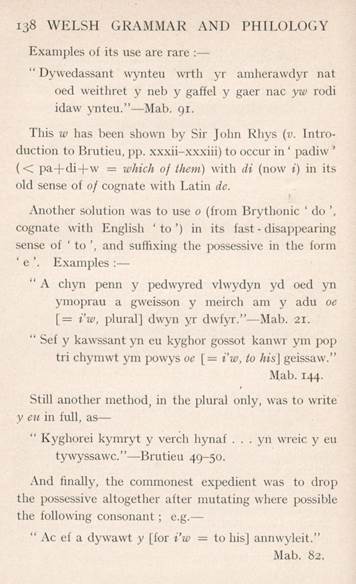
(delwedd L1397) (tudalen 138)
|
138 WELSH GRAMMAR AND PHILOLOGY
Examples of its use are rare
Dywedassant wy•nteu wrth yr amherawdyr nat
oed weithret y neb y gaffel y gaer nac yw rodi
idaw ynteu." — Mab. 91.
This w has been shown by Sir John Rhys (v. Introduction to Brutieu, pp. xxxii
— xxxiii) to occur in ' padiw '
( < pa-+-di-+-w = which Of them) with di (now i) in its
old sense of o/ cognate with Latin de.
Another solution was to use o (from Brythonic ' do '
cognate with English ' to ') in its fast - disappearing
sense of ' to’, and suffixing the possessive in the form
‘e Examples: —
“A Chyn penn y pedwyred vlwydyn yd oed yn
ymoprau a gweisson y meirch am y adu oe
[ = i'w, plural] dwyn yr dwfyr." — Mab. 21.
“Sef y kawssant yn eu kyghor gossot kanwr ym pop
tri chymwt ym powysoe [ = i'w, to his] geissaw."
Mab. 144.
Still another method, in the plural only, was to write
y eu in full, as —
‘Kyghorei kymryt y verch hynaf
. . . yn wrenc y eu
tywyssawc." — Brutieu 49 — 50.
And finally, the commonest expedient was to drop
the possessive altogether after mutating where possible
the following consonant; e.g. —
“Ac ef a dywawt y [for i'w = to his] annwyleit."
Mab. 82.
|
|
|
|
|
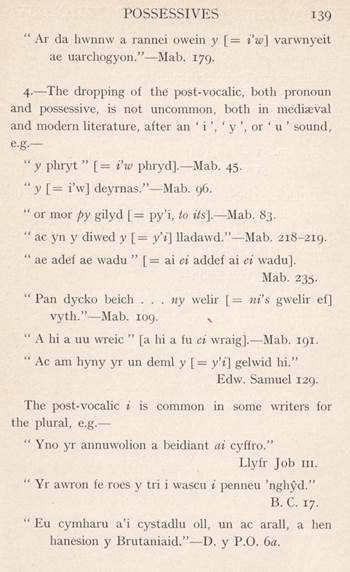
(delwedd L1398) (tudalen 139)
|
POSSESSIVES
139
“Ar da hwnnw a rannei owein y [ = i'w] varwnyeit
ae uarchogyon." — Mab. 179.
4. — The dropping of the post-vocalic, both pronoun
and possessive, is not uncommon, both in mediæval
and modern literature, after an ' i’, ‘y or ' u ' sound,
“y phryt " i'w phryd]. — Mab. 45.
“y [ = i'w] deyrnas." — Mab. 96.
“or mor py gilyd [ = py'i, to its]. — Mab. 83.
ac yn y diwed y y'il lladawd." — Mab. 218 — 219.
“ae adef ae wadu " [ = ai ei addef ai ei wadu].
Mab. 235•
“Pan dycko beich
. ny "'elir [ = ni's gwelir ef]
vyth." — Mab. 109.
“A hi a uu wreic " [a hi a fu ei 191.
“Ac am hyny yr un dernl y y'i] gelwid hi."
Edw. Samuel 129.
The post-vocalic i is common in some writers for
the plural, e.g. —
“Y no yr annuwolion a beidiant ai cyffro."
Llyfr Job 111.
“Yr awron fe roes y tri i wascu i penneu 'nghf'd."
B. C. 17.
“Eu cymharu a'i cystadlu 011, un ac arall, a hen
hanesion y Brutaniaid." — D. y P.O. Ga.
|
|
|
|
|
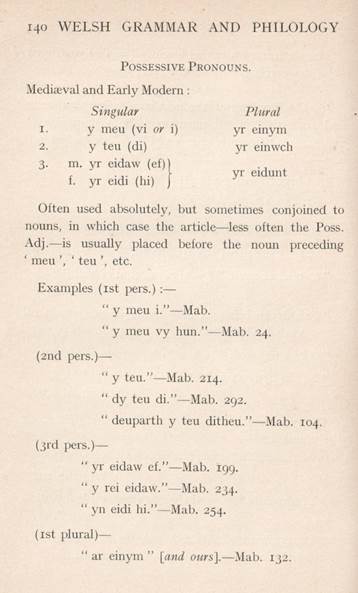
(delwedd L1399) (tudalen 140)
|
140 WELSH GRAMMAR AND PHILOLOGY
POSSESSIVE PRONOUNS.
Mediæval and Early Modern:
1.
2.
Singular
y meu (vi or i)
y teu (di)
3. m. yr eidaw (ef)
f. yr eidi (hi)
Plural
yr ernyrn
yr einwch
yr eidunt
Often used absolutely, but sometimes conjoined to
nouns, in which case the article — less often the Poss.
Adj. — is usually placed before the noun preceding
meu’, ‘teu’, etc.
Examples (1st pers.):
y meu i." — Mab.
“y meu vy hun." — Mab. 24.
(2nd pers.) —
y 214.
“dy teu 292.
“deuparth y teu ditheu." — Mab. 104.
(3rd pers.)_
yr eidaw ef." — Mab. 199.
“y rei eidaw
234.
yn eidi hi."
Mab. 254.
(1st plural) —
‘ar emym
‘[and 132.
|
|
|
|
|
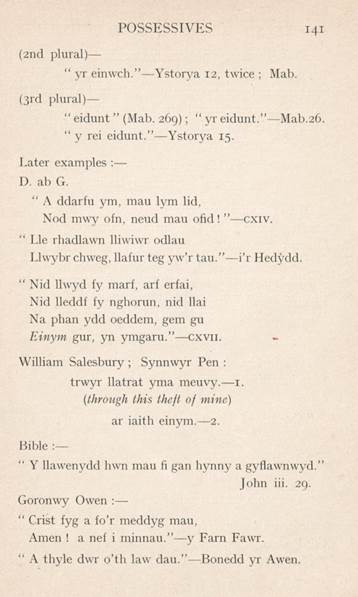
(delwedd L1400) (tudalen 141)
|
POSSESSIVES
(2nd plural) —
“yr 12, twice;
(3rd plural).
eidunt " (Mab. 269); " yr eidunt
‘y rei eidunt." — Ystorya 15.
Inter examples: —
“A ddarfu ym, mau lym lid,
141
Mab.
Nod mwy ofn, neud mau ofid ! " — cxrv.
“Lle rhadlawn Iliwiwr odlau
Llwybr chweg, llafur teg yw'r Hed$dd.
“Nid llwyd fy marf, arf erfai,
Nid Ileddf fy nghorun. nid llai
Na phan ydd oeddem, gem gu
Einym gur, yn ymgaru." — cxvll.
William Salesbury; Synnwyr Pen:
trwyr llatrat yma meuvy. — -l.
(through this theft o/ mine)
ar iaith einym. — 2.
Bible: —
Y llawenydd hwn mau fi gan hynny a gyflawnwyd."
John iii. 29.
Goronwy Owen
“Crist fyg a fo'r meddyg mau,
Amen ! a nei i minnau." — y Farn Fawr.
A thyle dwr o'th law dau." — Bonedd yr Awen.
|
|
|
|
|
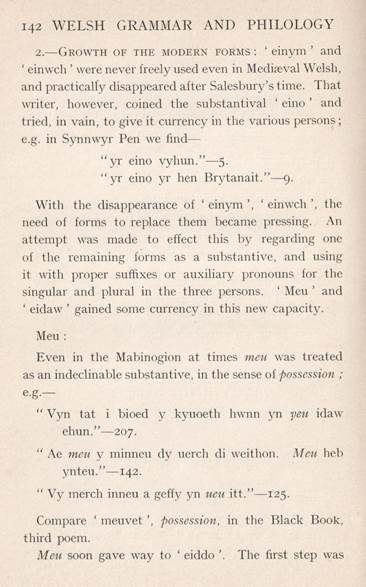
(delwedd L1401) (tudalen 142)
|
142 WELSH GRAMMAR AND PHILOLOGY
2. — GROWTH OF THE MODERN FORMS: ' einym ' and
‘einwch ' were never freely used even in Mediteval Welsh,
and practically disappeared after Salesbury's time. That
writer, however, coined the substantival ' eino ' and
tried, in vain, to give it currency in the various persons;
e.g. in Synnwyr Pen we find —
"yr eino
"yr eino yr hen Brytanait." — 9.
With the disappearance of ' einyrn’, ‘einwch’, the
need of forms to replace them became pressing. An
attempt was made to effect this by regarding one
of the remaining forms as a substantive, and using
it with proper suffixes or auxiliary pronouns for the
singular and plural in the three persons. ' Meu ' and
‘eidaw ' gained some currency in this new capacity.
Meu:
Even in the Mabinogion at times was treated
as an indeclinable substantive, in the sense of possession;
e.g. —
“Vyn tat i bioed y kyuoeth hwnn yn yeu idaw
Chun.' ' — 207.
“Ae meu y minneu dy uerch di weithon. ,lleu heb
ynteu. " — 142
“Vy merch inneu a geffy yn ueu
Compare ' meuvet’, possession, in the Black Book,
third poem.
Meu soon gave way to ' eiddo '. The first step was
|
|
|
|
|
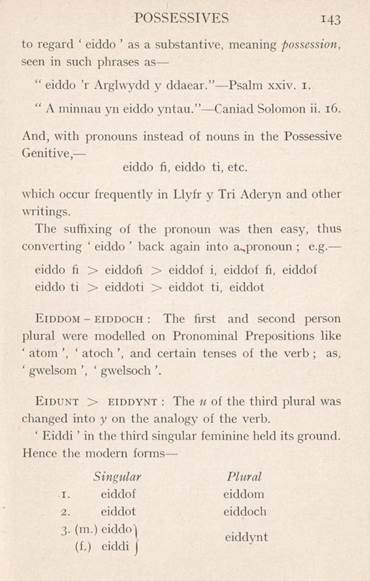
(delwedd L1402) (tudalen 143)
|
POSSESSIVES
143
to regard ' eiddo ' as a substantive, meaning possession,
seen in such phrases as —
“eiddo 'r Argl»dd y ddaear." — Psalrn xxiv. 1.
‘A minnau yn eiddo yntau." — Caniad Solomon ii. 16.
And, with pronouns instead of nouns in the Possessive
Genitive, —
eiddo fi, eiddo ti, etc.
which occur frequently in Llyfr y Tri Aderyn and other
writings.
The suffixing of the pronoun was then easy, thus
converting ' eiddo ' back again into a — pronoun; e.g. —
eiddo fi > eiddofi > eiddof i, eiddof fi, eiddof
eiddo ti > eiddoti > eiddot ti, eiddot
EIDDOM — EIDDOCH: The first and second person
plural were modelled on Pronominal Prepositions like
‘atom
‘, ‘atoch’, and certain tenses of the verb; as,
‘gwelsom’, ‘gwelsoch '.
EIDUNT > EIDDYNT: The u of the third plural was
clianged into y on the analogy of the verb.
‘Eiddi ' in the third singular feminine held its ground.
Hence the modern forms —
-1.
2.
Singular
eiddof
eiddot
Plural
eiddom
eiddoch
eiddvnt
(m.) eiddoi
(f.) eiddi
|
|
|
|
|
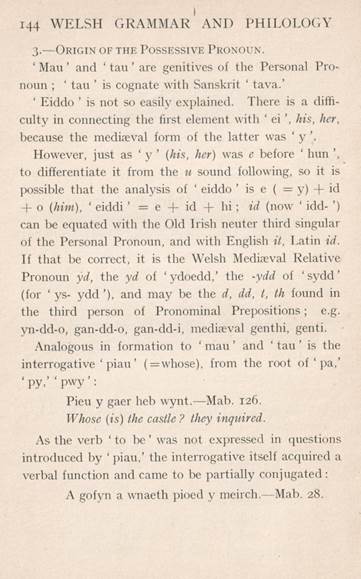
(delwedd L1403) (tudalen 144)
|
144 WEI.SH GRAMMAR AND PHILOLOGY
OF THE POSSESSIVE PRONOUN.
‘Mau ' and ' tau ' are genitives of the Personal Pronoun; ' tau ' is cognate
with Sanskrit tava.'
‘Eiddo ' is not so easily explained. There is a difflculty in connecting the
first element With ' ei ' , his, her,
because the mediæval form of the latter was ' y '.
However, just as ' y ' (his, her) was c before ' hun’,
to differentiate it from the u sound following, so it is
possible that the analysis of ' eiddo ' is e ( = y) + id
o (him), ‘eiddi' = e + id + hi; id (now ' idd- ')
can be equated with the Old Irish neuter third singular
of the Personal Pronoun, and with English if, Latin id.
If that be correct, it is the Welsh Mediæval Relative
Pronoun Yd, the yd of ydoedd,' the -ydd of 'sycld '
(for ' ys- ydd '), and may be the d, dd, t, th found in
the third person of Pronominal Prepositions; e.g.
yn-dd-o, gan-dd-o, gan-dd-i, mediæval genthi, genti.
Analogous in formation to ' mau ' and ' tau ' is the
interrogative ' piau' (=whose), from the root of ' pa,'
‘PY" ' pwy'
Pieu y gaer heb wynt. — Mab. 126.
Whose (is) the castle? they inquired.
As the verb ' to be ' was not expressed in questions
introduced by ' piau.' the interrogative itself acquired a
verbal function and came to be partially conjugated:
A gofyn a wnaeth pioed y meirch. — Mab. 28.
|
|
|
|
|
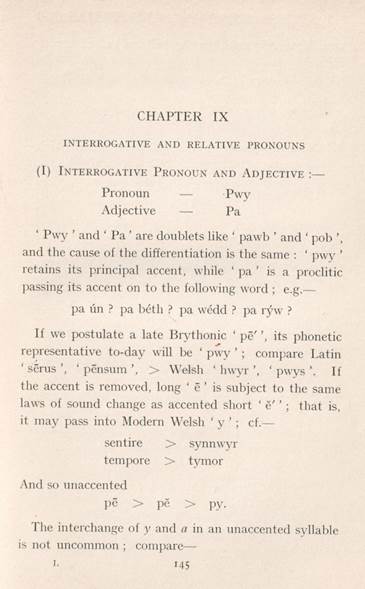
(delwedd L1404) (tudalen 145)
|
CHAPTER IX
INTERROGATIVE AND RELATIVE PRONOUNS
(I) INTERROGATIVE PRONOUN AND ADJECTIVE
Pronoun
Adjective
Pa
‘P wy ' and ' Pa ' are doublets like ' pawb ' and ' pob
and the cause of the differentiation is the same: ' pwy '
retains its principal accent, while ' pa ' is a proclitic
passing its accent on to the following word; e.g. —
pa fin ? pa béth ? pa wédd ? pa r$w ?
If we postulate a late Brythonic ' pö'‘, its phonetic
representative to-day will be ' pwy '; compare Latin
sörus pönsurn’, > Welsh hsvyr'. ' pu•ys If
the accent is removed, long ' ' is subject to the same
laws of sound change as accented short ' é' '
that is,
it may pass into Modern Welsh ' y '; cf. —
sentire > synnwyr
tempore > tymor
And so unaccented
The interchange of y and a in an unaccented syllable
is not uncommon; compare —
|
|
|
|
|
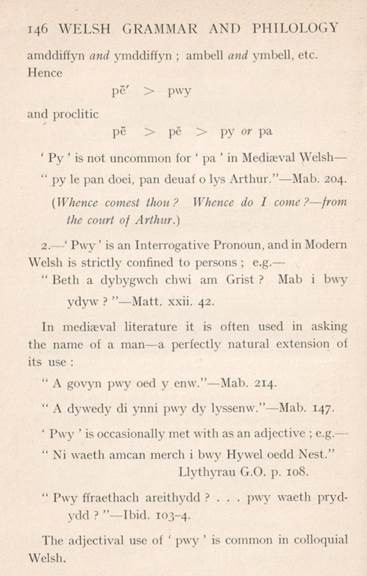
(delwedd L1405) (tudalen 146)
|
146 WELSH GRAMMAR AND PHILOLOGY
amddiffyn and ymddiffyn; ambell and ymbell, etc.
Hence
and proclitic
pi > > py or pa
‘Py ' is not uncommon for ' pa ' in Media•val Welsh —
‘py le pan doei, pan deuaf o lys Arthur." — Mab. 204.
(IVhence comest thou ? Il'hence do I come
the court o/ Arthur.)
Puy ' is an Interrogative Pronoun, and in Modern
Welsh is strictly confined to persons; e.g. —
“Beth a dybygwch chwi am Grist ? Mab i bwy
ydyw ? " — Matt. xxii. 42.
In mediæval literature it is often used in asking
the name of a man — a perfectly natural extension of
its use:
“A govyn pwy oed y enw." — Mab. 214.
“A dywedy di ynni pwy dy lyssenw." — Mab. 147.
rwy ' is occasionally met with as an adjective; e.g. —
Ni waeth amcan merch i bwy Hywel oedd Nest."
I-lythyrau G.(). p. 108.
. . pwy waeth pryd" Ihvy ffraethach areithydd ? .
ydd ? "
Ibid. 103 — 4.
The adjectival use of ' pwy ' is common in colloquial
Welsh.
|
|
|
|
|
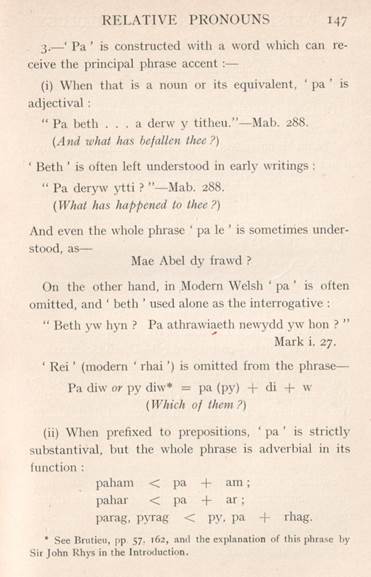
(delwedd L1406) (tudalen 147)
|
RELATIVE PRONOUNS
147
Pa ' is constructed with a word which can receive the principal phrase accent:
—
(i) When that is a noun or its equivalent, ‘pa ' is
adjectival:
. a derw y titheu." — Mab. 288.
“Pa beth .
(And what has befallen thee ? )
‘Beth ' is often left understood in early writings:
“Pa deryw ytti ? " — Mab. 288.
(VV'hat has happened to thee
And even the whole phrase ' pa le ' is sometimes understood, as —
Mae Abel dy frawd ?
On the other hand, in Modern Welsh ' pa ' is often
omitted, and ' beth ' used alone as the interrogative:
“Beth yw hyn ? Pa athrawiaeth newydd yw hon ? "
Mark i. 27.
‘Rei ' (modern ' rhai ') is omitted from the phrase —
= pa (py) + di -F w
Pa diw or py diw*
(Which o/ them ?)
(ii) When prefixed to prepositions, ‘pa ' is strictly
substantival, but the whole phrase is adverbial in its
function:
paham < pa + am;
pahar < pa + ar;
parag, pyrag < py,pa + rhag.
• See Brutieu, pp 57. 162, and the explanation of this phrase by
Sir John Rhys in the Introduction.
|
|
|
|
|
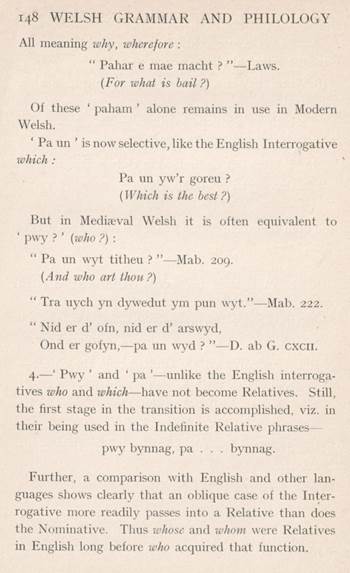
(delwedd L1407) (tudalen 148)
|
148 WELSH GRAMMAR AND PHILOLOGY
All meaning why, wherefore:
“Pahar e mae macht ? " — l-aw•s
(For what is bail ? )
Of these ' paham ' alone remains in use in Modern
Welsh.
‘Pa un ' is now selective, like the English Interrogative
which:
Pa un yw'r goreu ?
(Which is the best P)
But in Medi:eval Welsh it is often equivalent to
‘? ' (who:
“Pa un wyt titheu ? " — Mab. 209.
(And who art thou
“Tra uych yn dywedut yrn pun 222.
“Nid er d' ofn, nid er d' arswyd,
Ond er gofyn, — pa un wyd ? " — D. ab G. CXCII.
Pwy ' and ' pa ' — unlike the English interrogatives who and which — have not
become Relatives. Still,
the first stage in the transition is accomplished, viz. in
their being used in the Indefinite Relative phrases —
pwy bynnag, pa
bynnag.
Further, a comparison with English and other languages shows clearly that an
oblique case of the In!errogative more readily passes into a Relative than
does
the N.»minative. Thus whose and whom were Relatives
in English long before who acquired that function.
|
|
|
|
|
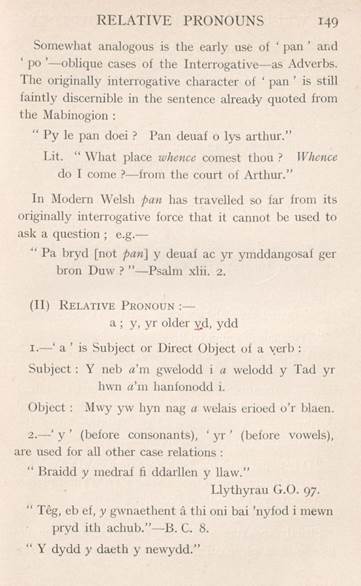
(delwedd L1408) (tudalen 149)
|
RELATIVE PRONOUNS
r 49
Somewhat analogous is the early use Of ' pan arid
po ' — oblique cases of the Interrogative — as Adverbs.
The originally interrogative character of ' pan ' is still
faintly discernible in the sentence already quoted from
the Mabinogion:
“Py le pan doei? Pan deuaf o lys arthur."
Lit.
“What place whence comest thou? IV'hence
do I come ? — from the court of Arthur."
In Modern Welsh pan has travelled so far from its
originally interrogative force that it cannot be used to
ask a question; e.g. —
‘Pa bryd [not pan] y deuaf ac yr ymddangosai ger
bron Duw ? " — Psalm xlii. 2.
(Il) RELATIVE PRONOUN
a; y, yr older L'd, ydd
‘a ' is Subject or Direct Object of a verb:
Subject: Y neb a'm gwelodd i a welodd y Tad yr
hwn a'm hanfonodd i.
Object: Mv,y hyn nag a welais erioed O'r blaen.
‘y ' (before consonants), ‘yr ' (before vowels),
2.
are used for all other case relations:
“Braidd y medrai fi ddarllen y llaw."
Llythyrau G.O. 97.
‘Tég, eb ef, y gwnaethent å thi oni bai 'nyfod i mewn
pryd ith C. 8.
“Y dydd y daeth y newydd."
|
|
|
|
|
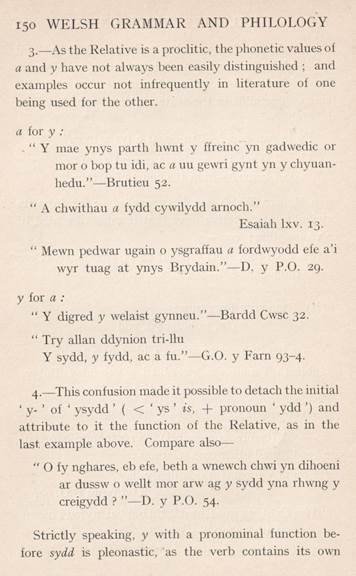
(delwedd L1409) (tudalen 150)
|
150 WELSH GRAMMAR AND PHILOLOGY
3. — As the Relative is a proclitic, the phonetic values of
a and y have not always been easily distinguished; and
examples occur not infrequently in literature of one
being used for the other.
a for y:
. " Y mae ynys parth hw•nt y ffreine yn gadwedic or
mor o bop tu idi, ac uu gewri gynt yn y chyuanhedu." — Brutieu 52.
“A chvvithau a fydd cywilydd arnoch."
Esaiah Ixv. 13.
‘Mewn pedwar ugain o ysgraffau fordwyodd efe a'i
wyr tuag at ynys y P.O. 29.
y for a:
“Y digred y welaist gynneu." — Bardd Cwsc 32.
“Try allan ddynion tri-llu
Y sydd, y fydd, ac a y Farn 93 — 4.
4. — This confusion made it possible to detach the initial
‘y- ' of ' ysydd ' ( < ' ys' is, + pronoun ' ydd ') and
attribute to it the function of the Relative, as in the
last. example above. Compare also —
“O fy nghares, eb efe, beth a wnewch chwi yn dihoeni
ar dussw o wellt mor arw ag y sydd yna rhwng y
creigydd ? " — D. y P.O. 54.
Strictly speaking, y with a pronominal function before sydd is pleonastic,
•as the verb contains its own
|
|
|
|
|
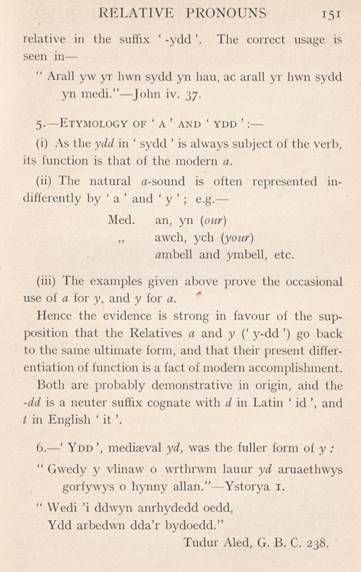
(delwedd L1410) (tudalen 151)
|
RELATIVE PRONOUNS
151
relative in the suffix -ydd '. The correct usage is
seen In —
‘Arall yw yr hwn sydd yn hau, ac arall yr hwn sydd
yn medi." — John iv. 37.
5. — ETYMOLOGY OF ' A ' AND ' YIM) '
(i) As the ydd in ' sydd ' is always subject of the verb,
its function is that of the modern a.
(ii) The natural a-sound is often represented indifferently by a ' and ' y ';
e.g. —
Med. an, yn (our)
awch, ych (your)
ambell and ymbell, etc.
(iii) The examples given above prove the occasional
use of a for y, and y for a.
Hence the evidence is strong in favour of the supposition that the Relatives
a and y (' y-dd ') go back
to the same ultimate form, and that their present differentiation of function
is a fact of modern accomplishlnent.
Both are probably demonstrative in origin, aild the
-dd is a neuter suffix cognate with d in Latin ' id’, and
t in English ' it '.
YDD mediæval yd, was the fuller form oi y:
“Gwedy y vlinaw 0 wrthrwm lauur yd aruaethwys
gorfywys o hynny I.
“Wedi 'i ddwyn anrhydedd oedd,
Ydd arbedwn dda'r bydoedd."
Tudur Aled, G. B. C. 238.
|
|
|
|
|
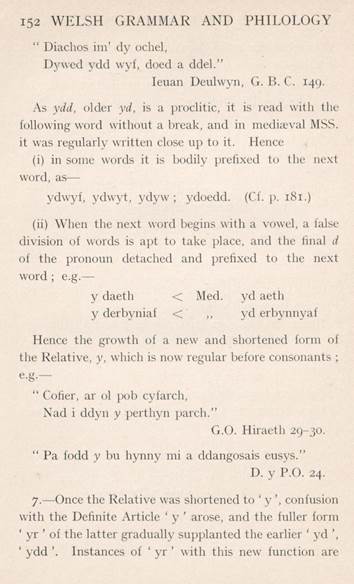
(delwedd L1411) (tudalen 152)
|
152 WELSH GRAMMAR AND PHILOLOGY
“Diachos im' dy ochel,
I)ywed ydd wyf, doed a ddel."
leuan Deulwyn, G. B. C. 149.
As ydd, older yd, is a proclitic, it is read with the
following word without a break, and in mediæval MSS.
it was regularly written close up to it. Hence
(i) in some words it is bodily prefixed to the next
word, as —
ydwyi, yduyt, ydyw; ydoedd. (Cf. p. 181.)
(ii) When the next word begins with a vowel, a false
division of words is apt to take place, and the final d
of the pronoun detached and prefixed to the next
word; e.g. —
< Med. yd aeth
y daeth
y derbyniaf <
yd erbynnyai
Hence the growth of a new and shortened form of
the Relative, y, which is now regular before consonants;
“Cotier, ar 01 pob cyiarch,
Nad i ddyn y pertluyn parch."
G.O. Hiraeth 29-30.
“Pa fodd y bu hynny mi a ddangosais eusys."
D. y P.O. 24.
7. — Once the Relative was shortened to ' y’, confusion
with the Definite Article 'y ' arose, and the fuller form
‘yr ' of the latter gradually supplanted the earlier ' yd '
ydd Instances of ' yr ' with this new function are
|
|
|
|
|
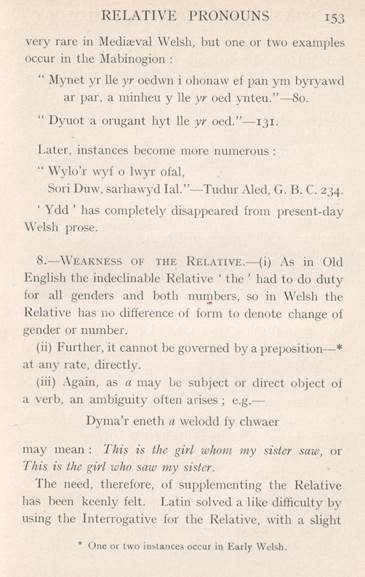
(delwedd L1412) (tudalen 153)
|
RELATIVE PRONOUNS
153
very rare in Media•val Welsh, but one or two exarnples
occur in the Mabinogion:
“Mynet yr Ile yr i ohonaw ef pan ym byryawd
ar par. a minheu y Ile yr oed
Dynot a otmgant hyt Ile yr
I.ater, instances becolne tnore nutnerous:
Wvlo'r wvf o lwvr oial,
Sori Duw, sarhawyd Aled, G. B. C. 234.
‘Ydd ' has completely disappeared from present-day
NVelsh prose.
8. — WEAKNEss OF THE As in Old
English the indeclinable Relative ' the ' had to do duty
for all genders and both nurnbers, so in Welsh the
Relative has no difference of form to denote change of
gender or number.
(ii) Further, it cannot be governed by a preposition — *
at any rate, directly.
(iii) Again, as a may be subject or direct object oi
a verb, an ambiguity often arises; e.g.
Dyma'r eneth a welodd iy chwaer
may mean: This is the girl whom my sister saw, or
This is the girl who saw my sister.
The need, therefore, of supplenwnting the Relative
has been keenly felt. Latin solved a like difficulty by
using the Interrogative for the Relative, with a slight
• One or two instances occur in Early Welsh.
|
|
|
|
|
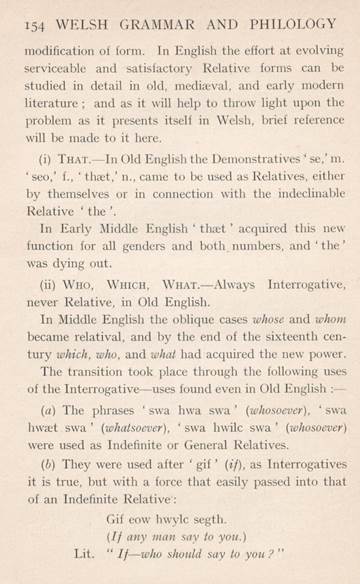
(delwedd L1413) (tudalen 154)
|
154 WELSH GRAMMAR AND PHILOLOGY
modification oi form. In English the effort at evolving
serviceable and satisfactory Relative forms can be
studied in detail in old, mediæval, and early modern
literature; and as it will help to throw light upon the
problem as it presents itself in Welsh, brief reference
will be made to it here.
(i) THAT. — In Old English the Demonstratives ' se,' m.
seo,' f.,‘thæt,' n.. came to be used as Relatives, either
by themselves or in connection with the indeclinable
Relative ' the '.
In Early Middle English ' tluet ' acquired this new
function for all genders and both. numbers, and ' the '
was dying out.
(ii) WHO, WHICH, WHAT. — Always Interrogative,
never Relative, in Old English.
In Middle English the oblique cases whose and whom
became relatival, and bv the end of the sixteenth century which, who, and
what had acquired the new power.
The transition took place through the following uses
of the Interrogative — uses found even in Old English: —
(a) The phrases ' swa hwa swa ' (whosoever), ‘swa
hwæt swa ' (whatsoever), ‘swa hwilc swa ' (whosoever)
were used as Indefinite or General Relatives.
(b) They were used after ' gif ' (if), as Interrogatives
it is true, but with a force that easily passed into that
of an Indefinite Relative:
Gif eow hwylc segth.
Lit.
(I/ any man say to you.)
“If — who should Say to you ?
|
|
|
|
|
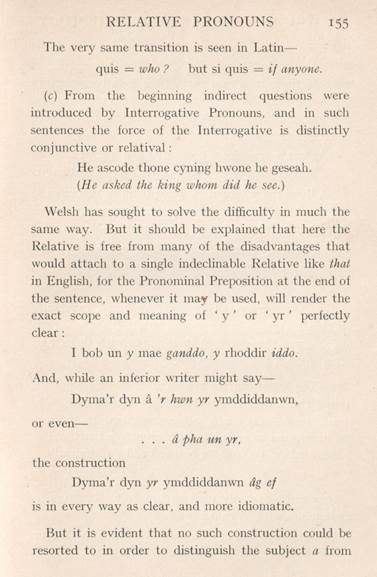
(delwedd L1414) (tudalen 155)
|
RELATIVE PRONOUNS
The very same transition is seen in Latin —
155
quis = who ? but si quis = i/ anyone.
(c) From the beginning indirect questions were
introduced by Interrogative Pronouns, and in such
sentences the force of the Interrogative is distinctly
conjunctive or relatival
He ascode thone cyning hwone he geseah.
(He asked the king whom did he see.)
Welsh has sought to solve the difflculty in much the
same way. But it should be explained that here the
Relative is free from many of the disadvantages that
would attach to a single indeclinable Relative like thal
in English, for the Pronominal Preposition at the end of
the sentence, whenever it may be used, will render the
exact scope and meaning of ' y ' or ' yr ' perfectly
clear:
I bob un y mae ganddo, y rhoddir iddo.
And, while an inferior writer might say
l)yma'r dyn 'r hwn yr ymddiddanwn,
Or
. "ha un yr,
the construction
Dyma'r dyn yr ymddiddanwn åg e/
is in every way as clear, and more idiomatic.
But it is evident that no such construction could be
resorted to in order to distinguish the subject a irom
|
|
|
|
|
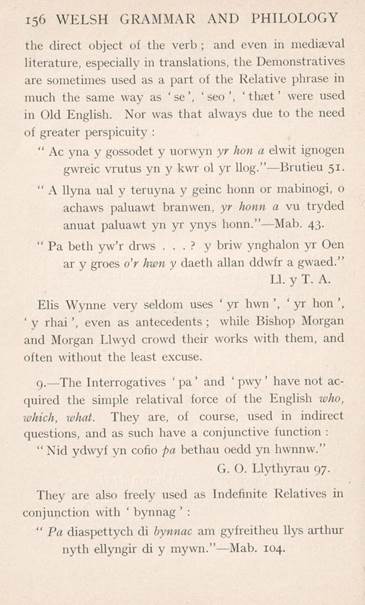
(delwedd L1415) (tudalen 156)
|
156 WELSH GRAMMAR AND PHILOLOGY
the direct object of the verb; and even in medic•eval
literature, especially in translations, the Demonstratives
are sornetirnes used as a part of the Relative phrase in
much the same way as 'se', 'seo’, ‘thæt ' were used
in Old English. Nor was that always due to the need
of greater perspicuity:
‘Ac yna y gossodet y uorwyn yr hon a elwit ignogen
gwreic vrutus yn y kwr 01 yr Ilog." — Brutieu 51.
“A llyna ual y teruyna y geinc honn or mabinogi, o
achaws paluawt branwen, yr honn a vu tryded
anuat paluawt yn yr ynys honn." — Mab. 43.
. ? V briw ynghalon yr Oen
“Pa beth yw'r drws
ar y groes O'r hwn y daeth allan ddwfr a gwaed."
Elis Wynne very seldom uses ' yr hwn’, ‘yr hon’,
‘y rhai even as antecedents; while Bishop Morgan
and Morgan Llwvd crowd their works with them, and
often without the least excuse.
9. — The Interrogatives pa ' and ' pwy ' have not acquired the simple
relatival force of the English who,
which, what. They are, of course, used in indirect
questions, and as Such have a conjunctive function:
“Nid ydwyf yn cofio pa bethau oedd yn hwnnw."
G. O. I-lythyrau 97.
They are also freely used as Indefinite Relatives in
conjunction with ' bynnag '
“Pa diaspettych di bynnac arn gyireitheu llys arthur
nyth ellyngir di y 104.
|
|
|
|
|
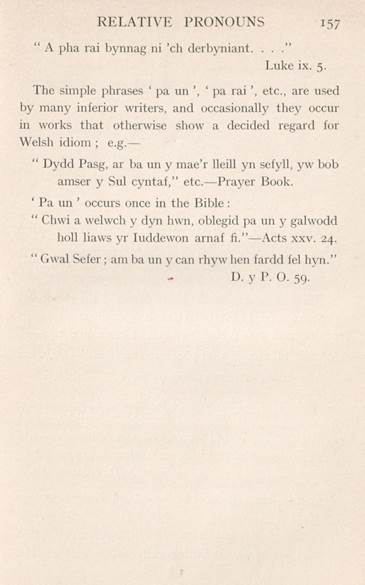
(delwedd L1416) (tudalen 157)
|
RELATIVE PRONOUNS
“A pha rai bynnag ni 'ch derbyniant.
157
Luke ix. 5'
The simple phrases ' pa un’, ‘pa rai’, etc., are used
by many inferior writers, and occasionally they occur
in works that otherwise show a decided regard for
Welsh idiom; e.g. —
“I)ydd Pasg, ar ba un y mae'r Ileill yn sefyll, yw bob
arnser y Sul cyntaf," etc. — Prayer Book.
‘Pa un ' occurs once in the Bible:
“Chwi a welwch y dyn hwn, oblegid pa un y galwodd
holl liaws yr luddewon arnaf fi." — Acts xxv. 24.
“Gwal Sefer; am ba un y can rhyw hen fardd fel hyn."
D. y P. O. 59.
|
|
|
|
|
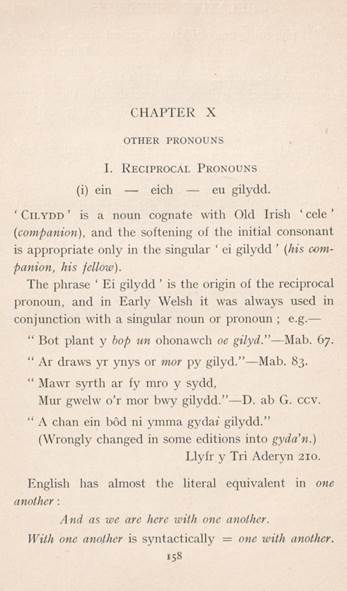
(delwedd L1417) (tudalen 158)
|
CHAPTER X
OTHER PRONOUNS
I. RECIPROCAL PRONOUNS
(i) ein
eich
eu gilydd.
‘Cll.vnn' is a noun cognate with Old Irish ' cele '
(companion), and the softening of the initial consonant
is appropriate only in the singular ' ei gilydd ' (his comPanion, his
fellow).
The phrase ' Ei gilydd ' is the origin of the reciprocal
pronoun, and in Early Welsh it was always used in
conjunction with a singular noun or pronoun; e.g. —
“Bot plant y bop un ohonawch oe gilyd." — Mab. 67.
“Ar draws yr ynys or mor py 83.
“Mawr syrth ar fy mro y sydd,
Mur gwelw O'r mor bwy gilydd." — D. ab G. ccv.
‘A Chan ein böd ni ymrna gydai gilydd."
(Wrongly changed in some editions into gyda'n.)
Llyfr y Tri Aderyn 210.
English has almost the literal equivalent in one
another:
And as wc are here with one another.
With one another is syntactically = one with another.
|
|
|
|
|
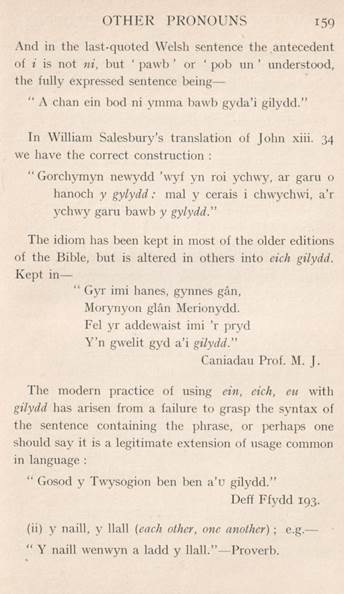
(delwedd L1418) (tudalen 159)
|
OTHER PRONOUNS
159
And in the last-quoted Welsh sentence the antecedent
of i is not ni, but ' pawb' or ' pob un ' understood,
the fully expressed sentence being —
“A chan ein bod ni yrnrna bawl) gyda'i gilydd."
In William Salesbury's translation of John Niii. 34
we have the correct construction:
“Gorchymyn newydd '"Sf yn roi ychwy, ar garu o
hanoch y gylydd: mal y cerais i chwychwi, a'r
ychuy garu bawb y gylydd."
The idiom has been kept in most of the older editions
of the Bible, but is altered in others into cich gilydd.
Kept in —
“Gyr imi banes, gynnes gin,
Morynyon glån Merionydd.
Fel yr addewaist imi 'r pryd
Y'n gwelit gyd a'i gilydd."
Caniadau Prof. M. J.
The modern practice of using ein, eich, eu with
gilydd has arisen from a failure to grasp the syntax of
the sentence containing the phrase, or perhaps one
should say it is a legitimate extension of usage common
in language:
“Gosod y Twysogion ben ben a'r gilydd."
Deff Ffydd 193.
(ii) y naill, y llall (cach other, onc another); e.g.
“Y naill wenwyn a ladd y llall." — Proverb.
|
|
|
|
|
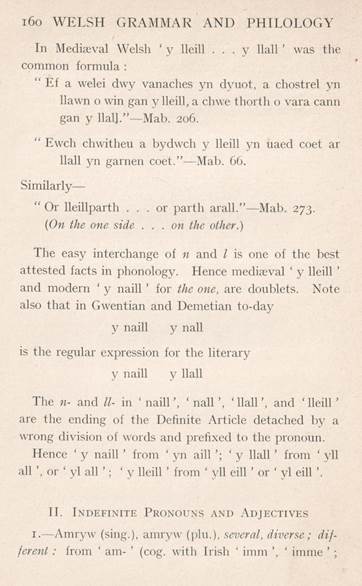
(delwedd L1419) (tudalen 160)
|
160 WELSH GRAMMAR AND PHILOLOGY
In Mediæval Welsh ' y Ileill
. y llall ' was the
common formula:
‘Ef a welei dwy vanaches yn dyuot, a chostrel yn
llawn o win gan y Ileill, a chwe thortli o vara cann
gan y llall."
Mab. 206.
“Ewch chwitheu a bydwch y Ileill yn uaed coet ar
llall yn garnen coet." — Mab. 66.
Similarly
“Or Ileillparth .
(On the one side .
. or parth 273.
on the other.)
The easy interchange of n and I is one of the best
attested facts in phonology. Hence medi.•eval ' y Ileill '
and modern ' y naill ' for the one, are doublets. Note
also that in Gwentian and Demetian to-day
y naill y nall
is the regular expression for the literary
y naili y nail
The n- and 11- in ' mill', 'nail’, 'liail', and 'Ileill '
are the ending of the Definite Article detached by a
wrong division of words and prefixed to the pronoun.
Hence ' y naill ' from ' yn aill ' y llall from ' yll
all or
y Ileill ' from ' yll eill ' or' yl eill
Il. INDEFINITE PRosouxs AND ADJECTIVES
I. — Amryw (sing.), amryw (plu.), several, diverse; different: from ' am- '
(cog. with Irish imm’,
Irnme '
|
|
|
|
|
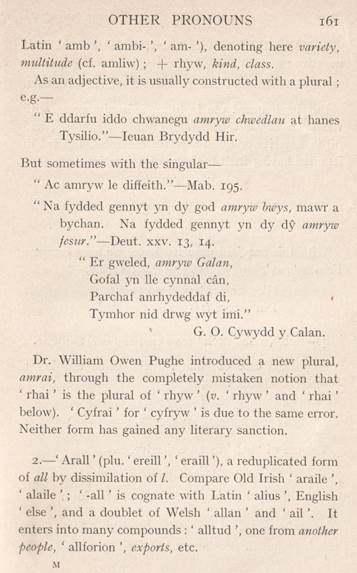
(delwedd L1420) (tudalen 161)
|
OTHER PRONOUNS
161
Latin ' amb ' ambi-’,
‘arn- '), denoting here variety,
multitude (cf. amliw); -F rhyw, kind, class.
As an adjective. it is usually constructed with a plural;
e.g. —
“E ddarfu iddo chwanegu amryw chwedlau at hanes
Tysilio." — leuan Brydydd Hir.
But sometimes with the singular —
“Ac amryw le diffeith." — Mab. 195.
“Na fydded gennyt yn dy god amryw bwys, mawr a
bychan. Na fydded gennyt yn dy CIS amryw
xxv. 13, 14.
“Er gweled, amryw Galan,
Gofal yn Ile cynnal can,
Parchaf anrhydeddaf di,
Tymhor nid drwg wyt imi."
G. O. Cywydd y Calan.
Dr. William Owen Pughe introduced a new plural,
amrai, through the completely mistaken notion that
‘rhai ' is the plural of ' rhyw ' (v. ' rhyw ' and ' rhai '
below). ' Cyfrai ' for ' cyfryw ' is due to the same error.
Neither form has gained any literary sanction.
Arall ' (plu. ' ereill’, ‘eraill '), a reduplicated form
of all bv dissimilation of l. Compare Old Irish ' araile’,
‘alaile '
‘; -all ' is cognate with Latin ' alius’, English
‘else’, and a doublet of Welsh ' allan ' and ' ail '.
enters into many compounds: ' alltud’, one from another
people, ‘allforion’, exports, etc.
|
|
|
|
|
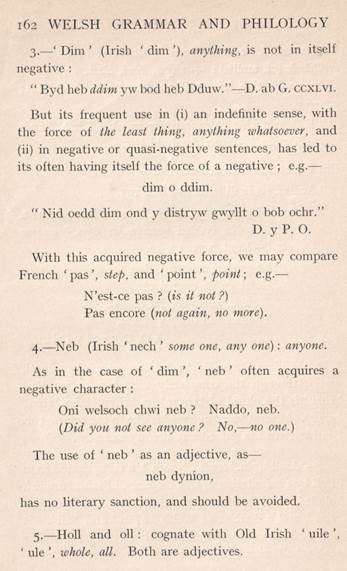
(delwedd L1421) (tudalen 162)
|
162 WELSH GRAMMAR AND PHILOLOGY
Dim ' (Irish ' dim '), anything, is not in itself
negative:
“Byd hebddim yw bod heb ab G. CCXLVI.
But its frequent use in (i) an indefinite sense, with
the force of the least thing, anything whatsoever, and
(ii) in negative or quasi-negative sentences, has led to
its often having itself the force of a negative; e.g. —
dim o ddim.
“Nid oedd dim Ond y distryw gwyllt o bob ochr."
With this acquired negative force, we may compare
French 'pas', step, and ' point', point; e.g. —
N'est-ce pas ? (is it not P)
Pas encore (not again, no more).
4. — Neb (Irish nech ' some one, any one): anyone.
As in the case of ' dim’, ‘neb' often acquires a
negative character:
Oni welsoch chwi neb? Naddo, neb.
(Did you not see anyone? one.)
The use of ' neb ' as an adjective, as —
neb dynion,
has no literary sanction, and should be avoided.
5. — Holl and 011: cognate with Old Irish ' uile’,
‘ule’, whole, all. Both are adjectives.
|
|
|
|
|
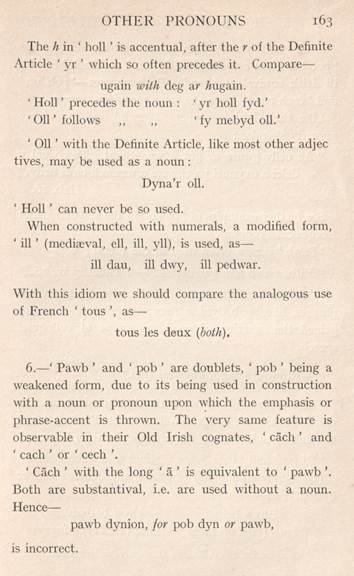
(delwedd L1422) (tudalen 163)
|
OTHER PRONOUNS
163
The h in ' holl ' is accentual, after the r of the Definite
Article ' yr ' which so often precedes it. Compare —
ugain with deg ar hugain.
Holl ' precedes the noun:
‘011 ' follows
•yr holl fyd.'
‘fy mebyd 011.'
‘011 ' with the Definite Article, like most other adjec
tives, may be used as a noun:
Dyna'r 011.
‘Holl ' can never be so used.
When constructed with numerals, a modified form,
‘ill ' (mediæval, ell, ill, yll), is used, as —
ill dau, ill dwy, ill pedwar.
With this idiom we should compare the analogous use
of French ' tous’, as —
tous les deux (both).
6. — ' Pawb ' and ' pob ' are doublets, ‘pob ' being a
weakened form, due to its being used in construction
with a noun or pronoun upon which the emphasis or
phrase-accent is thrown. The very same feature is
observable in their Old Irish cognates, ‘cäch ' and
‘cach ' or ' cech '.
‘Cäch ' with the long ' ä ' is equivalent to ' pawb
Both are substantival, i.e. are used without a noun.
Hence —
pawb dynion, for pob dyn or pawb,
is incorrect.
|
|
|
|
|
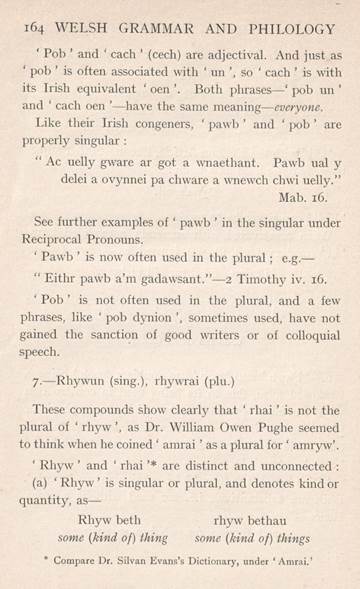
(delwedd L1423) (tudalen 164)
|
164 WELSH GRAMMAR AND PHILOLOGY
‘Pob ' and ' cach ' (cech) are adjectival. And just as
‘pob ' is often associated with ' un’, so ' cach ' is with
its Irish equivalent ' oen Both phrases — ' pob un '
and ' cach oen ' — have the same meaning — everyone.
Like their Irish congeners, ‘pawb ' and ' ' are
properly singular:
“Ac uelly gware ar got a wnaethant. Pawb ual y
delei a ovynnei pa chware a wnewch chwi uelly."
Mab. 16.
See further examples of ' pawb ' in the singular under
Reciprocal Pronouns.
‘Pawb ' is now often used in the plural; e.g. —
“Eithr pawb a'm gadawsant." — 2 Timothy iv. 16.
‘Pob ' is not often used in the plural, and a few
phrases, like ' pob dynion’, sometimes used, have not
gained the sanction of good writers or of colloquial
speech.
7. — Rhywun (sing.), rhywrai (plu.)
These compounds show clearly that ' rhai ' is not the
plural of ' rhyw’, as Dr. William Owen Pughe seemed
to think when he coined ' amrai ' as a plural for ' amryw'.
‘Rhyw ' and ' rhai '*
are distinct and unconnected:
(a) ' Rhyw ' is singular or plural, and denotes kind or
quantity, as —
Rh»v beth
rhyw bethau
some (kind of) thing some (kind of) things
• Compare Dr. Silvan Evans's Dictionary, under Amrai.
|
|
|
|
|
(delwedd L1424) (tudalen 165)
|
OTHER PRONOUNS
165
‘Rhai ' is always plural, and applies only to number:
Rhai pethau (some things, a number o/ things).
(b) ' Rhyw ' governs the soft mutation:
Rhyw beth ( < peth); rhyw bethau ( < pethau).
‘Rhai ' is followed by the radical:
Rhai pethau.
|
|
|
|
|
(delwedd L1425) (tudalen 166)
|
CHAPTER Xl
THE VERB
1. — To the student of comparative grammar, as exemplified in the two
languages with which Wales is most intimately concerned, one of the most
noticeable peculiarities of the Welsh verb is the absence of an Infinitive
Mood, including participles. Taking the last, we find
that the Present, Past, and Future Participles Active
are regularly expressed by prepositional phrases, without any trace of a
participial inflection; thus —
learning
having learnt
is yn dysgu
, wedi dysgu
, am ddysgu, ar ddysgu.
being about to learn
But when the matter is looked into a little more
closely we find that English is not so far removed from
Welsh in this construction, for learning is in origin a
verbal noun, and, in Old English, was always used as
such. In Middle English -ing ' ousted the Old English
present participle ending ' -nde’, as —
O. E. leornende Mid. E. leorning.
The transition is seen in such expressions as —
The house is building, for
The house is a ( = on, in) building.
166
|
|
|
|
|
(delwedd L1426) (tudalen 167)
|
THE VERB
167
When the preposition is thus supplied, the analogy to
the Welsh construction is remarkable.
The Old English present participle ending still survives in two or three
words, where its presence might
not be readily suspected, viz. in ' fiend’, ‘friend’, and
‘husband’, meaning respectively the hater, the lover
or cherisher, and the house-dweller. By Verner's Law
we expect a d in English, in an originally unaccented
syllable, from an Aryan t, as ' third’, Latin ' tertius '.
This t is preserved in Latin, for the stem of the present
participle ends in '-nt’, as ' amant(em) '. It is instructive
to trace the same termination in Welsh, though no longer
with a verbal function. It occurs in such words as
‘meddiant ' and dihuddiant '. Nor is the change of
meaning difficult. It is a case of simple association to
pass from the act of possessing to the thing possessed.
Compare a parallel transference in English —
We are holding our own (ptc.).
This is a small holding (noun).
2. — THE VERB-NOUN
The student must beware of regarding it as a mere
equivalent of the English infinitive mood. It is much
more of a noun than the latter; thus —
(a) It may be qualified by the definite article:
“Gan gydymholi beth yw yr adgyfodi o feirw."
Mark ix. 10.
(Questioning one with another whal the rising from the
dead should mean.)
|
|
|
|
|
(delwedd L1427) (tudalen 168)
|
168 WELSH GRAMMAR AND PHILOLOGY
(b) Also by an adjective:
Canu (la, (good singing).
(c) The noun dependent upon it, as when dependent
upon any other noun, is in the genitive case, and undergoes no initial
mutation:
Contrast: derbyn tal (the receipt 0/ Payment).
and —
derbyniais 'iål (I received Payment),
where ' dil ' is accusative case, and has the customary
soft mutation of the object when following a transitive
verb.
I.ikewise the post-vocalic or infixed pronoun preceding it is in the
possessive genitive case in function) and not the accusative. This is evident
from the
mutation, e.g. —
A'i chanmol a wnaeth (And he Praised her.)
The possessive 'i governs the aspirate mutation.
Contrast:
Fe'i canmolodd hi (He Praised her),
where the 'i is followed by the radical, and is thus in
the accusative case direct object of ' canmolodd '.
(d) It is governed by prepositions:
Cyn derbyn tål,
Before the (receiøt 0/ Payment).
|
|
|
|
|
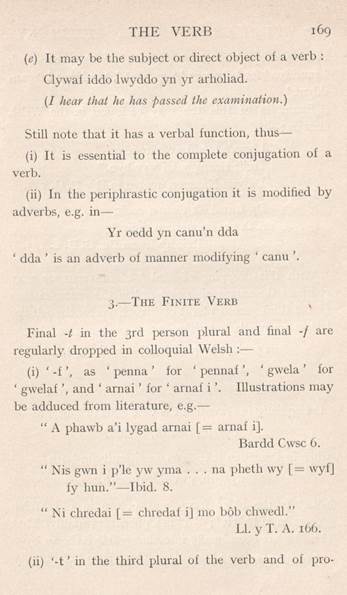
(delwedd L1428) (tudalen 169)
|
THE VERB
169
(e) It may be the subject or direct object of a verb:
Cl»vaf iddo lwyddo yn yr arholiad.
(I hear that he has passed the examination.)
Still note that it has a verbal function, thus —
(i) It is essential to the complete conjugation of a
verb.
(ii) In the periphrastic conjugation it is modified by
adverbs, e.g. in —
Yr oedd yn canu'n dda
‘dda ' is an adverb of manner modifying ' canu '.
3. — THE FINITE VERB
Final -t in the 3rd person plural and final -i are
regularly dropped in colloquial Welsh: —
(i) ' as ' penna' for ' pennaf', ‘gnvela' for
Illustrations may
‘gwelaf’, and ' arnai ' for ' arnaf i '.
be adduced from literature, e.g. —
“A phawb a'i lygad arnai arnaf i].
Bardd cwsc 6.
. . na pheth wy [ = wyf]
“Nis e,vn i p'le yw yma .
Ibid. S.
fy hun —
“Ni chredai chredaf i] mo böb chwedl."
Ll. y T. A. 166.
(ii) '-t ' in the third plural of the verb and oi pro
|
|
|
|
|
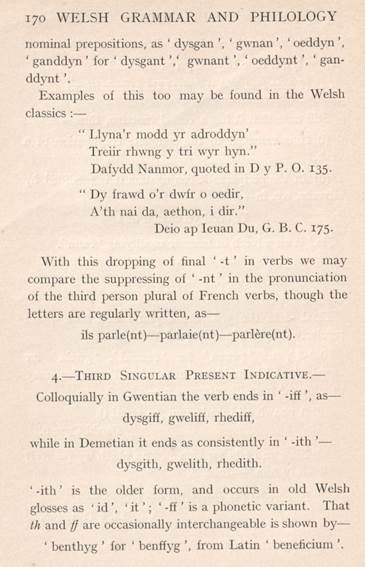
(delwedd L1429) (tudalen 170)
|
170 WELSH GRAMMAR AND PHILOLOGY
nominal prepositions, as ' dysgan’, ‘gunan’, ‘oeddyn’,
‘ganddyn ' for ' dysgant’,' gwnant’, ‘oeddynt’, ‘ganddynt '.
Examples of this too may be found in the Welsh
classics: —
“Llyna'r modd yr adroddyn'
Treiir rhwng y tri wyr hyn."
I)afydd Nanmor, quoted in I) y P. O. 135.
Dy frawd O'r dwfr o oedir,
A'th nai da, aethon, i dir."
Deio ap leuan Du, G. B. C. 175.
With this dropping of final ' -t ' in verbs we may
compare the suppressing of -nt ' in the pronunciation
of the third person plural of French verbs, though the
letters are regularly written, as —
ils
4. — THIRD SINGULAR PRESENT INDICATIVE. —
Colloquially in Gwentian the verb ends in ' -iff ' , as —
dysgiff, gweliff, rhediff,
while in Demetian it ends as consistently in ' -ith ' —
dysgith, gwelith, rhedith.
‘-ith' is the older form. and occurs in old Welsh
glosses as ' id’, it '; ' is a phonetic variant. That
th and are occasionally interchangeable is shown by —
‘benthyg ' for ' benffyg’, from Latin ' beneficium
|
|
|
|
|
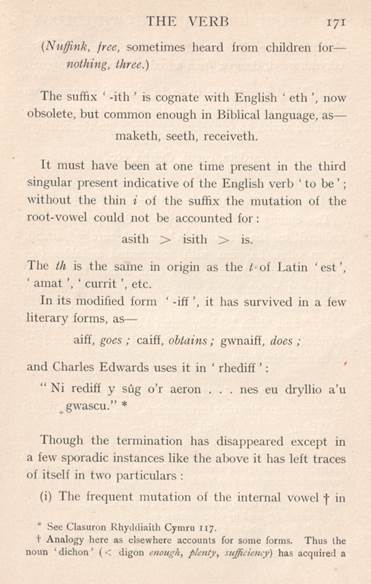
(delwedd L1430) (tudalen 171)
|
THE VERB
171
(Nuank, free, sometimes heard from children for —
nothing, three.)
The suffix -ith is cognate with English ' eth now
obsolete, but common enough in Biblical language, as —
maketh, seeth, receiveth.
It must have been at one time present in the third
singular present indicative of the English verb ' to be ' ,
without the thin i of the suffl.x the mutation of the
root-vowel could not be accounted for:
asith > isith > is.
The th is the saine in origin as the t•of Latin ' est’,
‘amat ' currit’, etc.
In its modified form ' -iff’, it has survived in a few
literary forms, as —
aiff, goes; caiff, obtains; gwnaiff, does ,
and Charles Edwards uses it in ' rhediff ':
“Ni rediff y süg O'r aeron
. . . nes eu dryllio a'u
gwascu." *
Though the termination has disappeared except in
a few sl»radic instances like the above it has left traces
of itself in two particulars:
(i) The frequent mutation of the internal vowel t in
• See Clasuron Rhyddiaith Cymru
Analogy here as elsewhere accounts for some forms. Thus the
noun ' dichon' ( < digon enough, plenty, sußiem-y) has acquired a
|
|
|
|
|
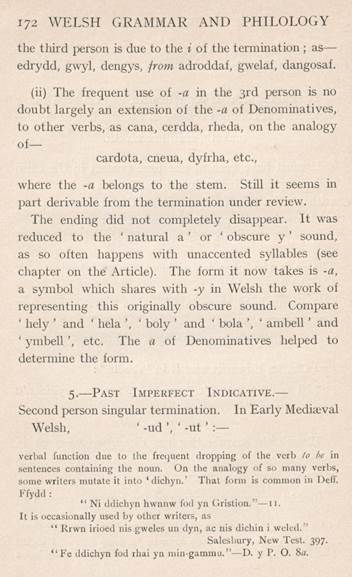
(delwedd L1431) (tudalen 172)
|
172 WELSH GRAMMAR AND PHILOLOGY
the third person is due to the i of the termination; as —
edrydd, gwyl, dengys, from adroddaf, gwelaf, dangosaf.
(ii) The frequent use of -a in the 3rd person is no
doubt largely an extension of the -a of Denominatives,
to other verbs, as cana, cerdda, rheda, on the analogy
of —
cardota, cneua, dyfrha, etc.,
where the -a belongs to the stem. Still it seems in
part derivable from the termination under review.
The ending did not completely disappear. It was
reduced to the ' natural a ' or ' obscure y ' sound,
as so often happens with unaccented syllables (see
chapter on the Article). The form it now takes is -a,
a symbol which shares with -y in Welsh the work of
representing this originally obscure sound. Compare
‘hely ' and ' hela’, ‘boly ' and ' bola’, ‘ambell ' and
‘ymbell’, etc. The a of Denominatives helped to
determine the form.
5. — PAST IMPERFECT INDICATIVE. —
Second person singular termination. In Early Mediæval
Welsh,
‘-ud’, ‘ut
verbal function due to the frequent dropping of the verb to in
sentences containing the noun. On the analogy of so many verbs,
some writers mutate it into ' dichyn.' That form is common in l)eff.
Ffydd:
Ni ddichyn hwnnw fod yn Gristion.
It is occasionally used by other writers, as
Rrwn irioed nis gweles un dyn, ac nis dichin i weled.
Saleshury, New •rest. 397.
Fe ddichyn fod rhai yn min•gammu. y P. O. Set.
|
|
|
|
|
(delwedd L1432) (tudalen 173)
|
THE VERB
173
“Py wyneb yssyd arnat ti pryt na delud y edrych y
gofut a arnaf 176.
“A bychan a rybychud
1m 'o gerdd, rym agwrdd ddrud. — "D. ab G. cxxrv.
-ud, -ut, > -yd, -yt:
Original long ' ' sound (as in ' swn’, ‘00 ' in English
‘pool ') had a marked tendency in Welsh to unrounding
and palatalization. Thus u of Latin ' tu ' (pronounce
like English ' to '), and Old English ' thu ' ( > Modern
and
‘thou ') is the unrounded palatal i in Welsh ' ti ' •
‘rhin ' is cognate with English ' rune'. The ' '
of the later Romano-British period has not advanced
quite as far in literary Welsh, though outside Gwynedd
it has colloquially the value of i rather than the standard
u. Hence Latin ' pürus’, ‘mürus’, have, by unround' mur '.
ing, passed into Modern Welsh ' pur ' ,
One wide-spread result of the unrounding of u
(w-sound) was to confuse it with y, which in final
syllables had the same value as the u was now acquiring.
The result is a very noticeable uncertainty in the use
of u and y in final syllables. Thus in the Bruts and
Mabinogion ' Kymry ' is the invariable form for both
Welsh people and Wales, but in the sixteenth, seventeenth, and eighteenth
centuries a variant form in -u
arose, and was used side by side with ' Cymry ' in both
senses. The limiting of ' Cymru ' to denote Wales is a
very modern distinction. Similarly ' melus' during
the same period came to be almost invariably written
‘melys’, and the verb-sufflx under discussion was
changed from ' -ud’, ‘-ut’, into ' -yd’, ‘-yt’, as —
|
|
|
|
|
(delwedd L1433) (tudalen 174)
|
174 WELSH GRAMMAR AND PHILOLOGY
“Goddau f' armerth, O'rn nerthyd,
YW Dydd Barn a diwedd byd."
G. O. y Farn.
Finally, under the influence of the thin i of the pronoun ti, which usually
follows the verb, the suffix is
now ' -id’, or rather ' -it due to the t of the pronoun.
Third singular ' -ai’, older ' -ei ':
many writers —
like Maurice Kyffln, Bishop Morgan, and Morgan Llwyd
— continually use the simplified -e
heard colloquially
throughout Wales, as —
“Canys y glust [a'm] clywe a'm bendithie."
Llyvyr Job 63.
The termination -iad occurs in one or two words, e.g. —
“Ac na wydyat pwy ae lladei." — Mab. 41.
“Nid adwaeniad odineb,
Ni fynai nyn fi na ab G. x,XX1.
“Nid oes, f' Arglwydd, a wyddiad
Ei dymp, onid Ef a'i Dad." — G. O. y Farn.
6. — PAST IMPERFECT PLURAL —
In Mediæval Welsh the terminations were regularly
em -ewch ' , ynt The e Of the first and second
persons is now commonly extended by analogy to the
third —
-em, -ech, -ent.
But the modernity of the last form may readily be seen
by reference to our older classics; thus in the Mabino
|
|
|
|
|
(delwedd L1434) (tudalen 175)
|
THE VERB
175
gion v' -ynt ' is the invariable form, and it occurs on
every page, e.g. —
elynt (p. 85); tebygynt, cerdynt, gwelynt
(all on p. 86); gwelynt (six times on p. 87); notteynt
(88); peidynt, yttoedynt (90); oedynt, buasynt (91).
The poets have resisted the change of ' -ynt ' into
‘-ent’, due no doubt in part to the far larger number
of words that can be found to rhyme with the old form.
Still, the newer ending occurs even in poetry, and
especially where rhyme requires it: —
“Y n Ilinyn yno llanwent
Hapus gylch Powys a Gwent."
G. O. i Ofyn Ffrancod.
“Rhoenl obaith ar weniaith wag."
G. O. Y Maen Gwerthfawr.
7. — THE AORIST OR PRETERITE OR PAST INDEFINITE.
— The regular termination of the third
person singular
in Modern Welsh is ' -odd’, as —
dysgodd, gwelodd, canodd, rhedodd, lladdodd.
Colloquially in Gwentian ' -ws ' is the common termination, as —
dysgws, gwelws, canws, rhedws, lladdws,
while in Demetian -as is occasionally heard, as —
gwelas.
In Mediæval Welsh —
-wys, -as, -awd, -es, -is,
|
|
|
|
|
(delwedd L1435) (tudalen 176)
|
176 WELSH GRAMMAR AND PHILOLOGY
all occur, and it may be safely said that in the Mabinogion ' -wys ' and '
-as ' are quite as common as ' -awd '.
“V gwyr a wiscwys ymdanunt." — Mab. 26 — 7.
“Llyma heb wynt y tir a welas an harglwyd ni."
Mab. 87.
“Ac yna y dewissawd gwneuthur y gaer uchaf yn
aruon idi." — Mab. 89.
“A phan deffroes, hoedel nac einyoes na b»vyt nyt
oed 85.
‘Y neb a dechreuis vyn diua yssyd yn y orfen."
Mab. 53.
The ' -ws ' of Gwentian is a doublet of the ' -wys ' of
the Mabinogion.
In a few verbs the ' -dd ' (older ' -d ') of ' -odd ' is
sometimes attached to the stem without a connecting
vowel, as —
cant for canodd, gwant for gwanodd,
cymerth for cymerodd.
The d is hardened into t by the adjoining n; compare
genti ' for ' ganddi’, common in mediæval literature
and still used colloquially in some parts of Wales; also —
ynte < on'de < onide.
The joining of the final consonant of the suffix to
the stem without an intervening vowel is seen in llas,
the aorist impersonal of ' lladdaf'. Thus while the
|
|
|
|
|
(delwedd L1436) (tudalen 177)
|
THE VERB
177
fuller form ' lladded ' goes back to older ' lladet
the
variant ' llas ' is from ' llast' < ' llad-t '.
Similarly
‘wS•s' is from ' wyst' < ' ' wydt.
For the change of d into s compare Latin ' est’, (cats)
< ' ed-t’, and English ' wist ' < ' wit-te’, and ' must '
< ' mot-te '. The eclipsing or assimilation of the -t to
the s in ' llas ' and 'wys' from ' llast ' and ' wyst' is a
later change.
The aorist plural regularly ended in
-am, -awch, -ant,
in mediæval literature: —
1st: '
Yn kwn a 52.
‘Ai gwaeth i ddyn, gnviw ei thaid,
Y n y llwyn ennill enaid,
Na gwneuthur fal y gwneutham
Yn Rhufain, acyn Sain Siam ? al) G. x.
2nd:
“Ha wyr heb ef or gwnaethawch gam y mi
digawn y buawch 67.
3rd:
“A phan edrychyssant." — Mab. 46.
“Ar gwraged a gyvodassant 223.
In the change of a into o in the first and second persons,
at least two influences have been at work: —
(i) m is an essentially rounded consonant and tends
to convert the unrounded medial a into the rounded
and more guttural o. Compare —
‘siom’, ‘som’, from English ' sham '.
|
|
|
|
|
(delwedd L1437) (tudalen 178)
|
178 WELSH GRAMMAR AND PHILOLOGY
(ii) The growth of the inorganic * w before the ch
of the second person yielded, in conjunction with the a,
the diphthong ate, which is regularly simplified into o /
in a final unaccented syllable, as —
eiddo < Med. eidaw.
Hence the modern endings of the plural aorist are.
-orn, -och, -ant.
An occasional instance of the change is found even
in mediæval literature, e.g. —
“Mae yr enw heb y penndaran dyuet. Gwri Wallt
Euryn a dodyssorn ni arnaw ef. " — Mab 24.
Third plural in ' -ont ': even the ' -ant ' of the third
person was occasionally changed into ' -ont ' by analogy:
“Ymysc hynny wynt a glywsont chwedyldyaeth y
wrth riannon." — Mab. 22.
“Ac yn hynny rybud a gawssont wynteu." — Mab. 47.
‘-ont ' occurs not infrequently in early Modern Welsh,
as in Deffynniad Ffydd — gwnaethont (p. 120), cipiasont
(133), rowsont (133), etc. So in Bishop Morgan's
translation of the Bible, Llyfr y Tri Aderyn, and Drych
y Prif Oesoedd; but -ant ' never fell into disuse, and is
now the invariable form except in the verb ' to be’,
where both ' buont ' and ' buant ' are fully sanctioned.
It should be noted that the ' -ont ' of ' buont ' is not
• Or the w here may be an instance of metathesis, e.g. —
gwelsachwi > gwelsawchi > gwelsawch.
|
|
|
|
|
(delwedd L1438) (tudalen 179)
|
and compounds of ' bod ';
adnabuant, canfuant, not adnabuont, caniuont.
8. — IMPERATIVE
Much uncertainty is experienced by some writers
over the correct form of the third person plural.
It originally ended in ' -ent ':
Pan gl»vhont Ilef dy gorn disgynnent wynteu am
ben y llys." — Mab. 14.
In Modern Welsh, however, ‘-ant' is the regular
form:
“Ond llawenycher y rhai cyfiawn, a gorfoleddant ger
bron Duw; a byddant hyfryd o lawenydd."
Ps. Ixviii.
“Canys dywedant hwy a fynnont yng nghylch ei
gnvreiddyn, a dygant eu tadauo 'Spaen . . . neu'r
man y mynnont, nid y'nt Ond cymmysg o Ellrnyn
a Brython." — Llythyrau Goronwy Owen 124.
Maurice Kyfiin in Deffynniad Ffydd occasionally
uses the Jussive Subjunctive instead of the Imperative:
“Gwrandawont Barnard. " — 105.
(Let them listen to Barnard.)
“Cystadlon.nhwy'n heglwysi ni, a'u helgwysi eu
hun; a nhwy a gant weled ddarfod iddynt hwy'n
irwnt aruthr ymadel a'r
|
|
|
|
|
(delwedd L1439) (tudalen 180)
|
THE
used in the derivatives
hence —
VERB
179
WELSH GRAMMAR AND PHILOLOGY
So in —
‘Ac aed Moses ei hun at yr Arglwydd; ac na ddclont
hwy, ac nac aed y bobl i fynu gyd ag cf."
Ex. xxiv. 2.
9. — SUBJVNCTIVE PRESENT
In Mediæval Welsh the second person singular ended
in -ych ':
“Pa geluydyt yd awn ni wrthi heb y manawydan.
Yr honn y mynnych or a wdam ni heb y pryderi." — Mab. 48.
“Ac o achaws y kewilyd a wnaethost di y Ilew llaw
gyffes, na beidych ditheu dangos dy wyneb liw
dyd vyth .. . ac na chollych dy enw." — Mab. 80.
In Modern Welsh the sufflx is as often -ech as -ych;
thus in Matthew vi. we find
pan wnelych." — vv. 2, 3.
“A phan 5•
“Ond tydi, pan weddiech."
“Eithr pan ymprydiech di." — v. 17.
‘-ot ' is sometimes met with — a modern back formation from the third
singular, which ends in ' -o:
“Fel y mynnot, lesu anwyl
, Ac nid fel y mynnaf fi." — W. A. Griffiths.
(See Y Caniedydd Cynulleidfaol, hymn 531.)
|
|
|
|
|
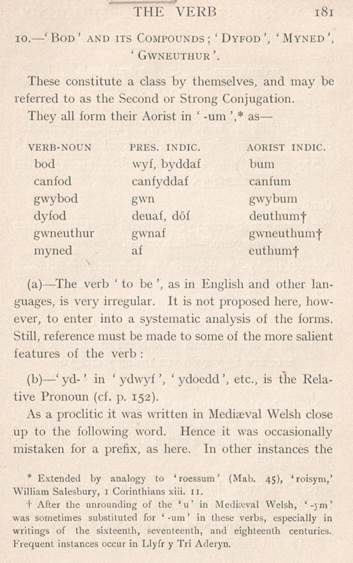
(delwedd L1440) (tudalen 181)
|
THE VERB
10. — ' Bon' AND ITS COMPOUNDS; ' DYFOD’,
‘GWNEUTHUR '.
181
‘MYNED’,
These constitute a class by themselves, and may be
referred to as the Second or Strong Conjugation.
They all form their Aorist in ' -um’,* as —
VERB-NOUN
can fod
gwybod
dyfod
gwneuthur
myned
PRES. INDIC.
wyf, byddaf
canfyddaf
gwn
deuaf, döf
gwnaf
af
AORIST INDIC.
bum
canfum
gwybum
deuthumt
gnvneuthunit
euthurnt
(a) — The verb ' to be’, as in English and other languages, is very
irregular. It is not proposed here, however, to enter into a systematic
analysis of the forms.
Still, reference must be made to some of the more salient
features of the verb:
in ' ydwyf’, ‘ydoedd’, etc., is Relative Pronoun (cf. p. 152).
As a proclitic it ••.vas written in Mediæval Welsh close
up to the following word. Hence it was occasionally
mistaken for a prefix, as here. In other instances the
• Extended by analogy to roessum' (Mab. 45),
roisym,
William Salesbury, 1 Corinthians xiii. 11.
After the unrounding of the • u' in Medieval Welsh, -ym
was sometimes substituted for
-um' in these verbs, especially in
writings of the sixteenth, seventeenth, and eighteenth centuries.
Frequent instances occur in Llyfr y Tri Aderyn.
|
|
|
|
|
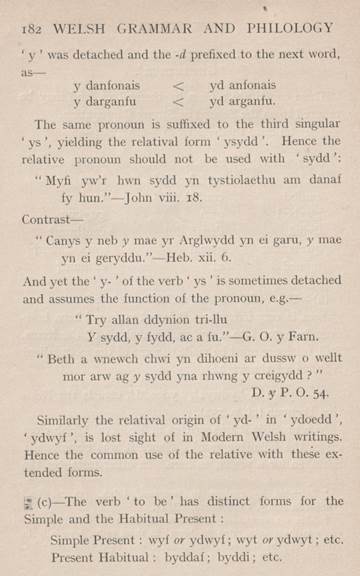
(delwedd L1441) (tudalen 182)
|
182 WELSH GRAMMAR AND PHILOLOGY
‘y ' was detached and the -d prefixed to the next word,
< yd anfonais
y danfonais
< yd arganiu.
y darganfu
The same pronoun is suffixed to the third singular
‘ys’, yielding the relatival form y»dd '. Hence the
relative pronoun should not be used with ' sydd ' •
“Myfl yw'r hwn sydd tystiolaethu am danaf
fy bun."
John viii. 18.
Contrast —
“Canys y neb y mae yr Arglwydd yn ei garu, y mae
yn ei geryddu." — Heb. xii. 6.
And yet the ' y- ' of the verb ' ys ' is sometimes detached
and assumes the function of the pronoun, e.g. —
“Try allan ddynion tri-llu
Y sydd, y fydd, ac a O. y Farn.
“Beth a quewch chwi yn dihoeni ar dussw o wellt
mor arw ag y sydd yna rhwng y creigydd ? "
D. y P. O. 54.
Similarly the relatival origin of ' yd- ' in ' ydoedd’,
ydwyf’, is lost sight of in Modern Welsh writings.
Hence the common use of the relative with these extended forms.
5_ verb ' to be ' has distinct forms for the
Simple and the Habitual Present:
Simple Present: wyf or ydwyf; wyt or ydwyt; etc.
Present Habitual: byddai; byddi; etc.
|
|
|
|
|
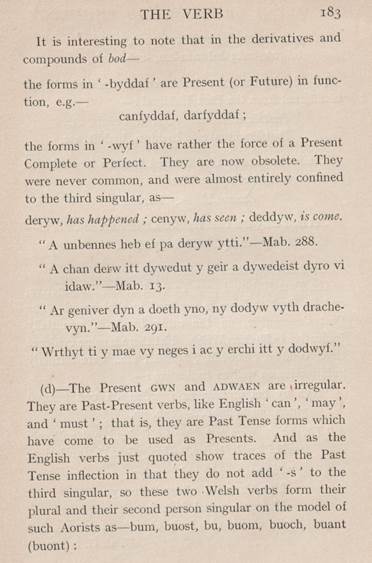
(delwedd L1442) (tudalen 183)
|
THE VERB
183
It is interesting to note that in the derivatives and
compounds of bod —
the forms in ' -byddaf ' are Present (or Future) in function, e.g. —
canfyddaf, darfyddaf;
the forms in ' -wyf ' have rather the force of a Present
Complete or Perfect. They are now obsolete. They
were never common, and were almost entirely confined
to the third singular, as —
deryw, has happened; cenyw, has seen; deddyw, is come.
“A unbennes heb ef pa deryw ytti." — Mab. 288.
“A chan derw itt dywedut y geir a d»vedeist dyro vi
13.
“Ar geniver dyn a doeth yno, ny dodyw vyth drachevyn." — Mab. 291.
“Wrthyt ti y mae vy neges i ac y erchi itt y dodwyf."
(d) — The Present GWN and ADWAEN are , irregular.
They are Past-Present verbs, like English ' can’, ‘may’,
and ' must '; that is, they are Past Tense forms which
have come to be used as Presents. And as the
English verbs just quoted show traces of the Past
Tense inflection in that they do not add ' -s ' to the
third singular, so these two .Welsh verbs form their
plural and their second person singular on the model of
such Aorists as bum, buost, bu, buom, buoch, buant
(buont):
|
|
|
|
|
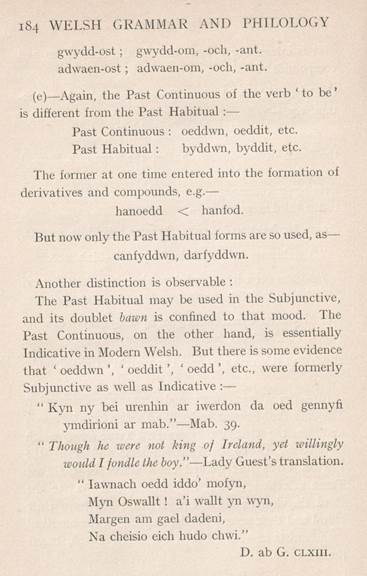
(delwedd L1443) (tudalen 184)
|
184 WELSH GRAMMAR AND PHILOLOGY
gwydd-ost; gwydd-om, -och, -ant.
adwaen-ost; adwaen-om, -och, -ant.
(e) — Again, the Past Continuous of the verb ' to be '
is different from the Past Habitual: —
Past Continuous: oeddwn, oeddit, etc.
Past Habitual: byddwn, byddit, etc.
The former at one time entered into the formation of
derivatives and compounds, e.g. —
hanoedd < hanfod.
But now only the Past Habitual forms are so used, as —
canfyddwn, darfyddwn.
Another distinction is observable:
The Past Habitual may be used in the Subjunctive,
and its doublet bawn is confined to that mood. The
Past Continuous, on the other hand, is essentially
Indicative in Modern Welsh. But there is some evidence
that ' oeddwn’, ‘oeddit’, ‘oedd’, etc., were formerly
Subjunctive as well as Indicative: —
“Kyn ny bei urenhin ar iwerdon da oed gennyfi
ymdirioni ar mab." — Mab. 39.
“Though he were not king o/ Ireland, yet willingly
would I fondle lhe boy." — Lady Guest's translation.
“lam,vnach oedd iddo' mofyn,
Myn Oswallt a'i wallt yn wyn,
Margen am gael dadeni,
Na cheisio cich hudo chwi."
D. ab G. CLXIII.
|
|
|
|
|
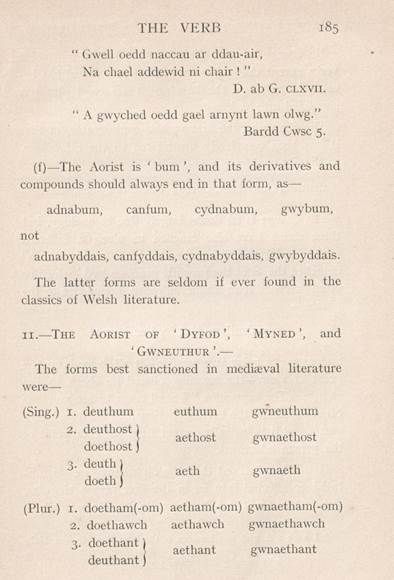
(delwedd L1444) (tudalen 185)
|
D. ab G. CLXVII.
“A gnvyclued oedd gael arnynt lawn olwg."
Bardd Cwsc 5.
(f) — The Aorist is ' bum and its derivatives and
compounds should always end in that form, as —
canfum, Cydnabum, gwybum,
adnabum,
not
adnabyddais, canfyddais, cydnabyddais, gwybyddais.
The latter forms are seldom if ever found in the
THE VERB
Gwell oedd nacCau ar ddau-air,
Na chael addewid ni chair ! "
(Sing.) 1. deuthum
185
classics of Welsh literature.
ll. — THE AORIST OF 'DVFOD’,
‘GWXECTIICR '.
‘MYNED’,
and
The forms best sanctioned in mediæval literature
deuthost
2.
doe t host
deuth
3.
doeth
(Plur.) I. doetham(-om)
2. doethawch
3. doethant
deuthant
|
|
|
|
|
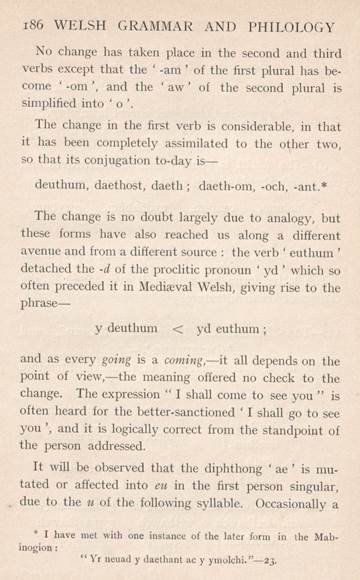
(delwedd L1445) (tudalen 186)
|
euthum
aethost
aeth
g«neuthum
gwnaeth
aetham(-om) gwnaetham(-om)
aethawch
aethant
gwnacthawch
gwnaethant
186 WELSH GRAMMAR AND PHILOLOGY
No change has taken place in the second and third
verbs except that the ' -am ' of the first plural has become ' -om’, and the
' aw ' of the second plural is
simplified into ' o '.
The change in the first verb is considerable, in that
it has been completely assimilated to the other two,
so that its conjugation to-day is —
deuthum, daethost, daeth; daeth-om, -och, -ant.*
The change is no doubt largely due to analogy, but
these forms have also reached us along a different
avenue and from a different source: the verb ' euthum '
detached the -d of the proclitic pronoun ' yd ' which so
often preceded it in Mediæval Welsh, giving rise to the
phrase —
y deuthum < yd euthurn;
and as every going is a coming, — it all depends on the
point of view, — the meaning offered no check to the
change. The expression " I shall come to see you " is
often heard for the better-sanctioned ' I shall go to see
you’, and it is logically correct from the standpoint of
the person addressed.
It will be observed that the diphthong ' ae ' is mutated or affected into eu
in the first person singular,
due to the u of the following syllable. Occasionally a
I have met with one instance of the later form in the Mabunoguon:
Vr neuad y daethant ac y yrnolchi. " — 23.
|
|
|
|
|
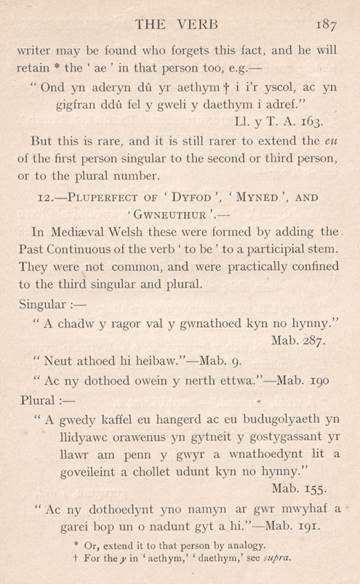
(delwedd L1446) (tudalen 187)
|
THE VERB
187
writer may be found who forgets this fact, and he will
retain * the ' ae ' in that person too, e.g. —
“Ond yn aderyn di yr aethymt i i'r yscol, ac yn
gigfran ddü fel y gnveli y daethym i adref."
Ll. y T. A. 163.
But this is rare, and it is still rarer to extend the cu
of the first person singular to the second or third person,
or to the plural number.
12. — PLUPERFECT OF ' DYFOD’, ‘MYNED’, AND
‘GWNEUTHUR '.
In Mediæval Welsh these were formed by adding the
Past Continuous of the verb ' to be ' to a participial stem.
They were not common, and were practically confined
to the third singular and plural.
Singular: —
“A chadw y ragor val y gwnathoed kyn no hynny."
Mab. 287.
“Neut athoed hi heibaw." — Mab. 9.
“Ac ny dothoed owein y nerth ettwa." — Mab. 190
Plural
“A gwedy kaffel eu hangerd ac eu budugolyaeth yn
Ilidyawc orawenus yn gytneit y gostygassant yr
llawr am penn y gwyr a wnathoedynt lit a
goveileint a chollet udunt kyn no hynny."
Mab. 155.
“.Ac ny dothoedynt yno narnyn ar gwr mwyhaf a
garei bop un o nadunt gyt a 191.
Or, extend it to that person by analogy.
t For they in ' aethym,' daethym,' see supra.
|
|
|
|
|
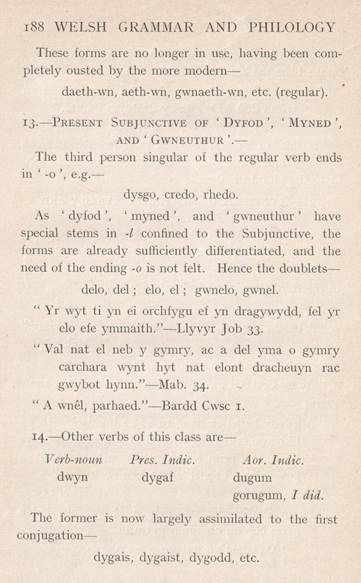
(delwedd L1447) (tudalen 188)
|
188 WELSH GRAMMAR AND PHILOLOGY
These forms are no longer in use, having been completely ousted by the more
modern —
daeth-wn, aeth-wn, gwnaeth-wn, etc. (regular).
13. — PRESEXT SUBJUNCTIVE OF ' DYFOD’, ‘MYNED’,
AND ' GWNEUTHUR '.
The third person singular of the regular verb ends
In -O e.g. —
dysgo, credo, rhedo.
As ' dyfod’, ‘myned’, and ' gwneuthur' have
special stems in -l confined to the Subjunctive, the
forms are already sufficiently differentiated, and the
need of the ending -o is not felt. Hence the doublets —
delo, del; elo, el; gwnelo,
‘Yr wyt ti yn ei orchfygu ef yn dragywydd, fel yr
elo efe Job 33.
“Val nat el neb y gymry, ac a del yma o gymry
cat-chara wynt hyt nat elont dracheuyn rac
gwybot 34.
‘A wnél, parhaed." — Bardd Cwsc 1.
14. — Other verbs of this class are —
Verb-noun
d wyn
Pres. Indic.
dygaf
A 0". Indic.
dugum
gorugum, I did.
The former is now largely assilililated to the first
conjugation —
dygais, dygaist, dygodd, etc.
|
|
|
|
|
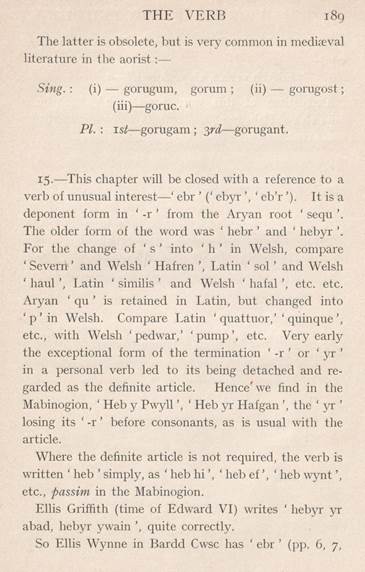
(delwedd L1448) (tudalen 189)
|
THE VERB
189
The latter is obsolete, but is very common in mediæval
literature in the aorist: —
Sing.:
(i) — gorugum, gorum; (ii) — gorugost;
(iii) — goruc.
Pl.: Ist — gorugam; 3rd — gorugant.
15. — This chapter will be closed with a reference to a
verb of unusual interest — ' ebr ' ebyr ' eb'r ').
It is a
deponent form in ' -r ' from the Arvan root ' sequ '
The older form of the word was ' hebr ' and ' hebyr '.
For the change of ' s ' into ' h ' in Welsh, compare
'Severn' and Welsh ' Hafren’, Latin ' sol ' and Welsh
‘haul’, Latin ' similis' and Welsh ' hafal’, etc. etc.
Aryan ' qu ' is retained in Latin, but changed into
'p' in Welsh. Compare Latin ' quattuor,’ ‘quinque
etc., with Welsh ' pedwar,’ ‘pump', etc. Very early
the exceptional form of the termination ' -r ' or ' yr '
in a personal verb led to its being detached and regarded as the definite
article. Hence' we find in the
Mabinogion, ‘Heb y Pwyll’, ‘Heb yr Hafgan’, the ' yr '
losing its ' -r' before consonants, as is usual with the
article.
Where the definite article is not required, the verb is
written ' heb 'simply, as ' hebhi’, ‘heb ef', 'heb wynt’,
etc., Passim in the Mabinogion.
Ellis Griffith (time of Edward VI) writes ' hebyr yr
abad, hebyr ywain’, quite correctly.
So Ellis Wynne in Bardd Cwsc has ' ebr ' (pp. 6, 7,
|
|
|
|
|
(delwedd L1449) (tudalen 190)
|
190 WELSH GRAMMAR AND PHILOLOGY
etc.), but he is not quite free from the idea of the article,
e.g. —
“Edrych yrwan, eb yr
Derivatives of this word are ' ateb’, ‘gohebu’,
‘diareb'. Hebrwng io accompany, escort, is from the
same root.
|
|
|
|
|
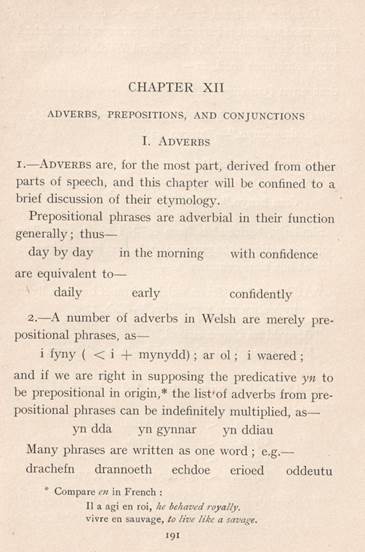
(delwedd L1450) (tudalen 191)
|
CHAPTER Xll
ADVERBS, PREPOSITIONS, AND CONJUNCTIONS
I. ADVERBS
I. — ADVERBS are, for the most part, derived from other
parts of speech, and this chapter will be confined to a
brief discussion of their etymology.
Prepositional phrases are adverbial in their function
generally; thus —
day by day in the morning with confidence
are equivalent to —
daily
early
confiden tly
2. — A number of adverbs in Welsh are merely prepositional phrases, as —
i fyny ( < i -F mynydd); ar 01; i waered;
and if we are right in supposing the predicative yn to
be prepositional in origin,* the list'0f adverbs from prepositional phrases
can be indefinitely multiplied, as
yn dda yn gynnar yn ddiau
Many phrases are written as one word; e.g. —
drachefn drannoeth echdoe erioed oddeutu
Compare en in French:
Il a agi en roi, behaved royally.
vivre en sauvage, to live like a savage.
191
|
|
|
|
|
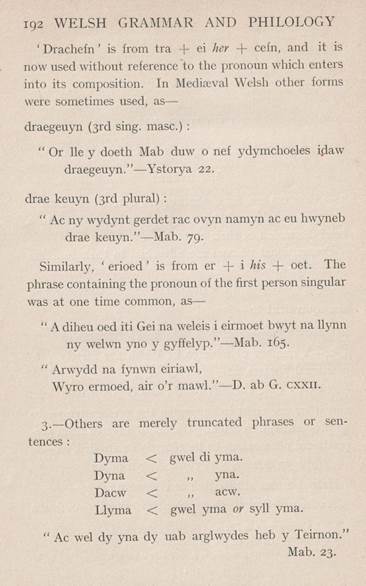
(delwedd L1451) (tudalen 192)
|
192 WELSH GRAMMAR AND PHILOLOGY
‘Drachefn ' is from tra 4- ei her + cefn, and it is
now used without reference •to the pronoun wliich enters
into its composition. In Mediæval Welsh other forms
were sometimes used, as —
draegeuyn (3rd sing. masc.):
“Or Ile y doeth Mab duw o nef ydymchoeles islaw
draegeuyn. " — Ystorya 22.
drae keuyn (3rd plural):
“Ac ny wydynt gerdet rac ovyn namyn ac eu hwyneb
drae keuyn." — Mab. 79.
Similarly, ‘erioed ' is from er -+- i his -4- oet. The
phrase containing the pronoun of the first person singular
was at one time common, as —
“A diheu oed iti Gei na weleis i eirmoet bwyt na llynn
ny welwn yno y gyffelyp." — Mab. 165.
‘Arwydd na fynwn eiriawl,
Wyro ermoed, air O'r mawl." — l). ab G. cxxll.
3. — Others are merely truncated phrases or sentences:
Dyma <
Dyna <
Dacw <
I-lyma <
‘Ac wel dy yna dy
|
|
|
|
|
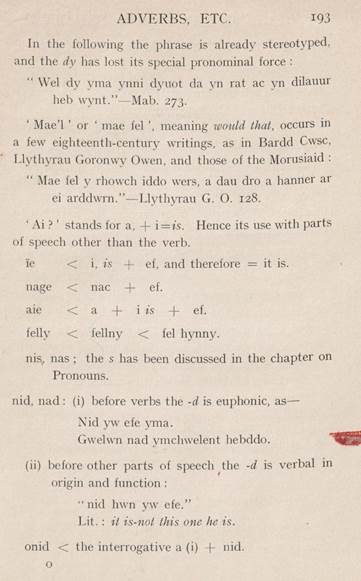
(delwedd L1452) (tudalen 193)
|
gwel di yma.
yna.
acw.
gwel yrna or syll yma.
nab arglwydes heb y Teirnon."
Mab. 23.
ADVERBS, ETC.
193
In the following the phrase is already stereotyped,
and the dy has lost its special pronominal force:
‘Wel dy yma ynni dynot da yn rat ac yn dilauur
heb wvnt."
Mab. 273.
Mae'l ' or ' mae fel meaning would that, occurs in
a few eighteenth-century writings. as in Bardd cwsc,
Llythyrau Goronwy Owen, and those of the Morusiaid:
“Mae fel y rhowch iddo wers, a dau dro a banner ar
ei G. O. 128.
‘Ai?' stands for a, + i=is. Hence its use with parts
of speech other than the verb.
< i, is + el, and therefore = it is.
nage < nac + ef.
felly < fellny < fel hynny.
nis, nas; the s has been discussed in the chapter on
Pronouns.
nid, nad: (i) before verbs the -d is euphonic, as —
Nid yw efe yrna.
Gwelwn nad ymchwelent hebddo.
(ii) before other parts of speech the -d is verbal in
origin and function:
nid hwn yw efe."
Lit.: it is-not this one he is.
onid < the interrogative a (i) + nid.
|
|
|
|
|
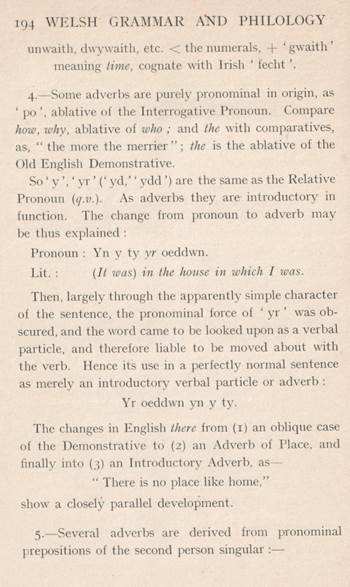
(delwedd L1453) (tudalen 194)
|
194 WELSH GRAMMAR AND PHILOLOGY
unwaith. dwvwaith, etc. < the numerals, + gwaith '
meaning time, cognate with Irish ' fecht '
4. — Some adverbs are purely pronominal in origin, as
po ablative of the Interrogative Pronoun. Compare
how, why. ablative of who; and the with comparatives,
as. " the more the merrier "; the is the ablative of the
Old English Demonstrative.
So' y'. ' yr' yd,' ydd ') are the same as the Relative
Pronoun (q.v.). As adverbs they are introductory in
function. The change from pronoun to adverb may
be thus explained:
Pronoun: Yn y ty yr oeddwn.
Lit.
(It was) in the house in which I was.
Then, largely through the apparently simple character
of the sentence, the pronotninal force of ' yr ' was obscured, and the word
came to be looked upon as a verbal
particle, and therefore liable to be moved about "ith
the verb. Hence its use in a perfectly normal sentence
as merely an introductory verbal particle or adverb:
Yr oeddwn yn y ty.
The changes in English there from (1) an oblique case
of the Demonstrative to (2) an Adverb of Place, and
finally into (3) an Introductory Adverb. as
“There is no place like home,"
show a closelS' parallel develoément.
5. — Several adverbs are derived from pronominal
prepositions of the second person singular: —
|
|
|
|
|
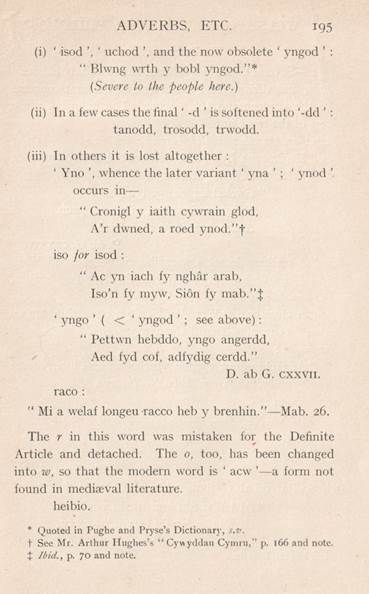
(delwedd L1454) (tudalen 195)
|
ADVERBS, ETC.
195
(i) ' isod’, ‘uchod and the now obsolete ' yngod ':
Blwng "Tth y bobl yngod."*
(Sewere to the People here.)
(ii) In a cases the final ' -d ' is softened into '-dd ':
tanodd, trosodd, trwodd.
(iii) In others it is lost altogether:
‘Yno’, whence the later variant ' yna
occurs 111 —
“Cronigl y iaith cywrain glod,
A'r dwned, a roed ynod."t
iso for isod:
Ac yn iach fy nghår arab,
Iso'n fy rnyw, Siön fy mab."t
‘yngo' ( < ' yngod'; see above):
“Pettwn hebddo, yngo angerdd,
Aed fyd cof, adfydig cerdd. "
‘; ' ynod '
D. ab G. cxxvll.
t' Mi a welaf longeu •racco heb y brenhin." — Mab. 26.
The r in this word was mistaken for the Definite
Article and detached. The o, too, has been changed
into w, so that the modern word is ' acw ' — a form not
found in mediteval literature.
heibio.
• Quoted in Pughe and Pryse's Dictionary,
t See Mr. Arthur llughes's Cyøyddau Cymru,"
p. 166 and note.
Ibid., p. 70 and note.
|
|
|
|
|
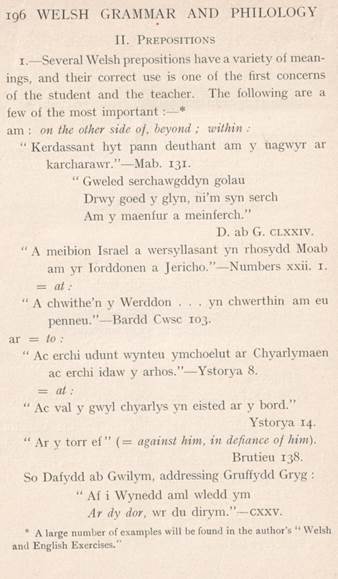
(delwedd L1455) (tudalen 196)
|
196 WELSH GRAMMAR AND PHILOLOGY
Il. PREPOSITIONS
1. — Several Welsh prepositions have a variety of meanings, and their correct
use is one of the first concerns
of the student and the teacher. The following are a
few of the most important:
am: on the other side o/ , beyond; within:
“Kerdassant hyt pann deuthant am y nagwyr ar
karcharawr." — Mab. 131.
“Gweled serchawgddyn golau
I)rwy goed y glyn, ni'm syn serch
Am y maenfur a meinferch."
D. ab G. CLXXIV.
“A meibion Israel a wersyllasant yn rhosydd Moab
am yr lorddonen a Jericho." — Numbers xxii. 1.
= at:
yn chwerthin am eu
“A chwithe'n y Werddon
penneu. " — Bardd Cqsc 103.
ar = to:
“Ac erchi udunt wynteu ymchoelut ar Chyarlymaen
ac erchi idaw y arhos." — Ystorya 8.
“Ac val y gwyl chyarlys yn eisted ar y bord."
Ystorya 14.
Ar y torr ef " ( = against him, in defiance o/ him).
Brutieu 138.
So Dafvdd ab Gwilym, addressing Gruffydd Gryg:
“Af i Wynedd aml wledd ym
Ar dy dor, wr du dirym." — cxxv.
A large number of examples will be found in the author's Welsh
and English Exercises.'
|
|
|
|
|
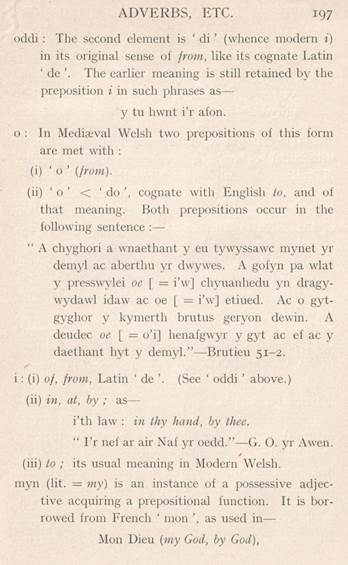
(delwedd L1456) (tudalen 197)
|
ADVERBS, ETC.
197
oddi: The second element is ' di ' (whence modern i)
in its original sense of from, like its cognate Latin
de The earlier meaning is still retained by the
preposition i in such phrases as —
y tu hwnt i'r aion.
o: In Mediæval Welsh two prepositions of this form
are met with:
(i) o ' (from).
(ii) o' < ' do cognate witli English to, and Oi
that meaning. Both prepositions occur in the
following sentence: —
“A chyghori a wnaethant y eu tywyssawc mynet yr
demyl ac aberthu yr dwywes. A gofyn pa wlat
y presswylei oe [ i'w] chyuanhedu yn dragywydawl idaw ac oe [ = i'w] etiued.
Ac o gytgyghor y kymerth brutus geryon dewin. A
deudec oe [ = o'i] henafgwyr y gyt ac ef ac y
daethant hyt y demyl." — Brutieu 51 — 2.
i: (i) o', from, Latin ' de '.
(See ' oddi ' above.)
(ii) in, at, by; as —
i'th law: in thy hand, by thee.
“I'r nef ar air Naf yr O. yr Awen.
(iii) to; its usual meaning in Modern Welsh.
myn (lit. = my) is an instance of a possessive adjective acquiring a
prepositional function. It is borrowed from French ' mon’, as used in
Mon Dieu (my God, by God),
|
|
|
|
|
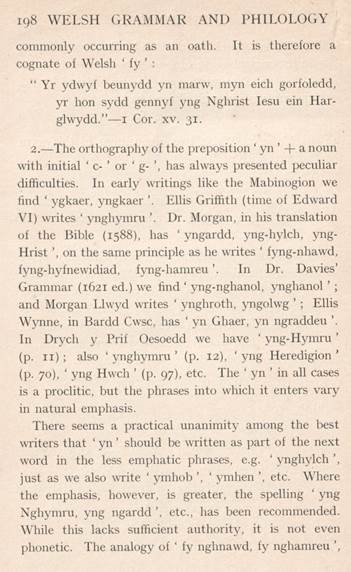
(delwedd L1457) (tudalen 198)
|
198 WELSH GRAMMAR AND PHILOLOGY
commonly occurring as an oath. It is therefore a
cognate of Welsh ' fy ':
“Yr ydwyf beunydd yn marw, myn eich gorioledd,
yr hon sydd gennyf yng Nghrist lesu ein HarCor. xv. 31.
2. — The orthography of the preposition ' yn ' + a noun
with initial ' c- ' or ' g-’, has always presented peculiar
difficulties. In early writings like the Mabinogion we
find ' Y'gkaer, yngkaer '. Ellis Griffith (time of Edward
VI) writes ' ynghymru '. Dr. Morgan, in his translation
of the Bible (1588), has ' yngardd, yng-hylch, yngHrist’, on the same
principle as he writes ' fyng-nhawd,
In Dr. Davies'
fyng-hyfnewidiad, fyng-hamreu '.
Grammar (1621 ed.) we find ' yng-nghanol, ynghanol '
and Morgan Llwyd writes ' ynghroth, yngolwg '; Ellis
Wynne, in Bardd Cwsc, has ' yn Ghaer, yn ngraddeu '
In Drych y Prif Oesoedd we have ' yng-Hymru '
(p. 11); also ' ynghymru ' (p. 12), ‘yng Heredigion '
(p. 70), ‘yng Hwch ' (p. 97), etc. The ' yn ' in all cases
is a proclitic, but the phrases into which it enters vary
in natural emphasis.
There seems a practical unanimity among the best
writers that ' yn ' should be written as part of the next
word in the less emphatic phrases, e.g. ' ynghylch '
just as we also write ' ymhob’, ‘ymhen’, etc. Where
the emphasis, however, is greater, the spelling ' yng
Nghymru, yng ngardd’, etc., has been recommended.
While this lacks sufficient authority, it is not even
phonetic. The analogy of ' fy nghnawd, fy nghamreu’,
|
|
|
|
|
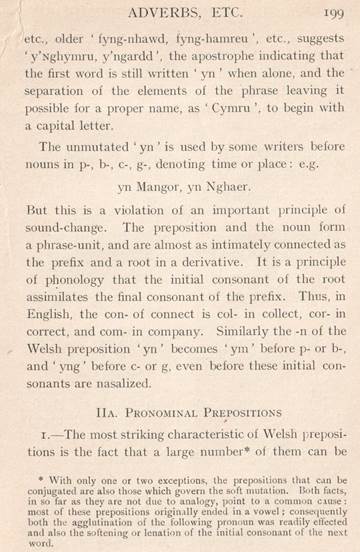
(delwedd L1458) (tudalen 199)
|
ADVERBS, ETC.
199
etc., older fyng-nhawd, fyng-hamreu etc., suggests
‘y' Nghymru, y'ngardd the apostrophe indicating that
the first word is still v.Titten ' yn ' when alone, and the
separation of the elements of the phrase leaving it
possible for a proper name, as ' Cymru’, to begin with
a capital letter.
The unmutated ' yn ' is used by some write's before
nouns in p-, b-, c-, g-, denoting time or place: e.g.
yn Mangor, yn Nghaer.
But this is a violation of an important principle oi
sound-change. The peposition and the noun form
a phrase-unit, and are almost as intimately connected as
the prefix and a root in a derivative. It is a principle
of phonology that the initial consonant of the root
assimilates the final consonant of the prefix. Thus, in
English, the con- of connect is col- in collect, cor- in
correct, and com- in company. Similarly the -n of the
Welsh preposition ' yn ' becomes ym ' before p- or b-,
and ' yng' before c- or g, even before these initial consonants are
nasalized.
IIA. PRONOMINAL PREPOSITIONS
1. — The most striking characteristic of Welsh Ijrepositions is the fact that
a large number* of them can be
• With only one or two exceptions, the prepositions that can be
conjugated are also those which govern the soft mutation. Both facts,
in so far as they are not due to analogy, ptiint to a common cause:
most of these prepositions origin.illy ended in a vowel; conseqttently
the agglutination of the following pronoun was readily effected
and also the softening or lenation of the mitial consonant of the next
word.
|
|
|
|
|
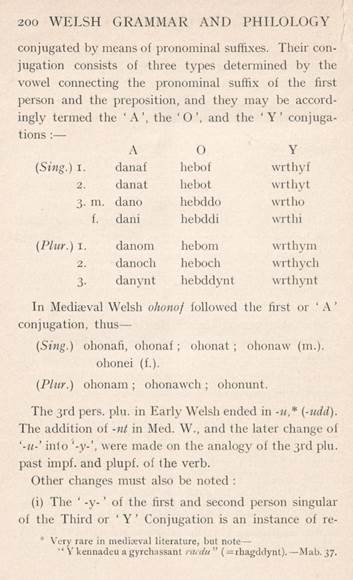
(delwedd L1459) (tudalen 200)
|
zoo WELSH GRAMMAR AND PHILOLOGY
conjugated by means of pronominal suffixes. Their conjugation consists of
three types determined by the
vowel connecting the pronominal suffix of the first
person and the preposition, and they may be accordingly termed the A the 'O
and the ' Y' conjugations:
(Sing.) 1.
2.
3.
(Plur.) r.
2.
3.
m.
danaf
danat
dano
dani
danom
danoch
danynt
o
hebof
hebot
hebddo
hebddi
heborn
heboch
hebddynt
wrthyf
wrthyt
wrtho
wrthi
wrthvm
wrthych
wrthynt
In Mediæval Welsh ohono/ followed the first or ' A '
conjugation, thus —
(Sing.) ohonafi, ohonaf; ohonat; ohonaw (m.).
ohonei (f.).
(Plur.) ohonam; ohonawch; ohonunt.
The 3rd pers. plu. in Early Welsh ended in -u,* (-udd).
The addition of -nt in Med. W., and the later change of
'-It-' into '-y-', were made on the analogy oi the 3rd plu.
past impf. and plupf. of the verb.
Other changes must also be noted:
(i) The ' -y- ' of the first and second person singular
of the Third or ' Y ' Conjugation is an instance of reVery rare in mediæval
literature, but note —
V kennadeu a gyrchassant ra,'du ( rhagddynt). — Mab. 37.
|
|
|
|
|
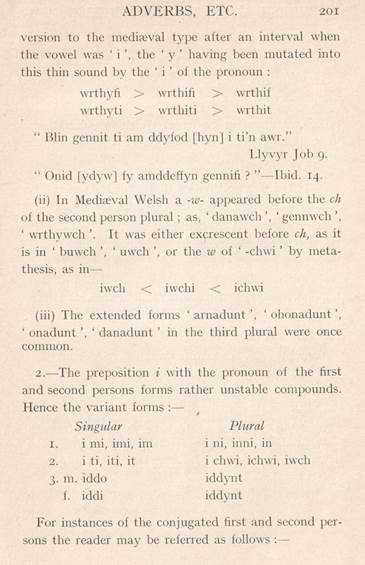
(delwedd L1460) (tudalen 201)
|
ADVERBS, ETC.
201
version to the mediæ•val type after an interval when
the vowel was ' i’, the ' y ' having been mutated into
this thin sound by the ' i ' oi the pronoun:
wrthyfi > wrthifi > methif
vvrthyti > wrthiti > wrthit
Blin gennit ti am ddyfod [hyn] i ti'n awr."
I.lyvyr Job 9.
Onid [ydywl fy amddefiyn gennifi ? "
Ibid. 14.
(ii) In Mediæval Welsh a -w- appeared before the ch
of the second person plural; as, ‘danawch’, ‘gennwch’,
It was either excrescent before ch, as it
‘wrthvwch '.
‘uwch’, or the w of ' -chwi ' by metais in ' buwch
thesis, as in —
iwch < iwchi < ichwi
', ‘ohonadunt
(iii) The extended forms ' arnadunt
‘onadunt’, ‘danadunt ' in the third plural were once
conunon.
2. — The preposition i with the pronoun of the first
and second persons forms rather unstable ccnnpounds.
Hence the variant forms: —
1.
2.
Singular
i ti, iti, it
3. m. iddo
f. iddi
Plural
nl, inni, in
i chwi, ichwi, iwch
iddvnt
iddynt
For instances of the conjugated first and second persons the reader may be
referred as follows: —
|
|
|
|
|
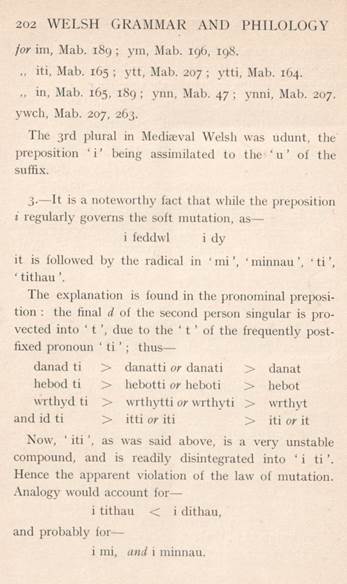
(delwedd L1461) (tudalen 202)
|
202 WELSH GRAMMAR AND PHILOLOGY
for im, Mab. 189; ym, Mab. 196, 198.
, iti, Mab. 165; ytt, Mab. 207; ytti, Mab. 164.
in, Mab. 165, 189; ynn, Mab. 47; ynni, Mab. 207.
ywch, Mab. 207, 263.
The 3rd plural in Mediæval Welsh was udunt, the
preposition 'i' being assimilated to the; 'u' of the
suffix.
3. — It is a noteworthy fact that while the preposition
i regularly governs the soft mutation, as —
i feddwl
i dy
it is followed by the radical in ' mi’,
‘minnau’, ti
‘tithau
The explanation is found in the pronominal preposition: the final d of the
second person singular is provected into t due to the t oi the frequently
postfixed pronoun ti ' , t
danad ti > danatti or danati > danat
hebod ti > hebotti or heboti > hebot
wrthyd ti > wrthytti or wrthyti > wrthyt
and id ti
> itti or iti
> iti or it
Now, ‘iti’, as was said above, is a very unstable
compound, and is readily disintegrated into ' i ti
Hence the apparent violation oi the law of mutation.
Analogy would account for —
i tithau < i dithau,
and probably for —
i rni, and i minnau.
|
|
|
|
|
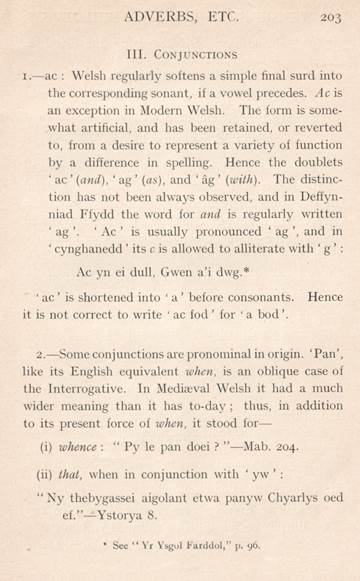
(delwedd L1462) (tudalen 203)
|
ADVERBS, ETC.
Ill. CONJUNCTIONS
203
l. — ac: Welsh regularly softens a simple final surd into
the corresponding sonant. if a vowel precedes. Ac is
an exception in Modern Welsh. The form is somewhat artificial, and has been
retained, or reverted
to, from a desire to represent a variety of function
by a difference in spelling. Hence the doublets
‘ac' (and), 'ag' (as), and ' åg' (with). The distinction has not been always
observed, and in Deffynniad Fiydd the word for and is regularly written
Ac ' is usually pronounced ' ag’, and in
'ag'.
‘cynghanedd ' its c is allowed to alliterate with ' g' •
Ac yn ei dull, Gwen a'i dwg.*
‘ac ' is shortened into ' a ' before consonants. Hence
it is not correct to write ' ac fod' for 'a bod '.
2. — Some conjunctions are pronominal in origin. ' Pan' ,
like its English equivalent when. is an oblique case of
the Interrogative. In Media•val Welsh it had a much
wider meaning than it has to-day; thus, in addition
to its present force of when, it stood for —
(i) whence: “Py le pan doei ? " — Mab. 204.
(ii) that, when in conjunction with ' yw '
“Ny thebygassei aigolant etwa panyw Chyarlys oed
• See Farddol," p.
|
|
|
|
|
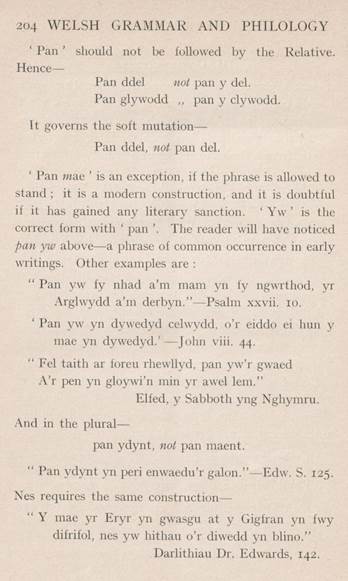
(delwedd L1463) (tudalen 204)
|
204 WELSH GRAMMAR AND PHILOLOGY
‘Pan ' should not be followed by the Relative.
Hence —
Pan ddel
not pan y del.
Pan glywodd , pan y clywocld.
It governs the soit mutation —
Pan ddel, not pan del.
‘Pan mae ' is an exception, if the phrase is allowed to
stand; it is a modern construction, and it is doubtful
if it has gained any literary sanction. ' Yw' is the
correct form with ' pan Tile reader will have noticed
pan yw above — a phrase of common occurrence in early
writings. Other examples are:
“Pan yw fy nhad a'm mam yn fy ngwrthod, yr
Arglv.ycld a'm derbyn." — Psalm xxvii. 10.
Pan yw yn dywedyd celwydd, O'r eiddo ei hun y
mae yn dywedyd.' — John viii. 44.
“Fel taith ar foreu rhewllyd. pan yw'r gwaed
A'r pen yn gloywi'n min yr awel lem."
Elfed, y Sabboth yng Nghymru.
And in the plural —
pan ydynt, nol pan maent.
‘Pan ydynt yn peri enwaedu'r galon."- — Edw. S. 125.
Nes requires the same construction —
‘Y mae yr Eryr yn gwasgu at y Gigfran yn fwy
difrifol, nes yw hithau O'r diwedd yn blino."
Darlithiau Dr. Edwards, 142.
|
|
|
|
|
(delwedd L1464) (tudalen 205)
|
ADVERBS, ETC.
“Mae un yn dal ei ddrychfeddyliau clir
O flaen y dori mewn vmresymiad coeth,
Nes yw'r gwirionedd heb gymylog len
Vn edrych yn eu llygaid."
205
Elfed, y Sabboth yng Nghymru.
os: The s of os is of double origin —
i. It is often the Post-vocalic or Infixed Personal
Pronoun, as in —
‘Mi a ddywedaf wrtho os gwelaf.'
I shall tell him if 1 see him.
And though its pronominal function is now obscured, the rule whereby the verb
must immediately follow the infixed pronoun is strictly observed.
Hence —
os daw, not os y daw.
os y bu.
os bu
ii. When followed by any part of speech other than a
verb, the s stands for 'ys', 3rd sing. of 'wyf’,
e.g. —
“Os myfi yr ydych yn ei geisio, gadewch i'r rhai
hyn fyned ymaith " — St. John xviii. 8.
Lit. I/ it is I whom ye seek, let these go their way.
y and yr (older — yd) are identical with the Relative. Both are probablv
Demonstrative in origin.
Compare the Latin cognate id and English it. The
change of function from pronoun to conjunction
finds an exact parallel in the Englisll that, which.
etymologically, is the neuter of the Demonstrative.
|
|
|
|
|
(delwedd L1465) (tudalen 206)
|
206 WELSH GRAMMAR AND PHILOLOGY
The transition is not difficult of explanation in
English. The stages are these: —
(i) ' He will come, — l know that '
(ii) Then, with he will come' understood or expressed earlier, simply
I know that '; and
(iii) ' He will come ' is appended in apposition to that
for the sake of clearness; thus —
‘I know that (viz.) he will come.'
(iv) That in (iii) readily acquires a conjunctional
force.
As ' y ' yr’, ‘yd ') has lost its Demonstrative power,
the alteration of function is not as easily demonstrated.
3. — Some conjunctions are verbal in origin:
Pe < bei, the third singular past imperfect subjunctive of the verb ' to
be Compare the semiconjunctional force of the auxiliary verb in English
when brought to the beginning of the sentence, as —
Were I to go
Should he come
Ys in canys.
Mai is a doublet of mae:
If I were to go.
I/ he should come.
‘Llyma vy ffyd mae mi ae rannaf." — Mab. 206.
“Coelia fy rhiain fain hir,
A gwS'l ddihareb mae gwir." — D. ab G. CLXIII.
Taw: now obsolete as a verb. Compare Irish
‘tä ' (is).
|
|
|
|
|
(delwedd L1466) (tudalen 207)
|
CHAPTER NIII
COMPOSITION AND DERIVATION AND THE MEANING
OF WORDS
I. — WITH the exception of a few hundred words taken
from Latin, mainly during the Romano-British period,
Welsh has, on the whole, successfully resisted the introduction of borrowed
words. It has preferred to supply
new words by forming compounds and derivatives from
native elements — a characteristic also of Greek and
Modern German. English at one time possessed the
same power, but with the great influx of NormanFrench words during the early
Middle English period
composition fell into desuetude, and to-day the language is open to the
taunt, not infrequently levelled
against it, that the bulk of its vocabulary is not English
at all. Whether it is to the ultimate advantage of a
nation to coin and build up out of its own store, and
decline to adopt many words of foreign origin, is a
debatable question. But a comparison of English and
Welsh, as typical of two languages following divergent
paths for the extension of their vocabulary, brings out
one or two salient facts worthy of attention.
(a) Native words are always richer in associations,
and Welsh is a language of great emotional suggestion.
Its words are redolent of our hills and dales. They
|
|
|
|
|
(delwedd L1467) (tudalen 208)
|
208 WELSH GRAMMAR AND PHILOLOGY
pulsate with the trials and struggles, the failures and
triumphs, of the past. Hence it is sometimes called
the language oi the heart. The same fact accounts for
the criticism, in the case of English, that an address
or an essay, except on a technical subject, sounds insincere or unreal if it
contains a large number of foreign
words to the exclusion of more expressive and simpler
native synonyms. The vocabulary of the " Pilgrim's
, and that book is
Progress " is remarkably " pure '
always mentioned as evidence of the power and
effectiveness of the unpolluted English language."
Macaulay has referred * to it as possessing " a strong
For magnificence, for
human interest." and adds:
pathos, for vehement exhortation, for subtle disquisition, for every purpose
of the poet. the orator, and the
divine, this homely dialect, the dialect of plain working
men, was perfectly sufficient."
(b) But a weakness is inseparable from this excellence. It is difficult to
divest a native word of Inisleading associations. Where precision is
imperative, it
is important that a word be found free from disturbing
and irrelevant suggestion. Hence. for technical and
scientific purposes, it conduces to lucidity to borrow
words to which we can attach tlue precise meanings
required.
(c) An intelligent borrowing will enrich a language
with synonyms expressive of the most delicate shades
Of difference in meaning, as Palernal and fatherly,
• Review of Southey's edition of the Pilgrim's Progress."
|
|
|
|
|
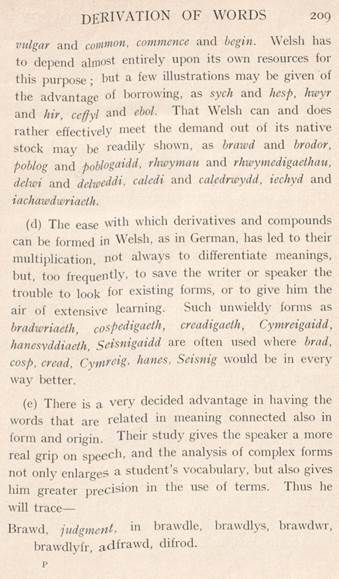
(delwedd L1468) (tudalen 209)
|
DERIVATION OF WORDS
209
vulgar and common, commence and begin. Welsh has
to depend almost entirely upon its own resources for
this purpose; but a few illustrations may be given of
of borrowing. as sych and hest), hwyr
the advantage
and hir, cetivl and ebol. That Welsh can and does
rather effectively meet the demand out of its native
stock may be readily shown, as brawd and brodor,
poblog and fioblogttidd. rhwymau and rhwymedigaethau,
delwi and delweddi, caledi and caledrwydd, iechyd and
i a chawdwriaeth.
(d) The ease with which derivatives and compounds
can be formed in Welsh, as in German, has led to their
multiplication, not always to differentiate meanings,
but, too frequently, to save the writer or speaker the
trouble to look for existing forms, or to give him the
air of extensive learning. Such unwieldy forms as
bradwriaeth, cospedigaeth, creadigaeth, Cymreigaidd,
hanesvddiaeth, Seisnigaidd are often used where brad,
cosp, cread. Cymreig. hones, Scisnig would be in every
way better.
(e) There is a very decided advantage in having the
words that are related in meaning connected also in
Their study gives the speaker a more
form and origin.
real grip on speech, and the analysis of complex forms
not only enlarges a student's vocabulary, but also gives
him greater precision in the use of terms. Thus he
will trace —
Brawd, judgment, in brawdle, brawdlys, brawdwr,
brawdlvfr, adirawd, difrod.
|
|
|
|
|
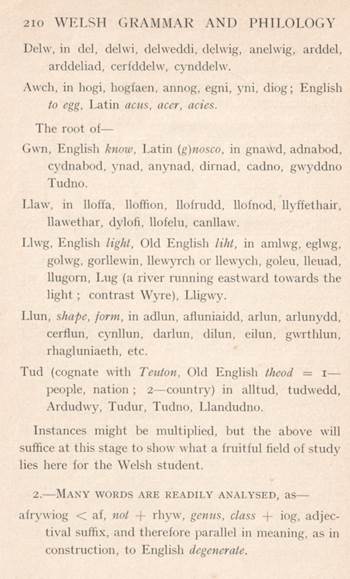
(delwedd L1469) (tudalen 210)
|
210 WEI.SH GRAMMAR AND PHILOLOGY
Delw, in del, delwi, delweddi, delwig, anelwig, arddel,
arddeliad, cerfddelw, cvnddelw.
Awch, in hogi, hogfaen, annog. egni, yni. diog; English
to egg. Latin acus, acer, acies.
The root of —
Gwn, English know. Latin (g)nosco, in gnawd, adnabod,
cydnabod, ynad, anynad, dirnad, cadno, gwyddno
Tudno.
I-law. in Iloffa, Iloffton, Ilofrudd, Ilofnod, llvffethair,
llawethar, dvlofi, Ilofelu, canllaw.
Llwg, English light, Old English liht, in amlwg, eglwg,
golwg, gorllewin, Ilewyrch or Ilewych, goleu, Ileuad,
llugorn, Lug (a river running eastward towards the
light; contrast Wyre), Lligwy.
Llun, shape. form, in adlun, afluniaidd, arlun, arlunydd,
cerflun, cynllun. darlun. dilun. eilun, KAVTthlun,
rhagluniaeth, etc.
Tud (cognate with Teuton. Old English theod =
people, nation; 2 — country) in alltud, tudwedd,
Ardudwy, Tudur, Tudno, I.landudno.
Instances might be multiplied, but the above will
suthce at this stage to show wluat a fruitful field of study
lies here for the Welsh student.
2. — MANY WORDS ARE READILY ANALYSED, as —
< af, not rhyw, genus, class + iog, adjectival suffix, and therefore
parallel in tneaning, as in
construction, to English degenerate.
|
|
|
|
|
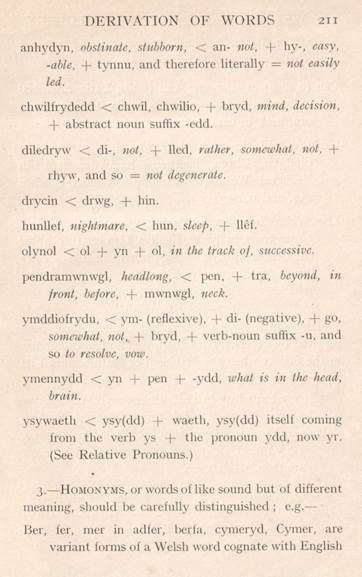
(delwedd L1470) (tudalen 211)
|
DERIVATION OF WORDS
211
anhydyn, obstinate, stubborn, < an- not, + hy-, easy,
-able, + tynnu, and therefore literally = not easily
chwilfrydedd < chwil, chwilio, + bryd, mind, decision,
+ abstract noun suffix -edd.
diledryw < di-, not, -F Iled, rather, somewhat, not, +
rhyw, and so = not degenerate.
drycin < drwg, + hin.
hunllef, nightmare, < hun, sleep, + lléf.
olynol < 01 -+- yn + 01, in the track of, successive.
pendramwnwgl, headlong, < pen, -+- tra, beyond, in
front, before, + mwnwgl, neck.
yrnddiofrydu. < yrn- (reflexive). + di- (negative), + go,
somewhat, not, + bryd, + verb-noun sufftx -u, and
so to resolve, vow.
ymennydd < yn + pen + -ydd, what is in the head,
brain.
ysywaeth < ysy(dd) + waeth, ysy(dd) itself coming
from the verb ys + the pronoun ydd, now yr.
(See Relative Pronouns.)
or words of like sound but of different
tneaning, slu»uld be carefully distinguished; e.g. —
Ber, ier, mer in adfer, beria, cymeryd, Cymer, are
variant forms of a Welsh word cognate with English
|
|
|
|
|
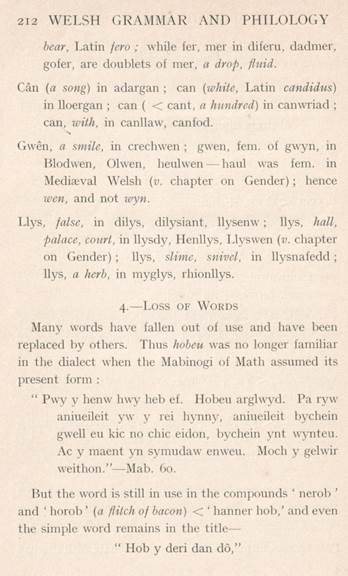
(delwedd L1471) (tudalen 212)
|
212 WELSH GRAMMAR AND PHILOLOGY
bear, I-atin kero; while fer. mer in diferu, dadmer,
gofer, are doublets of mer. a drop. fluid.
Cån (a song) in adargan; can (white, Latin candidus)
in Iloergan; can ( < cant, a hundred) in canwriad;
can, with, in canllaw, canfod.
Gwén, a smile, in crechwen; gu•en, fern. of gwyn, in
Blodwen, Olwen, heulwen haul was fem. in
Mediæval Welsh (v. chapter on Gender); hence
wen, and not wyn.
Llys, false, in dilys, dilysiant, llysenw; llys, hall,
palace, court, in llvsdy, Henllys, l.lyswen (v. chapter
on Gender);
llys, slime, snivel, in llysnafedd;
llys, a herb, in myglys, rhionllys.
4. — Loss OF WORDS
Many words have fallen out oi use and have been
replaced by others. Thus hobeu was no longer familiar
in the dialect when the Mabinogi of Math assumed its
present form:
“Pwy y henw heb ef. Hobeu arglwyd. Pa rvw
aniueileit yw y rei hynny, aniueileit bychein
gwell eu kic no chic eidon, bychein ynt wynteu.
Ac y maent yn symudaw enweu. Moch y gelwir
weithon
60.
But the word is still in use in the compounds ' nerob '
and ' horob ' (a flitch o/ bacon) < ' banner 110b,' and even
the simple word remains in the title —
“Hob y deri dan db,"
|
|
|
|
|
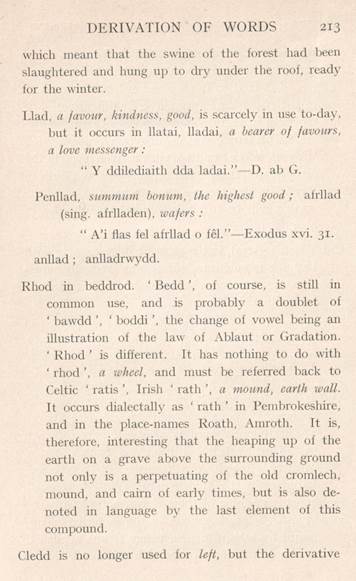
(delwedd L1472) (tudalen 213)
|
DERIVATION OF WORDS
213
which meant that the swine oi the forest had been
slaughtered and hung up to dry under the roof, ready
for the winter.
Llad, a /avour, kindness, good, is scarcely in use to-day,
but it occurs in llatai, lladai, a bearer o/ 'avows,
a love messenger:
“Y ddilediaith (Ida ab G.
Penllad, summum bonum, the highest good; afrllad
(sing. afrlladen), wafers:
“A'i flas fel airllad o xvi. 31.
anllad; anlladrwvdd.
Rhod in beddrod. ' Bedd’, of course, is still in
common use, and is probablv a doublet of
‘bawdd’, ‘boddi the change of vowel being an
illustration of the law of Ablaut or Gradation.
It has nothing to do with
‘Rhod ' is different.
‘rhod a wheel, and must be referred back to
Irish ' rath’, a mound, earth wall.
Celtic ' ratis’,
It occurs dialectallv as ' rath ' in Pembrokeshire,
and in the place-names Roath, Amroth. It is,
therefore, interesting that the heaping up oi the
earth on a grave above the surrounding ground
not only is a perpetuating of the old cromlech,
mound, and cairn of early times, but is also denoted in language by the last
element of this
compound.
Cledd is no longer used for left, but the derivative
|
|
|
|
|
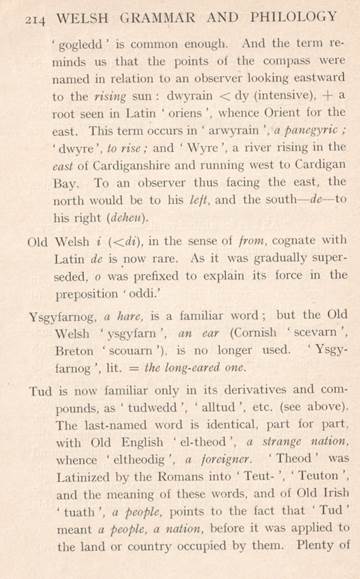
(delwedd L1473) (tudalen 214)
|
214 WELSH GRAMMAR AND PHILOLOGY
‘gogledd ' is common enough. And the term reminds us that the points of the
compass were
named in relation to an observer looking eastward
to the rising sun: dwyrain < dy (intensive), + a
root seen in Latin ' oriens’, whence Orient ior the
east. This term occurs in ' arwyrain ' Panegyric;
‘dwyre’, to rise; and ' Wyre’, a river rising in the
east of Cardiganshire and running west to Cardigan
Bay. To an observer thus facing the east, the
north would be to his left, and the south — dc — to
his right (dehcu).
Old Welsh i (<di), in the sense of from, cognate with
Latin de is now rare. As it was gradually superseded, o was prefixed to
explain its force in the
preposition ' oddi.'
Ysgyfarnog, a hare, is a familiar word; but the Old
Welsh ' ysgyfarn’, an ear (Cornish ' scevarn’,
Breton ' scouarn is no longer used. Ysgyfarnog’, lit. = the long-eared one.
Tud is now familiar only in its derivatives and compounds, as ' tudwedd’, ‘alltud’,
etc. (see above).
The last-named word is identical, part for part,
with Old English ' el-theod’, a strange nation,
whence ' eltheodig’, a foreigner. ' Theod ' was
Latinized by the Romans into ' Teut-’, ‘Teuton’,
and the meaning of these words, and of Old Irish
‘tuath’, a people, points to the fact that ' Tud '
meant a people, a nation, before it was applied to
the land or country occupied by them. Plenty of
|
|
|
|
|
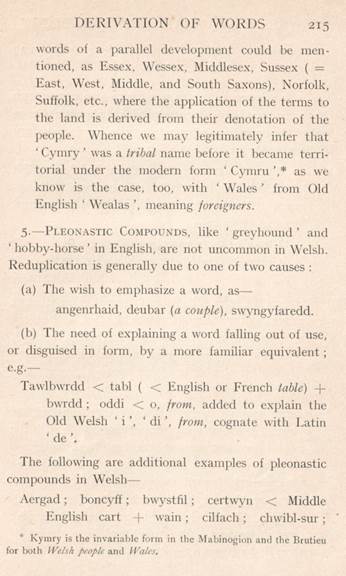
(delwedd L1474) (tudalen 215)
|
DERIVATION OF WORDS
215
words of a parallel development could be mentioned, as Essex, Wessex,
Middlesex. Sussex ( =
East, West, Middle, and South Saxons), Norfolk,
Suffolk, etc., where the application of the terms to
the land is derived from their denotation of the
people. Whence we may legitimately infer that
Cymry ' was a tribal name before it became territorial under the modern form
' Cvmru ' ,*
as we
know is the case, too, v.ith ' Wales ' from Old
English ' Wealas’, meaning foreigners.
5. — PLEOXASTIC COMPOUNDS, like ' greyhound ' and
‘hobby-horse ' in English, are not uncommon in Welsh.
Reduplication is generally due to one of two causes:
(a) The wish to emphasize a word, as —
angenrhaid, deubar (a couple), swyngyfaredd.
(b) The need of explaining a word falling out of use,
or disguised in form, by a more familiar equivalent;
Tawlbwrdd < tabl ( < English or French table) -ib"Tdd; oddi <
o, from. added to explain the
Old NVelsh ' i’, ‘di’, from, cognate with Latin
'de'.
The following are additional exatnples of pleonastic
compounds in Welsh —
Aergad; boncyff; bwystfil;
certwyn < Middle
English cart + wain; cilfach;
chwibl-sur;
Kymry is the invariable form in the Mabinogion and the Brutieu
for Ix»th Welsh and Wales.
|
|
|
|
|
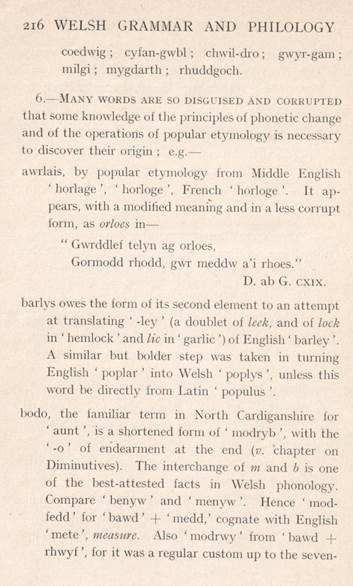
(delwedd L1475) (tudalen 216)
|
216 WELSH GRAMMAR AND PHILOLOGY
coedwig; cyfan-gwbl; chwil-dro; gnvyr-gam;
milgi; mygdarth; rhuddgoch.
6. — MANY WORDS ARE SO DISGUISED AND CORRUPTED
that some knowledge of the principles of phonetic change
and of the operations of popular etylnology is necessary
to discover their origin; e.g. —
awrlais, by popular etymology from Middle English
‘horlage’, horloge’, French ' horloge '.
It appears, with a modified meaning and in a less corrupt
form, as orloes in —
“GMTddlef telyn ag orloes.
Gormodd rhodd, gwr meddw a'i rhoes."
D. ab G. cxax.
barlys owes the form of its second element to an attempt
at translating ' -ley ' (a doublet of leek, and of lock
in ' hemlock ' and lic in garlic ') of English ' barley '
.A similar but bolder step was taken in turning
English poplar ' into Welsh ' poplys’, unless this
word be directly from Latin populus
bodo, the familiar term in North Cardiganshire for
aunt’, is a shortened fortn of ' Inodryb’, with the
‘-o' of efidearrnent at the end (v. Ohapter on
Diminutives). The interchange of m and b is one
of the best-attested facts in Welsh phonology.
Compare benyw ' and ' menyw '. Hence Inodfedd ' for 'bawd ' 4 medd,' cognate
with English
mete measure. Also modrwy' from ' bawd 4rhwyi’, for it was a regular custom
up to the seven
|
|
|
|
|
(delwedd L1476) (tudalen 217)
|
DERIVATION OF WORDS
217
teenth century to wear rings on thutnbs as well as
on the other fingers; -rhwyi ' is a doublet of
‘rhwvrn
‘rhwymyn and rneans a band. Compare aerwy ' breichrwyfeu ' (Mab.). ' cyfrwy’,
etc.
breicliled: a partially translated form of English and
bracelet '
‘Braich ' equals French bras’,
French '
arm, and ' -let ' is a diminutive suffix. For the
softening of final ' -t ' in Welsh. cotnpare ' cwpled '
and soned ' from English ' couplet ' and sonnet '
Some writers, like Glyn Cothi, saw Iledr’,
leather, in the last element and duly added the r:
“Gwisgaw breichledr, os medraf,
O arian neu aur a wnaf."
The same attempt at " rationalizing " a suffl.x is
observable in the etymology often given to canwvllarn '
‘coesarn’, llwvarn’, etc. The sound r is
apt to develop an inorganic or epenthetic n after it,
as in •ar-n-af ' (contrast •at-af ' miswrn' < English
‘visor'; and the substantival suffix -ar ' (yr in
') in the above words assumes the extended form ' -ar-n '. Hence the somewhat
conimon impression that the suffix is a shortened form
of harn (for haearn).
bydwraig (English ' midwife is another instance Of the
interchange oi m and: byd < mid ' meaning
with, and gwraig a translation of wife.
ceiniog is scarcely intelligible etymologically ironi the
• See I h. Silvan Evans's Dictionary
|
|
|
|
|
(delwedd L1477) (tudalen 218)
|
218 WELSH GRAMMAR AND PHILOLOGY
coin so named; but one is reminded by such facts
“twenty-four pennyweights make one ounce '
that before 1797 the penny was a silver coin, and
the term ' ceiniog ' < ' can’, bright, shining, white, is
a record of the earlier currency.
Cylan ' is shortened in various ways, as —
cefnfor, cefnllif; cenlloer, cenllif.
cyfr: an intensive prefix meaning whole, complete;
probably a variant form of ' cyfa•n’, for the liquids
'n’, and ' r', readily interchange; e.g.
cnwc and crug
elydn
elydr.
So ' cyfrgolledig' would be 'cyfan -F golledig '
completely lost. Compare ' cyfrgrwn ' , cyfrgwbl '.
erbyn: -byn is the old dative of ' pen', a head. Other
traces of case inflection are —
-dwy, in meud"Y, lit. servant o/ God; and
Dyfrdwy. Genitive of Duw.
peun-, for older peupn, in beunoeth, beunydd.
Accus. of pob.
gwarogaeth < older ' gwrogaeth’, and therefore the
exact equivalent of 'homage' ( < Latin 'homo' , man).
fel < fal < y fal < hafal, cognate with Latin ' similis '.
The first syllable was corrupted, mistaken for the
definite article and detached. Then the initial ' f '
was sometimes provected into ' m’, as —
|
|
|
|
|
(delwedd L1478) (tudalen 219)
|
DERIVATION OF WORDS
“Ef a arganuu ar y nef mal fiord o syr."
219
Ystorya 1.
7. — OTHERS HAVE TRAVELLED GREAT LENGTHS IN
MEANING FROM THEIR LITERAL OR ETYMOLOGICAL
SENSE; e.g. —
awgrvm is eventually from Arabic " al-Khowarazmi’,
the native of Khwarazm (Khiva). surname of the
Arab mathematician Abu Ja'far Mohammed Ben
Musa, who flourished early in the ninth century,
and through the translation of whose work on
Algebra, the Arabic numerals became generally
known in Europe ".* Hence its first derived meaning is a numeral, a
figure, and then it readily acquired the meaning of symbol, sign.
brudio, brudwyr < Brutus, the eponymous ancestor of
the Britons. Hence ' y Brutieu’, the Bruis, a
chronicle or history of the Britons; and as these
chronicles contained much prophecy ' brudio ' has
come to mean to guess future even's, to Prophesy;
and ' brudwyr ' , wisards, sorcerers. (Compare Lev.
xix. 31, Isa. xix. 3, Daniel ii. 27, etc.)
cawl, a South Wales term for broth, especially one in
which cabbage or leeks have been boiled; from
Latin ' caulis’, a cabbage (whence English ' cauliflower ').
cyfair, an acre; from ' cyfer’, ‘cyfair’, opposite; hence
‘that over against the dwelling or the town.' Com• Quote in Evans's
Dictionary, under Awgrym
|
|
|
|
|
(delwedd L1479) (tudalen 220)
|
220 WELSH GRAMMAR AND PHILOLOGY
pare English country' < French ' contrée' <
Latin contra’, against; also Gennan ' gegend’,
a region, country. ironi gegen against, opposite.
gwawd, originally praise, hence mock praise and finally
mockery.
lladd. cognate with English ' slay’, still retains its old
meaning of to strike in *'mladd Cornpare sledge,
a doublet of slay. as in ' sledge-hannner’,
striking hammer. From to strike it came to mean
to cut, and that is its force in ' lladd gwair’,
‘lladd maun’, etc. Finally, to kill. ' Slay ' shows
a parallel change of meaning.
mynwent, a graveyard, a burial Place, from Latin ' monumentum '. Hence (i) a
monument, (ii) ' a Nace of
tombs’, and therefore a burial ground.
rhinwedd, virtue, from ' rhin '. The vowel goes back to
a Brythonic or Celtic u '
Compare Welsh ' tl
and Old Irish tü’, I-atin ' tü '; also Welsh ' din’,
‘dinas’, and Old Irish ' dün Old English ' tün '
( > Modern English town '). The word ' rhin' is
thus seen to be cognate with English ' runes’, the
narne given by the ()ld English people to the alphabet which they brought
over with them from the
Continent. But its use for the alphabet is derived
and secondary, for its first meaning is mystery, and
the invention oi writing, the conveying of thought
by means oi scratches on sword-hilts, etc., must
have been one oi the greatest mysteries confronting
|
|
|
|
|
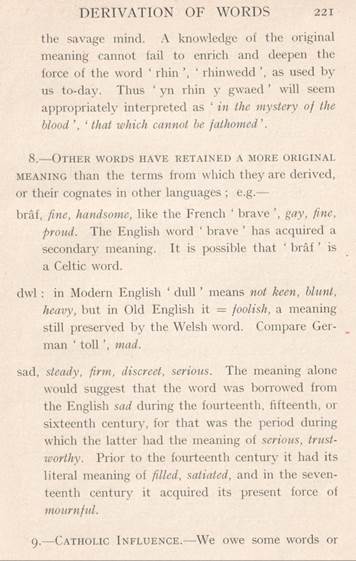
(delwedd L1480) (tudalen 221)
|
DERIVATION OF WORDS
221
the savage mind. A knowledge of the original
meaning cannot fail to enricll and deepen the
rhinwedd’, as used by
force of the word rhin’, ‘
us to-dav. Thus ' yn rhin y gwaed ' will seem
appropriately interpreted as ' in lhc mystery o/ the
blood that which cannot fathomed '.
8. — OTHF.R WORDS HAVE RETAINED A MORE ORIGINAL
MEANING than the terms from which they are derived,
or their cognates in other languages; e.g. —
bråf, fine, handsome, like the French ' brave’, gay, 'inc,
Proud. The English word ' brave ' has acquired a
secondary meaning. It is possible that ' bråf ' is
a Celtic word.
dwl: in Modern English ' dull means not keen, blunt,
foolish, a meaning
heavy, but in Old English it —
still preserved by the Welsh word. Compare German ' toll’, mad.
sad, steady, firm, discreet, serious. The meaning alone
would suggest that the word was borrowed from
the English sad during the fourteenth. fifteenth, or
sixteenth century, for that was the period during
which the latter had the meaning of serious, trustworthv. Prior to the
fourteenth century it had its
literal meaning of filled, satiated, and in the Seventeenth century it
acquired its present force of
mourn/ul.
9. — CATH01.1C INFLUENCE. — We owe some words or
|
|
|
|
|
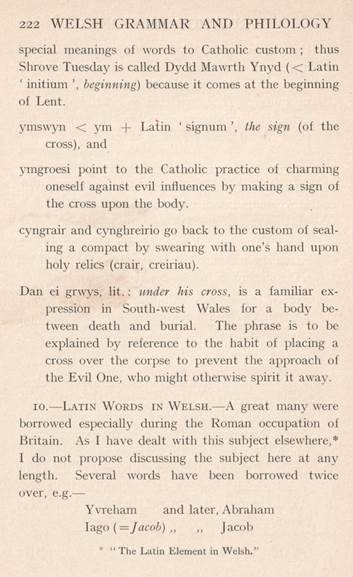
(delwedd L1481) (tudalen 222)
|
222 WELSH GRAMMAR AND PHILOLOGY
special meanings of words to Catholic custom; thus
Shrove Tuesday is called Dydd Mawrth Ynyd ( < Latin
‘initium beginning) because it comes at the beginning
of Lent.
ymswyn < ym + Laiin ' signum’, the sign (of the
cross), and
ymgroesi point to the Catholic practice of charming
oneself against evil influences by making a sign of
the cross upon the body.
cyngrair and cynghreirio go back to the custom of sealing a compact by
swearing with one's hand upon
holy relics (crair, creiriau).
Dan ei grwys, lit.: under his cross, is a familiar expression in South-west
Wales for a body between death and burial. The phrase is to be
explained by reference to the habit of placing a
cross over the corpse to prevent the approach of
the Evil One, who might otherwise spirit it away.
IO. — LATIN WORDS IN WELSH. — A great many were
borrowed especially during the Roman occupation oi
Britain. As I have dealt with this subject elsewhere, •
I do not propose discussing the subject here at any
length. Several words have been borrowed twice
over, e.g. —
Yvreharn
and later, Abraham
lago ( = Jacob) „
J acob
The Latin Element in Welsh.
|
|
|
|
|
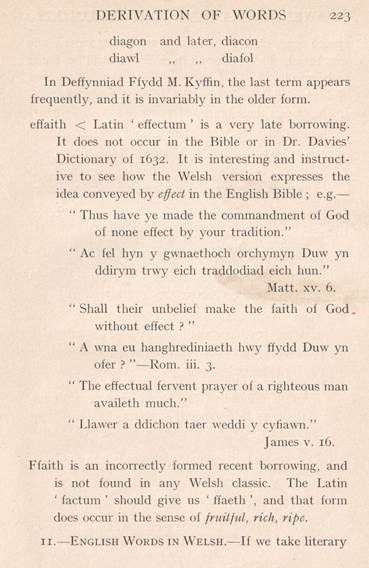
(delwedd L1482) (tudalen 223)
|
DERIVATION OF WORDS
diagon and later, diacon
223
diawl
diafol
In Deffynniad Ffydd M. KyiT1n, the last term appears
frequently, and it is invariably in the older form.
effaith < Latin ' effectum ' is a very late borrowing.
It does not occur in the Bible or in Dr. Davies'
Dictionary of 1632. It is interesting and instructive to see how the Welsh
version expresses the
idea conveyed by effect in the English Bible; e.g. —
Thus have ye made the commandment of God
of none effect by your tradition."
“Ac fel hyn y gwnaethoch orchymyrp Duw yn
ddirym trwy eich traddodiad eich hun."
Matt. xv. 6.
“Shall their unbelief make the faith of God _
without effect ? "
“A wna eu hanghrediniaeth hwy fiydd Duw yn
ofer ? " — Rom. iii. 3.
“The effectual fervent prayer of a righteous man
availeth much."
“I-lawer a ddichon taer weddi y cyfiawn."
James v. 16.
Ffaith is an incorrectly - formed recent borrowing, and
is not found in any Welsh classic. The Latin
factum ' should give us ' ffaeth’, and that form
does occur in the sense of fruitful, rich, ripe.
WORDS IN WELSH. — If we take literary
|
|
|
|
|
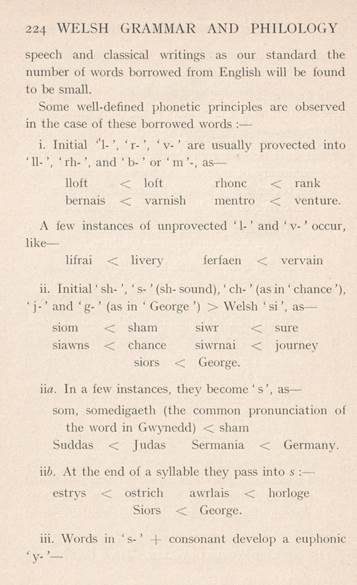
(delwedd L1483) (tudalen 224)
|
224 WELSH GRAMMAR AND PHILOLOGY
speech and classical writings as our standard the
number of words borrowed from English will be found
to small.
Some well-defined phonetic principles are observed
in the case of these borrowed words: —
i. Initial’, 'r '
'v- ' are usually provected into
rh-’, and 'b- ' or ' m '-, as —
Iloft
< loft
rhonc < rank
bernais < varnish mentro < venture.
A few instances of unprovected 'l- ' and ' v- ' occur,
lifrai
‘j•' and
storn
stawns
< livery
ferfaen < vervain
ii. Initial 'sh-’, 's- ' (sh- sound), ‘ch- ' (as in ' chance '),
(as in George ') > Welsh ' si’, as —
< sham
< chance
SIMT
< sure
snvrnat < journev
siors < George.
iia. In a few instances, they become ' s', as —
som, somedigaeth (the cornmon pronunciation of
the word in Gwynedd) < sham
Suddas < Judas Ser-mania < Germany.
iib. At the end of a syllable they pass into s: —
estrvs < ostrich
awrlais < horloge
Siors < George.
iii. Words in ' s.' + consonant develop a euphonic
|
|
|
|
|
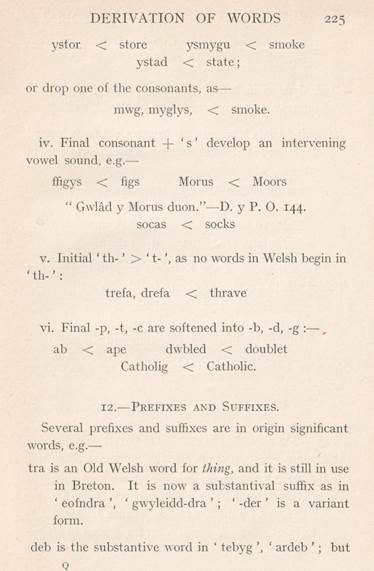
(delwedd L1484) (tudalen 225)
|
DERIVATION OF WORDS
225
ysmygu < smoke
ystor < store
ystad < state;
or drop one of the consonants, as —
mwg, myglys, < smoke.
iv. Final consonant -F 's' develop an intervening
vowel sound, e.g. —
fhgys < figs
Morus < Moors
“Gwlåd y Morns y P. O. 144.
socas < socks
v. Initial ' th-' > 't- as no words in Welsh begin in
trefa, drefa < thrave
vi. Final -p, -t, -c are softened into -b, -d, -g _
ab < ape
dwbled < doublet
Catholig < Catholic.
12. — PREFIXES AND SUFFIXES.
Several prefixes and suffixes are in origin significant
words, e.g. —
tra is an Old Welsh word for thing, and it is still in use
in Breton. It is now a substantival suffx as in
‘eofndra’, ‘gwyleidd-dra'; ' -der '
is a variant
form.
deb is the substantive word in ' tebyg’, ‘ardeb '; but
|
|
|
|
|
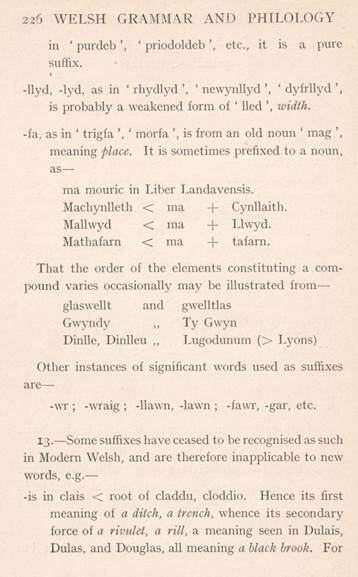
(delwedd L1485) (tudalen 226)
|
226 WELSH GRAMMAR AND PHILOLOGY
‘priodoldeb’, etc., it is a pure
in ' purdeb’,
suffix.
‘newynllyd ' dyfrllyd ' ,
-llyd, -lyd, as in ' rhydlyd’,
is probably a weakened form of ' Iled’, width.
-fa, as in ' trigfa’, ‘morfa’, is from an old noun ' mag ,
meaning Place. It is sometimes prefixed to a noun,
ma mouric in Liber Landavensis.
Machynlleth < ma + Cynllaith.
Mallwyd < ma + Llwyd.
Mathafarn < ma + tafarn.
That the order of the elements constituting a compound varies occasionally
may be illustrated from —
and gwell tlas
glaswellt
Gwyndy
Dinlle, Dinlleu ,
Ty Gwyn
Lugodunum Lyons)
Other instances of significant words used as sufflxes
-wr; -wraig; -llawn, -lawn; -fawr, -gar, etc.
13. — Some suffxes have ceased to be recognised as such
in Modern Welsh, and are therefore inapplicable to new
words, e.g. —
-is in clais < root of claddu, cloddio. Hence its first
meaning of a ditch, a trench, whence its secondary
force of a rivulet, a rill, a meaning seen in Dulais,
Dulas, and Douglas, all meaning a black brook. For
|
|
|
|
|
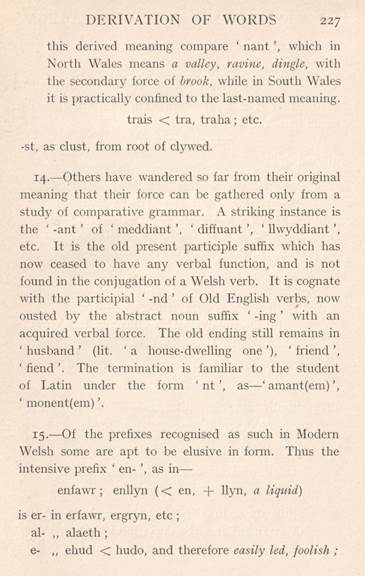
(delwedd L1486) (tudalen 227)
|
DERIVATION OF WORDS
227
this derived meaning compare ' nant’, which in
North Wales means a valley, ravine, dingle, with
the secondary force of brook, while in South Wales
it is practically confined to the last-named meaning.
trais < tra, traha; etc.
-st, as clust, from root of clywed.
14. — Others have wandered so far from their original
meaning that their force can be gathered only from a
study of comparative grammar. A striking instance is
the ' -ant ' of ' meddiant’, ‘diffuant’, ‘llwyddiant’,
etc. It is the old present participle suffix which has
now ceased to have any verbal function, and is not
found in the conjugation of a Welsh verb. It is cognate
with the participial ' -nd ' of Old English verps, now
ousted by the abstract noun suffix ' -ing ' with an
acquired verbal force. The old ending still remains in
‘husband' (lit.
‘a house-dwelling one '), ‘friend’,
‘fiend The termination is familiar to the student
of Latin under the form ' nt as — ' amant(em) ' ,
‘monent(em) '.
15. — Of the prefixes recognised as such in Modern
Welsh some are apt to be elusive in form. Thus the
intensive prefix ' en-’, as in —
enfawr; enllyn en, -F llyn, a liquid)
is er- in erfawr, ergryn, etc;
al- „ alaeth;
e- „ ehud < hudo, and therefore easily led, foolish;
|
|
|
|
|
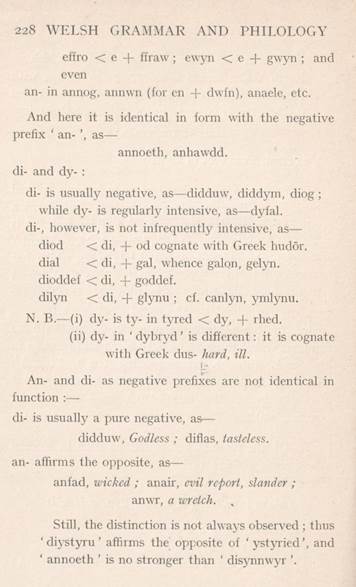
(delwedd L1487) (tudalen 228)
|
228 WELSH GRAMMAR AND PHILOLOGY
effro < e -F ffraw; ewyn < e -l- gwyn; and
even
an- in annog, annwn (for en -F dwfn), anaele, etc.
And here it is identical in form with the negative
prefix ' an-’, as —
annoeth, anhawdd.
di- and dy-:
di- is usually negative, as — didduw, diddym, diog;
while dy- is regularly intensive, as — dyfal.
di-, however, is not infrequently intensive, as —
diod < di, -F od cognate with Greek hudör.
dial < di, -i- gal, whence galon, gelyn.
dioddef < di, + goddef.
dilyn < di, -f- glynu; cf. canlyn, ymlynu.
N. B. — (i) dy- is ty- in tyred < dy, -F rhed.
(ii) dy- in ' dybryd ' is different: it is cognate
with Greek dus- hard, ill.
An- and di- as negative prefixes are not identical in
function: —
di- is usually a pure negative, as —
didduw, Godless; diflas, tasteless.
an- affirms the opposite, as —
anfad, wicked; anair, evil report, slander;
anv.T, a wretch.
Still, the distinction is not alwavs observed; thus
di»tyru ' affrms the opposite of ' ystyricd’, and
‘annoeth ' is no stronger than ' disynnwyr '.
|
|
|
|
|
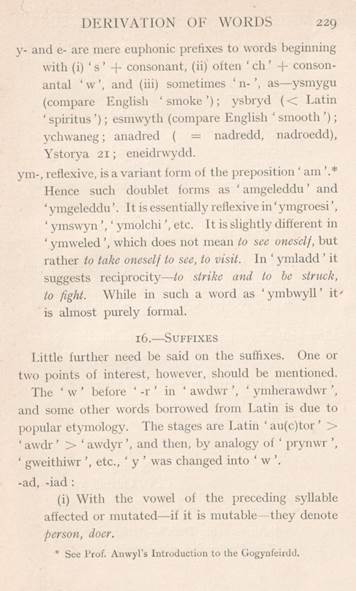
(delwedd L1488) (tudalen 229)
|
DERIVATION OF WORDS
229
y- and e- are mere euphonic prefixes to words beginning
with (i) s' 4- consonant, (ii) often ' ch ' + consonantal ' w', and (iii)
sometimes ' n-’, as — ysmygu
ysbryd ( < Latin
‘smoke ');
(compare English
‘spiritus '); esnnvyth (compare English ' smooth;
nadredd, nadroedd),
ychwaneg; anadred
Ystorya 21; eneidrwydd.
ym-, reflexive, is a variant form of tile preposition ' am
Hence such doublet forms as amgeleddu ' and
‘ymgeleddu'. It is essentially reflexive in 'ymgroesi',
ymswyn’, ‘ymolchi’, etc. It is slightly different in
ymweled % which does not mean 10 sec oneself, but
rather to take oneself to see, to visit. In ' ymladd ' it
suggests reciprocity — to strike to be struck,
to fight. While in such a word as ' yrnbwyll' it'
is almost purely formal.
16. — SUFFIXES
I.ittle further need be said on the suffixes. One or
two points of interest, however, should be mentioned.
The ' w' before ' -r ' in ' awdwr’, ‘ymherawd"T’,
and some other words borrowed from Latin is due to
popular etymology. The stages are Latin >
‘awdr' > ' awdyr', and then, by analogy of prynwr ,
‘gweithiwr’, etc., ‘y ' was changed into ' w '.
-ad, -iad:
(i) With the vowel of the preceding syllable
affected or mutated — if it is mutable — they denote
Person, doer.
• See Prof. Anwyl's Introduction to the Gogynfeirdd.
|
|
|
|
|
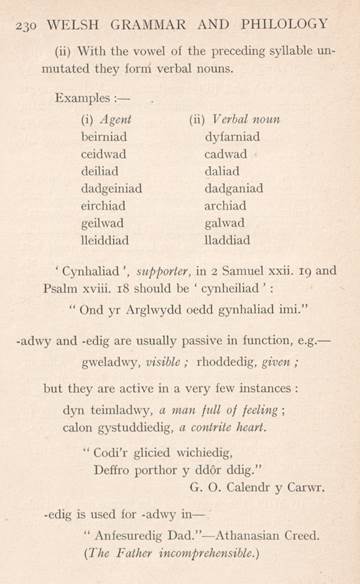
(delwedd L1489) (tudalen 230)
|
230 WELSH GRAMMAR AND PHILOLOGY
(ii) With the vowel of the preceding syllable unmutated they form verbal
nouns.
Examples: —
(i) Agent
beirniad
ceidwad
deiliad
dadgeiniad
eirchiad
geilwad
Ileiddiad
(ii) Verbal noun
dyfarniad
cadwad
daliad
dadganiad
archiad
gal wad
lladdiad
‘Cynhaliad’, supporter, in 2 Samuel xxii. 19 and
Psalm xviii. 18 should be ' cynheiliad ':
“Ond yr Arglwydd oedd gynhaliad imi."
-adwy and -edig are usually passive in function, e.g. —
gweladwy, visible; rhoddedig, given;
but they are active in a very few instances:
dyn teimladuy, a man full o/ feeling;
calon gystuddiedig, a contrite heart.
“Codi'r glicied wichiedig,
Deffro porthor y ddör ddig."
G. O. Calendr y Carwr.
-edig is used for -adwy in —
“Anfesuredig Dad." — Athanasian Creed.
(The Father incomprehensible.)
|
|
|
|
|
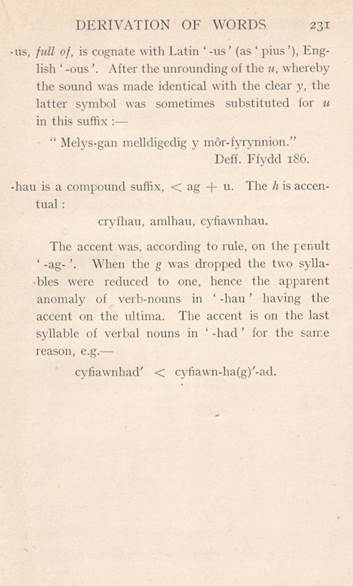
(delwedd L1490) (tudalen 231)
|
DERIVATION OF WORDS
231
-us, full of, is cognate with Latin ' -us' (as ' Pius '), English ' -ous '.
After the unrounding of the u, whereby
the sound was made identical with the clear y, the
latter svmbol was sometimes substituted for u
in this suffl.x: —
Melys-gan melldigedig y mör-fyrynnion."
Deff. Fiydd 06.
-hatl is a compound sufflx, < ag + u. The h is accentual:
cryfhau, amlhau, cyfiawnhau.
The accent was, according to rule, on the penult
‘-ag- When the g was dropped the sylla.bles were reduced to one, hence the
apparent
anomaly of verb-nouns in ' -hau ' having the
accent on the ultima. The accent is on the last
syllable of verbal nouns in ' -had ' for the same
reason, e.g. —
cyfiawnhad' <
|
|
|
|
|

(delwedd L1491) (tudalen 232)
|
|
|
|
|
|
|
|
|
|
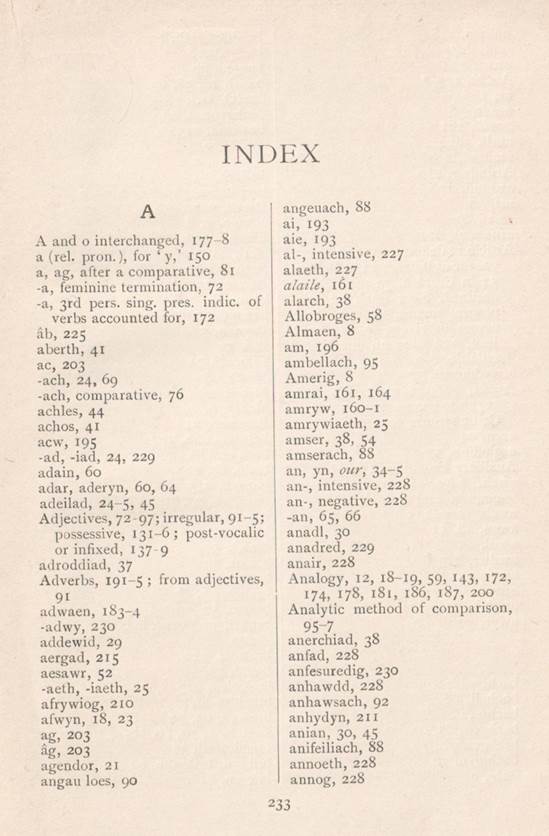
(delwedd L1492) (tudalen 233)
|
INDEX
angeuach, SS
A and o interchanged,
a (rel. pron.), for 150
a, ag, after a comparative, Sl
-a, fetninine termination, 72
-a, 3rd perS. sing. pres. indie.
verbs accounted for, 172
.ib, 225
aberth, 41
ac, 203
.ach, 24, 69
-ach, comparative, 76
achles, 44
achos, 41
acw, 195
-ad, -iad, 24, 229
adain, 60
adar, aderyn, 60, 64
adeilad, 24-8, 45
Adjectives, 72 97; irregular, 91
of
possessive, 131 — 0; post-vocalic
or infixed, 137-9
adroddiad, 37
Adverbs, 191 5; from adjectives,
adwaen, 1S3-4
•adwy, 230
addewid, 29
aergad, 215
aesawr, 52
•acth, .iaeth, 25
afrywiog, 210
afwyn, IS, 23
ag, 203
angau loes,
|
aie, 193
al., intensive, 227
alaeth, 227
a:aile,
alarch. SS
Allobroges, SS
Almaen, S
am, 196
ambellach, 95
Amerig, S
antrai, 161, 164
amryW, 160 — 1
amrywiaeth, 25
amser, SS, 54
amserach, SS
an, yn, our, 34 — 5
an-, intensive, 22S
an-, negative, 22S
-an, 65, 66
anadl, 30
anadred, 229
amir, 22S
Analogy, 12, IS-19, 59, 143, 172,
174, 178, ISI, ISO, 'S? , 200
Analytic method Of comparison,
95 •7
anerchiad, SS
anfad, 22S
anfesuredig, 230
anhaw•ld, 22S
anhaw,ach, 92
anhydyn, 21
anian, 30, 45
anifeiliach, SS
annoeth, 228
annog, 228
|
|
|
|
|
|
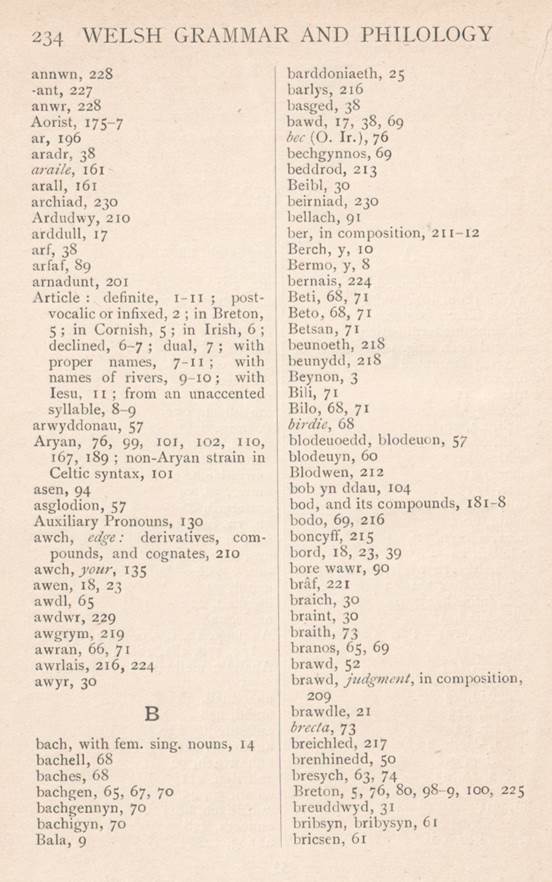
(delwedd L1493) (tudalen 234)
|
233 WELSH GRAMMAR AND PHILOLOGY
233
WELSH GRAMMAR AND PHILOLOGY
annwn, 22S
-ant, 227
anwr, 22S
Aorist, 175 — 7
ar, 196
aradr, 38
avail', 161
arall, 161
archiad, 230
Ardudwy, 210
arddull, 17
arf, SS
arfaf, 89
arnadunt, 201
Article:
definite, 1-11; Instvocalic or infixed, 2; in Breton,
5; in Cornish, 5; in Irish, 6;
declined, 6-7; dual, 7; with
provx•r names, 7-11; with
names of rivers, 9-10; with
lesu, 1 1; from an unaccented
syllable, SO
arwyddonau, 57
Aryan, 76, 99, 101, 102, 1 10,
107, 189; non-Aryan strain in
Celtic syntax, 101
asen, 94
asglodion, 57
Auxiliary Pronouns, 130
awch, ddA"e: derivatives, com.
pounds, and cognates, 210
awch,your. 135
awen, IS, 23
awdl, 65
awdwr, 229
awgrym, 219
awran, 66,
awrlais, 216, 224
awyr, 30
bach, with fem. sing
bachell, 6S
baches, "S
bachk'en, 65, 67, 70
70
bachlgyn, 70
|
Kala, 9
. nouns
, 14
barddoniaeth, 25
barlys, 216
basged,
bawd, 17, SS, 69
[O. Ir.), 76
bechgynnos, 69
beddrod, 213
Beil,l, 30
beirniad, 230
bellach, 91
ber, in composition, 211 — 12
Berch, y, 10
Bermo, y, S
bernais, 224
Beti, 6S, 71
Beto, 68, 71
Betsan, 71
beunoeth, 21S
beunydd, 21S
Beynon, 3
Biii, 71
Bilo, 6S, 71
birdie, OS
blodeuoedd, I'lodeuon, 57
blodeuyn, 60
Blotlwen, 212
bob yn ddau, 104
bod, and its compounds, LSI-S
bodo, 69, 216
boncyff, 215
bor.l, IS, 23, 39
bore wawr, 90
bråf, 221
braich, 30
braint, 30
braith, 73
l.ran•.s, 65, 69
brawd, 52
brawd, in composition,
209
brawdle, 21
73
breichled, 217
l.renhinedd, 50
l•resych, 63, 74
5, 76, So, 9S9, 100, 225
l.reud,iwyd, 31
l•rilysyn, l.ribysyn,
bricscn, 61
|
|
|
|
|
|
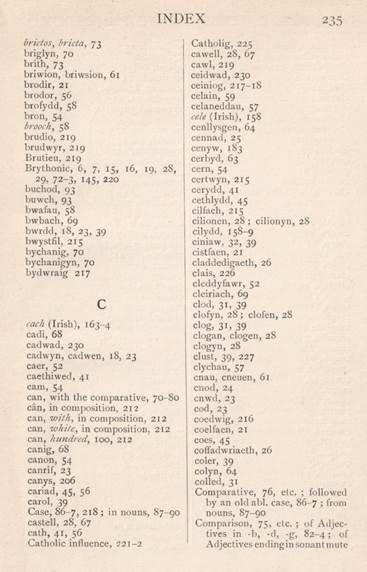
(delwedd L1494) (tudalen 235)
|
INDEX
235
brictos, bricta, 73
briglyn, 70
brith, 73
briwion, briwsion, 61
brodir, 21
brodor, 56
brofydd, 58
bron, 54
brooch , 58
brudio, 219
brudwyr, 219
Brutieu, 219
Brythonic, 6, 7, 15'
29, 72-3, 145, 220
buchod, 93
buwch, 93
bwafau, 58
bwbach, 69
bwrdd, IS, 23, 39
bwystfil, 215
bychanig, 70
bychanigyn, 70
bydwraig 217
c
cach (Irish), 163 — 4
cadi, 68
cadwad, 230
cadwyn, cadwen, IS,
caer, 52
caethiwed, 41
cam, 54
16
, 19,
23
28,
can, with the comparative, 70 — so
can, in composition. 212
can, with, in composition, 212
can, white, in composition, 212
can, hundred, 212
canig, 6S
canon, 54
canrif, 23
canys,
cariad, 45, 56
carol, 39
Case, 86-7, 218; in nouns, 87 — 90
castell, 28, 67
cath, 41, 56
Catholic influence, 221 — 2
|
Catholig, 225
cawell, 2S, 67
cawl, 219
ceidwad, 230
ceiniog, 217-18
celain, 59
celaneddau, 57
cele (Irish), 158
cenllysgen, 64
cennad, 25
cenyw, 1S3
cerbyd, 63
cern, 54
certwyn, 215
cerydd, 41
cethlydd, 45
cilfach, 215
cilionen, 2S; cilionyn, 28
cilydd, 15S — 9
cmiaw, 32, 39
cistfacn, 21
claddedigaeth, 26
dais, 226
cleddyfawr, 52
cleiriach, 69
clod, 31, 39
clofyn, 28; clofen, 28
clog, 31, 39
clogan, clogen, 2S
clogyn, 28
clust, 39, 227
Clychau, 57
cnau, cneuen, 61
cnod, 24
cnwd, 23
cod, 23
coedwig, 216
coelfaen, 21
coes, 45
coffadwriaeth, 26
coler, 39
colyn, 64
coiled, 31
Comparative, 76, etc.; followed
by an old ala. case, 86-7; from
nouns, 87 — 90
Comparison, 75, etc.; of Adjectives in •b,
Adjectives endingin sonant mute
|
|
|
|
|
|
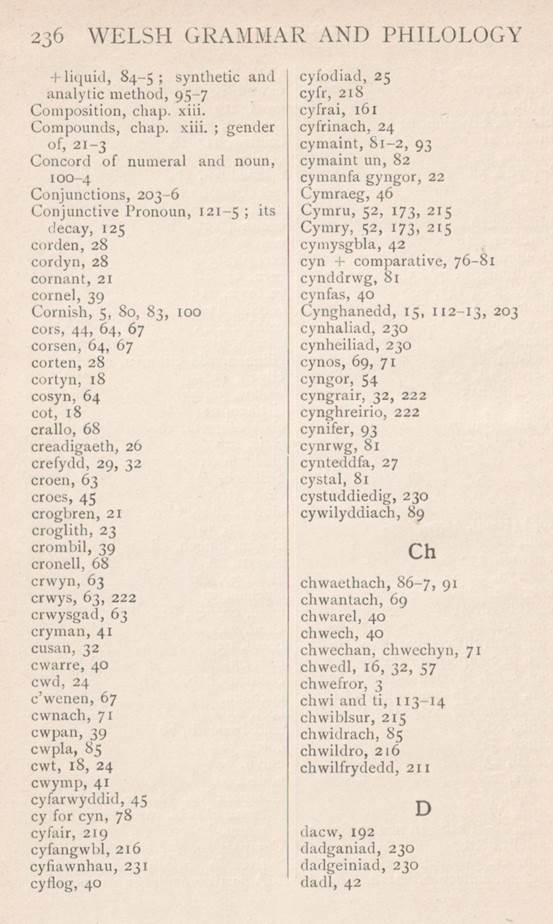
(delwedd L1495) (tudalen 236)
|
236 WELSH GRAMMAR AND PHILOLOGY
liquid, 84-5; synthetic and
analytic method, 95-7
Conq»osition, chap. Niii.
Compounds, chap. xiii.; gender
Concord of numeral and noun,
100
Conjunctions, 203-6
Conjunctive Pronoun, 121 — 5; its
(!ecay, 125
corclen, 2S
cordyn, 2S
COrnant, 21
cornel, 39
Cornish, 5, So, SS,
cots, 44, 64, 67
corsen, 64, 07
corten, 2S
cortyn, IS
cosyn, 64
cot, IS
crallo, OS
crea.iigaeth, 26
crefydd, 29, 32
croen, 63
crocs, 45
crogl'ren, 21
croglith, 23
croml'il, 39
crone•ll,
crwyn, 63
crwys, 63, 222
crwysgad, 63
cryman, 41
cusan, 32
cwarre, 40
cw'i, 24
c'wcnen, 67
cwnach, 7 1
cwpan, 39
cwpla, SS
cwt, IS, 24
cwytnl', 41
cyfarwyddi.l, 45
cy for cyn, 7S
cyfair, 219
cyfangwl.l, 210
cyiiawnhau, 231
cytlog, 40
|
cyiodiad, 25
cyfr, 21S
cyfrai, 161
cyfrinach, 24
cymaint, Sl-2, 93
cymaint un, S2
cytnanfa gyngor, 22
Cymraeg, 46
Cymru, 52, 173, 215
Cymry, 52, 173, 215
cy•tnysgbla, 42
comparative, 76-SI
cyn
cyndcirwg, Sl
cynfas, 40
Cynghanedd, 15. 112-13, 203
cynhaliad, 230
cynheiliad, 230
cynos, 69, 71
cyngor, 54
cyngrmr, 32, 222
cynghreirio, 222
cynifer, 93
cynrwg, Sl
cynteddfa, 27
cystal, Sl
cystuddiedig, 230
cywilyddiach, 89
Ch
chwaethach, 86 — 7, 91
chwantach, 69
chwarel, 40
chwech, 40
chwechan, chwechyn, 71
chwedl, 16, 32, 57
chwefror, 3
chwi and ti, 113 — 14
chwil•lsur, 215
chwi.lrach, S;
chwildro, 216
chwilfrydedd, 211
192
'ladganiad, 230
dadgeiniad, 230
da,ll, 42
|
|
|
|
|
|
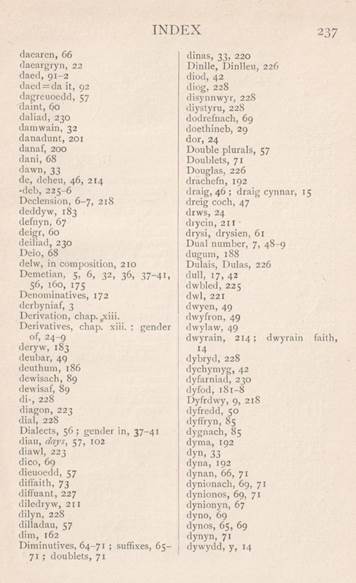
(delwedd L1496) (tudalen 237)
|
daearen, 66
'laeargryn, 22
daed, 91 — 2
daed=cla it, 92
flagreuoedd, 57
daint, 60
daliad, 230
damwain, 32
danadunt, 201
danaf, 200
dani, 68
(lawn, 33
de, deheu, 46, 214
•del', 225-6
Declensi..n, 6 — 7, 21S
deddyw,
clefnyn, 67
deigr, 60
deilia.l, 230
Dei„, OS
delw, in composition
, 210
Demetian, 5, 6, 32,
36,
56, 160, 175
Denominatives, 172
derbyniaf, 3
Derivation, chap. *iii.
INDEX
dinas, 33, 220
l)inlle, 226
diog. 228
'li*ynnwyr, 22S
'liystyru, 22S
d•nlrefnach, 69
doethineb, 29
dor, 24
Double plurals, 57
Doublets, 71
Douglas, 226
drachefn, 192
draig, 40; draig cynnar, 15
dreig coch, 47
d'ycin, 211
drysi, drysien, 61
number, 7, 48-9
dugum, ISS
Dulais, nulxs, 226
37-41,
gender
237
faith,
Derivatives, chap. xiii.:
of, 24-9
deryw, 1S3
(leubar, 49
denthum, 186
dewisach, 89
dewisaf, S9
di-, 22S
diagon, 223
dial, 22S
Dialects, 56; gender in,
diatl, days, 57, 102
diawl, 223
dico, 69
dieuoedd, 57
diffaith, 73
diffuant, 227
diledryw, 211
dilyn, 22S
dilladaa, 57
dim, 162
dull, 17, 42
dwbled, 225
dwl, 221
dwyen, 49
dwyfron, 49
awylaw, 49
dwyrain, 214;
14
dybryd, 228
dy•chymyg, 42
dyfarniad, 230
dyfod,
Dyfrdwy, 9, 2 IS
glyfredd, So
dyffryn, S5
dygnach, S;
dyma, 192
dyna, 192
dynan, 66, 7 t
dynionach, 69, 71
dynionos, 69, 71
dynionyn, 67
dyno, 69
dynos, 65, 69
dynyn, 71
dywydd, y, 14
dwyrain
37-41
Diminutives, 64 — 71 suffixes,
71; doublets, 71
|
|
|
|
|
|
|
(delwedd L1497) (tudalen 238)
|
238 WELSH GRAMMAR AND PHILOLOGY
e., intensive, 227-8; euphonic,
229
ebr, 1S9
•ed, cornparative, 76-7, SI
edafedd, 59
-edig, 230
-edd, 27
ef, 115
efo, 121
effaith, 223
effro, 227
ehud, 227
ei, for eu, 136
eidunt, 143
Eitl, yr, 7, 49
eiliad, 25, 40
einwch, 142 — 3
einym, 142-3
eirchiad, 230
eithafion, eithafoedd
elain, 59
-ell, 2S, 67
ellyn, 34
elwach, S9
Emphatic Pronouns,
en (French), 191
.en, 28, 64, 66
en., intensive, 227
eneidrwydd, 229
enfawr, 227
, 54
116-21
English, 79, S7, 96, 97, 1 10, 1 13,
122, 125, 144, 14S, 151, 154
155, 156, 167, IS', 206,
216, 217, 219, 221, 224,
Middle English, IOS, 154, 207
216; Old English, 59, 103, 109
153, 154, 156, 167, 194,
215, 220, 221, 227
enllyn, 227
Epic dialect, 123
er., intensive, 227
erbyn, 21S
erfawr, 227
ergryn, 227
eruoed: 192
ermoed, 192
eryr, 42
|
|
|
|
|
|
|
(delwedd L1498) (tudalen 239)
|
215,
229;
214,
.es, 65, 6S
esmwyth, 229
estrys, 224
estyllod, 57
euryn, 64
ewig, 52
ewyllys, 46
ewyn, 227
F, Ff
f, dropped when final, 59, 169;
restored or inserted in plurals,
57-9
.fa, 27, 226
faith, 223
fel, 21S
felly, 193
Fenni, y, 10
/iend, 227
fftgys, 225
tilach, 76
tilwch, 76
fo, 115
foursome , IOS
Ffreinc, 51
French, 12, 13, 96-7, 100, 106,
IOS, 110, 191, 207, 216, 217,
219, 221
friend, 227
ffrwd, 34
ffurfafen, 2S
ffwlcyn, 70
g > f and if, 59
•g g- > -g c, 47
69
galwad, 25, 230
Gambold, 13, 14
220
geilwad, 230
genedigaeth, 26
geneuau, 57
Gender, chap. ii.: no neut. gend.
in Modern Welsh, 12, 19-20;
13 — 14; influence
of internal 15-16, 23 4;
gender affectinv: the f,.rm. IS;
analogy, IS 19: Of conq»ounds,
Of derivatives, 24 •9;
21-3;
changes of gender in M".lern
welsh, 29-37; dialectal differ.
ences, 37 — 4 r; pecuiiarity of
gender in particular authors,
41 — 4; words varying in gender
IN DEX
123, 207
239
according to meaning
, 44-7;
in adjectives, 71-3
Genitive, 101-4
glaswellt, 226
gogled(l, 213-14
golwg, 46
gorfoledd, 27
gorugum, ISSO
Greek, 6, 7, 13, 122,
grugionyn, 67
gwaethed, 93
g Waew, g way w, 34
Await h,
44
gwalch, 35
gwarogaeth, 21S
gWasanaeth, 26
gwawd, 220
gwaywawr, 51
gweithred, 34
gweladwy, 230
gwele«iig, 230
gwen, 72, 212
gwcn, 212
Gwen", 69
Gwener, IS
Gwentian, 5, 6,
160, 175, 176
gwewyr, 51
230
gwirioned.l, 35
gwlithos, 69
gwn, 1S3 4, 210
32,
37-4'
, 56,
gwneuthur, ISI-SS
gwniadur, 40
gwraf,
gwrthddadl, 22
|
|
|
|
|
|
|
(delwedd L1499) (tudalen 240)
|
gwybed, gwybetlyn, 61
Gwyddyl, 50
gwyn, 72
gwyndy, 226
Gwyne.l,l, 37-41, 173, 224
kWYrgam, 216
haeach, 89
hafal, 21S
Ilafren, 76
banes, 35
-hau, 231
haul, 35, 76
hawg, rhawg, 3
hawsach, 92
hawsaf, 92-3
hawsed, 93
hebof, 200
. heddwch, 36
heresi, 42
hesp, 76
heulwen, 212
hiraeth, 26
hob, 212; hob y deri dan
22
horob, 212
hunan, 66
hunell, 6S
htmllef, 21 1
hurthgen, 70
husband, 227
hwn, 73, 74, 75
hwnna, 74, 75; hwnnw, 74, 75
hwyaeh, 91
hwyrach, 91
llybrids, 61
hy.lyr, 94
hyfrytach, SS
Ion, 70
hynach, 92
hyn, gender of, 19
hytrach, 91
hytraf, 94
240 WELSH GRAMMAR AND PHILOLOGY
1
prep., 19
and not
tithau
dithau 202
lago, 222
lanto,
iawn, iawnach, iawnaf, iawned,
94
ie, '93
les", yr, 11
Ifano, 69
-iff, 3rd sing. pres. indic., 170-1
Ifi,
ill, with numerals, 105 — 6, 163
im, 1m'. 201
Imperfect, Vast, 172 — 5
Imlefinite Pronoun, 160-5
Indicative, v. Verb
-ineb, 29
-; Def.
Infixed Poss. Adj., 137 9
Art., 2•, l'ers. l'ron., 12,- 30
inflection, 72-4
Interrogative Pronoun, 1450
101", 69, 71
Iolyn, 71
lorddonen. 9
Irish, 65, 00, ICO, 103, 213
Irish, Middle, SO.
Irish, Old, 5, 6, 19 — 20, 39. 76,
SO, 9.S — 9, 104, 105, 10, 144,
15S, 161, 162, 214, 220
Irregular Adjectives 91-5
iso, is.ul, 195
-ith, in 3rd sing. pres. indic — of
verbs, 170-1
-in, -u (Old Irish), 76
iwch, 20t
lwerddon, S 9
iyrchell, OS
-k.in, 190
Kymry, 53, '73
|
|
|
|
|
|
|
(delwedd L1500) (tudalen 241)
|
(tudaten 240)
laigitt (O. Ir.), 76
Latin, 2, 13, 30, 59, 74, SS, 106,
Ito, 122, 135, 144, 145, 151,
i .63' 155, 101, 177, 1S9, 205,
214, 216, 220, 222-3, 227, 229
liaison,
lifrai, 224
66
Lyons, 226
liar', 213
lladd, 220
lladdiad, 230
I,landudno, 211
lias, 177
llasar, 3
llaw, in composition, 210
llawer, 93
Ileill,
95
liefydd, 58
Ileidr, 60
Ilei.ldiad, 230
Ilem, 73
Ilesnch, 90
llcuad, 25
l.ligwy, 210; I.ug, 210
Ilipryn, 70
Ilith, 53
ll.w•rcen, 70
llc,ft, 224
71
Ilonges, 71
iluchio, 93
lion, IS
lluwch, 93
llwf, 5S
ilwg, in composition, 210
llwyddiant, 227
llwyn, 44, 54, 55
llwyth, 54, 55
-llyd, -lyd, 226
INDEX
241
llyfon, llyfau. 58
llygod, liygoden, 61
llym, 73
llyma, 192
llys, hall,
llys, false, 212
llys, slime, 212
llys, a herb, 212
llythyr, 56
macrell, 2S
mach, 76
Machynlleth, 226
mae'l, mae fel, 193
mai, 205
ma mouric, 226
malwod, malwoden, 61
Mallwyd, 226
Mathafarn, 226
mau, mine, 140-1, 144
16,
36,
212
Medizeval Welsh, 7. Welsh
meddiant, 227
Menai, 9 — 10
mentro, 224
mer, in composition, 211 — 12
merched, 62
Metonymy, 43, 44
meu, 140 — 1
meudwy, 21S
meuvet, 142
mi, 110-12
milgi, 216
minnef, 125
mlS, 19
modrwy, 69, 216 — 17
modryb, 69
moes, 42
Mood, 7. Verb
mor + positive, 95-6
morfa, 27
Morus, 225
morwyn, 53
multiplicative method of enumer•
ation, 99
mutation, initial. 47, 48; of
vowels, 72-4
mwy, mwyaf in comparison, 96 — 7
|
|
|
|
|
|
|
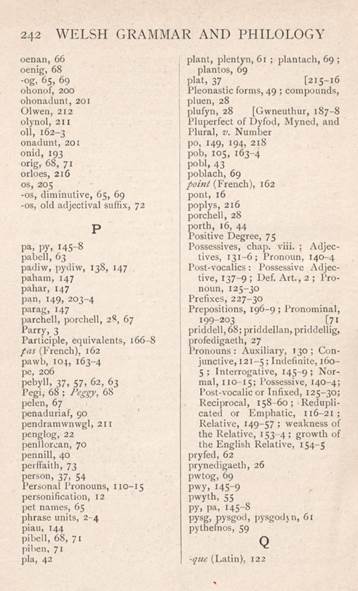
(delwedd L1501) (tudalen 242)
|
mwyach, 91
Mwythig, Y, S
mygdarth, 216
myglys, 225
myn, 19S
myned, I Sr — SS
mynwent, 28, 220
n: excrescent, 217; dropped, 7S
na, nag, after a comparative, St
nad, 193
nage, 193
nail', 159 — 60
nail, y, 6, 160
nant, 227
nas, 193
neb, 162
Ned, 3
nef, gender of, 20, 37; nefoedd, 62
nege_seuau, negeseuon, 57
neidr, 60
Neil, 3
nerob, 212
nestling , 64
Neuter Gender, 12, 19 — 20
newyddach, 95
ickname, 3
nid, 193
ms, 193
nos da, nos dawch, 14
Number, in nouns, chap. iii.;
Dual, 4S-9; Plural, 49;
words that have changed their
plural fortn, 50 — 3; words with
two or more plural forms,
53; dialectal plural forms, 56;
double plurals, 57; incorrect
plurals, 62
Nutnerals, 98-109
nyth, 40, 56
o
o, 197
och, 76
.o%-h (Breton), 76
oddi, 197, 214
242 WELSH GRAMMAR AND PHILOLOGY
oenan, 66
oenig, 68
.og, 65, 69
ohonof,
ohonadunt, 201
Olwen, 212
olynol, 211
011, 162 — 3
onadunt, 201
onid, 193
orig, 6S, 71
orloes, 216
os, 205
-os, diminutive, 65, 69
-os, old adjectival suffix, 72
pa, py, 145-8
pabell, 63
padiw, pyciiw, 138, 147
paham, 147
pahar, 147
pan, 149, 203-4
parag, 147
parchell, porchell, 2R, 67
Parry, 3
Participle, equivalents, 166 — S
fas (French), 162
pawb, 101, 163 — 4
pe, 2c6
37' 57, 62, 63
Fegi , 6S; Peggy, 6S
pelen, 67
penaduriaf, 90
pendramwnwgl, 211
penglog, 22
penllorcan, 70
pennill, 40
perffaith, 73
person, 37, 54
Personal Pronouns, 110 — 15
1k2rsonification, 12
pet names, 65
phrase units, 2 — 4
puau, 144
pibell, 68, 71
piben, 71
pla, 42
|
|
|
|
|
|
|
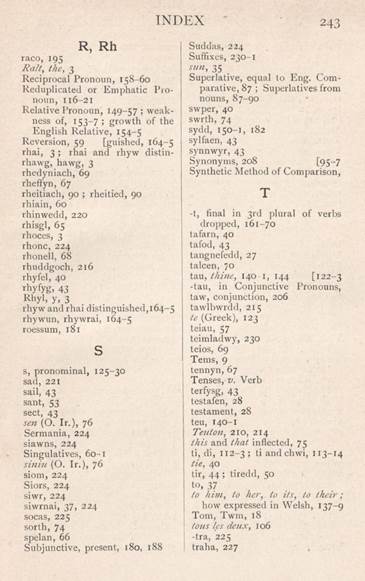
(delwedd L1502) (tudalen 243)
|
plant, plentyn, 61; plantach, 69;
plantos, 69
plat, 37
[215-16
Pleonastic forms, 49; compounds,
pluen, 28
plufyn, 28 (Gwneuthur, 187 -S
PI ulrrfect Of l)yfod, Myned, and
Plural, 7. Number
PO, 149, 194, 21S
pob, 105, 163-4
pobl, 43
poblach, 69
point (French), 162
Pont, 16
poplys, 216
porchell, 28
porth, 16, 44
Positive Degree, 75
Possessives, chap. viii.; Adjectives, 1314); Pronoun, 140 — 4
Post-vocalics: Possessive Adjective, 137 — 9; Def. Art., 2; Pronoun, 125 — 30
Prefixes, 227-30
Prepositions, 196 — 9; Pronominal,
199-203
priddell, 68; priddellan, priddellig,
profedigaeth, 27
Pronouns: Auxiliary, '30; Con.
junctive, 121 — 5; Indefinite, 1605; Interrogative, 1450; Normal, 110 — 15;
l'ossessive, 140-4;
Yost-vocalic or Infixed, 125 — 30;
Reciprocal, 158-60;
cated or Emphatic, 116.21;
Relative, 149-57; weakness of
the Relative, 153 4; growth of
the English Relative, 154-5
pryfed, 62
prynedigaeth, 26
pwtog, 69
pwy, 145-9
pwyth, 55
py, pa, 145 — S
pysg, fpysgod, pysgodyn, 61
pythe nos, 59
-que (Latin), 122
INDEX
243
raco, 195
Rapt, the, 3
Reciprocal Pronoun, 158 — 60
Reduplicated or Emphatic PIOnoun, 116-21
Relative Pronoun, 149 — 57
; weakness of, 153-7; growth
of the
English Relative, 154 — 5
Reversion, 59
[guished,
r 64-5
rhai, 3; rhai and rhyw
distinrhawg, hawg, 3
rhedyniach, 69
rhetfyn, 67
rheitiach,; rheitied,
rhiain, 60
rhinwedd, 220
rhisgl, 65
rhoces, 3
rhonc, 224
rhonell, 68
rhuddgoch, 216
rhyfel, 40
rhyfyg, 43
Rhyl, y, 3
rhyw and rhai
rhywun, rhywrai, 164 — 5
roessum, ISI
s
s, pronominal, 125 — 30
sad, 221
sail, 43
sant, 53
sect, 43
sen (O. Ir.), 76
Sermania, 224
stawns, 224
Singulatives, 60-1
siniu (O. Ir.), 76
siom, 224
Siors, 224
siwr, 224
siwrnai, 37, 224
socas, 225
sorth, 74
slklan, 66
Subjunctive, present, ISO,
|
|
|
|
|
|
|
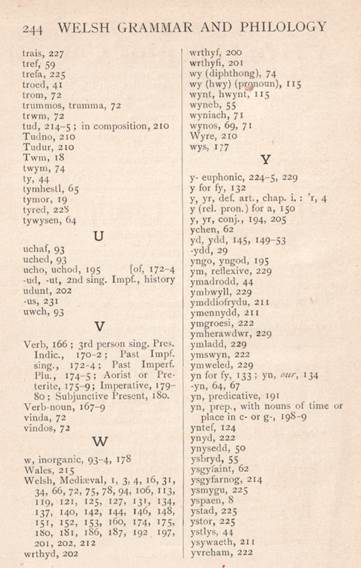
(delwedd L1503) (tudalen 244)
|
1 SS
Suddas, 224
Suffixes, 230-1
35
Superlative, equal to Eng. Com•
parative, 87; Superlatives from
nouns, S7-g:»
swper, 40
swrth, 74
sydd, 150 — 1,
sylfaen, 43
synnwyr, 43
Synonyms, 208
195-7
Synthetic Method of Comparison,
-t, final in 3rd plural of verbs
dropped, 161 — 70
tafarn, 40
tafod, 43
tangnefedd, 27
talcen, 70
tau, thin.', 140L1, 144 [1 22-3
-tau, in Conjunctive Pronouns,
taw, conjunction, 206
tawlbwrdd, 215
t,' (Greek), 123
teiau, 57
te•imladwy, 230
teios, 69
Tems, 9
tennyn, 67
Tenses, v. Verb
terfysg, 43
testafen, 2S
testament, 2S
teu, 140 — 1
Teuton, 210, 214
this and that inflected, 75
ti, di, 112 — 3; ti and chwi, 113 — 14
tie, 40
tir, 44; tiredd, 50
to, 37
him, to her, to its, to;
how expressed in Welsh, 137 — 9
Tom, Twin, IS
ious de•u.r,
-tra, 225
traha, 227
244 WELSH GRAMMAR AND PHILOLOGY
trais, 227
tref, 59
trefa, 225
troed, 41
trom, 72
trummos, trumma, 72
trwm, 72
tud, 214 — 5; in composition, 210
Tudno, 210
Tudur, 210
Tw,n, IS
twym, 74
ty, 44
tymhestl, 65
tymor, 19
tyred, 22S
tywysen, 64
uchaf, 93
uched, 93
(of, 172-4
ucho, uchod, 195
-ud, .ut, 2nd sing. Impf., history
udunt, 202
-us, 231
uwch, 93
Verb, 166; 3rd person sing. pres.
Past Impf.
Indic., 170-2;
sing., 172-4; Past Imperf.
174-5; Aorist or preFlu.,
terite, 175-9; 1m •erative, 179SO: Subjunctive •resent, ISO.
Verb-noun, 167 — 9
vinda, 72
vindos, 72
w, inorganic, 93 — 4,
Wales, 215
Welsh, Medieval, 1, 3, 4, 16, 31'
34, 60, 72, 75, 78, 94,
106, 113,
119, 121, 125, 127,
131, 134,
146, 143,
137, 140, 142, 144,
151, 152, 153, 160,
174, 175'
ISO, IS', ISO, 187,
192 197,
201, 202, 212
wrthyd, 202 wrthyf, 200
wrthyfi, 201
wy (diphthong), 74
wy (hwy) (pryoun), 115
wynt, hwynt, 115
wyneb, 55
wyniach, 71
wynos, 69, 71
V,' yre, 2 to
wys,; 7
y. euphonic, 224-5, 229
y for fy, 132
y, yr, def. art., chap. i.:
y (rel. pron.) for a, 150
y, yr, conj., 194, 205
ychen, 62
yd, ydd, 145, 149-53
-ydd, 29
yngo, yngod, 195
ym, reflexive, 229
ymadrodd, 44
ymbwyll, 229
ymddiofrydu, 211
ymennydd, 211
ymgroesl, 222
ymherawdwr, 229
ymladd, 229
ymswyn, 222
ymweled, 229
yn for fy, 133; yn, our, 134
-yo, 64, 67
yn, predicative, 191
yn, prep., with nouns of time or
place in c- or g-, 19S-9
yntef, 124
ynyd, 222
ynysedd, 50
ysbryd, 55
62
ysgythrnog, 214
ysmygu, 225
yspaen, S
ystad, 225
ystor, 225
ystlys,
ysywaeth, 211
yvreham, 222
|
|
|
|
|
|