|
|
|
|
(delwedd J6326) (Gorffennaf 1892) (tudalen 77)
|
CYFENWAU CYMREIG. (Papyr a
ddarllenwyd gerbron Cymdeithas
Lenyddol y Tabernacl, King's Cross,
Llundain, Mawrth 5ed, 1892).
I. HANES CYFENWAU CYMREIG.
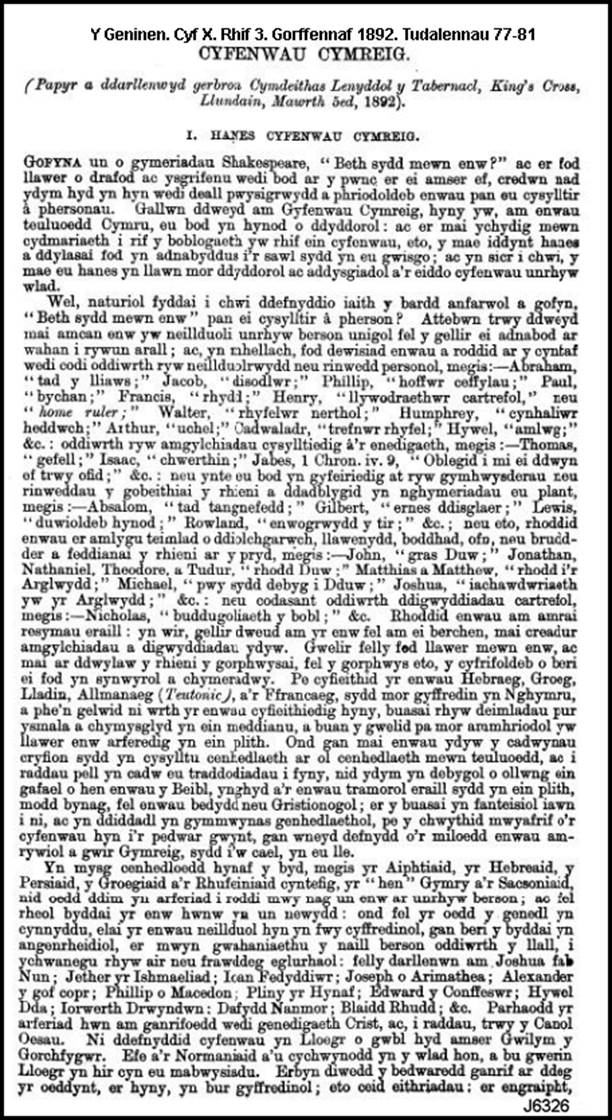
Gofyna un o gymeriadau Shakespeare, "Beth
sydd mewn enw?" ac er fod llawer
o drafod ac ysgrifenu wedi bod ar y pwnc er ei amser ef, credwn nad ydym hyd
yn hyn wedi deall pwysigrwydd a phriodoldeb enwau pan eu cysylltir â phersonau.
Gallwn ddweyd am Gyfenwau Cymreig, hyny yw, am enwau teuluoedd Cymru, eu bod yn hynod o ddyddorol: ac er mai
ychydig mewn cydmariaeth i rif y boblogaeth yw rhif ein cyfenwau, eto, y mae
iddynt hanes a ddylasai fod yn adnabyddus i'r sawl sydd yn eu gwisgo; ac yn
sicr i chwi, y mae eu hanes yn llawn mor ddyddorol ac addysgiadol a'r eiddo cyfenwau unrhyw wlad.
Wel, naturiol fyddai i chwi ddefnyddio iaith y
bardd anfarwol a gofyn, "Beth sydd mewn enw" pan ei cysylltir â
pherson? Attebwn trwy ddweyd mai amcan enw yw neillduoli unrhyw berson unigol
fel y gellir ei adnabod ar wahan i rywun arall; ac, yn mhellach, fod dewisiad
enwau a roddid ar y cyntaf wedi codi oddiwrth ryw neillduolrwydd neu rinwedd
personol, megis: — Abraham, "tad y lliaws;" Jacob, "disodlwr;"
Phillip, "hoffwr ceffylau;" Paul, "bychan;" Francis,
"rhydd;" Henry, “llywodraethwr cartrefol," neu “home
ruler;" Walter, “rhyfelwr nerthol;" Humphrey, “cynhaliwr
heddwch;" Arthur,
"uchel;" Cadwaladr,
"trefnwr rhyfel;" Hywel, "amlwg;" &c.; oddiwrth ryw amgylchiadau cysylltiedig â'r
enedigaeth, megis: — Thomas,
“gefell;" Isaac, “chwerthin;" Jabes, 1 Chron. iv. 9, “Oblegid i mi
ei ddwyn ef trwy ofid;" &c.; neu ynte eu bod yn gyfeiriedig at ryw
gymhwysderau neu rinweddau y gobeithiai y rhieni a ddadblygid yn nghymeriadau
eu plant, megis: — Absalom, “tad tangnefedd;” Gilbert, “ernes ddisglaer;”
Lewis, “duwioldeb hynod;” Rowland,
“enwogrwydd y tir;” &c.; neu eto, rhoddid enwau er amlygu teimlad o
ddiolchgarwch, llawenydd, boddhad, ofo, neu brudd-der a feddianai y rhieni ar
y pryd, megis: — John, "gras Duw;" Jonathan, Nathaniel, Theodore, a
Tudur, "rhodd Duw;"
Matthias a Matthew, "rhoddi'r Arglwydd;" Michael, “pwy sydd debyg i
Dduw;” Joshua, “iachawdwriaeth yw yr Arglwydd;" &c.: neu codasant oddiwrth
ddigwyddiadau cartrefol, megis: — Nicholas, “buddugoliaeth y bobl;” &c. Rhoddid enwau am amrai resymau eraill: yn wir, gellir dweud am yr enw fel am ei berchen, mai creadur
amgylchiadau a digwyddiadau ydyw. Gwelir felly fod llawer mewn enw, ac mai ar ddwylaw y rhieni y
gorphwysai, fel y gorphwys eto, y cyfrifoldeb o beri ei fod yn synwyrol a
chymeradwy. Pe cyfieithid yr enwau Hebraeg, Groeg, Lladin, Allmanaeg
(Teutonic), a'r
Ffrancaeg, sydd mor gyffredin yn Nghymru, a
phe'n gelwid ni wrth yr enwau cyfieithiedig
hyny, buasai rhyw deimladau pur ysmala a chymysglyd yn ein meddianu, a buan y
gwelid pa mor ammhriodol yw llawer enw arferedlg yn ein plith.
Ond gan mai enwau ydyw y cadwynau cryfion sydd yn cysylltu cenhedlaeth ar ol
cenhedlaeth mewn teuluoedd, ac i raddau pell yn cadw eu traddodiadau i fyny,
nid ydym yn debygol o ollwng ein gafael o hen enwau y Beibl, ynghyd a'r enwau
tramorol eraill sydd yn ein plith, modd bynag, fel enwau bedydd neu
Gristionogol; er y buasai yn fanteisiol iawn i ni, ac yn ddiddadl yn gymmwynas
genhedlaethol, pe y chwythid mwyafrif o'r cyfenwau hyn i'r pedwar gwynt, gan
wneyd defnydd o'r miloedd enwau
amrywiol a gwir Gymreig, sydd i'w cael, yn eu lle.
Yn mysg cenhedloedd hynaf y byd, megis yr
Aiphtiaid, yr Hebreaid, y Persiaid, y Groegiaid a'r Rhufeiniaid cyntefig, yr “hen” Gymry a'r Sacsonìaid,
nid oedd ddim yn arferiad i roddi mwy nag un enw ar unrhyw berson; ac fel rheol byddai yr enw hwnw yn un newydd: ond fel
yr oedd y genedl yn cynnyddu, elai yr enwau neillduol hyn yn fwy cyffredinol, gan beri y byddai
yn angenrheidiol, er mwyn gwahaniaethu y naill berson oddiwrth y llall, i
ychwanegu rhyw air neu frawddeg eglurhaol: felly darllenwn am Joshua fab Nun; Jether yr Ishmaeliad; Ioan Fedyddiwr;
Joseph o Arimathea; Alexander y gof copr; Phillip o Macedon; Pliny yr Hynaf;
Edward y Conffeswr;
Hywel Dda; Iorwerth Drwyndwn: Dafydd Nanmor; Blaidd Rhudd; &c. Parhaodd yr arferiad hwn am
ganrifoedd wedi genedigaeth Crist, ac, i raddau, trwy y Canol Oesau. Ni ddefnyddid cyfenwau yn Lloegr o gwbl hyd amser Gwilym y Gorchfygwr. Efe a'r
Normaniaid a'u cychwynodd yn y wlad hon, a bu gwerin Lloegr yn hir cyn eu
mabwysiadu. Erbyn diwedd y bedwaredd ganrif ar ddeg yr oeddynt, er hyny, yn
bur gyffredinol; eto ceid eithriadau; er engraipht,
|
|
|
|
|
(delwedd J6327) (Gorffennaf 1892) (tudalen 78)
|
78 CYFENWAU CYMREIG.
dywed
y Parch. Mark Noble nad oedd gan amryw o deuluoedd yn Sir Gaer Efrog (Yorkshire) gyfenwau hyd ddiwedd yr eilfed ganrif
ar bymtheg.
Cyn myned yn mhellach buddiol efallai fyddai
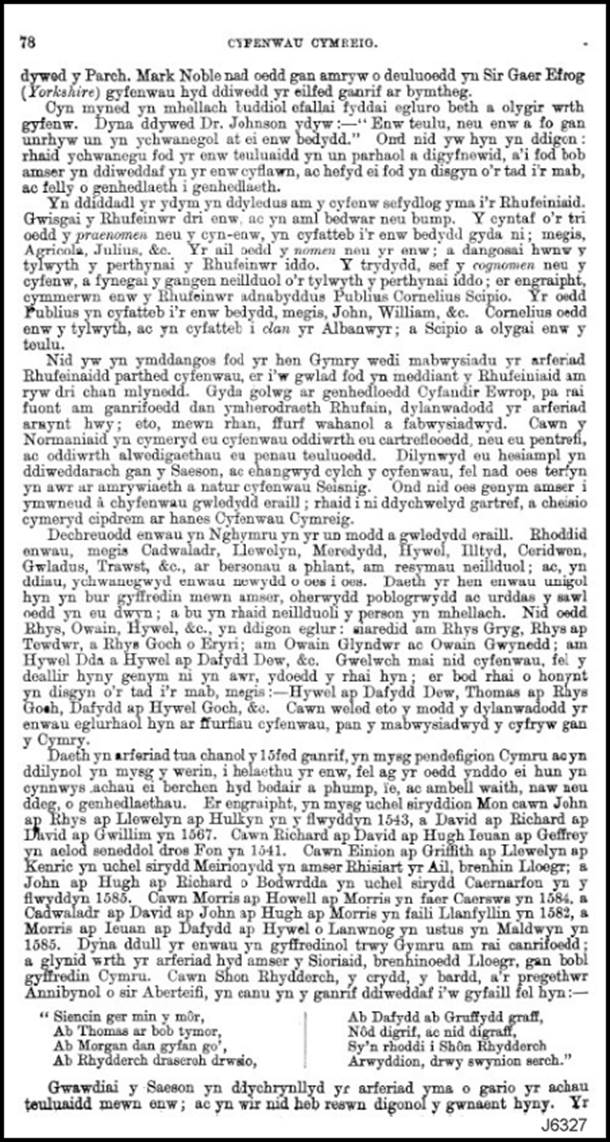
egluro beth a olygir wrth gyfenw. Dyna ddywed Dr. Johnson ydyw: — " Enw teulu,
neu enw a fo gan unrhyw un yn ychwanegol at ei enw bedydd." Ond nid yw
hyn yn ddigon: rhaid ychwanegu fod yr enw teuluaidd yn un parhaol a
digyfnewid, a'i fod bob amser yn ddiweddaf yn yr enw cyflawn, ac hefyd ei fod
yn disgyn o'r tad i'r mab, ac felly o
genhedlaeth i genhedlaeth.
Yn ddiddadl yr ydym yn ddyledus am y cyfenw
sefydlog yma i'r Rhufeiniaid.
Gwisgai y Rhufeinwr dri enw, ac yn aml bedwar neu bump. Y cyntaf o'r tri oedd
y praenomen neu y cyn-enw, yn cyfatteb i'r enw bedydd gyda ni; megis,
Agricola, Julius, &c. Yr ail oedd y nomen neu yr enw; a dangosai hwnw y tylwyth y perthynai y
Rhufeinwr iddo. Y trydydd, sef y cognomen neu y cyfenw, a fynegai y gangen
neillduol o'r tylwyth y perthynai iddo; er engraipht, cymmerwn enw y
Rhufeinwr adnabyddus Publius Cornelius
Scipio. Yr oedd Publius yn cyfatteb i'r enw bedydd, megis, John, William,
&c. Cornelius oedd enw y tylwyth, ac yn cyfatteb i clan yr Albanwyr; a
Scipio a olygai enw y teulu.
Nid yw yn ymddangos fod yr hen Gymry wedi
mabwysiadu yr arferiad Rhufeinaidd parthed cyfenwau, er i'w gwlad fod yn
meddiant y Rhufeiniaid am ryw dri chan mlynedd. Gyda golwg ar genhedloedd
Cyfandir Ewrop, pa
rai fuont am ganrifoedd dan ymherodraeth Rhufain, dylanwadodd yr arferiad
arnynt hwy; eto, mewn rhan, ffurf wahanol a
fabwysiadwyd. Cawn y Normaniaid yn cymeryd eu cyfenwau oddiwrth eu
cartrefleoedd, neu eu pentrefi, ac oddiwrth alwedigaethau eu penau teuluoedd.
Dilynwyd eu hesiampl yn ddiweddarach gan y Saeson, ac ehangwyd cylch y
cyfenwau, fel nad oes terfyn yn awr ar amrywiaeth a natur cyfenwau Seisnig.
Ond nid oes genym amser i ymwneud â chyfenwau gwledydd eraill; rhaid i ni
ddychwelyd gartref, a cheisio cymeryd cipdrem ar hanes Cyfenwau Cymreig.
Dechreuodd enwau yn Nghymru yn yr un modd a
gwledydd eraill. Rhoddid enwau, megis Cadwaladr, Llewelyn, Meredydd, Hywel,
Illtyd, Ceridwen, Gwladus, Trawst, &c, ar bersonau a phlant, am resymau
neillduol; ac, yn ddiau, ychwanegwyd enwau newydd o oes i oes. Daeth yr hen
enwau unigol hyn yn bur gyffredin mewn amser, oherwydd poblogrwydd ac urddas
y sawl oedd yn eu dwyn; a bu yn rhaid neillduoli y person yn mhellach. Nid oedd Rhys, Owain,
Hywel, &c, yn ddigon eglur: siaredid am Rhys Gryg, Rhys ap Tewdwr, a Rhys
Goch o Eryri; am Owain Glyndwr ac Owain Gwynedd; am Hywel Dda a Hywel ap
Dafydd Dew, &c. Gwelwch mai nid cyfenwau, fel y deallir hyny genym ni yn
awr, ydoedd y rhai hyn; er bod rhai o honynt yn disgyn o'r tad i'r mab,
megis: — Hywel ap Dafydd Dew, Thomas ap Rhys Go«h, Dafydd ap Hywel Goch,
&c. Cawn weled eto y modd y dylanwadodd yr enwau eglurhaol hyn ar
ffurfiau cyfenwau, pan y mabwysiadwyd y cyfryw gan y Cymry.
Daeth yn arferiad tua chanol y 15fed ganrif, yn
mysg pendefigion Cymru ac yn ddilynol yn mysg y werin, i helaethu yr enw, fel
ag yr oedd ynddo ei hun yn cynnwys .achau ei berchen hyd bedair a phump, ïe, ac ambell waith, naw neu ddeg, o
genhedlaethau. Er engraipht, yn mysg uchel siryddion Mon cawn John ap Rhys ap Llewelyn ap Hulkyn yn y flwyddyn 1543, a
David ap Richard ap
Dayid ap Gwillim yn 1567. Cawn Richard ap
David ap Hugh Ieuan ap Geffrey yn aelod
seneddol dros Fon yn 1541. Cawn Einion ap Griffith ap Llewelyn ap Kenric yn uchel sirydd Meinonydd yn amser Rhisiart
yr Ail, brenhin Lloegr; a John ap Hugh ap Richard o Bodwrdda yn uchel sirydd
Caernarfon yn y flwyddyn 1585.
Cawn Morris ap Howell ap Morris yn faer Caersws yn 1584, a Cadwaladr ap David
ap John ap Hugh ap Morris yn faili Llanfyllin yn 1582, a Morris ap Ieuan ap Dafydd ap Hywel o
Lanwnog yn ustus yn Maldwyn yn 1585. Dyna ddull yr enwau yn gyffredinol trwy Gymru am rai canrifoedd; a glynid
wrth yr arferiad hyd amser y Sioriaid, brenhinoedd Lloegr, gan bobl gyffredin Cymru. Cawn Shon Rhydderch, y crydd, y
bardd, a'r pregethwr Annibynol o sir Aberteifì, yn canu yn y gannf ddiweddaf
i'w gyfaill fel hyn: —
“Siencin ger min y môr,
Ab Thomaa ar bob tymor,
Ab Morgan dan gyfan go',
Ab Rhyddercb
draserch drwsio,
Ab Dafydd ab Gruffydd graff,
Nôd digrif, ac nid digraff,
Sy'n rhoddi i Shôn Rhydderch
Arwyddion, drwy swynion serch.'
Gwawdiai y Saeson yn ddychrynllyd yr arferiad yma
o gario yr achau teuluaidd mewn enw; ac yn wir nid heb reswn digonol y
gwnaent hyny. Yr
|
|
|
|
|
(delwedd J6328) (Gorffennaf 1892) (tudalen 79)
|
CYFENWAU CYMREIG. 79
oedd yn arferiad anghyfleus, beth bynag ellid
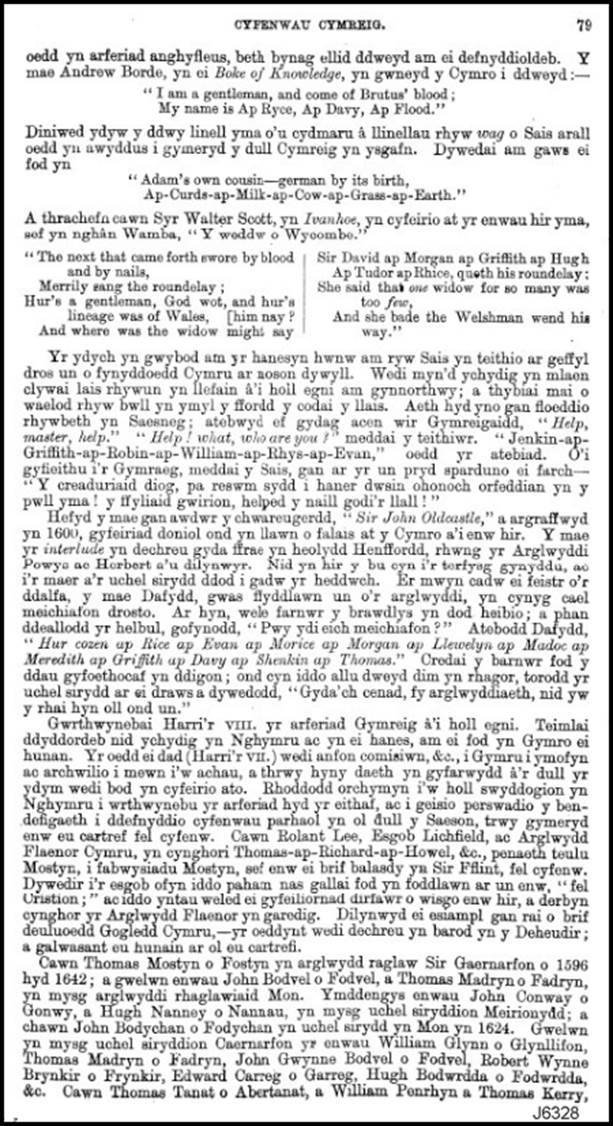
ddweyd am ei defnyddioldeb. Y mae Andrew Borde, yn ei Boke of Knowledge, yn gwneyd y Cymro i ddweyd: —
“I am a gentleman, and come of Brutus' blood;
My name is Ap Ryce, Ap Davy, Ap Flood."
Diniwed ydyw y ddwy linell yma o'u cydmaru â
llinellau rhyw wag o Sais arall oedd yn awyddus i gymeryd y dull Cymreig yn
ysgafn. Dywedai am gaws ei fodyn
“Adam's own cousin — german by its birth,
Ap-Curds-ap-Milk-ap-Cow-ap-Grass-ap-Earth."
A thrachefn cawn Syr
Walter Scott, yn Ivanhoe, yn cyfeirio at yr enwau hir yma, sef yn nghân Wamba, “Y weddw o
Wycombe."
“The next that came forth swore by blood and by
nails,
Merrily eang the roundelay;
Hur's a gentleman, God wot, and hur's lineage was
of Wales,
And wbere was the widow migbt say him nay?
Sir David ap Morgan ap Grriffith ap Hugh
Ap Tudor ap Rhice, quoth his roundelay;
She said that one widow for so many was too few,
And sbe bade the Welshman wend his way."
Yr ydych yn gwybod am yr hanesyn hwnw am ryw Sais yn teithio ar geffyl
dros un o fynyddoedd Cymru ar noson dywyll. Wedi myn'd ychydig yn mlaen
clywai lais rhywun yn llefain â'i holl egni am gynnorthwy; a thybiai mai o waelod rhyw
bwll yn ymyl y ffordd y codai y llais. Aeth hyd yno gan floeddio rhywbeth yn
Saesneg; atebwyd ef gydag acen wir Gymreigaidd, “Help, master, help."
“Help! what, who are you?" meddai
y teithiwr. “Jenkin-ap-Griffith-ap-Robin-ap-William-ap-Rhys-ap-Evan," oedd yr atebiad. O'i gyfieithu i'r Gymraeg, meddai y Sais, gan ar yr un
pryd sparduno ei farch — “Y creaduriaid
diog, pa reswm sydd i haner dwsin ohonoch orfeddian yn y pwll yma! y ffyliaid
gwirion, helped y naill godi'r llall!”
Hefyd y mae gan awdwr y chwareugerdd, “Sir John Oldcastle,"
a argraffwyd yn 1600, gyfeiriad doniol ond yn llawn o falais at y Cymro a'i enw hir. Y mae yr interlude yn dechreu gyda ffrae
yn heolydd Henffordd, rhwng yr Arglwyddi Powys ac Herbert a'u dilynwyr. Nid yn hir y bu cyn i'r terfysg gynyddu,
ac i'r maer a'r uchel sirydd ddod i gadw yr
heddwch. Er mwyn cadw ei feistr o'r
ddalfa, y mae Dafydd, gwas ffyddlawn un o'r arglwyddi, yn cynyg cael
meichiafon drosto. Ar hyn, wele farnwr y brawdlys yn dod heibio; a phan
ddeallodd yr helbul, gofynodd, “Pwy ydi eich meichiafon?” Atebodd Dafydd,
“Hur cozen ap Rice ap Evan ap Morice ap Morgan ap Llewelyn ap Madoc ap
Meredith ap Griffith ap Davy ap Shenkin ap Thomas." Credai y barnwr fod y ddau
gyfoethocaf yn ddigon; ond cyn
iddo allu dweyd dim yn rhagor, torodd yr uchel sirydd ar ei draws a dywedodd,
“Gyda'ch cenad, fy arglwyddiaeth, nid yw y rhai hyn oll ond un."
Gwrthwynebai Harri'r VIII. yr arferiad Gymreig
â'i holl egni. Teimlai ddyddordeb nid ychydig yn Nghymru ac yn ei hanes, am
ei fod yn Gymro ei hunan. Yr oedd ei dad (Harri'r VII.) wedi anfon comisiwn, &c., i Gymru i ymofyn
ac archwilio i mewn i'w achau, a thrwy hyny daeth yn gyfarwydd â'r dull yr
ydym wedi bod yn cyfeirio ato. Rhoddodd orchymyn i'w holl swyddogion yn
Nghymru i wrthwynebu yr arferiad hyd yr eithaf, ac i geisio perswadio y
bendefigaeth i ddefnyddio cyfenwau parhaol yn ol dull y Saeson, trwy gymeryd
enw eu cartref fel cyfenw. Cawn Rolant Lee,
Esgob Lichfield, ac Arglwydd Flaenor Cymru, yn cynghori
Thomas-ap-Richard-ap-Howel, &c, penaeth teulu Mostyn, i fabwysiadu
Mostyn, sef enw ei brif balasdy yn Sir Fflínt, fel cyfenw. Dywedir i'r esgob
ofyn iddo paham nas gallai fod yn foddlawn ar un enw, '' fel Cristion;" ac iddo yntau weled ei gyfeiliornad
dirf awr o wisgo enw hir, a derbyn cynghor yr Arglwydd Flaenor yn garedig.
Dilynwyd ei esiampl gan rai o brif deuluoedd Gogledd Cymru, — yr oeddynt wedi
dechreu yn barod yn y Deheudir; a galwasant eu hunain ar ol eu cartrefi.
Cawn Thomas Mostyn o Fostyn yn arglwydd raglaw
Sir Gaernarfon o 1596 hyd 1642; a gwelwn enwau John Bodvel o Fodvel, a Thomas
Madryn o Fadryn, yn
mysg arglwyddi rhaglawiaid Mon. Ymddengys enwau John Conway o Gonwy, a Hugh Nanney o Nannau, yn mysg uchel siryddion
Meirionydd; a chawn John Bodychan o Fodychan yn uchel sirydd yn Mon yn 1624.
Gwelwn yn mysg uchel siryddion Caernarfon yr enwau William Glynn o
Glynllifon, Thomas Madryn o Fadryn, John Gwynne Bodvel o Fodvel, Robert Wynne Brynkir o Frynkir, Edward Carreg o
Garreg, Hugh Bodwrdda o Fodwrdda, &c. Cawn Thomas Tanat o Abertanat, a William Penrhyn a Thomas Kerry,
|
|
|
|
|
(delwedd J6329) (Gorffennaf 1892) (tudalen 80)
|
80 CYFENWAU CYMREIG.
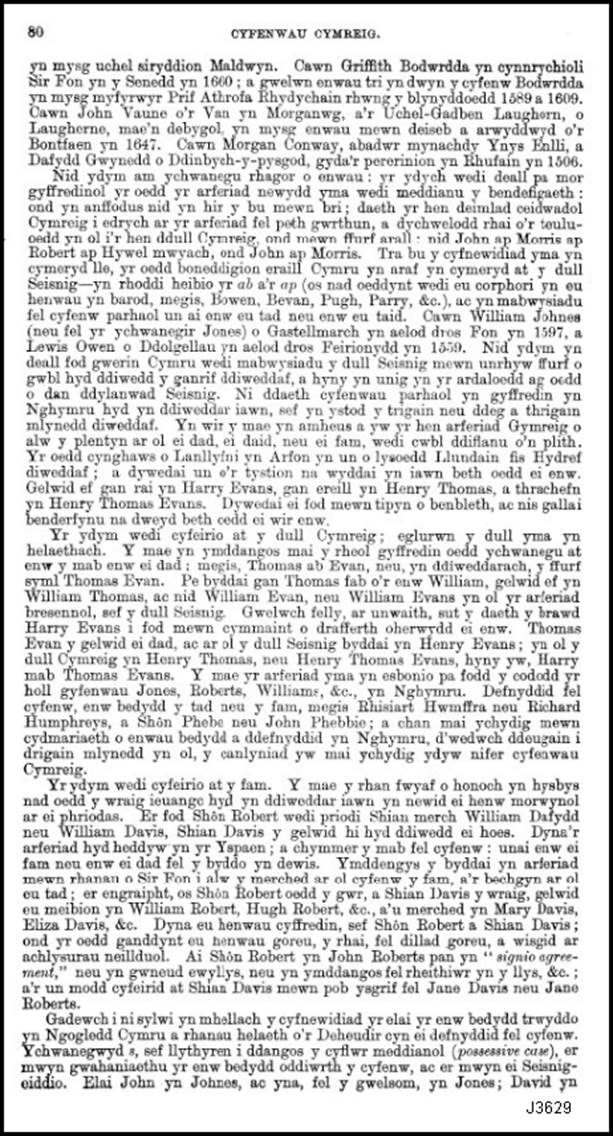
yn mysg uchel siryddion Maldwyn. Cawn Griffith Bodwrdda yn cynnrychioli Sir Fon yn y Senedd yn 1660; a gwelwn enwau tri yn
dwyn y cyfenw Bodwrdda yn mysg myfyrwyr Prif Athrofa Rhydychain rhwng y
blynyddoedd 1589 a 1609. Cawn John Vanne o'r Van yn Morganwg, a'r Uchel-Gadben Laughern, o Laugherne, mae'n debygol, yn mysg enwau mewn
deiseb a arwyddwyd o'r Bontfaen yn 1647. Cawn Morgan Conway, abadwr mynachdy Ynys Enlli, a Dafydd
Gwynedd o Ddinbych-y-pysgod, gyda'r pererinion yn Rhufain yn 1506.
Nid ydym am ychwanegu rhagor o enwau: yr ydych
wedi deall pa mor gyffredinol yr
oedd yr arferiad newydd yma wedi meddianu y bendefigaeth: ond yn anffodus nid
yn hir y bu mewn bri; daeth yr hen deimlad ceidwadol Cymreig i edrych ar yr arferiad fel peth gwrthun,
a dychwelodd rhai o'r
teuluoedd yn ol i'r hen ddull Cymreig, ond mewn ffurf arall, nid John ap Morris ap Robert ap Hywel mwyach, ond
John ap Morris. Tra bu y cyfnewidiad yma yn cymeryd lle, yr oedd boneddigion
eraill Cymru yn araf yn cymeryd at y dull Seisnig — yn rhoddi heibio yr ab
a'r ap (os nad oeddynt wedi eu corphori yn eu henwau yn barod, megis, Bowen,
Bevan, Pugh, Parry, &c), ac yn mabwysiadu fel
cyfenw parhaol un ai enw eu tad neu enw eu taid. Cawn William Johnes (neu fel yr ychwanegir Jones)
o Gastellmarch yn aelod dros Fon yn 1597, a Lewis Owen o Ddolgellau yn aelod
dros Feirionydd yn 1559. Nid ydym yn deall fod gwerin Cymru wedi mabwysiadu y
dull Seisnig mewn unrhyw ffurf o gwbl hyd ddiwedd y ganrif ddiweddaf, a hyny
yn unig yn yr ardaloedd ag oedd o dan ddylanwad Seisnig. Ni ddaeth cyfenwau parhaol yn gyffredin yn Nghymru hyd yn
ddiweddar iawn, sef yn ystod y trigain neu ddeg a thrigain mlynedd diweddaf. Yn wir y mae yn amheus a yw yr
hen arferiad Gymreig o alw y plentyn ar ol ei dad, ei daid, neu ei fam, wedi
cwbl ddiflanu o'n plith. Yr oedd cynghaws o Lanllyfni yn Arfon yn un o
lysoedd Llundain fis Hydref diweddaf; a dywedai un o'r tystion na wyddai yn
iawn beth oedd ei enw. Gelwid ef gan rai yn Harry Evans, gan ereill yn Henry Thomas, a thrachefn yn
Henry Thomas Evans. Dywedai ei fod mewn tipyn o benbleth, ac nis gallai benderfynu
na dweyd beth oedd ei wir enw.
Yr ydym wedi cyfeirio at y dull Cymreig; eglurwn
y dull yma yn helaethach. Y mae yn ymddangos mai y rheol gyffredin oedd
ychwanegu at enw y mab enw ei dad; megis, Thomas ab Evan, neu, yn
ddiweddarach, y ffurf syml Thomas Evan. Pe byddai gan Thomas fab o'r enw
William, gelwid ef yn William Thomas, ac nid William Evan, neu William Evans
yn ol yr arferiad bresennol, sef y dull Seisnig. Gwelwch felly, ar unwaith,
sut y daeth y brawd Harry Evans i fod mewn cymmaint o drafferth oherwydd ei
enw. Thomas Evan y gelwid ei dad, ac ar ol y dull Seisnig byddai yn Henry
Evans; yn ol y dull Cymreig yn Henry Thomas, neu Henry Thomas Evans, hyny yw,
Harry mab Thomas Evans. Y mae yr arferiad yma yn esbonio pa fodd y cododd yr
holl gyfenwau Jones, Roberts, Williams, &c, yn Nghymru. Defnyddid fel
cyfenw, enw bedydd y tad neu y fam, megis Rhisiart Hwmffra neu Richard Humphreys, a Shôn Phebe neu John
Phebbie; a chan mai ychydig mewn cydmariaeth o enwau bedydd a ddefnyddid yn
Nghymru, d'wedwch ddeugain i drigain mlynedd yn ol, y canlyniad yw mai
ychydig ydyw nifer cyfenwau
Cymreig.
Yr ydym wedi
cyfeirio at y fam. Y mae y rhan fwyaf o honoch yn hysbys nad oedd y wraig ieuangc
hyd yn ddiweddar iawn yn newid ei henw morwynol ar ei phriodas. Er fod Shôn
Robert wedi priodi Shian merch William Dafydd neu William Davis, Shian Davis
y gelwid hi hyd ddiwedd ei hoes. Dyna'r arferiad hyd heddyw yn yr Yspaen; a chymmer y mab fel cyfenw:
unai enw ei fam neu enw ei dad fel y byddo yn dewis. Ymddengys y byddai yn
arferiad mewn rhanau o Sir Fon i alw y
merched ar ol cyfenw y fam, a'r bechgyn ar ol eu tad; er engraipht, os Shôn
Robert oedd y gwr, a Shian Davis y wraig, gelwid eu meibion yn William
Robert, Hugh Robert, &c, a'u merched yn Mary Davis, Eliza Davis, &c. Dyna eu henwau cyffredin, sef
Shôn Robert a Shian Davis; ond yr oedd ganddynt eu henwau goreu, y rhai, fel dillad goreu, a wisgid
ar achlysurau neillduol. Ai Shôn Robert yn John Roberts pan yn “signio
agreement," neu yn gwneud ewyllys, neu yn ymddangos fel rheithiwr yn y llys, &c; a'r un modd cyfeirid
at Shian Davis mewn pob ysgrif fel Jane Davis neu Jane Roberts.
Gadewch i ni sylwi yn mhellach y cyfnewidiad yr
elai yr enw bedydd trwyddo yn Ngogledd Cymru a rhanau helaeth o'r Deheudrr
cyn ei defnyddid fel cyfenw. Ychwanegwyd s, sef llythyren i ddangos y cyflwr
meddianol (possessive case), er
mwyn gwahaniaethu yr enw bedydd oddiwrth y cyfenw, ac er mwyn ei Seisnigeiddio. Elai John yn Johnes, ac yna, fel y gwelsom, yn
Jones; David yn
|
|
|
|
|
(delwedd J6330) (Gorffennaf 1892) (tudalen 81)
|
81
Davids, ac yna Davies, &c. Cawn John, David, Harry,
Henry, &c, yn gyfenwau yn Neheudir Cymru, ond byth yn y Gogledd; oddi
eithr bod teuluoedd wedi symud. Sylwn eto nad yw s yn cael ei ychwanegu yn yr
enwau hyny ag sydd yn barod yn gyfenwau, megis Bowen, Bevan, Pugh, Parry, Powel, &c.; ni chawn, ar y
naill law, y ffurfiau Bowens, Bevans, Pughs, Parrys, Powels, &c.; ond, ar
y llaw arall, cawn Owens, Evans, Hughes, Harris, Howels, &c. Un o effeithiau digrif dyfodiad cyfenwau parhaol
Seisnig i Gymru yw cael dau frawd yn meddu cyfenwau gwahanol. Y dull Cymreig
oedd mewn bri pan welodd y brawd hynaf y goleuni; ond erbyn dyfodiad y brawd
ieuangaf, yr oedd y ffasiwn newydd wedi dyfod i'r wlad, a chyfenwau yn ngwir
ystyr y gair wedi dechreu eu gyrfa yn yr ardal.
Temple, Llundain.
T. E. Morris.
|
|
|
|
|
(delwedd J6331) (Ebrill 1893) (tudalen 125)
|
Y Geninen. Cyf XI. Rhif 2. Ebrill 1893. pp 125-128
CYFENWAU CYMREIG. II.
Yr ydym yn awr wedi
cyrhaedd y cyfnod hwnw yn hanes Cyfenwau Cymreig pan y mae Jones, Williams,
Lloyd, Edwards, &c, wedi dod yn gyffredin yn mhob man bron. Yr oedd amcan
enwau wedi ei golli i raddau, fel ag y mae yn y dyddiau hyn. Siaredid am
Robert Williams; ond nid oedd neb yn gwybod at bwy y cyfeirid. Yr oedd yn
rhaid ychwanegu, — a drwg genym addef, rhaid gwneud hyny yn awr, — rhyw
eiriau eglurhaol, megis Robert Williams y Crydd, neu Robert Williams, Siop
Llestri; neu Robert Williams, Ty'n-lon, &c. Y canlyniad fu i'r cyfenwau
dyblyg ddyfod i fri, y rhai a ffurfiwyd trwy roddi enw morwynol y fam yn
gysylltiedig â chyfenw y tad; er engraipht, priodai John Williams, Mary
Jones; a gelwid eu mab hynaf yn Lewis Jones Williams. Wedi i Lewis gyrhaedd
oedran gwr galwai ei hun yn Mr. Jones-Williams, er mwyn ei wahaniaethu
oddiwrth ei gymydog, Mr. Williams. Cawn faint y fynir o'r cyfenwau dyblyg o'r
dosbarth yma yn Nghymru: dyma rai o honynt: — Lloyd-Edwards, Bowen-Rowlands,
Williams-Wynn, Parry-Jones, Vaughan-Williams, Pryce-Jones, Davies-Evans,
Dillwyn-Llewelyn, Williams-Ellis, Lloyd-Roberts, &c.: a rhaid i ni beidio
anghofio y cyfenwau diystyr, yr oeddym bron a dweyd disynwyr, megis Powel
Powel, Pugh Pugh, &c. Gwell genym gyfenwau o natur Pryse-Rice na'r
dosbarth yna. Byddai yn rhywbeth digrifol, oni fyddai, i glywed Mr. Jones-Jones
yn siarad gyda Mr. Roberts-Roberts am briodas ei gyfaill Mr.
Williams-Williams â merch yr hen Mr. Hughes-Hughes. Nid ydyw wedi dyfod i hyn
eto; ac yr ydym yn gobeithio na fydd y Cymry, yn nhlodi eu cyfenwau, yn symud
y ffordd yna. Yr ydym yn gweled cyfnod newydd a disglaer yn gwawrio ar
gyfenwau Cym-
|
|
|
|
|
(delwedd J6332a) (Ebrill 1893) (tudalen 126a)
|
126 CYFENWAU CYMREIG.
reig; y mae darpariadau
ar eì gyfer wedi dechreu er's rhyw bymtheg i ugain mlynedd yn ol, ac yn
cynyddu o ddydd i ddydd. Cyfeirio yr ydym at y cyfenwau deublyg y mae rhyw
gant a haner i ddau cant o bregethwyr a gweinidogion Cymru wedi eu
mabwysiadu. Ychwanegant at gyfenwau eu rhieni rhyw hen enw personol Cymreig
neu enw eu cartref, neu enw sant eu plwyf genedigol, neu enw rhyw afon neu
fryn, neu rhyw fangre arall; a galwant eu hunain yn Mavonwy Davies, Cynddylan
Jones, Rhondda Williams, Teilo Evans, Adfryn Roberts, Elvet Lewis, Cadvan
Davies, Cernyw Williams, Herber Evans, Tawelfryn Thomas, Myvenydd Morgan,
Uwchllyn Jones, Aeron Thomas, Ffrwdwen Lewis, Margam Jones, &c, &c.
Rhyw adnewyddiad yn hanes enwau ydyw y dull yma, oherwydd cawn Mr. Bodychan
Sparrow yn Uchel Sirydd Mon yn 1754, ac un arall o'r un enw yn y flwyddyn
1782. Nid yw y dull yma wedi ei gyfyngu i bregethwyr Cymru; cawn gantorion,
cyfreithwyr, aelodau seneddol, &c, yn dilyn eu hesiampl. Cawn gyfreithiwr
galluog o'r enw John Roberts yn cael ei ddychwelyd i'r Senedd, a phan yn
cyrhaedd Ty y Cyffredin yn cyfarfod aelod anrhydeddus arall o'r un enw; ac er
mwyn ysgoi camgymeriad, y mae yn ychwanegu, at yr enw a roddwyd iddo yn ei
fabandod, enw ei gartref; a Mr. Bryn Roberts y gelwir ef mwyach. Aeth Mr.
Thomas Lewis o Sir Fon i weled Gwlad yr Addewid; a phan y dychwelodd gartref
chwyddodd ei enw yn Thomas Palestina Lewis. Cawn far-gyfreithiwr o Ddeheudir
Cymru yn cymmeryd ei gartref yn Llundain ac yn byw am dymor yn y rhan hono o
honi a elwir Sydenham; ac, er mwyn cyfleusdra ei frawd, Mr. Jones, ar yr un
gylchdaith, yn galw ei hun yn Sydenham Jones. Y mae nifer mawr o leygwyr o
bob galwedigaeth yn dilyn esiampl y pregethwyr yn hyn: yn eu mysg cawn yr
enwau Emrys Jones, Emlyn Evans, Lleufer Thomas, Gwyngyll Hughes, Marchant
Williams, Melinddwr Davies, Gwenogfryn Evans, Coethyr Williams, Gwynfe Evans,
Ffrangcon Davies, Keri Evans, Daronwy Isaacs, &c, &c.
Nid ydym am helaethu ar y
testyn dan sylw; ond dymunem daflu allan awgrym ar y penawd hwn trwy ddatgan
ein gobaith cryfaf y bydd i'r cyfeillion â'r cyfenwau deublyg neillduol yma
wneyd i ffwrdd â'r cyfenw olaf, a galw eu hunain yn Mr. Emrys, Mr. Mavonwy,
Mr. Melinddwr, Mr. Ffrwdwen, Mr. Cadvan, Mr. Bryn, Mr. Daronwy, Mr.
Tawelfryn, Mr. Margam, Mr. Myddvai, &c, gan eu sicrhau y byddant trwy
hyny nid yn unig yn adfywio hen arferiad a fabwysiadwyd gan bendefigion Cymru
dair canrif yn ol, ond hefyd yn gwneyd cymwynas ddirfawr i Gymru trwy
gynnyddu nifer ei chyfenwau, a thrwy leihau y camgymeriadau ag sydd beunydd
yn codi o achos anamlder a thlodi ei chyfenwau. Credwn yn gadarn y byddai hyn
yn gam yn yr iawn gyfeiriad ac yn sicr o fod yn fudiad doeth a chyfleus;
|
|
|
|
|
(delwedd J6332b) (Ebrill 1893) (tudalen 126b)
|
126b CYFENWAU CYMRAEG
a byddai ei fabwysiadu yn
troi yn fendith gymdeithasol i ni fel Cymry. Y mae llawer o honom, mae yn bur
debyg, wedi gwneyd camgymeriadau dybryd oherwydd unrhywiaeth ein cyfenwau.
Cwynodd y Barnwr yn gyhoeddus yn Llys Mân Ddyledion Porthmadog, ryw ddeugain
mlynedd yn ol, am yr anghyfleusdra a berid oherwydd fod bron bob un ag oedd
yn dyfod o flaen y llys yn dwyn yr un cyfenw. Yr oeddynt i gyd yn Joneses.
Dywedai y byddai yn gymwynas gymdeithasol pe newidiai y mwyafrif o'r Cymry eu
cyfenwau, a phe cymmerent enwau gwahanol yn eu lle er mwyn lleihau y dyryswch
ydoedd beunydd yn eu blino. Yr ydym yn gwybod fod unrhywiaeth cyfenwau
Cymreig wedi peri llawer iawn o gyfreithio trwy'r wlad, a hyny yn codi, fel
rheol, oddiwrth ddiofalwch pan yn gwneuthur ewyllys, neu am fod y cyfreithiwr
yn anghyfarwydd âg enwau a chyfenwau y teulu, ac felly yn cymmeryd y naill am
y llall. Y mae enghreiphtiau o hyn ger bron ein meddwl yn awr; a cheir mai
dyma ydyw profiad a thystiolaeth pob cyfreithiwr yn Nghymru, yn hen ac yn
ieuangc. Wrth derfynu y rhan yma o'n llith yr ydym am argymhell eto i sylw y
Cymro gwladgarol y priodoldeb, os ydyw; wedi penderfynu newid ei gyfenw, iddo
gymmeryd fel cyfenw un gwir Gymreig; a thrwy hyny gyflwyno rhodd dda a
chymeradwy, nid yn unig i'w blant, ond hefyd i'w gymydogion ac i'w genedl.
Yr ydym wedi ceisio rhoddi
rhyw frasluniad, a brasluniad yn unig, o hanes cyfenwau Cymreig: teimlem ei
fod yn bur amherffaith; ond gan nad oedd y gofod; yn caniattau, rhaid oedd ei
dori i lawr a'i gwtogi er mwyn traethu yn mhellach ar i Gyfenwau Cymreig
megis y cawn hwy yn Nghymru yn yr amser presenol. Ond cyn myned yn mlaen i
draethu am gyfenwau yr oes hon, feallai mai buddiol fyddai sylwi ychydig ar
Gyfenwau Cymreig ag y sydd erbyn hyn wedi gorphen eu gyrfa. Y mae nifer y
rhai hyn yn lluosog iawn; a gellid eu cyfyngu i ryw ddau ddosbarth: y
dosbarth cyntaf yn cynnwys cyfenwau wedi codi o enwau tai, tiroedd, a threfi;
a'r ail yn cynnwys enwau bedydd, yn gysylltiedig âg ab neu ap. Yn y dosbarth
cyntaf cawn yr enwau Bodwrdda, Brynkir, Bodychan, Clun, Cydweli, Coitmore,
Derwas, Maesmor, Marcross, Penrhyn, Quellyn, Saython, Ystumllyn, Trygarne,
Van, &c, &c: ac yn yr ail ddosbarth cawn Ab Edward (wedi ei fyrhau yn
y cyfamser i Bedward), Ap David, Ap Res, Aprichard, Apewe, Apprice, Appowel,
Ap Harry, Ap Howell, &c, &c Y mae yr oll o'r enwau yma i'w cael yn
mysg enwau myfyrwyr Cymreig yn y ddwy brif-athrofa, Caergrawnt a Rhydychain,
rhwng y blynyddoedd 1556 a 1682. Bachgen tlawd, y mae yn ymddangos, oedd Hugh
Appowel, myfyriwr yn Rhydychain yn 1662; oherwydd rhoddodd senedd yr athrofa ganiattad
iddo i gardotta. Ond os tlawd felly oedd Hugh Appowel, cawn y Cymro da a
chyfoethog David
|
|
|
|
|
(delwedd J6333a) (Ebrill 1893) (tudalen 127a)
|
CYFENWAU CYMREIG. 127a.
Appowel o'r brif-ddinas
yn rhoddi, yn y flwyddyn 1508, bum punt (swm mawr y pryd hwnw) i Gwmpeini y
Sidanwyr i'w rhanu i dlodion plwyfydd St. Lawrence, Jewey, a St. Mary, yn
Llundain. Nis gallwn ond cyfeirio at Evan ap Thomas o Groesoswallt; a Morris
ab Evan o Llandaf; a Robert ap Robyn, a'i gyfaill, Owen ap Guttyn, o
esgobaeth Bangor, yn mysg y pererinion yn Rhufain yn nechreu yr
unfed-ganrif-ar-bymtheg: rhaid symud yn mlaen i'r oes oleuedig hon.
II. CYFENWAU SEISNIG YN
NGHYMRU.
Cawn gannoedd o gyfenwau
Seisnig yn Nghymru, y rhan fwyaf o honynt wedi croesi y gororau yn ystod yr
haner can mlynedd diweddaf, sef cyfnod dadblygiad y gweithfeydd glo a haiarn.
ond nid ydynt wedi eu cyfyngu i'r ardaloedd y ceir gweithfeydd glo, copr, neu
haiarn ynddynt; maent yn wasgaredig ar hyd a lled y wlad. Cawn y mwyafrif o
honynt, wrth gwrs, yn y siroedd hyny sydd wedi bod am oesau a chenedlaethau o
dan ddylanwadau Seisnig, megis siroedd Callestr, Trefaldwyn, Maesyfed, Mynwy,
Morganwg, a Phenfro.
Mae mwy o lawer o
gyfenwau Seisnig, neu, yn hytrach, cyfenwau wedi dyfod o Loegr, yn Morganwg
nag yn unrhyw sir arall yn Nghymru: ond, er hyny, yr ydym yn tybied mai yn
Maldwyn y mae cyfenwau Seisnig wedi cael mwyaf o dderbyniad; oherwydd er nad
ydynt yn lluosog yno, eto y maent yn llawer mwy poblogaidd.
Yr ydym wedi ceisio
ffurfio rhestr deg a chyflawn o'r cyfenwau Seisnig mwyaf cyffredin ac
adnabyddus, yn ogystal a'r rhai hynaf mewn gwahanol barthau o Gymru; ac er
gwneud ein goreu i'w byrhâu, eto y mae eu nifer dros dri chant; a chawn fod
amryw o honynt i'w cael, yma ac acw, yn mhob sir o'r bron. Nid ydym am flino
y darllenydd â rhestr gyflawn o honynt, ond yn unig rhoddi cyfres o gyfenwau
Seisnig ag sydd wedi eu cyfyngu yn arbenig, ond nid yn gwbl oll, i wahanol
siroedd yn Nghymru.
Yn Mon cawn Bulkeley a
Priestly; yn Sir Gaernarfon, Buckley, Carter, a Priestly; yn Meirionydd,
Buckley a Ryder. Yn Sir Ddinbych cawn Beck, Baker, Pownall, ac Yorke. (Y mae
genym amheuaeth am y cyfenw Beck neu Begg: teimlem mai y gair Cymraeg
"bach" ydyw wedi ei Seisnigeiddio; ond gan nad ydym yn sicr o hyny
ymddengys Beck yn y dosbarth yma). Yn Sir Gallestr cawn Beck, Bibby,
Catherall, Clarke, Cartwright, Denman, Fletcher, Hope, Kerfoot, Muspratt,
Mason, a Wheldon. Yn Maldwyn cawn Ashton, Astley, Bebb, Benbow neu Benbough,
Colley, Cound, Goodwin, Giles, Hamer, Higgins, Halford neu Holford, Ingram,
Kinsey, Minshull, Mytton, Meddins, Lupas, Paxton, Ryder, Talbot, Varley,
Wilding, ac Woosnam. Yn Maesyfed cawn Abley, Beck, Baldwin, Bound neu Bounds,
Baylis, Bufton, Dyke neu Dykes, Goodwin, Mills, Mellin, Lucas, Shewell,
Stokes, Watson, Wild, a Wilding. — Rhaid aros gyda y cyfenw Mellin. Ai nid y
gair
|
|
|
|
|
(delwedd J6333b) (Ebrill 1893) (tudalen 127b)
|
CYFENWAU CTMREIG. 127
desgrifiadol Cymreig
"melyn" ydyw? Nis gallem benderfynu, oherwydd nad ydym yn
gydnabyddus âg hanes rhai o'r teuluoedd sydd yn dwyn y cyfryw. Y mae yn
gyfenw cyffredin yn Lloegr, ac felly yr ydym wedi edrych arno fel cyfenw
Seisnig. Cawn y cyfenwau Bailey, ac Havard neu Harvard, yn Mrycheiniog; a
Bonsall, Bateman, a Colby, yn Sir Aberteifi. Yn Mhenfro cawn Berry, Codd,
Greenish, Hoskin neu Hoskins, Havard, Harvard, Muscott, Melchior, Marychurch,
Merryman, Ormond, Peregrine neu Perrigrin, Perkins, Roach neu Roch, Slocombe
neu Slocum, a Stokes. Yn Sir Gaerfyrddin cawn Gravell, Hicks, Hopkin neu
Hopkins, Hancock, Mansel, Martin, Salmon, Scurlock, Sibbering, a Stepney. Yn
Morganwg cawn Bruce, Cory, Coslett neu Cosslett, Chappell, Hopkins, Insole,
Kinsey, Parsons, Radcliíîe neu Ratcliffe, Spickett, Talbot, Tamlyn neu
Tamlin, Tyler, Vivian, a Yeo: ac yn Mynwy cawn Addis, Chappell, Coslett,
Sheddick nea Shaddick, &c. Gwelir, felly, oddiwrth y rhestr uchod, fod
llawer o gyfenwau Seisnig yn blaguro mewn rhyw un sir neu siroedd neillduol.
Felly yr un modd cawn rai o honynt wedi sefydlu i raddau helaeth mewn ambell
i dref neu ardal yn Nghymru; er enghraipht, cawn Huxley yn gyffredin yn
Bethesda (Arfon), a Holt (Fflint); Ace a Bonnell yn Llanelli; Cule yn
Mhontypridd; Rymer yn Tiddenham (Mynwy); Boore yn Llanfair-yn-Muallt; Hoskin
a Strick yn Oystermouth; Herring, Lilwall, Sheen, a Travers, yn Hay; Langford
yn Berriew, &c. Mae y cyfenwau Franklyn, Waters, a Webber, yn bur
gyffredinol yn Nheheudir Cymru.
Yr ydym wedi cyfeirio at
ddull y Normaniaid, ac wedi hyny arferiad cyffredin y Saeson, o fabwysiadu fel
cyfenwau, enwau eu cartrefleoedd. Cawn lawer o gyfenwau Seisnig o'r natur yma
yn Nghymru, megis Ashton, Bailey, Barnet, Bonsall, Brigstocke, Buckley,
Carrington, Hooson, Kenyon, Lumley, Minshull, Mytton, Picton, Pownall,
Spurrel a Wheldon. Yn wreiddiol, euwau pentrefi, &c, yn Lloegr yw y
cyfenwau hyn.
Nid oes, fel y dywedasom,
ddiwedd ar amrywiaeth cyfenwau Seisnig. Y mae rhyw gymysgedd rhyfedd a digrif
yn eu plith. Nis gallem ddychmygu am y Cymry yn dilyn esiampl y Saeson yn
hyn. Cawn yr enwau teuluaidd canlynol yn Nghymru, — Badland, Bather,
Bracegirdle, Bywater, Copperwater, Cowmeadow, Deadman, Drinkwater, England,
Goose, Horsepool, Loveluck, Merry, Merryman, Marychurch, Shufflebottom,
Sloper, Vittles, Welshman, &c.
Yr ydym yn credu mai y
ddau gyfenw Seisnig mwyaf cyffredin yn Nghymru ydynt Hopkins a Perkins.
Morganwg yw cartrefle Hopkins, a Phenfro yw eiddo Perkins. Y mae Hopkin neu
Hopkins yn tarddu o “Hop," llysenw am Robert, a'r bychanig-air
(diminutive) “kin;" felly ei ystyr ydyw Bob Bach; megis mai ystyr
Siencyn, neu Siancyn yn ol Lewis Dwnn, ydyw Shion Bach neu Shian Bach. Gwelwn
|
|
|
|
|
(delwedd J6334a) (Ebrill 1893) (tudalen 128a)
|
128a CYFENWAU CYMREIG.
mai yr un gair ydyw
Jenkins a Shoncyn; er hyny nid cywir fuasai galw y creadur bychan a shonc
hwnw a adnabyddir yn yr Ysgrythyr fel ceiliog y rhedyn, yn “Jenkins y gwair."
Y mae Hopkins níd yn unig yn gyfenw poblogaidd yn y Deheudir, ond y mae yr
enw wedi bod yno am oesau. Cawn Hopkin ap David ap Richard yn byw yn Ystrad
Fflur yn 1534, yn agos i dri chan mlynedd a haner yn ol. Yr oedd tri o feirdd
enwog o'r enw Hopcyn yn blodeuo yn Morganwg y ganrif ddiweddaf. David Hopcyn
o'r Coedty, yr hwn a fu farw yn 1730, oedd un o honynt: ac un arall oedd Wil
Hopcyn, awdwr y penillion swynol, "Bugeilio'r Gwenith Gwyn." Ganwyd
ef yn Llangynwyd yn 1700. Fel Dafydd ap Gwilym gynt, canodd lawer er ceisio
enill cariad un o forwynion glân Cymru; ond ni fu yr Awen yn ddigon nerthol i
enyn ei serch. Methodd Wil Hopcyn ag enill llaw y Ferch o Gefn Ydfa (Ann
Thomas); a bu farw, os ydym yn cofio yn iawn, yn hen lanc. Talfyriad am
Peterkin ydyw Perkin neu Perkins; ac felly ei ystyr ydyw Pedr Bach. Cawn
Wilkins a Watkins, enwau o'r un natur, yn gyffredin yn Nghymru. Ystyr y naill
yw Wil Bach, a'r llall Wat neu Walter Bach.
Buasai yn ddyddorol
chwilio i mewn i hanes ac ystyron llawer o'r cyfenwau Seisnig hyn; ond gan
mai ysgrifenu yr ydym ar Gyfenwau Cymreig, nid ydym yn teimlo mai buddiol
fyddai treulio llawer o amser gyda hwynt. Er hyny, dichon mai nid anmhriodol
fyddai traethu ychydig ar rai o honynt. Y mae y cyfenw Bebb yn Maldwyn bron a'n dyrysu. Ai tybed mai yr un a “Bebba" y Swissiaid
ydyw? Ffurf arall o'r enw Hebraeg Eliza ydyw “Bebba;" ac yn y gwreiddiol
golyga “Llw Duw." — Y mae Blackwell yn hen gyfenw yn Ngogledd Cymru. Nid
rhaid ond cyfeirio, er profi hyn, at y bardd a'r llenor enwog John Blackwell
(Alun), yr hwn a anwyd yn Sir Gallestr yn 1797, ac a fu farw rhyw haner can
mlynedd yn ol. — Ymsefydlodd y Bulkeleys yn Mon yn y flwyddyn 1440. Penodwyd
William Bulkeley, sef Arglwydd Hotcroft o Sir Gaer, yn Gwnstabl Castell
Beaumaris y flwyddyn hono.
Cawn y cyfenw hwn yn
fynych yn mysg swyddogion y sir; a bu aelodau o'r teulu yn cynrychioli yr
ynys yn y Senedd am genhedlaethau. Yr oedd penaeth presenol y teulu, Syr
Richard Bulkeley, yn Uchel Sirydd dros Fon ychydig flynyddau yn ol. — Cyfenw
henafol arall ydyw Clough. Yr oedd Syr Richard Clough o Ddinbych yn fab i
rieni tlawd; ond trwy ei ddiwydrwydd a'i alluoedd masnachol casglodd gymmaint
o gyfoeth fel yr aeth y gair, "Myn'd yn Clough," yn ddiareb yn
Nyffryn Clwyd am fyned yn gyfoethog. Ganwyd Syr Richard yn Ninbych yn 1520; a
bu farw yn Hamburg, lle hefyd y claddwyd ef yn 1570. Yr ydym yn cael lle i
gredu ei fod yn wladgarwr selog, oherwydd cludwyd ei galon i'w chladdu yn
Nghymru, yn hen eglwys ei blwyf genedigol, sef yr Eglwys Wen, wrth Ddinbych.
— Gair Groeg ydyw George, yn golygu “garddwr."
|
|
|
|
|
(delwedd J6334b) (Ebrill 1893) (tudalen 128b)
|
128b CYFENWAU CYMREIG
Cawn y cyfenw yn Mhenfro,
ac yn un o fwrdeisdrefi Sir Gaernarfon. — Tybiwn mai ffurf arall ar Hanmer
ydyw Hamer, cyfenw poblogaidd yn Maldwyn. Os felly, tardda o enw pentref yn Sir Gallestr; a gallwn ei hawlio fel
cyfenw gwir Gymreig. Barna Lower, yn ei lyfr "Enwau Teuluaidd," mai
hen enw personol Almanaeg ydyw. Feallai mai yr un ydyw a'r enwau Seisnig
Haymo ac Hayman sydd yn tarddu o'r hen air Almanaeg (Teutonic) am
''gartref.'' Beth bynag am hyny, Cymro â chyfenw Cymraeg ydoedd Syr David
Hanmer o Hanmer, Barnwr o Faingc y Brenhin yn nheyrnasiad Rhisiart yr Ail. —
Daeth y cyfenw Lucas i'n gwlad o'r Yspaen. Yr un enw ydyw a Luc. Y gair
Lladinaidd "lux" (goleuni) ydyw y gwreiddiol. — Y mae y Lumleys yn
hanu o'r Angliaid a'r Sacsoniaid. Cyfeirid attynt bob amser yn Sir Deifr
(Durham) fel “The lofty Lumleys." — Y mae Miles yn gyfenw henafol yn
mysg y werin yn Nghymru. Yn ddiamheu y Cymro mwyaf enwog ac adnabyddus o'r
enw yma ydoedd y Parch. John Miles, sylfaenydd Cymanfa y Bedyddwyr yn
Nghymru. Bu yn rhaid iddo ymfudo i'r America oherwydd erledigaeth; ond daeth
yn ol i Abertawe, lle y bu yn llafurio y rhan oreu o'i oes y'ngwinllan ei
Arglwydd gyda llwyddiant a bendith mawr. Bu farw yno yn 1683. Y mae Miles yn
tarddu naill ai o'r enw Groegaidd Milo, yn golygu "gwasgwr;" neu
o'r enw Hebraeg Michael, "pwy sydd debyg i Dduw." — Enw Lladinaidd
ydyw Peregrine; ac er mai "teithiwr" ydyw ei ystyr, cawn mai
sefydlog ydyw yn Sir Benfro. — Yr oedd y Pooles yn hen deulu yn Sir
Feirionydd. Cawn Richard Pool o'r Tycerrig yn warden yr Eglwys dros blwyf
Llanfihangel-y-Traethau yn Ardudwy yn 1745. — Talfyriad ydyw Sauuders o
Alexander, enw Groeg, yn golygu “cynnorthwywr dynion." Gŵyr y
darllenydd am bregethwr galluog yn Neheudir Cymru sydd newydd ymadael â'r
fuchedd hon, oedd yn gwisgo yr enw hwn gydag urddas ac anrhydedd. — Nid ydym
yn deall ystyr y cyfenw Sibbering a geir mewn gwahanol rannau o Sir
Gaerfyrddin, os nad ydyw yr un a'r enw Frisiaidd “Sibbern," ystyr yr hwn
ydyw “yr arth fuddugoliaethus." — Y mae yn ymddangos mai yr un ydyw
Taplen a Thomas, a'i fod wedi dyfod i Gymru o Ogledd Lloegr. Gan fod ffurf yr
enw gwreiddiol wedi ei newid gan y Sais, ystyrir Taplen yn gyfenw Seisnig.
Nid ydym am ymhelaethu ar
gyfenwau Seisnig; ond teg ydyw cydnahod eu defnyddioldeb yn Nghymru. Y mae yn
bleser ac yn iechyd bron i ddod ar draws ambell i gyfenw Seisnig mewn ardal
yn mha un y mae y trigolion i gyd yn Jones, Williams, Roberts, &c. Heb
son am eu manteision cymdeithasol, y mae rhyw swyn mewn amrywiaeth enwau. Nid
rhaid i ni ychwanegu fod cannoedd o'r Cymry yn gwisgo cyfenwau Seisnig, er
nad ydynt yn hyddysg yn yr iaith hono. Cymry "coch cyfa” sydd yn siarad
hen iaith y bryniau ac yn gwneud “pob peth yn Gymraeg."
T. E. Morris.
|
|
|
|
|
(delwedd J6335) (Ebrill 1893) (tudalen 154)
)
|
Y Geninen. Cyf XI. Rhif 3.
Gorffennaf 1893. Tudalennau 154-155
CYFENWAU CYMREIG.
III. CYFENWAU CYMREIG YN
LLOEGR.
Symudwn yn awr i'r ail ddosbarth,
sef Cyfenwau Cymreig yn Lloegr, nad ydynt i'w cael y dyddiau hyn yn Nghymru. Er nad yw y dosparth hwn yn un lluosog, eto y mae yn hynod o
ddyddorol. Ymddengys yn rhyfedd fod cyfenwau Cymreig i'w cael yn Lloegr nad
ydynt i'w cael yn Nghymru; ac y mae yn peri i ni ymholi pa fodd y cododd yr
enwau hyn, a pha resymau sydd am nad ydynt i'w cael yn y wlad y maent wedi
tarddu o honi.
Dichon fod un rheswm yn codi
oddiar ymlyniad y Cymro wrth enw ei dad ar ol iddo ymfudo i Loegr; a bod y
cyfenw yn barhaol yno, tra yr ydoedd yn gyfnewidiol yn Nghymru. Er
enghraipht, pe symudai Thomas ap John o Gymru i Loegr, gelwid ef gan y Saeson
yn Mr. Ap John; a dyna fyddai enw ei deulu byth mwyach. Yr ydym yn tybied fod
hyn yn rheswm digonol am bresenoldeb cyfenwau megis Ap John, Ap Merick,
Apowell, Apthorp, Apwenwyn, Abethell, &c., yn Lloegr, tra nad ydynt i'w
cael yn Nghymru, am na ddefnyddid y talfyriadau am “fab," sef ab ac ap,
gan y Cymry pan y daethant yn gyffredinol i fabwysiadu cyfenwau.
Cyfyd rheswm arall hefyd yn
ddiameu oddiwrth y ffaith fod llawer o'r Cymry, ar ol sefydlu yn Lloegr a
dyfod yn gyfarwydd ag arferion y Saeson, wedi mabwysiadu eu hen lysenwau, neu
enwau desgrifiadol a roddwyd iddynt yn Nghymru fel cyfenwau; a chan nad oedd
y Saeson yn gallu dilyn ac efelychu y seiniau Cymreig, newidiwyd ffurf yr
enwau hyn fel ag i'w cyfaddasu i'w dull hwynt o'u swnio. Gelwid William Llwyd
yn William Floyd neu William Flood: elai Hywel Goch yn Hoell Goz neu Howel
Goss, a John Du yn John Dee, &c. Symudodd hefyd ambell i deulu à chyfenw
eithriadol Grymreig i Loegr, megis teulu Heylin o Bentreheilyn yn
Llandysilio, Maldwyn; ac felly daeth rhyw ychydig o gyfenwau neillduol dros y
gororau o Gymru.
Ceisiwn roddi hanes rhai o
Gyfenwau Cymreig yn Lloegr. Nid ydym ond am gyfeirio at y cyfenwau hyny sydd
wedi eu ffurfio drwy gysylltu ap neu ab ág enwau bedydd, megis Batha a Batho
(Ab Adda); Bedwin (Ab Edwin); Bemand a Beamand (Ab Emwnd neu Ab Edmund);
Beevor (Ab Ivor); Apwenwyn (Ap Einion), &c. Cawn gyfleustra i draethu ar
y rbai hyn eto.
Y mae y cyfenwau canlynol yn
tarddu o'r Gymraeg: Anyon ac Onions; Boffìn; Cam a Gam; Coffin; Dee; Day a
Tye; Floyd a Flood; Flower; Goss a Gough; Moel a Mole; Wace; &c. —
Llygriad ydyw Anyon, ac hefyd Onions, o'r hen enw Cymreig Eynon. Ceir y
cyfenw Onions yn Nheheudir Cymru yn ogystal ag yn Lloegr. — Y mae Boffin yn
enghraipht o'r cyfnewidiad rhyfedd yr elai ambell i enw Cymreig trwyddo yn
mysg y Saeson. Dywed Mr. Egerton Phillimore fod Boffin, sef enw teuluaidd yn
Rhydychain, yn tarddu o Vychan; a gellir profi hyn trwy hen weithredoedd ac
ysgrifau eraill. — Ni raid esbonio y cyfenwau Cam a Gam. Y mae yn amlwg mai
nid milwyr oedd y sawl a alwyd felly ar y cyntaf. Buasai meddwl hyny yn
sarhâd ar goffawdwriaeth y milwr dewr Syr Dafydd Gam; ond gan mai bradwr
dibendraw ydoedd, feallai fod Gam yn enw da a chywir iddo. Bradychodd ei
wlad, a thrwy hyny gwnaeth gam â'i gydwladwyr, a bu yn rhodio ar hyd lwybrau
ceimion y rhan ddiweddaf o'i oes. Cawn un o'r enw John Cam yn Uchel Sirydd
Meirionydd yn 1316, sef y 10fed flwyddyn o deyrnasiad Iorwerth yr Ail.
Cyfettyb y cyfenwau Gam a Cam i'r cyfenw Games a geir yn awr yn Sir
Frycheiniog ac yn Ynys Manaw. — Y mae Coffin yn gyfenw adnabyddus ar y
Gororau ac yn Dyfnaint. Ffurf arall ydyw o'r cyfenw Cymreig “Cyffin."
Ystyr y gair ydyw “terfyn," neu yn y Saesoneg “confine," megis yn y
frawddeg, “Y'nghyffiniau Zabulon a Nephthali" (S. Matthew iv. 13). — Y
gair Cymraeg “du” wedi ei Seisnigeiddio ydyw y cyfenw Dee. Yr oedd Dr. John
Du, neu John Dee fel ei gelwid gan y Saeson, yn un o ysgolheigion penaf ei
oes, ac yn uchel yn ffafr y Frenhines Elizabeth. Ymddengys mai negroaid oedd
ei hynafiaid. Ganwyd ef yn Nantygroes, yn Sir Faesyfed, yn 1527; a bu farw yn
1608. Yr oedd yn seryddwr byd-enwog; ac oherwydd hyny edrychid arno hyd yn
nod gan fawnon y deyrnas hon a theyrnasoedd Cyfandir Ewrop fel dewin a
phrophwyd. — Y mae y cyfenwau Day a Tye wedi codi o'r enw personol Dei, sef
yr hoff-air Cymreig am David. Cawn y cyfenw Dakin neu Deicyn yn Nghymru,
Lloegr, a Llanrwst. — Ffurfiau eraill o Lloyd neu Llwyd, ydyw Floyd, Flood a
Loyd, ac feallai hefyd Blood. Cawn ffurf
arall, Bloyd, yn gyfenw yn Newmarket, Sir Fflint. Ceir y teulu Gwyddelig
Flower yn olrhain ei gyfenw o'r enw hynafol Llywarch. — Y mae Gough, Gooch, a
Goss yn tarddu o'r gair Cymraeg "coch" neu "goch." Yr
oedd David ap Hoell Goz o Brithdir yn ustus yn Maldwyn yn nheyrnasiad
Elizabeth. Wedi
|
|
|
|
|
(delwedd J6336) (Ebrill 1893) (tudalen 155)
|
CYFENWAU CYMREIG. 155
colli ei wallt, mae'n
debygol, yr oedd penaeth y teuluoedd a elwir yn awr yn Mole a Moel. — Dywedir
mai y gair Oymraeg “gwas” ydyw gwreiddiol y cyfenw Seisnig Wace.
Y mae dosbarth o Gyfenwau
Cymreig yn Lloegr yn codi oddiwrth enwau lleoedd yn Nghymru, megis Bodvill;
Carew; Fflint; Powys; Penrhyn; Snowdon; &c. Y mae y cyfenw Bodvill yn
tarddu o enw hen balasdy yn Sir Gaernarfon, sef Bodvel, ger Pwllheli, lle y
ganwyd Mrs. Piozzi, cyfeilles i Dr. Johnson. Yr oedd y Bodveliaid o Bodvel yn
hen deulu urddasol ac anrhydeddus iawn yn Sir Fon ac yn Sir Gaernarfon o
deyrnasiad Elizabeth hyd amser y Sioriaid. Cawn aelodau o'r teulu yn
cynnyrchioli Mon ac Arfon yn y Senedd o amser i amser. Yr oedd John Bodvel,
neu John Bodville, yn Arglwydd Raglaw Mon o 1643 i 1650, ac yn Gwnstabl
Castell Caernarfon yn amser y Weriniaeth. Priododd ei ferch Sarah a Robert,
Arglwydd Bodmin; a bu eu mab Charles Bodville, yr Arglwydd Radnor, yn llanw
yr un swydd a'i daid fel cwnstabl Castell Caernarfon, ar adegau o 1681 hyd
1714. Y cyfnod goreu yn hanes addysg Cymru cyn teyrnasiad Victoria ydoedd o
ddechreu teyrnasiad Elizabeth hyd amser y Weriniaeth; y pryd hyny yr oedd
nifer mawr o fechgyn o Gymru i'w cael yn y ddwy Brifathrofa, a chawn yn eu
mysg un o'r enw John Bodvell, yn Ngholeg Oriel, yn Rhydychain, yn 1594.
Hen enw Cymreig arall yn
Lloegr ydyw Carew. Gwnawd Syr John Carew o Castell Caeryw yn Sir Benfro yn farchog
gan Risiart yr Ail am ei wroldeb yn Mrwydr Agincourt; a bu yn ddyn gweithgar
ac enwog ar hyd ei oes. Erbyn heddyw ceir amryw o deuluoedd yn dwyn y cyfenw
hwn; a chawn fod penaeth un o honynt yn eistedd yn Nhy yr Arglwyddi o dan y
teitl Arglwydd Carew.
Y mae Caddell a Cadell yn
tarddu o'r hen enw personol Cymreig “Caddell," ystyr pa un ydyw
"rhyfelgar." Tybiwn mai ffurf arall i'r enw ydyw Cadle, a geir yn
Nghymru.
Yr oeddym yn ymfalchio y llynedd
am fod Arglwydd Faer Llundain yn Gymro. Y mae amryw o Gymry wedi bod yn dal
swyddi uchel yn Nghorfforaeth Llundain, ac yn eu mysg nid oes enw mor
anrhydeddus a Rowland Heylin o Bentreheilyn. Ỳr oedd yn Henadur ac
Uchel Sirydd yn nechreu yr eilfed ganrif ar bymtheg. Gwr da ydoedd; a
dangosodd ei gariad tuag at ei gydwladwyr a'i sel tuag at Dduw trwy ddwyn y
rhan helaethaf o'r draul yn yr argraphiad cyntaf (mewn plyg mawr) o'r Bibl
Cymraeg, yn y flwyddyn 1630. Mabwysiadodd y teulu yr enw Heilyn neu Heylin am
eu bod yn y swydd o ddwyn y meiliau i dywysogion Powys. Ystyr Heylin ydyw
“haelfrydig." Dyn enwog arall yn dwyn y cyfenw hwn ydoedd Peter Heilyn,
yr hanesydd. Y mae rhai yn barnu mai llygriad o Mab Heylin neu Ap Heilyn ydyw
y cyfenw Palin a geir yn Lloegr a Chymru. Fe all hyny fod.
Nis gallwn ddweyd llawer
mwy gydag unrhyw sicrwydd ar Gyfenwau Cymreig yn Lloegr: yr ydym oddicartref
yn y wlad yma; ac y mae y testyn yn llawn o anhawsderau ac yn galw am lawer
mwy o amser, o ofal, ac o wybodaeth, nag yr ydym yn alluog ar hyn o bryd i'w
roddi iddo. Er engraipht, anhawdd ydyw peidio meddwl mai enwau Cymreig ydyw
Garth; Nevin; Ovens; Bywell (Ab Hywel); Kennin; Jayne a Jevons (Ieuan neu
Jevan); Prickett; &c.
Yr ydym yn awr wedi
cyrhaedd y pwynt hwnw y gallwn deimlo ein bod yn rhydd ac yn barod i ymwneud
â chyfenwau poblogaidd y Dywysogaeth, sef y cyfenwau Normanaidd, y cyfenwau
Beiblaidd, a'r cyfenwau gwir Grymrseg. Y mae y tir wedi ei glirio, ac yn y
rhifynau nesaf cawn draethu ar y cyfenwau hyny sydd mor adnabyddus ac mor
luosog yn mhob cwr o'n gwlad, o Gaergybi i Gaerdydd, a thrwy Gymru benbaladr.
Temple, Llundain. T. E.
Morris.
|
|
|
|
|
(delwedd J6317) (Ebrill 1898) (clawr)
|
Y Geninen. Cyf XVI. Rhif 2. Ebrill 1898.
Cyfenwau Cymreig. – IV.
Cyfenwau Normanaidd, &c., Cymru. Gan Mr. T. E. Morris, Ll. M., B. A.
(Morus Glaslyn) 89
|
|
|
|
|
(delwedd J6318) (Ebrill 1898) (tudalen 89)
|
Y Geninen. Cyf XVI. Rhif
2. Ebrill 1898. Tudalennau 89-95
CYFENWAU CYMRAEG.
IV. CYFENWAU NORMANAIDD, &c, CYMRU.
Y MAE yn anghenrheidiol ar y dechreu egluro y defnyddir y frawddeg "Cyfenwau Normanaidd"
mewn ystyr rydd a chyffredin, a'i bod yn cynwys nid yn unig cyfenwau
Normanaidd a Ffrengig, ond hefyd enwau Cristionogol, neu yn hytrach enwau
bedydd, a ddygwyd i Gymru gan y Normaniaid, ac a fabwysiadwyd wedi hyny gan y Cymry fel cyfenwau. Y mae y
cyfenwau hyn, ynghyd ag enwau Ysgrythyrol a ddefnyddir fel cyfenwau, yn
ffurfio y mwyafrif o enwau teuluaidd Cymru. Fe welir fod ym mysg yr enwau
bedydd a ddaethant yma gyda'r Normaniaid amryw enwau Anglaidd neu Saesonaidd.
Fe fydd yn gyfleus i gynwys hefyd yn y dosbarth hwn yr enwau Almanaeg
(Teutonic) hyny a ddaethant i'r Dywysogaeth o wledydd eraill, megis yr enwau
bedydd gludwyd i Benfro yn yr amseroedd boreu gan feibion dewr ac
anturiaethus Llychlyn, ac, wedi hyny, yn llawer diweddarach, yr enwau a
ddygwyd yno gan y Fflemhisiaid. Dengys Mr. Edward Laws, yn ei lyfr — Little England beyond Wales (1888) — fod rhai o'r enwau
Fflemhisaidd yma yn cael eu defnyddio fel cyfenwau yn Mhenfro yn yr amser presenol. Cymerir i mewn
hefyd yn y dosbarth hwn rai o enwau teuluaidd Penfro a Morganwg a ddaethant i
wlad Gŵyr, i'r Rhos ym Mhenfro, ac i ardaloedd eraill, gyda'r
Fflemhisiaid, ynghyd ag amryw gyfenwau Ffrengig, &c, y rhai, gallwn fod yn sicr, a ddaethant i Gymru
gyda'r ffoedigion Huguenotaidd yn y flwyddyn 1685, pan ddiddymwyd Deddf
Nantes, — neu yn ystod y cyfnod o haner can' mlynedd (1666 — 1715) y bu yr
Huguenotiaid yn ymfudo o Ffrainc o herwydd erledigaeth grefyddol.
Cawsom drafferth i ddosbarthu amryw gyfenwau, y rhai a allesid eu dodi
yn mysg Cyfenwau Seisnig yn Nghymru (gwel ysgrif II.), neu gyda Chyfenwau
Normanaidd, &c, Cymru. Ni ddilynasom unrhyw reol arbenig yn hyn o beth: y mae y
dosbarthiad yn hytrach wedi bod yn bwnc o farn bersonol, er i ni osod pob enw
Normanaidd a gyfnewidiwyd i radd helaeth, wedi'r cyfnod a adwaenir yn hanes
Lloegr fel y “Cyfnod Normanaidd," yn mysg cyfenwau Seisnig: er
engraipht, y cyfenwau Hoplrins, Watkins, Wilkins, &c.
Daeth cyfenwau Normanaidd gyntaf i Gymru gyda Robert Fitzhamon a'i
ddeuddeg marchog, y rhai y cawn eu bod wedi ymsefydlu ym Mro Morganwg, adeg
marwolaeth William yr Ail, yny flwyddyn 1100. Gallwn, felly, gymeryd yn ganiataol fod enwau
a chyfenwau Normanaidd yn bod yn Sir Forganwg am beth amser, feallai am
genedlaethau, cyn cael eu mabwysiadu ym mharthau eraill Cymru; a rhesymol yw
tybied fod yr enwau yma wedi cael eu mabwysiadu i ryw raddau yn ystod y
ddeuddegfed ganrif gan Gymry Morganwg, y rhai a orfodwyd i ymostwng i lywodraeth
y Normaniaid. Fel ag yr hysbysir ni yn nghofnodion Mainc y Brenhin (1194 —
99) fod hen enwau bedydd Sacsonaidd, &c, wedi eu rhoi o'r neilldu yn
Lloegr, yn y ddeuddegfed ganrif, i wneud ffordd i enwau Normanaidd, felly hefyd yn y ganrif ganlynol
cawn gyfnewidiad o'r un natur yn cymeryd lle i raddau pell yn Sir Forganwg
ynglŷn âg enwau Cymreig. Gwelwn, oddiwrth restrau dyddorol o enwau
dirprwywyr a benodwyd i chwilio i mewn i werth iawnderau gwriogaethol
(feudal) Arglwydd Morganwg, a geir mewn ysgrifau yn perthyn i'r flwyddyn 1262
(Public Record Office, London, Bag 1, No. 15) fod yr holl enwau a roddir mewn rhai manau yn ei
diriogaeth yn Normanaidd, — er engraipht, yn Nghaerdydd; fod yr enwau mewn
manau eraill yn gymysglyd, hyny yw, yn Normanaidd ac yn Gymreig, — megis yn
Nghastell Nedd; tra, mewn manau eraill, y mae y cwbl yn rhai Cymreig, megis
yn Llan Trisant. Yr enw Philip ab Llewelyn yw yr unig eithriad yn Llan
Trisant; a gall fod yr enw Beiblàidd Philip yno cyn dyfodiad y Normaniaid.
Byddwn yn ymdrin âg enwau Beiblaidd Cymru mewn ysgrif arall. Y mae y
ffeithiau hyn yn profi fod enwau Normanaidd wedi eu mabwysiadu yn raddol ym
Morganwg ar draul enwau Cymreig henafol; a gallwn ddweyd gyda sicrwydd y bu'r
cyffelyb gyfnewidiad wedi hyn, o bryd ì bryd, drwy Gymru benbaladr, unwaith y
deuai'r dylanwad Normanaidd ì gymeryd gafael mewn unrhyw ardal arbennig. Y
mae rhesymau cedyrn dros gredu fod enwau Ellmynig yr allfro wedi eu
mabwysiadu yn raddol gan dirfeddianwyr mawrion Cymru, dosbarth oedd yn cynwys
pendefigion a bonedd y tir, yna gan eu gweision a'u deiliaid, ac, yn
ddiweddaf oll, gan y werin. Teimlodd Deheudir Cymru ddylanwad y gorchfygiad
Normanaidd yn llawer cynt na Gogledd Cymru. Ymddengys fod gweithgarwch y
Normamaid wedi ei gyfyngu am beth amser i siroedd Mynwy a Morganwg, ac ì
ranau o siroedd Cymreig y Goror. Ni ddarfu i'r Normaniaid fentro ymwthio ì
berfedd-dir Cymru cyn iddynt yn gyntaf ddarostwng y rhanau hyny o'n gwlad.
Yr ydym yn gwybod eu bod wedi meddianu rhanau helaeth o siroedd Aberteifi a Phenfro
|
|
|
|
|
(delwedd J6319) (Ebrill 1898) (tudalen 90)
|
90 CYFENWAU CYMREIG.
cyn diwedd teyrnasiad y Brenhin Harri'r Trydydd (1272); ond ni ddaeth Cymru i gyd o
dan gysgod y gallu Normanaidd hyd deyrnasiad ei olynydd, Edward y Cyntaf.
Collodd Cymru ei hannibyniaeth ar farwolaeth ei thywysog olaf, Llewelyn ap
Iorwerth, yn 1282. Pan ddeuai unrhyw ardal i feddiant y Normaniaid, y peth
cyntaf a wneid ydoedd adeiladu castell neu gestyll er mwyn amddiffyn a chadw
yr ardal hono yn eu meddiant. Wedi adeiladu'r castell cymerid gofal i osod
gwarchodlu digonol yno; ac yn ddiddadl fe warchodwyd y cestyll Cymreig hyn yn
dda am dymor maith wedi i Gymru roi i fyny obeithio am gael ei hannibyniaeth yn ol, ac wedi iddi
blygu yn ddistaw (oddigerth gwrthryfel Owain Glyndwr) i'w thynged anocheladwy.
Y mae Cymru wedi ei britho bron âg adfeilion yr hen gestyll hyn, a adeiladwyd
neu a ail-adeiladwyd gan y Normaniaid. Fel y byddai y Cymry yn ymddistewi ac
yn myned yn llai gelyniaethus, cynyddai y dylanwad Norrnanaidd yn ddirfawr;
ac yn ddiamheu mabwysiadwyd enwau Normanaidd cyn pen hir yn raddol heb ddim
rhagfarn, nes o'r diwedd y dadwreiddiwyd yr hen enwau Cymreig hyny a
ddefnyddid yn Nghymru ac yn Mhrydain er cyn cof. Nid oedd hyn eto ond
ail-adroddiad o'r hyn a ddigwyddodd yn Lloegr. Wrth chwilio hen ysgrifau
Seisnig y ddeuddegfed ganrif a'r drydedd ganrif ar ddeg, cawn fod bron yr
holl enwau personol a gynwysir ynddynt, oddigerth ambell i eithriad annghyffredin, yn
enwau Normanaidd. Y mae yr hen enwau Anglaidd a Sacsonaidd wedi eu diarddel.
Cawn fod cyfnewidiad o'r natur yma gyda golwg ar fabwysiadu enwau, ac hyd yn
nod gyfenwau, y genedl fuddugoliaethus wedi digwydd bron ymhob gwlad ddarostyngedig. Cawn
engreiphtiau o hyn yn ein Trefedigaethau, ac yn yr India. Y mae brodorion y
gwledydd yma fel pe buasent, i raddau pell, wedi, neu yn, mabwysiadu yn
raddol, enwau Seisnig yn hytrach na pharhau i ddefnyddio eu henwau
desgrifiadol henafol.
I iawn ddeall pa mor drwyadl y cyfnewidiwyd neu, yn wir, y chwildrowyd
enwau bedydd neu enwau Cristionogol Cymru rhwng y bedwaredd ganrif ar ddeg
a'r unfed ganrif ar bymtheg, ni raid i unrhyw un ond cymharu yr enwau
personol a roddir yn Nghofrestr Caernarfon (Record of Carnarvon) â'r enwau a geir yn ysgrifau
Cymreig yr unfed a'r eilfed ganrif ar bymtheg. Cynwysa Cofrestr Caernarfon
enwau y tirfeddianwyr, y deiliaid, &c, yn y tair sir — Mon, Caernarfon, a
Meirionydd. Ymddengys y rhan gyntaf, perthynol i Fon ac i Gaernarfon, fel wedi ei hysgrifenn yn y flwyddyn 1353
(26 Edward III.), tra yr ysgrifenwyd y gweddill, sef rhestr Sir Feirionydd, y
mae yn bur debyg, yn ddiweddarach. Dywed Mr. Henry Ellis fel hyn, yn ei Ragarweiniad i'r argraphiad o
Gofrestr Caernarfon, a gyhoeddwyd trwy orchymyn y Frenhines yn 1838 —
"Pan yn cofrestru enwau y deiliaid, rhoddir eu henwau yn Rhestr
Meirionydd, fel rheol, am bedair, yn aml bump, ac ambell i waith, hyd yn nod,
chwech neu saith genhedlaeth. Y mae hyn yn unig yn dangos fod Rhestr
Meirionydd yn ddiweddarach na Rhestrau Caernarfon a Mon. Y mae iddi
arbenigrwydd arall hefyd, yn y defnydd aml, a bron parhaus, a wneir o v'z neu
m'z am verch, . . . . yr hyn a ddigwydda yn anaml yn Rhestrau Caernarfon a
Mon, yn mha rai y defnyddir y cjiystyr fil^a.,' Yr ydym yn cytuno â Mr. Ellis fod
Rhestrau Caernarfon a Mon yn hŷn na Rhestr Meirionydd; ond nis gallwn
gytuno â'i resymau dros yr honiad yma. Yr ydym yn credu y buasai presenoldeb
enwau hirion y deiliaid y cyfeirir atynt, ynddo ei hun, yn ddangosiad cryf
fod Rhestr Meirionydd yn hŷn na'r lleill; ond gan yr edrychir ar
Feirionydd yn ddiddadl bob amser fel y sir fwyaf Cymreig yn Nghymru, nid ydym
yn rhyfeddu fod yr enwau hirion yma yn cael eu defnyddio y pryd hyn, na bod y
gair “verch” yn digwydd yn barhaus yn y Rhestr yna. Yr ydym yn cael ein
harwain i gredu fod Rhestrau Mon a Chaernarfon wedi eu parotoi cyn Rhestr
Meirionydd, am fod enwau Normanaidd yn llawer lluosocach yn y Rhestr olaf nag
yn y ddwy arall; ac nis gellir esbonio y ffaith yma ond drwy ganiatäu fod
Meirionydd wedi bod yn fwy agored i ddylanwadau Normanaidd yn gynt na Mon a Chaernarfon.
Ni fuasai unrhyw hanesydd Cymreig yn amddiffyn haeriad fel hwn. Tra y mae
Rhestrau Mon a Chaernarfon yn llawn o enwau Cymreig henafol, megis Cadwgan,
Eignion, Gethin, Gruffydd, Goronwy, Ithel, Madog, &c, nis gallwn ddod o hyd i fwy na saith
enw Normanaidd yn y ddwy restr, sef, Hammond, Henry, Kenric (?) Morris, Robert, Reginald, Trentham, a William.
Cawn y rhai hyn yn y ffurfiau, Homond, Henr’, Ken’, Morys, Ropp't, Reginald, Trentham o Novum Burgum (Niwbwrch, Mon), a Wilym. Fel y
dywedwyd yn barod, cawn lawer mwy o enwau Normanaidd yn Rhestr Meirionydd nag yn y
gweddill o Gofrestr Caernarfon; ac am ein bod yn credu fod Rhestr Meirionydd
wedi ei hysgrifenu yn ddiweddarach na'r rhestrau eraill, yr ydym yn casglu
fod enwau Normanaidd wedi eu mabwysiadu yn y cyfamser i'r
|
|
|
|
|
(delwedd J6320) (Ebrill 1898) (tudalen 91)
|
CYFENWAU CYMREIG. 91
fath raddau, ac mor gyflym, yn y tair sir, fel ag yr oedd mwy o enwau Normanaidd yn Meirion ar y pryd yr ysgrifenwyd ei
rhestr, nag oedd yn Nghaernarfon a Mon, rai blynyddoedd cyn hyny, pan yr oedd
rhestrau y ddwy sir yma yn cael eu dodi ynghyd.
Cawn restr ddyddorol o enwau rhai o fwrdeiswyr Dinas Mawddwy mewn breinlen (charter) a roddwyd yn y
flwyddyn 1391 gan John, Arglwydd "Mowthwy," i David Holbarch a
bwrdeiswyr eraill, ac a argraphwyd yn y Powys-land Club Papers (cyf. i., tud.
182). Cadarnhawyd y freinlen yn 1423 gan Hugh Burgh. Mae y rhan fwyaf o'r enwau bron yn hollol
Gymreig, megis, "Madocke ap David ap Madocke," “Risett Duy ap Dd.
lloid," “Madock Brydith," &c.; tra y mae y gweddill yn enwau
Beiblaidd, Normanaidd, neu Seisnig. Cawn enwau fel “William ap Adaf ap
Tuder," “Margaret filie Laurencii," "Johanni ap Laurens,"
“Wilcocke ap Gruffuth ap Wilcocke," a “Dd. ap Ithell ap Morris Mawre," yn y rhestr hon.
Gwelwn felly fod yr enwau Normanaidd William a Morris wedi cyrhaedd Dinas
Mawddwy erbyn y flwyddyn 1391.
Ar ol edrych drwy'r Heraldic Visitations of Wales, gan Lewis Dwnn, a
gyhoeddwyd yn 1586, yr ydym yn casglu fod yr enwau Rhisiart (Richard),
Robert, Harri, Prys (Pierce), a Huw (Hugh), wedi gwreiddio yn Sir Gaernarfon
fel enwau bedydd erbyn canol yr unfed ganrif ar bymtheg; ac y mae yn amlwg
fod enwau Normanaidd ar arfer yn y tair sir, Mon, Caernarfon, a Meirionydd, ac yn
ddiau trwy Gymru i gyd, erbyn 1580; ond nid ydyw yn ymddangos fod cyfenwau
sefydlog wedi eu mabwysiadu eto gan fonedd Gwynedd, fel y gwnaeth uchelwyr
siroedd Abertefi a Phenfro, y rhai yr arweinir ni i gredu oeddynt yn dilyn
bonedd Lloegr yn hyn o beth. Cawn fod bonedd Morganwg a Mynwy wedi cofleidio
cyfenwau pendaut tua chanol yr unfed ganrif ar bymtheg. Mabwysiadodd teulu
Herbert gyfenw sefydlog neu bendant yn y flwyddyn 1556; ac y mae yn bur debyg
fod teuluoedd mwyaf urddasol y ddwy sir ar y pryd wedi dilyn eu hesiampl. Y
mae rhestrau enwau uchel reithwyr (grand juries) Sir Dre Faldwyn, yn nechreu
teyrnasiad y Frenhines Elizabeth (1558), yn rhoddi sail i ni i gredu fod
enwau Normanaidd y pryd hyny yn gymeradwy gan fonedd y sir hono. Cawn enwau
fel Edmund, Edward, Reynold, Richard, Roger, &c, yn rhestr yr uchel reithwyr am 1560 — 61,
yn ogystal a'r hen enwau Cymreig, Ieuan, Prytherch, Owen, &c. Ymddengys
oddiwrth y rhestr hon nad oedd cyfenwau sefydlog i'w cael yn mysg prif
deuluoedd, y sir cyn 1560 neu 1561. Yr ydym yn lled-dybio fod Lewis Dwnn wedi
ceisio defnyddio'r cyfleusderau a roddwyd iddo yn ystod ei deithiau achyddol
i argymell hen deuluoedd Cymru (a gadwent at yr hen ddull Cymreig o newid yr
enw bob cenhedlaeth) i fabwysiadu cyfenwau sefydlog yn ol dull boneddigion Lloegr; oblegid ar
ol adeg ei deithiau ef, tua diwedd yr unfed ganrif ar bymtheg, cawn fod bron
y cwbl o'r prif deuluoedd Cymreig drwy Gymru wedi cydymffurfio â'r arferiad
Seisnig.
Enwau bedydd eu tadau neu eu teidiau, fel rheol, ydoedd y cyfenwau a
fabwysiadwyd gan fonedd Cymru yn yr unfed ganrif ar bymtheg a'r ganrif
ddilynol; felly, pan ddaeth y werin bobl i fabwysiadu cyfenwau, dilynasant
esiampl y boneddigion, a chymerasant, bron yn gwbl oll, enw'r tad fel cyfenw.
Y mae yn anffodus iawn fod ein henafiaid, ychydig genhedlaethau yn ol, — neu,
yn wir, efallai mewn canoedd o engreifftiau, ddim ond cenhedlaeth neu ddwy yn
ol, — wedi ymfoddloni, fel rheol, ar ychwanegu y llythyren s at enw'r tad er
mwyn ei wneud yn gyfenw sefydlog a Seisnigaidd ei arddull. Dywedir fod y
llythyren s, pan ychwanegir hi at enw bedydd neu enw Cristionogol gyda'r
amcan o wneud cyfenw Seisnig, yn arwyddocäu y gair Seisnig son neu fab; ac
felly ffurfir oddiwrth yr enw Harry, y cyfenw Harris yn ol y dull Seisnig,
neu y cyfenw Parry (ap Harry), yn ol yr hen ddull Cymreig. Pan y cofiwn nad
oedd Rhisiart William ond ffasiwn newydd o ddweyd Rhisiart ap Williain (neu
Gwilym), &c, ac mai ffasiwn, neu ddull diweddarach fyth, o ddweyd yr un
peth ydyw Richard Williams, gwelwn i'n henafiaid Dic-Sion-Dafyddol, pan yn dìlyn y Saeson yn hyn o
beth, yn ddiarwybod gorphori yn eu cyfenwau, ffasiwn newydd, oedd, gydag
ambell eithriad, yn arwyddocäu yn wirioneddol y cyfnewidiadau a wnelid. Yr
eithriadau y cyfeirir atynt ydyw y cyfenwau a ffurfiwyd oddiwrth enwau
teidiau. Cawn engraipht o hyn ar dudalen 82, cyf. ii., o lyfr Lewis Dwnn y cyfeiriwyd atto yn barod,
lle y gwelwn fod Hugh Davies, mab Morys ap Gruffydd ap Dafydd, &c, wedi
mabwysiadu Davies fel cyfenw tua'r flwyddyn 1600. Merch ydoedd ei fam, Lowri,
i ryw “Dafydd Lloyd ab Sion Gruffydd," o Leyn, yn Sir Gaernarfon.
Gofidia ysgrifenydd erthygl yn yr Edinburgh Review (cyf. 101) am fod nifer
fechan o gyfenwau ag sydd wedi tarddu o enw Cristionogol tad neu fam yn
|
|
|
|
|
(delwedd J6321) (Ebrill 1898) (tudalen 92)
|
92 CYFENWAU CYMREIG.
cynrychioli “corph y boblogaeth." Y mae ysgrifenydd
arall i'r Cornhill Magazine (1868), pan yn cyfeirio at adroddiad y Cyfeirydd Cyffredinol
(Registrar General), yn datgan ei farn fel hyn: — " Y mae ein
cyd-ddeiliaid yn Nghymru wedi bod bob amser ym mhell ar ein hol ar y pwnc o
enwau priod a theuluaidd. O'r diwedd, pan, ar ol hir oedi, y mabwysiadasant
ein trefn ni o gyfenwi, yn lle eu dull trwsgl hwy eu hunain, ymddengys eu bod
wedi dewis ac wedi glynu wrth y dosbarth symlaf o'n henwau, ac esgeuluso bron
y cwbl o'r gweddill." A phan yn cyfeirio at y cyfenw gor-boblogaidd
Jones (cawn draethu arno mewn ysgrif arall ar Gyfenwau Beiblaidd), ychwanega
yr ysgrifenydd fod y cyfenw yma mor gyffredin yn Nghyniru fel ag y tueddid ef
i feddwl “ei fod yn dangos fod yn well gan y cyffredin y dull symlaf o enwi
eu gilydd, yn hytrach na theitlau desgrifiadol a phendant. Gorbwysa'r enw yma
bob enw arall i'r fath raddau ymhlith y Cymry nes gwneud pwnc eu henwau
teuluaidd yn llawer llai dyddorol nag enwau Lloegr." Gallasai yr
ysgrifenydd ychwanegu fod ein henwau teuluaidd ni nid yn unig yn “llai
dyddorol" ond hefyd yn fwy dyryslyd na chyfenwau Lloegr. Nid ydym ar ein
penau ein hunain yn hyn o beth. Dywed L. Lloyd, yn ei Scandinavian
Adventures, a argraphwyd yn 1854, fod gwreng Sweden, yr amser hono, yn
mabwysiadu cyfenwau parhaol o'r un ffurf a'u henafiaid, gyda'r canlyniad fod
cyfenwau Swedaidd yn ychydig mewn rhif, tra yr ydoedd nifer y Swediaid a
wisgent yr un enwau yn gymesurol fawr. Dywed, — "Buasai y dyryswch ag y
mae y trefniant yma yn greu yn ddiddiwedd, oni b'ai, mewn pob pwnc o fasnach,
fod enw cartref y sawl y cyfeirid atto yn cael ei ychwanegu. Felly, er mwyn
osgoi y dyryswch yma, gelwir y milwyr yn y fyddin wrth ffug-enwau (unsill fel
rheol), megis enwau adar, bwystfilod, coed, &c." Y mae y rhan gyntaf
o'r dyfyniad yma yn hynod o wir am Gymru wledig; canys os bydd angen gofyn am
enw ryw berson yn byw yn un o drefydd neu bentrefydd Cymru â chanddo gyfenw
poblogaidd, rhaid hefyd enwi galwedigaeth neu gartref yr hwn y cyfeirir atto,
neu fe fydd naill ai'r gofynydd neu ei attebydd yn fuan yn dyrysu yn lân. Nid
ydym yn gwybod a yw yr anhawsder Swedaidd yn codi yn ein byddin, (y mae
llysenw yn gwneud y tro yn y militia); ond yr ydym yn deall y gwnawd i ffwrdd ag anhawsder o'r natur yma
ynglýn â gweinidogion y Trefnyddon Wesleyaidd yn Nghyniru, trwy gyfeirio
atynt fel hyn — y Parch. William Williams (a); y Parch. William Williams (b), &c. Ni raid
ail-adrodd yr hyn a ddywedwyd mewn ysgrif flaenorol am yr anhwylusdod a'r
camgymeriadau sydd beunydd yn codi yn ein mysg fel cenedl oherwydd aneglurder
enwau Cymreig. Nis gallwn lai na gofidio am nad ydyw y priod-enwau gwir Gymreig a geir yn
llu yn Nghofrestr Caernarfon ac mewn hen ysgrifau Cymreig eraill, ddim wedi
cael eu mabwysiadu yn gyfenwau sefydlog, gyda'r un parodrwydd a chyfenwau
Normanaidd a Beiblaidd. Nid ydyw yn rhy ddiweddar eto i gael cyfnewidiad
trwyadl arall yn ein cyfenwau, am nad oes cyfraith yn erbyn newid cyfenw ac
am nad ydyw yn angenrheidiol i gael caniatâd unrhyw lys i wneud hyny. Byddai
rhoddi hysbysiad yn y papyr newydd o gyfnewidiad cyfenw, neu wneud y peth yn
hysbys i'r cymydogion, yn ddigon o ddiogelwch pe buasai unrhyw un mor garedig
a gadael ychydig o eiddo i gyfaill (ag oedd wedi newid ei gyfenw) o dan ei
hen gyfenw. Y ffordd oreu i newid cyfenw ydyw trwy weithred; ond os bydd y
sawl a newidia ei gyfenw yn ofalus i gywiro unrhyw un a'i geilw wrth ei hen
gyfenw, daw y peth yn fuan yn hysbys i bawb, ac ni fydd un anhawsder iddo
brofi mewn unrhyw lys ei fod wedi newid ei gyfenw, tra y bydd tystion o hyny
yn fyw; ond wedi iddo ef a'i genhedlaeth gael eu claddu erys gweithred yn
brawf digonol o'r cyfnewidiad.
Os cymerwn unrhyw restr o enwau a chyfenwau yn Nghymru o'r eilfed
ganrif ar bymtheg hyd yn awr, naturiol fydd cael fod nifer rhyw enw neu
gyfenw neillduol yn gwahaniaethu yn ol yr ardal neu yr ardaloedd lle y ceir
yr enw, ac amseriad y rhestr am yr ardal neu yr ardaloedd hyny. Anfonwyd
deiseb i Oliver Cromwell yn 1655, sef “Cyfarchiad gostyngedig, &c. . . .
amryw o Eglwysi a Christionogion yn Neheudir Cymru a Sir Fynwy,"
yr hon sydd yn cynwys 762 o enwau, yn mysg y rhai ceir mai Thomas, Jones, a
Williams, yw y cyfenwau mwyaf lluosog; a cheir y cyfenw Thomas yn blaenu ar
Jones y tro yma. Nid ydyw y cyfenwau Richards a Roberts mor gyffredin yn y
rhestr ag y buasem yn disgwyl: y mae Walter neu Watkins bron mor luosog a hwythau. Y
mae nifer y cyfenwau gwir Gymreig yn y rhestr yn ymddangos yn fwy nag yn
unrhyw restr gydmarol ddiweddar y gwyddom am dani. Pa fodd bynag am hyny,
rhaid i ni beidio cymeryd yn ganiataol fod pob cyfenw a geir ynddi yn
barhaol: (gweler y nodyn ar Lewis). Dichon fod enwau Normanaidd a Seisnig yn
myned yn fwyfwy poblogaidd yn Nghymru ar ol hyd
|
|
|
|
|
(delwedd J6322) (Ebrill 1898) (tudalen 93)
|
CYFENWAU CYMREIG. 93
yn nod yr eilfed ganrif ar bymtheg, a hyny er anfantais i'r enwau
personol gwir Gymreig. Y mae yn ymddangos yn amlwg y gallwn, i ryw raddau,
esbonio prinder cyfenwau gwir Gymreig yn rhestrau enwau Cymreig y ganrif
bresenol trwy gofio am y mabwysiadu cyffredinol fu ar lawer o enwau Beiblaidd yn ystod y
diwygiadau yng Nghyniru, — enwau oeddynt cyn hyny yn ddieithr i'r bobl.
Y mae yn ymddangos, oddiwrth restr o etholwyr Sir Dre Faldwyn a
anfonwyd yn ddiweddar gau Mr. Charles Ashton, o Ddinas Mawddwy, i'r Bye-Gones, mai Edward, Edwards; Humphreys; Lewis; Morris; Richard,
Richards, Richardes; Roberts, a Williams, ydoedd y cyfenwau mwyaf poblogaidd
o darddiad Normanaidd yn y sir hono yn y flwyddyn 1774, — er y gallem dybied
oddiwrth y rhestr mai y cyfenwau mwyaf poblogaidd yn y sir oeddynt gyfenwau
gwir Gymreig a chyfenwau Beiblaidd.
Y mae yn angenrheidiol hysbysu y darllenydd, cyn mynd yn mhellach,
nad ydyw y ffaith fod cyfenwau o darddiad Ffrengig neu Normanaidd i'w cael
mewn rhyw restr yn sail dros ddweyd mai yn ystod y “cyfnod Normanaidd” y
daeth y rhai hyny i'r wlad yma. Y mae llu o gyfenwau Ffrengig wedi dyfod i'n
plith er yr oes bell hono; ac y mae yn bur debyg nad yw llawer o'r bobl hyny
sydd byth a hefyd yn hòni eu bod wedi dyfod i Loegr, neu, o ran hyny, i
Gymru, “gyda'r Gorchfygwr," yn ddim amgen na disgynyddion y miloedd
gweithwyr tlawd, ac eraill, a gawsant noddfa a chartref parhaus yn Mhrydain
Fawr yn amser diddymiad Deddf Nantes yn 1685. Dechreuodd yr Huguenotiaid ymfudo o
Ffrainc yn 1666; ac aeth yr ymfudiad i'r wlad hon yn mlaen yn ystod eu herledigaeth gan Louis XIV.; a pharhaodd am tua
haner can' mlynedd. Dywed Mr. Richard Williains, F.R.Hist.S., o'r Dre Newydd, mewn
erthygl awgrymiadol a dyddorol ar y “Cyfenwau Estronol yn Sir Dre Faldwyn” a
geir yn nghyhoeddiad Cymdeithas Powys (gwel cyf. iv., tud. 409 — 412), fod
rhai o'r ffoedigion hyn neu eu plant wedi ymsefydlu yn y sir hono; a
chyfeirid at y traddodiad am henafiaid teulu Woods o Lan Bryn Mair yn d'od
drosodd yn y llong o Ffrainc, &c, mewn cefn-cawelli (kypes neu pannìers). Nid oes dim
amheuaeth na ddarfu rhai o'r ymnoddwyr Huguenotaidd ymsefydlu yn Nghymru; a
chred rhai y bu ymsefydliad Huguenotaidd fel hyn yn Llan Bryn Mair. Y mae y
Proffeswr J. E. Lloyd, o Goleg Prif Athrofaol Bangor, o'r farn fod
presenoldeb enwau megis Francis, Jervis, Jarman, Tibbott, &c, yn ardal
Llan Bryn Mair, yn cadarnhau y grediniaeth hon. Dywed Mr. Richard Williams
nas gw^yr ef a oes sail i'r dybiaeth fod yna ymsefydliad Huguenotaidd yn Sir
Dre Faldwyn, er y dywed y gall fod rhai o'r Huguenotiaid wedi dod i'r sir,
a'u bod wedi cadw eu henwau Ffrengig, neu, mewn rhai engreiphtiau, wedi eu
newid am enwau Seisnig cyfystyr. Tueddir ni i gredu fod yr enwau German neu
Jerman, Jarrett, Jervis, Jordan, Jeffries, a Tibbott, wedi d'od i Gymru
gyda'r ymsefydlwyr Huguenotaidd, neu, efeallai, Fflemhisaidd; ond nis gallwn wirio
y dybiaeth bersonol hon.
Cyfeiriwyd, ar ddechreu'r ysgrif hon, at enwau Llychlynaidd a
Fflemhisaidd yn Mhenfro. Rhydd Mr. Edward Laws y rhestr ganlynol o'r enwau
gwir Lychlynaidd a geir hyd heddyw yn y sir, yn ei lyfr Little England beyond
Wales (1888): (gwel tudalen 93): — Athoe — aethoe, ynys wiaid (eider ducks); Codd — hoddi, clustog; Cole
— kollr, bryn; Coleby, bryn dy; Havard, havardr; Protheroe — brodiroe,
brawd-dir, neu ynys brawd; Scall — scald, bardd neu gerddor; Scourfield, neu
Scurfield, a elwir sker, fel; Craig, creigfryn; Stubbs — stubbi, ystanc; Skyrme — skroemi, enw cawr; Tasher — tasha,
llogell. Dywed Mr. Laws y gall Prendergast, cyfenw sydd erbyn hyn yn
anarferedig, fod yn Flemhisaidd, ac y gall ei ystyr fod yn “ddyn dieithr o
Brender, — beth bynag yw ystyr hyny." Ychwanega y ceir yr enw yn mysg enwau swyddogion
byddin William y Gorchfygwr yn rhestr Battell Abbey; a sylfaena ei farn fod y
Prendergastiaid yn Fflemhisiaid ar y ffaith fod "yr enw a'i gyfansoddiad
yn debyg i enwau a geir yn rhagymadrodd y Gyfraith Sallc"
Dywed Mr. Henry Owen, awdwr Gerald the Welshman, mewn erthygl ar “Y Fflemhisiaid
yn Mhenfro," a ymddangosodd yn yr Archceologia Cambrensis yn mis Ebrill, 1895
(Fifth series, No. 46) fel hyn: — "Adroddir yn y croniclau fod Harri y
Cyntaf .... wedi casglu y Fflemhisiaid yn nghyd ac wedi eu gosod hwynt yn nghyntaf ar
ddiffaeth-dir yr afon Tweed, ac wedi hyn eu symud i'r lle a adnabyddir yn awr
fel Cantref y Rhos (Roose). . . . Gellir gweled hyd heddyw pa mor lwyr yr anfonwyd y trigolion i ffwrdd
oddiwrth absenoldeb enwau lleoedd Cymreig yn Rhos. . . . Ym Mrut Gwent cawn
hanes am ddau sefydliad yn y Rhos, un yn 1106 a'r llall yn 1113; a chyn pob un yr oedd gorlifìad o'r môr wedi digwydd yn
Nhir Ffianders.....
|
|
|
|
|
(delwedd J6323) (Ebrill 1898) (tudalen 94)
|
94 CYFENWAU
CYMREIG.
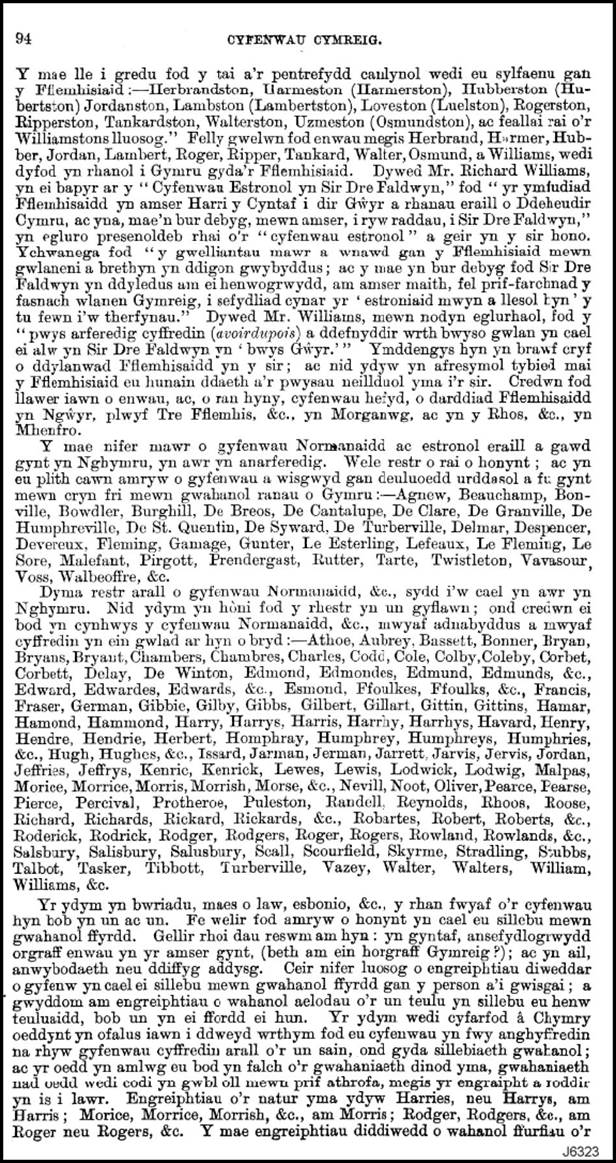
Y mae lle i gredu fod y tai a'r pentrefydd canlynol wedi eu sylfaenu
gan y Fflemhisiaid: — Herbrandston, Harmeston (Harmerston), Hubberston (Hubertston) Jordanston, Lambston (Lambertston),
Loveston (Luelston), Rogerston, Ripperston, Tankardston, Walterston, Uzmeston (Osmundston), ac feallai
rai o'r Williamstons lluosog." Felly gwelwn fod enwau megis Herbrand, Harmer, Hubber, Jordan, Lambert,
Roger, Ripper, Tankard, Walter, Osmund, a Williams, wedi dyfod yn rhanol i
Gymru gyda'r Fflemhisiaid. Dywed Mr. Richard Williams, yn ei bapyr ar y
“Cyfenwau Estronol yn Sir Dre Faldwyn," fod “yr ymfudiad Fflemhisaidd yn
amser Harri y Cyntaf i dir Gŵyr a rhanau eraill o Ddeheudir Cymru, ac
yna, mae'n bur debyg, mewn amser, i ryw raddau, i Sir Dre Faldwyn," yn
egluro presenoldeb rhai o'r “cyfenwau estronol" a geir yn y sir hono.
Ychwanega fod '' y gwelliantau mawr a wnawd gan y Fflemhisiaid mewn gwlaneni
a brethyn yn ddigon gwybyddus; ac y mae yn bur debyg fod Sir Dre Faldwyn yn
ddyledus am ei henwogrwydd, am amser maith, fel prif-farchnad y fasnach
wlanen Gymreig, i sefydliad cynar yr ' estroniaid mwyn a llesol hyn' y tu
fewn i'w therfynau." Dywed Mr. Williams, mewn nodyn eglurhaol, fod y
"pwys arferedig cyffredin (avoirdupois) a ddefnyddir wrthbwyso gwlan yn
cael ei alw yn Sir Dre Faldwyn yn 'bwys Gŵyr.' “Ymddengys hyn yn brawf
cryf o ddylanwad Fflemhisaidd yn y sir; ac nid ydyw yn afresymol tybied mai y
Fflemhisiaid eu hunain ddaeth a'r pwysau neillduol yma i'r sir. Credwn fod
llawer iawn o enwau, ac, o ran hyny, cyfenwau hefyd, o darddiad Fflemhisaidd
yn Ngŵyr, plwyf Tre Fflemhis, &c, yn Morganwg, ac yn y Rhos, &c,
yn Mhenfro.
Y mae nifer mawr o gyfenwau Normanaidd ac estronol eraill a gawd
gynt yn Nghymru, yn awr yn anarferedig. Wele restr o rai o honynt; ac yn eu plith
cawn amryw o gyfenwau a wisgwyd gan deuluoedd urddasol a fu gynt mewn cryn
fri mewn gwahanol ranau o Gymru: — Agnew, Beauchamp, Bonville, Bowdler,
Burghill, De Breos, De Cantalupe, De Clare, De Granville, De Humphreville, De
St. Quentin, De Syward. De Turberville, Delmar, Despencer, Devereux, Fleming,
Gamage, Gunter, Le Esterling, Lefeaux, Le Fleming, Le Sore, Malefant,
Pirgott, Prendergast, Rutter, Tarte, Twistleton, Vavasour, Voss, Walbeoffre, &c
Dyma restr arall o gyfenwau Normanaidd, &c, sydd i'w cael yn awr
yn Nghymru. Nid ydym yn hòni fod y rhestr yn un gyflawn; ond credwn ei bod yn cynhwys y cyfenwau
Normanaidd, &c, mwyaf adnabyddus a mwyaf cyffredin yn ein gwlad ar hyn
obryd: — Athoe, Aubrey, Bassett, Bonner, Bryan, Bryans, Bryant, Chambers, Chambres,
Charles, Codd, Cole, Colby, Coleby, Corbet, Corbett, Delay, De Winton, Edmond,
Edmondes, Edmund, Edmunds, &c, Edward, Edwardes, Edwards, &c, Esmond,
Ffoulkes, Ffoulks, &c, Francis, Fraser, German, Gibbie, Gilby, Gibbs, Gilbert,
Gillart, Gittin, Gittins, Hamar, Hamond, Hammond, Harry, Harrys, Harris, Harrhy,
Harrhys, Havard, Henry, Hendre, Hendrie, Herbert, Homphray, Humphrey, Humphreys,
Humphries, &c, Hugh, Hughes, &c, Issard, Jarman, Jerman, Jarrett.
Jarvis, Jervis, Jordan, Jeffrìes, Jeffrys, Kenric, Kenrick, Lewes, Lewis, Lodwick,
Lodwig, Malpas, Morice, Morrice, Morris, Morrish, Morse, &c, Nevill, Noot,
O1iver, Pearce, Pearse, Pierce, Percival, Protheroe, Puleston, Eandell,
Eeynolds, Rhoos, Roose, Richard, Richards, Rickard, Rickards, &c, Robartes,
Robert, Roberts, &c, Roderick, Rodrick, Rodger, Rodgers, Roger, Rogers, Rowland,
Rowlands, &c, Salsbury, Salisbury, Salusbury, Scall, Scourfield, Skyrme, Stradling, Stubbs, Talbot,
Tasker, Tibbott, Turberville, Vazey, Walter, Walters, William, Williams, &c
Yr ydym yn bwriadu, maes o law, esbonio, &c, y rhan fwyaf o'r
cyfenwau hyn bob yn un ac un. Fe welir fod amryw o honynt yn cael eu sillebu
mewn gwahanol ffyrdd. Gellir rhoi dau reswm am hyn: yn gyntaf,
ansefydlogrwydd orgraff enwau yn yr amser gynt, (beth am ein horgraff
Gymreig?); ac yn ail, anwybodaeth neu ddiffyg addysg. Ceir nifer luosog o
engreiphtiau diweddar o gyfenw yn cael ei sillebu mewn gwahanol ffyrdd gan y
person a'i gwisgai; a gwyddom am engreiphtiau o wahanol aelodau o'r un teulu
yn sillebu eu henw teuluaidd, bob un yn ei ffordd ei hun. Yr ydym wedi
cyfarfod â Chymry oeddynt yn ofalus iawn i ddweyd wrthym fod eu cyfenwau yn
fwy anghyffredin na rhyw gyfenwau cyffredin arall o'r un sain, ond gyda
sillebiaeth gwahanol; ac yr oedd yn amlwg eu bod yn falch o'r gwahaniaeth
dinod yma, gwahaniaeth nad oedd wedi codi yn gwbl oll mewu prif athrofa,
megis yr engraipht a roddir yn is i lawr. Engreiphtiau o'r natur yma ydyw
Harries, neu Harrys, am Harris; Morice, Morrice, Morrish, &c, am Morris;
Rodger, Rodgers, &c, am Roger neu Rogers, &c Y mae engreiphtiau
diddiwedd o wahanol ff'urfiau o'r
|
|
|
|
|
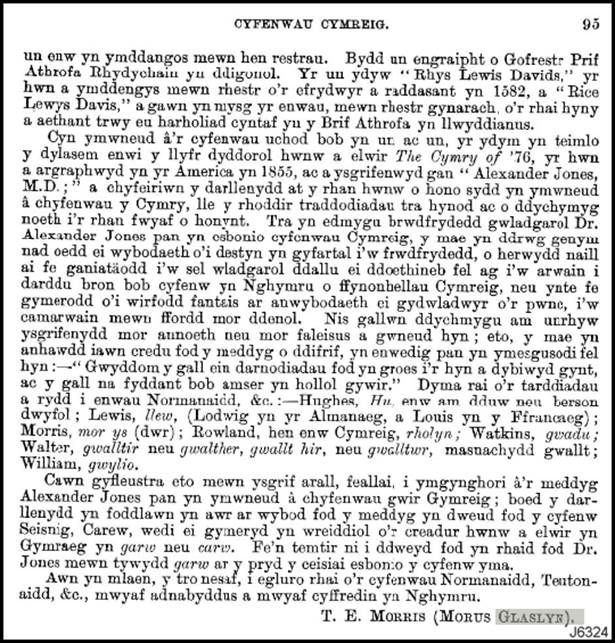
(delwedd J6324) (Ebrill 1898) (tudalen 95)
|
CYFENWAU CYMREIG. 95
un enw yn ymddangos mewn hen restrau. Bydd un engraipht o Gofrestr
Prif Athrofa Rhydychain yn ddigonol. Yr un ydyw “Rhys Lewis Davids," yr
hwn a ymddengys rnewn rhestr o'r efrydwyr a raddasant yn 1582, a “Rice Lewys
Davis," a gawn yn mysg yr enwau, mewn rhestr gynarach, o'r rhai hyny a aethant trwy eu harholiad cyntaf yn y
Brif Athrofa yn llwyddianus.
Cyn ymwneud â'r cyfenwau uchod bob yn un ac un, yr ydym yn teimlo y
dylasem enwi y llyfr dyddorol hwnw a elwir The Cymry of '76, yr hwn a argraphwyd
yn yr America yn 1855, ac a ysgrifenwyd gan “Alexander Jones, M.D.;” a
chyfeiriwn y darllenydd at y rhan hwnw o hono sydd yn ymwneud â chyfenwau y
Cymry, lle y rhoddir traddodiadau tra hynod ac o ddychymyg noeth i'r rhan
fwyaf o honynt. Tra yn edmygu brwdfrydedd gwladgarol Dr. Alexander Jones pan
yn esbonio cyfenwau Cymreig, y mae yn ddrwg genym nad oedd ei wybodaeth o'i destyn yn gyfartal i'w
frwdfrydedd, o herwydd naill ai fe ganiatäodd i'w sel wladgarol ddallu ei
ddoethineb fel ag i'w arwain i darddu bron bob cyfenw yn Nghymru o
ffynonhellau Cymreig, neu ynte fe gymerodd o'i wirfodd fantais ar anwybodaeth
ei gydwladwyr o'r pwnc, i'w camarwain mewn ffordd mor ddenol. Nis gallwn ddychmygu am unrhyw
ysgrifenydd mor annoeth neu mor faleisus a gwneud hyn; eto, y mae yn anhawdd iawn credu fod
y meddyg o ddifrif, yn enwedig pan yn ymesgusodi fel hyn: — "Gwyddom y
gall ein darnodiadau fod yn groes i'r hyn a dybiwyd gynt, ac y gall na
fyddant bob amser yn hollol gywir." Dyma rai o'r tarddiadau a rydd i
enwau Normanaidd, &c.: — Hughes, Hu, enw am dduw neu berson dwyfol;
Lewis, llew, (Lodwig yn yr Almanaeg, a Louis yn y Ffrancaeg); Morris, mor ys
(dwr); Rowland, hen enw Cymreig, rholyn; Watkins, gwadu; Walter, gwalltir neu gwalther, gwallt hir,
neu gwalltwr, masnachydd gwallt; William, gwylio.
Cawn gyfleustra eto mewn ysgrif arall, feallai, i ymgynghori â'r
meddyg Alexander Jones pan yn ymwneud â chyfenwau gwir Grymreig; boed y
darllenydd yn foddlawn yn awr ar wybod fod y meddyg yn dweud fod y cyfenw
Seisnig, Carew, wedi ei gymeryd yn wreiddiol o'r creadur hwnw a elwir yn
Gymraeg yn garw neu carw. Fe'n temtir ni i ddweyd fod yn rhaid fod Dr. Jones
mewn tywydd garw ar y pryd y ceisiai esbonio y cyfenw yma.
Awn yn mlaen, y tro nesaf, i egluro rhai o'r cyfenwau Normanaidd,
Teutonaidd, &c, mwyaf adnabyddus a mwyaf cyffredin yn Nghymru.
T. E. Morris (Morus Glaslyn).
|
|
|
|
|
(delwedd J6401) (Gorffennaf 1898) (clawr)
|
Y Geninen. Cyf XVI. Rhif
3. Gorffennaf 1898.
Cyfenwau
Cymreig. IV. Cyfenwau Normanaidd, &c., Cymru. Gan Mr. T. E. Morris, Ll.
M., B. A. (Morus Glaslyn) 187
|
|
|
|
|
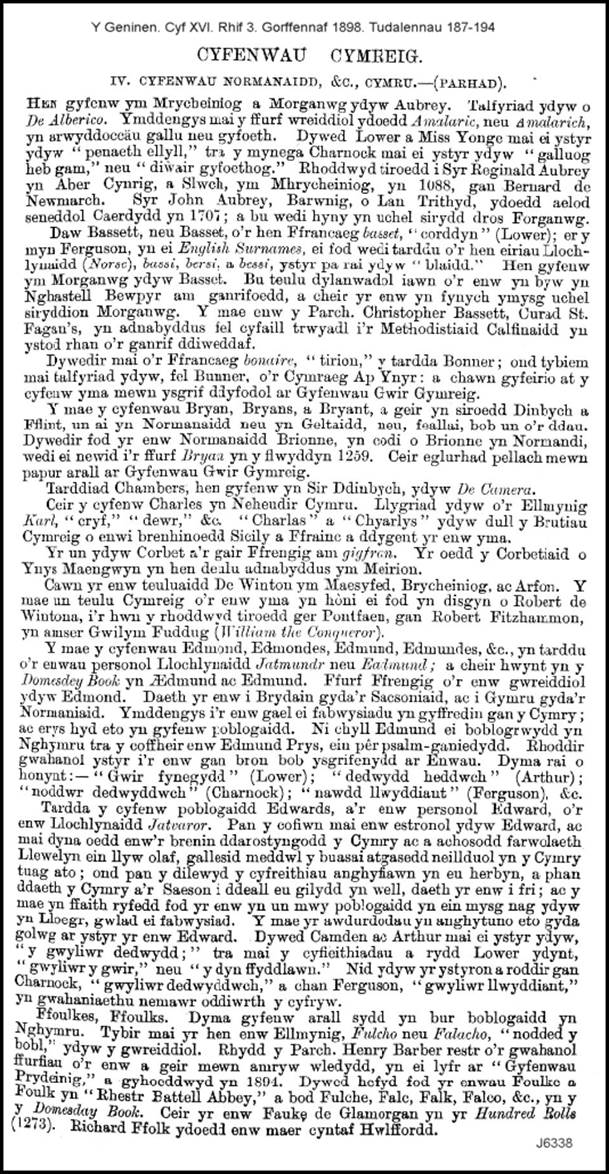
(delwedd J6338) (Gorffennaf
1898) (tudalen 187)
|
Y Geninen. Cyf XVI. Rhif
3. Gorffennaf 1898. Tudalennau 187-194
CYFENWAU CYMREIG.
IV.
CYFENWAU NORMANAIDD, &C, CYMRU. — (PARHAD).
Hen gyfenw ym
Mrycheiniog a Morganwg ydyw Aubrey. Talfyriad ydyw o De Alberico. Ymddengys mai y ffurf wreiddiol ydoedd Amalaric,
neu Amalarich, yn
arwyddoccäu gallu neu gyfoeth. Dywed Lower a Miss Yonge mai ei ystyr ydyw “penaeth ellyll," tra y
mynega Charnock mai ei ystyr ydyw “galluog heb gam,'' neu ''diwair gyfoethog.'' Rhoddwyd tiroedd i Syr Reginald Aubrey yn Aber Cynrig, a Slwch, ym
Mhrycheiniog, yn 1088, gan Bernard de Newmarch. Syr John Aubrey, Barwnig, o Lan Trithyd,
ydoedd aelod seneddol Caerdydd yn 1707; a bu wedi hyny yn uchel sirydd dros
Forganwg.
Daw Bassett, neu Basset, o'r hen Ffrancaeg
basset, “corddyn" (Lower); er y myn
Ferguson, yn ei English Surnames, ei fod wedi tarddu o'r hen eiriau Llochlynaidd (Norse), bassi, bersi, a bessi,
ystyr pa rai ydyw “blaidd." Hen gyfenw ym Morganwg ydyw Basset. Bu teulu
dylanwadol iawn o'r enw yn byw yn Nghastell Bewpyr am ganrifoedd, a cheir yr
enw yn fynych ymysg uchel siryddion Morganwg. Y mae enw y Parch. Christopher
Bassett, Curad St. Fagan's, yn adnabyddus fel cyfaill trwyadl i'r
Methodistiaid Calfinaidd yn ystod rhan o'r ganrif ddiweddaf.
Dywedir mai o'r Ffrancaeg bonaire, “tirion,"
y tardda Bonner; ond tybiem mai talfyriad ydyw, fel Bunner, o'r Cymraeg Ap
Ynyr: a chawn gyfeirio at y cyfenw yma mewn ysgrif ddyfodol ar Gyfenwau Gwir Gymreig.
Y mae y cyfenwau Bryan, Bryans, a Bryant, a geir
yn siroedd Dinbych a Fflint, un ai yn Normanaidd neu yn Geltaidd, neu,
feallai, bob un o'r ddau. Dywedir fod yr enw Normanaidd Brionne, yn codi o Brionne yn Normandi,
wedi ei newid i'r ffurf Bryan yn y flwyddyn 1259. Ceir eglurhad pellach mewn
papur arall ar Gyfenwau Gwir Gymreig.
Tarddiad Chambers, hen gyfenw yn Sir Ddiubych,
ydyw De Camera.
Ceir y cyfenw Charles yn Neheudir Cymru. Llygriad
ydyw o'r Ellmynig Karl, "cryf," “dewr," &c. "Charlas"
a “Chyarlys” ydyw dull y Brutiau Cymreig o enwi brenhinoedd Sicily a Ffrainc
a ddygent yr enw yma.
Yr un ydyw Corbet a'r gair Ffrengig am gigfran. Yr oedd y Corbetiaid o Ynys Maengwyn yn hen
deulu adnabyddus ym Meirion.
Cawn yr enw teuluaidd De Winton ym Maesyfed,
Brycheiniog, ac Arfon. Y mae un teulu Cymreig o'r enw yma yn hòni ei fod yn
disgyn o Robert de Wintona, i'r hwn y rhoddwyd tiroedd ger Pontfaen, gan
Robert Fitzhammon, yn amser Gwilym Fuddug (William the Conqueror).
Y mae y cyfenwau
Edmond, Edmondes, Edmund, Edmundes, &c, yn tarddu o'r enwau personol Llochlynaidd Jatmundr
neu Eadmund; a cheir hwynt yn y Domesday Book yn Aedmund ac Edmund.
Ffurf Ffrengig o'r enw gwreiddiol ydyw Edmond. Daeth yr enw i Brydain gyda'r
Sacsoniaid, ac i Gymru gyda'r Normaniaid. Ymddengys i'r enw gael ei fabwysiadu yn
gyffredin gan y Cymry; ac erys hyd eto yn gyfenw poblogaidd. Ni chyll Edmund
ei boblogrwydd yn Nghymru tra y coffheir enw Edmund Prys, ein pêr
psalm-ganiedydd. Rhoddir gwahanol ystyr i'r enw gan bron bob ysgrifenydd ar
Enwau. Dyma rai o honynt: — “Gwir fynegydd" (Lower); “dedwydd heddwch” (Arthur);
"noddwr dedwyddwch" (Charnock); “nawdd llwyddiant" (Ferguson),
&c.
Tardda y cyfenw poblogaidd Edwards, a'r enw
personol Edward, o'r enw Llochlynaidd Jatvaror. Pan y cofiwn mai enw estronol
ydyw Edward, ac mai dyna oedd enw'r brenin ddarostyngodd y Cymry ac a
achosodd farwolaeth Llewelyn ein llyw olaf, gallesid meddwl y buasai atgasedd
neillduol yn y Cymry tuag ato; ond pan y dilewyd y cyfreithiau anghyfiawn yn
eu herbyn, a phan ddaeth y Cymry a'r Saeson i ddeall eu gilydd yn well, daeth
yr enw i fri; ac y mae yn ffaith ryfedd fod yr enw yn un mwy poblogaidd yn
ein mysg nag ydyw yn Lloegr, gwlad ei fabwysiad. Y mae yr awdurdodau yn anghytuno eto gyda golwg ar ystyr yr enw
Edward. Dywed Camden ac Arthur mai ei ystyr ydyw, "y gwyliwr
dedwydd;" tra mai y cyfieithiadau a rydd Lower ydynt, ''gwyliwr y
gwir,'' neu ''y dyn ffyddlawn.'' Nid ydyw yr ystyron a roddir gan Charnock,
“gwyliwr dedwyddwch,"
a chan Ferguson, “gwyliwr llwyddiant," yn gwahaniaethu nemawr oddiwrth y
cyfryw.
Ffoulkes, Ffoulks. Dyma gyfenw arall sydd yn bur
boblogaidd yn Nghymru. Tybir mai yr hen eiîw Ellmynig, Fulcho neu Falacho,
"nodded y bobl," ydyw y gwreiddiol. Rhydd y Parch. Henry Barber
restr o'r gwahanol fiurfiau o'r enw a geir mewn amryw wledydd, yn ei lyfr ar
“Gyfenwau Prydeinig," a gyhoeddwyd yn 1894. Dywed hefyd fod yr enwau
Foulke a Foulk yn “Rhestr Battell Abbey," a bod Fulche, Falc,
Falk, Falco, &c, yn y y Domesday Book. Ceir yr
enw Fauke de Glamorgan yn yr Hundred Rolls (1273). Richard Ffolk ydoedd enw maer cyntaf
Hwlffordd.
|
|
|
|
|
(delwedd J6339) (Gorffennaf 1898) (tudalen 188)
|
188 CYFENWAU CYMREIG.
Ystyr
y cyfenw Francis, yr hwn a geir yn Neheudir Cymru, ac yn enwedig yn ardal Pen
y Bont ar Ogwy, ydyw un ai "rhydd" neu "Y Ffrangcwr" (Le Franceys).
Tybir mai enw arall am William ydyw Gillart,
cyfenw a geir yn Maldwyn. Nid oes sail, hyd y gwyddom, i'r haeriad mai yr un
ydyw a'r enw Cymreig Gelert.
Harry, Harrhy, Harrys, Harrhys, Harris, Harries,
Henry, Hendric, &c. Cofnodir yr enw “Henri” amryw o weithiau ym Mrut y
Tywysogion fel enw rhai o frenhinoedd Lloegr a Ffrainc. Cyfeirir hefyd at
"henri vab Kadwgan o'r ffranges verch pictot tywyssawc or ffreinc,"
dan y flwyddyn 1113; a chawn fod "henri ab arthen, goruchel athro,"
wedi marw yn 1161. Mae y cyfeiriad cyntaf yn engraipht clir o'r dull y
mabwysiadwyd enwau Normanaidd yn Nghymru.
Boneddiges o Ffrainc ydoedd mam Harri ab Cadwgan. Rhesymol ydyw tybied fod ei mab wedi ei alw ar ol un
o'i pherthynasau; a gallwn fod yn sicr fod rhai o'r pendefigion wedi bedyddio
eu meibion ar enw eu tywysog, a bod eu tenantiaid wedi dilyn eu hesiampl yn
hyn o beth. Naturiol hefyd ydyw credu fod enw ysgolor mor wych a Henri ab
Arthen wedi cymeradwyo ei hun i lawer o rieni Cymreig oedd yn edmygu eu
cydwladwr dysgedig. Dywed ysgrifenydd i'r Notes & Queries mai eithriad yw dod o hyd i Henry neu
Harri cyn amser Harri'r IV. Ceir yr enw yn fwy mynych yn amser Harri'r VI. Yr
oedd gan Syr Rhys ap Thomas (Harri'r V. a'r VI.) frawd yn ogystal a
pherthynasau yn dwyn yr enw. Nid oedd yn cofio am ychwaneg na thri Chymro o'r
enw Harri cyn hyn. Ceir enw un, sef Cadwgan ab Bleddyn, a'i wraig Normanaidd,
yn y flwyddyn 1107. Ceir un yn dwyn yr enw Ennri ym mysg y tystion mewn
breinlen yngly^n â mynachlog Llan Egwestl; yn wir, y mae dau neu dri
yn cael eu henwi mewn breinleni tua'r flwyddyn 1250; ond feallai mai ffurf
Ladinaidd ydyw yr enwau hyn ar Ynyr, neu, yn fwy tebyg, ar Gynwrig. Dichon
mai poblogrwydd Harri'r VI. a Henry Tudor a wnaeth yr enw yn boblogaidd.
Tybia yr ysgrifenydd fod yr ymgyfeillach a fu rhwng rhai o'r Cymry â'r Saeson
yn ystod y rhyfeloedd yn Ffrainc wedi peri i'r enw gael ei fabwysiadu fel enw
teuluaidd, oherwydd fod yr Henri cyntaf y gwyddis am dano o deulu Dwn gydag
Owen Glyndwr, yn Nghaerfyrddin, pan y llosgwyd y dref yn 1403. Terddir Henri,
gan rai, o'r enw Kunreich, trwy yr hen ffurf hunoricus, “enwog am
gryfder," tra y rhydd Miss Yonge ei ystyr fel "rheolwr
cartref" (homc rider). Terddid Henri gan Camden o'r Lladin honoricus,
“anrhydeddus," a chan Verstigau o'r Teutonaidd einrich, “yn wastad yn
gyfoethog." Yr oedd Kilian yn dal allan mai Heynrich, "yn gyfoethog
gartref," oedd ei ffurf gyntefig, — eryr haerid gan eraill mai Herrick, “arglwydd cyfoethog," oedd yr enw
gwreiddiol.
Cartref y cyfenwau Harry, Henry, Harris, Harries,
&c, ydyw Deheudir Cymru. Ymddengys Hendre fel ffurf arall o Hendrie neu
Henry, er y gall ei darddiad fod yr enw Beiblaidd Andrew. Nis gwyddom fod un
sail dros gredu mai yr un ydyw y cyfenw Hendre a'r enw lleol Cymreig Hendre.
Herbert ydyw un o'r enwau personol Normanaidd
hynaf a fabwysiadwyd fel cyfenw yn Nghymru. Cawn yr enw yn barhaus y'mysg
rhestrau uchel siryddion Mynwy, Morganwg, Brycheiniog, a Sir Aberteifi. Daeth
Peter Fitz Herbert, un o'r arglwyddi a law-nododd y Magna Charta, i feddiant o arglwyddiaethau a chestyll
Blaen Llyfui a Thalgarth ym Mhrycheiniog, trwy briodas âg Isabel, gweddw
Dafydd ab Llewelyn, Tywysog Gwynedd. Bu farw yn 1235. Y mae hanes y teulu yma
yn ddyddorol mewn cysylltiad â'r dull Cymreig o enwi personau. Unig enw mab
Peter Fitz Herbert ydoedd Herbert; a gelwid ei orwyr yr un modd yn Herbert;
tra yr adnabyddid ŵyr Herbert fel John Herbert ab Adam, neu Siencyn. Yr
oedd hwn yn arglwydd Gwern Ddu, ger Aber Gavenni. Yr oedd ei fab Gwilym ab Siencyn yn byw yn y Berth Hir, ger
tref Mynwy, o 1307 i 1377. Hywel ab Gwilym oedd mab, Siencyn ab Hywel oedd ŵyr,
a Dafydd ab Siencyn oedd orwyr, Gwilym ab Siencyn. Fe laddwyd Dafydd ab
Siencyn yn Banbury, pan yn rhyfela o dan faner ei gefnder, Arglwydd Penfro.
Gelwid ei fab yn Thomas ab Dafydd ab Siencyn, yn ol y dull Cymreig, a'i ŵyr,
yn ol yr un rheol, yn John ab Thomas. Dywedir y bu raid i orwyr Dafydd ab
Siencyn, “yn ol y gyfraith," fabwysiadu y dull Seisnig o gymeryd cyfenw
pendant;
ac felly y talfyrwyd ei enw o William ab John ab
Thomas, neu Gwilym ab John, i'r enw William Jones. Yr oedd efe yn uchel
sirydd Mynwy yn 1556. Galwyd ei ddisgynyddion yn Jones hyd y flwyddyn 1848,
pryd y caniatawyd i John Arthur Edward Jones, o Lanarth, trwy awdurdod y Frenhines,
fabwysiadu y cyfenw Herbert, sef cyfenw Normanaidd ei enwog hynafiaid. Y mae
y dull yma o newid cyfenw
|
|
|
|
|
(delwedd J6340) (Gorffennaf 1898) (tudalen 189)
|
CYFENWAU CYMREIG. 189
yn un mor gostus (oherwydd taliadau swyddogol) na
chyfeiriwyd ato ar dudalen 92. Y mae newid enw trwy ddeddf seneddol yn fwy
costus fyth.
Dywed Miss Yonge mai enw Teutonaidd ydyw Herbert,
aç mai ei ystyr ydyw "y milwr dysglaer." Rhydd Arthur yr un ystyr
i'r enw; ond dywed mai y gwreiddiol ydyw y geiriau Sacsonaidd, here, "milwr," a beorht,
“dysglaer." Nid ydyw y cyfenw hwn yn ffafryn ynmysg gwerin Cymru; ond
ceir ef fynychaf ym mysg bonedd ein gwlad.
Rhoddir amryw darddiadau ac ystyron i'r cyfenwau
Homphray ac Humphrey gan wahanol ysgrifenwyr ar gyfenwau. Dyma rai o honynt:
— Cunfrid,
oddiwrth y geiriau Teutonaidd kun frid, “yr amddiffynwr cryf” (Charnock); hun, “y bobl;" frid,
"heddwch," h.y., “heddwch y bobl" (MissYonge); homme vrai,
geiriau Ffrengig, yn arwyddocäu “dyn cywir" (Arthur), &c. Cyfeirir
ym Mrut y Saeson, o dan y flwyddyn 1307, at “wmfrei bown mab wmffrei arall iarll henfford." Y mae cofnodiad ym Mrut y
Tywysogion am “Castell hwmfre yn dyffryn clettwr." Cyfeiria Mr. Stephen
Wilhams, yn ei lyfr ar Ystrad Fflur, at y castell yma, yr hwn oedd ar ei
draed yn 1159. Y mae Humphrey a Humphreys yn gyfenwau poblogaidd ym mhob rhan o
Gymru, tra y cyfyngir Homphray bron yn gwbl oll i Sir Forganwg. Yr oedd un
o'r enw Henry Humphries, o Bwllheli, yn uchel sirydd Sir Gaernarfon yn 1628.
Y mae y cyfenwau Hugh a Hughes wedi dyrysu bron
bob ysgrifenydd ar gyfenwau. Dywed rhai mai enw Teutonaidd ydyw, eraill mai
Celtaidd; tra y deil Charnoek y tardda o'r gair Isdiraidd (Dutch) hoog, ystyr
pa un, meddir, ydyw "uchel" neu "dal." Dywed Arthur mai y
Gaeleg am Hugh ydyw Aiodh, yn arwyddoccäu “dieithr ddyn." Crybwylhr mewn
sylw ym Mrutiau y Werddon (Tìte Annaîs of Ireland) mai ystyr yr enw Celtaidd
Aodh, a seinir yn Ii neu I, ydyw “tân," a'i fod wedi tarddu o wasanaeth
crefyddol y Derwyddon, ac mai y
ffurf Seisnig o hono ydyw Hugh, megis mai y ffurfiau Lladinaidd ydynt Aidus,
Aedus, Hugo, &c. Dywed Wachter, o'r ochr arall, mai o'r hen iaith
Ellmynaidd y tardda Hugo, sef y gair hug, cyfystyr pa un ydyw "y
meddwl."
Ymddengys mai Miss Yonge oedd y gyntaf i daflu
amheuaeth ar darddiad yr enw. Enwir Hu Gadarn ganddi, a dywed — "Nid oes
esboniad wedi ei roddi ar y gair Hu; ond y mae wedi myned yn enw yn Nghymru
ac yn Llydaw. Yn yr Hen Ffraneaeg ceir yr enw yn y ffurfiau Hue, Hues, Huon,
yn ogystal a'r ffurf Huette fel enw merch. Y ffurf wir Gymreig yn ei arddull
Seisnig ydyw Hu neu Huw, er ei fod bron yn ddieithriad yn cael ei gamgymeryd
am yr Hugh Teutonaidd, yn tarddu o hugur, 'y meddwl,' â pha un y gall ei fod yn
gyfystyr. Sillefir yr enw
Cymreig teuluaidd Ap Hu bob amser fel Pugh." Ymddengys mai ffurfiau
gwreiddiol Pugh ydynt Ap Huw ac Ap Hugh, — ac nid Ap Hu, fel yr awgryma Miss
Yonge. Dywed ym mhellach fod Roghan yr Alban, a seinir Ioan, yn cael ei
gyfieithu yn ddiwahaniaeth fel Evan, Ewan, a Hugh. Barn y foneddiges hon ydyw
fod Hugh wedi dyfod i Loegr gyda'r Normaniaid ac mai enw Teutonaidd ydyw am
“feddwl," tra y tardda yr enw Hu o ffynhonell Geltaidd gyda'r un
cyfystyr.
Yr ydym yn credu mai aralleiriad ydyw yr hen
ffurf Gymreig Hu am yr enw cynarach Normanaidd Hugh, a geir yn y Domesday
Book fel Hugo. Nid oes nemawr sail, os oes dim, dros y dywediad a geir yn y
llyfr, a elwir The Norman People (1874), mai
enw Cymraeg neu Geltaidd ydyw Hugh. Feallai fod y ffurfiau diweddar o'r enwau
oedd yn tarddu o'r Celtaidd, Aodh neu Aoidh, a'r Gaeleg, Roghan, oherwydd eu
tebygrwydd i'r enw Teutonaidd, wedi cael eu camgymeryd am dano, ac felly
collwyd golwg ar eu tarddiad gwahanol, pan eu byrhawyd i'r ffurf olaf, Hugh.
Enwir tri o'r enw Hu yn llawysgrifau Iolo (Iolo
MSS.). Cyfeirir yn “Chwedlau'r Doethion" at Hu Arddar a Phlenydd ab Hu
hydr. Copiwyd y
chwedlau yma gan Iolo Morganwg o Lyfr Tre'r Bryn, sef casgliad o weithiau a
wnawd gan Thomas ab Ieuan tua'r flwyddyn 1670. Nid oes tystiolaeth ar gael i
ddangos pa bryd y cyfansoddwyd y chwedlau yma ar gân; ac er eu bod yn cynwys
dywediadau rhai o'r seintiau Cymreig boreuaf, y mae lle i gredu eu bod i gyd yn ddiweddarach na'r bedwaredd ganrif ar ddeg.
Nid ydyw y ffaith fod dau Hu i'w cael yn “Chwedlau'r Doethion” yn ymddangos
yn ddigon o brawf o darddiad Cymreig neu Geltaidd yn enw Hu: ac hyd yn nod pe
caniatëid y bu yr hen enw
Cymreig, Hu, unwaith ar arfer, eto ni ddefnyddid ef yr adeg y daeth y Normaniaid i'n tir, onide buasai'n
naturiol i ni ddisgwyl dod ar ei draws yn ein llawysgrifau boreuaf. Ni cheir yr enw o gwbl yn
y Mabinogion; a Normamaid oedd yr holl bersonau o'r enw yna a grybwyllir ym
Mrut y Tywysogion.
Darllenwn yn y Brut am farwolaeth “hu vras, Iarll kaer llion," yn 1100; a chyfeirir yn y llyfr at “Hu dy la Sai,"
“Hu dy Roc," a “Hu dy
|
|
|
|
|
(delwedd J6341) (Gorffennaf
1898) (tudalen 190)
|
190 CYFENWAU CYMREIG.
Sai." Cawn hefyd y ffurf diweddar o Hugh, er
engraifft, “Huw de Andelei." Y mae'n fwy na thebyg mai y rheswm paham yr ystyrir
Hugh yn enw Cymreig gan Gymry ydyw y traddodiad fod rhyw Hu Gadarn wedi
arwain y Cymry o'r Dwyrain dros gyfandir Ewrob a glanio ym Mhrydain mewn
cwrwgl. Yr Hu Gadarn hwn ydyw y trydydd Hu y sonir am dano yn ysgrifau Iolo
yn "Englynion y Gorugiau," a gyfansoddwyd,
meddir, gan y Bardd Glas o'r Gadair. Barn Iolo oedd fod y gwr hwn yn cydoesi
â Hywel Dda; os felly, bu fyw yn y ddegfed ganrif.
Dyma goruc Hu Gadarn: —
“Goruc Hugadarn Gymmhram
Ar Gymry Ynys Prydain
I ddyffryd o ddeffro Bain."
Dywedir mai yr un ydoedd Deffro Bani neu Ddeffro
Bannau a Taprobane neu Ynys
Ceylon, trigfa ein cyndad Adda. Nid oes arnom eisiau bychanu Hu Gadarn; ond
nis gellir cymeryd bodolaeth y traddodiad yma, a'r cyfeiriad ato yn Englynion
y Gorugiau, fel prawf difrif o darddiad Cymreig neu Geltig Hugh. Dyna, yn
wir, ydoedd barn yr enwog Thomas Stephens, oherwydd dywed, yn ei Literature
of thc Kymry,
tudalen 169, na chlywid unrhyw foliant i Hu Gadarn cyn marwolaeth Llywelyn ap
Gruffydd, ac mai yn fuan wedi hyny y cododd Hu i'r golwg. Ychwanega fod
“beirdd y cyfnod yma yn ei enwi yn fynych: rhoddwyd uchel ganmoliaeth iddo
gan Iolo Goch; a gallwn gasglu o waith Sion Cent (1350) fod moliant Hu ar ei
oreu y pryd hyny." Darfyddodd y ffurf Hu ganrifoedd yn ol fel enw
arferedig yn Nghymru; ac anaml y canfyddir y ffurf Huw yn llenyddiaeth
Gymreig yr oes hon. Ymddengys fod Huw Huws, neu y Bardd Coch o Fon, yr hwn a
fu fyw y ganrif ddiweddaf, yn sillebu ei enw fel hyn.
Bu ychydig ysgrifenu ar y cyfenw yma yn y Notes and Queries, flynyddau yn ol; a dywedai Mr.
Gildersome-Dickenson (7fed gyfres, cyf. xi., tud. 334) fod Hughes yn
gyfenw beth bynag mor foreu â 1450-1; a thystiolaetha Mr. Higgins, o Maidenhead,
fod y dull Cymreig o gyfenwi y tad yn ol enw y tad mewn bri yn Swydd Amwythig
yn foreu iawn; oherwydd gelwir mab un Hugh Higgons yn John Hughes yn y
Visitation of Salop a
ysgrifenwyd yn 1623. Dywed un ysgrifenydd "na ddefnyddid Hughes fel
cyfenw yn Nghymru cyn 1550; a phur anaml y deuir ar draws yr enw bedydd Hugh
cyn yr adeg yma. Y pryd hyn cawn saith o deuluoedd o'r enw Hughes yn codi, un
o dylwyth Caradog Freichfras, dau o dylwyth Elystan, un o dylwyth Cowryd ap
Cadfan, un o dylwyth Owain Brogyntyn, a dau o dylwyth Tudor Trefor. Bu farw
Hugh ap William, sylfaeuydd teulu yr Hughesiaid o Gwerclas, yn 1600. Yr oedd
Rhys Hughes — yr
Hughes cyntaf o Faes y Pandy, yn uchel sirydd yn y flwyddyn 1582." Nid
oes un amheuaeth nad oedd Hugh yn enw bedydd cyffredin yn ein gwlad yn yr
unfed ganrif ar bymtheg; ac yn ol pob tebyg yr oedd yr enw yn un adnabyddus
yn Nghymru yn ystod y tair neu y pedair canrif cyn hyny. Yr oedd enw Hugh
Lupus, yr hwn a grewyd yn Iarll Caer, yn 1070, yn enw adnabyddus yn Ngwynedd;
a bu iarll arall ar ei ol, sef Hugh Cyfeiliog (1153 — 1180) o'r un enw.
Teimlwn yn falch nad yw Hughes-Hughes yn gyfenw yn Nghymru, — ceir hwnw yn
Lloegr.
Cyfenwau a geir yn Sir Drefaldwyn ydyw Jarman,
Jerman, German, &c, yn tarddu o'r ffurf Ffrengig German. Cawn yr enwau German, Garmund, a Germund, yn y Domesday Book. Tueddir ni i feddwl
fod yr hen enw Cymreig Garmon o'r un tarddiad. Cawn y ffurf Germon ym mysg y Fflemhisiaid.
Yr un ydyw y cyfenwau Jarett a Jarrett a geir ym
Meirion ac ym Maldwyn, a'r enwau Girard a Gerard yn y Domesday Book. Dywed Lower mai Teutonaidd ydynt o ran
tarddiad, ac mai “diysgog waywffon” ydyw eu hystyr.
Enwau yn Sir Drefaldwyn drachefn ydyw Jarvis a
Jervis, yn tarddu, trwy y Ffrancaeg Jervais, o ffynhonell Deutonaidd, yn arwyddocäu,
"awyddus am ryfel."
Daw Jeffries a Jeffrys, yn ol Lower, o'r enw
Teutonaidd Godfridus, neu, yn ol Charnock, o'r hen Ellmynig walt frid, “yr amddiffynwr nerthol."
Yr un ydyw Kenric a Kenrick a Cymric, yr hwn sydd yn tarddu fel Henry
o Kunreich. Barna Arthur, modd bynag, mai o'r enw Sacsonaidd Kenric y tardd, sef Kennen, "i wybod," a ric, "cyfoethog," hyny yw, "un yn gwybod ei
fod yn gyfoethog." Felly, ni thâl i'r un Kenrick fod yn dlawd.
Yr un ydyw Lewis a'r enw Ffrengig Louis, sef
llygriad o Ludovicus, ffurf
Ladinaidd o'r hen enw Ellmynig Ludwig, sydd yn tarddu, medd Charnock, o lant wig, "y rhyfelwr enwog." Yr ystyr a
rydd Miss Yonge i Lewis a Lodwick ydyw “enwog mewn sancteiddrwydd."
Gelwir brenhinoedd Ffrainc o'r enw yma yn “Lowys” ym Mrut y Tywysogion. Fe
sonir, o dan y flwyddyn
|
|
|
|
|
(delwedd J6342) (Gorffennaf 1898) (tudalen 191)
|
CYFENWAU
CYMREIG. 191
1213, am "Lowys ab Phylip, ardderchawc
vrenhin ffreinc" Wrth gwrs, yr hanesydd Cymreig a ddododd yr ab yn yr
enw.
Dywed Lower mai yn ystod teyrnasiad Harri'r VIII.
y mabwysiadwyd Lewis fel cyfenw yn
Lloegr. Nid ydyw y ffaith mai Hugh Lewys oedd enw cwnstabl Castell Harlech yn
1504 yn profì fod Lewys y pryd hynny yn gyfenw pendant, er fod absenoldeb yr ab neu
ap yn yr enw yn rhoddi rhyw fath o sail dros gredu hynny. Eithriad y pryd hynny
oedd i unrhyw Gymro fod heb un ab, o leiaf, yn ei enw. Nis gellir penderfynu
gydag unrhyw sicrwydd pa bryd y daeth cyfenw teuluaidd yn un arhosol heb
weled ach y teulu. Yr oedd Lewis yn enw adnabyddus yn Nghymru yn yr unfed
ganrif ar byrntheg. Yr oedd “Lewis ab Ieun" yn rheithor Darowen, ym Maldwyn, yn 1537. Lewis
Owen oedd enw yr aelod seneddol dros Feirion yn 1547. Rhees Lewis oedd aelod
seneddol Maesyfed yn 1553: a chawn “Rees Lewis" arall yn cynrychioli bwrdeisdref
Mynwy yn y Senedd yn 1571. Lewis Lang, neu Lewis Gig Eidion, ydoedd fardd tìraeth a digrif, yn byw
rhwng 1580 a 1620. Gellir profi fod Lewis yn gyfenw pendant yn y Deheudir, os
nad yn y Gogledd, yn yr unfed ganrif ar bymtheg. Dywed Miss Yonge fod y Cymry
yn defnyddio Lewis fel ffurf Seisnig o Llewelyn; a chyfeiriodd Mr. Edward
Owen, o'r India Office, Llundain, yn ei dystiolaeth o flaen y Ddirprwyaeth
Dir, at enw ''Meurig ap Llewelyn (neu Lewis)'' yn ymddangos mewn prydles a
wnawd yn y flwyddyn 1529. Ni cheir yr enwau Lewis, Lodwich, a Ludwig, yn y
Brutiau nac yn y Trioedd.
Y mae yr enwau Morice, Morrice, Morris, Morrish,
Morse, &c, wedi peri llawer o flinder i ysgrifenwyr ar gyfenwau. Tyb y
mwyafrif ydyw fod Morris yn tarddu trwy yr enw Ffrengig Maurice, o'r Lladin
Maurus, “Mwr" (a Moor); a chyfeiriant at y ddawns Fwraidd (morrice
dance) fel prawf o hynny. Barna ysgrrfenydd i'r Notes and Queries (gwel 3ydd gyfres, cyf. xii., tud. 254)
mai o'r gair Seisnig moor, “rhosdir," y tardd; ac awgryma mai trigolion
y rhos oedd y Morrisiaid cyntaf. Dywed ysgrifenydd arall mai yr un ydyw y
cyfenw hwn a'r enw Teutonaidd Amalric, a dardd o himmel reich, “teyrnas
nefoedd." Y mae Charnock o'r farn mai y geiriau du marais, “o'r
rhos," ydyw tarddiad Maurice a Morris; a dyfyna nodiadau i'r perwyl hwn
o awduron Ffrengig.
Ceir yr enw mewn gwahanol ffurfiau yn y Domesday
Book, yn Rhestr
Battell Abbey, ac yn y Rotuli de Oblatis et Finibus (amser y Brenin John).
Barna y Parch. Henry Barber mai Moris — enw lleol Normanaidd — ydyw ffynhonell Morris; ac awgryma mai ffurf o'r gair Ffrengig
marais, “rhosdir," ydyw. Y mae Burke yn rhanu y Morrisiaid i ddau
ddosbarth, sef Morrisiaid y Cyfandir a Morrisiaid Cymru. Dywed mai tarddiad
Cymreig Morris ydyw “mawr-rwyce," hynny yw, "mawr-rwsg," ac y
gelwid hen benaethiaid Cymry felly am eu dewrder a'u gallu. Rhydd arwyddair
un o deuluoedd y Morrisiaid, sef “Marte et mari faventibas," fel sail
i'w ddywediad. Tardda ysgrifenydd arall, yn yr Archaeologia Cambrensis
(cyf. xlv.), yr enw yr un modd, os
nad “mor rhys," hynny yw, “yn awyddus am y mor," ydyw ei ystyr. Nid
ydym yn credu mai tarddiad Cymreig sydd i Morris. Nid oes un sail dros ddweyd
fod hen benaethiaid Cymreig yn cael eu galw, oherwydd eu hurddas, yn
Forrisiaid yn y cyn oesoedd, ae nis gallwn weled fod unrhyw gysylltiad gwirioneddol
rhwng yr arwyddair uchod â'r enw Morris. Nid ydym ychwaith yn cofio i ni erioed weled mai
Mawr-rwysg ydoedd yr enw Cymreig am Mars, fel y dywed Lower yn ei “Gyfenwau
Seisnig," a argraphwyd yn 1875 (cyf. ii., tud. 58). Yr ydym yn barnu mai Normanaidd ydyw y cyfenw Morris a geir yn Nghymru, ac mai yr un ydyw a Maurice, enw
a ddaeth i'r wlad gyda'r Normaniaid ac yn ystod Rhyfeloedd y Groes. Ni cheir
yr enw Morris o gwbl yn Llyfr Coch Hergest, er fod ei ffurf henafaidd Meuruc
i'w gael yn y Brut a elwir "Ystorya Brenhined y Brytanyeit." Sylwir
ym mhellach ar yr enw “Meyrich” mewn papyr dyfodol ar Gyfenwau Gwir Gymreig.
Nid oes hyd yn nod gyfeiriad yn y casgliad o lawysgrifau a wnawd gan Iolo
Morganwg at y cyfenw Morris, ac nid ydyw i'w gael, hyd y gwyddom, yn unrhyw
un o'n llawysgrifau mwyaf henafol. Yr ydym yn credu mai ffynhonell Morris neu
Morrice ydyw un ai y gair Ffrengig Marais, "rhos dir," neu ynte y
Lladin Maurus, “Mŵr," neu feallai Maurusius, “Mŵraidd."
Ymddengys fod yr enw Rhufeinaidd Mauricius yn tarddu o Maurus, enw a
fabwysiadwyd gan y Cymry, ynghyd a llawer o enwau Lladinaidd eraill, yn ystod
arosiad y Rhufeiniaid ym Mhrydain, yn y ffurfiau Mauric, Meuric, a Meurig. Os
ffurf o'r enw Lladinaidd Mauricius ydyw Maurice, y mae yn amlwg fod yr hen Gymry
yn rhoddi sain galed i'r llythyren c yn yr
enw gwreiddiol, tra y rhoddai y Galiaid sain feddal iddi.
Cawn y ffurfiau Morys, Morus, &c, yn barhaus
mewn hen achau a llawysgrifau
Cymreig ar ol 1282 — y flwyddyn y trechwyd y Cymry. Digwydd
|
|
|
|
|
(delwedd J6343) (Gorffennaf 1898) (tudalen 192)
|
192 CYFENWAU CYMREIG.
"Morys" ddwywaith o leiaf yn Nghofrestr
Caernarfon; ac yr oedd un o'r personau yn dwyn yr enw yma yn byw yn “Brythtyr,"
sef Brithdir, ger Dol Gellau, yn 1576. Cawn enwau “Maurieius Tudye” o
Ddinbych, a “Mauricius ap
Evan," ym mysg y pererinion i Rufain yn 1506. Yr oedd Dafydd ap Ithel ap
Morris Mawre yn un o fwrdeisdrefwyr Dinas Mawddwy yn 1391; a cheir mai enw abad
Ystrad Fflur yn 1443 ydoedd William Morris. Cawn fod James Morris, o Aberteifi, yn uchel sirydd yn 1555;
fod Rees ap Morris ap Owen yn llanw yr un swydd ym Meirion yn 1565; a
thrachefn William Morrice ap Ellis, o'r Clennenau, yn Sir Gaernarfon, yn 1590.
“Moricius ap Hoell ap Moris" oedd maer Caersws yn 1584. Yr oedd rhai o'n hen feirdd yn dwyn yr enw
yma, sef Morus Morgannwg, yr hwn oedd yn byw yn 1220; Morus ap Howel ap
Cadwaladr (1490 — 1520); a Morus Gethin (1470 — 1570); ac, yn ddiweddarach,
cawn Hugh Morris, a Lewis Morris, neu Llewelyn Ddu o Fon. Nid ydyw Syr Lewis
Morris yn canu yn Gymraeg, fel ei hynafiad hyglod o'r un enw; ond y mae ei
fantell wedi disgyn ar ysgwyddau teilwng, er hynny; ac yn ddiddadl y mae pob
Cymro yn falch o'r safon uchel a ddeil ym mysg beirdd Seisnig yr oes.
Gwelir oddiwrth waith Lewis Dwnn a'r achau
Cymreig fod "Morys" yn enw poblogaidd ym mysg teuluoedd Sir
Gaernarfon yn nechreu yr eilfed ganrif ar bymtheg. Paham y gelwir y gwynt yn
"Morus," nis gwyddom, — os nad llygriad
ydyw o Boreas, yr enw Lladinaîdd am y gwynt gogleddol.
Llygriad ydyw Nevill o'r geiriau de nova villa, “o'r dref newydd:" a daeth Oliver o Ffrainc; a thardda o ffynhonell Ladinaidd,
yn arwyddocäu "olewydden."
Ffurfiau diweddar ydyw y cyfenwau Pearce, Pearse,
Pierce, &c, o'r enw Normanaidd Piers neu Pears, sydd yn tarddu o'r gair Groeg petros, “carreg," trwy y Ffrancaeg Pierre. Er mai Pyrs
ydyw y ffurf Gymreig o'r enw, eto fe'i Seisnigeiddir pan yr ysgrifennir neu
yr argrephir mewn coflyfrau a phapurau swyddogol, — nid felly yr oedd yn yr
hen amser gynt. Cawn y cofnodiad canlynol
ym Mrut y Tywysogion o dan 1176: “Y vlwyddyn rac wyneb y bu varw Kynan abat y
ty gwynn a davyd escob mynyw. Ac yny ol y deuessawd pyrs yn escob."
Ceir y cyfenw Puleston gyntaf yn Nghymru yn Sir
Fflint yn 1284, pryd y gwnaeth Syr Roger de Pyvelisdon, neu Puleston, ei
gartref yn Emral. Y mae yn ddyddorol sylwi mai yr ail o'r enw i fod yn
gwnstabl Castell Caernarfon ydyw Syr John Puleston. Bu Syr John Puleston, y
cwnstabl cyntaf o'r enw, farw yn 1551.
Dywed Mr. Edward Laws mai henw Llochlynaidd ydyw
Protheroe, yn codi o'r gair brodiroe, “ynys frawd”; a rhydd y Parch. Henry Barber
enw pentref yn Sir Northumberland, a elwir Prudhoe, fel ei darddiad. Yr ydym
yn credu mai enw gwir Gymreig ydyw Protheroe, nid amgen nag Ap Rhydderch; ac
fe draethir arno mewn papyr dyfodol.
Enwau Sacsonaidd ydyw y cyfenwau Randell a
Rendel, yn codi o'r enw Randulf a geir yn y
Domesday Booh. Dywed Charnock mai Radulf ydyw y dull cywir o ysgrifenu'r
gwreiddiol; a thardda o'r hen air Ellmynig rad-ulph, “cynnorthwy." Uchel
sirydd Fflint yn 1561 ydoedd un o'r enw Randolph Hanmer.
Dywedir, ar un llaw, mai yr enw lleol Rhos, ym
Mhenfro, ydyw tarddiad y cyfenwau Rhoos, Roose, a Roos; ac, ar y llaw arall,
mai yr enw lleol Ros, neu Rots yn awr, ger Caen, yn Ffrainc, ydyw. Terddir yr
enw Ros o'r Lladin rufus, “coch," trwy yr hen air Ffrengig rous. Yr oedd
un Anchatel de Ros yn byw yn
Caint yn 1086; a chawn enw Geoffrey de Ros yn yr un sir yn 1130.
Nid ydyw yr awdurdodau yn cytuno etto gyda golwg
ar ddechreuad yr enw Richard a'r cyfenwau Richards, Rickards, &c, a
ffurfir o hono. Y mae yn dra thebyg mai hen eiriau Ellmynig, reich hart,
''tranerthol," neu'' tra chyfoethog," ydyw ei darddiad. Ceir y
ffurfiau Richeri, Ricar, a Richer, yn y Domesday Book.
Richards, Roberts, a Williams, ydyw y tri chyfenw
Normanaidd mwyaf poblogaidd yn Nghymru; ac y maent ym mysg yr enwau Normanaidd boreuaf a fabwysiadwyd gan genedl y Cymry. Y
mae yn hawdd profi fod Richard yn enw personol pur gyffredin yn y Dywysogaeth
tua diwedd y bymthegfed ganrif, er nad ydyw i'w gael yn Nghoflyfr Caernarfon,
yr hwn a ysgrifenwyd, fel y mynegwyd o'r blaen, tua chanol y ganrif hono.
Darllenwn ýn y llawysgrifau a gasglwyd gan Iolo Morganwg fod Rhiccert ab
Einion ab Collwyn, tad Rhys Goch, yn byw yn Nhir Iarll yn 1140; a chawn
gofnodiad ym Mrut y Tywysogion am farwolaeth “Rickert o gaer riw escob mynyw
dudd kalan ebrill 1280." Ceir yr enw ym Mrut y Tywysogion a Brut y
Saeson yn y ffurfiau
|
|
|
|
|
(delwedd J6344) (Gorffennaf 1898) (tudalen 193)
|
CYFENWAU CYMREIG. 193
Rickert, Richart,
Risiart, a
Risyart. Ceir pedwar o'r enw bedydd Richard yn uchel siryddion ym Meirion
rhwng 1332 a 1547. Gellid rhoi amryw o engreiphtiau o'r enw yma ym mysg
siryddion Cymru, ac eraill, yn y bymthegfed ganrif a'r unfed ganrif ar
bymtheg; ond ni a adawn ar hynyna.
Y mae Robert, o ba un y cyfyd y cyfenwau Roberts,
Robartes, &c., yn enw
Teutonaidd henafol iawn; a daeth drosodd i Loegr yn adeg y Gorchfygiad. Ceir
yr enw 48 o weithiau yn y Domesday Book yn y ffurfìau Rodpert, Rotpert, a
Robert. Y mae yn ymddangos fod Robert yn hanu o'r hen enwau Ellmynig,
Ruadpert a Ruodpredt, a tharddant, yn ol barn Charnock, o'r rat brecht,
"un enwog am gyngor;” felly yr oedd
y Robert cyntaf yn gynghorwr ardderchog ac yn fath o Solomon Teutonaidd.
Daeth Robert i Gymru gyda Robert Fitzhamon. Ceir yr enw ym Mrut y Tywysogion
ac yn Nghoflyfr Caernarvon. Dywedir yn y Brut am ddarostyngiad “rotpert vab
ystefyn o nest verch rys ab tewdwr” yn 1172; a cheir y cofnodiad canlynol o
dan y flwyddyn 1210: “Ac yno y delit rothert escob bangor yny eglwys."
Cawn Brydydd y Moch, sef Llywarch ab Llewelyn, yr hwn a fu fyw rhwng 1160 a
1260, yn galaru ar farwolaeth Iorwerth ap Rotpert; a chyfeiria ato yn y
geiriau canlynol: —
“Ny wrthit yndyd gawr
Mab rotpert rwyf byddinawr
Wyr aryfrud maredud mawr."
Ceir cân gan Iorwerth Vychan ap Iorwerth ap Rotpert yn y Myvyrian Archoeology. Bu fyw rhwng y blynyddoedd 1290 a 1340. Nid
oes angen ychwanegu engreiphtiau. Y mae yr enw Robert i'w gael ym mhob achau
Cymreig, ac feallai ym mhob llawysgrif Gymreig sydd yn cynnwys amrywiol enwau
personol. Daeth yn boblogaidd fel cyfenw, y ganrif ddiweddaf a'r ganrif
bresenol, pan y mabwysiadwyd y dull Seisnig o gyfenwi yn Nghymru, gyda'r
canlyniad fod Roberts yn cael ei ystyried bob amser fel cyfenw Cymreig, er na
ddylid anghofio fod yr Iwerddon hefyd yn ei hawlio ymysg ei hamryw gyfenwau.
Dywedir gan un ysgrifenydd nad oes cysylltiad
rhwng yr enwau Cymreig Rhodri a Rhydderch a'r
enw Roderick neu Rodrick; ond nid ydyw yn profi ei osodiad. Terddir Roderic
o'r enw personol Ellmynig Roderick, yr hwn a gyfyd o'r geiriau rad reich, “un
cyfoethog am gyngor." Bu Rhodri Fawr, Brenin Cymru, fyw o 843 i 877.
Cawn enw "Evan Prhydderch," o Goleg yr Holl Saint, yn Nghofrestr
Prifathrofa Rhydychain, o dan y dyddiad 30 Ionawr, 1617; a desgrifir ef fel
mab "Roderic Evans o Llanor" yn Sir Gaernarfon. Cawn sylwi eto ar y
cyfenw Rhydderch mewn papyr dyfodol.
Rodger, Rodgers, Roger, Rogers. Rhoddir y
tarddiadau canlynol i'r enw Roger gan wahauol ysgrifenyddion, sef y geiriau Lladin
rudis gero. “yr wyf yn dwyn gwialen” (Dr. Charles Rogers); y geiriau Teutonaidd, rhu, “gorphwys;” geren, "gwyliwr," hynny yw,
rhu geren, ''gwyliwr gorphwys"
(Arthur); yr hen eiriau Ellmynig, rat gar, "y cynghorwr nerthol,"
neu rat ger, “cynghorwr rhyfel" (Charnock); “gwaewffon clod” (Miss
Yonge), &c. Ceir y cyfenwau Rogers a Rodgers fynychaf yn Sir Drefaldwyn.
Yr oedd Syr Roger Mostyn yn arglwydd raglaw Sir Gaernarfon o 1674 i 1679. Y
ffurf Gyrnreig o Roger ydyw Rosier neu Rosser. Cawn gyfeirio at y cyfenw hwn
eto mewn papyr arall.
Roland, Rolands, Rowland, Rowlands. Ni chyfeirir
at yr enwau, neu, yn hytrach, yr enw yma, yn Llyfr Coch Hergest nac yn
Nghofrestr Caernarfon; er hyny, gellir casglu fod Roland wedi dod i Gymru pan
y daeth y Normaniaid yma. Yr oedd un Roland Griffith yn uchel-sirydd Mon yn y
blynyddoedd 1540, 1547, a 1552. Y mae yr awdurdodau, fel gyda phob enw Normanaidd
bron, yn gwahaniaethu eto gyda golwg ar darddiad ac ystyr Rowland. Dywed
Camden y daw o'r geiriau Anglaidd-Sacsonaidd rod land, "cynghorwr ei
wlad," tra y deil Miss Yonge ei fod yn tarddu o'r geiriau Teutonaidd a
gyfieithir yn "enwogrwydd y tir;" a barna Charnock mai y geiriau
Sacsonaidd rof land, “y gwladwr enwog," ydyw tarddiad yr enw.
Terddir y cyfenwau Salsbury, Salisbury, a Salusbury, gan Lower, o'r cyfenw Normanaidd adnabyddus
"De Sarisbarie;" tra, ar y llaw arall, dywedir yn Llyfryddiaeth y
Cymry" (1869) mai sylfaenydd y teulu ydoedd Adam de Salbri, mab Duc Bavaria, yr hwn a ymsefydlodd yn
Nghymru ac a benodwyd yn gapten gwarchodlu Castell Dinbych. Yr oedd teulu
Salisbury, o Leweni, yn Sir Ddinbych, yn un nodedig o enwog. Cafodd Syr
Thomas Salisbury, y milwr clodfawr,
a'r cyntaf a enwir yn achau Lleweni, ei wneud yn farchog gan Harri’r VIII. ym
Mrwydr Blackheath, yn 1497. Nid oes nemawr neb ond yr henafiaethydd yn
gwybod am ei enw ef; ond nid oes unrhyw Gymro darllengar heb glywed am William Salesbury, yr ysgolor gwych
a'r cymwynaswr ffyddlon
|
|
|
|
|
(delwedd J6345) (Gorffennaf 1898) (tudalen 194)
|
194 CYFENWAU CYMREIG.
a
gyfieithodd y Testament Newydd gyntaf
i'r Gymraeg. Bydded ei goffadwriaeth yn wynfydedig.
Cyfenw ym Morganwg ydyw Stradling; a thalfyriad
ydyw o de Esterling, neu le Esterling. Fe roddwyd arglwyddiaeth Llan Werydd
(St. Donat's) i “William Desterlin." Bu y teulu yn un hynod o
ddylanwadol a pharchus ym Morganwg am bedwair neu bum canrif. Yr oedd Syr
Edward Stradling, yr hwn a fu fyw o 1529 i 1606, yn noddwr hael i lenyddiaeth
Gymreig. Cyfenw arall a geir ym Morganwg ydyw Talbot.
Tardda Tibbot trwy yr enw Ffrengig Thibaud, yr hwn a ddaw o'r geiriau teut bald, “yr
arweinydd eofn." Ceir y cofnodiad canlynol ym Mrut y Tywysogion o dan y
flwyddyn 1166: — "Kanys brenhin Lloegyr a rodasai yn vreichiau y vrenhin ffreinc, Henri
tywyssawc bwrgin. A thybawt Ieuanc y vrawt. Meibion oedd y rei hynny yr
tibawt tywyssawc burgwn." Credir i'r cyfenw hwn gael ei ddwyn i Sir
Forganwg gan y ffoedigion Huguenotaidd tua diwedd yr eilfed ganrif ar
bymtheg. Ganwyd y Parch. Richard Tibbot yn Llan Bryn Mair; a bu yn weinidog yno gyda'r Annibynwyr o 1762 hyd ei farwolaeth yn
1798. Yr oedd yn un o'r diwygwyr mwyaf gweithgar ac adnabyddus yn ei ddydd,
ac yr oedd yn gyfaill personol i'r Parch. Howel Harris.
Tarddiad y cyfenw Turberville a geir ym Morganwg
ydyw De Turbida Villa. Yr oedd Syr Paine de Turberville, hynafiad y teulu, yn
un o'r tystion i freinleni Mynachlog Castell Nedd yn ystod teyrnasiad Harri'r
I. Ceir y cyfenw Vazey yn Mhont
y Pridd. Talfyriad ydyw o De Vesci.
Walter, Walters. Nld oes sicrwydd am darddiad yr
enw Walter. Barna Miss Yonge ei fod yn Deutonaidd ac mai ei ystyr ydyw “y
rhyfelwr nerthol;” a dywed Charnock mai y geiriau walt hir, “arglwydd
nerthol," ydyw ei flynhonell. Yr oedd bardd Cymreig o'r enw Madawg ap
Gwalter yn byw rhwng y blynyddoedd 1250 a 1300.
Williams, gyda'r
eithriad o Jones, ydyw y cyfenw mwyaf poblogaidd yn Nghymru. Ymddengys
oddiwrth adroddiad y Cyfeirydd Cyffredinol (Registrar General) am 1853 fod Jones yn ail, a Williams yn
drydydd, o ran nifer, ymysg cyfenwau Lloegr a Chymru y flwyddyn hono. Dywed Bardsley, yn ei English
Sumames (1875), mai rhwng William a John y mae'r gystadleuaeth am y mwyaf o'r
un enw wedi bod yn Lloegr er amser y Domesday Book. Fe enwir 68 William yn y
llyfr hwnw, ond ni chrybwyllir mwy na 10 John. Ymddengys fod William yn fwy
poblogaidd fel enw yn Lloegr na John; ond newidiwyd ei ffurf i Gwilym. Ceir yr enwau Gwilym a Gwilim yn fynych yn Llyfr Coch Hergest; ond ni enwir
William fwy nag unwaith. Dywedir y lladdwyd "william o vreban, un o'r
fflemhissieit," yn 1107, gan Madoc ac “Owein." Ni cheir y ffurf William yn Nghoflyfr Caernarfon; ond fe
geir Gwilym a Wilym. Y mae enwau “William ap Adaf ap Tuder," a
“Willielms ap Llewelyn ap Eden," yn digwydd ymysg enwau a roddir yn y
freinlen a roddwyd gan John, Arglwydd Mawddwy, yn 1391. Rhoddir yr enwau
“Gryfyth Wylliams” a “John Wyllyams” mewn llawysgrif yn dwyn perthynas âg
Ystrad Fflûr yn y flwyddyn 1558. Tebyg mai dyma yr engreiphtiau cyntaf a ellir gael o'r
cyfenw William yn Nghymru. Y mae yr enw William i'w gael yn fwy mynych mewn hen lawysgrifau a chofnodion nag unrhyw enw Normanaidd arall
yn Nghymru, ac felly nid rhaid ychwanegu engreiphtiau o'r enw.
Rhydd Charnock yr hen enw Ellmynig Wilhelm; hynny
yw, vil helm, “amddiffynydd
cadarn," fel
tarddiad yr enw William; tra y dywed Wachter fod yr enw yn codi o'r geiriau
weil helm, “amddiffynydd gorphwysdra." Barna Miss Yonge mai Teutonaidd
yw yr enw ac mai ei ystyr ydyw “helm penderfyniad."
Y mae yn fwy na thebyg fod William Williams yn enw anghyfleus a wisgir gan
ganoedd o Gymry a allasent yn hawdd ei newid a gwisgo enwau mwy pwrpasol; ond
beth bynag am ei anghyfleusdra a'i amlder, gwell hynny na gwisgo enw o
gyffelyb natur i'r un a geir mewn coflyfr plwyfol yn Oldwinsford, Sir Gaer
Wrangon (Worcestershire). Fe gofnodir yno fedyddiad “Dancell Dallphebo Marke
Anthony Dallery Gallery Cesar Williams," mab un o'r un enw, yn Ionawr,
1676. Prin y gallem gredu fod y bachgen wedi byw yn hir; a rhyfedd oedd i'w dad fyw cyhyd heb i'w enw ei dagu. Na, pa
gyfnewidiadau bynag a all y dyfodol ddwyn ar enwau a chyfenwau Cymru, nis
gallwn gredu y bydd y Cymry mor ffol a mabwysiadu enwau hirion o'r natur yma,
ond y byddant yn chwilio yr hen achau a'r heb goflyfrau am enwau destlus a gwir Gymreig, ac y
gwnant ddefnydd da o honynt, gan eu mabwysiadu yn gyfenwau pendant, er mwyn
gwneyd i ffwrdd, i raddau pell, à'r anhwylusdod a'r dyryswch a geir yn awr
gyda chyfenwau ein cenedl. Temple, Llundain. T, E. Morris (Morus Glaslyn),
|
|
|
|
|
(delwedd J6399) (Gorffennaf 1899) (clawr)
|
Y Geninen. Cyf XVII. Rhif
3. Gorffennaf 1899.
Cyfenwau
Cymreig. – V. Cyfenwau Beiblaidd Cymru. Gan Mr. T. E. Morris, Ll. M., B. A.
(Morus Glaslyn) 173
|
|
|
|
|
(delwedd J6346) (Gorffennaf 1899) (tudalen 173)
|
Y Geninen. Cyf XVII. Rhif 3. Gorffennaf 1899.
Tudalennau 173-176
CYFENWAU CYMREIG.
V. CYFENWAU BEIBLAIDD CYMRU.
Yr ydym wedi esbonio mewn papyrau blaenorol y
modd y tarddodd y rhan fwyaf o gyfenwau Cymreig o enwau bedydd neu enwau
Cristionogol trwy iddynt gael eu mabwysiadu fel y cyfryw gyfenwau nid yn unig
yn eu ffurfiau syml a chyffredin ond hefyd trwy ychwanegu at y ffurflau hynny
y llythyren s, a esbonir fel talfyriad o'r gair Seisnig son, "mab."
Yr ydym hefyd wedi dangos fod y mwyafrif o'n cyfenwau wedi codi o enwau
personol Normanaidd ac enwau personol a geir yn y Beibl. Bwriadwn ymdrin yn y
papyr yma â'r cyfenwau hynny a darddant o enwau personol yr Ysgrythyrau.
Y mae nifer y cyfenwau hyn yn un cymharol fawr;
ac, yn wir, ymddengys yn fwy yn Nghymru nag yn unrhyw wlad o'i maint a'i
phoblogaeth, ag eithrio, feallai, rai o dalaethau Rwsia, lle y mae yr
Iuddewon yn cartrefu trwy ffydd. Y mae nifer cyfenwau Beiblaidd yn y
Dywysogaeth yn fwy na thrigain, ac feallai nad ydyw lawer llai na chant. Ceir
ymysg y nifer yma, ar un llaw, rai o'n cyfenwau mwyaf poblogaidd, megys
Davies, James, Phillips, Thomas, ac, wrth gwrs, yr anwrthwynebadwy a'r
diddiwedd Jones; ac, ar y llaw arall, rai o'r enwau teuluaidd mwyaf anhyfryd
ac ansoniarus a feddwn, megys Cain, Herod, Jehu, Lot, Mordecai, &c. Y mae
cynifer o Gymry yn Neheudir Cymru, ac yn enwedig ym Morganwg, yn meddu
cyfenwau yn tarddu o'r Hen Destament fel y tybia llawer o'r Saeson yn
gyfeiliornus fod mwy o deuluoedd Iuddewaidd yn byw yn rhai o drefydd Morganwg
nag y sydd yn Hampstead hapus neu Brighton freiniol. Yn wir, gallai y rhai
hynny o'n brodyr y Saeson sydd yn anghyfarwydd â Chymru feddwl, oddiwrth
bresenoldeb cyfenwau Beiblaidd mewn amryw rannau o'r Dywysogaeth, eu bod o'r diwedd
wedi darganfod cartref un neu ychwaneg o lwythau colledig Israel. Nid ydym am
gymeradwyo y rhai hyny ar ein hochr ni o Glawdd Offa a all fod o'r farn yma,
i ddwyn ymlaen bresenoldeb y cyfenwau hyn fel tystiolaeth o blaid eu tyb. Y
mae, modd bynag, yn ffaith ddiamheuol fod mwy o gyfenwau Ysgrythyrol i'w caeí
yn ne-ddwyrain Cymru nag yn unrhyw ran arall o'r Dywysogaeth. Nis gallwn
esbonio hyn. Ymddengys fod presenoldeb enwau personol yr Hen Destament fel
cyfenwau i'w briodoH i'r Diwygiad Methodistaidd a'r diwygiadau crefyddol
eraill a fuyn Nghymru rhwng 1750 ac 1850; ond gan fod effeithiau y diwygiadau
yma wedi eu teimlo drwy'r wlad o benbwygilydd, ag eithrio Maesyfed, y mae yn
anhawdd deall pahaui y cyfyngir y dosbarth neillduol yma o gyfenwau, a siarad
yn gyffredinol, i'r rhan dde-ddwyreiniol o Gymru. I'r sawl sydd yn hysbys o'r
cyfnewidiadau dirfawr a wnawd yn y cymeriad Cymreig gan y diwygiadau
crefyddol dilynol hyn, a'r rhai sydd yn hysbys o'r dull difrif a pharchus y
mae y Beibl wedi cael, etto yn cael, a gobeithiwn a fydd bob amser yn cael,
ei ddarllen a'i ddwys fyfyrio yn Nghymru, nid yw yn syn fod cyfran mor
helaeth o enwau bedydd poblogaidd Cymru wedi cael eu cymmeryd o'r Ysgrythyrau
a bod cyfran lawn mor helaeth o'r enwau yma yn awr yn cael eu defnyddio fel
cyfenwau yn y Dywysogaeth. Y mae y Beibl wedi bod, ac yn parhau i fod, yn
allu byw y'ngwlad ein tadau; ac hyd yn nod ag edrych arno o'r ochr lenyddol,
efe ydyw yr un Llyfr ag y mae pob Cymro, o leiaf pob Cymro uniaith, bydded
dlawd neu gyfoethog, i ryw raddau wedi "ei ddarllain, ei chwilio, a'i
ddysgu, a'i fewnol dreulio." Yn wir, buasai yn beth hynod pe buasai
cyfenwau Beiblaidd yn anghyffredin yn Nghymru, y wlad y gwerthfawrogir y
Beibl gymaint ynddi. Gallwn fod yn sicr y buasai yn groes i ewyllys y bobl i
ganiatau (heb son am annog) diddymiad yr enwau teuluaidd cyffredin Daries,
Jones, neu Thomas; ond y mae yn llawn sicrach y buasai yn fendith pe cyfyngid
y cyfenwau Beiblaidd mwyaf poblogaidd i nifer llawer iawn yn llai o
deuluoedd, a phe mabwysiedid, hyd yn nod, enwau Beiblaidd eraill, neu, ynte
gwell fyth, enwau gwir Gymreig, yn eu lle. Cadwer enwau personol da a
rhesymol yr Ysgrythyr Lân; ond yn enw synwyr cyffredin, ai nid doeth fuasai
cael rhyw gyfnewidiad ynglŷn â'r cyfenwau di-ddiwedd a ffurfir o honynt,
a gadael y cyfryw enwau Cristionogol, neu, yn hytrach, enwau Iuddewaidd, yn
llonydd? Yn sicr, gallasai y rhieni hynny ym Morganwg a alwasant eu plentyn
Cristionogol wrth yr enw bedydd (ond an-Nghristíonogol) o Maher-shalel-has
baz, a olyga "prysurwch at eich yspail," ddewis enw mwy hapus?
Rhaid fod enw mor glogyrnog wedi bod yn faich anioddefol iddo ac yn rhwystr
effeithiol iddo rhag cael helwriaeth dda yn ei oes. Pe wel darllenwyr “Y Beirniad,"
oddiwrth ysgrif ar “Enwau” a ymddangosodd yn y cylchgrawn hwnnw yn 1872, fod
hwn yn fyw y flwyddyn hono. Gadewch i ni obeithio ei fod wedi osgoi
marwolaeth a'i fod erbyn hyn yn byw ac yn llwyddo o dan enw arall.
|
|
|
|
|
(delwedd J6347) (Gorffennaf 1899) (tudalen 174)
|
174 CYFENWAU CYMREIG.
Gan ein bod wedi cyfeirio fel hyn at enwau bedydd, bydd yn gyfleus, cyn myned
yn mhellach gyda chyfenwau Beiblaidd presenol y Dywysogaeth, ini roi trem
gyffredinol ar ddechreuad enwau Ysgrythyrol yn Lloegr a Chymru. Diammeu i
nifer fawr o enwau Ysgrythyrol gael eu defnyddio fel enwau bedydd gan y Prydeinwyr
neu yr hen Gymry wedi dyfodiad Cristionogaeth i Frydain ac yn nyddiau Eglwys
Brydeinig foreuol. Yr ydym yn awr yn cyfeirio at adeg ymhell cyn i Awstin, y
mynach, lanio yn ein tir. Daeth i Brydain, fe gofir, yn y flwyddyn 597 O.C. Yn
ystod y cyfnod hwn bu y saint canlynol fyw ym Mhrydain yn dwyn enwau
Ysgrythyrol: — Aaron, Asaf, Deiniol neu Daniel, Deiniol Fab neu Deiniolen,
ein nawdd sant Dewi, Ismael, Pawl Hên neu Paulinus, Pedr, Samson ab Amwn Ddu,
Samson ab Caw, ac Ystyffan. Ceir hanes byr am bob un o'r saint hyn yn llyfr y
diweddar Barch. Rice Rees, Essay on the Welsh Saints (1836). Dywedir fod
Aaron, yr hwn oedd Rufeinwr yn hytrach na Phrydeiniwr, wedi dioddef merthyrdod
yn 303 O.C, neu yn ystod erledigaeth y Cristionogion y'nghorllewin Ewrop gan
Maximian Herculius. Credir fod y sant hwn yn un o drigolion y ddinas
Rufeinaidd Caerlleon ar Wysg. Y mae cyfeiriad at ei ferthyrdod yn y Brut a
elwir “Ystorya Brenhined y Brytanyeit" sydd i'w gael yn un o'n hysgrifau
mwyaf henafol, sef y Llyfr Coch o Hergest. Dilynwyd Cyndeyrn fel Esgob Llan
Elwy gan Asaf tua'r fiwyddyn 560 O.C.; a dyma, mae'n debyg, y rheswm dros
roddi'r enw Seisnig St. Asaph i'r ddinas. Dywedir mai Deiniol ydoedd
sylfaenydd abatty Bangor Deiniol neu Bangor Fawr yn Arfon; ac efe ydoedd
esgob ac abad cyntaf yr abatty yna. Dywed Sieffre o Fynwy iddo farw yn 544 O.C.
Ystyrir Deiniol Fab neu Deiniolen, yn sylfaenydd eglwysi Llan Ddeiniolen yn
sir Gaernarfon a Llan Ddeiniol Fab ym Mon. Bu farw Dewi Sant, mab Sandde ab
Ceredig ab Cunedda, yn 544 O.C., medd Asher, yn 82 mlwydd oed. Haera Giraldus
Cambrensis, neu Gerallt Gymro, fod Dewi yn 147 mlwydd oed pan y bu farw; a
dywed y diweddar Broffeswr Rees y gallasai fod wedi byw hyd at y flwyddyn 566
O.C. Os cymerwn yn ganiataol ei fod wedi marw yn y flwyddyn yma, yr oedd Dewi
yn ei fedd ddeng mlynedd ar hugain neu ychwaneg cyn i gynrychiolydd y Pab
ddyfod i aflonyddu ar heddwch yr hen Eglwys Brydeinig, eglwys nad oedd yn
cydnabod yr hyn elwir yn hawl ddwyfol Archoffeiriad Rhufaín i gael ei
ystyried yn vicar neu gynrychiolydd Crist, neu ei honiadau mai efe yw ceidwad
agoriadau Uffern. Blodeuai Ismael, brodor o Armorica, yn y cyfnod rhwng 542 a
566 O.C, neu ran o hono, yn ogystal a Samson ab Amwn Ddu, ac hefyd Ystyffan,
mab Mawan ab Cyngeu ab Cadell. Daeth Pawl Hên neu Paulinus o Ogledd Prydain;
ac efe ydoedd abad cyntaf y Ty Gwyn ar Dâf neu Whitland. Yr oedd yn bresennol
yn y gymanfa a gynhaliwyd yn Llan Ddewi Brefi yn 519. Brawd Tyssul oedd Pedr;
a bu fyw yn ystod y cyfnod o 500 i 542 O.C, neu ran o hono. Ganwyd Samson ab
Amwn Ddu ym Morganwg; ac wedi bod yn esgob yn Dole yn Armorica, dychwelodd,
yn ol hanesiaeth Gymreig, i Goleg Illtud, yn Llan Illtud Fawr, lle y mae
croes goffa iddo i'w gweled hyd y dydd heddyw. Sant arall a addysgwyd
y'ngholeg enwog Illtud ydoedd Samson ab Caw. Yniddengys fod enwau y saint hyn
yn ffurfio rhestr gyflawn o'r holl enwau diamheuol Ysgrythyrol a grybwyllir
yn nhraethawd Rees, ac yn y gyfrol werthfawr ar y Saint Cymreig a gyhoeddwyd
o dan nawdd Cymdeithas y Llawysgrifau Cymreig a fodolai flynyddoedd yn ol.
Gwelir oddiwrth y cyfrolau uchod nad oedd enwau Beiblaidd yn boblogaidd o
gwbl yn y dyddiau santaidd hynny, pan yr ymddengys fod pob aelod o deuluoedd
Cymreig neillduol yn sant wrth enedigaeth yn hytrach nag wrth broffes. Gellir
dweyd, braidd, fod bonedd yn cael ei ystyried yr adeg hono yn bwysicach na
duwioldeb. Dyddiau yr egwyddor etifeddol yn ddiddadl ydoedd y rhai hynny; ni
allasai neb ond rhai o lwyth Aaron, megys, fod yn offeiriaid. Y mae pob sail
dros gredu, er hynny, fod y seintiau Cymreig yn ddosbarth duwiol ar wahan i'r
gwahaniaeth teuluaidd hwn. Nid oes a fynom ni, modd bynag, yn y papyr yma,
â'u cymeriadau personol, ond yn hytrach â'r enwau yr adnabyddid hwynt
wrthynt. Yn ddigamsynied, yr oedd gan y Saint Cymreig enwau Cymreig. Ychydig
iawn yw nifer y rhai a wisgent enwau Beiblaidd o'u cydmaru â nifer y saint âg
enwau Cymreig arnynt. Y mae absenoldeb enwau Beiblaidd yn y Mabinogion yn fwy
hynod fyth. Nis gallwn ddarganfod ond dau enw o'r fath yn holl gwmpas yr
ystoriau swynol hyn, sef Eli a Samson Vinsych; a cheir y naill a'r llall o'r
enwau hyn yn ystori Cilhwch ac Olwen. Fe all Asse, yn yr en'w Ileol "Kaer
Asse," — yn sefyll, feallai, dros Asaf neu Asaph, — wneud trydydd enw.
Os gallwn farnu oddiwrth natur yr enwau a grybwyllir yn y Mabinogion a'r
enwau wisgid gan y Saint Cymreig, y mae cyfnewidiad mawr wedi cymeryd lle yn
y dull Cymreig o enwi personau, er y dyddiau bore
|
|
|
|
|
(delwedd J6348) (Gorffennaf 1899) (tudalen 175)
|
CYFENWAU CYMREIG. 175
hynny, yn hanes Cymru. Y mae enwau a chyfenwau
gwir Gymreig, a siarad yn gyffredinol, yn awr mor brin y'Nghymru o'u cydmaru
âg enwau a chyfenwau estronol, bydded hwy yn rhai Seisnig, Normanaidd, neu
Feiblaidd, ag ydoedd enwau estronol cyn y Gorchfygiad gan William. Anffawd
fawr ydyw ei bod hi fel hyn.
Y mae y rhan fwyaf o'r enwau a geir yn y Trîoedd,
y Brutiau, ac yn Llyfr Teilo, yn cynwys enwau wisgid gan Gymry o'r amseroedd
boreuaf hyd ddiwedd y drydedd ganrif ar ddeg. Y mae cyfeiriad yn y Trioedd at
ddau gymeriad o'r Beibl, sef Samson ac Absalom, y rhai a elwir “Sampson
Gadarn” ac “Absalon ab Dafydd”; ag eithrio y rhai hyn, yr unig Gymro, neu yn
hytrach, Prydeiniwr, a enwir yn y Trioedd a allasai fod ag enw bedydd
Beiblaidd ganddo ydyw Elisser Gosgorddfawr. Gwneir cyfeiriadau yn “Ystorya
Brenhined y Brytanyeit" at Aaron, y merthyr, ac at un
"Elasyus," yr hwn a fu farw yn y flwyddyn 542 O.C. Dywedir yn y
Brut yma fod “Elised ab Rodri” wedi cael ei ladd yn 940 O.C., a bod
“Chynge," mab rhyw “Elised," wedi ei wenwyno yr un flwyddyn.
Bwriadwn ymdrin â'r enwau Elisser, Elasyus, Elised, &c, ymhellach ymlaen
dan y cyfenw Ellis. Ymysg yr enwau a enwir yn Mrut y Brenhinoedd Brytanaidd,
o'r rhai hyny a fu fyw wedi dyfodiad Gwilym y Gorchfygwr i'r wlad, y mae
enwau tri thywysog Cymreig, y cwbl yn dwyn yr enw Dafydd, sef Dafydd ab
Gruffydd ab Llewelyn, Dafydd ab Owain Gwynedd, a Dafydd ab Llewelyn ab
Iorwerth, yn ogystal ag enwau Daniel ab Sulyen, “esgob Mynyw ac archddiagon
Powys," yr hwn a fu farw yn 1127; a Cadivor, mab Daniel, archddiacon
“Keredigyawn," yr hwn a fu farw yn 1162 neu 1163. Dywedir yn Mrut y
Tywysogion fod Griffth ab Cyngan wedi cael ei ladd drwy drais ei frawd Elisse
yn 810 (" y llas griffri vab Eyngan o dwyll elisse y vrawt "), a
bod “Marc mab herald benmon" (Penmon) wedi cael ei ladd tua'r flwyddyn
940 o.C. Ceir cyfeiriadau yn y Brut yma at farwolaethau y personau canlynol:
— Simon, "archddiagon Keveilawc," tua 1151; Thomas Walin, esgob
Mynyw, tua 1255; a “Joab, abat y Fflur" (Ystrad Fflur) yn 1268; ac y
mae'r gwahanol enwau “Ystevyn gwnstabyl," Elise ab Madawc, ac Ioan, yn
cael eu nodi o dan y gwahanol flynyddoedd 1135, 1202, a (tua) 1270. Gwelir
fod y blynyddau hyn yn ddilynol i 1066, sef blwyddyn gorchfygiad Lloegr gan
Gwilym y Gorchfygwr.
Fe ddywed Anderson yn ei lyfr Genealogy and
Surnames (1865) fod enwau Beiblaidd “mor hynod o anfynych yn Lloegr cyn y
Gorchfygiad, fel nad oes yr un i'w gael mewn rhestr o esgobion Sacsonaidd.
Fel aml i arferiad a threfniad, hyd yn hyn yn anadnabyddus yn Lloegr, fe'i
dygwyd i'r wlad gan y Normaniaid, ymlyniad y rhai wrth eu crefydd a wnaeth
enwau Ysgrythyrol, megis Adam, David, John, Stephen, Peter, a Matthew, yn
fuan yn bur gyffredin yn yr ynys hon; ac y maent wedi aros yn gyffredin hyd
yn hyn." Yr ydym wedi gweled fod yr enwau Dafydd, Pedr, ac Ysteffan, a
ddyfynwyd, wedi bod yma am ganrifoedd cyn dyfodiad y Normaniaid; ac yr oedd
John hefyd wedi cael ei fabwysiadu yn ei wisg Brydeinig, Ieuan, yn ystod y
cyfnod y bu yr hen Eglwys Brydeinig yn blodeuo. Y mae yr enw Ieuan i'w gael
ymysg tystion i rodd a wnawd gan y brenhin Pabiau i Eglwys Gadeiriol Llandaf.
Fe ddyfynir geiriad y rhodd hon yn llawn yn Llyfr Teilo, a adnabyddir hefyd
fel "Llyfr Llan Daf” neu Liber Landavensis. Cawn yn yr hen lyfr Cymreig
yma fod esgob o'r esgobaeth hon a gysegrwyd ar y dydd cyntaf o Hydref, 1022,
yn cael ei alw yn Joseph, a bod Noe ab Arthur, yr hwn a roddodd “Pen alun”
(yn awr, Penally, ger Dinbych y Pysgod), i'r eglwys gadeiriol, yn byw yn
nyddiau Dyfrig Fawr neu Dyfrig Sant. Cyfeirir hefyd yn Llyfr Teilo at Aaron;
Daniel, esgob Bangor; Dewi Sant; Elised, brawd Arthfael, brenhin Gwent; ac at
Pawl Hên neu Paulinus, yn ogystal a nifer o bersonau eraill, y rhai a fuont
fyw ar ol y gorchfygiad Normanaidd. Fe orphenwyd cyfansoddi yr hen lyfr hwn,
mae'n debyg, tua'r flwyddyn 1132.
Nid oes amheuaeth na roddwyd adfywiad graddol i
fabwysiad enwau Beiblaidd y'Nghyniru trwy helaethu y dylanwad Normanaidd.
Ceir yr enwau Ysgrythyrol canlynol yn y Domesday Book: — "Abel, Abraham,
Adam, David, Eli, Isaac, Jacob, James, Johannes, Joseph, Matheus, Marc,
Michaelis, Michaliel, Moyses, Nichol, Nicholaus, Paulin, Pauli, Petrus,
Salomon, Sanson, Simon, Simond, Simund, a Stefan." Gwisgid yr enwau yna
gan amryw o bersonau a enwir yn y llyfr uchod; a dichon fod yr enwau “Leviat,
Michelenie, Peret, Pierani, a Tame," a geir hefyd ynddo, yn tarddu o'r
Beibl. Gorfodir ni i ddyfod i'r penderfyniad fod mabwysiad enwau Beiblaidd
y'Nghymru yn y Canol Oesoedd yn ddyledus i raddau helaeth i'r dylanwad
Normanaidd; oherwydd ymddengys nad oedd y fath enwau wedi dod o gwbl yn
weddol bobl-
|
|
|
|
|
(
delwedd J6349) (Gorffennaf 1899) (tudalen 176)
|
176 CYFENWAU CYMREIG.
ogaidd ond yn yr ardaloedd hynny yn y Dywysogaeth
lle yr oedd y Normaniaid yn dal awdurdod. Ag eithrio yr enw poblogaidd David
neu Dafydd, y mae enwau Beiblaidd yn anfynych iawn y'Nghoflyfr Caernarfon, a
ysgrifenwyd tua chanol y bedwaredd ganrif ar ddeg. Ceir ynddo yr enwau
"Daniel, Jacobi, Johannes, Phillip, Thomas, a Symon," a rhai enwau
Beiblaidd mewn gwisg Gymreig, megis "Atha" (Adda),
"Issek" a "Isek" (Isaac), a "Ieuan" (Ioan).
Gwelir oddiwrth achau Cymreig ac ysgrifau Gwladol
(State documents) yn dwyn cysylltiad â Chymru, fod enwau Ysgrythyrol, a
siarad yn gyffredinol, yn anfynych yn Nghymru hyd ddechreuad yr ail ganrif ar
bymtheg. Yr oedd eu presenoldeb blaenorol yn y Dywysogaeth yn ddyledus mewn
rhan i ddygiad Cristionogaeth i'r wlad, ac, fel y dywedwyd o'r blaen, hefyd
mewn rhan i'r Normaniaid ac i ddylanwad Rhyfeloedd y Groes. Bu Gerallt Gymro,
fel y geilw Mr. Henry Owen Giraldus Cambrensis, ar daith trwy Gymru yn 1187,
gyda'r Archesgob Baldwin, yn pregethu ar ran Rhyfel y Groes; ac er nad oedd y
rhyfelgyrch hwn mor lwyddianus yn ei ffrwythau ag y disgwylid, eto gallwn fod
yn sicr iddo fod yn foddion i wneud enwau Ysgrythyrol yn boblogaidd ymysg
Cymry yr oes honno. Yr oedd gan amryw o Gymry enwog oedd yn blodeuo rhwng y
Gorchfygiad Normanaidd a diwedd yr unfed ganrif ar bymtheg enwau Beiblaidd,
ac yn eu mysg ceir enwau tywysogion a beirdd, â pha rai y mae pob myfyriwr o
hanesyddiaeth a llenyddiaeth Gymreig yn gyfarwydd. T. E. MORRIS (MORRIS GLASLYN).
|
|
|
|
|
(delwedd J6350) (Hydref 1899) (tudalen 266)
|
Y Geninen. Cyf XVII. Rhif
4. Hydref 1899. Tudalennau 266-269
CYFENWAU CYMREIG.
V. CYFENWAU BEIBLAIDD CYMRU.. — (Parhad.)
Cyn myned yn mlaen i draethu ar enwau Ysgrythyrol
y'Nghymru yn ystod y tair canrif ddiweddaf, nis gallwn beidio cyfeirio at
ddywediad rhyfedd Theophilus Evans, yn ei lyfr “Drych y Prif Oesoedd,"
gyda golwg ar y Cymry hynny oedd yn gwisgo yr enwau Dafydd, Evan, Shôn, a
Siencyn. Gwyddom mai ffurf Gymreig ddiweddar ar David ydyw Dafydd; ac
ymddengys mai Dewi ydoedd ei ffurf gyntaf, a bod Evan neu Ieuan, a Shon, a
Siencyn, yn ffurfìau Cymreig cynar a diweddar o'r enw John. Pan yn cyfeirio
at yr hen Brydeiniaid, dywed: —
“Yn y gamp, y maent yn ymranu yn ddwy blaid, dan
enwau Brithwyr ac Henwyr, y naill yn erbyn y llall. Yr Henwyr yw yr holl rai
o'r pedwar enw cynefin, Efan, Dafydd, Shon a Siencyn; a'r Brithwyr yw pawb yn
ddiwahan o un enw arall pa bynag; ac fynychaí y mae'r Henwyr (er ond o bedwar
enw) yn ennill y maes. Yn awr, wrth Henwyr y meddylir yn ddilys yr hen drigolion
cyntaf; ac felly y Brithwyr, yn estroniaid a phobl ddyfod. Tua 75 A.D. y tiriodd
y Brithwyr cyntaf yn Mhrydain."
Fe ysgrifenwyd yr uchod yn y flwyddyn 1740, dros
ganrif a haner yn ol, cyn i'r un o'n hen ysgrifau Cymreig gwerthfawr gael ei
gyhoeddi. Nid rhyfedd, felly, fod awdwr y llyfr adnabyddus y bum yn difynu o
hono yn haeru yr hyn nis gallai ei wirio. Nis gallwn, modd bynag, gytuno fod
absenoldeb defnyddiau yn unrhyw gyfiawnhad dros apelio at ddychymyg bywiog am
ei ffeithiau. Nid oes angenrhaid am sylw pellach ar hyn o fater. Y mae
Theophilus Evans wedi marw; ac am y marw rhaid siarad gyda pharch, Fe
wasanaethodd ei genedl yn dda. Gorphwysed ei weddillion mewn heddwch.
Dywed awdwr The History of Christian Names (1803)
fod enwau Ysgrythyrol wedi dechreu cael eu defnyddio yn helaeth yn Lloegr
rhwng 1500 a 1600, ac y dewisid y cyfryw enwau yn fynych trwy agor y Beibl ar
amcan a chymeryd yr enw cyntaf y damweiniai y llygad syrthio arno; ond ambell
i dro fe godai y dewisiad oddiar edmygedd gwirioneddol o'r cymeriad oedd
piau'r enw. Gwyddom fod y dull hwn wedi cael ei ddilyn mewn llawer o
engreifftiau y'Nghymru yn ystod y deng mlynedd ar hugain neu'r deugain
mlynedd diweddaf; eto gellir cymeryd yn ganiataol fod y rhan fwyaf o'n henwau
Ysgrythyrol wedi cael eu mabwysiadu ar y cyntaf am yr edmygai rhieni Cymreig
y cymeriadau Beiblaidd a alwyd wrth yr enwau hynny. Braidd y gall yr esboniad
yma, modd bynag, gymeryd i mewn y fath enwau a Chain a Herod. Beth bynag am
hynny, y mae yn sicr i enwau Beiblaidd gyrraedd poblogrwydd helaeth yn ystod
y Weriniaeth (1649-1660) nid yn unig yn Lloegr ond hefyd y'Nghymru. Gellir
proíì y ffaith yma drosodd a throsodd. Y mae y dyfyniad canlynol a gymerwyd o
gyhoeddiad a alwyd The Character of a London Diurnal, ac a argraphwyd yn
Llundain yn Rhagfyr, 1644, ynddo ei hun yn dystiolaeth gref o'r ffaith hon
ynglŷn â Lloegr: —
“Ond y mae y dydd-lyfr (diurnal) wedi blino ar y
fraich o gnawd; a dechreua hosanna yn awr i Cromwell, un sydd wedi curo ei
ddrymiau yn llwyr trwy yr Hen Destament; a gellwch ddysgu achau ein Gwaredwr
oddiwrth yr enwau yn ei gatrawd. Nid yw y cynnullfeistr yn defnyddio unrhyw
restr oddigerth y benod gyntaf ym Mathew. Pa fodd y beiddient wrthwynebu y
brenhin i ddod ag estron bobl i'r wlad pan y maent hwy eu hunain yn lletya y
fath fyddin o Hebreaid."
Yr oedd enwau a chyfenwau Ysgrythyrol hefyd wedi
cynyddu y'Nghymru yn ystod y cyfnod yma ac ynghynt. Mewn deiseb, yn cynwys
enwau 762 o bersonau, a gyflwynwyd yn 1655 i Oliver Cromwell gan amryw o
eglwysi yn Neheudir Cymru a Sir Fynwy cawn yr enwau Beiblaidd canlynol yn
digwydd yn fynych: — "Daniel, David, Davids, Davies, Davis, Ellis,
Gibeon, John, Jones, Mathew, Mathews, Moses, Philip, Phillip, Phillips,
Sampson, Samuel, Thomas, &c. Y cyfenw mwyaf cyffredin ydyw Thomas, cyfenw
poblogaidd Morganwg. Cymer Jones yr ail le y tro hwn. Er adeg y Weriniaeth,
ac yn enwedig yn ystod cyfnod y diwygiadau crefyddol y cyfeirid atynt ar
ddechreu y papyr hwn, y mae enwau a chyfenwau Beiblaidd wedi lluosogi
y'Nghymru ochr yn ochr â chynydd yr Eglwysi Rhyddion. Y mae Ymneillduaeth
wedi gadael ei hargraff ar Gymru yn ei henwau Ysgrythyrol, y rhai sydd ambell
dro, fel y gwelsom, yn hynod o afresymol o ran eu nodwedd. Cawn gyfleustra
etto i gyfeirio at ddosbarth o gyfenwau Beiblaidd yn y Dywysogaeth y gellir
eu galw yn afresymol; ond yn y cyfamser prysurwn i ymdrin â phrif gyfenw
Cymru a'r holl deyrnas, mae'n debyg, os nad yn wir y cymundebau Seisnig trwy
yr holl fyd gyda'u gilydd: cyfeiriwn at y cyfenw syml a byth-bresenol hwnw a
adwaenir trwy y cyfanfyd fel Jones.
Megys ag mai “John Bull" yw yr enw
arwyddocaol am Sais, felly hefyd “John Jones” ydyw yr enw a ddefnyddir i
ddesgrifio Cymro. Dywedodd y
|
|
|
|
|
(delwedd J6351) (Hydref 1899) (tudalen 267)
|
CYFENWAU CYMREIG. 267
Cofrestrydd Cyffredinol, yn ei Adroddiad a
gyhoeddwyd yn 1853, fod “yr enw John Jones y'Nghymru yn un perffaith ddiogel,
o herwydd, pe y gelwid ef allan ar groes tref farchnad, ni chyfeiriai at neb
penodol." Yr oedd y mynegiad yma, yn sicr, yn wir, yn llythrennol wir,
yn 1853. Y mae yr enw noeth John Jones yn anamlach oddiar y pryd hwnw; ond y
mae yn amheus a ydyw personau sydd yn dwyn yr enw bedydd John a'r cyfenw
Jones, gydag enw arall yn y canol, yn llai yn awr na'r adeg hono. Yr unig
wahaniaeth ydyw hyn, y mae John Jones yn ei noethni, yn awr wedi cael ei
ddilladu àg enw arall i osgoi amryfusedd, ac er mwyn iddo gael ei ystyried
ryw ychydig yn fwy parchus o'r herwydd. Os ä'r John Thomas Jonesiaid a'r John
Richard Jonesiaid ar gynydd fel ag y maent yn myned, byddwn yn fuan yn yr un
man ag yr oeddym yn 1853, a bydd raid ychwanegu enw dilladol arall, neu newid
y cyfenw, fel yr awgrymasom mewn papyrau blaenorol; yn wir, os na wneir y
naill neu'r llaíl, bydd y dyryswch yn ddyryswch mwy. Pan yn son am John Jones
rhydd Lower ystori fach ddyddorol yn ei Patronymica Brittanica (1860) i'r
perwyl canlynol: —
"Tua'r flwyddyn 1825, yn Assizes Henffordd {Hereford),
yr oedd tyst mewn achos Cymreig yn cael ei holi ger bron y Barnwr Allan Park.
Ei enw ydoedd John Jones. Gofynwyd iddo ai dyna ei enw bob amser; a dywedodd
yntau mai ê. Yna gofynwyd iddo ai ni fyddai ar adegau, pan yn byw y'Nghaerfyrddin,
yn cael ei adnabod wrth yr enw Evan Evans, ac i hyn attebodd yn gadarnhaol.
Esboniwyd yr anghysondeb ymddangosiadol yma i'r llys gan Mr. Taunton (wedi
hynny Syr William Taunton, barnwr yn Llys Mainc y Brenhin), yr hwn a
ddywedodd mai arall-eiriad Cymreig oedd Evan am John, ac Evans am Jones; ac y
gallasai John Jones gael ei alw yn ddiwahaniaeth yn Evan Jones, John Evans,
heb unrhyw wir gyfnewidiad yn yr enw."
Fe all fod yr esboniad yma yn un cywir; ond y mae
yn amheus a ydoedd yr arferiad yma unrhyw amser yn gyffredinol trwy Gymru;
oherwydd nid ymddengys y gwybyddid yn gyffredinol mai yr un enw ydoedd John
ac Evan neu Ieuan.
Gwrandawyd achos rhyfedd ynglŷn âg ewyllys
yn Llys Sirol Caernarfon, yn haf 1877, pryd y tystiolaethwyd fod John Morris,
y testamentwr, wedi rhoddi yr enw John Jones i'w fab (ystyr pa un ydoedd John
ap John) “yn ol hen arferiad Cymreig." Ystyriai y barnwr yr arferiad yn
un ffol; ac ychwanegai un o'r cyfreithwyr ei fod yn achosi llawer iawn o
gyfreithio oherwydd yr anhawsder o wahaniaethu y naill berson oddiwrth y
llall. Dywedid fod yr arferiad yn diflanu yn raddol, ac nad oedd yr un person
allan o ugain y pryd hynny yn ei ddilyn.
Parodd yr enw John Jones lawer iawn o flinder yn
Ionawr, 1899, yn y gwrandawiad a fu yn Nhy y Cyffredin ger bron Mr. Campion,
Archwiliwr Rheolau y Ty, ynghylch y ddeddf fwriadedig er dod a dwr i Lundain
o Gymru. Holwyd amryw o dystion Cymreig o'r enw John Jones; a bu cryn
anhawsder wedyn i wybod at dystiolaeth pa John Jones y cyfeirid. Yr oedd
dyryswch yn teyrnasu, ond ar ol deuddydd o'r blinder yma deuwyd i awyr enwau
clir; a bu diwedd ar y fath anhwylusdod. Dywedai Mr. Cripps, un o'r
bar-gyfreithwyr, fod un ar bymtheg o'r darnau tir a fwriedid brynu er mwyn
gwneyd llyn, yn cael eu perchenogi gan bersonau yn dwyn yr enwau John Jones.
Nis gwyddom a ydyw dyddiau John Jones wedi eu
cyfrif, ond y mae yn amlwg, er yr hyn a ddywedwyd am achos y dwr, nad yw yr
enw mor gyffredin yn awr y'Nghymru ag y byddai ugain neu, hyd yn nod, ddeng
mlynedd yn ol. Y mae yn ddrwg genym nad ydym wedi dod o hyd i'r John Jones
gwreiddiol, ond cawn fod yr enw wedi cyrhaedd Birmiugham yn 1589, a bod y
John Jones hwn yn ddyn digon cymeradwy i gael ei enwi mewn breinlen a
arwyddwyd y flwyddyn hono.
Y mae tarddiad Jones yn berffaith amlwg.
Talfyriad ydyw o'r ffurf Johnes neu Johns, hynny yw, John gyda'r ychwanegiad
o es neu s, a esboniwyd yn flaenorol. William Johnes, neu, fel yr ychwanegir,
Jones o Gastellmarch, ydoedd yr aelod seneddol dros Fon yn 1597; ac ymddengys
mai Griffith John neu Griffith Jones (yr hwn hefyd a enwir yn Griftìth ap
John ap Robert) ydoedd cwnstabl Cymreig cyntaf Castell Conwy. Yr oedd yn
gwnstabl yn y flwyddyn 1549. Cawn yr enwau Thomas Johns a John Jones ymysg
tirfeddianwyr Lleyn yn 1675. Dywed y Cofrestrydd Cyffredinol yn yr Adroddiad
y cyfeiriwyd ato yn barod, fod yn hawdd esbonio amlygrwydd y cyfenw Jones
“oherwydd fod cymeriad St. John, ymhob gwlad y cofleidiwyd Cristionogaeth
ynddi, wedi bod yn uchel iawn yn ei boblogrwydd, ac mai ei enw ef a roddid yn
fynychaf wrth y bedyddfaen. . . Y'Nghymru, modd bynag, y mae mor gyffredm
fel, ar y dybiaeth hon, na fuasai waeth i ni boblogi y Dywysogaeth â dynion
di-enw;
|
|
|
|
|
(delwedd J6352) (Hydref 1899) (tudalen 268)
|
268 CYFENWAU CYMREIG.
casglu yr ydyin, gan hyny, nad yw y wlad hono ond yn cynrychioli dewisiad
cyffredinol o'r ffurf symlaf o enw personol yn hytrach na chwaeth am enwau
mwy neillduol neu ddesgrifiadol. Y mae y ffaith fod mwyafrif cyfenwau Cymreig
yn codi o enw bedydd y tad yn gwneud enwau teuluaidd Cymru yn llawer llai
dyddorol na chyfenwau Lloegr."
Y mae teuluoedd y Jonesaid yn gwir gynrychioli
teuluoedd Cymru. Fe ddywedir mai yn ystod Rhyfeloedd y Groes y daeth yr enw
John yn boblogaidd yn Lloegr, ac y defnyddid ef ar y cyntaf oherwydd ei
gysylltiadau duwiol. Y mae yn fwy na thebyg mai cymeriad personol John sydd
yn esbonio cyffredinolrwydd yr enw a'i fabwysiad boreuol y'Nghyrnru fel enw a
chyfenw; ond fel cyfenw y mae ei fynychdra yn dod yn ddifrifol. Y mae gormod
o lawer iawn o'r Jonesiaid yn y wlad; a buasai yn fendith fawr pe buasai y
Senedd, yn ei doethineb, yn ymestyn ei chynorthwy trwy roddi cyfleustra i
unrhyw Jones, a deimlai duedd felly, i newid ei enw yn rhad ac yn effeithiol
trwy fyned i gofrestr-newid-enw i'r amcan hwn. Bu y Barnwr Lopes — yn awr
Arglwydd Llwydlo (Ludlow) — yn gwrandaw achos o Sir Gaernarfon ynghylch
ewyllys, ym mis Gorphenaf, 1894; ac y rnae yn ymddangos ei fod wedi bod mewn
penbleth garw oherwydd nifer y Jonesiaid a'r Robertsiaid oedd yn gysylltiedig
â'r achos. Y oedd y nifer o wahanol bersonau yn gwisgo yr un cyfenw a fu o'i
flaen y diwrnod cyntaf yn dyrysu hyd y nod ei ddeall treiddiol ef; ond ar yr
ail ddiwrnod yr oedd y Jonesiaid eu hunain yn ormod iddo. Yr oedd y
Robertsiaid wedi ymneillduo o'r achos; ond gwnawd y gwagder yma i fyny trwy
ddyfodiad y Jonesiaid y diwrnod wedyn yn nifer cynyddol, ie, bron yn llu
lluosog. Nid yn unig yr oedd y barnwr wedi dyrysu, ond yr oedd y
bar-gyfreithwyr yn yr achos mewn trallod mwy: ac ymddangosodd y Llys fel pe
wedi ei droi yn Bedlam tadenwol. Yr oedd yr achos yma, yn sicr, yn wers
wrthrychol mewn enwi i bob Cymro; a phwysleisiodd y Wasg Gymreig, ar y pryd,
y priodoldeb o gael cyfnewidiad trwyadl y'nghyfenwau Cymru. Er hyn oll,
teyrnasa Jones yn ben. Gwir a ddywedodd un golygydd — fod genym ddigonedd o
enwau ardderchog y'Nghymru; ond yn anffodus enwau lleoedd ydyw ein henwau
goreu, ac nid yr enwau a roddir i ddynion a merched. Gofynodd “Punch” ychydig
amser yn ol — “Ai nid ydyw Jones yn enw Cymreig?" Nis gallwn yn
gydwybodol atteb, “Ydyw, diolch i'r nefoedd;" ond, ar y llaw arall,
rhaid i ni gyffesu mai Jones ydyw y cyfenw mwyaf cyffredin y'Nghymru; a
buasai yn dda pe buasai Cambria yn ei anwybyddu ac yn mabwysiadu yn ei le rai
o'r enwau da, desgrifiadol, a soniarus, a geir yn y Mabinogion ac ymysg hen
lyfrau am yr Eglwys Brydeinig cyntefig. Rhaid i ni ollwng Jones ymaith heb
fendith, oherwydd ei fod yn awr yn llipa, wedi tyfu gormod, ac yn dda i ddim
ond i achosi dyryswch dibendraw. Gwnaethem yr un peth a Davies a Thomas, a'r
enwau cyffredin eraill o'r Beibl a geir yn Nghymru; cawsent i gyd fyned yr un
ffordd a Jones, i'r anialwch neu i'r diffaethwch; ac yna gallasem gael y
boddhâd o ysgrifenu ardraws pob cyfryw gyfenw y gair — (ac yn yr achos yma, y
gair croesawus) — "Ichabod."
Dyma restr o'r rhan fwyaf o gyfenwau Beiblaidd
sydd i'w cael yn awr y'Nghymru a Sir Fynwy: — Abel, Abell, Abraham, Absalom,
Adams, Amos, Benjamin, Cain, Caleb, Clement, Cornelius, (Dafydd?) David,
Davies, Davis, Davys, Daniel, Daniell, Daniels, Elias, Ellis, Emanuel,
Emmanuel, Enoch, Ephraim, Ezekiel, Felix, Gabriel, (Gibeon?), Herod, Hosea,
Isaac, Isaacs, Ishmael, Jacob, Jacobs, James, Japheth, Jehu, Jeremy, Job,
Joel, John, Johnes, Jones, Jonas, Jonathan, Joseph, Joshua, Levi, Levy, Lot,
Luke, Manuel, Mark, Marks, Matthew, Mathew, Mathews, Matthews, Mathias,
Matthias, Micab, Michael, Mordecai, Moses, Nathan, Nathaniel, Nichol,
Nicholas, Nicholl, Nichols, Nicol, Nicholl, Paul, Paull, Peter, Peters,
Phebbi, Phillip, Phillips, Salathiel, Samson, Sampson, Samuel, Samuels,
Shadrach, Simon, Solomon, Stephen, Stephens, Theophilus, Thomas, Timothy,
Titus, Tobias, Zechary, &c. Argrephir yr enwau gwreiddiol a'u hystyron,
yn niwedd y papyr hwn. Y mae yn syndod gweled fod cynifer o'r Cymry yn glynu
wrth gyfenwau mor Hebreig ag Abraham, Absalom, Benjamin, Caleb, Enoch,
Ephraim, Gabriel, Hosea, Ishmael, Jacob, Moses, Levi, Lot, Nathan, Shadrach,
Solomon, Zechary, &c.; ac y mae yn hynod fod y cyfenwau o'r dosbarth yma
i'w cael bron i gyd yn Neheudir Cymru. Hawlia brodor o Landybie mai trigolion
y plwyf hwnw biau'r llawryf am wisgo enwau Ysgiythyrol. Ysgrifenodd i
newyddiadur lleol, a mynegai y gallasai y pentref rifo, ymysg ei blant,
bersonau yn dwyn yr enwau Enoch, Noah, Isaiah, Jeremiah, Daniel, Joseph,
Isaac, Jacob, Dan, Benjamin, Moses, Joshua, Hananiab, Josiah, Nimrod, David,
Samuel, Matthew, Thomas, Stephen, Phillip, Peter, James, a John. Dyna
gofnodiad nas gall Aberdâr yn
|
|
|
|
|
(delwedd J6353) (Hydref 1899) (tudalen 269)
|
CYFENWAU CYMREIG. 269
y Deheudir, na Ffestiniog yn y Gogledd, ragori
arno. Y mae yn rhaid fod gan bobl Llandybie duedd ofnadwy at enwau Beiblaidd.
Wel, nid ydym yn cenfigenu wrthynt. Y mae, fodd bynag, gan rai o'r Deheuwyr
enwau o natur eithafol, ac nis gallwn amgyffred na deall sut y tueddwyd
unrhyw rieni i roddi enwau mor anghyffredin a gwrthun i'w plant. Y mae
cannoedd o Gymry â chanddynt enwau bedydd, y rhai a ail-adroddir yn eu
cyfenwau, Yr ydym yn gyfarwydd â'r cyduniadau Beiblaidd, megis David Davies,
John Jones, Phillip Phillips, Thomas Thomas, &c.: ond onid yw yr enwau
canlynol a wisgir gan Gymry byw yn wirioneddol ryfedd? — Daniel Daniel
(Lerpwl); Ephraim Ephraim (Ffestiniog); Enoch Enoch (Aber Ayron); Joshua
Joshua (Aber Gafenni); Michael Michael (Aberdâr); Moses Moses (Caerphili);
Theophilus Theophilus; &c. Y mae yr enwau yn ddigon di-chwaeth; ond y mae
yna Gymry diniwed yn gwisgo enwau llawn mwy anghyfaddas na'r rhai yma. Dyma
ychydig o honynt: — David Jonathan (Aber Ayron); Josiah Emanuel (Aberdâr);
Daniel Mordecai (Llan Sannor); Johanna Emmanuel (Dowlais); Seth Joshua (Pont
Faen); Thomas Salathiel (Bala); &c.
Gallesid rhoddi llawer o enwau eraill i ddangos
pa mor anghymedrol ydyw y dull-enwi Cymreig, nid yn unig heddyw ond hefyd yn
yr amser a fu. Gyda golwg ar y gorphenol, cofnodir am un Abednego Jones o
Fallwyd yn rhoddi dwy geiniog yn 1689 tuag at gynorthwyo y Protestaniaid
Ffrengig; cofnodir mai enw taid y diweddar Nicander (y Parch. Morris
Williams) ydoedd William Jesus; fod un David Onesiphorus yn byw yn Llan
Fflewyn, Mon, y ganrif ddiweddaf; ac mai enw gweinidog llwyddianus gyda'r
Annibynwyr yn Aberystwyth, yr hwn a anwyd yn 1774 ac a fu farw yn 1844, ydoedd
Azariah Shadrach.
Yn awr y mae y rhan fwyaf o'r enwau a'r cyfenwau
Beiblaidd hyn yn ddi-ystyr i ni, ond i'r Hebreaid a'r Groegiaid yr oeddynt yn
llawn o feddwl. Yn union fel y mae ystyr cyfenw Cymreig, megis Anwyl neu
Dedwith, yn amlwg i ni, felly hefyd yr oedd yr enwau Hebraeg i'r Iuddewon a'r
enwau Groegaidd i'r Groegiaid. Y mae darllenwyr y Beibl yn gydnabyddus âg
ystyron enwau megis Abraham, Isaac, Ishmael, Jabez, Pedr, a Samuel; ond pa
faint a ŵyr ystyron enwau cynnefin fel Daniel, David, John, Phillip,
Thomas, Stephen, &c.? Y mae gan rai o honom enwau cyfaddas, — nid oes gan
eraill. Nid yw pob Daniel yn gyfìawn, ac ni cheir pob Dafydd yn wr wrth fodd
calon Duw. Beth bynag am hynny, y mae bywydau rhai o'n cydgenedl wedi profi
mor hynod o briodol a hapus oedd yr enwau a ddygent. John Elias oedd un. Yr
oedd ei enw bedydd yn cyhoeddi ei fod yn rhodd Duw, tra yr arwyddocâ ei
gyfenw mai Jehovah oedd ei Dduw. Ond, wedi'r cwbl, gellir dweud mai camenwau
ydoedd llawer o'r enwau gwreiddiol a geir yn y Beibl. Nid oedd Absalom yn
“dad tangnefedd," ac y mae yn amheus a allasai Solomon fod yn
“heddychol" gyda y fath nifer o wragedd o'i gwmpas. Nid oedd Pedr mor
sefydlog a'r “graig;” ac, yn sicr, nid dyn “bychan" ydoedd Paul,
oddieithr feallai mewn taldra. Gall y rhai hynny o honom felly ag sydd yn
gwisgo enwau anghymwys gymeryd cysur oddiwith y ffeithiau hyn.-Nis gall pob
Thomas fod yn “efaill” na phob Philip fod yn "hoff o geffylau;" ond
nid oes unrhyw reswm paham nas gall pob Felix fod yn "hapus" er ei
fod wedi priodi. Pa fodd bynag, da fuasai pe byddai pob Daniel yn gyfiawn,
pob Gabriel yn ddyn Duw, pob Marc yn foneddigaidd, a phob Titus yn
anrhydeddus. Pe gallesid ystyried pob person a elwir yn Jones yn rhodd Duw,
gwlad mor fendigedig fuasai Cymru! ni allasai unrhyw dywysogaeth ar wyneb y
ddaear fod mor nefol! Y mae Jones "ar gynnydd" y'Nghymru, ond nid
felly Japheth, er yr awgryma ei ystyr hynny. — (I’w barhau).
Porth Madog.
T.E. Morris (Morris Glaslyn).
|
|
|
|
|
(delwedd J6354) (Gorffennaf 1900) (tudalen 166)
|
Y Geninen. Cyf XVIII. Rhif 4. Hydref 1900. Tudalennau 166-169
CYFENWAU CYMREIG.
V. CYFENWAU BEIBLAIDD CYMRU.
Bwriadwn yn awr ymdrin â rhai o'r enwau Beiblaidd
cyffredin a geir y'Nghymru.
Adams, yn naturiol, a hawlia ein sylw cyntaf. Tra
yn cyfaddef fod y cyfenw hwn yn gyffredin yn Lloegr, yr ydym, er hynny, yn
credu fod ei fabwysiad ef, y'nghyd a chynifer o gyfenwau Beiblaidd eraill
y'Nghymru, yn codi o'r Diwygiadau crefyddol y cyfeiriwyd attynt yn nechreu y
papur hwn. Ceir y cyfenw fynychaf yn siroedd Caerfyrddin a Phenfro. Y ffurf
Gymreig hynaf o'r enw Adam ydoedd Addaf, a dalfyrwyd wedi hynny i Adda, y
ffurf a ddefnyddir yn y Beibl Cymraeg ac y'Nghymraeg yr oes hon. Ymddengys
fod yr enw yn un cyffredin mewn manau neillduol y'Nghymru o'r drydedd ganrif
ar ddeg i'r bymthegfed ganrif. Yr oedd amryw ffurfiau i'r enw. Cawn mewn Patent
Roll y'nglŷn â Sir Drefaldwyn, o'r flwyddyn 1290, fod y brenhin Edward I.
wedi rhoddi prydles ar dir gwyllt (waste) a elwid Aldredeshys a Dyothuguin i
un “Adam ap Leulyn," a bod prydles arall wedi ei rhoddi i un “Adaph ap
Adaf ap Blethin Gough” ar dir gwyllt a elwid La Dole. Llewarch ap Adam oedd
un o dystion i weithred o eiddo yr Esgob Anian a wnawd yn y flwyddyn 1309, ac
a argraphwyd yn llyfr Browne Willis ar Eglwys Gadeiriol Bangor. Enw Deon
Ardudwy yn 1340 ydoedd Adam ap Joram. Digwydda yr enw “Atha ap llowargh”
y'Nghoflyfr Caernarfon; a cheir y ffurf henafol Addaf yn yr enw “William ap
Adaf ap Tuder” mewn breinlen a gyflwynw}rd yn 1391 i David Holbarch, ac
eraill, gan John, Arglwydd Mawddwy. Y mae amlder enwau fel Cae Adda, Bryn
Adda, &c, fel pe yn profi poblogrwydd yr enw yn yr hen amser gynt. Y mae
yn amlwg y dechreuwyd arfer yr enw y'Ngogledd Cymru, o leiaf, yn adeg
dyfodiad y Normaniaid, os nad, yn wir, cyn y cyfnod hwnnw.
Pan y cofiwn fod nifer fawr o gyfenwau Cymreig
wedi eu ffurfio trwy ychwanegu ab neu ap at enwau personol Cymreig a
Normanaidd, y mae yn ffaith ryfedd na chawn gyfenwau Cymreig wedi eu ffurfio
yn yr un modld gydag enwau Ysgrythyrol, ag eithro Adam neu Adda, ac Ellis (yn
tarddu o Ellas), megys Bellis. Gwelir ar unwaith mai Ab Adam ydyw
|
|
|
|
|
(delwedd J6355) (Gorffennaf 1900) (tudalen 167)
|
CYFENWAU CYMREIG. 167
Baddam: a tharddodd Batha, Batho, ac o bosibl Bather
a Byddir, o'r un ffynhonell. Fe all Bissicks fod yn gyfenw arall o'r un
natur; ond nid oes genym dystiolaeth i gadarnhau y tarddiad awgrymedig, sef,
Ab Isaac, &c. Ceir y cyfenw Bather yn Sir Ddinbych; ac y mae Byddir yn
gyfenw yn Llan Dudoch, ger Aberteifi. Cawn gyfeiriad y'nghofrestr Cas Gwent
at un “Margarett, merch Amos John
Baddam," o dan y dyddiad 3edd Ebrill, 1599.
Fel rhyw fath o wrthdystiad i'r awgrymiadau
gor-wladgar a geir y'ngwaith ambell i fardd Cymreig, fe ddywed ambell i Gymro
ffraeth, ond bob amser mewn dull chwareus, mai enw llawn preswylydd cyntaf
Eden ydoedd “Adda Jones."
Blodeua Clement fel cyfenw yn Siroedd Caerfyrddin
a Morganwg.
David, Davies, &c. — Ceir y cyfenw David yn
gyffredin yn Neheudir Cymru, tra mai Davies, a ddeillia o hono, ydyw, yn
nesaf at Jones, y cyfenw Beiblaidd mwyaf cyffredin y'Nghymru a Mynwy. Y mae
yn amheus a oes yna bentref yn unrhyw un o'r tair sir ar ddeg heb fod rhyw
Davies yn byw yno. Dywedai y Cofnodydd Cyffredinol (Begistrar General), yn ei
adroddiad yn 1853, fod Davies yn bummed ar ei restr o'r cyfenwau mwyaf
cyffredin yn Lloegr a Chymru. Yr oedd Jones a Williams yn ail a thrydydd ar y
rhestr hono. Priodolai safle y cyfenwau hyn ar ei restr i'w poblogrwydd
y'Nghymru. Esboniai fod yr enw personol Dafydd yn perthyn “yn gwbl oll i
ddyddiau Celtaidd," a'i fod, “er yr adeg honno, wedi bod yn enw
cenedlaethol nodweddiadol o'r Dywysogaeth. Taffy ydyw y ffurf adnabyddus o'r
gair."
Nid oes neb bron yn awr y'Nghymru yn cael ei alw
yn Dafydd wrth ei fedyddio, ond yn hytrach yn David, er mai Dafydd y'i gelwir
yn fynych gan ei gymydogion. Nid ydym yn tybied fod Dafydd neu Davidd erioed
wedi bod yn gyfenw parhaol y'Nghymru, er ei fod yn gyffredin ddigon o dan yr
hen ddull Cymreig o enwi. Cawn, er engraipht, enw un “Richard Davidd,"
y'mysg tirfeddianwyr Lleyn yn 1675.
Nid ydyw Dewi, ffurf henafol David, wedi bod yn
cael ei ddefnyddio fel enw personol am genedlaethau, os nad, yn wir, am
ganrifoedd. Defnyddir Dewi weithiau fel ffug-enw gan y beirdd, ond dyna'r cwbl:
er engraipht, enw barddonol y diweddar Barch. David Roberts, D.D., Gwrecsam,
ydoedd Dewi Ogwen. Y mae yr enw David wedi bod yn boblogaidd y'Nghymru y'mhob
oes er dyfodiad Cristionogaeth i Brydain, er fod ei ffurf wedi newid ychydig.
Fe gollwyd y ffurf wreiddiol Gymreig Dewi, mae'n debyg, pan y defnyddiwyd
Dafydd yn ei le gan gyfieithwyr y Beibl Cymraeg. Yr oedd nifer fawr o hen
ffurfiau Cymreig ar enwau poblogaidd yr Ysgrythyr un ai wedi peidio a bod ar
dafod leferydd erbyn y cyfnod hwnnw, neu, o bosibl, mabwysiadodd cyfieithwyr
y Beibl y ffurfiau cyfattebol presenol er mwyn amlygu eu gwrthwynebiad i'r
Eglwys Babaidd â pha un yr oedd yr hen enwau wedi ac yn cael eu cysylltu.
Cyfeirio yr ydym at ffurfiau Cymreig boreuol ar enwau Ysgrythyrol a ddefnyddid
cyn y Diwygiad yn amser Harri VIII., megys Y Frëam (Abraham); Caen (Cain); Io
(Job); Sawel (Samuel); Selyf a Sele (Solomon); Sioseb (Joseph); Simwnt
(Simon); &c. Fe barheid ac fe barheir i ddefnyddio yr hen enwau hyn gan y
beirdd yn aml yn eu cyfeiriadau at gymeriadau y Beibl.
Dr. Richard Davies, cyfieithydd y Llyfr Gweddi
Gyffredin i'r Gymraeg, ydoedd y cyntaf o'i deulu i ddefnyddio Davies fel
cyfenw. Mab ydoedd i Dafydd ab Gronwy, curad Y Gyffin, ger Conwy. Ganwyd ef
yn 1501, cysegrwyd ef yn esgob Llan Elwy yn 1559; wedi hynny symudwyd ef i Dŷ
Ddewi, lle y bu farw yn 1581.
Diweddwn ein sylwadau ar Davies trwy ddifynu dwy
enghraipht o'i boblogrwydd anffodus fel cyfenw y'Nghymru. Cymerir un
engraipht o restr a wnawd y ganrif ddiweddaf a'r llall o restr a gyhoeddwyd y
flwyddyn ddiweddaf (1899). Ymddengys fod yna 918 o bleidleiswyr seneddol yn
Sir Drefaldwvn yn 1774 yn gwisgo cvfenwau Cymreig. Yr oedd 155 o honynt yn
Jonesiaid, a 84 yn Daviesiaid. Nid oedd ond un pleidleisiwr yn arddel David
fel cyfenw. Dywedir y' “Nghelt Llundain” am 25 Mawrth, 1899, mewn adolygiad
ar lyfr a ysgrifenwyd ar blwyfydd Llan Geler a Phenboyr, gan Mr. D. E. Jones,
Llandyssul, ac a gyhoeddwyd yn nechreu y flwyddyn 1899, fod yr adolygydd wedi
cyfrif ymysg y tanysgrifwyr i'r llyfr 37 o bersonau yn dwyn yr enw David
Davies, 25 o John Daviesiaid, 12 o Evan Evansiaid, 38 o David Jonesiaid, a 41
John Jonesiaid! Y casgliad naturiol a wnaeth ysgrifenvdd yr adolygiad gyda'r
ffeithiau tarawiadol yma ydoedd, fod yn hen bryd i ni fel Cymry newid ein
dull o gyfenwi, ac nis gallwn lai na dyfod i'r un casgliad yn union ag ef,
|
|
|
|
|
(delwedd J6356) (Gorffennaf 1900) (tudalen 168)
|
168 CYFENWAU CYMREIG.
Elias. — Dywed Bardsley, yn ei Romance of the London Directory, fod yn ddigon
hawdd profì mai Rhyfelwyr y Groes a ddaeth a'r enwau John ac Elias i gymeradwyaeth yn Lloegr. Os yr un
ydyw yr enw henafol Cymreig Elisedd ag Elias, fe'i mabwysiadwyd gan y
Brythoniaid pan ddaeth Cristionogaeth i Brydain; ac y mae er y pryd hynny wedi
aros yn enw poblogaidd y'Nghymru mewn rhyw ffurf neu gilydd. (Gwel ymlaen dan
Ellis).
Ceir y cyfenw Elias, fel rheol, yn Neheudir
Cymru. Yr oedd John Elias, prif bregethwr Cymru, modd bynag, yn frodor o Fon.
Newidiwyd ei enw gwreiddiol John Jones dan yr amgylchiadau canlynol. Yr oedd,
pan yn ddyn ieuanc, yn awyddus am bregethu; a chynghorwyd ef i fyned i'r
Seiat Fisol a gynhelid y' Mryn ’Rodyn. Pan glywodd y Parch. John Jones,
Edern, pregethwr enwog yn ei ddydd, mai enw y llanc ieuanc ydoedd John Jones,
gofynodd beth oedd enw ei dad. Dywedwyd wrtho mai Elias Jones ydoedd. “'N
eno'r dyn," meddai, “gelwch y bachgen yn John Elias, onide ni a fyddwn
yn John Jonesiaid i gyd yn y fan." Mabwysiadwyd yr awgrymiad hapus yma,
a rhoddwyd i Gymru enw seraphaidd ac enw nodweddol o'i wrthrych. Y mae genym
le i ddiolch i'r gwr da, craff, John Jones o Edern, am yr enw gogoneddus hwn,
enw a berthyn i Gymru gyfan, ac nid i un pentref neu fangre neillduol.
Ellis. — Dywed Lower, yn ei Patronymica
Britannica, “nad oes feallai unrhyw enw a ganiatä yr un amrywiaeth mewn
tarddiad, neu y fath nifer o ffurfiau gwahanol," ag Ellis. Haera Mr. W.
Smith Ellis, ar y llaw arall, yn ei Third Supplement io Notices of the
Ellises of England, Scotland and Jreland (1875) fod “yn amheus, yn wir, a oes
mwy nag un tarddiad i'r enw," er y cytuna fod llawer ffurf i'r enw; a
rhydd enghreiphtiau yn ei lyfr. Y mae genym, modd bynag, dystiolaeth i brofi
fod Ellis, fel cyfenw Cymreig, yn tarddu yn ddiamheuol o'r enw henafol
Cymreig Elisedd a'i ffurfiau gwahanol. Credwn fod tarddiad yr enw henafol yma
i'w gael mewn ffurf Gymreig cynar am Elias neu Eliseus ag sydd wedi bod yn
anarferedig am genhedlaethau. Ni fuasai unrhyw un, er hynny, yn dal allan fod
pob Eìlis y'Nghymru i'w olrhain i'r ffynhonell hon, oherwydd mae'n debyg fod
yma rai teuluoedd o'r enw ag sydd wedi ei gael o ffynonellau eraill.
Y mae y gofyniad a ydyw pob Ellis yn tarddu o un
cychwyniad ac o un yn unig, yn un nad ydym am geisio ei benderfynu; ond nis
gall fod unrhyw amheuaeth o berthynas i wahaniaeth barn ysgrifenwyr ar gyfenwau
y'nghylch y peth. Gallasem roddi daliadau gwahanol amryw ysgrifenwyr, megys
Ferguson, Lower, Smith Ellis, Hals, De Brecquigny, ac eraill, ar y mater; ond
gan nad yw y rhai hyn yn ymdrin â'r cyfenw yn ei wedd Gymreig fel yr ydym ni
am geisio gwneud, teimlem na fuasai hynny yn fuddiol ac y buasai eu gwahanol
ddaliadau yn pendroni y darllenydd. Digon ydyw dweud fod y mwyafrif yn credu
mai yr un ydyw Ellis ac EÌias.
Yr ydym wedi cyfeirio yn flaenorol yn y papur hwn
at Elisser Gosgorddfawr, “Elasyus," Elised ab Rodri, ac Elisse fab
Cynan. Yr un enwau yn ddiamheuol ydynt Elliser, Elised ac Elisse; a chredwn
mai ffurf Ladinaidd i'r un enw ydyw Elasyus. Dywed Mr. Egerton Phillimore fod
Elisse, neu yn hytrach Elised, Eliset, &c, (yn y rhai y saif y d neu t terfynol
am dd) yn enw cyfFredin mewn achau Cymreig. Ceir, er engraipht, y ffurfiau Elised
ac Eliset yn Llyfr Teilo. Y mae llawer ffurf i'r hen enw yma; a gellir yn
hawdd olrhain ei gyfnewidiad i'r enw bedydd Ellis (ac felly i'r cyfenw)
oddiwrth yr engreiphtiau sydd yn dilyn. Defnyddia Lewis Dwnn, yn ei Heraldic
Fisitations of Wales (cyf. II.) y tri ffurf Elise (tud. 9), Elisse (tud. 16),
ac Elisau (tud. 100) am “Elised ab Rodri," neu Ellis, mab Anarawd,
brenin Gogledd Cymru, ac ŵyr i Rodri Fawr, brenin Cymru (843 — 876). Y
mae achau Syr Owen Pool o Harlech a theulu Clenenney, a roddir gan Dwnn yn yr
un gyfrol, yn ddyddorol iawn i bob Ellis. Cawn (tud. 102) fod gan Syr Owen
Pool dair merch, Elliw, Margaret a Catrin. Priododd Elliw “Elis Prys, un o'r
Kyngor": ail wr Margaret ydoedd “Elisau ab Robert Wynn"; tra y
priododd Catrin âg “William ab Elisau ab William o Drawsfynydd." Darllenwn
hefyd (tud. 156) fod un o henafiaid Arglwydd Harlech, a alwyd “Elizau ab
Morys," o'r “Celynennau," ger Penmorfa, yn Sir Gaernarfon, wedi
priodi, y'nghyntaf, Jonet, merch Syr James Owen; a ganwyd iddynt fab y
cyfeirir atto fel “James Ellis, Dr. o'r gyvraith”; ac yn ail, Catherine,
ferch “Prys Stanley," o'r hon y bu mab iddo a elwir “Morys ab
Elise." Y mae y cofnodiad dilynol, fod Morys ab Elise wedi priodi
"Elise v. Sr. John Puleston," yn hynod o awgrymiadol. Gwyddom fod
ystyr Eliza yn Hebraeg yn bur agos i ystyr Elias neu Eliseus; felly os ydyw
Elise yn hen ffurf Gymreig
|
|
|
|
|
(delwedd J6357) (Gorffennaf 1900) (tudalen 169)
|
CYFENWAU CYMREIG. 169
o Eliza neu Elizabeth, gallwn yn rhesymol gasglu
yr un modd mai Elise neu Elisedd ydyw yr hen ffurf Gymreig wreiddiol (neu
darddiad o honi) o un ai Elias neu Eliseus, neu y ddau. Ymddengys y ffaith
fod y ffurf Elisa hefyd yn cael ei defnyddio am Elise neu Elisedd fel pe yn
cadarnhau y casgliad yma. Heblaw y rhai hyn, cawn y ffurfiau canlynol yn
wastad mewn hen achau a choflyfrau Cymreig: — Elissey, Ellissey, Eliza,
Elisa, Elis, Elys, Ellisser, &c. Rhown enghraipht o bob un yn y fan hon.
Ceir Ellissey yn fynych iawn y'nghofrestrau plwyfol Mallwyd am y blynyddoedd
1572, 1584, &c: (gwel dyfyniadau y diweddar Charles Ashton yn Bye-Gones
am Chwefror a Mawrth, 1899). Cyfeirir at Ellis, mab Madoc ap Meredith,
tywysog Powys, yn The Royal Tribes of Wales gan Philip Yorke, fel Eliza,
Elisa, ac Elis. Enwir un “Elys ap Mores” ym Mhapurau Cartrefol, &c, Harri
viii. (cyf. 5) am y flwyddyn 1531-32; a thybir fod y llinell, “Gosgordd
loywffordd Elisser," a geir y'mysg barddoniaeth y Myvyrian Archaeology,
cyf. i., tud. 424) yn cynwys cyfeiriad at esgyniad Elias. Os felly, yr un enw
ydyw Ellis ac Elias. Yr ydym wedi methu dod o hyd i unrhyw gyfeiriad yn
llenyddiaeth Cymru cyn y Diwygiad yn amser Harri viii. at y prophwyd Elias
na'i olynydd Eliseus. Pe buasem wedi llwyddo yn hyn cawsem felly afael ar yr
hen ffurf Gymreig am Elias neu Eliseus. Mae'n amlwg mai ffurf ddiweddar ydyw
Eliseus, beth bynag a ellir ddweud am Elias. Cyfeiria Mr. O.M. Edwards, A.S.,
mewn erthygl yn Gymru (cyf. iv., tud. 15) at drais Elisri ab Madog yn gadael
y tywysog Llewelyn ab Iorwerth er mwyn ymuno â'i elyn Gwenwynwyn, tywysog
Powys. Cawn fod un “Griffith ap Ellice" neu “Gruffíth Ellice” yn
rheithior Molesdale yn 1538: (gwel Bye Gones, cyf. xiii., tud. 204). Y dull
Seisnig o ysgrifenu Elised ydyw Helised. Cyfeirir at Elised ab Tudyr, gwr
mawr y'Mrycheiniog yn amser y Normaniaid, dan yr enw Helised, mewn ysgrifau
Seisnig. Cawn enwau “Robert Wynn ab Elisa” a “Lewes Anwyll" yn arwyddo
gweithred, yn Hydref, 1587, fel cyflafareddwyr rhwng dau foneddwr o
Eifionydd, rhanbarth o'r wlad lle y bu trefn y Scotch clan gyda'i alanastra a
thywalltiad gwaed yn teyrnasu am hir amser. Gwelir felly fod yr ymladdau hyn
wedi rhoi ffordd erbyn y flwyddyn 1587 i foddion tangnefeddus cyflafareddiad.
Ymddengys fod y ffurfiau uchod o Ellis wedi cael eu rhoi heibio yn nechreu y
ganrif hon neu yn gynt. Dywed Mr. Smith Ellis mai yr un enw ydyw Ellis a
Lewis, a'u bod wedi dod o Ffrainc. Nid ydym o'r un farn ag ef; oherwydd ni fu
Ellis a Lewis erioed yn un enw y'Nghymru, er y camgymerwyd Lewis am enw
arall, Llewelyn, ambell i waith. Modd bynag, yr oedd Ellis yma ymhell cyn i'r
Normaniaid dirio yn Mrydain.
Dywed Mr. Smith Ellis fod “yr enw Ellis y'Nghymru
yn un o'r rhai lleiaf poblogaidd o'i ddosbarth. Yn y ddwy gyfrol fawr o achau
gan Syr Samuel R. Meyrick, y mae yr enw yn un cydmarol ddieithr. Nid ydyw i'w
gael fwy na rhyw haner dwsin o weithiau yn y ddangoseg (index) i Goflyfr
Caernarfon, er y ceir Elydir 20 o weithiau, ac enwau eraill yn fynych."
Cyfeiria ysgrifenydd yn y Notes and Queries (7.
S., cyf. v., tud. 227) at Ellis fel “un o'r ychydig gyfenwau ag sydd eto (1888)
yn ddigonol i drigolion Criccieth." Nid ydym yn credu fod yr ysgrifenydd
yn bwriadu cyfleu y syniad fod Ellis yn enw gor-boblogaidd yn yr hen
fwrdeisdref hono, oherwydd byddai y syniad yn un anghywir. Y mae y cyfenw
Ellis yn bodoli i'r un graddau yn mhob tref yn Ngogledd Cymru o'r un
boblogaeth â Chriccieth. Y mae yn gyfenw gweddol boblogaidd yn Ngogledd
Cymru.
Ni wyddom a ydoedd Pellings, enw teulu
y'ngodreu'r Wyddfa ger Rhyd-ddu (yn hanu, fe ddywedir, o'r tylwyth teg) i'w
olrhain i Ap Ellis neu i'r enw morwynol Penelope. Y mae traddodiad yn son am
y ddau darddiad. Am fanylion o'r teulu rhamantus hwn, ag sydd yn awr, wrth
gwrs, wedi peidio a bod, gall yr anghrediniol ddarllen Cymru (1875) gan Owen
Jones, ac hefyd erthygl ar “Forwyn y Llyn," gan Miss Lizzie Lewis, o
Benygroes, yn Gymru'r Plant am Orphenaf, 1894.
Nis gallwn ddiweddu y nodiadau hyn heb gyfeirio
at un o oreugwyr, ac ar yr un pryd, un o hoff blant Cymru, y diweddar Thomas
Edward Ellis, A.S., yr hwn a gymerwyd ymaith oddiwrthym mor ddisymwth yn
anterth ei nerth ar ol gyrfa ddisglaer. Achosodd ei farwolaeth ofid garw i
ganoedd, a bu cenedl gyfan yn galaru ar ei ol. Bydd y cyfenw Ellis yn y
dyfodol yn gysylltiedig y'Nghymru â'r Cymro enwocaf a mwyaf adnabyddus a fu
erioed yn gwisgo yr enw, a bydd yn ysbrydiaeth i bob Cymro da i geisio
gwasanaethu gwlad ei dadau gyda'r ffyddlondeb a'r yni ag ydoedd yn nodweddu
llafur ac ymdrechion y gwladgarwr urddasol ac uchelfrydig a gollasom mor
ddiweddar.
T. E. Morris (Morus Glaslyn).
|
|
|
|
|
(delwedd J6400) (Hydref 1900) (clawr)
|
Y Geninen. Cyf XVIII.
Rhif 4. Hydref 1900.
Cyfenwau
Cymreig. – V. Cyfenwau Beiblaidd Cymru. Gan Mr. T. E. Morris, Ll. M., B. A.
(Morus Glaslyn) 274
|
|
|
|
|
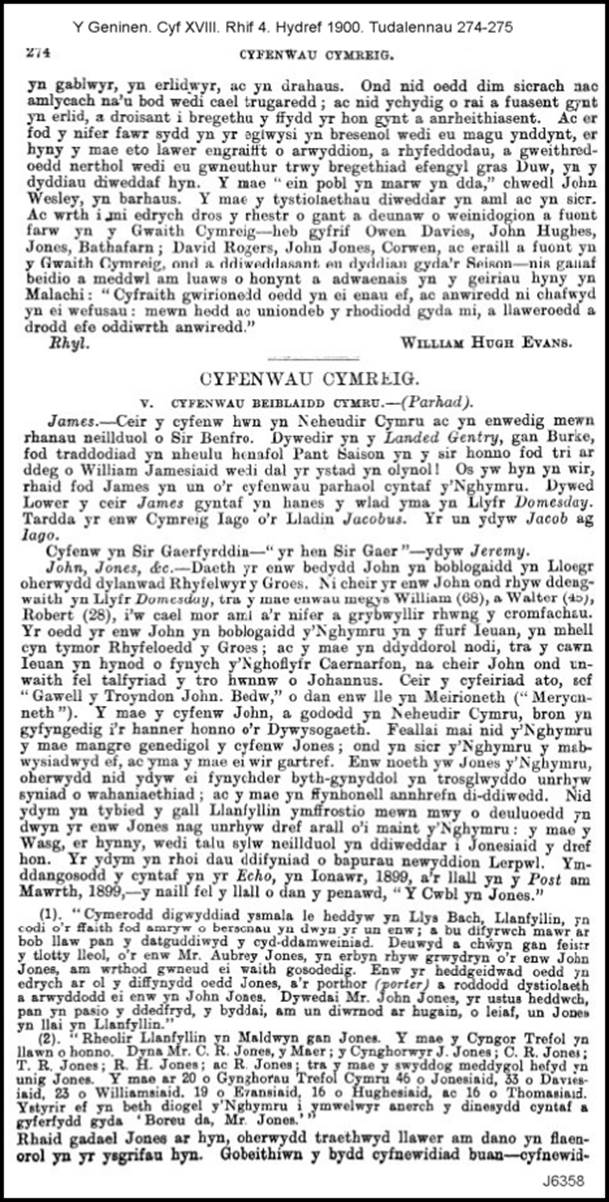
(delwedd J6358) (Hydref 1900) (tudalen 274)
|
Y Geninen. Cyf XVIII.
Rhif 4. Hydref 1900. Tudalennau 274-27
CYFENWAU CYMREIG.
V. CYFENWAU BEIBLAIDD CYMRU.— (Parhad).
James.—Ceir y cyfenw hwn yn Neheudir Cymru ac yn
enwedig mewn rhanau neillduol o Sir Benfro. Dywedir yn y Landed Gentry, gan
Burke, fod traddodiad yn nheulu henafol Pant Saison yn y sir honno fod tri ar
ddeg o William Jamesiaid wedi dal yr ystad yn olynol! Os yw hyn yn wir, rhaid
fod James yn un o'r cyfenwau parhaol cyntaf y'Nghymru. Dywed Lower y ceir
James gyntaf yn hanes y wlad yma yn Llyfr Domesday. Tardda yr enw Cymreig
Iago o'r Lladin Jacobus. Yr un ydyw Jacob ag lago.
Cyfenw yn Sir Gaerfyrddin— "yr hen Sir Gaer"
— ydyw Jeremy.
John, Jones, &c.—Daeth yr enw bedydd John yn
boblogaidd yn Lloegr oherwydd dylanwad Rhyfelwyr y Groes. Ni cheir yr enw
John ond rhyw ddengwaith yn Llyfr Domesday, tra y mae enwau megys William
(68), a Walter (45), Robert (28), i'w cael mor aml a'r nifer a grybwyllir
rhwng y cromfachau. Yr oedd yr enw John yn boblogaidd y'Nghymru yn y ffurf
Ieuan, yn mhell cyn tymor Rhyfeloedd y Groes; ac y mae yn ddyddorol nodi, tra
y cawn Ieuan yn hynod o fynych y'Nghoflyfr Caernarfon, na cheir John ond unwaith
fel talfyriad y tro hwnnw o Johannus. Ceir y cyfeiriad ato, sef "Gawell
y Troyndon John. Bedw," o dan enw lle yn Meirioneth ("Meryonneth").
Y mae y cyfenw John, a gododd yn Neheudir Cymru, bron yn gyfyngedig i'r
hanner honno o'r Dywysogaeth. Feallai mai nid y'Nghymru y mae mangre
genedigol y cyfenw Jones; ond yn sicr y'Nghymru y mabwysiadwyd ef, ac yma y
mae ei wir gartref. Enw noeth yw Jones y'Nghymru, oherwydd nid ydyw ei
fynychder byth-gynyddol yn trosglwyddo unrhyw syniad o wahaniaethiad; ac y
mae yn ffynhonell annhrefn di-ddiwedd. Nid ydym yn tybied y gall Llanfyllin
ymffrostio mewn mwy o deuluoedd yn dwyn yr enw Jones nag unrhyw dref arall
o'i maint y'Nghymru: y mae y Wasg, er hynny, wedi talu sylw neillduol yn
ddiweddar i Jonesiaid y dref hon. Yr ydym yn rhoi dau ddifyniad o bapurau
newyddion Lerpwl. Ymddangosodd y cyntaf yn yr Echo, yn Ionawr, 1899, a'r
llall yn y Post am Mawrth, 1899,—y naill fel y llall o dan y penawd, "Y
Cwbl yn Jones."
(1). "Cymerodd digwyddiad ysmala le heddyw
yn Llys Bach, Llanfyllin, yn codi o'r ffaith fod amryw o bersonau yn dwyn yr
un enw; a bu difyrwch mawr ar bob llaw pan y datguddiwyd y cyd-ddamweiniad.
Deuwyd a chŵyn gan feisír y tlotty lleol, o'r enw Mr. Aubrey Jones, yn
erbyn rhyw grwydryn o'r enw John Jones, am wrthod gwneud ei waith gosodedig.
Enw yr heddgeidwad oedd yn edrych ar ol y diffynydd oedd Jones, a'r porthor (porter)
a roddodd dystiolaeth a arwyddodd ei enw yn John Jones. Dywedai Mr. John Jones,
yr ustus heddwch, pan yn pasio y ddedfryd, y byddai, am un diwrnod ar hugain,
o leiaf, un Jones yn llai yn Llanfyllin."
(2). "Rheolir Llanfyllin yn Maldwyn gan
Jones. Y mae y Cyngor Trefol yn llawn o honno. Dyna Mr. C. R. Jones, y Maer;
y Cynghorwyr J. Jones; C. R. Jones; T. R. Jones; R. H. Jones; ac R. Jones;
tra y mae y swyddog meddygol hefyd yn unig Jones. Y mae ar 20 o Gynghorau
Trefoî Cymru 46 o Jonesiaid, 33 o Daviesiaid, 23 o Williamsiaid. 19 o Evansiaid,
16 o Hughesiaid, ac 16 o Thomasiaid. Ystyrir ef yn beth diogel y'Nghymru i
ymwelwyr anerch y dinesydd cyntaf a gyferfydd gyda 'Boreu da, Mr.
Jones.'"
Rhaid gadael Jones ar hyn, oherwydd traethwyd
llawer am dano yn flaenorol yn yr ysgrifau hyu. Gobeithiwn y bydd cyfnewidiad
buan —-cyfnewid-
|
|
|
|
|
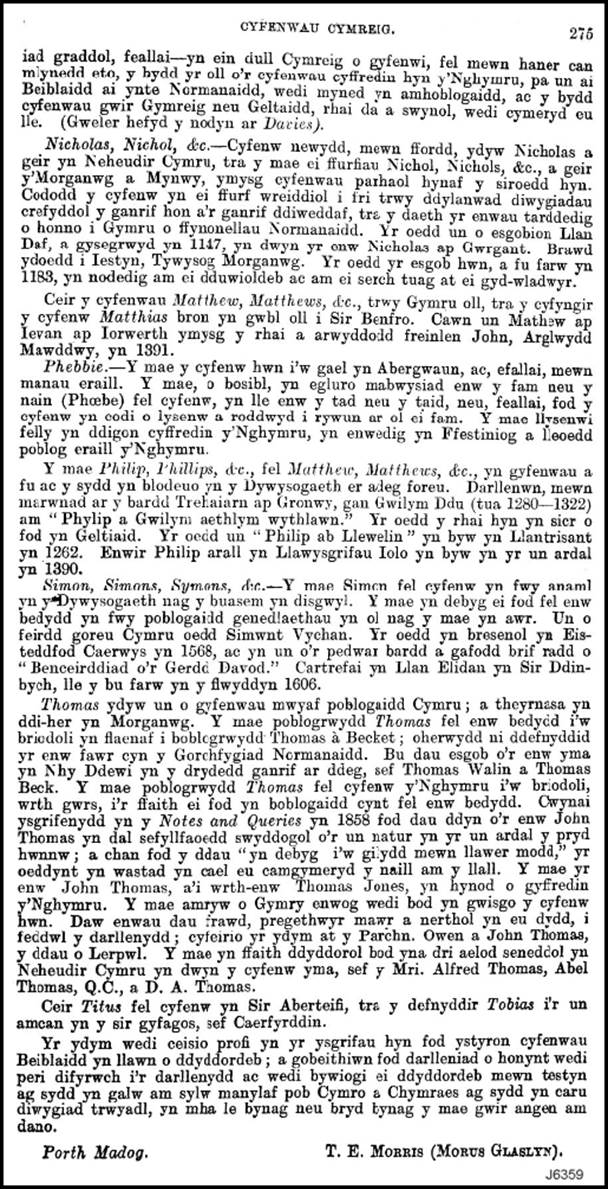
(delwedd J6359) (Hydref 1900) (tudalen 275)
|
CYFENWAU CYMREIG. 275
iad graddol, feallai - yn ein dull Cymreig o
gyfenwi, fel mewn haner can mlynedd eto, y bydd yr oll o'r cyfenwau cyffredin
hyn y'Nghymru, pa un ai Beiblaidd ai ynte Normanaidd, wedi myned yn
amhoblogaidd, ac y bvdd cyfenwau gwir Gymreig neu Geltaidd, rhai da a swynol,
wedi cymeryd eu lle. (Gweler hefyd y nodyn ar Davies).
Nicholas, Nichol, &c—Cyfenw newydd, mewn ffordd,
ydyw Nicholas a geir yn Neheudir Cymru, tra y mae ei ffurfiau Nichol,
Nichols, &c, a geir y'Morganwg a Mynwy, ymysg cyfenwau parhaol hynaf y
siroedd hyn Cododd y cyfenw yn ei ffurf wreiddiol i fri trwy ddylanwad
diwygiadau crefyddol y ganrif hon a'r ganrif ddiweddaf, tra y daeth yr enwau
tarddedig o honno i Gymru o ffynonellau Normanaidd. Yr oedd un o esgobion
Llan Daf, a gysegrwyd yn 1147, yn dwyn yr enw Nicholas ap Gwrgant. Brawd
ydoedd i Iestyn, Tywysog Morganwg. Yr oedd yr esgob hwn, a fu farw yn 1183,
yn nodedig am ei dduwioldeb ac am ei serch tuag at ei gyd-wladwyr.
Ceir y cyfenwau Matthew, Matthews, &c, trwy
Gymru oll, tra y cyfyngir y cyfenw Matthias bron yn gwbl oll i Sir Benfro.
Cawn un Mathew ap Ievan ap Iorwerth ymysg y rhai a arwyddodd freinlen John,
Arglwydd Mawddwy, yn 1391.
Phebbie.—Y mae y cyfenw hwn i'w gael yn
Abergwaun, ac, efallai, mewn manau eraill. Y mae, o bosibl, yn egluro
mabwysiad enw y fam neu y nain (Phoebe) fel cyfenw, yn lle enw y tad neu y
taid, neu, feallai, fod y cyfenw yn codi o lysenw a roddwyd i rywun ar ol eí
fam. Ý mae llysenwi felly yn ddigon cyffredin y'Nghymru, yn enwedig yn
Ffestiniog a lleoedd poblog eraill y'Nghymru.
Y mae Philip, Phillips, &c, fel Matthew,
Matthews, &c, yn gyfenwau a fu ac y sydd yn blodeuo yn y Dywysogaeth er
adeg foreu. Darllenwn, mewn marwnad ar y bardd Trehaiarn ap Gronwy, gan
Gwilym Ddu (tua 1280—1322) am " Phylip a Gwilym aethlym wythlawn."
Yr oedd y rhai hyn yn sicr o fod yn Geltiaid. Yr oedd un " Philip ab
Llewelin " yn byw yn Lìantrisant yn 1262. Enwir Philip arall yn
Llawysgrifau Iolo yn byw yn yr un ardal yn 1390.
Simon, Simons, Symons, &c—Y mae Simon fel
cyfenw yn fwy anaml yn y Dywysogaeth nag y buasem yn disgwyl. Y mae yn debyg
ei fod fel enw bedydd yn fwy poblogaidd genedlaethau yn ol nag y mae yn awr.
Un o feirdd goreu Cymru oedd Simwnt Vychan. Yr oedd yn bresenol yn Eisteddfod
Caerwys yn 1568, ac yn un o'r pedwar bardd a gafodd brif radd o
"Benceirddiad o'r Gerdd Davod." Cartrefai yn Llan Elidan yn Sir
Ddin- bych, lle y bu farw yn y flwyddyn 1606.
Thomas ydyw un o gyfenwau mwyaf poblogaidd Cymru;
a theyrnasa yn ddi-her yn Morganwg. Y mae poblogrwydd Thomas fel enw bedydd
i'w briodoli yn flaenaf i boblogrwydd Thomas à Becket; oherwydd ni ddefnyddid
yr enw fawr cyn y Gorchfygiad Normanaidd. Bu dau esgob o'r enw yma yn Nhy
Ddewi yn y drydedd ganrif ar ddeg, sef Thomas Walin a Thomas Beck. Y mae
poblogrwydd Thomas fel cyfenw y'Nghymru i'w briodoli, wrth gwrs, i'r ffaith
ei fod yn boblogaidd cynt fel enw bedydd. Cwynai ysgrifenydd yn y Notes and
Queries yn 1858 fod dau ddyn o'r enw John Thomas yn dal sefyllfaoedd
swyddogol o'r un natur yn yr un ardal y pryd hwnnw; a chan fod y ddau
"yn debyg i'w gilydd mewn llawer modd," yr oeddynt yn wastad yn
cael eu camgymeryd y naill am y llall. Y mae yr enw John Thomas, a'i wrth-enw
Thomas Jones, yn hynod o gyffredin y'Nghymru. Y mae amryw o Gymry enwog wedi
bod yn gwisgo y cyfenw hwn. Daw enwau dau frawd, pregethwyr mawr a nerthol yn
eu dydd, i feddwl y darllenydd ; cyfeirio yr ydym at y Parchn. Owen a John
Thomas, y ddau o Lerpwl. Y mae yn ffaith ddyddorol bod yna dri aelod seneddol
yn Neheudir Cymru yn dwyn y cyfenw yma, sef y Mri. Alfred Thomas, Abel
Thomas, Q.C, a D. A. Thomas.
Ceir Titus fel cyfenw yn Sir Aberteifi, tra y
defnyddir Tobias i'r un amcan yn y sir gyfagos, sef Caerfyrddin.
Yr ydym wedi ceisio profi yn yr ysgrifau hyn fod
ystyron cyfenwau Beiblaidd yn llawn o ddyddordeb; a gobeithiwn fod darlleniad
o honynt wedi peri difyrwch i'r darllenydd ac wedi bywiogi ei ddyddordeb mewn
testyn ag sydd yn galw am sylw manylaf pob Cymro a Chymraes ag sydd yn caru
diwygiad trwyadl, yn mha le bynag neu bryd bynag y mae gwir angen am dano.
Porth Madog. T. E. Morris (Morus Glaslyn).
|





 B5237: